Samizdat

Publishing the Forbidden. All Rights Reserved. © Samizdat 2014-2025.

Tag: Babylonia

Editorial Note on the Apkallu and the Roadmap Ahead

I am breaking the narrative stream to speak directly to the process emerging from our reading on the apkallū, the antediluvian and postdiluvian sages of ancient Mesopotamia.

If you are reading along over my shoulder, you noticed that we digressed from Martin Lang, “Mesopotamian Early History and the Flood Story,” in a post titled On the Date of the Flood.

Martin Lang wrote:

“Berossos’ own knowledge of primordial kings probably goes back to sources that were available in Hellenistic times. The Sumerian King List itself was still known in the Seleucid era, or rather versions of king lists that echo, structurally and stylistically, their ancient forerunners from the early second millennium.

In matching up the primordial kings with the seven sages, the apkallū, Berossos once again works in the vein of contemporary scholars, who demonstrably constructed lists with kings and apkallū in order to advertise their own importance, and the primordial roots of their knowledge, as Alan Lenzi has recently shown.”

I updated that post to include a link to Alan Lenzi, “The Uruk List of Kings and Sages and Late Mesopotamian Scholarship,” JANER 8.2, 2008, which is serialized and linked in posts below.

I also changed the link to the Sumerian King List to point to the beautiful 1939 edition by Thorkild Jacobsen generously published by the University of Chicago Press, available for free download off the web.

We then dipped into Anne Draffkorn Kilmer, “The Mesopotamian Counterparts of the Biblical Nephilim,” in Francis I. Andersen, et al, eds., Perspectives on Language and Text: Essays and Poems in Honor of Francis I. Andersen’s Sixtieth Birthday, 1985, in a post titled On the Apkallū.

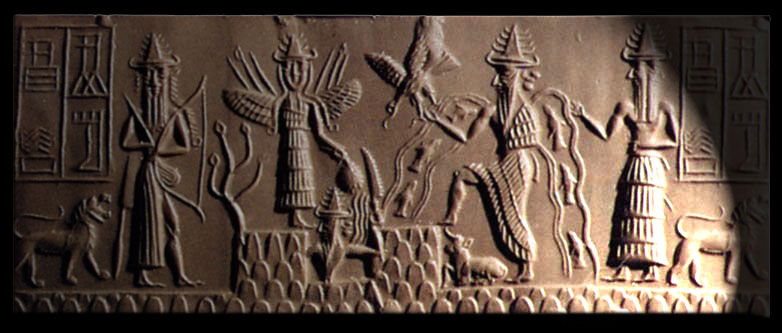
This is where I drilled in hard on the apkallū, incorporating bas reliefs and figurines held at the Louvre and the British Museum. Out of numerous posts addressing the apkallū, this one is well-illustrated, and lushly hyperlinked.

Moreover, Anne Kilmer synthesized the supporting research on the apkallū at the time of writing very effectively, so if you are overwhelmed by the other articles, just read this one. It goes without saying that you should not be intimidated by this academic literature. I have made it as readable and accessible as I can.

Yes, there is a lot of it. As I excavate the academic literature on the apkallū the hard way, mining references from footnote after footnote, I get a sense of what it might be like, to be an academic Assyriologist rather than an autodidact.

I do not include everything that I find. I assess and include just those pieces which accrue gravitas in that greater academic community. If you see glaring omissions, please let me know. This note is shaping up to be an academic survey of the literature on the apkallū, and it may save others treading these same paths some time.

Fair warning: our continuing digression into the apkallu will be deep.

As I complete serialization of source texts, I will include links to the posts beneath their citation below. These sources are sorted by date, so we can track the evolution of academic thinking on the apkallū. Our digression includes excerpts from:

After we complete our deep dive into the apkallu, we will return to the Sumerian King List, then resume with Berossos. This is the roadmap ahead.

Editorial note: In some cases citations above which are not followed by links in the bulleted list are internet dry holes, no digital versions are available. In other cases, links are to Google Books editions, which often limit visible pages. Google’s intent is to sell electronic versions of the texts that they scan.

Under these circumstances, I end up rekeying entire articles, at ruinous waste of time. If you have a moment, please send a sweet nastygram to Google asking them to post free and complete eBooks as they continue their vast project to digitize the entirety of human knowledge.

In other cases, I simply have not yet reviewed the articles and posted them. If you are following this project, you see that I post updates nearly every day. Stay tuned.

My purpose in publishing Samizdat is to highlight excerpts from the great books, mining synchronicities from legends and myths. As I point out in the About page, the Deluge was an historical event for the ancient Sumerians.

I now need to update that page, incorporating the research that we have already completed on the Sumerian King List, setting up a future digression into the concept of the Great Year, which Berossos associated with traditions of a Conflagration and the Deluge.

If you wondered where we were going, I wrote this for you.

 Updated 20 November 2015, 23:39 hrs.

Is the šãru the Solution to the Impossibly Long Antediluvian Reigns?

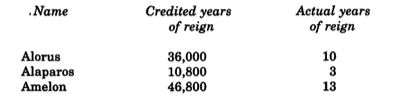
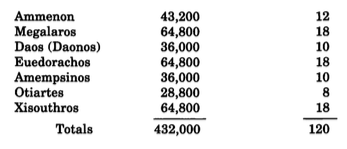
“Regardless of the names, however, it is apparent that when the formula for calculating the actual length of reigns is applied, the figures on Berossos’ list of ancient Sumerian kings are amenable to precisely the same treatment as the original Sumerian King List.

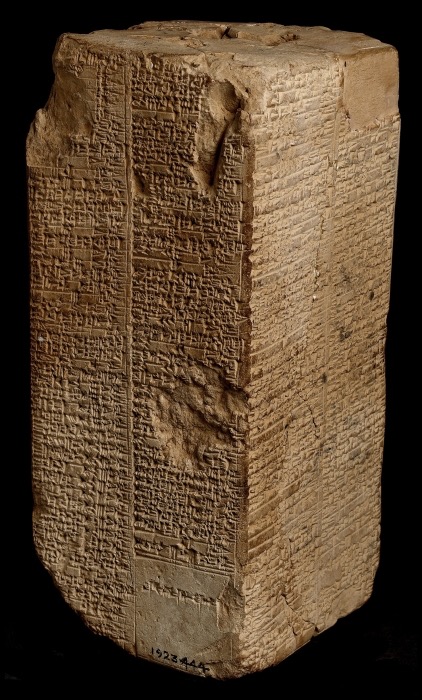
Among all the extant exemplars of the Sumerian King List, the Weld-Blundell prism in the Ashmolean Museum cuneiform collection represents the most extensive version as well as the most complete copy of the King List.  In this depiction, all four sides of the Sumerian King List prism are portrayed.  http://cdli.ox.ac.uk/wiki/doku.php?id=the_sumerian_king_list_sklid=the_sumerian_king_list_skl

Among all the extant exemplars of the Sumerian King List, the Weld-Blundell prism in the Ashmolean Museum cuneiform collection represents the most extensive version as well as the most complete copy of the King List.
In this depiction, all four sides of the Sumerian King List prism are portrayed.
http://cdli.ox.ac.uk/wiki/doku.php?id=the_sumerian_king_list_sklid=the_sumerian_king_list_skl

This indicates that Berossos was thoroughly familiar with the Sumerian system of computing lengths of reigns, as expressed on the Weld-Blundell prism, and that he was representing the priestly tradition many centuries later in his own configurations.

The revised king list of Berossos is as follows:

Revised King List of Berossus 1Revised King List of Berossos 2

Berossos’ figures constitute a remarkable tribute to the tenacity of ancient priestly traditions, since the Babylonians had normally used base-10 in their mathematical calculations for many centuries. Berossos, however, felt a commitment to honor the ancient heroes whom he was listing in the age-old Sumerian manner.

In attempting to provide a “rational” solution to the problem of large numbers in the antediluvian King List, I have said nothing as to precisely why base-60 squared was employed in the listing.

Scholars who have checked the numbers are satisfied that they have been transcribed accurately, with the result that the issue must now turn on mathematical considerations, as Young has suggested. From a prima facie standpoint it is no longer legitimate to question the numbers themselves, but instead to recognize the possibility that base-60 squared was actually functioning as a mathematical constant.

So little insight has been gained into the theoretical dynamics of Sumerian mathematics that it is impossible to say with certainty what the reason was for employing base-60 squared as a constant, assuming that this was its actual function in the King List, as seems eminently probable.

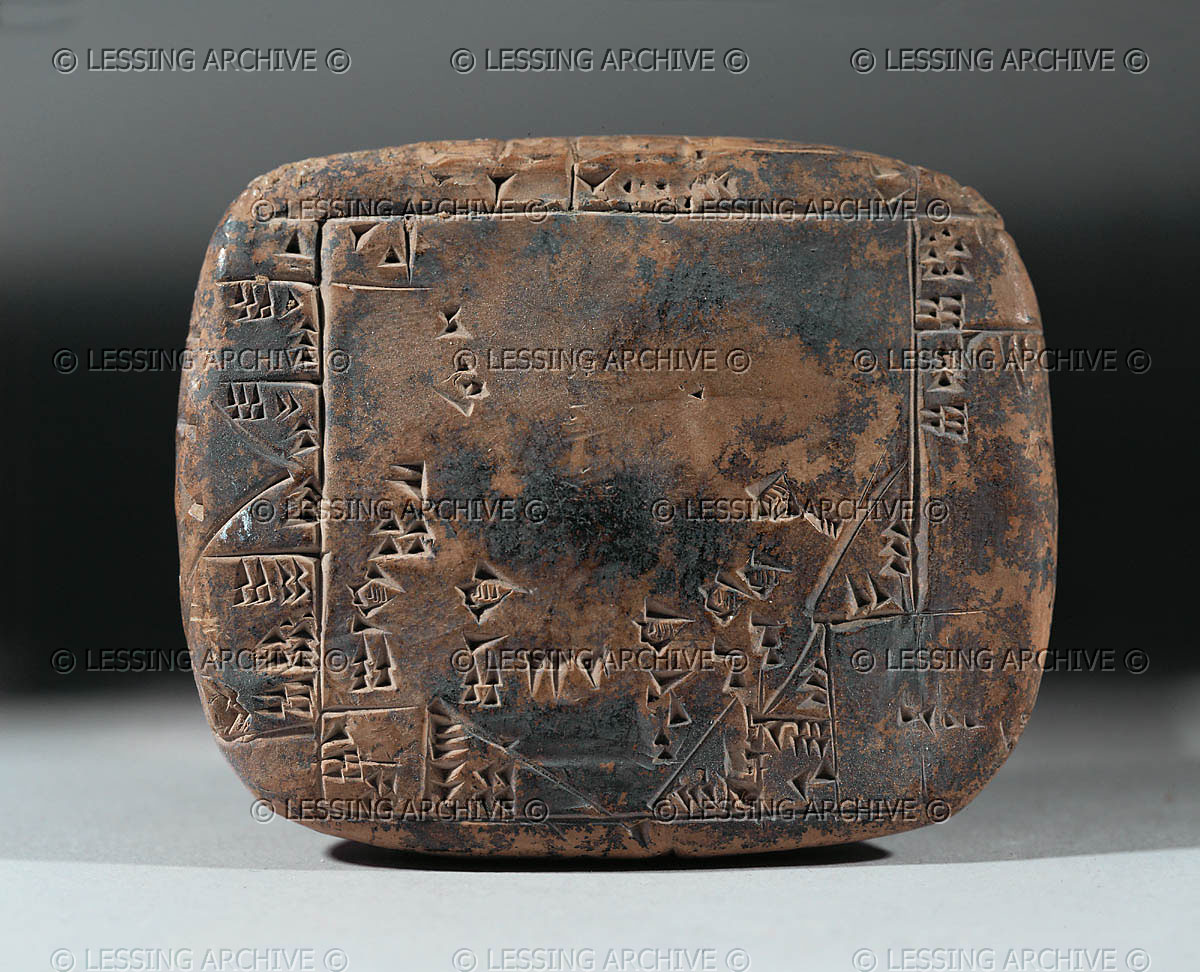
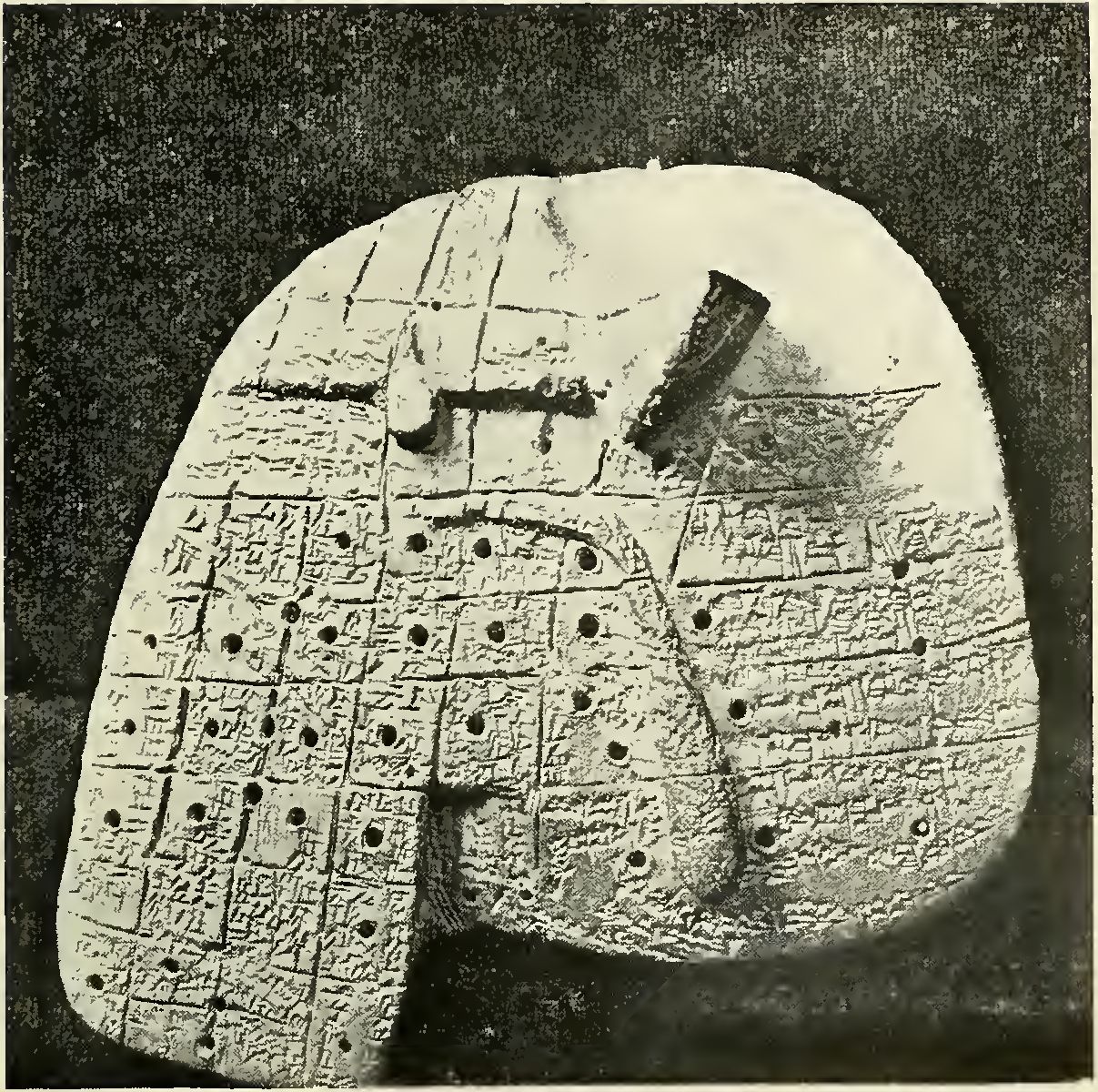
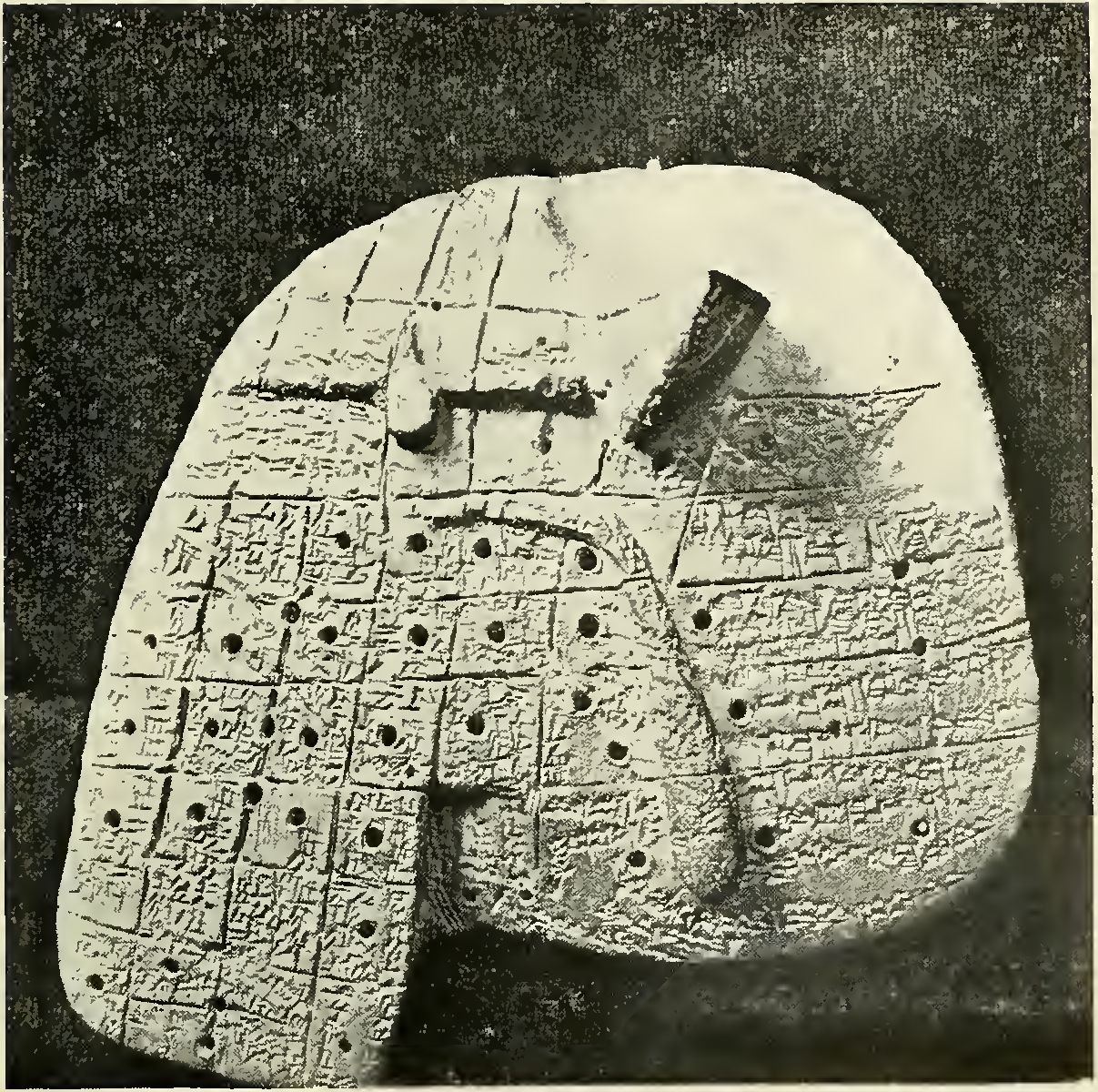
Calculation of the surface area of terrain at Umma, Mesopotamia (Iraq). Ur III Clay tablet (2100 BCE) 7 x 5.8 cm AO 5677, Louvre Museum. http://www.lessingimages.com/viewimage.asp?i=08020612+&cr=328&cl=1

Calculation of the surface area of terrain at Umma, Mesopotamia (Iraq). Ur III Clay tablet (2100 BCE) 7 x 5.8 cm AO 5677, Louvre Museum.
http://www.lessingimages.com/viewimage.asp?i=08020612+&cr=328&cl=1

It was certainly integral to the structure of the various recorded reigns, unlike some constants in modern mathematics that grace an equation but are not indispensable entities. Why base-60 should have been squared in order to perform its function satisfactorily is also problematical. Perhaps, after all, base-60 squared was intended to serve as a symbol of relative power and importance, which the compilers of the ancient Sumerian King List associated with those men whose reigns they recorded.

Regardless of the immediate answers to these queries, it seems clear that base-60 squared should be recognized as an “ideal” constant, which, however, must be factored out once it has been isolated so that it is not reckoned as part of the overall calculation.

In any event, we know that the ancient Sumero-Babylonian sexagesimal system employed at least the following mathematical bases as units: 60° (= 1), which in Akkadian was called ištēn; 60 (to the first power) 1 (= 60), which was called šūšu; 60 (to the second power) 2 (= 3600), which was called šãru; and 60 (to the third power) 3 (= 216,000), which was called šuššārū. The word šãru had a Sumerian antecedent (šár) that means not only “3600” but also “universe.” (See footnote 17 below).

In later times the Greeks put the sexagesimal system to full use, “both in the familiar division of the circumference of the circle into 360 “degrees’ of 60 minutes or 3600 seconds each, and in the division of the radius into units of consecutive sixtieths.” By employing the šãru as the key to unlocking the antediluvian numbers in the Sumerian King List as well as in Berossos, we find ourselves not only discerning “rational” numbers depicting the length of royal reigns in those ancient chronological tables but also walking in the footsteps of noble mathematical tradentes.”

Footnote 17:

O. Neugebauer, The Exact Sciences in Antiquity (2d ed.; New York: Harper, 1957) p. 141. U. Cassuto, A Commentary on the Book of Genesis. Part I: From Adam to Noah (Genesis I-VI 8) (Jerusalem: Magnes, 1961) p. 258, has observed that the 241,200 of the antediluvian Sumerian King List equals one great šãru (šuššārū—i.e., 216,000—plus seven šãru—i.e., 7 χ 3600 or 25,200) and that the 432,000 of Berossos equals 120 šãru (i.e., 120 χ 3600) or two great šãru (= two šuššārū—i.e., 2 χ 216,000).

Footnote 19:

I am deeply indebted to my daughters, C. Felicity Harrison and H. Judith Virta, for reviewing this paper critically, to my son, Graham K. Harrison, for technical advice involving the mathematical analysis, and to Ronald Youngblood for the Sumero-Akkadian and Greek information in the final paragraph and for the references in nn. 17 and 18 (footnote 18 omitted here).

R.K. Harrison, “Reinvestigating the Antediluvian Sumerian King List,” Journal of the Evangelical Theological Society (JETS) 36 / 1 (March 1993), pp. 6-8.

Oannes and the Apkallu, the Seven Sages of Sumeria

“Placed between two other books, Babyloniaca 2 takes on the function of a narrative pivot in Berossos’ work. It has connections with book one and book three, by way of recapitulation (e.g. Oannes and the sages) and anticipation (mention of kings who are treated in book three); and it brings into contact two fundamentally different periods in history: the mythic prehis­tory of book 1, which is cast as a revelation transmitted by the semi-divine sage Oannes; and the political history of book 3, which bears out Oannes’ revelation in a setting where gods and humans are much more clearly separate.

Book 2 of Berossos’ Babyloniaca contains, as far as we can tell, the history of Babylonian kingship organised according to a very tra­ditional pattern. Broadly speaking, it comprises the ten kings before the Flood, the deluge narrative and a concise history of rulers down to Nabonassar.

Among all the extant exemplars of the Sumerian King List, the Weld-Blundell prism in the Ashmolean Museum cuneiform collection represents the most extensive version as well as the most complete copy of the King List. It lists rulers from the antediluvian dynasties to Suen-magir, the fourteenth ruler of the Isin dynasty (ca. 1763–1753 B.C.). The prism contains four sides with two columns on each side. Perforated, the prism must originally have a wooden spindle going through its centre so that it might be rotated and read on all four sides. http://cdli.ox.ac.uk/wiki/doku.php?id=the_sumerian_king_list_sklid=the_sumerian_king_list_skl

Among all the extant exemplars of the Sumerian King List, the Weld-Blundell prism in the Ashmolean Museum cuneiform collection represents the most extensive version as well as the most complete copy of the King List. It lists rulers from the antediluvian dynasties to Suen-magir, the fourteenth ruler of the Isin dynasty (ca. 1763–1753 B.C.). The prism contains four sides with two columns on each side. Perforated, the prism must originally have a wooden spindle going through its centre so that it might be rotated and read on all four sides.
http://cdli.ox.ac.uk/wiki/doku.php?id=the_sumerian_king_list_sklid=the_sumerian_king_list_skl

The structural backbone of the book is a king list, more specifically, the so-called Sumerian King List in a version which contains sections before and after the Flood. The time before the Flood is structured by the succession of antediluvian kings, that after the Flood traces the reigns of postdiluvian kings, thus forming a narrative diptych around the central Flood narrative. Eusebius describes the overall effect as follows:

“This Berosos narrated in his first book, and in the second he wrote ordering the kings one after another… In collecting the names of the kings he collects [that] alone, but he tells nothing pre­cise of their deeds, indeed he did not consider them worthy of mention […].”

Eusebius’ complaint notwithstanding, Berossos does seem to have fleshed out the skeleton of his king list with some narrative interludes. For example, he inserts references to the antediluvian sages, a peculiarity paralleled in cuneiform sources of the Hellenistic period.

The combination of the list itself and the Flood narrative continued unchanged down to the first millennium BCE and is also attested in some fragments from the Neo-Assyrian and Late Babylonian period.

More specifically, Berossos connects the beginnings of humanity with the Oannes theme from book one. As far as we can tell, that theme appeared twice in the Babyloniaca: near the beginning of the work, Berossos introduces Oannes as the ‘paragon of Mesopotamian scholarly mysticism and wisdom’.

‘In the very first year’, a fearsome beast named Oannes appears out of the Red Sea and teaches humankind the arts of civilisation. In book 2, we learn that he is only the first in a series of other such beasts (F3a).

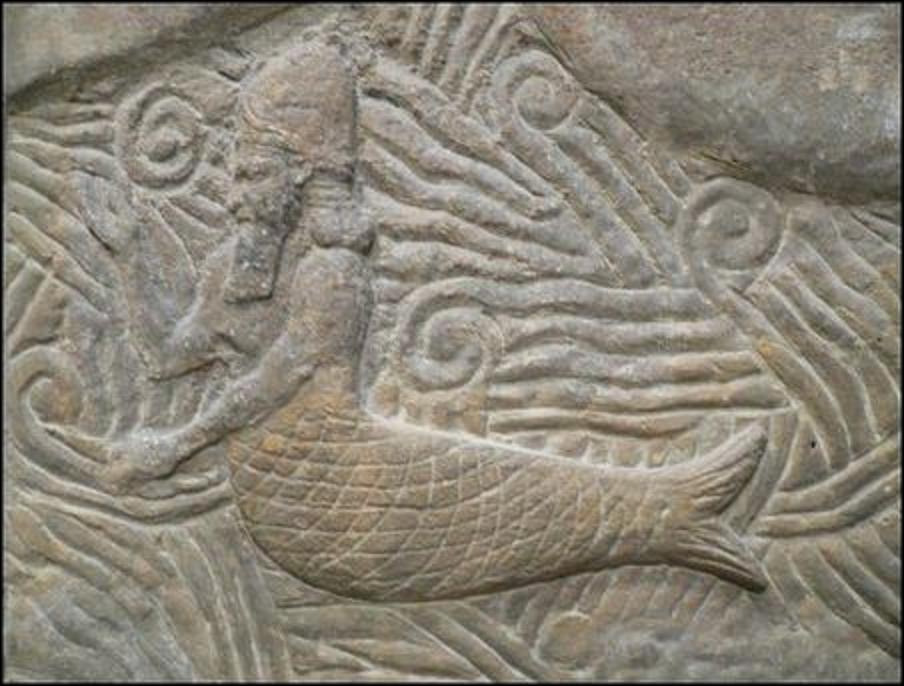
This protective spirit (Apkallu or Abkallu) guarded the entrance to the temple of Ninurta at Nimrud. A fish's head can be seen on Apkallu's head, and its skin hangs down over the back of Apkallu's body.  Neo-Assyrian era, 865-860 BCE. From the Temple of Ninurta, Nimrud (ancient Kalhu; Biblical Calah), northern Mesopotamia, Iraq. (The British Museum, London). Osama Shukir Muhammed Amin FRCP (Glasg) http://www.ancient.eu/image/2708/

This protective spirit (Apkallu or Abkallu) guarded the entrance to the temple of Ninurta at Nimrud. A fish’s head can be seen on Apkallu’s head, and its skin hangs down over the back of Apkallu’s body.
Neo-Assyrian era, 865-860 BCE. From the Temple of Ninurta, Nimrud (ancient Kalhu; Biblical Calah), northern Mesopotamia, Iraq. (The British Museum, London).
Osama Shukir Muhammed Amin FRCP (Glasg)
http://www.ancient.eu/image/2708/

Oannes, however, is clearly the most important: he is depicted as more than a mere culture hero but acts as some­thing very close to a creator god himself, shaping amorphous matter and turning mindless creatures into human beings with an identity and creative intelligence.

Oannes alone is responsible for the growth of human civilisation and its manifestations in history. Moreover, in describing his intervention, Berossos combines what in Sumero-Akkadian tradition were known as divine acts of creation with the teachings that humanity traditionally attributed to the apkallu, the mysterious seven sages who were created and inspired by Enki/Ea, the god of wisdom.

Part of the reason here, I suspect, might be that Berossos tried to make Oannes more plausible to a Greek audience by giving him some of the attributes of the Platonic δημιουργός (dēmiurgós), who acts ‘like a versatile artist or craftsman, creates his work from available materials according to a predetermined plan (PI. Resp. 507c; 530 a; 597b ff.; PI. Soph. 265c ff.; PI. Pit. 269c ff.; 272e ff.; PI. 7V.)’.

The aim is to underline the enormous age of Babylonian culture, the beginnings of which coincide with the dawn of all human culture. It is significant therefore that Berossos recapitulates the Oannes theme when he finally starts his account of human history in Babyloniaca 2.”

Martin Lang, “Book Two: Mesopotamian Early History and the Flood Story,” from Johannes Haubold, Giovanni B. Lanfranchi, Robert Rollinger, John Steele (eds.), The World of Berossos, Proceedings of the 4th International Colloquium on the Ancient Near East Between Classical and Ancient Oriental Traditions, Harrassowitz Verlag, Wiesbaden, 2013, pp. 48-9.

Barbarian Wisdom and Berossus

“Tiamat’s monsters were characterised by a mixture of animal and human features. If my reconstruction is broadly correct, Berossos filled the void left by their demise with separate creation accounts for each of these categories of being.

The Enūma Eliš has nothing to say about the creation of animals, but does describe human creation in some detail. Berossos agrees broadly with its account of human creation, though some details differ.

Above all, Berossos claims that Bel used his own blood to create mankind whereas in the epic Marduk uses that of another god. Berossos may or may not have found this version of events in now lost Mesopotamian texts, but the question remains why he introduced it here, against the pull of his main source.

The answer, one suspects, was once again that he was keen to cater for the tastes of his Greek readers. In Enūma Eliš, as in other Mesopotamian texts, mankind descends from a rebel against the emerging order of the universe.

Among other things, that explains why we must shoulder the gods’ work and lead a life of misery. In Berossos, this typically Babylonian view of human life is developed into one that would have spoken to educated Greeks: the blood that flows in our veins is not after all that of a devil but of Zeus no less: and so it is that we are endowed with νους (‘intelligence’), and divine φρόνησις (‘understanding’).

De Breucker points out that Berossos is here elaborating on an idea which he found in the Babylonian Poem of the Flood or Atrahasis, where the god (W)ē, ‘who has intelligence’ (Akkadian tēmu) is slaughtered to create man.

This is an interesting detail, for it shows that Berossos creatively combined diverse Babylonian sources. But he did more than merely cut and paste what he found: in the Babyloniaca the ruling god himself gives of his intel­ligence.

One last time, the preferred version of the story seems chosen for its resonances with Greek, and more specifically Stoic, thought. The Stoic god is himself νους, or νοερός. The same must be true of Bel in Berossos, for as recipients of his blood we too are νοεροί.

Indeed, we are also endowed with divine understanding, φρόνησις. In allegorical terms, Athena is φρόνησις, sprung from the head of Zeus, which may explain why decapitation becomes an issue in Berossos whereas it plays no role in Enūma Eliš or Atrahasis: the story which describes Zeus giving birth to Athena / Phronesis from his head was much-discussed in Stoic circles from Greece to Babylon itself. Berossos, it would seem, alludes to it here.

There is much in the Babyloniaca that will remain forever lost to us. The extant fragments are scanty, and often do not allow us to reconstruct with certainty what Berossos wrote, or even what he intended. That is a fact which must be accepted.

But I also hope to have shown that progress can be made; and that, through careful and sympathetic reading, we can often gain a fairly good sense of what Berossos was trying to achieve. I have argued that Book 1 of the Babyloniaca was in many ways Berossos’ signature piece. It is here that he establishes his credentials as a conveyor of barbarian wisdom, one of the few subject positions that were available to a non-Greek wishing to address a Greek audience.

Already Aristotle thought that the Chaldaeans were among those who invented philosophy, so for once Berossos had a positive stereotype with which to work. He embraced the project with gusto, conjuring up the super-sage Oannes, who was equally at home in water and darkness as in daylight and air (who better to describe how these principles coalesced to form the cosmos?); and putting in the mouth of this creature a cosmogonic myth that could literally not have been more ancient: after all, Oannes appears in year one of human history.

Oannes.

Oannes.

Yet, ancient as it is, Oanneslogos becomes philosophically fresh when read through Berossos’ rationalising lens. What is on display here is both age-old barbarian wisdom and cutting-edge Greek philosophy, or rather, a pretence to cutting-edge philosophy.

Stoic el­ements are predominant, partly because Stoicism was the best-selling brand of philosophy at the time, and partly, one suspects, because it lent itself to the project of educating a king. But Berossos does far more than simply default to the Stoa. He shows that he can do Empedocles too. Above all, he throws in outrageous intellectual feats of his own, none more outrageous than his numerical equation of Omorka / Tiamat with Selene, the moon (BNJ 680 F lb (6)).

This too has sometimes been branded an interpolation, but it strikes me as quintessential Berossos, precisely the kind of thing this author would do. Book 1 of the Babyloniaca was his opportunity to shine, and he made sure he took it. Abydenos was right to summarises the contents of the book as ‘the wisdom of the Chaldaeans’ (BNJ 685 F2b). That is surely how Berossos intended it.”

Johannes Haubold, “The Wisdom of the Chaldaeans: Reading Berossos, Babyloniaca Book 1,” from Johannes Haubold, Giovanni B. Lanfranchi, Robert Rollinger, John Steele (eds.), The World of Berossos, Proceedings of the 4th International Colloquium on the Ancient Near East Between Classical and Ancient Oriental Traditions, Harrassowitz Verlag, Wiesbaden, 2013, pp. 41-3.

Berossos and Chimeras

” … The point is rather that he ex­ploited convergences between Greek and Mesopotamian thought so as to present himself as the kind of man whom Hellenistic Greek audiences would have recognized as σοφός, ‘wise’, or φιλόσοφος, ‘a lover of wisdom’.

In pursuit of this goal, Berossos seems to have proceeded eclectically, one might even say, opportunistically. His account of Tiamat’s army is telling in this regard. As expected, Berossos takes inspiration from the Enūma Eliš.

But he lists many creatures that are not found in the Babylonian epic, and some at least seem specifically added to appeal to a Greek audience. What is more, Berossos fundamentally changes the tone and overall meaning of the original, transforming the list of Tiamat’s monsters into a piece of philosophical speculation in the vein of Empedocles:

(It is said that) many creatures with two faces and two chests came into being, offspring of cows, with human prows, and others again growing forth with human physique and the head of oxen, mixed beings, partly equipped with female and partly with male members (Empedocles F61 DK).

Berossos’ account offers some remarkable similarities:

There was a time, he says, when everything was [darkness and] water and that in it fabulous beings with peculiar forms came to life. For men with two wings were born and some with four wings and two faces, having one body and two heads, male and female, and double genitalia, male and female.

Other men were born, some having the legs and the horns of goats, others with the feet of horses. Yet others had the hind parts of horses, but the foreparts of men, and were hippocentaurs in form.

Bulls were also engendered having the heads of men as well as four-bodied dogs having the tails of a fish from their hind parts, dog-headed horses and men and other beings having heads and bodies of horses, but tails of fish and still other beings having forms of all sorts of wild animals.

In addition to these, there were fish and reptiles and snakes and many other marvellous creatures differing in appearance from one another. Images of these were also set up in the temple of Belos.

The parallels between Empedocles and Berossos are glaring (bull-men, two-faced crea­tures, gender confusion, etc.), but can we seriously entertain the possibility that Berossos responded to Presocratic philosophy?

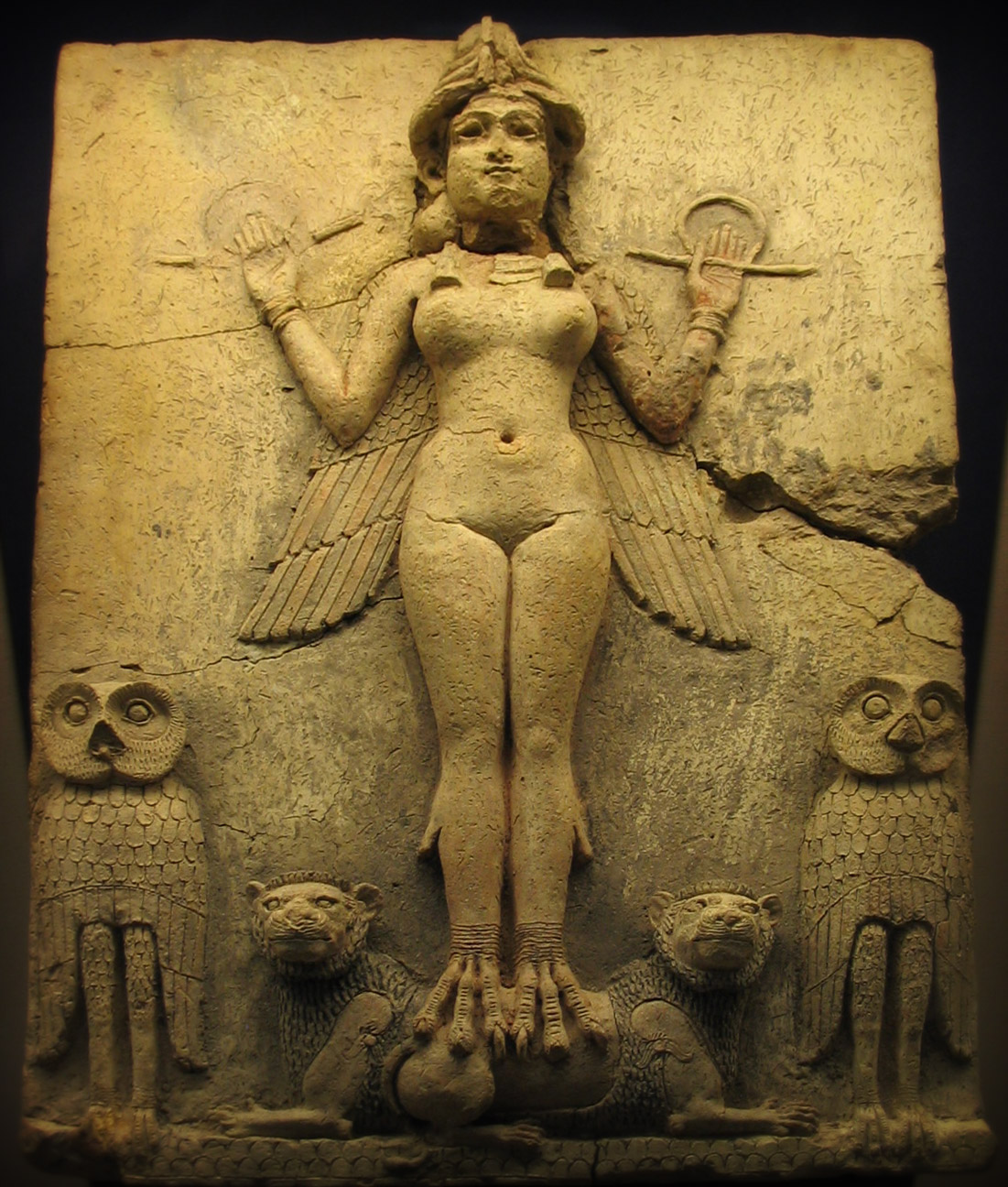
The Burney Relief, Babylon (1800-1750 BCE). A portrayal of Ishtar or Ereshkigal. In line with the descriptions of Berossos, this goddess has wings and owl's feet.  https://upload.wikimedia.org/wikipedia/commons/1/19/Burney_Relief_Babylon_-1800-1750.JPG

The Burney Relief, Babylon (1800-1750 BCE). A portrayal of Ishtar or Ereshkigal.
In line with the descriptions of Berossos, this goddess has wings and owl’s feet.
https://upload.wikimedia.org/wikipedia/commons/1/19/Burney_Relief_Babylon_-1800-1750.JPG

Allowing ourselves to contemplate this question can be a salutary exercise, but it need be no more than that: Berossos did not have to read Empedocles in order to learn about spontaneous generation. For that is what is at issue here: like Empedocles and others before him, Berossos presents his monsters as spontaneously sprung from primordial moisture: what was theogonic myth in Enūma Eliš becomes for him a question of physics.

And a hotly debated question at that: Empedocles always remained associated with the idea of primordial monsters, but already Aristotle built it into a much more far-reaching argument about purpose in nature.

[ … ]

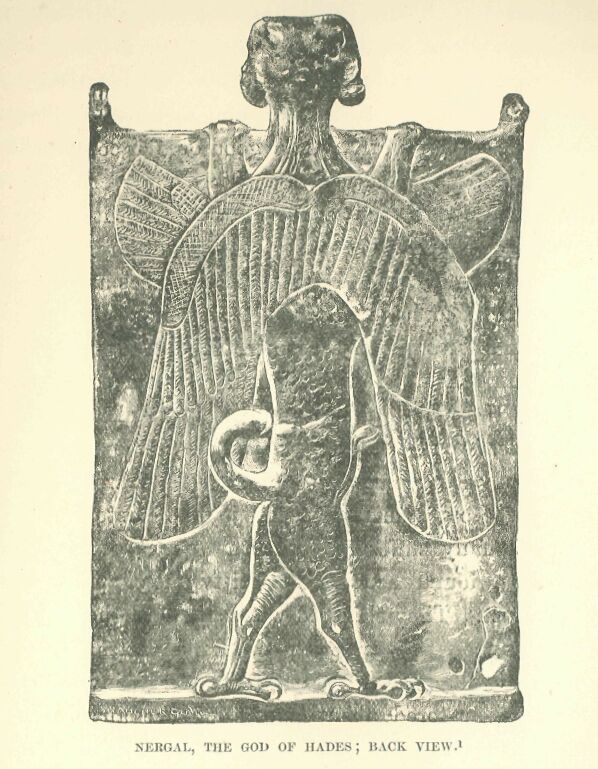
A depiction of Nergal, patron god of Kutha.

A depiction of Nergal, patron god of Kutha.

Apollonius exploits the fact that early monsters were a source of ‘wonder’ (θάμβος), an idea which recalls Berossos’ emphasis on the miraculous nature of Tiamat’s creatures (τερατώδη, θαυμαστά). At a fairly basic level, this kind of thing was good box office.

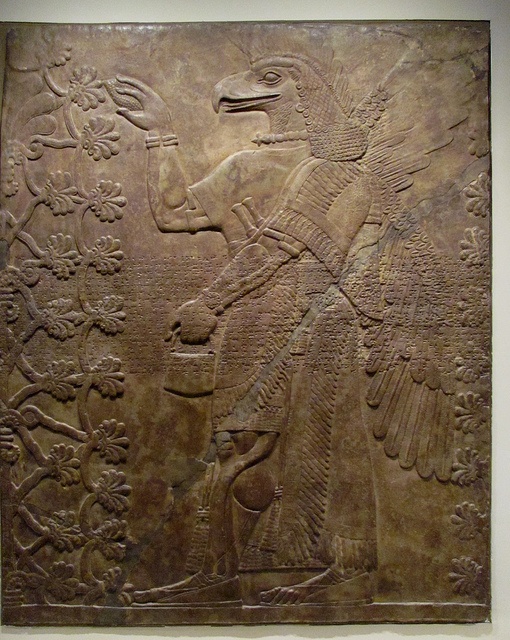
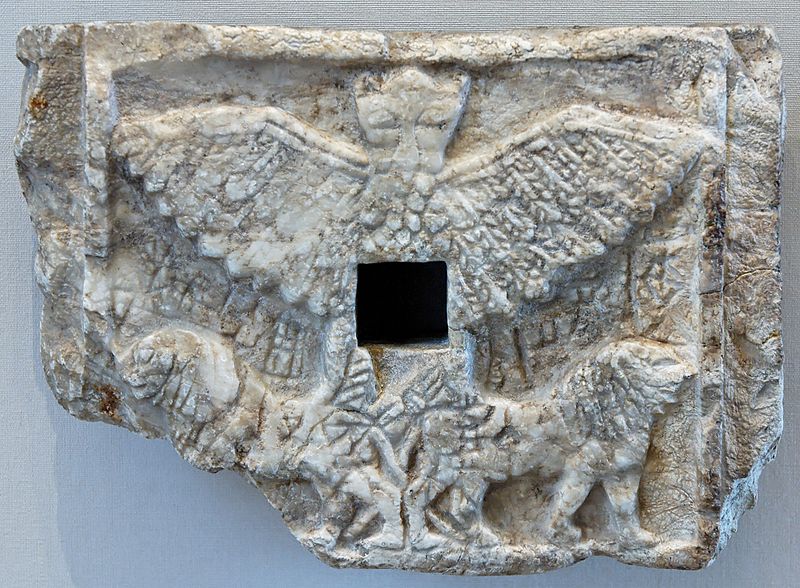
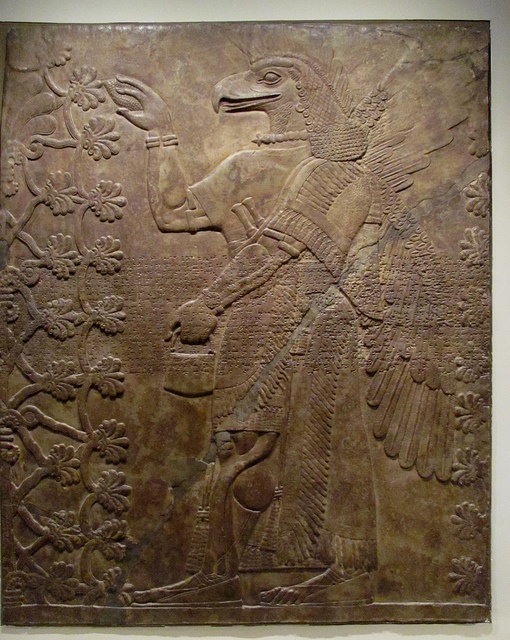
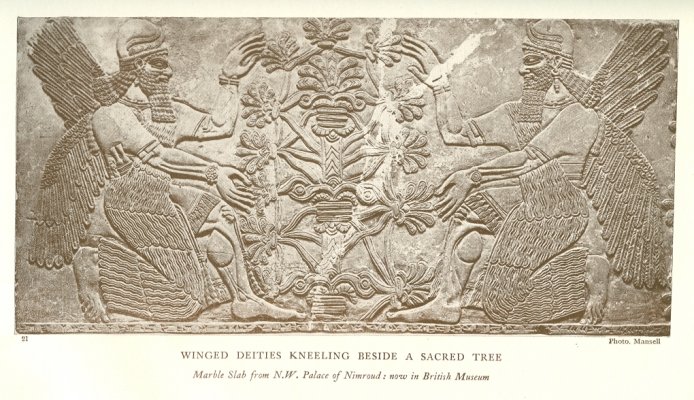
A bas relief in the Louvre.  I am unsure what to make of these eagle-headed entities. Some old sources claim that they portray Asshur.  Others call them "genies," and note that they have wings, which is an indicator of divinity.  In this case the being tends to a tree of life, or tree of knowledge.  This bas relief is in the Louvre.  Primary publicationNimrud NW Palace I-24 = RIMA 2.0.101.023, ex. 189 (f) Collection	Nimrud, Iraq (a); British Museum, London, UK (b); Louvre Museum, Paris, France (c); Nimrud, Iraq (d); Detroit Institute of Arts, Detroit, Michigan, USA (e); British Museum, London, UK; Louvre Museum, Paris, France (f); unlocated (g) Museum no.	Nimrud fragment no. 42 (a); BM 098061 (b); AO 22198 (c); Nimrud fragment no. 43 and 45 (d); DIA 47.181 (e) (photo: DIA); AO 19849 (f); unlocated (g) Accession no.	1903-10-10, 0002 (b) Provenience	Kalhu (mod. Nimrud) Excavation no.	 Period	Neo-Assyrian (ca. 911-612 BC) Dates referenced	Assurnasirpal2.00.00.00 Object type	other (see object remarks) Remarks	slab, relief Material	stone: limestone Language	Akkadian Overview at

I am unsure what to make of these eagle-headed entities. Some old sources claim that they portray Asshur.
Others call them “genies,” and note that they have wings, which is an indicator of divinity.
In this case the being tends to a tree of life, or tree of knowledge.
This bas relief is in the Louvre.
Primary publication Nimrud NW Palace I-24 = RIMA 2.0.101.023, ex. 189 (f)
Collection Nimrud, Iraq (a); British Museum, London, UK (b); Louvre Museum, Paris, France (c); Nimrud, Iraq (d); Detroit Institute of Arts, Detroit, Michigan, USA (e); British Museum, London, UK; Louvre Museum, Paris, France (f); unlocated (g)
Museum no. Nimrud fragment no. 42 (a); BM 098061 (b); AO 22198 (c); Nimrud fragment no. 43 and 45 (d); DIA 47.181 (e) (photo: DIA); AO 19849 (f); unlocated (g)
Accession no. 1903-10-10, 0002 (b)
Provenience Kalhu (mod. Nimrud)
Period Neo-Assyrian (ca. 911-612 BC)
Dates referenced Assurnasirpal2.00.00.00
Material stone: limestone
Language Akkadian
Overview at <http://cdli.ucla.edu/projects/nimrud/index.html&gt;

Yet, we have seen that primordial monsters also had a more serious philosophical point. Apart from Aristotle, the Epicureans too grappled with the legacy of Empedocles’ idea, accepting spontaneous generation as an important part of their non-teleological account of the universe, but reject­ing some of its more extravagant implications.”

Johannes Haubold, “The Wisdom of the Chaldaeans: Reading Berossos, Babyloniaca Book 1,” from Johannes Haubold, Giovanni B. Lanfranchi, Robert Rollinger, John Steele (eds.), The World of Berossos, Proceedings of the 4th International Colloquium on the Ancient Near East Between Classical and Ancient Oriental Traditions, Harrassowitz Verlag, Wiesbaden, 2013, pp. 37-9.

The Priest of Bel was Actually a Greek Philosopher

“Clearly, we need to allow for the possibility that some of these apparent similarities are fortuitous, just as we also need to allow for historically grown similarities between Ancient Greek and Mesopotamian thought: after all, these two cultures had long been part of the same Eastern Mediterranean world.

But there are at least two reasons for believing that Berossos really did cast himself as a philosopher in the vein of a Zeno. First, his reading of the Enūma Eliš was not the only possible one, nor was Berossos the first to isolate cosmic principles from the poem.

A generation or so earlier, Aristotle’s pupil Eudemos of Rhodes had already had access to a Greek text of the Enūma Eliš and had taken it to encapsulate the principles of Babylonian philosophy as follows:

Among the barbarians, the Babylonians appear to pass over the idea of a single principle in silence and instead to assume two principles of the universe, Tauthe (~ Tiamat) and Apason (~ Apsu), making Apason the husband of Tauthe, and calling her the mother of the gods.

Of these was born an only-begotten son, Moumis (~ Mummu) who, it seems, brought about the intelligible universe from the two first principles.

The same parents also gave rise to another generation, Dache and Dachos (~ Lahmu and Lahamu); and yet another, Kissare and Assoros (~ Kišar and Anšar), who in turn had three sons, Anos (~ Anu), Illinos (~ Ellil) and Aos (~ Ea).

Aos and Dauke (~ Damkina) begot a son called Bel who they say is the demiurge.

Like Berossos, Eudemos reads the Enūma Eliš as an account of physics and singles out two cosmic principles, one male one female.

However, unlike Berossos he identifies these principles with Tiamat and Apsu, rather than Tiamat and Bel, and focuses on the opening genealogy of the gods rather than on tablets 4-6 of Enūma Eliš, which describe the battle among the gods and the creation of the world and man.

Tiamat and Bel-Marduk

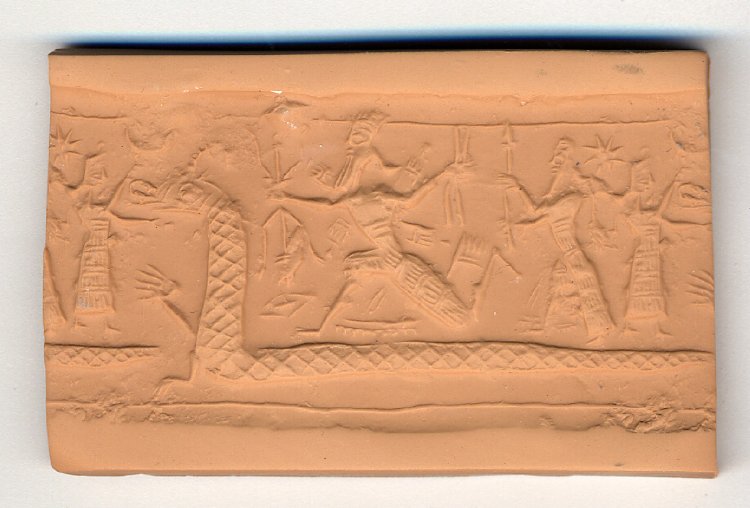
Segell cilíndric i la seva impressió, representant una escena mitològica: Asshur atacant un monstre és aclamat per una deessa. Segles IX-VIII aC
http://ca.wikipedia.org/wiki/Asshur#/media/File:Cylinder_seal_mythology_Louvre_AO30255.jpg
British Museum 89589.
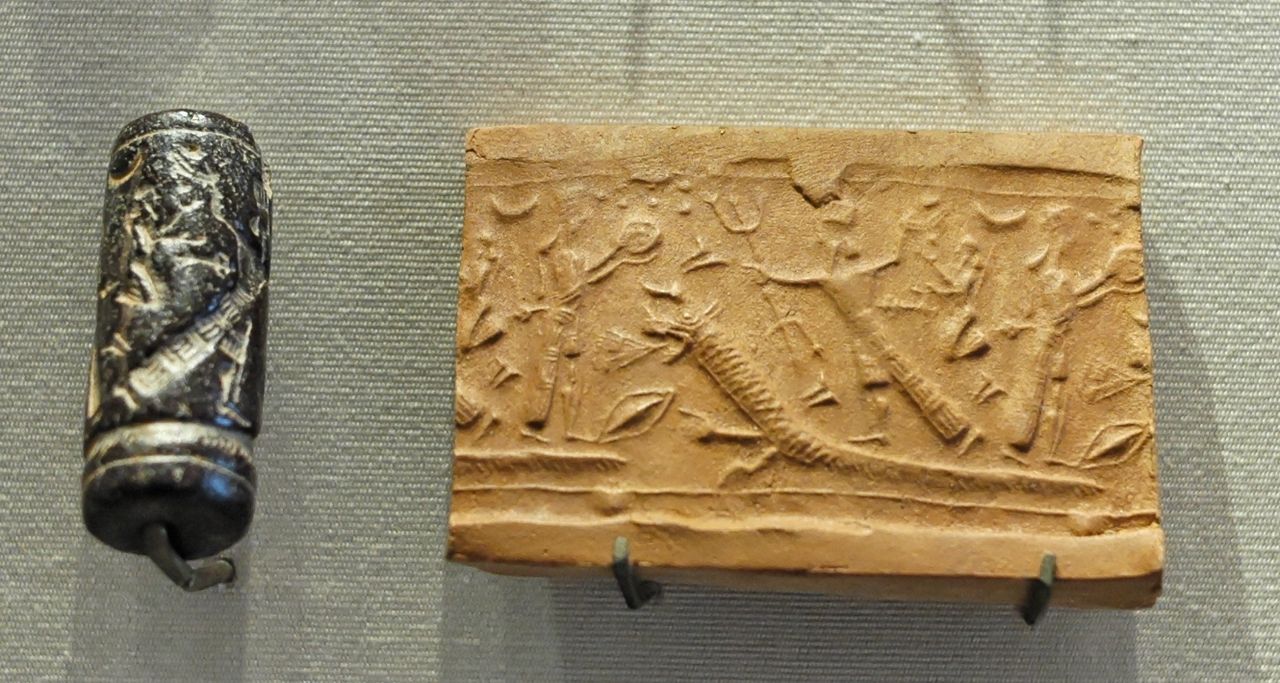
A black serpentinite cylinder seal portrays a snout-nosed, horned Tiamat as a dragon.
A bearded god, Ninurta or Bel-Marduk, runs along the reptile’s body with crossed, wedge-tipped quivers on his back. In his right hand he holds a six-pronged thunderbolt below which is a rhomb, while in his left he holds two arrows.
Behind the god, a smaller bearded god in a horned head-dress holds a spear.
On the tail of the dragon stands a goddess, to the left of her head is the eight-rayed star of Istar and the inverted crescent of the Moon God Sin.
The seal may illustrate a scene from the epic of creation in which the forces of chaos, led by Tiamat, are defeated by a god representing cosmic order, Ninurta, or Bel-Marduk.
© The Trustees of the British Museum
http://www.britishmuseum.org/research/collection_online/collection_object_details/collection_image_gallery.aspx?assetId=159863&objectId=277961&partId=1

Judging by Polyhistor’s summary, Berossos seems to have skipped over those early genealogies; or at least to have shifted the main weight of his paraphrase elsewhere. It may seem hazardous to argue from absence in a text as badly mutilated as the Babyloniaca.

However, the entire thrust of Polyhistor’s narrative, including the framing account of Oannes, seems to suggest that the primordial soup of BNJ680 F lb(6), and the monsters in it, really did come first.

There is another feature of Berossos’ narrative which sets him apart from Eudemos: he translates the names of Babylonian deities into their Greek equivalents rather than merely transliterating them. Unlike his forerunner, Berossos was clearly interested in making his account accessible — and meaningful — to a wider Greek audience.

This leads me to my sec­ond reason for thinking that Berossos was quite actively modelling himself on contemporary Greek philosophers like Zeno, and that is his method of reading myth, as encapsulated in the phrase, ‘but he says that this amounts to an allegorical account of physics’.

The phrasing here has been deemed late, though Demetrius, On Style, already uses similar language, and Zeno’s pupil and successor as head of the Stoa, Cleanthes, may have done too.

Whether or not Berossos actually said άλληγορικώζ πεφυσιολογήσθαι, the sentiment is clearly his — for he must be the one who translated Omorka/Tiamat into Greek θάλασσα, hardly a fully fledged mythological character in the Greek imagination.

More generally, the entire thrust of his reading of Enūma Eliš seems to me to be self-evidently rationalising, and, in a rather loose sense of the word, allegorising too.”

Johannes Haubold, “The Wisdom of the Chaldaeans: Reading Berossos, Babyloniaca Book 1,” from Johannes Haubold, Giovanni B. Lanfranchi, Robert Rollinger, John Steele (eds.), The World of Berossos, Proceedings of the 4th International Colloquium on the Ancient Near East Between Classical and Ancient Oriental Traditions, Harrassowitz Verlag, Wiesbaden, 2013, pp. 35-7.

Babyloniaca Book 1

“What, then, does it mean for Berossos to introduce himself as a Babylonian, and a priest of Bel? The question may seem odd, for it suggests a choice which prima facie Berossos did not have: was he not simply stating a fact?

And yet, I shall argue that Berossos did have a choice as to how he presented himself, and that both his profession as a priest and his self-portrayal as a Babylonian can be read as examples of carefully calibrated role play.

Let us first have a look at ethnicity. As a Babylonian, Berossos was a barbarian in Greek eyes, and broadly speaking that was not an auspicious starting point. Yet, non-Greek cultures could also carry more positive connotations.

By the Hellenistic period, Greek intellectuals had become accustomed to regard barbarian priests as commanding a privileged knowledge of history. Berossos very directly plays on that stereotype when he rejects the untruths spread by ‘Greek writers’ in Babyloniaca Book 3.

Greek readers would have appreciated that, as a priest of Bel, Berossos was in a good position to set the record straight; though the gesture would have had little resonance in a purely Mesopotamian context.

Indeed, we now know that from a Mesopotamian perspective there was no such thing as ‘a priest of Bel’ in Babylon, though there was of course a wide range of personnel associated with the main temple of Marduk, the Esagila.

Berossos, then, does not simply state a neutral fact when he introduces himself as a Babylonian and a priest of Bel. Rather, he masquerades as a figure from Greek oriental­ising lore so as to lodge a very specific claim to cultural authority: Babylonian priests (‘Chaldaeans’, as they were known), were not just seen as masters of time but also as sources of esoteric knowledge, essentially a society of proto-philosophers.

That cliche, I suggest, informs Berossos’ paraphrase of Enūma Eliš in Babyloniaca Book 1.

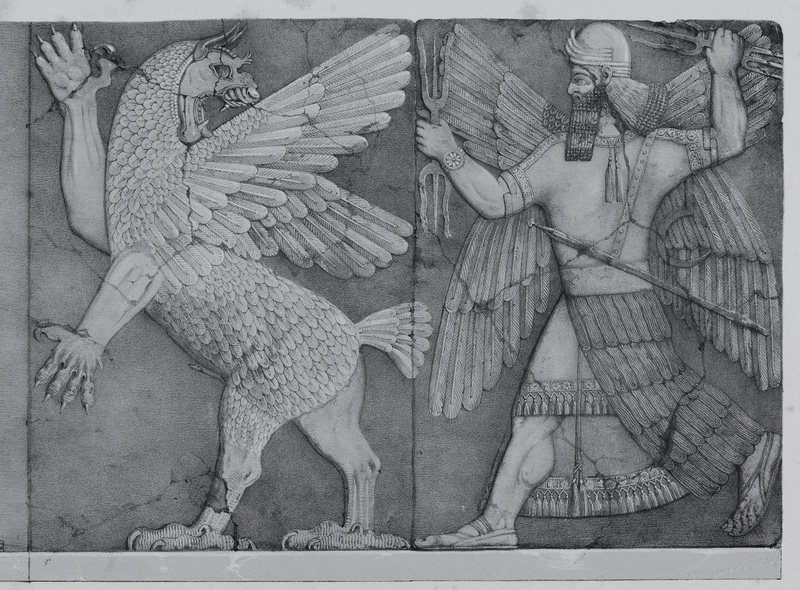
Battle between Marduk (Bel) and Tiamat. Drawn from a bas-relief from the Palace of Ashur-nasir-pal, King of Assyria, 885-860 B.C., at Nimrûd. British Museum, Nimrûd Gallery, Nos. 28 and 29. http://bharatkalyan97.blogspot.com/2013/06/tablet-of-destinies.html

Battle between Marduk (Bel) and Tiamat. Drawn from a bas-relief from the Palace of Ashur-nasir-pal, King of Assyria, 885-860 B.C., at Nimrûd.
British Museum, Nimrûd Gallery, Nos. 28 and 29.
http://bharatkalyan97.blogspot.com/2013/06/tablet-of-destinies.html

In his account of creation, Berossos describes the universe as being created from two main forces, Tiamat and BelTiamat provides the matter from which Bel shapes all things. She is female, he is male; she is passive, he is active; she is chaotic, dark and watery, he is orderly, active, bright and airy.

In Babylonian terms, this is not a bad paraphrase of Enūma Eliš, though it skips over the opening genealogies and radically condenses the rest of the narrative. Much of this work of condensation will be down to Alexander Polyhistor, the first-century BCE excerptor who had little incentive to preserve details of Berossos’ account that did not suit his sensationalist agenda.

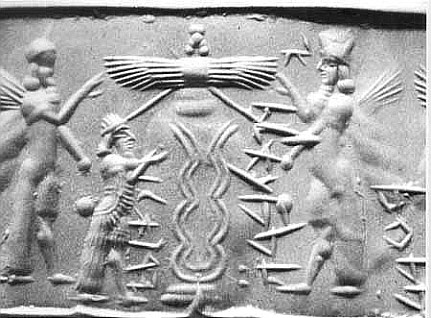
British Museum 89589. A black serpentinite cylinder seal in the linear style portrays a snout-nosed, horned reptile, probably Tiamat as a dragon. The upper third of its long body rises from two front paws or hands, one of which is raised; the remainder of the body runs around the bottom of the seal and supports three figures; there are no hind legs.  A bearded god, Ninurta or Bel-Marduk, runs along the reptile's body with crossed, wedge-tipped quivers on his back. In his right hand he holds a six-pronged thunderbolt below which is a rhomb, while in his left he holds two arrows.  Behind the god, a smaller bearded god in a horned head-dress holds a spear before him.  On the tail of the reptile stands a goddess, who holds her arms open to seize the snout of the reptile.  To the left of her head is the eight-rayed star of Istar and the inverted crescent of the Moon God Sin.  The seal may illustrate a scene from the epic of creation in which the forces of chaos, led by Tiamat, are defeated by a god representing cosmic order, Ninurta, or Bel-Marduk.  © The Trustees of the British Museum http://www.britishmuseum.org/research/collection_online/collection_object_details/collection_image_gallery.aspx?assetId=159863&objectId=277961&partId=1

British Museum 89589.
A black serpentinite cylinder seal in the linear style portrays a snout-nosed, horned reptile, probably Tiamat as a dragon. The upper third of its long body rises from two front paws or hands, one of which is raised; the remainder of the body runs around the bottom of the seal and supports three figures; there are no hind legs.
A bearded god, Ninurta or Bel-Marduk, runs along the reptile’s body with crossed, wedge-tipped quivers on his back. In his right hand he holds a six-pronged thunderbolt below which is a rhomb, while in his left he holds two arrows.
Behind the god, a smaller bearded god in a horned head-dress holds a spear before him.
On the tail of the reptile stands a goddess, who holds her arms open to seize the snout of the reptile.
To the left of her head is the eight-rayed star of Istar and the inverted crescent of the Moon God Sin.
The seal may illustrate a scene from the epic of creation in which the forces of chaos, led by Tiamat, are defeated by a god representing cosmic order, Ninurta, or Bel-Marduk.
© The Trustees of the British Museum
http://www.britishmuseum.org/research/collection_online/collection_object_details/collection_image_gallery.aspx?assetId=159863&objectId=277961&partId=1

But even the truncated version of Babyloniaca Book 1 which Polyhistor passed on to Eusebius still betrays signs of Berossos’ original ap­proach. What Berossos seems to have done in Babyloniaca Book 1 is to extract two cosmic principles from the jumble of divine characters in Enūma Eliš.

The resulting account of creation strikingly resembles Stoic physics as formulated by Berossos’ contemporary Zeno of Citium. For Zeno too, the universe was based on two entities, matter and god.

Like Bel in Berossos, Zeno’s god was active, male, the shaping principle that pervaded matter; and like Berossos’ Tiamat, Stoic matter was passive, female, waiting to be dissected and moulded.

Sceptics may object that this convergence between Berossos and Zeno may as well be pure coincidence; after all, there are only so many ways one can imagine a cosmogony, and the opposition between Marduk and Tiamat was of course prefigured in Enūma Eliš itself.”

Johannes Haubold, “The Wisdom of the Chaldaeans: Reading Berossos, Babyloniaca Book 1,” from Johannes Haubold, Giovanni B. Lanfranchi, Robert Rollinger, John Steele (eds.), The World of Berossos, Proceedings of the 4th International Colloquium on the Ancient Near East Between Classical and Ancient Oriental Traditions, Harrassowitz Verlag, Wiesbaden, 2013, pp. 34-5.

The Three Books of the Babyloniaca

“Jewish and Christian users even manipulated Berossos’ account in order to accommodate it to Biblical history.

Josephus claims that a Babylonian mentioned by Berossos could be identified with Abraham (BNJ 680 F 6), which is obviously a Jewish misinterpretation.

Eusebius adduces an alleged synchronism between the Babylonian and Judean kings in the account of Polyhistor in order to settle Old Testament chronology (BNJ 680 F 7c).

It is, however, certain that this synchronism was a later Jewish or Christian creation. The parallel number of ten Babylonian antediluvian kings and Biblical patriarchs is very probably a Jewish or Christian forgery too.

In Mesopotamian tradition there were no more than nine antediluvian kings, as e.g. in the Dynastic Chronicles, which was very likely an important source of Berossos. Moreover, the name of one of the kings is in fact that of a postdiluvian ruler (Ammenon = Enmenunna). This suggests that a later user inserted a tenth name in Berossos’ list in order to create the correspondence with the Old Testament tradition.

Apart from links with Biblical tradition, several fragments contain references to stories in classical literature. Sennacherib’s erection of a monument in Cilicia and the foundation of Tarsus (BNJ 680 F 7c // 685 F 5) recalls the classical story of the epitaph of the Assyrian king Sardanapallos, who boasted to have built Tarsus and Anchiale in one day (Strabo 14.5.9).

The fall of Nineveh and the death by fire of the Assyrian king Sarakos (BNJ 680 F 7d // 685 F 5) parallels the end of Sardanapallos in Ctesianic tradition (BNJ 688 F lb and lq). Berossos also gives a version of the construction of the ‘Hanging Gardens’ in Babylon (BNJ 680 F 8a), in classical tradition one of the Seven Wonders of the World. The close connections to classical tales very probably explain why these stories survived in the fragments.

It must be emphasised, then, that due to the particular interests of our main sources — Josephus and the Christian apologists — we only have a partial and biased view of Berossos’ original composition. A few fragments clearly show that Berossos’ work was broader in scope than may appear at face value.

Athenaeus describes a Saturnalia-like festival celebrat­ed in Babylon (BNJ680 F2), which demonstrates that Berossos also wrote about Babylonian customs. Clement of Alexandria informs us that Artaxerxes II introduced the cult of the Persian goddess Anaitis in Babylon (BNJ 680 F 11).

This shows that Berossos treated the Achaemenid period in some detail and did not confine himself to the brief summary in BNJ 680 F 10. The lexicographer Hesychius notes that Sarachero was the female adorner of the spouse of Bel (BNJ 680 F 13), but we do not know in which context Sarachero had been mentioned.

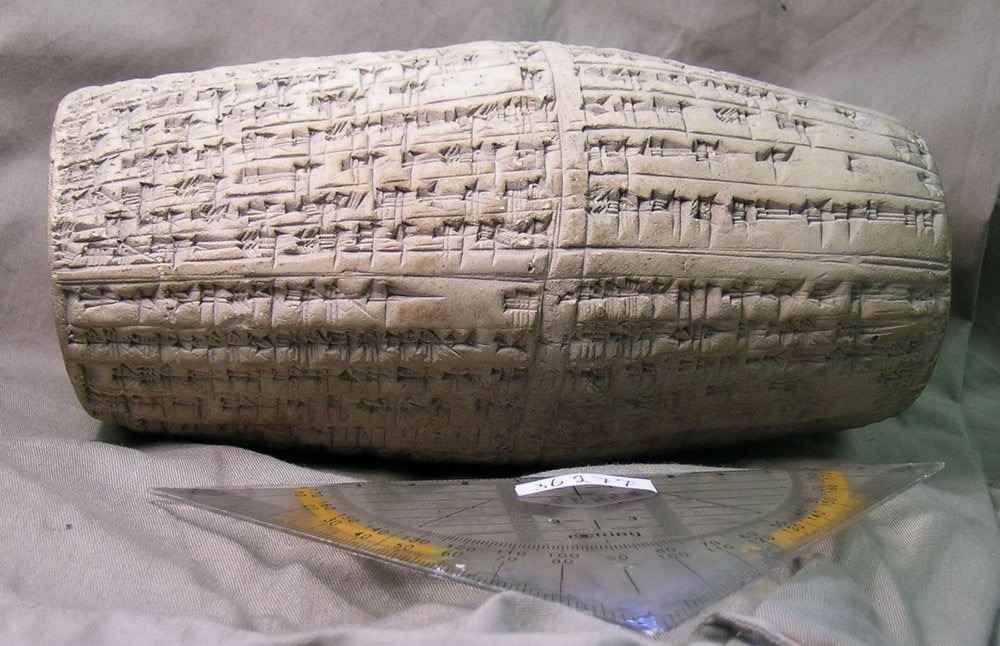
Antiochus Cylinder BM36277


The Cylinder of Antiochus I Soter from the Ezida Temple in Borsippa (the Antiochus Cylinder) is an historiographical text from ancient Babylonia. It describes how the Seleucid crown prince Antiochus, the son of king Seleucus Nicator, rebuilt the Ezida Temple and prays for divine protection. The cuneiform text itself (BM 36277) is now in the British Museum.
The Antiochus cylinder is the latest such cylinder extant. Another late example is the Cyrus Cylinder, commemorating Cyrus’ capture of Babylon in 539 BCE (Schaudig 2001: 550-6). This cylinder, however, was written in normal Neo-Babylonian script.
The document is a barrel-shaped clay cylinder, which was buried in the foundations of the Ezida temple in Borsippa. This form of foundation document is common since the second millennium. The script of this cylinder is deliberately archaic, using a ceremonial Babylonian cuneiform script that was also used in the Codex of Hammurabi and adopted in a number of royal inscriptions of Neo-Babylonian kings like Nabopolassar, Nebuchadnezzar and Nabonidus (cf. Berger 1973). The script varies from the cuneiform that was used for chronicles, diaries, rituals, scientific and administrative texts.
The Antiochus Cylinder was recovered by Hormuzd Rassam in 1880 in Ezida, the temple of the god Nabu in Borsippa, from its original position “encased in some kiln-burnt bricks covered over with bitumen,” in the “doorway” of Koldewey’s Room A1. Rassam (1897: 270) mistakenly records this as a cylinder of Nebuchadnezzar II (Reade 1986: 109). The cylinder is now in the British Museum in London.
http://www.livius.org/cg-cm/chronicles/antiochus_cylinder/antiochus_cylinder1.html

Let us now turn to the Babyloniaca itself. Tatian states that the work consists of three books (BNJ 680 T2). Fragments from each book have been preserved. As far as we can judge, the contents of the books can be outlined as follows:

Book 1 opens with a prologue, in which Berossos presents himself and his sources. In this prologue he probably also explained his dedication to Antiochus I. After the prologue he describes the geography of Babylonia, the country’s fauna and flora and its multiethnic popu­lation.

Berossos then proceeds to primeval history: the ‘fish-man’ Oannes, in Mesopotamian tradition Uan(na), the first antediluvian and most important sage, brings civilisation to hu­mankind in Babylonia in the very first year of kingship. Thereupon, the sage narrates how the universe was created by Belos and how this god formed man (BNJ 680 F la-b and 685 F la-b).

Athenaeus’ testimony that Berossos describes the celebration of a festival in his first book (BNJ 680 F2) is the only indication that this book also dealt with Babylonian customs. Although I concluded that the astronomical / astrological fragments preserved under the name of Berossos are not genuine, this does not exclude the possibility that Berossos wrote in his work on this Babylonian science par excellence.

As a rule, a Greek ethnographical work, the genre Berossos followed, presents the intellectual achievements of the people treated. If Berossos wrote on Babylonian astronomy / astrology, Book 1 — and more specifi­cally in the section of Babylonian customs — was the most likely part of his work to do it.

Book 2 gives an overview of Babylonian rulers, starting with the antediluvian kings (BNJ 680 F 3a-b – F 6 and 685 F 2-3; Aelian records the tale of King Euchoros, or Enmerkar in the cuneiform, whose guards hurled the infant Gilgamesh (Gilgamos) from the height of the citadel in the History of Animals, 12.21).

The book probably ends with the reign of Nabonassar (747-734). For the most part, this section of Berossos’ work was very likely an enumeration of kings, dynasties and year numbers and did not provide elaborate information — at least for the early periods.

This can be deduced from Eusebius’ remark that Berossos gave hardly any information on the kings’ deeds or even omitted them (BNJ 680 F 3a). This very likely reflects the dearth of sources Berossos could rely on: many of the early rulers were no more than names in long king lists. The overview of kings and dynasties is interrupted by the story of the Flood and its aftermath (BNJ 680 F 4a-c and 685 F 3a-b).

Book 3 relates the history of Babylonia from Nabonassar to Alexander the Great (BNJ 680 F7-11 and 685 F5-7). From this book more narrative episodes have been preserved and although Berossos’ treatment of the Achaemenid period is almost completely lost, the notice that Artaxerxes II introduced the cult of Anaitis demonstrates that Berossos elaborated on this period too.”

Geert de Breucker, “Berossos: His Life and Work,” from Johannes Haubold, Giovanni B. Lanfranchi, Robert Rollinger, John Steele (eds.), The World of Berossos, Proceedings of the 4th International Colloquium on the Ancient Near East Between Classical and Ancient Oriental Traditions, Harrassowitz Verlag, Wiesbaden, 2013, pp. 22-3.

The Chaldaica and the Babyloniaca

“Before I focus on the work itself, I first discuss the text as it has come down to us, because this is essential for our understanding of the work. Berossos’ history of Babylonia has only been preserved in fragments. Two titles have been transmitted: Chaldaica and Babyloniaca.

It is almost certain that the latter is authentic, as this is the title used in antiquarian and lexi­cographical literature and is more in tune with Berossos’ subject, the history of Babylonia. The extant fragments have come down to us by a very complex process of transmission. Most of them derive from Jewish and Christian authors.

In this process the pagan polymath Alexander Polyhistor played a pivotal role, as the bulk of the fragments derives from the epitome he made of Berossos’ work in Rome between 80 and 40 BC. This ‘summary’, how­ever, also survives in fragments.

Flavius Josephus (2nd half 1st c. AD) almost certainly used it in his Jewish Antiquities and Contra Apionem. The Church Father Eusebius of Caesarea (ca. 265-340 AD) excerpted Polyhistor’s epitome for the first book of his Chronicle.

This first book being lost too, the excerpts are known by an Armenian translation of the Chronicle (after 6th c.) and by the Byzantine monk Syncellus, who inserted them in his own chronographical work (around 810). A comparison of the Armenian translation and Syncellus shows that the Armenian text contains quite a number of corruptions and mistranslations. In gen­eral, Syncellus’ text is more reliable.

To these excerpts we can add the fragments transmitted under the name of Abydenus, an obscure historian, probably living in the 2nd or 3rd c. AD (BNJ 685). Although he mentions neither Berossos nor Alexander Polyhistor, it is clear that Abydenus did no more than rework Polyhistor’s epitome of the Babyloniaca and give it an Ionic veneer.

The fragments ascribed to Abydenus have come down to us through Eusebius, either directly — in his Praeparatio Evangelica — or indirectly — by the aforementioned Armenian translation and Syncellus, each using Eusebius’ Chronicle in this case too.

Another set of fragments survived through Greek learned literature: Athenaeus (BNJ 680 F2), Hesychius (BNJ 680 F 13) and the Oxyrhynchus Glossary (BNJ 680 F23a-b).

Josephus and the Christian authors were mainly interested in Berossos’ work for apologetic rea­sons. They aimed to prove the veracity of the Biblical account and Old Testament chro­nology. It is, therefore, no surprise that most fragments have a link with Biblical history, such as the Flood, the important period of the destruction of the Temple of Jerusalem by Nebuchadnezzar II and the beginning of its reconstruction under Cyrus.

Other fragments deal with Assyrian and Babylonian kings mentioned in the Old Testament: apart from Nebuchadnezzar and Cyrus, Tiglath-pileser III (Pulu), Merodach-Baladan II, Sennacherib, Esarhaddon and Amel-Marduk.

Even the long excerpt on Babylonian primeval history (BNJ680 F la-b), which has appar­ently no connection to Biblical history, has been transmitted for apologetic reasons — but in another sense. Eusebius used this fabulous story in order to refute Berossos’ chronology of the antediluvian period.

On the one hand, Berossos’ number of ten antediluvian kings agreed with that of the Biblical generations and patriarchs before the Flood — and thus confirmed Genesis. On the other hand, Berossos’ chronology of 432,000 years for the antediluvian period completely disagreed with the Old Testament and was thus problematic.

In his refutation, Eusebius discredits the Babylonian chronology by pointing to Berossos’ account of the primeval period, which was evidently fabulous. Those who accepted the Babylonian antediluvian chronology, Eusebius pointedly suggested, should also accept this nonsense as truth.

This refutation also explains why Eusebius treats the antediluvian kings first and then gives the excerpt on primeval times.”

Geert de Breucker, “Berossos: His Life and Work,” from Johannes Haubold, Giovanni B. Lanfranchi, Robert Rollinger, John Steele (eds.), The World of Berossos, Proceedings of the 4th International Colloquium on the Ancient Near East Between Classical and Ancient Oriental Traditions, Harrassowitz Verlag, Wiesbaden, 2013, pp. 20-2.

Berossus and a Sibyl

“Since these fragments do not express Babylonian astronomical or astrological doctrines, the obvious conclusion is that their attribution to Berossos is not genuine. In a way, this as­tronomical / astrological material can be compared with the work which Annius of Viterbo fabricated under the name of Berosus Chaldaeus.

Since these fragments are not genuine, I assume that the testimonies describing Berossos as an ‘internationally’ renowned astro­loger are also fabricated. The creation of a ‘Berossos the astrologer’ is not a unique case in Greek and Roman literature. The aforementioned Egyptians, pharaoh Nechepso and his sage Petosiris, under whose names several works circulated, are merely Hellenistic creations.

Likewise, the life of the famous philosopher Pythagoras was quickly surrounded by legends: he travelled across the Orient and was taught by native sages. A Roman tradition even held that he taught the Roman king Numa Pompilius, who is traditionally dated some 150 years before the historical Pythagoras, at the end of the 8th c. BC.

The character of ‘Berossos the astrologer’ was very likely created in order to give astronomical / astrological doctrines a Babylonian origin. The story of his school on Cos might have been invented in order to explain how ‘Chaldaean’ lore reached the Greek world.

For later generations Berossos the historian and the astrologer were obviously one and the same person. This explains why Josephus mentions Berossos’ role in transmitting Babylonian as­tronomical and philosophical lore and continues by paraphrasing and citing from his history (BNJ 680 T 3, F 8a and F 9a).

The reason why Berossos was chosen to become an astrologer is easy to find: he was a ‘Chaldaean’, a Babylonian priest himself, for Greeks and Romans great experts in astronomy and astrology. Moreover, he had written a history based on arcane native sources.

Some testimonies, finally, report that Berossos was the father of the Hebrew-Babylonian Sibyl called Sabbe (BNJT 7a-c, In the Suda this Sibyl is called “Sambethe,” Σ 361 s.v. Chaldaean Sibyl). This is undoubtedly a legend.

Its origin may be connected to the insertion of a story ascribed to the Sibyl in the epitome which Alexander Polyhistor made of Berossos’ work (BNJ 680 F4a-b). That Sibyl too can very likely be identified as the Hebrew-Babylonian one. The inserted paraphrase in Polyhistor’s epitome derives from the Third Sibylline Book, which implies that the Sibyl in Polyhistor is the same as the pseudepigraphic Sibylline author of this book.

The latter can be labelled as ‘Hebrew-Babylonian’, as she is said to be a relative of Noah and to have dwelt in Babylon after the Flood. Berossos’ fatherhood of a prophetess might also be related, in one way or another, with Pliny’s testi­mony that he made divine predictions (BNJ 680 T 6).”

Geert de Breucker, “Berossos: His Life and Work,” from Johannes Haubold, Giovanni B. Lanfranchi, Robert Rollinger, John Steele (eds.), The World of Berossos, Proceedings of the 4th International Colloquium on the Ancient Near East Between Classical and Ancient Oriental Traditions, Harrassowitz Verlag, Wiesbaden, 2013, p. 20.

The Historicity of Berossus

“Some sources suggest that Berossos had, as it were, an international career as an astronomer. According to those sources, he left Babylon and migrated to the Greek world after the publi­cation of his history.

Vitruvius states that he moved to the island of Cos and opened a school there (BNJ T 5a-b). Vitruvius also ascribes the invention of a specific type of sundial to Berossos (BNJ 680 T 5c).

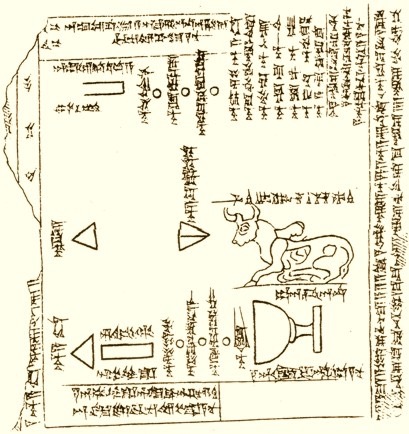
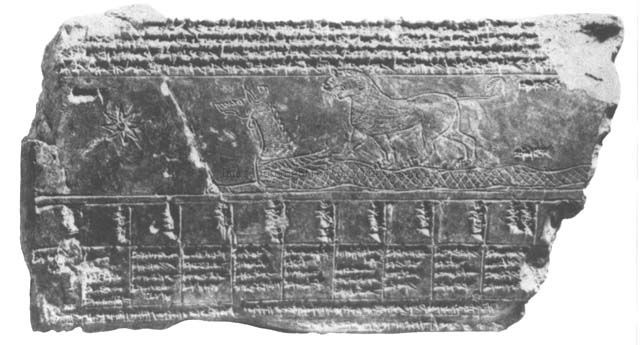
The Bull of Heaven, Taurus, is drawn on an "esoteric tablet" dated to the Seleucid era. See Textes cuneiform du Louvre by Francois Thureau-Dangin, Tome VI (Tablets d'Uruk, a la usage des pretres du temple d'Anu au temps des Seleucides), (Plate 91), 1922. The same plate is reproduced in Astrological Reports to Assyrian Kings, Herman Hunger, 1992, p. 40.  http://members.westnet.com.au/gary-david-thompson/page11-10.html

The Bull of Heaven, Taurus, is drawn on an “esoteric tablet” dated to the Seleucid era. See Textes cuneiform du Louvre by Francois Thureau-Dangin, Tome VI (Tablets d’Uruk, a la usage des pretres du temple d’Anu au temps des Seleucides), (Plate 91), 1922. The same plate is reproduced in Astrological Reports to Assyrian Kings, Herman Hunger, 1992, p. 40.
http://members.westnet.com.au/gary-david-thompson/page11-10.html

Josephus agrees with the Roman architect that Berossos propagated Babylonian lore: he says that the Chaldaean was famed among those who were engaged in learning, because he published for the Greeks works on astronomy and on the philosophy of the Chaldaeans (BNJ 680 T3).

Pliny the Elder presents Berossos as the most important scholar of astronomy/astrology and adds that the Athenians honoured him with a statue with a gilded tongue because of his divine predictions (BNJ 680 T 6).

The historicity of these biographical data is subject to debate. Burstein and Verbrugghe / Wickersham accept the ‘second’ life of Berossos as historical. Schwartz rejects the testimony according to which Berossos opened a school on Cos, because he thinks it unlikely that the Babylonian priest would have abandoned his prebendary income in Babylon.

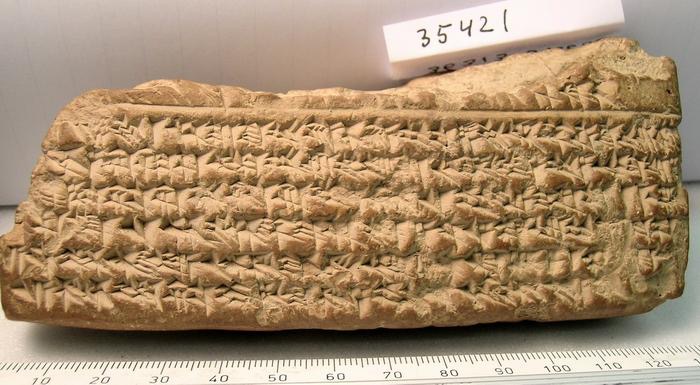
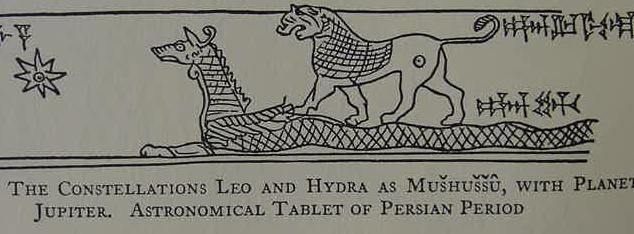
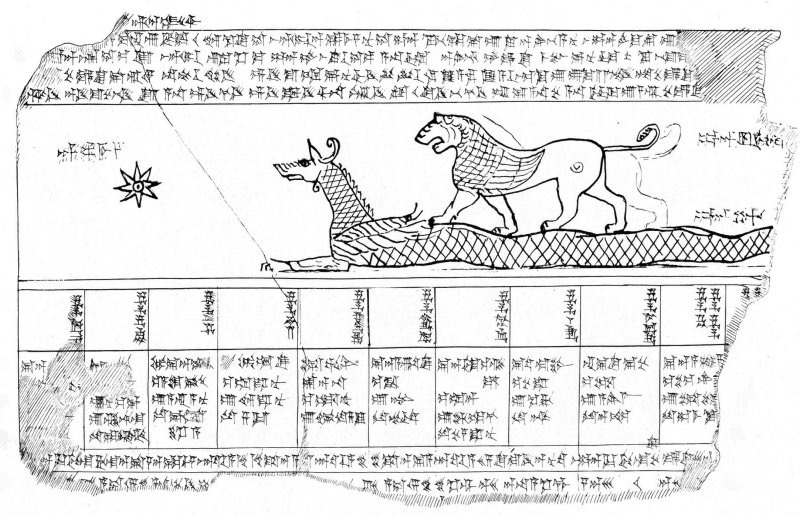
Leo with Corvus standing on Hydra (VAT 7847 (= VAN 784 Staatliche Museen zu Berlin) VAT 7847, Obverse.  A Seleucid era astrological tablet. Two astrological texts from Uruk, VAT 7847 and Louvre Museum's AO 6448, have long been recognized as two pieces of one large tablet (zodiac compilation tablet). The tablet deals with the division of Zodiac into subzodiacs, and the connection of these subzodiacs to different cities/towns, temples plants, trees and stones. (In tabular form, for each constellation of the zodiac, a tradition of the connection of each constellation of the zodiac with a certain city, temple name, and the designations for wood and stones are dealt with.) AO6448 has drawings of the constellations Corvus and Virgo with the planet Mercury in attendance.   VAT 7847 (= VAN 784 Staatliche Museen zu Berlin) contains drawings with names of stars/constellations.  VAT 7847, Obverse. Constellation depiction on a Seleucid astrological tablet (from 2nd-century BCE Uruk). The depiction shows a lion standing on the back of a winged serpent. The two constellations depicted are Hydra and Leo. (They are shown "from the other side" - facing left instead of right.) The eight-pointed star to the left is captioned dingirSAG.ME.GAR (Jupiter). (However, some persons have mistakenly identified the bright star as Procyon.) VAT 7847 is a part of a larger tablet that had broken into two parts. The join for VAT 7847 appeared in Textes cunéiformes du Louvre by François Thureau-Dangin, Tome XII (Tablettes d'Uruk, à l'usage des prêtres du temple d'Anu au temps des Séleucides), 1922, catalogued as AO 6448. VAT 7847 is in the State Museum, Berlin, and AO 6448 is in the Louvre Museum, Paris. Both sides show in their upper part drawings of labelled drawings of constellations. As a completed tablet VAT 7847 and AO 6448 form an astrological calendar. The text contains omens and hemerological predictions. The tablet deals with the Babylonian zodiac and depicts 12 divisions corresponding to the months and the signs of the zodiac and is concerned with lunar eclipses near zodiacal constellations. The tablet is dated to the Hellenistic period circa 200 BCE by one source and circa 323-363 by Klaus Wagensonner, University of Oxford, and originates from Uruk (modern Warka). http://members.westnet.com.au/gary-david-thompson/page11-10.html

Leo with Corvus standing on Hydra (VAT 7847 (= VAN 784 Staatliche Museen zu Berlin)
VAT 7847, Obverse.
A Seleucid era astrological tablet. Two astrological texts from Uruk, VAT 7847 and Louvre Museum’s AO 6448, have long been recognized as two pieces of one large tablet (zodiac compilation tablet). The tablet deals with the division of Zodiac into subzodiacs, and the connection of these subzodiacs to different cities/towns, temples plants, trees and stones. (In tabular form, for each constellation of the zodiac, a tradition of the connection of each constellation of the zodiac with a certain city, temple name, and the designations for wood and stones are dealt with.) AO6448 has drawings of the constellations Corvus and Virgo with the planet Mercury in attendance.
VAT 7847 (= VAN 784 Staatliche Museen zu Berlin) contains drawings with names of stars/constellations. VAT 7847, Obverse. Constellation depiction on a Seleucid astrological tablet (from 2nd-century BCE Uruk). The depiction shows a lion standing on the back of a winged serpent. The two constellations depicted are Hydra and Leo. (They are shown “from the other side” – facing left instead of right.) The eight-pointed star to the left is captioned dingir SAG.ME.GAR (Jupiter). (However, some persons have mistakenly identified the bright star as Procyon.)
VAT 7847 is a part of a larger tablet that had broken into two parts. The join for VAT 7847 appeared in Textes cunéiformes du Louvre by François Thureau-Dangin, Tome XII (Tablettes d’Uruk, à l’usage des prêtres du temple d’Anu au temps des Séleucides), 1922, catalogued as AO 6448. VAT 7847 is in the State Museum, Berlin, and AO 6448 is in the Louvre Museum, Paris. Both sides show in their upper part drawings of labelled drawings of constellations. As a completed tablet VAT 7847 and AO 6448 form an astrological calendar. The text contains omens and hemerological predictions. The tablet deals with the Babylonian zodiac and depicts 12 divisions corresponding to the months and the signs of the zodiac and is concerned with lunar eclipses near zodiacal constellations. The tablet is dated to the Hellenistic period circa 200 BCE by one source and circa 323-363 by Klaus Wagensonner, University of Oxford, and originates from Uruk (modern Warka).
http://members.westnet.com.au/gary-david-thompson/page11-10.html

Some judge it impossible that Berossos would have migrated to an island that was under control of the Ptolemies, bitter enemies of the Seleucids. These are not convincing arguments to discard the historicity of the biographical information. In itself, it is not impossible that Berossos migrated to the west and taught Babylonian astronomy / astrology.

The question of historicity should, however, be connected with the question of whether the astronomical / astrological fragments transmitted under the name of Berossos are authentic (BNJ 680 F 15-22). As Kuhrt and the present author have shown, these fragments reflect Greek, not Babylonian doctrines and are, therefore, not authentic.

Babylonians believed that gods grouped the stars into constellations and gave them names, not men, as BNJ 680 F 17 states. There are no indications that they believed in a cyclical destruction of the universe by fire or water (BNJ 680 F21), whereas this was a popular doctrine of the Stoics.

A drawing of VAT 7847 (= VAN 784 Staatliche Museen zu Berlin).

A drawing of VAT 7847 (= VAN 784 Staatliche Museen zu Berlin).

Several ancient authors ascribe a lunar theory to Berossos that explains the lunar phases and lunar eclipses (BNJ 680 F 18-20). In short, this theory asserts that the moon has its own light and consists of a luminous hemisphere and a dark one. It rotates around its own axis. The lunar phases are the result of the attraction of the moon’s luminous hemisphere by the sun, which depends on the distance between both celestial bodies.

The closer the moon is to the sun, the more the fiery hemisphere is attracted by the latter and is turned toward it. The moon’s dark side is correspondingly turned towards the earth. So far, there is no evidence in the cunei­form sources that this theory, which other classical authors attribute to the Babylonians in general (Lucretius, De rerum natura, 720-7 and Apuleius, De deo Socratis, 1.1), has a Babylonian background; it seems that it is a Greco-Roman creation.

Finally, no astrological cuneiform texts have been preserved that determine the maximum lifetime of a human being by calculating the sum of the rising times of the zodiacal sign in which that person was born, and of the two subsequent signs (BNJ 680 F22).

On the other hand, it was a popular doctrine in Greek and Roman astrology. Pliny the Elder, who mentions Berossos’ calculation (BNJ 680 F22a), ascribes the origin of this theory not to the Babylonians, but to two Egyptians Nechepso and Petosiris, themselves fictitious characters.”

Geert de Breucker, “Berossos: His Life and Work,” from Johannes Haubold, Giovanni B. Lanfranchi, Robert Rollinger, John Steele (eds.), The World of Berossos, Proceedings of the 4th International Colloquium on the Ancient Near East Between Classical and Ancient Oriental Traditions, Harrassowitz Verlag, Wiesbaden, 2013, 19-20.

Who Was Berossus?

“This volume is devoted to a man whose work is largely lost, whose life is shrouded in mys­tery, and whose real name we do not know.

(‘Berossos’ is a Greek rendering of an Akkadian name. Our best guess at the moment is that his fellow Babylonians would have known him as Bēl-rē ‘ûšunu (‘Bel is their shepherd’), but this is not certain; see further De Breucker’s contribution to this volume.)

What we do know is that ‘Berossos’ of Babylon was a contemporary of Alexander the Great and the first two Seleucid kings, Seleucus I and Antiochus I, and that he wrote a work about Babylonian history and culture, the Babyloniaca.

He describes himself as a Babylonian and a priest of Bel-Marduk, the national god of Babylon, though in practice this may mean no more than that he was in some way attached to the main temple of Babylon, the Esagila.

According to Vitruvius, Berossos later moved to the Greek island of Cos to open a school of astronomy.

Pliny mentions a statue which the Athenians set up to celebrate his powers of prophecy; and Pausanias makes him the father of the Sibyl. With Pausanias we are plainly in the realm of mythmaking.

Whether Vitruvius or Pliny are any more trustworthy has been debated. Whatever we make of their testimonies, it is not implausible that Berossos had connections with the astronomers of the Esagila while in Babylon, and he must certainly have had some connection with, or at least an interest in, the Seleucid court, because he dedicated his Babyloniaca to Antiochus I.

We know from a cuneiform chronicle that Babylonian religious experts acted as advisors to Antiochus I.

(R. J. van der Spek, Chronicle concerning Antiochus and the Sin temple: preliminary edition and translation, 1997.

A similar encounter is reported by Diodorus Siculus, 17.112: when Alexander returned to Babylon from India, an astronomer of the Esagila temple called Belephantes (Akkadian Bēl-apla-iddin?), advised Alexander not to enter the city.)

Excerpt from Diodorus follows.

17.112.1: After the conclusion of his war with the Cossaeans, Alexander set his army in motion and marched towards Babylon in easy stages, interrupting the march frequently and resting the army.

17.112.2: While he was still three hundred furlongs from the city, the scholars called Chaldaeans, who have gained a great reputation in astrology and are accustomed to predict future events by a method based on age-long observations, chose from their number the eldest and most experienced.

By the configuration of the stars they had learned of the coming death of the king in Babylon, and they instructed their representatives to report to the king the danger which threatened. They told their envoys also to urge upon the king that he must under no circumstances make his entry into the city; 

17.112.3: that he could escape the danger if he re-erected the tomb of Belus which had been demolished by the Persians, but he must abandon his intended route and pass the city by.

The leader of the Chaldaean envoys, whose name was Belephantes, was not bold enough to address the king directly but secured a private audience with Nearchus, one of Alexander’s Friends, and told him everything in detail, requesting him to make it known to the king.

17.112.4: When Alexander, accordingly, learned from Nearchus about the Chaldaeans’ prophecy, he was alarmed and more and more disturbed, the more he reflected upon the ability and high reputation of these people.

After some hesitation, he sent most of his Friends into Babylon, but altered his own route so as to avoid the city and set up his headquarters in a camp at a distance of two hundred furlongs. 

This act caused general astonishment and many of the Greeks came to see him, notably among the philosophers Anaxarchus.

17.112.5: When they discovered the reason for his action, they plied him with arguments drawn from philosophy and changed him to the degree that he came to despise all prophetic arts, and especially that which was held in high regard by the Chaldaeans. 

It was as if the king had been wounded in his soul and then healed by the words of the philosophers, so that he now entered Babylon with his army. 

17.112.6: As on the previous occasion, the population received the troops hospitably, and all turned their attention to relaxation and pleasure, since everything necessary was available in profusion.

These were the events of this year.”

Diodorus Siculus, 17.112.

Berossos may well have been one of them, or in any case have worked in a similar milieu.”

Johannes Haubold, “The World of Berossos: Introduction,” from Johannes Haubold, Giovanni B. Lanfranchi, Robert Rollinger, John Steele (eds.), The World of Berossos, Proceedings of the 4th International Colloquium on the Ancient Near East Between Classical and Ancient Oriental Traditions, Harrassowitz Verlag, Wiesbaden, 2013, p. 3.

Berossus was a Historian and a Priest of Bel, Not a Babylonian Astronomer

“As de Breucker has emphasized, one goal of the Babyloniaca was to promote Babylonian antiquity and scholarship. We should see the so-called astronomical fragments in this light, as part of his promotion of Babylonian scholarship.

However, it is clear that Berossos was not himself one of the astronomical scribes working in Babylonia. All of the astronomy he explains has its origin not in contemporary Babylonian astronomy, but in works such as Enūma Eliš, a literary epic that includes a brief cosmological section.

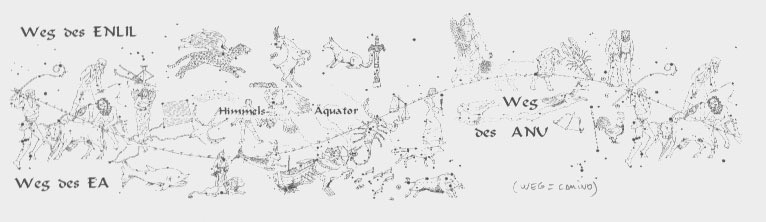
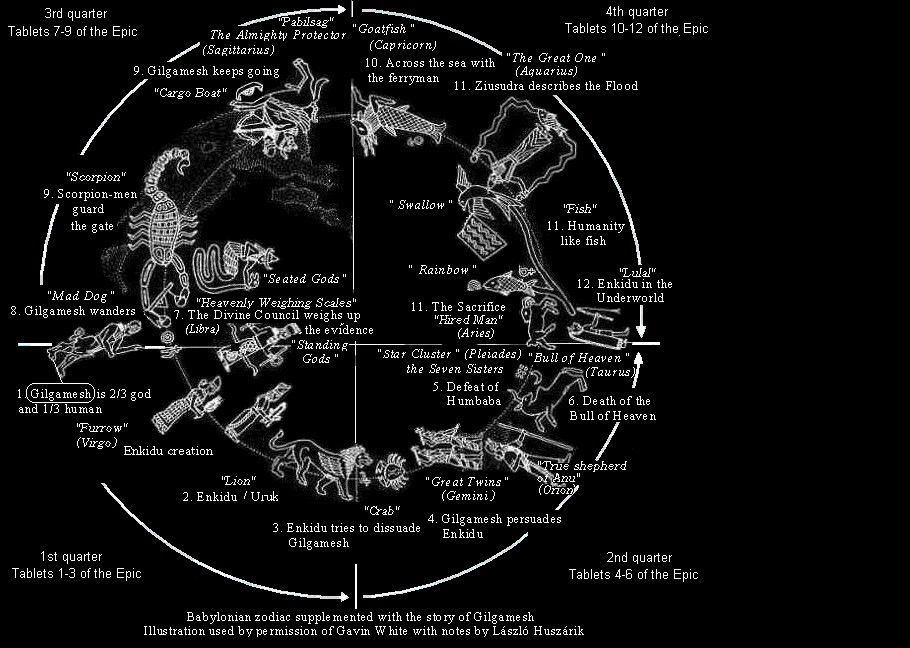
Los sumerios dividían su cielo en tres “caminos” que transcurrían paralelos al ecuador celeste y que daban la vuelta al cielo: el camino de Ea , el camino de Anu y el camino de Enlil . Estos caminos eran las esferas de influencia de tres supradeidades abstractas que jamás se representaban corporalmente: la divina trinidad. Eran las esferas del mundo material (Ea), el mundo humano (Anu) y el mundo divino (Enlil). A través de estas tres bandas serpenteaba “el camino de la Luna” (Charranu), que también era el camino de los planetas: el zodíaco. De esta forma, una parte del zodíaco se encuentra en el camino de Enlil (los signos de verano), una parte en el camino de Anu (signos de primavera y otoño) y una parte en el camino de Ea (los signos de invierno). El mapa estelar adjunto preparado por Werner Papke según el mul.apin muestra esta división para el período de 2340 a.C. En ese momento de la historia, los sumerios ya conocían el movimiento de desplazamiento precesional de las constelaciones. Las representaciones anteriores siempre hablan de 11 signos zodiacales (todavía falta Libra). En cambio, el mul.apin describe las imágenes de 12 constelaciones y explica claramente que Zibanium (Libra) se construyó a partir de las pinzas del escorpión, para dar al comienzo del otoño su propio signo. Anteriormente, el zodíaco siempre se basaba en dos estrellas: Aldebarán (en Tauro) marcaba el equinoccio (duración del día y de la noche iguales) de primavera y Antares (en Escorpio) determinaba el punto de inicio del otoño. Pero esto sólo es cierto alrededor del 3200 a.C. Probablemente, un poco antes de que se escribiera el mul.apin, se descubrió que el punto de misma duración del día y de la noche se había desplazado hacia el oeste: de Aldebarán a las Pléyades y de Antares hacia las pinzas del escorpión. http://www.escuelahuber.org/articulos/articulo13.htm

Los sumerios dividían su cielo en tres “caminos” que transcurrían paralelos al ecuador celeste y que daban la vuelta al cielo: el camino de Ea , el camino de Anu y el camino de Enlil . Estos caminos eran las esferas de influencia de tres supradeidades abstractas que jamás se representaban corporalmente: la divina trinidad. Eran las esferas del mundo material (Ea), el mundo humano (Anu) y el mundo divino (Enlil). A través de estas tres bandas serpenteaba “el camino de la Luna” (Charranu), que también era el camino de los planetas: el zodíaco. De esta forma, una parte del zodíaco se encuentra en el camino de Enlil (los signos de verano), una parte en el camino de Anu (signos de primavera y otoño) y una parte en el camino de Ea (los signos de invierno). El mapa estelar adjunto preparado por Werner Papke según el mul.apin muestra esta división para el período de 2340 a.C.
En ese momento de la historia, los sumerios ya conocían el movimiento de desplazamiento precesional de las constelaciones. Las representaciones anteriores siempre hablan de 11 signos zodiacales (todavía falta Libra). En cambio, el mul.apin describe las imágenes de 12 constelaciones y explica claramente que Zibanium (Libra) se construyó a partir de las pinzas del escorpión, para dar al comienzo del otoño su propio signo. Anteriormente, el zodíaco siempre se basaba en dos estrellas: Aldebarán (en Tauro) marcaba el equinoccio (duración del día y de la noche iguales) de primavera y Antares (en Escorpio) determinaba el punto de inicio del otoño. Pero esto sólo es cierto alrededor del 3200 a.C. Probablemente, un poco antes de que se escribiera el mul.apin, se descubrió que el punto de misma duración del día y de la noche se había desplazado hacia el oeste: de Aldebarán a las Pléyades y de Antares hacia las pinzas del escorpión.
http://www.escuelahuber.org/articulos/articulo13.htm

He may also have been aware of MUL.APIN, which was a widely known text both inside and outside the small circle of astronomical scribes (many copies of MUL.APIN were found in archival contexts quite different from the majority of Babylonian astronomical texts). But there is no evidence that Berossos had access to or would have understood contemporary astronomical texts.

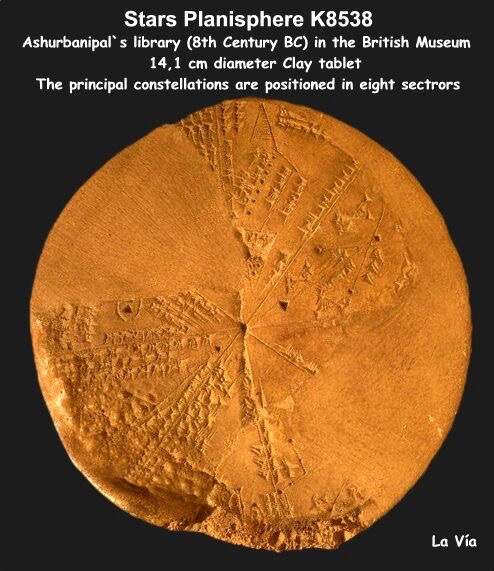
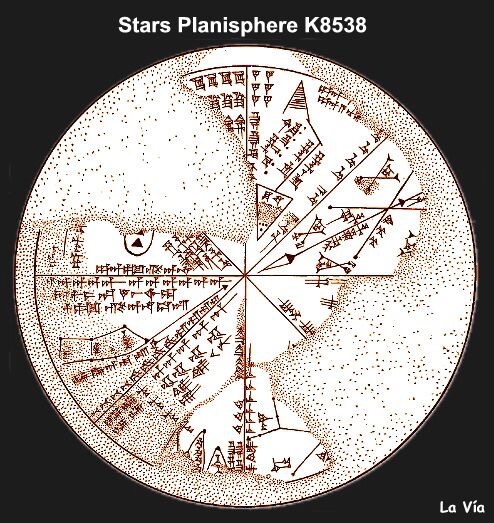
I MUL.APIN sono testi antichi su tavolette di argilla, comprendono un elenco di trentasei stelle, tre stelle per ogni mese dell’anno. Le stelle sono quelle aventi ciascuna la levata eliaca in un particolare mese. Si ha perciò questo schema: nella prima riga sono elencate tre stelle, che hanno la levata eliaca nel primo mese dell'anno, Nīsannu (quello associato all'epoca dell'equinozio di primavera). Nella seconda riga sono elencate altre tre stelle, ancora ciascuna avente levata eliaca nel secondo mese, Ayyāru, e così via. http://www.lavia.org/italiano/archivio/calendarioakkadit.htm

I MUL.APIN sono testi antichi su tavolette di argilla, comprendono un elenco di trentasei stelle, tre stelle per ogni mese dell’anno. Le stelle sono quelle aventi ciascuna la levata eliaca in un particolare mese. Si ha perciò questo schema: nella prima riga sono elencate tre stelle, che hanno la levata eliaca nel primo mese dell’anno, Nīsannu (quello associato all’epoca dell’equinozio di primavera). Nella seconda riga sono elencate altre tre stelle, ancora ciascuna avente levata eliaca nel secondo mese, Ayyāru, e così via.
http://www.lavia.org/italiano/archivio/calendarioakkadit.htm

If he did, he did not include any of this material in the fragments that are preserved to us. Indeed, including such material would probably have had the opposite effect to that which Berossos sought: no-one in the Greek world at the beginning of the third century BC would have been able to understand contemporary Babylonian astronomy, and, being unconcerned with issues of cause, it probably would have been viewed as irrelevant by astronomers in the tradition of Plato and Aristotle.

The transmission and assimilation of contemporary Babylonian astronomy into Greek astronomy could only take place once Greek astronomy itself had turned into a quantitative science in the second century BC. …

The ancient testimonies mentioning Berossos frequently laud him for his astronomical and astrological skill. It is interesting to ask, therefore, how Berossos’s writings were presented and used by later astronomical authors.

First, it is perhaps surprising to note given the popular perception presented in the testimonies that Berossos is not cited or referred to by any of the serious, technical astronomers of the Greco-Roman world: Hipparchus, Geminus, Ptolemy, etc.

Instead, references to Berossos are found only in works of a more general or introductory nature. Indeed, among the authors who cite the so-called astronomical fragments, only Cleomedes is writing a work devoted to astronomy, and his Caelestia is not a high-level work.

Di seguito possiamo vedere una tavoletta della collezione Kuyunjik, rinvenuta fra le rovine della biblioteca reale di Ashurbanipal (668-627 a.C.) a Ninive, capitale dell'antica Assiria, ed è attualmente esposta al British Museum di Londra (K8538). La scrittura cuneiforme cita chiaramente i nomi di stelle e di pianeti. Insomma la mappa era un planisfero a 360 gradi, ossia la riproduzione di una superficie sferica su un piano dei cieli con al centro la Terra. http://www.lavia.org/italiano/archivio/calendarioakkadit.htm

Di seguito possiamo vedere una tavoletta della collezione Kuyunjik, rinvenuta fra le rovine della biblioteca reale di Ashurbanipal (668-627 a.C.) a Ninive, capitale dell’antica Assiria, ed è attualmente esposta al British Museum di Londra (K8538). La scrittura cuneiforme cita chiaramente i nomi di stelle e di pianeti. Insomma la mappa era un planisfero a 360 gradi, ossia la riproduzione di una superficie sferica su un piano dei cieli con al centro la Terra.
http://www.lavia.org/italiano/archivio/calendarioakkadit.htm

The sources of the two main astronomical fragments, Vitruvius and Cleomedes, quote Berossos for his theory of the lunar phases (Cleomedes’ discussion of the moon’s other motions appears as an introduction to this material).

A drawing of British Museum (K8538). As stated above,

A drawing of British Museum (K8538). As stated above, “La scrittura cuneiforme cita chiaramente i nomi di stelle e di pianeti. Insomma la mappa era un planisfero a 360 gradi, ossia la riproduzione di una superficie sferica su un piano dei cieli con al centro la Terra.”
http://www.lavia.org/italiano/archivio/calendarioakkadit.htm

Interestingly, both these authors present Berossos’ model as one of several explanations for the moon’s phases and then argue against it. Cleomedes presents three models for the lunar phases: Berossos’ model, a model in which the moon is illuminated by reflected sunlight, and a third model, which he will argue is correct, in which the moon is illuminated by a mingling of the sun’s light with the moon’s body.

Cleomedes dismisses Berossos’ model on several grounds:

His doctrine is easily refuted. First, since the Moon exists in the aether, it cannot be ‘half fire’ rather than being completely the same in its substance like the rest of the heavenly bodied.

Second, what happens in an eclipse also conspicuously disconfirms this theory. Berossus, that is, cannot demonstrate how, when the Moon falls into the Earth’s shadow, its light, all of which is facing in our direction at that time, disappears from sight.

If the Moon were constituted as he claims, it would have to become more luminous on falling into the Earth’s shadow rather than disappear from sight!

Vitruvius contrasts Berossos’ model with one he attributes to Aristarchus in which the moon is illuminated by reflected light from the sun. Vitruvius makes it clear that Aristarchus’ model is to be preferred.

Lucretius, presents three models: first the moon is illuminated by reflected sunlight, second the Berossos model (attributed only to ‘the Chaldeans’), and finally the suggestion that the moon is created anew with its own light each day. As is his way, Lucretius does not argue for any one model over the others.

For these later authors, Berossos was useful as a rhetorical tool rather than for the details of his astronomy. So far as we know, no later astronomer in the Greco-Roman world used any of Berossos’s astronomy or attempted to develop it in any way.

Instead, his astronomy provided material that could be argued against in order to promote a different model. If the alternative to the model an author wanted to promote was Berossos’ model, and Berossos’ model was clearly problematical, then this was an implicit argument for the model the author was promoting.

Even though it is not possible to connect each and every chapter (of the Epic of Gilgamesh) with a single star sign, the zodiac does form an excellent backdrop for telling the story.  There are clear references to constellations in the zodiac, as well as to others which are directly next to the zodiac. To illustrate this, (above) is the Babylonian star chart, based on the Mul.Apin tablets, as reconstructed by Gavin White in his book Babylonian Star Lore. http://thesecretofthezodiac.hu/node/1

Even though it is not possible to connect each and every chapter (of the Epic of Gilgamesh) with a single star sign, the zodiac does form an excellent backdrop for telling the story.
There are clear references to constellations in the zodiac, as well as to others which are directly next to the zodiac. To illustrate this, (above) is the Babylonian star chart, based on the Mul.Apin tablets, as reconstructed by Gavin White in his book Babylonian Star Lore.
http://thesecretofthezodiac.hu/node/1

Berossos’ astronomy was useful not in itself but for how it could be used as a straw man in arguments for alternative astronomical models. The usefulness of Berossos in this capacity was increased because Berossos had become a well-known name identified with astronomical skill.

Vitruvius, a few chapters after his discussion of the illumination of the moon, lists the inventors of various types of sundial. Berossos is the first name in the list, followed by Aristarchus, Eudoxus, Apollonius and several others (the attributions are certainly fictitious – Vitruvius was an inveterate name-dropper).

If another model was better than Berossos, therefore, the implication is that it must be of the highest quality. Whether or not the astronomical fragments are genuine, which I suspect they largely are, and whether or not Berossos really understood any Babylonian astronomy, which he certainly did not, for later authors he provided a valuable service as an authority figure, imbued both with scientific prestige and a certain eastern exoticism, who could be argued against to promote various astronomical models.”

John M. Steele, “The ‘Astronomical Fragments’ of Berossos in Context,” in Johannes Haubold, Giovanni B. Lanfranchi, Robert Rollinger, John Steele (eds.), The World of Berossos, Proceedings of the 4th International Colloquium on the Ancient Near East Between Classical and Ancient Oriental Traditions, Harrassowitz Verlag, Wiesbaden, 2013, pp. 117-9.

Controversy Over Sacred Prostitution in Mesopotamia

“Having proved that neither the 6jldV7m5Fkw9GXSaqZbeOnvYF_6NXGaMDVY-No3wtPY  nor the qadištu nor the nu-gig are to be reckoned as sacred prostitutes, it remains necessary to prove that there was no such institution as sacred prostitution in Mesopotamia in spite of its widespread reputation among scholars, to which I would like to return in the conclusion.
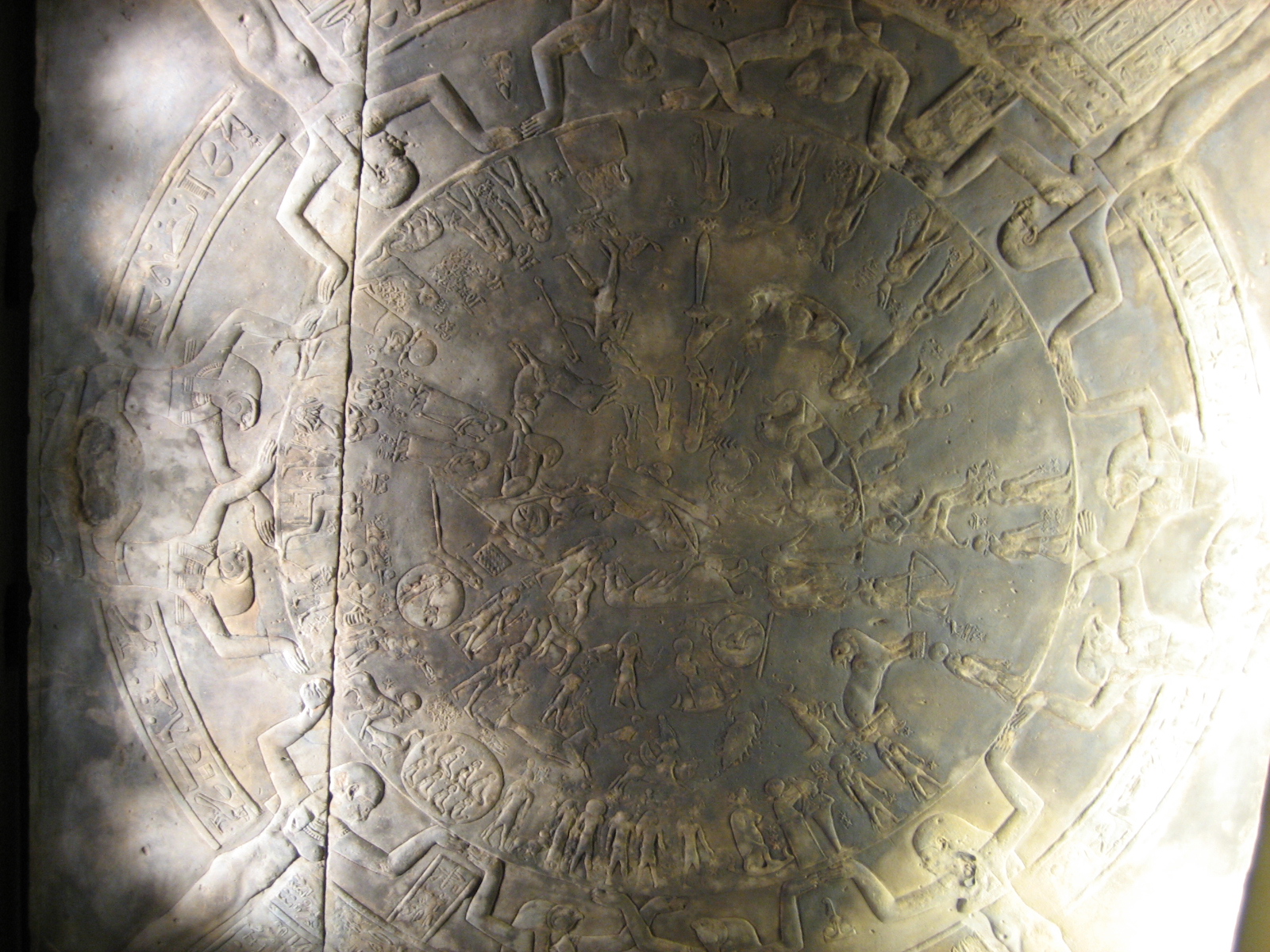
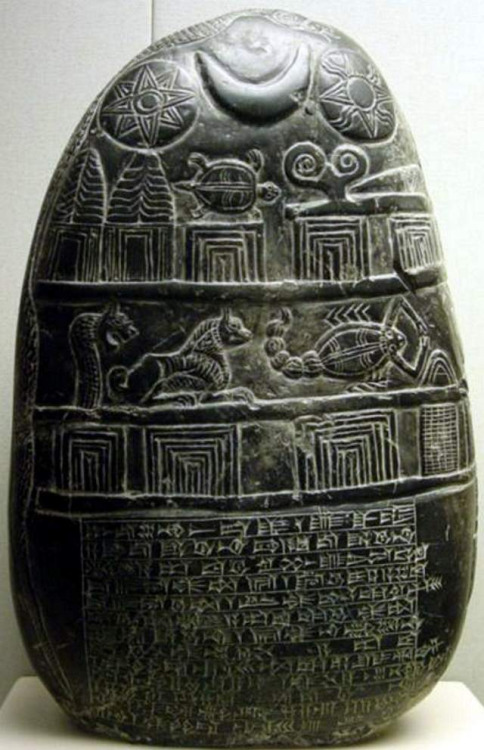
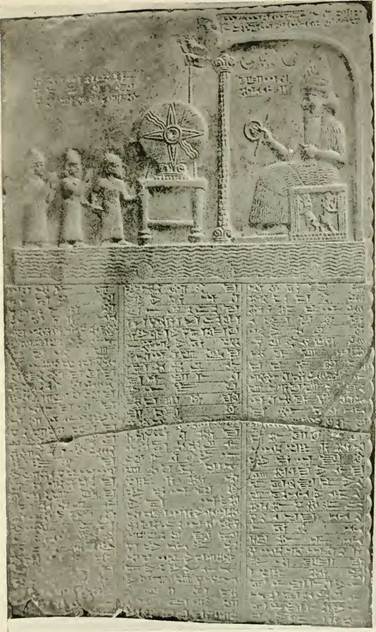
Their investigations are tainted by certain perceptions. Their primary problems concern their epistemological approaches and historical methodologies. First is the unproven assertion of this institution.

For example, Astour states that “Babylonia [was] the classical land of sacral prostitution …. Sacral prostitution existed in Israel and Judah until the implementation of the religious reforms of the seventh and sixth centuries B.C.” This fallacy is repeated ad nauseam in many general discussions of sacred prostitution. In 1987, the Encyclopedia of Religion entry for “hierodouleiacomments:

Contemporary scholarship uses the expression sacred prostitution to refer to a sexual rite practiced in the ancient Near East. In the temples of Ishtar, Astarte, Ma, AnShita, and Aphrodite, for example, women, often virgins, offered themselves sexually to strangers. Sometimes the temples were staffed by such “sacred prostitutes.”

Such allegations first appear in the work of Herodotus (The Histories, 1.199) whose view of Mesopotamian culture was considerably biased and whose speculations have been elaborated by Strabo in his Geography (16.1.20), and by other classical authors. Of the scholars cited above in note one, a majority have investigated this source and have realized it was the only source for claiming sacred prostitution, and discarded it on these grounds.

When scholars discuss an institution without any attempt to define it, we must conclude that their methodology is questionable. The term “sacred prostitution” is employed for any sexual practice within the “sacred sphere”; the sacred prostitute can be a priestess who participated in a “sacred marriage,” a laywoman, such as Herodotus’s Babylonian woman, who once in her life has to offer herself to a stranger for money in the temple of Aphrodite, a priestess whose caring for the gods included offering them sexual services, or a laywoman who participated in organized, ritual sexual activities.

It is obvious that a definition of terms is mandatory. According to the Oxford English Dictionary, “prostitution” is “the action of prostituting or condition of being prostituted. . . the offering of the body to indiscriminate lewdness for hire,” from late Latin prostituere, “to place before, to expose publicly, offer for sale, to act as a prostitute.”

“Sacred prostitution” would, therefore, be the act of offering the body to indiscriminate lewdness for hire in the sacred sphere, ritual, or place. None of the above scholarly definitions fits this definition with the exception of that originating with Herodotus!

For these reasons, some writers, such as Fisher and Lerner, differentiate “cultic sexual service” from “commercial prostitution”; the former discriminating and without payment, and the latter indiscriminate and with payment.

For Mesopotamia, we have clear and explicit evidence of the profitable profession of the prostitute, the harimtu. Her place of work is usually the tavern. Inanna and Ishtar both act as patroness of the tavern and its inhabitants. The profession of prostitution is designated harimūtu.

However, in the city of Sippar in the Old Babylonian period, this status and its prerogatives are held by men as well as women, husbands as well as wives. These prerogatives are designated as those of a goddess; but whether it can be inferred from this statement that there is any relationship to the temple and its cult is impossible to determine from the evidence.

From economic texts, we could conclude that silver may have been exchanged during the fulfillment of these prerogatives or from the sale of these offices as any other office. Because of the dearth of information concerning the status of harimutu and our lack of knowledge concerning the temple’s part in the regulation of the tavern/brothel and the prostitutes that congregated there, it might be better to give a more generalized definition of “prostitution” in Mesopotamia.

Consequently, I would suggest that a “prostitute” is one who is outside the culturally defined bounds of controlled sexuality.”

Joan Goodnick Westenholz, “Tamar, Qēdēšā, Qadištu, and Sacred Prostitution in Mesopotamia,” The Harvard Theological Review, Vol. 82, No. 3 (July, 1989), pp. 260-2.

Tracing the Doctrine of Cataclysms of Berossus

“The context in Censorinus shows that the interval of 2434 years was in Aristarchus’s opinion the interval between alternate conflagrations and inundations of the world when the sun, moon, and stars all return to the same zodiacal sign.

It is very difficult to trace exactly the adoption of Babylonian ideas by the Greek astronomers. An active part in the diffusion of Babylonian astronomy is often ascribed to Berosus the Chaldaean, who was a contemporary of Aristarchus, and had a doctrine of cataclysms similar to his; for Berosus claimed that when all the planets were in Cancer the earth would be burned, and when they were in Capricorn there would be a flood.

But an examination of the astronomical fragments of Berosus suggests that he had a very inadequate knowledge of the subject. His views on the moon’s phases are reported by Vitruvius, who contrasts them with the explanation given by Aristarchus.

It looks indeed as though Aristarchus set out deliberately to refute the views of his Babylonian contemporary, who settled in Cos, not far from Samos, the home of Aristarchus. Berosus supposed that the moon had light of her own, one half of her orb being luminous and the rest of a blue colour. The moon’s phases thus in his view were caused by her luminous half being turned towards or away from the earth.

Aristarchus, however, maintained that the moon receives her light from the sun, so that on the fourteenth day of the month when she is in opposition to the sun, she is full and rises when the sun is setting.

Vitruvius shows that Aristarchus explained the first and last quarters and the new moons as well; and it is obvious from Aristarchus’s book on the sizes and distances of the sun and moon that Berosus had nothing to teach the Samian about the phases of the moon.

No doubt Aristarchus applied what he had learned from Strato and his own theory about light and shadow to the moon’s phases and to eclipses also. The most obvious objection to Berosus’s doctrine was that it failed to explain lunar eclipses, as Cleomedes [2.4] pointed out.

It is most unlikely that Berosus had anything worth while to teach the Greeks about theoretical astronomy, though he did have a cursory interest in the subject, having treated it in the first book of the Babyloniaca (P. Schnabel, Berossos und die babylonisch-hellenistische LiteraturLeipzig 1923, p. 19.)

We are told also that he maintained that Babylonian astronomical records did not go back before the time of Nabonasar, that king having destroyed the earlier ones. In view of this clear statement it is surprising to find that according to our texts of Pliny, Berosus held that observations of the stars had been inscribed on baked tablets for 480,000 (!) years (490,000 in some copies).

If we read CCCCLXXX for CCCCLXXX we can reduce the period to 480 years. Now Berosus dedicated his Babyloniaca to Antiochus I Soter, who reigned from 281/0 to 262/1 B.C., and if we add 480 to a year in the reign of that king we are brought close to the epoch of Nabonasar.

I think it likely therefore that Berosus stated that accurate observations had been made in Babylonia for 480 years from the time of Nabonasar, and that earlier observations were not available to him. This suggestion is supported by the failure of Ptolemy in the Almagest to cite any Chaldaean observations earlier than the time of Nabonasar.

If Ptolemy’s dating of the first year of Nabonasar to 747 B.C. was the same as Berosus’s, then we have a date for the publication of the Babyloniaca, 480 years after 747 B.C. or 267 B.C., a year well within the reign of Antiochus I to whom the work was dedicated.”

George Huxley, “Aristarchus of Samos and Graeco-Babylonian Astronomy,” Greek, Roman and Byzantine Studies, Duke University, Vol 5, No 2 (1964), pp. 125-7.

Hesiod Fragment 304

“Hesiod’s riddle assumes a system of four world periods, each comprising a year of twelve months of which the first and the last are occupied by the creation and the destruction of the world, respectively.

The equal world periods of Berossus end alternately in a world inundation and a world conflagration, the former when all the planets are in the sign of the Capricorn, the latter when they are all in the sign of Cancer.

We have already pointed out that this astrological view of the end of the world is based on the rather obvious idea that the Great Year, like the ordinary solar year, has its summer and its winter, which according to Censorinus was even mentioned by Aristotle.

Plato did not relate the world flood and world conflagration to specific, actually impossible, stellar constellations. He ascribes the world conflagration to a disastrous deviation of the celestial bodies from their fixed courses. (Plato, Timaeus, 22d. In Plato the world catastrophes never lead to the complete destruction of the human race. Borossus himself, in his report on the Babylonian flood, makes no mention of the planets coinciding in the sign of the Capricorn.)

And he does not state anywhere that these world catastrophes mark the termination of the Great Year.

The Pre-Socratics held the view that human life is periodically destroyed by a total flooding and a total desiccation of the earth. This may even be implicit in Anaximander’s doctrine of the drying up of the world. (Anaximander, frg., A. 27).

In any case we find this concept clearly expressed in Philolaus, who knew two destructions of the world: one by fire pouring from the sky, the other by water from the moon, released by an inversion of the air; the vapors rising from the earth provide the cosmos with food. (Philolaus, frg., A. 18).

We must not visualize this as a sudden catastrophe but rather as a slow drying up of the earth until life is no longer possible, followed by a gradual moistening of the earth until it finally drowns in water.

Philolaus assumed an unceasing rising and sinking movement of the air and of the accompanying moisture present in the cosmos. Due to the heat of the sun, “the fire that pours from the sky,” the water on earth evaporates and the ascending vapors, which form the food of the cosmos, rise together to the moon. (According to Aëtius, De placitis philosophorum, II, 17, 4, this was taught as early as by Heraclitus, cf. FVS, I, 146).

When the earth is completely dried out and life has come to an end, the process is reversed, and by the opposite movement of the air the earth is gradually moistened until life revives. It is clear that this conception derives from the observation of the sun’s capacity to cause evaporation and of the falling of the dew on clear moonlit nights.

On his system Philolaus evokes a magnificent vision of the course of the cosmos in which the immensely long world periods succeed each other as the night the day.

This conception is highly consistent with the idea that one month of the world year is needed for the creation and one month for the destruction of the world. This makes it probable that the four eras of the Great Year assumed by the riddle of Hesiod were, in the original conception, alternately ended by flooding and drying up of the world.

The first period of which Berossus speaks was terminated by a world flood, from which it follows that the second period referred to in Hesiod, frg., 304, would have to end in “fire.”

R. van den Broek, The Myth of the Phoenix: According to Classical and Early Christian Traditions, Brill Archive, 1972, pp. 100-2.

Hesiod, the Great Year, and the Phoenix

“In the discussion of the Classical conception of the Great Year it was mentioned that Plato was the first author to make a clear statement about this cosmic period. He referred to an almost inconceivably long time, which he could characterize only by saying that at the completion of such a cosmic revolution the perfect number of time comprises the perfect year. It remains possible, however, that in another connection he assigned a specific duration to the Great Year.

In the eighth book of Politeia, Plato discusses the question of how an aristocracy can become degraded into a timocracy, i.e. a form of government in which ambition is the dominant principle of the rulers. (Plato, Politeia, VIII, 3, 544d-547c).

This occurs, he says, because the Guardians will not be able, by calculation and observation, to determine the appropriate times for birth. In an extremely difficult passage which has given rise to many commentaries he then gives the computation of what is incorrectly called the “nuptial number.” (A. Diès, Le nombre de Platon, essai d’exégèse et d’histoire, Académie des Inscriptions et Belles-Lettres, XIV, Paris, 1936, and others).

Plato begins by remarking that for the divine creature there is a period embraced by a perfect number. (Plato, Politeia, VIII, 3, 546b). This is reminiscent of his statement that the duration of the Great Year can be expressed in a perfect number.

The zodiac is a planisphere or map of the stars on a plane projection, showing the 12 constellations of the zodiacal band forming 36 decans of ten days each, and the planets. These decans are groups of first-magnitude stars. These were used in the ancient Egyptian calendar, which was based on lunar cycles of around 30 days and on the heliacal rising of the star Sothis (Sirius). The celestial arch is represented by a disc held up by four pillars of the sky in the form of women, between which are inserted falcon-headed spirits. On the first ring 36 spirits symbolize the 360 days of the Egyptian year. On an inner circle, one finds constellations, showing the signs of the zodiac. Some of these are represented in the same Greco-Roman iconographic forms as their familiar counterparts (e.g. the Ram, Taurus, Scorpio, and Capricorn, albeit most in odd orientations in comparison to the conventions of ancient Greece and later Arabic-Western developments), whilst others are shown in a more Egyptian form: Aquarius is represented as the flood god Hapy, holding two vases which gush water. Rogers noted the similarities of unfamiliar iconology with the three surviving tablets of a "Seleucid zodiac" and both relating to kudurru, "boundary-stone" representations: in short, Rogers sees the Dendera zodiac as "a complete copy of the Mesopotamian zodiac". http://en.wikipedia.org/wiki/Dendera_zodiac

The zodiac is a planisphere or map of the stars on a plane projection, showing the 12 constellations of the zodiacal band forming 36 decans of ten days each, and the planets. These decans are groups of first-magnitude stars. These were used in the ancient Egyptian calendar, which was based on lunar cycles of around 30 days and on the heliacal rising of the star Sothis (Sirius).
The celestial arch is represented by a disc held up by four pillars of the sky in the form of women, between which are inserted falcon-headed spirits. On the first ring 36 spirits symbolize the 360 days of the Egyptian year.
On an inner circle, one finds constellations, showing the signs of the zodiac. Some of these are represented in the same Greco-Roman iconographic forms as their familiar counterparts (e.g. the Ram, Taurus, Scorpio, and Capricorn, albeit most in odd orientations in comparison to the conventions of ancient Greece and later Arabic-Western developments), whilst others are shown in a more Egyptian form: Aquarius is represented as the flood god Hapy, holding two vases which gush water. Rogers noted the similarities of unfamiliar iconology with the three surviving tablets of a “Seleucid zodiac” and both relating to kudurru, “boundary-stone” representations: in short, Rogers sees the Dendera zodiac as “a complete copy of the Mesopotamian zodiac”.
http://en.wikipedia.org/wiki/Dendera_zodiac

For the elucidation of “the divine creature,” reference can be made to the statement in the Timaeus that the Demiurge himself was only the creator of the fixed stars, the planets, and the earth. (Plato, Timaeus, 39e-40b.)

It is therefore probable that the reference in the Politeia to a period comprising a perfect number as belonging to that which the deity generates, should be seen as the duration of the complete cosmic revolution of the Great Year.

But for human creatures, says Plato, there is a geometric number, and this is the one for which he supplies the complex computation already mentioned. Especially since the research done by Diès there has been general agreement that this geometric number, which can be computed in several different ways, is 12,960,000.

To provide the long-sought harmony between the various components of this passage, it has been assumed that the perfect number of the divine creature is the same as the whole geometric number holding for human procreation, the component factors of the geometrical number having special relevance for the latter. (Ahlvers, 19-20, basing himself on 12,960,000 days = 36,000 years).

If this is valid, it may be concluded that in the Politeia Plato assumed a duration of 12,960,000 years for the Great Year.

Even if Plato did not mean that the perfect number of the rotation of that which the deity generates is equal to the geometric number, it would nevertheless have to be taken as probable that the number 12,960,000 originally pertained to the duration of the Great Year and that there is a relationship to the concept underlying Hesiod, frg. 304, since this fragment assumes a cycle of four successive world eras forming together a Great Year of 1,296,000 years. The Platonic number—which, incidentally, is a Babylonian sar squared—is thus ten times Hesiod’s value.”

R. van den Broek, The Myth of the Phoenix: According to Classical and Early Christian Traditions, Brill Archive, 1972, pp. 98-9.)

The Great Year Doctrine of World Catastrophe

“In the Greek world the first distinct mention of the Great Year was made by Plato, who argued in his Timaeus that time is produced by the celestial bodies: the moon determines the month, the sun the year; but the times of the planets and of the sphere of the fixed stars are so great that it can hardly be known whether they are times at all.

In any case it is clear that the perfect number of time fulfills the perfect year at the moment at which the sun, the moon, the planets, and the fixed stars have all completed their courses and have again reached their starting point. (Plato, Timaeus, 39c, 39d).

By this is meant that the Great Year is completed when the celestial bodies have reached the same positions in relation to each other as they had at the beginning of that period. The identical conception is found in Cicero, qualified by the statement that the actual duration of such a period is a matter of controversy (Cicero, De natura deorum, II, 51-2).

But in his Hortensius, the book which was later to make such a strong impression on the young Augustine, Cicero equated the Great Year with 12,954 ordinary years, as we know from Tacitus and Servius (Tacitus, Dialogus de oratoribus, 16, 7. Maurus Servius Honoratus, Commentary on the Aenid of Virgil, I, 296. The same number is given by Solinus in connection with the phoenix, Solini Polyhistor, cap. xxxvi).

In addition to these opinions about the Great Year there is another according to which the sun, the moon, and the five planets all return at the end of the Great Year to one and the same sign of the Zodiac, the one under which they were when it began. According to Censorinus, Aristotle himself had put forward this same view, and preferentially indicated this period as “the Greatest Year.” This year, like the ordinary solar year, was thought to have a summer and winter too, the summer culminating in a world conflagration and the world in a world flood. (Censorinus, De die natali, 18, II. ).

How much of this really goes back to Aristotle cannot be said with certainty. (V. Rose, Aristotelis fragmenta, Lipsiae, 1886, 39, frg. 25). According to Seneca, Berossus, the Babylonian priest of Bel who wrote in the third century BC, propagated the same doctrine in a more detailed form: when the sun, the moon, and the planets came to lie in a straight line under the sign of Cancer, the world would burst into flames; and if they reached that position under Capricorn, the world would be inundated. (Seneca, Naturales Quaestiones, III, 29, I).

BM102485 - Boundary stone (kudurru) Kassite dynasty, about 1125-1100 BC Probably from southern Iraq A legal statement about the ownership of a piece of land The cuneiform inscription on this kudurru records the granting by Eanna-shum-iddina, the governor of the Sealand, of five gur of corn land in the district of Edina in south Babylonia to a man called Gula-eresh. The boundaries of the land are laid out; the surveyor is named as Amurru-bel-zeri and the transfer completed by two high officials who are also named. Nine gods are invoked to protect the monument, along with seventeen divine symbols. The symbols of the important Mesopotamian gods are most prominent: the solar disc of the sun-god Shamash, the crescent of the moon-god Sin and the eight-pointed star of Ishtar, goddess of fertility and war. The square boxes beneath these signs represent altars supporting the symbols of gods, including horned headdresses, the triangular spade of Marduk, and the wedge-shaped stylus of Nabu, the god of writing. A prominent snake is shown on many kudurru and may, like many of the symbols, be related to the constellations. The text ends with curses on anyone who removes, ignores or destroys the kudurru. L.W. King, Babylonian boundary stones and (London, Trustees of the British Museum, 1912) © The Trustees of the British Museum http://www.britishmuseum.org/explore/highlights/highlight_objects/me/b/boundary_stone_kudurru-6.aspx

BM102485 – Boundary stone (kudurru)
Kassite dynasty, about 1125-1100 BC
Probably from southern Iraq
A legal statement about the ownership of a piece of land
The cuneiform inscription on this kudurru records the granting by Eanna-shum-iddina, the governor of the Sealand, of five gur of corn land in the district of Edina in south Babylonia to a man called Gula-eresh. The boundaries of the land are laid out; the surveyor is named as Amurru-bel-zeri and the transfer completed by two high officials who are also named.
Nine gods are invoked to protect the monument, along with seventeen divine symbols. The symbols of the important Mesopotamian gods are most prominent: the solar disc of the sun-god Shamash, the crescent of the moon-god Sin and the eight-pointed star of Ishtar, goddess of fertility and war. The square boxes beneath these signs represent altars supporting the symbols of gods, including horned headdresses, the triangular spade of Marduk, and the wedge-shaped stylus of Nabu, the god of writing.
A prominent snake is shown on many kudurru and may, like many of the symbols, be related to the constellations. The text ends with curses on anyone who removes, ignores or destroys the kudurru.
L.W. King, Babylonian Boundary Stones (London, Trustees of the British Museum, 1912)
© The Trustees of the British Museum
http://www.britishmuseum.org/explore/highlights/highlight_objects/me/b/boundary_stone_kudurru-6.aspx

These rather improbable theories were especially favored among astrologers, since Greek astronomy had already reached a point of development at which the doctrines of Berossus could not be accepted. (J. Bidez, Bérose et la grande année, in Melanges Paul Fredericq, Brussels, 1904, 9-19.)

These texts treating the views of Aristotle and Berossus say that world catastrophes corresponding to the summer and winter of the solar year can occur in the course of the Great Year. The period between two world catastrophes could also be seen as a Great Year, but only in the derivative sense. The true Great Year, which might with Aristotle be called the Greatest Year, coincided with a complete cosmic revolution, whether interpreted in the sense of Plato and Cicero or in that of Aristotle and Berossus.

The Great Year of the Classical world arose from the purely mythical conception of a cosmic periodicity ultimately traceable to Babylonia.” (B.L. van der Waerden, Das gross Jahr und die ewige Wiederkehr, in Hermes, 80, 1952, 135-43.)”

R. van den Broek, The Myth of the Phoenix: According to Classical and Early Christian Traditions, Brill Archive, 1972, pp. 72-6.

From Uz to Baphomet

“The gazelle or antelope was a mythological animal in Babylonia so far as it represented Ea, who is entitled ‘the princely gazelle ’ and ‘the gazelle who gives the earth.’ But this animal was also appropriated to Mul-lil, the god of Nippur, who was specially called the ‘gazelle god.’

It is likely, therefore, that this animal had been worshipped totemically at Nippur. Scores of early cylinders represent it being offered in sacrifice to a god, and bas-reliefs and other carvings show it reposing in the arms of various deities.

Limestone tablet depicting king Nabu-aplu-iddina being led into the presence of Šamaš, the sun god; 860 BCE-850 BCE.  Šamaš sits in the E-babbar shrine and holds the rod and ring symbols of kingship (BM 91000). © The British Museum. http://oracc.museum.upenn.edu/amgg/listofdeities/utu/ Alternative interpretation, from Lewis Spence, Myths and Legends of Babylonia and Assyria, London, 1917, p. 292.  "A god called Uz has for his name the Akkadian word for goat. Mr Hormuzd Rassam found a sculptured stone tablet in a temple of the sun-god at Sippara on which was an inscription to Sin, Shamash, and Ishtar, as being “set as companions at the approach to the deep in sight of the god Uz.”  This god Uz is depicted as sitting on a throne watching the revolution of the solar disc, which is placed upon a table and made to revolve by means of a rope or string. He is clad in a robe of goat-skin." http://www.wisdomlib.org/mesopotamian/book/myths-and-legends-of-babylonia-and-assyria/d/doc7171.html

Limestone tablet depicting king Nabu-aplu-iddina being led into the presence of Šamaš, the sun god; 860 BCE-850 BCE.
Šamaš sits in the E-babbar shrine and holds the rod and ring symbols of kingship (BM 91000). © The British Museum.
http://oracc.museum.upenn.edu/amgg/listofdeities/utu/
Alternative interpretation, from Lewis Spence, Myths and Legends of Babylonia and Assyria, London, 1917, p. 292.
“A god called Uz has for his name the Akkadian word for goat. Mr Hormuzd Rassam found a sculptured stone tablet in a temple of the sun-god at Sippara on which was an inscription to Sin, Shamash, and Ishtar, as being “set as companions at the approach to the deep in sight of the god Uz.”
This god Uz is depicted as sitting on a throne watching the revolution of the solar disc, which is placed upon a table and made to revolve by means of a rope or string. He is clad in a robe of goat-skin.”
http://www.wisdomlib.org/mesopotamian/book/myths-and-legends-of-babylonia-and-assyria/d/doc7171.html

The goat, too, seems to have been peculiarly sacred, and formed one of the signs of the zodiac. A god called Uz has for his name the Akkadian word for goat. Mr Hormuzd Rassam found a sculptured stone tablet in a temple of the sun-god at Sippara on which was an inscription to Sin, Shamash, and Ishtar, as being “set as companions at the approach to the deep in sight of the god Uz.”

This god Uz is depicted as sitting on a throne watching the revolution of the solar disc, which is placed upon a table and made to revolve by means of a rope or string. He is clad in a robe of goat-skin.

This cult of the goat appears to be of very ancient origin, and the strange thing is that it seems to have found its way into mediaeval and even into modern magic and pseudo-religion. There is very little doubt that it is the Baphomet of the knights-templar and the Sabbatic goat of the witchcraft of the Middle Ages.

It seems almost certain that when the Crusaders sojourned in Asia-Minor they came into contact with the remains of the old Babylonian cult.

When Philip the Fair of France arraigned them on a charge of heresy a great deal of curious evidence was extorted from them regarding the worship of an idol that they kept in their lodges.

The real character of this they seemed unable to explain. It was said which the image was made in the likeness of ‘Baphomet,’ which name was said to be a corruption of Mahomet, the general Christian name at that period for a pagan idol, although others give a Greek derivation for the word.

This figure was often described as possessing a goat’s head and horns. That, too, the Sabbatic goat of the Middle Ages was of Eastern and probably Babylonian origin is scarcely to be doubted. At the witch orgies in France and elsewhere those who were afterwards brought to book for their sorceries declared that Satan appeared to them in the shape of a goat and that they worshipped him in this form.

A depiction of Baphomet by Eliphas Levi, Transcendental Magic, (Figure IX), p. 296.

A depiction of Baphomet by Eliphas Levi, Transcendental Magic, (Figure IX), p. 296.

The Sabbatic meetings during the fifteenth century in the wood of Moffiaines, near Arras, had as their centre a goat-demon with a human countenance, and a like fiend was adored in Germany and in Scotland. From all this it is clear that the Sabbatic goat must have had some connexion with the East.

Eliphas Levi drew a picture of the Baphomet or Sabbatic goat to accompany one of his occult works, and strangely enough the symbols that he adorns it with are peculiarly Oriental—moreover the sun-disc figures in the drawing.

Now Levi knew nothing of Babylonian mythology, although he was moderately versed in the mythology of modern occultism, and it would seem that if he drew his information from modern or mediaeval sources that these must have been in direct line from Babylonian lore.”

Lewis Spence, Myths and Legends of Babylonia and Assyria, 1917, pp. 292-4.

On Divination in Ancient Babylonia

“Divination as practised by means of augury was a rite of the first importance among the Babylonians and Assyrians. This was absolutely distinct from divination by astrology.

The favourite method of augury among the Chaldeans of old was that by examination of the liver of a slaughtered animal. It was thought that when an animal was offered up in sacrifice to a god that the deity identified himself for the time being with that animal, and that the beast thus afforded a means of indicating the wishes of the god.

Simulacrum of a sheep’s liver, inscribed with magical formulae for purposes of divination by the priests of Babylon.   Photo W. A. Mansell and Co. Lewis Spence, Myths and Legends of Babylonia and Assyria, London, 1917. P. 281. http://www.wisdomlib.org/uploads/images/clay-object.jpg

Simulacrum of a sheep’s liver, inscribed with magical formulae for purposes of divination by the priests of Babylon.
Photo W. A. Mansell and Co.
Lewis Spence, Myths and Legends of Babylonia and Assyria, London, 1917. P. 281.
http://www.wisdomlib.org/uploads/images/clay-object.jpg

Now among people in a primitive state of culture the soul is almost invariably supposed to reside in the liver instead of in the heart or brain. More blood is secreted by the liver than by any other organ in the body, and upon the opening of a carcase it appears the most striking, the most central, and the most sanguinary of the vital parts. The liver was, in fact, supposed by early peoples to be the fountain of the blood supply and therefore of life itself.

Hepatoscopy or divination from the liver was undertaken by the Chaldeans for the purpose of determining what the gods had in mind. The soul of the animal became for the nonce the soul of the god, therefore if the signs of the liver of the sacrificed animal could be read the mind of the god became clear, and his intentions regarding the future were known.

Divinatory clay liver models for training soothsayers.  The one in the middle foretells the destruction of small cities.  Baken clay, 19th–18th centuries BC, from the royal palace at Mari (now in Syria).  Louvre Museum  wikidata:Q19675 Department of Oriental Antiquities, Richelieu, ground floor, room 3 Accession number	AO 19837 Excavated by André Parrot, 1935–1936 Source/Photographer	Jastrow (2005) http://commons.wikimedia.org/wiki/File:Divinatory_livers_Louvre_AO19837.jpg

Divinatory clay liver models for training soothsayers.
The one in the middle foretells the destruction of small cities.
Baken clay, 19th–18th centuries BC, from the royal palace at Mari (now in Syria).
Louvre Museum
wikidata:Q19675
Department of Oriental Antiquities, Richelieu, ground floor, room 3
Accession number AO 19837
Excavated by André Parrot, 1935–1936
Source/Photographer Jastrow (2005)
http://commons.wikimedia.org/wiki/File:Divinatory_livers_Louvre_AO19837.jpg

The animal usually sacrificed was a sheep, the liver of which animal is most complicated in appearance. The two lower lobes are sharply divided from one another and are separated from the upper by a narrow depression, and the whole surface is covered with markings and fissures, lines and curves which give it much the appearance of a map on which roads and valleys are outlined. This applies to the freshly excised liver only, and these markings are never the same in any two livers.

Certain priests were set apart for the practice of liver-reading, and these were exceedingly expert, being able to decipher the hepatoscopic signs with great skill. They first examined the gall-bladder, which might be reduced or swollen. They inferred various circumstances from the several ducts and the shapes and sizes of the lobes and their appendices. Diseases of the liver, too, particularly common among sheep in all countries, were even more frequent among these animals in the marshy portions of the Euphrates Valley.

The literature connected with this species of augury is very extensive, and Assur-bani-pal’s library contained thousands of fragments describing the omens deduced from the practice. These enumerate the chief appearances of the liver, as the shade of the colour of the gall, the length of the ducts, and so forth.

The lobes were divided into sections, lower, medial, and higher, and the interpretation varied from the phenomena therein observed. The markings on the liver possessed various names, such as ‘palaces,’ ‘weapons,’ ‘paths,’ and ‘feet,’ which terms remind us somewhat of the bizarre nomenclature of astrology.

Later in the progress of the art the various combinations of signs came to be known so well, and there were so many cuneiform texts in existence which afforded instruction in them, that a liver could be quickly ‘read’ by the barû or reader, a name which was afterward applied to the astrologists as well and to those who divined through various other natural phenomena.

One of the earliest instances on record of hepatoscopy is that regarding Naram-Sin, who consulted a sheep’s liver before declaring war. The great Sargon did likewise, and we find Gudea applying to his ‘liver inspectors’ when attempting to discover a favourable time for laying the foundations of the temple of Nin-girsu.

Throughout the whole history of the Babylonian monarchy in fact, from its early beginnings to its end, we find this system in vogue. Whether it was in force in Sumerian times we have no means of knowing, but there is every likelihood that such was the case.”

Lewis Spence, Myths and Legends of Babylonia and Assyria, 1917, pp. 281-3.

Spence on Babylonian Religion and Magic

“LIKE other primitive races the peoples of Chaldea scarcely discriminated at all between religion and magic. One difference between the priest and the sorcerer was that the one employed magic for religious purposes whilst the other used it for his own ends.

The literature of Chaldea—especially its religious literature—teems with references to magic, and in its spells and incantations we see the prototypes of those employed by the magicians of medieval Europe.

Indeed so closely do some of the Assyrian incantations and magical practices resemble those of the European sorcerers of the Middle Ages and of primitive peoples of the present day that it is difficult to convince oneself that they are of independent origin.

In Chaldea as in ancient Egypt the crude and vague magical practices of primeval times received form and developed into accepted ritual, just as early religious ideas evolved into dogmas under the stress of theological controversy and opinion.

As there were men who would dispute upon religious questions, so were there persons who would discuss matters magical. This is not to say that the terms ‘religion’ and ‘magic’ possessed any well-defined boundaries for them.

Nor is it at all clear that they do for us in this twentieth century. They overlap; and it has long been the belief of the writer that their relations are but represented by two circles which intersect one another and the areas of which partially coincide.

The writer has outlined his opinions regarding the origin of magic in an earlier volume of this series, and has little to add to what he then wrote, except that he desires to lay stress upon the identification of early religion and magic.

It is only when they begin to evolve, to branch out, that the two systems present differences. If there is any one circumstance which accentuates the difference more than another it is that the ethical element does not enter into magic in the same manner as it does into religion.

That Chaldean magic was the precursor of European mediaeval magic as apart from popular sorcery and witchcraft is instanced not only by the similarity between the systems but by the introduction into mediaeval magic of the names of Babylonian and Assyrian gods and magicians.

Again and again is Babylon appealed to even more frequently than Egypt, and we meet constantly with the names of Beelzebub, Ishtar (as Astarte), Baal, and Moloch, whilst the names of demons, obviously of Babylonian origin, are encountered in almost every work on the subject.

Frequent allusions are also made to the ‘wise men’ and necromancers of Babylon, and to the ‘star-gazers’ of Chaldea. The conclusion is irresistible that ceremonial magic, as practised in the Middle Ages, owed much to that of Babylon.

Our information regarding Chaldean magic is much more complete than that which we possess concerning the magic of ancient Egypt.

Hundreds of spells, incantations, and omen-inscriptions have been recovered, and these not only enlighten us regarding the class of priests who practised magic, but they tell us of the several varieties of demons, ghosts, and evil spirits; they minutely describe the Babylonian witch and wizard, and they picture for us many magical ceremonies, besides informing us of the names of scores of plants and flowers possessing magical properties, of magical substances, jewels, amulets, and the like.

Also they speak of sortilege or the divination of the future, of the drawing of magical circles, of the exorcism of evil spirits, and the casting out of demons.”

Lewis Spence, Myths and Legends of Babylonia and Assyria, 1917, pp. 257-9.

Lewis Spence on the Great Temples of Babylonia

“This outline of the history of E-Kur will serve for that of many other Babylonian temples. The temple of Shamash at Sippar, which was known as E-babbara, or the Brilliant House, can be traced back as far as the days of Naram-Sin.

This was also restored by monarchs of the Kassite dynasty, but the nomadic tribes, who ever threatened the peace of Babylonia, made an inroad, scattered the priesthood, and destroyed the great idol of Shamash.

It was nearly 500 years after this that the Brilliant House was restored to its former glory by Nabu-baliddin. Nebuchadrezzar rebuilt portions of the temple, as did the last King of Babylonia, Nabonidus, who scandalized the priests of Babylon by his preference for the worship of Shamash.

We shall remember that one of the principal centres of the cult of the moon was at Ur, the city whence came Abram the Patriarch, and it is probable that he was originally a moon-worshipper. Another such centre of lunar adoration was Harran.

These places were regarded as especially sacrosanct, as the moon-cult was more ancient than that of the sun, and was therefore looked upon with a greater degree of veneration. Both of these cities possessed temples to Sin, the moon-god, and in them astrology and stellar observation were enthusiastically carried on.

Harran was more than once overrun by the fierce nomadic tribes of the desert, but its prestige survived even their destructive tendencies.

The temple of E-anna at Erech, dedicated to Ishtar, was one of the most famous sanctuaries in Babylonia. It is alluded to in one of the creation legends, as were also the temples at Nippur, as ‘The bright house of the gods.’

The temple of Merodach at E-Sagila and that of Nabu at E-Zida were inseparably associated, for a visit to one practically necessitated a visit to both. An original rivalry between the gods had ended in a species of amalgamation, and together they may be said to have symbolized the national religion of Babylonia. Indeed so great was their influence that it can scarcely be over-estimated.

The theological thought of the country emanated from the schools which clustered around them, and they were the great literary centres of Babylonia, and thus the progenitors of Assyrian culture.”

Lewis Spence, Myths and Legends of Babylonia and Assyria, 1917, pp. 249-50.

Boaz and Jachin, and Pillars of Emerald and Gold in the Temple of Melkarth in Herodotus

“Within the last few years, bas-reliefs have been found in Sicily and Tunisia representing persons in the act of adoration before a small triad of stone. We are here on Phoenician territory, and it is not strange therefore that classical writers should speak of the βαίτυλοι or Beth-els, the meteoric stones which had fallen from heaven like “the image” of Artemis at Ephesos, and were accordingly honoured by the Phoenicians.

In the mythology of Byblos, Heaven and Earth were said to have had four sons, Ilos or ElBêtylos or Beth-elDagon and Atlas; and the god of heaven was further declared to have invented the Baityli, making of them living stones (Eusebius of Caesarea: Praeparatio Evangelica (Preparation for the Gospel), Tr. E.H. Gifford (1903) — Book 1, Chapter 10).

Bethuel is connected with Aram in the Old Testament (Genesis xxii, 21, 22); and we all remember how, on his way to Haran, Jacob awakened out of sleep, saying, “Surely the Lord is in this place,” and “took the stone that he had put for his pillows, and set it up for a pillar, and poured oil upon the top of it, and called the name of that place Beth-el.”

In Palestine, however, the Beth-els were arranged in a circle or Gilgal, rather than singly; the isolated monuments were the cones of stone or the bare tree-trunks which symbolised Ashêrah, the goddess of fertility, and Baal the Sun-god. The sun-pillars and the ashêrim meet with frequent mention in the Biblical records; and we may gain some idea as to what the latter were like from the pictures we have on coins and gems of the famous conical stone that stood within the holy of holies in the temple of the Paphian Aphroditê, as well as from the description given of it by Tacitus.

On a gem in the British Museum, Sin, “the god of Harran,” is represented by a stone of the same shape surmounted by a star. The “pillars of the Sun” were also stones of a like form. When the Phoenician temple in the island of Gozo, whose ruins are known as the Temple of the Giants, was excavated, two such columns of stone were found, planted in the ground, one of which still remains in situ.

We cannot forget that even in Solomon’s temple, built as it was by Phoenician workmen, there were two columns of stone, Boaz and Yakin, set on either side of the porch (1 Kings vii. 21), like the two columns of gold and emerald glass which Herodotos saw in the temple of Melkarth at Tyre (Herodotus, The Histories, ii, 44).

The sacred stones which were thus worshipped in Arabia, in Phoenicia and in Syria, were worshipped also among the Semites of Babylonia. There is a curious reference to the consecration of a Beth-el in the Epic of Gisdhubar.

When the hero had been dismissed by the Chaldean Noah, and his sickness had been carried away by the waters of the sea, we are told that “he bound together heavy stones,” and after taking an animal for sacrifice, “poured over it a homer” in libation.

He then commenced his homeward voyage up the Euphrates, having thus secured the goodwill of heaven for his undertaking.”

A.H. Sayce, Lectures on the Origin and Growth of Religion as Illustrated by the Religion of the Ancient Babylonians, 5th ed., London, 1898, pp. 408-10.

Divinity of the High Places, and Sacred Stones

“The sacred mounds of Babylonia, in fact, like the Gilgals of Palestine, appear to have been the sites of older structures which had long fallen into decay, and around which fancy and tradition were allowed to play freely.

They had in this way become veritable hills–tumuli, as we should term them in our modern archeological vocabulary–and as such deserved the venerable title of sadu, or “mountain.” New temples like that of “the mountain of the world” could be named after them, but this did not imply a recollection that the sacred mounds had once been temples themselves.

They were rather, like the mountains of the eastern frontier, the everlasting altars of the gods, on whose summits worship could most fittingly be paid to the deities of heaven. And, like the mountains, they were something more than altars; they were themselves divine, the visible habitations of the spirits of the air.

It is possible that Prof. Friedrich Delitzsch is right in proposing to see in the Assyrian sadu, or “mountain,” the explanation of the Hebrew title of the Deity, El Shaddai. At all events, God is compared to a rock in the Old Testament (Deuteronomy, xxxii. 15, Psalms, xviii. 2), and the worship of sacred stones was widely spread through the Semitic world.

Between the sacred mounds of Babylonia, however, and the sacred stones of Semitic faith, there was a wide difference, answering to a difference in the minds of the two races to whom these separate cults belonged.

The sacred stone was a Beth-el, or “house of god;” no habitation of a mere spirit, but the dwelling-place of deity itself. Its sanctity was not inherent; it was sacred because it had been transformed into an altar by the oil that was poured out upon it in libation, or the priest who was consecrated to its service. The worship of those sacred stones was common to all the branches of the Semitic family.

The famous black stone of the Kaaba at Mecca is a standing witness of the fact. So firmly rooted was the belief in its divine character among the Arabs of Mohammed’s day that he was unable to eradicate it, but was forced to make a compromise with the old faith by attaching to the stone the traditions of the Old Testament.

The black stone, though more sacred than any others, did not stand alone. All around Mecca there were similar stones, termed Anzab, three of which may still be seen, according to Mr. Doughty, at the gates of the city, where they go by the names of IIobbal, Lâta and Uzza.

Northward of Mecca, at Medain-Saleh, the burial-place of the ancient kingdom of the Nabathaeans, Mr. Doughty has discovered niches in the rock containing sacred stones. Above one of them is an inscription which shows that the stone was the symbol or habitation of the god Auda (or Aera): “This is the place of prayer which Seruh the son of Tuka has erected to Auda of Bostra, the great god, in the month Nisan of the first year of king Malkhos.”

A.H. Sayce, Lectures on the Origin and Growth of Religion as Illustrated by the Religion of the Ancient Babylonians, 5th ed., London, 1898, pp. 407-8.

Was the Birs-i-Nimrud the Historical Tower of Babel?

“At any rate, in Babylonia itself the primitive cult of the mountains could be carried on only artificially. The sacred mountains of the plain were the mounds which marked the sites of ancient temples, or the towers which rose within them in order that the priest might continue on their summits that close communion with heaven which he had once enjoyed on the high places of the mountain-tops.

In the story of the Deluge, the mountain peak of Nizir, where the rescued hero of the legend built his altar and poured out his offerings, is called a ziggurrat, or temple-tower. Conversely, “the mountain of the world” was the name given to a temple at Calah; and the mountain of ‘Sabu, to which the god Zu took his flight, was Kharsak-kalama, “the mountain of mankind,” an artificial mound near Kis.

The most famous of these sacred tels or mounds, however, was the famous tilu ellu, “the illustrious mound,” at Borsippa, now represented by the Birs-i-Nimrud. Nebo, to whom the great temple of Borsippa was dedicated, is called its god (H.C. Rawlinson, The Cuneiform Inscriptions of Western Asia, 1886, ii. 54, 71).

The Birs-i-Numrud, alleged to be the ruined remains of the historical Tower of Babel.  Current dimensions are 150 feet high with a circumference of 2300 ft.  https://www.pinterest.com/pin/206180489165185035/

The Birs-i-Numrud, alleged to be the ruined remains of the historical Tower of Babel.
Current dimensions are 150 feet high with a circumference of 2300 ft.
https://www.pinterest.com/pin/206180489165185035/

One of “the three great” or secret “names of Anu” was that of “the lord who issues forth from the illustrious mound” (H.C. Rawlinson, The Cuneiform Inscriptions of Western Asia, 1886, iii. 68, ID), in reference to the fact that the Accadian prototype of Nebo was once the universe itself, in which the seven spheres of light were set, and around which the ocean-stream wound like a rope or serpent.

When the old god of Borsippa had passed into the Semitic Nebo, the attributes which had formerly connected him with the firmament of heaven were transferred to Anu, the sky-god of the official cult.

A fragmentary tablet, which gives us, as I believe, the Babylonian version of the building of the tower of Babel, expressly identifies it with “the illustrious mound.” Here we are told of the leader of the rebellion that when “the thought of his heart was hostile” and he “had wronged the father of all the gods,” when “he was hurrying to seize Babylon,” and “small and great were mingling the mound,” “the divine king of the illustrious mound” intervened, “Anu iifted up (his hand) in front” and prayed “to his father the lord of the firmament.”

“All day long he troubled” them; “as they lamented on their couch he ended not” their “distress.” “In his wrath he overthrows (their) secret counsel; in his (fury) he set his face to mingle (their) designs; he gave the command (?), he made strange their plan” (William Saint Chad Boscawen, Transactions of the Society of Biblical Archeology, v. 1.)

The very word that the Hebrew writer uses in order to explain the origin of the name of Babylon, and which the Authorised Version translates “confound,” is here employed of those who “mingled together” the mound, and whose designs were afterwards themselves “mingled'” by the god of heaven.

“The illustrious mound” was known as far back as the time when the months of the Accadian year were named. The month which corresponded to the Semitic Tasrit or Tisri, and our September, was “the month of the illustrious mound.”

It would seem, therefore, that legend had referred the attempt to build the tower whose head should reach to heaven to the autumnal equinox; at any rate, it is clear that the mound of Borsippa was not only in existence, but was already in a state of ruin when the Accadian calendar was first drawn up.”

A.H. Sayce, Lectures on the Origin and Growth of Religion as Illustrated by the Religion of the Ancient Babylonians, 5th ed., London, 1898, pp. 405-7.

Babylonian Astro-Theology

“In the Observations of Bel the stars are already invested with a divine character. The planets are gods like the sun and moon, and the stars have already been identified with certain deities of the official pantheon, or else have been dedicated to them.

The whole heaven, as well as the periods of the moon, has been divided between the three supreme divinities, Anu, Bel and Ea. In fact, there is an astro-theology, a system of Sabaism, as it would have been called half a century ago.

The star constellation of Hydra as a Babylonian Serpent-Dragon called Mushussu meaning "furious snake," with horns and wings from a clay cuneiform tablet of the Persian period.  According to Professor Langdon, Tammuz (Sumerian Dumuzi) was called a "Heavenly Serpent-dragon," he also noted that Ningishzida whose name means "Lord of the Good Tree" according to some scholars, was an aspect of Dumuzi/Tammuz, Dumuzi being called in hymns "Damu, the child Ningishzida."  (For the drawing cf. p. 286. Stephen Herbert Langdon. The Mythology of All Races- Semitic. Vol. 5. Boston. Marshall Jones Company. 1931). http://www.bibleorigins.net/SerpentDragonMardukAsshur.html

The star constellation of Hydra as a Babylonian Serpent-Dragon called Mushussu meaning “furious snake,” with horns and wings from a clay cuneiform tablet of the Persian period.
According to Professor Langdon, Tammuz (Sumerian Dumuzi) was called a “Heavenly Serpent-dragon,” he also noted that Ningishzida whose name means “Lord of the Good Tree” according to some scholars, was an aspect of Dumuzi/Tammuz, Dumuzi being called in hymns “Damu, the child Ningishzida.”
(For the drawing cf. p. 286. Stephen Herbert Langdon. The Mythology of All Races- Semitic. Vol. 5. Boston. Marshall Jones Company. 1931).
http://www.bibleorigins.net/SerpentDragonMardukAsshur.html

This astro-theology must go back to the very earliest times. The cuneiform characters alone are a proof of this. The common determinative of a deity is an eight-rayed star, a clear evidence that at the period when the cuneiform syllabary assumed the shape in which we know it, the stars were accounted divine.

We have seen, moreover, that the sun and moon and evening star were objects of worship from a remote epoch, and the sacredness attached to them would naturally have been reflected upon the other heavenly bodies with which they were associated.

Totemism, too, implies a worship of the stars. We find that primitive peoples confound them with animals, their automatic motions being apparently explicable by no other theory; and that primitive Chaldea was no exception to this rule has been already pointed out.

Here, too, the sun was an ox, the moon was a steer, and the planets were sheep. The adoration of the stars, like the adoration of the sun and moon, must have been a feature of the religion of primeval Shinar.

Marduk, the supreme god of Babylon. At his feet the Mushhushshu Serpent-dragon, associated with him, as he overpowered it when he defeated Tiamat the female personfication of the salty sea or ocean, mother of the gods, who sought to destroy the land-dwelling gods until killed by Marduk.  In this myth the Serpent-dragon was a creature of Tiamat's (for the image cf. p. 301. Stephen Herbert Langdon. The Mythology of All Races- Semitic. Vol. 5. Boston. Marshall Jones Company. 1931).  This drawing is after a 9th century BCE Babylonian cylinder seal. The Assyrians later declared their God Asshur as the god who defeated Tiamat, and Marduk's serpent-dragon was portrayed as accompanying Asshur. Marduk's robe is the heavenly night sky with all its stars. he was also called "the son of the Sun,"  "the Sun" and "bull-calf of the Sun" (Babylonian amar-utu). http://www.bibleorigins.net/SerpentDragonMardukAsshur.html

Marduk, the supreme god of Babylon. At his feet the Mushhushshu Serpent-dragon, associated with him, as he overpowered it when he defeated Tiamat the female personification of the salty sea or ocean, mother of the gods, who sought to destroy the land-dwelling gods until killed by Marduk.
In this myth the Serpent-dragon was a creature of Tiamat’s (for the image cf. p. 301. Stephen Herbert Langdon. The Mythology of All Races- Semitic. Vol. 5. Boston. Marshall Jones Company. 1931).
This drawing is after a 9th century BCE Babylonian cylinder seal. The Assyrians later declared their God Asshur as the god who defeated Tiamat, and Marduk’s serpent-dragon was portrayed as accompanying Asshur. Marduk’s robe is the heavenly night sky with all its stars. he was also called “the son of the Sun,” “the Sun” and “bull-calf of the Sun” (Babylonian amar-utu). I suspect that the medallions hanging from his neck are none other than the Tablets of Fate.
http://www.bibleorigins.net/SerpentDragonMardukAsshur.html

But this primeval adoration was something very different from the elaborate astro-theology of a later day. So elaborate, indeed, is it that we can hardly believe it to have been known beyond the circle of the learned classes.

The stars in it became the symbols of the official deities. Nergal, for example, under his two names of Sar-nem and ‘Sulim-ta-ea, was identified with Jupiter and Mars. It is not difficult to discover how this curious theological system arose.

Its starting-point was the prominence given to the worship of the evening and morning stars in the ancient religion, and their subsequent transformation into the Semitic Istar. The other planets were already divine; and their identification with specific deities of the official cult followed as a matter of course.

As the astronomy of Babylonia became more developed, as the heavens were mapped out into groups of constellations, each of which received a definite name, while the leading single stars were similarly distinguished and named, the stars and constellations followed the lead of the planets. As Mars became Nergal, so Orion became Tammuz.

The priest had succeeded the old Sumerian sorcerer, and was now transforming himself into an astrologer. To this cause we must trace the rise of Babylonian astro-theology and the deification of the stars of heaven.

The Sabianism of the people of Harrân in the early centuries of the Christian era was no survival of a primitive faith, but the last echo of the priestly astro-theology of Babylonia. This astro-theology had been a purely artificial system, the knowledge of which, like the knowledge of astrology itself, was confined to the learned classes.

It first grew up in the court of Sargon of Accad, but its completion cannot be earlier than the age of Khammuragas. In no other way can we explain the prominence given in it to Merodach, the god of Babylon.”

A.H. Sayce, Lectures on the Origin and Growth of Religion as Illustrated by the Religion of the Ancient Babylonians, 5th ed., London, 1898, pp. 400-2.

Babylonian Astrology

“With the Semitic domination of Sargon of Accad, however, Babylonian astronomy entered upon a new phase. To him, tradition ascribed the compilation of the standard work on Babylonian astronomy and astrology called the Observations of Bel, and afterwards translated into Greek by Berossos (Editorial note: a book by Johannes Haubold, et al, The World of Berossos, 2013, which presents material presented at an academic conference in 2010, can be downloaded in its entirety. Our gratitude is owed to Harrassowitz Verlag of Wiesbaden. A faster and shorter resource is Robert Drews, “The Babylonian Chronicles and Berossus,” Iraq, 1975, which is synopsized in the ensuing three posts).

But the edition of the work which we possess presupposes a much later date. Aries, and not Taurus, marks the beginning of the year, and the text contains references to political and geographical facts, some of which are probably not much older than the age of Assur-bani-pal. This is explained by the nature of the work. It was not so much a treatise on astronomy, as on the pseudo-science that had been evolved out of the observations of astronomy.

The Chaldean priests had grasped but imperfectly the idea of causation; their fundamental assumption was “post hoc, ergo propter hoc;” when two events had been noticed to happen one after the other, the first was the cause of the second. Hence their anxiety to record the phenomena of the heavens and the occurrences that took place after each; if a war with Elam had followed an eclipse of the sun on a particular day, it was assumed that a recurrence of the eclipse on the same day would be followed by a recurrence of a war with Elam.

Assyrian star planisphere found in the library of the Assyrian king Ashurbanipal (Aššur-bāni-apli – reigned 668-627 BCE) at Nineveh.  The function of this unique 13-cm diameter clay tablet, in which the principal constellations are positioned in eight sectors, is disputed. The texts and drawings appear to be astro-magical in nature.  Kuyunjik Collection, British Museum, K 8538 [= CT 33, 10]. London. http://www.staff.science.uu.nl/~gent0113/babylon/babybibl.htm

Assyrian star planisphere found in the library of the Assyrian king Ashurbanipal (Aššur-bāni-apli – reigned 668-627 BCE) at Nineveh.
The function of this unique 13-cm diameter clay tablet, in which the principal constellations are positioned in eight sectors, is disputed. The texts and drawings appear to be astro-magical in nature.
Kuyunjik Collection, British Museum, K 8538 [= CT 33, 10]. London.
http://www.staff.science.uu.nl/~gent0113/babylon/babybibl.htm

In this way a science of astrology was created whose students could foretell the future by observing the signs of the sky.

It is obvious that a work whose object was to connect astronomical observations with current events must have been constantly undergoing alteration and growth. New observations would from time to time be introduced into it, sometimes causing confusion or even omissions in the text. There are instances in which we can detect the presence of observations placed side by side, though belonging to very different periods, or of older records which have been supplemented by the calculations of a later age.

In their present form, therefore, the Observations of Bel have to be used with caution if we would argue from them to the beliefs and practices of early Babylonia.

But the astrological science, or pseudo-science, which underlies the whole work, shows that even in its earliest form it was a product of the Semitic epoch. Between the attitude of mind presupposed by this pseudo-science, and the attitude of mind presupposed by the magical texts and Shamanistic cult of Sumerian Chaldea, there lies an impassable gulf.

This illustration is from a page on Babylonian astronomy hosted by the science faculty of the Mathematical Institute of Utrecht University.  http://www.staff.science.uu.nl/~gent0113/babylon/babybibl_fixedstars.htm A dedicated work assessing the influences of Chaldean astrology on later Greek and Roman knowledge can be found in Franz Cumont, Astrology and Religion Among the Greeks and Romans, 1912.  Full text available for download at several locations on the net, including: http://theosnet.net/dzyan/miscpubs/Astrology_and_Religion.pdf

This illustration is from a page on Babylonian astronomy hosted by the science faculty of the Mathematical Institute of Utrecht University.
http://www.staff.science.uu.nl/~gent0113/babylon/babybibl_fixedstars.htm
A dedicated work assessing the influences of Chaldean astrology on later Greek and Roman knowledge can be found in Franz Cumont, Astrology and Religion Among the Greeks and Romans, 1912.
Full text available for download at several locations on the net, including:
http://theosnet.net/dzyan/miscpubs/Astrology_and_Religion.pdf

According to the latter, events are brought about by the agency of the innumerable spirits of earth and air, and can be controlled by the spells and exorcisms of the sorcerer; according to the astrologer of Sargon’s court, they are natural occurrences, caused and determined by other natural occurrences which can be discovered and noted by the observer. Out of the astrologer the astronomer could be born; between science and sorcery there can be only an eternal feud.

It does not follow, however, that the pre-Semitic population of Chaldea took no notice of the phenomena of the sky. Unusual phenomena, such as an eclipse, must necessarily excite the attention of superstitious and half-civilized tribes; and the formation of a calendar, the invention of the Zodiac, and the naming of the principal constellations, show that a rudimentary astronomy was already in existence.

Indeed, the Observations of Bel not only contain technical terms of Accadian origin, but embody notices of phenomena like eclipses which presuppose a long period of earlier observations.

Unless such observations had existed, even the first compilation of the work would have been impossible. It was astrology, not the rudiments of astronomy, for which the Semites of Babylonia can claim the entire credit.”

A.H. Sayce, Lectures on the Origin and Growth of Religion as Illustrated by the Religion of the Ancient Babylonians, 5th ed., London, 1898, pp. 398-400.

The Babylonian Zodiac is 1000 Years Older than Sargon of Accad

“The contents of the fifth tablet introduce us to a side of Babylonian religion which occupied an important and prominent position, at all events in the official cult. At the beginning of the present century, writers upon the ancient East were fond of enlarging upon a Sabaistic system of faith which they supposed had once been the dominant form of religion in Western Asia.

The accompanying illustration, which is reproduced from the Boundary Stone of Ritti-Marduk (Brit. Mus., No. 90,858), supplies much information about the symbols of the gods, and of the Signs of the Zodiac in the reign of Nebuchadnezzar I, King of Babylon, about 1120 B.C..  Thus in Register 1, we have the Star of Ishtar, the crescent of the Moon-god Sin, and the disk of Shamash the Sun-god.  In Reg. 2 are three stands (?) surmounted by tiaras, which represent the gods Anu, Enlil (Bel) and Ea respectively.  In Reg. 3 are three altars (?) or shrines (?) with a monster in Nos. 1 and 2. Over the first is the lance of Marduk, over the second the mason's square of Nabû, and over the third is the symbol of the goddess Ninkharsag, the Creatress.  In Reg. 4 are a standard with an animal's head, a sign of Ea; a two-headed snake = the Twins; an unknown symbol with a horse's head, and a bird, representative of Shuḳamuna and Shumalia.  In Reg. 5 are a seated figure of the goddess Gula and the Scorpion-man; and in Reg. 6 are forked lightning, symbol of Adad, above a bull, the Tortoise, symbol of Ea (?), the Scorpion of the goddess Ishkhara, and the Lamp of Nusku, the Fire-god.  Down the left-hand side is the serpent-god representing the constellation of the Hydra. http://sacred-texts.com/ane/blc/img/016.png http://sacred-texts.com/ane/blc/blc07.htm

The accompanying illustration, which is reproduced from the Boundary Stone of Ritti-Marduk (Brit. Mus., No. 90,858), supplies much information about the symbols of the gods, and of the Signs of the Zodiac in the reign of Nebuchadnezzar I, King of Babylon, about 1120 B.C..
Thus in Register 1, we have the Star of Ishtar, the crescent of the Moon-god Sin, and the disk of Shamash the Sun-god.
In Reg. 2 are three stands (?) surmounted by tiaras, which represent the gods Anu, Enlil (Bel) and Ea respectively.
In Reg. 3 are three altars (?) or shrines (?) with a monster in Nos. 1 and 2. Over the first is the lance of Marduk, over the second the mason’s square of Nabû, and over the third is the symbol of the goddess Ninkharsag, the Creatress.
In Reg. 4 are a standard with an animal’s head, a sign of Ea; a two-headed snake = the Twins; an unknown symbol with a horse’s head, and a bird, representative of Shuḳamuna and Shumalia.
In Reg. 5 are a seated figure of the goddess Gula and the Scorpion-man; and in Reg. 6 are forked lightning, symbol of Adad, above a bull, the Tortoise, symbol of Ea (?), the Scorpion of the goddess Ishkhara, and the Lamp of Nusku, the Fire-god.
Down the left-hand side is the serpent-god representing the constellation of the Hydra.
http://sacred-texts.com/ane/blc/img/016.png
http://sacred-texts.com/ane/blc/blc07.htm

 Star-worship was imagined to be the most primitive phase of Oriental religion, and the reference to it in the book of Job was eagerly seized upon as an evidence of the antiquity of the book. Dupuis resolved all human forms of faith into Zodiacal symbols, and Sir William Drummond went far in the same direction. That the first gods of the heathen were the planets and stars of heaven, was regarded by high authorities as an incontrovertible fact.

The plains of Shinar were held to be the earliest home of this Sabaism or star-worship. The astronomy and astrology of Babylonia had been celebrated even by Greek and Latin authors, and scholars were inclined to see in the “Chaldaean shepherds” the first observers of the heavens.

The “astrologers, the star-gazers, the monthly prognosticators” of Babylon, are enumerated in the Old Testament (Isaiah xlvii. 13); and the small cylinders brought by travelers from Bagdad, with their frequent representations of a star or sun, seemed to leave no doubt that the deities of Babylonia were in truth the heavenly bodies. The decipherment of the cuneiform inscriptions has shown that the belief in Babylonian “Sabaism” was, after all, not altogether a chimera.

Babylonia was really the cradle of astronomical observations. Long before the lofty zigurrâti or “towers” of the temples were reared, where the royal astronomers had their stations and from whence they sent their reports to the king, the leading groups of stars had been named, a calendar had been formed, and the eclipses of the sun and moon had been noted and recorded.

The annual path of the sun through the sky had been divided into twelve sections, like the twelve kasbu or double hours of the day, and each section had been distinguished by its chief constellation or star. It was thus that the Zodiac first came into existence.

The names given to its constellations are not only Accadian, but they also go back to the totemistic age of Accadian faith. The first sign, the first constellation, was that of “the directing bull,” so named from the solar bull who at the vernal equinox began to plough his straight furrow through the sky, directing thereby the course of the year.

The last sign but one was “the fish of Ea;” while midway between the two, presiding over the month whose name was derived from its “facing the foundation” or “beginning” of the year, was the great star of the Scorpion.

The fact that the year thus began with Taurus proves the antiquity of the Chaldean Zodiac, and of the months of thirty days which corresponded to its several signs. From about B.C. 2500 and onwards, the precession of the equinoxes caused Aries, and not Taurus, to be the asterism into which the sun entered at spring-time; the period when Taurus ushered in the year reached back from that date to about B.C. 4700.

The Zodiacal circle may therefore have been invented nearly a thousand years before Sargon of Accad was born; and that it was invented at an early epoch is demonstrated by its close connection with the Accadian calendar.”

A.H. Sayce, Lectures on the Origin and Growth of Religion as Illustrated by the Religion of the Ancient Babylonians, 5th ed., London, 1898, pp. 396-8.

Nergal the Destroyer

“The library of Nineveh contained the copy of a tablet which, according to its concluding lines, was originally written for the great temple of Nergal at Cutha. The words of the text are put in the mouth of Nergal the destroyer, who is represented as sending out the hosts of the ancient brood of chaos to their destruction.

Nergal appears at the top, leering over a top register which contains the eight-pointed star of Ishtar and the inverted half-moon crescent of the Moon God Sin.  In the second register, seven demons appear to support the heavens.  The middle register depicts the burial rites for new arrivals in the underworld.  The lower register depicts the goddess Allat, or Ereshkigal, sister of Ishtar, who reigns in the underworld. She kneels upon a horse, which appears to be oppressed by her burden, in a boat which floats upon the waters of life. Note the lions suckling at her breast.  Drawn by Faucher-Gudin, from a bronze plaque of which an engraving was published by Clermont-Ganneau.  The original, which belonged to M. Péretié, is now in the collection of M. de Clercq. http://www.gutenberg.org/files/17323/17323-h/17323-h.htm#linkBimage-0039

Nergal appears at the top, leering over a top register which contains the eight-pointed star of Ishtar and the inverted half-moon crescent of the Moon God Sin.
In the second register, seven demons appear to support the heavens.
The middle register depicts the burial rites for new arrivals in the underworld.
The lower register depicts the goddess Allat, or Ereshkigal, sister of Ishtar, who reigns in the underworld. She kneels upon a horse, which appears to be oppressed by her burden, in a boat which floats upon the waters of life. Note the lions suckling at her breast.
Drawn by Faucher-Gudin, from a bronze plaque of which an engraving was published by Clermont-Ganneau.
The original, which belonged to M. Péretié, is now in the collection of M. de Clercq.
http://www.gutenberg.org/files/17323/17323-h/17323-h.htm#linkBimage-0039

Nergal is identified with Nerra, the plague-god, who smites them with pestilence, or rather with Ner, the terrible “king who gives not peace to his country, the shepherd who grants no favour to his people.”

We are first told how the armies of chaos came into existence.

“On a tablet none wrote, none disclosed, and no bodies or brushwood were produced in the land; and there was none whom I approached.

Warriors with the body of a bird of the valley, men with the faces of ravens, did the great gods create. In the ground did the gods create their city. Tiamat (the dragon of chaos) suckled them. Their progeny (sasur) the mistress of the gods created.

In the midst of the mountains they grew up and became heroes and increased in number. Seven kings, brethren, appeared and begat children. Six thousand in number were their peoples. The god Banini their father was king; their mother was the queen Melili.”

It was the subjects and the offspring of these semi-human heroes whom the god Ner was deputed to destroy.

The reverse side of the god Nergal,  drawn by Faucher-Gudin. This is the back of the bronze plate above; the animal-head of the god appears in relief at the top of the illustration. http://www.gutenberg.org/files/17323/17323-h/17323-h.htm#linkBimage-0018

The reverse side of the god Nergal, drawn by Faucher-Gudin. This is the back of the bronze plate above; the animal-head of the god appears in relief at the top of the illustration.
http://www.gutenberg.org/files/17323/17323-h/17323-h.htm#linkBimage-0018

It is clear that the legend of Cutha agrees with Berossos in the main facts, however much it may differ in details. In both alike, we have a first creation of living beings, and these beings are of a composite nature, and the nurselings of Tiamat or Chaos.

"Bird men" are depicted.

“Bird men” are depicted.

In both alike, the whole brood is exterminated by the gods of light. A curious point in connection with the legend is the description of chaos as a time when writing was as yet unknown and records unkept. Perhaps we may see in this an allusion to the fact that the Babylonian histories of the pre-human period were supposed to have been composed by the gods.

The date to which the legend in its present form may be assigned is difficult to determine. The inscription is in Semitic only, like the other creation-tablets, and therefore cannot belong to the pre-Semitic age. It belongs, moreover, to an epoch when the unification of the deities of Babylonia had already taken place, and the circle of “the great gods” was complete.

Ea, Istar, Zamama, Anunit, even Nebo and “Samas the warrior,” are all referred to in it. We must therefore place its composition after the rise not only of the hymns of Sippara, but also of the celebrity of the Semitic god of Borsippa.

On the other hand, the reference to the pateśi or priest-king in the concluding lines seems to prevent us from assigning too late a date to the poem. Perhaps we shall not be far wrong in ascribing it to the era of Khammuragas.”

A.H. Sayce, Lectures on the Origin and Growth of Religion as Illustrated by the Religion of the Ancient Babylonians, 5th ed., London, 1898, pp. 372-4.

Conflation of Languages

“The beliefs which produced the magical texts must still have been active, although the hymn belongs to a late period of Babylonian history; the old doctrine of an inexorable fate, even if degraded into a belief in the witch’s art, still existed along with the worship of a god who restored the dead to life and was supreme in mercy to those that were in trouble.

We have only to turn to our modern newspapers to discover how slowly such primeval beliefs die out, and how long they may linger among the uneducated and superstitious by the side of the most exalted faiths and the mightiest triumphs of inductive science.

The fact that one text is magical, while another contains a hymn to the deity, does not of itself prove the relative ages of the two documents. Then, thirdly, it has become increasingly manifest that a good many of the so-called Accadian texts are not Accadian in their origin.

As I pointed out several years ago, the old Accado-Sumerian language was learned by the Semitic Babylonians as Latin was learned by the mediaeval monks, and for much the same reasons. It was the language of the oldest sacred texts; it was also the early language of law; and both priests and lawyers were accordingly interested in its preservation and use.

What happened to Latin in the Middle Ages had already happened to Accadian in Babylonia. The monks spoke and wrote in a language which was Latin indeed, but which had lost its classical purity; monkish Latin was full of modern words and idioms, and its grammar was not always scrupulously accurate.

On the other hand, it contributed multitudes of words, and even forms of expression, to the languages of every-day life that were spoken around it, and the words were frequently modified to suit the pronunciation and genius of the languages that borrowed them, just as the modern words which monkish Latin had itself adopted were furnished with classical terminations and construed in a classical fashion.

The case was precisely the same in ancient Chaldea. Here, too, there was a monkish Accadian, both spoken and written, some of which would have shocked the Accadian speakers of an earlier age. The literati of the court of Sargon of Accad had been partly Accadian, partly Semitic; the Accadian scribes wrote and spoke Semitic, the Semitic scribes wrote and spoke Accadian.

The result was necessarily a large amount of lending and borrowing upon both sides, and the growth of an artificial literary language which maintained its ground for centuries. The way for the rise of this artificial dialect had already been prepared by the long contact there had been between the two chief languages of primitive Chaldea.

When two languages thus exist side by side–like Welsh, for example, by the side of English–they will borrow one from another, the language of superior culture and organisation being that which exerts the greatest influence.

The pupils will imitate the speech of their masters in art and science even if, as in the case of Greece and Rome, the masters in art and science are the subjects in political power.”

A.H. Sayce, Lectures on the Origin and Growth of Religion as Illustrated by the Religion of the Ancient Babylonians, 5th ed., London, 1898, pp. 322-3.

Babylonian Magical Incantations

“The relation between the magical texts and the hymns of ancient Babylonia is now, therefore, clear. In many cases, at least, the hymns formed part of the magical texts; they were the mystical incantations around the recitation of which the rites prescribed in the texts were intended to revolve.

The magical text was not complete without the repetition of a form of words as well as a direct appeal to the names of certain supernatural beings; and the form of words was in many instances furnished by hymns to the gods or analogous kinds of composition.

It is not only the magical texts, however, in which we find the hymns embedded and prefaced by the significant word siptu, “incantation.” They are still more numerous in the ritual texts–in the texts, that is to say, which describe the religious ceremonies the Babylonian was called upon to perform.

These ceremonies had for the most part the same end and object as the magical texts; they were not so much a communion with the deities of heaven, as an attempt to compel them by particular rites and words to relieve the worshipper from trouble, or to bestow upon him some benefit.

Divine worship, in short, was a performance rather than an act of devotion, and upon the correctness of the performance depended entirely its efficacy. The mispronunciation of a single word, the omission to tie a knot at the right moment, would invalidate the whole ceremony and render its repetition necessary.

The ritual, therefore, was a sort of acted magic, and it is consequently not surprising that the hymns should play the same part in it as they did in the incantations of the magical texts.

It follows from all this that many of the magical texts are, like the ritual texts, later than many of the hymns. The fact must necessarily introduce some modification into Lenormant’s theory of the origin of the sacred books of Chaldaea.

In the second place, not only the hymns, but even the magical texts are at times composed in Semitic Babylonian only. There is no trace of an Accadian original of any kind whatever. And not only is this the case, but these purely Semitic hymns occasionally glide into what is neither more nor less than unadulterated magic.”

A.H. Sayce, Lectures on the Origin and Growth of Religion as Illustrated by the Religion of the Ancient Babylonians, 5th ed., London, 1898, pp. 319-20.

The Sacred Books of Chaldea and the Long Shadow Cast by Francois Lenormant

“To François Lenormant, whose untimely death was an irreparable loss to the progress of Assyrian research, belongs the merit of first describing and defining the sacred books of ancient Babylonia.

With the keenness of perception that characterised him, he pointed out two main collections of Babylonian sacred texts; one containing magic incantations and exorcisms; the other, hymns to the gods.

The magical texts obviously belong to an earlier and less advanced stage of religious belief than the hymns; they presuppose, in fact, a sort of Shamanism, according to which each object and power of nature has its zi or “spirit,” which can be propitiated only by a sorcerer-priest and certain magical rites; while the hymns, on the other hand, introduce us to a world of gods, and their language from time to time approaches a high level of spiritual expression.

The collection of hymns Lenormant very happily named the Chaldean Rig-Veda, and to them he subsequently added a third collection, consisting of penitential psalms which in many respects resemble the psalms of the Old Testament.

All three collections are generally composed in both Accadian and Semitic Babylonian, the Semitic Babylonian being a translation of the presumably older Accadian text which is written line by line above it.

It was natural to suppose that what has happened in the case of other sacred books happened also in Babylonia; that the magical texts were first collected together, the collection subsequently acquiring a sacred character; and that a similar process took place in the case of the hymns.

The whole work would have been complete before the culture and literature of the Accadians were handed on to the Semites: in this way the preservation of the Accadian originals would be accounted for, the very words of the primitive documents and their correct pronunciation having come to be looked upon as sacred and inspired; while the Semitic interlinear translation served, like the Aramaic Targums of the Old Testament, to assist the priests in understanding the object of their recitations.

As time went on, the religious beliefs which underlay the magical texts became so far removed from those of a later age that the texts themselves gradually passed into the background, the collection of hymns taking more and more their place as pre-eminently the Babylonian Bible.

The theory as thus stated is at once simple and probable. But although in its main outlines it is no doubt correct, further research has shown that its simplicity is due to the imperfection of the materials upon which Lenormant had to work, and that it will have to be very considerably modified before all the facts now known to us are accounted for.

In the first place, there are numerous magical texts which are later, and not older, than many of the hymns. Nothing is more common than to find a magical text breaking off into a hymn or a fragment of a hymn the recitation of which forms part of the spell or ceremony.

A large number of the hymns that have come down to us are thus embedded in the magical documents of which they form an integral part. The hymn to the seven evil spirits, for instance, quoted in a former Lecture, is really a portion of one of the most famous of the magicaI texts.

In such instances there can be no question that the hymn is older than the text in which it is found. Moreover, it is difficult to distinguish the hymns when used in this way from similar poetical addresses to divine beings, which, so far from being especially sacred, were employed as spells in medical practice.”

A.H. Sayce, Lectures on the Origin and Growth of Religion as Illustrated by the Religion of the Ancient Babylonians, 5th ed., London, 1898, pp. 315-7.

Sins of Man

Merodach mourned over the doom pronounced against his city, and apparently with some effect; for after a good many broken and lost lines, the tablet goes on to describe the despatch of the terrible plague-god to Erech, “the seat of Anu and Istar, the city of the choirs of the festival-makers and consecrated maidens of Istar,” who “dreaded death,” for the nomad ‘Suti of the desert had combined against their state.

The eunuch-priests were now compelled to bow the face before another deity than the peaceful Istar, who “cried and was troubled over the city of Erech.” Eventually, however, Nerra was “quieted” by “Isum his councillor, the illustrious god who goes before him,” “and the warrior Nerra spake thus:

“Sea-land against sea-land, ‘Sumasti against ‘Sumasti, the Assyrian against the Assyrian, the Elamite against the Elamite, the Kossaean against the Kossaean, the Kurd against the Kurd, the Lullubite against the Lullubite, country against country, house against house, man against man, brother against brother, let them destroy one another, and afterwards let the Accadian come and slay them all, and fall upon their breasts.”

The warrior Nerra (further) addresses a speech to Isum, who goes before him:

‘Go, Isum, incline all thy heart to the word thou hast spoken.’

(Then) Isum sets his face towards the land of the west; the seven warrior gods, unequalled, sweep (all things) away behind him.

At the land of Phoenicia, at the mountains, the warrior arrived; he lifted up the hand, he laid it on the mountain; the mountain of Phoenicia, he counted as his own soil.”

In thus marching to the west, the minister of the Babylonian god of death approaches the country in which another angel of pestilence was seen by the king of Israel.

“By the threshing-floor of Araunah the Jebusite,” David had beheld the angel of the Lord “stretching out his hand upon Jerusalem to destroy it.”

As in Babylon, so too in Israel, the plague had been a visitation for the sins of man. It was the instrument of God’s anger wielded by the hands of his angel-minister. That same angel-minister had once before stood before Balaam, and with a drawn sword in his hand had threatened the Syrian prophet with death.

He was not a demon from the lower world, like the old Chaldean plague-spirit Namtar; he was not the inexorable law of destiny, before whom even the gods had to submit their wills; but a member of the celestial hierarchy, the messenger of a beneficent God.

He came to destroy, but it was to destroy the guilty. The sins of man, and not the malevolence or passionless law of a supernatural being, brought death and suffering into the world. The Babylonian legend of Nerra, like the records of the Old Testament, tells the same tale as the Babylonian story of the Deluge.”

A.H. Sayce, Lectures on the Origin and Growth of Religion as Illustrated by the Religion of the Ancient Babylonians, 5th ed., London, 1898, pp. 312-4.

A Babylonian Incantation

“In the hymns the mamit occupies a conspicuous place. Thus we read:

“0 curse, curse, the boundary that none can pass!

The limit of the gods (themselves) against which they may not transgress!

The limit of heaven and earth which altereth not!

The unique god against whom none may sin!

Neither god nor man can undo (it). A snare not to be passed through, which is set for evil.

Whether an evil utuk, or an evil alu, or an evil ekimmu, or an evil gallu, or an evil god, or an evil incubus, or a labartu, or a labatsu, or an akhkharu, or a lilu, or a lilat, or the maid of a lilu, or the evil plague-demon, or a disease-bringing asakku, or a bad sickness, which has set its head towards the dropping water of Ea, may the snare of Ea seize it! which has stretched its head against the wisps of Nirba (the Corn-god), may the lasso of Nirba bind it!

Against the limitation (of the curse) it has transgressed. Never may (the limitation) of the gods, the limitation of heaven and earth, depart from it. (The limitation of the great) gods it reverences not. May (the lasso of) the great gods bind it! May the great gods curse it! May they send back (the demon) to (his) home! The home of (his) habitation may they cause him to enter!

As for him who has turned to another place, to another place, a place invisible, may they bring him!

As for him who has turned into the gate of the house, the gate of a place from whence there is no exit may they cause him to enter! As for him who has stationed himself in the door and bolts, in the door and bolts may they hind him with bonds from which there is no release!

As for him who has blown (?) into the threshold and socket, who into threshold and hinge has crept, like water may they pour him out, like a cup may they shatter him, like a quarry-stone may they break him to pieces! As for him who has passed across the beam, his wings may they cut!

As for him who has thrust his neck into the chamber, may they twist his neck!”

H.C. Rawlinson, The Cuneiform Inscriptions of Western Asia, 1886, iv, 16, No. 1.

This is a fair sample of the incantations by means of which the Babylonians believed that they could free themselves from the demoniac agencies that surrounded them. The power of the mamit was such that the gods themselves could not transgress it, and the mamit was accordingly invoked to protect the mortal from the demons of plague and sickness.

But the plague itself might be regarded as a mamit or “doom” inflicted by heaven upon the guilty earth.”

A.H. Sayce, Lectures on the Origin and Growth of Religion as Illustrated by the Religion of the Ancient Babylonians, 5th ed., London, 1898, pp. 307-9.

The Power and Magic of Names

“The voices heard by the Babylonian in nature, however, were not a whit more sacred to him than the inarticulate voice which found expression in the name. Like all primitive peoples, the Chaldeans confounded the person and the name by which he was known.

The name, in fact, was the personality, and whatever happened to the name would happen equally to the personality. Injury could be done to a person by using his name in a spell; and, similarly, to pronounce the name of a deity compelled him to attend to the wishes of the priest or exorcist.

As among the ancient Egyptians, the secret names of the gods–many of them heirlooms from a primeval age, whose actual meaning was forgotten–were not only especially holy, but also especially efficacious.

Names, consequently, like the persons or things they represented, were in themselves of good and evil omen; and the Babylonian would have sympathised with the feeling which made the Roman change Maleventum into Beneventum, or has caused the Cape of Storms to become the Cape of Good Hope.

Whether this superstition about names was of purely Semitic origin, or whether it was shared in by the Accadians, we have no means of determining at present; the analogy of other races, however, in a corresponding stage of social development would lead us to infer that the superstition was the independent possession of Accadians and Semites alike.

At all events, it was deeply imprinted upon the Semitic mind. The sacredness attached to the name of the God of Israel among the later Jews, and the frequent employment of the name for the person of the Lord, bear witness to the fact.

When Moses was ordained to his mission of leading his people out of Egypt and forming them into a nation, it was prefaced by what was henceforth to be the sacred and national name of their God.

There were names of good fortune and names of evil fortune, and special significance was attached to a change of name.

Three successive usurpers of the throne of Assyria–Pul, Ululâ or Ilulaios, and the father of Sennacherib–all discarded their old names on the successful accomplishment of their usurpation.

Sargon II and dignitary, said to be his marshal Tartan. Low-relief from the L wall of the palace of Sargon II at Dur Sharrukin in Assyria (now Khorsabad in Iraq), c. 716–713 BC. Fouilles de Paul-Émile Botta en 1843–1844. DimensionsH. 3.30 m (10 ft. 9 ¾ in.), W. 2.30 m (7 ft. 6 ½ in.), D. 33 cm (12 ¾ in.) Current location	 (Inventory) Louvre Museum  Department of Oriental Antiquities, Richelieu wing, ground floor, room 4 Accession number	AO 19873 & AO 19874 Credit line	Excavations of Paul-Émile Botta, 1843–1844 Source/Photographer	Jastrow (2006) http://commons.wikimedia.org/wiki/File:Sargon_II_and_dignitary.jpg

Sargon II and dignitary, said to be his marshal Tartan. Low-relief from the L wall of the palace of Sargon II at Dur Sharrukin in Assyria (now Khorsabad in Iraq), c. 716–713 BC.
Fouilles de Paul-Émile Botta en 1843–1844.
Dimensions H. 3.30 m (10 ft. 9 ¾ in.), W. 2.30 m (7 ft. 6 ½ in.), D. 33 cm (12 ¾ in.)
Current location
(Inventory) Louvre Museum
Department of Oriental Antiquities, Richelieu wing, ground floor, room 4
Accession number AO 19873 & AO 19874
Credit line Excavations of Paul-Émile Botta, 1843–1844
Source/Photographer Jastrow (2006)
http://commons.wikimedia.org/wiki/File:Sargon_II_and_dignitary.jpg

Pul and Ululâ adopted those of the two famous monarchs of the older Assyrian dynasty, Tiglath-Pileser and Shalmaneser, retaining their original designations only in Babylonia, where the names they had adopted were associated with ideas of hostility and invasion; while Sargon, who claimed to be lord of Babylonia as well as of Assyria, identified himself with the past glories of the ancient kingdom by taking the name of Sargon of Accad.

In 1847 archaeologists discovered a prism of Sargon dated to the early 8th century BC reading: "At the beginning of my royal rule, I…the town of the Samarians I besieged, conquered (2 Lines destroyed) [for the god…] who let me achieve this my triumph… I led away as prisoners [27,290 inhabitants of it (and) equipped from among them (soldiers to man)] 50 chariots for my royal corps…. The town I rebuilt better than it was before and settled therein people from countries which I had conquered. I placed an officer of mine as governor over them and imposed upon them tribute as is customary for Assyrian citizens." (Nimrud Prism IV 25-41) https://theosophical.files.wordpress.com/2011/08/sargon-nimrud-cylinder1.jpg

In 1847 archaeologists discovered a prism of Sargon dated to the early 8th century BC reading:
“At the beginning of my royal rule, I…the town of the Samarians I besieged, conquered (2 Lines destroyed) [for the god…] who let me achieve this my triumph… I led away as prisoners [27,290 inhabitants of it (and) equipped from among them (soldiers to man)] 50 chariots for my royal corps…. The town I rebuilt better than it was before and settled therein people from countries which I had conquered. I placed an officer of mine as governor over them and imposed upon them tribute as is customary for Assyrian citizens.” (Nimrud Prism IV 25-41)
https://theosophical.files.wordpress.com/2011/08/sargon-nimrud-cylinder1.jpg

The adoption of these time-honoured names of itself conferred legitimacy upon the new claimants of the throne; along with the name they inherited the title and the claim to veneration of those who had borne them.

It must have been for a similar reason that Esar-haddon’s name, according to Sennacherib, was changed to that of Assur-etil-yukin-abla, “Assur the hero has established the son,” “for affection’s sake,” though the prince preferred to retain his earlier appellation of Esar-haddon or Assur-akh-iddina, “Assur has given the brother,” after his accession to the throne.

We are reminded of the records of the Jews, from which we learn that Jedidiah became the Solomon of later history, and the Pharaoh of Egypt “turned the name” of Eliakim into Jehoiakim.”

A.H. Sayce, Lectures on the Origin and Growth of Religion as Illustrated by the Religion of the Ancient Babylonians, 5th ed., London, 1898, pp. 302-4.

Augury Through the Flights of Birds and the Voice of the Thunder

“The divine storm-bird,” however, who invested himself by stealth with the attributes of Mul-lil, and carried the knowledge of futurity to mankind, served to unite the two species of augury which read the future in the flight of birds and the flash of the lightning.

The first species was but a branch of the general pseudo-science which discovered coming events from the observation of animals and their actions, while the second species was closely allied to the belief that in the thunder men heard the voice of the gods. The old belief marked its impress upon Hebrew as well as upon Assyro-Babylonian thought.

“The voice of thy thunder was in the whirlwind,” says the Psalmist; and nothing can show more clearly what must once have been the Canaanitish faith than the poetic imagery of another Psalm (xxix.):

“The voice of the Lord is upon the waters;

the God of glory thundereth;

the Lord is upon many waters.

The voice of the Lord is powerful;

the voice of the Lord is full of majesty.

The voice of the Lord breaketh the cedars;

yea, the Lord breaketh the cedars of Lebanon. …

The voice of the Lord shaketh the wilderness;

the Lord shaketh the wilderness of Kadesh.

The voice of the Lord maketh the hinds to calve, and discovereth the forests.”

In the Talmud, “the voice of the Lord” has become the bath qôl, or “daughter of the voice,” a supernatural message from heaven which sometimes proceeded from the Holy of Holies, sometimes, like the δαιμονιον of Socrates, assumed the form of an intuition directing the recipient as to his course in life.

This prophetic voice of heaven was heard in the thunder by the Accadians as well as by the Semites. I have already noticed that the Accadians believed the sounds of nature to be divine voices, from which the initiated could derive a knowledge of the future.

At Eridu it was more especially the roar of the sea in which the Sumerian priest listened to the revelations of his deities, and this perhaps was the oracle through which Oannes had spoken to men. In the rival city of northern Babylonia, where the supreme god presided over the realm of the dead, and not over the waters of the sea, the divine voice came to men in the thunder.

By the side of Mul-lil, the lord of the ghost-world, stood Mul-me-sarra (Wül-mö-sára), “the lord of the voice of the firmament.” Mul-me-sarra, in fact, was but Mul-lil himself in another form, and hence, as lord of Hades, was the author, not only of the thunder, but of subterranean noises as well.”

A.H. Sayce, Lectures on the Origin and Growth of Religion as Illustrated by the Religion of the Ancient Babylonians, 5th ed., London, 1898, 299-300.

The Knowledge of Fire and Prognostication Were Stolen From the Gods

“It was thus that “the divine storm-bird” of the ancient Accadian faith passed into the god Zu of the Semitic epoch.

“The divine storm-bird” was a ravenous bird of prey, of large size and sharp beak, who darted on its spoil and devoured the flesh. The Semitic Babylonians identified it with their Zu, partly because zu signified a “stormy wind,” partly because a species of vulture was called by the same name.

The Zu Bird dominates the top of this bas relief, while the head of the figure on the right is missing, common vandalism committed by grave robbers: defacing the heads and the eyes of idols crippled their efficacy.

The Zu Bird dominates the top of this bas relief, while the head of the figure on the right is missing, common vandalism committed by grave robbers: defacing the heads and the eyes of idols crippled their efficacy.

But the conception of the tempest as a bird which rushes on its prey is common to many mythologies. In Aryan mythology the storm-cloud appears under the varying forms of the eagle, the woodpecker, and the robin redbreast, the sacred bird of Thor; while in Chinese folk-lore the storm-bird is “a bird which in flying obscures the sun and of whose quills are made water-tuns.”

The roc of the Arabian Nights, with its wings ten thousand fathoms in width, and its egg which it was a sin in Aladdin to wish to take from the place where it hung, is but an echo of the Chinese storm-bird. It is in the nest of the storm-bird that the tempest is brewed; it swoops upon the earth with the rush of his wings, and the lightning itself is but the gleam of his flight.

Even a poet of to-day instinctively speaks of the curlews as “dreary gleams about the moorland flying over Locksley Hall.”

“The divine storm-bird” was known as Lugal-banda, “the lusty king,” and was the patron deity of the city of Marad, near Sippara. He brought the lightning, the fire of heaven, from the gods to men, giving them at once the knowledge of fire and the power of reading the future in the flashes of the storm.

Zu or Anzu (from An 'heaven' and Zu 'to know' in Sumerian language), as a lion-headed eagle, ca. 2550–2500 BCE, Louvre.  Votive relief of Ur-Nanshe, king of Lagash, representing the bird-god Anzu (or Im-dugud) as a lion-headed eagle.  Alabaster, Early Dynastic III (2550–2500 BCE). Found in Telloh, ancient city of Girsu.  H. 21.6 cm (8 ½ in.), W. 15.1 cm (5 ¾ in.), D. 3.5 cm (1 ¼ in.)  http://bharatkalyan97.blogspot.com/2013/07/legend-of-anzu-which-stole-tablets-of.html

Zu or Anzu (from An ‘heaven’ and Zu ‘to know’ in Sumerian language), as a lion-headed eagle, ca. 2550–2500 BCE, Louvre.
Votive relief of Ur-Nanshe, king of Lagash, representing the bird-god Anzu (or Im-dugud) as a lion-headed eagle.
Alabaster, Early Dynastic III (2550–2500 BCE). Found in Telloh, ancient city of Girsu.
H. 21.6 cm (8 ½ in.), W. 15.1 cm (5 ¾ in.), D. 3.5 cm (1 ¼ in.)
http://bharatkalyan97.blogspot.com/2013/07/legend-of-anzu-which-stole-tablets-of.html

Like Prometheus, therefore, he was an outcast from the gods. He had stolen their treasures and secret wisdom, and had communicated them to mankind. In Babylonia, as in Greece, the divine benefactor of primitive humanity was doomed to suffer.

The knowledge and the artificial warmth man has gained are not the free gifts of the gods; they have been wrenched from them by guile; and though man has been allowed to retain them, his divine friend and benefactor is condemned to punishment.

The culture-god of totemistic Marad is thus a very different being from the culture-god of Eridu; both, indeed, are clad in animal form; but whereas the fish-god of Eridu is the willing and unhindered communicator of civilisation, whose successor, Merodach, becomes a god of light and healing, the bird-god of Marad is a pariah among his divine brethren, hunted out of heaven by the great gods, and wresting from them by craft man’s future knowledge of good and evil.

It was only in the later syncretic age, when these uglier facts of the earlier mythology were glossed over or forgotten, that the divine “bull” was described as “the offspring of the god Zu” (H.C. Rawlinson, The Cuneiform Inscriptions of Western Asia, 1886, iv. 123, 19).”

A.H. Sayce, Lectures on the Origin and Growth of Religion as Illustrated by the Religion of the Ancient Babylonians, 5th ed., London, 1898, pp. 293-5.

Sargon and the Observations of Bel

“We know that Sargon’s patronage of science produced the great standard Babylonian work on astronomy and astrology, in seventy-two books, which went under the name of the Observations of Bel. It was translated into Greek by the Chaldean historian Bêrôssos, and large portions of it, including a table of contents, are among the tablets found on the site of the library of Kouyunjik.

This illustration is from a page on Babylonian astronomy hosted by the science faculty of the Mathematical Institute of Utrecht University.  http://www.staff.science.uu.nl/~gent0113/babylon/babybibl_fixedstars.htm A dedicated work assessing the influences of Chaldean astrology on later Greek and Roman knowledge can be found in Franz Cumont, Astrology and Religion Among the Greeks and Romans, 1912.  Full text available for download at several locations on the net, including: http://theosnet.net/dzyan/miscpubs/Astrology_and_Religion.pdf

This illustration is from a page on Babylonian astronomy hosted by the science faculty of the Mathematical Institute of Utrecht University.
http://www.staff.science.uu.nl/~gent0113/babylon/babybibl_fixedstars.htm
A dedicated work assessing the influences of Chaldean astrology on later Greek and Roman knowledge can be found in Franz Cumont, Astrology and Religion Among the Greeks and Romans, 1912.
Full text available for download at several locations on the net, including:
http://theosnet.net/dzyan/miscpubs/Astrology_and_Religion.pdf

In the course of centuries it had undergone a large amount of interpolation and addition; marginal glosses had crept into the text, and new paragraphs had been inserted recording the observations that had been made by the astronomers and astrologers of Babylonia during the whole length of the historical period.

In the form, therefore, in which it was edited for the library of Nineveh, it was very different from the original work that had been composed by the orders of Sargon. Old and new matter had been mixed up in it, and the enlargements introduced into it had probably nearly doubled its original size.

In the Fifth Tablet of the Creation Series (l. 2) the Signs of the Zodiac are called Lumashi 12  , but unfortunately no list of their names is given in the context. Now these are supplied by the little tablet (No. 77,821) of the Persian Period of which a reproduction is here given. It has been referred to and discussed by various scholars, and its importance is very great.  The transcript of the text, which is now published (see p. 68) for the first time, will be acceptable to the students of the history of the Zodiac. Egyptian, Greek, Syriac and Arabic astrological and astronomical texts all associate with the Signs of the Zodiac twelve groups, each containing three stars, which are commonly known as the "Thirty-six Dekans."   The text of line 4 of the Fifth Tablet of the Creation Series proves that the Babylonians were acquainted with these groups of stars, for we read that Marduk "set up for the twelve "months of the year three stars apiece." In the List of Signs of the Zodiac here given, it will be seen that each Sign is associated with a particular month. http://www.sacred-texts.com/ane/blc/blc07.htm http://www.sacred-texts.com/ane/blc/img/015.png

In the Fifth Tablet of the Creation Series (l. 2) the Signs of the Zodiac are called Lumashi 12 , but unfortunately no list of their names is given in the context. Now these are supplied by the little tablet (No. 77,821) of the Persian Period of which a reproduction is here given. It has been referred to and discussed by various scholars, and its importance is very great.
The transcript of the text, which is now published (see p. 68) for the first time, will be acceptable to the students of the history of the Zodiac. Egyptian, Greek, Syriac and Arabic astrological and astronomical texts all associate with the Signs of the Zodiac twelve groups, each containing three stars, which are commonly known as the “Thirty-six Dekans.”
The text of line 4 of the Fifth Tablet of the Creation Series proves that the Babylonians were acquainted with these groups of stars, for we read that Marduk “set up for the twelve “months of the year three stars apiece.” In the List of Signs of the Zodiac here given, it will be seen that each Sign is associated with a particular month.
http://www.sacred-texts.com/ane/blc/blc07.htm
http://www.sacred-texts.com/ane/blc/img/015.png

But the original work was itself a compilation of records and observations that had been made during an untold number of previous years. These records and observations had for the most part been written in Accadian; the result being that, although the astronomy of the Chaldeans, as we know it, is purely Semitic in form and character, many of its technical terms are non-Semitic, as well as the names of the celestial bodies.

Hence it is that we find a remarkable inconsistency between certain facts reported by the astronomical tablets and the astronomical system which they set before us. This astronomical system is based upon the assumption that the sun enters the first point of the constellation Aries at the time of the vernal equinox.

http://doormann.tripod.com/asssky.htm Assyrian star map from Nineveh (K 8538). Counterclockwise from bottom: Sirius (Arrow), Pegasus + Andromeda (Field + Plough), [Aries], the Pleiades, Gemini, Hydra + Corvus + Virgo, Libra. Drawing by L.W.King with corrections by J.Koch. Neue Untersuchungen zur Topographie des Babilonischen Fixsternhimmels (Wiesbaden 1989), p. 56ff.

http://doormann.tripod.com/asssky.htm
Assyrian star map from Nineveh (K 8538). Counterclockwise from bottom: Sirius (Arrow), Pegasus + Andromeda (Field + Plough), [Aries], the Pleiades, Gemini, Hydra + Corvus + Virgo, Libra. Drawing by L.W.King with corrections by J.Koch. Neue Untersuchungen zur Topographie des Babilonischen Fixsternhimmels (Wiesbaden 1989), p. 56ff.

The system must therefore have come into existence later than the 26th century before the Christian era, when Aries first became the starting-point of the Zodiacal signs. But the signs themselves were named, and the path of the sun through them was mapped out, when the vernal equinox still coincided with the sun’s entrance, not into Aries, but into Taurus.

The whole pre-Semitic nomenclature of the Zodiacal signs, and the months of the year that correspond to them, rests on the supposition that the Zodiacal bull ushers in the vernal year. Its Accadian name was “the directing Bull,” the bull that directs the course of the year; and the sign which faced it, the Scorpion of a later age, was correspondingly termed the star “that is opposite to the foundation” of the year.

We can now understand why the Sun-god Merodach, whom even the astronomers of the historical period continued to identify with the typical constellations of the twelve months of the year, should have been entitled “the Bull of Light” in the primitive astronomical records.

He was, in fact, the celestial bull who ploughed the great furrow of the sky, and from whom the first sign of the Zodiac borrowed its name. We may see in him the prototype of that famous bull of later legend whom Anu created in order to avenge upon Gisdhubar the slight offered by the latter to Istar.

The Sun-god eventually became the monster slain by a solar hero. Such are the results of time working upon the half-forgotten beliefs and tales of an earlier age.

Whiie in some instances the old totemistic conceptions were evaded by the degeneration of a god into a mere animal, in others the reverse process took place, the bestial element being eliminated from the nature of the god.”

A.H. Sayce, Lectures on the Origin and Growth of Religion as Illustrated by the Religion of the Ancient Babylonians, 5th ed., London, 1898, pp. 291-3.

More Totemism

“We can learn a good deal about this totemism from the old ideographic representations of the names of the chief deities. They are like fossils, embodying the beliefs of a period which had long passed away at the date of the earliest monuments that have come down to us.

The name of Ea himself affords us an example of what we may find. It is sometimes expressed by an ideograph which signifies literally “an antelope” (dara in Accadian, turakhu in Assyrian, whence perhaps the Biblical name of Terah).

Ishtar is depicted at far left, wearing the horned headdress of divinity, with weapons on her back and a long knife in her hand.  A worshipper presents a sacrificial animal, next to an uncertain goddess depicted with water flowing from her vase.  Ea appears with a fishtail hanging behind him, and an antelope bucking beside him.  I am not certain which goddess appears at far right.

Ishtar is depicted at far left, wearing the horned headdress of divinity, with weapons on her back and a long knife in her hand.
A worshipper presents a sacrificial animal, next to an uncertain goddess depicted with water flowing from her vase.
Ea appears with a fishtail hanging behind him, and an antelope bucking beside him.
I am not certain which goddess appears at far right.

Thus we are told that Ea was called ”the antelope of the deep,” “the antelope the creator,” “the antelope the prince,” “the lusty antelope;” and the “ship” or ark of Ea in which his image was carried at festivals was entitled “the ship of the divine antelope of the deep.”

Ishtar receives the worship of an Amazon. Ishtar stands on a lion, holding a bow with arrows at her back. Her eight-pointed star is atop her head.  Lusty antelopes rear on the right side, perhaps signifying the god Ea.

Ishtar receives the worship of an Amazon. Ishtar stands on a lion, holding a bow with arrows at her back. Her eight-pointed star is atop her head.
Lusty antelopes rear on the right side, perhaps signifying the god Ea.

We should, indeed, have expected that the animal of Ea would have been the fish rather than the antelope, and the fact that it is not so points to the conclusion that the culture-god of southern Babylonia was an amalgamation of two earlier deities, one the divine antelope, and the other the divine fish.

Perhaps it was originally as the god of the river that Ea had been adored under the form of the wild beast of the Eden or desert.

There was yet another animal with which the name of Ea had been associated. This was the serpent. The Euphrates in its southern course bore names in the early inscriptions which distinctly connect the serpent with Ea on the one hand, and the goddess Innina on the other.

It was not only called “the river of the great deep”– a term which implied that it was a prolongation of the Persian Gulf and the encircling ocean; it was further named the river of the śubar lilli, “the shepherd’s hut of the lillu” or “spirit,””the river of Innína,” “the river of the snake,” and “the river of the girdle of the great god.”

In-nina is but another form of Innána or Nâna, and we may see in her at once the Istar of Eridu and the female correlative of Anúna. Among the chief deities reverenced by the rulers of Tel-loh was one whose name is expressed by the ideographs of “fish” and “enclosure,” which served in later days to denote the name of Ninâ or Nineveh.

It seems clear, therefore, that the pronunciation of Nina was attached to it; and Dr. Oppert may accordingly be right in thus reading the name of the goddess as she appears on the monuments of Tel-loh.

Nina, consequently, is both the fish-goddess and the divinity whose name is interchanged with that of the snake. Now Nina was the daughter of Ea, her eldest daughter being described in a text of Tel-loh as “the lady of the city of Mar,” the modern Tel Id, according to Hommel, where Dungi built her a temple which he called “the house of the jewelled circlet” (sutartu).

This latter epithet recalls to us the Tillili of the Tammuz legend as well as the Istar of later Babylonia. In fact, it is pretty clear that Nina, “the lady,” must have been that primitive Istar of Eridu and its neighborhood who mourned like Tillili the death of Tammuz, and whose title was but a dialectic variation of that of Nana given to her at Erech.”

A.H. Sayce, Lectures on the Origin and Growth of Religion as Illustrated by the Religion of the Ancient Babylonians, 5th ed., London, 1898, pp. 280-2.

Totemic Depictions of the Gods

“It is only the demons and inferior spirits, or mythical personages like Ea-bani, the friend of Gisdhubar, who are portrayed as animals, or as composite figures partly human and partly bestial. Ea alone, in his character of “god of life,” is given the fish’s skin, and even then the skin is but thrown over his back like a priestly cloak.

A depiction of the God Ea, or Oannes.

A depiction of the God Ea, or Oannes.

The composite monsters, whose forms Bêrôssos saw painted on the walls of the temple of Bêlos, were the brood of chaos, not of the present order of the world. The legend of the creation preserved by the priests of Cutha declares that the creatures, half men and half birds, which were depicted in sacred art, were suckled by Tiamat, the dragon-like personification of anarchy and chaos. Their disappearance marked the victory of light over darkness, of the gods of heaven over the Titanic monsters of an extinct age.

The deities of Babylonia were emphatically human; human in character and human in form. They stood in marked contrast to the animal-headed gods of Egypt, and harmonised with the Semitic belief that made the deity the father of the human race, who had created man in his own image.

Even in pre-Semitic days, Chaldean art had already followed the same line of thought, and had depicted its divinities in the likeness of men; but in pre-Semitic days this was a tendency only; it was not until the Accadian came in contact with the Semite that he felt the full force of the Semitic conception, and allowed his ancient deities of light and life to take permanently upon them the human shape.

For there are many indications that it had not always been so. The very fact that the divine beings who in the Semitic era were relegated to the realms of chaos or the inferior world of subordinate spirits, were to the last represented as partly bestial in form, proves pretty clearly that the Babylonians had once seen nothing derogatory to the divine nature in such a mode of representation.

The winged bulls who guarded the approach to the temple and protected it from the invasion of evil spirits, or the eagle-headed cherubs who knelt on either side of the sacred tree, were survivals of a time when “the great gods of heaven and earth” were themselves imaged and adored in similar form.

Winged bulls with human faces guard the approach to the god Nebo.

Winged bulls with human faces guard the approach to the god Nebo.

The same evidence is borne by the animals on whose backs the anthropomorphic deities are depicted as standing in later art. When the gods had become human, there was no other place left for the animals with whom they had once been so intimately connected.

The evidence, however, is not borne by art alone. The written texts aver that the gods were symbolised by animals, like the Sun-god of Kis, whose “image” or symbol was the eagle. It is these symbols which appear on the Babylonian boundary-stones, where in the infancy of Assyrian research they were supposed to represent the Zodiacal signs.

A boundary stone. The eight-pointed star of Ishtar appears at top left, the crescent moon of the Moon God Sin is at top center, and the symbol of the Sun God Shamas appears at top right.

A boundary stone. The eight-pointed star of Ishtar appears at top left, the crescent moon of the Moon God Sin is at top center, and the symbol of the Sun God Shamas appears at top right.

That they were originally something more than mere symbols is expressly indicated in the myths about the goddess of love. Gisdhubar taunts her with her treatment, not only of Alála, the eagle, but also of the horse and the lion, whose names are not given to us.

Here, at any rate, popular tradition has preserved a recollection of the time when the gods of Babylonia were still regarded as eagles and horses and lions. We are taken back to an epoch of totemism, when the tribes and cities of Chaldea had each its totem, or sacred animal, to whom it offered divine worship, and who eventually became its creator-god.

Not less clear is the legend of the first introduction of culture into the valley of the Euphrates. Oannes, or Ea, it was ever remembered, had the body of a fish, and, like a fish, he sank each night into the waters  of the Persian Gulf when the day was closed which he had spent among his favoured disciples of Eridu.

The culture-god himself had once been a totem, from which we may infer how long it was before totemism disappeared, at all events from southern Babylonia, where the contact with Semitic thought was less strong and abiding than was the case further north.”

A.H. Sayce, Lectures on the Origin and Growth of Religion as Illustrated by the Religion of the Ancient Babylonians, 5th ed., London, 1898, pp. 277-80.

Semiramis, Queen of Assyria

“But Istar was not merely the goddess of love. By the side of the amorous goddess there was also a warlike one. The Syrian goddess who migrated westward was a warrior as well as a bride. Among the Hittites and their disciples in Asia Minor, she was served not only by Galli, but by Amazons–warrior priestesses–as well.

Ishtar receives the worship of an Amazon. Ishtar stands on a lion, holding a bow with arrows at her back. Her eight-pointed star is atop her head.

Ishtar receives the worship of an Amazon. Ishtar stands on a lion, holding a bow with arrows at her back. Her eight-pointed star is atop her head.

The Artemis of Ephesos, her lineal descendant, was separated by a wide gulf from the Aphroditê of Cyprus. Both Artemis and Aphroditê were alike the offspring of the same Babylonian deity, but in making their way to Greece they had become separated and diverse. The goddess of the Hittites and of Asia Minor preserved mainly her fiercer side; the goddess of Phoenician Cyprus her gentler side. Both sides, however, had once been united in the Istar of Chaldea.

The Greek myths which recounted the story of Semiramis recorded the fact. For Semiramis is but Istar in another guise. As Istar was called “queen” by the Assyrians, so is Semiramis the queen of Assyria; as Semiramis deserts Menôn for Ninos or Nineveh, so did Istar desert her old haunts for her later temple at Nineveh.

The dove into which Semiramis was changed was the bird sacred to Istar. Her passion for her son Ninyas, “the Ninevite,” whom another version of the myth names Zames or Samas, is an echo of the passion of Istar, the Dav-kina of Eridu, for Tammuz the Sun-god. The warrior-queen of Assyria, in fact, was the great Babylonian goddess in her martial character.

Tammuz and Ishtar.

Tammuz and Ishtar.

While the gentler-mannered Babylonians preferred to dwell upon the softer side of Istar, the Assyrians, as was natural in the case of a military nation, saw in her mainly the goddess of war and battle. Like Babylonia, with its two centres of her worship at Erech and Accad, Assyria also had its two great sanctuaries of Istar at Nineveh and Arbela.

That she should have had no famous temple in Assur, the old capital of the kingdom, shows clearly the comparatively late development of her cult. Doubtless the earliest inhabitants of the Assyrian cities had brought with them the name and worship of Istar, but it could only have been long afterwards that it attained its final celebrity. Indeed, we can trace its progress through the historical inscriptions until it culminates in the reign of Assur-bani-pal.

There was a particular cause for this gradual development which was connected with the warlike attributes of the Assyrian Istar. The Assyrians were an essentially Semitic people. Their supreme goddess accordingly was that vague and colourless Bilit ili, “the mistress of the gods,” who sat as a queenly shadow by the side of Bel.

They had none of those associations with the older Accadian goddesses, with their specific names and functions, which the natives of the Babylonian cities possessed; apart from Istar, the evening star, there was no goddess among them who could claim a more independent position than that of a Bilit ili. Assur himself had no special consort, like Zarpanit at Babylon or even  at Accad.

Except Istar, therefore, the Assyrian pantheon was destitute of a goddess who could assert her equality with the gods.”

A.H. Sayce, Lectures on the Origin and Growth of Religion as Illustrated by the Religion of the Ancient Babylonians, 5th ed., London, 1898, pp. 270-2.

The Rites of Ishtar

“Her worship was a reflexion of that worship of nature which underlay the Semitic conception of Baalism. The fierce passions excited by an Eastern sun found their expression in it.

Prostitution became a religious duty, whose wages were consecrated to the goddess of love. She was served by eunuchs and by trains of men and boys who dressed like women and gave themselves up to women’s pursuits.

Ishtar in terracotta relief, early 2nd millennium BC., Eshnunna. Currently in the Louvre. Department of Near Eastern antiquities, Richelieu, ground floor, room 3, case 6 Accession numberAO 12456 Purchased 1930 http://commons.wikimedia.org/wiki/File:Ishtar_Eshnunna_Louvre_AO12456.jpg

Ishtar in terracotta relief, early 2nd millennium BC., Eshnunna.
Currently in the Louvre.
Department of Near Eastern antiquities, Richelieu, ground floor, room 3, case 6
Accession number AO 12456
Purchased 1930
http://commons.wikimedia.org/wiki/File:Ishtar_Eshnunna_Louvre_AO12456.jpg

Istar, in fact, had ceased to be the “pure” goddess of the evening star. The other elements in her hybrid character had come to the front, aided by the Semitic conception of the female side of the divinity. She was now the fruitful goddess of the earth, teeming with fertility, the feminine development of the life-giving Sun-god, the patroness of love.

The worshipper who would serve her truly had to share with her her pains and pleasures. Only thus could he live the divine life, and be, as it were, united with the deity. It was on this account that the women wept with Istar each year over the fatal wound of Tammuz; it was on this account that her temples were filled with the victims of sexual passion and religious frenzy, and that her festivals were scenes of consecrated orgies.

The Burney Relief, Babylon (1800-1750 BCE). The figure in the relief was sometimes identified with Lilith, based on a misreading of an outdated translation of the Epic of Gilgamesh. Modern research has identified the figure as either Ishtar or Ereshkigal. https://upload.wikimedia.org/wikipedia/commons/1/19/Burney_Relief_Babylon_-1800-1750.JPG

The Burney Relief, Babylon (1800-1750 BCE). The figure in the relief was sometimes identified with Lilith, based on a misreading of an outdated translation of the Epic of Gilgamesh. Modern research has identified the figure as either Ishtar or Ereshkigal.
https://upload.wikimedia.org/wikipedia/commons/1/19/Burney_Relief_Babylon_-1800-1750.JPG

As the worship of the goddess spread westward, the revolting features connected with it spread at the same time. The prophets of Israel denounce the abominations committed in honour of Ashtoreth and Baal within the sacred walls of Jerusalem itself; the Greek writers stand aghast at the violations of social decency enjoined as religious duties on the adorers of the oriental Aphroditê; and Lucian himself–if Lucian indeed be the author of the treatise–is shocked at the self-mutilation practised before the altar of the Syrian goddess of Hieropolis.

From Syria, the cult, with all its rites, made its way, like that of Attys-Adonis, to the populations beyond the Taurus. At Komana in Kappadokia, the goddess Ma was ministered to by 6000 eunuch-priests, and the Galli of Phrygia rivalled the priests of Baal and Ashtoreth in cutting their arms with knives, in scourging their backs, and in piercing their flesh with darts.

The worship of the fierce powers of nature, at once life-giving and death-dealing, which required from the believer a sympathetic participation in the sufferings and pleasures of his deities, produced alternate outbursts of frenzied self-torture and frenzied lust.

There was, however, a gentler side to the worship of Istar. The cult of a goddess who watched over the family bond and whose help was ever assured to the faithful in his trouble, could not but exercise a humanising influence, however much that influence may have been sullied by the excesses of the popular religion.

But there were many whose higher and finer natures were affected only by the humanising influence and not by the popular faith. Babylonia does not seem to have produced any class of men like the Israelitish prophets; but it produced cultivated scribes and thinkers, who sought and found beneath the superstitions of their countrymen a purer religion and a more abiding form of faith.

Istar was to them a divine “mother,” the goddess who had begotten mankind, and who cared for their welfare with a mother’s love.”

A.H. Sayce, Lectures on the Origin and Growth of Religion as Illustrated by the Religion of the Ancient Babylonians, 5th ed., London, 1898, pp. 266-7.

Morning Star, Evening Star, Ishtar

“Already, before the days of Sargon of Accad and the compilation of the great Babylonian work on astronomy, it had been discovered that the evening and morning stars were one and the same.

Not only, therefore, was Istar the evening star, the companion of the moon; she became also the morning star, the companion and herald of the sun.

It was thus that she assumed the attributes and titles of a male deity, since Dun-khud-e, “the hero who issues forth at daybreak,” was both a god and the morning star. As the morning star, therefore, Istar was a god and the successor of a god, so that it is not wonderful if the bewildered Semite, who found no visible sign of gender in the name of the divinity he had adopted, should sometimes have regarded Istar as the masculine form of Ashtoreth.

Nebo in the British Museum.

Nebo in the British Museum.

Some of the early Accadian titles of Istar belong to her as the star of the morning, though the title of “Lady of Rising,” given her as “the wife of Anu” (H.C. Rawlinson, The Cuneiform Inscriptions of Western Asia, 1886, ii. 54,15), would apply equally to the evening star.

In making her the wife of the Sky-god, the mythologists were only expressing in another way what the poet of the legend of the seven evil spirits had denoted by saying that Istar set up her throne by the side of Anu.

Messenger of the gods, Nebo. From a statute in the British Museum.  George Rawlinson - Source: Seven Great Monarchies Of The Ancient Eastern World, Vol 1. (1875) http://www.gutenberg.org/files/17323/17323-h/17323-h.htm#linkBimage-0018

Messenger of the gods, Nebo. From a statute in the British Museum.
George Rawlinson – Source: Seven Great Monarchies Of The Ancient Eastern World, Vol 1. (1875)
http://www.gutenberg.org/files/17323/17323-h/17323-h.htm#linkBimage-0018

More usually, however, the relation between Istar and Anu was regarded as a genetic one; she was the daughter, rather than the wife, of the Sky. At times, again, she is called the daughter of the Moon-god, the Moon-god being here the larger body which begets the smaller star.

It is possible that these different views about her descent are derived from different centres of worship; that which made her the daughter of Sin having its origin in Ur, while that which made her the daughter of Anu emanated from Erech.

At any rate, her connection with the Moon-god seems to have been the more popular view in Semitic times.

As a planet, Istar’s ordinary name was the Accadian Dilbat, or “Announcer.” One of the smaller cities of Babylonia had the same name, and was probably the chief seat of the worship of the goddess under this particular form. It is obvious that the name must have been originally applied not to the evening but to the morning star.

It was only as the announcer of day and the herald of the sun that Venus could be the Accadian representative of the Semitic Nebo. The other messengers of the gods were male: and in Semitic times the fact that there had once been a female messenger was forgotten.

The name of Dilbat, it is true, remained, but only as the name of a star; the place of lstar as the herald of the Sun-god was taken, at Babylon at all events, by Nebo.

It is possible that the records of the city of Dilbat, if ever they are recovered, will show us that this was the primal home of the name of Istar itself, and the centre from which it first spread. If so, however, it was little more than the primal home of the goddess’s name.

The real source and centre of the worship of Istar at the dawn of the historical period, the starting-point from which it was handed on to the Semites and became overlaid with Semitic beliefs and practices, was not Dilbat, but Erech.

In the days when Erech had been a leading state, when the cult of the Sky-god had been carried by its people to other parts of the Eastern world, the cult of Istar also had been carried with it. Wherever the worship of Anu had gone, the worship of Istar, the daughter of Anu, went too.”

A.H. Sayce, Lectures on the Origin and Growth of Religion as Illustrated by the Religion of the Ancient Babylonians, 5th ed., London, 1898, pp. 258-60.

Syncretic Istar

“But who, all this while, was the goddess, whom one legend made the faithful wife enduring even death for her husband’s sake, while another regarded her as the most faithless and cruel of coquettes?

I have already spoken of her as the goddess of love, and such, indeed, she was to the Babylonian or Assyrian of later days. In the story of her descent into Hades, her residence in the lower world is marked by all cessation of intercourse between male and female in the animal creation, as well as among the gods of heaven.

It was this feature of the story which caused it to find its way into the literature of another people, and to survive the days when the clay tablets of Assyria and Babylon could still be read. We find it serving to point a moral in the pages of the Talmud.

We are there told how a pious rabbi once prayed that the demon of lust should be bound, and how his petition was granted. But society quickly fell into a state of anarchy. No children were born; no eggs even could be procured for food; and the rabbi was at length fain to confess that his prayer had been a mistaken one, and to ask that the demon should again be free.

But though a moral signification thus came to be read into the old Babylonian myth, it was a signification that was originally entirely foreign to it. Prof. Tiele has clearly shown that the legend of Istar’s descent into Hades is but a thinly-veiled description of the earth-goddess seeking below for the hidden waters of life, which shall cause the Sun-god and all nature with him to rise again from their sleep of death.

Drawn by Faucher-Gudin, from an intaglio at Rome. http://www.gutenberg.org/files/17323/17323-h/17323-h.htm#linkBimage-0018

Drawn by Faucher-Gudin, from an intaglio at Rome.
http://www.gutenberg.org/files/17323/17323-h/17323-h.htm#linkBimage-0018

The spirits of earth, the gnomes that guard its treasures below, watch over the waters, and not until they are led forth and placed on their golden throne can their precious treasure be secured. It is the earth who loses her adornments, one by one, as she passes slowly downward into the palace-prison of the infernal goddess, and it is the earth who is once more gladdened at spring-time with the returning love of the youthful Sun-god.

Istar, then, must primitively have been the goddess of the earth, and the bride of Tammuz at Eridu must accordingly have been his mother Dav-kina. This alone will explain the persistent element in the myth as it made its way to the Greeks, according to which the mother of Tammuz was also his sister.

Istar, Tillili, Dav-kina, were all but different names and forms of the same divinity. We have just seen that Tillili, at all events, was the primordial earth.

Drawn by Faucher-Gudin, from a heliogravure in Ménant's Recherches sur la Glyptique orientale. http://www.gutenberg.org/files/17323/17323-h/17323-h.htm#linkBimage-0018

Drawn by Faucher-Gudin, from a heliogravure in Ménant’s Recherches sur la Glyptique orientale.
http://www.gutenberg.org/files/17323/17323-h/17323-h.htm#linkBimage-0018

What Istar was primitively, however, will not explain what she became in those later ages of Babylonian history to which our monuments belong. Her origin faded more and more into the background; new elements entered into her character; and she absorbed the attributes and functions of numberless local divinities. The Istar of Assur-bani-pal or Nabonidos was the inheritress of cults and beliefs which had grown up in different localities and had gathered round the persons of other deities.”

A.H. Sayce, Lectures on the Origin and Growth of Religion as Illustrated by the Religion of the Ancient Babylonians, 5th ed., London, 1898, pp. 250-2.

The Tree of Life = The Tree of Knowledge

“But the cedar was something more than a world-tree. It was employed, as we have seen, in incantations and magic rites which were intended to restore strength and life to the human frame. It was thus essentially “a tree of life,” and the prototype and original of those conventional trees of Iife with which the walls of the Assyrian paiaces were adorned.

Stone relief from the throne room of Ashurnasirpal II. Nimrud (ancient Kalhu), northern Iraq. Neo-Assyrian, 870–860 BC. This Assyrian relief is from the throne room of the North-West Palace of Ashurnasirpal II (reigned 883-859 BC) at Nimrud in northern Iraq. It was originally positioned behind the king’s throne. Ashurnasirpal appears twice, shown from two sides, dressed in ritual robes and holding a mace symbolising his authority. The figure of the king on the right makes a gesture of worship to a god in a winged disk in the top centre of the relief.  The source of the king’s power may be Ashur, the national god, or Shamash, the god of the sun and justice.  He holds a ring in one hand, an ancient Mesopotamian symbol of god-given kingship. The figure of the king on the left appears to gesture towards a Sacred Tree in the centre. This balanced combination of steams and foliage is a symbol of fertility and abundance given by the gods. Behind the king, on either side of the relief, is a winged protective spirit who blesses and purifies Ashurnasirpal using a cone-shaped object to sprinkle liquid from a ritual bucket. The relief thus summarises visually the main ideas of Assyrian kingship; he is the source of abundance provided by the gods. Ancient visitors approaching the enthroned king would have thus seen three royal figures, the living king facing them, and, on either side of him, two carved images showing Ashurnasirpal’s relationship with the gods.  Emerging from behind the king himself would be the Sacred-Tree. There was another almost identical relief opposite the main door of the throne room, and similar scenes occupied prominent positions in other Assyrian palaces. They were also embroidered on the royal clothes. J.E. Reade, Assyrian sculpture (London, The British Museum Press, 1983) Excavated by Austen Henry Layard, 1845-7 ME 124531, Room 7-8: Assyria: Nimrud http://www.britishmuseum.org/explore/highlights/highlight_objects/me/s/stone_throne_room_relief.aspx

Stone relief from the throne room of Ashurnasirpal II.
Nimrud (ancient Kalhu), northern Iraq. Neo-Assyrian, 870–860 BC.
This Assyrian relief is from the throne room of the North-West Palace of Ashurnasirpal II (reigned 883-859 BC) at Nimrud in northern Iraq. It was originally positioned behind the king’s throne.
Ashurnasirpal appears twice, shown from two sides, dressed in ritual robes and holding a mace symbolising his authority. The figure of the king on the right makes a gesture of worship to a god in a winged disk in the top centre of the relief.
The source of the king’s power may be Ashur, the national god, or Shamash, the god of the sun and justice.
He holds a ring in one hand, an ancient Mesopotamian symbol of god-given kingship. The figure of the king on the left appears to gesture towards a Sacred Tree in the centre. This balanced combination of steams and foliage is a symbol of fertility and abundance given by the gods.
Behind the king, on either side of the relief, is a winged protective spirit who blesses and purifies Ashurnasirpal using a cone-shaped object to sprinkle liquid from a ritual bucket. The relief thus summarises visually the main ideas of Assyrian kingship; he is the source of abundance provided by the gods.
Ancient visitors approaching the enthroned king would have thus seen three royal figures, the living king facing them, and, on either side of him, two carved images showing Ashurnasirpal’s relationship with the gods.
Emerging from behind the king himself would be the Sacred-Tree.
There was another almost identical relief opposite the main door of the throne room, and similar scenes occupied prominent positions in other Assyrian palaces. They were also embroidered on the royal clothes.
J.E. Reade, Assyrian sculpture (London, The British Museum Press, 1983)
Excavated by Austen Henry Layard, 1845-7
ME 124531, Room 7-8: Assyria: Nimrud
http://www.britishmuseum.org/explore/highlights/highlight_objects/me/s/stone_throne_room_relief.aspx

 Those who have visited the Assyrian collection of the British Museum will remember the curious form which it generally assumes, as well as the figures of the two cherubs which kneel or stand before it on either side. At times they are purely human; at other times they have the head of a hawk and hold a cone–the fruit of the cedar–over the tree by whose side they stand.

Alabaster relief from Nimroud, in the Louvre.  http://world-mysteries.com/mpl.htm

Alabaster relief from Nimroud, in the Louvre. The cone, or “fruit of the cedar,” is in the right hand of the eagle figure.
http://world-mysteries.com/mpl.htm

It is possible that, as time went on, another tree became confounded with the original tree of life. The palm was from the earliest period characteristic of Babylonia; and while its fruit seemed to be the stay and support of life, the wine made from it made “glad the heart of man.”

Date-wine was largely used, not only in Babylonian medicine, but in the religious and magical ceremonies of Babylonia as well. It is not at all improbable, therefore, that the later Babylonian tree of life, with its strange conventional form, was an amalgamation of two actual trees, the cedar and the palm.

Donald A. MacKenzie, Myths of Babylonia and Assyria, 1915, p. 340. http://www.sacred-texts.com/ane/mba/img/34000.jpg

Donald A. MacKenzie, Myths of Babylonia and Assyria, 1915, p. 340.
http://www.sacred-texts.com/ane/mba/img/34000.jpg

It is even possible that while one of them, the cedar, was primarily the sacred tree of Eridu, the other was originally the sacred tree of some other locality of Chaldea.

What gives some colour to this last suggestion is, that in later Babylonian belief the tree of life and the tree of knowledge were one and the same.

The text which describes the initiation of a soothsayer associates the cedar with “the treasures of Anu, Bel and Ea, the tablets of the gods, the delivering of the oracle of heaven and earth.” It was upon the heart or core of the cedar, too, that the name of Ea, the god of wisdom, was inscribed.

And it was wisdom rather than life, the knowledge of the secrets of heaven and the magical arts that benefit or injure, which the priesthood of Babylonia and the gods they worshipped kept jealously guarded.

Only the initiated were allowed to taste of its fruit. In this respect, consequently, there was a marked difference between the belief of the Babylonians and the account which we find in the earlier chapters of Genesis.”

A.H. Sayce, Lectures on the Origin and Growth of Religion as Illustrated by the Religion of the Ancient Babylonians, 5th ed., London, 1898, pp. 241-2.

The World Tree of Eridu

“But the primitive home of Tammuz had been in that “garden” of Edin, or Eden, which Babylonian tradition placed in the immediate vicinity of Eridu. The fragment of an old bilingual hymn has been preserved, which begins in the following way :

1. “(In) Eridu a stalk grew over-shadowing; in a holy place did it become green;

2. its root ([sur]sum) was of white crystal which stretched towards the deep;

3. (before) Ea was its course in Eridu, teeming with fertility;

4. its seat was the (central) place of the earth;

5. its foliage was the couch of Zikum (the primeval) mother.

6. Into the heart of its holy house which spread its shade like a forest hath no man entered.

7. (There is the home) of the mighty mother who passes across the sky.

8. (In) the midst of it was Tammuz.

10. (There is the shrine) of the two (gods).”

The description reminds us of the famous Ygg-drasil of Norse mythology, the world-tree whose roots descend into the world of death, while its branches rise into Asgard, the heaven of the gods.

The Babylonian poet evidently imagined his tree also to be a world-tree, whose roots stretched downwards into the abysmal deep, where Ea presided, nourishing the earth with the springs and streams that forced their way upwards from it to the surface of the ground.

Its seat was the earth itself, which stood midway between the deep below and Zikum, the primordial heavens, above, who rested as it were upon the overshadowing branches of the mighty “stem.” Within it, it would seem, was the holy house of Dav-kina, “the great mother,” and of Tammuz her son, a temple too sacred and far hidden in the recesses of the earth for mortal man to enter.

It is perhaps a reminiscence of this mystic temple that we find in the curious work on Nabathean Agriculture, composed in the fourth or fifth century by a Mandaite of Chaldea, where we are told of the temple of the sun in Babylon, in which the images of the gods from all the countries of the world gathered themselves together to weep for Tammuz.

What the tree or “stalk” was which sprang up like the bean-stalk of our old nursery tale, is indicated in the magical text to which the fragment about it has been appended. In this, Ea describes to Merodach the means whereby he is to cure a man who is possessed of the seven evil spirits.

He is first to go to “the cedar-tree, the tree that shatters the power of the incubus, upon whose core the name of Ea is recorded,” and then, with the help of “a good masal” or phylactery which is placed on the sick man’s head as he lies in bed at night, to invoke the aid of the Fire-god to expel the demons.

It is the cedar, therefore, which played the same part in Babylonian magic as the rowan ash of northern Europe, and which was believed to be under the special protection of Ea; and the parallel, therefore, between the ash Ygg-drasil of Norse mythology and the world-tree of the poet of Eridu becomes even closer than before.”

A.H. Sayce, Lectures on the Origin and Growth of Religion as Illustrated by the Religion of the Ancient Babylonians, 5th ed., London, 1898, pp. 237-40.

Evolution of Tammuz

“We can draw but one conclusion from all this. The resurrection of Tammuz had once been commemorated as well as his death, and the festivals had been identified, not only with that of the Egyptian Osiris, as at Gebal, but also with those of other Semitic forms of the Sun-god, of Hadad and of Rimmon.

Sarcophagus of Psusennes 1 (early 10th century BCE) formed as Osiris, with crook and frail placed to form a cross. From National Museum, Cairo. http://i-cias.com/e.o/osiris.htm

Sarcophagus of Psusennes 1 (early 10th century BCE) formed as Osiris, with crook and frail placed to form a cross. From National Museum, Cairo.
http://i-cias.com/e.o/osiris.htm

When Macrobius states that Adad meant “the only one” in Syrian, he implies that Adad or Hadad--the Sun-god whose festival fell after the harvests of autumn–was identical with Tammuz.

In Babylonia, Tammuz was the Sun-god of spring; his foe was the summer heat; his death was mourned in the month of June. If there was another feast in which grief gave place to joy at his restoration to life, it was separate  from that which celebrated his death, and must have taken place at a different time of the year.

In its transplantation to the west, however, the cult of TammuzAdonis underwent a change. He was identified with other forms of the solar deity; his festivals were merged into theirs; and, except in places like Gebal, where a natural phenomenon prevented the alteration, the anniversary of his death was shifted to the fall of the year.

He ceased to be the Sun-god of spring, and became the Sun-god of summer. In the highlands of Syria the summer was not the dangerous foe it was in Babylonia; it was, on the contrary, a kindly friend, whose heats quickened and fostered the golden grain. Winter, and not summer, was the enemy who had slain the god.

The story of Tammuz was not of Semitic invention, however much it may owe, in the form in which we know it, to Semitic imagination. The month of Tammuz was called in the Accadian calendar “the month of the errand of Istar,” a clear proof that the legend of the Descent of the goddess into Hades was already known.

Nor is the name of Tammuz itself of Semitic origin. The Semites did not agree about the precise form which it should assume, and it is probable that the form (Tammuz) which prevailed in the west was due to a “popular etymology.” At all events, the Assyro-Babylonian form is not Tammuz, but Duzu, itself contracted from Duwuzu, and a fair representative of the original Accadian Dumu-zi or Duwu-zi, “the son of life.”

The word was interpreted by the Semites as meaning the “offspring,” “the only son;”  but it may be merely a shortened form of the name Dumu-zi-apzu, “the son of the spirit of the deep.” The “spirit of the deep” is of course Ea, as is expressly stated in a mythological tablet, where Dumu-zi-apzu is given as the name of one of his six sons.

Professor Langdon suggested that the below seated deity might be Tammuz as a god of grain and vegetation. Ears of grain grow from his shoulders (cf. p. 90. Stephen Herbert Langdon. The Mythology of All Races- Semitic. Vol. 5. Boston. Marshall Jones Company. 1931). Langdon noted that Tammuz/Dumuzi had many roles and manifestations. He was not only associated with dying and resurrected vegetation, he was also identified with freshwater, for water was essential in the irrigation canals of lower Mesopotamia to sustain life. A number of hymns ask Damu/Dumuzi to "arise from the river," to a degree, the annual flooding or rising of the Euphrates and Tigris rivers would assure plentiful water for crops. "O man, my Damu, my irrigator thou art." (p. 343, Langdon) http://www.bibleorigins.net/TammuzGrainGodSeal.html

Professor Langdon suggested that the below seated deity might be Tammuz as a god of grain and vegetation. Ears of grain grow from his shoulders (cf. p. 90. Stephen Herbert Langdon. The Mythology of All Races- Semitic. Vol. 5. Boston. Marshall Jones Company. 1931).
Langdon noted that Tammuz/Dumuzi had many roles and manifestations. He was not only associated with dying and resurrected vegetation, he was also identified with freshwater, for water was essential in the irrigation canals of lower Mesopotamia to sustain life. A number of hymns ask Damu/Dumuzi to “arise from the river,” to a degree, the annual flooding or rising of the Euphrates and Tigris rivers would assure plentiful water for crops.
“O man, my Damu, my irrigator thou art.” (p. 343, Langdon)
http://www.bibleorigins.net/TammuzGrainGodSeal.html

How early the designation must be, is shown by the fact that Ea appears in it as not yet a god, but as a spirit only. We are carried back to the first dawn of Chaldean religious belief. The name was translated by the Semites “Timmuz (or Dimmuz) of the flood” (H.C. Rawlinson, The Cuneiform Inscriptions of Western Asia, 1886, ii. 47, 29), and the solar character of the deity was indicated by writing his name with ideographs that signified “the maker of fire” (tim-izí).

But this very mode of writing the name, which probably grew up in the court of Sargon of Accad, proves that already the name had lost its last element. The “son of the spirit of the deep” had become “the son of life,” “the only son” of the god Ea.

It is thus that a mythological tablet gives “the River-god,” who is but Ea under another title, a single son Duzi, where the name has assumed its contracted Semitic form, and is written with ideographs that mean “the heart of life.”

A.H. Sayce, Lectures on the Origin and Growth of Religion as Illustrated by the Religion of the Ancient Babylonians, 5th ed., London, 1898, pp. 231-3.

The Lamentations for Tammuz

“On the one hand, we now know who was that Tammuz in whose honour Ezekiel saw the women of Jerusalem weeping at the gate of “the Lord’s house.”

On the other hand, it is clear that the Tammuz and Istar of the Babylonian legend are the Adonis and Aphrodite of Greek mythology. Like Tammuz, Adonis, the beloved one of Aphrodite, is slain by the boar’s tusk of winter, but eventually ransomed from Hades by the prayers of the goddess.

It has long been recognised that Aphrodite, the Kyprian goddess of love and war, came to Hellas from Phoenicia, whether or not we agree with Dr. Hommel in seeing in her name a mere etymological perversion of the Phoenician Ashtoreth.

Adonis is the Phoenician Adoni, “my lord,” the cry with which the worshippers of the stricken Sun-god mourned his untimely descent into the lower world.

The cry was familiar throughout the land of Palestine. In the valley of Megiddo, by the plain of Jezreel, each year witnessed “the mourning for Hadad-Rimmon” (Zechariah xii. ll),while hard by Amos heard the men of Israel mourning for “the only son” (Amos viii. lo), and the prophet of Judah gives the very words of the refrain: “Ah me, my brother, and ah me, my sister! Ah me, Adonis, and ah me, his lady!” (Jeremiah xxii. 18).

Monument funéraire, Adonis mourant: Museu Gregoriano Etrusco, Vatican. Uploaded by Jean-Pol GRANDMONT http://en.wikipedia.org/wiki/Adonis#/media/File:0_Monument_funéraire_-_Adonis_mourant_-_Museu_Gregoriano_Etrusco.JPG

Monument funéraire, Adonis mourant: Museu Gregoriano Etrusco, Vatican.
Uploaded by Jean-Pol GRANDMONT
http://en.wikipedia.org/wiki/Adonis#/media/File:0_Monument_funéraire_-_Adonis_mourant_-_Museu_Gregoriano_Etrusco.JPG

 The words were carried across the western sea to men of an alien race and language. “Cry ailinon, ailinon! woe!” says the Greek poet of Athens, and already in Homeric days the dirge was attributed to a mythic Linos whose magic fate was commemorated in its opening words: “0 Linos, Linos!”

Linos, however, had no existence except in a popular etymology; the Greek ailinos is in reality the Phoenician ai-lénu, “alas for us!” with which the lamentations for the death of the divine Adonis were wont to begin.

Like the refrain quoted by Jeremiah, the words eventually go back to Babylonia, and find their counterpart in the closing lines of the old Babylonian poem I have translated above. When Tillili commences her wail over the dead Tammuz, she cries, like the women of Judah and Phoenicia, “0 my brother, the only one!”

It was, above all, in the Phoenician town of Gebal or Byblos that the death of Adonis was commemorated. Here, eight miles to the north of Beyrût, the ancient military road led from eastern Asia to the shores of the Mediterranean, and brought from early days the invading armies of Babylonia and Assyria to the coasts and cities of Canaan.

Hard by was the river of Adonis, the Nahr Ibrahim of to-day, which rolled through a rocky gorge into the sea. Each year, when the rains and melting snow of spring stained its waters with the red marl of the mountains, the people of Gebal beheld in it the blood of the slaughtered Sun-god.

It was then, in the month of Tammuz or June, that the funeral-festival of the god was held. For seven days it lasted. “Gardens of Adonis,” as they were called, were planted, pots filled with earth and cut herbs, which soon withered away in the fierce heat of the summer sun–fitting emblems of the lost Adonis himself.

Meanwhile, the streets and gates of the temples were filled with throngs of wailing women. They tore their hair, they disfigured the face, they cut the breast with sharp knives, in token of the agony of their grief.

Their cry of lamentation went up to Heaven mingled with that of the Galli, the emasculated priests of Ashtoreth, who shared with them their festival of woe over her murdered bridegroom.

Adonis, the young, the beautiful, the beloved of Ashtoreth, was dead; the bright sun of the springtide, like the verdure of nature which he had called into life, was slain and withered by the hot blasts of the summer.”

A.H. Sayce, Lectures on the Origin and Growth of Religion as Illustrated by the Religion of the Ancient Babylonians, 5th ed., London, 1898, pp. 227-9.

Priests and Priestesses in Babylonia

“AT an early period in Babylonian history the priesthood and kingship were blended in one office, and it is not until after several centuries from the beginnings of Babylonian history as we know it that the two offices were separated.

Indeed, long afterward the monarchs of Babylonia and Assyria appear to have taken especial pleasure in styling themselves the priests of such and such a deity, and in all likelihood they personally officiated at the altars of the gods on occasions of high religious sanctity.

The priesthood in general was called shangu, which may mean ‘ sacrificer,’ and there is little doubt that at first, as among other peoples, the Babylonian priest was practically a medicine-man. It was his business to secure people from the attacks of the evil demons who caused disease and the wiles of witches, and to forecast the future and discover the will and intentions of the gods.

From left, Storm God Ninurta, with bows and arrows.  Ishtar, queen of heaven and earth is elevated with wings and spears and maces on her shoulders.  The tree of life sprouts to her right, our left.  The Sun God Shamash rises from the mountain Kur in the center, with rays of light on his shoulder.  The God of Water and Wisdom, Enki/Ea battles the bird-god Imdugud/Anzu, with depictions of the Tigris and Euphrates rivers and fish coursing from his shoulders.  At far right is the deified vizier Usmu, the two-faced. All gods wear conical hats with four pairs of horns.  At far left is the word Adda in Accadian cuneiform, "Scribe."  Accordingly this cylinder seal is known as the Seal of Adda, Akkadian period, 2350-2100 BCE. British Library.  http://www.ancientworlds.net/aw/Article/787375

From left, Storm God Ninurta, with bows and arrows.
Ishtar, queen of heaven and earth is elevated with wings and spears and maces on her shoulders.
The tree of life sprouts to her right, our left.
The Sun God Shamash rises from the mountain Kur in the center, with rays of light on his shoulder.
The God of Water and Wisdom, Enki/Ea battles the bird-god Imdugud/Anzu, with depictions of the Tigris and Euphrates rivers and fish coursing from his shoulders.
At far right is the deified vizier Usmu, the two-faced. All gods wear conical hats with four pairs of horns.
At far left is the word Adda in Accadian cuneiform, “Scribe.”
Accordingly this cylinder seal is known as the Seal of Adda, Akkadian period, 2350-2100 BCE. British Library.
http://www.ancientworlds.net/aw/Article/787375

It is quite clear how such an official as this came to be known as the ‘sacrificer,’ for it would seem that the best way to find favour with the gods was to make offerings to them through an accredited intermediary. Indeed the early priesthood of Babylonia appears to have been as much magical as religious, and we read of the makhkhu, or soothsayer, the mushelu, or necromancer, the asipu, or sorcerer, and the mashmashu, or charmer, whose especial functions are probably outlined in their several titles.

But as civilization proceeded and theological opinion took shape, religious ceremonial began to take the place of what was little better than sorcery. It has been said that magic is an attempt to force the hands of the gods, to overawe them, whereas religion is an appeal to their protective instincts.

Now when the feeling began to obtain that there was such a quality as justice in the universe, and when the idea of just gods had an acceptance among the people through the instruction of thinking theologians, the more vulgar practices of the sorcerer-priests fell out of favour with the upper classes, if not with the populace, and a more imposing ceremonial took the place of mere incantation.

Besides, being founded on the idea of mercy as opposed to mere power, religion has invariably recommended itself, politically speaking, to the class of mind which makes for immediate and practical progress as apart from that which seeks to encourage mere speculation.

As the ritual grew the necessity for new branches of the priesthood was discovered. At the head of the priestly organization was the shangan-makhu, and each class of priests had its chief as well. The priests were a caste, — that is, it is probable that the right to enter the priesthood was vested in certain families, but many young men were educated by the priests who did not in after life exercise their functions, but who became scribes or lawyers.

As in the case of most primitive religions, the day of the priest was carefully subdivided. It was made up of three watches, and the night was divided into a similar number of watches. Three relays of priests thus officiated through the day and three through the night.

Iraq, Akkadian Period Reign of Naramsin or Sharkalishari, ca. 2254-2193 B.C. Black stone 4.2 cm H, 2.5 cm W Purchased in New York, 1947 Oriental Institute Museum A27903 This cylinder seal was dedicated to the goddess, Ninishkun, who is interceding on the owner's behalf with the great goddess Ishtar. Ishtar places her right foot upon a roaring lion, which she restrains with a leash. The scimitar in her left hand and the weapons sprouting from her winged shoulders are a reference to her martial qualities. https://oi.uchicago.edu/collections/highlights/highlights-collection-mesopotamia

Iraq, Akkadian Period
Reign of Naramsin or Sharkalishari, ca. 2254-2193 B.C.
Black stone
4.2 cm H, 2.5 cm W
Purchased in New York, 1947
Oriental Institute Museum A27903
This cylinder seal was dedicated to the goddess, Ninishkun, who is interceding on the owner’s behalf with the great goddess Ishtar. Ishtar places her right foot upon a roaring lion, which she restrains with a leash. The scimitar in her left hand and the weapons sprouting from her winged shoulders are a reference to her martial qualities.
https://oi.uchicago.edu/collections/highlights/highlights-collection-mesopotamia

Priestesses were also known in Babylonia, and many references are made in the texts to the ‘sacred women.’ Some of these were exorcisers, and others, like the Greek pythonesses, presided at oracular shrines. The cult of Ishtar in especial had many attendant priestesses, and these were of several classes.”

Lewis Spence, Myths and Legends of Babylonia and Assyria, 1917, pp. 239-41.

Ibn Wayshiyya and Magic

“Magic has always had a role to play in Islamic society. Its use has often been condemned by religious scholars, yet the efficacy of magic has never been contested; the early tenth-century religious scholar al-Ash’arī (d. 324/936), to take but one example, wrote in his dogmatical work Ibána (p. 19): «(…) and we belíeve that there are magicians and magic in this world, and that magic is an existing entity in this world».

During the Middle Ages magic always kept this role not only among common people but also among the learned. In the tenth century the Brethren of Purity wrote extensively on magic in their Rasā’il (esp. IV:283- 335) and magical elements can easily be detected from a variety of sources, including the biography of the prophet Muhammad.

One of the learned authors who was very much interested in magic and esoterica was the early tenth-century Abū Bakr Ibn Wahshiyya (alive in 318/930), the author or translator of many «Nabatean» books, among them the famous al-Filāha an-Nabatiyya, «the Nabatean Agriculture>.

The Nabatean books (also called the Nabatean corpus in the following) of Ibn Wahshiyya claim to be translations from «ancient Syriac». Both the author and his book, mainly Filāha, have been controversial since the nineteenth century, when the corpus was first enthusiatically received in Europe as deriving from the ancient Babylonians, though subsequently exposed as a forgery.

There is no need to cover once again the history of the controversy, and it is enough to draw attention to the present situation. The majority of scholars have more or less ignored both Ibn Wahshiyya and his works, whereas a few, especially Toufic Fahd, have courageously but not always coherently defended the authenticity of Filāha, not as a remnant of ancient Babylonian literature but as an authentic Arabic translation of a fourth/fifth century AD pseudepigraphic Aramic text.

The other works of Ibn Wahshiyya have received extremely scant attention, despite their obvious importance as a source for the almost unknown rural and parochial life in Iraq.

Hiéroglyphe reproduits par Ibn Wahshiyyah, Paris, Bibliothèque Nationale, MS Arabe 6805 folios 92b. ff http://www.esoblogs.net/6946/ibn-wahshiyya-et-la-magie-2/

Hiéroglyphe reproduits par Ibn Wahshiyyah, Paris, Bibliothèque Nationale, MS Arabe 6805 folios 92b. ff
http://www.esoblogs.net/6946/ibn-wahshiyya-et-la-magie-2/

In the final analysis the question of the texts’ exact provenence must still be left open, though the lack of any signs of translation in the texts as well as the absence of similar genuine texts in Aramaic argues against their authenticity.

Nevertheless, we must make a difference between the works and their material. Whether the works of the Nabatean corpus are authentic or not, that is whether they indeed derive from complete books written in Syriac or some other form of Aramaic or not, there are features that speak in favour of the authenticity of (some of) the material in these books.

First, there are several prayers in Aramaic, in Arabic script, in, eg., Sumūm, which clearly sound Aramaic; their present corruption is most probably due to later copyists. Ibn Wahshiyya himself could hardly have composed these prayers, so they must have come to him in either written or oral form.

Second, the local setting is given accurately, which proves that Ibn Wahshiyya did know the area he was speaking about and thus there is nothing ínherently improbable in presuming that he had access to local traditions.

Third, and most importantly, much of the material has to be genuine as parallels can be found in Babylonian and Assyrian sources—I am referring to the Tammūz/Dumuzi description in particular—which proves that it cannot be a product of Muslim fiction but a report of practices in semipagan rural areas.

Some of these descriptions are more detailed and accurate in the works of Ibn Wahshiyya than in any of the other extant Muslim sources, which makes it improbable that Ibn Wahshiyya could have found them in the Arabic literature at his disposal.

Thus they must stem from a living tradition—although obviously an already dying one.”

Jaakko Hāmeem-Anttila, “Ibn Wahshiyya and Magic,” Anaquel de Estudios Árabes X, 1999, pp. 39-41.