Samizdat

Publishing the Forbidden. All Rights Reserved. © Samizdat 2014-2025.

Tag: Apkallu

Carolyn Nakamura on the Figurines

Mastering Matters: Magical Sense and Apoptropaic Figurine Worlds of Neo-Assyria

Introduction: Magical Figures from the Past

“When contemplating certain deposits unearthed during the excavations at Nimrud in the 1950s, Max Mallowan remarked, “this magical practice had an immensely long survival, as witness the nursery rhyme:

Four corners to my bed,
Four angels round my head,
One to watch and one to pray,
And two to bear my soul away.” (1966:226)

Mallowan’s commentary, rather typical of his time, concerned the discovery of numerous brick boxes encasing figurines made of sun-dried clay, found buried underneath the corners, thresholds, and central spaces of room floors, possibly where a bed once stood.

Excavations during the late 1800s to mid 1900s located such deposits in residences, palaces, and temples at important political and religious capitals of the Neo-Assyrian Empire, including Nimrud, Assur, Nineveh, Khorsabad and at Ur in Babylonia under Assyrian rule; they first appeared during the reign of Shalmaneser III and generally persisted up through the reign of Sin-shar-ishkun (ca. 858–612 B.C.).

One can imagine an excavator’s delight in finding such deposits, and there was apparently considerable competition and excitement surrounding their discovery and unveiling (Oates and Oates 2001:253–254).

But, locating such boxes did not always promise the discovery of figurines. Numerous “empty” brick boxes contained nothing more than a thick layer of sandy material, possibly remnants of decomposed organic matter such as wood or food.

Deposits from Ur contained offerings of animal bones, remnants of grain and a pottery sherd along with the clay figures (Woolley 1926:692). And at Assur, some of the buried boxes entombed miniature bronze weapons (Rittig 1977).

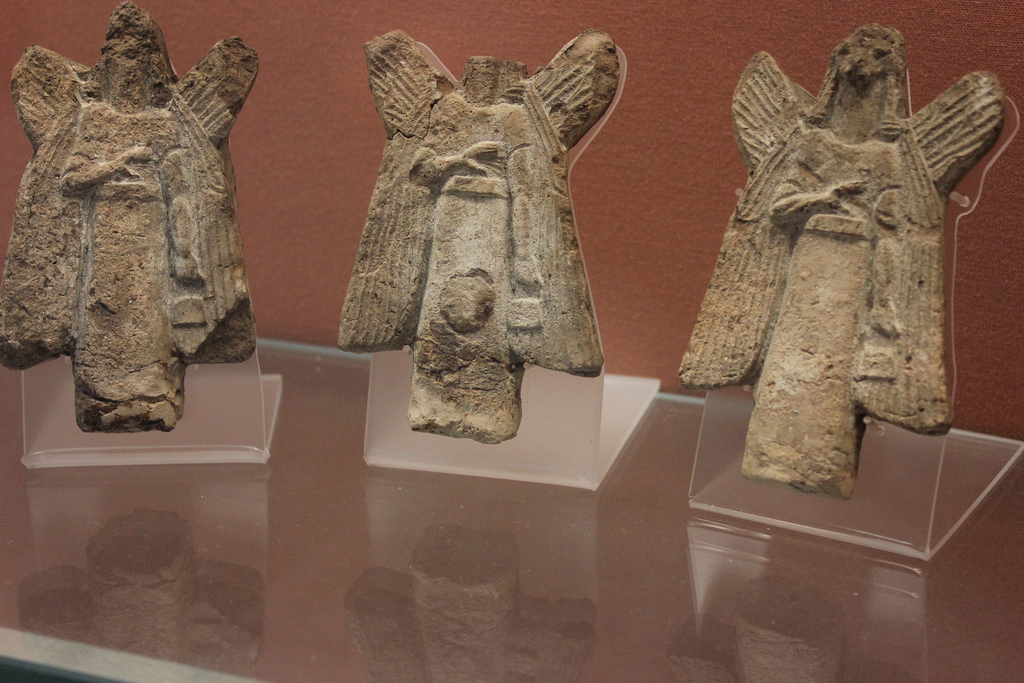
But perhaps the most curious finds were the figurines of “warrior” men, mythological fish- and bird-apkallū sages, human-beast hybrids, horned snakes, and other fantastical beings (Figure 2.1).

Apotropaic figurine deposit found in room S57 of Fort Shalmaneser at Nimrud. Adapted from Curtis and Read (1995:112).

Apotropaic figurine deposit found in room S57 of Fort Shalmaneser at Nimrud. Adapted from Curtis and Read (1995:112).

Generally, such deposits comprised one, two, or seven figurines standing “at attention” in boxes facing in toward the center of the room.

These deposits, not simply buried but concealed and contained, amounted to the discovery within a discovery, the revelation of an ancient secret or desire that had remained hidden for thousands of years.

Other archaeological findings, however, had already anticipated these discoveries: ancient texts preserved instructions for an apotropaic ritual involving the burial of clay and wood figurines under room floors quite in the manner described above (Gurney 1935; Smith 1926; Wiggermann 1992).

The name of one text explicitly pronounced its purpose: šēp lemutti ina bīt amēli parāsu, “to block the entry of the enemy in someone’s house” (Wiggermann 1992:1); and the first twenty lines named the “enemy” to be almost any evil imaginable, from spirits, gods, and ancestors to disease, misfortune, Fate, and Death.

The text guided a priest-exorcist through a choreography of very specific and often protracted ceremonies involving various objects, gestures, substances, and locations, leading up to the final installation of the magically protective figures entombed underground.

Notably, another related text fragment, KAR 298, specifically detailed the making, function, character, number, and placement of the figurines (Smith 1926). The archaeological evidence proved to be remarkably consistent with these texts in terms of form and details of surface treatment, and to some extent, position and grouping of the figures.

So the Neo-Assyrians themselves revealed the secret of the figurine deposits: they were magically powerful deposits that protected the individual and his house from sickness and evil. The protective figures served to “watch,” “pray,” and “bear souls away,” as it were.”

Carolyn Nakamura, “Mastering matters: magical sense and apotropaic figurine worlds of Neo-Assyria,” Archaeologies of materiality (2005): 18-19.

Green Identifies the Lahmu and the Ugallu

“Returning to the apotropaic ritual, after the fish-apkallē the text prescribes various kinds of wooden figures which cannot be identified among actual figurines, although some types may, as Dr. Reade suggested, be represented in Assyrian sculpture.

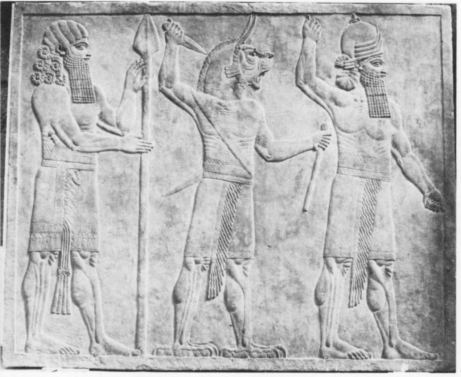
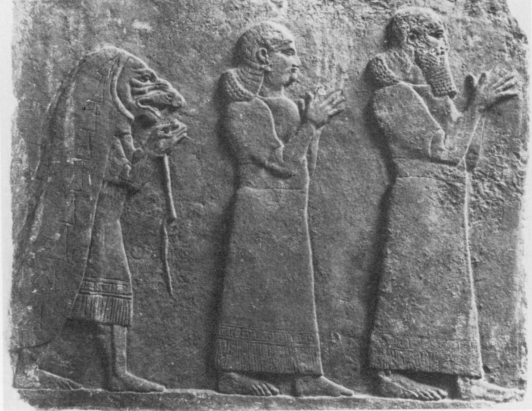
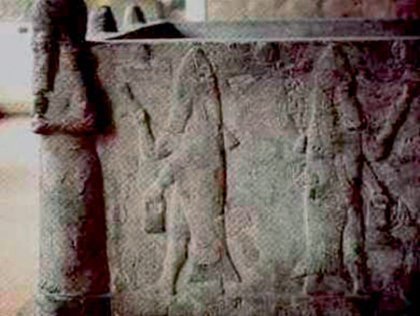
BM 118918, courtesy of the British Museum, plate XId. Green determines in this article that the leonine-headed entity in the center is the ugallu, or "Great lion."

BM 118918, courtesy of the British Museum, plate XId. Green determines in this article that the leonine-headed entity in the center is the ugallu, or “Great lion.”

These wooden figures end, however, with those of the ugallu, “Great-lion,” of which clay examples do exist. The human-leonine figure of Plate XId, centre, is commonly portrayed in glyptic art from the Akkadian period onwards and in seventh-century Assyrian sculpture.

He has been identified by Karl Frank and, with reservations, Ursula Calmeyer, as an utukku-demon (K. Frank, MAOG 14 (1941), idem, Babylonische Beschwörungsreliefs (Leipzig, 1908) … Notice already a figurine of the type used to illustrate the edition of Utukkū Lemnūtu of R.C. Thompson, The Devils and Evil Spirits of Babylonia and Assyria II (London, 1904)), but this view has been challenged by Dessa Rittig (Rittig, 108).

She is unable, however, to offer an alternative identification. Woolley once appears to interpret the creature as the ugallu, but elsewhere in the same paper as the urmahlīlu, “Lion-man,” apparently incorrectly identifying the two. Dr. Reade has suggested alternative identifications as the ugallu or the lahmu.

An ugallu, or "Great lion," ND 8190, courtesy of the Musées Royaux d'Art et d'Histoire, Brussels, Plate XIa.

An ugallu, or “Great lion,” ND 8190, courtesy of the Musées Royaux d’Art et d’Histoire, Brussels, Plate XIa.

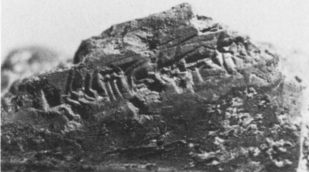
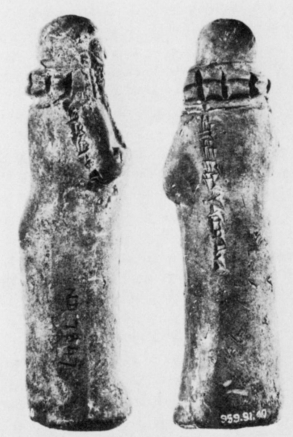
But the latter creature, as we shall see, appears to have a different identity, and the identification of this human-leonine figure as the ugallu is apparently confirmed by the Nimrud fictile examples (Plate XIa). The inscription (Plate XIb) corresponds well with that prescribed for figures of the ugallu in the ritual.

Inscription on the right side of ND 8181 (IM 61854), British School of Archeology in Iraq, photograph by David A. Loggie. Plate XIb. Green states that the "inscription corresponds well with that prescribed for figures of the ugallu in the ritual."

Inscription on the right side of ND 8181 (IM 61854), British School of Archeology in Iraq, photograph by David A. Loggie. Plate XIb. Green states that the “inscription corresponds well with that prescribed for figures of the ugallu in the ritual.”

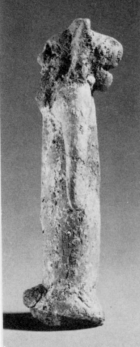
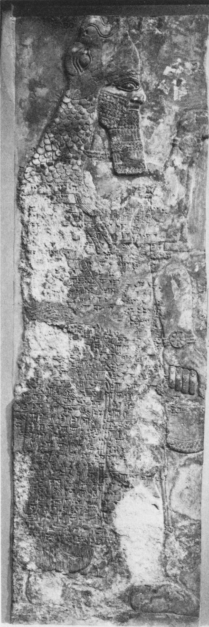
The type must probably be distinguished from the whip-carrying human figure wearing a lion’s pelt, of which a single example occurs in the Nimrud series (Plate XIIa).

ND 9342, Metropolitan Museum of Art, Rogers Fund, 1957. Plate XIIa. Green states that this is a "whip-carrying human figure wearing a lion's pelt," from the Nimrud series.

ND 9342, Metropolitan Museum of Art, Rogers Fund, 1957. Plate XIIa. Green states that this is a “whip-carrying human figure wearing a lion’s pelt,” from the Nimrud series.

The type, as R.S. Ellis has shown, is also distinguished on the palace reliefs (Plate XIIc).

BM 136773, British Museum, a clear representation of the ugallu or "Great lion." Plate XIIc.

BM 136773, British Museum, a clear representation of the ugallu or “Great lion.” Plate XIIc.

Perhaps yet another distinctive type is the Janus-figure of Plate XIIb, having both human and leonine faces, but with no parallels known to me. The identification of both types is unclear.

ND 5296, Metropolitan Museum of Art, Rogers Fund, 1957. Green terms this figurine "Janus-faced," with both leonine and human faces. Plate XIIb.

ND 5296, Metropolitan Museum of Art, Rogers Fund, 1957. Green terms this figurine “Janus-faced,” with both leonine and human faces. Plate XIIb.

The next passage of the ritual prescribes clay figures of the lahmu, inscribed and coated in gypsum, with “water painted on them in black wash.” The type of figure to which this passage refers, though not the reading of the Akkadian name, has been well recognized, since plaques from Aššur, inscribed as in the ritual, depict the figure in close conformity to his representation on the monumental reliefs (Plate XId, left).

BM 118918, courtesy of the British Museum, plate XId. Green identifies the ugallu at the center, the "Great lion," and lahmu at left.

BM 118918, courtesy of the British Museum, plate XId. Green identifies the ugallu at the center, the “Great lion,” and lahmu at left.

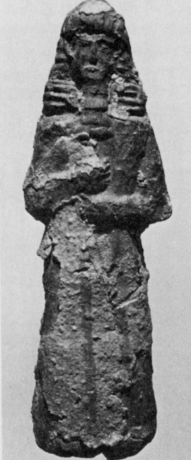
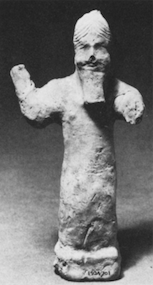
The Nimrud “heroes” are in the main heavily bearded and bewigged men without the distinctive six spiral tresses (Plate XIIIa), but they are nevertheless often inscribed, in the same fashion, and so quite likely represent the same personage.

Green states that these figurines are inscribed with statements that they represent lahmu.  ND 7847, Royal Ontario Museum. Plate XIIIa.

Green states that these figurines are inscribed with statements that they represent lahmu.
ND 7847, Royal Ontario Museum. Plate XIIIa.

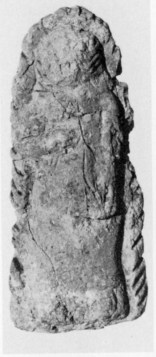
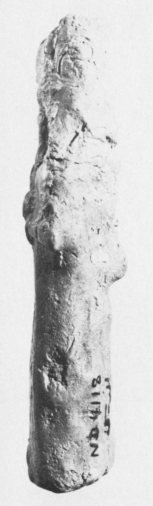
Most interesting, perhaps, is a Burnt Palace example on which much of the gypsum coating and painted water survive (Plate XIIIb), as on some similar figures from Ur.

ND 4111 (IM 59290), British School of Archeology in Iraq, photograph by David A. Loggie. Green, Plate XIIIb.

ND 4111 (IM 59290), British School of Archeology in Iraq, photograph by David A. Loggie. Green, Plate XIIIb.

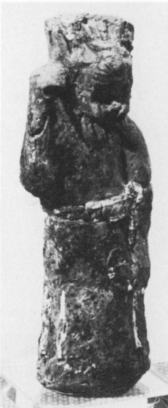
Figurines of a human deity with one arm raised in the air in similar fashion to the ugallu (Plate XIc) have not been found at Nimrud, but the identification of the ugallu from Nimrud figurines allows a possible identification of this personage also.

Oxford 1924.701, Ashmolean Museum. Plate XIc.

Oxford 1924.701, Ashmolean Museum. Plate XIc.

A common line-up at doorways in the North Palace at Nineveh involves a trio of this god, the ugallu and the lahmu (Plate XId). In the ritual text, moreover, the passages prescribing figurines of the ugallu and lahmu occur together, preceded by a prescription for figures of the “House god” who makes a gesture with his right hand and carries a weapon in his left.

BM 118918, courtesy of the British Museum, plate XId. Green identifies the ugallu at the center, the "Great lion," and lahmu at left. He speculates that the "House god" appears at far right. Plate XId.

BM 118918, courtesy of the British Museum, plate XId. Green identifies the ugallu at the center, the “Great lion,” and lahmu at left. The lahmu can be distinguished by his idiosyncratic six curled tresses. He speculates that the “House god” appears at far right. Plate XId.

It is possible, therefore, although it cannot be proved, that the three figures of these doorway reliefs are enumerated in the same order in this ritual.”

Anthony Green, “Neo-Assyrian Apotropaic Figures,” Iraq, Vol. 45, 1983, pp. 90-2.

Figurines Excavated from the Burnt Palace and Fort Shalmaneser

The most expansive text prescribing the types of figurines is the Aššur ritual KAR, no. 298. After defining the purpose of the ritual as to avert evil from the house, the text begins to prescribe the types of figures to be fashioned and buried at set locations.

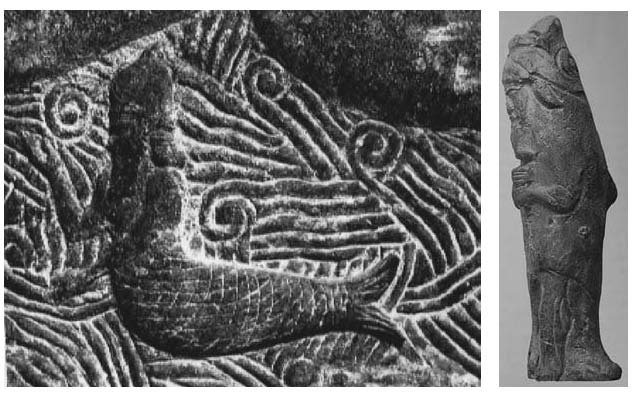
BM 124573, courtesy of the Trustees of the British Museum. Plate Xa.  This fish apkallū appears to have his right hand raised in the gesture of blessing with the mullilu cone, with the banduddu bucket in his left hand.

BM 124573, courtesy of the Trustees of the British Museum. Plate Xa.
This fish apkallū appears to have his right hand raised in the gesture of blessing with the mullilu cone, with the banduddu bucket in his left hand.

It begins with a long passage prescribing wooden figures of seven apkallē “Sages,” from seven Babylonian cities. No such actual figurines appear to exist, nor should we expect any if the prescription were faithfully followed, since timber figurines would have perished.

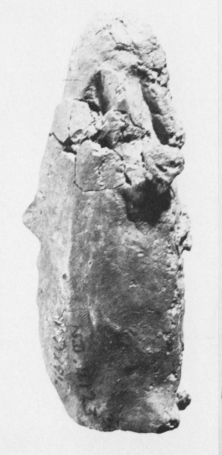
A bird-apkallū of the Nisroc kind, plate IXb. The figure is too worn to discern what is held in the right hand, while the left hand holds what appears to be a banduddu bucket.

A bird-apkallū of the Nisroc kind, plate IXb. The figure is too worn to discern what is held in the right hand, while the left hand holds what appears to be a banduddu bucket.

The next passage, however, prescribes apkallū figures with the faces and wings of birds. These are the bird-headed figures (Plate IXb), found appropriately in groups of seven. As well as in the Burnt Palace, a group of such figures was found in Fort Shalmaneser in a late seventh-century context; the excavator believed that the figures were redeposited ninth-century pieces, but they are rather different in style (ND 9518, figures in the round rather than flat-backed plaques) and may in fact date closer to the period suggested by their findspot.

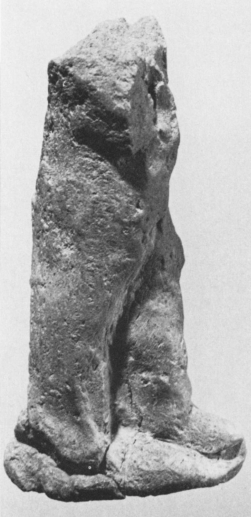
Fish-Apkallū figure, Plate Xb. ND 4118, courtesy of the British School of Archeology in Iraq, photograph by David A. Loggie.

Fish-Apkallū figure, Plate Xb. ND 4118, courtesy of the British School of Archeology in Iraq, photograph by David A. Loggie.

A group of figures of the same type was found by George Smith in the so-called “S.E. Palace,” perhaps a part of the same building as Palace “AB;” the pieces are close in style to the Burnt Palace examples and may date to the late ninth century.

ND 4123 (IM 59291), Plate Xc, courtesy of the British School of Archeology in Iraq. Photograph: David A. Loggie.

ND 4123 (IM 59291), Plate Xc, courtesy of the British School of Archeology in Iraq. Photograph: David A. Loggie.

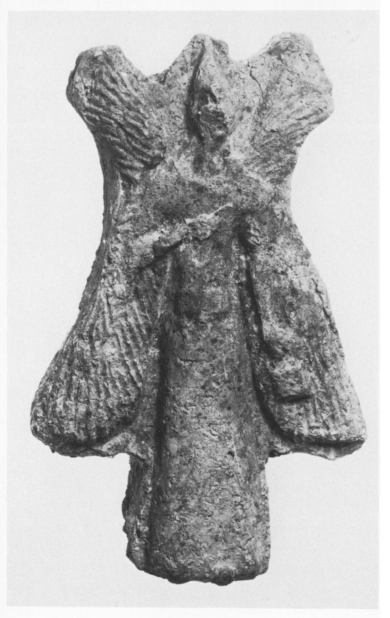
The ritual goes on to prescribe a set of seven figures of the apkallē cloaked in the skin of a fish. This type is represented by septenary groups of fish-garbed human figures which vary somewhat from deposit to deposit.

The usual type from the Burnt Palace, thin and fairly flat, sometimes has a fish-head and, on the reverse, a dorsal fin (Plate Xb), but often has no very obvious fish elements, so that the pieces must be identified  from others in the same deposit or by comparison with those in other deposits.

Also from the Burnt Palace come some more obvious human-piscine figures of heavy solid clay (Plate Xc). Six examples of this subtype were found, together with a seventh, “leader” (?), figure of the same being but of a very different style: a tall but flat fish-garbed man, the scales and tail indicated on the back by incised cross-hatching and diagonal lines.

ND 7903B. Courtesy of the British School of Archeology in Iraq, photograph by David A. Loggie. Plate Xd.

ND 7903B. Courtesy of the British School of Archeology in Iraq, photograph by David A. Loggie. Plate Xd.

Over thirty figurines and metal figurine accoutrements were found not buried in boxes but loose in the fill of one of the so-called “barracks-rooms” of Fort Shalmaneser. They would seem to be remnants from disturbed deposits, but evidently reused, since the fish-cloaked figures, of incongruous styles, were nevertheless seven in number.

It is possible, therefore, that the room was a kind of sick-bay, decked out with these prophylactic images. Plate Xd shows one of the types found, rather crudely made but with the line of the fish-cloak evident enough.

It is interesting to note, in this context, that when one of the legs is exposed and set forward on figurines of this type, it is the left one, perhaps foreshadowing an Islamic custom of entering a holy place with the right foot first, but the haunts of the jinn leading with the left.

The fish-cloaked figure is known in Mesopotamian art from the Kassite period, and despite a dearth of extant sculpture was not an uncommon figure in the Neo-Assyrian palace or temple (Plate Xa).”

Anthony Green, “Neo-Assyrian Apotropaic Figures,” Iraq, Vol. 45, 1983, pp. 88-90.

From Anthony Green, Neo-Assyrian Apotropaic Figures, 1983

“From Assyria and Babylonia in the first half of the first millennium BCE comes a series of small figurines in the round and relief plaques, which are usually found beneath the floors of buildings within receptacles of baked or unbaked brick or (at Nineveh) stone slabs or (so far restricted to Aššur) pottery jars; the figurines themselves are almost invariably of sun-dried clay, very occasionally, perhaps, of terracotta or metal.

(Note 1: E. Douglas Van Buren, Foundation Figurines and Offerings (Berlin, 1931) [henceforth referred to as FFO] is now outdated on this subject. For a synthesis of material mainly from published sources up to 1973, see Dessa Rittig, Assyrisch-babylonische Kleinplastik magischer Bedeutung vom. 13.-6. Fh v. Chr. (München, 1977) [henceforth Rittig]. The Nimrud corpus remains for the most part unpublished. A certain amount of new material, including Nimrud figurines, will appear in R.S. Ellis, Domestic Spirits: Apotropaic Figurines in Mesopotamian Buildings (Philadelphia, forthcoming)).

Their purpose, as texts prescribing the rituals involved attest, was to avert evil from the buildings and sickness from the inhabitants.

The British School’s Nimrud complement comprises at least 136 relevant pieces from 66 separate deposits discovered in three buildings: the Burnt Palace, the Acropolis Palace (AB) and Fort Shalmaneser, and dating possibly from the reign of Shalmaneser III (?) or, at least, Adad-nirari III down to the fall of the Assyrian Empire in 613 BCE.

In this paper I shall deal with just one, but perhaps the most important, area on which the series sheds light, namely the question of the identification of the creatures represented by the various iconographic types. It can hardly be denied that the study of apotropaic figurines is of somewhat limited importance in itself. Where it succeeds is rather in the light which it throws upon matters of more general and basic interest.

It is vital here to recognize the official nature of the ritual and practice, and the consequent position of the iconography of the figurines in the official religion of the Assyrian state. And while there are no apparent documentary sources directly concerning, for example, the subjects of the apotropaic palace reliefs, there are texts ordaining procedures for apotropaic rituals involving figurines, which often enable identifications of analogous types.

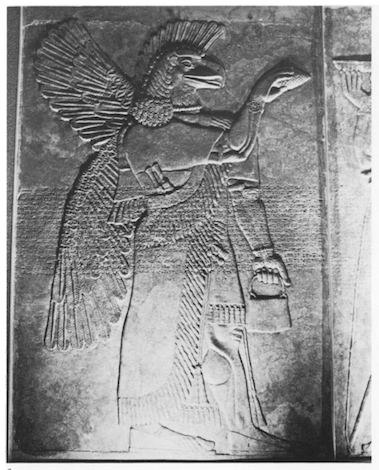
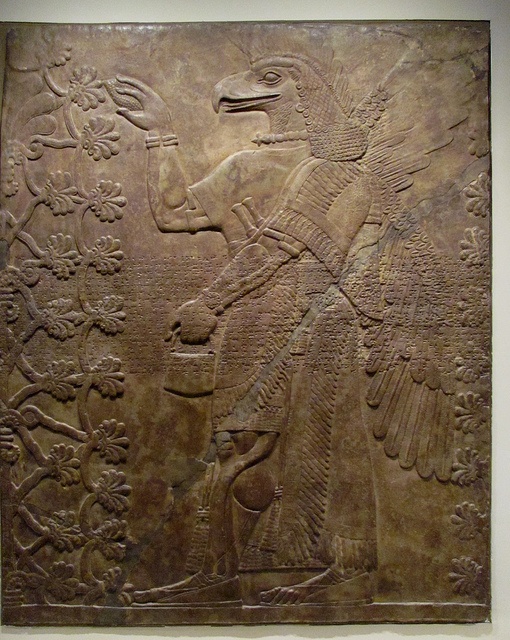
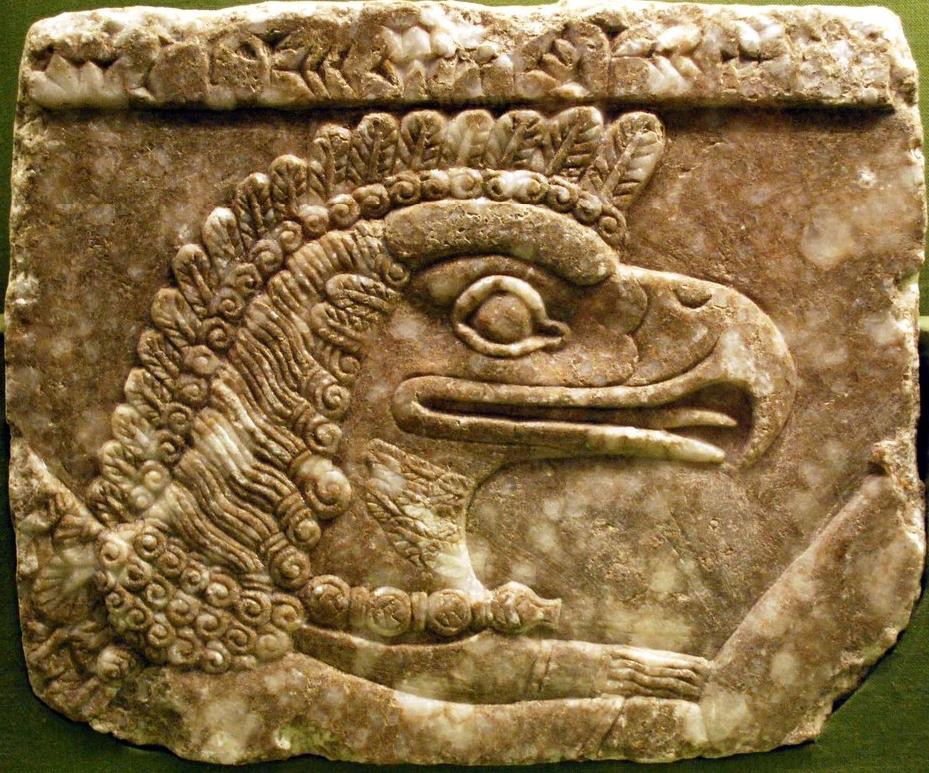
Professor Mallowan was quick to recognize the relationship between the so-called Nisroch or “Griffin-demon” common in the ninth-century palaces and in Middle and Neo-Assyrian art in general (Plate IXa), and the bird-headed human figurines of apkallē from Phase E of the Burnt Palace (Plate IXb).

A bird-apkallū, the so-called Nisroch or "Griffin-demon). Plate IXa.

A bird-apkallū, the so-called Nisroch or “Griffin-demon.” Plate IXa.

A bird-headed human figurine of apkallē from Phase E of the Burnt Palace, Plate IXb.

A bird-headed human figurine of apkallē from Phase E of the Burnt Palace, Plate IXb.

Citing this instance, J.B. Stearns (Reliefs from the Palace of Ashurnasirpal II, AfO Behest 15 (Graz, 1961), 26, n. 44), has remarked that although there is here an isolated, rather superficial, relationship, there are no general correspondences between the figures on the reliefs and the actual or prescribed figurines, and that even in this case the connection does not aid our understanding of the monumental figures:

” . . . it is important to note that they are only one type out of many kinds of statuettes mentioned in these texts. Thus the parallel between the foundation-figures and the reliefs seems far from complete, since only the … winged, eagle-headed genie is present in the texts …

It should also be noted that among the several types of figurines excavated none except the bird-headed type seems to resemble the genies of the reliefs …

In short, the relationship between the apkallē of the typical text here adduced and the excavated figurines seems rather superficial, and the connection of either texts or the figurines with the rites depicted on the reliefs seems too tenuous to warrant basing an explanation of the reliefs upon such evidence.”

But although this appears true when considering the reliefs catalogued in Stearn’s restricted study, it is not the case when the full repertoire of apotropaic figures on the reliefs and in fictile art is considered, when a number of correlations can be found.

The method of using such correlations to identify individual figure types has already been well vindicated, I believe, in Dr. Julian Reade’s reappraisal of the subject-matter of Assyrian sculpture.”

Anthony Green, “Neo-Assyrian Apotropaic Figures,” Iraq, Vol. 45, 1983, pp. 87-8.

Why No Canonical Literature Regarding the Apkallu?

“In adducing the motif of the “wise vizier”, I have only meant to show that the “wise men” of a tradition are not necessarily kings, and furthermore, to show the complexity of a problem that, if I do not pretend to solve, I neither am inclined to embezzle.

In my opinion, the myth of the apkallu’s in all likelihood reflects the etiological story which the Greek accounts attempt to render, but which did not survive in the Mesopotamian canonical literature.

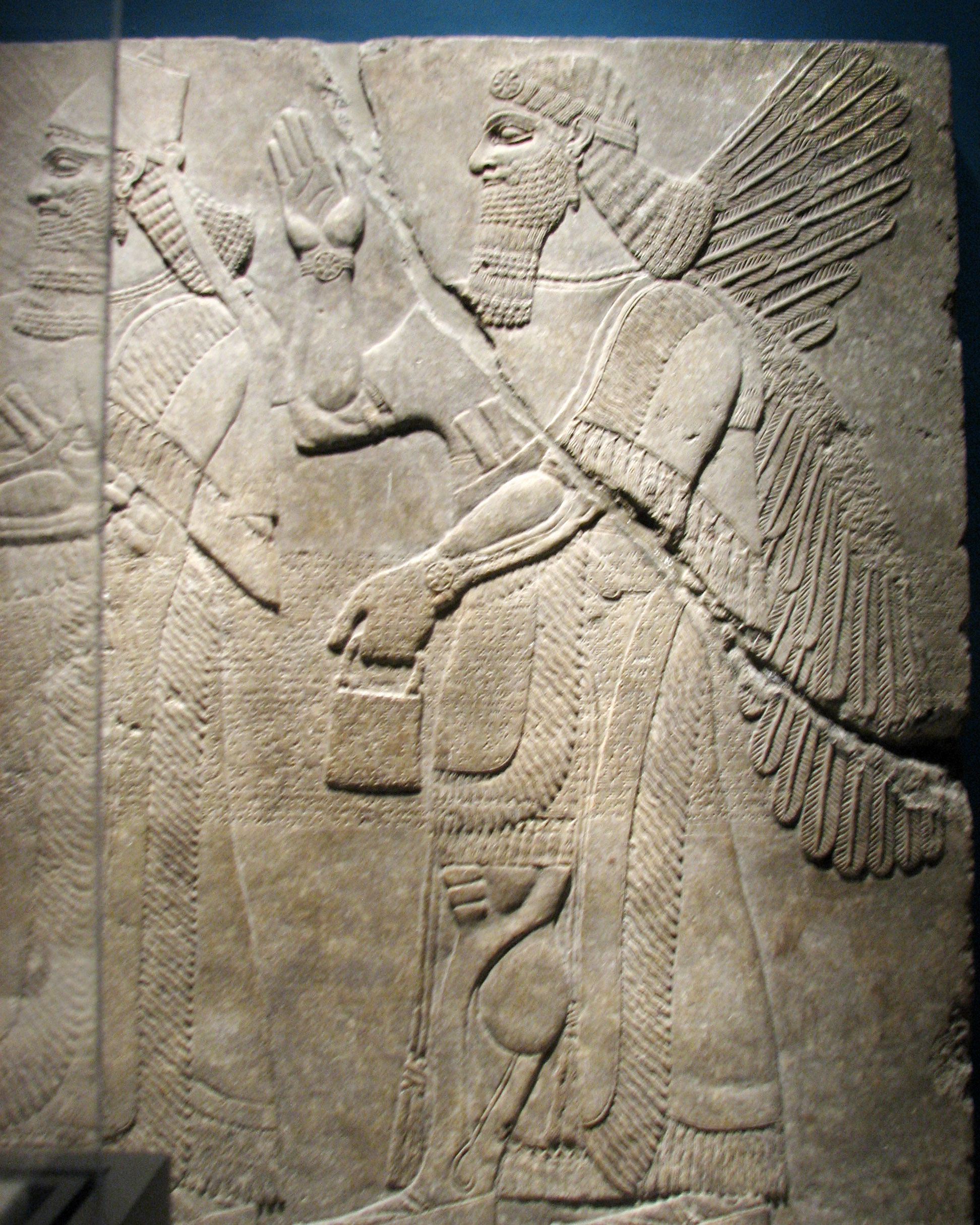
This winged umu-apkallū raises his right arm in the greeting gesture, with the banduddu water bucket in his left hand. The headdress is unusual, not the usual horned tiara, but a headband with a rosette insignia.

This winged umu-apkallū raises his right arm in the greeting gesture, with the banduddu water bucket in his left hand. The headdress is unusual, not the usual horned tiara, but a headband with a rosette insignia.

Beside the reference to the “old sages from before the flood” (AMT 105:22, last cited by Lambert, JCS 11 p. 8), an allusion to the presence on earth, before the flood, of apkallu’s, who after the flood regained the Apsû, is contained in the Epic of Era, where Marduk says that he “made these wise men go down to the Apsû” (ummânī šunūti ana apsî ušēridma, I 147), together with the precious materials needed to fashion the divine statute.

In the following rhetorical questions in which he regrets that neither the materials, nor the craftsmen needed to work them are available, Marduk finally deplores the absence of the sages who, most likely, were the only ones capable of infusing life into the divine statue: ali sibīt apkallī (NUN.ME) apsî purādī ebbūti ša kīma Ea bēlišunu uzna sīrtu šuklulu (I 162) “Where are the seven sages of the Apsû, the pure purādu-fish, who, just as their lord Ea, have been endowed with sublime wisdom?”. […]

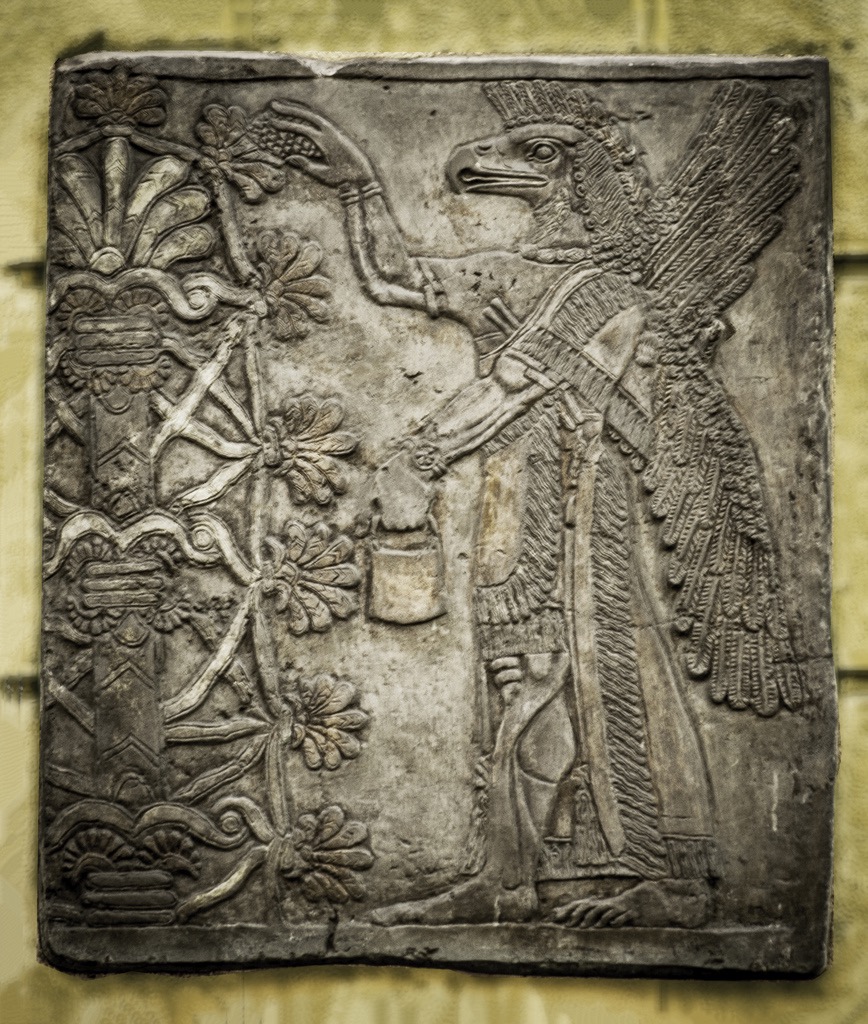
In Neo-Assyrian art these bird-headed

In Neo-Assyrian art these bird-headed “genies,” as they were long described, are now known to be apkallū, “bird-apkallū,” in this case, mixed-feature exorcists and creatures of protection created by the god Ea. They traditionally served as advisors to kings. Their association with sacred trees, as they are often portrayed, remains somewhat perplexing.
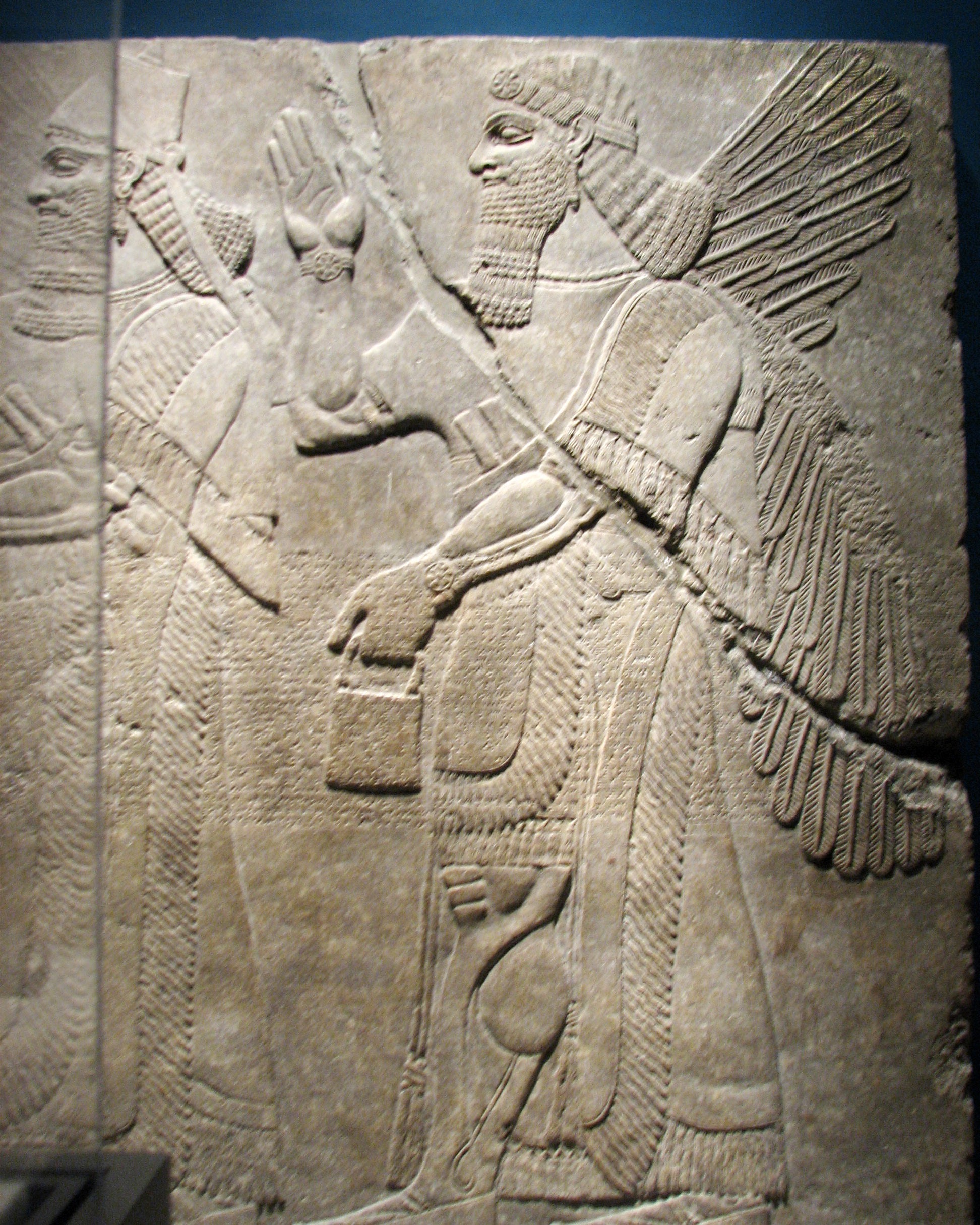
This apkallū makes the iconic gesture of exorcism and liberation of sin with the mullilu cone in his raised right hand, and the banduddu water bucket in his left hand.
There are three known types of apkallū: the human, with wings; the avian-headed, with wings, and the fish-apkallū, with carp skin draped over their heads.
https://www.flickr.com/photos/lanpernas2/8606000868/

The story here edited cannot be interpreted as an etiological myth. Neither the exploits of the apkallu’s, nor even their names suggest any literary figure known to us, with the exception of Adapa, nor are they said to have existed in the period before the flood.

Meager evidence is the mention of the apkallu from Ur, Lu-Nanna, in the colophon of a text (K 8080, see Lambert, JCS 11 p. 7) listing poultices for magical purposes and of Piriggalabzu in the incipit of a Sumerian t i g i -song. …

On the other hand, two apkallu’s not described among the heroes of our text — who, as the reader must have noted, are only five in number — are mentioned as authors: a certain Enlil-muballit, apkallu of Nippur under Enlil-bani of Isin, in AMT 105:24 (see Lambert, JCS 11 p. 8), and a certain Ur-Gatumduga in the subscript to the Šulgi-hymn PBS 1/1 No. 11 …

There is little hope that we will ever find more ample material dealing with the apkallu’s. Of the legend, or cycle of legends, concerning their exploits what our texts tells us alone survives.

Indeed, we may even assume that at the time of its redaction the details of the legendary events had already faded into the past. Only the legend of Adapa must have still been well known, for concerning him the text contents itself with an even briefer allusion than its report on the other apkallu’s.

The very terseness of the characterization of each apkallu reminds us of the style of the so-called “historical omens” attached to the early kings, many of which are better considered anecdotes, as has been suggested by Güterbock, ZA 42 57 ff.

Just as historical texts never mention the exploits of Narām-Sin, Sargon, and others, that are referred to in these omens, so literary texts, transmitting always the same written tradition, have not recorded the feats of the apkallu’s.

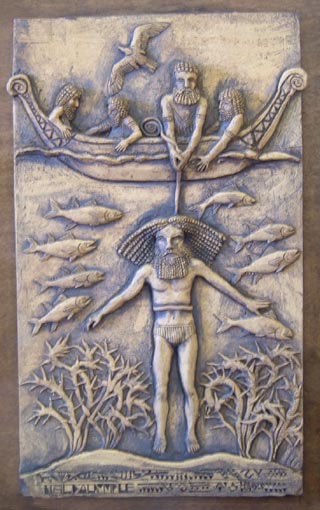
Antediluvian apkallū portrayed as fish-men, such mixed-species creatures were the teachers of men.<br />  These specific statuettes were buried in the foundations of the home of an exorcist, where they were positioned beneath doorways and against particular walls to exert a prophylactic effect, warding off evil.<br />  The antediluvian type of apkallū, the so-called purādu-fish, are often grouped in sevens.

Antediluvian apkallū portrayed as fish-men, such mixed-species creatures were the teachers of men.
These specific statuettes were buried in the foundations of the home of an exorcist, where they were positioned beneath doorways and against particular walls to exert a prophylactic effect, warding off evil.
The antediluvian type of apkallū, the so-called purādu-fish, are often grouped in sevens.

It certainly seems as if the scribes deliberately suppressed a cycle dealing with those human beings who, at one or other of history, and no doubt with the connivance of Ea, revolted against the gods and “brought down Ištar from heaven into Eanna,” or “aroused Adad’s anger” by some forgotten or perhaps unmentionable act, or “angered Ea” through some form of challenge which is still obscure to us, in spite of the three duplicates we now have of this allusion.

Even the learned Lu-Nanna is not included for his literary achievements, but for a feat, we suspect, disrespectful to the goddess.

These acts of hubris seem quite irreconcilable with the picture we have formed of the Mesopotamian attitude towards the gods on the basis of traditional literature, and they must have been the cause of the eventual oblivion from which, however, the memory of some admirable human achievement persistently drew out again the figures of the “possessors of unsurpassed wisdom,” the sages.”

Erica Reiner, “The Etiological Myth of the “Seven Sages,” Orientalia, v. 30, No. 1, 1961, pp. 9-11.

On the Ummânu

“Such an association of the apkallu’s with kings of renown is singularly striking in view of the ancient near eastern motif that links a person of superior wisdom with a famous king.

In Egypt, we have the tradition — or fiction — of viziers who are credited with the authorship of “instructions” or “admonitions” (see J.A. Wilson, ANET 412 ff. and 432 n. 4, see also H. Brunner in Handbuch der Orientalistik I/2 p. 92 f.); for the Old Testament, references are conveniently collected by J. Lindblom, in Supplements to Vetus Testamentum 3, p. 129 f.

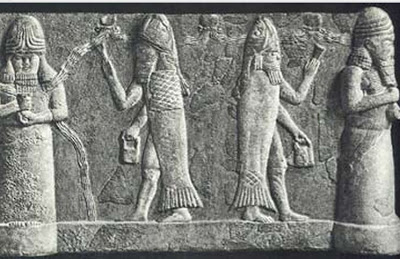
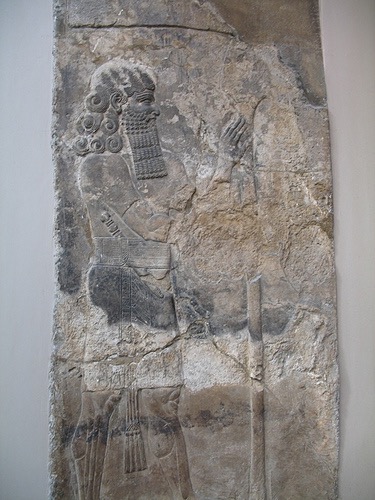
The god Ea at far left, wearing the horned headdress indicative of divinity, with water coursing from his shoulders. 

A fish-apkallū is in the iconic posture with right hand raised in blessing or exorcism, with the banduddu bucket in his left hand. 

The next apkallū wields an indistinct and as yet undefined angular object in his right hand, with the typical banduddu bucket in his left. 

The entity at far right, which appears to be wearing a horned tiara indicative of divinty, remains unidentified and undefined.

The god Ea at far left, wearing the horned headdress indicative of divinity, with water coursing from his shoulders. 

A fish-apkallū is in the iconic posture with right hand raised in blessing or exorcism, with the banduddu bucket in his left hand. 

The next apkallū wields an indistinct and as yet undefined angular object in his right hand, with the typical banduddu bucket in his left. 

The entity at far right, which appears to be wearing a horned tiara indicative of divinty, remains unidentified and undefined.

The most famous figure of such a wise man, whose story is the most wide spread, is Ahiqar, whose Mesopotamian origin has repeatedly been stated (for bibliography see Ginsberg in ANET 427), although no Babylonian prototype of the story as a whole is known.

However, there can be proven for Babylonia the existence of at least the theme that serves as a framework for Ahiqar’s sayings: this theme, the “disgrace and rehabilitation of a minister”, has been discussed, with a good comparative bibliography, by  A.H. Krappe in JAOS 61 (1941) 280-84.

The story is included in the “bilingual proverbs” (latest publication with bibliography, by W.G. Lambert, Babylonian Wisdom Literature 239 ff.), where it comprises a section of fourteen lines (ii 50-63, op. cit., p. 241), the longest of the sayings which usually consist of only two to four lines, although there are some as much as eight lines long.

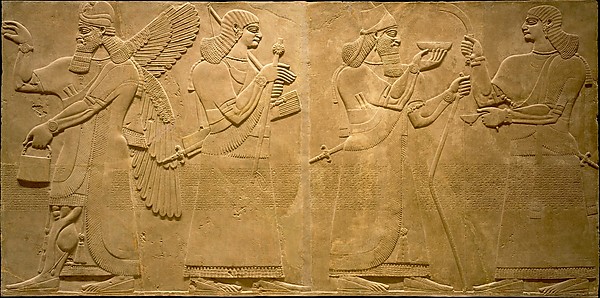
The umu-apkallū at far left has his right hand raised in the iconic gesture of purification and exorcism, but no mullilu cone appears to be present.<br /> The banduddû bucket is present in the left hand. This umu-apkallū wears a horned tiara, indicative of divinity.<br /> The next entity lacks wings, and so is probably not an umu-apkallū. The mace in the right hand could be an e'ru, as it is not yet clear precisely what e'ru means. I do not understand the object in his left hand. The mace could be an indicator of sovereignty, of kingship.<br /> The next entity holds a bowl and the curved staff, known as the gamlu-curved staff. While this entity wears a headdress, it is not horned, and wings are absent, suggesting that it is human rather than umu-apkallū. This is probably a king, Museum notes suggest Ashurnasirpal.<br /> The entity at far right wields a curved stick in his right hand, I am unsure how Wiggermann defines it, and I am completely stumped by the object in his left hand, which appears to be a ladle. The entity appears to be a priest, blessing an offering from the king in a bowl.<br /> Overall, this frieze supports one theme of Erica Reiner's article on the Seven Sages of Sumeria, which is that each king had his associated advisor in the form of an apkallū.

The umu-apkallū at far left has his right hand raised in the iconic gesture of purification and exorcism, but no mullilu cone appears to be present.
The banduddû bucket is present in the left hand. This umu-apkallū wears a horned tiara, indicative of divinity.
The next entity lacks wings, and so is probably not an umu-apkallū. The mace in the right hand could be an e’ru, as it is not yet clear precisely what e’ru means. I do not understand the object in his left hand. The mace could be an indicator of sovereignty, of kingship.
The next entity holds a bowl and the curved staff, known as the gamlu-curved staff. While this entity wears a headdress, it is not horned, and wings are absent, suggesting that it is human rather than umu-apkallū. This is probably a king, Museum notes suggest Ashurnasirpal.
The entity at far right wields a curved stick in his right hand, I am unsure how Wiggermann defines it, and I am completely stumped by the object in his left hand, which appears to be a ladle. The entity appears to be a priest, blessing an offering from the king in a bowl.
Overall, this frieze supports one theme of Erica Reiner’s article on the Seven Sages of Sumeria, which is that each king had his associated advisor in the form of an apkallū.

Since none of the previous translations does justice to the motif expressed in the relevant passage, I suggest the following (the short lines of the bilingual text disposed in two columns are here restored to their assumed full length):

  • 50-51: “Their gods have returned to the ruin,
  • 52-53: the clamor (of daily life) has filled (lit. entered) the deserted house (again);
  • 54-55: (where) the ingrate is tenant, the wise man does not reach old age.
  • 56-58: The wise vizier, whose wisdom his king (or his lord) has not heeded,
  • 59-61: and any valuable (person) forgotten by his master,
  • 62-63: when a need arises for him (i.e., for his wisdom), he will be reinstated.”

The second half of the “saying” has reference to the disgrace and rehabilitation of a wise vizier, and, unless the first three lines (ii. 50-55) should be taken as a separate saying (so last J. Pereman, The Book of Assyro-Babylonian Proverbs [in Hebrew], p. 58), the reference to the “ingrate” (raggu) would indicate that the other basic theme of the Ahiqar-story, that of the “ungrateful nephew” (see Krappe, loc. cit., p. 281), had already been fused in the Mesopotamian tradition, as in the Ahiqar-story, with that of the “disgrace and rehabilitation of a minister”.

The argument for the existence in Babylonia of a tradition linking wisdom to a high official (“vizier”) of the king can be strengthened by the philological evidence of the alternation of the terms apkallu and ummânu, which has been adduced in other contexts.

In the top register, Ummiamu, (a variant spelling of Reiner's ummânu), human apkallū that are postdiluvian, tend to a sacred tree. In the lower register, antediluvian apkallū with avian heads tend to a sacred tree.<br />  The cones and buckets in their hands are now understood to be standard devices used to sprinkle water. Called mullilu and banduddu, respectively, the water sprinkling ritual was intended to liberate sin, or as part of a rite of exorcism.

In the top register, Ummiamu, (a variant spelling of Reiner’s ummânu), human apkallū that are postdiluvian, tend to a sacred tree. In the lower register, antediluvian apkallū with avian heads tend to a sacred tree.
The cones and buckets in their hands are now understood to be standard devices used to sprinkle water. Called mullilu and banduddu, respectively, the water sprinkling ritual was intended to liberate sin, or as part of a rite of exorcism.

The usual acceptation of the latter is “master craftsman,” often referring to scribes, authors or copyists of literary texts. References to both have been collected by van Dijk, La Sagesse Suméro-Accadienne, p. 20 n. 56, and note that Adapa, besides his more common epithet apkallu, is also called ummânu . . .

Moreover, it has been shown the term ummânu serves not only as the designation of a learned man or craftsman, but also refers, although in late texts, to a high official . . . In our connection most relevant is the mention of the ummânu beside the king in the Synchronistic King List (see simply Oppenheim in ANET 272 ff.), and the passage from the Fürstenspiegel (see now Lambert, BWL 112:5): šarru . . . ana UM.ME A la iqūl “if the king does not heed the vizier (or wise man).”

Note in the same text . . . is most likely to be read apkallišu.”

Erica Reiner, “The Etiological Myth of the “Seven Sages,” Orientalia, v. 30, No. 1, 1961, pp. 7-9.

Each King had his Apkallu

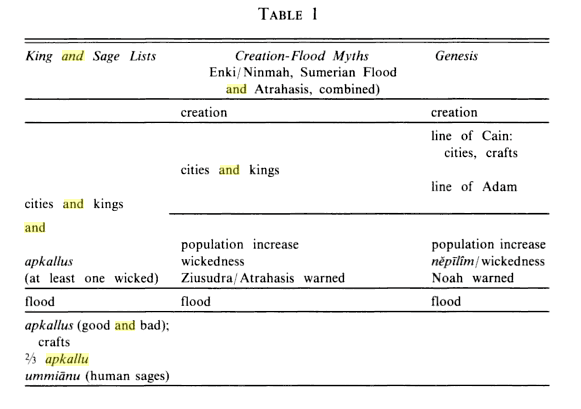
“The fish-figurines would seem to confirm the theory attractively put forward by Zimmern (KAT 535 ff. and subsequently ZA 35 151 ff.), that the apkallu’s, often occurring in groups of seven and sometimes identified with purādu-fish (Sumerian s u h u r . k u), represent Oannes and the other fish-like monsters who, according to Berosso’s account, taught mankind all crafts and civilization.

This depiction of a fish-apkallū (Apkallu, Abkallu) guarded the entrance to the temple of Ninurta at Nimrud. A fish's head can be seen on Apkallu's head, and its skin hangs down over the back of Apkallu's body.  Neo-Assyrian era, 865-860 BCE. From the Temple of Ninurta, Nimrud (ancient Kalhu; Biblical Calah), northern Mesopotamia, Iraq. (The British Museum, London). Osama Shukir Muhammed Amin FRCP (Glasg) http://www.ancient.eu/image/2708/

This depiction of a fish-apkallū (Apkallu, Abkallu) guarded the entrance to the temple of Ninurta at Nimrud. A fish’s head can be seen on Apkallu’s head, and its skin hangs down over the back of Apkallu’s body.
Neo-Assyrian era, 865-860 BCE. From the Temple of Ninurta, Nimrud (ancient Kalhu; Biblical Calah), northern Mesopotamia, Iraq. (The British Museum, London).
Osama Shukir Muhammed Amin FRCP (Glasg)
http://www.ancient.eu/image/2708/

Furthermore, the apkallu-figurines of the ritual KAR 298 discussed by Zimmern loc. cit. (see also Gurney, AAA 22 38 ff.) are each associated with a city in Mesopotamia and addressed as ūmu; Güterbock’s suggestion that the element p i r i g in the names of three apkallu’s in our text corresponds to this ūmu and refers to their character as mythological creatures (ZA 42 10 n. 3) would thus strengthen the argument in favor of the identification of the apkallu’s with the monsters described by Berossos.

What in the Greek account clearly reflects an etiological myth finds no correspondence in any of the texts dealing with apkallu’s in Mesopotamia. The exploits of the apkallu’s, as we shall see, are on a different mythological plane.

Nergal appears at the top, leering over a top register which contains the eight-pointed star of Ishtar and the inverted half-moon crescent of the Moon God Sin.  In the second register, seven demons appear to support the heavens.  The middle register depicts the burial rites for new arrivals in the underworld, presided over by two fish-apkallū.  The lower register depicts the goddess Allat, or Ereshkigal, sister of Ishtar, who reigns in the underworld. She kneels upon a horse, which appears to be oppressed by her burden, in a boat which floats upon the waters of life. Note the lion pups suckling at her breast.  Drawn by Faucher-Gudin, from a bronze plaque of which an engraving was published by Clermont-Ganneau.  The original, which belonged to M. Péretié, is now in the collection of M. de Clercq. http://www.gutenberg.org/files/17323/17323-h/17323-h.htm#linkBimage-0039

Nergal appears at the top, leering over a top register which contains the eight-pointed star of Ishtar and the inverted half-moon crescent of the Moon God Sin.
In the second register, seven demons appear to support the heavens.
The middle register depicts the burial rites for new arrivals in the underworld, presided over by two fish-apkallū.
The lower register depicts the goddess Allat, or Ereshkigal, sister of Ishtar, who reigns in the underworld. She kneels upon a horse, which appears to be oppressed by her burden, in a boat which floats upon the waters of life. Note the lion pups suckling at her breast.
Drawn by Faucher-Gudin, from a bronze plaque of which an engraving was published by Clermont-Ganneau.
The original, which belonged to M. Péretié, is now in the collection of M. de Clercq.
http://www.gutenberg.org/files/17323/17323-h/17323-h.htm#linkBimage-0039

The connection between them and wisdom and the crafts lies in the term ummânu, which is one of their epithets, and to which I shall presently return.

First, however, we shall have to dispel the misconception originating with Zimmern’s article in KAT, and repeated in the discussions connected with the apkallu’s by others, namely, the assumed identity of the “wise men” — or some of them — with the early kings.

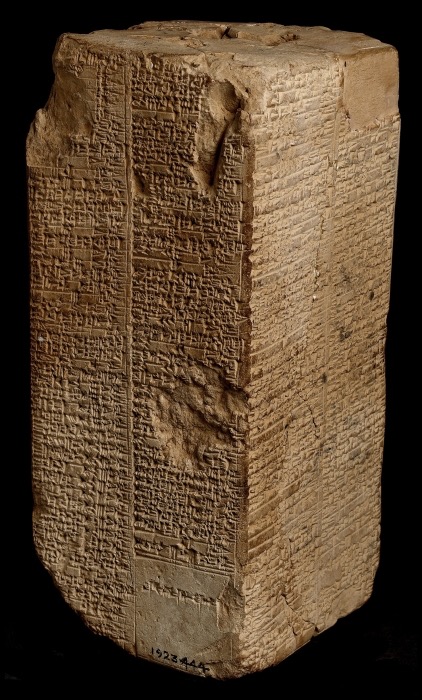
Besides a certain juggling of names inevitable when dealing with Berossos, the allusion to the “man who ascended to heaven” in the text published by Gurney, JRAS 1935 459 ff., was taken to refer to Etana, the more easily so since the phrase used in the Sumerian version, l ú a n . š è  b a . a n . e x (DU+DU) echoes the very words of the Sumerian King List: E t a n a   s i p a  l ú  a n . š è  b a . e x . d è (see Jacobsen, AS 11 p. 80: 16 f. and n. 67).

Antediluvian apkallu portrayed as fish-men, such mixed-species creatures were the teachers of men.

Antediluvian apkallu portrayed as fish-men, such mixed-species creatures were the teachers of men. Small figurines of this type were buried beneath doorways and beneath walls for prophylactic purposes, warding off evil. In some cases, they were buried in a set of seven statuettes, indicative of the so-called “Seven Sages” of Sumeria.

The view of Güterbock, ZA 42 9f., that the tradition of the apkallu’s is separate from that of the historical kings, and his assumption that the phrase “who ascended to heaven” refers to Adapa — of whom the same words are used in one of the versions of the Adapa legend (PSBA 16 [1894] 275:14, latest translation by Speiser, ANET 101 ff.) — is vindicated against his critics by the structure of the present text.

Since each personage is described by a group of at least four lines, the third and fourth lines, “[ . . . ] who ascended to heaven”, must be part of the description of the same person mentioned in the first and second lines as the purification priest of Eridu (išippu Eridu).

Because this is a well-known title of Adapa, the section must refer to him rather than to Etana. Indeed, none of the apkallu’s mentioned is himself a king, but is only associated with a famed king of old: the text states clearly that Nunpiriggaldim was the apkallu of Enmerkar, that Lu-Nanna was apkallu under Šulgi, allowing us only to conjecture that each was a noted person during a particular reign, excelling in superior wisdom — a topos later taken up by the Assyrian kings when they boast of being endowed with a wisdom equal to that of the apkallu’s.”

Erica Reiner, “The Etiological Myth of the “Seven Sages,” Orientalia, v. 30, No. 1, 1961, pp. 6-7.

Erica Reiner on the Etiological Myth of the “Seven Sages”

“The bilingual text LKA No. 76 has been characterized by Ebeling, in the catalog LKA p. x, as “Zweisprachiger Text von den ‘sieben Söhnen von Nippur’, mystischen Inhalts.” The obverse of the text contains an unusual self-description given by the “sons of Nippur,” to which I have been unable to find a parallel, but the much smaller portion preserved of the reverse, which most likely is an altogether different composition, is a duplicate to two texts from Kouyunjik edited by O.R. Gurney, JRAS 1935 459 ff., which deal with the apkallu’s who, under the designation “Seven Sages” have received repeated attention in Assyriological literature.

Fish-Apkallu statuettes of the type that were buried in the foundations of buildings.

Fish-Apkallu statuettes of the type that were buried in the foundations of buildings.

The reverse of LKA 76, which shall be my sole concern in this paper, as well as an unpublished fragment from Kouyunjik copied by Geers, permits us to establish the historical and mythological significance of these personages. [ … ]

Translation

  • 1′-2′. [Adapa,] the purification priest of Eridu
  • 3′-4′. [ … ] who ascended to heaven.
  • 5′-6′. They are the seven brilliant apkallu’s, purādu-fish of the sea,
  • 7′-9′. [sev]en apkallu’s “grown” in the river, who insure the correct functioning of the plans of heaven and earth.
  • 10′-13′. Nunpiriggaldim, the apkallu of Enmerkar, who brought down Ištar from heaven into Eanna;
  • 14′-17′. Piriggalnungal, stemming from Kiš, who angered Adad in heaven so that he let no rain and (hence) vegetation be in the country for three years;
  • 18′-23′. Piriggalabzu, stemming from [Eridu] who . . . . and thus angered Ea in the Apsû so that he . . . [cut (?) the cords from (?) the seal around his neck (?)] . . .
  • 24′-27′. The fourth (is) Lu-Nanna, (only) two-thirds apkallu, who drove the ušumgallu-dragon from Eninkarnunna (var. Eninkiagnunna), the temple of Ištar of Šulgi.
  • 28′-31′. [ . . . ] of human descent, whom (pl.) the lord Ea had endowed with a broad understanding.

. . . If the restorations [MIN] in lines 3’ff are correct, this section enumerates or addresses apkallu’s . . . (See footnote 3, below).

(Footnote 3: While the main concern of these pages is to follow the apkallu’s into their mythological past, it should be mentioned that their role in the here edited text, as well as in other rituals to be mentioned presently, is an apotropaic one (having the power to avert evil influences or bad luck); indeed, copies … of the text under discussion may well represent a tablet of the series bīt mēsiri, for which see G. Meier, AfO 14 139 ff.

Bird Apkallū and Fish Apkallū, side by side. Apkallū statuettes of this design were buried in appropriate places in the home of a Babylonian exorcist. They were believed to have prophylactic qualities, guarding the home from evil.

Bird Apkallū and Fish Apkallū, side by side. Apkallū statuettes of this design were buried in appropriate places in the home of a Babylonian exorcist. They were believed to have prophylactic qualities, guarding the home from evil.

This is made likely by the content as well as the style of the invocations alternating with ritual directions, and the latter have been here restored on the basis of this similarity. Moreover, A rev. 5′ f. recalls the catchline of 4R 21 B, a recension of Tablet II of bīt mēsiri … the number, shape, and use of these apotropaic figures varies from text to text, apkallu being a general term for the fish-, bird-, or “Gilgameš“-like men (see Landsberger Sam’al 95 n. 227); thus, before the apkallu’s enumerated in lines 10′-27′, who are then summed up as being of human descent (ilitti amēlūti), the text mentions the seven apkallu’s who are purādu-fish and seven apkallu’s who were “created” (Sumerian “grown”) in the river.)

As A rev. 16’ff. shows, the rites were performed for the benefit of a patient (LÚ.GIG); they include, according to A rev. 10’f., fashioning of apotropaic apkallu-figurines, or, according to lines 3’ff. (in copy C), figurines of suhurmāšu-fish.”

Erica Reiner, “The Etiological Myth of the “Seven Sages,” Orientalia, v. 30, No. 1, 1961, pp. 1-6.

Wiggermann Defines the Lamassu

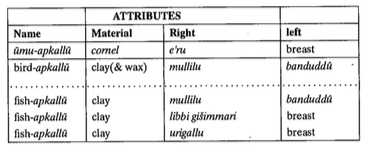
“The limited number of candidates available for identification with e’ru, libbi gišimmari and urigallu enables us to choose a denotation, even when the results of philology are not unequivocal in each case.

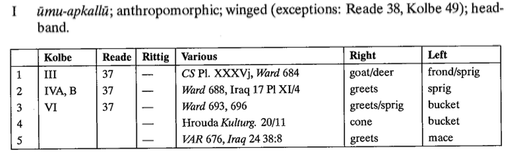
The sages and the lesser gods of NAss art share attributes and therefore functions: goat, sprig, greeting gesture, cone, bucket and mace. Both can occur with or without wings.

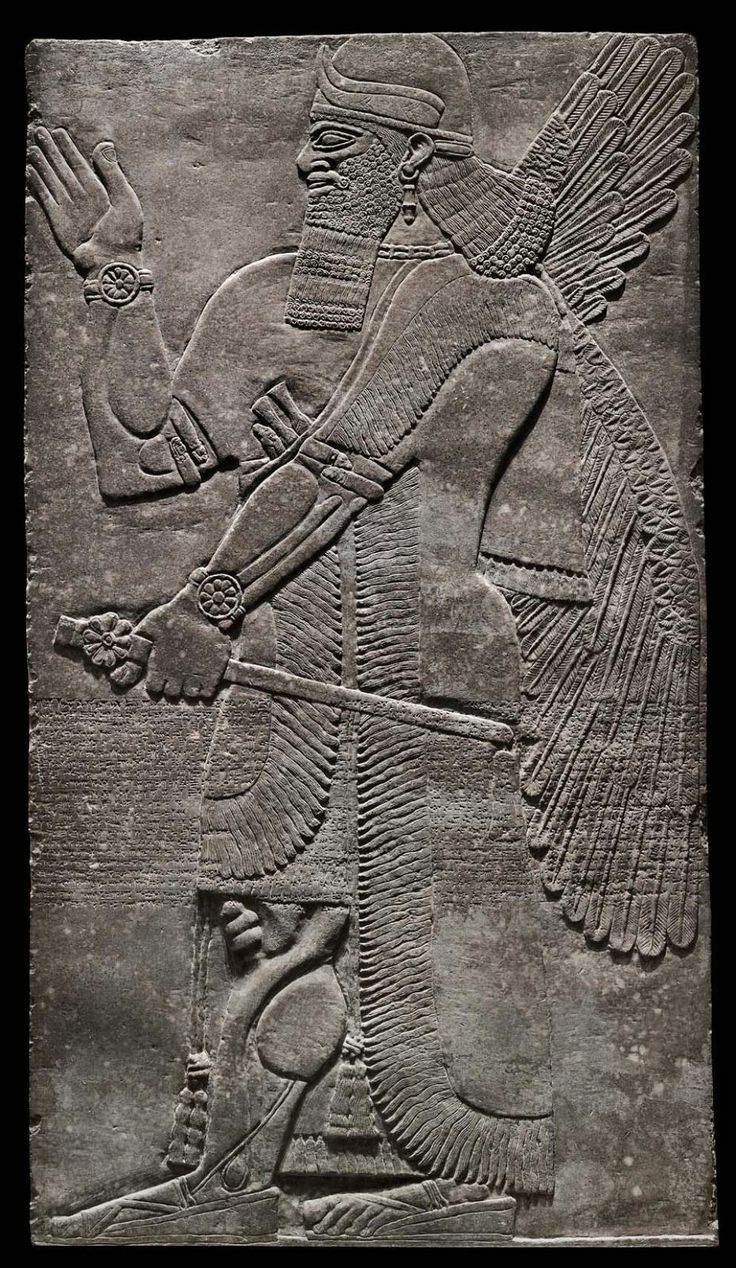
This umu-apkallū makes the iconic greeting gesture with his right hand while holding an e'ru stick in his left.  The tassels of his robe are clear around his ankles, as are bracelets just above his elbows.  Note the detail of the individually feathered wings. The rosette insignia on the e'ru and his wrist is not yet understood.  The headdress is a horned tiara, indicative of divinity.

This umu-apkallū makes the iconic greeting gesture with his right hand while holding an e’ru stick in his left.
The tassels of his robe are clear around his ankles, as are bracelets just above his elbows.
Note the detail of the individually feathered wings. The rosette insignia on the e’ru and his wrist is not yet understood. The headdress is a horned tiara, indicative of divinity.

The apkallū of the rituals share properties with some of the gods of the rituals: the šūt kakkī (II.A.3.4) hold the e’ru-stick/mace, the il bīti (II.A.3.8) greets and holds the gamlu-curved staff (attributes also of apkallū in art), the undeciphered intruders of text II Rev. 9f., probably gods since they are made of tamarisk, hold an ara gišimmari (cf. also text IV/1 ii 6’f.; held by apkallū of art), and the šūt kappī, “the winged ones”, of bīt mēseri (III.B.6) hold the e’ru and the libbi gišimmari.

The umu-apkallū at far left has his right hand raised in the iconic gesture of purification and exorcism, but no mullilu cone is present.  The banduddû bucket is present in the left hand. This umu-apkallū wears a horned tiara, indicative of divinity.  The next entity lacks wings, and so is probably not an umu-apkallū. The mace in the right hand could be an e'ru, as it is not yet clear precisely what e'ru means. I do not understand the object in his left hand.  The next entity holds a bowel and the curved staff, known as the gamlu-curved staff. While this entity wears a headdress, it is not horned, and wings are absent, suggesting that it is human rather than umu-apkallū.  The entity at far right wields a curved stick in his right hand, I am unsure how Wiggermann defines it, and I completely stumped by the object in his left hand, which appears to be a ladle.

The umu-apkallū at far left has his right hand raised in the iconic gesture of purification and exorcism, but no mullilu cone is present.
The banduddû bucket is present in the left hand. This umu-apkallū wears a horned tiara, indicative of divinity.
The next entity lacks wings, and so is probably not an umu-apkallū. The mace in the right hand could be an e’ru, as it is not yet clear precisely what e’ru means. I do not understand the object in his left hand.
The next entity holds a bowl and the curved staff, known as the gamlu-curved staff. While this entity wears a headdress, it is not horned, and wings are absent, suggesting that it is human rather than umu-apkallū.
The entity at far right wields a curved stick in his right hand, I am unsure how Wiggermann defines it, and I completely stumped by the object in his left hand, which appears to be a ladle. If I had to guess, I would surmise that the entity with the raised bowl is a king, and he is holding an offering which the figure at far right is blessing with the curved stick.

Like the (winged) gods and sages of art (Kolbe Reliefprogramme IIA, VII; above apkallū I and II) the gods of the rituals sometimes kneel (šūt kappī, III.B.6); kamsūtu, “kneeling figures”, probably gods since they are made of tamarisk in ritual II Rev. 11f., occur as well (Ritual II Rev. 11f., Text VI Col. B:25, BiOr 30 178:18).

The designations of these purifying and exorcising gods of the rituals are not names, but descriptions of function or appearance: šūt kakkī, “weapon-men”, it bīti, “god of the house”, šūt kappī, “winged ones”, kamsūtu, “kneeling ones”.

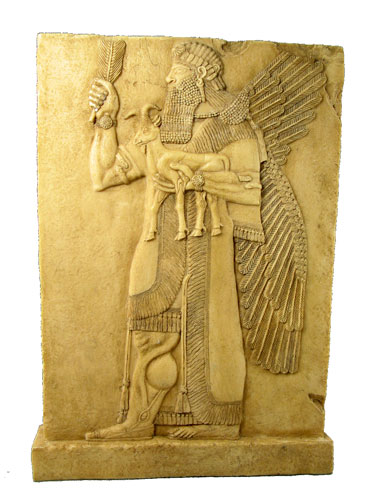
This um-apkallū holds a feather in his right hand, raised, and holds a small goat in his left hand.  The tassels on his robe are distinct, as are the bracelets on his upper arms, just above his elbows.  The headdress is unknown to me.  Wiggermann appears to favor the ür-term "lamassu" for all such apkallu figures.

This umu-apkallū holds a feather in his right hand, raised, and holds a small goat in his left hand.
The tassels on his robe are distinct, as are the bracelets on his upper arms, just above his elbows.
The headdress is unknown to me.
Wiggermann appears to favor the ür-term “lamassu” for all such apkallu figures.

Likewise the purifying and exorcising gods of art are not represented as individuals but as indistinguishable members of a group of lesser gods of similar function, holding more or less interchangeable attributes.

Although not an exorcist but an armed door keeper, the nameless god ša ištēt ammatu lān-šu, ” One Cubit” (II.A.3.5), might belong here; the winged goddess holding a bracelet (Kolbe VIII) may be a female member of the same group.

Without definite proof we propose to indentify the nameless exorcising gods of the rituals with the indistinct winged gods of the reliefs.

The “names” distinguish the members of this group according to form or function, but we ought to expect a term identifying these gods as similar lesser gods. The only term available is lamassu (also proposed by Reade BaM 10 36).

In view of the many difficulties surrounding this term (provisionally Foxvog/Heimpel/Kilmer/Spycket RiA 6 446ff.) definite proof would require a separate study.”

F.A.M. Wiggermann, Mesopotamian Protective Spirits: The Ritual Texts, STYX&PP Publications, Groningen, 1992, p. 79.

On the Fish-Apkallu

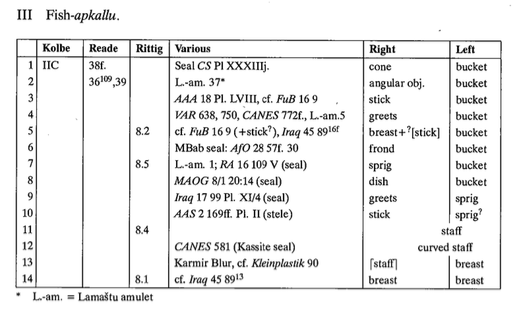
Fish Apkallu

“Lamaštu amulets:

The fish-apkallū on Lamaštu amulet 2 (and 4?), exactly like the ūmu-apkallū on Lamaštu amulets 3 and 61, has his left hand on the bed of the sick man. The right hand is slightly damaged, but probably greeting.

Fish-Apkallu statuettes of the type that were buried in the foundations of buildings.

Fish-Apkallu statuettes of the type that were buried in the foundations of buildings. It is difficult to tell whether they hold their hands in a prayerful position or hold something indistinct. 

Wrong hand:

Occasionally apkallū are attested holding the bucket in their right hand: AfO 28 57f. 30 (above IIiI/6), Lamaštu amulet 5 (?), Calmeyer Reliefbronzen 66 H:8 (bird-apkallū).

Unidentified object:

One of the apkallū on CANES 773 holds in his right hand an unidentified feather-like object.

Identification:

The identification of the fish-apkallū of ritual I/IiI with the “fish-garbed” man goes back to Smith JRAS 1926 709 (based on comparison with the Kleinplastik from Ur); identification of one of them with Oannes has been proposed since the early days of Assyriology (Kolbe Reliefprogramme 26, Zimmern KAT 535ff., ZA 35 151ff.) but was proved only after the names of the sages in Berossos’ Babyloniaka were recognized in cuneiform (van Dijk UVB 18 46ff.).

Occasionally the apkallū is mistakenly identified with the fish-man / kulullû (see below, VII.C.9), a completely different figure. U4 – a n (Oannes) and Adapa, a human sage living approximately at the same time, are probably two different figures (Borger JNES 33186, Picchioni Adapa 97ff.).

A "fish-man" / kulullû is depicted at left, and a fish-apkallū at right.  Wiggermann distinguishes these two entities.

A “fish-man” / kulullû is depicted at left, and a fish-apkallū at right.
Wiggermann distinguishes these two entities.

The texts clearly indicate that the fish-apkallū are not fish-garbed priests, but mythological figures, man and fish; they are bīnūt apsî, “creatures of apsû“, in ritual I/IIi, purād tāmtiša ina nāri ibbanú, “carp of the sea…who were grown in the river” in text IIiI.B.8 (cf. also Cagni Erra, I 162), and Berossos clearly describes them as a mixture of fish and man (cf. S. Mayer Burstein SANE I/5 13, 19).

Their names lack the determinative DINGIR, they are no gods, and the horns on the head of the fish (on palace reliefs, not on seals, cf. Kleinplastik 89, FuB 10 35) probably developed from its gills.

Berossos calls them “hemidaimones” (Jacoby FGrH 400).

Fish-Apkallū depicted on a cistern. The fish iconography is unmistakable, as are the banduddu buckets in their left hands. Objects in their right hands are indistinct, but the traditional gestures of warding or blessing seem clear.

Fish-Apkallū depicted on a cistern. The fish iconography is unmistakable, as are the banduddu buckets in their left hands. Objects in their right hands are indistinct, but the traditional gestures of warding or blessing seem clear. The objects in their right hands may be the “angular objects” mentioned in the table by Wiggermann at the top of the page. 

History.

In the third millennium a b g al is the name of a profession: see MSL 12 10:15, ZA 72 174 11 v 3, Bauer AWL 125 i 4 (NUN.ME.KA X ME/GANA2f, cf. also Barton MBI 2 iv 2), Ukg. 6 ii 30′, iii 4 (NUN.ME.KA X ME/GANA2f.) UET 8 33:15 and for the same profession in the divine world: TCL 15 10:98 (dA b g a l) cf. 85.

In OB sum. incantations a b g a l apparently refers to a mythological sage at the court of Enki: VAS 17 13:5 (together with Enkum, Ninkum, and the seven children of Apsû), 16:11, 32:21, HSAO 262:56, PBS I/2 123:9 IIIISET 1 217 Ni 4176:12, OrNS 44 68, cf. ASKT 12 Obv. 11ff.

The “seven apkallū of Eridu“, at least in AnSt 30 78 (SB) identified with the seven antediluvian sages (Anenlilda is among them), are rooted in the third millenium (TCS 3 25:139, cf. Benito “Enki and Ninmah” and “Enki and the World Order” 91:105, and for later attestations JCS 21 11 25+a, Maqlû II 124, V 110 = AfO 21 77, VII 49, VIII 38).

The names of the seven antediluvian sages are certainly not as old as the names of the antediluvian kings: they seem to be derived partly from the titles of literary works (Hallo JAOS 83 175f.), and partly from the names of the antediluvian kings.

The element en-me-(e n) (and a m – m e, a m – i etc.) = e m e n (me —en) (cf. Finkelstein JCS 17 42, Wilcke Lugalbanda 41), “lord”, in the names of the kings has been reinterpreted as “the lord (e n) who makes good (d u 10 – g a)/ perfects (g a l a m) / refines (b ùl u g -g á) the regulations (m e)”.

Although the resulting names are good Sumerian (Lambert JCS 16 74), the consistent difference is telling. The Sumerian of the linguistically rather simple bilingual incantation to the fish-apkallū in bīt mēseri (III.B.8) could well be of MB date, and the Kassite seals with representations of the fish-apkallū prove that at this time the later views existed at least partially.

These undatable later views connect the named carp apkallū with canonized literature (Lambert JCS 16 59ff., Hallo JAOS 83 175f., van Dijk-Mayer BaMB 2 no 90) and have possibly been developed concomittantly.

Literature on the apkallū types :

Below text III.B.8, 9, 10, 11; Borger JNES 33 183ff., Foster OrNS 43 344ff., Komoróczy ActAntHung 21 135ff., 142ff., S. Mayer Burstein SANE 1/5 13ff., Kawami Iran 10 146ff., van Dijk UVB 18 43ff., all with many references to previous literature.”

F.A.M. Wiggermann, Mesopotamian Protective Spirits: The Ritual Texts, STYX&PP Publications, Groningen, 1992, p. 76-7.

Bird Apkallu, Characterized as Griffin Demons

Bird-apkallu

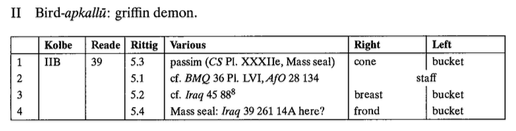
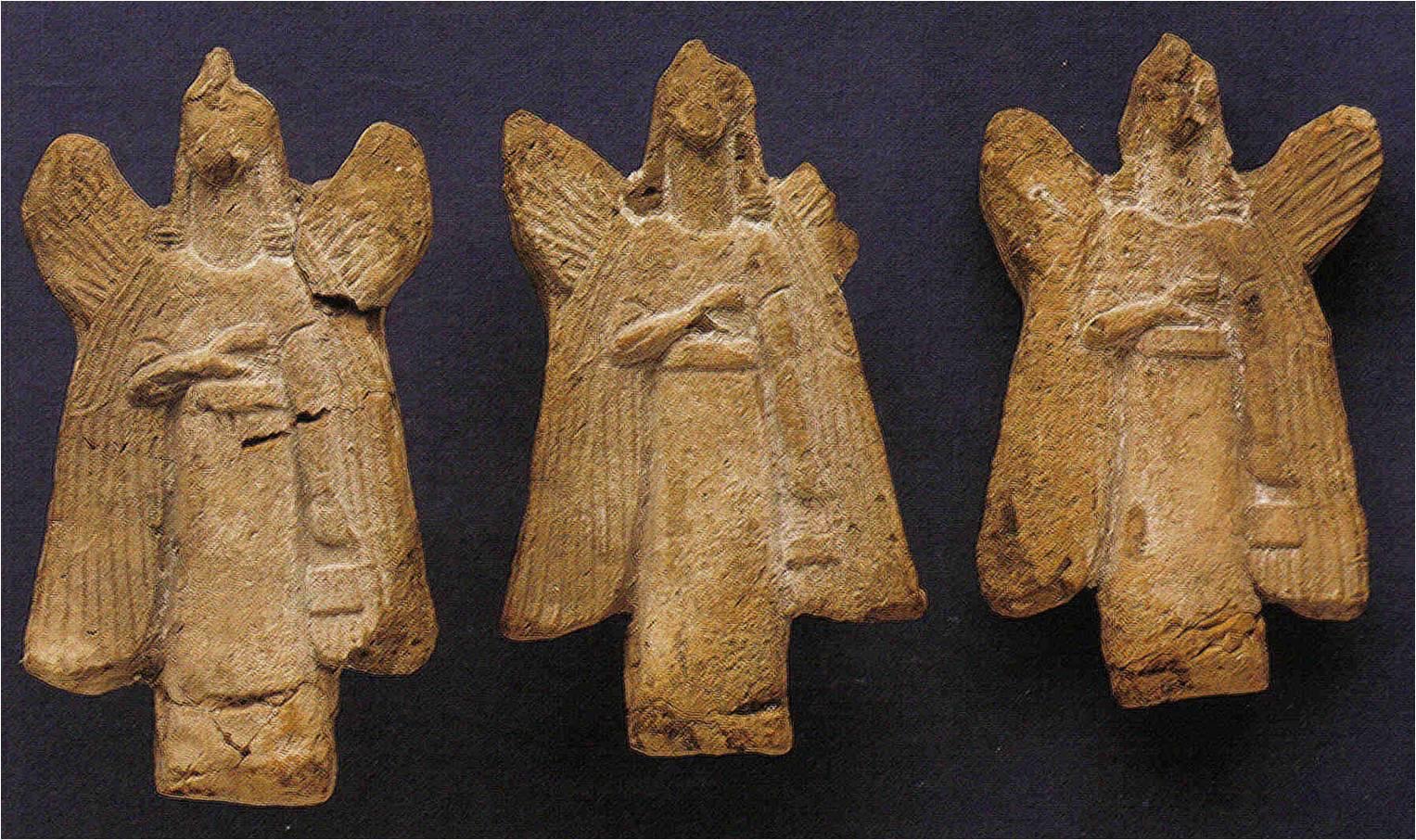
Bird-Apkallū statuettes in characteristic poses, right hands on their breasts, banduddu buckets in their left hands.

Bird-Apkallū statuettes in characteristic poses, right hands on their breasts, banduddu buckets in their left hands.

History: the griffin-demon does not stem from Babylonia; there he is attested first on the assyrianizing robe of Nabû-mukîn-apli (cf. Brinkman PHPKB 171, beginning of the 1st millennium) holding cone and bucket (King BBSt Pl. LXXIV); in Assyria, Syria, and the north he is attested much earlier (Parker Essays Wilkinson 33, Collon AOAT 27 222, on MAss seals: Klengel Brandt FuB 10 2438,39), cf. Madhloom Sumer 20 57ff.

Bird-apkallū, with hands on their chests, and banduddu buckets in their left hands.

Bird-apkallū, with hands on their chests, and banduddu buckets in their left hands.

Thus we are led to believe that a traditional northern hybrid with apotropaic functions was matched in Assyria with a traditional Babylonian literary figure with similar functions.

In Babylonia, from MB onwards, the apotropaic apkallū were viewed as partly man and partly carp; in the early first millennium Babylonia takes over the bird-apkallū (BBSt Pl. LXXIV), and Assyria the fish-apkallū (Rittig Kleinplastik 87).

The first millennium magical texts of Babylonian origin had to accommodate these foreign apotropaic beings.

Bird Apkallū and Fish Apkallū, side by side. Apkallū statuettes of this design were buried in appropriate places in the home of a Babylonian exorcist. They were believed to have prophylactic qualities, guarding the home from evil.

Bird Apkallū and Fish Apkallū, side by side. Apkallū statuettes of this design were buried in appropriate places in the home of a Babylonian exorcist. They were believed to have prophylactic qualities, guarding the home from evil.

The bird-apkallū are accommodated in bit mēseri by a slight change of form and sequence of the names of the fish-apkallū (text III.B.10). In ritual I/II they are simply provided with the same incantation as the fish-apkallū.

F.A.M. Wiggermann, Mesopotamian Protective Spirits: The Ritual Texts, STYX&PP Publications, Groningen, 1992, p. 75-6.

On the Names of the Umu-Apkallu

“History.

The name-like designations of the ūmu-apkallū are artificial and systematic; they do not even pretend to be historical realities. The names all start with ūmu / UD and may have been grafted on the u4- and p i r i g – names of other apkallū (Güterbook ZA 42103, Hallo JAOS 83 175, Reiner OrNS 30 6).

Fish-Apkallū depicted on a cistern. The fish iconography is unmistakable, as are the banduddu buckets in their left hands. Objects in their right hands are indistinct, but the traditional gestures of warding or blessing seem clear.

Fish-Apkallū depicted on a cistern. The fish iconography is unmistakable, as are the banduddu buckets in their left hands. Objects in their right hands are indistinct, but the traditional gestures of warding or blessing seem clear.

 P i r i g in these names is explained in a commentary to the diagnostic omens as nūru (P i r i g – g a l – a b z u = nūru rabû ša apsî, RA 73 153:2, OrNS 30 3:18′) and also Berossos’ account of the activities of the first sage, Oannes (S. Mayer Burstein SANE 1/5 13f.), indicates that the common denominator of ūmu and p i r i g is “light” rather than a monstruous appearance; that personified ūmu denotes the personified day or weather, sometimes visualized as a lion (or leonine monster), in other contexts as well will be explained below (VII.4a).

For this reason we have translated ūmu in the names of the ūmu-apkallū as “day”. The ūmu-apkallū were either antediluvian or postdiluvian sages; without definite proof, we prefer the former possibility on the following grounds:

  1. Names of postdiluvian sages are known from a number of sources (JSC 16 64ff., UVB 18 44:8ff., text III B 8, Reiner OrNS 30 10) but no canonical list of seven has been formed.
  2. If our ritual needed postdiluvian sages, it could have chosen from the known names; it would not have needed to invent names.
  3. Postdiluvian sages are probably not prestigious enough to function as mythological foundation of exorcism.
  4. The cities of the ūmu-apkallū (Ur, Nippur, Eridu, Kullab, Keš, Lagaš, Šuruppak) can be considered to complement the cities of the fish-apkallū (Eridu, Bad-tibira, Larak, Sippar) as antediluvian centres.

The reason for the invention of a second group of antediluvian apkallū, attested only in ritual I/II and its close relatives (III.B. and III.C), may have lain in the necessity of mythologically underpinning the existence of a traditional Assyrian apotropaic figure without appropriate credentials.

Fish-Apkallu statuettes of the type that were buried in the foundations of buildings.

Fish-Apkallu statuettes of the type that were buried in the foundations of buildings.

Support for this view can be found in the combative character which they share with the bird-apkallū, but not with the fish-apkallū; the bird-apkallū are a similar group of Assyrian apotropaic figures, similarly underpinned, the fish-apkallū are genuinely Babylonian.

The iconographic history of the ūmu-apkallū is in view of his human appearance difficult to trace; forerunners perhaps are the figures briefly discussed by Rittig Kleinplastik 28, and specimens from MAss times may possibly be found on the seals Iraq 17 Pl. X/3, Iraq 39 Pl. XXViI/2A, XXIX/27, ZA 47 55:5, 56:9.

Bird-Apkallu statuettes in characteristic poses, banduddu buckets in their left hands.

Bird-Apkallu statuettes in characteristic poses, banduddu buckets in their left hands.

Speculation.

The name of the last apkallū before the flood, ūmu ša ana šagši balāta inamdinu, “day that gives life to the slain”, could conceivably be a learned interpretation of the name of the last king of Šuruppak before the flood z i – u d – s ù – r a; using Babylonian methods (cf. J. Bottéro Finkelstein Memorial Volume 5ff.), u d gives ūmu, š e ES of z i (for še) or r a (for s a g – g i š – r a) gives šagšu, r a gives ana, z i gives balātu, and s ù (for s u m) gives nadānu. That this possible derivation actually applies, however, cannot be proved.”

F.A.M. Wiggermann, Mesopotamian Protective Spirits: The Ritual Texts, STYX&PP Publications, Groningen, 1992, p. 74-5.

Things that Apkallu Hold

” … we present a survey of the objects in the hands of apkallū on reliefs, seals, and in the Kleinplastik. The survey is not meant to be complete. It is based on the recent treatments of Rittig (Kleinplastik), Kolbe (Reliefprogramme), and Reade (BaM 10 17ff.).

Umu-Apkallu Anthropomorphic and Winged

Lamaštu amulets:

Occasionally on Lamaštu amulets (2, 3, 5, 20 ?, 29′, 37 61) a figure wearing a shawl covering the legs, once clearly with headband (3, cf. the description RA 18 176), appears at the head or feet of the bed of the sick man, together with fish-apkallū (2, 5, 37) or alone (3, 61).

His right hands greets (2′, 3?, 5′, 61?) or holds an angular object, his left hand is placed on the bed (3, 61), on a censer (3, cf. Wiggermann apud Stol Zwangerschap en Geboorte 111) or holds a square object (37) or the bucket. He is never winged.

Frank LSS-III/3 who considered the fish-apkallū a dressed up priest, thought the second figure at the bed to be an assistant priest. Today we no longer view the fish-apkallū as priests, and accordingly the men at the bed are assistant apkallū rather than assistant priests. The “men” are clearly involved in activities similar to those of the fish-apkallū, and the texts prescribing the visual representations of beneficial supernatural powers do not offer another candidate for the identification of this apkallū-like figure than the ūmuapkallū.

Bird Apkallu and Fish Apkallu, side by side. Apkallu statuettes of this design were buried in appropriate places in the home of a Babylonian exorcist. They were believed to have prophylactic qualities, guarding the home from evil.

Bird Apkallu and Fish Apkallu, side by side. Apkallu statuettes of this design were buried in appropriate places in the home of a Babylonian exorcist. They were believed to have prophylactic qualities, guarding the home from evil.

Identification of ūmu-apkallū on reliefs:

The description and incantation of the ūmu-apkallū make it clear that they are anthropomorphic figures of human descent; the material they are made of also distinguishes them from the gods and the monsters and apkallū of non-human lineage.

That the horns of divinity are lacking in the description then is not a coincidence (as it is in the case of the il bīti). On amulets, in a context clearly defined by the bed of the sick man and the presence of fish-apkallū, only one figure is available for identification with the ûmu-apkallū (see above); this figure serves as a check on any identification of the ūmu-apkallū in the less clear context of the palace reliefs.

Umu-Apkallu, with right hand raised in greeting. The banduddu bucket is in the left hand. Later analysts focus on the rosette patterns on the headdress and bracelets of um-apkallu, and their earrings.

Umu-Apkallu, with right hand raised in greeting. The banduddu bucket is in the left hand. Later analysts focus on the rosette patterns on the headdress and bracelets of um-apkallu, and their earrings.

There is no reason why the ūmu-apkallū must appear on reliefs; the text quoted by Reade BaM 10 38i27 may have belonged to fish- or bird-apkallū (text I/7). However, the apparent bearing of our rituals on the apotropaic subject-matter of the reliefs, and more specifically the presence of the bird- and fish-apkallū, leads us to expect them.

Although ritual I/II prescribes specific attributes for each type of apkallū, the actual fish- and bird-apkallū of the Kleinplastik show that this specificity is a forced choice between a number of more or less equivalent attributes; we must not expect the ūmu-apkallū to have held only the object denoted by e’ru, whatever it is; the ūmu-apkallū of the Lamaštu amulets confirm this point.

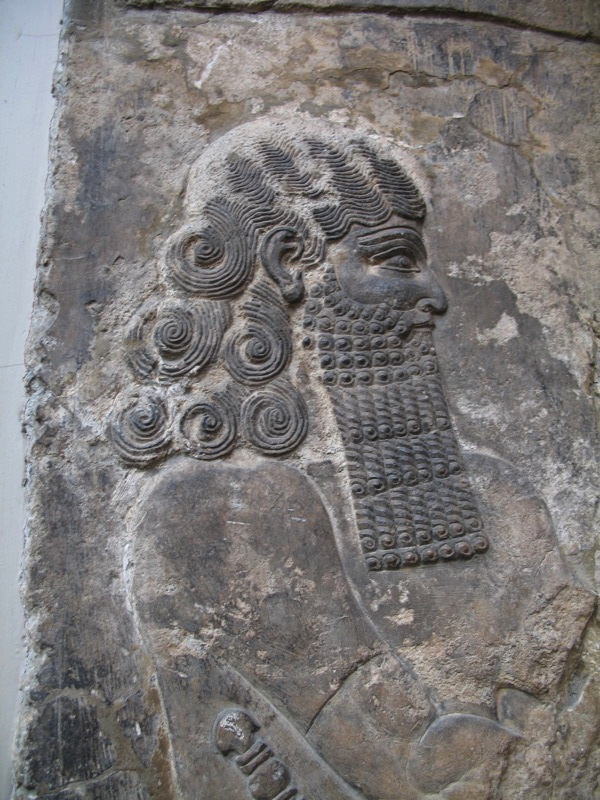
This well-preserved bas relief retains incredible detail. The daggers carried in the Umu-Apkallu's waistband are clear, as is the rosette styling on his wristbands. The earrings are more distinct than most other examples, and the headdress appears to be of the horned-tiara type. The umu-apkallu appears to wear bracelets on his upper arms. Tassels are apparent on the fringes of his robe, as well as behind the neck.

This well-preserved bas relief retains incredible detail. The daggers carried in the Umu-Apkallu’s waistband are clear, as is the rosette styling on his wristbands. The earrings are more distinct than most other examples, and the headdress appears to be of the horned-tiara type. The umu-apkallu appears to wear bracelets on his upper arms. Tassels are apparent on the fringes of his robe, as well as behind the neck.

The banduddû, identified with certainty with the bucket, thus isolates two groups with anthropomorphic members: the (winged) figures with headband and the (winged) figures with horned tiara (we will return to them below). The other attributes of the members of both groups can be made to match the attributes of the apkallū known from the texts; the horned figures, however, must be gods, and since the apkallū are no gods, the figures with the headband should be the apkallū (so Reade BaM 10 37; differently Kolbe Reliefprogramme 14ff., cf. 41f. 47, 50).

The banduddu buckets are discernible in the left hands of these bird-apkallu statuettes.

The banduddu buckets are discernible in the left hands of these bird-apkallu statuettes.

The ūmu-apkallū of the Lamaštu-amulets confirms this identification: decisive is the headband defining this type of supernatural beings (this band with daisy-like flowers differs from the diadem with two strips of cloth pendant behind, worn by the king or the crown-prince, cf. Reade Iraq 29 46, Iraq 34 92f.).

Unfortunately the headgear of the ūmu-apkallū is described only as agê ramāni-šunu, “crowns (cut out) of their own (wood)”; agû denotes a variety of functionally similar divine or royal headgears (CAD A/1 157a).

The different dress of the apkallū of the Lamaštu amulets cannot be adduced against identification with the apkallū of the reliefs; differences in dress are attested for the bird-apkallū as well, cf. Kolbe Reliefprogramme Pl. IV/1 and 2, Iraq 33 Pl. XiVe, Rittig Kleinplastik Fig. 20ff.; ūmu-apkallū with a shawl covering the legs appear on seals (VAR 675, probably CANES 705).”

F.A.M. Wiggermann, Mesopotamian Protective Spirits: The Ritual Texts, STYX&PP Publications, Groningen, 1992, p. 73-4.

On the Mullilu, the “cleaner,” the Purification Instrument of the Apkallu Exorcist

Apkallu Attributes

“–mullilu, “purification instrument” (literally: “cleaner”).

When it is agreed upon that a word denoting the cone, the most common object in the hands of the bird-apkallū and the fish-apkallū, must appear among the terms denoting objects held by the apkallū in ritual I/II, this word can only be mullilu.

The identification of mullilu as denoting the cone is based on the observation that the cone on reliefs, seals and in the Kleinplastik never occurs as the only object held by an apkallū; thus e’ru, libbi gišimmari, and urigallu, the other objects held by an apkallū, are excluded.

Klengel-Brandt (FuB 10 34, cf. Rittig Kleinplastik 215) thinks mullilu denotes “eine Art kurzen Wedel … der hauptsachlich zum besprengen mit Wasser benutzt worden ist“, and indentifies it with the cone. Correctly, but without justification, Parker (Essays Wilkinson 33) states that mullilu, “purifier”, “may be the cone-shaped object carried by the genii”.

Umu-Apkallū in the characteristic act of purification, sprinkling sacred water from the Banduddu bucket with the Mullilu cone.  From Nimrud, capital of king Ashurnarzipal. AO 19845

Umu-Apkallū in the characteristic act of purification, sprinkling sacred water from the Banduddu bucket with the Mullilu cone.
From Nimrud, capital of king Ashurnarzipal.
AO 19845

Unclear is BBR 26 v 39ff. (restored from 28:9, quoted by CAD M/2 189a), where the king carries a mullilu in his right and in his left hand. Never, on seals, reliefs or as a statue, does a figure carry a cone in both his left and his right hand.

The identity of the cone is still being debated: male inflorescence of the date-palm, or cone of a coniferous tree (cf., with previous literature, Stearns AfOB 15 2443). In a recent study, the second option is hesitantly favoured (Bleibtreu, Flora 61f., 93f., 123f.).

A bird-apkallu with mullilu and banduddu.  Drawn by Faucher-Gudin from an Assyrian bas-relief from Khorsabad. http://www.gutenberg.org/files/17323/17323-h/17323-h.htm#linkBimage-0011

A bird-apkallu with mullilu and banduddu.
Drawn by Faucher-Gudin from an Assyrian bas-relief from Khorsabad.
http://www.gutenberg.org/files/17323/17323-h/17323-h.htm#linkBimage-0011

The Akkadian term mullilu does not give a clue. From a philological point of view the fir-cone (terinnu) is preferable to the male inflorescence of the date-palm (rikbu, cf. Landsberger Date Palm 19): terinnu is attested as an instrument bringing about the release of sin (Maqlû I 24, cf. Landsberger Date Palm 14) and thus resembles the other objects carried by the apkallū. For rikbu no such use is known.

Regarding cone and bucket, we conclude with the following:

  • The bucket is always carried in the left hand. The other hand may be empty, or may carry a variety of objects, such as the sprig (Kolbe Reliefprogramme Type VI), which occur also in the hands of figures not carrying buckets. The value of the bucket in the ritual cannot be dependent on the objects held in the other hand. The bucket, or rather its content, is effective simply by being present.
  • One object, the cone, appears only when the figure in question carries a bucket in its left hand. The value of the cone must in some way be dependent on the value of the bucket.
  • The texts indicate that the bucket contained holy water effectuating “release”. As was proposed before, the dependent cone “purifier”(mullilu) held in the right hand activated the holy water: it was a sprinkler (Klengel-Brandt, Rittig, CAD M/1l 189a).
  • The figures carrying buckets (and cones) are engaged in a purification ritual. As will be seen below, this accords well with their function of apkallū.
  • Figures carrying cones point their cone at the sacred tree, the king, or courtiers (Stearns AfOB 15 64f.). Figures standing in doorways and apparently pointing their cones at nothing, are perhaps best thought of as pointing their cones at passing visitors, just as the weapons and the gestures of greeting are directed at the visitors, and not at the building.
  • The sacred tree benefits from the activities of the genii, the genii do not need the tree, cf. Stearns AfOB 15 70ff. It is not necessary to understand the meaning of the tree in order to understand the meaning of the figures with bucket and cone.
  • For the tree we refer to Porada AASOR 24 108ff., Madhloon Sumer 26 137ff., Stearns AfOB 15 70ff. Genge AcOr 33 321ff., Hrouda BaM 3 41ff., Kolbe Reliefprogramme 83ff., Bleibtreu Flora 37ff., and passim, Parker Essays Wilkinson 38. For a doubtful connection with the texts, cf. van Dijk Syncretism 175 f., and Lugal 1 10 ff. (see below 000).”

F.A.M. Wiggermann, Mesopotamian Protective Spirits: The Ritual Texts, STYX&PP Publications, Groningen, 1992, p. 67.

Statues in Private Rooms, the apkallū, “Sages.”

“In the bedroom (kummu, cf. III.B.6), the “place of life” (AAA 22 88:146f.), at the head of the bed of the threatened man, the seven anthropomorphic ūmu-apkallū, the “leading sages” (cf. II.A.3.1), are stationed. The seven bird-apkallū are buried against the wall at the head of the bed, but in an adjoining room (uncertain, cf. II.A.3.9).

This depiction of a fish-apkallū (Apkallu, Abkallu) guarded the entrance to the temple of Ninurta at Nimrud. A fish's head can be seen on Apkallu's head, and its skin hangs down over the back of Apkallu's body.  Neo-Assyrian era, 865-860 BCE. From the Temple of Ninurta, Nimrud (ancient Kalhu; Biblical Calah), northern Mesopotamia, Iraq. (The British Museum, London). Osama Shukir Muhammed Amin FRCP (Glasg) http://www.ancient.eu/image/2708/

This depiction of a fish-apkallū (Apkallu, Abkallu) guarded the entrance to the temple of Ninurta at Nimrud. A fish’s head can be seen on Apkallu’s head, and its skin hangs down over the back of Apkallu’s body.
Neo-Assyrian era, 865-860 BCE. From the Temple of Ninurta, Nimrud (ancient Kalhu; Biblical Calah), northern Mesopotamia, Iraq. (The British Museum, London).
Osama Shukir Muhammed Amin FRCP (Glasg)
http://www.ancient.eu/image/2708/

At the threshold of the bedroom seven fish-apkallū guard the entrance; two further groups of seven fish-apkallū are buried in front of, and behind the chair. The chair may have been in the bedroom or perhaps rather in an adjoining living-room or dining-room (the furniture of a dining room in the Neo-Assyrian period has been studied by K. Deller and I. Finkel in ZA 74 86f.; it includes a kussiu, “chair”, but no bed).

Material: the ūmu-apkallū are made of e’ru, a kind of wood well known for its magical properties, but as yet not identified with certainty; Thompson DAB 298f.: “Laurel”, CAD E 318ff.: a variety of cornel (followed by AHw 247a), Salonen Wasserfahrzeuge 99, 152: “Lorbeer” (cf., Oppenheim Eames 54), Civil apud Landsberger Datepalm 26: “(dwarf)ash” (followed by CAD M/1 221a, M/2 220b, S 202a, AHw 676a), see further Sollberger Genava 26 61 and Snell Ledgers and Prices 211.

The god Ea is portrayed at far left, with water coursing from his shoulders.  Two fish-apkallu hold banduddu buckets. This bas relief is atypical in that the left-side fish-apkallu holds his banduddu in his right hand, rather than the left, as is portrayed in most other depictions.  This bas relief is also unusual in that it portrays the fish-apkallu with different objects in their raised hands. The raised hand of the fish-apkallu on the left is indistinct, partially covered by the water flowing from the shoulders of the god Ea, while the other fish-apkallu raises an object that I have not yet identified.

The god Ea is portrayed at far left, with water coursing from his shoulders.
Two fish-apkallu hold banduddu buckets. This bas relief is atypical in that the left-side fish-apkallu holds his banduddu in his right hand, rather than the left, as is portrayed in most other depictions.
This bas relief is also unusual in that it portrays the fish-apkallu with different objects in their raised hands. The raised hand of the fish-apkallu on the left is indistinct, partially covered by the water flowing from the shoulders of the god Ea, while the other fish-apkallu raises an object that I have not yet identified.

In the incantation UDUG HUL EDiN.NA DAGAL LA (cf. text III.C), that accompanies the fabrication of the statues of the ūmu apkallū, the e’ru of which they are to be made is called: gis HUL.DÚB.BA GIŠ NAM.TI.LA, “mace that hits evil (cf. Grayson Iraq 37 69), wood of life” (AAA 22 88:152f.).

Analogous to the designation of the tamarisk of which the gods were made as the “bone of divinity” (above A), the designation of the material of the ūmu apkallū reveals something of their character: they chase evil away, and procure life.

Probably relevant is the “mystical” commentary (cf. below note 3e) gis TUKUL MA.NU: VII u4-mu gis TUKUL dAMAR.UTU, “the mace of e’ru: the seven ūmu-demons, the mace of Marduk“. Here “the mace of cornel” may refer to the seven ūmu-apkallū holding an e’ru stick or mace in their right hands. In straight-forward ritual contexts (notes 2, 13c, d, e) “mace of cornel” is rather an alternative designation of the e’ru (stick/mace) itself.

The ūmu-apkallū certainly did not belong to the bīnūt apsê, “creatures of apsû” (I 144); they probably did not belong to the bīnūt šamê, “creatures of heaven”, either, since the preceding designation salmī annūti, “these statues”, refers to the statues of tamarisk made the same day, and not to the statues of cornel made the day before (I 143).

The line closing the description of the statues of cornel does not contain a general term analogous to I 143 closing the tamarisk section; perhaps I 28 did contain such a term, or perhaps no such term was used.

A bas relief in the Louvre.  In this case the bird-apkallū tends to a sacred tree. Considering the mullilu in his right hand and the banduddu in his left, (tree cone and water bucket), he is engaged in a water ritual intended to sanctify the sacred tree. This is a common motif in Sumerian and Neo-Assyrian idols.  This bas relief is in the Louvre.  Primary publicationNimrud NW Palace I-24 = RIMA 2.0.101.023, ex. 189 (f) Collection	Nimrud, Iraq (a); British Museum, London, UK (b); Louvre Museum, Paris, France (c); Nimrud, Iraq (d); Detroit Institute of Arts, Detroit, Michigan, USA (e); British Museum, London, UK; Louvre Museum, Paris, France  Museum no.	Nimrud fragment no. 42 (a); BM 098061 (b); AO 22198 (c); Nimrud fragment no. 43 and 45 (d); DIA 47.181 (e) (photo: DIA); AO 19849  Accession no.	1903-10-10, 0002 (b) Provenience	Kalhu (mod. Nimrud) Period	Neo-Assyrian (ca. 911-612 BC)

A bas relief in the Louvre.
In this case the bird-apkallū tends to a sacred tree. Considering the mullilu in his right hand and the banduddu in his left, (tree cone and water bucket), he is engaged in a water ritual intended to sanctify the sacred tree. This is a common motif in Sumerian and Neo-Assyrian idols.
This bas relief is in the Louvre.
Primary publication Nimrud NW Palace I-24 = RIMA 2.0.101.023, ex. 189 (f)
Collection Nimrud, Iraq (a); British Museum, London, UK (b); Louvre Museum, Paris, France (c); Nimrud, Iraq (d); Detroit Institute of Arts, Detroit, Michigan, USA (e); British Museum, London, UK; Louvre Museum, Paris, France
Museum no. Nimrud fragment no. 42 (a); BM 098061 (b); AO 22198 (c); Nimrud fragment no. 43 and 45 (d); DIA 47.181 (e) (photo: DIA); AO 19849
Accession no. 1903-10-10, 0002 (b)
Provenience Kalhu (mod. Nimrud)
Period Neo-Assyrian (ca. 911-612 BC)

The bird- and fish-apkallū are made of clay, and are included among the bīnūt apsê, “the creatures of apsû” (I 144). They and the other statues of clay are the salmū sākip lemnūti ša Ea u Marduk, “the statues repelling the evil ones, of Ea and Marduk“, stationed in the house “to expel the foot of evil” (I 160f. 165f.). The bird- and fish-apkallū are separated, however, from the other figures of clay by a line indicating the end of a section (I 183).

In text I the clay of the bird-apkallū is mixed with wax.”

F.A.M. Wiggermann, Mesopotamian Protective Spirits: The Ritual Texts, STYX&PP Publications, Groningen, 1992, p. 65.

Apkallu Details (Excerpt from Wiggermann)

“Although text II is an extract, and as such less informative on the ritual than text I, it nevertheless supplies information not supplied by text I. The extra information of text II is given below figure by figure in the order of text I.

Human apkallu, known as ummiamu, distinguished with two pairs of wings. In a gesture of ritual purification, he holds a

Human apkallu, known as ummiamu, distinguished with two pairs of wings. In a gesture of ritual purification, he holds a “cleaner” cone in one hand, and a bucket in the other. The cone is called a mullilu, the bucket a banduddu. From Nimrud, capital of king Ashurnarzipal.
AO 19845

For each figure the details relevant to the discussions below are added: number of order in text II, name, number of statues, material, nature, character of incantation and inscription, attributes.

1.1          umu-apkallû, I 44ff.; 7; e’ru; anthropomorphic/human.

attributes: in the right hand: a cornel(-stick) charred at both ends; left hand on breast.
buried: ina SAG g’N?., “at the head of the bed” (II Obv. 11).
incantation: ÉN VII NUN.ME.MEŠ a-šá-red-du-tú, “seven leading sages” (II Obv. 11). Text I omits this incantation; its function is apparently fulfilled by the incantation ÉN UDUG HUL EDIN.NA DAGAL.LA I 40 (cf. below III.C.).

These figures are not supplied with horns of bronze/copper, which would positively identify them as gods, nor do the inscriptions and incantations characterize them as divine: they are sages of human descent, giving life by their incantations, and putting to flight evil.

The lack of added precision in the description (in contrast to the specifications of the bird- and fish-apkallū), and the head dress, garments, and hands, make them anthropomorphic.

A King, Ashurnasirpal, interacts with an attendant at far right. An apkallu is depicted at far left, denoted by his wings and his characteristic pose, with raised right hand and left hand holding a bucket. Apkallu in this pose typically have a cone in their right hands, which they use to ritually sprinkle water.

A King, Ashurnasirpal, interacts with an attendant at far right. An apkallu is depicted at far left, denoted by his wings and his characteristic pose, with raised right hand and left hand holding a banduddu bucket. Apkallu in this pose typically have a cone in their right hands, a mullilu, which they use to ritually sprinkle water.

[ … ]

9.2          Bird-apkullū, I 170ff.; 7; clay and wax; human/bird.

attributes: in the right hand a cleaner (mullilu), in the left a bucket.
buried: ina SUHUŠ É II-i ina SAG gis NÁ, “at the base of the (wall of the) “second room”, at the head of the bed” (II Obv. 14). The translation of II-i is uncertain: Smith JRAS 1926 696: “second pavement”(709 14: “not clear”); Gurney, Hibbert and Rittig suppose that II-i introduces an alternative position, which seems improbable in the present context.

In MAss/NAss the ša bīti šanî (CAD B 296b) is a servant in the dining room, and bītu šanû is accordingly perhaps “dining room”, cf. CAD B 297f., Kinnier Wilson CTN I 85, Postgate FNALD 5:5, Dailey CTN 3 165 ad 12. An incantation to these figures is attested only in text II (Obv. 14, incipit): ÉN at-tú-nu NU NUN.ME ma-sa-ri, “incantation: you are the statues of the sages, the guardians”: the incipit reveals only a part of their character: they are guardians.

In the top register, Ummiamu, human apkallu that are postdiluvian, tend to a sacred tree. In the lower register, antediluvian apkallu with avian heads tend to a sacred tree.  The pinecones and buckets in their hands are now understood to be standard devices used to sprinkle water. The water sprinkling ritual was intended to liberate sin.

In the top register, Ummiamu, human apkallu that are postdiluvian, tend to a sacred tree. In the lower register, antediluvian apkallu with avian heads tend to a sacred tree.
The tree cones and buckets in their hands are now understood to be standard devices used to sprinkle water, known as mullilu and banduddu, respectively .
The water sprinkling ritual was intended to liberate sin.

10.3        Fish-apkallū, I 174ff.; 7; clay; human/fish.

attributes: in the right hand a cleaner, in the left a bucket.
buriedina I.DIB. É.NUN, “at the threshold of the bedroom (II Obv. 16)”. The incantation to these figures is the same as the one to the bird-apkallū (only in text II Obv. 16).

11.4        Fish-apkallū, I 178ff.; 7; clay; human/fish.

attributes; in the right hand on offshoot of the datepalm, the left on the breast (Ed Note: sic).

buried: ina tar-siina EGIR gil GU.ZA, “opposite the gate, behind the chair” (II Obv. 18)
The incantation to these figures is the same as the one to the bird-apkallū (only in text II Obv. 18).

12.5        Fish-apkallū, I 181ff.; 7; clay; human/fish.

attributes: in the right hand a standard, the left on the breast.
buried: ina MÚRU É ina IGI-[at]gis GU.ZA, “in the middle of the room, in front of the chair” (II Obv. 20).
The incantation to these figures is the same as the one to the bird-apkallū (only in text II Obv. 20.”

F.A.M. Wiggermann, Mesopotamian Protective Spirits: The Ritual Texts, STYX&PP Publications, Groningen, 1992, pp. 46-9.

Lahmu, “The Hairy One,” is Not Apkallu

“The Babylonian scientific and religious texts reveal the names of over three thousand gods and demons, members of local and national pantheons. Most, if not all, play a part in cult or magic, and must have been represented in some form.

Gods and demons, cult and magic, are the main subjects of Babylonian art, but generally texts and art cannot be combined. Captions and parallelism between text and representations on boundary stones and other monuments allowed the identification of a number of divine symbols; the Lamaštu ritual texts matching the Lamaštu amulets allowed the identification of the demons Lamaštu and Pazuzu, and of objects playing a part in the ritual.

Amulet with a figure of Lamashtu From Mesopotamia, around 800 BC A demonic divinity who preys on mothers and children This is a protective image of Lamashtu, a fearsome female divinity of the underworld, intended to keep evil at bay. Although she is usually described in modern works as a demon, the writing of her name in cuneiform suggests that in Babylonia and Assyria she was regarded as a kind of goddess. Unlike the majority of demons, who acted only on the commands of the gods, Lamashtu practised evil apparently for its own sake and on her own initiative. There is a cuneiform incantation on the reverse to frighten her away. Lamashtu's principal victims were unborn and new-born babies. Slipping into the house of a pregnant woman, she tries to touch the woman's stomach seven times to kill the unborn baby, or she kidnaps the child. Magical measures against Lamashtu included wearing a bronze head of Pazuzu. Some of these plaques show a bedridden man rather than a pregnant woman, so they seem to relate to Lamashtu as a bringer of disease. Lamashtu is described in texts as having the head of a lion, the teeth of a donkey, naked breasts, a hairy body, stained hands, long fingers and finger nails, and the talons of a bird. Plaques also show her suckling a piglet and a whelp while she holds snakes in her hands. She stands on her sacred animal, the donkey, which is sometimes shown in a boat, riding through the underworld. H.W.F. Saggs, Babylonians (London, The British Museum Press, 1995) J. Black and A. Green, Gods, demons and symbols (London, The British Museum Press, 1992) http://www.britishmuseum.org/explore/highlights/highlight_objects/me/a/amulet_with_figure_of_lamashtu.aspx

Amulet with a figure of Lamashtu
From Mesopotamia, around 800 BC
A demonic divinity who preys on mothers and children
This is a protective image of Lamashtu, a fearsome female divinity of the underworld, intended to keep evil at bay. Although she is usually described in modern works as a demon, the writing of her name in cuneiform suggests that in Babylonia and Assyria she was regarded as a kind of goddess. Unlike the majority of demons, who acted only on the commands of the gods, Lamashtu practised evil apparently for its own sake and on her own initiative. There is a cuneiform incantation on the reverse to frighten her away.
Lamashtu’s principal victims were unborn and new-born babies. Slipping into the house of a pregnant woman, she tries to touch the woman’s stomach seven times to kill the unborn baby, or she kidnaps the child. Magical measures against Lamashtu included wearing a bronze head of Pazuzu. Some of these plaques show a bedridden man rather than a pregnant woman, so they seem to relate to Lamashtu as a bringer of disease.
Lamashtu is described in texts as having the head of a lion, the teeth of a donkey, naked breasts, a hairy body, stained hands, long fingers and finger nails, and the talons of a bird. Plaques also show her suckling a piglet and a whelp while she holds snakes in her hands. She stands on her sacred animal, the donkey, which is sometimes shown in a boat, riding through the underworld.
H.W.F. Saggs, Babylonians (London, The British Museum Press, 1995)
J. Black and A. Green, Gods, demons and symbols (London, The British Museum Press, 1992)
http://www.britishmuseum.org/explore/highlights/highlight_objects/me/a/amulet_with_figure_of_lamashtu.aspx

(The Lamaštu amulets have been collected by Walter Farber, “Lamaštu,” Reallexikon der Assyriologie (RlA) 6/V-VI, 1983, p. 441; see also his discussion in E. Rochberg-Halton ed., Language, Literature, and History, Fs E. Reiner, 1987, p. 85ff), and Walter Farber, Lamaštu: An Edition of the Canonical Series of Lamaštu Incantations and Rituals and Related Texts from the Second and First Millennia BC, Eisenbrauns, 2014.)

Two texts, the “Göttertypentext” and the “Unterweltsvision,” describe the visual appearance of a number of supernatural beings, but both are atypical and can be used only with extreme caution. More promising was a group of texts containing descriptions of prophylactic figures, gods and demons, but efforts to combine the described figures with the actually excavated ones were hampered by the fragmentary state of preservation of K 2987B+ (below text I) and bīt mēseri (below text III).

(E. Köcher, Der Babylonische Göttertypentext, Mitteilungen des Instituts für Orientforschung (MIO), vol. 1, 1953, p. 57ff.; Wolfram von Soden, “Die Unterweltsvision eines assyrischen Kronprinzen,” ZA 43 (1936) 1ff. See also K. Frank, MAOG 14/2, 1941, p. 23ff. (discussions of figures), and the new edition of Alasdair Livingstone in State Archives of Assyria (SSA) Vol. IIIHelsinki, 1989, pp. 68-76.)

Thus texts and art remained largely seperated. Philology retired and the explanation of Mesopotamian art was left to archaeologists and art historians. The conviction gained ground that this state of affairs was necessary rather than accidental: there was indeed but a loose connection between the imaginary world of the texts and that of the objects.

Scribes and artists expressed different theologies on the basis of a less specified common culture. Observations by the famous German assyriologist B. Landsberger supported this theory. Landsberger adduced arguments to indentify the naked hero and the bull man, two traditional figures of art, with the apkallu, “sage,” and the GUD.DUMU.dUTU, the “Bull-Son-of-the-Sun.”

Lahmu is an Akkadian deity, the mythological first-born son of Apsu and Tiamat. With his sister Lahamu, they were the parents of Anshar and Kishar, the father of the sky and the mother of the earth, who begat the first gods. Lahmu is depicted as a snake, or as a bearded man with six hair curls. For the Sumerians, Lahmu was “the muddy one,” and this title was ever after given to the gatekeeper of the Abzu temple of Enki at Eridu. As gatekeeper, he is termed Lahmu the Hairy, or sometimes “the Hairy One.”  http://en.wikipedia.org/wiki/Lahmu

Lahmu is an Akkadian deity, the mythological first-born son of Apsu and Tiamat. With his sister Lahamu, they were the parents of Anshar and Kishar, the father of the sky and the mother of the earth, who begat the first gods. Lahmu is depicted as a snake, or as a bearded man with six hair curls. For the Sumerians, Lahmu was “the muddy one,” and this title was ever after given to the gatekeeper of the Abzu temple of Enki at Eridu. As gatekeeper, he is termed Lahmu the Hairy, or sometimes “the Hairy One.”
http://en.wikipedia.org/wiki/Lahmu

Landsberger’s identifications and conclusions, however, cannot be upheld. His identification of the naked hero as apkallu was based on a sign miscopied by E. Eberling and a fragmentary duplicate from London. Collation and new duplicates revealed the true name of the naked hero: lahmu, “the hairy one” (JEOL 27 p.91). History and connotation of “lahmu” perfectly match the history of the naked hero, and there is no longer any reason to suspect separate origins.

Landsberger’s equation GUD.DUMU.dUTU = bull man was based on etymology and the justified expectation that the bull man under some name occurs in the texts. The equation could be proved only now (below VII.C. 6), and it is evident that GUD.DUMU.d UTU is a logographic spelling of kusarikku, “bison,” a term well known throughout Babylonia in various other spellings. Again the history of “kusarikku” matches the history of the bull man, and again there is no reason to suspect separate origins.

Lahmu, “Hairy,” is a protective and beneficent deity, the first-born son of Apsu and Tiamat. He and his sister Laḫamu are the parents of Anshar and Kishar, the sky father and earth mother, who birthed the gods of the Mesopotamian Pantheon. Laḫmu is depicted as a bearded man with a red sash-usually with three strands- and four to six curls on his head. He is often associated with the Kusarikku or “Bull-Man.” In Sumerian times Laḫmu may have meant “the muddy one”. Lahmu guarded the gates of the Abzu temple of Enki at Eridu. He and his sister Laḫamu are primordial deities in the Babylonian Epic of Creation –Enuma Elis and Lahmu may be related to – or identical with- ‘Lahamu’ one of Tiamat’s Creatures in that epic. http://foundfact.com/portfolio-view/lahmu/#!prettyPhoto http://foundfact.com/library/beings-people-and-gods/page/6/#!prettyPhoto

Lahmu, “Hairy,” is a protective and beneficent deity, the first-born son of Apsu and Tiamat. He and his sister Laḫamu are the parents of Anshar and Kishar, the sky father and earth mother, who birthed the gods of the Mesopotamian Pantheon. Laḫmu is depicted as a bearded man with a red sash-usually with three strands- and four to six curls on his head. He is often associated with the Kusarikku or “Bull-Man.” In Sumerian times Laḫmu may have meant “the muddy one”. Lahmu guarded the gates of the Abzu temple of Enki at Eridu. He and his sister Laḫamu are primordial deities in the Babylonian Epic of Creation –Enuma Elis and Lahmu may be related to – or identical with- ‘Lahamu’ one of Tiamat’s Creatures in that epic.
http://foundfact.com/portfolio-view/lahmu/#!prettyPhoto
http://foundfact.com/library/beings-people-and-gods/page/6/#!prettyPhoto

(Since lahmu, “the hairy one,” names the naked hero (hero with six curls) after his visual appearance, art must have played a part in the early formation of the supernatural world. In the case of “(mythological) Bison,” the artistic expression (bull-man) is secondary.)

Since a separation of texts and art cannot be maintained in the case of these two most prominent figures (others could be added), the theory of independent origins and development loses its supporting argument. The observed gap between art and texts is accidental, not necessary.”

F.A.M. Wiggermann, Mesopotamian Protective Spirits: The Ritual Texts, STYX&PP Publications, Groningen, 1992, pp. xi-xii.

Correspondences Between Apkallu and the Nephilim

“Mesopotamian literature provides some interesting glimpses into the conceptual background of Genesis 6:1-4. The most notable case is the famous hero Gilgamesh. As a great warrior-king, he would certainly fit the epithets “ancient warrior” and “man of renown.”

In the Gilgamesh Epic we are told that “two-thirds of him is god and one-third of him is human” (I.46 and IX.31), the son of the goddess Ninsun and the human king Lugalbanda. In this ancestry we see a divine / human marriage and the birth of a semi divine child.

Gilgamesh defeating the Bull of Heaven.

Gilgamesh defeating the Bull of Heaven.

There is also a pivotal scene in the Gilgamesh epic where the goddess Ishtar sees that Gilgamesh is beautiful and desires to marry him–but Gilgamesh refuses Ishtar’s advances (VI.5-80). Here is almost another divine / human marriage, again with a divine woman and a mortal man. The motif of Gilgamesh’s semi divine identity likely stems from the ideology of kingship in Mesopotamia, in which the king is often depicted as quasi-divine, sealed with greatness by the gods at birth.

For example, the Tukulti Ninurta Epic describes the Assyrian king as “the flesh of the gods” (šēr ilāni), the same phrase used to describe Gilgamesh in Gilgamesh IX.53. Royalty is rounded with divinity in Mesopotamian political ideology, as it is elsewhere in the ancient Near East.

In the top register, Ummiamu tend to a sacred tree, In the lower register, antediluvian apkallu tend to a sacred tree.  The pinecones and buckets in their hands are now understood to be standard devices used to sprinkle water.

In the top register, ummianu, postdiluvian apkallu, tend to a sacred tree, In the lower register, antediluvian apkallu tend to a sacred tree.
The pinecones and buckets in their hands are now understood to be standard devices used to sprinkle water in blessing.

It is entirely possible that the unknown legends of the Nephilim have something to do with stories of such ancient semi divine warrior kings. Another relevant example, mediating between Mesopotamian and biblical traditions, is Nimrod (Genesis 10:8-12; J), a mighty hunter and king of Babylon and Assyria.

A.D. Kilmer has suggested that the ancient sages of Mesopotamian tradition–the apkallu–may be related to the Nephilim. The grounds for this suggestion are the following: the apkallu lived immediately before and after the flood; some of the post-diluvian apkallu are described as angering various gods; and some apkallu are “of human descent,” one of them being only two-thirds apkallu. A Late Babylonian list of the apkallu alludes to several unknown episodes about the postdiluvian apkallu:

  • Nungalpiriggaldim–who brought down Ishtar from heaven and who made the harp decorated with bronze and lapis.
  • Piriggalnungal–who angered Adad
  • Piriggalabsu–who angered Ea
  • Lu-Nanna, only two-thirds apkallu–who drove the dragon from Ishtar’s temple
  • [total of ] four of human descent whom Ea endowed with comprehensive intelligence.

Of the apkallu before the flood, only Adapa can be said to have angered the gods, since Anu calls him to task for breaking the wing of the south wind.

The transgressions of the apkallu are intriguing, particularly those “of human descent.” Yet it is hard to see how these figures can be directly related to the Nephilim, since their identities and attributes are so different: the apkallu are ancient sages and culture heros, while the Nephilim are ancient warriors and giants.

It is plausible, as H.S. Kvanvig has argued, that tales of the apkallu became mixed with interpretations of the Sons of God and the Nephilim in post-exilic times, for in I Enoch and later texts the heavenly beings (the “Watchers”) that come to earth to marry human women are also culture heroes, teaching arts and sciences to their human wives. Adding to this possibility of influence are indications that parts of I Enoch are of Mesopotamian provenance.”

Ronald Hendel, “The Nephilim Were on the Earth: Genesis 6:1-4 and its Ancient Near Eastern Context,” in Christoph Auffarth and Loren T. Stuckenbruck, eds., The Fall of the Angels, Brill, 2004, pp. 27-9.

Editorial Note on the Apkallu and the Roadmap Ahead

I am breaking the narrative stream to speak directly to the process emerging from our reading on the apkallū, the antediluvian and postdiluvian sages of ancient Mesopotamia.

If you are reading along over my shoulder, you noticed that we digressed from Martin Lang, “Mesopotamian Early History and the Flood Story,” in a post titled On the Date of the Flood.

Martin Lang wrote:

“Berossos’ own knowledge of primordial kings probably goes back to sources that were available in Hellenistic times. The Sumerian King List itself was still known in the Seleucid era, or rather versions of king lists that echo, structurally and stylistically, their ancient forerunners from the early second millennium.

In matching up the primordial kings with the seven sages, the apkallū, Berossos once again works in the vein of contemporary scholars, who demonstrably constructed lists with kings and apkallū in order to advertise their own importance, and the primordial roots of their knowledge, as Alan Lenzi has recently shown.”

I updated that post to include a link to Alan Lenzi, “The Uruk List of Kings and Sages and Late Mesopotamian Scholarship,” JANER 8.2, 2008, which is serialized and linked in posts below.

I also changed the link to the Sumerian King List to point to the beautiful 1939 edition by Thorkild Jacobsen generously published by the University of Chicago Press, available for free download off the web.

We then dipped into Anne Draffkorn Kilmer, “The Mesopotamian Counterparts of the Biblical Nephilim,” in Francis I. Andersen, et al, eds., Perspectives on Language and Text: Essays and Poems in Honor of Francis I. Andersen’s Sixtieth Birthday, 1985, in a post titled On the Apkallū.

This is where I drilled in hard on the apkallū, incorporating bas reliefs and figurines held at the Louvre and the British Museum. Out of numerous posts addressing the apkallū, this one is well-illustrated, and lushly hyperlinked.

Moreover, Anne Kilmer synthesized the supporting research on the apkallū at the time of writing very effectively, so if you are overwhelmed by the other articles, just read this one. It goes without saying that you should not be intimidated by this academic literature. I have made it as readable and accessible as I can.

Yes, there is a lot of it. As I excavate the academic literature on the apkallū the hard way, mining references from footnote after footnote, I get a sense of what it might be like, to be an academic Assyriologist rather than an autodidact.

I do not include everything that I find. I assess and include just those pieces which accrue gravitas in that greater academic community. If you see glaring omissions, please let me know. This note is shaping up to be an academic survey of the literature on the apkallū, and it may save others treading these same paths some time.

Fair warning: our continuing digression into the apkallu will be deep.

As I complete serialization of source texts, I will include links to the posts beneath their citation below. These sources are sorted by date, so we can track the evolution of academic thinking on the apkallū. Our digression includes excerpts from:

After we complete our deep dive into the apkallu, we will return to the Sumerian King List, then resume with Berossos. This is the roadmap ahead.

Editorial note: In some cases citations above which are not followed by links in the bulleted list are internet dry holes, no digital versions are available. In other cases, links are to Google Books editions, which often limit visible pages. Google’s intent is to sell electronic versions of the texts that they scan.

Under these circumstances, I end up rekeying entire articles, at ruinous waste of time. If you have a moment, please send a sweet nastygram to Google asking them to post free and complete eBooks as they continue their vast project to digitize the entirety of human knowledge.

In other cases, I simply have not yet reviewed the articles and posted them. If you are following this project, you see that I post updates nearly every day. Stay tuned.

My purpose in publishing Samizdat is to highlight excerpts from the great books, mining synchronicities from legends and myths. As I point out in the About page, the Deluge was an historical event for the ancient Sumerians.

I now need to update that page, incorporating the research that we have already completed on the Sumerian King List, setting up a future digression into the concept of the Great Year, which Berossos associated with traditions of a Conflagration and the Deluge.

If you wondered where we were going, I wrote this for you.

 Updated 20 November 2015, 23:39 hrs.

On the Apkallu

“During the course of the years studying and teaching the Primeval History as recorded in the literary texts of ancient Mesopotamia, this writer has been struck by certain similarities between the Akkadian apkallu (Sumerian algal / NUN.ME / EN.ME), creatures of the god Ea, the “sages of old,” and the biblical nēpīlîm of Genesis 6 who are introduced just before the flood account.

In the Mesopotamian king and sage lists, the apkallu occur in the pre-flood era, and in some texts for a limited time after the flood. In general, however, the pre-flood sages are called apkallu and their traditional number is seven, while the post-flood sages are called the ummiānu.

Apkallu portrayed with Ea, at far left, with water coursing from his shoulders.

Apkallu portrayed with Ea, at far left, with water coursing from his shoulders.

The apkallu are semi-divine beings who may be depicted as mixed beings, as priests wearing fish hoods, or who may, like Adapa, be called a son of Ea. Moreover, humans and apkallu could presumably mate since we have the description of the four post-flood apkallu as “of human descent,” the fourth being only “two-thirds apkallu” as opposed to pre-flood pure apkallu and subsequent human sages (ummiānu).
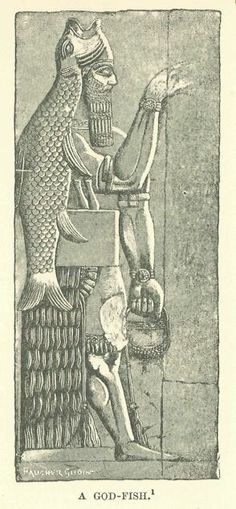
A depiction of the apkallu, Adapa, or Oannes.

A depiction of the apkallu, Adapa, or Oannes.

The short mythological “episode” in Genesis 6:1-4 tells us only that after the population increased, the nēpīlîm appeared on the earth after divine beings (sons of elohim) had mated with the daughters of men. The following verse (v. 5) states that Yahweh saw that men’s wickedness was great.

It can be assumed from this brief account that the nēpīlîm were the offspring of those divine fathers and human mothers, and that it was the nēpīlîm who somehow exemplified wicked mankind in general. Let us now turn to the Mesopotamian apkallu tales and lists to see how their behavior, as well as their parentage, may have some features in common with the nēpīlîm.

Antediluvian apkallu portrayed as fish-men, such mixed-species creatures were the teachers of men.

Antediluvian apkallu portrayed as fish-men, such mixed-species creatures were the teachers of men.

The most celebrated apkallu was Adapa, identified as a son of Ea. As we are told in the best known and best preserved myth about him, he executed an act of hubris by breaking the wing of the south wind; the end result, for him, of that wicked act was that he was denied immortality.

He is probably to be equated with the last antediluvian apkallu who was reported to have ascended to heaven. As we know from the late lists of sages, several other apkallu at the time of the flood or right after it also committed daring or wicked acts (the list that follows is abbreviated with respect to details and is conflated from the pertinent texts):

Antediluvian apkallu

  • Uanna — Who completed the plans of heaven and earth
  • Uannedugga — Who was endowed with comprehensive intelligence
  • Enmedugga — Who was allowed a good fate
  • Enmegaluamma — Who was born in a house
  • Enmebulugga — Who grew up on pasture land
  • Anenlilda — The exorcist of Eridu
  • Utuabzu (Utuabba) — Who ascended to heaven
  • [Total of] seven brilliant purādu fish . . . born in the river, who direct the plans of heaven and earth.

(Editorial note, source: Bit Mēseri III, 14’=27′)

Postdiluvian apkallu

  • (both Adapa and Nunpiriggaldim are associated with Enmerkir)
  • Nungalpiriggaldim — Who brought down Ishtar from heaven and who made the harp decorated with bronze and lapis*
  • Piriggalnungal — Who angered Adad*
  • Piriggalabsu — Who angered Ea*
  • Lu-Nanna (2/3d apkallu) — Who drove the dragon from Ishtar’s temple*
  • *[Total of] four of human descent whom (pl.) Ea endowed with comprehensive intelligence.

(Editorial note, also see source: Helge Kvanvig, Traditions of the Apkallus, Primeval History: Babylonian, Biblical and Enochic: An Intertextual Reading, Brill, 2011.)

Thus we see that the traditions about the superhuman apkallu contained stories, most of them lost to us, about their famous and infamous deeds. But it is the latter ones, from Adapa to Piriggalabzu (sic), around whom the obvious misbehavior clusters.

It is of further interest to note that the pivotal role of the nēpīlîm passage in Genesis 6 occurs together with the theme of increased population growth on which Genesis 6 opens. If we compare the Mesopotamian material, we see a similar position in the storytelling for the importance of population increase and concomitant wickedness as a factor leading to the flood.

The Mesopotamian sages were endowed with wisdom and special powers because they were created by the god Ea and associated with the deep (as fish-men, etc.). Because of their powers they were capable of acts that could impress or offend the gods, that could cause beneficial or harmful natural phenomena.

It is the negative side of them that seems to be involved in the period just before and after the flood in the sage lists. A similar theme runs through the Atrahasis Epic; there, at each attempt of the gods to decrease men’s numbers by means of drought, etc., Ea instructs his son (?) Atrahasis, the Extra Wise and thus a sage figure in his own right but also to be equated with the king of Shuruppak, how to outwit the gods and overcome hardship.

Thus each god whose cult is neglected and deprived of offerings, as a result of those instructions, was sure to be angered. Their collective anger at such acts and their disgust at humanity’s increase and bad condition led to the joint decision to send the flood.
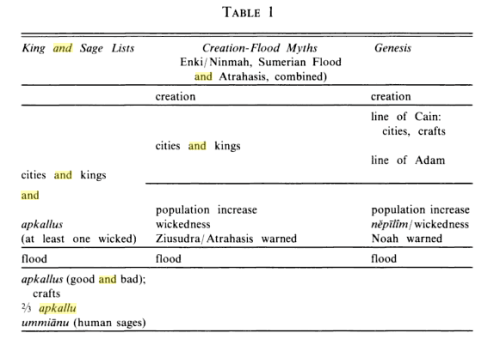
Table from Anne Draffkorn Kilmer, The Mesopotamian Counterparts of the Biblical Nephilim, 1985

Whereas the Mesopotamian myth and list traditions single out and keep distinct the sages and king-heroes, Genesis 6:4 speaks only of the “heroes of old, men of renown” and equates them with the nēpīlîm. In fact, it is possible that this verse intended to equate both the lines of Adam and Cain with the nēpīlîm. If so, the reintroduction of Noah four verses later would complete the line of thinking, since Noah was one of the heroes of old.

Yet the line of Cain (the Smith), juxtaposed as it is with the line of Adam, seems to operate in a manner similar to the Mesopotamian traditional list of the line of sages juxtaposed with the line of kings, as others have argued.

Like the apkallu who built the early cities and those who brought the civilized arts to men, the line of Cain performed the same service (or dis-service, in the biblical view). As to v 3 concerning man’s shortened lifespan, it may have its counterpart in the post-flood renegotiations of the terms for man’s continued existence as described in the Atrahasis Epic.

There, the fixing of a term of life for mortals was probably contained in the fragmentary section about controlling population growth. In the Sumerian King List it is only after King Gilgamesh (who was 1/3d divine) that rulers begin to have more normal longevity (beginning with the 126 year reign of his successor).

Postdiluvian advisors to kings who were men, the ummianu, were the successors of the antediluvian mixed-species Apkallu who were portrayed as fish-men. In this frieze now held in the British Museum they tend to a tree of life or a tree of knowledge. The antediluvian Apkallu were the so-called seven sages of Sumeria.

Postdiluvian advisors to kings who were men, the ummianu, were the successors of the antediluvian mixed-species Apkallu who were portrayed as fish-men. In this frieze now held in the British Museum they tend to a sacred tree. The antediluvian Apkallu were the so-called seven sages of Sumeria.

One other cuneiform text can be mentioned in which the sages may be associated with wicked acts, viz. The Epic of Erra (alternative full text of the Epic from Foster’s B is available). There the sages (called ummiānu) seem to be guilty by implication since we are told that they were dispatched for good to the apsu at the time of the flood and may have been deprived access to the mes-tree, “the flesh of the gods,” which provided them with the special material to make divine and kingly statues (as well as knowledge, skill and longevity?), but which was hidden from them (and all future mortals) forever when Marduk cast it into the deep.
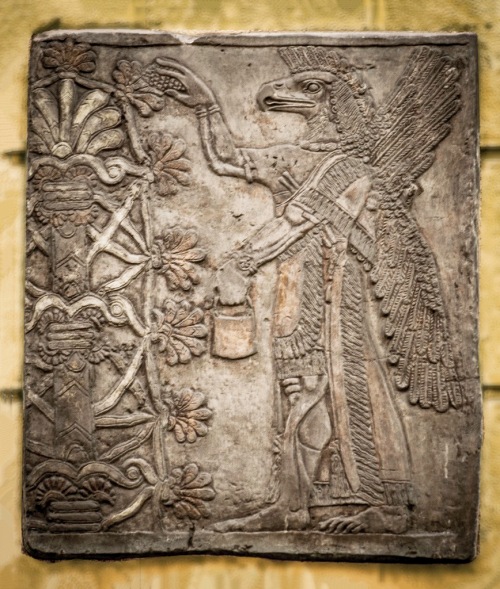
In Neo-Assyrian art these bird-headed

In Neo-Assyrian art these bird-headed “genies,” as they are often described, are now known to be apkallu, mixed-feature creatures created by the god Ea. They traditionally served as advisors to kings. They are often depicted in association with sacred trees.
https://www.flickr.com/photos/lanpernas2/8606000868/

If the flood is the same Abubu perhaps the mes-tree (see footnote 11 below) may be compared with the plant (of life) whose hidden location in the deep Utnapishtim revealed to Gilgamesh. If so, it leads us to suspect a further connection between the Mesopotamian mythological trees and plants and the tree(s) in Eden to which another sage figure, Adam, had once had access.

A modern depiction of Gilgamesh harvesting the Plant of Life from the ocean floor, guided by Utnapishtim, the deified survivor of the Deluge.  http://www.mediahex.com/Utnapishtim

A modern depiction of Gilgamesh harvesting the Plant of Life from the ocean floor, guided by Utnapishtim, the deified survivor of the Deluge.
http://www.mediahex.com/Utnapishtim

In short, we may be able to look to the Mesopotamian sage traditions for the mythological background of Genesis 6:1-4. While the ties between the apkallu and the nēpīlîm are hardly ties that bind, there are enough points of comparison—superhuman / semi-divine beings, acts of daring / hubris, acts that anger divinity, association with wickedness in men, their predominantly pre-flood existence—to encourage our consideration.

The Mischwesen sages seem at least to be closer to the nēpīlîm topically than the theogony materials concerning the generations of the gods. It is hoped that the circumstantial evidence for a remote connection between the apkallu and the nēpīlîm is strong enough to have been worth trying the case.”

(Footnote 11: Now that the bird-faced winged genies of Assyrian Palace art may be identified as apkallu (see Anthony Green, “Neo-Assyrian Apotropaic Figures,” Iraq 45 (1983), pp. 87-96) the close association of apkallu with special trees is clear.)

(For other mixed-beings, creatures of Ea, note F. Köcher, “Der babylonische Göttertypentext,” Mitteilungen des Instituts für Orientforschung 1 (1953), pp. 72, 74, 78, 80.)

Anne Draffkorn Kilmer, “The Mesopotamian Counterparts of the Biblical Nephilim,” in Francis I. Andersen, Edgar W. Conrad, & Edward G. Newing, eds., Perspectives on Language and Text: Essays and Poems in Honor of Francis I. Andersen’s Sixtieth Birthday, 1985, pp. 39-43.

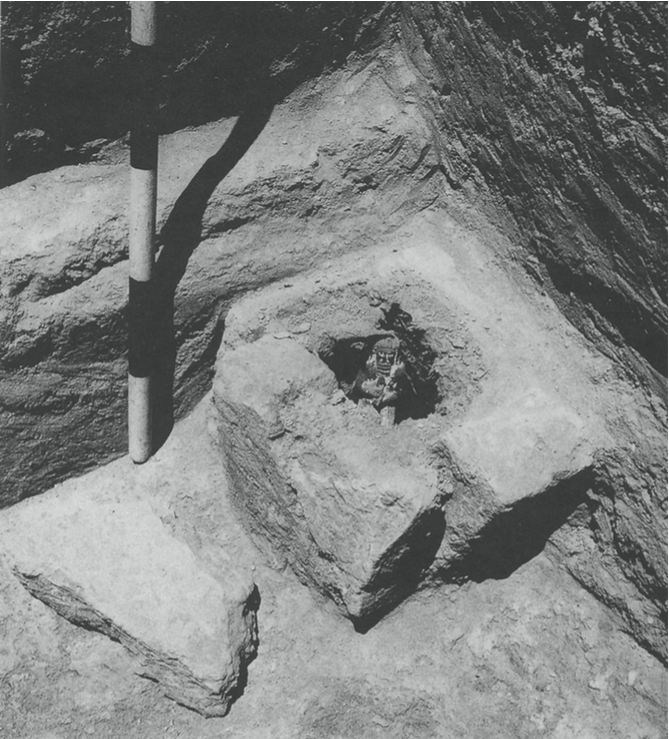
On the Date of The Flood

“I now turn to Berossos’ account of the Flood as the central narrative of book 2. The extant fragments contain the following elements:
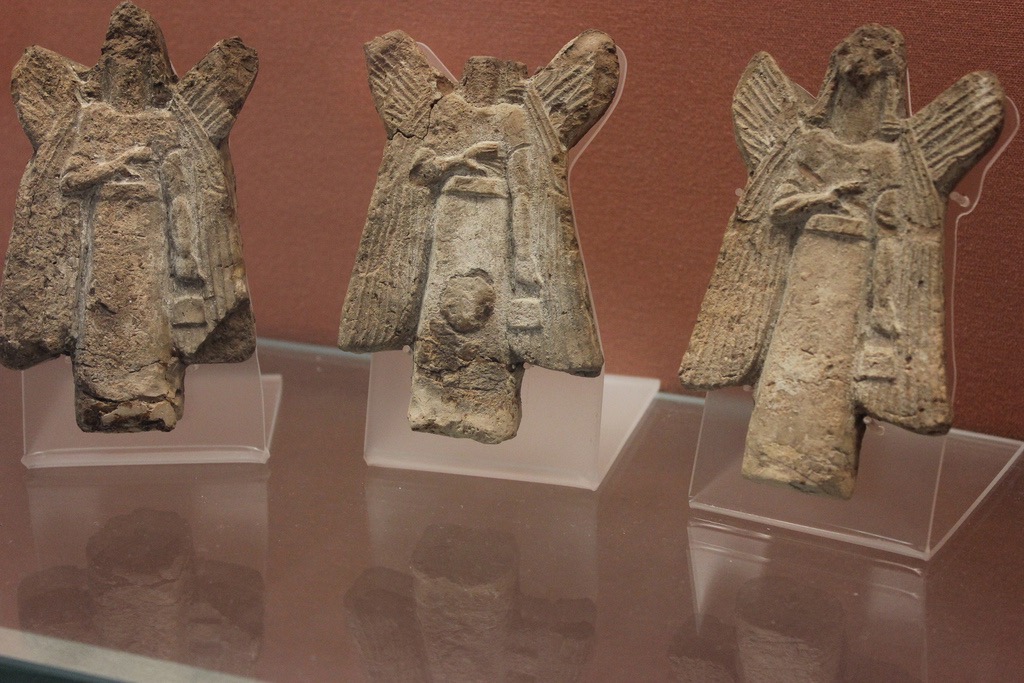
  • – Kronos reveals the destruction of mankind in a dream
  • Xisouthros is told he must bury the tablets in Sippar
  • – He must build a boat and embark together with family, friends, and animals
  • – The coming and receding of the deluge (mentioned in only one sentence)
  • – Bird scene
  • – Disembarking
  • – Worship and ritual offering
  • – Disappearance of Xisouthros, who will henceforth live with the gods
  • Xisouthros’ friends and relatives are told (not by Kronos, but a ‘voice’) to go to Sippar and dig up the tablets, and to hand them over to mankind.
  • – Landing place in Armenia, in the Korduaian mountains. The remains of the ark are still there, and people scrape off bitumen for magic purposes.

In Mesopotamian accounts of the deluge the Flood marks a break between a mythic prehis­tory and a history closer to the world as it is today. According to Manfried Dietrich, many mythical texts from Mesopotamia reflect this view of history, whereby an embryonic phase in the development of the world (‘embryonaler Status’) is followed by what he calls the ‘Jetzt-Zeit’, i.e. the present time.

The extant fragments of Berossos follow the same overall scheme. For Berossos too, the time before the Flood is a period of revelation, when the basis for all later knowledge was laid. Writings originating in this period would accordingly have a special authority and ‘the history which follows is the time when this revelation is transmitted and unfolded.’

Berossos was not the first to connect an antediluvian king list with the Flood story: al­ready the Sumerian version of the Flood story mentions five primeval cities known also from copies of the Sumerian King List.

Among all the extant exemplars of the Sumerian King List, the Weld-Blundell prism in the Ashmolean Museum cuneiform collection represents the most extensive version as well as the most complete copy of the King List.  In this depiction, all four sides of the Sumerian King List prism are portrayed.  It lists rulers from the antediluvian dynasties to Suen-magir, the fourteenth ruler of the Isin dynasty (ca. 1763–1753 B.C.).   The prism contains four sides with two columns on each side. Perforated, the prism must originally have a wooden spindle going through its centre so that it might be rotated and read on all four sides. http://cdli.ox.ac.uk/wiki/doku.php?id=the_sumerian_king_list_sklid=the_sumerian_king_list_skl

Among all the extant exemplars of the Sumerian King List, the Weld-Blundell prism in the Ashmolean Museum cuneiform collection represents the most extensive version as well as the most complete copy of the King List.
In this depiction, all four sides of the Sumerian King List prism are portrayed.
It lists rulers from the antediluvian dynasties to Suen-magir, the fourteenth ruler of the Isin dynasty (ca. 1763–1753 B.C.).
The prism contains four sides with two columns on each side. Perforated, the prism must originally have a wooden spindle going through its centre so that it might be rotated and read on all four sides.
http://cdli.ox.ac.uk/wiki/doku.php?id=the_sumerian_king_list_sklid=the_sumerian_king_list_skl

Berossos’ own knowledge of primordial kings probably goes back to sources that were available in Hellenistic times. The Sumerian King List itself was still known in the Seleucid era, or rather versions of king lists that echo, structurally and stylistically, their ancient forerunners from the early second millenium.

In matching up the primordial kings with the seven sages, the apkallu, Berossos once again works in the vein of contemporary scholars, who demonstrably constructed lists with kings and apkallu in order to advertise their own importance, and the primordial roots of their knowledge, as Alan Lenzi has recently shown (Editorial note: this link is to Alan Lenzi, “The Uruk List of Kings and Sages and Late Mesopotamian Scholarship,” JANER 8.2, 2008, which will be serialized in its own posts shortly).

Detail, Apkallu head, from a frieze in Nimrud.  http://non-aliencreatures.wikia.com/wiki/Apkallu

Detail, apkallu head, from a frieze in Nimrud.
http://non-aliencreatures.wikia.com/wiki/Apkallu

Yet, Berossos does not merely translate ancient documents, but rather selects and reframes what he finds, thus constructing his own version of the past. For a start, he locates the beginnings of kingship in Babylon and not in Eridu as the first city of Mesopotamian tradition.

Moreover, he reckons the overall duration of pre-flood history at 432,000 years (120 saroi = 120 x 3600 years), a sum that reflects the sexagesimal count­ing system of ancient Mesopotamia but which, as far as we know, is unique in Mesoptamian tradition.

432,000, however, is no arbitrary accumulation of individual reigns, but rather represents an astronomical ‘great year’, or an exact fraction of it. A great year is the period of time it takes for all heavenly bodies to return to their original place in the sky.

Berossos evidently had at least some astronomical knowledge, and moreover was keen to display his knowledge. Indeed, another peculiarity of Babyloniaca 2, beside the exorbitant reigns of the pre-flood kings, is Berossos’ unusual and very specific reference to a date for the Flood:

Kronos stood over him in his sleep and said that on the 15th of the month of Daisios mankind would be destroyed by a flood.

The Armenian version (F4a) supplies some explanatory glosses inserted at a later stage (in italics):

He says that Kronos, whom they call the father of Aramazd and others call Time, revealed to him in his sleep that on the 15th of the month of De(s)ios, which is Mareri, mankind was to be destroyed by the Flood.

There is no mention of a specific date in cuneiform texts about the Flood, yet Berossos puts it on ‘the fifteenth of the month Daisios’. According to the Macedonian calendar introduced by the Seleucids, Daisios is the 8th month of the year, and comes in spring (April/May, Babylonian Ayyaru).

Perhaps Berossos inserted a Macedonian dating in order to make it more relevant to his readers who were familiar with Greek Flood narratives. The choice of date may not be entirely accidental, as the Tigris and the Euphrates burst their banks in spring.

However, extant cuneiform sources link the deluge with rains and a cosmic storm rather than natural inundations, and we may have to look elsewhere for an explanation.”

Martin Lang, “Book Two: Mesopotamian Early History and the Flood Story,” from Johannes Haubold, Giovanni B. Lanfranchi, Robert Rollinger, John Steele (eds.), The World of Berossos, Proceedings of the 4th International Colloquium on the Ancient Near East Between Classical and Ancient Oriental Traditions, Harrassowitz Verlag, Wiesbaden, 2013, pp. 49-51.

Oannes and the Apkallu, the Seven Sages of Sumeria

“Placed between two other books, Babyloniaca 2 takes on the function of a narrative pivot in Berossos’ work. It has connections with book one and book three, by way of recapitulation (e.g. Oannes and the sages) and anticipation (mention of kings who are treated in book three); and it brings into contact two fundamentally different periods in history: the mythic prehis­tory of book 1, which is cast as a revelation transmitted by the semi-divine sage Oannes; and the political history of book 3, which bears out Oannes’ revelation in a setting where gods and humans are much more clearly separate.

Book 2 of Berossos’ Babyloniaca contains, as far as we can tell, the history of Babylonian kingship organised according to a very tra­ditional pattern. Broadly speaking, it comprises the ten kings before the Flood, the deluge narrative and a concise history of rulers down to Nabonassar.

Among all the extant exemplars of the Sumerian King List, the Weld-Blundell prism in the Ashmolean Museum cuneiform collection represents the most extensive version as well as the most complete copy of the King List. It lists rulers from the antediluvian dynasties to Suen-magir, the fourteenth ruler of the Isin dynasty (ca. 1763–1753 B.C.). The prism contains four sides with two columns on each side. Perforated, the prism must originally have a wooden spindle going through its centre so that it might be rotated and read on all four sides. http://cdli.ox.ac.uk/wiki/doku.php?id=the_sumerian_king_list_sklid=the_sumerian_king_list_skl

Among all the extant exemplars of the Sumerian King List, the Weld-Blundell prism in the Ashmolean Museum cuneiform collection represents the most extensive version as well as the most complete copy of the King List. It lists rulers from the antediluvian dynasties to Suen-magir, the fourteenth ruler of the Isin dynasty (ca. 1763–1753 B.C.). The prism contains four sides with two columns on each side. Perforated, the prism must originally have a wooden spindle going through its centre so that it might be rotated and read on all four sides.
http://cdli.ox.ac.uk/wiki/doku.php?id=the_sumerian_king_list_sklid=the_sumerian_king_list_skl

The structural backbone of the book is a king list, more specifically, the so-called Sumerian King List in a version which contains sections before and after the Flood. The time before the Flood is structured by the succession of antediluvian kings, that after the Flood traces the reigns of postdiluvian kings, thus forming a narrative diptych around the central Flood narrative. Eusebius describes the overall effect as follows:

“This Berosos narrated in his first book, and in the second he wrote ordering the kings one after another… In collecting the names of the kings he collects [that] alone, but he tells nothing pre­cise of their deeds, indeed he did not consider them worthy of mention […].”

Eusebius’ complaint notwithstanding, Berossos does seem to have fleshed out the skeleton of his king list with some narrative interludes. For example, he inserts references to the antediluvian sages, a peculiarity paralleled in cuneiform sources of the Hellenistic period.

The combination of the list itself and the Flood narrative continued unchanged down to the first millennium BCE and is also attested in some fragments from the Neo-Assyrian and Late Babylonian period.

More specifically, Berossos connects the beginnings of humanity with the Oannes theme from book one. As far as we can tell, that theme appeared twice in the Babyloniaca: near the beginning of the work, Berossos introduces Oannes as the ‘paragon of Mesopotamian scholarly mysticism and wisdom’.

‘In the very first year’, a fearsome beast named Oannes appears out of the Red Sea and teaches humankind the arts of civilisation. In book 2, we learn that he is only the first in a series of other such beasts (F3a).

This protective spirit (Apkallu or Abkallu) guarded the entrance to the temple of Ninurta at Nimrud. A fish's head can be seen on Apkallu's head, and its skin hangs down over the back of Apkallu's body.  Neo-Assyrian era, 865-860 BCE. From the Temple of Ninurta, Nimrud (ancient Kalhu; Biblical Calah), northern Mesopotamia, Iraq. (The British Museum, London). Osama Shukir Muhammed Amin FRCP (Glasg) http://www.ancient.eu/image/2708/

This protective spirit (Apkallu or Abkallu) guarded the entrance to the temple of Ninurta at Nimrud. A fish’s head can be seen on Apkallu’s head, and its skin hangs down over the back of Apkallu’s body.
Neo-Assyrian era, 865-860 BCE. From the Temple of Ninurta, Nimrud (ancient Kalhu; Biblical Calah), northern Mesopotamia, Iraq. (The British Museum, London).
Osama Shukir Muhammed Amin FRCP (Glasg)
http://www.ancient.eu/image/2708/

Oannes, however, is clearly the most important: he is depicted as more than a mere culture hero but acts as some­thing very close to a creator god himself, shaping amorphous matter and turning mindless creatures into human beings with an identity and creative intelligence.

Oannes alone is responsible for the growth of human civilisation and its manifestations in history. Moreover, in describing his intervention, Berossos combines what in Sumero-Akkadian tradition were known as divine acts of creation with the teachings that humanity traditionally attributed to the apkallu, the mysterious seven sages who were created and inspired by Enki/Ea, the god of wisdom.

Part of the reason here, I suspect, might be that Berossos tried to make Oannes more plausible to a Greek audience by giving him some of the attributes of the Platonic δημιουργός (dēmiurgós), who acts ‘like a versatile artist or craftsman, creates his work from available materials according to a predetermined plan (PI. Resp. 507c; 530 a; 597b ff.; PI. Soph. 265c ff.; PI. Pit. 269c ff.; 272e ff.; PI. 7V.)’.

The aim is to underline the enormous age of Babylonian culture, the beginnings of which coincide with the dawn of all human culture. It is significant therefore that Berossos recapitulates the Oannes theme when he finally starts his account of human history in Babyloniaca 2.”

Martin Lang, “Book Two: Mesopotamian Early History and the Flood Story,” from Johannes Haubold, Giovanni B. Lanfranchi, Robert Rollinger, John Steele (eds.), The World of Berossos, Proceedings of the 4th International Colloquium on the Ancient Near East Between Classical and Ancient Oriental Traditions, Harrassowitz Verlag, Wiesbaden, 2013, pp. 48-9.