
Samizdat

Publishing the Forbidden. All Rights Reserved. © Samizdat 2014-2025.

Category: The Etiological Myth of the “Seven Sages”

Why No Canonical Literature Regarding the Apkallu?

“In adducing the motif of the “wise vizier”, I have only meant to show that the “wise men” of a tradition are not necessarily kings, and furthermore, to show the complexity of a problem that, if I do not pretend to solve, I neither am inclined to embezzle.

In my opinion, the myth of the apkallu’s in all likelihood reflects the etiological story which the Greek accounts attempt to render, but which did not survive in the Mesopotamian canonical literature.
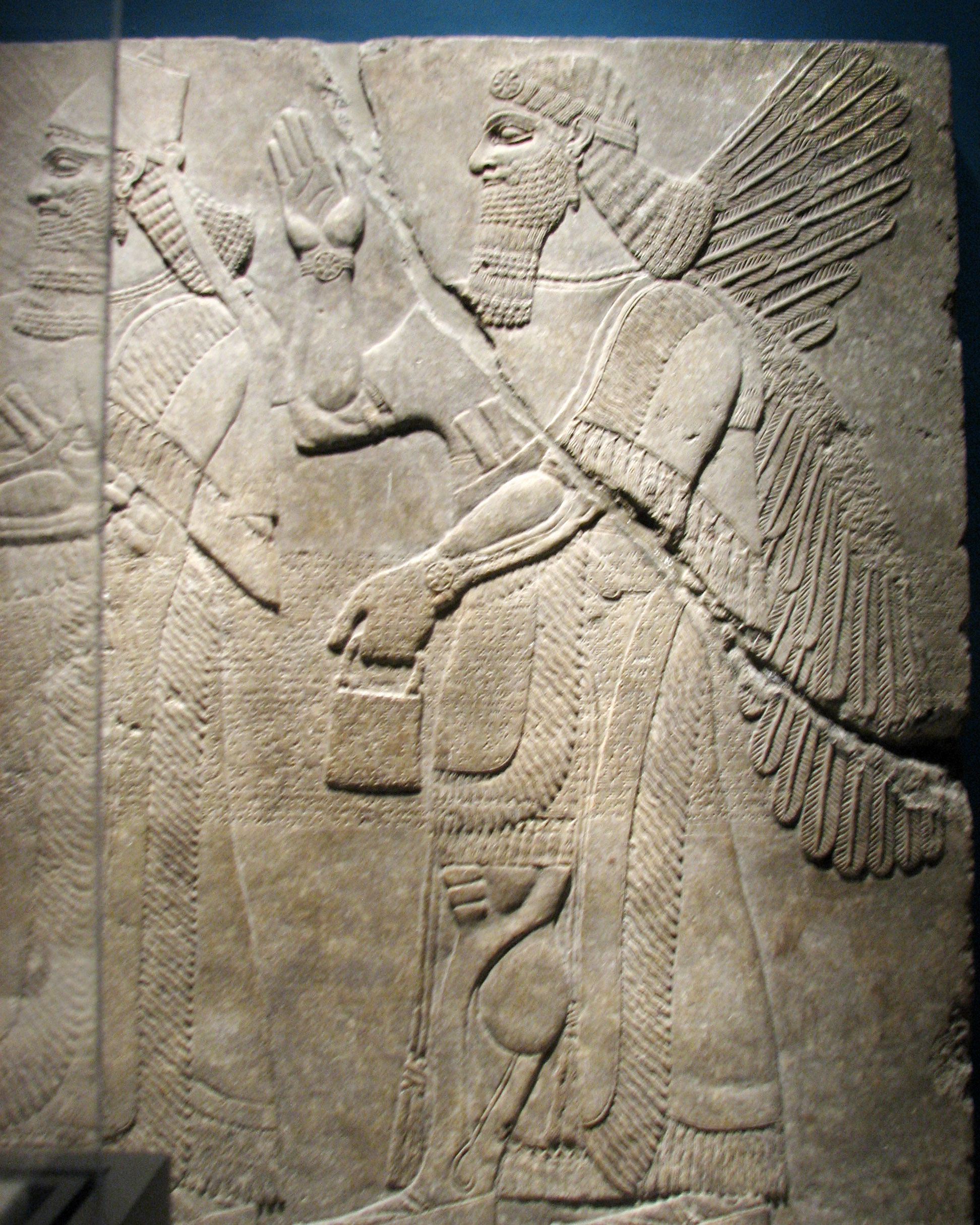
This winged umu-apkallū raises his right arm in the greeting gesture, with the banduddu water bucket in his left hand. The headdress is unusual, not the usual horned tiara, but a headband with a rosette insignia.

This winged umu-apkallū raises his right arm in the greeting gesture, with the banduddu water bucket in his left hand. The headdress is unusual, not the usual horned tiara, but a headband with a rosette insignia.

Beside the reference to the “old sages from before the flood” (AMT 105:22, last cited by Lambert, JCS 11 p. 8), an allusion to the presence on earth, before the flood, of apkallu’s, who after the flood regained the Apsû, is contained in the Epic of Era, where Marduk says that he “made these wise men go down to the Apsû” (ummânī šunūti ana apsî ušēridma, I 147), together with the precious materials needed to fashion the divine statute.

In the following rhetorical questions in which he regrets that neither the materials, nor the craftsmen needed to work them are available, Marduk finally deplores the absence of the sages who, most likely, were the only ones capable of infusing life into the divine statue: ali sibīt apkallī (NUN.ME) apsî purādī ebbūti ša kīma Ea bēlišunu uzna sīrtu šuklulu (I 162) “Where are the seven sages of the Apsû, the pure purādu-fish, who, just as their lord Ea, have been endowed with sublime wisdom?”. […]
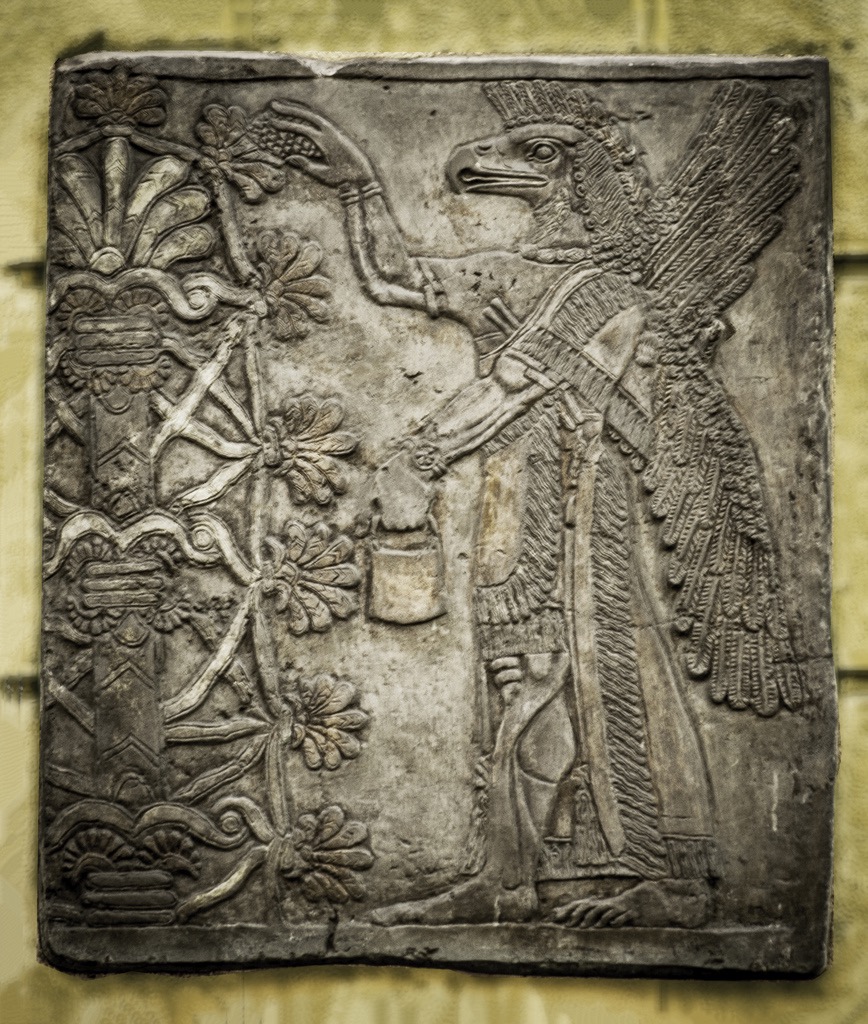
In Neo-Assyrian art these bird-headed

In Neo-Assyrian art these bird-headed “genies,” as they were long described, are now known to be apkallū, “bird-apkallū,” in this case, mixed-feature exorcists and creatures of protection created by the god Ea. They traditionally served as advisors to kings. Their association with sacred trees, as they are often portrayed, remains somewhat perplexing.
This apkallū makes the iconic gesture of exorcism and liberation of sin with the mullilu cone in his raised right hand, and the banduddu water bucket in his left hand.
There are three known types of apkallū: the human, with wings; the avian-headed, with wings, and the fish-apkallū, with carp skin draped over their heads.
https://www.flickr.com/photos/lanpernas2/8606000868/

The story here edited cannot be interpreted as an etiological myth. Neither the exploits of the apkallu’s, nor even their names suggest any literary figure known to us, with the exception of Adapa, nor are they said to have existed in the period before the flood.

Meager evidence is the mention of the apkallu from Ur, Lu-Nanna, in the colophon of a text (K 8080, see Lambert, JCS 11 p. 7) listing poultices for magical purposes and of Piriggalabzu in the incipit of a Sumerian t i g i -song. …

On the other hand, two apkallu’s not described among the heroes of our text — who, as the reader must have noted, are only five in number — are mentioned as authors: a certain Enlil-muballit, apkallu of Nippur under Enlil-bani of Isin, in AMT 105:24 (see Lambert, JCS 11 p. 8), and a certain Ur-Gatumduga in the subscript to the Šulgi-hymn PBS 1/1 No. 11 …

There is little hope that we will ever find more ample material dealing with the apkallu’s. Of the legend, or cycle of legends, concerning their exploits what our texts tells us alone survives.

Indeed, we may even assume that at the time of its redaction the details of the legendary events had already faded into the past. Only the legend of Adapa must have still been well known, for concerning him the text contents itself with an even briefer allusion than its report on the other apkallu’s.

The very terseness of the characterization of each apkallu reminds us of the style of the so-called “historical omens” attached to the early kings, many of which are better considered anecdotes, as has been suggested by Güterbock, ZA 42 57 ff.

Just as historical texts never mention the exploits of Narām-Sin, Sargon, and others, that are referred to in these omens, so literary texts, transmitting always the same written tradition, have not recorded the feats of the apkallu’s.

Antediluvian apkallū portrayed as fish-men, such mixed-species creatures were the teachers of men.<br />  These specific statuettes were buried in the foundations of the home of an exorcist, where they were positioned beneath doorways and against particular walls to exert a prophylactic effect, warding off evil.<br />  The antediluvian type of apkallū, the so-called purādu-fish, are often grouped in sevens.

Antediluvian apkallū portrayed as fish-men, such mixed-species creatures were the teachers of men.
These specific statuettes were buried in the foundations of the home of an exorcist, where they were positioned beneath doorways and against particular walls to exert a prophylactic effect, warding off evil.
The antediluvian type of apkallū, the so-called purādu-fish, are often grouped in sevens.

It certainly seems as if the scribes deliberately suppressed a cycle dealing with those human beings who, at one or other of history, and no doubt with the connivance of Ea, revolted against the gods and “brought down Ištar from heaven into Eanna,” or “aroused Adad’s anger” by some forgotten or perhaps unmentionable act, or “angered Ea” through some form of challenge which is still obscure to us, in spite of the three duplicates we now have of this allusion.

Even the learned Lu-Nanna is not included for his literary achievements, but for a feat, we suspect, disrespectful to the goddess.

These acts of hubris seem quite irreconcilable with the picture we have formed of the Mesopotamian attitude towards the gods on the basis of traditional literature, and they must have been the cause of the eventual oblivion from which, however, the memory of some admirable human achievement persistently drew out again the figures of the “possessors of unsurpassed wisdom,” the sages.”

Erica Reiner, “The Etiological Myth of the “Seven Sages,” Orientalia, v. 30, No. 1, 1961, pp. 9-11.

On the Ummânu

“Such an association of the apkallu’s with kings of renown is singularly striking in view of the ancient near eastern motif that links a person of superior wisdom with a famous king.

In Egypt, we have the tradition — or fiction — of viziers who are credited with the authorship of “instructions” or “admonitions” (see J.A. Wilson, ANET 412 ff. and 432 n. 4, see also H. Brunner in Handbuch der Orientalistik I/2 p. 92 f.); for the Old Testament, references are conveniently collected by J. Lindblom, in Supplements to Vetus Testamentum 3, p. 129 f.

The god Ea at far left, wearing the horned headdress indicative of divinity, with water coursing from his shoulders. 

A fish-apkallū is in the iconic posture with right hand raised in blessing or exorcism, with the banduddu bucket in his left hand. 

The next apkallū wields an indistinct and as yet undefined angular object in his right hand, with the typical banduddu bucket in his left. 

The entity at far right, which appears to be wearing a horned tiara indicative of divinty, remains unidentified and undefined.

The god Ea at far left, wearing the horned headdress indicative of divinity, with water coursing from his shoulders. 

A fish-apkallū is in the iconic posture with right hand raised in blessing or exorcism, with the banduddu bucket in his left hand. 

The next apkallū wields an indistinct and as yet undefined angular object in his right hand, with the typical banduddu bucket in his left. 

The entity at far right, which appears to be wearing a horned tiara indicative of divinty, remains unidentified and undefined.

The most famous figure of such a wise man, whose story is the most wide spread, is Ahiqar, whose Mesopotamian origin has repeatedly been stated (for bibliography see Ginsberg in ANET 427), although no Babylonian prototype of the story as a whole is known.

However, there can be proven for Babylonia the existence of at least the theme that serves as a framework for Ahiqar’s sayings: this theme, the “disgrace and rehabilitation of a minister”, has been discussed, with a good comparative bibliography, by  A.H. Krappe in JAOS 61 (1941) 280-84.

The story is included in the “bilingual proverbs” (latest publication with bibliography, by W.G. Lambert, Babylonian Wisdom Literature 239 ff.), where it comprises a section of fourteen lines (ii 50-63, op. cit., p. 241), the longest of the sayings which usually consist of only two to four lines, although there are some as much as eight lines long.

The umu-apkallū at far left has his right hand raised in the iconic gesture of purification and exorcism, but no mullilu cone appears to be present.<br /> The banduddû bucket is present in the left hand. This umu-apkallū wears a horned tiara, indicative of divinity.<br /> The next entity lacks wings, and so is probably not an umu-apkallū. The mace in the right hand could be an e'ru, as it is not yet clear precisely what e'ru means. I do not understand the object in his left hand. The mace could be an indicator of sovereignty, of kingship.<br /> The next entity holds a bowl and the curved staff, known as the gamlu-curved staff. While this entity wears a headdress, it is not horned, and wings are absent, suggesting that it is human rather than umu-apkallū. This is probably a king, Museum notes suggest Ashurnasirpal.<br /> The entity at far right wields a curved stick in his right hand, I am unsure how Wiggermann defines it, and I am completely stumped by the object in his left hand, which appears to be a ladle. The entity appears to be a priest, blessing an offering from the king in a bowl.<br /> Overall, this frieze supports one theme of Erica Reiner's article on the Seven Sages of Sumeria, which is that each king had his associated advisor in the form of an apkallū.

The umu-apkallū at far left has his right hand raised in the iconic gesture of purification and exorcism, but no mullilu cone appears to be present.
The banduddû bucket is present in the left hand. This umu-apkallū wears a horned tiara, indicative of divinity.
The next entity lacks wings, and so is probably not an umu-apkallū. The mace in the right hand could be an e’ru, as it is not yet clear precisely what e’ru means. I do not understand the object in his left hand. The mace could be an indicator of sovereignty, of kingship.
The next entity holds a bowl and the curved staff, known as the gamlu-curved staff. While this entity wears a headdress, it is not horned, and wings are absent, suggesting that it is human rather than umu-apkallū. This is probably a king, Museum notes suggest Ashurnasirpal.
The entity at far right wields a curved stick in his right hand, I am unsure how Wiggermann defines it, and I am completely stumped by the object in his left hand, which appears to be a ladle. The entity appears to be a priest, blessing an offering from the king in a bowl.
Overall, this frieze supports one theme of Erica Reiner’s article on the Seven Sages of Sumeria, which is that each king had his associated advisor in the form of an apkallū.

Since none of the previous translations does justice to the motif expressed in the relevant passage, I suggest the following (the short lines of the bilingual text disposed in two columns are here restored to their assumed full length):

  • 50-51: “Their gods have returned to the ruin,
  • 52-53: the clamor (of daily life) has filled (lit. entered) the deserted house (again);
  • 54-55: (where) the ingrate is tenant, the wise man does not reach old age.
  • 56-58: The wise vizier, whose wisdom his king (or his lord) has not heeded,
  • 59-61: and any valuable (person) forgotten by his master,
  • 62-63: when a need arises for him (i.e., for his wisdom), he will be reinstated.”

The second half of the “saying” has reference to the disgrace and rehabilitation of a wise vizier, and, unless the first three lines (ii. 50-55) should be taken as a separate saying (so last J. Pereman, The Book of Assyro-Babylonian Proverbs [in Hebrew], p. 58), the reference to the “ingrate” (raggu) would indicate that the other basic theme of the Ahiqar-story, that of the “ungrateful nephew” (see Krappe, loc. cit., p. 281), had already been fused in the Mesopotamian tradition, as in the Ahiqar-story, with that of the “disgrace and rehabilitation of a minister”.

The argument for the existence in Babylonia of a tradition linking wisdom to a high official (“vizier”) of the king can be strengthened by the philological evidence of the alternation of the terms apkallu and ummânu, which has been adduced in other contexts.

In the top register, Ummiamu, (a variant spelling of Reiner's ummânu), human apkallū that are postdiluvian, tend to a sacred tree. In the lower register, antediluvian apkallū with avian heads tend to a sacred tree.<br />  The cones and buckets in their hands are now understood to be standard devices used to sprinkle water. Called mullilu and banduddu, respectively, the water sprinkling ritual was intended to liberate sin, or as part of a rite of exorcism.

In the top register, Ummiamu, (a variant spelling of Reiner’s ummânu), human apkallū that are postdiluvian, tend to a sacred tree. In the lower register, antediluvian apkallū with avian heads tend to a sacred tree.
The cones and buckets in their hands are now understood to be standard devices used to sprinkle water. Called mullilu and banduddu, respectively, the water sprinkling ritual was intended to liberate sin, or as part of a rite of exorcism.

The usual acceptation of the latter is “master craftsman,” often referring to scribes, authors or copyists of literary texts. References to both have been collected by van Dijk, La Sagesse Suméro-Accadienne, p. 20 n. 56, and note that Adapa, besides his more common epithet apkallu, is also called ummânu . . .

Moreover, it has been shown the term ummânu serves not only as the designation of a learned man or craftsman, but also refers, although in late texts, to a high official . . . In our connection most relevant is the mention of the ummânu beside the king in the Synchronistic King List (see simply Oppenheim in ANET 272 ff.), and the passage from the Fürstenspiegel (see now Lambert, BWL 112:5): šarru . . . ana UM.ME A la iqūl “if the king does not heed the vizier (or wise man).”

Note in the same text . . . is most likely to be read apkallišu.”

Erica Reiner, “The Etiological Myth of the “Seven Sages,” Orientalia, v. 30, No. 1, 1961, pp. 7-9.

Each King had his Apkallu

“The fish-figurines would seem to confirm the theory attractively put forward by Zimmern (KAT 535 ff. and subsequently ZA 35 151 ff.), that the apkallu’s, often occurring in groups of seven and sometimes identified with purādu-fish (Sumerian s u h u r . k u), represent Oannes and the other fish-like monsters who, according to Berosso’s account, taught mankind all crafts and civilization.

This depiction of a fish-apkallū (Apkallu, Abkallu) guarded the entrance to the temple of Ninurta at Nimrud. A fish's head can be seen on Apkallu's head, and its skin hangs down over the back of Apkallu's body.  Neo-Assyrian era, 865-860 BCE. From the Temple of Ninurta, Nimrud (ancient Kalhu; Biblical Calah), northern Mesopotamia, Iraq. (The British Museum, London). Osama Shukir Muhammed Amin FRCP (Glasg) http://www.ancient.eu/image/2708/

This depiction of a fish-apkallū (Apkallu, Abkallu) guarded the entrance to the temple of Ninurta at Nimrud. A fish’s head can be seen on Apkallu’s head, and its skin hangs down over the back of Apkallu’s body.
Neo-Assyrian era, 865-860 BCE. From the Temple of Ninurta, Nimrud (ancient Kalhu; Biblical Calah), northern Mesopotamia, Iraq. (The British Museum, London).
Osama Shukir Muhammed Amin FRCP (Glasg)
http://www.ancient.eu/image/2708/

Furthermore, the apkallu-figurines of the ritual KAR 298 discussed by Zimmern loc. cit. (see also Gurney, AAA 22 38 ff.) are each associated with a city in Mesopotamia and addressed as ūmu; Güterbock’s suggestion that the element p i r i g in the names of three apkallu’s in our text corresponds to this ūmu and refers to their character as mythological creatures (ZA 42 10 n. 3) would thus strengthen the argument in favor of the identification of the apkallu’s with the monsters described by Berossos.

What in the Greek account clearly reflects an etiological myth finds no correspondence in any of the texts dealing with apkallu’s in Mesopotamia. The exploits of the apkallu’s, as we shall see, are on a different mythological plane.

Nergal appears at the top, leering over a top register which contains the eight-pointed star of Ishtar and the inverted half-moon crescent of the Moon God Sin.  In the second register, seven demons appear to support the heavens.  The middle register depicts the burial rites for new arrivals in the underworld, presided over by two fish-apkallū.  The lower register depicts the goddess Allat, or Ereshkigal, sister of Ishtar, who reigns in the underworld. She kneels upon a horse, which appears to be oppressed by her burden, in a boat which floats upon the waters of life. Note the lion pups suckling at her breast.  Drawn by Faucher-Gudin, from a bronze plaque of which an engraving was published by Clermont-Ganneau.  The original, which belonged to M. Péretié, is now in the collection of M. de Clercq. http://www.gutenberg.org/files/17323/17323-h/17323-h.htm#linkBimage-0039

Nergal appears at the top, leering over a top register which contains the eight-pointed star of Ishtar and the inverted half-moon crescent of the Moon God Sin.
In the second register, seven demons appear to support the heavens.
The middle register depicts the burial rites for new arrivals in the underworld, presided over by two fish-apkallū.
The lower register depicts the goddess Allat, or Ereshkigal, sister of Ishtar, who reigns in the underworld. She kneels upon a horse, which appears to be oppressed by her burden, in a boat which floats upon the waters of life. Note the lion pups suckling at her breast.
Drawn by Faucher-Gudin, from a bronze plaque of which an engraving was published by Clermont-Ganneau.
The original, which belonged to M. Péretié, is now in the collection of M. de Clercq.
http://www.gutenberg.org/files/17323/17323-h/17323-h.htm#linkBimage-0039

The connection between them and wisdom and the crafts lies in the term ummânu, which is one of their epithets, and to which I shall presently return.

First, however, we shall have to dispel the misconception originating with Zimmern’s article in KAT, and repeated in the discussions connected with the apkallu’s by others, namely, the assumed identity of the “wise men” — or some of them — with the early kings.

Besides a certain juggling of names inevitable when dealing with Berossos, the allusion to the “man who ascended to heaven” in the text published by Gurney, JRAS 1935 459 ff., was taken to refer to Etana, the more easily so since the phrase used in the Sumerian version, l ú a n . š è  b a . a n . e x (DU+DU) echoes the very words of the Sumerian King List: E t a n a   s i p a  l ú  a n . š è  b a . e x . d è (see Jacobsen, AS 11 p. 80: 16 f. and n. 67).

Antediluvian apkallu portrayed as fish-men, such mixed-species creatures were the teachers of men.

Antediluvian apkallu portrayed as fish-men, such mixed-species creatures were the teachers of men. Small figurines of this type were buried beneath doorways and beneath walls for prophylactic purposes, warding off evil. In some cases, they were buried in a set of seven statuettes, indicative of the so-called “Seven Sages” of Sumeria.

The view of Güterbock, ZA 42 9f., that the tradition of the apkallu’s is separate from that of the historical kings, and his assumption that the phrase “who ascended to heaven” refers to Adapa — of whom the same words are used in one of the versions of the Adapa legend (PSBA 16 [1894] 275:14, latest translation by Speiser, ANET 101 ff.) — is vindicated against his critics by the structure of the present text.

Since each personage is described by a group of at least four lines, the third and fourth lines, “[ . . . ] who ascended to heaven”, must be part of the description of the same person mentioned in the first and second lines as the purification priest of Eridu (išippu Eridu).

Because this is a well-known title of Adapa, the section must refer to him rather than to Etana. Indeed, none of the apkallu’s mentioned is himself a king, but is only associated with a famed king of old: the text states clearly that Nunpiriggaldim was the apkallu of Enmerkar, that Lu-Nanna was apkallu under Šulgi, allowing us only to conjecture that each was a noted person during a particular reign, excelling in superior wisdom — a topos later taken up by the Assyrian kings when they boast of being endowed with a wisdom equal to that of the apkallu’s.”

Erica Reiner, “The Etiological Myth of the “Seven Sages,” Orientalia, v. 30, No. 1, 1961, pp. 6-7.

Erica Reiner on the Etiological Myth of the “Seven Sages”

“The bilingual text LKA No. 76 has been characterized by Ebeling, in the catalog LKA p. x, as “Zweisprachiger Text von den ‘sieben Söhnen von Nippur’, mystischen Inhalts.” The obverse of the text contains an unusual self-description given by the “sons of Nippur,” to which I have been unable to find a parallel, but the much smaller portion preserved of the reverse, which most likely is an altogether different composition, is a duplicate to two texts from Kouyunjik edited by O.R. Gurney, JRAS 1935 459 ff., which deal with the apkallu’s who, under the designation “Seven Sages” have received repeated attention in Assyriological literature.

Fish-Apkallu statuettes of the type that were buried in the foundations of buildings.

Fish-Apkallu statuettes of the type that were buried in the foundations of buildings.

The reverse of LKA 76, which shall be my sole concern in this paper, as well as an unpublished fragment from Kouyunjik copied by Geers, permits us to establish the historical and mythological significance of these personages. [ … ]

Translation

  • 1′-2′. [Adapa,] the purification priest of Eridu
  • 3′-4′. [ … ] who ascended to heaven.
  • 5′-6′. They are the seven brilliant apkallu’s, purādu-fish of the sea,
  • 7′-9′. [sev]en apkallu’s “grown” in the river, who insure the correct functioning of the plans of heaven and earth.
  • 10′-13′. Nunpiriggaldim, the apkallu of Enmerkar, who brought down Ištar from heaven into Eanna;
  • 14′-17′. Piriggalnungal, stemming from Kiš, who angered Adad in heaven so that he let no rain and (hence) vegetation be in the country for three years;
  • 18′-23′. Piriggalabzu, stemming from [Eridu] who . . . . and thus angered Ea in the Apsû so that he . . . [cut (?) the cords from (?) the seal around his neck (?)] . . .
  • 24′-27′. The fourth (is) Lu-Nanna, (only) two-thirds apkallu, who drove the ušumgallu-dragon from Eninkarnunna (var. Eninkiagnunna), the temple of Ištar of Šulgi.
  • 28′-31′. [ . . . ] of human descent, whom (pl.) the lord Ea had endowed with a broad understanding.

. . . If the restorations [MIN] in lines 3’ff are correct, this section enumerates or addresses apkallu’s . . . (See footnote 3, below).

(Footnote 3: While the main concern of these pages is to follow the apkallu’s into their mythological past, it should be mentioned that their role in the here edited text, as well as in other rituals to be mentioned presently, is an apotropaic one (having the power to avert evil influences or bad luck); indeed, copies … of the text under discussion may well represent a tablet of the series bīt mēsiri, for which see G. Meier, AfO 14 139 ff.

Bird Apkallū and Fish Apkallū, side by side. Apkallū statuettes of this design were buried in appropriate places in the home of a Babylonian exorcist. They were believed to have prophylactic qualities, guarding the home from evil.

Bird Apkallū and Fish Apkallū, side by side. Apkallū statuettes of this design were buried in appropriate places in the home of a Babylonian exorcist. They were believed to have prophylactic qualities, guarding the home from evil.

This is made likely by the content as well as the style of the invocations alternating with ritual directions, and the latter have been here restored on the basis of this similarity. Moreover, A rev. 5′ f. recalls the catchline of 4R 21 B, a recension of Tablet II of bīt mēsiri … the number, shape, and use of these apotropaic figures varies from text to text, apkallu being a general term for the fish-, bird-, or “Gilgameš“-like men (see Landsberger Sam’al 95 n. 227); thus, before the apkallu’s enumerated in lines 10′-27′, who are then summed up as being of human descent (ilitti amēlūti), the text mentions the seven apkallu’s who are purādu-fish and seven apkallu’s who were “created” (Sumerian “grown”) in the river.)

As A rev. 16’ff. shows, the rites were performed for the benefit of a patient (LÚ.GIG); they include, according to A rev. 10’f., fashioning of apotropaic apkallu-figurines, or, according to lines 3’ff. (in copy C), figurines of suhurmāšu-fish.”

Erica Reiner, “The Etiological Myth of the “Seven Sages,” Orientalia, v. 30, No. 1, 1961, pp. 1-6.

Editorial Note on the Apkallu and the Roadmap Ahead

I am breaking the narrative stream to speak directly to the process emerging from our reading on the apkallū, the antediluvian and postdiluvian sages of ancient Mesopotamia.

If you are reading along over my shoulder, you noticed that we digressed from Martin Lang, “Mesopotamian Early History and the Flood Story,” in a post titled On the Date of the Flood.

Martin Lang wrote:

“Berossos’ own knowledge of primordial kings probably goes back to sources that were available in Hellenistic times. The Sumerian King List itself was still known in the Seleucid era, or rather versions of king lists that echo, structurally and stylistically, their ancient forerunners from the early second millennium.

In matching up the primordial kings with the seven sages, the apkallū, Berossos once again works in the vein of contemporary scholars, who demonstrably constructed lists with kings and apkallū in order to advertise their own importance, and the primordial roots of their knowledge, as Alan Lenzi has recently shown.”

I updated that post to include a link to Alan Lenzi, “The Uruk List of Kings and Sages and Late Mesopotamian Scholarship,” JANER 8.2, 2008, which is serialized and linked in posts below.

I also changed the link to the Sumerian King List to point to the beautiful 1939 edition by Thorkild Jacobsen generously published by the University of Chicago Press, available for free download off the web.

We then dipped into Anne Draffkorn Kilmer, “The Mesopotamian Counterparts of the Biblical Nephilim,” in Francis I. Andersen, et al, eds., Perspectives on Language and Text: Essays and Poems in Honor of Francis I. Andersen’s Sixtieth Birthday, 1985, in a post titled On the Apkallū.

This is where I drilled in hard on the apkallū, incorporating bas reliefs and figurines held at the Louvre and the British Museum. Out of numerous posts addressing the apkallū, this one is well-illustrated, and lushly hyperlinked.

Moreover, Anne Kilmer synthesized the supporting research on the apkallū at the time of writing very effectively, so if you are overwhelmed by the other articles, just read this one. It goes without saying that you should not be intimidated by this academic literature. I have made it as readable and accessible as I can.

Yes, there is a lot of it. As I excavate the academic literature on the apkallū the hard way, mining references from footnote after footnote, I get a sense of what it might be like, to be an academic Assyriologist rather than an autodidact.

I do not include everything that I find. I assess and include just those pieces which accrue gravitas in that greater academic community. If you see glaring omissions, please let me know. This note is shaping up to be an academic survey of the literature on the apkallū, and it may save others treading these same paths some time.

Fair warning: our continuing digression into the apkallu will be deep.

As I complete serialization of source texts, I will include links to the posts beneath their citation below. These sources are sorted by date, so we can track the evolution of academic thinking on the apkallū. Our digression includes excerpts from:

After we complete our deep dive into the apkallu, we will return to the Sumerian King List, then resume with Berossos. This is the roadmap ahead.

Editorial note: In some cases citations above which are not followed by links in the bulleted list are internet dry holes, no digital versions are available. In other cases, links are to Google Books editions, which often limit visible pages. Google’s intent is to sell electronic versions of the texts that they scan.

Under these circumstances, I end up rekeying entire articles, at ruinous waste of time. If you have a moment, please send a sweet nastygram to Google asking them to post free and complete eBooks as they continue their vast project to digitize the entirety of human knowledge.

In other cases, I simply have not yet reviewed the articles and posted them. If you are following this project, you see that I post updates nearly every day. Stay tuned.

My purpose in publishing Samizdat is to highlight excerpts from the great books, mining synchronicities from legends and myths. As I point out in the About page, the Deluge was an historical event for the ancient Sumerians.

I now need to update that page, incorporating the research that we have already completed on the Sumerian King List, setting up a future digression into the concept of the Great Year, which Berossos associated with traditions of a Conflagration and the Deluge.

If you wondered where we were going, I wrote this for you.

 Updated 20 November 2015, 23:39 hrs.