
Melvin: Origins of Human Civilization–Divine Mediation or Human Endeavor?
“In the study of Genesis 1–11, it is common for scholars to make comparisons between the biblical material and ancient Near Eastern myths. The discovery of large numbers of texts from Mesopotamia and Ugarit during the nineteenth and twentieth centuries created a veritable deluge of comparative studies of the primeval history.
While the observation of the many continuities between Genesis 1–11 and Mesopotamian myths has contributed greatly to our understanding of this portion of the biblical text, it is also important to note the discontinuities between the biblical and extra-biblical material.
One such discontinuity relates to the origin of human civilization. In Mesopotamian myths, civilization arises via the intervention of gods or other divine beings. It is portrayed variously as a gift bestowed directly upon humanity, an institution preceding the creation of humanity (via the creation of patron deities of various technologies), or the bestowal of knowledge upon humans by gods, sometimes through intermediary beings.
In Genesis 1–11, on the other hand, there are no divine mediators, and there does not appear to be any divine assistance in the rise of civilization.
(Late Second Temple period expansions of the tradition preserved in Genesis 6:1–4, such as 1 Enoch 6–11 and Jubilees 4:15, 21–23a 8:1–4, do include angelic revelation of secret knowledge which contributes to human civilization.
Although a few scholars, most notably J. T. Milik and Margaret Barker, have argued that these works preserve elements of an earlier, more extensive tradition which Genesis 6:1–4 has abridged, their proposals have not met with much acceptance.
See J. T. Milik, The Books of Enoch: Aramaic Fragments of Qumran Cave 4 (Oxford: Clarendon, 1976), 30–32a; Margaret Barker, The Older Testament: The Survival of Themes from the Ancient Royal Cult in Sectarian Judaism and Early Christianity (London: SPCK, 1987), 18–19a; see especially the review of Barker by Nickelsburg in JBL 109 (1990), 335–37. See below for a further discussion of this possibility.)

Click to zoom. Pieter Brueghel the Elder (1526/1530-1569), The Tower of Babel (circa 1563-1565, oil on panel, Museum Bojimans Van Beuningen, Room 06, Rotterdam. Accession number 2443 (OK). Bequeathed to the Museum Bojimans Van Beuningen by Daniël George van Beuningen.
Brueghel painted three versions of the Tower of Babel. This one is in the collection of the Museum Bojimans Van Beuningen in Rotterdam. A second version is in the collection of the Kunsthistorisches Museum in Vienna. A third version, a miniature on ivory, is apparently held by a private collector. Its disposition is unknown.
The official position taken by the Wikimedia Foundation is that “faithful reproductions of two-dimensional public domain works of art are public domain”.
https://commons.wikimedia.org/wiki/File:Pieter_Bruegel_the_Elder_-_The_Tower_of_Babel_(Rotterdam)_-_Google_Art_Project.jpg
Rather, civilization is the product of human endeavor. In Genesis 4:17–22, humans discover or invent various aspects of civilized life: city-building, animal husbandry, music, and metallurgy. The human source of city-building is further underscored in Genesis 10–11 with the construction of cities by Nimrod (10:8–12) and the building of the city and tower of Babylon (11:1–9).
I propose that the absence of divine mediation from Genesis 1–11 shifts the responsibility for civilization and the evils which accompany it onto humanity, particularly through the Eden narrative’s portrayal of civilizing knowledge as illicitly acquired divine knowledge.
In order to make this case, I will first examine the Mesopotamian literature to establish the mythological background which Genesis 1–11 rejects. Then, I will analyze the relevant biblical texts in order to demonstrate the absence of the instruction motif. Finally, I will argue that the Eden story in Genesis 3 is the key to understanding how and why the mythological motif of divine instruction was excluded from Genesis 1–11.”
David P. Melvin, “Divine Mediation and the Rise of Civilization in Mesopotamian Literature and in Genesis 1-11,” Journal of Hebrew Scriptures, 2010, pp. 1-3.


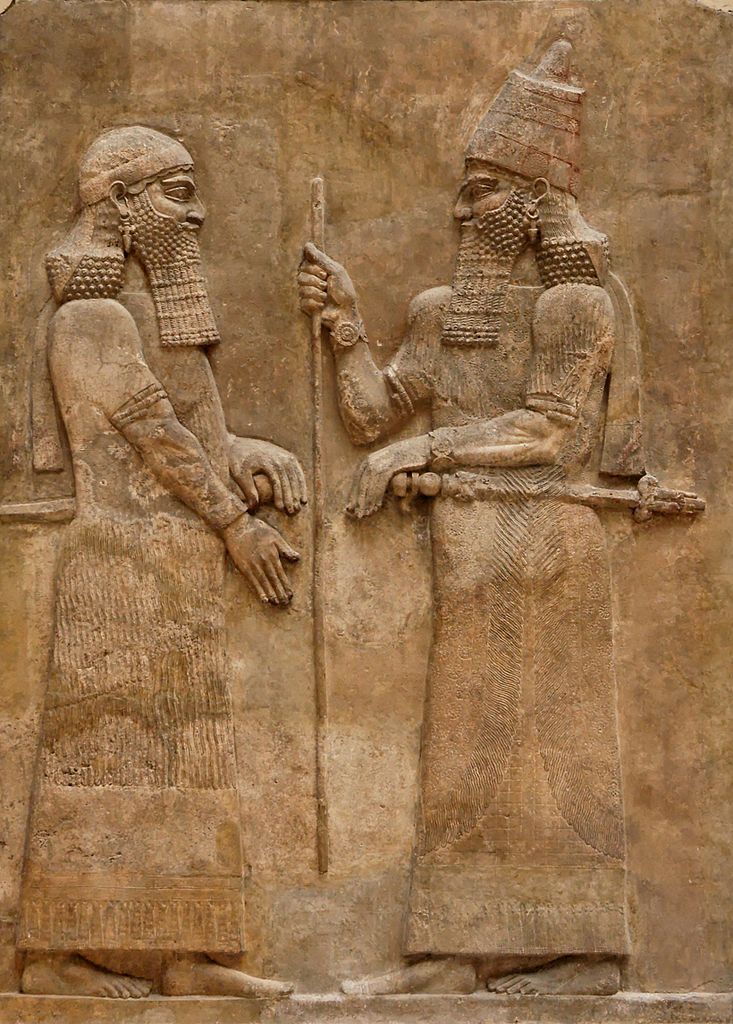
![In 1847 archaeologists discovered a prism of Sargon dated to the early 8th century BC reading: "At the beginning of my royal rule, I…the town of the Samarians I besieged, conquered (2 Lines destroyed) [for the god…] who let me achieve this my triumph… I led away as prisoners [27,290 inhabitants of it (and) equipped from among them (soldiers to man)] 50 chariots for my royal corps…. The town I rebuilt better than it was before and settled therein people from countries which I had conquered. I placed an officer of mine as governor over them and imposed upon them tribute as is customary for Assyrian citizens." (Nimrud Prism IV 25-41) https://theosophical.files.wordpress.com/2011/08/sargon-nimrud-cylinder1.jpg](https://therealsamizdat.com/wp-content/uploads/2015/05/sargon-nimrud-cylinder1.jpg)
 Samizdat
_-_Google_Art_Project.jpg)


September 20, 2015
Melvin: Who Built the First City? Cain? Enoch? Chousor? Or Nimrod?
“The portrayal of the rise of civilization in Genesis 1–11, on the other hand, is generally negative and is devoid of any hint of divine assistance or bestowal of the arts of civilization. A key text in this regard is Genesis 4:20–22, in which the descendants of Cain found the guilds of nomadic shepherding, music, and metallurgy.
The statements are brief, merely indicating that Jabal was the founder of nomadic shepherding, Jubal was the founder of the art of music, and Tubal-cain was the first to work with metals.
If one considers the entirety of Genesis 4, one may also add to the list of new developments animal husbandry (v. 2), agriculture (v 2), city-building and urbanism (v 17), and polygamy (v 19).
An aerial view of the Ziggurat of Ur.
Gunkel, following Wellhausen, reads the account as brief fragments of what were originally much fuller mythological narratives and suggests that they may originally have referred to deities, but even if this reading is correct for the original myths, the text in its present form has been largely de-mythologized, and the individuals and their accomplishments are completely human.
(Hermann Gunkel, Genesis (trans. Mark E. Biddle; Macon: Mercer University Press, 1997), p. 50. Wellhausen argues that the genealogies in Genesis 4 and Genesis 5 refer to the same individuals and were originally identical.
See Julius Wellhausen, Prolegomena to the History of Israel (New York: Meridian, 1957), pp. 308–09; see also E. A. Speiser, Genesis (AB 1; Garden City: Doubleday, 1964), pp. 35–36. If this is the case, then it is important to note that Cain’s genealogy has been distinguished from Seth’s by the insertion of episodes which give the entire list a negative overtone (e.g., Cain’s fratricide, Lamech’s murders).
See John Skinner, A Critical and Exegetical Commentary on Genesis (2d ed.; ICC; Edinburgh: T&T Clark, 1930), p. 115. Since the statements concerning the arts of civilization appear only in the Cainite genealogy, it is likely that their inclusion is for the sake of bringing upon them “guilt by association” with the dark line of Cain.
Ruins and Plan of the Anu Ziggurat and the White Temple. Uruk ( Present-day Warka, Iraq). c. 3300-3000 BCE.
https://www.pinterest.com/pin/168814686005734256/
Seth’s genealogy, by contrast, includes a number of statements which give a more positive impression to the whole list (e.g., humans calling on the name of Yahweh, Enoch walking with God). However, Gordan J. Wenham makes a case against seeing the two genealogies as originally identical. See Gordon J. Wenham, Genesis 1–15 (WBC, 1; Waco: Word, 1987), p. 110.)
Further indication of the human origin of civilization in Genesis 1–11 appears in the motif of city-building and urbanism. Interestingly, Mesopotamian myths attribute the origin of the earliest cities to the work of gods (e.g., Marduk’s construction of Babylon) or semi-divine heroes (e.g., Gilgamesh’s building of the walls of Uruk), while Genesis 4:17 attributes the first city to Cain, who names it after his first son, Enoch, with no indication of divine assistance.
(Westermann notes that the reading of the Hebrew text seems to indicate that it was actually Enoch who built the city, rather than Cain, until one reaches the phrase כשם כנן “according to the name of his son,” which he suggests may originally have read simply כשמו “according to his name” (Genesis 1–11, 327).
He further argues that it would be unusual for Cain to have been both the founder of agriculture and the first city-builder. Such accounts of the development of civilization typically do so by a succession of births in which each generation makes but one new contribution.
But this is not always the case, as The Phoenician History shows by attributing to Chousor (Kothar) the arts of magic, divination, prophecy, sailing, and fishing (see Albert I. Baumgarten, The Phoenician History of Philo of Byblos: A Commentary [Leiden: Brill, 1981], p. 143).)
Similarly, the building of several key cities in Mesopotamia, as well as the formation of the world’s first empire, is attributed to Nimrod in Genesis 10:8–12.”
David P. Melvin, “Divine Mediation and the Rise of Civilization in Mesopotamian Literature and in Genesis 1-11,” Journal of Hebrew Scriptures, 2010, pp. 7-9.
Share this: