Samizdat

Publishing the Forbidden. All Rights Reserved. © Samizdat 2014-2025.

Category: Mesopotamia

Lenzi: Strabo, Pausanias and Pliny All Have Agendas

“The Seleucid attention to indigenous traditions as well as their support of Mesopotamian temples—whether directly or indirectly—is the second element in understanding the Hellenistic context from which our text arose.

Historians of Hellenistic Mesopotamia in recent decades have successfully countered earlier, largely Helleno-centric scholarly opinions about Seleucid neglect or disinterest in and thus demise of traditional Babylonian settlements and institutions.

The alleged neglect, in fact, originates with modern historians who had not adequately factored the cuneiform evidence into their accounts and rather too eagerly believed the tendentious reports concerning Babylon given by such classical authors as Strabo (Geography 16.1.5), Pausanias (Description of Greece 1.16.3), and Pliny (Natural History 6.26.122).

Based on a growing body of cuneiform and archaeological evidence, recent scholars have suggested that the Seleucids actually made significant investments in traditional Mesopotamia.

Chronicles, astronomical diaries, and administrative documents attest to the fact that Seleucid rulers took part, at least at times, in various traditional temple rituals and supported the temples through various projects of renovation or repair, especially in Babylon.
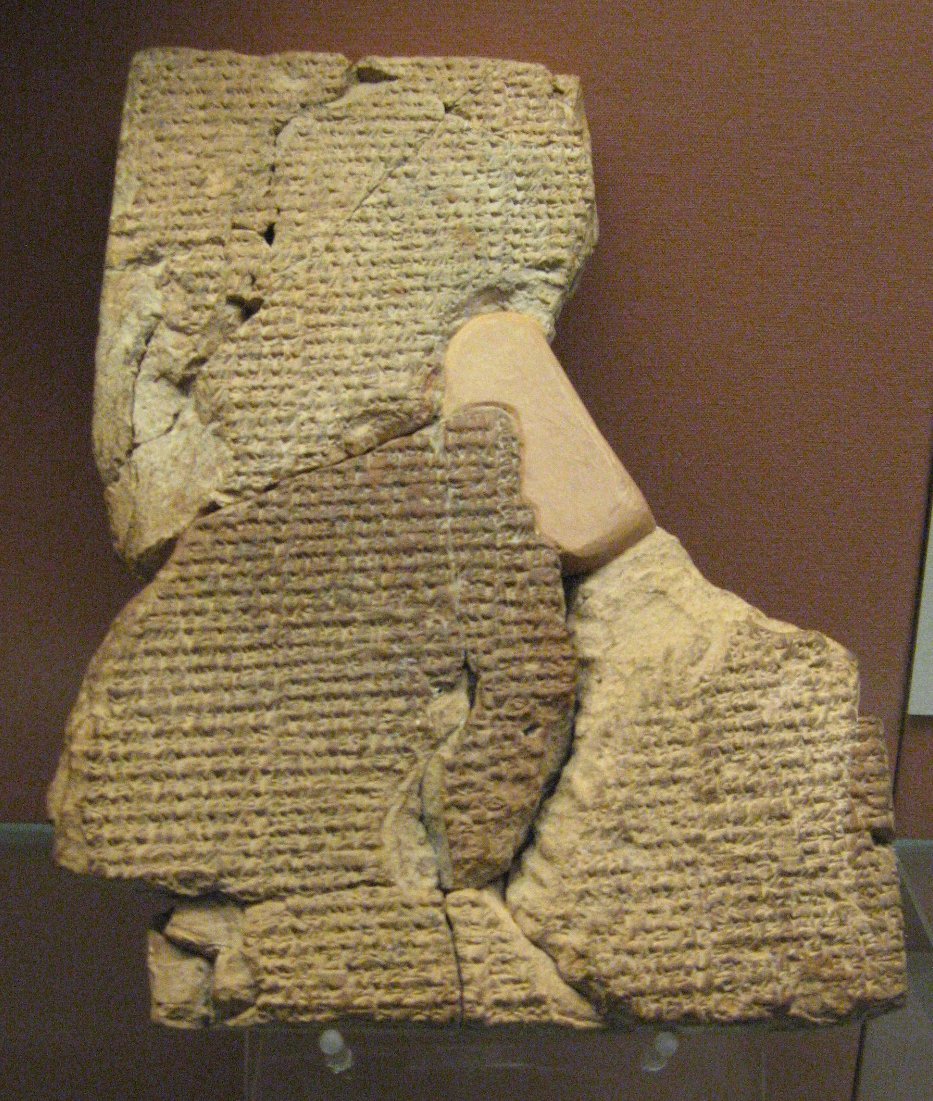
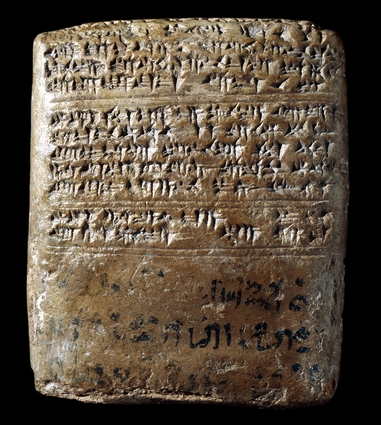
According to some interpretations, the death of the Persian king Darius III Codomannus in July 330 CE was foretold in the Dynastic Prophecy written on a clay tablet found at Babylon.  Heralding the end of the Achaemenid empire, the Macedonian conquerer Alexander the Great took over.  The tablets containing the Dynastic Prophecy are now in the British Museum, BM40623.

According to some interpretations, the death of the Persian king Darius III Codomannus in July 330 CE was foretold in the Dynastic Prophecy written on a clay tablet found at Babylon.
Heralding the end of the Achaemenid empire, the Macedonian conquerer Alexander the Great took over.
The tablets containing the Dynastic Prophecy are now in the British Museum, BM40623.

(See, e.g., A. Kirk Grayson, Babylonian Historical-Literary Texts, Toronto Semitic Texts and Studies (Toronto: University of Toronto Press, 1975), 19-20, n.29, where he entertains the idea that the Dynastic Prophecy may have had an anti-hellenistic element in it but opposes S. K. Eddy’s idea of widespread anti-Hellenistic sentiment in Seleucid Mesopotamia (in his The King is Dead: Studies in the Near Eastern Resistance to Hellenism 334-31 B.C. [Lincoln: University of Nebraska Press, 1961]) by listing the cuneiform evidence that records Seleucid patronage of traditional Babylonian cultic institutions.

See further Grayson’s Assyrian and Babylonian Chronicles (Locust Valley, NY: J. J. Augustin, 1975; reprinted, Winona Lake: Eisenbrauns, 2000), 278, n.2, where he lists various kinds of evidence of Seleucid temple restorations, among other things.

(Grayson notes here renovations during the reign of Antiochus IV Epiphanes [175-164 BCE], citing M. Rostovtzeff, “Seleucid Babylonia: Bullae and Seals of Clay with Greek Inscriptions,” Yale Classical Studies 3 [1932], 3-113, here 6-7, as evidence; but upon closer inspection of Rostovtzeff one will see that he has in fact dated the Kephalon inscription [now known to be from 201 BCE] to the reign of Antiochus IV.

Adam Falkenstein indicates that the proper reading for the date was established only some time after its initial publication [Topographie von Uruk: I. Teil Uruk zur Seleukidenzeit (Leipzig: Otto Harrassowitz, 1941), 7, n.3].

The relevant lines are quoted below in a translation by Bert van der Spek.

[Column 5]   4   For two years [he will exercise kingship]. [1].   5   That king a eunuch [will murder].   6   A certain prince [......] [2]   7   will set out and [seize] the thr[one]   8   Five years [he will exercise] king[ship]   9   Troops of the land of Hani [......] [3]  10  will set out a[nd? .. ]./-ship?\ th[ey will?  ...]  11  [his] troop[s they will defeat;]  12  booty from him they will take [and his spoils]  13  they will plunder. Later [his] tr[oops ...]  14  will assemble and his weapons he will ra[ise (...)]  15  Enlil, Šamaš and [Marduk(?)] [4]  16  will go at the side of his army [(...);]  17  the overthrow of the Hanaean troops he will [bring about].  18  His extensive booty he will car[ry off and]   19  into his palace he [will bring it]  20  The people who had [experienced] misfortune  21  [will enjoy] well-being.  22  The heart of the land [will be happy]  23  Tax exemption [he will grant to Babylonia]

 http://www.livius.org/aj-al/alexander/alexander_t49.html

The relevant lines are quoted below in a translation by Bert van der Spek.

[Column 5]
4 For two years [he will exercise kingship]. [1].
5 That king a eunuch [will murder].
6 A certain prince [……] [2]
7 will set out and [seize] the thr[one]
8 Five years [he will exercise] king[ship]
9 Troops of the land of Hani [……] [3]
10 will set out a[nd? .. ]./-ship?\ th[ey will? …]
11 [his] troop[s they will defeat;]
12 booty from him they will take [and his spoils]
13 they will plunder. Later [his] tr[oops …]
14 will assemble and his weapons he will ra[ise (…)]
15 Enlil, Šamaš and [Marduk(?)] [4]
16 will go at the side of his army [(…);]
17 the overthrow of the Hanaean troops he will [bring about].
18 His extensive booty he will car[ry off and]
19 into his palace he [will bring it]
20 The people who had [experienced] misfortune
21 [will enjoy] well-being.
22 The heart of the land [will be happy]
23 Tax exemption [he will grant to Babylonia]


http://www.livius.org/aj-al/alexander/alexander_t49.html

There is, therefore, currently no evidence to the best of my knowledge for renovation of Mesopotamian temples under Antiochus IV.)

Note also S. M. Sherwin-White, “Babylonian Chronicle Fragments as a Source for Seleucid History,” Journal of Near Eastern Studies 42 (1983), 265-70 and her analysis in “Ritual for a Seleucid King at Babylon?” Journal of Hellenic Studies 103 (1983), 156-59, citing Grayson’s earlier work (159, nn.40-41).
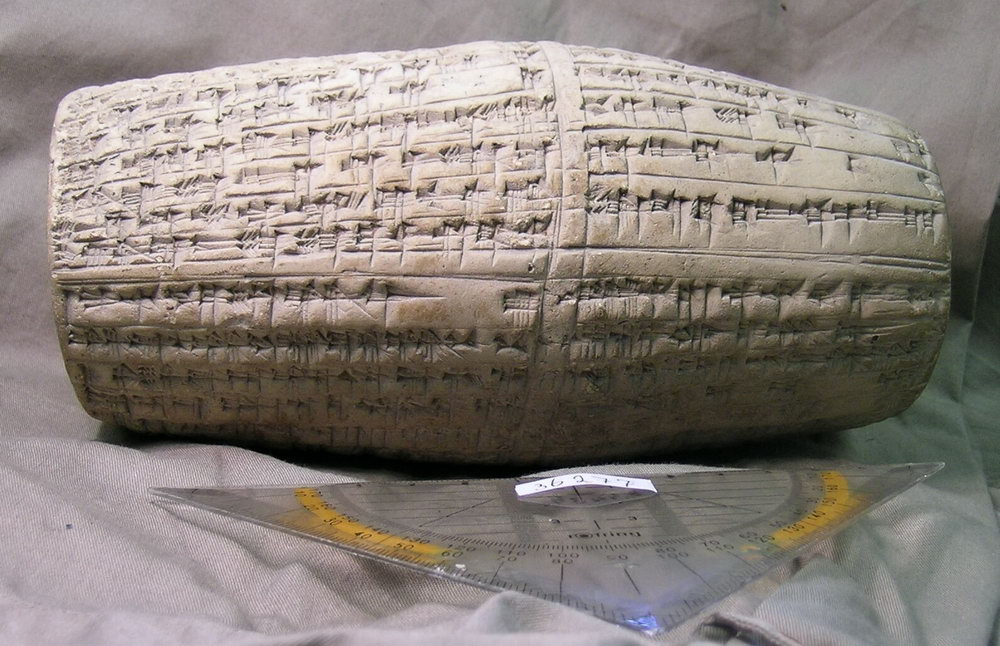
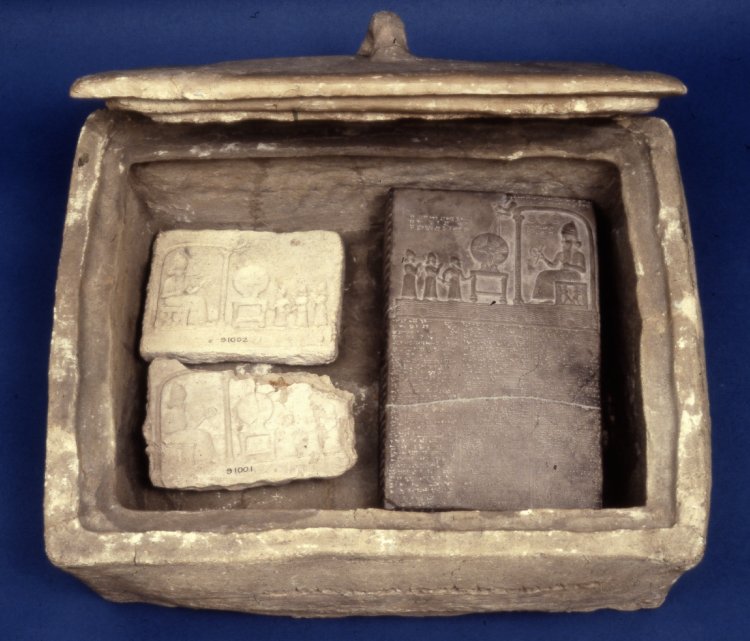
The Cylinder of Antiochus I Soter from the Ezida Temple in Borsippa (Antiochus Cylinder) is an historiographical text from ancient Babylonia.  It describes how the Seleucid crown prince Antiochus, the son of king Seleucus Nicator, rebuilt the Ezida Temple.  

The cuneiform text itself (BM 36277) is now in the British Museum.

The document is a barrel-shaped clay cylinder, which was buried in the foundations of the Ezida temple in Borsippa.  The script of this cylinder is inscribed in archaic ceremonial Babylonian cuneiform script that was also used in the well-known Codex of Hammurabi and adopted in a number of royal inscriptions of Neo-Babylonian kings, including. Nabopolassar, Nebuchadnezzar and Nabonidus (cf. Berger 1973).  The script is quite different from the cuneiform script that was used for chronicles, diaries, rituals, scientific and administrative texts.

    Another late example is the Cyrus Cylinder, commemorating Cyrus' capture of Babylon in 539 BCE (Schaudig 2001: 550-6). This cylinder, however, was written in normal Neo-Babylonian script. The Antiochus Cylinder was found by Hormuzd Rassam in 1880 in Ezida, the temple of the god Nabu in Borsippa, in what must have been its original position,

The Cylinder of Antiochus I Soter from the Ezida Temple in Borsippa (Antiochus Cylinder) is an historiographical text from ancient Babylonia.
It describes how the Seleucid crown prince Antiochus, the son of king Seleucus Nicator, rebuilt the Ezida Temple.


The cuneiform text itself (BM 36277) is now in the British Museum.

 The document is a barrel-shaped clay cylinder, which was buried in the foundations of the Ezida temple in Borsippa.
The script of this cylinder is inscribed in archaic ceremonial Babylonian cuneiform script that was also used in the well-known Codex of Hammurabi and adopted in a number of royal inscriptions of Neo-Babylonian kings, including Nabopolassar, Nebuchadnezzar and Nabonidus (cf. Berger 1973).
The script is quite different from the cuneiform script that was used for chronicles, diaries, rituals, scientific and administrative texts.


Another late example is the Cyrus Cylinder, commemorating Cyrus’ capture of Babylon in 539 BCE (Schaudig 2001: 550-6). This cylinder, however, was written in normal Neo-Babylonian script.
The Antiochus Cylinder was found by Hormuzd Rassam in 1880 in Ezida, the temple of the god Nabu in Borsippa, in what must have been its original position, “encased in some kiln-burnt bricks covered over with bitumen” in the “doorway” of Koldewey’s Room A1: probably this was built into the eastern section of the wall between A1 and Court A, since the men of Daud Thoma, the chief foreman, seem to have destroyed much of the brickwork at this point.
Rassam (1897: 270) mistakenly records this as a cylinder of Nebuchadnezzar II (Reade 1986: 109). The cylinder is now in the British Museum in London.

 (BM 36277).
http://www.livius.org/cg-cm/chronicles/antiochus_cylinder/antiochus_cylinder1.html

Amélie Kuhrt and Susan Sherwin-White, “Aspects of Seleucid Royal Ideology: The Cylinder of Antiochus I from Borsippa,” Journal of Hellenic Studies 111 (1991), 81-2 survey the data (chronicles and diaries) for Seleucid work on Marduk’s temple in Babylon, dating between 322/1 to 224/3 and Kuhrt, “The Seleucid Kings and Babylonia,” 48 cites an astrological diary that proves Antiochus III engaged in cultic rites as late as 187 BCE.

For the diaries specifically, see, e.g., R. J. van der Spek, “The Astronomical Diaries as a Source for Achaemenid and Seleucid History,” Bibliotheca Orientalis 50 (1993), 91-101 and Wayne Horowitz, “Antiochus I, Esagil, and a Celebration of the Ritual for Renovation of Temples,” Revue d’assyriologie et d’archéologie orientale 85 (1991), 75-77.

Archaeology often confirms reports of temple renovation and perhaps equally significantly has yet to provide evidence for the Hellenization of temple architecture. In fact, quite the opposite case holds true: Seleucid rulers seem to have encouraged the continued use of traditional temple styles when renovation projects were undertaken.

(See Lise Hannestad and Daniel Potts, “Temple Architecture in the Seleucid Kingdom,” in Religion and Religious Practice in the Seleucid Kingdom, ed. Per Bilde et al.; Studies in Hellenistic Civilization 1 (Aarhus: Aarhus University Press, 1990), 107, who cite the Bīt Rēš temple’s (Temple of Anu) traditional design as evidence (a temple refurbished at least a couple of times during the Seleucid period).

They conclude with the following: “we can hardly escape the conclusion that there was no official programme of Hellenization of the religious sphere during Seleucid rule. The evidence from Babylonia points rather to the contrary, that the Seleucid kings, like many later colonizers, encouraged traditionalism in the religious sphere” (123).

See also Susan B. Downey, Mesopotamian Religious Architecture (Princeton: Princeton University Press, 1988), 7-50, especially 11, 14, 16, and 38 (all concerning temples in either Babylon or Uruk).

Alan Lenzi, The Uruk List of Kings and Sages and Late Mesopotamian ScholarshipJANER 8.2, Brill, Leiden, 2008. pp. 153-5.

Lenzi: The Antediluvian Medical Tablet from Ashurbanipal’s Library (K.4023)

“As is well-known, antediluvian knowledge had special significance in Mesopotamia. (For other examples of antediluvian knowledge (though sometimes in a broken context), see the examples gathered by Lambert, “Catalogue of Texts and Authors,” 72 at the note on VI 15.)

The most important example of this fact for the purposes of this study comes from an oft cited colophon of a medical tablet from Ashurbanipal’s library, AMT 105,1 (K.4023), lines 21-25.

AM-102 ; No. #1 (K4023) British Museum of London 

Tablet K.4023  COL. I  [Starting on Line 38] . . .  Root of caper which (is) on a grave, root of thorn (acacia) which (is) on a grave, right horn of an ox, left horn of a kid, seed of tamarisk, seed of laurel, Cannabis, seven drugs for a bandage against the Hand of a Ghost thou shalt bind on his temples.  FOOTNOTES:  [1] - The American Journal of Semitic Languages and Literatures, Vol. 54, No. 1/4 (Oct., 1937), pp. 12-40; Assyrian Prescriptions for the Head By R. Campbell Thompson 

 http://antiquecannabisbook.com/chap2B/Assyria/K4023.htm

AM-102 ; No. #1 (K4023)
British Museum of London 

Tablet K.4023
COL. I
[Starting on Line 38] . . .
Root of caper which (is) on a grave, root of thorn (acacia) which (is) on a grave, right horn of an ox, left horn of a kid, seed of tamarisk, seed of laurel, Cannabis, seven drugs for a bandage against the Hand of a Ghost thou shalt bind on his temples.
FOOTNOTES:
[1] – The American Journal of Semitic Languages and Literatures, Vol. 54, No. 1/4 (Oct., 1937), pp. 12-40; Assyrian Prescriptions for the Head By R. Campbell Thompson 


http://antiquecannabisbook.com/chap2B/Assyria/K4023.htm

This colophon shows not only the association of antediluvian sages and a human sage but also the “mythology of scribal succession” in action.

(For the original copy of the tablet, see R. Campbell Thompson, Assyrian Medical Texts (London: H. Milford / New York: Oxford University Press, 1923; reprinted, Osnabrück: Otto Zeller Verlag, 1983), 105,1 (=K.4023, col. iv, and thus probably from Nineveh).

I have cited the text according to Hermann Hunger, Babylonische und assyrische Kolophone, Alter Orient und Altes Testament 2 (Neukirchen-Vluyn: Neukirchener Verlag / Kevelaer: Verlag Butzon and Bercker, 1968), no. 533, with corrections from Yaakov Elman, “Authoritative Oral Tradition in Neo-Assyrian Scribal Circles,” Journal of the Ancient Near Eastern Society 7 (1975), 19-32, here 31.)

Salves (and) bandages: tested (and) checked, which are ready at hand, composed by the ancient sages from before the flood, which in Suruppak in the second year of Enlil-bani, king of Isin, Enlil-muballit, sage of Nippur, bequeathed.

Although the number of apkallū is unspecified in this text, the indication of plurality of sages and the antediluvian time frame strongly suggest an association with the seven sages known from traditions such as Bīt mēseri and the ULKS.

The fact that the tablet claims the apkallū composed these recipes bolsters the authority (by invoking these beings associated with Ea) and legitimacy (by asserting antiquity) of the recipes contained in the text.

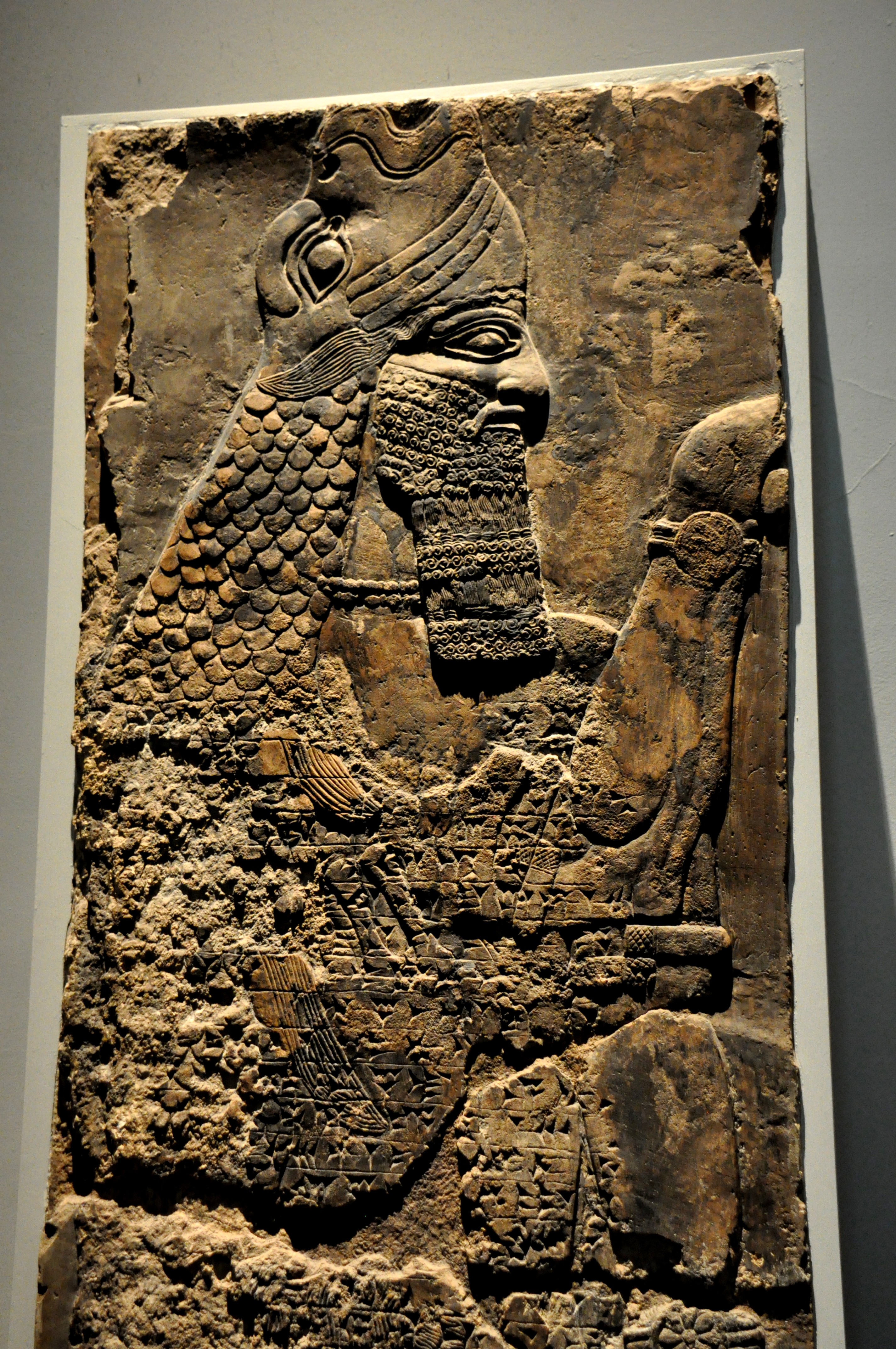
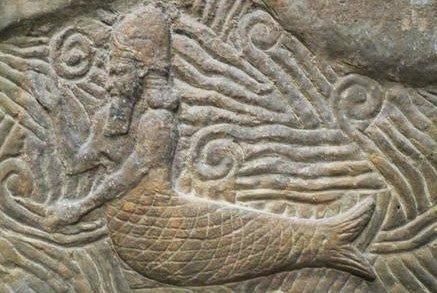
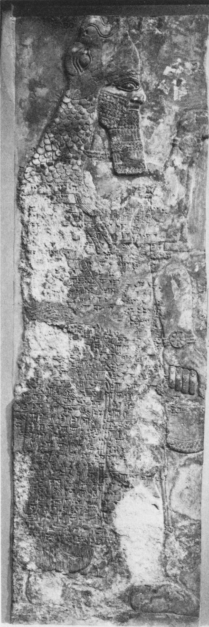
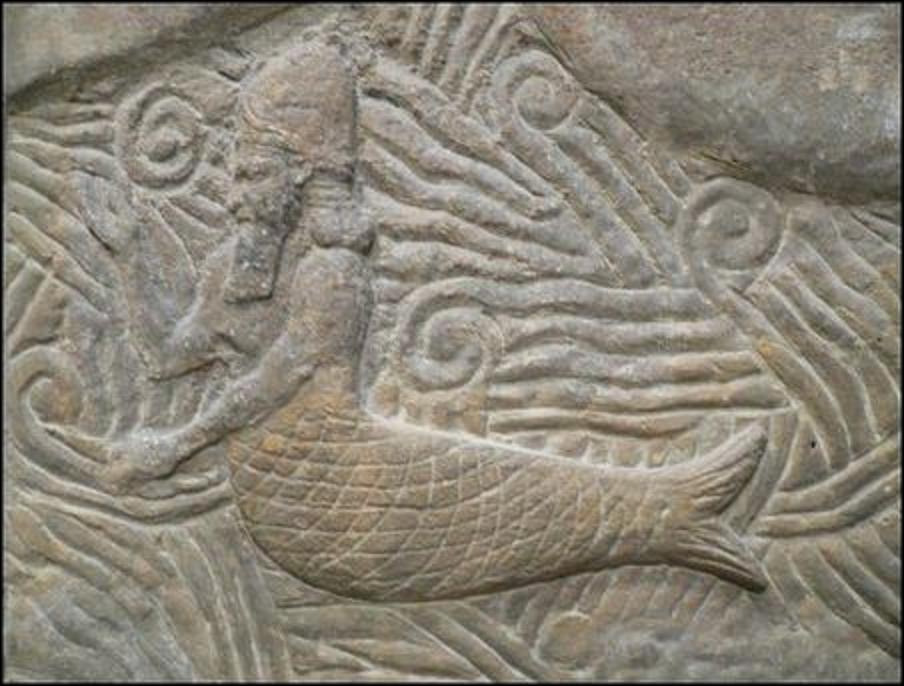
This depiction of a fish-apkallū of the parādu-fish type guarded the entrance to the temple of Ninurta at Nimrud.  A fish's head can be seen on the apkallu's head, and its skin hangs down over the back of his body.  It is important to recall that the so-called Seven Sages of Sumeria were apkallū of this type. Neo-Assyrian era, 865-860 BCE.  From the Temple of Ninurta, Nimrud (ancient Kalhu; Biblical Calah), northern Mesopotamia, Iraq. (The British Museum, London). Osama Shukir Muhammed Amin FRCP (Glasg) http://www.ancient.eu/image/2708/

This depiction of a fish-apkallū of the parādu-fish type guarded the entrance to the temple of Ninurta at Nimrud.
A fish’s head can be seen on the apkallu’s head, and its skin hangs down over the back of his body.
It is important to recall that the so-called Seven Sages of Sumeria were apkallū of this type.
Neo-Assyrian era, 865-860 BCE.
From the Temple of Ninurta, Nimrud (ancient Kalhu; Biblical Calah), northern Mesopotamia, Iraq. (The British Museum, London).
Osama Shukir Muhammed Amin FRCP (Glasg)
http://www.ancient.eu/image/2708/

But I do not think that is its primary purpose. The claim is not made in the context of a ritual; so it does not primarily function to create ritual power.

Rather, the claim occurs in a colophon, a label that communicates something about the tablet for other would-be readers/users of it. The invocation of the apkallū and a claim to antediluvian knowledge in a colophon intends therefore to affect the social situation in which the tablet is used.

In this case the colophon credentials a human being as the possessor of antediluvian knowledge (i.e., medical recipes). Revealed by primeval apkallū, mediated to the human sage Enlil-muballit, and transmitted, presumably, by means of various copyists to the present possessor, AMT 105,1 implies the same notion of succession as the ULKS.

A similar idea is probably attested in KAR 177, obv. iv 25-32, a text containing hemerologies, which reads:

Favorable days. According to the seven s[ages(?)].
Duplicate of a tablet from Sippar, Nippur, Babylon, Larsa, Ur, Uruk, and Eridu.
The scholars excerpted, selected, and gave it to Nazimuruttash, king of the world.

(The tablet is from Assur and presumably the NA period. The text and restorations follow W. G. Lambert, “Ancestors, Authors, and Canonicity,” Journal of Cuneiform Studies 11 (1957), 1-14, here 8.

Lambert also gives the remainder of the colophon, rev. iv 1-3 (8), which is of no interest in this context, and sets out von Soden’s readings in a follow-up note (“Ancestors, Authors, and Canonicity [JCS XI, 1-14]: Additions and Corrections,” Journal of Cuneiform Studies 11 [1957], 112).

It seemed highly unlikely to the editor (Lambert) that the seven cities named in the text represented the seven exemplars from which the scribe worked. In other words, it seems unlikely that the scribe was looking at seven different copies while writing his own tablet.

Instead, Lambert proposed that the seven cities represent a succession of exemplars. Each of the exemplars was written by one of the seven sages one after another thereby creating a line of succession for the present tablet that extends back into earliest times.

The claim of this colophon, therefore, is that the tablet of hemerologies over which the ummânū labored goes back to the apkallū and ultimately originated in Eridu, the home city of Ea.

This again demonstrates an example of the “mythology of scribal succession” and an implicit assertion of antediluvian knowledge.”

Alan Lenzi, The Uruk List of Kings and Sages and Late Mesopotamian ScholarshipJANER 8.2, Brill, Leiden, 2008. pp. 149-51.

Lenzi: A Fault Line Where Legend and History Collides

“If this were the only instance of apkallū in a ritual context, this difference in genre would be of little consequence. But, in fact, it is not.

The seven apkallū are mentioned, for example, in anti-witchcraft incantations in Maqlû II 124,36 V 110,37 VII 49,38 VIII 38 (though without names). (Note that the next line…has “the wisdom, the ingenuity of Ea they spoke.”)

They also occur in a medical incantation in LKA 146 that gives a mythological account of Ea communicating poultices to humans.

(W. G. Lambert, “The Twenty-one ‘Poultices,’” Anatolian Studies 30 (1980), 77-83. See also, e.g., Bīt rimki (Rykle Borger, “Das Dritte ‘Haus’ der Serie Bīt Rimki [VR 50-51, Schollmeyer HGS Nr.1],” Journal of Cuneiform Studies 21 [1967], 11:25 + a); the rituals treated by Wiggermann, Mesopotamian Protective Spirits; and the (overlapping) attestations noted by J. J. A. van Dijk, La Sagesse Sumero-Accadienne, Commentationes Orientales 1 (Leiden: Brill, 1953), 20, n.56.)

In this bas relief from Nimrud, human apkallū, the ummánū, kneel and tend to a sacred tree.<br />  Both ummânū wear horned tiaras and display rosette bracelets on their wrists. Bracelets are also apparent on their upper arms.<br />  In the lower register, bird-apkallū raise mulillu cones to sprinkle water in a gesture of exorcism and liberation of sin.<br />  As is typical, the banduddu buckets are in their left hands.<br />  Interestingly in this case, the bracelets are atypical, and only one rosette insignia can potentially be discerned. This sort of specificity must be deliberate. What it portends, however, remains speculative.

In this bas relief from Nimrud, human apkallū, the ummánū, kneel and tend to a sacred tree.
Both ummânū wear horned tiaras and display rosette bracelets on their wrists. Bracelets are also apparent on their upper arms.
In the lower register, bird-apkallū raise mulillu cones to sprinkle water in a gesture of exorcism and liberation of sin.
As is typical, the banduddu buckets are in their left hands.
Interestingly in this case, the bracelets are atypical, and only one rosette insignia can potentially be discerned. This sort of specificity must be deliberate. What it portends, however, remains speculative.

From such evidence Sanders has argued that the seven apkallū are restricted to myths (they are found in Erra I 162 and Gilgamesh I 21 and XI 326 (called muntalkū)) and rituals during the Neo-Assyrian period (and earlier), and this fact, in his opinion, speaks against their use in a scholarly genealogy before the Seleucid era.

(He writes, “[t]he human sages, ummânu, appear for the first time in Neo-Assyrian king lists, and in the bīt mēseri fragments of the Neo-Assyrian period the superhuman apkallū are for the first time listed by name and correlated with legendary and historical kings.

While Mesopotamian kings remain on the throne, the apkallū remain confined to myth and ritual. In the Seleucid period, after the loss of native kingship, the apkallū enter history. . . .

Evidence of a historically developing identification between the Mesopotamian ritual practitioner and the apkallū in general and Adapa in particular finally emerges in Seleucid Uruk” (Sanders, “Writing, Ritual, and Apocalypse,” 144-45).

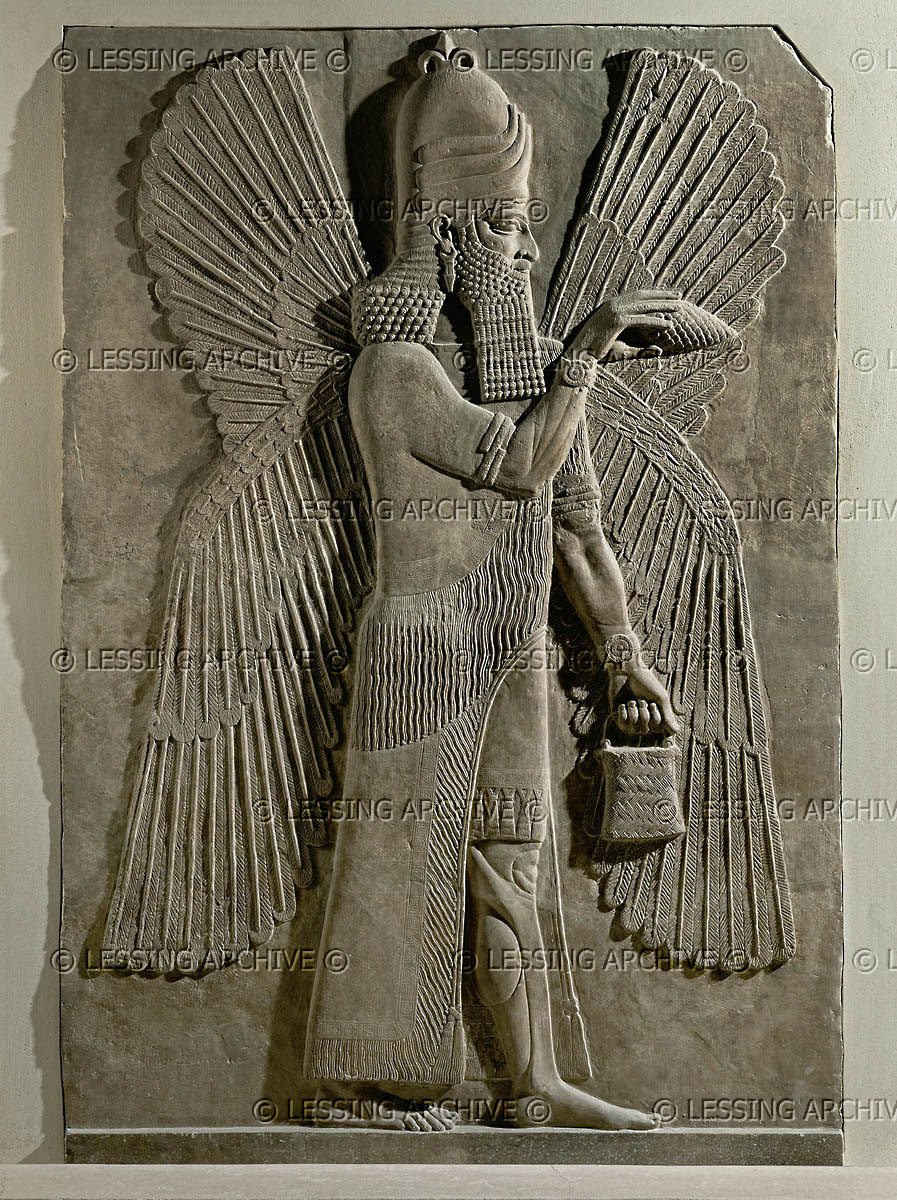
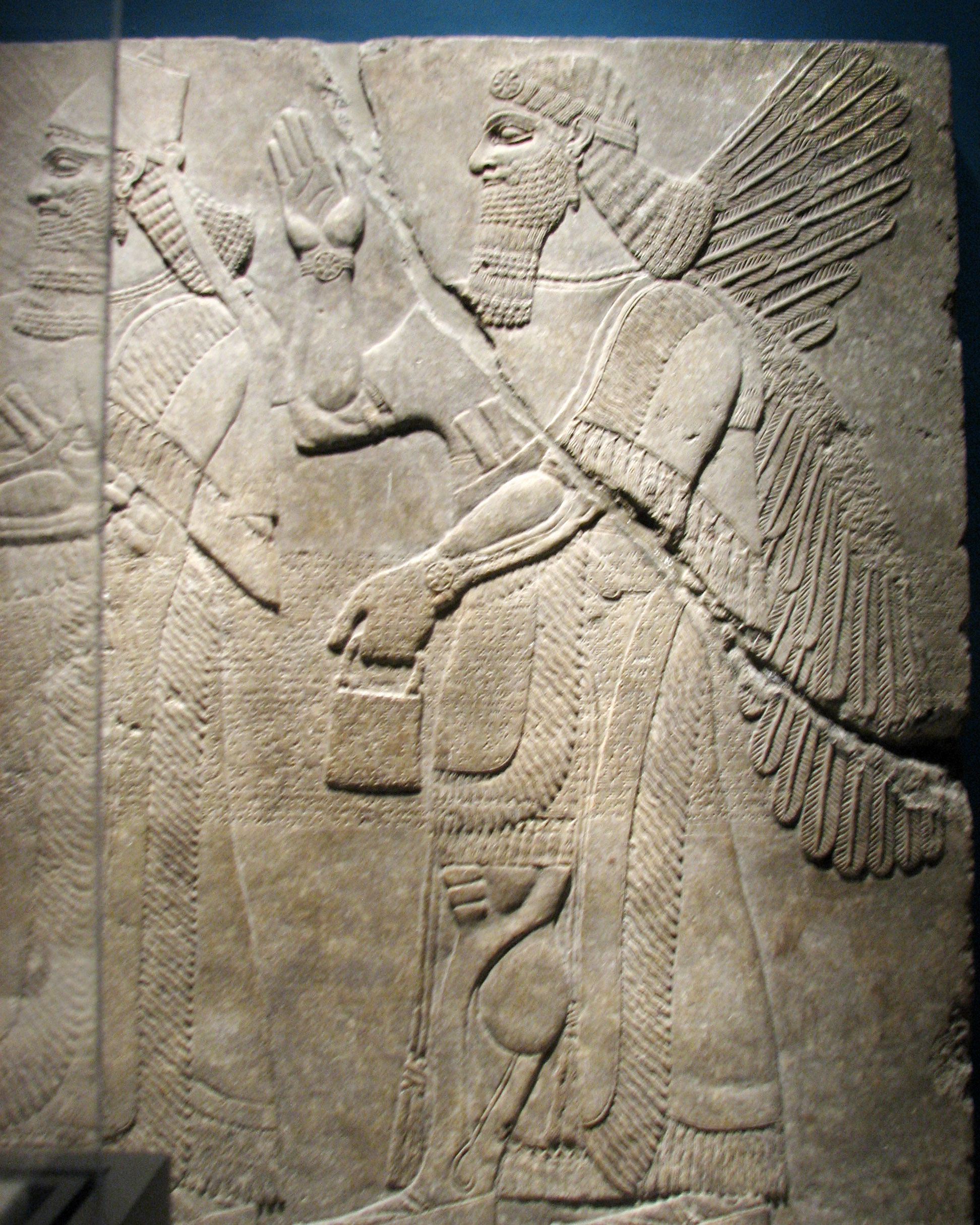
In this Nimrud bas relief from the Louvre an ummânū sprinkles water with a mullilu cone, holding his banduddu bucket in his other hand. This ummânū wears bracelets with a different design, as rosettes are not apparent. In this case, the design appears to consist of concentric circles.  This ummânū also wears the common horned headdress, but in this case the headdress is surmounted by an object that resembles a partial fleur de lis. The detail on this bas relief is unusually good, revealing details about the earrings that are blurry in most other examples.  Bracelets are also apparent on the upper arms, and the banduddu bucket reveals cross-hatching detail which rarely appears on other depictions.  The realistic portrayal of fine detail on the fingernails, the toenails, and the tassels are singular. In no other example does the embroidery on the garment stand out as well.  The fine detail on the wings and the braided hair is exceptional, and this ummânū appears to be wearing a medallion or other object at his sternum, a detail not noted elsewhere.  From Nimrud, capital of king Ashurnarzipal.  Louvre, AO 19845

In this Nimrud bas relief from the Louvre an ummânū sprinkles water with a mullilu cone, holding his banduddu bucket in his other hand.
This ummânū wears bracelets with a different design, as rosettes are not apparent. In this case, the design appears to consist of concentric circles.
This ummânū also wears the common horned headdress, but in this case the headdress is surmounted by an object that resembles a partial fleur de lis.
The detail on this bas relief is unusually good, revealing details about the earrings that are blurry in most other examples.
Bracelets are also apparent on the upper arms, and the banduddu bucket reveals cross-hatching detail which rarely appears in other depictions.
The realistic portrayal of fine detail on the fingernails, the toenails, and the tassels is singular. In no other example does the embroidery on the garment stand out so well.
The fine detail on the wings and the braided hair is exceptional, and this ummânū appears to be wearing a medallion or other object at his sternum, a detail not noted elsewhere.
From Nimrud, capital of king Ashurnarzipal.
Louvre, AO 19845

Sanders’ objection reminds us of the need for sensitivity to genre in adducing evidence, something few others have taken seriously when discussing the issue of scholarly genealogy.

There is, however, other non-ritual evidence that both alleviates the problem he raises and provides more support for the earlier apkallūummânū association suggested by the Bīt mēseri material.

A textual variant between the only two manuscripts of the Akkadian literary composition “Advice to a Prince,” which is clearly a non-ritual text, supports the close association of the apkallū and ummânū in the early first millennium. A comparison of the two tablets at lines 4 and 5 reveals our variant of interest.

(In the standard edition of the text, Lambert expresses the opinion that the text is from Babylon and should be dated to roughly 1000 to 700 BCE. He also notes, “(t)he text is written on a tablet from the libraries of Assurbanipal [i.e., DT 1], and no duplicate has yet been found” (W. G. Lambert, Babylonian Wisdom Literature [Oxford: Oxford University Press, 1960; reprinted, Winona Lake: Eisenbrauns, 1996], 110, 111).

Steven Cole has recently published a duplicate to DT 1 (Nippur IV. The Early Neo-Babylonian Governor’s Archive from Nippur, Oriental Institute Publications 114 [Chicago: The Oriental Institute of the University of Chicago, 1996], no. 128 [= OIP 114 128]); the tablet was found among a cache from Nippur.)

(If) he does not listen to his sage, his days will be short.

(If ) he does not listen to (his) scholar, his land will rebel against him.

In the standard edition based on DT 1 (the Ninevite version), Lambert took the ME in NUN.ME-šú as a plural marker and read the word as rubû, “princes, nobles.” (Babylonian Wisdom Literature, 112-13.)

This is understandable in light of line 10 which sets NUN.ME alongside DI.KUD.ME (dayyānū, “judges”).

In the orthography of the latter term ME must indicate plurality. But Reiner has noted that DT 1 typically uses MES to express the plural (line 10’s DI.KUD.ME being the one indisputable exception); thus, it seemed likely to her that NUN.ME in both lines 4 and 10 should be read apkallū (singular.) (See Erica Reiner, “The Etiological Myth of the ‘Seven Sages,’” Orientalia 30 (1961), 9 and n.1.)”

Alan Lenzi, The Uruk List of Kings and Sages and Late Mesopotamian ScholarshipJANER 8.2, Brill, Leiden, 2008. pp. 146-8.

Lenzi: The Uruk List of Kings and Sages

THE URUK LIST OF KINGS AND SAGES AND LATE MESOPOTAMIAN SCHOLARSHIP

ALAN LENZI

University of the Pacific

Abstract

“The Uruk List of Kings and Sages is best known for its genealogy connecting human scholars to antediluvian sages. Since its publication in 1962, however, questions pertaining to the text’s specific purpose within the context of Hellenistic Uruk have been neglected.

This study seeks to understand two such questions: why is the most explicit scholarly genealogy written in the Hellenistic period?; and who is the last named person in the text?

Seeking answers to these questions sheds new light on the text’s purpose: it is an attempt by scholars to gain support for themselves and their novel cultic agenda.

Keywords: Hellenistic Uruk, Mesopotamian scholars, Nicharkos, Antiquarianism, Anu cult

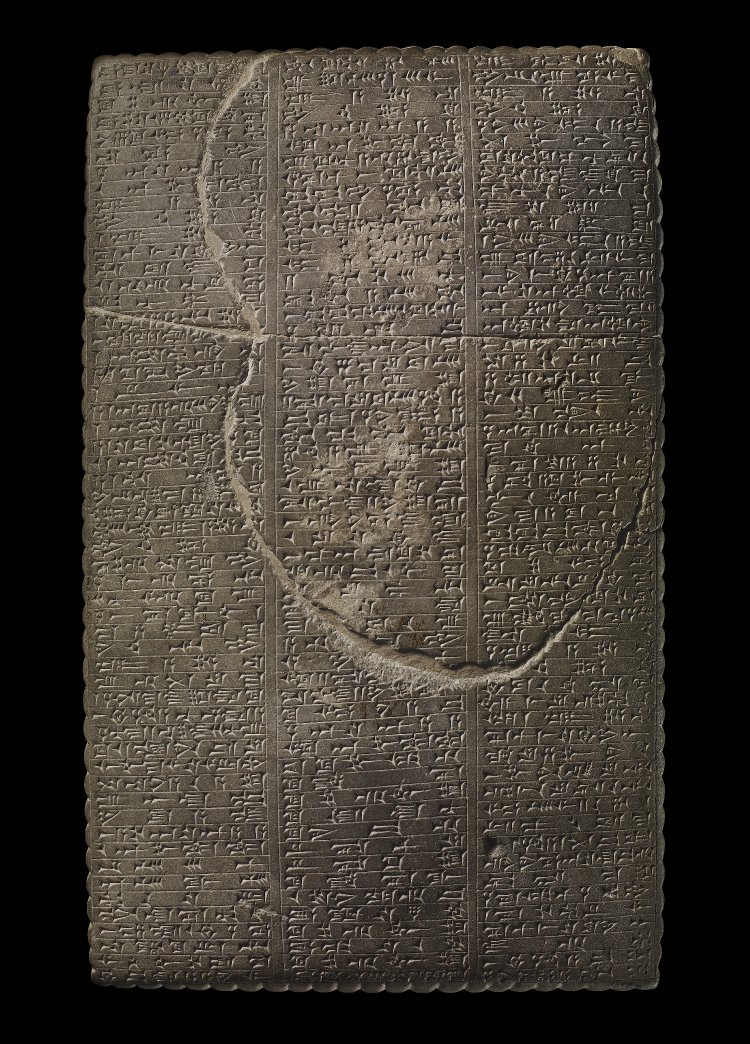
The cuneiform tablet (IM 65066) is in the Bagdad Museum.

 A.K. Grayson, from the Reallexikon der Assyriologie, s.v. "Königslisten und Chroniken". A.K. Grayson, 'Assyrian and Babylonian King Lists,' in: Lišan mithurti. (Festschrift Von Soden) (Kevelaer : Neukirchen-Vluyn : Butzon & Bercker; 1969) Plate III.

 http://www.livius.org/source-content/uruk-king-list/

The cuneiform tablet (IM 65066) is in the Bagdad Museum.


A.K. Grayson, from the Reallexikon der Assyriologie, s.v. “Königslisten und Chroniken”.
A.K. Grayson, ‘Assyrian and Babylonian King Lists,’ in: Lišan mithurti. (Festschrift Von Soden) (Kevelaer : Neukirchen-Vluyn : Butzon & Bercker; 1969) Plate III.


http://www.livius.org/source-content/uruk-king-list/

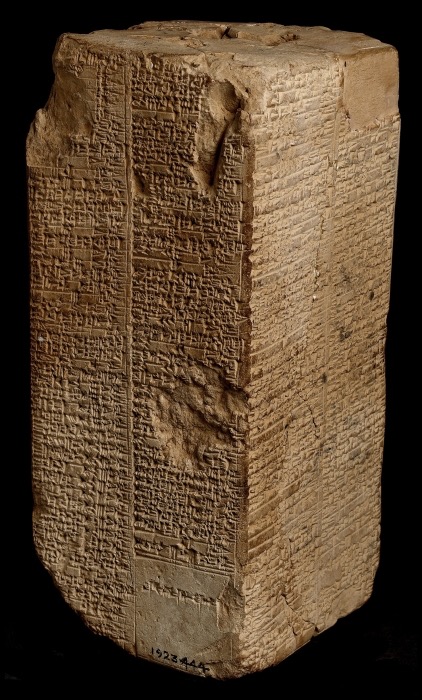
The “Uruk List of Kings and Sages” (ULKS) was discovered in Anu’s Bīt Rēš temple by German archaeologists during the 1959/60 season and published in 1962 by van Dijk. (The tablet bears the excavation number W.20030, 7. For an edition of the text, see Jan van Dijk, “Die Inschriftenfunde,” Vorläufiger Bericht über die . . . Ausgrabungen in Uruk-Warka 18 (1962), 44-52 and plate 27).

Since then Assyriologists have cited this Seleucid-era text as the clearest cuneiform evidence that Mesopotamian scholars (ummânū) traced their professional ancestry explicitly back to the mythological sages (apkallū) of antediluvian fame and thereby implicitly to a relationship with the god Ea.

Setting this evidence alongside earlier historical data, it becomes clear that this scholarly genealogy was already functioning in the Neo-Assyrian period but probably even earlier in the late second millennium. (See, e.g., Helge S. Kvanvig, Roots of Apocalyptic: The Mesopotamian Background of the Enoch Figure and of the Son of Man, Wissenschaftliche Monographien zum Alten und Neuen Testament 61 (Neukirchen-Vluyn: Neukirchener Verlag, 1988), 202, etc.)

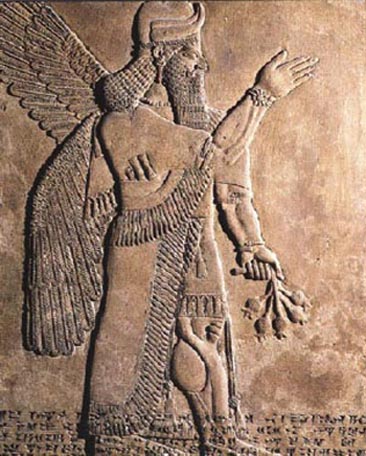
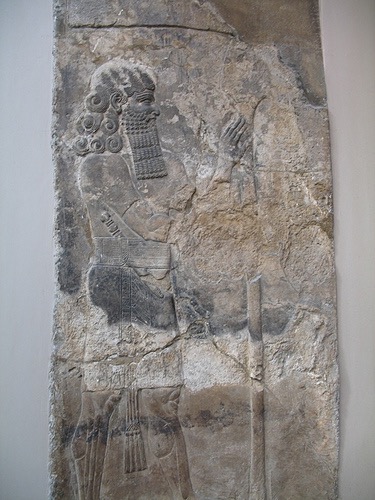
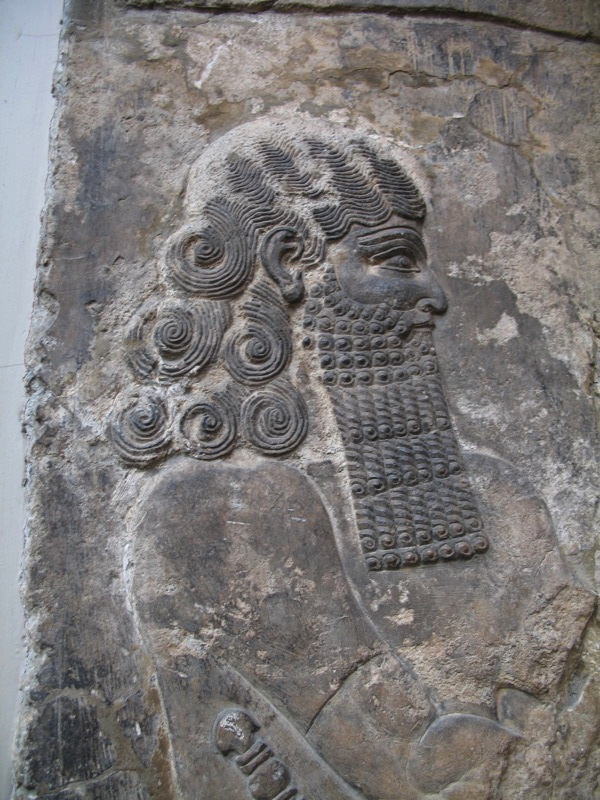
An ummânu, or sage of human descent. The ummânu raises his right hand in the iconic gesture of greeting, with uncertain plants in his left hand. Note the rosette design on his wristband, and the horned tiara headdress, indicative of divinity. 

Such human apkallū are invariably portrayed with wings.

An ummânu, or sage of human descent. The ummânu raises his right hand in the iconic gesture of greeting, with uncertain plants in his left hand. Note the rosette design on his wristband, and the horned tiara headdress, indicative of divinity. 

Such human apkallū are invariably portrayed with wings.

Despite its historical importance, this genealogical aspect of our text has over-shadowed other basic questions about the Seleucid historical context in which it arose. Two such questions provide the impetus for this study:

  1. Despite the well-known importance of scholars in the earlier Neo-Assyrian period and the abundance of materials relating to their activities, why does one find the most explicit and systematic connection between the ummânū and apkallū in the Seleucid period?
  2. How does the last named and oft-overlooked individual fit into this text’s plan and into the social context of Hellenistic Uruk? (Van Dijk recognized right away that this last person is of utmost significance for the interpretation of the text and offered tentative ideas about his identity and purpose (see “Die Inschriftenfunde,” 45-46, 50, 52). I know of no other explicit treatment of this particular issue since van Dijk’s. This study attempts to build on his suggestions.)

In order to formulate a plausible answer to these questions I raise three issues very briefly that provide context. First, I review some of the earlier first millennium evidence for the genealogical connection between the ummânū and apkallū; second, I survey the Seleucid dynasty’s relationship to indigenous institutions in Mesopotamia, especially with regard to temples; and finally, I consider aspects of the archaizing theological tendencies of Urukean scribes in the late Persian and Hellenistic periods.

In light of this contextualization, I interpret the ULKS as a tendentious document written by scholars who needed to reassert their importance to the community leadership in order to advance their cultic-political agenda. Unfortunately, due to the circumstantial and at times fragmentary evidence, this interpretation can only be offered as a plausible reading and must therefore remain tentative.”

Alan Lenzi, The Uruk List of Kings and Sages and Late Mesopotamian Scholarship, JANER 8.2, Brill, Leiden, 2008. pp. 137-40.

Nakamura: Magic Enchants Us with the Possible Made Real

Conclusion

“An obscure memory of cosmic perturbations in the distant past and the dim thought of future catastrophes form the very basis of human thought, speech and images.”

M. Bakhtin, Rabelais and His World

“This obscure memory and dim thought of humankind vividly inhabited Neo-Assyrian mythologies, religious values, and social practices.

In Mesopotamian thought, dichotomies did not provide a fundamental way of organizing experience. Rational thought was neither dominant nor lacking in their system of knowledge; the medical use of plants, social ordinances and laws, city planning, and other cultural forms certainly exhibited strains of deductive reasoning.

But Mesopotamian thought also embraced the various shadows, symmetries, torsions, syncopations, ruptures, and reversals that punctuate the rich texture of human experience.

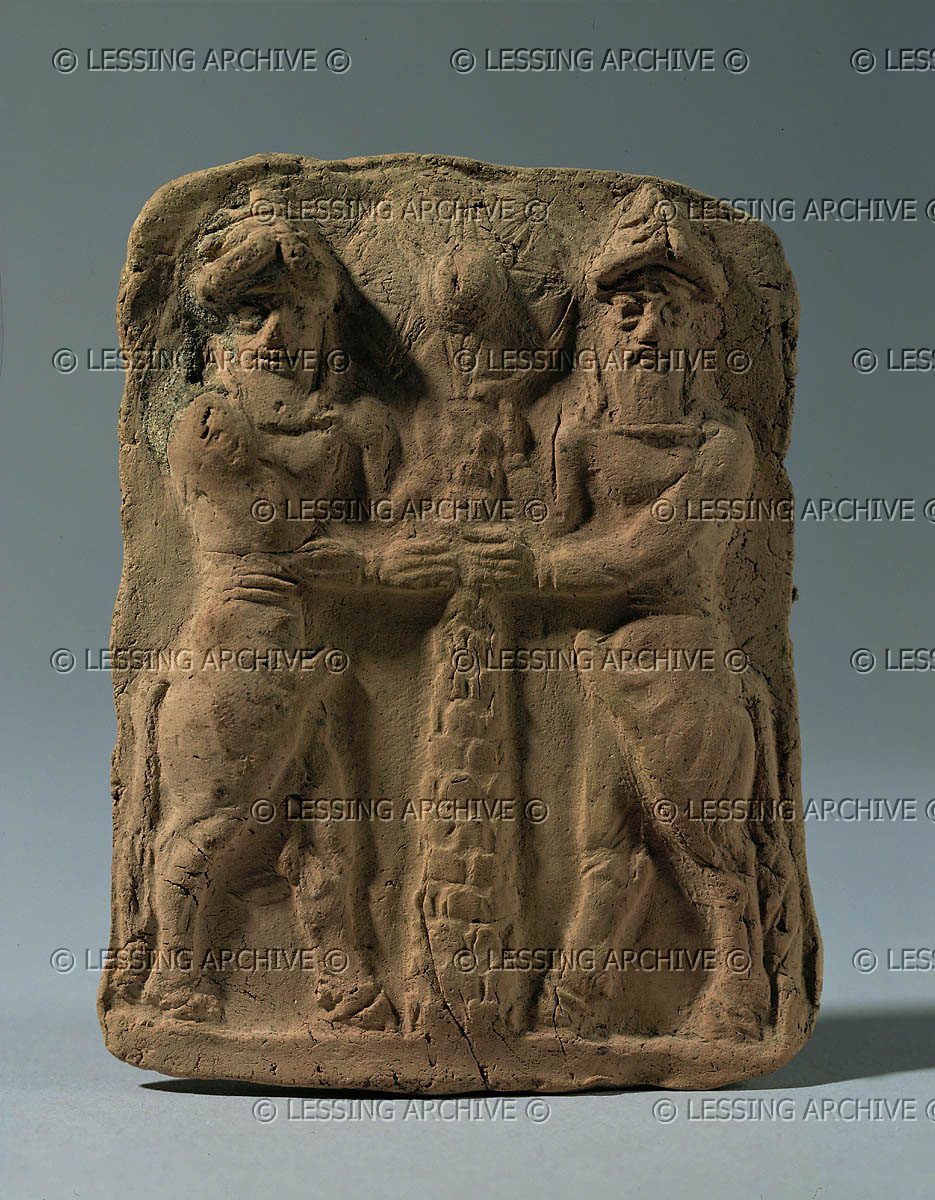
Two Kusarikku, or "bull-men," holding a sacred palm tree surmounted by the eight-pointed star of Ištar.  Note the horned headdresses, indicative of divinity.  From Eshnunna (Tell Asmar near Baghdad,Iraq). Early 2nd millennium BCE. Louvre, AO 12446

Two Kusarikku, or “bull-men,” holding a sacred palm tree surmounted by the eight-pointed star of Ištar.
Note the horned headdresses, indicative of divinity.
From Eshnunna (Tell Asmar near Baghdad,Iraq). Early 2nd millennium BCE.
Louvre, AO 12446

Magic traces a mode of thinking that is layered, reticular, and corporeal, rather than linear and abstract, and this mode provided the ground for Mesopotamian social and religious life in both its logical and sensory depth. Magic, then and now, enchants us not with the truth, but with the possible made real.

Neo-Assyrian magical figurine work conjures and materializes a primordial secret: if apotropaic magic names that which wards off and turns away evil, then evil is nothing other than the insidious reality that humans themselves create their own creators and make their own world.

But the exposure of this secret, which would seem to threaten the very dissolution of the religious belief and tradition at the core of Assyrian social life, instead serves to preserve these beliefs and traditions (cf. Taussig 1999).

In this way, the apotropaic device recalls that perverse disposition of the supplement: “a terrifying menace, the supplement is also the first and surest protection against that very menace” (Derrida 1974:153).

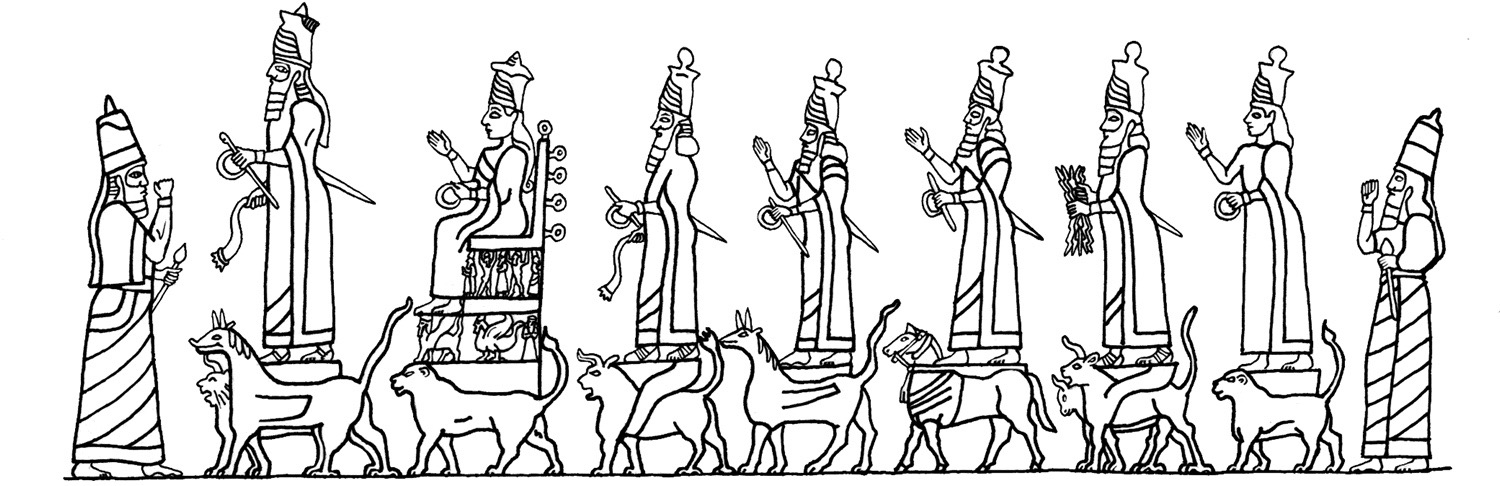
A pantheon.

A pantheon.

Figurine deposits secure the protection of the present by giving a future to the mythological past, a past in which the gods and spirits ground the condition for human social life.

This mimetic production does not reproduce the same, but discloses a new life through the figures of repetition, transfiguration, and burial; as such, it constitutes the processual enactment of a memorial gesture whereby a particular Neo-Assyrian mythohistory preserves its future in the material memory of itself.

The gods and spirits, like the dead, become our guardians, “we give them a future so that they may give us a past. We help them live on so they may help us go forward” (Harrison 2003:158).

As an art of doing, magic capitalizes on this strife between meaning and matter, life and death, past and future, and in it, grounds the authority of a desired social order.”

Carolyn Nakamura, “Mastering matters: magical sense and apotropaic figurine worlds of Neo-Assyria,” Archaeologies of materiality (2005): 38-9.

Nakamura: the āšipu was Master of the Figurines

The Buried and Enclosed

“The multiple layers of concealment in this Neo-Assyrian figurine ritual suggest a play on the hiding and receiving powers of the earth.

In Mesopotamia, burial constituted a pervasive and important ritual idiom; people buried valuables, sacrifices, foundation offerings, caches of various materials, and their dead.

Nakamura: "By burying figurines of powerful beings, the āšipu preserves an expressed belief in a present reality of supernatural power, mythological origin and divine order."

Nakamura: “By burying figurines of powerful beings, the āšipu preserves an expressed belief in a present reality of supernatural power, mythological origin and divine order.”

Such diverse practices surely supported an equally diverse range of meanings. But in a basic sense, burial can mean to store, preserve, and put the past on hold (Harrison 2003:xi). This concept of burial holds purchase in the way in which protection relates to memory.

By burying figurines of powerful beings, the āšipu preserves an expressed belief in a present reality of supernatural power, mythological origin and divine order.

Burial keeps things hidden and protected such that preservation binds memory to a specific locality, from which it can be retrieved in the future as a given past. And this preservation of the future configures protection as survival.

It is interesting to mention here a temporal particularity in the Akkadian language that designates the “past” as lying before and the “future” as lying behind (Maul 1997:109), a stark reversal of our modern notions.

Mythology also seems to corroborate the notion that Mesopotamians “proceeded with their backs to the future,” as it were. Berossos’ Babyloniaka presents the primordial sage Oannes as having taught humans all the arts of domestic and cultural life.

Other myths regard this knowledge of the civilized arts as a gift from the god Enki (Ea). What is striking in both of these accounts is that the Mesopotamians believed that all cultural achievements — be they architecture, writing, healing, metalwork, carpentry, et cetera — were endowed to humans at the beginning of time, and this notion locates the ideal image of society in a primordial and mythological past rather than in a hopeful future (Maul 1997:109).

Furthermore, the figurines were not only buried, but also placed appropriately under the earth, in the space of the Netherworld and the apsû, the primordial freshwater ocean.

A depiction of the underworld.  Nergal appears at the top, leering over a top register which contains the eight-pointed star of Ishtar and the inverted half-moon crescent of the Moon God Sin.  In the second register, seven demons appear to support the heavens.  The middle register depicts the burial rites for new arrivals in the underworld, presided over by two fish-apkallū.  The lower register depicts the goddess Allat, or Ereshkigal, sister of Ishtar, who reigns in the underworld. She kneels upon a horse, which appears to be oppressed by her burden, in a boat which floats upon the waters of life. Note the lion pups suckling at her breast.  Drawn by Faucher-Gudin, from a bronze plaque of which an engraving was published by Clermont-Ganneau.  The original, which belonged to M. Péretié, is now in the collection of M. de Clercq. http://www.gutenberg.org/files/17323/17323-h/17323-h.htm#linkBimage-0039

A depiction of the underworld.
Nergal appears at the top, leering over a top register which contains the eight-pointed star of Ishtar and the inverted half-moon crescent of the Moon God Sin.
In the second register, seven demons appear to support the heavens.
The middle register depicts the burial rites for new arrivals in the underworld, presided over by two fish-apkallū.
The lower register depicts the goddess Allat, or Ereshkigal, sister of Ishtar, who reigns in the underworld. She kneels upon a horse, which appears to be oppressed by her burden, in a boat which floats upon the waters of life. Note the lion pups suckling at her breast.
Drawn by Faucher-Gudin, from a bronze plaque of which an engraving was published by Clermont-Ganneau.
The original, which belonged to M. Péretié, is now in the collection of M. de Clercq.
http://www.gutenberg.org/files/17323/17323-h/17323-h.htm#linkBimage-0039

Numerous sources locate the underworld in the ground, beneath the surface of the earth (Black and Green 1992:180; Bottéro 1992:273–275). This idea follows from a traditional Mesopotamian conception of a vertical and bipolar universe where the earth, inhabited by living humans, separated the Heavens (šamû) from the Netherworld (ersętu) (Bottéro 1992:273).

And the borders of these domains were permeable, as entry to the Netherworld could be gained by way of a stairway leading down to the gate, while spirits could access the human world through cracks and holes in earth’s surface.

But importantly, the prevailing worldview of this time held that every being occupied a proper space in the world, with the lower hemisphere, symmetrical to the upper heavens, providing a discrete space and residence for the dead and other supernatural beings.

In this context, the burial of figurines of creatures from the underworld and apsû might constitute a mimetic gesture of placing or commanding such beings to their proper place in the world. This ritual practice not only reflects but reenacts the notion of an underworld located underground.

Furthermore, the strategic placement of the figurine deposits under certain architectural and household features may act to channel and focus the protective power of the beings, since they dwell in their “proper” realm.

The fact that the figurines were encased in boxes is also evocative of the important gesture of providing a “house” for the deities, and there could be no greater service rendered to a divine being than the building of his or her house (Frankfort 1978:267).

Additionally, the “immateriality” of a buried geography as an invisible, powerful presence is itself provocative.

The figurines, so installed, become effectively removed from the sensuous sphere of human–object relations. In this register of experience, they are “completed,” no longer engaging in processes of mutual constitution and becoming.

But the materiality of the figurine deposit endures and is powerful in this capacity to survive, virtually unmolested, performing its original duty; cut off from human relations, mute, blind, and restrained, they no longer strike back at human subjects, but can only direct their force to fighting off evil spirits in the Netherworld, as instructed by the āšipu.

There is a sense here of Derrida’s (1994) autonomous automaton, the animate puppet with a will of its own that yet obeys some predetermined program. By containing, concealing, and hiding these magical figures, the priest has made his mastery of their power complete.”

Carolyn Nakamura, “Mastering matters: magical sense and apotropaic figurine worlds of Neo-Assyria,” Archaeologies of materiality (2005): 36-8.

Nakamura: The Figurines as Magical Objects

The Hybrid

“The magical power of the āšipu also allows him to identify certain mythological and supernatural beings appropriate for the task of protection; these are ancient sages (apkallū), warrior deities and monsters, associated with civilized knowledge and the formidable forces of life, death, peace, and destruction of divine will and rule (Green 1993; Wiggermann 1993).

These figures take on different protective attributes depending on the nature of the represented being; the apkallū act as purifiers and exorcists to expel and ward off evil forces, while monsters, gods, and dogs tend to the defense of the house from demonic intruders (Wiggermann 1992:96–97).

Lahmu, “Hairy,” is a protective and beneficent deity, the first-born son of Apsu and Tiamat. He and his sister Laḫamu are the parents of Anshar and Kishar, the sky father and earth mother, who birthed the gods of the Mesopotamian Pantheon. Laḫmu is depicted as a bearded man with a red sash-usually with three strands- and four to six curls on his head. He is often associated with the Kusarikku or “Bull-Man.” In Sumerian times Laḫmu may have meant “the muddy one”. Lahmu guarded the gates of the Abzu temple of Enki at Eridu. He and his sister Laḫamu are primordial deities in the Babylonian Epic of Creation –Enuma Elis and Lahmu may be related to – or identical with- ‘Lahamu’ one of Tiamat’s Creatures in that epic. http://foundfact.com/portfolio-view/lahmu/#!prettyPhoto http://foundfact.com/library/beings-people-and-gods/page/6/#!prettyPhoto

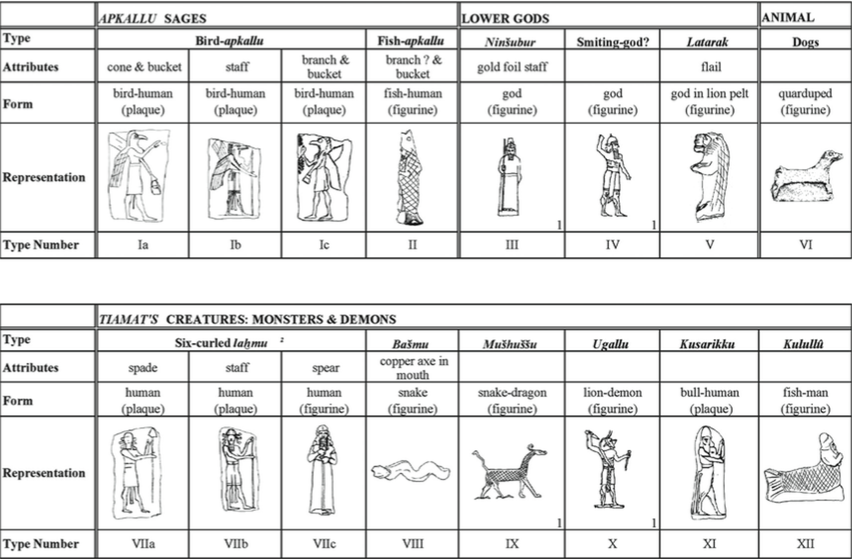
All of these figures find some association either with the underworld or the freshwater ocean under the earth (apsû) which was the domain of Enki, the god associated with wisdom, magic, incantation, and the arts and crafts of civilization (Black and Green 1992:75), and notably, all but the lahmu portray composite human–animal physiognomies (Figure 2.2).

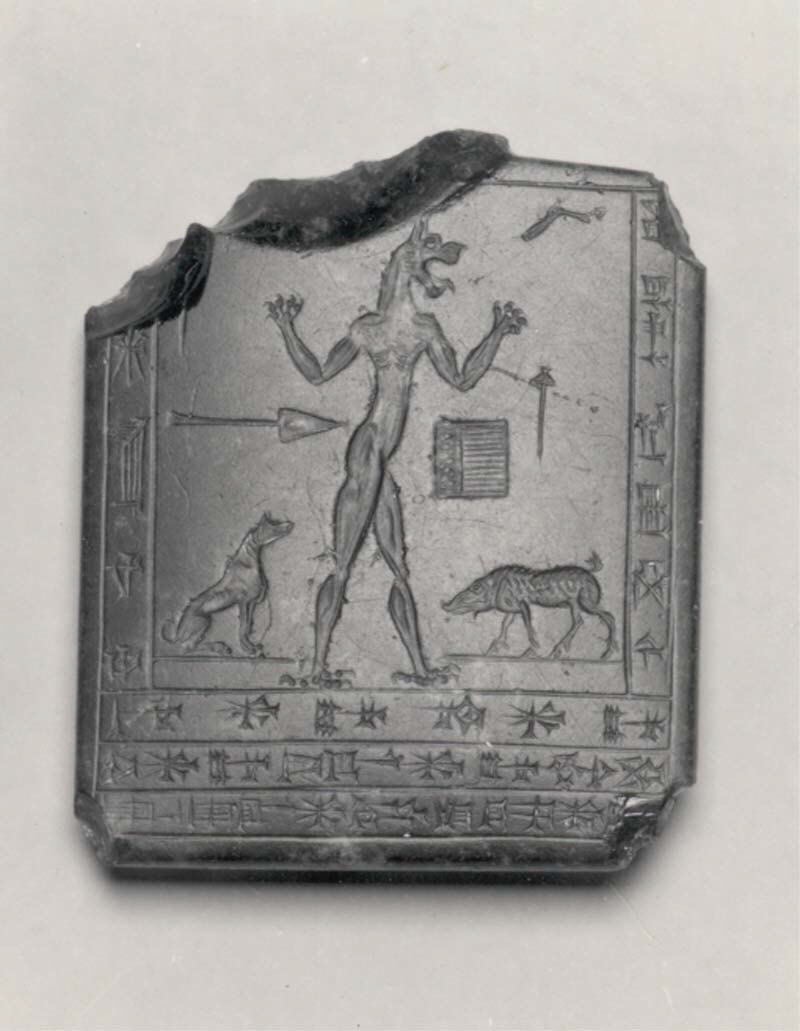
Figure 2.2. Apotropaic figures with associated features.  1. Drawing after Richards in Black and Green (1992:65).  2. The identification of the lahmu figure is controversial; it names both a cosmogonic deity and one of Tiamat’s creatures (Wiggermann 1992:155–156), and may also represent an apkallu sage (Ellis 1995:165; Russell 1991:184, fn. 27)

Figure 2.2. Apotropaic figures with associated features.
1. Drawing after Richards in Black and Green (1992:65).
2. The identification of the lahmu figure is controversial; it names both a cosmogonic deity and one of Tiamat’s creatures (Wiggermann 1992:155–156), and may also represent an apkallu sage (Ellis 1995:165; Russell 1991:184, fn. 27)

Such forms manifest a communion of things generally held to be opposed to each other. The blending of humans and animals in this context might capitalize on the tension between Mesopotamian conceptions of a structured, civilized human world and a chaotic, untamed natural world (Bottéro 1992).

Hybrids materialize a unity of self and other, human and animal as a strange being that is at once knowable and controllable and unknowable and incontrollable.

Fish-man known as a Kulullû. Terracotta figurine (8th-7th BCE) in the Louvre collection, Nr. 3337.  The Kulullû is distinct from the fish-Apkallū. They are not the same.

Fish-man known as a Kulullû. Terracotta figurine (8th-7th BCE) in the Louvre collection, Nr. 3337.
The Kulullû is distinct from the fish-Apkallū. They are not the same.

As beings in-between, hybrids embody potential, transition, and similarity in difference. Such liminality is often associated with dangerous power, a power that obeys the apotropaic economy of the supplement, since it terrifies and yet provides the surest protection against that terror (Derrida 1974:154).

Another depiction of the Kulullû, or fish-man.

Another depiction of the Kulullû, or fish-man.

By miming such beings in clay figurines, the āšipu brings forth their active life and force in petrified form. Capitalizing on the apotropaic logic of defense, this gesture captures self-defeating force and suspends it in space, material, and time.

Many of the figurine types are depicted in movement with hands gesturing and a foot forward to suggest forward movement. Following Susan Stewart (1984:54), I submit that the force of animated life does not diminish when arrested in the fixity and exteriority of the figurine, but rather, is captured as a moment of hesitation always on the verge of forceful action.

The apotropaic figurine is a magical object — what Michael Taussig calls a “time–space compaction of the mimetic process” — doubled over since its form and matter, creation and presentation capture certain inherent energies that humans desire to control.

The magical object, which encounters the unknown by presenting its form and image “releases a force capable of vanquishing it, or even befriending it” (Deleuze 2003:52). But as ritual texts and archaeological deposits confirm, it was not just the images themselves that rendered power, but something in the process of their creation.

While such apotropaic figures appear in grand scale and idealized form on wall reliefs flanking entrances of kingly palaces purifying all who passed through the gates, the figures standing guard in floor deposits performed an additional task.”

Carolyn Nakamura, “Mastering matters: magical sense and apotropaic figurine worlds of Neo-Assyria,” Archaeologies of materiality (2005): 34-6.

Nakamura: The Common Terrain Shared by Myth and Iconography

“After this “enlivening,” the āšipu then molds this clay into various figures of power and protection, in effect reenacting the divine creation of humans from the clay of the apsû, the primordial underground freshwater ocean.

(Similar narratives of the creation of humankind reiterate a trope of the divine formation of being from clay. In the Atrahasis epic (Tablet I, lines 210–213) humankind is born from the mixing of primordial clay and the blood of a slain god, and in Enki and Ninmah (lines 24–26) humankind is made from this clay only.)

Cuneiform tablet with the Atrahasis Epic Babylonian, about 17th century BC From Sippar, southern Iraq A version of the Flood story The story outlines the structure of the universe according to Babylonian beliefs. Heaven is ruled by the god Anu, the earth by Enlil and the subterranean sweet water by Enki. The text then explains how the minor gods work in the fields but then rebel. As a result, humans are made from clay, saliva and divine blood to act as servants of the gods. This does not prove a perfect solution, as the humans reproduce and their noise disturbs Enlil's sleep. He decides to destroy them with plague, famine, drought and finally a flood. However, each time Enki instructs one of the humans, Atrahasis, to survive the disasters. The god gives Atrahasis seven days warning of the flood, and he builds a boat, loads it with his possessions, animals and birds. He is subsequently saved while the rest of humankind is destroyed. However, the gods are unhappy as they no longer receive the offerings they used to. There is a gap in the text at this point but it does end with Atrahasis making an offering and Enlil accepting the existence and usefulness of humans. Copies of this story have survived from the seventeenth to the seventh century BC showing that it was copied and re-copied over the centuries. This is the most complete version. There are clear similarities between this Flood story and others known in Mesopotamian literature, for example, the Epic of Gilgamesh. T.C. Mitchell, The Bible in the British Museum (London, The British Museum Press, 1988) S. Dalley, Myths from Mesopotamia (Oxford University Press, 1991) W.G. Lambert and A.R. Millard, Atra-hasis (Oxford, Clarendon Press, 1969) http://www.britishmuseum.org/explore/highlights/highlight_objects/me/c/cuneiform_the_atrahasis_epic.aspx

Cuneiform tablet with the Atrahasis Epic
Babylonian, about 17th century BC
From Sippar, southern Iraq
A version of the Flood story
The story outlines the structure of the universe according to Babylonian beliefs. Heaven is ruled by the god Anu, the earth by Enlil and the subterranean sweet water by Enki. The text then explains how the minor gods work in the fields but then rebel. As a result, humans are made from clay, saliva and divine blood to act as servants of the gods.
This does not prove a perfect solution, as the humans reproduce and their noise disturbs Enlil’s sleep. He decides to destroy them with plague, famine, drought and finally a flood. However, each time Enki instructs one of the humans, Atrahasis, to survive the disasters. The god gives Atrahasis seven days warning of the flood, and he builds a boat, loads it with his possessions, animals and birds. He is subsequently saved while the rest of humankind is destroyed. However, the gods are unhappy as they no longer receive the offerings they used to. There is a gap in the text at this point but it does end with Atrahasis making an offering and Enlil accepting the existence and usefulness of humans.
Copies of this story have survived from the seventeenth to the seventh century BC showing that it was copied and re-copied over the centuries. This is the most complete version. There are clear similarities between this Flood story and others known in Mesopotamian literature, for example, the Epic of Gilgamesh.
T.C. Mitchell, The Bible in the British Museum (London, The British Museum Press, 1988)
S. Dalley, Myths from Mesopotamia (Oxford University Press, 1991)
W.G. Lambert and A.R. Millard, Atra-hasis (Oxford, Clarendon Press, 1969)
http://www.britishmuseum.org/explore/highlights/highlight_objects/me/c/cuneiform_the_atrahasis_epic.aspx

And this mimetic act doubles back, for at the end of the incantation the āšipu invokes the creative utterance of Enki (Ea) and incants himself into the picture; here he blurs his position as both mime and mimed other: “in this way, as both chanter and person chanted about, as demonstrator and demonstrated, he creates the bridge between the original and copy that brings a new force, the third force of magical power, to intervene in the human world” (Taussig 1993:106).

(One creation myth (of many) also poses Enki (Ea) as taking on the organization of the entire universe and accomplishes this feat solely in the creative power of his word (Black and Green 1992:54)).

And it is the āšipu’s body that provides the ligature of this bond:

O Ea, King of the Deep, to see…

I, the magician am thy slave.

March thou on my right hand,

Be present on my left;

Add thy pure spell unto mine,

Add thy pure voice unto mine,

Vouchsafe (to me) pure words,

Make fortunate the utterance of my mouth,

Ordain that my decisions be happy,

Let me be blessed wherever I tread,

Let the man who I (now) touch be blessed.

(Utukki Limnuti, III/VII:260 ff. Thompson 1903-04:27-9, added emphasis).

It is bodily sense — initiated by the āšipu’s voice, movement, and touch — that forges a correspondence between the natural and the divine.

Through the mimetic faculty, magical craft and performance invites a direct and sensuous relation with the open world capable of recuperating a pre-organized state of sensation and perception.

This visceral presentation of the self-becoming-other and spirit-becoming-substance, reproduces the original fold of being that encompasses divine, human, and natural worlds. The Mesopotamian world was indeed enchanted, and humans, always already engaged in such a world, needed only to feel or sense in order to retrieve such unity.

I have dwelled upon the bodily aspects of practice — namely, those gestures of relating and transforming through incantation, touch, and movement — to underscore magic as a technique, as a knowing and producing that choreographs a dis/re-organization of worldly relations.

Magical performance amounts to a mimetic demonstration of vital correspondences between ideas, essences, and things in the processual enactment of an ideal made real. The affective force of such bodily techniques arises from the kinetic communication and experience of the performance; but how are we to make sense of the power or force of ideal protection made real through the burial of miniature figurine deposits?

Most commonly, scholarship has approached this ritual practice and material assemblage by considering certain symbolic and conceptual linkages to Neo-Assyrian ritual, religion, and culture, for instance, the common terrain shared by myth and iconography (see Green 1983; 1993; Wiggermann 1992; 1993).

While such critical analyses get at important aspects and processes of ancient intellection, they ultimately fail to consider the devastatingly material logic of magic that often subverts (only to reinforce) such discursive productions of meaning. To redress this imbalance, I presently examine this concrete logic and how it discloses apotropaic power.”

Carolyn Nakamura, “Mastering matters: magical sense and apotropaic figurine worlds of Neo-Assyria,” Archaeologies of materiality (2005): 30-1.

Nakamura: Magic as Mimesis in Mesopotamia

“Merleau-Ponty’s (1968) notion of intertwining or chiasm between interior and exterior experience might provide a helpful ontological frame here.

This bare movement of perception posits the emergence of various social worlds from the sensuous interchange between interior and exterior phenomena, namely, nodes of self-organization (perception) and the “chaos” of indeterminacy (being).

There exists a necessary separation and continuum between the former and the latter as the very condition for perception, such that perceptual faith becomes a “strange attractor in the circulation of sense, in the interweaving of perceptual and material systems” (Mazis 1999:233).

And Merleau-Ponty (1968) conceives of the bare notion of flesh as providing the substrate or condition for this movement. Flesh posits a world of indeterminate being connected by an essential openness to becoming completed by the world, things, others, qualities and interrelations (Grosz 1999:151).

Such transactions are never “completed” per se, but rather engage in continuous exchange, in an ongoing process of becoming. This unity, therefore, conditions perception as “a communication or communion, the taking up or completion by us of some extraneous intention or, . . . the complete expression outside ourselves of our perceptual powers and coition, so to speak, of our body with things” (Merleau-Ponty 1962).

The notion of an original unity seems to inhabit a Mesopotamian worldview in which dreams, visions, abnormal events, internal organs, and entrails provided an “empirical” basis for reality. In this reality, interior events and natural and social phenomena were intimately and specifically related.

One could argue that this worldview maintained a certain interpenetration or continuity between the interiority of the mind and the exteriority of the world. This notion is supported in the polysemic and polyphonic character of the Mesopotamian writing systems.

According to Asher-Grève and Asher (1998:39), the Sumerian language and vocabulary offers no evidence for the radical bifurcation of mind and body that is so fundamental to Western intellectual thought.

They find support for this notion in the Sumerian word, Šà, a holistic term that denotes the mind, body, and heart; the body and heart are the seat of the will, “it thinks, feels, has power over the limbs and is open to the influence of the deities” (1998:39).

Moreover, they see the body as providing a fundamental point of reference in early Mesopotamia; Sumerians see the body as the total being, confirmed by the absence of a distinct Sumerian word for brain/mind (1998:40).

In later times, ancient scribes and scholars exploited the flexibility of the Akkadian language evidenced in plays and puns on words (see Alster 2002). It is notable that the formation and development of the cuneiform script (created by Mesopotamians for Sumerian and adapted also to Akkadian), always allowed for a number of permutations and ambiguities to intervene, on the level of things indicated as well as on the level of signifying words (Bottéro 1992:94).

This capacity for linguistic signs and phonemes to hold multiple and freely interchangeable values reveals an indeterminacy built into what Bottéro calls the concrete and polysemic character of a “script of things” (Bottéro 1992:100). In other words, linguistic thought also supports a material logic of correspondence.

Although Mesopotamians certainly made distinctions between various concrete and intangible phenomena — the supernatural and natural worlds were connected through a notion of divinity, but were not seen as the same — perhaps it was the potential for their connection or conflation that was significant in the context of magic.

The reorientation of classical mind–matter, subject–object divisions within a relation of continuity and mutual implication sets up an ontological frame that might better approach an ancient Neo-Assyrian worldview (following Meskell 1999; 2002; 2004).

Such a frame not only situates magic in a pre-discursive world of relations, but also grounds it in an aesthetics that discloses a powerful process of enacting correspondence.

It should come as no surprise, then, to find mimetic work as a principle technique of magic, since the recovery of the world in its pre-differentiated unity provides the condition for the mimetic process of getting into the skin of an other (cf. Taussig 1993), that way of making which is the occasion of magic.

If this unity becomes obscured by the habitual, purifying movements of social process, then magic seeks its recovery in secrecy, through the concrete work of mimesis.”

Carolyn Nakamura, “Mastering matters: magical sense and apotropaic figurine worlds of Neo-Assyria,” Archaeologies of materiality (2005): 26-7.

Nakamura–Rimbaud’s Derangement of All the Senses, Magic, and Archeology

“Curiously, archaeological research has not fully exploited the evocative cooperation between text, iconography, material, and deposition in this apotropaic practice. Rather, it has been the art historical and Assyriological traditions that have provided the most thorough deliberations on the ritual.

Iconographic analyses present detailed visual descriptions of the figurines (Klengel-Brandt 1968; Rittig 1977; Van Buren 1931), and trace out a visual typology of apotropaic images (Green 1993; Wiggermann 1993), while textual analysis investigates the symbolic logic of apotropaic prescription and the mythological identities of the figures (Wiggermann 1992).

Two long-awaited volumes no doubt will provide further analyses of particular site assemblages (Green forthcoming) and the apotropaic figurines in general (Ellis forthcoming). Despite the richness of textual and archaeological data, an anthropological perspective is distinctly lacking; however, such research would considerably enrich our views of this remarkable ancient practice.

Regrettably, studies of previously excavated materials have not exploited the diverse range of approaches afforded by modern social sciences. While previously excavated sites and materials admittedly do not often lend themselves to the analytical and interpretive techniques most favored by archaeologists, such data should not be omitted from modern reconsideration and inquiry simply because they present a special challenge for substantive interpretation (see Meskell 1999).

There is, in fact, adequate data to perform detailed contextual and spatial analyses of the apotropaic practice at certain Neo-Assyrian sites. Furthermore, I would argue that conventional interpretations in archaeology — still oriented toward explanation and meaning — fail to get at the most compelling aspects of ancient magic, exactly that which makes it magical.

Magic surely presents something beyond the reach of representational or functional interpretations and thus demands a different perspective. What is required is an evocation of magic that aims directly at the caesura between meaning and matter and delves into the shadowy processes of materializing experience, belief, and value.

Perhaps it is not surprising that archaeology, with only material traces of human activity to work with, has left the critical study of magic to other disciplines. It is revealing that “magic” is generally invoked as an explanation for those slippery things, processes, and occurrences that our rational and linguistic varieties of logic can’t quite master.

From this vantage, magic has become something more suitable for explaining than for being explained. But as Mauss (1972) decisively observed in A General Theory of Magic, magic is as much a way of doing as a way of thinking.

We should consider, then, not a logic but an aesthetics of magical practice, as a particular way of making sense (Gosden 2001). And this way of doing engages a radical materiality that not only enacts the mutual constitution of subjects and objects, but provides the condition for such discursive practices.

A consideration of materiality vis-à-vis magic, then, does not presume and continue the anthropological pursuit of finding meaning in matter, the well-rehearsed terrain of discovering how various cultures construct and inscribe meaning in their artifacts.

What is magical or forceful in certain artifacts evades such fixed and flattened analyses since processes of abstraction do not account for the “untranscended materiality” or “plastic power” of the object that derives from the thing’s materialness itself (Pels 1998:101).

Impoverished attempts to discover the meaning or social context of a magical artifact, as it were, fall short not only because of an opacity of things, but also because our habituated ways of apprehending and constructing meaning threaten a veritable non-recognition of the things themselves.

This purifying analytical gaze effectively eviscerates matter of its very materiality — its innate capacity to continuously engage and enter into new relations. But recovering a recognition of things simply requires embracing the thingness of matter, namely, that insistent sensuousness of things that compels a confrontation with humans.

This move does not return us to problematic theories of materialism, but rather engages a notion of materiality as a dialectic and supplemental aesthetic of relating to.

Humans mime the animate in the inanimate, and the ideal in the real, to create and transform the world around them, only to be created and transformed right back. Such is the reality of matter: it “strikes back” (Pels 1998:91).

Within this framework I suggest that apotropaic figurine magic encompasses a process that enacts both a distinct mode of perception and a material event that renders a protected reality.

This discussion converges specifically on two aspects of magic: first, how magic capitalizes on a tension between the social construction of meaning and the radical autonomy of matter, and second, how magical perception, in the way of poetic action, masters the unknown by recovering and performing a “derangement of all the senses.” (Rimbaud 1967:302 and Deleuze 1993).

From such a viewpoint, Mesopotamian magic neither constitutes nor opposes a “rational” mode of knowing the world, but rather moves alongside in tandem, as counterpoint in a polyphonic system of knowledge. From this perspective, magic engages a sensuous metaphysics and grounds the possibility of a distinct socio-religious worldview.”

Carolyn Nakamura, “Mastering matters: magical sense and apotropaic figurine worlds of Neo-Assyria,” Archaeologies of materiality (2005): 19-22.

Figurines Excavated from the Burnt Palace and Fort Shalmaneser

The most expansive text prescribing the types of figurines is the Aššur ritual KAR, no. 298. After defining the purpose of the ritual as to avert evil from the house, the text begins to prescribe the types of figures to be fashioned and buried at set locations.

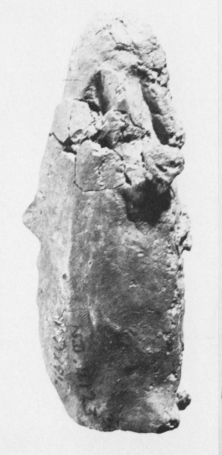
BM 124573, courtesy of the Trustees of the British Museum. Plate Xa.  This fish apkallū appears to have his right hand raised in the gesture of blessing with the mullilu cone, with the banduddu bucket in his left hand.

BM 124573, courtesy of the Trustees of the British Museum. Plate Xa.
This fish apkallū appears to have his right hand raised in the gesture of blessing with the mullilu cone, with the banduddu bucket in his left hand.

It begins with a long passage prescribing wooden figures of seven apkallē “Sages,” from seven Babylonian cities. No such actual figurines appear to exist, nor should we expect any if the prescription were faithfully followed, since timber figurines would have perished.

A bird-apkallū of the Nisroc kind, plate IXb. The figure is too worn to discern what is held in the right hand, while the left hand holds what appears to be a banduddu bucket.

A bird-apkallū of the Nisroc kind, plate IXb. The figure is too worn to discern what is held in the right hand, while the left hand holds what appears to be a banduddu bucket.

The next passage, however, prescribes apkallū figures with the faces and wings of birds. These are the bird-headed figures (Plate IXb), found appropriately in groups of seven. As well as in the Burnt Palace, a group of such figures was found in Fort Shalmaneser in a late seventh-century context; the excavator believed that the figures were redeposited ninth-century pieces, but they are rather different in style (ND 9518, figures in the round rather than flat-backed plaques) and may in fact date closer to the period suggested by their findspot.

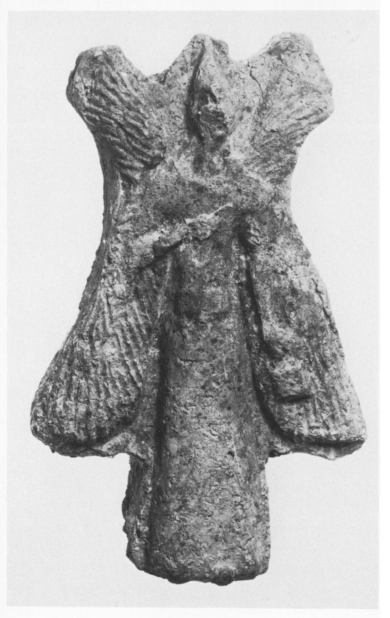
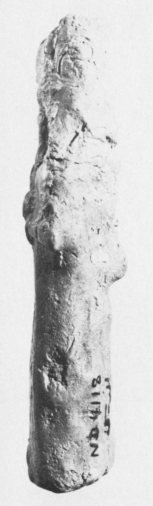
Fish-Apkallū figure, Plate Xb. ND 4118, courtesy of the British School of Archeology in Iraq, photograph by David A. Loggie.

Fish-Apkallū figure, Plate Xb. ND 4118, courtesy of the British School of Archeology in Iraq, photograph by David A. Loggie.

A group of figures of the same type was found by George Smith in the so-called “S.E. Palace,” perhaps a part of the same building as Palace “AB;” the pieces are close in style to the Burnt Palace examples and may date to the late ninth century.

ND 4123 (IM 59291), Plate Xc, courtesy of the British School of Archeology in Iraq. Photograph: David A. Loggie.

ND 4123 (IM 59291), Plate Xc, courtesy of the British School of Archeology in Iraq. Photograph: David A. Loggie.

The ritual goes on to prescribe a set of seven figures of the apkallē cloaked in the skin of a fish. This type is represented by septenary groups of fish-garbed human figures which vary somewhat from deposit to deposit.

The usual type from the Burnt Palace, thin and fairly flat, sometimes has a fish-head and, on the reverse, a dorsal fin (Plate Xb), but often has no very obvious fish elements, so that the pieces must be identified  from others in the same deposit or by comparison with those in other deposits.

Also from the Burnt Palace come some more obvious human-piscine figures of heavy solid clay (Plate Xc). Six examples of this subtype were found, together with a seventh, “leader” (?), figure of the same being but of a very different style: a tall but flat fish-garbed man, the scales and tail indicated on the back by incised cross-hatching and diagonal lines.

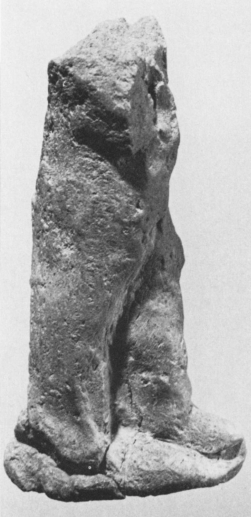
ND 7903B. Courtesy of the British School of Archeology in Iraq, photograph by David A. Loggie. Plate Xd.

ND 7903B. Courtesy of the British School of Archeology in Iraq, photograph by David A. Loggie. Plate Xd.

Over thirty figurines and metal figurine accoutrements were found not buried in boxes but loose in the fill of one of the so-called “barracks-rooms” of Fort Shalmaneser. They would seem to be remnants from disturbed deposits, but evidently reused, since the fish-cloaked figures, of incongruous styles, were nevertheless seven in number.

It is possible, therefore, that the room was a kind of sick-bay, decked out with these prophylactic images. Plate Xd shows one of the types found, rather crudely made but with the line of the fish-cloak evident enough.

It is interesting to note, in this context, that when one of the legs is exposed and set forward on figurines of this type, it is the left one, perhaps foreshadowing an Islamic custom of entering a holy place with the right foot first, but the haunts of the jinn leading with the left.

The fish-cloaked figure is known in Mesopotamian art from the Kassite period, and despite a dearth of extant sculpture was not an uncommon figure in the Neo-Assyrian palace or temple (Plate Xa).”

Anthony Green, “Neo-Assyrian Apotropaic Figures,” Iraq, Vol. 45, 1983, pp. 88-90.

Why No Canonical Literature Regarding the Apkallu?

“In adducing the motif of the “wise vizier”, I have only meant to show that the “wise men” of a tradition are not necessarily kings, and furthermore, to show the complexity of a problem that, if I do not pretend to solve, I neither am inclined to embezzle.

In my opinion, the myth of the apkallu’s in all likelihood reflects the etiological story which the Greek accounts attempt to render, but which did not survive in the Mesopotamian canonical literature.

This winged umu-apkallū raises his right arm in the greeting gesture, with the banduddu water bucket in his left hand. The headdress is unusual, not the usual horned tiara, but a headband with a rosette insignia.

This winged umu-apkallū raises his right arm in the greeting gesture, with the banduddu water bucket in his left hand. The headdress is unusual, not the usual horned tiara, but a headband with a rosette insignia.

Beside the reference to the “old sages from before the flood” (AMT 105:22, last cited by Lambert, JCS 11 p. 8), an allusion to the presence on earth, before the flood, of apkallu’s, who after the flood regained the Apsû, is contained in the Epic of Era, where Marduk says that he “made these wise men go down to the Apsû” (ummânī šunūti ana apsî ušēridma, I 147), together with the precious materials needed to fashion the divine statute.

In the following rhetorical questions in which he regrets that neither the materials, nor the craftsmen needed to work them are available, Marduk finally deplores the absence of the sages who, most likely, were the only ones capable of infusing life into the divine statue: ali sibīt apkallī (NUN.ME) apsî purādī ebbūti ša kīma Ea bēlišunu uzna sīrtu šuklulu (I 162) “Where are the seven sages of the Apsû, the pure purādu-fish, who, just as their lord Ea, have been endowed with sublime wisdom?”. […]

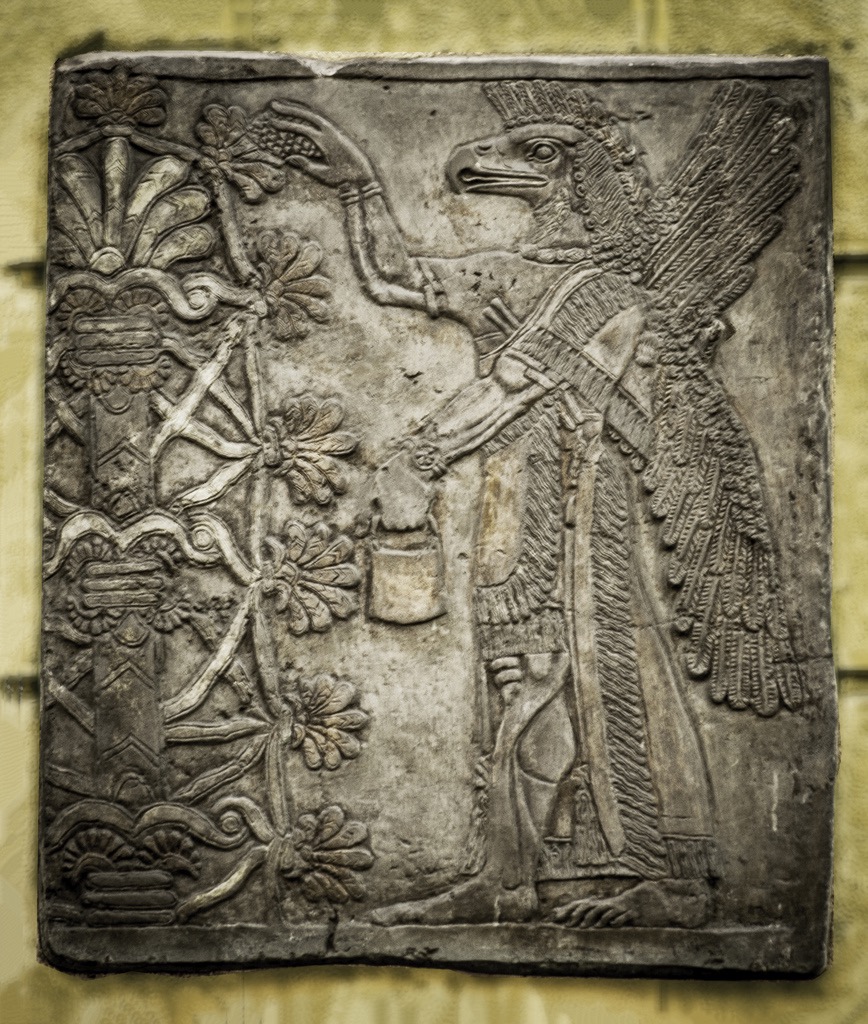
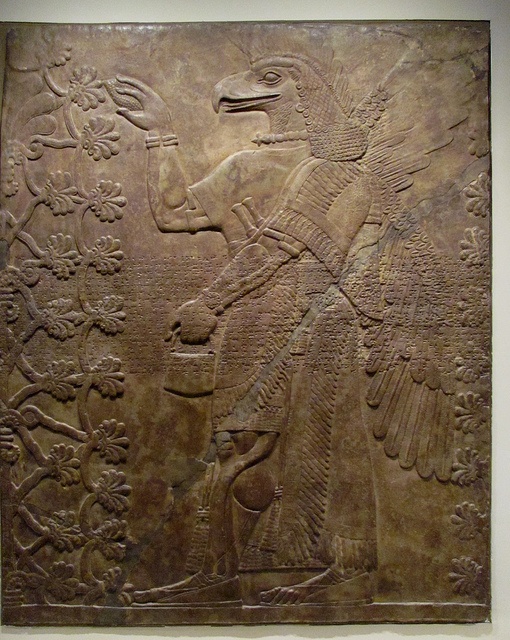
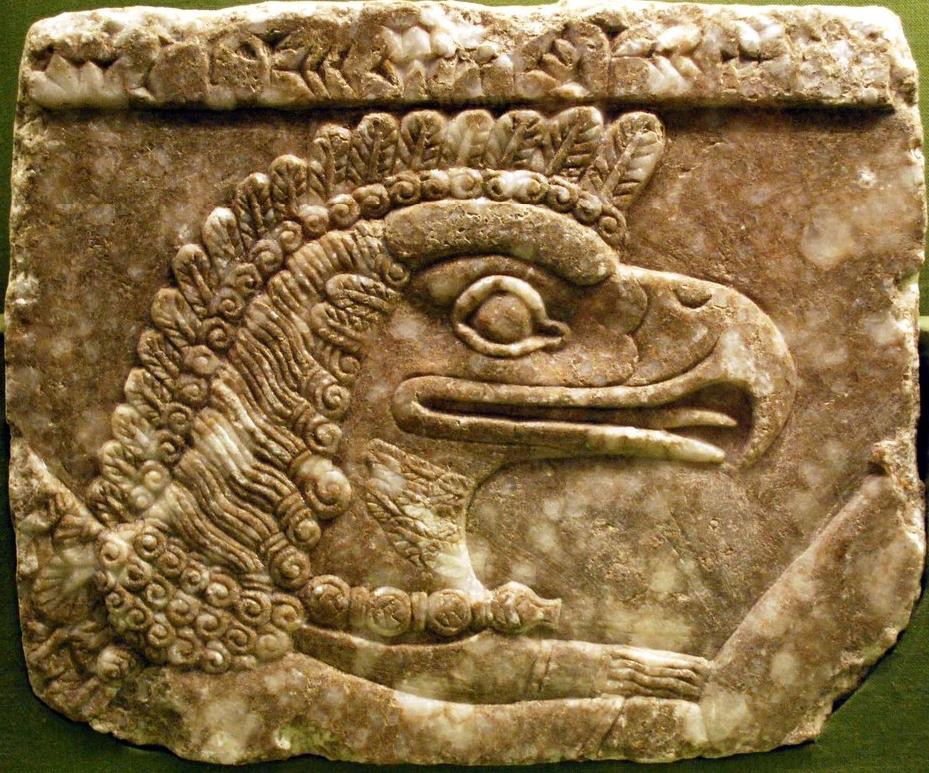
In Neo-Assyrian art these bird-headed

In Neo-Assyrian art these bird-headed “genies,” as they were long described, are now known to be apkallū, “bird-apkallū,” in this case, mixed-feature exorcists and creatures of protection created by the god Ea. They traditionally served as advisors to kings. Their association with sacred trees, as they are often portrayed, remains somewhat perplexing.
This apkallū makes the iconic gesture of exorcism and liberation of sin with the mullilu cone in his raised right hand, and the banduddu water bucket in his left hand.
There are three known types of apkallū: the human, with wings; the avian-headed, with wings, and the fish-apkallū, with carp skin draped over their heads.
https://www.flickr.com/photos/lanpernas2/8606000868/

The story here edited cannot be interpreted as an etiological myth. Neither the exploits of the apkallu’s, nor even their names suggest any literary figure known to us, with the exception of Adapa, nor are they said to have existed in the period before the flood.

Meager evidence is the mention of the apkallu from Ur, Lu-Nanna, in the colophon of a text (K 8080, see Lambert, JCS 11 p. 7) listing poultices for magical purposes and of Piriggalabzu in the incipit of a Sumerian t i g i -song. …

On the other hand, two apkallu’s not described among the heroes of our text — who, as the reader must have noted, are only five in number — are mentioned as authors: a certain Enlil-muballit, apkallu of Nippur under Enlil-bani of Isin, in AMT 105:24 (see Lambert, JCS 11 p. 8), and a certain Ur-Gatumduga in the subscript to the Šulgi-hymn PBS 1/1 No. 11 …

There is little hope that we will ever find more ample material dealing with the apkallu’s. Of the legend, or cycle of legends, concerning their exploits what our texts tells us alone survives.

Indeed, we may even assume that at the time of its redaction the details of the legendary events had already faded into the past. Only the legend of Adapa must have still been well known, for concerning him the text contents itself with an even briefer allusion than its report on the other apkallu’s.

The very terseness of the characterization of each apkallu reminds us of the style of the so-called “historical omens” attached to the early kings, many of which are better considered anecdotes, as has been suggested by Güterbock, ZA 42 57 ff.

Just as historical texts never mention the exploits of Narām-Sin, Sargon, and others, that are referred to in these omens, so literary texts, transmitting always the same written tradition, have not recorded the feats of the apkallu’s.

Antediluvian apkallū portrayed as fish-men, such mixed-species creatures were the teachers of men.<br />  These specific statuettes were buried in the foundations of the home of an exorcist, where they were positioned beneath doorways and against particular walls to exert a prophylactic effect, warding off evil.<br />  The antediluvian type of apkallū, the so-called purādu-fish, are often grouped in sevens.

Antediluvian apkallū portrayed as fish-men, such mixed-species creatures were the teachers of men.
These specific statuettes were buried in the foundations of the home of an exorcist, where they were positioned beneath doorways and against particular walls to exert a prophylactic effect, warding off evil.
The antediluvian type of apkallū, the so-called purādu-fish, are often grouped in sevens.

It certainly seems as if the scribes deliberately suppressed a cycle dealing with those human beings who, at one or other of history, and no doubt with the connivance of Ea, revolted against the gods and “brought down Ištar from heaven into Eanna,” or “aroused Adad’s anger” by some forgotten or perhaps unmentionable act, or “angered Ea” through some form of challenge which is still obscure to us, in spite of the three duplicates we now have of this allusion.

Even the learned Lu-Nanna is not included for his literary achievements, but for a feat, we suspect, disrespectful to the goddess.

These acts of hubris seem quite irreconcilable with the picture we have formed of the Mesopotamian attitude towards the gods on the basis of traditional literature, and they must have been the cause of the eventual oblivion from which, however, the memory of some admirable human achievement persistently drew out again the figures of the “possessors of unsurpassed wisdom,” the sages.”

Erica Reiner, “The Etiological Myth of the “Seven Sages,” Orientalia, v. 30, No. 1, 1961, pp. 9-11.

On the Ummânu

“Such an association of the apkallu’s with kings of renown is singularly striking in view of the ancient near eastern motif that links a person of superior wisdom with a famous king.

In Egypt, we have the tradition — or fiction — of viziers who are credited with the authorship of “instructions” or “admonitions” (see J.A. Wilson, ANET 412 ff. and 432 n. 4, see also H. Brunner in Handbuch der Orientalistik I/2 p. 92 f.); for the Old Testament, references are conveniently collected by J. Lindblom, in Supplements to Vetus Testamentum 3, p. 129 f.

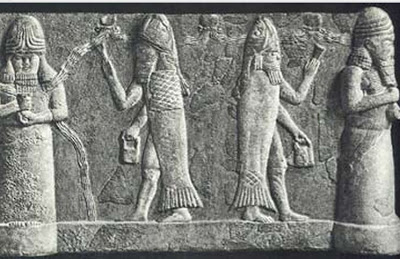
The god Ea at far left, wearing the horned headdress indicative of divinity, with water coursing from his shoulders. 

A fish-apkallū is in the iconic posture with right hand raised in blessing or exorcism, with the banduddu bucket in his left hand. 

The next apkallū wields an indistinct and as yet undefined angular object in his right hand, with the typical banduddu bucket in his left. 

The entity at far right, which appears to be wearing a horned tiara indicative of divinty, remains unidentified and undefined.

The god Ea at far left, wearing the horned headdress indicative of divinity, with water coursing from his shoulders. 

A fish-apkallū is in the iconic posture with right hand raised in blessing or exorcism, with the banduddu bucket in his left hand. 

The next apkallū wields an indistinct and as yet undefined angular object in his right hand, with the typical banduddu bucket in his left. 

The entity at far right, which appears to be wearing a horned tiara indicative of divinty, remains unidentified and undefined.

The most famous figure of such a wise man, whose story is the most wide spread, is Ahiqar, whose Mesopotamian origin has repeatedly been stated (for bibliography see Ginsberg in ANET 427), although no Babylonian prototype of the story as a whole is known.

However, there can be proven for Babylonia the existence of at least the theme that serves as a framework for Ahiqar’s sayings: this theme, the “disgrace and rehabilitation of a minister”, has been discussed, with a good comparative bibliography, by  A.H. Krappe in JAOS 61 (1941) 280-84.

The story is included in the “bilingual proverbs” (latest publication with bibliography, by W.G. Lambert, Babylonian Wisdom Literature 239 ff.), where it comprises a section of fourteen lines (ii 50-63, op. cit., p. 241), the longest of the sayings which usually consist of only two to four lines, although there are some as much as eight lines long.

The umu-apkallū at far left has his right hand raised in the iconic gesture of purification and exorcism, but no mullilu cone appears to be present.<br /> The banduddû bucket is present in the left hand. This umu-apkallū wears a horned tiara, indicative of divinity.<br /> The next entity lacks wings, and so is probably not an umu-apkallū. The mace in the right hand could be an e'ru, as it is not yet clear precisely what e'ru means. I do not understand the object in his left hand. The mace could be an indicator of sovereignty, of kingship.<br /> The next entity holds a bowl and the curved staff, known as the gamlu-curved staff. While this entity wears a headdress, it is not horned, and wings are absent, suggesting that it is human rather than umu-apkallū. This is probably a king, Museum notes suggest Ashurnasirpal.<br /> The entity at far right wields a curved stick in his right hand, I am unsure how Wiggermann defines it, and I am completely stumped by the object in his left hand, which appears to be a ladle. The entity appears to be a priest, blessing an offering from the king in a bowl.<br /> Overall, this frieze supports one theme of Erica Reiner's article on the Seven Sages of Sumeria, which is that each king had his associated advisor in the form of an apkallū.

The umu-apkallū at far left has his right hand raised in the iconic gesture of purification and exorcism, but no mullilu cone appears to be present.
The banduddû bucket is present in the left hand. This umu-apkallū wears a horned tiara, indicative of divinity.
The next entity lacks wings, and so is probably not an umu-apkallū. The mace in the right hand could be an e’ru, as it is not yet clear precisely what e’ru means. I do not understand the object in his left hand. The mace could be an indicator of sovereignty, of kingship.
The next entity holds a bowl and the curved staff, known as the gamlu-curved staff. While this entity wears a headdress, it is not horned, and wings are absent, suggesting that it is human rather than umu-apkallū. This is probably a king, Museum notes suggest Ashurnasirpal.
The entity at far right wields a curved stick in his right hand, I am unsure how Wiggermann defines it, and I am completely stumped by the object in his left hand, which appears to be a ladle. The entity appears to be a priest, blessing an offering from the king in a bowl.
Overall, this frieze supports one theme of Erica Reiner’s article on the Seven Sages of Sumeria, which is that each king had his associated advisor in the form of an apkallū.

Since none of the previous translations does justice to the motif expressed in the relevant passage, I suggest the following (the short lines of the bilingual text disposed in two columns are here restored to their assumed full length):

  • 50-51: “Their gods have returned to the ruin,
  • 52-53: the clamor (of daily life) has filled (lit. entered) the deserted house (again);
  • 54-55: (where) the ingrate is tenant, the wise man does not reach old age.
  • 56-58: The wise vizier, whose wisdom his king (or his lord) has not heeded,
  • 59-61: and any valuable (person) forgotten by his master,
  • 62-63: when a need arises for him (i.e., for his wisdom), he will be reinstated.”

The second half of the “saying” has reference to the disgrace and rehabilitation of a wise vizier, and, unless the first three lines (ii. 50-55) should be taken as a separate saying (so last J. Pereman, The Book of Assyro-Babylonian Proverbs [in Hebrew], p. 58), the reference to the “ingrate” (raggu) would indicate that the other basic theme of the Ahiqar-story, that of the “ungrateful nephew” (see Krappe, loc. cit., p. 281), had already been fused in the Mesopotamian tradition, as in the Ahiqar-story, with that of the “disgrace and rehabilitation of a minister”.

The argument for the existence in Babylonia of a tradition linking wisdom to a high official (“vizier”) of the king can be strengthened by the philological evidence of the alternation of the terms apkallu and ummânu, which has been adduced in other contexts.

In the top register, Ummiamu, (a variant spelling of Reiner's ummânu), human apkallū that are postdiluvian, tend to a sacred tree. In the lower register, antediluvian apkallū with avian heads tend to a sacred tree.<br />  The cones and buckets in their hands are now understood to be standard devices used to sprinkle water. Called mullilu and banduddu, respectively, the water sprinkling ritual was intended to liberate sin, or as part of a rite of exorcism.

In the top register, Ummiamu, (a variant spelling of Reiner’s ummânu), human apkallū that are postdiluvian, tend to a sacred tree. In the lower register, antediluvian apkallū with avian heads tend to a sacred tree.
The cones and buckets in their hands are now understood to be standard devices used to sprinkle water. Called mullilu and banduddu, respectively, the water sprinkling ritual was intended to liberate sin, or as part of a rite of exorcism.

The usual acceptation of the latter is “master craftsman,” often referring to scribes, authors or copyists of literary texts. References to both have been collected by van Dijk, La Sagesse Suméro-Accadienne, p. 20 n. 56, and note that Adapa, besides his more common epithet apkallu, is also called ummânu . . .

Moreover, it has been shown the term ummânu serves not only as the designation of a learned man or craftsman, but also refers, although in late texts, to a high official . . . In our connection most relevant is the mention of the ummânu beside the king in the Synchronistic King List (see simply Oppenheim in ANET 272 ff.), and the passage from the Fürstenspiegel (see now Lambert, BWL 112:5): šarru . . . ana UM.ME A la iqūl “if the king does not heed the vizier (or wise man).”

Note in the same text . . . is most likely to be read apkallišu.”

Erica Reiner, “The Etiological Myth of the “Seven Sages,” Orientalia, v. 30, No. 1, 1961, pp. 7-9.

Each King had his Apkallu

“The fish-figurines would seem to confirm the theory attractively put forward by Zimmern (KAT 535 ff. and subsequently ZA 35 151 ff.), that the apkallu’s, often occurring in groups of seven and sometimes identified with purādu-fish (Sumerian s u h u r . k u), represent Oannes and the other fish-like monsters who, according to Berosso’s account, taught mankind all crafts and civilization.

This depiction of a fish-apkallū (Apkallu, Abkallu) guarded the entrance to the temple of Ninurta at Nimrud. A fish's head can be seen on Apkallu's head, and its skin hangs down over the back of Apkallu's body.  Neo-Assyrian era, 865-860 BCE. From the Temple of Ninurta, Nimrud (ancient Kalhu; Biblical Calah), northern Mesopotamia, Iraq. (The British Museum, London). Osama Shukir Muhammed Amin FRCP (Glasg) http://www.ancient.eu/image/2708/

This depiction of a fish-apkallū (Apkallu, Abkallu) guarded the entrance to the temple of Ninurta at Nimrud. A fish’s head can be seen on Apkallu’s head, and its skin hangs down over the back of Apkallu’s body.
Neo-Assyrian era, 865-860 BCE. From the Temple of Ninurta, Nimrud (ancient Kalhu; Biblical Calah), northern Mesopotamia, Iraq. (The British Museum, London).
Osama Shukir Muhammed Amin FRCP (Glasg)
http://www.ancient.eu/image/2708/

Furthermore, the apkallu-figurines of the ritual KAR 298 discussed by Zimmern loc. cit. (see also Gurney, AAA 22 38 ff.) are each associated with a city in Mesopotamia and addressed as ūmu; Güterbock’s suggestion that the element p i r i g in the names of three apkallu’s in our text corresponds to this ūmu and refers to their character as mythological creatures (ZA 42 10 n. 3) would thus strengthen the argument in favor of the identification of the apkallu’s with the monsters described by Berossos.

What in the Greek account clearly reflects an etiological myth finds no correspondence in any of the texts dealing with apkallu’s in Mesopotamia. The exploits of the apkallu’s, as we shall see, are on a different mythological plane.

Nergal appears at the top, leering over a top register which contains the eight-pointed star of Ishtar and the inverted half-moon crescent of the Moon God Sin.  In the second register, seven demons appear to support the heavens.  The middle register depicts the burial rites for new arrivals in the underworld, presided over by two fish-apkallū.  The lower register depicts the goddess Allat, or Ereshkigal, sister of Ishtar, who reigns in the underworld. She kneels upon a horse, which appears to be oppressed by her burden, in a boat which floats upon the waters of life. Note the lion pups suckling at her breast.  Drawn by Faucher-Gudin, from a bronze plaque of which an engraving was published by Clermont-Ganneau.  The original, which belonged to M. Péretié, is now in the collection of M. de Clercq. http://www.gutenberg.org/files/17323/17323-h/17323-h.htm#linkBimage-0039

Nergal appears at the top, leering over a top register which contains the eight-pointed star of Ishtar and the inverted half-moon crescent of the Moon God Sin.
In the second register, seven demons appear to support the heavens.
The middle register depicts the burial rites for new arrivals in the underworld, presided over by two fish-apkallū.
The lower register depicts the goddess Allat, or Ereshkigal, sister of Ishtar, who reigns in the underworld. She kneels upon a horse, which appears to be oppressed by her burden, in a boat which floats upon the waters of life. Note the lion pups suckling at her breast.
Drawn by Faucher-Gudin, from a bronze plaque of which an engraving was published by Clermont-Ganneau.
The original, which belonged to M. Péretié, is now in the collection of M. de Clercq.
http://www.gutenberg.org/files/17323/17323-h/17323-h.htm#linkBimage-0039

The connection between them and wisdom and the crafts lies in the term ummânu, which is one of their epithets, and to which I shall presently return.

First, however, we shall have to dispel the misconception originating with Zimmern’s article in KAT, and repeated in the discussions connected with the apkallu’s by others, namely, the assumed identity of the “wise men” — or some of them — with the early kings.

Besides a certain juggling of names inevitable when dealing with Berossos, the allusion to the “man who ascended to heaven” in the text published by Gurney, JRAS 1935 459 ff., was taken to refer to Etana, the more easily so since the phrase used in the Sumerian version, l ú a n . š è  b a . a n . e x (DU+DU) echoes the very words of the Sumerian King List: E t a n a   s i p a  l ú  a n . š è  b a . e x . d è (see Jacobsen, AS 11 p. 80: 16 f. and n. 67).

Antediluvian apkallu portrayed as fish-men, such mixed-species creatures were the teachers of men.

Antediluvian apkallu portrayed as fish-men, such mixed-species creatures were the teachers of men. Small figurines of this type were buried beneath doorways and beneath walls for prophylactic purposes, warding off evil. In some cases, they were buried in a set of seven statuettes, indicative of the so-called “Seven Sages” of Sumeria.

The view of Güterbock, ZA 42 9f., that the tradition of the apkallu’s is separate from that of the historical kings, and his assumption that the phrase “who ascended to heaven” refers to Adapa — of whom the same words are used in one of the versions of the Adapa legend (PSBA 16 [1894] 275:14, latest translation by Speiser, ANET 101 ff.) — is vindicated against his critics by the structure of the present text.

Since each personage is described by a group of at least four lines, the third and fourth lines, “[ . . . ] who ascended to heaven”, must be part of the description of the same person mentioned in the first and second lines as the purification priest of Eridu (išippu Eridu).

Because this is a well-known title of Adapa, the section must refer to him rather than to Etana. Indeed, none of the apkallu’s mentioned is himself a king, but is only associated with a famed king of old: the text states clearly that Nunpiriggaldim was the apkallu of Enmerkar, that Lu-Nanna was apkallu under Šulgi, allowing us only to conjecture that each was a noted person during a particular reign, excelling in superior wisdom — a topos later taken up by the Assyrian kings when they boast of being endowed with a wisdom equal to that of the apkallu’s.”

Erica Reiner, “The Etiological Myth of the “Seven Sages,” Orientalia, v. 30, No. 1, 1961, pp. 6-7.

Statues in Private Rooms, the apkallū, “Sages.”

“In the bedroom (kummu, cf. III.B.6), the “place of life” (AAA 22 88:146f.), at the head of the bed of the threatened man, the seven anthropomorphic ūmu-apkallū, the “leading sages” (cf. II.A.3.1), are stationed. The seven bird-apkallū are buried against the wall at the head of the bed, but in an adjoining room (uncertain, cf. II.A.3.9).

This depiction of a fish-apkallū (Apkallu, Abkallu) guarded the entrance to the temple of Ninurta at Nimrud. A fish's head can be seen on Apkallu's head, and its skin hangs down over the back of Apkallu's body.  Neo-Assyrian era, 865-860 BCE. From the Temple of Ninurta, Nimrud (ancient Kalhu; Biblical Calah), northern Mesopotamia, Iraq. (The British Museum, London). Osama Shukir Muhammed Amin FRCP (Glasg) http://www.ancient.eu/image/2708/

This depiction of a fish-apkallū (Apkallu, Abkallu) guarded the entrance to the temple of Ninurta at Nimrud. A fish’s head can be seen on Apkallu’s head, and its skin hangs down over the back of Apkallu’s body.
Neo-Assyrian era, 865-860 BCE. From the Temple of Ninurta, Nimrud (ancient Kalhu; Biblical Calah), northern Mesopotamia, Iraq. (The British Museum, London).
Osama Shukir Muhammed Amin FRCP (Glasg)
http://www.ancient.eu/image/2708/

At the threshold of the bedroom seven fish-apkallū guard the entrance; two further groups of seven fish-apkallū are buried in front of, and behind the chair. The chair may have been in the bedroom or perhaps rather in an adjoining living-room or dining-room (the furniture of a dining room in the Neo-Assyrian period has been studied by K. Deller and I. Finkel in ZA 74 86f.; it includes a kussiu, “chair”, but no bed).

Material: the ūmu-apkallū are made of e’ru, a kind of wood well known for its magical properties, but as yet not identified with certainty; Thompson DAB 298f.: “Laurel”, CAD E 318ff.: a variety of cornel (followed by AHw 247a), Salonen Wasserfahrzeuge 99, 152: “Lorbeer” (cf., Oppenheim Eames 54), Civil apud Landsberger Datepalm 26: “(dwarf)ash” (followed by CAD M/1 221a, M/2 220b, S 202a, AHw 676a), see further Sollberger Genava 26 61 and Snell Ledgers and Prices 211.

The god Ea is portrayed at far left, with water coursing from his shoulders.  Two fish-apkallu hold banduddu buckets. This bas relief is atypical in that the left-side fish-apkallu holds his banduddu in his right hand, rather than the left, as is portrayed in most other depictions.  This bas relief is also unusual in that it portrays the fish-apkallu with different objects in their raised hands. The raised hand of the fish-apkallu on the left is indistinct, partially covered by the water flowing from the shoulders of the god Ea, while the other fish-apkallu raises an object that I have not yet identified.

The god Ea is portrayed at far left, with water coursing from his shoulders.
Two fish-apkallu hold banduddu buckets. This bas relief is atypical in that the left-side fish-apkallu holds his banduddu in his right hand, rather than the left, as is portrayed in most other depictions.
This bas relief is also unusual in that it portrays the fish-apkallu with different objects in their raised hands. The raised hand of the fish-apkallu on the left is indistinct, partially covered by the water flowing from the shoulders of the god Ea, while the other fish-apkallu raises an object that I have not yet identified.

In the incantation UDUG HUL EDiN.NA DAGAL LA (cf. text III.C), that accompanies the fabrication of the statues of the ūmu apkallū, the e’ru of which they are to be made is called: gis HUL.DÚB.BA GIŠ NAM.TI.LA, “mace that hits evil (cf. Grayson Iraq 37 69), wood of life” (AAA 22 88:152f.).

Analogous to the designation of the tamarisk of which the gods were made as the “bone of divinity” (above A), the designation of the material of the ūmu apkallū reveals something of their character: they chase evil away, and procure life.

Probably relevant is the “mystical” commentary (cf. below note 3e) gis TUKUL MA.NU: VII u4-mu gis TUKUL dAMAR.UTU, “the mace of e’ru: the seven ūmu-demons, the mace of Marduk“. Here “the mace of cornel” may refer to the seven ūmu-apkallū holding an e’ru stick or mace in their right hands. In straight-forward ritual contexts (notes 2, 13c, d, e) “mace of cornel” is rather an alternative designation of the e’ru (stick/mace) itself.

The ūmu-apkallū certainly did not belong to the bīnūt apsê, “creatures of apsû” (I 144); they probably did not belong to the bīnūt šamê, “creatures of heaven”, either, since the preceding designation salmī annūti, “these statues”, refers to the statues of tamarisk made the same day, and not to the statues of cornel made the day before (I 143).

The line closing the description of the statues of cornel does not contain a general term analogous to I 143 closing the tamarisk section; perhaps I 28 did contain such a term, or perhaps no such term was used.

A bas relief in the Louvre.  In this case the bird-apkallū tends to a sacred tree. Considering the mullilu in his right hand and the banduddu in his left, (tree cone and water bucket), he is engaged in a water ritual intended to sanctify the sacred tree. This is a common motif in Sumerian and Neo-Assyrian idols.  This bas relief is in the Louvre.  Primary publicationNimrud NW Palace I-24 = RIMA 2.0.101.023, ex. 189 (f) Collection	Nimrud, Iraq (a); British Museum, London, UK (b); Louvre Museum, Paris, France (c); Nimrud, Iraq (d); Detroit Institute of Arts, Detroit, Michigan, USA (e); British Museum, London, UK; Louvre Museum, Paris, France  Museum no.	Nimrud fragment no. 42 (a); BM 098061 (b); AO 22198 (c); Nimrud fragment no. 43 and 45 (d); DIA 47.181 (e) (photo: DIA); AO 19849  Accession no.	1903-10-10, 0002 (b) Provenience	Kalhu (mod. Nimrud) Period	Neo-Assyrian (ca. 911-612 BC)

A bas relief in the Louvre.
In this case the bird-apkallū tends to a sacred tree. Considering the mullilu in his right hand and the banduddu in his left, (tree cone and water bucket), he is engaged in a water ritual intended to sanctify the sacred tree. This is a common motif in Sumerian and Neo-Assyrian idols.
This bas relief is in the Louvre.
Primary publication Nimrud NW Palace I-24 = RIMA 2.0.101.023, ex. 189 (f)
Collection Nimrud, Iraq (a); British Museum, London, UK (b); Louvre Museum, Paris, France (c); Nimrud, Iraq (d); Detroit Institute of Arts, Detroit, Michigan, USA (e); British Museum, London, UK; Louvre Museum, Paris, France
Museum no. Nimrud fragment no. 42 (a); BM 098061 (b); AO 22198 (c); Nimrud fragment no. 43 and 45 (d); DIA 47.181 (e) (photo: DIA); AO 19849
Accession no. 1903-10-10, 0002 (b)
Provenience Kalhu (mod. Nimrud)
Period Neo-Assyrian (ca. 911-612 BC)

The bird- and fish-apkallū are made of clay, and are included among the bīnūt apsê, “the creatures of apsû” (I 144). They and the other statues of clay are the salmū sākip lemnūti ša Ea u Marduk, “the statues repelling the evil ones, of Ea and Marduk“, stationed in the house “to expel the foot of evil” (I 160f. 165f.). The bird- and fish-apkallū are separated, however, from the other figures of clay by a line indicating the end of a section (I 183).

In text I the clay of the bird-apkallū is mixed with wax.”

F.A.M. Wiggermann, Mesopotamian Protective Spirits: The Ritual Texts, STYX&PP Publications, Groningen, 1992, p. 65.

Mesopotamian Apotropaic Gods and Monsters

“It remains, however, that art expresses theological development less clearly than the written sources. The types of art and their contexts were fixed in the third millennium, and only minor changes are allowed through time.

Most of the supernatural beings treated in this book become defeated adversaries of gods at some point in their history, but they are never represented as such in art. Other theological changes are expressed by omitting certain features or contexts, rather than by adding new ones.

The identities and histories of Mesopotamian monsters are the subject of this book. It is an expanded version of “Studies in Babylonian Demonology II,” announced in JEOL 27 90ff., dealing with the lahmu. Here the lahmu, the “hairy one,” reappears in its proper setting between the other apotropaic gods and monsters of the rituals. The expansion is due to the recovery of new textual material.

(F.A.M. Wiggermann, The Staff of Ninšubura: Studies in Babylonian Demonology II, Jaarbericht Ex Oriente Lux 29, 1985-6).

PazuzuDemonAssyria1stMil_2

Pazuzu: a demon-god of the underworld, sometimes invoked for beneficial ends. The inscription covering the back of his wings states: “I am Pazuzu, son of Hanpa, king of the evil spirits of the air which issue violently from mountains, causing much havoc.” Pazuzu was particularly associated with the west wind which brought the plague. Under certain circumstances Pazuzu was a protective spirit, particularly to drive his wife Lamashtu back to the underworld. Lamashtu was a demoness who infected men with various diseases. Pazuzu first appeared in the 1st millennium BC with the body of a man and the head of a scowling dragon-snake, with two pairs of wings and talons of a bird of prey. He has a scorpion’s tail and his body is covered in scales. http://wayback.archive.org/web/20090628125910/http://www.louvre.fr/llv/oeuvres/detail_notice.jsp?CONTENT%3C%3Ecnt_id=10134198673225951&CURRENT_LLV_NOTICE%3C%3Ecnt_id=10134198673225951&FOLDER%3C%3Efolder_id=9852723696500800&baseIndex=56&bmLocale=en Bronze statuette of Pazuzu, circa 800 BC –- circa 700 BC, Louvre Museum.

The texts treated are rituals for the defence of the house against epidemic diseases, represented as an army of demonic intruders. The gates, rooms, and corners of the house are occupied by prophylactic figures of clay or wood, that the texts describe in detail. The clay figures have been found in excavations, and the importance of these texts for iconography lies in linking descriptions with archaeological fact.

Fortunately the archaeological material corresponding to our texts has been collected and discussed in two recent monographs: Dessa Rittig, Assyrisch-babylonische Kleinplastik magischer Bedeutung vom 13.-6. Jh. v Chr, (1977), and Dieter Kolbe, Die Reliefprogramme religiös-mythologischen Charakters in neu-assyrischen Palästen, (1981). Both authors tried to match the archeological types with the figures of the ritual texts, then still fragmentary.

The main text K 2987B+ (parts of it were edited previously by O. R. Gurney, “Babylonian Prophylactic Figures and Their Ritual,” AAA 22 (1935), 42ff.) and the better preserved extracted KAR 298 are edited and collated below as text I and II, and considerable progress could be made in their reconstruction.

A third text containing similar material is bīt mēseri which has been treated here as text III.

Differing somewhat is the “Ritual for the Substitute King.” A new manuscript has been edited here as text VI.

Lamashtu demon amulet, ca. early 1st millennium B.C., Mesopotamia or Iran, Obsidian. James N. Spear Gift, 1984 Accession Number: 1984.348 Metropolitan Museum of Art. http://www.metmuseum.org/collection/the-collection-online/search/326961

Lamashtu demon amulet, ca. early 1st millennium B.C., Mesopotamia or Iran,
Obsidian.
James N. Spear Gift, 1984
Accession Number: 1984.348
Metropolitan Museum of Art.
http://www.metmuseum.org/collection/the-collection-online/search/326961

Although the identities and the histories of the monsters are the main subject of the present study, the information supplied by the texts on other facets of iconography could not be totally ignored. In the commentary on text II paragraphs on gods, sages, and attributes have been inserted. Here the correspondance of the texts with the archaeological material is less straightforward, and our results remain tentative.”

F.A.M. Wiggermann, Mesopotamian Protective Spirits: The Ritual Texts, STYX&PP Publications, Groningen, 1992, p. xii.

Lahmu, “The Hairy One,” is Not Apkallu

“The Babylonian scientific and religious texts reveal the names of over three thousand gods and demons, members of local and national pantheons. Most, if not all, play a part in cult or magic, and must have been represented in some form.

Gods and demons, cult and magic, are the main subjects of Babylonian art, but generally texts and art cannot be combined. Captions and parallelism between text and representations on boundary stones and other monuments allowed the identification of a number of divine symbols; the Lamaštu ritual texts matching the Lamaštu amulets allowed the identification of the demons Lamaštu and Pazuzu, and of objects playing a part in the ritual.

Amulet with a figure of Lamashtu From Mesopotamia, around 800 BC A demonic divinity who preys on mothers and children This is a protective image of Lamashtu, a fearsome female divinity of the underworld, intended to keep evil at bay. Although she is usually described in modern works as a demon, the writing of her name in cuneiform suggests that in Babylonia and Assyria she was regarded as a kind of goddess. Unlike the majority of demons, who acted only on the commands of the gods, Lamashtu practised evil apparently for its own sake and on her own initiative. There is a cuneiform incantation on the reverse to frighten her away. Lamashtu's principal victims were unborn and new-born babies. Slipping into the house of a pregnant woman, she tries to touch the woman's stomach seven times to kill the unborn baby, or she kidnaps the child. Magical measures against Lamashtu included wearing a bronze head of Pazuzu. Some of these plaques show a bedridden man rather than a pregnant woman, so they seem to relate to Lamashtu as a bringer of disease. Lamashtu is described in texts as having the head of a lion, the teeth of a donkey, naked breasts, a hairy body, stained hands, long fingers and finger nails, and the talons of a bird. Plaques also show her suckling a piglet and a whelp while she holds snakes in her hands. She stands on her sacred animal, the donkey, which is sometimes shown in a boat, riding through the underworld. H.W.F. Saggs, Babylonians (London, The British Museum Press, 1995) J. Black and A. Green, Gods, demons and symbols (London, The British Museum Press, 1992) http://www.britishmuseum.org/explore/highlights/highlight_objects/me/a/amulet_with_figure_of_lamashtu.aspx

Amulet with a figure of Lamashtu
From Mesopotamia, around 800 BC
A demonic divinity who preys on mothers and children
This is a protective image of Lamashtu, a fearsome female divinity of the underworld, intended to keep evil at bay. Although she is usually described in modern works as a demon, the writing of her name in cuneiform suggests that in Babylonia and Assyria she was regarded as a kind of goddess. Unlike the majority of demons, who acted only on the commands of the gods, Lamashtu practised evil apparently for its own sake and on her own initiative. There is a cuneiform incantation on the reverse to frighten her away.
Lamashtu’s principal victims were unborn and new-born babies. Slipping into the house of a pregnant woman, she tries to touch the woman’s stomach seven times to kill the unborn baby, or she kidnaps the child. Magical measures against Lamashtu included wearing a bronze head of Pazuzu. Some of these plaques show a bedridden man rather than a pregnant woman, so they seem to relate to Lamashtu as a bringer of disease.
Lamashtu is described in texts as having the head of a lion, the teeth of a donkey, naked breasts, a hairy body, stained hands, long fingers and finger nails, and the talons of a bird. Plaques also show her suckling a piglet and a whelp while she holds snakes in her hands. She stands on her sacred animal, the donkey, which is sometimes shown in a boat, riding through the underworld.
H.W.F. Saggs, Babylonians (London, The British Museum Press, 1995)
J. Black and A. Green, Gods, demons and symbols (London, The British Museum Press, 1992)
http://www.britishmuseum.org/explore/highlights/highlight_objects/me/a/amulet_with_figure_of_lamashtu.aspx

(The Lamaštu amulets have been collected by Walter Farber, “Lamaštu,” Reallexikon der Assyriologie (RlA) 6/V-VI, 1983, p. 441; see also his discussion in E. Rochberg-Halton ed., Language, Literature, and History, Fs E. Reiner, 1987, p. 85ff), and Walter Farber, Lamaštu: An Edition of the Canonical Series of Lamaštu Incantations and Rituals and Related Texts from the Second and First Millennia BC, Eisenbrauns, 2014.)

Two texts, the “Göttertypentext” and the “Unterweltsvision,” describe the visual appearance of a number of supernatural beings, but both are atypical and can be used only with extreme caution. More promising was a group of texts containing descriptions of prophylactic figures, gods and demons, but efforts to combine the described figures with the actually excavated ones were hampered by the fragmentary state of preservation of K 2987B+ (below text I) and bīt mēseri (below text III).

(E. Köcher, Der Babylonische Göttertypentext, Mitteilungen des Instituts für Orientforschung (MIO), vol. 1, 1953, p. 57ff.; Wolfram von Soden, “Die Unterweltsvision eines assyrischen Kronprinzen,” ZA 43 (1936) 1ff. See also K. Frank, MAOG 14/2, 1941, p. 23ff. (discussions of figures), and the new edition of Alasdair Livingstone in State Archives of Assyria (SSA) Vol. IIIHelsinki, 1989, pp. 68-76.)

Thus texts and art remained largely seperated. Philology retired and the explanation of Mesopotamian art was left to archaeologists and art historians. The conviction gained ground that this state of affairs was necessary rather than accidental: there was indeed but a loose connection between the imaginary world of the texts and that of the objects.

Scribes and artists expressed different theologies on the basis of a less specified common culture. Observations by the famous German assyriologist B. Landsberger supported this theory. Landsberger adduced arguments to indentify the naked hero and the bull man, two traditional figures of art, with the apkallu, “sage,” and the GUD.DUMU.dUTU, the “Bull-Son-of-the-Sun.”

Lahmu is an Akkadian deity, the mythological first-born son of Apsu and Tiamat. With his sister Lahamu, they were the parents of Anshar and Kishar, the father of the sky and the mother of the earth, who begat the first gods. Lahmu is depicted as a snake, or as a bearded man with six hair curls. For the Sumerians, Lahmu was “the muddy one,” and this title was ever after given to the gatekeeper of the Abzu temple of Enki at Eridu. As gatekeeper, he is termed Lahmu the Hairy, or sometimes “the Hairy One.”  http://en.wikipedia.org/wiki/Lahmu

Lahmu is an Akkadian deity, the mythological first-born son of Apsu and Tiamat. With his sister Lahamu, they were the parents of Anshar and Kishar, the father of the sky and the mother of the earth, who begat the first gods. Lahmu is depicted as a snake, or as a bearded man with six hair curls. For the Sumerians, Lahmu was “the muddy one,” and this title was ever after given to the gatekeeper of the Abzu temple of Enki at Eridu. As gatekeeper, he is termed Lahmu the Hairy, or sometimes “the Hairy One.”
http://en.wikipedia.org/wiki/Lahmu

Landsberger’s identifications and conclusions, however, cannot be upheld. His identification of the naked hero as apkallu was based on a sign miscopied by E. Eberling and a fragmentary duplicate from London. Collation and new duplicates revealed the true name of the naked hero: lahmu, “the hairy one” (JEOL 27 p.91). History and connotation of “lahmu” perfectly match the history of the naked hero, and there is no longer any reason to suspect separate origins.

Landsberger’s equation GUD.DUMU.dUTU = bull man was based on etymology and the justified expectation that the bull man under some name occurs in the texts. The equation could be proved only now (below VII.C. 6), and it is evident that GUD.DUMU.d UTU is a logographic spelling of kusarikku, “bison,” a term well known throughout Babylonia in various other spellings. Again the history of “kusarikku” matches the history of the bull man, and again there is no reason to suspect separate origins.

Lahmu, “Hairy,” is a protective and beneficent deity, the first-born son of Apsu and Tiamat. He and his sister Laḫamu are the parents of Anshar and Kishar, the sky father and earth mother, who birthed the gods of the Mesopotamian Pantheon. Laḫmu is depicted as a bearded man with a red sash-usually with three strands- and four to six curls on his head. He is often associated with the Kusarikku or “Bull-Man.” In Sumerian times Laḫmu may have meant “the muddy one”. Lahmu guarded the gates of the Abzu temple of Enki at Eridu. He and his sister Laḫamu are primordial deities in the Babylonian Epic of Creation –Enuma Elis and Lahmu may be related to – or identical with- ‘Lahamu’ one of Tiamat’s Creatures in that epic. http://foundfact.com/portfolio-view/lahmu/#!prettyPhoto http://foundfact.com/library/beings-people-and-gods/page/6/#!prettyPhoto

Lahmu, “Hairy,” is a protective and beneficent deity, the first-born son of Apsu and Tiamat. He and his sister Laḫamu are the parents of Anshar and Kishar, the sky father and earth mother, who birthed the gods of the Mesopotamian Pantheon. Laḫmu is depicted as a bearded man with a red sash-usually with three strands- and four to six curls on his head. He is often associated with the Kusarikku or “Bull-Man.” In Sumerian times Laḫmu may have meant “the muddy one”. Lahmu guarded the gates of the Abzu temple of Enki at Eridu. He and his sister Laḫamu are primordial deities in the Babylonian Epic of Creation –Enuma Elis and Lahmu may be related to – or identical with- ‘Lahamu’ one of Tiamat’s Creatures in that epic.
http://foundfact.com/portfolio-view/lahmu/#!prettyPhoto
http://foundfact.com/library/beings-people-and-gods/page/6/#!prettyPhoto

(Since lahmu, “the hairy one,” names the naked hero (hero with six curls) after his visual appearance, art must have played a part in the early formation of the supernatural world. In the case of “(mythological) Bison,” the artistic expression (bull-man) is secondary.)

Since a separation of texts and art cannot be maintained in the case of these two most prominent figures (others could be added), the theory of independent origins and development loses its supporting argument. The observed gap between art and texts is accidental, not necessary.”

F.A.M. Wiggermann, Mesopotamian Protective Spirits: The Ritual Texts, STYX&PP Publications, Groningen, 1992, pp. xi-xii.

Sex, Evil, and the Fall

“If we posit a rich circulation of oral traditions in the eastern Mediterranean–including Mesopotamia, West Semitic cultures, and Greece–following the well-attested trade route in the Late Bronze and Iron Ages, then we may wish to relate these Greek, Mesopotamian, and biblical texts to these (now invisible) streams of tradition.

In this view, the texts are a literary selection and / or reworking of a few stories among the many variations that circulated in these traditions. With this maximal view of the interaction of eastern Mediterranean oral and written traditions, it is not necessary to relate the surviving texts to each other directly; it is plausible to see each as representing a particular selection of motifs and combinations, each text articulating its distinctive discourse out of the available materials of tradition.

Against this background, we may see Genesis 6:1-4 as related to Greek traditions as a member of a larger family of discourses, and, at the same time, as a distinctive version (and abbreviation) of old traditions.

It has often been argued that the biblical writers eschewed mythology and embraced instead a view of time and history closer to modern conceptions. This position, exemplified in the “Biblical Theology” school of the postwar period has been effectively countered by closer attention to the continuities between biblical and Near Eastern texts and concepts.

Satan in his Original Glory:  'Thou wast Perfect till Iniquity was Found in Thee'  c.1805 William Blake 1757-1827 Presented by the executors of W. Graham Robertson through the Art Fund 1949  http://www.tate.org.uk/art/work/N05892

Satan in his Original Glory:
‘Thou wast Perfect till Iniquity was Found in Thee’
c.1805 William Blake 1757-1827 Presented by the executors of W. Graham Robertson through the Art Fund 1949
http://www.tate.org.uk/art/work/N05892

Genesis 1-11 functions as myth just as thoroughly as Atrahasis or Hesiod’s Theogony, in that it lays out the origin of the present cosmic order as a product of primeval events, a narrative of the past that is constitutive of the present world.

In Alan Dundes’ succinct defintion, myth is “a sacred narrative explaining how the world or humans came to be in their present form.” (Alan Dundes, ed., The Flood Myth (Berkeley, 1988), p. 1.) Genesis 1-11 fulfills neatly this generic and functional definition. It is a cycle of ancient Israelite mythology, a prelude to the stories (which may be called legendary or epic) of national origin in the rest of the Pentateuch. Genesis 6:1-4 is an obvious example of myth in this sense.

Even as Genesis 6:1-4 shows that mythology was alive and well in ancient Israel, it also shows that such stories could be controversial, since this account has been so severely truncated in the J source. Each culture creates its own discursive boundaries, which are constantly subject to negotiation and conflict.

There were aspects of the full story of the Sons of God and the Daughters of Men that, according to the J source, ought not to be said. The boundaries between what can and cannot be said are important to discern in order to attend to the distinctive features of Israelite culture in its various manifestations.

Israelite religion is both like and unlike the religions of its neighbors according to these shifting boundaries of discourse and practice. Genesis 6:1-4 shows how the sexuality of the gods and their marriages with human women came into conflict with the unsayable in the conceptual horizons of the J source.

 William Blake (1757–1827)  wikidata: Q41513 s:en:Author:William  Deutsch: Der große Rote Drache und die mit der Sonne bekleidete Frau Français : Le grand Dragon Rouge et la Femme vêtue de soleil Español: El gran dragón rojo y la mujer vestida de sol wikidata:Q538936 Date1805-1810 Current location: National Gallery of Art  wikidata:Q214867 Washington (D.C.) Source/PhotographerThe Yorck Project: 10.000 Meisterwerke der Malerei. DVD-ROM, 2002. ISBN 3936122202. Distributed by DIRECTMEDIA Publishing GmbH. Permission (Reusing this file) http://mail.wikipedia.org/pipermail/wikide-l/2005-April/012195.html https://commons.wikimedia.org/wiki/File:William_Blake_003.jpg


William Blake (1757–1827)
wikidata: Q41513 s:en:Author:William
Deutsch: Der große Rote Drache und die mit der Sonne bekleidete Frau
Français : Le grand Dragon Rouge et la Femme vêtue de soleil
Español: El gran dragón rojo y la mujer vestida de sol
wikidata:Q538936
Date 1805-1810
Current location: National Gallery of Art
wikidata:Q214867
Washington (D.C.)
Source/Photographer The Yorck Project: 10.000 Meisterwerke der Malerei. DVD-ROM, 2002. ISBN 3936122202. Distributed by DIRECTMEDIA Publishing GmbH.
Permission
(Reusing this file) http://mail.wikipedia.org/pipermail/wikide-l/2005-April/012195.html
https://commons.wikimedia.org/wiki/File:William_Blake_003.jpg

That these issues are not spoken of elsewhere in the Hebrew Bible also illuminates this particular boundary of the unsayable. Sex, gods, and the allure of women are a potent and self-censoring combination in biblical discourse.

In post-biblical times, these tantalizing issues came to receive fuller attention, in what Freud might call a return of the repressed. The terse and sensational aspects of Genesis 6:1-4 provoked detailed exegetical attention. The wayward Sons of God and the Nephilim, the latter taken in their etymological sense as the “fallen ones,” in combination with other biblical stories of the “fall” of divine beings (especially Isaiah 14Ezekiel 28, and Psalm 82), gave rise to the myth of the fallen angels who seduced human women and introduced evil on the earth.

The awakened sexuality of these divine beings leads to their cosmic fall, similar to the exegetical equation of sex and evil in some post-biblical interpretations of the Garden of Eden story. (Elaine Pagels, Adam, Eve, and the Serpent, New York, 1988).

Through these extensions of the biblical story, the brief and cryptic text of Genesis 6:1-4 became the site of potent discourses in the Hellenistic period and beyond.”

Ronald Hendel, “The Nephilim Were on the Earth: Genesis 6:1-4 and its Ancient Near Eastern Context,” in Christoph Auffarth and Loren T. Stuckenbruck, eds., The Fall of the Angels, Brill, 2004, pp. 32-4.

Flood Traditions

“Another point of connection with Mesopotamian traditions concerns the relationship between Genesis 6:1-4 and the flood story. Since Genesis 6:1-4 occurs immediately prior to the flood story, it is possible that the stories were more richly connected in other versions of these stories, whether oral or written.

One such possibility would be a version of the flood story in which the deeds and / or existence of the mixed breed demigods provoked God to destroy them in a great cataclysm–the flood. This possible story is not told in biblical or Mesopotamian texts of the flood, but an intriguing Greek text about the Trojan War (see below) raises the possibility of this combination of motifs.

Library of Ashurbanipal / The Flood Tablet / The Gilgamesh Tablet Date15 July 2010 Current location: British Museum Link back to Institution wikidata:Q6373 Source/Photographer	Fæ (Own work) Other versions	File:British Museum Flood Tablet 1.jpg British Museum reference	K.3375 Detailed description:	 Part of a clay tablet, upper right corner, 2 columns of inscription on either side, 49 and 51 lines + 45 and 49 lines, Neo-Assyrian., Epic of Gilgamesh, tablet 11, story of the Flood. ~ Description extract from BM record. Location	Room 55

 https://commons.wikimedia.org/wiki/File:Library_of_Ashurbanipal_The_Flood_Tablet.jpg

Library of Ashurbanipal / The Flood Tablet / The Gilgamesh Tablet
Date 15 July 2010
Current location: British Museum Link back to Institution wikidata:Q6373
Source/Photographer Fæ (Own work)
Other versions File:British Museum Flood Tablet 1.jpg
British Museum reference K.3375
Detailed description:
Part of a clay tablet, upper right corner, 2 columns of inscription on either side, 49 and 51 lines + 45 and 49 lines, Neo-Assyrian., Epic of Gilgamesh, tablet 11, story of the Flood. ~ Description extract from BM record.
Location Room 55


https://commons.wikimedia.org/wiki/File:Library_of_Ashurbanipal_The_Flood_Tablet.jpg

In the versions of the flood recounted in Mesopotamian and biblical texts, the motives for the flood are several:

  • Old Babylonian Atrahasis: the “noise” (rigmu) of overabundant humans makes it impossible for Enlil to sleep. The flood is an extreme and, as Enki points out, morally repugnant method of population reduction.
  • Standard Babylonian Gilgamesh epic. Tablet XI and the flood tablet from Ugarit: the flood was sent for reasons impenetrable to humans: it is a “secret of the gods” (pirišta ša ili. XI.10).
  • The J flood story of Genesis: the evil of the human heart makes Yahweh regret that he created humans, and so he resolves to destroy them with a flood (Genesis 6:5-7).
  • The P flood story of Genesis: the violence of humans has corrupted the earth, and so God resolves to destroy them with a flood (Genesis 8:11-3).

None of these motives directly requires the existence of mixed-breed demigods or the sexual mingling of gods and humans. In its context as a prologue to the flood, Genesis 6:1-4 serves as one of several illustrations of human evil or corruption, but is not itself a necessary or sufficient cause of the flood.

Cuneiform tablet with the Atrahasis Epic, Babylonian, about 17th century BC  From Sippar, southern Iraq  A version of the Flood story  The story outlines the structure of the universe according to Babylonian beliefs. Heaven is ruled by the god Anu, the earth by Enlil and the subterranean sweet water by Enki.  The text then explains how the minor gods work in the fields but then rebel. As a result, humans are made from clay, saliva and divine blood to act as servants of the gods. This does not prove a perfect solution, as the humans reproduce and their noise disturbs Enlil's sleep.  He decides to destroy them with plague, famine, drought and finally a flood. However, each time Enki instructs one of the humans, Atrahasis, to survive the disasters.  The god gives Atrahasis seven days warning of the flood, and he builds a boat, loads it with his possessions, animals and birds. He is subsequently saved while the rest of humankind is destroyed.  However, the gods are unhappy as they no longer receive the offerings they used to. There is a gap in the text at this point but it does end with Atrahasis making an offering and Enlil accepting the existence and usefulness of humans.  Copies of this story have survived from the seventeenth to the seventh century BC showing that it was copied and re-copied over the centuries. This is the most complete version.  There are clear similarities between this Flood story and others known in Mesopotamian literature, for example, the Epic of Gilgamesh.  T.C. Mitchell, The Bible in the British Museum (London, The British Museum Press, 1988)  S. Dalley, Myths from Mesopotamia (Oxford University Press, 1991)  W.G. Lambert and A.R. Millard, Atra-hasis: the Babylonian story (Oxford, Clarendon Press, 1969)  http://www.britishmuseum.org/explore/highlights/highlight_objects/me/c/cuneiform_the_atrahasis_epic.aspx

Cuneiform tablet with the Atrahasis Epic, Babylonian, about 17th century BC
From Sippar, southern Iraq
A version of the Flood story
The story outlines the structure of the universe according to Babylonian beliefs. Heaven is ruled by the god Anu, the earth by Enlil and the subterranean sweet water by Enki.
The text then explains how the minor gods work in the fields but then rebel. As a result, humans are made from clay, saliva and divine blood to act as servants of the gods. This does not prove a perfect solution, as the humans reproduce and their noise disturbs Enlil’s sleep.
He decides to destroy them with plague, famine, drought and finally a flood. However, each time Enki instructs one of the humans, Atrahasis, to survive the disasters.
The god gives Atrahasis seven days warning of the flood, and he builds a boat, loads it with his possessions, animals and birds. He is subsequently saved while the rest of humankind is destroyed.
However, the gods are unhappy as they no longer receive the offerings they used to. There is a gap in the text at this point but it does end with Atrahasis making an offering and Enlil accepting the existence and usefulness of humans.
Copies of this story have survived from the seventeenth to the seventh century BC showing that it was copied and re-copied over the centuries. This is the most complete version.
There are clear similarities between this Flood story and others known in Mesopotamian literature, for example, the Epic of Gilgamesh.
T.C. Mitchell, The Bible in the British Museum (London, The British Museum Press, 1988)
S. Dalley, Myths from Mesopotamia (Oxford University Press, 1991)
W.G. Lambert and A.R. Millard, Atra-hasis: the Babylonian story (Oxford, Clarendon Press, 1969)
http://www.britishmuseum.org/explore/highlights/highlight_objects/me/c/cuneiform_the_atrahasis_epic.aspx

But it is in the nature of oral and mythological traditions that stories and myths can be combined and recombined–this is what Claude Lévi-Strauss (The Savage Mind, Chicago, 1966, pp. 16-22) calls the “bricolage” of myth making, and what Albert Lord (Singer of Tales, 2d ed., Harvard university Press, 2000,) calls the multiformity of oral narrative traditions.

It is possible that the birth and proliferation of the demigods signified a kind of chaotic disruption of the cosmic order that required a global destruction. But to find an example of such a combination of motifs, we must turn from Mesopotamia to Greece.”

Ronald Hendel, “The Nephilim Were on the Earth: Genesis 6:1-4 and its Ancient Near Eastern Context,” in Christoph Auffarth and Loren T. Stuckenbruck, eds., The Fall of the Angels, Brill, 2004, pp. 29-30.

Correspondences Between Apkallu and the Nephilim

“Mesopotamian literature provides some interesting glimpses into the conceptual background of Genesis 6:1-4. The most notable case is the famous hero Gilgamesh. As a great warrior-king, he would certainly fit the epithets “ancient warrior” and “man of renown.”

In the Gilgamesh Epic we are told that “two-thirds of him is god and one-third of him is human” (I.46 and IX.31), the son of the goddess Ninsun and the human king Lugalbanda. In this ancestry we see a divine / human marriage and the birth of a semi divine child.

Gilgamesh defeating the Bull of Heaven.

Gilgamesh defeating the Bull of Heaven.

There is also a pivotal scene in the Gilgamesh epic where the goddess Ishtar sees that Gilgamesh is beautiful and desires to marry him–but Gilgamesh refuses Ishtar’s advances (VI.5-80). Here is almost another divine / human marriage, again with a divine woman and a mortal man. The motif of Gilgamesh’s semi divine identity likely stems from the ideology of kingship in Mesopotamia, in which the king is often depicted as quasi-divine, sealed with greatness by the gods at birth.

For example, the Tukulti Ninurta Epic describes the Assyrian king as “the flesh of the gods” (šēr ilāni), the same phrase used to describe Gilgamesh in Gilgamesh IX.53. Royalty is rounded with divinity in Mesopotamian political ideology, as it is elsewhere in the ancient Near East.

In the top register, Ummiamu tend to a sacred tree, In the lower register, antediluvian apkallu tend to a sacred tree.  The pinecones and buckets in their hands are now understood to be standard devices used to sprinkle water.

In the top register, ummianu, postdiluvian apkallu, tend to a sacred tree, In the lower register, antediluvian apkallu tend to a sacred tree.
The pinecones and buckets in their hands are now understood to be standard devices used to sprinkle water in blessing.

It is entirely possible that the unknown legends of the Nephilim have something to do with stories of such ancient semi divine warrior kings. Another relevant example, mediating between Mesopotamian and biblical traditions, is Nimrod (Genesis 10:8-12; J), a mighty hunter and king of Babylon and Assyria.

A.D. Kilmer has suggested that the ancient sages of Mesopotamian tradition–the apkallu–may be related to the Nephilim. The grounds for this suggestion are the following: the apkallu lived immediately before and after the flood; some of the post-diluvian apkallu are described as angering various gods; and some apkallu are “of human descent,” one of them being only two-thirds apkallu. A Late Babylonian list of the apkallu alludes to several unknown episodes about the postdiluvian apkallu:

  • Nungalpiriggaldim–who brought down Ishtar from heaven and who made the harp decorated with bronze and lapis.
  • Piriggalnungal–who angered Adad
  • Piriggalabsu–who angered Ea
  • Lu-Nanna, only two-thirds apkallu–who drove the dragon from Ishtar’s temple
  • [total of ] four of human descent whom Ea endowed with comprehensive intelligence.

Of the apkallu before the flood, only Adapa can be said to have angered the gods, since Anu calls him to task for breaking the wing of the south wind.

The transgressions of the apkallu are intriguing, particularly those “of human descent.” Yet it is hard to see how these figures can be directly related to the Nephilim, since their identities and attributes are so different: the apkallu are ancient sages and culture heros, while the Nephilim are ancient warriors and giants.

It is plausible, as H.S. Kvanvig has argued, that tales of the apkallu became mixed with interpretations of the Sons of God and the Nephilim in post-exilic times, for in I Enoch and later texts the heavenly beings (the “Watchers”) that come to earth to marry human women are also culture heroes, teaching arts and sciences to their human wives. Adding to this possibility of influence are indications that parts of I Enoch are of Mesopotamian provenance.”

Ronald Hendel, “The Nephilim Were on the Earth: Genesis 6:1-4 and its Ancient Near Eastern Context,” in Christoph Auffarth and Loren T. Stuckenbruck, eds., The Fall of the Angels, Brill, 2004, pp. 27-9.

Editorial Note on the Apkallu and the Roadmap Ahead

I am breaking the narrative stream to speak directly to the process emerging from our reading on the apkallū, the antediluvian and postdiluvian sages of ancient Mesopotamia.

If you are reading along over my shoulder, you noticed that we digressed from Martin Lang, “Mesopotamian Early History and the Flood Story,” in a post titled On the Date of the Flood.

Martin Lang wrote:

“Berossos’ own knowledge of primordial kings probably goes back to sources that were available in Hellenistic times. The Sumerian King List itself was still known in the Seleucid era, or rather versions of king lists that echo, structurally and stylistically, their ancient forerunners from the early second millennium.

In matching up the primordial kings with the seven sages, the apkallū, Berossos once again works in the vein of contemporary scholars, who demonstrably constructed lists with kings and apkallū in order to advertise their own importance, and the primordial roots of their knowledge, as Alan Lenzi has recently shown.”

I updated that post to include a link to Alan Lenzi, “The Uruk List of Kings and Sages and Late Mesopotamian Scholarship,” JANER 8.2, 2008, which is serialized and linked in posts below.

I also changed the link to the Sumerian King List to point to the beautiful 1939 edition by Thorkild Jacobsen generously published by the University of Chicago Press, available for free download off the web.

We then dipped into Anne Draffkorn Kilmer, “The Mesopotamian Counterparts of the Biblical Nephilim,” in Francis I. Andersen, et al, eds., Perspectives on Language and Text: Essays and Poems in Honor of Francis I. Andersen’s Sixtieth Birthday, 1985, in a post titled On the Apkallū.

This is where I drilled in hard on the apkallū, incorporating bas reliefs and figurines held at the Louvre and the British Museum. Out of numerous posts addressing the apkallū, this one is well-illustrated, and lushly hyperlinked.

Moreover, Anne Kilmer synthesized the supporting research on the apkallū at the time of writing very effectively, so if you are overwhelmed by the other articles, just read this one. It goes without saying that you should not be intimidated by this academic literature. I have made it as readable and accessible as I can.

Yes, there is a lot of it. As I excavate the academic literature on the apkallū the hard way, mining references from footnote after footnote, I get a sense of what it might be like, to be an academic Assyriologist rather than an autodidact.

I do not include everything that I find. I assess and include just those pieces which accrue gravitas in that greater academic community. If you see glaring omissions, please let me know. This note is shaping up to be an academic survey of the literature on the apkallū, and it may save others treading these same paths some time.

Fair warning: our continuing digression into the apkallu will be deep.

As I complete serialization of source texts, I will include links to the posts beneath their citation below. These sources are sorted by date, so we can track the evolution of academic thinking on the apkallū. Our digression includes excerpts from:

After we complete our deep dive into the apkallu, we will return to the Sumerian King List, then resume with Berossos. This is the roadmap ahead.

Editorial note: In some cases citations above which are not followed by links in the bulleted list are internet dry holes, no digital versions are available. In other cases, links are to Google Books editions, which often limit visible pages. Google’s intent is to sell electronic versions of the texts that they scan.

Under these circumstances, I end up rekeying entire articles, at ruinous waste of time. If you have a moment, please send a sweet nastygram to Google asking them to post free and complete eBooks as they continue their vast project to digitize the entirety of human knowledge.

In other cases, I simply have not yet reviewed the articles and posted them. If you are following this project, you see that I post updates nearly every day. Stay tuned.

My purpose in publishing Samizdat is to highlight excerpts from the great books, mining synchronicities from legends and myths. As I point out in the About page, the Deluge was an historical event for the ancient Sumerians.

I now need to update that page, incorporating the research that we have already completed on the Sumerian King List, setting up a future digression into the concept of the Great Year, which Berossos associated with traditions of a Conflagration and the Deluge.

If you wondered where we were going, I wrote this for you.

 Updated 20 November 2015, 23:39 hrs.

On the Apkallu

“During the course of the years studying and teaching the Primeval History as recorded in the literary texts of ancient Mesopotamia, this writer has been struck by certain similarities between the Akkadian apkallu (Sumerian algal / NUN.ME / EN.ME), creatures of the god Ea, the “sages of old,” and the biblical nēpīlîm of Genesis 6 who are introduced just before the flood account.

In the Mesopotamian king and sage lists, the apkallu occur in the pre-flood era, and in some texts for a limited time after the flood. In general, however, the pre-flood sages are called apkallu and their traditional number is seven, while the post-flood sages are called the ummiānu.

Apkallu portrayed with Ea, at far left, with water coursing from his shoulders.

Apkallu portrayed with Ea, at far left, with water coursing from his shoulders.

The apkallu are semi-divine beings who may be depicted as mixed beings, as priests wearing fish hoods, or who may, like Adapa, be called a son of Ea. Moreover, humans and apkallu could presumably mate since we have the description of the four post-flood apkallu as “of human descent,” the fourth being only “two-thirds apkallu” as opposed to pre-flood pure apkallu and subsequent human sages (ummiānu).

A depiction of the apkallu, Adapa, or Oannes.

A depiction of the apkallu, Adapa, or Oannes.

The short mythological “episode” in Genesis 6:1-4 tells us only that after the population increased, the nēpīlîm appeared on the earth after divine beings (sons of elohim) had mated with the daughters of men. The following verse (v. 5) states that Yahweh saw that men’s wickedness was great.

It can be assumed from this brief account that the nēpīlîm were the offspring of those divine fathers and human mothers, and that it was the nēpīlîm who somehow exemplified wicked mankind in general. Let us now turn to the Mesopotamian apkallu tales and lists to see how their behavior, as well as their parentage, may have some features in common with the nēpīlîm.

Antediluvian apkallu portrayed as fish-men, such mixed-species creatures were the teachers of men.

Antediluvian apkallu portrayed as fish-men, such mixed-species creatures were the teachers of men.

The most celebrated apkallu was Adapa, identified as a son of Ea. As we are told in the best known and best preserved myth about him, he executed an act of hubris by breaking the wing of the south wind; the end result, for him, of that wicked act was that he was denied immortality.

He is probably to be equated with the last antediluvian apkallu who was reported to have ascended to heaven. As we know from the late lists of sages, several other apkallu at the time of the flood or right after it also committed daring or wicked acts (the list that follows is abbreviated with respect to details and is conflated from the pertinent texts):

Antediluvian apkallu

  • Uanna — Who completed the plans of heaven and earth
  • Uannedugga — Who was endowed with comprehensive intelligence
  • Enmedugga — Who was allowed a good fate
  • Enmegaluamma — Who was born in a house
  • Enmebulugga — Who grew up on pasture land
  • Anenlilda — The exorcist of Eridu
  • Utuabzu (Utuabba) — Who ascended to heaven
  • [Total of] seven brilliant purādu fish . . . born in the river, who direct the plans of heaven and earth.

(Editorial note, source: Bit Mēseri III, 14’=27′)

Postdiluvian apkallu

  • (both Adapa and Nunpiriggaldim are associated with Enmerkir)
  • Nungalpiriggaldim — Who brought down Ishtar from heaven and who made the harp decorated with bronze and lapis*
  • Piriggalnungal — Who angered Adad*
  • Piriggalabsu — Who angered Ea*
  • Lu-Nanna (2/3d apkallu) — Who drove the dragon from Ishtar’s temple*
  • *[Total of] four of human descent whom (pl.) Ea endowed with comprehensive intelligence.

(Editorial note, also see source: Helge Kvanvig, Traditions of the Apkallus, Primeval History: Babylonian, Biblical and Enochic: An Intertextual Reading, Brill, 2011.)

Thus we see that the traditions about the superhuman apkallu contained stories, most of them lost to us, about their famous and infamous deeds. But it is the latter ones, from Adapa to Piriggalabzu (sic), around whom the obvious misbehavior clusters.

It is of further interest to note that the pivotal role of the nēpīlîm passage in Genesis 6 occurs together with the theme of increased population growth on which Genesis 6 opens. If we compare the Mesopotamian material, we see a similar position in the storytelling for the importance of population increase and concomitant wickedness as a factor leading to the flood.

The Mesopotamian sages were endowed with wisdom and special powers because they were created by the god Ea and associated with the deep (as fish-men, etc.). Because of their powers they were capable of acts that could impress or offend the gods, that could cause beneficial or harmful natural phenomena.

It is the negative side of them that seems to be involved in the period just before and after the flood in the sage lists. A similar theme runs through the Atrahasis Epic; there, at each attempt of the gods to decrease men’s numbers by means of drought, etc., Ea instructs his son (?) Atrahasis, the Extra Wise and thus a sage figure in his own right but also to be equated with the king of Shuruppak, how to outwit the gods and overcome hardship.

Thus each god whose cult is neglected and deprived of offerings, as a result of those instructions, was sure to be angered. Their collective anger at such acts and their disgust at humanity’s increase and bad condition led to the joint decision to send the flood.

Table from Anne Draffkorn Kilmer, The Mesopotamian Counterparts of the Biblical Nephilim, 1985

Whereas the Mesopotamian myth and list traditions single out and keep distinct the sages and king-heroes, Genesis 6:4 speaks only of the “heroes of old, men of renown” and equates them with the nēpīlîm. In fact, it is possible that this verse intended to equate both the lines of Adam and Cain with the nēpīlîm. If so, the reintroduction of Noah four verses later would complete the line of thinking, since Noah was one of the heroes of old.

Yet the line of Cain (the Smith), juxtaposed as it is with the line of Adam, seems to operate in a manner similar to the Mesopotamian traditional list of the line of sages juxtaposed with the line of kings, as others have argued.

Like the apkallu who built the early cities and those who brought the civilized arts to men, the line of Cain performed the same service (or dis-service, in the biblical view). As to v 3 concerning man’s shortened lifespan, it may have its counterpart in the post-flood renegotiations of the terms for man’s continued existence as described in the Atrahasis Epic.

There, the fixing of a term of life for mortals was probably contained in the fragmentary section about controlling population growth. In the Sumerian King List it is only after King Gilgamesh (who was 1/3d divine) that rulers begin to have more normal longevity (beginning with the 126 year reign of his successor).

Postdiluvian advisors to kings who were men, the ummianu, were the successors of the antediluvian mixed-species Apkallu who were portrayed as fish-men. In this frieze now held in the British Museum they tend to a tree of life or a tree of knowledge. The antediluvian Apkallu were the so-called seven sages of Sumeria.

Postdiluvian advisors to kings who were men, the ummianu, were the successors of the antediluvian mixed-species Apkallu who were portrayed as fish-men. In this frieze now held in the British Museum they tend to a sacred tree. The antediluvian Apkallu were the so-called seven sages of Sumeria.

One other cuneiform text can be mentioned in which the sages may be associated with wicked acts, viz. The Epic of Erra (alternative full text of the Epic from Foster’s B is available). There the sages (called ummiānu) seem to be guilty by implication since we are told that they were dispatched for good to the apsu at the time of the flood and may have been deprived access to the mes-tree, “the flesh of the gods,” which provided them with the special material to make divine and kingly statues (as well as knowledge, skill and longevity?), but which was hidden from them (and all future mortals) forever when Marduk cast it into the deep.

In Neo-Assyrian art these bird-headed

In Neo-Assyrian art these bird-headed “genies,” as they are often described, are now known to be apkallu, mixed-feature creatures created by the god Ea. They traditionally served as advisors to kings. They are often depicted in association with sacred trees.
https://www.flickr.com/photos/lanpernas2/8606000868/

If the flood is the same Abubu perhaps the mes-tree (see footnote 11 below) may be compared with the plant (of life) whose hidden location in the deep Utnapishtim revealed to Gilgamesh. If so, it leads us to suspect a further connection between the Mesopotamian mythological trees and plants and the tree(s) in Eden to which another sage figure, Adam, had once had access.

A modern depiction of Gilgamesh harvesting the Plant of Life from the ocean floor, guided by Utnapishtim, the deified survivor of the Deluge.  http://www.mediahex.com/Utnapishtim

A modern depiction of Gilgamesh harvesting the Plant of Life from the ocean floor, guided by Utnapishtim, the deified survivor of the Deluge.
http://www.mediahex.com/Utnapishtim

In short, we may be able to look to the Mesopotamian sage traditions for the mythological background of Genesis 6:1-4. While the ties between the apkallu and the nēpīlîm are hardly ties that bind, there are enough points of comparison—superhuman / semi-divine beings, acts of daring / hubris, acts that anger divinity, association with wickedness in men, their predominantly pre-flood existence—to encourage our consideration.

The Mischwesen sages seem at least to be closer to the nēpīlîm topically than the theogony materials concerning the generations of the gods. It is hoped that the circumstantial evidence for a remote connection between the apkallu and the nēpīlîm is strong enough to have been worth trying the case.”

(Footnote 11: Now that the bird-faced winged genies of Assyrian Palace art may be identified as apkallu (see Anthony Green, “Neo-Assyrian Apotropaic Figures,” Iraq 45 (1983), pp. 87-96) the close association of apkallu with special trees is clear.)

(For other mixed-beings, creatures of Ea, note F. Köcher, “Der babylonische Göttertypentext,” Mitteilungen des Instituts für Orientforschung 1 (1953), pp. 72, 74, 78, 80.)

Anne Draffkorn Kilmer, “The Mesopotamian Counterparts of the Biblical Nephilim,” in Francis I. Andersen, Edgar W. Conrad, & Edward G. Newing, eds., Perspectives on Language and Text: Essays and Poems in Honor of Francis I. Andersen’s Sixtieth Birthday, 1985, pp. 39-43.

Is the šãru the Solution to the Impossibly Long Antediluvian Reigns?

“Regardless of the names, however, it is apparent that when the formula for calculating the actual length of reigns is applied, the figures on Berossos’ list of ancient Sumerian kings are amenable to precisely the same treatment as the original Sumerian King List.

Among all the extant exemplars of the Sumerian King List, the Weld-Blundell prism in the Ashmolean Museum cuneiform collection represents the most extensive version as well as the most complete copy of the King List.  In this depiction, all four sides of the Sumerian King List prism are portrayed.  http://cdli.ox.ac.uk/wiki/doku.php?id=the_sumerian_king_list_sklid=the_sumerian_king_list_skl

Among all the extant exemplars of the Sumerian King List, the Weld-Blundell prism in the Ashmolean Museum cuneiform collection represents the most extensive version as well as the most complete copy of the King List.
In this depiction, all four sides of the Sumerian King List prism are portrayed.
http://cdli.ox.ac.uk/wiki/doku.php?id=the_sumerian_king_list_sklid=the_sumerian_king_list_skl

This indicates that Berossos was thoroughly familiar with the Sumerian system of computing lengths of reigns, as expressed on the Weld-Blundell prism, and that he was representing the priestly tradition many centuries later in his own configurations.

The revised king list of Berossos is as follows:

Revised King List of Berossus 1Revised King List of Berossos 2

Berossos’ figures constitute a remarkable tribute to the tenacity of ancient priestly traditions, since the Babylonians had normally used base-10 in their mathematical calculations for many centuries. Berossos, however, felt a commitment to honor the ancient heroes whom he was listing in the age-old Sumerian manner.

In attempting to provide a “rational” solution to the problem of large numbers in the antediluvian King List, I have said nothing as to precisely why base-60 squared was employed in the listing.

Scholars who have checked the numbers are satisfied that they have been transcribed accurately, with the result that the issue must now turn on mathematical considerations, as Young has suggested. From a prima facie standpoint it is no longer legitimate to question the numbers themselves, but instead to recognize the possibility that base-60 squared was actually functioning as a mathematical constant.

So little insight has been gained into the theoretical dynamics of Sumerian mathematics that it is impossible to say with certainty what the reason was for employing base-60 squared as a constant, assuming that this was its actual function in the King List, as seems eminently probable.

Calculation of the surface area of terrain at Umma, Mesopotamia (Iraq). Ur III Clay tablet (2100 BCE) 7 x 5.8 cm AO 5677, Louvre Museum. http://www.lessingimages.com/viewimage.asp?i=08020612+&cr=328&cl=1

Calculation of the surface area of terrain at Umma, Mesopotamia (Iraq). Ur III Clay tablet (2100 BCE) 7 x 5.8 cm AO 5677, Louvre Museum.
http://www.lessingimages.com/viewimage.asp?i=08020612+&cr=328&cl=1

It was certainly integral to the structure of the various recorded reigns, unlike some constants in modern mathematics that grace an equation but are not indispensable entities. Why base-60 should have been squared in order to perform its function satisfactorily is also problematical. Perhaps, after all, base-60 squared was intended to serve as a symbol of relative power and importance, which the compilers of the ancient Sumerian King List associated with those men whose reigns they recorded.

Regardless of the immediate answers to these queries, it seems clear that base-60 squared should be recognized as an “ideal” constant, which, however, must be factored out once it has been isolated so that it is not reckoned as part of the overall calculation.

In any event, we know that the ancient Sumero-Babylonian sexagesimal system employed at least the following mathematical bases as units: 60° (= 1), which in Akkadian was called ištēn; 60 (to the first power) 1 (= 60), which was called šūšu; 60 (to the second power) 2 (= 3600), which was called šãru; and 60 (to the third power) 3 (= 216,000), which was called šuššārū. The word šãru had a Sumerian antecedent (šár) that means not only “3600” but also “universe.” (See footnote 17 below).

In later times the Greeks put the sexagesimal system to full use, “both in the familiar division of the circumference of the circle into 360 “degrees’ of 60 minutes or 3600 seconds each, and in the division of the radius into units of consecutive sixtieths.” By employing the šãru as the key to unlocking the antediluvian numbers in the Sumerian King List as well as in Berossos, we find ourselves not only discerning “rational” numbers depicting the length of royal reigns in those ancient chronological tables but also walking in the footsteps of noble mathematical tradentes.”

Footnote 17:

O. Neugebauer, The Exact Sciences in Antiquity (2d ed.; New York: Harper, 1957) p. 141. U. Cassuto, A Commentary on the Book of Genesis. Part I: From Adam to Noah (Genesis I-VI 8) (Jerusalem: Magnes, 1961) p. 258, has observed that the 241,200 of the antediluvian Sumerian King List equals one great šãru (šuššārū—i.e., 216,000—plus seven šãru—i.e., 7 χ 3600 or 25,200) and that the 432,000 of Berossos equals 120 šãru (i.e., 120 χ 3600) or two great šãru (= two šuššārū—i.e., 2 χ 216,000).

Footnote 19:

I am deeply indebted to my daughters, C. Felicity Harrison and H. Judith Virta, for reviewing this paper critically, to my son, Graham K. Harrison, for technical advice involving the mathematical analysis, and to Ronald Youngblood for the Sumero-Akkadian and Greek information in the final paragraph and for the references in nn. 17 and 18 (footnote 18 omitted here).

R.K. Harrison, “Reinvestigating the Antediluvian Sumerian King List,” Journal of the Evangelical Theological Society (JETS) 36 / 1 (March 1993), pp. 6-8.

On the Date of The Flood

“I now turn to Berossos’ account of the Flood as the central narrative of book 2. The extant fragments contain the following elements:

  • – Kronos reveals the destruction of mankind in a dream
  • Xisouthros is told he must bury the tablets in Sippar
  • – He must build a boat and embark together with family, friends, and animals
  • – The coming and receding of the deluge (mentioned in only one sentence)
  • – Bird scene
  • – Disembarking
  • – Worship and ritual offering
  • – Disappearance of Xisouthros, who will henceforth live with the gods
  • Xisouthros’ friends and relatives are told (not by Kronos, but a ‘voice’) to go to Sippar and dig up the tablets, and to hand them over to mankind.
  • – Landing place in Armenia, in the Korduaian mountains. The remains of the ark are still there, and people scrape off bitumen for magic purposes.

In Mesopotamian accounts of the deluge the Flood marks a break between a mythic prehis­tory and a history closer to the world as it is today. According to Manfried Dietrich, many mythical texts from Mesopotamia reflect this view of history, whereby an embryonic phase in the development of the world (‘embryonaler Status’) is followed by what he calls the ‘Jetzt-Zeit’, i.e. the present time.

The extant fragments of Berossos follow the same overall scheme. For Berossos too, the time before the Flood is a period of revelation, when the basis for all later knowledge was laid. Writings originating in this period would accordingly have a special authority and ‘the history which follows is the time when this revelation is transmitted and unfolded.’

Berossos was not the first to connect an antediluvian king list with the Flood story: al­ready the Sumerian version of the Flood story mentions five primeval cities known also from copies of the Sumerian King List.

Among all the extant exemplars of the Sumerian King List, the Weld-Blundell prism in the Ashmolean Museum cuneiform collection represents the most extensive version as well as the most complete copy of the King List.  In this depiction, all four sides of the Sumerian King List prism are portrayed.  It lists rulers from the antediluvian dynasties to Suen-magir, the fourteenth ruler of the Isin dynasty (ca. 1763–1753 B.C.).   The prism contains four sides with two columns on each side. Perforated, the prism must originally have a wooden spindle going through its centre so that it might be rotated and read on all four sides. http://cdli.ox.ac.uk/wiki/doku.php?id=the_sumerian_king_list_sklid=the_sumerian_king_list_skl

Among all the extant exemplars of the Sumerian King List, the Weld-Blundell prism in the Ashmolean Museum cuneiform collection represents the most extensive version as well as the most complete copy of the King List.
In this depiction, all four sides of the Sumerian King List prism are portrayed.
It lists rulers from the antediluvian dynasties to Suen-magir, the fourteenth ruler of the Isin dynasty (ca. 1763–1753 B.C.).
The prism contains four sides with two columns on each side. Perforated, the prism must originally have a wooden spindle going through its centre so that it might be rotated and read on all four sides.
http://cdli.ox.ac.uk/wiki/doku.php?id=the_sumerian_king_list_sklid=the_sumerian_king_list_skl

Berossos’ own knowledge of primordial kings probably goes back to sources that were available in Hellenistic times. The Sumerian King List itself was still known in the Seleucid era, or rather versions of king lists that echo, structurally and stylistically, their ancient forerunners from the early second millenium.

In matching up the primordial kings with the seven sages, the apkallu, Berossos once again works in the vein of contemporary scholars, who demonstrably constructed lists with kings and apkallu in order to advertise their own importance, and the primordial roots of their knowledge, as Alan Lenzi has recently shown (Editorial note: this link is to Alan Lenzi, “The Uruk List of Kings and Sages and Late Mesopotamian Scholarship,” JANER 8.2, 2008, which will be serialized in its own posts shortly).

Detail, Apkallu head, from a frieze in Nimrud.  http://non-aliencreatures.wikia.com/wiki/Apkallu

Detail, apkallu head, from a frieze in Nimrud.
http://non-aliencreatures.wikia.com/wiki/Apkallu

Yet, Berossos does not merely translate ancient documents, but rather selects and reframes what he finds, thus constructing his own version of the past. For a start, he locates the beginnings of kingship in Babylon and not in Eridu as the first city of Mesopotamian tradition.

Moreover, he reckons the overall duration of pre-flood history at 432,000 years (120 saroi = 120 x 3600 years), a sum that reflects the sexagesimal count­ing system of ancient Mesopotamia but which, as far as we know, is unique in Mesoptamian tradition.

432,000, however, is no arbitrary accumulation of individual reigns, but rather represents an astronomical ‘great year’, or an exact fraction of it. A great year is the period of time it takes for all heavenly bodies to return to their original place in the sky.

Berossos evidently had at least some astronomical knowledge, and moreover was keen to display his knowledge. Indeed, another peculiarity of Babyloniaca 2, beside the exorbitant reigns of the pre-flood kings, is Berossos’ unusual and very specific reference to a date for the Flood:

Kronos stood over him in his sleep and said that on the 15th of the month of Daisios mankind would be destroyed by a flood.

The Armenian version (F4a) supplies some explanatory glosses inserted at a later stage (in italics):

He says that Kronos, whom they call the father of Aramazd and others call Time, revealed to him in his sleep that on the 15th of the month of De(s)ios, which is Mareri, mankind was to be destroyed by the Flood.

There is no mention of a specific date in cuneiform texts about the Flood, yet Berossos puts it on ‘the fifteenth of the month Daisios’. According to the Macedonian calendar introduced by the Seleucids, Daisios is the 8th month of the year, and comes in spring (April/May, Babylonian Ayyaru).

Perhaps Berossos inserted a Macedonian dating in order to make it more relevant to his readers who were familiar with Greek Flood narratives. The choice of date may not be entirely accidental, as the Tigris and the Euphrates burst their banks in spring.

However, extant cuneiform sources link the deluge with rains and a cosmic storm rather than natural inundations, and we may have to look elsewhere for an explanation.”

Martin Lang, “Book Two: Mesopotamian Early History and the Flood Story,” from Johannes Haubold, Giovanni B. Lanfranchi, Robert Rollinger, John Steele (eds.), The World of Berossos, Proceedings of the 4th International Colloquium on the Ancient Near East Between Classical and Ancient Oriental Traditions, Harrassowitz Verlag, Wiesbaden, 2013, pp. 49-51.

Oannes and the Apkallu, the Seven Sages of Sumeria

“Placed between two other books, Babyloniaca 2 takes on the function of a narrative pivot in Berossos’ work. It has connections with book one and book three, by way of recapitulation (e.g. Oannes and the sages) and anticipation (mention of kings who are treated in book three); and it brings into contact two fundamentally different periods in history: the mythic prehis­tory of book 1, which is cast as a revelation transmitted by the semi-divine sage Oannes; and the political history of book 3, which bears out Oannes’ revelation in a setting where gods and humans are much more clearly separate.

Book 2 of Berossos’ Babyloniaca contains, as far as we can tell, the history of Babylonian kingship organised according to a very tra­ditional pattern. Broadly speaking, it comprises the ten kings before the Flood, the deluge narrative and a concise history of rulers down to Nabonassar.

Among all the extant exemplars of the Sumerian King List, the Weld-Blundell prism in the Ashmolean Museum cuneiform collection represents the most extensive version as well as the most complete copy of the King List. It lists rulers from the antediluvian dynasties to Suen-magir, the fourteenth ruler of the Isin dynasty (ca. 1763–1753 B.C.). The prism contains four sides with two columns on each side. Perforated, the prism must originally have a wooden spindle going through its centre so that it might be rotated and read on all four sides. http://cdli.ox.ac.uk/wiki/doku.php?id=the_sumerian_king_list_sklid=the_sumerian_king_list_skl

Among all the extant exemplars of the Sumerian King List, the Weld-Blundell prism in the Ashmolean Museum cuneiform collection represents the most extensive version as well as the most complete copy of the King List. It lists rulers from the antediluvian dynasties to Suen-magir, the fourteenth ruler of the Isin dynasty (ca. 1763–1753 B.C.). The prism contains four sides with two columns on each side. Perforated, the prism must originally have a wooden spindle going through its centre so that it might be rotated and read on all four sides.
http://cdli.ox.ac.uk/wiki/doku.php?id=the_sumerian_king_list_sklid=the_sumerian_king_list_skl

The structural backbone of the book is a king list, more specifically, the so-called Sumerian King List in a version which contains sections before and after the Flood. The time before the Flood is structured by the succession of antediluvian kings, that after the Flood traces the reigns of postdiluvian kings, thus forming a narrative diptych around the central Flood narrative. Eusebius describes the overall effect as follows:

“This Berosos narrated in his first book, and in the second he wrote ordering the kings one after another… In collecting the names of the kings he collects [that] alone, but he tells nothing pre­cise of their deeds, indeed he did not consider them worthy of mention […].”

Eusebius’ complaint notwithstanding, Berossos does seem to have fleshed out the skeleton of his king list with some narrative interludes. For example, he inserts references to the antediluvian sages, a peculiarity paralleled in cuneiform sources of the Hellenistic period.

The combination of the list itself and the Flood narrative continued unchanged down to the first millennium BCE and is also attested in some fragments from the Neo-Assyrian and Late Babylonian period.

More specifically, Berossos connects the beginnings of humanity with the Oannes theme from book one. As far as we can tell, that theme appeared twice in the Babyloniaca: near the beginning of the work, Berossos introduces Oannes as the ‘paragon of Mesopotamian scholarly mysticism and wisdom’.

‘In the very first year’, a fearsome beast named Oannes appears out of the Red Sea and teaches humankind the arts of civilisation. In book 2, we learn that he is only the first in a series of other such beasts (F3a).

This protective spirit (Apkallu or Abkallu) guarded the entrance to the temple of Ninurta at Nimrud. A fish's head can be seen on Apkallu's head, and its skin hangs down over the back of Apkallu's body.  Neo-Assyrian era, 865-860 BCE. From the Temple of Ninurta, Nimrud (ancient Kalhu; Biblical Calah), northern Mesopotamia, Iraq. (The British Museum, London). Osama Shukir Muhammed Amin FRCP (Glasg) http://www.ancient.eu/image/2708/

This protective spirit (Apkallu or Abkallu) guarded the entrance to the temple of Ninurta at Nimrud. A fish’s head can be seen on Apkallu’s head, and its skin hangs down over the back of Apkallu’s body.
Neo-Assyrian era, 865-860 BCE. From the Temple of Ninurta, Nimrud (ancient Kalhu; Biblical Calah), northern Mesopotamia, Iraq. (The British Museum, London).
Osama Shukir Muhammed Amin FRCP (Glasg)
http://www.ancient.eu/image/2708/

Oannes, however, is clearly the most important: he is depicted as more than a mere culture hero but acts as some­thing very close to a creator god himself, shaping amorphous matter and turning mindless creatures into human beings with an identity and creative intelligence.

Oannes alone is responsible for the growth of human civilisation and its manifestations in history. Moreover, in describing his intervention, Berossos combines what in Sumero-Akkadian tradition were known as divine acts of creation with the teachings that humanity traditionally attributed to the apkallu, the mysterious seven sages who were created and inspired by Enki/Ea, the god of wisdom.

Part of the reason here, I suspect, might be that Berossos tried to make Oannes more plausible to a Greek audience by giving him some of the attributes of the Platonic δημιουργός (dēmiurgós), who acts ‘like a versatile artist or craftsman, creates his work from available materials according to a predetermined plan (PI. Resp. 507c; 530 a; 597b ff.; PI. Soph. 265c ff.; PI. Pit. 269c ff.; 272e ff.; PI. 7V.)’.

The aim is to underline the enormous age of Babylonian culture, the beginnings of which coincide with the dawn of all human culture. It is significant therefore that Berossos recapitulates the Oannes theme when he finally starts his account of human history in Babyloniaca 2.”

Martin Lang, “Book Two: Mesopotamian Early History and the Flood Story,” from Johannes Haubold, Giovanni B. Lanfranchi, Robert Rollinger, John Steele (eds.), The World of Berossos, Proceedings of the 4th International Colloquium on the Ancient Near East Between Classical and Ancient Oriental Traditions, Harrassowitz Verlag, Wiesbaden, 2013, pp. 48-9.

Barbarian Wisdom and Berossus

“Tiamat’s monsters were characterised by a mixture of animal and human features. If my reconstruction is broadly correct, Berossos filled the void left by their demise with separate creation accounts for each of these categories of being.

The Enūma Eliš has nothing to say about the creation of animals, but does describe human creation in some detail. Berossos agrees broadly with its account of human creation, though some details differ.

Above all, Berossos claims that Bel used his own blood to create mankind whereas in the epic Marduk uses that of another god. Berossos may or may not have found this version of events in now lost Mesopotamian texts, but the question remains why he introduced it here, against the pull of his main source.

The answer, one suspects, was once again that he was keen to cater for the tastes of his Greek readers. In Enūma Eliš, as in other Mesopotamian texts, mankind descends from a rebel against the emerging order of the universe.

Among other things, that explains why we must shoulder the gods’ work and lead a life of misery. In Berossos, this typically Babylonian view of human life is developed into one that would have spoken to educated Greeks: the blood that flows in our veins is not after all that of a devil but of Zeus no less: and so it is that we are endowed with νους (‘intelligence’), and divine φρόνησις (‘understanding’).

De Breucker points out that Berossos is here elaborating on an idea which he found in the Babylonian Poem of the Flood or Atrahasis, where the god (W)ē, ‘who has intelligence’ (Akkadian tēmu) is slaughtered to create man.

This is an interesting detail, for it shows that Berossos creatively combined diverse Babylonian sources. But he did more than merely cut and paste what he found: in the Babyloniaca the ruling god himself gives of his intel­ligence.

One last time, the preferred version of the story seems chosen for its resonances with Greek, and more specifically Stoic, thought. The Stoic god is himself νους, or νοερός. The same must be true of Bel in Berossos, for as recipients of his blood we too are νοεροί.

Indeed, we are also endowed with divine understanding, φρόνησις. In allegorical terms, Athena is φρόνησις, sprung from the head of Zeus, which may explain why decapitation becomes an issue in Berossos whereas it plays no role in Enūma Eliš or Atrahasis: the story which describes Zeus giving birth to Athena / Phronesis from his head was much-discussed in Stoic circles from Greece to Babylon itself. Berossos, it would seem, alludes to it here.

There is much in the Babyloniaca that will remain forever lost to us. The extant fragments are scanty, and often do not allow us to reconstruct with certainty what Berossos wrote, or even what he intended. That is a fact which must be accepted.

But I also hope to have shown that progress can be made; and that, through careful and sympathetic reading, we can often gain a fairly good sense of what Berossos was trying to achieve. I have argued that Book 1 of the Babyloniaca was in many ways Berossos’ signature piece. It is here that he establishes his credentials as a conveyor of barbarian wisdom, one of the few subject positions that were available to a non-Greek wishing to address a Greek audience.

Already Aristotle thought that the Chaldaeans were among those who invented philosophy, so for once Berossos had a positive stereotype with which to work. He embraced the project with gusto, conjuring up the super-sage Oannes, who was equally at home in water and darkness as in daylight and air (who better to describe how these principles coalesced to form the cosmos?); and putting in the mouth of this creature a cosmogonic myth that could literally not have been more ancient: after all, Oannes appears in year one of human history.

Oannes.

Oannes.

Yet, ancient as it is, Oanneslogos becomes philosophically fresh when read through Berossos’ rationalising lens. What is on display here is both age-old barbarian wisdom and cutting-edge Greek philosophy, or rather, a pretence to cutting-edge philosophy.

Stoic el­ements are predominant, partly because Stoicism was the best-selling brand of philosophy at the time, and partly, one suspects, because it lent itself to the project of educating a king. But Berossos does far more than simply default to the Stoa. He shows that he can do Empedocles too. Above all, he throws in outrageous intellectual feats of his own, none more outrageous than his numerical equation of Omorka / Tiamat with Selene, the moon (BNJ 680 F lb (6)).

This too has sometimes been branded an interpolation, but it strikes me as quintessential Berossos, precisely the kind of thing this author would do. Book 1 of the Babyloniaca was his opportunity to shine, and he made sure he took it. Abydenos was right to summarises the contents of the book as ‘the wisdom of the Chaldaeans’ (BNJ 685 F2b). That is surely how Berossos intended it.”

Johannes Haubold, “The Wisdom of the Chaldaeans: Reading Berossos, Babyloniaca Book 1,” from Johannes Haubold, Giovanni B. Lanfranchi, Robert Rollinger, John Steele (eds.), The World of Berossos, Proceedings of the 4th International Colloquium on the Ancient Near East Between Classical and Ancient Oriental Traditions, Harrassowitz Verlag, Wiesbaden, 2013, pp. 41-3.

Berossos and Chimeras

” … The point is rather that he ex­ploited convergences between Greek and Mesopotamian thought so as to present himself as the kind of man whom Hellenistic Greek audiences would have recognized as σοφός, ‘wise’, or φιλόσοφος, ‘a lover of wisdom’.

In pursuit of this goal, Berossos seems to have proceeded eclectically, one might even say, opportunistically. His account of Tiamat’s army is telling in this regard. As expected, Berossos takes inspiration from the Enūma Eliš.

But he lists many creatures that are not found in the Babylonian epic, and some at least seem specifically added to appeal to a Greek audience. What is more, Berossos fundamentally changes the tone and overall meaning of the original, transforming the list of Tiamat’s monsters into a piece of philosophical speculation in the vein of Empedocles:

(It is said that) many creatures with two faces and two chests came into being, offspring of cows, with human prows, and others again growing forth with human physique and the head of oxen, mixed beings, partly equipped with female and partly with male members (Empedocles F61 DK).

Berossos’ account offers some remarkable similarities:

There was a time, he says, when everything was [darkness and] water and that in it fabulous beings with peculiar forms came to life. For men with two wings were born and some with four wings and two faces, having one body and two heads, male and female, and double genitalia, male and female.

Other men were born, some having the legs and the horns of goats, others with the feet of horses. Yet others had the hind parts of horses, but the foreparts of men, and were hippocentaurs in form.

Bulls were also engendered having the heads of men as well as four-bodied dogs having the tails of a fish from their hind parts, dog-headed horses and men and other beings having heads and bodies of horses, but tails of fish and still other beings having forms of all sorts of wild animals.

In addition to these, there were fish and reptiles and snakes and many other marvellous creatures differing in appearance from one another. Images of these were also set up in the temple of Belos.

The parallels between Empedocles and Berossos are glaring (bull-men, two-faced crea­tures, gender confusion, etc.), but can we seriously entertain the possibility that Berossos responded to Presocratic philosophy?

The Burney Relief, Babylon (1800-1750 BCE). A portrayal of Ishtar or Ereshkigal. In line with the descriptions of Berossos, this goddess has wings and owl's feet.  https://upload.wikimedia.org/wikipedia/commons/1/19/Burney_Relief_Babylon_-1800-1750.JPG

The Burney Relief, Babylon (1800-1750 BCE). A portrayal of Ishtar or Ereshkigal.
In line with the descriptions of Berossos, this goddess has wings and owl’s feet.
https://upload.wikimedia.org/wikipedia/commons/1/19/Burney_Relief_Babylon_-1800-1750.JPG

Allowing ourselves to contemplate this question can be a salutary exercise, but it need be no more than that: Berossos did not have to read Empedocles in order to learn about spontaneous generation. For that is what is at issue here: like Empedocles and others before him, Berossos presents his monsters as spontaneously sprung from primordial moisture: what was theogonic myth in Enūma Eliš becomes for him a question of physics.

And a hotly debated question at that: Empedocles always remained associated with the idea of primordial monsters, but already Aristotle built it into a much more far-reaching argument about purpose in nature.

[ … ]

A depiction of Nergal, patron god of Kutha.

A depiction of Nergal, patron god of Kutha.

Apollonius exploits the fact that early monsters were a source of ‘wonder’ (θάμβος), an idea which recalls Berossos’ emphasis on the miraculous nature of Tiamat’s creatures (τερατώδη, θαυμαστά). At a fairly basic level, this kind of thing was good box office.

A bas relief in the Louvre.  I am unsure what to make of these eagle-headed entities. Some old sources claim that they portray Asshur.  Others call them "genies," and note that they have wings, which is an indicator of divinity.  In this case the being tends to a tree of life, or tree of knowledge.  This bas relief is in the Louvre.  Primary publicationNimrud NW Palace I-24 = RIMA 2.0.101.023, ex. 189 (f) Collection	Nimrud, Iraq (a); British Museum, London, UK (b); Louvre Museum, Paris, France (c); Nimrud, Iraq (d); Detroit Institute of Arts, Detroit, Michigan, USA (e); British Museum, London, UK; Louvre Museum, Paris, France (f); unlocated (g) Museum no.	Nimrud fragment no. 42 (a); BM 098061 (b); AO 22198 (c); Nimrud fragment no. 43 and 45 (d); DIA 47.181 (e) (photo: DIA); AO 19849 (f); unlocated (g) Accession no.	1903-10-10, 0002 (b) Provenience	Kalhu (mod. Nimrud) Excavation no.	 Period	Neo-Assyrian (ca. 911-612 BC) Dates referenced	Assurnasirpal2.00.00.00 Object type	other (see object remarks) Remarks	slab, relief Material	stone: limestone Language	Akkadian Overview at

I am unsure what to make of these eagle-headed entities. Some old sources claim that they portray Asshur.
Others call them “genies,” and note that they have wings, which is an indicator of divinity.
In this case the being tends to a tree of life, or tree of knowledge.
This bas relief is in the Louvre.
Primary publication Nimrud NW Palace I-24 = RIMA 2.0.101.023, ex. 189 (f)
Collection Nimrud, Iraq (a); British Museum, London, UK (b); Louvre Museum, Paris, France (c); Nimrud, Iraq (d); Detroit Institute of Arts, Detroit, Michigan, USA (e); British Museum, London, UK; Louvre Museum, Paris, France (f); unlocated (g)
Museum no. Nimrud fragment no. 42 (a); BM 098061 (b); AO 22198 (c); Nimrud fragment no. 43 and 45 (d); DIA 47.181 (e) (photo: DIA); AO 19849 (f); unlocated (g)
Accession no. 1903-10-10, 0002 (b)
Provenience Kalhu (mod. Nimrud)
Period Neo-Assyrian (ca. 911-612 BC)
Dates referenced Assurnasirpal2.00.00.00
Material stone: limestone
Language Akkadian
Overview at <http://cdli.ucla.edu/projects/nimrud/index.html&gt;

Yet, we have seen that primordial monsters also had a more serious philosophical point. Apart from Aristotle, the Epicureans too grappled with the legacy of Empedocles’ idea, accepting spontaneous generation as an important part of their non-teleological account of the universe, but reject­ing some of its more extravagant implications.”

Johannes Haubold, “The Wisdom of the Chaldaeans: Reading Berossos, Babyloniaca Book 1,” from Johannes Haubold, Giovanni B. Lanfranchi, Robert Rollinger, John Steele (eds.), The World of Berossos, Proceedings of the 4th International Colloquium on the Ancient Near East Between Classical and Ancient Oriental Traditions, Harrassowitz Verlag, Wiesbaden, 2013, pp. 37-9.

The Priest of Bel was Actually a Greek Philosopher

“Clearly, we need to allow for the possibility that some of these apparent similarities are fortuitous, just as we also need to allow for historically grown similarities between Ancient Greek and Mesopotamian thought: after all, these two cultures had long been part of the same Eastern Mediterranean world.

But there are at least two reasons for believing that Berossos really did cast himself as a philosopher in the vein of a Zeno. First, his reading of the Enūma Eliš was not the only possible one, nor was Berossos the first to isolate cosmic principles from the poem.

A generation or so earlier, Aristotle’s pupil Eudemos of Rhodes had already had access to a Greek text of the Enūma Eliš and had taken it to encapsulate the principles of Babylonian philosophy as follows:

Among the barbarians, the Babylonians appear to pass over the idea of a single principle in silence and instead to assume two principles of the universe, Tauthe (~ Tiamat) and Apason (~ Apsu), making Apason the husband of Tauthe, and calling her the mother of the gods.

Of these was born an only-begotten son, Moumis (~ Mummu) who, it seems, brought about the intelligible universe from the two first principles.

The same parents also gave rise to another generation, Dache and Dachos (~ Lahmu and Lahamu); and yet another, Kissare and Assoros (~ Kišar and Anšar), who in turn had three sons, Anos (~ Anu), Illinos (~ Ellil) and Aos (~ Ea).

Aos and Dauke (~ Damkina) begot a son called Bel who they say is the demiurge.

Like Berossos, Eudemos reads the Enūma Eliš as an account of physics and singles out two cosmic principles, one male one female.

However, unlike Berossos he identifies these principles with Tiamat and Apsu, rather than Tiamat and Bel, and focuses on the opening genealogy of the gods rather than on tablets 4-6 of Enūma Eliš, which describe the battle among the gods and the creation of the world and man.

Tiamat and Bel-Marduk

Segell cilíndric i la seva impressió, representant una escena mitològica: Asshur atacant un monstre és aclamat per una deessa. Segles IX-VIII aC
http://ca.wikipedia.org/wiki/Asshur#/media/File:Cylinder_seal_mythology_Louvre_AO30255.jpg
British Museum 89589.
A black serpentinite cylinder seal portrays a snout-nosed, horned Tiamat as a dragon.
A bearded god, Ninurta or Bel-Marduk, runs along the reptile’s body with crossed, wedge-tipped quivers on his back. In his right hand he holds a six-pronged thunderbolt below which is a rhomb, while in his left he holds two arrows.
Behind the god, a smaller bearded god in a horned head-dress holds a spear.
On the tail of the dragon stands a goddess, to the left of her head is the eight-rayed star of Istar and the inverted crescent of the Moon God Sin.
The seal may illustrate a scene from the epic of creation in which the forces of chaos, led by Tiamat, are defeated by a god representing cosmic order, Ninurta, or Bel-Marduk.
© The Trustees of the British Museum
http://www.britishmuseum.org/research/collection_online/collection_object_details/collection_image_gallery.aspx?assetId=159863&objectId=277961&partId=1

Judging by Polyhistor’s summary, Berossos seems to have skipped over those early genealogies; or at least to have shifted the main weight of his paraphrase elsewhere. It may seem hazardous to argue from absence in a text as badly mutilated as the Babyloniaca.

However, the entire thrust of Polyhistor’s narrative, including the framing account of Oannes, seems to suggest that the primordial soup of BNJ680 F lb(6), and the monsters in it, really did come first.

There is another feature of Berossos’ narrative which sets him apart from Eudemos: he translates the names of Babylonian deities into their Greek equivalents rather than merely transliterating them. Unlike his forerunner, Berossos was clearly interested in making his account accessible — and meaningful — to a wider Greek audience.

This leads me to my sec­ond reason for thinking that Berossos was quite actively modelling himself on contemporary Greek philosophers like Zeno, and that is his method of reading myth, as encapsulated in the phrase, ‘but he says that this amounts to an allegorical account of physics’.

The phrasing here has been deemed late, though Demetrius, On Style, already uses similar language, and Zeno’s pupil and successor as head of the Stoa, Cleanthes, may have done too.

Whether or not Berossos actually said άλληγορικώζ πεφυσιολογήσθαι, the sentiment is clearly his — for he must be the one who translated Omorka/Tiamat into Greek θάλασσα, hardly a fully fledged mythological character in the Greek imagination.

More generally, the entire thrust of his reading of Enūma Eliš seems to me to be self-evidently rationalising, and, in a rather loose sense of the word, allegorising too.”

Johannes Haubold, “The Wisdom of the Chaldaeans: Reading Berossos, Babyloniaca Book 1,” from Johannes Haubold, Giovanni B. Lanfranchi, Robert Rollinger, John Steele (eds.), The World of Berossos, Proceedings of the 4th International Colloquium on the Ancient Near East Between Classical and Ancient Oriental Traditions, Harrassowitz Verlag, Wiesbaden, 2013, pp. 35-7.

Sacred Prostitution is an Amalgam of Misconceptions

“If prostitution is defined as occurring outside the cultural bounds of controlled sexuality, then controlled coitus within the sacred sphere is not prostitution.

The existence of the so-called sacred marriage ritual during which ritual intercourse seems to have been performed once a year during the New Year’s festival in the latter half of the third millennium and the beginning of the second millennium as symbolic of the union of the divine and human realms does not indicate any ritual promiscuity.

Any cult-related sexual activity simply does not exist outside of sacred marriage rites. Arnaud supposes that the misconception of sacred prostitution arose through the confusion which existed because the lines between sacred sphere and secular sphere were not always kept, and that the temples included underlings of doubtful morality with close ties to groups at the edges of society.

Thus, he maintains that prostitution was a frequent activity without the temple collecting any revenue from it.

In addition to the methodological issues, there are factual inaccuracies abiding in the secondary studies based on dated Assyriological treatments of pertinent information. It is unfortunate that scholars who have been interested in this problem lack access to the original sources. Much confusion has arisen over misunderstood words.

There are two approaches to the question of the existence of sacred prostitution. The first is the argument from silence: there are no legal regulations, administrative documents, or any other record of such a practice. In the absence of positive evidence, the second approach analyzes the negative evidence against sexual activities within the sacred sphere.

Testimony comes from prohibitions and the dire fates which will befall those who commit such transgressions. The words, “if he ate unwittingly what is taboo to his god, if he had intercourse with the priestess of his god . . .,” appear in the confessionals of a penitent sinner.

Sexual offences and the trespassing of sancta are linked in that they are both sins committed against the property of the gods. For the exorcist, there exist diagnostic omens explicating the reasons for the medical predicaments of the patient:

“The embraces given to the entu priestess are discovered by a way of association when a man’s tongue is tied and he cannot speak. Sexual intercourse with a priestess provokes a swollen epigastrium, a feverish abdomen, diseases of the testicles and a scaly penis.”

Thus the issue of sacred prostitution comes down to the accuracy of Herodotus, and much doubt has been cast on his statements. Arnaud has attempted to trace the origins of Herodotus’s statements. He blames the Mesopotamian scribes for misunderstanding their own traditions.

According to Arnaud, those traditions concerned past important cultic functions attributed to women, while the contemporary first-millennium women were relegated to performing household tasks or were prostitutes hanging around the temple precinct, especially in the Aramaized cult of Istar / Inanna of Uruk. The scribes could have speculated upon the debased venal cult, and their speculations could have resulted in the cultic prostitution fiction given to Herodotus.

Thus, this chapter in the annals of historical research, whereby a generalization derived from an ancient fiction coupled with the projection of a modern ideology of women onto historical data becomes fact in scholarly discourse, can now be deleted. “Sacred prostitution” is an amalgam of misconceptions, presuppositions, and inaccuracies.”

Joan Goodnick Westenholz, “Tamar, Qēdēšā, Qadištu, and Sacred Prostitution in Mesopotamia,” The Harvard Theological Review, Vol. 82, No. 3 (July, 1989), pp. 262-3.

Controversy Over Sacred Prostitution in Mesopotamia

“Having proved that neither the 6jldV7m5Fkw9GXSaqZbeOnvYF_6NXGaMDVY-No3wtPY  nor the qadištu nor the nu-gig are to be reckoned as sacred prostitutes, it remains necessary to prove that there was no such institution as sacred prostitution in Mesopotamia in spite of its widespread reputation among scholars, to which I would like to return in the conclusion.
Their investigations are tainted by certain perceptions. Their primary problems concern their epistemological approaches and historical methodologies. First is the unproven assertion of this institution.

For example, Astour states that “Babylonia [was] the classical land of sacral prostitution …. Sacral prostitution existed in Israel and Judah until the implementation of the religious reforms of the seventh and sixth centuries B.C.” This fallacy is repeated ad nauseam in many general discussions of sacred prostitution. In 1987, the Encyclopedia of Religion entry for “hierodouleiacomments:

Contemporary scholarship uses the expression sacred prostitution to refer to a sexual rite practiced in the ancient Near East. In the temples of Ishtar, Astarte, Ma, AnShita, and Aphrodite, for example, women, often virgins, offered themselves sexually to strangers. Sometimes the temples were staffed by such “sacred prostitutes.”

Such allegations first appear in the work of Herodotus (The Histories, 1.199) whose view of Mesopotamian culture was considerably biased and whose speculations have been elaborated by Strabo in his Geography (16.1.20), and by other classical authors. Of the scholars cited above in note one, a majority have investigated this source and have realized it was the only source for claiming sacred prostitution, and discarded it on these grounds.

When scholars discuss an institution without any attempt to define it, we must conclude that their methodology is questionable. The term “sacred prostitution” is employed for any sexual practice within the “sacred sphere”; the sacred prostitute can be a priestess who participated in a “sacred marriage,” a laywoman, such as Herodotus’s Babylonian woman, who once in her life has to offer herself to a stranger for money in the temple of Aphrodite, a priestess whose caring for the gods included offering them sexual services, or a laywoman who participated in organized, ritual sexual activities.

It is obvious that a definition of terms is mandatory. According to the Oxford English Dictionary, “prostitution” is “the action of prostituting or condition of being prostituted. . . the offering of the body to indiscriminate lewdness for hire,” from late Latin prostituere, “to place before, to expose publicly, offer for sale, to act as a prostitute.”

“Sacred prostitution” would, therefore, be the act of offering the body to indiscriminate lewdness for hire in the sacred sphere, ritual, or place. None of the above scholarly definitions fits this definition with the exception of that originating with Herodotus!

For these reasons, some writers, such as Fisher and Lerner, differentiate “cultic sexual service” from “commercial prostitution”; the former discriminating and without payment, and the latter indiscriminate and with payment.

For Mesopotamia, we have clear and explicit evidence of the profitable profession of the prostitute, the harimtu. Her place of work is usually the tavern. Inanna and Ishtar both act as patroness of the tavern and its inhabitants. The profession of prostitution is designated harimūtu.

However, in the city of Sippar in the Old Babylonian period, this status and its prerogatives are held by men as well as women, husbands as well as wives. These prerogatives are designated as those of a goddess; but whether it can be inferred from this statement that there is any relationship to the temple and its cult is impossible to determine from the evidence.

From economic texts, we could conclude that silver may have been exchanged during the fulfillment of these prerogatives or from the sale of these offices as any other office. Because of the dearth of information concerning the status of harimutu and our lack of knowledge concerning the temple’s part in the regulation of the tavern/brothel and the prostitutes that congregated there, it might be better to give a more generalized definition of “prostitution” in Mesopotamia.

Consequently, I would suggest that a “prostitute” is one who is outside the culturally defined bounds of controlled sexuality.”

Joan Goodnick Westenholz, “Tamar, Qēdēšā, Qadištu, and Sacred Prostitution in Mesopotamia,” The Harvard Theological Review, Vol. 82, No. 3 (July, 1989), pp. 260-2.

Hesiod, the Great Year, and the Phoenix

“In the discussion of the Classical conception of the Great Year it was mentioned that Plato was the first author to make a clear statement about this cosmic period. He referred to an almost inconceivably long time, which he could characterize only by saying that at the completion of such a cosmic revolution the perfect number of time comprises the perfect year. It remains possible, however, that in another connection he assigned a specific duration to the Great Year.

In the eighth book of Politeia, Plato discusses the question of how an aristocracy can become degraded into a timocracy, i.e. a form of government in which ambition is the dominant principle of the rulers. (Plato, Politeia, VIII, 3, 544d-547c).

This occurs, he says, because the Guardians will not be able, by calculation and observation, to determine the appropriate times for birth. In an extremely difficult passage which has given rise to many commentaries he then gives the computation of what is incorrectly called the “nuptial number.” (A. Diès, Le nombre de Platon, essai d’exégèse et d’histoire, Académie des Inscriptions et Belles-Lettres, XIV, Paris, 1936, and others).

Plato begins by remarking that for the divine creature there is a period embraced by a perfect number. (Plato, Politeia, VIII, 3, 546b). This is reminiscent of his statement that the duration of the Great Year can be expressed in a perfect number.

The zodiac is a planisphere or map of the stars on a plane projection, showing the 12 constellations of the zodiacal band forming 36 decans of ten days each, and the planets. These decans are groups of first-magnitude stars. These were used in the ancient Egyptian calendar, which was based on lunar cycles of around 30 days and on the heliacal rising of the star Sothis (Sirius). The celestial arch is represented by a disc held up by four pillars of the sky in the form of women, between which are inserted falcon-headed spirits. On the first ring 36 spirits symbolize the 360 days of the Egyptian year. On an inner circle, one finds constellations, showing the signs of the zodiac. Some of these are represented in the same Greco-Roman iconographic forms as their familiar counterparts (e.g. the Ram, Taurus, Scorpio, and Capricorn, albeit most in odd orientations in comparison to the conventions of ancient Greece and later Arabic-Western developments), whilst others are shown in a more Egyptian form: Aquarius is represented as the flood god Hapy, holding two vases which gush water. Rogers noted the similarities of unfamiliar iconology with the three surviving tablets of a "Seleucid zodiac" and both relating to kudurru, "boundary-stone" representations: in short, Rogers sees the Dendera zodiac as "a complete copy of the Mesopotamian zodiac". http://en.wikipedia.org/wiki/Dendera_zodiac

The zodiac is a planisphere or map of the stars on a plane projection, showing the 12 constellations of the zodiacal band forming 36 decans of ten days each, and the planets. These decans are groups of first-magnitude stars. These were used in the ancient Egyptian calendar, which was based on lunar cycles of around 30 days and on the heliacal rising of the star Sothis (Sirius).
The celestial arch is represented by a disc held up by four pillars of the sky in the form of women, between which are inserted falcon-headed spirits. On the first ring 36 spirits symbolize the 360 days of the Egyptian year.
On an inner circle, one finds constellations, showing the signs of the zodiac. Some of these are represented in the same Greco-Roman iconographic forms as their familiar counterparts (e.g. the Ram, Taurus, Scorpio, and Capricorn, albeit most in odd orientations in comparison to the conventions of ancient Greece and later Arabic-Western developments), whilst others are shown in a more Egyptian form: Aquarius is represented as the flood god Hapy, holding two vases which gush water. Rogers noted the similarities of unfamiliar iconology with the three surviving tablets of a “Seleucid zodiac” and both relating to kudurru, “boundary-stone” representations: in short, Rogers sees the Dendera zodiac as “a complete copy of the Mesopotamian zodiac”.
http://en.wikipedia.org/wiki/Dendera_zodiac

For the elucidation of “the divine creature,” reference can be made to the statement in the Timaeus that the Demiurge himself was only the creator of the fixed stars, the planets, and the earth. (Plato, Timaeus, 39e-40b.)

It is therefore probable that the reference in the Politeia to a period comprising a perfect number as belonging to that which the deity generates, should be seen as the duration of the complete cosmic revolution of the Great Year.

But for human creatures, says Plato, there is a geometric number, and this is the one for which he supplies the complex computation already mentioned. Especially since the research done by Diès there has been general agreement that this geometric number, which can be computed in several different ways, is 12,960,000.

To provide the long-sought harmony between the various components of this passage, it has been assumed that the perfect number of the divine creature is the same as the whole geometric number holding for human procreation, the component factors of the geometrical number having special relevance for the latter. (Ahlvers, 19-20, basing himself on 12,960,000 days = 36,000 years).

If this is valid, it may be concluded that in the Politeia Plato assumed a duration of 12,960,000 years for the Great Year.

Even if Plato did not mean that the perfect number of the rotation of that which the deity generates is equal to the geometric number, it would nevertheless have to be taken as probable that the number 12,960,000 originally pertained to the duration of the Great Year and that there is a relationship to the concept underlying Hesiod, frg. 304, since this fragment assumes a cycle of four successive world eras forming together a Great Year of 1,296,000 years. The Platonic number—which, incidentally, is a Babylonian sar squared—is thus ten times Hesiod’s value.”

R. van den Broek, The Myth of the Phoenix: According to Classical and Early Christian Traditions, Brill Archive, 1972, pp. 98-9.)

Nascence of the Babylonian Zodiac

“ANCIENT Chaldea was undoubtedly the birth place of that mysterious science of astrology which was destined to exert such influence upon the European mind during the Middle Ages, and which indeed has not yet ceased to amuse the curious and flatter the hopes of the credulous.

Whether any people more primitive than the Akkadians had studied the movements of the stars it would indeed be extremely difficult to say. This the Akkadians or Babylonians were probably the first to attempt. The plain of Mesopotamia is peculiarly suited to the study of the movements of the stars. It is level for the most part, and there are few mountains around which moisture can collect to obscure the sky. Moreover the climate greatly assists such observations.

Like most primitive people the Babylonians originally believed the stars to be pictures drawn on the heavens. At a later epoch they were described as the “writing of heaven;” the sky was supposed to be a great vault, and the movements observed by these ancient astronomers were thought to be on the part of the stars alone.

Of course it would be noticed at an early stage that some of the stars seemed fixed while others moved about. Lines were drawn between the various stars and planets, and the figures which resulted from these were regarded as omens.

Assyrian star planisphere found in the library of the Assyrian king Ashurbanipal (Aššur-bāni-apli – reigned 668-627 BCE) at Nineveh.  The function of this unique 13-cm diameter clay tablet, in which the principal constellations are positioned in eight sectors, is disputed. The texts and drawings appear to be astro-magical in nature.  Kuyunjik Collection, British Museum, K 8538 [= CT 33, 10]. London. http://www.staff.science.uu.nl/~gent0113/babylon/babybibl.htm

Assyrian star planisphere found in the library of the Assyrian king Ashurbanipal (Aššur-bāni-apli – reigned 668-627 BCE) at Nineveh.
The function of this unique 13-cm diameter clay tablet, in which the principal constellations are positioned in eight sectors, is disputed. The texts and drawings appear to be astro-magical in nature.
Kuyunjik Collection, British Museum, K 8538 [= CT 33, 10]. London.
http://www.staff.science.uu.nl/~gent0113/babylon/babybibl.htm

Again, certain groups or constellations were connected with such lines which led them to be identified with various animals, and in this we may observe the influence of animism. The Babylonian zodiac was, with the exception of the sign of Merodach, identified with the eleven monsters forming the host of Tiawath.

The first complete reconstruction of the Babylonian heavens in the modern era. For more information the reader is referred to ‘Babylonian Star-lore, An Illustrated Guide to the Star-lore and Constellations of Ancient Babylonia’ by Gavin White.  © 2007, Gavin White. http://solariapublications.com/2011/10/25/map-2-full-reconstruction-of-the-babylonian-star-map/

The first complete reconstruction of the Babylonian heavens in the modern era.
For more information the reader is referred to Babylonian Star-lore, An Illustrated Guide to the Star-lore and Constellations of Ancient Babylonia, by Gavin White.
© 2007, Gavin White.
http://solariapublications.com/2011/10/25/map-2-full-reconstruction-of-the-babylonian-star-map/

Thus it would seem that the zodiacal system as a whole originated in Babylonia. The knowledge of the Chaldean astronomers appears to have been considerable, and it is likely that they were familiar with most of the constellations known to the later Greeks.

The following legend is told regarding the origin of astrology by Maimonides, the famous Jewish rabbi and friend of Averroes, in his commentary on the Mischnah :

“ In the days of Enos, the son of Seth, the sons of Adam erred with great error: and the council of the wise men of that age became brutish; and Enos himself was of them that erred. And their error was this: they said,—

Forasmuch as God hath created these stars and spheres to govern the world, and hath set them on high, and hath imparted honour unto them, and they are ministers that minister before Him, it is meet that men should laud and glorify and give them honour.

For this is the will of God that we laud and magnify whomsoever He magnifieth and honoureth, even as a king would honour them that stand before him. And this is the honour of the king himself.

When this thing was come up into their hearts they began to build temples unto the stars, and to offer sacrifice unto them, and to laud and magnify them with words, and to worship before them, that they might, in their evil opinion, obtain favour of their Creator.

And this was the root of idolatry; for in process of time there stood up false prophets among the sons of Adam, which said, that God had commanded them and said unto them,—

Worship such a star, or all the stars, and do sacrifice unto them thus and thus; and build a temple for it, and make an image of it, that all the people, women and children, may worship it.

And the false prophet showed them the image which he had feigned out of his own heart, and said that it was the image of that star which was made known to him by prophecy.

And they began after this manner to make images in temples, and under trees, and on the tops of mountains and hills, and assembled together and worshipped them; and this thing was spread through all the world to serve images, with services different one from another, and to sacrifice unto and worship them.

So, in process of time, the glorious and fearful Name was forgotten out of the mouth of all living, and out of their knowledge, and they acknowledged Him not.

And there was found on earth no people that knew aught, save images of wood and stone, and temples of stone which they had been trained up from their childhood to worship and serve, and to swear by their names; and the wise men that were among them, the priests and such like, thought that there was no God save the stars and spheres, for whose sake, and in whose likeness, they had made these images; but as for the Rock Everlasting, there was no man that did acknowledge Him or know Him save a few persons in the world, as Enoch, Methusaleh, Noah, Shem, and Heber.

And in this way did the world work and converse, till that pillar of the world, Abram our father, was born.”

Lewis Spence, Myths and Legends of Babylonia and Assyria, 1917, pp. 231-3.

Sumerian Archeology

“Arriving in 1878, Rassam went to work with a will. Over a period of four years he opened excavations not only at Nineveh but at sites ranging from eastern Anatolia to southern Iraq, leaving the day-to-day excavation to his assistants and rarely visiting the sites.

Bronze band from the Palace Gates of Shalmaneser III in the British Museum.  The scenes show in the upper tier the king receiving tribute from Tyre and Sidon in Lebanon and in the lower tier the conquest of the town of Hazuzu in Syria. https://en.wikipedia.org/wiki/Balawat_Gates

Bronze band from the Palace Gates of Shalmaneser III in the British Museum.
The scenes show in the upper tier the king receiving tribute from Tyre and Sidon in Lebanon and in the lower tier the conquest of the town of Hazuzu in Syria.
https://en.wikipedia.org/wiki/Balawat_Gates

His discoveries included panels of embossed bronze sheeting that had originally covered the great gates erected by Shalmaneser III at Balawat near Nimrud, and around 50,000 cuneiform cylinders and tablets in the Shamash temple at Sippar near Babylon. But times had changed since the cavalier days of the 1850s.

Relief image on the Tablet of Shamash, British Library room 55. Found in Sippar (Tell Abu Habbah), in Ancient Babylonia; it dates from the 9th century BC and shows the sun god Shamash on the throne, in front of the Babylonian king Nabu-apla-iddina (888-855 BC) between two interceding deities. The text tells how the king made a new cultic statue for the god and gave privileges to his temple. https://en.wikipedia.org/wiki/Tablet_of_Shamash#/media/File:Tablet_of_Shamash_relief.jpg

Relief image on the Tablet of Shamash, British Library room 55. Found in Sippar (Tell Abu Habbah), in Ancient Babylonia; it dates from the 9th century BC and shows the sun god Shamash on the throne, in front of the Babylonian king Nabu-apla-iddina (888-855 BC) between two interceding deities. The text tells how the king made a new cultic statue for the god and gave privileges to his temple.
https://en.wikipedia.org/wiki/Tablet_of_Shamash#/media/File:Tablet_of_Shamash_relief.jpg

Considerable advances had been made in excavation techniques and recording methods. It was no longer enough to plunder sites for antiquities; buildings and other contexts had to be carefully investigated and recorded, and objects had to be recovered with care, without allowing them to “crumble to dust.”

Rassam was seriously criticized by other scholars in the field, and his departure largely saw the end of crude excavation methods in Mesopotamia—until the wanton destruction by bandits with bulldozers following the 2003 invasion of Iraq, which threatens utterly to obliterate a huge number of sites.

As a native of the region, Rassam was very aware of the threat to the ancient cities from treasure hunters and brick robbers. When he left for Britain, therefore, he hired guardians to prevent future plundering in the important sites, including Kuyunjik and Sippar. Over the following decade, however, antiquities, and particularly tablets, that seemed likely to have come from these sites appeared in some numbers on the international market. The British Museum sent out Wallis Budge to investigate.

Budge arrived in Baghdad in 1888, armed with a permit to excavate Kuyunjik as a cover for his detective work. Within days, he purchased many tablets from local dealers, most of whom he found to be the very people appointed to guard the ancient sites, and skillfully foiled a plan to prevent him from exporting them.

Later in the year he reopened excavations at Kuyunjik, recovering some 200 tablets from the spoil of previous excavations. His luck turned the following year, however, when he excavated at ed-Der, part of ancient Sippar. The procedures involved in obtaining an excavation permit were long-winded and public: By the time Budge could start work, ed-Der had been thoroughly “examined” by the Vali of Baghdad, with the result that 10,000 tablets had found their way into the hands of dealers.

A similar fate befell the Frenchman Ernest de Sarzec, who excavated Telloh (ancient Girsu) in 1877–1881 and 1888–1900. This was the first serious investigation of a site belonging to Mesopotamia’s original Sumerian civilization, and the objects found here created great excitement in Europe, where they were displayed in the 1880s Paris exhibition.

     Stele of Vultures detail 01-transparent.png One fragment of the victory stele of the king Eannatum of Lagash over Umma, Sumerian archaic dynasties. https://en.wikipedia.org/wiki/Stele_of_the_Vultures#/media/File:Stele_of_Vultures_detail_01-transparent.png


Stele of Vultures detail 01-transparent.png
One fragment of the victory stele of the king Eannatum of Lagash over Umma, Sumerian archaic dynasties.
https://en.wikipedia.org/wiki/Stele_of_the_Vultures#/media/File:Stele_of_Vultures_detail_01-transparent.png

The powerful and austere art style typified by the diorite statues strongly impressed European art critics, and a sculptured slab, dubbed the “Stele of the Vultures,” sparked great interest, because it showed for the first time in history an organized army going to war.

Telloh also yielded numerous tablets, some relating to border disputes with neighboring Umma, the fascinating first contemporary account of warfare—but most of them were not recovered by de Sarzec. During de Sarzec’s frequent absences, local people, often sponsored by Baghdad dealers, abstracted around 40,000 tablets from one of the mounds. These provided the first substantial body of works in the Sumerian language, whose very existence had been doubted in earlier decades.

The first U.S. expedition to work in Mesopotamia experienced an even more dramatic mixture of success and failure. Sponsored by Pennsylvania University, a team headed by John Peters arrived in 1887 to excavate Nippur, the holy city of ancient Sumer.

Hopelessly out of their depth in the complexities of dealing with the local villagers and authorities, their first season ended in an all-out attack in which their camp was set on fire, half their horses perished, and they lost $1,000 in gold—although they saved their antiquities.

Work resumed in 1890, under more auspicious circumstances, and continued intermittently until 1900. Among the 30,000 tablets recovered from Nippur were around 2,100 whose subject matter was literature, in contrast to the ubiquitous economic texts: These opened a window onto the fascinating world of the Sumerians and to this day form the bulk of known Sumerian literature.”

Jane R. McIntosh, Ancient Mesopotamia, 2005, pp. 30-2.

The Story of Mesopotamian Archeology

“Although official attentions were now turned elsewhere, strong popular interest in Mesopotamian antiquities continued, fueling a flourishing trade in material looted by local merchants from the ancient cities of Assyria. Scholarly plundering had already caused considerable destruction. Now the situation reached its nadir, with the retrieval of saleable pieces being the only aim, very much at the expense of the ancient remains.

Scholarly activity had not ceased, however, although it was no longer concentrated in the field. By the end of the 1850s the successful decipherment of Akkadian cuneiform meant that inscriptions and texts recovered from Nineveh and elsewhere could now yield a vast amount of information on the ancient Mesopotamian world.

One of the most surprising discoveries was the great time depth of the civilization. Biblical and Classical sources had painted a picture of the wealth and grandeur of Assyria in the first millennium B.C.E., and this had been confirmed by the excavations at Nineveh and adjacent cities.

The library uncovered in Ashurbanipal’s palace included texts written in the second millennium B.C.E., shedding light on the period of the Old Babylonian Empire and the early history of the Assyrians, the time of the biblical patriarch Abraham, native of the Mesopotamian city of Ur.

But there were also copies of even more ancient texts that revealed the existence in the third millennium B.C.E. of the southern Mesopotamian civilization of Sumer and Akkad.

The later nineteenth century was a time of great intellectual upheaval. The developing science of geology was revealing the immense age and gradual formation of the earth, while Charles Darwin was showing how life had evolved in all its diversity. This new knowledge undermined the certainties of the Bible, according to which the world was created in immutable form at a date calculated by biblical scholars as 4004 B.C.E.

In this epoch of challenge to established traditional views, many found it reassuring that archaeological research in the Near East was uncovering cities and records of individuals familiar from the Bible, thus confirming and buttressing its authenticity.

It was therefore electrifying news when George Smith, who had spent many years quietly studying cuneiform texts, announced in December 1872 that he had found part of a tablet recounting the story of the Flood. A serious-minded man, he amazed his colleagues at the moment of discovery by leaping to his feet, rushing round the room, and beginning to tear off his clothes.

In less than two months he found himself en route to Mosul to look for the missing pieces of the tablet, lavishly sponsored by the Daily Telegraph of London—a measure of the immense popular excitement that his discovery had generated.

Once Smith had accomplished the tedious and time-consuming task of extracting a permit from the Ottoman authorities, he achieved his objective in just five days of digging, finding among the debris left by previous excavators a piece of tablet that accounted for the major part of the missing section.

Smith later returned to excavate further at Nineveh, but in 1876 he contracted a fatal illness. As his replacement, the British Museum appointed Hormuzd Rassam, veteran of the 1850s excavations.”

Jane R. McIntosh, Ancient Mesopotamia, 2005, pp. 29-30.

The View of Babylon at the Near End of History

“The influence and prestige of Mesopotamia ensured that its myths, legends, and history were widely disseminated in the Near East and beyond. Many elements of Assyrian and Babylonian legal institutions and laws, science, astronomy, mathematics and medicine, calendar and the division of time, as well as magical and ritual beliefs and practices such as divination were widely adopted, as can be seen in Classical and Hellenistic Greek literature and in the Bible.

Whereas the early Greeks knew of Mesopotamia at one remove, the Israelites had direct and often painful experience of the Mesopotamians. Mesopotamian myths and history are interwoven with biblical accounts of the early days of the world: for example, the story of the Tower of Babel in Genesis 11. From the mid-ninth century B.C.E., the biblical kingdoms of Israel and Judah suffered from Assyrian expansionism, and revolts against Assyrian, and later, Babylonian, rule led to the sack of their cities and the deportation of many of their citizens. The climax came in 588–587 B.C.E., when Jerusalem was put to the torch, the Temple destroyed, and its notables exiled to Babylon.

Although a substantial Jewish community flourished in Babylon for many centuries, becoming familiar with Babylonian traditions, it is the purple prose of the traditionalists who returned to Judah that formed the picture of Mesopotamia that passed into Western consciousness via the Bible. Centuries of conflict had produced a very hostile biblical view of Mesopotamian culture and civilization, especially of Babylon “the mother of harlots and of the abominations of the earth” (Revelation 17:5), ruled by supposedly corrupt and decadent rulers like Belshazzar, who was “weighed in the balance and found wanting” (Daniel 5:27).

Although the Greeks had no such political axe to grind, they also gave the Mesopotamians a bad press, contrasting their alien practices with the civilized behavior epitomized in the Greek mind by the Greeks. Thus, for example, Herodotus draws attention to the practice of sacred prostitution. He also gives an anecdotal and fanciful account of Mesopotamian history. In contrast, his descriptions of the cities of Babylonia, and particularly Babylon itself, are both accurate and informative.

Nevertheless, contemporaries came to doubt his accounts, which conflicted with those in the twenty-three-volume Persica of Ctesias, a Greek doctor at the Persian court in the fifth century B.C.E. In fact, Ctesias’s account is far less reliable than that of Herodotus, being filtered through the attitudes and knowledge of Mesopotamia’s Persian conquerors. Unfortunately, it was upon Ctesias’s work that later Classical scholars based their writings about Mesopotamia.

This was despite the existence of a far better account, a three-volume work by the third century B.C.E. Babylonian scholar Berossus. A native of Babylon, Berossus wrote in Greek but had access to many cuneiform texts that provided detailed and accurate information on Mesopotamian history and culture. Berossus’s Babyloniaca, which ran from the Creation to Alexander’s conquest, was copied and circulated for a few centuries but by the first century B.C.E. had been largely superseded by a digest in which a Greek scholar, Alexander Polyhistor, uncritically assembled material from a number of different and conflicting texts, including Berossus and Ctesias. Information was drawn from Berossus’s work to calculate chronology, particularly the dates of the Creation and the Flood, but his original was otherwise neglected. Little of it survived the Classical period.

The Hellenistic Greeks took an active interest in the visible relics of Mesopotamia’s past. Alexander the Great began reconstructing the ziggurat of Marduk (the Tower of Babel), although work ceased upon his death. His successors carried out restorations in the precinct of Marduk and of the temple of Nabu in Borsippa. The Hanging Gardens of Babylon, reputedly built by Nebuchadrezzar for his Median queen, Amyitis, were regarded as one of the Seven Wonders of the World, their fame long outlasting their physical existence. Some versions of the list of Seven Wonders also included the great walls of Babylon, said by Herodotus to be wide enough to turn a four-horse chariot on.”

Jane R. McIntosh, Ancient Mesopotamia, 2005, pp. 21-3.

The Tel el Amarna Letters Between Assyrian Kings and Egyptian Pharaohs

” … What the Babylonian chronologists called ‘the First Dynasty of Babylon’ fell in its turn, and it is claimed that a Sumerian line of eleven kings took its place. Their sway lasted for 368 years—a statement which is obviously open to question.

These were themselves overthrown and a Kassite dynasty from the mountains of Elam was founded by Kandis (c . 1780 B.C.) which lasted for nearly six centuries. These alien monarchs failed to retain their hold on much of the Asiatic and Syrian territory which had paid tribute to Babylon and the suzerainty of Palestine was likewise lost to them.

It was at this epoch, too, that the high-priests of Asshur in the north took the title of king, but they appear to have been subservient to Babylon in some degree. Assyria grew gradually in power. Its people were hardier and more warlike than the art-loving and religious folk of Babylon, and little by little they encroached upon the weakness of the southern kingdom until at length an affair of tragic proportions entitled them to direct interference in Babylonian politics.

[ … ]

The circumstances which necessitated this intervention are not unlike those of the assassination of King Alexander of Serbia and Draga, his Queen, that happened 3000 years later.

The Kassite king of Babylonia had married the daughter of Assur-yuballidh of Assyria. But the match did not meet with the approval of the Kassite faction at court, which murdered the bridegroom-king.

This atrocious act met with swift vengeance at the hands of Assur-yuballidh of Assyria, the bride’s father, a monarch of active and statesmanlike qualities, the author of the celebrated series of letters to Amen-hetep IV of Egypt, unearthed at Tel-el-Amarna.

This clay tablet is part of a collection of 382 cuneiform documents discovered in 1887 in Egypt, at the site of Tell el-Amarna. ... The majority date to the reign of Amenhotep IV (Akhenaten) (1352-1336 BC), the heretic pharaoh who founded a new capital at Tell el-Amarna. This letter is written in Akkadian, the diplomatic language of Mesopotamia at the time. It is addressed to Amenhotep III from Tushratta, king of Mitanni (centred in modern Syria). Tushratta calls the pharaoh his 'brother', with the suggestion that they are of equal rank. The letter starts with greetings to various members of the royal house including Tushratta's daughter Tadu-Heba, who had become one of Amenhotep's many brides. ... Tushratta goes on to inform Amenhotep that, with the consent of the goddess Ishtar, he has sent a statue of her to Egypt. He hopes that the goddess will be held in great honour in Egypt and that the statue may be sent back safely to Mitanni. Three lines of Egyptian, written in black ink, have been added, presumably when the letter arrived in Egypt. The addition includes the date 'Year 36' of the king. W.L. Moran, The Amarna letters (John Hopkins University Press, Baltimore, 1992) http://www.britishmuseum.org/explore/highlights/highlight_objects/me/l/clay_tablet_letter,_egypt_2.aspx

This clay tablet is part of a collection of 382 cuneiform documents discovered in 1887 in Egypt, at the site of Tell el-Amarna. …
The majority date to the reign of Amenhotep IV (Akhenaten) (1352-1336 BC), the heretic pharaoh who founded a new capital at Tell el-Amarna.
This letter is written in Akkadian, the diplomatic language of Mesopotamia at the time. It is addressed to Amenhotep III from Tushratta, king of Mitanni (centred in modern Syria). Tushratta calls the pharaoh his ‘brother’, with the suggestion that they are of equal rank. The letter starts with greetings to various members of the royal house including Tushratta’s daughter Tadu-Heba, who had become one of Amenhotep’s many brides. …
Tushratta goes on to inform Amenhotep that, with the consent of the goddess Ishtar, he has sent a statue of her to Egypt. He hopes that the goddess will be held in great honour in Egypt and that the statue may be sent back safely to Mitanni.
Three lines of Egyptian, written in black ink, have been added, presumably when the letter arrived in Egypt. The addition includes the date ‘Year 36’ of the king.
W.L. Moran, The Amarna letters (John Hopkins University Press, Baltimore, 1992)
http://www.britishmuseum.org/explore/highlights/highlight_objects/me/l/clay_tablet_letter,_egypt_2.aspx

He led a punitive army into Babylonia, hurled from the throne the pretender placed there by the Kassite faction, and replaced him with a scion of the legitimate royal stock. This king, Burna-buryas, reigned for over twenty years, and upon his decease the Assyrians, still nominally the vassals of the Babylonian Crown, declared themselves independent of it.

Not content with such a revolutionary measure, under Shalmaneser I (1300 B.C.) they laid claim to the suzerainty of the Tigris-Euphrates region, and extended their conquests even to the boundaries of far Cappadocia, the Hittites and numerous other confederacies submitting to their yoke.

Shalmaneser’s son, Tukulti-in-Aristi, took the city of Babylon, slew its king, Bitilyasu, and thus completely shattered the claim of the older state to supremacy. He had reigned in Babylon for some seven years when he was faced by a popular revolt, which seems to have been headed by his own son, Assur-nazir-pal, who slew him and placed Hadad-nadin-akhi on the throne.

This king conquered and killed the Assyrian monarch of his time, Bel-kudur-uzur, the last of the old Assyrian royal line, whose death necessitated the institution of a new dynasty, the fifth monarch of which was the famous Tiglath-pileser I.”

Lewis Spence, Myths and Legends of Babylonia and Assyria, 1917, pp. 21-3.

Sargon: Conquerer, Librarian

“But the first great Semitic empire in Babylonia was that founded by the famous Sargon of Akkad. As is the case with many popular heroes and monarchs whose deeds are remembered in song and story— for example, Perseus, Oedipus, Cyrus, Romulus, and our own King Arthur—the early years of Sargon were passed in obscurity.

Sargon is, in fact, one of the ‘fatal children.’ He was, legend stated, born in concealment and sent adrift, like Moses, in an ark of bulrushes on the waters of the Euphrates, whence he was rescued and brought up by one Akki, a husbandman.

But the time of his recognition at length arrived, and he received the crown of Babylonia. His foreign conquests were extensive. On four successive occasions he invaded Syria and Palestine, which he succeeded in welding into a single empire with Babylonia. Pressing his victories to the margin of the Mediterranean, he erected upon its shores statues of himself as an earnest of his conquests. He also overcame Elam and northern Mesopotamia and quelled a rebellion of some magnitude in his own dominions.

His son, Naram-Sin, claimed for himself the title of “King of the Four Zones,” and enlarged the empire left him by his father, penetrating even into Arabia. A monument unearthed by J. de Morgan at Susa depicts him triumphing over the conquered Elamites. He is seen passing his spear through the prostrate body of a warrior whose hands are upraised as if pleading for quarter. His head-dress is ornamented with the horns emblematic of divinity, for the early Babylonian kings were the direct vicegerents of the gods on earth.

The brilliance of Naram-Sin's reign is reflected in the execution of this stele, which commemorated his victory over Satuni, king of the Lullubi.  The Akkadian army is climbing the steep slopes of the Zagros Mountains, home to the Lullubi. This upward march sweeps aside all resistance. To the right of a line of trees clinging to the mountainside, defeated enemies are depicted in a posture of submission. Those who have been killed are trampled underfoot by the Akkadian soldiers or drop over the precipice. These mountain people are clad in a tunic of hide and wear their long hair tied back. The composition is dominated by the lofty figure of the king, to whom all eyes - those of the Akkadian soldiers and of their Lullubi enemies - are turned. The triumphant sovereign, shown taller than the other men in the traditional manner, leads his army in the attack on the mountain.  He is followed by standard bearers who march before helmeted soldiers carrying bows and axes. Naram-Sin tramples the bodies of his enemies, while a kneeling Lullubi tries to tear out the arrow piercing his throat. Another raises his hands to his mouth, begging the Akkadian king for mercy.  But the conqueror's gaze is directed toward the top of the mountain. Above Naram-Sin, solar disks seem to radiate their divine protection toward him, while he rises to meet them. The Akkadian sovereign wears a conical helmet with horns - a symbol traditionally the privilege of the gods - and is armed with a large bow and an axe. This victorious ascension chiseled in stone thus celebrates a sovereign who considers himself on an equal footing with the gods. In official inscriptions, Naram-Sin's name was therefore preceded with a divine determinative.  He pushed back the frontiers of the empire farther than they had ever been, from Ebla in Syria to Susa in Elam, and led his army

The brilliance of Naram-Sin’s reign is reflected in the execution of this stele, which commemorated his victory over Satuni, king of the Lullubi.
The Akkadian army is climbing the steep slopes of the Zagros Mountains, home to the Lullubi. This upward march sweeps aside all resistance. To the right of a line of trees clinging to the mountainside, defeated enemies are depicted in a posture of submission. Those who have been killed are trampled underfoot by the Akkadian soldiers or drop over the precipice. These mountain people are clad in a tunic of hide and wear their long hair tied back.
The composition is dominated by the lofty figure of the king, to whom all eyes – those of the Akkadian soldiers and of their Lullubi enemies – are turned. The triumphant sovereign, shown taller than the other men in the traditional manner, leads his army in the attack on the mountain.
He is followed by standard bearers who march before helmeted soldiers carrying bows and axes. Naram-Sin tramples the bodies of his enemies, while a kneeling Lullubi tries to tear out the arrow piercing his throat. Another raises his hands to his mouth, begging the Akkadian king for mercy.
But the conqueror’s gaze is directed toward the top of the mountain. Above Naram-Sin, solar disks seem to radiate their divine protection toward him, while he rises to meet them. The Akkadian sovereign wears a conical helmet with horns – a symbol traditionally the privilege of the gods – and is armed with a large bow and an axe.
This victorious ascension chiseled in stone thus celebrates a sovereign who considers himself on an equal footing with the gods. In official inscriptions, Naram-Sin’s name was therefore preceded with a divine determinative.
He pushed back the frontiers of the empire farther than they had ever been, from Ebla in Syria to Susa in Elam, and led his army “where no other king had gone before him.”
He now appears as a universal monarch, as proclaimed by his official title “King of the Four Regions” – namely, of the whole world.
http://www.louvre.fr/en/oeuvre-notices/victory-stele-naram-sin

Even at this comparatively early time (c . 3800 b.c.) the resources of the country had been well exploited by its Semitic conquerors, and their absorption of the Sumerian civilization had permitted them to make very considerable progress in the enlightened arts. Some of their work in bas-relief, and even in the lesser if equally difficult craft of gem-cutting, is among the finest efforts of Babylonian art.

Nor were they deficient in more utilitarian fields. They constructed roads through the most important portions of the empire, along which a service of posts carried messages at stated intervals, the letters conveyed by these being stamped or franked by clay seals, bearing the name of Sargon.

Sargon is also famous as the first founder of a Babylonian library. This library appears to have contained works of a most surprising nature, having regard to the period at which it was instituted.

One of these was entitled The Observations of Bel, and consisted of no less than seventy-two books dealing with astronomical matters of considerable complexity; it registered and described the appearances of comets, conjunctions of the sun and moon, and the phases of the planet Venus, besides recording many eclipses. This wonderful book was long afterward translated into Greek by the Babylonian historian Berossus, and it demonstrates the great antiquity of Babylonian astronomical science even at this very early epoch.

Another famous work contained in the library of Sargon dealt with omens, the manner of casting them, and their interpretation—a very important side-issue of Babylonian magico-religious practice.

Among the conquests of this great monarch, whose splendour shines through the shadows of antiquity like the distant flash of arms on a misty day, was the fair island of Cyprus. Even imagination reels at the well-authenticated assertion that five thousand seven hundred years ago the keels of a Babylonian conqueror cut the waves of the Mediterranean and landed upon the shores of flowery Cyprus stern Semitic warriors, who, loading themselves with loot, erected statues of their royal leader and returned with their booty.

A god in horned cap brandishes a mace and the forked lightening of Iva-Vul, Thunder God, and sets foot on a recumbent bull.  Behind him is a leaping ibex. In front, a man, perhaps the king, in a short coat, standing full face. Behind him a man on bended knee, possibly the owner of the cylinder. Above him, a small deer is recumbent and inverted.  Then a figure in a long garment, and 3 rows of cuneiform writing:

A god in horned cap brandishes a mace and the forked lightening of Iva-Vul, Thunder God, and sets foot on a recumbent bull.
Behind him is a leaping ibex. In front, a man, perhaps the king, in a short coat, standing full face. Behind him a man on bended knee, possibly the owner of the cylinder. Above him, a small deer is recumbent and inverted.
Then a figure in a long garment, and 3 rows of cuneiform writing:
“Arba Istar: son of Ibu Beled: servant of the god Naram-Sin.”
The king Naram-Sin, to whom a divine determinative prefix is given here, reigned in Babylonia no later than 2600 BCE.
Cyprus, plate 4300.
John L. Myres, Handbook of the Cesnola Collection of Antiquities from Cyprus, 1914.

In a Cyprian temple De Cesnola discovered, down in the lowest vaults, a haematite cylinder which described its owner as a servant of Naram-Sin, the son of Sargon, so that a certain degree of communication must have been kept up between Babylonia and the distant island, just as early Egypt and Crete were bound to each other by ties of culture and commerce.

Lewis Spence, Myths and Legends of Babylonia and Assyria, 1917, pp. 16-9.

Mesopotamian Religion is Undefinable

“Mesopotamian religion includes certain beliefs and practices of the Sumerians, Akkadians, Assyrians, Babylonians and other peoples who lived at various times in different parts of ancient Mesopotamia, the region corresponding roughly to modern Iraq, from the fourth through the first millennia BCE.

The history and cultures of these peoples were mostly forgotten during the early Christian era, save for brief historical narratives of famous kings and cities in the Hebrew Bible, in classical authors such as Herodotus, Diodorus and Josephus, and in scattered excerpts from a lost book by Berossus, a Babylonian writing in Greek in the third century BCE.

Beginning in the nineteenth century CE, with the discovery and excavation of ancient Mesopotamian sites and decipherment of Mesopotamian languages such as Sumerian and Akkadian, European and American scholars identified texts, objects and architecture as religious in nature. They used these to reconstruct ancient Mesopotamian religious beliefs and practices in the absence of any continuous or living tradition from ancient times to the present.

Inevitably the intellectual concerns of successive generations of scholars, their personal religious commitments and their individual stances, such as piety, scepticism or anticlericalism, had their effect on agendas of research and modes of presentation of Mesopotamian religion in modern studies. Many scholars of an earlier generation took for granted, for example, a higher degree of religious preoccupation and expression among ‘ancient Oriental’ or ‘Semitic peoples’ than among other ancient peoples such as the Greeks and Romans, but generalizations on this order are no longer the basis for serious research.

Some scholars imagined, for example, that the priesthood was primarily responsible for preserving culture, while others claimed that priests resisted change and development, suppressed writings unacceptable to them, and generally stood in the way of progress.

Pioneering studies of Mesopotamian religion tended to be comprehensive, such as that by M. Jastrow (1898, partially revised German edition 1912, with a volume of illustrations, 1912). Its fundamental thesis was that ancient Mesopotamian religion derived from local animistic cults that grew and merged into a larger, more complex interlocking set of religious practices and beliefs.

Similar views were set forth by R. W. Rogers (1908) in a volume that treated Mesopotamian religion as a sort of prelude to Judaism, itself a prelude to Christianity. E. Dhorme (1945, not available in English) wrote a concise and well-documented descriptive study.

The most influential writer in English on Mesopotamian religion was Thorkild Jacobsen. He developed a view that ancient Mesopotamian religion derived from a person’s sense of the ‘other’ in the natural world around him, leading to feelings of fear and awe. People perceived active will in natural events, processes and phenomena. This sense of the other was expressed, using metaphorical terms, in myth and theology and was acted upon in cult and ritual.

We have a comprehensive presentation of his views (Jacobsen 1976) and a later summary statement of his work (Jacobsen 1987). Bottéro (2001) stressed spiritual values and a phenomenological rather than a schematic, theoretical approach; for a summary of its main theses see Bottéro (1992: 201–31).

Economic and ritual aspects of Mesopotamian religion are presented by Oppenheim (1977), professing disdain for a historical approach to the subject. He contributed a brief but suggestive essay to a collection edited by Ferm (1950: 65–79). A more detailed, primarily bibliographical survey was offered by Römer (1969). There are numerous technical studies of aspects of Mesopotamian religion in the scientific literature of Assyriology, but few of them are in English.

Many presentations of Mesopotamian religion rely on retellings of ancient literary works that modern scholars classify as mythology. Authoritative presentations of Mesopotamian and other ancient Near Eastern mythologies were made in Kramer (1961 and 1969), as well as in a major treatment of Mesopotamian mythological texts jointly with Bottéro (1989, not available in English). Recent English translations of Akkadian mythology are found in Dalley (1989) and Foster (1996). Important Sumerian myths and other religious texts are translated in Jacobsen (1987).

No ancient Mesopotamian term corresponds to the modern concept of ‘religion,’ nor is there any ancient scripture, systematic treatise or general description of religious belief or activity from any period of Mesopotamian history. This means that definition of Mesopotamian religion can at best be only a modern mode of selecting and interpreting ancient writings and material culture using modern humanistic categories for which there may not have been ancient counterparts. Although the Mesopotamians recognized certain matters as ‘pertaining to the gods’, a distinction between religious and secular matters may not have been always fully comprehensible in the context of Mesopotamian culture.”

Benjamin R. Foster, “Sources,” John R. Hinnells, ed., A Handbook of Ancient Religions, 2007, pp. 161-5.

Worship of Idols and Graven Images

“Just as a great king might exercise wide dominion in the world but needed to sleep and eat, so too the Mesopotamian gods were ascribed universal dominion but had physical, social and aesthetic needs that their human subjects were created to serve (Oppenheim 1977: 183–98).

Thus temples of the gods were at first houses then palatial structures where the god ruled as a householder and dignitary (Oppenheim 1961: 158–69). The god’s house was provided with sleeping quarters, audience chambers, storerooms and dining halls in which choice foods were served and music performed. There were gardens for the god’s enjoyment and dalliance. Their homes were appointed in luxurious style with works of art, commemorative inscriptions and treasuries of offerings, gifts and valuables.

The gods travelled to visit other gods and entertained each other with feasts accompanied by speeches and heavy drinking. Like any good householder, the gods were concerned with the stewardship of their domains. The Sumerian goddess Nanshe, for example, is described in a hymn as searching out fraud and embezzlement in her household accounts ( Jacobsen 1987a: 131; Heimpel in Hallo 1997: 526–31).

The gods were understood to be physically present at will in an image (Hallo 1983) that was dressed and adorned with special clothing, jewelry and headdresses. Destruction of the image or its removal by an enemy was a disaster for the community, demanding a theological explanation: the deity was angry with his city or her people, even if no cause for this anger could be established, and had forsaken both the image and the community.

Return of an abducted image was a moment of jubilation and renewal of patriotic feeling, as when the lost statue of Marduk was returned from its captivity in Elam by the Babylonian king Nebuchadnezzar I (twelfth century BCE).

Some Mesopotamian authors speculated on the relationship between an object produced by human craftsmanship and a universal cosmic power, asserting, as in the Epic of Erra, that the image was primeval and the craftsmen uncanny, with later human counterparts permitted by the gods to make repairs (Foster 1996: 765). However, reports of theft of divine apparel or jewelry suggest that not all Mesopotamians were awed by images of the gods.”

Benjamin R. Foster, “Gods in Their Dwellings,” John R. Hinnells, ed., A Handbook of Ancient Religions, 2007, pp. 181-2.

Mesopotamian Cosmology

“In literature and magic spells, Mesopotamians referred to the beginnings of the world. The various accounts were quite different, so there was no one story that should be considered standard or universally accepted.

The most comprehensive and ambitious of the accounts of creation, contained in the Babylonian Epic of Creation, refers to a time before the present generation of gods in which there were two waters, male and female, commingling with no distinct separation. Rather than the ‘chaos’ which it is often considered, this combination was dynamic and productive, yielding several pairs of older gods, male and female, and ultimately a much larger number of younger gods, on whom the narrative focuses.

The successive generations of gods were progressively stronger and greater than the preceding ones, suggesting that the Mesopotamians visualized a dynamic past development of their universe, culminating in a present order that was stable and unchanging (Foster 1996: 350):

When on high no name was given to heaven,

Nor below was the netherworld called by name,

Primeval Apsu was their progenitor,

And matrix-Tiamat was she who bore them all,

They were mingling their waters together,

No canebrake was intertwined nor thicket matted close.

When no gods at all had been brought forth,

None called by names, none destinies ordained,

Then were the gods formed within these two.

The Babylonian Epic of Creation ascribed to Marduk, god of Babylon, the reorganization of the cosmos into the form the Babylonians knew it, including the motions of the stars, a firmament above the earth, rivers and mountains of the earth, the phases of the moon, and so forth. Since this account dates only to the second half of the second millennium BCE and presupposes a cosmos centred on Babylon, there is no reason to assign it universal validity in Mesopotamia. The poem appears to contain a variety of earlier materials worked into a coherent narrative.

The universe was visualized as circular, with a firmament below heaven and a corresponding surface above the netherworld. Some speculative texts proposed several layers in the cosmos (Lambert 1975). In any case, heaven was so remote from earth that the land was not visible to a human observer who had risen so high, such as the mythologized king Etana, who flew up to heaven on an eagle, or the sage Adapa, who was summoned to heaven after interfering with the wind.

In later periods, heaven and netherworld were thought to be organized like urban earth, with gates, defences, and large residences for the gods containing reception areas, sleeping quarters, baths and other amenities.”

Benjamin R. Foster, “Cosmology,” John R. Hinnells, ed., A Handbook of Ancient Religions, 2007, pp. 183-4.

Mesopotamian End Times

“Mesopotamia offers little evidence for a belief in a future end of the world. The only clear reference to this occurs in a third-century BCE work in Greek by Berossus, reputedly a Babylonian priest. He stated that the earth was in danger of ending in fire or flood when the planets were gathered in a straight line in the constellations Cancer or Capricorn.

No earlier Mesopotamian reference to this belief has been identified, so its authenticity as a native Mesopotamian tradition is disputed. Although there are references to good and bad times and to the impermanence of political power in any one city or dynasty, these changes were described not as cyclical but as the result of divine favour or disfavour to individual rulers or their cities.

The Mesopotamians viewed the world in which they lived as different from that of very ancient times, which were separated from the more recent past by the flood. The Mesopotamians believed that the flood would not recur; therefore, in effect the end of the world had already taken place.

They expected the world to endure in the form they knew it, despite individual triumphs and destructions of cities and states. Since the flood had shown that the human race was essential to maintain the living standards of the gods, the gods might reduce the human population through plague or famine, but would never again attempt to eliminate it entirely.”

Benjamin R. Foster, “End of the World,” John R. Hinnells, ed., A Handbook of Ancient Religions, 2007, pp. 184-5.

Creation of Man

“According to the Babylonian Flood Story, the gods created the human race in order for it to maintain them in a comfortable and luxurious living standard. In this account, the first human was made in collaboration by the birth-goddess, Mami or Nintu, and Enki, god of wisdom. They took a piece of clay, kneaded it with divine spittle, then mixed in the spirit, flesh and blood of a slain rebellious god (Foster 1996: 168):

“They slaughtered Aw-ilu, who had the inspiration [for the revolt against the gods], in their assembly.

The [birth-goddess] Nintu mixed clay with his flesh and blood.

That same god and man were thoroughly mixed in the clay.

For the rest of time they would hear the drum,

From the flesh of the god the spirit remained.

It would make the living know its sign,

Lest he be allowed to be forgotten, the spirit remained.”

To sustain the human race, birth, maturity, marriage and procreation were instituted. Later, when the population had grown too great, celibacy, infertility, still birth and social restrictions against childbirth for certain groups of people were imposed on the human race.

This was not the only Mesopotamian story of how human beings were created. In a Sumerian account, the god of wisdom produced various experimental but defective human beings until a satisfactory human was brought forth (Kramer 1961: 68–70). In another Sumerian creation story, human beings grew from the earth after Enlil struck it with a pickaxe. Then he handed them the pickaxe and they set to work (Farber in Hallo 1997: 511–13). In the Babylonian Epic of Creation, Enki/Ea’s role in creating the human race is subordinated to Marduk, who is said to have had the original idea for it (Foster 1996: 383):

“I shall compact blood, I shall cause bones to be.

I shall make stand a human being, let ‘Man’ be its name.

I shall create human kind.

They shall bear the gods’ burden that those may rest.”

Humans in Mesopotamian thought were differentiated from animals in that they ate prepared foods, such as bread and beer, in preference to uncooked wild plants and water. Humans, unlike animals, wore clothes and treated and adorned their bodies with alien substances, such as oils and cosmetics, and cut their hair, rather than letting it grow to a natural length.

Humans were different from gods in that they had inferior mental and physical powers and had limited lifespans. What some later peoples deemed human characteristics, such as an immortal soul, language, social organization and use of implements, seemed to the Mesopotamians to be developments of human potential rather than distinguishing features of the race.”

Benjamin R. Foster, “Gods and the Human Race,” John R. Hinnells, ed., A Handbook of Ancient Religions, 2007, pp. 185-6.

The Schism Between Biblical and Mesopotamian Studies

“Some scholars of Mesopotamia sought to declare independence from biblical studies in the 1930s, insisting that Mesopotamia be studied on its own terms, even in isolation, but for most people the main interest of Mesopotamian religions lies in their historical interest and comparison with ancient Greece and the Bible.

Studies regularly appear on the Near Eastern background of Greek mythology and culture. Some, such as the work of Cyrus Gordon, are strongly critical of a perceived tendency of Classicists to assume that Greece stood alone in the eastern Mediterranean and was not significantly influenced by Near Eastern (or ‘Semitic’) peoples (Gordon 1965).

With respect to the Bible, the ‘contextual approach,’ advocated by scholars such as William W. Hallo, makes both comparisons and contrasts, recognizing the autonomy and interdependence of ancient Israel and Mesopotamia (Hallo 1997).

This steers a middle course between the extremism of the Pan-Babylonianists and of those who would build a fence around the Bible and claim that Israel was somehow exempt from the dynamic influences of Mesopotamia, the greatest cultural centre in Western Asia during the first millennium BCE.

No serious student of the Bible can ignore Mesopotamian civilization, but the religious experiences of both Mesopotamia and the Hebrews have to be understood in their own terms before they can be profitably compared or contrasted.”

Benjamin R. Foster, “Mesopotamian Religion and the Bible,” John R. Hinnells, ed., A Handbook of Ancient Religions, 2007, pp. 209.

Semites vs. Sumerians

“Each new discovery of cuneiform tablets elicits a wave of publications asserting biblical ‘parallels,’ many of them uncertain and farfetched, even when a millennium or more may have elapsed between the tablets and the relevant portion of the Bible.

The biblical scholar M. Dahood, for example, saw parallels betwen the Bible and cuneiform tablets from Ebla in northern Syria, which date to approximately 1300 years before the kingdom of David. E. A. Speiser insisted that the ‘patriarchal age’ of the Bible was reflected in tablets from Nuzi in northern Mesopotamia (early fourteenth century BCE), although most of his analogies have been discarded in recent years.

The discovery of prophetic documents at Mari (eighteenth century BCE) attracted much discussion, as did comparison of ancient treaties with the biblical covenant.

A subtler interconnection between the worlds of the Hebrews and of the Babylonians was provided by what might be called ‘Pan-Semitism,’ the idea that the Semitic peoples had certain innate mental and emotional characteristics and limitations in common that conditioned their religious values.

A concise statement of this view, which is traceable, for example, to the works of the influential French thinker Ernest Renan, will be found in S. A. Cook’s contribution ‘The Semites, Temperament and Thought’ in the Cambridge Ancient History (1924), chapter V.

Cook held that Semitic thought was verbal rather than visual, emotional rather than systematic or speculative, and so could not have created such a grand astral system of beliefs as the Pan-Babylonianists had imagined underlay modern Christianity, Judaism and Islam.

To Pan-Semitists, Greece, with its alleged superior visual and speculative thought, albeit comparatively shallow religion, was as essential to understanding Christianity as was Judaism.

Scholars wrote of the ‘Hebrew’ and the ‘Greek’ element in Christianity and European culture. The Pan-Semitists bracketed Judaism, Islam and Babylonia as ‘Semitic’ in type, but not Christianity. This left the place of the Sumerians in the equation Babylonian = Semitic difficult to define.

The early twentieth-century historian Eduard Meyer, for example, therefore argued that the Semites were the original inhabitants of Mesopotamia and the Sumerians were later invaders, thereby maintaining the originally ‘Semitic’ character of Mesopotamian civilization.

In the period after World War I, some scholars tried to distinguish ‘Sumerian’ from ‘Semitic’ thought in Mesopotamian culture. Thus discussion of the relations between Babylonia and the Bible proceeded in an atmosphere charged with faith, scepticism and anti-Semitism.”

Benjamin R. Foster, “Mesopotamian Religion and the Bible,” John R. Hinnells, ed., A Handbook of Ancient Religions, 2007, pp. 208-9.

Assyro-Babylonian Studies in Modern Context

“Mesopotamian religion has been of interest to biblical scholars since the discovery in 1872 by George Smith of a flood story in an Assyrian tablet. This proved that non-biblical ancient Near Eastern documents contained material directly pertinent to the Bible. To some thinkers, the uniqueness and integrity of the Bible could therefore no longer be maintained.

Leading philologists, especially in Germany, such as Hugo Winckler, Hermann Gunkel, Heinrich Zimmern and Friedrich Delitzsch, staked out different and sometimes contradictory positions in what became known as ‘Pan-Babylonianism’ or the ‘Astral-mythological’ school. The basic tenet of this group was that the civilization of Israel was essentially Babylonian in origin, including its religious ideas, such as monotheism.

Winckler, for example, argued that Joshua, Saul and David were actually Babylonian astral deities. Zimmern went on to suggest that Marduk was a forerunner of Jesus. Peter Jensen, a distinguished Assyriologist, argued that Abraham, Jesus and John the Baptist, for example, were borrowed from Babylonian mythology and that the Gilgamesh epic, to him a kind of astral saga, was the basis for the New Testament and the Koran.

Outside of Germany more moderate positions were taken, but still implying a strong cultural and religious dependency of Israel upon Babylonia. The extravagant claims of the Pan-Babylonianists eventually collapsed and are not taken seriously today.

A broader and more moderate view held that Babylonia was part of the ancient Near Eastern context of the Hebrew Bible (Lambert 1988). Committed Christian and Jewish scholars, for example, often put the Bible first, so to them ancient Near Eastern ‘parallels’ helped to clarify or even ‘prove’ the validity of the Bible because they were independent witness to biblical passages.

Mesopotamian studies, especially in the United States, became effectively an adjunct of biblical studies. In the period 1880–1940 the majority of leading American scholars in the discipline were Protestant clergymen, very much interested in possible biblical connections.

To some scholars, such as W. F. Albright, the ‘biblical world’ came to include the whole of the ancient Near East. There was therefore no need to separate Mesopotamian studies from biblical studies; they were aspects of the same agenda. In this spirit, Albright could entitle one of his most popular books From the Stone Age to Christianity (Albright 1940).

According to this, Mesopotamian religion was a ‘preparatio’ for the more profound religion of Israel, itself a preparation for Christianity. Today, because of the accumulation of new material, a panoramic grasp of the languages and civilizations of the ancient Near East such as Albright enjoyed is impossible to attain, but Albright’s fundamental approach remains influential, especially among conservative Christian scholars.”

Benjamin R. Foster, “Mesopotamian Religion and the Bible,” John R. Hinnells, ed., A Handbook of Ancient Religions, 2007, pp. 207-8.

Seize the Day

“Death in Mesopotamian religious thought did not mean the total extinction of the individual, only of the physical self and of those qualities of a person that made him productive and attractive to other human beings (Bottéro 1992: 268– 86).

A recognizable winged spirit, resembling a dove, passed to the netherworld. This was a dreary, sombre domain ruled by a pitiless hierarchy of deities and demons. There the spirit languished, often in hunger, thirst and misery, unless family or friends remembered to leave offerings of food and drink for the spirit to partake of and prayed for the spirit’s rest and contentment (Foster 1996: 403):

Dust is their sustenance and clay their food,

They see no light but dwell in darkness,

They are clothed like birds in wings for garments,

And dust has gathered on the door and bolt.

A Sumerian poem recounting a visit to the netherworld refers to the dependence of the dead upon the living (Foster 2001: 141):

Did you see the ghost of him who has no one to make funerary offerings?

I saw him. He eats table scraps and bread crusts thrown into the street.

Ghosts and spectres of the dead could trouble the living, sometimes for no apparent reason, sometimes because they had not been properly interred or were discontented because of some human action or neglect. The city Cutha, in northern Babylonia, was considered the city of the dead and the centre of the cult of death.

The netherworld was organized like an earthly or heavenly kingdom, surrounded by walls with seven gates (Lambert 1990). A popular Mesopotamian poem (Dalley 1989: 163–81; Foster 1996: 410–28) told how the netherworld had once been ruled by a queen alone, Ereshkigal, but that she eventually found a husband, Nergal or Erra.

In one version of the story, he forces himself into the netherworld by violence and threatens her into submission. In another, he breaks her loneliness and sexual frustration with a passionate relationship that finally results in their marriage.

The gods of heaven and netherworld, separated, according to the Babylonian Epic of Creation, into two groups of 600 each, could not visit each other, though they could exchange messengers. Even the great gods feared the netherworld, which barred countless human dead from swarming onto the earth to devour the living in their eternal, unsatiated hunger.

The dead entered the netherworld naked and relinquished all hope of returning to life. How their ghosts escaped to plague the living is not clear. Various Mesopotamian stories told of human beings who learned what happened after a person died.

In one, the Sumerian hero Enkidu volunteered in a fit of bravado to go down to the netherworld to retrieve a favourite athletic object of the king, Gilgamesh. This was apparently a stick and a ball or puck that had fallen down there at the pleas of the people who were oppressed by the violent game that made use of them. The losers resented Gilgamesh’s bullying tactics in the game.

Enkidu recognized his relatives and saw certain distinctions among the dead: heroes were treated better than common folk, for example, and stillborn children had a sort of play area with miniature furniture. He barely escaped alive and forgot in the stress of the moment to bring back the objects (Foster 2001: 129–43).

Much later, an Assyrian dignitary described a vision of the netherworld that included an array of monsters, composites of humans and animals in shape. He, like Enkidu, recognized a dead spirit, but fled in an ecstasy of terror and grief, narrowly escaping permanent confinement (Foster 1996: 715–22):

He darted out into the street like an arrow and scooped up dirt from alley and square in his mouth, all the while setting up a frightful clamor, ‘Woe! Alas! Why have you ordained this for me?’

Mesopotamians honoured the dead of their families with a regular ceremony of remembrance and offering. Dead and sometimes even living kings were accorded divine honours and observances in special sanctuaries. Rulers and other powerful people could be buried in lavish tombs with grave gifts, perhaps more as a splendid way of dying than out of hope that they would need such gifts in the afterlife.

Some Sumerian rulers had chariots, animals and even court attendants buried with them; Assyrian queens might be buried with their finest jewelry. Clay or metal vessels might hold food, drink and cosmetics. Burial might be in vaults in royal palaces, under the floor of homes (especially for children) or in cemeteries outside the city.

Graves were not marked on the surface, so far as is known, and funerary inscriptions, naming the deceased or invoking blessings upon them from future descendants or passers-by, were very rare. One literary text describes an excavation to open an ancient tomb and the horrible shock the investigators felt when they beheld and reflected on the fate in store for them (Foster 1996: 436).

One of the major literary achievements of ancient Mesopotamia, the Akkadian Epic of Gilgamesh (George 1999; Foster 2001), tells the story of Gilgamesh, king of Uruk, who sought immortal life. This was based on older Sumerian poems about various episodes in Gilgamesh’s life.

In the epic, Gilgamesh’s beloved friend, the wild man Enkidu, dies as the result of an expedition to achieve eternal fame for Gilgamesh by slaying a distant monster and cutting down a great tree. Terrified of dying himself, Gilgamesh abandons all in a desperate quest to find the survivor of the flood, Utanapishtim, to ask him his secret of immortality.

Gilgamesh eventually reaches Utanapishtim after unexampled heroism and hardships, not to mention the timely intervention of several kind-hearted women, but learns that his hope is vain – Utanapishtim was granted immortality for surviving the flood, but this was a one-time event that would not be repeated for Gilgamesh’s sake.

Neither he nor any other human being had any hope of achieving immortality. This poem was popular in learned circles; manuscripts have turned up throughout Mesopotamia, and from Syria and Asia Minor, dating to a time span of 1500 years.

There was no Mesopotamian paradise, no return of the soul in another body for another life, no judgement, and no sense that death might eventually end in a final consummation. Some Mesopotamians responded to this outlook by suggesting that the good for a human being was to enjoy life, love, family and vitality while they were within reach, for even a modest life was better than a grand death, as a tavern keeper advises Gilgamesh (Foster 2001: 75):

When the gods created mankind,

They established death for mankind,

And withheld eternal life for themselves.

As for you, Gilgamesh, let your stomach be full,

Always be happy, night and day.

Make every day a delight,

Night and day play and dance.

Your clothes should be clean,

Your head should be washed,

You should bathe in water,

Look proudly on the little one holding your hand,

Let your mate be always blissful in your loins,

This, then, is the work of mankind.”

Benjamin R. Foster, “Mesopotamia,” in John R. Hinnels, ed., A Handbook of Ancient Religions, Cambridge, 2007, pp. 188-90.

On the Mesopotamian Gods and Mankind

“According to the Babylonian Flood Story, the gods created the human race in order for it to maintain them in a comfortable and luxurious living standard. In this account, the first human was made in collaboration by the birth-goddess, Mami or Nintu, and Enki, god of wisdom.

They took a piece of clay, kneaded it with divine spittle, then mixed in the spirit, flesh and blood of a slain rebellious god (Foster 1996: 168):

They slaughtered Aw-ilu, who had the inspiration [for the revolt against the gods], in their assembly.

The [birth-goddess] Nintu mixed clay with his flesh and blood.

That same god and man were thoroughly mixed in the clay.

For the rest of time they would hear the drum,

From the flesh of the god the spirit remained.

It would make the living know its sign,

Lest he be allowed to be forgotten, the spirit remained.

To sustain the human race, birth, maturity, marriage and procreation were instituted. Later, when the population had grown too great, celibacy, infertility, still birth and social restrictions against childbirth for certain groups of people were imposed on the human race.

This was not the only Mesopotamian story of how human beings were created. In a Sumerian account, the god of wisdom produced various experimental but defective human beings until a satisfactory human was brought forth (Kramer 1961: 68–70).

In another Sumerian creation story, human beings grew from the earth after Enlil struck it with a pickaxe. Then he handed them the pickaxe and they set to work (Farber in Hallo 1997: 511–13).

In the Babylonian Epic of Creation, Enki/Ea’s role in creating the human race is subordinated to Marduk, who is said to have had the original idea for it (Foster 1996: 383):

I shall compact blood,

I shall cause bones to be.

I shall make stand a human being, let ‘Man’ be its name.

I shall create human kind.

They shall bear the gods’ burden that those may rest.

Humans in Mesopotamian thought were differentiated from animals in that they ate prepared foods, such as bread and beer, in preference to uncooked wild plants and water. Humans, unlike animals, wore clothes and treated and adorned their bodies with alien substances, such as oils and cosmetics, and cut their hair, rather than letting it grow to a natural length.

Humans were different from gods in that they had inferior mental and physical powers and had limited lifespans. What some later peoples deemed human characteristics, such as an immortal soul, language, social organization and use of implements, seemed to the Mesopotamians to be developments of human potential rather than distinguishing features of the race.”

Benjamin R. Foster, “Mesopotamia,” in John R. Hinnels, ed., A Handbook of Ancient Religions, Cambridge, 2007, pp. 185-6.

Hebrew and Babylonian Creation Myths

” … For the local Babylonian colouring of the stories, and the great age to which their existence can be traced, extending back to the time of the Sumerian inhabitants of Mesopotamia, 3 are conclusive evidence ….

On the other hand, it is equally unnecessary to cite the well-known arguments to prove the existence among the Hebrews of Creation legends similar to those of Babylonia for centuries before the Exile.

The allusions to variant Hebrew forms of the Babylonian Dragon-Myth in Amos ix, 3, Isaiah li, 9, Psalm lxxiv, 13 f., and lxxxix, 9 f., and Job xxvi, 12 f., and ix, 13, may be cited as sufficient proof of the early period at which the borrowing from Babylonian sources must have taken place; and the striking differences between the Biblical and the known Babylonian versions of the legends prove that the Exilic and post-Exilic Jews must have found ready to their hand ancient Hebrew versions of the stories, and that the changes they introduced must in the main have been confined to details of arrangement and to omissions necessitated by their own more spiritual conceptions and beliefs.

The discovery of the Tell el-Amarna tablets proved conclusively that Babylonian influence extended throughout Egypt and Western Asia in the fifteenth century B.C., and the existence of legends among the letters demonstrated the fact that Babylonian mythology exerted an influence coextensive with the range of her political ties and interests.

We may therefore conjecture that Babylonian myths had become naturalized in Palestine before the conquest of that country by the Israelites. Many such Palestinian versions of Babylonian myths the Israelites no doubt absorbed; while during the subsequent period of the Hebrew kings Assyria and Babylonia exerted a direct influence upon them.

It is clear, therefore, that at the time of their of Babylonian exile the captive Jews did not find in Babylonian mythology an entirely new and unfamiliar subject, but recognized in it a series of kindred beliefs, differing much from their own in spiritual conceptions, but presenting a startling resemblance on many material points.”

Leonard William King, The Seven Tablets of Creation, London, 1902, pp. xcv-xcvii.

Babylonian Creation Myths Echo Down the Centuries

” … The evidence furnished by these recently discovered tablets with regard to the date of Babylonian legends in general may be applied to the date of the Creation legends.

While the origin of much of the Creation legends may be traced to Sumerian sources, 1 it is clear that the Semitic inhabitants of Mesopotamia at a very early period produced their own versions of the compositions which they borrowed, modifying and augmenting them to suit their own legends and beliefs.

The connection of Marduk with the Dragon-Myth, and with the stories of the creation of the world and man, may with considerable probability be assigned to the subsequent period during which Babylon gradually attained to the position of the principal city in Mesopotamia.

On tablets inscribed during the reigns of kings of the First Dynasty we may therefore expect to find copies of the Creation legends corresponding closely with the text of the series Enuma elish. It is possible that the division of the poem into seven sections, inscribed upon separate tablets, took place at a later period; but, be this as it may, we may conclude with a considerable degree of confidence that the bulk of the poem, as we know it from late Assyrian and Neo-Babylonian copies, was composed at a period not later than B.C. 2000.

The political influence which the Babylonians exerted over neighbouring nations during long periods of their history was considerable, and it is not surprising that their beliefs concerning the origin of the universe should have been partially adopted by the races with whom they came in contact.

That Babylonian elements may be traced in the Phoenician cosmogony has long been admitted, but the imperfect, and probably distorted, form in which the latter has come down to us renders uncertain any comparison of details. 1

Some of the beliefs concerning the creation of the world which were current among the Egyptians bear a more striking resemblance to the corresponding legends of Babylonia. Whether this resemblance was due to the proto-Semitic strain which probably existed in the ancient Egyptian race, 1 or is to be explained as the result of later Babylonian influence from without, is yet uncertain.

But, whatever explanation be adopted, it is clear that the conception of chaos as a watery mass out of which came forth successive generations of primeval gods is common to both races. 2

It is in Hebrew literature, however, that the most striking examples of the influence of the Babylonian Creation legends are to be found.”

Leonard William King, The Seven Tablets of Creation, London, 1902. pp. lxxix-lxxxi.

More on the Babylonian Zodiac

” … Then returning to the dead body of Tiâmat he smashed her skull with his club and scattered her blood to the north wind, and as a reward for his destruction of their terrible foe, he received gifts and presents from the gods his fathers.

The text then goes on to say that Marduk “devised a cunning plan,” i.e., he determined to carry out a series of works of creation.

He split the body of Tiâmat into two parts; out of one half he fashioned the dome of heaven, and out of the other he constructed the abode of Nudimmud, or Ea, which he placed over against Apsu, i.e., the deep.

He also formulated regulations concerning the maintenance of the same. By this “cunning plan” Marduk deprived the powers of darkness of the opportunity of repeating their revolt with any chance of success.

Having established the framework of his new heaven and earth Marduk, acting as the celestial architect, set to work to furnish them. In the first place he founded E-Sharra, or the mansion of heaven, and next he set apart and arranged proper places for the old gods of the three realms–Anu, Bel and Ea.

Illustration: Tablet sculptured with a scene representing the worship of the Sun-god in the Temple of Sippar.  The Sun-god is seated on a throne within a pavilion holding in one hand a disk and bar which may symbolize eternity.  Above his head are the three symbols of the Moon, the Sun, and the planet Venus.  On a stand in front of the pavilion rests the disk of the Sun, which is held in position by ropes grasped in the hands of two divine beings who are supported by the roof of the pavilion.  The pavilion of the Sun-god stands on the Celestial Ocean, and the four small disks indicate either the four cardinal points or the tops of the pillars of the heavens.  The three figures in front of the disk represent the high priest of Shamash, the king (Nabu-aplu-iddina, about 870 B.C.) and an attendant goddess. [No. 91,000.]

Illustration: Tablet sculptured with a scene representing the worship of the Sun-god in the Temple of Sippar.
The Sun-god is seated on a throne within a pavilion holding in one hand a disk and bar which may symbolize eternity.
Above his head are the three symbols of the Moon, the Sun, and the planet Venus.
On a stand in front of the pavilion rests the disk of the Sun, which is held in position by ropes grasped in the hands of two divine beings who are supported by the roof of the pavilion.
The pavilion of the Sun-god stands on the Celestial Ocean, and the four small disks indicate either the four cardinal points or the tops of the pillars of the heavens.
The three figures in front of the disk represent the high priest of Shamash, the king (Nabu-aplu-iddina, about 870 B.C.) and an attendant goddess. [No. 91,000.]

Museum number 91000 The engraved text contains a record of Nabu-apla-iddina's re-endowment of the Sun-Temple at Sippar. The inscription is engraved in six columns, three upon the obverse and three upon the reverse; and the upper part of the obverse is occupied by a scene sculptured in low relief; the edges of the tablet are bevelled.

Museum number 91000
The engraved text contains a record of Nabu-apla-iddina’s re-endowment of the Sun-Temple at Sippar. The inscription is engraved in six columns, three upon the obverse and three upon the reverse; and the upper part of the obverse is occupied by a scene sculptured in low relief; the edges of the tablet are bevelled.

Museum number 91000 Group of Objects Pottery box and the limestone sun-god tablet and its covers deposited in it by Nabopolassar.

Museum number 91000
Group of Objects
Pottery box and the limestone sun-god tablet and its covers deposited in it by Nabopolassar.

The text of the Fifth Tablet, which would undoubtedly have supplied details as to Marduk’s arrangement and regulations for the sun, the moon, the stars, and the Signs of the Zodiac in the heavens is wanting.

The prominence of the celestial bodies in the history of creation is not to be wondered at, for the greater number of the religious beliefs of the Babylonians are grouped round them. Moreover, the science of astronomy had gone hand in hand with the superstition of astrology in Mesopotamia from time immemorial; and at a very early period the oldest gods of Babylonia were associated with the heavenly bodies.

Thus the Annunaki and the Igigi, who are bodies of deified spirits, were identified with the stars of the northern and southern heaven, respectively. And all the primitive goddesses coalesced and were grouped to form the goddess Ishtar, who was identified with the Evening and Morning Star, or Venus.

The Babylonians believed that the will of the gods was made known to men by the motions of the planets, and that careful observation of them would enable the skilled seer to recognize in the stars favourable and unfavourable portents. Such observations, treated from a magical point of view, formed a huge mass of literature which was being added to continually.

From the nature of the case this literature enshrined a very considerable number of facts of pure astronomy, and as early as the period of the First Dynasty (about 2000 B.C.), the Babylonians were able to calculate astronomical events with considerable accuracy, and to reconcile the solar and lunar years by the use of epagomenal months.

They had by that time formulated the existence of the Zodiac, and fixed the “stations” of the moon, and the places of the planets with it; and they had distinguished between the planets and the fixed stars. In the Fifth Tablet of the Creation Series (l. 2) the Signs of the Zodiac are called Lumashi, but unfortunately no list of their names is given in the context.

 Illustration: Tablet inscribed with a list of the Signs of the Zodiac. [No. 77,821.]


Illustration: Tablet inscribed with a list of the Signs of the Zodiac. [No. 77,821.]

Now these are supplied by the little tablet (No. 77,821) of the Persian Period of which a reproduction is here given. It has been referred to and discussed by various scholars, and its importance is very great. The transcript of the text, which is now published (see p. 68) for the first time, will be acceptable to the students of the history of the Zodiac.

Egyptian, Greek, Syriac and Arabic astrological and astronomical texts all associate with the Signs of the Zodiac twelve groups, each containing three stars, which are commonly known as the “Thirty-six Dekans.”

The text of line 4 of the Fifth Tablet of the Creation Series proves that the Babylonians were acquainted with these groups of stars, for we read that Marduk “set up for the twelve months of the year three stars apiece.” In the List of Signs of the Zodiac here given, it will be seen that each Sign is associated with a particular month.

At a later period, say about 500 B.C., the Babylonians made some of the gods regents of groups of stars, for Enlil ruled 33 stars, Anu 23 stars, and Ea 15 stars. They also possessed lists of the fixed stars, and drew up tables of the times of their heliacal risings.

Such lists were probably based upon very ancient documents, and prove that the astral element in Babylonian religion was very considerable.”

E.A. Wallis Budge, et al, & the British Museum, The Babylonian Legends of the Creation & the Fight Between Bel & the Dragon Told by Assyrian Tablets from Nineveh (BCE 668-626), 1901, pp. 10-11.