Samizdat

Publishing the Forbidden. All Rights Reserved. © Samizdat 2014-2025.

Category: 2011

Kvanvig: Berossos and Primeval History

“Berossos does not only list the sages in succession. He is especially interesting because of the information he gives about the first sage, Oannes, who parallels Uan in the two other lists. Berossos’ account is here so noteworthy that we quote it as a whole:

“In Babylonia there was a large number of people of different ethnic origins who had settled in Chaldea. They lived without discipline and order, just like animals.

In the very first year there appeared from the Red Sea (the Persian Gulf) in an area bordering Babylonia a frightening monster named Oannes, just as Apollodoros says in his history.

It had the whole body of a fish, but underneath and attached to the head of the fish there was another head, human, and joined to the tail of the fish, feet, like those of a man, and it had a human voice.

Its form has been preserved in sculpture to this day.

Berossos says that this monster spent its days with men, never eating anything, but teaching men the skills necessary for writing and for doing mathematics and for all sorts of knowledge: how to build cities, found temples, and make laws.

It taught men how to determine borders and divide land, also how to plant seeds and then harvest their fruits and vegetables. In short, it taught men all those things conducive to a stalled and civilized life.

Since that time nothing further has been discovered.

At the end of the day, this monster, Oannes, went back to the sea and spent the night. It was amphibious, able to live both on land and in the sea.

Later also other monsters similar to Oannes appeared, about whom Berossos gave more information in his writings on the kings. Berossos says about Oannes that he had written as follows about the creation and government of the world and had given these explanations to man.”

(A creation story based on Enuma Elish follows.)

(Eusebius, (Arm.) Chronicles, p.6, 8-9, 2 and Syncellus p. 49, 19).

It is not difficult to recognize the Sumerian concept of civilization in Berossos’ account. We have met this several times earlier in the way it also permeated some of the Babylonian literature.

Fish-man known as a Kulullû. Terracotta figurine (8th-7th BCE) in the Louvre collection, Nr. 3337.  The Kulullû is distinct from the fish-Apkallū. They are not the same.

Fish-man known as a Kulullû. Terracotta figurine (8th-7th BCE) in the Louvre collection, Nr. 3337.
The Kulullû is distinct from the fish-Apkallū. They are not the same.

In Atrahasis we met it in the relation between the lullû-man and the ilu-man. In the Eridu Genesis we met in it the description of human’s first uncivilized state, before the gods had given the human race kingship and they had established cities.

Sowie Museum 9-1796, sun-dried clay figurine of a suhurmaššu, probably from Aššur. Previously published: H.F. Lutz, University of California Publications in Semitic Philology 9/7 (1930), Rittig, 97.  Sowie Museum 9-1795, sun-dried figurine of a kilīlu, allegedly from Aššur. Previously published: Lutz, op. cit., Rittig, 95f. Plate XV.

Sowie Museum 9-1796, sun-dried clay figurine of a suhurmaššu, probably from Aššur. Previously published: H.F. Lutz, University of California Publications in Semitic Philology 9/7 (1930), Rittig, 97.
Sowie Museum 9-1795, sun-dried figurine of a kilīlu, allegedly from Aššur. Previously published: Lutz, op. cit., Rittig, 95f. Plate XV.

In the Royal Chronicle of Lagash this wrecked state of humankind was transposed to the period after the destruction by the flood. In condensed form, we find it in the Sumerian concept of me, which is linked to the names of both antediluvian kings and sages.

In many ways Berossos’ account is a description of how the me first was bestowed on the human race after they had lived like animals.

In the sources we have dealt with so far, Berossos is the first who explicitly combines the tradition of the apkallus with other blocks of tradition from primeval time. This may be suggested in Bīt Mēseri in the transition from the seven to the four sages, but it is not explicitly stated.”

Helge Kvanvig, Primeval History: Babylonian, Biblical, and Enochic: An Intertextual Reading, Brill, 2011, pp. 113-4.

Kvanvig: Introducing Ahiqar

“The figures in the next list of ten are generally designated ummanu, which is the common designation for a scholar of high reputation. There are one or perhaps two exceptions.

The first figure of the second list, Nungalpiriggal, is designated apkallu. This might be a reflection of a tradition, since this figure is also designated apkallu in Bīt Mēseri.

The second case is trickier. I.L. Finkel claims to see the Sumerian signs nun.me, equivalent to Akkadian apkallu, also connected to Sinliqunninni, the next figure, who operated during the reign of Gilgamesh.

It might be that this is also a reflection of tradition, since the next two figures in Bīt Mēseri are designated apkallu as well. The reason for this inconsistency could be that there existed a tradition where the number seven was fixed to the apkallus, while the different authors could not deny that there had been other apkallus beside these.

Library of Ashurbanipal / The Flood Tablet / The Gilgamesh Tablet<br /> Date 15 July 2010<br /> Current location: British Museum wikidata:Q6373<br /> Source/Photographer Fæ (Own work)<br /> Other versions File:British Museum Flood Tablet 1.jpg<br /> British Museum reference K.3375<br /> Detailed description:<br /> Part of a clay tablet, upper right corner, 2 columns of inscription on either side, 49 and 51 lines + 45 and 49 lines, Neo-Assyrian, Epic of Gilgamesh, tablet 11, story of the Flood. ~ Description extract from BM record.<br /> Location Room 55

<br /> https://commons.wikimedia.org/wiki/File:Library_of_Ashurbanipal_The_Flood_Tablet.jpg

Library of Ashurbanipal / The Flood Tablet / The Gilgamesh Tablet
Date 15 July 2010
Current location: British Museum wikidata:Q6373
Source/Photographer Fæ (Own work)
Other versions File:British Museum Flood Tablet 1.jpg
British Museum reference K.3375
Detailed description:
Part of a clay tablet, upper right corner, 2 columns of inscription on either side, 49 and 51 lines + 45 and 49 lines, Neo-Assyrian, Epic of Gilgamesh, tablet 11, story of the Flood. ~ Description extract from BM record.
Location Room 55


https://commons.wikimedia.org/wiki/File:Library_of_Ashurbanipal_The_Flood_Tablet.jpg

Sinliqunninni is a famous scholar; in the Catalogue of Texts and Authors he is listed as the author of the Epic of Gilgamesh (VI, 10).

(Cf. W.G. Lambert, “A Catalogue of Texts and Authors,” JCS 16 (1962): 59-77, 67.)

The names of most postdiluvian scholars are well-known from incipits, colophons, and in the Catalogue of Texts and Authors. They are regarded as famous scholars responsible for “scientific” works.

The name of the first, however, Nungalpiriggal, seems to be pure fiction. Previously the sign pirig was understood as a word for “lion,” thus indicating the figure’s monstrous appearance. In a commentary to diagnostic omens, however, the sign is explained as Akkadian nūru, “light.” The name would thus mean “great prince, great light.”

The figure at the tenth place in the Uruk text is of special significance. Therefore the text devotes a special commentary to him: at the time of the king Aššurahiddina, Aba’enlidari was ummânū, [šá lū] ah-la-MI-muú i-qab-bu-ú a-hu-‘u-qa-a-ri, “whom the Arameans call Ahiqar” (rev. line 20).

Aba’enlidari is known as the ancestor of the wisdom tradition in Nippur. In the Uruk tablet he is made the same person as one of Sennacherib’s counselors. The author of the Uruk tablet obviously knew that there existed Aramaic traditions about a great wise man at Sennacherib’s court and made the connection to Aba’enlidari.

A novel about Ahiqar, written in Aramaic, together with a series of his proverbs, was found in Upper Egypt, in Elephantine.

Prior to this discovery, extracts from this book were known. Ahiqar is also known in the Jewish book of Tobit (1:22; 14:10).

(For a thorough analysis of both the proverbs and the novel of Ahiqar, cf. I. Kottsieper, “The Aramaic Tradition: Ahiqar,” in Scribes, Sages, and Seers: The Sage in the Eastern Mediterranean World, ed. L.G. Perdue. Göttingen 2008, 109-24.)

In the Elephantine Ahiqar story he is described in the following way:

“Are you] the wise scribe and the lord of good counsel,

who [was a righteous] man [and b]y whose counsel all of Assyria was guided?

(Elephantine Ahiqar story iii, 42-3).

He is also described as “the great Ahiqar” (iii, 60).

(Text in A. Cowley, Aramaic Papyri of the Fifth Century B.C. Oxford 1923, 204f., 213f.)

Helge Kvanvig, Primeval History: Babylonian, Biblical, and Enochic: An Intertextual Reading, Brill, 2011, pp. 111-3.

Kvanvig: Discrepancies Between the Lists

“The Sumerian concept of me, “cosmic ordinances,” has a wide range of meanings connected to culture and human conditions. The myth Inanna and Enki has a list which gives good illustration of what is regarded as me: human relations, cultural relations, political relations, occupations, sciences, crafts, arts, deeds, etc. —in short, all the human characteristics that are connected to civilized life.

(Cf. also W. van Binsbergen and F. Wiggermann, “Magic in History: A Theoretical Perspective, and Its Application to Ancient Mesopotamia,” in Mesopotamian Magic: Textual, Historical, and Interpretative Perspectives, ed. T. Busch and K. van der Toorn, AMD, Groningen 1999, 3-34, 20-25.)

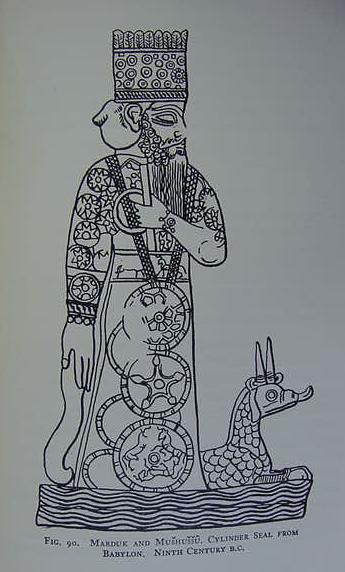
Marduk, the supreme god of Babylon. At his feet the Mushhushshu Serpent-dragon, which he overpowered when he defeated Tiamat, mother of the gods, who sought to destroy the land-dwelling gods.<br />  In this myth the Serpent-dragon was a creature of Tiamat's (for the image cf. p. 301. Stephen Herbert Langdon. The Mythology of All Races- Semitic. Vol. 5. Boston. Marshall Jones Company. 1931).<br />  This drawing is after a 9th century BCE Babylonian cylinder seal. The Assyrians later declared their God Asshur as the god who defeated Tiamat, and Marduk's serpent-dragon was portrayed as accompanying Asshur.<br />  Marduk's robe depicts the heavenly night sky with all its stars.<br />  I believe that the large circular medallions hanging from Marduk's neck are among the few portrayals of the me, the tablets of destinies, in all Assyrian art.<br />  Marduk was also called "the son of the Sun," "the Sun" and "bull-calf of the Sun" (Babylonian amar-utu).<br />  http://www.bibleorigins.net/SerpentDragonMardukAsshur.html

Marduk, the supreme god of Babylon. At his feet the Mushhushshu Serpent-dragon, which he overpowered when he defeated Tiamat, mother of the gods, who sought to destroy the land-dwelling gods.
In this myth the Serpent-dragon was a creature of Tiamat’s (for the image cf. p. 301. Stephen Herbert Langdon. The Mythology of All Races- Semitic. Vol. 5. Boston. Marshall Jones Company. 1931).
This drawing is after a 9th century BCE Babylonian cylinder seal. The Assyrians later declared their God Asshur as the god who defeated Tiamat, and Marduk’s serpent-dragon was portrayed as accompanying Asshur.
Marduk’s robe depicts the heavenly night sky with all its stars.
I believe that the large circular medallions hanging from Marduk’s neck are among the few portrayals of the me, the tablets of destinies, in all Assyrian art.
Marduk was also called “the son of the Sun,” “the Sun” and “bull-calf of the Sun” (Babylonian amar-utu).
http://www.bibleorigins.net/SerpentDragonMardukAsshur.html

These royal names seem to have been reinterpreted in the apkallu-lists: en-me-du-ga, “Lord of the good me;” en-me-galamma, “Lord who perfects me;” en-me-bulùg-gá, “Lord who refines me.”

(Cf. F.A.M. Wiggermann, Mesopotamian Protective Spirits: The Ritual Texts, vol. 1, CM. Groningen, 1992, 77.)

We will return to the names of the significant first and seventh sage in our discussion of Bīt Mēseri below.

The Uruk tablet contains two successive lists: first, the one of the seven apkallus; then, after a clear transition, a new list of ten scholars.

The new list of ten starts with the apkallu Nungalpiriggal who operated during the reign of Enmerkar. We have a similar division into two lists in Bīt Mēseri as well. There we find first a list of seven and then a list of four.

Also in Bīt Mēseri, Nungalpiriggal, operating under Enmerkar, is the first apkallu in the new list. There is a lacuna in the introduction to the second list on the Uruk tablet. Van Dijk restores here “after the flood,” but considers also the possibility “in Uruk,” since Enmerkar was king in Uruk.

The first restoration seems most likely, since the Uruk tablet does not mention cities in any other place. The notice of the flood belongs to the style of the Antediluvian King List, which the Uruk tablet is part of.

It is interesting to notice that also Berossos seems to have started the list of postdiluvian kings with Enmerkar, with the introduction, “after the flood.” Thus, there seems to be a stable tradition in these lists of scholars to start the postdiluvian period with the apkallu operating under Enmerkar, king of Uruk.

This is quite interesting, since it is in opposition to the order of the Sumerian King List, which starts with the dynasty of Kish, and lists Uruk as the second dynasty. Bīt Mēseri indeed includes Kish, but only after Uruk.

The Uruk tablet does not mention Kish, but continues with Gilgamesh as king, who according to the King List ruled in Uruk as well. The reason for this must be that the list of apkallus is generated according to the significance of the sages and only secondarily merged with the King List.

There is a clear division in rank between the scholars of the two lists, although this is expressed differently in Bīt Mēseri and the Uruk tablet. We concentrate first on the Uruk text. All the first seven in the Uruk tablet are designated apkallu, which is the highest honorary title for a wise man, “sage, expert.”

Helge Kvanvig, Primeval History: Babylonian, Biblical, and Enochic: An Intertextual Reading, Brill, 2011, pp. 110-1.

Kvanvig: The Apkallu List from Bīt Mēseri

“Reiner numbers the lines 1’-31’, which covers the lines 9-31 in Weiher’s edition. Borger knew Weiher’s work on the Uruk recension of Bīt Mēseri when he translated the text, even though Weiher’s final edition was published afterwards. We will return to the different aspects of the text later.

  • 1-2: Incantation: Uanna, who completed the plans of heaven and earth;
  • 3-4: Uannedugga, who is given broad understanding;
  • 5: Enmedugga, to whom a good fate is decreed;
  • 6: Enmegalamma, who was born in a house;
  • 7: Enmebulugga, who grew up on a river-flat;
  • 8: Anenlilda, the purification priest from Eridu;
  • 9. Utuabzu, who ascended to heaven;
  • 10-11: the pure carps, the carps from the sea, the seven,
  • 12-13: the seven apkallus, born in the river, who keep in order the plans of heaven and earth.
  • 14-15: Nungalpiriggaldim, the apkallu of Enmerkar, who brought down Ištar from heaven into the sanctuary;
  • 16-17: Piriggalnungal, born in Kiš, who angered the god Iškur / Adad in heaven,
  • 18-19: so he allowed neither rain nor growth in the land for three years;
  • 20-23:Piriggalabzu, born in Adab / Utab, who hung his seal on a “goat-fish” and thereby angered the god Enki / Ea in the fresh water sea, so that a fuller struck him with his own seal;
  • 24-25: the fourth, Lu-Nanna, two-thirds apkallu,
  • 26-27: who expelled a dragon from É-Ninkiagnunna, the temple of Ištar and Šulgi;
  • 28-29: the four apkallus, of human descent, whom the Lord Enki / Ea has endowed with broad understanding.

(Bīt Mēseri III, 1’-29’).

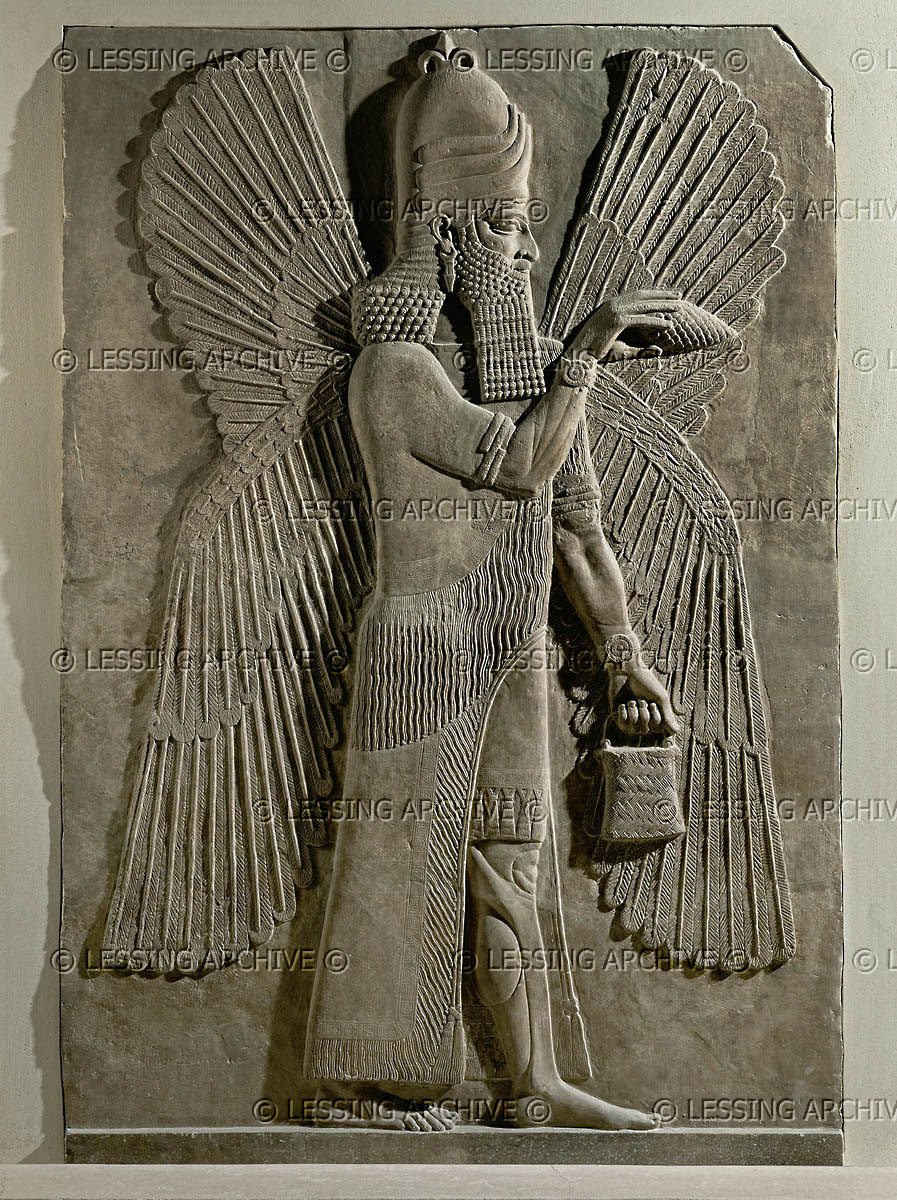
Now compare this Nimrud bas relief from the Louvre: an ummânū sprinkles water with a mullilu cone in his right hand, holding his banduddu bucket in his left. This ummânū wears bracelets with a concentric circular design, and rosettes are not apparent. This ummânū also wears the common horned headdress of Anu, but with three stacked layers of horns. As noted elsewhere, this headdress is surmounted by an object that resembles a partial fleur de lis. From Nimrud, capital of king Ashurnarzipal.  Louvre, AO 19845

Now compare this Nimrud bas relief from the Louvre: an ummânū sprinkles water with a mullilu cone in his right hand, holding his banduddu bucket in his left.
This ummânū wears bracelets with a concentric circular design, and rosettes are not apparent.
This ummânū also wears the common horned headdress of Anu, but with three stacked layers of horns.
As noted elsewhere, this headdress is surmounted by an object that resembles a partial fleur de lis.
From Nimrud, capital of king Ashurnarzipal.
Louvre, AO 19845

We have a stable tradition extending over several hundred years about the names and order of the seven apkallus living before the flood. The list in Bīt Mēseri is the oldest one, and is Neo-Assyrian; the list in Berossos is from around 290; the Uruk list is dated to 164 / 165.

It is, however, clear that the Greek text of Berossos’ Babyloniaca is in no way part of a line of transmission. In this respect Berossos is of interest because his list is a witness to a cuneiform textual tradition that existed in Babylon at this time.

It shows, together with the Uruk tablet and the Babylonia recension of Bīt Mēseri, that the list of antediluvian sages did not only belong to the Assyrians, but was adopted by the Babylonians in later centuries.

The names of the apkallus are not as old as the names of the antediluvian kings. They have similarities with the names of known literary works.

(cf. W.W. Hallo, “On the Antiquity of Sumerian Literature,” JAOS 83 (1963): 167-76, 175f.)

Moreover, three of the sages have names constructed of en-me. Three of the kings in the lists have similar constructions: Enmenluanna, Enmegalanna, Enmeduranna (Enmeduranki). These three names can tentatively be translated as follows: “Lord of the me, man of heaven; Lord of the great me, of heaven; Lord of the me, band of heaven.”

(Cf. Kvanvig, Roots of Apocalyptic, 193, note 109 for a suggested translation of the whole Antediluvian King List, based on D. O. Edzard, “Enmebaragesi von Kiš,” ZA (NF) 19 (43) (1959): 9-26, 18.)

Helge Kvanvig, Primeval History: Babylonian, Biblical, and Enochic: An Intertextual Reading, Brill, 2011, pp. 108-10.

Kvanvig: The Lists of the Seven Apkallus

“There are known three lists of apkallus, two cuneiform and the one in Berossos. The first known cuneiform list of seven apkallus was published by E. Reiner in 1961, and then reedited with new pieces added by R. Borger in 1974.

Already Reiner suggested that the broken tablet belonged to the Neo-Assyrian incantations series Bīt Mēseri, “protected house.” Borger made clear that the list belonged to the third tablet in this series, and that there are traces of two more lists of a similar kind.

(E. Reiner, “The Etiological Myth of the ‘Seven Sages’,” Orientalia (NS) 30 (1961): 1-11. Borger, “Die Beschwörungsserie Bit Meseri,” 192-3.)

The three types of apkallū are portrayed, with the human ummânū at far left, the bird-apkallū type in the middle, and the antediluvian purādu-fish type at far right.  The human ummânū is attested in the Uruk List of Kings and Sages, while other references to bird-apkallū are legion, as documented in Wiggermann and other authorities. The purādu-fish apkallū is principally attested in Berossus, though other authorities confirm them, as well.

The three types of apkallū are portrayed, with the human ummânū at far left, the bird-apkallū type in the middle, and the antediluvian purādu-fish type at far right.
The human ummânū is attested in the Uruk List of Kings and Sages, while other references to bird-apkallū are legion, as documented in Wiggermann and other authorities. The purādu-fish apkallū is principally attested in Berossus, though other authorities confirm them, as well.

There are found two copies of of the apkallu list from Bīt Mēseri in late Babylonia. A. Cavigneaux published a tiny little fragment in 1979. In 1983, E. von Weiher published the transliteration of the full list as part of an Uruk recension of Bīt Mēseri.

The tablets were found in the house of what was most likely a priest specializing in astrology and divination. They can be dated to the 4-3 century, which means about the same time as Berossos wrote his Babyloniaca.

That there existed a Babylonian recension of the apkallu list in Bīt Mēseri is important, because it demonstrates that the tradition contained in this list was not an isolated Assyrian phenomenon.

As already stated, the Antediluvian King List from Uruk, W 20 030, 7, published by van Dijk in 1962, contained both seven kings and seven parallel apkallus. Berossos also paralleled kings and apkallus, but unlike the Uruk tablet it has one apkallu parallel to the first king, a=one to the fourth, four to the sixth, and one to the seventh.

Fish-Apkallū statuettes of the type that were buried in the foundations of buildings.  The so-called parādu-fish apkallū were the seven antediluvian sages of Sumeria.

Fish-Apkallū statuettes of the type that were buried in the foundations of buildings.
The so-called parādu-fish apkallū were the seven antediluvian sages of Sumeria.

The names of the apkallus and their successions are identical in Bīt Mēseri and the Uruk tablet, with small variations in spelling. We render the names in the Sumerian form they have in the Uruk tablet:

  • Uan
  • Uandugga
  • Enmedugga
  • Enmegalamma
  • Enmebulugga
  • Anenlilda
  • Utuabzu

There is a correspondence to the Greek names in Berossos, but it demands both scholarly quibbling and a bit of creative imagination to explain how exactly the Sumerian words were transformed to Greek ones. We have to bear in mind that it is far from certain that we have Berossos’s own spellings. His text has gone through many hands.

In Bīt Mēseri the list of the seven apkallus is succeeded by a list of four apkallus and built into an incantation. For the sense of convenience we bring here an English translation based on Reiner’s English edition of a part of the list and Weiher’s German edition of the full list.”

Helge Kvanvig, Primeval History: Babylonian, Biblical, and Enochic: An Intertextual Reading, Brill, 2011, pp. 107-8.

Lenzi: The Mythology of Scribal Succession

“The text of the ULKS is as follows:

“During the reign of Ayalu, the king, Adapa was sage.

During the reign of Alalgar, the king, Uanduga was sage.

During the reign of Ameluana, the king, Enmeduga was sage.

During the reign of Amegalana, the king, Enmegalama was sage.

During the reign of Enmeušumgalana, the king, Enmebuluga was sage.

During the reign of Dumuzi, the shepherd, the king, Anenlilda was sage.

During the reign of Enmeduranki, the king, Utuabzu was sage.

After the flood,(?) during the reign of Enmerkar, the king, Nungalpirigal was sage, whom Ištar brought down from heaven to Eana. He made the bronze lyre, whose . . . (were) lapis lazuli, according to the technique of Ninagal (Ninagal is Ea’s smith). The lyre was placed before Anu . . ., the dwelling of (his) personal god.?

During the reign of Gilgamesh, the king,? Sin-leqi-unnini was scholar.

During the reign of Ibbi-Sin, the king, Kabti-ili-Marduk was scholar.

During the reign of Išbi-Erra, the king, Sidu, a.k.a. Enlil-ibni, was scholar.

During the reign of Abi-ešuh, the king, Gimil-Gula and Taqiš-Gula were the scholars.

During the reign of . . ., the king, Esagil-kin-apli was scholar.

During the reign of Adad-apla-iddina, the king, Esagil-kin-ubba (this name … despite chronological problems, is probably to be identified with Saggil-kina-ubbib, the author of The Babylonian Theodicy; see van Dijk, “Die Inschriftenfunde,” 51) was scholar.

During the reign of Nebuchadnezzar, the king, Esagil-kin-ubba was scholar.

During the reign of Esarhaddon, the king, Aba-Enlil-dari was scholar, whom the Arameans call Ahiqar.

. . . Nikarchos.

Tablet of Anu-belšunu, son of Nidintu-Anu, descendant of Sin-leqi-unnini, the lamentation-priest of Anu and Antu. An Urukean. (Copied) by his own hand. Uruk, 10 Ayyar, 147th year of Antiochus, the king.

The one who reveres Anu will not carry it off.”

Gaining a historical perspective on the scholarly genealogical tradition attested in the text of ULKS is the first element of contextualizing our text. Clearly, the ULKS is unique.

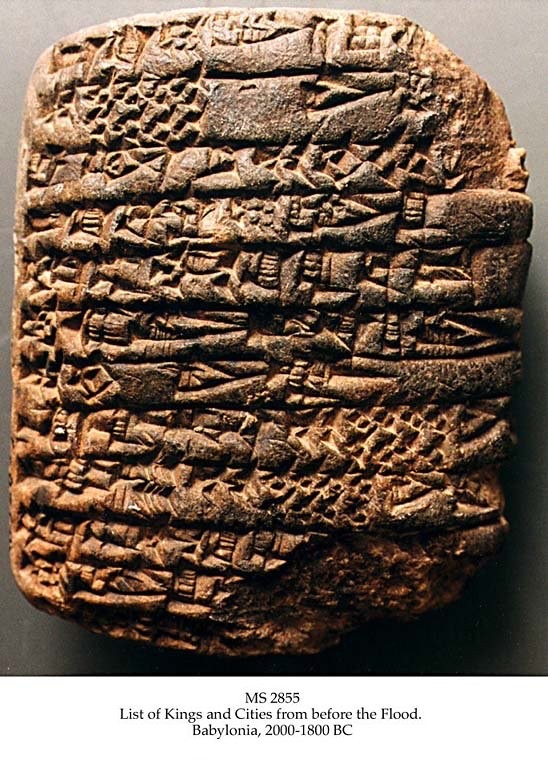
 Text:  "IN ERIDU: ALULIM RULED AS KING 28,800 YEARS. ELALGAR RULED 43,200 YEARS. ERIDU WAS ABANDONED. KINGSHIP WAS TAKEN TO BAD-TIBIRA. AMMILU'ANNA THE KING RULED 36,000 YEARS. ENMEGALANNA RULED 28,800 YEARS. DUMUZI RULED 28,800 YEARS. BAD-TIBIRA WAS ABANDONED. KINGSHIP WAS TAKEN TO LARAK. EN-SIPA-ZI-ANNA RULED 13,800 YEARS. LARAK WAS ABANDONED. KINGSHIP WAS TAKEN TO SIPPAR. MEDURANKI RULED 7,200 YEARS. SIPPAR WAS ABANDONED. KINGSHIP WAS TAKEN TO SHURUPPAK. UBUR-TUTU RULED 36,000 YEARS. TOTAL: 8 KINGS, THEIR YEARS: 222,600" MS in Sumerian on clay, probably Larsa Babylonia, 2000-1800 BC, 1 tablet, 8,1x6,5x2,7 cm, single column, 26 lines in cuneiform script. 5 other copies of the Antediluvian king list are known only: MS 3175, 2 in Oxford: Ashmolean Museum, one is similar to this list, containing 10 kings and 6 cities, the other is a big clay cylinder of the Sumerian King List, on which the kings before the flood form the first section, and has the same 8 kings in the same 5 cities as the present.  A 4th copy is in Berkeley: Museum of the University of California, and is a school tablet. A 5th tablet, a small fragment, is in Istanbul. The list provides the beginnings of Sumerian and the world’s history as the Sumerians knew it. The cities listed were all very old sites, and the names of the kings are names of old types within Sumerian name-giving. Thus it is possible that correct traditions are contained, though the sequence given need not be correct. The city dynasties may have overlapped. It is generally held that the Antediluvian king list is reflected in Genesis 5, which lists the 10 patriarchs from Adam to Noah, all living from 365 years (Enoch) to 969 years (Methuselah), altogether 8,575 years.  It is possible that the 222,600 years of the king list reflects a more realistic understanding of the huge span of time from Creation to the Flood, and the lengths of the dynasties involved.  The first of the 5 cities mentioned , Eridu, is Uruk, in the area where the myths place the Garden of Eden, while the last city, Shuruppak, is the city of Ziusudra, the Sumerian Noah. Jöran Friberg: A remarkable Collection of Babylonian Mathematical Texts. Springer 2007.  Sources and Studies in the History of Mathematics and Physical Sciences.  Manuscripts in the Schøyen Collection, vol. 6, Cuneiform Texts I. pp. 237-241. Andrew George, ed.: Cuneiform Royal Inscriptions and Related Texts in the Schøyen Collection, Cornell University Studies in Assyriology and Sumerology, vol. 17,  Manuscripts in the Schøyen Collection, Cuneiform texts VI. CDL Press, Bethesda, MD, 2011, text 96, pp. 199-200, pls. LXXVIII-LXXIX. Andrew E. Hill & John H. Walton: A survey of the Old Testament, 3rd ed., Grand Rapids, Mi., Zondervan Publ. House, 2009, p. 206.  Zondervan Illustrated Bible, Backgrounds, Commentary. John H. Walton, gen. ed. Grand Rapids, Mich., Zondervan, 2009, vol 1, p. 482, vol. 5, p. 398. Babylonia 2000 - 1800 BC

MS 2855
Text:
“IN ERIDU: ALULIM RULED AS KING 28,800 YEARS. ELALGAR RULED 43,200 YEARS. ERIDU WAS ABANDONED. KINGSHIP WAS TAKEN TO BAD-TIBIRA. AMMILU’ANNA THE KING RULED 36,000 YEARS. ENMEGALANNA RULED 28,800 YEARS. DUMUZI RULED 28,800 YEARS. BAD-TIBIRA WAS ABANDONED. KINGSHIP WAS TAKEN TO LARAK. EN-SIPA-ZI-ANNA RULED 13,800 YEARS. LARAK WAS ABANDONED. KINGSHIP WAS TAKEN TO SIPPAR. MEDURANKI RULED 7,200 YEARS. SIPPAR WAS ABANDONED. KINGSHIP WAS TAKEN TO SHURUPPAK. UBUR-TUTU RULED 36,000 YEARS. TOTAL: 8 KINGS, THEIR YEARS: 222,600”
MS in Sumerian on clay, probably Larsa Babylonia, 2000-1800 BC, 1 tablet, 8,1×6,5×2,7 cm, single column, 26 lines in cuneiform script.
5 other copies of the Antediluvian king list are known only: MS 3175, 2 in Oxford: Ashmolean Museum, one is similar to this list, containing 10 kings and 6 cities, the other is a big clay cylinder of the Sumerian King List, on which the kings before the flood form the first section, and has the same 8 kings in the same 5 cities as the present.
A 4th copy is in Berkeley: Museum of the University of California, and is a school tablet. A 5th tablet, a small fragment, is in Istanbul.
The list provides the beginnings of Sumerian and the world’s history as the Sumerians knew it. The cities listed were all very old sites, and the names of the kings are names of old types within Sumerian name-giving. Thus it is possible that correct traditions are contained, though the sequence given need not be correct. The city dynasties may have overlapped.
It is generally held that the Antediluvian king list is reflected in Genesis 5, which lists the 10 patriarchs from Adam to Noah, all living from 365 years (Enoch) to 969 years (Methuselah), altogether 8,575 years.
It is possible that the 222,600 years of the king list reflects a more realistic understanding of the huge span of time from Creation to the Flood, and the lengths of the dynasties involved.
The first of the 5 cities mentioned, Eridu, is Uruk, in the area where the myths place the Garden of Eden, while the last city, Shuruppak, is the city of Ziusudra, the Sumerian Noah.
Jöran Friberg: A Remarkable Collection of Babylonian Mathematical Texts. Springer 2007.
Sources and Studies in the History of Mathematics and Physical Sciences.
Manuscripts in the Schøyen Collection, vol. 6, Cuneiform Texts I. pp. 237-241. Andrew George, ed.: Cuneiform Royal Inscriptions and Related Texts in the Schøyen Collection, Cornell University Studies in Assyriology and Sumerology, vol. 17,
Manuscripts in the Schøyen Collection, Cuneiform texts VI. CDL Press, Bethesda, MD, 2011, text 96, pp. 199-200, pls. LXXVIII-LXXIX.
Andrew E. Hill & John H. Walton: A Survey of the Old Testament, 3rd ed., Grand Rapids, MI., Zondervan Publ. House, 2009, p. 206.
Zondervan Illustrated Bible, Backgrounds, Commentary. John H. Walton, gen. ed. Grand Rapids, MI., Zondervan, 2009, vol 1, p. 482, vol. 5, p. 398.
Babylonia
2000 – 1800 BC
http://www.schoyencollection.com/history-collection-introduction/sumerian-history-collection/king-cities-before-flood-ms-2855

It lists seven well-known antediluvian kings, each paired with his corresponding apkallū-sage, then a single post-diluvian king-apkallū pair, followed by eight post-diluvian kings, each with his corresponding ummânu-scholar (in one case, two scholars).

The list is arranged from start to finish in what one must recognize as an attempt at chronological order. Focusing on the ummânū, the implication of the text is rather clear: the human, post-diluvian scholars are the direct professional descendants of the earlier semi-divine apkallū.

In a previous study I called this traditional genealogical relationship the “mythology of scribal succession.”

Alan Lenzi, The Uruk List of Kings and Sages and Late Mesopotamian ScholarshipJANER 8.2, Brill, Leiden, 2008. pp. 140-3.

Editorial Note on the Apkallu and the Roadmap Ahead

I am breaking the narrative stream to speak directly to the process emerging from our reading on the apkallū, the antediluvian and postdiluvian sages of ancient Mesopotamia.

If you are reading along over my shoulder, you noticed that we digressed from Martin Lang, “Mesopotamian Early History and the Flood Story,” in a post titled On the Date of the Flood.

Martin Lang wrote:

“Berossos’ own knowledge of primordial kings probably goes back to sources that were available in Hellenistic times. The Sumerian King List itself was still known in the Seleucid era, or rather versions of king lists that echo, structurally and stylistically, their ancient forerunners from the early second millennium.

In matching up the primordial kings with the seven sages, the apkallū, Berossos once again works in the vein of contemporary scholars, who demonstrably constructed lists with kings and apkallū in order to advertise their own importance, and the primordial roots of their knowledge, as Alan Lenzi has recently shown.”

I updated that post to include a link to Alan Lenzi, “The Uruk List of Kings and Sages and Late Mesopotamian Scholarship,” JANER 8.2, 2008, which is serialized and linked in posts below.

I also changed the link to the Sumerian King List to point to the beautiful 1939 edition by Thorkild Jacobsen generously published by the University of Chicago Press, available for free download off the web.

We then dipped into Anne Draffkorn Kilmer, “The Mesopotamian Counterparts of the Biblical Nephilim,” in Francis I. Andersen, et al, eds., Perspectives on Language and Text: Essays and Poems in Honor of Francis I. Andersen’s Sixtieth Birthday, 1985, in a post titled On the Apkallū.

This is where I drilled in hard on the apkallū, incorporating bas reliefs and figurines held at the Louvre and the British Museum. Out of numerous posts addressing the apkallū, this one is well-illustrated, and lushly hyperlinked.

Moreover, Anne Kilmer synthesized the supporting research on the apkallū at the time of writing very effectively, so if you are overwhelmed by the other articles, just read this one. It goes without saying that you should not be intimidated by this academic literature. I have made it as readable and accessible as I can.

Yes, there is a lot of it. As I excavate the academic literature on the apkallū the hard way, mining references from footnote after footnote, I get a sense of what it might be like, to be an academic Assyriologist rather than an autodidact.

I do not include everything that I find. I assess and include just those pieces which accrue gravitas in that greater academic community. If you see glaring omissions, please let me know. This note is shaping up to be an academic survey of the literature on the apkallū, and it may save others treading these same paths some time.

Fair warning: our continuing digression into the apkallu will be deep.

As I complete serialization of source texts, I will include links to the posts beneath their citation below. These sources are sorted by date, so we can track the evolution of academic thinking on the apkallū. Our digression includes excerpts from:

After we complete our deep dive into the apkallu, we will return to the Sumerian King List, then resume with Berossos. This is the roadmap ahead.

Editorial note: In some cases citations above which are not followed by links in the bulleted list are internet dry holes, no digital versions are available. In other cases, links are to Google Books editions, which often limit visible pages. Google’s intent is to sell electronic versions of the texts that they scan.

Under these circumstances, I end up rekeying entire articles, at ruinous waste of time. If you have a moment, please send a sweet nastygram to Google asking them to post free and complete eBooks as they continue their vast project to digitize the entirety of human knowledge.

In other cases, I simply have not yet reviewed the articles and posted them. If you are following this project, you see that I post updates nearly every day. Stay tuned.

My purpose in publishing Samizdat is to highlight excerpts from the great books, mining synchronicities from legends and myths. As I point out in the About page, the Deluge was an historical event for the ancient Sumerians.

I now need to update that page, incorporating the research that we have already completed on the Sumerian King List, setting up a future digression into the concept of the Great Year, which Berossos associated with traditions of a Conflagration and the Deluge.

If you wondered where we were going, I wrote this for you.

 Updated 20 November 2015, 23:39 hrs.