
Selz: On Sacred Marriage
“This passage reminds one of the old Mesopotamian concept—and I am convinced it is a Mesopotamian concept, not a mere invention of modern scholarship—according to which a (mythical) ruler is thought to cohabit with a goddess or with her priestly incarnation.

Hierogamus, bed and couple. Period of the Amorite dynasties, early 2nd millennium BCE. Baked clay, H: 11,3 cm. AO 8662, Louvre.
http://www.lessingimages.com/viewimage.asp?i=08021112+&cr=413&cl=1#
(This is a much disputed issue, best known under the heading “Sacred Marriage” concept. What is interesting here is the feature of a divine-human interaction in the sexual life and the consequences thereof. We are not concerned here with the hypothesis of a purely metaphorical interpretation or with a possible actualization in an alleged ritual.

Couple on a bed (hierogamus). From Susa, 14th-12th BCE. Terracotta, 11,2 x 5,8 cm. SB 7979, Louvre.
http://www.lessingimages.com/viewimage.asp?i=08021158+&cr=523&cl=1#
For a comparative evaluation of this topic see P. Lapinkivi, The Sumerian Sacred Marriage in the Light of Comparative Evidence (SAAS 15; Helsinki: Neo-Assyrian Text Corpus Project, 2004.)
See further E. Cancik-Kirschbaum, “Hierogamie-Eine Skizze zum Sachstand in der Altorientalistik,” in Gelebte Religionen: FS Hartmut Zinser (ed. H. Piegeler, I. Pohl, and S. Rademacher; Würzburg: Königshausen & Neumann, 2004), pp. 65-72.

Couple embracing (hierogamus). From Susa, 14th-12th BCE. Terracotta, 11,3 x 6 cm. SB 6609, Louvre.
http://www.lessingimages.com/viewimage.asp?i=08021159+&cr=569&cl=1#
G.J. Selz, “The Divine Prototypes,” in Religion and Power: Divine Kingship in the Ancient World and Beyond (ed. N. Brisch; Oriental Institute Seminars 4; Chicago: Oriental Institute of the University of Chicago, 2008), pp. 13-31.
Accordingly, the kings of the Ur III empire depict themselves in their hymns as divine scions, as sons of the mythical ruler Lugalbanda and the Goddess Ninsu(mu)na-k. In the present context it is not without interest that these kings were thus becoming “brothers of Gilgamesh,” profiting somehow from the hero’s legendary fame.

Bed with a geometrical pattern, bed with a couple embracing (hierogamus), both from Susa, Iran, 14th-12th BCE SB 11206, geometrical pattern, terracotta 3,1 x 11,8 cm. SB 5888, bed with couple, terracotta, 3 x 9,5 cm, Louvre.
http://www.lessingimages.com/viewimage.asp?i=08021160+&cr=691&cl=1#
The divine sonship, however, can be traced back to the middle of the third millennium. An Old Sumerian ruler of the south Mesopotamian city state Lagash depicts himself in his text as follows:
“(The god) [Ni]n[gir]su-k [imp]lanted the [semen] for (the ruler) E’[a]na-tum in the [wom]b . . . rejoiced over [E’anatum]. (The goddess) Inana-k accompanied him, named him “In the E’ana (temple) of Inana-k from (the sacred precinct) Ibgal I bring him (= E’ana-Inana-lbgal-akak-atum)” and set him on the legitimising knees of (the mother goddess) Ninchursag(a). Ninchursag(a) [offered him] her legitimising breast.”
(Ean 1, 4:9-12 (H. Steible, ed., Die altsumerische Bau-und Weihinschriften [2 vols.; Freiburger altorientalische Studien 5; Wiesbaden: Steiner, 1982], pp. 1:122) RIME 1.9.3.1, 4:9-12.
See D. Frayne, ed., Presargonic Period (2700-2350 BCE) (RIME 1; Toronto: University of Toronto Press, 2008), pp. 129-30.)
“Ningirsu-k rejoiced over E’anatum, semen implanted into the womb by Ningirsu-k. Ningirsu-k laid his span upon him, for (a length of) five forearms he set his forearm upon him: (he measured) five forearms (cubits), one span! (to the reconstructed measurements of this period ca. 2.72 meters). Ningirsu-k, out of his great joy, [gave him] the kin[gship of Lagash].”
(Ean. 1, 5:1-5 H. Steible, Die altsumerischen Bau-und Weihinschriften, 1:123) = RIME 1.9.3.1 (Frayne, Presargonic Period, p. 129).
Hence, the ruler is the one “who has strength,” a precondition for his successful rule.
The aforementioned size of 2.72 meters makes just a small giant. However, this size is an outward sign designating someone who transgresses human measurements and norms.
Accordingly it became possible to attribute to such an extraordinary ruler a sort of functional divinity, as can be corroborated by several additional arguments.
We can therefore say that the ruler is perceived as an Avatar, a manifestation of the state god Ningirsu-k.”
Gebhard J. Selz, “Of Heroes and Sages–Considerations of the Early Mesopotamian Background of Some Enochic Traditions,” in Armin Lange, et al, The Dead Sea Scrolls in Context, v. 2, Brill, 2011, pp. 795-6.

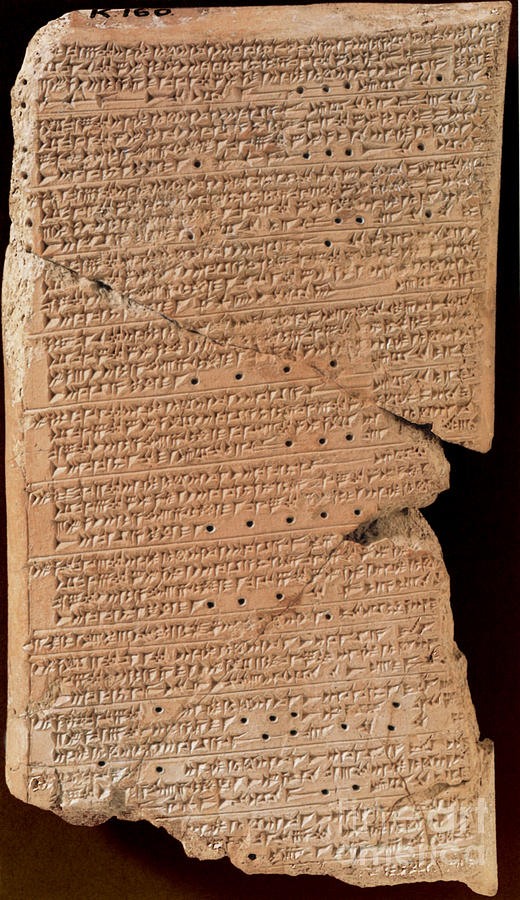






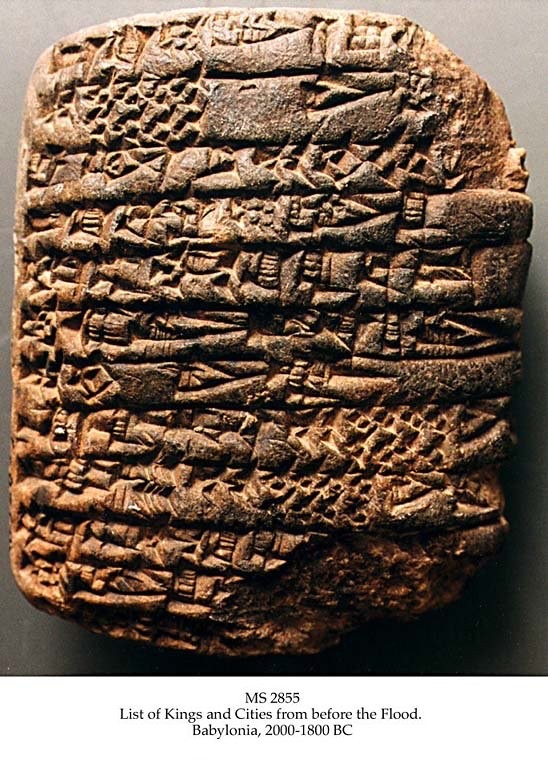
![The relevant lines are quoted below in a translation by Bert van der Spek.
[Column 5] 4 For two years [he will exercise kingship]. [1]. 5 That king a eunuch [will murder]. 6 A certain prince [......] [2] 7 will set out and [seize] the thr[one] 8 Five years [he will exercise] king[ship] 9 Troops of the land of Hani [......] [3] 10 will set out a[nd? .. ]./-ship?\ th[ey will? ...] 11 [his] troop[s they will defeat;] 12 booty from him they will take [and his spoils] 13 they will plunder. Later [his] tr[oops ...] 14 will assemble and his weapons he will ra[ise (...)] 15 Enlil, Šamaš and [Marduk(?)] [4] 16 will go at the side of his army [(...);] 17 the overthrow of the Hanaean troops he will [bring about]. 18 His extensive booty he will car[ry off and] 19 into his palace he [will bring it] 20 The people who had [experienced] misfortune 21 [will enjoy] well-being. 22 The heart of the land [will be happy] 23 Tax exemption [he will grant to Babylonia]
http://www.livius.org/aj-al/alexander/alexander_t49.html](https://therealsamizdat.com/wp-content/uploads/2015/08/dynastic-prophecy-bm40623_cols_vi_v.jpg)


![AM-102 ; No. #1 (K4023) British Museum of London
Tablet K.4023 COL. I [Starting on Line 38] . . . Root of caper which (is) on a grave, root of thorn (acacia) which (is) on a grave, right horn of an ox, left horn of a kid, seed of tamarisk, seed of laurel, Cannabis, seven drugs for a bandage against the Hand of a Ghost thou shalt bind on his temples. FOOTNOTES: [1] - The American Journal of Semitic Languages and Literatures, Vol. 54, No. 1/4 (Oct., 1937), pp. 12-40; Assyrian Prescriptions for the Head By R. Campbell Thompson
http://antiquecannabisbook.com/chap2B/Assyria/K4023.htm](https://therealsamizdat.com/wp-content/uploads/2015/07/k4023-antdiluvian-medical-text.jpg)







 Samizdat

