Samizdat

Publishing the Forbidden. All Rights Reserved. © Samizdat 2014-2026.

Category: Uncategorized

Eco: The Indo-European Hypothesis, 2

kircher_079

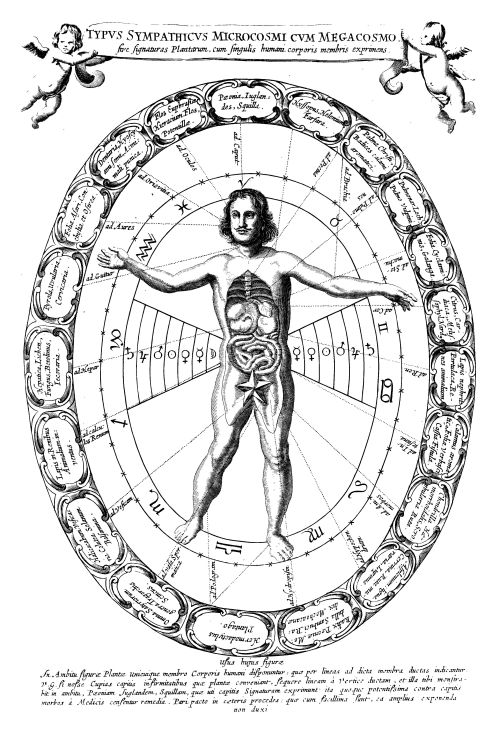
Athanasius Kircher (1602-80), sympathies between the microcosm and the megacosm, from Mundus subterraneus, 1665, vol. 2, p.406. Courtesy of Stanford University and the University of Oklahoma Libraries. This work is in the public domain in its country of origin and other countries and areas where the copyright term is the author’s life plus 100 years or less. 

“But are we really able to say that with the birth of the modern science of linguistics the ghost of Hebrew as the holy language had finally been laid to rest? Unfortunately not. The ghost simply reconstituted itself into a different, and wholly disturbing, Other.

As Olender (1989, 1993) has described it, during the nineteenth century, one myth died only to be replaced by another.

With the demise of the myth of linguistic primacy, there arose the myth of the primacy of a culture–or of a race. When the Hebrew language and civilization was torn down, the myth of the Aryan races rose up to take its place.

The reality of Indo-European was only virtual; yet it was still intrusive. Placed face to face with such a reality, Hebrew receded to the level of metahistory. It became a symbol.

At the symbolic level, Hebrew ranged from the linguistic pluralism of Herder, who celebrated it as a language that was fundamentally poetic (thus opposing an intuitive to a rationalistic culture), to the ambiguous apology of Renan, who–by contrasting Hebrew as the tongue of monotheism and of the desert to Indo-European languages (with their polytheistic vocation)–ends up with oppositions which, without our sense of hindsight, might even seem comic: the Semitic languages are incapable of thinking in terms of multiplicity, are unwilling to countenance abstraction; for this reason the Semitic culture would remain closed to scientific thinking and devoid of a sense of humor.

Unfortunately, this is not just a story of the gullibility of scientists. We know only too well that the Aryan myth had political consequences that were profoundly tragic. I have no wish to saddle the honest students of Indo-European with blame for the extermination camps, especially as–at the level of linguistic science–they were right.

It is rather that, throughout this book, we have been sensitive to side effects. And it is hard not to think of these side effects when we read in Olender the following passage from the great linguist, Adolphe Pictet, singing this hymn to Aryan culture:

“In an epoch prior to that of any historical witnesses, an epoch lost in the night of time, a race, destined by providence to one day rule the entire world, slowly grew in its primitive birthplace, a prelude to its brilliant future.

Privileged over all others by the beauty of their blood, by their gifts of intelligence, in the bosom of a great and severe nature that would not easily yield up its treasures, this race was summoned from the very beginning to conquer. [ . . . ]

Is it not perhaps curious to see the Aryas of Europe, after a separation of four or five thousand years, close the circle once again, reach their unknown brothers in India, dominate them, bring to them the elements of a superior civilization, and then to find ancient evidence of a common origin?”

(Les origines indo-européennes ou les Aryas primitifs, 1859-63: III, 537, cited in Olender 1989: 130-9).

At the end of a thousand year long ideal voyage to the East in search of roots, Europe had at last found some ideal reasons to turn that virtual voyage into a real one–for the purposes not of intellectual discovery, however, but of conquest.

It was the idea of the “white man’s burden.” With that, there was no longer any need to discover a perfect language to convert old or new brothers. It was enough to convince them to speak an Indo-European language, in the name of a common origin.”

Umberto Eco, The Search for the Perfect Language, translated by James Fentress, Blackwell. Oxford, 1995, pp. 105-6.

Eco: The Indo-European Hypothesis

kircher_011

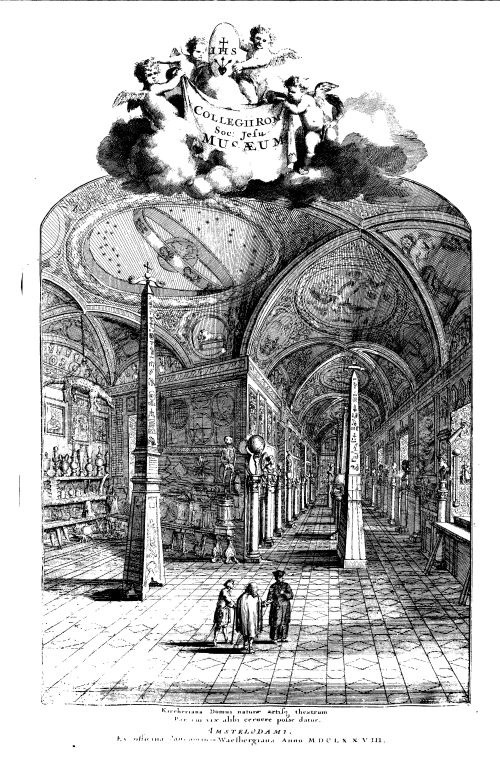
Athanasius Kircher (1602-80), Kircher’s museum at the Collegio Romano, frontispiece of Giorgio de Sepibus, Romani Collegii Musaeum Celeberrimum, Rome, 1678. Courtesy of Stanford University and the Zymoglyphic Museum. This work is in the public domain in its country of origin and other countries and areas where the copyright term is the author’s life plus 100 years or less. 

“Between the eighteenth and the nineteenth centuries a new perspective opened. The battle for Hebrew had been definitively lost. It now seemed clear that, even had it existed, linguistic change and corruption would have rendered the primitive language irrecuperable.

What was needed instead was a typology in which information about known languages might be codified, family connections established, and relations of descent traced. We are here at the beginning of a story which has nothing to do with our own.

In 1786, in the Journal of the Asiatick Society of Bombay, Sir William Jones announced that

“The Sanskrit language, whatever be its antiquity, is of a wonderful structure; more perfect than Greek, more copious than Latin, and more exquisitely refined than either, yet bearing to both of them a stronger affinity, both in the root of verbs and in the forms of grammar [ . . . ]

No philosopher could examine them all three, without believing them to have sprung from some common source, which, perhaps, no longer exists.” (“On the Hindus,” The Works of Sir William Jones, III, London 1807, 34-5).

Jones advanced the hypothesis that Celtic, Gothic and even ancient Persian were all related to Sanskrit. Note that he spoke not only of similar verb roots, but also of similar grammatical structures. We have left behind the study of lexical analogies, and are beginning a research on syntactic similarities and phonetic affinities.

Already in 1653, John Wallis (Grammatica linguae anglicae) had posed the problem of how one might establish the relation between a series of French words–guerre, garant, gard, gardien, garderobe, guise–and the English series–war, warrant, ward, warden, wardrobe, wise–by proving the existence of a constant shift from g to w.

Later in the nineteenth century, German scholars, such as Friedrich and Wilhelm von Schlegel and Franz Bopp, deepened the understanding of the relation between Sanskrit, Greek, Latin, Persian and German.

They discovered a set of correspondences in the conjugation of the verb to be in all these languages.

Gradually they came to the conclusion that not only was Sanskrit the original language of the group, its Ursprache, but that there must have existed, for this entire family, an even more primitive proto-language from which they all, Sanskrit included, had derived. This was the birth of the Indo-European hypothesis.

Through the work of Jakob Grimm (Deutsche Grammatik, 1818) these insights became organized in a scientific fashion. Research was based on the study of sound shifts (Lautverschiebungen) which traced how from the Sanskrit p were generated pous-podos in Greek, pes-pedes in Latin, fotus in Gothic, and foot in English.

What had changed between the utopian dream of an Adamic language and the new perspective? Three things. Above all, scholars had elaborated a set of scientific criteria.

In the second place, the original language no longer seemed like an archeological artifact that, one day, might actually be dug up. Indo-European was an ideal point of scholarly reference only.

Finally, Indo-European made no claim to being the original language of all humanity; it merely represented the linguistic root for just one family–the Aryan.”

Umberto Eco, The Search for the Perfect Language, translated by James Fentress, Blackwell. Oxford, 1995, pp. 103-5.

Eco: The Nationalistic Hypothesis, 4

kircher_058

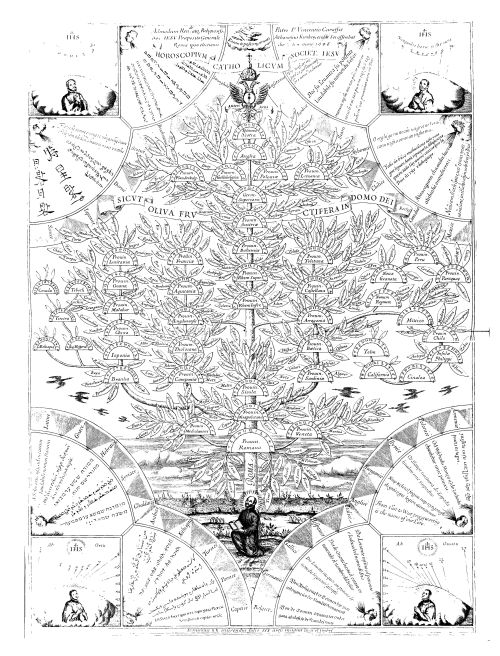
Athanasius Kircher (1602-80), Universal horoscope of the Society of Jesus, or the Jesuits. Comprising an olive tree as a sundial, the time in each Jesuit province can be read. From Ars Magna Lucis et Umbrae, 1646, p. 553, courtesy of Herzog August Bibliothek, and Stanford University. This work is in the public domain in its country of origin and other countries and areas where the copyright term is the author’s life plus 100 years or less.

“In the British context, the Celtic hypothesis had naturally quite a different meaning; it meant, for one thing, an opposition to the theory of a Germanic origin.

In the eighteenth century the thesis of Celtic primacy was supported by Rowland Jones, who argued “no other language, not even English, shows itself to be so close to the first universal language, and to its natural precision and correspondence between words and things, in the form and in the way in which we have presented it as universal language.”

The English language is

“the mother of all the western dialects and the Greek, elder sister of all orientals, and in its concrete form, the living language of the Atlantics and of the aborigines of Italy, Gaul and Britain, which furnished the Romans with much of their vocables . . . The Celtic dialects and knowledge derived their origin from the circles of Trismegistus, Hermes, Mercury or Gomer . . . [and] the English language happens more peculiarly to retain its derivation from that purest fountain of languages (“Remarks on the Circles of Gomer,” The Circles of Gomer, 1771: II, 31-2).”

Etymological proofs follow.

Such nationalistic hypotheses are comprehensible in the seventeenth and eighteenth centuries, when the larger European states began to take form, posing the problem of which of them was to be supreme on the continent.

In this period, spirited claims to originality and superiority arise no longer from the visionary quest for universal peace, but–whether their authors realized this or not–from concrete reasons of state.

In whatever case, and whatever their nationalist motivations, as a result of what Hegel calls the astuteness of reason, the furious search for etymologies, which was supposed to prove the common descent of every living language, eventually ended by creating the conditions in which serious work in comparative linguistics might become more profitable.

As this work expanded, the phantom of an original mother tongue receded more and more into the background, remaining, at most, a mere regulative hypothesis. To compensate for the loss, there arose a new and pressing need to establish a typology of fundamental linguistic stocks.

Thus, in this radically altered perspective, the search for the original mother tongue transformed itself into a general search for the origins of a given language.

The need to document the existence of the primeval language had resulted in theoretical advances such as the identification and delimitation of important linguistic families (Semitic and Germanic), the elaboration of a model of linguistic descent with the inheritance of common linguistic traits, and, finally, the emergence of an embryonic comparative method typified in some synoptic dictionaries. (Simone 1990: 331).”

Umberto Eco, The Search for the Perfect Language, translated by James Fentress, Blackwell. Oxford, 1995, pp. 102-3.

Eco: The Nationalistic Hypothesis, 3

kircher_062

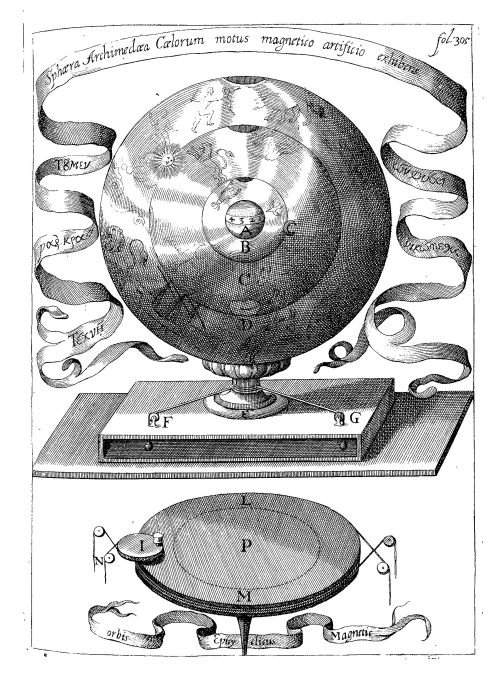
Athanasius Kircher (1602-80), his interpretation of the legendary sphere of Archimedes, using magnets to simulate the rotation of the planets. From Magnes, sive de Arte Magnetica, 1643, p. 305. Courtesy of Stanford University. This work is in the public domain in its country of origin and other countries and areas where the copyright term is the author’s life plus 100 years or less.  


“Ideas similar to these were expressed by Schottel (Teutsche Sprachkunst, 1641), who celebrated the German language as the one which, in its purity, remained closest to the language of Adam (adding to this the idea that language was the expression of the native genius of a people).

Others even claimed that Hebrew had derived from German. They repeated the claim that their language had descended from Japheth, who, in this rendition, had supposedly settled in Germany.

The name of the exact locality changed, of course, to fit the needs of different authors; yet Japheth’s grandson, Ascenas, was said to have lived in the principality of Anhalt even before the confusio. There he was the progenitor of Arminius and Charlemagne.

In order to understand these claims, one must take into account the fact that, during the sixteenth and seventeenth centuries, Protestant Germany rallied to the defense of the language of Luther’s Bible.

It was in this period that claims to the linguistic primacy of German arose, and many of these assumptions “should be seen within the context of Germany’s political fragmentation after the Thirty Years War. Since the German nation was one of the main forces capable of uniting the nation, its value had to be emphasized and the language itself had to be liberated from foreign influences” (Faust 1981: 366).

Leibniz ironized on these and other theories. In a letter of 7 April 1699 (cited in Gensini 1991: 113) he ridiculed those who wished to draw out everything from their own language–Becanus, Rudbeck, a certain Ostroski who considered Hungarian as the mother tongue, an abbé Francois and Pretorius, who did respectively the same for Breton and Polish.

Leibniz concluded that if one day the Turks and Tartars became as learned as the Europeans, they would have no difficulty finding ways to promote their own idioms to the rank of mother tongue for all humanity.

Despite these pleasantries, Leibniz was not entirely immune himself to nationalist temptations. In his Nouveaux essais (III, 2) he made a good-natured jibe at Goropius Becanus, coining the verb goropiser for the making of bad etymologies.

Still, he conceded, Becanus might not always have been entirely wrong, especially when he recognized in the Cimbrian, and, consequently, in Germanic, a language that was more primitive than Hebrew.

Leibniz, in fact, was a supporter of the Celto-Scythian hypothesis, first advanced in the Renaissance (cf. Borst 1957-63: III/1, iv, 2; Droixhe 1978).

In the course of over ten years collecting linguistic materials and subjecting them to minute comparisons, Leibniz had become convinced that at the root of the entire Japhetic stock there lay a Celtic language that was common to both the Gauls and the Germans, and that “we may conjecture that this [common stock] derives from the time of the common origin of all these peoples, said to be among the Scythians, who, coming from the Black Sea, crossed the Danube and the Vistula, and of whom one part may have gone to Greece, while the other filled Germany and Gaul” (Nouveaux essais, III, 2).

Not only this: Leibniz even discovered analogies between the Celto-Scythian languages and those which we would today call the Semitic languages, due, he conjectured, to successive migrations.

He held that “there was nothing that argues either against or for the idea of a single, common origin of all nations, and, in consequence, of one language that is radical and primitive.”

He admitted that Arabic and Hebrew seemed closer than others, their numerous alterations notwithstanding. He concluded, however, that “it seems that Teutonic has best preserved its natural and Adamitic aspect (to speak like Jacques Böhm [sic]).”

Having examined various types of German onomatopoeia, he finally concluded that the Germanic language seemed most primitive.

In presenting this scheme in which a Scythian language group progressively diffused throughout the Mediterranean world, and in distinguishing this group from the other group of southern or Aramaic languages, Leibniz designed a linguistic atlas.

Most of the conjectures in Leibniz’s own particular scheme were, in the end, erroneous; nevertheless, in the light of comparative linguistic work which would come afterwards, he had some brilliant intuitions (cf. Gensini 1990: 41).”

Umberto Eco, The Search for the Perfect Language, translated by James Fentress, Blackwell. Oxford, 1995, pp. 99-102.

Eco: The Nationalistic Hypothesis, 2

kircher_087

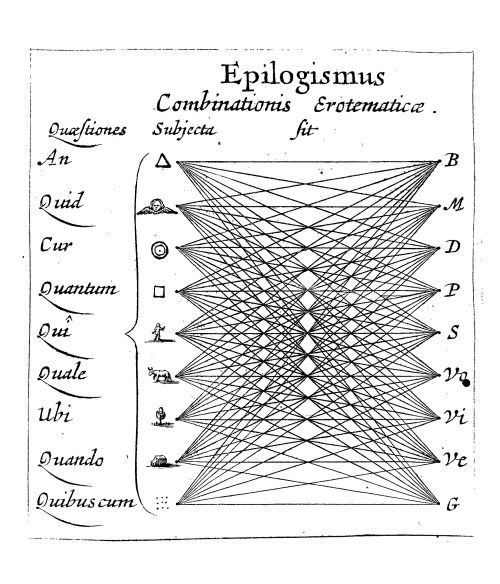
Athanasius Kircher (1602-80), Combinations of the nine universal symbols, from Ars Magna Sciendi Sive Combinatoria, 1669, p. 171. Courtesy of Stanford University.  This work is in the public domain in its country of origin and other countries and areas where the copyright term is the author’s life plus 100 years or less.


“Despite its improbability, the so-called “Flemish thesis” proved remarkably long-lasting. It survived even into the nineteenth century. It did so, however, less on its scientific merits than because it was part of a larger nationalistic polemic.

In his La province de Liège . . . Le flamand langue primordiale, mère de toutes les langues of 1868, the baron de Ryckholt proclaimed that “Flemish is the only language spoken in the cradle of humanity” and that “it alone is a language, while all the rest, dead or living, are but mere dialects or debased forms more or less disguised” (cf. Droixhe 1990: for linguistic follies de grandeur in general, Poliakov 1990).

With such a persistent and ebullient Flemish claim, it can hardly be surprising that there should be a Swedish candidacy as well. In 1671, Georg Stiernhielm wrote his De linguarum origine praefatio.

In 1688, his fellow countryman, Andreas Kempe, wrote Die Sprachen des Paradises; this included a scene in which God and Adam conversed with one another, God speaking in Swedish while Adam spoke in Danish; while they were talking, however, Eve was busy being seduced by a French-speaking serpent (cf. Borst 1957-63: III, 1, 1338; Olender 1989, 1993).

We are, by now, close to parody; yet we should not overlook the fact that these claims were made precisely in Sweden’s period as a major power on the European chessboard.

Olaus Rudbeck, in his Atlantica sive Mannheim vera Japheti posterorum sedes ac patria of 1675, demonstrated that Sweden was the home of Japheth and his line, and that from this racial and linguistic stock all the Gothic idioms were born.

Rudbeck identified Sweden, in fact, as the mythical Atlantis, describing it as the ideal land, the land of the Hesperides, from which civilization had spread to the entire world.

This was an argument that Isidore himself had already used. In his Etymologiarum, IX, ii, 26-7, he had suggested that the progenitor of the Goths was another of Japheth’s sons–Magog. Vico was later to comment acidly on all such claims (Scienza nuova seconda, 1744: II, 2.4, 430):

“Having now to enter upon a discussion of this matter, we shall give a brief sample of the opinions that have been held respecting it–opinions so numerous, inept, frivolous, pretentious or ridiculous, and so numerous, that we need not relate them.

By way of sample then: because in the returned barbarian times Scandinavia by the conceit of the nations was called vagina gentium and was believed to be the mother of all other nations of the world, therefore by the conceit of the scholars Johannes and Olaus Magnus were of the opinion that their Goths had preserved them from the beginning of the world the letters divinely inspired by Adam.

This dream was laughed at by all the scholars, but this did not keep Johannes van Gorp from following suit and going one better by claiming his own Dutch language, which is not much different from Saxon, has come down from the Earthly Paradise and is the mother of all other languages. [ . . . ]

And yet this conceit swelled to bursting point in the Atlantica of Olaus Rudbeck, who will have it that the Greek letters came from the runes; that the Phoenician letters, to which Cadmus gave the order and values those of the Hebrew, were inverted runes; and that the Greeks finally straightened them here and rounded them there by rule and compass.

And because the inventor is Merkurssman among the Scandinavians, he will have it that the Mercury who invented letters for the Egyptians was a Goth.”

Already by the fourteenth century, the idea of a German linguistic primacy was shaking the German-speaking world. The idea later appeared in Luther, for whom German was the language closest to God.

In 1533 Konrad Pelicanus (Commentaria bibliorum) set out the analogies between German and Hebrew, without, however, coming to a final judgement over which of the two was truly the Ursprache (cf. Borst 1957-63: III/1, 2).

In the baroque period, Georg Philipp Harsdörffer (Frauenzimmer Gesprächspiele, 1641, Niemayer Tübingen, ed., 1968: 335ff) claimed that the German language:

“speaks in the languages of nature, quite perceptibly expressing all its sounds. [ . . . ]

It thunders with the heavens, flashes lightening with the quick moving clouds, radiates with the hail, whispers with the winds, foams with the waves, creaks with the locks, sounds with the air, explodes with the cannons; it roars like the lion, lows like the oxen, snarls like the bear, bells like the stag, bleats like the sheep, grunts like the pig, barks like the dog, whinnies like the horse, hisses like the snake, meows like the cat, honks like the goose, quacks like the duck, buzzes like the bumble bee, clucks like the hen, strikes its beak like the stork, caws like the crow, coos like the swallow, chirps like the sparrow. [ . . . ]

On all those occasions in which nature gives things their own sound, nature speaks in our own German tongue. For this, many have wished to assert that the first man, Adam, would not have been able to name the birds and all the other beasts of the fields in anything but our words, since he expressed, in a manner conforming to their nature, each and every innate property and inherent sound; and thus it is not surprising that the roots of the larger part of our words coincide with the sacred language.”

German had remained in a state of perfection because Germany had never been subjected to the yoke of a foreign ruler. Lands that had been subjected had inevitably adapted their customs and language to fit those of the victor.

This was also the opinion of Kircher. French, for example, was a mix of Celtic, Greek and Latin. The German language, by contrast, was richer in terms than Hebrew, more docile than Greek, mightier than Latin, more magnificent in its pronunciations than Spanish, more gracious than French, and more correct than Italian.”

Umberto Eco, The Search for the Perfect Language, translated by James Fentress, Blackwell. Oxford, 1995, pp. 97-9.

Eco: The Nationalistic Hypothesis

kircher_122

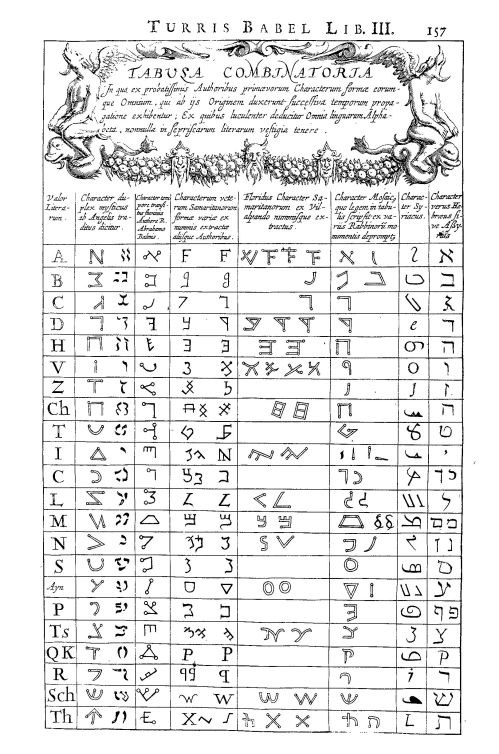
Athanasius Kircher (1602-80), an excerpt from p. 157 of Turris Babel, Sive Archontologia Qua Priscorum post diluvium hominum vita, mores rerumque gestarum magnitudo, Secundo Turris fabrica civitatumque exstructio. confusio linguarum, & inde gentium transmigrationis, cum principalium inde enatorum idiomatum historia, multiplici eruditione describuntur & explicantur. Amsterdam, Jansson-Waesberge, 1679. A table portraying ancient alphabets, in which Kircher asserts that modern alphabets resemble ancient versions. Courtesy of Stanford University. This work is in the public domain in its country of origin and other countries and areas where the copyright term is the author’s life plus 100 years or less. 


“Another alternative was to accept that Hebrew had been the original perfect language, but to argue that, after the confusio, the crown of perfection had been bestowed upon other languages.

The first text which countenances this sort of “nationalistic” reconstruction of linguistic history is the Commentatio super opera diversorum auctorum de antiquitatibus loquentium of 1498 by Giovanni Nanni, or Annius, which tells how, before it was colonized by the Greeks, Etruria had been settled by Noah and his descendants.

Nanni is here reflecting on the contradiction between Genesis 11, the story of Babel, and Genesis 10. In 10:5, the sons of Japheth settle the “isles of the Gentiles  . . . every one after his tongue.”

The notion of a lineage ascending from modern Tuscan through Etruscan to the Aramaic of Noah was elaborated in Florence by Giovann Battista Gelli (Dell’origine di Firenze, 1542-4), and by Piero Francesco Giambullari (Il Gello, 1564).

Their thesis, fundamentally anti-humanist, accepted the idea that the multiplication of tongues had preceded Babel (citing what Dante had had to say in Paradise, xxvi).

This thesis was passionately received by Guillaume Postel, who, we have seen, had already argued that Celtic had descended from Noah. In De Etruriae regionis (1551) Postel embraced the position of Gelli and Giambullari concerning the relationship of the Etruscan to Noah, qualifying it, however, by the claim that the Hebrew of Adam had remained–at least in its hieratic form–uncontaminated throughout the centuries.

More moderate were the claims of Spanish Renaissance authors. The Castilian tongue too might claim descent from one of Japheth’s many sons–in this case Tubal. Yet it was still only one of the seventy-two languages formed after Babel.

This moderation was more apparent than real, however, for, in Spain, the term “language of Babel” became an emblem of antiquity and nobility (for Italian and Spanish debates, cf. Tavoni 1990).

It was one thing to argue that one’s own national language could claim nobility on account of its derivation from an original language–whether that of Adam or that of Noah–but quite a different matter to argue that, for this reason, one’s language ought to be considered as the one and only perfect language, on a par with the language of Adam.

Only the Irish grammarians cited in the first chapter and Dante had had, so far, the audacity to arrive at such a daring conclusion (and even Dante–who had aspired to create a perfect language from his own vernacular–made sarcastic remarks on those who consider their native language as the most ancient and perfect: cf. DVE, I, vi).

By the seventeenth century, however, linguistic nationalism had begun to bud; this prompted a plethora of such curious claims.

Goropius Becanus (Jan van Gorp) in his Origins Antwerpianae of 1569 agreed with all claims made about the divine inspiration of the original language, and about its motivated and non-arbitrary relation between words and things.

According to him there was only a single living language in which this motivated concordance existed to an exemplary degree; that language was Dutch, particularly the dialect of Antwerp.

The ancestors of the burghers of Antwerp were the Cimbri, the direct descendants of the sons of Japheth. These had not been present under the Tower of Babel, and, consequently, they had been spared the confusio linguarum.

Thus they had preserved the language of Adam in all its perfection. Such an assertion, Becanus claimed, could be proved by etymological demonstrations. He produced a string of arguments whose level of etymological wishful thinking matched those of Isidore and Guichard; they later became known as “becanisms” or “goropisms.”

Becanus further claimed that his thesis was also proved by the facts that the Dutch had the highest number of monosyllabic words, possessed a richness of sounds superior to all other languages, and favored in the highest degree the formation of compound words.

Becanus‘ thesis was later supported by Abraham Mylius (Lingua belgica, 1612) as well as by Adrian Schrickius (Adversariorum Libri III, 1620), who wished to demonstrate “that Hebrew was divine and firstborn” and “that Teutonic came immediately afterwards.”

Teutonic here meant the Dutch spoken in Antwerp, which, at the time, was its best-known dialect. In both cases, the demonstration was supported by etymological proofs little better than those of Becanus.”

Umberto Eco, The Search for the Perfect Language, translated by James Fentress, Blackwell. Oxford, 1995, pp. 95-7.

Eco: The Pre-Hebraic Language

kircher_099

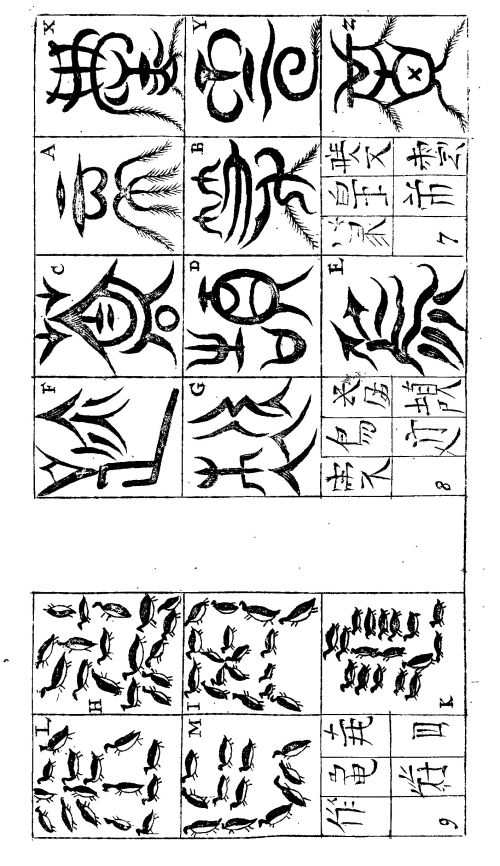
Athanasius Kircher (1602-80), Origins of the Chinese Characters, China Illustrata, or China monumentis, qua sacris qua profanis, nec non variis naturae & artis spectaculis, aliarumque rerum memorabilium argumentis illustrata (1667), p. 229. Courtesy of Stanford University. This work is in the public domain in its country of origin and other countries and areas where the copyright term is the author’s life plus 100 years or less. 

“Alongside these philosophical discussions, other inspired glottogonists (for whom the defeat of the Hebraic hypothesis was a consummated fact) were breaking new theoretical ground.

The explorers and missionaries of the sixteenth and seventeenth centuries had discovered civilizations, older than the Hebrews, which had their own cultural and linguistic traditions.

In 1699, John Webb (An Historical Essay endeavoring the Probability that the Language of the Empire of China is the Primitive Language) advanced the idea that, after the Flood, Noah had landed his Ark and gone to live in China.

Consequently, it was the Chinese language which held primacy. Furthermore, since the Chinese had not participated in the construction of the Tower of Babel, their language had remained immune from the effects of the confusio; Chinese had survived intact for centuries, protected from foreign invasion. Chinese thus conserved the original linguistic patrimony.

Ours is a story that proceeds through many strange anachronisms. Near the end of the eighteenth century, just at the moment when, quite unconnected with any form of the monogenetic hypothesis, a comparative methodology was about to emerge, there appeared the most gigantic attempt to date to rediscover the primitive language.

In 1765, Charles de Brosses wrote a Traité de la formation méchanique des langues. The treatise propounded a theory of language that was both naturalistic (the articulation of terms reflects the nature of things–sweet sounds designate sweet objects) and materialistic (language is reduced to physical operations, supernatural entities are seen as the result of linguistic play: cf. Droixhe 1978).

As part of this theory, however, de Brosses could not resist indulging in a series of speculations about the nature of the primitive language, “organic, physical, and necessary, that not one of the world’s peoples either knows or practices in its simplicity, but which, none the less, was spoken by all men, and constitutes the basis of language in every land” (“Discours préliminaire,” xiv-xv).

“The linguist must analyze the mechanisms of different languages, discovering which of those features arise through natural necessity. From this he may, moving through a chain of natural inferences, work his way back from each of the known languages to the original, unknown matrix.

It is only a matter of locating a small set of primitive roots that might yield a universal nomenclature for all languages, European and oriental.

Radically Cratylian and mimologist as it was (cf. Ginette 1976: 85-118), the comparative approach of de Brosses took the vowels to constitute the raw material in a continuum of sound upon which the consonants acted to sculpt out the intonations and the caesurae.

Their effect, often more visible to the eye than to the ear (remember the persistent failure to distinguish between sounds and letters), is to render consonantal identity the key criterion of comparative analysis.

Like Vico, de Brosses considered that the invention of articulated sounds had proceeded in step with the invention of writing. Fano (1962: 231; English tr., p. 147) sums up his theory very well:

“De Brosses imagines this process as follows: like the good school teacher who takes chalk in hand to make his lesson clearer from a didactic viewpoint, the cave man intermingled his discourses with little explicative figures.

If, for example, he wanted to say “a raven flew away and rested on the top of a tree,” he would first imitate the croaking of the bird, then he would express the flight with a “frrr! frrr!” and eventually take a piece of coal and draw a tree with a raven on top.”

Another Herculean effort in the cause of mimological hypothesis was that of Antoine Court de Gébelin, who, between 1773 and 1782, published nine quarto volumes, totaling over five thousand pages, giving to this opus–multiple, creaking, though not utterly devoid of interest–the title Le monde primitif analysé et comparé avec le monde moderne (cf. Genette 1976: 119-48).

Court de Gébelin knew the results of previous comparativist research. He also knew that the human linguistic faculty was exercised through a specific phonatory apparatus; and he was acquainted with its anatomy and physiology.

He followed, moreover, the doctrines of the Physiocrats, and when he sought to explain the origin of language, he did so through a re-reading of ancient myths, interpreting them as allegories describing the relation of man the farmer to the land (vol. I).

Writing, too, was susceptible to this sort of explanation. Although it was born before the separation of peoples, writing could be interpreted as having evolved in the time of the agrarian states, which needed to develop an instrument that would keep track of landed property and foster commerce and law (vol. III, p. xi) . . .

Yet there still shines Court de Gébelin‘s dream of uncovering the original language of the primitive world, the language which served as the origin and basis of a universal grammar through which all existing languages might be explained.

In the preliminary discourse to volume III, dedicated to the natural history of speech or the origins of language, Court de Gébelin affirmed that words were not born by chance: “each word has its own rationale deriving from Nature” (p. ix). He developed a strongly mimological theory of language accompanied by an ideographic theory of writing, according to which the alphabet itself is nothing but the primitive hieroglyphic script reduced to a small set of radical characters or “keys” (III, xii).

As a faculty based upon a determined anatomical structure, language might certainly be considered as God’s gift, but the elaboration of a primitive tongue was a human endeavor. It followed that when God spoke first to human beings, he had to use a language that they could understand, because it was a product of their own (III, 69).

To uncover this primitive language, Court de Gébelin undertook an impressive etymological analysis of Greek, Latin and French. Nor did he neglect coats of arms, coins, games, the voyages of the Phoenicians around the world, American Indian languages, medallions, and civil and religious history as manifested in calendars and almanacs.

As a basis for this original language he set out to reconstruct a universal grammar, founded on necessary principles, valid in all times and in all places, so that the moment that one of these principles was discovered lying immanent in any one language it could be projected into all the others.

Court de Gébelin seems, in the end, to have wanted too much. He wanted a universal grammar; he wanted the mother tongue; he wanted the biological and social origins of language.

He ended up, as Yaguello observes (1984: 19), by muddling them all together in a confused mass. To top it all off, he fell victim in the end to the siren call of the Celto-nationalist hypothesis which I shall be describing in the next section.

Celtic (being similar to oriental languages from which it originated) was the tongue of Europe’s first inhabitants. From Celtic had derived Greek, Latin, Etruscan, Thracian, German, the Cantabrian of the ancient Spaniards, and the Runic of the Norsemen (vol. V).”

Umberto Eco, The Search for the Perfect Language, translated by James Fentress, Blackwell. Oxford, 1995, pp. 91-5.

Eco: Conventionalism, Epicureanism and Polygenesis, 2

tumblr_n455agXMeA1rtynt1o1_r2_1280

Athanasius Kircher (1602-80), from Turris Babel, Sive Archontologia Qua Primo Priscorum post diluvium hominum vita, mores rerumque gestarum magnitudo, Secundo Turris fabrica civitatumque exstructio, confusio linguarum, & inde gentium transmigrationis, cum principalium inde enatorum idiomatum historia, multiplici eruditione describuntur & explicantur. Amsterdam, Jansson-Waesberge, 1679. This work is in the public domain in its country of origin and other countries and areas where the copyright term is the author’s life plus 100 years or less.

“During these same years, thinkers also returned to reflect upon an older suggestion by Epicurus, who, in a letter to Herodotus, gave his opinion that the names of things were not  originally due to convention; human beings themselves had rather created them from their own natures.

Those of differing tribes, “under the impulse of special feelings and special presentations of sense,” uttered “special cries.” The air thus emitted was moulded by their different feelings or sense perceptions (letter to Herodotus, in Diogenes Laertius, Lives of the Philosophers, X, 75-6).

Epicurus went on to add that, to eliminate confusion and for reasons of economy, the various peoples subsequently came to an agreement over what name they should give things.

He had no fixed opinion on whether this agreement had been made from instinct or “by rational thought” (cf. Formigari 1970: 17-28; Gensini 1991: 92; Manetti 1987: 176-7).

That was the first part of Epicurus‘ thesis, which emphasized the natural rather than conventional origin of languages; however, this idea was taken up by Lucretius: nature prompted human beings to emit the sounds of language; necessity gave birth to the names of things.

Therefore to suppose that someone then distributed names among things, and from him that men learnt their first words, is folly. For why should he have been able to mark all things with titles and to utter the various sounds of the tongue, and at the same time others not be thought able to have done it? . . .

Therefore if it is the various sensations that they feel which drive animals to emit differing sounds, even though they remain mute, how much more just is it to say that sensations induce mortals to indicate different things with different sounds. (De rerum natura, W.H.D. Rouse, tr., London: Heinemann, 1975: V, 1041-90).

This was a new view, one which we may call the materialist-biological theory of the origin of language. Language arose out of a natural inclination to transform sensations into ideas, which, for the sake of civil convenience, were then translated into sounds.

If it were true, as Epicurus had suggested, that this process of transformation might vary in different races, climates and places, it was hardly too much to imagine that, in diverse times and ways, the different races had originated different families of languages.

This was the intuition behind the theory that evolved in the eighteenth century: each language had its own genius.

Epicurus‘ thesis could not help but seem seductive in the “libertine” milieu of seventeenth-century France, in an atmosphere of skepticism ranging from sarcastic agnosticism to confessed atheism.

In 1655 there appeared the Systema theologicum ex prae-Adamitarum hypothesi, written by a Calvinist named Isaac de La Peyrère. Starting from an extremely original reading of the fifth chapter of St. Paul’s Epistle to the Romans, La Peyrère argued for the polygenesis of races and peoples.

Reports of missionaries and explorers had represented non-European civilizations, such as the Chinese, as so ancient that their histories were incommensurable with biblical chronology, especially in regard to their accounts of the origin of the world.

La Peyrère inferred from this that there existed a pre-Adamite human race, untouched by original sin. He concluded that the stories both of the original sin and of the Flood concerned only Adam and his descendants in the land of the Hebrews (cf. Zoli 1991: 70).

This was a hypothesis that had already appeared in Islamic culture. Drawing on the Koran (2:31), al-Maqdisi, in the tenth century, had alluded to the existence of different races prior to Adam (cf. Borst 1957-63: I, II, 9).

Quite apart from the obvious theological implications of such an assumption (and the works of La Peyrère were condemned to be burnt), it was clear that, by now, Hebrew civilization–along with its holy language–was falling from its throne.

If one accepted that species had developed differentially in differing conditions, and that their linguistic capacity reflected their degree of evolution and of adaptation to the environment, it was easy to accept the polygenetic hypothesis.

A particular brand of polygeneticism–certainly not of libertine inspiration–can be ascribed to Giambattista Vico. Vico was a thinker who naturally proceeded against the grain of his times.

Instead of searching for actual chronological origins, he set out to delineate an ideal and eternal history. Paradoxically, by jumping outside the bounds of history, Vico was to become one of the founders of modern historicism.

What Vico wished to tell was not, or–depending on how one wishes to take the chronological table at the beginning of his Scienza nuova seconda (1744)–not only, a historical course, but rather the ever recurring conditions in which languages are born and develop in every time and in every place.

Vico described an ideal line of descent which traced the development of language from the language of the gods to that of heroes and, finally, to that of human beings. The first language had to be hieroglyphic (“sacred or divine”), the second symbolic (“by heroic signs and devices”), and the third epistolary (“for men at a distance to communicate to each other the current needs of their lives,” para. 432).

According to Vico, language, at its ideal point of origin, was directly motivated by, and metaphorically congruent with, the human experience of nature. Only at a later state did language become organized in a more conventional form.

Vico affirms, however, that “as gods, heroes, and men began at the same time (for they were, after all, men who imagined the gods and who believed their own heroic nature to be a mixture of the divine and human natures), so these three languages began at the same time” (466).

Thus, circumventing the seventeenth-century question of whether or not a natural linguistic stage was succeeded by a conventional one, Vico directly addressed the question of why there existed as many different languages as there were different peoples.

He responded by asserting “this great truth . . . that, as the peoples have certainly by the diversity of climates acquired different natures, from which have sprung as many different customs, so from their different natures and customs as many different languages have arisen” (445).

As to the story of the primacy of Hebrew, Vico disposes of it in a series of observations tending to prove that, if anything, the Hebrews had derived their alphabet from the Greeks and not vice versa.

Nor was Vico susceptible to the Hermetic fantasies of the Renaissance, according to which all wisdom came from the Egyptians.

From his description there emerges instead a complex network of cultural and commercial trafficking, in which the Phoenicians–prompted by mercantile necessity–exported their characters to both the Egyptians and the Greeks, while, at the same time, spreading throughout the Mediterranean basin the set of hieroglyphic characters that they had borrowed from the Chaldeans and had adapted to fit their need for a numerical system to keep track of their stocks of merchandise (441-3).”

Umberto Eco, The Search for the Perfect Language, translated by James Fentress, Blackwell. Oxford, 1995, pp. 88-91.

Eco: Conventionalism, Epicureanism and Polygenesis

Joseph_Justus_Scaliger_-_Imagines_philologorum

Giuseppe Giusto Scaligero, or Joseph Justus Scaliger (1540-1609), this illustration is from the title page of Marcus Manilus, Astronomicon a Ios. Scaligero ex vetusto codice Gemblacensi infinitis mendis repurgatum. Eiusdem Iosephi Scaligeri notae etc. Leiden. Christophorus Raphelengius for Joannes Commelin, 1599-1600, with a handwritten dedication from Scaliger to the mathematician Henri de Monantheuil, courtesy of the Leiden University Library and the Scaliger Institute. This narrative courtesy of the Warburg Institute. This work is in the public domain in its country of origin and other countries and areas where the copyright term is the author’s life plus 100 years or less.

“By now, however, time was running out for the theories of Kircher, Guichard and Duret. Already in the Renaissance, Hebrew’s status as the original and sacred language had begun to be questioned.

By the seventeenth century, a new and complex set of arguments has evolved. We might, emblematically, place these arguments under the sign of Genesis 10. In these, attention moved away from the problem of primordial language to that of matrices linguae, or mother tongues–this was an expression first coined by Giuseppe Giusto Scaligero (Diatribe de europaeorum linguis, 1599).

Scaligero individuated eleven language families, seven major and four minor. Within each family, all languages were related; between the language families, however, kinship was impossible to trace.

The Bible, it was noted, had given no explicit information about the character of the primordial language. There were many who could thus maintain that the division of tongues had originated not at the foot of the shattered tower, but well before.

The notion of confusio could be interpreted as a natural process. Scholars set about trying to understand this process by uncovering the grammatical structures common to all languages: “It was no longer a question of “reduction,” but of a classification aimed at revealing a common system latent within all languages, while still respecting their individual differences” (Demonet 1992: 341, and II, 5, passim).

In his Histoire critique du Vieux Testament (1678), Richard Simon, considered one of the founders of modern biblical criticism, discarded the hypothesis of the divine origin of Hebrew, citing the ironic remarks of Gregory of Nyssa.

Language, he wrote, was a human invention; since human reason differs in different peoples, so languages must differ as well. God willed that different peoples speak different languages in order that “each might explain themselves in their own way.”

Meric Casaubon (De quattor linguis commentatio, 1650) accepted the idea of Grotius that–in so far as it had ever existed–the primordial language had long since disappeared.

Even if the words spoken by Adam had been inspired directly by God, humanity had since developed its languages autonomously. The Hebrew of the Bible was just one of the languages that arose after the Flood.

Leibniz also insisted that the historic language of Adam was irredeemably lost, and that, despite our best efforts, “nobis ignota est.” In so far as it had ever existed, it had either totally disappeared, or else survived only as relics (undated fragment in Gensini 1990: 197).

In this climate, the myth of a language that followed the contours of the world came to be rearticulated in the light of the principle of the arbitrariness of the sign. This was a principle that, in any case, philosophical thought had never entirely abandoned, as it formed part of the Aristotelian legacy.

In precisely this period, Spinoza, from a fundamentally nominalist point of view, asked how a general term such as man could possibly express man’s true nature, when different individuals formed their ideas in different ways:

“for example, those who are accustomed to contemplate with admiration the height of men will, on hearing the name man, think of an animal with an erect posture; those, instead, who are in the habit of contemplating some other feature, will form another of the common images of man–man as a laughing animal, as a biped, as featherless, as rational. Thus every individual will form images of universals according to the dispositions of their own bodies.” (Ethica, 1677: proposition XL, scolion I).

Implicitly challenging the idea that Hebrew was the language whose words corresponded to the nature of things, Locke considered that words used by human beings were signs of their ideas, “not by any natural connexion, that there is between particular articulated Sounds and certain Ideas, for then there would be but one Language amongst all Men; but by voluntary Imposition.” (An Essay concerning Human Understanding, 1690: III, 2, 1).

As soon as ideas lost their quality as innate, Platonic entities, becoming nominal ideas instead, language itself lost its aura of sacrality, turning into a mere instrument for interaction–a human construct.

In Leviathan (1651: I, 4, “Of Speech”), Hobbes admitted that the first author of speech could only have been God himself, and that he had taught Adam what to name the animals. Yet, immediately thereafter, Hobbes abandons the scriptural account to picture Adam as striking out on his own.

Hobbes argued that Adam continued freely to add new names “as the experience and use of the creatures should give him occasion.” In other words, Hobbes left Adam to confront his own experiences and his own needs; and it was from these needs (necessity being, as we know, the mother of all invention) that the languages after Babel were born.”

Umberto Eco, The Search for the Perfect Language, translated by James Fentress, Blackwell. Oxford, 1995, pp. 85-8.

Eco: The Etymological Furor, 2

tower-to-the-moon

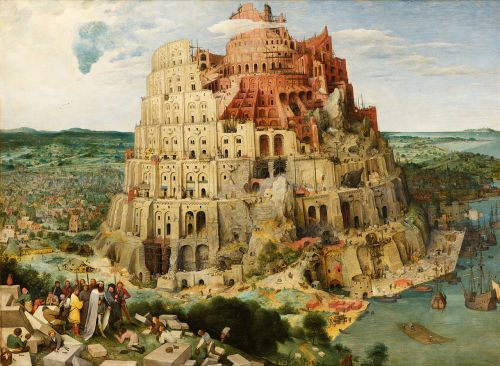
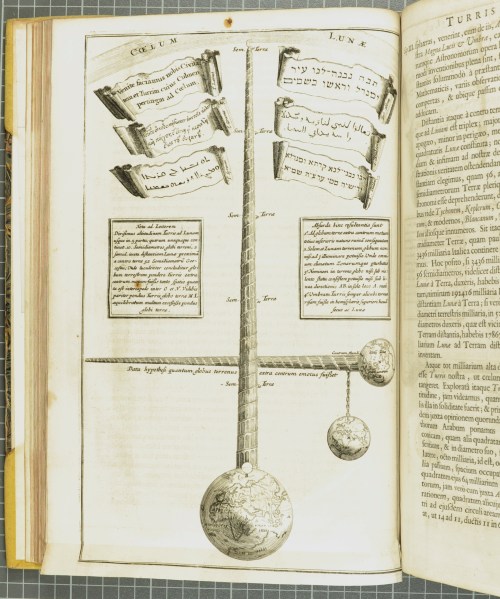
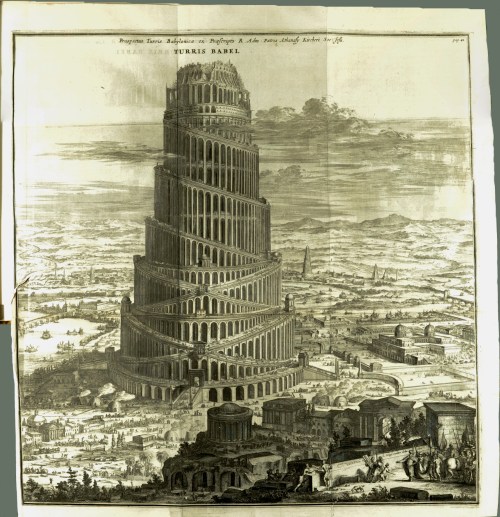
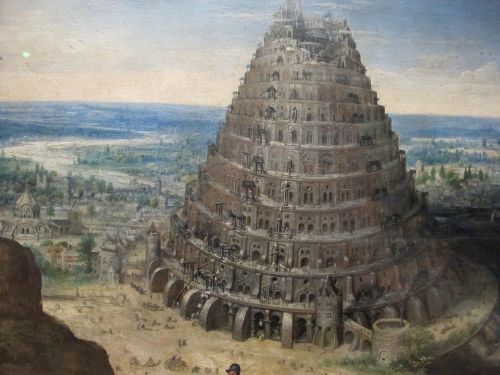
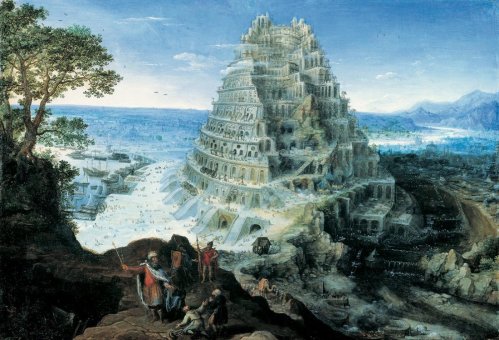
Athanasius Kircher (1602-80), Turris Babel, Amsterdam, 1679. The illustrations in Turris Babel were engraved by C. Decker. This copy is held by the University of St. Andrews, under call number 417f BS1238.B2K5. The librarian at St. Andrews, who signed himself simply as “DG,” quoted from a narrative posted on the site of the Museum of Jurassic Technology, recounting Genesis 10-11, in which Nimrod attempted to build a tower that reached the heavens. The Museum observes, “This model illustrates Kircher’s proof that Nimrod’s ambition was intrinsically flawed: in order to reach the nearest heavenly body; the Moon, the tower would have to be 178,672 miles high, comprised of over three million tons of matter. The uneven distribution of the Earth’s mass would tip the balance of the planet and move it from its position at the center of the universe, resulting in a cataclysmic disruption in the order of nature.” This work is in the public domain in its country of origin and other countries and areas where the copyright term is the author’s life plus 100 years or less.

“The thousand or so pages of Guichard are really little more than an extensive raiding expedition in which languages, dead and living, are pillaged for their treasures. More or less by chance, Guichard sometimes manages to hit upon a real etymological connection; but there is little scientific method in his madness.

Still, the early attempts by authors such as Duret and Guichard to prove the monogenetic hypothesis did lead to a conception of Hebrew as less “magical,” and this eventually helped clear the way for a more modern conception of comparative linguistics (cf. Simone 1990: 328-9).

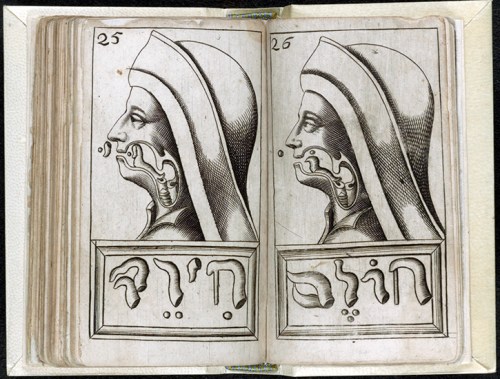
During the sixteenth and seventeenth centuries, fantasy and science remained inextricably entangled. In 1667, Mercurius van Helmont published an Alphabeti veri naturalis Hebraici brevissima delineatio, which proposed to examine methods for the teaching to speak of deaf-mutes.

This was the sort of project which, during the Enlightenment in the following century, might have been the occasion for valuable reflections upon the nature of language. For van Helmont, however, science was subordinated to his own monogenetic fantasies.

He started with the presumption that there must be a primitive language, easy to learn, even for those who had never learned to speak a language at all, and that it could not be but Hebrew.

Then van Helmont proceeded to demonstrate that the sounds of Hebrew were the ones most easily produced by the human vocal organs. Then, with the assistance of thirty-three woodcuts, he showed how, in making the sounds of Hebrew, the movements of tongue, palate, uvula and glottis reproduced the shapes of the corresponding Hebrew letters.

The result was a radical version of the mimological theory: not only did the Hebrew sounds reflect the inherent nature of things themselves, but the very mud from which the human vocal organs were formed had been especially sculpted to emit a perfect language that God pressed on Adam in not only its spoken but evidently its written form as well (see figure 5.1).

wls0041_enlarge

Baron Franciscus Mercurius van Helmont (1614-98), Alphabet verè Naturalis Hebraici brevissima delineation, A Brief Delineation of the True Nature of the Hebrew Alphabet, Sulzbach: Abraham Lichtenthaler, 1667. Held in the Hebraic Section of the African and Middle Eastern Division of the Library of Congress under call number 041.00.00. Reproduced as Figure 5.1 in Umberto Eco, The Search for the Perfect Language, p. 84. This work is in the public domain in its country of origin and other countries and areas where the copyright term is the author’s life plus 100 years or less.   

In Turris Babel of 1679, Kircher presented a synthesis of the various positions which we have been reviewing. After an examination of the history of the world from the Creation to the Flood, and, from there, to the confusion of Babel, Kircher traced its subsequent historical and anthropological development through an analysis of various languages.

Kircher never questioned Hebrew’s priority as the lingua sancta; this had been explicitly revealed in the Bible. He held it as self-evident that Adam, knowing the nature of each and every beast, had named them accordingly, adding that “sometimes conjoining, sometimes separating, sometimes permutating the letters of the divers names, he recombined them according to the nature and properties of the various animals” (III, 1, 8).

Since this idea is based on a citation from the kabbalistic writings of the Rabbi R. Becchai, we can infer that Kircher was thinking of Adam defining the properties of the various animals by permutating the letters of their names.

To be precise, first the names themselves mimic some property of the animals to which they refer: lion, for example, is written ARYH in Hebrew; and Kircher takes the letters AHY as miming the heavy sound of a lion panting.

After naming the lion “ARYH,” Adam rearranged these letters according to the kabbalist technique of temurah. Nor did he limit himself to anagrams: by interpolating letters, he constructed entire sentences in which every word contained one or more of the letters of the Hebrew word.

Thus Kircher was able to generate a sentence which showed that the lion was monstrans, that is, able to strike terror by his sole glance; that he was luminous as if a light were shining from his face, which, among other things, resembled a mirror . . . We see here Kircher playing with etymological techniques already suggested in Plato’s Cratylus (which he, in fact, cites, p. 145) to twist names to express a more or less traditional lore about people and animals.

At this point, Kircher took the story up to the present. He told how, after the confusion, five dialects arose out of Hebrew: Chaldean, Samaritan (the ancestor of Phoenician), Syriac, Arabic and Ethiopic.

From these five he deduced, by various etymological means, the birth of various other languages (explaining the successive stages by which the alphabet developed along the way) until he reached the European languages of his own time.

As the story approaches the present, the argument becomes more plausible: linguistic change is seen as caused by the separation and mixture of peoples. These, in turn, are caused by the rise and fall of empires, migrations due to war and pestilence, colonialization and climatic variation.

He is also able to identify the process of creolization which can occur when two languages are put into contact with one another. Out of the multiplication of languages, moreover, are born the various idolatrous religions, and the multiplication of the names of the gods (III, I, 2).”

Umberto Eco, The Search for the Perfect Language, translated by James Fentress, Blackwell. Oxford, 1995, pp. 82-5.

Eco: The Etymological Furor

956px-Conrad_Gesner_-_Conradi_Gesneri_Historia_plantarum_Walderbeere

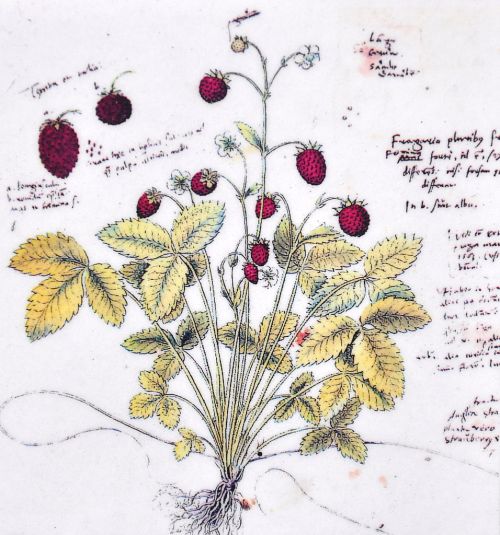
Conrad Gesner (1516-65), Conradi Gesneri Historia plantarum Walderbeere, Zurich: Botanical Garden zur Katz, published in 1750. Photographed by Roland zh, licensed under the Creative Commons Attribution-Share Alike 3.0 Unported license. This work is in the public domain in its country of origin and other countries and areas where the copyright term is the author’s life plus 100 years or less. 

“Postel’s was a clear and unambiguous demand for the restoration of Hebrew as the universal language. Few, however, made this demand in so radical a fashion. For others, it was usually enough to demonstrate that Hebrew was superior because it was the first language from which all others had derived.

One example is the Mithridates of Conrad Gessner. Published in 1555, the Mithridates is a book that draws parallels between fifty-five different languages.

Having dwelt briefly on the happy condition of some legendary beings with two tongues, one for human speech and the other to speak the language of the birds, Gessner immediately passed to the claim that “all existing languages had retained words of a Hebrew origin, though in a corrupt state” (1610 edn: 3).

Other authors–in order to demonstrate such a parenthood–started a mad etymological chase.

This etymological furor was not a new condition. Between the sixth and seventh centuries, by a fanciful account of the seventy-two existing languages, Isidore of Seville (Etymologiarum) elaborated a series of etymologies that has made him the laughing stock of scholars ever since: our corpus (body) comes from corruptus perit as our body goes to corruption; homo (man) derives from humus or mud from which he is born; iumenta (mare) comes from iuvat because horses help men; agnus is a lamb because it recognizes its own mother . . . These are examples of hyper-Cratylian mimological hypothesis, and we shall see that they were taken up by the supporters of Hebrew.

In 1613 Claude Duret published his monumental Thrésor de l’histoire des langues de cet univers. Using the Christian kabbala as his starting point, Duret set forth a vast panorama that swept from the origins of language, to an examination of all known tongues, including those of the New World, to a final chapter on the language of animals.

Duret started from the premise that Hebrew was the universal language of the human race; it thus appeared to him as self-evident that each animal name in Hebrew should include an encapsulated “natural history” of that animal.

Thus we are told that, in Hebrew:

the Eagle is called Nescher, a word formed by the combination of Schor and Isachar, the first meaning to look and the second to be straight because, above all others, the eagle is a bird of firm sight whose gaze is always directed towards the sun [ . . . ]

The Lion has three names, that is Aryeh, Labi, and Layisch. The first name comes from another which means tear or lacerate; the second is related to the word leb which means heart, and laab, which means to live in solitude.

The third name usually means a great and furious lion, and bears an analogy with the verb yosh, which means trample. [ . . . ] because this animal tramples and damages its prey. (p. 40).

Hebrew had managed to retain this proximity to the world of things because it never permitted itself to be polluted by other languages (ch. x). This presumption of Hebrew’s natural affinity to the world of things is also demonstrated by its magic potential.

Duret recalled that Eusebius and St. Jerome had ridiculed the Greeks because they had exalted their own language but were unable to find any mystic significance of their alphabet.

Only ask a Hebrew child the significance of the letter Alef, and he will respond “discipline,” and so on for all the other letters and for their combinations (p. 194).

Duret is an example of retrospective etymologizing, aiming at showing how the mother tongue was harmoniously related to the nature of things. Other authors engaged in prospective etymologizing, projecting Hebrew words forwards to show how they transmuted themselves into the words of all other languages.

In 1606, Estienne Guichard wrote his L’harmonie étymologique des langues, where he showed that all existing languages might be derived from Hebrew roots. He started from the premise that Hebrew was the simplest language because in it “all words are simple, and their substance consists of but three radicals.”

Manipulating these radicals through inversion, anagrams and permutations in the best kabbalistic tradition, Guichard provided his etymologies.

In Hebrew, the verb batar means to divide. How can we prove that Latin dividere comes from batar? Simple: by inversion, batar produces tarab; tarab then becomes the Latin tribus and, from there, turns into distribuo and dividere (p. 147). Zacen means old. Rearranging the radicals, we get zanec from which derives Latin senex. 

A further rearrangement and we have cazen, from which derives the Oscan word casnar, which is the root of the Latin canus, elder (p. 247). By this method we might equally prove that the English head comes from the late Latin testa, since the anagram of testa gives eatts.”

Umberto Eco, The Search for the Perfect Language, translated by James Fentress, Blackwell. Oxford, 1995, pp. 80-2.

Eco: Postel’s Universalistic Utopia, 2

746_2

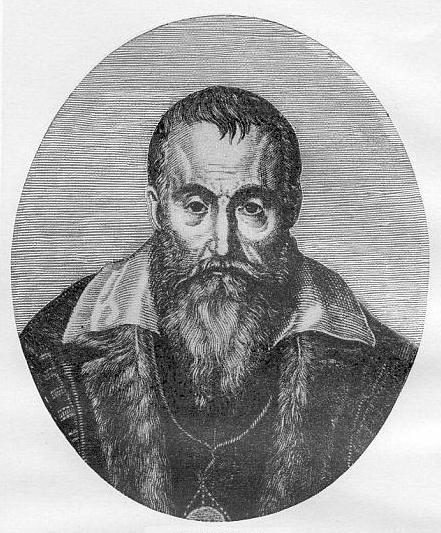
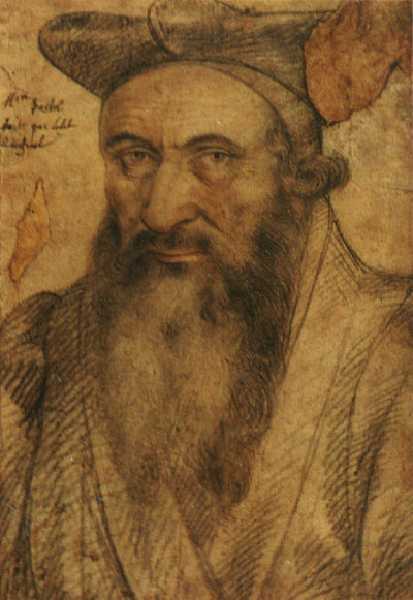
An unattributed and undated portrait of Guillaume Postel (1510-84), published by George Saliba. This work is in the public domain in its country of origin and other countries and areas where the copyright term is the author’s life plus 100 years or less. 

“After various peregrinations, Postel found himself in Venice, where, in 1547, he was appointed chaplain of the Hospital of Sts. John and Paul (called the Ospedaletto), and censor of books published in the Hebrew language in that city.

While in the Ospedaletto, he was appointed confessor to its founder, the fifty year old Johanna, or Mother Zuana, a woman who had dedicated her life to helping the poor. Gradually, the conviction grew on Postel that in meeting Johanna, he had come into contact with a great prophetic spirit.

He conceived for her a mystic passion in which he saw her as the mother of the world, destined to redeem humanity from its original sin.

After rereading the kabbalist text, the Zohar, Postel identified Johanna as Shekinah as well as with the angelical pope whose coming had been foretold in the prophecies of Joachim a Fiore.

Finally, he identified her as the second Messiah. According to Postel, the feminine component of humanity, guilty of the sin of Eve, had not been saved by Christ. The salvation of the daughters of Eve would only occur with the coming of a second Messiah (on Postel’s “feminism” cf. Sottile 1984).

The question whether Johanna was truly a mystic with extraordinary capacities or whether these were just qualities that Postel projected into her is hardly an important issue for us.

What is important rather is that there was now established an intense spiritual communion: Johanna, the kabbala, universal peace, the last age foretold by Joachim, were all thrown into a single crucible; what emerged was Johanna in the role formerly held by Ignatius Loyola in Postel’s utopian schemes.

What is more, “Johanna’s “immaculate conception” produces her “little son,” Postel, the new Elias” (Kuntz 1981: 91).

Rumors of singular goings on at the Ospedaletto soon spread, however, and in 1549, Postel was forced to leave Venice. He resumed his wanderings in the Orient, returning to Venice the following year only to learn of the death of Johanna.

According to tradition, on hearing the news he fell into a state of prostration mixed with ecstasy in which he claimed to be able to stare into the sun for an hour. He felt the spirit of Johanna gradually invading his body (Kuntz: 1981: 104). He began to proclaim his belief in metempsychosis.

Postel next returned to Paris where, with great public acclaim, he resumed his teaching. Yet soon he was announcing the advent of the era of Restitution, a golden century under the sign of Johanna.

Once again, he found himself at the center of a philosophical and religious turmoil. When the king forced him to abandon teaching, he set off on a new journey through various cities, ending up again in Venice, arriving just in time to prevent his books from being placed on the Index.

He was questioned by the Inquisition, which tried to induce him to recant. In 1555, in recognition of his services to science and politics, he was declared “non malus sed amens,” not guilty but insane.

His life was spared, but he was imprisoned, first in Ravenna and afterwards in Rome.

At the request of the French religious authorities, Postel was later transferred to Paris, in 1564. He retired to the monastery of Saint-Martin-des-Champs where he lived until his death in 1587. During this period, he wrote a repudiation of his heretical doctrines concerning Mother Johanna.

Apart from this final capitulation, Postel seems to have been a relentless defender of ideas which, for this period, were quite unconventional. His particular vision of utopia must be regarded within the cultural context of his time.

Demonet (1992: 337ff) underlines that his idea of the “restitution” of Hebrew as the language of universal concord also required that infidels recognize their error and accept the Christian revelation.

None the less, as Kuntz notes (1981: 49), Postel was neither an orthodox Catholic nor an orthodox Protestant; his moderate and pacifist positions infuriated, in fact, extremists of both persuasions.

Some of his doctrines were theologically ambiguous: he claimed that Christianity was the only religion that verified the message of Judaism, but–at the same time–that to be a good Christian it was not necessary to belong to a sect (Catholic church included), but rather to feel the presence of the divine within.

It followed that a true Christian could, and even should, observe Jewish law, and that the Muslims could be considered half-Christians.

More than once, Postel condemned the persecution of the Jews. He spoke of the Jewishness of all men, talking of Christian-Jews instead of Jewish Christians (Kuntz 1981: 130).

He claimed that the true tradition of Christianity was Judaism with its name changed, and lamented that Christianity had lost its Judaic roots.

Such positions could only be seen as extremely provocative by a church still clinging to the pre-Renaissance doctrine that Christianity represented both the correction and the cancellation of Judaism.

In order to affirm, as Postel did in his De orbis, the existence of a harmony between the faiths, it was necessary to exercise a tolerance on a number of theological issues. Postel’s doctrine has thus been described as a universalistic theism (Radetti 1936).”

Umberto Eco, The Search for the Perfect Language, translated by James Fentress, Blackwell. Oxford, 1995, pp. 77-80.

Eco: Postel’s Universalistic Utopia

Guillaume Postel, The Great Key, Eliphas Levi, The Key of the Great Mysteries, 1861

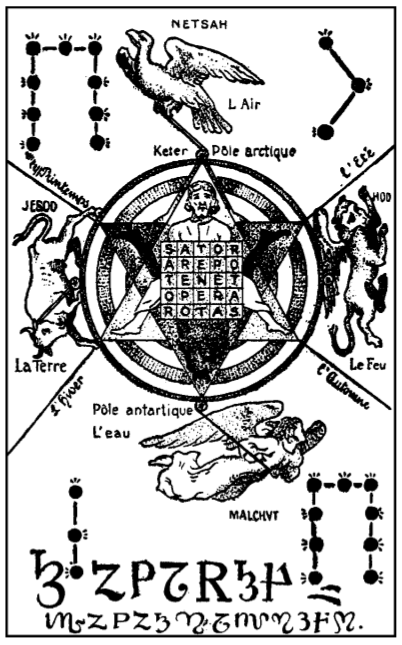
Guillaume Postel (1510-81), The Great Key, in Eliphas Levi (1810-75), La Clef des Grands MystèresThe Key of the Great Mysteries, 1861.

“A special place in the story of the renewal of Hebrew studies belongs to the French utopian thinker and érudit, Guillaume Postel (1510-81). Councillor to the kings of France, close to the major religious, political and scientific personalities of his epoch, Postel returned from a series of diplomatic missions to the Orient, voyages which enabled him to study Arabic and Hebrew as well as to learn of the wisdom of the kabbala, a changed and marked man.

Already renowned as a Greek philologist, around 1539, Postel was appointed to the post of “mathematicorum et peregrinarum linguarum regius interpretes” in that Collège des Trois Langues which eventually became the Collège de France.

In his De originibus seu de Hebraicae linguae et gentis antiquitate (1538), Postel argued that Hebrew came directly from the sons of Noah, and that, from it, Arabic, Chaldean, Hindi and, indirectly, Greek had all descended as well.

In Linguarum duodecem characteribus differentium alphabetum, introductio (1538), by studying twelve different alphabets he proved the common derivation of every language. From here, he went on to advance the project of a return to Hebrew as the instrument for the peaceable fusion of the peoples of differing races.

To support his argument that Hebrew was the proto-language, Postel developed the criterion of divine economy. As there was but one human race, one world and one God, there could be but one language; this was a “sacred language, divinely inspired into the first man” (De Foenicum litteris, 1550).

God had educated Adam by breathing into him the capacity to call things by their appropriate names (De originibus, seu, de varia et potissimum orbit Latino ad hanc diem incognita aut inconsyderata historia, 1553).

Although Postel does not seem to have thought either of an innate faculty for languages or of a universal grammar, as Dante had done, there still appears in many of his writings the notion of an Averroist active intellect as the repository of the forms common to all humanity, in which the roots of our linguistic faculty must be sought (Les très merveilleuses victoires des femmes du nouveau monde together with La doctrine du siècle doré, both from 1553).

Postel’s linguistic studies were connected to his particular vision of a religious utopia: he foresaw the reign of universal peace.

In his De orbis terrae concordia (1544:I) he clearly states that his studies in language would help to lay the foundations upon which a universal concord could be created. He envisioned the creation of a linguistic commonwealth that would serve as living proof to those of other faiths that not only was the message of Christianity true, but equally it verified their own religious beliefs: there are some principles of a natural religion, or sets of innate ideas held by all peoples (De orbis, III).

Here was the spirit that had inspired Lull and Nicholas of Cusa. Yet Postel was convinced that universal peace could only be realized under the protection of the king of France: among the world’s rulers the king of France alone held a legitimate claim to the title of king of the world.

He was the direct descendent of Noah, through Gomer, son of Japheth, founder of the Gallic and Celtic races (cf. particularly Les raisons de la monarchie, c. 1551). Postel (Trésor des propheties de l’univers, 1556) supported this contention with a traditional etymology (see, for example, Jean Lemaire de Belges, Illustration de Gaule et singularitez de Troye, 1512-3, fol. 64r): in Hebrew, the term gallus meant “he who overcame the waves;” thus the Gauls were the people who had survived the waters of the Flood (cf. Stephens 1989:4).

Postel first attempted to convert Francis I to his cause. The king, however, judged him a fanatic, and he lost favor at court. He went to Rome, hoping to win over to his utopian schemes Ignatius of Loyola, whose reformist ideals seemed kindred to his own.

It did not take Ignatius long, however, to realize that Postel’s ambitions were not identical to those of the Jesuits. Accepting Postel’s project might have placed their vow of obedience to the pope at risk.

Besides, Ignatius was a Spaniard, and the idea of turning the king of France into the king of the world would hardly have appealed to him. Although Postel continued long afterwards to look upon the Jesuits as the divine instrument for the creation of universal peace, he himself was forced to leave the company after a mere year and a half.”

Umberto Eco, The Search for the Perfect Language, translated by James Fentress, Blackwell. Oxford, 1995, pp. 75-7.

Eco: The Return to Hebrew

Hildegard_von_Bingen_Liber_Divinorum_Operum

Hildegard von Bingen, Universal Man, Liber Divinorum Operum, or Book of Divine Works, 1165. This work is in the public domain in its country of origin and other countries and areas where the copyright term is the author’s life plus 100 years or less.   

“From Origen to Augustine, almost all of the church Fathers assumed, as a matter of incontrovertible fact, that, before the confusion, humanity’s primordial language was Hebrew.

The most notable dissenting voice was Gregory of Nyssa (Contra Eunomium). God, he thought, could not have spoken Hebrew; were we to imagine, he said ironically, a schoolmaster God drilling our forefathers in the Hebrew alphabet (cf. Borst 1957-63: I, 2, and II/1, 3.1)?

Despite this, the image of Hebrew as the divine language survived through the Middle Ages (cf. De Lubac 1959: II, 3.3).

By the sixteenth and seventeenth centuries, however, it no longer seemed enough simply to maintain that Hebrew was the photo-language (little being known thereof): it was deemed necessary to promote its study, and, if possible, its diffusion.

By now we are in a climate very different from that of St. Augustine: not only do the interpreters wish to go back to the text in its original version, but they do it with the conviction that the original and holy language of scripture was the only one capable of expressing its sacred truth.

What has happened in the meantime is, of course, the Reformation. Protestants refused to accept the claim of the Catholic church to be the sole mediator and interpreter, placing itself, with its canonic Latin translations, between the believer and the Holy Writ.

Out of this refusal to accept the church’s traditional interpretation of scripture arose the stimulus to study the languages in which the sacred texts had first been formulated.

The contemporary debate over this was varied and complex. The most comprehensive treatment is contained perhaps in Brian Walton’s In biblia polyglotta prolegomena (1673: especially 1-3).

However, the story of this debate during the Renaissance is so complex (see Demonet 1992) that we shall limit ourselves to a gallery of exemplary portraits.”

Umberto Eco, The Search for the Perfect Language, translated by James Fentress, Blackwell. Oxford, 1995, pp. 73-5.

Eco: The Monogenetic Hypothesis and the Mother Tongues

05-06-stitched-together

Athanasius Kircher, Turris Babel, Amsterdam, 1679. The illustrations in Turris Babel were engraved by C. Decker. This plate was based on an original by Lievin Cruyl (c. 1640-1720) in Rome. This is catalog no. 46, between pages 40-1 from the original work held in the Bodleian Library, Oxford. This plate was published by the Museum of the History of Science at Oxford. Another copy is also held by the University of St. Andrews, under call number r17f BS1238.B2K5. Stanford University also has a copy. This work is in the public domain in its country of origin and other countries and areas where the copyright term is the author’s life plus 100 years or less.

Editorial Note:

The formatting of this section differs from the original because I am tired of wrestling with the WordPress interface. Eco organizes this section with numbered paragraphs. I omit the numbering. Further, I insert paragraph breaks in the middle of Eco’s long paragraphs to ease readability.

The Monogenetic Hypothesis and the Mother Tongues

“In its most ancient versions, the search for a perfect language took the form of the monogenetic hypothesis which assumed that all languages descended from a unique mother tongue.

Before I tell the story of this hypothesis, however, we should note that most of the attempts suffered from a continuous confusion between different theoretical options.

The distinction between a perfect language and a universal language was not sufficiently understood. It is one thing to search for a language capable of mirroring the true nature of objects; it is quite another to search for the language which everyone might, or ought to, speak. There is nothing that rules out that a language which is perfect might be accessible only to a few, while a language that is universal might also be imperfect.

The distinction between the Platonic opposition of nature and convention was not kept separate from the general problem of the origin of language (cf. Formigari 1970). It is possible to imagine a language that expresses the nature of things, but which, none the less, is not original, but arises through invention.

It is also possible to discuss whether language originated as an imitation of nature (the “mimological” hypothesis, Genette 1976) or as the result of a convention, without necessarily posing the question of whether the former is better than the latter.

As a consequence, claims to linguistic superiority on etymological grounds (more direct filiation with an ancient language) are often confused with those on mimological grounds–while the presence of onomatopoetic words in a language can be seen as a sign of perfection, not as the proof of the direct descent of that language from a primordial one.

Despite the fact that the distinction was already clear in Aristotle, many authors failed to distinguish between a sound and the alphabetical sign that represented it.

As Genette (1976) has often reminded us, before the advent of comparative linguistics in the nineteenth century, most research on languages concentrated on semantics, assembling nomenclature families of supposedly related words (often, as we shall see, making up etymologies to match), but neglecting both phonology and grammar.

Finally, there was not a clear cut distinction between primordial language and universal grammar. It is possible to search for a set of grammatical principles common to all languages without wishing to return to a more primitive tongue.”

Umberto Eco, The Search for the Perfect Language, translated by James Fentress, Blackwell. Oxford, 1995, pp. 73-4.

Eco: The Concordia Universalis of Nicholas of Cusa

Tafel18

Meister des Marienlebens, Kreuzigung, Passionsalter aus Bernkastel-Kues, 1460. This work is in the public domain in its country of origin and other countries and areas where the copyright term is the author’s life plus 100 years or less. 

“The seductive potentiality of Lull’s appeal to the principle of universal concord is revealed by the resumption of his project, two centuries later, by Nicholas of Cusa. Nicholas is famous as the figure who revived Plato during the years between the crisis of scholasticism and the beginning of the Renaissance.

Nicholas also propounded the idea of an infinitely open universe, whose centre was everywhere and whose circumference nowhere. As an infinite being, God transcended all limits and overcame every opposition.

As the diameter of a circle increased, its curvature diminished; so at its limit its circumference became a straight line of infinite length.

Likewise, in God all opposites coincide. If the universe had a centre, it would be limited by another universe. But in the universe, God is both centre and circumference. Thus the earth could not be the centre of the universe.

This was the starting point for a vision of the plurality of worlds, of a reality founded on mathematical principles, which can be submitted to continuous investigation, where the world, if not infinite in a strict sense, was at least capable of assuming an infinite number of guises.

The thought of Nicholas is rich in cosmological metaphors (or models) founded upon the image of the circle and the wheel (De docta ignorantia, II, 11), in which the names of the divine attributes (explicitly borrowed from Lull) form a circle where each supports and confirms the others (I, 21).

The influence of Lull is even more explicitly revealed when Nicholas notes that the names by which the Greeks, Latins, Germans, Turks and Saracens designate the divinity are either all in fundamental accord, or derive from the Hebrew tetragrammaton (see the sermon Dies sanctificatus).

The ideas of Lull had spread to the Veneto towards the close of the fourteenth century. Nicholas probably came into contact with them in Padua. Their diffusion was, in part, a reaction against a scholastic Aristotelianism now in crisis; yet the diffusion also reflected the feverish cultural atmosphere generated by close contacts with the East.

Just as Catalonia and Majorca had been frontier territories in contact with the Muslim and Jewish worlds at the time of Lull, so the Venetian Republic had opened itself to the world of Byzantium and of the Arab countries two centuries later. The emerging currents of Venetian humanism were inspired by a new curiosity and respect for other cultures (cf. Lohr 1988).

It was thus appropriate that in this atmosphere there should have reemerged the thought of a figure whose preaching, whose theological speculations, and whose research on universal language were all conceived with the aim of building an intellectual and religious bridge between the European West and the East.

Lull believed that true authority could not be based on a rigid unity, but rather on the tension between various centers. It was the laws of Moses, the revelations of Christ and the preaching of Mohammed that, taken together, might produce a unified result.

Lull’s doctrine acted as a mystical and philosophical stimulus and seemed an imaginative and poetic alternative to the encyclopedia of Aristotelian scholasticism, but it provided a political inspiration as well.

The works of a writer who had dared to put his doctrine into the vernacular proved congenial to humanists who, on the one hand, had begun to celebrate the dignity of their own native tongues, but, on the other hand, wondered how it was possible to establish a rational discussion which broke the boundaries of national traditions, a philosophy which could reanimate the body of encyclopedic scholasticism by injecting the leaven of exotic new doctrines, expressed in languages still entirely unknown.

In his De pace fidei, Nicholas opened a polemical dialogue with the Muslims. He asked himself Lull’s question: how might the truth of Christian revelation be demonstrated to followers of the two other monotheistic religions?

Perhaps, Nicholas mused, it was a mistake to translate the persons of the Trinity as “Father,” “Son” and “Holy Ghost.” Perhaps they should have been given more philosophical names (better understandable by other cultures).

In his ecumenical fervor, Nicholas even went so far as to propose to the Jews and the Muslims that, if they would accept the Gospels, he would see that all Christians received circumcision. It was a proposal, as he confessed at the end, whose practical realization might present certain difficulties. (De pace fidei, XVI, 60).

Nicholas retained from Lull the spirit of universal peace as well as his metaphysical vision. Yet before the thrilling potential of Nicholas’s own vision of an infinity of worlds could be translated into a new and different version of the art of combination, new ideas would have to fertilize the humanist and Renaissance world.

The rediscovery of the art of combination would have to wait for the rediscovery of Hebrew, for Christian kabbalism, for the spread of Hermeticism, and for a new and positive reassessment of magic.”

Umberto Eco, The Search for the Perfect Language, translated by James Fentress, Blackwell. Oxford, 1995, pp. 69-72.


Eco: The Arbor Scientarium, 2

Ramon Llull, Arbor Scientiae, Rome, 1295

Ramon Llull, Arbor Scientiae, Rome, 1295. This work is in the public domain in its country of origin and other countries and areas where the copyright term is the author’s life plus 100 years or less.  

“Between the first and last versions of his art, Lull’s thought underwent a long process of evolution (described by Carreras y Artau 1939: I, 394), in order to render his art able to deal not only with theology and metaphysics, but also with cosmology, law, medicine, astronomy, geometry and psychology.

Increasingly, the art became a means of treating the entire range of knowledge, drawing suggestions from the numerous medieval encyclopedias, and anticipating the encyclopedic dreams of the Renaissance and the baroque.

All this knowledge, however, needed to be ordered hierarchically. Because they were determinations of the first cause, the dignities could be defined circularly, in reference to themselves; beyond the dignities, however, began the ladder of being. The art was designed to permit a process of reasoning at every step.

The roots of the Tree of Science were the nine dignities and the nine relations. From here, the tree then spread out into sixteen branches, each of which had its own, separate tree. Each one of the sixteen trees, to which there was dedicated a particular representation, was divided into seven parts–roots, trunk, major branches, lesser branches, leaves, fruits and flowers.

Eight of the trees clearly corresponded to eight of the subjects of the tabula generalis: these are the Arbor elementalis, which represents the elementata, that is, objects of the sublunary world, stones, trees and animals composed of the four elements; the Arbor vegetalis;  the Arbor sensualis; the Arbor imaginalis, which represents images that replicate in the mind whatever is represented on the other trees; the Arbor humanalis et moralis (memory, intellect and will, but also the various sciences and arts); the Arbor coelestialis (astronomy and astrology); the Arbor angelicalis; and the Arbor divinalis, which includes the divine dignities.

To this list are added another eight: the Arbor mortalis (virtues and vices); the Arbor eviternalis (life after death); the Arbor maternalis (Mariology); the Arbor Christianalis (Christology); the Arbor imperialis (government); the Arbor apostolicalis (church); the Arbor exemplificalis (the contents of knowledge); and the Arbor quaestionalis, which contains four thousand questions on the various arts.

To understand the structure of these trees, it is enough to look at only one–the Arbor elementalis. Its roots are the nine dignities and nine relations. Its trunk represents the conjoining of these principles, out of which emerges the confused body of primordial chaos which occupies space.

In this are the species of things and their dispositions. The principle branches represent the four elements (earth, air, fire and water) which stretch out into the four masses which are made from them (the seas and the lands).

The leaves are the accidents. The flowers are the instruments, such as hands, feet and eyes. The fruits represent individual things, such as stone, gold, apple, bird.

Calling this a “forest” of trees would be an improper metaphor: the trees overlay one another to rise hierarchically like the peaked roof of a pagoda. The trees at the lower levels participate in those higher up.

The vegetable tree, for example, participates in the tree of elements; the sensual tree participates in the first two; the tree of imagination is built up out of the first three, and it forms the base from which the next tree, the human one, will arise (Llinares 1963: 211-2).

The system of trees reflects the organization of reality itself; it represents the great chain of being the way that it is, and must metaphysically be. This is why the hierarchy constitutes a system of “true” knowledge.

The priority of metaphysical truth over logical validity in Lull’s system also explains why he laid out his art the way he did: he wished his system to produce, for any possible argument, a middle term that would render that argument amenable to syllogistic treatment; having structured the system for this end, however, he proceeded to discard a number of well-formed syllogisms which, though logically valid, did not support the arguments he regarded as metaphysically true.

For Lull, the significance of the middle term of the syllogism was thus not that of scholastic logic. Its middle term served to bind the elements of the chain of being: it was a substantial, not a formal, link.

If the art is a perfect language, it is so only to the extent to which it can speak of a metaphysical reality, of a structure of being which exists independently of it. The art was not a mechanism designed to chart unknown universes.

In the Catalan version of his Logica Algazelis, Lull writes, “De la logic parlam tot breau–car a parlor avem Deu.” (“About logic we will be brief, for it is to talk about God”).

Much has been written about the analogy between Lull’s art and the kabbala. What distinguishes kabbalistic thought from Lull’s is that, in the kabbala, the combination of the letters of the Torah had created the universe rather than merely reflected it.

The reality that the kabbalistic mystic sought behind these letters had not yet been revealed; it could be discovered only through whispering the syllables as the letters whirled.

Lull’s ars combinatoria, by contrast, was a rhetorical instrument; it was designed to demonstrate what was already known, and lock it for ever in the steely cage of the system of trees.

Despite all this, the art might still qualify as a perfect language if those elementary principles, common to all humanity, that it purported to expound really were universal and common to all peoples.

As it was, despite his effort to assimilate ideas from non-Christian and non-European religions, Lull’s desperate endeavor failed through its unconscious ethnocentrism. The content plane, the universe which his art expounded, was the product of the western Christian tradition.

It could not change even though Lull translated it into Arabic or Hebrew. The legend of Lull’s own agony and death is but the emblem of that failure.”

Umberto Eco, The Search for the Perfect Language, translated by James Fentress, Blackwell. Oxford, 1995, pp. 67-9.

Eco: The Arbor Scientarium

Ramon Llull, Liber de ascensu et decensu intellectus, 1304, first published 1512

Ramon Llull, Liber de ascensu et decensu intellectus, 1304, first published 1512. This work is in the public domain in its country of origin and other countries and areas where the copyright term is the author’s life plus 100 years or less.     

“The Lullian art was destined to seduce later generations who imagined that they had found in it a mechanism to explore the numberless possible connections between dignities and principles, principles and questions, questions and virtues or vices.

Why not even construct a blasphemous combination stating that goodness implies an evil God, or eternity a different envy? Such a free and uncontrolled working of combinations and permutations would be able to produce any theology whatsoever.

Yet the principles of faith, and the belief in a well-ordered cosmos, demanded that such forms of combinatorial incontinence be kept repressed.

Lull’s logic is a logic of first, rather than second, intentions; that is, it is a logic of our immediate apprehension of things rather than of our conceptions of them. Lull repeats in various places that if metaphysics considers things as they exist outside our minds, and if logic treats them in their mental being, the art can treat them from both points of view.

Consequently, the art could lead to more secure conclusions than logic alone, “and for this reason the artist of this art can learn more in a month than a logician can in a year.” (Ars magna, X, 101).

What this audacious claim reveals, however, is that, contrary to what some later supposed, Lull’s art is not really a formal method.

The art must reflect the natural movement of reality; it is therefore based on a notion of truth that is neither defined in the terms of the art itself, nor derived from it logically. It must be a conception that simply reflects things as they actually are.

Lull was a realist, believing in the existence of universals outside the mind. Not only did he accept the real existence of genera and species, he believed in the objective existence of accidental forms as well.

Thus Lull could manipulate not only genera and species, but also virtues, vices and every other sort of differentia as well; at the same time, however, all those substances and accidents could not be freely combined because their connections were determined by a rigid hierarchy of beings (cf. Rossi 1960: 68).

In his Dissertatio de arte combinatoria of 1666, Leibniz wondered why Lull had limited himself to a restricted number of elements. In many of his works, Lull had, in truth, also proposed systems based on 10, 16, 12 or 20 elements, finally settling on 9. But the real question ought to be not why Lull fixed upon this or that number, but why the number of elements should be fixed at all.

In respect of Lull’s own intentions, however, the question is beside the point; Lull never considered his to be an art where the combination of the elements of expression was free rather than precisely bound in content.

Had it not been so, the art would not have appeared to Lull as a perfect language, capable of illustrating a divine reality which he assumed from the outset as self-evident and revealed.

The art was the instrument to convert the infidels, and Lull had devoted years to the study of the doctrines of the Jews and Arabs. In his Compendium artis demonstrativa (“De fine hujus libri“) Lull was quite explicit: he had borrowed his terms from the Arabs.

Lull was searching for a set of elementary and primary notions that Christians held in common with the infidels. This explains, incidentally, why the number of absolute principles is reduced to nine (the tenth principle, the missing letter A, being excluded from the system, as it represented perfection or divine unity).

One is tempted to see in Lull’s series the ten Sefirot of the kabbala, but Plazteck observes (1953-4: 583) that a similar list of dignities is to be found in the Koran. Yates (1960) identified the thought of John Scot Erigene as a direct source, but Lull might have discovered analogous lists in various other medieval Neo-Platonic texts–the commentaries of pseudo-Dionysius, the Augustinian tradition, or the medieval doctrine of the transcendental properties of being (cf. Eco 1956).

The elements of the art are nine (plus one) because Lull thought that the transcendental entities recognized by every monotheistic theology were ten.

Lull took these elementary principles and inserted them into a system which was already closed and defined, a system, in fact, which was rigidly hierarchical–the system of the Tree of Science.

To put this in other terms, according to the rules of Aristotelian logic, the syllogism “all flowers are vegetables, X is a flower, therefore X is a vegetable” is valid as a piece of formal reasoning independent of the actual nature of X.

For Lull, it mattered very much whether X was a rose or a horse. If X were a horse, the argument must be rejected, since it is not true that a horse is a vegetable. The example is perhaps a bit crude; nevertheless, it captures very well the idea of the great chain of being (cf. Lovejoy 1936) upon which Lull based his Arbor scientiae (1296).”

Umberto Eco, The Search for the Perfect Language, translated by James Fentress, Blackwell. Oxford, 1995, pp. 64-7.

Eco: The Alphabet and the Four Figures, 3

12544152.0001.001-00000019

Jonathan Swift, Gulliver’s Travels, 1892 George Bell and Sons edition, Project Gutenberg. Also see Jonathan Swift, Gulliver’s Travels, A.J. Rivero, ed., New York: W.W.Norton, 2001, Part III, chapter 5. Cited in Bethany Nowviskie, “Ludic Algorithms,” in Kevin Kee, ed., Pastplay: Teaching and Learning History with Technology, Ann Arbor, MI: University of Michigan Press, 2014. 

“It follows that Lull’s art is not only limited by formal requirements (since it can generate a discovery only if one finds a middle term for the syllogism); it is even more severely limited because the inferences are regulated not by formal rules but rather by the ontological possibility that something can be truly predicated of something else.

The formal rules of the syllogism would allow such arguments as “Greed is different from goodness — God is greedy — Therefore God is different from goodness.” Yet Lull would discard both the premises and the conclusion as false.

The art equally allows the formulation of the premise “Every law is enduring,” but Lull rejects this as well because “when an injury strikes a subject, justice and law are corrupted” (Ars brevis, quae est de inventione mediorum iuris, 4.3a).

Given a proposition, Lull accepts or rejects its logical conversion, without regard to its formal correctness (cf. Johnston 1987: 229).

Nor is this all. The quadruples derived from the fourth figure appear in the columns more than once. In Ars magna the quadruple BCTB, for example, figures seven times in each of the first seven columns.

In V, 1, it is interpreted as “Whether there exists some goodness so great that it is different,” while in XI, 1, applying the rule of logical obversion, it is read as “Whether goodness can be great without being different”–obviously eliciting a positive response in the first case and a negative one in the second.

Yet these reappearances of the same argumentative scheme, to be endowed with different semantic contents, do not bother Lull. On the contrary, he assumes that the same question can be solved either by any of the quadruples from a particular column that generates it, or from any of the other columns!

Such a feature, which Lull takes as one of the virtues of his art, represents in fact its second severe limitation. The 1,680 quadruples do not generate fresh questions, nor do they furnish new proofs.

They generate instead standard answers to an already established set of questions. In principle, the art only furnishes 1,680 different ways of answering a single question whose answer is already known.

It cannot, in consequence, really be considered a logical instrument at all. It is, in reality, a sort of dialectical thesaurus, a mnemonic aid for finding out an array of standard arguments able to demonstrate an already known truth.

As a consequence, any of the 1,680 quadruples, if judiciously interpreted, can yield up the correct answer to the question for which it is adapted.

See, for instance, the question “Whether the world is eternal” (“Utrum mundus sit aeternus“). Lull already knew the answer: negative, because anyone who thought the world eternal would fall into the Averroist error.

Note, however, that the question cannot be generated directly by the art itself; for there is no letter corresponding to world. The question is thus external to the art.

In the art, however, there does appear a term for eternity, that is, D; this provides a starting point.

In the second figure, D is tied to the relative principle contrarietas or opposition, as manifested in the opposition of the sensible to the sensible, of the intellectual to the sensible, and of the intellectual to the intellectual.

The same second figure also shows that D forms a triangle with B and C. The question also began with utrum, which appears at B under the heading Questiones in the tabula generalis. This constitutes a hint that the solution needs to be sought in the column in which appear B, C and D.

Lull says that “the solution to such a question must be found in the first column of the table;” however, he immediately adds that, naturally, “it could be found in other columns as well, as they are all bound to each other.”

At this point, everything depends on definitions, rules, and a certain rhetorical legerdemain in interpreting the letters. Working from the chamber BCDT (and assuming as a premise that goodness is so great as to be eternal), Lull deduces that if the world were eternal, it would also be eternally good, and, consequently, there would be no evil.

“But,” he remarks, “evil does exist in the world as we know by experience. Consequently we must conclude that the world is not eternal.” This negative conclusion, however, is not derived from the logical form of the quadruple (which has, in effect, no real logical form at all), but is merely based on an observation drawn from experience.

The art may have been conceived as the instrument to use universal reason to show the Averroist Muslims the error of their ways; but it is clear that unless they already shared with Lull the “rational” conviction that the world cannot be eternal, they are not going to be persuaded by the art.”

Umberto Eco, The Search for the Perfect Language, translated by James Fentress, Blackwell. Oxford, 1995, pp. 62-4.

Eco: The Alphabet and the Four Figures, 2

Raymond Llull, Combinations, Strasbourg ed 1598

Umberto Eco, The Search for the Perfect Language, 1995, pg. 60. Figure 4.2, a page of combinations from the Strasbourg edition of the Ars Magna of Raymond Llull, 1598. This work is in the public domain in its country of origin and other countries and areas where the copyright term is the author’s life plus 100 years or less.  

Taken in groups of 3, 9 elements generate 84 combinations–BCD, BCE, CDE, etc. If, in his Ars breu and elsewhere, Lull sometimes speaks of 252 (84*3) combinations, it is because to each triple can be assigned three questions, one for each of the letters of the triple (see also the Jesuit Athanasius Kircher, Ars magna sciendi, p. 14.

ArsMagnaSciendi1

Athanasius Kircher, Ars Magna Sciendi, Amsterdam, 1669. This work is in the public domain in its country of origin and other countries and areas where the copyright term is the author’s life plus 100 years or less. 

Each triple further generates a column of 20 combinations (giving a table of 20 rows by 84 columns) because Lull transforms the triples into quadruples by inserting the letter T. In this way, he obtains combinations like BCDT, BCTB, BTBC, etc. (See examples in figure 4.2, at the top of this page).

The letter T, however, plays no role in the art; it is rather a mnemonic artifice. It signifies that the letters that precede it are to be read as dignities from the first figure, while those that follow it are to be read as relative principles as defined in the second figure.

Thus, to give an example, the quadruple BCTC must be read: B (= goodness) + C (= greatness) and therefore (switching to the second figure) C (=  concordance).

Looking at the tabula generalis, we further notice that combinations with an initial B take the question utrum, those with an initial C take quid, etc. This produces from BCTC the following reading: “Whether goodness is great inasmuch as it contains in itself concordant things.”

This produces a series of quadruples which seem, at first sight, embarrassing: the series contains repetitions. Had repetitions been permissible, there would have been 729 triples instead of 84.

The best solution to the mystery of these repetitions is that of Platzek (1953-4: 141). He points out that, since, depending on whether it precedes or follows the T, a letter can signify either a dignity or a relation, each letter has, in effect, two values.

Thus–given the sequence BCTB–it should be read as BCb. The letters in upper case would be read as dignities, and the one in lower case as a relation. It follows that, in his 84 columns, Lull was not really listing the combinations for three letters but for six. Six different elements taken three at a time give 20 permutations, exactly as many appear in each column.

The 84 columns of 20 quadruples each yield 1,680 permutations. This is a figure obtained by excluding inversions of order.

At this point, however, a new question arises. Given that all these 1,680 quadruples can express a propositional content, do they all stand for 1,680 valid arguments as well?

ArsMagnaSciendi

Athanasius Kircher, Ars Magna Sciendi sive Combinatoria, Amsterdam, 1669. Frontispiece. This work is in the public domain in its country of origin and other countries and areas where the copyright term is the author’s life plus 100 years or less.  

Not at all, for not every sequence generated by the art is syllogistically valid. Kircher, in his Ars magna sciendi, suggests that one must deal with the resulting sequences as if they were anagrams: one starts by forming a complete list of all the possible arrangements of the letters of a particular word, then discards those that do not correspond to other existing words.

The letters of the Latin word ROMA, for example, can be combined in 24 different orders: certain sequences form acceptable Latin words, such as AMOR, MORA, RAMO; others, however, such as AOMR, OAMR, MRAO, are nonsense, and are, as it were, thrown away.

Lull’s own practice seems to suppose such a criterion. He says, for example, in his Ars magna, segunda pars principalis that in employing the first figure, it is always possible to reverse subject and predicate (“Goodness is great” / “Greatness is good”).

It would not, however, be possible to reverse goodness and angel, for while angel participates in goodness, goodness does not participate in angel, since there are beings other than angels which are good.

In other words, angel entails goodness but not vice versa. Lull also adds that the combination “Greed is good” is inherently unacceptable as well. Whoever wishes to cultivate the art, Lull says, must be able to know what is convertible and what is not.”

Umberto Eco, The Search for the Perfect Language, translated by James Fentress, Blackwell. Oxford, 1995, pp. 60-2.

Eco: The Alphabet and the Four Figures

Illuminati_sacre_pagine_p.fessoris_amplissimi_magistri_Raymundi_Lull._Ars_magna,_generalis_et_vltima_-_quarucunq3_artium_(et)_scientiarum_ipsius_Lull._assecutrix_et_clauigera_-_(et)_ad_eas_aditum_(14591005828)

Raymond Llull (1232-1316), Ars magna, segunda figurageneralis et ultima, 1517, held in the Getty Research Institute and digitized by that institution in collaboration with the Internet Archive, generously posted on archive.org. This work is in the public domain in its country of origin and other countries and areas where the copyright term is the author’s life plus 100 years or less.


“The ars combinatoria of Lull employs an alphabet of nine letters–B to K, leaving out J–and four figures (see figure 4.1). In a tabula generalis that appears in several of his works, Lull set out a table of six groups of nine entities, one for each of the nine letters.

The first group are the nine absolute principles, or divine dignities, which communicate their natures to each other and spread throughout creation.

After this, there are nine relative principles, nine types of question, nine subjects, nine virtues and nine vices.

Lull specifies (and this is an obvious reference to Aristotle’s list of categories) that the nine dignities are subjects of predication, while the other five series are predicates. We shall see that subject and predicate are sometimes allowed to exchange their roles, while in other cases variations of order are not considered as pertinent.

First figure. This traces all the possible combinations between the dignities, thus allowing predications such as “Goodness [bonitas] is great,” “Greatness [magnitudo] is glorious,” etc.

Since the dignities are treated as nouns when they appear as a predicate, the lines connecting them can be read in both directions. The line connecting magnitudo and bonitas can, for example, be read as both “Greatness is good” and “Goodness is great.” This explains why 36 lines produce 72 combinations.

The first figure is designed to allow regular syllogisms to be inferred. To demonstrate, for example, that goodness can be great, it is necessary to argue that “all that is magnified by greatness is great–but goodness is what is magnified by greatness–therefore goodness is great.”

The first table excludes self-predications, like BB or CC, because, for Lull, there is no possibility of a middle term in an expression of the type “Goodness is good” (in Aristotelian logic, “all As are B–C is an A–therefore C is a B” is a valid syllogism because, following certain rules, the middle term A is so disposed to act as the, as it were, bond between B and C).

Second figure. This serves to connect the relative principles with triples of definitions. They are the relations connecting the divine dignities with the cosmos. Since it is intended merely as a visual mnemonic that helps to fix in the mind the various relations between different types of entity, there is no method of combination associated with the second figure.

For example, difference, concordance and opposition (contrarietas) can each be considered in reference to (1) two sensible entities, such as a plant and a stone, (2) a sensible and an intellectual entity, like body and soul, and (3) two intellectual entities, like the soul and an angel.

Third figure. Here Lull displayed all possible letter pairings. The figure contains 36 pairs inserted in what Lull calls the 36 chambers. The figure makes it seem that he intended to exclude inversions.

Yet, in reality, the figure does contemplate inversions in order, and thus the number of the chambers is virtually 72 since each letter is permitted to function as either subject or predicate (“Goodness is great” also gives “Greatness is good:” Ars magna, VI, 2).

Having established the combinations, Lull proceeds to what he calls the “evacuation of the chambers.” Taking, for example, chamber BC, we read it first according to the first figure, obtaining goodness and greatness (bonitas and magnitudo); then according to the second figure, obtaining difference and concordance, (differentia and concordantia: Ars magna, II, 3).

From these two pairs we derive 12 propositions: “Goodness is great,” “Difference is great,” Goodness is different,” “Goodness is different,” “Difference is good,” “Goodness is concordant,” “Difference is concordant,” “Greatness is good,” “Concordance is good,” “Greatness is different,” “Concordance is different,” “Greatness is concordant,” and “Concordance is great.”

Going back to the tabula generalis in figure 4.1, we find that, under the next heading, Questiones, B and C  are utrum (whether) and quid (what). By combining these 2 questions with the 12 propositions we have just constructed, we obtain 24 questions, like “Whether goodness is great?,” or “What is a great goodness?” (see Ars magna, VI, 1).

In this way, the third figure generates 432 propositions and 864 questions–at least in theory. In reality, there are 10 additional rules to be considered (given in Ars magna, VI, iv).

For the chamber BC, for example, there are the rules B and C. These rules depend on the theological definition of the terms, and on certain argumentative constraints which have nothing to do with the rules of combination.

illuminatisacrep00llul_0040

Quarta figura, fourth figure.

Fourth figure. This is the most famous of the figures, and the one destined to have the greatest influence on subsequent tradition. In this figure, triples generated by the nine elements are considered.

In contrast to the preceding figures, which are simply static diagrams, the fourth figure is mobile. It is a mechanism formed by three concentric circles, of decreasing size, inserted into each other, and held together usually by a knotted cord.

If we recall that in the Sefer Yezirah the combination of the letters was visually represented by a wheel or a spinning disc, it seems probable that Lull, a native of Majorca, has been influenced here by the kabbalistic tradition that flourished in his time in the Iberian peninsula.”

Umberto Eco, The Search for the Perfect Language, translated by James Fentress, Blackwell. Oxford, 1995, pp. 56-60.


Eco: The Elements of the Ars Combinatoria

Ramon_Llull, Ars Magna, Fig_1

Raymond Llull (1232-1316), Figure 1 from Ars magna, 1300. This work is in the public domain in its country of origin and other countries and areas where the copyright term is the author’s life plus 100 years or less. 

“Given a number of different elements n, the number of arrangements that can be made from them, in any order whatever, is expressed by their factorial n!, calculated as 1.*2*3. . . . *n.

This is the method for calculating the possible anagrams of a word of n letters, already encountered as the art of temurah in the kabbala. The Sefer Yezirah informed us that the factorial of 5 was 120.

As n increases, the number of possible arrangements rises exponentially: the possible arrangements for 36 elements, for example, are 371, 993, 326, 789, 901, 217, 467, 999, 448, 150, 835, 200, 000, 000.

If the strings admit repetitions, then those figures grow upwards. For example, the 21 letters of the Italian alphabet can give rise to more than 51 billion billion 21-letter-long sequences (each different from the rest); when, however, it is admitted that some letters are repeated, but the sequences are shorter than the number of elements to be arranged, then the general formula for n elements taken t at a time with repetitions is n1  and the number of strings obtainable for the letters of the Italian alphabet would amount to 5 billion billion billion.

Let us suppose a different problem. There are four people, A. B, C, and D. We want to arrange these four as couples on board an aircraft in which the seats are in rows that are two across; the order is relevant because I want to know who will sit at the the window and who at the aisle.

We are thus facing a problem of permutation, that is, of arranging n elements, taken t at a time, taking the order into account. The formula for finding all the possible permutations is n!/(n-t)In our example the persons can be disposed this way:

AB     AC     AD     BA     CA     DA     BC     BD     CD     CB     DB     DC

 Suppose, however, that the four letters represented four soldiers, and the problem is to calculate how many two-man patrols could be formed from them. In this case the order is irrelevant (AB or BA are always the same patrol). This is a problem of combination, and we solve it with the following formula: n!/t!(n-t)! In this case the possible combinations would be:

AB     AC     AD     BC     BD     CD

Such calculuses are employed in the solution of many technical problems, but they can serve as discovery procedures, that is, procedures for inventing a variety of possible “scenarios.”

In semiotic terms, we are in front of an expression-system (represented both by the symbols and by the syntactic rules establishing how n elements can be arranged t at a time–and where t can coincide with n), so that the arrangement of the expression-items can automatically reveal possible content-systems.

In order to let this logic of combination or permutation work to its fullest extent, however, there should be no restrictions limiting the number of possible content-systems (or worlds) we can conceive of.

As soon as we maintain that certain universes are not possible in respect of what is given in our own past experience, or that they do not correspond to what we hold to be the laws of reason, we are, at this point, invoking external criteria not only to discriminate the results of the ars combinatoria, but also to introduce restrictions within the art itself.

We saw, for example, that, for four people, there were six possible combinations of pairs. If we specify that the pairing is of a matrimonial nature, and if A and B are men while C and D are women, then the possible combinations become four.

If A and C are brother and sister, and we take into the account the prohibition against incest, we have only three possible groupings. Yet matters such as sex, consanguinity, taboos and interdictions have nothing to do with the art itself: they are introduced from outside in order to control and limit the possibilities of the system.”

Umberto Eco, The Search for the Perfect Language, translated by James Fentress, Blackwell. Oxford, 1995, pp. 54-6.

Eco: The Ars Magna of Raymond Lull

Raymond Lull, Tabula Generalis, pg. 57, Eco, Search for a Perfect Language, 1995

Raymond Lull (1232-1316), Tabula Generalis, figure 4.1, Lull’s Alphabet, from Umberto Eco, The Search for a Perfect Language, Blackwell, Oxford, 1995, pg. 57. 

“A near contemporary of Dante, Ramòn Llull (Latinized as Lullus and Anglicized as Lull–and sometimes as Lully) was a Catalan, born in Majorca, who lived probably between 1232 (or 1235) and 1316.

Majorca during this period was a crossroads, an island where Christian, Jewish and Arab cultures all met; each was to play a role in Lull’s development. Most of his 280 known works were written initially in Arabic or Catalan (cf. Ottaviano 1930).

Lull led a carefree early life which ended when he suffered a mystic crisis. As a result, he entered the order of Tertian friars.

It was among the Franciscans that all of the earlier strands converged in his Ars magna, which Lull conceived as a system for a perfect language with which to convert the infidels. The language was to be a universal; it was to be articulated at the level of expression in a universal mathematics of combination; its level of content was to consist of a network of universal ideas, held by all peoples, which Lull himself would devise.

St. Francis had already sought to convert the sultan of Babylonia, and the dream of establishing universal concordance between differing races was becoming a recurrent theme in Franciscan thought. Another of Lull’s contemporaries, the Franciscan Roger Bacon, foresaw that contact with the infidels (not merely Arabs, but also Tartars) would require study of foreign languages.

The problem for him, however, was not that of inventing a new, perfect language, but of learning the languages that the infidels already spoke in order to convert them, or, failing that, at least to enrich Christian culture with a wisdom that the infidels had wrongfully appropriated (“tamquam ab iniustis possessoribus“).

The aims and methods of Lull and Bacon were different; yet both were inspired by ideals of universality and of a new universal crusade based on peaceful dialogue rather than on arms.

In this utopia the question of language played a crucial role (cf. Alessio 1957). According to legend, Lull was to die martyred at the hands of the Saracens, to whom he had appeared, armed with his art, believing it to be an infallible means of persuasion.

Lull was the first European philosopher to write doctrinal works in the vulgar tongue. Some are even in popular verses, so as to reach readers who knew neither Latin nor Arabic: “per tal che hom puscha mostrar / logicar e philosophar / a cels que win saben lati / ni arabichi” (Compendium, 6-9).

His art was universal not merely in that it was designed to serve all peoples, but also in that it used letters and figures in a way (allegedly) comprehensible even to illiterates of any language.”

Umberto Eco, The Search for the Perfect Language, translated by James Fentress, Blackwell. Oxford, 1995, pp. 53-4.

Eco: Dante and Abulafia, 2

1280px-Bartolomeu_Velho_1568

Bartolomeu Velho (d.1568), Figure of the Heavenly Bodies, an illuminated illustration of the Ptolemaic geocentric conception of the Universe, from Cosmographia, 1568. Held in the Bibliotèque Nationale de France, Paris. This work is in the public domain in its country of origin and other countries and areas where the copyright term is the author’s life plus 100 years or less.  

“Yet could Dante have known the theories of Abulafia?

Abulafia visited Italy on several occasions: he was in Rome in 1260; he remained on the peninsula until 1271, when he returned to Barcelona; he returned to Rome in 1280 with the project of converting the pope.

He journeyed afterwards to Sicily, where we lose trace of him somewhere near the end of the 1290s. His ideas incontestably exercised an influence on contemporary Italian Jewish thought. We have a record of a debate in 1290 between Hillel of Verona (who had probably met Abulafia twenty years earlier) and Zerakhya of Barcelona, who arrived in Italy at the beginning of the 1270s (cf. Genot-Bismuth 1988: II).

Hillel, who had contacts in the world of Bologna intellectuals, had written to Zerakhya to ask him the question first posed by Herodotus: in what language would a child speak if it were brought up with no linguistic stimuli?

Hillel maintained that such a child would naturally speak Hebrew, because Hebrew was humanity’s original natural language. Hillel either did not know, or else disregarded, the fact that Abulafia was of a different opinion. Not so with Zerakhya.

He sarcastically remarked that Hillel had been taken in by the siren song of the “uncircumcised” of Bologna. The first sounds emitted by a child without linguistic education, he asserted, would resemble the barking of dogs. It was madness to maintain that the sacred language could be naturally bestowed on human beings.

Humanity possessed a linguistic potential, but it was a potential that could be activated only through education of the vocal organs. This, however, required instruction.

At this point, Zerakhya brought forward a proof that we shall find in a number of post-Renaissance Christian authors (for example, in the In Biblia polyglotta prolegomena by Walton in 1673, or the De sacra philosophia of 1652 by Vallesio): had there been the primordial gift of an original sacred language, then all human beings, regardless of their native tongue, would have the innate ability to speak it.

The existence of such a debate is enough to show, without needing to invent a meeting between Dante and Abulafia, that Abulafia’s ideas were subject to discussion in Italy, especially in the Bolognese intellectual circles which influenced Dante, and from which, according to Maria Corti, he absorbed his notion of the forma locutionis.

Nor does the Bologna debate constitute the only point of encounter between Dante and Jewish thought.

Genot-Bismuth has given us a vivid picture of the close of the thirteenth century in which we will later find a Yehuda Romano giving a series of lectures on the Divine Comedy for his co-religionists, a Lionello di Ser Daniele who did likewise using a Divine Comedy transliterated into Hebrew script, not to mention the surprising personage of Immanuel da Roma, who, in his own poetic compositions, seemed to launch an attack on Dante’s ideals almost aspiring to produce a sort of counter-Comedy in Hebrew.

Naturally this only establishes the influence of Dante on Italian Jewish culture, not the other way around. Yet Genot-Bismuth is able to show opposing influences as well, even to the point of suggesting that Dante’s theory of the four senses of scripture, found in his Epistula, XIII (cf. Eco 1985), had a Jewish origin.

Such a hypothesis may be too bold: there were any number of Christian sources from which Dante might have drawn this doctrine. What seems less daring, and, in fact, entirely plausible, is the suggestion that, in Bologna, Dante would have heard echoes of the debate between Hillel and Zerakhya.

One could say that in DVE he appears still close to the position of the former (or of his Christian inspirers, as Zerakhya reproaches him), while in Paradise he turns towards the positions of the latter, that is, the position of Abulafia (even though, when writing DVE, he already had the opportunity to know both theses).

However, it is not necessary to document direct links (even though Genot-Bismuth finds the presence of Jewish influences in certain passages of the De regimine principium of Giles of Rome), but rather to demonstrate the existence of a cultural climate in which ideas could circulate and within which a formal and informal debate between the church and the synagogue might ensue (cf. Calimani 1987: viii).

We should remember that, before the Renaissance, a Christian thinker would scarcely wish to admit publicly that he drew on Hebrew doctrine.

Like heretics, the Jewish community belonged to a category of outcasts that–as Le Goff shrewdly observes–the Middle Ages officially despised but at the same time admired; regarding them with an admixture of attraction and fear, keeping them at a distance, but making sure that the distance was fixed near enough so they would always remain close at hand.

“What was termed charity in their regard more resembled the game that cats play with mice” (Le Goff 1964:373).

Before the kabbala was rehabilitated by humanist culture, Christianity knew little of it. It was often simply regarded as a branch of the black arts. Even so, as Gorni has pointed out (1990: vii), in the Divine Comedy, Dante seems to share a great deal of knowledge about magic and divinatory practices (astrology, chiromancy, physiognomy, geomancy, pyromancy, hydromancy and, not least, the black arts of magic themselves).

In one way or another, Dante seems to have been informed about an excluded and underground culture in which, at least according to vulgar opinion, the kabbala somehow belonged.

In this way, it becomes ever more plausible that, even if it does not derive directly from the theories of the Modistae, Dante’s forma locutionis is not a language but the universal matrix for all language.”

Umberto Eco, The Search for the Perfect Language, translated by James Fentress, Blackwell. Oxford, 1995, pp. 49-52.

Eco: Dante and Abulafia

1280px-The_Hay_Wain_by_Hieronymus_Bosch

Hieronymus Bosch (1450-1516), The Haywain or The Hay Wagon Triptych (1516), held after 1907 as accession number P02052 in The Prado Museum, Madrid. Bosch signed this work “Jheronimus Bosch” in the lower right corner of the central panel. This work is in the public domain in its country of origin and other countries and areas where the copyright term is the author’s life plus 100 years or less. 

“If we turn from DVE to Paradise, xxxvi (several years having passed in the meantime), we find that Dante has changed his mind. In the earlier work, Dante unambiguously states that it was from the forma locutionis given by God that the perfect language of Hebrew was born, and that it was in this perfect language that Adam addressed God, calling him El. In Paradise, xxxvi, 124-38, however, Adam says:

La lingua ch’io parlai fu tutta spenta

innanzi che all’ovra incomsummabile

fosse le gente di Nembròt attenta:

ché nullo effetto mai razïonabile,

per lo piacer uman che rinovella

seguendo il cielo, sempre fu durabile. 

Opera naturale è ch’uom favella,

ma, così o così, natura lascia,

poi fare a voi, secondo che v’abbella.

Pria ch’i’ pscendessi all’infernale ambascia 

I s’appellava in terra il sommo bene,

onde vien letizia che mi fascia; 

e EL si chiamò poi: e ciò convene,

ché l’uso dei mortali è come fronda

in ramo, che sen va e altra vene.

“The language that I spoke was entirely extinguished before the uncompletable work [the tower of Babel] of the people of Nembrot was even conceived: because no product of the human reason, from the human taste for always having something new, following the influence of the stars, is ever stable. It is natural that man speaks; but whether this way or that, nature lets you yourselves do as it pleases you. Before I descended into the pains of Hell, on earth the Highest Good was called I–from whence comes the light of joy that enfolds me; the name then became EL: and this change was proper, because the customs of mortals are like the leaves on a branch, one goes and another comes.”

Born of humanity’s natural disposition towards speech, languages may split, grow and change through human intervention. According to Adam, the Hebrew spoken before the building of the tower, when God was named El, was not the same as the Hebrew spoken in the earthly paradise, when Adam called him I.

Dante seems here to oscillate between Genesis 10 and Genesis 11. He must always have known these two texts; what could have induced him to modify his earlier views? An intriguing clue is the strange idea that God had once been called I, a term that not one of Dante’s legion of commentators has ever been able to explain satisfactorily.

Returning for a moment to the last chapter, we remember that for Abulafia, the atomic elements of any text–the letters–had individual meanings of their own. Thus, in the divine name YHWH, the letter Yod was itself a divine name.

Dante would have transliterated Yod as I, and this gives one possible source for his change of opinion. If this is so, it would not be the only idea that Dante seems to have had in common with Abulafia.

We saw in the last chapter that for Abulafia the Torah had to be equated with the active intellect, and the scheme from which God created the world was the same as the gift which he gave to Adam–a linguistic matrix, not yet Hebrew, yet capable of generating all other languages.

There were Averroist sympathies in Dante, too, especially in his version of the Avicennist and Augustinian concept of the active intellect (equated with divine wisdom) which offers the forms to possible intellect (cf. in particular, Nardi 1942: v). Nor were the Modistae and the others who supported the idea of universal grammar exempt from Averroist influence.

Thus there existed a common philosophical ground which, even without positing direct links, would have inclined both Dante and Abulafia to regard the gift of language as the bestowal of a forma locutionis, defined as a generative linguistic matrix with affinities to the active intellect.

There are further parallels as well. For Abulafia, Hebrew was the historic proto-language. It was a proto-language, however, that during their exile, the chosen people had forgotten. By the time of the confusion of Babel, therefore, the language of Adam was, as Dante puts it, “tutta spenta” (entirely extinguished).

Idel (1989: 17) cites an unedited manuscript by a disciple of Abulafia which says:

“Anyone who believes in the creation of the world, if he believes that languages are conventional he must also believe that they are of two types: the first is Divine, i.e. agreement between God and Adam, Eve and their children.

The second is derived from the first, and the first was known only to Adam and was not passed on to any of his offspring except for Seth, [ . . . ] And so, the traditions reached Noah. And the confusion of the tongues during the generation of the dispersion [at the tower of Babel] occurred only to the second type of language, i.e., to natural language.”

If we remember that, in such a context, the term “tradition” can refer to the kabbala itself, it seems evident that the above passage alludes, once again, to a linguistic wisdom, a forma locutionis, regarded as a set of rules for constructing the differing languages.

If, in its original form, this wisdom was not a language, but rather a universal matrix for all languages, we can not only explain the mutation of Hebrew between Eden and Babel, but also understand the hope that this original wisdom might somehow be recuperated and (in different ways, obviously, for Abulafia and Dante) even be made to bloom again.”

Umberto Eco, The Search for the Perfect Language, translated by James Fentress, Blackwell. Oxford, 1995, pp. 46-9.

Eco: The Illustrious Vernacular

Lucas_valkenborch_il_giovane_(attr.),_costruzione_della_torre_di_babele,_1620_ca._02

Lucas van Valckenborch (1535-97), Construction of the Tower of Babel, 1620 (I have no idea how this painting can be attributed to van Valckenborch, who died in 1597, while the painting is dated 1620). Held in the Musée d’Art et d’Histoire de Genève, photographed by Sailko, May 2014. This file is licensed under the Creative Commons Attribution 3.0 Unported license. This work is in the public domain in its country of origin and other countries and areas where the copyright term is the author’s life plus 100 years or less.  

“Now we can begin to understand the nature of the illustre vernacular that Dante hunts like a perfumed panther (I, xvi, 1). We catch glimpses of it, evanescent, in the works of the poets that Dante considers the most important; but the language still remains unformed and unregulated, its grammatical principles unarticulated.

Confronted with the existing vernaculars, natural but not universal languages, and with a grammar that was universal but artificial, Dante sought to establish his dream of the restoration of the natural and universal forma locutionis of Eden.

Yet unlike those in the Renaissance who wished to restore the Hebrew language itself to its original magic and divinatory power, Dante’s goal was to reinstate these original conditions in a modern invention: an illustrious vernacular, of which his own poetry would constitute the most notable achievement, was, to Dante, the only way in which a modern poet might heal the wound of Babel.

The entire second part of DVE is therefore to be understood not as a mere treatise of style, but as an effort to fix the conditions, rules, forma locutionis of the only conceivable perfect language–the Italian of the poetry of Dante. (Corti 1981: 70).

The illustrious vernacular would take from the perfect language its necessity (as opposed to conventionality) because, just as the perfect forma locutionis permitted Adam to speak with God, so the illustrious vernacular would permit the poet to make his words adequate to express what he wished, and what could not be expressed otherwise.

Out of this bold conception for the restoration of a perfect language, and of his own role within it, comes a celebration of the quasi-biological force displayed by language’s capacity to change and renew itself over time instead of a lament over the multiplicity of tongues.

The assertion of language’s creativity, after all, stands at the base of Dante’s own project to create a perfect, modern, natural language, without recourse to a dead language as a model. For someone of Dante’s temperament, a conviction that the Hebrew of Adam was the one truly perfect language could only have resulted in the learning of Hebrew and in the composition of his poem in that idiom.

That Dante did not decide to learn Hebrew shows that he was convinced that the vernacular he intended to invent would correspond to the principles of the universal, God-given form better even than the Hebrew spoken by Adam himself.

Thus Dante puts forth his own candidacy as a new (and more perfect) Adam.”

Umberto Eco, The Search for the Perfect Language, translated by James Fentress, Blackwell. Oxford, 1995, pp. 45-6.

Eco: Dante and Universal Grammar

tumblr_m1uu09B2pu1qd2czho1_1280

Cornelisz Anthonisz, The Fall of the Tower of Babel, 1547. The text at top right reads “Bablon / Genesis 11.” The text in the top left banner reads, “When it was at its highest / it should not do fall.” The stone at the bottom left reads “1547.” This work is in the public domain in its country of origin and other countries and areas where the copyright term is the author’s life plus 100 years or less.  

“One solution to the problem has been proposed by Maria Corti (1981: 46ff). It is, by now, generally accepted that we cannot regard Dante as simply an orthodox follower of the thought of St. Thomas Aquinas.

According to circumstances, Dante used a variety of philosophical and theological sources; it is furthermore well established that he was influenced by various strands of the so-called radical Aristotelianism whose major representative was Siger of Brabant.

Another important figure in radical Aristotelianism was Boethius of Dacia, who, like Siger, suffered the condemnation of the Bishop of Paris in 1277. Boethius was a member of a group of grammarians called Modistae, and the author of a treatise, De modis significandi, which–according to Corti–influenced Dante, because Bologna was the focal point from which, either through a stay in the city, or through Florentine or Bolognese friends, such influences reached Dante.

The Modist grammarians asserted the existence of linguistic universals–that is, of rules underlying the formation of any natural language. This may help clarify precisely what Dante meant by forma locutionis. In his De modis, Boethius of Dacia observed that it was possible to extract from all existing languages the rules of a universal grammar, distinct from either Greek or Latin grammar (Quaestio 6).

The “speculative grammar” of the Modistae asserted a relation of specular correspondence between language, thought and the nature of things. For them, it was a given that the modi intelligendi and, consequently, the modi significandi reflected the modi essendi of things themselves.

What God gave Adam, therefore, was neither just the faculty of language nor yet a natural language; what he gave was, in fact, a set of principles for a universal grammar. These principles acted as the formal cause of language: “the general structuring principle of language, as regards either the lexicon, or the morphological and syntactical components of the language that Adam would gradually forge by living and giving names.” (Corti 1981: 47).

Maria Corti’s thesis has been vehemently contested (cf., in particular, Pagani 1982; Maierù 1983). It has been objected that there is no clear proof that Dante even knew the work of Boethius of Dacia, that many of the analogies that Maria Corti tries to establish between Dante’s text and Boethius cannot be sustained, and that, finally, many of the linguistic notions that one finds in Dante were already circulating in the works of philosophers even before the thirteenth century.

Now, even if the first two objections are conceded, there still remains the third. That there were widespread discussions of the subject of universal grammar in medieval culture is something that no one, and certainly not Corti’s critics, wishes to place in doubt.

As Maierù puts it, it was not necessary to read Boethius to know that grammar has one and the same substance in all languages, even if there are variations on the surface, for this assertion is already found in Roger Bacon.

Yet this, if anything, constitutes proof that it was possible that Dante could have been thinking about universal grammar when he wrote DVE. If this is so, he could have conceived of the forma locutionis given by God as a sort of innate mechanism, in the same terms as Chomsky’s generative grammar, which, interestingly enough, was inspired by the rationalist ideas of Descartes and sixteenth-century grammarians who, in their turn, had rediscovered the ideas of the medieval Modistae.

Yet if this is all there is to it, what is the point of the story of Babel? It seems most likely that Dante believed that, at Babel, there had disappeared the perfect forma locutionis whose principles permitted the creation of languages capable of reflecting the true essence of things; languages, in other words, in which the modi essendi of things were identical with the modi significandi.

The Hebrew of Eden was the perfect and unrepeatable example of such a language. What was left after Babel? All that remained were shattered, imperfect formae locutionis, imperfect as the various vulgar Italian dialects whose defects and whose incapacity to express grand and profound thoughts Dante pitilessly analyzed.”

Umberto Eco, The Search for the Perfect Language, translated by James Fentress, Blackwell. Oxford, 1995, pp. 43-5.

Eco: The First Gift to Adam

Jheronimus_Bosch_115_inner_wings

Hieronymus Bosch (1450-1516), Paradise and Hell, circa 1510. These two panels were based on the left and right wings of a triptych called The Hay Wagon or The Haywain. After 1907 the entire triptych was held in the Museo del Prado, Madrid, under accession number 2052. This work is in the public domain in its country of origin and other countries and areas where the copyright term is the author’s life plus 100 years or less.

“In the pages which follow, Dante affirms that, in Genesis, it is written that the first to speak was Eve (“mulierem invenitur ante omnes fuisse locutam”) when she talked with the serpent. It seemed to him “troublesome not to imagine that an act so noble for the human race did not come from the lips of a man but rather from those of a woman.”

If anything, of course, we know that it was God that first spoke in Genesis: he spoke to create the world. After that, when God made Adam give names to the animals, Adam presumably emitted sounds as well, though, curiously, the whole episode of the naming of things in Genesis 2:19 is ignored by Dante.

Finally, Adam speaks to show his satisfaction at the appearance of Eve. Mengaldo (1979: 42) has suggested that, since, for Dante, speaking means to externalize the thoughts of our mind, speaking implies spoken dialogue. Thus, since the encounter of Eve and the serpent is the first instance of dialogue, it is, therefore, for Dante, the first instance of linguistic behavior.

This is an argument that accords well with Dante’s choice here of the word locutio, whose ambiguous status we have just discussed. We are thus led to imagine that, for Dante, Adam’s satisfaction with the creation of Eve would have been expressed in his heart, and that, in naming the animals, rather than speaking (in the usual sense of the word), Adam was laying down the rules of language, and thus performing a metalinguistic act.

In whatever case, Dante mentions Eve only to remark that it seemed to him more reasonable to suppose that Adam had really spoken first. While the first sound that humans let forth is the wail of pain at their birth, Dante thought that the first sound emitted by Adam could only have been an exclamation of joy which, at the same time, was an act of homage towards his creator.

The first word that Adam uttered must therefore have been the name of God, El (attested in patristic tradition as the first Hebrew name of God). The argument here implies that Adam spoke to God before he named the animals, and that, consequently, God had already provided Adam with some sort of linguistic faculty before he had even constructed a language.

When Adam spoke to God, it was in response. Consequently, God must have spoken first. To speak, however, the Lord did not necessarily have to use a language. Dante is here appealing to the traditional reading of Psalm 148, in which the verses where “Fire, and hail; snow, and vapor; stormy wind” all “praise the name of the Lord,” thus “fulfilling his word,” are taken to mean that God expresses himself naturally through creation.

Dante, however, contours this passage in a very singular way, suggesting that God was able to move the air in such a way that it resonated to form true words. Why did Dante find it necessary to propose such a cumbersome and seemingly gratuitous reading?

The answer seems to be that, as the first member of the only species that uses speech, Adam could only conceive ideas through hearing linguistic sounds. Moreover, as Dante also makes clear (I, v, 2), God wanted Adam to speak so that he might use the gift to glorify God’s name.

Dante must then ask in what idiom Adam spoke. He criticizes those (the Florentines in particular) who always believe their native language to be the best. There are a many great native languages, Dante comments, and many of these are better than the Italian vernaculars.

He then (I, vi, 4) affirms that, along with the first soul, God created a certam formam locutionis. Mengaldo wishes to translate this as “a determined form of language” (Mengaldo 1979: 55). Such a translation, however, would not explain why Dante, shortly thereafter, states that “It was therefore the Hebrew language [ydioma] that the lips of the first speaker forged [fabricarunt]” (I, vi, 7).

It is true that Dante specifies that he is speaking here of a form “in regard to the expressions which indicated things, as well as to the construction of these expressions and their grammatical endings,” allowing the inference that, by forma locutionis, he wishes to refer to a lexicon and a morphology and, consequently, to a determined language.

Nevertheless, translating forma locutionis as “language” would render the next passage difficult to understand:

qua quidem forma omnis lingua loquentium uterertur, nisi culpa presumptionis humanae dissipata fuisset, ut inferius ostenderentur. Hac forma locutionis locutus est Adam: hac forma locutionis locuti sunt homines posteri ejus usque ad edificationem turris Babel, quae “turris confusionis” interpretatur: hanc formam locutionis hereditati sunt filii Heber, qui ab eo sunt dicti Hebrei. Hiis solis post confusionem remansit, ut Redemptor noster, qui ex illis oratus erat secundum humanitatem, non lingua confusionis sed gratie frueretur. Fuit ergo hebraicum ydioma illud quod primi locuentis labia fabricarunt.” (I, vi, 5).

On the one hand, if Dante wanted to use forma locutionis here to refer to a given tongue, why, in observing that Jesus spoke Hebrew, does he once use lingua and once ydioma (and in recounting the story of the confusion–I,vii–he uses the term loquela) while forma locutionis is only used apropos of the divine gift?

On the other hand, if we understand forma locutionis as a faculty of language innate in all humans, it is difficult to explain why the sinners of Babel are said to have lost it, since DVE repeatedly acknowledges the existence of languages born after Babel.

In light of this, let me try to give the translation of the passage:

“and it is precisely this form that all speakers would make use of in their language had it not been dismembered through the fault of human presumption, as I shall demonstrate below. By this linguistic form Adam spoke: by this linguistic form spoke all his descendants until the construction of the Tower of Babel–which is interpreted as the “tower of confusion:” This was the linguistic form that the sons of Eber, called Hebrews after him, inherited. It remained to them alone after the confusion, so that our Savior, who because of the human side of his nature had to be born of them, could use a language not of confusion but of grace. It was thus the Hebrew tongue that was constructed by the first being endowed with speech.”

In this way, the forma locutionis was neither the Hebrew language nor the general faculty of language, but a particular gift from God to Adam that was lost after Babel. It is the lost gift that Dante sought to recover through his theory of an illustrious vernacular.”

Umberto Eco, The Search for the Perfect Language, translated by James Fentress, Blackwell. Oxford, 1995, pp. 40-3.

Eco: Language and Linguistic Behavior

2c221f4c363032be84d30c19fff8c532

Salvador Dalí (1904-89), Tower of Babel, from the series Biblia Sacra: Ancien Testament, 1967-9, held in the Espace Dali, Dali Museum, Paris. Photo by hanneorla on Flickr. © All rights reserved. This work is in the public domain in its country of origin and other countries and areas where the copyright term is the author’s life plus 100 years or less.

“In referring to his conception of the vernacular, in the opening chapter of his treatise Dante uses terms such as vulgaris eloquentia, locutio vulgarium gentium and vulgaris locutio, while reserving the term locutio secundaria for grammar.

We can probably take eloquentia as generically “ability to speak fluently.” Nevertheless, the text contains a series of distinctions, and these are probably not casual. In certain instances, Dante speaks of locutio, in others of ydioma, of lingua or of loquela.

He uses the term ydioma whenever he refers to the Hebrew language (I, iv, 1; I, vi, 1; I, vi, 7) and when he expresses his notion of the branching off of the various languages of the world–the Romance languages in particular. In vi, 6-7, in speaking of the confusion after Babel, Dante uses the term loquela.

In this same context, however, he uses ydioma for the languages of the confusion as well as for the Hebrew language which remained intact. He can speak of the loquela of the Genovese and of the Tuscans while, at the same time, using lingua both for Hebrew and for the Italian vernacular dialects.

It thus seems that the terms ydioma, lingua and loquela are all to be understood as meaning a tongue or a given language in the modern, Saussurian sense of langue.

Often locutio is used in this sense too. When he wishes to say that, after the destruction of Babel, the workers on the tower began to speak imperfect languages, he writes, “tanto rudius nunc barbariusque locuntur.” A few lines later, referring to the Hebrew language in its original state, he uses the phrase, “antiquissima locutione.” (I, vi, 6-8).

Nevertheless, although ydioma, lingua and loquela are “marked” forms (used only where langue in the Saussurian sense is meant), the term locutio  seems to have another, more elastic sense.

It is used whenever the context seems to suggest either the activity of speaking, or the functioning of the linguistic faculty. Dante often uses locutio to mean the act of speaking: for example, he says of animal sounds that they cannot be construed as locutio, meaning by this that they do not qualify as proper linguistic activity. (I, ii, 6-7).

Dante also uses locutio every time that Adam addresses God.

These distinctions are clearest in the passage (I, iv, 1) where Dante asks himself “to what man was the faculty of speech [locutio] first given, and what he said at the beginning [quod primus locutus fuerit], and to whom, and where, and when, and in what language [sub quo ydiomate] were the first acts of linguistic behavior [primiloquium] emitted?”

I think I am justified here in giving primiloquium this sense of “first linguistic behavior” on the analogy of Dante’s use of the terms tristiloquium and turpiloquium to characterize the evil way of speaking of the Romans and the Florentines.

Umberto Eco, The Search for the Perfect Language, translated by James Fentress, Blackwell. Oxford, 1995, pp. 38-40.

Eco: Latin and the Vernacular

DanteDetail

Dante Alighieri (1265-1321), with the mountain of Purgatory behind him and the city of Florence to his left, holds the incipit “Nel mezzo del cammin di nostra vita” in a detail taken from a painting by Domenico di Michelino (1417-91), 1465. This work is in the public domain in its country of origin and other countries and areas where the copyright term is the author’s life plus 100 years or less.  

“An apology for the vernacular, DVE is written in Latin. As a poet, Dante wrote in Italian; as a philosopher and as a political scientist (as we would say today) who advocated the restoration of a universal monarchy, Dante stuck to the language of theology and law.

DVE defines a vernacular as the speech that an infant learns as it first begins to articulate, imitating the sounds made to it by its nurse, before knowing any rule. The same was not true of that locutio secundaria called grammar by Romans.

Grammar meant a ruled-governed language, one, moreover, that could be mastered only after long study to acquire the habitus.

Considering that in the vocabulary of the Schoolmen habitus was a virtue, a capacity to do some specific thing, a present-day reader might take Dante merely to be distinguishing between the instinctive ability to express oneself in language (performance) and grammatical competence.

It is clear, however, that by grammar Dante meant scholastic Latin, the only language whose rules were taught in school during this period (cf. also Viscardi 1942: 31ff).

In this sense Latin was an artificial idiom; it was, moreover, an idiom which was “perpetual and incorruptible,” having been ossified into the international language of church and university through a system of rules by grammarians from Servius (between the fourth and fifth centuries) to Priscian (between the fifth and sixth) when Latin had ceased to be the living language of the Romans.

Having made this distinction between a primary and a secondary language clear, Dante went on to proclaim in no uncertain terms that, of the two, it was the first, the vernacular, that was the more noble.

He gave various reasons for this opinion: vernaculars were the first languages of humanity; “though divided by different words and accents” (I, i, 4) the whole world continues to use them; finally, vernaculars are natural and not artificial.

This choice led Dante, however, into a double predicament.

First, although assuming that the most noble language must be natural, the fact that natural languages were split into a multiplicity of dialects suggested that they were not natural but conventional.

Second, a vulgar tongue is the language spoken by everyone (by vulgus, or common people). But in DVE Dante insists on the variety of the languages of the world.

How can he reconcile the idea that languages are many with the idea that the vernacular was the natural language for the whole human race? To say that learning a natural language without the aid of rules is common to the whole human race does not amount to saying that we all speak the same one.

A way to escape such a double predicament would be to interpret Dante’s argument as if he wanted to say that our ability to learn different natural languages (according to the place of our birth or to the first linguistic training we receive) depends on our native faculty for languages.

This is certainly an innate faculty which manifests itself in different linguistic forms and substances, that is, in our ability to speak different natural languages (see also Marigo 1938: comment 9, n. 23; Dragonetti 1961: 23).

Such a reading would be legitimated by various of Dante’s assertions concerning our faculty to learn a mother tongue; this faculty is natural, it exists in all peoples despite their differences in word and accent, and is not associated with any specific language.

It is a general faculty, possessed by humanity as a species, for “only man is able to speak” (I, ii, 1). The ability to speak is thus a specific trait of human beings; one that is possessed by neither angels, nor beasts, nor demons.

Speaking means an ability to externalize our particular thoughts; angels, by contrast, have an “ineffable intellectual capacity:” they either understand the thoughts of others, or they can read them in the divine mind.

Animals lack individual feelings, possessing only “specific” passions. Consequently each knows its own feelings and may recognize feelings when displayed by animals of the same species, having no need to understand the feelings of other species.

Inferno_Canto_7_lines_8-9

Gustave Doré (1832-83), Inferno, Canto VII, lines 8,9, 1883. This work is in the public domain in its country of origin and other countries and areas where the copyright terms in the author’s life plus 100 years or less. 

Each demon immediately recognizes the depths of perfidy of another. (By the way, in the Divine Comedy Dante will decide to make his demons talk; they will still sometimes use a speech not quite human: the celebrated diabolical expression of Inferno, vii, 1, “Pape Satan, pape Satan aleppe,” is curiously reminiscent of another expression: “Raphèl maí amècche zabì almi,” Inferno xxxi, 67–the fatal words, spoken by Nimrod, which set off the catastrophe of Babel; even the devils thus speak the languages of the confusion; cf. Hollander 1980).

In contrast to these beings, however, humans are guided by reason. In individuals, this takes the forms of discernment and judgement. Yet human beings also need some further faculty which might allow them to externalize the contents of this intellect in outward signs.

Dante defines the faculty for language as the disposition for humans to associate rational signifiers with signifieds perceived by the senses, thus accepting the Aristotelian doctrine that the relation between outward signs and both the corresponding passions of the soul, and the things that they signify, is conventional and ad placitum.

Dante made it very clear that while the linguistic faculty is a permanent and immutable trait of the human species, natural languages are historically subject to variation, and are capable of developing over the course of time, enriching themselves independently of the will of any single speaker.

Dante was no less aware that a natural language may be enriched through the creativity of single individuals as well, for the illustrious vernacular that he intended to shape was to be the product of just such an individual creative effort.

Yet it seems that between the faculty of language and the natural languages which are the ultimate result, Dante wished to posit a further, intermediate stage. We can see this better by looking at Dante’s treatment of the story of Adam.”

Umberto Eco, The Search for the Perfect Language, translated by James Fentress, Blackwell. Oxford, 1995, pp. 35-8.

Eco: The Perfect Language of Dante

bdante001

Dante Alighieri (1265-1321), De vulgari eloquentia Libri Duo (1301-5). This edition was printed in Paris, Ex libris Corbinelli, 1577. It is held by the University of Mannheim under call number Sch 072/212. This copy includes manuscript notes by Gilles Ménage, Aegidius Menagius, 1613-92. The last private owner of this book was François-Josephe Terrace Desbillons (1711-89). The Latin text of this book is available on the Latin Library website.

“The first occasion on which the world of medieval Christianity had to confront a systematic project for a perfect language was De vulgari eloquentia (hereafter DVE) of Dante Alighieri, written presumably between 1301 and 1305.

Dante’s text opens with an observation which, obvious thought it may be, is still fundamental for us: there is a multitude of vulgar tongues, all of them are natural languages, and all are opposed to Latin–which is a universal but artificial grammar.

Before the blasphemy of Babel, humanity had known but one language, a perfect language, a language spoken by Adam with God and by his posterity. The plurality of tongues arose as the consequence of the confusio linguarum.

Revealing a knowledge of comparative linguistics exceptional for his time, Dante sought to demonstrate how this fragmentation had actually taken place. The division of the languages born from the confusion, he argued, had proceeded in three stages.

First he showed how languages split up into the various zones of the world; then, using the vernacular word for yes as his measuring rod, he showed how languages (within what we today call the Romance area) had further split into the oc, oil and groups.

Finally, within this last subdivision, Dante showed how particular languages were even further fragmented into a welter of  local dialects, some of which might, as in Bologna, even vary from one part of a city to another.

All of these divisions had occurred, Dante observed, because the human being is–by custom, by habit, by language, and according to differences in time and space–a changeable animal.

If the aim of his project was to discover one language more decorous and illustrious than the others, Dante had to take each of the various vernaculars in turn and subject it to a severe critical analysis.

Examining the work of the best Italian poets, and assuming that each in his own way had always gone beyond his local dialect, Dante thought to create a vernacular (volgare) that might be more illustre (illustrious, in the sense of “shining with light”), cardinale (useful as a guiding rule or cardine), regale (worthy of being spoken in the royal palace of the national king–if the Italians were ever to obtain one), and curiale (worthy to be a language of government, of courts of law, and of wisdom).

Such a vernacular belonged to every city in Italy, yet to none. It existed only as an ideal form, approached by the best poets, and it was according to this ideal form that all the vulgar dialects needed to be judged.

The second, and uncompleted, part of DVE sketches out the rules of composition for the one and only vernacular to which the term illustrious might truly apply–the poetic language of which Dante considered himself to be the founder.

Opposing this language to all other languages of the confusion, Dante proclaimed it as the one which had restored that primordial affinity between words and objects which had been the hallmark of the language of Adam.”

Umberto Eco, The Search for the Perfect Language, translated by James Fentress, Blackwell. Oxford, 1995, pp. 34-5.

Eco: The Mother Tongue

1130px-Hebrew_Alphabet.svg

The Hebrew alphabet. Compiled and posted by Assyrio on Wikipedia. The copyright holder releases this work into the public domain, granting anyone the right to use this work for any purpose without any conditions, unless such conditions are required by law.  

Humiliter dedicata a amico miles Georgius Hand IV, polyglottis et πολυμαθής.

“Despite this, Abulafia did not think that this matrix of all languages (which coincides with the eternal, but not with the written, Torah) corresponded yet to Hebrew. Here Abulafia made a distinction between the twenty-two letters as a linguistic matrix, and Hebrew as the mother tongue of humanity.

The twenty-two Hebrew letters represented the ideal sounds which had presided over the creation of the seventy existing languages. The fact that other languages had more vowels depended on the variations in pronouncing the twenty-two letters. In modern terminology, the new foreign sounds would be called allophones of the fundamental Hebrew phonemes.

Other kabbalists had observed that the Christians lacked the letter Kheth, while the Arabs lacked Peh. In the Renaissance, Yohanan Alemanno argued that the origins of these phonetic deviations in non-Hebrew languages were the noises of beasts; some were like the grunting of pigs, others were like the croaking of frogs, still others were like the sound of a crane.

The assimilation of bestial sounds showed that these were the languages of peoples who had abandoned the right path and true conduct of their lives. In this sense, another result of the confusion of Babel was the multiplication of letters.

Alemanno was aware that there were also other peoples who considered their languages as superior to all others. He cited Galen, who claimed that Greek was the most pleasing of all languages and the one that most conformed to the laws of reason.

Not daring to contradict him, he attributed this fact to affinities he saw as existing between Greek, Hebrew, Arabic and Assyrian.

For Abulafia, the twenty-two Hebrew letters represented the entire gamut of sounds naturally produced by the human vocal organs. It was the different ways of combining these letters that had given rise to the different languages.

The word zeruf (combination) and the word lashon (language) had the same numerical value (386): it followed that the rules of combination provided the explanation to the formation of each separate language.

Abulafia admitted that the decision to represent these sounds according to certain graphic signs was a matter of convention; it was, however, a convention established between God and the prophets.

Being aware that there existed other theories which claimed that the sounds which expressed ideas or things were conventional (he could have encountered such an Aristotelian and Stoic notion in Jewish authors like Maimonides), Abulafia, nevertheless, invoked a rather modern distinction between conventionality and arbitrariness.

Hebrew was a conventional but not an arbitrary language. Abulafia rejected the claim, maintained, among others, by certain Christian authors, that, left entirely to itself, a child would automatically begin to speak Hebrew: the child would be unaware of the convention.

Yet Hebrew remained the sacred mother tongue, because the names given by Adam, though conventional, were in accordance with nature. In this sense, Hebrew was the proto-language.

Its existence was a precondition for all the rest, “For if such a language did not precede it, there couldn’t have been mutual agreement to call a given object by a different name from what it was previously called, for how would the second person understand the second name if he doesn’t know the original name, in order to be able to agree to the changes.” (Sefer or ha-Sekhel; cf. Idel 1989: 14).

Abulafia lamented that his people in the course of their exile had forgotten their original language. He looked on the kabbalist as a laborer working to rediscover the original matrix of all the seventy languages of the world.

Still, he knew that it would not be until the coming of the Messiah that all the secrets of the kabbala would be definitively revealed. Only then, at the end of time, would all linguistic differences cease, and languages be reabsorbed back into the original sacred tongue.”

Umberto Eco, The Search for the Perfect Language, translated by James Fentress, Blackwell. Oxford, 1995, pp. 32-3.

Eco: Cosmic Permutability and the Kabbala of Names, 2

Athanasius Kircher (1602-80), The Bembine Table of Isis, Oedipus Aegypticiacus

Athanasius Kircher (1602-80), The Bembine Table of Isis, Oedipus Aegypticiacus, or Mensa Isiaca, N. Inv. C. 7155, Museo Egizio, photo by Fuzzypeg from Manly Palmer Hall, The Secret Teachings of All Ages (1928), all rights released. The Bembine Table was acquired by Cardinal Bembo after the sack of Rome in 1527, then purchased by the Savoy King Carlo Emanuele I in 1630 in Turin. A Roman interpretation of a bronze and silver altar table in an Egyptian style, early scholars surmised that the table pertained to an Isis cult. Kircher relied upon it for the third volume of his masterwork. It was ultimately determined to be an antique forgery, and not a work of ancient Egypt. This image is in the public domain. The author died over 70 years ago.   


“What justified  this process of textual dissolution was that, for Abulafia, each letter, each atomic element, already had a meaning of its own, independent of the meaning of the syntagms in which it occurred.

Each letter was already a divine name: “Since, in the letters of the Name, each letter is already a Name itself, know that Yod is a name, and YH is a name” (Perush Havdalah de-Rabbi ‘Akivà).

This practice of reading by permutation tended to produce ecstatic effects:

“And begin by combining this name, namely, YHWH, at the beginning alone, and examining all its combinations and move it, turn it about like a wheel, returning around, front and back, like a scroll, and do not let it rest, but when you see its matter strengthened because of the great motion, because of the fear of confusion of your imagination, and rolling about of your thoughts, and when you let it rest, return to it and ask [it] until there shall come to your hand a word of wisdom from it, do not abandon it.

Afterwards go on to the second one from it, Adonay, and ask of it its foundation [yesodo] and it will reveal to you its secret [sodo]. And then you will apprehend its matter in the truth of its language. Then join and combine the two of them [YHWH and Adonay] and study them and ask them, and they will reveal to you the secrets of wisdom . . .

Afterwards combine Elohim, and it will also grant you wisdom, and then combine the four of them, and find the miracles of the Perfect One [i.e. God], which are miracles of wisdom.” (Hayyê ha-Nefes, in Idel 1988c:21).

If we add that the recitation of the names was accompanied by special techniques of breathing, we begin to see how from recitation the adept might pass into ecstasy, and from ecstasy to the acquisition of magic powers; for the letters that the mystic combined were the same sounds with which God created the world.

This latter aspect came especially into prominence during the fifteenth century. For Yohanan Alemanno, friend and inspirer of Pico della Mirandola, “the symbolic cargo of language was transformed into a kind of quasi-mathematical command. Kabbalistic symbolism thus turned into–or perhaps returned to–a magical language of incantation” (Idel 1988b: 204-5).

For the ecstatic kabbala, language was a self-contained universe in which the structure of language represented the structure of reality itself. Already in the writings of Philo of Alexandria there had been an attempt to compare the intimate essence of the Torah with the Logos as the world of ideas.

Such Platonic conceptions had even penetrated into the Haggidic and Midrashic literature in which the Torah was conceived as providing the scheme according to which God created the world.

The eternal Torah was identified with wisdom and, in many passages, with the world of forms or universe of archetypes. In the thirteenth century, taking up a decidedly Averroist line, Abulafia equated the Torah with the active intellect, “the form of all the forms of separate intellects” (Sefer Mafteakh ha-Tokhahot).

In contrast, therefore, with the main philosophical tradition (from Aristotle to the Stoics and to the Middle Ages, as well as to Arab and Judaic philosophers), language, in the kabbala, did not represent the world merely by referring to it.

It did not, that is, stand to the world in the relation of signifier to signified or sign to its referent. If God created the world by uttering sounds or by combining written letters, it must follow that these semiotic elements were not representations of pre-existing things, but the very forms by which the elements of the universe are moulded.

The significance of this argument in our own story must be plain: the language of creation was perfect not because it merely happened to reflect the structure of the universe in some exemplary fashion; it created the universe.

Consequently it stands to the universe as the cast stands to the object cast from it.”

Umberto Eco, The Search for the Perfect Language, translated by James Fentress, Blackwell. Oxford, 1995, pp. 30-2.

Eco: Cosmic Permutability and the Kabbala of Names

c135465f172396fd741c7ad7b26331cc

Athanasius Kircher, The Ten Sefirot, from Oedipus Aegyptiacus, published in three folio tomes in Rome, 1652-54. This was considered Kircher’s masterwork on Egyptology, and it cast a long shadow for centuries until Champollion deciphered the Rosetta Stone in 1824, unlocking the secrets of the Egyptian hieroglyphs: Kircher was exposed as an erudite fraud. Kircher cited Chaldean astrology, Hebrew kabbalah, Greek myth, Pythagorean mathematics, Arabic alchemy and Latin philology as his sources.     

“The kabbalist could rely on the unlimited resources of temurah because anagrams were more than just a tool of interpretation: they were the very method whereby God created the world.

This doctrine had already been made explicit in the Sefer Yezirah, or Book of Creation, a little tract written some time between the second and the sixth centuries. According to it, the “stones” out of which God created the world were the thirty-two ways of wisdom. These were formed by the twenty-two letters of the Hebrew alphabet and the ten Sefirot.

“Twenty-two foundation letters: He ordained them, He hewed them, He combined them, He weighed them, He interchanged them. And He created with them the whole creation and everything to be created in the future.” (II, 2).

“Twenty-two foundation letters: He fixed them on a wheel like a wall with 231 gates and He turns the wheel forward and backward.” (II, 4).

“How did He combine, weigh, and interchange them? Aleph with all and all with Aleph; Beth with all and all with Beth; and so each in turn. There are 231 gates. And all creation and all language come from one name.” (II, 5).

“How did He combine them? Two stones build two houses, three stones build six houses, four stones build twenty-four houses, five stones build a hundred and twenty houses, six stones build seven hundred and twenty houses, seven stones build five thousand and forty houses. Begin from here and think of what the mouth is unable to say and the ear unable to hear.” (IV, 16).

(The Book of Creation, Irving Friedman, ed., New York: Weiser, 1977).

Indeed, not only the mouth and ear, but even a modern computer, might find it difficult to keep up with what happens as the number of stones (or letters) increases. What the Book of Creation is describing is the factorial calculus. We shall see more of this later, in the chapter on Lull’s art of permutation.

The kabbala shows how a mind-boggling number of combinations can be produced from a finite alphabet. The kabbalist who raised this art to its highest pitch was Abulafia, with his kabbala of the names (cf. Idel 1988a, 1988b, 1988c, 1989).

The kabbala of the names, or the ecstatic kabbala, was based on the practice of the recitation of the divine names hidden in the Torah, by combining the letters of the Hebrew alphabet.

The theosophical kabbala, though indulging in numerology, acrostics and anagrams, had retained a basic respect for the sacred text itself. Not so the ecstatic kabbalah: in a process of free linguistic creativity, it altered, disarticulated, decomposed and recomposed the textual surface to reach the single letters that served as its linguistic raw material.

For the theosophical kabbala, between God and the interpreter, there still remained a text; for the ecstatic kabbalist, the interpreter stood between the text and God.”

Umberto Eco, The Search for the Perfect Language, translated by James Fentress, Blackwell. Oxford, 1995, pp. 28-30.

Eco: The Kabbalistic Pansemioticism, 2

Ilan Sefirot - Kabbalistic Divinity map. Amsterdam, 18th century, NLI

Ilan Sefirot. Kabbalistic Divinity Map. Amsterdam, 18th century, NLI. 

“In Christian tradition, the four levels are excavated through a labour of interpretation which brings surplus meaning to the surface. Yet it is a labour performed without altering the expression-plane, that is, the surface of the text.

The commentator tries in many ways to correct scribal errors, so as to re-establish the only and original version according to the alleged intention of the original author. For some kabbalistic currents, by contrast, to read means to anatomize, as it were, the very expression-substance, by three fundamental techniques: notariqon, gematria and temurah.

Notariqon was the technique of using acrostics to cipher and decipher a hidden message. The initial (or final) letters of a series of words generate new words. Such a technique was already a familiar artifice in poetry during the late antique and Middle Ages, when it was used for magic purposes under the name of ars notoria.

Kabbalists typically used acrostics to discover mystic relations. Mosé de Leon, for example, took the initial letters of the four senses of scripture (Peshat, Remez, Derash and Sod) and formed out of them PRDS.

Since Hebrew is not vocalized, it was possible to read this as Pardes or Paradise. The initial letters of Moses’s question in Deuteronomy 30:12, “Who shall go up for us to heaven?,” as they appear in the Torah form MYLH, or “circumcision,” while the final letters give YHWH, Jahveh.

The answer is therefore: “the circumcised will go up to God.” Abulafia discovered that the final letters of MVH (“brain”) and LB (“heart”) recall the initial letters of two Sefirot, Hokmah (wisdom) and Binah (intelligence).

Gematria was based on the fact that, in Hebrew, numbers are indicated by letters; this means that each Hebrew word can be given a numerical value, calculated by summing the numbers represented by its letters.

This allows mystic relations to be established between words having different meanings through identical numerical values. It is these relations that the kabbalist seeks to discover and elucidate.

The serpent of Moses, for example, is a prefiguration of the Messiah because the value of both words is 358. Adding up the letters in YHWH, we get 72, and kabbalistic tradition constantly searched for the seventy-two names of God.

Temurah is the art of anagrams. In a language in which vowels must be interpolated, anagrams are more exciting than in other idioms. Mosé Cordovero wondered why there appeared in Deuteronomy a prohibition against wearing garments of mixed wool and linen.

He found the answer when he discovered that the letters of that passage could be recombined to produce another text which warned Adam not to take off his original garment of light and put on the skin of the serpent, which symbolized demonic power.

Abraham Abulafia (thirteenth century) systematically combined the letter Alef with each of the four letters of the tetragrammaton YHWH; then he vocalized each of the resulting units by every possible permutation of five vowels, thus obtaining four tables with fifty entries each.

Eleazar ben Yudah of Worms went on to vocalize every unit using twice each of the five vowels, and the total number of combinations increased geometrically (cf. Idel 1988b: 22-3).”

Umberto Eco, The Search for the Perfect Language, translated by James Fentress, Blackwell. Oxford, 1995, pp. 27-8.


Eco: The Kabbalistic Pansemioticism


Lucas_van_valckenborch,_torre_di_babele,_1594,_02

Lucas van Valckenborch (1535-97), The Tower of Babel (1594), Musée du Louvre, Paris. This work is in the public domain in its country of origin and other countries and areas where the copyright term is the author’s life plus 100 years or less.  

“Our story opened with a reference to an eastern text, the Bible. By the time of the last church Fathers, however, knowledge of the language in which this text was composed had been lost. Thus we were able to begin our story by reading the Bible directly in the Latin of the Vulgate.

The Christian West would begin to come to terms with Hebrew only from the Renaissance onwards. However, in the same centuries in which Hebrew was forgotten by Christian scholars, in the Jewish milieu of Provence and Spain there flowered a current of Hebrew mysticism destined to have a profound influence  on Europe’s search for the perfect language: kabbala, a mystical current that regarded creation itself as a linguistic phenomenon.”

Editorial Note

There are many ways to write Kabbala, but Eco in this text writes it that way. I will include tags for “kabbalah” as well, so you can search for affiliated texts, which are numerous. Other ways to write it include “cabala” and “qabbalah” and “qabala,” but in the case of Cabala and similar transliterations like Cabbala the reference is to a completely separate system of thought which Eco addresses below.

 The Reading of the Torah

“The kabbala (from qabbalah, which might be rendered as “tradition”) was a technique of interpretation grafted onto the practice of commenting  on the Torah, that is, on the books of the Pentateuch, together with the practice of rabbinical commentary known as the Talmud.

In this way, the kabbala appears pre-eminently as a technique of reading and interpreting the sacred text. Yet the actual Torah rolls upon which the kabbalistic scholar labored served him merely as a point of departure: underneath the letters in which the Torah was written, the kabbalist sought to descry the shape of the eternal Torah, created by God before all worlds, and consigned to his angels.

According to some, the primordial Torah was inscribed in black flames upon white fire. At the moment of its creation, it appeared as a series of letters not yet joined up in the form of words.

For this reason, in the Torah rolls there appear neither vowels, nor punctuation, nor accents; for the original Torah was nothing but a disordered heap of letters. Furthermore, had it not been for Adam’s sin, these letters might have been joined differently to form another story.

For the kabbalist, God will abolish the present ordering of these letters, or else will teach us how to read them according to a new disposition, only after the coming of the Messiah.

One school of the kabbalistic tradition, characterized in recent studies as the theosophical kabbala, endeavored to find beneath the letters of the sacred text references to the ten Sefirot, or the ten hypostases of the divinity.

The theosophy of the Sefirot might be compared to the various theories of cosmic chains appearing in the Hermetic, Gnostic and Neo-Platonic traditions; the ten Sefirot were hypostases in the sense of representing either increasing grades of emanation, and, therefore, ten intermediate steps between God and the world, or ten internal aspects of the divinity itself.

In either case, in so far as they represented various ways in which the infinite expands itself, actually or potential, into the finite universe, they also constituted a series of channels or steps through which the soul passes on its journey of return to God.

The kabbalist uses the Torah as a symbolic instrument; beneath the letters of the Torah, beneath the events to which, to the uninstructed, its words seem to allude, there is a text which reveals a mystic and metaphysical reality.

To use this instrument to uncover this reality, however, the text needs to be read not only literally but also in three other senses: allegorical-philosophical, hermeneutic and mystic. This is reminiscent of the four ways of reading scripture in Christian exegetical tradition.

Beyond this point, however, all analogies between the kabbala and Christian exegesis break down, and kabbalism proceeds by its own, radically individual, route.”

Umberto Eco, The Search for the Perfect Language, translated by James Fentress, Blackwell. Oxford, 1995, pp. 25-7.


Eco: Side-Effects

valckenborch_babel_1595_grt

Lucas van Valckenborch (1535-97), The Tower of Babel (1595), held in the Mittelrhein-Museum in Koblenz as Accession Number M31. This work is in the public domain in its country of origin and other countries and areas where the copyright term is the author’s life plus 100 years or less.   

“The story of the search for the perfect language is the story of a dream and of a series of failures. Yet that is not to say that a story of failures must itself be a failure. Though our story be nothing but the tale of the obstinate pursuit of an impossible dream, it is still of some interest to know how this dream originated, as well as uncovering the hopes that sustained the pursuers throughout their secular course.

Put in this light, our story represents a chapter in the history of European culture. It is a chapter, moreover, with a particular interest today when the peoples of Europe–as they discuss the whys and wherefores of a possible commercial and political union–not only continue to speak different languages, but speak them in greater number than ten years ago, and even, in certain places, arm against one another for the sake of their ethno-linguistic differences.

We shall see that the dream of a perfect language has always been invoked as a solution to religious or political strife. It has even been invoked as the way to overcome simple difficulties in commercial exchange. The history of the reasons why Europe thought that it needed a perfect language can thus tell us a good deal about the cultural history of that continent.

Besides, even if our story is nothing but a series of failures, we shall see that each failure produced its own side-effects. Punctually failing to come to fruition, each of the projects left a train of beneficial consequences in its wake.

Each might thus be viewed as a sort of serendipitous felix culpa: many of today’s theories, as well as many of the practices which we theorize (from taxonomy in the natural sciences to comparative linguistics, from formal languages to artificial intelligence and to the cognitive sciences), were born as side-effects of the search for a perfect language.

It is only fair, then, that we acknowledge these pioneers: they have given us a lot, even if it was not what they promised.

Finally, through examining the defects of the perfect languages, conceived in order to eliminate the defects of the natural ones, we shall end up by discovering that these natural languages of ours contain some unexpected virtues. This can finally serve us as consolation for the curse of Babel.”

Umberto Eco, The Search for the Perfect Language, translated by James Fentress, Blackwell. Oxford, 1995, pp. 19-20.

Editorial Note

This concludes my coverage of Chapter 1, From Adam to Confusio Linguarum, omitting in its entirety a section that Eco titled A Semiotic Model for Natural Language, pages 20-4.

I omit this section because it is Eco getting into the weeds of his semiotic method, and while he explains himself clearly, I find it boring. Should you need these pages, just ask. I have screenshots of them, and I can either post them as illustrations or attach them to an email. I am not in the mood to rekey these pages as text. Please accept my apologies.

Besides, Eco’s next chapter is titled The Kabbalistic Pansemioticism, and it is fascinating. With no further ado, I will resume there, with his Chapter 2.

Eco: Before and After Europe, 4

1280px-Kmska_Tobias_Verhaecht_(1561–1631)_en_Jan_Brueghel_de_Oude_(1568-1625)_-_Toren_van_Babel_28-02-2010_14-02-24

Tobias Verhaecht (1561-1631) & Jan Brueghel the Elder (1568-1625), The Tower of Babel. Held in the Royal Museum of Fine Arts Antwerp under accession number 947, photographed by Paul Hermans and published on Wikimedia. This work is in the public domain in its country of origin and other countries and areas where the copyright term is the author’s life plus 100 years or less.  

“Why is it, however, that a document asserting the rights and qualities of one language in contrast to others appears at this particular moment? A quick look at the iconographic history increases our curiosity.

There are no known representations of the Tower of Babel before the Cotton Bible (fifth or sixth century CE). It next appears in a manuscript perhaps from the end of the tenth century, and then on a relief from the cathedral of Salerno from the eleventh century.

After this, however, there is a flood of towers (Minkowski 1983). It is a flood, moreover, that has its counterpart in a vast deluge of theoretical speculation originating in precisely this period as well.

It seems, therefore, that it was only at this point that the story of the confusion of tongues came to be perceived not merely as an example of how divine justice humbled human pride, but as an account of a historical (or metahistorical) event.

It was now the story of how a real wound had been inflicted on humanity, a wound that might, in some way, be healed once more.

This age, characterized as “dark,” seemed to witness a reoccurrence of the catastrophe of Babel: hairy barbarians, peasants, artisans, these first Europeans, unlettered and unversed in official culture, spoke a multitude of vulgar tongues of which official culture was apparently unaware.

It was the age that saw the birth of the languages which we speak today, whose documentary traces–in the Serments de Strasbourg (842) or the Carta Capuana (960)–inevitably appear only later.

Facing such texts as Sao ko kelle terre, per kelle fine ke ki contene, trenta anni le possette parte Sancti Benedicti, or Pro Deo amur et pro Christian poblo et nostro commun salvament, the European culture becomes aware of the confusio linguarum.

Yet before this confusion there was no European culture, and, hence, no Europe. What is Europe, anyway? It is a continent, barely distinguishable from Asia, existing, before people had invented a name for it, from the time that the unstoppable power of continental drift tore it off from the original Pangea.

In the sense that we normally mean it, however, Europe was an entity that had to wait for the fall of the Roman Empire and the birth of the Romano-Germanic kingdoms before it could be born. Perhaps even this was not enough, nor even the attempt at unification under the Carolingians.

How are we going to establish the date when the history of Europe begins? The dates of great political events and battles will not do; the dates of linguistic events must serve in their stead.

In front of the massive unity of the Roman Empire (which took in parts of Africa and Asia), Europe first appears as a Babel of new languages. Only afterwards was it a mosaic of nations.

Europe was thus born from its vulgar tongues. European critical culture begins with the reaction, often alarmed, to the eruption of these tongues. Europe was forced at the very moment of its birth to confront the drama of linguistic fragmentation, and European culture arose as a reflection on the destiny of a multilingual civilization.

Its prospects seemed troubled; a remedy for linguistic confusion needed to be sought. Some looked backwards, trying to rediscover the language spoken by Adam. Others looked ahead, aiming to fabricate a rational language possessing the perfections of the lost speech of Eden.”

Umberto Eco, The Search for the Perfect Language, translated by James Fentress, Blackwell. Oxford, 1995, pp. 17-9.

Eco: Before and After Europe, 3

Francisco_de_holanda-de_aetatibus

Francisco of Holland, 1543-73, De aetatibus mundi imagines, Creation of Man, Biblioteca Nacional de España. This work is in the public domain in its country of origin and other countries and areas where the copyright term is the author’s life plus 100 years or less.

 “There is one sense in which St. Augustine did have a clear idea of a perfect language, common to all people. But this was not a language of words; it was, rather, a language made out of things themselves.

He viewed the world, as it was later to be put, as a vast book written with God’s own finger. Those who knew how to read the book were able to understand the allegories hidden in the scriptures, where, beneath references to simple earthly things (plants, stones, animals), symbolic meanings lay.

This Language of the World, instituted by its creator, could not be read, however, without a key; it was the need to provide such a key that provoked a rapid outflowing of bestiaries, lapidaries, encyclopedias and imagines mundi throughout the Middle Ages.

This represents a tradition that will resurface in our own story as well: European culture will sometimes seize upon hieroglyphs and other esoteric ideograms, believing that truth can only be expressed in emblems or symbols.

Still, St. Augustine’s symbolic interests were not combined with the longing to recover a lost tongue that someone might, or ought to, speak once again.

For Augustine, as for nearly all the early Fathers, Hebrew certainly was the primordial language. It was the language spoken before Babel. After the confusion, it still remained the tongue of the elected people.

Nevertheless, Augustine gave no sign of wanting to recover its use. He was at home in Latin, by now the language of the church and of theology.

Several centuries later, Isidore of Seville found it easy to assume that, in any case, there were three sacred languages–Hebrew, Greek and Latin–because these were the three languages that appeared written above the cross (Etymologiarum, ix, 1).

With this conclusion, the task of determining the language in which the Lord said “fiat lux” became more arduous.

If anything, the Fathers were concerned about another linguistic puzzle: the Bible clearly states that God brought before Adam all the beasts of the field and all the fowl of the air. What about the fish? Did Adam name the fish? Maybe it seemed inconvenient dragging them all up from the briny deep to parade them in the garden of Eden.

We may think this a slight matter; yet the question, whose last trace is to be found in Massey’s Origins and Progress of Letters published in 1763 (cf. White 1917: II, 196), was never satisfactorily resolved, despite Augustine’s helpful suggestion that the fish were named one at a time, as they were discovered (De Genesi ad litteram libri duodecim, XII, 20).

Between the fall of the Roman Empire and the early Middle Ages, when Europe had still to emerge, premonitions of its linguistic future lurked unrecorded. New languages came slowly into being. It has been calculated that, towards the end of the fifth century, people no longer spoke Latin, but Gallo-Romanic, Italico-Romanic or Hispano-Romanic.

While intellectuals continued to write in Latin, bastardizing it ever further, they heard around them local dialects in which survivals of languages spoken before Roman civilization crossed with new roots arriving with the barbarian invaders.

It is in the seventh century, before any known document written in Romance or Germanic languages, that the first allusion to our theme appears. it is contained in an attempt, on the part of Irish grammarians, to defend spoken Gaelic over learned Latin.

In a work entitled Auracepit na n-Éces (“the precepts of the poets”), the Irish grammarians refer to the structural material of the tower of Babel as follows:

“Others affirm that in the tower there were only nine materials, and that these were clay and water, wool and blood, wood and lime, pitch, linen, and bitumen. . . . These represent noun, pronoun, verb, adverb, participle, conjunction, preposition, interjection.”

Ignoring the anomaly of the nine parts of the tower and only eight parts of speech, we are meant to understand that the structure of language and the construction of the tower are analogous. This is part of an argument that the Gaelic language constituted the first and only instance of a language that overcame the confusion of tongues.

It was the first, programmed language, constructed after the confusion of tongues, and created by the seventy-two wise men of the school of Fenius. The canonic account in the Precepts

“shows the action of the founding of this language . . . as a “cut and paste” operation on other languages that the 72 disciples undertook after the dispersion. . . . It was then that the rules of this language were constructed. All that was best in each language, all there was that was grand or beautiful, was cut out and retained in Irish. . . . Wherever there was something that had no name in any other language, a name for it was made up in Irish. (Poli 1989: 187-9).”

This first-born and, consequently, supernatural language retained traces of its original isomorphism with the created world. As long as the proper order of its elements was respected, this ensured a sort of iconic bond between grammatical items and referents, or states of things in the real world.”

Umberto Eco, The Search for the Perfect Language, translated by James Fentress, Blackwell. Oxford, 1995, pp. 14-7.

Eco: Before and After Europe, 2

babel

MC Escher, Tower of Babel, 1928. This image of a drawing is copyrighted by the artist, who died in 1972. Low-resolution images of works of art for purposes of critical commentary qualify for fair use under United States copyright law.

“Despite this, by the second century AD, there had begun to form the suspicion that Latin and Greek might not be the only languages which expressed harmoniously the totality of experience.

Slowly spreading across the Greco-Roman world, obscure revelations appeared; some were attributed to Persian magi, others to an Egyptian divinity called Thoth-Hermes, to Chaldean oracles, and even to the very Pythagorean and Orphic traditions which, though born on Greek soil, had long been smothered under the weight of the great rationalist philosophy.

By now, the classical rationalism, elaborated and re-elaborated over centuries, had begun to show signs of age. With this, traditional religion entered a period of crisis as well. The imperial pagan religion had become a purely formal affair, no more than a simple expression of loyalty.

Each people had been allowed to keep its own gods. These were accommodated to the Latin pantheon, no one bothering over contradictions, synonyms or homonyms. The term characterizing this leveling toleration for any type of religion (and for any type of philosophy or knowledge as well) is syncretism.

An unintended result of this syncretism, however, was that a diffused sort of religiosity began to grow in the souls of the most sensitive. It was manifested by a belief in the universal World Soul; a soul which subsisted in stars and in earthly objects alike.

Our own, individual, souls were but small particles of the great World Soul. Since the reason of philosophers proved unable to supply truths about important matters such as these, men and women sought revelations beyond reason, through visions, and through communications with the godhead itself.

It was in this climate that Pythagoreanism was reborn. From its beginnings, Pythagoreans had regarded themselves as the keepers of a mystic form of knowledge, and practiced initiatory rites.

Their understanding of the laws of music and mathematics was presented as the fruit of revelation obtained from the Egyptians. By the time of Pythagoreanism’s second appearance, however, Egyptian civilization had been eradicated by the Greek and Latin conquerors.

Egypt itself had now become an enigma, no more than an incomprehensible hieroglyph. Yet there is nothing more fascinating than secret wisdom: one is sure that it exists, but one does not know what it is. In the imagination, therefore, it shines as something unutterably profound.

That such wisdom could exist while still remaining unknown, however, could only be accounted for by the fact that the language in which this wisdom was expressed had remained unknown as well.

This was the reasoning of Diogenes Laertius, who wrote in his Lives of the Philosophers in the third century AD:

“There are those who assert that philosophy started among the Barbarians: there were, they claim, Magi among the Persians, the Chaldeans, the Babylonians, the Assyrians, the Gymnosophists of India, the Druids among the Celts and Galatians” (I).

The classical Greeks had identified barbarians as those who could not even articulate their speech. It now seemed that these very mumblings were of a sacred language, filled with the promise of tacit revelations (Festugière 1944-54:I).

I have given a summary of the cultural atmosphere at this time because, albeit in a delayed fashion, it was destined to have a deep influence on our story. Although no one at the time proposed the reconstruction of the perfect language, the need for one was, by now, vaguely felt.

We shall see that the suggestions, first planted during these years, flowered more than twelve centuries later in humanistic and Renaissance culture (and beyond); this will constitute a central thread in the story I am about to tell.

In the meantime, Christianity had become a state religion, expressed in the Greek of the patristic East and in the Latin still spoken in the West. After St. Jerome translated the Old Testament in the fourth century, the need to know Hebrew as a sacred language grew weaker. This happened to Greek as well.

A typical example of this cultural lack is given by St. Augustine, a man of vast culture, and the most important exponent of Christian thought at the end of the empire.

The Christian revelation is founded on an Old Testament written in Hebrew and a New Testament written, for the most part, in Greek. St. Augustine, however, knew no Hebrew; and his knowledge of Greek was, to say the least, patchy (cf. Marrou 1958).

This amounts to a somewhat paradoxical situation: the man who set himself the task of interpreting scripture in order to discover the true meaning of the divine word could read it only in a Latin translation.

The notion that he ought to consult the Hebrew original never really seems to have entered Augustine’s mind. He did not entirely trust the Jews, nurturing a suspicion that, in their versions, they might have erased all references to the coming of Christ.

The only critical procedure he would allow was that of comparing translations in order to find the most likely version. In this way, St. Augustine, though the father of hermeneutics, was certainly not destined to become the father of philology.”

Umberto Eco, The Search for the Perfect Language, translated by James Fentress, Blackwell. Oxford, 1995, pp. 12-4.


Eco: Before and After Europe

Cleve-van_construction-tower-babel

Hendrick van Cleve III (1525-89), The Tower of Babel, 16th Century, Kröller-Müller Museum. This work is in the public domain in its country of origin and other countries and areas where the copyright term is the author’s life plus 100 years or less. 

“Stories accounting for the multiplicity of tongues appear in divers mythologies and theogonies (Borst 1957-63: I, 1). None the less, it is one thing to know why many languages exist; it is quite another to decide that this multiplicity is a wound that must be healed by the quest for a perfect language.

Before one decides to seek a perfect language, one needs, at the very least, to be persuaded that one’s own is not so.

Keeping, as we decided, strictly to Europe–the classical Greeks knew of peoples speaking languages other than theirs: they called these peoples barbaroi, beings who mumble in an incomprehensible speech.

The Stoics, with their more articulated notion of semiotics, knew perfectly well that the ideas to which certain sounds in Greek corresponded were also present in the minds of barbarians.

However, not knowing Greek, barbarians had no notion of the connection between the Greek sound and the particular idea. Linguistically and culturally speaking, they were unworthy of any attention.

For the Greek philosophers, Greek was the language of reason. Aristotle’s list of categories is squarely based on the categories of Greek grammar. This did not explicitly entail a claim that the Greek language was primary: it was simply a case of the identification of thought with its natural vehicle.

Logos was thought, and Logos was speech. About the speech of barbarians little was known; hence, little was known about what it would be like to think in the language of barbarians.

Although the Greeks were willing to admit that the Egyptians, for example, possessed a rich and venerable store of wisdom, they only knew this because someone had explained it to them in Greek.

As Greek civilization expanded, the status of Greek as a language evolved as well. At first, there existed almost as many varieties of Greek as there were Greek texts (Meillet 1930:4). In the period following the conquests of Alexander the Great, however, there arose and spread a common Greek–the koiné.

This was the language of Polybius, Strabo, Plutarch and Aristotle; it was the language taught in the schools of grammar. Gradually it became the official language of the entire area of the Mediterranean bounded by Alexander’s conquests.

Spoken by patricians and intellectuals, Greek still survived here under Roman domination as well, as the language of commerce and trade, of diplomacy, and of scientific and philosophical debate.

It was finally the language in which the first Christian texts were transmitted (the Gospels and the Septuagint translation of the Bible in the third century BCE), and the language of the early church fathers.

A civilization with an international language does not need to worry about the multiplicity of tongues. Nevertheless such a civilization can worry about the “rightness” of its own.

In the Cratylus, Plato asks the same question that a reader of the Genesis story might: did the nomothete choose the sounds with which to name objects according to the object’s nature (physis)?

This is the thesis of Cratylus, while Ermogene maintains that they were assigned by law or human convention (nomos). Socrates moves among these theses with apparent ambiguity.

Finally, having subjected both to ironical comment, inventing etymologies that neither he (nor Plato) is eager to accept, Socrates brings forward his own hypothesis: knowledge is founded not on our relation to the names of things, but on our relation to the things themselves–or, better, to the ideas of those things.

Later, even by these cultures that ignored Cratylus, every discussion on the nature of a perfect language has revolved around the three possibilities first set out in this dialogue.

None the less, the Cratylus is not itself a project for a perfect language: Plato discusses the preconditions for semantic adequacy within a given language without posing the problem of a perfect one.

While the Greek koiné continued to dominate the Mediterranean basin, Latin was becoming the language of the empire, and thus the universal language for all parts of Europe reached by Roman legions.

Later it became the language of the Roman church. Once again, a civilization with a common language was not troubled by the plurality of tongues.

Learned men might still discourse in Greek, but, for the rest of the world, speaking with barbarians was, once again, the job of a few translators, and this only until these same barbarians began to speak their Latin.”

Umberto Eco, The Search for the Perfect Language, translated by James Fentress, Blackwell. Oxford, 1995, pp. 10-2.

Eco: From Adam to Confusio Linguarum, 2

Confusion_of_Tongues

Gustav Doré (1832-83), The Confusion of Tongues (1865-8), engraving, held in a private collection. This work is in the public domain in its country of origin and other countries and areas where the copyright term is the author’s life plus 100 years or less.

“Told in this way, however, the story is still incomplete. We have left out Genesis 10. Here, speaking of the diffusion of the sons of Noah after the Flood, the text states of the sons of Japheth that, “By these [sons] were the isles of the Gentiles divided in their lands; every one after his tongue, after their families, in their nations” (10:5).

This idea is repeated in similar words for the sons of Ham (10:20) and of Shem (10:31). How are we meant to interpret this evident plurality of languages prior to Babel?

The account presented in Genesis 11 is dramatic, able to inspire visual representations, as is shown by the further iconographic tradition.

The account in Genesis 10 is, by contrast, less theatrical. It is obvious that tradition focused on the story in which the existence of a plurality of tongues was understood as the tragic consequence of the confusion after Babel and the result of a divine malediction.

Where it was not neglected entirely, Genesis 10 was reduced to a sort of footnote, a provincial episode recounting the diffusion of tribal dialects, not the multiplication of tongues.

Thus Genesis 11 seems to possess a clear and unequivocal meaning: first there was one language, and then there were–depending on which tradition we follow–seventy or seventy-two.

It is this story that served as the point of departure for any number of dreams to “restore” the language of Adam. Genesis 10, however, has continued to lurk in the background with all its explosive potential still intact.

If the languages were already differentiated after Noah, why not before? It is a chink in the armor of the myth of Babel. If languages were differentiated not as a punishment but simply as a result of a natural process, why must the confusion of tongues constitute a curse at all?

Every so often in the course of our story, someone will oppose Genesis 10 to Genesis 11. Depending on the period and the theologico-philosophical context, the results will be more or less devastating.”

Umberto Eco, The Search for the Perfect Language, translated by James Fentress, Blackwell. Oxford, 1995, pp. 9-10.

Eco: From Adam to Confusio Linguarum


wereldbol

Outer panels of Hieronymus Bosch, The Garden of Earthly Delights, 1480-1505, held in the Prado, Accession number P02823. A helpful analysis has been posted by Dr. Sally Hickson on the site of the Khan Academy. This work is in the public domain in its country of origin and other countries where the copyright term is the life of the author plus 100 years or less.

Genesis 2, 10, 11

Our story has an advantage over many others: it can begin at the Beginning.

God spoke before all things, and said, “Let there be light.” In this way, he created both heaven and earth; for with the utterance of the divine word, “there was light” (Genesis 1:3-4).

Thus Creation itself arose through an act of speech; it is only by giving things their names that he created them and gave them ontological status: “And God called the light Day and the darkness He called Night . . . And God called the firmament Heaven” (1:5, 8).

In Genesis 2:16-17, the Lord speaks to man for the first time, putting at his disposal all the goods in the earthly paradise, commanding him, however, not to eat of the fruit of the tree of the knowledge of good and evil.

We are not told in what language God spoke to Adam. Tradition has pictured it as a sort of language of interior illumination, in which God, as in other episodes of the Bible, expresses himself by thunderclaps and lightening.

If we are to understand it this way, we must think of a language which, although it is not translatable into any known idiom, is still, through a special grace or dispensation, comprehensible to its hearer.

It is at this point, and only at this point (2:19ff), that “out of the ground the Lord God formed every beast of the field, and every fowl of the air; and brought them unto Adam to see what he would call them.”

The interpretation of this passage is an extremely delicate matter. Clearly we are here in the presence of a motif, common in other religions and mythologies–that of the nomothete, the name-giver, the creator of language.

Yet it is not at all clear on what basis Adam actually chose the names he gave to the animals. The version in the Vulgate, the source for European culture’s understanding of the passage, does little to resolve this mystery.

The Vulgate has Adam calling the various animals “nominibus sui,” which we can only translate, “by their own names.” The King James version does not help us any more: “Whatsoever Adam called every living creature, that was the name thereof.”

But Adam might have called the animals “by their own names” in two senses. Either he gave them the names that, by some extra-linguistic right, were already due to them, or he gave them those names we still use on the basis of a convention initiated by Adam.

In other words, the names that Adam gave the animals are either the names that each animal intrinsically ought to have been given, or simply the names that the nomothete arbitrarily and ad placitum decided to give to them.

From this difficulty, we pass to Genesis 2:23. Here Adam sees Eve for the first time; and here, for the first time, the reader hears Adam’s actual words. In the King James version, Adam is quoted as saying: “This is now bone of my bones, and flesh of my flesh: she shall be called Woman . . .”

In the Vulgate the name is virago (a translation from the Hebrew isshà, the feminine of ish, “man.” If we take Adam’s use of virago together with the fact that, in Genesis 3:20, he calls his wife Eve, meaning “life,” because “she was the mother of all living,” it is evident that we are faced with names that are not arbitrary, but rather–at least etymologically–“right.”

The linguistic theme is taken up once more, this time in a very explicit fashion, in Genesis 11:1. We are told that after the Flood, “the whole earth was of one language, and of one speech.”

Yet men in their vanity conceived a desire to rival the Lord, and thus to erect a tower that would reach up to the heavens. To punish their pride and to put a stop to the construction of their tower, the Lord thought:

“Go to, let us go down, and there confound their language, that they may not understand one another’s speech . . . . Therefore is the name of it called Babel; because the Lord did there confound the language of all the earth: and from thence did the Lord scatter them abroad upon the face of all the earth” (Genesis 11:7, 9).

In the opinion of various Arab authors (cf. Borst, 1957-63: I, II, 9), the confusion was due to the trauma induced by the sight, terrifying no doubt, of the collapse of the tower. This really changes nothing: the biblical story, as well as the partially divergent accounts of other mythologies, simply serves to establish the fact that different languages exist in the world.”

Umberto Eco, The Search for the Perfect Language, translated by James Fentress, Blackwell. Oxford, 1995, pp. 7-9.

Umberto Eco: Search for the Perfect Language, 3

El_jardín_de_las_Delicias,_de_El_Bosco

Hieronymus Bosch (1450-1516), Garden of Earthly Delights. The left tablet of the triptych depicts Paradise, with the creation of Eve and the Fountain of Life. The central tablet portrays the pleasures of life, and the rightmost tablet Hell. Held in the collection of the Prado. Accession number P02823, this work is in the public domain in its country of origin and other countries where the copyright term is the life of the author plus 100 years or less.

“Having established the boundaries of my discourse, I must pay my debts. I am indebted to the studies of Paolo Rossi for first awakening my interest in the subjects of classical mnemonics, pansophia and world theaters; to Alessandro Bausani’s witty and learned overview on invented languages; to Lia Formigari’s book on the linguistic problems of English empiricism; and to many other authors whom, if I do not cite every time that I have drawn on them, I hope, at least, to have cited on crucial points, as well as to have included in the bibliography.

My only regret is that George Steiner had already copyrighted the most appropriate title for this book–After Babel–nearly twenty years ago. Hats off.

I would also like to thank the BBC interviewer who, on 4 October 1983, asked me what semiotics meant. I replied that he ought to know the answer himself, since semiotics was defined by Locke in 1690, in Great Britain, and since in the same country was published in 1668 the Essay towards a Real Character by Bishop Wilkins, the first semiotic approach to an artificial language.

Later, as I left the studio, I noticed an antiquarian bookstore, and, out of curiosity, I walked into it. Lying there I saw a copy of Wilkin’s Essay. It seemed a sign from heaven; so I bought it. That was the beginning of my passion for collecting old books on imaginary, artificial, mad and occult languages, out of which has grown my personal ‘Bibliotheca Semiologica Curiosa, Lunatica, Magica et Pneumatica,’ which has been a mainstay to me in the present endeavor.

In 1987, I was also encouraged to undertake the study of perfect languages by an early work of Robert Pellerey, and I shall often be referring to his recent volume on perfect languages in the eighteenth century. I have also given two courses of lectures on this topic in the University of Bologna and one at the Collège de France.

Many of my students have made contributions about particular themes or authors. Their contributions appeared, as the rules of academic fairness require, before the publication of this book, in the final issue of VS (1992), 61-3, ‘Le lingue perfette.’

A final word of thanks to the antiquarian booksellers on at least two continents who have brought to my attention rare or unknown texts. Unfortunately–considering the size prescribed for this book–as rich as the most exciting of these trouvailles are, they could receive only passing mention, or none at all. I console myself that I have the material for future excursions in erudition.

Besides, the first draft of this research totaled twice the number of pages I am now sending to the printer. I hope that my readers will be grateful for the sacrifice that I have celebrated for their comfort, and that the experts will forgive me the elliptic and panoramic bent of my story.

Umberto Eco

Bologna, Milan, Paris”

Umberto Eco, The Search for the Perfect Language, translated by James Fentress, Blackwell. Oxford, 1995, pp. 5-6.

Eco: Search for the Perfect Language, 2.

Pieter Brueghel the Elder (1526/1530-1569 CE), The Tower of Babel. Brueghel painted three versions of the Tower of Babel. One is kept in the Museum Bojimans Van Beuningen in Rotterdam, the second, this one, is held in the Kunsthistoriches Museum in Vienna, while the disposition of the third version, a miniature on ivory, is unknown. Faithful reproductions of two-dimensional public domain works of art are public domain.

Pieter Brueghel the Elder (1526/1530-1569 CE), The Tower of Babel. Brueghel painted three versions of the Tower of Babel. One is kept in the Museum Bojimans Van Beuningen in Rotterdam, the second, this one, is held in the Kunsthistoriches Museum in Vienna, while the disposition of the third version, a miniature on ivory, is unknown. Faithful reproductions of two-dimensional public domain works of art are public domain.

“Beyond this, I have decided to consider only projects concerning true and proper languages. This means that, with a bitter sigh of relief, I have decided to consider only the following:

  1. the rediscovery of languages postulated as original or as mystically perfect — such as Hebrew, Egyptian or Chinese;
  2. the reconstruction of languages postulated, either fancifully or not, as original or mother tongues, including the laboratory model of Indo-European;
  3. languages constructed artificially for one of three ends: (a) perfection in terms of either function or structure, such as the a priori philosophical languages of the seventeenth and eighteenth centuries, which were designed to express ideas perfectly and to discover thereby new connections between the diverse aspects of reality; (b) perfection in terms of universality, such as the a posteriori international languages of the nineteenth century; (c) perfection in terms of practicality, if only presumed, such as the so-called polygraphies;
  4. more or less magic languages, whether they be discovered or fabricated, whose perfection is extolled on account of either their mystic affability or their initiative secrecy.

By contrast, I can give no more than bare notice to any of the following:

  1. oneiric languages, not expressly invented, such as the languages of the insane, or of trance states, or of mystic revelations (like the Unknown Language of Saint Hildegarde of Bingen), as well as all the cases of glossolalia or xenoglossia (cf. Samara 1972); Goodman 1972);
  2. fictitious languages, either in narrative (from Rabelais to Foigny up to Orwell’s ‘Newspeak’ and Tolkien), or in poetry (like Chlebnikov’s transmental speech). In the majority of these cases, we are presented with only short stretches of speech, supposedly representing an actual language, for which, however, there is provided neither a lexicon nor a syntax (cf. Pons 1930, 1931, 1932, 1979; Yaguello 1984).
  3. bricolage languages, that is languages that are created spontaneously by the encounter of two linguistically distinct cultures. Typical examples are the pidgins arising in areas of colonialism. As cross-national as they may be, they are not universal. They are, rather, partial and imperfect because they have a limited lexicon and an oversimplified syntax; they are used to facilitate simple activities such as barter, but are unable to express higher types of experience (cf. Waldman 1977);
  4. natural tongues or jargons serving as vehicular languages in multilingual zones. An example of such a language of exchange might be Swahili, the lingua franca of large areas of East Africa. Modern English would be another example. French was formerly an example, if one considers that, during the Convention, the Abbé Gregoire revealed that, out of a population of twenty-six million, fifteen million French men and women spoke a language other than that of Paris (Calvet 1981: 110);
  5. formal languages whose use is limited to special scientific purposes, such as the languages of chemistry, algebra and logic (these will be considered only as they derive from projects defined by category 3(a) above;
  6. the immense and delectable category of the so-called fous du language (see, for example, Blavier 1982; Yaguello 1984). Admittedly, in such cases it is not always easy to distinguish between technical insanity and mild glottomania, and many of my own characters may sometimes show some aspects of lunacy. Still, it is possible to make a distinction. We will not consider belated glottomaniacs. Nevertheless, I have not always been able to keep down my taste for whimsicality, especially when (even though the belatedness was hardly justifiable) those attempts had, anyway, a certain, traceable, historic influence, or, at least, they documented the longevity of a dream.

Similarly, I do not claim here to examine the whole of the researches on a universal grammar (except in cases in which they clearly intersect with my topic), because they deserve a separate chapter of the history of linguistics.

Likewise, this is not (except, again, where the subject intersects with that of the perfect language) a book about the secular, or rather, millennial, question of the origins of language.

There are infinite discussions on the origins of human language which do not consider the possibility or the opportunity of returning back to the language of our origins, either because they assume that it had definitely disappeared, or because they consider it as radically imperfect.

Finally, were it up to me to decide under which heading this book should be filed in a library catalogue (an issue which, for Leibniz, was bound up with the problem of a perfect language), I would pick neither ‘linguistics’ nor ‘semiotics’ (even though the book employs semiotics as its instrument, and demands a certain degree of semiotic interest from its reader).

I would rather pick ‘history of ideas.’ This explains why I make no attempt to construct a rigorous semiotic typology for the various types of a priori and a posteriori languages: this would require a detailed examination of each and every project, a job for students of what is now called ‘general inter linguistics.’

The present book aims instead at delineating, with large brushstrokes and selected examples, the principle episodes of the story of a dream that has run now for almost two thousand years.”

Umberto Eco, The Search for the Perfect Language, translated by James Fentress, Blackwell. Oxford, 1995, pp. 2-5.

Umberto Eco: Search for the Perfect Language

Pieter_Bruegel_the_Elder_-_The_Tower_of_Babel_(Rotterdam)_-_Google_Art_Project

Pieter Brueghel the Elder (1526/1530-1569), The Tower of Babel (circa 1563-1565, oil on panel, Museum Bojimans Van Beuningen, Room 06, Rotterdam. Accession number 2443 (OK). Bequeathed to the Museum Bojimans Van Beuningen by Daniël George van Beuningen. Brueghel painted three versions of the Tower of Babel. This one is in the collection of the Museum Bojimans Van Beuningen in Rotterdam. A second version is in the collection of the Kunsthistorisches Museum in Vienna. A third version, a miniature on ivory, is apparently held by a private collector. Its disposition is unknown. The official position taken by the Wikimedia Foundation is that “faithful reproductions of two-dimensional public domain works of art are public domain”. https://commons.wikimedia.org/wiki/File:Pieter_Bruegel_the_Elder_-_The_Tower_of_Babel_(Rotterdam)_-_Google_Art_Project.jpg

This is the first page of my serialization of Umberto Eco, The Search for the Perfect Language, translated by James Fentress, Blackwell. Oxford, 1995.

Editorial Note

This book is not available in electronic formats from Amazon or other vendors, and there are no .pdf versions lurking anywhere on the web. The lone electronic version that I did uncover is hosted on OpenLibrary.org, and lending is controlled using Adobe Digital Editions. This so offended me that I digitized every page of the work. Making no apologies, I publish it here.

This book by Umberto Eco was mentioned in an article discussed earlier on this site, by Tzahi Weiss, “On the Matter of Language: The Creation of the World from Letters and Jacques Lacan’s Perception of Letters as Real,” 2009.

My post on this paper is published as Smoke Signals: Comments on Borges, Tzahi Weiss, Kabbalah, “On the Matter of Language: The Creation of the World From Letters and Jacques Lacan’s Perception of Letters As Real,” JJTP 17.1, Brill, 2009.

Eco Begins

With no further ado, Eco opens with several excerpts, one from Herodotus, History, II, I, another from Jonathan Swift, Gulliver’s Travels, III, pg. 5, and this one, from Leibniz, Letter to Duke of Hanover, 1679, which I excerpt in full.

“If only God would again inspire your Highness, the idea which had the goodness to determine that I be granted 1200 emus would become the idea of a perpetual revenue, and then I would be as happy as Raymond Lull, and perhaps with more reason . . . For my invention uses reason in its entirety and is, in addition, a judge of controversies, an interpreter of notions, a balance of probabilities, a compass which will guide us over the ocean of experiences, an inventory of things, a table of thoughts, a microscope for scrutinizing present things, a telescope for predicting distant things, a general calculus, an innocent magic, a non-chimerical cabal, a script which all will read in their own language; and even a language which one will be able to learn in a few weeks, and which will soon be accepted amidst the world. And which will lead the way for the true religion everywhere it goes.”
Leibnitz, Letter to Duke of Hanover, 1679.

“The dream of a perfect language did not only obsess European culture. The story of the confusion of tongues, and of the attempt to redeem its loss through the rediscovery or invention of a language common to all humanity, can be found in every culture (cf. Borst 1957-63). Nevertheless, this book will tell only one strand of that story — the European; and, thus, references to pre- or extra-European cultures will be sporadic and marginal.

This book has another limit as well; that is, a qualitative one. As I was on the verge of writing its final version, there reached my desk at least five recent projects, all of which seem to be related to the ancient prototypes I was dealing with.

I should emphasize that I will be limiting myself to those prototypes because Borst, whose own study concerns only the historical discussion on the confusion of tongues, has managed to present us with six volumes.

Finishing this introduction, I received Demonet’s account of the debate on the nature and origin of language between 1480 and 1580, which takes up seven hundred thick and weighty pages.

Couturat and Leau analyzed 19 models of a priori languages, and another 50 mixed or a posteriori languages; Monnerot-Dumaine reports on 360 projects for international languages; Knowlson lists 83 projects of universal languages during the seventeenth and eighteenth centuries; and, though limiting himself to projects in the nineteenth century, Porset provides a list of 173 titles.

Moreover, in the few years I have dedicated to this subject, I have discovered in antiquarian catalogues a large number of works missing from the biographies of the preceding books.

Some, by obscure authors, were entirely dedicated to the glottogonic problems; others were by authors known for other reasons, who, none the less, dedicated substantial chapters to the theme of the perfect language.

This ought to be enough to convince anyone that our list of titles is still far from complete; and, that therefore, to paraphrase a joke by Macedonio Fernandez, the number of things which are not in the bibliographies is so high that it would be impossible to to find room for one more missing item.

Hence my decision to proceed by a campaign of deliberated decimation. I have reserved attention for projects which seemed to me exemplary (whether for their virtues or their defects); as for the rest I defer to works dedicated to specific authors and periods.”
Umberto Eco, The Search for the Perfect Language, translated by James Fentress, Blackwell. Oxford, 1995, pp. 1-2.


Arthur C. Clarke: The Nine Billion Names of God

“This is a slightly unusual request,” said Dr. Wagner, with what he hoped was commendable restraint. “As far as I know, it’s the first time anyone’s been asked to supply a Tibetan monastery with an Automatic Sequence Computer. I don’t wish to be inquisitive, but I should hardly have thought that your — ah — establishment had much use for such a machine. Could you explain just what you intend to do with it?”

“Gladly,” replied the lama, readjusting his silk robes and carefully putting away the slide rule he had been using for currency conversions. “Your Mark V Computer can carry out any routine mathematical operation involving up to ten digits. However, for our work we are interested in letters, not numbers. As we wish you to modify the output circuits, the machine will be printing words, not columns of figures.”

“I don’t quite understand….”

“This is a project on which we have been working for the last three centuries — since the lamasery was founded, in fact. It is somewhat alien to your way of thought, so I hope you will listen with an open mind while I explain it.”

“Naturally.”

“It is really quite simple. We have been compiling a list which shall contain all the possible names of God.”

“I beg your pardon?”

“We have reason to believe,” continued the lama imperturbably, “that all such names can be written with not more than nine letters in an alphabet we have devised.”

“And you have been doing this for three centuries?”

“Yes: we expected it would take us about fifteen thousand years to complete the task.”

“Oh,” Dr. Wagner looked a little dazed. “Now I see why you wanted to hire one of our machines. But exactly what is the purpose of this project?”

The lama hesitated for a fraction of a second, and Wagner wondered if he had offended him. If so, there was no trace of annoyance in the reply.

“Call it ritual, if you like, but it’s a fundamental part of our belief. All the many names of the Supreme Being — God, Jehovah, Allah, and so on — they are only man-made labels. There is a philosophical problem of some difficulty here, which I do not propose to discuss, but somewhere among all the possible combinations of letters that can occur are what one may call the real names of God. By systematic permutation of letters, we have been trying to list them all.”

“I see. You’ve been starting at AAAAAAA… and working up to ZZZZZZZZ….”

“Exactly — though we use a special alphabet of our own. Modifying the electromatic typewriters to deal with this is, of course, trivial. A rather more interesting problem is that of devising suitable circuits to eliminate ridiculous combinations. For example, no letter must occur more than three times in succession.”

“Three? Surely you mean two.”

“Three is correct: I am afraid it would take too long to explain why, even if you understood our language.”

“I’m sure it would,” said Wagner hastily. “Go on.”

“Luckily, it will be a simple matter to adapt your Automatic Sequence Computer for this work, since once it has been programmed properly it will permute each letter in turn and print the result. What would have taken us fifteen thousand years it will be able to do in a hundred days.”

Dr. Wagner was scarcely conscious of the faint sounds from the Manhattan streets far below. He was in a different world, a world of natural, not man-made, mountains. High up in their remote aeries these monks had been patiently at work, generation after generation, compiling their lists of meaningless words. Was there any limit to the follies of mankind? Still, he must give no hint of his inner thoughts. The customer was always right….

“There’s no doubt,” replied the doctor, “that we can modify the Mark V to print lists of this nature. I’m much more worried about the problem of installation and maintenance. Getting out to Tibet, in these days, is not going to be easy.”

“We can arrange that. The components are small enough to travel by air — that is one reason why we chose your machine. If you can get them to India, we will provide transport from there.”

“And you want to hire two of our engineers?”

“Yes, for the three months that the project should occupy.”

“I’ve no doubt that Personnel can manage that.” Dr. Wagner scribbled a note on his desk pad. “There are just two other points —”

Before he could finish the sentence the lama had produced a small slip of paper.

“This is my certified credit balance at the Asiatic Bank.”

“Thank you. It appears to be — ah — adequate. The second matter is so trivial that I hesitate to mention it — but it’s surprising how often the obvious gets overlooked. What source of electrical energy have you?”

“A diesel generator providing fifty kilowatts at a hundred and ten volts. It was installed about five years ago and is quite reliable. It’s made life at the lamasery much more comfortable, but of course it was really installed to provide power for the motors driving the prayer wheels.”

“Of course,” echoed Dr. Wagner. “I should have thought of that.”


The view from the parapet was vertiginous, but in time one gets used to anything. After three months, George Hanley was not impressed by the two-thousand-foot swoop into the abyss or the remote checkerboard of fields in the valley below. He was leaning against the wind-smoothed stones and staring morosely at the distant mountains whose names he had never bothered to discover.

This, thought George, was the craziest thing that had ever happened to him. “Project Shangri-La,” some wit back at the labs had christened it. For weeks now the Mark V had been churning out acres of sheets covered with gibberish. Patiently, inexorably, the computer had been rearranging letters in all their possible combinations, exhausting each class before going on to the next. As the sheets had emerged from the electromatic typewriters, the monks had carefully cut them up and pasted them into enormous books.

In another week, heaven be praised, they would have finished. Just what obscure calculations had convinced the monks that they needn’t bother to go on to words of ten, twenty, or a hundred letters, George didn’t know. One of his recurring nightmares was that there would be some change of plan, and that the high lama (whom they’d naturally called Sam Jaffe, though he didn’t look a bit like him) would suddenly announce that the project would be extended to approximately A.D. 2060. They were quite capable of it.

George heard the heavy wooden door slam in the wind as Chuck came out onto the parapet beside him. As usual, Chuck was smoking one of the cigars that made him so popular with the monks — who, it seemed, were quite willing to embrace all the minor and most of the major pleasures of life. That was one thing in their favor: they might be crazy, but they weren’t bluenoses. Those frequent trips they took down to the village, for instance…

“Listen, George,” said Chuck urgently. “I’ve learned something that means trouble.”

“What’s wrong? Isn’t the machine behaving?” That was the worst contingency George could imagine. It might delay his return, and nothing could be more horrible. The way he felt now, even the sight of a TV commercial would seem like manna from heaven. At least it would be some link with home.

“No — it’s nothing like that.” Chuck settled himself on the parapet, which was unusual because normally he was scared of the drop. “I’ve just found what all this is about.”

What d’ya mean? I thought we knew.”

“Sure — we know what the monks are trying to do. But we didn’t know why. It’s the craziest thing—”

“Tell me something new,” growled George.

“— but old Sam’s just come clean with me. You know the way he drops in every afternoon to watch the sheets roll out. Well, this time he seemed rather excited, or at least as near as he’ll ever get to it. When I told him that we were on the last cycle he asked me, in that cute English accent of his, if I’d ever wondered what they were trying to do. I said, ‘Sure’ — and he told me.”

“Go on: I’ll buy it.”

“Well, they believe that when they have listed all His names — and they reckon that there are about nine billion of them — God’s purpose will be achieved. The human race will have finished what it was created to do, and there won’t be any point in carrying on. Indeed, the very idea is something like blasphemy.”

“Then what do they expect us to do? Commit suicide?”

“There’s no need for that. When the list’s completed, God steps in and simply winds things up… bingo!”

“Oh, I get it. When we finish our job, it will be the end of the world.”

Chuck gave a nervous little laugh.

“That’s just what I said to Sam. And do you know what happened? He looked at me in a very queer way, like I’d been stupid in class, and said, ’It’s nothing as trivial as that.’ ”

George thought this over a moment.

“That’s what I call taking the Wide View,” he said presently. “But what d’you suppose we should do about it? I don’t see that it makes the slightest difference to us. After all, we already knew that they were crazy.”

“Yes — but don’t you see what may happen? When the list’s complete and the Last Trump doesn’t blow — or whatever it is they expect — we may get the blame. It’s our machine they’ve been using. I don’t like the situation one little bit.”

“I see,” said George slowly. “You’ve got a point there. But this sort of thing’s happened before, you know. When I was a kid down in Louisiana we had a crackpot preacher who once said the world was going to end next Sunday. Hundreds of people believed him — even sold their homes. Yet when nothing happened, they didn’t turn nasty, as you’d expect. They just decided that he’d made a mistake in his calculations and went right on believing. I guess some of them still do.”

“Well, this isn’t Louisiana, in case you hadn’t noticed. There are just two of us and hundreds of these monks. I like them, and I’ll be sorry for old Sam when his lifework backfires on him. But all the same, I wish I was somewhere else.”

“I’ve been wishing that for weeks. But there’s nothing we can do until the contract’s finished and the transport arrives to fly us out.

“Of course,” said Chuck thoughtfully, “we could always try a bit of sabotage.”

“Like hell we could! That would make things worse.”

“Not the way I meant. Look at it like this. The machine will finish its run four days from now, on the present twenty-hours-a-day basis. The transport calls in a week. O.K. — then all we need to do is to find something that needs replacing during one of the overhaul periods — something that will hold up the works for a couple of days. We’ll fix it, of course, but not too quickly. If we time matters properly, we can be down at the airfield when the last name pops out of the register. They won’t be able to catch us then.”

“I don’t like it,” said George. “It will be the first time I ever walked out on a job. Besides, it ’would make them suspicious. No, I’ll sit tight and take what comes.”


“I still don’t like it,” he said, seven days later, as the tough little mountain ponies carried them down the winding road. “And don’t you think I’m running away because I’m afraid. I’m just sorry for those poor old guys up there, and I don’t want to be around when they find what suckers they’ve been. Wonder how Sam will take it?” “It’s funny,” replied Chuck, “but when I said good-by I got the idea he knew we were walking out on him — and that he didn’t care because he knew the machine was running smoothly and that the job would soon be finished. After that — well, of course, for him there just isn’t any After That….”

George turned in his saddle and stared back up the mountain road. This was the last place from which one could get a clear view of the lamasery. The squat, angular buildings were silhouetted against the afterglow of the sunset: here and there, lights gleamed like portholes in the side of an ocean liner. Electric lights, of course, sharing the same circuit as the Mark V. How much longer would they share it? wondered George. Would the monks smash up the computer in their rage and disappointment? Or would they just sit down quietly and begin their calculations all over again?”

He knew exactly what was happening up on the mountain at this very moment. The high lama and his assistants would be sitting in their silk robes, inspecting the sheets as the junior monks carried them away from the typewriters and pasted them into the great volumes. No one would be saying anything. The only sound would be the incessant patter, the never-ending rainstorm of the keys hitting the paper, for the Mark V itself was utterly silent as it flashed through its thousands of calculations a second. Three months of this, thought George, was enough to start anyone climbing up the wall.

“There she is!” called Chuck, pointing down into the valley. “Ain’t she beautiful!”

She certainly was, thought George. The battered old DC3 lay at the end of the runway like a tiny silver cross. In two hours she would be bearing them away to freedom and sanity. It was a thought worth savoring like a fine liqueur. George let it roll round his mind as the pony trudged patiently down the slope.

The swift night of the high Himalayas was now almost upon them. Fortunately, the road was very good, as roads went in that region, and they were both carrying torches. There was not the slightest danger, only a certain discomfort from the bitter cold. The sky overhead was perfectly clear, and ablaze with the familiar, friendly stars. At least there would be no risk, thought George, of the pilot being unable to take off because of weather conditions. That had been his only remaining worry.

He began to sing, but gave it up after a while. This vast arena of mountains, gleaming like whitely hooded ghosts on every side, did not encourage such ebullience. Presently George glanced at his watch.

“Should be there in an hour,” he called back over his shoulder to Chuck. Then he added, in an afterthought: “Wonder if the computer’s finished its run. It was due about now.”

Chuck didn’t reply, so George swung round in his saddle. He could just see Chuck’s face, a white oval turned toward the sky.

“Look,” whispered Chuck, and George lifted his eyes to heaven. (There is always a last time for everything.)

Overhead, without any fuss, the stars were going out.

Arthur C. Clarke, “The Nine Billion Names of God,” from The Nine Billion Names of God, 1967.

The Secret Doctrine of Jesus

“…He said: Give not that which is holy unto the dogs, neither cast ye your pearls before swine, lest they trample them under their feet, and turn again and rend you.” To the common folk Christ spoke in parables, not because He was of a common mind, but because He was an initiate and so understood how fine is the division between reason and madness, and how easily can knowledge dissolve the filament which separates these two.

“… Amongst the Jews, and Christ was of that race, we find it firmly established, and it is not a mere coincidence that the Hebrew word Sod, which means “mystery” or “secrets,” has the same numerical value, namely 70, as the Hebrew word which represents “wine;” for mystery can intoxicate as well as refresh.”

“The mysteries of the early Hebrews were closely guarded by the Sons of the Doctrine, and it would appear that many of their secrets were derived from Egypt and later on from Babylonia. We are told that Moses was learned in all the wisdom of the Egyptians and that in the first four books of the Pentateuch he has esoterically laid down the principles of the secret doctrine. He initiated seventy elders into the mysteries, which they transmitted from mouth to ear.”

“…Though refuted by Origen, Celsus was undoubtedly right when he declared that the primitive Christian Church was possessed of a secret system, and Weishaupt, the supposed founder of the Illuminati…said:

“No one … has so cleverly concealed the high meaning of His teaching, and no one has finally so surely and easily directed men on to the path of freedom, as our great master Jesus of Nazareth. This secret meaning and natural consequence of His teaching He hid completely, for Jesus had a secret doctrine, as we see in more than one place of the Scriptures.”

“…there can be no doubt whatever that the Bible is a mystical work containing a secret doctrine which is only known to those who have been initiated into it. … Even when … Leibnitz published in the Acta Eruditorum … his scheme of differential calculus, he did so in such a way as to hide both the method and object from the uninitiated. Newton did the same with his invention of infinite series; and algebra, as far as it was understood by the Arabians, was, as a secret, known to and hidden by certain Italian mathematicians for three hundred years.”

–JFC Fuller, The Secret Wisdom of the Qabala, pp. 8-9.

The Creation of the Universe

“Even more extravagant than the Muslims were the Jews. The first chapter of the Jewish Bible contains the famous sentence: And God said, ‘Let there be light,’ and there was light;” the Kabbalists argued that the virtue of that command from the Lord came from the letters of the words.

The Sepher Yetzirah (Book of the Formation), written in Syria or Palestine around the sixth century, reveals that Yehovah of the Armies, God of Israel and God Omnipotent, created the universe by means of the cardinal numbers from one to ten and the twenty-two letters of the alphabet. That numbers may be instruments or elements of the Creation is the dogma of Pythagoras and Iamblichus; that letters also are is a clear indication of the new cult of writing.

The second paragraph of the second chapter reads: “Twenty-two fundamental letters: God drew them, engraved them, combined them, weighed them, permutated them, and with them produced everything that is and everything that will be.” Then the book reveals which letter has power over air, and which over water, and which over fire, and which over wisdom, and which over peace, and which over grace, and which over sleep, and which over anger, and how (for example) the letter kaf, which has power over life, served to form the sun in the world, the day Wednesday in the week, and the left ear on the body.”

–Jorge Luis Borges, “On the Cult of Books.”