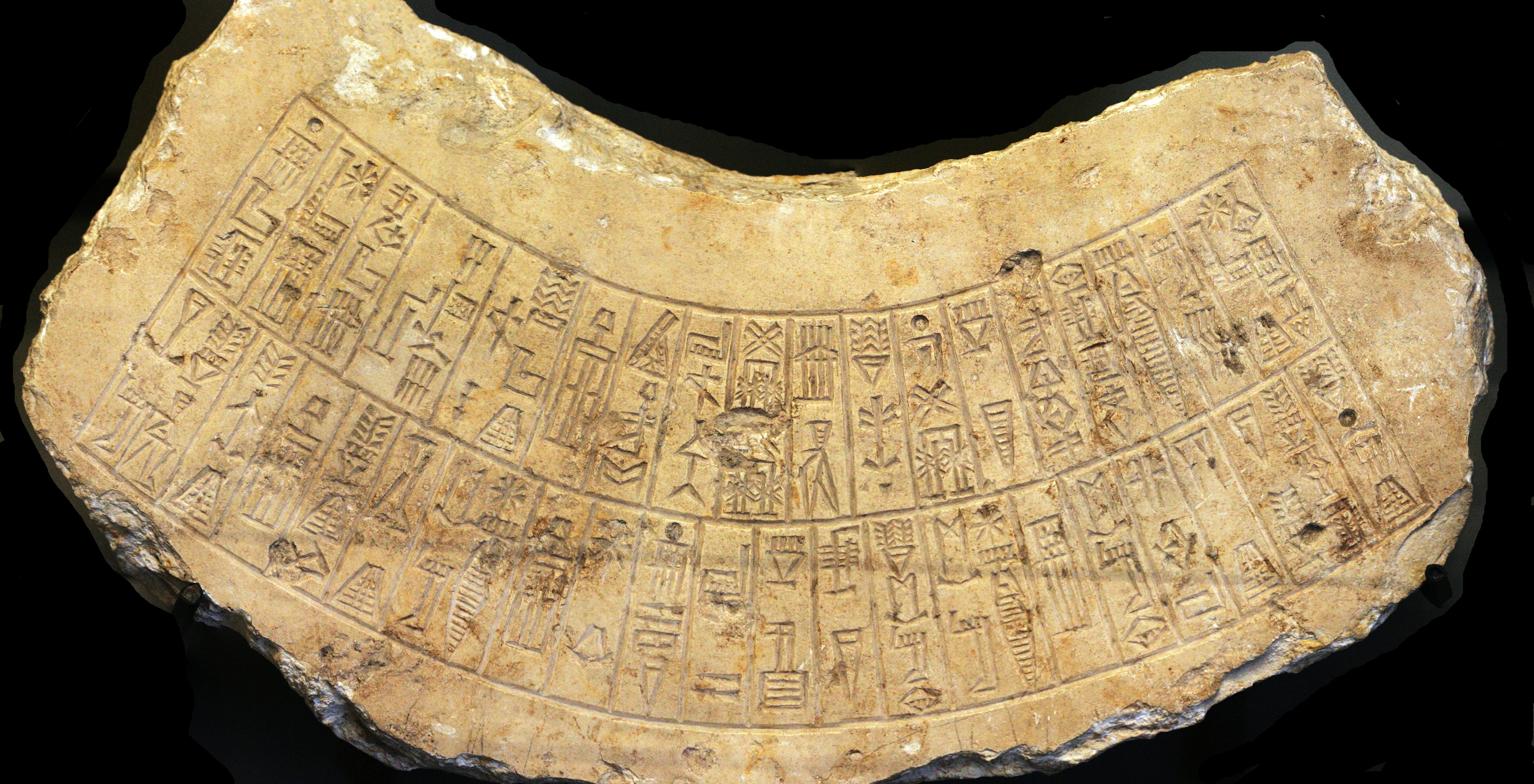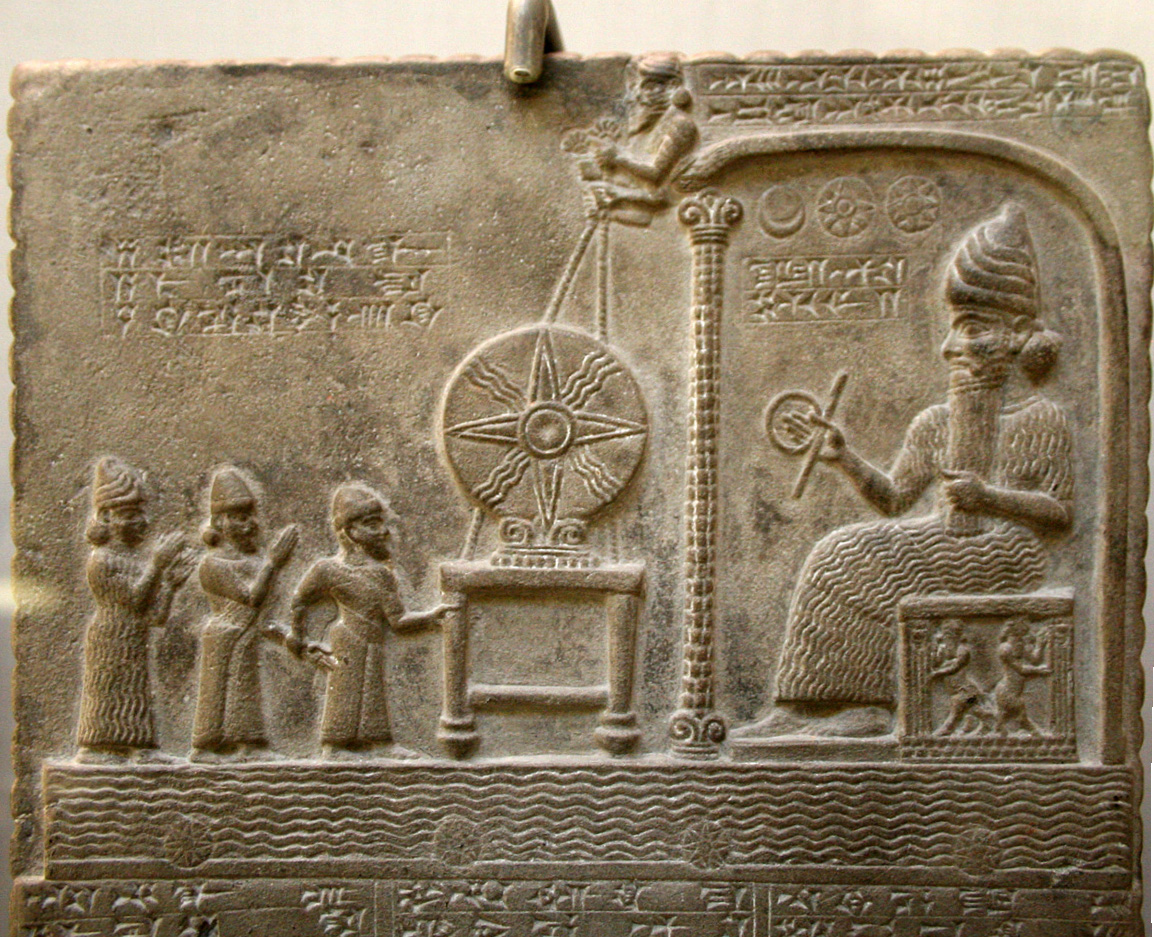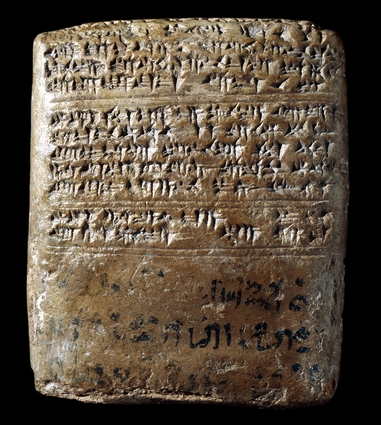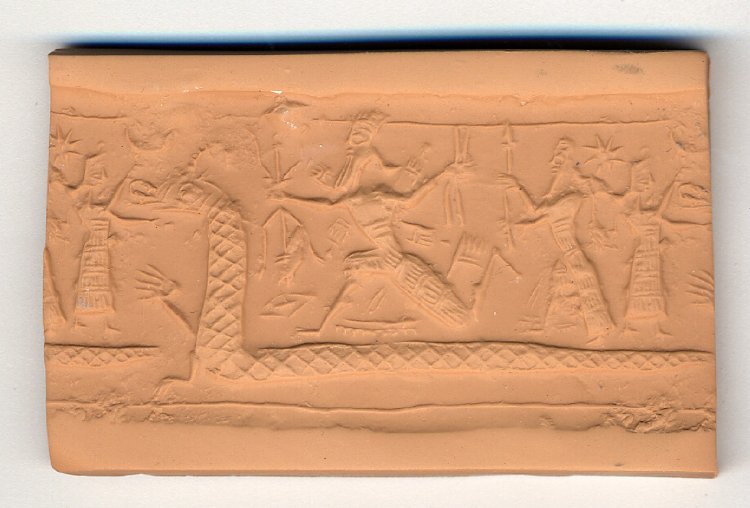
Samizdat

Publishing the Forbidden. All Rights Reserved. © Samizdat 2014-2026.

Tag: Babylon

Nebo, God of Wisdom, Scribe of the Gods, Patron of Writing

“The popularity of Nebo was brought about through his association with Merodach. His chief seat of worship was at Borsippa, opposite to Babylon, and when the latter city became the seat of the imperial power the proximity of Borsippa greatly assisted the cult of Nebo.

So close did the association between the deities of the two cities become that at length Nebo was regarded as the son of Merodach—a relationship that often implies that the so-called descendant of the elder god is a serious rival, or that his cult is nearly allied to the elder worship.

Nebo had acquired something of a reputation as a god of wisdom, and probably this it was which permitted him to stand separately from Merodach without becoming absorbed in the cult of the great deity of Babylon.
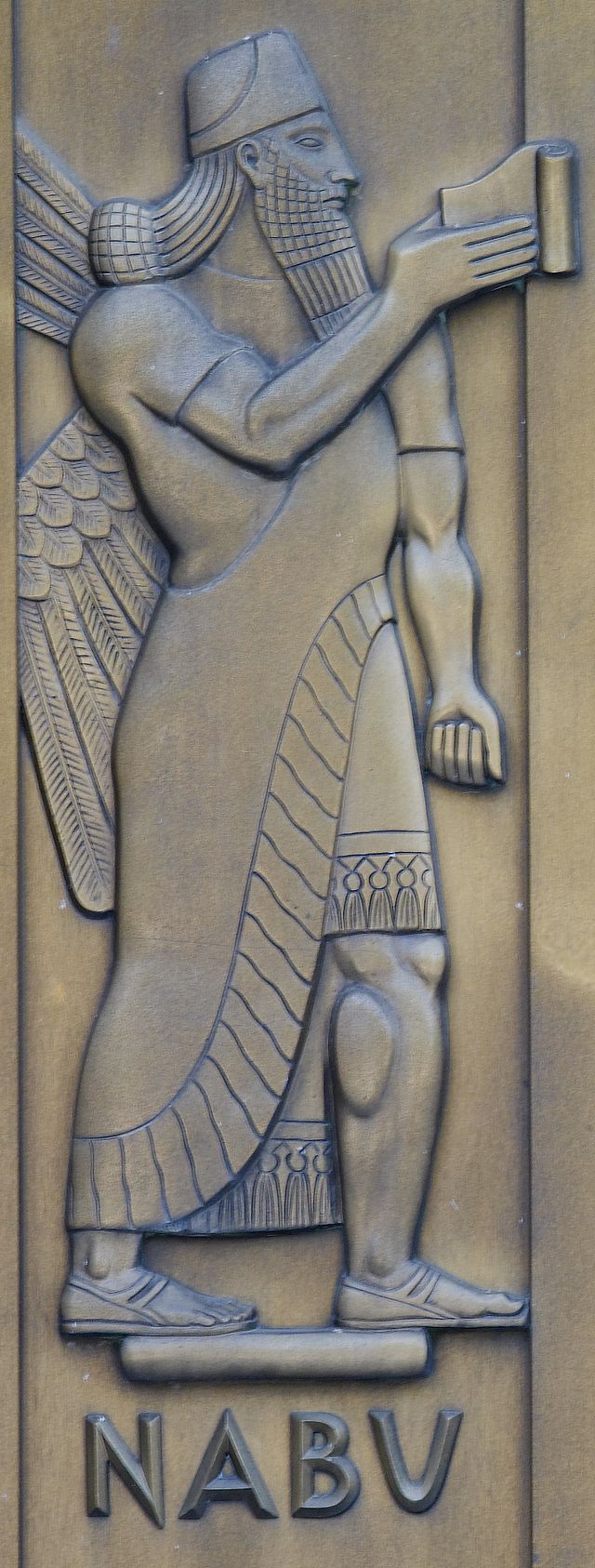
Nabu, or Nebo, sculpted bronze figure by Lee Lawrie. Door detail, east entrance, Library of Congress John Adams Building, Washington, D.C. Photographed 2007 by Carol Highsmith (1946–), who explicitly placed the photograph in the public domain. - Library of Congress, Prints & Photographs Division. http://en.wikipedia.org/wiki/Nabu#/media/File:Nabu-Lawrie-Highsmith.jpeg

Nabu, or Nebo, sculpted bronze figure by Lee Lawrie. Door detail, east entrance, Library of Congress John Adams Building, Washington, D.C.
Photographed 2007 by Carol Highsmith (1946–), who explicitly placed the photograph in the public domain. – Library of Congress, Prints & Photographs Division.
http://en.wikipedia.org/wiki/Nabu#/media/File:Nabu-Lawrie-Highsmith.jpeg

He was credited, like Ea, with the invention of writing, the province of all ‘wise’ gods, and he presided over that department of knowledge which interpreted the movements of the heavenly bodies. The priests of Nebo were famous as astrologers, and with the bookish king Assur-bani-pal, Nebo and his consort Tashmit were especial favourites as the patrons of writing.

By the time that the worship of Merodach had become recognised at Babylon, the cult of Nebo at Borsippa was so securely rooted that even the proximity of the greatest god in the land failed to shake it.

Even after the Persian conquest the temple-school at Borsippa continued to flourish.

But although Nebo thus ‘outlived’ many of the greater gods it is now almost impossible to trace his original significance as a deity. Whether solar or aqueous in his nature—and the latter appears more likely— he was during the period of Merodach’s ascendancy regarded as scribe of the gods, much as Thoth was the amanuensis of the Egyptian otherworld—that is to say, he wrote at the dictation of the higher deities.
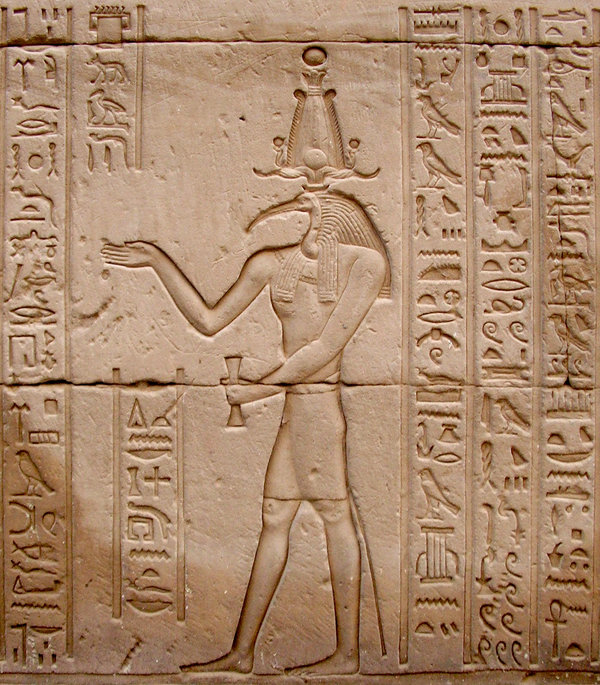
A depiction of the Egyptian god of writing, Thoth.

A depiction of the Egyptian god of writing, Thoth.

When the gods were assembled in the Chamber of Fates in Merodach’s temple at Babylon, he chronicled their speeches and deliberations and put them on record. Indeed he himself had a shrine in this temple of E-Sagila, or ‘the lofty house,’ which was known as E-Zila, or ‘the firm house.’

Once during the New Year festival Nebo was carried from Borsippa to Babylon to his father’s temple, and in compliment was escorted by Merodach part of the way back to his own shrine in the lesser city. It is strange to see how closely the cults of the two gods were interwoven.

The Kings of Babylonia constantly invoke them together, their names and those of their temples are found in close proximity at every turn, and the symbols of the bow and the stylus or pen, respectively typical of the father and the son, are usually discovered in one and the same inscription.

Even Merodach’s dragon, the symbol of his victory over the dark forces of chaos, is assigned to Nebo.”

Lewis Spence, Myths and Legends of Babylonia and Assyria, 1917, pp. 184-6.
Bilat, Beltis, Nin-Ki-Gal, Allat, Infernal Queen of the Underworld

“When the god of Nipur became Semitic, his character underwent a change.

As the supreme deity of the state he was necessarily a Baal, but the Semitic Baal embodied very different conceptions from those which were associated with the Accadian Mul-lil. It is true that, as I have just pointed out, his primitive attributes still clung to him, but they were superadded to other attributes which showed him to be the supreme Sun-god of Semitic worship.

That supreme Sun-god, however, revealed himself to his worshippers under two aspects; he might be either the beneficent god who gave life and light to the world, or he might be the fierce and wrathful sun of summer who scorches all nature with his heat, and sinks at night, like a ball of glowing metal, into the darkness of the under-world.

Necessarily it was rather under the latter aspect that the Mul-lil of Nipur became the Semitic Bel.

This is the Bel whose cult was carried to Assyria, and whose name is mentioned frequently in the inscriptions of Nineveh, where among other titles he bears that of “father of the gods.”

This is a title which he received, not in virtue of his primitive character, but because he had become the Semitic Bel.

He was distinguished from the younger Bel of Babylon, Bel-Merodach, as βελιτανας or βολαθην (Βêl-êthûn), (ed. note: Greek sic) “the older Baal,” when Babylon became the imperial city, and its Bel claimed to be the father and head of the Babylonian gods.

But the distinction, as might be expected, was not always observed, and the older and younger Bel are sometimes confounded together.

The confusion was rendered the more easy by the fact that the wife of the Bel of Nipur was addressed as Bilat, and thus was undistinguished in name from Beltis of Babylon.

But she was in reality, as we have seen, the queen of Hades, Nin-ki-gal as the Accadians called her, or Allat as she is named in the Semitic texts.

Allat is interpreted “the unwearied;” like the Homeric epithet of Hades, αδαμαστος, “the inflexible” divinity who ceases not to deal on all sides his fatal blows. Her proper title, however–that, at least, under which she had originally been known at Nipur–was Nin-lil, “the lady of the ghost-world.”

It is under this name that Assur-bani-pal addresses her (Trustees of the British Museum (H.C. Rawlinson), The Cuneiform Inscriptions of Western Asia, ii. 66) as “the mistress of the world, whose habitation is the temple of the library” (i.e. the temple of Istar at Nineveh).

As Allat, the goddess of Hades, she was a much-dreaded and formidable figure, who is described in the legend of the Descent of Istar as inflicting upon her sister-goddess all the pains and diseases which emanated from her demoniac satellites.

The unfortunate Istar, stripped of her clothing and adornments, is held up to the scorn of the lower world; and Namtar, the plague-demon, is ordered by Allat to smite her with maladies in the eyes, in the sides, in the feet, in the heart, in the head, and, in short, in all the limbs.

Throughout the legend Namtar appears as the messenger of the infernal queen.”

A.H. Sayce, Lectures on the Origin and Growth of Religion as Illustrated by the Religion of the Ancient Babylonians, 5th ed., London, 1898, pp. 148-50.

The Oracles of Ea

“How a water-god became the demiurge seems at first sight obscure. But it ceases to be so when we remember the local character of Babylonian religion.

Ea was as much the local god of Eridu as Merodach was of Babylon, or Assur of Assyria. His connection with the water was due to the position of Eridu at the mouth of the Euphrates and on the shore of the sea, as well as to the maritime habits of its population.

In other respects he occupied the same place as the patron-deities of the other great cities. And these patron-deities were regarded as creators, as those by whose agency the present world had come into existence, and by whose hands the ancestors of their worshippers had been made.

This conception of a creating deity is one of the distinguishing features of early Babylonian religion. Mankind are not descended from a particular divinity, as they are in other theologies; they are created by him.

The hymn to Ea tells us that the god of Eridu was the creator of the black-headed race-that is to say, the old non-Semitic population whose primary centre and starting-point was in Eridu itself. It was as creators that the Accadian gods were distinguished from the host of spirits of whom I shall have to speak in another Lecture.

The Accadian word for “god” was dimer, which appears as dingir, from an older dingira, in the southern dialect of Sumer. Now dimer or dingir is merely “the creator,” formed by the suffix r or ra, from the verb dingi or dime, “to create.”

A simpler form of dimer is dime, a general name for the divine hierarchy. By the side of dime, dim, stood gime, gim, with the same meaning; and from this verb came the Sumerian name of Istar, Gingira. Istar is said to have been the mother of mankind in the story of the Deluge, and as Gula, “the great” goddess, she is addressed in a prayer as “the mother who has borne the men with the black heads.”

It was in consequence of the fact that he was a creator that Ea was, according to Accado-Sumerian ideas, a dingir or “god.”

In the cosmology of Eridu, therefore, the origin of the universe was the watery abyss. The earth lay upon this like a wife in the arms of her husband, and Dav-kina accordingly was adored as the wife of Ea.

It was through her that the oracles of Ea, heard in the voice of the waves, were communicated to man. Dav-kina is entitled “the mistress of the oracular voice of the deep,” and also “the lady who creates the oracular voice of heaven.”‘

The oracles delivered by the thunder, the voice of heaven, thus became the reflex of the oracles delivered through the roaring of the sea.”

A.H. Sayce, Lectures on the Origin and Growth of Religion as Illustrated by the Religion of the Ancient Babylonians, 5th ed., London, 1898, pp. 142-4.

Egyptian Hieroglyphs and Babylonian Cuneiform Share No Common Ancestor

Ea was [ … ] the source of their culture. He was symbolised, it would seem, by a serpent; … the primeval seat of the worship of Ea was the city of Eridu, now represented by the mounds of Abu Shahrein on the eastern bank of the Euphrates, and not far to the south of Mugheir or Ur.

Eridu is a contracted form of the older Eri-duga, or “good city,” which appears in the non-Semitic texts of northern Babylonia as Eri-zêba,with the same meaning. The place was thus a peculiarly holy spot, whose sanctity was established far and wide throughout the country.

But it was not a holy city only. It is often termed, more especially in the sacred tests, “the lordly city,”‘ and we are told that one of its titles was “the Iand of the sovereign.”

In historical times, however, Eridu had sunk to the condition of a second-rate or even third-rate town; its power must therefore belong to that dimly remote age of which the discoveries at Tel-loh have enabled us to obtain a few glimpses. There must have been a time when Eridu held a foremost rank among the cities of Babylonia, and when it was the centre from which the ancient culture and civilisation of the country made its way.

Along with this culture went the worship of Ea, the god of Eridu, who to the closing days of the Babylonian monarchy continued to be known as Eridúga, “the god of Eridu.” At the period when the first elements of Chaldean culture were being fostered in Eridu, the city stood at the mouth of the Euphrates and on the edge of the Persian Gulf.

If the growth of the alluvium at the mouths of the Euphrates and Tigris has always been the same as is the case at present (about sixty-six feet a year), this would have been at the latest about 3000 B.C.; but as the accumulation of soil has been more rapid of late, the date would more probably be about 4000 B.C.

Already, therefore, the cult of Ea would have been established, and the sea-faring traders of Eridu would have placed themselves under his protection.

It will be noticed that the culture-myths of Babylonia, like the culture-myths of America, bring the first civiliser of the country from the sea. It is as a sea deity that Oannes is the culture-hero of the Chaldeans; it is from the depths of the Persian Gulf that he carries to his people the treasures of art and science.

Two questions are raised by this fact. Was the culture of Babylonia imported from abroad; and was Ea, its god of culture, of foreign extraction?

The last great work published by Lepsius was an attempt to answer the first of these questions in the affirmative. He revived the old theory of a mysterious Cushite population which carried the civilisation of Egypt to the shores of Babylonia.

But to all theories of this sort there is one conclusive objection. The origin of Babylonian culture is so closely bound up with the origin of the cuneiform system of writing, that the two cannot be separated from each other.

Between the hieroglyphics of Egypt, however, and the primitive pictures out af which the cuneiform characters developed, there is no traceable connection.

Apart from those general analogies which we find in all early civilisations, the script, the theology and the astronomy of Egypt and Babylonia, show no vestiges of a common source.”

A.H. Sayce, Lectures on the Origin and Growth of Religion as Illustrated by the Religion of the Ancient Babylonians, 5th ed., London, 1898, pp. 134-6.

Sayce on the God Ea, or Oannes

“Ea, as we have already seen, was the god not only of the deep, but also of wisdom. Ancient legends affirmed that the Persian Gulf–the entrance to the deep or ocean-stream–had been the mysterious spot from whence the first elements of culture and civilisation had been brought to Chaldea.

Berossos, the Chaldean historian–so at least his epitomiser Alexander Polyhistor declared–had reported them as follows:

“At Babylon there was a great resort of people of various races who inhabited Chaldea, and lived in a lawless manner like the beasts of the field.

In the first year there appeared in that part of the Erythraean sea which borders upon Babylonia, a creature endowed with reason, by name Oannes, whose whole body (according to the account of Apollodaros) was that of a fish; under the fish’s head he had another head, with feet also below similar to those of a man subjoined to the fish’s tail.

His voice, too, and language were articulate and human; and a representation of him is preserved even to this day.

“This being was accustomed to pass the day among men, but took no food at that season; and he gave them an insight into letters and sciences and arts of every kind. He taught them to construct houses, to found temples, to compile laws, and explained to them the principles of geometrical knowledge.

He made them distinguish the seeds of the earth, and showed them how to collect the fruits; in short, he instructed them in everything which could tend to soften manners and humanize their lives. From that time, nothing material has been added by way of improvement to his instructions.

Now when the sun had set, this being Oannes used to retire again into the sea, and pass the night in the deep, for he was amphibious. After this there appeared other animals like Oannes, of which Berossos proposes to give an account when he comes to the history of the kings.

Moreover, Oannes wrote concerning the generation of mankind, of their different ways of life, and of their civil polity.”

[ … ]

The exact etymology of the name which appears under the Greek dress of Oannes has not yet been ascertained. Lenormant thought that it represented Ea-khan, “Ea the fish.” But whether or not this is the case, it is certain that Oannes and Ea are one and the same.

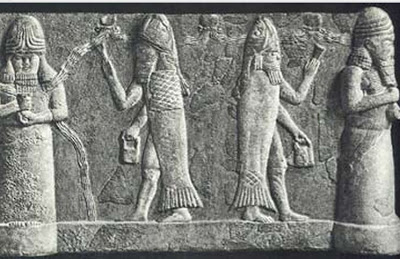
A depiction of Oannes, or Ea.

A depiction of Oannes, or Ea.

Ea, as we have seen, not only had his home in the waters of the Persian Gulf, he was also the culture-god of primitive Babylonia, the god of wisdom, the instructor of his worshippers in arts and science.

An old Babylonian sermon on the duty of a prince to administer justice impartially and without bribes, declares that if “he speaks according to the injunction (or writing) of the god Ea, the great gods will seat him in wisdom and the knowledge of righteousness.”

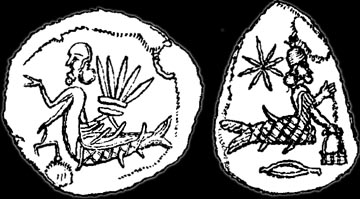
Ea was, moreover, like Oannes, represented as partly man and partly fish. Sometimes the fish’s skin is thrown over the man’s back, the head of a fish appearing behind that of the man; sometimes the body of the man is made to terminate in the tail of a fish.

A depiction of the God Ea, or Oannes.

A depiction of the God Ea, or Oannes.

A gem in the British Museum, on which the deity is depicted in the latter fashion, bears an inscription stating that the figure is that of “the god of pure life.”

OannesGems

Now “the god of pure life,” as we are expressly informed by a rubrical gloss to a hymn in honour of the demiurge Ea, was one of the names of Ea.”

A.H. Sayce, Lectures on the Origin and Growth of Religion as Illustrated by the Religion of the Ancient Babylonians, 5th ed., London, 1898, pp. 131-3.

The God Assur

“The transference of the centre of power from Assur to Nineveh made the anthropomorphic side of Assur’s nature still more prominent. He represented now the whole nation and the central power which governed the nation. He was thus the representative at once of the people and of the king in whose hands the government of the people was centred.

Assyria became “the land of the god Assur,” belonging to him in much the same way as the city of Babylon belonged to Bel-Merodach. But whereas Bel-Merodach was the Baal of a particular city only, Assur was, like the Yahveh of Israel, the national god of a race.

There was yet another respect in which Assur resembled the Yahveh of Israel. There was no goddess Assurritu by the side of Assur, as there was an Anatu by the side of Anu, a Beltis by the side of Bel. If, in imitation of Babylonian usage, Bilat or Beltis is sometimes addressed as the consort of Assur, it is simply a literary affectation; Assur was not a Bel or Baal, like Merodach.

Bilat is a Babylonian goddess; she is properly the wife of the older Bel, in later times identified with Zarpanit. There is no indication that Assur had a “face” or reflection; he stands by himself, and the inspiration received from him by the Assyrian kings is received from him alone. When a female divinity is invoked along with him, it is the equally independent goddess Istar or Ashtoreth.

We possess a list of the deities whose images stood in the temples of Assur at Assur and Nineveh.

At the head of each list the name of Assur is thrice invoked, and once his name is followed by that of Istar. There was, in fact, a special form of Istar, under which she was worshipped as “the Istar of Nineveh;” but the form was purely local, not national, arising from the existence there of a great temple dedicated to her. There was no national goddess to place by the side of the national god.

Assur consequently differs from the Babylonian gods, not only in the less narrowly local character that belongs to him, but also in his solitary nature. He is “king of all gods” in a sense in which none of the deities of Babylonia were.

He is like the king of Assyria himself, brooking no rival, allowing neither wife nor son to share in the honours which he claims for himself alone. He is essentially a jealous god, and as such sends forth his Assyrian adorers to destroy his unbelieving foes. Wife-less, childless, he is mightier than the Babylonian Baalim; less kindly, perhaps, less near to his worshippers than they were, but more awe-inspiring and more powerful.

We can, in fact, trace in him all the lineaments upon which, under other conditions, there might have been built up as pure a faith as that of the God of Israel.”

A.H. Sayce, Lectures on the Origin and Growth of Religion as Illustrated by the Religion of the Ancient Babylonians, 5th ed., London, 1898, pp. 126-9.

Herodotus and Strabo on Babylonian Temple Prostitution

“There are two other “historic” accounts of sexual activities in and around the Babylonian temples, both of which have unduly influenced modern historians. One was written by the Greek historian Herodotus in the fifth century B.C. and purports to describe religious prostitution in the temple of the Goddess Mylitta; the other was written by the Roman traveler Strabo some four hundred years later, confirming Herodotus. Here is Herodotus’s account:

“Every woman born in the country must once in her life go and sit down in the precinct of Venus [Mylitta], and there consort with a stranger…. A woman who has once taken her seat is not allowed to return home till one of the strangers throws a silver coin into her lap, and takes her with him beyond the holy ground…. The silver coin maybe of any size….

The woman goes with the first man who throws her money, and rejects no one. When she has gone with him, and so satisfied the goddess, she returns home, and from that time forth no gift however great will prevail with her. Such of the women. . . who are ugly have to stay a long time before they can fulfil the law. Some have waited three or four years in the precinct.”

There is no confirmation besides Strabo’s for this story and there are no known “laws” regulating or even referring to this practice. Herodotus may have mistaken the activities of prostitutes around the temple for a rite involving every Assyrian virgin.

Another of Herodotus’s stories, told to him by Babylonian priests, seems to have more historic foundation. It described a high tower in the temple of Marduk, at the top of which the high priestess dwelt in a room with a couch, in which she was nightly visited by the god.

The story somewhat parallels a historic account, dating from the first millennium B.C., which describes how the Neo-Babylonian King Nabu-naid dedicated his daughter as high priestess of the Moon god Sin. He surrounded the building in which she lived with a high wall and furnished it with ornaments and fine furniture.

This description would be consistent with what we know of the living conditions of some of the royal high priestesses and with the belief that the god visited them nightly, just as he nightly ate the meals prepared for him.

Herodotus cites this as an example of “temple prostitution,” and modern historians of prostitution repeat the tale after him, treating his accounts as facts. I interpret the function of the priestess as a significant example of sacral sexual service, which may have been actually carried out or may have been symbolically reenacted.

From the conflicting interpretations of the evidence we have about the activities of women in temple service, it is difficult to arrive at an understanding of these women’s social role. What earlier was a purely religious cultic function may have become corrupted at a time when commercial prostitution already flourished in the temple precincts.

Sexual intercourse performed for strangers in the temple to honor the fertility and sexual power of the goddess may customarily have been rewarded by a donation to the temple. Worshipers regularly brought offerings of food, oil, wine, and precious goods to the temple to honor the deities and in the hope of thus advancing their own cause.

It is conceivable that this practice corrupted some of the temple servants, tempting them to keep all or some of these gifts for their own profit. Priests may also have encouraged or permitted the use of slave women and the lower class of temple servants as commercial prostitutes in order to enrich the temple.”

Gerda Lerner, “The Origin of Prostitution in Ancient Mesopotamia,” Signs, 1986, pp. 243-4.

Assur, National Deity of Assyria

“Supreme over the old Babylonian pantheon rises the figure of a new god, the national deity of Assyria, its impersonation Assur. Assur is not merely primus inter pares, merely the president of the divine assembly, like Merodach; he is their lord and master in another and more autocratic sense.

Like the Yahveh of Israel, he claims to be “king above all gods,” that “among all gods” there is none like unto himself. In his name and through his help the Assyrian kings go forth to conquer; the towns they bum, the men they slay, the captives they take, are all his gifts.

It is to destroy “the enemies of Assur,” and to lay their yoke upon those who disbelieve in his name, that they load their armies into other lands; it is his decrees, his law, that they write upon the monuments they erect in conquered countries.

The gods of Babylonia are invoked, it is true; their old Babylonian titles are accorded to them; they are called upon to curse the sacrilegious in the stereotyped phrases of the ancient literature; but it is Assur, and Assur alone, to whom the Assyrian monarch turns in moments of distress; it is Assur, and Assur alone, in whose name he subdues the infidel. Only the goddess Istar finds a place by the side of Assur.

It is not difficult to account for all this. In passing from their native homes to Assyria, the Babylonian deities lost that local character which was the very breath of their existence. How far they owe their presence in Assyrian literature to the literary class, how far they had been brought from Babylonia in early days by the people themselves, I am not prepared to say.

One fact, however, is clear; in becoming Assyrian the Babylonian gods have lost both their definiteness and their rank. The invocations addressed to them lack their old genuine ring, their titles are borrowed from the literature of the southern kingdom, and their functions are usurped by the new god Assur.

It is almost pitiable to find Bel-Merodach invoked, in phrases that once denoted his power above other deities, by the very kings who boast of their conquests over his people, or who even razed his city to the ground.

The Assyrian, in fact, occupied much the same position as an Israelite who, while recognizing the supremacy of his national God, thought it prudent or cultivated to offer at the same time a sort of inferior homage to the Baalim of Canaan.”

A.H. Sayce, Lectures on the Origin and Growth of Religion as Illustrated by the Religion of the Ancient Babylonians, 5th ed., London, 1898, pp. 122-3.

Epic of Gilgamesh, Tablets IV and V, Slaying of Khumbaba

“The IVth tablet is concerned with a description of the monster with whom the heroes are about to do battle.

Khumbaba, whom Bel had appointed to guard the cedar (i.e., one particular cedar which appears to be of greater height and sanctity than the others), is a creature of most terrifying aspect, the very presence of whom in the forest makes those who enter it grow weak and impotent.

As the heroes draw near Eabani complains that his hands are feeble and his arms without strength, but Gilgamesh speaks words of encouragement to him. It may be noted, in passing, that the word Khumbaba is of Elamite origin, a fact which has led certain authorities to identify the monster with an Elamite dynasty which anciently dominated Erech, and which came to grief about 2250 BCE.

It is difficult, if not impossible, to establish the connexion between the mythical encounter and a definite historical event; but it may at least be presumed that the bestowal of an Elamite designation on the monster argues a certain enmity between Elam and Babylon.

The next fragments bring us into the Vth tablet.

The heroes, having reached “a verdant mountain,” paused to survey the Forest of Cedars. When they entered the forest the death of Khumbaba was foretold to one or other, or both of them, in a dream, and they hastened forward to the combat.

Unfortunately the text of the actual encounter has not been preserved, but we learn from the context that the heroes were successful in slaying Khumbaba.

Lewis Spence, Myths and Legends of Babylonia and Assyria, 1917, pp. 166-7.

Nebo, God of Prophecy

“A knowledge of Babylonian letters and learning was accompanied by a knowledge of the Babylonian god of letters and learning.

In Assyria, Nebo was honoured as much as he was in Babylonia itself. The Assyrian kings and scribes might be silent about the name of Merodach, but the name of Nebo was continually in their mouths.

His name and worship passed even to the distant Semitic tribes of the west. The names of places in Palestine in which his name occurs, proves that the god of prophecy was adored by Canaanites and Moabites alike. Moses, the leader and prophet of Israel, died on the peak of Mount Nebo, and cities bearing the name stood within the borders of the tribes of Reuben and Judah.

When the Israelites entered upon their literary era, the old name of roch, or “seer,” was exchanged for the more literary one of Nēbi, or “prophet.”

The Semites of Babylonia provided Nebo with a wife, Tasmitu, “the hearer.” She helped to open and enlarge the ears which received the divine mysteries her husband’s inspiration enabled his devout servants to write down.

The revolution which transferred the learning of the Babylonians from the Accadians to the Semites, transferred the patronage of the literary class from the old god Ea to his younger rivals Nebo and Tasmit.

[ … ]

The Semites of Babylonia thus closely resembled their brother Semites of Canaan in their fundamental conception of religion. As the Canaanite or Phoenician had “lords many,” the multitudinous Baalim who represented the particular forms of the Sun-god worshipped in each locality, so too the gods of Semitic Babylonia were equally multitudinous and local–Merodach, for example, being merely the Bel or Baal of Babylon, just as Mel-karth (Melech-kiryath) was the Baal of Tyre.

But the parallelism extends yet further. We have seen that the rise of the prophet-god in Babylonia marks the growing importance of literature and a literary class, just as the beginning of a literary age in Israel is coeval with the change of the seer into the prophet.

Now the literary age of Israel was long preceded by a literary age among their Phoenician neighbours, and its growth is contemporaneous with the closer relations that grew up between the monarchs of Israel and Hiram of Tyre.

What Israel was in this respect to the Phoenicians, Assyria was to Babylonia. The Assyrians were a nation of warriors and traders rather than of students; their literature was for the most part an exotic, a mere imitation of Babylonian cuiture.

In Babylonia, education was widely diffused; in Assyria, it was confined to the learned class. We must remember, therefore, that in dealing with Assyrian documents we are dealing either with a foreign importation or with the thoughts and beliefs of a small and special class.”

A.H. Sayce, Lectures on the Origin and Growth of Religion as Illustrated by the Religion of the Ancient Babylonians, 5th ed., London, 1898, pp. 119-122.

Nebo, God of Wisdom, God of Writing

In Semitic days, Zarpanit, the inheritor of all these old traditions and worships, fell from her high estate. She ceased to be the goddess of wisdom, the voice of the deep revealing the secrets of heaven to the diviner and priest; she became merely the female shadow and companion of Merodach, to whom a shrine was erected at the entrance to his temple.

Her distinctive attributes all belong to the pre-Semitic epoch; with the introduction of a language which recognized gender, she was lost in the colourless throng of Ashtaroth or Baalat, the goddesses who were called into existence by the masculine Baalim.

Zarpanit, however, had something to do with the prominence given to Nebo in the Babylonian cult. Nebo, the son of Merodach and Zarpanitu, had, as we have seen, a chapel called E-Zida within the precincts of the great temple of his father.

E-Zida, “the constituted house,” derived its name from the great temple of Borsippa, the suburb of Babylon, the ruins of which are now known to travelers as the Birs-i-Nimrúd. Borsippa, it would seem, had once been an independent town, and Nebo, or the prototype of Nebo, had been its protecting deity.

In the middle of the city rose E-Zida, the temple of Nebo and Nana Tasmit, with its holy of holies, “the supreme house of life,” and its lofty tower termed “the house of the seven spheres of heaven and earth.” It had been founded, though never finished, according to Nebuchadnezzar, by an ancient king.

For long centuries it had remained a heap of ruin, until restored by Nebuchadnezzar, and legends had grown up thickly around it. It was known as the tul ellu, “the pure” or “holy mound,” and one of the titles of Nebo accordingly was “god of the holy mound.”

The word Nebo is the Semitic Babylonian Nabiu or Nabû. It means the proclaimer,” “the prophet,” and thus indicates the character of the god to whom it was applied. Nebo was essentially the proclaimer of the mind and wishes of Merodach.

He stood to Merodach in the same relation that an older mythology regarded Merodach as standing to Ea. While Merodach was rather the god of healing, in accordance with his primitively solar nature, Nebo was emphatically the god of science and literature.

The communication of the gifts of wisdom, therefore, which originally emanated from Ea, was thus shared between Merodach and his son. At Babylon, the culture-god of other countries was divided into two personalities, the one conveying to man the wisdom that ameliorates his condition, the other the knowledge which finds its expression in the art of writing.”

A.H. Sayce, Lectures on the Origin and Growth of Religion as Illustrated by the Religion of the Ancient Babylonians, 5th ed., London, 1898, pp. 112-3.

Triads and Feminine Reflections in Babylonian Religion

“Even at Babylon, however, Merodach did not stand alone. He shared his divine honours, as we have seen, with his wife Zarpanitu and his son Nebo.

The old Accadian cult seems to have had a fancy for trinities or triads, originating perhaps in the primary astronomical triad of the Sun-god, the Moon-god and the Evening Star.

The Accadian triad usually consisted of male deities. The Semites, however, as I hope to point out in the next Lecture, introduced a new idea, that of sex, into the theology of the country. Every god was provided with his female reflection, who stood to him in the relation of the wife to the husband.

Baal, accordingly, had his female reflex, his “face,” as it was termed, Bilat or Beltis. By the side of the Baal of Babylon, therefore, stood Beltis, “the lady” by the side of her “lord.”

Her local name mas Zarpanitu, which a punning etymology subsequently turned into Zir-banitu, “creatress of seed,” sometimes written Zir-panitu, with an obvious  play on the word panu, or “face.”

Zarpanitu was of purely Semitic origin. But she was identified with an older Accadian divinity, Gasmu, “the wise one,” the fitting consort of a deity whose office it was to convey the wishes of the god of wisdom to suffering humanity.

The Accadian goddess, however, must originally have stood rather in the relation of mother than of wife to the primitive Merodach. She was entitled “the lady of the deep,” “the mistress of the abode of the fish,” and “the voice of the deep.”

Hence she must have ranked by the side of Ea, the fish-god and “lord of the deep;” and in the title “voice” or “incantation of the deep,” we may see a reference to the ideas which caused Ea to become the god of wisdom, and brought the fish-god Oannes out of the Persian Gulf to carry culture and knowledge to the inhabitants of Chaldea.

In the roar of the sea-waves, the early dwellers on the shores of the Gulf must have heard the voice of heaven, and their prophets and diviners must have discovered in it a revelation of the will of the gods.

It is not surprising, therefore, if Zarpanit was specially identified with the goddess Lakhamun, who was worshipped in the sacred island of Dilmun, or with the goddess Elagu, whose name was revered in the mountains of Elam.”

A.H. Sayce, Lectures on the Origin and Growth of Religion as Illustrated by the Religion of the Ancient Babylonians, 5th ed., London, 1898, pp. 110-1.

The Puzzle of Marduk

“Was Merodach himself an Accadian or a Semitic deity? The names of the kings belonging to the first dynasty of Babylon are mostly Semitic; it might therefore be supposed that the deity they worshipped was Semitic also.

And so undoubtedly was the Merodach of the historical age, the great Bel or Baal of Babylon. But we must remember that the foundation of Babylon went back into the dim night of the past far beyond the era of its first dynasty of Semitic kings, and that its very name was but a translation of the older Ka-dimira, “gate of the god.”

The temple of Merodach, moreover, bore, up to the last, not a Semitic, but an Accadian designation. As we shall see, along with the older culture the Semitic settlers in Babylonia borrowed a good deal of the theology of the Accadian people, modifying it in accordance with their own beliefs, and identifying its gods and demons with their own Baalim.

Marduk.

Marduk.

It would not be surprising, then, if we found that Merodach also had once been an Accadian divinity, though his attributes, and perhaps also his name, differed very considerably from those of the Semitic Bel.

Even after the Romans had identified their Saturn with the Kronos of the Greeks, the essential characteristics of the two deities remained altogether different.”

A.H. Sayce, Lectures on the Origin and Growth of Religion as Illustrated by the Religion of the Ancient Babylonians, 5th ed., London, 1898, p. 105.

Elder and Younger Bel

The Bel of this legend, who has settled the places of the Sun and the Moon in the sky, is not the Babylonian Bel, but the older Bel of Nipur, from whom Merodach, the Bel of Babylon, had afterwards to be distinguished.

The Accadian original of the poem belongs to a very early epoch, before the rise of Babylon, when the supreme Bel of the Semitic inhabitants of Babylonia was still the god whom the Accadians called Mul-lilla, “the lord of the lower world.”

This Bel or Mul-lilla fades into the background as the Semitic element in Babylonian religion became stronger and the influence of Babylon greater, though the part that he played in astronomical and cosmological lore, as well as his local cult at Nipur, kept his memory alive; while the dreaded visitants of night, the demoniac lilu and lilat or lilith, from the lower world, preserved a faint memory of the spirits of which he had once been the chief.

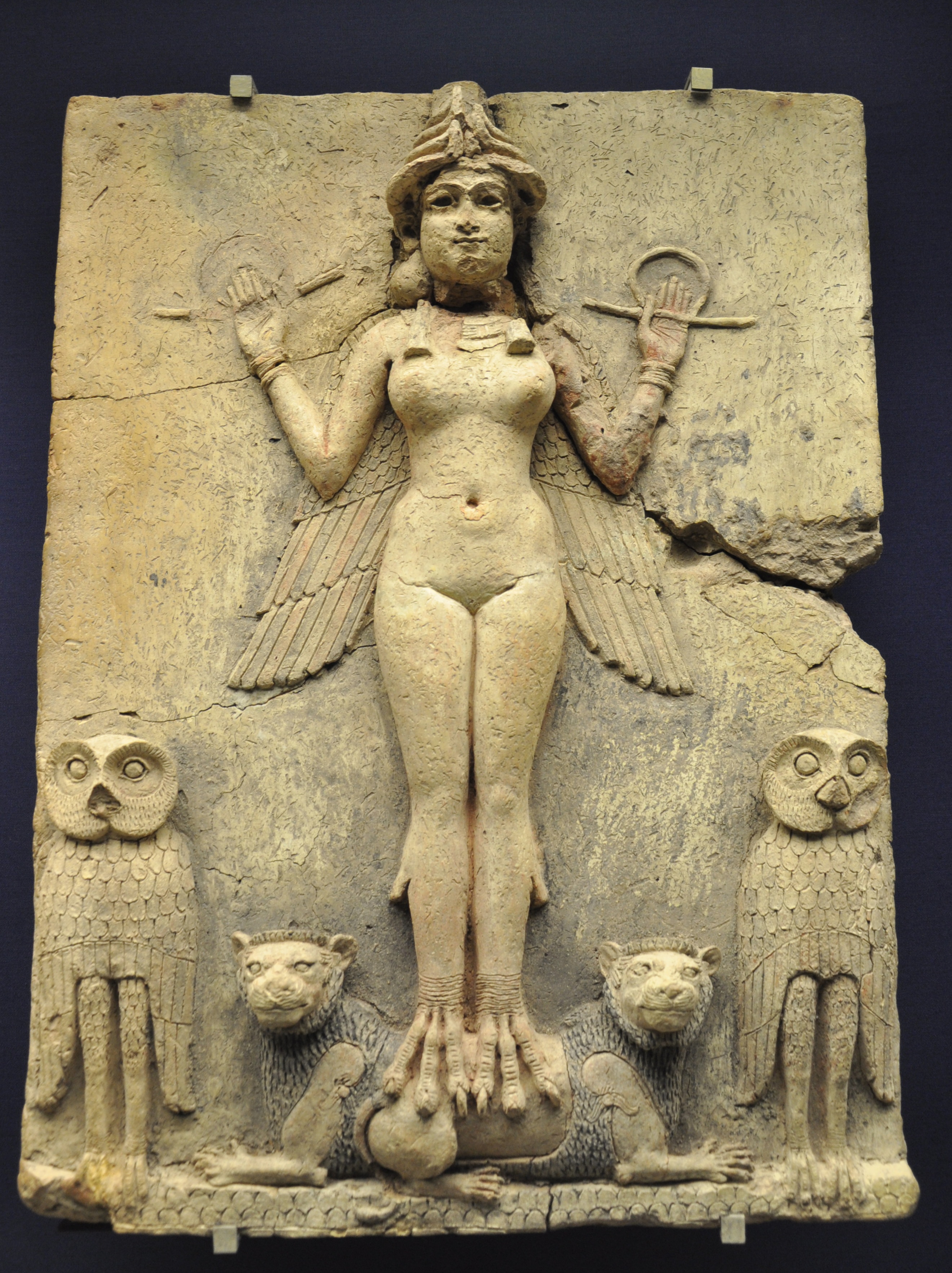
Burney Relief, Babylon (1800-1750 BCE). The figure in the relief was sometimes identified with Lilith, based on a misreading of an outdated translation of the Epic of Gilgamesh. Modern research has identified the figure as either Ishtar or Ereshkigal. https://upload.wikimedia.org/wikipedia/commons/1/19/Burney_Relief_Babylon_-1800-1750.JPG

Burney Relief, Babylon (1800-1750 BCE). The figure in the relief was sometimes identified with Lilith, based on a misreading of an outdated translation of the Epic of Gilgamesh. Modern research has identified the figure as either Ishtar or Ereshkigal.
https://upload.wikimedia.org/wikipedia/commons/1/19/Burney_Relief_Babylon_-1800-1750.JPG

 One by one, however, the attributes that had formerly attached to the older Bel were absorbed by the younger Bel of Babylon.

It was almost as it was in Greece, where the older gods were dethroned by their own offspring; in the Babylonia of Nebuchadnezzar and Nabonidos, it was the younger gods–Merodach, Sin and Samas–to whom vows were the most often made and prayer the most often ascended.

Such was the latest result of the local character of Babylonian worship: the younger gods were the gods of the younger Babylonian cities, and the god of Babylon, though he might be termed “the first-born of the gods,” was in one sense the youngest of them all.

The title, however, “first-born of the gods” was of the same nature as the other title, “prince of the world,” bestowed upon him by his grateful worshippers. It meant little else than that Babylon stood at the head of the world, and that its god must therefore be the first-born, not of one primeval deity, but of all the primeval deities acknowledged in Chaldea.

According to the earlier faith, he was the first-born of Ea only. Ea was god of the deep, both of the atmospheric deep upon which the world floats, and of that watery deep, the Okeanos of Homer, which surrounds the earth like a coiled serpent.

All streams and rivers were subject to his sway, for they flowed into that Persian Gulf which the ignorance of the primitive Chaldean imagined to be the ocean-stream itself. It was from the Persian Gulf that tradition conceived the culture and civilisation of Babylonia to have come, and Ea was therefore lord of wisdom as well as lord of the deep.

His son Merodach was the minister of his counsels, by whom the commands of wisdom were carried into practice. Merodach was thus the active side of his father Ea; to use the language of Gnosticism, he was the practical activity that emanates from wisdom.”

A.H. Sayce, Lectures on the Origin and Growth of Religion as Illustrated by the Religion of the Ancient Babylonians, 5th ed., London, 1898, p. 103-4.

E-Sagila: Temple of the Sun

“May we not conclude, then, that originally Merodach also was a solar deity, the particular Sun-god, in fact, whose worship was carried on at Babylon?

The conclusion is verified by the express testimony of the ritual belonging to Merodach’s temple E-Sagila. Here we read that

“In the month Nison, on the second day, two hours after nightfall, the priest must come and take of the waters of the river, must enter into the presence of Bel; and putting on a stole in the presence of Bel, must say this prayer:

“0 Bel, who in his strength has no equal! O Bel, blessed sovereign, lord of the world, seeking after the favour of the great gods, the lord who in his glance has destroyed the strong, lord of kings, light of mankind, establisher of faith!

0 Bel, thy sceptre is Babylon, thy crown is Borsippa, the wide heaven is the dwelling-place of thy liver. …0 lord of the world, light of the spirits of heaven, utterer of blessings, who is there whose mouth murmurs not of thy righteousness, or speaks not of thy glory, and celebrates not thy dominion?

0 lord of the world, who dwellest in the temple of the Sun, reject not the hands that are raised to thee; be merciful to thy city Babylon, to E-Sagila thy temple incline thy face; grant the prayers of thy people the sons of Babylon.”

Nothing can be more explicit than the statement that E-Sagila, the temple of Merodach, was also the temple of the Sun. We thus come to understand the attributes that are ascribed to Merodach and the language that is used of him.

He is “the light of the spirits of heaven,” even as the Son-god, … is “the illuminator of darkness” whose face is beheld by the spirits of the earth. The wide heaven is naturally his dwelling-place, and he raises the dead to life as the sun of spring revivifies the dead vegetation of winter.

The part that he plays in the old mythological poems, in the poems, that is, which embody the ancient myths and legends of Babylonia, is now fully explained. One of the most famous of these was the story of the combat between Merodach and Tiamat, the dragon of darkness and chaos.”

A.H. Sayce, Lectures on the Origin and Growth of Religion as Illustrated by the Religion of the Ancient Babylonians, 5th ed., London, 1898, pp. 100-102.

Marduk as Sun God of Babylon

Here Merodach, it will be observed, though “lord of all that exists,” is nevertheless only the first-born of the gods.

There were gods older than he, just as there were cities older than Babylon. He could not therefore be absolute lord of the world; it was only within Babylon itself that this was the case; elsewhere his rule was shared with others.

Hence it was that while Nebuchadnezzar as a native of Babylon was the work of his hands, outside Babylon there were other creators and other lords. This fact is accentuated in an inscription of Nabonidos, belonging to the earlier part of his reign, in which Merodach is coupled with the Moon-god of Ur and placed on an equal footing with him.

One of the epithets applied by Nebuchadnezzar to Merodach is that of riminu, or “merciful.” It is indeed a standing epithet of the god. Merodach was the intercessor between the gods and men, and the interpreter of the will of Ea, the god of wisdom.

In an old bilingual hymn he is thus addressed: “Thou art Merodach, the merciful lord who loves to raise the dead to life.” The expression is a remarkable one, and indicates that the Babylonians were already acquainted with a doctrine of the resurrection at an early period.

Merodach’s attribute of mercy is coupled with his power to raise the dead. The same expression occurs in another of these bilingual hymns, which I intend to discuss in a future Lecture…

“(Thou art) the king of the land, the lord of the world!

0 firstborn of Ea, omnipotent over heaven and earth.

0 mighty lord of mankind, king of (all) lands,

(Thou art) the god of gods,

(The prince) of heaven and earth who hath no rival,

The companion of Anu and Bel (Mul-lil),

The merciful one among the gods,

The merciful one who loves to raise the dead to life,

Merodach, king of heaven and earth,

King of Babylon, lord of E-Sagila,

King of E-Zida, king of E-makh-tilla (the supreme house of life),

Heaven and earth are thine!

The circuit of heaven and earth is thine,

The incantation that gives life is thine,

The breath that gives life is thine,

The holy writing of the mouth of the deep is thine:

Mankind, even the black-headed race (of Accad),

All living souls that have received a name, that exist in the world,

The four quarters of the earth wheresoever they are,

All the angel-hosts of heaven and earth

(Regard) thee and (lend to thee) an ear.”

[ … ]

A.H. Sayce, Lectures on the Origin and Growth of Religion as Illustrated by the Religion of the Ancient Babylonians, 5th ed., London, 1898, pp. 98-102.

Temple of Bel, Temple of Marduk, Temple of Babylon, E-Sagila

“He says of it:

Ka-khilibu, the gate of glory, as well as the gate of E-Zida within E-Sagila, I made as brilliant as the sun. The holy seats, the place of the gods who determine destiny, which is the place of the assembly (of the gods), the holy of holies of the gods of destiny, wherein on the great festival (Zagmuku) at the beginning of the year, on the eighth and the eleventh days (of the month), the divine king (Merodach), the god of heaven and earth, the lord of heaven, descends, while the gods in heaven and earth, listening to him with reverential awe and standing humbly before him, determine therein a destiny of long-ending days, even the destiny of my life; this holy of holies, this sanctuary of the kingdom, this sanctuary of the lordship of the first-born of the gods, the prince, Merodach, which a former king had adorned with silver, I overlaid with glittering gold and rich ornament.”

Just within the gate was the “seat” or shrine of the goddess Zarpanit, the wife of Merodach, perhaps to be identified with that Succoth-benoth whose image, we are told in the Old Testament, was made by the men of Babylon.

E-Zida, “the firmly-established temple,” was the chapel dedicated to Nebo, and derived its name from the great temple built in honour of that deity at Borsippa. As Nebo was the son of Merodach, it was only fitting that his shrine should stand within the precincts of his father’s temple, by the side of the shrine sacred to his mother Zarpanit.

It was within the shrine of Nebo, the god of prophecy, that the parakku, or holy of holies, was situated, where Merodach descended at the time of the great festival at the beginning of the year, and the divine oracles were announced to the attendant priests.

The special papakha or sanctuary of Merodach himself was separate from that of his son. It went by the name of E-Kua, “the house of the oracle,” and probably contained the golden statue of Bel mentioned by Herodotus.

Nebuchadnezzar tells us that he enriched its walls with ”glittering gold.” Beyond it rose the stately ziggurat, or tower of eight stages, called E-Temen-gurum, “the house of the foundation-stone of heaven and earth.” As was the case with the other towers of Babylonia and Assyria, its topmost chamber was used as an observatory.

This illustration depicts the dual ziggurats of E-temen-anki and the Temple of Bel, conflating them as E-Sagila, the Temple of Marduk.  http://www.dalamatiacity.com/urantia-clues23.htm

This illustration depicts the dual ziggurats of E-temen-anki and the Temple of Bel, conflating them as E-Sagila, the Temple of Marduk.
http://www.dalamatiacity.com/urantia-clues23.htm

No temple was complete without such a tower; it was to the Babylonian what the high-places were to the inhabitants of a mountainous country like Canaan. It takes us back to an age when the gods were believed to dwell in the visible sky, and when therefore man did his best to rear his altars as near to them as possible. “Let us build us a city and a tower,” said the settlers in Babel, “whose top may reach unto heaven.”

 The Babylonian Bel, accordingly, was Merodach, who watched over the fortunes of Babylon and the great temple there which had been erected in his honour. He was not the national god of Babylonia, except in so far as the city of Babylon claimed to represent the whole of Babylonia; he was simply the god of the single city of Babylon and its inhabitants.

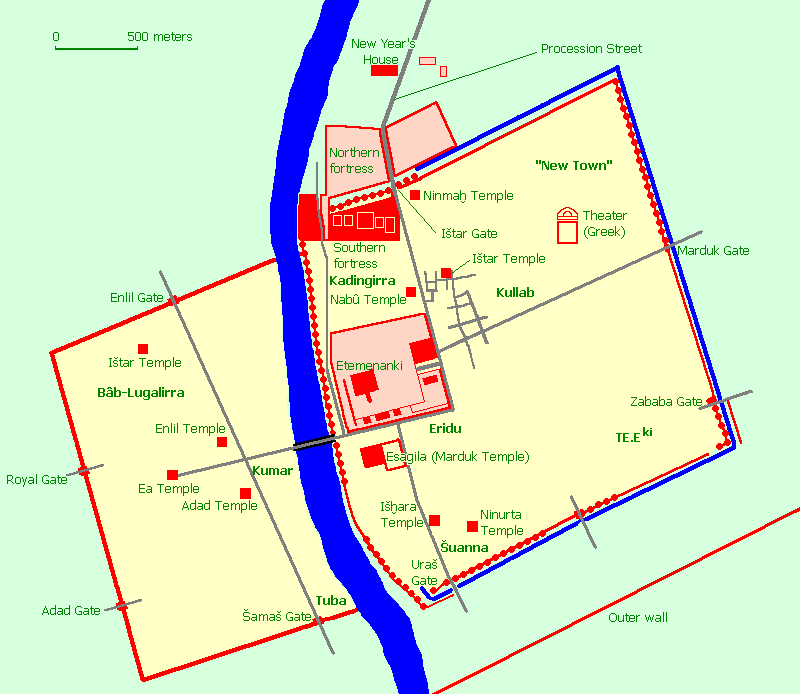
This map depicts more clearly the relative positions of Etemenanki and the Temple of Marduk.  Map of Babylon Creator Jona Lendering Licence Attribution-NonCommercial-ShareAlike 4.0 International Linked Babylon, Babylonian Empire, Capture of Babylon (Herodotus), Esagila, Etemenanki (the "Tower of Babel"), Zopyrus Categories Babylonia http://www.livius.org/pictures/a/maps/map-of-babylon/ http://www.livius.org/place/etemenanki/

This map depicts more clearly the relative positions of Etemenanki and the Temple of Marduk.
Map of Babylon
Creator
Jona Lendering
Licence
Attribution-NonCommercial-ShareAlike 4.0 International
Linked
Babylon, Babylonian Empire, Capture of Babylon (Herodotus), Esagila, Etemenanki (the “Tower of Babel”), Zopyrus
Categories
Babylonia
http://www.livius.org/pictures/a/maps/map-of-babylon/
http://www.livius.org/place/etemenanki/

He was but one Baal out of many Baalim, supreme only when his worshippers were themselves supreme. It was only when a Nebuchadnezzar or a Khammuragas was undisputed master of Babylonia that the god they adored became “the prince of the gods.”

But the other gods maintained their separate positions by his side, and in their own cities would have jealously resented any interference with their ancient supremacy. As we have seen, Nabonidos brought upon himself the anger of heaven because he carried away the gods of Marad and Kis and other towns to swell the train of Merodach in his temple at Babylon.”

 A.H. Sayce, Lectures on the Origin and Growth of Religion as Illustrated by the Religion of the Ancient Babylonians, 5th ed., London, 1898, pp. 94-7.

E-Sagila, The Great Temple of Bel in Babylon

The temple or “tomb”of Bêlos, as it was also called by the Greeks, was one of the wonders of the world.

Hêrodotos, quoting probably from an earlier author, describes it in the following terms :

“The temple of Zeus Bêlos,with bronze gates which remained up to my time, was a square building two furlongs every way. In the middle of the temple was a tower of solid masonry, a furlong in length and breadth, and upon this tower another tower had been erected, and upon that again another, and so on for eight towers.

And the ascent to them was by an incline which wound round all the towers on the outside. About the middle of the incline are a resting-place and seats, where those who ascend may sit and rest. In the topmost tower is a large shrine, within which is a large and well-appointed couch, with a golden table at its side.

But no image is set up there, nor does any one pass the night there except a single woman, a native of the country, whom the god selects for himself from among all the inhabitants, as is asserted by the Chaldeans, the priests of the god.

They further say, though I cannot believe it, that the god himself visits the shrine and takes his rest upon the couch. … There is another shrine below belonging to this Babylonian temple, and containing a great statue of Zeus [Bêlos] of gold in a sitting posture, and a great golden table is set beside it.

The pedestal and chair of the statue are of gold, and, as the Chaldeans used to say, the gold was as much as 800 talents in weight. Outside the shrine is a golden altar. There is also another great altar upon which full-grown sheep are sacrificed, for upon the golden altar only sucklings are allowed to be offered.

Upon the larger altar also the Chaldeans burn each year a thousand talents of frankincense at the time when they keep the festival of the god. In this part of the temple there was still at that time a figure of a man twelve cubits high, of solid gold.”

It is clear from this description that the great temple of Babylon resembled a large square enclosure formed by huge walls of brick, within which rose a tower in eight stages. Below the tower was a shrine or temple, and outside it two altars, the smaller one of gold for special offerings, while the larger one was intended for the sacrifice of sheep as well as for the burning of incense.

We learn a good deal about this temple from the inscriptions of Nebuchadnezzar, which show that although Hêrodotos was correct in his general description of the building, he has made mistakes in the matter of details.

The Temple itself stood on the east side of Babylon, and had existed since the age of Khammuragas (B.C. 2250), and the first dynasty which had made Babylon its capital. It bore the title of E-Sagila or E-Saggil, an Accadian name signifying “the house of the raising of the head.”

Its entrance also bore the Accadian title of Ka-khilibu, which Nebuchadnezzar renders “the gate of glory.”

 A.H. Sayce, Lectures on the Origin and Growth of Religion as Illustrated by the Religion of the Ancient Babylonians, 5th ed., London, 1898, pp. 92-4.

Marduk of Babylon: Baal

” … Nebuchadnezzar may invoke Merodach as “the lord of the gods,” “the god of heaven and earth,” “the eternal, the holy, the lord of all things,” but he almost always couples him with other deities–Nebo, Sin or Gula–of whom he speaks in equally reverential terms.

Even Nabonidos uses language of Sin, the Moon-god, which is wholly incompatible with a belief in the exclusive supremacy of Merodach. He calls him “the lord of the gods of heaven and earth, the king of the gods and the god of gods, who dwell in heaven and are mighty.” Merodach was, in fact, simply the local god of Babylon.

Events had raised Babylon first to the dignity of the capital of Babylonia, and then of that of a great empire, and its presiding deity had shared its fortunes. It was he who had sent forth its people on their career of conquest; it was to glorify his name that he had given them victory.

The introduction of other deities on an equal footing with himself into his own peculiar seat, his own special city, was of itself a profanation, and quite sufficient to draw upon Nabonidos his vindictive anger. The Moon-god might be worshipped at Ur; it was out of place to offer him at Babylon the peculiar honours which were reserved for Merodach alone.

Here, then, is one of the results of that localisation of religious worship which was characteristic of Babylonia. Nabonidos not only offended the priests and insulted the gods of other cities by bringing their images into Babylon, he also in one sense impaired the monopoly which the local deity of Babylon enjoyed. He thus stirred up angry feelings on both sides.

Had he himself been free from the common belief of the Babylonian in the local character of his gods, he might have effected a revolution similar to that of Hezekiah; he had, however, the superstition which frequently accompanies antiquarian instincts, and his endeavour to make Babylon the common gathering-place of the Babylonian divinities was dictated as much by the desire to make all of them his friends as by political design.

Now who was this Merodach, this patron-god of Babylon, whose name I have had so often to pronounce? Let us see, first of all, what we can learn about him from the latest of our documents, the inscriptions of Nebuchadnezzar and his successors.

In these, Merodach appears as the divine protector of Babylon and its inhabitants. He has the standing title of Bilu or “lord,” which the Greeks turned into βμλος, and which is the same as the Baal of the Old Testament. The title is frequently used as a name, and is, in fact, the only name under which Merodach was known to the Greeks and Romans.

In the Old Testament also it is as Bel that he comes before us. When the prophet declares that “Bel boweth down” and is “gone into captivity,” he is referring to Merodach and the overthrow of Merodach’s city.

To the Babylonian, Merodach was pre-eminently the Baal or “lord,” like the Baalim or “lords” worshipped under special names and with special rites in the several cities of Canaan.”

 A.H. Sayce, Lectures on the Origin and Growth of Religion as Illustrated by the Religion of the Ancient Babylonians, 5th ed., London, 1898, pp. 90-2.

The Fall of Nabonidos

“The destruction of the local cults, the attempt to unify and centralise religious worship, was to the Rab-shakeh, as it was to the Babylonian scribes, and doubtless also to many of the Jews in the time of Hezekiah, an act of the grossest impiety.

An annalistic tablet, drawn up not long after the conquest of Babylonia by Cyrus, hints that before making his final attack on the country, the Elamite prince had been secretly aided by a party of malcontents in Chaldea itself.

It is at all events significant that as soon as the army of Nabonidos was defeated, the whole population at once submitted, and that even the capital, with its almost impregnable fortifications, threw open its gates.

The revolts which took place afterwards in the reigns of Dareios and Xerxes, and the extremities endured by the Babylonians before they would surrender their city, prove that their surrender was not the result of cowardice or indifference to foreign rule. The great mass of the people must have been discontented with Nabonidos and anxious for his overthrow.

The anger of Merodach and the gods, in fact, was but a convenient way of describing the discontent and anger of an important section of the Babylonians themselves. Nabonidos did not belong to the royal house of Nebuchadnezzar; he seems to have raised himself to the throne by means of a revolution, and his attempt at centralisation excited strong local animosities against him.

Religion and civil government were so closely bound up together, that civil centralisation meant religious centralisation also; the surest sign that the cities of Babylonia had been absorbed in the capital was that the images of the gods whose names had been associated with them from time immemorial were carried away to Babylon. The cities lost their separate existence along with the deities who watched over their individual fortunes.

The removal of the gods, however, implied something more than the removal of a number of images and the visible loss of local self-government or autonomy. Each image was the centre of a particular cult, carried on in a particular temple in a particular way, and entrusted to the charge of a special body of priests.

It was no wonder, therefore, that the high-handed proceedings of Nabonidos aroused the enmity of these numerous local priesthoods, as well as of all those who profited in any way from the maintenance of the local cults.

Most of the cities which were thus deprived of their ancestral deities were as old as Babylon; many of them claimed to be older; while it was notorious that Babylon did not become a capital until comparatively late in Babylonian history.

The Sun-god of Sippara, the Moon-god of Ur, were alike older than Merodach of Babylon. Indeed, though in the age of Nabonidos the title of Bel or “lord”had come to be applied to Merodach specially, it was known that there was a more ancient Bel–Belitanas, “the elder Bel,” as the Greeks wrote the word–whose worship had spread from the city of Nipur, and who formed one of the supreme triad of Babylonian gods.”

A.H. Sayce, Lectures on the Origin and Growth of Religion as Illustrated by the Religion of the Ancient Babylonians, 5th ed., London, 1898, pp. 85-6.

The Rise of Marduk

“In an inscription upon a clay cylinder brought from Babylonia seven years ago, Cyrus is made to declare that the overthrow of Nabonidos, the last independent Babylonian monarch, was due to the anger of Bel and the other gods.

Nabonidos had removed their images from their ancient sanctuaries, and had collected them together in the midst of Babylon. The priests maintained that the deed had aroused the indignation of Merodach, “the lord of the gods,” who had accordingly rejected Nabonidos, even as Saul was rejected from being king of Israel, and had sought for a ruler after his own heart.

It was “in wrath” that the deities had ”left their shrines when Nabonidos brought them into Babylon,” and had prayed Merodach, the divine patron of the imperial city, to “go round unto all men wherever might be their seats.”

Merodach sympathised with their wrongs; “he visited the men of Sumer and Accad whom he had sworn should be his attendants,” and “all lands beheld his friend.” He chose Cyrus, king of Elam, and destined him by name for the sovereignty of Chaldea.

Cyrus, whom the Hebrew prophet had already hailed as the Lord’s Anointed, was thus equally the favourite of the supreme Babylonian god.

“Merodach, the great lord, the restorer of his people,” we are told, “beheld with joy the deeds of his vicegerent who was righteous in hand and heart. To his city of Babylon he summoned his march, and he bade him take the road to Babylon; like a friend and a comrade he went at his side.”

A single battle decided the conflict: the Babylonians opened their gates, and “without fighting or battle,” Cyrus was led in triumph into the city of Babylon.

His first care was to show his gratitude towards the deities who had so signally aided him. Their temples were rebuilt, and they themselves were restored to their ancient seats.

With all the allowance that must be made for the flattery exacted by a successful conqueror, we must confess that this is a very remarkable document. It is written in the Babylonian language and in the Babylonian form of the cuneiform syllabary, and we may therefore infer that it was compiled by Babylonian scribes and intended for the perusal of Babylonian readers.

Yet we find the foreign conqueror described as the favourite of the national god, while the last native king is held up to reprobation as the dishonorer of the gods. It is impossible not to compare the similar treatment experienced by Nebuchadnezzar and the native Jewish kings respectively at the hands of Jeremiah.

The Jewish prophet saw in the Chaldean invader the instrument of the God of Judah, just as the Babylonian scribes saw in Cyrus the instrument of the god of Babylon; and the fall of the house of David is attributed, just as much as the fall of Nabonidos, to divine anger.”

A.H. Sayce, Lectures on the Origin and Growth of Religion as Illustrated by the Religion of the Ancient Babylonians, 5th ed., London, 1898, pp. 85-6.

Babylonian Origins of Jewish Purim

We have already questioned whether the Scripture story of Esther is in some manner connected with the goddess Ishtar. Writing of the Jewish feast of Purim, Sir James Frazer says (Golden Bough, vol. iii, p. 153):

“ From the absence of all notice of Purim in the older books of the Bible, we may fairly conclude that the festival was instituted or imported at a comparatively late date among the Jews. The same conclusion is supported by the Book of Esther itself, which was manifestly written to explain the origin of the feast and to suggest motives for its observance.

For, according to the author of the book, the festival was established to commemorate the deliverance of the Jews from a great danger which threatened them in Persia under the reign of King Xerxes. Thus the opinion of modern scholars that the feast of Purim, as celebrated by the Jews, was of late date and Oriental origin, is borne out by the tradition of the Jews themselves.

An examination of that tradition and of the mode of celebrating the feast renders it probable that Purim is nothing but a more or less disguised form of the Babylonian festival of the Sacaea or Zakmuk. . . .

But further, when we examine the narrative which professes to account for the institution of Purim, we discover in it not only the strongest traces of Babylonian origin, but also certain singular analogies to those very features of the Sacaean festival with which we are here more immediately concerned.

The Book of Esther turns upon the fortunes of two men, the vizier Haman and the despised Jew Mordecai, at the court of a Persian king. Mordecai, we are told, had given mortal offence to the vizier, who accordingly prepares a tall gallows on which he hopes to see his enemy hanged, while he himself expects to receive the highest mark of the King’s favour by being allowed to wear the royal crown and the royal robes, and thus attired to parade the streets, mounted on the King’s own horse and attended by one of the noblest princes, who should proclaim to the multitude his temporary exaltation and glory.

But the artful intrigues of the wicked vizier miscarried and resulted in precisely the opposite of what he had hoped and expected; for the royal honours which he had looked for fell to his rival Mordecai, and he himself was hanged on the gallows which he had made ready for his foe.

In this story we seem to detect a reminiscence, more or less confused, of the Zoganes of the Sacaea, in other words, of the custom of investing a private man with the insignia of royalty for a few days, and then putting him to death on the gallows or the cross. . . .

“A strong confirmation of this view is furnished by a philological analysis of the names of the four personages. It seems to be now generally recognised by Biblical scholars that the name Mordecai, which has no meaning in Hebrew, is nothing but a slightly altered form of Marduk or Merodach, the name of the chief god of Babylon, whose great festival was the Zakmuk; and further, it is generally admitted that Esther in like manner is equivalent to Ishtar, the great Babylonian goddess whom the Greeks called Astarte, and who is more familiar to English readers as Ashtaroth.

The derivation of the names of Haman and Vashti is less certain, but some high authorities are disposed to accept the view of Jensen that Haman is identical with Humman or Homman, the national god of the Elamites, and that Vashti is in like manner an Elamite deity, probably a goddess whose name appears in inscriptions.”

Lewis Spence, Myths and Legends of Babylonia and Assyria, 1917, pp. 140-2.

More on Sargon

“But in spite of the atmosphere of myth which came to enshroud him, as it enshrouded the persons of Kyros, of Charlemagne, and of other heroes of popular history, Sargon was a historical monarch and the founder of a really great empire.

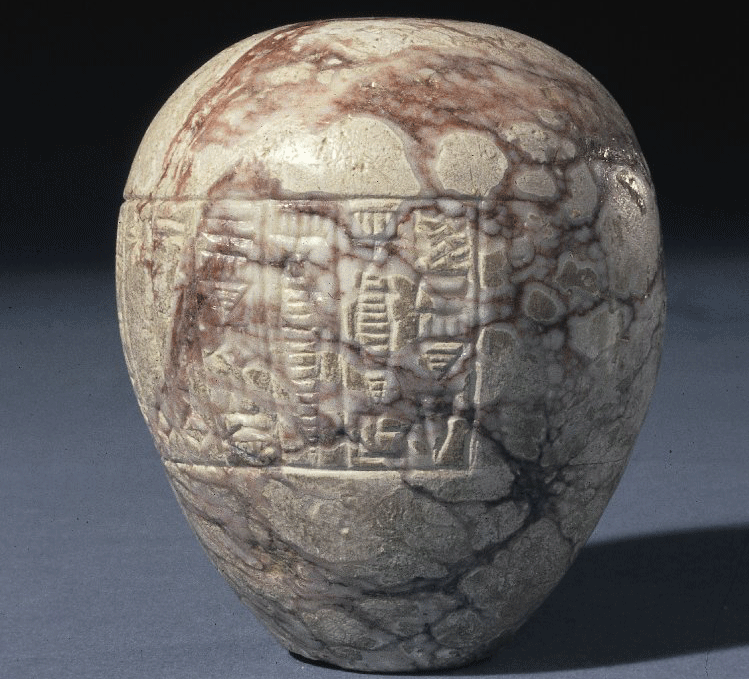
The British Museum actually possesses an inscribed egg of veined marble which he dedicated to the Sun-god of Sippara (ed note: Shamash), and the seal of his librarian Ibni-sarru is in the hands of M. Le Clercq of Paris. What may be termed the scientific literature of the library of Nineveh makes frequent reference to him, and we learn that it was for the great library which he established in his capital city of Accad that the two standard Babylonian works on astronomy and terrestrial omens were originally compiled.

Sargon's inscribed egg for the Sun God Shamash at Sippara in the British Museum.

Sargon’s inscribed egg for the Sun God Shamash at Sippara in the British Museum.

 The work on astronomy was entitled The Observations of Bel, and consisted of no less than seventy-two books, dealing with such matters as the conjunction of the sun and moon, the phases of Venus, and the appearances of comets.

It was translated in later days into Greek by the historian Berossus and though supplemented by numerous additions in its passage through the hands of generations of Babylonian astronomers, the original work contained so many records of eclipses as to demonstrate the antiquity of Babylonian astronomy even in the remote age of Sargon himself.

But besides our knowledge of Sargon’s patronage of learning, we also know something about the civil history of his reign. A copy of its annals has come down to us. We gather from these that he was not only successful in overthrowing all opposition at home, he was also equally successful abroad.

His first campaign was against the powerful kingdom of Elam in the East, where he overthrew the enemy and mutilated their slain. Next he turned to the West, laying his yoke on Syria, and subjugating “the four quarters” of the world. Then the rival kings of Babylon and other Chaldean cities felt his power; and out of the spoil of the vanquished he built the city of Accad and gave it its name.

From this time forward his attention was chiefly devoted to the West. Year after year he penetrated into Syria, until at last, we are told, “he had neither equal nor rival;” he crossed the Mediterranean to the island we now call Cyprus, and “in the third year,” at the bounds of the setting sun, his hands conquered all peoples and his mouth decreed a single empire.

Here on the shores of Cyprus the great conqueror erected images of himself, and then carried the booty of the island to the opposite coast of Asia. Such a glimpse into the history of what became afterwards a Grecian sea, when as yet no Greeks had made their ray to their later home, is startling to those whose conceptions of authentic history have been limited by the narrow horizon of the classical world. Its trustworthiness, however, has been curiously verified by a discovery made by General de Cesnola in the treasure-vaults of a Kyprian temple among the ruins of the ancient Kurion.

A god in horned cap brandishes a mace and the forked lightening of Iva-Vul, Thunder God, and sets foot on a recumbent bull.  Behind him is a leaping ibex. In front, a man, perhaps the king, in a short coat, standing full face. Behind him a man on bended knee, possibly the owner of the cylinder. Above him, a small deer is recumbent and inverted.  Then a figure in a long garment, and 3 rows of cuneiform writing:  "Arba Istar: son of Ibu Beled: servant of the god Naram-Sin."  The king Naram-Sin, to whom a divine determinative prefix is given here, reigned in Babylonia no later than 2600 BCE.  Cyprus, plate 4300.  John L. Myres, Handbook of the Cesnola Collection of Antiquities from Cyprus, 1914.

A god in horned cap brandishes a mace and the forked lightening of Iva-Vul, Thunder God, and sets foot on a recumbent bull.
Behind him is a leaping ibex. In front, a man, perhaps the king, in a short coat, standing full face. Behind him a man on bended knee, possibly the owner of the cylinder. Above him, a small deer is recumbent and inverted.
Then a figure in a long garment, and 3 rows of cuneiform writing:
“Arba Istar: son of Ibu Beled: servant of the god Naram-Sin.”
The king Naram-Sin, to whom a divine determinative prefix is given here, reigned in Babylonia no later than 2600 BCE.
Cyprus, plate 4300.
John L. Myres, Handbook of the Cesnola Collection of Antiquities from Cyprus, 1914.

Here, among other hematite cylinders of early Babylonian origin, he found one the first owner of which describes himself as a ” servant” or ”worshipper” of “the deified Naram- Sin.” Naram-Sin was the son and successor of Sargon, and it is not likely that he would have received divine honours after the fall of the dynasty to which he belonged.

The fact that the cylinder was discovered in Cyprus seems to show that even after Sargon’s death a connection continued to exist between Cyprus and the imperial power of Babylonia. Naram-Sin, however, was more bent on the conquest of Magána, or the Sinaitic Peninsula, than upon further campaigns in the West.

Sinai, with its mines of turquoise and copper, had been a prize coveted by the Egyptians ever since the age of the Third Dynasty, and one of the first efforts of the rising rival power on the banks of the Euphrates was to gain possession of the same country.

Naram-Sin, so runs the annalistic tablet, “marched to the land of Magána; the land of Magána he conquered, and overcame its king.”

A.H. Sayce, Lectures on the Origin and Growth of Religion as Illustrated by the Religion of the Ancient Babylonians, 5th ed., London, 1898, pp. 29-31.

The Genesis of the Kings List

“The single fact which has shaken it to its very foundations is the discovery of the date to which the reign of Sargon of Accad must be assigned. The last king of of Babylonia, Nabonidos, had antiquarian tastes, and busied himself not only with the restoration of the old temples of his country, but also with the disinterment of the memorial cylinders which their builders and restorers had buried beneath their foundations.

It was known that the great temple of the Sun-god at Sippara, where the mounds of Abu-Habba now mark its remains, had been originally erected by Naram-Sin the son of Sargon, and attempts had been already made to find the records which, it was assumed, he had entombed under its angles. With true antiquarian zeal, Nabonidos continued the search, and did not desist until, like the Dean and Chapter of some modern cathedral, he had lighted upon “the foundation-stone” of Naram-Sin himself.

The Foundation Stone of Naram-Sin.

The Foundation Stone of Naram-Sin.

 This “foundation-stone,” he tells us, had been seen by none of his predecessors for 3200 years. In the opinion, accordingly, of Nabonidos, a king who was curious about the past history of his country, and whose royal position gave him the best possible opportunities for learning all that could be known about it, Naram-Sin and his father Sargon I, lived 3200 years before his own time, or 3750 B.C.

The date is so remote and so contrary to all our preconceived ideas regarding the antiquity of the Babylonian monarchy, that I may be excused if at first I expressed doubts as to its accuracy. We are now accustomed to contemplate with equanimity the long chronology which the monuments demand for the history of Pharaonic Egypt, but we had also been accustomed to regard the history of Babylonia as beginning at the earliest in the third millennium before our era. Assyrian scholars had inherited the chronological prejudices of a former generation, and a starveling chronology seemed to be confirmed by the statements of Greek writers.

I was, however, soon forced to re-consider the reasons of my scepticism. The cylinder on which Nabonidos accounts his discovery of the foundation-stone of Naram-Sin was brought from the excavations of Mr. Hormuzd Rassam in Babylonia, and explained by Mr. Pinches six years ago.

Soon afterwards, Mr. Pinches was fortunate enough to find among some other inscriptions from Babylonia fragments of three different lists, in one of which the kings of Babylonia were arranged in dynasties, and the number of years each king reigned was stated, as well as the number of years the several dynasties lasted.

An Assyrian copy of a similar list had been already discovered by Mr. George Smith, who, with his usual quickness of perception, saw that it must have resembled the lists from which Berossos, the Greek historian of Chaldaea, drew the materials of his chronology; but the copy was so mere a fragment that the chronological position of the kings mentioned upon it was a matter of dispute.

Happily this is not the case with the principal test published by Mr. Pinches. It had been compiled by a native of Babylon, who consequently began with the first dynasty which made Babylon the capital of the kingdom, and who seems to have flourished in the time of Nabonidos. We can check the accuracy of his statements in a somewhat curious way.

One of the two other texts brought to light by Mr. Pinches is a schoolboy’s exercise copy of the first two dynasties mentioned on the annalistic tablet. There are certain variations between thc two texts, however, which show that the schoolboy or his master must have used some other list of the early kings than that which was employed by the compiler of the tablet; nevertheless, the names and the regnal years, with one exception, agree exactly in each.

In Assyria, an accurate chronology was kept by means of certain officers, the so-called Eponyms, who were changed every year and gave their names to the year over which they presided. We have at present no positive proof that the years were dated in the same way in Babylonia; but since most Assyrian institutions were of Babylonian origin, it is probable that they were.

At all events, the scribes of a later day believed that they had trustworthy chronological evidence extending back into a dim antiquity; and when we remember the imperishable character of the clay literature of the country, and the fact that the British Museum actually contains deeds and other legal documents dated in the rein of Khammuragas, more than four thousand years ago, there is no reason why we should not consider the belief to have been justified.”

A.H. Sayce, Lectures on the Origin and Growth of Religion as Illustrated by the Religion of the Ancient Babylonians, 5th ed., London, 1898, pp. 21-3.

Sumerian Archeology

“Arriving in 1878, Rassam went to work with a will. Over a period of four years he opened excavations not only at Nineveh but at sites ranging from eastern Anatolia to southern Iraq, leaving the day-to-day excavation to his assistants and rarely visiting the sites.

Bronze band from the Palace Gates of Shalmaneser III in the British Museum.  The scenes show in the upper tier the king receiving tribute from Tyre and Sidon in Lebanon and in the lower tier the conquest of the town of Hazuzu in Syria. https://en.wikipedia.org/wiki/Balawat_Gates

Bronze band from the Palace Gates of Shalmaneser III in the British Museum.
The scenes show in the upper tier the king receiving tribute from Tyre and Sidon in Lebanon and in the lower tier the conquest of the town of Hazuzu in Syria.
https://en.wikipedia.org/wiki/Balawat_Gates

His discoveries included panels of embossed bronze sheeting that had originally covered the great gates erected by Shalmaneser III at Balawat near Nimrud, and around 50,000 cuneiform cylinders and tablets in the Shamash temple at Sippar near Babylon. But times had changed since the cavalier days of the 1850s.

Relief image on the Tablet of Shamash, British Library room 55. Found in Sippar (Tell Abu Habbah), in Ancient Babylonia; it dates from the 9th century BC and shows the sun god Shamash on the throne, in front of the Babylonian king Nabu-apla-iddina (888-855 BC) between two interceding deities. The text tells how the king made a new cultic statue for the god and gave privileges to his temple. https://en.wikipedia.org/wiki/Tablet_of_Shamash#/media/File:Tablet_of_Shamash_relief.jpg

Relief image on the Tablet of Shamash, British Library room 55. Found in Sippar (Tell Abu Habbah), in Ancient Babylonia; it dates from the 9th century BC and shows the sun god Shamash on the throne, in front of the Babylonian king Nabu-apla-iddina (888-855 BC) between two interceding deities. The text tells how the king made a new cultic statue for the god and gave privileges to his temple.
https://en.wikipedia.org/wiki/Tablet_of_Shamash#/media/File:Tablet_of_Shamash_relief.jpg

Considerable advances had been made in excavation techniques and recording methods. It was no longer enough to plunder sites for antiquities; buildings and other contexts had to be carefully investigated and recorded, and objects had to be recovered with care, without allowing them to “crumble to dust.”

Rassam was seriously criticized by other scholars in the field, and his departure largely saw the end of crude excavation methods in Mesopotamia—until the wanton destruction by bandits with bulldozers following the 2003 invasion of Iraq, which threatens utterly to obliterate a huge number of sites.

As a native of the region, Rassam was very aware of the threat to the ancient cities from treasure hunters and brick robbers. When he left for Britain, therefore, he hired guardians to prevent future plundering in the important sites, including Kuyunjik and Sippar. Over the following decade, however, antiquities, and particularly tablets, that seemed likely to have come from these sites appeared in some numbers on the international market. The British Museum sent out Wallis Budge to investigate.

Budge arrived in Baghdad in 1888, armed with a permit to excavate Kuyunjik as a cover for his detective work. Within days, he purchased many tablets from local dealers, most of whom he found to be the very people appointed to guard the ancient sites, and skillfully foiled a plan to prevent him from exporting them.

Later in the year he reopened excavations at Kuyunjik, recovering some 200 tablets from the spoil of previous excavations. His luck turned the following year, however, when he excavated at ed-Der, part of ancient Sippar. The procedures involved in obtaining an excavation permit were long-winded and public: By the time Budge could start work, ed-Der had been thoroughly “examined” by the Vali of Baghdad, with the result that 10,000 tablets had found their way into the hands of dealers.

A similar fate befell the Frenchman Ernest de Sarzec, who excavated Telloh (ancient Girsu) in 1877–1881 and 1888–1900. This was the first serious investigation of a site belonging to Mesopotamia’s original Sumerian civilization, and the objects found here created great excitement in Europe, where they were displayed in the 1880s Paris exhibition.

     Stele of Vultures detail 01-transparent.png One fragment of the victory stele of the king Eannatum of Lagash over Umma, Sumerian archaic dynasties. https://en.wikipedia.org/wiki/Stele_of_the_Vultures#/media/File:Stele_of_Vultures_detail_01-transparent.png


Stele of Vultures detail 01-transparent.png
One fragment of the victory stele of the king Eannatum of Lagash over Umma, Sumerian archaic dynasties.
https://en.wikipedia.org/wiki/Stele_of_the_Vultures#/media/File:Stele_of_Vultures_detail_01-transparent.png

The powerful and austere art style typified by the diorite statues strongly impressed European art critics, and a sculptured slab, dubbed the “Stele of the Vultures,” sparked great interest, because it showed for the first time in history an organized army going to war.

Telloh also yielded numerous tablets, some relating to border disputes with neighboring Umma, the fascinating first contemporary account of warfare—but most of them were not recovered by de Sarzec. During de Sarzec’s frequent absences, local people, often sponsored by Baghdad dealers, abstracted around 40,000 tablets from one of the mounds. These provided the first substantial body of works in the Sumerian language, whose very existence had been doubted in earlier decades.

The first U.S. expedition to work in Mesopotamia experienced an even more dramatic mixture of success and failure. Sponsored by Pennsylvania University, a team headed by John Peters arrived in 1887 to excavate Nippur, the holy city of ancient Sumer.

Hopelessly out of their depth in the complexities of dealing with the local villagers and authorities, their first season ended in an all-out attack in which their camp was set on fire, half their horses perished, and they lost $1,000 in gold—although they saved their antiquities.

Work resumed in 1890, under more auspicious circumstances, and continued intermittently until 1900. Among the 30,000 tablets recovered from Nippur were around 2,100 whose subject matter was literature, in contrast to the ubiquitous economic texts: These opened a window onto the fascinating world of the Sumerians and to this day form the bulk of known Sumerian literature.”

Jane R. McIntosh, Ancient Mesopotamia, 2005, pp. 30-2.

The Story of Mesopotamian Archeology

“Although official attentions were now turned elsewhere, strong popular interest in Mesopotamian antiquities continued, fueling a flourishing trade in material looted by local merchants from the ancient cities of Assyria. Scholarly plundering had already caused considerable destruction. Now the situation reached its nadir, with the retrieval of saleable pieces being the only aim, very much at the expense of the ancient remains.

Scholarly activity had not ceased, however, although it was no longer concentrated in the field. By the end of the 1850s the successful decipherment of Akkadian cuneiform meant that inscriptions and texts recovered from Nineveh and elsewhere could now yield a vast amount of information on the ancient Mesopotamian world.

One of the most surprising discoveries was the great time depth of the civilization. Biblical and Classical sources had painted a picture of the wealth and grandeur of Assyria in the first millennium B.C.E., and this had been confirmed by the excavations at Nineveh and adjacent cities.

The library uncovered in Ashurbanipal’s palace included texts written in the second millennium B.C.E., shedding light on the period of the Old Babylonian Empire and the early history of the Assyrians, the time of the biblical patriarch Abraham, native of the Mesopotamian city of Ur.

But there were also copies of even more ancient texts that revealed the existence in the third millennium B.C.E. of the southern Mesopotamian civilization of Sumer and Akkad.

The later nineteenth century was a time of great intellectual upheaval. The developing science of geology was revealing the immense age and gradual formation of the earth, while Charles Darwin was showing how life had evolved in all its diversity. This new knowledge undermined the certainties of the Bible, according to which the world was created in immutable form at a date calculated by biblical scholars as 4004 B.C.E.

In this epoch of challenge to established traditional views, many found it reassuring that archaeological research in the Near East was uncovering cities and records of individuals familiar from the Bible, thus confirming and buttressing its authenticity.

It was therefore electrifying news when George Smith, who had spent many years quietly studying cuneiform texts, announced in December 1872 that he had found part of a tablet recounting the story of the Flood. A serious-minded man, he amazed his colleagues at the moment of discovery by leaping to his feet, rushing round the room, and beginning to tear off his clothes.

In less than two months he found himself en route to Mosul to look for the missing pieces of the tablet, lavishly sponsored by the Daily Telegraph of London—a measure of the immense popular excitement that his discovery had generated.

Once Smith had accomplished the tedious and time-consuming task of extracting a permit from the Ottoman authorities, he achieved his objective in just five days of digging, finding among the debris left by previous excavators a piece of tablet that accounted for the major part of the missing section.

Smith later returned to excavate further at Nineveh, but in 1876 he contracted a fatal illness. As his replacement, the British Museum appointed Hormuzd Rassam, veteran of the 1850s excavations.”

Jane R. McIntosh, Ancient Mesopotamia, 2005, pp. 29-30.

The View of Babylon at the Near End of History

“The influence and prestige of Mesopotamia ensured that its myths, legends, and history were widely disseminated in the Near East and beyond. Many elements of Assyrian and Babylonian legal institutions and laws, science, astronomy, mathematics and medicine, calendar and the division of time, as well as magical and ritual beliefs and practices such as divination were widely adopted, as can be seen in Classical and Hellenistic Greek literature and in the Bible.

Whereas the early Greeks knew of Mesopotamia at one remove, the Israelites had direct and often painful experience of the Mesopotamians. Mesopotamian myths and history are interwoven with biblical accounts of the early days of the world: for example, the story of the Tower of Babel in Genesis 11. From the mid-ninth century B.C.E., the biblical kingdoms of Israel and Judah suffered from Assyrian expansionism, and revolts against Assyrian, and later, Babylonian, rule led to the sack of their cities and the deportation of many of their citizens. The climax came in 588–587 B.C.E., when Jerusalem was put to the torch, the Temple destroyed, and its notables exiled to Babylon.

Although a substantial Jewish community flourished in Babylon for many centuries, becoming familiar with Babylonian traditions, it is the purple prose of the traditionalists who returned to Judah that formed the picture of Mesopotamia that passed into Western consciousness via the Bible. Centuries of conflict had produced a very hostile biblical view of Mesopotamian culture and civilization, especially of Babylon “the mother of harlots and of the abominations of the earth” (Revelation 17:5), ruled by supposedly corrupt and decadent rulers like Belshazzar, who was “weighed in the balance and found wanting” (Daniel 5:27).

Although the Greeks had no such political axe to grind, they also gave the Mesopotamians a bad press, contrasting their alien practices with the civilized behavior epitomized in the Greek mind by the Greeks. Thus, for example, Herodotus draws attention to the practice of sacred prostitution. He also gives an anecdotal and fanciful account of Mesopotamian history. In contrast, his descriptions of the cities of Babylonia, and particularly Babylon itself, are both accurate and informative.

Nevertheless, contemporaries came to doubt his accounts, which conflicted with those in the twenty-three-volume Persica of Ctesias, a Greek doctor at the Persian court in the fifth century B.C.E. In fact, Ctesias’s account is far less reliable than that of Herodotus, being filtered through the attitudes and knowledge of Mesopotamia’s Persian conquerors. Unfortunately, it was upon Ctesias’s work that later Classical scholars based their writings about Mesopotamia.

This was despite the existence of a far better account, a three-volume work by the third century B.C.E. Babylonian scholar Berossus. A native of Babylon, Berossus wrote in Greek but had access to many cuneiform texts that provided detailed and accurate information on Mesopotamian history and culture. Berossus’s Babyloniaca, which ran from the Creation to Alexander’s conquest, was copied and circulated for a few centuries but by the first century B.C.E. had been largely superseded by a digest in which a Greek scholar, Alexander Polyhistor, uncritically assembled material from a number of different and conflicting texts, including Berossus and Ctesias. Information was drawn from Berossus’s work to calculate chronology, particularly the dates of the Creation and the Flood, but his original was otherwise neglected. Little of it survived the Classical period.

The Hellenistic Greeks took an active interest in the visible relics of Mesopotamia’s past. Alexander the Great began reconstructing the ziggurat of Marduk (the Tower of Babel), although work ceased upon his death. His successors carried out restorations in the precinct of Marduk and of the temple of Nabu in Borsippa. The Hanging Gardens of Babylon, reputedly built by Nebuchadrezzar for his Median queen, Amyitis, were regarded as one of the Seven Wonders of the World, their fame long outlasting their physical existence. Some versions of the list of Seven Wonders also included the great walls of Babylon, said by Herodotus to be wide enough to turn a four-horse chariot on.”

Jane R. McIntosh, Ancient Mesopotamia, 2005, pp. 21-3.

Nimrod, Abram, and Idolatry

“Many Jewish legends bring Abram into relationship with Nimrod, the mythical King of Babylon. According to legend Abram was originally an idolater, and many stories are preserved respecting his conversion. Jewish legend states that the Father of the Faithful originally followed his father Terah’s occupation, which was that of making and selling images of clay; and that, when very young, he advised his father

“to leave his pernicious trade of idolatry by which he imposed on the world.”

The Jewish Rabbins relate that on one occasion, his father Terah having undertaken a considerable journey, the sale of the images devolved on him, and it happened that a man who pretended to be a purchaser asked him how old he was.

“Fifty years,” answered the Patriarch.

“Wretch that thou art,” said the man, “for adoring at that age a thing which is only one day old!”

Abram was astonished; and the exclamation of the old man had such an effect upon him, that when a woman soon after brought some flour, as an offering to one of the idols, he took an axe and broke them to pieces, preserving only the largest one, into the hand of which he put the axe. Terah returned home and inquired what this havoc meant.

Abram replied that the deities had quarrelled about an offering which a woman had brought, upon which the larger one had seized an axe and destroyed the others. Terah replied that he must be in jest, as it was impossible that inanimate statues could so act; and Abram immediately retorted on his father his own words, showing him the absurdity of worshipping false deities. But Terah, who does not appear to have been convinced, delivered Abram to Nimrod, who then dwelt in the Plain of Shinar, where Babylon was built.

Nimrod, having in vain exhorted Abram to worship fire, ordered him to be thrown into a burning furnace, exclaiming—

“Let your God come and take you out.”

As soon as Haran, Abram’s youngest brother, saw the fate of the Patriarch, he resolved to conform to Nimrod’s religion; but when he saw his brother come out of the fire unhurt, he declared for the “God of Abram,” which caused him to be thrown in turn into the furnace, and he was consumed.

A certain writer, however, narrates a different version of Haran’s death. He says that he endeavoured to snatch Terah’s idols from the flames, into which they had been thrown by Abram, and was burnt to death in consequence.”

Lewis Spence, Myths and Legends of Babylonia and Assyria, 1917, pp. 51-2.

There Were Giants

“It is strange that the dispersion of tribes at Babel should be connected with the name of Nimrod, who figures in Biblical as well as Babylonian tradition as a mighty hunter.

Epiphanius states that from the very foundation of this city (Babylon) there commenced an immediate scene of conspiracy, sedition, and tyranny, which was carried on by Nimrod, the son of Chus the Ethiopian. Around this dim legendary figure a great deal of learned controversy has raged. Before we examine his legendary and mythological significance, let us see what legend and Scripture say of him.

In the Book of Genesis (chap. x, 8,  ff.) he is mentioned as “a mighty hunter before Yahweh: wherefore it is said, Even as Nimrod the mighty hunter before the Lord.” He was also the ruler of a great kingdom. “The beginning of his kingdom was Babel, and Erech, and Accad, and Calneh in the land of Shinar. Out of that land went forth Asshur” (that is, by compulsion of Nimrod) “and builded Nineveh,” and other great cities.

In the Scriptures Nimrod is mentioned as a descendant of Ham, but this may arise from the reading of his father’s name as Cush, which in the Scriptures indicates a coloured race. The name may possibly be Cash and should relate to the Cassites.

It appears then that the sons of Cush or Chus, the Cassites, according to legend, did not partake of the general division of the human race after the fall of Babel, but under the leadership of Nimrod himself remained where they were. After the dispersion, Nimrod built Babylon and fortified the territory around it. It is also said that he built Nineveh and trespassed upon the land of Asshur, so that at last he forced Asshur to quit that territory.[3]

The Greeks gave him the name of Nebrod or Nebros, and preserved or invented many tales concerning him and his apostasy, and concerning the tower which he is supposed to have erected. He is described as a gigantic person of mighty bearing, and a contemner of everything divine; his followers are represented as being equally presumptuous and overbearing. In fact he seems to have appeared to the Greeks very much like one of their own Titans.

Nimrod has been identified both with Merodach, the tutelar god of Babylon, and with Gilgamesh, the hero of the epic of that name, with Orion, and with others. The name, according to Petrie, has even been found in Egyptian documents of the XXII Dynasty as ‘Nemart.’

Nimrod seems to be one of those giants who rage against the gods, as do the Titans of Greek myth and the Jotunn of Scandinavian story. All are in fact earth-gods, the disorderly forces of nature, who were defeated by the deities who stood for law and order. The derivation of the name Nimrod may mean ‘rebel.’

In all his later legends, for instance, those of them that are related by Philo in his De Gigantibus (a title which proves that Nimrod was connected with the giant race by tradition), he appears as treacherous and untrustworthy. The theory that he is Merodach has no real foundation either in scholarship or probability. As a matter of fact the Nimrod legend seems to be very much more archaic than any piece of tradition connected with Merodach, who indeed is a god of no very great antiquity.”

Lewis Spence, Myths and Legends of Babylonia and Assyria, 1917, pp. 49-51.

Politics Among the Magicians and Astrologers

“No. 124.

When the Moon reaches the Sun and with it fades out of sight, its horns being dim, there will be truth in the land, and the son will speak the truth with his father. (On the fourteenth the Moon was seen with the Sun.)

When the Moon and the Sun are invisible, the king will increase wisdom; the king of the land, the foundation of his throne will be secure. (On the fourteenth day the Moon was seen with the Sun.)

When the Moon and Sun are seen with one another on the fourteenth, there will be silence, the land will be satisfied; the gods intend Akkad for happiness. Joy in the heart of the people. The cattle of Akkad will lie down securely in the pasture-places.

When a dark halo surrounds the Moon, it gathers clouds, that month will bring rain. When its horns are dim, a flood will come. (On the fourteenth the Moon was seen with the Sun.)

About the people concerning whom I sent to the king, my lord, the king does not say ‘Why ?’ but has said ‘let them bring them hither.’

Now the king knows I hold no land in Assyria: I, what is my family to them, or what my life? Who is my god, who is my lord, to whom and how are my eyes turned?

Now let my lord king, lor whose life I pray Samas, send it unto Ahisa, by royal authority, and let his messenger bring the people: let the governor of Babylon cause him to leave.

Let Nabu-itir-napsati, my son, the king’s servant, come, that with me he may visit (?) the king.”

Reginald Campbell Thompson, The Reports of the Magicians and Astrologers of Nineveh and Babylon, Vol. II, London, 1900. pp. lvi-lvii.

The Twilight of Babylon

“Nabonidus (555-539 b.c.) was the last of the Babylonian kings—a man of a very religious disposition and of antiquarian tastes. He desired to restore the temple of the moon-god at Harran and to restore such of the images of the gods as had been removed to the ancient shrines. But first he desired to find out whether this procedure would meet with the approval of the god Merodach. To this end he consulted the augurs, who opened the liver of a sheep and drew thence favourable omens.

But on another occasion he aroused the hostility of the god and incidentally of the priests of E-Sagila by preferring the sun-god to the great Bel of Babylon. He tells us in an inscription that when restoring the temple of Shamash at Sippar he had great difficulty in unearthing the old foundation-stone, and that, when at last it was unearthed, he trembled with awe as he read thereon the name of Naram-sin, who, he says, ruled 3200 years before him.

But destiny lay in wait for him, for Cyrus the Persian invaded Babylonia in 538 b.c., and after defeating the native army at Opis he pressed on to Babylon, which he entered without striking a blow. Nabonidus was in hiding, but his place of concealment was discovered. Cyrus, pretending to be the avenger of Bel-Merodach for the slights the unhappy Nabonidus had put upon the god, had won over the people, who were exceedingly wroth with their monarch for attempting to remove many images of the gods from the provinces to the capital.

Cyrus placed himself upon the throne of Babylon and about a year before his death (529 b.c.) transferred the regal power to his son, Cambyses.

Assyrian-Babylonian history here ceases and is merged into Persian. Babylonia recovered its independence after the death of Darius. A king styling himself Nebuchadrezzar III arose, who reigned for about a year (521-520 b.c.), at the end of which time the Persians once more returned as conquerors. A second revolt in 514 b.c. caused the partial destruction of the walls, and finally the great city of Babylon became little better than a quarry out of which the newer city of Seleucia and other towns were built.”

Lewis Spence, Myths and Legends of Babylonia and Assyria, 1917, pp. 40-2.

The Madness of Nebuchadnezzar II

“Twelve months after this Nebuchadrezzar was in the midst of his palace at Babylon, boasting of what he had accomplished during his reign, when a voice from heaven spake, saying :

“O King Nebuchadrezzar, to thee it is spoken, the kingdom is departed from thee,”

and straightway was Nebuchadrezzar driven from man and he did eat grass as an ox and his body was wet with the dew of heaven, till his hair was grown like eagle’s feathers and his nails like bird’s claws.

At the termination of his time of trial Nebuchadrezzar lifted his eyes to heaven, and praising the Most High admitted his domination over the whole earth. Thus was the punishment of the boaster completed.

Building Inscription of King Nebuchadnezar II at the Ishtar Gate. An abridged excerpt says:  "I (Nebuchadnezzar) laid the foundation of the gates down to the ground water level and had them built out of pure blue stone. Upon the walls in the inner room of the gate are bulls and dragons and thus I magnificently adorned them with luxurious splendour for all mankind to behold in awe." https://en.wikipedia.org/wiki/Nebuchadnezzar_II

Building Inscription of King Nebuchadnezar II at the Ishtar Gate. An abridged excerpt says:
“I (Nebuchadnezzar) laid the foundation of the gates down to the ground water level and had them built out of pure blue stone. Upon the walls in the inner room of the gate are bulls and dragons and thus I magnificently adorned them with luxurious splendour for all mankind to behold in awe.”
https://en.wikipedia.org/wiki/Nebuchadnezzar_II

It has been stated with some show of probability that the judgment upon Nebuchadrezzar was connected with that weird disease known as lycanthropy, from the Greek words lukos, a wolf, and anthropos, a man. It develops as a kind of hysteria and is characterized by a belief on the part of the victim that he has become an animal.

There are, too, cravings for strange food, and the afflicted person runs about on all fours. Among primitive peoples such a seizure is ascribed to supernatural agency, and garlic or onion—the common scourge of vampires—is held to the nostrils.”

Lewis Spence, Myths and Legends of Babylonia and Assyria, 1917, p. 40.

The First Jewish Exile

“But strangely enough the older seat of power, Babylon, still flourished to some extent.

By superhuman exertions, Nebuchadrezzar II (or Nebuchadnezzar), who reigned for forty-three years, sent the standard of Babylonia far and wide through the known world. In 567 b.c. he invaded Egypt.

In one of his campaigns he marched against Jerusalem and put its king, Jehoiakim, to death, but the king whom the Babylonian monarch set up in his place was deposed and the royal power vested in Zedekiah.

Zedekiah revolted in 558 b.c. and once more Jerusalem was taken and destroyed, the principal inhabitants were carried captive to Babylon, and the city was reduced to a condition of insignificance.

This, the first exile of the Jews, lasted for seventy years. The story of this captivity and of Nebuchadrezzar’s treatment of the Jewish exiles is graphically told in the Book of Daniel, whom the Babylonians called Belteshazzar.

Daniel refused to eat the meat of the Babylonians, probably because it was not prepared according to Jewish rite. He and his companions ate pulse and drank water, and fared upon it better than the Babylonians on strong meats and wines.”

Lewis Spence, Myths and Legends of Babylonia and Assyria, 1917, pp. 36-7.

Semiramis was Legendary, Mythical, and Real

“It was through the researches of Professor Lehmann-Haupt of Berlin that the true personal significance of Semiramis was recovered. Until the year 1910 the legends of Diodorus and others were held to have been completely disproved and Semiramis was regarded as a purely mythical figure. Old Bryant in his Antient Mythology, published at the beginning of last century, proves the legendary status of Semiramis to his own satisfaction.

He says :

“It must be confessed that the generality of historians have represented Semiramis as a woman, and they describe her as a great princess who reigned in Babylon; but there are writers who from their situation had opportunities of better intelligence, and by those she is mentioned as a deity. The Syrians, says Athenagoras, worshipped Semiramis, and adds that she was esteemed the daughter of Dercatus and the same as the Suria Dea. . .

Semiramis was said to have been born at Ascalon because Atargatus was there worshipped under the name of Dagon, and the same memorials were preserved there as at Hierapolis and Babylon. These memorials related to a history of which the dove was the principal type. It was upon the same account that she was said to have been changed to a dove because they found her always depicted and worshipped under that form. . . .

From the above I think it is plain that Semiramis was an emblem and that the name was a compound of Sama-ramas, or ramis, and it signified ‘the divine token,’ a type of providence, and as a military ensign, (for as such it was used) it may with some latitude be interpreted ‘the standard of the most High.’ It consisted of the figure of a dove, which was probably encircled with the iris, as those two emblems were often represented together. All who went under that standard, or who paid any deference to that emblem, were styled Semarim or Samorim. It was a title conferred upon all who had this device for their national insigne.”

There is much more of this sort of thing, typical of the mythic science of the eighteenth and early nineteenth centuries. It is easy to see how myth became busy with the name of the Assyrian Queen, whose exploits undoubtedly aroused the enthusiasm not only of the Assyrians themselves but of the peoples surrounding them. Just as any great work in ancient Britain was ascribed to the agency of Merlin or Arthur, so such monuments as could not otherwise be accounted for were attributed to Semiramis. Western Asia is monumentally eloquent of her name, and even the Behistun inscriptions of Darius have been placed to her credit. Herodotus states that one of the gates of Babylon was called after her, and that she raised the artificial banks that confined the river Euphrates. Her fame lasted until well into the Middle Ages’, and the Armenians called the district round Lake Van, Shamiramagerd.

There is very little doubt that her fame became mingled with that of the goddess Ishtar: she possesses the same Venus-like attributes, the dove is her emblem, and her story became so inextricably intertwined with that of the Babylonian goddess that she ultimately became a variant of her. The story of Semiramis is a triumphant vindication of the manner in which by certain mythical processes a human being can attain the rank of a god or goddess, for Semiramis was originally very real indeed. A column discovered in 1909 describes her as “a woman of the palace of Samsi-rammon, King of the World, King of Assyria, King of the Four Quarters of the World.”

This dedication indicates that Semiramis, or, to give her her Assyrian title, Sammuramat, evidently possessed an immense influence over her husband, Samsi-rammon, and that perhaps as queen-mother that influence lasted for more than one reign, so that the legend that after a regency of forty-two years she delivered up the kingdom to her son, Ninyas, may have some foundation in fact. She seems to have made war against the Medes and Chaldeans. The story that on relinquishing her power she turned into a dove and disappeared may mean that her name, Sammuramat, was easily connected with the Assyrian summat, the word for “dove;” and for a person of her subsequent legendary fame the mythical connexion with Ishtar is easily accounted for.”

Lewis Spence, Myths and Legends of Babylonia and Assyria, 1917, pp. 27-9.

The Legend of Queen Semiramis

” … It was during this campaign, says Diodorus Siculus, that Ninus first beheld Semiramis. Her precise legendary or mythical origin is obscure. Some writers aver that she was the daughter of the fish-goddess Ataryatis, or Derketo, and Oannes, the Babylonian god of wisdom… Ataryatis was a goddess of Ascalon in Syria, and after birth her daughter Semiramis was miraculously fed by doves until she was found by one Simmas, the royal shepherd, who brought her up and married her to Onnes, or Menon, one of Ninus’s generals.

He fell by his own hand, and Ninus thereupon took Semiramis to wife, having profoundly admired her ever since her conduct at the capture of Bactria, where she had greatly distinguished herself. Not long afterward Ninus died, leaving a son called Ninyas.

During her son’s minority Semiramis assumed the regency, and the first great work she undertook was the interment of her husband, whom she buried with great splendour, and raised over him a mound of earth no less than a mile and a quarter high and proportionally wide, after which she built Babylon.

This city being finished, she made an expedition into Media ; and wherever she went left memorials of her power and munificence. She erected vast structures, forming lakes and laying out gardens of great extent, particularly in Chaonia and Ecbatana. In short, she leveled hills, and raised mounds of an immense height, which retained her name for ages.

After this she invaded Egypt and conquered Ethiopia, with the greater part of Libya; and having accomplished her wish, and there being no enemy to cope with her, excepting the kingdom of India, she resolved to direct her forces toward that quarter.

She had an army of 3,000,000 foot, 500,000 horse, and 100,000 chariots. For the passing of rivers and engaging the enemy by water she had procured 2000 ships, to be so constructed as to be taken to pieces for the advantage of carriage: which ships were built in Bactria by men from Phoenicia, Syria, and Cyprus. With these she fought a naval engagement with Strabrobates, King of India, and at the first encounter sunk a thousand of his ships.

After this she built a bridge over the river Indus, and penetrated into the heart of the country. Here Strabrobates engaged her. Being deceived by the numerous appearance of her elephants, he at first gave way, for being deficient in those animals she had procured the hides of 3000 black oxen, which, being properly sewn and stuffed with straw, presented the appearance of so many elephants. All this was done so naturally that even the real elephants of the Indian king were deceived.

But the stratagem was at last discovered, and Semiramis was obliged to retreat, after having lost a great part of her army. Soon after this she resigned the government to her son Ninyas, and died. According to some writers, she was slain by his hand.

Lewis Spence, Myths and Legends of Babylonia and Assyria, 1917, pp. 25-7.

The Tel el Amarna Letters Between Assyrian Kings and Egyptian Pharaohs

” … What the Babylonian chronologists called ‘the First Dynasty of Babylon’ fell in its turn, and it is claimed that a Sumerian line of eleven kings took its place. Their sway lasted for 368 years—a statement which is obviously open to question.

These were themselves overthrown and a Kassite dynasty from the mountains of Elam was founded by Kandis (c . 1780 B.C.) which lasted for nearly six centuries. These alien monarchs failed to retain their hold on much of the Asiatic and Syrian territory which had paid tribute to Babylon and the suzerainty of Palestine was likewise lost to them.

It was at this epoch, too, that the high-priests of Asshur in the north took the title of king, but they appear to have been subservient to Babylon in some degree. Assyria grew gradually in power. Its people were hardier and more warlike than the art-loving and religious folk of Babylon, and little by little they encroached upon the weakness of the southern kingdom until at length an affair of tragic proportions entitled them to direct interference in Babylonian politics.

[ … ]

The circumstances which necessitated this intervention are not unlike those of the assassination of King Alexander of Serbia and Draga, his Queen, that happened 3000 years later.

The Kassite king of Babylonia had married the daughter of Assur-yuballidh of Assyria. But the match did not meet with the approval of the Kassite faction at court, which murdered the bridegroom-king.

This atrocious act met with swift vengeance at the hands of Assur-yuballidh of Assyria, the bride’s father, a monarch of active and statesmanlike qualities, the author of the celebrated series of letters to Amen-hetep IV of Egypt, unearthed at Tel-el-Amarna.

This clay tablet is part of a collection of 382 cuneiform documents discovered in 1887 in Egypt, at the site of Tell el-Amarna. ... The majority date to the reign of Amenhotep IV (Akhenaten) (1352-1336 BC), the heretic pharaoh who founded a new capital at Tell el-Amarna. This letter is written in Akkadian, the diplomatic language of Mesopotamia at the time. It is addressed to Amenhotep III from Tushratta, king of Mitanni (centred in modern Syria). Tushratta calls the pharaoh his 'brother', with the suggestion that they are of equal rank. The letter starts with greetings to various members of the royal house including Tushratta's daughter Tadu-Heba, who had become one of Amenhotep's many brides. ... Tushratta goes on to inform Amenhotep that, with the consent of the goddess Ishtar, he has sent a statue of her to Egypt. He hopes that the goddess will be held in great honour in Egypt and that the statue may be sent back safely to Mitanni. Three lines of Egyptian, written in black ink, have been added, presumably when the letter arrived in Egypt. The addition includes the date 'Year 36' of the king. W.L. Moran, The Amarna letters (John Hopkins University Press, Baltimore, 1992) http://www.britishmuseum.org/explore/highlights/highlight_objects/me/l/clay_tablet_letter,_egypt_2.aspx

This clay tablet is part of a collection of 382 cuneiform documents discovered in 1887 in Egypt, at the site of Tell el-Amarna. …
The majority date to the reign of Amenhotep IV (Akhenaten) (1352-1336 BC), the heretic pharaoh who founded a new capital at Tell el-Amarna.
This letter is written in Akkadian, the diplomatic language of Mesopotamia at the time. It is addressed to Amenhotep III from Tushratta, king of Mitanni (centred in modern Syria). Tushratta calls the pharaoh his ‘brother’, with the suggestion that they are of equal rank. The letter starts with greetings to various members of the royal house including Tushratta’s daughter Tadu-Heba, who had become one of Amenhotep’s many brides. …
Tushratta goes on to inform Amenhotep that, with the consent of the goddess Ishtar, he has sent a statue of her to Egypt. He hopes that the goddess will be held in great honour in Egypt and that the statue may be sent back safely to Mitanni.
Three lines of Egyptian, written in black ink, have been added, presumably when the letter arrived in Egypt. The addition includes the date ‘Year 36’ of the king.
W.L. Moran, The Amarna letters (John Hopkins University Press, Baltimore, 1992)
http://www.britishmuseum.org/explore/highlights/highlight_objects/me/l/clay_tablet_letter,_egypt_2.aspx

He led a punitive army into Babylonia, hurled from the throne the pretender placed there by the Kassite faction, and replaced him with a scion of the legitimate royal stock. This king, Burna-buryas, reigned for over twenty years, and upon his decease the Assyrians, still nominally the vassals of the Babylonian Crown, declared themselves independent of it.

Not content with such a revolutionary measure, under Shalmaneser I (1300 B.C.) they laid claim to the suzerainty of the Tigris-Euphrates region, and extended their conquests even to the boundaries of far Cappadocia, the Hittites and numerous other confederacies submitting to their yoke.

Shalmaneser’s son, Tukulti-in-Aristi, took the city of Babylon, slew its king, Bitilyasu, and thus completely shattered the claim of the older state to supremacy. He had reigned in Babylon for some seven years when he was faced by a popular revolt, which seems to have been headed by his own son, Assur-nazir-pal, who slew him and placed Hadad-nadin-akhi on the throne.

This king conquered and killed the Assyrian monarch of his time, Bel-kudur-uzur, the last of the old Assyrian royal line, whose death necessitated the institution of a new dynasty, the fifth monarch of which was the famous Tiglath-pileser I.”

Lewis Spence, Myths and Legends of Babylonia and Assyria, 1917, pp. 21-3.

Immortality and Mortality of Mesopotamian Gods

“A further property of divinity was immortality. In narratives about divine deeds, gods were understood to be born of the intercourse of male and female parents. There is reference to their being nursed as infants but no further indication of a sense of their education, training or personal development.

Rather, as in the case of Marduk in the Babylonian Epic of Creation, the gods were born with full powers, knowing how to use weapons, understand magic words and so forth. As with Ninurta, a hero god, younger gods were expected to honour, obey and avenge slights to their parents. Having achieved a certain maturity, the gods stayed that way and did not age, though one and the same god could be portrayed as a youthful hero or as a sublime sage with magical, in preference to physical, prowess.

Gods could die, but only at the hands of other gods. Some died in battle or were executed for offences against higher gods. For example, the rebel god, Aw-ila, in the Story of the Flood (Foster 1996: 160–203 and below, pp. 184–5, 187) was executed to punish the uprising of the lesser gods against the great gods, but his spirit lingered on in the newly created human race, palpable as the human pulse. His flesh and blood were used to make the first human and his will may have given the human race its rebellious or wayward spirit.

The execution of Kingu, leader of the attacking army of gods and monsters in the Babylonian Epic of Creation, was modelled on this episode, but Kingu was there (falsely) accused of suborning Tiamat, mother of the gods, to kill her children (Foster 1996: 350–401).”

Benjamin R. Foster, “Birth and Death,” John R. Hinnells, ed., A Handbook of Ancient Religions, 2007, pp. 180-1.

Mesopotamian Cosmology

“In literature and magic spells, Mesopotamians referred to the beginnings of the world. The various accounts were quite different, so there was no one story that should be considered standard or universally accepted.

The most comprehensive and ambitious of the accounts of creation, contained in the Babylonian Epic of Creation, refers to a time before the present generation of gods in which there were two waters, male and female, commingling with no distinct separation. Rather than the ‘chaos’ which it is often considered, this combination was dynamic and productive, yielding several pairs of older gods, male and female, and ultimately a much larger number of younger gods, on whom the narrative focuses.

The successive generations of gods were progressively stronger and greater than the preceding ones, suggesting that the Mesopotamians visualized a dynamic past development of their universe, culminating in a present order that was stable and unchanging (Foster 1996: 350):

When on high no name was given to heaven,

Nor below was the netherworld called by name,

Primeval Apsu was their progenitor,

And matrix-Tiamat was she who bore them all,

They were mingling their waters together,

No canebrake was intertwined nor thicket matted close.

When no gods at all had been brought forth,

None called by names, none destinies ordained,

Then were the gods formed within these two.

The Babylonian Epic of Creation ascribed to Marduk, god of Babylon, the reorganization of the cosmos into the form the Babylonians knew it, including the motions of the stars, a firmament above the earth, rivers and mountains of the earth, the phases of the moon, and so forth. Since this account dates only to the second half of the second millennium BCE and presupposes a cosmos centred on Babylon, there is no reason to assign it universal validity in Mesopotamia. The poem appears to contain a variety of earlier materials worked into a coherent narrative.

The universe was visualized as circular, with a firmament below heaven and a corresponding surface above the netherworld. Some speculative texts proposed several layers in the cosmos (Lambert 1975). In any case, heaven was so remote from earth that the land was not visible to a human observer who had risen so high, such as the mythologized king Etana, who flew up to heaven on an eagle, or the sage Adapa, who was summoned to heaven after interfering with the wind.

In later periods, heaven and netherworld were thought to be organized like urban earth, with gates, defences, and large residences for the gods containing reception areas, sleeping quarters, baths and other amenities.”

Benjamin R. Foster, “Cosmology,” John R. Hinnells, ed., A Handbook of Ancient Religions, 2007, pp. 183-4.

Temples of the Cults

” … We have already indicated, in connection with the discussion of the chief figures in the pantheon, the tendency to group around the cult of the patron deity of an important centre the worship of other gods, and we have seen that this tendency goes hand in hand with the political expansion of such a centre, but that the centre is apt to retain a considerable portion at least of its religious prestige even after the political decline has set in.

The force of tradition, playing so effective a part in religion everywhere, would help to maintain rituals and practices once established, even if the conditions giving rise to such rituals and practices no longer prevailed. Confining ourselves to the larger centres and to those best known to us, like Nippur, Lagash, Uruk, Ur, Kish, Eridu, Sippar, Babylon and Borsippa in the south, and Ashur, Calah and Nineveh in the north, we note the gradual extension of the area within which the main temple stood to become a more or less extensive sacred quarter.

So in Nippur E-kur, the name of Enlil’s sanctuary, becomes such a designation to include the temples and shrines erected to the numerous deities grouped around Enlil and brought into a relationship of subserviency to their master, as his sons, daughters, servants, body-guard, ministers and officials. Similarly in Babylon, E-sagila, as the name of Marduk’s temple, grows to be a spacious quarter with numerous sanctuaries, large and small, to Nabu, Ninmakh (or Ishtar), Shamash, Ea, Nergal, Ninib to name only the most important.

The general arrangement of these temples, as we shall have occasion to see in more detail in the chapter on the architecture and art, [1] was in all cases the same, following an ancient prototype which provided an outer and an inner court of almost parallel dimensions, with a corridor leading from the inner court to the innermost smaller chamber, reserved for the priests and the rulers and in which, enclosed in a niche, the image of the.deity in whose honor the temple was erected stood.

Grouped around the three divisions was a series of rooms, varying in number according to the size and importance of the edifice, for the accommodation of the priests and for the administration of the temple, while in the case of the largest centres, special buildings were erected as store-houses for the temple possessions, stables for the animals, and dwellings for the numerous attendants and officials incident to the growing complications of the larger temple organizations. A feature of the main temple in every centre that was never lacking was a stage-tower, consisting of from two to seven stories, and placed either behind or at the side of the temple proper.” [2]

Morris Jastrow, The Civilization of Babylonia and Assyria, 1915, pp. 269-70.

Babylonian Creation Myths Echo Down the Centuries

” … The evidence furnished by these recently discovered tablets with regard to the date of Babylonian legends in general may be applied to the date of the Creation legends.

While the origin of much of the Creation legends may be traced to Sumerian sources, 1 it is clear that the Semitic inhabitants of Mesopotamia at a very early period produced their own versions of the compositions which they borrowed, modifying and augmenting them to suit their own legends and beliefs.

The connection of Marduk with the Dragon-Myth, and with the stories of the creation of the world and man, may with considerable probability be assigned to the subsequent period during which Babylon gradually attained to the position of the principal city in Mesopotamia.

On tablets inscribed during the reigns of kings of the First Dynasty we may therefore expect to find copies of the Creation legends corresponding closely with the text of the series Enuma elish. It is possible that the division of the poem into seven sections, inscribed upon separate tablets, took place at a later period; but, be this as it may, we may conclude with a considerable degree of confidence that the bulk of the poem, as we know it from late Assyrian and Neo-Babylonian copies, was composed at a period not later than B.C. 2000.

The political influence which the Babylonians exerted over neighbouring nations during long periods of their history was considerable, and it is not surprising that their beliefs concerning the origin of the universe should have been partially adopted by the races with whom they came in contact.

That Babylonian elements may be traced in the Phoenician cosmogony has long been admitted, but the imperfect, and probably distorted, form in which the latter has come down to us renders uncertain any comparison of details. 1

Some of the beliefs concerning the creation of the world which were current among the Egyptians bear a more striking resemblance to the corresponding legends of Babylonia. Whether this resemblance was due to the proto-Semitic strain which probably existed in the ancient Egyptian race, 1 or is to be explained as the result of later Babylonian influence from without, is yet uncertain.

But, whatever explanation be adopted, it is clear that the conception of chaos as a watery mass out of which came forth successive generations of primeval gods is common to both races. 2

It is in Hebrew literature, however, that the most striking examples of the influence of the Babylonian Creation legends are to be found.”

Leonard William King, The Seven Tablets of Creation, London, 1902. pp. lxxix-lxxxi.

Death is a Mystery

“Lastly, the twelfth tablet of the Assyrian version of the Gilgamesh Epic is of a purely didactic character, bearing evidence of having been added as a further illustration of the current belief that there is no escape from the nether world to which all must go after life has come to an end.

Proper burial and suitable care of the dead represent all that can be done in order to secure a fairly comfortable rest for those who have passed out of this world. Enkidu is once more introduced into this episode. His shade is invoked by Gilgamesh and rises up out of the lower world to give a discouraging reply to Gilgamesh’s request,

“Tell me, my friend, tell me, my friend, The law of the earth which thou hast experienced, tell me.”

The mournful message comes back:

“I cannot tell thee, my friend, I cannot tell.”

Death is a mystery and must always remain such.

The historical Gilgamesh has clearly no connection with the figure introduced into this twelfth tablet. Indeed, as already suggested, the Gilgamesh Epic must have ended with the return to Erech, as related at the close of the eleventh tablet.

The twelfth tablet was added by some school-men of Babylonia (or perhaps of Assyria), purely for the purpose of conveying a summary of the teachings in regard to the fate of the dead.

Whether these six episodes covering the sixth to the twelfth tablets,

(1) the nature myth,

(2) the killing of the divine bull,

(3) the punishment of Gilgamesh and the death of Enkidu,

(4) Gilgamesh’s wanderings,

(5) the Deluge,

(6) the search for immortality, were all included at the time that the old Babylonian version was compiled cannot, of course, be determined until we have that version in a more complete form.

Since the two tablets thus far recovered show that as early as 2000 B.C. the Enkidu tale had already been amalgamated with the current stories about Gilgamesh, and the endeavor made to transfer the traits of the former to the latter, it is eminently likely that the story of Ishtar’s unhappy love adventure with Gilgamesh was included, as well as Gilgamesh’s punishment and the death of Enkidu.

With the evidence furnished by Meissner’s fragment of a version of the old Babylonian revision and by our two tablets, of the early disposition to make popular tales the medium of illustrating current beliefs and the teachings of the temple schools, it may furthermore be concluded that the death of Enkidu and the punishment of Gilgamesh were utilized for didactic purposes in the old Babylonian version.

On the other hand, the proof for the existence of the deluge story in the Hammurabi period and some centuries later, independent of any connection with the Gilgamesh Epic, raises the question whether in the old Babylonian version, of which our two tablets form a part, the deluge tale was already woven into the pattern of the Epic.

At all events, till proof to the contrary is forthcoming, we may assume that the twelfth tablet of the Assyrian version, though also reverting to a Babylonian original, dates as the latest addition to the Epic from a period subsequent to 2000 B.C.; and that the same is probably the case with the eleventh tablet.”

Morris Jastrow (ed.), Albert T. Clay (trans.), An Old Babylonian Version of the Gilgamesh Epic on the Basis of Recently Discovered Texts, 1920, p. 21.

We Were Created From the Blood of Kingu

” … When Marduk had arranged heaven and earth, and had established the gods in their places, the gods complained that their existence was barren, because they lacked worshippers at their shrines and offerings.

To make a way out of this difficulty Marduk devised another “cunning plan,” and announced his intention of creating man out of “blood and bone” DAMI ISSIMTUM. We have already quoted (see p. 11) the statement of Berosus that man was created out of the blood of a god mixed with earth; here, then, is the authority for his words.

Marduk made known to Ea his intention of creating man, and Ea suggested that if one of the gods were sacrificed the remainder of them should be set free from service, presumably to Marduk.

Thereupon Marduk summons a council of the gods, and asks them to name the instigator of the fight in which he himself was the victor. In reply the gods named Kingu, Tiâmat’s second husband, whom they seized forthwith, and bound with fetters and carried to Ea, and then having “inflicted punishment upon him they let his blood.” From Kingu’s blood Ea fashioned mankind for the service of the gods.

Now among the texts which have been found on the tablets at Kal’at Sharkât is an account of the creation of man which differs from the version given in the Seven Tablets of Creation, but has two features in common with it.

These two features are: (1) the council of the gods to discuss the creation of man; (2) the sacrifice which the gods had to make for the creation of man. In the variant version two (or more) gods are sacrificed, Ilu Nagar Ilu Nagar, i.e., “the workmen gods,” about whom nothing is known. The place of sacrifice is specified with some care, and it is said to be “Uzu-mu-a, or the bond of heaven and earth.” Uzu-mu-a may be the bolt with which Marduk locked the two halves of Tiâmat into place.

The Anunnaki, wishing to give an expression of their admiration for Marduk’s heroism, decided to build him a shrine or temple. To this Marduk agreed, and chose Babylon, i.e., the “Gate of God,” for its site.

The Anunnaki themselves made the bricks, and they built the great temple of E-Sagila at Babylon. When the temple was finished, Marduk re-enacted the scene of creation; for, as he had formerly assigned to each god his place in the heavens, so now he assigned to each god his place in E-Sagila.

The tablet ends with a long hymn of praise which the Anunnaki sang to Marduk, and describes the summoning of an assembly of the gods to proclaim ceremonially the great Fifty Names of this god. Thus the gods accepted the absolute supremacy of Marduk.”

E.A. Wallis Budge, et al, & the British Museum, The Babylonian Legends of the Creation & the Fight Between Bel & the Dragon Told by Assyrian Tablets from Nineveh (BCE 668-626), 1901, p. 12.

The Library of Ashur-bani-pal

ASHUR-BANI-PAL, BOOK-COLLECTOR AND PATRON OF LEARNING.

“Ashur-bani-pal (the Asnapper of Ezra iv, 10) succeeded his father Esarhaddon B.C. 669, and at a comparatively early period of his reign he seems to have devoted himself to the study of the history of his country, and to the making of a great Private Library.

The tablets that have come down to us prove not only that he was as great a benefactor of the Library of the Temple of Nebo as any of his predecessors, but that he was himself an educated man, a lover of learning, and a patron of the literary folk of his day.

In the introduction to his Annals, as found inscribed on his great ten-sided prism in the British Museum, he tells us how he took up his abode in the Crown Prince’s dwelling from which Sermacherib and Esarhaddon had ruled the Assyrian Empire, and in describing his own education he says:

“I, Ashur-bani-pal, within it (i.e., the palace) understood the wisdom of Nebo, all the art of writing of every craftsman, of every kind, I made myself master of them all (i.e., of the various kinds of writing).”

These words suggest that Ashur-bani-pal could not only read cuneiform texts, but could write like a skilled scribe, and that he also understood all the details connected with the craft of making and baking tablets.

Having determined to form a Library in his palace he set to work in a systematic manner to collect literary works. He sent scribes to ancient seats of learning, e.g., Ashur, Babylon, Cuthah, Nippur, Akkad, Erech, to make copies of the ancient works that were preserved there, and when the copies came to Nineveh he either made transcripts of them himself, or caused his scribes to do so for the Palace Library.

In any case he collated the texts himself and revised them before placing them in his Library. The appearance of the tablets from his Library suggests that he established a factory in which the clay was cleaned and kneaded and made into homogeneous, well-shaped tablets, and a kiln in which they were baked, after they had been inscribed.

The uniformity of the script upon them is very remarkable, and texts with mistakes in them are rarely found. How the tablets were arranged in the Library is not known, but certainly groups were catalogued, and some tablets were labelled.

Groups of tablets were arranged in numbered series, with “catch lines,” the first tablet of the series giving the first line of the second tablet, the second tablet giving the first line of the third tablet, and so on.

Ashur-bani-pal was greatly interested in the literature of the Sumerians, i.e., the non-Semitic people who occupied Lower Babylonia about B.C. 3500 and later. He and his scribes made bilingual lists of signs and words and objects of all classes and kinds, all of which are of priceless value to the modem student of the Sumerian and Assyrian languages.”

E.A. Wallis Budge, The Babylonian Story of the Deluge and the Epic of Gilgamish1929, pp. 15-17.

Legends of Creation and Dragons

” … Both the source of the original form of the Legend of the Fight between Ea and Apsu, and Marduk and Tiâmat, and the period of its composition are unknown, but there is no doubt that in one form or another it persisted in Mesopotamia for thousands of years.

The apocryphal book of “Bel and the Dragon” shows that a form of the Legend was in existence among the Babylonian Jews long after the Captivity, and the narrative relating to it associates it with religious observances.

But there is no foundation whatsoever for the assertion which has so often been made that the Two Accounts of the Creation which are given in the early chapters in Genesis are derived from the Seven Tablets of Creation described in the preceding pages. It is true that there are many points of resemblance between the narratives in cuneiform and Hebrew, and these often illustrate each other, but the fundamental conceptions of the Babylonian and Hebrew accounts are essentially different.

In the former the earliest beings that existed were foul demons and devils, and the God of Creation only appears at a later period, but in the latter the conception of God is that of a Being Who existed in and from the beginning, Almighty and Alone, and the devils of chaos and evil are His servants.

The seal may illustrate a scene from the epic of creation in which the forces of chaos, led by Tiamat, are defeated by a god representing cosmic order, probably Ninurta.

The seal may illustrate a scene from the epic of creation in which the forces of chaos, led by Tiamat, are defeated by a god representing cosmic order, probably Ninurta.

Among the primitive Semitic peoples there were probably many versions of the story of the Creation; and the narrative told by the Seven Tablets is, no doubt, one of them in a comparatively modern form.

It is quite clear that the Account of the Creation given in the Seven Tablets is derived from very ancient sources, and a considerable amount of literary evidence is now available for reconstructing the history of the Legend.

Thus in the Sumerian Account the narrative of the exploits of the hero called ZIUSUDU 19  begins with a description of the Creation and then goes on to describe a Flood, and there is little doubt that certain passages in this text are the originals of the Babylonian version as given in the Seven Tablets.

In the Story of ZIUSUDU, however, there is no mention of any Dragon. And there is reason to think that the Legend of the Dragon had originally nothing whatever to do with the Creation, for the texts of fragments of two distinct Accounts 20 of the Creation describe a fight between a Dragon and some deity other than Marduk.

In other Accounts the Dragon bears a strong resemblance to the Leviathan of Psalm civ, 26; Job xli, 1. In the one text he is said to be 50 biru 21 in length, and 1 biru in thickness; his mouth was 6 cubits (about 9 feet) wide, and the circumference of his ears 12 cubits (18 feet).

He was slain by a god whose name is unknown, and the blood continued to flow from his body for three years, three months, one day and one night.

In the second text the Dragon is 60 biru long and his thickness is 30 biru; the diameter of each eye is half a biru, and his paws are 20 biru long.

Thus there is every reason for believing that the Legend as it is given in the Seven Tablets is the work of some editor, who added the Legend of the Creation to the Legend of the Dragon in much the same way as the editor of the Gilgamish Legends included an account of the Deluge in his narrative of the exploits of his hero.

All forms of the Legend of the Creation and of the Dragon were popular in Babylonia, and one of them achieved so much notoriety that the priest employed recited it as an incantation to charm away the toothache.

The literary form of the text of the Seven Tablets fulfils the requirements of Semitic poetry in general. The lines usually fall into couplets, the second line being the antiphon of the first, e.g.:–

“When in the height heaven was not named,
And the earth beneath did not yet bear a name.”

Thus we have:–

enuma elish || lâ nabû shamamu
shaplish ammatum || shuma lâ zakrat

E.A. Wallis Budge, The Babylonian Legends of the Creation and the Fight Between Bel and the Dragon, 1921.

The Fifty Names of Marduk

” … it is clear that a dispute broke out between Marduk and the gods after he had created them, and the tradition of it has made its way into the religious literatures of the Hebrews, Syrians, Arabs, Copts and Abyssinians.

The cuneiform texts tell us nothing about the cause of the dispute, but tradition generally ascribes it to the creation of man by the supreme God; and it is probable that all the apocryphal stories which describe the expulsion from heaven of the angels who contended against God under the leadership of Satan, or Satnael, or Iblîs, are derived from a Babylonian original which has not yet been found.

The “Fifty Names,” or laudatory epithets mentioned above, find parallels in Seventy-five Praises of Rā, sung by the Egyptians under the XIXth dynasty, 15 and in the Ninety-nine Beautiful Names of Allâh, which are held in such great esteem by the Muḥammadans. 16

The respect in which the Fifty Names were held by the Babylonians is well shown by the work of the Epilogue on the Seventh Tablet, where it is said, “Let them be held in remembrance, let the first-comer (i.e., any and every man) proclaim them; let the wise and the understanding consider them together. Let the father repeat them and teach them to his son. Let them be in the ears of the herdsman and the shepherd.”

The object of the writer of the Fifty Names was to show that Marduk was the “Lord of the gods,” that the power, qualities and attributes of every god were enshrined in him, and that they all were merely forms of him.

This fact is proved by the tablet (No. 47,406), 17 which contains a long list of gods who are equated with Marduk in his various forms. 18

The tendency in the later Babylonian religion to make Marduk the god above all gods has led many to think that monotheistic conceptions were already in existence among the Babylonians as early as the period of the First Dynasty, about 2000 B.C. It is indisputable that Marduk obtained his pre-eminence in the Babylonian Pantheon at this early period.

But some authorities deny the existence of monotheistic conceptions among the Babylonians at that time, and attribute Marduk’s kingship of the gods to the influence of the political situation of the time, when Babylon first became the capital of the country, and mistress of the greater part of the known world.

Material for deciding this question is wanting, but it may be safely said that whatever monotheistic conceptions existed at that time, their acceptance was confined entirely to the priests and scribes. They certainly find no expression in the popular religious texts.”

E.A. Wallis Budge, The Babylonian Legends of the Creation and the Fight Between Bel and the Dragon, 1921.

Mankind Was Created from the Blood of a God and Earth

” … When Marduk had arranged heaven and earth, and had established the gods in their places, the gods complained that their existence was barren, because they lacked worshippers at their shrines and offerings.

To make a way out of this difficulty Marduk devised another “cunning plan,” and announced his intention of creating man out of “blood and bone” DAMI IṢṢIMTUM .

We have already quoted (see p. 11) the statement of Berosus that man was created out of the blood of a god mixed with earth; here, then, is the authority for his words.

Marduk made known to Ea his intention of creating man, and Ea suggested that if one of the gods were sacrificed the remainder of them should be set free from service, presumably to Marduk.

Thereupon Marduk summons a council of the gods, and asks them to name the instigator of the fight in which he himself was the victor.

In reply the gods named Kingu, Tiâmat’s second husband, whom they seized forthwith, and bound with fetters and carried to Ea, and then having “inflicted punishment upon him they let his blood.”

From Kingu’s blood Ea fashioned mankind for the service of the gods.

Now among the texts which have been found on the tablets at Ḳal’at Sharḳât is an account of the creation of man which differs from the version given in the Seven Tablets of Creation, but has two features in common with it. These two features are:

(1) the council of the gods to discuss the creation of man;

(2) the sacrifice which the gods had to make for the creation of man. In the variant version two (or more) gods are sacrificed, Ilu Nagar Ilu Nagari.e., “the workmen gods,” about whom nothing is known.

The place of sacrifice is specified with some care, and it is said to be “Uzu-mu-a, or the bond of heaven and earth.” Uzu-mu-a may be the bolt with which Marduk locked the two halves of Tiâmat into place.

The Anunnaki, wishing to give an expression of their admiration for Marduk’s heroism, decided to build him a shrine or temple. To this Marduk agreed, and chose Babylon, i.e., the “Gate of God,” for its site.

The Anunnaki themselves made the bricks, and they built the great temple of E-Sagila at Babylon. When the temple was finished, Marduk re-enacted the scene of creation; for, as he had formerly assigned to each god his place in the heavens, so now he assigned to each god his place in E-Sagila.

The tablet ends with a long hymn of praise which the Anunnaki sang to Marduk, and describes the summoning of an assembly of the gods to proclaim ceremonially the great Fifty Names of this god. Thus the gods accepted the absolute supremacy of Marduk.”

E.A. Wallis Budge, The Babylonian Legends of the Creation and the Fight Between Bel and the Dragon, 1921.

Again, Berossus

“Versions in Greek of the Legends found by George Smith had long been known to classical scholars, owing to the preservation of fragments of them in the works of later Greek writers, e.g., Eusebius, Syncellus, and others.

The most important of these is derived from the History of Babylonia, which was written in Greek by BEROSUS, a priest of Bel-Marduk, i.e., the “Lord Marduk,” at Babylon, about 250 B.C. In this work Berosus reproduced all the known historical facts and traditions derived from native sources which were current in his day.

It is therefore not surprising to find that his account of the Babylonian beliefs about the origin of things corresponds very closely with that given in the cuneiform texts, and that it is of the greatest use in explaining and partly in expanding these texts. His account of the primeval abyss, out of which everything came, and of its inhabitants reads:–

“There was a time in which there existed nothing but darkness and an abyss of waters, wherein resided most hideous beings, which were produced on a two-fold principle. There appeared men, some of whom were furnished with two wings, others with four, and with two faces. They had one body but two heads; the one that of a man, the other of a woman; and likewise in their several organs both male and female. Other human figures were to be seen with the legs and horns of goats; some had horses’ feet; while others united the hind-quarters of a horse with the body of a man, resembling in shape the hippo-centaurs. Bulls likewise were bred there with the heads of men, and dogs with four told bodies, terminated in their extremities with the tails of fishes; horses also with the heads of dogs; men too and other animals, with the heads and bodies of horses and the tails of fishes. In short, there were creatures in which were combined the limbs of every species of animals. In addition to these, fishes, reptiles, serpents, with other monstrous animals, which assumed each other’s shape and countenance. Of all which were preserved delineations in the temple of Belus at Babylon.” (Cory, Ancient Fragments, London, 1832, pp. 24-26.)

E.A. Wallis Budge, The Babylonian Legends of the Creation and the Fight Between Bel and the Dragon, 1921.

Giants Again, and Abraham

FROM EUPOLEMUS.
CONCERNING THE TOWER OF BABEL, AND ABRAHAM.

“The City of Babylon owes its foundation to those who were saved from the catastrophe of the Flood; these were the giants, (Heb. נפלים = fallen ones), and they built the tower which is noticed in history. But the tower being overthrown by the interposition of God, the giants were scattered over all the earth.

He says, moreover, that in the tenth generation, in the City of Babylonia, called Camarina (which, by some, is called the city Urie, and which signifies a city of the Chaldeans), there lived, the thirteenth in descent, (a man named), Abraham, a man of a noble race and superior to all others in wisdom.

Of him they relate that he was the inventor of astrology and the Chaldean magic, and that on account of his eminent piety he was esteemed by God. It is further said, that under the directions of God he removed and lived in Phoenicia, and there taught the Phoenicians the motions of the sun and moon, and all other things; for which reason he was held in great reverence by their king.” 121―Extracted from Eusebius, Preparatio Evangelica, 9.

E. Edmond Hodges, Cory’s Ancient Fragments, 3d ed., 1876, p. 77.

On the Confusion of Tongues

ALEXANDER POLYHISTOR.
CONCERNING THE TOWER OF BABEL.

“The Sibyl says, that when all men formerly spoke the same language, some among them undertook to erect a large and lofty tower, in order to climb into heaven. But God, (or the gods), sending forth a whirlwind, frustrated their design and gave to each tribe a particular language of its own, which (confusion of tongues) is the reason that the name of that city is called Babylon.”

“After the Flood, Titan and Prometheus lived, and Titan undertook a war against Kronus.”

―Extracted from Syncellus, 44. Josephus’ Antiquities of the Jews, i. chap. 4.; Eusebius, Preparatio Evangelica, 9.

FROM THE SIBYLLINE ORACLES.

“But when the judgments of Almighty God
Were ripe for execution ; when the tower
Rose to the skies upon Assyria’s plain,
And all mankind one language only knew:
A dread commission from on high was given
To the fell whirlwinds, which with dire alarms
Beat on the tower, and to its lowest base
Shook it convulsed. And now all intercourse,
By some occult and overruling power,
Ceased among men. By utterance they strove,
Perplexed and anxious, to disclose their mind,
But their lip failed them ; and in lieu of words
Produced a painful babbling sound : the place
Was thence called Babel; by the apostate crew
Named from the event. Then severed, far away
They sped, uncertain, into realms unknown:
Thus kingdoms rose, and the glad world was filled.”

The Sibyl having named Kronus, Titan, and Iapetus (Japheth) as the three sons of the Patriarch (Noah), who governed the world in the tenth generation, after the Flood, and mentioned the division of the world into three parts, (viz, by Shem, Ham, and Japhetti), over which each of the Patriarchs ruled in peace, then relates the death of Noah, and the war between Kronus and Titan.

N.B. The translation given above is from Vol. IV. of Bryant’s Ancient Mythology. The fragment above given is mentioned by Josephus; and some lines are quoted by the Christian Fathers, Athenagoras and Theophilus of Antioch.”

E. Edmond Hodges, Cory’s Ancient Fragments, 3d ed., 1876, pp. 75-6.

On Oannes, from Berosus, via Alexander Polyhistor

“BEROSUS, in his first book concerning the history of Babylonia, informs us that he lived in the time of Alexander, the son of Philip. And he mentions that there were written accounts preserved at Babylon with the greatest care, comprehending a term of fifteen myriads of years. These writings contained a history of the heavens and the sea; of the birth of mankind; also of those who had sovereign rule; and of the actions achieved by them.

And, in the first place, he describes Babylonia as a country which lay between the Tigris and Euphrates. [ … ]

The part of Babylonia which bordered upon Arabia was barren, and without water; but that which lay on the other side had hills, and was fruitful. At Babylon there was (in these times) a great resort of people of various nations, who inhabited Chaldea, and lived without rule and order, like the beasts of the field.

In the first year there made its appearance, from a part of the Erythraean sea which bordered upon Babylonia, an animal endowed with reason, who was called Oannes. (According to the account of Apollodorus) the whole body of the animal was like that of a fish; and had under a fish’s head another head, and also feet below, similar to those of a man, sub-joined to the fish’s tail. His voice, too, and language was articulate and human; and a representation of him is preserved even to this day.

This Being, in the day-time, used to converse with men; but took no food at that season; and he gave them an insight into letters, and sciences, and every kind of art. He taught them to construct houses, to build temples, to compile laws, and explained to them the principles of geometrical knowledge. He made them distinguish the seeds of the earth, and showed them how to collect fruits.

In short, he instructed them in everything which could tend to soften manners and humanise mankind. From that time, so universal were his instructions, nothing material has been added by way of improvement.

When the sun set it was the custom of this Being to plunge again into the sea, and abide all night in the deep; for he was amphibious.

After this, there appeared other animals, like Oannes, of which Berosus promises to give an account when he comes to the history of the kings.”

E. Edmond Hodges, Cory’s Ancient Fragments, 3d ed., 1876, pp. 56-8.