Samizdat

Publishing the Forbidden. All Rights Reserved. © Samizdat 2014-2026.

Category: London

Babylonian Religion

” … Outside the inscriptions of Babylonia and Assyria, there is but little bearing upon the religion of those countries, the most important fragment being the extracts from Berosus and Damascius referred to above.

Among the Babylonian and Assyrian remains, however, we have an extensive and valuable mass of material, dating from the fourth or fifth millennium before Christ until the disappearance of the Babylonian system of writing about the beginning of the Christian era.

The earlier inscriptions are mostly of the nature of records, and give information about the deities and the religion of the people in the course of descriptions of the building and rebuilding of temples, the making of offerings, the performance of ceremonies, etc.

Purely religious inscriptions are found near the end of the third millennium before Christ, and occur in considerable numbers, either in the original Sumerian text, or in translations, or both, until about the third century before Christ.

Among the more recent inscriptions–those from the library of the Assyrian king Aššur-bani-âpli and the later Babylonian temple archives–there are many lists of deities, with numerous identifications with each other and with the heavenly bodies, and explanations of their natures.

It is needless to say that all this material is of enormous value for the study of the religion of the Babylonians and Assyrians, and enables us to reconstruct at first hand their mythological system, and note the changes which took place in the course of their long national existence.”

Theophilus G. Pinches, The Religion of Babylonia and Assyria, London, 1906, pp. 2-4.

Hebrew and Babylonian Creation Myths

” … For the local Babylonian colouring of the stories, and the great age to which their existence can be traced, extending back to the time of the Sumerian inhabitants of Mesopotamia, 3 are conclusive evidence ….

On the other hand, it is equally unnecessary to cite the well-known arguments to prove the existence among the Hebrews of Creation legends similar to those of Babylonia for centuries before the Exile.

The allusions to variant Hebrew forms of the Babylonian Dragon-Myth in Amos ix, 3, Isaiah li, 9, Psalm lxxiv, 13 f., and lxxxix, 9 f., and Job xxvi, 12 f., and ix, 13, may be cited as sufficient proof of the early period at which the borrowing from Babylonian sources must have taken place; and the striking differences between the Biblical and the known Babylonian versions of the legends prove that the Exilic and post-Exilic Jews must have found ready to their hand ancient Hebrew versions of the stories, and that the changes they introduced must in the main have been confined to details of arrangement and to omissions necessitated by their own more spiritual conceptions and beliefs.

The discovery of the Tell el-Amarna tablets proved conclusively that Babylonian influence extended throughout Egypt and Western Asia in the fifteenth century B.C., and the existence of legends among the letters demonstrated the fact that Babylonian mythology exerted an influence coextensive with the range of her political ties and interests.

We may therefore conjecture that Babylonian myths had become naturalized in Palestine before the conquest of that country by the Israelites. Many such Palestinian versions of Babylonian myths the Israelites no doubt absorbed; while during the subsequent period of the Hebrew kings Assyria and Babylonia exerted a direct influence upon them.

It is clear, therefore, that at the time of their of Babylonian exile the captive Jews did not find in Babylonian mythology an entirely new and unfamiliar subject, but recognized in it a series of kindred beliefs, differing much from their own in spiritual conceptions, but presenting a startling resemblance on many material points.”

Leonard William King, The Seven Tablets of Creation, London, 1902, pp. xcv-xcvii.

Points of Correspondence Between Genesis and the Enuma Elish

” … It would be tempting to trace the framework of the Seven Days of Creation, upon which the narrative in Genesis is stretched, to the influence of the Seven Tablets of Creation, of which we now know that the great Creation Series was composed. The reasons for the employment of the Seven Days in the Hebrew account are, however, not the same which led to the arrangement of the Babylonian poem upon Seven Tablets.

In the one the writer’s intention is to give the original authority for the observance of the Sabbath; in the other there appears to have been no special reason for this arrangement of the poem beyond the mystical nature of the number “seven.”

Moreover, acts of creation are recorded on all of the first six Days in the Hebrew narrative, while in the Babylonian poem the creation only begins at the end of the Fourth Tablet. 1 The resemblance, therefore, is somewhat superficial, but it is possible that the employment of the number “seven” in the two accounts was not fortuitous.

Whether the Sabbath was of Babylonian origin (as seems probable) or not, it is clear that the writer of the narrative in Genesis was keenly interested in its propagation and its due observance. Now in Exilic and post-Exilic times the account of the Creation most prevalent in Babylonia was that in the poem Enuma elish, the text of which was at this time absolutely fixed and its arrangement upon Seven Tablets invariable.

That the late revival of mythology among the Jews was partly due to their actual study of the Babylonian legends at this period is sufficiently proved by the minute points of resemblance between the accounts of the Deluge in Genesis and in the poem of Gilgamesh. 1

It is probable, therefore, that the writer who was responsible for the final form of Gen. i-ii, 4a, was familiar with the Babylonian legend of Creation in the form in which it has come down to us. The supposition, then, is perhaps not too fanciful, that the connection of the Sabbath with the story of Creation was suggested by the mystical number of the Tablets upon which the Babylonian poem was inscribed.

Further resemblances to the Babylonian Creation legends may be traced in the second Hebrew account of the Creation which follows the first in Gen. ii, 4b-7. According to this version man was formed from the dust of the ground, which may be compared to the mixing of Bel’s blood with earth according to the account of Berossus, the use of the Creator’s blood in the one account being paralleled by the employment of His breath in the other for the purpose of giving life to the dust or earth.

Earth is not mentioned in the recovered portion of the Sixth Tablet, but its use in the creation of men is fully in accordance with Babylonian beliefs. Thus, according to the second Babylonian account of the Creation, 1 Marduk formed man by pouring out dust beside a reed which he had set upon the face of the waters. Clay is also related to have been employed in the creation of special men and heroes; thus it was used in Ea-bani’s creation by Arum, 2 and it is related to have been mixed with divine blood for a similar purpose in the fragmentary legend Bu. 91-5-9, 269. 3

To the account of the creation of woman in Gen. ii, 18 ff. we find a new parallel in l. 5 of the Sixth Tablet of the Creation Series, in the use of the word issimtu, “bone,” corresponding to the Hebrew ‘esem which occurs in the phrase “bone of my bones” in Gen. ii, 23.

In addition to the Babylonian colouring of much of the story of Paradise we may now add a new parallel from the Babylonian address to a mythical River of Creation, inscribed on S. 1704 and the Neo-Babylonian Tablet 82-9-18, 5311. 1

This short composition is addressed to a River to whom the creation of all things is ascribed, 2 and with this river we may compare the mythical river of Paradise which watered the garden, and on leaving it was divided into four branches.

That the Hebrew River of Paradise is Babylonian in character is clear; and the origin of the Babylonian River of Creation is also to be found in the Euphrates, from whose waters southern Babylonia derived its great fertility. 3 The life-giving stream of Paradise is met with elsewhere in the Old Testament, as, for instance, in Ezekiel xlvii, and it is probable that we may trace its influence in the Apocalypse.”1

Leonard William King, The Seven Tablets of Creation, London, 1902. pp. xci-xcv.

Creation of Mankind in Genesis and the Enuma Elish

” … The account of the creation of man, which is recorded as the eighth and last act of creation in the Hebrew account (Gen. i, 26-31), at length finds its parallel in the Babylonian poem upon the new fragment of the Sixth Tablet, No. 92,629. 2

It has already been pointed out that the Babylonian account closely follows the version of the story handed down to us from Berossus, 3 and it may here be added that the employment by Marduk, the Creator, of his own blood in the creation of man may perhaps be compared to the Hebrew account of the creation of man in the image and after the likeness of Elohim. 4

Moreover, the use of the plural in the phrase “Let us make man” in Gen. i, 26, may be compared with the Babylonian narrative which relates that Marduk imparted his purpose of forming man to his father Ea, whom he probably afterwards instructed to carry out the actual work of man’s creation. 1

A parallel to the charge which, according to the Hebrew account, Elohim gave to man and woman after their creation, has hitherto been believed to exist on the tablet K. 3,364, which was supposed to contain a list of the duties of man as delivered to him after his creation by Marduk.

The new Babylonian duplicate of this text, No. 33,851, proves that K. 3,364 is not part of the Creation Series, but is merely a tablet of moral precepts, so that its suggested resemblance to the Hebrew narrative must be given up. It is not improbable, however, that a missing portion of the Sixth Tablet did contain a short series of instructions by Marduk to man, since man was created with the special object of supplying the gods with worshippers and building shrines in their honour.

That to these instructions to worship the gods was added the gift of dominion over beasts, birds, and vegetation is possible, but it must be pointed out that the Babylonian version of man’s creation is related from the point of view of the gods, not from that of man.

Although his creation forms the culmination of Marduk’s work, it was conceived, not as an end and aim in itself, but merely as an expedient to satisfy the discontented gods. 2 This expedient is referred to in the Seventh Tablet, l. 29, in the phrase “For their forgiveness (i.e., the forgiveness of the gods) did he create mankind,” and other passages in the Seventh Tablet tend to show that Marduk’s mercy and goodness are extolled in his relations, not to mankind, but to the gods. 1

In one passage man’s creation is referred to, but it is in connection with the charge that he forget not the deeds of his Creator. 2

The above considerations render it unlikely that the Babylonian poem contained an exact parallel to the exalted charge of Elohim in which He placed the rest of creation under man’s dominion.

It is possible, however, that upon the new fragment of the Seventh Tablet, K. 12,830 (restored from the commentary K. 8,299) 3 we have a reference to the superiority of man over animals, in the phrase “mankind [he created], [and upon] him understanding [he bestowed (?) . . .]”; and if this be so, we may compare it to Gen. i, 286.

Moreover, if my suggested restoration of the last word in l. 7 of the Sixth Tablet be correct, so that it may read “I will create man who shall inhabit [the earth], 4” we may compare it to Gen. i, 28a in which man is commanded to be fruitful, and multiply, and replenish the earth.” 1

Leonard William King, The Seven Tablets of Creation, London, 1902. pp. lxxxvii-xc.

Parallels Between the Enuma Elish and Genesis

“The close relation existing between the Babylonian account of the Creation and the narrative in Genesis i, 1-11, 4a has been recognized from the time of the first discovery of the former, 1 and the old and new points of resemblance between them may here be briefly discussed.

According to each account the existence of a watery chaos preceded the creation of the universe; and the Hebrew word tehôm, translated “the deep” in Gen. i, 2, is the equivalent of the Babylonian Tiamat, the monster of the deep personifying chaos and confusion.

In the details of the Creation there is also a close resemblance between the two accounts. In the Hebrew narrative the first act of creation is that of light (Gen. i, 3-5), and it has been suggested that a parallel possibly existed in the Babylonian account, in that the creation of light may have been the cause of the revolt of Tiamat.

From the new fragments of the poem we now know that the rebellion of the forces of disorder, which was incited by Apsû and not Tiamat, was due, not to the creation of light, but to his hatred of the way of the gods which produced order in place of chaos 2

A parallelism may still be found, however; in the original form of the Babylonian myth, according to which the conqueror of the dragon was undoubtedly a solar deity. 3 Moreover, as has been pointed out above, 4 day and night are vaguely conceived in the poem as already in existence at the time of Apsû’s revolt, so that the belief in the existence of light before the creation of the heavenly bodies is a common feature of the Hebrew and the Babylonian account.

The second act of creation in the Hebrew narrative is that of a firmament which divided the waters that were under the firmament from the waters that were above the firmament (Gen. i, 6-8).

In the Babylonian poem the body of Tiamat is divided by Marduk, and from one-half of her he formed a covering or dome for heaven, i.e. a firmament, which kept her upper waters in place. Moreover, on the fragment S. 2,013 1 we find mention of a Ti-amat e-Zi-ti and a Ti-amat shap-li-ti, that is, an Upper Tiamat (or Ocean) and a Lower Tiamat (or Ocean), which are the exact equivalents of the waters above and under the firmament. 2

The third and fourth acts of creation, as narrated in Gen. i, 9-13, are those of the earth and of vegetation. Although no portion of the Babylonian poem has yet been recovered which contains the corresponding account, it is probable that these acts of creation were related on the Fifth Tablet of the series. 1

Berossus expressly states that Bel formed the earth out of one half of Omorka’s body, and as his summary of the Babylonian Creation story is proved to be correct wherever it can be controlled, it is legitimate to assume that he is correct in this detail also.

Moreover, in three passages in the Seventh Tablet the creation of the earth by Marduk is referred to: … “Since he created the heaven and fashioned the firm earth”; 2 the new fragment … states, “He named the four quarters (of the world)”; 3 and another new fragment … definitely ascribes to Marduk the title “Creator of the earth.” 4

That the creation of vegetation by Marduk was also recorded in the poem may be concluded from the opening lines of the Seventh Tablet, which are inscribed on the new fragment … and … ascribe to him the titles “Bestower of planting,” “Founder of sowing,” ” Creator of grain and plants,” and add that he “caused the green herb to spring up.” 1

Leonard William King, The Seven Tablets of Creation, London, 1902. pp. lxxxi-lxxxv.

Babylonian Creation Myths Echo Down the Centuries

” … The evidence furnished by these recently discovered tablets with regard to the date of Babylonian legends in general may be applied to the date of the Creation legends.

While the origin of much of the Creation legends may be traced to Sumerian sources, 1 it is clear that the Semitic inhabitants of Mesopotamia at a very early period produced their own versions of the compositions which they borrowed, modifying and augmenting them to suit their own legends and beliefs.

The connection of Marduk with the Dragon-Myth, and with the stories of the creation of the world and man, may with considerable probability be assigned to the subsequent period during which Babylon gradually attained to the position of the principal city in Mesopotamia.

On tablets inscribed during the reigns of kings of the First Dynasty we may therefore expect to find copies of the Creation legends corresponding closely with the text of the series Enuma elish. It is possible that the division of the poem into seven sections, inscribed upon separate tablets, took place at a later period; but, be this as it may, we may conclude with a considerable degree of confidence that the bulk of the poem, as we know it from late Assyrian and Neo-Babylonian copies, was composed at a period not later than B.C. 2000.

The political influence which the Babylonians exerted over neighbouring nations during long periods of their history was considerable, and it is not surprising that their beliefs concerning the origin of the universe should have been partially adopted by the races with whom they came in contact.

That Babylonian elements may be traced in the Phoenician cosmogony has long been admitted, but the imperfect, and probably distorted, form in which the latter has come down to us renders uncertain any comparison of details. 1

Some of the beliefs concerning the creation of the world which were current among the Egyptians bear a more striking resemblance to the corresponding legends of Babylonia. Whether this resemblance was due to the proto-Semitic strain which probably existed in the ancient Egyptian race, 1 or is to be explained as the result of later Babylonian influence from without, is yet uncertain.

But, whatever explanation be adopted, it is clear that the conception of chaos as a watery mass out of which came forth successive generations of primeval gods is common to both races. 2

It is in Hebrew literature, however, that the most striking examples of the influence of the Babylonian Creation legends are to be found.”

Leonard William King, The Seven Tablets of Creation, London, 1902. pp. lxxix-lxxxi.

The Cuneiform Puzzle of the Creation

” …  George Smith recovered the opening lines of the First Tablet, which describes the condition of things before Creation when the primeval water-gods, Apsû and Tiamat, personifying chaos, mingled their waters in confusion.

The text then briefly relates how to Apsû and Tiamat were born the oldest of the gods, the first pair, Lahmu and Lahamu, being followed after a long interval by Anshar and Kishar, and after a second interval by other deities, of whose names the text … only preserves that of Anu.

George Smith perceived that this theogony had been reproduced by Damascius in his summary of the beliefs of the Babylonians concerning the creation of the world. 1

Now, since Damascius mentions Ἴλλινος and Ἀός along with Ἀνός, it was clear that the text of the poem included a description of the birth of the elder Bel (i.e. Enlil or Illil) and of Ea in the passage in which Anu’s name occurs. But as the text … breaks off … the course of the story after this point has hitherto been purely a matter for conjecture.

It appeared probable that the lines which followed contained a full account of the origin of the younger gods, and from the fact that Damascius states that Βῆλος, the Creator of the world, was the son of (i.e. Ea) and Δαύκη (i.e. Damkina), it has been concluded that at any rate special prominence was given to the birth of Bel, i.e. Marduk, who figures so prominently in the story from the close of the Second Tablet onwards.

The new fragments of the First Tablet show that the account of the birth of the gods in the Creation Series is even shorter than that given by Damascius, for the poem contains no mention of the birth and parentage of Marduk.

After mentioning the birth of Nudimmud (i.e. Ea), 2 the text proceeds to describe his marvellous wisdom and strength, and states that he had no rival among the gods; the birth of no other god is recorded after that of Ea, and, when Marduk is introduced later on, his existence, like that of Mummu and of Gaga, appears to be tacitly assumed.

It would seem, therefore, that the reference made by Damascius to Marduk’s parentage was not derived from the text of the Creation Series, but was added by him to complete his summary of the Babylonian beliefs concerning the origin of the gods.”

Leonard William King, The Seven Tablets of Creation, London, 1902. pp. xxxiii-xxxvii.

The Enuma Elish

“THE great Assyrian poem, or series of legends, which narrates the story of the Creation of the world and man, was termed by the Assyrians and Babylonians Enuma elish, “When in the height,” from the two opening words of the text.

The poem consisted of some nine hundred and ninety-four lines, and was divided into seven sections, each of which was inscribed upon a separate Tablet. The Tablets were numbered by the Assyrian scribes, and the separate sections of the poem written upon them do not vary very much in length.

The shortest Tablet contains one hundred and thirty-eight lines, and the longest one hundred and forty-six, the average length of a Tablet being about one hundred and forty-two lines.

The poem embodies the beliefs of the Babylonians and Assyrians concerning the origin of the universe; it describes the coming forth of the gods from chaos, and tells the story of how the forces of disorder, represented by the primeval water-gods Apsû and Tiamat, were overthrown by Ea and Marduk respectively, and how Marduk, after completing the triumph of the gods over chaos, proceeded to create the world and man.

The poem is known to us from portions of several Assyrian and late-Babylonian copies of the work, and from extracts from it written out upon the so-called “practice-tablets,” or students’ exercises, by pupils of the Babylonian scribes.

The Assyrian copies of the work are from the great library which was founded at Nineveh by Ashur-bani-pal, king of Assyria from B.C. 668 to about B.C. 626; the Babylonian copies and extracts were inscribed during the period of the kings of the Neo-Babylonian and Persian periods; and one copy of the Seventh Tablet may probably be assigned to as late a date as the period of the Arsacidae.

All the tablets and fragments, which have hitherto been identified as inscribed with portions of the text of the poem, are preserved in the British Museum.”

Leonard William King, The Seven Tablets of Creation, London, 1902. pp. xxv-xxvi.

Twins

“The close association of Enkidu and Gilgamesh which becomes one of the striking features in the combination of the tales of these two heroes naturally recalls the “Heavenly Twins” motif, which has been so fully and so suggestively treated by Professor J. Rendell Harris in his Cult of the Heavenly Twins, (London, 1906).

Professor Harris has conclusively shown how widespread the tendency is to associate two divine or semi-divine beings in myths and legends as inseparable companions or twins, like Castor and Pollux, Romulus and Remus, the Acvins in the Rig-Veda, Cain and Abel, Jacob and Esau in the Old Testament, the Kabiri of the Phoenicians, Herakles and Iphikles in Greek mythology, Ambrica and Fidelio in Teutonic mythology, Patollo and Potrimpo in old Prussian mythology, Cautes and Cautopates in Mithraism, Jesus and Thomas (according to the Syriac Acts of Thomas), and the various illustrations of “Dioscuri in Christian Legends,” set forth by Dr. Harris in his work under this title, which carries the motif far down into the period of legends about Christian Saints who appear in pairs, including the reference to such a pair in Shakespeare’s Henry V:

“And Crispin Crispian shall ne’er go by

From that day to the ending of the world.”

–(Act, IV, 3, 57-58.)

There are indeed certain parallels which suggest that Enkidu-Gilgamesh may represent a Babylonian counterpart to the “Heavenly Twins.” In the Indo-Iranian, Greek and Roman mythology, the twins almost invariably act together. In unison they proceed on expeditions to punish enemies.

But after all, the parallels are of too general a character to be of much moment; and moreover the parallels stop short at the critical point, for Gilgamesh though worsted is not killed by Enkidu, whereas one of the “Heavenly Twins” is always killed by the brother, as Abel is by Cain, and Iphikles by his twin brother Herakles.

Even the trait which is frequent in the earliest forms of the “Heavenly Twins,” according to which one is immortal and the other is mortal, though applying in a measure to Enkidu who is killed by Ishtar, while Gilgamesh the offspring of a divine pair is only smitten with disease, is too unsubstantial to warrant more than a general comparison between the Enkidu-Gilgamesh pair and the various forms of the “twin” motif found throughout the ancient world.

For all that, the point is of some interest that in the Gilgamesh Epic we should encounter two figures who are portrayed as possessing the same traits and accomplishing feats in common, which suggest a partial parallel to the various forms in which the twin-motif appears in the mythologies, folk-lore and legends of many nations; and it may be that in some of these instances the duplication is due, as in the case of Enkidu and Gilgamesh, to an actual transfer of the traits of one figure to another who usurped his place.”

Morris Jastrow (ed.), Albert T. Clay (trans.), An Old Babylonian Version of the Gilgamesh Epic on the Basis of Recently Discovered Texts, 1920, pp. 22-3.

Again, Berossus

“Versions in Greek of the Legends found by George Smith had long been known to classical scholars, owing to the preservation of fragments of them in the works of later Greek writers, e.g., Eusebius, Syncellus, and others.

The most important of these is derived from the History of Babylonia, which was written in Greek by BEROSUS, a priest of Bel-Marduk, i.e., the “Lord Marduk,” at Babylon, about 250 B.C. In this work Berosus reproduced all the known historical facts and traditions derived from native sources which were current in his day.

It is therefore not surprising to find that his account of the Babylonian beliefs about the origin of things corresponds very closely with that given in the cuneiform texts, and that it is of the greatest use in explaining and partly in expanding these texts. His account of the primeval abyss, out of which everything came, and of its inhabitants reads:–

“There was a time in which there existed nothing but darkness and an abyss of waters, wherein resided most hideous beings, which were produced on a two-fold principle. There appeared men, some of whom were furnished with two wings, others with four, and with two faces. They had one body but two heads; the one that of a man, the other of a woman; and likewise in their several organs both male and female. Other human figures were to be seen with the legs and horns of goats; some had horses’ feet; while others united the hind-quarters of a horse with the body of a man, resembling in shape the hippo-centaurs. Bulls likewise were bred there with the heads of men, and dogs with four told bodies, terminated in their extremities with the tails of fishes; horses also with the heads of dogs; men too and other animals, with the heads and bodies of horses and the tails of fishes. In short, there were creatures in which were combined the limbs of every species of animals. In addition to these, fishes, reptiles, serpents, with other monstrous animals, which assumed each other’s shape and countenance. Of all which were preserved delineations in the temple of Belus at Babylon.” (Cory, Ancient Fragments, London, 1832, pp. 24-26.)

E.A. Wallis Budge, The Babylonian Legends of the Creation and the Fight Between Bel and the Dragon, 1921.

On the Neo-Platonic Forgeries

IN giving to the public a new edition of Cory’s Ancient Fragments I have endeavoured to respond to the wishes of numerous literary friends by furnishing a brief account of the several authors to whom we are indebted for these extracts, and, at the same time, some information respecting the decipherment of the hieroglyphic texts of Egypt, and the cuneiform records of Nineveh and Babylon.

The first edition of this work appeared in 1828, the second in 1832; therefore, at a time when Egyptian scholarship was still in its infancy, while cuneiform research had not yet seen the light. The discoveries of Champollion, Young, Birch, Bunsen, Brugsch, Chabas, Le Page Renouf, Godwin, and a host of other scholars in the former field of research, and of Layard, Botta, Rawlinson, Norris, Oppert, Menant, George Smith, Sayce, Fox Talbot, and Schrader in the latter, have furnished so much valuable information respecting the ancient empires of Egypt and Assyria, that we can no longer rest satisfied with the meagre accounts transmitted to us by the classic writers concerning times and people with which they were themselves but imperfectly acquainted.

At a time, therefore, when, thanks to the labours of the distinguished scholars above named, we can read with considerable facility and astonishing certainty the papyri of Egypt and the clay-tablets of Babylon, it behoves us to pause for a moment, and consider how this wonderful mine of ancient treasures was discovered, and the means by which it has been worked.

Cory’s Fragments constitute a fitting supplement to the fragments which have been exhumed from the mounds of Nineveh, and rescued from the tombs and mummy-pits of Egypt. Considered in this light they will be found to explain and complete one another; for, in the one we have Assyrians and Egyptians speaking for themselves each in his own tongue; in the other the information is supplied through a Greek channel, and reaches us, no doubt, more or less coloured by the media through which it has passed.

It is only when we place the two accounts side by side that we are in a position to estimate their respective values, and reproduce the half obliterated lines. “The contents of this volume,” says Cory, in his preface, “are fragments, which have been translated from foreign languages into Greek, or have been quoted, or transcribed, by Greeks from foreign authors; or, have been written in the Greek language by foreigners who have had access to the archives of their own countries.”

[ … ]

I have also referred the student to authorised translations of cuneiform and hieroglyphic texts, whenever I thought that any additional light was thrown by them upon the statements contained in these Fragments. Lastly, it remains only for me to say in this place that I have omitted Cory’s preface entirely, as resting chiefly upon the long-exploded learning of Jacob Bryant, Faber, and Parkhurst; and have dispensed altogether with the Neo-Platonic forgeries which Cory had placed at the end, bearing the titles respectively of, Oracles of Zoroaster, the Hermetic Creed, the Orphic, Pythagorean, and other fragments, of doubtful authenticity and of little value.

We now possess, thanks to the labours of MM. Anquetil Duperron, Spiegel, and Haug, all the remains of the so-called Zend-Avesta, of which only a small portion the Gathas are regarded by competent scholars as genuine. Comparing these so-called Oracles of Zoroaster with the genuine fragments, we have every reason to reject them as spurious.

Such as they are, however, they will be found, translated into English, in Stanley’s Lives of the Philosophers. I have preferred, therefore, in the present edition, to omit this farrago of metaphysico-philosophical nonsense, and have added several fragments of other ancient authors containing matter of greater importance.”

E. Richmond Hodges, Cory’s Ancient Fragments of the Phoenician, Carthaginian, Babylonian, Egyptian and Other Authors, London: Reeves & Turner, 1876, pp. vii-xiii.

The Amorous Queen of Heaven Sat as One in Darkness

“It is evident that there were various versions of the Tammuz myth in Ancient Babylonia. In one the goddess Ishtar visited Hades to search for the lover of her youth. A part of this form of the legend survives in the famous Assyrian hymn known as The Descent of Ishtar. It was first translated by the late Mr. George Smith, of the British Museum.

A box containing inscribed tablets had been sent from Assyria to London, and Mr. Smith, with characteristic patience and skill, arranged and deciphered them, giving to the world a fragment of ancient literature infused with much sublimity and imaginative power.

Ishtar is depicted descending to dismal Hades, where the souls of the dead exist in bird forms:

I spread like a bird my hands.

I descend, I descend to the house of darkness, the dwelling of the god Irkalla:

To the house out of which there is no exit,

To the road from which there is no return:

To the house from whose entrance the light is taken,

The place where dust is their nourishment and their food mud.

Its chiefs also are like birds covered with feathers;

The light is never seen, in darkness they dwell….

Over the door and bolts is scattered dust.

When the goddess reaches the gate of Hades she cries to the porter:

Keeper of the waters, open thy gate,

Open thy gate that I may enter.

If thou openest not the gate that I may enter

I will strike the door, the bolts I will shatter,

I will strike the threshold and will pass through the doors;

I will raise up the dead to devour the living,

Above the living the dead shall exceed in numbers.

The porter answers that he must first consult the Queen of Hades, here called Allatu, to whom he accordingly announces the arrival of the Queen of Heaven. Allatu’s heart is filled with anger, and makes reference to those whom Ishtar caused to perish:

Let me weep over the strong who have left their wives,

Let me weep over the handmaidens who have lost the embraces of their husbands,

Over the only son let me mourn, who ere his days are come is taken away.

Then she issues abruptly the stern decree:

Go, keeper, open the gate to her,

Bewitch her according to the ancient rules;

that is, “Deal with her as you deal with others who come here.”

As Ishtar enters through the various gates she is stripped of her ornaments and clothing. At the first gate her crown was taken off, at the second her ear-rings, at the third her necklace of precious stones, at the fourth the ornaments of her breast, at the fifth her gemmed waist-girdle, at the sixth the bracelets of her hands and feet, and at the seventh the covering robe of her body.

Ishtar asks at each gate why she is thus dealt with, and the porter answers, “Such is the command of Allatu.”

After descending for a prolonged period the Queen of Heaven at length stands naked before the Queen of Hades. Ishtar is proud and arrogant, and Allatu, desiring to punish her rival whom she cannot humble commands the plague demon, Namtar, to strike her with disease in all parts of her body. The effect of Ishtar’s fate was disastrous upon earth: growth and fertility came to an end.

Meanwhile Pap-sukal, messenger of the gods, hastened to Shamash, the sun deity, to relate what had occurred. The sun god immediately consulted his lunar father, Sin, and Ea, god of the deep. Ea then created a man lion, named Nadushu-namir, to rescue Ishtar, giving him power to pass through the seven gates of Hades. When this being delivered his message …

Allatu … struck her breast; she bit her thumb,

She turned again: a request she asked not.

In her anger she cursed the rescuer of the Queen of Heaven.

May I imprison thee in the great prison,

May the garbage of the foundations of the city be thy food,

May the drains of the city be thy drink,

May the darkness of the dungeon be thy dwelling,

May the stake be thy seat,

May hunger and thirst strike thy offspring.

She was compelled, however, to obey the high gods, and addressed Namtar, saying:

Unto Ishtar give the waters of life and bring her before me.

Thereafter the Queen of Heaven was conducted through the various gates, and at each she received her robe and the ornaments which were taken from her on entering. Namtar says:

Since thou hast not paid a ransom for thy deliverance to her (Allatu), so to her again turn back,

For Tammuz the husband of thy youth.

The glistening waters (of life) pour over him…

In splendid clothing dress him, with a ring of crystal adorn him.

Ishtar mourns for “the wound of Tammuz,” smiting her breast, and she did not ask for “the precious eye-stones, her amulets,” which were apparently to ransom Tammuz. The poem concludes with Ishtar’s wail:

O my only brother (Tammuz) thou dost not lament for me.

In the day that Tammuz adorned me, with a ring of crystal,

With a bracelet of emeralds, together with himself, he adorned me,

With himself he adorned me; may men mourners and women mourners

On a bier place him, and assemble the wake.

A Sumerian hymn to Tammuz throws light on this narrative. It sets forth that Ishtar descended to Hades to entreat him to be glad and to resume care of his flocks, but Tammuz refused or was unable to return.

His spouse unto her abode he sent back.

She then instituted the wailing ceremony:

The amorous Queen of Heaven sits as one in darkness.”

Donald A. Mackenzie, Myths of Babylonia and Assyria, 1915.

The Most Religious Nation of Antiquity

“Now the Egyptians believed that as the souls of the departed could assume the form of any living thing or plant, so the “gods,” who in many respects closely resembled them, could and did take upon themselves the forms of birds and beasts; this was the fundamental idea of the so-called “Egyptian animal worship,” which provoked the merriment of the cultured Greek, and drew down upon the Egyptians the ridicule and abuse of the early Christian writers.

But if the matter be examined closely its apparent stupidity disappears. The Egyptians paid honour to certain birds, and animals, and reptiles, because they considered that they possessed certain of the characteristics of the gods to whom they made them sacred.

The bull was a type of the strength and procreative power of the god of reproduction in nature, and the cow was the type of his female counterpart; every sacred animal and living thing possessed some quality or attribute which was ascribed to some god, and as each god was only a form of Râ, the quality or attribute ascribed to him was that of the Sun-god himself.

The educated Egyptian never worshipped an animal as an animal, but only as an incarnation of a god, and the reverence paid to animals in Egypt was in no way different from that paid to the king, who was regarded as “divine” and as an incarnation of Râ the Sun-god, who was the visible symbol of the Creator.

The relation of the king to Râ was identical with that of Râ to God. The Hebrews, Greeks, and Romans never understood the logical conception which underlay the reverence with which the Egyptians regarded certain animals, and as a result they grossly misrepresented their religion.

The ignorant people, no doubt, often mistook the symbol for what it symbolized, but it is wrong to say that the Egyptians worshipped animals in the ordinary sense of the word, and this fact cannot be too strongly insisted on.

Holding the views he did about transformations there was nothing absurd in the reverence which the Egyptian paid to animals. When a sacred animal died the god whom it represented sought out another animal of the same species in which to renew his incarnation, and the dead body of the animal, inasmuch as it had once been the dwelling-place of a god, was mummified and treated in much the same way as a human body after death, in order that it might enjoy immortality.

These views seem strange, no doubt, to us when judged by modern ideas, but they formed an integral part of the religious beliefs of the Egyptians, from the earliest to the latest times.

What is remarkable, however, is the fact that, in spite of invasions, and foreign wars, and internal dissensions, and external influences of all kinds, the Egyptians clung to their gods and the sometimes childish and illogical methods which they adopted in serving them with a conservatism and zeal which have earned for them the reputation of being at once the most religious and most superstitious nation of antiquity.

Whatever literary treasures may be brought to light in the future as the result of excavations in Egypt, it is most improbable that we shall ever receive from that country any ancient Egyptian work which can properly be classed among the literature of atheism or freethought; the Egyptian might be more or less religious according to his nature and temperament, but, judging, from the writings of his priests and teachers which are now in our hands, the man who was without religion and God in some form or other was most rare, if not unknown.”

E.A. Wallis Budge, Egyptian Magic, London, 1901. Pp. 232-4.

Transformations of the Afterlife

“But the use of the horoscope is much older than the time of Alexander the Great, for to a Greek horoscope (published for the first time by Kenyon, Catalogue of Greek Papyri vol. i. p. 132 ff) in the British Museum is attached “an introductory letter from some master of the art of astrology to his pupil, named Hermon, urging him to be very exact and careful in his application of the laws which the ancient Egyptians, with their laborious devotion to the art, had discovered and handed down to posterity.”

Thus we have good reason for assigning the birthplace of the horoscope to Egypt. In connexion with the horoscope must be mentioned the “sphere” or “table” of Democritus as a means of making predictions as to life and death.

In a magical papyrus (footnotes for page 230 are missing from my edition, not included at the end of the text)  we are told to “ascertain in what month the sick man took to his bed, and the name he received at his birth.”

“Calculate the [course of] the moon, and see how many periods of thirty days have elapsed; then note in the table the number of days left over, and if the number comes in the upper part of the table, he will live, but if in the lower part, he will die.”

Egyptian Horoscope TableBoth from the religious and profane literature of Egypt we learn that the gods and man in the future life were able at will to assume the form of any animal, or bird, or plant, or living thing, which they pleased, and one of the greatest delights to which a man looked forward was the possession of that power.

This is proved by the fact that no less than twelve (footnote missing)  of the chapters of the Book of the Dead are devoted to providing the deceased with the words of power, the recital of which was necessary to enable him to transform himself into a “hawk of gold,” a “divine hawk,” “the governor of the sovereign princes,” “the god who giveth light in the darkness,” a lotus, the god Ptah, a bennu bird (i.e., phœnix), a heron, a “living soul,” a swallow, the serpent Sata, and a crocodile; and another chapter (footnote missing)  enabled him to transform himself into “whatever form he pleaseth.”

Armed with this power he could live in the water in the form of a crocodile, in the form of a serpent he could glide over the rocks and ground, in the form of the birds mentioned above he could fly through the air, and soar up and perch himself upon the bow of the boat of Râ, in the form of the lotus he had mastery over the plants of the field, and in the form of Ptah he became “more powerful than the lord of time, and shall gain the mastery over millions of years.”

The bennu bird, it will be remembered, was said to be the “soul of Râ,” and by assuming this form the deceased identified himself with Khepera, the great god of creation, and thus acquired the attributes of the soul of the Sun-god.

In the Elysian Fields he was able to assume any form and to swim and fly to any distance in any direction. It is noteworthy that no beast of the field or wild animal is mentioned as a type of his possible transformations into animals.”

E.A. Wallis Budge, Egyptian Magic, London, 1901. Pp. 229-32.

The Five Epagomenal Days

“But to the three hundred and sixty days given in the calendars of lucky and unlucky days must be added the five epagomenal days which were considered to be of great importance and had each its peculiar name.

On the first Osiris was born, on the second Heru-ur (Aroueris), on the third Set, on the fourth Isis, and on the fifth Nephthys; the first, third, and fifth of these days were unlucky, and no work of any kind was to be undertaken on them.

The rubric which refers to these days (See Chabas, op. cit., p. 104) states that whosoever knoweth their names shall never suffer from thirst, that he shall never be smitten down by disease, and that the goddess Sekhet (the Eye of Sekhet seems to have taken the form of noxious vapours in the fields at sunrise; see Chabas, op. cit., p. 78) shall never take possession of him; it also directs that figures of the five gods mentioned above shall be drawn with unguent and ânti scent upon a piece of fine linen, evidently to serve as an amulet.

From the life of Alexander the Great by Pseudo-Callisthenes (I. 4) we learn that the Egyptians were skilled in the art of casting nativities, and that knowing the exact moment of the birth of a man they proceeded to construct his horoscope.

Nectanebus employed for the purpose a tablet made of gold and silver and acacia wood, to which were fitted three belts. Upon the outer belt was Zeus with the thirty-six decani surrounding him; upon the second the twelve signs of the Zodiac were represented; and upon the third the sun and moon (quote from my History of Alexander the Great, Cambridge, 1889, p. 5).

He set the tablet upon a tripod, and then emptied out of a small box upon it models of the seven stars (i.e., Sun, Moon, Zeus, Kronos, Aphrodite, and Hermes; we must add Mars according to Meusel’s Greek text) that were in the belts, and put into the middle belt eight precious stones; these he arranged in the places wherein he supposed the planets which they represented would be at the time of the birth of Olympias, and then told her fortune from them.”

E.A. Wallis Budge, Egyptian Magic, London, 1901. Pp. 228-9.

Lucky and Unlucky Days

“In magical papyri we are often told not to perform certain magical ceremonies on such and such days, the idea being that on these days hostile powers will make them to be powerless, and that gods mightier than those to which the petitioner would appeal will be in the ascendant.

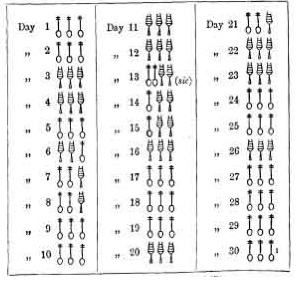
There have come down to us, fortunately, papyri containing copies of the Egyptian calendar, in which each third of every day for three hundred and sixty days of the year is marked lucky or unlucky, and we know from other papyri why certain days were lucky or unlucky, and why others were only partly so (see Brit. Mus. Papyrus, No. 10,474).

Taking the month Thoth, which was the first month of the Egyptian year, and began, according to the Gregorian Calendar, on August 29th, we find that the days are marked as follows:—

The Egyptian Month of Thoth.

The Egyptian Month of Thoth.

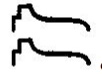
Now the sign Egyptian Sign for Lucky means “lucky,” and Egyptian Sign for Unlucky means “unlucky”; thus at a glance it could be seen which third of the day is lucky or unlucky, and the man who consulted the calendar would, of course, act accordingly.

It must be noted that the priests or magicians who drew up the calendar had good reasons for their classification of the days, as we may see from the following example. The 19th day of Thoth is, in the above list, marked wholly lucky, i.e., each third of it is lucky, and the papyrus Sallier IV (see Chabas, Le Calendrier, p. 24) also marks it wholly lucky, and adds the reason:—

“It is a day of festival in heaven and upon earth in the presence of Râ. It is the day when flame was hurled upon those who followed the boat containing the shrine of the gods; and on this day the gods gave praises being content,” etc.

But in both lists the 26th day is marked wholly unlucky, the reason being, “This was the day of the fight between Horus and Set.” They first fought in the form of men, then they took the form of bears, and in this state did battle with each other for three days and three nights.

Isis aided Set when he was getting the worst in the fight, and Horus thereupon cut off his mother’s head, which Thoth transformed by his words of power into that of a cow and put on her body. On this day offerings are to be made to Osiris and Thoth, but work of any kind is absolutely forbidden.”

E.A. Wallis Budge, Egyptian Magic, London, 1901. Pp. 224-6.

The Seven Hathors

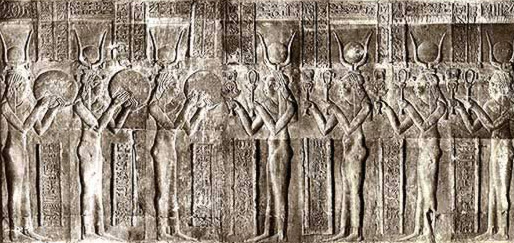
“The Seven Hathor goddesses also could predict the future of a human being, for in the well-known “Tale of Two Brothers” it is related that, when the god Khnemu, at the request of Râ-Harmachis, had created for Bata a wife “who was more beautiful in her person than any other woman in all the earth, for the essence of every god was contained in her,” they came to see her, and that they spake with one voice, saying, “Her death will be caused by the knife.”

And this came to pass, for, according to the story, when the king whose wife she became heard from her first husband that she had left him and had wrought evil against him, he entered into judgment with her in the presence of his chiefs and nobles, and “one carried out their decree,” i.e., they sentenced her to death and she was executed.

Similarly, in another story, the Seven Hathors came to see the son who had been born to a certain king in answer to his prayers to the gods, and when they had seen him they said, “He shall die by means of a crocodile, or a serpent, or a dog.”

The Seven Hathors The story goes on to say how he escaped from the crocodile and the serpent, and though the end is wanting, it is quite clear that he was wounded by an accidental bite of his dog and so died. (See Maspero, Contes Égyptiens, pp. 29-46).

The moral of all such stories is that there is no possibility of avoiding fate, and it is most probable that the modern Egyptian has only inherited his ancestors’ views as to its immutability. (The uneducated Muhammadan believes that man’s fate is written upon his skull, and that the sutures are the writing. No man, however, can read them. See the words of Zayn al-Mawasif in Burton’s Alf Laylah wa Laylah, vol. viii., p. 237).

A man’s life might, however, be happy or unhappy according as the hour of the day or the day itself was lucky or unlucky, and every day of the Egyptian year was divided into three parts, each of which was lucky or unlucky.

When Olympias was about to give birth to Alexander the Great, Nectanebus stood by her making observations of the heavenly bodies, and from time to time he besought her to restrain herself until the auspicious hour had arrived; and it was not until he saw a certain splendour in the sky and knew that all the heavenly bodies were in a favourable position that he permitted her to bring forth her child.

And when he had said, “O queen, now thou wilt give birth to a governor of the world,” the child fell upon the ground while the earth quaked, and the lightnings flashed, and the thunder roared. (See Pseudo-Callisthenes, I. 12). Thus it is quite evident that the future of a child depended even upon the hour in which he was born.”

E.A. Wallis Budge, Egyptian Magic, London, 1901. Pp. 223-4.

Destiny

“The Egyptians believed that a man’s fate or destiny was decided before he was born, and that he had no power whatever to alter it.

Their sages, however, professed to be able to declare what the fate might be, provided that they were given certain data, that is to say, if they were told the date of his birth, and if they were able to ascertain the position of the planets and stars at that time.

The goddess of fate or destiny was called “Shai,” and she is usually accompanied by another goddess called “Renenet,” who is commonly regarded as the lady of fortune; they both appear in the Judgment Scene, where they seem to watch the weighing of the heart on behalf of the deceased.

But another goddess, Meskhenet, is sometimes present, and she also seems to have had influence over a man’s future; in any case she was able to predict what that future was to be.

Thus we read that she and Isis, and Nephthys, and Heqet, disguised as women, went to the house of Râ-user, whose wife Râ-Tettet was in travail; when they had been taken into her room they assisted her in giving birth to triplets, and as each child was born Meskhenet declared, “He shall be a king who shall have dominion over the whole land.”

And this prophecy was fulfilled, for the three boys became three of the kings of the Vth dynasty. (See Erman, Westcar Papyrus, Berlin, 1890, hieroglyphic transcript, pll. 9 and 10).”

E.A. Wallis Budge, Egyptian Magic, London, 1901. Pp. 222-3.

The Ka, the Ghost of the Egyptians

The peculiar ideas which the Egyptians held about the composition of man greatly favoured the belief in apparitions and ghosts. According to them a man consisted of a physical body, a shadow, a double, a soul, a heart, a spirit called the khu, a power, a name, and a spiritual body.

When the body died the shadow departed from it, and could only be brought back to it by the performance of a mystical ceremony; the double lived in the tomb with the body, and was there visited by the soul whose habitation was in heaven.

The soul was, from one aspect, a material thing, and like the ka, or double, was believed to partake of the funeral offerings which were brought to the tomb; one of the chief objects of sepulchral offerings of meat and drink was to keep the double in the tomb and to do away with the necessity of its wandering about outside the tomb in search of food.

It is clear from many texts that, unless the double was supplied with sufficient food, it would wander forth from the tomb and eat any kind of offal and drink any kind of dirty water which it might find in its path.

But besides the shadow, and the double, and the soul, the spirit of the deceased, which usually had its abode in heaven, was sometimes to be found in the tomb.

There is, however, good reason for stating that the immortal part of man which lived in the tomb and had its special abode in the statue of the deceased was the “double.”

This is proved by the fact that a special part of the tomb was reserved for the ka, or double, which was called the “house of the ka,” and that a priest, called the “priest of the ka,” was specially appointed to minister therein.

The double enjoyed the smell of the incense which was offered at certain times each year in the tomb, as well as the flowers, and herbs, and meat, and drink; and the statue of the deceased in which the double dwelt took pleasure in all the various scenes which were painted or sculptured on the walls of the various chambers of the tomb, and enjoyed again all the delights which his body had enjoyed upon earth.

The ka, or double, then, in very early times was, to all intents and purposes, the ghost of the Egyptians.

In later times the khu, or “spirit,” seems to have been identified with it, and there are frequent allusions in the texts to the sanctity of the offerings made to the khu, and to their territories, i.e., the districts in which their mummified bodies lie.

E.A. Wallis Budge, Egyptian Magic, London, 1901. Pp. 217-8.

Procuring Dreams and Visions

Since dreams and visions in which the future might be revealed to the sleeper were greatly desired, the Egyptian magician set himself to procure such for his clients by various devices, such as drawing magical pictures and reciting magical words.

The following are examples of spells for procuring a vision and dreams, taken from British Museum Papyrus, No. 122, lines 64 ff. and 359 ff, (see Catalogue of Greek Papyri, vol. i. p. 118).

“To obtain a vision from [the god] Bes. Make a drawing of Besa, as shewn below, on your left hand, and envelope your hand in a strip of black cloth that has been consecrated to Isis (?) and lie down to sleep without speaking a word, even in answer to a question.”

“Wind the remainder of the cloth round your neck. The ink with which you write must be composed of the blood of a cow, the blood of a white dove, fresh (?) frankincense, myrrh, black writing-ink, cinnabar, mulberry juice, rain-water, and the juice of wormwood and vetch.”

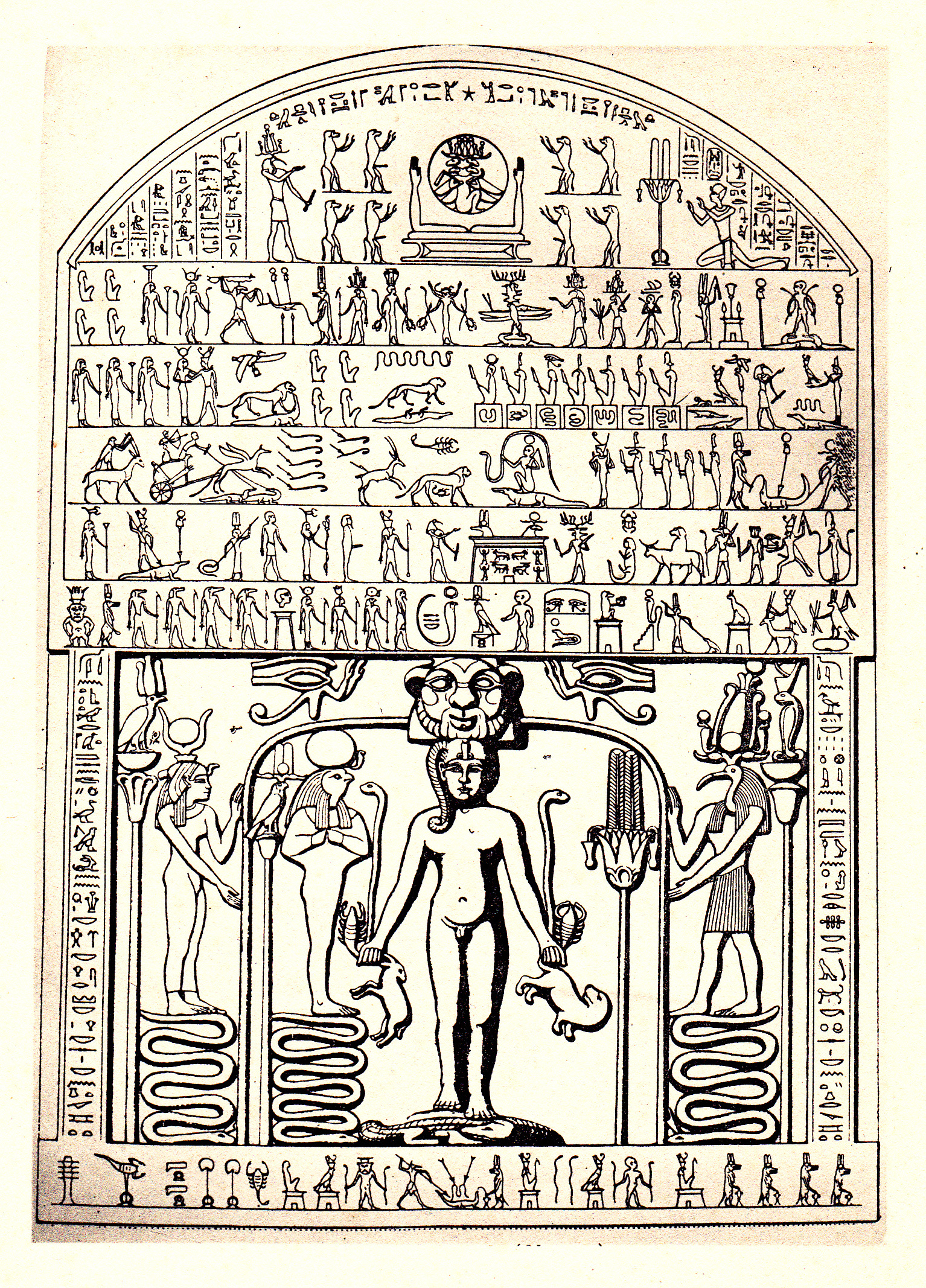
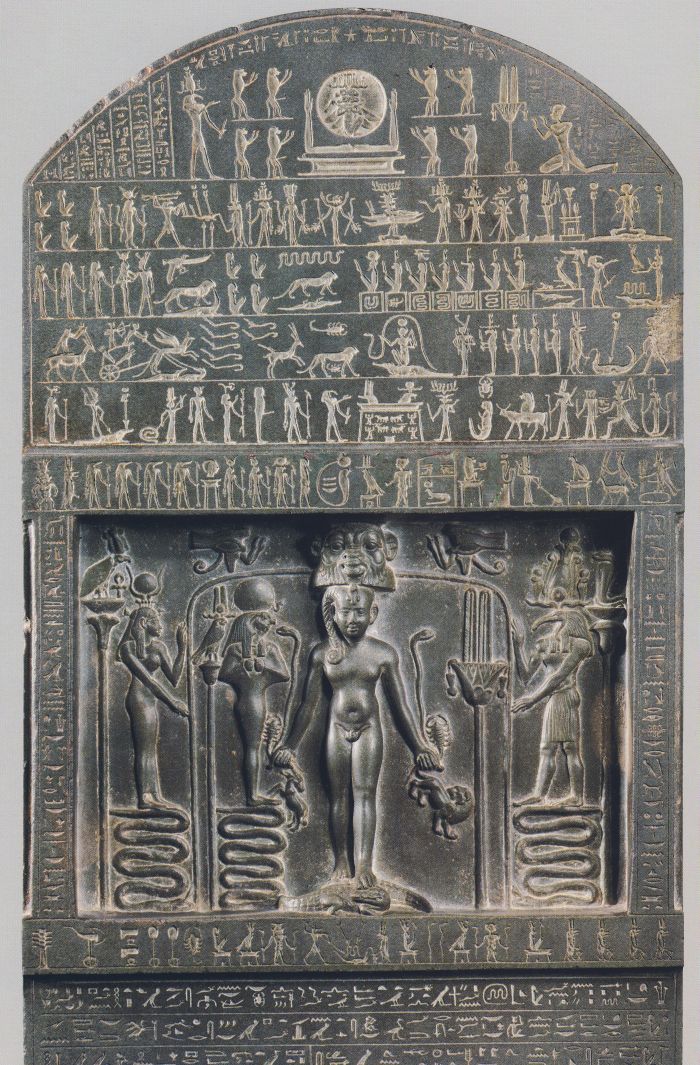
“With this write your petition before the setting sun, [saying], “Send the truthful seer out of the holy shrine, I beseech thee, Lampsuer, Sumarta, Baribas, Dardalam, Iorlex: O Lord send the sacred deity Anuth, Anuth, Salbana, Chambré, Breïth, now, now, quickly, quickly. Come in this very night.'” (A sketch of the god Besa is given at the end of the papyrus. See the description of the “Metternichstele” above, p. 147 ff).

“To procure dreams: Take a clean linen bag and write upon it the names given below. Fold it up and make it into a lamp-wick, and set it alight, pouring pure oil over it.”

“The word to be written is this: ‘Armiuth, Lailamchoüch, Arsenophrephren, Phtha, Archentechtha.’”

“Then in the evening, when you are going to bed, which you must do without touching food [or, pure from all defilement], do thus.”

“Approach the lamp and repeat seven times the formula given below: then extinguish it and lie down to sleep. The formula is this: ‘Sachmu . . . epaëma Ligotereënch: the Aeon, the Thunderer, Thou that hast swallowed the snake and dost exhaust the moon, and dost raise up the orb of the sun in his season, Chthetho is thy name; I require, O lords of the gods, Seth, Chreps, give me the information that I desire.’”

E.A. Wallis Budge, Egyptian Magic, London, 1901. Pp. 215-7.

Amen, the Only God

“Of Nut-Amen, the successor of the great Piânkhi who came down from Gebel Barkal and conquered all Egypt from Syene to the sea, we read that in the first year of his reign he one night dreamed a dream wherein he saw two serpents, one on his right hand and the other on his left; when he awoke they had disappeared.

Having asked for an interpretation of the dream he was told:—

“The land of the South is thine, and thou shalt have dominion over the land of the North: the White Crown and the Red Crown shall adorn thy head. The length and the breadth of the land shall be given unto thee, and the god Amen, the only god, shall be with thee.” (See Brugsch, Egypt under the Pharaohs, Vol. ii., p. 259).

The two serpents were the symbols of the goddesses Nekhebet and Uatchet, the mistresses of the South and North respectively.

As the result of his dream Nut-Amen invaded Egypt successfully and brought back much spoil, a portion of which he dedicated to the service of his god Amen.”

E.A. Wallis Budge, Egyptian Magic, London, 1901. P. 215.

Dreaming at the Base of the Sphinx

In early Christian literatures we find a number of examples of demoniacal possession in which the demon who has entered the body yields it up before a demon of greater power than himself, but the demon who is expelled is invariably hostile to him that expels him, and he departs from before him with every sign of wrath and shame.

The fact that it was believed possible for the demon of Bekhten and the god Khonsu to fraternize, and to be present together at a festival made by the Prince of the country, shews that the people of Bekhten ascribed the same attributes to spirits or demons as they did to men.

The demon who possessed the princess recognized in Khonsu a being who was mightier than himself, and, like a vanquished king, he wished to make the best terms he could with his conqueror, and to be on good terms with him.

The Egyptians believed that the divine powers frequently made known their will to them by means of dreams, and they attached considerable importance to them; the figures of the gods and the scenes which they saw when dreaming seemed to them to prove the existence of another world which was not greatly unlike that already known to them.

The knowledge of the art of procuring dreams and the skill to interpret them were greatly prized in Egypt as elsewhere in the East, and the priest or official who possessed such gifts sometimes rose to places of high honour in the
state, as we may see from the example of Joseph, (see Genesis, Chapters xi., xii) for it was universally believed that glimpses of the future were revealed to man in dreams.

As instances of dreams recorded in the Egyptian texts may be quoted those of Thothmes IV., king of Egypt about B.C. 1450, and Nut-Amen, king of the Eastern Sûdân and Egypt, about B.C. 670.

A prince, according to the stele which he set up before the breast of the Sphinx at Gizeh, was one day hunting near this emblem of Râ-Harmachis, and he sat down to rest under its shadow and fell asleep and dreamed a dream.

In it the god appeared to him, and, having declared that he was the god Harmachis-Khepera-Râ-Temu, promised him that if he would clear away from the Sphinx, his own image, the drift sand in which it was becoming buried, he would give to him the sovereignty of the lands of the South and of the North, i.e., of all Egypt.

In due course the prince became king of Egypt under the title of Thothmes IV, and the stele which is dated on the 19th day of the month Hathor of the first year of Thothmes IV proves that the royal dreamer carried out the wishes of the god. (See Vyse, Appendix, London, 1842, vol. iii., p. 114 ff).

E.A. Wallis Budge, Egyptian Magic, London, 1901. Pp. 213-5.

In Which a Pharaoh Sends the Statue of a God on a Journey

The Prince of Bekhten, seeing that the priest was unable to afford relief to his daughter, sent once again to the king, and entreated him to send a god to his help.

When the ambassador from Bekhten arrived in Egypt the king was in Thebes, and on hearing what was asked he went into the temple of Khonsu Nefer-hetep, and besought that god to allow his counterpart Khonsu to depart to Bekhten and to deliver the daughter of the prince of that country from the power of the demon that possessed her.

It seems as if the sage Tehuti-em-heb had been sent to Bekhten by the advice of the god, for the king says, in addressing, the god, “I have come once again into thy presence”; but in any case Khonsu Nefer-hetep agreed to his request, and a fourfold measure of magical power was imparted to the statue of the god which was to go to Bekhten.

The god, seated in his boat, and five other boats with figures of gods in them, accompanied by chariots and horses on the right hand and on the left, set out from Egypt, and after travelling for seventeen months arrived in Bekhten, where they were received with great honour.

The god Khonsu went to the place where Bent-ent-resht was, and, having performed a magical ceremony over her, the demon departed from her and she was cured straightway.

Then the demon addressed the Egyptian god, saying, “Grateful and welcome is thy coming unto us, O great god, thou vanquisher of the hosts of darkness!”

“Bekhten is thy city, the inhabitants thereof are thy slaves, and I am thy servant; and I will depart unto the place whence I came that I may gratify thee, for unto this end hast thou come thither.”

“And I beseech thy Majesty to command that the Prince of Bekhten and I may hold a festival together.”

To the demon’s request Khonsu agreed, and he commanded his priest to tell the Prince of Bekhten to make a great festival in honour of the demon; this having been done by the command of Khonsu the demon departed to his own place.

When the Prince of Bekhten saw that Khonsu was thus powerful, he and all his people rejoiced exceedingly, and he determined that the god should not be allowed to return to Egypt, and as a result Khonsu remained in Bekhten for three years, four months, and five days.

On a certain day, however, the Prince was sleeping., and he dreamed a dream in which he saw the god Khonsu come forth from his shrine in the form of a hawk of gold, and having mounted into the air he flew away to Egypt.

The Prince woke up in a state of great perturbation, and having inquired of the Egyptian priest was told by him that the god had departed to Egypt, and that his chariot must now be sent back.

Then the Prince gave to Khonsu great gifts, and they were taken to Egypt and laid before the god Khonsu Nefer-hetep in his temple at Thebes.

E.A. Wallis Budge, Egyptian Magic, London, 1901. Pp. 211-3.

An Infamous Case of Demoniacal Possession

“Incidentally, however, we have one interesting proof that foreign peoples believed that the Egyptians were able to cure the diseases caused by demoniacal possession, and the exercise of their power on the occasion described was considered to be so noteworthy that the narrative of it was inscribed upon a stele (originally published by Prisse, Monuments Égyptiens, Paris, 1817, pl. 24) and setup in the temple of the god Khonsu at Thebes, so that all men might read and know what a marvellous cure his priests had effected.

(It is now preserved in the Bibliotèque Nationale at Paris; for a full description and translation of it see E. de Rougé, Étude sur une stele Égyptienne, Paris, 1858).

It appears that king Rameses I was in Mesopotamia “according to his wont, year by year,” and all the chiefs of the countries round about came to pay their respects to him, and they sought to obtain his goodwill and protection, probably even an alliance, by bringing to him gifts of gold, and lapis-lazuli, and turquoise, and of every kind of valuable thing which the land produced, and every man sought to outdo his neighbour by the lavishness of his gifts.

Among others there came the Prince of Bekhten, and at the head of all the offerings which he presented to His Majesty he placed his eldest daughter, who was very beautiful.

When the king saw her he thought her the most beautiful girl he had ever seen, and he bestowed upon her the title of “Royal spouse, chief lady, Râ-neferu” (i.e., “the beauties of Râ,” the Sun-god), and took her to Egypt; and when they arrived in that country the king married her.

One day during the fifteenth year of the king’s reign, when His Majesty was in Thebes celebrating the festival of Amen-Râ, a messenger came to the king and reported the arrival of an ambassador from the Prince of Bekhten who had brought rich gifts for the royal lady Râ-neferu.

When he had been led into the king’s presence, he did homage before him, saying, “Glory and praise be unto thee, O thou Sun of the nations; grant that we may live before thee!”

Having said these words be bowed down and touched the ground with his head three times, and said, “I have come unto thee, O my sovereign Lord, on behalf of the lady Bent-ent-resht, the younger sister of the royal spouse Râ- neferu, for, behold, an evil disease hath laid hold upon her body; I beseech thy Majesty to send a physician (Bekh khet, “knower of things”) to see her.”

Stele recording the casting out of the devil from the Princess of Bekhten. On the right the king is offering Incense to Khonsu Nefer-hetep, and on the left a priest is offering incense to Khonsu, "the great god who driveth away devils." (From Prisse, Monuments, plate 24.)

Stele recording the casting out of the devil from the Princess of Bekhten. On the right the king is offering Incense to Khonsu Nefer-hetep, and on the left a priest is offering incense to Khonsu, “the great god who driveth away devils.” (From Prisse, Monuments, plate 24.)

Then the king straightway ordered the books of the “double house of life” to be brought and the learned men to appear, and when they had come into his presence he ordered them to choose from among their number a man “wise of heart and cunning of finger,” that he might send him to Bekhten; they did so, and their choice fell upon one Tehuti- em-heb.

This sage having come before the king was ordered to set out for Bekhten in company with the ambassador, and he departed; and when they had arrived there the Egyptian priest found the lady Bent-ent-resht to be possessed of a demon or spirit over which he was powerless.”

 E.A. Wallis Budge, Egyptian Magic, London, 1901. Pp. 206-11.

Excerpt from the Papyrus of Hunefer, BC 1350

“But it must be remembered that hitherto only the “bull of the south” has been sacrificed, and that the “bull of the north” has yet to be offered up; and all the ceremonies which have been already performed must be repeated if the deceased would have the power to go forth at will over the whole earth.

From the earliest times the South and the North were the two great sections into which the world was divided, and each section possessed its own special gods, all of whom had to be propitiated by the deceased; hence most religious ceremonies were ordered to be performed in duplicate.

In later days each section was divided into two parts, and the four divisions thus made were apportioned to the four children of Horus; hence prayers and formulæ were usually said four times, once in honour of each god, and the rubrical directions on this point are definite.

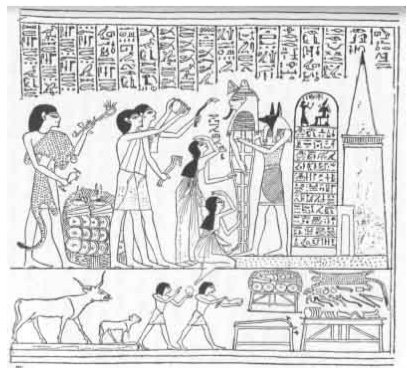
The ceremony of "opening the mouth" being performed on the mummy of Hunefer, about B.C. 1350 (From the Papyrus of Hunefer, sheet 5)

The ceremony of “opening the mouth” being performed on the mummy of Hunefer, about B.C. 1350 (From the Papyrus of Hunefer, sheet 5)

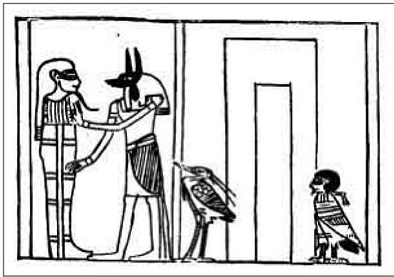
In the limited space of this book it is not possible to reproduce all the scenes of the ceremony of opening the mouth and the eyes which are depicted in the tombs and elsewhere, but on page 199 is a general view of the ceremony as it is often given in the papyri of the XVIIIth and XIXth dynasties.

On the right we see the pyramidal tomb in the Theban hill with its open door, and by the side of it is the funeral stele with a rounded top inscribed with a figure of the deceased standing in adoration before Osiris, and with a prayer to the god for sepulchral offerings.

Anubis, the god of the dead, embraces the mummy, thus indicating his readiness to take the deceased under his protection.

Nasha, the wife of the deceased, stands weeping before the mummy, and at his feet kneels another weeping woman, probably his daughter.

Anubis and the mummy stand upon a layer of sand which has been placed there with the object of sanctifying the ground.

A priest clad in a panther’s skin holds a censer containing burning incense in one hand, and a vase, from which he sprinkles water, in the other.

One ministrant holds the two instruments “Tun-tet” and “Seb-ur” in the right hand, and the “Ur hekau” instrument in the left; and another offers four vases of unguent.

In the lower register are a cow and her calf, and two men are carrying along to the mummy the haunch which we must assume to have been recently cut from the slaughtered bull, and the heart which has just been taken out of him.

On a table we see lying a number of objects, the “Meskhet,” and Pesh-en-kef,” and other instruments, two sets of four vases for holding unguents and oil, the bags of colour, the iron of the south and north, etc.”

E.A. Wallis Budge, Egyptian Magic, London, 1901. P. 198-202.

Opening of the Mouth Concluded

“Thus the mouth and the eyes of the deceased are opened. The Sem priest then took in his hand the instrument called ur hekau, i.e., the “mighty one of enchantments,” a curious, sinuous piece of wood, one end of which is in the form of a ram’s head surmounted by a uraeus, and touched the mouth and the eyes of the statue or mummy four times, whilst the Kher-heb recited a long address in which he declared that this portion of the ceremony had secured for the deceased all the benefits which accrued to the god Osiris from the actions of Nut, Horus, and Set, when he was in a similar state.

It has been said above that every dead man hoped to be provided with the hekau, or words of power, which were necessary for him in the next world, but without a mouth it was impossible for him to utter them.

Now that the mouth, or rather the use of it, was restored to the deceased, it was all important to give him not only the words of power, but also the ability to utter them correctly and in such wise that the gods and other beings would hearken to them and obey them; four touches of the ur hekau instrument on the lips endowed the deceased with the faculty of uttering the proper words in the proper manner in each of the four quarters of the world.

When this had been done, several other ceremonies were performed with the object of allowing the “son who loveth him” or his representative to take part in the opening of the mouth of his father.

In order to do this he took in his hand a metal chisel and touched the openings of the mouth and of the eyes, and then the Sem priest touched them first with his little finger, and afterwards with a little bag filled with pieces of red stone or carnelian, with the idea, M. Maspero thinks, of restoring to the lips and eyelids the colour which they had lost during the process of mummification.

The “son who loves him” then took four objects called “iron of the South, and iron of the North,” and laid each of them four times upon the mouth and the eyes while the Kher-heb recited the proper address in which the mummy or statue is said to have had his mouth and lips established firmly.

Pesh-en-kef Instrument This done, the Sem priest brings an instrument called the “Pesh-en-kef,” and touches the mouth of the mummy or statue therewith, and says, “O Osiris, I have stablished for thee the two jaw-bones in thy face, and they are now separated”; that is to say, the bandages with which they have been tied up can no longer prevent their movement when the deceased wishes to eat.

After the Pesh-en-kef had been used the Sem priest brought forward a basket or vessel of some kind of food in the shape of balls, and by the order of the Kher-heb offered them to the mouth of the mummy, and when this portion of the ceremony was ended, the Sem priest took an ostrich feather, and waved it before its face four times, but with what object is not clear.

Such are the ceremonies which it was thought necessary to perform in order to restore to the deceased the functions which his body possessed upon earth.”

E.A. Wallis Budge, Egyptian Magic, London, 1901. P. 196-8.

Opening of the Mouth

“The sprinkling of water was followed by a purification by means of incense, also contained in four vases, one for each of the four quarters of the earth.

The burning of this sweet-smelling substance assisted in opening the mouth of the deceased and in strengthening his heart.

At this stage the Sem priest dressed himself in the skin of a cow, and lying down upon a kind of couch pretended to be asleep; but he was roused up by the Am-asi priest in the presence of the Kher-heb and the Am-khent priest, and when the Sem priest had seated himself upon a seat, the four men together represented the four children of Horus, (i.e., Mestha, Hâpi, Tuamutef and Qebhsennuf) or the gods with the heads of a hawk, an ape, a jackal, and a man respectively.

The Sem priest then said, “I have seen my father in all his forms,” which the other men in turn repeat.

The meaning of this portion of the ceremony is hard to explain, but M. Maspero (op. cit., p. 168) thinks that it was intended to bring back to the body of the deceased its shadow (khaibit), which had departed from it when it died.

The preliminary purifications being ended, and the shadow having been joined to the body once more, the statue or mummy is approached by the men who represent the armed guard of Horus; and one of their number, having taken upon himself the character of Horus, the son of Osiris and Isis, touches its mouth with his finger.

The Kher-heb next made ready to perform the sacrifice which was intended to commemorate the slaughter, at some very early period, of the fiends who were the friends of Set.

It seems that, the soul of Horus dwelt in an eye, and that Set nearly succeeded in devouring it; but Horus vanquished Set and saved his eye.

Set’s associates then changed themselves into the forms of animals, and birds, and fish, but they were caught, and their heads were cut off; Set, however, who was concealed in the form of a pig, contrived to escape.

The sacrifice consisted of a bull (or cow) or two, two gazelles or antelopes, and ducks.

When the bull had been slain, one of the forelegs was cut off, and the heart taken out, and offered to the statue or mummy; the Sem priest then took the bleeding leg and touched, or pretended to touch, the mouth and eyes with it four times.

The slaughtered gazelles or antelopes and ducks were simply offered before the statue. The Sem priest next said to the statue, “I have come to embrace thee, I am thy son Horus, I have pressed thy mouth; I am thy son, I love thee. . . . Thy mouth was closed, but I have set in order for thee thy mouth and thy teeth.”

The "Seb-ur" and "Tuntet" Instruments for Opening the Mouth.

The “Seb-ur” and “Tuntet” Instruments for Opening the Mouth.

He then brought two instruments, called “Seb-ur” and “Tuntet” respectively, and touched the mouth of the statue or mummy with them, whilst the Kher-heb said, “Thy mouth was closed, but I have set in order for thee thy mouth and thy teeth. I open for thee thy mouth, I open for thee thy two eyes. I have opened for thee thy mouth with the instrument of Anubis. I have opened thy mouth with the instrument of Anubis, with the iron implement with which the mouths of the gods were opened.”

“Horus, open the mouth! Horus, open the mouth! Horus hath opened the mouth of the dead, as he in times of old opened the mouth of Osiris, with the iron which came forth from Set, with the iron instrument with which he opened the mouths of the gods.”

“He hath opened thy mouth with it. The deceased shall walk and shall speak, and his body shall be with the great company of the gods in the Great House of the Aged One in Annu, and he shall receive there the ureret crown from Horus, the lord of mankind.”

E.A. Wallis Budge, Egyptian Magic, London, 1901. P. 193-6.

Rites of Mummification Concluded

“On the conclusion of the ceremonies which concern the head the deceased has the power to go in among the holy and perfect spirits, his name is exalted among men, the denizens of heaven receive his soul, the beings of the underworld bow down before his body, the dwellers upon earth adore him, and the inhabitants of the funeral mountain renew for him his youth.

Besides these things, Anubis and Horus make perfect his bandages, and the god Thoth protects his members by his words of magical power; and he himself has learned the magical formulæ which are necessary to make his path straight in the underworld, and also the proper way in which to utter them.

All these benefits were secured for him by the use of bandages and unguents which possess both magical names and properties, and by the words of power uttered by the priests who recited the Ritual of Embalmment, and by the ceremonies which the priest who personated Anubis performed beside the body of the deceased in imitation of those which the god Anubis performed for the dead god Osiris in remote days.

Next the left hand of the deceased was mummified and bandaged according to the instructions given in the Ritual of Embalmment. The hand was stretched out on a piece of linen, and a ring was passed over the fingers; it was then filled with thirty-six of the substances which were used in embalming, according to the number of the forms of the god Osiris.

This done, the hand was bandaged with a strip of linen in six folds, upon which were drawn figures of Isis and Hâpi. The right hand was treated in a similar way, only the figures drawn upon the bandages were those of Râ and Amsu; and when the appropriate words had been recited over both hands divine protection was assured them.

After these things the ceremonies concerning the right and left arms were performed, and these were followed by rubbing the soles of the feet and the legs and the thighs, first with black-stone oil, and secondly with holy oil.

The toes were wrapped in linen, and a piece of linen was laid on each leg; on each piece was drawn the figure of a jackal, that on the right leg representing Anubis, and that on the left Horus.

When flowers of the ânkham plant and other substances had been laid beside and on the legs, and they had been treated with ebony-gum water and holy oil, and appropriate addresses had been said, the ceremony of bandaging the body was ended.”

E.A. Wallis Budge, Egyptian Magic, London, 1901. P. 189-91.

The Rites Continued

“When these words have been said, a priest who is made to personify Anubis comes to the deceased and performs certain symbolical ceremonies by his head, and lays certain bandages upon it. When the head and mouth and face have been well oiled the bandage of Nekheb is laid on the forehead, the bandage of Hathor on the face, the bandage of Thoth upon the two ears, and the bandage of Nebt-hetep on the nape of the neck.

Over the head was laid the bandage of Sekhet, in two pieces, and over each ear, and each nostril, and each cheek was fastened a bandage or strip of linen; over the forehead went four pieces of linen, on the top of the head two, outside the mouth two, and inside two, over the chin two, and over the nape of the neck four large pieces; there were to be twenty-two pieces to the right and to the left of the face passing over the two ears.

The Lady of the West is then addressed in these words:—

“Grant thou that breathing may take place in the head of the deceased in the underworld, and that be may see with his eyes, and that he may hear with his two ears; and that he may breathe through his nose; and that he may be able to utter sounds with his mouth; and that he may be able to speak with his tongue in the underworld.”

“Receive thou his voice in the Hall of Maâti and his speech in the Hall of Seb in the presence of the Great God, the lord of Amentet.”

The addresses which follow these words have reference to the delights and pleasures of the future life which shall be secured for him through the oil and unguents, which are duly specified and described, and through the magical figures which are drawn upon the bandages.

The protecting properties of the turquoise and other precious stones are alluded to, and after a further anointing with oil and the placing of grains of myrrh and resin, the deceased is declared to have “received his head,” and he is promised that it shall nevermore depart from him.”

E.A. Wallis Budge, Egyptian Magic, London, 1901. P. 188-9.

Le Rituel de l’Embaumement

“He believed that he would feed upon the celestial and imperishable food whereon the gods lived, but at the same time he spared no effort or expense to provide for his tomb being supplied at stated intervals throughout the year with perishable food in the shape of offerings of oxen, feathered fowl, cakes, bread, and the like.

He mummified his dead and swathed them in linen bandages, and then by the performance of magical ceremonies and by the recital of words of power sought to give back to their members the strength to eat, and drink, and talk, and think, and move at will.

Indeed, all the evidence now forthcoming seems to prove that he never succeeded in bringing himself to think that the gods could do without his help, or that the pictures or representations of the scenes which took place in the life, and death, and burial, and resurrection of Osiris, upon which he relied so implicitly, could possibly fail to be as efficacious as the actual power of the god himself.

The examination of mummies has shown us with tolerable clearness what methods were adopted in preparing bodies for bandaging and final ornamentation, and the means adopted for disposing of the more corruptible portions of the body are well known from classical and other writers.

But for an account of the manner in which the body was bandaged, and a list of the unguents and other materials employed in the process, and the words of power which were spoken as each bandage was laid in its place, we must have, recourse to a very interesting papyrus which has been edited and translated by M. Maspero under the title of Le Rituel de l’Embaumement. (In Mémoire sur quelques Papyrus du Louvre, Paris, 1875).

The first part of the papyrus, which probably gave instructions for the evisceration of the body, is wanting, and only the section which refers to the bandaging is at all perfect.

The text opens with an address to the deceased in which it is said, “The perfume of Arabia hath been brought to thee to make perfect thy smell through the scent of the god.”

“Here are brought to thee liquids which have come forth from Râ, to make perfect . . . thy smell in the Hall [of Judgment].

O sweet-smelling soul of the great god, thou dost contain such a sweet odour that thy face shall neither change nor perish. . . .

Thy members shall become young in Arabia, and thy soul shall appear over thy body in Ta-neter (i.e., the ‘divine land’).”

 After this the priest or mummifier was to take a vase of liquid which contained ten perfumes, and to smear therewith the body from head to foot twice, taking especial care to anoint the head thoroughly. He was then to say, “Osiris (i.e., the deceased), thou hast received the perfume which shall make thy members perfect.”

“Thou receivest the source [of life] and thou takest the form of the great Disk (i.e., Aten), which uniteth itself unto thee to give enduring form to thy members; thou shalt unite with Osiris in the great Hall.”

E.A. Wallis Budge, Egyptian Magic, London, 1901. P. 184-6.

On Mummification

MAGICAL CEREMONIES.
“IN the preceding pages we have seen how the Egyptians employed magical stones or amulets, and magical words, and magical pictures, and magical names, in the performance of deeds both good and evil; it remains to consider these magical ceremonies in which the skill of the magician-priest was exerted to its fullest extent, and with the highest objects, that is to say, to preserve the human body in a mummified condition, and to perform the symbolic acts which would restore its natural functions.

When we think of the sublime character of the life which the souls of the blessed dead were believed to lead in heaven with the gods, it is hard to understand why the Egyptians took such pains to preserve the physical body from decay.

No Egyptian who believed his Scriptures ever expected that his corruptible body would ascend into heaven and live with the gods, for they declare in no uncertain manner that it remains upon the earth whilst the soul dwells in heaven.

But that the preservation of the body was in some way or for some reason absolutely necessary is certain, for the art of mummification flourished for several thousands of years, and unless there was some good reason, besides the observance of conservative custom and traditional use, why it should do so, king and priest, gentle and simple, and rich and poor, would never have burdened their relatives and heirs with the expense of costly funeral ceremonies, and with the performance of rites which were of no avail.

At first sight, too, it seems strange to find the Egyptians studying carefully how best to provide the dead with a regular supply of sepulchral offerings, for when we come to think about it we notice that in arranging for the well-being of the dead nothing whatever was left to chance.

For example, a papyrus will contain several prayers and pictures with appropriate formulæ, the object of each of which is to give the deceased meat and drink; any one of these would have been enough for the purpose, but it was thought best in such an important matter to make assurance doubly sure, and if there was the least doubt about the efficacy of one Chapter one or more of the same class were added.

Similarly, the tendency of the natural body after death being to decay, the greatest care was taken in mummifying its various members, lest perchance any one of them should be neglected accidentally, and should, either by the omission of the words of power that ought to have been said over it, or through the lax performance of some ceremony, decay and perish.

The Egyptian declared that he was immortal, and believed that he would enjoy eternal life in a spiritual body; yet he attempted by the performance of magical ceremonies and the recital of words of power to make his corruptible body to endure for ever.”

E.A. Wallis Budge, Egyptian Magic, London, 1901. P. 182-4.

Gnostic Magical Names From the Metternich Stele and the Harris Magical Papyrus

“The examples of the use of names possessing magical powers described above illustrate the semi-religious views on the subject of names which the Egyptians held, and we have now to consider briefly the manner in which the knowledge of a name was employed in uses less important than those which had for their object the attainment of life and happiness in the world to come.

In the famous magical papyrus (British Museum, No. 10,042) which Chabas published (Le Papyrus Magique Harris, Chalon-sur-Saône, 1860) we find a series of interesting charms and magical formulæ which were written to preserve its possessor from the attacks of sea and river monsters of every kind, of which the following is an example.

“Hail, lord of the gods! Drive away from me the lions of the country of Meru (Meroë?), and the crocodiles which come forth from the river, and the bite of all poisonous reptiles which crawl forth from their holes. Get thee back, O crocodile Mâk, thou son of Set! Move not by means of thy tail! Work not thy legs and feet! Open not thy mouth! Let the water which is before thee turn into a consuming fire, O thou whom the thirty-seven gods did make, and whom the serpent of Râ did put in chains, O thou who wast fettered with links of iron before the boat of Râ! Get thee back, O crocodile Mâk, thou son of Set!”

These words were to be said over a figure of the god Amen painted on clay; the rod was to have four rams’ heads upon one neck, under his feet was to be a figure of the crocodile Mâk, and to the right and left of him were to be the dog headed apes, i.e., the transformed spirits of the dawn, who sang hymns of praise to Râ when he rose daily. (See the scene in the rounded portion of the Metternichstele illustrated on p. 149, reproduced below).

Detail, Metternich stele. (Clippus of Horus, Metternichestele, ed. Golenischeff, plate 1.) Reproduced from E.A. Wallis Budge, Egyptian Magic, p. 149.

Detail, Metternich stele. (Clippus of Horus, Metternichestele, ed. Golenischeff, plate 1.)
Reproduced from E.A. Wallis Budge, Egyptian Magic, p. 149.

Again, let us suppose that some water monster wished to attack a man in a boat. To avoid this the man stood before the cabin of the boat and, taking a hard egg in his hand, he said, “O egg of the water which hath been spread over the earth, essence of the divine apes, the great one in the heaven above and in the earth beneath, who dost dwell in the nests which are in the waters, I have come forth with thee from the water, I have been with thee in thy nest, I am Amsu of Coptos, I am Amsu, lord of Kebu.”

When he had said these words he would appear to the animal in the water in the form of the god Amsu, with whom he had identified himself, and it would be afraid and flee.

At the end of the papyrus in which the above extracts occur we find a series of magical names which may be read thus:–Atir-Atisa, Atirkaha-Atisa, Samumatnatmu-Atisa, Samuanemui-Atisa, Samutekaari-Atisa, Samutekabaiu-Atisa, Samutchakaretcha-Atisa, Tâuuarehasa, Qina, Hama, Senentuta-Batetsataiu, Anrehakatha-sataiu, Haubailra-Haari.

From these and similar magical names it is quite certain that the Gnostics and other sects which held views akin to theirs obtained the names which they were so fond of inscribing upon their amulets and upon the so-called magical papyri.”

E.A. Wallis Budge, Egyptian Magic, London, 1901. P. 173-6.

Names of the God Amen, and Sekhet-Bast-Ra

“Passing now to certain chapters of the Book of the Dead which are rich in names of magical power, (chapters CLXII., CLXIII., CLXIV., CLXV) we notice that the god Amen, whose name meant the “hidden one,” possessed numerous names, upon the knowledge of which the deceased relied for protection.

Thus he says, “O Amen, (see Chapters of Coming Forth by Day, p. 295) Amen; O Re-Iukasa; O God, Prince of the gods of the east, thy name is Na-ari-k, or (as others say) Ka-ari-ka, Kasaika is thy name. Arethikasathika is thy name. Amen-na-an-ka-entek-share, or (as others say) Thek-share-Amen-kerethi, is thy name.”

“O Amen, let me make supplication unto thee, for I, even I, know thy name. Amen is thy name. Ireqai is thy name. Marqathai is thy name. Rerei is thy name. Nasaqbubu is thy name. Thanasa-Thanasa is thy name. Shareshatha-katha is thy name. O Amen, O Amen, O God, O God, O Amen, I adore thy name.”

In another place (Ibid., p. 293) the deceased addresses Sekhet-Bast-Râ, saying, “Thou art the fire-goddess Ami-seshet, whose opportunity escapeth her not; thy name is Kaharesapusaremkakaremet, Thou art like unto the mighty flame of Saqenaqat which is in the bow of the boat of thy father Harepukakashareshabaiu, for behold, thus is [the name uttered] in the speech of the Negroes, and of the Anti, and of the people of Nubia. Sefiperemhesihrahaputchetef is thy name; Atareamtcherqemturennuparsheta is the name of one of thy divine sons, and Panemma that of the other.”

And in yet another chapter (see Chapters of Coming Forth by Day, p. 289) the deceased addressing the god Par says, “Thou art the mighty one of names among the gods, the mighty runner whose strides are might thou art the god the mighty one who comest and rescuest the needy one and the afflicted from him that oppresseth him; give heed to my cry.”

“I am the Cow, and thy divine name is in my mouth, and I will utter it; Haqabakaher is thy name; Âurauaaqersaanqrebathi is thy name; Kherserau is thy name; Kharsatha is thy name. I praise thy name . . . . O be gracious unto the deceased, and cause thou heat to exist under his head, for, indeed, he is the soul of the great divine Body which resteth in Annu (Heliopolis), whose names are Khukheperuru and Barekathatchara.”

E.A. Wallis Budge, Egyptian Magic, London, 1901. P. 172-3.

The Names of Apep

“But among the beings whom the deceased wished to avoid in the underworld were the beings who “lay snares, and who work the nets, and who are fishers,” and who would draw him into their nets.

It seems as if it were absolutely necessary that he should fall in with these beings and their nets, for a whole chapter of the Book of the Dead was written with the view of enabling him to escape from them unharmed; the god their leader is called “the god whose face is behind him,” and “the god who hath gained the mastery over his heart.”

To escape from the net which was worked by “the fishers who lay snares with their nets and who go round about in the chambers of the waters,” the deceased had to know the names of the net, and of the ropes, and of the pole, and of the hooks, and of each and every part of it; without this knowledge nothing could save him from calamity.

We unfortunately understand very few of the allusions to mythological events which are contained in the names of the various parts of the machinery which work the net, but it is quite certain that they have reference to certain events in the lives of the gods who are mentioned, and that these were well known to the writers and readers of religious texts.

From the above descriptions of the means whereby the deceased made his way through the gates and the halls of the underworld and escaped from the fowler and his net, it will be readily understood that the knowledge of the name alone was, in some cases, sufficient to help him out of his difficulties; but in others it was necessary to have the name which was possessed of magical power inscribed upon some object, amulet or otherwise.

Moreover, some gods and devils were thought to have the power to assume different forms, and as each form carried with it its own name, to have absolute power over a god of many forms it was necessary to know all his names.

Thus in the “Book of Overthrowing Âpep” (Papyrus of Nesi-Amsu, col. xxiii. 1. 6. (Archæologia, vol. LII)) we are told not only to make a wax figure of the monster, but also to write his name upon it, so that when the figure is destroyed by being burnt in the fire his name also may be destroyed; this is a striking example of the belief that the name was an integral part of the economy of a living creature.

But Âpep possessed many forms and therefore many names, and unless he could be invoked by these names he still had the power to do evil; the above-mentioned book (ibid., col. xxxii. 1. 13 f) therefore supplies us with a list of his names, among which occur the following:—

“Tutu (i.e., “Doubly evil one”), Hau-hra (i.e., “Backward Face”), Hemhemti (i.e., “Roarer”), Qetu (i.e., “Evil-doer”), Âmam (i.e., “Devourer”), Saatet-ta (i.e., “Darkener of earth”), Iubani, Khermuti, Unti, Karauememti, Khesef-hra, Sekhem-hra, Khak-ab, Nâi, Uai, Beteshu, Kharebutu “the fourfold fiend,” etc.

All these names represent, as may be seen from the few of which translations are given, various aspects of Âpep, the devil of thunder, lightning, cloud, rain, mist, storm, and the like, and the anxiety to personify these so that the personifications might be attacked by means of magical ceremonies and words of power seems positively childish.”

E.A. Wallis Budge, Egyptian Magic, London, 1901. P. 170-2.

The Halls of Osiris

“In another Chapter (see Chapters of Coming Forth by Day, p. 128) the deceased addresses seven gods, and says, “Hail, ye seven beings who make decrees, who support the Balance on the night of the judgment of the Utchat, who cut off heads, who hack necks in pieces, who take possession of hearts by violence and rend the places where hearts are fixed, who make slaughterings in the Lake of Fire, I know you, and I know your names; therefore know ye me, even as I know your names.”

The deceased, having declared that the seven gods know his name and he their names, has no further apprehension that evil will befall him.

In one portion of the kingdom of Osiris there existed seven halls or mansions through which the deceased was anxious to pass, but each of the gates was guarded by a doorkeeper, a watcher, and a herald, and it required special provision on the part of the deceased to satisfy these beings that he had a right to pass them.

In the first place, figures of the seven gates had to be made in some substance (or painted upon papyrus), as well as a figure of the deceased: the latter was made to approach each of the gates and to stand before it and to recite an address which had been specially prepared for the purpose.

Meanwhile the thigh, the head, the heart, and the hoof of a red bull were offered at each gate, as well as a very large number of miscellaneous offerings which need not be described in detail.

But all these ceremonies would not help the deceased to pass through the gates, unless be knew the names of the seven doorkeepers, and the seven watchers, and the seven heralds who guarded them.

The gods of the first gate were:—

Sekhet-hra-âsht-aru, Semetu, and Hukheru;

those of the second, Tun-hât, Seqet-hra, and Sabes;

of the third, Am-huat-ent-pehfi, Res-hra, and Uâau;

of the fourth, Khesef-hra-âsht-kheru, Res-ab, and Neteka-hra-khesef-atu;

of the fifth, Ânkh-em-fentu, Ashebu, and Tebherkehaat;

of the sixth, Akentauk-ha-kheru, An-hra, and Metes-hra-ari-she;

of the seventh, Metes-sen, Ââa-kheru, and Khesef-hra-khemiu.

And the text, which the deceased recites to the Halls collectively, begins, “Hail, ye Halls! Hail, ye who made the Halls for Osiris! Hail, ye who watch your Halls! Hail, ye who herald the affairs of the two lands for the god Osiris each day, the deceased knoweth you, and he knoweth your names.” (See Chapters of Coming Forth by Day, p. 211).

The names having been uttered, and the addresses duly recited, the deceased went wherever he pleased in the seven Halls of Osiris.”

E.A. Wallis Budge, Egyptian Magic, London, 1901. P. 165-6.

Getting to the Afterlife is No Cakewalk

“Without the knowledge of the names of the gods and devils of the underworld the dead Egyptian would have fared badly, for his personal liberty would have been fettered, the roads and paths would have been blocked to him, the gates of the mansions of the underworld would have been irrevocably shut in his face, and the hostile powers which dogged his footsteps would have made an end of him; these facts are best illustrated by the following examples:—

When the deceased comes to the Hall of Judgment, at the very beginning of his speech he says, “Homage to thee, O Great God, thou Lord of Maâti, I have come to thee, O my Lord, and I have brought myself hither that I may behold thy beauties.”

“I know thee, and I know thy name, and I know the names of the two and forty gods who exist with thee in this Hall of Maâti.” (See Chapters of Coming Forth by Day, p. 191).

But although the gods may be favourable to him, and he be found righteous in the judgment, he cannot make his way among the other gods of the underworld without a knowledge of the names of certain parts of the Hall of Maâti.

After the judgment he acquires the mystical name of “He who is equipped with the flowers and the dweller in his olive tree,” and it is only after he has uttered this name that the gods say “Pass onwards.”

Next the gods invite him to enter the Hall of Maâti, but he is not allowed to pass in until he has, in answer to questions asked by the bolts, lintels, threshold, fastenings, socket, door-leaves, and door-posts, told their names.

The floor of the Hall will not permit him to walk upon it unless he tells not only its name, but also the mystical names of his two legs and feet wherewith he is about to tread upon it.

When all this has been done the guardian of the Hall says to him, “I will not announce thy name [to the god] unless thou tellest me my name”; and the deceased replies, “‘Discerner of hearts and searcher of the reins’ is thy name.”

In reply to this the guardian says, “If I announce thy name thou must utter the name of the god who dwelleth in his hour,” and the deceased utters the name “Mâau-Taui.”

But still the guardian is not satisfied, and he says, “If I announce thy name thou must tell me who is he whose heaven is of fire, whose walls [are surmounted by] living uraei, and the floor of whose house is a stream of water.”

Who is he, I say? (i.e., what is his name?)” But the deceased has, of course, learnt the name of the Great God, and he replies, “Osiris.”

The guardian of the Hall is now content, and he says, “Advance, verily thy name shall be mentioned to him”; and he further promises that the cakes, and ale, and sepulchral meals which the deceased shall enjoy shall come from the “Eye of Râ.”

E.A. Wallis Budge, Egyptian Magic, London, 1901. P. 163-5.

The Gods of Ancient Egypt are Personifications of the Names of Ra

“Again, in the story of Râ and Isis, given in the preceding chapter, we have seen that although Isis was able to make a serpent and to cause it to bite Râ, and to make him very ill, she was powerless to do as she wished in heaven and upon earth until she had persuaded the god to reveal to her his name by which he ruled the universe.

In yielding up his name to the goddess he placed himself in her power, and in this example we have a striking instance of the belief that the knowledge of the name of god, or devil, or human being, implied dominion over that being.

We have seen elsewhere that Râ, the type and symbol of God, is described as the god of “many names,” and in that wonderful composition the XVIIth Chapter of the Book of the Dead, (see Chapters of Coming Forth by Day, p. 49) we have the following statement:—

“I am the great god Nu, who gave birth unto himself, and who made his name to become the company of the gods.”

Then the question, “What does this mean?” or “Who is this?” is asked. And this is the answer:

“It is Râ, the creator of the name[s] of his limbs, which came into being in the form of the gods who are in the following of Râ.”

From this we see that all the “gods” of Egypt were merely personifications of the NAMES Of Râ, and that each god was one of his members, and that a name of a god was the god himself.”

E.A. Wallis Budge, Egyptian Magic, London, 1901. P. 162.

The God Khepera Utters His Own Name at the Creation

“But in the present chapter we are not so much concerned with the ordinary as with the extraordinary uses to which a name might be put, and the above facts have only been mentioned to prove that a man’s name was regarded as an essential part of himself, and that the blotting out of the name of an individual was synonymous with his destruction.

Without a name no man could be identified in the judgment, and as a man only came into being upon this earth when his name had been pronounced, so the future life could only be attained after the gods of the world beyond the grave had become acquainted with it and had uttered it.

According to the story of the Creation which is related in the Papyrus of Nesi-Amsu, (see my paper in Archæologia, Vol. LII., London, 1891) before the world and all that therein is came into being, only the great god Neb-er-tcher existed, for even the gods were not born.

Now when the time had come for the god to create all things be says, “I brought (i.e., fashioned) my mouth, and I uttered my own name as a word of power, and thus I evolved myself under the evolutions of the god Khepera, and I developed myself out of the primeval matter which had evolved multitudes of evolutions from the beginning of time.

“Nothing existed on this earth [before me], I made all things. There was none other who worked with me at that time.”

Elsewhere, that is to say, in the other version of the story, the god Khepera says, “I developed myself from the primeval matter which I made, I developed myself out of the primeval matter. My name is ‘Osiris,’ the germ of primeval matter.”

Here, then, we have a proof that the Egyptians regarded the creation as the result of the utterance of the name of the god Neb-er-tcher or Khepera by himself.”

E.A. Wallis Budge, Egyptian Magic, London, 1901. P. 161.

On Magical Names in Ancient Egyptian Magical Literature

MAGICAL NAMES.
“THE Egyptians, like most Oriental nations, attached very great importance to the knowledge of names, and the knowledge of how to use and to make mention of names which possessed magical powers was a necessity both for the living and the dead.

It was believed that if a man knew the name of a god or a devil, and addressed him by it, he was bound to answer him and to do whatever he wished; and the possession of the knowledge of the name of a man enabled his neighbour to do him good or evil.

The name that was the object of a curse brought down evil upon its owner, and similarly the name that was the object of a blessing or prayer for benefits secured for its master many good things.

To the Egyptian the name was as much a part of a man’s being as his soul, or his double (KA), or his body, and it is quite certain that this view was held by him in the earliest times.

Thus in the text which is inscribed on the walls inside (Line 169) the pyramid of Pepi L, king of Egypt about B.C. 3200, we read, “Pepi hath been purified. He hath taken in his hand the mâh staff, he hath provided himself with his throne, and he hath taken his seat in the boat of the great and little companies of the gods.”

“Ed maketh Pepi to sail to the West, he stablisheth his seat above those of the lords of doubles, and he writeth down Pepi at the head of those who live.”

“The doors of Pekh-ka which are in the abyss open themselves to Pepi, the doors of the iron which is the ceiling of the sky open themselves to Pepi, and he passeth through them; he hath his panther skin upon him, and the staff and whip are in his hand.”

“Pepi goeth forward with his flesh, Pepi is happy with his name, and he liveth with his ka (double).”

Curiously enough only the body and name and double of the king are mentioned, just as if these three constituted his whole economy; and it is noteworthy what importance is attached to the name in this passage.

In the text from the pyramid of another king (Pepi II. (ed. Maspero, 1. 669, ff. Recueil, tom. xii. 1892, p. 146)) we have a prayer concerning the preservation of the name, which is of such interest that a rendering of it in full is here given: it reads, “O Great Company of the gods who dwell in Annu (Heliopolis), grant that Pepi Nefer-ka-Râ may flourish (literally ‘germinate’), and that his pyramid, his ever lasting building, may flourish, even as the name of Temu, the chief of the nine gods, doth flourish.”

“If the name of Shu, the lord of the upper shrine in Annu, flourisheth, then Pepi shall flourish, and his pyramid, his everlasting building, shall flourish!”

“If the name of Tefnut, the lady of the lower shrine in Annu, flourisheth, the name of Pepi shall be established, and this his pyramid shall be established to all eternity!”

“If the name of Seb flourisheth at the ‘homage of the earth,’ then the name of Pepi shall flourish, and this his pyramid shall flourish, and this his building shall flourish unto all eternity!”

“If the name of Nut in the House of Shenth in Annu flourisheth, the name of Pepi shall flourish, and this his pyramid shall flourish, and this his building shall flourish unto all eternity!”

“If the name of Osiris flourisheth in the nome of Abydos, then the name of Pepi shall flourish, and this his pyramid shall flourish, and this his building shall flourish unto all eternity!”

“If the name of Osiris Khent-Amentet flourisheth, then the name of Pepi shall flourish, and this his pyramid shall flourish, and this his building shall flourish unto all eternity!”

“If the name of Set, the dweller in Nubt (Ombos) flourisheth, then the name of Pepi shall flourish, and this his pyramid shall flourish, and this his building shall flourish unto all eternity!”

“If the name of Horus flourisheth, then the name of Pepi shall flourish, and this his pyramid shall flourish, and this his building shall flourish unto all eternity!”

“If the name of Râ flourisheth in the horizon, then the name of Pepi shall flourish, and this his pyramid shall flourish, and this his building shall flourish unto all eternity!”

“If the name of Khent-merti flourisheth in Sekhem (Letopolis), then the name of Pepi shall flourish, and this his pyramid shall flourish, and this his building shall flourish unto all eternity!”

“If the name of Uatchet in Tep flourisheth, then the name of Pepi shall flourish, and this his pyramid shall flourish, and this his building shall flourish unto all eternity!”

The above prayer or formula was the origin of most of the prayers and texts which had for their object the “making the name to germinate or flourish,” and which were copied so frequently in the Saïte, Ptolemaic, and Roman periods.

All these compositions show that from the earliest to the latest times the belief as to the importance of the preservation of the name never changed in Egypt, and the son who assisted in keeping green his father’s name, and in consequence his memory, performed a most meritorious duty.”

E.A. Wallis Budge, Egyptian Magic, London, 1901. Pp. 157-61.

Submarine of Alexander the Great

“The Arab historian Mas’ûdî has preserved (see Les Prairies d’Or, ed. B. de Meynard and Pavet de Courteille, Paris, 1861, tom. ii. p. 425 ff) a curious legend of the talismans which were employed by Alexander the Great to protect the city of Alexandria whilst it was being built, and as the legend is of Egyptian origin, and dates from a period not greatly removed from that in which the Metternich stele was made, it is worthy of mention.

When the foundations of the city had been laid, and the walls had begun to rise up, certain savage animals came up each night from the sea, and threw down everything which had been built during the day; watchmen were appointed to drive them away, but in spite of this each morning saw the work done during the previous day destroyed.

After much thought Alexander devised a plan whereby he might thwart the sea monsters, and he proceeded to carry it into effect.

He made a box ten cubits long and five cubits wide with sides made of sheets of glass fastened into frames by means of pitch, resin, etc.

Metternich Stele.

Metternich Stele.

In this box Alexander placed himself, together with two skilful draughtsmen, and having been closed it was towed out to sea by two vessels; and when weights of iron, lead, and stone had been attached to the under part of it, it began to sink, being guided to the place which Alexander wished it to reach by means of cords which were worked from the ships.

When the box touched the bottom of the sea, thanks to the clearness of the glass sides and the water of the sea, Alexander and his two companions were able to watch the various marine monsters which passed by, and he saw that although they had human bodies they had the heads of beasts; some had axes, some had saws, and some had hammers, and they all closely resembled workmen.

As they passed in front of the box Alexander and his two draughtsmen copied their forms upon paper with great exactness, and depicted their hideous countenances, and stature, and shape; this done, a signal was made, and the box was drawn up to the surface.

As soon as Alexander reached the land he ordered his stone and metal workers to make reproductions of the sea monsters according to the drawings which he and his friends had made, and when they were finished he caused them to be set up on pedestals along the sea-shore, and continued his work of building the city.

When the night came, the sea monsters appeared as usual, but as soon as they saw that figures of themselves had been put up on the shore they returned at once to the water and did not shew themselves again.

When, however, the city had been built and was inhabited, the sea monsters made their appearance again, and each morning a considerable number of people were found to be missing; to prevent this Alexander placed talismans upon the pillars which, according to Mas’ûdî, were there in his day.

Each pillar was in the shape of an arrow and was eighty cubits in height, and rested upon a plinth of brass; the talismans were placed at their bases, and were in the form of figures or statues of certain beings with suitable inscriptions, and as they were put in position after careful astronomical calculations had been made for the purpose we may assume that they produced the effect desired by the king.”

E.A. Wallis Budge, Egyptian Magic, London, 1901. Pp. 147-56

The Divine Book of Ptah

From a papyrus of the Ptolemaic period we obtain some interesting facts about the great skill in working magic and about the knowledge of magical formulæ which were possessed by a prince called Setnau Khâ-em-Uast.

He knew how to use the powers of amulets and talismans, and how to compose magical formulæ, and he was master both of religious literature and of that of the “double house of life,” or library of magical books.

One day as he was talking of such things one of the king’s wise men laughed at his remarks, and in answer Setnau said, “If thou wouldst read a book possessed of magical powers come with me. and I will show it to thee, the book was written by Thoth himself, and in it there are two formulæ. The recital of the first will enchant (or bewitch) heaven, earth, hell, sea, and mountains, and by it thou shalt see all the birds, reptiles, and fish, for its power will bring the fish to the top of the water. The recital of the second will enable a man if he be in the tomb to take the form which he had upon earth,” etc.

When questioned as to where the book was, Setnau said that it was in the tomb of Ptah-nefer-ka at Memphis. A little later Setnau went there with his brother and passed three days and three nights in seeking for the tomb of Ptah-nefer-ka, and on the third day they found it; Setnau recited some words over it, and the earth opened and they went down to the place where the book was.

When the two brothers came into the tomb they found it to be brilliantly lit up by the light which came forth from the book; and when they looked they saw not only Ptah-nefer-ka, but his wife Ahura, and Merhu their son.

Now Ahura and Merhu were buried at Coptos but their doubles had come to live with Ptah- nefer-ka by means of the magical power of Thoth.

Setnau told them that he had come to take away the book, but Ahura begged him not to do so, and related to him the misfortunes which had already followed the possession of it.

She was, it seems, the sister of Ptah-nefer-ka whom she married, and after the birth of her son Merhu, her husband seemed to devote himself exclusively to the study of magical books, and one day a priest of Ptah promised to tell him where the magical book described above might be found if he would give him a hundred pieces of silver, and provide him with two handsome coffins.

When the money and the coffins had been given to him, the priest of Ptah told Ptah-nefer-ka that the book was in an iron box in the middle of the river at Coptos.

“The iron box is in a bronze box, the bronze box is in a box of palm-tree wood, the palm tree wood box is in a box of ebony and ivory, the ebony and ivory box is in a silver box, the silver box is in a gold box, and in the gold (sic) box lies the book.

The box wherein is the book is surrounded by swarms of serpents and scorpions and reptiles of all kinds, and round it is coiled a serpent which cannot die.”

Ptah-nefer-ka told his wife and the king what he had heard, and at length set out for Coptos with Ahura and Merhu in the royal barge; having arrived at Coptos he went to the temple of Isis and Harpocrates and offered up a sacrifice and poured out a libation to these gods.

Five days later the high priest of Coptos made for him the model of a floating stage and figures of workmen provided with tools; he then recited words of power over them and they became living, breathing men, and the search for the box began.

Having worked for three days and three nights they came to the place where the box was. Ptah-nefer-ka dispersed the serpents and scorpions which were round about the nest of boxes by his words of power, and twice succeeded in killing the serpent coiled round the box, but it came to life again; the third time he cut it into two pieces, and laid sand between them, and this time it did not take its old form again.

He then opened the boxes one after the other, and taking out the gold box with the book inside it carried it to the royal barge. He next read one of the two formula in it and so enchanted or bewitched the heavens and the earth that he learned all their secrets; he read the second and he saw the sun rising in the heavens with his company of the gods, etc.

His wife Ahura then read the book and saw all that her husband had seen. Ptah-nefer-ka then copied the writings on a piece of new papyrus, and having covered the papyrus with incense dissolved it in water and drank it; thus he acquired the knowledge which was in the magical book.

Meanwhile these acts had stirred the god Thoth to wrath, and he told Râ what Ptah-nefer-ka had done. As a result the decree went forth that Ptah-nefer-ka and his wife and child should never return to Memphis, and on the way back to Coptos Ahura and Merhu fell into the river and were drowned; and while returning to Memphis with the book Ptah-nefer-ka himself was drowned also.

Setnau, however, refused to be diverted from his purpose, and he insisted on having the book which he saw in the possession of Ptah-nefer-ka; the latter then proposed to play a game of draughts and to let the winner have the book.

The game was for fifty-two points, and although Ptah-nefer-ka tried to cheat Setnau, he lost the game. At this juncture Setnau sent his brother Anhaherurau up to the earth to bring him his talismans of Ptah and his other magical writings, and when he returned he laid them upon Setnau, who straightway flew up to heaven grasping the wonderful book in his hand.

As he went up from the tomb light went before him, and the darkness closed in behind him; but Ptah-nefer-ka said to his wife, “I will make him bring back this book soon, with a knife and a rod in his hand and a vessel of fire upon his head.”

Of the bewitchment of Setnau by a beautiful woman called Tabubu and of his troubles in consequence thereof we need make no mention here: it is sufficient to say that the king ordered him to take the book back to its place, and that the prophecy of Ptah-nefer-ka was fulfilled. (For translations see Brugsch, Le Roman de Setnau (in Revue Archéologique, 2nd series, Vol. xvi., 1867, p. 161 ff.); Maspero, Contes Égyptiens, Paris, 1882, pp. 45-82; Records of the Past, vol. iv., pp. 129-148; and for the original Demotic text see Mariette, Les Papyrus du Musée de Boulaq, tom. i., 1871, pll. 29-32; Revillout, Le Roman de Setna, Paris, 1877; Hess, Roman von Sfne Ha-m-us. Leipzig, 1888).

E.A. Wallis Budge, Egyptian Magic, London, 1901. Pp. 142-6.

Snake Bite Charm

“Now from a few words of text which follow the above narrative we learn that the object of writing it was not so much to instruct the reader as to make a magic formula, for we are told that it was to be recited over figures of Temu and Horus, and Isis and Horus, that is to say, over figures of Temu the evening sun, Horus the Elder, Horus the son of Isis, and Isis herself.

Temu apparently takes the place of Râ, for he represents the sun as an old man, i.e., Râ, at the close of his daily life when he has lost his strength and power.

The text is a charm or magical formula against snake bites, and it was thought that the written letters, which represented the words of Isis, would save the life of any one who was snake-bitten, just as they saved the life of Râ.

If the full directions as to the use of the figures of Temu, Isis, and the two Horus gods, were known unto us we should probably find that they were to be made to act in dumb show the scenes which took place between Râ, and Isis when the goddess succeeded in taking from him his name.

Thus we have ample evidence that Isis possessed marvellous magical powers, and this being so, the issues of life and death, as far as the deceased was concerned, we know from the texts to have been in her hands.

Her words of power, too, were a priceless possession, for she obtained them from Thoth, who was the personification of the mind and intelligence of the Creator, and thus their origin was divine, and from this point of view were inspired.”

E.A. Wallis Budge, Egyptian Magic, London, 1901. Pp. 142.

The Sun Stood Still

“Isis then continues her narrative thus:—

“I Isis conceived a child, and was great with child of Horus. I, a goddess, gave birth to Horus, the son of Isis, upon an island (or nest) in Athu the region of swamps; and I rejoiced greatly because of this, for I regarded Horus as a gift which would repay me for the loss of his father.”

“I hid him most carefully and concealed him in my anxiety, and indeed he was well hidden, and then I went away to the city of Am. When I had saluted the inhabitants thereof I turned back to seek the child, so that I might give him suck and take him in my arms again.”

“But I found my sucking-child Horus the fair golden one, well nigh dead! He had bedewed the ground with the water from his eye and with the foam from his lips, his body was stiff, his heart was still, and no muscle in any of his limbs moved.”

(This is an exact description of the state of an animal which has been stung by the small black scorpion in Egypt and the Sûdân. I saw Colonel W. H. Drage’s dog “Shûbra” bitten at Merâwî in September, 1897, by a black scorpion, and in about an hour she was in the state of Horus as described above, and the whole camp was distressed, for both master and dog were great favourites. When it was no longer possible to administer spirit to her, Major G. R. Griffith and others immersed her body in pails of very hot water for several hours, and at sundown she was breathing comfortably, and she soon afterwards recovered).

“Then I uttered a bitter cry of grief, and the dwellers in the papyrus swamps ran to me straightway from out of their houses, and they bewailed the greatness of my calamity; but none of them opened his mouth to speak, for every one was in deep sorrow for me, and no man knew how to bring back life into Horus.”

“Then there came to me a certain woman who was well known in her city, for she belonged to a noble family, and she tried to rekindle the life in Horus, but although her heart was full of her knowledge my son remained motionless.”

Meanwhile the folk remarked that the son of the divine mother Isis had been protected against his brother Set, that the plants among which he had been hidden could not be penetrated by any hostile being, that the words of power of Temu, the father of the gods, “who is in heaven,” should have preserved the life of Horus, that Set his brother could not possibly have had access to where the child was, who, in any case, had been protected against his wickedness; and at length it was discovered that Horus had been stung by a scorpion, and that the reptile “which destroyeth the heart” had wounded him, and had probably killed him.

At this juncture Nephthys arrived, and went round about among the papyrus swamps weeping bitterly because of the affliction of her sister Isis; with her also was Serqet, the goddess of scorpions, who asked continually, “What hath happened to the child Horus?”

Then Nephthys said to Isis, “Cry out in prayer unto heaven, and let the mariners in the boat of Râ cease to row, and let not the boat of Râ move further on its course for the sake of the child Horus”; and forthwith Isis sent forth her cry up to heaven, and made her request come unto the “Boat of millions of years,” and the Sun stood still and his boat moved not from its place by reason of the goddess’s petition.

Out from the boat came the god Thoth provided with magical powers, and bearing with him the great power to command in such wise that the words of his mouth must be fulfilled straightway; and he spake to Isis, saying “O thou goddess Isis, whose mouth knoweth how to utter charms (or talismans), no suffering shall come upon thy child Horus, for his health and safety depend upon the boat of Râ.”

“I have come this day in the divine boat of the Disk (Aten) to the place where it was yesterday. When darkness (or night) ruleth, the light shall vanquish it for the health (or safety) of Horus for the sake of his mother Isis and similarly shall it happen unto every one who possesseth what is [here] written(?).”

What took place next is, of course, evident. The child Horus was restored to life, to the great joy of his mother Isis, who was more indebted than ever to the god Thoth for coming to deliver her out of her trouble on the death of her son, just as he had done on the death of her husband.

Now because Isis had revivified both her husband and her son by the words of power and talismans which she possessed, mortal man thought it was absolutely necessary for him to secure her favour and protection at any cost, for eternal life and death were in her hands.

As time went on the Egyptians revered her more and more, and as she was the lady of the gods and of heaven, power equal to that possessed by Râ himself was ascribed to her.”

E.A. Wallis Budge, Egyptian Magic, London, 1901. Pp. 133-7.

A Tale of Isis from the Metternich Stele

“But apart from being the protector and friend of Osiris, Thoth was the refuge to which Isis fled in her trouble. The words of a hymn declare that she knew “how to turn aside evil hap,” and that she was “strong of tongue, and uttered the words of power which she knew with correct pronunciation, and halted not in her speech, and was perfect both in giving the command and in saying the word,” (Chabas, Revue Archéologique, 1857, p. 65 ff.; Ledrain, Monuments Égyptiens, pl. xxii. ff.; and for a recent translation see my First Steps in Egyptian, pp. 179-188) but this description only proves that she had been instructed by Thoth in the art of uttering words of power with effect, and to him, indeed, she owed more than this.

Metterniche Stele

Metternich Stele

When she found the dead body of her husband Osiris, she hovered about over it in the form of a bird, making air by the beating of her wings, and sending forth light from the sheen of her feathers, and at length she roused the dead to life by her words of power; as the result of the embrace which followed this meeting Horus was born, and his mother suckled him and tended him in her hiding-place in the papyrus swamps.

After a time she was persecuted by Set, her husband’s murderer, who, it seems, shut her and her son Horus up in a house as prisoners. Owing, however, to the help which Thoth gave her, she came forth by night and was accompanied on her journey by seven scorpions, (the story is told on the famous Metternichstele, ed. Golénischeff, Leipzig, 1877) called respectively Tefen, Befen, Mestet, Mestetef, Petet, Thetet, and Matet, the last three of which pointed out the way.

The guide of the way brought her to the swamps of Per-sui, (i.e., Crocodilopolis) and to the town of the two goddesses of the sandals where the swampy country of Athu begins.

Journeying on they came to Teb, (the city of the two sandals. The two sandals were made of leather from the skin of the god Nehes or Set, the opponent of Horus) where the chief of the district had a house for his ladies; now the mistress of the house would not admit Isis on account of the scorpions that were with her, for she had looked out of her door and watched Isis coming.

On this the scorpions took counsel together and wished to sting her by means of the scorpion Tefen, but at this moment a poor woman who lived in the marshes opened the door of her cottage to Isis, and the goddess took shelter therein.

Meanwhile the scorpion had crept under the door into the house of the governor, and stung the son of the lady of the house, and also set the place on fire; no water could quench the fire, and there was no rain to do it, for it was not then the rainy season.

Now these things happened to the woman who had done no active harm to Isis, and the poor creature wandered about the streets of the city uttering loud cries of grief and distress because she knew not whether her boy would live or die.

When Isis saw this she was sorry for the child who had been stung, and as he was blameless in the matter of the door of his mother’s house being shut in the face of the goddess, she determined to save him.

Thereupon she cried out to the distraught mother, saying, “Come to me, come to me! For my word is a talisman which beareth life. I am a daughter well known in thy city also, and I will do away the evil by means of the word of my mouth which my father hath taught me, for I am the daughter of his own body.”

Then Isis laid her hands upon the body of the boy, and in order to bring back the spirit into his body said—

“Come Tefen, appear upon the ground, depart hence, come not nigh!

“Come poison of Befen, appear upon the ground. I am Isis, the goddess, the lady of words of power, who doeth deeds of magic, the words of whose voice are charms.

“Obey me, O every reptile that stingeth, and fall down headlong!

“O poison of [Mestet and] Mestetef, mount not upwards!

“O poison of Petet and Thetet, draw not nigh! O Matet, fall down headlong!”

The goddess Isis then uttered certain words of the charm which had been given to her by the god Seb in order to keep poison away from her, and said, “Turn away, get away, retreat, O poison,” adding the words “Mer-Râ” in the morning and “The Egg of the Goose appeareth from out of the sycamore” in the evening, as she turned to the scorpions.

Both these sentences were talismans. After this Isis lamented that she was more lonely and wretched than all the people of Egypt, and that she had become like an old man who hath ceased to look upon and to visit fair women in their houses; and she ordered the scorpions to turn away their looks from her and to show her the way to the marshes and to the secret place which is in the city of Khebt.

Then the words of the cry, “The boy liveth, the poison dieth! As the sun liveth, so the poison dieth,” were uttered, and the fire in the house of the woman was extinguished, and heaven rejoiced at the words of Isis.

When Isis had said that the “son of the woman had been stung because his mother had shut the door of her house in her face, and had done nothing for her,” the words of the cry, “The boy liveth and the poison dieth,” were again uttered, and the son of the woman recovered.”

E.A. Wallis Budge, Egyptian Magic, London, 1901. Pp. 129-33.

Thoth and Words of Power at the Creation

“On the amulet of the Buckle we have inscribed the words, “May the blood of Isis, and the powers of Isis, and the words of power of Isis be mighty to protect this mighty one,” etc., and in the address which Thoth makes to Osiris he says, “I am Thoth, the favoured one of Râ, the lord of might, who bringeth to a prosperous end that which he doeth, the mighty one of words of power, who is in the boat of millions of years, the lord of laws, the subduer of the two lands,” etc. (See Chapters of Coming forth by Day, p. 340 f).

From the above passages we not only learn how great was the confidence which the deceased placed in his words of power, but also that the sources from which they sprang were the gods Thoth and Isis.

It will be remembered that Thoth is called the “scribe of the gods,” the “lord of writing,” the “master of papyrus,” the “maker of the palette and the ink-jar,” the “lord of divine words,” i.e., the holy writings or scriptures, and as he was the lord of books and master of the power of speech, he was considered to be the possessor of all knowledge both human and divine.

At the creation of the world it was he who reduced to words the will of the unseen and unknown creative Power, and who uttered them in such wise that the universe came into being, and it was he who proved himself by the exercise of his knowledge to be the protector and friend of Osiris, and of Isis, and of their son Horus.

From the evidence of the texts we know that it was not by physical might that Thoth helped these three gods, but by giving them words of power and instructing them how to use them.

We know that Osiris vanquished his foes, and that he reconstituted his body, and became the king of the underworld and god of the dead, but he was only able to do these things by means of the words of power which Thoth had given to him, and which he had taught him to pronounce properly and in a proper tone of voice.

It is this belief which makes the deceased cry out, “Hail, Thoth, who madest Osiris victorious over his enemies, make thou Ani to be victorious over his enemies in the presence of the great and sovereign princes who are in Tattu,” or in any other place.

Without the words of power given to him by Thoth, Osiris would have been powerless under the attacks of his foes, and similarly the dead man, who was always identified with Osiris, would have passed out of existence at his death but for the words of power provided by the writings that were buried with him.

In the Judgment Scene it is Thoth who reports to the gods the result of the weighing of the heart in the balance, and who has supplied its owner with the words which he has uttered in his supplications, and whatever can be said in favour of the deceased he says to the gods, and whatever can be done for him he does.”

E.A. Wallis Budge, Egyptian Magic, London, 1901. Pp. 127-9.

More on Words of Power

“The written word has been regarded in the East with reverence from time immemorial, and a copy of a sacred writing or text is worn or carried about to this day with much the same ideas and beliefs about its power to protect as in the earliest times.

In ancient Egypt the whole Book of the Dead, as well as the various sections of it which are usually copied on papyri, consisted of a series of “words of power,” and the modern Egyptian looks upon the Koran in the same light as his ancestor looked upon the older work. (In a similar way the Arabs attach as much importance to the Fatha, or opening chapter, and to the chapter which declares the Unity of God (CXII.), as to the rest of the Koran).

A curious passage in the text inscribed on the inside of the pyramid of Unas reads (1. 583), “The bone and flesh which possess no writing are wretched, but, behold, the writing of Unas is under the great seal, and behold, it is not under the little seal.”

It is difficult to explain the passage fully, but there is no doubt that we have here an allusion to the custom of placing writings believed to be possessed of magical powers with the dead.

Certain passages or sections of the religious books of ancient nations have always been held to be of more importance than others, and considering the great length of such compositions this is not to be wondered at.

Among the Egyptians two forms of the LXIVth Chapter of the Book of the Dead were in use, and there is no doubt whatever that the shorter form, as far back as the Ist dynasty, about B.C. 4300, was intended to be a summary of the whole work, and that the recital of it was held to be as efficacious as the recital of all the rest of it. (See Chapter of Coming Forth by Day, p. 70).

It is a remarkable fact that this form is called “The Chapter of knowing the ‘Chapters of Coming Forth by Day‘ in a single Chapter,” and that it is declared to date from the time of Hesepti, a king of the Ist dynasty, about B.C. 4300, whilst the “finding” of the longer form is attributed to the reign of Men-kau-Râ (Mycerinus), a king of the IVth dynasty, about B.C. 3600.

It is interesting to note how persistently certain chapters and formulæ occur in funeral papyri of different periods, and the explanation seems to be that a popular selection was made at an early date, and that this selection was copied with such additions or omissions as the means of the friends of the deceased allowed or made necessary.

One thing is quite certain: every man in Egypt died in the firm belief that in the course of his journey into the next world he would be provided with words of power which would enable him to make his way thither unhindered, and give him abundance of meat and drink.”

E.A. Wallis Budge, Egyptian Magic, London, 1901. Pp. 124-6.

The Seven Hathors

“It is probable that Chapters CLXIL-CLXV were composed at a comparatively late date.

Yet another example of the magical pictures of the Book of the Dead must here be given. The vignette of Chapter CXLVIII. contains pictures of seven cows “and their bull,” and of four rudders; the seven cows have reference to the seven Hathor goddesses, the bull is, of course, a form of Râ, and the four rudders refer to the four quarters of the earth and to the four cardinal points.

The text of the Chapter contains the names of the cows and of the bull, and of the rudders, and certain prayers for sepulchral offerings. Now the deceased would be provided with “abundance of food regularly and continually for ever,” if the following things were done for him.

Figures of the cows and of their bull and of the rudders were to be painted in colours upon a board (?), and when Râ, the Sun-god, rose upon them the friends of the deceased were to place offerings before them; these offerings would be received mystically by the gods and goddesses whom the figures represented, and in return they would bestow upon the deceased all the offerings or gifts of meat and drink which he would require.

Moreover, “if this be done,” we are told, “Râ shall be a rudder for the deceased, and he shall be a strength protecting him, and he shall make an end of all his enemies for him in the underworld, and in heaven, and upon earth, and in every place wherever he may enter.”

We have seen above, in the description of the amulets which the Egyptians used, how both the substance of the amulet and the words which were inscribed upon it possessed magical powers, but we may learn from several instances given in the papyri that the written words alone were sufficient in some cases to produce remarkable effects.

This is, of course, a very natural development, and charms or words of power which needed nothing but to be written on papyrus or linen to produce a magical effect would be popular with all classes of men and women, and especially among the poor and the ignorant.”

E.A. Wallis Budge, Egyptian Magic, London, 1901. Pp. 123-4.

Keeping Secrets from the Underworld God Sukati

The words of power which form the CLXIVth Chapter to be effectual had to be recited over a figure of the goddess Mut which was to have three heads.

The first head was like that of the goddess Pekhat and had plumes; the second was like that of a man and had upon it the crowns of the South and North; the third was like that of a vulture and had upon it plumes; the figure had a pair of wings, and the claws of a lion.

This figure was painted in black, green, and yellow colours upon a piece of anes linen; in front of it and behind it was painted a dwarf who wore plumes upon his head. One hand and arm of each dwarf were raised, and each had two faces, one being that of a hawk and the other that of a man; the body of each was fat.

These figures having been made, we are told that the deceased shall be “like unto a god with the gods of the underworld; he shall never, never be turned back; his flesh and his bones shall be like those of one who hath never been dead; he shall drink water at the source of the stream; a homestead shall be given unto him in Sekhet-Aaru; he shall become a star of heaven; he shall set out to do battle with the serpent fiend Nekau and with Tar, who are in the underworld; he shall not be shut in along with the souls which are fettered; he shall have power to deliver himself wherever he may be; and worms shall not devour him.” (See Chapters of Coming Forth by Day, p. 294).

Again, the words of power which form the CLXVth Chapter to be effectual were ordered by the rubric to “be recited over a figure of the God of the lifted hand, which shall have plumes upon its head; the legs thereof shall be wide apart, and the middle portion of it shall be in the form of a beetle, and it shall be painted blue with a paint made of lapis-lazuli mixed with qamai water.”

“And it shall be recited over a figure with a head like unto that of a man, and the hands and the arms thereof shall be stretched away from his body; above its right shoulder shall there be the head of a ram, and above its left shoulder shall there be the head of a ram.”

“And thou shalt paint the figure of the God of the lifted hand upon a piece of linen immediately over the heart of the deceased, and thou shalt paint the other over his breast; but let not the god Sukati who is in the underworld know it.”

If these things be done, “the deceased shall drink water from the source of the stream, and he shall shine like the stars in the heavens above.”

E.A. Wallis Budge, Egyptian Magic, London, 1901. Pp. 121-3.

Hypocephalus

Now the cow is, of course, Isis-Hathor, and both the words and the picture refer to some event in the life of Râ, or Horus. It is quite evident that the words of power, or charm, uttered by Isis-Hathor delivered the god out of some trouble, and the idea is that as it delivered the god, and was of benefit to him, even so will it deliver the deceased and be of benefit to him. The words of power read:—

“O Amen, O Amen, who art in heaven, turn thy face upon the dead body of thy son, and make him sound and strong in the underworld.”

And again we are warned that the words are “a great mystery” and that “the eye of no man whatsoever must see it, for it is a thing of abomination for [every man] to know it. Hide it, therefore; the Book of the lady of the hidden temple is its name.”

An examination of mummies of the late period shews that the Egyptians did actually draw a figure of the cow upon papyrus and lay it under the head of the deceased, and that the cow is only one figure among a number of others which were drawn on the same papyrus.

With the figures magical texts were inscribed and in course of time, when the papyrus had been mounted upon linen, it superseded the gold figure of the cow which was fastened to the neck of the deceased, and became, strictly speaking an amulet, though its usual name among archaeologists is “hypocephalus.” The figure on the opposite page well illustrates the object. It will be noticed that the hypocephalus is round; this is due to the fact that it represents the pupil of the Eye of Horus, which from time immemorial in Egypt was regarded as the source of all generative power, and of reproduction and life.

Ancient Egyptian Tomb Hypocephalus

Hypocephalus or object placed under the head.

 Hypocephalus or object placed under the head 
of the deceased Shai-enen to keep warmth in the body.

The first group of gods are:—

Nehebka offering to Horus his Eye, a goddess with the Eye of Horus for a head, the cow of Isis-Hathor described above, the four children of Horus, two lions, a member of the human body, the pylon of heads of Khnemu the god of reproduction, and Horus-Râ.

In the second are the boat of the Sun being poled along by Horus, and the boat of the Moon, with Harpocrates in the bow. In the other scenes we have the god Khepera in his boat, Horus in his boat, and Horus-Sept in his boat.

The god with two faces represents the double aspect of the sun in setting and rising, and the god with the rams’ heads, who is being adored by apes, is a mystical form of Khnemu, one of the great gods of reproduction, who in still later times became the being whose name under the form of Khnumis or Khnoubis occupied such an important position among the magical names which were in use among the Gnostics.

The two following prayers from the hypocephalus will illustrate the words of power addressed to Amen, i.e., the Hidden One, quoted above:—

1. “I am the Hidden One in the hidden place. I am a perfect spirit among the companions of Râ, and I have gone in and come forth among the perfect souls. I am the mighty Soul of saffron-coloured form.

“I have come forth from the underworld at pleasure. I have come. I have come forth from the Eye of Horus. I have come forth from the underworld with Râ from the House of the Great Aged One in Heliopolis.

“I am one of the spirits who come forth from the underworld: grant thou unto me the things which my body needeth, and heaven for my soul, and a hidden place for my mummy.”

2. “May the god, who himself is hidden, and whose face is concealed, who shineth upon the world in his forms of existence, and in the underworld, grant that my soul may live for ever!

“May the great god in his disk give his rays in the underworld of Heliopolis! Grant thou unto me an entrance and an exit in the underworld without let or hindrance.”

Chapter CLXIII. of the Book of the Dead was written to prevent the body of a man mouldering away in the underworld, and to deliver him from the souls which were so unfortunate as to be shut in the various places thereof, but in order to make it thoroughly efficacious it was ordered to be recited over three pictures:

(1) a serpent with legs, having a disk and two horns upon its head;

(2) an utchat, (see above, p. 55) or Eye of Horus, “in the pupil of which shall be a figure of the God of the lifted hand with the face of a divine soul, and having plumes and a back like a hawk”;

(3) an utchat, or Eye of Horus, “in the pupil of which there shall be a figure of the God of the lifted hand with the face of the goddess Neith, and having plumes and a back like a hawk.”

If these things be done for the deceased “he shall not be turned back at any gate of the underworld, he shall eat, and drink, and perform the natural functions of his body as he did when he was upon earth; and none shall rise up to cry out against him; and he shall be protected from the hands of the enemy for ever and ever.” (See Chapters of Coming Forth by Day, p. 292).

E.A. Wallis Budge, Egyptian Magic, London, 1901. Pp. 115-21.

Vignettes From the Papyrus of Ani

soul_of_ani_visiting_his_body_in_the_bier

The soul of the scribe Ani visiting his mummified body 
as it lies on its bier in the tomb. 
(From the Papyrus of Ani, plate 17.)

“Many of the pictures or vignettes carry their own interpretations with them, e.g., the picture of the soul hovering over the dead body which lies beneath it on the bier at once suggests the reunion of the soul with the body; the picture of the deceased walking away from a “block of slaughter” and a knife dripping with blood suggests escape from a cruel death; the picture of a soul and spirit standing before an open door suggests that the soul has freedom to wander about at will; and the picture of the soul and the shadow in the act of passing out through the door of the tomb indicates clearly that these parts of man’s economy are not shut up in the tomb for all eternity.

Anubis with Ani

Anubis holding the mummy of the scribe Ani.

Anubis holding the mummy of the scribe Ani; 
by the door of the tomb stand the soul and spirit of the deceased 
in the form of a human-headed hawk and bennu bird respectively. 
(From the Papyrus of Ani, plate 16.)

But the ideas which prompted the painting of other vignettes are not so clear, e.g., those which accompany Chapters CLXII-CLXV in the late or Säite Recension of the Book of the Dead, although, fortunately, the rubrics to these chapters make their object clear.

Thus the picture which stands above Chapter CLXII. is that of a cow having upon her head horns, a disk, and two plumes, and from the rubric we learn that a figure of it was to be made in gold and fastened to the neck of the deceased, and that another, drawn upon new papyrus, was to be placed under his head.

If this be done “then shall abundant warmth be in him throughout, even like that which was in him when he was upon earth. And he shall become like a god in the underworld, and he shall never be turned back at any of the gates thereof.”

Ani Leaving the Tomb

Ani Passing Through the Door of His Tomb

The scribe Ani passing through the door of the tomb. 
Outside are his shadow and his soul in the form of a human-headed bird. 
(From the Papyrus of Ani, plate 18.)

The words of the chapter have great protective power (i.e., are a charm of the greatest importance) we are told, “for it was made by the cow for her son Râ when he was setting, and when his habitation was surrounded by a company of beings of fire.”

E.A. Wallis Budge, Egyptian Magic, London, 1901. Pp. 113-6.