Samizdat

Publishing the Forbidden. All Rights Reserved. © Samizdat 2014-2025.

Tag: London

Berossus was a Historian and a Priest of Bel, Not a Babylonian Astronomer

“As de Breucker has emphasized, one goal of the Babyloniaca was to promote Babylonian antiquity and scholarship. We should see the so-called astronomical fragments in this light, as part of his promotion of Babylonian scholarship.

However, it is clear that Berossos was not himself one of the astronomical scribes working in Babylonia. All of the astronomy he explains has its origin not in contemporary Babylonian astronomy, but in works such as Enūma Eliš, a literary epic that includes a brief cosmological section.
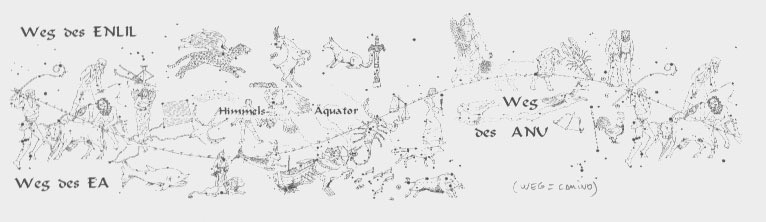
Los sumerios dividían su cielo en tres “caminos” que transcurrían paralelos al ecuador celeste y que daban la vuelta al cielo: el camino de Ea , el camino de Anu y el camino de Enlil . Estos caminos eran las esferas de influencia de tres supradeidades abstractas que jamás se representaban corporalmente: la divina trinidad. Eran las esferas del mundo material (Ea), el mundo humano (Anu) y el mundo divino (Enlil). A través de estas tres bandas serpenteaba “el camino de la Luna” (Charranu), que también era el camino de los planetas: el zodíaco. De esta forma, una parte del zodíaco se encuentra en el camino de Enlil (los signos de verano), una parte en el camino de Anu (signos de primavera y otoño) y una parte en el camino de Ea (los signos de invierno). El mapa estelar adjunto preparado por Werner Papke según el mul.apin muestra esta división para el período de 2340 a.C. En ese momento de la historia, los sumerios ya conocían el movimiento de desplazamiento precesional de las constelaciones. Las representaciones anteriores siempre hablan de 11 signos zodiacales (todavía falta Libra). En cambio, el mul.apin describe las imágenes de 12 constelaciones y explica claramente que Zibanium (Libra) se construyó a partir de las pinzas del escorpión, para dar al comienzo del otoño su propio signo. Anteriormente, el zodíaco siempre se basaba en dos estrellas: Aldebarán (en Tauro) marcaba el equinoccio (duración del día y de la noche iguales) de primavera y Antares (en Escorpio) determinaba el punto de inicio del otoño. Pero esto sólo es cierto alrededor del 3200 a.C. Probablemente, un poco antes de que se escribiera el mul.apin, se descubrió que el punto de misma duración del día y de la noche se había desplazado hacia el oeste: de Aldebarán a las Pléyades y de Antares hacia las pinzas del escorpión. http://www.escuelahuber.org/articulos/articulo13.htm

Los sumerios dividían su cielo en tres “caminos” que transcurrían paralelos al ecuador celeste y que daban la vuelta al cielo: el camino de Ea , el camino de Anu y el camino de Enlil . Estos caminos eran las esferas de influencia de tres supradeidades abstractas que jamás se representaban corporalmente: la divina trinidad. Eran las esferas del mundo material (Ea), el mundo humano (Anu) y el mundo divino (Enlil). A través de estas tres bandas serpenteaba “el camino de la Luna” (Charranu), que también era el camino de los planetas: el zodíaco. De esta forma, una parte del zodíaco se encuentra en el camino de Enlil (los signos de verano), una parte en el camino de Anu (signos de primavera y otoño) y una parte en el camino de Ea (los signos de invierno). El mapa estelar adjunto preparado por Werner Papke según el mul.apin muestra esta división para el período de 2340 a.C.
En ese momento de la historia, los sumerios ya conocían el movimiento de desplazamiento precesional de las constelaciones. Las representaciones anteriores siempre hablan de 11 signos zodiacales (todavía falta Libra). En cambio, el mul.apin describe las imágenes de 12 constelaciones y explica claramente que Zibanium (Libra) se construyó a partir de las pinzas del escorpión, para dar al comienzo del otoño su propio signo. Anteriormente, el zodíaco siempre se basaba en dos estrellas: Aldebarán (en Tauro) marcaba el equinoccio (duración del día y de la noche iguales) de primavera y Antares (en Escorpio) determinaba el punto de inicio del otoño. Pero esto sólo es cierto alrededor del 3200 a.C. Probablemente, un poco antes de que se escribiera el mul.apin, se descubrió que el punto de misma duración del día y de la noche se había desplazado hacia el oeste: de Aldebarán a las Pléyades y de Antares hacia las pinzas del escorpión.
http://www.escuelahuber.org/articulos/articulo13.htm

He may also have been aware of MUL.APIN, which was a widely known text both inside and outside the small circle of astronomical scribes (many copies of MUL.APIN were found in archival contexts quite different from the majority of Babylonian astronomical texts). But there is no evidence that Berossos had access to or would have understood contemporary astronomical texts.

I MUL.APIN sono testi antichi su tavolette di argilla, comprendono un elenco di trentasei stelle, tre stelle per ogni mese dell’anno. Le stelle sono quelle aventi ciascuna la levata eliaca in un particolare mese. Si ha perciò questo schema: nella prima riga sono elencate tre stelle, che hanno la levata eliaca nel primo mese dell'anno, Nīsannu (quello associato all'epoca dell'equinozio di primavera). Nella seconda riga sono elencate altre tre stelle, ancora ciascuna avente levata eliaca nel secondo mese, Ayyāru, e così via. http://www.lavia.org/italiano/archivio/calendarioakkadit.htm

I MUL.APIN sono testi antichi su tavolette di argilla, comprendono un elenco di trentasei stelle, tre stelle per ogni mese dell’anno. Le stelle sono quelle aventi ciascuna la levata eliaca in un particolare mese. Si ha perciò questo schema: nella prima riga sono elencate tre stelle, che hanno la levata eliaca nel primo mese dell’anno, Nīsannu (quello associato all’epoca dell’equinozio di primavera). Nella seconda riga sono elencate altre tre stelle, ancora ciascuna avente levata eliaca nel secondo mese, Ayyāru, e così via.
http://www.lavia.org/italiano/archivio/calendarioakkadit.htm

If he did, he did not include any of this material in the fragments that are preserved to us. Indeed, including such material would probably have had the opposite effect to that which Berossos sought: no-one in the Greek world at the beginning of the third century BC would have been able to understand contemporary Babylonian astronomy, and, being unconcerned with issues of cause, it probably would have been viewed as irrelevant by astronomers in the tradition of Plato and Aristotle.

The transmission and assimilation of contemporary Babylonian astronomy into Greek astronomy could only take place once Greek astronomy itself had turned into a quantitative science in the second century BC. …

The ancient testimonies mentioning Berossos frequently laud him for his astronomical and astrological skill. It is interesting to ask, therefore, how Berossos’s writings were presented and used by later astronomical authors.

First, it is perhaps surprising to note given the popular perception presented in the testimonies that Berossos is not cited or referred to by any of the serious, technical astronomers of the Greco-Roman world: Hipparchus, Geminus, Ptolemy, etc.

Instead, references to Berossos are found only in works of a more general or introductory nature. Indeed, among the authors who cite the so-called astronomical fragments, only Cleomedes is writing a work devoted to astronomy, and his Caelestia is not a high-level work.
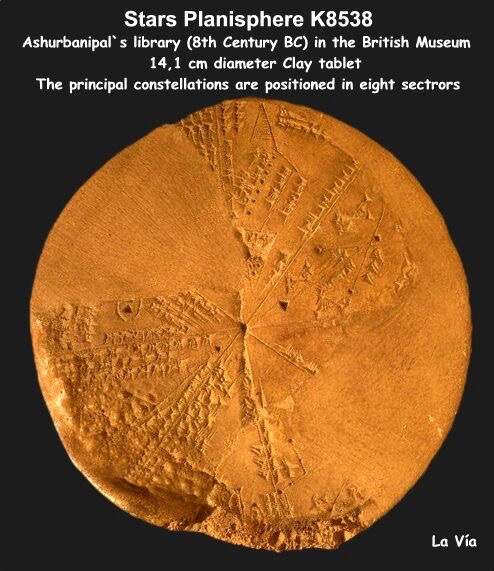
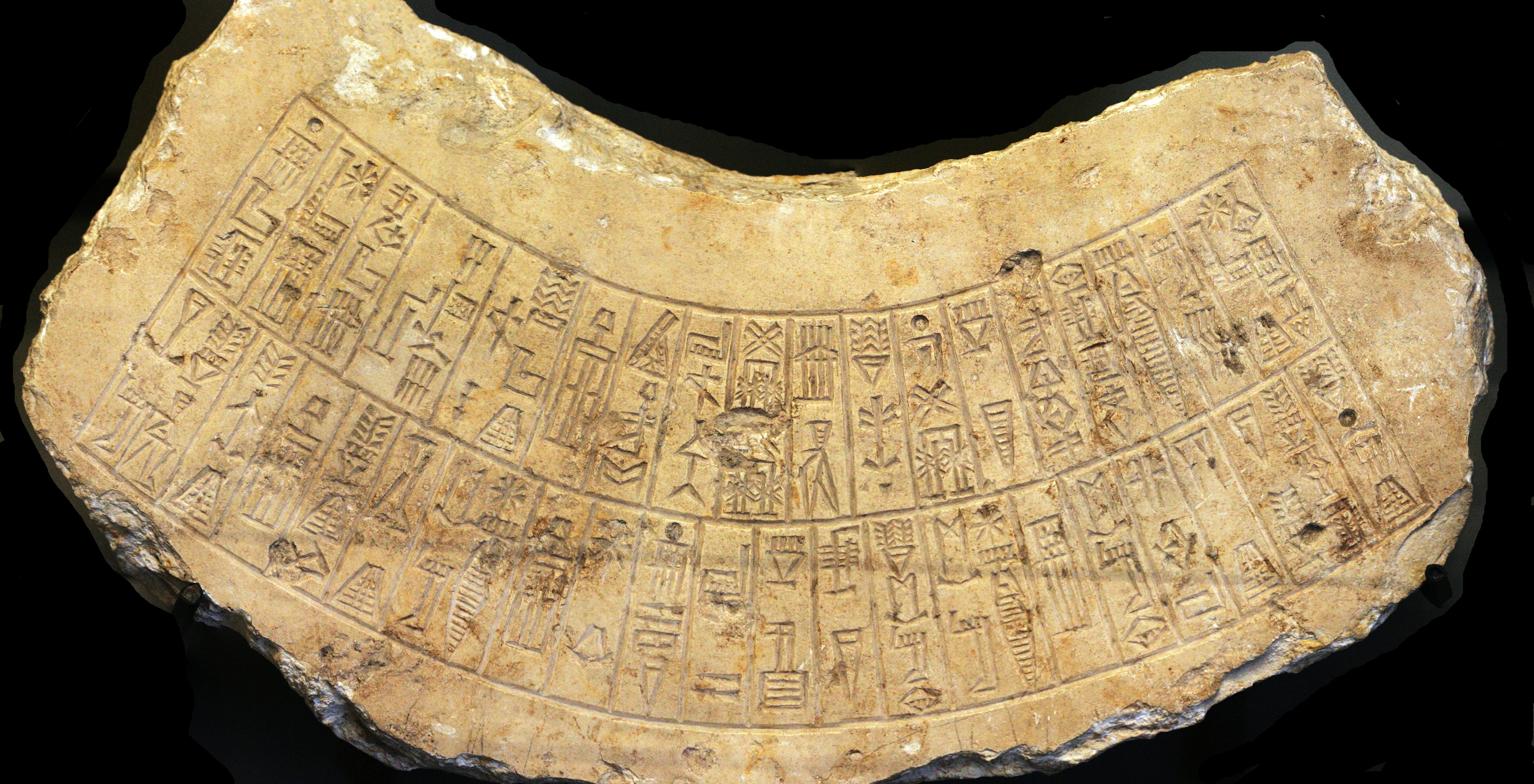
Di seguito possiamo vedere una tavoletta della collezione Kuyunjik, rinvenuta fra le rovine della biblioteca reale di Ashurbanipal (668-627 a.C.) a Ninive, capitale dell'antica Assiria, ed è attualmente esposta al British Museum di Londra (K8538). La scrittura cuneiforme cita chiaramente i nomi di stelle e di pianeti. Insomma la mappa era un planisfero a 360 gradi, ossia la riproduzione di una superficie sferica su un piano dei cieli con al centro la Terra. http://www.lavia.org/italiano/archivio/calendarioakkadit.htm

Di seguito possiamo vedere una tavoletta della collezione Kuyunjik, rinvenuta fra le rovine della biblioteca reale di Ashurbanipal (668-627 a.C.) a Ninive, capitale dell’antica Assiria, ed è attualmente esposta al British Museum di Londra (K8538). La scrittura cuneiforme cita chiaramente i nomi di stelle e di pianeti. Insomma la mappa era un planisfero a 360 gradi, ossia la riproduzione di una superficie sferica su un piano dei cieli con al centro la Terra.
http://www.lavia.org/italiano/archivio/calendarioakkadit.htm

The sources of the two main astronomical fragments, Vitruvius and Cleomedes, quote Berossos for his theory of the lunar phases (Cleomedes’ discussion of the moon’s other motions appears as an introduction to this material).
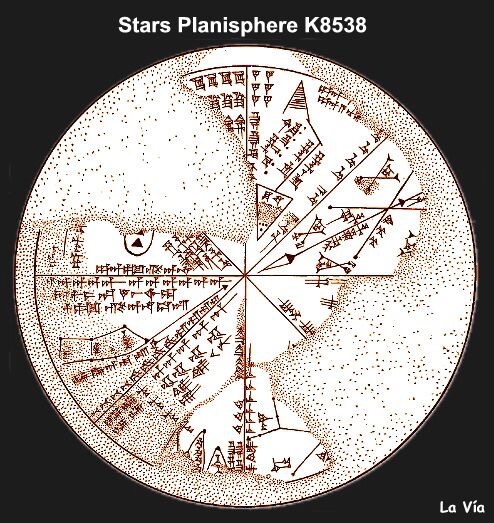
A drawing of British Museum (K8538). As stated above,

A drawing of British Museum (K8538). As stated above, “La scrittura cuneiforme cita chiaramente i nomi di stelle e di pianeti. Insomma la mappa era un planisfero a 360 gradi, ossia la riproduzione di una superficie sferica su un piano dei cieli con al centro la Terra.”
http://www.lavia.org/italiano/archivio/calendarioakkadit.htm

Interestingly, both these authors present Berossos’ model as one of several explanations for the moon’s phases and then argue against it. Cleomedes presents three models for the lunar phases: Berossos’ model, a model in which the moon is illuminated by reflected sunlight, and a third model, which he will argue is correct, in which the moon is illuminated by a mingling of the sun’s light with the moon’s body.

Cleomedes dismisses Berossos’ model on several grounds:

His doctrine is easily refuted. First, since the Moon exists in the aether, it cannot be ‘half fire’ rather than being completely the same in its substance like the rest of the heavenly bodied.

Second, what happens in an eclipse also conspicuously disconfirms this theory. Berossus, that is, cannot demonstrate how, when the Moon falls into the Earth’s shadow, its light, all of which is facing in our direction at that time, disappears from sight.

If the Moon were constituted as he claims, it would have to become more luminous on falling into the Earth’s shadow rather than disappear from sight!

Vitruvius contrasts Berossos’ model with one he attributes to Aristarchus in which the moon is illuminated by reflected light from the sun. Vitruvius makes it clear that Aristarchus’ model is to be preferred.

Lucretius, presents three models: first the moon is illuminated by reflected sunlight, second the Berossos model (attributed only to ‘the Chaldeans’), and finally the suggestion that the moon is created anew with its own light each day. As is his way, Lucretius does not argue for any one model over the others.

For these later authors, Berossos was useful as a rhetorical tool rather than for the details of his astronomy. So far as we know, no later astronomer in the Greco-Roman world used any of Berossos’s astronomy or attempted to develop it in any way.

Instead, his astronomy provided material that could be argued against in order to promote a different model. If the alternative to the model an author wanted to promote was Berossos’ model, and Berossos’ model was clearly problematical, then this was an implicit argument for the model the author was promoting.
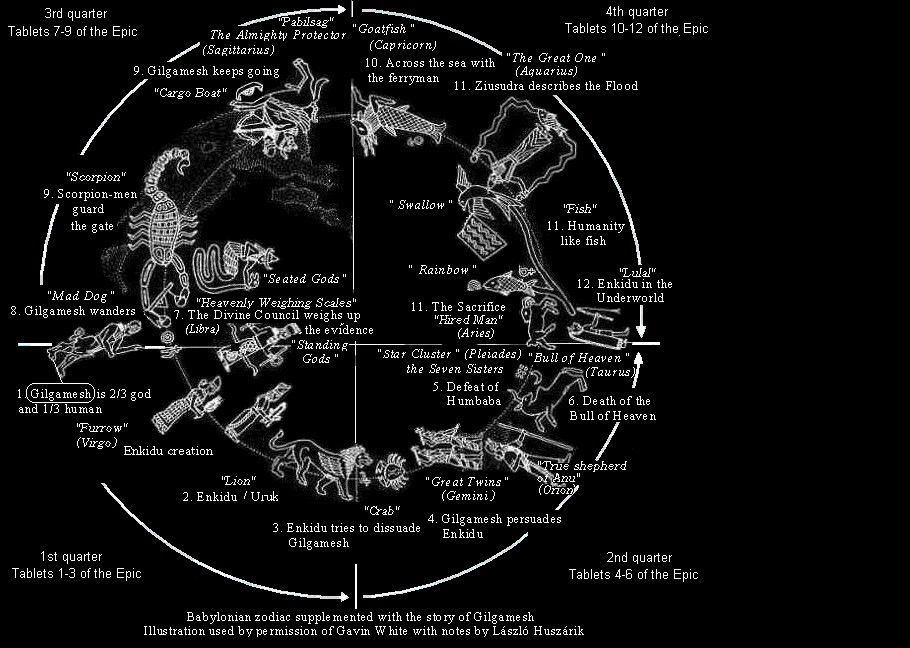
Even though it is not possible to connect each and every chapter (of the Epic of Gilgamesh) with a single star sign, the zodiac does form an excellent backdrop for telling the story.  There are clear references to constellations in the zodiac, as well as to others which are directly next to the zodiac. To illustrate this, (above) is the Babylonian star chart, based on the Mul.Apin tablets, as reconstructed by Gavin White in his book Babylonian Star Lore. http://thesecretofthezodiac.hu/node/1

Even though it is not possible to connect each and every chapter (of the Epic of Gilgamesh) with a single star sign, the zodiac does form an excellent backdrop for telling the story.
There are clear references to constellations in the zodiac, as well as to others which are directly next to the zodiac. To illustrate this, (above) is the Babylonian star chart, based on the Mul.Apin tablets, as reconstructed by Gavin White in his book Babylonian Star Lore.
http://thesecretofthezodiac.hu/node/1

Berossos’ astronomy was useful not in itself but for how it could be used as a straw man in arguments for alternative astronomical models. The usefulness of Berossos in this capacity was increased because Berossos had become a well-known name identified with astronomical skill.

Vitruvius, a few chapters after his discussion of the illumination of the moon, lists the inventors of various types of sundial. Berossos is the first name in the list, followed by Aristarchus, Eudoxus, Apollonius and several others (the attributions are certainly fictitious – Vitruvius was an inveterate name-dropper).

If another model was better than Berossos, therefore, the implication is that it must be of the highest quality. Whether or not the astronomical fragments are genuine, which I suspect they largely are, and whether or not Berossos really understood any Babylonian astronomy, which he certainly did not, for later authors he provided a valuable service as an authority figure, imbued both with scientific prestige and a certain eastern exoticism, who could be argued against to promote various astronomical models.”

John M. Steele, “The ‘Astronomical Fragments’ of Berossos in Context,” in Johannes Haubold, Giovanni B. Lanfranchi, Robert Rollinger, John Steele (eds.), The World of Berossos, Proceedings of the 4th International Colloquium on the Ancient Near East Between Classical and Ancient Oriental Traditions, Harrassowitz Verlag, Wiesbaden, 2013, pp. 117-9.
Babylon, Fallen

“Although in all the articles and discussions concerning cultic prostitution the preeminence of Babylon as the “mother of harlots” is never mentioned; it is an unarticulated assumption underlying their arguments.

“The woman was dressed in purple and scarlet and glittered with gold and jewels and pearls, and she was holding a gold winecup filled with the disgusting filth of her prostitution; on her forehead was written a name, a cryptic name: “Babylon the Great, the mother of the prostitutes and all the filthy practices on the earth.” (Revelations 17:4-5, NJB)

This popular identification of harlotry with Babylon appears to stem from Revelation, a widely read and quoted book in our Western Christianized civilization, a quotation from which opens this article. The persistence of such views to the present is illustrated in this graphic depiction of Babylon by Joan Oates:

So wrote a New Testament prophet, and, although the allusion was to Rome, the sentiment accurately expressed the ancient world’s view of Babylon. Today, 2000 years after the city was “cast down and found no more,” the name still conjures up in our minds a vision of opulence and splendour stained with the smear of pagan decadence so enthusiastically applied by the writers of the Hebrew world. (Joan Oates, Babylon (London: Thames & Hudson, 1979), p. 9.)

This common misconception arose because of the lack of awareness that the reference–as Joan Oates seems to realize–is of Hebraic origin and alludes exclusively to the practices of then-existing decadent Rome and not to those of a Babylon of an earlier period.

The authentic Greek view of Babylon, though running parallel to that of Revelation, is found typically in the words of older writers such as Herodotus and reflects their derogatory perception of women and barbarians.

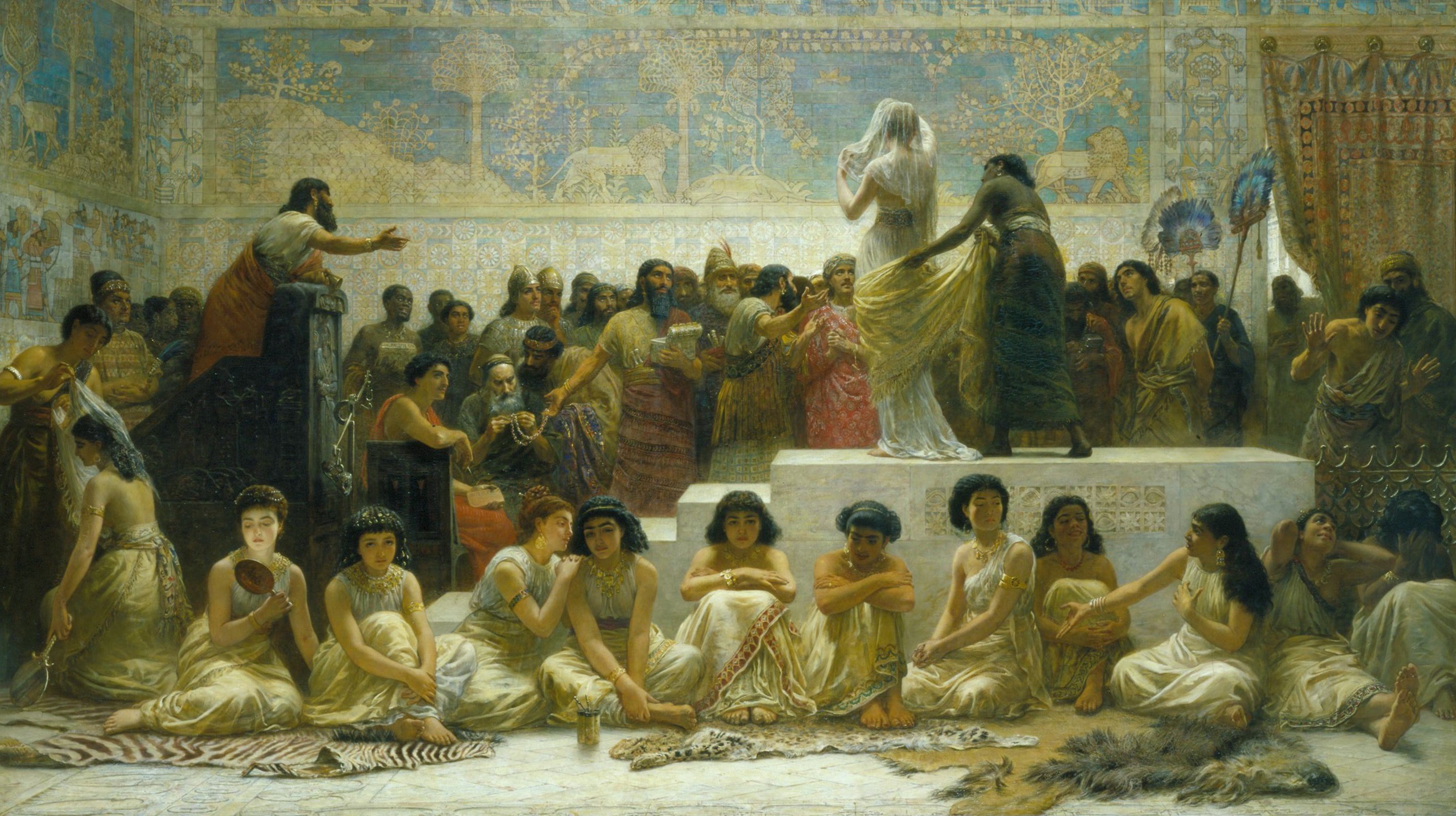
The Babylonian Marriage Market


Edwin Long (1829–1891) wikidata:Q3042629
The Babylonian Marriage Market
Royal Holloway College (London).
23 May 2007 (original upload date). Original uploader was Briangotts at en.wikipedia
Permission
(Reusing this file) PD-US.
http://en.wikipedia.org/wiki/File:Babylonian_marriage_market.jpg
The Babylonian Marriage Market is an 1875 painting by the British painter Edwin Long of young women being auctioned into marriage. It received attention for its provocative depiction of women being sold and its attention to historical detail. It was inspired by a passage in the Histories by Herodotus, and the artist painstakingly copied some of the images from Assyrian artifacts.
It is currently held in the Picture Gallery of Royal Holloway College, after being bought by Thomas Holloway in 1882, where it fetched a then-record price for a painting by a living artist at £6,615.
http://en.wikipedia.org/wiki/The_Babylonian_Marriage_Market

The truly Hebraic or Judean view toward ancient Babylon in the world of the Old Testament is revealed through numerous references to Babylon both in the historical and in the literary texts. The most elaborate portrayal is given in the description of the fall of Babylon in Deutero-Isaiah whose people lived closer in time, in territory and in kinship to those of Babylonia.

There Babylon is distinguished by the epithet 6VBq5vJAmPGzoQtSaZp-KnBuAy87TDxAT0Dh1j1NOu0, “the virgin daughter of Babylon”–an epithet by which Jerusalem is often esteemed, 2u5voQ59k3CODNCGd_l_coUc62wSXXnY3h-RTbnJaLo, “the virgin daughter of Zion.”

Note in the following passage rather than being “stained with the smear of pagan decadence,” Babylon is honored and dignified with the rank of a queen who has been sheltered, veiled, and protected from any type of manual labor:

Come down, sit in the dust, virgin daughter of Babylon! Sit on the ground dethroned, daughter of the Chaldeans! For no longer will they call you soft and dainty. Take the millstones, grind the meal, take off your veil; strip off your skirt, bare the thigh, cross the rivers. Let your nudity be displayed–yes, let your sex appear; I will take vengeance, I will not entreat man…. Sit in silence, enter into darkness, daughter of the Chaldeans: For no longer will they call you the mistress of kingdoms. (Isaiah 47:1 – 5)

In the succeeding lines, Babylon stands accused not of harlotry but of spells and sorceries, and can expect punishment in the form of evils and disasters which cannot be conjured away or averted.

This reflects a clear picture of Babylonian practice–a reliance on incantations (spells for positive and negative results) and divination (sorceries to tell the future) and namburbi, and other rituals to avert predicted disasters.

In light of its ethnic, cultural, and linguistic proximity, the Hebrew Bible could portray a more accurate understanding of Babylon and its culture.

Thus, we have come full circle from using Mesopotamian material to explain the Bible to using biblical material to depict Babylon. Both traditions are firmly rooted in the ancient Near East.

It is the Greeks and their denigration of the female sex and of barbarians that caused them to lump together the negative attributes of both groups in their description of Babylon and its cultic rites.”

Joan Goodnick Westenholz, “Tamar, Qēdēšā, Qadištu, and Sacred Prostitution in Mesopotamia,” The Harvard Theological Review, Vol. 82, No. 3 (July, 1989), pp. 264-5.

The Great Year Doctrine of World Catastrophe

“In the Greek world the first distinct mention of the Great Year was made by Plato, who argued in his Timaeus that time is produced by the celestial bodies: the moon determines the month, the sun the year; but the times of the planets and of the sphere of the fixed stars are so great that it can hardly be known whether they are times at all.

In any case it is clear that the perfect number of time fulfills the perfect year at the moment at which the sun, the moon, the planets, and the fixed stars have all completed their courses and have again reached their starting point. (Plato, Timaeus, 39c, 39d).

By this is meant that the Great Year is completed when the celestial bodies have reached the same positions in relation to each other as they had at the beginning of that period. The identical conception is found in Cicero, qualified by the statement that the actual duration of such a period is a matter of controversy (Cicero, De natura deorum, II, 51-2).

But in his Hortensius, the book which was later to make such a strong impression on the young Augustine, Cicero equated the Great Year with 12,954 ordinary years, as we know from Tacitus and Servius (Tacitus, Dialogus de oratoribus, 16, 7. Maurus Servius Honoratus, Commentary on the Aenid of Virgil, I, 296. The same number is given by Solinus in connection with the phoenix, Solini Polyhistor, cap. xxxvi).

In addition to these opinions about the Great Year there is another according to which the sun, the moon, and the five planets all return at the end of the Great Year to one and the same sign of the Zodiac, the one under which they were when it began. According to Censorinus, Aristotle himself had put forward this same view, and preferentially indicated this period as “the Greatest Year.” This year, like the ordinary solar year, was thought to have a summer and winter too, the summer culminating in a world conflagration and the world in a world flood. (Censorinus, De die natali, 18, II. ).

How much of this really goes back to Aristotle cannot be said with certainty. (V. Rose, Aristotelis fragmenta, Lipsiae, 1886, 39, frg. 25). According to Seneca, Berossus, the Babylonian priest of Bel who wrote in the third century BC, propagated the same doctrine in a more detailed form: when the sun, the moon, and the planets came to lie in a straight line under the sign of Cancer, the world would burst into flames; and if they reached that position under Capricorn, the world would be inundated. (Seneca, Naturales Quaestiones, III, 29, I).

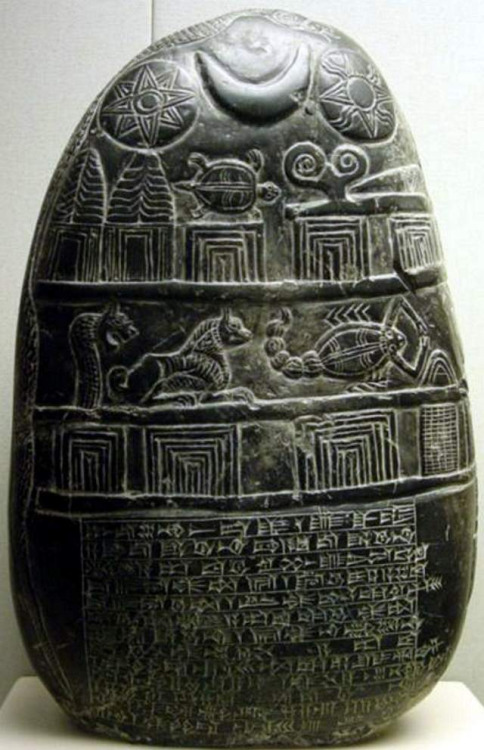
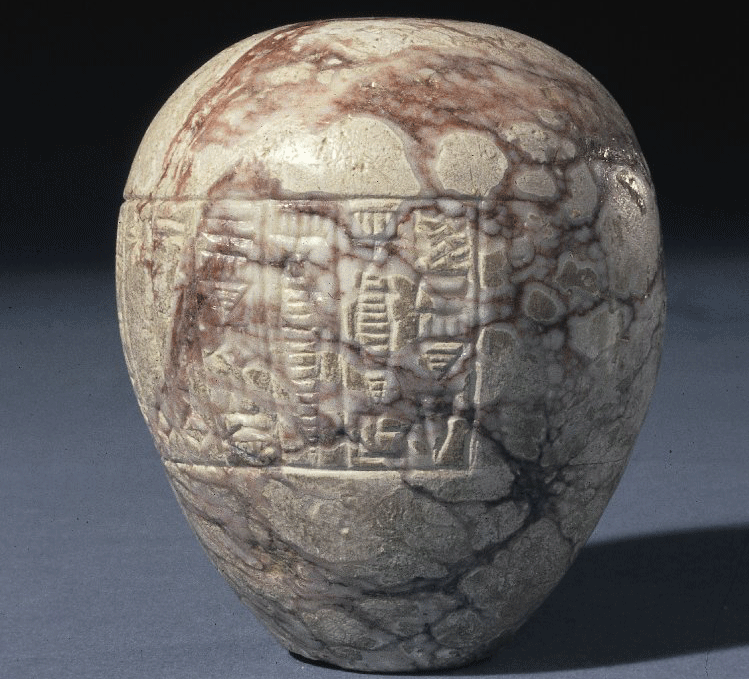
BM102485 - Boundary stone (kudurru) Kassite dynasty, about 1125-1100 BC Probably from southern Iraq A legal statement about the ownership of a piece of land The cuneiform inscription on this kudurru records the granting by Eanna-shum-iddina, the governor of the Sealand, of five gur of corn land in the district of Edina in south Babylonia to a man called Gula-eresh. The boundaries of the land are laid out; the surveyor is named as Amurru-bel-zeri and the transfer completed by two high officials who are also named. Nine gods are invoked to protect the monument, along with seventeen divine symbols. The symbols of the important Mesopotamian gods are most prominent: the solar disc of the sun-god Shamash, the crescent of the moon-god Sin and the eight-pointed star of Ishtar, goddess of fertility and war. The square boxes beneath these signs represent altars supporting the symbols of gods, including horned headdresses, the triangular spade of Marduk, and the wedge-shaped stylus of Nabu, the god of writing. A prominent snake is shown on many kudurru and may, like many of the symbols, be related to the constellations. The text ends with curses on anyone who removes, ignores or destroys the kudurru. L.W. King, Babylonian boundary stones and (London, Trustees of the British Museum, 1912) © The Trustees of the British Museum http://www.britishmuseum.org/explore/highlights/highlight_objects/me/b/boundary_stone_kudurru-6.aspx

BM102485 – Boundary stone (kudurru)
Kassite dynasty, about 1125-1100 BC
Probably from southern Iraq
A legal statement about the ownership of a piece of land
The cuneiform inscription on this kudurru records the granting by Eanna-shum-iddina, the governor of the Sealand, of five gur of corn land in the district of Edina in south Babylonia to a man called Gula-eresh. The boundaries of the land are laid out; the surveyor is named as Amurru-bel-zeri and the transfer completed by two high officials who are also named.
Nine gods are invoked to protect the monument, along with seventeen divine symbols. The symbols of the important Mesopotamian gods are most prominent: the solar disc of the sun-god Shamash, the crescent of the moon-god Sin and the eight-pointed star of Ishtar, goddess of fertility and war. The square boxes beneath these signs represent altars supporting the symbols of gods, including horned headdresses, the triangular spade of Marduk, and the wedge-shaped stylus of Nabu, the god of writing.
A prominent snake is shown on many kudurru and may, like many of the symbols, be related to the constellations. The text ends with curses on anyone who removes, ignores or destroys the kudurru.
L.W. King, Babylonian Boundary Stones (London, Trustees of the British Museum, 1912)
© The Trustees of the British Museum
http://www.britishmuseum.org/explore/highlights/highlight_objects/me/b/boundary_stone_kudurru-6.aspx

These rather improbable theories were especially favored among astrologers, since Greek astronomy had already reached a point of development at which the doctrines of Berossus could not be accepted. (J. Bidez, Bérose et la grande année, in Melanges Paul Fredericq, Brussels, 1904, 9-19.)

These texts treating the views of Aristotle and Berossus say that world catastrophes corresponding to the summer and winter of the solar year can occur in the course of the Great Year. The period between two world catastrophes could also be seen as a Great Year, but only in the derivative sense. The true Great Year, which might with Aristotle be called the Greatest Year, coincided with a complete cosmic revolution, whether interpreted in the sense of Plato and Cicero or in that of Aristotle and Berossus.

The Great Year of the Classical world arose from the purely mythical conception of a cosmic periodicity ultimately traceable to Babylonia.” (B.L. van der Waerden, Das gross Jahr und die ewige Wiederkehr, in Hermes, 80, 1952, 135-43.)”

R. van den Broek, The Myth of the Phoenix: According to Classical and Early Christian Traditions, Brill Archive, 1972, pp. 72-6.

From Uz to Baphomet

“The gazelle or antelope was a mythological animal in Babylonia so far as it represented Ea, who is entitled ‘the princely gazelle ’ and ‘the gazelle who gives the earth.’ But this animal was also appropriated to Mul-lil, the god of Nippur, who was specially called the ‘gazelle god.’

It is likely, therefore, that this animal had been worshipped totemically at Nippur. Scores of early cylinders represent it being offered in sacrifice to a god, and bas-reliefs and other carvings show it reposing in the arms of various deities.

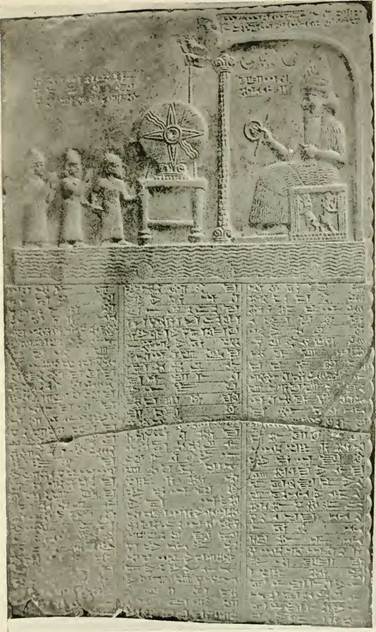
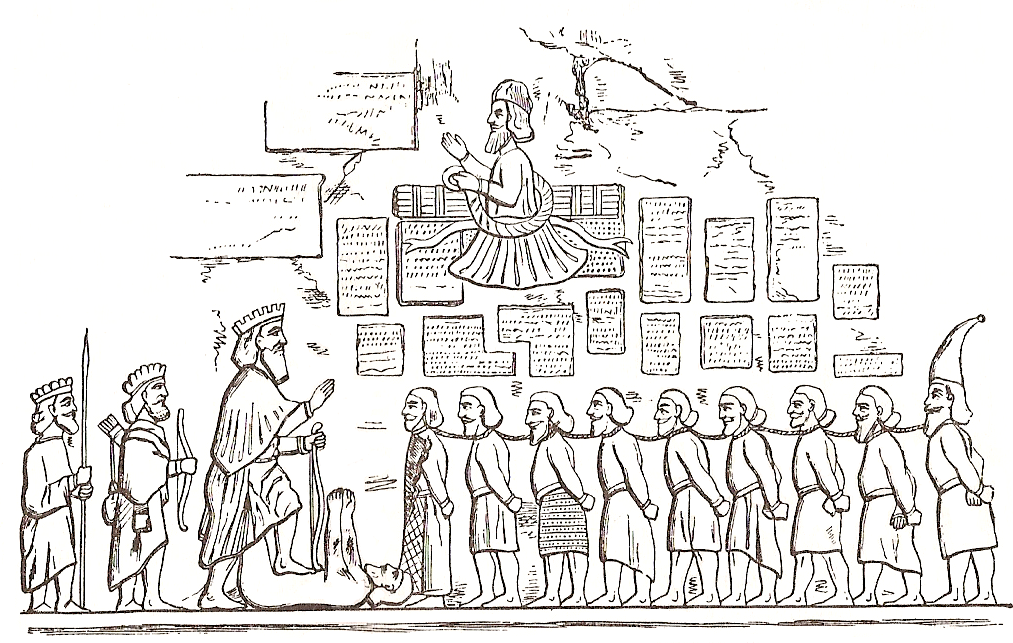
Limestone tablet depicting king Nabu-aplu-iddina being led into the presence of Šamaš, the sun god; 860 BCE-850 BCE.  Šamaš sits in the E-babbar shrine and holds the rod and ring symbols of kingship (BM 91000). © The British Museum. http://oracc.museum.upenn.edu/amgg/listofdeities/utu/ Alternative interpretation, from Lewis Spence, Myths and Legends of Babylonia and Assyria, London, 1917, p. 292.  "A god called Uz has for his name the Akkadian word for goat. Mr Hormuzd Rassam found a sculptured stone tablet in a temple of the sun-god at Sippara on which was an inscription to Sin, Shamash, and Ishtar, as being “set as companions at the approach to the deep in sight of the god Uz.”  This god Uz is depicted as sitting on a throne watching the revolution of the solar disc, which is placed upon a table and made to revolve by means of a rope or string. He is clad in a robe of goat-skin." http://www.wisdomlib.org/mesopotamian/book/myths-and-legends-of-babylonia-and-assyria/d/doc7171.html

Limestone tablet depicting king Nabu-aplu-iddina being led into the presence of Šamaš, the sun god; 860 BCE-850 BCE.
Šamaš sits in the E-babbar shrine and holds the rod and ring symbols of kingship (BM 91000). © The British Museum.
http://oracc.museum.upenn.edu/amgg/listofdeities/utu/
Alternative interpretation, from Lewis Spence, Myths and Legends of Babylonia and Assyria, London, 1917, p. 292.
“A god called Uz has for his name the Akkadian word for goat. Mr Hormuzd Rassam found a sculptured stone tablet in a temple of the sun-god at Sippara on which was an inscription to Sin, Shamash, and Ishtar, as being “set as companions at the approach to the deep in sight of the god Uz.”
This god Uz is depicted as sitting on a throne watching the revolution of the solar disc, which is placed upon a table and made to revolve by means of a rope or string. He is clad in a robe of goat-skin.”
http://www.wisdomlib.org/mesopotamian/book/myths-and-legends-of-babylonia-and-assyria/d/doc7171.html

The goat, too, seems to have been peculiarly sacred, and formed one of the signs of the zodiac. A god called Uz has for his name the Akkadian word for goat. Mr Hormuzd Rassam found a sculptured stone tablet in a temple of the sun-god at Sippara on which was an inscription to Sin, Shamash, and Ishtar, as being “set as companions at the approach to the deep in sight of the god Uz.”

This god Uz is depicted as sitting on a throne watching the revolution of the solar disc, which is placed upon a table and made to revolve by means of a rope or string. He is clad in a robe of goat-skin.

This cult of the goat appears to be of very ancient origin, and the strange thing is that it seems to have found its way into mediaeval and even into modern magic and pseudo-religion. There is very little doubt that it is the Baphomet of the knights-templar and the Sabbatic goat of the witchcraft of the Middle Ages.

It seems almost certain that when the Crusaders sojourned in Asia-Minor they came into contact with the remains of the old Babylonian cult.

When Philip the Fair of France arraigned them on a charge of heresy a great deal of curious evidence was extorted from them regarding the worship of an idol that they kept in their lodges.

The real character of this they seemed unable to explain. It was said which the image was made in the likeness of ‘Baphomet,’ which name was said to be a corruption of Mahomet, the general Christian name at that period for a pagan idol, although others give a Greek derivation for the word.

This figure was often described as possessing a goat’s head and horns. That, too, the Sabbatic goat of the Middle Ages was of Eastern and probably Babylonian origin is scarcely to be doubted. At the witch orgies in France and elsewhere those who were afterwards brought to book for their sorceries declared that Satan appeared to them in the shape of a goat and that they worshipped him in this form.

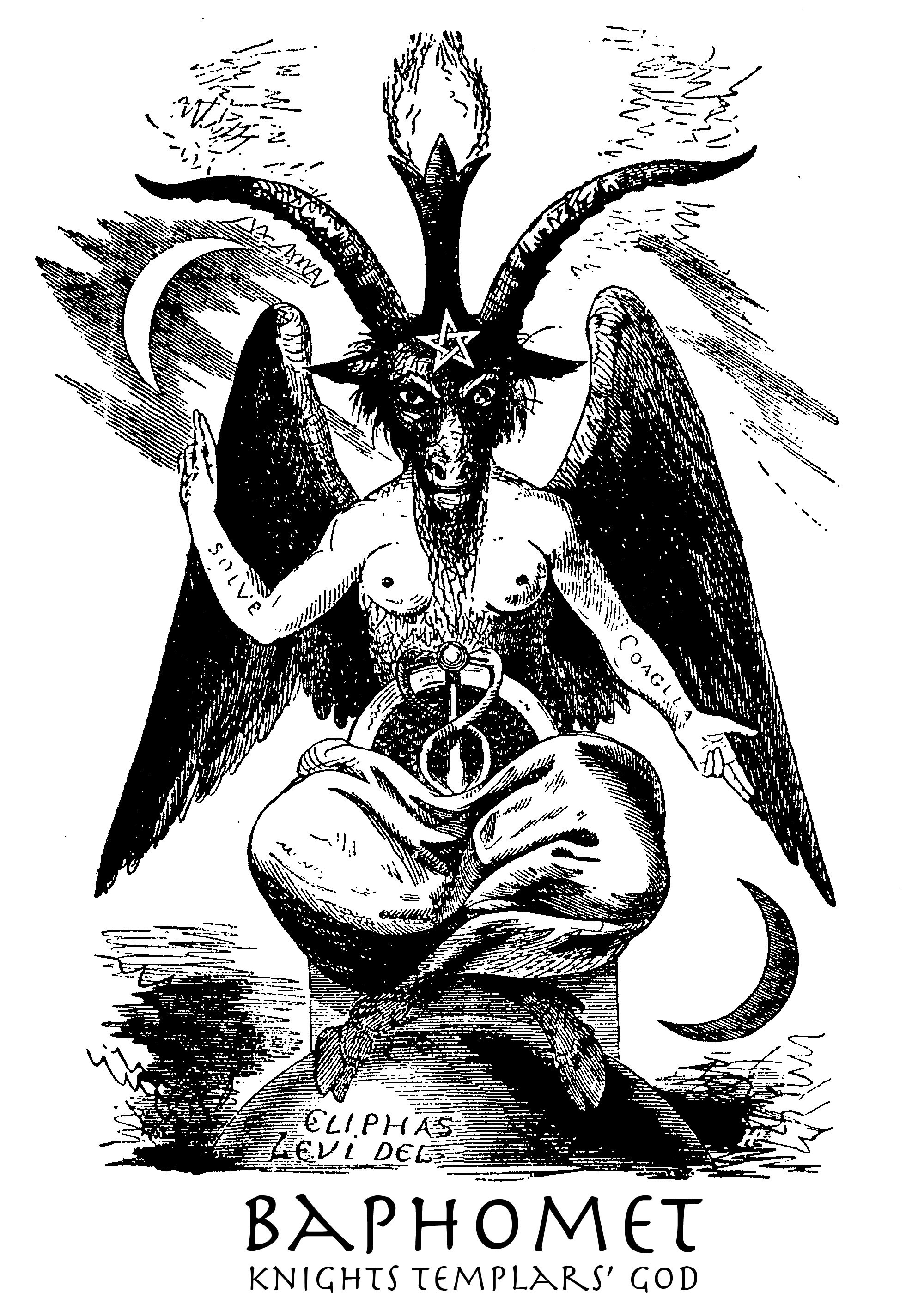
A depiction of Baphomet by Eliphas Levi, Transcendental Magic, (Figure IX), p. 296.

A depiction of Baphomet by Eliphas Levi, Transcendental Magic, (Figure IX), p. 296.

The Sabbatic meetings during the fifteenth century in the wood of Moffiaines, near Arras, had as their centre a goat-demon with a human countenance, and a like fiend was adored in Germany and in Scotland. From all this it is clear that the Sabbatic goat must have had some connexion with the East.

Eliphas Levi drew a picture of the Baphomet or Sabbatic goat to accompany one of his occult works, and strangely enough the symbols that he adorns it with are peculiarly Oriental—moreover the sun-disc figures in the drawing.

Now Levi knew nothing of Babylonian mythology, although he was moderately versed in the mythology of modern occultism, and it would seem that if he drew his information from modern or mediaeval sources that these must have been in direct line from Babylonian lore.”

Lewis Spence, Myths and Legends of Babylonia and Assyria, 1917, pp. 292-4.

On Divination in Ancient Babylonia

“Divination as practised by means of augury was a rite of the first importance among the Babylonians and Assyrians. This was absolutely distinct from divination by astrology.

The favourite method of augury among the Chaldeans of old was that by examination of the liver of a slaughtered animal. It was thought that when an animal was offered up in sacrifice to a god that the deity identified himself for the time being with that animal, and that the beast thus afforded a means of indicating the wishes of the god.

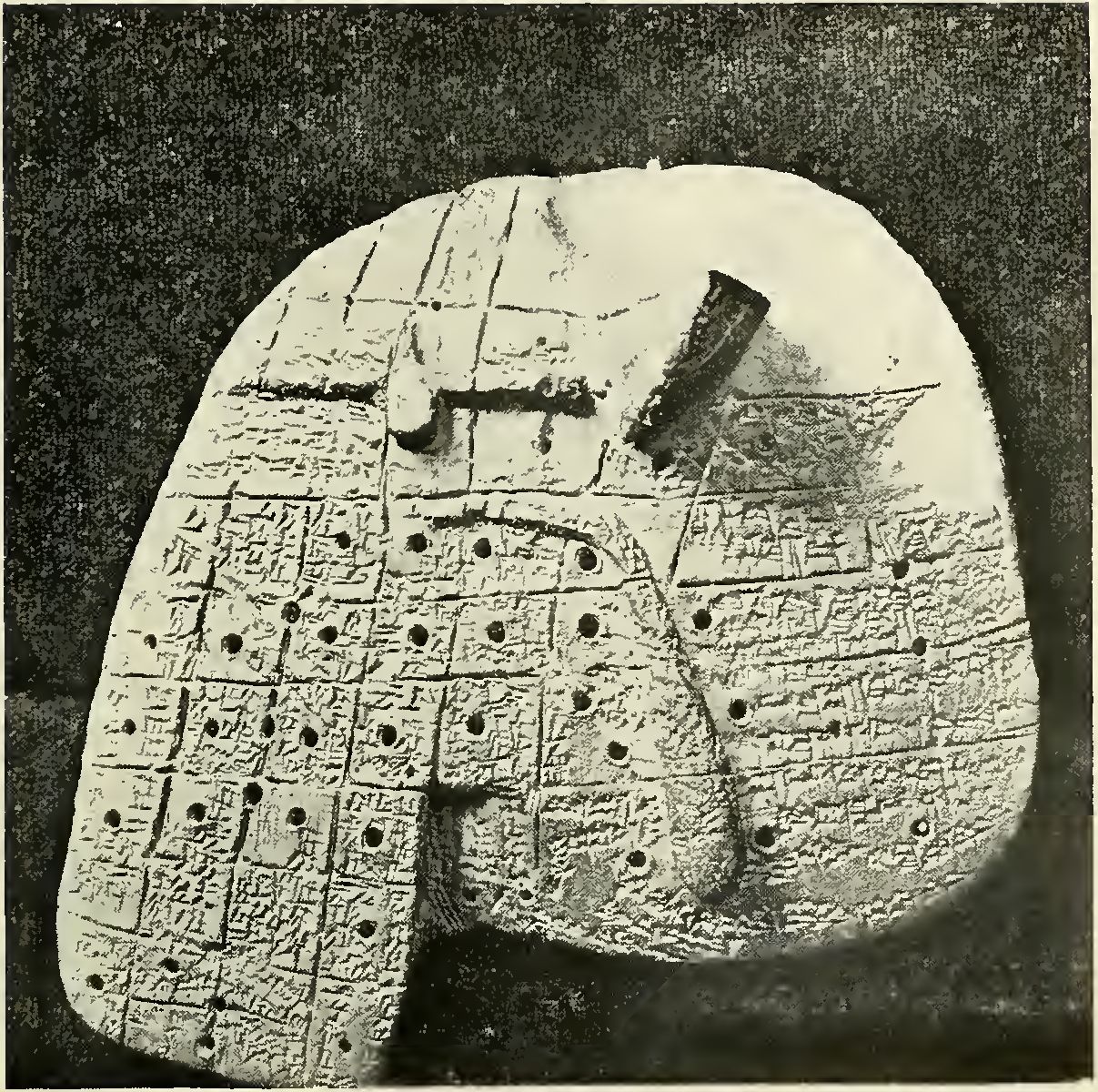
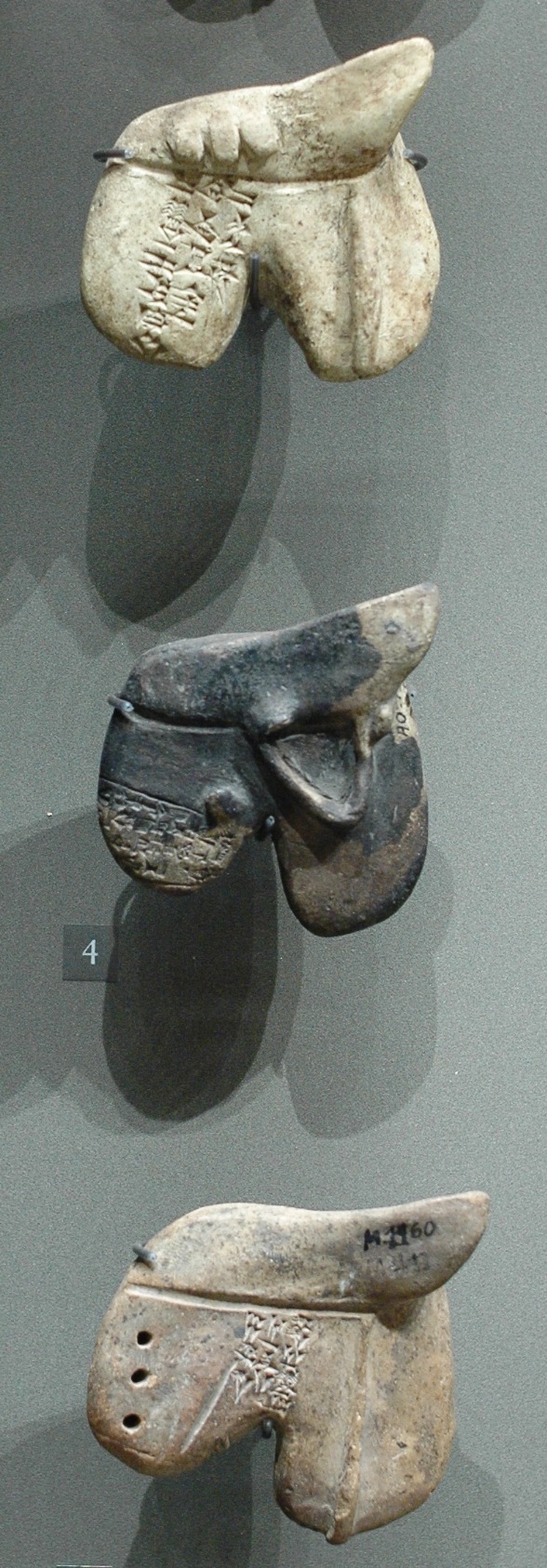
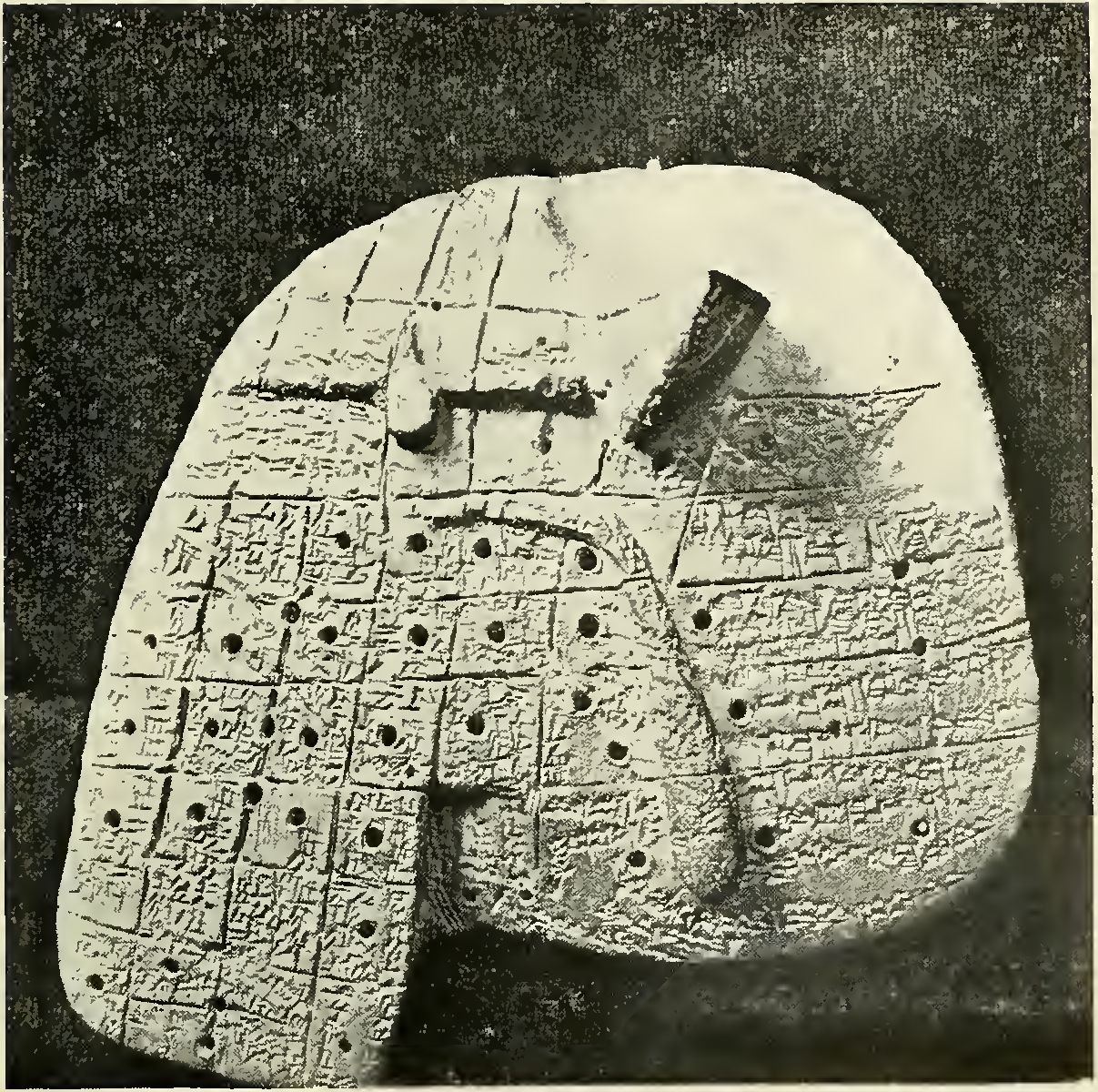
Simulacrum of a sheep’s liver, inscribed with magical formulae for purposes of divination by the priests of Babylon.   Photo W. A. Mansell and Co. Lewis Spence, Myths and Legends of Babylonia and Assyria, London, 1917. P. 281. http://www.wisdomlib.org/uploads/images/clay-object.jpg

Simulacrum of a sheep’s liver, inscribed with magical formulae for purposes of divination by the priests of Babylon.
Photo W. A. Mansell and Co.
Lewis Spence, Myths and Legends of Babylonia and Assyria, London, 1917. P. 281.
http://www.wisdomlib.org/uploads/images/clay-object.jpg

Now among people in a primitive state of culture the soul is almost invariably supposed to reside in the liver instead of in the heart or brain. More blood is secreted by the liver than by any other organ in the body, and upon the opening of a carcase it appears the most striking, the most central, and the most sanguinary of the vital parts. The liver was, in fact, supposed by early peoples to be the fountain of the blood supply and therefore of life itself.

Hepatoscopy or divination from the liver was undertaken by the Chaldeans for the purpose of determining what the gods had in mind. The soul of the animal became for the nonce the soul of the god, therefore if the signs of the liver of the sacrificed animal could be read the mind of the god became clear, and his intentions regarding the future were known.

Divinatory clay liver models for training soothsayers.  The one in the middle foretells the destruction of small cities.  Baken clay, 19th–18th centuries BC, from the royal palace at Mari (now in Syria).  Louvre Museum  wikidata:Q19675 Department of Oriental Antiquities, Richelieu, ground floor, room 3 Accession number	AO 19837 Excavated by André Parrot, 1935–1936 Source/Photographer	Jastrow (2005) http://commons.wikimedia.org/wiki/File:Divinatory_livers_Louvre_AO19837.jpg

Divinatory clay liver models for training soothsayers.
The one in the middle foretells the destruction of small cities.
Baken clay, 19th–18th centuries BC, from the royal palace at Mari (now in Syria).
Louvre Museum
wikidata:Q19675
Department of Oriental Antiquities, Richelieu, ground floor, room 3
Accession number AO 19837
Excavated by André Parrot, 1935–1936
Source/Photographer Jastrow (2005)
http://commons.wikimedia.org/wiki/File:Divinatory_livers_Louvre_AO19837.jpg

The animal usually sacrificed was a sheep, the liver of which animal is most complicated in appearance. The two lower lobes are sharply divided from one another and are separated from the upper by a narrow depression, and the whole surface is covered with markings and fissures, lines and curves which give it much the appearance of a map on which roads and valleys are outlined. This applies to the freshly excised liver only, and these markings are never the same in any two livers.

Certain priests were set apart for the practice of liver-reading, and these were exceedingly expert, being able to decipher the hepatoscopic signs with great skill. They first examined the gall-bladder, which might be reduced or swollen. They inferred various circumstances from the several ducts and the shapes and sizes of the lobes and their appendices. Diseases of the liver, too, particularly common among sheep in all countries, were even more frequent among these animals in the marshy portions of the Euphrates Valley.

The literature connected with this species of augury is very extensive, and Assur-bani-pal’s library contained thousands of fragments describing the omens deduced from the practice. These enumerate the chief appearances of the liver, as the shade of the colour of the gall, the length of the ducts, and so forth.

The lobes were divided into sections, lower, medial, and higher, and the interpretation varied from the phenomena therein observed. The markings on the liver possessed various names, such as ‘palaces,’ ‘weapons,’ ‘paths,’ and ‘feet,’ which terms remind us somewhat of the bizarre nomenclature of astrology.

Later in the progress of the art the various combinations of signs came to be known so well, and there were so many cuneiform texts in existence which afforded instruction in them, that a liver could be quickly ‘read’ by the barû or reader, a name which was afterward applied to the astrologists as well and to those who divined through various other natural phenomena.

One of the earliest instances on record of hepatoscopy is that regarding Naram-Sin, who consulted a sheep’s liver before declaring war. The great Sargon did likewise, and we find Gudea applying to his ‘liver inspectors’ when attempting to discover a favourable time for laying the foundations of the temple of Nin-girsu.

Throughout the whole history of the Babylonian monarchy in fact, from its early beginnings to its end, we find this system in vogue. Whether it was in force in Sumerian times we have no means of knowing, but there is every likelihood that such was the case.”

Lewis Spence, Myths and Legends of Babylonia and Assyria, 1917, pp. 281-3.

The Tree of Life = The Tree of Knowledge

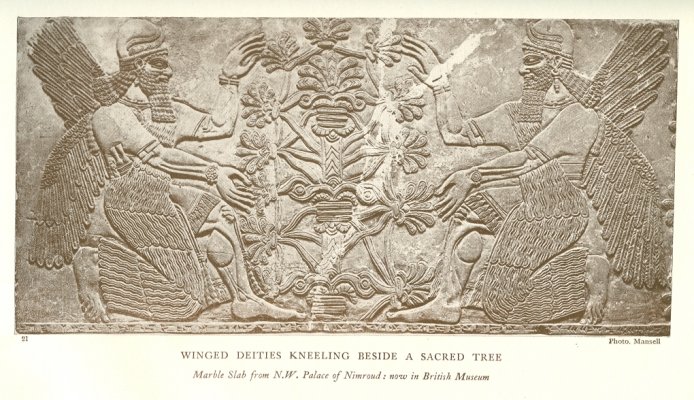
“But the cedar was something more than a world-tree. It was employed, as we have seen, in incantations and magic rites which were intended to restore strength and life to the human frame. It was thus essentially “a tree of life,” and the prototype and original of those conventional trees of Iife with which the walls of the Assyrian paiaces were adorned.

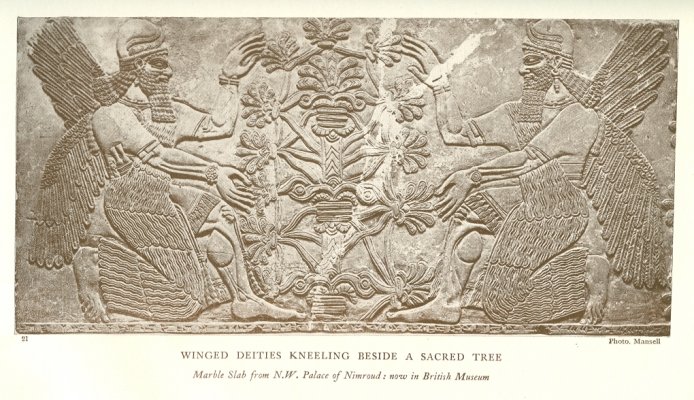
Stone relief from the throne room of Ashurnasirpal II. Nimrud (ancient Kalhu), northern Iraq. Neo-Assyrian, 870–860 BC. This Assyrian relief is from the throne room of the North-West Palace of Ashurnasirpal II (reigned 883-859 BC) at Nimrud in northern Iraq. It was originally positioned behind the king’s throne. Ashurnasirpal appears twice, shown from two sides, dressed in ritual robes and holding a mace symbolising his authority. The figure of the king on the right makes a gesture of worship to a god in a winged disk in the top centre of the relief.  The source of the king’s power may be Ashur, the national god, or Shamash, the god of the sun and justice.  He holds a ring in one hand, an ancient Mesopotamian symbol of god-given kingship. The figure of the king on the left appears to gesture towards a Sacred Tree in the centre. This balanced combination of steams and foliage is a symbol of fertility and abundance given by the gods. Behind the king, on either side of the relief, is a winged protective spirit who blesses and purifies Ashurnasirpal using a cone-shaped object to sprinkle liquid from a ritual bucket. The relief thus summarises visually the main ideas of Assyrian kingship; he is the source of abundance provided by the gods. Ancient visitors approaching the enthroned king would have thus seen three royal figures, the living king facing them, and, on either side of him, two carved images showing Ashurnasirpal’s relationship with the gods.  Emerging from behind the king himself would be the Sacred-Tree. There was another almost identical relief opposite the main door of the throne room, and similar scenes occupied prominent positions in other Assyrian palaces. They were also embroidered on the royal clothes. J.E. Reade, Assyrian sculpture (London, The British Museum Press, 1983) Excavated by Austen Henry Layard, 1845-7 ME 124531, Room 7-8: Assyria: Nimrud http://www.britishmuseum.org/explore/highlights/highlight_objects/me/s/stone_throne_room_relief.aspx

Stone relief from the throne room of Ashurnasirpal II.
Nimrud (ancient Kalhu), northern Iraq. Neo-Assyrian, 870–860 BC.
This Assyrian relief is from the throne room of the North-West Palace of Ashurnasirpal II (reigned 883-859 BC) at Nimrud in northern Iraq. It was originally positioned behind the king’s throne.
Ashurnasirpal appears twice, shown from two sides, dressed in ritual robes and holding a mace symbolising his authority. The figure of the king on the right makes a gesture of worship to a god in a winged disk in the top centre of the relief.
The source of the king’s power may be Ashur, the national god, or Shamash, the god of the sun and justice.
He holds a ring in one hand, an ancient Mesopotamian symbol of god-given kingship. The figure of the king on the left appears to gesture towards a Sacred Tree in the centre. This balanced combination of steams and foliage is a symbol of fertility and abundance given by the gods.
Behind the king, on either side of the relief, is a winged protective spirit who blesses and purifies Ashurnasirpal using a cone-shaped object to sprinkle liquid from a ritual bucket. The relief thus summarises visually the main ideas of Assyrian kingship; he is the source of abundance provided by the gods.
Ancient visitors approaching the enthroned king would have thus seen three royal figures, the living king facing them, and, on either side of him, two carved images showing Ashurnasirpal’s relationship with the gods.
Emerging from behind the king himself would be the Sacred-Tree.
There was another almost identical relief opposite the main door of the throne room, and similar scenes occupied prominent positions in other Assyrian palaces. They were also embroidered on the royal clothes.
J.E. Reade, Assyrian sculpture (London, The British Museum Press, 1983)
Excavated by Austen Henry Layard, 1845-7
ME 124531, Room 7-8: Assyria: Nimrud
http://www.britishmuseum.org/explore/highlights/highlight_objects/me/s/stone_throne_room_relief.aspx

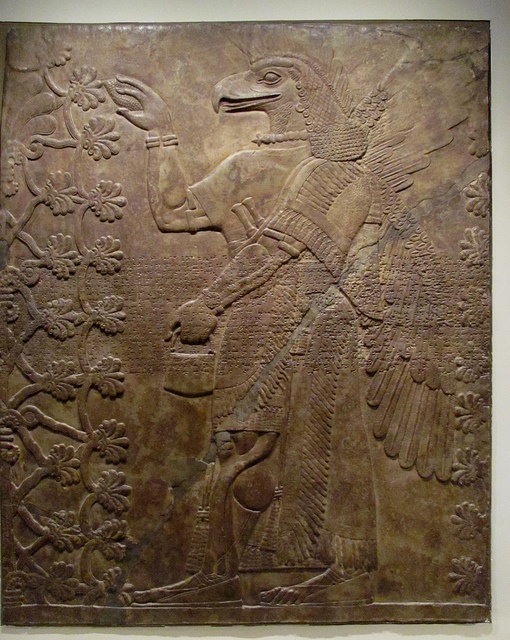
 Those who have visited the Assyrian collection of the British Museum will remember the curious form which it generally assumes, as well as the figures of the two cherubs which kneel or stand before it on either side. At times they are purely human; at other times they have the head of a hawk and hold a cone–the fruit of the cedar–over the tree by whose side they stand.

Alabaster relief from Nimroud, in the Louvre.  http://world-mysteries.com/mpl.htm

Alabaster relief from Nimroud, in the Louvre. The cone, or “fruit of the cedar,” is in the right hand of the eagle figure.
http://world-mysteries.com/mpl.htm

It is possible that, as time went on, another tree became confounded with the original tree of life. The palm was from the earliest period characteristic of Babylonia; and while its fruit seemed to be the stay and support of life, the wine made from it made “glad the heart of man.”

Date-wine was largely used, not only in Babylonian medicine, but in the religious and magical ceremonies of Babylonia as well. It is not at all improbable, therefore, that the later Babylonian tree of life, with its strange conventional form, was an amalgamation of two actual trees, the cedar and the palm.

Donald A. MacKenzie, Myths of Babylonia and Assyria, 1915, p. 340. http://www.sacred-texts.com/ane/mba/img/34000.jpg

Donald A. MacKenzie, Myths of Babylonia and Assyria, 1915, p. 340.
http://www.sacred-texts.com/ane/mba/img/34000.jpg

It is even possible that while one of them, the cedar, was primarily the sacred tree of Eridu, the other was originally the sacred tree of some other locality of Chaldea.

What gives some colour to this last suggestion is, that in later Babylonian belief the tree of life and the tree of knowledge were one and the same.

The text which describes the initiation of a soothsayer associates the cedar with “the treasures of Anu, Bel and Ea, the tablets of the gods, the delivering of the oracle of heaven and earth.” It was upon the heart or core of the cedar, too, that the name of Ea, the god of wisdom, was inscribed.

And it was wisdom rather than life, the knowledge of the secrets of heaven and the magical arts that benefit or injure, which the priesthood of Babylonia and the gods they worshipped kept jealously guarded.

Only the initiated were allowed to taste of its fruit. In this respect, consequently, there was a marked difference between the belief of the Babylonians and the account which we find in the earlier chapters of Genesis.”

A.H. Sayce, Lectures on the Origin and Growth of Religion as Illustrated by the Religion of the Ancient Babylonians, 5th ed., London, 1898, pp. 241-2.

The Lamentations for Tammuz

“On the one hand, we now know who was that Tammuz in whose honour Ezekiel saw the women of Jerusalem weeping at the gate of “the Lord’s house.”

On the other hand, it is clear that the Tammuz and Istar of the Babylonian legend are the Adonis and Aphrodite of Greek mythology. Like Tammuz, Adonis, the beloved one of Aphrodite, is slain by the boar’s tusk of winter, but eventually ransomed from Hades by the prayers of the goddess.

It has long been recognised that Aphrodite, the Kyprian goddess of love and war, came to Hellas from Phoenicia, whether or not we agree with Dr. Hommel in seeing in her name a mere etymological perversion of the Phoenician Ashtoreth.

Adonis is the Phoenician Adoni, “my lord,” the cry with which the worshippers of the stricken Sun-god mourned his untimely descent into the lower world.

The cry was familiar throughout the land of Palestine. In the valley of Megiddo, by the plain of Jezreel, each year witnessed “the mourning for Hadad-Rimmon” (Zechariah xii. ll),while hard by Amos heard the men of Israel mourning for “the only son” (Amos viii. lo), and the prophet of Judah gives the very words of the refrain: “Ah me, my brother, and ah me, my sister! Ah me, Adonis, and ah me, his lady!” (Jeremiah xxii. 18).

Monument funéraire, Adonis mourant: Museu Gregoriano Etrusco, Vatican. Uploaded by Jean-Pol GRANDMONT http://en.wikipedia.org/wiki/Adonis#/media/File:0_Monument_funéraire_-_Adonis_mourant_-_Museu_Gregoriano_Etrusco.JPG

Monument funéraire, Adonis mourant: Museu Gregoriano Etrusco, Vatican.
Uploaded by Jean-Pol GRANDMONT
http://en.wikipedia.org/wiki/Adonis#/media/File:0_Monument_funéraire_-_Adonis_mourant_-_Museu_Gregoriano_Etrusco.JPG

 The words were carried across the western sea to men of an alien race and language. “Cry ailinon, ailinon! woe!” says the Greek poet of Athens, and already in Homeric days the dirge was attributed to a mythic Linos whose magic fate was commemorated in its opening words: “0 Linos, Linos!”

Linos, however, had no existence except in a popular etymology; the Greek ailinos is in reality the Phoenician ai-lénu, “alas for us!” with which the lamentations for the death of the divine Adonis were wont to begin.

Like the refrain quoted by Jeremiah, the words eventually go back to Babylonia, and find their counterpart in the closing lines of the old Babylonian poem I have translated above. When Tillili commences her wail over the dead Tammuz, she cries, like the women of Judah and Phoenicia, “0 my brother, the only one!”

It was, above all, in the Phoenician town of Gebal or Byblos that the death of Adonis was commemorated. Here, eight miles to the north of Beyrût, the ancient military road led from eastern Asia to the shores of the Mediterranean, and brought from early days the invading armies of Babylonia and Assyria to the coasts and cities of Canaan.

Hard by was the river of Adonis, the Nahr Ibrahim of to-day, which rolled through a rocky gorge into the sea. Each year, when the rains and melting snow of spring stained its waters with the red marl of the mountains, the people of Gebal beheld in it the blood of the slaughtered Sun-god.

It was then, in the month of Tammuz or June, that the funeral-festival of the god was held. For seven days it lasted. “Gardens of Adonis,” as they were called, were planted, pots filled with earth and cut herbs, which soon withered away in the fierce heat of the summer sun–fitting emblems of the lost Adonis himself.

Meanwhile, the streets and gates of the temples were filled with throngs of wailing women. They tore their hair, they disfigured the face, they cut the breast with sharp knives, in token of the agony of their grief.

Their cry of lamentation went up to Heaven mingled with that of the Galli, the emasculated priests of Ashtoreth, who shared with them their festival of woe over her murdered bridegroom.

Adonis, the young, the beautiful, the beloved of Ashtoreth, was dead; the bright sun of the springtide, like the verdure of nature which he had called into life, was slain and withered by the hot blasts of the summer.”

A.H. Sayce, Lectures on the Origin and Growth of Religion as Illustrated by the Religion of the Ancient Babylonians, 5th ed., London, 1898, pp. 227-9.

Hymns On the Seven Matu Gods

An Accadian hymn about the Seven Harmful Spirits:

  1. “They are the destructive reptiles, even the winds that create evil!
  2. as an evil reptile, as an evil wind, do they appear!
  3. as an evil reptile, as an evil wind, who marches in front are they !
  4. Children monstrous (gitmalutu), monstrous sons are they!
  5. Messengers of the pest-demon are they!
  6. Throne-bearers of the goddess of Hades are they!
  7. The whirlwind (mátu) which is poured upon the land are they!
  8. The seven are gods of the wide-spread heaven.
  9. The seven are gods of the wide-spread earth.
  10. The seven are gods of the (four) zones.
  11. The seven are gods seven in number.
  12. Seven evil gods are they!
  13. Seven evil demons are they!
  14. Seven evil consuming spirits are they!
  15. In heaven are they seven, in earth are they seven!”
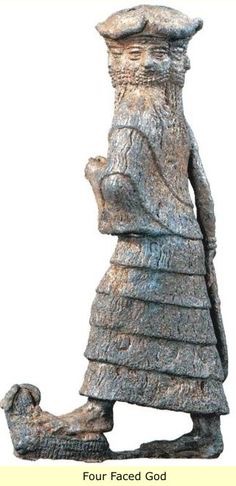
Four faced wind demon. Old Babylonian Period, 18th-17th century B.C. Purchased in Baghdad, 1930 Oriental Institute Museum A7119 University of Chicago https://oi.uchicago.edu/collections/highlights/highlights-collection-mesopotamia

Four faced wind demon. Old Babylonian Period, 18th-17th century B.C.
Purchased in Baghdad, 1930
Oriental Institute Museum A7119
University of Chicago
https://oi.uchicago.edu/collections/highlights/highlights-collection-mesopotamia

From H.C. Rawlinson, The Cuneiform Inscriptions of Western Asia, 1886, iv. 1. ii. 65–iii. 26; 2. v. 30-59:

  1. “Seven are they, seven are they!
  2. In the hollow of the deep, seven are they!
  3. (In) the glory of heaven, seven are they!
  4. In the hollow of the deep in a palace grew they up! (In the original, “from the hollow …. came they forth”).
  5. Male they are not, female they are not!
  6. They are the dust-storm, the travelled ones are they!
  7. Wife they possess not, child is unborn to them.
  8. Order and kindliness know they not.
  9. They hearken not to prayer and supplication.
  10. From the horse of the mountain came they forth.
  11. Of Ea are they the foes.
  12. The throne-bearers of the gods are they.
  13. To trouble the canal in the street are they set.
  14. Evil are they, evil are they!
  15. Seven are they, seven are they, seven doubly said are they!”
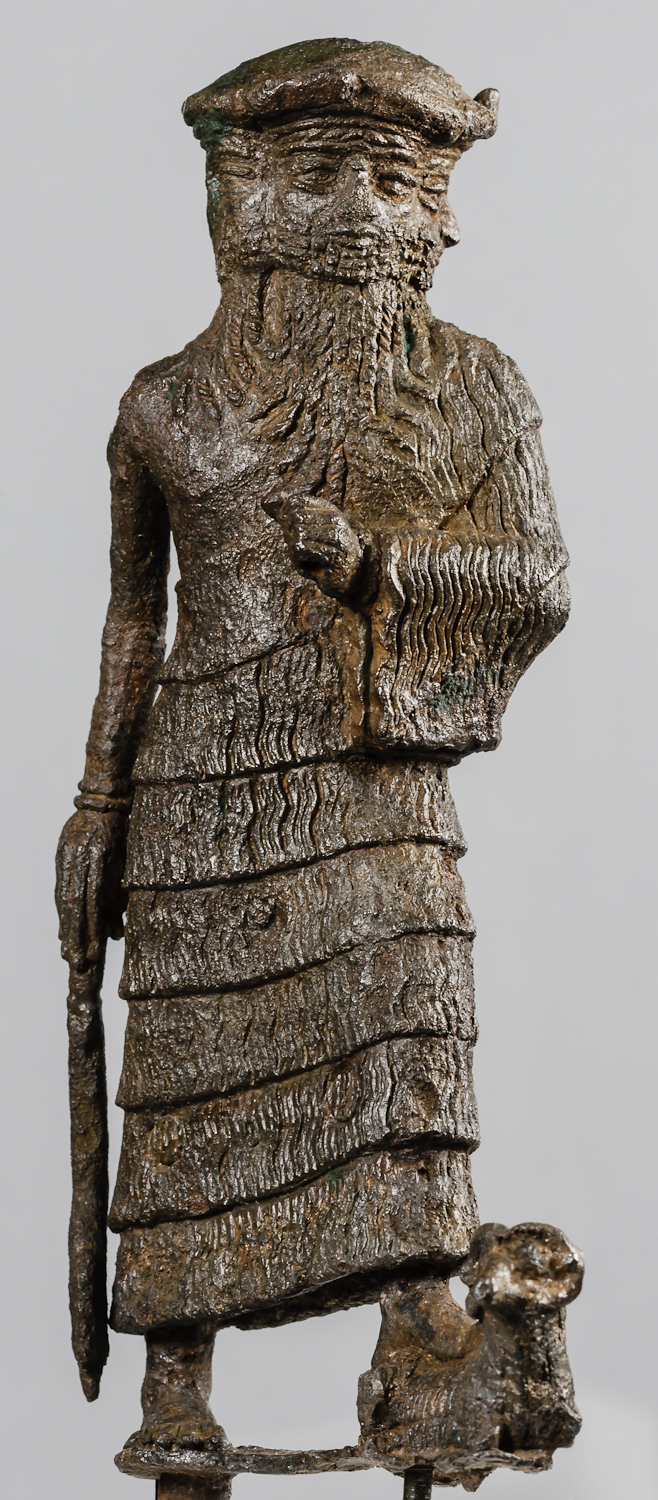
Four faced statuette, representing the god of the four winds. The god wears a low cap with a pair of horns meeting above each face. He carries a scimitar in his right hand and places his left foot upon the back of a crouching ram.  https://oi.uchicago.edu/collections/highlights/highlights-collection-mesopotamia

Four faced statuette, representing the god of the four winds. The god wears a low cap with a pair of horns meeting above each face. He carries a scimitar in his right hand and places his left foot upon the back of a crouching ram.
https://oi.uchicago.edu/collections/highlights/highlights-collection-mesopotamia

Another poet of Eridu, in a hymn to the Fire-god, speaks of the seven spirits in similar language:

  1. “O god of Fire,” he asks, “how were those seven begotten, how grew they up?
  2. Those seven in the mountain of the sunset were born;
  3. those seven in the mountain of the sunrise grew up.”

Throughout they are regarded as elemental powers, and their true character as destructive winds and tempests is but thinly veiled by a cloak of poetic imagery. But it will be noticed that they already belong to the harmful side of nature; and though the word which I have rendered “evil,” after the example of the Semitic translators, means rather “injurious” than “evil” in our sense of the word, they are already the products of night and darkness; their birth-place is the mountain behind which the sun sinks into the gloomy lower world.

 In the 22nd book of the great work on Astronomy, compiled for Sargon of Accad, they are termed “the seven great spirits” or galli, and it is therefore possible that they had already been identified with the “seven gods of destiny,” the Anúna-ge or “spirits of the lower world,” of the cult of Nipur.

In their gradual development into the Semite Rimmon, the spirits of the air underwent a change of parentage.

Mâtu, as we have seen, was, like his kindred wind-gods of Eridu, the offspring of Ea. But the home of the wind is rather the sky than the deep, and Meri, “the shining firmament,” was naturally associated with the sky.

When Ana, “the sky,” therefore, became the Semitic Anu, Rimmon, who united in himself Mâtu and Meri and other local gods of wind and weather as well, was made his son.”

A.H. Sayce, Lectures on the Origin and Growth of Religion as Illustrated by the Religion of the Ancient Babylonians, 5th ed., London, 1898, pp. 207-8.

On the Annunaki

“Hence it is that in a bilingual hymn the Anúnas of the lower world are called “the great gods;” while another text declares that while “the great gods are fifty in number, the gods of destiny are seven and the Anúna of heaven are five.”

Besides the five Anúnas of the heaven, there were the more famous Anúnas of the lower world, whose golden throne was placed in Hades by the side of the waters of life. They were called the Anú-na-ge, “the masters of the underworld,” a term which the Semites pronounced Anúnaki.

These Anúnaki were opposed to the Igigi or angels, the spirits of the upper air, and, the real origin of their name being forgotten, took the place of the older Anúnas.

In one of the texts I heve quoted, the Semitic translator not only renders the simple Anúnas by “Anúnaki,” he even speaks of the “Anúnaki of heaven,” which is a contradiction in terms.

Though Anunit was considered merely a local form of Istar (H.C. Rawlinson, The Cuneiform Inscriptions of Western Asia, 1886, 49, 12), the great temple of Ulbar–if that is the right pronunciation of the word–which had been erected by Zabu about B.C. 2340, preserved her special name and cult at Sippara, from whence it passed into Assyria.

Nabonidos tells us that he restored the temple

“for Anunit, the mistress of battle, the bearer of the bow and quiver, the accomplisher of the command of Bel her father, the sweeper away of the enemy, the destroyer of the wicked, who marches before the gods, who has made (his) omens favourable at sunrise and sunset.”

In calling her the lady of battle and daughter of Bel, Nabonidos identifies her with Istar, an identification which is made even more plain a few lines further on (col. iii. 42, 48-51), where he makes her the sister of Samas and daughter of Sin.

This identity of Anunit and Istar brings Sippara into close connection with Erech, the modern Warka, the city specially consecrated to the goddess of love.

Erech, we are told in the story of the plague-demon Nerra, was “the seat of Anu and Istar, the city of the choirs of the festival-girls and consecrated maidens of Istar,” where in E-Ana, “the house of heaven,” dwelt her priests, “the festival-makers who had devoted their manhood in order that men might adore the goddess, carrying swords, carrying razors, stout dresses and flint-knives,” “who minister to cause reverence for the glory of Istar.”

Erech, too, was the city with whose fortunes the legend of Gisdhubar (Gilgamesh) was associated; it was here that he slew the bull Anu had created to avenge the slight offered by him to Istar; and it was here in Uruk śuburi, “in Erech the shepherd’s hut,” that he exercised his sovereignty.

Erech is thus connected with the great epic of the Semitic Babylonians, and it is probable that its author, Siu-liqi- unnini, was a native of the place.

However this may be, Erech appears to have been one of the centres of Semitic influence in Babylonia from a very early period. The names of the kings stamped upon its oldest bricks bear Semitic names, and the extent to which the worship of Istar as developed at Erech spread through the Semitic world points to its antiquity as a Semitic settlement.”

A.H. Sayce, Lectures on the Origin and Growth of Religion as Illustrated by the Religion of the Ancient Babylonians, 5th ed., London, 1898, pp. 183-.5.

Nipur, City of Magic

“It is thus clear that, just as Eridu in southern Babylonia was the primitive seat of the worship of the Chaldean culture-god and of the civilisation with which his name was connected, Nipur in northern Babylonia was the original home of a very different kind of worship, which concerned itself with ghosts and demons and the various monsters of the under-world.

It was, in fact, the home of that belief in magic, and in the various spirits exorcised by the magician, which left so deep an impression upon the religion of early Babylonia, and about which I shall have to speak in a future Lecture.

The analogy of Eridu would lead us to infer, moreover, that it was not only the home of this belief, but also the source from which it made its way to other parts of the country.

In the pre-historic age, Eridu in the south and Nipur in the north would have been the two religious centres of Babylonian theology, from whence two wholly different streams of religious thought and influence spread and eventually blended.

The mixture formed what I may call the established religion of Chaldea in the pre-Semitic period. That this conclusion is not a mere inference is shown by the monuments discovered at Tel-loh.

Tel-loh was geographically nearer to Eridu than to Nipur, and its theology might therefore be expected to be more largely influenced by that of Eridu than by that of Nipur. And such, indeed, is the case.

Temples and statues are dedicated to Ea, “the king of Eridu,” and more especially to Bahu, a goddess who occupied a conspicuous place in the cosmological legends of Eridu.

But Mul-lil, the god of Nipur, appears far more frequently in the inscriptions of Tel-loh than we should have anticipated.

Nin-kharsak, “the mistress of the mountain,” and “mother of the gods,” in whom we may see a local divinity, is associated with him as wife; and Nin-girśu himself, the patron god of Tel-loh, is made his “hero” or “champion.”

So close, indeed, is the connection of the latter with Mul-lil, that the compilers of the mythological tablets, in a latter age, identified him with the “warrior” god of Nipur, Adar the son of Mul-lil.

Adar, or Ninep, or Uras--for his name has been read in these various fashions, and the true reading still remains unknown–played a conspicuous part in Babylonian, and more especially Assyrian theology.

He was regarded as emphatically the warrior and champion of the gods, and as such was naturally a favourite object of worship amongst a nation of warriors like the Assyrians. Indeed, it may be suspected that the extent to which the name of the older Bel was reverenced in Assyria was in some measure due to the favour in which his son Adar was held.

In the inscriptions of Nineveh, the title of “hero-god” (masu) is applied to him with peculiar frequency; this was the characteristic upon which the Assyrian kings more particularly loved to dwell.

In Babylonia, on the other hand, Adar was by no means so favourite a divinity. Here it was the milder and less warlike Merodach that took his place. The arts of peace, rather than those of war, found favour among the Semitic population of the southern kingdom.”

A.H. Sayce, Lectures on the Origin and Growth of Religion as Illustrated by the Religion of the Ancient Babylonians, 5th ed., London, 1898, pp. 150-2.

Bilat, Beltis, Nin-Ki-Gal, Allat, Infernal Queen of the Underworld

“When the god of Nipur became Semitic, his character underwent a change.

As the supreme deity of the state he was necessarily a Baal, but the Semitic Baal embodied very different conceptions from those which were associated with the Accadian Mul-lil. It is true that, as I have just pointed out, his primitive attributes still clung to him, but they were superadded to other attributes which showed him to be the supreme Sun-god of Semitic worship.

That supreme Sun-god, however, revealed himself to his worshippers under two aspects; he might be either the beneficent god who gave life and light to the world, or he might be the fierce and wrathful sun of summer who scorches all nature with his heat, and sinks at night, like a ball of glowing metal, into the darkness of the under-world.

Necessarily it was rather under the latter aspect that the Mul-lil of Nipur became the Semitic Bel.

This is the Bel whose cult was carried to Assyria, and whose name is mentioned frequently in the inscriptions of Nineveh, where among other titles he bears that of “father of the gods.”

This is a title which he received, not in virtue of his primitive character, but because he had become the Semitic Bel.

He was distinguished from the younger Bel of Babylon, Bel-Merodach, as βελιτανας or βολαθην (Βêl-êthûn), (ed. note: Greek sic) “the older Baal,” when Babylon became the imperial city, and its Bel claimed to be the father and head of the Babylonian gods.

But the distinction, as might be expected, was not always observed, and the older and younger Bel are sometimes confounded together.

The confusion was rendered the more easy by the fact that the wife of the Bel of Nipur was addressed as Bilat, and thus was undistinguished in name from Beltis of Babylon.

But she was in reality, as we have seen, the queen of Hades, Nin-ki-gal as the Accadians called her, or Allat as she is named in the Semitic texts.

Allat is interpreted “the unwearied;” like the Homeric epithet of Hades, αδαμαστος, “the inflexible” divinity who ceases not to deal on all sides his fatal blows. Her proper title, however–that, at least, under which she had originally been known at Nipur–was Nin-lil, “the lady of the ghost-world.”

It is under this name that Assur-bani-pal addresses her (Trustees of the British Museum (H.C. Rawlinson), The Cuneiform Inscriptions of Western Asia, ii. 66) as “the mistress of the world, whose habitation is the temple of the library” (i.e. the temple of Istar at Nineveh).

As Allat, the goddess of Hades, she was a much-dreaded and formidable figure, who is described in the legend of the Descent of Istar as inflicting upon her sister-goddess all the pains and diseases which emanated from her demoniac satellites.

The unfortunate Istar, stripped of her clothing and adornments, is held up to the scorn of the lower world; and Namtar, the plague-demon, is ordered by Allat to smite her with maladies in the eyes, in the sides, in the feet, in the heart, in the head, and, in short, in all the limbs.

Throughout the legend Namtar appears as the messenger of the infernal queen.”

A.H. Sayce, Lectures on the Origin and Growth of Religion as Illustrated by the Religion of the Ancient Babylonians, 5th ed., London, 1898, pp. 148-50.

Mul-lil = Bel

“The “lord of the ghost-world” extended his sway over this nether earth also.

He is therefore entitled “the lord of the world,” as well as “king of all the spirits of the earth.” According to one version of the story of the Deluge, it was he who caused the waters of the flood to descend from heaven, and who designed the destruction of all mankind.

“When Mul-lil,” we are told, “approached and saw the ship (of Xisuthros), he stood still and was filled with wrath against the gods and the spirits of heaven. ‘What soul has escaped therefrom?’ (he cried). ‘Let no man remain alive in the great destruction.'”

It was then that Ea came forward with words of wisdom, and protested against this attempt of Mul-lil to confound the innocent with the guilty.

“Let the sinner alone bear his sin; let the evil-doer bear his own iniquity.”

And though the wrathful god was pacified, so that Xisuthros and his companions were allowed to escape from their threatened death, the rescued hero did not forget the evil intentions of Mul-lil; but when inviting the other gods to his sacrifice after his descent from the ark, he specially excepted the god of Nipur.

“Let the (other) gods come to my altar, but let Mul-lil not come to the altar, since he did not act considerately, but caused a deluge and doomed my people to destruction.”

In these quotations I have called the god by his old Accadian name, Mul-lil; But long before this account of the Deluge was composed, even though in its present form it probably reaches back more than 2000 years before the Christian era, the Accadian Mul-lil had become the Semitic Bel.

His primitive attributes, however, still adhered to him. He was still the god of the lower world, whose messengers were diseases and nightmares and the demons of night, and from whom came the plagues and troubles that oppressed mankind.

In a magical text (Trustees of the British Museum (H.C. Rawlinson), The Cuneiform Inscriptions of Western Asia, iv. 1. 5, 6), Namtar, the plague-demon, is called “the beloved son of Mul-lil“–standing, in fact, in the same relation to Mul-lil that Tammuz does to Ea, and in the next line Mul-lil’s wife is asserted to be Nin-ki-gal or Allat, “the queen of the mighty land” of Hades.

This magical text, however, is a good deal older than the time when the Semites adopted and transformed the deities of the Accadians, or at all events it expresses the ideas of that earlier period.”

A.H. Sayce, Lectures on the Origin and Growth of Religion as Illustrated by the Religion of the Ancient Babylonians, 5th ed., London, 1898, pp. 146-8.

Origins of Lilith

“We can now understand why it was that in the theology of Eridu the Sun-god was the offspring of Ea and Dav-kina. The name that he bore there was Dumuzi or Tammuz, “the only-begotten one,” of whom I shall have much to say in the next Lecture.

At present I need only remark that he was the primeval Merodach; the Sun-god born of Ea who was called Merodach by the Babylonians was called Tammuz (Dumuzi,) by the people of Eridu.

Perhaps Merodach is after all nothing more than “the god from Eridu.” That he came originally from Eridu we have already seen.

The author of the hymn to the demiurge identifies Ea with “father Bel.” As “the lord of heaven and earth,” Ea was indeed a Baal or Bel to the Semites, to whose age the hymn belongs.

But the particular Bel with whom the poet wishes to identify him was Mul-lil, the supreme god and demiurge of Nipur (the modern Niffer). In a list of the titles of Ea, we find it expressly stated that he is one with “Mul-lil the strong.”

But such an identification belongs to the later imperial age of Babylonian history. Mul-lil was primitively a purely local divinity, standing in the same relation to his worshippers at Nipur that Ea stood to his at Eridu.

Mul-lil signifies “the lord of the ghost-world.” Lil was an Accado-Sumerian word which properly denoted “a dust-storm” or “cloud of dust,” but was also applied to ghosts, whose food was supposed to be the dust of the earth, and whose form was like that of a dust-cloud.

The Accadian language possessed no distinction of gender, and lil therefore served to represent both male and female ghosts. It was, however, borrowed by the Semites under the form of lillum, and to this masculine they naturally added the feminine lilatu.

Originally this lilatu represented what the Accadians termed “the handmaid of the ghost” (kel-lilla), of whom it was said that the lil had neither husband nor wife; but before long lilatu was confounded with the Semitic lilátu, “the night,” and so became a word of terror, denoting the night-demon who sucked the blood of her sleeping victims.

In the legend of the Descent of Istar into Hades, the goddess is made to threaten that unless she is admitted to the realm of the dead she will let them out in the form of vampires to devour the living.

From the Semitic Babylonians the name and conception of Lilatu passed to the Jews, and in the book of Isaiah (xxxiv. 14) the picture of the ghastly desolation which should befall Idumea is heightened by its ruined mounds being made the haunt of Lilith.

According to the Rabbis, Lilith had been the first wife of Adam, and had the form of a beautiful woman; but she lived on the blood of children whom she slew at night.”

A.H. Sayce, Lectures on the Origin and Growth of Religion as Illustrated by the Religion of the Ancient Babylonians, 5th ed., London, 1898, pp. 144-6.

The Oracles of Ea

“How a water-god became the demiurge seems at first sight obscure. But it ceases to be so when we remember the local character of Babylonian religion.

Ea was as much the local god of Eridu as Merodach was of Babylon, or Assur of Assyria. His connection with the water was due to the position of Eridu at the mouth of the Euphrates and on the shore of the sea, as well as to the maritime habits of its population.

In other respects he occupied the same place as the patron-deities of the other great cities. And these patron-deities were regarded as creators, as those by whose agency the present world had come into existence, and by whose hands the ancestors of their worshippers had been made.

This conception of a creating deity is one of the distinguishing features of early Babylonian religion. Mankind are not descended from a particular divinity, as they are in other theologies; they are created by him.

The hymn to Ea tells us that the god of Eridu was the creator of the black-headed race-that is to say, the old non-Semitic population whose primary centre and starting-point was in Eridu itself. It was as creators that the Accadian gods were distinguished from the host of spirits of whom I shall have to speak in another Lecture.

The Accadian word for “god” was dimer, which appears as dingir, from an older dingira, in the southern dialect of Sumer. Now dimer or dingir is merely “the creator,” formed by the suffix r or ra, from the verb dingi or dime, “to create.”

A simpler form of dimer is dime, a general name for the divine hierarchy. By the side of dime, dim, stood gime, gim, with the same meaning; and from this verb came the Sumerian name of Istar, Gingira. Istar is said to have been the mother of mankind in the story of the Deluge, and as Gula, “the great” goddess, she is addressed in a prayer as “the mother who has borne the men with the black heads.”

It was in consequence of the fact that he was a creator that Ea was, according to Accado-Sumerian ideas, a dingir or “god.”

In the cosmology of Eridu, therefore, the origin of the universe was the watery abyss. The earth lay upon this like a wife in the arms of her husband, and Dav-kina accordingly was adored as the wife of Ea.

It was through her that the oracles of Ea, heard in the voice of the waves, were communicated to man. Dav-kina is entitled “the mistress of the oracular voice of the deep,” and also “the lady who creates the oracular voice of heaven.”‘

The oracles delivered by the thunder, the voice of heaven, thus became the reflex of the oracles delivered through the roaring of the sea.”

A.H. Sayce, Lectures on the Origin and Growth of Religion as Illustrated by the Religion of the Ancient Babylonians, 5th ed., London, 1898, pp. 142-4.

Egyptian Hieroglyphs and Babylonian Cuneiform Share No Common Ancestor

Ea was [ … ] the source of their culture. He was symbolised, it would seem, by a serpent; … the primeval seat of the worship of Ea was the city of Eridu, now represented by the mounds of Abu Shahrein on the eastern bank of the Euphrates, and not far to the south of Mugheir or Ur.

Eridu is a contracted form of the older Eri-duga, or “good city,” which appears in the non-Semitic texts of northern Babylonia as Eri-zêba,with the same meaning. The place was thus a peculiarly holy spot, whose sanctity was established far and wide throughout the country.

But it was not a holy city only. It is often termed, more especially in the sacred tests, “the lordly city,”‘ and we are told that one of its titles was “the Iand of the sovereign.”

In historical times, however, Eridu had sunk to the condition of a second-rate or even third-rate town; its power must therefore belong to that dimly remote age of which the discoveries at Tel-loh have enabled us to obtain a few glimpses. There must have been a time when Eridu held a foremost rank among the cities of Babylonia, and when it was the centre from which the ancient culture and civilisation of the country made its way.

Along with this culture went the worship of Ea, the god of Eridu, who to the closing days of the Babylonian monarchy continued to be known as Eridúga, “the god of Eridu.” At the period when the first elements of Chaldean culture were being fostered in Eridu, the city stood at the mouth of the Euphrates and on the edge of the Persian Gulf.

If the growth of the alluvium at the mouths of the Euphrates and Tigris has always been the same as is the case at present (about sixty-six feet a year), this would have been at the latest about 3000 B.C.; but as the accumulation of soil has been more rapid of late, the date would more probably be about 4000 B.C.

Already, therefore, the cult of Ea would have been established, and the sea-faring traders of Eridu would have placed themselves under his protection.

It will be noticed that the culture-myths of Babylonia, like the culture-myths of America, bring the first civiliser of the country from the sea. It is as a sea deity that Oannes is the culture-hero of the Chaldeans; it is from the depths of the Persian Gulf that he carries to his people the treasures of art and science.

Two questions are raised by this fact. Was the culture of Babylonia imported from abroad; and was Ea, its god of culture, of foreign extraction?

The last great work published by Lepsius was an attempt to answer the first of these questions in the affirmative. He revived the old theory of a mysterious Cushite population which carried the civilisation of Egypt to the shores of Babylonia.

But to all theories of this sort there is one conclusive objection. The origin of Babylonian culture is so closely bound up with the origin of the cuneiform system of writing, that the two cannot be separated from each other.

Between the hieroglyphics of Egypt, however, and the primitive pictures out af which the cuneiform characters developed, there is no traceable connection.

Apart from those general analogies which we find in all early civilisations, the script, the theology and the astronomy of Egypt and Babylonia, show no vestiges of a common source.”

A.H. Sayce, Lectures on the Origin and Growth of Religion as Illustrated by the Religion of the Ancient Babylonians, 5th ed., London, 1898, pp. 134-6.

Sayce on the God Ea, or Oannes

“Ea, as we have already seen, was the god not only of the deep, but also of wisdom. Ancient legends affirmed that the Persian Gulf–the entrance to the deep or ocean-stream–had been the mysterious spot from whence the first elements of culture and civilisation had been brought to Chaldea.

Berossos, the Chaldean historian–so at least his epitomiser Alexander Polyhistor declared–had reported them as follows:

“At Babylon there was a great resort of people of various races who inhabited Chaldea, and lived in a lawless manner like the beasts of the field.

In the first year there appeared in that part of the Erythraean sea which borders upon Babylonia, a creature endowed with reason, by name Oannes, whose whole body (according to the account of Apollodaros) was that of a fish; under the fish’s head he had another head, with feet also below similar to those of a man subjoined to the fish’s tail.

His voice, too, and language were articulate and human; and a representation of him is preserved even to this day.

“This being was accustomed to pass the day among men, but took no food at that season; and he gave them an insight into letters and sciences and arts of every kind. He taught them to construct houses, to found temples, to compile laws, and explained to them the principles of geometrical knowledge.

He made them distinguish the seeds of the earth, and showed them how to collect the fruits; in short, he instructed them in everything which could tend to soften manners and humanize their lives. From that time, nothing material has been added by way of improvement to his instructions.

Now when the sun had set, this being Oannes used to retire again into the sea, and pass the night in the deep, for he was amphibious. After this there appeared other animals like Oannes, of which Berossos proposes to give an account when he comes to the history of the kings.

Moreover, Oannes wrote concerning the generation of mankind, of their different ways of life, and of their civil polity.”

[ … ]

The exact etymology of the name which appears under the Greek dress of Oannes has not yet been ascertained. Lenormant thought that it represented Ea-khan, “Ea the fish.” But whether or not this is the case, it is certain that Oannes and Ea are one and the same.

A depiction of Oannes, or Ea.

A depiction of Oannes, or Ea.

Ea, as we have seen, not only had his home in the waters of the Persian Gulf, he was also the culture-god of primitive Babylonia, the god of wisdom, the instructor of his worshippers in arts and science.

An old Babylonian sermon on the duty of a prince to administer justice impartially and without bribes, declares that if “he speaks according to the injunction (or writing) of the god Ea, the great gods will seat him in wisdom and the knowledge of righteousness.”

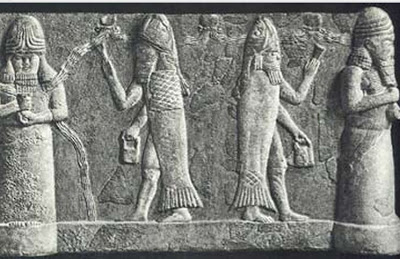
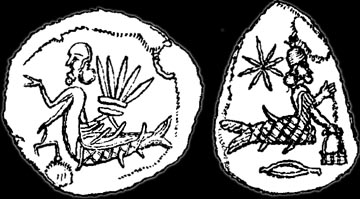
Ea was, moreover, like Oannes, represented as partly man and partly fish. Sometimes the fish’s skin is thrown over the man’s back, the head of a fish appearing behind that of the man; sometimes the body of the man is made to terminate in the tail of a fish.

A depiction of the God Ea, or Oannes.

A depiction of the God Ea, or Oannes.

A gem in the British Museum, on which the deity is depicted in the latter fashion, bears an inscription stating that the figure is that of “the god of pure life.”

OannesGems

Now “the god of pure life,” as we are expressly informed by a rubrical gloss to a hymn in honour of the demiurge Ea, was one of the names of Ea.”

A.H. Sayce, Lectures on the Origin and Growth of Religion as Illustrated by the Religion of the Ancient Babylonians, 5th ed., London, 1898, pp. 131-3.

Nebo, God of Prophecy

“A knowledge of Babylonian letters and learning was accompanied by a knowledge of the Babylonian god of letters and learning.

In Assyria, Nebo was honoured as much as he was in Babylonia itself. The Assyrian kings and scribes might be silent about the name of Merodach, but the name of Nebo was continually in their mouths.

His name and worship passed even to the distant Semitic tribes of the west. The names of places in Palestine in which his name occurs, proves that the god of prophecy was adored by Canaanites and Moabites alike. Moses, the leader and prophet of Israel, died on the peak of Mount Nebo, and cities bearing the name stood within the borders of the tribes of Reuben and Judah.

When the Israelites entered upon their literary era, the old name of roch, or “seer,” was exchanged for the more literary one of Nēbi, or “prophet.”

The Semites of Babylonia provided Nebo with a wife, Tasmitu, “the hearer.” She helped to open and enlarge the ears which received the divine mysteries her husband’s inspiration enabled his devout servants to write down.

The revolution which transferred the learning of the Babylonians from the Accadians to the Semites, transferred the patronage of the literary class from the old god Ea to his younger rivals Nebo and Tasmit.

[ … ]

The Semites of Babylonia thus closely resembled their brother Semites of Canaan in their fundamental conception of religion. As the Canaanite or Phoenician had “lords many,” the multitudinous Baalim who represented the particular forms of the Sun-god worshipped in each locality, so too the gods of Semitic Babylonia were equally multitudinous and local–Merodach, for example, being merely the Bel or Baal of Babylon, just as Mel-karth (Melech-kiryath) was the Baal of Tyre.

But the parallelism extends yet further. We have seen that the rise of the prophet-god in Babylonia marks the growing importance of literature and a literary class, just as the beginning of a literary age in Israel is coeval with the change of the seer into the prophet.

Now the literary age of Israel was long preceded by a literary age among their Phoenician neighbours, and its growth is contemporaneous with the closer relations that grew up between the monarchs of Israel and Hiram of Tyre.

What Israel was in this respect to the Phoenicians, Assyria was to Babylonia. The Assyrians were a nation of warriors and traders rather than of students; their literature was for the most part an exotic, a mere imitation of Babylonian cuiture.

In Babylonia, education was widely diffused; in Assyria, it was confined to the learned class. We must remember, therefore, that in dealing with Assyrian documents we are dealing either with a foreign importation or with the thoughts and beliefs of a small and special class.”

A.H. Sayce, Lectures on the Origin and Growth of Religion as Illustrated by the Religion of the Ancient Babylonians, 5th ed., London, 1898, pp. 119-122.

More Epithets of Nebo

“We have only to glance over the titles which were given to Nebo to see how thoroughly the conception of “the prophet” was associated with that of ‘”the writer.”

He is not only “the wise,” “the intelligent,” “the creator of peace,” “the author of the oracle;” he is also “the creator of the written tablet,” “the maker of writing,” “the opener” and “enlarger of the ear.”

Assur-bani-pal is never weary of telling us, at the end of the documents his scribes had copied from their Babylonian originals, that “Nebo and Tasmit had given him broad ears (and) endowed (him) with seeing eyes,” so that he had “written, bound together and published the store of tablets, a work which none of the kings who had gone before had undertaken, even the secrets of Nebo, the list of characters as many as exist.”

In the literary dialect of the Semitic epoch, Nebo went by the Accadian name of dim-sar, “the scribe,” and the ideograph by which he is sometimes denoted was regarded by the Semitic literati as signifying “the maker of intelligence” and “the creator of writing.”

These, however, were not the only titles that Nebo bore. He was also “the bond of the universe,” and “the overseer of the angel-hosts of heaven and earth.” The latter office might be explained as derived from his duties as scribe of the gods; but it is hard to discover what connection there could be between the first title and his association with literature.

Light is thrown upon it, however, by the fact that the ziggurrat or tower of his temple at Borsippa had the name of “the house of the seven bonds of heaven and earth.” The seven “bonds” seem to represent the seven planets, or rather their stations; the tower was in seven stages, and each stage was painted so as to symbolise the colours symbolical of the several planets.

Nebo must, therefore, have once been an elemental god, or at all events a god connected with the chief of the heavenly bodies.

We know that Babylonian astronomy made him the presiding deity of the planet Mercury, just as it made Merodach the presiding deity of Jupiter; but it cannot have been in reference to this that the tower of his temple was dedicated to the seven heavenly spheres.

Nebo cannot well have been one of the seven himself in the conception of its builders; he must rather have been the universe in which the seven spheres were set.”

A.H. Sayce, Lectures on the Origin and Growth of Religion as Illustrated by the Religion of the Ancient Babylonians, 5th ed., London, 1898, pp. 114-6.

Nebo, God of Wisdom, God of Writing

In Semitic days, Zarpanit, the inheritor of all these old traditions and worships, fell from her high estate. She ceased to be the goddess of wisdom, the voice of the deep revealing the secrets of heaven to the diviner and priest; she became merely the female shadow and companion of Merodach, to whom a shrine was erected at the entrance to his temple.

Her distinctive attributes all belong to the pre-Semitic epoch; with the introduction of a language which recognized gender, she was lost in the colourless throng of Ashtaroth or Baalat, the goddesses who were called into existence by the masculine Baalim.

Zarpanit, however, had something to do with the prominence given to Nebo in the Babylonian cult. Nebo, the son of Merodach and Zarpanitu, had, as we have seen, a chapel called E-Zida within the precincts of the great temple of his father.

E-Zida, “the constituted house,” derived its name from the great temple of Borsippa, the suburb of Babylon, the ruins of which are now known to travelers as the Birs-i-Nimrúd. Borsippa, it would seem, had once been an independent town, and Nebo, or the prototype of Nebo, had been its protecting deity.

In the middle of the city rose E-Zida, the temple of Nebo and Nana Tasmit, with its holy of holies, “the supreme house of life,” and its lofty tower termed “the house of the seven spheres of heaven and earth.” It had been founded, though never finished, according to Nebuchadnezzar, by an ancient king.

For long centuries it had remained a heap of ruin, until restored by Nebuchadnezzar, and legends had grown up thickly around it. It was known as the tul ellu, “the pure” or “holy mound,” and one of the titles of Nebo accordingly was “god of the holy mound.”

The word Nebo is the Semitic Babylonian Nabiu or Nabû. It means the proclaimer,” “the prophet,” and thus indicates the character of the god to whom it was applied. Nebo was essentially the proclaimer of the mind and wishes of Merodach.

He stood to Merodach in the same relation that an older mythology regarded Merodach as standing to Ea. While Merodach was rather the god of healing, in accordance with his primitively solar nature, Nebo was emphatically the god of science and literature.

The communication of the gifts of wisdom, therefore, which originally emanated from Ea, was thus shared between Merodach and his son. At Babylon, the culture-god of other countries was divided into two personalities, the one conveying to man the wisdom that ameliorates his condition, the other the knowledge which finds its expression in the art of writing.”

A.H. Sayce, Lectures on the Origin and Growth of Religion as Illustrated by the Religion of the Ancient Babylonians, 5th ed., London, 1898, pp. 112-3.

Triads and Feminine Reflections in Babylonian Religion

“Even at Babylon, however, Merodach did not stand alone. He shared his divine honours, as we have seen, with his wife Zarpanitu and his son Nebo.

The old Accadian cult seems to have had a fancy for trinities or triads, originating perhaps in the primary astronomical triad of the Sun-god, the Moon-god and the Evening Star.

The Accadian triad usually consisted of male deities. The Semites, however, as I hope to point out in the next Lecture, introduced a new idea, that of sex, into the theology of the country. Every god was provided with his female reflection, who stood to him in the relation of the wife to the husband.

Baal, accordingly, had his female reflex, his “face,” as it was termed, Bilat or Beltis. By the side of the Baal of Babylon, therefore, stood Beltis, “the lady” by the side of her “lord.”

Her local name mas Zarpanitu, which a punning etymology subsequently turned into Zir-banitu, “creatress of seed,” sometimes written Zir-panitu, with an obvious  play on the word panu, or “face.”

Zarpanitu was of purely Semitic origin. But she was identified with an older Accadian divinity, Gasmu, “the wise one,” the fitting consort of a deity whose office it was to convey the wishes of the god of wisdom to suffering humanity.

The Accadian goddess, however, must originally have stood rather in the relation of mother than of wife to the primitive Merodach. She was entitled “the lady of the deep,” “the mistress of the abode of the fish,” and “the voice of the deep.”

Hence she must have ranked by the side of Ea, the fish-god and “lord of the deep;” and in the title “voice” or “incantation of the deep,” we may see a reference to the ideas which caused Ea to become the god of wisdom, and brought the fish-god Oannes out of the Persian Gulf to carry culture and knowledge to the inhabitants of Chaldea.

In the roar of the sea-waves, the early dwellers on the shores of the Gulf must have heard the voice of heaven, and their prophets and diviners must have discovered in it a revelation of the will of the gods.

It is not surprising, therefore, if Zarpanit was specially identified with the goddess Lakhamun, who was worshipped in the sacred island of Dilmun, or with the goddess Elagu, whose name was revered in the mountains of Elam.”

A.H. Sayce, Lectures on the Origin and Growth of Religion as Illustrated by the Religion of the Ancient Babylonians, 5th ed., London, 1898, pp. 110-1.

The Puzzle of Marduk

“Was Merodach himself an Accadian or a Semitic deity? The names of the kings belonging to the first dynasty of Babylon are mostly Semitic; it might therefore be supposed that the deity they worshipped was Semitic also.

And so undoubtedly was the Merodach of the historical age, the great Bel or Baal of Babylon. But we must remember that the foundation of Babylon went back into the dim night of the past far beyond the era of its first dynasty of Semitic kings, and that its very name was but a translation of the older Ka-dimira, “gate of the god.”

The temple of Merodach, moreover, bore, up to the last, not a Semitic, but an Accadian designation. As we shall see, along with the older culture the Semitic settlers in Babylonia borrowed a good deal of the theology of the Accadian people, modifying it in accordance with their own beliefs, and identifying its gods and demons with their own Baalim.

Marduk.

Marduk.

It would not be surprising, then, if we found that Merodach also had once been an Accadian divinity, though his attributes, and perhaps also his name, differed very considerably from those of the Semitic Bel.

Even after the Romans had identified their Saturn with the Kronos of the Greeks, the essential characteristics of the two deities remained altogether different.”

A.H. Sayce, Lectures on the Origin and Growth of Religion as Illustrated by the Religion of the Ancient Babylonians, 5th ed., London, 1898, p. 105.

Elder and Younger Bel

The Bel of this legend, who has settled the places of the Sun and the Moon in the sky, is not the Babylonian Bel, but the older Bel of Nipur, from whom Merodach, the Bel of Babylon, had afterwards to be distinguished.

The Accadian original of the poem belongs to a very early epoch, before the rise of Babylon, when the supreme Bel of the Semitic inhabitants of Babylonia was still the god whom the Accadians called Mul-lilla, “the lord of the lower world.”

This Bel or Mul-lilla fades into the background as the Semitic element in Babylonian religion became stronger and the influence of Babylon greater, though the part that he played in astronomical and cosmological lore, as well as his local cult at Nipur, kept his memory alive; while the dreaded visitants of night, the demoniac lilu and lilat or lilith, from the lower world, preserved a faint memory of the spirits of which he had once been the chief.

Burney Relief, Babylon (1800-1750 BCE). The figure in the relief was sometimes identified with Lilith, based on a misreading of an outdated translation of the Epic of Gilgamesh. Modern research has identified the figure as either Ishtar or Ereshkigal. https://upload.wikimedia.org/wikipedia/commons/1/19/Burney_Relief_Babylon_-1800-1750.JPG

Burney Relief, Babylon (1800-1750 BCE). The figure in the relief was sometimes identified with Lilith, based on a misreading of an outdated translation of the Epic of Gilgamesh. Modern research has identified the figure as either Ishtar or Ereshkigal.
https://upload.wikimedia.org/wikipedia/commons/1/19/Burney_Relief_Babylon_-1800-1750.JPG

 One by one, however, the attributes that had formerly attached to the older Bel were absorbed by the younger Bel of Babylon.

It was almost as it was in Greece, where the older gods were dethroned by their own offspring; in the Babylonia of Nebuchadnezzar and Nabonidos, it was the younger gods–Merodach, Sin and Samas–to whom vows were the most often made and prayer the most often ascended.

Such was the latest result of the local character of Babylonian worship: the younger gods were the gods of the younger Babylonian cities, and the god of Babylon, though he might be termed “the first-born of the gods,” was in one sense the youngest of them all.

The title, however, “first-born of the gods” was of the same nature as the other title, “prince of the world,” bestowed upon him by his grateful worshippers. It meant little else than that Babylon stood at the head of the world, and that its god must therefore be the first-born, not of one primeval deity, but of all the primeval deities acknowledged in Chaldea.

According to the earlier faith, he was the first-born of Ea only. Ea was god of the deep, both of the atmospheric deep upon which the world floats, and of that watery deep, the Okeanos of Homer, which surrounds the earth like a coiled serpent.

All streams and rivers were subject to his sway, for they flowed into that Persian Gulf which the ignorance of the primitive Chaldean imagined to be the ocean-stream itself. It was from the Persian Gulf that tradition conceived the culture and civilisation of Babylonia to have come, and Ea was therefore lord of wisdom as well as lord of the deep.

His son Merodach was the minister of his counsels, by whom the commands of wisdom were carried into practice. Merodach was thus the active side of his father Ea; to use the language of Gnosticism, he was the practical activity that emanates from wisdom.”

A.H. Sayce, Lectures on the Origin and Growth of Religion as Illustrated by the Religion of the Ancient Babylonians, 5th ed., London, 1898, p. 103-4.

E-Sagila: Temple of the Sun

“May we not conclude, then, that originally Merodach also was a solar deity, the particular Sun-god, in fact, whose worship was carried on at Babylon?

The conclusion is verified by the express testimony of the ritual belonging to Merodach’s temple E-Sagila. Here we read that

“In the month Nison, on the second day, two hours after nightfall, the priest must come and take of the waters of the river, must enter into the presence of Bel; and putting on a stole in the presence of Bel, must say this prayer:

“0 Bel, who in his strength has no equal! O Bel, blessed sovereign, lord of the world, seeking after the favour of the great gods, the lord who in his glance has destroyed the strong, lord of kings, light of mankind, establisher of faith!

0 Bel, thy sceptre is Babylon, thy crown is Borsippa, the wide heaven is the dwelling-place of thy liver. …0 lord of the world, light of the spirits of heaven, utterer of blessings, who is there whose mouth murmurs not of thy righteousness, or speaks not of thy glory, and celebrates not thy dominion?

0 lord of the world, who dwellest in the temple of the Sun, reject not the hands that are raised to thee; be merciful to thy city Babylon, to E-Sagila thy temple incline thy face; grant the prayers of thy people the sons of Babylon.”

Nothing can be more explicit than the statement that E-Sagila, the temple of Merodach, was also the temple of the Sun. We thus come to understand the attributes that are ascribed to Merodach and the language that is used of him.

He is “the light of the spirits of heaven,” even as the Son-god, … is “the illuminator of darkness” whose face is beheld by the spirits of the earth. The wide heaven is naturally his dwelling-place, and he raises the dead to life as the sun of spring revivifies the dead vegetation of winter.

The part that he plays in the old mythological poems, in the poems, that is, which embody the ancient myths and legends of Babylonia, is now fully explained. One of the most famous of these was the story of the combat between Merodach and Tiamat, the dragon of darkness and chaos.”

A.H. Sayce, Lectures on the Origin and Growth of Religion as Illustrated by the Religion of the Ancient Babylonians, 5th ed., London, 1898, pp. 100-102.

Marduk as Sun God of Babylon

Here Merodach, it will be observed, though “lord of all that exists,” is nevertheless only the first-born of the gods.

There were gods older than he, just as there were cities older than Babylon. He could not therefore be absolute lord of the world; it was only within Babylon itself that this was the case; elsewhere his rule was shared with others.

Hence it was that while Nebuchadnezzar as a native of Babylon was the work of his hands, outside Babylon there were other creators and other lords. This fact is accentuated in an inscription of Nabonidos, belonging to the earlier part of his reign, in which Merodach is coupled with the Moon-god of Ur and placed on an equal footing with him.

One of the epithets applied by Nebuchadnezzar to Merodach is that of riminu, or “merciful.” It is indeed a standing epithet of the god. Merodach was the intercessor between the gods and men, and the interpreter of the will of Ea, the god of wisdom.

In an old bilingual hymn he is thus addressed: “Thou art Merodach, the merciful lord who loves to raise the dead to life.” The expression is a remarkable one, and indicates that the Babylonians were already acquainted with a doctrine of the resurrection at an early period.

Merodach’s attribute of mercy is coupled with his power to raise the dead. The same expression occurs in another of these bilingual hymns, which I intend to discuss in a future Lecture…

“(Thou art) the king of the land, the lord of the world!

0 firstborn of Ea, omnipotent over heaven and earth.

0 mighty lord of mankind, king of (all) lands,

(Thou art) the god of gods,

(The prince) of heaven and earth who hath no rival,

The companion of Anu and Bel (Mul-lil),

The merciful one among the gods,

The merciful one who loves to raise the dead to life,

Merodach, king of heaven and earth,

King of Babylon, lord of E-Sagila,

King of E-Zida, king of E-makh-tilla (the supreme house of life),

Heaven and earth are thine!

The circuit of heaven and earth is thine,

The incantation that gives life is thine,

The breath that gives life is thine,

The holy writing of the mouth of the deep is thine:

Mankind, even the black-headed race (of Accad),

All living souls that have received a name, that exist in the world,

The four quarters of the earth wheresoever they are,

All the angel-hosts of heaven and earth

(Regard) thee and (lend to thee) an ear.”

[ … ]

A.H. Sayce, Lectures on the Origin and Growth of Religion as Illustrated by the Religion of the Ancient Babylonians, 5th ed., London, 1898, pp. 98-102.

Temple of Bel, Temple of Marduk, Temple of Babylon, E-Sagila

“He says of it:

Ka-khilibu, the gate of glory, as well as the gate of E-Zida within E-Sagila, I made as brilliant as the sun. The holy seats, the place of the gods who determine destiny, which is the place of the assembly (of the gods), the holy of holies of the gods of destiny, wherein on the great festival (Zagmuku) at the beginning of the year, on the eighth and the eleventh days (of the month), the divine king (Merodach), the god of heaven and earth, the lord of heaven, descends, while the gods in heaven and earth, listening to him with reverential awe and standing humbly before him, determine therein a destiny of long-ending days, even the destiny of my life; this holy of holies, this sanctuary of the kingdom, this sanctuary of the lordship of the first-born of the gods, the prince, Merodach, which a former king had adorned with silver, I overlaid with glittering gold and rich ornament.”

Just within the gate was the “seat” or shrine of the goddess Zarpanit, the wife of Merodach, perhaps to be identified with that Succoth-benoth whose image, we are told in the Old Testament, was made by the men of Babylon.

E-Zida, “the firmly-established temple,” was the chapel dedicated to Nebo, and derived its name from the great temple built in honour of that deity at Borsippa. As Nebo was the son of Merodach, it was only fitting that his shrine should stand within the precincts of his father’s temple, by the side of the shrine sacred to his mother Zarpanit.

It was within the shrine of Nebo, the god of prophecy, that the parakku, or holy of holies, was situated, where Merodach descended at the time of the great festival at the beginning of the year, and the divine oracles were announced to the attendant priests.

The special papakha or sanctuary of Merodach himself was separate from that of his son. It went by the name of E-Kua, “the house of the oracle,” and probably contained the golden statue of Bel mentioned by Herodotus.

Nebuchadnezzar tells us that he enriched its walls with ”glittering gold.” Beyond it rose the stately ziggurat, or tower of eight stages, called E-Temen-gurum, “the house of the foundation-stone of heaven and earth.” As was the case with the other towers of Babylonia and Assyria, its topmost chamber was used as an observatory.

This illustration depicts the dual ziggurats of E-temen-anki and the Temple of Bel, conflating them as E-Sagila, the Temple of Marduk.  http://www.dalamatiacity.com/urantia-clues23.htm

This illustration depicts the dual ziggurats of E-temen-anki and the Temple of Bel, conflating them as E-Sagila, the Temple of Marduk.
http://www.dalamatiacity.com/urantia-clues23.htm

No temple was complete without such a tower; it was to the Babylonian what the high-places were to the inhabitants of a mountainous country like Canaan. It takes us back to an age when the gods were believed to dwell in the visible sky, and when therefore man did his best to rear his altars as near to them as possible. “Let us build us a city and a tower,” said the settlers in Babel, “whose top may reach unto heaven.”

 The Babylonian Bel, accordingly, was Merodach, who watched over the fortunes of Babylon and the great temple there which had been erected in his honour. He was not the national god of Babylonia, except in so far as the city of Babylon claimed to represent the whole of Babylonia; he was simply the god of the single city of Babylon and its inhabitants.

This map depicts more clearly the relative positions of Etemenanki and the Temple of Marduk.  Map of Babylon Creator Jona Lendering Licence Attribution-NonCommercial-ShareAlike 4.0 International Linked Babylon, Babylonian Empire, Capture of Babylon (Herodotus), Esagila, Etemenanki (the "Tower of Babel"), Zopyrus Categories Babylonia http://www.livius.org/pictures/a/maps/map-of-babylon/ http://www.livius.org/place/etemenanki/

This map depicts more clearly the relative positions of Etemenanki and the Temple of Marduk.
Map of Babylon
Creator
Jona Lendering
Licence
Attribution-NonCommercial-ShareAlike 4.0 International
Linked
Babylon, Babylonian Empire, Capture of Babylon (Herodotus), Esagila, Etemenanki (the “Tower of Babel”), Zopyrus
Categories
Babylonia
http://www.livius.org/pictures/a/maps/map-of-babylon/
http://www.livius.org/place/etemenanki/

He was but one Baal out of many Baalim, supreme only when his worshippers were themselves supreme. It was only when a Nebuchadnezzar or a Khammuragas was undisputed master of Babylonia that the god they adored became “the prince of the gods.”

But the other gods maintained their separate positions by his side, and in their own cities would have jealously resented any interference with their ancient supremacy. As we have seen, Nabonidos brought upon himself the anger of heaven because he carried away the gods of Marad and Kis and other towns to swell the train of Merodach in his temple at Babylon.”

 A.H. Sayce, Lectures on the Origin and Growth of Religion as Illustrated by the Religion of the Ancient Babylonians, 5th ed., London, 1898, pp. 94-7.

E-Sagila, The Great Temple of Bel in Babylon

The temple or “tomb”of Bêlos, as it was also called by the Greeks, was one of the wonders of the world.

Hêrodotos, quoting probably from an earlier author, describes it in the following terms :

“The temple of Zeus Bêlos,with bronze gates which remained up to my time, was a square building two furlongs every way. In the middle of the temple was a tower of solid masonry, a furlong in length and breadth, and upon this tower another tower had been erected, and upon that again another, and so on for eight towers.

And the ascent to them was by an incline which wound round all the towers on the outside. About the middle of the incline are a resting-place and seats, where those who ascend may sit and rest. In the topmost tower is a large shrine, within which is a large and well-appointed couch, with a golden table at its side.

But no image is set up there, nor does any one pass the night there except a single woman, a native of the country, whom the god selects for himself from among all the inhabitants, as is asserted by the Chaldeans, the priests of the god.

They further say, though I cannot believe it, that the god himself visits the shrine and takes his rest upon the couch. … There is another shrine below belonging to this Babylonian temple, and containing a great statue of Zeus [Bêlos] of gold in a sitting posture, and a great golden table is set beside it.

The pedestal and chair of the statue are of gold, and, as the Chaldeans used to say, the gold was as much as 800 talents in weight. Outside the shrine is a golden altar. There is also another great altar upon which full-grown sheep are sacrificed, for upon the golden altar only sucklings are allowed to be offered.

Upon the larger altar also the Chaldeans burn each year a thousand talents of frankincense at the time when they keep the festival of the god. In this part of the temple there was still at that time a figure of a man twelve cubits high, of solid gold.”

It is clear from this description that the great temple of Babylon resembled a large square enclosure formed by huge walls of brick, within which rose a tower in eight stages. Below the tower was a shrine or temple, and outside it two altars, the smaller one of gold for special offerings, while the larger one was intended for the sacrifice of sheep as well as for the burning of incense.

We learn a good deal about this temple from the inscriptions of Nebuchadnezzar, which show that although Hêrodotos was correct in his general description of the building, he has made mistakes in the matter of details.

The Temple itself stood on the east side of Babylon, and had existed since the age of Khammuragas (B.C. 2250), and the first dynasty which had made Babylon its capital. It bore the title of E-Sagila or E-Saggil, an Accadian name signifying “the house of the raising of the head.”

Its entrance also bore the Accadian title of Ka-khilibu, which Nebuchadnezzar renders “the gate of glory.”

 A.H. Sayce, Lectures on the Origin and Growth of Religion as Illustrated by the Religion of the Ancient Babylonians, 5th ed., London, 1898, pp. 92-4.

Marduk of Babylon: Baal

” … Nebuchadnezzar may invoke Merodach as “the lord of the gods,” “the god of heaven and earth,” “the eternal, the holy, the lord of all things,” but he almost always couples him with other deities–Nebo, Sin or Gula–of whom he speaks in equally reverential terms.

Even Nabonidos uses language of Sin, the Moon-god, which is wholly incompatible with a belief in the exclusive supremacy of Merodach. He calls him “the lord of the gods of heaven and earth, the king of the gods and the god of gods, who dwell in heaven and are mighty.” Merodach was, in fact, simply the local god of Babylon.

Events had raised Babylon first to the dignity of the capital of Babylonia, and then of that of a great empire, and its presiding deity had shared its fortunes. It was he who had sent forth its people on their career of conquest; it was to glorify his name that he had given them victory.

The introduction of other deities on an equal footing with himself into his own peculiar seat, his own special city, was of itself a profanation, and quite sufficient to draw upon Nabonidos his vindictive anger. The Moon-god might be worshipped at Ur; it was out of place to offer him at Babylon the peculiar honours which were reserved for Merodach alone.

Here, then, is one of the results of that localisation of religious worship which was characteristic of Babylonia. Nabonidos not only offended the priests and insulted the gods of other cities by bringing their images into Babylon, he also in one sense impaired the monopoly which the local deity of Babylon enjoyed. He thus stirred up angry feelings on both sides.

Had he himself been free from the common belief of the Babylonian in the local character of his gods, he might have effected a revolution similar to that of Hezekiah; he had, however, the superstition which frequently accompanies antiquarian instincts, and his endeavour to make Babylon the common gathering-place of the Babylonian divinities was dictated as much by the desire to make all of them his friends as by political design.

Now who was this Merodach, this patron-god of Babylon, whose name I have had so often to pronounce? Let us see, first of all, what we can learn about him from the latest of our documents, the inscriptions of Nebuchadnezzar and his successors.

In these, Merodach appears as the divine protector of Babylon and its inhabitants. He has the standing title of Bilu or “lord,” which the Greeks turned into βμλος, and which is the same as the Baal of the Old Testament. The title is frequently used as a name, and is, in fact, the only name under which Merodach was known to the Greeks and Romans.

In the Old Testament also it is as Bel that he comes before us. When the prophet declares that “Bel boweth down” and is “gone into captivity,” he is referring to Merodach and the overthrow of Merodach’s city.

To the Babylonian, Merodach was pre-eminently the Baal or “lord,” like the Baalim or “lords” worshipped under special names and with special rites in the several cities of Canaan.”

 A.H. Sayce, Lectures on the Origin and Growth of Religion as Illustrated by the Religion of the Ancient Babylonians, 5th ed., London, 1898, pp. 90-2.

Civil Centralization = Religious Centralization

“Up to the last, Babylonian religion remained local. It was this local character that gives us the key to its origin and history, and explains much that would otherwise seem inconsistent and obscure.

The endeavour of Nabonidos to undermine its local character and to create a universal religion for a centralised Babylonia, was deeply resented by both priests and people, and ushered in the fall of the Babylonian empire. The fundamental religious idea which had underlain the empire had been the supremacy of Merodach, the god of Babylon, over all other gods, not the absorption of the deities of the subject nations into a common cult.

The policy of Nabonidos, therefore, which aimed at making Merodach, not primus inter pares, but absolute lord of captive or vassal deities, shocked the prejudices of the Babylonian people, and eventually proved fatal to its author.

In Cyrus, accordingly, the politic restorer of the captive populations and their gods to their old homes, the priests and worshippers of the local divinities saw the pious adherent of the ancient forms of faith, and the real favourite of Merodach himself.

Merodach had not consented to the revolutionary policy of Nabonidos; he had, on the contrary, sympathised with the wrongs of his brother gods in Babylonia and throughout the world, and had thus deserted his own city and the renegade monarch who ruled over it.

In all this there is a sharp contrast to the main religious conception which subsequently held sway over the Persian empire, as well as to that which was proclaimed by the prophets of Judah, and in the reforms of Hezekiah and Josiah was carried out practically by the Jewish kings. The Ahura-mazda whom Dareios invokes on the rock of Behistun is not only the lord of the gods, he is a lord who will not brook another god by his side.

A penciled illustration of the Behistun Inscription.  https://commons.wikimedia.org/wiki/File:Behistun_Inscription_Eger.png

A penciled illustration of the Behistun Inscription.
https://commons.wikimedia.org/wiki/File:Behistun_Inscription_Eger.png

The supreme god of the Persian monarch is as absolute as the Persian monarch himself. In the Persian empire which was organised by Dareios, centralisation became for the first time a recognised and undisputed fact, and political centralisation went hand-in-hand with religious centralisation as well.

In Judah, a theocracy was established on the ruins of the old beliefs which had connected certain localities with certain forms of divinity, and which found such naive expression in the words of David to Saul (1 Samuel xxvi. 19): “They have driven me out this day from abiding in the inheritance of the Lord, saying, Go, serve other gods.”

The destruction of the high-places and the concentration of the worship of Yahveh in Jerusalem, was followed by the ever-increasing conviction that Yahveh was not only a jealous God who would allow none other gods besides Himself; He was also a God who claimed dominion over the whole world.”

A.H. Sayce, Lectures on the Origin and Growth of Religion as Illustrated by the Religion of the Ancient Babylonians, 5th ed., London, 1898, pp. 89-90.

The Fall of Nabonidos

“The destruction of the local cults, the attempt to unify and centralise religious worship, was to the Rab-shakeh, as it was to the Babylonian scribes, and doubtless also to many of the Jews in the time of Hezekiah, an act of the grossest impiety.

An annalistic tablet, drawn up not long after the conquest of Babylonia by Cyrus, hints that before making his final attack on the country, the Elamite prince had been secretly aided by a party of malcontents in Chaldea itself.

It is at all events significant that as soon as the army of Nabonidos was defeated, the whole population at once submitted, and that even the capital, with its almost impregnable fortifications, threw open its gates.

The revolts which took place afterwards in the reigns of Dareios and Xerxes, and the extremities endured by the Babylonians before they would surrender their city, prove that their surrender was not the result of cowardice or indifference to foreign rule. The great mass of the people must have been discontented with Nabonidos and anxious for his overthrow.

The anger of Merodach and the gods, in fact, was but a convenient way of describing the discontent and anger of an important section of the Babylonians themselves. Nabonidos did not belong to the royal house of Nebuchadnezzar; he seems to have raised himself to the throne by means of a revolution, and his attempt at centralisation excited strong local animosities against him.

Religion and civil government were so closely bound up together, that civil centralisation meant religious centralisation also; the surest sign that the cities of Babylonia had been absorbed in the capital was that the images of the gods whose names had been associated with them from time immemorial were carried away to Babylon. The cities lost their separate existence along with the deities who watched over their individual fortunes.

The removal of the gods, however, implied something more than the removal of a number of images and the visible loss of local self-government or autonomy. Each image was the centre of a particular cult, carried on in a particular temple in a particular way, and entrusted to the charge of a special body of priests.

It was no wonder, therefore, that the high-handed proceedings of Nabonidos aroused the enmity of these numerous local priesthoods, as well as of all those who profited in any way from the maintenance of the local cults.

Most of the cities which were thus deprived of their ancestral deities were as old as Babylon; many of them claimed to be older; while it was notorious that Babylon did not become a capital until comparatively late in Babylonian history.

The Sun-god of Sippara, the Moon-god of Ur, were alike older than Merodach of Babylon. Indeed, though in the age of Nabonidos the title of Bel or “lord”had come to be applied to Merodach specially, it was known that there was a more ancient Bel–Belitanas, “the elder Bel,” as the Greeks wrote the word–whose worship had spread from the city of Nipur, and who formed one of the supreme triad of Babylonian gods.”

A.H. Sayce, Lectures on the Origin and Growth of Religion as Illustrated by the Religion of the Ancient Babylonians, 5th ed., London, 1898, pp. 85-6.

The Rise of Marduk

“In an inscription upon a clay cylinder brought from Babylonia seven years ago, Cyrus is made to declare that the overthrow of Nabonidos, the last independent Babylonian monarch, was due to the anger of Bel and the other gods.

Nabonidos had removed their images from their ancient sanctuaries, and had collected them together in the midst of Babylon. The priests maintained that the deed had aroused the indignation of Merodach, “the lord of the gods,” who had accordingly rejected Nabonidos, even as Saul was rejected from being king of Israel, and had sought for a ruler after his own heart.

It was “in wrath” that the deities had ”left their shrines when Nabonidos brought them into Babylon,” and had prayed Merodach, the divine patron of the imperial city, to “go round unto all men wherever might be their seats.”

Merodach sympathised with their wrongs; “he visited the men of Sumer and Accad whom he had sworn should be his attendants,” and “all lands beheld his friend.” He chose Cyrus, king of Elam, and destined him by name for the sovereignty of Chaldea.

Cyrus, whom the Hebrew prophet had already hailed as the Lord’s Anointed, was thus equally the favourite of the supreme Babylonian god.

“Merodach, the great lord, the restorer of his people,” we are told, “beheld with joy the deeds of his vicegerent who was righteous in hand and heart. To his city of Babylon he summoned his march, and he bade him take the road to Babylon; like a friend and a comrade he went at his side.”

A single battle decided the conflict: the Babylonians opened their gates, and “without fighting or battle,” Cyrus was led in triumph into the city of Babylon.

His first care was to show his gratitude towards the deities who had so signally aided him. Their temples were rebuilt, and they themselves were restored to their ancient seats.

With all the allowance that must be made for the flattery exacted by a successful conqueror, we must confess that this is a very remarkable document. It is written in the Babylonian language and in the Babylonian form of the cuneiform syllabary, and we may therefore infer that it was compiled by Babylonian scribes and intended for the perusal of Babylonian readers.

Yet we find the foreign conqueror described as the favourite of the national god, while the last native king is held up to reprobation as the dishonorer of the gods. It is impossible not to compare the similar treatment experienced by Nebuchadnezzar and the native Jewish kings respectively at the hands of Jeremiah.

The Jewish prophet saw in the Chaldean invader the instrument of the God of Judah, just as the Babylonian scribes saw in Cyrus the instrument of the god of Babylon; and the fall of the house of David is attributed, just as much as the fall of Nabonidos, to divine anger.”

A.H. Sayce, Lectures on the Origin and Growth of Religion as Illustrated by the Religion of the Ancient Babylonians, 5th ed., London, 1898, pp. 85-6.

Sacred Number 7

“Seven, too, was a sacred number, whose magic virtues had descended to the Semites from their Accadian predecessors. When the Chaldaean Noah escaped from the Deluge, his first act was to build an altar and to set vessels, each containing the third of an ephah, by sevens, over a bed of reeds, pine-wood and thorns.

Seven by seven had the magic knots to be tied by the witch, seven times had the body of the sick man to be anointed with the purifying oil.

As the Sabbath of rest fell on each seventh day of the week, so the planets, like the demon messengers of Anu, were seven in number, and “the god of the number seven” received peculiar honour.”

A.H. Sayce, Lectures on the Origin and Growth of Religion as Illustrated by the Religion of the Ancient Babylonians, 5th ed., London, 1898, p. 82.

Sacrifice of Children was a Babylonian Institution

” … But although the Assyrian kings are fond of boasting of their exploits in massacring or torturing their defeated enemies in honour of Assur, we find no allusions in the inscriptions of the historical period to human sacrifice.

That human sacrifices, however, were known as far back as the Accadian era, is shown by a bilingual text (K5139) which enjoins the abgal, or “chief prophet,” to declare that the father must give the life of his child for the sin of his own soul, the child’s head for his head, the child’s neck for his neck, the child’s breast for his breast.

The text not only proves that the idea of vicarious punishment was already conceived of; it also proves that the sacrifice of children was a Babylonian institution.

In the great work on astronomy called The Observations of Bel, we are told that “on the high-places the son is burnt.” The offering was consequently by fire, as in Phoenicia.

The sacrifices were accompanied, sometimes by hymns or incantations, sometimes by prayers. The prayers were all prescribed, and a large number of them have been preserved.”

A.H. Sayce, Lectures on the Origin and Growth of Religion as Illustrated by the Religion of the Ancient Babylonians, 5th ed., London, 1898, p. 78.

The Etymology of the Name “Moses”

“Josephos has preserved an extract from the Egyptian historian Manetho, which relates the Egyptian version of the story of the Exodus as it was told in the second century before our era. In this it is stated that the earlier name of Moses was Osarsiph, and that he had been priest of Heliopolis or On.

Here it is evident that Moses and Joseph have been confounded together. The name of Joseph, who married the daughter of the priest of On, has been decomposed into two elements, the first of which is the divine name Jeho, and this has been changed into its supposed Egyptian equivalent Osar or Osiris.

It is clear that, whatever might have been his opinion about the name of Joseph, Manetho had no doubt that that of Moses was purely Israelitish. It was not until he had become the Israelitish lawgiver and had ceased to be an Egyptian priest that Osarsiph took the name of Moses.

But Moses finds no satisfactory etymology in the pages of the Hebrew lexicon. It stands alone among Hebrew proper names, like Aaron and David. We do not hear of any other persons who have borne the name. If, therefore, it is Semitic, it must belong to an older stratum of Semitic nomenclature than that preserved to us in the Old Testament. We must look to other branches of the Semitic stock for its explanation.

There is only one other branch of the Semitic family whose records are earlier than those of the Hebrews. Arabic literature begins long after the Christian era, when Jewish and Greek and even Christian names and ideas had penetrated into the heart of the Arabian peninsula.

The Arabic language, moreover, belongs to a different division of the Semitic family of speech from that to which Hebrew belongs. To compare Arabic and Hebrew together is like comparing Latin with modern German. There is, however, one Semitic language which has the closest affinities to Hebrew, and this is also the language of which we possess records older than those of the Hebrew Scriptures. I need hardly say that I am referring to Assyrian.

Now the Assyrian equivalent of the Hebrew Mosheh, “Moses,” would be mâsu, and, as it happens, mâsu is a word which occurs not unfrequently in the inscriptions. It was a word of Accadian origin, but since the days of Sargon of Accad had made itself so thoroughly at home in the language of the Semitic Babylonians as to count henceforth as a genuinely Semitic term.

Mâsu signified as nearly as possible all that we mean by the word “hero.” As such, it was an epithet applied to more than one divinity; there was one god more especially for whom it became a name.

This god was the deity sometimes called Adar by Assyrian scholars, sometimes Nin-ip, but whose ordinary name among the Assyrians is still a matter of uncertainty. He was a form of the Sun-god, originally denoting the scorching sun of mid-day. He thus became invested with the sterner attributes of the great luminary of day, and was known to his worshippers as “the warrior of the gods.”

The title of Mâsu, however, was not confined to Adar. It was given also to another solar deity, Merodach, the tutelar god of Babylon and the antagonist of the dragon of chaos, and was shared by him with Nergal, whose special function it was to guard and defend the world of the dead.

But Nergal himself was but the sun of night, the solar deity, that is to say, after he had accomplished his daily work in the bright world above and had descended to illuminate for a time the world below.”

A.H. Sayce, Lectures on the Origin and Growth of Religion as Illustrated by the Religion of the Ancient Babylonians, 5th ed., London, 1898, pp. 45-7.

Commonalities Between Sargon and Moses

” … I will conclude this Lecture with a few illustrations of the extent to which the study of Babylonian religion may be expected to throw light on the earlier portions of Scripture. We have already noticed the curious parallelism which exists between the legend of Sargon’s exposure in an ark of bulrushes and the similar exposure of the great Israelitish leader Moses on the waters of the Nile.

The parallelism exists even further than this common account of their infancy. Sargon of Accad was emphatically the founder of Semitic supremacy in Babylonia; he was the great lawgiver of Babylonian legend; and to him was assigned the compilation of those works on astrology and augury from which the wise men of the Chaldeans subsequently derived their lore.

Moses was equally the legislator of the Israelites and the successful vindicator of Semitic independence from the exactions of Egyptian tyranny, and future generations quoted the books of the Hebrew law under his name.

As we have seen, Sargon was a historical personage, and popular tradition merely treated him as it has treated other heroes of the past, by attaching to him the myths and legends that had once been told of the gods.

Now the name of the great Hebrew legislator has long been a puzzle and a subject of dispute. In the Hebrew Old Testament it is connected with the Hebrew verb mashâh, “to draw out,” not, indeed, in the sense that Moses was he who had been drawn out of the water, for this would not be grammatically permissible, though Pharaoh’s daughter puns upon the idea (Exod. ii. 10), but in the sense of a leader who had drawn his people out of the house of bondage and led them through the waves of the sea.

The translators of the Septuagint, on the other hand, living as they did in Egypt, endeavoured to give the word an Egyptian form and an Egyptian etymology. With them the name is always Μωυσης, which Josephos tells us is derived from the Egyptian words , “water,” and usês, “saved from the water.”

But this etymology, apart from other imperfections, depends upon the change the translators of the Septuagint have themselves made in the pronunciation of the name.

Modern Egyptian scholars, equally willing to find for it an Egyptian derivation, have had recourse to the Egyptian messu or mes, “a son.” This word, it is true, when occurring in proper names is usually combined with the name of a deity; Rameses, for example, the Sesostris of the Greeks, being written in the hieroglyphics Ra-messu, “Lord of the Sun-god.”

But it is conceivable that we might occasionally meet with it alone, and it is also conceivable, though not very probable, that the daughter of the Egyptian king would assign to her adopted child the simple name of “son.”

It is much less conceivable that such an Egyptian name would be that by which a national hero would be afterwards known to his Semitic countrymen. It is difficult to believe that the founder of the Israelitish people would have borne a title which the Israelites did not understand, and which could remind them only of that hated Egyptian land wherein they had been slaves.”

A.H. Sayce, Lectures on the Origin and Growth of Religion as Illustrated by the Religion of the Ancient Babylonians, 5th ed., London, 1898, pp. 43-5.

Tracing Religious Ideas from Babylon to Judaism

“But it was not only through the Babylonian exile that the religious ideas of the Babylonian and the Jew came into contact with each other. It was then, indeed, that the ideas of the conquering race–the actual masters of the captives, who had long been accustomed to regard Babylonia as the home of a venerable learning and culture–were likely to make their deepest and most enduring impression; it was then, too, that the Jew for the first time found the libraries and ancient literature of Chaldea open to his study and use.

But old tradition had already pointed to the valley of the Euphrates as the primeval cradle of his race. We all remember how Abraham, it is said, was born in Ur of the Chaldees, and how the earlier chapters of Genesis make the Euphrates and Tigris two of the rivers of Paradise, and describe the building of the Tower of Babylon as the cause of the dispersion of mankind.

Now the Hebrew language was the language not only of the Israelites, but also of those earlier inhabitants of the country whom the Jews called Canaanites and the Greeks Phoenicians. Like the Israelites, the Phoenicians held that their ancestors had come from the Persian Gulf and the alluvial plain of Babylonia.

The tradition is confirmed by the researches of comparative philology. Many of the words which the Semites have in common seem to point to the neighbourhood of Babylonia as the district from which those who used them originally came, and where they called the fauna and flora of the country by common names.

Their first home appears to have been in the low-lying desert which stretches eastward of Chaldea–on the on the very side of the Euphrates, in fact, on which stood the great city of Ur, the modern Mugheir.

Here they led a nomad life, overawed by the higher culture of the settled Accadian race, until a time came when they began to absorb it themselves, and eventually, as we have seen, to dispossess and supersede their teachers.

The tribes which travelled northward and westward must, we should think, have carried with them some of the elements of the culture they had learnt from their Accadian neighbors. And such, indeed, we find to be the case.

The names of Babylonian deities meet us again in Palestine and the adjoining Semitic lands. Nebo, the Babylonian god of prophecy and literature, has given his name to towns that stood within the territories of Reuben and Judah, as well as to the Moabite mountain on which Moses breathed his last; Anu, the Babylonian god of heaven, and his female consort Anatu, re-appear in Beth-Anath, “the temple of Anatu,” and Anathoth, the birth-place of Jeremiah; and Sinai itself is but the mountain of Sin, the Babylonian Moon-god.

We may thus assume that there were two periods in the history of the Jewish people in which they came under the influence of the religious conceptions of Babylonia. There was the later period of the Babylonish exile, when the influence was strong and direct; there was also the earlier period, when the amount of influence is more hard to determine.

Much will depend upon the view we take of the age of the Pentateuch, and of the traditions or histories embodied therein. Some will be disposed to see in Abraham the conveyer of Babylonian ideas to the west; others will consider that the Israelites made their first acquaintance with the gods and legends of Babylonia through the Canaanites and other earlier inhabitants of Palestine.

Those who incline to the latter belief may doubt whether the fathers of the Canaanitish tribes brought the elements of their Babylonian beliefs with them from Chaldea, or whether these beliefs were of later importation, due to the western conquests of Sargon and his successors.”

A.H. Sayce, Lectures on the Origin and Growth of Religion as Illustrated by the Religion of the Ancient Babylonians, 5th ed., London, 1898, pp. 41-3.

The Influence of Babylonian Religion on Judaism

“But, it will be asked, what interest can the religions of Babylonia and Assyria have for us, much more an inquiry into their nature and origin? They have long since perished, like the people who professed them, and have left no apparent traces of their influence upon the nations about whom we know and care most.

The Greeks and Romans concerned themselves so little with these Eastern barbarians as neither to read nor to preserve the only Greek history of Chaldaea (ed. note: referring to Berossus) which was written by a native and professed to be derived from native accounts; we owe the fragments we have of it to the apologetic zeal of Christian controversialists.

Still less would it appear that these old people of Babylonia and Assyria can have had any influence upon the world of to-day, or have served to mould the ideas and the society of modern Europe. Such questions may be asked, and until lately it would have been hard to answer them.

And yet a moment’s consideration might have shown that there was one nation at all events which has exercised, and still exercises, a considerable intluence upon our own thought and life, and which had been brought into close contact with the religion and culture of Babylonia at a critical epoch in its history.

The influence of Jewish religion upon Christianity, and consequently upon the races that have been moulded by Christianity, has been lasting and profound. Now Jewish religion was intimately bound up with Jewish history, more intimately perhaps than has been the case with any other great religion of the world.

It took its colouring from the events that marked the political life of the Hebrew people; it developed in unison with their struggles and successes, their trials and disappointments. Its great devotional utterance, the Book of Psalms, is national, not individual; the individual in it has merged his own aspirations and sufferings into those of the whole community.

The course of Jewish prophecy is equally stamped with the impress of the national fortunes. It grows clearer and more catholic as the intercourse of the Jewish people with those around them becomes wider; and the lesson is taught at last that the God of the Jews is the God also of the whole world.

Now the chosen instruments for enforcing this lesson, as we are expressly told, were the Assyrian and the Babylonian. The Assyrian was the rod of God’s anger, while the Babylonish exile was the bitter punishment meted out to Judah for its sins.

The captives who returned again to their own land came back with changed hearts and purified minds; from henceforward Jerusalem was to be the unrivalled dwelling-place of “the righteous nation which keepeth the truth.”

Apart, therefore, from any influence which the old religious beliefs of Babylonia may have had upon the Greeks, and which, as we shall see, was not so wholly wanting as was formerly imagined, their contact with the religious conceptions of the Jewish exiles must, to say the least, have produced an effect which it is well worth our while to study.

Hitherto, the traditional view has been that this effect exhibited itself wholly on the antagonistic side; the Jews carried nothing away from the land of their captivity except an intense hatred of idolatry, more especially Babylonian, as well as of the beliefs and practices associated therewith.

Now and then, it is true, some bold spirit, like Bishop Warburton, may have ventured to propound the paradox that the doctrine of the resurrection was first learnt by the Jews in Babylonia, but it was treated generally as a paradox, and of late years, if admitted at all, was considered a proof of the influence not of the Babylonians but of their Persian conquerors.”

A.H. Sayce, Lectures on the Origin and Growth of Religion as Illustrated by the Religion of the Ancient Babylonians, 5th ed., London, 1898, pp. 38-40.

Diorite Statues

“The land of Magána was already known to the inhabitants of Babylonia. The earliest Chaldaean monuments yet discovered are those which have been excavated at Tel-loh in southern Chaldaea by a Frenchman, M. de Sarzec, and are now deposited in the Louvre.

Some of them go back almost to the very beginnings of Chaldaean art and cuneiform writing. Indeed, the writing is hardly yet cuneiform; the primitive pictorial forms of many of the characters are but thinly disguised, and the vertical direction they originally followed, like Chinese, is still preserved.

The language and art alike are Proto-Chaldaean: there is as yet no sign that the Semite was in the land. Among the monuments are seated figures carved out of stone. The stone in several instances is diorite, a stone so hard that even the modern workman may well despair of chiselling it into the lineaments of the human form.

Seated diorite statue of Gudea, prince of Lagash, dedicated to the god Ningishzida, neo-Sumerian period. Marie-Lan Nguyen (2011) https://en.wikipedia.org/wiki/Statues_of_Gudea#/media/File:Gudea_of_Lagash_Girsu.jpg

Seated diorite statue of Gudea, prince of Lagash, dedicated to the god Ningishzida, neo-Sumerian period.
Marie-Lan Nguyen (2011)
https://en.wikipedia.org/wiki/Statues_of_Gudea#/media/File:Gudea_of_Lagash_Girsu.jpg

Now an inscription traced upon one of the figures tells us that the stone was brought from the land of Magan. Already, therefore, before the time of Sargon and the rise of Semitic supremacy and civilisation, the peninsula of Sinai was not only known to the inhabitants of Chaldaea, but blocks of stone were transported from it to the stoneless plain of Babylonia, and there made plastic under the hand of the sculptor.

I have already alluded to the fact that the quarries of Sinai had been known to the Egyptians and worked by them as early as the epoch of the Third Dynasty, some 6000 years ago. Is it more than a coincidence that one of the most marvellous statues in the world, and the chief ornament of the Museum of Bulâq, is a seated figure of king Khephrên of the Fourth Dynasty, carved out of green diorite, like the statues of Tel-loh, and representing the monarch in almost the same attitude?

 Statue of Khafre in diorite. Valley Temple of Khafra, Giza. Egyptian Museum, Cairo.  Main floor - room 42. Diorite: height 168 cm, width 57 cm, depth 96 cm. JE 10062 - CG 14. https://en.wikipedia.org/wiki/Khafra#/media/File:Khafre_statue.jpg Jon Bodsworth - http://www.egyptarchive.co.uk/html/cairo_museum_10.html


Statue of Khafre in diorite. Valley Temple of Khafra, Giza. Egyptian Museum, Cairo.
Main floor – room 42. Diorite: height 168 cm, width 57 cm, depth 96 cm. JE 10062 – CG 14.
https://en.wikipedia.org/wiki/Khafra#/media/File:Khafre_statue.jpg
Jon Bodsworth – http://www.egyptarchive.co.uk/html/cairo_museum_10.html

The Babylonian work is ruder than the Egyptian work, it is true; but if we place them side by side, it is hard to resist the conviction that both belong to the same school of sculpture, and that the one is but a less skilful imitation of the other.

The conviction grows upon us when we find that diorite is as foreign to the soil of Egypt as it is to that of Babylonia, and that the standard of measurement marked upon the plan of the city, which one of the figures of Tel-loh holds upon his lap, is the same as the standard of measurement of the Egyptian pyramid-builders–the kings of the fourth and two following dynasties.

 Egyptian research has independently arrived at the conclusion that the pyramid-builders were at least as old as the fourth millennium before the Christian era. Thc great pyramids of Gizeh were in course of erection, the hieroglyphic system of writing was already fully developed, Egypt itself was thoroughly organised and in the enjoyment of a high culture and civilisation, at a time when, according to Archbishop Usher’s chronology, the world was being created.

The discoveries at Tel-loh have revealed to us a corresponding period in the history of Babylonia, earlier considerably than the age of Sargon of Accad, in which we seem to find traces of contact between Babylonia and the Egyptians of the Old Empire.

It would even seem as if the conquests of Naram-Sin in Sinai were due to the fall of the Sixth Dynasty and the overthrow of the power of the old Egyptian empire. For some centuries after that event Egypt is lost to history, and its garrisons and miners in the Sinai peninsula must have been recalled to serve against enemies nearer home.”

A.H. Sayce, Lectures on the Origin and Growth of Religion as Illustrated by the Religion of the Ancient Babylonians, 5th ed., London, 1898, pp. 31-4.

More on Sargon

“But in spite of the atmosphere of myth which came to enshroud him, as it enshrouded the persons of Kyros, of Charlemagne, and of other heroes of popular history, Sargon was a historical monarch and the founder of a really great empire.

The British Museum actually possesses an inscribed egg of veined marble which he dedicated to the Sun-god of Sippara (ed note: Shamash), and the seal of his librarian Ibni-sarru is in the hands of M. Le Clercq of Paris. What may be termed the scientific literature of the library of Nineveh makes frequent reference to him, and we learn that it was for the great library which he established in his capital city of Accad that the two standard Babylonian works on astronomy and terrestrial omens were originally compiled.

Sargon's inscribed egg for the Sun God Shamash at Sippara in the British Museum.

Sargon’s inscribed egg for the Sun God Shamash at Sippara in the British Museum.

 The work on astronomy was entitled The Observations of Bel, and consisted of no less than seventy-two books, dealing with such matters as the conjunction of the sun and moon, the phases of Venus, and the appearances of comets.

It was translated in later days into Greek by the historian Berossus and though supplemented by numerous additions in its passage through the hands of generations of Babylonian astronomers, the original work contained so many records of eclipses as to demonstrate the antiquity of Babylonian astronomy even in the remote age of Sargon himself.

But besides our knowledge of Sargon’s patronage of learning, we also know something about the civil history of his reign. A copy of its annals has come down to us. We gather from these that he was not only successful in overthrowing all opposition at home, he was also equally successful abroad.

His first campaign was against the powerful kingdom of Elam in the East, where he overthrew the enemy and mutilated their slain. Next he turned to the West, laying his yoke on Syria, and subjugating “the four quarters” of the world. Then the rival kings of Babylon and other Chaldean cities felt his power; and out of the spoil of the vanquished he built the city of Accad and gave it its name.

From this time forward his attention was chiefly devoted to the West. Year after year he penetrated into Syria, until at last, we are told, “he had neither equal nor rival;” he crossed the Mediterranean to the island we now call Cyprus, and “in the third year,” at the bounds of the setting sun, his hands conquered all peoples and his mouth decreed a single empire.

Here on the shores of Cyprus the great conqueror erected images of himself, and then carried the booty of the island to the opposite coast of Asia. Such a glimpse into the history of what became afterwards a Grecian sea, when as yet no Greeks had made their ray to their later home, is startling to those whose conceptions of authentic history have been limited by the narrow horizon of the classical world. Its trustworthiness, however, has been curiously verified by a discovery made by General de Cesnola in the treasure-vaults of a Kyprian temple among the ruins of the ancient Kurion.

A god in horned cap brandishes a mace and the forked lightening of Iva-Vul, Thunder God, and sets foot on a recumbent bull.  Behind him is a leaping ibex. In front, a man, perhaps the king, in a short coat, standing full face. Behind him a man on bended knee, possibly the owner of the cylinder. Above him, a small deer is recumbent and inverted.  Then a figure in a long garment, and 3 rows of cuneiform writing:  "Arba Istar: son of Ibu Beled: servant of the god Naram-Sin."  The king Naram-Sin, to whom a divine determinative prefix is given here, reigned in Babylonia no later than 2600 BCE.  Cyprus, plate 4300.  John L. Myres, Handbook of the Cesnola Collection of Antiquities from Cyprus, 1914.

A god in horned cap brandishes a mace and the forked lightening of Iva-Vul, Thunder God, and sets foot on a recumbent bull.
Behind him is a leaping ibex. In front, a man, perhaps the king, in a short coat, standing full face. Behind him a man on bended knee, possibly the owner of the cylinder. Above him, a small deer is recumbent and inverted.
Then a figure in a long garment, and 3 rows of cuneiform writing:
“Arba Istar: son of Ibu Beled: servant of the god Naram-Sin.”
The king Naram-Sin, to whom a divine determinative prefix is given here, reigned in Babylonia no later than 2600 BCE.
Cyprus, plate 4300.
John L. Myres, Handbook of the Cesnola Collection of Antiquities from Cyprus, 1914.

Here, among other hematite cylinders of early Babylonian origin, he found one the first owner of which describes himself as a ” servant” or ”worshipper” of “the deified Naram- Sin.” Naram-Sin was the son and successor of Sargon, and it is not likely that he would have received divine honours after the fall of the dynasty to which he belonged.

The fact that the cylinder was discovered in Cyprus seems to show that even after Sargon’s death a connection continued to exist between Cyprus and the imperial power of Babylonia. Naram-Sin, however, was more bent on the conquest of Magána, or the Sinaitic Peninsula, than upon further campaigns in the West.

Sinai, with its mines of turquoise and copper, had been a prize coveted by the Egyptians ever since the age of the Third Dynasty, and one of the first efforts of the rising rival power on the banks of the Euphrates was to gain possession of the same country.

Naram-Sin, so runs the annalistic tablet, “marched to the land of Magána; the land of Magána he conquered, and overcame its king.”

A.H. Sayce, Lectures on the Origin and Growth of Religion as Illustrated by the Religion of the Ancient Babylonians, 5th ed., London, 1898, pp. 29-31.

Sargon

“Sargon himself was a monarch whom both Accadian and Semite delighted to honour. Myths surrounded his infancy as they surrounded the infancy of Kyros, and popular legend saw in him the hero-prince who had been deserted in childhood and brought up among squalid surroundings, until the time came that he should declare himself in his true character and receive his rightful inheritance.

He was born, it was said, of an unknown father; as Mars had wooed the mother of the founder of Rome, so some god whom later tradition feared to name had wooed the mother of the founder of the first Semitic empire. She brought forth her first-born “in a secret place” by the side of the Euphrates, and placed him in a basket of rushes which she daubed with bitumen and entrusted to the waters of the river.

The story reminds us of Perseus launched upon the sea with his mother Danae in a boat, of Romulus and Remus exposed to the fury of the Tiber, and still more of Moses in his ark of bulrushes upon the Nile. The Euphrates refused to drown its future lord, and bore the child in safety to Akki “the irrigator,” the representative of the Accadian peasants who tilled the laud for their Semitic masters. In this lowly condition and among a subjugated race Sargon was brought up.

Akki took compassion on the little waif, and reared him as if he had been his own son. As he grew older he was set to till the garden and cultivate the fruit-trees, and while engaged in this humble work attracted the love of the goddess Istar.

Then came the hour of his deliverance from servile employment, and, like David, he made his way to a throne. For long years he ruled the black-headed race of Accad; he rode through subjugated countries in chariots of bronze, and crossed the Persian Gulf to the sacred isle of Dilmun.

The very name the people gave him was a proof of his predestined rise to greatness. Sargon was not his real title. This was Sarganu, which a slight change of pronunciation altered into Sargina, a word that conveyed the meaning of “constituted” or “predestined” “king” to his Accadian subjects.

It was the form assumed in their mouths by the Semitic Sarru-kinu, and thus reminded them of the Sun-god Tammuz, the youthful bridegroom of Istar who was addressed as ablu kinu or “only son,” as well as of Nebo the “very son” (ablu kinu) of thc god Merodach.

Sargina, however, was not the only name by which the king was known to them. They called him also Dádil or Dádal, a title which the Semitic scribes afterwards explained to mean “Sargon, the king of constituted right (sar-kinti), devisor of constituted law, deviser of prosperity,” though its true signification was rather “the very wise.”

A.H. Sayce, Lectures on the Origin and Growth of Religion as Illustrated by the Religion of the Ancient Babylonians, 5th ed., London, 1898, pp. 26-8.

Intimations of Antediluvian Kings

“Now the annalistic tablet takes us back reign by reign, dynasty by dynasty, to about the year 2400 B.C. Among the monarchs mentioned upon it is Khammuragas, whose reign is placed 112 years later (B.C. 2290). Of Sargon and his son Naram-Sin, however, there is no trace.

But this is not all. On the shelves of the British Museum you may see huge sun-dried bricks, on which are stamped the names and titles of kings who erected or repaired the temples where they have been found. In the dynasties of the annalistic tablet their names are as much absent as is the name of Sargon.

They must have belonged to an earlier period than that with which the list of the tablet begins, and have reigned before the time when, according to the margins of our Bibles, the flood of Noah was covering the earth, and reducing such bricks as these to their primeval slime.

But the kings who have recorded their constructive operations on the bricks are seldom connected with one another. They are rather the isolated links of a broken chain, and thus presuppose a long period of time during which their reigns must have fallen.

This conclusion is verified by another document, also coming from Babylonia and also first published by Mr. Pinches. This document contains a very long catalogue of royal names, not chronologically arranged, as is expressly stated, but drawn up for a philological purpose–that of explaining in Assyrian the Accadian and Kossaean names of the non-Semitic rulers of Babylonia.

Though the document is imperfect it embodies about sixty names which do not occur on the annalistic tablet, and must therefore be referred to an earlier epoch than that with which the latter begins.

[ … ]

Moreover, whatever might have been the original character of the Semitic occupation of Babylonia, from the time of Sargon I downwards it was of a more or less peaceable nature; Accadians and Semites mingled together, and from the mixture sprang the peculiar civilisation of Babylonia, and the peculiar type of its people.”

A.H. Sayce, Lectures on the Origin and Growth of Religion as Illustrated by the Religion of the Ancient Babylonians, 5th ed., London, 1898, pp. 23-6.

The Genesis of the Kings List

“The single fact which has shaken it to its very foundations is the discovery of the date to which the reign of Sargon of Accad must be assigned. The last king of of Babylonia, Nabonidos, had antiquarian tastes, and busied himself not only with the restoration of the old temples of his country, but also with the disinterment of the memorial cylinders which their builders and restorers had buried beneath their foundations.

It was known that the great temple of the Sun-god at Sippara, where the mounds of Abu-Habba now mark its remains, had been originally erected by Naram-Sin the son of Sargon, and attempts had been already made to find the records which, it was assumed, he had entombed under its angles. With true antiquarian zeal, Nabonidos continued the search, and did not desist until, like the Dean and Chapter of some modern cathedral, he had lighted upon “the foundation-stone” of Naram-Sin himself.

The Foundation Stone of Naram-Sin.

The Foundation Stone of Naram-Sin.

 This “foundation-stone,” he tells us, had been seen by none of his predecessors for 3200 years. In the opinion, accordingly, of Nabonidos, a king who was curious about the past history of his country, and whose royal position gave him the best possible opportunities for learning all that could be known about it, Naram-Sin and his father Sargon I, lived 3200 years before his own time, or 3750 B.C.

The date is so remote and so contrary to all our preconceived ideas regarding the antiquity of the Babylonian monarchy, that I may be excused if at first I expressed doubts as to its accuracy. We are now accustomed to contemplate with equanimity the long chronology which the monuments demand for the history of Pharaonic Egypt, but we had also been accustomed to regard the history of Babylonia as beginning at the earliest in the third millennium before our era. Assyrian scholars had inherited the chronological prejudices of a former generation, and a starveling chronology seemed to be confirmed by the statements of Greek writers.

I was, however, soon forced to re-consider the reasons of my scepticism. The cylinder on which Nabonidos accounts his discovery of the foundation-stone of Naram-Sin was brought from the excavations of Mr. Hormuzd Rassam in Babylonia, and explained by Mr. Pinches six years ago.

Soon afterwards, Mr. Pinches was fortunate enough to find among some other inscriptions from Babylonia fragments of three different lists, in one of which the kings of Babylonia were arranged in dynasties, and the number of years each king reigned was stated, as well as the number of years the several dynasties lasted.

An Assyrian copy of a similar list had been already discovered by Mr. George Smith, who, with his usual quickness of perception, saw that it must have resembled the lists from which Berossos, the Greek historian of Chaldaea, drew the materials of his chronology; but the copy was so mere a fragment that the chronological position of the kings mentioned upon it was a matter of dispute.

Happily this is not the case with the principal test published by Mr. Pinches. It had been compiled by a native of Babylon, who consequently began with the first dynasty which made Babylon the capital of the kingdom, and who seems to have flourished in the time of Nabonidos. We can check the accuracy of his statements in a somewhat curious way.

One of the two other texts brought to light by Mr. Pinches is a schoolboy’s exercise copy of the first two dynasties mentioned on the annalistic tablet. There are certain variations between thc two texts, however, which show that the schoolboy or his master must have used some other list of the early kings than that which was employed by the compiler of the tablet; nevertheless, the names and the regnal years, with one exception, agree exactly in each.

In Assyria, an accurate chronology was kept by means of certain officers, the so-called Eponyms, who were changed every year and gave their names to the year over which they presided. We have at present no positive proof that the years were dated in the same way in Babylonia; but since most Assyrian institutions were of Babylonian origin, it is probable that they were.

At all events, the scribes of a later day believed that they had trustworthy chronological evidence extending back into a dim antiquity; and when we remember the imperishable character of the clay literature of the country, and the fact that the British Museum actually contains deeds and other legal documents dated in the rein of Khammuragas, more than four thousand years ago, there is no reason why we should not consider the belief to have been justified.”

A.H. Sayce, Lectures on the Origin and Growth of Religion as Illustrated by the Religion of the Ancient Babylonians, 5th ed., London, 1898, pp. 21-3.

The Story of Mesopotamian Archeology

“Although official attentions were now turned elsewhere, strong popular interest in Mesopotamian antiquities continued, fueling a flourishing trade in material looted by local merchants from the ancient cities of Assyria. Scholarly plundering had already caused considerable destruction. Now the situation reached its nadir, with the retrieval of saleable pieces being the only aim, very much at the expense of the ancient remains.

Scholarly activity had not ceased, however, although it was no longer concentrated in the field. By the end of the 1850s the successful decipherment of Akkadian cuneiform meant that inscriptions and texts recovered from Nineveh and elsewhere could now yield a vast amount of information on the ancient Mesopotamian world.

One of the most surprising discoveries was the great time depth of the civilization. Biblical and Classical sources had painted a picture of the wealth and grandeur of Assyria in the first millennium B.C.E., and this had been confirmed by the excavations at Nineveh and adjacent cities.

The library uncovered in Ashurbanipal’s palace included texts written in the second millennium B.C.E., shedding light on the period of the Old Babylonian Empire and the early history of the Assyrians, the time of the biblical patriarch Abraham, native of the Mesopotamian city of Ur.

But there were also copies of even more ancient texts that revealed the existence in the third millennium B.C.E. of the southern Mesopotamian civilization of Sumer and Akkad.

The later nineteenth century was a time of great intellectual upheaval. The developing science of geology was revealing the immense age and gradual formation of the earth, while Charles Darwin was showing how life had evolved in all its diversity. This new knowledge undermined the certainties of the Bible, according to which the world was created in immutable form at a date calculated by biblical scholars as 4004 B.C.E.

In this epoch of challenge to established traditional views, many found it reassuring that archaeological research in the Near East was uncovering cities and records of individuals familiar from the Bible, thus confirming and buttressing its authenticity.

It was therefore electrifying news when George Smith, who had spent many years quietly studying cuneiform texts, announced in December 1872 that he had found part of a tablet recounting the story of the Flood. A serious-minded man, he amazed his colleagues at the moment of discovery by leaping to his feet, rushing round the room, and beginning to tear off his clothes.

In less than two months he found himself en route to Mosul to look for the missing pieces of the tablet, lavishly sponsored by the Daily Telegraph of London—a measure of the immense popular excitement that his discovery had generated.

Once Smith had accomplished the tedious and time-consuming task of extracting a permit from the Ottoman authorities, he achieved his objective in just five days of digging, finding among the debris left by previous excavators a piece of tablet that accounted for the major part of the missing section.

Smith later returned to excavate further at Nineveh, but in 1876 he contracted a fatal illness. As his replacement, the British Museum appointed Hormuzd Rassam, veteran of the 1850s excavations.”

Jane R. McIntosh, Ancient Mesopotamia, 2005, pp. 29-30.

Portents of Thunder

“No. 257.

When it thunders in Ab, the day is dark, heaven rains, lightning lightens, waters will be poured forth in the channels.

When it thunders on a cloudless day, there will be darkness (or) famine in the land.

Concerning this sickness the king has not spoken from his heart.

The sickness lasts a year: people that are ill recover.

Do thou grant, O king my lord, that they pursue the worship of the gods and pray the gods day and night.

Does truth ever reach the king and his family?

A man should kill a calf (?) without blemish, he should cut it in pieces; he himself should say as follows, ‘A man that is in full health, his days are short (?): he is sick, his days are long.’

From Ištar-šuma-íris.”

Reginald Campbell Thompson, The Reports of the Magicians and Astrologers of Nineveh and Babylon, Vol. II, London, 1900, p. lxxx.

The Omen of a Star Lasts a Month

“No. 245.

When the Moon occults Kilba, there will be an eclipse of Subarti.

When Spica (Pafi) is darkened over the Moon and enters the Moon, the days of the prince will be long.

The Moon for one year is long.

Let the king give heed, let him not pass it by, let him guard himself, let not the king go into the street on an evil day until the time of the omen has passed. (The omen of a star lasts for a full month.)

From Irašši-ilu, the king’s servant.”

Reginald Campbell Thompson, The Reports of the Magicians and Astrologers of Nineveh and Babylon, Vol. II, London, 1900, p. lxxvii.

Portents of the Moon

“No. 234.

When Mars approaches the Moon and stands, the Moon will cause evil to inhabit the land.

When a planet stands at the left horn of the Moon, the king will act mightily.

When a star stands at the left front of the Moon, the king will act mightily.

When a star stands at the left rear of the Moon, the king of Akkad will work mightily.

When Virgo (Dilgan) stands at its left horn, in that year the vegetables of Akkad will prosper.

When Virgo (Dilgan) stands above it, in that year the crops of the land will prosper.

When a star stands at the left horn of the Moon, a hostile land will see evil.

When a star stands at its left horn, there will be an eclipse of the king of Aharrû.

The Gan-ba of that land will be diminished; it will rain.

When a star stands at its left horn, an eclipse of the king of Aharrû will take place.

When at its left horn a star (stands) Rammanu will devour in a hostile land (or) an eclipse will take place, (or) an eclipse of the king of Aharrû: his land will be diminished.

From Zakir.”

Reginald Campbell Thompson, The Reports of the Magicians and Astrologers of Nineveh and Babylon, Vol. II, London, 1900, p. lxxiv.

Portents of Venus

“No. 207.

Venus is appearing at sunset in the Tropic of Cancer: this is its interpretation.

When Venus appears in Siwan, there will be a slaughter of the enemy.

When Venus appears in the Tropic of Cancer, the king of Akkad will have no rival.

Five or six days ago it reached Allul. This is its interpretation.

When Venus (Uza) approaches Allul, there will be obedience and welfare in the land: the gods will have mercy on the land.

Empty . . (?) will be full and the crops of the land will prosper; the sick in the land will recover. Pregnant women will perfect their offspring. The great gods will show favour to the sanctuaries of the land, the houses of the great gods will be renewed. ( Uza = Venus.)

From Šumaï.”

Reginald Campbell Thompson, The Reports of the Magicians and Astrologers of Nineveh and Babylon, Vol. II, London, 1900, pp. lxix-lxx.

Martian Portents of Evil

“No. 195.

When Jupiter stands in front of Mars, there will be corn and men will be slain, (or) a great army will be slain.

When Jupiter and Mars . . . the god will devour (or) rains will be given upon the land. (Ustaddanu šutadunu resolved?)

When Mars approaches Jupiter, there will be a great devastation in the land.

When Jupiter and a planet, their stars face, evil will befall the land.

When Mars (Lubad-dir) and Jupiter (Rabú) approach, there will be a slaughter of cattle. (Lubad-dir is Mars, Rabú is Jupiter.)

Mars has approached Jupiter. When Mars (Šanamma) approaches Jupiter, in that year the king of Akkad will die and the crops of that land will be prosperous.

This omen is evil for the lands; let the king, my lord, make a Nambulbi-ceremony to avert the evil.

From Nabû-ikiša of Borsippa.”

Reginald Campbell Thompson, The Reports of the Magicians and Astrologers of Nineveh and Babylon, Vol. II, London, 1900, pp. lxvii-lxviii.

A Star as a Portent of Slaughter

“No. 187

(Obv. 1-6). When Jupiter (Sagmigar) passes to the place of sunset, there will be a dwelling securely, kindly peace will descend on the land. (It appeared in front of Allul.)

When Jupiter (Sagmigar) assumes a brilliance in the tropic of Cancer and (becomes?) Nibiru, Akkad will overflow with plenty, the king of Akkad will grow powerful.

(Rev. 5 ff.) When a great star like fire rises from sunrise and disappears at sunset, the troops of the enemy in battle (or) the troops of the enemy in slaughter will be slain.

At the beginning of thy reign Jupiter was seen in its right position; may the lord of gods make thee happy and lengthen thy days!

From Asaridu, the son of Damka.”

Reginald Campbell Thompson, The Reports of the Magicians and Astrologers of Nineveh and Babylon, Vol. II, London, 1900, p. lxvi.

A Magician and a Handmaiden

“No. 183.

When a bright star appears in the ecliptic (?), there will be a slaughter of Elam with the sword.

When the Sun reaches its zenith in a parhelion (?), the king will grow angry and raise the sword. (Explanation of ideograph.)

Jupiter has stood for a month over its reckoned time. When Jupiter passes to sunset, the land will dwell peacefully. Jupiter has stood for a month over its reckoned time.

Marcheswan is the month of the king, my lord.

(Rev. 5 ff.). The handmaiden of the king, my lord, has gone (?) to Akkad; I cannot tarry, [for] she has run away; let the king, my lord, [send and] fetch her and give her to me.

From Bil-li’, son of Igibi, the magician.”

Reginald Campbell Thompson, The Reports of the Magicians and Astrologers of Nineveh and Babylon, Vol. II, London, 1900. pp. lxiv-lxv.

Politics Among the Magicians and Astrologers

“No. 124.

When the Moon reaches the Sun and with it fades out of sight, its horns being dim, there will be truth in the land, and the son will speak the truth with his father. (On the fourteenth the Moon was seen with the Sun.)

When the Moon and the Sun are invisible, the king will increase wisdom; the king of the land, the foundation of his throne will be secure. (On the fourteenth day the Moon was seen with the Sun.)

When the Moon and Sun are seen with one another on the fourteenth, there will be silence, the land will be satisfied; the gods intend Akkad for happiness. Joy in the heart of the people. The cattle of Akkad will lie down securely in the pasture-places.

When a dark halo surrounds the Moon, it gathers clouds, that month will bring rain. When its horns are dim, a flood will come. (On the fourteenth the Moon was seen with the Sun.)

About the people concerning whom I sent to the king, my lord, the king does not say ‘Why ?’ but has said ‘let them bring them hither.’

Now the king knows I hold no land in Assyria: I, what is my family to them, or what my life? Who is my god, who is my lord, to whom and how are my eyes turned?

Now let my lord king, lor whose life I pray Samas, send it unto Ahisa, by royal authority, and let his messenger bring the people: let the governor of Babylon cause him to leave.

Let Nabu-itir-napsati, my son, the king’s servant, come, that with me he may visit (?) the king.”

Reginald Campbell Thompson, The Reports of the Magicians and Astrologers of Nineveh and Babylon, Vol. II, London, 1900. pp. lvi-lvii.