Samizdat

Publishing the Forbidden. All Rights Reserved. © Samizdat 2014-2026.

Tag: Egypt

The Ka, the Ghost of the Egyptians

The peculiar ideas which the Egyptians held about the composition of man greatly favoured the belief in apparitions and ghosts. According to them a man consisted of a physical body, a shadow, a double, a soul, a heart, a spirit called the khu, a power, a name, and a spiritual body.

When the body died the shadow departed from it, and could only be brought back to it by the performance of a mystical ceremony; the double lived in the tomb with the body, and was there visited by the soul whose habitation was in heaven.

The soul was, from one aspect, a material thing, and like the ka, or double, was believed to partake of the funeral offerings which were brought to the tomb; one of the chief objects of sepulchral offerings of meat and drink was to keep the double in the tomb and to do away with the necessity of its wandering about outside the tomb in search of food.

It is clear from many texts that, unless the double was supplied with sufficient food, it would wander forth from the tomb and eat any kind of offal and drink any kind of dirty water which it might find in its path.

But besides the shadow, and the double, and the soul, the spirit of the deceased, which usually had its abode in heaven, was sometimes to be found in the tomb.

There is, however, good reason for stating that the immortal part of man which lived in the tomb and had its special abode in the statue of the deceased was the “double.”

This is proved by the fact that a special part of the tomb was reserved for the ka, or double, which was called the “house of the ka,” and that a priest, called the “priest of the ka,” was specially appointed to minister therein.

The double enjoyed the smell of the incense which was offered at certain times each year in the tomb, as well as the flowers, and herbs, and meat, and drink; and the statue of the deceased in which the double dwelt took pleasure in all the various scenes which were painted or sculptured on the walls of the various chambers of the tomb, and enjoyed again all the delights which his body had enjoyed upon earth.

The ka, or double, then, in very early times was, to all intents and purposes, the ghost of the Egyptians.

In later times the khu, or “spirit,” seems to have been identified with it, and there are frequent allusions in the texts to the sanctity of the offerings made to the khu, and to their territories, i.e., the districts in which their mummified bodies lie.

E.A. Wallis Budge, Egyptian Magic, London, 1901. Pp. 217-8.

Procuring Dreams and Visions

Since dreams and visions in which the future might be revealed to the sleeper were greatly desired, the Egyptian magician set himself to procure such for his clients by various devices, such as drawing magical pictures and reciting magical words.

The following are examples of spells for procuring a vision and dreams, taken from British Museum Papyrus, No. 122, lines 64 ff. and 359 ff, (see Catalogue of Greek Papyri, vol. i. p. 118).

“To obtain a vision from [the god] Bes. Make a drawing of Besa, as shewn below, on your left hand, and envelope your hand in a strip of black cloth that has been consecrated to Isis (?) and lie down to sleep without speaking a word, even in answer to a question.”

“Wind the remainder of the cloth round your neck. The ink with which you write must be composed of the blood of a cow, the blood of a white dove, fresh (?) frankincense, myrrh, black writing-ink, cinnabar, mulberry juice, rain-water, and the juice of wormwood and vetch.”

“With this write your petition before the setting sun, [saying], “Send the truthful seer out of the holy shrine, I beseech thee, Lampsuer, Sumarta, Baribas, Dardalam, Iorlex: O Lord send the sacred deity Anuth, Anuth, Salbana, Chambré, Breïth, now, now, quickly, quickly. Come in this very night.'” (A sketch of the god Besa is given at the end of the papyrus. See the description of the “Metternichstele” above, p. 147 ff).

“To procure dreams: Take a clean linen bag and write upon it the names given below. Fold it up and make it into a lamp-wick, and set it alight, pouring pure oil over it.”

“The word to be written is this: ‘Armiuth, Lailamchoüch, Arsenophrephren, Phtha, Archentechtha.’”

“Then in the evening, when you are going to bed, which you must do without touching food [or, pure from all defilement], do thus.”

“Approach the lamp and repeat seven times the formula given below: then extinguish it and lie down to sleep. The formula is this: ‘Sachmu . . . epaëma Ligotereënch: the Aeon, the Thunderer, Thou that hast swallowed the snake and dost exhaust the moon, and dost raise up the orb of the sun in his season, Chthetho is thy name; I require, O lords of the gods, Seth, Chreps, give me the information that I desire.’”

E.A. Wallis Budge, Egyptian Magic, London, 1901. Pp. 215-7.

Amen, the Only God

“Of Nut-Amen, the successor of the great Piânkhi who came down from Gebel Barkal and conquered all Egypt from Syene to the sea, we read that in the first year of his reign he one night dreamed a dream wherein he saw two serpents, one on his right hand and the other on his left; when he awoke they had disappeared.

Having asked for an interpretation of the dream he was told:—

“The land of the South is thine, and thou shalt have dominion over the land of the North: the White Crown and the Red Crown shall adorn thy head. The length and the breadth of the land shall be given unto thee, and the god Amen, the only god, shall be with thee.” (See Brugsch, Egypt under the Pharaohs, Vol. ii., p. 259).

The two serpents were the symbols of the goddesses Nekhebet and Uatchet, the mistresses of the South and North respectively.

As the result of his dream Nut-Amen invaded Egypt successfully and brought back much spoil, a portion of which he dedicated to the service of his god Amen.”

E.A. Wallis Budge, Egyptian Magic, London, 1901. P. 215.

Dreaming at the Base of the Sphinx

In early Christian literatures we find a number of examples of demoniacal possession in which the demon who has entered the body yields it up before a demon of greater power than himself, but the demon who is expelled is invariably hostile to him that expels him, and he departs from before him with every sign of wrath and shame.

The fact that it was believed possible for the demon of Bekhten and the god Khonsu to fraternize, and to be present together at a festival made by the Prince of the country, shews that the people of Bekhten ascribed the same attributes to spirits or demons as they did to men.

The demon who possessed the princess recognized in Khonsu a being who was mightier than himself, and, like a vanquished king, he wished to make the best terms he could with his conqueror, and to be on good terms with him.

The Egyptians believed that the divine powers frequently made known their will to them by means of dreams, and they attached considerable importance to them; the figures of the gods and the scenes which they saw when dreaming seemed to them to prove the existence of another world which was not greatly unlike that already known to them.

The knowledge of the art of procuring dreams and the skill to interpret them were greatly prized in Egypt as elsewhere in the East, and the priest or official who possessed such gifts sometimes rose to places of high honour in the
state, as we may see from the example of Joseph, (see Genesis, Chapters xi., xii) for it was universally believed that glimpses of the future were revealed to man in dreams.

As instances of dreams recorded in the Egyptian texts may be quoted those of Thothmes IV., king of Egypt about B.C. 1450, and Nut-Amen, king of the Eastern Sûdân and Egypt, about B.C. 670.

A prince, according to the stele which he set up before the breast of the Sphinx at Gizeh, was one day hunting near this emblem of Râ-Harmachis, and he sat down to rest under its shadow and fell asleep and dreamed a dream.

In it the god appeared to him, and, having declared that he was the god Harmachis-Khepera-Râ-Temu, promised him that if he would clear away from the Sphinx, his own image, the drift sand in which it was becoming buried, he would give to him the sovereignty of the lands of the South and of the North, i.e., of all Egypt.

In due course the prince became king of Egypt under the title of Thothmes IV, and the stele which is dated on the 19th day of the month Hathor of the first year of Thothmes IV proves that the royal dreamer carried out the wishes of the god. (See Vyse, Appendix, London, 1842, vol. iii., p. 114 ff).

E.A. Wallis Budge, Egyptian Magic, London, 1901. Pp. 213-5.

In Which a Pharaoh Sends the Statue of a God on a Journey

The Prince of Bekhten, seeing that the priest was unable to afford relief to his daughter, sent once again to the king, and entreated him to send a god to his help.

When the ambassador from Bekhten arrived in Egypt the king was in Thebes, and on hearing what was asked he went into the temple of Khonsu Nefer-hetep, and besought that god to allow his counterpart Khonsu to depart to Bekhten and to deliver the daughter of the prince of that country from the power of the demon that possessed her.

It seems as if the sage Tehuti-em-heb had been sent to Bekhten by the advice of the god, for the king says, in addressing, the god, “I have come once again into thy presence”; but in any case Khonsu Nefer-hetep agreed to his request, and a fourfold measure of magical power was imparted to the statue of the god which was to go to Bekhten.

The god, seated in his boat, and five other boats with figures of gods in them, accompanied by chariots and horses on the right hand and on the left, set out from Egypt, and after travelling for seventeen months arrived in Bekhten, where they were received with great honour.

The god Khonsu went to the place where Bent-ent-resht was, and, having performed a magical ceremony over her, the demon departed from her and she was cured straightway.

Then the demon addressed the Egyptian god, saying, “Grateful and welcome is thy coming unto us, O great god, thou vanquisher of the hosts of darkness!”

“Bekhten is thy city, the inhabitants thereof are thy slaves, and I am thy servant; and I will depart unto the place whence I came that I may gratify thee, for unto this end hast thou come thither.”

“And I beseech thy Majesty to command that the Prince of Bekhten and I may hold a festival together.”

To the demon’s request Khonsu agreed, and he commanded his priest to tell the Prince of Bekhten to make a great festival in honour of the demon; this having been done by the command of Khonsu the demon departed to his own place.

When the Prince of Bekhten saw that Khonsu was thus powerful, he and all his people rejoiced exceedingly, and he determined that the god should not be allowed to return to Egypt, and as a result Khonsu remained in Bekhten for three years, four months, and five days.

On a certain day, however, the Prince was sleeping., and he dreamed a dream in which he saw the god Khonsu come forth from his shrine in the form of a hawk of gold, and having mounted into the air he flew away to Egypt.

The Prince woke up in a state of great perturbation, and having inquired of the Egyptian priest was told by him that the god had departed to Egypt, and that his chariot must now be sent back.

Then the Prince gave to Khonsu great gifts, and they were taken to Egypt and laid before the god Khonsu Nefer-hetep in his temple at Thebes.

E.A. Wallis Budge, Egyptian Magic, London, 1901. Pp. 211-3.

An Infamous Case of Demoniacal Possession

“Incidentally, however, we have one interesting proof that foreign peoples believed that the Egyptians were able to cure the diseases caused by demoniacal possession, and the exercise of their power on the occasion described was considered to be so noteworthy that the narrative of it was inscribed upon a stele (originally published by Prisse, Monuments Égyptiens, Paris, 1817, pl. 24) and setup in the temple of the god Khonsu at Thebes, so that all men might read and know what a marvellous cure his priests had effected.

(It is now preserved in the Bibliotèque Nationale at Paris; for a full description and translation of it see E. de Rougé, Étude sur une stele Égyptienne, Paris, 1858).

It appears that king Rameses I was in Mesopotamia “according to his wont, year by year,” and all the chiefs of the countries round about came to pay their respects to him, and they sought to obtain his goodwill and protection, probably even an alliance, by bringing to him gifts of gold, and lapis-lazuli, and turquoise, and of every kind of valuable thing which the land produced, and every man sought to outdo his neighbour by the lavishness of his gifts.

Among others there came the Prince of Bekhten, and at the head of all the offerings which he presented to His Majesty he placed his eldest daughter, who was very beautiful.

When the king saw her he thought her the most beautiful girl he had ever seen, and he bestowed upon her the title of “Royal spouse, chief lady, Râ-neferu” (i.e., “the beauties of Râ,” the Sun-god), and took her to Egypt; and when they arrived in that country the king married her.

One day during the fifteenth year of the king’s reign, when His Majesty was in Thebes celebrating the festival of Amen-Râ, a messenger came to the king and reported the arrival of an ambassador from the Prince of Bekhten who had brought rich gifts for the royal lady Râ-neferu.

When he had been led into the king’s presence, he did homage before him, saying, “Glory and praise be unto thee, O thou Sun of the nations; grant that we may live before thee!”

Having said these words be bowed down and touched the ground with his head three times, and said, “I have come unto thee, O my sovereign Lord, on behalf of the lady Bent-ent-resht, the younger sister of the royal spouse Râ- neferu, for, behold, an evil disease hath laid hold upon her body; I beseech thy Majesty to send a physician (Bekh khet, “knower of things”) to see her.”

Stele recording the casting out of the devil from the Princess of Bekhten. On the right the king is offering Incense to Khonsu Nefer-hetep, and on the left a priest is offering incense to Khonsu, "the great god who driveth away devils." (From Prisse, Monuments, plate 24.)

Stele recording the casting out of the devil from the Princess of Bekhten. On the right the king is offering Incense to Khonsu Nefer-hetep, and on the left a priest is offering incense to Khonsu, “the great god who driveth away devils.” (From Prisse, Monuments, plate 24.)

Then the king straightway ordered the books of the “double house of life” to be brought and the learned men to appear, and when they had come into his presence he ordered them to choose from among their number a man “wise of heart and cunning of finger,” that he might send him to Bekhten; they did so, and their choice fell upon one Tehuti- em-heb.

This sage having come before the king was ordered to set out for Bekhten in company with the ambassador, and he departed; and when they had arrived there the Egyptian priest found the lady Bent-ent-resht to be possessed of a demon or spirit over which he was powerless.”

 E.A. Wallis Budge, Egyptian Magic, London, 1901. Pp. 206-11.

On Mummification

MAGICAL CEREMONIES.
“IN the preceding pages we have seen how the Egyptians employed magical stones or amulets, and magical words, and magical pictures, and magical names, in the performance of deeds both good and evil; it remains to consider these magical ceremonies in which the skill of the magician-priest was exerted to its fullest extent, and with the highest objects, that is to say, to preserve the human body in a mummified condition, and to perform the symbolic acts which would restore its natural functions.

When we think of the sublime character of the life which the souls of the blessed dead were believed to lead in heaven with the gods, it is hard to understand why the Egyptians took such pains to preserve the physical body from decay.

No Egyptian who believed his Scriptures ever expected that his corruptible body would ascend into heaven and live with the gods, for they declare in no uncertain manner that it remains upon the earth whilst the soul dwells in heaven.

But that the preservation of the body was in some way or for some reason absolutely necessary is certain, for the art of mummification flourished for several thousands of years, and unless there was some good reason, besides the observance of conservative custom and traditional use, why it should do so, king and priest, gentle and simple, and rich and poor, would never have burdened their relatives and heirs with the expense of costly funeral ceremonies, and with the performance of rites which were of no avail.

At first sight, too, it seems strange to find the Egyptians studying carefully how best to provide the dead with a regular supply of sepulchral offerings, for when we come to think about it we notice that in arranging for the well-being of the dead nothing whatever was left to chance.

For example, a papyrus will contain several prayers and pictures with appropriate formulæ, the object of each of which is to give the deceased meat and drink; any one of these would have been enough for the purpose, but it was thought best in such an important matter to make assurance doubly sure, and if there was the least doubt about the efficacy of one Chapter one or more of the same class were added.

Similarly, the tendency of the natural body after death being to decay, the greatest care was taken in mummifying its various members, lest perchance any one of them should be neglected accidentally, and should, either by the omission of the words of power that ought to have been said over it, or through the lax performance of some ceremony, decay and perish.

The Egyptian declared that he was immortal, and believed that he would enjoy eternal life in a spiritual body; yet he attempted by the performance of magical ceremonies and the recital of words of power to make his corruptible body to endure for ever.”

E.A. Wallis Budge, Egyptian Magic, London, 1901. P. 182-4.

Abrasax, the Invincible Name of Power

“The last class of documents undoubtedly contains a very large proportion of the magical ideas, beliefs, formulæ, etc., which were current in Egypt from the time of the Ptolemies to the end of the Roman Period, but from about B.C. 150 to A.D. 200 the papyri exhibit traces of the influence of Greek, Hebrew, and Syrian philosophers and magicians, and from a passage like the following (see Goodwin, Fragment of a Græco-Egyptian Work upon Magic, p. 7) we may get a proof of this:—

“I call thee, the headless one, that didst create earth and heaven, that didst create night and day, thee the creator of light and darkness. Thou art Osoronnophris, whom no man hath seen at any time; thou art Iabas, thou art Iapôs, thou hast distinguished the just and the unjust, thou didst make female and male, thou didst produce seeds and fruits, thou didst make men to love one another and to hate one another.”

“I am Moses thy prophet, to whom thou didst commit thy mysteries, the ceremonies of Israel; thou didst produce the moist and the dry and all manner of food.”

“Listen to me: I am an angel of Phapro Osoronnophris; this is thy true name, handed down to the prophets of Israel. Listen to me. (Here follow a number of names of which Reibet, Athelebersthe, Blatha, Abeu, Ebenphi, are examples) . . .”

In this passage the name Osoronnophris is clearly a corruption of the old Egyptian names of the great god of the dead “Ausar Unnefer,” and Phapro seems to represent the Egyptian Per-âa (literally, “great house”) or “Pharaoh,” with the article pa “the” prefixed.

It is interesting to note that Moses is mentioned, a fact which seems to indicate Jewish influence.

In another magical formula we read, (Goodwin, op. cit., p. 21) “I call upon thee that didst create the earth and bones, and all flesh and all spirit, that didst establish the sea and that shakest the heavens, that didst divide the light from the darkness, the great regulative mind, that disposest everything, eye of the world, spirit of spirits, god of gods, the lord of spirits, the immoveable Aeon, IAOOUÊI, hear my voice.”

“I call upon thee, the ruler of the gods, high-thundering Zeus, Zeus, king, Adonai, lord, Iaoouêe. I am he that invokes thee in the Syrian tongue, the great god, Zaalaêr, Iphphou, do thou not disregard the Hebrew appellation Ablanathanalb, Abrasilôa.”

“For I am Silthakhôoukh, Lailam, Blasalôth, Iaô, Ieô, Nebouth, Sabiothar, Bôth, Arbathiaô, Iaoth, Sabaôth, Patoure, Zagourê, Baroukh Adonai, Elôai, Iabraam, Barbarauô, Nau, Siph,” etc.

The spell ends with the statement that it “loosens chains, blinds, brings dreams, creates favour; it may be used in common for whatever purpose you will.”

In the above we notice at once the use of the seven vowels which form “a name wherein be contained all Names, and all Lights, and all Powers” (see Kenyon, Greek Papyri in the British Museum, London, 1893, p. 63). The seven vowels have, of course, reference to the three vowels “Iaô” (for Iaoouêi we should probably read Iaô ouêi) which were intended to represent one of the Hebrew names for Almighty God, “Jâh.”

The names “Adonai, Elôai,” are also derived through the Hebrew from the Bible, and Sabaôth is another well-known Hebrew word meaning “hosts”; some of the remaining names could be explained, if space permitted, by Hebrew and Syriac words.

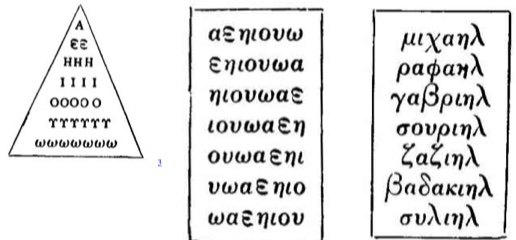
On papyri and amulets the vowels are written in magical combinations in such a manner as to form triangles and other shapes; with them are often found the names of the seven archangels of God; the following are examples:–

 (British Museum, Gnostic gem, No. G. 33). (Kenyon, Greek Papyri, p. 123). (Ibid., p. 123. These names read Michael, Raphael, Gabriel, Souriel, Zaziel, Badakiel, and Suliel).


(British Museum, Gnostic gem, No. G. 33).
(Kenyon, Greek Papyri, p. 123).
(Ibid., p. 123. These names read Michael, Raphael, Gabriel, Souriel, Zaziel, Badakiel, and Suliel)

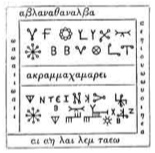
In combination with a number of signs which owe their origin to the Gnostics the seven vowels were sometimes engraved upon plaques, or written upon papyri, with the view of giving the possessor power over gods or demons or his fellow creatures.

The example printed below is found on a papyrus in the British Museum and accompanies a spell written for the purpose of overcoming the malice of enemies, and for giving security against alarms and nocturnal visions. (Kenyon, op. cit., P. 121).

Amulet inscribed with signs and letters of magical power for overcoming the malice of enemies. (From Brit. Mus., Greek Papyrus, Nu. CXXIV.--4th or 5th century.) (Kenyon, Greek Papyri, p. 123).

Amulet inscribed with signs and letters of magical power for overcoming the malice of enemies. (From Brit. Mus., Greek Papyrus, Nu. CXXIV.–4th or 5th century.) (Kenyon, Greek Papyri, p. 123).

But of all the names found upon Gnostic gems two, i.e., Khnoubis (or Khnoumis), and Abrasax (or Abraxas), are of the most frequent occurrence. The first is usually represented as a huge serpent having the head of a lion surrounded by seven or twelve rays.

Over the seven rays, one on the point of each, are the seven vowels of the Greek alphabet, which some suppose to refer to the seven heavens; and on the back of the amulet, on which the figure of Khnoumis occurs, is usually found the sign of the triple S and bar.

Khnoumis is, of course, a form of the ancient Egyptian god Khnemu, or “Fashioner” of man and beast, the god to whom many of the attributes of the Creator of the universe were ascribed.

Khnemu is, however, often depicted with the head of a ram, and in the later times, as the “beautiful ram of Râ,” he has four heads; in the Egyptian monuments he has at times the head of a hawk, but never that of a lion.

The god Abrasax is represented in a form which has a human body, the bead of a hawk or cock, and legs terminating in serpents; in one hand he holds a knife or dagger, and in the other a shield upon which is inscribed the great name ΙΑΩ {Greek IAW}, or JÂH.

Considerable difference of opinion exists as to the meaning and derivation of the name Abrasax, but there is no doubt that the god who bore it was a form of the Sun-god, and that he was intended to represent some aspect of the Creator of the world.

The name was believed to possess magical powers of the highest class, and Basileides, (he of Alexandria, who lived about A.D. 120. He was a disciple of Menander, and declared that he had received the esoteric doctrine of Saint Peter from Glaucias, a disciple of the Apostle) who gave it currency in the second century, seems to have regarded it as an invincible name.

It is probable, however, that its exact meaning was lost at an early date, and that it soon degenerated into a mere magical symbol, for it is often found inscribed on amulets side by side with scenes and figures with which, seemingly, it cannot have any connexion whatever.

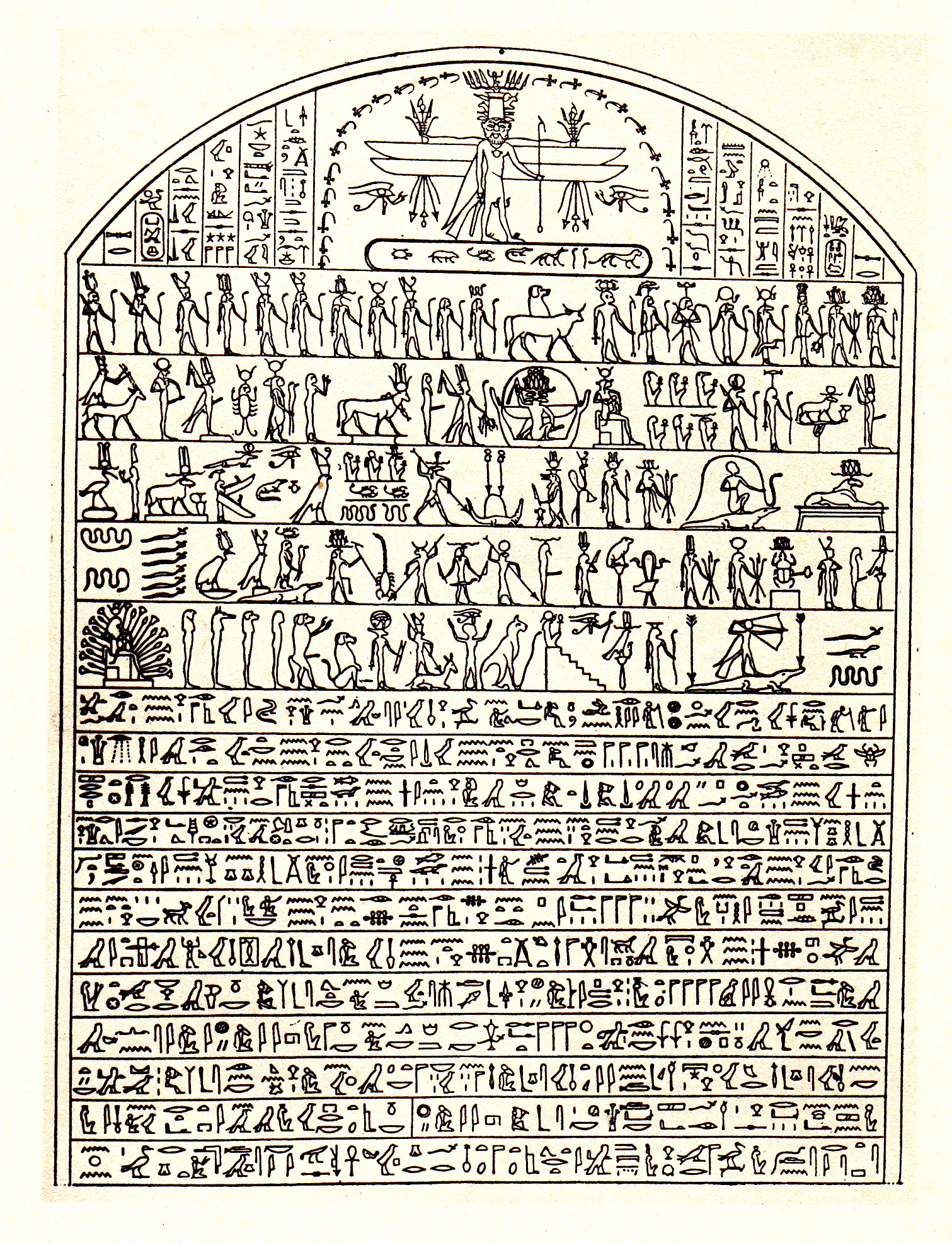
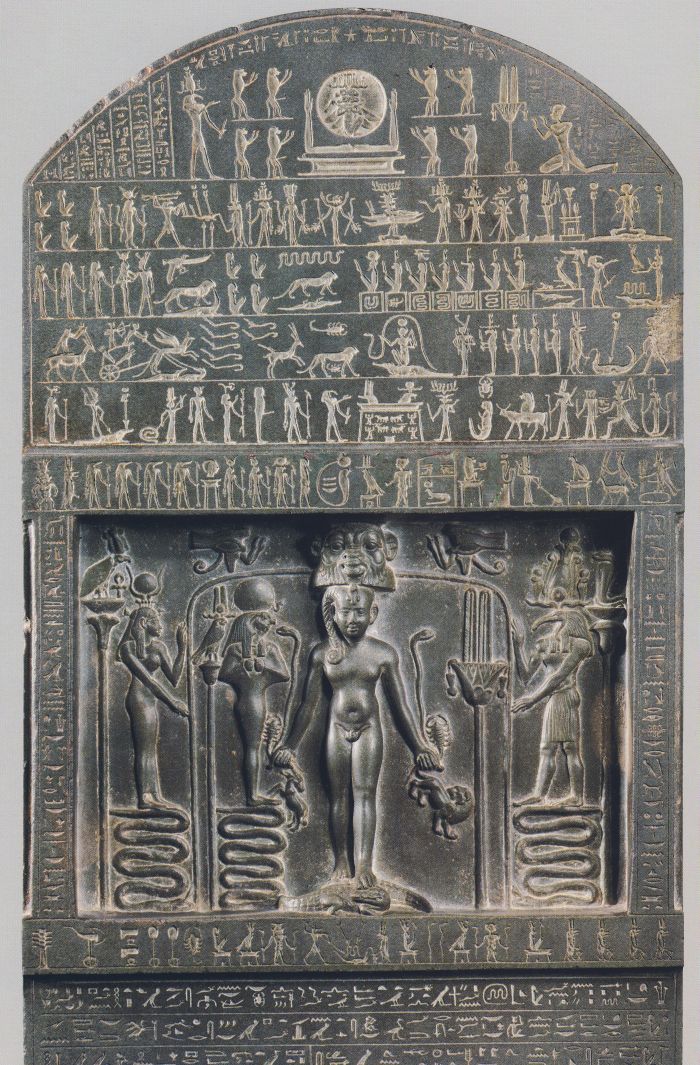
Judging from certain Gnostic gems in the British Museum, Abrasax is to be identified with the polytheistic figure that stands in the upper part of the Metternich stele depicted on p. 153 and below.

Metternich Stele.

Metternich Stele.

This figure has two bodies, one being that of a man, and the other that of a bird; from these extend four wings, and from each of his knees projects a serpent.

He has two pairs of hands and arms; one pair is extended along the wings, each hand holding the symbols of “life,” “stability,” and “power,” and two knives and two serpents; the other pair is pendent, the right hand grasping the sign of life, and the other a sceptre.

His face is grotesque, and probably represents that of Bes, or the sun as an old man; on his head is a pylon-shaped object with figures of various animals, and above it a pair of horns which support eight knives and the figure of a god with raised hands and arms, which typifies “millions of years.”

The god stands upon an oval wherein are depicted figures of various “typhonic” animals, and from each side of his crown proceed several symbols of fire.

Whether in the Gnostic system Abraxas absorbed all the names and attributes of this god of many forms cannot be said with certainty.”

E.A. Wallis Budge, Egyptian Magic, London, 1901. P. 177-80.

Gnostic Magical Names From the Metternich Stele and the Harris Magical Papyrus

“The examples of the use of names possessing magical powers described above illustrate the semi-religious views on the subject of names which the Egyptians held, and we have now to consider briefly the manner in which the knowledge of a name was employed in uses less important than those which had for their object the attainment of life and happiness in the world to come.

In the famous magical papyrus (British Museum, No. 10,042) which Chabas published (Le Papyrus Magique Harris, Chalon-sur-Saône, 1860) we find a series of interesting charms and magical formulæ which were written to preserve its possessor from the attacks of sea and river monsters of every kind, of which the following is an example.

“Hail, lord of the gods! Drive away from me the lions of the country of Meru (Meroë?), and the crocodiles which come forth from the river, and the bite of all poisonous reptiles which crawl forth from their holes. Get thee back, O crocodile Mâk, thou son of Set! Move not by means of thy tail! Work not thy legs and feet! Open not thy mouth! Let the water which is before thee turn into a consuming fire, O thou whom the thirty-seven gods did make, and whom the serpent of Râ did put in chains, O thou who wast fettered with links of iron before the boat of Râ! Get thee back, O crocodile Mâk, thou son of Set!”

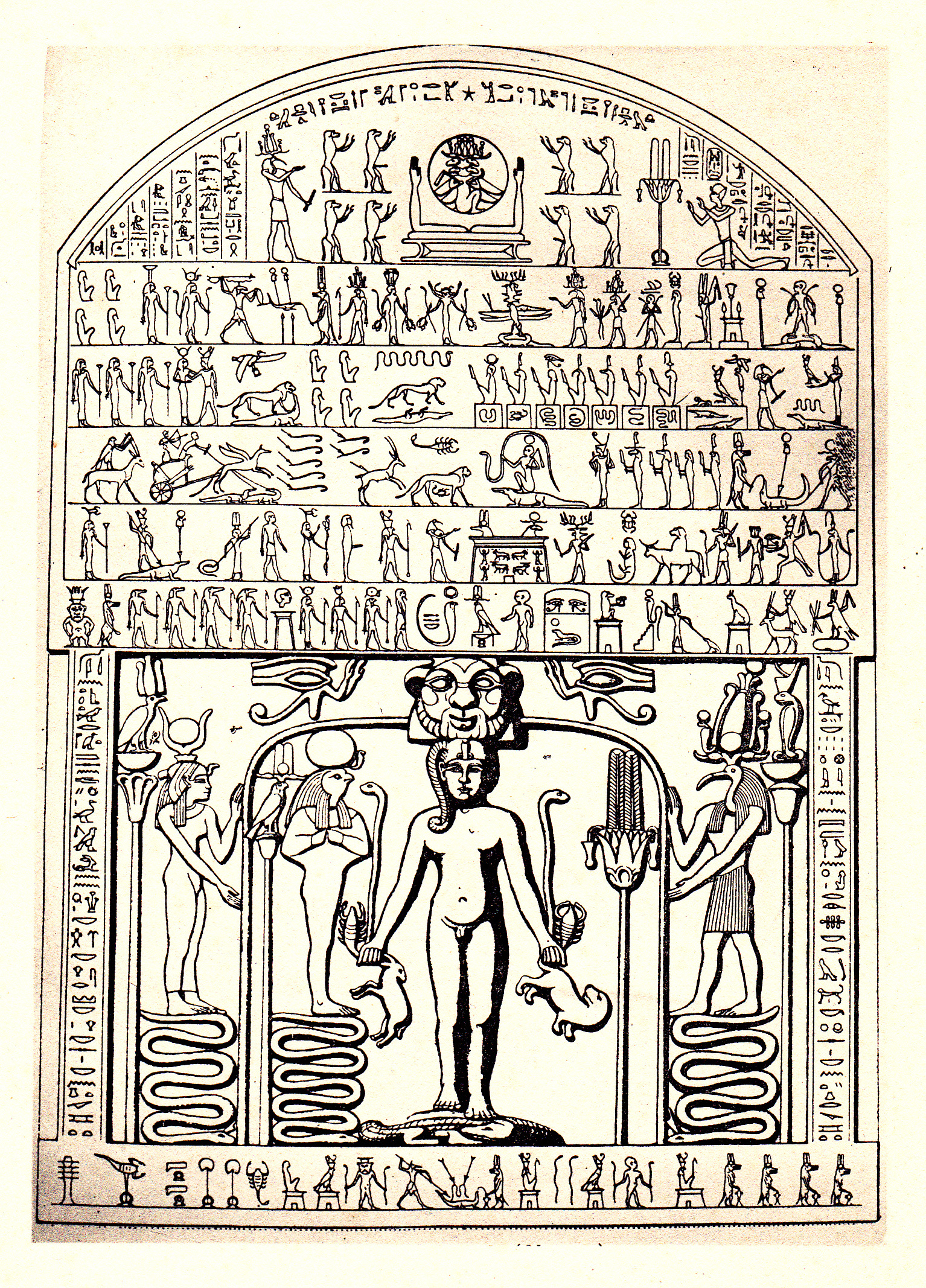
These words were to be said over a figure of the god Amen painted on clay; the rod was to have four rams’ heads upon one neck, under his feet was to be a figure of the crocodile Mâk, and to the right and left of him were to be the dog headed apes, i.e., the transformed spirits of the dawn, who sang hymns of praise to Râ when he rose daily. (See the scene in the rounded portion of the Metternichstele illustrated on p. 149, reproduced below).

Detail, Metternich stele. (Clippus of Horus, Metternichestele, ed. Golenischeff, plate 1.) Reproduced from E.A. Wallis Budge, Egyptian Magic, p. 149.

Detail, Metternich stele. (Clippus of Horus, Metternichestele, ed. Golenischeff, plate 1.)
Reproduced from E.A. Wallis Budge, Egyptian Magic, p. 149.

Again, let us suppose that some water monster wished to attack a man in a boat. To avoid this the man stood before the cabin of the boat and, taking a hard egg in his hand, he said, “O egg of the water which hath been spread over the earth, essence of the divine apes, the great one in the heaven above and in the earth beneath, who dost dwell in the nests which are in the waters, I have come forth with thee from the water, I have been with thee in thy nest, I am Amsu of Coptos, I am Amsu, lord of Kebu.”

When he had said these words he would appear to the animal in the water in the form of the god Amsu, with whom he had identified himself, and it would be afraid and flee.

At the end of the papyrus in which the above extracts occur we find a series of magical names which may be read thus:–Atir-Atisa, Atirkaha-Atisa, Samumatnatmu-Atisa, Samuanemui-Atisa, Samutekaari-Atisa, Samutekabaiu-Atisa, Samutchakaretcha-Atisa, Tâuuarehasa, Qina, Hama, Senentuta-Batetsataiu, Anrehakatha-sataiu, Haubailra-Haari.

From these and similar magical names it is quite certain that the Gnostics and other sects which held views akin to theirs obtained the names which they were so fond of inscribing upon their amulets and upon the so-called magical papyri.”

E.A. Wallis Budge, Egyptian Magic, London, 1901. P. 173-6.

Getting to the Afterlife is No Cakewalk

“Without the knowledge of the names of the gods and devils of the underworld the dead Egyptian would have fared badly, for his personal liberty would have been fettered, the roads and paths would have been blocked to him, the gates of the mansions of the underworld would have been irrevocably shut in his face, and the hostile powers which dogged his footsteps would have made an end of him; these facts are best illustrated by the following examples:—

When the deceased comes to the Hall of Judgment, at the very beginning of his speech he says, “Homage to thee, O Great God, thou Lord of Maâti, I have come to thee, O my Lord, and I have brought myself hither that I may behold thy beauties.”

“I know thee, and I know thy name, and I know the names of the two and forty gods who exist with thee in this Hall of Maâti.” (See Chapters of Coming Forth by Day, p. 191).

But although the gods may be favourable to him, and he be found righteous in the judgment, he cannot make his way among the other gods of the underworld without a knowledge of the names of certain parts of the Hall of Maâti.

After the judgment he acquires the mystical name of “He who is equipped with the flowers and the dweller in his olive tree,” and it is only after he has uttered this name that the gods say “Pass onwards.”

Next the gods invite him to enter the Hall of Maâti, but he is not allowed to pass in until he has, in answer to questions asked by the bolts, lintels, threshold, fastenings, socket, door-leaves, and door-posts, told their names.

The floor of the Hall will not permit him to walk upon it unless he tells not only its name, but also the mystical names of his two legs and feet wherewith he is about to tread upon it.

When all this has been done the guardian of the Hall says to him, “I will not announce thy name [to the god] unless thou tellest me my name”; and the deceased replies, “‘Discerner of hearts and searcher of the reins’ is thy name.”

In reply to this the guardian says, “If I announce thy name thou must utter the name of the god who dwelleth in his hour,” and the deceased utters the name “Mâau-Taui.”

But still the guardian is not satisfied, and he says, “If I announce thy name thou must tell me who is he whose heaven is of fire, whose walls [are surmounted by] living uraei, and the floor of whose house is a stream of water.”

Who is he, I say? (i.e., what is his name?)” But the deceased has, of course, learnt the name of the Great God, and he replies, “Osiris.”

The guardian of the Hall is now content, and he says, “Advance, verily thy name shall be mentioned to him”; and he further promises that the cakes, and ale, and sepulchral meals which the deceased shall enjoy shall come from the “Eye of Râ.”

E.A. Wallis Budge, Egyptian Magic, London, 1901. P. 163-5.

The Gods of Ancient Egypt are Personifications of the Names of Ra

“Again, in the story of Râ and Isis, given in the preceding chapter, we have seen that although Isis was able to make a serpent and to cause it to bite Râ, and to make him very ill, she was powerless to do as she wished in heaven and upon earth until she had persuaded the god to reveal to her his name by which he ruled the universe.

In yielding up his name to the goddess he placed himself in her power, and in this example we have a striking instance of the belief that the knowledge of the name of god, or devil, or human being, implied dominion over that being.

We have seen elsewhere that Râ, the type and symbol of God, is described as the god of “many names,” and in that wonderful composition the XVIIth Chapter of the Book of the Dead, (see Chapters of Coming Forth by Day, p. 49) we have the following statement:—

“I am the great god Nu, who gave birth unto himself, and who made his name to become the company of the gods.”

Then the question, “What does this mean?” or “Who is this?” is asked. And this is the answer:

“It is Râ, the creator of the name[s] of his limbs, which came into being in the form of the gods who are in the following of Râ.”

From this we see that all the “gods” of Egypt were merely personifications of the NAMES Of Râ, and that each god was one of his members, and that a name of a god was the god himself.”

E.A. Wallis Budge, Egyptian Magic, London, 1901. P. 162.

On Magical Names in Ancient Egyptian Magical Literature

MAGICAL NAMES.
“THE Egyptians, like most Oriental nations, attached very great importance to the knowledge of names, and the knowledge of how to use and to make mention of names which possessed magical powers was a necessity both for the living and the dead.

It was believed that if a man knew the name of a god or a devil, and addressed him by it, he was bound to answer him and to do whatever he wished; and the possession of the knowledge of the name of a man enabled his neighbour to do him good or evil.

The name that was the object of a curse brought down evil upon its owner, and similarly the name that was the object of a blessing or prayer for benefits secured for its master many good things.

To the Egyptian the name was as much a part of a man’s being as his soul, or his double (KA), or his body, and it is quite certain that this view was held by him in the earliest times.

Thus in the text which is inscribed on the walls inside (Line 169) the pyramid of Pepi L, king of Egypt about B.C. 3200, we read, “Pepi hath been purified. He hath taken in his hand the mâh staff, he hath provided himself with his throne, and he hath taken his seat in the boat of the great and little companies of the gods.”

“Ed maketh Pepi to sail to the West, he stablisheth his seat above those of the lords of doubles, and he writeth down Pepi at the head of those who live.”

“The doors of Pekh-ka which are in the abyss open themselves to Pepi, the doors of the iron which is the ceiling of the sky open themselves to Pepi, and he passeth through them; he hath his panther skin upon him, and the staff and whip are in his hand.”

“Pepi goeth forward with his flesh, Pepi is happy with his name, and he liveth with his ka (double).”

Curiously enough only the body and name and double of the king are mentioned, just as if these three constituted his whole economy; and it is noteworthy what importance is attached to the name in this passage.

In the text from the pyramid of another king (Pepi II. (ed. Maspero, 1. 669, ff. Recueil, tom. xii. 1892, p. 146)) we have a prayer concerning the preservation of the name, which is of such interest that a rendering of it in full is here given: it reads, “O Great Company of the gods who dwell in Annu (Heliopolis), grant that Pepi Nefer-ka-Râ may flourish (literally ‘germinate’), and that his pyramid, his ever lasting building, may flourish, even as the name of Temu, the chief of the nine gods, doth flourish.”

“If the name of Shu, the lord of the upper shrine in Annu, flourisheth, then Pepi shall flourish, and his pyramid, his everlasting building, shall flourish!”

“If the name of Tefnut, the lady of the lower shrine in Annu, flourisheth, the name of Pepi shall be established, and this his pyramid shall be established to all eternity!”

“If the name of Seb flourisheth at the ‘homage of the earth,’ then the name of Pepi shall flourish, and this his pyramid shall flourish, and this his building shall flourish unto all eternity!”

“If the name of Nut in the House of Shenth in Annu flourisheth, the name of Pepi shall flourish, and this his pyramid shall flourish, and this his building shall flourish unto all eternity!”

“If the name of Osiris flourisheth in the nome of Abydos, then the name of Pepi shall flourish, and this his pyramid shall flourish, and this his building shall flourish unto all eternity!”

“If the name of Osiris Khent-Amentet flourisheth, then the name of Pepi shall flourish, and this his pyramid shall flourish, and this his building shall flourish unto all eternity!”

“If the name of Set, the dweller in Nubt (Ombos) flourisheth, then the name of Pepi shall flourish, and this his pyramid shall flourish, and this his building shall flourish unto all eternity!”

“If the name of Horus flourisheth, then the name of Pepi shall flourish, and this his pyramid shall flourish, and this his building shall flourish unto all eternity!”

“If the name of Râ flourisheth in the horizon, then the name of Pepi shall flourish, and this his pyramid shall flourish, and this his building shall flourish unto all eternity!”

“If the name of Khent-merti flourisheth in Sekhem (Letopolis), then the name of Pepi shall flourish, and this his pyramid shall flourish, and this his building shall flourish unto all eternity!”

“If the name of Uatchet in Tep flourisheth, then the name of Pepi shall flourish, and this his pyramid shall flourish, and this his building shall flourish unto all eternity!”

The above prayer or formula was the origin of most of the prayers and texts which had for their object the “making the name to germinate or flourish,” and which were copied so frequently in the Saïte, Ptolemaic, and Roman periods.

All these compositions show that from the earliest to the latest times the belief as to the importance of the preservation of the name never changed in Egypt, and the son who assisted in keeping green his father’s name, and in consequence his memory, performed a most meritorious duty.”

E.A. Wallis Budge, Egyptian Magic, London, 1901. Pp. 157-61.

The Sun Stood Still

“Isis then continues her narrative thus:—

“I Isis conceived a child, and was great with child of Horus. I, a goddess, gave birth to Horus, the son of Isis, upon an island (or nest) in Athu the region of swamps; and I rejoiced greatly because of this, for I regarded Horus as a gift which would repay me for the loss of his father.”

“I hid him most carefully and concealed him in my anxiety, and indeed he was well hidden, and then I went away to the city of Am. When I had saluted the inhabitants thereof I turned back to seek the child, so that I might give him suck and take him in my arms again.”

“But I found my sucking-child Horus the fair golden one, well nigh dead! He had bedewed the ground with the water from his eye and with the foam from his lips, his body was stiff, his heart was still, and no muscle in any of his limbs moved.”

(This is an exact description of the state of an animal which has been stung by the small black scorpion in Egypt and the Sûdân. I saw Colonel W. H. Drage’s dog “Shûbra” bitten at Merâwî in September, 1897, by a black scorpion, and in about an hour she was in the state of Horus as described above, and the whole camp was distressed, for both master and dog were great favourites. When it was no longer possible to administer spirit to her, Major G. R. Griffith and others immersed her body in pails of very hot water for several hours, and at sundown she was breathing comfortably, and she soon afterwards recovered).

“Then I uttered a bitter cry of grief, and the dwellers in the papyrus swamps ran to me straightway from out of their houses, and they bewailed the greatness of my calamity; but none of them opened his mouth to speak, for every one was in deep sorrow for me, and no man knew how to bring back life into Horus.”

“Then there came to me a certain woman who was well known in her city, for she belonged to a noble family, and she tried to rekindle the life in Horus, but although her heart was full of her knowledge my son remained motionless.”

Meanwhile the folk remarked that the son of the divine mother Isis had been protected against his brother Set, that the plants among which he had been hidden could not be penetrated by any hostile being, that the words of power of Temu, the father of the gods, “who is in heaven,” should have preserved the life of Horus, that Set his brother could not possibly have had access to where the child was, who, in any case, had been protected against his wickedness; and at length it was discovered that Horus had been stung by a scorpion, and that the reptile “which destroyeth the heart” had wounded him, and had probably killed him.

At this juncture Nephthys arrived, and went round about among the papyrus swamps weeping bitterly because of the affliction of her sister Isis; with her also was Serqet, the goddess of scorpions, who asked continually, “What hath happened to the child Horus?”

Then Nephthys said to Isis, “Cry out in prayer unto heaven, and let the mariners in the boat of Râ cease to row, and let not the boat of Râ move further on its course for the sake of the child Horus”; and forthwith Isis sent forth her cry up to heaven, and made her request come unto the “Boat of millions of years,” and the Sun stood still and his boat moved not from its place by reason of the goddess’s petition.

Out from the boat came the god Thoth provided with magical powers, and bearing with him the great power to command in such wise that the words of his mouth must be fulfilled straightway; and he spake to Isis, saying “O thou goddess Isis, whose mouth knoweth how to utter charms (or talismans), no suffering shall come upon thy child Horus, for his health and safety depend upon the boat of Râ.”

“I have come this day in the divine boat of the Disk (Aten) to the place where it was yesterday. When darkness (or night) ruleth, the light shall vanquish it for the health (or safety) of Horus for the sake of his mother Isis and similarly shall it happen unto every one who possesseth what is [here] written(?).”

What took place next is, of course, evident. The child Horus was restored to life, to the great joy of his mother Isis, who was more indebted than ever to the god Thoth for coming to deliver her out of her trouble on the death of her son, just as he had done on the death of her husband.

Now because Isis had revivified both her husband and her son by the words of power and talismans which she possessed, mortal man thought it was absolutely necessary for him to secure her favour and protection at any cost, for eternal life and death were in her hands.

As time went on the Egyptians revered her more and more, and as she was the lady of the gods and of heaven, power equal to that possessed by Râ himself was ascribed to her.”

E.A. Wallis Budge, Egyptian Magic, London, 1901. Pp. 133-7.

A Tale of Isis from the Metternich Stele

“But apart from being the protector and friend of Osiris, Thoth was the refuge to which Isis fled in her trouble. The words of a hymn declare that she knew “how to turn aside evil hap,” and that she was “strong of tongue, and uttered the words of power which she knew with correct pronunciation, and halted not in her speech, and was perfect both in giving the command and in saying the word,” (Chabas, Revue Archéologique, 1857, p. 65 ff.; Ledrain, Monuments Égyptiens, pl. xxii. ff.; and for a recent translation see my First Steps in Egyptian, pp. 179-188) but this description only proves that she had been instructed by Thoth in the art of uttering words of power with effect, and to him, indeed, she owed more than this.

Metterniche Stele

Metternich Stele

When she found the dead body of her husband Osiris, she hovered about over it in the form of a bird, making air by the beating of her wings, and sending forth light from the sheen of her feathers, and at length she roused the dead to life by her words of power; as the result of the embrace which followed this meeting Horus was born, and his mother suckled him and tended him in her hiding-place in the papyrus swamps.

After a time she was persecuted by Set, her husband’s murderer, who, it seems, shut her and her son Horus up in a house as prisoners. Owing, however, to the help which Thoth gave her, she came forth by night and was accompanied on her journey by seven scorpions, (the story is told on the famous Metternichstele, ed. Golénischeff, Leipzig, 1877) called respectively Tefen, Befen, Mestet, Mestetef, Petet, Thetet, and Matet, the last three of which pointed out the way.

The guide of the way brought her to the swamps of Per-sui, (i.e., Crocodilopolis) and to the town of the two goddesses of the sandals where the swampy country of Athu begins.

Journeying on they came to Teb, (the city of the two sandals. The two sandals were made of leather from the skin of the god Nehes or Set, the opponent of Horus) where the chief of the district had a house for his ladies; now the mistress of the house would not admit Isis on account of the scorpions that were with her, for she had looked out of her door and watched Isis coming.

On this the scorpions took counsel together and wished to sting her by means of the scorpion Tefen, but at this moment a poor woman who lived in the marshes opened the door of her cottage to Isis, and the goddess took shelter therein.

Meanwhile the scorpion had crept under the door into the house of the governor, and stung the son of the lady of the house, and also set the place on fire; no water could quench the fire, and there was no rain to do it, for it was not then the rainy season.

Now these things happened to the woman who had done no active harm to Isis, and the poor creature wandered about the streets of the city uttering loud cries of grief and distress because she knew not whether her boy would live or die.

When Isis saw this she was sorry for the child who had been stung, and as he was blameless in the matter of the door of his mother’s house being shut in the face of the goddess, she determined to save him.

Thereupon she cried out to the distraught mother, saying, “Come to me, come to me! For my word is a talisman which beareth life. I am a daughter well known in thy city also, and I will do away the evil by means of the word of my mouth which my father hath taught me, for I am the daughter of his own body.”

Then Isis laid her hands upon the body of the boy, and in order to bring back the spirit into his body said—

“Come Tefen, appear upon the ground, depart hence, come not nigh!

“Come poison of Befen, appear upon the ground. I am Isis, the goddess, the lady of words of power, who doeth deeds of magic, the words of whose voice are charms.

“Obey me, O every reptile that stingeth, and fall down headlong!

“O poison of [Mestet and] Mestetef, mount not upwards!

“O poison of Petet and Thetet, draw not nigh! O Matet, fall down headlong!”

The goddess Isis then uttered certain words of the charm which had been given to her by the god Seb in order to keep poison away from her, and said, “Turn away, get away, retreat, O poison,” adding the words “Mer-Râ” in the morning and “The Egg of the Goose appeareth from out of the sycamore” in the evening, as she turned to the scorpions.

Both these sentences were talismans. After this Isis lamented that she was more lonely and wretched than all the people of Egypt, and that she had become like an old man who hath ceased to look upon and to visit fair women in their houses; and she ordered the scorpions to turn away their looks from her and to show her the way to the marshes and to the secret place which is in the city of Khebt.

Then the words of the cry, “The boy liveth, the poison dieth! As the sun liveth, so the poison dieth,” were uttered, and the fire in the house of the woman was extinguished, and heaven rejoiced at the words of Isis.

When Isis had said that the “son of the woman had been stung because his mother had shut the door of her house in her face, and had done nothing for her,” the words of the cry, “The boy liveth and the poison dieth,” were again uttered, and the son of the woman recovered.”

E.A. Wallis Budge, Egyptian Magic, London, 1901. Pp. 129-33.

More on Words of Power

“The written word has been regarded in the East with reverence from time immemorial, and a copy of a sacred writing or text is worn or carried about to this day with much the same ideas and beliefs about its power to protect as in the earliest times.

In ancient Egypt the whole Book of the Dead, as well as the various sections of it which are usually copied on papyri, consisted of a series of “words of power,” and the modern Egyptian looks upon the Koran in the same light as his ancestor looked upon the older work. (In a similar way the Arabs attach as much importance to the Fatha, or opening chapter, and to the chapter which declares the Unity of God (CXII.), as to the rest of the Koran).

A curious passage in the text inscribed on the inside of the pyramid of Unas reads (1. 583), “The bone and flesh which possess no writing are wretched, but, behold, the writing of Unas is under the great seal, and behold, it is not under the little seal.”

It is difficult to explain the passage fully, but there is no doubt that we have here an allusion to the custom of placing writings believed to be possessed of magical powers with the dead.

Certain passages or sections of the religious books of ancient nations have always been held to be of more importance than others, and considering the great length of such compositions this is not to be wondered at.

Among the Egyptians two forms of the LXIVth Chapter of the Book of the Dead were in use, and there is no doubt whatever that the shorter form, as far back as the Ist dynasty, about B.C. 4300, was intended to be a summary of the whole work, and that the recital of it was held to be as efficacious as the recital of all the rest of it. (See Chapter of Coming Forth by Day, p. 70).

It is a remarkable fact that this form is called “The Chapter of knowing the ‘Chapters of Coming Forth by Day‘ in a single Chapter,” and that it is declared to date from the time of Hesepti, a king of the Ist dynasty, about B.C. 4300, whilst the “finding” of the longer form is attributed to the reign of Men-kau-Râ (Mycerinus), a king of the IVth dynasty, about B.C. 3600.

It is interesting to note how persistently certain chapters and formulæ occur in funeral papyri of different periods, and the explanation seems to be that a popular selection was made at an early date, and that this selection was copied with such additions or omissions as the means of the friends of the deceased allowed or made necessary.

One thing is quite certain: every man in Egypt died in the firm belief that in the course of his journey into the next world he would be provided with words of power which would enable him to make his way thither unhindered, and give him abundance of meat and drink.”

E.A. Wallis Budge, Egyptian Magic, London, 1901. Pp. 124-6.

MAGICAL PICTURES AND FORMULÆ, SPELLS, ETC.

“FROM what has been said above it is clear that the Egyptian believed it possible to vivify by means of formulæ and words of power any figure made in the form of a man or animal, and to make it work either on behalf of or against his fellow man.

Besides this, he believed greatly in the efficacy of representations or pictures of the gods, and of divine beings and things, provided that words of power properly recited by properly appointed people were recited over them. If this fact be borne in mind a great many difficulties in understanding religious texts disappear, and many apparently childish facts are seen to have an important meaning.

If we look into the tombs of the early period we see painted on the walls numbers of scenes in which the deceased is represented making offerings to the gods and performing religious ceremonies, as well as numbers of others in which he is directing the work of his estate and ruling his household.

It was not altogether the result of pride that such pictures were painted on the walls of tombs, for at the bottom of his heart the Egyptian hoped and believed that they were in reality representations of what he would do in the next world, and he trusted that the words of his prayers would turn pictures into realities, and drawings into substances.

The wealthy Egyptian left behind him the means for making the offerings which his ka, or double, needed, and was able to provide for the maintenance of his tomb and of the ka chapel and of the priest or priests who ministered to it.

It was an article of faith among all classes that unless the ka was properly fed it would be driven to wander about and pick up filth and anything else of that nature which it found in its path, as we may see from the LIInd Chapter of the Book of the Dead, in which the deceased says, “That which is an abomination unto me, that which is an abomination unto me let me not eat. That which is an abomination unto me, that which is an abomination unto me is filth; let me not eat of it instead of the cakes [which are offered unto] the Doubles (kau). Let it not light upon my body; let me not be obliged to take it into my hands; and let me not be obliged to walk thereon in my sandals.”

E.A. Wallis Budge, Egyptian Magic, London, 1901. Pp. 104-6.

On the Black Arts

“From Egypt, by way of Greece and Rome, the use of wax figures passed into Western Europe and England, and in the Middle Ages it found great favour with those who interested themselves in the working of the “black art,” or who wished to do their neighbour or enemy an injury.

Many stories are current of how in Italy and England ignorant or wicked minded people made models of their enemies in wax and hung them up in the chimney, not too close to the fire, so that they might melt away slowly, and of how the people that were represented by such figures gradually lost the power over their limbs, and could not sleep, and slowly sickened and died.

If pins and needles were stuck into the wax figures at stated times the sufferings of the living were made more agonizing, and their death much more painful.

Sharpe relates (see C. K. Sharpe, Witchcraft in Scotland, London, 1884, p. 21) that about the end of the VIIth century king Duffus was so unpopular that “a company of hags roasted his image made of wax upon a wooden spit, reciting certain words of enchantment, and basting the figure with a poisonous liquor.

These women when apprehended declared that as the wax melted, the body of the king should decay, and the words of enchantment prevented him from the refreshment of sleep.”

The two following extracts from Thomas Middleton’s The Witch (London, 1778) illustrate the views held about wax figures in England in the time of this writer. (Born about 1570, died about 1626).

I.
Heccat. Is the heart of wax
Stuck full of magique needles?”
Stadlin. ‘Tis done Heccat.

Heccat. And is the Farmer’s picture, and his wives, Lay’d downe to th’ fire yet?
Stadlin. They are a roasting both too.
Heccat. Good:
Then their marrowes are a melting subtelly
And three monethes sicknes sucks up life in ’em.”
(Act i., scene 2.)

II.
Heccat. What death is’t you desire for Almachildes?
Duchesse. A sodaine and a subtle.
Heccat. Then I have fitted you.
Here lye the guifts of both; sodaine and subtle:
His picture made in wax, and gently molten
By a blew fire kindled with dead mens’ eyes
Will waste him by degrees.”
(Act v., scene 2)

Mr. Elworthy in his very interesting book The Evil Eye (London, 1895, pp. 53, 56) relates some striking examples of the burning of hearts stuck full of pins for magical purposes in recent years.

Thus an old woman at Mendip had a pig that fell ill, and she at once made up her mind that the animal had been “overlooked”; in her trouble she consulted a “white witch,” i.e. a “wise” man, and by his orders she acted thus.

She obtained a sheep’s heart, and having stuck it full of pins (in the Worth Riding of Yorkshire evil influences were averted by means of a living black cock which “was pierced with pins and roasted alive at dead of night, with every door, window, and cranny and crevice stuffed up” (see Blakeborough, Wit, Character, Folk-lore and Customs of the North Riding of Yorkshire, London, 1898, p. 205)) set it to roast before a fire, whilst her friends and neighbours sang:–

“It is not this heart I mean to burn.
But the person’s heart I wish to turn,
Wishing them neither rest nor peace
Till they are dead and gone.”

At intervals her son George sprinkled salt on the fire which added greatly to the weirdness of the scene, and at length, when the roasting had been continued until far into the night, a black cat jumped out from somewhere and was, of course, instantly declared to be the demon which had been exorcised.

Again, in October, 1882, a heart stuck full of pins was found in a recess of a chimney in an old house in the village of Ashbrittle; and in 1890 another was found nailed up inside the “clavel” in the chimney of an old house at Staplegrove.”

E.A. Wallis Budge, Egyptian Magic, London, 1901. Pp. 97-100.

On Magical Figures in Ancient Egyptian Magic

“IT has been said above that the name or the emblem or the picture of a god or demon could become an amulet with power to protect him that wore it, and that such power lasted as long as the substance of which it was made lasted, if the name, or emblem, or picture was not erased from it.

But the Egyptians went a step further than this, and they believed that it was possible to transmit to the figure of any man, or woman, or animal, or living creature, the soul of the being which it represented, and its qualities and attributes.

The statue of a god in a temple contained the spirit of the god which it represented, and from time immemorial the people of Egypt believed that every statue and every figure possessed an indwelling spirit.

When the Christianized Egyptians made their attacks on the “idols of the heathen” they proved that they possessed this belief, for they always endeavoured to throw down the statues of the gods of the Greeks and Romans, knowing that if they were once shattered the spirits which dwelt in them would have no place wherein to dwell, and would thereby be rendered homeless and powerless.

It will be remembered that it is stated in the Apocryphal Gospels that when the Virgin Mary and her Son arrived in Egypt there “was a movement and quaking throughout all the land, and all the idols fell down from their pedestals and were broken in pieces.”

Then all the priests and nobles went to a certain priest with whom “a devil used to speak from out of the idol,” and they asked him the meaning of these things; and when he had explained to them that the footstep of the son of the “secret and hidden god” had fallen upon the land of Egypt, they accepted his counsel and made a figure of this god.

The Egyptians acknowledged that the new god was greater than all their gods together, and they were quite prepared to set up a statue of him because they believed that in so doing they would compel at least a portion of the spirit of the “secret and hidden god” to come and dwell in it.

In the following pages we shall endeavour to describe the principal uses which the Egyptians made of the figures of gods, and men, and beasts, to which magical powers had been imparted by means of the performance of certain symbolic ceremonies and the recital of certain words of power; and how they could be employed to do both good and evil.”

E.A. Wallis Budge, Egyptian Magic, London, 1901. Pp. 65-7.

Egyptian Magic

A STUDY of the remains of the native religious literature of ancient Egypt which have come down to us has revealed the fact that the belief in magic, that is to say, in the power of magical names, and spells, and enchantments, and formulæ, and pictures, and figures, and amulets, and in the performance of ceremonies accompanied by the utterance of words of power, to produce supernatural results, formed a large and important part of the Egyptian religion.

[ … ]

The belief in magic, the word being used in its best sense, is older in Egypt than the belief in God, and it is certain that a very large number of the Egyptian religious ceremonies, which were performed in later times as an integral part of a highly spiritual worship, had their origin in superstitious customs which date from a period when God, under any name or in any form, was unconceived in the minds of the Egyptians.

[ … ]

From the religious books of ancient Egypt we learn that the power possessed by a priest or man who was skilled in the knowledge and working of magic was believed to be almost boundless. By pronouncing certain words or names of power in the proper manner and in the proper tone of voice he could heal the sick, and cast out the evil spirits which caused pain and suffering in those who were diseased, and restore the dead to life, and bestow upon the dead man the power to transform the corruptible into an incorruptible body, wherein the soul might live to all eternity.

His words enabled human beings to assume divers forms at will, and to project their souls into animals and other creatures; and in obedience to his commands, inanimate figures and pictures became living beings and things which hastened to perform his behests. The powers of nature acknowledged his might, and wind and rain, storm and tempest, river and sea, and disease and death worked evil and ruin upon his foes, and upon the enemies of those who were provided with the knowledge of the words which he had wrested from the gods of heaven, and earth, and the underworld.

Inanimate nature likewise obeyed such words of power, and even the world itself came into existence through the utterance of a word by Thoth; by their means the earth could be rent asunder, and the waters forsaking their nature could be piled up in a heap, and even the sun’s course in the heavens could be stayed by a word.

No god, or spirit, or devil, or fiend, could resist words of power, and the Egyptians invoked their aid in the smallest as well as in the greatest events of their lives. To him that was versed in the lore contained in the books of the “double house of life” the future was as well known as the past, and neither time nor distance could limit the operations of his power; the mysteries of life and death were laid bare before him, and he could draw aside the veil which hid the secrets of fate and destiny from the knowledge of ordinary mortals.

[ … ]

In the “white” and “black” magic of the Egyptians most of the magic known in the other countries of the world may be found; it is impossible yet to say exactly how much the beliefs and religious systems of other nations were influenced by them, but there is no doubt that certain views and religious ideas of many heathen and Christian sects may be traced directly to them.

[ … ]

But the fact remains that they did believe in One God Who was almighty, and eternal, and invisible, Who created the heavens, and the earth, and all beings and things therein; and in the resurrection of the body in a changed and glorified form, which would live to all eternity in the company of the spirits and souls of the righteous in a kingdom ruled by a being who was of divine origin, but who had lived upon the earth, and had suffered a cruel death at the hands of his enemies, and had risen from the dead, and had become the God and king of the world which is beyond the grave; and that, although they believed all these things and proclaimed their belief with almost passionate earnestness, they seem never to have freed themselves from a hankering after amulets and talismans, and magical names, and words of power, and seem to have trusted in these to save their souls and bodies, both living and dead, with something of the same confidence which they placed in the death and resurrection of Osiris.

E.A. Wallis Budge, Egyptian Magic, London, 1901. Pp. vii. – xiv.

Creation of the Stars

Meanwhile darkness covered the land. When day broke the men who had repented of their blasphemies appeared with their bows, and slew the enemies of Ra. At this result Ra was pleased, and he forgave those who had repented because of their righteous slaughter of his enemies. From this time onwards human sacrifices were offered up at the festivals of Ra celebrated in this place, and at Heliopolis and in other parts of Egypt.

After these things Ra declared to Nut that he intended to leave this world, and to ascend into heaven, and that all those who would see his face must follow him thither. Then he went up into heaven and prepared a place to which all might come. Then he said, “Hetep sekhet aa,” i.e., “Let a great field be produced,” and straightway “Sekhet-hetep,” or the “Field of peace,” came into being.

He next said, “Let there be reeds (aaru) in it,” and straightway “Sekhet Aaru,” or the “Field of Reeds,” came into being. Sekhet-hetep was the Elysian Fields of the Egyptians, and the Field of Reeds was a well-known section of it.

Another command of the god Ra resulted in the creation of the stars, which the legend compares to flowers. Then the goddess Nut trembled in all her body, and Ra, fearing that she might fall, caused to come into being the Four Pillars on which the heavens are supported.

Turning to Shu, Ra entreated him to protect these supports, and to place himself under Nut, and to hold her up in position with his hands. Thus Shu became the new Sun-god in the place of Ra, and the heavens in which Ra lived were supported and placed beyond the risk of falling, and mankind would live and rejoice in the light of the new sun.

At this place in the legend a text is inserted called the “Chapter of the Cow.” It describes how the Cow of Heaven and the two Boats of the Sun shall be painted, and gives the positions of the gods who stand by the legs of the Cow, and a number of short magical names, or formulae, which are inexplicable.

The general meaning of the picture of the Cow is quite clear. The Cow represents the sky in which the Boats of Ra, sail, and her four legs are the four cardinal points which cannot be changed. The region above her back is the heaven in which Ra reigns over the beings who pass thereto from this earth when they die, and here was situated the home of the gods and the celestial spirits who govern this world.

E.A. Wallis Budge, Legends of the Gods: The Egyptian Texts, edited with Translations, London, 1912. (No page numbers are given in my edition).

Legend of the Destruction of Mankind

THE LEGEND OF THE DESTRUCTION OF MANKIND.
The text containing the Legend of the Destruction of Mankind is written in hieroglyphs, and is found on the four walls of a small chamber which is entered from the “hall of columns” in the tomb of Seti I., which is situated on the west bank of the Nile at Thebes.

On the wall facing the door of this chamber is painted in red the figure of the large “Cow of Heaven.” The lower part of her belly is decorated with a series of thirteen stars, and immediately beneath it are the two Boats of Ra, called Semketet and Mantchet, or Sektet and Matet.

Each of her four legs is held in position by two gods, and the god Shu, with outstretched uplifted arms, supports her body. The Cow was published by Champollion, [Monuments, tom., iii., p. 245] without the text.

[ … ]

The legend takes us back to the time when the gods of Egypt went about in the country, and mingled with men and were thoroughly acquainted with their desires and needs. The king who reigned over Egypt was Ra, the Sun-god, who was not, however, the first of the Dynasty of Gods who ruled the land.

His predecessor on the throne was Hephaistos, who, according to Manetho, reigned 9000 years, whilst Ra reigned only 992 years; Panodorus makes his reign to have lasted less than 100 years.

Be this as it may, it seems that the “self-created and self-begotten” god Ra had been ruling over mankind for a very long time, for his subjects were murmuring against him, and they were complaining that he was old, that his bones were like silver, his body like gold, and his hair like lapis-lazuli.

When Ra heard these murmurings he ordered his bodyguard to summon all the gods who had been with him in the primeval World-ocean, and to bid them privately to assemble in the Great House, which can be no other than the famous temple of Heliopolis. This statement is interesting, for it proves that the legend is of Heliopolitan origin, like the cult of Ra itself, and that it does not belong, at least in so far as it applies to Ra, to the Predynastic Period.

When Ra entered the Great Temple, the gods made obeisance to him, and took up their positions on each side of him, and informed him that they awaited his words. Addressing Nu, the personification of the World-ocean, Ra bade them to take notice of the fact that the men and women whom his Eye had created were murmuring against him. He then asked them to consider the matter and to devise a plan of action for him, for he was unwilling to slay the rebels without hearing what his gods had to say.

In reply the gods advised Ra to send forth his Eye to destroy the blasphemers, for there was no eye on earth that could resist it, especially when it took the form of the goddess Hathor. Ra accepted their advice and sent forth his Eye in the form of Hathor to destroy them, and, though the rebels had fled to the mountains in fear, the Eye pursued them and overtook them and destroyed them.

Hathor rejoiced in her work of destruction, and on her return was praised by Ra, for what she had done. The slaughter of men began at Suten-henen (Herakleopolis), and during the night Hathor waded about in the blood of men. Ra asserted his intention of being master of the rebels, and this is probably referred to in the Book of the Dead, Chapter XVII., in which it is said that Ra rose as king for the first time in Suten-henen.

Osiris also was crowned at Suten-henen, and in this city lived the great Bennu bird, or Phoenix, and the “Crusher of Bones” mentioned in the Negative Confession.

E.A. Wallis Budge, Legends of the Gods: The Egyptian Texts, edited with Translations, London, 1912. (No page numbers are given in my edition).

Tears of the God in Egyptian Creation Myths

The embraces of Keb caused Nut to bring forth five gods at a birth, namely, Osiris, Horus, Set, Isis, and Nephthys. Osiris and Isis married before their birth, and Isis brought forth a son called Horus; Set and Nephthys also married before their birth, and Nephthys brought forth a son named Anpu (Anubis), though he is not mentioned in the legend.

Of these gods Osiris is singled out for special mention in the legend, in which Khepera, speaking as Neb-er-tcher, says that his name is Ausares, who is the essence of the primeval matter of which he himself is formed. Thus Osiris was of the same substance as the Great God who created the world according to the Egyptians, and was a reincarnation of his great-grandfather. This portion of the legend helps to explain the views held about Osiris as the great ancestral spirit, who when on earth was a benefactor of mankind, and who when in heaven was the saviour of souls.

The legend speaks of the sun as the Eye of Khepera, or Neb-er-tcher, and refers to some calamity which befell it and extinguished its light. This calamity may have been simply the coming of night, or eclipses, or storms; but in any case the god made a second Eye, i.e., the Moon, to which he gave some of the splendour of the other Eye, i.e., the Sun, and he gave it a place in his Face, and henceforth it ruled throughout the earth, and had special powers in respect of the production of trees, plants, vegetables, herbs, etc.

Thus from the earliest times the moon was associated with the fertility of the earth, especially in connection with the production of abundant crops and successful harvests.

According to the legend, men and women sprang not from the earth, but directly from the body of the god Khepera, or Neb-er-tcher, who placed his members together and then wept tears upon them, and men and women, came into being from the tears which had fallen from his eyes.

E.A. Wallis Budge, Legends of the Gods: The Egyptian Texts, edited with Translations, London, 1912. (No page numbers are given in my edition).

Fire Vomiting Goddesses

“The leaders of this remarkable procession are four forms of the goddess NEITH of Saïs, who spring into life so soon as the sound of the voice of AFU-RA is heard; these are Neith the Child, Neith of the White Crown, Neith of the Red Crown, and Neith of the phallus. These goddesses “guard the holy gate of the city of Saïs, which is unknown, and can neither be seen nor looked at.”

On the right of the path of AFU-RA we see the two-headed god APER-HRA-NEB-TCHETTA, with the Crown of the South on one head, and the Crown of the North on the other.

Next come the god TEMU, his body, and his soul, the former in the shape of a serpent with two pairs of human legs and a pair of wings, and the latter in that of a man, with a disk on his head, and his hands stretched out to the wings (vol. i., p. 242).

In front of these are the body and soul of the Star-god SHETU, who follows AFU-RA and casts the living ones to him every day. All the other deities here represented assist the god in his passage, and help him to arrive on the Horizon of the East.

The region to the left of the Boat is one of fire, and representations of it which we have in the BOOK AM-TUAT and the BOOK OF GATES may well have suggested the beliefs in a fiery hell that have come down through the centuries to our own time.

Quite near the Boat stands Horus, holding in the left hand the snake-headed boomerang, with which he performs deeds of magic; in front of him is the serpent SET-HEH, i.e., the Everlasting Set, his familiar and messenger (vol. i., p. 249).

Horus is watching and directing the destruction of the bodies, souls, shadows, and heads of the enemies of RA, and of the damned who are in this DIVISION, which is taking place in five pits of fire.

A lioness-headed goddess stands by the side of the first pit which contains the enemies of RA; the fire with which they are consumed is supplied by the goddess, who vomits it into one corner of the pit.

The next four pits contain the bodies, souls, shades, and heads respectively, of the damned, the fire being supplied by the goddesses in charge. In the pit following are four beings who are immersed, head downwards, in the depths of its fires (vol. i., pp. 249-253). The texts which refer to the pits of fire show that the beings who were unfortunate enough to be cast into them were hacked in pieces by the goddesses who were over them, and then burned in the fierce fire provided by SET-HEH and the goddesses until they were consumed.

The pits of fire were, of course, suggested by the red, fiery clouds which, with lurid splendour, often herald the sunrise in Egypt. As the sun rose, dispersing as he did so the darkness of night, and the mist and haze which appeared to cling to him, it was natural for the primitive peoples of Egypt to declare that his foes were being burned in his pits or lakes of fire.

The redder and brighter the fiery glare, the more effective would the burning up of the foes be thought to be, and it is not difficult to conceive the horror which would rise in the minds of superstitious folk when they saw the day open with a dull or cloudy sky, with no evidence in it that the Sun had defeated the powers of darkness, and had suffered no injury during the night.

The presence of the pits of fire in this DIVISION suggests that we have now practically arrived at the end of the Tuat, and, according to the views of those who compiled the original description of AKERT, this is indeed the case.”

E.A. Wallis Budge, The Egyptian Heaven and Hell, 1905, pp. 177-9.

Words of Power in the Egyptian Tuat

The ultimate fate of the souls of human beings who had departed to the Tuat must always have been a matter of speculation to the Egyptians, and at the best they could only hope that they had traversed the long, dark, and dangerous valley in safety.

The same may be said of numbers of the gods, who in very early times were believed to possess a nature which closely resembled that of men and women, and to be in danger of extermination in the Tuat. Of the gods the only one about whose successful passage of the Tuat there was no doubt was Ra, or according to the priests of Amen, Amen-Ra, for he rose each morning in the East, and it was manifest to all that he had overcome whatsoever dangers had threatened him in the Tuat during the past night.

This being so, it became the object of every man to obtain permission to travel in the boat of Ra through the Tuat, for those who were followers of Osiris could disembark when it arrived at his kingdom, and those who wished to remain with Ra for ever could remain in it with him. To each class of believer a guide to the Tuat was necessary, for up to a certain place in that region both the followers of Osiris and the followers of Ra required information about the divisions of the Tuat, and knowledge of the names of the Halls and Gates, and of the beings who guarded them and who were all-powerful in the land of darkness.

For the worshippers of Amen, or Amen-Ra, the BOOK AM-TUAT was prepared, whilst the followers of Osiris pinned their faith to the BOOK OF GATES. From each of these Books we find that the Sun-god was not able to pass through the Tuat by virtue of the powers which he possessed as the great god of the world, but only through his knowledge of the proper words of power, and of magical names and formulae, before the utterance of which every denizen of the Tuat was powerless.

Osiris had, of course, passed through the Tuat, and seated himself on his throne in the “House of Osiris,” but even he would have been unable to perform his journey in safety through the Tuat without the help of the words of power which Horus, the son of Isis, the son of Osiris, had uttered, and the magical ceremonies which he had performed.

Words and ceremonies alike he learned from Isis, who, according to a later tradition, obtained the knowledge of them from Thoth, the Divine Intelligence. Now if Osiris and Ra had need of such magical assistance in their passage through the Tuat, how much greater must have been the need of man!

E.A. Wallis Budge, The Egyptian Heaven and Hell, 1905, pp. 91-3.

Weighing the Heart in the Balance

“From the extract from the Chapter of Sekhet-Aaru and Sekhet-hetepet given above, it is quite clear that the followers of Osiris hoped and expected to do in the next world exactly what they had done in this, and that they believed they would obtain and continue to live their life in the world to come by means of a word of power; and that they prayed to the god Hetep for dominion over it, so that they might keep it firmly in their memories, and not forget it.

This is another proof that in the earliest times men relied in their hope of a future life more on the learning and remembering of a potent name or formula than on the merits of their moral and religious excellences. From first to last throughout the chapter there is no mention of the god Osiris, unless he be the “Great God” whose birthplace is said to be in the region Unen-em-hetep, and nowhere in it is there any suggestion that the permission or favour of Osiris is necessary for those who would enter either Sekhet-Aaru or Sekhet-hetep.

This seems to indicate that the conceptions about the Other World, at least so far as the “realms of the blest” were concerned, were evolved in the minds of Egyptian theologians before Osiris attained to the high position which he occupied in the Dynastic Period. On the other hand, the evidence on this point which is to be deduced from the Papyrus of Ani must be taken into account.

At the beginning of this Papyrus we have first of all Hymns to Ra and Osiris, and the famous Judgment Scene which is familiar to all. We see the heart of Ani being weighed in the Balance against the symbol of righteousness in the presence of the Great Company of the Gods, and the weighing takes place at one end of the house of Osiris, whilst Osiris sits in his shrine at the other.

The “guardian of the Balance” is Anubis, and the registrar is Thoth, the scribe of the gods, who is seen noting the result of the weighing. In the picture the beam of the Balance is quite level, which shows that the heart of Ani exactly counterbalances the symbol of righteousness.

This result Thoth announces to the gods in the following words, “In very truth the heart of Osiris hath been weighed, and his soul hath stood as a witness for him; its case is right (i.e., it hath been found true by trial) in the Great Balance. No wickedness hath been found in him, he hath not purloined the offerings in the temples, (Ani was the receiver of the ecclesiastical revenues of the gods of Thebes and Abydos, and the meaning here is that he did not divert, to his own use any portion of the goods he received) and he hath done no evil by deed or word whilst he was upon earth.”

The gods in their reply accept Thoth’s report, and declare that, so far as they are concerned, Ani has committed neither sin nor evil. Further, they go on to say that he shall not be delivered over to the monster Amemet, and they order that he shall have offerings, that he shall have the power to go into the presence of Osiris, and that he shall have a homestead, or allotment, in Sekhet-hetepet for ever.

We next see Ani being led into the presence of Osiris by Horus, the son of Isis, who reports that the heart of Ani hath sinned against no god or goddess; as it hath also been found just and righteous according to the written laws of the gods, he asks that Ani may have cakes and ale given to him, and the power to appear before Osiris, and that he may take his place among the “Followers of Horus,” and be like them for ever.

Now from this evidence it is clear that Ani was considered to have merited his reward in Sekhet-hetepet by the righteousness and integrity of his life upon earth as regards his fellow-man, and by the reverence and worship which he paid to every god and every goddess; in other words, it is made to appear that he had earned his reward, or had justified himself by his works. Because his heart had emerged triumphantly from its trial the gods decreed for him the right to appear in the presence of the god Osiris, and ordered him to be provided with a homestead in Sekhet-hetep.

There is no mention of any repentance on Ani’s part for wrong done; indeed, he says definitely, “There is no sin in my body. I have not uttered wittingly that which is untrue, and I have committed no act having a double motive [in my mind].” As he was troubled by no remembrance of sin, his conscience was clear, and he expected to receive his reward, not as an act of mercy on the part of the gods, but as an act of justice.

Thus it would seem that repentance played no part in the religion of the primitive inhabitants of Egypt, and that a man atoned for his misdeeds by the giving of offerings, by sacrifice, and by worship. On the other hand, Nebseni is made to say to the god of Sekhet-hetep, “Let me be rewarded with thy fields, O Hetep; but do thou according to thy will, O lord of the winds.”

This petition reveals a frame of mind which recognizes submissively the omnipotence of the god’s will, and the words “do thou according to thy will” are no doubt the equivalent of those which men of all nations and in every age have prayed–“Thy will be done.”

E.A. Wallis Budge, The Egyptian Heaven and Hell, 1905, pp. 49-52.

Getting Laid in the Afterlife

“The texts inscribed on them contain extracts from the Heliopolitan Recension of the Book of the Dead, of which we know so much from the selections given in the Pyramids of Unas, Teta, and other kings, but side by side with these are copies of chapters belonging to Books of the Dead, which seem to have been originally composed at some anterior period, and which were intended to reflect the more popular and more materialistic religious views and beliefs.

Among such books must be mentioned the “Book of Two Ways,” or the “Two Ways of the Blessed Dead,” of which a version inscribed on a coffin in the Berlin Museum has been recently published. (Schack-Schackenburg, Das Buch von den Zwei Wegen des Seligen Toten, Leipzig, 1903).

The rubrical directions of this work show that it was compiled when implicit belief existed in the minds of the Egyptians as to the efficacy of certain “words of power” (hekau ) and of pictures of the gods, and it is clear that many portions of it are purely magical, and were intended to produce very material results. Thus concerning one passage a rubric says, “Whosoever knoweth this Chapter may have union with women by night or by day, and the heart (or, desire) of the woman shall come to him whensoever he would enjoy her.”

This rubric follows a text in which the deceased is made to pray for power of generation similar to that possessed by the god Beba, and for the will and opportunity of overcoming women, and it was to be written on a bandlet which was to be attached to the right arm. Moreover, the soul which had knowledge of certain sections of the work would “live among the living ones,” and would “see Osiris every day,” and would have “air in his nostrils, and death would never draw nigh unto him.”

The illustrations which accompany the texts on the coffins from Al-Barsha make it evident that under the XIth Dynasty the Egyptian theologian had not only divided the Under-world in his mind into sections, with doors, &c., but that he was prepared to describe that portion of it which belonged to the blessed dead, and to supply a plan of it!”

E.A. Wallis Budge, The Egyptian Heaven and Hell, 1905, pp. 12-4.

Autoeroticism and Tears in Egyptian Funerary Texts

CHAPTER VI.

The Gate of Teka-Hra.

The Fifth Division of the Tuat.

“THE boat of the sun having passed through the Fourth Division of the Tuat arrives at the gateway which leads to the FIFTH DIVISION. This gateway is similar to that which guards the Fourth Division, and is guarded by nine gods, who are described as the “Fourth company;” at the entrance to the corridor and at its exit stands a jackal-headed god, the former being called AAU, and the latter TEKMI, each is said to “extend his arms and hands to Ra.”

The corridor is swept by flames of fire, as before. The gateway is called ARIT, and the text says, “This great god cometh to this gateway, and entereth in through it, and the gods who are therein acclaim him.” The nine gods say to Ra, “RA-HERU-KHUTI unfoldeth our doors, and openeth our gateways. Hail, Ra, come thou to us, O great god, lord of hidden nature.”

[ … ]

This door is shut after the great god hath passed through it, and there is lamentation to those who are in this gateway when they hear this door close upon them.”

[ … ]

[Ra saith:—]

‘Draw ye me along, O ye gods of the Tuat, and sing praises unto me, O ye who are at the head of the stars; let your cords be strong (or, vigorous), and draw ye me along by means of them, and let your hands and arms be steady, let there be speed in your legs, let there be strong intent in your souls, and let your hearts be glad. Open ye a prosperous way into the chambers (qerti) of hidden things.”’

[ … ]

Horus saith unto the creatures of Ra who dwell in the Black Land (Qemt, i.e., Egypt) and in the Red Land (i.e., the deserts which lie on each side of the Black Land formed of the mud of the Nile):—

“Magical protection be unto you, O ye creatures of Ra, who have come into being from the Great One who is at the head of heaven! Let there be breath to your nostrils, and let your linen swathings be unloosed! Ye are the tears (or the weeping) of the eye of my splendour in your name of RETH (i.e., men). Mighty of issue (AA-MU) ye have come into being in your name of AAMU; Sekhet hath created them, and it is she who delivereth (or, avengeth) their souls. I masturbated [to produce you], and I was content with the hundreds of thousands [of beings] who came forth from me in your name of NEHESU (i.e., Negroes); Horus made them to come into being, and it is he who avengeth their souls. I sought out mine Eye, and ye came into being in your name of THEMEHU; Sekhet hath created them, and she avengeth their souls.”

The passage which refers to the gods who make stable the period of life (KHERU-AHAU-EM-AMENT) reads:—

Those who make firm (or, permanent) the duration of life stablish the days of the souls [in] Amenti and possess the word (or, command) of the place of destruction. Ra saith unto them:—

“Inasmuch as ye are the gods who dwell in the Tuat, and who have possession of [the serpent] METERUI, by means of whom ye mete out the duration of life of the souls who are in Amenti who are condemned to destruction, destroy ye the souls of the enemies according to the place of destruction which ye are commanded to appoint, and let them not see the hidden place.”

[ … ]

“[Here are] the divine sovereign chiefs who shall destroy the enemies. They shall have their offerings by means of the word [which becometh] Maat; they shall have their oblations upon earth by means of the word [which becometh] Maat, and it is they who destroy and who pass the edict concerning (literally, write) the duration of the life of the souls who dwell in Amenti.

The destruction which is yours shall be [directed] against the enemies, and the power to write which ye possess shall be for the place of destruction. I have come, even I the great one Horus, that I may make a reckoning with my body, and that I may shoot forth evils against my enemies.

Their food is bread, and their drink is the tchesert wine, and they have cool water wherewith to refresh (or, bathe) themselves. [Offerings are made to them upon earth. One doth not enter into the place of destruction.]”

—E.A. Wallis Budge, The Short Form of the Book of Am-Tuat, The Summary of the Book of What Is In the Underworld, from The Book of Gates, 1905, pp. 139-57.

Gershom Scholem on the Secret Doctrine of the Talmud

“I have elsewhere dealt at length with this Merkabah-mysticism of the so- called Hekhaloth literature, and shown that a genuine and unbroken chain of tradition links these writings to the secret doctrine of the Talmud. Large parts of this literature still belong to the talmudic period itself, and the central ideas of these texts go back to the first and second centuries.

To be sure, these texts, which in their present form belong in part to the genre of apocalyptic pseudepigraphy, are not always as old as they pretend to be. But even in these later adaptations, the underlying traditional material dates back to the period indicated. The mystical hymns found in several of the most important texts may definitely be traced back at least to the third century; here it is the literary form itself that militates against the idea of a later revision. The conceptions that find expression here surely were not developed later; in fact, they may date from a much earlier time.

These writings contain instructions for obtaining the ecstatic vision of the celestial regions of the Merkabah. They describe the peregrinations of the ecstatic through these regions: the seven heavens and the seven palaces or temples, Hekhaloth, through which the Merkabah mystic travels before he arrives at the throne of God. Revelations are made to the voyager concerning the celestial things and the secrets of the Creation, the hierarchy of the angels, and the magical practices of theurgy.

Having ascended to the highest level, he stands before the throne and beholds a vision of the mystical figure of the Godhead, in the symbol of the “likeness as the appearance of a man” whom the prophet Ezekiel was permitted to see upon the throne of Merkabah. There he receives a revelation of the “measurement of the body,” in Hebrew Shi’ur Qomah, that is, an anthropomorphic description of the divinity, appearing as the primal man, but also as the lover of the Song of Songs, together with the mystical names of his limbs.

The age of this Shi’ur Qomah mysticism, which scandalized the consciousness of later, “enlightened” centuries, may now be fixed with certainty. Contrary to the views that once prevailed, it must be dated to the second century, and certainly not later. It is undoubtedly connected with the interpretation of the Song of Songs as a mystical allegory of God’s relation with Israel.

Just as in the earliest days God revealed himself to the entire community of Israel, as was the case at the time of the Exodus from Egypt, where he was visibly manifest upon his Merkabah (this idea is attested in midrashic interpretations that undoubtedly go back to the tannaim), so is this revelation repeated in the relations between God and the mystic initiated into the secrets of the Merkabah.

The most important fragments of these descriptions transmitted in the Shi’ur Qomah make explicit reference to the depiction of the lover in many passages of the Song of Songs; this depiction thus offers a biblical veneer for what are evidently theosophic mysteries whose precise meaning and exact connections still escape us.”

–Gershom Scholem, Origins of the Kabbalah, 1987, pp. 19-21.

Edenic Origins of the Kabbalah

“The Qabalah is traditionally traced back to Adam and Eve.”

[ … ]

“The disciplines of the Mystical Qabalah are distinct from those practiced by magicians, wizards, and sorcerers who seek to acquire creative and/or destructive power, depending on what paths they traverse on the Tree of Life.

The occult disciplines of wizards and magicians are often called the Practical, Hermetic, or Magical Qabalah. Practical Qabalah has its roots in the “Thirteen Enochian Keys” of Enoch son of Qain, along with a highly admixture of material taken from Egyptian, Mesopotamian and other non-Hebrew sources.

It is important not to confuse Enoch son of Qain with Enoch son of Yared. The former Enoch was the grandson of Adam and the son after whom Qain was said to name a city.

Enoch son of Yared was the great, great, great, great grandson of Adam, and the one who “walked with Elohim” and was transformed into Metatron.”

–Daniel Feldman, Qabalah: The Mystical Heritage of the Children of Abraham, 2001. Pg. 33-4.

Kabbalah as Metasystem

“The prime source for the precursors of the occult revival were without question Athanasius Kircher (1602-80), a German Jesuit whose Oedipus Aegyptiacus (1652) detailed Kabbalah amongst its study of Egyptian mysteries and hieroglyphics, and Cornelius Agrippa’s De Occulta Philosophia (1533).

Other works, such as those from alchemists including Khunrath, Fludd and Vaughan indicated that the Kabbalah had become the convenient metamap for early hermetic thinkers. Christian mystics began to utilise its structure for an explanation of their revelations, the most notable being Jacob Boeheme (1575-1624). However, the most notable event in terms of our line of examination is undoubtedly the publication of Christian Knorr von Rosenroth’s (1636-89) Kabbalah Denudata in Latin in 1677 and 1684, which provided translations from the Zohar and extracts from the works of Isaac Luria.”

“Another stream stemming from Rosenroth’s work came through Eliphas Levi (1810-75), who … ascribed to the Tarot an ancient Egyptian origin. From de Gebelin and Rosenroth, Levi synthesized a scheme of attribution of the Tarot cards to the twenty-two paths of the Tree of Life, a significant development in that it provided a synthetic model of processes to be later modified and used by the Golden Dawn as mapping the initiation system of psychological, occult, and spiritual development. Levi wrote, “Qabalah … might be called the mathematics of human thought.”

“It is said by traditional Kabbalists and Kabbalistic scholars that the occultist has an imperfect knowledge of the Tree, and hence the work of such is corrupt. It appears to me that the Kabbalah is a basic device whose keys are infinite, and that any serious approach to its basic metasystem will reveal some relevance if tested in the world about us, no matter how it may be phrased.

The first Kabbalists cannot be said to have had an imperfect knowledge because they did not understand or utilise information systems theory or understand modern cosmology. Indeed, their examination of themselves and the Universe revealed such knowledge many hundreds of years before science formalised it, in the same way that current occult thinking may be rediscovered in some new science a hundred or thousand years hence.”

–Frater FP, The Magician’s Kabbalah, pp.  5-7.

Merkabah Mystics

“The teachings of the Merkabah mystics became part of the “Heikhalot” school, whose name means “palace,” referring to the spiritual planes through which the mystics ascended. The description of these journeys seems to bear similarities to the journey of the soul into the Underworld depicted in the Egyptian Book of Coming Forth by Day, with magical words or appropriate names of the gods to be spoken before each door is passed and each palace entered.”

–Frater FP, The Magician’s Kabbalah, 2003, pg. 4.

Self-Immolation in Jewish Practice

Rabbi Joseph Karo authored the Shulhan Arukh (The Laid Table). He claimed that it was “dictated by a divine messenger, a magid, whom he regarded as a manifestation of the shekhinah.”

Incredibly, Dan comments that “…Safed scholars went as far as inflicting themselves with pain and wounds, including self-immolation, which is very rare in Jewish practice.”

“Isaac Luria, who revolutionized the kabbalah in this period, arrived in Safed in 1570 when these practices were at their peak.” Luria was born in Safed in 1534, but migrated to Egypt and then later returned. Luria died because of the plague two years later, in 1572, at the age of 38. The most important of Luria’s teachings were published by Gershom Scholem and Isaiah Tishby in 1941.

–Joseph Dan, Kabbalah: A Very Short Introduction, pg.73.

Marsilio Ficino and Christian Kabbalah

“Christian kabbalah can be traced to the “school of Marsilio Ficino in Florence, in the second half of the fifteenth century.”

“Ficino is best known for his translations of Plato’s writings from Greek to Latin, but of much importance was his translation to Latin of the corpus of esoteric, mysterious old treatises known as the Hermetica. These works, probably originating from Egypt in late antiquity, are attributed to a mysterious ancient philosopher, Hermes Trismegistus (The Thrice-Great Hermes), and they deal with magic, astrology, and esoteric theology.”

Ficino and his followers considered magic as “an ancient scientific doctrine, the source of all religious and natural truth.”

Dan mentions Count Giovani Pico dela Mirandola, a “great thinker, young scholar and theologian, who died at age thirty-three in 1496.”

He also observes that Pico’s interest in Hebrew was facilitated by the Latin translations of the Jewish Christian convert, Flavius Methredates.”

Pico’s most famous work, the Nine Hundred Theses, proclaims that Christianity’s truth is best demonstrated by the disciplines of magic and kabbalah.” In Pico’s work, magic and kabbalah are often indistinguishable. He interpreted kabbalistic texts as “ancient esoteric lore, conserved by Jews, at the heart of which was the Christian message.”

–Joseph Dan, Kabbalah: A Very Short Introduction, pg. 62-3.

The Moral Precepts of Ptah-hetep

Moral Precepts of Ptah-hetep, Governor of Memphis, Advisor to King Pharaoh Assa, 5th Dynasty, 3500 BCE

CHAPTER XIII
MORAL AND PHILOSOPHICAL LITERATURE

Side by side with the great mass of literature of a magical and religious character that flourished in Egypt under the Ancient Empire, we find that there existed also a class of writings that are remarkably like those contained in the Book of Proverbs, which is attributed to Solomon, the King of Israel, and in “Ecclesiasticus,” and the “Book of Wisdom.”

The priests of Egypt took the greatest trouble to compose Books of the Dead and Guides to the Other World in order to help the souls of the dead to traverse in safety the region that lay between this world and the next, or Dead Land, and the high officials who flourished under the Pharaohs of the early dynasties drew up works, the object of which was to enable the living man to conduct himself in such a way as to satisfy his social superiors, to please his equals, and to content his inferiors, and at the same time to advance to honours and wealth himself.

These works represent the experience, and shrewdness, and knowledge which their writers had gained at the Court of the Pharaohs, and are full of sound worldly wisdom and high moral excellence. They were written to teach young men of the royal and aristocratic classes to fear God, to honour the king, to do their duty efficiently, to lead strictly moral, if not exactly religious, lives, to treat every man with the respect due to his position in life, to cultivate home life, and to do their duty to their neighbours, both to those who were rich and those who were poor.

The oldest Egyptian book of Moral Precepts, or Maxims, or Admonitions, is that of Ptah-hetep, governor of the town of Memphis, and high confidential adviser of the king; he flourished in the reign of Assa, a king of the fifth dynasty, about 3500 B.C. His work is found, more or less complete, in several papyri, which are preserved in the British Museum and in the National Library in Paris, and extracts from it, which were used by Egyptian pupils in the schools attached to the temples, and which are written upon slices of limestone, are to be seen in the Egyptian Museum in Cairo and elsewhere.

The oldest copy of the work contains many mistakes, and in some places the text is unintelligible, but many parts of it can be translated, and the following extracts will illustrate the piety and moral worth, and the sagacity and experience of the shrewd but kindly “man of the world” who undertook to guide the young prince of his day. The sage begins his work with a lament about the evil effects that follow old age in a man–

“Depression seizeth upon him every day, his eyesight faileth, his ears become deaf, his strength declineth, his heart hath no rest, the mouth becometh silent and speaketh not, the intelligence diminisheth, and it is impossible to remember to-day what happened yesterday.

“The bones are full of pain, the pursuit that was formerly attended with pleasure is now fraught with pain, and the sense of taste departeth. Old age is the worst of all the miseries that can befall a man. The nose becometh stopped up and one cannot smell at all.”

At this point Ptah-hetep asks, rhetorically, “Who will give me authority to speak? Who is it that will authorise me to repeat to the prince the Precepts of those who had knowledge of the wise counsels of the learned men of old?”

“In answer to these questions the king replies to Ptah-hetep, “Instruct thou my son in the words of wisdom of olden time. It is instruction of this kind alone that formeth the character of the sons of noblemen, and the youth who hearkeneth to such instruction will acquire a right understanding and the faculty of judging justly, and he will not feel weary of his duties.”

Immediately following these words come the “Precepts of beautiful speech” of Ptah-hetep, whose full titles are given, viz. the Erpa, the Duke, the father of the god (i.e. the king), the friend of God, the son of the king. Governor of Memphis, confidential servant of the king.

These Precepts instruct the ignorant, and teach them to understand fine speech; among them are the following:

“Be not haughty because of thy knowledge. Converse with the ignorant man as well as with him that is educated.

“Do not terrify the people, for if thou dost, God will punish thee. If any man saith that he is going to live by these means, God will make his mouth empty of food. If a man saith that he is going to make himself powerful (or rich) thereby, saying, ‘I shall reap advantage, having knowledge,’ and if he saith, ‘I will beat down the other man,’ he will arrive at the result of being able to do nothing. Let no man terrify the people, for the command of God is that they shall enjoy rest.

“If thou art one of a company seated to eat in the house of a man who is greater than thyself, take what he giveth thee [without remark]. Set it before thee. Look at what is before thee, but not too closely, and do not look at it too often. The man who rejecteth it is an ill-mannered person.

“Do not speak to interrupt when he is speaking, for one knoweth not when he may disapprove. Speak when he addresseth thee, and then thy words shall be acceptable.

“When a man hath wealth he ordereth his actions according to his own dictates. He doeth what he willeth…. The great man can effect by the mere lifting up of his hand what a [poor] man cannot. Since the eating of bread is according to the dispensation of God, a man cannot object thereto.

“If thou art a man whose duty it is to enter into the presence of a nobleman with a message from another nobleman, take care to say correctly and in the correct way what thou art sent to say; give the message exactly as he said it. Take great care not to spoil it in delivery and so to set one nobleman against another. He who wresteth the truth in transmitting the message, and only repeateth it in words that give pleasure to all men, gentleman or common man, is an abominable person.

“If thou art a farmer, till the field which the great God hath given thee. Eat not too much when thou art near thy neighbours…. The children of the man who, being a man of substance, seizeth [prey] like the crocodile in the presence of the field labourers, are cursed because of his behaviour, his father suffereth poignant grief, and as for the mother who bore him, every other woman is happier than she. A man who is the leader of a clan (or tribe) that trusteth him and followeth him becometh a god.

“If thou dost humble thyself and dost obey a wise man, thy behaviour will be held to be good before God. Since thou knowest who are to serve, and who are to command, let not thy heart magnify itself against the latter. Since thou knowest who hath the power, hold in fear him that hath it….

“Be diligent at all times. Do more than is commanded. Waste not the time wherein thou canst labour; he is an abominable man who maketh a bad use of his time. Lose no chance day by day in adding to the riches of thy house. Work produceth wealth, and wealth endureth not when work is abandoned.

“If thou art a wise man, beget a son who shall be pleasing unto God.

“If thou art a wise man, be master of thy house. Love thy wife absolutely, give her food in abundance, and raiment for her back; these are the medicines for her body. Anoint her with unguents, and make her happy as long as thou livest. She is thy field, and she reflecteth credit on her possessor. Be not harsh in thy house, for she will be more easily moved by persuasion than by violence. Satisfy her wish, observe what she expecteth, and take note of that whereon she hath fixed her gaze. This is the treatment that will keep her in her house; if thou repel her advances, it is ruin for thee. Embrace her, call her by fond names, and treat her lovingly.

“Treat thy dependants as well as thou art able, for this is the duty of those whom God hath blessed.

“If thou art a wise man, and if thou hast a seat in the council chamber of thy lord, concentrate thy mind on the business [so as to arrive at] a wise decision. Keep silence, for this is better than to talk overmuch. When thou speakest thou must know what can be urged against thy words. To speak in the council chamber [needeth] skill and experience.

“If thou hast become a great man having once been a poor man, and hast attained to the headship of the city, study not to take the fullest advantage of thy situation. Be not harsh in respect of the grain, for thou art only an overseer of the food of God.

“Think much, but keep thy mouth closed; if thou dost not how canst thou consult with the nobles? Let thy opinion coincide with that of thy lord. Do what he saith, and then he shall say of thee to those who are listening, ‘This is my son.'”

The above and all the other Precepts of Ptah-hetep were drawn up for the guidance of highly-placed young men, and have little to do with practical, every-day morality. But whilst the Egyptian scribes who lived under the Middle and New Empires were ready to pay all honour to the writings of an earlier age, they were not slow to perceive that the older Precepts did not supply advice on every important subject, and they therefore proceeded to write supplementary Precepts.

–E.A. Wallis Budge, The Literature of the Ancient Egyptians, pp. 101-3.

THE LEGEND OF THE WANDERINGS OF ISIS

“The god Osiris, as we have seen in the chapter on the Egyptian Religion in the accompanying volume, lived and reigned at one time upon earth in the form of a man. His twin-brother Set was jealous of his popularity, and hated him to such a degree that he contrived a plan whereby he succeeded in putting Osiris to death.

Set then tried to usurp his brother’s kingdom and to make himself sole lord of Egypt, and, although no text states it distinctly, it is clear that he seized his brother’s wife, Isis, and shut her up in his house.

Isis was, however, under the protection of the god Thoth, and she escaped with her unborn child, and the following Legend describes the incidents that befell her, and the death and revivification of Horus.

It is cut in hieroglyphs upon a large stone stele which was made for Ankh-Psemthek, a prophet of Nebun in the reign of Nectanebus I, who reigned from 373 B.C. to 360 B.C. The stele was dug up in 1828 at Alexandria, and was given to Prince Metternich by Muhammad Ali Pasha; it is now commonly known as the “Metternich Stele.”

The Legend is narrated by the goddess herself, who says:

“I am Isis. I escaped from the dwelling wherein my brother Set placed me. Thoth, the great god, the Prince of Truth in heaven and on earth, said unto me:

“Come, O goddess Isis [hearken thou], it is a good thing to hearken, for he who is guided by another liveth. Hide thyself with thy child, and these things shall happen unto him. His body shall grow and flourish, and strength of every kind shall be in him. He shall sit upon his father’s throne, he shall avenge him, and he shall hold the exalted position of ‘Governor of the Two Lands.’”

I left the house of Set in the evening, and there accompanied me Seven Scorpions, that were to travel with me, and sting with their stings on my behalf. Two of them, Tefen and Befen, followed behind me, two of them, Mestet and Mestetef, went one on each side of me, and three, Petet, Thetet, and Maatet, prepared the way for me.

I charged them very carefully and adjured them to make no acquaintance with any one, to speak to none of the Red Fiends, to pay no heed to a servant (?), and to keep their gaze towards the ground so that they might show me the way.

And their leader brought me to Pa-Sui, the town of the Sacred Sandals, [These places were in the seventh nome of Lower Egypt (Metelites)] at the head of the district of the Papyrus Swamps. When I arrived at Teb I came to a quarter of the town where women dwelt.

And a certain woman of quality spied me as I was journeying along the road, and she shut her door in my face, for she was afraid because of the Seven Scorpions that were with me. Then they took counsel concerning her, and they shot out their poison on the tail of Tefen. As for me, a peasant woman called Taha opened her door, and I went into the house of this humble woman.

Then the scorpion Tefen crawled in under the door of the woman Usert [who had shut it in my face], and stung her son, and a fire broke out in it; there was no water to put it out, but the sky sent down rain, though it was not the time of rain. And the heart of Usert was sore within her, and she was very sad, for she knew not whether her son would live or die; and she went through the town shrieking for help, but none came out at the sound of her voice.

And I was sad for the child’s sake, and I wished the innocent one to live again. So I cried out to her, saying, Come to me! Come to me! There is life in my mouth. I am a woman well known in her town. I can destroy the devil of death by a spell which my father taught me. I am his daughter, his beloved one.

Then Isis laid her hands on the child and recited this spell:

“O poison of Tefent (sic), come forth, fall on the ground; go no further. O poison of Befent (sic), come forth, fall on the ground. I am Isis, the goddess, the mistress of words of power. I am a weaver of spells, I know how to utter words so that they take effect. Hearken to me, O every reptile that biteth (or stingeth), and fall on the ground. O poison of Mestet, go no further. O poison of Mestetef, rise not up in his body. O poison of Petet and Thetet, enter not his body. O poison of Maatet, fall on the ground.

Ascend not into heaven, I command you by the beloved of Ra, the egg of the goose which appeareth from the sycamore. My words indeed rule to the uttermost limit of the night. I speak to you, O scorpions. I am alone and in sorrow, and our names will stink throughout the nomes….

The child shall live! The poison shall die! For Ra liveth and the poison dieth. Horus shall be saved through his mother Isis, and he who is stricken shall likewise be saved.”

Meanwhile the fire in the house of Usert was extinguished, and heaven was content with the utterance of Isis. Then the lady Usert was filled with sorrow because she had shut her door in the face of Isis, and she brought to the house of the peasant woman gifts for the goddess, whom she had apparently not recognized.

The spells of the goddess produced, of course, the desired effect on the poison, and we may assume that the life of the child was restored to him. The second lot of gifts made to Isis represented his mother’s gratitude.

Exactly when and how Isis made her way to a hiding place cannot be said, but she reached it in safety, and her son Horus was born there.

The story of the death of Horus she tells in the following words:

“I am Isis. I conceived a child, Horus, and I brought him forth in a cluster of papyrus plants (or, bulrushes). I rejoiced exceedingly, for in him I saw one who would make answer for his father. I hid him, and I covered him up carefully, being afraid of that foul one [Set], and then I went to the town of Am, where the people gave thanks for me because they knew I could cause them trouble.

I passed the day in collecting food for the child, and when I returned and took Horus into my arms, I found him, Horus, the beautiful one of gold, the boy, the child, lifeless! He had bedewed the ground with the water of his eye and with the foam of his lips. His body was motionless, his heart did not beat, and his muscles were relaxed.”

Then Isis sent forth a bitter cry, and lamented loudly her misfortune, for now that Horus was dead she had none to protect her, or to take vengeance on Set. When the people heard her voice they went out to her, and they bewailed with her the greatness of her affliction. But though all lamented on her behalf there was none who could bring back Horus to life.

Then a “woman who was well known in her town, a lady who was the mistress of property in her own right,” went out to Isis, and consoled her, and assured her that the child should live through his mother.

And she said, “A scorpion hath stung him, the reptile Aunab hath wounded him.” Then Isis bent her face over the child to find out if he breathed, and she examined the wound, and found that there was poison in it, and then taking him in her arms, “she leaped about with him like a fish that is put upon hot coals,” uttering loud cries of lamentation.

During this outburst of grief the goddess Nephthys, her sister, arrived, and she too lamented and cried bitterly over her sister’s loss; with her came the Scorpion-goddess Serqet.

Nephthys at once advised Isis to cry out for help to Ra, for, said she, it is wholly impossible for the Boat of Ra to travel across the sky whilst Horus is lying dead.

Then Isis cried out, and made supplication to the Boat of Millions of Years, and the Sun-god stopped the Boat. Out of it came down Thoth, who was provided with powerful spells, and, going to Isis, he inquired concerning her trouble.

“What is it, what is it, O Isis, thou goddess of spells, whose mouth hath skill to utter them with supreme effect? Surely no evil thing hath befallen Horus, for the Boat of Ra hath him under its protection. I have come from the Boat of the Disk to heal Horus.”

Then Thoth told Isis not to fear, but to put away all anxiety from her heart, for he had come to heal her child, and he told her that Horus was fully protected because he was the Dweller in his disk, and the firstborn son of heaven, and the Great Dwarf, and the Mighty Ram, and the Great Hawk, and the Holy Beetle, and the Hidden Body, and the Governor of the Other World, and the Holy Benu Bird, and by the spells of Isis and the names of Osiris and the weeping of his mother and brethren, and by his own name and heart.

Turning towards the child Thoth began to recite his spells and said, “Wake up, Horus! Thy protection is established. Make thou happy the heart of thy mother Isis. The words of Horus bind up hearts and he comforteth him that is in affliction. Let your hearts rejoice, O ye dwellers in the heavens. Horus who avenged his father shall make the poison to retreat.

That which is in the mouth of Ra shall circulate, and the tongue of the Great God shall overcome [opposition]. The Boat of Ra standeth still and moveth not, and the Disk (i.e. the Sun-god) is in the place where it was yesterday to heal Horus for his mother Isis.

Come to earth, draw nigh, O Boat of Ra, O ye mariners of Ra; make the boat to move and convey food of the town of Sekhem (i.e. Letopolis) hither, to heal Horus for his mother Isis….

Come to earth, O poison! I am Thoth, the firstborn son, the son of Ra. Tem and the company of the gods have commanded me to heal Horus for his mother Isis.

O Horus, O Horus, thy Ka protecteth thee, and thy Image worketh protection for thee. The poison is as the daughter of its own flame; it is destroyed because it smote the strong son. Your temples are safe, for Horus liveth for his mother.”

Then the child Horus returned to life, to the great joy of his mother, and Thoth went back to the Boat of Millions of Years, which at once proceeded on its majestic course, and all the gods from one end of heaven to the other rejoiced.

Isis entreated either Ra or Thoth that Horus might be nursed and brought up by the goddesses of the town of Pe-Tep, or Buto, in the Delta, and at once Thoth committed the child to their care, and instructed them about his future.

Horus grew up in Buto under their protection, and in due course fought a duel with Set, and vanquished him, and so avenged the wrong done to his father by Set.”

–E. A. Wallis Budge, The Literature of the Ancient Egyptians, 1914, pp. 43-5.

From the Ancient Egyptian Pyramid Text of Unas, and the Text of Teta

“The skies lower, the Star-gods tremble, the Archers [names of groups of stars] quake, the bones of the Akeru [more names of groups of stars] gods tremble, and those who are with them are struck dumb when they see Unas rising up as a soul, in the form of the god who liveth upon his fathers, and who turneth his mothers into his food.

Unas is the lord of wisdom, and his mother knoweth not his name. The adoration of Unas is in heaven, he hath become mighty in the horizon like Temu, the father that gave him birth, and after Temu had given him birth Unas became stronger than his father. The Doubles (i.e. vital strength) of Unas are behind him, the soles of his feet are beneath his feet, his gods are over him, his serpents are [seated] upon his brow, the serpent-guides of Unas are in front of him, and the spirit of the flame looketh upon [his] soul.

The powers of Unas protect him. Unas is a bull in heaven. He directeth his steps where he willeth. He liveth upon the form which each god taketh upon himself, and he eateth the flesh of those who come to fill their bellies with the magical charms in the Lake of Fire. Unas is equipped with power against the spirit-souls thereof, and he riseth in the form of the mighty one, the lord of those who dwell in power (?).

Unas hath taken his seat with his back turned towards Keb (the Earth-god). Unas hath weighed his words [entered into judgement] with the hidden god (?) who hath no name, on the day of hacking in pieces the firstborn. Unas is the lord of offerings, the untier of the knot, and he himself maketh abundant the offerings of meat and drink. Unas devoureth men, and liveth upon the gods, he is the lord of envoys whom he sendeth forth on his missions. ‘He who cutteth off hairy scalps,’ who dwelleth in the fields, tieth the gods with ropes. Tcheser-tep shepherdeth them for Unas and driveth them unto him; and the Cord-master hath bound them for slaughter. Khensu, the slayer of the wicked, cutteth their throats, and draweth out their intestines, for it is he whom Unas sendeth to slaughter [them], and Shesmu [the executioner of Osiris] cutteth them in pieces, and boileth their members in his blazing caldrons of the night.

Unas eateth their magical powers, and he swalloweth their spirit-souls. The great ones among them serve for his meal at daybreak, the lesser serve for his meal at eventide, and the least among them serve for his meal in the night. The old gods and the old goddesses become fuel for his furnace. The mighty ones in heaven light the fire under the caldrons wherein are heaped up the thighs of the firstborn; and he who maketh those who live in heaven to go about for Unas lighteth the fire under the caldrons with the thighs of their women; he goeth about the Two Heavens in their entirety, and he goeth round about the two banks of the Celestial Nile.

Unas is the Great Power, the Power of Powers, and Unas is the Chief of the gods in visible forms. Whatsoever he findeth upon his path he eateth forthwith, and the magical might of Unas is before that of all the spirit-bodies who dwell in the horizon. Unas is the firstborn of the firstborn gods. Unas is surrounded by thousands, and oblations are made unto him by hundreds; he is made manifest as the Great Power by Saah (Orion), the father of the gods.

Unas repeateth his rising in heaven, and he is crowned lord of the horizon. He hath reckoned up the bandlets and the arm-rings [of his captives], he hath taken possession of the hearts of the gods. Unas hath eaten the Red Crown, and he hath swallowed the White Crown; the food of Unas is the intestines, and his meat is hearts and their words of power. Behold, Unas eateth of that which the Red Crown sendeth forth, he increaseth, and the words of power of the gods are in his belly; his attributes are not removed from him.

Unas hath eaten the whole of the knowledge of every god, and the period of his life is eternity, and the duration of his existence is everlastingness. He is in the form of one who doeth what he wisheth, and who doth not do what he hateth, and he abideth on the horizon for ever and ever and ever. The Soul of the gods is in Unas, their spirit-souls are with Unas, and the offerings made unto him are more than those that are made unto the gods. The fire of Unas is in their bones, for their soul is in Unas, and their shades are with those who belong unto them. Unas hath been with the two hidden (?) Kha (?) gods, …; the seat of the heart of Unas is among those who live upon this earth for ever and ever and ever.”

–E.A.W. Budge, The Literature of the Ancient Egyptians, 1914, p. 13.

You Say Kabbalah, I Say Cabala

Christian kabbalah can be traced to the “school of Marsilio Ficino in Florence, in the second half of the fifteenth century.”

“Ficino is best known for his translations of Plato’s writings from Greek to Latin, but of much importance was his translation to Latin of the corpus of esoteric, mysterious old treatises known as the Hermetica. These works, probably originating from Egypt in late antiquity, are attributed to a mysterious ancient philosopher, Hermes Trismegistus (The Thrice-Great Hermes), and they deal with magic, astrology, and esoteric theology.”

Ficino and his followers considered magic as “an ancient scientific doctrine, the source of all religious and natural truth.”

Dan mentions Count Giovani Pico de la Mirandola, a “great thinker, young scholar and theologian, who died at age thirty-three in 1496.”

He also observes that Pico’s interest in Hebrew was facilitated by the Latin translations of the Jewish Christian convert, Flavius Methredates.”

Pico’s most famous work, the Nine Hundred Theses, proclaims that Christianity’s truth is best demonstrated by the disciplines of magic and kabbalah.” In Pico’s work, magic and kabbalah are often indistinguishable. He interpreted kabbalistic texts as “ancient esoteric lore, conserved by Jews, at the heart of which was the Christian message.”

–Joseph Dan, Kabbalah: A Very Short Introduction, pg. 62-3.

On Metempsychosis, or Reincarnation

“Indian contact with the Greeks can be traced back to Alexander the Great, establishing trade and exchange between the eastern Mediterranean, the Middle East (Persian), and India. The classic narrative of this relationship is found in the Life of Apollonius of Tyana (recorded by Philostratus, c. 220 CE). Apollonius journeyed to India to study at the sacred hill of the Indian “wise men marked with a crescent on their foreheads”. When Apollonius (d. 98 CE) was asked about why he came on such a long journey, he replied “Your ways are wiser and much more godly”, clearly indicating a classic Greek respect for Indian thought at the time of Roman Philostratus (36).

Another example, far more significant, is that of the teachings of the Persian religious leader, Mani (c. 245 CE). According to Mani’s teachings, the Apostles of Light sent by Jesus to redeem humanity included the Buddha and Manichaeism is distinctively influenced by Buddhist ideas, such as Mani representing himself as the Buddha to come, Maitreya (37). In esoteric circles, Iranian syncretic religions (such as those of Kushan) came to be regarded as influenced by both Greco-Roman and Indo-Iranian ideas, ideas that have carried over into the history of various forms of Western Esotericism but are little studied (38).

One of the significant esoteric teachings contained in the Life of Apollonius, recorded as a teaching of the Indian sages, is that on reincarnation. When Apollonius asks about the nature of the soul, he is told that, like Pythagoras and Plato, human beings live many lives in diverse bodies based on past actions. Further, the Indian sages claim that this teaching which was taught to the Greek philosophers in Egypt was transmitted to the Egyptians by ancient Rishis’ of India who migrated to north Africa (Ethiopia) from the Ganges River basin (39).

The belief in reincarnation or metempsychosis has very ancient roots in India and is the probable source of that belief in the classical period of formative Gnosticism (40). Gnostic teachers such as Basilides propagated the idea along with other groups such as the Carpocratians and Ophites, and it was popular among various Neoplatonists such as Alcinous, as well as taught by the archetypal magician, Simon Magus. It was also taught by Mani as the fate of the “Hearers” who did not attain perfection (41). Gnostic texts such as the ZostrianosThe Treatise on Resurrection, and the later Pistis Sophia further propagated ideas of reincarnation for the “inpenitent soul” that it might try again to attain the goal of liberation from worldly life (42). Thus a very early Indian influence in Western Esotericism may have roots in the spread and popularity of ideas of reincarnation, also found in early elements of Christianity but later repressed.”

–Lee Irwin, “Western Esotericism, Eastern Spirituality, and the Global Future.”

http://www.esoteric.msu.edu/VolumeIII/HTML/Irwin.html

Abraxas

“Discoveries have been made in and around Egypt of amulets containing stones engraved with the name of a spirit or god, Abraxas (earlier Abrasax). The name also appears frequently in curse tablets, often in conjunction with other names of spirits or gods. Abraxas is associated with the Basilideans, followers of Basilides, a religious teacher in early second-century Alexandria.

Basilidean teaching combined ideas from a number of religious traditions including Zoroastrianism, Judaism, and Christianity. If one adds the numerical value of the Greek letters of Abraxas or Abrasax  (` or `), one obtains the total 365 (1 þ 2 þ 100 þ 1 þ 200 þ 1 þ 60), which corresponds to the 365 orders of spirits recognized in the Basilidean model of the universe (Budge 1978: 208). It also corresponds to the number of days in the solar year, and Abraxas was associated with the sun” (Ogden 1999: 48).

 –Barry J. Blake, Secret Language: Codes, Tricks, Spies, Thieves, and Symbols, 2010, pg. 123-4.

“The Praises of Isis, Mistress of the Universe and Creator of Civilization.”

Demetrios, the son of Artemidoros, who is also called Thraseas, a Magnesian from Magnesia on the Meander, an offering in fulfillment of a vow to Isis. He transcribed the following from the stele in Memphis which stands by the temple of Hephaistos:

“I am Isis, the tyrant of every land; and I was educated by Hermes, and together with Hermes I invented letters, both the hieroglyphic and the demotic, in order that the same script should not be used to write everything.

I imposed laws on men, and the laws which I laid down no one may change. I am the eldest daughter of Kronos. I am the wife and sister of King Osiris. I am she who discovered the cultivation of grain for men. I am the mother of King Horos (Horus).

I am she who rises in the Dog Star. I am she who is called goddess by women. By me the city of Bubastis was built. I separated earth from sky. I designated the paths of the stars. The sun and the moon’s course I laid out. I invented navigation. I caused the just to be strong.

Woman and man I brought together. For woman I determined that in the tenth month she shall deliver a baby into the light. I ordained that parents be cherished by their children. For parents who are cruelly treated I imposed retribution.

Together with my brother Osiris I stopped cannibalism. I revealed initiations to men. I taught men to honor the images of the gods. I established precincts for the gods. The governments of tyrants I suppressed.

I stopped murders. I compelled women to be loved by men. I caused the just to be stronger than gold and silver. I ordained that the true be considered beautiful. I invented marriage contracts. Languages I assigned to Greeks and barbarians.

I caused the honorable and the shameful to be distinguished by Nature. I caused nothing to be more fearful than an oath. He who unjustly plotted against others I gave into the hands of his victim. On those who commit unjust acts I imposed retribution.

I ordained that suppliants be pitied. I honor those who justly defend themselves. With me the just prevails. Of rivers and winds and the sea I am mistress. No one becomes famous without my knowledge. I am the mistress of war. Of the thunderbolt am I mistress. I calm and stir up the sea. I am the rays of the sun. I sit beside the course of the sun. Whatever I decide, this also is accomplished. For me everything is right.

I free those who are in bonds. I am the mistress of sailing. The navigable I make unnavigable when I choose. I established the boundaries of cities. I am she who is called Lawgiver. The island from the depths I brought up into the light. I conquer Fate. Fate heeds me. Hail Egypt who reared me.”

—From Stanley M. Burstein, The Reign of Cleopatra (Westport, CT: Greenwood Press, 2004), p. 154.

–From Stanley M. Burnstein, The Hellenistic Age from the Battle of Ipsos to the Death of Kleopatra VII (Cambridge: Cambridge University Press, 1985), pg. 147.


Sacred and Ritual Copulation

“We would take the copulation of goats with women in an Egyptian temple (reported by Herodotus) on a sacred, ritual level.”

–W.H. Roscher, Pan and the Nightmare: Ephialtes–A Pathological-Mythological Treatise on the Nightmare in Classical Antiquity, & An Essay on Pan by James Hillman, 1972. Pp. xxxviii. (James Hillman, “An Essay on Pan.”)

On Enoch and the Angel Metatron.

“The disciplines of the Mystical Qabalah are distinct from those practiced by magicians, wizards, and sorcerers who seek to acquire creative and/or destructive power, depending on what paths they traverse on the Tree of Life. The occult disciplines of wizards and magicians are often called the Practical, Hermetic, or Magical Qabalah.

Practical Qabalah has its roots in the “Thirteen Enochian Keys” of Enoch son of Qain, along with a highly admixture of material taken from Egyptian, Mesopotamian and other non-Hebrew sources.

It is important not to confuse Enoch son of Qain with Enoch son of Yared. The former Enoch was the grandson of Adam and the son after whom Qain was said to name a city.

Enoch son of Yared was the great, great, great, great grandson of Adam, and the one who “walked with Elohim” and was transformed into Metatron.”

–Daniel Feldman, Qabalah: The Mystical Heritage of the Children of Abraham, 2001. Pg. 33-4.