Samizdat

Publishing the Forbidden. All Rights Reserved. © Samizdat 2014-2025.

Tag: British Museum

The Genesis of the Kings List

“The single fact which has shaken it to its very foundations is the discovery of the date to which the reign of Sargon of Accad must be assigned. The last king of of Babylonia, Nabonidos, had antiquarian tastes, and busied himself not only with the restoration of the old temples of his country, but also with the disinterment of the memorial cylinders which their builders and restorers had buried beneath their foundations.

It was known that the great temple of the Sun-god at Sippara, where the mounds of Abu-Habba now mark its remains, had been originally erected by Naram-Sin the son of Sargon, and attempts had been already made to find the records which, it was assumed, he had entombed under its angles. With true antiquarian zeal, Nabonidos continued the search, and did not desist until, like the Dean and Chapter of some modern cathedral, he had lighted upon “the foundation-stone” of Naram-Sin himself.
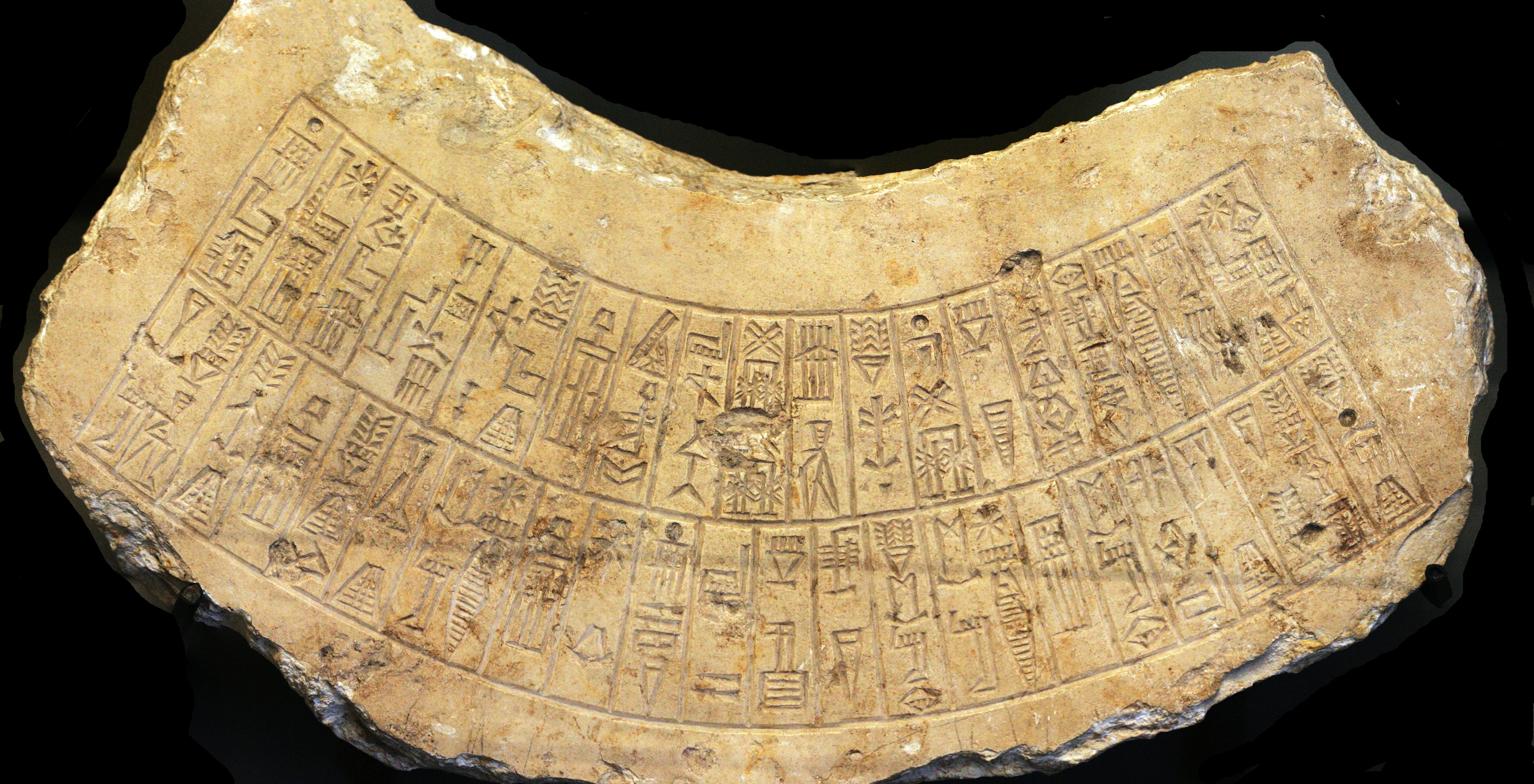
The Foundation Stone of Naram-Sin.

The Foundation Stone of Naram-Sin.

 This “foundation-stone,” he tells us, had been seen by none of his predecessors for 3200 years. In the opinion, accordingly, of Nabonidos, a king who was curious about the past history of his country, and whose royal position gave him the best possible opportunities for learning all that could be known about it, Naram-Sin and his father Sargon I, lived 3200 years before his own time, or 3750 B.C.

The date is so remote and so contrary to all our preconceived ideas regarding the antiquity of the Babylonian monarchy, that I may be excused if at first I expressed doubts as to its accuracy. We are now accustomed to contemplate with equanimity the long chronology which the monuments demand for the history of Pharaonic Egypt, but we had also been accustomed to regard the history of Babylonia as beginning at the earliest in the third millennium before our era. Assyrian scholars had inherited the chronological prejudices of a former generation, and a starveling chronology seemed to be confirmed by the statements of Greek writers.

I was, however, soon forced to re-consider the reasons of my scepticism. The cylinder on which Nabonidos accounts his discovery of the foundation-stone of Naram-Sin was brought from the excavations of Mr. Hormuzd Rassam in Babylonia, and explained by Mr. Pinches six years ago.

Soon afterwards, Mr. Pinches was fortunate enough to find among some other inscriptions from Babylonia fragments of three different lists, in one of which the kings of Babylonia were arranged in dynasties, and the number of years each king reigned was stated, as well as the number of years the several dynasties lasted.

An Assyrian copy of a similar list had been already discovered by Mr. George Smith, who, with his usual quickness of perception, saw that it must have resembled the lists from which Berossos, the Greek historian of Chaldaea, drew the materials of his chronology; but the copy was so mere a fragment that the chronological position of the kings mentioned upon it was a matter of dispute.

Happily this is not the case with the principal test published by Mr. Pinches. It had been compiled by a native of Babylon, who consequently began with the first dynasty which made Babylon the capital of the kingdom, and who seems to have flourished in the time of Nabonidos. We can check the accuracy of his statements in a somewhat curious way.

One of the two other texts brought to light by Mr. Pinches is a schoolboy’s exercise copy of the first two dynasties mentioned on the annalistic tablet. There are certain variations between thc two texts, however, which show that the schoolboy or his master must have used some other list of the early kings than that which was employed by the compiler of the tablet; nevertheless, the names and the regnal years, with one exception, agree exactly in each.

In Assyria, an accurate chronology was kept by means of certain officers, the so-called Eponyms, who were changed every year and gave their names to the year over which they presided. We have at present no positive proof that the years were dated in the same way in Babylonia; but since most Assyrian institutions were of Babylonian origin, it is probable that they were.

At all events, the scribes of a later day believed that they had trustworthy chronological evidence extending back into a dim antiquity; and when we remember the imperishable character of the clay literature of the country, and the fact that the British Museum actually contains deeds and other legal documents dated in the rein of Khammuragas, more than four thousand years ago, there is no reason why we should not consider the belief to have been justified.”

A.H. Sayce, Lectures on the Origin and Growth of Religion as Illustrated by the Religion of the Ancient Babylonians, 5th ed., London, 1898, pp. 21-3.

Sumerian Archeology

“Arriving in 1878, Rassam went to work with a will. Over a period of four years he opened excavations not only at Nineveh but at sites ranging from eastern Anatolia to southern Iraq, leaving the day-to-day excavation to his assistants and rarely visiting the sites.

Bronze band from the Palace Gates of Shalmaneser III in the British Museum.  The scenes show in the upper tier the king receiving tribute from Tyre and Sidon in Lebanon and in the lower tier the conquest of the town of Hazuzu in Syria. https://en.wikipedia.org/wiki/Balawat_Gates

Bronze band from the Palace Gates of Shalmaneser III in the British Museum.
The scenes show in the upper tier the king receiving tribute from Tyre and Sidon in Lebanon and in the lower tier the conquest of the town of Hazuzu in Syria.
https://en.wikipedia.org/wiki/Balawat_Gates

His discoveries included panels of embossed bronze sheeting that had originally covered the great gates erected by Shalmaneser III at Balawat near Nimrud, and around 50,000 cuneiform cylinders and tablets in the Shamash temple at Sippar near Babylon. But times had changed since the cavalier days of the 1850s.

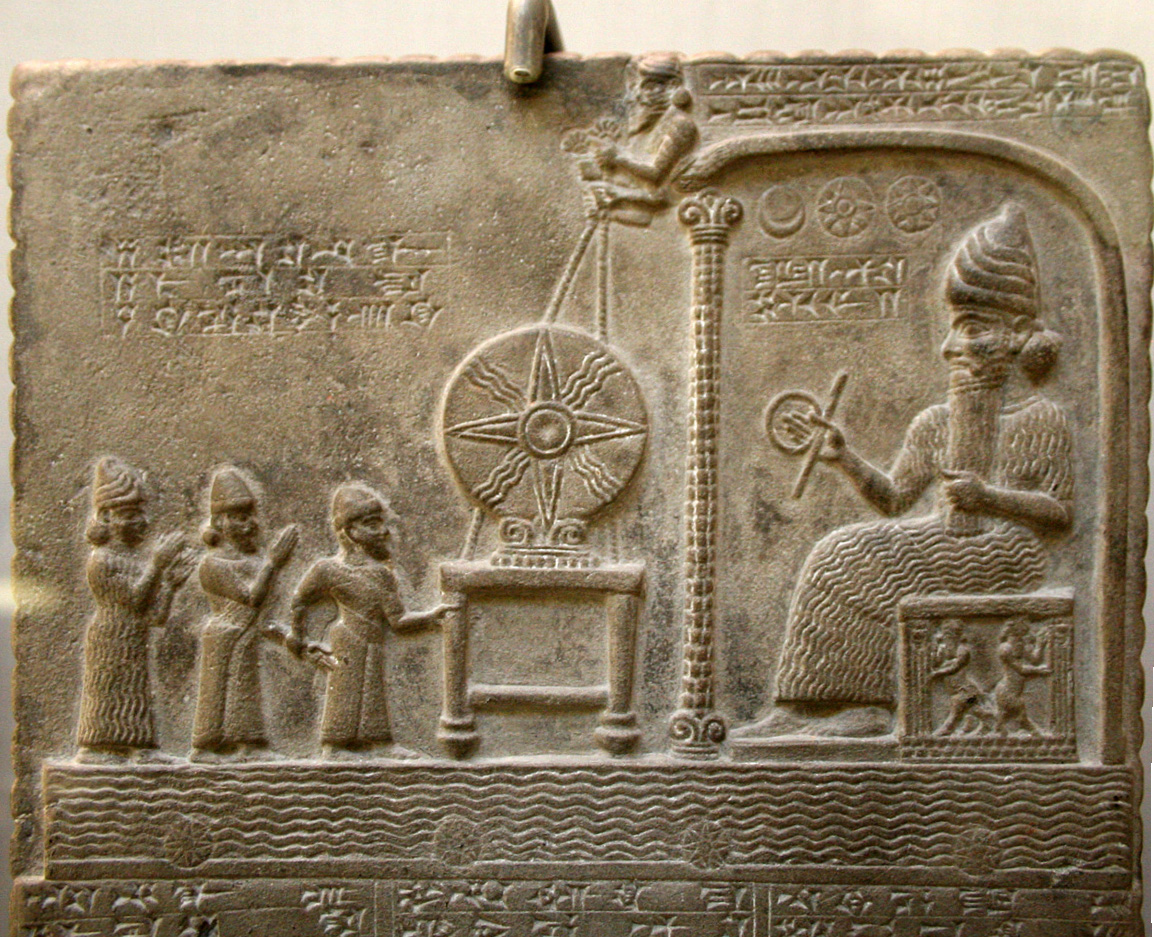
Relief image on the Tablet of Shamash, British Library room 55. Found in Sippar (Tell Abu Habbah), in Ancient Babylonia; it dates from the 9th century BC and shows the sun god Shamash on the throne, in front of the Babylonian king Nabu-apla-iddina (888-855 BC) between two interceding deities. The text tells how the king made a new cultic statue for the god and gave privileges to his temple. https://en.wikipedia.org/wiki/Tablet_of_Shamash#/media/File:Tablet_of_Shamash_relief.jpg

Relief image on the Tablet of Shamash, British Library room 55. Found in Sippar (Tell Abu Habbah), in Ancient Babylonia; it dates from the 9th century BC and shows the sun god Shamash on the throne, in front of the Babylonian king Nabu-apla-iddina (888-855 BC) between two interceding deities. The text tells how the king made a new cultic statue for the god and gave privileges to his temple.
https://en.wikipedia.org/wiki/Tablet_of_Shamash#/media/File:Tablet_of_Shamash_relief.jpg

Considerable advances had been made in excavation techniques and recording methods. It was no longer enough to plunder sites for antiquities; buildings and other contexts had to be carefully investigated and recorded, and objects had to be recovered with care, without allowing them to “crumble to dust.”

Rassam was seriously criticized by other scholars in the field, and his departure largely saw the end of crude excavation methods in Mesopotamia—until the wanton destruction by bandits with bulldozers following the 2003 invasion of Iraq, which threatens utterly to obliterate a huge number of sites.

As a native of the region, Rassam was very aware of the threat to the ancient cities from treasure hunters and brick robbers. When he left for Britain, therefore, he hired guardians to prevent future plundering in the important sites, including Kuyunjik and Sippar. Over the following decade, however, antiquities, and particularly tablets, that seemed likely to have come from these sites appeared in some numbers on the international market. The British Museum sent out Wallis Budge to investigate.

Budge arrived in Baghdad in 1888, armed with a permit to excavate Kuyunjik as a cover for his detective work. Within days, he purchased many tablets from local dealers, most of whom he found to be the very people appointed to guard the ancient sites, and skillfully foiled a plan to prevent him from exporting them.

Later in the year he reopened excavations at Kuyunjik, recovering some 200 tablets from the spoil of previous excavations. His luck turned the following year, however, when he excavated at ed-Der, part of ancient Sippar. The procedures involved in obtaining an excavation permit were long-winded and public: By the time Budge could start work, ed-Der had been thoroughly “examined” by the Vali of Baghdad, with the result that 10,000 tablets had found their way into the hands of dealers.

A similar fate befell the Frenchman Ernest de Sarzec, who excavated Telloh (ancient Girsu) in 1877–1881 and 1888–1900. This was the first serious investigation of a site belonging to Mesopotamia’s original Sumerian civilization, and the objects found here created great excitement in Europe, where they were displayed in the 1880s Paris exhibition.

     Stele of Vultures detail 01-transparent.png One fragment of the victory stele of the king Eannatum of Lagash over Umma, Sumerian archaic dynasties. https://en.wikipedia.org/wiki/Stele_of_the_Vultures#/media/File:Stele_of_Vultures_detail_01-transparent.png


Stele of Vultures detail 01-transparent.png
One fragment of the victory stele of the king Eannatum of Lagash over Umma, Sumerian archaic dynasties.
https://en.wikipedia.org/wiki/Stele_of_the_Vultures#/media/File:Stele_of_Vultures_detail_01-transparent.png

The powerful and austere art style typified by the diorite statues strongly impressed European art critics, and a sculptured slab, dubbed the “Stele of the Vultures,” sparked great interest, because it showed for the first time in history an organized army going to war.

Telloh also yielded numerous tablets, some relating to border disputes with neighboring Umma, the fascinating first contemporary account of warfare—but most of them were not recovered by de Sarzec. During de Sarzec’s frequent absences, local people, often sponsored by Baghdad dealers, abstracted around 40,000 tablets from one of the mounds. These provided the first substantial body of works in the Sumerian language, whose very existence had been doubted in earlier decades.

The first U.S. expedition to work in Mesopotamia experienced an even more dramatic mixture of success and failure. Sponsored by Pennsylvania University, a team headed by John Peters arrived in 1887 to excavate Nippur, the holy city of ancient Sumer.

Hopelessly out of their depth in the complexities of dealing with the local villagers and authorities, their first season ended in an all-out attack in which their camp was set on fire, half their horses perished, and they lost $1,000 in gold—although they saved their antiquities.

Work resumed in 1890, under more auspicious circumstances, and continued intermittently until 1900. Among the 30,000 tablets recovered from Nippur were around 2,100 whose subject matter was literature, in contrast to the ubiquitous economic texts: These opened a window onto the fascinating world of the Sumerians and to this day form the bulk of known Sumerian literature.”

Jane R. McIntosh, Ancient Mesopotamia, 2005, pp. 30-2.

The Story of Mesopotamian Archeology

“Although official attentions were now turned elsewhere, strong popular interest in Mesopotamian antiquities continued, fueling a flourishing trade in material looted by local merchants from the ancient cities of Assyria. Scholarly plundering had already caused considerable destruction. Now the situation reached its nadir, with the retrieval of saleable pieces being the only aim, very much at the expense of the ancient remains.

Scholarly activity had not ceased, however, although it was no longer concentrated in the field. By the end of the 1850s the successful decipherment of Akkadian cuneiform meant that inscriptions and texts recovered from Nineveh and elsewhere could now yield a vast amount of information on the ancient Mesopotamian world.

One of the most surprising discoveries was the great time depth of the civilization. Biblical and Classical sources had painted a picture of the wealth and grandeur of Assyria in the first millennium B.C.E., and this had been confirmed by the excavations at Nineveh and adjacent cities.

The library uncovered in Ashurbanipal’s palace included texts written in the second millennium B.C.E., shedding light on the period of the Old Babylonian Empire and the early history of the Assyrians, the time of the biblical patriarch Abraham, native of the Mesopotamian city of Ur.

But there were also copies of even more ancient texts that revealed the existence in the third millennium B.C.E. of the southern Mesopotamian civilization of Sumer and Akkad.

The later nineteenth century was a time of great intellectual upheaval. The developing science of geology was revealing the immense age and gradual formation of the earth, while Charles Darwin was showing how life had evolved in all its diversity. This new knowledge undermined the certainties of the Bible, according to which the world was created in immutable form at a date calculated by biblical scholars as 4004 B.C.E.

In this epoch of challenge to established traditional views, many found it reassuring that archaeological research in the Near East was uncovering cities and records of individuals familiar from the Bible, thus confirming and buttressing its authenticity.

It was therefore electrifying news when George Smith, who had spent many years quietly studying cuneiform texts, announced in December 1872 that he had found part of a tablet recounting the story of the Flood. A serious-minded man, he amazed his colleagues at the moment of discovery by leaping to his feet, rushing round the room, and beginning to tear off his clothes.

In less than two months he found himself en route to Mosul to look for the missing pieces of the tablet, lavishly sponsored by the Daily Telegraph of London—a measure of the immense popular excitement that his discovery had generated.

Once Smith had accomplished the tedious and time-consuming task of extracting a permit from the Ottoman authorities, he achieved his objective in just five days of digging, finding among the debris left by previous excavators a piece of tablet that accounted for the major part of the missing section.

Smith later returned to excavate further at Nineveh, but in 1876 he contracted a fatal illness. As his replacement, the British Museum appointed Hormuzd Rassam, veteran of the 1850s excavations.”

Jane R. McIntosh, Ancient Mesopotamia, 2005, pp. 29-30.

Ashurbanipal’s Great Library of Nineveh

“But if Assur-bani-pal was effeminate and lax in government, he was the first great patron of literature. It is to his magnificent library at Nineveh that we owe practically all that we have preserved of the literature that was produced in Babylonia.

He saw that the southern part of his empire was far more intellectual and cultured than Assyria, and he despatched numerous scribes to the temple schools of the south, where they copied extensively from their archives every description of literary curiosity— hymns, legends, medical prescriptions, myths and rituals were all included in the great library at Nineveh. These through the labours of Layard and Rassam have been restored to us.

It is a most extraordinary instance of antiquarian zeal in an epoch which we regard as not far distant from the beginnings of verifiable history. Nearly twenty thousand fragments of brick, bearing the results of Assur-bani-pal’s researches, are housed in the British Museum, and this probably represents only a portion of his entire collection.

Political motives have been attributed to Assur-bani-pal in thus bringing together such a great library. It has been argued that he desired to make Assyria the centre of the religious influence of the empire. This would derogate greatly from the view that sees in him a king solely fired with the idea of preserving and retaining all that was best in ancient Babylonian literature in the north as well as in the south, and having beside him for his own personal use those records which many circumstances prove he was extremely desirous of obtaining. Thus we find him sending officials on special missions to obtain copies of certain works.

It is also significant that Assur-bani-pal placed his collection in a library and not in a temple—a fact which, discounts the theory that his collection of literature had a religious-political basis.”

Lewis Spence, Myths and Legends of Babylonia and Assyria, 1917, pp. 35-6.

Elements of the Cult of Tammuz

” … Whilst on earth, he was the one who nourished the ewe and her lamb, the goat and her kid, and also caused them to be slain–probably in sacrifice.

“He has gone, he has gone to the bosom of the earth,” the mourners cried, “he will make plenty to overflow for the land of the dead, for its lamentations for the day of his fall, in the unpropitious month of his year.”

There was also lamentation for the cessation of the growth of vegetation, and one of these hymns, after addressing him as the shepherd and husband of Ištar, “lord of the underworld,” and “lord of the shepherd’s seat,” goes on to liken him to a germ which has not absorbed water in the furrow, whose bud has not blossomed in the meadow; to the sapling which has not been planted by the watercourse, and to the sapling whose root has been removed.

In the “Lamentations” in the Manchester Museum, Ištar, or one of her devotees, seems to call for Tammuz, saying, “Return, my husband,” as she makes her way to the region of gloom in quest of him.

Ereš-ê-gala, “the lady of the great house” (Persephone), is also referred to, and the text seems to imply that Ištar entered her domain in spite of her. In this text other names are given to him, namely, /Tumu-giba/, “son of the flute,” /Ama-elaggi/, and /Ši-umunnagi/, “life of the people.”

The reference to sheep and goats in the British Museum fragment recalls the fact that in an incantation for purification the person using it is told to get the milk of a yellow goat which has been brought forth in the sheep-fold of Tammuz, recalling the flocks of the Greek sun-god Helios.

These were the clouds illuminated by the sun, which were likened to sheep–indeed, one of the early Sumerian expressions for “fleece” was “sheep of the sky.” The name of Tammuz in Sumerian is Dumu-zi, or in its rare fullest form, Dumu-zida, meaning “true” or “faithful son.” There is probably some legend attached to this which is at present unknown.

Theophilus G. Pinches, The Religion of Babylonia and Assyria, London, 1906, pp. 71-2.

The Enuma Elish

“THE great Assyrian poem, or series of legends, which narrates the story of the Creation of the world and man, was termed by the Assyrians and Babylonians Enuma elish, “When in the height,” from the two opening words of the text.

The poem consisted of some nine hundred and ninety-four lines, and was divided into seven sections, each of which was inscribed upon a separate Tablet. The Tablets were numbered by the Assyrian scribes, and the separate sections of the poem written upon them do not vary very much in length.

The shortest Tablet contains one hundred and thirty-eight lines, and the longest one hundred and forty-six, the average length of a Tablet being about one hundred and forty-two lines.

The poem embodies the beliefs of the Babylonians and Assyrians concerning the origin of the universe; it describes the coming forth of the gods from chaos, and tells the story of how the forces of disorder, represented by the primeval water-gods Apsû and Tiamat, were overthrown by Ea and Marduk respectively, and how Marduk, after completing the triumph of the gods over chaos, proceeded to create the world and man.

The poem is known to us from portions of several Assyrian and late-Babylonian copies of the work, and from extracts from it written out upon the so-called “practice-tablets,” or students’ exercises, by pupils of the Babylonian scribes.

The Assyrian copies of the work are from the great library which was founded at Nineveh by Ashur-bani-pal, king of Assyria from B.C. 668 to about B.C. 626; the Babylonian copies and extracts were inscribed during the period of the kings of the Neo-Babylonian and Persian periods; and one copy of the Seventh Tablet may probably be assigned to as late a date as the period of the Arsacidae.

All the tablets and fragments, which have hitherto been identified as inscribed with portions of the text of the poem, are preserved in the British Museum.”

Leonard William King, The Seven Tablets of Creation, London, 1902. pp. xxv-xxvi.

Boundary Stone of Ritti-Marduk (British Museum, No. 90,858)

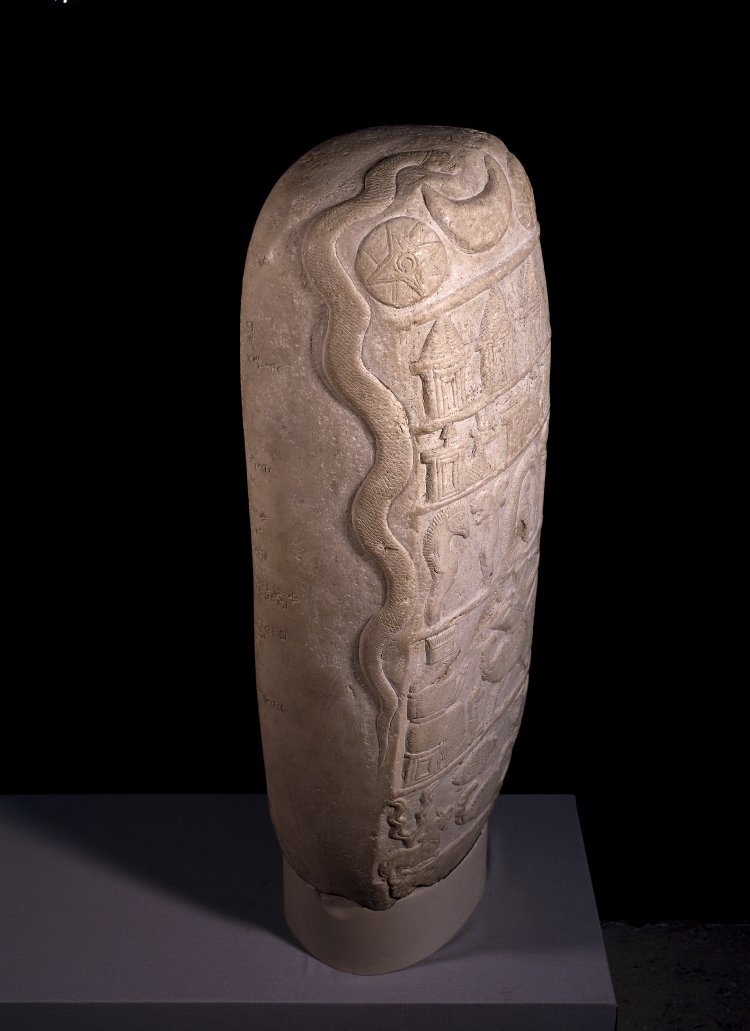
The accompanying illustration, which is reproduced from the Boundary Stone of Ritti-Marduk (Brit. Mus., No. 90,858), supplies much information about the symbols of the gods, and of the Signs of the Zodiac in the reign of Nebuchadnezzar I, King of Babylon, about 1120 B.C.

British Museum number 90858 Description 3/4: Right Limestone stela in the form of a boundary-stone: consisting of a block of calcareous limestone, shaped and prepared on four sides to take sculptures and inscriptions. It is now mounted on a stone plinth.  Faces B and C each bear a single column of inscription, the lines running the full width of the stone.  The top of the stone and Face D have been left blank, except for the serpent, which has been carved to the left of the emblems on Face A.  Inscribed with a Charter from the reign of Nebuchadnezzar I.

British Museum number 90858
Description 3/4: Right
Limestone stela in the form of a boundary-stone: consisting of a block of calcareous limestone, shaped and prepared on four sides to take sculptures and inscriptions. It is now mounted on a stone plinth.
Faces B and C each bear a single column of inscription, the lines running the full width of the stone.
The top of the stone and Face D have been left blank, except for the serpent, which has been carved to the left of the emblems on Face A.
Inscribed with a Charter from the reign of Nebuchadnezzar I.

Thus in Register 1, we have the Star of Ishtar, the crescent of the Moon-god Sin, and the disk of Shamash the Sun-god. In Reg. 2 are three stands (?) surmounted by tiaras, which represent the gods Anu, Enlil (Bel) and Ea respectively. In Reg. 3 are three altars (?) or shrines (?) with a monster in Nos. 1 and 2. Over the first is the lance of Marduk, over the second the mason’s square of Nabû, and over the third is the symbol of the goddess Ninkharsag, the Creatress. In Reg. 4 are a standard with an animal’s head, a sign of Ea; a two-headed snake = the Twins; an unknown symbol with a horse’s head, and a bird, representative of Shukamuna and Shumalia. In Reg. 5 are a seated figure of the goddess Gula and the Scorpion-man. In Reg. 6 are forked lightning, symbol of Adad, above a bull, the Tortoise, symbol of Ea (?), the Scorpion of the goddess Ishkhara, and the Lamp of Nusku, the Fire-god.  Down the left-hand side is the serpent-god representing the constellation of the Hydra.

Thus in Register 1, we have the Star of Ishtar, the crescent of the Moon-god Sin, and the disk of Shamash the Sun-god.
In Reg. 2 are three stands (?) surmounted by tiaras, which represent the gods Anu, Enlil (Bel) and Ea respectively.
In Reg. 3 are three altars (?) or shrines (?) with a monster in Nos. 1 and 2. Over the first is the lance of Marduk, over the second the mason’s square of Nabû, and over the third is the symbol of the goddess Ninkharsag, the Creatress.
In Reg. 4 are a standard with an animal’s head, a sign of Ea; a two-headed snake = the Twins; an unknown symbol with a horse’s head, and a bird, representative of Shukamuna and Shumalia.
In Reg. 5 are a seated figure of the goddess Gula and the Scorpion-man.
In Reg. 6 are forked lightning, symbol of Adad, above a bull, the Tortoise, symbol of Ea (?), the Scorpion of the goddess Ishkhara, and the Lamp of Nusku, the Fire-god.
Down the left-hand side is the serpent-god representing the constellation of the Hydra.

The mutilated text of the Fifth Tablet makes it impossible to gain further details in connection with Marduk’s work in arranging the heavens. We are, however, justified in assuming that the gaps in it contained statements about the grouping of the gods into triads.

In royal historical inscriptions the kings often invoke the gods in threes, though they never call any one three a triad or trinity. It seems as if this arrangement of gods in threes was assumed to be of divine origin.

In the Fourth Tablet of Creation, one triad “Anu-Bel-Ea” is actually mentioned, and in the Fifth Tablet, another is indicated, “Sin-Shamash-Ishtar.”

In these triads Anu represents the sky or heaven, Bel or Enlil the region under the sky and including the earth, Ea the underworld, Sin the Moon, Shamash the Sun, and Ishtar the star Venus.

When the universe was finally constituted several other great gods existed, e.g., Nusku, the Fire-god, Enurta, a solar god, Nergal, the god of war and handicrafts, Nabu, the god of learning, Marduk of Babylon, the great national god of Babylonia, and Ashur, the great national god of Assyria.

E.A. Wallis Budge, et al, & the British Museum, The Babylonian Legends of the Creation & the Fight Between Bel & the Dragon Told by Assyrian Tablets from Nineveh (BCE 668-626), 1901, pp. 11-2.

More on the Babylonian Zodiac

” … Then returning to the dead body of Tiâmat he smashed her skull with his club and scattered her blood to the north wind, and as a reward for his destruction of their terrible foe, he received gifts and presents from the gods his fathers.

The text then goes on to say that Marduk “devised a cunning plan,” i.e., he determined to carry out a series of works of creation.

He split the body of Tiâmat into two parts; out of one half he fashioned the dome of heaven, and out of the other he constructed the abode of Nudimmud, or Ea, which he placed over against Apsu, i.e., the deep.

He also formulated regulations concerning the maintenance of the same. By this “cunning plan” Marduk deprived the powers of darkness of the opportunity of repeating their revolt with any chance of success.

Having established the framework of his new heaven and earth Marduk, acting as the celestial architect, set to work to furnish them. In the first place he founded E-Sharra, or the mansion of heaven, and next he set apart and arranged proper places for the old gods of the three realms–Anu, Bel and Ea.

Illustration: Tablet sculptured with a scene representing the worship of the Sun-god in the Temple of Sippar.  The Sun-god is seated on a throne within a pavilion holding in one hand a disk and bar which may symbolize eternity.  Above his head are the three symbols of the Moon, the Sun, and the planet Venus.  On a stand in front of the pavilion rests the disk of the Sun, which is held in position by ropes grasped in the hands of two divine beings who are supported by the roof of the pavilion.  The pavilion of the Sun-god stands on the Celestial Ocean, and the four small disks indicate either the four cardinal points or the tops of the pillars of the heavens.  The three figures in front of the disk represent the high priest of Shamash, the king (Nabu-aplu-iddina, about 870 B.C.) and an attendant goddess. [No. 91,000.]

Illustration: Tablet sculptured with a scene representing the worship of the Sun-god in the Temple of Sippar.
The Sun-god is seated on a throne within a pavilion holding in one hand a disk and bar which may symbolize eternity.
Above his head are the three symbols of the Moon, the Sun, and the planet Venus.
On a stand in front of the pavilion rests the disk of the Sun, which is held in position by ropes grasped in the hands of two divine beings who are supported by the roof of the pavilion.
The pavilion of the Sun-god stands on the Celestial Ocean, and the four small disks indicate either the four cardinal points or the tops of the pillars of the heavens.
The three figures in front of the disk represent the high priest of Shamash, the king (Nabu-aplu-iddina, about 870 B.C.) and an attendant goddess. [No. 91,000.]

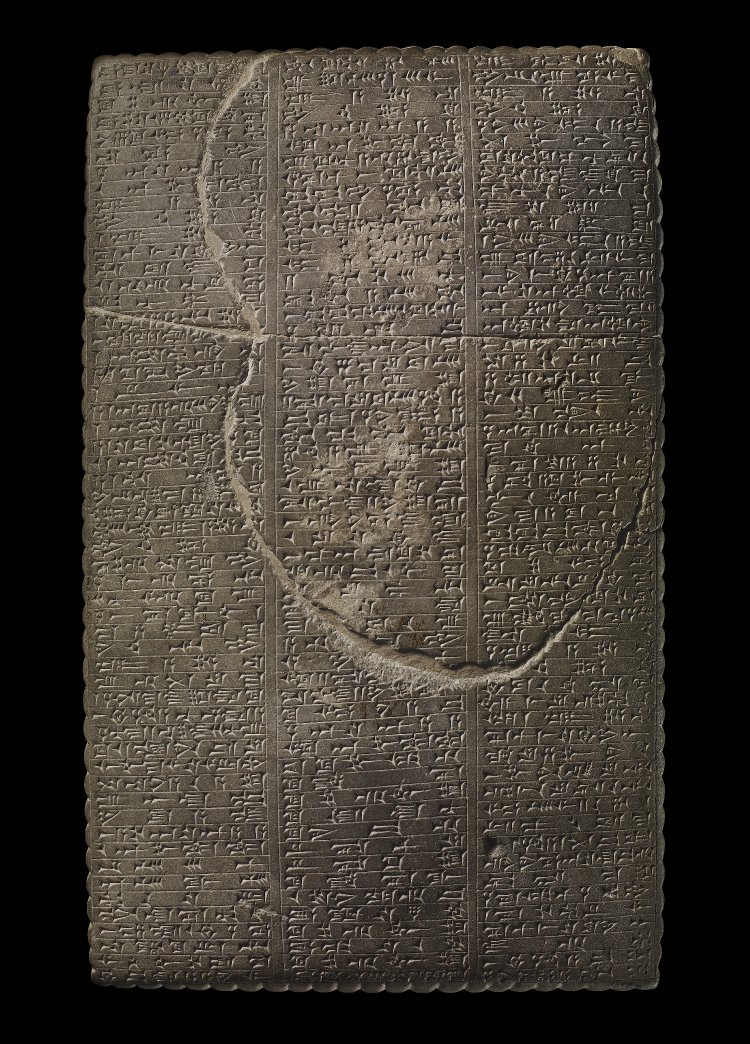
Museum number 91000 The engraved text contains a record of Nabu-apla-iddina's re-endowment of the Sun-Temple at Sippar. The inscription is engraved in six columns, three upon the obverse and three upon the reverse; and the upper part of the obverse is occupied by a scene sculptured in low relief; the edges of the tablet are bevelled.

Museum number 91000
The engraved text contains a record of Nabu-apla-iddina’s re-endowment of the Sun-Temple at Sippar. The inscription is engraved in six columns, three upon the obverse and three upon the reverse; and the upper part of the obverse is occupied by a scene sculptured in low relief; the edges of the tablet are bevelled.

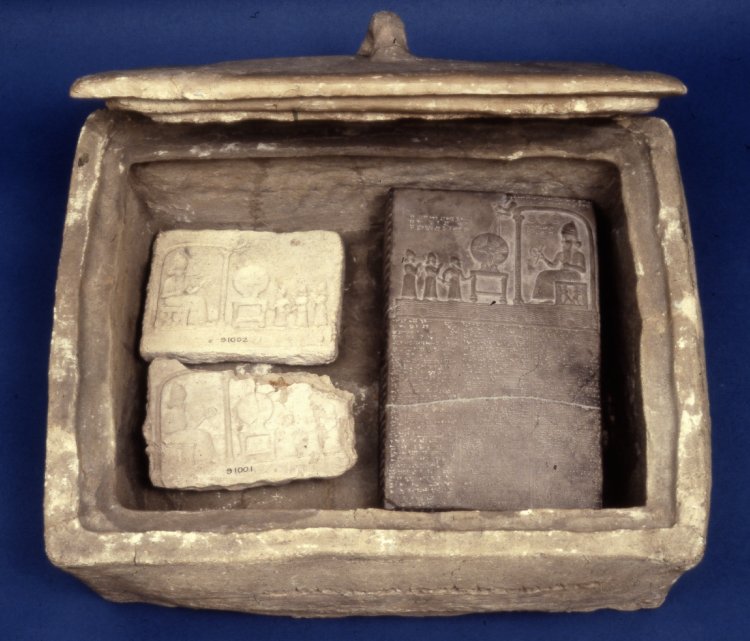
Museum number 91000 Group of Objects Pottery box and the limestone sun-god tablet and its covers deposited in it by Nabopolassar.

Museum number 91000
Group of Objects
Pottery box and the limestone sun-god tablet and its covers deposited in it by Nabopolassar.

The text of the Fifth Tablet, which would undoubtedly have supplied details as to Marduk’s arrangement and regulations for the sun, the moon, the stars, and the Signs of the Zodiac in the heavens is wanting.

The prominence of the celestial bodies in the history of creation is not to be wondered at, for the greater number of the religious beliefs of the Babylonians are grouped round them. Moreover, the science of astronomy had gone hand in hand with the superstition of astrology in Mesopotamia from time immemorial; and at a very early period the oldest gods of Babylonia were associated with the heavenly bodies.

Thus the Annunaki and the Igigi, who are bodies of deified spirits, were identified with the stars of the northern and southern heaven, respectively. And all the primitive goddesses coalesced and were grouped to form the goddess Ishtar, who was identified with the Evening and Morning Star, or Venus.

The Babylonians believed that the will of the gods was made known to men by the motions of the planets, and that careful observation of them would enable the skilled seer to recognize in the stars favourable and unfavourable portents. Such observations, treated from a magical point of view, formed a huge mass of literature which was being added to continually.

From the nature of the case this literature enshrined a very considerable number of facts of pure astronomy, and as early as the period of the First Dynasty (about 2000 B.C.), the Babylonians were able to calculate astronomical events with considerable accuracy, and to reconcile the solar and lunar years by the use of epagomenal months.

They had by that time formulated the existence of the Zodiac, and fixed the “stations” of the moon, and the places of the planets with it; and they had distinguished between the planets and the fixed stars. In the Fifth Tablet of the Creation Series (l. 2) the Signs of the Zodiac are called Lumashi, but unfortunately no list of their names is given in the context.

 Illustration: Tablet inscribed with a list of the Signs of the Zodiac. [No. 77,821.]


Illustration: Tablet inscribed with a list of the Signs of the Zodiac. [No. 77,821.]

Now these are supplied by the little tablet (No. 77,821) of the Persian Period of which a reproduction is here given. It has been referred to and discussed by various scholars, and its importance is very great. The transcript of the text, which is now published (see p. 68) for the first time, will be acceptable to the students of the history of the Zodiac.

Egyptian, Greek, Syriac and Arabic astrological and astronomical texts all associate with the Signs of the Zodiac twelve groups, each containing three stars, which are commonly known as the “Thirty-six Dekans.”

The text of line 4 of the Fifth Tablet of the Creation Series proves that the Babylonians were acquainted with these groups of stars, for we read that Marduk “set up for the twelve months of the year three stars apiece.” In the List of Signs of the Zodiac here given, it will be seen that each Sign is associated with a particular month.

At a later period, say about 500 B.C., the Babylonians made some of the gods regents of groups of stars, for Enlil ruled 33 stars, Anu 23 stars, and Ea 15 stars. They also possessed lists of the fixed stars, and drew up tables of the times of their heliacal risings.

Such lists were probably based upon very ancient documents, and prove that the astral element in Babylonian religion was very considerable.”

E.A. Wallis Budge, et al, & the British Museum, The Babylonian Legends of the Creation & the Fight Between Bel & the Dragon Told by Assyrian Tablets from Nineveh (BCE 668-626), 1901, pp. 10-11.

Marduk Kills Tiâmat

” … When Anu reported his inability to deal with Tiâmat, a council of the gods was called, and Ea induced his son, Marduk to be present.

We next find Anshar in converse with the god Marduk, who offers to act as the champion of the gods and to fight Tiâmat and her allies. Marduk being a form of the Sun-god, the greatest of all the powers of light, thus becomes naturally the protagonist of the gods, and the adversary of Tiâmat and her powers of darkness.

Then Anshar summoned a great council of the gods, who forthwith met in a place called “Upshukkinaku,” which may be described as the Babylonian Olympus. It was all-important for Marduk to appear at the council of the gods before he undertook his task, because it was necessary for him to be formally recognised by them as their champion, and he needed to be endowed by them with magical powers.

The primitive gods Lakhmu and Lakhamu, and the Igigi, who may be regarded as star-gods, were also summoned. A banquet was prepared, and the gods attended, and having met and kissed each other they sat down, and ate bread and drank hot and sweet sesame wine.

The fumes of the wine confused their senses, but they continued to drink, and at length “their spirits were exalted.” They appointed Marduk to be their champion officially, and then they proceeded to invest him with the power that would cause every command he spake to be followed immediately by the effect which he intended it to produce.

Next Marduk, with the view of testing the new power which had been given him, commanded a garment to disappear and it did so; and when he commanded it to reappear it did so.

Illustration: Shamash the Sun-god setting (?) on the horizon. In his right he holds a tree (?), and in his left a ... with a serrated edge. Above the horizon is a goddess who holds in her left hand an ear of corn. On the right is a god who seems to be setting free a bird from his right hand. Round him is a river with fish in it, and behind him is an attendant god; under his foot is a young bull. To the right of the goddess stand a hunting god, with a bow and lasso, and a lion. From the seal-cylinder of Adda ..., in the British Museum. About 2500 B.C. [No. 89,115.]

Illustration: Shamash the Sun-god setting (?) on the horizon. In his right he holds a tree (?), and in his left a … with a serrated edge. Above the horizon is a goddess who holds in her left hand an ear of corn. On the right is a god who seems to be setting free a bird from his right hand. Round him is a river with fish in it, and behind him is an attendant god; under his foot is a young bull. To the right of the goddess stand a hunting god, with a bow and lasso, and a lion. From the seal-cylinder of Adda …, in the British Museum. About 2500 B.C. [No. 89,115.]

Then the gods saluted him as their king, and gave him the insignia of royalty, namely, the sceptre, the throne and the pala, whatever that may be. And as they handed to him these things they commanded him to go and hack the body of Tiâmat in pieces, and to scatter her blood to the winds.

Thereupon Marduk began to arm himself for the fight. He took a bow, a spear, and a club; he filled his body full of fire and set the lightning before him. He took in his hands a net wherewith to catch Tiâmat, and he placed the four winds near it, to prevent her from escaping from it when he had snared her.

He created mighty winds and tempests to assist him, and grasped the thunderbolt in his hand; and then, mounting upon the Storm, which was drawn by four horses, he went out to meet and defeat Tiâmat. It seems pretty certain that this description of the equipment of Marduk was taken over from a very ancient account of the Fight with Tiâmat in which the hero was Enlil, i.e., the god of the air, or of the region which lies between heaven and hell.

Marduk approached and looked upon the “Middle” or “Inside” or “Womb” of Tiâmat, and divined the plan of Kingu who had taken up his place therein.

In the Seventh Tablet (l. 108) Marduk is said to have “entered into the middle of Tiâmat,” and because he did so he is called “Nibiru,” i.e., “he who entered in,” and the “seizer of the middle.” What the words “middle of Tiâmat” meant to the Babylonian we are not told, but it is clear that Marduk’s entry into it was a signal mark of the triumph of the god.

When Kingu from the “middle of Tiâmat” saw Marduk arrayed in his terrible panoply of war, he was terrified and trembled, and staggered about and lost all control of his legs; and at the mere sight of the god all the other fiends and devils were smitten with fear and reduced to helplessness.

Tiâmat saw Marduk and began to revile him, and when he challenged her to battle she flew into a rage and attempted to overthrow him by reciting an incantation, thinking that her words of power would destroy his strength. Her spell had no effect on the god, who at once cast his net over her.

At the same moment he made a gale of foul wind to blow on her face, and entering through her mouth it filled her body; whilst her body was distended he drove his spear into her, and Tiâmat split asunder, and her womb fell out from it.

Marduk leaped upon her body and looked on her followers as they attempted to escape. But the Four Winds which he had stationed round about Tiâmat made all their efforts to flee of no effect. Marduk caught all the Eleven allies of Tiâmat in his net, and he trampled upon them as they lay in it helpless.

Marduk then took the TABLET OF DESTINIES from Kingu’s breast, and sealed it with his seal and placed it on his own breast.”

E.A. Wallis Budge, et al, & the British Museum, The Babylonian Legends of the Creation & the Fight Between Bel & the Dragon Told by Assyrian Tablets from Nineveh (BCE 668-626), 1901, pp. 9-10.

The First Zodiac

” … Not content with Ummu-Khubur’s brood of devils, Tiâmat called the stars and powers of the air to her aid, for she “set up” …

(1) the Viper,

(2) the Snake,

(3) the god Lakhamu,

(4) the Whirlwind,

(5) the ravening Dog,

(6) the Scorpion-man,

(7) the mighty Storm-wind,

(8) the Fish-man, and

(9) the Horned Beast.

These bore (10) the “merciless, invincible weapon,” and were under the command of (11) Kingu, whom Tiâmat calls “her husband.”

Thus Tiâmat had Eleven mighty Helpers besides the devils spawned by Ummu-Khubur. We may note in passing that some of the above-mentioned Helpers appear among the Twelve Signs of the Zodiac which Marduk “set up” after his conquest of Tiâmat, e.g., the Scorpion-man, the Horned Beast, etc.

This fact suggests that the first Zodiac was “set up” by Tiâmat, who with her Eleven Helpers formed the Twelve Signs; the association of evil with certain stars may date from that period. That the Babylonians regarded the primitive gods as powers of evil is clear from the fact that Lakhamu, one of them, is enumerated among the allies of Tiâmat.

The helpers of Tiâmat were placed by her under the command of a god called KINGU who is TAMMUZ. He was the counterpart, or equivalent, of ANU, the Sky-god, in the kingdom of darkness, for it is said in the text “Kingu was exalted and received the power of Anu,” i.e., he possessed the same power and attributes as Anu.

When Tiâmat appointed Kingu to be her captain, she recited over him a certain spell or incantation, and then she gave him the TABLET OF DESTINIES and fastened it to his breast, saying, “Whatsoever goeth forth from thy mouth shall be established.”

Armed with all the magical powers conferred upon him by this Tablet, and heartened by all the laudatory epithets which his wife Tiâmat heaped upon him, Kingu went forth at the head of his devils.

When Ea heard that Tiâmat had collected her forces and was determined to continue the fight against the gods which Apsû and Mummu had begun, and that she had made her husband Kingu her champion, he was “afflicted” and “sat in sorrow.” He felt unable to renew the fight against the powers of darkness, and he therefore went and reported the new happenings to Anshar, representative of the “host of heaven,” and took counsel with him.

When Anshar heard the matter he was greatly disturbed in mind and bit his lips, for he saw that the real difficulty was to find a worthy antagonist for Kingu and Tiâmat. A gap in the text here prevents us from knowing exactly what Anshar said and did, but the context suggests that he summoned Anu, the Sky-god, to his assistance. Then, having given him certain instructions, he sent him on an embassy to Tiâmat with the view of conciliating her.

When Anu reached the place where she was he found her in a very wrathful state, and she was muttering angrily; Anu was so appalled at the sight of her that he turned and fled. It is impossible at present to explain this interlude, or to find any parallel to it in other ancient Oriental literature.”

Illustration: Shamash the Sun-god rising on the horizon, flames of fire ascending from his shoulder. The two portals of the dawn, each surmounted by a lion, are being drawn open by attendant gods. From a Babylonian seal cylinder in the British Museum. [No. 89,110.]

Illustration: Shamash the Sun-god rising on the horizon, flames of fire ascending from his shoulder. The two portals of the dawn, each surmounted by a lion, are being drawn open by attendant gods. From a Babylonian seal cylinder in the British Museum. [No. 89,110.]

E.A. Wallis Budge, et al, & the British Museum, The Babylonian Legends of the Creation & the Fight Between Bel & the Dragon Told by Assyrian Tablets from Nineveh (BCE 668-626), 1901, pp. 8-9.

Gilgamesh, Enkidu and the Nameless Harlot

THE EPIC OF GILGAMISH.

“The narrative of the life, exploits and travels of Gilgamish, king of Erech, filled Twelve Tablets which formed the Series called from the first three words of the First Tablet, SHA NAGBU IMURUi.e., “He who hath seen all things.”

The exact period of the reign of this king is unknown, but in the list of the Sumerian kingdoms he is fifth ruler in the Dynasty of Erech, which was considered the second dynasty to reign after the Deluge. He was said to have ruled for 126 years.

The principal authorities for the Epic are the numerous fragments of the tablets that were found in the ruins of the Library of Nebo and the Royal Library of Ashur-bani-pal at Nineveh, and are now in the British Museum, but very valuable portions of other and older versions (including some fragments of a Hittite translation) have now been recovered from various sources, and these contribute greatly to the reconstruction of the story.

The contents of the Twelve Tablets may be briefly described thus–

THE FIRST TABLET.

The opening lines describe the great knowledge and wisdom of Gilgamish, who saw everything, learned everything, under stood everything, who probed to the bottom the hidden mysteries of wisdom, and who knew the history of everything that happened before the Deluge.

He travelled far over sea and land, and performed mighty deeds, and then he cut upon a tablet of stone an account of all that he had done and suffered. He built the wall of Erech, founded the holy temple of E-Anna, and carried out other great architectural works.

He was a semi-divine being, for his body was formed of the “flesh of the gods,” and “two-thirds of him were god, and one-third was man,” The description of his person is lost. As Shepherd (i.e., King) of Erech he forced the people to toil overmuch, and his demands reduced them to such a state of misery that they cried out to the gods and begged them to create some king who should control Gilgamish and give them deliverance from him.

The gods hearkened to the prayer of the men of Erech, and they commanded the goddess Aruru to create a rival to Gilgamish. The goddess agreed to do their bidding, and having planned in her mind what manner of being she intended to make, she washed her hands, took a piece of clay, cast it on the ground, and made a male creature like the god En-urta. His body was covered all over with hair. The hair of his head was long like that of a woman, and he wore clothing like that of Sumuqan, the god of cattle.

He was different in every way from the people of the country, and his name was Enkidu. He lived in the forests on the hills, ate herbs like the gazelle, drank with the wild cattle, and herded with the beasts of the field. He was mighty in stature, invincible in strength, and obtained complete mastery over all the creatures of the forests in which he lived.

One day a certain hunter went out to snare game, and he dug pit-traps and laid nets, and made his usual preparations for roping in his prey. But after doing this for three days he found that his pits were filled up and his nets smashed, and he saw Enkidu releasing the beasts that had been snared.

The hunter was terrified at the sight of Enkidu, and went home hastily and told his father what he had seen and how badly he had fared. By his father’s advice he went to Erech, and reported to Gilgamish what had happened.

When Gilgamish heard his story he advised him to act upon a suggestion which the hunter’s father had already made, namely that he should hire a harlot and take her out to the forest, so that Enkidu might be ensnared by the sight of her beauty, and take up his abode with her.

The hunter accepted this advice, and having found a harlot to help him in removing Enkidu from the forests, he set out from Erech with her and in due course arrived at the forest where Enkidu lived, and sat down by the place where the beasts came to drink.

On the second day when the beasts came to drink and Enkidu was with them, the woman carried out the instructions which the hunter had given her, and when Enkidu saw her cast aside her veil, he left his beasts and came to her, and remained with her for six days and seven nights. At the end of this period he returned to the beasts with which he had lived on friendly terms, but as soon as the gazelle winded him they took to flight, and the wild cattle disappeared into the woods.”

E.A. Wallis Budge, The Babylonian Story of the Deluge and the Epic of Gilgamish1929, pp. 41-3.

The Library of Ashur-bani-pal

ASHUR-BANI-PAL, BOOK-COLLECTOR AND PATRON OF LEARNING.

“Ashur-bani-pal (the Asnapper of Ezra iv, 10) succeeded his father Esarhaddon B.C. 669, and at a comparatively early period of his reign he seems to have devoted himself to the study of the history of his country, and to the making of a great Private Library.

The tablets that have come down to us prove not only that he was as great a benefactor of the Library of the Temple of Nebo as any of his predecessors, but that he was himself an educated man, a lover of learning, and a patron of the literary folk of his day.

In the introduction to his Annals, as found inscribed on his great ten-sided prism in the British Museum, he tells us how he took up his abode in the Crown Prince’s dwelling from which Sermacherib and Esarhaddon had ruled the Assyrian Empire, and in describing his own education he says:

“I, Ashur-bani-pal, within it (i.e., the palace) understood the wisdom of Nebo, all the art of writing of every craftsman, of every kind, I made myself master of them all (i.e., of the various kinds of writing).”

These words suggest that Ashur-bani-pal could not only read cuneiform texts, but could write like a skilled scribe, and that he also understood all the details connected with the craft of making and baking tablets.

Having determined to form a Library in his palace he set to work in a systematic manner to collect literary works. He sent scribes to ancient seats of learning, e.g., Ashur, Babylon, Cuthah, Nippur, Akkad, Erech, to make copies of the ancient works that were preserved there, and when the copies came to Nineveh he either made transcripts of them himself, or caused his scribes to do so for the Palace Library.

In any case he collated the texts himself and revised them before placing them in his Library. The appearance of the tablets from his Library suggests that he established a factory in which the clay was cleaned and kneaded and made into homogeneous, well-shaped tablets, and a kiln in which they were baked, after they had been inscribed.

The uniformity of the script upon them is very remarkable, and texts with mistakes in them are rarely found. How the tablets were arranged in the Library is not known, but certainly groups were catalogued, and some tablets were labelled.

Groups of tablets were arranged in numbered series, with “catch lines,” the first tablet of the series giving the first line of the second tablet, the second tablet giving the first line of the third tablet, and so on.

Ashur-bani-pal was greatly interested in the literature of the Sumerians, i.e., the non-Semitic people who occupied Lower Babylonia about B.C. 3500 and later. He and his scribes made bilingual lists of signs and words and objects of all classes and kinds, all of which are of priceless value to the modem student of the Sumerian and Assyrian languages.”

E.A. Wallis Budge, The Babylonian Story of the Deluge and the Epic of Gilgamish1929, pp. 15-17.

The Library of the Temple of Nebo in Nineveh

NEBO AND HIS LIBRARY AT NINEVEH.

“Nothing is known of the early history of the Library of the Temple of Nebo at Nineveh, but there is little doubt that it was in existence in the reign of Sargon II.

Authorities differ in their estimate of the attributes that were assigned to Nebo (Nabu) in Pre-Babylonian times, and “cannot decide whether he was a water-god, or a fire-god, or a corn-god, but he was undoubtedly associated with Marduk, either as his son or as a fellow-god.

It is certain that as early as B.C. 2000 he was regarded as one of the “Great Gods” of Babylonia, and in the fourteenth century B.C. his cult was already established in Assyria. He had a temple at Nimrûd in the ninth century B.C., and King Adad-nirari (B.C. 811-783) set up six statues in it to the honour of the god; two of these statues are now in the British Museum.

The same Adad-nirari also repaired the Nebo temple at Nineveh. Under the last Assyrian Empire Nebo was believed to possess the wisdom of all the gods, and to be the “All-wise ” and “All-knowing.” He was the inventor of all the arts and sciences, and the source of inspiration in wise and learned men, and he was the divine scribe and past master of all the mysteries connected with literature and the art of writing (dup-sharrute).

Ashur-bani-pal addresses him as “Nebo, the mighty son, the director of the whole of heaven and of earth, holder of the tablet, bearer of the writing-reed of the tablet of destiny, lengthener of days, vivifier of the dead, stablisher of light for the men who are troubled.”

In the reign of Sargon II the Temple of Nebo at Kuyûnjik was repaired, and probably at that time a library was housed in it. Layard found some of the remains of Nebo’s Library in the South West Palace, but it must have been transferred thither, for the temple of Nebo lay farther north, near the south corner of Ashur-bani-pal’s palace.

Nebo’s temple at Nineveh bore the same name as his very ancient temple at Borsippa (the modem Birs-i-Nimrûd), viz., “E-ZIDA.”

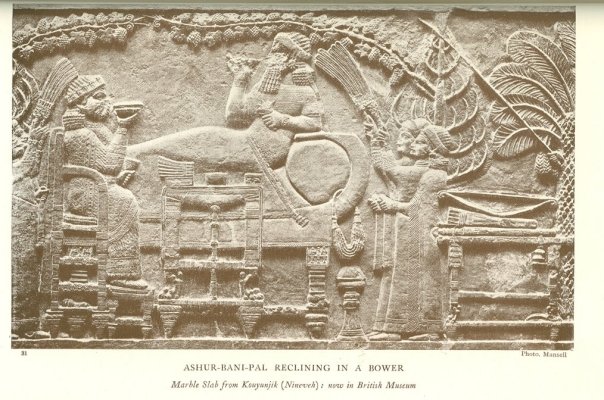
Ashur-bani-pal

” … The records of Ashur-bani-pal cease after 640 B.C., so that we are unable to follow the events of his reign during its last fourteen years. Apparently peace prevailed everywhere. The great monarch, who was a pronounced adherent of the goddess cults, appears to have given himself up to a life of indulgence and inactivity.

Under the name Sardanapalus he went down to tradition as a sensual Oriental monarch who lived in great pomp and luxury, and perished in his burning palace when the Medes revolted against him. It is evident, however, that the memory of more than one monarch contributed to the Sardanapalus legend, for Ashur-bani-pal had lain nearly twenty years in his grave before the siege of Nineveh took place.

In the Bible he is referred to as “the great and noble Asnapper,” and he appears to have been the emperor who settled the Babylonian, Elamite, and other colonists “in the cities of Samaria.”

He erected at Nineveh a magnificent palace, which was decorated on a lavish scale. The sculptures are the finest productions of Assyrian art, and embrace a wide variety of subjects–battle scenes, hunting scenes, and elaborate Court and temple ceremonies. Realism is combined with a delicacy of touch and a degree of originality which raises the artistic productions of the period to the front rank among the artistic triumphs of antiquity.

Ashur-bani-pal in the palace of Nineveh.

Ashur-bani-pal boasted of the thorough education which he had received from the tutors of his illustrious father, Esarhaddon. In his palace he kept a magnificent library. It contained thousands of clay tablets on which were inscribed and translated the classics of Babylonia.

To the scholarly zeal of this cultured monarch is due the preservation of the Babylonian story of creation, the Gilgamesh and Etana legends, and other literary and religious products of remote antiquity. Most of the literary tablets in the British Museum were taken from Ashur-bani-pal’s library.”

Donald A. Mackenzie, Myths of Babylonia and Assyria, 1915, pp. 486-7.

The Royal Library of Kalkhi

” … The prominence given to Nebo, the god of Borsippa, during the reign of Adad-nirari IV is highly significant.

He appears in his later character as a god of culture and wisdom, the patron of scribes and artists, and the wise counsellor of the deities. He symbolized the intellectual life of the southern kingdom, which was more closely associated with religious ethics than that of war-loving Assyria.

A great temple was erected to Nebo at Kalkhi, and four statues of him were placed within it, two of which are now in the British Museum. On one of these was cut the inscription, from which we have quoted, lauding the exalted and wise deity and invoking him to protect Adad-nirari and the lady of the palace, Sammu-rammat, and closing with the exhortation, “Whoso cometh in after time, let him trust in Nebo and trust in no other god.”

The priests of Ashur in the city of Asshur must have been as deeply stirred by this religious revolt at Kalkhi as were the priests of Amon when Akhenaton turned his back on Thebes and the national god to worship Aton in his new capital at Tell-el-Amarna.

It would appear that this sudden stream of Babylonian culture had begun to flow into Assyria as early as the reign of Shalmaneser III, and it may be that it was on account of that monarch’s pro-Babylonian tendencies that his nobles and priests revolted against him.

Shalmaneser established at Kalkhi a royal library which was stocked with the literature of the southern kingdom. During the reign of Adad-nirari IV this collection was greatly increased, and subsequent additions were made to it by his successors, and especially Ashur-nirari IV, the last monarch of the Middle Empire.

The inscriptions of Shamshi-Adad, son of Shalmaneser III, have literary qualities which distinguish them from those of his predecessors, and may be accounted for by the influence exercised by Babylonian scholars who migrated northward.

To the reign of Adad-nirari belongs also that important compilation the Synchronistic History of Assyria and Babylonia, which deals with the relations of the two kingdoms and refers to contemporary events and rulers.”

Donald A. Mackenzie, Myths of Babylonia and Assyria, 1915, pp. 422-3.

The Amorous Queen of Heaven Sat as One in Darkness

“It is evident that there were various versions of the Tammuz myth in Ancient Babylonia. In one the goddess Ishtar visited Hades to search for the lover of her youth. A part of this form of the legend survives in the famous Assyrian hymn known as The Descent of Ishtar. It was first translated by the late Mr. George Smith, of the British Museum.

A box containing inscribed tablets had been sent from Assyria to London, and Mr. Smith, with characteristic patience and skill, arranged and deciphered them, giving to the world a fragment of ancient literature infused with much sublimity and imaginative power.

Ishtar is depicted descending to dismal Hades, where the souls of the dead exist in bird forms:

I spread like a bird my hands.

I descend, I descend to the house of darkness, the dwelling of the god Irkalla:

To the house out of which there is no exit,

To the road from which there is no return:

To the house from whose entrance the light is taken,

The place where dust is their nourishment and their food mud.

Its chiefs also are like birds covered with feathers;

The light is never seen, in darkness they dwell….

Over the door and bolts is scattered dust.

When the goddess reaches the gate of Hades she cries to the porter:

Keeper of the waters, open thy gate,

Open thy gate that I may enter.

If thou openest not the gate that I may enter

I will strike the door, the bolts I will shatter,

I will strike the threshold and will pass through the doors;

I will raise up the dead to devour the living,

Above the living the dead shall exceed in numbers.

The porter answers that he must first consult the Queen of Hades, here called Allatu, to whom he accordingly announces the arrival of the Queen of Heaven. Allatu’s heart is filled with anger, and makes reference to those whom Ishtar caused to perish:

Let me weep over the strong who have left their wives,

Let me weep over the handmaidens who have lost the embraces of their husbands,

Over the only son let me mourn, who ere his days are come is taken away.

Then she issues abruptly the stern decree:

Go, keeper, open the gate to her,

Bewitch her according to the ancient rules;

that is, “Deal with her as you deal with others who come here.”

As Ishtar enters through the various gates she is stripped of her ornaments and clothing. At the first gate her crown was taken off, at the second her ear-rings, at the third her necklace of precious stones, at the fourth the ornaments of her breast, at the fifth her gemmed waist-girdle, at the sixth the bracelets of her hands and feet, and at the seventh the covering robe of her body.

Ishtar asks at each gate why she is thus dealt with, and the porter answers, “Such is the command of Allatu.”

After descending for a prolonged period the Queen of Heaven at length stands naked before the Queen of Hades. Ishtar is proud and arrogant, and Allatu, desiring to punish her rival whom she cannot humble commands the plague demon, Namtar, to strike her with disease in all parts of her body. The effect of Ishtar’s fate was disastrous upon earth: growth and fertility came to an end.

Meanwhile Pap-sukal, messenger of the gods, hastened to Shamash, the sun deity, to relate what had occurred. The sun god immediately consulted his lunar father, Sin, and Ea, god of the deep. Ea then created a man lion, named Nadushu-namir, to rescue Ishtar, giving him power to pass through the seven gates of Hades. When this being delivered his message …

Allatu … struck her breast; she bit her thumb,

She turned again: a request she asked not.

In her anger she cursed the rescuer of the Queen of Heaven.

May I imprison thee in the great prison,

May the garbage of the foundations of the city be thy food,

May the drains of the city be thy drink,

May the darkness of the dungeon be thy dwelling,

May the stake be thy seat,

May hunger and thirst strike thy offspring.

She was compelled, however, to obey the high gods, and addressed Namtar, saying:

Unto Ishtar give the waters of life and bring her before me.

Thereafter the Queen of Heaven was conducted through the various gates, and at each she received her robe and the ornaments which were taken from her on entering. Namtar says:

Since thou hast not paid a ransom for thy deliverance to her (Allatu), so to her again turn back,

For Tammuz the husband of thy youth.

The glistening waters (of life) pour over him…

In splendid clothing dress him, with a ring of crystal adorn him.

Ishtar mourns for “the wound of Tammuz,” smiting her breast, and she did not ask for “the precious eye-stones, her amulets,” which were apparently to ransom Tammuz. The poem concludes with Ishtar’s wail:

O my only brother (Tammuz) thou dost not lament for me.

In the day that Tammuz adorned me, with a ring of crystal,

With a bracelet of emeralds, together with himself, he adorned me,

With himself he adorned me; may men mourners and women mourners

On a bier place him, and assemble the wake.

A Sumerian hymn to Tammuz throws light on this narrative. It sets forth that Ishtar descended to Hades to entreat him to be glad and to resume care of his flocks, but Tammuz refused or was unable to return.

His spouse unto her abode he sent back.

She then instituted the wailing ceremony:

The amorous Queen of Heaven sits as one in darkness.”

Donald A. Mackenzie, Myths of Babylonia and Assyria, 1915.

Transformations of the Afterlife

“But the use of the horoscope is much older than the time of Alexander the Great, for to a Greek horoscope (published for the first time by Kenyon, Catalogue of Greek Papyri vol. i. p. 132 ff) in the British Museum is attached “an introductory letter from some master of the art of astrology to his pupil, named Hermon, urging him to be very exact and careful in his application of the laws which the ancient Egyptians, with their laborious devotion to the art, had discovered and handed down to posterity.”

Thus we have good reason for assigning the birthplace of the horoscope to Egypt. In connexion with the horoscope must be mentioned the “sphere” or “table” of Democritus as a means of making predictions as to life and death.

In a magical papyrus (footnotes for page 230 are missing from my edition, not included at the end of the text)  we are told to “ascertain in what month the sick man took to his bed, and the name he received at his birth.”

“Calculate the [course of] the moon, and see how many periods of thirty days have elapsed; then note in the table the number of days left over, and if the number comes in the upper part of the table, he will live, but if in the lower part, he will die.”

Egyptian Horoscope TableBoth from the religious and profane literature of Egypt we learn that the gods and man in the future life were able at will to assume the form of any animal, or bird, or plant, or living thing, which they pleased, and one of the greatest delights to which a man looked forward was the possession of that power.

This is proved by the fact that no less than twelve (footnote missing)  of the chapters of the Book of the Dead are devoted to providing the deceased with the words of power, the recital of which was necessary to enable him to transform himself into a “hawk of gold,” a “divine hawk,” “the governor of the sovereign princes,” “the god who giveth light in the darkness,” a lotus, the god Ptah, a bennu bird (i.e., phœnix), a heron, a “living soul,” a swallow, the serpent Sata, and a crocodile; and another chapter (footnote missing)  enabled him to transform himself into “whatever form he pleaseth.”

Armed with this power he could live in the water in the form of a crocodile, in the form of a serpent he could glide over the rocks and ground, in the form of the birds mentioned above he could fly through the air, and soar up and perch himself upon the bow of the boat of Râ, in the form of the lotus he had mastery over the plants of the field, and in the form of Ptah he became “more powerful than the lord of time, and shall gain the mastery over millions of years.”

The bennu bird, it will be remembered, was said to be the “soul of Râ,” and by assuming this form the deceased identified himself with Khepera, the great god of creation, and thus acquired the attributes of the soul of the Sun-god.

In the Elysian Fields he was able to assume any form and to swim and fly to any distance in any direction. It is noteworthy that no beast of the field or wild animal is mentioned as a type of his possible transformations into animals.”

E.A. Wallis Budge, Egyptian Magic, London, 1901. Pp. 229-32.

Procuring Dreams and Visions

Since dreams and visions in which the future might be revealed to the sleeper were greatly desired, the Egyptian magician set himself to procure such for his clients by various devices, such as drawing magical pictures and reciting magical words.

The following are examples of spells for procuring a vision and dreams, taken from British Museum Papyrus, No. 122, lines 64 ff. and 359 ff, (see Catalogue of Greek Papyri, vol. i. p. 118).

“To obtain a vision from [the god] Bes. Make a drawing of Besa, as shewn below, on your left hand, and envelope your hand in a strip of black cloth that has been consecrated to Isis (?) and lie down to sleep without speaking a word, even in answer to a question.”

“Wind the remainder of the cloth round your neck. The ink with which you write must be composed of the blood of a cow, the blood of a white dove, fresh (?) frankincense, myrrh, black writing-ink, cinnabar, mulberry juice, rain-water, and the juice of wormwood and vetch.”

“With this write your petition before the setting sun, [saying], “Send the truthful seer out of the holy shrine, I beseech thee, Lampsuer, Sumarta, Baribas, Dardalam, Iorlex: O Lord send the sacred deity Anuth, Anuth, Salbana, Chambré, Breïth, now, now, quickly, quickly. Come in this very night.'” (A sketch of the god Besa is given at the end of the papyrus. See the description of the “Metternichstele” above, p. 147 ff).

“To procure dreams: Take a clean linen bag and write upon it the names given below. Fold it up and make it into a lamp-wick, and set it alight, pouring pure oil over it.”

“The word to be written is this: ‘Armiuth, Lailamchoüch, Arsenophrephren, Phtha, Archentechtha.’”

“Then in the evening, when you are going to bed, which you must do without touching food [or, pure from all defilement], do thus.”

“Approach the lamp and repeat seven times the formula given below: then extinguish it and lie down to sleep. The formula is this: ‘Sachmu . . . epaëma Ligotereënch: the Aeon, the Thunderer, Thou that hast swallowed the snake and dost exhaust the moon, and dost raise up the orb of the sun in his season, Chthetho is thy name; I require, O lords of the gods, Seth, Chreps, give me the information that I desire.’”

E.A. Wallis Budge, Egyptian Magic, London, 1901. Pp. 215-7.

Abrasax, the Invincible Name of Power

“The last class of documents undoubtedly contains a very large proportion of the magical ideas, beliefs, formulæ, etc., which were current in Egypt from the time of the Ptolemies to the end of the Roman Period, but from about B.C. 150 to A.D. 200 the papyri exhibit traces of the influence of Greek, Hebrew, and Syrian philosophers and magicians, and from a passage like the following (see Goodwin, Fragment of a Græco-Egyptian Work upon Magic, p. 7) we may get a proof of this:—

“I call thee, the headless one, that didst create earth and heaven, that didst create night and day, thee the creator of light and darkness. Thou art Osoronnophris, whom no man hath seen at any time; thou art Iabas, thou art Iapôs, thou hast distinguished the just and the unjust, thou didst make female and male, thou didst produce seeds and fruits, thou didst make men to love one another and to hate one another.”

“I am Moses thy prophet, to whom thou didst commit thy mysteries, the ceremonies of Israel; thou didst produce the moist and the dry and all manner of food.”

“Listen to me: I am an angel of Phapro Osoronnophris; this is thy true name, handed down to the prophets of Israel. Listen to me. (Here follow a number of names of which Reibet, Athelebersthe, Blatha, Abeu, Ebenphi, are examples) . . .”

In this passage the name Osoronnophris is clearly a corruption of the old Egyptian names of the great god of the dead “Ausar Unnefer,” and Phapro seems to represent the Egyptian Per-âa (literally, “great house”) or “Pharaoh,” with the article pa “the” prefixed.

It is interesting to note that Moses is mentioned, a fact which seems to indicate Jewish influence.

In another magical formula we read, (Goodwin, op. cit., p. 21) “I call upon thee that didst create the earth and bones, and all flesh and all spirit, that didst establish the sea and that shakest the heavens, that didst divide the light from the darkness, the great regulative mind, that disposest everything, eye of the world, spirit of spirits, god of gods, the lord of spirits, the immoveable Aeon, IAOOUÊI, hear my voice.”

“I call upon thee, the ruler of the gods, high-thundering Zeus, Zeus, king, Adonai, lord, Iaoouêe. I am he that invokes thee in the Syrian tongue, the great god, Zaalaêr, Iphphou, do thou not disregard the Hebrew appellation Ablanathanalb, Abrasilôa.”

“For I am Silthakhôoukh, Lailam, Blasalôth, Iaô, Ieô, Nebouth, Sabiothar, Bôth, Arbathiaô, Iaoth, Sabaôth, Patoure, Zagourê, Baroukh Adonai, Elôai, Iabraam, Barbarauô, Nau, Siph,” etc.

The spell ends with the statement that it “loosens chains, blinds, brings dreams, creates favour; it may be used in common for whatever purpose you will.”

In the above we notice at once the use of the seven vowels which form “a name wherein be contained all Names, and all Lights, and all Powers” (see Kenyon, Greek Papyri in the British Museum, London, 1893, p. 63). The seven vowels have, of course, reference to the three vowels “Iaô” (for Iaoouêi we should probably read Iaô ouêi) which were intended to represent one of the Hebrew names for Almighty God, “Jâh.”

The names “Adonai, Elôai,” are also derived through the Hebrew from the Bible, and Sabaôth is another well-known Hebrew word meaning “hosts”; some of the remaining names could be explained, if space permitted, by Hebrew and Syriac words.

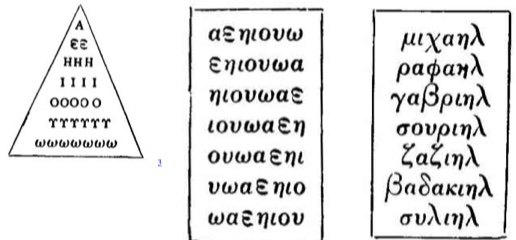
On papyri and amulets the vowels are written in magical combinations in such a manner as to form triangles and other shapes; with them are often found the names of the seven archangels of God; the following are examples:–

 (British Museum, Gnostic gem, No. G. 33). (Kenyon, Greek Papyri, p. 123). (Ibid., p. 123. These names read Michael, Raphael, Gabriel, Souriel, Zaziel, Badakiel, and Suliel).


(British Museum, Gnostic gem, No. G. 33).
(Kenyon, Greek Papyri, p. 123).
(Ibid., p. 123. These names read Michael, Raphael, Gabriel, Souriel, Zaziel, Badakiel, and Suliel)

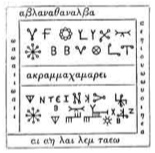
In combination with a number of signs which owe their origin to the Gnostics the seven vowels were sometimes engraved upon plaques, or written upon papyri, with the view of giving the possessor power over gods or demons or his fellow creatures.

The example printed below is found on a papyrus in the British Museum and accompanies a spell written for the purpose of overcoming the malice of enemies, and for giving security against alarms and nocturnal visions. (Kenyon, op. cit., P. 121).

Amulet inscribed with signs and letters of magical power for overcoming the malice of enemies. (From Brit. Mus., Greek Papyrus, Nu. CXXIV.--4th or 5th century.) (Kenyon, Greek Papyri, p. 123).

Amulet inscribed with signs and letters of magical power for overcoming the malice of enemies. (From Brit. Mus., Greek Papyrus, Nu. CXXIV.–4th or 5th century.) (Kenyon, Greek Papyri, p. 123).

But of all the names found upon Gnostic gems two, i.e., Khnoubis (or Khnoumis), and Abrasax (or Abraxas), are of the most frequent occurrence. The first is usually represented as a huge serpent having the head of a lion surrounded by seven or twelve rays.

Over the seven rays, one on the point of each, are the seven vowels of the Greek alphabet, which some suppose to refer to the seven heavens; and on the back of the amulet, on which the figure of Khnoumis occurs, is usually found the sign of the triple S and bar.

Khnoumis is, of course, a form of the ancient Egyptian god Khnemu, or “Fashioner” of man and beast, the god to whom many of the attributes of the Creator of the universe were ascribed.

Khnemu is, however, often depicted with the head of a ram, and in the later times, as the “beautiful ram of Râ,” he has four heads; in the Egyptian monuments he has at times the head of a hawk, but never that of a lion.

The god Abrasax is represented in a form which has a human body, the bead of a hawk or cock, and legs terminating in serpents; in one hand he holds a knife or dagger, and in the other a shield upon which is inscribed the great name ΙΑΩ {Greek IAW}, or JÂH.

Considerable difference of opinion exists as to the meaning and derivation of the name Abrasax, but there is no doubt that the god who bore it was a form of the Sun-god, and that he was intended to represent some aspect of the Creator of the world.

The name was believed to possess magical powers of the highest class, and Basileides, (he of Alexandria, who lived about A.D. 120. He was a disciple of Menander, and declared that he had received the esoteric doctrine of Saint Peter from Glaucias, a disciple of the Apostle) who gave it currency in the second century, seems to have regarded it as an invincible name.

It is probable, however, that its exact meaning was lost at an early date, and that it soon degenerated into a mere magical symbol, for it is often found inscribed on amulets side by side with scenes and figures with which, seemingly, it cannot have any connexion whatever.

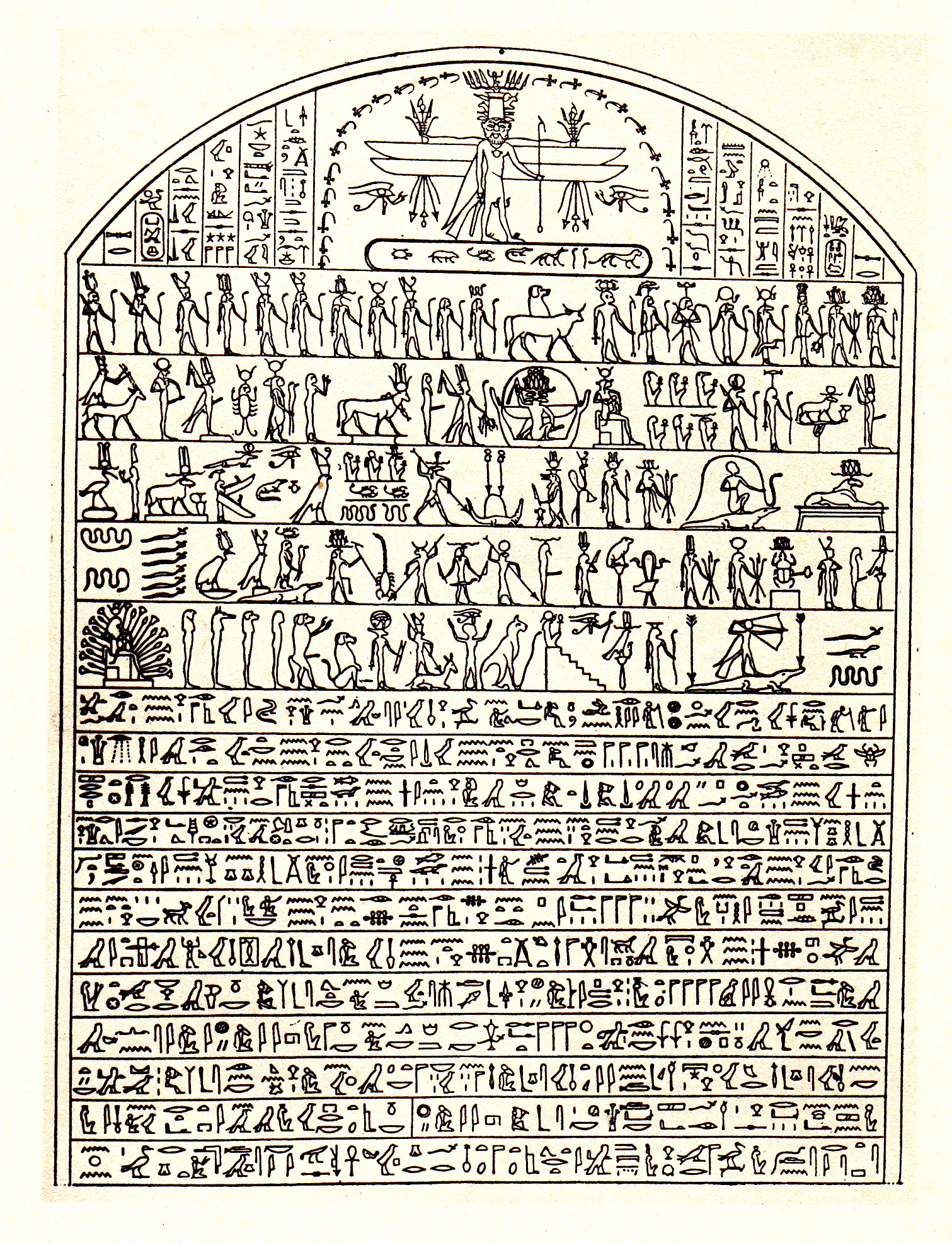
Judging from certain Gnostic gems in the British Museum, Abrasax is to be identified with the polytheistic figure that stands in the upper part of the Metternich stele depicted on p. 153 and below.

Metternich Stele.

Metternich Stele.

This figure has two bodies, one being that of a man, and the other that of a bird; from these extend four wings, and from each of his knees projects a serpent.

He has two pairs of hands and arms; one pair is extended along the wings, each hand holding the symbols of “life,” “stability,” and “power,” and two knives and two serpents; the other pair is pendent, the right hand grasping the sign of life, and the other a sceptre.

His face is grotesque, and probably represents that of Bes, or the sun as an old man; on his head is a pylon-shaped object with figures of various animals, and above it a pair of horns which support eight knives and the figure of a god with raised hands and arms, which typifies “millions of years.”

The god stands upon an oval wherein are depicted figures of various “typhonic” animals, and from each side of his crown proceed several symbols of fire.

Whether in the Gnostic system Abraxas absorbed all the names and attributes of this god of many forms cannot be said with certainty.”

E.A. Wallis Budge, Egyptian Magic, London, 1901. P. 177-80.

Footnote 48, An Amulet

“Through 231 gates everything goes forth. It is found therefore, that every creature and every speech [language] goes forth out of one name” (2:5). Does this mean that the alphabet, in its sequence, constitutes a mystical name? Of such a conception of the alphabet, Franz Dornseiff (Das Alphabet in Mystik und Magie, 2d ed. [Leipzig, 1925], 69-80) collected abundant testimonies from the Greek and Latin sources; cf. also A. Dieterich, ABC—Denkmäler, Rheinisches Museum für Philologie 56 (1900): 77-105.

In the Wiener Jahres hefte 32 (1940): 79-84, Joseph Keil published an important Hebrew-Greek amulet that contains, with an obviously magical intention, the Hebrew alphabet in Greek transcription in the so-called at-bash order. In this order the alphabet is written in two rows boustrophedon and two letters are vertically connected in pairs.

The amulet should be dated between the second and fourth centuries, but certainly no later. (I was able to identify clearly, though with some effort, the Hebrew text of Deuteronomy 28:58, which was in one of the three lines that neither Keil nor Ludwig Blau—to whom he showed the amulet in 1926—was able to decipher.

It is only natural that the view that the alphabet constitutes “One name, to wit the name of 22 letters” should have passed into the early Kabbalah, as is attested by the Commentary on the Prayer Book, composed about 1260, by the (anonymous?) commentator Sefer ha-Manhig on the Pirqe Rabbi Eliezer, Ms. British Museum, Mar-goliouth 743, fol. 96b.”

–Gershom Scholem, Origins of the Kabbalah, 1987, pp. 24-35.

The Moral Precepts of Ptah-hetep

Moral Precepts of Ptah-hetep, Governor of Memphis, Advisor to King Pharaoh Assa, 5th Dynasty, 3500 BCE

CHAPTER XIII
MORAL AND PHILOSOPHICAL LITERATURE

Side by side with the great mass of literature of a magical and religious character that flourished in Egypt under the Ancient Empire, we find that there existed also a class of writings that are remarkably like those contained in the Book of Proverbs, which is attributed to Solomon, the King of Israel, and in “Ecclesiasticus,” and the “Book of Wisdom.”

The priests of Egypt took the greatest trouble to compose Books of the Dead and Guides to the Other World in order to help the souls of the dead to traverse in safety the region that lay between this world and the next, or Dead Land, and the high officials who flourished under the Pharaohs of the early dynasties drew up works, the object of which was to enable the living man to conduct himself in such a way as to satisfy his social superiors, to please his equals, and to content his inferiors, and at the same time to advance to honours and wealth himself.

These works represent the experience, and shrewdness, and knowledge which their writers had gained at the Court of the Pharaohs, and are full of sound worldly wisdom and high moral excellence. They were written to teach young men of the royal and aristocratic classes to fear God, to honour the king, to do their duty efficiently, to lead strictly moral, if not exactly religious, lives, to treat every man with the respect due to his position in life, to cultivate home life, and to do their duty to their neighbours, both to those who were rich and those who were poor.

The oldest Egyptian book of Moral Precepts, or Maxims, or Admonitions, is that of Ptah-hetep, governor of the town of Memphis, and high confidential adviser of the king; he flourished in the reign of Assa, a king of the fifth dynasty, about 3500 B.C. His work is found, more or less complete, in several papyri, which are preserved in the British Museum and in the National Library in Paris, and extracts from it, which were used by Egyptian pupils in the schools attached to the temples, and which are written upon slices of limestone, are to be seen in the Egyptian Museum in Cairo and elsewhere.

The oldest copy of the work contains many mistakes, and in some places the text is unintelligible, but many parts of it can be translated, and the following extracts will illustrate the piety and moral worth, and the sagacity and experience of the shrewd but kindly “man of the world” who undertook to guide the young prince of his day. The sage begins his work with a lament about the evil effects that follow old age in a man–

“Depression seizeth upon him every day, his eyesight faileth, his ears become deaf, his strength declineth, his heart hath no rest, the mouth becometh silent and speaketh not, the intelligence diminisheth, and it is impossible to remember to-day what happened yesterday.

“The bones are full of pain, the pursuit that was formerly attended with pleasure is now fraught with pain, and the sense of taste departeth. Old age is the worst of all the miseries that can befall a man. The nose becometh stopped up and one cannot smell at all.”

At this point Ptah-hetep asks, rhetorically, “Who will give me authority to speak? Who is it that will authorise me to repeat to the prince the Precepts of those who had knowledge of the wise counsels of the learned men of old?”

“In answer to these questions the king replies to Ptah-hetep, “Instruct thou my son in the words of wisdom of olden time. It is instruction of this kind alone that formeth the character of the sons of noblemen, and the youth who hearkeneth to such instruction will acquire a right understanding and the faculty of judging justly, and he will not feel weary of his duties.”

Immediately following these words come the “Precepts of beautiful speech” of Ptah-hetep, whose full titles are given, viz. the Erpa, the Duke, the father of the god (i.e. the king), the friend of God, the son of the king. Governor of Memphis, confidential servant of the king.

These Precepts instruct the ignorant, and teach them to understand fine speech; among them are the following:

“Be not haughty because of thy knowledge. Converse with the ignorant man as well as with him that is educated.

“Do not terrify the people, for if thou dost, God will punish thee. If any man saith that he is going to live by these means, God will make his mouth empty of food. If a man saith that he is going to make himself powerful (or rich) thereby, saying, ‘I shall reap advantage, having knowledge,’ and if he saith, ‘I will beat down the other man,’ he will arrive at the result of being able to do nothing. Let no man terrify the people, for the command of God is that they shall enjoy rest.

“If thou art one of a company seated to eat in the house of a man who is greater than thyself, take what he giveth thee [without remark]. Set it before thee. Look at what is before thee, but not too closely, and do not look at it too often. The man who rejecteth it is an ill-mannered person.

“Do not speak to interrupt when he is speaking, for one knoweth not when he may disapprove. Speak when he addresseth thee, and then thy words shall be acceptable.

“When a man hath wealth he ordereth his actions according to his own dictates. He doeth what he willeth…. The great man can effect by the mere lifting up of his hand what a [poor] man cannot. Since the eating of bread is according to the dispensation of God, a man cannot object thereto.

“If thou art a man whose duty it is to enter into the presence of a nobleman with a message from another nobleman, take care to say correctly and in the correct way what thou art sent to say; give the message exactly as he said it. Take great care not to spoil it in delivery and so to set one nobleman against another. He who wresteth the truth in transmitting the message, and only repeateth it in words that give pleasure to all men, gentleman or common man, is an abominable person.

“If thou art a farmer, till the field which the great God hath given thee. Eat not too much when thou art near thy neighbours…. The children of the man who, being a man of substance, seizeth [prey] like the crocodile in the presence of the field labourers, are cursed because of his behaviour, his father suffereth poignant grief, and as for the mother who bore him, every other woman is happier than she. A man who is the leader of a clan (or tribe) that trusteth him and followeth him becometh a god.

“If thou dost humble thyself and dost obey a wise man, thy behaviour will be held to be good before God. Since thou knowest who are to serve, and who are to command, let not thy heart magnify itself against the latter. Since thou knowest who hath the power, hold in fear him that hath it….

“Be diligent at all times. Do more than is commanded. Waste not the time wherein thou canst labour; he is an abominable man who maketh a bad use of his time. Lose no chance day by day in adding to the riches of thy house. Work produceth wealth, and wealth endureth not when work is abandoned.

“If thou art a wise man, beget a son who shall be pleasing unto God.

“If thou art a wise man, be master of thy house. Love thy wife absolutely, give her food in abundance, and raiment for her back; these are the medicines for her body. Anoint her with unguents, and make her happy as long as thou livest. She is thy field, and she reflecteth credit on her possessor. Be not harsh in thy house, for she will be more easily moved by persuasion than by violence. Satisfy her wish, observe what she expecteth, and take note of that whereon she hath fixed her gaze. This is the treatment that will keep her in her house; if thou repel her advances, it is ruin for thee. Embrace her, call her by fond names, and treat her lovingly.

“Treat thy dependants as well as thou art able, for this is the duty of those whom God hath blessed.

“If thou art a wise man, and if thou hast a seat in the council chamber of thy lord, concentrate thy mind on the business [so as to arrive at] a wise decision. Keep silence, for this is better than to talk overmuch. When thou speakest thou must know what can be urged against thy words. To speak in the council chamber [needeth] skill and experience.

“If thou hast become a great man having once been a poor man, and hast attained to the headship of the city, study not to take the fullest advantage of thy situation. Be not harsh in respect of the grain, for thou art only an overseer of the food of God.

“Think much, but keep thy mouth closed; if thou dost not how canst thou consult with the nobles? Let thy opinion coincide with that of thy lord. Do what he saith, and then he shall say of thee to those who are listening, ‘This is my son.'”

The above and all the other Precepts of Ptah-hetep were drawn up for the guidance of highly-placed young men, and have little to do with practical, every-day morality. But whilst the Egyptian scribes who lived under the Middle and New Empires were ready to pay all honour to the writings of an earlier age, they were not slow to perceive that the older Precepts did not supply advice on every important subject, and they therefore proceeded to write supplementary Precepts.

–E.A. Wallis Budge, The Literature of the Ancient Egyptians, pp. 101-3.