Selz: On Giants
“Dating back to the late nineteenth century and the so-called Babel-Bible dispute, the relation of the biblical traditions, especially those concerning the paradise narrative, the flood-story, and the (antediluvian) patriarchs, to the Mesopotamian world received much interest (see below).
(For an overview over this politically remarkable dispute and the involvement of the German emperor Wilhelm II see R.G. Lehmann, Friedrich Delitzsch und der Babel-Bibel-Streit (OBO 133; Fribourg: Universitätsverlag, 1989).
Delitzsch’s hypotheses were sharply criticised by Christian and Jewish theologians of the time and soon became a political issue. Finally the emperor was even requested to make a public profession of his faith.)
From a modern scholarly point of view, much of what has been written in this period is obsolete and related to anti-biblical or apologetic motivations. Therefore, we encounter often a general warning against a naïve comparative attitude which is certainly in place.

Courtesy of The Blake Archive and the Cincinnati Museum, William Blake’s “Enoch Walked with God.”
Executed sometime between 1780-85 CE, this illustration is Cincinnati Museum Accession Number 1977.214.
“As always, the William Blake Archive is a free site, imposing no access restrictions and charging no subscription fees. The site is made possible by the University of North Carolina at Chapel Hill with the University of Rochester, the continuing support of the Library of Congress, and the cooperation of the international array of libraries and museums that have generously given us permission to reproduce works from their collections in the Archive.”
https://blakearchive.wordpress.com/2014/07/25/publication-announcement-thel-copy-n-and-enoch-walked-with-god/
(Cf. R. Liwak, “Bibel und Babel: Wider die theologische und religionsgeschichtliche Naivität,” BTZ 2 (1989): pp. 206-33. An extensive bibliography of “Articles by Jewish Writers on the Babel-Bibel Controversy” is published in Y. Shavit and M. Eran, eds., The Hebrew Bible Reborn: From Holy Scripture to the Book of Books: A History of Biblical Culture and the Battles over the Bible in Modern Judaism (trans. C. Naor; SJ 38; Berlin: de Gruyter, 2007), pp. 531-66).
If in the following paragraphs we refer to various Mesopotamian materials, we are fully aware of this warning. We do not intend to establish literal dependencies, but would rather draw attention to some parallels with selected Mesopotamian motifs.

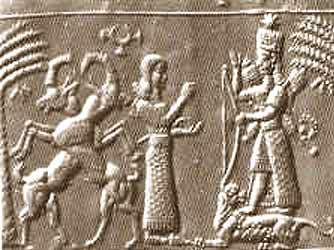
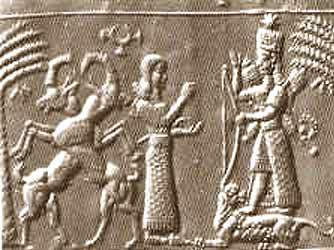
This seal appears to portray the translation of King Etana at upper left.
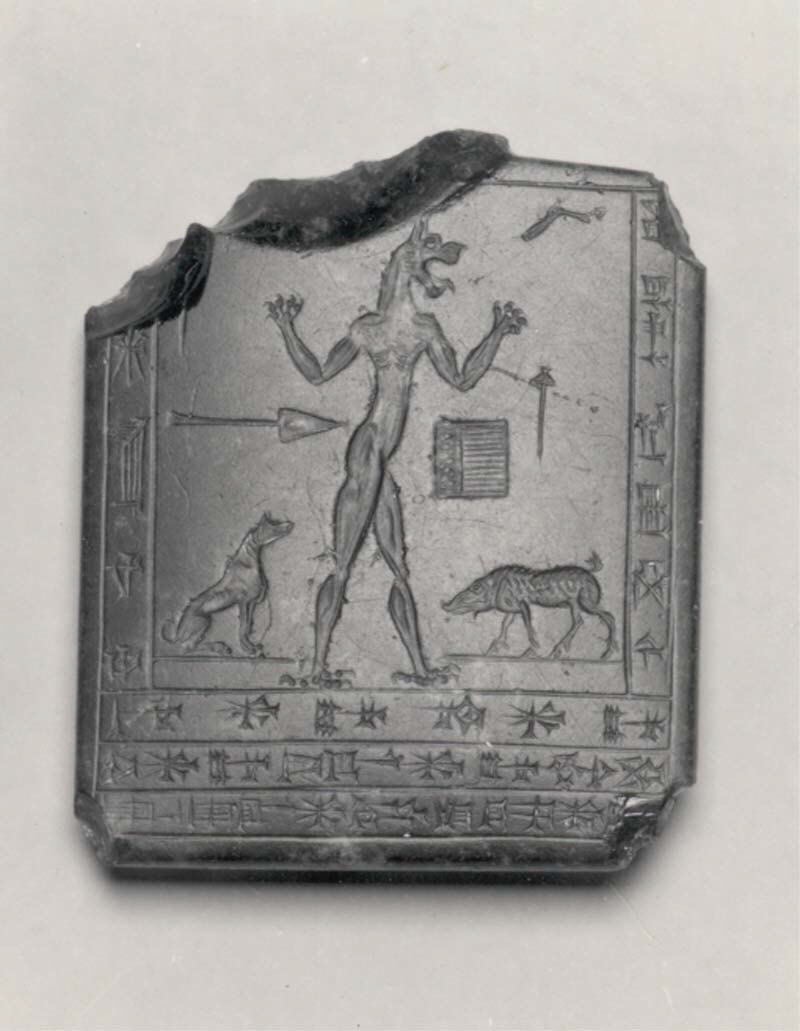
I am not sure where this seal is held. If you can assist, please do.
We will neither address the question of a common Near Eastern origin of such motifs, nor will we attempt to reconstruct the ways of transmission in the necessary detail. The latter were certainly manifold, and that orality played a major role is very likely but, of course, hard to prove.
The most important contributions concerning the relationship between Berossos, the Sumerian King list, and the biblical patriarchs as well as the connected literary motifs are presently those of R. Borger, J.C. VanderKam, H. Kvanvig and A.A. Orlov. I shall return to them later.
(Cf. G.P. Verbrugghe and J.M. Wickersham, Berossos and Manetho, Introduced and Translated: Native Traditions in Ancient Mesopotamia and Egypt (Ann Arbor: University of Michigan Press, 1996).
(R. Borger, “Die Beschwörungsserie Bīt Mēseri und die Himmelfahrt Henochs,” JNES 33 (1974): pp. 183-96; for an abbreviated English version see idem, “The Incantation Series Bīt Mēseri and Enoch’s Ascension to Heaven,” in I Studied Inscriptions from Before the Flood: Ancient Near Eastern, Literary, and Linguistic Approaches to Genesis 1-11 (ed. R.S. Hess and D.T. Tsumura; Sources for Biblical and Theological Study 4, Winona Lake: Eisenbrauns, 1994), pp. 224-33.)
(J.C. VanderKam, Enoch and the Growth of an Apocalyptic Tradition (CBQMS 16; Washington: Catholic Biblical Association of America, 1984).
The discovery of the Qumran manuscripts put 1 Enoch in the centre of these discussions and their connections to the related Jewish-Hellenistic texts and to Mesopotamian forerunners have been widely discussed.

Titled “The Nephilim,” the artist is said to be unknown.
http://doctorwoodhead.com/days-noah-corruption-demonic-activity-part/
The Qumran manuscripts of the Book of Giants mention the hero Gilgamesh among the Giants who were offspring of the evil (fallen) angels who had intercourse with human females.
(The following excerpts of the reconstructed Book of Giants are taken from the edition of The Gnostic Society Library (MSS: 4Q203, 1Q23, 2Q26, 4Q530–532, 6Q8). Editorial note: A long excerpt from the Book of Giants is reproduced here.)
Starting from this fact, I attempt to show that not only did the generally late Mesopotamian traditions about the primeval sages and related matters form a background for the mythical imagery of the Enochic system of thought, but that the much earlier epic traditions about the kings Gilgamesh and Etana should also be considered.
We might not be able to avoid some of the traps of this sort of intertextual studies, however, we are by all means entitled to look after the pre- and the post-texts, especially if we remember that any reading implies a recreation of new texts.
To put it metaphorically, texts are not stable entities but living beings undergoing all sort of philological and interpretative changes.”
Gebhard J. Selz, “Of Heroes and Sages–Considerations of the Early Mesopotamian Background of Some Enochic Traditions,” in Armin Lange, et al, The Dead Sea Scrolls in Context, v. 2, Brill, 2011, pp. 781-4.



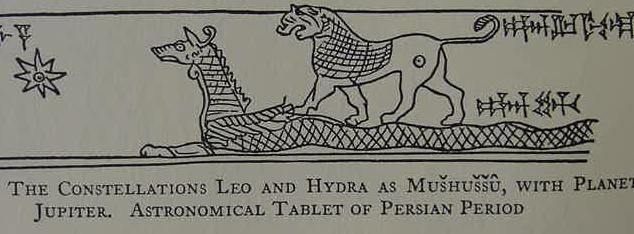
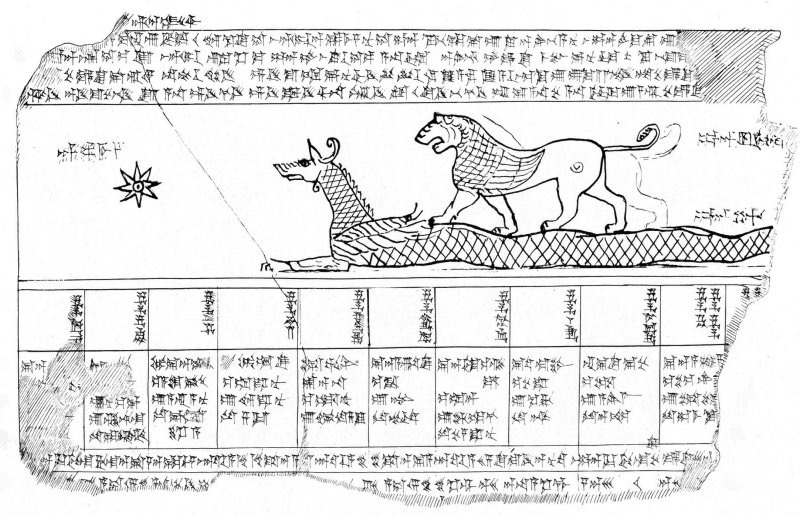
![Assyrian star planisphere found in the library of the Assyrian king Ashurbanipal (Aššur-bāni-apli – reigned 668-627 BCE) at Nineveh. The function of this unique 13-cm diameter clay tablet, in which the principal constellations are positioned in eight sectors, is disputed. The texts and drawings appear to be astro-magical in nature. Kuyunjik Collection, British Museum, K 8538 [= CT 33, 10]. London. http://www.staff.science.uu.nl/~gent0113/babylon/babybibl.htm](https://therealsamizdat.com/wp-content/uploads/2015/04/babylonian-star-chart.jpg)


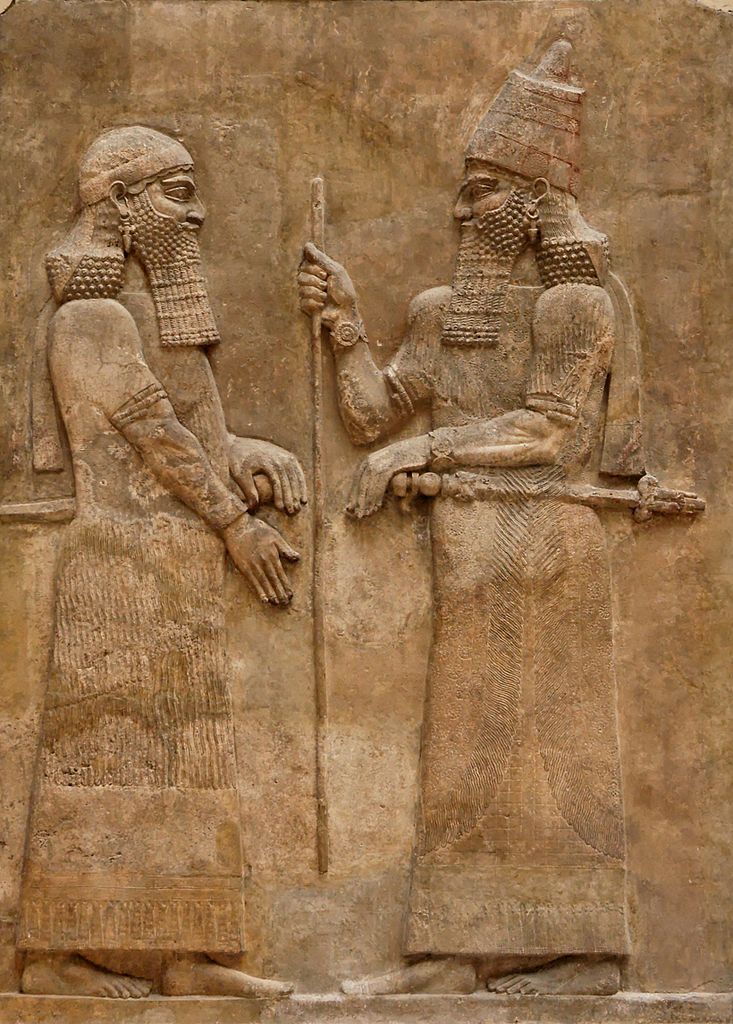
![In 1847 archaeologists discovered a prism of Sargon dated to the early 8th century BC reading: "At the beginning of my royal rule, I…the town of the Samarians I besieged, conquered (2 Lines destroyed) [for the god…] who let me achieve this my triumph… I led away as prisoners [27,290 inhabitants of it (and) equipped from among them (soldiers to man)] 50 chariots for my royal corps…. The town I rebuilt better than it was before and settled therein people from countries which I had conquered. I placed an officer of mine as governor over them and imposed upon them tribute as is customary for Assyrian citizens." (Nimrud Prism IV 25-41) https://theosophical.files.wordpress.com/2011/08/sargon-nimrud-cylinder1.jpg](https://therealsamizdat.com/wp-content/uploads/2015/05/sargon-nimrud-cylinder1.jpg)

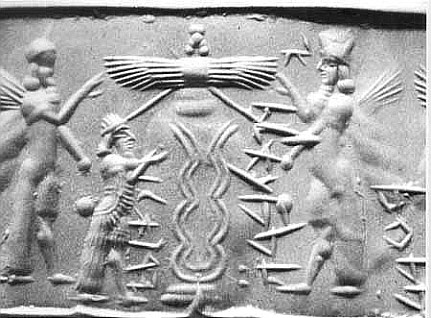
![From left, Storm God Ninurta, with bows and arrows. Ishtar, queen of heaven and earth is elevated with wings and spears and maces on her shoulders. The tree of life sprouts to her right, our left. The Sun God Shamash rises from the mountain Kur in the center, with rays of light on his shoulder. The God of Water and Wisdom, Enki/Ea battles the bird-god Imdugud/Anzu, with depictions of the Tigris and Euphrates rivers and fish coursing from his shoulders. At far right is the deified vizier Usmu, the two-faced. All gods wear conical hats with four pairs of horns. At far left is the word Adda in Accadian cuneiform, "Scribe." Accordingly this cylinder seal is known as the Seal of Adda, Akkadian period, 2350-2100 BCE. British Library. [No. 89,115.] http://www.ancientworlds.net/aw/Article/787375](https://therealsamizdat.com/wp-content/uploads/2015/05/00099452_000.jpg)


![http://doormann.tripod.com/asssky.htm Assyrian star map from Nineveh (K 8538). Counterclockwise from bottom: Sirius (Arrow), Pegasus + Andromeda (Field + Plough), [Aries], the Pleiades, Gemini, Hydra + Corvus + Virgo, Libra. Drawing by L.W.King with corrections by J.Koch. Neue Untersuchungen zur Topographie des Babilonischen Fixsternhimmels (Wiesbaden 1989), p. 56ff.](https://therealsamizdat.com/wp-content/uploads/2015/05/assyrian-star-map-from-nineveh.jpg)















 Samizdat