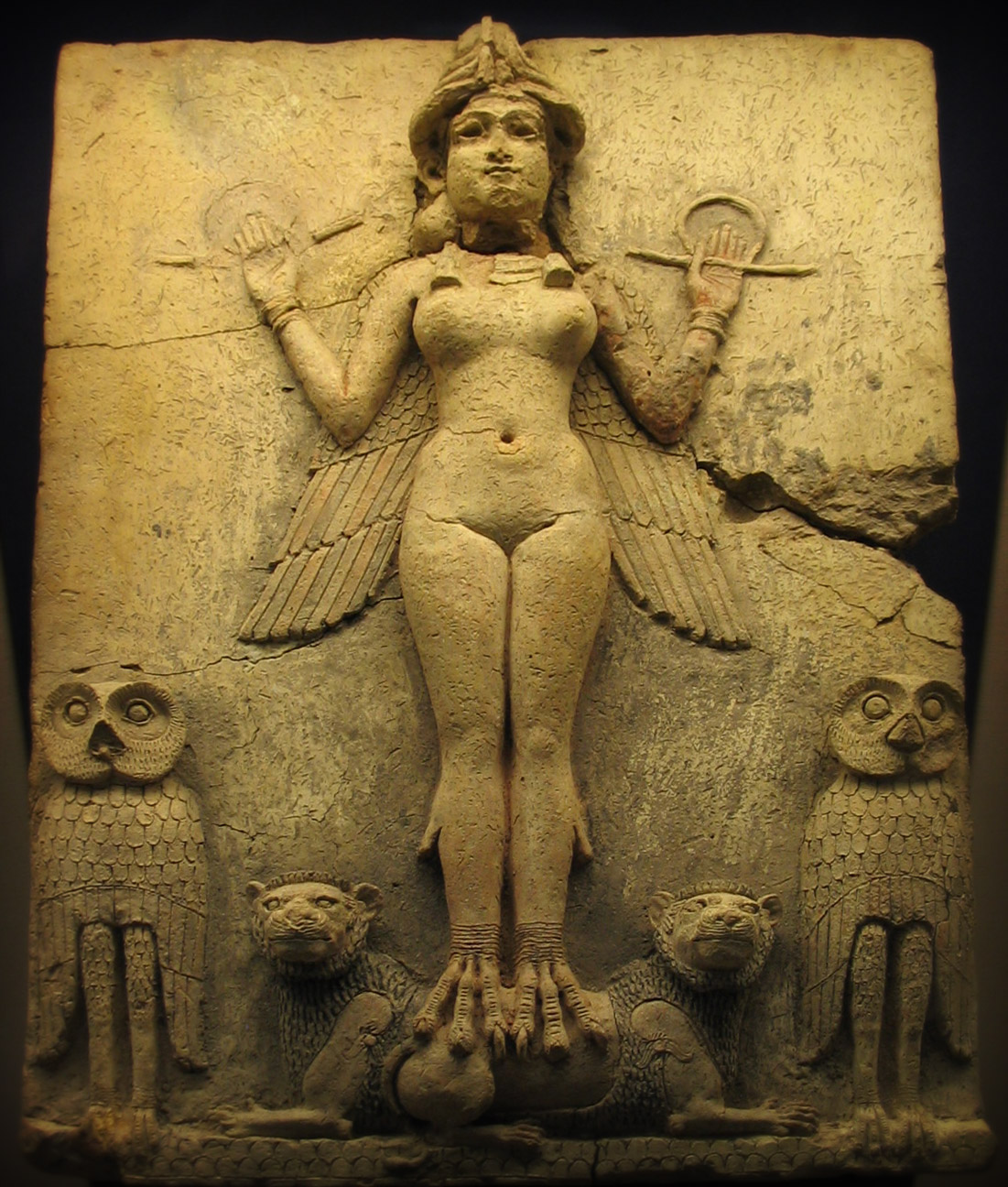
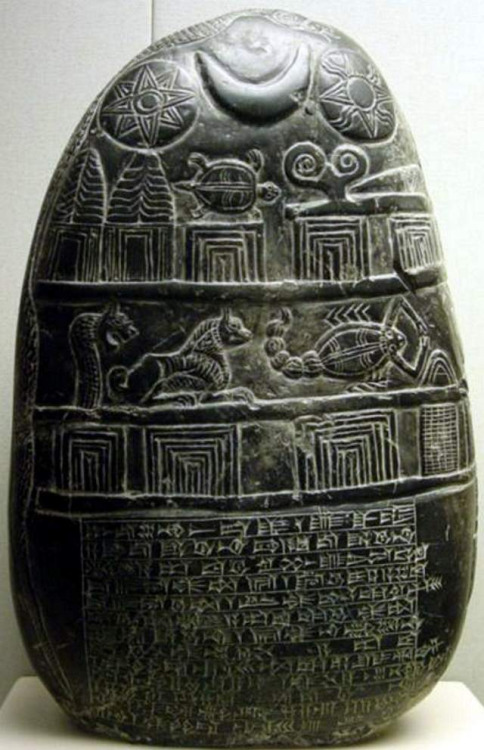
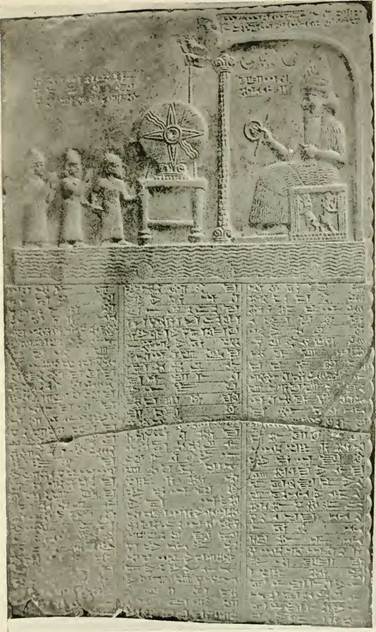
Samizdat

Publishing the Forbidden. All Rights Reserved. © Samizdat 2014-2026.

Category: Chronology

Selz: Plant of Birth or Plant of Life in the Etana Legend?

“The story of Etana, one of the oldest tales in a Semitic language, was, as I have argued elsewhere, modeled after the then extant Sumerian tales of the Gilgamesh Epic.

Gilgamesh’s search for “the plant of life,” the ú-nam-ti-la (šammu ša balāti) was, however, replaced by Etana’s search for the plant of birth-giving (šammu ša alādi). The entire story runs as follows:

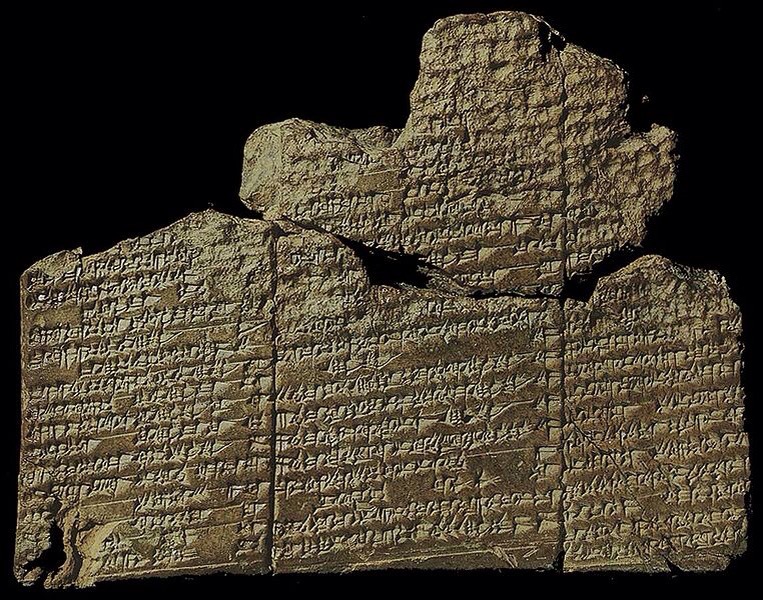
British Museum K. 19530, Library of Ashurbanipal (reigned 669-631 BCE), excavated from Kouyunjik by Austen Henry Layard. Neo-Assyrian 7th Century BCE, Nineveh.  This cuneiform tablet details the legend of Etana, a mythological king of Kish.  http://www.britishmuseum.org/research/collection_online/collection_object_details.aspx?objectId=287204&partId=1&searchText=WCT28297&page=1 http://www.britishmuseum.org/explore/highlights/highlight_objects/me/c/cuneiform_the_legend_of_etana.aspx This image is released under a Creative Commons Attribution-NonCommercial-ShareAlike 4.0 International (CC BY-NC-SA 4.0) license.

British Museum K. 19530, Library of Ashurbanipal (reigned 669-631 BCE), excavated from Kouyunjik by Austen Henry Layard. Neo-Assyrian 7th Century BCE, Nineveh.
This cuneiform tablet details the legend of Etana, a mythological king of Kish.
http://www.britishmuseum.org/research/collection_online/collection_object_details.aspx?objectId=287204&partId=1&searchText=WCT28297&page=1
http://www.britishmuseum.org/explore/highlights/highlight_objects/me/c/cuneiform_the_legend_of_etana.aspx
This image is released under a Creative Commons Attribution-NonCommercial-ShareAlike 4.0 International (CC BY-NC-SA 4.0) license.

The gods build the first city Kish, but kingship is still in heaven. A ruler is wanted (and found). Due to an illness, Etana’s wife is unable to conceive. The plant of birth is wanted.

In the ensuing episode eagle and snake swore an oath of friendship. Suddenly the eagle plans to eat up the snake’s children; a baby eagle, with the name of Atrahasīs opposes this plan, but eagle executes it.

Now, the weeping snake seeks justice from the sun-god. With the god’s help the eagle is trapped in a burrow, and now the eagle turns to the sun-god for help. He receives the answer that, because of the taboo-violation he cannot help, but will send someone else.

Etana prays daily for the plant of birth and in a dream the sun-god tells Etana to approach the eagle. In order to get the eagle’s support Etana helps him out of his trap.

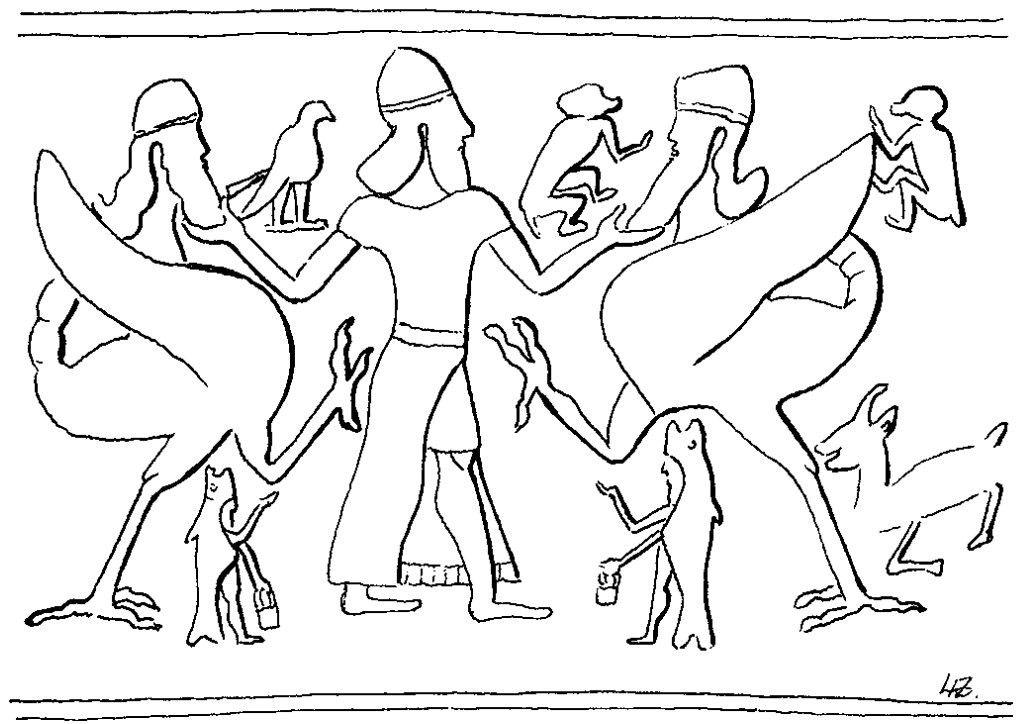
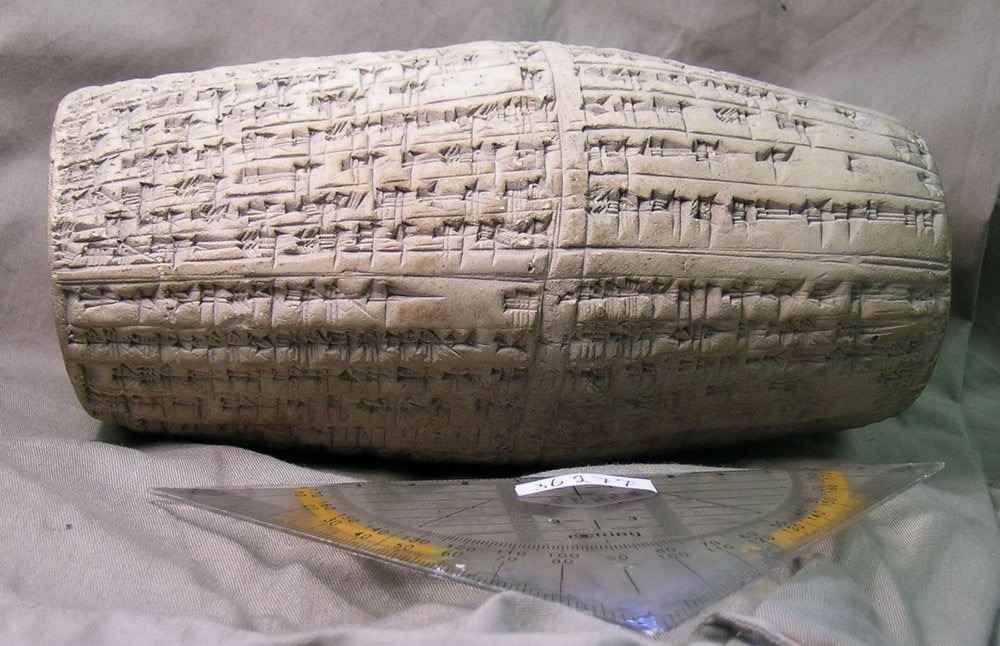
BM 89767, Limestone cylinder seal illustrating the myth of Etana, shepherd and legendary king of Kish, who was translated to heaven by an eagle to obtain the plant of life.  This seal portrays Etana’s ascent, witnessed by a shepherd, a dog, goats and sheep. Dated 2250 BCE, this seal was excavated by Hormuz Rassam, and came from an old, previously unregistered collection acquired before 1884.  Dominique Collon, Catalogue of the Western Asiatic Seals in the British Museum: Cylinder Seals II: Akkadian, Post-Akkadian, Ur III Periods, II, London, British Museum Press, 1982.  R.M. Boehner, Die Entwicklung der Glyptic wahrend der Akkad-Zeit, 4, Berlin, 1965.  Alfred Jeremias, Das Alte Testament im Lichte des Alten Orients: Handbuch zur biblisch-orientalischen Altertumskunde, Leipzig, JC Hinrichs, 1906.  Also AN128085001, 1983, 0101.299.  This image is released under a Creative Commons Attribution-NonCommercial-ShareAlike 4.0 International (CC BY-NC-SA 4.0) license.  © The Trustees of the British Museum. http://www.britishmuseum.org/research/collection_online/collection_object_details/collection_image_gallery.aspx?partid=1&assetid=128085001&objectid=368707

BM 89767, Limestone cylinder seal illustrating the myth of Etana, shepherd and legendary king of Kish, who was translated to heaven by an eagle to obtain the plant of life.
This seal portrays Etana’s ascent, witnessed by a shepherd, a dog, goats and sheep. Dated 2250 BCE, this seal was excavated by Hormuzd Rassam, and came from an old, previously unregistered collection acquired before 1884.
Dominique Collon, Catalogue of the Western Asiatic Seals in the British Museum: Cylinder Seals II: Akkadian, Post-Akkadian, Ur III Periods, II, London, British Museum Press, 1982.
R.M. Boehner, Die Entwicklung der Glyptic wahrend der Akkad-Zeit, 4, Berlin, 1965.
Alfred Jeremias, Das Alte Testament im Lichte des Alten Orients: Handbuch zur biblisch-orientalischen Altertumskunde, Leipzig, JC Hinrichs, 1906.
Also AN128085001, 1983, 0101.299.
This image is released under a Creative Commons Attribution-NonCommercial-ShareAlike 4.0 International (CC BY-NC-SA 4.0) license.
© The Trustees of the British Museum.
http://www.britishmuseum.org/research/collection_online/collection_object_details/collection_image_gallery.aspx?partid=1&assetid=128085001&objectid=368707

Now the eagle, carrying Etana on his back, ascends to the heavens. On the uppermost level of the heavens Etana becomes afraid and the eagle takes him back to the earth.

The end of the story is missing, but that Etana finally got hold of the plant of birth is very likely, since other sources mention his son.

To summarize: I have tried to show that some features of the Enoch tradition are a re-writing of very ancient concepts. I do not claim that they all can be explained assuming dependencies, as earlier scholarship has done.

I do not intend to idolize “origins,” but what might eventually come out of such a research—if the topics mentioned here are thoroughly worked out and elaborated in detail—is, that our texts implicate many more meanings than tradition may have supposed.

In my opinion there can be little doubt that the official transmission of texts in Mesopotamia was supplemented by a wealth of oral tradition. Indeed, the situation may be comparable to the one attested in the (still) living oral tradition on Enoch in the Balkanian vernaculars.”

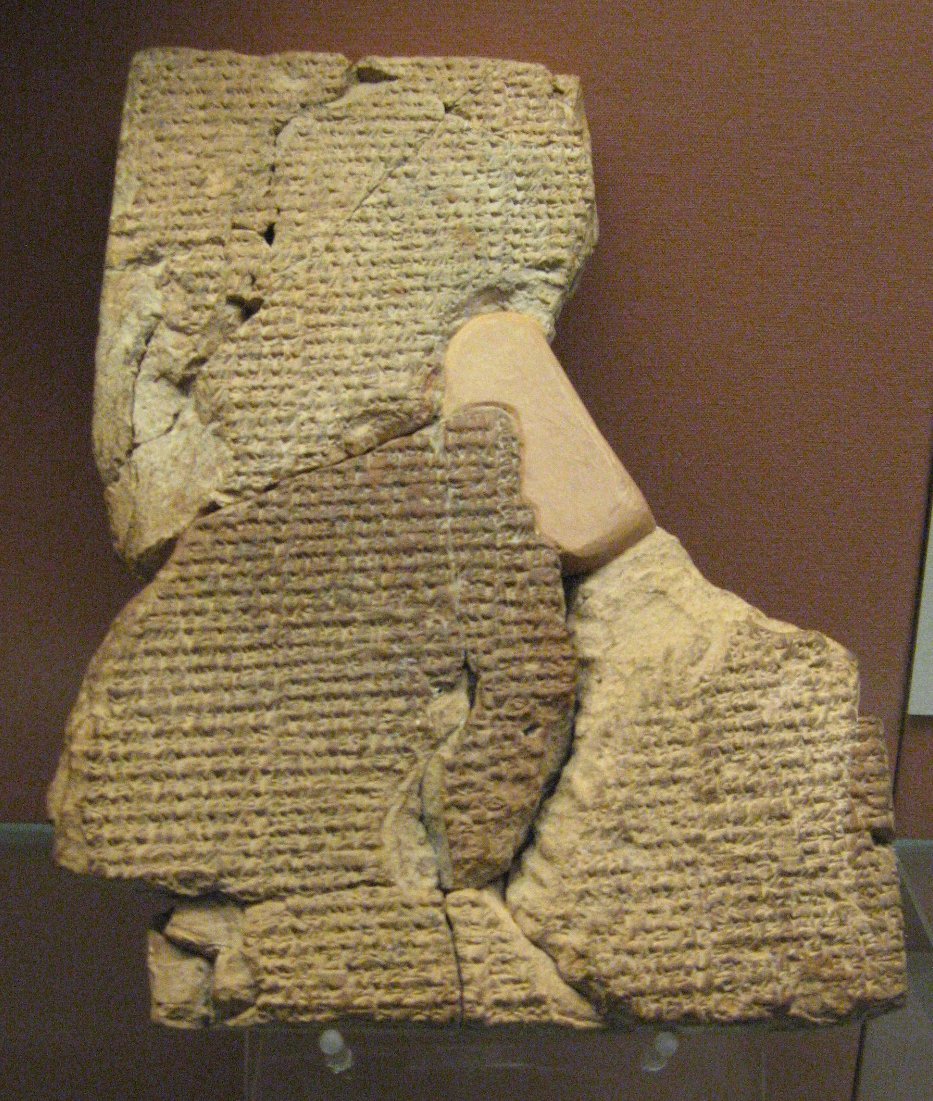
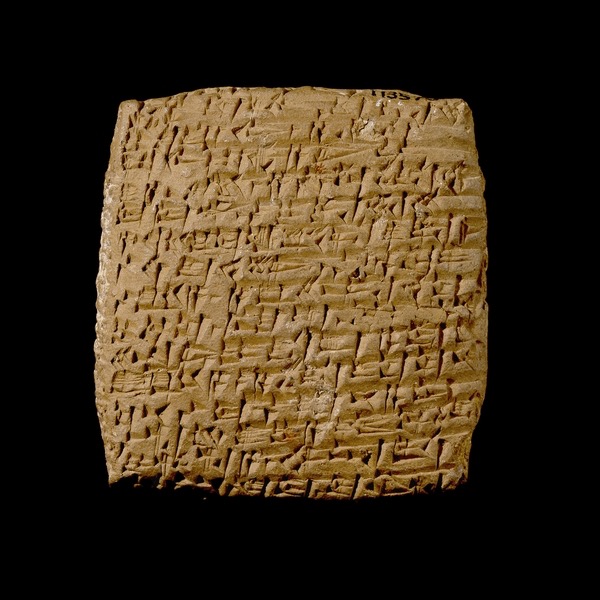
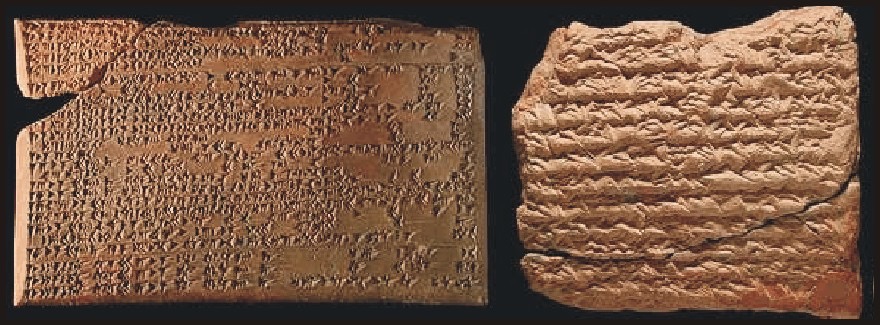
This Akkadian clay tablet, dated to circa 1900-1600 BCE, preserves a partial version of the Sumerian Legend of Etana.  Held by the Morgan Library.  http://www.codex99.com/typography/1.html

This Akkadian clay tablet, dated to circa 1900-1600 BCE, preserves a partial version of the Sumerian Legend of Etana.
Held by the Morgan Library.
http://www.codex99.com/typography/1.html

(See G.J. Selz, “Die Etana-Erzählung: Ursprung und Tradition eines der ältesten epischen Texte in einer semitischen Sprache,” Acta Sumerologica (Japan) 20 (1998): pp. 135-79.

A different opinion is expressed by P. Steinkeller, “Early Semitic Literature and Third Millennium Seals with Mythological Motifs,” in Literature and Literary Language at Ebla (ed. P. Fronzaroli; Quaderni di Semitistica 18; Florence: Dipartimento di linguistica Università di Firenze, 1992), pp. 243-75 and pls. 1-8.

Further remarks on the ruler’s ascension to heaven are discussed by G.J. Selz, “Der sogenannte ‘geflügelte Tempel’ und die ‘Himmelfahrt’ der Herrscher: Spekulationen über ein ungelöstes Problem der altakkadischen Glyptik und dessen möglichen rituellen Hintergrund,” in Studi sul Vicino Oriente Antico dedicati alla memoria di Luigi Cagni (ed. S. Graziani; Naples: Istituto Universitario Orientale, 2000, pp. 961-83.)

Gebhard J. Selz, “Of Heroes and Sages–Considerations of the Early Mesopotamian Background of Some Enochic Traditions,” in Armin Lange, et alThe Dead Sea Scrolls in Context, v. 2, Brill, 2011, pp. 799-800.

Selz: Victory Steles, Dreams and the Erra Epic

“A further consequence is that the appearance of the ruler was perceived as perfect in every sense, physically and mentally, he is strong and wise, these being the preconditions for his rule.

(Compare, for example, I.J. Winter, “The Body of the Able Ruler: Towards an Understanding of the Statues of Gudea,” in DUMU-E2-DUB-BA-A: Studies in Honor of Ake W. Sjöberg (ed. H. Behrens, D. Loding, and M.T. Roth; Publications of the Samuel Noah Kramer Fund 11; Philadelphia: University of Pennsylvania Museum, 1989), pp. 573-84.)

Such perfection is also mentioned repeatedly as a feature of the kings of Ur III; the best sources for this are provided by their hymns.

(See already S.N. Kramer, “Kingship in Sumer and Akkad: The Ideal King,” in Le palais et la royauté: Archéologie et civilization: Compte rendu de la XIXe Rencontre Assyriologique Internationale organisée par le Groupe François Thureau-Dangin, Paris, 29 juin–2 juillet 1971 (ed. P. Garelli; Paris: Geithner, 1974), pp. 163-76.

J. Klein, The Royal Hymns of Šulgi, King of Ur: Man’s Quest for Immortal Fame (Transactions of the American Philosophical Society 71.7; Philadelphia: American Philosophical Society, 1981); and numerous other works.)

Therefore it does not come as a surprise that in the texts from the last years of his reign, king Shulgi-r was marked with the divine classifier, which was traditionally reserved for all sorts of deities.

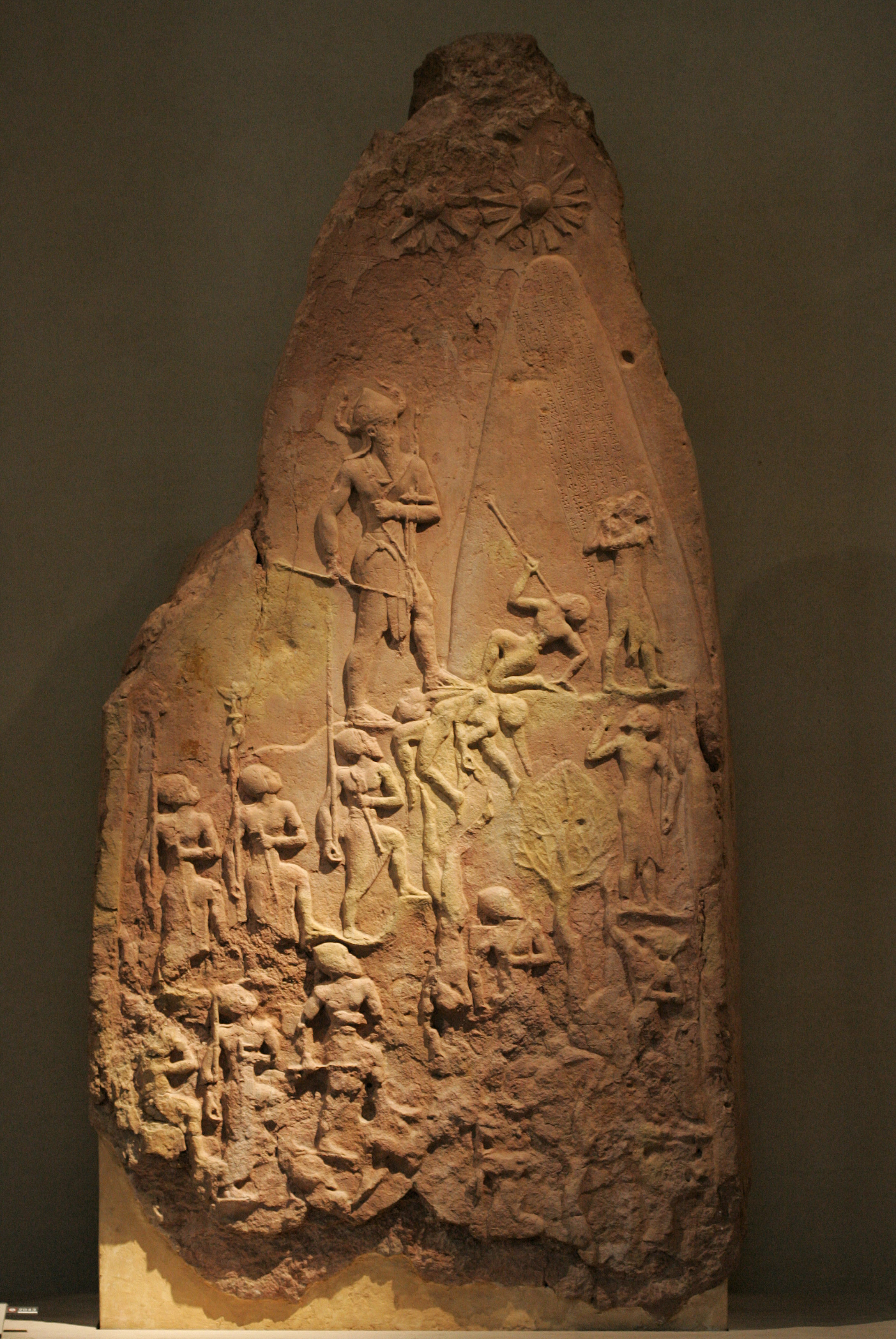
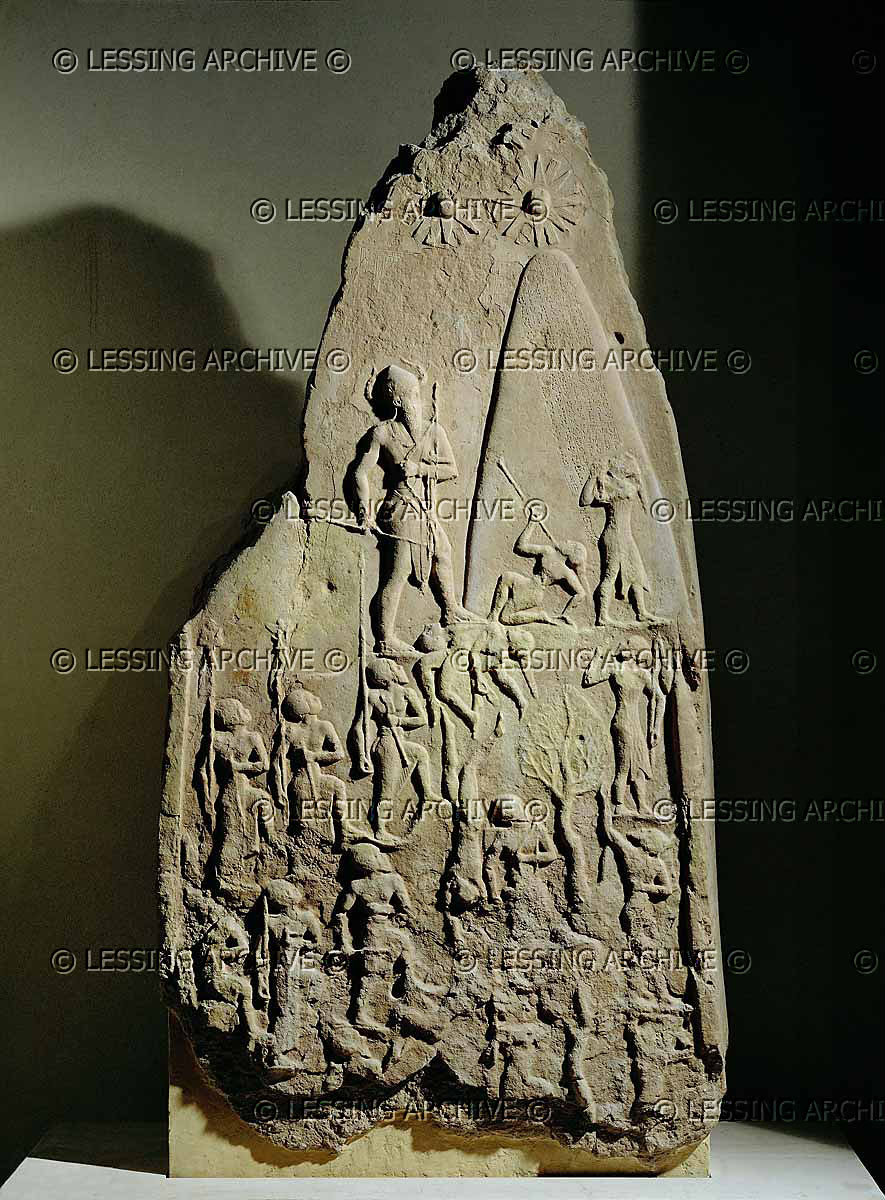
Roughly two centuries earlier the Old Akkadian king Narām-Sîn established this practice when he asserts that after rescuing the land from dire straits the people from various cities asked their gods to name him as their god and built him even a temple in the capital city Agade.

Victory Stele of Naram-Sin Brought back from Sippar to Susa as a war prize in the 12th century BCE.  Louvre Museum Accession number Sb 4 Found by J. de Morgan Photo: Rama This work is free software; you can redistribute it or modify it under the terms of the CeCILL. The terms of the CeCILL license are available at www.cecill.info. https://commons.wikimedia.org/wiki/File:Victory_stele_of_Naram_Sin_9068.jpg

Victory Stele of Naram-Sin
Brought back from Sippar to Susa as a war prize in the 12th century BCE.
Louvre Museum
Accession number Sb 4
Found by J. de Morgan
Photo: Rama
This work is free software; you can redistribute it or modify it under the terms of the CeCILL. The terms of the CeCILL license are available at http://www.cecill.info.
https://commons.wikimedia.org/wiki/File:Victory_stele_of_Naram_Sin_9068.jpg

Such (self-)deification of the ruler was not accepted unanimously in Mesopotamia: In the later cuneiform tradition Narām-Sîn’s attempt to obliterate the border between the human and the divine spheres was branded as blasphemous.

Like the giants, the rulers of Mesopotamia could have dreams. Dreams do, of course, play a major role all over the ancient Near East. For lack of space I just mention some very early examples here. The observable parallels may speak for themselves.

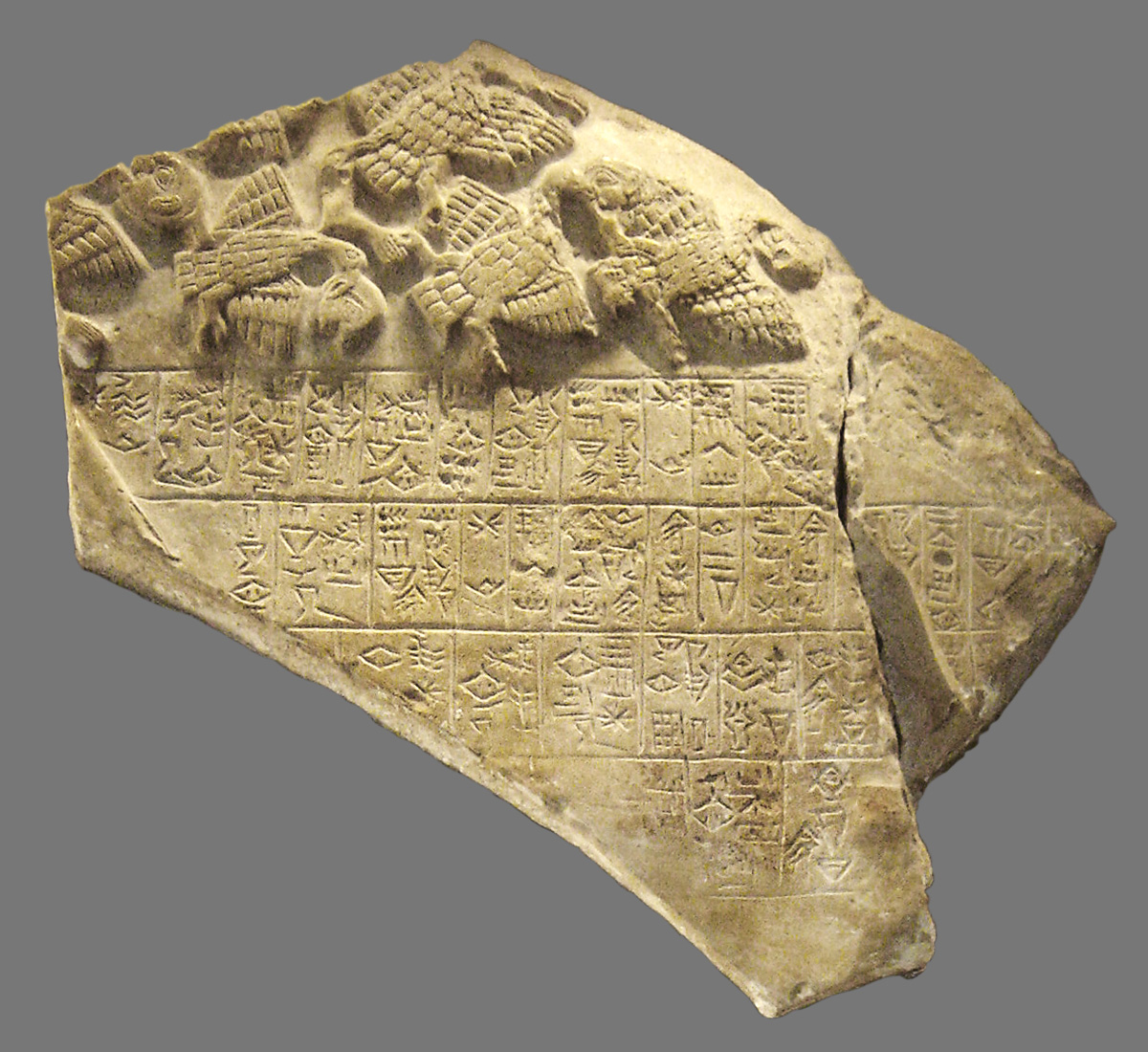
One fragment of the victory stele of the king Eannatum of Lagash over Umma, called « Stele of Vultures ». Historical side. Limestone, circa 2450 BC, Sumerian archaic dynasties. Found in 1881 in Girsu (now Tello, Iraq), Mesopotamia, by Édouard de Sarzec. Louvre Museum. Department of Mesopotamian antiquities, Richelieu, ground floor, room 1a AO 16 IO9, AO 50, AO 2246 and AO 2348 (for the whole stele) Donation of the British Museum. Eric Gaba (User:Sting), July 2005. Any use of this photograph can be made as long as you credit me (Eric Gaba – Wikimedia Commons user: Sting) as the author and distribute the copies and derivative works under the same license(s) that the one(s) stated below. A message with a reply address would also be greatly appreciated. Permission is granted to copy, distribute and/or modify this document under the terms of the GNU Free Documentation License, Version 1.2 or any later version published by the Free Software Foundation; with no Invariant Sections, no Front-Cover Texts, and no Back-Cover Texts. A copy of the license is included in the section entitled GNU Free Documentation License.

One fragment of the victory stele of the king Eannatum of Lagash over Umma, called « Stele of Vultures ». Historical side. Limestone, circa 2450 BC, Sumerian archaic dynasties. Found in 1881 in Girsu (now Tello, Iraq), Mesopotamia, by Édouard de Sarzec.
Louvre Museum.
Department of Mesopotamian antiquities, Richelieu, ground floor, room 1a
AO 16 IO9, AO 50, AO 2246 and AO 2348 (for the whole stele)
Donation of the British Museum.
Eric Gaba (User:Sting), July 2005.
Permission is granted to copy, distribute and/or modify this document under the terms of the GNU Free Documentation License, Version 1.2 or any later version published by the Free Software Foundation; with no Invariant Sections, no Front-Cover Texts, and no Back-Cover Texts. A copy of the license is included in the section entitled GNU Free Documentation License.

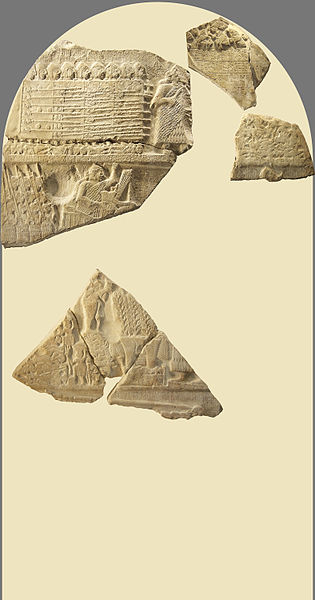
The earliest attestation for a dream is attested in the famous stele of vultures of the pre-Sargonic king of Lagash, E’anatum. In E’anatum 1, 6:28 we read: “to the one who has lain down, to the one who has lain down (the deity) stood at (his) head.”

Reconstitution of the victory stele of the king Eannatum of Lagash over Umma, called « Stele of Vultures ». Historical side. Limestone, circa 2450 BC, Sumerian archaic dynasties. Found in 1881 in Girsu (now Tello, Iraq), Mesopotamia, by Édouard de Sarzec. AO 16 IO9, AO 50, AO 2246 and AO 2348 (for the whole stele) https://commons.wikimedia.org/wiki/Category:Stele_of_the_Vultures#/media/File:Stele_of_Vultures_historical_side.jpg Eric Gaba (User:Sting), July 2005. Any use of this photograph can be made as long as you credit me (Eric Gaba – Wikimedia Commons user: Sting) as the author and distribute the copies and derivative works under the same license(s) that the one(s) stated below. A message with a reply address would also be greatly appreciated. Permission is granted to copy, distribute and/or modify this document under the terms of the GNU Free Documentation License, Version 1.2 or any later version published by the Free Software Foundation; with no Invariant Sections, no Front-Cover Texts, and no Back-Cover Texts. A copy of the license is included in the section entitled GNU Free Documentation License.

Reconstitution of the victory stele of the king Eannatum of Lagash over Umma, called « Stele of Vultures ». Historical side. Limestone, circa 2450 BC, Sumerian archaic dynasties. Found in 1881 in Girsu (now Tello, Iraq), Mesopotamia, by Édouard de Sarzec.
AO 16 IO9, AO 50, AO 2246 and AO 2348 (for the whole stele)
https://commons.wikimedia.org/wiki/Category:Stele_of_the_Vultures#/media/File:Stele_of_Vultures_historical_side.jpg
Eric Gaba (User:Sting), July 2005.
Permission is granted to copy, distribute and/or modify this document under the terms of the GNU Free Documentation License, Version 1.2 or any later version published by the Free Software Foundation; with no Invariant Sections, no Front-Cover Texts, and no Back-Cover Texts. A copy of the license is included in the section entitled GNU Free Documentation License.

(We note that this passage follows the miraculous birth of the ruler E’anatum; presumably he was thus especially fitted for the dream message.)

For our purpose, here it is noteworthy, that a deity was the sender or transmitter of the dream. The dream was of divine origin, considered as revelation of the divine will.”

(The clearest reference to the divine revelation of a text is attested in the late Erra Epic with his evident “apocalyptic” theme where the author Kabti-ilāni-Marduk actually asserts in the colophon of the text: (5:40):

Reconstitution of the victory stele of the king Eannatum of Lagash over Umma, called « Stele of Vultures ». Mythological side. Limestone, circa 2450 BC, Sumerian archaic dynasties. Found in 1881 in Girsu (now Tello, Iraq), Mesopotamia, by Édouard de Sarzec. AO 16 IO9, AO 50, AO 2246 and AO 2348 (for the whole stele) https://commons.wikimedia.org/wiki/File:Stele_of_Vultures_mythological_side.jpg Eric Gaba (User:Sting), July 2005. Any use of this photograph can be made as long as you credit me (Eric Gaba – Wikimedia Commons user: Sting) as the author and distribute the copies and derivative works under the same license(s) that the one(s) stated below. A message with a reply address would also be greatly appreciated. Permission is granted to copy, distribute and/or modify this document under the terms of the GNU Free Documentation License, Version 1.2 or any later version published by the Free Software Foundation; with no Invariant Sections, no Front-Cover Texts, and no Back-Cover Texts. A copy of the license is included in the section entitled GNU Free Documentation License.

Reconstitution of the victory stele of the king Eannatum of Lagash over Umma, called « Stele of Vultures ». Mythological side. Limestone, circa 2450 BC, Sumerian archaic dynasties. Found in 1881 in Girsu (now Tello, Iraq), Mesopotamia, by Édouard de Sarzec.
AO 16 IO9, AO 50, AO 2246 and AO 2348 (for the whole stele)
https://commons.wikimedia.org/wiki/File:Stele_of_Vultures_mythological_side.jpg
Eric Gaba (User:Sting), July 2005.
Permission is granted to copy, distribute and/or modify this document under the terms of the GNU Free Documentation License, Version 1.2 or any later version published by the Free Software Foundation; with no Invariant Sections, no Front-Cover Texts, and no Back-Cover Texts. A copy of the license is included in the section entitled GNU Free Documentation License.

“For (the god) Erra had burned with wrath and planned to lay waste the countries and slay their peoples, but Ishum, his counsellor, appeased him and (Erra) left a remnant! Kabti-ilāni-Marduk, the son of Dabibi, (was) the composer of this tablet (= of this poem):

(The deity) revealed it to him during the night, and in the morning, when he recited (it), he did not skip a single (line) nor a single line (of his own) did he add to it ….” (5:55)

[Erra speaks] “The scribe who commits it to memory shall escape the enemy country (and) shall be honoured in his own country. In the sanctuary of (those) sages where they constantly mention my name, I will grant them wisdom.

To the house in which this tablet is placed—however furious Erra may be, however murderous the Sebettu (pleaiades or seven sisters) may be—the sword of destruction shall not come near.”

(English translation by L. Cagni, The Poem of Erra [Sources of the Ancient Near East 1.3; Malibu: Undena Publications, 1974).”

Gebhard J. Selz, “Of Heroes and Sages–Considerations of the Early Mesopotamian Background of Some Enochic Traditions,” in Armin Lange, et alThe Dead Sea Scrolls in Context, v. 2, Brill, 2011, pp. 796-7.

Selz: On Sacred Marriage

“This passage reminds one of the old Mesopotamian concept—and I am convinced it is a Mesopotamian concept, not a mere invention of modern scholarship—according to which a (mythical) ruler is thought to cohabit with a goddess or with her priestly incarnation.

Hierogamus, bed and couple. Period of the Amorite dynasties, early 2nd millennium BCE Baked clay, H: 11,3 cm AO 8662, Louvre.  http://www.lessingimages.com/viewimage.asp?i=08021112+&cr=413&cl=1#

Hierogamus, bed and couple. Period of the Amorite dynasties, early 2nd millennium BCE. Baked clay, H: 11,3 cm. AO 8662, Louvre.
http://www.lessingimages.com/viewimage.asp?i=08021112+&cr=413&cl=1#

(This is a much disputed issue, best known under the heading “Sacred Marriage” concept. What is interesting here is the feature of a divine-human interaction in the sexual life and the consequences thereof. We are not concerned here with the hypothesis of a purely metaphorical interpretation or with a possible actualization in an alleged ritual.

Couple on a bed (hierogamus). From Susa, 14th-12th BCE Terracotta, 11,2 x 5,8 cm SB 7979, Louvre.  http://www.lessingimages.com/viewimage.asp?i=08021158+&cr=523&cl=1#

Couple on a bed (hierogamus). From Susa, 14th-12th BCE. Terracotta, 11,2 x 5,8 cm. SB 7979, Louvre.
http://www.lessingimages.com/viewimage.asp?i=08021158+&cr=523&cl=1#

For a comparative evaluation of this topic see P. Lapinkivi, The Sumerian Sacred Marriage in the Light of Comparative Evidence (SAAS 15; Helsinki: Neo-Assyrian Text Corpus Project, 2004.)

See further E. Cancik-Kirschbaum, “Hierogamie-Eine Skizze zum Sachstand in der Altorientalistik,” in Gelebte Religionen: FS Hartmut Zinser (ed. H. Piegeler, I. Pohl, and S. Rademacher; Würzburg: Königshausen & Neumann, 2004), pp. 65-72.

Couple embracing (hierogamus). From Susa, 14th-12th BCE Terracotta, 11,3 x 6 cm SB 6609, Louvre. http://www.lessingimages.com/viewimage.asp?i=08021159+&cr=569&cl=1#

Couple embracing (hierogamus). From Susa, 14th-12th BCE. Terracotta, 11,3 x 6 cm. SB 6609, Louvre.
http://www.lessingimages.com/viewimage.asp?i=08021159+&cr=569&cl=1#

G.J. Selz, “The Divine Prototypes,” in Religion and Power: Divine Kingship in the Ancient World and Beyond (ed. N. Brisch; Oriental Institute Seminars 4; Chicago: Oriental Institute of the University of Chicago, 2008), pp. 13-31.

Accordingly, the kings of the Ur III empire depict themselves in their hymns as divine scions, as sons of the mythical ruler Lugalbanda and the Goddess Ninsu(mu)na-k. In the present context it is not without interest that these kings were thus becoming “brothers of Gilgamesh,” profiting somehow from the hero’s legendary fame.

Bed with a geometrical pattern, bed with a couple embracing (hierogamus), both from Susa, Iran, 14th-12th BCE SB 11206 geometrical pattern, terracotta 3,1 x 11,8 cm Sb 5888 bed with couple, terracotta, 3 x 9,5 cm, Louvre. http://www.lessingimages.com/viewimage.asp?i=08021160+&cr=691&cl=1#

Bed with a geometrical pattern, bed with a couple embracing (hierogamus), both from Susa, Iran, 14th-12th BCE SB 11206, geometrical pattern, terracotta 3,1 x 11,8 cm. SB 5888, bed with couple, terracotta, 3 x 9,5 cm, Louvre.
http://www.lessingimages.com/viewimage.asp?i=08021160+&cr=691&cl=1#

The divine sonship, however, can be traced back to the middle of the third millennium. An Old Sumerian ruler of the south Mesopotamian city state Lagash depicts himself in his text as follows:

“(The god) [Ni]n[gir]su-k [imp]lanted the [semen] for (the ruler) E’[a]na-tum in the [wom]b . . . rejoiced over [E’anatum]. (The goddess) Inana-k accompanied him, named him “In the E’ana (temple) of Inana-k from (the sacred precinct) Ibgal I bring him (= E’ana-Inana-lbgal-akak-atum)” and set him on the legitimising knees of (the mother goddess) Ninchursag(a). Ninchursag(a) [offered him] her legitimising breast.”

(Ean 1, 4:9-12 (H. Steible, ed., Die altsumerische Bau-und Weihinschriften [2 vols.; Freiburger altorientalische Studien 5; Wiesbaden: Steiner, 1982], pp. 1:122) RIME 1.9.3.1, 4:9-12.

See D. Frayne, ed., Presargonic Period (2700-2350 BCE) (RIME 1; Toronto: University of Toronto Press, 2008), pp. 129-30.)

Ningirsu-k rejoiced over E’anatum, semen implanted into the womb by Ningirsu-k. Ningirsu-k laid his span upon him, for (a length of) five forearms he set his forearm upon him: (he measured) five forearms (cubits), one span! (to the reconstructed measurements of this period ca. 2.72 meters). Ningirsu-k, out of his great joy, [gave him] the kin[gship of Lagash].”

(Ean. 1, 5:1-5 H. Steible, Die altsumerischen Bau-und Weihinschriften, 1:123) = RIME 1.9.3.1 (Frayne, Presargonic Period, p. 129).

Hence, the ruler is the one “who has strength,” a precondition for his successful rule.

The aforementioned size of 2.72 meters makes just a small giant. However, this size is an outward sign designating someone who transgresses human measurements and norms.

Accordingly it became possible to attribute to such an extraordinary ruler a sort of functional divinity, as can be corroborated by several additional arguments.

We can therefore say that the ruler is perceived as an Avatar, a manifestation of the state god Ningirsu-k.”

Gebhard J. Selz, “Of Heroes and Sages–Considerations of the Early Mesopotamian Background of Some Enochic Traditions,” in Armin Lange, et alThe Dead Sea Scrolls in Context, v. 2, Brill, 2011, pp. 795-6.

Selz: On the Astronomical Diaries of Babylon

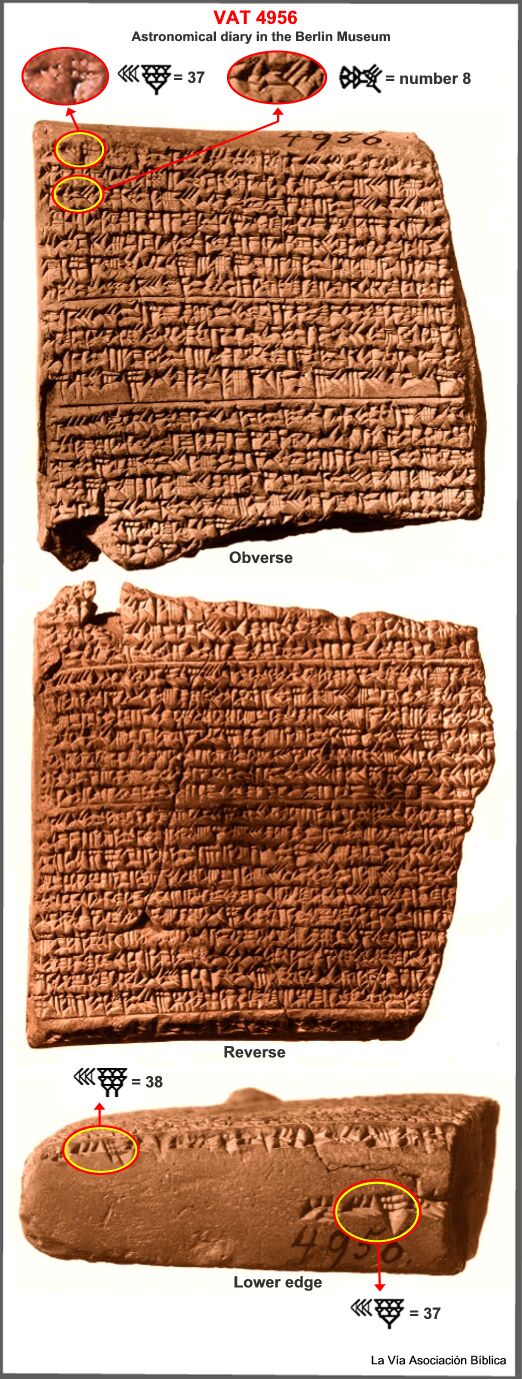
“I cannot discuss here the philological evidence that anchors the biblical tradition in the historical charts. This is a different, albeit very important field which may support my arguments: I just mention one recent example: Jeremiah 39:3 may go back to an eye witness’s account of Nebuchadnezzar’s conquest of Jerusalem in 589 BCE.

Tablet VAT 4956 in the Berlin Museum details the positions of the moon and the planets during the year 37 of the reign of Nebuchadnezzar, king of Babylon, 567 BCE. This tablet is famous for confirming the destruction of Jerusalem in 586 BCE. http://www.lavia.org/english/archivo/vat4956en.htm

Tablet VAT 4956 in the Berlin Museum details the positions of the moon and the planets during the year 37 of the reign of Nebuchadnezzar, king of Babylon, 567 BCE. This tablet is famous for confirming the destruction of Jerusalem in 586 BCE.
http://www.lavia.org/english/archivo/vat4956en.htm

This is indicated by my colleague Michael Jursa’s identification of the chief-eunuch Nabu-sharrussu-ukin, the biblical נכו שרםכים רכםרים or Nebu-Sarsekim, in an economic document from the sun-god temple in Sippar, dated to the “Month XI, day 18, year 10 Nebuchadnezzar, king of Babylon.”

(M. Jursa, Nabû-šarrūssu-ukīn, rab ša-rēši, und ‘Nebusarsekim’ (Jeremiah 39:3),” NABU 5 (2008). Jursa’s translation of the document runs as follows:

“Regarding] 1.5 minas (0.75 kg) of gold, the property of Nabû-šarrūssu-ukīn, the chief eunuch, which he sent via Arad-Bānītu the eunuch to [the temple] Esangila: Arad-Bānītu has delivered [it] to Esangila.

In the presence of Bēl-usāti, son of Alpāya, the royal bodyguard, [and of] Nādin, son of Marduk-zēru-ibni. Month XI, day 18, year 10  [of] Nebuchadnezzar, king of Babylon.”

We may note here that the evaluation of this document provoked a broad discussion in scholarly literature and in the Internet.)

The Babylonian exile had a major impact on the development of Judaism, possibly even on the moulding of the apocalyptic traditions.

(Jeremiah 39:3 gives account of Nebuchadnezzar’s conquest of Jerusalem and his victory over the Judean King Zedekiah: The passage reports that all of the officers of the king of Babylon made their entry, and occupied the middle gate.)

(Kvanvig, Roots, writes: “The emergence of the apocalyptic traditions and literature presupposes both a direct contact with Mesopotamian culture in the Babylonian diaspora, and the syncretistic tendencies in Palestine in the post-exilic centuries.” See also Sarah Robinson, “The Origins of Jewish Apocalyptic Literature: Prophecy, Babylon, and 1 Enoch,” MS Thesis, University of South Florida, 2005.)

The background of this “knowledge transfer,” however, is the scholarly situation as just described. I say this not to deny the contribution of mere story-telling and fantastic lore to the growth of the corpus of apocalyptic literature, but we cannot neglect the scholarly and even empirical background of the underlying world-view.

Indeed, this may provide the best explanation for why so many different topics and stylistic features are fused in the extant Enochic traditions.

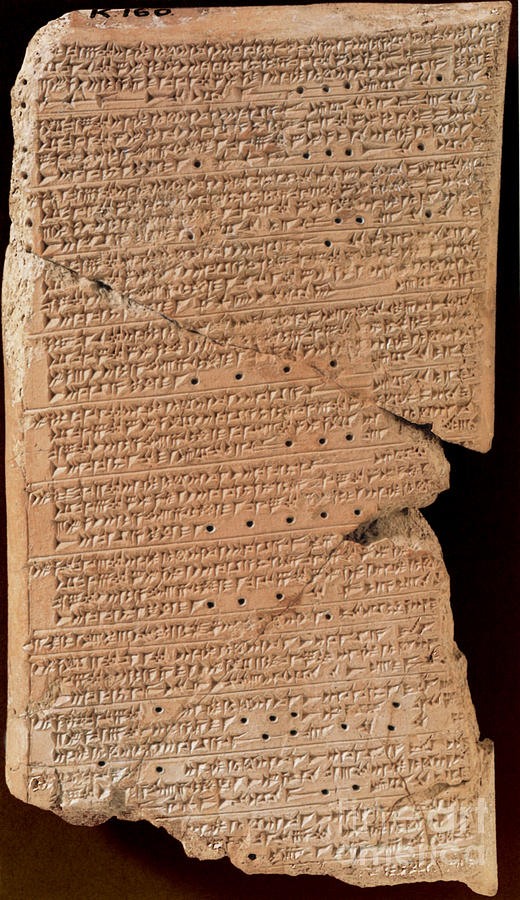
The Venus Tablet of Ammisaduqa, which is tablet 63 in the Enuma Anu Enlil sequence, preserves the astronomical observations of Venus during the 1st Millennium BCE. This tablet is dated back to the mid-7th Century BCE, during the reign of King Ammisaduqa. http://fineartamerica.com/featured/2-venus-tablet-of-ammisaduqa-7th-century-science-source.html

The Venus Tablet of Ammisaduqa, which is tablet 63 in the Enuma Anu Enlil sequence, preserves the astronomical observations of Venus during the 1st Millennium BCE.
This tablet is dated back to the mid-7th Century BCE, during the reign of King Ammisaduqa.
http://fineartamerica.com/featured/2-venus-tablet-of-ammisaduqa-7th-century-science-source.html

What concerns us here is the heuristic attitude of Mesopotamian scholarship. Even in the late Seleucid period this scholarship remains basically “holistic” or “monistic” in the way that it links all sorts of empiricism, as may be demonstrated with examples from the famous “Astronomical Diaries.”

(We follow here the unpublished manuscript of G. Graßhoff, “The Diffusion of Knowledge: From Babylonian Regularities to Science in the Antiquity” (paper presented at the 97th Dahlem Workshop on Globalization of Knowledge and its Consequences at the Dahlem Konferenzen, Berlin, 18-23 November 2007).

In the fifth year of Darius III (331 BCE) we find a series of astronomical observations:

“Day 13 [20 September]: Sunset to moonrise 8. There was a lunar eclipse. Its totality was covered at the moment when Jupiter set and Saturn rose. During totality the west wind blew, during clearing the east wind. During the eclipse, deaths and plague occurred.

Day 14: All day clouds were in the sky …”

The reports then continue with observations from the “Burse of Babylon”; commodity prizes are given together with the positions of the planets in the zodiacal signs.

“That month, the equivalent for 1 shekel of silver was: barley . . . at that time, Jupiter was in Scorpio; Venus was in Leo, at the end of the month in Virgo; Saturn was in Pisces; Mercury and Mars, which had set, were not visible.”

The reports further continue with the famous account of the downfall of the Persian empire in the same year, after the battle at Gaugamela, north of Mosul (331 BCE).”

(H. Hunger, ed., Astronomical Diaries and Related Texts from Babylonia, vol. 2: Diaries from 261 BCE to 165 BCE (Denkschriften der philosophisch-historischen Klasse 210; Wien: Verlag der Österreichischen Akademie der Wissenschaften, 1989), pp. 175-6.)

Gebhard J. Selz, “Of Heroes and Sages–Considerations of the Early Mesopotamian Background of Some Enochic Traditions,” in Armin Lange, et alThe Dead Sea Scrolls in Context, v. 2, Brill, 2011, pp. 786-7.

Selz: Enūma Anu Enlil and MUL.APIN

“My contribution is an outsider’s view, neither pretending to do justice to the ongoing discussions in biblical studies, in particular in the studies of the Dead Sea Scrolls, nor dwelling on the highly complicated matter of the Babylonian background of the astronomical Enoch tradition.

O. Neugebauer, one of the pioneers working on Babylonian astronomical texts wrote in 1981:

“The search for time and place of origin of this primitive picture of the cosmic order can hardly be expected to lead to definitive results. The use of 30-day schematic months could have been inspired, e.g., by Babylonian arithmetical schemes (of the type of ‘Mul-Apin’), or by the Egyptian calendar.”

He then continues: “But [sc. in Astronomical Enoch] there is no visible trace of the sophisticated Babylonian astronomy of the Persian or Seleucid-Parthian period.”

The Neo-Assyrian star map K 8538, from H. Hunger, ed., Astrological Reports to Assyrian Kings (SAA 8, Helsinki: Helsinki University Press: 1992), p. 46.<br /> K8538 is held in the British Museum collection, excavated by Austen Henry Layard from the Library of Ashurbanipal in Nineveh.<br /> The curator's comments state that the text and depicted constellations are interpreted in Koch, 1989.<br /> A celestial planisphere with eight sections, representing the night sky of 3-4 January 650 BCE over Nineveh.<br /> Also Figure 1, Gebhard Selz, Of Heroes and Sages, p. 785. http://www.britishmuseum.org/research/collection_online/collection_object_details.aspx?objectId=303316&partId=1

The Neo-Assyrian star map K 8538, from H. Hunger, ed., Astrological Reports to Assyrian Kings (SAA 8, Helsinki: Helsinki University Press: 1992), p. 46.
K8538 is held in the British Museum collection, excavated by Austen Henry Layard from the Library of Ashurbanipal in Nineveh.
The curator’s comments state that the text and depicted constellations are interpreted in Koch, 1989.
A celestial planisphere with eight sections, representing the night sky of 3-4 January 650 BCE over Nineveh.
Also Figure 1, Gebhard Selz, Of Heroes and Sages, p. 785. http://www.britishmuseum.org/research/collection_online/collection_object_details.aspx?objectId=303316&partId=1

(Cf. M. Albani, Astronomie und Schöpfungsglaube: Untersuchungen zum astronomischen Henochbuch (WMANT 68; Neukirchen-Vluyn: Neukirche 1994), pp. 1-29; cf. furthermore the works of Milik, Books of Enoch, and O. Neugebauer, The “Astronomical” Chapters of the Ethiopic Book of Enoch (72 to 82) Det Kongelige Danske Videnskabernes Selskab: Matematisk-fysiske Meddelelser 40.10; Copenhagen: Munksgaard, 1981).

The opinion “that the astronomical part of the Book of Enoch is based on concepts extant in the Old Testament is simply incorrect: the Enoch year is not an old semitic calendaric unit; the schematic alternation between hollow and full months is not a real lunar calendar, and there exists no linear scheme in the Old Testament for the length of daylight, or patterns for ‘gates,’ for winds, or for ‘thousands’ of stars, related to the schematic year. The whole Enochian astronomy is clearly an ad hoc construction and not the result of a common semitic tradition.

Neugebauer’s opinion sharply contrasts the statement of VanderKam that “Enoch’s science is a Judaized refraction of an early stage in the development of Babylonian astronomy—a stage that finds varied expression in texts such as the astrolabes, Enūma Anu Enlil, and mul APIN.

Enuma Anu Enlil is a series of about 70 tablets dealing with Babylonian astrology. These accounts were found in the early 19th century by excavation in Niniveh, near present day Bagdad. The bulk of the work is a substantial collection of omens, estimated to number between 6500 and 7000, which interpret a wide variety of celestial and atmospheric phenomena in terms relevant to the king and state. The tablets presumably date back to about 650 BCE, but several of the omens may be as old as 1646 BCE. Many of the reports found on the tablets represent ‘astrometeorological’ forecasts (Rasmussen 2010).<br /> http://www.climate4you.com/ClimateAndHistory%205000-0%20BC.htm

Enuma Anu Enlil is a series of about 70 tablets dealing with Babylonian astrology. These accounts were found in the early 19th century by excavation in Niniveh, near present day Bagdad. The bulk of the work is a substantial collection of omens, estimated to number between 6500 and 7000, which interpret a wide variety of celestial and atmospheric phenomena in terms relevant to the king and state. The tablets presumably date back to about 650 BCE, but several of the omens may be as old as 1646 BCE. Many of the reports found on the tablets represent ‘astrometeorological’ forecasts (Rasmussen 2010).
http://www.climate4you.com/ClimateAndHistory%205000-0%20BC.htm

In it astronomical and astrological concepts are intermingled and schematic arrangements at times predominate over facts.”

Here VanderKam comes back to an early view of H. Zimmern from 1901, who saw the Enochic tradition anchored in stories around the primeval king Enmeduranki, to whom the gods granted mantic (related to divination or prophecy) and astronomical wisdom.

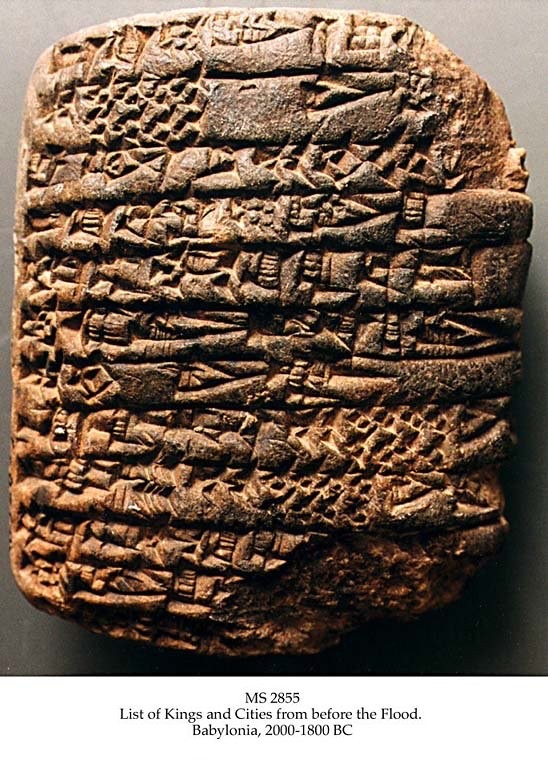
BM 86378, cuneiform tablets from the library of King Ashurbanipal, circa 687 BCE, held in the British Museum.<br /> MUL.APIN includes a list of thirty-six stars, three stars for each month of the year. The stars are those having a helical rise in a particular month. The first line lists the three stars, which have the helical rise in the first month of the year, Nisannu, which is associated with the vernal equinox. <br /> In the second line, three other stars are listed, with a helical rise in the second month, Ayyāru, and so on.<br /> I MUL.APIN sono testi antichi su tavolette di argilla, comprendono un elenco di trentasei stelle, tre stelle per ogni mese dell’anno. <br /> Le stelle sono quelle aventi ciascuna la levata eliaca in un particolare mese. Si ha perciò questo schema: nella prima riga sono elencate tre stelle, che hanno la levata eliaca nel primo mese dell'anno, Nīsannu (quello associato all'epoca dell'equinozio di primavera). <br /> Nella seconda riga sono elencate altre tre stelle, ancora ciascuna avente levata eliaca nel secondo mese, Ayyāru, e così via.<br /> http://www.lavia.org/italiano/archivio/calendarioakkadit.htm

BM 86378, cuneiform tablets from the library of King Ashurbanipal, circa 687 BCE, held in the British Museum.
MUL.APIN includes a list of thirty-six stars, three stars for each month of the year. The stars are those having a helical rise in a particular month. The first line lists the three stars, which have the helical rise in the first month of the year, Nisannu, which is associated with the vernal equinox.
In the second line, three other stars are listed, with a helical rise in the second month, Ayyāru, and so on.
I MUL.APIN sono testi antichi su tavolette di argilla, comprendono un elenco di trentasei stelle, tre stelle per ogni mese dell’anno.
Le stelle sono quelle aventi ciascuna la levata eliaca in un particolare mese. Si ha perciò questo schema: nella prima riga sono elencate tre stelle, che hanno la levata eliaca nel primo mese dell’anno, Nīsannu (quello associato all’epoca dell’equinozio di primavera).
Nella seconda riga sono elencate altre tre stelle, ancora ciascuna avente levata eliaca nel secondo mese, Ayyāru, e così via.
http://www.lavia.org/italiano/archivio/calendarioakkadit.htm

(VanderKam, Enoch and the Growth, p. 101. H. Zimmern, Beiträge zur Kenntnis der babylonischen Religion: Die Beschwörungstafeln Šurpu, Ritualtafeln für den Wahrsager, Beschwörer und Sänger (Assyriologische Bibliothek 12; Leipzig: Hinrichs, 1901).

The main arguments against Neugebauer’s position are provided by the Enochic Aramaic fragments from Cave 4, the careful evaluation of which prompted Milik already in 1976 to suggest that the astronomical parts of the Enoch tradition do belong to the oldest stratum of the Enoch literature in concordance to the  (originally) year life span allotted to Enoch in Genesis 5:23.”

Gebhard J. Selz, “Of Heroes and Sages–Considerations of the Early Mesopotamian Background of Some Enochic Traditions,” in Armin Lange, et alThe Dead Sea Scrolls in Context, v. 2, Brill, 2011, pp. 784-6.

Selz: On Giants

“Dating back to the late nineteenth century and the so-called Babel-Bible dispute, the relation of the biblical traditions, especially those concerning the paradise narrative, the flood-story, and the (antediluvian) patriarchs, to the Mesopotamian world received much interest (see below).

(For an overview over this politically remarkable dispute and the involvement of the German emperor Wilhelm II see R.G. Lehmann, Friedrich Delitzsch und der Babel-Bibel-Streit (OBO 133; Fribourg: Universitätsverlag, 1989).

Delitzsch’s hypotheses were sharply criticised by Christian and Jewish theologians of the time and soon became a political issue. Finally the emperor was even requested to make a public profession of his faith.)

From a modern scholarly point of view, much of what has been written in this period is obsolete and related to anti-biblical or apologetic motivations. Therefore, we encounter often a general warning against a naïve comparative attitude which is certainly in place.

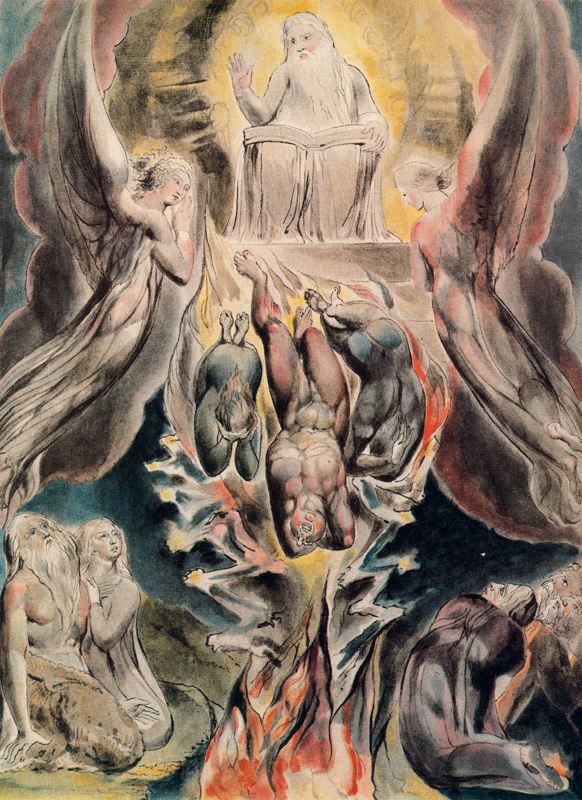
Courtesy of The Blake Archive and the Cincinnati Museum, William Blake's

Courtesy of The Blake Archive and the Cincinnati Museum, William Blake’s “Enoch Walked with God.”
Executed sometime between 1780-85 CE, this illustration is Cincinnati Museum Accession Number 1977.214.
“As always, the William Blake Archive is a free site, imposing no access restrictions and charging no subscription fees. The site is made possible by the University of North Carolina at Chapel Hill with the University of Rochester, the continuing support of the Library of Congress, and the cooperation of the international array of libraries and museums that have generously given us permission to reproduce works from their collections in the Archive.”
https://blakearchive.wordpress.com/2014/07/25/publication-announcement-thel-copy-n-and-enoch-walked-with-god/

(Cf. R. Liwak, “Bibel und Babel: Wider die theologische und religionsgeschichtliche Naivität,” BTZ 2 (1989): pp. 206-33. An extensive bibliography of “Articles by Jewish Writers on the Babel-Bibel Controversy” is published in Y. Shavit and M. Eran, eds., The Hebrew Bible Reborn: From Holy Scripture to the Book of Books: A History of Biblical Culture and the Battles over the Bible in Modern Judaism (trans. C. Naor; SJ 38; Berlin: de Gruyter, 2007), pp. 531-66).

If in the following paragraphs we refer to various Mesopotamian materials, we are fully aware of this warning. We do not intend to establish literal dependencies, but would rather draw attention to some parallels with selected Mesopotamian motifs.

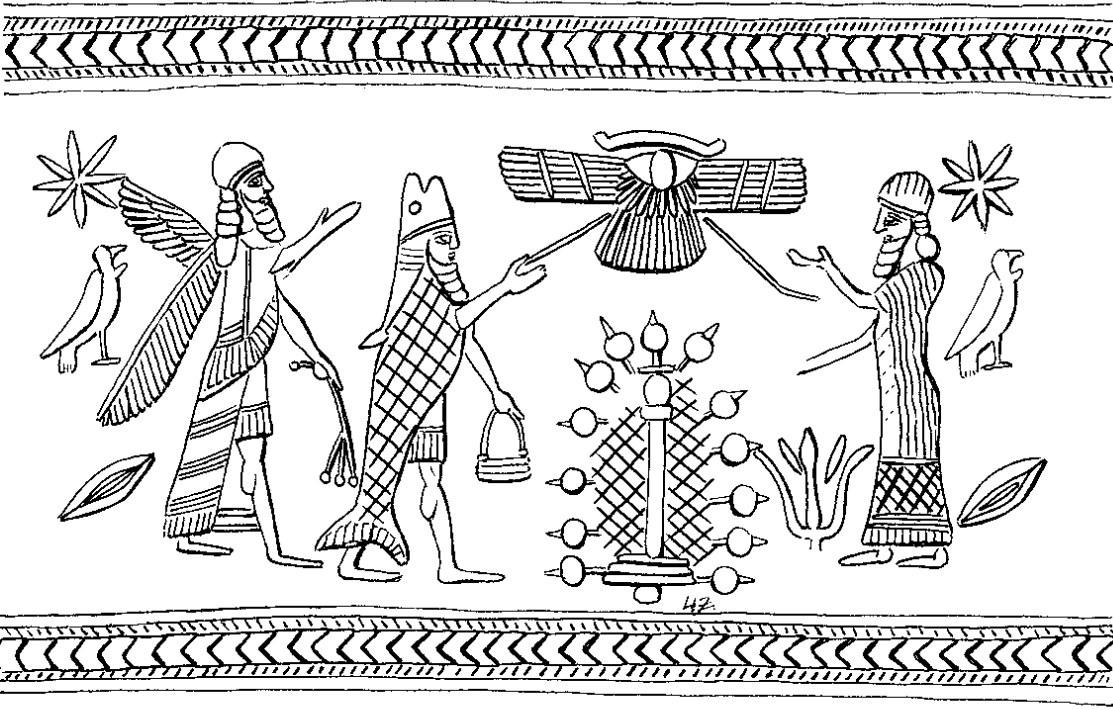
This seal appears to portray the translation of King Etana at upper left. I am not sure where this seal is held. If you can assist, please do.

This seal appears to portray the translation of King Etana at upper left.
I am not sure where this seal is held. If you can assist, please do.

We will neither address the question of a common Near Eastern origin of such motifs, nor will we attempt to reconstruct the ways of transmission in the necessary detail. The latter were certainly manifold, and that orality played a major role is very likely but, of course, hard to prove.

The most important contributions concerning the relationship between Berossos, the Sumerian King list, and the biblical patriarchs as well as the connected literary motifs are presently those of R. Borger, J.C. VanderKam, H. Kvanvig and A.A. Orlov. I shall return to them later.

(Cf. G.P. Verbrugghe and J.M. Wickersham, Berossos and Manetho, Introduced and Translated: Native Traditions in Ancient Mesopotamia and Egypt (Ann Arbor: University of Michigan Press, 1996).

(R. Borger, “Die Beschwörungsserie Bīt Mēseri und die Himmelfahrt Henochs,” JNES 33 (1974): pp. 183-96; for an abbreviated English version see idem, “The Incantation Series Bīt Mēseri and Enoch’s Ascension to Heaven,” in I Studied Inscriptions from Before the Flood: Ancient Near Eastern, Literary, and Linguistic Approaches to Genesis 1-11 (ed. R.S. Hess and D.T. Tsumura; Sources for Biblical and Theological Study 4, Winona Lake: Eisenbrauns, 1994), pp. 224-33.)

(J.C. VanderKam, Enoch and the Growth of an Apocalyptic Tradition (CBQMS 16; Washington: Catholic Biblical Association of America, 1984).

The discovery of the Qumran manuscripts put 1 Enoch in the centre of these discussions and their connections to the related Jewish-Hellenistic texts and to Mesopotamian forerunners have been widely discussed.

Titled

Titled “The Nephilim,” the artist is said to be unknown.
http://doctorwoodhead.com/days-noah-corruption-demonic-activity-part/

The Qumran manuscripts of the Book of Giants mention the hero Gilgamesh among the Giants who were offspring of the evil (fallen) angels who had intercourse with human females.

(The following excerpts of the reconstructed Book of Giants are taken from the edition of The Gnostic Society Library (MSS: 4Q203, 1Q23, 2Q26, 4Q530–532, 6Q8). Editorial note: A long excerpt from the Book of Giants is reproduced here.)

Starting from this fact, I attempt to show that not only did the generally late Mesopotamian traditions about the primeval sages and related matters form a background for the mythical imagery of the Enochic system of thought, but that the much earlier epic traditions about the kings Gilgamesh and Etana should also be considered.

We might not be able to avoid some of the traps of this sort of intertextual studies, however, we are by all means entitled to look after the pre- and the post-texts, especially if we remember that any reading implies a recreation of new texts.

To put it metaphorically, texts are not stable entities but living beings undergoing all sort of philological and interpretative changes.”

Gebhard J. Selz, “Of Heroes and Sages–Considerations of the Early Mesopotamian Background of Some Enochic Traditions,” in Armin Lange, et alThe Dead Sea Scrolls in Context, v. 2, Brill, 2011, pp. 781-4.

Melvin: Divine Instruction Reappears in 1 Enoch

“In contrast, the developments in human civilization according to Genesis 1–11 occur without any level of divine assistance, and indeed, in some cases (e.g., the construction of Babel and its tower) meet with divine opposition.

Moreover, the overall tone of Genesis 3–11 is that of an increasing descent of humanity into sin, and the origins of various aspects of civilization, while not necessarily inherently sinful, receive a negative coloring by virtue of the fact that they are placed within the downward spiral of the human race.

(Batto notes the transformation of Enkidu from his earlier wild, animal-like status as an analog to the civilization of humans. Enkidu’s reception of wisdom results in both the loss of his relationship with the animals and Shamhat’s observation that “you have become like a god” (“Creation Theology,” 20–21).

At far left, Enkidu grapples with Gilgamesh, wearing a horned crown of divinity. Enkidu fights a bull in the center, and a goddess, Ishtar, wearing a crown of divinity and weapons at her back, flanks a small female figure, possibly the priestess Shamhat, who tamed Enkidu. https://en.wikipedia.org/wiki/Shamhat

At far left, Enkidu grapples with Gilgamesh, wearing a horned crown of divinity. Enkidu fights a bull in the center, and a goddess, Ishtar, wearing a crown of divinity and weapons at her back, flanks a small female figure, possibly the priestess Shamhat, who tamed Enkidu.
https://en.wikipedia.org/wiki/Shamhat

Finally, mention must be made of the enigmatic account preserved in Genesis 6:1–4. These four brief verses recount the mating of divine beings בני האלהים with human women בנות האדם and the birth of children who are reckoned as mighty warriors of antiquity הבכרים אשר מעולם.

While Genesis 6:1–4 says nothing of the rise of human civilization, later expansions of this tradition in 1 Enoch 6–11 and Jubilees 4:15, 21–23; 8:1–4 do include the revelation of some of the arts of civilization by the Heavenly Watchers (= בני אלהם􏰤􏰨􏰀􏰓􏰥􏰃􏰨􏰦􏰢).

Much of this material finds parallels in Mesopotamian traditions, raising the possibility that Genesis 6:1–4, or perhaps the myth which lies behind the text in its present form, included the divine instruction motif.

(See especially Kvanvig’s comparison of Genesis 6:1–4 and 1 Enoch 6–11 to the 􏰎􏰍􏰝􏰎􏰒􏰒􏰩􏰃apkallu tradition, Atrahasis, and the Adapa myth (Roots of Apocalyptic, 270–342, esp. pp. 313–18).

Paul D. Hanson also sees evidence of the appropriation of ancient Near Eastern traditions concerning euhemeristic culture heroes, such as Gilgamesh, in 1 Enoch 6–11 (“Rebellion in Heaven, Azazel, and Euhemeristic Heroes in 1 Enoch 6–11,” JBL 96 [1977], pp. 226–33; see also David P. Melvin, “The Gilgamesh Traditions and the Pre-History of Genesis 6:1–4,” PRSt [forthcoming]).

A number of scholars have noted that Genesis 6:1–4 appears to be an abridgment of a fuller myth (e.g., Wellhausen, Prolegomena, p. 317; Gunkel, Genesis, p. 59). Yet even here, caution is due, as David L. Petersen points out that there is nothing incomprehensible about the text as it stands and that “these verses do contain a complete plot,” (“Genesis 6:1–4, Yahweh and the Organization of the Cosmos,” JSOT 13 [1979], pp. 47–64; citation from p. 48).

The Fall of the Rebel Angels is an oil-on-panel by Flemish renaissance artist Pieter Bruegel the Elder, painted in 1562. It is currently held and exhibited at the Royal Museums of Fine Arts of Belgium in Brussels. Bruegel's depiction of this subject is taken from a passage from the Book of Revelation (12, 2-9) and reveals the artist's profound debt to Hieronymous Bosch, especially in the grotesque figures of the fallen angels, shown as half-human, half-animal monsters. Together with Dulle Griet and The Triumph of Death, which have similar dimensions, it was probably painted for the same collector and destined to become part of a series. https://en.wikipedia.org/wiki/The_Fall_of_the_Rebel_Angels_(Bruegel)

The Fall of the Rebel Angels is an oil-on-panel by Flemish renaissance artist Pieter Brueghel the Elder, painted in 1562. It is currently held and exhibited at the Royal Museums of Fine Arts of Belgium in Brussels.
Brueghel’s depiction of this subject is taken from a passage from the Book of Revelation (12, 2-9) and reveals the artist’s profound debt to Hieronymous Bosch, especially in the grotesque figures of the fallen angels, shown as half-human, half-animal monsters.
Together with Dulle Griet and The Triumph of Death, which have similar dimensions, it was probably painted for the same collector and destined to become part of a series.
https://en.wikipedia.org/wiki/The_Fall_of_the_Rebel_Angels_(Bruegel)

Considering that Genesis 6:1–4, along with Genesis 4:17–22, is the place where one would most expect to find evidence of divine mediation of civilization, the absence of such mediation is all the more striking.

If the author of Genesis 6:1–4 drew upon an early (Mesopotamian?) myth which included something akin to the instruction motif which appears in 1 Enoch 6–11, yet did not include this element, there must have been a reason for this omission.

(Ronald Hendel notes that “The Yahwist retained the story in his composition, yet declined to present it in a full narrative form,” (“Of Demigods and the Deluge: Toward an Interpretation of Genesis 6:1–4,” JBL 106 [1987], 14).

It is, of course, possible that Genesis 6:1–4, perhaps as part of a larger “Yahwist” composition, did originally include the instruction motif, and that the seeming awkwardness and incompleteness of the present text to many scholars is the result of its removal during later editing or transmission. Yet without textual evidence, it is impossible to conclusively arrive at a reconstruction of a fuller original text.)

While one must remain open to the possibility that Genesis 6:1–4 alludes to a larger tradition which included divine instruction, the absence of this motif from the final form of Genesis 6:1–4, especially in light of its (re)appearance in 1 Enoch 6–11, actually underscores the total shift away from divine mediation of culture in Genesis 1–11.”

David P. Melvin, “Divine Mediation and the Rise of Civilization in Mesopotamian Literature and in Genesis 1-11,” Journal of Hebrew Scriptures, 2010, pp. 11-12.

Melvin: Human Civilization is a Gift of the gods

“At other times, the gods create civilization directly, either through the birth of the patron deities of aspects of civilization (e.g., agriculture) or by means of themes.

(This phenomenon is especially prevalent in Sumerian creation accounts, which often emphasize the importance of agricultural technology by placing the creation of tools prior to and even necessary for the creation of humans (see, for example, The Song of the Hoe [COS 1.157]) and by presenting the development of agriculture as a theogony in which the patron deities of various agricultural technologies are born. See Cattle and Grain in Samuel N. Kramer, Sumerian Mythology: A Study of Spiritual and Literary Achievement in the Third Millennium B.C. (rev. ed.; New York: Harper & Brothers, 1961), 72–73.)

(See Enki and Inanna (COS 1.161). See also Kramer, Sumerian Mythology, 64–68; Bottéro, 238–39.)

In The Song of the Hoe, Enlil invents the hoe, first, in order to prepare the ground for sprouting humans, and second, for humans to use in their work of temple-building.

(In Mesopotamian Creation myths, the origin of humans is usually described in one of two ways. The first is that they are fashioned from clay, usually mixed with the blood of a slain god (cf. Enuma Elish; Atrahasis). The second is that they sprout up from the ground like plants, as is the case here.)

Similarly, in Cattle and Grain the arts of animal husbandry and agriculture are tied to their patron deities, Lahar and Ashnan. In another text, Enki decrees the fates of the cities of Sumer, blessing them and causing civilization to develop.

Batto notes that a number of texts present the earliest humans (i.e., humans prior to the divine bestowal of the gift of civilization) as animal-like. Thus, in Cattle and Grain, early humans walk about naked, eat grass like sheep, and drink water from ditches.

A fragment of The Eridu Genesis. <br />  The earliest recorded Sumerian creation myth is The Eridu Genesis, known from a cuneiform tablet excavated from Nippur, a fragment from Ur, and a bilingual fragment in Sumerian with Akkadian, from the Library of Ashurbanipal dated 600 BCE. The main fragment from Nippur (depicted above) is dated to 1600 BCE. <br />  http://etcsl.orinst.ox.ac.uk/cgi-bin/etcsl.cgi?text=t.1.7.4# <br />  https://en.wikipedia.org/wiki/Sumerian_creation_myth <br />  It was Thorkild Jacobsen who named this fragment. As he says, “…it deals with the creation of man, the institution of kingship, the founding of the first cities and the great flood. Thus it is a story of beginnings, a Genesis, and, as I will try to show in detail later, it prefigures so to speak, the biblical Genesis in its structure. <br />  The god Enki and his city Eridu figure importantly in the story, Enki as savior of mankind, Eridu as the first city. Thus “The Eridu Genesis” seems appropriate." <br />  In a footnote, Jacobsen observes, “The tablet was found at Nippur during the third season’s work of the Expedition of the University of Pennsylvania (1893-6) but was not immediately recognized for what it was. The box in which it was kept was labeled “incantation.” Thus it was not until 1912, when Arno Poebel went through the tablet collection, that its true nature was discovered.” <br />  He continues, “Poebel published it in hardcopy ... and furnished a transliteration, translation and penetrating analysis .... He convincingly dated the tablet (pp. 66-9) on epigraphical and other grounds to the latter half of the First Dynasty of Babylon.” <br />  “Little further work of consequence was done on the text for thirty-six years—a detailed bibliography may be found in Rykle Borger, Handbuch der Keilschriftliteratur I (Berlin: de Gruyter, p. 411 ... but in 1950 Samuel N. Kramer’s translation was published in ANET (pp. 43-4) and again, almost twenty years later, Miguel Civil restudied the text in his chapter on Atra-hasīs (pp. 138-47). <br />  The interpretation here offered owes much to our predecessors, far more than would appear from our often very different understanding of the text." <br />  https://books.google.co.uk/books?id=g5MGVP6gAPkC&amp;pg=PA129&amp;dq=Eridu+Genesis.+Nippur&amp;hl=en&amp;sa=X&amp;ved=0CCEQ6AEwAGoVChMI4ImL2PiCxwIVhNWACh01nwD6#v=onepage&amp;q=Eridu%20Genesis.%20Nippur&amp;f=false

A fragment of The Eridu Genesis.
The earliest recorded Sumerian creation myth is The Eridu Genesis, known from a cuneiform tablet excavated from Nippur, a fragment from Ur, and a bilingual fragment in Sumerian with Akkadian, from the Library of Ashurbanipal dated 600 BCE. The main fragment from Nippur (depicted above) is dated to 1600 BCE.
http://etcsl.orinst.ox.ac.uk/cgi-bin/etcsl.cgi?text=t.1.7.4#
https://en.wikipedia.org/wiki/Sumerian_creation_myth
It was Thorkild Jacobsen who named this fragment. As he says, “…it deals with the creation of man, the institution of kingship, the founding of the first cities and the great flood. Thus it is a story of beginnings, a Genesis, and, as I will try to show in detail later, it prefigures so to speak, the biblical Genesis in its structure.
The god Enki and his city Eridu figure importantly in the story, Enki as savior of mankind, Eridu as the first city. Thus “The Eridu Genesis” seems appropriate.”
In a footnote, Jacobsen observes, “The tablet was found at Nippur during the third season’s work of the Expedition of the University of Pennsylvania (1893-6) but was not immediately recognized for what it was. The box in which it was kept was labeled “incantation.” Thus it was not until 1912, when Arno Poebel went through the tablet collection, that its true nature was discovered.”
He continues, “Poebel published it in hardcopy … and furnished a transliteration, translation and penetrating analysis …. He convincingly dated the tablet (pp. 66-9) on epigraphical and other grounds to the latter half of the First Dynasty of Babylon.”
“Little further work of consequence was done on the text for thirty-six years—a detailed bibliography may be found in Rykle Borger, Handbuch der Keilschriftliteratur I (Berlin: de Gruyter, p. 411 … but in 1950 Samuel N. Kramer’s translation was published in ANET (pp. 43-4) and again, almost twenty years later, Miguel Civil restudied the text in his chapter on Atra-hasīs (pp. 138-47).
The interpretation here offered owes much to our predecessors, far more than would appear from our often very different understanding of the text.”
https://books.google.co.uk/books?id=g5MGVP6gAPkC&pg=PA129&dq=Eridu+Genesis.+Nippur&hl=en&sa=X&ved=0CCEQ6AEwAGoVChMI4ImL2PiCxwIVhNWACh01nwD6#v=onepage&q=Eridu%20Genesis.%20Nippur&f=false

Both The Rulers of Lagash and The Eridu Genesis present early humanity as similar to animals in that they slept on straw beds in pens because they did not know how to build houses and also lived at the mercy of the rains because they did not know how to dig canals for irrigation.

Batto concludes that Mesopotamian literature depicts the advancement of early humans as their evolution from a low, animal-like state to a higher, “civilized” state by means of gifts from the gods.

A further illustration of the role of the gods in the rise of civilization in Sumer is the myth Innana and Enki􏰓􏰋􏰎􏰋􏰋􏰎􏰃􏰎􏰋􏰐􏰃􏰔􏰋􏰝􏰉. In this text, Inanna steals the mes (in this case, corresponding to the arts of civilization) from Enki in Eridu and brings them to Uruk, thus transferring civilization to Uruk. The text mentions 94 individual elements of civilization, including:

“… the craft of the carpenter, the craft of the copper-smith, the art of the scribe, the craft of the smith, the craft of the leather-worker, the craft of the fuller, the craft of the builder, the craft of the mat-weaver, understanding, knowledge, purifying washing rites, the house of the shepherd,…kindling of fire, extinguishing of fire….”

Key in this myth is the fact that it is the divine mes, originally bestowed by Enki upon Eridu alone but subsequently transferred to Uruk by Inanna, which give rise to civilization.

What is nearly universal in the Mesopotamian literature, as far as the available texts indicate, is that the source of human civilization is divine, with humans acting primarily as recipients of divine knowledge.

Because of its divine origin and the clear benefits which it provides for humans—at least for those favored humans on whom the gods bestow it—civilization is portrayed in an overwhelmingly positive manner in these texts.”

David P. Melvin, “Divine Mediation and the Rise of Civilization in Mesopotamian Literature and in Genesis 1-11,” Journal of Hebrew Scriptures, 2010, pp. 6-7.

Melvin: On the Role of Divine Counsel

“Elements of civilization are also attributed to the semi-divine hero, Gilgamesh. The opening lines of the Epic of Gilgamesh celebrate his great wisdom:

“He who saw the Deep, the country’s foundation, [who] knew…, was wise in all matters! [Gilgamesh, who] saw the Deep, the country’s foundation, [who] knew…, was wise in all matters! [He …] everywhere […] and [learnt] of everything the sum of wisdom. He saw what was secret, discovered what was hidden, he brought back a tale of before the Deluge.”

(The Epic of Gilgamesh, SBV I.1–8 (Andrew George, The Epic of Gilgamesh: A New Translation [London: Penguin, 2000], p.1).

The text goes on to describe Gilgamesh’s achievements in building the edifices of the city of Uruk, especially its wall. Here the text highlights the great wisdom required for such construction by ascribing the foundations of the city wall to the wisdom of the “Seven Sages” (apkallus).

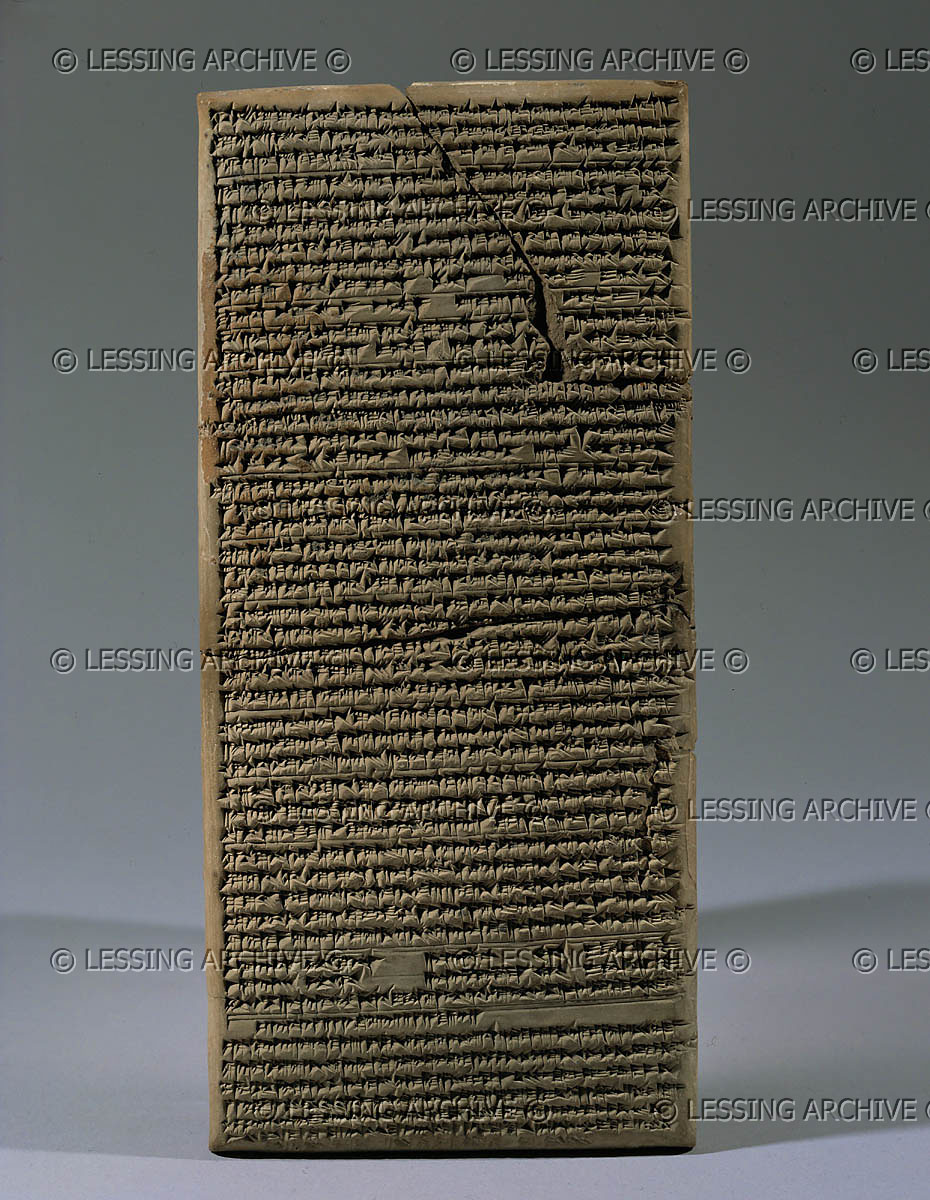
Cuneiform tablet with the Atrahasis Epic. Babylonian, about 17th century BCE. From Sippar, southern Iraq. A version of the Flood story. The story outlines the structure of the universe according to Babylonian beliefs. Heaven is ruled by the god Anu, the earth by Enlil and the subterranean sweet water by Enki. The text then explains how the minor gods work in the fields but then rebel. As a result, humans are made from clay, saliva and divine blood to act as servants of the gods. This does not prove a perfect solution, as the humans reproduce and their noise disturbs Enlil's sleep. He decides to destroy them with plague, famine, drought and finally a flood.  However, each time Enki instructs one of the humans, Atrahasis, to survive the disasters. The god gives Atrahasis seven days warning of the flood, and he builds a boat, loads it with his possessions, animals and birds. He is subsequently saved while the rest of humankind is destroyed.  However, the gods are unhappy as they no longer receive the offerings they used to.  There is a gap in the text at this point but it does end with Atrahasis making an offering and Enlil accepting the existence and usefulness of humans. Copies of this story have survived from the seventeenth to the seventh century BCE showing that it was copied and re-copied over the centuries. This is the most complete version. There are clear similarities between this Flood story and others known in Mesopotamian literature, for example, the Epic of Gilgamesh. T.C. Mitchell, The Bible in the British Museum (London, The British Museum Press, 1988) S. Dalley, Myths from Mesopotamia (Oxford University Press, 1991) W.G. Lambert and A.R. Millard, Atra-hasis (Oxford, Clarendon Press, 1969) http://www.britishmuseum.org/explore/highlights/highlight_objects/me/c/cuneiform_the_atrahasis_epic.aspx

Cuneiform tablet with the Atrahasis Epic.
Babylonian, about 17th century BCE.
From Sippar, southern Iraq.
A version of the Flood story.
The story outlines the structure of the universe according to Babylonian beliefs. Heaven is ruled by the god Anu, the earth by Enlil and the subterranean sweet water by Enki. The text then explains how the minor gods work in the fields but then rebel. As a result, humans are made from clay, saliva and divine blood to act as servants of the gods.
This does not prove a perfect solution, as the humans reproduce and their noise disturbs Enlil’s sleep. He decides to destroy them with plague, famine, drought and finally a flood.
However, each time Enki instructs one of the humans, Atrahasis, to survive the disasters. The god gives Atrahasis seven days warning of the flood, and he builds a boat, loads it with his possessions, animals and birds. He is subsequently saved while the rest of humankind is destroyed.
However, the gods are unhappy as they no longer receive the offerings they used to.
There is a gap in the text at this point but it does end with Atrahasis making an offering and Enlil accepting the existence and usefulness of humans.
Copies of this story have survived from the seventeenth to the seventh century BCE showing that it was copied and re-copied over the centuries. This is the most complete version. There are clear similarities between this Flood story and others known in Mesopotamian literature, for example, the Epic of Gilgamesh.
T.C. Mitchell, The Bible in the British Museum (London, The British Museum Press, 1988)
S. Dalley, Myths from Mesopotamia (Oxford University Press, 1991)
W.G. Lambert and A.R. Millard, Atra-hasis (Oxford, Clarendon Press, 1969)
http://www.britishmuseum.org/explore/highlights/highlight_objects/me/c/cuneiform_the_atrahasis_epic.aspx

Moreover, within the epic, the greatest achievements of Gilgamesh are the building of the wall of Uruk and the wisdom he obtained and passed on to subsequent generations.

(Jeffrey H. Tigay, The Evolution of the Gilgamesh Epic (Phildelphia: University of Pennsylvania Press, 1982), pp.142–49; 213.)

The source of this wisdom is his encounter with the divinized Flood hero, as the Sumerian text The Death of Bilgames indicates:

“…you reached Ziusudra in his abode! The rites of Sumer, forgotten there since distant days of old, the rituals and customs—it was you brought them down to the land. The rites of hand-washing and mouth-washing you put in good order, [after the] Deluge it was you made known all the tasks of the land […].”

(The Death of Bilgames, M 57–62 (George, The Epic of Gilgamesh, pp.198– 99).

Thus, Gilgamesh acts as a mediating figure between the divine source of the knowledge necessary for aspects of civilization and the people of Sumer. The source of his divine knowledge is the divinized Flood hero, who had in turn received his knowledge from Enki / Ea, as well as perhaps his divine mother, Ninsun.

Library of Ashurbanipal / The Flood Tablet / The Gilgamesh Tablet Date15 July 2010 Current location: British Museum wikidata:Q6373 Source/Photographer	Fæ (Own work) Other versions	File:British Museum Flood Tablet 1.jpg British Museum reference	K.3375 Detailed description:	 Part of a clay tablet, upper right corner, 2 columns of inscription on either side, 49 and 51 lines + 45 and 49 lines, Neo-Assyrian., Epic of Gilgamesh, tablet 11, story of the Flood. ~ Description extract from BM record. Location	Room 55

 https://commons.wikimedia.org/wiki/File:Library_of_Ashurbanipal_The_Flood_Tablet.jpg

Library of Ashurbanipal / The Flood Tablet / The Gilgamesh Tablet
Date 15 July 2010
Current location: British Museum wikidata:Q6373
Source/Photographer Fæ (Own work)
Other versions File:British Museum Flood Tablet 1.jpg
British Museum reference K.3375
Detailed description:
Part of a clay tablet, upper right corner, 2 columns of inscription on either side, 49 and 51 lines + 45 and 49 lines, Neo-Assyrian, Epic of Gilgamesh, tablet 11, story of the Flood. ~- Description extract from BM record.
Location Room 55


https://commons.wikimedia.org/wiki/File:Library_of_Ashurbanipal_The_Flood_Tablet.jpg

(See Atrahasis OBV I.364–67; III.11–35 (Benjamin R. Foster, Before 􏰂􏰕􏰇􏰃􏰄􏰖􏰆􏰇􏰆􏰛􏰃􏰙􏰋􏰃􏰙􏰋􏰂􏰕􏰌􏰒􏰌􏰞􏰚􏰃􏰌􏰘􏰃􏰙􏰝􏰝the Muses: An Anthology of Akkadian Literature [3rd ed.; Bethesda, MD: CDL Press, 2005], pp. 329, 247–48).

(In The Death of Bilgames, Enki, following the recounting of Gilgamesh’s great achievements and wisdom, states, “And now we look on Bilgames: despite his mother we cannot show him mercy!” (M 78–79 [George, The Epic of Gilgamesh, 199 (sic)]).

In the Epic of Gilgamesh, Ninsun counsels Gilgamesh by her divine wisdom following his dreams portending Enkidu’s arrival, and, like the apkallus, Gilgamesh is said to have been granted “broad understanding” by the gods (SBV I.242–98 [George, The Epic of Gilgamesh, pp. 9–11]).

In similar fashion, Enmerkar acts as a mediator of divine knowledge which benefits humanity by aiding in the rise of civilization. In the Sumerian myth Enmerkar and the Lord of Aratta, Enmerkar competes with the Lord of Aratta for supremacy in the region.

They engage in a battle of wits in which the Lord of Aratta issues various seemingly impossible challenges for Enmerkar, and in each case, Enmerkar succeeds by receiving divine inspiration from a deity.

Thus, for example, when the Lord of Aratta challenges Enmerkar to carry grain from Uruk to Aratta in a net, he receives the solution from the grain goddess, Nidaba, who “open[s] for him her ‘Nidaba’s holy house of understanding.’”

(Enmerkar and the Lord of Aratta, lines 324–26 (Thorkild Jacobsen, The Harps That Once…: Sumerian Poetry in Translation [New Haven: Yale University Press, 1987], p. 301).

By his reception of divine knowledge, Enmerkar is able not only to meet the Lord of Aratta’s challenges, he also invents several new technologies (e.g., writing) along the way.

Because of the crucial role divine counsel plays in Enmerkar’s cultural achievements, his accomplishments become, indirectly, the work of the gods in bringing about human civilization.”

David P. Melvin, “Divine Mediation and the Rise of Civilization in Mesopotamian Literature and in Genesis 1-11,” Journal of Hebrew Scriptures, 2010, pp. 4-5.

Izre’el: Adapa and the South Wind as Mythos

“A Sumerian version of Adapa from the Old Babylonian period has been discovered at Tell Haddad (ancient Meturan) and has been announced by Cavigneaux and al-Rawi (1993: 92-3). The Sumerian version is reported to be similar to the Akkadian version. It includes “an incantation-like passage” at the end, as does the Akkadian version represented by Fragment D.

Furthermore, the myth is the second part of a longer narrative, the first part of which describes the time just following the deluge and describes the feeding of the gods and the organization of mankind.

The discovery of the myth of Adapa and the South Wind immediately attracted wide attention. Its ideology and its correspondence to the intellectual heritage of Western religions precipitated flourishing studies of this myth, both philological and substantive.

This is MLC 1296, an Akkadian fragment of the Adapa Myth in the collection of the Morgan Library and Museum. http://corsair.themorgan.org/cgi-bin/Pwebrecon.cgi?BBID=215815

This is MLC 1296, an Akkadian fragment of the Adapa Myth in the collection of the Morgan Library and Museum.
http://corsair.themorgan.org/cgi-bin/Pwebrecon.cgi?BBID=215815

Many translations have appeared during the past century, shedding light on various aspects of the myth and its characters. Picchioni (1981) made use of the scholarly work that preceded him, but following his monograph further studies and new translations of the Adapa narrative appeared (among which were Michalowski 1980; Müller 1983-4; Dalley 1989; Talon 1990; Dietrich 1991; Izre’el 1991a; Müller 1991; Dietrich 1993; Foster 1993; Izre’el 1993: 52-7; 1997: 43-50; Kämerer 1998: 254-59).

Picchioni’s monograph marked a turning point in the Assyriological study of the myth and became the standard edition of the myth. There are several reasons for this: first, it summarized the diverging views published in the secondary literature.

Second, Picchioni’s critical edition was solid and up to date. Third, his study established (although not without precedent; see Böhl 1953: 149-50; 1959; Hecker 1974: in passing, index: p. 214; cf. already Zimmern in Gunkel 1895: 420-1 n. 2) that the structure of the text (more specifically, the Amarna fragment) must be viewed as verse.

This enhanced our understanding of the text as a piece of literature (cf. von Soden 1984: 227-30; Izre’el 1991a).

However, in spite of comprehensive treatment of the personae and symbols of the myth, Picchioni’s treatment of the narrative itself was remarkably brief (cf. Ella 1983). It is precisely with this in mind that I am publishing the present study: I am unveiling the myth of Adapa and the South Wind as mythos, as story. To do this, I will analyze the underlying concepts through extensive treatment of form.

First I offer an edition of the extant fragments of the myth, including the transliterated Akkadian text, a translation, and a philological commentary. As the reader will see, I consider language the salient and crucial part of any textual treatment, especially one that analyzes the overt and covert meanings of a myth.

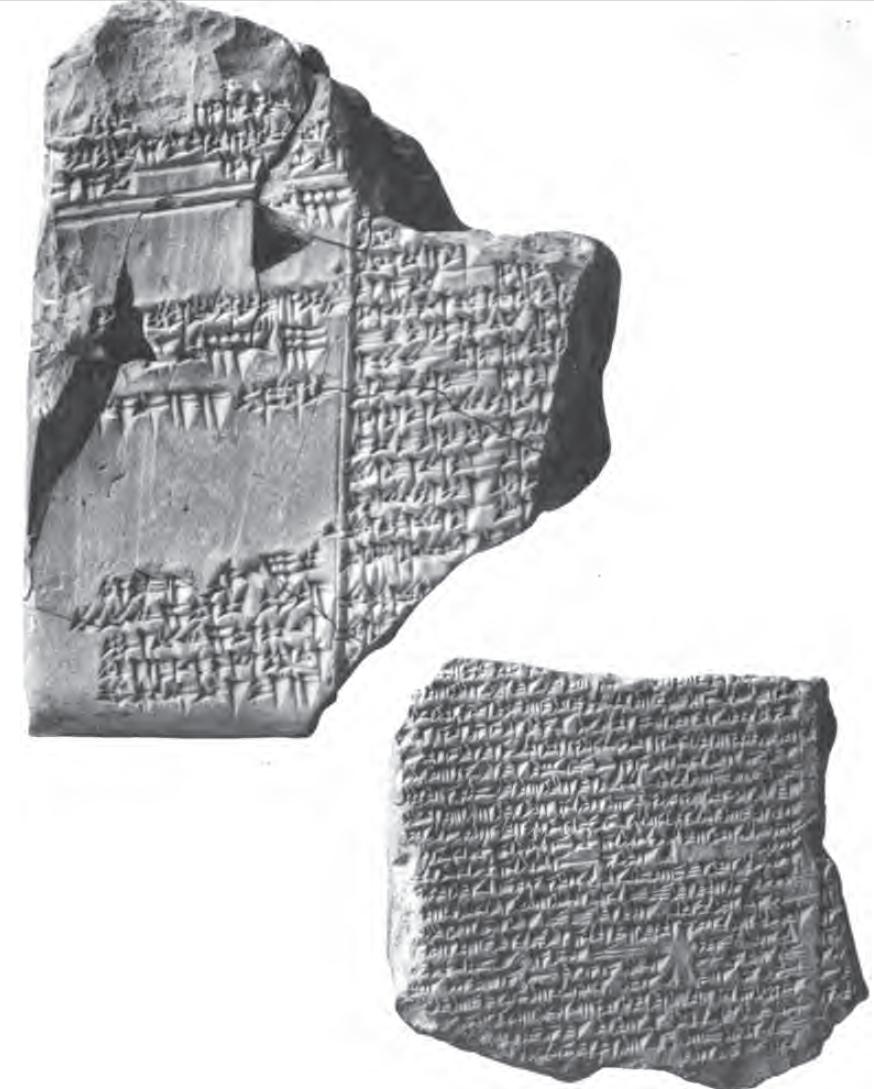
These cuneiform originals are from Albert T. Clay, A Hebrew Deluge Story in Cuneiform. New Haven: Yale University Press, 1922. This particular photograph states,

These cuneiform originals are from Albert T. Clay, A Hebrew Deluge Story in Cuneiform. New Haven: Yale University Press, 1922.
This particular photograph states, “Early Atrahasis Cuneiform Original –Reverse
Adapa Version – Obverse (Reverse is destroyed).”
http://www.cumorah.com/index.php?target=view_other_articles&story_id=59&cat_id=7

I cannot overemphasize the need for thorough philological and linguistic analysis before discussing meaning, even though some interpretations are merely the result of context-realizations.

The analysis of poetic form that follows will then lead to analyzing the myth as a piece of literature and to uncovering its meaning—or rather, meanings.

This study therefore marks another phase in the long, extensive, and never-ceasing research into this abysmal Mesopotamian myth. Being just one of many human beings allured to and intrigued by this tale told in ancient times to a more understanding audience than ours, I wish to share with my own audience both my interpretation and my impression of this particular myth, as well as the methodology that I have adopted for my enquiry.

Within these confines, I hope that this study will have something to offer to the more general study of the Mesopotamian, especially the Akkadian, mythological texts.”

Schlomo Izre’el, Adapa and the South Wind: Language Has the Power of Life and Death, Eisenbrauns, 2001, pp. 7-8.

Izre’el: Listing the Fragments

Previous Studies and the Present Study

“The scholarly world first became aware of the myth of Adapa and the South Wind when its largest fragment was discovered among the scholarly tablets of the El-Amarna archive in 1887 (Harper 1891; Scheil 1891; cf. Zimmern 1892; Sayce 1892; Izre’el 1997: 1-13, 43-50).

A fragment of the myth (now known as Fragment D) had, in fact, already been published before that time by one of the pioneers of Mesopotamian studies, George Smith (Smith 1876:125-6).

Smith, however, did not have at his disposal enough data to identify this fragment as part of the myth to which it belonged and attributed it to the Ea narrative (for which see Cagni 1969, 1977). While discussing the Berossus account of Oannes, Smith stated that “it is a curious fact the legend of Oannes, which must have been one of the Babylonian stories of the Creation, has not yet been discovered” (Smith 1876: 306).

Sayce, who said he had copied this fragment, “related to an otherwise unknown individual named Adapa,” “many years ago,” was able to attribute this fragment to the Adapa myth only after the discovery of the Amarna fragment (Sayce 1892; cf. Sayce in Morgan 1893: 183-4; Bezold 1894a: 114 n. 1, 1894b: 405 n. 1; Strong 1894; 1895).

We now have at our disposal six fragments of the myth. The largest and most important fragment is the one discovered at Amarna (“Fragment B”) and thus dated to the 14th century BCE (see further pp. 47-9).

Five other fragments (A, A1, C, D, and E) were part of the Ashurbanipal library and are representative of this myth as it was known in Assyria about seven centuries later. Only two of the extant fragments (A and A1) are variants of the same text. Fragments C and D come from different sections of the text.

Fragment E represents another recension of the myth, which also seems to be similar to the known versions.

K 15072, British Museum. Another extremely sparse entry for this Akkadian cuneiform tablet, provenance Nineveh, modern Kuyunjik.<br /> http://www.cdli.ucla.edu/cdlisearch/search_beta/search_results.php?SearchMode=Text&ObjectID=401152

K 15072, British Museum. Another extremely sparse entry for this Akkadian cuneiform tablet, provenance Nineveh, modern Kuyunjik.
http://www.cdli.ucla.edu/cdlisearch/search_beta/search_results.php?SearchMode=Text&ObjectID=401152

The following is a list of the extant fragments edited in this volume, with their museum numbers and main previous editions.

  • Fragment A: MLC 1296 (Pierpont Morgan Library, New York);
  • Scheil 1898: 124-33;
  • Clay 1922: 39-41, pls IV, VI (cf. Clay 1923: 10-11);
  • Picchioni 1981: 112-5, 127-31 (figure 1), tav. 1.
  • Fragment A1: K 15072 (British Museum, London).
  • Parallel to the last extant section Fragment A. Schramm 1974;
  • Picchioni 1981: 114-5, 131, tav. IV-V.
  • Fragment B: VAT 348 (Vorderasiatisches Museum, Berlin);
  • Winkler and Abel 1889-90: 240;
  • Schroeder 1915: #194;
  • Harper 1894: 418-25;
  • Jensen 1900: 94-9, with comments on pp. 411-3;
  • Knudtzon 1915: 964-9 (= EA 356);
  • Picchioni 1981: 114-21, 131-6, 162-3 (figures 2-3 = Schroeder 1915: #194, tav. II-III;
  • Izre’el 1997: 43-50, copy (= Schroeder 1915: #194 with collations = pp. 177, 179 below), photographs.
  • Fragment C: K 8743 (British Museum, London). Expanded parallel to part of Fragment B.
  • Langdon 1915: pl. IV, #3, and p. 42 n. 2;
  • Thompson 1930: pl. 31;
  • Jensen 1900: xvii-xviii;
  • Picchioni 1981: 120-1, 136-7, 164 (figure 4), tav. IV-V.
  • Photograph also in Böhl 1959: Taf. 12.
  • Fragment D: K 8214 (British Museum, London). Virtual parallel to the end of Fragment B with additions.
  • Strong 1894;
  • Furlani 1929: 132;
  • Picchioni 1981: 122-3, 137-41, 165 (figure 5), tav. VI.
  • Photograph also in Böhl 1959: Taf. 12.
  • Fragment E: K 9994 (British Museum, London). A small fragment probably representing a different recension of the myth.
  • Von Soden 1976: 429-30;
  • Picchioni 1981: 95-6, tav. IV-V.

A cuneiform copy is published here for the first time, courtesy of the Trustees of the British Museum.

The notation “Fragment E” is introduced here.

In addition to these fragments, one may note a possible title to the myth. The catalogue of literary texts Rm 618 (Bezold 1889-99: 4.1627) lists a title of a work on Adapa (line 3):

Adapa into heaven ( . . . )

Picchioni (1981: 87 n. 244) suggested that this might be an incipit of the first verse of the myth; Talon (1990: 44, 54) agrees (see further Hallo 1963: 176; cf. Lambert 1962: 73-4).

It is difficult to see how this line could have been the opening verse of any of the versions known to us, since both Fragment A and Fragment B seem to have opened differently (cf., for Fragment B, p. 108, and, for a literary analysis of Fragment A, pp. 112-3).

It may perhaps be suggested that this was a title rather than an incipit (thus also Röllig 1987: 50), because we know that Adapa’s ascent to heaven is also referred to elsewhere (p. 4).

British Museum K 10147. Notes on this fragment are sparse. It was sourced at Nineveh, modern Kuyunjik, and marked Neo-Assyrian (ca. 911-612 BC).<br /> http://www.cdli.ucla.edu/cdlisearch/search_beta/archival_view.php?ObjectID=P398516

British Museum K 10147. Notes on this fragment are sparse. It was sourced at Nineveh, modern Kuyunjik, and marked Neo-Assyrian (ca. 911-612 BC).
http://www.cdli.ucla.edu/cdlisearch/search_beta/archival_view.php?ObjectID=P398516

Von Soden, while suggesting the attribution of K 9994 (= Fragment E) to this myth (cf. also Borger 1975: 62, following Lambert), also made some observations concerning K 10147, saying that although the attribution of this fragment to the myth is doubtful, it may have formed part of the beginning of the text, before the extant Fragment A (von Soden 1976: 431; already Bezold 1894b: 405 n. 1).

This and other small fragments mentioning Adapa or relating to this figure have been collected by Picchioni (1981).”

(Ed. note: Links on this page are far from perfect. I have done my best to at least show a direction if you are seeking a specific citation or a particular work. Many of the cited works are not on the web. If you want them, you will have to complete your citations and then request them through an interlibrary loan at a physical library. If you have updated links to citations or to complete works, or images of the fragments themselves, please share them with me through the comments feature below. It would be a selfless contribution to scholarship if you could scan them and upload them to the internet. I will integrate them into this page. Please remember to mention if you would like to be credited.)

Schlomo Izre’el, Adapa and the South Wind: Language Has the Power of Life and Death, Eisenbrauns, 2001, pp. 5-7.

Kvanvig: At the Brink of Legendary Time and Historical Time

“In Bīt Mēseri and Berossos, where there are narratives connected to the names, it is clear that the apkallus were those who brought humankind the basic wisdom needed to establish civilization. This is written out in a full story in Berossos; the same is referred to in Bīt Mēseri in the phrase “plans of heaven and earth.”

In both places the first apkallu Uan/Oannes is most prominent in this matter. They both concur with the D fragment of the Adapa Myth, where Adapa is given insight into the secrets of both heaven and earth, the whole of Anu’s domain.

We observe in the lists, however, that there is not only a division between the first group of seven apkallus and the subsequent sages / scholars; there is also continuity. This seems to be the whole idea of extending the list of seven with subsequent scholars. The subsequent scholars belong to a tradition going back to the antediluvian apkallus.

There are variations in how this is expressed. The system is most clear in the Uruk tablet, which changes the designation from apkallu, mostly reserved for sages before the flood, to ummanu, the self-designation of the scholars preserving their wisdom after the flood.

But there is a very interesting hint in Bīt Mēseri as well. Lu-Nanna, the last apkallu in the list after the flood, is two-thirds apkallu. Here there is clearly a second point of transition–we must presume this time from apkallus to scholars.

A stone bust of the King Šulgi (2094 BCE - 2047 BCE), possibly recovered from the ruins of Tello, ancient Girsu.  Third dynasty of Ur 2120 BCE.  Colecciones Burzaco © Jose Latova.  http://press.lacaixa.es/socialprojects/photo.html?noticia=17853&imagen=14

A stone bust of the King Šulgi (2094 BCE – 2047 BCE), possibly recovered from the ruins of Tello, ancient Girsu.
Third dynasty of Ur 2120 BCE.
Colecciones Burzaco © Jose Latova.
http://press.lacaixa.es/socialprojects/photo.html?noticia=17853&imagen=14

This is confirmed in another short notice about Lu-Nanna in Bīt Mēseri: he lived during the time of Šulgi. Here, when the power of the apkallus fades, we are for the first and only time in Bīt Mēseri placed in real history. Šulgi is attested as a historical king; he reigned during the third dynasty of Ur (2094-2047 BCE).

Thus, at the brink between legendary time and historical time comes the transition from the mythical and legendary apkallus to the historical ummanus.

This clear tendency in the lists is confirmed by several witnesses from Late Assyrian kings stretching down to the last Babylonian king Nabonidus. The witnesses both attest that there was a special quality connected to wisdom from before the flood, and that this was the wisdom brought to humankind through the apkallus.

The king needed access to this kind of “higher” wisdom, which included insight into the divine secrets, in order to reign. Those responsible for providing the king with this kind of wisdom were the ummanus attached to the royal court. The wisdom one brought to humankind by the apkallus accordingly had a political dimension.

The ummanus provided the king with the wisdom necessary to rule the empire. The myth about the transmission of divine wisdom became part of an imperial ideology.

Text:  "IN ERIDU: ALULIM RULED AS KING 28,800 YEARS. ELALGAR RULED 43,200 YEARS. ERIDU WAS ABANDONED. KINGSHIP WAS TAKEN TO BAD-TIBIRA. AMMILU'ANNA THE KING RULED 36,000 YEARS. ENMEGALANNA RULED 28,800 YEARS. DUMUZI RULED 28,800 YEARS. BAD-TIBIRA WAS ABANDONED. KINGSHIP WAS TAKEN TO LARAK. EN-SIPA-ZI-ANNA RULED 13,800 YEARS. LARAK WAS ABANDONED. KINGSHIP WAS TAKEN TO SIPPAR. MEDURANKI RULED 7,200 YEARS. SIPPAR WAS ABANDONED. KINGSHIP WAS TAKEN TO SHURUPPAK. UBUR-TUTU RULED 36,000 YEARS. TOTAL: 8 KINGS, THEIR YEARS: 222,600" MS in Sumerian on clay, probably Larsa Babylonia, 2000-1800 BC, 1 tablet, 8,1x6,5x2,7 cm, single column, 26 lines in cuneiform script. 5 other copies of the Antediluvian king list are known only: MS 3175, 2 in Oxford: Ashmolean Museum, one is similar to this list, containing 10 kings and 6 cities, the other is a big clay cylinder of the Sumerian King List, on which the kings before the flood form the first section, and has the same 8 kings in the same 5 cities as the present.  A 4th copy is in Berkeley: Museum of the University of California, and is a school tablet. A 5th tablet, a small fragment, is in Istanbul. The list provides the beginnings of Sumerian and the world’s history as the Sumerians knew it. The cities listed were all very old sites, and the names of the kings are names of old types within Sumerian name-giving. Thus it is possible that correct traditions are contained, though the sequence given need not be correct. The city dynasties may have overlapped. It is generally held that the Antediluvian king list is reflected in Genesis 5, which lists the 10 patriarchs from Adam to Noah, all living from 365 years (Enoch) to 969 years (Methuselah), altogether 8,575 years.  It is possible that the 222,600 years of the king list reflects a more realistic understanding of the huge span of time from Creation to the Flood, and the lengths of the dynasties involved.  The first of the 5 cities mentioned , Eridu, is Uruk, in the area where the myths place the Garden of Eden, while the last city, Shuruppak, is the city of Ziusudra, the Sumerian Noah. Jöran Friberg: A remarkable Collection of Babylonian Mathematical Texts. Springer 2007.  Sources and Studies in the History of Mathematics and Physical Sciences.  Manuscripts in the Schøyen Collection, vol. 6, Cuneiform Texts I. pp. 237-241. Andrew George, ed.: Cuneiform Royal Inscriptions and Related Texts in the Schøyen Collection, Cornell University Studies in Assyriology and Sumerology, vol. 17,  Manuscripts in the Schøyen Collection, Cuneiform texts VI. CDL Press, Bethesda, MD, 2011, text 96, pp. 199-200, pls. LXXVIII-LXXIX. Andrew E. Hill & John H. Walton: A survey of the Old Testament, 3rd ed., Grand Rapids, Mi., Zondervan Publ. House, 2009, p. 206.  Zondervan Illustrated Bible, Backgrounds, Commentary. John H. Walton, gen. ed. Grand Rapids, Mich., Zondervan, 2009, vol 1, p. 482, vol. 5, p. 398. Babylonia 2000 - 1800 BC

Text:
“IN ERIDU: ALULIM RULED AS KING 28,800 YEARS. ELALGAR RULED 43,200 YEARS. ERIDU WAS ABANDONED. KINGSHIP WAS TAKEN TO BAD-TIBIRA. AMMILU’ANNA THE KING RULED 36,000 YEARS. ENMEGALANNA RULED 28,800 YEARS. DUMUZI RULED 28,800 YEARS. BAD-TIBIRA WAS ABANDONED. KINGSHIP WAS TAKEN TO LARAK. EN-SIPA-ZI-ANNA RULED 13,800 YEARS. LARAK WAS ABANDONED. KINGSHIP WAS TAKEN TO SIPPAR. MEDURANKI RULED 7,200 YEARS. SIPPAR WAS ABANDONED. KINGSHIP WAS TAKEN TO SHURUPPAK. UBUR-TUTU RULED 36,000 YEARS. TOTAL: 8 KINGS, THEIR YEARS: 222,600”
MS in Sumerian on clay, probably Larsa Babylonia, 2000-1800 BC, 1 tablet, 8,1×6,5×2,7 cm, single column, 26 lines in cuneiform script.
5 other copies of the Antediluvian king list are known only: MS 3175, 2 in Oxford: Ashmolean Museum, one is similar to this list, containing 10 kings and 6 cities, the other is a big clay cylinder of the Sumerian King List, on which the kings before the flood form the first section, and has the same 8 kings in the same 5 cities as the present.
A 4th copy is in Berkeley: Museum of the University of California, and is a school tablet. A 5th tablet, a small fragment, is in Istanbul.
The list provides the beginnings of Sumerian and the world’s history as the Sumerians knew it. The cities listed were all very old sites, and the names of the kings are names of old types within Sumerian name-giving. Thus it is possible that correct traditions are contained, though the sequence given need not be correct. The city dynasties may have overlapped.
It is generally held that the Antediluvian king list is reflected in Genesis 5, which lists the 10 patriarchs from Adam to Noah, all living from 365 years (Enoch) to 969 years (Methuselah), altogether 8,575 years.
It is possible that the 222,600 years of the king list reflects a more realistic understanding of the huge span of time from Creation to the Flood, and the lengths of the dynasties involved.
The first of the 5 cities mentioned, Eridu, is Uruk, in the area where the myths place the Garden of Eden, while the last city, Shuruppak, is the city of Ziusudra, the Sumerian Noah.
Jöran Friberg: A Remarkable Collection of Babylonian Mathematical Texts. Springer 2007.
Sources and Studies in the History of Mathematics and Physical Sciences.
Manuscripts in the Schøyen Collection, vol. 6, Cuneiform Texts I. pp. 237-241. Andrew George, ed.: Cuneiform Royal Inscriptions and Related Texts in the Schøyen Collection, Cornell University Studies in Assyriology and Sumerology, vol. 17,
Manuscripts in the Schøyen Collection, Cuneiform texts VI. CDL Press, Bethesda, MD, 2011, text 96, pp. 199-200, pls. LXXVIII-LXXIX.
Andrew E. Hill & John H. Walton: A Survey of the Old Testament, 3rd ed., Grand Rapids, MI., Zondervan Publishing House, 2009, p. 206.
Zondervan Illustrated Bible, Backgrounds, Commentary. John H. Walton, gen. ed. Grand Rapids, MI, Zondervan, 2009, vol 1, p. 482, vol. 5, p. 398.

This wisdom became in the course of the first millennium not only oral, but written. There are numerous examples of how especially compositions belonging to the secret lore of the ummanus were ascribed to the apkallus, above all to the first of them, Uanadapa.

Here we can observe the same chain of transmission as in the lists. There is a general tendency to ascribe compositions of high authority to Ea and to Adapa, or other apkallus, as the second link in the chain.

Moreover, there is a tendency to use a language of revelation in the transmission from Ea to Adapa. In a manner like Kabti-ilāni-Marduk the god “showed” the heavenly wisdom to Adapa, who wrote it down on tablets. Or, as in the case of Nabonidus, he was even wiser than Adapa, because the god had revealed to him the divine secrets.

This notion is in line with a broader tendency from the end of the second millennium, to date compositions back to the mythical primeval time, the time before the flood.”

Helge Kvanvig, Primeval History: Babylonian, Biblical, and Enochic: An Intertextual Reading, Brill, 2011, pp. 154-5.

Kvanvig: Initiation is a Restriction of Marduk

“We think van der Toorn is right in taking this as a comment to the tendency present in the Catalogue. This is still no absolute chronology, since apkallus are listed as authors in III, 7; IV, 11; and VI, 11.

Nevertheless, the commentary seems to underscore three stages in the transmission of highly recognized written knowledge: it starts in the divine realm with the god of wisdom Ea; at the intersection point between the divine and the human stands Uanadapa; and as the third link in this chain stands (we must presuppose) an ummanu, “scholar.”

Tablet of Uruk. The ritual of daily sacrifices in the temple of the god Anu in Uruk.  Seleucid period, 3rd-2nd Centuries BCE, Hellenistic, from Uruk.  Baked clay, 22,3 x 10,4 cm  Louvre, AO 6451.

Tablet of Uruk. The ritual of daily sacrifices in the temple of the god Anu in Uruk.
Seleucid period, 3rd-2nd Centuries BCE, Hellenistic, from Uruk.
Baked clay, 22,3 x 10,4 cm
Louvre, AO 6451.

A. Lenzi has called attention to a colophon to a medical text which reveals a similar kind of transmission:

“Salves (and) bandages: tested (and) checked, which are ready at hand, composed by the ancient apkallus from before the flood, which in Šuruppak in the second year of Enlil-bani, king of Isin, Enlil-muballit, apkallu of Nippur, bequeathed. A non-expert may show an expert. An expert may not show a non-expert. A restriction of Marduk.”

(Medical Text, AMT 105, 1, 21-5. Lenzi, Secrecy and the Gods, p. 117.)

The models of transmission in the commentary of the Catalogue and in this colophon are not exactly the same, but the tendency is. In this text, an expert, possibly an āšipu, has in his hands a tablet of high dignity: it belongs to the secrets of the gods (cf. below).

AM-102 ; No. #1 (K4023) British Museum of London 

Tablet K.4023  COL. I  [Starting on Line 38] . . .  Root of caper which (is) on a grave, root of thorn (acacia) which (is) on a grave, right horn of an ox, left horn of a kid, seed of tamarisk, seed of laurel, Cannabis, seven drugs for a bandage against the Hand of a Ghost thou shalt bind on his temples.  FOOTNOTES:  [1] - The American Journal of Semitic Languages and Literatures, Vol. 54, No. 1/4 (Oct., 1937), pp. 12-40; Assyrian Prescriptions for the Head By R. Campbell Thompson 

 http://antiquecannabisbook.com/chap2B/Assyria/K4023.htm

AM-102 ; No. #1 (K4023)
British Museum of London 

Tablet K.4023
COL. I
[Starting on Line 38] . . .
Root of caper which (is) on a grave, root of thorn (acacia) which (is) on a grave, right horn of an ox, left horn of a kid, seed of tamarisk, seed of laurel, Cannabis, seven drugs for a bandage against the Hand of a Ghost thou shalt bind on his temples.
FOOTNOTES:
[1] – The American Journal of Semitic Languages and Literatures, Vol. 54, No. 1/4 (Oct., 1937), pp. 12-40; Assyrian Prescriptions for the Head By R. Campbell Thompson 


http://antiquecannabisbook.com/chap2B/Assyria/K4023.htm

Therefore, if somebody not belonging to the initiated by accident should have such a tablet, he may show it to the expert, but the expert should never show it to an uninitiated person. The content of the tablet was secret; it went back to the ancient apkallus from before the flood.

Afterwards a distinguished sage, an apkallu in Nippur, inherited it, and from this line of transmission it arrived to the scholar writing this colophon. The division between the apkallus before the flood and the postdiluvian apkallu in Nippur may here be similar to the division of the first group of apkallus of divine descent and the next group of four apkallus of human descent in Bīt Mēseri.

As we have seen, the Late Babylonian Uruk tablet also had a division between a group of seven “before the flood” and a group of ten afterwards, but here the first seven were apkallus, and the next group (with one or two exceptions) were ummanus.

What we observe here is confirmed by two independent contributions with different scope that we already have called attention to, K. van der Toorn, Scribal Culture and the Making of the Hebrew Bible, and A. Lenzi, Secrecy and the Gods.

They are both concerned with the transition from oral transmission of divine messages to written revelations, and they both use Mesopotamian sources from the first millennium as an analogy to what took place in Israel in the formation of the Hebrew Bible.

(van der Toorn, Scribal Culture, pp. 205-21; Lenzi, Secrecy and the Gods, pp. 67-122.)

Enuma Elish means “when above”, the two first words of the epic.  This Babylonian creation story was discovered among the 26,000 clay tablets found by Austen Henry Layard in the 1840's at the ruins of Nineveh.  Enuma Elish was made known to the public in 1875 by the Assyriologist George Adam Smith (1840-76) of the British Museum, who was also the discoverer of the Babylonian Epic of Gilgamesh. He made several of his findings on excavations in Nineveh. http://www.creationmyths.org/enumaelish-babylonian-creation/enumaelish-babylonian-creation-3.htm

Enuma Elish means “when above”, the two first words of the epic.
This Babylonian creation story was discovered among the 26,000 clay tablets found by Austen Henry Layard in the 1840’s at the ruins of Nineveh.
Enuma Elish was made known to the public in 1875 by the Assyriologist George Adam Smith (1840-76) of the British Museum, who was also the discoverer of the Babylonian Epic of Gilgamesh. He made several of his findings on excavations in Nineveh.
http://www.creationmyths.org/enumaelish-babylonian-creation/enumaelish-babylonian-creation-3.htm

Van der Toorn is concerned about the broad tendency in Mesopotamian scholarly series from the end of the second millennium to classify these as nisirti šamê u erseti, “a secret of heaven and earth.” This expression, occurring in colophons and elsewhere, does two things to the written scholarly lore: on the one hand, it claims that this goes back to a divine revelation; on the other hand, it restricts this revelation to a defined group of scholars.

This tendency goes along with the tendency to date the written wisdom back to primeval time, or to the time before the flood. This also concerns the most well-known compositions from the end of the second millennium, Enuma Elish and the standard version of Gilgamesh.”

Helge Kvanvig, Primeval History: Babylonian, Biblical, and Enochic: An Intertextual Reading, Brill, 2011, pp. 149-51.

Curnow: Ziusudra Divides Invented Myth from Mythologized Fact

“After this, the story begins to become more confused. According to the legend preserved in a surviving fragmentary text (Dalley 2000, pp. 184-7), Adapa was the priest of Ea in his temple at Eridu. Eridu was regarded as one of the most ancient cities of Mesopotamia and the place where kingship first appeared as a gift from the gods.

Although the narrative is not without its lacunae and ambiguities, it seems that Ea chose to make Adapa omniscient and wise, but not immortal. As such, he is an heroic figure, but nothing more.

The Scheil dynastic tablet or "Kish Tablet" is an ancient Mesopotamian cuneiform text containing a variant form of the Sumerian King List. The Assyriologist Jean-Vincent Scheil purchased the Kish Tablet from a private collection in France in 1911. The tablet is dated to the early 2d millennium BCE.  https://en.wikipedia.org/wiki/Scheil_dynastic_tablet

The Scheil dynastic tablet or “Kish Tablet” is an ancient Mesopotamian cuneiform text containing a variant form of the Sumerian King List.
The Assyriologist Jean-Vincent Scheil purchased the Kish Tablet from a private collection in France in 1911. The tablet is dated to the early 2d millennium BCE.
https://en.wikipedia.org/wiki/Scheil_dynastic_tablet

However, another very different story is told of Uan by Berossus (Hodges 1876, p. 57). According to this one, Uan emerged from the sea with the body of a fish, although added to this were a human head and human feet.

At night, this amphibious creature returned to the sea to rest. All the apkallu took this form. As they were created and / or sent by Ea, who was closely associated with the fresh water of his great-great-grandfather Apsu, there is a certain logic in the apkallu having something in common with freshwater fish.

Iconographical evidence indicates the apkallu could also be portrayed with the heads of birds, or with wings, or both. The one thing they were certainly not, according to this version of the myth, is human beings who were made wise. They were supernatural creatures, not gods, but bearing gifts from the gods.

Bird Apkallū and Fish Apkallū, the so-called purādu-fish, side by side. Apkallū statuettes of this design were buried in appropriate places in the home of a Babylonian exorcist. They were believed to have prophylactic qualities, guarding the home from evil.

Bird Apkallū and Fish Apkallū, the so-called purādu-fish, side by side. Apkallū statuettes of this design were buried in appropriate places in the home of a Babylonian exorcist. They were believed to have prophylactic qualities, guarding the home from evil.

So far only Adapa / Uan has been mentioned by name. For the sake of completeness, something can be said about the other apkallu, although little can be said with any certainty. They are known by various names, and different lists are not entirely consistent with each other.

Berossus, writing in Greek in the third century BCE, calls them Annedotus, Euedocus, Eneugamus, Eneubolus, Anementus and Anodaphus (Hodges 1876, pp. 53-4), while a much older Sumerian king list calls them Uanduga, Enmeduga, Enmegalamma, Anenlilda, Enmebulugga and Utuabzu (Wilson 1977, p. 150).

Although the myth relating to Adapa might generously be described as sketchy, virtually nothing is known of the others at all apart from their names, the names of the kings they served as counsellors, and the city-states in which they discharged this function.

Collectively it is said that they angered the gods and were banished back to the waters whence they came (Dalley 2000, p. 182). And other sources relating to the myth suggest that it was not Ea who sent them but Marduk, or Nabu or Ishtar.

There is a further myth that bears on the subject of wisdom, and this one concerns the individual variously known as Atrahasis, Utnapishtim and Ziusudra. With him we perhaps begin to approach the ill-defined threshold that divides invented myth from mythologized fact.

Cuneiform tablet with the Atrahasis Epic. Babylonian, about 17th century BCE. From Sippar, southern Iraq. A version of the Flood story. The story outlines the structure of the universe according to Babylonian beliefs. Heaven is ruled by the god Anu, the earth by Enlil and the subterranean sweet water by Enki. The text then explains how the minor gods work in the fields but then rebel. As a result, humans are made from clay, saliva and divine blood to act as servants of the gods. This does not prove a perfect solution, as the humans reproduce and their noise disturbs Enlil's sleep. He decides to destroy them with plague, famine, drought and finally a flood.  However, each time Enki instructs one of the humans, Atrahasis, to survive the disasters. The god gives Atrahasis seven days warning of the flood, and he builds a boat, loads it with his possessions, animals and birds. He is subsequently saved while the rest of humankind is destroyed.  However, the gods are unhappy as they no longer receive the offerings they used to.  There is a gap in the text at this point but it does end with Atrahasis making an offering and Enlil accepting the existence and usefulness of humans. Copies of this story have survived from the seventeenth to the seventh century BCE showing that it was copied and re-copied over the centuries. This is the most complete version. There are clear similarities between this Flood story and others known in Mesopotamian literature, for example, the Epic of Gilgamesh. T.C. Mitchell, The Bible in the British Museum (London, The British Museum Press, 1988) S. Dalley, Myths from Mesopotamia (Oxford University Press, 1991) W.G. Lambert and A.R. Millard, Atra-hasis (Oxford, Clarendon Press, 1969) http://www.britishmuseum.org/explore/highlights/highlight_objects/me/c/cuneiform_the_atrahasis_epic.aspx

Cuneiform tablet with the Atrahasis Epic.
Babylonian, about 17th century BCE.
From Sippar, southern Iraq.
A version of the Flood story.
The story outlines the structure of the universe according to Babylonian beliefs. Heaven is ruled by the god Anu, the earth by Enlil and the subterranean sweet water by Enki. The text then explains how the minor gods work in the fields but then rebel. As a result, humans are made from clay, saliva and divine blood to act as servants of the gods.
This does not prove a perfect solution, as the humans reproduce and their noise disturbs Enlil’s sleep. He decides to destroy them with plague, famine, drought and finally a flood.
However, each time Enki instructs one of the humans, Atrahasis, to survive the disasters. The god gives Atrahasis seven days warning of the flood, and he builds a boat, loads it with his possessions, animals and birds. He is subsequently saved while the rest of humankind is destroyed.
However, the gods are unhappy as they no longer receive the offerings they used to.
There is a gap in the text at this point but it does end with Atrahasis making an offering and Enlil accepting the existence and usefulness of humans.
Copies of this story have survived from the seventeenth to the seventh century BCE showing that it was copied and re-copied over the centuries. This is the most complete version. There are clear similarities between this Flood story and others known in Mesopotamian literature, for example, the Epic of Gilgamesh.
T.C. Mitchell, The Bible in the British Museum (London, The British Museum Press, 1988)
S. Dalley, Myths from Mesopotamia (Oxford University Press, 1991)
W.G. Lambert and A.R. Millard, Atra-hasis (Oxford, Clarendon Press, 1969)
http://www.britishmuseum.org/explore/highlights/highlight_objects/me/c/cuneiform_the_atrahasis_epic.aspx

If the name of Atrahasis (meaning “extra-wise”) is unfamiliar, his story is less so. The surviving text (Dalley 2000, pp. 9-35), which includes its own creation myth, tells of the gods sending a great flood to destroy humanity, but thanks to a warning from Ea, Atrahasis builds a boat and so is saved.

It is this flood that ends the period when the apkallu walked upon the earth, and the distinction between the antediluvian and the postdiluvian seems to have remained firmly established in the Mesopotamian mindset. That parts of Mesopotamia suffered serious flooding from time to time is hardly implausible, but what, if any basis, the story of a great flood bears to real events remains a matter for speculation.”

Trevor Curnow, Wisdom in the Ancient World, Bloomsbury, 2010, pp. 40-1.

Curnow: Boundaries of Legend and History

“In this chapter I shall be concerned with wise characters from myth and legend. I would not wish to pretend that the dividing line between myth, legend and history can be established with any certainty, and it may be that some of the characters who appear here have been unfairly removed from the historical record.

On the other hand, some cases do appear to be clear cut. In the end, if some characters find themselves in the wrong places, no harm is done as everyone who needs to appear somewhere will appear somewhere. Where it is appropriate and available, I have used the distinction between antediluvian and postdiluvian to mark the boundary between legend and history.

Text:<br />  "IN ERIDU: ALULIM RULED AS KING 28,800 YEARS. ELALGAR RULED 43,200 YEARS. ERIDU WAS ABANDONED. KINGSHIP WAS TAKEN TO BAD-TIBIRA. AMMILU'ANNA THE KING RULED 36,000 YEARS. ENMEGALANNA RULED 28,800 YEARS. DUMUZI RULED 28,800 YEARS. BAD-TIBIRA WAS ABANDONED. KINGSHIP WAS TAKEN TO LARAK. EN-SIPA-ZI-ANNA RULED 13,800 YEARS. LARAK WAS ABANDONED. KINGSHIP WAS TAKEN TO SIPPAR. MEDURANKI RULED 7,200 YEARS. SIPPAR WAS ABANDONED. KINGSHIP WAS TAKEN TO SHURUPPAK. UBUR-TUTU RULED 36,000 YEARS. TOTAL: 8 KINGS, THEIR YEARS: 222,600"<br />  MS in Sumerian on clay, probably Larsa Babylonia, 2000-1800 BC, 1 tablet, 8,1x6,5x2,7 cm, single column, 26 lines in cuneiform script.<br />  5 other copies of the Antediluvian king list are known only: MS 3175, 2 in Oxford: Ashmolean Museum, one is similar to this list, containing 10 kings and 6 cities, the other is a big clay cylinder of the Sumerian King List, on which the kings before the flood form the first section, and has the same 8 kings in the same 5 cities as the present.<br />  A 4th copy is in Berkeley: Museum of the University of California, and is a school tablet. A 5th tablet, a small fragment, is in Istanbul.<br />  The list provides the beginnings of Sumerian and the world’s history as the Sumerians knew it. The cities listed were all very old sites, and the names of the kings are names of old types within Sumerian name-giving. Thus it is possible that correct traditions are contained, though the sequence given need not be correct. The city dynasties may have overlapped.<br />  It is generally held that the Antediluvian king list is reflected in Genesis 5, which lists the 10 patriarchs from Adam to Noah, all living from 365 years (Enoch) to 969 years (Methuselah), altogether 8,575 years.<br />  It is possible that the 222,600 years of the king list reflects a more realistic understanding of the huge span of time from Creation to the Flood, and the lengths of the dynasties involved.<br />  The first of the 5 cities mentioned, Eridu, is Uruk, in the area where the myths place the Garden of Eden, while the last city, Shuruppak, is the city of Ziusudra, the Sumerian Noah.<br />  Jöran Friberg: A Remarkable Collection of Babylonian Mathematical Texts. Springer 2007.<br />  Sources and Studies in the History of Mathematics and Physical Sciences.<br />  Manuscripts in the Schøyen Collection, vol. 6, Cuneiform Texts I. pp. 237-241.  <br /> Andrew George, ed.: Cuneiform Royal Inscriptions and Related Texts in the Schøyen Collection, Cornell University Studies in Assyriology and Sumerology, vol. 17,<br />  Manuscripts in the Schøyen Collection, Cuneiform texts VI. CDL Press, Bethesda, MD, 2011, text 96, pp. 199-200, pls. LXXVIII-LXXIX.<br />  Andrew E. Hill &amp; John H. Walton: A Survey of the Old Testament, 3rd ed., Grand Rapids, Mi., Zondervan Publ. House, 2009, p. 206.<br />  Zondervan Illustrated Bible, Backgrounds, Commentary. John H. Walton, gen. ed. Grand Rapids, Mich., Zondervan, 2009, vol 1, p. 482, vol. 5, p. 398.

Text:
“IN ERIDU: ALULIM RULED AS KING 28,800 YEARS. ELALGAR RULED 43,200 YEARS. ERIDU WAS ABANDONED. KINGSHIP WAS TAKEN TO BAD-TIBIRA. AMMILU’ANNA THE KING RULED 36,000 YEARS. ENMEGALANNA RULED 28,800 YEARS. DUMUZI RULED 28,800 YEARS. BAD-TIBIRA WAS ABANDONED. KINGSHIP WAS TAKEN TO LARAK. EN-SIPA-ZI-ANNA RULED 13,800 YEARS. LARAK WAS ABANDONED. KINGSHIP WAS TAKEN TO SIPPAR. MEDURANKI RULED 7,200 YEARS. SIPPAR WAS ABANDONED. KINGSHIP WAS TAKEN TO SHURUPPAK. UBUR-TUTU RULED 36,000 YEARS. TOTAL: 8 KINGS, THEIR YEARS: 222,600”
MS in Sumerian on clay, probably Larsa Babylonia, 2000-1800 BC, 1 tablet, 8,1×6,5×2,7 cm, single column, 26 lines in cuneiform script.
5 other copies of the Antediluvian king list are known only: MS 3175, 2 in Oxford: Ashmolean Museum, one is similar to this list, containing 10 kings and 6 cities, the other is a big clay cylinder of the Sumerian King List, on which the kings before the flood form the first section, and has the same 8 kings in the same 5 cities as the present.
A 4th copy is in Berkeley: Museum of the University of California, and is a school tablet. A 5th tablet, a small fragment, is in Istanbul.
The list provides the beginnings of Sumerian and the world’s history as the Sumerians knew it. The cities listed were all very old sites, and the names of the kings are names of old types within Sumerian name-giving. Thus it is possible that correct traditions are contained, though the sequence given need not be correct. The city dynasties may have overlapped.
It is generally held that the Antediluvian king list is reflected in Genesis 5, which lists the 10 patriarchs from Adam to Noah, all living from 365 years (Enoch) to 969 years (Methuselah), altogether 8,575 years.
It is possible that the 222,600 years of the king list reflects a more realistic understanding of the huge span of time from Creation to the Flood, and the lengths of the dynasties involved.
The first of the 5 cities mentioned, Eridu, is Uruk, in the area where the myths place the Garden of Eden, while the last city, Shuruppak, is the city of Ziusudra, the Sumerian Noah.
Jöran Friberg: A Remarkable Collection of Babylonian Mathematical Texts. Springer 2007.
Sources and Studies in the History of Mathematics and Physical Sciences.
Manuscripts in the Schøyen Collection, vol. 6, Cuneiform Texts I. pp. 237-241.
Andrew George, ed.: Cuneiform Royal Inscriptions and Related Texts in the Schøyen Collection, Cornell University Studies in Assyriology and Sumerology, vol. 17,
Manuscripts in the Schøyen Collection, Cuneiform texts VI. CDL Press, Bethesda, MD, 2011, text 96, pp. 199-200, pls. LXXVIII-LXXIX.
Andrew E. Hill & John H. Walton: A Survey of the Old Testament, 3rd ed., Grand Rapids, Mi., Zondervan Publ. House, 2009, p. 206.
Zondervan Illustrated Bible, Backgrounds, Commentary. John H. Walton, gen. ed. Grand Rapids, Mich., Zondervan, 2009, vol 1, p. 482, vol. 5, p. 398.

Mesopotamia

I shall begin again in Mesopotamia with the enigmatic figures known as the apkallu. As has been noted [2.2], technically apkallu simply seems to mean “wisest” or “sage.”

However in Mesopotamian mythology, the term is also applied to a strange and complex group of individuals.

Unfortunately, the legends about them survive in only a fragmentary and not entirely coherent form, although the fundamental core of the stories told about them is fairly clear.

In the days between the creation of mankind and the great flood that destroyed nearly all of it, Ea sent seven sages, the apkallu, for the instruction of mankind. There was a tradition that each was a counsellor to an early king, but it is unclear whether this was an original feature of the myth or a later addition.

Central to the myth is the idea that they brought the skills and knowledge necessary for civilization.

The god Ea at far left, wearing the horned headdress indicative of divinity, with water coursing from his shoulders. 

A fish-apkallū is in the iconic posture with right hand raised in blessing or exorcism, with the banduddu bucket in his left hand. 

The next apkallū wields an indistinct and as yet undefined angular object in his right hand, with the typical banduddu bucket in his left. 

The entity at far right, which appears to be wearing a horned tiara indicative of divinty, remains unidentified and undefined.

The god Ea at far left, wearing the horned headdress indicative of divinity, with water coursing from his shoulders. 

A fish-apkallū is in the iconic posture with right hand raised in blessing or exorcism, with the banduddu bucket in his left hand. 

The next apkallū wields an indistinct and as yet undefined angular object in his right hand, with the typical banduddu bucket in his left. 

The entity at far right, which appears to be wearing a horned tiara indicative of divinty, remains unidentified and undefined.

The first of the apkallu was Adapa, a name that itself meant wise (Bottéro 1992, p. 248). He was also known as Uan, perhaps a pun on the word ummanu meaning “craftsman” (Dalley 2000, p. 328). According to the principal source for this, the ancient historian Berossus:

“… he gave them an insight into letters and sciences, and every kind of art. He taught them to construct houses, to found temples, to compile laws, and explained to them the principles of geometrical knowledge. He made them distinguish the seeds of the earth, and showed them how to collect fruits. In short he instructed them in everything which could tend to soften manners and humanise mankind. From that time, so universal were his instructions, nothing material has been added by way of improvement.” (Hodges 1876, p. 57).

These gifts to mankind are sometimes referred to by the Sumerian word “me,” and comprised all that was required for civilization. They were perceived as much as rules for correct living as knowledge, and behind these rules stood the gods as enforcing agents.

In the complex concept of me can be seen, perhaps, a fundamental principle of human social order backed up by divine sanction. Soden (1994, p. 177) suggests that the order associated with me extended far beyond the human and encompassed the entire cosmos.

In any event, the story of Adapa clearly suggests that the wise bring what is required for civilization to exist.”

Trevor Curnow, Wisdom in the Ancient World, Bloomsbury, 2010, pp. 39-40.

Dalley: Apkallu-7, IDD 2011

Iconography of Deities and Demons (IDD). 

Apkallu (continued).

Sources. Chronological Range.

“All three types begin to appear in the late 2nd millennium. Some possible antecedents are noted by GREEN (1993-97: 252; see also nos. 66-70 belonging to the early Atlantid series, which MATTHEWS 1990: 109 dates to the 14th century).

They could, however, have had a different connotation before being adopted into the sages tradition. Although late texts attribute the tradition of sages to early historical times, no iconographic evidence supports such antiquity for the tradition.

"Sometimes animal hybrids ... appear to take part in rituals....some types are clearly minor deities, since they wear the horned cap as a mark of their divinity...others may be human. A ...winged god, standing or kneeling, holds a bucket and cone ... in the scenes of "ritual" centered on the stylized tree. A similar female figure holds a chaplet of beads....A third figure carries a flowering branch, sometimes also a sacrificial (?) goat. Sometimes he wears the horned cap, and even when does not he often has wings. Presumably, therefore, such figures are also non-mortal; they may represent the Seven Sages in human guise." From Jeremy Black and Anthony Green, Gods, Demons and Symbols of Ancient Mesopotamia, 1992, pp. 86-8.

“Sometimes animal hybrids … appear to take part in rituals….some types are clearly minor deities, since they wear the horned cap as a mark of their divinity…others may be human. A …winged god, standing or kneeling, holds a bucket and cone … in the scenes of “ritual” centered on the stylized tree. A similar female figure holds a chaplet of beads….A third figure carries a flowering branch, sometimes also a sacrificial (?) goat. Sometimes he wears the horned cap, and even when does not he often has wings. Presumably, therefore, such figures are also non-mortal; they may represent the Seven Sages in human guise.”
From Jeremy Black and Anthony Green, Gods, Demons and Symbols of Ancient Mesopotamia, 1992, pp. 86-8.

Early dated examples of type 2 on sculpture come from the Terqa (Tell Ashara) stela of Tukulti-Ninurta II (890-884 BCE) (67) and the entrance to the Ninurta temple at Nimrud, probably installed by Assurnasirpal II (883- 859 BCE) (55*).

Huge sculptures of the fish-cloak Apkallu were used likewise in the Southwest Palace of Sennacherib (704-681 BCE) (53 – 54 ).

This depiction of a fish-apkallū of the parādu-fish type guarded the entrance to the temple of Ninurta at Nimrud.  A fish's head can be seen on the Apkallu's head, and its skin hangs down over the back of his body.  It is important to recall that the so-called Seven Sages of Sumeria were apkallū of this type. Neo-Assyrian era, 865-860 BCE.  From the Temple of Ninurta, Nimrud (ancient Kalhu; Biblical Calah), northern Mesopotamia, Iraq. (The British Museum, London). Osama Shukir Muhammed Amin FRCP (Glasg) http://www.ancient.eu/image/2708/

This depiction of a fish-apkallū of the parādu-fish type guarded the entrance to the temple of Ninurta at Nimrud.
A fish’s head can be seen on the Apkallu’s head, and its skin hangs down over the back of his body.
It is important to recall that the so-called Seven Sages of Sumeria were apkallū of this type.
Neo-Assyrian era, 865-860 BCE.
From the Temple of Ninurta, Nimrud (ancient Kalhu; Biblical Calah), northern Mesopotamia, Iraq. (The British Museum, London).
Osama Shukir Muhammed Amin FRCP (Glasg)
http://www.ancient.eu/image/2708/

Type 3 first appears on Middle Assyrian seals, and becomes popular in the 9th-7th centuries both in Assyria and Urartu, often in combination with the sacred tree.

Type 2, on the other hand, appears around the same time in Babylonia, and is taken over in Assyria in the 9th-7th centuries.

Type 1 may have begun early in Assyria of the 1st millennium.

Type 2 is found in Achaemenid (66) and Seleucid (MCEWAN 1982: nos. 30, 40) times.

Geographical Distribution.

As shown above, Assyria is the region where Types 1 and 2 were first found, with extension of Type 1 to Carchemish, and of Types 1 and 3 to West Semitic stamp seals (if they are genuine) and to Urartu, probably all under Assyrian influence.

From Ronald Wallenfels, Apkallu-Sealings from Hellenistic Uruk, 1993.  Seal number 3. A fish-apkallu, a paradu-fish apkallu, depicted on a personal seal.  https://www.academia.edu/1368825/Apkallu-Sealings_from_Hellenistic_Uruk

From Ronald Wallenfels, Apkallu-Sealings from Hellenistic Uruk, 1993.
Seal number 3. A fish-apkallu, a paradu-fish apkallu, depicted on a personal seal.
https://www.academia.edu/1368825/Apkallu-Sealings_from_Hellenistic_Uruk

The Babylonian Type 2 is more restricted, moving from Babylonia into Assyria, but from there to Pasargadae in West Iran, and thence into Seleucid art (MCEWAN 1982: nos. 30, 40).

Types 1 and 3 occur in Neo-Hittite/Aramaean sculpture at Carchemish (30), Sakce-gözü (80), and Malatya (31–32)

Object Types.

The three types mainly occur on Assyrian palace sculpture (1*–2, 6*–7, 17–18, 20, 22, 26, 53–55*, 67, including representations on buckets held by sages [e.g., PALEY 1976: pls. 16, 20, 28a-b] and on garments PALEY 1976: pl. 24a), on Assyrian wall-painting (16, 19), on seals (8*–9*, 11–14*, 33*–34*, 38, 41*–47, 52*, 63, 68*– 75*) or seal impressions (3–5, 49–51), carved ivory (10*, 21, 76*–79) found in Assyria, as groups of apotropaic clay figurines (56–62*), on amuletic plaques (35), on various Urartian objects (15*, 24–25, 27–29, 36*, 77) of stone and metal (pendants, horse frontlets, etc.), and as clay foundation figurines (65).

In Neo-Assyrian art these bird-headed "genies," as they were long described, are now known to be apkallū, "bird-apkallū," in this case, mixed-feature exorcists and creatures of protection created by the god Ea. They traditionally served as advisors to kings. Their association with sacred trees, as they are often portrayed, remains somewhat perplexing.  This apkallū makes the iconic gesture of exorcism and liberation of sin with the mullilu cone in his raised right hand, and the banduddu water bucket in his left hand.  There are three known types of apkallū: the human, with wings; the avian-headed, with wings, and the fish-apkallū, with carp skin draped over their heads.  https://www.flickr.com/photos/lanpernas2/8606000868/

In Neo-Assyrian art these bird-headed “genies,” as they were long described, are now known to be apkallū, “bird-apkallū,” in this case, mixed-feature exorcists and creatures of protection created by the god Ea. They traditionally served as advisors to kings. Their association with sacred trees, as they are often portrayed, remains somewhat perplexing.
This apkallū makes the iconic gesture of exorcism and liberation of sin with the mullilu cone in his raised right hand, and the banduddu water bucket in his left hand.
There are three known types of apkallū: the human, with wings; the avian-headed, with wings, and the fish-apkallū, with carp skin draped over their heads.
https://www.flickr.com/photos/lanpernas2/8606000868/

None are found on boundary stones of the Kassite and post-Kassite periods, nor on sealings from Emar tablets of the 12th century, nor among mid-7th century sculptures from Assurbanipal’s North Palace at Nineveh.

Conclusion.

The discrepancy between the written tradition in which the sages represent early antiquity, and the much later chronology of the iconographic evidence is striking. Babylonian and Assyrian traditions seem to have arisen separately. The diffusion of the probably Assyrian types 1 and 3 is different from that of the essentially Babylonian type 2.

The three types of apkallū are portrayed, with the human ummânū at far left, the Nisroc bird-apkallū type in the middle, and the antediluvian purādu-fish type at far right.  The human ummânū is attested in the Uruk List of Kings and Sages, while other references to bird-apkallū are legion, as documented in Wiggermann and other authorities.  The purādu-fish apkallū is principally attested in Berossus, though other authorities confirm them, as well.  The anthropomorphic qualities of the purādu-fish and the Nisroc apkallu remain unexplained, though the eagle is sacred to Enki / Ea.

The three types of apkallū are portrayed, with the human ummânū at far left, the Nisroc bird-apkallū type in the middle, and the antediluvian purādu-fish type at far right.
The human ummânū is attested in the Uruk List of Kings and Sages, while other references to bird-apkallū are legion, as documented in Wiggermann and other authorities.
The purādu-fish apkallū is principally attested in Berossus, though other authorities confirm them, as well.
The anthropomorphic qualities of the purādu-fish and the Nisroc apkallu remain unexplained, though the eagle is sacred to Enki / Ea.

Types 1 and 3 are closely associated with royal ritual in their scenes with the sacred tree and winged disc, and type 2 is especially associated with sickness, presumably as a healer. These associations make it likely that the bucket and cone, a hallmark of all three types, represent purification and blessing.”

Stephanie Dalley, “Apkallu,” Iconography of Deities and Demons in the Ancient Near East (IDD), Swiss National Science Foundation, University of Zurich, 2011 (text updated 2011 and illustrations updated 2007), p. 4-5/7.

Dalley: Apkallu, IDD 2011

Iconography of Deities and Demons (IDD).

Apkallu.

“Mesopotamian semi-divine figure. A Babylonian tradition related by Berossos in the 3rd cent. (BURSTEIN 1978: 13f) describes a creature called Oannes that rose up out of the Red Sea in the first year of man’s history. His entire body was that of a fish, but he had another head, presumably human, and feet like a man as well as a fish tail.

Apkallus type 1 and 2, Stephanie Dalley, IDD.<br />  Two forms of Apkallu are depicted here, the umu-apkallu or ummanu on the left, holding what appears to be a branch with poppy bulbs, and the puradu-fish type with banduddu bucket in left hand.<br />  The sacred tree appears at center, beneath a winged device whose meaning is unclear to me.<br />  The figure on the right is probably a king, as the rich garment is not topped by a horned tiara, indicative of divinity.

Apkallus type 1 and 2, Stephanie Dalley, IDD.
Two forms of Apkallu are depicted here, the umu-apkallu or ummanu on the left, holding what appears to be a branch with poppy bulbs, and the puradu-fish type with banduddu bucket in left hand.
The sacred tree appears at center, beneath a winged device whose meaning is unclear to me.
The figure on the right is probably a king, as the rich garment is not topped by a horned tiara, indicative of divinity.

He taught men to write, as well as many other arts, crafts, and institutions of civilization. He taught them to build cities and temples, to have laws, to till the land, and to harvest crops. At sunset he returned to the sea. Later there were other similar creatures who appeared on the earth. These were the sages.

The sage Adapa, a priest of Eridu created by the god Ea/Enki, was also called Oannes. The name Oannes was thus connected, by true or false etymology, with the common noun for a sage in early Akkadian ummiānum, later ummânum.

The other Akkadian term for a sage, apkallu, can also mean a type of priest or exorcist. According to a Sumerian temple hymn, the seven sages came from Eridu, the first city in the Sumerian King List. Since Eridu was the city of Ea who lived in the Apsu, iconography involving water and fish is to be expected for the sages. According to late Assyrian and Babylonian texts, legendary kings were credited early on with having sages.

This water basin carved from a solid block of basalt was found in Nineveh near the temple of Ishtar. It is decorated with reliefs of apkallu – puradu-fish antediluvian sages.  (Pergamon Museum, Berlin)

 http://www.arcalog.com/image-library/museums/assyria/sennacherib/

This water basin carved from a solid block of basalt was found in Nineveh near the temple of Ishtar. It is decorated with reliefs of apkallu – puradu-fish antediluvian sages.
(Pergamon Museum, Berlin)


http://www.arcalog.com/image-library/museums/assyria/sennacherib/

The Epic of Erra and Ishum (probably 8th cent.) attributes to Marduk the banishing of the sages down to the Apsu, and not allowing them to return. He describes them as pure purādu-fish, perhaps carp, who like their master Ea are especially clever, and were put among mortals before their banishment.

The ritual text bīt mēseri, for encircling a house with protective magical figurines, gives names to the sages of some famous kings in various cities (REINER 1961; BORGER 1974; see also HUNGER 1983: nos. 8- 11). Some of those sages angered the gods.

Bird Apkallū and Fish Apkallū, the so-called parādu-fish, side by side. Apkallū statuettes of this design were buried in appropriate places in the home of a Babylonian exorcist. They were believed to have apotropaic qualities, guarding the home from evil.

Bird Apkallū and Fish Apkallū, the so-called parādu-fish, side by side. Apkallū statuettes of this design were buried in appropriate places in the home of a Babylonian exorcist. They were believed to have apotropaic qualities, guarding the home from evil.

Ziusudra, also known as Utnapishtim and Atrahasis, was probably the last sage before the flood, the event which marks the division between immortal and mortal sages. Later sages were part mortal, part divine.

Kings credited with a sage include Enmerkar, Shulgi, Enlil-bani of Isin, Hammurabi, Nebuchadnezzar I, Sennacherib, and Esarhaddon, but this time span (legendary/Early Dynastic [26th cent.] to mid 7th cent.) does not match that of the identified iconography.

Certain texts are attributed to sages, notably two medical texts and a hymn (REINER 1961), the Myth of Etana, the Sumerian Tale of Three Ox-drivers, the Babylonian Theodicy, and the astrological series UD.SAR Anum Enlila.

Enuma Anu Enlil is a series of about 70 tablets dealing with Babylonian astrology. These accounts were found in the early 19th century by excavation in Nineveh, near present day Bagdad. The bulk of the work is a substantial collection of omens, estimated to number between 6500 and 7000, which interpret a wide variety of celestial and atmospheric phenomena in terms relevant to the king and state. The tablets presumably date back to about 650 BC, but several of the omens may be as old as 1646 BC. Many of the reports found on the tablets represent ‘astrometeorological’ forecasts (Rasmussen 2010).<br />  http://www.climate4you.com/ClimateAndHistory%205000-0%20BC.htm

Enuma Anu Enlil is a series of about 70 tablets dealing with Babylonian astrology. These accounts were found in the early 19th century by excavation in Nineveh, near present day Bagdad. The bulk of the work is a substantial collection of omens, estimated to number between 6500 and 7000, which interpret a wide variety of celestial and atmospheric phenomena in terms relevant to the king and state. The tablets presumably date back to about 650 BC, but several of the omens may be as old as 1646 BC. Many of the reports found on the tablets represent ‘astrometeorological’ forecasts (Rasmussen 2010).
http://www.climate4you.com/ClimateAndHistory%205000-0%20BC.htm

In Assyrian tradition the sages guarded the Tablet of Destinies for the god Nabu, patron of scribes. This information gives a possible link with the composite monsters in the tradition of the Babylonian Epic of Creation, which centers on control of the Tablet of Destinies.

Apkallu type 2. Stephanie Dalley, IDD.<br />  A puradu-fish apkallu appears to the left of the sacred tree, with two fish-men, apparently a merman and a mermaid, on the right.<br />  Wiggermann identified these composite beings as kullilu.

Apkallu type 2. Stephanie Dalley, IDD.
A puradu-fish apkallu appears to the left of the sacred tree, with two fish-men, apparently a merman and a mermaid, on the right.
Wiggermann identified these composite beings as kullilu.

Such a link would explain the scene that puts phenotype 1 (see § II.1) with composite monsters who fight as archers (24), and phenotype 2 (see § II.2) with mermen (44*, 51) and composite monsters (50*). However, in known versions of the Epic, the hero-god, not the composite monsters, is called a sage; thus the relationship is not clear.”

Wiggermann and Green call this composite being "Scorpion-tailed bird-man." He has a human upper torso, an avian body, and a scorpion tail.<br />  In this drawing from Dalley's article on the Apkallu, puradu-fish apkallu can be seen beneath them (Dalley, figure 50).<br />  Anthony Green, "Mischwesen. B," Reallexikon der Assyriologie (RLA), 1994, pp. 254-5. figure 15.

Wiggermann and Green call this composite being “Scorpion-tailed bird-man.” He has a human upper torso, an avian body, and a scorpion tail.
In this drawing from Dalley’s article on the Apkallu, puradu-fish apkallu can be seen beneath them (Dalley, figure 50).
Anthony Green, “Mischwesen. B,” Reallexikon der Assyriologie (RLA), 1994, pp. 254-5. figure 15.

Stephanie Dalley, “Apkallu,” Iconography of Deities and Demons in the Ancient Near East (IDD), Swiss National Science Foundation, University of Zurich, 2011 (text updated 2011 and illustrations updated 2007), p. 1/7.

Kvanvig: The Apkallus as Protective Spirits

“The apkallus are especially known from two incantation rituals: the one is Bīt Mēseri, as already stated; the other is called: šēp lemutti ina bit amēli parāsu, “to block the foot of evil into a man’s house” (KAR 298).

The two incantation series have a different scope. Bīt Mēseri prescribes the procedures to be performed when someone is ill, i.e. has come under demonic attack. Šēp Lemutti (“The Foot of Evil”) describes the procedures to be performed when a house should be protected from demonic attack. Consequently the rituals described have some common denominators, but also clear differences.

The rituals describe in great detail how figurines should be made of the seven apkallus. These figurines should then be addressed in an invocation to make them represent the apkallus themselves. In the case of Bīt Mēseri, where an ill person is concerned, the figurines should be arranged in the ill person’s room, close to his bed; in the case of Šēp Lemutti the figurines should be deposited in the foundation of the house.

Apotropaic figurine deposit found in room S57 of Fort Shalmaneser at Nimrud. Adapted from Curtis and Read (1995:112). (From Nakamura).

Apotropaic figurine deposit found in room S57 of Fort Shalmaneser at Nimrud. Adapted from Curtis and Read (1995:112). (From Nakamura).

We are here at a point where textual and archeological evidence support one another. An abundance of such small figurines are found in boxes buried in the foundations of houses and palaces from the Neo-Assyrian and the Neo-Babylonian period.

Nakamura: "By burying figurines of powerful beings, the āšipu preserves an expressed belief in a present reality of supernatural power, mythological origin and divine order."

Nakamura: “By burying figurines of powerful beings, the āšipu preserves an expressed belief in a present reality of supernatural power, mythological origin and divine order.”

Because of the detailed description of their appearance in the rituals, it is not difficult to identify the excavated figurines as the same entities described in the rituals. The excavated figurines are representations of the seven apkallus.

(Cf. F.A.M. Wiggermann, “Mischwesen A,” Reallexikon der Assyriologie und Vorderasiatischen Archäologie (RLA) 8, Berlin, 1993-7, pp. 222-25, 222, 224.)

Moreover, having identified the small figurines, it is also possible to identify many of the large reliefs that flanked the entrances to the palaces of the Neo-Assyrian kings. Here the small figurines were blown up in large scale representations of figures with the same appearance as the small figurines, corresponding to the descriptions in the rituals.

(Cf. For a detailed examination of the evidence, Dieter Kolbe, Die Reliefprogramme religiös-mythologischen Characters in neu-assyrischen Palästen, EH, Reihe 38, Frankfurt am Main, 1981, III-VII, 14-30.)

The three types of apkallū are portrayed, with the human ummânū at far left, the Nisroc bird-apkallū type in the middle, and the antediluvian purādu-fish type at far right.  The human ummânū is attested in the Uruk List of Kings and Sages, while other references to bird-apkallū are legion, as documented in Wiggermann and other authorities.  The purādu-fish apkallū is principally attested in Berossus, though other authorities confirm them, as well.  The anthropomorphic qualities of the purādu-fish and the Nisroc apkallu remain unexplained, though the eagle is sacred to Enki / Ea.

The three types of apkallū are portrayed, with the human ummânū at far left, the Nisroc bird-apkallū type in the middle, and the antediluvian purādu-fish type at far right.
The human ummânū is attested in the Uruk List of Kings and Sages, while other references to bird-apkallū are legion, as documented in Wiggermann and other authorities.
The purādu-fish apkallū is principally attested in Berossus, though other authorities confirm them, as well.
The anthropomorphic qualities of the purādu-fish and the Nisroc apkallu remain unexplained, though the eagle is sacred to Enki / Ea.

There are three kinds of apkallus: fish-apkallus, bird-apkallus, and human apkallus. The fish-apkallu is represented as a fish-garbed figure, with a human body and a carp cloak (cf. the description in Berossos).

The bird-apkallu is represented as a griffin; he has a human body, wings and a bird’s head.

A bas relief in the Louvre.  In this case the bird-apkallū tends to a sacred tree. Considering the mullilu in his right hand and the banduddu in his left, (tree cone and water bucket), he is engaged in a water ritual intended to sanctify the sacred tree. This is a common motif in Sumerian and Neo-Assyrian idols.  This bas relief is in the Louvre.  Primary publicationNimrud NW Palace I-24 = RIMA 2.0.101.023, ex. 189 (f) Collection	Nimrud, Iraq (a); British Museum, London, UK (b); Louvre Museum, Paris, France (c); Nimrud, Iraq (d); Detroit Institute of Arts, Detroit, Michigan, USA (e); British Museum, London, UK; Louvre Museum, Paris, France  Museum no.	Nimrud fragment no. 42 (a); BM 098061 (b); AO 22198 (c); Nimrud fragment no. 43 and 45 (d); DIA 47.181 (e) (photo: DIA); AO 19849  Accession no.	1903-10-10, 0002 (b) Provenience	Kalhu (mod. Nimrud) Period	Neo-Assyrian (ca. 911-612 BC)

A bas relief in the Louvre.
In this case the bird-apkallū tends to a sacred tree. Considering the mullilu in his right hand and the banduddu in his left, (tree cone and water bucket), he is engaged in a water ritual intended to sanctify the sacred tree. This is a common motif in Sumerian and Neo-Assyrian idols.
This bas relief is in the Louvre.
Primary publication Nimrud NW Palace I-24 = RIMA 2.0.101.023, ex. 189 (f)
Collection Nimrud, Iraq (a); British Museum, London, UK (b); Louvre Museum, Paris, France (c); Nimrud, Iraq (d); Detroit Institute of Arts, Detroit, Michigan, USA (e); British Museum, London, UK; Louvre Museum, Paris, France
Museum no. Nimrud fragment no. 42 (a); BM 098061 (b); AO 22198 (c); Nimrud fragment no. 43 and 45 (d); DIA 47.181 (e) (photo: DIA); AO 19849
Accession no. 1903-10-10, 0002 (b)
Provenience Kalhu (mod. Nimrud)
Period Neo-Assyrian (ca. 911-612 BC)

(Cf. Anthony Green, “Mischwesen B,” Reallexikon der Assyriologie und Vorderasiatischen Archäologie (RLA)  8, Berlin, 1993-7, pp. 246-64, 252; Anthony Green, “Neo-Assyrian Apotropaic Figures,” Iraq 45, 1983, pp. 87-96.)

The representation of the human apkallu is more uncertain. A. Green suggests that these apkallus were imagined as genii, figures with human bodies and wings, holding a bucket in the one hand and a cone in the other.

Now compare this Nimrud bas relief from the Louvre: an ummânū sprinkles water with a mullilu cone in his right hand, holding his banduddu bucket in his left. This ummânū wears bracelets with a concentric circular design, and rosettes are not apparent. This ummânū also wears the common horned headdress of Anu, but with three stacked layers of horns. As noted elsewhere, this headdress is surmounted by an object that resembles a partial fleur de lis. From Nimrud, capital of king Ashurnarzipal.  Louvre, AO 19845

Now compare this Nimrud bas relief from the Louvre: an ummânū sprinkles water with a mullilu cone in his right hand, holding his banduddu bucket in his left.
This ummânū wears bracelets with a concentric circular design, and rosettes are not apparent.
This ummânū also wears the common horned headdress of Anu, but with three stacked layers of horns.
As noted elsewhere, this headdress is surmounted by an object that resembles a partial fleur de lis.
From Nimrud, capital of king Ashurnarzipal.
Louvre, AO 19845

Figures of fish-apkallus and bird-apkallus are found in Babylonian Ur and in several of the major Assyrian cities, Nimrud, Aššur and Nineveh. They are found in royal palaces and in houses assumed to belong to the guild of the āšipū, “exorcists.”

This depiction of a fish-apkallū of the purādu-fish type guarded the entrance to the temple of Ninurta at Nimrud.<br /> A fish's head can be seen on the Apkallu's head, and its skin hangs down over the back of his body.<br /> It is important to recall that the so-called Seven Sages of Sumeria were apkallū of this type.<br /> Neo-Assyrian era, 865-860 BCE.<br /> From the Temple of Ninurta, Nimrud (ancient Kalhu; Biblical Calah), northern Mesopotamia, Iraq. (The British Museum, London).<br /> Osama Shukir Muhammed Amin FRCP (Glasg)<br /> http://www.ancient.eu/image/2708/

This depiction of a fish-apkallū of the purādu-fish type guarded the entrance to the temple of Ninurta at Nimrud.
A fish’s head can be seen on the Apkallu’s head, and its skin hangs down over the back of his body.
It is important to recall that the so-called Seven Sages of Sumeria were apkallū of this type.
Neo-Assyrian era, 865-860 BCE.
From the Temple of Ninurta, Nimrud (ancient Kalhu; Biblical Calah), northern Mesopotamia, Iraq. (The British Museum, London).
Osama Shukir Muhammed Amin FRCP (Glasg)
http://www.ancient.eu/image/2708/

(Cf. Dessa Rittig, Assyrisch-babylonische Kleinplastik magischer Bedeutung vom 13.-6. Jh. v. Chr., MVS. München, 1977, pp. 70-85, and pictures 20-31.)

The apkallus were, as stated, not only manufactured as prophylactic figurines. It is possible to find them in numerous examples of monumental art in Assyrian palaces. The fish-apkallu is also found in Persian Persagadae, placed at the entrance to the Audience Hall.

(Cf. Trudy S. Kawami, “A Possible Source for the Sculptures of the Audience Hall, Pasargadae,” Iran 10, 1972, pp. 146-8.)

In this bas relief from Nimrud, human apkallū, the ummánū, kneel and tend to a sacred tree.  Both ummânū wear horned tiaras and display rosette bracelets on their wrists. Bracelets are also apparent on their upper arms.  In the lower register, bird-apkallū raise mulillu cones to sprinkle water in a gesture of exorcism and liberation of sin.  As is typical, the banduddu buckets are in their left hands.  Interestingly in this case, the bracelets of the bird-apkallū are atypical. No rosettes are apparent.

In this bas relief from Nimrud, human apkallū, the ummánū, kneel and tend to a sacred tree.
Both ummânū wear horned tiaras and display rosette bracelets on their wrists. Bracelets are also apparent on their upper arms.
In the lower register, bird-apkallū raise mulillu cones to sprinkle water in a gesture of exorcism and liberation of sin.
As is typical, the banduddu buckets are in their left hands.
Interestingly in this case, the bracelets of the bird-apkallū are atypical. No rosettes are apparent.

In the Assyrian palaces the apkallus are guarding the sacred tree, the king, and deities. Thus the apkallus were not only invisible present in rituals (sic); they were manufactured as figures and represented in impressive monumental art.”

Helge Kvanvig, Primeval History: Babylonian, Biblical, and Enochic: An Intertextual Reading, Brill, 2011, pp. 129-31.

Kvanvig: Introducing Ahiqar

“The figures in the next list of ten are generally designated ummanu, which is the common designation for a scholar of high reputation. There are one or perhaps two exceptions.

The first figure of the second list, Nungalpiriggal, is designated apkallu. This might be a reflection of a tradition, since this figure is also designated apkallu in Bīt Mēseri.

The second case is trickier. I.L. Finkel claims to see the Sumerian signs nun.me, equivalent to Akkadian apkallu, also connected to Sinliqunninni, the next figure, who operated during the reign of Gilgamesh.

It might be that this is also a reflection of tradition, since the next two figures in Bīt Mēseri are designated apkallu as well. The reason for this inconsistency could be that there existed a tradition where the number seven was fixed to the apkallus, while the different authors could not deny that there had been other apkallus beside these.

Library of Ashurbanipal / The Flood Tablet / The Gilgamesh Tablet<br /> Date 15 July 2010<br /> Current location: British Museum wikidata:Q6373<br /> Source/Photographer Fæ (Own work)<br /> Other versions File:British Museum Flood Tablet 1.jpg<br /> British Museum reference K.3375<br /> Detailed description:<br /> Part of a clay tablet, upper right corner, 2 columns of inscription on either side, 49 and 51 lines + 45 and 49 lines, Neo-Assyrian, Epic of Gilgamesh, tablet 11, story of the Flood. ~ Description extract from BM record.<br /> Location Room 55

<br /> https://commons.wikimedia.org/wiki/File:Library_of_Ashurbanipal_The_Flood_Tablet.jpg

Library of Ashurbanipal / The Flood Tablet / The Gilgamesh Tablet
Date 15 July 2010
Current location: British Museum wikidata:Q6373
Source/Photographer Fæ (Own work)
Other versions File:British Museum Flood Tablet 1.jpg
British Museum reference K.3375
Detailed description:
Part of a clay tablet, upper right corner, 2 columns of inscription on either side, 49 and 51 lines + 45 and 49 lines, Neo-Assyrian, Epic of Gilgamesh, tablet 11, story of the Flood. ~ Description extract from BM record.
Location Room 55


https://commons.wikimedia.org/wiki/File:Library_of_Ashurbanipal_The_Flood_Tablet.jpg

Sinliqunninni is a famous scholar; in the Catalogue of Texts and Authors he is listed as the author of the Epic of Gilgamesh (VI, 10).

(Cf. W.G. Lambert, “A Catalogue of Texts and Authors,” JCS 16 (1962): 59-77, 67.)

The names of most postdiluvian scholars are well-known from incipits, colophons, and in the Catalogue of Texts and Authors. They are regarded as famous scholars responsible for “scientific” works.

The name of the first, however, Nungalpiriggal, seems to be pure fiction. Previously the sign pirig was understood as a word for “lion,” thus indicating the figure’s monstrous appearance. In a commentary to diagnostic omens, however, the sign is explained as Akkadian nūru, “light.” The name would thus mean “great prince, great light.”

The figure at the tenth place in the Uruk text is of special significance. Therefore the text devotes a special commentary to him: at the time of the king Aššurahiddina, Aba’enlidari was ummânū, [šá lū] ah-la-MI-muú i-qab-bu-ú a-hu-‘u-qa-a-ri, “whom the Arameans call Ahiqar” (rev. line 20).

Aba’enlidari is known as the ancestor of the wisdom tradition in Nippur. In the Uruk tablet he is made the same person as one of Sennacherib’s counselors. The author of the Uruk tablet obviously knew that there existed Aramaic traditions about a great wise man at Sennacherib’s court and made the connection to Aba’enlidari.

A novel about Ahiqar, written in Aramaic, together with a series of his proverbs, was found in Upper Egypt, in Elephantine.

Prior to this discovery, extracts from this book were known. Ahiqar is also known in the Jewish book of Tobit (1:22; 14:10).

(For a thorough analysis of both the proverbs and the novel of Ahiqar, cf. I. Kottsieper, “The Aramaic Tradition: Ahiqar,” in Scribes, Sages, and Seers: The Sage in the Eastern Mediterranean World, ed. L.G. Perdue. Göttingen 2008, 109-24.)

In the Elephantine Ahiqar story he is described in the following way:

“Are you] the wise scribe and the lord of good counsel,

who [was a righteous] man [and b]y whose counsel all of Assyria was guided?

(Elephantine Ahiqar story iii, 42-3).

He is also described as “the great Ahiqar” (iii, 60).

(Text in A. Cowley, Aramaic Papyri of the Fifth Century B.C. Oxford 1923, 204f., 213f.)

Helge Kvanvig, Primeval History: Babylonian, Biblical, and Enochic: An Intertextual Reading, Brill, 2011, pp. 111-3.

Timeline: Sumer

Timeline: Sumer

5400 BCE: The City of Eridu is founded.

5000 BCE: Godin Tepe settled.

5000 BCE – 1750 BCE: Sumerian civilization in the Tigris-Euphrates valley.

5000 BCE: Sumer inhabited by Ubaid people.

5000 BCE – 4100 BCE: The Ubaid Period in Sumer.

5000 BCE: Evidence of burial in Sumer.

4500 BCE: The Sumerians built their first temple.

4500 BCE: The City of Uruk founded.

4100 BCE – 2900 BCE: Uruk Period in Sumer.

3600 BCE: Invention of writing in Sumer at Uruk.

3500 BCE: Late Uruk Period.

3500 BCE: First written evidence of religion in Sumerian cuneiform.

2900 BCE – 2334 BCE: The Early Dynastic Period in Sumer.

2900 BCE – 2300 BCE: Early Dynastic I.

2750 BCE – 2600 BCE: Early Dynastic II.

2600 BCE -2300 BCE: Early Dynastic III. (Fara Period).

2600 BCE – 2000 BCE: The Royal Graves of Ur used in Sumer.

2500 BCE: First Dynasty of Lagash under King Eannutum is the first empire in Mesopotamia.

A fragment of the victory stele of king Eannutum of Lagash over Umma, called «Stele of Vultures». Circa 2450 BC, Sumerian archaic dynasties. Found in 1881 in Girsu (now Tello, Iraq), Mesopotamia, by Édouard de Sarzec.

 CC BY-SA 3.0 File:Stele of Vultures detail 02.jpg Uploaded by Sting Uploaded: 18 December 2007 https://en.wikipedia.org/wiki/Eannatum#/media/File:Stele_of_Vultures_detail_02.jpg


A fragment of the victory stele of king Eannutum of Lagash over Umma, called «Stele of Vultures».
Circa 2450 BC, Sumerian archaic dynasties. Found in 1881 in Girsu (now Tello, Iraq), Mesopotamia, by Édouard de Sarzec.


CC BY-SA 3.0
File:Stele of Vultures detail 02.jpg
Uploaded by Sting
Uploaded: 18 December 2007
https://en.wikipedia.org/wiki/Eannatum#/media/File:Stele_of_Vultures_detail_02.jpg

2330 BCE -2190 BCE: Akkadian Period.

2350 BCE: First code of laws by Urukagina, king of Lagash.
Fragment of an inscription of Urukagina; it reads as follows:

Fragment of an inscription of Urukagina; it reads as follows: “He [Uruinimgina] dug (…) the canal to the town-of-NINA. At its beginning, he built the Eninnu; at its ending, he built the Esiraran.” (Musée du Louvre)


Public Domain
Clay cone Urukagina Louvre AO4598ab.jpg
Uploaded by Jastrow
Created: circa 2350 BC
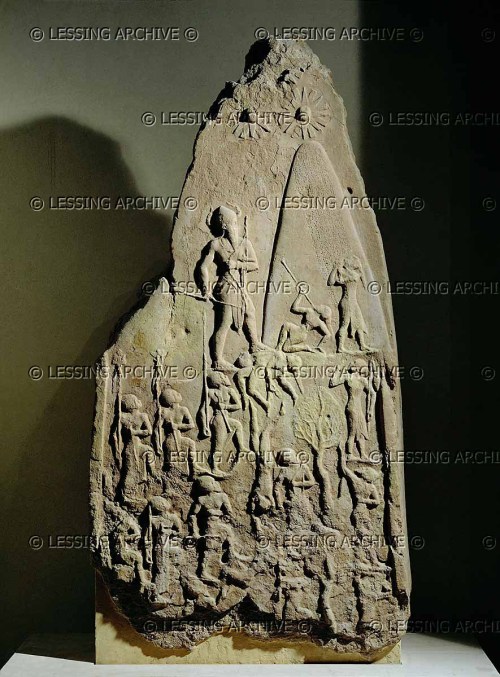
Victory Stele of Naram-Sin. The original Akkadian states that the six foot tall stele commemorates the victory of King Naram-Sin of Akkad over King Satuni, ruler of the Lullubi people of the mountainous Zagros. Naram-Sin was the grandson of Sargon, founder of the Akkadian empire, and the first potentate to unite the entirety of Mesopotamia in the late 24th century BCE.  Naram-Sin was the fourth sovereign of his line, following his uncle Rimush and his father Manishtusu. The Sumerian King List ascribes his rule of 36 years to 2254 BCE to 2218 BCE, a long reign not otherwise confirmed by extant documents.  The stele depicts the Akkadian army climbing the Zagros Mountains, eradicating all resistance. The slain are trampled underfoot or thrown from a precipice. Naram-Sin is portrayed wearing the horned crown of divinity, symbolic of a ruler who aspires to divinity himself. In official documentation, the name of Naram-Sin was preceded by the divine determinative. He styled himself the King of the Four Regions, or King of the World.  The stele was removed from Sippar to Susa, Iran a thousand years later by the Elamite King Shutruk-Nahhunte, as a war prize after his victorious campaign against Babylon in the 12th century BCE.  Alongside the preexisting cuneiform inscription, King Shutruk-Nahhunte appended another one glorifying himself, recording that the stele was looted during the pillage of Sippar.  Jacques de Morgan, Mémoires, I, Paris, 1900, p. 106, 144 sq, pl. X. Victor Scheil, Mémoires, II, Paris, 1900, p. 53 sq, pl. II.  Victor Scheil, Mémoires, III, Paris, 1901, p. 40 sq, pl. II.  André Parrot, Sumer, Paris, 1960, fig. 212-213.  Pierre Amiet, L’Art d'Agadé au musée du Louvre, Paris, Ed. de la Réunion des musées nationaux, 1976 - p. 29-32. Louvre Museum Accession number Sb 4 Found by J. de Morgan Photo: Rama This work is free software; you can redistribute it or modify it under the terms of the CeCILL. The terms of the CeCILL license are available at www.cecill.info. https://commons.wikimedia.org/wiki/File:Victory_stele_of_Naram_Sin_9068.jpg http://www.louvre.fr/en/oeuvre-notices/victory-stele-naram-sin

Victory Stele of Naram-Sin.
The original Akkadian states that the six foot tall stele commemorates the victory of King Naram-Sin of Akkad over King Satuni, ruler of the Lullubi people of the mountainous Zagros. Naram-Sin was the grandson of Sargon, founder of the Akkadian empire, and the first potentate to unite the entirety of Mesopotamia in the late 24th century BCE.
Naram-Sin was the fourth sovereign of his line, following his uncle Rimush and his father Manishtusu. The Sumerian King List ascribes his rule of 36 years to 2254 BCE to 2218 BCE, a long reign not otherwise confirmed by extant documents.
The stele depicts the Akkadian army climbing the Zagros Mountains, eradicating all resistance. The slain are trampled underfoot or thrown from a precipice. Naram-Sin is portrayed wearing the horned crown of divinity, symbolic of a ruler who aspires to divinity himself. In official documentation, the name of Naram-Sin was preceded by the divine determinative. He styled himself the King of the Four Regions, or King of the World.
The stele was removed from Sippar to Susa, Iran a thousand years later by the Elamite King Shutruk-Nahhunte, as a war prize after his victorious campaign against Babylon in the 12th century BCE.
Alongside the preexisting cuneiform inscription, King Shutruk-Nahhunte appended another one glorifying himself, recording that the stele was looted during the pillage of Sippar.
Jacques de Morgan, Mémoires, I, Paris, 1900, p. 106, 144 sq, pl. X.
Victor Scheil, Mémoires, II, Paris, 1900, p. 53 sq, pl. II.
Victor Scheil, Mémoires, III, Paris, 1901, p. 40 sq, pl. II.
André Parrot, Sumer, Paris, 1960, fig. 212-213.
Pierre Amiet, L’Art d’Agadé au musée du Louvre, Paris, Ed. de la Réunion des musées nationaux, 1976 – p. 29-32.
Louvre Museum
Accession number Sb 4
Found by J. de Morgan
Photo: Rama
This work is free software; you can redistribute it or modify it under the terms of the CeCILL. The terms of the CeCILL license are available at http://www.cecill.info.
https://commons.wikimedia.org/wiki/File:Victory_stele_of_Naram_Sin_9068.jpg
http://www.louvre.fr/en/oeuvre-notices/victory-stele-naram-sin

2218 BCE – 2047 BCE: The Gutian Period in Sumer.

2150 BCE – 1400 BCE: The Sumerian Epic of Gilgamesh written on clay tablets.

Library of Ashurbanipal / The Flood Tablet / The Gilgamesh Tablet Date15 July 2010 Current location: British Museum wikidata:Q6373 Source/Photographer Fæ (Own work) Other versions File:British Museum Flood Tablet 1.jpg British Museum reference K.3375 Detailed description: Part of a clay tablet, upper right corner, 2 columns of inscription on either side, 49 and 51 lines + 45 and 49 lines, Neo-Assyrian., Epic of Gilgamesh, tablet 11, story of the Flood. ~ Description extract from BM record. Location Room 55

 https://commons.wikimedia.org/wiki/File:Library_of_Ashurbanipal_The_Flood_Tablet.jpg

Library of Ashurbanipal / The Flood Tablet / The Gilgamesh Tablet
Date 15 July 2010
Current location: British Museum wikidata:Q6373
Source/Photographer Fæ (Own work)
Other versions File:British Museum Flood Tablet 1.jpg
British Museum reference K.3375
Detailed description:
Part of a clay tablet, upper right corner, 2 columns of inscription on either side, 49 and 51 lines + 45 and 49 lines, Neo-Assyrian., Epic of Gilgamesh, tablet 11, story of the Flood. ~ Description extract from BM record.
Location Room 55


https://commons.wikimedia.org/wiki/File:Library_of_Ashurbanipal_The_Flood_Tablet.jpg

2100 BCE: The Reign of Utu-Hegal at Uruk in Sumer and creation of the Sumerian King List.

2095 BCE – 2047 BCE: King Shulgi reigns in Ur, (following Gane).

Among all the extant exemplars of the Sumerian King List, the Weld-Blundell prism in the Ashmolean Museum cuneiform collection represents the most extensive version as well as the most complete copy of the King List. In this depiction, all four sides of the Sumerian King List prism are portrayed. http://cdli.ox.ac.uk/wiki/doku.php?id=the_sumerian_king_list_sklid=the_sumerian_king_list_skl

Among all the extant exemplars of the Sumerian King List, the Weld-Blundell prism in the Ashmolean Museum cuneiform collection represents the most extensive version as well as the most complete copy of the King List.
In this depiction, all four sides of the Sumerian King List prism are portrayed.
http://cdli.ox.ac.uk/wiki/doku.php?id=the_sumerian_king_list_sklid=the_sumerian_king_list_skl

2047 BCE – 2030 BCE: Ur-Nammu’s reign over Sumer. The legal Code of Ur-Nammu dates to 2100 BCE – 2050 BCE.
From the Stele of Ur-Nammu. <br /> This image (or other media file) is in the public domain because its copyright has expired.<br /> 
This applies to Australia, the European Union and those countries with a copyright term of life of the author plus 70 years.

<br /> https://en.wikipedia.org/wiki/Ur-Nammu#/media/File:Stela_of_Ur-Nammu_detail.jpg

From the Stele of Ur-Nammu.
This image (or other media file) is in the public domain because its copyright has expired.

This applies to Australia, the European Union and those countries with a copyright term of life of the author plus 70 years.


https://en.wikipedia.org/wiki/Ur-Nammu#/media/File:Stela_of_Ur-Nammu_detail.jpg

"In all probability I would have missed the Ur-Nammu tablet altogether had it not been for an opportune letter from F. R. Kraus, now Professor of Cuneiform Studies at the University of Leiden in Holland...  His letter said that some years ago, in the course of his duties as curator in the Istanbul Museum, he had come upon two fragments of a tablet inscribed with Sumerian laws, had made a "join" of the two pieces, and had catalogued the resulting tablet as No. 3191 of the Nippur collection of the Museum...  Since Sumerian law tablets are extremely rare, I had No. 3191 brought to my working table at once. There it lay, a sun-baked tablet, light brown in color, 20 by 10 centimeters in size. More than half of the writing was destroyed, and what was preserved seemed at first hopelessly unintelligible. But after several days of concentrated study, its contents began to become clear and take shape, and I realized with no little excitement that what I held in my hand was a copy of the oldest law code as yet known to man." 

Samuel Noah Kramer, History begins at Sumer, pp. 52–55.

CC0 File:Ur Nammu code Istanbul.jpg Uploaded by Oncenawhile Created: 1 August 2014

 https://en.wikipedia.org/wiki/Code_of_Ur-Nammu#/media/File:Ur_Nammu_code_Istanbul.jpg

“In all probability I would have missed the Ur-Nammu tablet altogether had it not been for an opportune letter from F. R. Kraus, now Professor of Cuneiform Studies at the University of Leiden in Holland…
His letter said that some years ago, in the course of his duties as curator in the Istanbul Museum, he had come upon two fragments of a tablet inscribed with Sumerian laws, had made a “join” of the two pieces, and had catalogued the resulting tablet as No. 3191 of the Nippur collection of the Museum…
Since Sumerian law tablets are extremely rare, I had No. 3191 brought to my working table at once. There it lay, a sun-baked tablet, light brown in color, 20 by 10 centimeters in size. More than half of the writing was destroyed, and what was preserved seemed at first hopelessly unintelligible. But after several days of concentrated study, its contents began to become clear and take shape, and I realized with no little excitement that what I held in my hand was a copy of the oldest law code as yet known to man.”


Samuel Noah Kramer, History Begins at Sumer, pp. 52–55.

CC0
File:Ur Nammu code Istanbul.jpg
Uploaded by Oncenawhile
Created: 1 August 2014


https://en.wikipedia.org/wiki/Code_of_Ur-Nammu#/media/File:Ur_Nammu_code_Istanbul.jpg

2047 BCE – 1750 BCE: The Ur III Period in Sumer, known as the Sumerian Renaissance, or the Neo-Sumerian Empire.

This tablet glorifies king Shulgi and his victories over the Lullubi peoples. It mentions the city of Erbil and the district of Sulaymaniayh. 2111-2004 BCE.  The Sulaymaniyah Museum, Iraq. 

CC BY-SA 4.0 File:Tablet of Shulgi.JPG Uploaded by Neuroforever Created: 20 January 2014

 https://en.wikipedia.org/wiki/Shulgi#/media/File:Tablet_of_Shulgi.JPG

This tablet glorifies king Shulgi and his victories over the Lullubi peoples. It mentions the city of Erbil and the district of Sulaymaniayh. 2111-2004 BCE.
The Sulaymaniyah Museum, Iraq.


CC BY-SA 4.0
File:Tablet of Shulgi.JPG
Uploaded by Neuroforever
Created: 20 January 2014


https://en.wikipedia.org/wiki/Shulgi#/media/File:Tablet_of_Shulgi.JPG

2038 BCE: King Shulgi of Ur builds his great wall in Sumer.

2000 BCE – 1600 BCE: Old Babylonian Period.

2000 BCE – 1800 BCE: Isin – Larsa.

Text:  "IN ERIDU: ALULIM RULED AS KING 28,800 YEARS. ELALGAR RULED 43,200 YEARS. ERIDU WAS ABANDONED. KINGSHIP WAS TAKEN TO BAD-TIBIRA. AMMILU'ANNA THE KING RULED 36,000 YEARS. ENMEGALANNA RULED 28,800 YEARS. DUMUZI RULED 28,800 YEARS. BAD-TIBIRA WAS ABANDONED. KINGSHIP WAS TAKEN TO LARAK. EN-SIPA-ZI-ANNA RULED 13,800 YEARS. LARAK WAS ABANDONED. KINGSHIP WAS TAKEN TO SIPPAR. MEDURANKI RULED 7,200 YEARS. SIPPAR WAS ABANDONED. KINGSHIP WAS TAKEN TO SHURUPPAK. UBUR-TUTU RULED 36,000 YEARS. TOTAL: 8 KINGS, THEIR YEARS: 222,600" MS in Sumerian on clay, probably Larsa Babylonia, 2000-1800 BC, 1 tablet, 8,1x6,5x2,7 cm, single column, 26 lines in cuneiform script. 5 other copies of the Antediluvian king list are known only: MS 3175, 2 in Oxford: Ashmolean Museum, one is similar to this list, containing 10 kings and 6 cities, the other is a big clay cylinder of the Sumerian King List, on which the kings before the flood form the first section, and has the same 8 kings in the same 5 cities as the present.  A 4th copy is in Berkeley: Museum of the University of California, and is a school tablet. A 5th tablet, a small fragment, is in Istanbul. The list provides the beginnings of Sumerian and the world’s history as the Sumerians knew it. The cities listed were all very old sites, and the names of the kings are names of old types within Sumerian name-giving. Thus it is possible that correct traditions are contained, though the sequence given need not be correct. The city dynasties may have overlapped. It is generally held that the Antediluvian king list is reflected in Genesis 5, which lists the 10 patriarchs from Adam to Noah, all living from 365 years (Enoch) to 969 years (Methuselah), altogether 8,575 years.  It is possible that the 222,600 years of the king list reflects a more realistic understanding of the huge span of time from Creation to the Flood, and the lengths of the dynasties involved.  The first of the 5 cities mentioned , Eridu, is Uruk, in the area where the myths place the Garden of Eden, while the last city, Shuruppak, is the city of Ziusudra, the Sumerian Noah. Jöran Friberg: A remarkable Collection of Babylonian Mathematical Texts. Springer 2007.  Sources and Studies in the History of Mathematics and Physical Sciences.  Manuscripts in the Schøyen Collection, vol. 6, Cuneiform Texts I. pp. 237-241. Andrew George, ed.: Cuneiform Royal Inscriptions and Related Texts in the Schøyen Collection, Cornell University Studies in Assyriology and Sumerology, vol. 17,  Manuscripts in the Schøyen Collection, Cuneiform texts VI. CDL Press, Bethesda, MD, 2011, text 96, pp. 199-200, pls. LXXVIII-LXXIX. Andrew E. Hill & John H. Walton: A survey of the Old Testament, 3rd ed., Grand Rapids, Mi., Zondervan Publ. House, 2009, p. 206.  Zondervan Illustrated Bible, Backgrounds, Commentary. John H. Walton, gen. ed. Grand Rapids, Mich., Zondervan, 2009, vol 1, p. 482, vol. 5, p. 398.

Text:
“IN ERIDU: ALULIM RULED AS KING 28,800 YEARS. ELALGAR RULED 43,200 YEARS. ERIDU WAS ABANDONED. KINGSHIP WAS TAKEN TO BAD-TIBIRA. AMMILU’ANNA THE KING RULED 36,000 YEARS. ENMEGALANNA RULED 28,800 YEARS. DUMUZI RULED 28,800 YEARS. BAD-TIBIRA WAS ABANDONED. KINGSHIP WAS TAKEN TO LARAK. EN-SIPA-ZI-ANNA RULED 13,800 YEARS. LARAK WAS ABANDONED. KINGSHIP WAS TAKEN TO SIPPAR. MEDURANKI RULED 7,200 YEARS. SIPPAR WAS ABANDONED. KINGSHIP WAS TAKEN TO SHURUPPAK. UBUR-TUTU RULED 36,000 YEARS. TOTAL: 8 KINGS, THEIR YEARS: 222,600”
MS in Sumerian on clay, probably Larsa Babylonia, 2000-1800 BC, 1 tablet, 8,1×6,5×2,7 cm, single column, 26 lines in cuneiform script.
5 other copies of the Antediluvian king list are known only: MS 3175, 2 in Oxford: Ashmolean Museum, one is similar to this list, containing 10 kings and 6 cities, the other is a big clay cylinder of the Sumerian King List, on which the kings before the flood form the first section, and has the same 8 kings in the same 5 cities as the present.
A 4th copy is in Berkeley: Museum of the University of California, and is a school tablet. A 5th tablet, a small fragment, is in Istanbul.
The list provides the beginnings of Sumerian and the world’s history as the Sumerians knew it. The cities listed were all very old sites, and the names of the kings are names of old types within Sumerian name-giving. Thus it is possible that correct traditions are contained, though the sequence given need not be correct. The city dynasties may have overlapped.
It is generally held that the Antediluvian king list is reflected in Genesis 5, which lists the 10 patriarchs from Adam to Noah, all living from 365 years (Enoch) to 969 years (Methuselah), altogether 8,575 years.
It is possible that the 222,600 years of the king list reflects a more realistic understanding of the huge span of time from Creation to the Flood, and the lengths of the dynasties involved.
The first of the 5 cities mentioned, Eridu, is in Uruk, in the area where the myths place the Garden of Eden, while the last city, Shuruppak, is the city of Ziusudra, the Sumerian Noah.
Jöran Friberg: A Remarkable Collection of Babylonian Mathematical Texts. Springer 2007.
Sources and Studies in the History of Mathematics and Physical Sciences.
Manuscripts in the Schøyen Collection, vol. 6, Cuneiform Texts I. pp. 237-241. Andrew George, ed.: Cuneiform Royal Inscriptions and Related Texts in the Schøyen Collection, Cornell University Studies in Assyriology and Sumerology, vol. 17,
Manuscripts in the Schøyen Collection, Cuneiform texts VI. CDL Press, Bethesda, MD, 2011, text 96, pp. 199-200, pls. LXXVIII-LXXIX.
Andrew E. Hill & John H. Walton: A Survey of the Old Testament, 3rd ed., Grand Rapids, MI., Zondervan Publishing House, 2009, p. 206.
Zondervan Illustrated Bible, Backgrounds, Commentary. John H. Walton, gen. ed. Grand Rapids, Mich., Zondervan, 2009, vol 1, p. 482, vol. 5, p. 398.

1861 BCE – 1837 BCE: King Enlil-bāni reigns in Isin.

1792 BCE – 1750: Reign of King Hammurabi (Old Babylonian Period).

1772 BCE: The Code of Hammurabi: One of the earliest codes of law in the world.

The Code of Hammurabi was discovered by archaeologists in 1901, with its editio princeps translation published in 1902 by Jean-Vincent Scheil. This nearly complete example of the Code is carved into a diorite stele in the shape of a huge index finger, 2.25-metre (7.4 ft) tall. The Code is inscribed in Akkadian, using cuneiform script. It is currently on display in the Louvre, with exact replicas in the Oriental Institute at the University of Chicago, the library of the Theological University of the Reformed Churches (Dutch: Theologische Universiteit Kampen voor de Gereformeerde Kerken) in The Netherlands, the Pergamon Museum of Berlin and the National Museum of Iran in Tehran. CC BY-SA 2.0 fr File:Code-de-Hammurabi-1.jpg Uploaded by Rama Uploaded: 8 November 2005

 https://en.wikipedia.org/wiki/Code_of_Hammurabi#/media/File:Code-de-Hammurabi-1.jpg

The Code of Hammurabi was discovered by archaeologists in 1901, with its editio princeps translation published in 1902 by Jean-Vincent Scheil. This nearly complete example of the Code is carved into a diorite stele in the shape of a huge index finger, 2.25-metre (7.4 ft) tall. The Code is inscribed in Akkadian, using cuneiform script. It is currently on display in the Louvre, with exact replicas in the Oriental Institute at the University of Chicago, the library of the Theological University of the Reformed Churches (Dutch: Theologische Universiteit Kampen voor de Gereformeerde Kerken) in The Netherlands, the Pergamon Museum of Berlin and the National Museum of Iran in Tehran.
CC BY-SA 2.0 fr
File:Code-de-Hammurabi-1.jpg
Uploaded by Rama
Uploaded: 8 November 2005


https://en.wikipedia.org/wiki/Code_of_Hammurabi#/media/File:Code-de-Hammurabi-1.jpg

1750 BCE: Elamite invasion and Amorite migration ends the Sumerian civilization.

Cuneiform tablet with the Sumerian tale of The Deluge, dated to circa 1740 BCE, from the ruins of Nippur.  From the permanent collection of the University of Pennsylvania Museum of Archeology and Anthropology, Philadelphia.  Text and photo © The Metropolitan Museum of Art. All rights reserved.

Cuneiform tablet with the Sumerian tale of The Deluge, dated to circa 1740 BCE, from the ruins of Nippur.
From the permanent collection of the University of Pennsylvania Museum of Archeology and Anthropology, Philadelphia.
Text and photo © The Metropolitan Museum of Art. All rights reserved.

1600 BCE – 1155 BCE: Kassite Period.

1595 BCE: King Agum-kakrime, aka Agum II, Kassite Kingdom.

1350 BCE – 1050 BCE: Middle Assyrian Period.
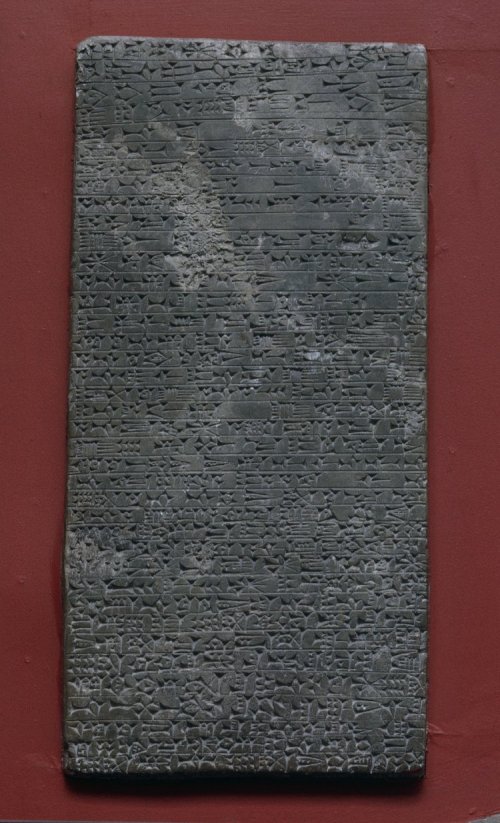
A gypsum memorial slab from the Middle Assyrian Period (1300 - 1275 BCE), findspot Kalah Shergat, Aššur.  The inscription records the name, titles and conquests of King Adad-Nirari, his father Arik-den-ili, his grandfather Enlil-nirari, and his great-grandfather Ashur-uballit I.  Memorializing the restoration of the Temple of Aššur in the city of Aššur, the text invokes curses upon the head of any king or other person who alters or defaces the monument.  The artifact was purchased from the French Consul in Mosul in 1874 for £70, the British Museum notes reference Mr. George Smith and The Daily Telegraph with an acquisition date of 1874.  Bezold, Carl, Catalogue of the Cuneiform Tablets in the Kouyunjik Collection of the British Museum, IV, London, BMP, 1896. Furlani, G, Il Sacrificio Nella Religione dei Semiti di Babilonia e Assiria, Rome, 1932. Rawlinson, Henry C; Smith, George, The Cuneiform Inscriptions of Western Asia, IV, London, 1861. Budge, E A W, A Guide to the Babylonian and Assyrian Antiquities., London, 1922. Budge, E A W, The Rise and Progress of Assyriology, London, Martin Hopkinson & Co, 1925. Grayson, Albert Kirk, Assyrian Rulers of the Third and Second Millennia BC (to 1115 BC), 1, Toronto, University of Toronto Press, 1987. http://www.britishmuseum.org/research/collection_online/collection_object_details.aspx?assetId=32639001&objectId=283138&partId=1

A gypsum memorial slab from the Middle Assyrian Period (1300 – 1275 BCE), findspot Kalah Shergat, Aššur.
The inscription records the name, titles and conquests of King Adad-Nirari, his father Arik-den-ili, his grandfather Enlil-nirari, and his great-grandfather Ashur-uballit I.
Memorializing the restoration of the Temple of Aššur in the city of Aššur, the text invokes curses upon the head of any king or other person who alters or defaces the monument.
The artifact was purchased from the French Consul in Mosul in 1874 for £70, the British Museum notes reference Mr. George Smith and The Daily Telegraph with an acquisition date of 1874.
Bezold, Carl, Catalogue of the Cuneiform Tablets in the Kouyunjik Collection of the British Museum, IV, London, BMP, 1896.
Furlani, G, Il Sacrificio Nella Religione dei Semiti di Babilonia e Assiria, Rome, 1932.
Rawlinson, Henry C; Smith, George, The Cuneiform Inscriptions of Western Asia, IV, London, 1861.
Budge, E A W, A Guide to the Babylonian and Assyrian Antiquities., London, 1922.
Budge, E A W, The Rise and Progress of Assyriology, London, Martin Hopkinson & Co, 1925.
Grayson, Albert Kirk, Assyrian Rulers of the Third and Second Millennia BC (to 1115 BC), 1, Toronto, University of Toronto Press, 1987.
http://www.britishmuseum.org/research/collection_online/collection_object_details.aspx?assetId=32639001&objectId=283138&partId=1

1330 BCE – 1295 BCE: Reign of King Muršili II (Hittite Kingdom).

1126 BCE – 1104 BCE: Reign of King Nebuchadnezzar I (Old Babylonian Period).

1120 BCE: The Sumerian Enuma Elish (creation story) is written.
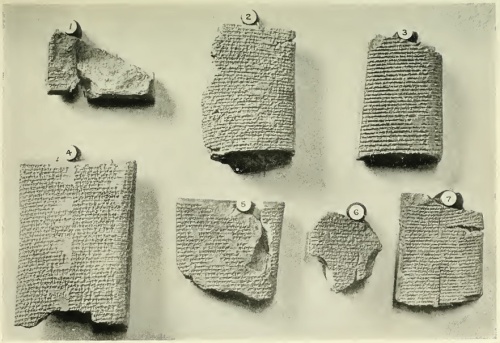
Enuma Elish means “when above”, the two first words of the epic. This Babylonian creation story was discovered among the 26,000 clay tablets found by Austen Henry Layard in the 1840's at the ruins of Nineveh. Enuma Elish was made known to the public in 1875 by the Assyriologist George Adam Smith (1840-76) of the British Museum, who was also the discoverer of the Babylonian Epic of Gilgamesh. He made several of his findings on excavations in Nineveh. http://www.creationmyths.org/enumaelish-babylonian-creation/enumaelish-babylonian-creation-3.htm

Enuma Elish means “when above”, the two first words of the epic.
This Babylonian creation story was discovered among the 26,000 clay tablets found by Austen Henry Layard in the 1840’s at the ruins of Nineveh.
Enuma Elish was made known to the public in 1875 by the Assyriologist George Adam Smith (1840-76) of the British Museum, who was also the discoverer of the Babylonian Epic of Gilgamesh. He made several of his findings on excavations in Nineveh.
http://www.creationmyths.org/enumaelish-babylonian-creation/enumaelish-babylonian-creation-3.htm

930 BCE – 612 BCE: Neo-Assyrian Period.

884 BCE – 859 BCE: Reign of King Ashurnasirpal II.

860 BCE – 850 BCE: Reign of King Nabû-apla-iddina (Babylonian Period).

858 BCE – 824 BCE: Reign of King Shalmaneser III.

854 BCE – 819 BCE: Reign of King Marduk-zākir-šumi (Babylonian Period).

823 BCE – 811 BCE: Reign of King Shamsi-Adad V.

810 BCE – 783 BCE: Reign of King Adad-nirari III.

782 BCE – 773 BCE: Reign of King Shalmaneser IV.

772 BCE – 755 BCE: Reign of King Assur-dan III.
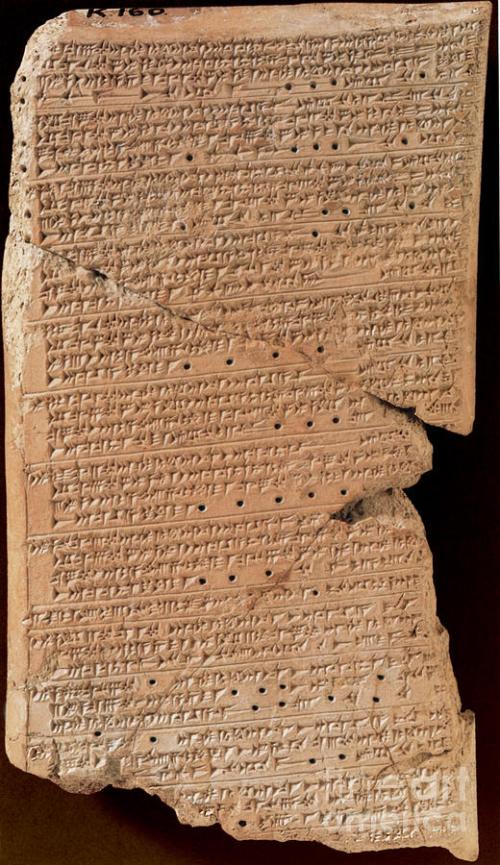
Venus Tablet Of Ammisaduqa, 7th Century The Venus Tablet of Ammisaduqa (Enuma Anu Enlil Tablet 63) refers to a record of astronomical observations of Venus, as preserved in numerous cuneiform tablets dating from the first millennium BC. This astronomical record was first compiled during the reign of King Ammisaduqa (or Ammizaduga), with the text dated to the mid-seventh century BCE.  The tablet recorded the rise times of Venus and its first and last visibility on the horizon before or after sunrise and sunset in the form of lunar dates. Recorded for a period of 21 years, this Venus tablet is part of Enuma anu enlil ("In the days of Anu and Enlil"), a long text dealing with Babylonian astrology, which mostly consists of omens interpreting celestial phenomena. http://fineartamerica.com/featured/2-venus-tablet-of-ammisaduqa-7th-century-science-source.html

Venus Tablet Of Ammisaduqa, 7th Century
The Venus Tablet of Ammisaduqa (Enuma Anu Enlil Tablet 63) refers to a record of astronomical observations of Venus, as preserved in numerous cuneiform tablets dating from the first millennium BC. This astronomical record was first compiled during the reign of King Ammisaduqa (or Ammizaduga), with the text dated to the mid-seventh century BCE.
The tablet recorded the rise times of Venus and its first and last visibility on the horizon before or after sunrise and sunset in the form of lunar dates. Recorded for a period of 21 years, this Venus tablet is part of Enuma anu enlil (“In the days of Anu and Enlil”), a long text dealing with Babylonian astrology, which mostly consists of omens interpreting celestial phenomena.
http://fineartamerica.com/featured/2-venus-tablet-of-ammisaduqa-7th-century-science-source.html

754 BCE – 745 BCE: Reign of King Assur-nirari V.

744 BCE – 727 BCE: Reign of King Tiglath-Pileser III.

726 BCE – 722 BCE: Reign of King Shalmaneser V.

721 BCE – 705 BCE: Reign of King Sargon II.

704 BCE – 681 BCE: Reign of King Sennacherib.

This stone water basin in the collection of the Vorderasiatisches Museum, Berlin came from the forecourt of the Temple of Aššur at Assur. The sides are inscribed with images of Enki / Ea, the Mesopotamian god of wisdom and exorcism, and puradu-fish apkallu. The textual references on the basin refer to the Assyrian king Sennacherib.<br /> The Temple of Aššur was known as the Ešarra, or Temple of the Universe.<br /> The Corpus of Mesopotamian Anti-Witchcraft Rituals online notes that water was rendered sacred for ritual purposes by leaving it exposed outside overnight, open to the stars and the purifying powers of the astral deities. The subterranean ocean, or apsû, was the abode of Enki / Ea, and the source of incantations, purification rites and demons, disease, and witchcraft.<br /> Adapted from text © by Daniel Schemer 2014, (CC BY-NC-ND license).<br /> http://www.cmawro.altorientalistik.uni-wuerzburg.de/magic_witchcraft/gods_stars/<br /> https://books.google.co.th/books?id=LSaeT9CloGIC&amp;pg=PA19&amp;lpg=PA19&amp;dq=water+basin+assur+temple+assur+vorderasiatisches+Museum+Berlin&amp;source=bl&amp;ots=9fw1d16kjb&amp;sig=4ufIF4Ev9MiZl1QUQ8Rv3QU_BZU&amp;hl=en&amp;sa=X&amp;ved=0CB8Q6AEwAGoVChMIysSB25rYyAIVUFmOCh1G7QKS#v=onepage&amp;q&amp;f=false

This stone water basin in the collection of the Vorderasiatisches Museum, Berlin came from the forecourt of the Temple of Aššur at Assur. The sides are inscribed with images of Enki / Ea, the Mesopotamian god of wisdom and exorcism, and puradu-fish apkallu. The textual references on the basin refer to the Assyrian king Sennacherib.
The Temple of Aššur was known as the Ešarra, or Temple of the Universe.
The Corpus of Mesopotamian Anti-Witchcraft Rituals online notes that water was rendered sacred for ritual purposes by leaving it exposed outside overnight, open to the stars and the purifying powers of the astral deities. The subterranean ocean, or apsû, was the abode of Enki / Ea, and the source of incantations, purification rites and demons, disease, and witchcraft.
Adapted from text © by Daniel Schwemer 2014, (CC BY-NC-ND license).
http://www.cmawro.altorientalistik.uni-wuerzburg.de/magic_witchcraft/gods_stars/
https://books.google.co.th/books?id=LSaeT9CloGIC&pg=PA19&lpg=PA19&dq=water+basin+assur+temple+assur+vorderasiatisches+Museum+Berlin&source=bl&ots=9fw1d16kjb&sig=4ufIF4Ev9MiZl1QUQ8Rv3QU_BZU&hl=en&sa=X&ved=0CB8Q6AEwAGoVChMIysSB25rYyAIVUFmOCh1G7QKS#v=onepage&q&f=false

680 BCE – 669 BCE: Reign of King Esarhaddon.

668 BCE – 627 BCE: Reign of King Ashurbanipal.

626 BCE – 539 BCE: Neo-Babylonian Period.

625 BCE – 605 BCE: Reign of King Nabopolassar.

604 BCE – 562 BCE: Reign of King Nebuchadnezzar II.
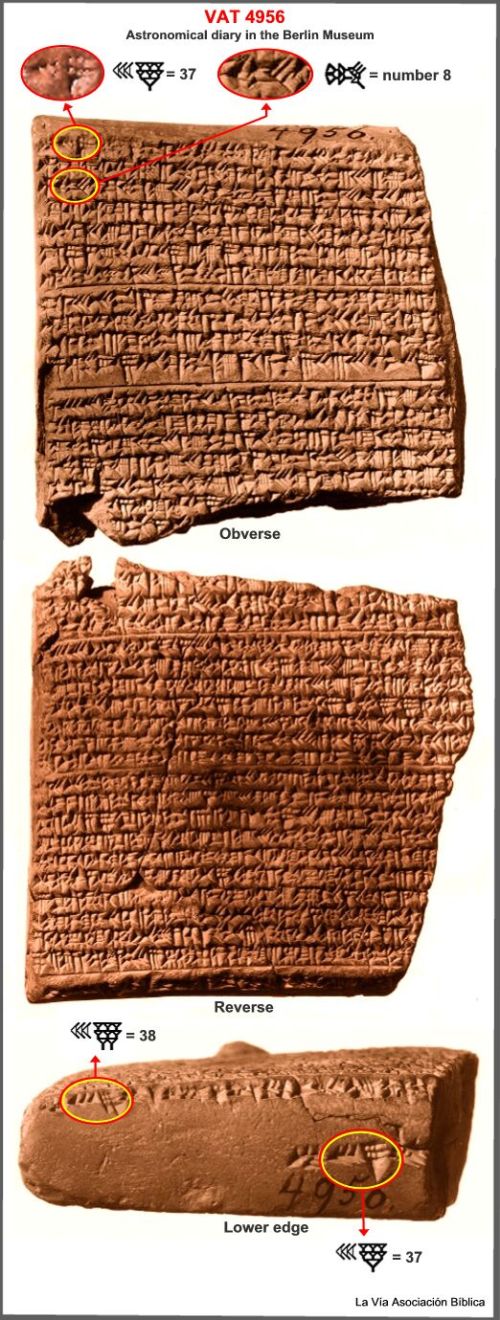
Astronomical Diary VAT 4956 in the collection of the Berlin Museum sets the precise date of the destruction of Jerusalem.  This tablet details the positions of the moon and planets during the year 37 of the reign of Nebuchadnezzar, king of Babylon, which was 567 BCE. Jerusalem was destroyed in 586 BCE. http://www.lavia.org/english/archivo/vat4956en.htm

Astronomical Diary VAT 4956 in the collection of the Berlin Museum sets the precise date of the destruction of Jerusalem.
This tablet details the positions of the moon and planets during the year 37 of the reign of Nebuchadnezzar, king of Babylon, which was 567 BCE. Jerusalem was destroyed in 586 BCE.
http://www.lavia.org/english/archivo/vat4956en.htm

561 BCE – 560 BCE: Reign of King Evil-Merodach.

559 BCE – 556 BCE: Reign of King Neriglissar.

556 BCE: Reign of King Labashi-Marduk.

555 BCE – 539 BCE: Reign of King Nabonidus.

550 BCE – 331 BCE: Achaemenid (Early Persian) Period.

538 BCE – 530 BCE: Reign of King Cyrus II.

529 BCE – 522 BCE: Reign of King Cambyses II.

522 BCE: Reign of King Bardiya.

522 BCE: Reign of King Nebuchadrezzar III.

521 BCE: Reign of King Nebuchadrezzar IV.

521 BCE – 486 BCE: Reign of King Darius I.

485 BCE – 465 BCE: Reign of King Xerxes I.

482 BCE: Reign of King Bel-shimanni.

482 BCE: Reign of King Shamash-eriba.

464 BCE – 424 BCE: Reign of King Artaxerxes.

424 BCE: Reign of King Xerxes II.

423 BCE – 405 BCE: Reign of King Darius II.

404 BCE – 359 BCE: Reign of King Artaxerxes II Memnon.

358 BCE – 338 BCE: Reign of King Artaxerxes III Ochus.

337 BCE – 336 BCE: Reign of King Arses.

336 BCE – 323 BCE: Reign of Alexander the Great (Greek Period, below).

335 BCE – 331 BCE: Reign of King Darius III.

323 BCE – 63 BCE: Seleucid (Hellenistic) Period.

333 BCE – 312 BCE: Macedonian Dynasty.

281 BCE – 261 BCE: Reign of Antiochus I.
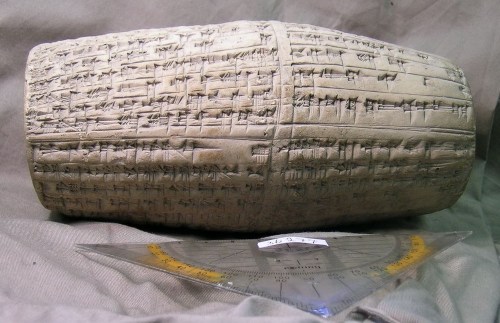
Antiochus Cylinder BM36277

The Cylinder of Antiochus I Soter from the Ezida Temple in Borsippa (Antiochus Cylinder) is an historiographical text from ancient Babylonia, dated 268 BCE, that recounts the Seleucid crown prince Antiochus, the son of king Seleucus Nicator, rebuilding the Ezida Temple.

Lenzi: “The opening lines read: “I am Antiochus, great king, strong king, king of the inhabited world, king of Babylon, king of the lands, the provider of Esagil and Ezida, foremost son of Seleucus, the king, the Macedonian, king of Babylon.”
https://therealsamizdat.com/category/alan-lenzi/

The cuneiform text itself (BM 36277) is now in the British Museum.

 The document is a barrel-shaped clay cylinder, which was buried in the foundations of the Ezida temple in Borsippa.
The script of this cylinder is inscribed in archaic ceremonial Babylonian cuneiform script that was also used in the well-known Codex of Hammurabi and adopted in a number of royal inscriptions of Neo-Babylonian kings, including. Nabopolassar, Nebuchadnezzar and Nabonidus (cf. Berger 1973).
The script is quite different from the cuneiform script that was used for chronicles, diaries, rituals, scientific and administrative texts.

(Another late example is the Cyrus Cylinder, commemorating Cyrus’ capture of Babylon in 539 BCE (Schaudig 2001: 550-6). This cylinder, however, was written in normal Neo-Babylonian script.)
The Antiochus Cylinder was found by Hormuzd Rassam in 1880 in Ezida, the temple of the god Nabu in Borsippa, in what must have been its original position, “encased in some kiln-burnt bricks covered over with bitumen” in the “doorway” of Koldewey’s Room A1: probably this was built into the eastern section of the wall between A1 and Court A, since the men of Daud Thoma, the chief foreman, seem to have destroyed much of the brickwork at this point.
Rassam (1897: 270) mistakenly records this as a cylinder of Nebuchadnezzar II (Reade 1986: 109). The cylinder is now in the British Museum in London.

 (BM 36277).
http://www.livius.org/cg-cm/chronicles/antiochus_cylinder/antiochus_cylinder1.html

This timeline is modified from an original on the ancient.eu site. I added links and illustrations, and tagged and categorized timeframes, which should bring up useful search results when surfing among the tags and categories at the bottom of the page.

I also integrated chronological periods and a selected list of kings from Constance Ellen Gane’s Composite Beings in Neo-Babylonian Art, 2012, p. xxii – xxiii, and de-conflicted the entry for the Ur III Period, aka The Sumerian Renaissance, which Gane dates with more precision than the original.

Lenzi: The Antediluvian Medical Tablet from Ashurbanipal’s Library (K.4023)

“As is well-known, antediluvian knowledge had special significance in Mesopotamia. (For other examples of antediluvian knowledge (though sometimes in a broken context), see the examples gathered by Lambert, “Catalogue of Texts and Authors,” 72 at the note on VI 15.)

The most important example of this fact for the purposes of this study comes from an oft cited colophon of a medical tablet from Ashurbanipal’s library, AMT 105,1 (K.4023), lines 21-25.

AM-102 ; No. #1 (K4023) British Museum of London 

Tablet K.4023  COL. I  [Starting on Line 38] . . .  Root of caper which (is) on a grave, root of thorn (acacia) which (is) on a grave, right horn of an ox, left horn of a kid, seed of tamarisk, seed of laurel, Cannabis, seven drugs for a bandage against the Hand of a Ghost thou shalt bind on his temples.  FOOTNOTES:  [1] - The American Journal of Semitic Languages and Literatures, Vol. 54, No. 1/4 (Oct., 1937), pp. 12-40; Assyrian Prescriptions for the Head By R. Campbell Thompson 

 http://antiquecannabisbook.com/chap2B/Assyria/K4023.htm

AM-102 ; No. #1 (K4023)
British Museum of London 

Tablet K.4023
COL. I
[Starting on Line 38] . . .
Root of caper which (is) on a grave, root of thorn (acacia) which (is) on a grave, right horn of an ox, left horn of a kid, seed of tamarisk, seed of laurel, Cannabis, seven drugs for a bandage against the Hand of a Ghost thou shalt bind on his temples.
FOOTNOTES:
[1] – The American Journal of Semitic Languages and Literatures, Vol. 54, No. 1/4 (Oct., 1937), pp. 12-40; Assyrian Prescriptions for the Head By R. Campbell Thompson 


http://antiquecannabisbook.com/chap2B/Assyria/K4023.htm

This colophon shows not only the association of antediluvian sages and a human sage but also the “mythology of scribal succession” in action.

(For the original copy of the tablet, see R. Campbell Thompson, Assyrian Medical Texts (London: H. Milford / New York: Oxford University Press, 1923; reprinted, Osnabrück: Otto Zeller Verlag, 1983), 105,1 (=K.4023, col. iv, and thus probably from Nineveh).

I have cited the text according to Hermann Hunger, Babylonische und assyrische Kolophone, Alter Orient und Altes Testament 2 (Neukirchen-Vluyn: Neukirchener Verlag / Kevelaer: Verlag Butzon and Bercker, 1968), no. 533, with corrections from Yaakov Elman, “Authoritative Oral Tradition in Neo-Assyrian Scribal Circles,” Journal of the Ancient Near Eastern Society 7 (1975), 19-32, here 31.)

Salves (and) bandages: tested (and) checked, which are ready at hand, composed by the ancient sages from before the flood, which in Suruppak in the second year of Enlil-bani, king of Isin, Enlil-muballit, sage of Nippur, bequeathed.

Although the number of apkallū is unspecified in this text, the indication of plurality of sages and the antediluvian time frame strongly suggest an association with the seven sages known from traditions such as Bīt mēseri and the ULKS.

The fact that the tablet claims the apkallū composed these recipes bolsters the authority (by invoking these beings associated with Ea) and legitimacy (by asserting antiquity) of the recipes contained in the text.

This depiction of a fish-apkallū of the parādu-fish type guarded the entrance to the temple of Ninurta at Nimrud.  A fish's head can be seen on the apkallu's head, and its skin hangs down over the back of his body.  It is important to recall that the so-called Seven Sages of Sumeria were apkallū of this type. Neo-Assyrian era, 865-860 BCE.  From the Temple of Ninurta, Nimrud (ancient Kalhu; Biblical Calah), northern Mesopotamia, Iraq. (The British Museum, London). Osama Shukir Muhammed Amin FRCP (Glasg) http://www.ancient.eu/image/2708/
This depiction of a fish-apkallū of the parādu-fish type guarded the entrance to the temple of Ninurta at Nimrud.
A fish’s head can be seen on the apkallu’s head, and its skin hangs down over the back of his body.
It is important to recall that the so-called Seven Sages of Sumeria were apkallū of this type.
Neo-Assyrian era, 865-860 BCE.
From the Temple of Ninurta, Nimrud (ancient Kalhu; Biblical Calah), northern Mesopotamia, Iraq. (The British Museum, London).
Osama Shukir Muhammed Amin FRCP (Glasg)
http://www.ancient.eu/image/2708/

But I do not think that is its primary purpose. The claim is not made in the context of a ritual; so it does not primarily function to create ritual power.

Rather, the claim occurs in a colophon, a label that communicates something about the tablet for other would-be readers/users of it. The invocation of the apkallū and a claim to antediluvian knowledge in a colophon intends therefore to affect the social situation in which the tablet is used.

In this case the colophon credentials a human being as the possessor of antediluvian knowledge (i.e., medical recipes). Revealed by primeval apkallū, mediated to the human sage Enlil-muballit, and transmitted, presumably, by means of various copyists to the present possessor, AMT 105,1 implies the same notion of succession as the ULKS.

A similar idea is probably attested in KAR 177, obv. iv 25-32, a text containing hemerologies, which reads:

Favorable days. According to the seven s[ages(?)].
Duplicate of a tablet from Sippar, Nippur, Babylon, Larsa, Ur, Uruk, and Eridu.
The scholars excerpted, selected, and gave it to Nazimuruttash, king of the world.

(The tablet is from Assur and presumably the NA period. The text and restorations follow W. G. Lambert, “Ancestors, Authors, and Canonicity,” Journal of Cuneiform Studies 11 (1957), 1-14, here 8.

Lambert also gives the remainder of the colophon, rev. iv 1-3 (8), which is of no interest in this context, and sets out von Soden’s readings in a follow-up note (“Ancestors, Authors, and Canonicity [JCS XI, 1-14]: Additions and Corrections,” Journal of Cuneiform Studies 11 [1957], 112).

It seemed highly unlikely to the editor (Lambert) that the seven cities named in the text represented the seven exemplars from which the scribe worked. In other words, it seems unlikely that the scribe was looking at seven different copies while writing his own tablet.

Instead, Lambert proposed that the seven cities represent a succession of exemplars. Each of the exemplars was written by one of the seven sages one after another thereby creating a line of succession for the present tablet that extends back into earliest times.

The claim of this colophon, therefore, is that the tablet of hemerologies over which the ummânū labored goes back to the apkallū and ultimately originated in Eridu, the home city of Ea.

This again demonstrates an example of the “mythology of scribal succession” and an implicit assertion of antediluvian knowledge.”

Alan Lenzi, The Uruk List of Kings and Sages and Late Mesopotamian ScholarshipJANER 8.2, Brill, Leiden, 2008. pp. 149-51.

Lenzi: The Mythology of Scribal Succession

“The text of the ULKS is as follows:

“During the reign of Ayalu, the king, Adapa was sage.

During the reign of Alalgar, the king, Uanduga was sage.

During the reign of Ameluana, the king, Enmeduga was sage.

During the reign of Amegalana, the king, Enmegalama was sage.

During the reign of Enmeušumgalana, the king, Enmebuluga was sage.

During the reign of Dumuzi, the shepherd, the king, Anenlilda was sage.

During the reign of Enmeduranki, the king, Utuabzu was sage.

After the flood,(?) during the reign of Enmerkar, the king, Nungalpirigal was sage, whom Ištar brought down from heaven to Eana. He made the bronze lyre, whose . . . (were) lapis lazuli, according to the technique of Ninagal (Ninagal is Ea’s smith). The lyre was placed before Anu . . ., the dwelling of (his) personal god.?

During the reign of Gilgamesh, the king,? Sin-leqi-unnini was scholar.

During the reign of Ibbi-Sin, the king, Kabti-ili-Marduk was scholar.

During the reign of Išbi-Erra, the king, Sidu, a.k.a. Enlil-ibni, was scholar.

During the reign of Abi-ešuh, the king, Gimil-Gula and Taqiš-Gula were the scholars.

During the reign of . . ., the king, Esagil-kin-apli was scholar.

During the reign of Adad-apla-iddina, the king, Esagil-kin-ubba (this name … despite chronological problems, is probably to be identified with Saggil-kina-ubbib, the author of The Babylonian Theodicy; see van Dijk, “Die Inschriftenfunde,” 51) was scholar.

During the reign of Nebuchadnezzar, the king, Esagil-kin-ubba was scholar.

During the reign of Esarhaddon, the king, Aba-Enlil-dari was scholar, whom the Arameans call Ahiqar.

. . . Nikarchos.

Tablet of Anu-belšunu, son of Nidintu-Anu, descendant of Sin-leqi-unnini, the lamentation-priest of Anu and Antu. An Urukean. (Copied) by his own hand. Uruk, 10 Ayyar, 147th year of Antiochus, the king.

The one who reveres Anu will not carry it off.”

Gaining a historical perspective on the scholarly genealogical tradition attested in the text of ULKS is the first element of contextualizing our text. Clearly, the ULKS is unique.

 Text:  "IN ERIDU: ALULIM RULED AS KING 28,800 YEARS. ELALGAR RULED 43,200 YEARS. ERIDU WAS ABANDONED. KINGSHIP WAS TAKEN TO BAD-TIBIRA. AMMILU'ANNA THE KING RULED 36,000 YEARS. ENMEGALANNA RULED 28,800 YEARS. DUMUZI RULED 28,800 YEARS. BAD-TIBIRA WAS ABANDONED. KINGSHIP WAS TAKEN TO LARAK. EN-SIPA-ZI-ANNA RULED 13,800 YEARS. LARAK WAS ABANDONED. KINGSHIP WAS TAKEN TO SIPPAR. MEDURANKI RULED 7,200 YEARS. SIPPAR WAS ABANDONED. KINGSHIP WAS TAKEN TO SHURUPPAK. UBUR-TUTU RULED 36,000 YEARS. TOTAL: 8 KINGS, THEIR YEARS: 222,600" MS in Sumerian on clay, probably Larsa Babylonia, 2000-1800 BC, 1 tablet, 8,1x6,5x2,7 cm, single column, 26 lines in cuneiform script. 5 other copies of the Antediluvian king list are known only: MS 3175, 2 in Oxford: Ashmolean Museum, one is similar to this list, containing 10 kings and 6 cities, the other is a big clay cylinder of the Sumerian King List, on which the kings before the flood form the first section, and has the same 8 kings in the same 5 cities as the present.  A 4th copy is in Berkeley: Museum of the University of California, and is a school tablet. A 5th tablet, a small fragment, is in Istanbul. The list provides the beginnings of Sumerian and the world’s history as the Sumerians knew it. The cities listed were all very old sites, and the names of the kings are names of old types within Sumerian name-giving. Thus it is possible that correct traditions are contained, though the sequence given need not be correct. The city dynasties may have overlapped. It is generally held that the Antediluvian king list is reflected in Genesis 5, which lists the 10 patriarchs from Adam to Noah, all living from 365 years (Enoch) to 969 years (Methuselah), altogether 8,575 years.  It is possible that the 222,600 years of the king list reflects a more realistic understanding of the huge span of time from Creation to the Flood, and the lengths of the dynasties involved.  The first of the 5 cities mentioned , Eridu, is Uruk, in the area where the myths place the Garden of Eden, while the last city, Shuruppak, is the city of Ziusudra, the Sumerian Noah. Jöran Friberg: A remarkable Collection of Babylonian Mathematical Texts. Springer 2007.  Sources and Studies in the History of Mathematics and Physical Sciences.  Manuscripts in the Schøyen Collection, vol. 6, Cuneiform Texts I. pp. 237-241. Andrew George, ed.: Cuneiform Royal Inscriptions and Related Texts in the Schøyen Collection, Cornell University Studies in Assyriology and Sumerology, vol. 17,  Manuscripts in the Schøyen Collection, Cuneiform texts VI. CDL Press, Bethesda, MD, 2011, text 96, pp. 199-200, pls. LXXVIII-LXXIX. Andrew E. Hill & John H. Walton: A survey of the Old Testament, 3rd ed., Grand Rapids, Mi., Zondervan Publ. House, 2009, p. 206.  Zondervan Illustrated Bible, Backgrounds, Commentary. John H. Walton, gen. ed. Grand Rapids, Mich., Zondervan, 2009, vol 1, p. 482, vol. 5, p. 398. Babylonia 2000 - 1800 BC

MS 2855
Text:
“IN ERIDU: ALULIM RULED AS KING 28,800 YEARS. ELALGAR RULED 43,200 YEARS. ERIDU WAS ABANDONED. KINGSHIP WAS TAKEN TO BAD-TIBIRA. AMMILU’ANNA THE KING RULED 36,000 YEARS. ENMEGALANNA RULED 28,800 YEARS. DUMUZI RULED 28,800 YEARS. BAD-TIBIRA WAS ABANDONED. KINGSHIP WAS TAKEN TO LARAK. EN-SIPA-ZI-ANNA RULED 13,800 YEARS. LARAK WAS ABANDONED. KINGSHIP WAS TAKEN TO SIPPAR. MEDURANKI RULED 7,200 YEARS. SIPPAR WAS ABANDONED. KINGSHIP WAS TAKEN TO SHURUPPAK. UBUR-TUTU RULED 36,000 YEARS. TOTAL: 8 KINGS, THEIR YEARS: 222,600”
MS in Sumerian on clay, probably Larsa Babylonia, 2000-1800 BC, 1 tablet, 8,1×6,5×2,7 cm, single column, 26 lines in cuneiform script.
5 other copies of the Antediluvian king list are known only: MS 3175, 2 in Oxford: Ashmolean Museum, one is similar to this list, containing 10 kings and 6 cities, the other is a big clay cylinder of the Sumerian King List, on which the kings before the flood form the first section, and has the same 8 kings in the same 5 cities as the present.
A 4th copy is in Berkeley: Museum of the University of California, and is a school tablet. A 5th tablet, a small fragment, is in Istanbul.
The list provides the beginnings of Sumerian and the world’s history as the Sumerians knew it. The cities listed were all very old sites, and the names of the kings are names of old types within Sumerian name-giving. Thus it is possible that correct traditions are contained, though the sequence given need not be correct. The city dynasties may have overlapped.
It is generally held that the Antediluvian king list is reflected in Genesis 5, which lists the 10 patriarchs from Adam to Noah, all living from 365 years (Enoch) to 969 years (Methuselah), altogether 8,575 years.
It is possible that the 222,600 years of the king list reflects a more realistic understanding of the huge span of time from Creation to the Flood, and the lengths of the dynasties involved.
The first of the 5 cities mentioned, Eridu, is Uruk, in the area where the myths place the Garden of Eden, while the last city, Shuruppak, is the city of Ziusudra, the Sumerian Noah.
Jöran Friberg: A Remarkable Collection of Babylonian Mathematical Texts. Springer 2007.
Sources and Studies in the History of Mathematics and Physical Sciences.
Manuscripts in the Schøyen Collection, vol. 6, Cuneiform Texts I. pp. 237-241. Andrew George, ed.: Cuneiform Royal Inscriptions and Related Texts in the Schøyen Collection, Cornell University Studies in Assyriology and Sumerology, vol. 17,
Manuscripts in the Schøyen Collection, Cuneiform texts VI. CDL Press, Bethesda, MD, 2011, text 96, pp. 199-200, pls. LXXVIII-LXXIX.
Andrew E. Hill & John H. Walton: A Survey of the Old Testament, 3rd ed., Grand Rapids, MI., Zondervan Publ. House, 2009, p. 206.
Zondervan Illustrated Bible, Backgrounds, Commentary. John H. Walton, gen. ed. Grand Rapids, MI., Zondervan, 2009, vol 1, p. 482, vol. 5, p. 398.
Babylonia
2000 – 1800 BC
http://www.schoyencollection.com/history-collection-introduction/sumerian-history-collection/king-cities-before-flood-ms-2855

It lists seven well-known antediluvian kings, each paired with his corresponding apkallū-sage, then a single post-diluvian king-apkallū pair, followed by eight post-diluvian kings, each with his corresponding ummânu-scholar (in one case, two scholars).

The list is arranged from start to finish in what one must recognize as an attempt at chronological order. Focusing on the ummânū, the implication of the text is rather clear: the human, post-diluvian scholars are the direct professional descendants of the earlier semi-divine apkallū.

In a previous study I called this traditional genealogical relationship the “mythology of scribal succession.”

Alan Lenzi, The Uruk List of Kings and Sages and Late Mesopotamian ScholarshipJANER 8.2, Brill, Leiden, 2008. pp. 140-3.

Nakamura: The Common Terrain Shared by Myth and Iconography

“After this “enlivening,” the āšipu then molds this clay into various figures of power and protection, in effect reenacting the divine creation of humans from the clay of the apsû, the primordial underground freshwater ocean.

(Similar narratives of the creation of humankind reiterate a trope of the divine formation of being from clay. In the Atrahasis epic (Tablet I, lines 210–213) humankind is born from the mixing of primordial clay and the blood of a slain god, and in Enki and Ninmah (lines 24–26) humankind is made from this clay only.)

Cuneiform tablet with the Atrahasis Epic Babylonian, about 17th century BC From Sippar, southern Iraq A version of the Flood story The story outlines the structure of the universe according to Babylonian beliefs. Heaven is ruled by the god Anu, the earth by Enlil and the subterranean sweet water by Enki. The text then explains how the minor gods work in the fields but then rebel. As a result, humans are made from clay, saliva and divine blood to act as servants of the gods. This does not prove a perfect solution, as the humans reproduce and their noise disturbs Enlil's sleep. He decides to destroy them with plague, famine, drought and finally a flood. However, each time Enki instructs one of the humans, Atrahasis, to survive the disasters. The god gives Atrahasis seven days warning of the flood, and he builds a boat, loads it with his possessions, animals and birds. He is subsequently saved while the rest of humankind is destroyed. However, the gods are unhappy as they no longer receive the offerings they used to. There is a gap in the text at this point but it does end with Atrahasis making an offering and Enlil accepting the existence and usefulness of humans. Copies of this story have survived from the seventeenth to the seventh century BC showing that it was copied and re-copied over the centuries. This is the most complete version. There are clear similarities between this Flood story and others known in Mesopotamian literature, for example, the Epic of Gilgamesh. T.C. Mitchell, The Bible in the British Museum (London, The British Museum Press, 1988) S. Dalley, Myths from Mesopotamia (Oxford University Press, 1991) W.G. Lambert and A.R. Millard, Atra-hasis (Oxford, Clarendon Press, 1969) http://www.britishmuseum.org/explore/highlights/highlight_objects/me/c/cuneiform_the_atrahasis_epic.aspx

Cuneiform tablet with the Atrahasis Epic
Babylonian, about 17th century BC
From Sippar, southern Iraq
A version of the Flood story
The story outlines the structure of the universe according to Babylonian beliefs. Heaven is ruled by the god Anu, the earth by Enlil and the subterranean sweet water by Enki. The text then explains how the minor gods work in the fields but then rebel. As a result, humans are made from clay, saliva and divine blood to act as servants of the gods.
This does not prove a perfect solution, as the humans reproduce and their noise disturbs Enlil’s sleep. He decides to destroy them with plague, famine, drought and finally a flood. However, each time Enki instructs one of the humans, Atrahasis, to survive the disasters. The god gives Atrahasis seven days warning of the flood, and he builds a boat, loads it with his possessions, animals and birds. He is subsequently saved while the rest of humankind is destroyed. However, the gods are unhappy as they no longer receive the offerings they used to. There is a gap in the text at this point but it does end with Atrahasis making an offering and Enlil accepting the existence and usefulness of humans.
Copies of this story have survived from the seventeenth to the seventh century BC showing that it was copied and re-copied over the centuries. This is the most complete version. There are clear similarities between this Flood story and others known in Mesopotamian literature, for example, the Epic of Gilgamesh.
T.C. Mitchell, The Bible in the British Museum (London, The British Museum Press, 1988)
S. Dalley, Myths from Mesopotamia (Oxford University Press, 1991)
W.G. Lambert and A.R. Millard, Atra-hasis (Oxford, Clarendon Press, 1969)
http://www.britishmuseum.org/explore/highlights/highlight_objects/me/c/cuneiform_the_atrahasis_epic.aspx

And this mimetic act doubles back, for at the end of the incantation the āšipu invokes the creative utterance of Enki (Ea) and incants himself into the picture; here he blurs his position as both mime and mimed other: “in this way, as both chanter and person chanted about, as demonstrator and demonstrated, he creates the bridge between the original and copy that brings a new force, the third force of magical power, to intervene in the human world” (Taussig 1993:106).

(One creation myth (of many) also poses Enki (Ea) as taking on the organization of the entire universe and accomplishes this feat solely in the creative power of his word (Black and Green 1992:54)).

And it is the āšipu’s body that provides the ligature of this bond:

O Ea, King of the Deep, to see…

I, the magician am thy slave.

March thou on my right hand,

Be present on my left;

Add thy pure spell unto mine,

Add thy pure voice unto mine,

Vouchsafe (to me) pure words,

Make fortunate the utterance of my mouth,

Ordain that my decisions be happy,

Let me be blessed wherever I tread,

Let the man who I (now) touch be blessed.

(Utukki Limnuti, III/VII:260 ff. Thompson 1903-04:27-9, added emphasis).

It is bodily sense — initiated by the āšipu’s voice, movement, and touch — that forges a correspondence between the natural and the divine.

Through the mimetic faculty, magical craft and performance invites a direct and sensuous relation with the open world capable of recuperating a pre-organized state of sensation and perception.

This visceral presentation of the self-becoming-other and spirit-becoming-substance, reproduces the original fold of being that encompasses divine, human, and natural worlds. The Mesopotamian world was indeed enchanted, and humans, always already engaged in such a world, needed only to feel or sense in order to retrieve such unity.

I have dwelled upon the bodily aspects of practice — namely, those gestures of relating and transforming through incantation, touch, and movement — to underscore magic as a technique, as a knowing and producing that choreographs a dis/re-organization of worldly relations.

Magical performance amounts to a mimetic demonstration of vital correspondences between ideas, essences, and things in the processual enactment of an ideal made real. The affective force of such bodily techniques arises from the kinetic communication and experience of the performance; but how are we to make sense of the power or force of ideal protection made real through the burial of miniature figurine deposits?

Most commonly, scholarship has approached this ritual practice and material assemblage by considering certain symbolic and conceptual linkages to Neo-Assyrian ritual, religion, and culture, for instance, the common terrain shared by myth and iconography (see Green 1983; 1993; Wiggermann 1992; 1993).

While such critical analyses get at important aspects and processes of ancient intellection, they ultimately fail to consider the devastatingly material logic of magic that often subverts (only to reinforce) such discursive productions of meaning. To redress this imbalance, I presently examine this concrete logic and how it discloses apotropaic power.”

Carolyn Nakamura, “Mastering matters: magical sense and apotropaic figurine worlds of Neo-Assyria,” Archaeologies of materiality (2005): 30-1.

Green Identifies the Lahmu and the Ugallu

“Returning to the apotropaic ritual, after the fish-apkallē the text prescribes various kinds of wooden figures which cannot be identified among actual figurines, although some types may, as Dr. Reade suggested, be represented in Assyrian sculpture.

BM 118918, courtesy of the British Museum, plate XId. Green determines in this article that the leonine-headed entity in the center is the ugallu, or "Great lion."

BM 118918, courtesy of the British Museum, plate XId. Green determines in this article that the leonine-headed entity in the center is the ugallu, or “Great lion.”

These wooden figures end, however, with those of the ugallu, “Great-lion,” of which clay examples do exist. The human-leonine figure of Plate XId, centre, is commonly portrayed in glyptic art from the Akkadian period onwards and in seventh-century Assyrian sculpture.

He has been identified by Karl Frank and, with reservations, Ursula Calmeyer, as an utukku-demon (K. Frank, MAOG 14 (1941), idem, Babylonische Beschwörungsreliefs (Leipzig, 1908) … Notice already a figurine of the type used to illustrate the edition of Utukkū Lemnūtu of R.C. Thompson, The Devils and Evil Spirits of Babylonia and Assyria II (London, 1904)), but this view has been challenged by Dessa Rittig (Rittig, 108).

She is unable, however, to offer an alternative identification. Woolley once appears to interpret the creature as the ugallu, but elsewhere in the same paper as the urmahlīlu, “Lion-man,” apparently incorrectly identifying the two. Dr. Reade has suggested alternative identifications as the ugallu or the lahmu.

An ugallu, or "Great lion," ND 8190, courtesy of the Musées Royaux d'Art et d'Histoire, Brussels, Plate XIa.

An ugallu, or “Great lion,” ND 8190, courtesy of the Musées Royaux d’Art et d’Histoire, Brussels, Plate XIa.

But the latter creature, as we shall see, appears to have a different identity, and the identification of this human-leonine figure as the ugallu is apparently confirmed by the Nimrud fictile examples (Plate XIa). The inscription (Plate XIb) corresponds well with that prescribed for figures of the ugallu in the ritual.

Inscription on the right side of ND 8181 (IM 61854), British School of Archeology in Iraq, photograph by David A. Loggie. Plate XIb. Green states that the "inscription corresponds well with that prescribed for figures of the ugallu in the ritual."

Inscription on the right side of ND 8181 (IM 61854), British School of Archeology in Iraq, photograph by David A. Loggie. Plate XIb. Green states that the “inscription corresponds well with that prescribed for figures of the ugallu in the ritual.”

The type must probably be distinguished from the whip-carrying human figure wearing a lion’s pelt, of which a single example occurs in the Nimrud series (Plate XIIa).

ND 9342, Metropolitan Museum of Art, Rogers Fund, 1957. Plate XIIa. Green states that this is a "whip-carrying human figure wearing a lion's pelt," from the Nimrud series.

ND 9342, Metropolitan Museum of Art, Rogers Fund, 1957. Plate XIIa. Green states that this is a “whip-carrying human figure wearing a lion’s pelt,” from the Nimrud series.

The type, as R.S. Ellis has shown, is also distinguished on the palace reliefs (Plate XIIc).

BM 136773, British Museum, a clear representation of the ugallu or "Great lion." Plate XIIc.

BM 136773, British Museum, a clear representation of the ugallu or “Great lion.” Plate XIIc.

Perhaps yet another distinctive type is the Janus-figure of Plate XIIb, having both human and leonine faces, but with no parallels known to me. The identification of both types is unclear.

ND 5296, Metropolitan Museum of Art, Rogers Fund, 1957. Green terms this figurine "Janus-faced," with both leonine and human faces. Plate XIIb.

ND 5296, Metropolitan Museum of Art, Rogers Fund, 1957. Green terms this figurine “Janus-faced,” with both leonine and human faces. Plate XIIb.

The next passage of the ritual prescribes clay figures of the lahmu, inscribed and coated in gypsum, with “water painted on them in black wash.” The type of figure to which this passage refers, though not the reading of the Akkadian name, has been well recognized, since plaques from Aššur, inscribed as in the ritual, depict the figure in close conformity to his representation on the monumental reliefs (Plate XId, left).

BM 118918, courtesy of the British Museum, plate XId. Green identifies the ugallu at the center, the "Great lion," and lahmu at left.

BM 118918, courtesy of the British Museum, plate XId. Green identifies the ugallu at the center, the “Great lion,” and lahmu at left.

The Nimrud “heroes” are in the main heavily bearded and bewigged men without the distinctive six spiral tresses (Plate XIIIa), but they are nevertheless often inscribed, in the same fashion, and so quite likely represent the same personage.

Green states that these figurines are inscribed with statements that they represent lahmu.  ND 7847, Royal Ontario Museum. Plate XIIIa.

Green states that these figurines are inscribed with statements that they represent lahmu.
ND 7847, Royal Ontario Museum. Plate XIIIa.

Most interesting, perhaps, is a Burnt Palace example on which much of the gypsum coating and painted water survive (Plate XIIIb), as on some similar figures from Ur.

ND 4111 (IM 59290), British School of Archeology in Iraq, photograph by David A. Loggie. Green, Plate XIIIb.

ND 4111 (IM 59290), British School of Archeology in Iraq, photograph by David A. Loggie. Green, Plate XIIIb.

Figurines of a human deity with one arm raised in the air in similar fashion to the ugallu (Plate XIc) have not been found at Nimrud, but the identification of the ugallu from Nimrud figurines allows a possible identification of this personage also.

Oxford 1924.701, Ashmolean Museum. Plate XIc.

Oxford 1924.701, Ashmolean Museum. Plate XIc.

A common line-up at doorways in the North Palace at Nineveh involves a trio of this god, the ugallu and the lahmu (Plate XId). In the ritual text, moreover, the passages prescribing figurines of the ugallu and lahmu occur together, preceded by a prescription for figures of the “House god” who makes a gesture with his right hand and carries a weapon in his left.

BM 118918, courtesy of the British Museum, plate XId. Green identifies the ugallu at the center, the "Great lion," and lahmu at left. He speculates that the "House god" appears at far right. Plate XId.

BM 118918, courtesy of the British Museum, plate XId. Green identifies the ugallu at the center, the “Great lion,” and lahmu at left. The lahmu can be distinguished by his idiosyncratic six curled tresses. He speculates that the “House god” appears at far right. Plate XId.

It is possible, therefore, although it cannot be proved, that the three figures of these doorway reliefs are enumerated in the same order in this ritual.”

Anthony Green, “Neo-Assyrian Apotropaic Figures,” Iraq, Vol. 45, 1983, pp. 90-2.

On the Banduddu, or Bucket

Apkallu Attributes

“–banduddû, “bucket”.

Banduddû unquestionably denotes the bucket held by many figures of the reliefs, cf. Frank LSS III/3 671, Zimmern ZA 35 151, Smith JRAS 1926 70913, Hrouda Kulturgeschichte 77, Madhloom Chronology 109ff., Kolbe Reliefprogramme Type IIA, VI, IIB, IIC.

The object is attested also in the hands of clay figures: Rittig Kleinplastik 70ff. (bird-apkallu), 80ff. (fish-apkallu), 98f. (kusarikku). Two buckets from Babylon belonged to unknown figures of wood. The actual figures always carry the bucket with their left hand; the texts prescribe the banduddû for the left hand when another object is held in the right hand.

In Neo-Assyrian art these bird-headed "genies," as they were long described, are now known to be apkallu, "bird-apkallu," mixed-feature exorcists and creatures of protection created by the god Ea. They traditionally served as advisors to kings. Their association with sacred trees, as they are often portrayed, remains somewhat perplexing.  https://www.flickr.com/photos/lanpernas2/8606000868/

In Neo-Assyrian art these bird-headed “genies,” as they were long described, are now known to be apkallu, “bird-apkallu,” mixed-feature exorcists and creatures of protection created by the god Ea. They traditionally served as advisors to kings. Their association with sacred trees, as they are often portrayed, remains somewhat perplexing. The banduddu (bucket) and mullilu (tree cone) are clearly depicted, in a format which is repeated in Neo-Assyrian art.
https://www.flickr.com/photos/lanpernas2/8606000868/

When a figure does not hold a second object, the hand with which to hold the banduddû is not specified (kusarikku, cf. also text V i 12′; urmahlullû, text VI Col. B:31). Only Ensimah in the divergent “Göttertypentext” (MIO 176 v 21) holds the banduddû in his right hand.

The banduddû bucket is not to be confused with the “flowing vase”, called hegallu, “abundance”, in Akkadian (MIO 1 106 vi 8). In rituals the banduddû was filled with water (cf. CAD : the exorcist imitates Marduk, who, on the advise of Ea, takes water from the “mouth of the twin rivers”, casts his spell over it, and sprinkles it over the sick man: VAS 171i 21ff. (OB) reads: gi ba-an-dug-dug gi a-1á gliš-GAMI -m a šu u m-ti-en / í d ka – min – na a …

Ishtar at far left, with weaponry on her back, knife in hand. She is acknowledging the greeting of a worshipper, with an animal sacrifice in hand.  I am unsure about the divinity portrayed in the center, she is a goddess, the horned headdress confirms it, and she appears to hold the hegallu, a flowing vase, which is synonymous with "abundance." My scholarship is yet too meager to hazard a guess about the remaining figures depicted.

Ishtar at far left, with weaponry on her back, knife in hand. She is acknowledging the greeting of a worshipper, with an animal sacrifice in hand.
I am unsure about the divinity portrayed in the center, she is a goddess, the horned headdress confirms it, and she appears to hold the hegallu, a flowing vase, which is synonymous with “abundance.”
My scholarship is yet too meager to hazard a guess about the remaining figures depicted.

What follows is barely readable, but the section ends with: (26′) a ù – m u – e – s ù. In the translation the broken lines have been restored after the late parallels KAR 91 Rev. 1ff. and CT 17 26 64ff. (bilingual): “take the bucket, the hoisting device with the wooden bail, bring water from the mouth of the twin rivers (cf. Falkenstein ZA 45 32 ad CT 17 26 65), over that water cast your holy spell, purify it with your holy incantation, and sprinkle that water over the man, the son of his god”.

The effect of sprinkling the holy water is the “release”(ptr) of the threatened man (cf. Šurpu VIII 41; K 8005+ 33, quoted by Zimmern BBR 157m and CAD B 79b). The connection between “banduddû” and “release” (ptr) may have been reinforced by etymological speculation (dug = patāru).

The gi b a – a n – dug – dug was originally a reed (determinative GI) container (b a – a n, cf. Oppenheim Eames 10, Steinkeller OrNS 51 359) used to carry liquids (VAS 17 1 i 21′, cf. Civil Studies Oppenheim 87); as such it was coated with bitumen: d ug, “to caulk” ((Oppenheim Eames 85, Falkenstein NSGU 3 110).

A b a – a n- dug – dug could be made of metal as well (cf. CAD B 79b). The Neo-Assyrian bucket was occasionally still decorated with an imitation of basket-work design, but in fact apparently made of metal (cf. Madhloom Chronology 110f., Stearns AfOB 15 2544).”

F.A.M. Wiggermann, Mesopotamian Protective Spirits: The Ritual Texts, STYX&PP Publications, Groningen, 1992, p. 66.

Sex, Evil, and the Fall

“If we posit a rich circulation of oral traditions in the eastern Mediterranean–including Mesopotamia, West Semitic cultures, and Greece–following the well-attested trade route in the Late Bronze and Iron Ages, then we may wish to relate these Greek, Mesopotamian, and biblical texts to these (now invisible) streams of tradition.

In this view, the texts are a literary selection and / or reworking of a few stories among the many variations that circulated in these traditions. With this maximal view of the interaction of eastern Mediterranean oral and written traditions, it is not necessary to relate the surviving texts to each other directly; it is plausible to see each as representing a particular selection of motifs and combinations, each text articulating its distinctive discourse out of the available materials of tradition.

Against this background, we may see Genesis 6:1-4 as related to Greek traditions as a member of a larger family of discourses, and, at the same time, as a distinctive version (and abbreviation) of old traditions.

It has often been argued that the biblical writers eschewed mythology and embraced instead a view of time and history closer to modern conceptions. This position, exemplified in the “Biblical Theology” school of the postwar period has been effectively countered by closer attention to the continuities between biblical and Near Eastern texts and concepts.

Satan in his Original Glory:  'Thou wast Perfect till Iniquity was Found in Thee'  c.1805 William Blake 1757-1827 Presented by the executors of W. Graham Robertson through the Art Fund 1949  http://www.tate.org.uk/art/work/N05892

Satan in his Original Glory:
‘Thou wast Perfect till Iniquity was Found in Thee’
c.1805 William Blake 1757-1827 Presented by the executors of W. Graham Robertson through the Art Fund 1949
http://www.tate.org.uk/art/work/N05892

Genesis 1-11 functions as myth just as thoroughly as Atrahasis or Hesiod’s Theogony, in that it lays out the origin of the present cosmic order as a product of primeval events, a narrative of the past that is constitutive of the present world.

In Alan Dundes’ succinct defintion, myth is “a sacred narrative explaining how the world or humans came to be in their present form.” (Alan Dundes, ed., The Flood Myth (Berkeley, 1988), p. 1.) Genesis 1-11 fulfills neatly this generic and functional definition. It is a cycle of ancient Israelite mythology, a prelude to the stories (which may be called legendary or epic) of national origin in the rest of the Pentateuch. Genesis 6:1-4 is an obvious example of myth in this sense.

Even as Genesis 6:1-4 shows that mythology was alive and well in ancient Israel, it also shows that such stories could be controversial, since this account has been so severely truncated in the J source. Each culture creates its own discursive boundaries, which are constantly subject to negotiation and conflict.

There were aspects of the full story of the Sons of God and the Daughters of Men that, according to the J source, ought not to be said. The boundaries between what can and cannot be said are important to discern in order to attend to the distinctive features of Israelite culture in its various manifestations.

Israelite religion is both like and unlike the religions of its neighbors according to these shifting boundaries of discourse and practice. Genesis 6:1-4 shows how the sexuality of the gods and their marriages with human women came into conflict with the unsayable in the conceptual horizons of the J source.

 William Blake (1757–1827)  wikidata: Q41513 s:en:Author:William  Deutsch: Der große Rote Drache und die mit der Sonne bekleidete Frau Français : Le grand Dragon Rouge et la Femme vêtue de soleil Español: El gran dragón rojo y la mujer vestida de sol wikidata:Q538936 Date1805-1810 Current location: National Gallery of Art  wikidata:Q214867 Washington (D.C.) Source/PhotographerThe Yorck Project: 10.000 Meisterwerke der Malerei. DVD-ROM, 2002. ISBN 3936122202. Distributed by DIRECTMEDIA Publishing GmbH. Permission (Reusing this file) http://mail.wikipedia.org/pipermail/wikide-l/2005-April/012195.html https://commons.wikimedia.org/wiki/File:William_Blake_003.jpg


William Blake (1757–1827)
wikidata: Q41513 s:en:Author:William
Deutsch: Der große Rote Drache und die mit der Sonne bekleidete Frau
Français : Le grand Dragon Rouge et la Femme vêtue de soleil
Español: El gran dragón rojo y la mujer vestida de sol
wikidata:Q538936
Date 1805-1810
Current location: National Gallery of Art
wikidata:Q214867
Washington (D.C.)
Source/Photographer The Yorck Project: 10.000 Meisterwerke der Malerei. DVD-ROM, 2002. ISBN 3936122202. Distributed by DIRECTMEDIA Publishing GmbH.
Permission
(Reusing this file) http://mail.wikipedia.org/pipermail/wikide-l/2005-April/012195.html
https://commons.wikimedia.org/wiki/File:William_Blake_003.jpg

That these issues are not spoken of elsewhere in the Hebrew Bible also illuminates this particular boundary of the unsayable. Sex, gods, and the allure of women are a potent and self-censoring combination in biblical discourse.

In post-biblical times, these tantalizing issues came to receive fuller attention, in what Freud might call a return of the repressed. The terse and sensational aspects of Genesis 6:1-4 provoked detailed exegetical attention. The wayward Sons of God and the Nephilim, the latter taken in their etymological sense as the “fallen ones,” in combination with other biblical stories of the “fall” of divine beings (especially Isaiah 14Ezekiel 28, and Psalm 82), gave rise to the myth of the fallen angels who seduced human women and introduced evil on the earth.

The awakened sexuality of these divine beings leads to their cosmic fall, similar to the exegetical equation of sex and evil in some post-biblical interpretations of the Garden of Eden story. (Elaine Pagels, Adam, Eve, and the Serpent, New York, 1988).

Through these extensions of the biblical story, the brief and cryptic text of Genesis 6:1-4 became the site of potent discourses in the Hellenistic period and beyond.”

Ronald Hendel, “The Nephilim Were on the Earth: Genesis 6:1-4 and its Ancient Near Eastern Context,” in Christoph Auffarth and Loren T. Stuckenbruck, eds., The Fall of the Angels, Brill, 2004, pp. 32-4.

The Sexual Mingling of Gods and Humans

“Flavius Joseph noted in his Jewish Antiquities the affinities between Genesis 6:1-4 and Greek traditions: “In fact the deeds that tradition ascribes to them resemble the audacious exploits told by the Greeks of the giants.”

The sexual encounters between Greek gods and human women (and also between Greek goddesses and human men) are a common topic in Greek mythology. A work almost wholly devoted to this theme is the fragmentary Catalogue of Women, a work of the seventh or sixth century BCE, though drawing on earlier traditions. (M.L. West, The Hasidic Catalogue of Women: Its Nature, Structure, and Origins, Oxford, 1985; Ludwig Koenen, “Greece, the Near East, and Egypt: Cyclic Destruction in Hesiod and the Catalogue of Women,” TAPA 124 (1994), pp. 1-34.)

It begins with an invocation to the Muses: “Sing now of the tribe of women … who unfasten their waistbands … in union with gods.” (R. Merkelbach and M.L. West, eds., Fragmenta Hesiodea (Oxford: Clarendon, 1967), pp. 3-4. Fragment I)

At the beginning of this account, gods and mortals mingled and feasted together, a proximity that led to their sexual unions.

The Catalogue seems to conclude with a fragment that describes the end of this era of divine-human intimacy. Zeus conceives a plan to send a great destruction–the Trojan War–to bring to an end the easy mingling of gods and humans.

“For at that time high-thundering Zeus was planning tremendous deeds, stirring up <quarrel> throughout the boundless earth. For now he was hastening to annihilate the greater part of the human race as a pretext to destroy the lives of the demigods.”

(Merckelbach-West, Fragmenta Hesiodea, 101-2).

It is not entirely clear what Zeus’ intentions are, since it is impossible (depending on some restorations in the following fragmentary lines) that he does not actually destroy the demigods but rather removes them to an idyllic existence in the Islands of the Blessed, as happens in Hesiod’s Works and Days. (H.G. Evelyn-White, Hesiod, the Homeric Hymns and Homerica (LCL: Cambridge, 1914), pp. 199-201.)

In any case, as L. Koenen observes, “he brings to an end the age of social and sexual intercourse between gods and mortal women.” (See Ludwig Koenen, “Greece, the Near East, and Egypt: Cyclic Destruction in Hesiod and the Catalogue of Women,” TAPA 124 (1994), p. 30).

This fragment, as scholars have noted, is remarkably similar to Genesis 6:1-4, particularly in the latter’s context as a prelude to the Flood story. (Ronald Hendel, “Of Demigods and the Deluge,” Journal of Biblical Literature, 1987, pp. 18-20) The Greek fragment includes the details of male gods having sex with human women, propagating a race of semi divine offspring, and the high god’s decision to send a great destruction.

In this case, Zeus’ decision to destroy “the greater part (pollen) of the human race” (or perhaps “the multitudinous human race”) is motivated by his desire to destroy (or remove) the race of mixed human-divine creatures, the demigods or heroes.

These are the great warriors who fight and die on both sides of the Trojan War. A separation between the human world and the divine world is established by Zeus’ plan, preventing the further sexual mingling of gods and humans and bringing to an end the age of heroes. (Ronald Hendel, “Of Demigods and the Deluge,” Journal of Biblical Literature, 1987, pp. 16-20).

R. Scodel has argued that the ideas in this fragment are in fact more suitable to a cosmic destruction than to the Trojan War:

“A war, no matter how long and how bitter, does not seem calamitous enough to have been an original form of the myth of destruction: it is, moreover, a normally human and local activity … It therefore seems likely that this aspect of the Trojan War is secondary, and that the theme has actually been borrowed from the Deluge.”

(Ruth Scodel, “The Achaean Wall and the Myth of Destruction,” HSCP 86, 1982, 42-3).

If it is plausible that this motive for the Trojan War (and there are others, including Zeus’ intent to reduce overpopulation, reminiscent of Enlil’s motive in Atrahasis) (See A.D. Kilmer, “The Mesopotamian Concept of Overpopulation and Its Solution as Reflected in the Mythology,” Or 41 (1972), p. 176) is related to Near Eastern traditions, in which Genesis 6:1-4 and the flood stories are mutually implicated.”

Ronald Hendel, “The Nephilim Were on the Earth: Genesis 6:1-4 and its Ancient Near Eastern Context,” in Christoph Auffarth and Loren T. Stuckenbruck, eds., The Fall of the Angels, Brill, 2004, pp. 30-2.

Flood Traditions

“Another point of connection with Mesopotamian traditions concerns the relationship between Genesis 6:1-4 and the flood story. Since Genesis 6:1-4 occurs immediately prior to the flood story, it is possible that the stories were more richly connected in other versions of these stories, whether oral or written.

One such possibility would be a version of the flood story in which the deeds and / or existence of the mixed breed demigods provoked God to destroy them in a great cataclysm–the flood. This possible story is not told in biblical or Mesopotamian texts of the flood, but an intriguing Greek text about the Trojan War (see below) raises the possibility of this combination of motifs.

Library of Ashurbanipal / The Flood Tablet / The Gilgamesh Tablet Date15 July 2010 Current location: British Museum Link back to Institution wikidata:Q6373 Source/Photographer	Fæ (Own work) Other versions	File:British Museum Flood Tablet 1.jpg British Museum reference	K.3375 Detailed description:	 Part of a clay tablet, upper right corner, 2 columns of inscription on either side, 49 and 51 lines + 45 and 49 lines, Neo-Assyrian., Epic of Gilgamesh, tablet 11, story of the Flood. ~ Description extract from BM record. Location	Room 55

 https://commons.wikimedia.org/wiki/File:Library_of_Ashurbanipal_The_Flood_Tablet.jpg

Library of Ashurbanipal / The Flood Tablet / The Gilgamesh Tablet
Date 15 July 2010
Current location: British Museum Link back to Institution wikidata:Q6373
Source/Photographer Fæ (Own work)
Other versions File:British Museum Flood Tablet 1.jpg
British Museum reference K.3375
Detailed description:
Part of a clay tablet, upper right corner, 2 columns of inscription on either side, 49 and 51 lines + 45 and 49 lines, Neo-Assyrian., Epic of Gilgamesh, tablet 11, story of the Flood. ~ Description extract from BM record.
Location Room 55


https://commons.wikimedia.org/wiki/File:Library_of_Ashurbanipal_The_Flood_Tablet.jpg

In the versions of the flood recounted in Mesopotamian and biblical texts, the motives for the flood are several:

  • Old Babylonian Atrahasis: the “noise” (rigmu) of overabundant humans makes it impossible for Enlil to sleep. The flood is an extreme and, as Enki points out, morally repugnant method of population reduction.
  • Standard Babylonian Gilgamesh epic. Tablet XI and the flood tablet from Ugarit: the flood was sent for reasons impenetrable to humans: it is a “secret of the gods” (pirišta ša ili. XI.10).
  • The J flood story of Genesis: the evil of the human heart makes Yahweh regret that he created humans, and so he resolves to destroy them with a flood (Genesis 6:5-7).
  • The P flood story of Genesis: the violence of humans has corrupted the earth, and so God resolves to destroy them with a flood (Genesis 8:11-3).

None of these motives directly requires the existence of mixed-breed demigods or the sexual mingling of gods and humans. In its context as a prologue to the flood, Genesis 6:1-4 serves as one of several illustrations of human evil or corruption, but is not itself a necessary or sufficient cause of the flood.

Cuneiform tablet with the Atrahasis Epic, Babylonian, about 17th century BC  From Sippar, southern Iraq  A version of the Flood story  The story outlines the structure of the universe according to Babylonian beliefs. Heaven is ruled by the god Anu, the earth by Enlil and the subterranean sweet water by Enki.  The text then explains how the minor gods work in the fields but then rebel. As a result, humans are made from clay, saliva and divine blood to act as servants of the gods. This does not prove a perfect solution, as the humans reproduce and their noise disturbs Enlil's sleep.  He decides to destroy them with plague, famine, drought and finally a flood. However, each time Enki instructs one of the humans, Atrahasis, to survive the disasters.  The god gives Atrahasis seven days warning of the flood, and he builds a boat, loads it with his possessions, animals and birds. He is subsequently saved while the rest of humankind is destroyed.  However, the gods are unhappy as they no longer receive the offerings they used to. There is a gap in the text at this point but it does end with Atrahasis making an offering and Enlil accepting the existence and usefulness of humans.  Copies of this story have survived from the seventeenth to the seventh century BC showing that it was copied and re-copied over the centuries. This is the most complete version.  There are clear similarities between this Flood story and others known in Mesopotamian literature, for example, the Epic of Gilgamesh.  T.C. Mitchell, The Bible in the British Museum (London, The British Museum Press, 1988)  S. Dalley, Myths from Mesopotamia (Oxford University Press, 1991)  W.G. Lambert and A.R. Millard, Atra-hasis: the Babylonian story (Oxford, Clarendon Press, 1969)  http://www.britishmuseum.org/explore/highlights/highlight_objects/me/c/cuneiform_the_atrahasis_epic.aspx

Cuneiform tablet with the Atrahasis Epic, Babylonian, about 17th century BC
From Sippar, southern Iraq
A version of the Flood story
The story outlines the structure of the universe according to Babylonian beliefs. Heaven is ruled by the god Anu, the earth by Enlil and the subterranean sweet water by Enki.
The text then explains how the minor gods work in the fields but then rebel. As a result, humans are made from clay, saliva and divine blood to act as servants of the gods. This does not prove a perfect solution, as the humans reproduce and their noise disturbs Enlil’s sleep.
He decides to destroy them with plague, famine, drought and finally a flood. However, each time Enki instructs one of the humans, Atrahasis, to survive the disasters.
The god gives Atrahasis seven days warning of the flood, and he builds a boat, loads it with his possessions, animals and birds. He is subsequently saved while the rest of humankind is destroyed.
However, the gods are unhappy as they no longer receive the offerings they used to. There is a gap in the text at this point but it does end with Atrahasis making an offering and Enlil accepting the existence and usefulness of humans.
Copies of this story have survived from the seventeenth to the seventh century BC showing that it was copied and re-copied over the centuries. This is the most complete version.
There are clear similarities between this Flood story and others known in Mesopotamian literature, for example, the Epic of Gilgamesh.
T.C. Mitchell, The Bible in the British Museum (London, The British Museum Press, 1988)
S. Dalley, Myths from Mesopotamia (Oxford University Press, 1991)
W.G. Lambert and A.R. Millard, Atra-hasis: the Babylonian story (Oxford, Clarendon Press, 1969)
http://www.britishmuseum.org/explore/highlights/highlight_objects/me/c/cuneiform_the_atrahasis_epic.aspx

But it is in the nature of oral and mythological traditions that stories and myths can be combined and recombined–this is what Claude Lévi-Strauss (The Savage Mind, Chicago, 1966, pp. 16-22) calls the “bricolage” of myth making, and what Albert Lord (Singer of Tales, 2d ed., Harvard university Press, 2000,) calls the multiformity of oral narrative traditions.

It is possible that the birth and proliferation of the demigods signified a kind of chaotic disruption of the cosmic order that required a global destruction. But to find an example of such a combination of motifs, we must turn from Mesopotamia to Greece.”

Ronald Hendel, “The Nephilim Were on the Earth: Genesis 6:1-4 and its Ancient Near Eastern Context,” in Christoph Auffarth and Loren T. Stuckenbruck, eds., The Fall of the Angels, Brill, 2004, pp. 29-30.

Asherah, Astarte, Anat, Athirat in Ancient Ugarit

“Some scholars have suggested that El’s two wives in The Birth of the Gracious Gods (Manfred Dietrich, Oswald Loretz, and Joaquín Sanmartín, Cuneiform Alphabetic Texts from Ugarit, Ras Ibn Hani and Other Places (CAT), KTU 2d enlarged edition. Münster: Ugarit-Verlag, 1995, p. 1.23) are mortal women, since they are referred to as ‘attm, “two women.” But it is just as likely that they are goddesses–perhaps Asherah and Rahmay, mentioned prominently earlier in the myth.

British Museum EA 191, upper register of limestone stele of chief craftsman Qeh.  Naked goddess identified as 'Ke(d)eshet, lady of heaven' flanked by the ithyphallic Egyptian god Min and Syro-Palestinian god Reshep.  Deir el-Medina (Dynasty 19).  Photograph © Trustees of the British Museum. Her name Qdš(-t) simply means 'holy'.  As such, it can be attached to almost any goddess, including the whole of the A-team: Anat, Astarte, Asherah and Athirat.  The question is: did there exist an independent goddess named Qedeshet at all?  She is not known from any Canaanite or Ugaritic texts or inscriptions.  Rather, she only appears as a named goddess in Egypt.  There, she is honoured with such typical titles as 'Lady of heaven' and 'Mistress of all the gods' -- which are not specific to her but could equally apply to any goddess in Egypt. What seems to have happened is this.  From the late Middle Bronze Age (ca. 1600 BCE) onwards, Canaan was under Egyptian rule.   Gods and goddesses moved with the armies back and forth in both directions.  Canaanites were envious (I would imagine) of the power of Egyptian deities and freely borrowed their attributes -- in our case, all those Hathor curls and lily-lotus flowers.  In return, Canaanite gods travelled to Egypt on the backs of soldiers, POW's and slaves. Once installed there, some became very popular with native Egyptians as well and were integrated with interesting local deities (as above, the Canaanite naked goddess with Egyptian Min on her left).  So, when we see a picture of the naked goddess in Egypt inscribed with words such as Qedeshet, lady of heaven, great of magic, mistress of the stars, we wonder if the artists were illustrating the Canaanite Q-lady, or a generic Canaanite naked goddess that had been taken over and developed in Egypt itself.  In other words, when the Egyptians borrowed the naked-female, did they mistake 'holy' for her own name?  In which case, the goddess may have been baptized in Egypt and not in her original Canaanite home. http://judithweingarten.blogspot.com/2014_01_01_archive.html

British Museum EA 191, upper register of limestone stele of chief craftsman Qeh. Naked goddess identified as ‘Ke(d)eshet, lady of heaven’ flanked by the ithyphallic Egyptian god Min and Syro-Palestinian god Reshep. Deir el-Medina (Dynasty 19). Photograph © Trustees of the British Museum.
“Her name Qdš(-t) simply means ‘holy’. As such, it can be attached to almost any goddess, including the whole of the A-team: Anat, Astarte, Asherah and Athirat. The question is: did there exist an independent goddess named Qedeshet at all? She is not known from any Canaanite or Ugaritic texts or inscriptions. Rather, she only appears as a named goddess in Egypt. There, she is honoured with such typical titles as ‘Lady of heaven’ and ‘Mistress of all the gods’ — which are not specific to her but could equally apply to any goddess in Egypt.”
http://judithweingarten.blogspot.com/2014_01_01_archive.html

In any case, these women become “El’s wives, El’s wives forever” (CAT 1.23.48-9) and give birth to two gods, Dawn and Dusk. There is much about this myth that is obscure, and nothing substantial that sheds light on Genesis 6:1-4.

In later West Semitic texts, the term “Children of El” (bn ‘ilm) is occasionally used, as at Ugarit, to refer to the main group of gods under the high gods. The Phoenician inscription of King Azitawadda (8th Century BCE) invokes a local sequence of gods: “Baal of heaven, and El the creator of earth, and the eternal Sun, and the whole council of the Children of El (bn ‘lm) (KAI 26. A.iii.19).

A Phoenician inscription from Arslan Tash (7th Century BCE) invokes the “Eternal One” and probably “Asherah,” followed by “All the Children of El (bn ‘lm) and the great of the council of all the Holy Ones” (KAI 27.11-2). An Ammonite inscription from the Amman Citadel (8th Century BCE) exhorts: “[Be]hold, you should trust(?) the Children of El (bn ‘lm).” These brief notices indicate that the term “Sons / Children of El” continued in use in the first millennium with the same general sense as in the second millennium texts.

Some Hellenistic era Phoenician traditions preserved in the writings of Philo of Byblos have been adduced as comparable to the themes and characters in Genesis 6: 1-4 (A.I. Baumgarten, The Phoenician History of Philos of Byblos (Leiden, 1981), pp. 156-7), but their relevance is dubious. In a portion of Philo’s Phoenician History (as quoted by the church father Eusebius), an interesting sequence of primeval history is related:

“From Genos, the son of Aion and Protogonos, there again were born mortal children whose names were Phos, Pur, and Phlox. These–he says–by rubbing sticks together discovered fire, and they taught its use.

And they begot sons who in size and eminence were greater [than their fathers] and whose names were given to the mountain ranges over which they ruled, so that they Kassios, the Lebanon, the Anti-Lebanon, and the Brathys were called after them.

From these–he says–were born Samemroumos who is also [called] Hypsouranios and Ousoos. And–he says–they called themselves after their mothers, since the women of that time united freely with anyone upon whom they chanced.” (Eusebius, Praeparatio evangelica 1.10.9)

These are probably authentic Phoenician traditions, but they have been filtered through Philo’s Hellenistic hermeneutics. If these traditions were about primeval humanity, as the text suggests, then the comparison with Genesis 6:1-4 would be warranted, particularly the birth of giants and perhaps the sexual adventures of women in primeval times. But it has long been clear that the characterization of these figures as human is due to Philo’s Euhemeristic technique, in which the stories of the gods have been transposed into stories about humans.

The clues that this is a sequence of divine figures include the following: Aion (“Eternity”) is identifiable as the well-known Canaanite / Phoenician god ‘Olam (“Eternal One”), as in the Arslan Tash inscription above; the children who discover fire are named “Light,” “Fire,” and “Flame,” also identifiable as Canaanite / Phoenician gods; their sons whose names are given to mountains are identifiable as local BaalsBaal of Kassios (= Mount Zaphon), called Zeus Kassios in Hellenistic times, Baal of Lebanon, and Baal of Anti-Lebanon (= Mount Hermon); Samemroumos means in Phoenician “High Heaven” (= Greek Hypsouranios), perhaps related to Baal of Heaven in the Phoenician inscription of Azitawadda above, or to the temple precinct in Sidon called “high heaven.”

Gold pendant, possibly Astarte. Ugarit. 1500-1200/1150 BCE. Drawing © Stéphane Beaulieu, after Toorn 1998:86, #31  http://www.matrifocus.com/IMB04/spotlight.htm

Gold pendant, possibly Astarte. Ugarit. 1500-1200/1150 BCE.
Drawing © Stéphane Beaulieu, after Toorn 1998:86, #31
http://www.matrifocus.com/IMB04/spotlight.htm

The “mothers,” champions of free sex in Philo’s text, are likely to be goddesses, though their identities are unclear. Astarte and Anat (called in a Ugaritic text “Lady of High Heaven”) are good candidates.

Phoenician traditions about gods of mountains and about goddesses who have sex and bear divine offspring are interesting of themselves, but do not bear directly on the story or characters of Genesis 6:1-4. The same lack of connection pertains to stories about open conflict or rebellions among the generations of the gods (related in Philo’s Phoenician History among other sources), since this theme is not perceptible in Genesis 6:1-4.

Nonetheless, the long duration of the “Sons / Children of El” in West Semitic lore indicates that the story in Genesis 6:1-4 is rooted in widespread cultural traditions. But, perhaps because our textual evidence is so sparse, we lack other West Semitic narratives that are clearly related to Genesis 6:1-4.”

Ronald Hendel, “The Nephilim Were on the Earth: Genesis 6:1-4 and its Ancient Near Eastern Context,” in Christoph Auffarth and Loren T. Stuckenbruck, eds., The Fall of the Angels, Brill, 2004, pp. 24-7.

On the Mythic Reigns of Antediluvian Kings in Sumeria

“Of the many fascinating and instructive artifacts that have been recovered from sites in Iraq where flourishing Sumerian cities once stood, few have been more intriguing than a prism now in the Weld-Blundell collection of the Ashmolean Museum in Oxford, England. Known more popularly as the Sumerian King List, it is held to have been compiled from as many as fifteen different texts.

Among all the extant exemplars of the Sumerian King List, the Weld-Blundell prism in the Ashmolean Museum cuneiform collection represents the most extensive version as well as the most complete copy of the King List. It lists rulers from the antediluvian dynasties to Suen-magir, the fourteenth ruler of the Isin dynasty (ca. 1763–1753 B.C.). The prism contains four sides with two columns on each side. Perforated, the prism must originally have a wooden spindle going through its centre so that it might be rotated and read on all four sides. http://cdli.ox.ac.uk/wiki/doku.php?id=the_sumerian_king_list_sklid=the_sumerian_king_list_skl

Among all the extant exemplars of the Sumerian King List, the Weld-Blundell prism in the Ashmolean Museum cuneiform collection represents the most extensive version as well as the most complete copy of the King List. It lists rulers from the antediluvian dynasties to Suen-magir, the fourteenth ruler of the Isin dynasty (ca. 1763–1753 B.C.). The prism contains four sides with two columns on each side. Perforated, the prism must originally have a wooden spindle going through its centre so that it might be rotated and read on all four sides.
http://cdli.ox.ac.uk/wiki/doku.php?id=the_sumerian_king_list_sklid=the_sumerian_king_list_skl

The King List traces the rulers of certain Sumerian cities in succession and is of immense value because it contains some very old traditions while at the same time furnishing an important chronological framework for the antediluvian period of the Near East. The original form of the List is thought to have gone back to Utu-Hegal, king of Uruk, perhaps about 2000 BC, but who was certainly flourishing during the early stages of the celebrated Third Dynasty of Ur (c. 2070-1960 BC).

The List commenced with an “antediluvian preamble”: “When kingship was lowered from heaven, it was in the city of Eridu.” After two kings had ruled over Eridu, kingship was transferred to Badtibira (usually identified with Tell Medain near Telloh), where the reigns of three kings were duly recorded in succession.

The antediluvian portion of the King List concluded with three rulers who reigned in Larak (possibly Tell el-Wilaya near Kut el-Imara), Sippar (the modern Abu Habba, twenty miles southwest of Baghdad), and Shuruppak (identified with Tell Fara, some forty miles southeast of Diwaniyah) respectively.

At this point the narrative broke off with the terse words: “the flood swept over (the earth).”

Thereafter the prism continued with the postdiluvian dynasties of Kish and other cities, but this material comes from a much later period and translations are not entirely reliable in some areas. Because this section is not significant for the present discussion, it will be dispensed with.

Among all the extant exemplars of the Sumerian King List, the Weld-Blundell prism in the Ashmolean Museum cuneiform collection represents the most extensive version as well as the most complete copy of the King List.  In this depiction, all four sides of the Sumerian King List prism are portrayed.  http://cdli.ox.ac.uk/wiki/doku.php?id=the_sumerian_king_list_sklid=the_sumerian_king_list_skl

Among all the extant exemplars of the Sumerian King List, the Weld-Blundell prism in the Ashmolean Museum cuneiform collection represents the most extensive version as well as the most complete copy of the King List.
In this depiction, all four sides of the Sumerian King List prism are portrayed.
http://cdli.ox.ac.uk/wiki/doku.php?id=the_sumerian_king_list_sklid=the_sumerian_king_list_skl

It should also be noted that, some 2,000 years later, a Babylonian priest named Berossos furnished what has been regarded as a revised form of the Sumerian King List but reproduced the names in Greek rather than Sumerian.

Berossos compiled the material in the time of Antiochus I (281-261 BC) and cataloged ten rather than the eight rulers on the original list. The identities of the kings on the revised list are difficult to confirm for the most part, but as with the ancient record the one Berossos compiled ascribed very long reigns to each ruler.

While the antediluvian section of the Sumerian King List has usually been regarded as important for establishing a chronology of early Sumerian kings, their amazingly long tenure of regal office has provoked many attempts at interpretation. At one extreme was the desire to dismiss the astronomically large figures as “completely artificial” on the grounds that such a position could hardly be denied even by the most superficial examination.

Some other investigators, influenced by the mythological interpretation of Biblical and other ancient Near Eastern writings, relegated the numbers frankly to legend and folklore and regarded them as unworthy of serious consideration.

Other scholars, however, feeling that they had some sort of basis in reality, thought of them in terms of epic or monumental description. There were in fact some grounds for this position, especially when it was learned that in ancient Egypt the phrase “he died aged 110” was actually an epitaph commemorating a life that had been lived selflessly and had resulted in outstanding social and moral benefits for others (cf. Genesis 50:26; Joshua 24:29).

It was thus a poetic tribute and bore no necessary relation to the individual’s actual lifespan.”

R.K. Harrison, “Reinvestigating the Antediluvian Sumerian King List,” Journal of the Evangelical Theological Society (JETS) 36 / 1 (March 1993), pp. 3-4.

On the Date of The Flood

“I now turn to Berossos’ account of the Flood as the central narrative of book 2. The extant fragments contain the following elements:

  • – Kronos reveals the destruction of mankind in a dream
  • Xisouthros is told he must bury the tablets in Sippar
  • – He must build a boat and embark together with family, friends, and animals
  • – The coming and receding of the deluge (mentioned in only one sentence)
  • – Bird scene
  • – Disembarking
  • – Worship and ritual offering
  • – Disappearance of Xisouthros, who will henceforth live with the gods
  • Xisouthros’ friends and relatives are told (not by Kronos, but a ‘voice’) to go to Sippar and dig up the tablets, and to hand them over to mankind.
  • – Landing place in Armenia, in the Korduaian mountains. The remains of the ark are still there, and people scrape off bitumen for magic purposes.

In Mesopotamian accounts of the deluge the Flood marks a break between a mythic prehis­tory and a history closer to the world as it is today. According to Manfried Dietrich, many mythical texts from Mesopotamia reflect this view of history, whereby an embryonic phase in the development of the world (‘embryonaler Status’) is followed by what he calls the ‘Jetzt-Zeit’, i.e. the present time.

The extant fragments of Berossos follow the same overall scheme. For Berossos too, the time before the Flood is a period of revelation, when the basis for all later knowledge was laid. Writings originating in this period would accordingly have a special authority and ‘the history which follows is the time when this revelation is transmitted and unfolded.’

Berossos was not the first to connect an antediluvian king list with the Flood story: al­ready the Sumerian version of the Flood story mentions five primeval cities known also from copies of the Sumerian King List.

Among all the extant exemplars of the Sumerian King List, the Weld-Blundell prism in the Ashmolean Museum cuneiform collection represents the most extensive version as well as the most complete copy of the King List.  In this depiction, all four sides of the Sumerian King List prism are portrayed.  It lists rulers from the antediluvian dynasties to Suen-magir, the fourteenth ruler of the Isin dynasty (ca. 1763–1753 B.C.).   The prism contains four sides with two columns on each side. Perforated, the prism must originally have a wooden spindle going through its centre so that it might be rotated and read on all four sides. http://cdli.ox.ac.uk/wiki/doku.php?id=the_sumerian_king_list_sklid=the_sumerian_king_list_skl

Among all the extant exemplars of the Sumerian King List, the Weld-Blundell prism in the Ashmolean Museum cuneiform collection represents the most extensive version as well as the most complete copy of the King List.
In this depiction, all four sides of the Sumerian King List prism are portrayed.
It lists rulers from the antediluvian dynasties to Suen-magir, the fourteenth ruler of the Isin dynasty (ca. 1763–1753 B.C.).
The prism contains four sides with two columns on each side. Perforated, the prism must originally have a wooden spindle going through its centre so that it might be rotated and read on all four sides.
http://cdli.ox.ac.uk/wiki/doku.php?id=the_sumerian_king_list_sklid=the_sumerian_king_list_skl

Berossos’ own knowledge of primordial kings probably goes back to sources that were available in Hellenistic times. The Sumerian King List itself was still known in the Seleucid era, or rather versions of king lists that echo, structurally and stylistically, their ancient forerunners from the early second millenium.

In matching up the primordial kings with the seven sages, the apkallu, Berossos once again works in the vein of contemporary scholars, who demonstrably constructed lists with kings and apkallu in order to advertise their own importance, and the primordial roots of their knowledge, as Alan Lenzi has recently shown (Editorial note: this link is to Alan Lenzi, “The Uruk List of Kings and Sages and Late Mesopotamian Scholarship,” JANER 8.2, 2008, which will be serialized in its own posts shortly).

Detail, Apkallu head, from a frieze in Nimrud.  http://non-aliencreatures.wikia.com/wiki/Apkallu

Detail, apkallu head, from a frieze in Nimrud.
http://non-aliencreatures.wikia.com/wiki/Apkallu

Yet, Berossos does not merely translate ancient documents, but rather selects and reframes what he finds, thus constructing his own version of the past. For a start, he locates the beginnings of kingship in Babylon and not in Eridu as the first city of Mesopotamian tradition.

Moreover, he reckons the overall duration of pre-flood history at 432,000 years (120 saroi = 120 x 3600 years), a sum that reflects the sexagesimal count­ing system of ancient Mesopotamia but which, as far as we know, is unique in Mesoptamian tradition.

432,000, however, is no arbitrary accumulation of individual reigns, but rather represents an astronomical ‘great year’, or an exact fraction of it. A great year is the period of time it takes for all heavenly bodies to return to their original place in the sky.

Berossos evidently had at least some astronomical knowledge, and moreover was keen to display his knowledge. Indeed, another peculiarity of Babyloniaca 2, beside the exorbitant reigns of the pre-flood kings, is Berossos’ unusual and very specific reference to a date for the Flood:

Kronos stood over him in his sleep and said that on the 15th of the month of Daisios mankind would be destroyed by a flood.

The Armenian version (F4a) supplies some explanatory glosses inserted at a later stage (in italics):

He says that Kronos, whom they call the father of Aramazd and others call Time, revealed to him in his sleep that on the 15th of the month of De(s)ios, which is Mareri, mankind was to be destroyed by the Flood.

There is no mention of a specific date in cuneiform texts about the Flood, yet Berossos puts it on ‘the fifteenth of the month Daisios’. According to the Macedonian calendar introduced by the Seleucids, Daisios is the 8th month of the year, and comes in spring (April/May, Babylonian Ayyaru).

Perhaps Berossos inserted a Macedonian dating in order to make it more relevant to his readers who were familiar with Greek Flood narratives. The choice of date may not be entirely accidental, as the Tigris and the Euphrates burst their banks in spring.

However, extant cuneiform sources link the deluge with rains and a cosmic storm rather than natural inundations, and we may have to look elsewhere for an explanation.”

Martin Lang, “Book Two: Mesopotamian Early History and the Flood Story,” from Johannes Haubold, Giovanni B. Lanfranchi, Robert Rollinger, John Steele (eds.), The World of Berossos, Proceedings of the 4th International Colloquium on the Ancient Near East Between Classical and Ancient Oriental Traditions, Harrassowitz Verlag, Wiesbaden, 2013, pp. 49-51.

An Excerpt from The Fall of the Angels

“How did the story about the fall of the angels relate to biblical tradition? Why is it only hinted at there, and not incorporated into the canon in more complete form? Two general points may be offered in response to these questions.

First, the story presupposes, rather than lies behind, the Hebrew Bible and, thus, is to be regarded as a development, indeed interpretation, of what later came to be recognized as canonical. Second, the communities which produced the story did so by transforming the biblical tradition through the dual filters of apocalyptic dualism and their own social contexts.

These points have to be taken into account when considering how it was that “the day of the Lord” of the exilic and post-exilic prophets could be absorbed into the notion of a final apocalyptic battle in later early Jewish literature. Was this shift from prophetic to apocalyptic eschatology the result of an attempt to reject the foreign domination by Hellenistic rulers—such as the Ptolemies in Egypt and the Seleucids in Syria—in the wake of Alexander the Great’s conquests?

Or was this growing dualism a reflection of the breach between urban and rural culture? Or, by contrast, did the apocalyptic religious tradition re-present knowledge gleaned from the “foreign” sciences of its day as divine revelation, doing so long before the Greeks came on the scene?

There were yet other stories in the Ancient Near East that had been told long time and retold in the Greek world. Those stories were adapted to the current social situation and to the clash of civilizations. (sic).

The famous passage from Genesis 6:1-4 played a central role in the development of apocalyptic traditions. The biblical tradition itself is ambiguous; it conveys a story about ancient “heroes”, on the one hand, and the “sons of the gods”, on the other. What these figures have to do with the destruction brought about through the Great Flood in the following narrative (Genesis 6:5ff.) constitutes the first question to be examined in this volume.

The contribution by Ronald Hendel does so by exploring possible parallels to the biblical story in the Ancient Near East. One of the most significant traditions to throw light on the biblical account is shown to be the Atrahasis Epic. If read alongside this epic, the ruptures and ambiguities within the Genesis narrative, which involves the insertion of a polytheistic conflict between deities into a monotheistic narrative about God and creation, do not appear so conspicuous or unexpected.

This is further illustrated by the common motif that has the lower world flooded by the heavenly world in order to prevent the superhuman inhabitants of the lower world from becoming too powerful. The attempt by the gods above to destroy the younger and smaller ones reaches a truce in the form of a treaty or alliance. This is how Genesis chapters 6-9 may be comprehended as a complete narrative and, in addition, came to include the passage in 6:1-4.

A tradition about a revolt in a heavenly palace is preserved in the Babylonian Atrahasis Epic, also known through the Baal-Cycle from Ugarit and the Hethitic Kumarbi Epic, has also influenced Greek mythology which tells of the conflict between Zeus, on the one hand, and his tyrannical murderer-father and the Titans his helpers, on the other. In this volume, Jan Bremmer argues impressively that the “Titans” of the story are actually not destroyed. The fear of their possible return persists and remains an irrepressible potential and threat.

How astronomic observation, the interpretation of stars as deities living in a distant world, and scientific knowledge are coalesced into the traditional image of God is shown by Matthias Albani in his analysis of Isaiah 14.

The Fall of the Rebel Angels is an oil-on-panel by Flemish renaissance artist Pieter Bruegel the Elder, painted in 1562. It is currently held and exhibited at the Royal Museums of Fine Arts of Belgium in Brussels. Bruegel's depiction of this subject is taken from a passage from the Book of Revelation (12, 2-9) and reveals the artist's profound debt to Hieronymous Bosch, especially in the grotesque figures of the fallen angels, shown as half-human, half-animal monsters.  Together with Dulle Griet and The Triumph of Death, which have similar dimensions, it was probably painted for the same collector and destined to become part of a series. https://en.wikipedia.org/wiki/The_Fall_of_the_Rebel_Angels_(Bruegel)

The Fall of the Rebel Angels is an oil-on-panel by Flemish renaissance artist Pieter Bruegel the Elder, painted in 1562. It is currently held and exhibited at the Royal Museums of Fine Arts of Belgium in Brussels.
Bruegel’s depiction of this subject is taken from a passage from the Book of Revelation (12, 2-9) and reveals the artist’s profound debt to Hieronymous Bosch, especially in the grotesque figures of the fallen angels, shown as half-human, half-animal monsters.
Together with Dulle Griet and The Triumph of Death, which have similar dimensions, it was probably painted for the same collector and destined to become part of a series.
https://en.wikipedia.org/wiki/The_Fall_of_the_Rebel_Angels_(Bruegel)

For Albani, the myth of the morning star that rises at night only to be driven away and dissolved by the light of the sun is discernible in a story about the power of God who, though rivaled by the smaller stars, is never surpassed by them.

The fact that the Isaiah account may be dated to the exilic period—and so is similar to expulsion of the throne pretender mentioned in Ezekiel 28—strengthens the likelihood that it functioned as a story of consolation. The image of the rise and fall of Helel was later translated into “Lucifer” in Latin tradition. The interpretation is depicted in Figure No. 2.

No direct line can be drawn from the Isaiah narrative to the Enochic apocalyptic literature and its Gnostic adaptation. The apocalyptic and cosmological dualisms of the latter fundamentally changed the religious tradition into something cosmic, super-historical, and superhuman.”

Christoph Auffarth & Loren T. Stuckenbruck, eds., “The Centre for Power for Evil: Its Origins and Development,” in The Fall of the Angels, Brill, 2004.

Oannes and the Apkallu, the Seven Sages of Sumeria

“Placed between two other books, Babyloniaca 2 takes on the function of a narrative pivot in Berossos’ work. It has connections with book one and book three, by way of recapitulation (e.g. Oannes and the sages) and anticipation (mention of kings who are treated in book three); and it brings into contact two fundamentally different periods in history: the mythic prehis­tory of book 1, which is cast as a revelation transmitted by the semi-divine sage Oannes; and the political history of book 3, which bears out Oannes’ revelation in a setting where gods and humans are much more clearly separate.

Book 2 of Berossos’ Babyloniaca contains, as far as we can tell, the history of Babylonian kingship organised according to a very tra­ditional pattern. Broadly speaking, it comprises the ten kings before the Flood, the deluge narrative and a concise history of rulers down to Nabonassar.

Among all the extant exemplars of the Sumerian King List, the Weld-Blundell prism in the Ashmolean Museum cuneiform collection represents the most extensive version as well as the most complete copy of the King List. It lists rulers from the antediluvian dynasties to Suen-magir, the fourteenth ruler of the Isin dynasty (ca. 1763–1753 B.C.). The prism contains four sides with two columns on each side. Perforated, the prism must originally have a wooden spindle going through its centre so that it might be rotated and read on all four sides. http://cdli.ox.ac.uk/wiki/doku.php?id=the_sumerian_king_list_sklid=the_sumerian_king_list_skl

Among all the extant exemplars of the Sumerian King List, the Weld-Blundell prism in the Ashmolean Museum cuneiform collection represents the most extensive version as well as the most complete copy of the King List. It lists rulers from the antediluvian dynasties to Suen-magir, the fourteenth ruler of the Isin dynasty (ca. 1763–1753 B.C.). The prism contains four sides with two columns on each side. Perforated, the prism must originally have a wooden spindle going through its centre so that it might be rotated and read on all four sides.
http://cdli.ox.ac.uk/wiki/doku.php?id=the_sumerian_king_list_sklid=the_sumerian_king_list_skl

The structural backbone of the book is a king list, more specifically, the so-called Sumerian King List in a version which contains sections before and after the Flood. The time before the Flood is structured by the succession of antediluvian kings, that after the Flood traces the reigns of postdiluvian kings, thus forming a narrative diptych around the central Flood narrative. Eusebius describes the overall effect as follows:

“This Berosos narrated in his first book, and in the second he wrote ordering the kings one after another… In collecting the names of the kings he collects [that] alone, but he tells nothing pre­cise of their deeds, indeed he did not consider them worthy of mention […].”

Eusebius’ complaint notwithstanding, Berossos does seem to have fleshed out the skeleton of his king list with some narrative interludes. For example, he inserts references to the antediluvian sages, a peculiarity paralleled in cuneiform sources of the Hellenistic period.

The combination of the list itself and the Flood narrative continued unchanged down to the first millennium BCE and is also attested in some fragments from the Neo-Assyrian and Late Babylonian period.

More specifically, Berossos connects the beginnings of humanity with the Oannes theme from book one. As far as we can tell, that theme appeared twice in the Babyloniaca: near the beginning of the work, Berossos introduces Oannes as the ‘paragon of Mesopotamian scholarly mysticism and wisdom’.

‘In the very first year’, a fearsome beast named Oannes appears out of the Red Sea and teaches humankind the arts of civilisation. In book 2, we learn that he is only the first in a series of other such beasts (F3a).

This protective spirit (Apkallu or Abkallu) guarded the entrance to the temple of Ninurta at Nimrud. A fish's head can be seen on Apkallu's head, and its skin hangs down over the back of Apkallu's body.  Neo-Assyrian era, 865-860 BCE. From the Temple of Ninurta, Nimrud (ancient Kalhu; Biblical Calah), northern Mesopotamia, Iraq. (The British Museum, London). Osama Shukir Muhammed Amin FRCP (Glasg) http://www.ancient.eu/image/2708/

This protective spirit (Apkallu or Abkallu) guarded the entrance to the temple of Ninurta at Nimrud. A fish’s head can be seen on Apkallu’s head, and its skin hangs down over the back of Apkallu’s body.
Neo-Assyrian era, 865-860 BCE. From the Temple of Ninurta, Nimrud (ancient Kalhu; Biblical Calah), northern Mesopotamia, Iraq. (The British Museum, London).
Osama Shukir Muhammed Amin FRCP (Glasg)
http://www.ancient.eu/image/2708/

Oannes, however, is clearly the most important: he is depicted as more than a mere culture hero but acts as some­thing very close to a creator god himself, shaping amorphous matter and turning mindless creatures into human beings with an identity and creative intelligence.

Oannes alone is responsible for the growth of human civilisation and its manifestations in history. Moreover, in describing his intervention, Berossos combines what in Sumero-Akkadian tradition were known as divine acts of creation with the teachings that humanity traditionally attributed to the apkallu, the mysterious seven sages who were created and inspired by Enki/Ea, the god of wisdom.

Part of the reason here, I suspect, might be that Berossos tried to make Oannes more plausible to a Greek audience by giving him some of the attributes of the Platonic δημιουργός (dēmiurgós), who acts ‘like a versatile artist or craftsman, creates his work from available materials according to a predetermined plan (PI. Resp. 507c; 530 a; 597b ff.; PI. Soph. 265c ff.; PI. Pit. 269c ff.; 272e ff.; PI. 7V.)’.

The aim is to underline the enormous age of Babylonian culture, the beginnings of which coincide with the dawn of all human culture. It is significant therefore that Berossos recapitulates the Oannes theme when he finally starts his account of human history in Babyloniaca 2.”

Martin Lang, “Book Two: Mesopotamian Early History and the Flood Story,” from Johannes Haubold, Giovanni B. Lanfranchi, Robert Rollinger, John Steele (eds.), The World of Berossos, Proceedings of the 4th International Colloquium on the Ancient Near East Between Classical and Ancient Oriental Traditions, Harrassowitz Verlag, Wiesbaden, 2013, pp. 48-9.

Berossos and Chimeras

” … The point is rather that he ex­ploited convergences between Greek and Mesopotamian thought so as to present himself as the kind of man whom Hellenistic Greek audiences would have recognized as σοφός, ‘wise’, or φιλόσοφος, ‘a lover of wisdom’.

In pursuit of this goal, Berossos seems to have proceeded eclectically, one might even say, opportunistically. His account of Tiamat’s army is telling in this regard. As expected, Berossos takes inspiration from the Enūma Eliš.

But he lists many creatures that are not found in the Babylonian epic, and some at least seem specifically added to appeal to a Greek audience. What is more, Berossos fundamentally changes the tone and overall meaning of the original, transforming the list of Tiamat’s monsters into a piece of philosophical speculation in the vein of Empedocles:

(It is said that) many creatures with two faces and two chests came into being, offspring of cows, with human prows, and others again growing forth with human physique and the head of oxen, mixed beings, partly equipped with female and partly with male members (Empedocles F61 DK).

Berossos’ account offers some remarkable similarities:

There was a time, he says, when everything was [darkness and] water and that in it fabulous beings with peculiar forms came to life. For men with two wings were born and some with four wings and two faces, having one body and two heads, male and female, and double genitalia, male and female.

Other men were born, some having the legs and the horns of goats, others with the feet of horses. Yet others had the hind parts of horses, but the foreparts of men, and were hippocentaurs in form.

Bulls were also engendered having the heads of men as well as four-bodied dogs having the tails of a fish from their hind parts, dog-headed horses and men and other beings having heads and bodies of horses, but tails of fish and still other beings having forms of all sorts of wild animals.

In addition to these, there were fish and reptiles and snakes and many other marvellous creatures differing in appearance from one another. Images of these were also set up in the temple of Belos.

The parallels between Empedocles and Berossos are glaring (bull-men, two-faced crea­tures, gender confusion, etc.), but can we seriously entertain the possibility that Berossos responded to Presocratic philosophy?

The Burney Relief, Babylon (1800-1750 BCE). A portrayal of Ishtar or Ereshkigal. In line with the descriptions of Berossos, this goddess has wings and owl's feet.  https://upload.wikimedia.org/wikipedia/commons/1/19/Burney_Relief_Babylon_-1800-1750.JPG

The Burney Relief, Babylon (1800-1750 BCE). A portrayal of Ishtar or Ereshkigal.
In line with the descriptions of Berossos, this goddess has wings and owl’s feet.
https://upload.wikimedia.org/wikipedia/commons/1/19/Burney_Relief_Babylon_-1800-1750.JPG

Allowing ourselves to contemplate this question can be a salutary exercise, but it need be no more than that: Berossos did not have to read Empedocles in order to learn about spontaneous generation. For that is what is at issue here: like Empedocles and others before him, Berossos presents his monsters as spontaneously sprung from primordial moisture: what was theogonic myth in Enūma Eliš becomes for him a question of physics.

And a hotly debated question at that: Empedocles always remained associated with the idea of primordial monsters, but already Aristotle built it into a much more far-reaching argument about purpose in nature.

[ … ]

A depiction of Nergal, patron god of Kutha.

A depiction of Nergal, patron god of Kutha.

Apollonius exploits the fact that early monsters were a source of ‘wonder’ (θάμβος), an idea which recalls Berossos’ emphasis on the miraculous nature of Tiamat’s creatures (τερατώδη, θαυμαστά). At a fairly basic level, this kind of thing was good box office.

A bas relief in the Louvre.  I am unsure what to make of these eagle-headed entities. Some old sources claim that they portray Asshur.  Others call them "genies," and note that they have wings, which is an indicator of divinity.  In this case the being tends to a tree of life, or tree of knowledge.  This bas relief is in the Louvre.  Primary publicationNimrud NW Palace I-24 = RIMA 2.0.101.023, ex. 189 (f) Collection	Nimrud, Iraq (a); British Museum, London, UK (b); Louvre Museum, Paris, France (c); Nimrud, Iraq (d); Detroit Institute of Arts, Detroit, Michigan, USA (e); British Museum, London, UK; Louvre Museum, Paris, France (f); unlocated (g) Museum no.	Nimrud fragment no. 42 (a); BM 098061 (b); AO 22198 (c); Nimrud fragment no. 43 and 45 (d); DIA 47.181 (e) (photo: DIA); AO 19849 (f); unlocated (g) Accession no.	1903-10-10, 0002 (b) Provenience	Kalhu (mod. Nimrud) Excavation no.	 Period	Neo-Assyrian (ca. 911-612 BC) Dates referenced	Assurnasirpal2.00.00.00 Object type	other (see object remarks) Remarks	slab, relief Material	stone: limestone Language	Akkadian Overview at

I am unsure what to make of these eagle-headed entities. Some old sources claim that they portray Asshur.
Others call them “genies,” and note that they have wings, which is an indicator of divinity.
In this case the being tends to a tree of life, or tree of knowledge.
This bas relief is in the Louvre.
Primary publication Nimrud NW Palace I-24 = RIMA 2.0.101.023, ex. 189 (f)
Collection Nimrud, Iraq (a); British Museum, London, UK (b); Louvre Museum, Paris, France (c); Nimrud, Iraq (d); Detroit Institute of Arts, Detroit, Michigan, USA (e); British Museum, London, UK; Louvre Museum, Paris, France (f); unlocated (g)
Museum no. Nimrud fragment no. 42 (a); BM 098061 (b); AO 22198 (c); Nimrud fragment no. 43 and 45 (d); DIA 47.181 (e) (photo: DIA); AO 19849 (f); unlocated (g)
Accession no. 1903-10-10, 0002 (b)
Provenience Kalhu (mod. Nimrud)
Period Neo-Assyrian (ca. 911-612 BC)
Dates referenced Assurnasirpal2.00.00.00
Material stone: limestone
Language Akkadian
Overview at <http://cdli.ucla.edu/projects/nimrud/index.html&gt;

Yet, we have seen that primordial monsters also had a more serious philosophical point. Apart from Aristotle, the Epicureans too grappled with the legacy of Empedocles’ idea, accepting spontaneous generation as an important part of their non-teleological account of the universe, but reject­ing some of its more extravagant implications.”

Johannes Haubold, “The Wisdom of the Chaldaeans: Reading Berossos, Babyloniaca Book 1,” from Johannes Haubold, Giovanni B. Lanfranchi, Robert Rollinger, John Steele (eds.), The World of Berossos, Proceedings of the 4th International Colloquium on the Ancient Near East Between Classical and Ancient Oriental Traditions, Harrassowitz Verlag, Wiesbaden, 2013, pp. 37-9.

Babyloniaca Book 1, Enuma Elis, Enuma Anu Ellil

“Of the many neglected aspects of Berossos’ work, his account of cosmogony in Babyloniaca 1 is easily the least well understood. The outlines of the narrative are of course well known: after an ethnographic introduction, Berossos reports how the super-sage Oannes emerged from the Southern Ocean in year one of human history, and how he taught mankind the arts of civilisation.

Nothing new was discovered since that time. Berossos then proceeds to give a taste of Oannes’ teachings by recounting the history of the world and, probably, much more beside. How much more has been subject to debate.

A depiction of the God Ea, Adapa, or Oannes.

A depiction of the God Ea, Adapa, or Oannes.

Some scholars have argued that Oannes covered astronomy in Book 1 of the Babyloniaca, and that many of our so-called astronomical fragments belong in that context. Others disagree.

There can be no disagreement about the cosmogonic parts of Oannes’ teachings because here we have Berossos’ Babylonian source text, the so-called ‘Epic of Creation’ or Enūma Eliš. Berossos adheres closely to this source, which is why Book 1 has always mattered to those scholars interested in Mesopotamian literature and its reception.

Beyond that, however, the book has not elicited much interest. Unlike Book 3, it contains no historical information; and unlike Book 2 it tells us little about Mesopotamian myth and literature that we did not already know from elsewhere.

As a con­sequence, one third of Berossos’ work tends to be ignored, or simply forgotten. With my chapter I aim to reverse this trend. I argue that Babyloniaca Book 1 forms a crucial part of Berossos’ overall project, his signature piece, no less.

I start with a simple question: why did Berossos see fit to open his work with the teachings of Oannes? Why have Book 1 at all? There are several ways of answering that question: we might, for example, point to the fact that Enūma Eliš was a staple of Babylonian scribal culture in Hellenistic times.

It was also crucially important to Babylonian religion, and to kingship as an institution: Babylonian kings answered very directly to the divine king Bel-Marduk at the New Year’s Festival, where the Enūma Eliš was solemnly performed on a regular basis.

In as much as the Babyloniaca was about kingship — and there can be little doubt that it was centrally concerned with this issue — it also had to be about Marduk and the story of how he gained control over the universe.

Berossos, then, was bound to touch on the Enūma Eliš at some point in his work. For similar reasons he was also bound to mention Oannes. Oannes was a famous Mesopotamian sage, and the author of important texts, though not, as far as we know, the Enūma Eliš.

Berossos may have done a bit of creative tweaking here, perhaps because Oannes — or Adapa, as he was also known — was firmly associated with the art of legitimate kingship. Beate Pongratz-Leisten, (1999, 309-20), has shown that the Assyrian kings Esarhaddon and Assurbanipal systematically claimed the wisdom of Oannes-Adapa for themselves.

Later, under the Babylonian king Nabonidus, Oannes became the focus of heated debates regarding proper royal behaviour: texts favourable to Nabonidus show him as an expert reader of Oannes’ supposed main work, the astrological omen collection Enūma Anu Ellil.

Enuma Anu Enlil is a series of 70 tablets addressing Babylonian astrology.  The bulk of the work is a substantial collection of 6500 to 7000 omens, interpreting celestial and atmospheric phenomena relevant to the king and state. The tablets date back to 650 BC, but some omens may be as old as 1646 BC. Many reports represent ‘astrometeorological’ forecasts (Rasmussen 2010). http://www.climate4you.com/ClimateAndHistory%205000-0%20BC.htm

Enuma Anu Ellil is a series of 70 tablets addressing Babylonian astrology.
The bulk of the work is a substantial collection of 6500 to 7000 omens, interpreting celestial and atmospheric phenomena relevant to the king and state. The tablets date back to 650 BC, but some omens may be as old as 1646 BC. Many reports represent ‘astrometeorological’ forecasts (Rasmussen 2010).
http://www.climate4you.com/ClimateAndHistory%205000-0%20BC.htm

Hostile sources, on the other hand, allege that Nabonidus boasted to know better than Oannes and that he introduced a perverse cult unknown to the great sage. As Berossos himself points out, there is nothing of value that could be have been unknown to Oannes (BNJ F 1(4)).

So, by casting him as an internal narrator, Berossos shows that his work is far more than merely a handbook of Babylonian history and custom: it is meant as a Fürstenspiegel, a full-blown introduction to the art of legitimate kingship.

These are important considerations when it comes to determining the significance of Babyloniaca Book 1, but they leave one question unanswered: how, if at all, did Berossos cater for the tastes of his Greek readers?

Do we simply assume that he asked them to swal­low Babylonian literature neat, with no regard for their potentially very different horizons of expectation? That seems prima facie unlikely, given that Berossos did after all write in Greek, not in Aramaic or Akkadian or ‘Chaldaean’ (whatever that might mean) — which raises the question of what his Greek readers were supposed to gain from the experience, and how Berossos went about selling himself and his culture to them. That, it seems to me, is precisely where the cosmogony of Book 1 becomes important.”

Johannes Haubold, “The Wisdom of the Chaldaeans: Reading Berossos, Babyloniaca Book 1,” from Johannes Haubold, Giovanni B. Lanfranchi, Robert Rollinger, John Steele (eds.), The World of Berossos, Proceedings of the 4th International Colloquium on the Ancient Near East Between Classical and Ancient Oriental Traditions, Harrassowitz Verlag, Wiesbaden, 2013, pp. 31-2.

Tracing the Doctrine of Cataclysms of Berossus

“The context in Censorinus shows that the interval of 2434 years was in Aristarchus’s opinion the interval between alternate conflagrations and inundations of the world when the sun, moon, and stars all return to the same zodiacal sign.

It is very difficult to trace exactly the adoption of Babylonian ideas by the Greek astronomers. An active part in the diffusion of Babylonian astronomy is often ascribed to Berosus the Chaldaean, who was a contemporary of Aristarchus, and had a doctrine of cataclysms similar to his; for Berosus claimed that when all the planets were in Cancer the earth would be burned, and when they were in Capricorn there would be a flood.

But an examination of the astronomical fragments of Berosus suggests that he had a very inadequate knowledge of the subject. His views on the moon’s phases are reported by Vitruvius, who contrasts them with the explanation given by Aristarchus.

It looks indeed as though Aristarchus set out deliberately to refute the views of his Babylonian contemporary, who settled in Cos, not far from Samos, the home of Aristarchus. Berosus supposed that the moon had light of her own, one half of her orb being luminous and the rest of a blue colour. The moon’s phases thus in his view were caused by her luminous half being turned towards or away from the earth.

Aristarchus, however, maintained that the moon receives her light from the sun, so that on the fourteenth day of the month when she is in opposition to the sun, she is full and rises when the sun is setting.

Vitruvius shows that Aristarchus explained the first and last quarters and the new moons as well; and it is obvious from Aristarchus’s book on the sizes and distances of the sun and moon that Berosus had nothing to teach the Samian about the phases of the moon.

No doubt Aristarchus applied what he had learned from Strato and his own theory about light and shadow to the moon’s phases and to eclipses also. The most obvious objection to Berosus’s doctrine was that it failed to explain lunar eclipses, as Cleomedes [2.4] pointed out.

It is most unlikely that Berosus had anything worth while to teach the Greeks about theoretical astronomy, though he did have a cursory interest in the subject, having treated it in the first book of the Babyloniaca (P. Schnabel, Berossos und die babylonisch-hellenistische LiteraturLeipzig 1923, p. 19.)

We are told also that he maintained that Babylonian astronomical records did not go back before the time of Nabonasar, that king having destroyed the earlier ones. In view of this clear statement it is surprising to find that according to our texts of Pliny, Berosus held that observations of the stars had been inscribed on baked tablets for 480,000 (!) years (490,000 in some copies).

If we read CCCCLXXX for CCCCLXXX we can reduce the period to 480 years. Now Berosus dedicated his Babyloniaca to Antiochus I Soter, who reigned from 281/0 to 262/1 B.C., and if we add 480 to a year in the reign of that king we are brought close to the epoch of Nabonasar.

I think it likely therefore that Berosus stated that accurate observations had been made in Babylonia for 480 years from the time of Nabonasar, and that earlier observations were not available to him. This suggestion is supported by the failure of Ptolemy in the Almagest to cite any Chaldaean observations earlier than the time of Nabonasar.

If Ptolemy’s dating of the first year of Nabonasar to 747 B.C. was the same as Berosus’s, then we have a date for the publication of the Babyloniaca, 480 years after 747 B.C. or 267 B.C., a year well within the reign of Antiochus I to whom the work was dedicated.”

George Huxley, “Aristarchus of Samos and Graeco-Babylonian Astronomy,” Greek, Roman and Byzantine Studies, Duke University, Vol 5, No 2 (1964), pp. 125-7.

The Great Year Doctrine of World Catastrophe

“In the Greek world the first distinct mention of the Great Year was made by Plato, who argued in his Timaeus that time is produced by the celestial bodies: the moon determines the month, the sun the year; but the times of the planets and of the sphere of the fixed stars are so great that it can hardly be known whether they are times at all.

In any case it is clear that the perfect number of time fulfills the perfect year at the moment at which the sun, the moon, the planets, and the fixed stars have all completed their courses and have again reached their starting point. (Plato, Timaeus, 39c, 39d).

By this is meant that the Great Year is completed when the celestial bodies have reached the same positions in relation to each other as they had at the beginning of that period. The identical conception is found in Cicero, qualified by the statement that the actual duration of such a period is a matter of controversy (Cicero, De natura deorum, II, 51-2).

But in his Hortensius, the book which was later to make such a strong impression on the young Augustine, Cicero equated the Great Year with 12,954 ordinary years, as we know from Tacitus and Servius (Tacitus, Dialogus de oratoribus, 16, 7. Maurus Servius Honoratus, Commentary on the Aenid of Virgil, I, 296. The same number is given by Solinus in connection with the phoenix, Solini Polyhistor, cap. xxxvi).

In addition to these opinions about the Great Year there is another according to which the sun, the moon, and the five planets all return at the end of the Great Year to one and the same sign of the Zodiac, the one under which they were when it began. According to Censorinus, Aristotle himself had put forward this same view, and preferentially indicated this period as “the Greatest Year.” This year, like the ordinary solar year, was thought to have a summer and winter too, the summer culminating in a world conflagration and the world in a world flood. (Censorinus, De die natali, 18, II. ).

How much of this really goes back to Aristotle cannot be said with certainty. (V. Rose, Aristotelis fragmenta, Lipsiae, 1886, 39, frg. 25). According to Seneca, Berossus, the Babylonian priest of Bel who wrote in the third century BC, propagated the same doctrine in a more detailed form: when the sun, the moon, and the planets came to lie in a straight line under the sign of Cancer, the world would burst into flames; and if they reached that position under Capricorn, the world would be inundated. (Seneca, Naturales Quaestiones, III, 29, I).

BM102485 - Boundary stone (kudurru) Kassite dynasty, about 1125-1100 BC Probably from southern Iraq A legal statement about the ownership of a piece of land The cuneiform inscription on this kudurru records the granting by Eanna-shum-iddina, the governor of the Sealand, of five gur of corn land in the district of Edina in south Babylonia to a man called Gula-eresh. The boundaries of the land are laid out; the surveyor is named as Amurru-bel-zeri and the transfer completed by two high officials who are also named. Nine gods are invoked to protect the monument, along with seventeen divine symbols. The symbols of the important Mesopotamian gods are most prominent: the solar disc of the sun-god Shamash, the crescent of the moon-god Sin and the eight-pointed star of Ishtar, goddess of fertility and war. The square boxes beneath these signs represent altars supporting the symbols of gods, including horned headdresses, the triangular spade of Marduk, and the wedge-shaped stylus of Nabu, the god of writing. A prominent snake is shown on many kudurru and may, like many of the symbols, be related to the constellations. The text ends with curses on anyone who removes, ignores or destroys the kudurru. L.W. King, Babylonian boundary stones and (London, Trustees of the British Museum, 1912) © The Trustees of the British Museum http://www.britishmuseum.org/explore/highlights/highlight_objects/me/b/boundary_stone_kudurru-6.aspx

BM102485 – Boundary stone (kudurru)
Kassite dynasty, about 1125-1100 BC
Probably from southern Iraq
A legal statement about the ownership of a piece of land
The cuneiform inscription on this kudurru records the granting by Eanna-shum-iddina, the governor of the Sealand, of five gur of corn land in the district of Edina in south Babylonia to a man called Gula-eresh. The boundaries of the land are laid out; the surveyor is named as Amurru-bel-zeri and the transfer completed by two high officials who are also named.
Nine gods are invoked to protect the monument, along with seventeen divine symbols. The symbols of the important Mesopotamian gods are most prominent: the solar disc of the sun-god Shamash, the crescent of the moon-god Sin and the eight-pointed star of Ishtar, goddess of fertility and war. The square boxes beneath these signs represent altars supporting the symbols of gods, including horned headdresses, the triangular spade of Marduk, and the wedge-shaped stylus of Nabu, the god of writing.
A prominent snake is shown on many kudurru and may, like many of the symbols, be related to the constellations. The text ends with curses on anyone who removes, ignores or destroys the kudurru.
L.W. King, Babylonian Boundary Stones (London, Trustees of the British Museum, 1912)
© The Trustees of the British Museum
http://www.britishmuseum.org/explore/highlights/highlight_objects/me/b/boundary_stone_kudurru-6.aspx

These rather improbable theories were especially favored among astrologers, since Greek astronomy had already reached a point of development at which the doctrines of Berossus could not be accepted. (J. Bidez, Bérose et la grande année, in Melanges Paul Fredericq, Brussels, 1904, 9-19.)

These texts treating the views of Aristotle and Berossus say that world catastrophes corresponding to the summer and winter of the solar year can occur in the course of the Great Year. The period between two world catastrophes could also be seen as a Great Year, but only in the derivative sense. The true Great Year, which might with Aristotle be called the Greatest Year, coincided with a complete cosmic revolution, whether interpreted in the sense of Plato and Cicero or in that of Aristotle and Berossus.

The Great Year of the Classical world arose from the purely mythical conception of a cosmic periodicity ultimately traceable to Babylonia.” (B.L. van der Waerden, Das gross Jahr und die ewige Wiederkehr, in Hermes, 80, 1952, 135-43.)”

R. van den Broek, The Myth of the Phoenix: According to Classical and Early Christian Traditions, Brill Archive, 1972, pp. 72-6.

From Uz to Baphomet

“The gazelle or antelope was a mythological animal in Babylonia so far as it represented Ea, who is entitled ‘the princely gazelle ’ and ‘the gazelle who gives the earth.’ But this animal was also appropriated to Mul-lil, the god of Nippur, who was specially called the ‘gazelle god.’

It is likely, therefore, that this animal had been worshipped totemically at Nippur. Scores of early cylinders represent it being offered in sacrifice to a god, and bas-reliefs and other carvings show it reposing in the arms of various deities.

Limestone tablet depicting king Nabu-aplu-iddina being led into the presence of Šamaš, the sun god; 860 BCE-850 BCE.  Šamaš sits in the E-babbar shrine and holds the rod and ring symbols of kingship (BM 91000). © The British Museum. http://oracc.museum.upenn.edu/amgg/listofdeities/utu/ Alternative interpretation, from Lewis Spence, Myths and Legends of Babylonia and Assyria, London, 1917, p. 292.  "A god called Uz has for his name the Akkadian word for goat. Mr Hormuzd Rassam found a sculptured stone tablet in a temple of the sun-god at Sippara on which was an inscription to Sin, Shamash, and Ishtar, as being “set as companions at the approach to the deep in sight of the god Uz.”  This god Uz is depicted as sitting on a throne watching the revolution of the solar disc, which is placed upon a table and made to revolve by means of a rope or string. He is clad in a robe of goat-skin." http://www.wisdomlib.org/mesopotamian/book/myths-and-legends-of-babylonia-and-assyria/d/doc7171.html

Limestone tablet depicting king Nabu-aplu-iddina being led into the presence of Šamaš, the sun god; 860 BCE-850 BCE.
Šamaš sits in the E-babbar shrine and holds the rod and ring symbols of kingship (BM 91000). © The British Museum.
http://oracc.museum.upenn.edu/amgg/listofdeities/utu/
Alternative interpretation, from Lewis Spence, Myths and Legends of Babylonia and Assyria, London, 1917, p. 292.
“A god called Uz has for his name the Akkadian word for goat. Mr Hormuzd Rassam found a sculptured stone tablet in a temple of the sun-god at Sippara on which was an inscription to Sin, Shamash, and Ishtar, as being “set as companions at the approach to the deep in sight of the god Uz.”
This god Uz is depicted as sitting on a throne watching the revolution of the solar disc, which is placed upon a table and made to revolve by means of a rope or string. He is clad in a robe of goat-skin.”
http://www.wisdomlib.org/mesopotamian/book/myths-and-legends-of-babylonia-and-assyria/d/doc7171.html

The goat, too, seems to have been peculiarly sacred, and formed one of the signs of the zodiac. A god called Uz has for his name the Akkadian word for goat. Mr Hormuzd Rassam found a sculptured stone tablet in a temple of the sun-god at Sippara on which was an inscription to Sin, Shamash, and Ishtar, as being “set as companions at the approach to the deep in sight of the god Uz.”

This god Uz is depicted as sitting on a throne watching the revolution of the solar disc, which is placed upon a table and made to revolve by means of a rope or string. He is clad in a robe of goat-skin.

This cult of the goat appears to be of very ancient origin, and the strange thing is that it seems to have found its way into mediaeval and even into modern magic and pseudo-religion. There is very little doubt that it is the Baphomet of the knights-templar and the Sabbatic goat of the witchcraft of the Middle Ages.

It seems almost certain that when the Crusaders sojourned in Asia-Minor they came into contact with the remains of the old Babylonian cult.

When Philip the Fair of France arraigned them on a charge of heresy a great deal of curious evidence was extorted from them regarding the worship of an idol that they kept in their lodges.

The real character of this they seemed unable to explain. It was said which the image was made in the likeness of ‘Baphomet,’ which name was said to be a corruption of Mahomet, the general Christian name at that period for a pagan idol, although others give a Greek derivation for the word.

This figure was often described as possessing a goat’s head and horns. That, too, the Sabbatic goat of the Middle Ages was of Eastern and probably Babylonian origin is scarcely to be doubted. At the witch orgies in France and elsewhere those who were afterwards brought to book for their sorceries declared that Satan appeared to them in the shape of a goat and that they worshipped him in this form.

A depiction of Baphomet by Eliphas Levi, Transcendental Magic, (Figure IX), p. 296.

A depiction of Baphomet by Eliphas Levi, Transcendental Magic, (Figure IX), p. 296.

The Sabbatic meetings during the fifteenth century in the wood of Moffiaines, near Arras, had as their centre a goat-demon with a human countenance, and a like fiend was adored in Germany and in Scotland. From all this it is clear that the Sabbatic goat must have had some connexion with the East.

Eliphas Levi drew a picture of the Baphomet or Sabbatic goat to accompany one of his occult works, and strangely enough the symbols that he adorns it with are peculiarly Oriental—moreover the sun-disc figures in the drawing.

Now Levi knew nothing of Babylonian mythology, although he was moderately versed in the mythology of modern occultism, and it would seem that if he drew his information from modern or mediaeval sources that these must have been in direct line from Babylonian lore.”

Lewis Spence, Myths and Legends of Babylonia and Assyria, 1917, pp. 292-4.

On Divination in Ancient Babylonia

“Divination as practised by means of augury was a rite of the first importance among the Babylonians and Assyrians. This was absolutely distinct from divination by astrology.

The favourite method of augury among the Chaldeans of old was that by examination of the liver of a slaughtered animal. It was thought that when an animal was offered up in sacrifice to a god that the deity identified himself for the time being with that animal, and that the beast thus afforded a means of indicating the wishes of the god.

Simulacrum of a sheep’s liver, inscribed with magical formulae for purposes of divination by the priests of Babylon.   Photo W. A. Mansell and Co. Lewis Spence, Myths and Legends of Babylonia and Assyria, London, 1917. P. 281. http://www.wisdomlib.org/uploads/images/clay-object.jpg

Simulacrum of a sheep’s liver, inscribed with magical formulae for purposes of divination by the priests of Babylon.
Photo W. A. Mansell and Co.
Lewis Spence, Myths and Legends of Babylonia and Assyria, London, 1917. P. 281.
http://www.wisdomlib.org/uploads/images/clay-object.jpg

Now among people in a primitive state of culture the soul is almost invariably supposed to reside in the liver instead of in the heart or brain. More blood is secreted by the liver than by any other organ in the body, and upon the opening of a carcase it appears the most striking, the most central, and the most sanguinary of the vital parts. The liver was, in fact, supposed by early peoples to be the fountain of the blood supply and therefore of life itself.

Hepatoscopy or divination from the liver was undertaken by the Chaldeans for the purpose of determining what the gods had in mind. The soul of the animal became for the nonce the soul of the god, therefore if the signs of the liver of the sacrificed animal could be read the mind of the god became clear, and his intentions regarding the future were known.

Divinatory clay liver models for training soothsayers.  The one in the middle foretells the destruction of small cities.  Baken clay, 19th–18th centuries BC, from the royal palace at Mari (now in Syria).  Louvre Museum  wikidata:Q19675 Department of Oriental Antiquities, Richelieu, ground floor, room 3 Accession number	AO 19837 Excavated by André Parrot, 1935–1936 Source/Photographer	Jastrow (2005) http://commons.wikimedia.org/wiki/File:Divinatory_livers_Louvre_AO19837.jpg

Divinatory clay liver models for training soothsayers.
The one in the middle foretells the destruction of small cities.
Baken clay, 19th–18th centuries BC, from the royal palace at Mari (now in Syria).
Louvre Museum
wikidata:Q19675
Department of Oriental Antiquities, Richelieu, ground floor, room 3
Accession number AO 19837
Excavated by André Parrot, 1935–1936
Source/Photographer Jastrow (2005)
http://commons.wikimedia.org/wiki/File:Divinatory_livers_Louvre_AO19837.jpg

The animal usually sacrificed was a sheep, the liver of which animal is most complicated in appearance. The two lower lobes are sharply divided from one another and are separated from the upper by a narrow depression, and the whole surface is covered with markings and fissures, lines and curves which give it much the appearance of a map on which roads and valleys are outlined. This applies to the freshly excised liver only, and these markings are never the same in any two livers.

Certain priests were set apart for the practice of liver-reading, and these were exceedingly expert, being able to decipher the hepatoscopic signs with great skill. They first examined the gall-bladder, which might be reduced or swollen. They inferred various circumstances from the several ducts and the shapes and sizes of the lobes and their appendices. Diseases of the liver, too, particularly common among sheep in all countries, were even more frequent among these animals in the marshy portions of the Euphrates Valley.

The literature connected with this species of augury is very extensive, and Assur-bani-pal’s library contained thousands of fragments describing the omens deduced from the practice. These enumerate the chief appearances of the liver, as the shade of the colour of the gall, the length of the ducts, and so forth.

The lobes were divided into sections, lower, medial, and higher, and the interpretation varied from the phenomena therein observed. The markings on the liver possessed various names, such as ‘palaces,’ ‘weapons,’ ‘paths,’ and ‘feet,’ which terms remind us somewhat of the bizarre nomenclature of astrology.

Later in the progress of the art the various combinations of signs came to be known so well, and there were so many cuneiform texts in existence which afforded instruction in them, that a liver could be quickly ‘read’ by the barû or reader, a name which was afterward applied to the astrologists as well and to those who divined through various other natural phenomena.

One of the earliest instances on record of hepatoscopy is that regarding Naram-Sin, who consulted a sheep’s liver before declaring war. The great Sargon did likewise, and we find Gudea applying to his ‘liver inspectors’ when attempting to discover a favourable time for laying the foundations of the temple of Nin-girsu.

Throughout the whole history of the Babylonian monarchy in fact, from its early beginnings to its end, we find this system in vogue. Whether it was in force in Sumerian times we have no means of knowing, but there is every likelihood that such was the case.”

Lewis Spence, Myths and Legends of Babylonia and Assyria, 1917, pp. 281-3.

Spence on Babylonian Religion and Magic

“LIKE other primitive races the peoples of Chaldea scarcely discriminated at all between religion and magic. One difference between the priest and the sorcerer was that the one employed magic for religious purposes whilst the other used it for his own ends.

The literature of Chaldea—especially its religious literature—teems with references to magic, and in its spells and incantations we see the prototypes of those employed by the magicians of medieval Europe.

Indeed so closely do some of the Assyrian incantations and magical practices resemble those of the European sorcerers of the Middle Ages and of primitive peoples of the present day that it is difficult to convince oneself that they are of independent origin.

In Chaldea as in ancient Egypt the crude and vague magical practices of primeval times received form and developed into accepted ritual, just as early religious ideas evolved into dogmas under the stress of theological controversy and opinion.

As there were men who would dispute upon religious questions, so were there persons who would discuss matters magical. This is not to say that the terms ‘religion’ and ‘magic’ possessed any well-defined boundaries for them.

Nor is it at all clear that they do for us in this twentieth century. They overlap; and it has long been the belief of the writer that their relations are but represented by two circles which intersect one another and the areas of which partially coincide.

The writer has outlined his opinions regarding the origin of magic in an earlier volume of this series, and has little to add to what he then wrote, except that he desires to lay stress upon the identification of early religion and magic.

It is only when they begin to evolve, to branch out, that the two systems present differences. If there is any one circumstance which accentuates the difference more than another it is that the ethical element does not enter into magic in the same manner as it does into religion.

That Chaldean magic was the precursor of European mediaeval magic as apart from popular sorcery and witchcraft is instanced not only by the similarity between the systems but by the introduction into mediaeval magic of the names of Babylonian and Assyrian gods and magicians.

Again and again is Babylon appealed to even more frequently than Egypt, and we meet constantly with the names of Beelzebub, Ishtar (as Astarte), Baal, and Moloch, whilst the names of demons, obviously of Babylonian origin, are encountered in almost every work on the subject.

Frequent allusions are also made to the ‘wise men’ and necromancers of Babylon, and to the ‘star-gazers’ of Chaldea. The conclusion is irresistible that ceremonial magic, as practised in the Middle Ages, owed much to that of Babylon.

Our information regarding Chaldean magic is much more complete than that which we possess concerning the magic of ancient Egypt.

Hundreds of spells, incantations, and omen-inscriptions have been recovered, and these not only enlighten us regarding the class of priests who practised magic, but they tell us of the several varieties of demons, ghosts, and evil spirits; they minutely describe the Babylonian witch and wizard, and they picture for us many magical ceremonies, besides informing us of the names of scores of plants and flowers possessing magical properties, of magical substances, jewels, amulets, and the like.

Also they speak of sortilege or the divination of the future, of the drawing of magical circles, of the exorcism of evil spirits, and the casting out of demons.”

Lewis Spence, Myths and Legends of Babylonia and Assyria, 1917, pp. 257-9.

Lewis Spence on the Great Temples of Babylonia

“This outline of the history of E-Kur will serve for that of many other Babylonian temples. The temple of Shamash at Sippar, which was known as E-babbara, or the Brilliant House, can be traced back as far as the days of Naram-Sin.

This was also restored by monarchs of the Kassite dynasty, but the nomadic tribes, who ever threatened the peace of Babylonia, made an inroad, scattered the priesthood, and destroyed the great idol of Shamash.

It was nearly 500 years after this that the Brilliant House was restored to its former glory by Nabu-baliddin. Nebuchadrezzar rebuilt portions of the temple, as did the last King of Babylonia, Nabonidus, who scandalized the priests of Babylon by his preference for the worship of Shamash.

We shall remember that one of the principal centres of the cult of the moon was at Ur, the city whence came Abram the Patriarch, and it is probable that he was originally a moon-worshipper. Another such centre of lunar adoration was Harran.

These places were regarded as especially sacrosanct, as the moon-cult was more ancient than that of the sun, and was therefore looked upon with a greater degree of veneration. Both of these cities possessed temples to Sin, the moon-god, and in them astrology and stellar observation were enthusiastically carried on.

Harran was more than once overrun by the fierce nomadic tribes of the desert, but its prestige survived even their destructive tendencies.

The temple of E-anna at Erech, dedicated to Ishtar, was one of the most famous sanctuaries in Babylonia. It is alluded to in one of the creation legends, as were also the temples at Nippur, as ‘The bright house of the gods.’

The temple of Merodach at E-Sagila and that of Nabu at E-Zida were inseparably associated, for a visit to one practically necessitated a visit to both. An original rivalry between the gods had ended in a species of amalgamation, and together they may be said to have symbolized the national religion of Babylonia. Indeed so great was their influence that it can scarcely be over-estimated.

The theological thought of the country emanated from the schools which clustered around them, and they were the great literary centres of Babylonia, and thus the progenitors of Assyrian culture.”

Lewis Spence, Myths and Legends of Babylonia and Assyria, 1917, pp. 249-50.

Boaz and Jachin, and Pillars of Emerald and Gold in the Temple of Melkarth in Herodotus

“Within the last few years, bas-reliefs have been found in Sicily and Tunisia representing persons in the act of adoration before a small triad of stone. We are here on Phoenician territory, and it is not strange therefore that classical writers should speak of the βαίτυλοι or Beth-els, the meteoric stones which had fallen from heaven like “the image” of Artemis at Ephesos, and were accordingly honoured by the Phoenicians.

In the mythology of Byblos, Heaven and Earth were said to have had four sons, Ilos or ElBêtylos or Beth-elDagon and Atlas; and the god of heaven was further declared to have invented the Baityli, making of them living stones (Eusebius of Caesarea: Praeparatio Evangelica (Preparation for the Gospel), Tr. E.H. Gifford (1903) — Book 1, Chapter 10).

Bethuel is connected with Aram in the Old Testament (Genesis xxii, 21, 22); and we all remember how, on his way to Haran, Jacob awakened out of sleep, saying, “Surely the Lord is in this place,” and “took the stone that he had put for his pillows, and set it up for a pillar, and poured oil upon the top of it, and called the name of that place Beth-el.”

In Palestine, however, the Beth-els were arranged in a circle or Gilgal, rather than singly; the isolated monuments were the cones of stone or the bare tree-trunks which symbolised Ashêrah, the goddess of fertility, and Baal the Sun-god. The sun-pillars and the ashêrim meet with frequent mention in the Biblical records; and we may gain some idea as to what the latter were like from the pictures we have on coins and gems of the famous conical stone that stood within the holy of holies in the temple of the Paphian Aphroditê, as well as from the description given of it by Tacitus.

On a gem in the British Museum, Sin, “the god of Harran,” is represented by a stone of the same shape surmounted by a star. The “pillars of the Sun” were also stones of a like form. When the Phoenician temple in the island of Gozo, whose ruins are known as the Temple of the Giants, was excavated, two such columns of stone were found, planted in the ground, one of which still remains in situ.

We cannot forget that even in Solomon’s temple, built as it was by Phoenician workmen, there were two columns of stone, Boaz and Yakin, set on either side of the porch (1 Kings vii. 21), like the two columns of gold and emerald glass which Herodotos saw in the temple of Melkarth at Tyre (Herodotus, The Histories, ii, 44).

The sacred stones which were thus worshipped in Arabia, in Phoenicia and in Syria, were worshipped also among the Semites of Babylonia. There is a curious reference to the consecration of a Beth-el in the Epic of Gisdhubar.

When the hero had been dismissed by the Chaldean Noah, and his sickness had been carried away by the waters of the sea, we are told that “he bound together heavy stones,” and after taking an animal for sacrifice, “poured over it a homer” in libation.

He then commenced his homeward voyage up the Euphrates, having thus secured the goodwill of heaven for his undertaking.”

A.H. Sayce, Lectures on the Origin and Growth of Religion as Illustrated by the Religion of the Ancient Babylonians, 5th ed., London, 1898, pp. 408-10.

Divinity of the High Places, and Sacred Stones

“The sacred mounds of Babylonia, in fact, like the Gilgals of Palestine, appear to have been the sites of older structures which had long fallen into decay, and around which fancy and tradition were allowed to play freely.

They had in this way become veritable hills–tumuli, as we should term them in our modern archeological vocabulary–and as such deserved the venerable title of sadu, or “mountain.” New temples like that of “the mountain of the world” could be named after them, but this did not imply a recollection that the sacred mounds had once been temples themselves.

They were rather, like the mountains of the eastern frontier, the everlasting altars of the gods, on whose summits worship could most fittingly be paid to the deities of heaven. And, like the mountains, they were something more than altars; they were themselves divine, the visible habitations of the spirits of the air.

It is possible that Prof. Friedrich Delitzsch is right in proposing to see in the Assyrian sadu, or “mountain,” the explanation of the Hebrew title of the Deity, El Shaddai. At all events, God is compared to a rock in the Old Testament (Deuteronomy, xxxii. 15, Psalms, xviii. 2), and the worship of sacred stones was widely spread through the Semitic world.

Between the sacred mounds of Babylonia, however, and the sacred stones of Semitic faith, there was a wide difference, answering to a difference in the minds of the two races to whom these separate cults belonged.

The sacred stone was a Beth-el, or “house of god;” no habitation of a mere spirit, but the dwelling-place of deity itself. Its sanctity was not inherent; it was sacred because it had been transformed into an altar by the oil that was poured out upon it in libation, or the priest who was consecrated to its service. The worship of those sacred stones was common to all the branches of the Semitic family.

The famous black stone of the Kaaba at Mecca is a standing witness of the fact. So firmly rooted was the belief in its divine character among the Arabs of Mohammed’s day that he was unable to eradicate it, but was forced to make a compromise with the old faith by attaching to the stone the traditions of the Old Testament.

The black stone, though more sacred than any others, did not stand alone. All around Mecca there were similar stones, termed Anzab, three of which may still be seen, according to Mr. Doughty, at the gates of the city, where they go by the names of IIobbal, Lâta and Uzza.

Northward of Mecca, at Medain-Saleh, the burial-place of the ancient kingdom of the Nabathaeans, Mr. Doughty has discovered niches in the rock containing sacred stones. Above one of them is an inscription which shows that the stone was the symbol or habitation of the god Auda (or Aera): “This is the place of prayer which Seruh the son of Tuka has erected to Auda of Bostra, the great god, in the month Nisan of the first year of king Malkhos.”

A.H. Sayce, Lectures on the Origin and Growth of Religion as Illustrated by the Religion of the Ancient Babylonians, 5th ed., London, 1898, pp. 407-8.

Was the Birs-i-Nimrud the Historical Tower of Babel?

“At any rate, in Babylonia itself the primitive cult of the mountains could be carried on only artificially. The sacred mountains of the plain were the mounds which marked the sites of ancient temples, or the towers which rose within them in order that the priest might continue on their summits that close communion with heaven which he had once enjoyed on the high places of the mountain-tops.

In the story of the Deluge, the mountain peak of Nizir, where the rescued hero of the legend built his altar and poured out his offerings, is called a ziggurrat, or temple-tower. Conversely, “the mountain of the world” was the name given to a temple at Calah; and the mountain of ‘Sabu, to which the god Zu took his flight, was Kharsak-kalama, “the mountain of mankind,” an artificial mound near Kis.

The most famous of these sacred tels or mounds, however, was the famous tilu ellu, “the illustrious mound,” at Borsippa, now represented by the Birs-i-Nimrud. Nebo, to whom the great temple of Borsippa was dedicated, is called its god (H.C. Rawlinson, The Cuneiform Inscriptions of Western Asia, 1886, ii. 54, 71).

The Birs-i-Numrud, alleged to be the ruined remains of the historical Tower of Babel.  Current dimensions are 150 feet high with a circumference of 2300 ft.  https://www.pinterest.com/pin/206180489165185035/

The Birs-i-Numrud, alleged to be the ruined remains of the historical Tower of Babel.
Current dimensions are 150 feet high with a circumference of 2300 ft.
https://www.pinterest.com/pin/206180489165185035/

One of “the three great” or secret “names of Anu” was that of “the lord who issues forth from the illustrious mound” (H.C. Rawlinson, The Cuneiform Inscriptions of Western Asia, 1886, iii. 68, ID), in reference to the fact that the Accadian prototype of Nebo was once the universe itself, in which the seven spheres of light were set, and around which the ocean-stream wound like a rope or serpent.

When the old god of Borsippa had passed into the Semitic Nebo, the attributes which had formerly connected him with the firmament of heaven were transferred to Anu, the sky-god of the official cult.

A fragmentary tablet, which gives us, as I believe, the Babylonian version of the building of the tower of Babel, expressly identifies it with “the illustrious mound.” Here we are told of the leader of the rebellion that when “the thought of his heart was hostile” and he “had wronged the father of all the gods,” when “he was hurrying to seize Babylon,” and “small and great were mingling the mound,” “the divine king of the illustrious mound” intervened, “Anu iifted up (his hand) in front” and prayed “to his father the lord of the firmament.”

“All day long he troubled” them; “as they lamented on their couch he ended not” their “distress.” “In his wrath he overthrows (their) secret counsel; in his (fury) he set his face to mingle (their) designs; he gave the command (?), he made strange their plan” (William Saint Chad Boscawen, Transactions of the Society of Biblical Archeology, v. 1.)

The very word that the Hebrew writer uses in order to explain the origin of the name of Babylon, and which the Authorised Version translates “confound,” is here employed of those who “mingled together” the mound, and whose designs were afterwards themselves “mingled'” by the god of heaven.

“The illustrious mound” was known as far back as the time when the months of the Accadian year were named. The month which corresponded to the Semitic Tasrit or Tisri, and our September, was “the month of the illustrious mound.”

It would seem, therefore, that legend had referred the attempt to build the tower whose head should reach to heaven to the autumnal equinox; at any rate, it is clear that the mound of Borsippa was not only in existence, but was already in a state of ruin when the Accadian calendar was first drawn up.”

A.H. Sayce, Lectures on the Origin and Growth of Religion as Illustrated by the Religion of the Ancient Babylonians, 5th ed., London, 1898, pp. 405-7.

Babylonian Astro-Theology

“In the Observations of Bel the stars are already invested with a divine character. The planets are gods like the sun and moon, and the stars have already been identified with certain deities of the official pantheon, or else have been dedicated to them.

The whole heaven, as well as the periods of the moon, has been divided between the three supreme divinities, Anu, Bel and Ea. In fact, there is an astro-theology, a system of Sabaism, as it would have been called half a century ago.

The star constellation of Hydra as a Babylonian Serpent-Dragon called Mushussu meaning "furious snake," with horns and wings from a clay cuneiform tablet of the Persian period.  According to Professor Langdon, Tammuz (Sumerian Dumuzi) was called a "Heavenly Serpent-dragon," he also noted that Ningishzida whose name means "Lord of the Good Tree" according to some scholars, was an aspect of Dumuzi/Tammuz, Dumuzi being called in hymns "Damu, the child Ningishzida."  (For the drawing cf. p. 286. Stephen Herbert Langdon. The Mythology of All Races- Semitic. Vol. 5. Boston. Marshall Jones Company. 1931). http://www.bibleorigins.net/SerpentDragonMardukAsshur.html

The star constellation of Hydra as a Babylonian Serpent-Dragon called Mushussu meaning “furious snake,” with horns and wings from a clay cuneiform tablet of the Persian period.
According to Professor Langdon, Tammuz (Sumerian Dumuzi) was called a “Heavenly Serpent-dragon,” he also noted that Ningishzida whose name means “Lord of the Good Tree” according to some scholars, was an aspect of Dumuzi/Tammuz, Dumuzi being called in hymns “Damu, the child Ningishzida.”
(For the drawing cf. p. 286. Stephen Herbert Langdon. The Mythology of All Races- Semitic. Vol. 5. Boston. Marshall Jones Company. 1931).
http://www.bibleorigins.net/SerpentDragonMardukAsshur.html

This astro-theology must go back to the very earliest times. The cuneiform characters alone are a proof of this. The common determinative of a deity is an eight-rayed star, a clear evidence that at the period when the cuneiform syllabary assumed the shape in which we know it, the stars were accounted divine.

We have seen, moreover, that the sun and moon and evening star were objects of worship from a remote epoch, and the sacredness attached to them would naturally have been reflected upon the other heavenly bodies with which they were associated.

Totemism, too, implies a worship of the stars. We find that primitive peoples confound them with animals, their automatic motions being apparently explicable by no other theory; and that primitive Chaldea was no exception to this rule has been already pointed out.

Here, too, the sun was an ox, the moon was a steer, and the planets were sheep. The adoration of the stars, like the adoration of the sun and moon, must have been a feature of the religion of primeval Shinar.

Marduk, the supreme god of Babylon. At his feet the Mushhushshu Serpent-dragon, associated with him, as he overpowered it when he defeated Tiamat the female personfication of the salty sea or ocean, mother of the gods, who sought to destroy the land-dwelling gods until killed by Marduk.  In this myth the Serpent-dragon was a creature of Tiamat's (for the image cf. p. 301. Stephen Herbert Langdon. The Mythology of All Races- Semitic. Vol. 5. Boston. Marshall Jones Company. 1931).  This drawing is after a 9th century BCE Babylonian cylinder seal. The Assyrians later declared their God Asshur as the god who defeated Tiamat, and Marduk's serpent-dragon was portrayed as accompanying Asshur. Marduk's robe is the heavenly night sky with all its stars. he was also called "the son of the Sun,"  "the Sun" and "bull-calf of the Sun" (Babylonian amar-utu). http://www.bibleorigins.net/SerpentDragonMardukAsshur.html

Marduk, the supreme god of Babylon. At his feet the Mushhushshu Serpent-dragon, associated with him, as he overpowered it when he defeated Tiamat the female personification of the salty sea or ocean, mother of the gods, who sought to destroy the land-dwelling gods until killed by Marduk.
In this myth the Serpent-dragon was a creature of Tiamat’s (for the image cf. p. 301. Stephen Herbert Langdon. The Mythology of All Races- Semitic. Vol. 5. Boston. Marshall Jones Company. 1931).
This drawing is after a 9th century BCE Babylonian cylinder seal. The Assyrians later declared their God Asshur as the god who defeated Tiamat, and Marduk’s serpent-dragon was portrayed as accompanying Asshur. Marduk’s robe is the heavenly night sky with all its stars. he was also called “the son of the Sun,” “the Sun” and “bull-calf of the Sun” (Babylonian amar-utu). I suspect that the medallions hanging from his neck are none other than the Tablets of Fate.
http://www.bibleorigins.net/SerpentDragonMardukAsshur.html

But this primeval adoration was something very different from the elaborate astro-theology of a later day. So elaborate, indeed, is it that we can hardly believe it to have been known beyond the circle of the learned classes.

The stars in it became the symbols of the official deities. Nergal, for example, under his two names of Sar-nem and ‘Sulim-ta-ea, was identified with Jupiter and Mars. It is not difficult to discover how this curious theological system arose.

Its starting-point was the prominence given to the worship of the evening and morning stars in the ancient religion, and their subsequent transformation into the Semitic Istar. The other planets were already divine; and their identification with specific deities of the official cult followed as a matter of course.

As the astronomy of Babylonia became more developed, as the heavens were mapped out into groups of constellations, each of which received a definite name, while the leading single stars were similarly distinguished and named, the stars and constellations followed the lead of the planets. As Mars became Nergal, so Orion became Tammuz.

The priest had succeeded the old Sumerian sorcerer, and was now transforming himself into an astrologer. To this cause we must trace the rise of Babylonian astro-theology and the deification of the stars of heaven.

The Sabianism of the people of Harrân in the early centuries of the Christian era was no survival of a primitive faith, but the last echo of the priestly astro-theology of Babylonia. This astro-theology had been a purely artificial system, the knowledge of which, like the knowledge of astrology itself, was confined to the learned classes.

It first grew up in the court of Sargon of Accad, but its completion cannot be earlier than the age of Khammuragas. In no other way can we explain the prominence given in it to Merodach, the god of Babylon.”

A.H. Sayce, Lectures on the Origin and Growth of Religion as Illustrated by the Religion of the Ancient Babylonians, 5th ed., London, 1898, pp. 400-2.

Digression on Berossus and the Babyloniaca, Continued

“Finally, there was no justification for Schwartz’ assumption that Berossus borrowed the doctrine of the Great Year from Greek philosophy. As P. Schnabel protested in 1923, Berossus‘ belief in a coming conflagration corresponded exactly to his lengthy account of a past Deluge, the two catastrophes marking the Great Year’s solstices in Cancer and Capricorn. There is to-date no evidence that the Great Year originated in Greek philosophy, and so no reason why it should be denied to the scholars of Babylon.

I do not know where Berossus published his statements about the Great Year and other astrological and astronomical matters. Since, however, no work other than his Babyloniaca is attested, it was most likely in one of the three books of that work that these subjects were discussed.

Berossus could have touched on these matters in Book Two. He did say that “in the tenth generation after the Deluge there was among the Chaldaeans a great and just man, skilled in celestial matters”, and the likely provenance of that Fragmentum is Book Two.

I have been unable to source the origin of this illustration, which resembles the Boundary Stone of Ritti-Marduk, British Museum No. 90,858, in so many details. It is possible that the illustration is a modern artifice, integrating components from the Boundary Stone, which is dated to the reign of Nebuchadnezzar I, circa 1120 BCE. The subject matter is obviously of the Babylonian zodiac. If you locate the source of this illustration, please advise me so that I may update this page.  Along the top is stretched a serpent, signifying a particular constellation. Beneath its tail is the inverted crescent of the Moon God Sin, the Four-Pointed Star or rosette of Shamash, the Sun God, and the Eight-Pointed Star of Ishtar. Celestial figures, seven in number, perhaps illustrating the cosmos as understood by the Babylonians of that era, are followed by the Scorpion, which is opposite the Zodiacal Bull in Taurus, not depicted.  The remaining features in the lower register exceed my scholarship, which is meager. If you can interpret them, I would be grateful for assistance. I observe that the composite creatures in the lower register are seven in number, perhaps corresponding to the chthonic creatures associated with Tiamat. It also occurs to me that they may portray the great temples of the gods in their various cities and cult centers.  I found this illustration on this page:  http://www.google.co.th/imgres?imgurl=http://www.redicecreations.com/specialreports/2006/01jan/annunaki10.jpg&imgrefurl=http://pixshark.com/babylonian-zodiac.htm&h=206&w=480&tbnid=UtiwYm8SfNjwcM:&zoom=1&docid=BJ1iXAxTrNnHSM&ei=mTA9VbaUIILJuATc7YBA&tbm=isch&ved=0CCgQMygJMAk The link below is to the Boundary Stone of Ritti-Marduk.  http://www.britishmuseum.org/research/collection_online/collection_object_details/collection_image_gallery.aspx?partid=1&assetid=135127&objectid=369364

I have been unable to source the origin of this illustration, which resembles the Boundary Stone of Ritti-Marduk, British Museum No. 90,858, in so many details. It is possible that the illustration is a modern artifice, integrating components from the Boundary Stone, which is dated to the reign of Nebuchadnezzar I, circa 1120 BCE. The subject matter is obviously the Babylonian zodiac.
If you locate the source of this illustration, please advise me so that I may update this page.
Along the top is stretched a serpent, signifying the constellation Hydra. Beneath its tail is the inverted crescent of the Moon God Sin, the Four-Pointed Star or rosette of Shamash, the Sun God, and the Eight-Pointed Star of Ishtar. Celestial figures, seven in number, perhaps illustrating the cosmos as understood by the Babylonians of that era, are followed by the Scorpion, which is opposite the Zodiacal Bull in Taurus, not depicted.
The remaining features in the lower register exceed my scholarship, which is meager. If you can interpret them, I would be grateful for assistance. I observe that the composite creatures in the lower register are seven in number, perhaps corresponding to the chthonic creatures associated with Tiamat. It also occurs to me that they may portray the great temples of the gods in their various cities and cult centers.
I found this illustration on this page:
http://www.google.co.th/imgres?imgurl=http://www.redicecreations.com/specialreports/2006/01jan/annunaki10.jpg&imgrefurl=http://pixshark.com/babylonian-zodiac.htm&h=206&w=480&tbnid=UtiwYm8SfNjwcM:&zoom=1&docid=BJ1iXAxTrNnHSM&ei=mTA9VbaUIILJuATc7YBA&tbm=isch&ved=0CCgQMygJMAk
The link below is to the Boundary Stone of Ritti-Marduk.
http://www.britishmuseum.org/research/collection_online/collection_object_details/collection_image_gallery.aspx?partid=1&assetid=135127&objectid=369364

But I think it even more likely that the astrological doctrines came at the end of the third book. Berossus disposed of the last four kings of the Neo-Babylonian dynasty in a few paragraphs, and did not allot much more than that to Nabopolassar and Nebuchadnezzar. One wonders what filled the rest of Book Three.

Semiramis‘ importance was denied. We shall presently see what Berossus had to say about Sennacherib and his successors, and here note only that it was not much; and Frag. 10 suggests that he did little more than list the regnal periods of the Persian rulers of Babylon.

If, like most, a book of the Babyloniaca ran to c. 2000 lines, almost two thirds of the book remains unaccounted for. I suggest that here, constituting about a quarter of the whole work, was to be found the “astronomy and philosophical doctrines of the Chaldaeans”, the presentation of which secured for Berossus whatever reputation he did enjoy in the classical world.

Such, I would argue, was the nature of the Babyloniaca. It has been customarily considered a work of history, and I do not doubt that it was presented as such: if they do not refer to it as the Babyloniaca, ancient authors call it the Chaldiaca, the Chaldaean History, or the History of the Chaldaeans.

The only thing in it which was of value to Josephus and Eusebius was what Berossus had to say about the history and chronology of Babylon in post-diluvian times, and it is as an historian that Berossus has been classified for the last 1500 years.

But in Hellenistic and Roman times, when his work was still known, the subjects with which Berossus was identified were “astronomy and the philosophical doctrines of the Chaldaeans”.

No matter how his work is reconstructed, what is conventionally called history can be made to fill little more than a third of it. It is no wonder that Pliny the Elder reports that the Athenians set up a statue of Berossusob divinas praedicationes“; and that in Judaea there grew a legend that the name of the Sibyl’s father was Berossus, a legend no more improbable than its modern equivalent, that of “Pseudo-Berossus of Cos”.”

Robert Drews, “The Babylonian Chronicles and Berossus,” Iraq, Vol. 37, No. 1 (Spring, 1975), pp. 52-4.

Babylonian Astrology

“With the Semitic domination of Sargon of Accad, however, Babylonian astronomy entered upon a new phase. To him, tradition ascribed the compilation of the standard work on Babylonian astronomy and astrology called the Observations of Bel, and afterwards translated into Greek by Berossos (Editorial note: a book by Johannes Haubold, et al, The World of Berossos, 2013, which presents material presented at an academic conference in 2010, can be downloaded in its entirety. Our gratitude is owed to Harrassowitz Verlag of Wiesbaden. A faster and shorter resource is Robert Drews, “The Babylonian Chronicles and Berossus,” Iraq, 1975, which is synopsized in the ensuing three posts).

But the edition of the work which we possess presupposes a much later date. Aries, and not Taurus, marks the beginning of the year, and the text contains references to political and geographical facts, some of which are probably not much older than the age of Assur-bani-pal. This is explained by the nature of the work. It was not so much a treatise on astronomy, as on the pseudo-science that had been evolved out of the observations of astronomy.

The Chaldean priests had grasped but imperfectly the idea of causation; their fundamental assumption was “post hoc, ergo propter hoc;” when two events had been noticed to happen one after the other, the first was the cause of the second. Hence their anxiety to record the phenomena of the heavens and the occurrences that took place after each; if a war with Elam had followed an eclipse of the sun on a particular day, it was assumed that a recurrence of the eclipse on the same day would be followed by a recurrence of a war with Elam.

Assyrian star planisphere found in the library of the Assyrian king Ashurbanipal (Aššur-bāni-apli – reigned 668-627 BCE) at Nineveh.  The function of this unique 13-cm diameter clay tablet, in which the principal constellations are positioned in eight sectors, is disputed. The texts and drawings appear to be astro-magical in nature.  Kuyunjik Collection, British Museum, K 8538 [= CT 33, 10]. London. http://www.staff.science.uu.nl/~gent0113/babylon/babybibl.htm

Assyrian star planisphere found in the library of the Assyrian king Ashurbanipal (Aššur-bāni-apli – reigned 668-627 BCE) at Nineveh.
The function of this unique 13-cm diameter clay tablet, in which the principal constellations are positioned in eight sectors, is disputed. The texts and drawings appear to be astro-magical in nature.
Kuyunjik Collection, British Museum, K 8538 [= CT 33, 10]. London.
http://www.staff.science.uu.nl/~gent0113/babylon/babybibl.htm

In this way a science of astrology was created whose students could foretell the future by observing the signs of the sky.

It is obvious that a work whose object was to connect astronomical observations with current events must have been constantly undergoing alteration and growth. New observations would from time to time be introduced into it, sometimes causing confusion or even omissions in the text. There are instances in which we can detect the presence of observations placed side by side, though belonging to very different periods, or of older records which have been supplemented by the calculations of a later age.

In their present form, therefore, the Observations of Bel have to be used with caution if we would argue from them to the beliefs and practices of early Babylonia.

But the astrological science, or pseudo-science, which underlies the whole work, shows that even in its earliest form it was a product of the Semitic epoch. Between the attitude of mind presupposed by this pseudo-science, and the attitude of mind presupposed by the magical texts and Shamanistic cult of Sumerian Chaldea, there lies an impassable gulf.

This illustration is from a page on Babylonian astronomy hosted by the science faculty of the Mathematical Institute of Utrecht University.  http://www.staff.science.uu.nl/~gent0113/babylon/babybibl_fixedstars.htm A dedicated work assessing the influences of Chaldean astrology on later Greek and Roman knowledge can be found in Franz Cumont, Astrology and Religion Among the Greeks and Romans, 1912.  Full text available for download at several locations on the net, including: http://theosnet.net/dzyan/miscpubs/Astrology_and_Religion.pdf

This illustration is from a page on Babylonian astronomy hosted by the science faculty of the Mathematical Institute of Utrecht University.
http://www.staff.science.uu.nl/~gent0113/babylon/babybibl_fixedstars.htm
A dedicated work assessing the influences of Chaldean astrology on later Greek and Roman knowledge can be found in Franz Cumont, Astrology and Religion Among the Greeks and Romans, 1912.
Full text available for download at several locations on the net, including:
http://theosnet.net/dzyan/miscpubs/Astrology_and_Religion.pdf

According to the latter, events are brought about by the agency of the innumerable spirits of earth and air, and can be controlled by the spells and exorcisms of the sorcerer; according to the astrologer of Sargon’s court, they are natural occurrences, caused and determined by other natural occurrences which can be discovered and noted by the observer. Out of the astrologer the astronomer could be born; between science and sorcery there can be only an eternal feud.

It does not follow, however, that the pre-Semitic population of Chaldea took no notice of the phenomena of the sky. Unusual phenomena, such as an eclipse, must necessarily excite the attention of superstitious and half-civilized tribes; and the formation of a calendar, the invention of the Zodiac, and the naming of the principal constellations, show that a rudimentary astronomy was already in existence.

Indeed, the Observations of Bel not only contain technical terms of Accadian origin, but embody notices of phenomena like eclipses which presuppose a long period of earlier observations.

Unless such observations had existed, even the first compilation of the work would have been impossible. It was astrology, not the rudiments of astronomy, for which the Semites of Babylonia can claim the entire credit.”

A.H. Sayce, Lectures on the Origin and Growth of Religion as Illustrated by the Religion of the Ancient Babylonians, 5th ed., London, 1898, pp. 398-400.