Samizdat

Publishing the Forbidden. All Rights Reserved. © Samizdat 2014-2025.

Tag: Oxford

Eco: Dee’s Magic Language
true-faithful-relation

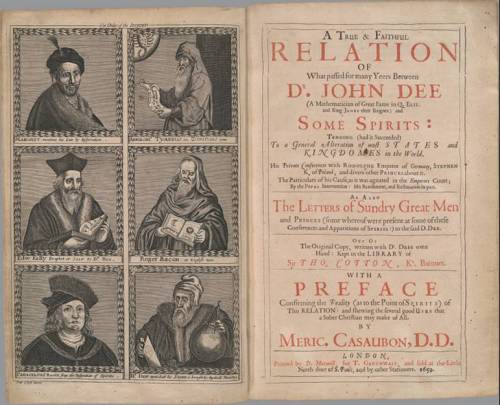
Florence Estienne Méric Casaubon (1599-1671), A True and Faithful Relation of what Passed for Many Yeers between Dr. John Dee [ . . . ] and Some Spirits, London, 1659. This work is in the public domain in its country of origin and other countries and areas where the copyright term is the author’s life plus 100 years or less. 

“In his Apologia compendiaria (1615) Fludd noted that the Rosicrucian brothers practiced that type of kabbalistic magic that enabled them to summon angels. This is reminiscent of the steganography of Trithemius. Yet it is no less reminiscent of the necromancy of John Dee, a man whom many authors considered the true inspirer of Rosicrucian spirituality.

In the course of one of the angelic colloquies recorded in A True and Faithful Relation of what Passed for Many Yeers between Dr. John Dee [ . . . ] and Some Spirits (1659: 92), Dee found himself in the presence of the Archangel Gabriel, who wished to reveal to him something about the nature of holy language.

When questioned, however, Gabriel simply repeated the information that the Hebrew of Adam, the language in which “every word signifieth the quiddity of the substance,” was also the primal language–a notion which, in the Renaissance, was hardly a revelation.

After this, in fact, the text continues, for page after page, to expatiate on the relations between the names of angels, numbers and secrets of the universe–to provide, in short, another example of the pseudo-Hebraic formulae which were the stock in trade of the Renaissance magus.

Yet it is perhaps significant that the 1659 Relation was published by Meric Casaubon, who was later accused of partially retrieving and editing Dee’s documents with the intention of discrediting him.

There is nothing, of course, surprising in the notion that a Renaissance magus invoked spirits; yet, in the case of John Dee, when he gave us an instance of cipher, or mystic language, he used other means.

In 1564, John Dee wrote the work upon which his contemporary fame rested–Monas hieroglyphica, where he speaks of a geometrical alphabet with no connection to Hebrew. It should be remembered that Dee, in his extraordinary library, had many of Lull’s manuscripts, and that many of his kabbalistic experiments with Hebrew characters in fact recall Lull’s use of letters in his art of combination (French 1972: 49ff).

Dee’s Monas is commonly considered a work of alchemy. Despite this, the network of alchemical references with which the book is filled seems rather intended to fulfill a larger purpose–that of explicating the cosmic implications deriving from Dee’s fundamental symbol, the Monad, based upon circles and straight lines, all generated from a single point.
bpt6k5401042m

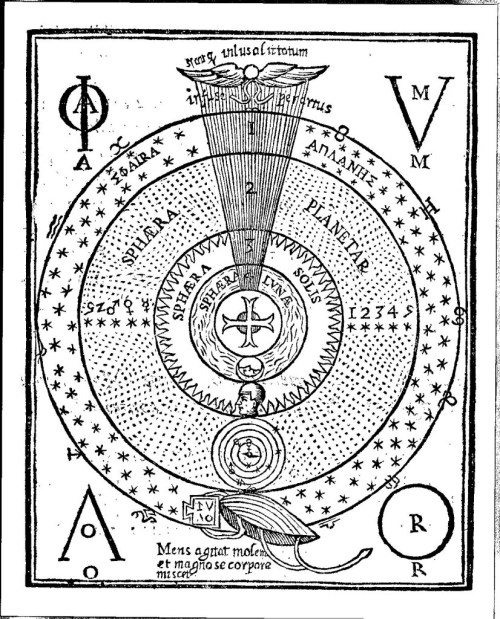
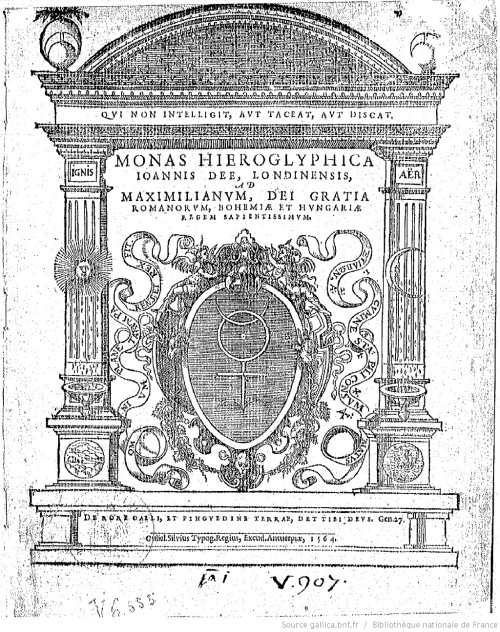
John Dee (1527-1609), Monas hieroglyphica, 1564, held in the Bibliothèque nationale de France. The Monad is the symbol at the heart of the illustration labeled Figure 8.1 in Eco’s  The Search for the Perfect Language, Oxford, 1995, p. 186.

In this symbol (see figure 8.1), the main circle represented the sun that revolves around its central point, the earth, and in its upper part was intersected by a semi-circle representing the moon.

Both sun and moon were supported on an inverted cross which represented both the ternary principle–two straight lines which intersect plus their point of intersection–and the quaternary principle–the four right angles formed at the intersections of the two lines.

The sum of the ternary and quaternary principles constituted a further seven-fold principle, and Dee goes even on to squeeze an eight-fold principle from the diagram.

By adding the first four integers together, he also derives a ten-fold principle. By such a manipulatory vertigo Dee then derives the four composite elements (heat and cold, wet and dry) as well as other astrological revelations.

From here, through 24 theorems, Dee makes his image undergo a variety of rotations, decompositions, inversions and permutations, as if it were drawing anagrams from a series of Hebrew letters.

Sometimes he considers only the initial aspects of his figure, sometimes the final one, sometimes making numerological analyses, submitting his symbol to the kabbalistic techniques of notariqon, gematria, and temurah.

As a consequence, the Monas should permit–as happens with every numerological speculation–the revelation of the whole of the cosmic mysteries.

However, the Monad also generates alphabetic letters. Dee was emphatic about this in the letter of dedication with which he introduced his book. Here he asked all “grammarians” to recognize that his work “would explain the form of the letters, their position and place in the alphabetical order, and the relations between them, along with their numerological values, and many other things concerning the primary Alphabet of the three languages.”

This final reference to “the three languages” reminds us of Postel (whom Dee met personally) and of the Collège des Trois Langues at which Postel was professor. In fact, Postel, to prove that Hebrew was the primal language in his 1553 De originibus, had observed that every “demonstration of the world” comes from point, line and triangle, and that sounds themselves could be reduced to geometry.

In his De Foenicum literis, he further argued that the invention of the alphabet was almost contemporary with the spread of language (on this point see many later kabbalistic speculations over the origins of language, such as Thomas Bang, Caelum orientis, 1657: 10).

What Dee seems to have done is to take the geometrical argument to its logical conclusion. He announced in his dedicatory letter that “this alphabetic literature contains great mysteries,” continuing that “the first Mystic letters of Hebrews, Greeks, and Romans were formed by God and transmitted to mortals [ . . . ] so that all the signs used to represent them were produced by points, straight lines, and circumferences of circles arranged by an art most marvelous and wise.”

When he writes a eulogy of the geometrical properties of the Hebrew Yod, one is tempted to think of the Dantesque I; when he attempts to discover a generative matrix from which language could be derived, one thinks of the Lullian Ars.

Dee celebrates his procedure for generating letters as a “true Kabbalah [ . . . ] more divine than grammar itself.”

These points have been recently developed by Clulee (1988: 77-116), who argues that the Monas should be seen as presenting a system of writing, governed by strict rules, in which each character is associated with a thing.

In this sense, the language of Monas is superior to the kabbala, for the kabbala aims at the interpretation of things only as they are said (or written) in language, whereas the Monas aims directly at the interpretation of things as they are in themselves. Thanks to its universality, moreover, Dee can claim that his language invents or restores the language of Adam.

According to Clulee, Dee’s graphic analysis of the alphabet was suggested by the practice of Renaissance artists of designing alphabetical letters using the compass and set-square.

Thus Dee could have thought of a unique and simple device for generating both concepts and all the alphabets of the world.

Neither traditional grammarians nor kabbalists were able to explain the form of letters and their position within the alphabet; they were unable to discover the origins of signs and characters, and for this reason they were uncapable (sic) to retrieve that universal grammar that stood at the bases of Hebrew, Greek and Latin.

According to Clulee, what Dee seems to have discovered was an idea of language “as a vast, symbolic system through which meanings might be generated by the manipulation of symbols” (1988: 95).

Such an interpretation seems to be confirmed by an author absent from all the bibliographies (appearing, to the best of my knowledge, only in Leibniz’s Epistolica de historia etymologica dissertatio of 1717, which discusses him in some depth).

This author is Johannes Petrus Ericus, who, 1697, published his Anthropoglottogonia sive linguae humanae genesis, in which he tried to demonstrate that all languages, Hebrew included, were derived from Greek.

In 1686, however, he had also published a Principium philologicum in quo vocum, signorum et punctorum tum et literarum massime ac numerorum origo. Here he specifically cited Dee’s Monas Hieroglyphica to derive from that matrix the letters of all alphabets (still giving precedence to Greek) as well as all number systems.

Through a set of extremely complex procedures, Ericus broke down the first signs of the Zodiac to reconstruct them into Dee’s Monad; he assumed that Adam had named each animal by a name that reproduced the sounds that that each emitted; then he elaborated a rather credible phonological theory identifying classes of letters such as “per sibilatione per dentes,” “per tremulatione labrorum,” “per compressione labrorum,” “per contractione palati,” “per respiratione per nares.”

Ericus concluded that Adam used vowels for the names of the beasts of the fields, and mutes for the fish. This rather elementary phonetics also enabled Ericus to deduce the seven notes of the musical scale as well as the seven letters which designate them–these letters being the basic elements of the Monas.

Finally, he demonstrated how by rotating this figure, forming, as it were, visual anagrams, the letters of all other alphabets could be derived.

Thus the magic language of the Rosicrucians (if they existed, and if they were influenced by Dee) could have been a matrix able to generate–at least alphabetically–all languages, and, therefore, all the wisdom of the world.

Such a language would have been more than a universal grammar: it would have been a grammar without syntactic structures, or, as Demonet (1992: 404) suggests, a “grammar without words,” a silent communication, close to the language of angels, or similar to Kircher’s conception of hieroglyphs.

Thus, once again, this perfect language would be based upon a sort of communicative short-circuit, capable of revealing everything, but only if it remained initiatically secret.”

Umberto Eco, The Search for the Perfect Language, translated by James Fentress, Blackwell. Oxford, 1995, pp. 185-90.
Eco: Hypotheses

Böhme_Philosophische_Kugel

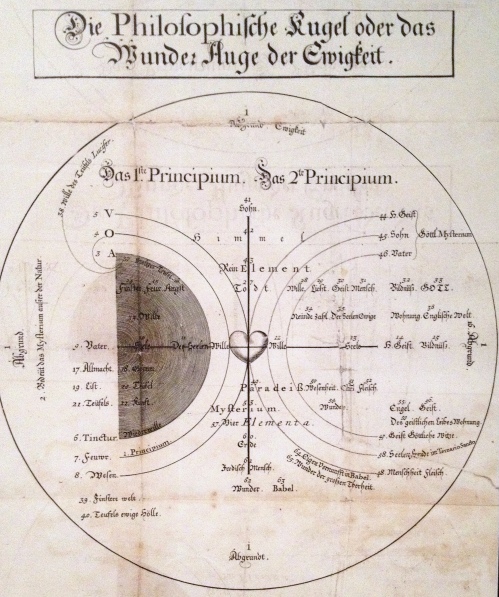
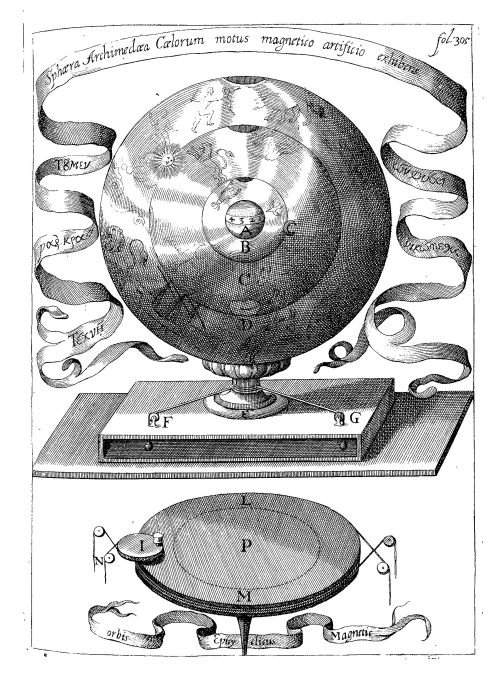
Jakob Böhme (1575-1624), Representation through a drawing of his Cosmogony, in Vierzig Fragen von der Seele, or Forty Questions of the Soul, 1620. This work is in the public domain in its country of origin and other countries and areas where the copyright term is the author’s life plus 100 years or less. 
“By the term “Rosicrucian linguistics” Ormsby-Lennon (1988) indicates a current of thought prevalent in Germany and England in the seventeenth century, whose influences could still be traced in the proposals for the invention of scientific languages by Dalgarno and Wilkins.

According to Ormsby-Lennon the Rosicrucians derived their notion of magic language from Jacob Böhme‘s theory of signatures.

Böhme, a mystic whose ideas had a great influence on later European culture, was well known in Rosicrucian circles in Germany.

From here, through a series of translations that continued into the eighteenth century, his influence passed into English theosophist culture. Webster, in his Academiarum examen of 1654, observed that the ideas of Böhme were recognized and adopted by the most enlightened confraternity of the Rosy Cross (pp. 26-7).

Böhme drew, in his turn, on Paracelsus‘ conviction that every natural element bore a sign that revealed its special occult powers, which in its turn recalls the tradition of physiognomics: powers were “signed” or marked in the forms and figures of all material things in the same way as the qualities of a man were revealed by the form of his face.

Nature had created nothing that failed to manifest its internal qualities through external signs, because the external forms of objects were, so to speak, nothing more than the result of the working of these same internal qualities.

Knowing this, humanity was on the way to discovering the essence of essences, that is to say, “the Language of Nature, in which each thing speaks of its particular properties,” (Signatura rerum, 1662, I).

In the writings of Böhme, however, the idea of signatures did not follow the previous magical tradition, but rather evolved as a mystical metaphor expressing the ideal of an unending search for the traces of the divine force which pervades the whole creation.

For Böhme, the mystic way started with a contemplation of simple, material objects which, at a certain point, might, as it were, burst into flames in an epiphany which revealed the true nature of the invisible.

His own vocation had been decided when, being still a young man, gazing at a tin pot struck by the rays of the sun, he was suddenly vouchsafed a vision that became, like Borge’s Alef, a privileged moment in which the light of God present in all things suddenly disclosed itself.

Böhme spoke of the speech of nature, or Natursprache, in his Mysterium Magnum of 1623; he described it as a “sensual speech” (“sensualische Sprache“) which was both “natural” and “essential.” It was the speech of all creation, the speech which Adam had used to name material things:

“During the time when all peoples spoke the same language, everyone naturally understood each other. When they no longer wished to use the sensual speech, however, they lost this proper understanding because they transferred the spirit of sensual speech into a crudely external form. [ . . . ]

Today, while the birds of the air and the beasts of the forests may still, each according to their own qualities, understand each other, not one of us understands the sensual speech any longer.

Let man therefore be aware of that from which he has excluded himself and that with which, moreover, one day, he will once again be born again, though no longer here on earth, but in another, spiritual world.

Spirits speak only to each other in sensual speech, and have no need for any other form of speech, because this is the Speech of Nature.” (Sämmtliche werke, Leipzig, 1922: V, 261-2).

In this passage, it is evident that, for Böhme, such Natursprache was no longer simply the language of signatures. When the spirits of the other world hold converse with one another, it is obvious that they use something more than natural signs.

It seems that the sensual speech was the same in which Adam named the animals and the same as the language given the apostles at Pentecost, an “open sensual speech” that comprehended all other languages.

Although this gift was lost in the confusion of Babel, it will, one day, return to us when the time is ripe, and we will be ready to converse with God. It seems evident that what Böhme is here describing is the language of glossolalic enthusiasm, or the so-called language of tongues.

Böhme’s notion of sensual speech seems very similar to Reuchlin‘s notion of the language of Adam alluded to in his De verbo mirifico (II, 6); this was a language manifested as a “simplex sermo purus, incorruptus, sanctus, brevis et constans [ . . . ] in quo Deus cum homine, et homines cum angelis locuti perhibentur coram, et non per interpretem, facie ad facie [ . . . ] sicut solet amicus cum amico” (“a simple and pure speech, uncorrupted, holy, brief, and constant, in which God and men, and men and angels could talk in each other’s presence, not through interpretation, but face to face, just as is usual between friends.”)

Or perhaps it was the same as the language of the birds, in which Adam during his sojourn in Eden could converse with (as well as name) every beast of the field, and every fowl of the air. After the Fall, the speech of birds was, once more, revealed to King Solomon, who taught it to the Queen of Sheba. It was a form of speech revealed  as well to Apollonius of Tyana (see Ormsby-Lennon 1988: 322-3).

We find a reference to this language of the birds in the chapter entitled “Histoire des oiseaux” in the Empires du Soleil of Cyrano de Bergerac (on Cyrano and language see Erba 1959: 23-5).

In this chapter, the traveller meets a marvelous bird whose tail is green, whose stomach is of an enamel blue, and whose purple head is surmounted by a golden crown. The bird addresses the traveler in a “singing speech” and he, to his amazement, finds that he is able to understand all that the bird has to say.

Nothing the perplexity on the traveler’s face, the bird explains:

“Among you humans there have been those able to speak and understand our Language. There was Apollonius of Tyana, Anaximander, and Aesop, and many others whose names I will not mention as you would not recognize them. Just so, there are to be found among the birds those who can speak and understand your own language. Thus, just as you will encounter birds that do not say a word, others that merely twitter, and others still that can speak, so you may even encounter one of the most perfect birds of all–those who can use all idioms.”

Was it then the practice of speaking in tongues that the Rosicrucians had in mind in their manifestos to the learned of Europe? Yet, if this is so, how are we to understand the allusions to a “secret writing . . . . expressed symbolically by numbers and designs?”

Why did they use the terms “characters and letters” when, in this period, these were notions associated with the search for the alphabetic characters capable of expressing the nature of things?

Umberto Eco, The Search for the Perfect Language, translated by James Fentress, Blackwell. Oxford, 1995, pp. 182-5.

Eco: Magic Language

speculum 01

Teophilus Schweighardt Constantiens, aka Daniel Mögling (1596-1635), Speculum Sophicum Rhodostauroticum (The Mirror of the Wisdom of the Rosy Cross), 1618. This work is in the public domain in its country of origin and other countries and areas where the copyright term is the author’s life plus 100 years or less.

“In a climate of extraordinary spiritual tension, the seventeenth century awaited change–a general reform of knowledge and morals, a reawakening of religions sensibility.

The period was dominated by a belief that a new, golden century was dawning; Postel had already used the term “golden century” in the title of one of his works. This was, moreover, an expectation shared by Catholics and Protestants alike, though each in different forms.

Authors from Campanella to Andreae had drawn up projects for an ideal republic. Not only Postel but other thinkers in different countries had designed schemes for a universal monarchy.

The Thirty Years War acted as a catalyst: conflict had flared in one region after another, creating, on the one hand, confessional hatreds and nationalist rivalries, engendering the modern notion of the raison d’état, on the other producing a pleiad of mystic spirits dreaming of universal peace (cf. De Mas 1982).

It was in this climate, then, that in 1614, there appeared an anonymous tract written in German: Allgemeine und general Reformation der gantzen weiten Welt. Though this was only discovered later, the first part was largely a re-elaboration of a satire written by Traiano Boccalini and published in 1612-3, called Ragguagli di Parnaso.

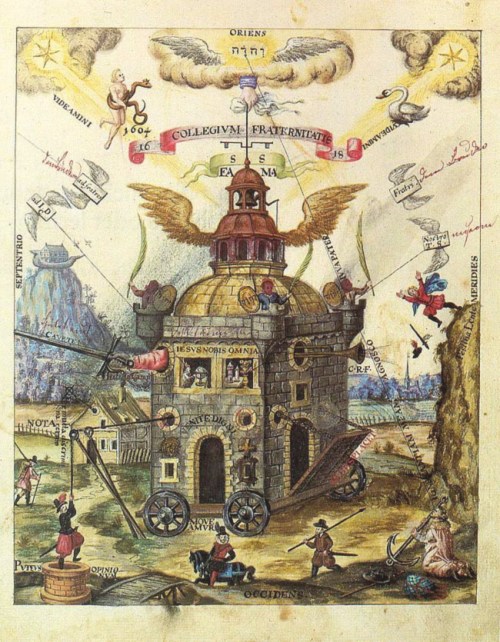
The second part, however, took the form of a manifesto, entitled Fama fraternitatis R.C. In this, the mysterious confraternity of the Rosicrucians openly declared its existence, supplying details concerning its own history as well as that of its mythical founder, Christian Rosencreutz.

In the following year, 1615, the German manifesto was republished together with a second manifesto, written this time in Latin, with the title Confessio fraternitatis Roseae crucis. Ad eruditos Europae (we shall use the first English translation, The Fame and the Confession of the Fraternity of R.C., London, 1652).

The first manifesto proclaimed its wish that there should be “a Society in Europe [ . . . ] with which such as be Governors might be brought up, for to learn all that which God hath suffered Man to know” (p. 9).

Both the manifestos emphasized the secret character of the confraternity and the fact that their members were not permitted to reveal its true aims and nature. It was a call, addressed to the learned of Europe, beseeching them to make contact with the writers of the manifesto; this made the final appeal of the Fama even more ambiguous:

“And although at this time we make no mention either of our names, or meetings, yet nevertheless every ones opinion shal assuredly come to our hands, in what language so ever it be, nor any body shal fail. who so gives but his name to speak with some of us, either by word of mouth, or else if there be some lett in writing [ . . . ] Also our building (although one hundred thousand people had very near seen and beheld the same) shal for ever remain untouched, undestroyed, and hidden to the wicked world.” (pp. 31-2).

Immediately, from almost every corner of Europe, responses to the Rosicrucian appeal were written. No one claimed to be a Rosicrucian. Almost no one claimed even to know who the Rosicrucians were. Yet almost everyone tried to claim that his own programme was synonymous with that of the Rosicrucian brotherhood.

Some authors professed an extreme humility. In his Themis aurea (1618), for example, Michael Maier insisted that though the brotherhood really existed, he was too humble an individual to be admitted as a member.

Yet, as Yates observed, this was typical of the behavior of Rosicrucian authors: not only did they deny being Rosicrucians, they claimed never to have encountered a single member of the confraternity.

Thus when, in 1623, a set of –naturally anonymous–manifestos appeared in Paris, announcing the arrival of the Rosicrucians, a furious polemic ensued in which the common opinion emerged that the Rosicrucians were worshippers of Satan.

It was said of Descartes that, in the course of a trip to Germany, he had tried (unsuccessfully of course) to make contact with the brotherhood. On his return to Paris, he even fell under suspicion of being a member.

He readily found a logical argument to exculpate himself, however; since it was well known that the Rosicrucians were invisible, Descartes showed up (making himself visible) in public places and on public occasions (see A. Baillet, Vie de Monsieur Descartes, 1693).

In 1623, a certain Neuhaus published, first in German and then in French, an Advertissiment pieux et utile des frères de la Rosee-Croix, in which he asked whether or not they existed, and if so, who they were and what was the origin of their name.

Neuhaus proved their existence by means of a rather startling argument: “By the very fact that they change and alter their name and that they mask their age, and that, by their own confession, they come and go without making themselves known, there is no Logician that could deny the necessity that they exist” (p. 5).

It would be tedious to recount here the entire story of books and tracts contradicting each other in an endeavor to reveal the truth about the Rosicrucians (it has sometimes been claimed, for instance, that the same author, using two different pseudonyms, was responsible for two or more tracts pro- and anti-Rosicrucians: see Arnold 1955; Edighoffer 1982).

It means that, when conditions are ripe, it takes but one spark–be it an obscure and ambiguous appeal for the spiritual reform of all humanity–to set off unexpected reactions. It almost seemed that everyone had been waiting for the Rosicrucian manifesto to appear as the missing piece in a polemic in which all sides–Catholic and Protestant–were waiting to join.

Thus, although the Jesuits were soon in the forefront of the battle against the Rosicrucians, there were not lacking those who insinuated that behind the Rosicrucians was the Society of Jesus itself, seeking to smuggle Catholic dogma into the Protestant world (see Rosa jesuitica, 1620).

The most intriguing aspect of the whole story was that the people immediately suspected of being the authors of the manifestos–Johann Valentin Andreae and his circle of friends in Tubingen–spent the rest of their lives either denying their involvement, or minimizing it as nothing more than a literary exercise.

As one might expect, given the spirit of the time, it was impossible to offer to the people of all lands a new philosophy without also offering them a perfect language in which to express it.

The manifestos, of course, spoke of this language; yet its perfection was mirrored by its secrecy (Fama, 287). According to the Confessio, the four founders of the brotherhood had “created the magic language and writing:”

“…and thenceforth our Trumpet shall publiquely sound with a loud sound, and great noise, when namely the fame (which at this present is shewed by few, and is secretly, as thing to come, declared in Figures and Pictures) shall be free, and publiquely proclaimed, and the whole World be filled withall [ . . . ]

So, the secret hid Writings and Characters are most necessary for all such things which are found out by Men: Although that great Book of Nature stand open to all Men, yet there are but few that can read and understand the same [ . . . ]

The Characters and Letters, as God hath here and there incorporated them in the Holy Scripture the Bible, so hath he imprinted them most apparently into the wonderful Creation of Heaven and Earth, yea in all Beasts [ . . . ]

From the which Characters and Letters we have borrowed our Magick writing, and have found out, and made a new Language for our selves, in the which withall is expressed and declared the Nature of all Things; so that it is no wonder that we are not so eloquent in other Languages, the which we know that they are altogether disagreeing to the Language of our forefathers, Adam and Enoch, and were through the Babylonical Confusion wholly hidden.” (pp. 43, 47, 48).

Umberto Eco, The Search for the Perfect Language, translated by James Fentress, Blackwell. Oxford, 1995, pp. 178-82.

Eco: Images for Aliens

Physical_Data

Georgia Guidestone, closeup of the detail stone, with physical dimensions and weight of the guidestones. The Georgia Guidestones are a granite monument erected by anonymous philanthropists in 1980 in Elbert County, Georgia, USA. The Guidestones include 10 guidelines inscribed in eight modern languages and four ancient tongues, including Babylonian, Classical Greek, Sanskrit and Egyptian hieroglyphs. Photo taken by KiltedEditor71 in August 2011 and published under the Creative Commons Attribution-Share Alike 3.0 Unported license.  

“Perhaps the most discomforting document for the future of the language of images is the report drawn up in 1984 by Thomas A. Sebeok (Sebeok 1984). He had been commissioned by the Office of Nuclear Waste Isolation and by a group of other institutions to elaborate answers to a question posed by the US Nuclear Regulatory Commission.

The American government had chosen several desert areas in the US for the burial (at the depth of hundreds of meters) of nuclear waste. The problem was not so much that of protecting the area from imprudent intrusions today, but rather that the waste would remain radioactive for another ten thousand years.

That is more than enough time for great empires and flourishing civilizations to perish. We have seen how, a few centuries after the last pharaoh had disappeared, knowledge of how to read hieroglyphs had disappeared as well.

It is easily conceivable that, ten thousand years hence, something similar will have happened to us. We may have reverted to barbarism. We may even be visited by inhabitants of other planets: how will we warn these alien visitors that they are in a danger zone?

Almost immediately, Sebeok discarded the possibility of any type of verbal communication, of electric signals as needing a constant power supply, of olfactory messages as being of brief duration, and of any sort of ideogram based on convention.

Even a pictographic language seemed problematic. Sebeok analyzed an image from an ancient primitive culture where one can certainly recognize human figures but it is hard to say what they are doing (dancing, fighting, hunting?).

Another solution would be to establish temporal segments of three generations each (calculating that, in any civilization, language will not alter beyond recognition between grandparents and grandchildren), giving instructions that, at the end of each segment, the message would be reformulated, adapting it to the semiotic conventions prevailing at the moment.

But even this solution presupposes precisely the sort of social continuity that the original question had put into doubt. Another solution was to fill up the entire zone with messages in all known languages and semiotic systems, reasoning that it was statistically probable that at least one of these messages would be comprehensible to the future visitors.

Even if only part of one of the messages was decipherable, it would still act as a sort of Rosetta stone, allowing the visitors to translate all the rest. Yet even this solution presupposed a form of cultural continuity (however weak it would be).

The only remaining solution was to institute a sort of “priesthood” of nuclear scientists, anthropologists, linguists and psychologists supposed to perpetuate itself by coopting new members. This caste would keep alive the knowledge of the danger, creating myths and legends about it.

Even though, in the passage of time, these “priests” would probably lose a precise notion of the peril that they were committed to protect humanity from, there would still survive, even in a future state of barbarism, obscure but efficacious taboos.

It is curious to see that, having been presented with a choice of various types of universal language, the choice finally fell on a “narrative” solution, thus reproposing what really did happen millennia ago.

Egyptian has disappeared, as well as as any other perfect and holy primordial language, and what remains of all this is only myths, tales without a code, or whose code has long been lost.

Yet they are still capable of keeping us in a state of vigil in our desperate effort at decipherment.

Umberto Eco, The Search for the Perfect Language, translated by James Fentress, Blackwell. Oxford, 1995, pp. 17-7.

Eco: The Egyptian vs. The Chinese Way, 3

kircher_100-639x1024

Athanasius Kircher (1602-80), Origins of the Chinese Characters, China Illustrata, 1667, courtesy of Stanford University. This work is in the public domain in its country of origin and other countries and areas where the copyright term is the author’s life plus 100 years or less.

“As the debate carried over into the eighteenth century, an increased social awareness and pedagogical attention began to be shown. We catch the traces of this in a tract written for quite different purposes, Diderot’s Lettre sur l’éducation des sourds et muets in 1751.

In 1776, the Abbé de l’Epée (Institutions des sourds et muets par la voie des signes méthodiques) entered into a polemic against the common, dactylological form of deaf-mute speak, which, then as now, was the common method of signing with fingers the letters of the alphabet.

De l’Epée was little interested that this language helped deaf-mutes communicate in a dactylological  version of the French language; instead he was besotted by the vision of a perfect language.

He taught his deaf-mutes to write in French; but he wished, above all, to teach them to communicate in a visual language of his own devising; it was a language not of letters but of concepts–therefore an ideography that, he thought, might one day become universal.

We can take for an example his method of teaching the meaning of “I believe,” thinking that his method might also work between speakers of different languages:

“I begin by making the sign of the first person singular, pointing  the index finger of my right hand towards my chest. I then put my finger on my forehead, on the concave part in which is supposed to reside my spirit, that is to say, my capacity for thought, and I make the sign for yes.

I then make the same sign on that part of the body which, usually, is considered as the seat of what is called the heart in its spiritual sense. [ . . . ]

I the make the same sign yes on my mouth while moving my lips. [ . . . ]

Finally, I place my hand on my eyes, and, making the sign for no show that I do not see.

At this point, all I need to do is to make the sign of the present [the Abbé had devised a series of sign gestures in which pointing once or twice in front of or behind the shoulders specified the proper tense] and to write I believe.” (pp. 80-1).

In the light of what we have been saying, it should appear evident that the visual performances of the good Abbé might be susceptible to a variety of interpretations were he not to take the precaution of employing a supplementary means (like writing out the word) to provide an anchor to prevent the fatal polysemy of his images.

It has sometimes been observed that the true limitation of iconograms is that, as well as they signify form or function, they cannot so easily signify actions, verb tenses, adverbs or prepositions.

In an article with the title “Pictures can’t say “ain’t,” Sol Worth (1975) argued that an image cannot assert the non-existence of what it represents. It is obviously possible to think of a code containing graphic operators signifying “existence/non-existence” or “past/future” and “conditional.”

But these signs would still depend (parasitically) on the semantic universe of the verbal language–as would happen (see ch. 10) with the so-called universal characters.

The ability of a visual language to express more than one meaning at once is also, therefore, its limitation. Goodman has noted (1968: 23) that there is a difference between a man-picture and a picture of a man.

The picture of a human being can be devised to represent (1) any member of the human race, (2) an individual person so-and-so, (3) a given person on the verge of doing something, dressed in a certain way, and so on.

Naturally the title can help to disambiguate the intention of the artist, but once again images are fatally “anchored” to words.

There have been any number of proposals for visual alphabets, some quite recent. We might cite Bliss’s Semantography, Eckhardt’s Safo, Janson’s Picto and Ota’s LoCos. Yet, as Nöth has observed (1990: 277), these are all cases of pasigraphy (which we shall discuss in a later chapter) rather than true languages.

Besides, they are based on natural languages. Many, moreover, are mere lexical codes without any grammatical component. The Nobel by Milan Randic consists of 20,000 visual lemmas, which can be combined together: a crown with an arrow pointing at a square with the uppermost side missing means “abdication” (where the square stands for a basket); two legs signify “to go,” and when this sign is united with the sign for “with” it means “to accompany.”

We seem to have returned to a sort of simplified hieroglyph which, in any case, will require us to learn a double set of conventions: the first to assign univocal meanings to single signs, the second to assign univocal meanings to sign clusters.

Each of these purely visual systems thus represents (1) a segment of artificial language, (2) endowed with a quasi-international extension, (3) capable of being used in only limited sectors, (4) debarred from creative use lest the images lose their capacity for univocal denotation, (5) without a grammar capable of generating an infinite or unlimited number of “sentences,” (6) unable to express new ideas because every element of expression always corresponds to a predetermined element of content, know in advance.

One could say that there is only a single system, which can claim the widest range of diffusion and comprehensibility: the images of cinema and television. One is tempted to say that this is certainly a “language” understood around the earth.

Nevertheless, even such a language displays certain disadvantages: it has difficulties in presenting mathematical abstractions and philosophical arguments; its alleged universal comprehensibility is problematic, at least as far as its editing syntax is concerned; finally, if there is no difficulty involved in receiving cinematic or televised images, it is extremely difficult to produce them.

Ease of execution is a notable argument in favor of verbal languages. Anyone who wished to communicate in a strictly visual language would probably have to go about with a camcorder, a portable television set, and a sackful of tapes, resembling Swift’s wise men who, having decided that it was necessary to show any object they wanted to designate, were forced to drag enormous sacks behind them.”

Umberto Eco, The Search for the Perfect Language, translated by James Fentress, Blackwell. Oxford, 1995, pp. 173-6.

Eco: The Egyptian vs. The Chinese Way, 2

kircher_099-590x1024

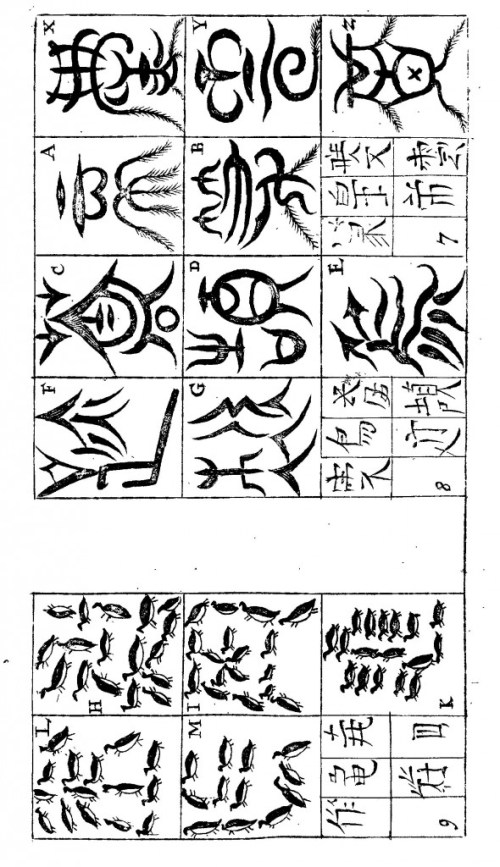
Athanasius Kircher (1602-80), origins of the Chinese characters, China Illustrata, 1667, p. 229, courtesy of Stanford University. This work is in the public domain in its country of origin and other countries and areas where the copyright term is the author’s life plus 100 years or less.

“On the subject of signatures, Della Porta said that spotted plants which imitated the spots of animals also shared their virtues (Phytognomonica, 1583, III, 6): the bark of a birch tree, for example, imitated the plumage of a starling and is therefore good against impetigo, while plants that have snake-like scales protect against reptiles (III, 7).

Thus in one case, morphological similarity is a sign for alliance between a plant and an animal, while in the next it is a sign for hostility.

Taddeus Hageck (Metoscopicorum libellus unus, 1584: 20) praises among the plants that cure lung diseases two types of lichen: however, one bears the form of a healthy lung, while the other bears the stained and shaggy shape of an ulcerated one.

The fact that another plant is covered with little holes is enough to suggest that this plant is capable of opening the pores. We are thus witnessing three very distinct principles of relation by similarity: resemblance to a healthy organ, resemblance to a diseased organ, and an analogy between the form of a plant and the therapeutic result that it supposedly produced.

This indifference as to the nature of the connection between signatures and signatum holds in the arts of memory as well. In his Thesaurus atificiosae memoriae (1579), Cosma Roselli endeavored to explain how, once of a system of loci and images had been established, it might actually  function to recall the res memoranda.

He thought it necessary to explain “quomodo multis modis, aliqua res alteri sit similis” (Thesaurus, 107), how, that is, one thing could be similar to another. In the ninth chapter of the second part he tried to construct systematically a set of criteria whereby images might correspond to things:

“according to similarity, which, in its turn, can be divided into similarity of substance (such as man as the microcosmic image of the macrocosm), similarity in quantity (the ten fingers for the Ten Commandments), according to metonymy or antonomasia (Atlas for astronomers or for astronomy, a bear for a wrathful man, a lion for pride, Cicero for rhetoric):

by homonyms: a real dog for the dog constellation;

by irony and opposition: the fatuous for the wise;

by trace: the footprint for the wolf, the mirror in which Titus admired himself for Titus;

by the name differently pronounced: sanum for sane;

by similarity of name: Arista [awn] for Aristotle;

by genus and species: leopard for animal;

by pagan symbol: the eagle for Jove;

by peoples: Parthians for arrows, Scythians for horses, Phoenicians for the alphabet;

by signs of the zodiac: the sign for the constellation;

by the relation between organ and function;

by common accident: the crow for Ethiopia;

by hieroglyph: the ant for providence.”

The Idea del teatro by Giulio Camillo (1550) has been interpreted as a project for a perfect mechanism for the generation of rhetorical sentences.

Yet Camillo speaks casually of similarity by morphological traits (a centaur for a horse), by action (two serpents in combat for the art of war), by mythological contiguity (Vulcan for the art of fire), by causation (silk worms for couture), by effects (Marsyas with his skin flayed off for butchery), by relation of ruler to ruled (Neptune for navigation), by relation between agent and action (Paris for civil courts), by antonomasia (Prometheus for man the maker), by iconism (Hercules drawing his bow towards the heavens for the sciences regarding celestial matters), by inference (Mercury with a cock for bargaining).

It is plain to see that these are all rhetorical connections, and there is nothing more conventional that a rhetorical figure. Neither the arts of memory nor the doctrine of signatures is dealing, in any degree whatsoever, with a “natural” language of images.

Yet a mere appearance of naturalness has always fascinated those who searched for a perfect language of images.

The study of gesture as the vehicle of interaction with exotic people, united with a belief in a universal language of images, could hardly fail to influence the large number of studies which begin to appear in the seventeenth century on the education of deaf-mutes (cf. Salmon 1972: 68-71).

In 1620, Juan Pablo Bonet wrote a Reducción de las letras y arte para enseñar a hablar los mudos. Fifteen years later, Mersenne (Harmonie, 2) connected this question to that of a universal language. John Bulwer suggested (Chirologia, 1644) that only by a gestural language can one escape from the confusion of Babel, because it was the first language of humanity.

Dalgarno (see ch. 11) assured his reader that his project would provide an easy means of educating deaf-mutes, and he again took up this argument in his Didascalocophus (1680). In 1662, the Royal Society devoted several debates to Wallis’s proposals on the same topic.”

Umberto Eco, The Search for the Perfect Language, translated by James Fentress, Blackwell. Oxford, 1995, pp. 171-3.

Eco: The Egyptian vs. The Chinese Way

kircher_093-653x1024

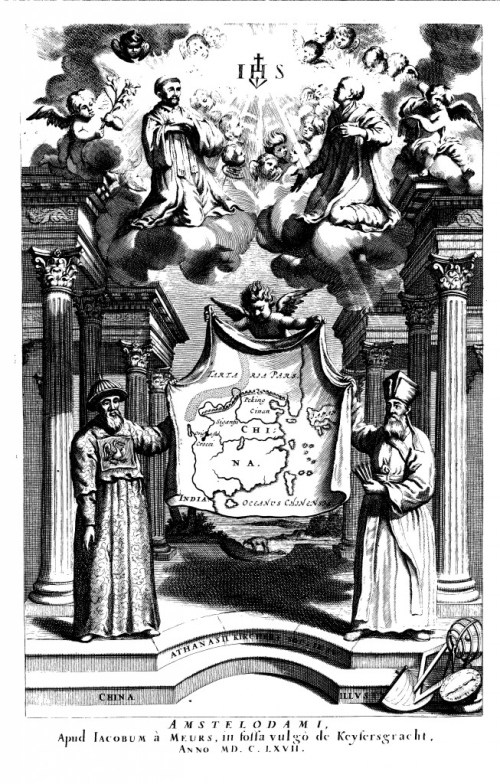
Athanasius Kircher (1602-80), frontispiece depicting Adam Schall and Matteo Ricci holding a map of China, China Illustrata, 1667, courtesy of Stanford University. This work is in the public domain in its country of origin and other countries and areas where the copyright term is the author’s life plus 100 years or less.

“Although today many are still of the opinion that images provide a means of communication that can overcome language barriers, the explanation of the way in which images can accomplish this by now takes one of two forms: the Egyptian and the Chinese way.

The Egyptian way today belongs only to art history. We believe that visual media such as paintings, sequences in films, etc. are “texts” which convey emotions and feelings that could not be expressed verbally: we cannot represent by mere words Mona Lisa to a blind person.

The meanings that such texts can express are multiple, because there is no universal code: the rules of representation (and of recognizability) for an Egyptian mural, an Arab miniature, a painting by Turner or a comic strip are simply not the same in each case.

It is true that some ideograms have been used as characters of a universal code, for instances many road signals; in the same vein we are using more or less universal pictograms (think of the schematic crossed knives and forks which signal a restaurant in an airport, or of the stylized “ladies” and “gentlemen” on public lavatory doors).

Sometimes visual signs are merely substituting alphabetical letters, as happens with semaphores or flag signals; sometimes a yellow flag meaning “contagious disease on board” simply stands for a verbal sentence (cf. Prieto 1966).

Likewise, the gestural languages of Trappist monks, Indian merchants, gypsies or thieves, as well as the drummed and whistled languages of certain tribes (cf. Le Barre 1964), are equally dependent on the model of natural languages.

As useful, convenient and ingenious as some of these systems of communication may be, they make no claims to being “perfect” languages in which philosophers might one day wish to compose a treatise.

Any language of images is based on the alleged fact that images exhibit some properties of the represented things. Yet in any representable thing there will always be a multitude of properties, and there are infinite points of view under which an image can be judged similar to something else. Moreover, “that a picture looks like nature often means only that it looks the way nature is usually painted” (Goodman 1968: 39).

We can see this by looking at the various versions of a semiotic apparatus (if not a true language) which remained alive for centuries and which flowered in the same period when the western culture was looking for perfect visual languages: the arts of memory (cf. Rossi 1960; Yates 1966).

An art of memory establishes at its expression-plane a system of loci (that is, of places in the literal sense of the word) which may be imagined as the rooms of a building or palace, or as an urban street or square.

This system of loci is destined to house a set of images, drawn from the same iconographical field, which will play the role of lexical units. The content-plane is given by a system of res memoranda, in other words, of things to be remembered, usually belonging to the same conceptual framework. In this way, an art of memory is a semiotic system.

For instance, in mnemonic systems like those presented by the Congestorius artificiosae memoriae by Romberch (1520), the Dialogo del modo di accrescerce e conservare la memoria by Dolce (1575), or the Artificiosae memoriae fundamenta by Paepp (1619), the system of grammatical cases is expressed (and thus recalled) by the different parts of the human body.

Not only is this a case of one system expressing another system; it is also a case where the two planes are (in Hjelmslev‘s sense) conformal. It is not arbitrary that the head stands for nominative, the chest, which can receive blows, stands for accusative, and the hands, which possess and offer, stand for genitive and dative, and so on.

This shows that a mnemonic image, in order to express its content easily, should evoke it by similarity. But no mnemonic system was ever able to find a univocal criterion of resemblance.

The criteria are the same as those that linked the signature to its signatum. If we look back and see (ch. 6) what Paracelsus had to say about the language of Adam, the Protoplastus, we see that he represented him as naming one animal on the basis of a morphological similarity (from which a virtue derived), while, in another case, the name derived directly from a virtue not manifested by the form of the object.

In other cases, the name that Adam gave reflected neither morphology nor causal relations, but was inferred symptomatically: for instance, the horn of the stag permitted us to infer the age of the animal from the complexity of its branching.”

Umberto Eco, The Search for the Perfect Language, translated by James Fentress, Blackwell. Oxford, 1995, pp. 168-71.

Eco: Later Critics

kircher_119-659x1024

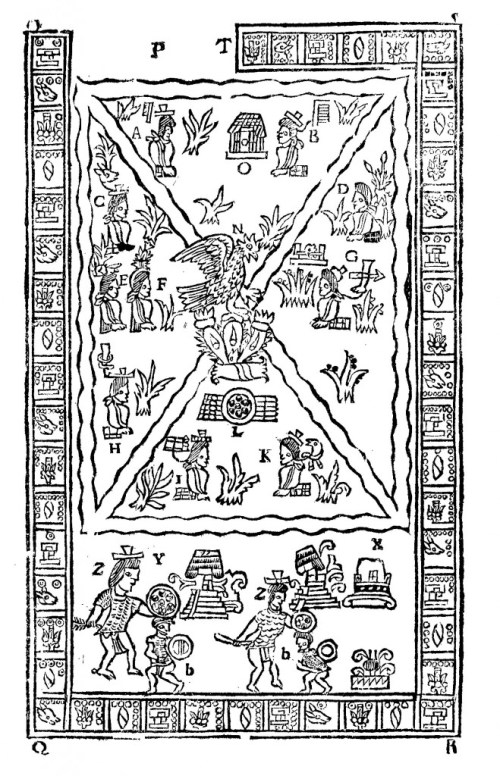
Athanasius Kircher (1602-80), Aztec scripture depicting the founding of Mexico City, Oedipus Aegyptiacus, tom. 3, p. 32. A selection of images from works by and related to Athanasius Kircher held in the Special Collections and University Archives of Stanford University Libraries, curated by Michael John Gorman, 2001. This work is in the public domain in its country of origin and other countries and areas where the copyright term is the author’s life plus 100 years or less. 

“About a century later, Vico took it for granted that the first language of humanity was in the form of hieroglyphics–that is, of metaphors and animated figures. He saw the pantomime, or acted-out rebus, with which the king of the Scythians replied to Darius the Great as an example of hieroglyphic speech.

He had intimated war with “just five real words;” a frog, a mouse, a bird, a ploughshare, and a bow.

The frog signified that he was born in Scythia, as frogs were born from the earth each summer; the mouse signified that he “like a mouse had made his home where he was born, that is, he had established his nation there;” the bird signified “there the auspices were; that is that he was subject to none but God;” the plough signified that he had made the land his own through cultivation; and finally the bow meant that “as supreme commander in Scythia he had the duty and the might to defend his country.” (Scienza nuova, II, ii, 4, 435).

Despite its antiquity and its primacy as the language of the gods, Vico attributed no quality of perfection to this hieroglyphic language. Neither did he regard it as inherently either ambiguous or secret: “we must here uproot the false opinion held by some of the Egyptians that the hieroglyphs were invented by philosophers to conceal in them their mysteries of lofty esoteric wisdom.

For it was by a common natural necessity that all the first nations spoke in hieroglyphs.” (ibid.).

This “speaking in things” was thus human and natural; its purpose was that of mutual comprehension. It was also a poetic form of speaking that could not, by its very nature, ever be disjoined from either the symbolic language of heroes or the epistolary language of commerce.

This last form of speech “must be understood as having sprung up by their [the plebeians’] free consent, by this eternal property, that vulgar speech and writing are a right of the people” (p. 439).

Thus the language of hieroglyphs, “almost entirely mute, only very slightly inarticulate” (p. 446), once reduced to a mere vestibule of heroic language (made up of images, metaphors, similes and comparisons, that “supplied all the resources of poetic expression,” p. 438) lost its sacred halo of esoteric mystery.

Hieroglyphs would become for Vico the model of perfection for the artistic use of language, without making any claim, however, to replace the ordinary languages of humanity.

Other eighteenth-century critics were moving in the same direction. Nicola Frèret (Reflexions sur les principles généraux de l’art d’écrire, 1718) wrote of hieroglyphic writing as an archaic artifice; Warburton considered it hardly more advanced than the writing systems of the Mexicans (The Divine Legation of Moses, 1737-41).

We have seen what the eighteenth century had to say on the subject of monogeneticism. In this same period, critics were developing a notion of writing as evolving in stages from a pictographic one (representing things), through hieroglyphs (representing qualities and passions as well) to ideograms, capable of giving an abstract and arbitrary representation of ideas.

This, in fact, had been Kircher’s distinction, but now the sequence followed a different order and hieroglyphs were no longer considered as the ordinary language.

In his Essai sur l’origine des langues (1781) Rousseau wrote that “the cruder the writing system, the more ancient the language,” letting it be understood that the opposite held as well: the more ancient the language, the cruder the writing.

Before words and propositions could be represented in conventional characters, it was necessary that the language itself be completely formed, and that the people be governed by common laws.

Alphabetic writing could be invented only by a commercial nation, whose merchants had sailed to distant lands, learning to speak foreign tongues. The invention of the alphabet represented a higher stage because the alphabet did more than represent words, it analyzed them as well.

It is at this point that there begins to emerge the analogy between money and the alphabet: both serve as a universal medium in the process of exchange–of goods in the first instance, of ideas in the second (cf. Derrida 1967: 242; Bora 1989: 40).

This nexus of ideas is repeatedly alluded to by Chevalier de Jaucourt in the entries that he wrote for the Encyclopédie: “Writing,” “Symbol,” “Hieroglyph,” “Egyptian writing,” and “Chinese writing.”

Jaucourt was conscious that if hieroglyphics were entirely in the form of icons, then the knowledge of their meanings would be limited to a small class of priest. The enigmatic character of such a system (in which Kircher took such pride) would eventually force the invention of more accessible forms such as demotic and hieratic.

Jaucourt went further in the attempt to distinguish between different types of hieroglyph. He based his distinctions on rhetoric. Several decades earlier, in fact, in 1730, Du Marsais had published his Traités des trophes, which had tried to delimit and codify all the possible values that a term might take in a process of rhetorical elaboration that included analogies.

Following this suggestion Jaucourt abandoned any further attempt at providing Hermetic explanations, basing himself on rhetorical criteria instead: in a “curiological” hieroglyph, the part stood for the whole; in the “tropical” hieroglyph one thing could be substituted for another on the grounds of similarity.

This limited the scope for interpretive license; once the mechanics of hieroglyphs could be anchored in rhetoric, the possibility for an infinite proliferation of meanings could be reined in.

In the Encyclopédie the hieroglyphs are presented as a mystification perpetrated at the hands of the Egyptian priesthood.”

Umberto Eco, The Search for the Perfect Language, translated by James Fentress, Blackwell. Oxford, 1995, pp. 166-8.

Eco: The Kircherian Ideology

original

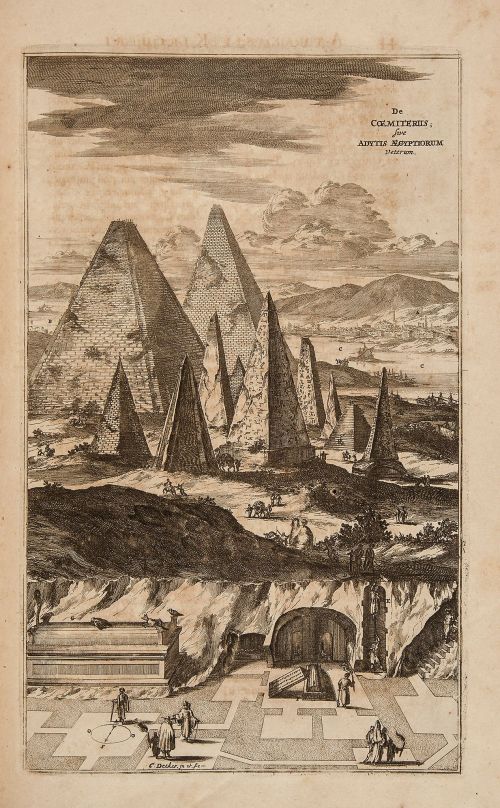
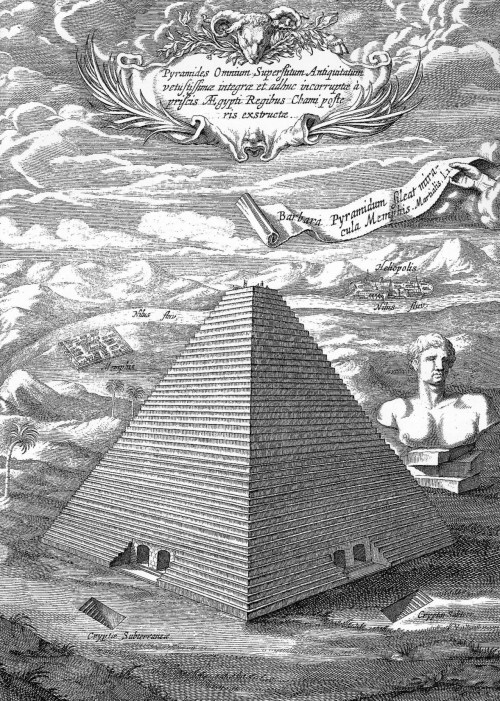
Athanasius Kircher (1602-80), Egyptian pyramids by Gioseffo Petrucci, Prodromo apologetico alli studi chiercheriani, Amsterdam, 1677, reprinted from Sphinx Mystagoga, a selection of images related to Athanasius Kircher in the Stanford University Archives, curated by Michael John Gorman, 2001. This work is in the public domain in its country of origin and other countries and areas where the copyright term is the author’s life plus 100 years or less.

“It would be idle to hold Kircher responsible for his inability to understand the nature of hieroglyphic writing, for which in his time nobody had the key. Yet his ideology magnified his errors.

“Nothing can explain the duplicity of the research of Kircher better than the engraving which opens the Obeliscus Pamphilius: in this cohabit both the illuminated image of Philomatià to whom Hermes explains every mystery and the disquieting gesture of Harpocrates who turns away the profane, hidden by the shadow of the cartouche.” (Rivosecchi 1982: 57).

The hieroglyphic configurations had become a sort of machine for the inducing of hallucinations which then could be interpreted in any possible way.

Rivosecchi (1982: 52) suggests that Kircher exploited this very possibility in order to discuss freely a large number of potentially dangerous themes–from astrology to alchemy and magic–disguising his own opinions as those of an immemorial tradition, one in which, moreover, Kircher treated prefigurations of Christianity.

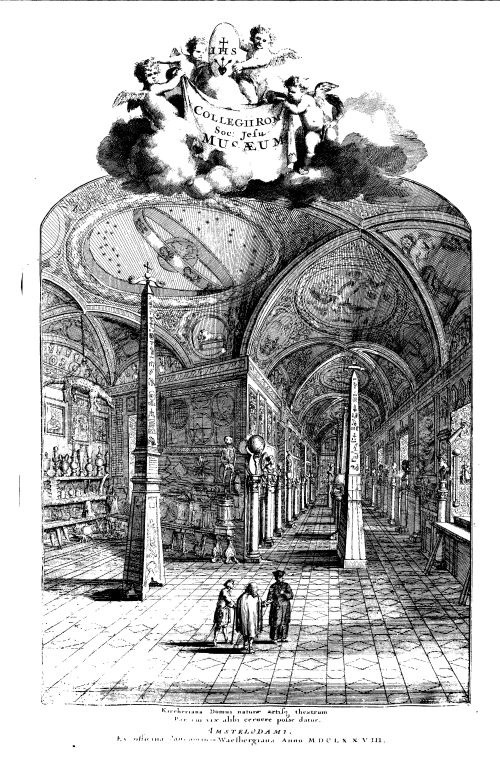
In the midst of this hermeneutic bulimia, however, there glimmers the exquisitely baroque temperament of Kircher at play, delighting in his taste for the great theater of mirrors and lights, for the surprising museographic collection (and one has only to think of that extraordinary Wunderkammer which was the museum of the Jesuit Collegio Romano).

Only his sensitivity to the incredible and the monstrous can explain the dedication to the Emperor Ferdinand III that opens the third volume of Oedipus:

“I unfold before your eyes, O Most Sacred Caesar, the polymorphous reign of Morpheus Hieroglyphicus. I tell of a theater in which an immense variety of monsters are disposed, and not the nude monsters of nature, but adorned by the enigmatic Chimeras of the most ancient of wisdoms so that here I trust sagacious wits will draw out immeasurable treasures for the sciences as well as no small advantage for letters.

Here there is the Dog of Bubasti, the Lion Saiticus, the Goat Mendesius, here there is the Crocodile, horrible in the yawning of its jaws, yet from whose uncovered gullet there emerges the occult meanings of divinity, of nature, and of the spirit of Ancient Wisdom espied through the vaporous play of images.

Here there are the Dipsodes thirsting for blood, the virulent Asp, the astute Icneumon, the cruel Hippopotami, the monstrous Dragons, the toad of swollen belly, the snail of twisted shell, the hairy caterpillar and the innumerable other specters which all show the admirably ordered chain which extends itself into the depths of nature’s sanctuaries.

Here is presented a thousand species of exotic things in many and varied images, transformed by metamorphosis, converted into human figures, and restored once more to themselves again in a dance of the human and the savage intertwined, and all in accordance with the artifices of the divine; and finally, there appears the divinity itself which, to say with Porphyry, scours the entire universe, ordering it with all things in a monstrous connubium; where now, sublime in its variegated face, it raises its canine cervix to reveal itself as Cenocephalus, now as the wicked Ibis, now as the Sparrow-hawk wrapped in a beaky mask.

[ . . . ] now, delighting in its virgin aspect, under the shell of the Scarab it lies concealed as the sting of the Scorpion [these descriptions carry on for four more pages] in this pantomorphic theater of nature  unfolded before our gaze, under the allegorical veil of occult meanings.”

This is the same spirit which informed the medieval taste for encyclopedias and for libri monstruorum, a genre which reappears from the Renaissance onwards under the “scientific” guise of the medical studies of Ambroise Paré, the naturalist works of Ulisse Aldrovandi, the collection of monsters of Fortunio Liceti, the Physica curiosa of Gaspar Schott.

Here it is combined, with a quality of frenzied dissymmetry that is almost Borrominian, recalling the aesthetic ideals presiding over the construction of the hydraulic grottos and mythological rocailles in the gardens of the period.

Beyond this, however, Rivosecchi has put his finger on another facet of the Kircherian ideology. In a universe placed under the sign of an ancient and powerful solar deity, the myth of Osiris had become an allegory of the troubled search for stability in the world still emerging from the aftermath of the Thirty Years War, in which Kircher was directly involved.

In this sense, we might read the dedications to Ferdinand III, which stand out at the beginning of each volume of the Oedipus, in the same light as the appeals of Postel to the French monarchy to restore harmony a century before, or as the analogous appeals of Bruno, or as Campanella’s celebration of a solar monarchy, prelude to the reign of Louis XIV, or as the calls for a golden century which we will discuss in the chapter on the Rosicrucians.

Like all the utopian visionaries of his age, the Jesuit Kircher dreamed of the recomposition of a lacerated Europe under a stable monarchy. As a good German, moreover, he repeated the gesture of Dante and turned to the Germanic, Holy Roman emperor.

Once again, as in the case of Lull, though in ways so different as to void the analogy, it was the search for a perfect language that became the instrument whereby a new harmony, not only in Europe, but across the entire planet, was to be established.

The knowledge of exotic languages, aimed not so much at recovering their original perfection, but rather at showing to the Jesuit missionaries “the method of bearing the doctrine of Christ to those cut off from it by diabolic malice” (preface to China, but also Oedipus, I, I, 396-8).

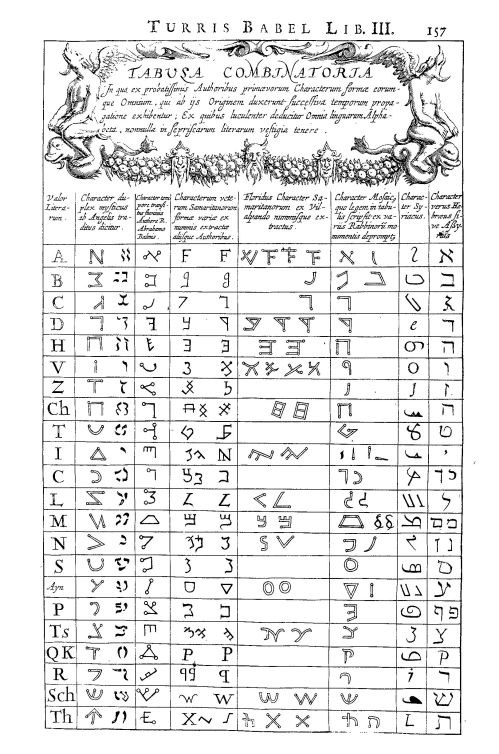
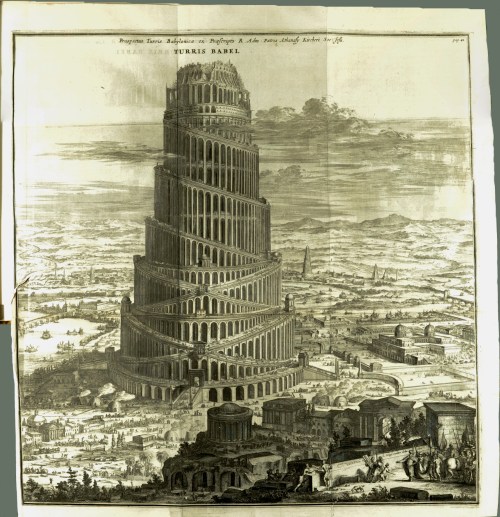
In the last of Kircher’s works, the Turris Babel, the story of the confusion of tongues is once again evoked, this time in an attempt to compose “a grandiose universal history, embracing all diversities, in a unified project of assimilation to Christian doctrine. [ . . . ]

The peoples of all the world, dispersed after the confusion, are to be called back together from the Tower of the Jesuits for a new linguistic and ideological reunification.” (Scolari 1983: 6).

In fact, hungry for mystery and fascinated by exotic languages though he was, Kircher felt no real need to discover a perfect language to reunite the world in harmony; his own Latin, spoken with the clear accents of the Counter-Reformation, seemed a vehicle perfectly adequate to transport as much gospel truth as was required in order to bring the various peoples together.

Kircher never entertained the thought that any of the languages he considered, not even the sacred languages of hieroglyphics and kabbalistic permutations, should ever again be spoken. He found in the ruins of these antique and venerated languages a garden of private delight; but he never conceived of them as living anew.

At most he toyed with the idea of preserving these languages as sacred emblems, accessible only to the elect, and in order to show their fecund impenetrability he needed elephantine commentaries.

In every one of his books, he showed himself as a baroque scholar in a baroque world; he troubled more over the execution of his tables of illustrations than over the writing (which is often wooden and repetitive).

Kircher was, in fact, incapable of thinking other than in images (cf. Rivosecchi 1982: 114). Perhaps his most lasting achievement, and certainly his most popular book, was the Ars magna lucis et umbrae of 1646.

Here he explored the visible in all its nooks and crannies, drawing from his exploration a series of scientifically valid intuitions which even faintly anticipate the invention of the techniques of photography and the cinema.”

Umberto Eco, The Search for the Perfect Language, translated by James Fentress, Blackwell. Oxford, 1995, pp. 162-5.

Eco: Kircher’s Chinese, 2

kircher_094

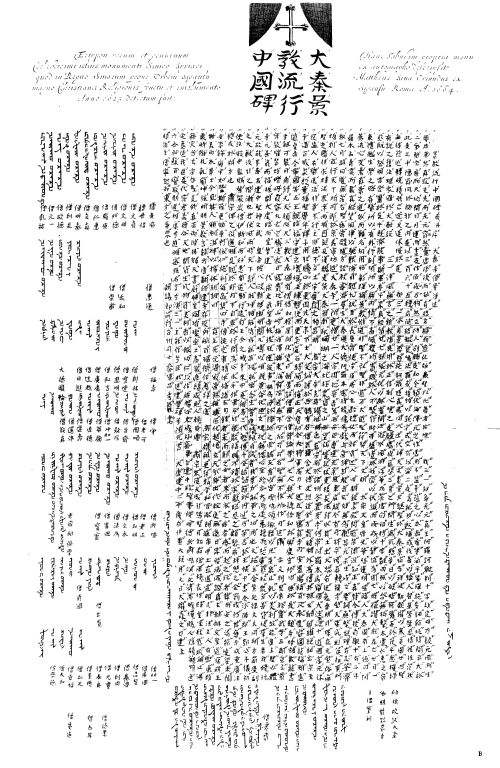
Athanasius Kircher (1602-80), Transcription of the Sino-Syriac Monument from China Illustrata, 1667, p. 12. This work is in the public domain in its country of origin and other countries and areas where the copyright term is the author’s life plus 100 years or less.

“Why did the problem of memory arise only here, and not in regard to Egyptian hieroglyphs? The reason was that hieroglyphs discharged their allegorical and metaphorical force immediately, in virtue of what Kircher held to be their inherent power of revelation, since they “integros conceptos ideales involvebant.”

By using the verb involvere (to wind or wrap up), however, Kircher meant the exact opposite of what we might, today, suppose when we think of the natural and intuitive similarity between a given image and a thing. Hieroglyphs do not make clear but rather conceal something,

This is the reason for which Kircher speaks of the inferiority of Amerindian characters (Oedipus, III, 13-4). They seemed to Kircher inferior because they were immediately pictographic, as they were representing only individuals and events; thus they looked like mere mnemonic notes unable to bear arcane revelations (Oedipus, IV, 28; on the inferiority of Amerindian characters see also Brian Walcott (ed. note: Eco has “Brian Walcott” on p. 160, when the actual name should be Brian Walton), In biblia polyglotta prolegomena, 2.23).

Chinese ideography was undoubtedly superior to Amerindian “pictography because it was capable of expressing abstract concepts. Yet, despite the fact that it also permitted witty combinations (cf. Oedipus, III, 13-4), its decipherment remained too univocal.

The Egyptians, Kircher argued, saw in the sign of the scarab not a mere scarab, but the sun–and not the material sun that warms our world of our senses, but the sun as archetype of the intelligible world. (Ed. Note: Eco has a bracket ” next to pictography but does not close it. I include it, repeating the error, as Eco published it.)

We shall see (ch. 10) that in seventeenth-century England, Chinese writing was considered perfect in so far as with ideograms every element on the expression-plane corresponded to a semantic unit on the content-plane. It was precisely these one-to-one correspondences that, for Kircher, deprived Chinese writing of its potential for mystery.

A Chinese character was monogamously bound to the concept it represented; that was its limitation: an Egyptian hieroglyph showed its superiority by its ability to summon up entire “texts,” and to express complex chunks of infinitely interpretable content.

Kircher repeated this argument in his China. There was nothing hieratic about the Chinese character; there was nothing that veiled it from profane eyes, hiding unfathomable depths of truth; it was a prosaic instrument of everyday communication.

Knowledge of Chinese could, of course, be motivated on ethnological grounds, especially as the Jesuits had acquired so many interests in China. Still, Chinese could not qualify for inclusion in the list of holy languages.

As to the Amerindian signs, not only were they patently denotative, but they revealed the diabolic nature of a people who had lost the last vestige of archaic wisdom.

As a civilization, Egypt no longer existed, and for the Europeans it was not yet a land for future conquest. Ignored in its geopolitical inconsistency, it became a Hermetical phantom. In this role it could be identified as the spiritual ancestor of the Christian West, the progenitor of the occident’s patrimony of mystic wisdom.

China, by contrast, was no phantom but a tangible Other. It was concretely there, still a political force of respectable dimensions, still a culture alternative to that of the West. The Jesuits themselves had revealed the deep roots of Chinese culture.

“The Chinese, moral and virtuous though pagan, when forgetting the truth revealed in the structure of hieroglyphs, converted their ideography into a neutral and abstract instrument of communication, and this led to the belief that their conversion would be easy to achieve.” (Pellerey 1992b: 521).

The Americas, by contrast, were designated as the land of conquest; here there would be no compromise with idolators and their low-grade species of writing: the idolators were to be converted, and every trace of their original culture, irredeemably polluted with diabolic influences, was to be wiped away.

“The demonization of the native American cultures found here a linguistic and theoretical justification.” (ibid.: 521).

Umberto Eco, The Search for the Perfect Language, translated by James Fentress, Blackwell. Oxford, 1995, pp. 160-2.

Eco: Kircher’s Chinese

kircher_049-826x1024

Athanasius Kircher (1602-80), schema of the Egyptian cosmos, Oedipus Aegyptiacus, tom. 2, vol. 1, p. 418. This work is in the public domain in its country of origin and other countries and areas where the copyright term is the author’s life plus 100 years or less.

“In an earlier chapter, we saw the suggestion made that Chinese might be the language of Adam. Kircher lived in a period of exciting discoveries in the Orient. The Spanish, Portuguese, English, Dutch, and, later, French conquered the route to the Indies, the Sunda seas, the way to China and to Japan.

But even more than by merchants, these pathways were traversed by Jesuits, following in the footsteps of Matteo Ricci who, a century before, had brought European culture to the Chinese, and returned to give Europe a deeper understanding of China.

With the publication of the Historia de las cosas más notables, ritos y costumbres del gran reino de la China by Juan Gonzales de Mendoza in 1585, there appeared in print in Europe characters in Chinese script.

In 1615 there finally appeared Ricci’s De christiana expeditione apud Sinas ab Societate Ieus suscepta, in which he explained that in Chinese, there existed as many characters as there were words. He insisted as well on the international character of the Chinese script, which, he wrote, was readily understood not only by the Chinese, but also by the Japanese, the Koreans, the Cochin-Chinese and by the Formosans.

We shall see that this was a discovery that would initiate the search for a real character from Bacon onwards. Already in 1627, in France, Jean Douet published a Proposition présentée au roy, d’une escriture universelle, admirable pour ses effects, très-utile à tous les hommes de la terre, in which Chinese was offered as a model for an international language.

At the same time, there had begun to appear information about the pictographic writings of Amerindians. Attempts at interpretation had yielded contradictory results; and this was discussed in works such as the Historia natural y moral de las Indias by José de Acosta in 1570, and the Relaciòn de las cosas de Yucatàn by Diego de Landa, written in the sixteenth century, although appearing only in the eighteenth; in 1609 there also appeared the Comentarios reales que tratan del origine de los Yncas by Garcilaso de la Vega.

An observation often repeated by these early observers was that contact with the indigenous natives was at first carried out by means of gestures. This awoke an interest in gesture’s potential as a universal language.

The universality of gestures and the universality of images turned out to be related themes (the first treatise on this subject was Giovanni Bonifacio‘s L’arte de’ cenni of 1616; on this topic in general, see Knox 1990).

The reports of his Jesuit brothers gave Kircher an incomparable source of ethnographic and linguistic information (see Simone 1990 on “Jesuit or Vatican linguistics”).

In his Oedipus, Kircher was especially interested in the diffusion of Chinese. He took up the same arguments, in a more elliptical form, in his China monumentis quà sacris quà profanis, nec non variis naturae et artis spectaculis, aliarum rerum memorabilis argumentis illustrata of 1667.

This latter work was more in the nature of a treatise in ethnography and cultural anthropology which, with its splendid and sometimes documented illustrations, collected all the reports that arrived from the missionaries of the Company, and described every aspect of Chinese life, culture and nature.

Only the sixth and last part of the work was dedicated to the alphabet.

Kircher presumed that the mysteries of hieroglyphic writing had been introduced to the Chinese by Noah’s son Ham. In the Arca Noe of 1675 (pp. 210ff) he identified Ham with Zoroaster, the inventor of magic.

But, unlike Egyptian hieroglyphs, Chinese characters were not for Kircher a puzzle. Chinese was a writing system still in use, and the key to its understanding had already been revealed. How could such a comprehensible language be sacred and a vehicle for occult mysteries?

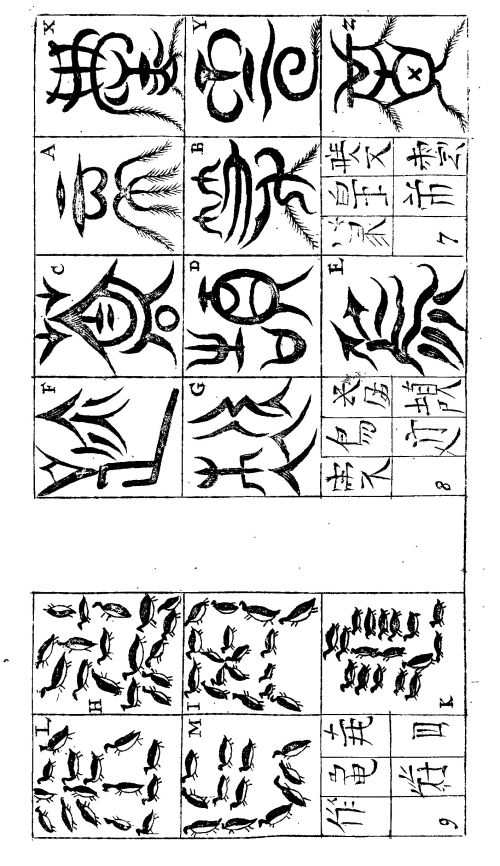
Kircher realized that Chinese characters were originally iconic and only later had grown extremely stylized over time, so as to lose their original similarity with things. He reconstructed after  his own fancy what he took to be the designs of fish and birds that had formed the starting points for current ideograms.

Kircher also realized that these ideograms did not express either letters or syllables, but referred to concepts. He noted that in order to translate our dictionary into their idiom we would need as many different characters as we had words (Oedipus, III, 11).

This led him to reflect on the amount of memory that was necessary for a Chinese scholar to know and remember all these characters.”

Umberto Eco, The Search for the Perfect Language, translated by James Fentress, Blackwell. Oxford, 1995, pp. 158-60.

Eco: Kircher’s Egyptology

kircher_008

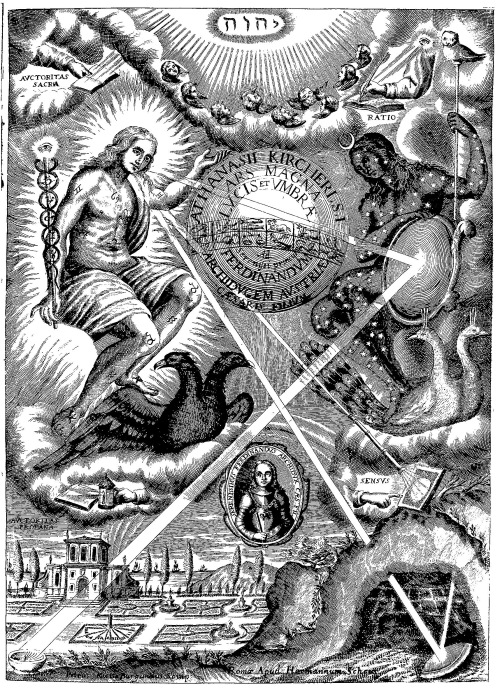
Athanasius Kircher (1602-80), frontispiece to Ars Magna Lucis et Umbrae, Rome, Scheus, 1646. Compendium Naturalis says that this allegorical engraving was executed on copper by Petrus Miotte Burgundus. Multiple copies are posted on the internet, including an eBook courtesy of GoogleBooks, one at the Max Planck Institute, one at the Herzog August Bibliothek, and one at Brigham Young University among many others. This work is in the public domain in its country of origin and other countries and areas where the copyright term is the author’s life plus 100 years or less. 

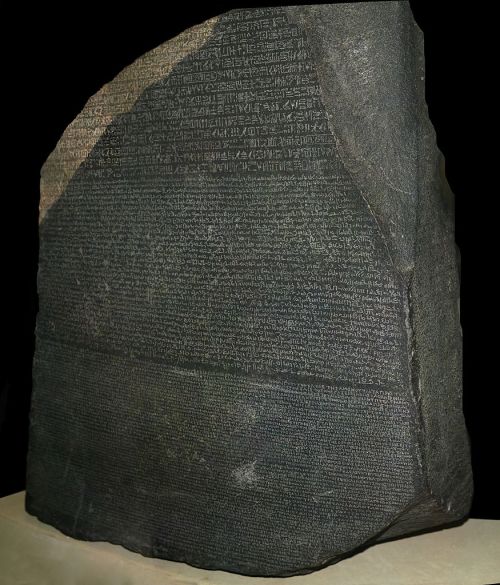
“When Kircher set out to decipher hieroglyphics in the seventeenth century, there was no Rosetta stone to guide him. This helps explain his initial, mistaken, assumption that every hieroglyph was an ideogram.

Understandable as it may have been, this was an assumption which doomed his enterprise at the outset. Notwithstanding its eventual failure, however, Kircher is still the father of Egyptology, though in the same way that Ptolemy is the father of astronomy, in spite of the fact that his main hypothesis was wrong.

In a vain attempt to demonstrate his hypothesis, Kircher amassed observational material and transcribed documents, turning the attention of the scientific world to the problem of hieroglyphs. Kircher did not base his work on Horapollo’s fantastic bestiary; instead, he studied and made copies of the royal hieroglyphic inscriptions.

His reconstructions, reproduced in sumptuous tables, have an artistic fascination all of their own. Into these reconstructions Kircher poured elements of his own fantasy, frequently reportraying the stylized hieroglyphs in curvaceous baroque forms.

Lacking the opportunity for direct observation, even Champollion used Kircher’s reconstructions for his study of the obelisk standing in Rome’s Piazza Navona, and although he complained of the lack of precision of many of the reproductions, he was still able to draw from them interesting and exact conclusions.

Already in 1636, in his Prodromus Coptus sive Aegyptiacus (to which was added, in 1643, a Lingua Aegyptiaca restituta), Kircher had come to understand the relation between the Coptic language and, on the one hand, Egyptian, and, on the other, Greek.

It was here that he first broached the possibility that all religions, even those of the Far East, were nothing more than more or less degenerated versions of the original Hermetic mysteries.

There were more than a dozen obelisks scattered about Rome, and restoration work on some of them had taken place from as early as the time of Sixtus V. In 1644, Innocent X was elected pope. His Pamphili family palace was in Piazza Navona, and the pope commissioned Bernini to execute for him the vast fountain of the four rivers, which remains there today.

On top of this fountain was to be placed the obelisk of Domitian, whose restoration Kircher was invited to superintend.

As the crowning achievement of this restoration, Kircher published, in 1650, his Obeliscus Pamphilius, followed, in 1652-4, by the four volumes of his Oedipus Aegyptiacus. This latter was an all-inclusive study of the history, religion, art, politics, grammar, mathematics, mechanics, medicine, alchemy, magic and theology of ancient Egypt, compared with all other eastern cultures, from Chinese ideograms to the Hebrew kabbala to the language of the brahmins of India.

The volumes are a typographical tour de force that demanded the cutting of new characters for the printing of the numerous exotic, oriental alphabets. It opened with, among other things, a series of dedications to the emperor in Greek, Latin, Italian, Spanish, French, Portuguese, German, Hungarian, Czech, Illirian, Turkish, Hebrew, Syriac, Arabic, Chaldean, Samaritan, Coptic, Ethiopic, Armenian, Persian, Indian and Chinese.

Still, the conclusions were the same as those of the earlier book (and would still be the same in the Obelisci Aegyptiaci nuper inter Isaei Romani rudera effosii interpretatio hieroglyphica of 1666 and in the Sphinx mystagoga of 1676).

At times, Kircher seemed to approach the intuition that certain of the hieroglyphs had a phonetic value. He even constructed a rather fanciful alphabet of 21 hieroglyphs, from whose forms he derives, through progressive abstractions, the letters of the Greek alphabet.

Kircher, for example, took the figure of the ibis bending its head until it rests between its two feet as the prototype of the capitalized Greek alpha, A. He arrived at this conclusion by reflecting on the fact that the meaning of the hieroglyphic for the ibis was “Bonus Daemon;” this, in Greek, would have been Agathos Daimon.

But the hieroglyph had passed into Greek through the mediation of Coptic, thanks to which the first sounds of a given word were progressively identified with the form of the original hieroglyph.

At the same time, the legs of the ibis, spread apart and resting on the ground, expressed the sea, or, more precisely, the only form in which the ancient Egyptians were acquainted with the sea–the Nile.

The word delta has remained unaltered in its passage into Greek, and this is why the Greek letter delta (Δ) has retained the form of a triangle.

It was this conviction that, in the end, hieroglyphs all showed something about the natural world that prevented Kircher from ever finding the right track. He thought that only later civilizations established that short-circuit between image and sound, which on the contrary characterized hieroglyphic writing from its early stages.

He was unable, finally, to keep the distinction between a sound and the corresponding alphabetic letter; thus his initial intuitions served to explain the generation of later phonetic alphabets, rather than to understand the phonetical nature of hieroglyphs.

Behind these errors, however, lies the fact that, for Kircher, the decipherment of hieroglyphs was conceived as merely the introduction to the much greater task–an explanation of their mystic significance.

Kircher never doubted that hieroglyphs had originated with Hermes Trismegistus–even though several decades before, Isaac Casaubon had proved that the entire Corpus Hermeticum could not be earlier than the first centuries of the common era.

Kircher, whose learning was truly exceptional, must have known about this. Yet he deliberately ignored the argument, preferring rather to exhibit a blind faith in his Hermetic axioms, or at least to continue to indulge his taste for all that was strange or prodigious.

Out of this passion for the occult came those attempts at decipherment which now amuse Egyptologists. On page 557 of his Obeliscus Pamphylius, figures 20-4 reproduce the images of a cartouche to which Kircher gives the following reading: “the originator of all fecundity and vegetation is Osiris whose generative power bears from heaven to his kingdom the Sacred Mophtha.”

This same image was deciphered by Champollion (Lettre à Dacier, 29), who used Kircher’s own reproductions, as “ΑΟΤΚΡΤΛ (Autocrat or Emperor) sun of the son and sovereign of the crown, ΚΗΣΡΣ ΤΜΗΤΕΝΣ ΣΒΣΤΣ (Caesar Domitian Augustus).”

The difference is, to say the least, notable, especially as regards the mysterious Mophtha, figured as a lion, over which Kircher expended pages and pages of mystic exegesis listing its numerous properties, while for Champollion the lion simply stands for the Greek letter lambda.

In the same way, on page 187 of the third volume of the Oedipus there is a long analysis of a cartouche that appeared on the Lateran obelisk. Kircher reads here a long argument concerning the necessity of attracting the benefits of the divine Osiris and of the Nile by means of sacred ceremonies activating the Chain of Genies, tied to the signs of the zodiac.

Egyptologists today read it as simply the name of the pharaoh Apries.”

Umberto Eco, The Search for the Perfect Language, translated by James Fentress, Blackwell. Oxford, 1995, pp. 154-8.

Eco: The Egyptian Alphabet, 3

PE40_H78_F84_Horapollo_p128-9_Hieroglyphica

Horapollo (c. 5th century CE), Hori Apollinis selecta hieroglyphica, Romae: sumtibus Iulij Francescschini, ex typographia Aloysij Zanetti, 1599, pp. 128-9. Brooklyn Museum Libraries, Wilbur Library of Egyptology, Special Collections, call number PE40 H78 F84. This work is in the public domain in its country of origin and other countries and areas where the copyright term is the author’s life plus 100 years or less.

Alciati’s commentary refers to the passage describing the stork in the Hieroglyphica. Yet we have just seen that there is no reference either to the feeding of the young or to the transport of the parents. These features are, however, mentioned in a fourth century AD text, the Hexaemeron of Basil (VIII, 5).

In other words, the information contained in the Hieroglyphica was already at the disposal of European culture. A search for traces of the stork from the Renaissance backwards is filled with pleasant surprises.

In the Cambridge Bestiary (twelfth century CE), we read that storks nourish their young with exemplary affection, and that “they incubate the nests so tirelessly that they lose their own feathers. What is more, when they have moulted in this way, they in turn are looked after by the babies, for a time corresponding in length to the time which they themselves have spent in bringing up and cherishing their offspring.” (The Bestiary, T.H. White, ed., New York: Putnam’s Sons, 1960: pp. 117-8).

The accompanying image shows a stork that carries a frog in its beak, obviously a dainty morsel for its young.

The Cambridge Bestiary has taken this idea from Isidore of Seville, who, in the Etymologiarum (XII, vii), says more or less the same. Who then are Isidore’s sources? St. Basil we have already seen; there was St. Ambrose as well (Hexaemeron, V, 16, 53), and possibly also Celsus (cited in Origen, Contra Celsum, IV, 98) and Porphyry (De abstinentia, III, 23, 1). These, in their turn, used Pliny’s Naturalis historia (X, 32) as their source.

Pliny, of course, could have been drawing on an Egyptian tradition, if Aelian, in the second to third century AD, could claim (though without citing Pliny by name) that “Storks are venerated among the Egyptians because they nourish and honor their parents when they grow old” (De animalium natura, X, 16).

But the idea can be traced back even further. The same notion is to be found in Plutarch (De solertia animalium, 4), Cicero (De finibus bonorum et malorum, II, 110), Aristotle (Historia animalium, IX, 7, 612b, 35), Plato (Alcibiades, 135 E), Aristophanes (The Birds, 1355), and finally in Sophocles (Electra, 1058).

There is nothing to prevent us from imagining that Sophocles himself was drawing on ancient Egyptian tradition; but, even if he were, it is evident that the story of the stork has been part of occidental culture for as long as we care to trace it.

It follows that Horapollo did not reveal anything hot. Moreover, the origin of this symbol seems to have been Semitic, given that, in Hebrew, the word for stork means “the one who has filial piety.”

Read by anyone familiar with medieval and classical culture, Horapollo’s booklet seems to differ very little from the bestiaries current in the preceding centuries. It merely adds some information about specifically Egyptian animals, such as the ibis and the scarab and neglects make certain of the standard moralizing comments or biblical references.

This was clear even to the Renaissance. In his Hieroglyphica sive de sacris Aegyptorum aliarumque gentium literis of 1556, Pierio Valeriano never tired of employing his vast stock of knowledge of classical and Christian sources to note the occasions where the assertions of Horapollo might be confirmed.

Yet instead of reading Horapollo in the light of a previous tradition, he revisits this whole tradition in the light of Horapollo.

With a barrage of citations from Latin and Greek authors, Giulio Cesare Capaccio displayed, in his Delle imprese of 1592, his perfect mastery of older traditions. Yet fashion now demanded that he interpreted this tradition in a Egyptian key.

“Without hieroglyphic observation,” and without having recourse to the Monas hieroglyphicaquel Giovanni Dee da Londino,” it was impossible, he said, to endow these images (coming from centuries of western culture) with their proper recondite meanings.

We are speaking of the “rereading” of a text (or of a network of texts) which had not been changed during the centuries. So what has changed? We are here witnessing a semiotic incident which, as paradoxical as some of its effects may have been, was, in terms of its own dynamic, quite easy to explain.

Horapollo’s text (qua text) differs but little from other similar writings, which were previously known. None the less, the humanists read it as a series of unprecedented statements. The reason is simply that the readers of the fifteenth century saw is as coming from a different author.

The text had not changed, but the “voice” supposed to utter it was endowed with a different charisma. This changed the way in which the text was received and the way in which it was consequently interpreted.

Thus, as old and familiar as these images were, the moment they appeared as transmitted not by the familiar Christian and pagan sources, but by the ancient Egyptian divinities themselves, they took on a fresh, and radically different, meaning.

For the missing scriptural commentaries there were substituted allusions to vague religions mysteries. The success of the book was due to its polysemy. Hieroglyphs were regarded as initiatory symbols.

They were symbols, that is, expressions that referred to an occult, unknown and ambivalent content. In contradistinction to conjecture, in which we take a visible symptom and infer from it its cause, Kircher defined a symbol as:

“a nota significativa of mysteries, that is to say, that it is the nature of a symbol to lead our minds, by means of certain similarities, to the understanding of things vastly different from the things that are offered to our external senses, and whose property it is to appear hidden under the veil of an obscure expression. [ . . . ] Symbols cannot be translated by words, but expressed only by marks, characters, and figures. (Obeliscus Pamphilius, II, 5, 114-20).”

These symbols were initiatory, because the allure of Egyptian culture was given by the promise of a knowledge that was wrapped in an impenetrable and indecipherable enigma so as to protect it from the idle curiosity of the vulgar multitudes.

The hieroglyph, Kircher reminds us, was the symbol of a sacred truth (thus, though all hieroglyphs are symbols, it does not follow that all symbols are hieroglyphs) whose force derived from its impenetrability to the eyes of the profane.”

Umberto Eco, The Search for the Perfect Language, translated by James Fentress, Blackwell. Oxford, 1995, pp. 151-4.

(Editorial Note: I must mention Mr. William Thayer, whose LacusCurtius site at the University of Chicago links to a whopping 51 complete texts by ancient authors and more. I stumbled across Mr. Thayer’s page as I linked to classical writers, and I find it to be both indispensable and a staggering contribution to online scholarship.

Thank you for this work, Mr. Thayer. I am one of the crazy ones out here in internet-land who realizes what you have done. With my best regards.)

Eco: The Egyptian Alphabet, 2

ngcs.staatsbibliothek-berlin.de

Stephan Michelspacher, Cabala, Spiegel der Kunst und Natur in Alchymia, (Cabala, the Mirror of Art and Nature in Alchemy), Augsburg, 1615. Also hosted courtesy of the Bayerische Staats Bibliothek. This work is in the public domain in its country of origin and other countries and areas where the copyright term is the author’s life plus 100 years or less. 

“Now we can understand what Horapollo sought to reveal. He wished to preserve and transmit a semiotic tradition whose key was, by now, entirely lost. He still managed to grasp certain features at either the phonetic or the ideographic level, yet much of his information was confused or scrambled in the course of transmission.

Often he gives, as the canonical solution, a reading elaborated only by a certain group of scribes during a certain, limited period.

Yoyotte (1955: 87) shows that when Horapollo asserts that Egyptians depicted the father with the ideogram for the scarab beetle, he almost certainly had in mind that, in the Late Period, certain scribes had begun to substitute the scarab for the usual sign for t to represent the sound it (“father”), since, according to a private cryptography developed during the eighteenth dynasty, a scarab stood for t in the name Atum.

Horapollo opened his text by saying that the Egyptians represented eternity with the images of the sun and the moon. Contemporary Egyptologists debate whether, in this explanation, he was thinking of two ideograms used in the Late Period which could be read phonetically as, respectively, r’nb (“all the days”) and r tr.wì (“night and day” that is, “always”); or whether Horapollo was thinking instead of Alexandrine bas reliefs where the two ideograms, appearing together, already signify “eternity” (in which case they would not be an Egyptian symbol, but one derived from Asian, even Hebraic sources).

In other places, Horapollo seems to have misunderstood the voices of tradition. He says, for instance, that the sign to indicate a word is depicted by a tongue and a blood shot eye. There exists a verbal root mdw (“to speak”) in whose ideogram there appears a club, as well as the word dd (“to say”) in whose ideogram appears a snake.

It is possible that either Horapollo or his source has erroneously taken either the club or the snake or both as representing a tongue. He then says that the course of the sun during the winter solstice is represented by two feet stopped together.

In fact, Egyptologists only know a sign representing two legs in motion, which supports the sense “movement” when accompanying signs meaning “to stop,” “to cease activity” or “to interrupt a voyage.” The idea that two stopped feet stand for the course of the sun seems merely to be a whim of Horapollo.

Horapollo says that Egypt is denoted by a burning thurible with a heart over it. Egyptologists have discovered in a royal epithet two signs that indicate a burning heart, but these two signs seem never to have been used to denote Egypt.

It does emerge, however, that (for a Father of the church such as Cyril of Alexandria) a brazier surmounted by a heart expressed anger (cf. Van der Walle and Vergot 1943).

This last detail may be an important clue. The second part of Hieroglyphica is probably the work of the Greek translator, Philippos. It is in this part that a number of clear references appear to the late Hellenistic tradition of the Phisiologus and other bestiaries, herbariums and lapidaries that derive from it.

This is a tradition whose roots lie not only in ancient Egypt, but in the ancient traditions throughout Asia, as well as in the Greek and Latin world.

We can look for this in the case of the stork. When the Hieroglyphica reaches the stork, it recites:

“How [do you represent] he who loves the father.

If they wish to denote he who loves the father, they depict a stork. In fact, this beast, nourished by its parents, never separates itself from them, but remains with them until their old age, repaying them with piety and deference.”

In fact, in the Egyptian alphabet, there is an animal like a stork which, for phonetic reasons, stands for “son.” Yet in I, 85, Horapollo gives this same gloss for the hoopoe. This is, at least, an indication that the text has been assembled syncretistically from a variety of sources.

The hoopoe is also mentioned in the Phisiologus, as well as in a number of classical authors, such as Aristophanes and Aristotle, and patristic authors such as St. Basil. But let us concentrate for a moment on the stork.

The Hieroglyphica was certainly one of the sources for the Emblemata of Andrea Alciati in 1531. Thus, it is not surprising to find here a reference to the stork, who, as the text explains, nourishes its offspring by bringing them pleasing gifts, while bearing on its shoulders the worn-out bodies of its parents, offering them food from its own mouth.

The image that accompanies this description in the 1531 edition is of a bird which flies bearing another on its back. In subsequent editions, such as the one from 1621, for this is substituted the image of a bird that flies with a worm in its beak for its offspring, waiting open-mouthed in the nest.”

Umberto Eco, The Search for the Perfect Language, translated by James Fentress, Blackwell. Oxford, 1995, pp. 149-51.

Eco: The Egyptian Alphabet

Rosetta_Stone

The Rosetta Stone, inscribed with a decree by Pharaoh Ptolemy V at Memphis, is dated to 196 BCE. Featuring three scripts, ancient Egyptian, Demotic and ancient Greek, the stele was discovered in 1799 by French soldier Pierre-Françoise Bouchard of the Napoleonic expedition to Egypt. Transferred to British control after the Capitulation of Alexandria in 1801, the stele has been on continual exhibition at the British Museum since 1802. The script was finally transliterated by Jean-Françoise Champollion in 1822, decrypting the mysteries of the Egyptian hieroglyphs. This photo © Hans Hillewaert in 2007, and is licensed under the Creative Commons Attribution-Share Alike 4.0 International license. This work is in the public domain in its country of origin and other countries and areas where the copyright term is the author’s life plus 100 years or less.  

“The hieroglyphic script is undoubtedly composed, in part, of iconic signs: some are easily recognizable–vulture, owl, bull, snake, eye, foot, man seated with a cup in hand; others are stylized–the hoisted sail, the almond-like shape for a mouth, the serrated line for water.

Some other signs, at least to the untrained eye, seem to bear only the remotest resemblance to the things that they are supposed to represent–the little square that stands for a seat, the sign of folded cloth, or the semicircle that represents bread.

All these signs are not icons (representing a thing by direct similarity) but rather ideograms, which work by a sort of rhetorical substitution. Thus an inflated sail serves to represent the wind; a man seated with a cup means to drink; a cow’s ear means to understand; the head of a cynocephalus stands for the god Thoth and for all his various attributes, such as writing and counting.

Not everything, however, can be represented ideographically. One way that the ancient Egyptians had found to circumvent this difficult was to turn their ideograms into simple phonograms.

In order to represent a certain sound they put the image of a thing whose name sounded similar. To take an example from Jean-Françoise Champollion‘s first decipherment (Lettre à Dacier, 17 September 1822, 11-12), the mouth, in Egyptian ro, was chosen to represent the Greek consonant P (rho).

It is ironic to think that while, for Renaissance Hermeticists, sounds had to represent the nature of things, for the Egyptians, things (or their corresponding images) were representing sounds (see, for a similar procedure, my remarks in chapter 6 on Bruno’s mnemonics).

By the time interest in Egyptian hieroglyphics had revived in Europe, however, knowledge of the hieroglyphic alphabet had been lost for over a thousand years. The necessary premise for the decipherment of hieroglyphs was a stroke of pure fortune, like the discovery of a bilingual dictionary.

In  fact, as is well known, decipherment was made possible by the discovery not of a dictionary, but of a trilingual text, the famous Rosetta Stone, named after the city of Rashid where it was found by a French soldier in 1799, and, as a result of Napoleon’s defeat at the hands of Nelson, soon transferred to London.

The stone bore an inscription in hieroglyphic, in demotic (a cursive, administrative script elaborated about 1,000 BCE), and in Greek.

Working from reproductions, Champollion, in his Lettre à Dacier, laid the foundation for the decipherment of hieroglyphs. He compared two cartouches which, from their position in the text, he guessed must refer to the names of Ptolemy (ΠΤΟΛΟΜΑΙΟΣ) and Cleopatra (ΚΛΟΠΑΤΡΑ).

He identified the five letters that both names have in common (Π, Τ, Ο, Λ, Α), and found that the two cartouches had five hieroglyphs in common as well. By supposing that each other instance of the same sign represented the same sound, Champollion could easily infer the phonetic value of the remaining text.

Champollion’s decipherment does not, however, explain a series of phenomena which can justify the interpretation of Horapollo. Greek and Roman colonizers had imposed on Egypt their commerce, their technology and their gods.

By the time of the spread of Christianity, Egypt had already abandoned many of its ancient traditions. Knowledge of sacred writing was still preserved and practiced only by priests living within the sacred enclosures of the ancient temples.

These were a dwindling breed: in those last repositories of a lost knowledge, cut off from the rest of the world, they cultivated the monuments of their ancient culture.

Since the sacred writing no longer served any practical use, but only initiatory purposes, these last priests began to introduce complexities into it, playing with the ambiguities inherent in a form of writing that could be differently read either phonetically or ideographically.

To write the name of the god Ptah, for example, the P was expressed phonetically and placed at the top of the name with the ideogram for sky (p[t]), the H was placed in the middle and represented by the image of the god Heh with his arms raised, and the T was expressed by the ideogram for the earth (ta).

It was an image that not only expressed Ptah phonetically, but also carried the visual suggestion that the god Ptah had originally separated the earth from the sky.

The discovery that, by combining different hieroglyphs, evocative visual emblems might be created inspired these last scribes to experiment with increasingly complicated and abstruse combinations.

In short, these scribes began to formulate a sort of kabbalistic play, based, however, on images rather than on letters.

Around the term represented by a sign (which was given an initial phonetic reading) there formed a halo of visual connotations and secondary senses, a sort of chord of associated meanings which served to amplify the original semantic range of the term.

The more the sacred text was enhanced by its exegetes, the more the conviction grew that they expressed buried truths and lost secrets (Sauneron 1957: 123-7).

Thus, to the last priests of a civilization sinking into oblivion, hieroglyphs appeared as a perfect language. Yet their perfection could only be understood by visually reading them; if by chance still pronounced, they would have lost any magic (Sauneron 1982: 55-6).”

Umberto Eco, The Search for the Perfect Language, translated by James Fentress, Blackwell. Oxford, 1995, pp. 146-9.

Eco: Horapollo’s Hieroglyphica

Duerer, Albrecht (1471-1528)

Albrecht Dürer (1471-1528), The Sun, the Moon and a Basilisk, circa 1512. The Sun, the Moon and the Basilisk (half eagle, half serpent, hatched from a cock’s egg by a serpent), represent Eternity. This drawing from a fragment is on the back of a manuscript translation of the Hieroglyphica by Horapollo translated by Willibald Pirkheimer, an associate of Dürer. Alexander Cory’s 1840 edition is posted on the Sacred Texts site, and the 1595 Mercier and Hoeschel edition in Latin and Greek is hosted on Archive.org due to the kind courtesy of the Getty Research Institute and the Sloan Foundation. This work is in the public domain in its country of origin and other countries and areas where the copyright term is the author’s life plus 100 years or less.  

“In 1419 Cristoforo de’ Buondelmonti acquired from the island of Andros a mysterious manuscript that was soon to excite the curiosity of philosophers such as Ficino: the manuscript was the Greek translation (by a certain Philippos) of the Horapòllonos Neiloùs ieroglyphikà.

The original author, Horapollo–or Horus Apollos, or Horapollus–was thus qualified as “Nilotic.” Although it was taken as genuinely archaic throughout the Renaissance, scholars now believe this text to be a late Hellenistic compilation, dating from as late as the fifth century AD.

As we shall see, although certain passages indicate that the author did possess exact information about Egyptian hieroglyphs, the text was written at a time when hieroglyphic writing had certainly fallen out of use. At best, the Hieroglyphica seems to be based on some texts written a few centuries before.

The original manuscript contained no images. Illustrations appeared only in later editions: for instance, though the first translation into Italian in 1547 is still without illustrations, the 1514 translation into Latin was illustrated by Dürer.

The text is divided into short chapters in which it is explained, for example, that the Egyptians represented age by depicting the sun and the moon, or the month by a palm branch.

There follows in each case a brief description of the symbolic meaning of each figure, and in many cases its polysemic value: for example, the vulture is said to signify mother, sight, the end of a thing, knowledge of the future, year, sky, mercy, Minerva, Juno, or two drachmas.

Sometimes the hieroglyphic sign is a number: pleasure, for example, is denoted by the number 16, because sexual activity begins at the age of sixteen. Since it takes two to have intercourse, however, this is denoted by two 16’s.

Humanist philosophical culture was immediately fascinated by this text: hieroglyphs were regarded as the work of the great Hermes Trismegistus himself, and therefore as a source of inexhaustible wisdom.

To understand the impact of Horopollo’s text on Europe, it is first necessary to understand what, in reality, these mysterious symbols were. Horopollo was describing a writing system, whose last example (as far as Egyptologists can trace) is on the Theodosius temple (AD 394).

Even if these inscriptions were still similar to those elaborated three thousand years before, the Egyptian language of the fifth century had changed radically. Thus, when Horopollo wrote his text, the key to understanding hieroglyphs had long been lost.”

Umberto Eco, The Search for the Perfect Language, translated by James Fentress, Blackwell. Oxford, 1995, pp. 145-6.

Eco: The Perfect Language of Images

original

Iamblicus (250-325 CE), De Mysteriis Aegyptiorum, Chaldoaerum, AssyriorumOn the Mysteries of the Egyptians, Chaldeans and Assyrians, Lyon: Joannis Tornaesium, 1577. In 2000, Joseph Peterson published a translation from the Greek by Alexander Wilder dated 1911 on the Esoteric Archives. A Latin edition published by Marsilio Ficino in Venice in 1497 is on AussagenLogic.org, with several exemplars on Google Books. This work is in the public domain in its country of origin and other countries and areas where the copyright term is the author’s life plus 100 years or less. 

“Already in Plato, as in Pythagoras before him, there appeared a veneration for the ancient wisdom of the Egyptians. Aristotle was more skeptical, and when he came to recount the history of philosophy in the first book of the Metaphysics, he started directly with the Greeks.

Influenced by Aristotle, the Christian authors of the Middle Ages showed relatively little curiosity about ancient Egypt. References to this tradition can be found only in marginal alchemical texts like Picatrix.

Isidore of Seville shortly mentioned the Egyptians as the inventors of geometry and astronomy, and said that the original Hebrew letters became the basis for the Greek alphabet when Isis, queen of the Egyptians, found them and brought them back to her own country (Etymologiarum, I, iii, 5).

By contrast, one could put the Renaissance under the standard of what Baltrušaitis (1967) has called the “search for Isis.” Isis became thus the symbol for an Egypt regarded as the wellspring of original knowledge, and the inventor of a sacred scripture, capable of expressing the unfathomable reality of the divine.

The Neoplatonic revival, in which Ficino played the role of high priest, restored to Egypt its ancient primacy.

In the Enneads (V, 8, 5-6) Plotinus wrote:

“The wise sages of Egypt [ . . . ] in order to designate things with wisdom do not use designs of letters, which develop into discourses and propositions, and which represent sounds and words; instead they use designs of images, each of which stands for a distinct thing; and it is these that they sculpt onto their temples. [ . . . ] Every incised sign is thus, at once, knowledge, wisdom, a real entity captured in one stroke.”

Iamblicus, in his De mysteriis aegyptiorum, said that the Egyptians, when they invented their symbols, imitating the nature of the universe and the creation of the gods, revealed occult intuitions by symbols.

The translation of the Corpus Hermeticum (which Ficino published alongside his translations of Iamblicus and other Neoplatonic texts) was under the sign of Egypt, because, for Ficino, the ancient Egyptian wisdom came from Hermes Trismegistus.”

Umberto Eco, The Search for the Perfect Language, translated by James Fentress, Blackwell. Oxford, 1995, pp. 144-5.

Eco: Infinite Songs & Locutions, 2

50arbreu_fig3_escorial

Ramon Llull (1232-1315), La Tercera Figura, from Ars brevis, Pisa, 1308. This illustration is hosted on the net by the Centre de Documentacio de Ramon Llull, while the original is held in the Escorial, MS.f-IV-12, folio 6. This work is in the public domain in its country of origin and other countries and areas where the copyright term is the author’s life plus 100 years or less.

Mersenne and Guldin were anticipating Borge’s Babel Library ad abundantiam. Not only this, Guldin observed that if the numbers are these, who can marvel at the existence of so many different natural languages?

The art was now providing an excuse for the confusio linguarum. It justifies it, however, by showing that it is impossible to limit the omnipotence of God.

Are there more names than things? How many names, asks Mersenne (Harmonie, II, 72), would we need if were to give more than one to each individual? If Adam really did give names to everything, how long would he have had to spend in Eden?

In the end, human languages limit themselves to the naming of general ideas and of species; to name an individual thing, an indication with a finger is usually sufficient (p. 74).

If this were not so, it might easily “happen that for every hair on the body of an animal and for each hair on the head of a man we might require a particular name that would distinguish it from all others. Thus a man with 100,000 hairs on his head and 100,000 more on his body would need to know 200,000 separate words to name them all” (pp. 72-3).

In order to name every individual thing in the world one should thus create an artificial language capable of generating the requisite number of locutions. If God were to augment the number of individual things unto infinity, to name them all it would be enough to devise an alphabet with a greater number of letters, and this would provide us with the means to name them all (p. 73).

From these giddy heights there dawns a consciousness of the possibility of the infinite perfectibility of knowledge. Man, the new Adam, possesses the possibility of naming all those things which his ancestor had lacked the time to baptize.

Yet such an artificial language would place human beings in competition with God, who has the privilege of knowing all things in their particularity. We shall see that Leibniz was later to sanction the impossibility of such a language.

Mersenne had led a battle against the kabbala and occultism only to be seduced in the end. Here he is cranking away at Lullian wheels, seemingly unaware of the difference between the real omnipotence of God and the potential omnipotence of a human combinatory language.

Besides, in his Quaestiones super Genesim (cols 49 and 52) he claimed that the presence of the sense of infinity in human beings was itself a proof of the existence of God.

This capacity to conceive of a quasi-infinite series of combinations depends on the fact that Mersenne, Guldin, Clavius and others (see, for example, Comenius, Linguarum methodus novissima (1648: III, 19), unlike Lull, were no longer calculating upon concepts but rather upon simple alphabetic sequences, pure elements of expression with no inherent meaning, controlled by no orthodoxy other than the limits of mathematics itself.

Without realizing it, these authors are verging towards the idea of a “blind thought,” a notion that we shall see Leibniz proposing with a greater critical awareness.”

Umberto Eco, The Search for the Perfect Language, translated by James Fentress, Blackwell. Oxford, 1995, pp. 141-3.

Eco: Infinite Songs & Locutions

cover_issue_206_en_US

Giordano Bruno (1548-1600), memory wheel, De Umbris Idearum, 1582, reconstructed by Dame Frances Yates, Warburg Institute. Frances Yates wrote Giordano Bruno and the Hermetic Tradition, Chicago, 1964. This work is in the public domain in its country of origin and other countries and areas where the copyright term is the author’s life plus 100 years or less.  

 “Between Lull and Bruno might be placed the game invented by H.P. Harsdörffer in his Matematische und philosophische Erquickstunden (1651: 516-9). He devises 5 wheels containing 264 units (prefixes, suffixes, letters and syllables).

This apparatus can generate 97,209,600 German words, including many that were still non-existent but available for creative and poetic use (cf. Faust 1981: 367). If this can be done for German, why not invent a device capable of generating all possible languages?

The problem of the art of combination was reconsidered in the commentary In spheram Ioannis de sacro bosco by Clavius in 1607. In his discussion of the four primary qualities (hot, cold, dry and wet), Clavius asked how many pairs they might form.

Mathematically, we know, the answer is six. But some combinations (like “hot and cold,” “dry and wet”) are impossible, and must be discarded, leaving only the four acceptable combinations: “Cold and dry” (earth), “hot and dry” (fire), “hot and wet” (air), “cold and wet” (water).

We seem to be back with the problem of Lull: a conventional cosmology limits the combinations.

Clavius, however, seemed to wish to go beyond these limits. He asked how many dictiones, or terms, might be produced using the 23 letters of the Latin alphabet (u being the same as v), combining them 2, 3, 4 at a time, and so on until 23.

He supplied a number of mathematical formulae for the calculations, yet he soon stopped as he began to see the immensity of the number of possible results–especially as repetitions were permissible.

In 1622, Paul Guldin wrote a Problema arithmeticum de rerum combinationibus (cf. Fichant 1991: 136-8) in which he calculated the number of possible locutions generated by 23 letters. He took into account neither the question of whether the resulting sequences had a sense, nor even that of whether they were capable of being pronounced at all.

The locutions could consist of anything from 2 to 23 letters; he did not allow repetitions. He arrived at a result of more than 70,000 billion billion. To write out all these locutions would require more than a million billion billion letters.

To conceive of the enormity of this figure, he asked the reader to imagine writing all these words in huge notebooks: each of these notebooks had 1,000 pages; each of these pages had 100 lines; each of these lines could accommodate 60 characters.

One would need 257 million billion of these notebooks. Where would you put them all? Guldin then made a careful volumetric study, imagining shelf space and room for circulation in the libraries that might store a consignment of these dimensions.

If you housed the notebooks in large libraries formed by cubes whose sides measured 432 feet, the number of such cubic buildings (hosting 32 million volumes each) would be 8,050,122,350. And where would you put them all? Even exhausting the total available surface space on planet earth, one would still find room for only 7,575,213,799!

In 1636 Father Marin Mersenne, in his Harmonie universelle, asked the same question once again. This time, however, to the dictiones he added “songs,” that is, musical sequences.

With this, the conception of universal language has begun to appear, for Mersenne realizes that the answer would necessarily have to include all the locutions in all possible languages. He marveled that our alphabet was capable of supplying “millions more terms than the earth has grains of sand, yet it is so easy to learn that one hardly needs memory, only a touch of discernment” (letter to Peiresc, c. April 1635; cf. Coumet 1975; Marconi 1992).

In the Harmonie, Mersenne proposed to generate only pronounceable words in French, Greek, Arabic, Chinese and every other language. Even with this limitation one feels the shudder provoked by a sort of Brunian infinity of possible worlds.

The same can be said of the musical sequences that can be generated upon an extension of 3 octaves, comprising 22 notes, without repetitions (shades of future 12-tone compositions!).

Mersenne observed that to write down all these songs would require enough reams of paper to fill in the distance between heaven and earth, even if every sheet contained 720 of these 22-note songs and every ream was so compressed as to be less than an inch thick.

In fact the number of possible songs amounted to 1,124,000,727,777,607,680,000 (Harmonie, 108). By dividing this figure by the 362,880 songs contained in each ream, one would still obtain a 16-digit figure, whilst the number of inches between the center of the earth and the stars is only 28,826,640,000,000 (a 14-digit figure).

Anyone who wished to copy out all these songs, a thousand per day, would have to write for 22,608,896,103 years and 12 days.”

Umberto Eco, The Search for the Perfect Language, translated by James Fentress, Blackwell. Oxford, 1995, pp. 139-41.

Eco: Bruno: Ars Combinatoria & Infinite Worlds, 3

b263063a82f44eff07e1cdb2b38780b0

Giordano Bruno (1548-1600), a mnemonic diagram, which appears towards the end of Cantus circaeus (Incantation of Circe), 1582, which also appears on the cover of Opere mnemotecniche, Vol. 1: De umbris idearum, 1582, Rita Sturlese, et al, ed. This work is in the public domain in its country of origin and other countries and areas where the copyright term is the author’s life plus 100 years or less.

“In her critical edition of De umbris (1991), Sturlese gives an interpretation of the use of the wheels that differs sharply from the “magical” interpretation given by Yates (1972). For Yates, the wheels generated syllables by which one memorizes images to be used for magical purposes.

Sturlese inverts this: for her, it is the images that serve to recall the syllables. Thus, for Sturlese, the purpose of the entire mnemonical apparatus was the memorization of an infinite multitude of words through the use of a fixed, and relatively limited, number of images.

If this is true, then it is easy to see that Bruno’s system can no longer be treated as an art where alphabetic combinations lead to images (as if it were a scenario-generating machine); rather, it is a system that leads from combined images to syllables.

Such a system not only aids memorization but, equally, permits the generation of an almost unlimited number of words–be they long and complex like incrassatus or permagnus, or difficult like many Greek, Hebrew, Chaldean, Persian or Arabic terms (De umbris, 169), or rare like scientific names of grass, trees, minerals, seeds or animal genera (De umbris, 152). The system is thus designed to generate languages–at least at the level of nomenclature.

Which interpretation is correct? Does Bruno concatenate the sequence CROCITUS to evoke the image of Pilumnus advancing rapidly on the back of a donkey with a bandage on his arm and a parrot on his head, or has he assembled these images so as to memorize CROCITUS?

In the “Prima Praxis” (De umbris, 168-72) Bruno tells us that it is not indispensable to work with all five wheels because, in most known languages, it is rare to find words containing syllables with four or five letters.

Furthermore, where such syllables do occur (for instance, in words like trans-actum or stu-prans), it is usually eash to devise some artifice that will obviate the necessity of using the fourth and fifth wheel.

We are not interested in the specific short cuts that Bruno used except to say that they cut out several billion possibilities. It is the very existence of such short cuts that seems significant.

If the syllabic sequences were expressing complex images, there should be no limit for the length of the syllables. On the contrary, if the images were expressing syllables, there would be an interest in limiting the length of the words, following the criteria of economy already present in most natural languages (even though there is no formal limit, since Leibniz will later remark that there exists in Greek a thirty-one-letter word).

Besides, if the basic criterion of every art of memory is to recall the unfamiliar through the more familiar, it seems more reasonable that Bruno considered the “Egyptian” traditional images as more familiar than the words of exotic languages.

In this respect, there are some passages in De umbris that are revealing: “Lycas in convivium cathenatus presentabat tibi AAA. . . . Medusa, cum insigni Plutonis presentabit AMO” (“Lycaon enchained in a banquet presents to you AAA . . . Medusa with the sign of Pluto presents AMO”).

Since all these names are in the nominative case, it is evident that they present the letters to the user of the system and not the other way around. This also follows from a number of passages in the Cantus circaeus where Bruno uses perceivable images to represent mathematical or abstract concepts that might not otherwise be imaginable or memorizable (cf. Vasoli 1958: 284ff).

That Bruno bequeathed all this to the Lullian posterity can be seen from further developments of Lullism.”

Umberto Eco, The Search for the Perfect Language, translated by James Fentress, Blackwell. Oxford, 1995, pp. 137-9.

Eco: Bruno: Ars Combinatoria & Infinite Worlds, 2

1280px-6665_-_Roma_-_Ettore_Ferrari,_Monumento_a_Giordano_Bruno_(1889)_-_Foto_Giovanni_Dall'Orto,_6-Apr-2008

Ettore Ferrari (1845-1929), Giordano Bruno Burned at the Stake, a bas relief on the plinth of the monument to Bruno in Campo de’Fiori square in Rome. This photo by Giovanni Dall’Orto © 2008. The copyright holder of this photo allows anyone to use for any purpose, provided that the copyright holder is properly attributed. Redistribution, derivative work, commercial use, and all other use is permitted.  


“Thus this language claimed to be so perfect as to furnish the keys to express relations between things, not only of this world, but of any of the other infinite worlds in their mutual concordance and opposition.

Nevertheless, in its semiotic structure, it was little more than an immense lexicon, conveying vague meanings, with a very simplified syntax. It was a language that could be deciphered only by short-circuiting it, and whose decipherment was the privilege only of the exegete able to dominate all its connections, thanks to the furor of Bruno’s truly heroic style.

In any case, even if his techniques were not so different from those of other authors of arts of memory, Bruno (like Lull, Nicholas of Cusa and Postel, and like the reformist mystics of the seventeenth century–at whose dawn he was to be burnt at the stake) was inspired by a grand utopian vision.

His flaming hieroglyphical rhetoric aimed at producing, through an enlargement of human knowledge, a reform, a renovation, maybe a revolution in the consciousness, customs, and even the political order of Europe. Of this ideal, Bruno was the agent and propagandist, in his wandering from court to European court.

Here, however, our interest in Bruno is limited to seeing how he developed Lullian techniques. Certainly, his own metaphysics of infinite worlds pushed him to emphasize the formal and architectonic aspects of Lull’s endeavor.

One of his mnemonic treatises, De lampade combinatoria lulliana ad infinita propositiones et media inveniendi (1586), opens by mentioning the limitless number of propositions that the Ars is capable of generating, and then says: “The properties of the terms themselves are of scant importance; it is only important that they show an order, a texture, an architecture.” (I, ix).

In the De umbris idearum (1582) Bruno described a set of movable, concentric wheels subdivided into 150 sectors. Each wheel contained 30 letters, made up of the 23 letters of the Latin alphabet, plus 7 letters from the Greek and Hebrew alphabets to which no letter corresponded in Latin (while, for instance, A could also stand for Alpha and Alef).

To each of the single letters there corresponded a specific image, representing for each respective wheel a different series of figures, activities, situations, etc. When the wheels were rotated against each other in the manner of a combination lock, sequences of letters were produced which served to generate complex images. We can see this in Bruno’s own example (De umbris, 163):

Giordano Bruno, De umbris, 163

Reproduced from Umberto Eco, The Search for the Perfect Language, James Fentress, trans., Blackwell: Oxford, 1995, p. 136, from Giordano Bruno, De umbris idearum, 1582, p. 163. 

In what Bruno called the “Prima Praxis,” the second wheel was rotated so as to obtain a combination such as CA (“Apollo in a banquet”). Turning the third wheel, he might obtain CAA (“Apollo enchained in a banquet”). We shall see in a moment why Bruno did not think it necessary to add fourth and fifth wheels as he would do for the “Secunda Praxis,” where they would represent, respectively, adstantia and circumstantias.

In his “Secunda Praxis,” by adding the five vowels to each of the 30 letters of his alphabet, Bruno describes 5 concentric wheels, each having 150 alphabetical pairs, like AA, AE, AI, AO, AU, BA, BE, BO, and so on through the entire alphabet.

These 150 pairs are repeated on each of the 5 wheels. As in the “Prima Praxis,” the significance changes with every wheel. On the first wheel, the initial letter signifies a human agent, on the second, an action, on the third, an insignia, on the fourth, a bystander, on the fifth, a set of circumstances.

By moving the wheels it is possible to obtain images such as “a woman riding on a bull, combing her hair while holding a mirror in her left hand, accompanied by an adolescent carrying a green bird in his hand” (De umbris, 212, 10).

Bruno speaks of images “ad omnes formationes possible, adaptabiles” (De umbris, 80), that is, susceptible of every possible permutation. In truth, it is almost impossible to write the number of sequences that can be generated by permutating 150 elements 5 at a time, especially as inversions are allowed (De umbris, 223).

This distinguishes the art of Bruno, which positively thirsts after infinity, from the art of Lull.”

Umberto Eco, The Search for the Perfect Language, translated by James Fentress, Blackwell. Oxford, 1995, pp. 135-7.

Eco: Bruno: Ars Combinatoria and Infinite Worlds

1280px-Relief_Bruno_Campo_dei_Fiori_n1

Ettore Ferrari (1845-1929), The Trial of Giordano Bruno by the Roman Inquisition, bronze relief, Campo de’Fiori, Rome. This bas relief graces the pedestal of the statue of Bruno at Campo de’Fiori in Rome. The collected works of Giordano Bruno (1548-1600) are in the Bibliotheca Bruniana Electronica at the Warburg Institute, with others at the Esoteric Archives. This photo dated 2006 by Jastrow is in the public domain. This work is in the public domain in its country of origin and other countries and areas where the copyright term is the author’s life plus 100 years or less.    

Giordano Bruno’s cosmological vision presented a world without ends, whose circumference, as Nicholas of Cusa had already argued, was nowhere to be found, and whose center was everywhere, at whatever point the observer chose to contemplate the universe in its infinity and substantial unity.

The panpsychism of Bruno had a Neoplatonic foundation: there was but a single divine breath, one principle of motion pervading the whole of the infinite universe, determining it in its infinite variety of forms.

The master idea of an infinite number of worlds was compounded with the notion that every earthly object can also serve as the Platonic shade of other ideal aspects of the universe. Thus every object exists not only in itself, but as a possible sign, deferral, image, emblem, hieroglyph of something else.

This worked also by contrast: an image can lead us back to the unity of the infinite even through its opposite. As Bruno wrote in his Eroici furori, “To contemplate divine things we need to open our eyes by using figures, similitudes, or any of the other images that the Peripatetics knew under the name of phantasms” (Dialoghi italiani, Florence: Sansei, 1958: 1158).

Where they did not emerge directly from his own inflamed imagination, Bruno chose images found in the Hermetic repertoire. These served as storehouses of revelations because of a naturally symbolic relationship that held between them and reality.

Their function was no longer, as in previous arts of memory, that of merely helping to order information for ease of recall, or this was, at least, by now a minor aspect: their function was rather that of helping to understand. Bruno’s images permitted the mind to discover the essence of things and their relations to each other.

The power of revelation stored inside these images was founded on their origin in far-off Egypt. Our distant progenitors worshipped cats and crocodiles because “a simple divinity found in all things, a fecund nature, a mother watching over the universe, expressed in many different ways and forms, shines through different subjects and takes different names” (Lo spaccio della bestia trionfante, Dialoghi italiani, 780-2).

But these images possess more than the simple capacity to reawaken our dormant imagination: they possess an authentic power to effect magical operations on their own, and functioned, in other words, in exactly the same way as the talismans of Ficino.

It is possible, of course, to take many of Bruno’s magical claims in a metaphorical sense, as if he was merely describing, according to the sensibility of his age, intellectual operations. It is also possible to infer that these images had the power to pull Bruno, after prolonged concentration, into a state of mystic ecstasy (cf. Yates 1964: 296).

Still, it is difficult to ignore the fact that some of Bruno’s strongest claims about the theurgic potential of seals appeared in a text that bore the significant title of De Magia:

“nor even are all writings of the same utility as these characters which, by their very configuration, seem to indicated things themselves. For example, there are signs that are mutually inclined to one another, that regard each other and embrace one another; these constrain us to love.

Then there are the opposite signs, signs which repel each other so violently that we are induced to hatred and to separation, becoming so hardened, incomplete, and broken as to produce in us ruin. There are knots which bind, and there are separated characters which release. [ . . . ]

These signs do not have a fixed and determined form. Anyone who, obeying his own furor, or the dictates of his soul, naturally creates his own images, be these of things desired or things to hold in contempt, cannot help but represent these images to himself and to his spirit as if the imagined things were really present.

Thus he experiences his own images with a power that he would not feel were he to represent these things to himself in the form of words, either in elegant oration, or in writing.

Such were the well-defined letters of the ancient Egyptians, which they called hieroglyphs or sacred characters. [ . . . ] by which they were able to enter into colloquies with the gods and to accomplish remarkable feats with them. [ . . . ]

And so, just as, where there lacks a common tongue, men of one race are unable to have colloquies with those of another, but must resort instead to gestures, so relations of any sort between ourselves and certain powers would be impossible were we to lack the medium of definite signs, seals, figures, characters, gestures, and other ceremonies.”

(Opera latine conscripta, Naples-Florence, 1879-1891, vol. III: 39-45).

Concerning the specific iconological material that Bruno employs, we find figures deriving directly from the Hermetic tradition, such as the Thirty-six Decans of the Zodiac, others drawn from mythology, necromantic diagrams that recall Agrippa or John Dee, Lullian suggestions, animals, plants and allegorical figures deriving from the repertoire of emblems and devices.

This is a repertoire with an extraordinary importance in the history of iconology, where the ways in which a certain seal, for example, refers back to a specific idea are largely governed by rhetorical criteria: phonetic similarities (a horse, equus, can correspond to an honest, aequus, man); the concrete for the abstract (a Roman soldier for Rome); antecedent for the consequent; accident for subject (or vice versa); and so on.

Sometimes the analogy  is based upon the similarity of the initial syllable (asinus for asyllum); and certainly Bruno did not know that this procedure, as we shall see in chapter 7, was followed by the Egyptians themselves when using their hieroglyphs.

At other times the relations might be based on kabbalistic techniques such as anagrams or paronomasias (like palatio standing for Latio: cf. Vasoli 1958: 285-6).”

Umberto Eco, The Search for the Perfect Language, translated by James Fentress, Blackwell. Oxford, 1995, pp. 132-5.

Eco: Lullian Kabbalism, 2

636px-Opera_didactica

Jan Amos Komensky, or Johann (John) Amos Comenius (1592-1670), from Opera didactica omnia, Amsterdam, 1657. This work is in the public domain in its country of origin and other countries and areas where the copyright term is the author’s life plus 100 years or less.  

“Numerology, magic geometry, music, astrology and Lullism were all thrown together in a series of pseudo-Lullian alchemistic works that now began to intrude onto the scene. Besides, it was a simple matter to inscribe kabbalistic terms onto circular seals, which the magical and alchemical tradition had made popular.

It was Agrippa who first envisioned the possibility of taking from the kabbala and from Lull the technique of combination in order to go beyond the medieval image of a finite cosmos and construct the image of an open expanding cosmos, or of different possible worlds.

In his In artem brevis R. Lulli (appearing in the editio princeps of the writings of Lull published in Strasbourg in 1598), Agrippa assembled what seems, at first sight, a reasonably faithful and representative anthology from the Ars magna.

On closer inspection, however, one sees that the number of combinations deriving from Lull’s fourth figure has increased enormously because Agrippa has allowed repetitions.

Agrippa was more interested in the ability of the art to supply him with a large number of combinations than in its dialectic and demonstrative properties. Consequently, he proposed to allow the sequences permitted by his art to proliferate indiscriminately to include subjects, predicates, rules and relations.

Subjects were multiplied by distributing them, each according to its own species, properties and accidents, by allowing them free play with terms that are similar or opposite, and by referring each to its respective causes, actions, passions and relations.

All that is necessary is to place whatever idea one intends to consider in the center of the circle, as Lull did with the letter A, and calculate its possible concatenations with all other ideas.

Add to this that, for Agrippa, it was permissible to add many other figures containing terms extraneous to Lull’s original scheme, mixing them up with Lull’s original terms: the possibilities for combination become almost limitless (Carreras y Artau 1939: 220-1).

Valerio de Valeriis seems to want the same in his Aureum opus (1589), when he says that the Ars “teaches further and further how to multiply concepts, arguments, or any other complex unto infinity, tam pro parte vera quam falsa, mixing up roots with roots, roots with forms, trees with trees, the rules with all these other things, and very many other things as well” (“De totius operis divisione“).

Authors such as these still seem to oscillate, unable to decide whether the Ars constitutes a logic of discovery or a rhetoric which, albeit of ample range, still serves merely to organize a knowledge that it has not itself generated.

This is evident in the Clavis universalis artis lullianae by Alsted (1609). Alsted is an author, important in the story of the dream of a universal encyclopedia, who even inspired the work of Comenius, but who still–though he lingered to point out the kabbalist elements in Lull’s work–wished to bend the art of combination into a tightly articulated system of knowledge, a tangle of suggestions that are, at once, Aristotelian, Ramist and Lullian (cf. Carreras y Artau 1939: II, 239-49; Tega 1984: I, 1).

Before the wheels of Lull could begin to turn and grind out perfect languages, it was first necessary to feel the thrill of an infinity of worlds, and (as we shall see) of all of the languages, even those that had yet to be invented.”

Umberto Eco, The Search for the Perfect Language, translated by James Fentress, Blackwell. Oxford, 1995, pp. 130-2.

Eco: Lullian Kabbalism

Roma1493

Unknown artist, Roma 1493, depicting the city of Rome as it appeared in that year. This woodcut was published in Hartmann Schedel (1440-1514), Schedelsche Weltchronik, Nürnberg, 1493, on folio lvii verso and lviii recto. Known in English as the Nuremberg Chronicle, or Schedel’s World Chronicle, the work commissioned by Sebald Schreyer (1446-1520) and Sebastian Kammermeister (1446-1503) was lushly illustrated with the first depictions of many cities. This work is in the public domain in its country of origin and other countries and areas where the copyright term is the author’s life plus 100 years or less. 

“We have now reached a point where we must collect what seem the various membra disiecta of the traditions we have been examining and see how they combined to produce a Lullian revival.

We can begin with Pico della Mirandola: he cited Lull in his Apologia of 1487. Pico, of course, would have been aware that there existed analogies between the permutational techniques of Lull and the temurah (which he called “revolutio alphabetaria“).

He was acute enough, however, to realize that they were two different things. In the Quaestio Sexta of the Apologia, where Pico proved that no science demonstrates the divinity of Christ better than magic and the kabbala, he distinguished two doctrines which might be termed kabbalist only in a figurative (transumptive) sense: one was the supreme natural magic; the other was the hokmat ha-zeruf of Abulafia that Pico termed an “ars combinandi,” adding that “apud nostros dicitur ars Raymundi licet forte diverso modo procedat” (“it is commonly designated as the art of Raymond, although it proceeds by a different method”).

Despite Pico’s scruples, a confusion between Lull and the kabbala was, by now, inevitable. It is from this time that the pathetic attempts of the Christian kabbalists to give Lull a kabbalistic reading begin.

In the 1598 edition of Lull’s works there appeared, under Lull’s name, a short text entitled De auditu kabbalistico: this was nothing other than Lull’s Ars brevis into which had been inserted a number of kabbalistic references.

It was supposedly first published in Venice in 1518 as an opusculum Raimundicum. Thorndike (1923-58: v, 325) has discovered the text, however, in manuscript form, in the Vatican Library, with a different title and with an attribution to Petrus de Maynardis.

The manuscript is undated, but, according to Thorndike, its calligraphy dates it to the fifteenth century. The most likely supposition is that it is a composition from the end of that century in which the suggestions first made by Pico were taken up and mechanically applied (Scholem et al. 1979: 40-1).

In the following century, the eccentric though sharp-witted Tommaso Garzoni di Bagnacavallo saw through the imposture. In his Piazza universale du tutte le arti (1589: 253), he wrote:

“The science of Raymond, known to very few, might be described with the term, very improper in itself, of Cabbala. About this, there is a notion common to all scholars, indeed, to the whole world, that in the Cabbala can be found teachings concerning everything [ . . . ] and for this reason one finds in print a little booklet ascribed to him [Lull] (though on this matter people beyond the Alps write many lies) bearing the title De Auditu Cabalistico. This is nothing but a brief summary of the Arte Magna as abbreviated, doubtlessly by Lull himself, into the Arte Breve.”

Still, the association persisted. Among various examples, we might cite Pierre Morestel, who published an Artis kabbalisticae, sive sapientiae diviniae academia in 1621, no more than a modest compilation from the De auditu.

Except for the title, and the initial identification of the Ars of Lull with the kabbala, there was nothing kabbalistic in it. Yet Morestel still thought it appropriate to include the preposterous etymology for the word kabbala taken from De auditu: “cum sit nomen compositum ex duabus dictionibus, videlicet abba et ala. Abba enim arabice idem quod pater latine, et ala arabice idem est quod Deus meus” (“as this name is composed of two terms, that is abba and ala. Abba is an Arabic word meaning Latin pater; ala is also Arabic, and means Deus meus“).

For this reason, kabbala means “Jesus Christ.”

The cliché of Lull the kabbalist reappears with only minimum variation throughout the writings of the Christian kabbalists. Gabriel Naudé, in his Apologie pour tous les grands hommes qui ont esté accuséz de magie (1625), energetically rebutted the charge that the poor Catalan mystic engaged in the black arts.

None the less, French (1972: 49) has observed that by the late Renaissance, the letters from B to K, used by Lull, had become associated with Hebrew letters, which for the kabbalists were names of angels or of divine attributes.”

Umberto Eco, The Search for the Perfect Language, translated by James Fentress, Blackwell. Oxford, 1995, pp. 128-30.

(Editorial Note: wallowing in the bibliography of Raimon Llull is not for the meek. I encountered many culs-de-sac and could not find digital versions of many of the works mentioned by Eco in this segment. If you have URLs to works which are not linked in this excerpt from Eco, please share them using the comment feature. Thank you.)

Eco: Kabbalism & Lullism in the Steganographies

060224

Johannes Trithemius (1462-1516), Polygraphiae libri sex, Basel, 1518. Courtesy of the Shakespeare Folger Library as file number 060224. Joseph H. Peterson at the Esoteric Archives digitized a copy of the complimentary work on steganography held by the British Library in 1997. That work is listed as Trithemius, Steganographic: Ars per occultam Scripturam animi sui voluntatem absentibus aperiendi certu, 4to, Darmst. 1621. London, British Library. This work is in the public domain in its country of origin and other countries and areas where the copyright term is the author’s life plus 100 years or less.   

“A peculiar mixture of kabbalism and neo-Lullism arose in the search for secret writings–steganographies. The progenitor of this search, which was to engender innumerable contributions between humanism and the baroque, was the prolific Abbot Johannes Trithemius (1462-1516).

Trithemius made no references to Lull in his works, relying instead on kabbalistic tradition, advising his followers, for instance, that before attempting to decipher a passage in secret writing they should invoke the names of angels such as Pamersiel, Padiel, Camuel and Aseltel.

On a first reading, these seem no more than mnemonic aids that can help either in deciphering or in ciphering messages in which, for example, only the initial letters of words, or only the initial letters of even-numbered words (and so on according to different sets of rules), are to be considered.

Thus Trithemius elaborated texts such as “Camuel Busarchia, menaton enatiel, meran sayr abasremon.” Trithemius, however, played his game of kabbala and steganography with a great deal of ambiguity. His Poligraphia seems simply a manual for encipherment, but with his posthumous Steganographia (1606 edition) the matter had become more complex.

Many have observed (cf. Walker 1958: 86-90, or Clulee 1988: 137) that if, in the first two books of this last work, we can interpret Trithemius‘ kabbalist references in purely metaphorical terms, in the third book there are clear descriptions of magic rituals.

Angels, evoked through images modeled in wax, are subjected to requests and invocations, or the adept must write his own name on his forehead with ink mixed with the juice of a rose, etc.

In reality, true steganography would develop as a technique of composing messages in cipher for political or military ends. It is hardly by chance that this was a technique that emerged during the period of conflict between emerging national states and flourished under the absolutist monarchies.

Still, even in this period, a dash of kabbalism gave the technique an increased spice.

It is possible that Trithemius‘ use of concentric circles rotating freely within each other owed nothing to Lull: Trithemius employed this device not, as in Lull, to make discoveries, but simply to generate or (decipher) cryptograms.

Every circle contains the letters of the alphabet; if one rotates the inner wheel so as to make the inner A correspond, let us say, to the outer C, the inner B will be enciphered as D, the inner C as E and so on (see also our ch. 9).

It seems probable that Trithemius was conversant enough with the kabbala to know certain techniques of temurah, by which words or phrases might be rewritten, substituting for the original letters the letters of the alphabet in reverse (Z for A, Y for B, X for C, etc.).

This technique was called the “atbash sequence;” it permitted, for example, the tetragrammaton YHWH to be rewritten as MSPS. Pico cited this example in one of his Conclusiones (cf. Wirzubski 1989: 43).

But although Trithemius did not cite him, Lull was cited by successive steganographers. The Traité des chiffres by Vigenère (1587) not only made specific references to Lullian themes, but also connected them as well to the factorial calculations first mentioned in the Sefer Yezirah.

However, Vigenère simply follows in the footsteps of Trithemius, and, afterwards, of Giambattista Della Porta (with his 1563 edition of De furtivis literarum notis, amplified in subsequent editions): he constructed tables containing 400 pairs generated by 20 letters; these he combined in triples to produce what he was pleased to call a “mer d’infini chiffrements à guise d’un autre Archipel tout parsemé d’isles . . . un embrouillement plus malaisé à s’en depestrer de tous les labrinthes de Crete ou d’Egypte” (pp. 193-4), a sea of infinite cryptograms like a new Archipelago all scattered with isles, an imbroglio harder to escape from than all the labyrinths of Crete and Egypt.

The fact that these tables were accompanied by lists of mysterious alphabets, some invented, some drawn from Middle Eastern scripts, and all presented with an air of secrecy, helped keep alive the occult legend of Lull the kabbalist.

There is another reason why steganography was propelling a Lullism that went far beyond Lull himself. The steganographers had little interest in the content (or the truths) expressed by their combinations.

Steganography was not a technique designed to discover truth: it was a device by which elements of a given expression-substance (letters, numbers or symbols of any type) might be correlated randomly (in increasingly differing ways so as to render their decipherment more arduous) with the elements of another expression-substance.

It was, in short, merely a technique in which one symbol replaced another. This encouraged formalism: steganographers sought ever more complex combinatory stratagems, but all that mattered was engendering new expressions through an increasingly mind-boggling number of purely syntactic operations. The letters were dealt with as unbound variables.

By 1624, in his Cryptometrices et cryptographie libri IX, Gustavus Selenus was designing a wheel of 25 concentric volvelles, each of them presenting 24 pairs of letters. After this, he displays a series of tables that record around 30,000 triples. From here, the combinatory possibilities become astronomical.”

Umberto Eco, The Search for the Perfect Language, translated by James Fentress, Blackwell. Oxford, 1995, pp. 126-8.

Eco: Magic Names & Kabbalistic Hebrew, 3

John-Dee-painting-originally-had-circle-of-Human-Skulls-X-Rays-Show

Henry Gillard Glindoni (1852-1913), John Dee Performing an Experiment Before Elizabeth I, purchased from Mr. Henry S. Wellcome circa 1900-36 as Accession Number 47369i, courtesy of Wellcome Library. The painting portrays Dr. John Dee conjuring for Queen Elizabeth I at Dr. Dee’s home in Mortlake. On the Queen’s left are her adviser William Cecil and Sir Walter Raleigh. Dr. Dee’s notorious scryer, Edward Kelley, is seated behind Dr. Dee, wearing a skullcap that conceals his cropped ears. This work caused a stir when an x-ray scan of the painting revealed that Dr. Dee originally stood in a magical circle comprised of human skulls. The skulls were presumably removed by the artist at the request of the original buyer. An extensive collection of works by Dr. Dee is available on the Esoteric Archives site. This work is in the public domain in its country of origin and other countries and areas where the copyright term is the author’s life plus 100 years or less. 

“John Dee–not only magus and astrologer to Queen Elizabeth I, but profound érudit and sharp politician as well–summoned angels of dubious celestial provenance by invoking names like Zizop, Zchis, Esiasch, Od and Iaod, provoking the admiring comment, “He seemeth to read as Hebrew is read” (cf. A True and Faithful Relation of 1659).

There exists, however, a curious passage in the Arabic Hermetic treatise, known in the Middle Ages through a Latin translation, called the Picatrix (III, I, 2: cf. Pingree 1986), in which the Hebrew and Chaldean idioms are associated with the saturnine spirit, and, hence with melancholy.

Saturn, on the one hand, was the sign of the knowledge of deep and secret things and of eloquence. On the other, however, it carried a set of negative connotations inherited from Judaic law, and was associated with black cloths, obscure streams, deep wells and lonely spots, as well as with metals like lead, iron and all that is black and fetid, with thick-leafed plants and, among animals, with “camelos nigros, porcos, simias, ursos, canes et gatos [sic]” (“black camels, pigs, moneys, bears, dogs and cats”).

This is a very interesting passage; if the saturnine spirit, much in vogue during the Renaissance, was associated with sacred languages, it was also associated with things, places and animals whose common property was their aura of black magic.

Thus, in a period in which Europe was becoming receptive to new sciences that would eventually alter the known face of the universe, royal palaces and the elegant villas in the Tuscan hills around Florence were humming with the faint burr of Semitic-sounding incantations–often on the lips of the scientists themselves–manifesting the fervid determination to win a mastery of both the natural and the supernatural worlds.

Naturally, things could not long remain in such a simple state. Enthusiasm for kabbalist mysticism fostered the emergence of a Hebrew hermeneutics that could hardly fail to influence the subsequent development of Semitic philology.

From the De verbo mirifico and the De arte kabbalistica by Reuchelin, to the De harmonia mundi of Francesco Giorgi or the Opus de arcanis catholicae veritatis by Galatinus, all the way to the monumental Kabbala denudata by Knorr von Rosenroth (passing through the works of Jesuit authors whose fervor at the thought of new discoveries allowed them to overcome their scruples at handling such suspect material), there crystallized traditions for reading Hebrew texts.

This is a story filled with exciting exegetical adventures, numerological fabulizing, mixtures of Pythagoreanism, Neoplatonism and kabbalism. Little of it has any bearing on the search for a perfect language. Yet the perfect language was already there: it was the Hebrew of the kabbalists, a language that revealed by concealing, obscuring and allegorizing.

To return to the linguistic model outlined in our first chapter, the kabbalists were fascinated by an expression-substance–the Hebrew texts–of which they sought to retrieve the expression-form (the grammar), always remaining rather confused apropos of the corresponding content-form.

In reality, their search aimed at rediscovering, by combining new expression-substances, a content-continuum as yet unknown, formless, though seemingly dense with possibility. Although the Christian kabbalists continually discovered new methods of segmenting an infinite continuum of content, its nature continued to elude them.

In principle, expression and content ought to be conformal, but the expression-form appeared as the iconic image of something shrouded in mystery, thus leaving the process of interpretation totally adrift (cf. Eco 1990).”

Umberto Eco, The Search for the Perfect Language, translated by James Fentress, Blackwell. Oxford, 1995, pp. 124-6.

Eco: Magic Names & Kabbalistic Hebrew, 2

Heinrich_Cornelius_Agrippa00

Heinrich Cornelius Agrippa von Nettesheim (1486-1535), portrait B01617 at the US National Library of Medicine. This work is in the public domain in its country of origin and other countries and areas where the copyright term is the author’s life plus 100 years or less.

“The idea that Hebrew was a language endowed with a mystical “force” had already appeared in both the ecstatic kabbala (described in ch. 2) and the Zohar, where (in 75 b, Noah) it is declared not only that the original Hebrew was the language that expressed the desires of the heart in prayer, but also that it was the only language understood by the celestial powers.

By confusing the tongues after the disaster of Babel, God had hindered the rebellious tower-builders from ever pressing their will upon heaven again. Immediately afterwards, the text goes on to observe that, after the confusion, human power was weakened, because only the words uttered in the sacred tongue reinforce the power of heaven.

The Zohar was thus describing a language that not only “said” but “did,” a language whose utterances set supernatural forces in motion.

To use this sacred tongue as an acting force, rather than as a means of communication, it was not even necessary to understand it. Some, of course, had studied Hebrew grammar in order to discover the revelations therein; for others, however, Hebrew was all the more sacred and efficacious for remaining incomprehensible.

The less it was penetrable, the brighter its aura of “mana” shone, and the more its dictates escaped human intelligences, the more they became clear and ineluctable to supernatural agents.

Such a language no longer even had to be the original Hebrew. All it needed to do was to seem like it.

And thus, during the Renaissance, the world of both black and white magic became populated with a vast array of more or less Semitic-sounding names, such as the clutch of angels’ names which Pico released into a Renaissance culture already abundantly muddled by the vagaries of both Latin transliteration and the innocence of the printers–Hasmalim, Aralis, Thesphsraim . . .

In that part of his De occulta philosophia dedicated to ceremonial magic, Agrippa also paid particular attention to the pronunciation of names, both divine and diabolic, on the principle that “although all the devils or intelligences speak the language of the countries over which they preside, they speak only Hebrew whenever they deal with someone who knows their mother tongue” (III, 23).

“The spirits can be bent to our wills only if we take care to pronounce their names properly: “These names [ . . . ] even though their sound and meaning are unknown, have, in the performance of magic [ . . . ] a greater power than meaningful names, when one, left dumbfounded by their enigma [ . . . ] firmly believing to be under divine influence, pronounces them with reverence, even if one does not understand them, to the glory of the divinity” (De occulta philosophia, III, 26).

The same could also be said of magical seals. Like Paracelsus, Agrippa made an abundant use of alphabets with pseudo-Hebraic characters. By a process of graphic abstraction, mysterious configurations were wrought from the original Hebrew letters and became the basis for talismans, pentacles and amulets bearing Hebrew sayings or versicles from the Bible. These were then put on to propitiate the benign or to terrorize the evil spirits.”

Umberto Eco, The Search for the Perfect Language, translated by James Fentress, Blackwell. Oxford, 1995, pp. 122-4.

Eco: Magic Names and Kabbalistic Hebrew

c681ae646961f196b2a03b422d05f00c

Heinrich Cornelius Agrippa von Nettesheim (1486-1535), man inscribed within a Pentagram with an astrological symbol at each pointDe occulta philosophia, 1533 edition, p. 163, digitized as call number Z1f9 by the Historical Medical Library of the College of Physicians of Philadelphia. This work is in the public domain in its country of origin and other countries and areas where the copyright term is the author’s life plus 100 years or less.  

“The date 1492 is an important one for Europe: it marks not only the discovery of America, but also the fall of Granada, through which Spain (and thus all Europe) severed its last link with Islamic culture.

As a consequence of Granada, moreover, their Christian majesties expelled the Jews from Spain, setting them off on a journey that carried them across the face of Europe. Among them there were the kabbalists, who spread their influence across the whole continent.

The kabbala of the names suggested that the same sympathetic links holding between sublunar objects and celestial bodies also apply to names.

According to Agrippa, Adam took both the properties of things and the influence of the stars into account when he devised his names; thus “these names contain within them all the remarkable powers of the things that they indicate” (De occulta philosophia, I, 70).

In this respect, Hebrew writing must be considered as particularly sacred; it exhibits perfect correspondence between letters, things and numbers (I, 74).

Giovanni Pico della Mirandola attended the Platonic academy of Marsilio Ficino where he had, in the spirit of the times, begun his study of the languages of ancient wisdom whose knowledge had gone into eclipse during the Middle Ages; Greek, Hebrew, Arabic and Chaldean.

Pico rejected astrology as a means of divination (Disputatio adversos astrologicos divinatores), but accepted astral magic as a legitimate technique for avoiding control by the stars, replacing it with the illuminated will of the magus.

If it were true that the universe was constructed from letters and numbers, it would follow that whoever knew the mathematical rules behind this construction might act directly on the universe.

According to Garin (1937: 162), such a will to penetrate the secrets of nature in order to dominate it presaged the ideal of Galileo.

In 1486 Pico made the acquaintance of the singular figure of a converted Jew, Flavius Mithridates, with whom he began an intense period of collaboration (for Mithridates see Secret 1964: 25ff).

Although Pico could boast a certain familiarity with Hebrew, he needed the help of the translations that Mithridates prepared for him to plumb the depths of the texts he wished to study.

Among Pico’s sources we find many of the works of Abulafia (Wirszubski 1989). Mithridates‘ translations certainly helped Pico; at the same time, however, they misled him–misleading all succeeding Christian kabbalists in his wake.

In order for a reader to use properly the kabbalist techniques of notariqon, gematria and temurah, it is obvious that the texts must remain in Hebrew: as soon as they are translated, most of the kabbalistic wordplays become unintelligible or, at least, lose their flavor.

In the translations he provided for Pico, Mithridates did often insert original Hebrew terms into his text; yet Pico (in part because typesetters of this period lacked Hebrew characters) often translated them into Latin, so augmenting the ambiguity and the obscurity of the text itself.

Beyond this, Mithridates, in common with many of the first Christian kabbalists, also had the vice of interpolating into the Hebrew texts references supposedly demonstrating that the original author had recognized the divinity of Christ. As a consequence, Pico was able to claim: “In any controversy between us and the Jews we can confute their arguments on the basis of the kabbalistic books.”

In the course of his celebrated nine hundred Conclusiones philosophicae, cabalisticae et theologicae, among which are included twenty-six Conclusiones magicae (1486), Pico demonstrated that the tetragrammaton, the sacred name of God, Yahweh, turned into the name of Jesus with the simple insertion of the letter sin.

This proof was used by all successive Christian kabbalists. In this way, Hebrew, a language susceptible to all the combinatory manipulations of the kabbalist tradition, was raised, once again, to the rank of a perfect language.

For example, in the last chapter of the Heptaplus (1489) Pico, taking off with an interpretation of the first word of Genesis (Bereshit, “In the beginning”), launches himself on a series of death-defying permutational and anagrammatical leaps.

To understand the logic of Pico’s reading, notice that in the following quotation the Hebrew characters have been substituted with the current name of the letters, Pico’s transliterations have been respected, and he is working upon the Hebrew form of the word: Bet, Resh, Alef, Shin, Yod, Tau.

“I say something marvelous, unparalleled, incredible . . . If we take the third letter and unite it with the first, we get [Alef Bet] ab. If we take the first, double it, and unite it with the second, we get [Bet Bet Resh] bebar. If we read all except the fourth with the first and the last, we get [Shin Bet Tau] sciabat.

If we place the first three in the order in which they appear, we get [Bet Resh Alef] bara. If we leave the first and take the next three, we get [Resh Alef Shin] rosc. If we leave the first two and take the two that follow, we get [Alef Shin] es.

If, leaving the first three, we unite the fourth with the last, we get [Shin Tau] seth. Once again, if we unite the second with the first, we get [Resh Bet] rab. If we put after the third, the fifth and the fourth, we get [Alef Yod Shin] hisc.

If we unite the first two letters with the last two, we get [Bet Resh Yod Tau] berith. If we unite the last to the first, we obtain the twelfth and last letter, which is [Tau Bet] thob, turning the thau into the letter theth, an extremely common procedure in Hebrew . . .

Ab means the father; bebar in the son and through the son (in fact, the beth put before means both things); resith indicates the beginning; sciabath means rest and end; bara means he created; rosc is head; es is fire; seth is fundament; rab means of the great; hisc of the man; berith with a pact; tob with goodness.

Thus taking the phrase all together and in order, it becomes: “The father in the son and for the son, beginning and end, that is, rest, created the head, the fire, and the fundament of the great man with a good pact.”

When Pico (in his “Magic Conclusion” 22) declared that “Nulla nomina ut significativa, et in quantum nomina sunt, singula et per se sumpta, in Magico opere virtutem habere possunt, nisi sint Hebraica, vel inde proxima derivata” (“No name, in so far as it has a meaning, and in so far as it is a name, singular and self-sufficient, can have a virtue in Magic, unless that name be in Hebrew or directly derived from it”), he meant to say that, on the basis of the supposed correspondence between the language of Adam and the structure of the world, words in Hebrew appeared as forces, as sound which, as soon as they are unleashed, are able to influence the course of events.”

Umberto Eco, The Search for the Perfect Language, translated by James Fentress, Blackwell. Oxford, 1995, pp. 119-22.

Eco: Kabbalism and Lullism in Modern Culture

Marsilio_Ficino

Marsilio Ficino (1433-99), a bust published in “Marsilio Ficino and Renaissance Neoplatonism,” by Nicholas Goodrick-Clarke, on Rosicrucian.org. This work is in the public domain in its country of origin and other countries and areas where the copyright term is the author’s life plus 100 years or less. 

“Hebrew was not the only beneficiary of the passion for archaic wisdom that gripped scholars from the end of the Middle Ages onwards. The dawn of the modern era also saw a revival of interest in Greek thought and in the Greek’s fascination with Egypt and its mysterious hieroglyphic script (see ch. 7).

Greek texts were rediscovered and enthusiastically assigned an antiquity they did not, in fact, possess. They included the Orphic Hymns, attributed to Orpheus, but, in fact, written probably between the second and third centuries AD; the Chaldean Oracles, also written in the second century, but attributed to Zoroaster; and, above all, the Corpus Hermeticum.

This was a compilation acquired in 1460 for Cosimo de’ Medici in Florence, and immediately rushed to Marsilio Ficino so that he might translate it.

This last compilation, as was later shown, was the least archaic of all. In 1614, by using stylistic evidence and by comparing the innumerable contradictions among the documents, Isaac Casaubon, in his De rebus sacris et ecclesiasticis, showed that it was a collection of texts by different authors, all writing in late Hellenistic times under the influences of Egyptian spirituality.

None of this was apparent in 1460, however. Ficino took the texts to be archaic, directly written by the mythical Hermes or Mercurius Trismegistus.

Ficino was struck to discover that his account of the creation of the universe resembled that of Genesis, yet–he said–we should not be amazed, because Mercurius could be none other than Moses himself (Theologica platonica, 8, 1).

This enormous historical error, as Yates says, was destined to have surprising results (1964: 18-9).

The Hermetic tradition provided a magico-astrological  account of the cosmos. Celestial bodies exercise their power and influence over earthly things, and by knowing the planetary laws one can not only predict these influences, but also manipulate them.

There exists a relation of sympathy between the universal macrocosm and the human microcosm, a latticework of forces which it is possible to harness through astral magic.

Astral magic was practiced through words and other signs, because there is a language by which human beings can command the stars. Such miracles can be performed through “talismans,” that is, images which might guarantee safe recovery, health or physical prowess.

In his De vita coelitus comparanda, Ficino provided a wealth of details concerning how such talismans were to be worn; how certain plants linked by sympathy to certain stars were to be consumed; how magical ceremonies were to be celebrated with the proper perfumes, garments and songs.

Talismanic magic works because the bond which unites the occult virtues of earthly things and the celestial bodies which instilled them is expressed by signatures, that is, formal aspects of material things that recall certain features (properties or powers) of the corresponding heavenly bodies.

God himself has rendered the sympathies between macrocosm and microcosm perceptible by stamping a mark, a sort of seal, onto each object of this world (cf. Thorndike 1923-58; Foucault 1966; Couliano 1984; Bianchi 1987).

In a text that can stand as the foundation for such a doctrine of signatures, Paracelsus declared that:

“The ars signata teaches the way in which the true and genuine names must be assigned to all things, the same names that Adam, the Protoplastus, knew in the complete and perfect way [ . . . ] which show, at the same time, the virtue, the power, and the property of this or that thing. [ . . . ]

This is the signator who signs the horns of the stag with branches so that his age may be known: the stag having as many years as his horns have branches. [ . . . ] This is the signator who covers the tongue of a sick sow with excrescences, so that her impurity may be known; if the tongue is impure so the whole body is impure.

This is the signator who tints the clouds with divers colors, whereby it is possible to forecast the changes of the heavens. (De natura rerum, I, 10, “De signatura rerum“).”

Even the Middle Ages were aware that “habent corpora omnia ad invisibilia bona simulitudinem” (Richard of Saint Victor, Benjamin Major, PL, 196, 90): all bodies possess qualities which give them similarities with invisible goods.

In consequence, every creature of the universe was an image, a mirror reflecting our terrestrial and supernatural destinies. Nevertheless, it did not occur to the Middle Ages that these images might speak in a perfect language.

They required interpretation, explication and comment; they needed to be enclosed in a rational didactic framework where they could be elucidated, deciphered, in order to make clear the mystical affinities between a symbol and its content.

For Renaissance Platonism, by contrast, the relation between the images and the ideas to which they referred was considered so intuitively direct that the very distinction between a symbol and its meaning disappeared (see Gombrich 1972: “Icones Symbolicae,” v).

Umberto Eco, The Search for the Perfect Language, translated by James Fentress, Blackwell. Oxford, 1995, pp. 117-9.

Eco: New Prospects for the Monogenetic Hypothesis

kircher_021

Athanasius Kircher (1602-80), frontispiece to Magnes sive De Arte Magnetica, 1641 and 1643 editions, digitized by the University of Lausanne and Stanford University. This work is in the public domain in its country of origin and other countries and areas where the copyright term is the author’s life plus 100 years or less.

“Doubting the possibility of obtaining scientific agreement upon an argument whose evidence had been lost in the mists of time, about which nothing but conjectures might be offered, the Société de Linguistique of Paris 1866 decided that it would no longer accept scientific communications on the subject of either universal languages or origins of language.

In our century that millenary debate took the form of research on the universals of language, now based on the comparative analysis of existing languages. Such a study has nothing to do with more or less fantastic historic reconstructions and does not subscribe to the utopian ideal of a perfect language (cf. Greenberg 1963; Steiner 1975: I, 3).

However, comparatively recent times have witnessed a renewal of the search for the origins of language (cf., for example, Fano 1962; Hewes 1975, 1979).

Even the search for the mother tongue has been revived in this century by Vitalij Ševorškin (1989), who has re-proposed the Nostratic hypothesis, originally advanced in Soviet scientific circles in the 1960s, and associated with the names of Vladislav Il’ič-Svitych and Aron Dolgoposkiji.

According to this hypothesis, there was a proto-Indo-European, one of the six branches of a larger linguistic family deriving from Nostratics–which in its turn derives from a proto-Nostratics, spoken approximately ten thousand years ago. The supporters of this theory have compiled a dictionary of several hundred terms of this language.

But the proto-Nostratics itself would derive from a more ancient mother tongue, spoken perhaps fifty thousand years ago in Africa, spreading from there throughout the entire globe (cf. Wright 1991).

According to the so-called “Eve’s hypothesis,” one can thus imagine a human couple, born in Africa, who later emigrated to the Near East, and whose descendants spread throughout Eurasia, and possibly America and Australia as well (Ivanov 1992:2). To reconstruct an original language for which we lack any written evidence, we must proceed like

“molecular biologists in their quest to understand the evolution of life. The biochemist identifies molecular elements that perform similar functions in widely divergent species, to infer the characteristics of the primordial cell from which they are presumed to have descended.

So does the linguist seek correspondences in grammar, syntax, vocabulary, and vocalization among known languages in order to reconstruct their immediate forebears and ultimately the original tongue. (Gamkrelidze and Ivanov 1990: 110).”

Cavalli-Sforza’s work on genetics (cf., for example, 1988, 1991) tends to show that linguistic affinities reflect genetic affinities. This supports the hypothesis of a single origin of all languages, reflecting the common evolutionary origin of all human groups.

Just as humanity evolved only once on the face of the earth, and later diffused across the whole planet, so language. Biological monogenesis and linguistic monogenesis thus go hand in hand and may be inferentially reconstructed on the basis of mutually comparable data.

In a different conceptual framework, the assumption that both the genetic and the immunological codes can, in some sense, be analyzed semiotically seems to constitute the new scientific attempt to find a language which could be defined as the primitive one par excellence (though not in historical but rather in biological terms).

This language would nest in the roots of evolution itself, of phylogenesis as of onto-genesis, stretching back to before the dawn of humanity (cf. Prodi 1977).”

Umberto Eco, The Search for the Perfect Language, translated by James Fentress, Blackwell. Oxford, 1995, pp. 115-6.

Eco: A Dream that Refused to Die, 2


kircher_132

Athanasius Kircher (1602-80), the philosophical tree, from Ars Magna Sciendi, 1669, digitized in 2007 and published on the web by the Complutense University of Madrid. This illustration courtesy of Stanford University. This work is in the public domain in its country of origin and other countries and areas where the copyright term is the author’s life plus 100 years or less. 


“Again apropos of the crusty old myth of Hebrew as the original language, we can follow it in the entertaining compilation given in White (1917: II, 189-208).

Between the first and ninth editions of the Encyclopedia Britannica (1771 and 1885), a period of over one hundred years, the article dedicated to “Philology” passed from a partial acceptance of the monogenetic hypothesis to manifestations of an increasingly modern outlook in scientific linguistics.

Yet the shift took place only gradually–a series of timid steps. The notion that Hebrew was the sacred original language still needed to be treated with respect; throughout this period, theological fundamentalists continued to level fire at the theories of philologists and comparative linguists.

Still in 1804, the Manchester Philological Society pointedly excluded from membership anyone who denied divine revelations by speaking of Sanskrit or Indo-European.

The monogeneticist counterattacks were many and varied. At the end of the eighteenth century, the mystic and theosophist Louis-Claude de Saint-Martin dedicated much of the second volume of his De l’esprit des choses (1798-9) to primitive languages, mother tongues and hieroglyphics.

His conclusions were taken up by Catholic legitimists such as De Maistre (Soirées de Saint Petersburg, ii), De Bonald (Recherches philosophiques, iii, 2) and Lamennais (Essai sur l’indifférence en matière de religion).

These were authors less interested in asserting the linguistic primacy of Hebrew as such than in contesting the polygenetic and materialist or, worse, the Lockean conventionalist account of the origin of language.

Even today, the aim of “reactionary” thought is not to defend the contention that Adam spoke to God in Hebrew, but rather to defend the status of language itself as the vehicle of revelation.

This can only be maintained as long as it is also admitted that language can directly express, without the mediation of any sort of social contract or adaptations due to material necessity, the relation between human beings and the sacred.

Our own century has witnessed counterattacks from an apparently opposite quarter as well. In 1956, the Georgian linguist Nicolaij Marr elaborated a particular version of polygenesis.

Marr is usually remembered as the inventor of a theory that language depended upon class division, which was later confuted by Stalin in his Marxism and Linguistics (1953). Marr developed his later position out of an attack on comparative linguistics, described as an outgrowth of bourgeois ideology–and against which he supported a radical polygenetic view.

Ironically, however, Marr’s polygeneticism (based upon a rigid notion of class struggle) in the end inspired him–again–with the utopia of a perfect language, born of a hybrid of all tongues when humanity will no more be divided by class or nationality (cf. Yaguello 1984: 7, with a full anthology of extracts).”

Umberto Eco, The Search for the Perfect Language, translated by James Fentress, Blackwell. Oxford, 1995, pp. 113-5.

Eco: A Dream that Refused to Die

kircher_117

Athanasius Kircher (1602-80), the Christian interpretation of the Kabbalah and the mystical names of God, Oedipus Aegyptiacus, tom. 2, vol. 1, 1652-4, p. 287. John Mark Ockerbloom curated an entry for all three volumes of this work at the University of Pennsylvania libraries. This illustration courtesy of Stanford University. This work is in the public domain in its country of origin and other countries and areas where the copyright term is the author’s life plus 100 years or less. 


“Even faced with the results of the research of comparative linguistics, however, monogenetic theories refuse to give up the ghost. The bibliography of belated monogeneticism is immense. In it, there is to be found the lunatic, the crank, the misfit, the bizarre mystic, as well as a number of students of unimpeachable rigor.

In 1850, for example, the Enlightenment notion of a language of action received a radically monogenetic reading in the Dactylologie et language primitif restitués d’apres les monuments by J. Barrois.

Assuming that the first language of humanity was a language of action and that this language was exclusively gestural, Barrois sought to prove that even the passages of the Bible which referred to God addressing Adam referred not to speaking in a verbal sense, but instead to a non-verbal, mimed language.

“The designation of the divers animals which Adam made was achieved by means of a special miming which recalled their form, instinct, habit, and qualities, and, finally, their essential properties.” (P. 31).

The first time that an unambiguous reference to verbal speech appears in the Bible is when God speaks to Noah; before this, all references seem vague. For Barrois, this was evidence showing that only slowly, in the immediately antediluvian age, did a phonetic form of language become common.

The confusio linguarum arose out of discord between gestural and spoken language. The primitive vocal language was born closely accompanied by gestures which served to underline its most important words–just as occurs today in the speech of negroes and Syrian merchants (p. 36).

A dactylological language (expressed by the movement of the fingers and deriving from the primitive language of action) was born later, as a form of short-hand support for the phonetic language, when this latter emerged as the dominant form.

Barrois examines iconographic documents of all ages, demonstrating that the dactylological language remained unaltered through various civilizations.

As for the everlasting idea of an original Hebrew, we might cite the figure of Fabre d’Olivet, whose La Langue hébraïque restituée, written in 1815, is still a source of inspiration for belated kabbalists today.

He told of a primitive language that no people had ever spoken, of which Hebrew (the Egyptian dialect of Moses) was but the most illustrious offspring. This insight leads him on to the search for a mother tongue in which Hebrew is carefully combed and then subjected to fantastic reinterpretations.

D’Olivet was convinced that, in this language, every phoneme, every single sound, must have its own special meaning. We will not follow d’Olivet as he re-explores this old terrain; it is enough to say that he presents a string of nonsensical etymologies which, though in the spirit of Duret, Guichard and Kircher, are, if anything, even less convincing.

We might, however, provide just one example to show how traces of an original Hebrew mimology can be discovered in a modern language as well. D’Olivet constructed an etymology for the French term emplacement. Place derives from the Latin platea and from the German Platz.

In both these words, the sound AT signifies protection, while the sound L means extension. LAT means, therefore, a “protected extension.” MENT, in its turn, derives from the Latin mens and the English mind.

In this syllable, E is the sign of absolute life, and N stands for reflexive existence. Together, as ENS, they mean “bodily spirit.” M refers to existence at a given point. Therefore, the meaning of emplacement is “la manière dont uno extension fixe et determinée peut être conçue et se presente aux yeux.”

As one critic has put it, Fabre d’Olivet has demonstrated that emplacement means “emplacement” (cf. Cellier 1953: 140; Pallotti 1992).

And yet. No less a figure than Benjamin Lee Whorf took Fabre d’Olivet as the starting point for a series of reflections on the curious subject of “oligosynthesis.”

He was wondering about the possible applications of a science capable of “restoring a possible common language of the human race or [of] perfecting an ideal natural tongue constructed of the original psychological significance of sounds, perhaps a future common speech, into which all our varied languages may be assimilated, or, putting it differently, to whose terms they may be reduced” (Whorf 1956: 12; see also 74-6).

This is neither the first nor the last of the paradoxes in our story: we associate Whorf with one of the least monogenetic of all the various glottogonic hypotheses; it was Whorf who developed the idea that each language was a “holistic” universe, expressing the world in a way that could never be wholly translated into any other language.”

Umberto Eco, The Search for the Perfect Language, translated by James Fentress, Blackwell. Oxford, 1995, pp. 111-3.

Eco: Philosophers Against Monogeneticism, 2

kircher_009

Athanasius Kircher (1602-80), hieroglyphic obelisk in honor of Honoratus Ioannis, from Principis Christiani Archetypon Politicum, Amsterdam, 1672, p. 235. Courtesy of Bayerische Staats Bibliothek and Stanford University. This work is in the public domain in its country of origin and other countries and areas where the copyright term is the author’s life plus 100 years or less. 


“In his Essai sur l’origine des connaissances humaines (1746), Condillac took Locke’s empiricism and reduced it to a radical sensationalism. According to Condillac, it was not only perception that derived from the senses, but all the working of our minds–memory, awareness, comparison and, consequently, judgement.

If a statue could be made possessing an internal organization identical to our own, Condillac argued, that statue would gradually, through its primary sensations of pain and pleasure, derive a collection of abstract notions identical to our own.

In this genesis of ideas, signs play a fundamental role: they express at first our primary feelings, by cries and gestures–a language of action. Afterwards this purely emotional language evolves to function as the mode in which we fix our thoughts–a language of institution.

The notion of a language of action had already been expressed by William Warburton (The Divine Legation of Moses, 1737-41). It was an idea that was to become an important tenet of sensationalist philosophy, as it provided a link that helped explain how human beings had passed from simple, immediate responses to more complex forms of cultural behavior, in the course of an irreversible historical development.

At the very end of the century, the Idéologues began to fill this picture in, elaborating a vision of the early course of human history that was, at once, materialist, historicist and sensitive to social factors.

They began to investigate every form of expression: various types of pictographic sign, gestures in the pantomime or in the language of deaf-mutes, orators and actors, algebraic characters, the jargons and passwords of secret societies (for it was in this period that masonic confraternities were founded and spread).

In works such as the Eléments d’idéologie by Antoine-Louis-Claude Destutt De Tracy (1801-15, 4 vols) and, even more, Des signes by Joseph-Marie de Degérando (1800: I, 5) a great historic panorama began to emerge.

At the first stage, human beings sought to make their intentions known to each other through simple actions; at the next stage they passed gradually to a language of nature, that is, an imitative language in which they could represent, by a sort of pantomime, a real action.

This would be a language still subject to misunderstandings, for there would be nothing to guarantee that both parties in a conversation would associate the mimed sign with the same idea, and that, consequently, the receiver would draw the intended conclusions about the purposes and circumstances for which the pantomime had been enacted.

Where the purpose was to refer to an object that was actually present, all that was necessary was a sign we might call indexical–a cry or glance in the direction of the object, a pointing of a finger.

Indexical signs would no longer do, however, where the intention was to refer to an object not present, either because the object was physically located at some other place or time, or because the “object” was, in fact, an interior state.

Where the absent object was physical and material, a mimed imitation might still be able to denote it–trying to imitate not substances but actions. To refer to non-physical, interior states, however, it was necessary to develop a more figurative language, a language of metaphor, synecdoche and metonymy.

Two weights hefted by the hands might, for example, suggest making a judgement between two parties; a flame might symbolize an ardent passion, and so on. Up to this point, we are still in a language of analogies, expressed in gestures, cries and primitive onomatopoeia, or by a symbolic or pictographic form of writing.

Slowly, however, these signs of analogy become signs of habitude; they are codified, more or less arbitrarily, up to the birth of a language in the strict sense of the term. Thus the semiotic machinery constructed by humanity is determined by environmental and historical factors.

This elaboration by the Idéologues implied a cogent and devastating critique of any idea of a perfect original language. It is a critique, moreover, that brought an argument initiated over two centuries earlier to a close.

This was the argument that had begun with the rediscovery of the hypothesis of Epicurus, and with the first reflections of Montaigne and Locke on the variety of cultures and the differences in beliefs among the variety of exotic peoples that the accounts of the explorers of their times were revealing.

Thus, under the entry “Language” in the Encyclopédie, Jaucourt could say that since languages were all reflections of the “genius” of the various peoples, it is impossible to conceive of a universal tongue.

Since customs and ideas were determined by climate, upbringing and government, it was not possible to impose the same customs, or the same ideas of vice and virtue, on all nations.

In this formulation, the notion of “genius” was employed as a means of explaining how each language contains its own particular vision of the world. Yet such a notion also implies that languages were mutually incommensurable.

This was an idea that already appears in Condillac (Essai sur l’origine des connaissances humaines, II, I, 5). It also appeared in Herder (Fragmente über die neuere deutsche Literatur, 1766-7), and was developed by Humboldt (Fragmente über die Verschiedenheit des menschlichen Sprachbaues und ihren Einfluss auf die geistige Entwicklung des Menschengeschlechts, 1836), for whom every language possesses its own innere Sprachform, an inner form expressing the vision of the world of the people who speak it.

When one assumes that there is an organic relation and a reciprocal influence between language and thought, it is clear that such an interaction does not only work within a given language at a given historical time: it affects the very historical development of every language and of every culture. (cf. De Mauro 1965: 47-63).”

Umberto Eco, The Search for the Perfect Language, translated by James Fentress, Blackwell. Oxford, 1995, pp. 108-11.

Eco: Philosophers Against Monogeneticism

kircher_126

Athanasius Kircher (1602-80), frontispiece from Oedipus Aegyptiacus, tom. 1, Oedipus solving the riddle of the Sphinx. John Mark Ockerbloom posted this curated entry for the entire work, courtesy of the University of Pennsylvania libraries. The Warburg posted a .pdf of the entire 2d volume for free download. This work is in the public domain in its country of origin and other countries and areas where the copyright term is the author’s life plus 100 years or less.    

“Although in the eighteenth century a de Brosses or a Court de Gébelin might still persist in his glottogonic strivings, by the time of the Enlightenment, philosophers had already laid the basis for the definitive liquidation of the myth of the mother tongue and of the notion of a linguistic paradise existing before Babel.

Rousseau, in his Essai sur l’origine des langues (published posthumously in 1781, but certainly written several decades earlier), used arguments already present in Vico to turn the tables on the older myths.

The very negative characteristics that philosophers had once attributed to the languages after Babel, Rousseau now discovered in the primitive language itself.

Primitive language spoke by metaphors. That meant that, in a primitive language, words did not, and could not, express the essence of the objects that they named. Reacting in front of an unknown object only instinctively, primitive people were slaves to their passions.

Primitive human beings would, metaphorically and erroneously, call beings slightly bigger or stronger than them giants (ch. 3). Such a primitive language was less articulated, closer to song, than a properly verbal language.

It was replete with synonyms to express a single entity in its differing aspects and relations. Furnished with few abstract terms, its grammar was irregular and full of anomalies. It was a language that represented without reasoning (ch. 4).

Furthermore, the very dispersion of peoples after the Flood made research into this original language a vain undertaking (ch. 9). Du Bos, in his Reflexions critiques ur la poésie et sur la peinture (edn: 1764: I, 35) preferred to speak of the language of the age of huts, rather than of the language of origins.

But even this language was not only lost forever: it was radically imperfect. History has begun to assert its rights. A return was impossible, and, in any event, would not have meant a return to a knowledge that was still full and whole.

Concerning the question of the genesis of language, the eighteenth century was divided into two camps; one maintaining a rationalist hypothesis, the other an empirico-sensationalist one.

Many Enlightenment thinkers remained under the influence of Descartes, whose philosophical principles were expressed in semiotic terms by the Grammair (1660) and the Logique (1662) of Port Royal.

Authors such as Beauzée and Du Marsais (both collaborators in the Encyclopédie) postulated a thoroughgoing isomorphism between language, thought and reality. Much of the discussion about the rationalization of grammar moved in this direction as well.

Under the heading “Grammar,” for example, Beauzée wrote that “the word is nothing but a sort of painting [tableau] of which the thought is the original.” Language’s proper function was to provide a faithful copy of the original thought.

Thus, it seemed to follow that “there must be a set of fundamental principles, common to all languages, whose indestructible truth is prior to all those arbitrary and haphazard conditions which have given birth to the various idioms which divide the human race.”

During this same period, however, there flowered another current, which Rosiello (1967) has termed “Enlightenment linguistics.” This was based on Lockean empiricism as it has been developed into the sensationalism of Condillac.

In contradistinction to the Cartesian doctrine of innate ideas, Locke has described the human mind as a blank slate, devoid of figures, which drew its ideas directly from the senses. It is through our senses that we have access to the outside world, and through reflection that we know the workings of our minds.

From these two activities derive all simple ideas, which intelligence later takes up, manipulating them and compounding them into the infinite variety of complex ideas.”

Umberto Eco, The Search for the Perfect Language, translated by James Fentress, Blackwell. Oxford, 1995, pp. 106-8.

Eco: The Indo-European Hypothesis, 2

kircher_079

Athanasius Kircher (1602-80), sympathies between the microcosm and the megacosm, from Mundus subterraneus, 1665, vol. 2, p.406. Courtesy of Stanford University and the University of Oklahoma Libraries. This work is in the public domain in its country of origin and other countries and areas where the copyright term is the author’s life plus 100 years or less. 

“But are we really able to say that with the birth of the modern science of linguistics the ghost of Hebrew as the holy language had finally been laid to rest? Unfortunately not. The ghost simply reconstituted itself into a different, and wholly disturbing, Other.

As Olender (1989, 1993) has described it, during the nineteenth century, one myth died only to be replaced by another.

With the demise of the myth of linguistic primacy, there arose the myth of the primacy of a culture–or of a race. When the Hebrew language and civilization was torn down, the myth of the Aryan races rose up to take its place.

The reality of Indo-European was only virtual; yet it was still intrusive. Placed face to face with such a reality, Hebrew receded to the level of metahistory. It became a symbol.

At the symbolic level, Hebrew ranged from the linguistic pluralism of Herder, who celebrated it as a language that was fundamentally poetic (thus opposing an intuitive to a rationalistic culture), to the ambiguous apology of Renan, who–by contrasting Hebrew as the tongue of monotheism and of the desert to Indo-European languages (with their polytheistic vocation)–ends up with oppositions which, without our sense of hindsight, might even seem comic: the Semitic languages are incapable of thinking in terms of multiplicity, are unwilling to countenance abstraction; for this reason the Semitic culture would remain closed to scientific thinking and devoid of a sense of humor.

Unfortunately, this is not just a story of the gullibility of scientists. We know only too well that the Aryan myth had political consequences that were profoundly tragic. I have no wish to saddle the honest students of Indo-European with blame for the extermination camps, especially as–at the level of linguistic science–they were right.

It is rather that, throughout this book, we have been sensitive to side effects. And it is hard not to think of these side effects when we read in Olender the following passage from the great linguist, Adolphe Pictet, singing this hymn to Aryan culture:

“In an epoch prior to that of any historical witnesses, an epoch lost in the night of time, a race, destined by providence to one day rule the entire world, slowly grew in its primitive birthplace, a prelude to its brilliant future.

Privileged over all others by the beauty of their blood, by their gifts of intelligence, in the bosom of a great and severe nature that would not easily yield up its treasures, this race was summoned from the very beginning to conquer. [ . . . ]

Is it not perhaps curious to see the Aryas of Europe, after a separation of four or five thousand years, close the circle once again, reach their unknown brothers in India, dominate them, bring to them the elements of a superior civilization, and then to find ancient evidence of a common origin?”

(Les origines indo-européennes ou les Aryas primitifs, 1859-63: III, 537, cited in Olender 1989: 130-9).

At the end of a thousand year long ideal voyage to the East in search of roots, Europe had at last found some ideal reasons to turn that virtual voyage into a real one–for the purposes not of intellectual discovery, however, but of conquest.

It was the idea of the “white man’s burden.” With that, there was no longer any need to discover a perfect language to convert old or new brothers. It was enough to convince them to speak an Indo-European language, in the name of a common origin.”

Umberto Eco, The Search for the Perfect Language, translated by James Fentress, Blackwell. Oxford, 1995, pp. 105-6.

Eco: The Indo-European Hypothesis

kircher_011

Athanasius Kircher (1602-80), Kircher’s museum at the Collegio Romano, frontispiece of Giorgio de Sepibus, Romani Collegii Musaeum Celeberrimum, Rome, 1678. Courtesy of Stanford University and the Zymoglyphic Museum. This work is in the public domain in its country of origin and other countries and areas where the copyright term is the author’s life plus 100 years or less. 

“Between the eighteenth and the nineteenth centuries a new perspective opened. The battle for Hebrew had been definitively lost. It now seemed clear that, even had it existed, linguistic change and corruption would have rendered the primitive language irrecuperable.

What was needed instead was a typology in which information about known languages might be codified, family connections established, and relations of descent traced. We are here at the beginning of a story which has nothing to do with our own.

In 1786, in the Journal of the Asiatick Society of Bombay, Sir William Jones announced that

“The Sanskrit language, whatever be its antiquity, is of a wonderful structure; more perfect than Greek, more copious than Latin, and more exquisitely refined than either, yet bearing to both of them a stronger affinity, both in the root of verbs and in the forms of grammar [ . . . ]

No philosopher could examine them all three, without believing them to have sprung from some common source, which, perhaps, no longer exists.” (“On the Hindus,” The Works of Sir William Jones, III, London 1807, 34-5).

Jones advanced the hypothesis that Celtic, Gothic and even ancient Persian were all related to Sanskrit. Note that he spoke not only of similar verb roots, but also of similar grammatical structures. We have left behind the study of lexical analogies, and are beginning a research on syntactic similarities and phonetic affinities.

Already in 1653, John Wallis (Grammatica linguae anglicae) had posed the problem of how one might establish the relation between a series of French words–guerre, garant, gard, gardien, garderobe, guise–and the English series–war, warrant, ward, warden, wardrobe, wise–by proving the existence of a constant shift from g to w.

Later in the nineteenth century, German scholars, such as Friedrich and Wilhelm von Schlegel and Franz Bopp, deepened the understanding of the relation between Sanskrit, Greek, Latin, Persian and German.

They discovered a set of correspondences in the conjugation of the verb to be in all these languages.

Gradually they came to the conclusion that not only was Sanskrit the original language of the group, its Ursprache, but that there must have existed, for this entire family, an even more primitive proto-language from which they all, Sanskrit included, had derived. This was the birth of the Indo-European hypothesis.

Through the work of Jakob Grimm (Deutsche Grammatik, 1818) these insights became organized in a scientific fashion. Research was based on the study of sound shifts (Lautverschiebungen) which traced how from the Sanskrit p were generated pous-podos in Greek, pes-pedes in Latin, fotus in Gothic, and foot in English.

What had changed between the utopian dream of an Adamic language and the new perspective? Three things. Above all, scholars had elaborated a set of scientific criteria.

In the second place, the original language no longer seemed like an archeological artifact that, one day, might actually be dug up. Indo-European was an ideal point of scholarly reference only.

Finally, Indo-European made no claim to being the original language of all humanity; it merely represented the linguistic root for just one family–the Aryan.”

Umberto Eco, The Search for the Perfect Language, translated by James Fentress, Blackwell. Oxford, 1995, pp. 103-5.

Eco: The Nationalistic Hypothesis, 4

kircher_058

Athanasius Kircher (1602-80), Universal horoscope of the Society of Jesus, or the Jesuits. Comprising an olive tree as a sundial, the time in each Jesuit province can be read. From Ars Magna Lucis et Umbrae, 1646, p. 553, courtesy of Herzog August Bibliothek, and Stanford University. This work is in the public domain in its country of origin and other countries and areas where the copyright term is the author’s life plus 100 years or less.

“In the British context, the Celtic hypothesis had naturally quite a different meaning; it meant, for one thing, an opposition to the theory of a Germanic origin.

In the eighteenth century the thesis of Celtic primacy was supported by Rowland Jones, who argued “no other language, not even English, shows itself to be so close to the first universal language, and to its natural precision and correspondence between words and things, in the form and in the way in which we have presented it as universal language.”

The English language is

“the mother of all the western dialects and the Greek, elder sister of all orientals, and in its concrete form, the living language of the Atlantics and of the aborigines of Italy, Gaul and Britain, which furnished the Romans with much of their vocables . . . The Celtic dialects and knowledge derived their origin from the circles of Trismegistus, Hermes, Mercury or Gomer . . . [and] the English language happens more peculiarly to retain its derivation from that purest fountain of languages (“Remarks on the Circles of Gomer,” The Circles of Gomer, 1771: II, 31-2).”

Etymological proofs follow.

Such nationalistic hypotheses are comprehensible in the seventeenth and eighteenth centuries, when the larger European states began to take form, posing the problem of which of them was to be supreme on the continent.

In this period, spirited claims to originality and superiority arise no longer from the visionary quest for universal peace, but–whether their authors realized this or not–from concrete reasons of state.

In whatever case, and whatever their nationalist motivations, as a result of what Hegel calls the astuteness of reason, the furious search for etymologies, which was supposed to prove the common descent of every living language, eventually ended by creating the conditions in which serious work in comparative linguistics might become more profitable.

As this work expanded, the phantom of an original mother tongue receded more and more into the background, remaining, at most, a mere regulative hypothesis. To compensate for the loss, there arose a new and pressing need to establish a typology of fundamental linguistic stocks.

Thus, in this radically altered perspective, the search for the original mother tongue transformed itself into a general search for the origins of a given language.

The need to document the existence of the primeval language had resulted in theoretical advances such as the identification and delimitation of important linguistic families (Semitic and Germanic), the elaboration of a model of linguistic descent with the inheritance of common linguistic traits, and, finally, the emergence of an embryonic comparative method typified in some synoptic dictionaries. (Simone 1990: 331).”

Umberto Eco, The Search for the Perfect Language, translated by James Fentress, Blackwell. Oxford, 1995, pp. 102-3.

Eco: The Nationalistic Hypothesis, 3

kircher_062

Athanasius Kircher (1602-80), his interpretation of the legendary sphere of Archimedes, using magnets to simulate the rotation of the planets. From Magnes, sive de Arte Magnetica, 1643, p. 305. Courtesy of Stanford University. This work is in the public domain in its country of origin and other countries and areas where the copyright term is the author’s life plus 100 years or less.  


“Ideas similar to these were expressed by Schottel (Teutsche Sprachkunst, 1641), who celebrated the German language as the one which, in its purity, remained closest to the language of Adam (adding to this the idea that language was the expression of the native genius of a people).

Others even claimed that Hebrew had derived from German. They repeated the claim that their language had descended from Japheth, who, in this rendition, had supposedly settled in Germany.

The name of the exact locality changed, of course, to fit the needs of different authors; yet Japheth’s grandson, Ascenas, was said to have lived in the principality of Anhalt even before the confusio. There he was the progenitor of Arminius and Charlemagne.

In order to understand these claims, one must take into account the fact that, during the sixteenth and seventeenth centuries, Protestant Germany rallied to the defense of the language of Luther’s Bible.

It was in this period that claims to the linguistic primacy of German arose, and many of these assumptions “should be seen within the context of Germany’s political fragmentation after the Thirty Years War. Since the German nation was one of the main forces capable of uniting the nation, its value had to be emphasized and the language itself had to be liberated from foreign influences” (Faust 1981: 366).

Leibniz ironized on these and other theories. In a letter of 7 April 1699 (cited in Gensini 1991: 113) he ridiculed those who wished to draw out everything from their own language–Becanus, Rudbeck, a certain Ostroski who considered Hungarian as the mother tongue, an abbé Francois and Pretorius, who did respectively the same for Breton and Polish.

Leibniz concluded that if one day the Turks and Tartars became as learned as the Europeans, they would have no difficulty finding ways to promote their own idioms to the rank of mother tongue for all humanity.

Despite these pleasantries, Leibniz was not entirely immune himself to nationalist temptations. In his Nouveaux essais (III, 2) he made a good-natured jibe at Goropius Becanus, coining the verb goropiser for the making of bad etymologies.

Still, he conceded, Becanus might not always have been entirely wrong, especially when he recognized in the Cimbrian, and, consequently, in Germanic, a language that was more primitive than Hebrew.

Leibniz, in fact, was a supporter of the Celto-Scythian hypothesis, first advanced in the Renaissance (cf. Borst 1957-63: III/1, iv, 2; Droixhe 1978).

In the course of over ten years collecting linguistic materials and subjecting them to minute comparisons, Leibniz had become convinced that at the root of the entire Japhetic stock there lay a Celtic language that was common to both the Gauls and the Germans, and that “we may conjecture that this [common stock] derives from the time of the common origin of all these peoples, said to be among the Scythians, who, coming from the Black Sea, crossed the Danube and the Vistula, and of whom one part may have gone to Greece, while the other filled Germany and Gaul” (Nouveaux essais, III, 2).

Not only this: Leibniz even discovered analogies between the Celto-Scythian languages and those which we would today call the Semitic languages, due, he conjectured, to successive migrations.

He held that “there was nothing that argues either against or for the idea of a single, common origin of all nations, and, in consequence, of one language that is radical and primitive.”

He admitted that Arabic and Hebrew seemed closer than others, their numerous alterations notwithstanding. He concluded, however, that “it seems that Teutonic has best preserved its natural and Adamitic aspect (to speak like Jacques Böhm [sic]).”

Having examined various types of German onomatopoeia, he finally concluded that the Germanic language seemed most primitive.

In presenting this scheme in which a Scythian language group progressively diffused throughout the Mediterranean world, and in distinguishing this group from the other group of southern or Aramaic languages, Leibniz designed a linguistic atlas.

Most of the conjectures in Leibniz’s own particular scheme were, in the end, erroneous; nevertheless, in the light of comparative linguistic work which would come afterwards, he had some brilliant intuitions (cf. Gensini 1990: 41).”

Umberto Eco, The Search for the Perfect Language, translated by James Fentress, Blackwell. Oxford, 1995, pp. 99-102.

Eco: The Nationalistic Hypothesis, 2

kircher_087

Athanasius Kircher (1602-80), Combinations of the nine universal symbols, from Ars Magna Sciendi Sive Combinatoria, 1669, p. 171. Courtesy of Stanford University.  This work is in the public domain in its country of origin and other countries and areas where the copyright term is the author’s life plus 100 years or less.


“Despite its improbability, the so-called “Flemish thesis” proved remarkably long-lasting. It survived even into the nineteenth century. It did so, however, less on its scientific merits than because it was part of a larger nationalistic polemic.

In his La province de Liège . . . Le flamand langue primordiale, mère de toutes les langues of 1868, the baron de Ryckholt proclaimed that “Flemish is the only language spoken in the cradle of humanity” and that “it alone is a language, while all the rest, dead or living, are but mere dialects or debased forms more or less disguised” (cf. Droixhe 1990: for linguistic follies de grandeur in general, Poliakov 1990).

With such a persistent and ebullient Flemish claim, it can hardly be surprising that there should be a Swedish candidacy as well. In 1671, Georg Stiernhielm wrote his De linguarum origine praefatio.

In 1688, his fellow countryman, Andreas Kempe, wrote Die Sprachen des Paradises; this included a scene in which God and Adam conversed with one another, God speaking in Swedish while Adam spoke in Danish; while they were talking, however, Eve was busy being seduced by a French-speaking serpent (cf. Borst 1957-63: III, 1, 1338; Olender 1989, 1993).

We are, by now, close to parody; yet we should not overlook the fact that these claims were made precisely in Sweden’s period as a major power on the European chessboard.

Olaus Rudbeck, in his Atlantica sive Mannheim vera Japheti posterorum sedes ac patria of 1675, demonstrated that Sweden was the home of Japheth and his line, and that from this racial and linguistic stock all the Gothic idioms were born.

Rudbeck identified Sweden, in fact, as the mythical Atlantis, describing it as the ideal land, the land of the Hesperides, from which civilization had spread to the entire world.

This was an argument that Isidore himself had already used. In his Etymologiarum, IX, ii, 26-7, he had suggested that the progenitor of the Goths was another of Japheth’s sons–Magog. Vico was later to comment acidly on all such claims (Scienza nuova seconda, 1744: II, 2.4, 430):

“Having now to enter upon a discussion of this matter, we shall give a brief sample of the opinions that have been held respecting it–opinions so numerous, inept, frivolous, pretentious or ridiculous, and so numerous, that we need not relate them.

By way of sample then: because in the returned barbarian times Scandinavia by the conceit of the nations was called vagina gentium and was believed to be the mother of all other nations of the world, therefore by the conceit of the scholars Johannes and Olaus Magnus were of the opinion that their Goths had preserved them from the beginning of the world the letters divinely inspired by Adam.

This dream was laughed at by all the scholars, but this did not keep Johannes van Gorp from following suit and going one better by claiming his own Dutch language, which is not much different from Saxon, has come down from the Earthly Paradise and is the mother of all other languages. [ . . . ]

And yet this conceit swelled to bursting point in the Atlantica of Olaus Rudbeck, who will have it that the Greek letters came from the runes; that the Phoenician letters, to which Cadmus gave the order and values those of the Hebrew, were inverted runes; and that the Greeks finally straightened them here and rounded them there by rule and compass.

And because the inventor is Merkurssman among the Scandinavians, he will have it that the Mercury who invented letters for the Egyptians was a Goth.”

Already by the fourteenth century, the idea of a German linguistic primacy was shaking the German-speaking world. The idea later appeared in Luther, for whom German was the language closest to God.

In 1533 Konrad Pelicanus (Commentaria bibliorum) set out the analogies between German and Hebrew, without, however, coming to a final judgement over which of the two was truly the Ursprache (cf. Borst 1957-63: III/1, 2).

In the baroque period, Georg Philipp Harsdörffer (Frauenzimmer Gesprächspiele, 1641, Niemayer Tübingen, ed., 1968: 335ff) claimed that the German language:

“speaks in the languages of nature, quite perceptibly expressing all its sounds. [ . . . ]

It thunders with the heavens, flashes lightening with the quick moving clouds, radiates with the hail, whispers with the winds, foams with the waves, creaks with the locks, sounds with the air, explodes with the cannons; it roars like the lion, lows like the oxen, snarls like the bear, bells like the stag, bleats like the sheep, grunts like the pig, barks like the dog, whinnies like the horse, hisses like the snake, meows like the cat, honks like the goose, quacks like the duck, buzzes like the bumble bee, clucks like the hen, strikes its beak like the stork, caws like the crow, coos like the swallow, chirps like the sparrow. [ . . . ]

On all those occasions in which nature gives things their own sound, nature speaks in our own German tongue. For this, many have wished to assert that the first man, Adam, would not have been able to name the birds and all the other beasts of the fields in anything but our words, since he expressed, in a manner conforming to their nature, each and every innate property and inherent sound; and thus it is not surprising that the roots of the larger part of our words coincide with the sacred language.”

German had remained in a state of perfection because Germany had never been subjected to the yoke of a foreign ruler. Lands that had been subjected had inevitably adapted their customs and language to fit those of the victor.

This was also the opinion of Kircher. French, for example, was a mix of Celtic, Greek and Latin. The German language, by contrast, was richer in terms than Hebrew, more docile than Greek, mightier than Latin, more magnificent in its pronunciations than Spanish, more gracious than French, and more correct than Italian.”

Umberto Eco, The Search for the Perfect Language, translated by James Fentress, Blackwell. Oxford, 1995, pp. 97-9.

Eco: The Nationalistic Hypothesis

kircher_122

Athanasius Kircher (1602-80), an excerpt from p. 157 of Turris Babel, Sive Archontologia Qua Priscorum post diluvium hominum vita, mores rerumque gestarum magnitudo, Secundo Turris fabrica civitatumque exstructio. confusio linguarum, & inde gentium transmigrationis, cum principalium inde enatorum idiomatum historia, multiplici eruditione describuntur & explicantur. Amsterdam, Jansson-Waesberge, 1679. A table portraying ancient alphabets, in which Kircher asserts that modern alphabets resemble ancient versions. Courtesy of Stanford University. This work is in the public domain in its country of origin and other countries and areas where the copyright term is the author’s life plus 100 years or less. 


“Another alternative was to accept that Hebrew had been the original perfect language, but to argue that, after the confusio, the crown of perfection had been bestowed upon other languages.

The first text which countenances this sort of “nationalistic” reconstruction of linguistic history is the Commentatio super opera diversorum auctorum de antiquitatibus loquentium of 1498 by Giovanni Nanni, or Annius, which tells how, before it was colonized by the Greeks, Etruria had been settled by Noah and his descendants.

Nanni is here reflecting on the contradiction between Genesis 11, the story of Babel, and Genesis 10. In 10:5, the sons of Japheth settle the “isles of the Gentiles  . . . every one after his tongue.”

The notion of a lineage ascending from modern Tuscan through Etruscan to the Aramaic of Noah was elaborated in Florence by Giovann Battista Gelli (Dell’origine di Firenze, 1542-4), and by Piero Francesco Giambullari (Il Gello, 1564).

Their thesis, fundamentally anti-humanist, accepted the idea that the multiplication of tongues had preceded Babel (citing what Dante had had to say in Paradise, xxvi).

This thesis was passionately received by Guillaume Postel, who, we have seen, had already argued that Celtic had descended from Noah. In De Etruriae regionis (1551) Postel embraced the position of Gelli and Giambullari concerning the relationship of the Etruscan to Noah, qualifying it, however, by the claim that the Hebrew of Adam had remained–at least in its hieratic form–uncontaminated throughout the centuries.

More moderate were the claims of Spanish Renaissance authors. The Castilian tongue too might claim descent from one of Japheth’s many sons–in this case Tubal. Yet it was still only one of the seventy-two languages formed after Babel.

This moderation was more apparent than real, however, for, in Spain, the term “language of Babel” became an emblem of antiquity and nobility (for Italian and Spanish debates, cf. Tavoni 1990).

It was one thing to argue that one’s own national language could claim nobility on account of its derivation from an original language–whether that of Adam or that of Noah–but quite a different matter to argue that, for this reason, one’s language ought to be considered as the one and only perfect language, on a par with the language of Adam.

Only the Irish grammarians cited in the first chapter and Dante had had, so far, the audacity to arrive at such a daring conclusion (and even Dante–who had aspired to create a perfect language from his own vernacular–made sarcastic remarks on those who consider their native language as the most ancient and perfect: cf. DVE, I, vi).

By the seventeenth century, however, linguistic nationalism had begun to bud; this prompted a plethora of such curious claims.

Goropius Becanus (Jan van Gorp) in his Origins Antwerpianae of 1569 agreed with all claims made about the divine inspiration of the original language, and about its motivated and non-arbitrary relation between words and things.

According to him there was only a single living language in which this motivated concordance existed to an exemplary degree; that language was Dutch, particularly the dialect of Antwerp.

The ancestors of the burghers of Antwerp were the Cimbri, the direct descendants of the sons of Japheth. These had not been present under the Tower of Babel, and, consequently, they had been spared the confusio linguarum.

Thus they had preserved the language of Adam in all its perfection. Such an assertion, Becanus claimed, could be proved by etymological demonstrations. He produced a string of arguments whose level of etymological wishful thinking matched those of Isidore and Guichard; they later became known as “becanisms” or “goropisms.”

Becanus further claimed that his thesis was also proved by the facts that the Dutch had the highest number of monosyllabic words, possessed a richness of sounds superior to all other languages, and favored in the highest degree the formation of compound words.

Becanus‘ thesis was later supported by Abraham Mylius (Lingua belgica, 1612) as well as by Adrian Schrickius (Adversariorum Libri III, 1620), who wished to demonstrate “that Hebrew was divine and firstborn” and “that Teutonic came immediately afterwards.”

Teutonic here meant the Dutch spoken in Antwerp, which, at the time, was its best-known dialect. In both cases, the demonstration was supported by etymological proofs little better than those of Becanus.”

Umberto Eco, The Search for the Perfect Language, translated by James Fentress, Blackwell. Oxford, 1995, pp. 95-7.

Eco: The Pre-Hebraic Language

kircher_099

Athanasius Kircher (1602-80), Origins of the Chinese Characters, China Illustrata, or China monumentis, qua sacris qua profanis, nec non variis naturae & artis spectaculis, aliarumque rerum memorabilium argumentis illustrata (1667), p. 229. Courtesy of Stanford University. This work is in the public domain in its country of origin and other countries and areas where the copyright term is the author’s life plus 100 years or less. 

“Alongside these philosophical discussions, other inspired glottogonists (for whom the defeat of the Hebraic hypothesis was a consummated fact) were breaking new theoretical ground.

The explorers and missionaries of the sixteenth and seventeenth centuries had discovered civilizations, older than the Hebrews, which had their own cultural and linguistic traditions.

In 1699, John Webb (An Historical Essay endeavoring the Probability that the Language of the Empire of China is the Primitive Language) advanced the idea that, after the Flood, Noah had landed his Ark and gone to live in China.

Consequently, it was the Chinese language which held primacy. Furthermore, since the Chinese had not participated in the construction of the Tower of Babel, their language had remained immune from the effects of the confusio; Chinese had survived intact for centuries, protected from foreign invasion. Chinese thus conserved the original linguistic patrimony.

Ours is a story that proceeds through many strange anachronisms. Near the end of the eighteenth century, just at the moment when, quite unconnected with any form of the monogenetic hypothesis, a comparative methodology was about to emerge, there appeared the most gigantic attempt to date to rediscover the primitive language.

In 1765, Charles de Brosses wrote a Traité de la formation méchanique des langues. The treatise propounded a theory of language that was both naturalistic (the articulation of terms reflects the nature of things–sweet sounds designate sweet objects) and materialistic (language is reduced to physical operations, supernatural entities are seen as the result of linguistic play: cf. Droixhe 1978).

As part of this theory, however, de Brosses could not resist indulging in a series of speculations about the nature of the primitive language, “organic, physical, and necessary, that not one of the world’s peoples either knows or practices in its simplicity, but which, none the less, was spoken by all men, and constitutes the basis of language in every land” (“Discours préliminaire,” xiv-xv).

“The linguist must analyze the mechanisms of different languages, discovering which of those features arise through natural necessity. From this he may, moving through a chain of natural inferences, work his way back from each of the known languages to the original, unknown matrix.

It is only a matter of locating a small set of primitive roots that might yield a universal nomenclature for all languages, European and oriental.

Radically Cratylian and mimologist as it was (cf. Ginette 1976: 85-118), the comparative approach of de Brosses took the vowels to constitute the raw material in a continuum of sound upon which the consonants acted to sculpt out the intonations and the caesurae.

Their effect, often more visible to the eye than to the ear (remember the persistent failure to distinguish between sounds and letters), is to render consonantal identity the key criterion of comparative analysis.

Like Vico, de Brosses considered that the invention of articulated sounds had proceeded in step with the invention of writing. Fano (1962: 231; English tr., p. 147) sums up his theory very well:

“De Brosses imagines this process as follows: like the good school teacher who takes chalk in hand to make his lesson clearer from a didactic viewpoint, the cave man intermingled his discourses with little explicative figures.

If, for example, he wanted to say “a raven flew away and rested on the top of a tree,” he would first imitate the croaking of the bird, then he would express the flight with a “frrr! frrr!” and eventually take a piece of coal and draw a tree with a raven on top.”

Another Herculean effort in the cause of mimological hypothesis was that of Antoine Court de Gébelin, who, between 1773 and 1782, published nine quarto volumes, totaling over five thousand pages, giving to this opus–multiple, creaking, though not utterly devoid of interest–the title Le monde primitif analysé et comparé avec le monde moderne (cf. Genette 1976: 119-48).

Court de Gébelin knew the results of previous comparativist research. He also knew that the human linguistic faculty was exercised through a specific phonatory apparatus; and he was acquainted with its anatomy and physiology.

He followed, moreover, the doctrines of the Physiocrats, and when he sought to explain the origin of language, he did so through a re-reading of ancient myths, interpreting them as allegories describing the relation of man the farmer to the land (vol. I).

Writing, too, was susceptible to this sort of explanation. Although it was born before the separation of peoples, writing could be interpreted as having evolved in the time of the agrarian states, which needed to develop an instrument that would keep track of landed property and foster commerce and law (vol. III, p. xi) . . .

Yet there still shines Court de Gébelin‘s dream of uncovering the original language of the primitive world, the language which served as the origin and basis of a universal grammar through which all existing languages might be explained.

In the preliminary discourse to volume III, dedicated to the natural history of speech or the origins of language, Court de Gébelin affirmed that words were not born by chance: “each word has its own rationale deriving from Nature” (p. ix). He developed a strongly mimological theory of language accompanied by an ideographic theory of writing, according to which the alphabet itself is nothing but the primitive hieroglyphic script reduced to a small set of radical characters or “keys” (III, xii).

As a faculty based upon a determined anatomical structure, language might certainly be considered as God’s gift, but the elaboration of a primitive tongue was a human endeavor. It followed that when God spoke first to human beings, he had to use a language that they could understand, because it was a product of their own (III, 69).

To uncover this primitive language, Court de Gébelin undertook an impressive etymological analysis of Greek, Latin and French. Nor did he neglect coats of arms, coins, games, the voyages of the Phoenicians around the world, American Indian languages, medallions, and civil and religious history as manifested in calendars and almanacs.

As a basis for this original language he set out to reconstruct a universal grammar, founded on necessary principles, valid in all times and in all places, so that the moment that one of these principles was discovered lying immanent in any one language it could be projected into all the others.

Court de Gébelin seems, in the end, to have wanted too much. He wanted a universal grammar; he wanted the mother tongue; he wanted the biological and social origins of language.

He ended up, as Yaguello observes (1984: 19), by muddling them all together in a confused mass. To top it all off, he fell victim in the end to the siren call of the Celto-nationalist hypothesis which I shall be describing in the next section.

Celtic (being similar to oriental languages from which it originated) was the tongue of Europe’s first inhabitants. From Celtic had derived Greek, Latin, Etruscan, Thracian, German, the Cantabrian of the ancient Spaniards, and the Runic of the Norsemen (vol. V).”

Umberto Eco, The Search for the Perfect Language, translated by James Fentress, Blackwell. Oxford, 1995, pp. 91-5.

Eco: Conventionalism, Epicureanism and Polygenesis, 2

tumblr_n455agXMeA1rtynt1o1_r2_1280

Athanasius Kircher (1602-80), from Turris Babel, Sive Archontologia Qua Primo Priscorum post diluvium hominum vita, mores rerumque gestarum magnitudo, Secundo Turris fabrica civitatumque exstructio, confusio linguarum, & inde gentium transmigrationis, cum principalium inde enatorum idiomatum historia, multiplici eruditione describuntur & explicantur. Amsterdam, Jansson-Waesberge, 1679. This work is in the public domain in its country of origin and other countries and areas where the copyright term is the author’s life plus 100 years or less.

“During these same years, thinkers also returned to reflect upon an older suggestion by Epicurus, who, in a letter to Herodotus, gave his opinion that the names of things were not  originally due to convention; human beings themselves had rather created them from their own natures.

Those of differing tribes, “under the impulse of special feelings and special presentations of sense,” uttered “special cries.” The air thus emitted was moulded by their different feelings or sense perceptions (letter to Herodotus, in Diogenes Laertius, Lives of the Philosophers, X, 75-6).

Epicurus went on to add that, to eliminate confusion and for reasons of economy, the various peoples subsequently came to an agreement over what name they should give things.

He had no fixed opinion on whether this agreement had been made from instinct or “by rational thought” (cf. Formigari 1970: 17-28; Gensini 1991: 92; Manetti 1987: 176-7).

That was the first part of Epicurus‘ thesis, which emphasized the natural rather than conventional origin of languages; however, this idea was taken up by Lucretius: nature prompted human beings to emit the sounds of language; necessity gave birth to the names of things.

Therefore to suppose that someone then distributed names among things, and from him that men learnt their first words, is folly. For why should he have been able to mark all things with titles and to utter the various sounds of the tongue, and at the same time others not be thought able to have done it? . . .

Therefore if it is the various sensations that they feel which drive animals to emit differing sounds, even though they remain mute, how much more just is it to say that sensations induce mortals to indicate different things with different sounds. (De rerum natura, W.H.D. Rouse, tr., London: Heinemann, 1975: V, 1041-90).

This was a new view, one which we may call the materialist-biological theory of the origin of language. Language arose out of a natural inclination to transform sensations into ideas, which, for the sake of civil convenience, were then translated into sounds.

If it were true, as Epicurus had suggested, that this process of transformation might vary in different races, climates and places, it was hardly too much to imagine that, in diverse times and ways, the different races had originated different families of languages.

This was the intuition behind the theory that evolved in the eighteenth century: each language had its own genius.

Epicurus‘ thesis could not help but seem seductive in the “libertine” milieu of seventeenth-century France, in an atmosphere of skepticism ranging from sarcastic agnosticism to confessed atheism.

In 1655 there appeared the Systema theologicum ex prae-Adamitarum hypothesi, written by a Calvinist named Isaac de La Peyrère. Starting from an extremely original reading of the fifth chapter of St. Paul’s Epistle to the Romans, La Peyrère argued for the polygenesis of races and peoples.

Reports of missionaries and explorers had represented non-European civilizations, such as the Chinese, as so ancient that their histories were incommensurable with biblical chronology, especially in regard to their accounts of the origin of the world.

La Peyrère inferred from this that there existed a pre-Adamite human race, untouched by original sin. He concluded that the stories both of the original sin and of the Flood concerned only Adam and his descendants in the land of the Hebrews (cf. Zoli 1991: 70).

This was a hypothesis that had already appeared in Islamic culture. Drawing on the Koran (2:31), al-Maqdisi, in the tenth century, had alluded to the existence of different races prior to Adam (cf. Borst 1957-63: I, II, 9).

Quite apart from the obvious theological implications of such an assumption (and the works of La Peyrère were condemned to be burnt), it was clear that, by now, Hebrew civilization–along with its holy language–was falling from its throne.

If one accepted that species had developed differentially in differing conditions, and that their linguistic capacity reflected their degree of evolution and of adaptation to the environment, it was easy to accept the polygenetic hypothesis.

A particular brand of polygeneticism–certainly not of libertine inspiration–can be ascribed to Giambattista Vico. Vico was a thinker who naturally proceeded against the grain of his times.

Instead of searching for actual chronological origins, he set out to delineate an ideal and eternal history. Paradoxically, by jumping outside the bounds of history, Vico was to become one of the founders of modern historicism.

What Vico wished to tell was not, or–depending on how one wishes to take the chronological table at the beginning of his Scienza nuova seconda (1744)–not only, a historical course, but rather the ever recurring conditions in which languages are born and develop in every time and in every place.

Vico described an ideal line of descent which traced the development of language from the language of the gods to that of heroes and, finally, to that of human beings. The first language had to be hieroglyphic (“sacred or divine”), the second symbolic (“by heroic signs and devices”), and the third epistolary (“for men at a distance to communicate to each other the current needs of their lives,” para. 432).

According to Vico, language, at its ideal point of origin, was directly motivated by, and metaphorically congruent with, the human experience of nature. Only at a later state did language become organized in a more conventional form.

Vico affirms, however, that “as gods, heroes, and men began at the same time (for they were, after all, men who imagined the gods and who believed their own heroic nature to be a mixture of the divine and human natures), so these three languages began at the same time” (466).

Thus, circumventing the seventeenth-century question of whether or not a natural linguistic stage was succeeded by a conventional one, Vico directly addressed the question of why there existed as many different languages as there were different peoples.

He responded by asserting “this great truth . . . that, as the peoples have certainly by the diversity of climates acquired different natures, from which have sprung as many different customs, so from their different natures and customs as many different languages have arisen” (445).

As to the story of the primacy of Hebrew, Vico disposes of it in a series of observations tending to prove that, if anything, the Hebrews had derived their alphabet from the Greeks and not vice versa.

Nor was Vico susceptible to the Hermetic fantasies of the Renaissance, according to which all wisdom came from the Egyptians.

From his description there emerges instead a complex network of cultural and commercial trafficking, in which the Phoenicians–prompted by mercantile necessity–exported their characters to both the Egyptians and the Greeks, while, at the same time, spreading throughout the Mediterranean basin the set of hieroglyphic characters that they had borrowed from the Chaldeans and had adapted to fit their need for a numerical system to keep track of their stocks of merchandise (441-3).”

Umberto Eco, The Search for the Perfect Language, translated by James Fentress, Blackwell. Oxford, 1995, pp. 88-91.

Eco: Conventionalism, Epicureanism and Polygenesis

Joseph_Justus_Scaliger_-_Imagines_philologorum

Giuseppe Giusto Scaligero, or Joseph Justus Scaliger (1540-1609), this illustration is from the title page of Marcus Manilus, Astronomicon a Ios. Scaligero ex vetusto codice Gemblacensi infinitis mendis repurgatum. Eiusdem Iosephi Scaligeri notae etc. Leiden. Christophorus Raphelengius for Joannes Commelin, 1599-1600, with a handwritten dedication from Scaliger to the mathematician Henri de Monantheuil, courtesy of the Leiden University Library and the Scaliger Institute. This narrative courtesy of the Warburg Institute. This work is in the public domain in its country of origin and other countries and areas where the copyright term is the author’s life plus 100 years or less.

“By now, however, time was running out for the theories of Kircher, Guichard and Duret. Already in the Renaissance, Hebrew’s status as the original and sacred language had begun to be questioned.

By the seventeenth century, a new and complex set of arguments has evolved. We might, emblematically, place these arguments under the sign of Genesis 10. In these, attention moved away from the problem of primordial language to that of matrices linguae, or mother tongues–this was an expression first coined by Giuseppe Giusto Scaligero (Diatribe de europaeorum linguis, 1599).

Scaligero individuated eleven language families, seven major and four minor. Within each family, all languages were related; between the language families, however, kinship was impossible to trace.

The Bible, it was noted, had given no explicit information about the character of the primordial language. There were many who could thus maintain that the division of tongues had originated not at the foot of the shattered tower, but well before.

The notion of confusio could be interpreted as a natural process. Scholars set about trying to understand this process by uncovering the grammatical structures common to all languages: “It was no longer a question of “reduction,” but of a classification aimed at revealing a common system latent within all languages, while still respecting their individual differences” (Demonet 1992: 341, and II, 5, passim).

In his Histoire critique du Vieux Testament (1678), Richard Simon, considered one of the founders of modern biblical criticism, discarded the hypothesis of the divine origin of Hebrew, citing the ironic remarks of Gregory of Nyssa.

Language, he wrote, was a human invention; since human reason differs in different peoples, so languages must differ as well. God willed that different peoples speak different languages in order that “each might explain themselves in their own way.”

Meric Casaubon (De quattor linguis commentatio, 1650) accepted the idea of Grotius that–in so far as it had ever existed–the primordial language had long since disappeared.

Even if the words spoken by Adam had been inspired directly by God, humanity had since developed its languages autonomously. The Hebrew of the Bible was just one of the languages that arose after the Flood.

Leibniz also insisted that the historic language of Adam was irredeemably lost, and that, despite our best efforts, “nobis ignota est.” In so far as it had ever existed, it had either totally disappeared, or else survived only as relics (undated fragment in Gensini 1990: 197).

In this climate, the myth of a language that followed the contours of the world came to be rearticulated in the light of the principle of the arbitrariness of the sign. This was a principle that, in any case, philosophical thought had never entirely abandoned, as it formed part of the Aristotelian legacy.

In precisely this period, Spinoza, from a fundamentally nominalist point of view, asked how a general term such as man could possibly express man’s true nature, when different individuals formed their ideas in different ways:

“for example, those who are accustomed to contemplate with admiration the height of men will, on hearing the name man, think of an animal with an erect posture; those, instead, who are in the habit of contemplating some other feature, will form another of the common images of man–man as a laughing animal, as a biped, as featherless, as rational. Thus every individual will form images of universals according to the dispositions of their own bodies.” (Ethica, 1677: proposition XL, scolion I).

Implicitly challenging the idea that Hebrew was the language whose words corresponded to the nature of things, Locke considered that words used by human beings were signs of their ideas, “not by any natural connexion, that there is between particular articulated Sounds and certain Ideas, for then there would be but one Language amongst all Men; but by voluntary Imposition.” (An Essay concerning Human Understanding, 1690: III, 2, 1).

As soon as ideas lost their quality as innate, Platonic entities, becoming nominal ideas instead, language itself lost its aura of sacrality, turning into a mere instrument for interaction–a human construct.

In Leviathan (1651: I, 4, “Of Speech”), Hobbes admitted that the first author of speech could only have been God himself, and that he had taught Adam what to name the animals. Yet, immediately thereafter, Hobbes abandons the scriptural account to picture Adam as striking out on his own.

Hobbes argued that Adam continued freely to add new names “as the experience and use of the creatures should give him occasion.” In other words, Hobbes left Adam to confront his own experiences and his own needs; and it was from these needs (necessity being, as we know, the mother of all invention) that the languages after Babel were born.”

Umberto Eco, The Search for the Perfect Language, translated by James Fentress, Blackwell. Oxford, 1995, pp. 85-8.

Eco: The Etymological Furor, 2

tower-to-the-moon

Athanasius Kircher (1602-80), Turris Babel, Amsterdam, 1679. The illustrations in Turris Babel were engraved by C. Decker. This copy is held by the University of St. Andrews, under call number 417f BS1238.B2K5. The librarian at St. Andrews, who signed himself simply as “DG,” quoted from a narrative posted on the site of the Museum of Jurassic Technology, recounting Genesis 10-11, in which Nimrod attempted to build a tower that reached the heavens. The Museum observes, “This model illustrates Kircher’s proof that Nimrod’s ambition was intrinsically flawed: in order to reach the nearest heavenly body; the Moon, the tower would have to be 178,672 miles high, comprised of over three million tons of matter. The uneven distribution of the Earth’s mass would tip the balance of the planet and move it from its position at the center of the universe, resulting in a cataclysmic disruption in the order of nature.” This work is in the public domain in its country of origin and other countries and areas where the copyright term is the author’s life plus 100 years or less.

“The thousand or so pages of Guichard are really little more than an extensive raiding expedition in which languages, dead and living, are pillaged for their treasures. More or less by chance, Guichard sometimes manages to hit upon a real etymological connection; but there is little scientific method in his madness.

Still, the early attempts by authors such as Duret and Guichard to prove the monogenetic hypothesis did lead to a conception of Hebrew as less “magical,” and this eventually helped clear the way for a more modern conception of comparative linguistics (cf. Simone 1990: 328-9).

During the sixteenth and seventeenth centuries, fantasy and science remained inextricably entangled. In 1667, Mercurius van Helmont published an Alphabeti veri naturalis Hebraici brevissima delineatio, which proposed to examine methods for the teaching to speak of deaf-mutes.

This was the sort of project which, during the Enlightenment in the following century, might have been the occasion for valuable reflections upon the nature of language. For van Helmont, however, science was subordinated to his own monogenetic fantasies.

He started with the presumption that there must be a primitive language, easy to learn, even for those who had never learned to speak a language at all, and that it could not be but Hebrew.

Then van Helmont proceeded to demonstrate that the sounds of Hebrew were the ones most easily produced by the human vocal organs. Then, with the assistance of thirty-three woodcuts, he showed how, in making the sounds of Hebrew, the movements of tongue, palate, uvula and glottis reproduced the shapes of the corresponding Hebrew letters.

The result was a radical version of the mimological theory: not only did the Hebrew sounds reflect the inherent nature of things themselves, but the very mud from which the human vocal organs were formed had been especially sculpted to emit a perfect language that God pressed on Adam in not only its spoken but evidently its written form as well (see figure 5.1).

wls0041_enlarge

Baron Franciscus Mercurius van Helmont (1614-98), Alphabet verè Naturalis Hebraici brevissima delineation, A Brief Delineation of the True Nature of the Hebrew Alphabet, Sulzbach: Abraham Lichtenthaler, 1667. Held in the Hebraic Section of the African and Middle Eastern Division of the Library of Congress under call number 041.00.00. Reproduced as Figure 5.1 in Umberto Eco, The Search for the Perfect Language, p. 84. This work is in the public domain in its country of origin and other countries and areas where the copyright term is the author’s life plus 100 years or less.   

In Turris Babel of 1679, Kircher presented a synthesis of the various positions which we have been reviewing. After an examination of the history of the world from the Creation to the Flood, and, from there, to the confusion of Babel, Kircher traced its subsequent historical and anthropological development through an analysis of various languages.

Kircher never questioned Hebrew’s priority as the lingua sancta; this had been explicitly revealed in the Bible. He held it as self-evident that Adam, knowing the nature of each and every beast, had named them accordingly, adding that “sometimes conjoining, sometimes separating, sometimes permutating the letters of the divers names, he recombined them according to the nature and properties of the various animals” (III, 1, 8).

Since this idea is based on a citation from the kabbalistic writings of the Rabbi R. Becchai, we can infer that Kircher was thinking of Adam defining the properties of the various animals by permutating the letters of their names.

To be precise, first the names themselves mimic some property of the animals to which they refer: lion, for example, is written ARYH in Hebrew; and Kircher takes the letters AHY as miming the heavy sound of a lion panting.

After naming the lion “ARYH,” Adam rearranged these letters according to the kabbalist technique of temurah. Nor did he limit himself to anagrams: by interpolating letters, he constructed entire sentences in which every word contained one or more of the letters of the Hebrew word.

Thus Kircher was able to generate a sentence which showed that the lion was monstrans, that is, able to strike terror by his sole glance; that he was luminous as if a light were shining from his face, which, among other things, resembled a mirror . . . We see here Kircher playing with etymological techniques already suggested in Plato’s Cratylus (which he, in fact, cites, p. 145) to twist names to express a more or less traditional lore about people and animals.

At this point, Kircher took the story up to the present. He told how, after the confusion, five dialects arose out of Hebrew: Chaldean, Samaritan (the ancestor of Phoenician), Syriac, Arabic and Ethiopic.

From these five he deduced, by various etymological means, the birth of various other languages (explaining the successive stages by which the alphabet developed along the way) until he reached the European languages of his own time.

As the story approaches the present, the argument becomes more plausible: linguistic change is seen as caused by the separation and mixture of peoples. These, in turn, are caused by the rise and fall of empires, migrations due to war and pestilence, colonialization and climatic variation.

He is also able to identify the process of creolization which can occur when two languages are put into contact with one another. Out of the multiplication of languages, moreover, are born the various idolatrous religions, and the multiplication of the names of the gods (III, I, 2).”

Umberto Eco, The Search for the Perfect Language, translated by James Fentress, Blackwell. Oxford, 1995, pp. 82-5.

Eco: The Etymological Furor

956px-Conrad_Gesner_-_Conradi_Gesneri_Historia_plantarum_Walderbeere

Conrad Gesner (1516-65), Conradi Gesneri Historia plantarum Walderbeere, Zurich: Botanical Garden zur Katz, published in 1750. Photographed by Roland zh, licensed under the Creative Commons Attribution-Share Alike 3.0 Unported license. This work is in the public domain in its country of origin and other countries and areas where the copyright term is the author’s life plus 100 years or less. 

“Postel’s was a clear and unambiguous demand for the restoration of Hebrew as the universal language. Few, however, made this demand in so radical a fashion. For others, it was usually enough to demonstrate that Hebrew was superior because it was the first language from which all others had derived.

One example is the Mithridates of Conrad Gessner. Published in 1555, the Mithridates is a book that draws parallels between fifty-five different languages.

Having dwelt briefly on the happy condition of some legendary beings with two tongues, one for human speech and the other to speak the language of the birds, Gessner immediately passed to the claim that “all existing languages had retained words of a Hebrew origin, though in a corrupt state” (1610 edn: 3).

Other authors–in order to demonstrate such a parenthood–started a mad etymological chase.

This etymological furor was not a new condition. Between the sixth and seventh centuries, by a fanciful account of the seventy-two existing languages, Isidore of Seville (Etymologiarum) elaborated a series of etymologies that has made him the laughing stock of scholars ever since: our corpus (body) comes from corruptus perit as our body goes to corruption; homo (man) derives from humus or mud from which he is born; iumenta (mare) comes from iuvat because horses help men; agnus is a lamb because it recognizes its own mother . . . These are examples of hyper-Cratylian mimological hypothesis, and we shall see that they were taken up by the supporters of Hebrew.

In 1613 Claude Duret published his monumental Thrésor de l’histoire des langues de cet univers. Using the Christian kabbala as his starting point, Duret set forth a vast panorama that swept from the origins of language, to an examination of all known tongues, including those of the New World, to a final chapter on the language of animals.

Duret started from the premise that Hebrew was the universal language of the human race; it thus appeared to him as self-evident that each animal name in Hebrew should include an encapsulated “natural history” of that animal.

Thus we are told that, in Hebrew:

the Eagle is called Nescher, a word formed by the combination of Schor and Isachar, the first meaning to look and the second to be straight because, above all others, the eagle is a bird of firm sight whose gaze is always directed towards the sun [ . . . ]

The Lion has three names, that is Aryeh, Labi, and Layisch. The first name comes from another which means tear or lacerate; the second is related to the word leb which means heart, and laab, which means to live in solitude.

The third name usually means a great and furious lion, and bears an analogy with the verb yosh, which means trample. [ . . . ] because this animal tramples and damages its prey. (p. 40).

Hebrew had managed to retain this proximity to the world of things because it never permitted itself to be polluted by other languages (ch. x). This presumption of Hebrew’s natural affinity to the world of things is also demonstrated by its magic potential.

Duret recalled that Eusebius and St. Jerome had ridiculed the Greeks because they had exalted their own language but were unable to find any mystic significance of their alphabet.

Only ask a Hebrew child the significance of the letter Alef, and he will respond “discipline,” and so on for all the other letters and for their combinations (p. 194).

Duret is an example of retrospective etymologizing, aiming at showing how the mother tongue was harmoniously related to the nature of things. Other authors engaged in prospective etymologizing, projecting Hebrew words forwards to show how they transmuted themselves into the words of all other languages.

In 1606, Estienne Guichard wrote his L’harmonie étymologique des langues, where he showed that all existing languages might be derived from Hebrew roots. He started from the premise that Hebrew was the simplest language because in it “all words are simple, and their substance consists of but three radicals.”

Manipulating these radicals through inversion, anagrams and permutations in the best kabbalistic tradition, Guichard provided his etymologies.

In Hebrew, the verb batar means to divide. How can we prove that Latin dividere comes from batar? Simple: by inversion, batar produces tarab; tarab then becomes the Latin tribus and, from there, turns into distribuo and dividere (p. 147). Zacen means old. Rearranging the radicals, we get zanec from which derives Latin senex. 

A further rearrangement and we have cazen, from which derives the Oscan word casnar, which is the root of the Latin canus, elder (p. 247). By this method we might equally prove that the English head comes from the late Latin testa, since the anagram of testa gives eatts.”

Umberto Eco, The Search for the Perfect Language, translated by James Fentress, Blackwell. Oxford, 1995, pp. 80-2.

Eco: Postel’s Universalistic Utopia, 2

746_2

An unattributed and undated portrait of Guillaume Postel (1510-84), published by George Saliba. This work is in the public domain in its country of origin and other countries and areas where the copyright term is the author’s life plus 100 years or less. 

“After various peregrinations, Postel found himself in Venice, where, in 1547, he was appointed chaplain of the Hospital of Sts. John and Paul (called the Ospedaletto), and censor of books published in the Hebrew language in that city.

While in the Ospedaletto, he was appointed confessor to its founder, the fifty year old Johanna, or Mother Zuana, a woman who had dedicated her life to helping the poor. Gradually, the conviction grew on Postel that in meeting Johanna, he had come into contact with a great prophetic spirit.

He conceived for her a mystic passion in which he saw her as the mother of the world, destined to redeem humanity from its original sin.

After rereading the kabbalist text, the Zohar, Postel identified Johanna as Shekinah as well as with the angelical pope whose coming had been foretold in the prophecies of Joachim a Fiore.

Finally, he identified her as the second Messiah. According to Postel, the feminine component of humanity, guilty of the sin of Eve, had not been saved by Christ. The salvation of the daughters of Eve would only occur with the coming of a second Messiah (on Postel’s “feminism” cf. Sottile 1984).

The question whether Johanna was truly a mystic with extraordinary capacities or whether these were just qualities that Postel projected into her is hardly an important issue for us.

What is important rather is that there was now established an intense spiritual communion: Johanna, the kabbala, universal peace, the last age foretold by Joachim, were all thrown into a single crucible; what emerged was Johanna in the role formerly held by Ignatius Loyola in Postel’s utopian schemes.

What is more, “Johanna’s “immaculate conception” produces her “little son,” Postel, the new Elias” (Kuntz 1981: 91).

Rumors of singular goings on at the Ospedaletto soon spread, however, and in 1549, Postel was forced to leave Venice. He resumed his wanderings in the Orient, returning to Venice the following year only to learn of the death of Johanna.

According to tradition, on hearing the news he fell into a state of prostration mixed with ecstasy in which he claimed to be able to stare into the sun for an hour. He felt the spirit of Johanna gradually invading his body (Kuntz: 1981: 104). He began to proclaim his belief in metempsychosis.

Postel next returned to Paris where, with great public acclaim, he resumed his teaching. Yet soon he was announcing the advent of the era of Restitution, a golden century under the sign of Johanna.

Once again, he found himself at the center of a philosophical and religious turmoil. When the king forced him to abandon teaching, he set off on a new journey through various cities, ending up again in Venice, arriving just in time to prevent his books from being placed on the Index.

He was questioned by the Inquisition, which tried to induce him to recant. In 1555, in recognition of his services to science and politics, he was declared “non malus sed amens,” not guilty but insane.

His life was spared, but he was imprisoned, first in Ravenna and afterwards in Rome.

At the request of the French religious authorities, Postel was later transferred to Paris, in 1564. He retired to the monastery of Saint-Martin-des-Champs where he lived until his death in 1587. During this period, he wrote a repudiation of his heretical doctrines concerning Mother Johanna.

Apart from this final capitulation, Postel seems to have been a relentless defender of ideas which, for this period, were quite unconventional. His particular vision of utopia must be regarded within the cultural context of his time.

Demonet (1992: 337ff) underlines that his idea of the “restitution” of Hebrew as the language of universal concord also required that infidels recognize their error and accept the Christian revelation.

None the less, as Kuntz notes (1981: 49), Postel was neither an orthodox Catholic nor an orthodox Protestant; his moderate and pacifist positions infuriated, in fact, extremists of both persuasions.

Some of his doctrines were theologically ambiguous: he claimed that Christianity was the only religion that verified the message of Judaism, but–at the same time–that to be a good Christian it was not necessary to belong to a sect (Catholic church included), but rather to feel the presence of the divine within.

It followed that a true Christian could, and even should, observe Jewish law, and that the Muslims could be considered half-Christians.

More than once, Postel condemned the persecution of the Jews. He spoke of the Jewishness of all men, talking of Christian-Jews instead of Jewish Christians (Kuntz 1981: 130).

He claimed that the true tradition of Christianity was Judaism with its name changed, and lamented that Christianity had lost its Judaic roots.

Such positions could only be seen as extremely provocative by a church still clinging to the pre-Renaissance doctrine that Christianity represented both the correction and the cancellation of Judaism.

In order to affirm, as Postel did in his De orbis, the existence of a harmony between the faiths, it was necessary to exercise a tolerance on a number of theological issues. Postel’s doctrine has thus been described as a universalistic theism (Radetti 1936).”

Umberto Eco, The Search for the Perfect Language, translated by James Fentress, Blackwell. Oxford, 1995, pp. 77-80.

Eco: Postel’s Universalistic Utopia

Guillaume Postel, The Great Key, Eliphas Levi, The Key of the Great Mysteries, 1861

Guillaume Postel (1510-81), The Great Key, in Eliphas Levi (1810-75), La Clef des Grands MystèresThe Key of the Great Mysteries, 1861.

“A special place in the story of the renewal of Hebrew studies belongs to the French utopian thinker and érudit, Guillaume Postel (1510-81). Councillor to the kings of France, close to the major religious, political and scientific personalities of his epoch, Postel returned from a series of diplomatic missions to the Orient, voyages which enabled him to study Arabic and Hebrew as well as to learn of the wisdom of the kabbala, a changed and marked man.

Already renowned as a Greek philologist, around 1539, Postel was appointed to the post of “mathematicorum et peregrinarum linguarum regius interpretes” in that Collège des Trois Langues which eventually became the Collège de France.

In his De originibus seu de Hebraicae linguae et gentis antiquitate (1538), Postel argued that Hebrew came directly from the sons of Noah, and that, from it, Arabic, Chaldean, Hindi and, indirectly, Greek had all descended as well.

In Linguarum duodecem characteribus differentium alphabetum, introductio (1538), by studying twelve different alphabets he proved the common derivation of every language. From here, he went on to advance the project of a return to Hebrew as the instrument for the peaceable fusion of the peoples of differing races.

To support his argument that Hebrew was the proto-language, Postel developed the criterion of divine economy. As there was but one human race, one world and one God, there could be but one language; this was a “sacred language, divinely inspired into the first man” (De Foenicum litteris, 1550).

God had educated Adam by breathing into him the capacity to call things by their appropriate names (De originibus, seu, de varia et potissimum orbit Latino ad hanc diem incognita aut inconsyderata historia, 1553).

Although Postel does not seem to have thought either of an innate faculty for languages or of a universal grammar, as Dante had done, there still appears in many of his writings the notion of an Averroist active intellect as the repository of the forms common to all humanity, in which the roots of our linguistic faculty must be sought (Les très merveilleuses victoires des femmes du nouveau monde together with La doctrine du siècle doré, both from 1553).

Postel’s linguistic studies were connected to his particular vision of a religious utopia: he foresaw the reign of universal peace.

In his De orbis terrae concordia (1544:I) he clearly states that his studies in language would help to lay the foundations upon which a universal concord could be created. He envisioned the creation of a linguistic commonwealth that would serve as living proof to those of other faiths that not only was the message of Christianity true, but equally it verified their own religious beliefs: there are some principles of a natural religion, or sets of innate ideas held by all peoples (De orbis, III).

Here was the spirit that had inspired Lull and Nicholas of Cusa. Yet Postel was convinced that universal peace could only be realized under the protection of the king of France: among the world’s rulers the king of France alone held a legitimate claim to the title of king of the world.

He was the direct descendent of Noah, through Gomer, son of Japheth, founder of the Gallic and Celtic races (cf. particularly Les raisons de la monarchie, c. 1551). Postel (Trésor des propheties de l’univers, 1556) supported this contention with a traditional etymology (see, for example, Jean Lemaire de Belges, Illustration de Gaule et singularitez de Troye, 1512-3, fol. 64r): in Hebrew, the term gallus meant “he who overcame the waves;” thus the Gauls were the people who had survived the waters of the Flood (cf. Stephens 1989:4).

Postel first attempted to convert Francis I to his cause. The king, however, judged him a fanatic, and he lost favor at court. He went to Rome, hoping to win over to his utopian schemes Ignatius of Loyola, whose reformist ideals seemed kindred to his own.

It did not take Ignatius long, however, to realize that Postel’s ambitions were not identical to those of the Jesuits. Accepting Postel’s project might have placed their vow of obedience to the pope at risk.

Besides, Ignatius was a Spaniard, and the idea of turning the king of France into the king of the world would hardly have appealed to him. Although Postel continued long afterwards to look upon the Jesuits as the divine instrument for the creation of universal peace, he himself was forced to leave the company after a mere year and a half.”

Umberto Eco, The Search for the Perfect Language, translated by James Fentress, Blackwell. Oxford, 1995, pp. 75-7.

Eco: The Return to Hebrew

Hildegard_von_Bingen_Liber_Divinorum_Operum

Hildegard von Bingen, Universal Man, Liber Divinorum Operum, or Book of Divine Works, 1165. This work is in the public domain in its country of origin and other countries and areas where the copyright term is the author’s life plus 100 years or less.   

“From Origen to Augustine, almost all of the church Fathers assumed, as a matter of incontrovertible fact, that, before the confusion, humanity’s primordial language was Hebrew.

The most notable dissenting voice was Gregory of Nyssa (Contra Eunomium). God, he thought, could not have spoken Hebrew; were we to imagine, he said ironically, a schoolmaster God drilling our forefathers in the Hebrew alphabet (cf. Borst 1957-63: I, 2, and II/1, 3.1)?

Despite this, the image of Hebrew as the divine language survived through the Middle Ages (cf. De Lubac 1959: II, 3.3).

By the sixteenth and seventeenth centuries, however, it no longer seemed enough simply to maintain that Hebrew was the photo-language (little being known thereof): it was deemed necessary to promote its study, and, if possible, its diffusion.

By now we are in a climate very different from that of St. Augustine: not only do the interpreters wish to go back to the text in its original version, but they do it with the conviction that the original and holy language of scripture was the only one capable of expressing its sacred truth.

What has happened in the meantime is, of course, the Reformation. Protestants refused to accept the claim of the Catholic church to be the sole mediator and interpreter, placing itself, with its canonic Latin translations, between the believer and the Holy Writ.

Out of this refusal to accept the church’s traditional interpretation of scripture arose the stimulus to study the languages in which the sacred texts had first been formulated.

The contemporary debate over this was varied and complex. The most comprehensive treatment is contained perhaps in Brian Walton’s In biblia polyglotta prolegomena (1673: especially 1-3).

However, the story of this debate during the Renaissance is so complex (see Demonet 1992) that we shall limit ourselves to a gallery of exemplary portraits.”

Umberto Eco, The Search for the Perfect Language, translated by James Fentress, Blackwell. Oxford, 1995, pp. 73-5.

Eco: The Monogenetic Hypothesis and the Mother Tongues

05-06-stitched-together

Athanasius Kircher, Turris Babel, Amsterdam, 1679. The illustrations in Turris Babel were engraved by C. Decker. This plate was based on an original by Lievin Cruyl (c. 1640-1720) in Rome. This is catalog no. 46, between pages 40-1 from the original work held in the Bodleian Library, Oxford. This plate was published by the Museum of the History of Science at Oxford. Another copy is also held by the University of St. Andrews, under call number r17f BS1238.B2K5. Stanford University also has a copy. This work is in the public domain in its country of origin and other countries and areas where the copyright term is the author’s life plus 100 years or less.

Editorial Note:

The formatting of this section differs from the original because I am tired of wrestling with the WordPress interface. Eco organizes this section with numbered paragraphs. I omit the numbering. Further, I insert paragraph breaks in the middle of Eco’s long paragraphs to ease readability.

The Monogenetic Hypothesis and the Mother Tongues

“In its most ancient versions, the search for a perfect language took the form of the monogenetic hypothesis which assumed that all languages descended from a unique mother tongue.

Before I tell the story of this hypothesis, however, we should note that most of the attempts suffered from a continuous confusion between different theoretical options.

The distinction between a perfect language and a universal language was not sufficiently understood. It is one thing to search for a language capable of mirroring the true nature of objects; it is quite another to search for the language which everyone might, or ought to, speak. There is nothing that rules out that a language which is perfect might be accessible only to a few, while a language that is universal might also be imperfect.

The distinction between the Platonic opposition of nature and convention was not kept separate from the general problem of the origin of language (cf. Formigari 1970). It is possible to imagine a language that expresses the nature of things, but which, none the less, is not original, but arises through invention.

It is also possible to discuss whether language originated as an imitation of nature (the “mimological” hypothesis, Genette 1976) or as the result of a convention, without necessarily posing the question of whether the former is better than the latter.

As a consequence, claims to linguistic superiority on etymological grounds (more direct filiation with an ancient language) are often confused with those on mimological grounds–while the presence of onomatopoetic words in a language can be seen as a sign of perfection, not as the proof of the direct descent of that language from a primordial one.

Despite the fact that the distinction was already clear in Aristotle, many authors failed to distinguish between a sound and the alphabetical sign that represented it.

As Genette (1976) has often reminded us, before the advent of comparative linguistics in the nineteenth century, most research on languages concentrated on semantics, assembling nomenclature families of supposedly related words (often, as we shall see, making up etymologies to match), but neglecting both phonology and grammar.

Finally, there was not a clear cut distinction between primordial language and universal grammar. It is possible to search for a set of grammatical principles common to all languages without wishing to return to a more primitive tongue.”

Umberto Eco, The Search for the Perfect Language, translated by James Fentress, Blackwell. Oxford, 1995, pp. 73-4.

Eco: The Concordia Universalis of Nicholas of Cusa

Tafel18

Meister des Marienlebens, Kreuzigung, Passionsalter aus Bernkastel-Kues, 1460. This work is in the public domain in its country of origin and other countries and areas where the copyright term is the author’s life plus 100 years or less. 

“The seductive potentiality of Lull’s appeal to the principle of universal concord is revealed by the resumption of his project, two centuries later, by Nicholas of Cusa. Nicholas is famous as the figure who revived Plato during the years between the crisis of scholasticism and the beginning of the Renaissance.

Nicholas also propounded the idea of an infinitely open universe, whose centre was everywhere and whose circumference nowhere. As an infinite being, God transcended all limits and overcame every opposition.

As the diameter of a circle increased, its curvature diminished; so at its limit its circumference became a straight line of infinite length.

Likewise, in God all opposites coincide. If the universe had a centre, it would be limited by another universe. But in the universe, God is both centre and circumference. Thus the earth could not be the centre of the universe.

This was the starting point for a vision of the plurality of worlds, of a reality founded on mathematical principles, which can be submitted to continuous investigation, where the world, if not infinite in a strict sense, was at least capable of assuming an infinite number of guises.

The thought of Nicholas is rich in cosmological metaphors (or models) founded upon the image of the circle and the wheel (De docta ignorantia, II, 11), in which the names of the divine attributes (explicitly borrowed from Lull) form a circle where each supports and confirms the others (I, 21).

The influence of Lull is even more explicitly revealed when Nicholas notes that the names by which the Greeks, Latins, Germans, Turks and Saracens designate the divinity are either all in fundamental accord, or derive from the Hebrew tetragrammaton (see the sermon Dies sanctificatus).

The ideas of Lull had spread to the Veneto towards the close of the fourteenth century. Nicholas probably came into contact with them in Padua. Their diffusion was, in part, a reaction against a scholastic Aristotelianism now in crisis; yet the diffusion also reflected the feverish cultural atmosphere generated by close contacts with the East.

Just as Catalonia and Majorca had been frontier territories in contact with the Muslim and Jewish worlds at the time of Lull, so the Venetian Republic had opened itself to the world of Byzantium and of the Arab countries two centuries later. The emerging currents of Venetian humanism were inspired by a new curiosity and respect for other cultures (cf. Lohr 1988).

It was thus appropriate that in this atmosphere there should have reemerged the thought of a figure whose preaching, whose theological speculations, and whose research on universal language were all conceived with the aim of building an intellectual and religious bridge between the European West and the East.

Lull believed that true authority could not be based on a rigid unity, but rather on the tension between various centers. It was the laws of Moses, the revelations of Christ and the preaching of Mohammed that, taken together, might produce a unified result.

Lull’s doctrine acted as a mystical and philosophical stimulus and seemed an imaginative and poetic alternative to the encyclopedia of Aristotelian scholasticism, but it provided a political inspiration as well.

The works of a writer who had dared to put his doctrine into the vernacular proved congenial to humanists who, on the one hand, had begun to celebrate the dignity of their own native tongues, but, on the other hand, wondered how it was possible to establish a rational discussion which broke the boundaries of national traditions, a philosophy which could reanimate the body of encyclopedic scholasticism by injecting the leaven of exotic new doctrines, expressed in languages still entirely unknown.

In his De pace fidei, Nicholas opened a polemical dialogue with the Muslims. He asked himself Lull’s question: how might the truth of Christian revelation be demonstrated to followers of the two other monotheistic religions?

Perhaps, Nicholas mused, it was a mistake to translate the persons of the Trinity as “Father,” “Son” and “Holy Ghost.” Perhaps they should have been given more philosophical names (better understandable by other cultures).

In his ecumenical fervor, Nicholas even went so far as to propose to the Jews and the Muslims that, if they would accept the Gospels, he would see that all Christians received circumcision. It was a proposal, as he confessed at the end, whose practical realization might present certain difficulties. (De pace fidei, XVI, 60).

Nicholas retained from Lull the spirit of universal peace as well as his metaphysical vision. Yet before the thrilling potential of Nicholas’s own vision of an infinity of worlds could be translated into a new and different version of the art of combination, new ideas would have to fertilize the humanist and Renaissance world.

The rediscovery of the art of combination would have to wait for the rediscovery of Hebrew, for Christian kabbalism, for the spread of Hermeticism, and for a new and positive reassessment of magic.”

Umberto Eco, The Search for the Perfect Language, translated by James Fentress, Blackwell. Oxford, 1995, pp. 69-72.