Samizdat

Publishing the Forbidden. All Rights Reserved. © Samizdat 2014-2026.

Tag: Hebrew

The Name

“… As mentioned earlier, almost all the root mantra in the Mystical Qabala involve the One Small Face Name.

The Name … is called the “Shem HaMeforesh” or “Brilliant Name of Fire.” It is often simply referred to as “HaShem” (lit. “The Name”), reflecting its central importance. The Name … is conventionally translated in scriptures as “Lord.” Within the context of Hebrew grammar, the word … is usually cited as a future tense third person form of the verb root  (lit. “to be”). Some regard the word as a composite that combines the past, present, and future tense forms of the verb root.

Orthodoxy has proclaimed the pronunciation of the letter-formula as a Name to be blasphemous. When the Name is encountered in the Torah or when chanting prayers, religious Jews will either pause in silence out of respect or substitute another power name, traditionally “Adonai” ( lit. my Master).

In the Latin Vulgate edition of the Tanakh, Jerome set the precedent of changing the pronunciation of the Yod to “J” and using the vowels from Adonai to produce the anglicized variation “Jehovah.” Jehovah is the way that most contemporary non-Jews pronounce the Name. The Name … is sometimes pronounced “Yaweh,” reflecting the tradition that the High Priest in the Temple of Jerusalem made a monosyllabic pronunciation of the Name … on Yom Kippur (Day of Atonement).

The halachic prohibition specifies to avoid pronouncing the four letters … as a Name. If one is inclined to follow their prohibition, one can use the Atziluthic version wherein the letters are considered to be standing alone, and therefore pronounced individually–“Yod” (as in “code”), “Heh” (as in “day”), “Vav” (as in “love”), “Heh.”

The Atziluthic version can be regarded as the most powerful way of pronouncing the Name …”

–Daniel Feldman, Qabala: The Mystical Heritage of the Children of Abraham, 2001, pg.  168.

Abrasax, the Invincible Name of Power

“The last class of documents undoubtedly contains a very large proportion of the magical ideas, beliefs, formulæ, etc., which were current in Egypt from the time of the Ptolemies to the end of the Roman Period, but from about B.C. 150 to A.D. 200 the papyri exhibit traces of the influence of Greek, Hebrew, and Syrian philosophers and magicians, and from a passage like the following (see Goodwin, Fragment of a Græco-Egyptian Work upon Magic, p. 7) we may get a proof of this:—

“I call thee, the headless one, that didst create earth and heaven, that didst create night and day, thee the creator of light and darkness. Thou art Osoronnophris, whom no man hath seen at any time; thou art Iabas, thou art Iapôs, thou hast distinguished the just and the unjust, thou didst make female and male, thou didst produce seeds and fruits, thou didst make men to love one another and to hate one another.”

“I am Moses thy prophet, to whom thou didst commit thy mysteries, the ceremonies of Israel; thou didst produce the moist and the dry and all manner of food.”

“Listen to me: I am an angel of Phapro Osoronnophris; this is thy true name, handed down to the prophets of Israel. Listen to me. (Here follow a number of names of which Reibet, Athelebersthe, Blatha, Abeu, Ebenphi, are examples) . . .”

In this passage the name Osoronnophris is clearly a corruption of the old Egyptian names of the great god of the dead “Ausar Unnefer,” and Phapro seems to represent the Egyptian Per-âa (literally, “great house”) or “Pharaoh,” with the article pa “the” prefixed.

It is interesting to note that Moses is mentioned, a fact which seems to indicate Jewish influence.

In another magical formula we read, (Goodwin, op. cit., p. 21) “I call upon thee that didst create the earth and bones, and all flesh and all spirit, that didst establish the sea and that shakest the heavens, that didst divide the light from the darkness, the great regulative mind, that disposest everything, eye of the world, spirit of spirits, god of gods, the lord of spirits, the immoveable Aeon, IAOOUÊI, hear my voice.”

“I call upon thee, the ruler of the gods, high-thundering Zeus, Zeus, king, Adonai, lord, Iaoouêe. I am he that invokes thee in the Syrian tongue, the great god, Zaalaêr, Iphphou, do thou not disregard the Hebrew appellation Ablanathanalb, Abrasilôa.”

“For I am Silthakhôoukh, Lailam, Blasalôth, Iaô, Ieô, Nebouth, Sabiothar, Bôth, Arbathiaô, Iaoth, Sabaôth, Patoure, Zagourê, Baroukh Adonai, Elôai, Iabraam, Barbarauô, Nau, Siph,” etc.

The spell ends with the statement that it “loosens chains, blinds, brings dreams, creates favour; it may be used in common for whatever purpose you will.”

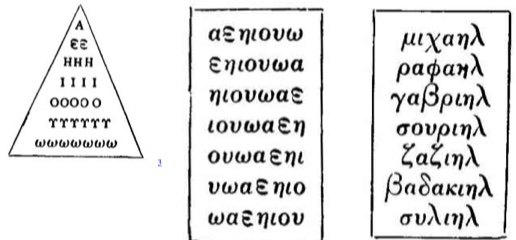
In the above we notice at once the use of the seven vowels which form “a name wherein be contained all Names, and all Lights, and all Powers” (see Kenyon, Greek Papyri in the British Museum, London, 1893, p. 63). The seven vowels have, of course, reference to the three vowels “Iaô” (for Iaoouêi we should probably read Iaô ouêi) which were intended to represent one of the Hebrew names for Almighty God, “Jâh.”

The names “Adonai, Elôai,” are also derived through the Hebrew from the Bible, and Sabaôth is another well-known Hebrew word meaning “hosts”; some of the remaining names could be explained, if space permitted, by Hebrew and Syriac words.

On papyri and amulets the vowels are written in magical combinations in such a manner as to form triangles and other shapes; with them are often found the names of the seven archangels of God; the following are examples:–
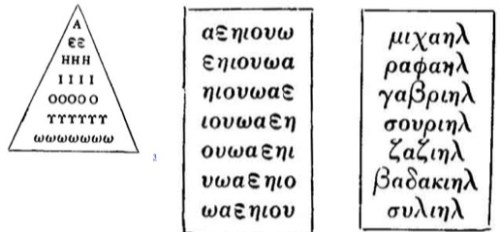
 (British Museum, Gnostic gem, No. G. 33). (Kenyon, Greek Papyri, p. 123). (Ibid., p. 123. These names read Michael, Raphael, Gabriel, Souriel, Zaziel, Badakiel, and Suliel).


(British Museum, Gnostic gem, No. G. 33).
(Kenyon, Greek Papyri, p. 123).
(Ibid., p. 123. These names read Michael, Raphael, Gabriel, Souriel, Zaziel, Badakiel, and Suliel)

In combination with a number of signs which owe their origin to the Gnostics the seven vowels were sometimes engraved upon plaques, or written upon papyri, with the view of giving the possessor power over gods or demons or his fellow creatures.

The example printed below is found on a papyrus in the British Museum and accompanies a spell written for the purpose of overcoming the malice of enemies, and for giving security against alarms and nocturnal visions. (Kenyon, op. cit., P. 121).
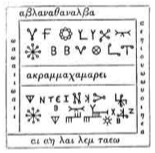
Amulet inscribed with signs and letters of magical power for overcoming the malice of enemies. (From Brit. Mus., Greek Papyrus, Nu. CXXIV.--4th or 5th century.) (Kenyon, Greek Papyri, p. 123).

Amulet inscribed with signs and letters of magical power for overcoming the malice of enemies. (From Brit. Mus., Greek Papyrus, Nu. CXXIV.–4th or 5th century.) (Kenyon, Greek Papyri, p. 123).

But of all the names found upon Gnostic gems two, i.e., Khnoubis (or Khnoumis), and Abrasax (or Abraxas), are of the most frequent occurrence. The first is usually represented as a huge serpent having the head of a lion surrounded by seven or twelve rays.

Over the seven rays, one on the point of each, are the seven vowels of the Greek alphabet, which some suppose to refer to the seven heavens; and on the back of the amulet, on which the figure of Khnoumis occurs, is usually found the sign of the triple S and bar.

Khnoumis is, of course, a form of the ancient Egyptian god Khnemu, or “Fashioner” of man and beast, the god to whom many of the attributes of the Creator of the universe were ascribed.

Khnemu is, however, often depicted with the head of a ram, and in the later times, as the “beautiful ram of Râ,” he has four heads; in the Egyptian monuments he has at times the head of a hawk, but never that of a lion.

The god Abrasax is represented in a form which has a human body, the bead of a hawk or cock, and legs terminating in serpents; in one hand he holds a knife or dagger, and in the other a shield upon which is inscribed the great name ΙΑΩ {Greek IAW}, or JÂH.

Considerable difference of opinion exists as to the meaning and derivation of the name Abrasax, but there is no doubt that the god who bore it was a form of the Sun-god, and that he was intended to represent some aspect of the Creator of the world.

The name was believed to possess magical powers of the highest class, and Basileides, (he of Alexandria, who lived about A.D. 120. He was a disciple of Menander, and declared that he had received the esoteric doctrine of Saint Peter from Glaucias, a disciple of the Apostle) who gave it currency in the second century, seems to have regarded it as an invincible name.

It is probable, however, that its exact meaning was lost at an early date, and that it soon degenerated into a mere magical symbol, for it is often found inscribed on amulets side by side with scenes and figures with which, seemingly, it cannot have any connexion whatever.

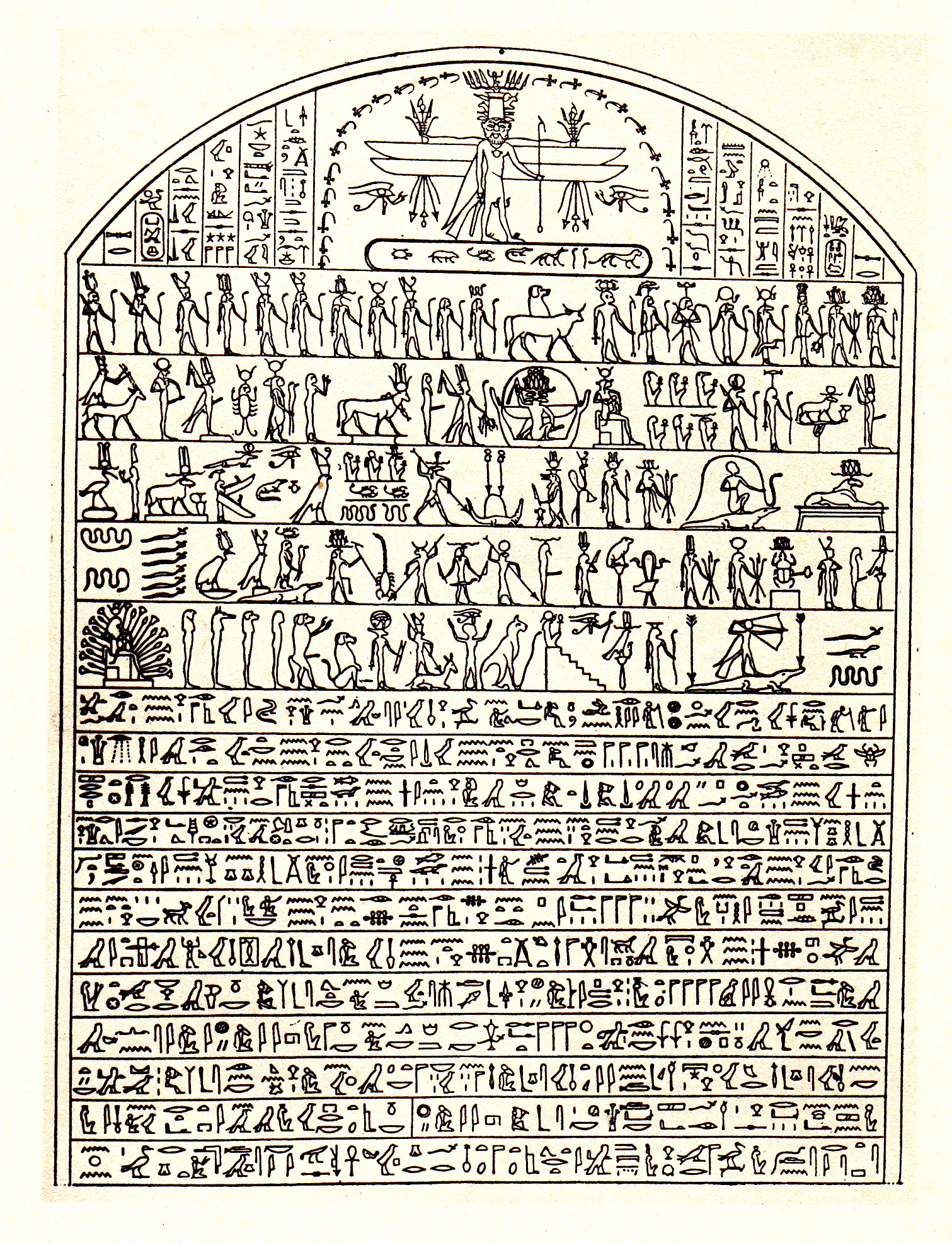
Judging from certain Gnostic gems in the British Museum, Abrasax is to be identified with the polytheistic figure that stands in the upper part of the Metternich stele depicted on p. 153 and below.

Metternich Stele.

Metternich Stele.

This figure has two bodies, one being that of a man, and the other that of a bird; from these extend four wings, and from each of his knees projects a serpent.

He has two pairs of hands and arms; one pair is extended along the wings, each hand holding the symbols of “life,” “stability,” and “power,” and two knives and two serpents; the other pair is pendent, the right hand grasping the sign of life, and the other a sceptre.

His face is grotesque, and probably represents that of Bes, or the sun as an old man; on his head is a pylon-shaped object with figures of various animals, and above it a pair of horns which support eight knives and the figure of a god with raised hands and arms, which typifies “millions of years.”

The god stands upon an oval wherein are depicted figures of various “typhonic” animals, and from each side of his crown proceed several symbols of fire.

Whether in the Gnostic system Abraxas absorbed all the names and attributes of this god of many forms cannot be said with certainty.”

E.A. Wallis Budge, Egyptian Magic, London, 1901. P. 177-80.

The Original Content of the Kabbalah

” … Traditions differ in matters of detail. According to some, it was Rabbi David, the father of Rabbi Abraham ben David (known in Hebrew literature by the acronym Rabad) and not Abraham ben Isaac, his father- in-law, who was the first to receive this Kabbalah. Albeck assumed Isaac the Blind was the son and not the grandson of Abraham ben Isaac, but the analysis of the oldest sources does not confirm this assumption. Around these scholars, but especially around Isaac the Blind, there crystallized the oldest groups of Provençal kabbalists that we are still able to identify.

The pupils of Rabad and his son, coming from Spain to study in the talmudic academies of Provence, were the principal agents of the Kabbalah’s transplantation to Spain and its propagation in that country. Nothing permits us to suppose that the Kabbalah, in the precise sense of the term, became known in Spain other than through this channel or by way of a parallel path that would point to Provence.

Here, to be sure, we must ask what the exact significance of the word Kabbalah was at this time in the circle of the kabbalists themselves. Kabbalah is a fairly common word in rabbinic Hebrew: it simply means “tradition.” In the Talmud, it served to designate the non-Pentateuchal parts of the Hebrew Bible. Later, every tradition was called by this name, without its entailing any specifically mystical nuance.

That it was already employed by the philosopher Solomon ibn Gabirol in the sense it would acquire among the kabbalists is a widespread but completely false assumption. It has just a little to do with the Aramaic word qibhla, “amulet.” The Spanish kabbalists still knew very well several generations later what original notion their predecessors had in mind when they employed the term Kabbalah. As late as the year 1330, Meir ben Solomon ibn Sahula, a pupil of Solomon ibn Adreth, expressed himself clearly and directly on the origin and meaning of this new discipline.

“It is incumbent upon us,” he writes in the preface to his commentary on the Book Yesirah, “to explore all of these things according to the measure of our understanding, and to follow, in what concerns them, the path taken by those who, in our generation and in the preceding generations, for two hundred years, are called kabbalists, mequbbalim, and they call the science of the ten sefiroth and some of the reasons for the [biblical] commandments by the name Kabbalah.”

It follows, then, that in the eyes of these kabbalists the new theosophic conception of God, based upon the doctrine of the ten sefiroth of the Book Yesirah as well as upon the mystical reasons founded on this doctrine for certain ritual precepts of the Torah, constitute the original content of the Kabbalah.

In the author’s own opinion, this teaching is by no means ancient; it does not go back many centuries. Rather, it is about two hundred years old, which brings us back, for its initial stage, to the period of the first revelations of the prophet Elijah —that is, in Provence, toward the middle of the thirteenth century. The chain of kabbalistic traditions that contains the names mentioned previously accords perfectly with this information. It should be noted, also, that the clear awareness on the part of this later kabbalist of the relative youth of the Kabbalah in no way prevents him from considering it a path to knowledge that is ”incumbent upon us” to follow.”

–Gershom Scholem, Origins of the Kabbalah, 1987, pp. 37-9.

Footnote 55 on the Use of the Name Iao

“On the use of the name Iao in the magic of the age of syncretism there is an abundance of material. Most of the older examples have been collected by W. von Baudissin, Studien zur Semitischen Religionsgeschichte, vol. 1 (Leipzig, 1876), 179-254. The passage from Yesirah is not referred to by Baudissin, nor did R. Reitzenstein make use of it in his treatment of the Book Yesirah, for which he assumes an ultimately Hellenistic origin reaching back to the second century; his arguments are based on a comparative study of letter-mysticism in late antiquity; see Reitzenstein, Poimandres (Leipzig, 1904), 291.

As an historian with a broad perspective, Reitzenstein perhaps had a clearer view than many other Jewish scholars, who often regarded the Book Yesirah as if it were suspended in a vacuum in the midst of the history of religions. It should also be noted, in this connection, that in the Coptic Pistis Sophia, chap. 136, Iao appears in a similar context: Jesus calls out his name as he turns toward the four corners of the world.

The sealing of the six directions of space by means of the permutations of Iao corresponds to the idea that this name is the master of the four directions of the world, that is, the master of the cosmos. Cf. the material assembled by Erik Peterson, Heis Theos (Göttingen, 1926), 306-307. Peterson’s interpretation of the magical name Arbathiao as “the four Iao” is, however, utterly unconvincing. The magical name is nothing other than a syncretistic transcription of the Tetragrammaton as “the tetrad [of the four letters of the name YHWH upon which is based the name] of Iao.”

This is proven by the corresponding form Tetrasya, which we find in the Hebrew writings of the Hekhaloth and which was still unknown to Peterson; cf. my Major Trends, 56, 363. The terminology employed in the Yesirah for these three directions of space is also very ancient: the phrase “above and below, in front and behind, right and left” is used in exactly the same manner in Akkadian, and is evidently also behind the wording of the Mishnah Hagigah 2:1 (first century), where “in front” and “behind” are to be understood spatially.

This usage was no longer understood by the amoraim, and was in any case transferred from the spatial to the temporal, as S. E. Löwenstamm, “On an Alleged Gnostic Element in Mishnah Hagiga II, 1″ (in Hebrew) in M. Haram (ed.), Yehezkel Kaufmann Jubilee Volume (Jerusalem, 1960), 112-121, has shown, drawing upon Akkadian material. His explanations furnished additional linguistic evidence in support of the antiquity of the Book Yesirah, although precisely the passage under consideration here escaped his attention.”

–Gershom Scholem, Origins of the Kabbalah, 1987, pp. 33-4

Footnote 48, An Amulet

“Through 231 gates everything goes forth. It is found therefore, that every creature and every speech [language] goes forth out of one name” (2:5). Does this mean that the alphabet, in its sequence, constitutes a mystical name? Of such a conception of the alphabet, Franz Dornseiff (Das Alphabet in Mystik und Magie, 2d ed. [Leipzig, 1925], 69-80) collected abundant testimonies from the Greek and Latin sources; cf. also A. Dieterich, ABC—Denkmäler, Rheinisches Museum für Philologie 56 (1900): 77-105.

In the Wiener Jahres hefte 32 (1940): 79-84, Joseph Keil published an important Hebrew-Greek amulet that contains, with an obviously magical intention, the Hebrew alphabet in Greek transcription in the so-called at-bash order. In this order the alphabet is written in two rows boustrophedon and two letters are vertically connected in pairs.

The amulet should be dated between the second and fourth centuries, but certainly no later. (I was able to identify clearly, though with some effort, the Hebrew text of Deuteronomy 28:58, which was in one of the three lines that neither Keil nor Ludwig Blau—to whom he showed the amulet in 1926—was able to decipher.

It is only natural that the view that the alphabet constitutes “One name, to wit the name of 22 letters” should have passed into the early Kabbalah, as is attested by the Commentary on the Prayer Book, composed about 1260, by the (anonymous?) commentator Sefer ha-Manhig on the Pirqe Rabbi Eliezer, Ms. British Museum, Mar-goliouth 743, fol. 96b.”

–Gershom Scholem, Origins of the Kabbalah, 1987, pp. 24-35.

Kabbalistic Foundations of Magic

I have briefly developed here some of the fundamental concepts of the Book Yesirah because they are of essential importance for the understanding of what follows and because this book was later read and interpreted by the kabbalists as a vade mecum for the Kabbalah. In contrast to later interpretations, the special charm of this text consists in the frequently felicitous and in any event ever-vivid imagery and fullness of meaning it lends to most of the concepts newly created in order to express abstractions. The author finds concrete and appropriate designations for notions that, until then, Hebrew did not know how to render in adequate terms.

That he failed on certain points and that his images sometimes remain obscure for us—which only encouraged their subsequent reinterpretation—is a clear sign of the difficulty of his efforts and of the energy with which he undertook them. The book’s solemn and enigmatic manner of speaking made it possible for the Jewish philosophers as well as the kabbalists of the Middle Ages to appeal to its authority.

Saadya, in the earliest extant (although certainly not the oldest) commentary interpreted it around 933 in accordance with his philosophic conception of the doctrine of Creation and his Jewish theology in general. Since then, a complete series of more or less detailed Hebrew and Arabic commentaries continued to be written down to the thirteenth and fourteenth centuries.

Everyone found in the book more or less what he was looking for, and the fact that Yehudah Halevi devoted extensive attention to it, almost a complete commentary, in the fourth tractate of his principal work of philosophy and theology, Sefer ha-Kuzari (around 1130), may serve as an indication of the great authority the book enjoyed.

But at the same time, this text also remained influential in entirely different circles, those who saw in its theory of language some sort of a foundation of magic, or those for whom the doctrine of the book included authentic elements of the Merkabah gnosis and of cosmogony.

The Book Yesirah was studied in the schools of the sages of Narbonne as well as among the French rabbis of the school of the tosafists and among the German Hasidim of the same period, and many commentaries have come down to us from these circles, which were generally averse to philosophic speculation.

It offers remarkable parallels, to say the least, to the turn which the Kabbalists gave to the doctrine of the sefiroth. It is no longer possible to say with certainty to what extent the study of the Book Yesirah was regarded in these circles as an esoteric discipline in the strict sense of the term. Perhaps one could view the text as situated at the limits of esotericism, partly within it, but partly already beyond it.

–Gershom Scholem, Origins of the Kabbalah, 1987, pp. 33-5.

The Great Name of God

“Also related to the magic of language mysticism is the author’s view that the six dimensions of heaven are “sealed” (1:13) by the six permutations of “His great name Yaho” (Hebrew YHW). These three consonants, utilized in Hebrew as matres lectionis for the vowels ia, and o, which are not written, make up the divine name Yaho, which contains the three consonants of the four-letter name of God, YHWH, as well as the form Yao, which penetrated into the documents of Hellenistic syncretism where its permutations likewise play a role. The signs that were subsequently developed to designate vowels were still unknown to the author.

This idea concerning the function of the name Yaho or Yao suggests important parallels. In the system of the Gnostic Valentinus, Iao is the secret name with which the Horos (literally: the limit, the limitation!) frightens away from the world of the pleroma the Sophia-Akhamoth who is in pursuit of Christ.

Does not the cosmos (as distinct from the pleroma), sealed by means of the six permutations of Yao in the Book Yesirah, constitute a sort of monotheistic parallel, perhaps even inspired by polemical intentions, to this Valentinian myth? In another text of a manifestly Jewish-syncretistic character, we similarly find the name Iao, as an invocation that consolidates the world in its limits, a perfect analogy to the sealing in Yesirah: in the cosmogony of the Leiden magical papyrus the earth writhed when the Pythian serpent appeared “and reared up powerfully. But the pole of heaven remained firm, even though it risked being struck by her. Then the god spoke: Iao! And everything was established and a great god appeared, the greatest, who arranged that which was formerly in the world and that which will be, and nothing in the realm of the Height was without order any more.”

The name Iao appears again among the secret names of this greatest god himself. It is difficult not to suspect a relation here between Jewish conceptions and those of Gnosticism and syncretism. This “sealing” of the Creation by means of the divine name belongs to the old stock of ideas of the Merkabah gnosis; it is attested in chapter 9 of the “Greater Hekhaloth.” What is said in the “Book of Creation” of the “six directions” of space is here said of the “orders of the Creation,” therefore, of the cosmos in general, whose preservation within its established arrangements, sidre bereshith, is due to its “sealing” by the great name of God.”

–Gershom Scholem, Origins of the Kabbalah, 1987, pp. 31-3.

Gershom Scholem on Correspondences

“All reality is constituted in the three levels of the cosmos—the world, time, and the human body, which are the fundamental realm of all being—and comes into existence through the combination of the twenty-two consonants, and especially by way of the “231 gates,” that is, the combinations of the letters into groups of two (the author apparently held the view that the roots of Hebrew words were based not on three but on two consonants).

Among the three realms there exist precise correlations, which no doubt also expresses relations of sympathy. The twenty-two consonants are divided into three groups, in accordance with the author’s peculiar phonetic system. The first contains the three “matrices,” ‘alef, mem, and shin. These in turn correspond to the three elements deduced in the first chapter in connection with the sefiroth—ether, water, fire—and from these all the rest came into being. These three letters also have their parallel in the three seasons of the year (again an ancient Greek division!) and the three parts of the body: the head, the torso, and the stomach.

The second group consists of the seven “double consonants” that in the Hebrew phonology of the author have two different sounds. They correspond, above all, to the seven planets, the seven heavens, the seven days of the week, and the seven orifices of the body. At the same time, they also represent the seven fundamental opposites in man’s life: life and death, peace and disaster, wisdom and folly, wealth and poverty, charm and ugliness, sowing and devastation, domination and servitude. To these correspond, in addition, the six directions of heaven and the Temple in the center of the world, which supports all of them (4:1-4).

The twelve remaining “simple” consonants correspond to man’s twelve principal activities, the signs of the zodiac, the twelve months, and the twelve chief limbs of the human body (the “leaders”). The combinations of all of these elements contain the root of all things, and good and evil, “pleasure and sorrow” (‘oneg and nega‘, which have the same consonants) have their origin in the same process, only according to a different arrangement of the elements (2:4).

This cosmogony and cosmology, based on language-mysticism, betray their relationship with astrological ideas. From them, direct paths lead to the magical conception of the creative and miraculous power of letters and words. It is by no means absurd to imagine that our text not only pursued theoretical aims, but was intended for thaumaturgical use as well. That is how the tradition of the early Middle Ages understood it, at least in part, and it would not have been wrong, in this case, to establish a connection between our text (or its prototype) and the story of the two masters of the Talmud, Rabbi Hanina and Rabbi Oshayah, who every Friday studied the “halakhoth concerning Creation” and by means of it created a calf that they then proceeded to eat.”

–Gershom Scholem, Origins of the Kabbalah, 1987, pp. 29-31.

Scholem on the Kabbalistic Elements

“The ten primordial numbers are called sefiroth—a Hebrew noun, newly formed here, that bears no relation to the Greek word sphaira, but is derived from a Hebrew verb meaning “to count.”

Steinschneider’s contention (Mathematik bei den Juden [Hildesheim, 1965], p. 148) that the original term acquired its specific kabbalistic meaning as a result of the similarity to the Greek word is not borne out by an analysis of the oldest kabbalistic texts. By introducing a new term, sefirah, in place of the usual mispar, the author seems to indicate that it is not simply a question of ordinary numbers, but of metaphysical principles of the universe or stages in the creation of the world.

The possibility that the term refers to emanations from God himself can be excluded in view of both the wording and the context; it could only be read into the text by later reinterpretation. Each of these primordial numbers is associated with a particular category of creation, the first four sefiroth undoubtedly emanating from each other.

The first one is the pneuma of the living God, ruah ‘elohim hayyim (the book continues to use the word ruah in its triple meaning of breath, air, and spirit). From the ruah comes forth, by way of condensation, as it were, the “breath of breath,” that is, the primordial element of the air, identified in later chapters with the ether, which is divided into material and immaterial either (SIC, should probably be ether).

The idea of an “immaterial ether,” ‘awir she’eno nithpas, like the other Hebrew neologisms in the book, seems to correspond to Greek conceptions. From the primordial air come forth the water and the fire, the third and the fourth sefiroth. Out of the primordial air God created the twenty-two letters; out of the primordial fire, the Throne of Glory and the hosts of angels.

The nature of this secondary creation is not sufficiently clear, for the precise terminological meaning that the author gave to the verbs haqaq and hasab, which belong to the vocabulary of architecture, can be interpreted in different ways. He does not utilize the Hebrew word for “create,” but words that mean “engrave” (is this to designate the contours or the form?) and “hew,” as one hews a stone out of the rock. The Aristotelian element of the earth is not known to the author as a primordial element.”

–Gershom Scholem, Origins of the Kabbalah, 1987, pp. 26-7.

The Sefer HaShmoth (Book of Names)

“…The Sefer HaShmoth (Book of Names)…is a book of Divine Names…it is a valuable key that can help open locks guarding the mysteries that lay hidden in Hebrew (and Arabic) qabalistic books, and provides Names of Power by which one can light the entire Tree. Secondly, it is the primary source of “Angelic Tree Language,” comprised of one series of Tree-maps that allude to distinctly different paths of ascension through the planes of consciousness and a second series that allude to different stations of perfected souls who have completed the ascension.”

“It is said that Adam gave the book to his son Seth and it was then passed down the generational line to Enoch son of Yared. When Enoch ascended and “walked with Elohim,” he took the book with him. The Sefer HaShmoth came back into the world again with the Covenant of Abraham. Abraham gave the book to Ishmael, Isaac, and his offspring by his concubines. Isaac’s copy was handed down to Master Mosheh (Moses) and was later sealed in the vault of the first Temple of Jerusalem. Buried in the Temple vault, access to the book was limited to those who had the psychic skill to “see/read” it in Yetzirah (Astral World of Formation), and the strength to survive the impact of its power without shattering their shells.”

–Daniel Feldman, Qabala: The Mystical Heritage of the Children of Abraham, 2001, pg.  60.

Seeking the Garden of Eden Alphabet

“The letterforms of the Sinatic and Ezra Hebrew alphabets bear little physical resemblance to one another, though they share the same twenty-two-letter format and have the same names for the letters.

Hence, the Sinatic Hebrew letter Alef transliterates with the Ezra Alef, the Sinatic Beyt with the Ezra Beyt, and so forth. Sinatic letterforms are basically built from the letters Alef and Ayin. Ezra Hebrew letter forms are built upon variations of the letter Yod.

Both alphabets have letters which overtly or covertly contain other letters, such as the Tav contained in the Sinatic Alef or the Beyt contained in the Ezra Alef (as described in the Sefer Bahir).

Unlike the Ezra alphabet, Sinatic does not have final letters, which were developed much later as a means of showing separation between words in crowded scrolls. The final letters became significant in the Ezra alphabet when given extended numerical value in gematria or qabalistic numerology.

The sudden appearance of the original Hebrew was paralleled several hundred years later by the sudden appearance of Brahmi Sanskrit in the Indus Valley.

Sinatic and Brahmi have many similar letterforms, and both were replaced by later alphabets claimed in present times to be the originals (i.e. Sinatic replaced by Ezra and Brahmi replaced by Deva Negari).

Some Qabalists and Tantrikas maintain that there is a parent alphabet, called the “Gan Aden Alphabet” (Garden of Eden), from which both Hebrew and Sanskrit are derived.

[ … ]

There is also said to be a Gan Aden Torah, an unbroken sequence of letters that may be broken into words and sentences in innumerable ways.

Hence, the written Torah is one such “translation” of the unbroken letter sequence, minus the letters and anusvara that were not included in the Hebrew alphabet.

A book called the Tiqunim HaZohar (“Perfections of Splendor”) discusses seventy ways of translating the first six letters of the Torah.”

–Daniel Feldman, Qabala: The Mystical Heritage of the Children of Abraham, 2001, pg. 57.

Sinatic Hebrew an Alphabetical Representation of Sumerian Cuneiform?

“…there is extensive archeological evidence of a much older Hebrew alphabet, called Gezer or Sinatic (after Mount Sinai), as the original and most ancient Hebrew.

Sinatic Hebrew is in fact the oldest known alphabet, suddenly appearing about the time of Abraham (circa 1850 BCE). The original Sinatic Hebrew became virtually extinct after the decimation of Lachish circa 701 BCE.

The Sinatic alphabet could have evolved as an alphabetic representation of the twenty-six Sumerian cuneiform ciphers, the world’s oldest known non-alphabetic language.”

–Daniel Feldman, Qabala: The Mystical Heritage of the Children of Abraham, 2001, pg. 56.

Time is Relative

“…time is relative and subject to compression and expansion.” (…) “it can then be said that the Hebrew calendar of seven thousand years spans the entire life of this universe in matter, which is currently estimated to be twenty billion years.

The implication of this idea is that the sequence of events in Torah B’reshith, all of which are assumed to occur in one plane of existence, actually manifest as a nonlinear space-time sequence occurring in more than one plane. Time-space is exponentially expansive in each successive plane of existence.

Perhaps the reader has had the experience of an elaborate dream that seemed to span a long period of time, maybe years, only to wake up  and find out that it actually occurred in a matter of minutes. Consider the oft-told story of a person seeing their entire life “pass before their eyes” in a near-death episode.”

–Daniel Feldman, Qabalah: The Mystical Heritage of the Children of Abraham, 2001. Pg. 50-1.

Edenic Origins of the Kabbalah

“The Qabalah is traditionally traced back to Adam and Eve.”

[ … ]

“The disciplines of the Mystical Qabalah are distinct from those practiced by magicians, wizards, and sorcerers who seek to acquire creative and/or destructive power, depending on what paths they traverse on the Tree of Life.

The occult disciplines of wizards and magicians are often called the Practical, Hermetic, or Magical Qabalah. Practical Qabalah has its roots in the “Thirteen Enochian Keys” of Enoch son of Qain, along with a highly admixture of material taken from Egyptian, Mesopotamian and other non-Hebrew sources.

It is important not to confuse Enoch son of Qain with Enoch son of Yared. The former Enoch was the grandson of Adam and the son after whom Qain was said to name a city.

Enoch son of Yared was the great, great, great, great grandson of Adam, and the one who “walked with Elohim” and was transformed into Metatron.”

–Daniel Feldman, Qabalah: The Mystical Heritage of the Children of Abraham, 2001. Pg. 33-4.

Seeking the Original Kabbalah

“By the Mystical Qabalah, we are referring to an ancient mystical transmission that preceded and supersedes any of the religious vessels through which it has been subsequently filtered and adapted.

These vessels include the Israelite Hebrew, Rabbinical Judaic, Mystical Christian, Sufi Islamic, and possibly even the North Indian Tantric.

Each of these vessels has framed the universal teachings of the Mystical Qabalah within the context, language, and cultural milieu of their respective dispensations. Each version is unique and beautiful, to be respected and celebrated.

But no single one of these vessels can legitimately claim to be the orthodox authority for these teachings.”

–Daniel Feldman, Qabalah: The Mystical Heritage of the Children of Abraham, 2001. Pg. 14.

Gematria

“Gematria is one of the rules for interpreting the Torah, and is partially a high-level system of numerology.

It is defined by Scholem as, “explaining a word or group of words according to the numerical value of the letters, or of substituting other letters of the alphabet for them in accordance with a set system. All Hebrew letters are equally values and words, so for example the letter Aleph, signifying “A,” also means “one,” as well as being a word meaning ‘ox.'” The table given lists the major values and meanings of the twenty-two letters. This allows the letters to be taken as symbols expressing differing aspects of the Universe, either as separate entities, or when combined together in words.”

(…)

“Although some Kabbalists denied the use of Gematria as relevant, other workers such as Abulafia dealt with Gematria so deeply that their works need “decoding” rather than reading. It is said that the Torah is likewise written, and that “mistakes” in the original Greek and Hebrew texts are not mistakes, but rather spellings and variations necessary to ensure the numbers underlying them were correct.”

–Frater FP, The Magician’s Kabbalah, pg. 81.

Marsilio Ficino and Christian Kabbalah

“Christian kabbalah can be traced to the “school of Marsilio Ficino in Florence, in the second half of the fifteenth century.”

“Ficino is best known for his translations of Plato’s writings from Greek to Latin, but of much importance was his translation to Latin of the corpus of esoteric, mysterious old treatises known as the Hermetica. These works, probably originating from Egypt in late antiquity, are attributed to a mysterious ancient philosopher, Hermes Trismegistus (The Thrice-Great Hermes), and they deal with magic, astrology, and esoteric theology.”

Ficino and his followers considered magic as “an ancient scientific doctrine, the source of all religious and natural truth.”

Dan mentions Count Giovani Pico dela Mirandola, a “great thinker, young scholar and theologian, who died at age thirty-three in 1496.”

He also observes that Pico’s interest in Hebrew was facilitated by the Latin translations of the Jewish Christian convert, Flavius Methredates.”

Pico’s most famous work, the Nine Hundred Theses, proclaims that Christianity’s truth is best demonstrated by the disciplines of magic and kabbalah.” In Pico’s work, magic and kabbalah are often indistinguishable. He interpreted kabbalistic texts as “ancient esoteric lore, conserved by Jews, at the heart of which was the Christian message.”

–Joseph Dan, Kabbalah: A Very Short Introduction, pg. 62-3.

Names of God and the Sefirot

“Most kabbalists integrated the biblical names of God into the system of the sefirot. Thus, for instance, the tetragrammaton–the biblical name of God written in four letters, YHVH, which in Hebrew, it is forbidden to pronounce–was interpreted as presenting the first sefirah, keter, in the almost-hidden little point above the first letter, yod, which represents the second sefirah, divine wisdom (hokhmah).

The first letter, he, is the binah, followed by the vav, which represents the number six, and thus relates to the six central sefirot from hesed to yesod. The last he represents the female entity, the shekhinah

It can be stated that the system of the sefirot is viewed by most kabbalists to represent the hidden, secret name or names of God …

Kabbalists utilized the names that were used by pre-kabbalistic esoterics, including the names of twelve, forty-two, and seventy-two letters, and integrated them into this system.”

–Joseph Dan, Kabbalah: A Very Short Introduction, 2006, pp. 44.

You Say Kabbalah, I Say Cabala

Christian kabbalah can be traced to the “school of Marsilio Ficino in Florence, in the second half of the fifteenth century.”

“Ficino is best known for his translations of Plato’s writings from Greek to Latin, but of much importance was his translation to Latin of the corpus of esoteric, mysterious old treatises known as the Hermetica. These works, probably originating from Egypt in late antiquity, are attributed to a mysterious ancient philosopher, Hermes Trismegistus (The Thrice-Great Hermes), and they deal with magic, astrology, and esoteric theology.”

Ficino and his followers considered magic as “an ancient scientific doctrine, the source of all religious and natural truth.”

Dan mentions Count Giovani Pico de la Mirandola, a “great thinker, young scholar and theologian, who died at age thirty-three in 1496.”

He also observes that Pico’s interest in Hebrew was facilitated by the Latin translations of the Jewish Christian convert, Flavius Methredates.”

Pico’s most famous work, the Nine Hundred Theses, proclaims that Christianity’s truth is best demonstrated by the disciplines of magic and kabbalah.” In Pico’s work, magic and kabbalah are often indistinguishable. He interpreted kabbalistic texts as “ancient esoteric lore, conserved by Jews, at the heart of which was the Christian message.”

–Joseph Dan, Kabbalah: A Very Short Introduction, pg. 62-3.

On Metatron

“Unlike the other Spheres, which have one archangel each, Malkuth has two. The first of them is named Metatron, and is also the archangel of the first Sphere, Kether. Alone of the Archangels, his name has no meaning in Hebrew (in point of fact, it is a Hebrew form of Mithras, the name of a Roman savior god of Persian origins). For reasons that will be discussed later on, Metatron is known as the Prince of Countenances; he represents a secret link connecting the highest and lowest of the Spheres.”

“Cabalistic traditions make a distinction, a useful one, between the aspect of Metatron assigned to Kether and that assigned to Malkuth, a distinction that involves a different spelling of the archangel’s name. Metatron in Malkuth is held to be the transformed Enoch, taken bodily into heaven according to the Biblical myth, and to function as a celestial scribe recording all the acts of humanity. His name was spelled MThThRVUN…Metatron in Kether, by contrast, is seen as a transcendent power, the “Lesser Tetragrammaton” created before the birth of the universe, and his name is spelled with an additional Yod, MIThThRVN….In either form, Metatron may be visualized as an angelic figure of pure light.”

The second archangel of Malkuth is named Sandalphon. As Metatron expresses the spiritual energies coming into Malkuth from above, Sandalphon expresses the spiritual energies of Malkuth itself; these two angels are usually paired in the traditional symbolism, and are associated with the two angelic figures atop the Ark of the Covenant, Metatron on the right hand, Sandalphon on the left. As Metatron is linked with Enoch, Sandalphon is often equated with Elijah, the other Old Testament figure who is said to have ascended directly into heaven.

Despite this and the meaning of the name, Sandalphon is often represented as female; she is called the Reconciler for Earth, and the Celestial Soul of Earth. She represents the driving force of evolution, the constant upward striving toward the spiritual on the part of every created thing. As the counterpart to the bright radiance of Metatron, she is sometimes envisioned as a luminous figure clad in dark garments.”

–John Michael Greer, Paths of Wisdom, the Magical Cabala in the Western Tradition, 1996, pg. 99-100.

On Enoch and the Angel Metatron.

“The disciplines of the Mystical Qabalah are distinct from those practiced by magicians, wizards, and sorcerers who seek to acquire creative and/or destructive power, depending on what paths they traverse on the Tree of Life. The occult disciplines of wizards and magicians are often called the Practical, Hermetic, or Magical Qabalah.

Practical Qabalah has its roots in the “Thirteen Enochian Keys” of Enoch son of Qain, along with a highly admixture of material taken from Egyptian, Mesopotamian and other non-Hebrew sources.

It is important not to confuse Enoch son of Qain with Enoch son of Yared. The former Enoch was the grandson of Adam and the son after whom Qain was said to name a city.

Enoch son of Yared was the great, great, great, great grandson of Adam, and the one who “walked with Elohim” and was transformed into Metatron.”

–Daniel Feldman, Qabalah: The Mystical Heritage of the Children of Abraham, 2001. Pg. 33-4.

More on Creation Through the Powers of the Alphabet.

“The Sefer Yezira (The Book of Creation) describes the process of creation mainly by the power of the letters of the alphabet. It dates to the 10th Century AD, though it was regarded as an ancient work. It was clearly developed and edited for several generations before it emerged into view. The exact date of its origin is unknown. Some assert that it was written before the destruction of Jerusalem in 70 CE, while others claim that it was written in the 9th century, with Islamic influences. The consensus seems to be that it dates to the third or fourth century, but there is no definitive evidence.

The concluding sentences state that Abraham knew the secrets of this work, so it is traditionally ascribed to Abraham the Patriarch.

The Book of Creation describes a system of cosmogony and cosmology different from Genesis, yet cites no authority and rarely refers to Bible verses.

“The universe was hewed, according to the first paragraph, by thirty-two “wondrous paths of wisdom,” and engraved in “three books.” The “paths” are described as ten sefirot and the twenty-two letters of the Hebrew alphabet. These sefirot are not divine powers….” They are “described as the directions or dimensions of the cosmos, (north, south, east, west, up, down, beginning, end, good, and evil), as well as the holy beasts of Ezekiel’s chariot, the stages of the emergence of the three elements (divine spirit, air or wind, and water and fire), and other characteristics that are unclear.”

“Early commentators interpreted the sefirot as the ten basic numbers from one to ten.”

“The central concept … is harmonia mundi, (harmony of the universe). There are three layers of existence, the cosmic, that of time, and that of man. Each letter, or group of letters, is in charge of one aspect of each layer.”

“Thus … the Hebrew letters that can be pronounced in two different ways–whose number, according to this work, is seven–in the cosmos, are in charge of the seven planets; in “time,” are in charge of the seven days of the week; and, in man, are in charge of the seven orifices in the head (eyes, ears, nostrils and mouth).

“The twelve letters that the author describes as “simple” are in charge of the twelve zodiac signs, the twelve months, and the twelve principal limbs, and so on. This model was used by subsequent thinkers to develop the concept of human beings as microcosmos, reflecting the characteristics of the cosmos as a whole (especially by Shabbatai Donolo, who used it to interpret the the verse in Genesis 1:27, indicating that man was created in the image of God).”

“The concept that the universe was created by the power of divine speech is an ancient one in Judaism, and the Sefer Yezira developed this idea systematically. The guiding principle seems to have been that if creation is accomplished by language, then the laws of creation are the laws of language. Grammar thus was conceived as the basic law of nature. The author developed a Hebrew grammar based on 231 “roots”–the number of possible combinations of 22 letters. He explained the existence of good and evil in the universe as a grammatical process: if the letter ayin is added to the “root” ng as a prefix, it gives ong, great pleasure, but if it is added as a suffix, it means infliction, malady. The author also insisted that everything in the universe, following grammatical principles, has two aspects, parallel to the gender duality of masculine and feminine.”

“The kabbalists … positioned this work in the heart of Jewish sacred tradition, a source of divine wisdom parallel to that of the Hebrew Bible.”

–Joseph Dan, Kabbalah: A Very Short Introduction, 2006, pp. 16-18.

Dr. John Dee, the Monas, and the Hebrew Alphabet as the Device of Divine Creation.

“…Dee was fascinated with the application of the exegetical techniques of cabbala to alchemy. He was well aware that each letter of the Hebrew alphabet has a numerical equivalence, and that the computation of these numbers in words and comparison with other significant words was believed to provide insights into various levels of reality. The fourth-century Sefer Ytzirah, or Jewish Book of Formation, gives a cosmogonic account of God engraving the universe with the twenty-two foundational letters of the Hebrew alphabet.” 

–Peter J. Forshaw, “The Early Alchemical Reception of John Dee’s Monas Hieroglyphica,” AMBIX, November, 2005, pg. 252 (6).