Samizdat

Publishing the Forbidden. All Rights Reserved. © Samizdat 2014-2025.

Tag: Greek

The Etymology of the Name “Moses”

“Josephos has preserved an extract from the Egyptian historian Manetho, which relates the Egyptian version of the story of the Exodus as it was told in the second century before our era. In this it is stated that the earlier name of Moses was Osarsiph, and that he had been priest of Heliopolis or On.

Here it is evident that Moses and Joseph have been confounded together. The name of Joseph, who married the daughter of the priest of On, has been decomposed into two elements, the first of which is the divine name Jeho, and this has been changed into its supposed Egyptian equivalent Osar or Osiris.

It is clear that, whatever might have been his opinion about the name of Joseph, Manetho had no doubt that that of Moses was purely Israelitish. It was not until he had become the Israelitish lawgiver and had ceased to be an Egyptian priest that Osarsiph took the name of Moses.

But Moses finds no satisfactory etymology in the pages of the Hebrew lexicon. It stands alone among Hebrew proper names, like Aaron and David. We do not hear of any other persons who have borne the name. If, therefore, it is Semitic, it must belong to an older stratum of Semitic nomenclature than that preserved to us in the Old Testament. We must look to other branches of the Semitic stock for its explanation.

There is only one other branch of the Semitic family whose records are earlier than those of the Hebrews. Arabic literature begins long after the Christian era, when Jewish and Greek and even Christian names and ideas had penetrated into the heart of the Arabian peninsula.

The Arabic language, moreover, belongs to a different division of the Semitic family of speech from that to which Hebrew belongs. To compare Arabic and Hebrew together is like comparing Latin with modern German. There is, however, one Semitic language which has the closest affinities to Hebrew, and this is also the language of which we possess records older than those of the Hebrew Scriptures. I need hardly say that I am referring to Assyrian.

Now the Assyrian equivalent of the Hebrew Mosheh, “Moses,” would be mâsu, and, as it happens, mâsu is a word which occurs not unfrequently in the inscriptions. It was a word of Accadian origin, but since the days of Sargon of Accad had made itself so thoroughly at home in the language of the Semitic Babylonians as to count henceforth as a genuinely Semitic term.

Mâsu signified as nearly as possible all that we mean by the word “hero.” As such, it was an epithet applied to more than one divinity; there was one god more especially for whom it became a name.

This god was the deity sometimes called Adar by Assyrian scholars, sometimes Nin-ip, but whose ordinary name among the Assyrians is still a matter of uncertainty. He was a form of the Sun-god, originally denoting the scorching sun of mid-day. He thus became invested with the sterner attributes of the great luminary of day, and was known to his worshippers as “the warrior of the gods.”

The title of Mâsu, however, was not confined to Adar. It was given also to another solar deity, Merodach, the tutelar god of Babylon and the antagonist of the dragon of chaos, and was shared by him with Nergal, whose special function it was to guard and defend the world of the dead.

But Nergal himself was but the sun of night, the solar deity, that is to say, after he had accomplished his daily work in the bright world above and had descended to illuminate for a time the world below.”

A.H. Sayce, Lectures on the Origin and Growth of Religion as Illustrated by the Religion of the Ancient Babylonians, 5th ed., London, 1898, pp. 45-7.

More on Sargon

“But in spite of the atmosphere of myth which came to enshroud him, as it enshrouded the persons of Kyros, of Charlemagne, and of other heroes of popular history, Sargon was a historical monarch and the founder of a really great empire.

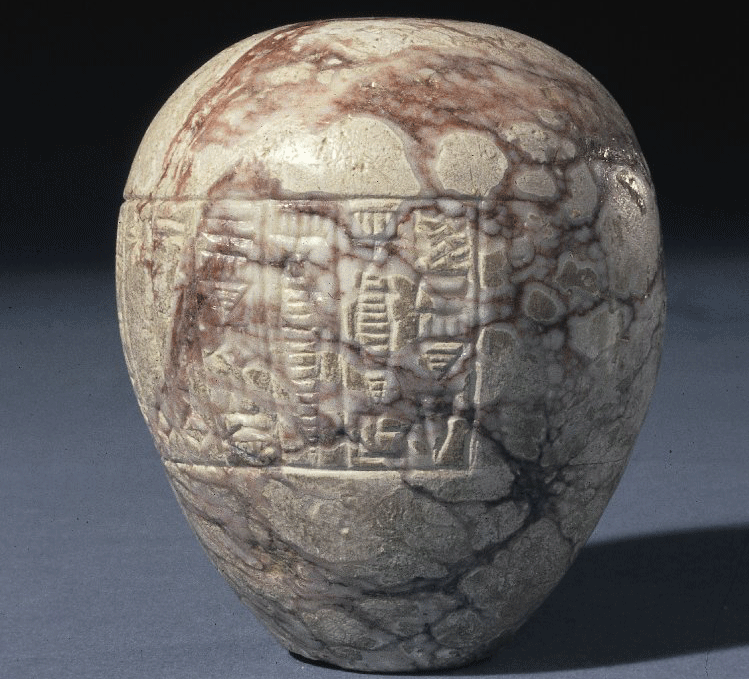
The British Museum actually possesses an inscribed egg of veined marble which he dedicated to the Sun-god of Sippara (ed note: Shamash), and the seal of his librarian Ibni-sarru is in the hands of M. Le Clercq of Paris. What may be termed the scientific literature of the library of Nineveh makes frequent reference to him, and we learn that it was for the great library which he established in his capital city of Accad that the two standard Babylonian works on astronomy and terrestrial omens were originally compiled.

Sargon's inscribed egg for the Sun God Shamash at Sippara in the British Museum.

Sargon’s inscribed egg for the Sun God Shamash at Sippara in the British Museum.

 The work on astronomy was entitled The Observations of Bel, and consisted of no less than seventy-two books, dealing with such matters as the conjunction of the sun and moon, the phases of Venus, and the appearances of comets.

It was translated in later days into Greek by the historian Berossus and though supplemented by numerous additions in its passage through the hands of generations of Babylonian astronomers, the original work contained so many records of eclipses as to demonstrate the antiquity of Babylonian astronomy even in the remote age of Sargon himself.

But besides our knowledge of Sargon’s patronage of learning, we also know something about the civil history of his reign. A copy of its annals has come down to us. We gather from these that he was not only successful in overthrowing all opposition at home, he was also equally successful abroad.

His first campaign was against the powerful kingdom of Elam in the East, where he overthrew the enemy and mutilated their slain. Next he turned to the West, laying his yoke on Syria, and subjugating “the four quarters” of the world. Then the rival kings of Babylon and other Chaldean cities felt his power; and out of the spoil of the vanquished he built the city of Accad and gave it its name.

From this time forward his attention was chiefly devoted to the West. Year after year he penetrated into Syria, until at last, we are told, “he had neither equal nor rival;” he crossed the Mediterranean to the island we now call Cyprus, and “in the third year,” at the bounds of the setting sun, his hands conquered all peoples and his mouth decreed a single empire.

Here on the shores of Cyprus the great conqueror erected images of himself, and then carried the booty of the island to the opposite coast of Asia. Such a glimpse into the history of what became afterwards a Grecian sea, when as yet no Greeks had made their ray to their later home, is startling to those whose conceptions of authentic history have been limited by the narrow horizon of the classical world. Its trustworthiness, however, has been curiously verified by a discovery made by General de Cesnola in the treasure-vaults of a Kyprian temple among the ruins of the ancient Kurion.

A god in horned cap brandishes a mace and the forked lightening of Iva-Vul, Thunder God, and sets foot on a recumbent bull.  Behind him is a leaping ibex. In front, a man, perhaps the king, in a short coat, standing full face. Behind him a man on bended knee, possibly the owner of the cylinder. Above him, a small deer is recumbent and inverted.  Then a figure in a long garment, and 3 rows of cuneiform writing:  "Arba Istar: son of Ibu Beled: servant of the god Naram-Sin."  The king Naram-Sin, to whom a divine determinative prefix is given here, reigned in Babylonia no later than 2600 BCE.  Cyprus, plate 4300.  John L. Myres, Handbook of the Cesnola Collection of Antiquities from Cyprus, 1914.

A god in horned cap brandishes a mace and the forked lightening of Iva-Vul, Thunder God, and sets foot on a recumbent bull.
Behind him is a leaping ibex. In front, a man, perhaps the king, in a short coat, standing full face. Behind him a man on bended knee, possibly the owner of the cylinder. Above him, a small deer is recumbent and inverted.
Then a figure in a long garment, and 3 rows of cuneiform writing:
“Arba Istar: son of Ibu Beled: servant of the god Naram-Sin.”
The king Naram-Sin, to whom a divine determinative prefix is given here, reigned in Babylonia no later than 2600 BCE.
Cyprus, plate 4300.
John L. Myres, Handbook of the Cesnola Collection of Antiquities from Cyprus, 1914.

Here, among other hematite cylinders of early Babylonian origin, he found one the first owner of which describes himself as a ” servant” or ”worshipper” of “the deified Naram- Sin.” Naram-Sin was the son and successor of Sargon, and it is not likely that he would have received divine honours after the fall of the dynasty to which he belonged.

The fact that the cylinder was discovered in Cyprus seems to show that even after Sargon’s death a connection continued to exist between Cyprus and the imperial power of Babylonia. Naram-Sin, however, was more bent on the conquest of Magána, or the Sinaitic Peninsula, than upon further campaigns in the West.

Sinai, with its mines of turquoise and copper, had been a prize coveted by the Egyptians ever since the age of the Third Dynasty, and one of the first efforts of the rising rival power on the banks of the Euphrates was to gain possession of the same country.

Naram-Sin, so runs the annalistic tablet, “marched to the land of Magána; the land of Magána he conquered, and overcame its king.”

A.H. Sayce, Lectures on the Origin and Growth of Religion as Illustrated by the Religion of the Ancient Babylonians, 5th ed., London, 1898, pp. 29-31.

The View of Babylon at the Near End of History

“The influence and prestige of Mesopotamia ensured that its myths, legends, and history were widely disseminated in the Near East and beyond. Many elements of Assyrian and Babylonian legal institutions and laws, science, astronomy, mathematics and medicine, calendar and the division of time, as well as magical and ritual beliefs and practices such as divination were widely adopted, as can be seen in Classical and Hellenistic Greek literature and in the Bible.

Whereas the early Greeks knew of Mesopotamia at one remove, the Israelites had direct and often painful experience of the Mesopotamians. Mesopotamian myths and history are interwoven with biblical accounts of the early days of the world: for example, the story of the Tower of Babel in Genesis 11. From the mid-ninth century B.C.E., the biblical kingdoms of Israel and Judah suffered from Assyrian expansionism, and revolts against Assyrian, and later, Babylonian, rule led to the sack of their cities and the deportation of many of their citizens. The climax came in 588–587 B.C.E., when Jerusalem was put to the torch, the Temple destroyed, and its notables exiled to Babylon.

Although a substantial Jewish community flourished in Babylon for many centuries, becoming familiar with Babylonian traditions, it is the purple prose of the traditionalists who returned to Judah that formed the picture of Mesopotamia that passed into Western consciousness via the Bible. Centuries of conflict had produced a very hostile biblical view of Mesopotamian culture and civilization, especially of Babylon “the mother of harlots and of the abominations of the earth” (Revelation 17:5), ruled by supposedly corrupt and decadent rulers like Belshazzar, who was “weighed in the balance and found wanting” (Daniel 5:27).

Although the Greeks had no such political axe to grind, they also gave the Mesopotamians a bad press, contrasting their alien practices with the civilized behavior epitomized in the Greek mind by the Greeks. Thus, for example, Herodotus draws attention to the practice of sacred prostitution. He also gives an anecdotal and fanciful account of Mesopotamian history. In contrast, his descriptions of the cities of Babylonia, and particularly Babylon itself, are both accurate and informative.

Nevertheless, contemporaries came to doubt his accounts, which conflicted with those in the twenty-three-volume Persica of Ctesias, a Greek doctor at the Persian court in the fifth century B.C.E. In fact, Ctesias’s account is far less reliable than that of Herodotus, being filtered through the attitudes and knowledge of Mesopotamia’s Persian conquerors. Unfortunately, it was upon Ctesias’s work that later Classical scholars based their writings about Mesopotamia.

This was despite the existence of a far better account, a three-volume work by the third century B.C.E. Babylonian scholar Berossus. A native of Babylon, Berossus wrote in Greek but had access to many cuneiform texts that provided detailed and accurate information on Mesopotamian history and culture. Berossus’s Babyloniaca, which ran from the Creation to Alexander’s conquest, was copied and circulated for a few centuries but by the first century B.C.E. had been largely superseded by a digest in which a Greek scholar, Alexander Polyhistor, uncritically assembled material from a number of different and conflicting texts, including Berossus and Ctesias. Information was drawn from Berossus’s work to calculate chronology, particularly the dates of the Creation and the Flood, but his original was otherwise neglected. Little of it survived the Classical period.

The Hellenistic Greeks took an active interest in the visible relics of Mesopotamia’s past. Alexander the Great began reconstructing the ziggurat of Marduk (the Tower of Babel), although work ceased upon his death. His successors carried out restorations in the precinct of Marduk and of the temple of Nabu in Borsippa. The Hanging Gardens of Babylon, reputedly built by Nebuchadrezzar for his Median queen, Amyitis, were regarded as one of the Seven Wonders of the World, their fame long outlasting their physical existence. Some versions of the list of Seven Wonders also included the great walls of Babylon, said by Herodotus to be wide enough to turn a four-horse chariot on.”

Jane R. McIntosh, Ancient Mesopotamia, 2005, pp. 21-3.

Chaldean Astronomy and Magic

“For more than two thousand years the records of Babylonian and Assyrian astronomy lay buried and forgotten under the ruins of Assyrian palaces, and all that was known of the subject came from a few passages in the Bible and in the works of Greek and Roman writers.

To the Hebrews the sorceries of Babylon were an accursed thing, and the prophet Isaiah scoffs at them in these words:

“Stand now with thine enchantments, and with the multitude of thy sorceries, wherein thou hast laboured from thy youth; if so be thou shalt be able to profit, if so be thou mayest prevail.

Thou art wearied in the multitude of thy counsels. Let now the astrologers, the stargazers, the monthly prognosticators, stand up, and save thee from these things that shall come upon thee.” (Isaiah 47:12).

Among Greek writers Strabo (died a.d. 24) asserted that the Chaldeans were skilled in astronomy and the casting of horoscopes, and Aelian (3rd century a.d.) mentions the fact that both the Babylonians and Chaldeans enjoyed a reputation for possessing a knowledge of astronomy.

Achilles Tatius  (6th century) reports the existence of a tradition to the effect that the Egyptians mapped the heavens, and that they inscribed their knowledge on their pillars; the same tradition declared that the Chaldeans claimed the glory of this science, the foundation of which they attributed to the god Bel.

For this last belief there seems to be some evidence in a statement of Berosus, to the effect that the god Bel created the stars and sun and moon, and the five planets. Diodorus Siculus, a contemporary of Augustus, tells us that the Babylonian priests observed the position of certain stars in order to cast horoscopes, and that they interpreted dreams and derived omens from the movement of birds and from eclipses and earthquakes.

The general evidence of serious writers leads us to believe that astrology formed part of the religious system of the Babylonians, and it certainly exercised considerable influence over the minds of the dwellers between the Tigris and the Euphrates.

In any case, the reputation of the Chaldeans, i.e., the Babylonians and Assyrians, for possessing magical powers was so widespread, that the very name Chaldean at a comparatively early date became synonymous with magician.”

Reginald Campbell Thompson, The Reports of the Magicians and Astrologers of Nineveh and Babylon, Vol. II, London, 1900. pp. xiii-xiv.

The Madness of Nebuchadnezzar II

“Twelve months after this Nebuchadrezzar was in the midst of his palace at Babylon, boasting of what he had accomplished during his reign, when a voice from heaven spake, saying :

“O King Nebuchadrezzar, to thee it is spoken, the kingdom is departed from thee,”

and straightway was Nebuchadrezzar driven from man and he did eat grass as an ox and his body was wet with the dew of heaven, till his hair was grown like eagle’s feathers and his nails like bird’s claws.

At the termination of his time of trial Nebuchadrezzar lifted his eyes to heaven, and praising the Most High admitted his domination over the whole earth. Thus was the punishment of the boaster completed.

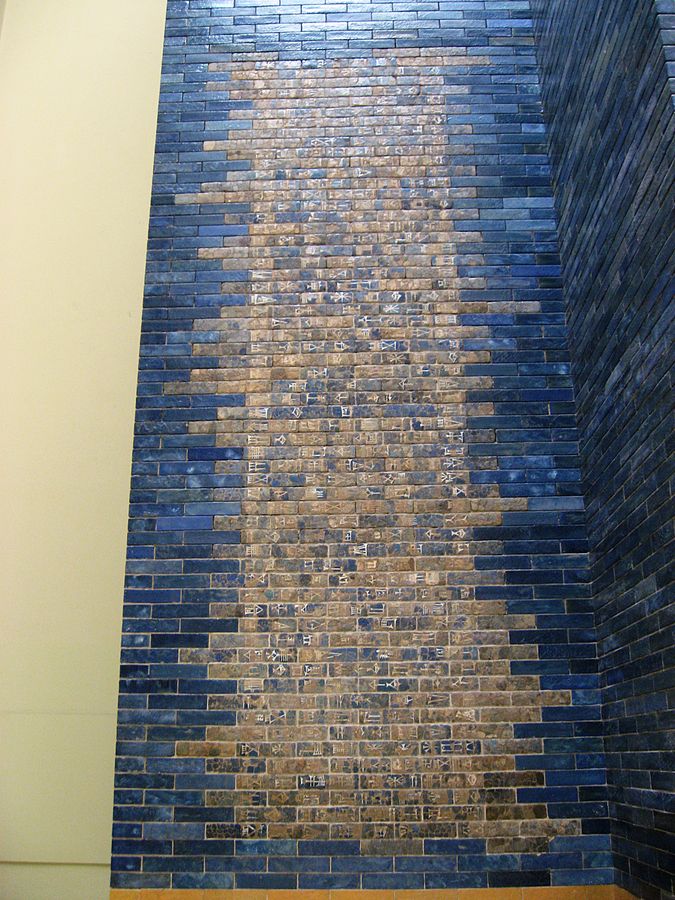
Building Inscription of King Nebuchadnezar II at the Ishtar Gate. An abridged excerpt says:  "I (Nebuchadnezzar) laid the foundation of the gates down to the ground water level and had them built out of pure blue stone. Upon the walls in the inner room of the gate are bulls and dragons and thus I magnificently adorned them with luxurious splendour for all mankind to behold in awe." https://en.wikipedia.org/wiki/Nebuchadnezzar_II

Building Inscription of King Nebuchadnezar II at the Ishtar Gate. An abridged excerpt says:
“I (Nebuchadnezzar) laid the foundation of the gates down to the ground water level and had them built out of pure blue stone. Upon the walls in the inner room of the gate are bulls and dragons and thus I magnificently adorned them with luxurious splendour for all mankind to behold in awe.”
https://en.wikipedia.org/wiki/Nebuchadnezzar_II

It has been stated with some show of probability that the judgment upon Nebuchadrezzar was connected with that weird disease known as lycanthropy, from the Greek words lukos, a wolf, and anthropos, a man. It develops as a kind of hysteria and is characterized by a belief on the part of the victim that he has become an animal.

There are, too, cravings for strange food, and the afflicted person runs about on all fours. Among primitive peoples such a seizure is ascribed to supernatural agency, and garlic or onion—the common scourge of vampires—is held to the nostrils.”

Lewis Spence, Myths and Legends of Babylonia and Assyria, 1917, p. 40.

Sargon: Conquerer, Librarian

“But the first great Semitic empire in Babylonia was that founded by the famous Sargon of Akkad. As is the case with many popular heroes and monarchs whose deeds are remembered in song and story— for example, Perseus, Oedipus, Cyrus, Romulus, and our own King Arthur—the early years of Sargon were passed in obscurity.

Sargon is, in fact, one of the ‘fatal children.’ He was, legend stated, born in concealment and sent adrift, like Moses, in an ark of bulrushes on the waters of the Euphrates, whence he was rescued and brought up by one Akki, a husbandman.

But the time of his recognition at length arrived, and he received the crown of Babylonia. His foreign conquests were extensive. On four successive occasions he invaded Syria and Palestine, which he succeeded in welding into a single empire with Babylonia. Pressing his victories to the margin of the Mediterranean, he erected upon its shores statues of himself as an earnest of his conquests. He also overcame Elam and northern Mesopotamia and quelled a rebellion of some magnitude in his own dominions.

His son, Naram-Sin, claimed for himself the title of “King of the Four Zones,” and enlarged the empire left him by his father, penetrating even into Arabia. A monument unearthed by J. de Morgan at Susa depicts him triumphing over the conquered Elamites. He is seen passing his spear through the prostrate body of a warrior whose hands are upraised as if pleading for quarter. His head-dress is ornamented with the horns emblematic of divinity, for the early Babylonian kings were the direct vicegerents of the gods on earth.

The brilliance of Naram-Sin's reign is reflected in the execution of this stele, which commemorated his victory over Satuni, king of the Lullubi.  The Akkadian army is climbing the steep slopes of the Zagros Mountains, home to the Lullubi. This upward march sweeps aside all resistance. To the right of a line of trees clinging to the mountainside, defeated enemies are depicted in a posture of submission. Those who have been killed are trampled underfoot by the Akkadian soldiers or drop over the precipice. These mountain people are clad in a tunic of hide and wear their long hair tied back. The composition is dominated by the lofty figure of the king, to whom all eyes - those of the Akkadian soldiers and of their Lullubi enemies - are turned. The triumphant sovereign, shown taller than the other men in the traditional manner, leads his army in the attack on the mountain.  He is followed by standard bearers who march before helmeted soldiers carrying bows and axes. Naram-Sin tramples the bodies of his enemies, while a kneeling Lullubi tries to tear out the arrow piercing his throat. Another raises his hands to his mouth, begging the Akkadian king for mercy.  But the conqueror's gaze is directed toward the top of the mountain. Above Naram-Sin, solar disks seem to radiate their divine protection toward him, while he rises to meet them. The Akkadian sovereign wears a conical helmet with horns - a symbol traditionally the privilege of the gods - and is armed with a large bow and an axe. This victorious ascension chiseled in stone thus celebrates a sovereign who considers himself on an equal footing with the gods. In official inscriptions, Naram-Sin's name was therefore preceded with a divine determinative.  He pushed back the frontiers of the empire farther than they had ever been, from Ebla in Syria to Susa in Elam, and led his army

The brilliance of Naram-Sin’s reign is reflected in the execution of this stele, which commemorated his victory over Satuni, king of the Lullubi.
The Akkadian army is climbing the steep slopes of the Zagros Mountains, home to the Lullubi. This upward march sweeps aside all resistance. To the right of a line of trees clinging to the mountainside, defeated enemies are depicted in a posture of submission. Those who have been killed are trampled underfoot by the Akkadian soldiers or drop over the precipice. These mountain people are clad in a tunic of hide and wear their long hair tied back.
The composition is dominated by the lofty figure of the king, to whom all eyes – those of the Akkadian soldiers and of their Lullubi enemies – are turned. The triumphant sovereign, shown taller than the other men in the traditional manner, leads his army in the attack on the mountain.
He is followed by standard bearers who march before helmeted soldiers carrying bows and axes. Naram-Sin tramples the bodies of his enemies, while a kneeling Lullubi tries to tear out the arrow piercing his throat. Another raises his hands to his mouth, begging the Akkadian king for mercy.
But the conqueror’s gaze is directed toward the top of the mountain. Above Naram-Sin, solar disks seem to radiate their divine protection toward him, while he rises to meet them. The Akkadian sovereign wears a conical helmet with horns – a symbol traditionally the privilege of the gods – and is armed with a large bow and an axe.
This victorious ascension chiseled in stone thus celebrates a sovereign who considers himself on an equal footing with the gods. In official inscriptions, Naram-Sin’s name was therefore preceded with a divine determinative.
He pushed back the frontiers of the empire farther than they had ever been, from Ebla in Syria to Susa in Elam, and led his army “where no other king had gone before him.”
He now appears as a universal monarch, as proclaimed by his official title “King of the Four Regions” – namely, of the whole world.
http://www.louvre.fr/en/oeuvre-notices/victory-stele-naram-sin

Even at this comparatively early time (c . 3800 b.c.) the resources of the country had been well exploited by its Semitic conquerors, and their absorption of the Sumerian civilization had permitted them to make very considerable progress in the enlightened arts. Some of their work in bas-relief, and even in the lesser if equally difficult craft of gem-cutting, is among the finest efforts of Babylonian art.

Nor were they deficient in more utilitarian fields. They constructed roads through the most important portions of the empire, along which a service of posts carried messages at stated intervals, the letters conveyed by these being stamped or franked by clay seals, bearing the name of Sargon.

Sargon is also famous as the first founder of a Babylonian library. This library appears to have contained works of a most surprising nature, having regard to the period at which it was instituted.

One of these was entitled The Observations of Bel, and consisted of no less than seventy-two books dealing with astronomical matters of considerable complexity; it registered and described the appearances of comets, conjunctions of the sun and moon, and the phases of the planet Venus, besides recording many eclipses. This wonderful book was long afterward translated into Greek by the Babylonian historian Berossus, and it demonstrates the great antiquity of Babylonian astronomical science even at this very early epoch.

Another famous work contained in the library of Sargon dealt with omens, the manner of casting them, and their interpretation—a very important side-issue of Babylonian magico-religious practice.

Among the conquests of this great monarch, whose splendour shines through the shadows of antiquity like the distant flash of arms on a misty day, was the fair island of Cyprus. Even imagination reels at the well-authenticated assertion that five thousand seven hundred years ago the keels of a Babylonian conqueror cut the waves of the Mediterranean and landed upon the shores of flowery Cyprus stern Semitic warriors, who, loading themselves with loot, erected statues of their royal leader and returned with their booty.

A god in horned cap brandishes a mace and the forked lightening of Iva-Vul, Thunder God, and sets foot on a recumbent bull.  Behind him is a leaping ibex. In front, a man, perhaps the king, in a short coat, standing full face. Behind him a man on bended knee, possibly the owner of the cylinder. Above him, a small deer is recumbent and inverted.  Then a figure in a long garment, and 3 rows of cuneiform writing:

A god in horned cap brandishes a mace and the forked lightening of Iva-Vul, Thunder God, and sets foot on a recumbent bull.
Behind him is a leaping ibex. In front, a man, perhaps the king, in a short coat, standing full face. Behind him a man on bended knee, possibly the owner of the cylinder. Above him, a small deer is recumbent and inverted.
Then a figure in a long garment, and 3 rows of cuneiform writing:
“Arba Istar: son of Ibu Beled: servant of the god Naram-Sin.”
The king Naram-Sin, to whom a divine determinative prefix is given here, reigned in Babylonia no later than 2600 BCE.
Cyprus, plate 4300.
John L. Myres, Handbook of the Cesnola Collection of Antiquities from Cyprus, 1914.

In a Cyprian temple De Cesnola discovered, down in the lowest vaults, a haematite cylinder which described its owner as a servant of Naram-Sin, the son of Sargon, so that a certain degree of communication must have been kept up between Babylonia and the distant island, just as early Egypt and Crete were bound to each other by ties of culture and commerce.

Lewis Spence, Myths and Legends of Babylonia and Assyria, 1917, pp. 16-9.

Nineveh, Cult Center of Ishtar Worship

“From the name /Nin/, which Ištar bore, there is hardly any doubt that she acquired the identification with Nina, which is provable as early as the time of the Lagašite kings, Lugal-anda and Uru-ka-gina.

As identified with Aruru, the goddess who helped Merodach to create mankind, Ištar was also regarded as the mother of all, and in the Babylonian story of the Flood, she is made to say that she had begotten man, but like “the sons of the fishes,” he filled the sea.

Nina, then, as another form of Ištar, was a goddess of creation, typified in the teeming life of the ocean, and her name is written with a character standing for a house or receptacle, with the sign for “fish” within.

Her earliest seat was the city of Nina in southern Babylonia, from which place, in all probability, colonists went northwards, and founded another shrine at Nineveh in Assyria, which afterwards became the great centre of her worship, and on this account the city was called after her Ninaa or Ninua.

As their tutelary goddess, the fishermen in the neighbourhood of the Babylonian Nina and Lagaš were accustomed to make to her, as well as to Innanna or Ištar, large offerings of fish.

As the masculine deities had feminine forms, so it is not by any means improbable that the goddesses had masculine forms, and if that be the case, we may suppose that it was a masculine counterpart of Nina who founded Nineveh, which, as is well known, is attributed to Ninos, the same name as Nina with the Greek masculine termination.”

Theophilus G. Pinches, The Religion of Babylonia and Assyria, London, 1906, pp. 75-6.

Were the Babylonian Kings … Gods?

“Though there is no proof that ancestor-worship in general prevailed at any time in Babylonia, it would seem that the worship of heroes and prominent men was common, at least in early times.

The tenth chapter of Genesis tells us of the story of Nimrod, who cannot be any other than the Merodach of the Assyro-Babylonian inscriptions; and other examples, occurring in semi-mythological times, are /En-we-dur-an-ki/, the Greek Edoreschos, and /Gilgameš/, the Greek Gilgamos, though Aelian’s story of the latter does not fit in with the account as given by the inscriptions.

In later times, the divine prefix is found before the names of many a Babylonian ruler–Sargon of Agadé,[*] Dungi of Ur (about 2500 B.C.), Rim-Sin or Eri-Aku (Arioch of Ellasar, about 2100 B.C.), and others.

It was doubtless a kind of flattery to deify and pay these rulers divine honours during their lifetime, and on account of this, it is very probable that their godhood was utterly forgotten, in the case of those who were strictly historical, after their death.

The deification of the kings of Babylonia and Assyria is probably due to the fact, that they were regarded as the representatives of God upon earth, and being his chief priests as well as his offspring (the personal names show that it was a common thing to regard children as the gifts of the gods whom their father worshipped), the divine fatherhood thus attributed to them naturally could, in the case of those of royal rank, give them a real claim to divine birth and honours.

An exception is the deification of the Babylonian Noah, Ut-napištim, who, as the legend of the Flood relates, was raised and made one of the gods by Aa or Ea, for his faithfulness after the great catastrophe, when he and his wife were translated to the “remote place at the mouth of the rivers.”

The hero Gilgameš, on the other hand, was half divine by birth, though it is not exactly known through whom his divinity came.”

[*] According to Nabonidus’s date 3800 B.C., though many Assyriologists regard this as being a millennium too early.”

Theophilus G. Pinches, The Religion of Babylonia and Assyria, London, 1906, pp. 13-4.

Twins

“The close association of Enkidu and Gilgamesh which becomes one of the striking features in the combination of the tales of these two heroes naturally recalls the “Heavenly Twins” motif, which has been so fully and so suggestively treated by Professor J. Rendell Harris in his Cult of the Heavenly Twins, (London, 1906).

Professor Harris has conclusively shown how widespread the tendency is to associate two divine or semi-divine beings in myths and legends as inseparable companions or twins, like Castor and Pollux, Romulus and Remus, the Acvins in the Rig-Veda, Cain and Abel, Jacob and Esau in the Old Testament, the Kabiri of the Phoenicians, Herakles and Iphikles in Greek mythology, Ambrica and Fidelio in Teutonic mythology, Patollo and Potrimpo in old Prussian mythology, Cautes and Cautopates in Mithraism, Jesus and Thomas (according to the Syriac Acts of Thomas), and the various illustrations of “Dioscuri in Christian Legends,” set forth by Dr. Harris in his work under this title, which carries the motif far down into the period of legends about Christian Saints who appear in pairs, including the reference to such a pair in Shakespeare’s Henry V:

“And Crispin Crispian shall ne’er go by

From that day to the ending of the world.”

–(Act, IV, 3, 57-58.)

There are indeed certain parallels which suggest that Enkidu-Gilgamesh may represent a Babylonian counterpart to the “Heavenly Twins.” In the Indo-Iranian, Greek and Roman mythology, the twins almost invariably act together. In unison they proceed on expeditions to punish enemies.

But after all, the parallels are of too general a character to be of much moment; and moreover the parallels stop short at the critical point, for Gilgamesh though worsted is not killed by Enkidu, whereas one of the “Heavenly Twins” is always killed by the brother, as Abel is by Cain, and Iphikles by his twin brother Herakles.

Even the trait which is frequent in the earliest forms of the “Heavenly Twins,” according to which one is immortal and the other is mortal, though applying in a measure to Enkidu who is killed by Ishtar, while Gilgamesh the offspring of a divine pair is only smitten with disease, is too unsubstantial to warrant more than a general comparison between the Enkidu-Gilgamesh pair and the various forms of the “twin” motif found throughout the ancient world.

For all that, the point is of some interest that in the Gilgamesh Epic we should encounter two figures who are portrayed as possessing the same traits and accomplishing feats in common, which suggest a partial parallel to the various forms in which the twin-motif appears in the mythologies, folk-lore and legends of many nations; and it may be that in some of these instances the duplication is due, as in the case of Enkidu and Gilgamesh, to an actual transfer of the traits of one figure to another who usurped his place.”

Morris Jastrow (ed.), Albert T. Clay (trans.), An Old Babylonian Version of the Gilgamesh Epic on the Basis of Recently Discovered Texts, 1920, pp. 22-3.

Again, Berossus

“Versions in Greek of the Legends found by George Smith had long been known to classical scholars, owing to the preservation of fragments of them in the works of later Greek writers, e.g., Eusebius, Syncellus, and others.

The most important of these is derived from the History of Babylonia, which was written in Greek by BEROSUS, a priest of Bel-Marduk, i.e., the “Lord Marduk,” at Babylon, about 250 B.C. In this work Berosus reproduced all the known historical facts and traditions derived from native sources which were current in his day.

It is therefore not surprising to find that his account of the Babylonian beliefs about the origin of things corresponds very closely with that given in the cuneiform texts, and that it is of the greatest use in explaining and partly in expanding these texts. His account of the primeval abyss, out of which everything came, and of its inhabitants reads:–

“There was a time in which there existed nothing but darkness and an abyss of waters, wherein resided most hideous beings, which were produced on a two-fold principle. There appeared men, some of whom were furnished with two wings, others with four, and with two faces. They had one body but two heads; the one that of a man, the other of a woman; and likewise in their several organs both male and female. Other human figures were to be seen with the legs and horns of goats; some had horses’ feet; while others united the hind-quarters of a horse with the body of a man, resembling in shape the hippo-centaurs. Bulls likewise were bred there with the heads of men, and dogs with four told bodies, terminated in their extremities with the tails of fishes; horses also with the heads of dogs; men too and other animals, with the heads and bodies of horses and the tails of fishes. In short, there were creatures in which were combined the limbs of every species of animals. In addition to these, fishes, reptiles, serpents, with other monstrous animals, which assumed each other’s shape and countenance. Of all which were preserved delineations in the temple of Belus at Babylon.” (Cory, Ancient Fragments, London, 1832, pp. 24-26.)

E.A. Wallis Budge, The Babylonian Legends of the Creation and the Fight Between Bel and the Dragon, 1921.

Sumerian Sacred Stories, c. 3500 BCE

” … it is quite as obvious that for the history of the progress of our civilization as we see and know it today, it is the tone and temper, the word and spirit of the ancient mythologies, those of the Greeks and Hebrews, of the Hindus and Iranians, of the Babylonians and Egyptians, which are of prime significance. It is the spiritual and religious concepts revealed in these ancient literatures which permeate the modern civilized world.

Still almost entirely unknown to this very moment is Sumerian mythology, the sacred stories of the non-Semitic, non-Indo-European people which in historical times, from approximately 3500 to 2000 B.C., inhabited Sumer, the relatively small land situated between the Tigris and Euphrates Rivers and stretching from the Persian Gulf northward approximately as far as modern Bagdad; a land that may be aptly described as the culture cradle of the entire Near East.

Should the reader turn, for example, to Hastings’ Encyclopedia of Religion and Ethics29 and examine the very long article on the cosmogonic or creation myths of the world, he will find a large and relatively exhaustive list of peoples, ancient and modern, cultured and primitive, whose cosmogonic concepts are described and analyzed. But he will look in vain for Sumerian cosmogony.

Similarly, the collection entitled Mythology of All the Races 30 devotes thirteen volumes to an analysis of the more important mythologies in the world; here, too, however, there will be found few traces of Sumerian mythology. Whatever little is known of Sumerian mythology is largely surmised from the modified, redacted, and in a sense, garbled versions of the Babylonians who conquered the Sumerians toward the very end of the third millennium B.C., and who used the Sumerian stories and legends as a basis and nucleus for the development of their own myths.

But it is a known fact that in the long stretch of time between approximately 3500 and 2000 B.C. it was the Sumerians who represented the dominant cultural group of the entire Near East. It was the Sumerians who developed and probably invented the cuneiform system of writing; who developed a well integrated pantheon together with spiritual and religious concepts which influenced profoundly all the peoples of the Near East; who, finally, created and developed a literature rich in content and effective in form.

Moreover, the following significant fact must be borne in mind. By the end of the third millennium B.C. Sumer had already ceased to exist as a political entity and Sumerian had already become a dead language, for by that time Sumer had been overrun and conquered by the Semites, and it is the Semitic Accadian language which gradually became the living, spoken tongue of the land.

Nevertheless Sumerian continued to be used as the literary and religious language of the Semitic conquerors for many centuries to come, like Greek in the Roman period and like Latin in the Middle Ages. Indeed for many centuries the study of the Sumerian language and literature remained the basic pursuit of the scribal schools and intellectual and spiritual centers not only of the Babylonians and Assyrians, but also of the many surrounding peoples such as the Elamites, Hurrians, Hittites, and Canaanites.

Obviously, then, both because of their content as well as because of their age, the Sumerian mythological tales and concepts must have penetrated and permeated those of the entire Near East. A knowledge of the Sumerian myths and legends is therefore a prime and basic essential for a proper approach to a scientific study of the mythologies current in the ancient Near East, for it illuminates and clarifies to no small extent the background behind their origin and development.” i

Samuel Noah Kramer, Sumerian Mythology, 1944, pp. 27-9.

Only Two Residents of the Babylonian Paradise

“Leaving, meantime, the many problems which arise from consideration of the Deluge legends and their connection with primitive agricultural myths, the attention of readers may be directed to the Babylonian conception of the Otherworld.

Pir-napishtim, who escaped destruction at the Flood, resides in an Island Paradise, which resembles the Greek “Islands of the Blessed”, and the Irish “Tir nan og” or “Land of the Young,” situated in the western ocean, and identical with the British …

… island-valley of Avilion,

Where falls not hail, or rain, or any snow,

Nor ever wind blows loudly, but it lies

Deep meadow’d, happy, fair with orchard lawns

And bowery hollows crowned with summer sea.

Only two human beings were permitted to reside on the Babylonian island paradise, however. These were Pir-napishtim and his wife.

Apparently Gilgamesh could not join them there. His gods did not transport heroes and other favoured individuals to a happy isle or isles like those of the Greeks and Celts and Aryo-Indians.”

Donald A. Mackenzie, Myths of Babylonia and Assyria, 1915.

The Attis Cult and the Baptism of Blood

“Tammuz died with the dying vegetation, and Diarmid expired when the hills apparently were assuming their purple tints. The month of Tammuz wailings was from 20th June till 20th July, when the heat and dryness brought forth the demons of pestilence. The mourners chanted:

He has gone, he has gone to the bosom of the earth,

And the dead are numerous in the land….

Men are filled with sorrow: they stagger by day in gloom …

In the month of thy year which brings not peace hast thou gone.

Thou hast gone on a journey that makes an end of thy people.

The following extract contains a reference to the slaying of the god:

The holy one of Ishtar, in the middle of the year the fields languish…

The shepherd, the wise one, the man of sorrows, why have they slain?…

In his temple, in his inhabited domain,

The child, lord of knowledge, abides no more…

In the meadows, verily, verily, the soul of life perishes.

There is wailing for Tammuz “at the sacred cedar, where the mother bore thee,” a reference which connects the god, like Adonis and Osiris, with tree worship:

The wailing is for the herbs: the first lament is, “they are not produced.”

The wailing is for the grain, ears are not produced.

The wailing is for the habitations, for the flocks which bring forth no more.

The wailing is for the perishing wedded ones; for the perishing children; the dark-headed people create no more.

The wailing is also for the shrunken river, the parched meadows, the fish pools, the cane brakes, the forests, the plains, the gardens, and the palace, which all suffer because the god of fertility has departed. The mourner cries:

How long shall the springing of verdure be restrained?

How long shall the putting forth of leaves be held back?

Whither went Tammuz? His destination has already been referred to as “the bosom of the earth,” and in the Assyrian version of the “Descent of Ishtar” he dwells in “the house of darkness” among the dead, “where dust is their nourishment and their food mud,” and “the light is never seen”–the gloomy Babylonian Hades.

In one of the Sumerian hymns, however, it is stated that Tammuz “upon the flood was cast out.” The reference may be to the submarine “house of Ea,” or the Blessed Island to which the Babylonian Noah was carried. In this Hades bloomed the nether “garden of Adonis.”

The following extract refers to the garden of Damu (Tammuz):–

Damu his youth therein slumbers …

Among the garden flowers he slumbers; among the garden flowers he is cast away …

Among the tamarisks he slumbers, with woe he causes us to be satiated.

Although Tammuz of the hymns was slain, he returned again from Hades. Apparently he came back as a child. He is wailed for as “child, Lord Gishzida,” as well as “my hero Damu.”

In his lunar character the Egyptian Osiris appeared each month as “the child surpassingly beautiful;” the Osiris bull was also a child of the moon; “it was begotten”, says Plutarch, “by a ray of generative light falling from the moon.”

When the bull of Attis was sacrificed his worshippers were drenched with its blood, and were afterwards ceremonially fed with milk, as they were supposed to have “renewed their youth” and become children.

The ancient Greek god Eros (Cupid) was represented as a wanton boy or handsome youth. Another god of fertility, the Irish Angus, who resembles Eros, is called “the ever young;” he slumbers like Tammuz and awakes in the Spring.

Apparently it was believed that the child god, Tammuz, returned from the earlier Sumerian Paradise of the Deep, and grew into full manhood in a comparatively brief period, like Vyasa and other super-men of Indian mythology. A couplet from a Tammuz hymn says tersely:

In his infancy in a sunken boat he lay.

In his manhood in the submerged grain he lay.

The “boat” may be the “chest” in which Adonis was concealed by Aphrodite when she confided him to the care of Persephone, queen of Hades, who desired to retain the young god, but was compelled by Zeus to send him back to the goddess of love and vegetation.

The fact that Ishtar descended to Hades in quest of Tammuz may perhaps explain the symbolic references in hymns to mother goddesses being in sunken boats also when their powers were in abeyance, as were those of the god for part of each year.

It is possible, too, that the boat had a lunar and a solar significance. Khonsu, the Egyptian moon god, for instance, was associated with the Spring sun, being a deity of fertility and therefore a corn spirit; he was a form of Osiris, the Patriarch, who sojourned on earth to teach mankind how to grow corn and cultivate fruit trees.

In the Egyptian legend Osiris received the corn seeds from Isis, which suggests that among Great-Mother-worshipping peoples, it was believed that agricultural civilization had a female origin.

The same myths may have been attached to corn gods and corn goddesses, associated with water, sun, moon, and stars.”

Donald A. Mackenzie, Myths of Babylonia and Assyria, 1915.

Tammuz, Attis, Osiris, Adonis, Diarmid Derive from a More Ancient God of Fertility

“The Babylonian myth of Tammuz, the dying god, bears a close resemblance to the Greek myth of Adonis. It also links with the myth of Osiris. According to Professor Sayce, Tammuz is identical with “Daonus or Daos, the shepherd of Pantibibla,” referred to by Berosus as the ruler of one of the mythical ages of Babylonia. We have therefore to deal with Tammuz in his twofold character as a patriarch and a god of fertility.

The Adonis version of the myth may be summarized briefly. Ere the god was born, his mother, who was pursued by her angry sire, as the river goddesses of the folk tales are pursued by the well demons, transformed herself into a tree.

Adonis sprang from the trunk of this tree, and Aphrodite, having placed the child in a chest, committed him to the care of Persephone, queen of Hades, who resembles the Babylonian Eresh-ki-gal. Persephone desired to retain the young god, and Aphrodite (Ishtar) appealed to Zeus (Anu), who decreed that Adonis should spend part of the year with one goddess and part of the year with the other.

It is suggested that the myth of Adonis was derived in post-Homeric times by the Greeks indirectly from Babylonia through the Western Semites, the Semitic title “Adon,” meaning “lord,” having been mistaken for a proper name. This theory, however, cannot be accepted without qualifications.

It does not explain the existence of either the Phrygian myth of Attis, which was developed differently from the Tammuz myth, or the Celtic story of “Diarmid and the boar,” which belongs to the archaeological “Hunting Period.”

There are traces in Greek mythology of pre-Hellenic myths about dying harvest deities, like Hyakinthos and Erigone, for instance, who appear to have been mourned for. There is every possibility, therefore, that the Tammuz ritual may have been attached to a harvest god of the pre-Hellenic Greeks, who received at the same time the new name of Adonis.

Osiris of Egypt resembles Tammuz, but his Mesopotamian origin has not been proved. It would appear probable that Tammuz, Attis, Osiris, and the deities represented by Adonis and Diarmid were all developed from an archaic god of fertility and vegetation, the central figure of a myth which was not only as ancient as the knowledge and practice of agriculture, but had existence even in the “Hunting Period.”

Traces of the Tammuz-Osiris story in various forms are found all over the area occupied by the Mediterranean or Brown race from Sumeria to the British Isles. Apparently the original myth was connected with tree and water worship and the worship of animals.

Adonis sprang from a tree; the body of Osiris was concealed in a tree which grew round the sea-drifted chest in which he was concealed. Diarmid concealed himself in a tree when pursued by Finn.

The blood of Tammuz, Osiris, and Adonis reddened the swollen rivers which fertilized the soil. Various animals were associated with the harvest god, who appears to have been manifested from time to time in different forms, for his spirit pervaded all nature. In Egypt the soul of Osiris entered the Apis bull or the ram of Mendes.

Tammuz in the hymns is called “the pre-eminent steer of heaven,” and a popular sacrifice was “a white kid of the god Tammuz,” which, however, might be substituted by a sucking pig. Osiris had also associations with swine, and the Egyptians, according to Herodotus, sacrificed a pig to him annually.

When Set at full moon hunted the boar in the Delta marshes, he probably hunted the boar form of Osiris, whose human body had been recovered from the sacred tree by Isis.

As the soul of Bata, the hero of the Egyptian folk tale, migrated from the blossom to the bull, and the bull to the tree, so apparently did the soul of Osiris pass from incarnation to incarnation. Set, the demon slayer of the harvest god, had also a boar form; he was the black pig who devoured the waning moon and blinded the Eye of Ra.

In his character as a long-lived patriarch, Tammuz, the King Daonus or Daos of Berosus, reigned in Babylonia for 36,000 years. When he died, he departed to Hades or the Abyss. Osiris, after reigning over the Egyptians, became Judge of the Dead.”

Donald A. Mackenzie, Myths of Babylonia and Assyria, 1915.

Gods, Goddesses, Demons

” … In the early stages of Sumerian culture, the gods and goddesses who formed groups were indistinguishable from demons. They were vaguely defined, and had changing shapes. When attempts were made to depict them they were represented in many varying forms. Some were winged bulls or lions with human heads; others had even more remarkable composite forms. The “dragon of Babylon”, for instance, which was portrayed on walls of temples, had a serpent’s head, a body covered with scales, the fore legs of a lion, hind legs of an eagle, and a long wriggling serpentine tail. Ea had several monster forms. The following description of one of these is repulsive enough:–

The head is the head of a serpent,

From his nostrils mucus trickles,

His mouth is beslavered with water;

The ears are like those of a basilisk,

His horns are twisted into three curls,

He wears a veil in his head band,

The body is a suh-fish full of stars,

The base of his feet are claws,

The sole of his foot has no heel,

His name is Sassu-wunnu,

A sea monster, a form of Ea.

R.C. Thompson’s Translation.

Even after the gods were given beneficent attributes to reflect the growth of culture, and were humanized, they still retained many of their savage characteristics. Bel Enlil and his fierce son, Nergal, were destroyers of mankind; the storm god desolated the land; the sky god deluged it with rain; the sea raged furiously, ever hungering for human victims; the burning sun struck down its victims; and the floods played havoc with the dykes and houses of human beings.

In Egypt the sun god Ra was similarly a “producer of calamity,” the composite monster god Sokar was “the lord of fear”. Osiris in prehistoric times had been “a dangerous god,” and some of the Pharaohs sought protection against him in the charms inscribed in their tombs.

The Indian Shiva, “the Destroyer”, in the old religious poems has also primitive attributes of like character.

The Sumerian gods never lost their connection with the early spirit groups. These continued to be represented by their attendants, who executed a deity’s stern and vengeful decrees. In one of the Babylonian charms the demons are referred to as “the spleen of the gods”–the symbols of their wrathful emotions and vengeful desires.

Bel Enlil, the air and earth god, was served by the demons of disease, “the beloved sons of Bel,” which issued from the Underworld to attack mankind. Nergal, the sulky and ill-tempered lord of death and destruction, who never lost his demoniac character, swept over the land, followed by the spirits of pestilence, sunstroke, weariness, and destruction.

Anu, the sky god, had “spawned” at creation the demons of cold and rain and darkness. Even Ea and his consort, Damkina, were served by groups of devils and giants, which preyed upon mankind in bleak and desolate places when night fell. In the ocean home of Ea were bred the “seven evil spirits” of tempest–the gaping dragon, the leopard which preyed upon children, the great Beast, the terrible serpent, &c.

In Indian mythology Indra was similarly followed by the stormy Maruts, and fierce Rudra by the tempestuous Rudras.

In Teutonic mythology Odin is the “Wild Huntsman in the Raging Host.”

In Greek mythology the ocean furies attend upon fickle Poseidon.

Other examples of this kind could be multiplied.”

Donald A. Mackenzie, Myths of Babylonia and Assyria, 1915.

Comparative Mythology

” … Of special interest in this connection are the resemblances between some of the Indian and Babylonian myths. The writer has drawn upon that “great storehouse” of ancient legends, the voluminous Indian epic, the Mahabharata, and it is shown that there are undoubted links between the Garuda eagle myths and those of the Sumerian Zu bird and the Etana eagle, while similar stories remain attached to the memories of “Sargon of Akkad” and the Indian hero Karna, and of Semiramis (who was Queen Sammu-ramat of Assyria) and Shakuntala.

The Indian god Varuna and the Sumerian Ea are also found to have much in common, and it seems undoubted that the Manu fish and flood myth is a direct Babylonian inheritance, like the Yuga (Ages of the Universe) doctrine and the system of calculation associated with it. It is of interest to note, too, that a portion of the Gilgamesh epic survives in the Ramayana story of the monkey god Hanuman’s search for the lost princess Sita; other relics of similar character suggest that both the Gilgamesh and Hanuman narratives are derived in part from a very ancient myth.

Gilgamesh also figures in Indian mythology as Yama, the first man, who explored the way to the Paradise called “The Land of Ancestors”, and over which he subsequently presided as a god. Other Babylonian myths link with those found in Egypt, Greece, Scandinavia, Iceland, and the British Isles and Ireland. The Sargon myth, for instance, resembles closely the myth of Scyld (Sceaf), the patriarch, in the Beowulf epic, and both appear to be variations of the Tammuz-Adonis story. Tammuz also resembles in one of his phases the Celtic hero Diarmid, who was slain by the “green boar” of the Earth Mother, as was Adonis by the boar form of Ares, the Greek war god.”

Donald A. Mackenzie, Myths of Babylonia and Assyria, 1915.

The Lance of Longinus and the Chalice of Christian Liturgy Represent Pagan Antecedents

“Reference to some recent studies in the Legend will make my meaning clear. A reviewer of my small Quest of the Holy Grail volume remarked that I appeared to be ignorant of Miss Peebles’s study The Legend of Longinus “which materially strengthens the evidence for the Christian origin.” 1

Now this is precisely what, in my view, the study in question, which I knew and possessed, does not do. As evidence for the fact that the Grail legend has taken over certain features derived from the popular ‘Longinus’ story (which, incidentally, no one disputed), the essay is, I hold, sound, and valuable; as affording material for determining the source of the Grail story, it is, on the other hand, entirely without value.

On the principle laid down above no theory which purports to be explanatory of the source of one symbol can be held satisfactory in a case where that symbol does not stand alone. We cannot accept for the Grail story a theory of origin which concerns itself with the Lance, as independent of the Grail. In the study referred to the author has been at immense pains to examine the different versions of the ‘Longinus’ legend, and to trace its development in literature; in no single instance do we find Longinus and his Lance associated with a Cup or Vase, receptacle of the Sacred Blood.

The plain fact is that in Christian art and tradition Lance and Cup are not associated symbols. The Lance or Spear, as an instrument of the Passion, is found in conjunction with the Cross, Nails, Sponge, and Crown of Thorns, (anyone familiar with the wayside Crosses of Catholic Europe will recognize this), not with the Chalice of the Mass 1.

This latter is associated with the Host, or Agnus Dei. Still less is the Spear to be found in connection with the Grail in its Food-providing form of a Dish.

No doubt to this, critics who share the views of Golther and Burdach will object, “but what of the Byzantine Mass? Do we not there find a Spear connected with the Chalice 2?”

I very much doubt whether we do–the so-called ‘Holy Spear’ of the Byzantine, and present Greek, liturgy is simply a small silver spear-shaped knife, nor can I discover that it was ever anything else. I have made careful enquiries of liturgical scholars, and consulted editions of Oriental liturgies, but I can find no evidence that the knife (the use of which is to divide the Loaf which, in the Oriental rite, corresponds to the Wafer of the Occidental, in a manner symbolically corresponding to the Wounds actually inflicted on the Divine Victim) was ever other than what it is to-day.”

Jessie L. Weston, From Ritual to Romance, 1920. Pp. 66-7.

Worshipping Virility

“While it is only of comparatively recent date that information as to the exact character of the worship directed to Tammuz has been available and the material we at present possess is but fragmentary in character, the corresponding cult of the Phoenician-Greek divinity we know as Adonis has for some years been the subject of scholarly research.

Not only have the details of the ritual been examined and discussed, and the surviving artistic evidence described and illustrated, but from the anthropological side attention has been forcibly directed to its importance as a factor in the elucidation of certain widespread Folk-beliefs and practices 2.

We know now that the worship of Adonis, which enjoyed among the Greeks a popularity extending to our own day, was originally of Phoenician origin, its principal centres being the cities of Byblos, and Aphaka.

From Phoenicia it spread to the Greek islands, the earliest evidence of the worship being found in Cyprus, and from thence to the mainland, where it established itself firmly.

The records of the cult go back to 700 B.C., but it may quite possibly be of much earlier date. Mr Langdon suggests that the worship of the divinity we know as Adonis, may, under another name, reach back to an antiquity equal with that we can now ascribe to the cult of Tammuz.

In its fully evolved classical form the cult of Adonis offers, as it were, a halfway house, between the fragmentary relics of Aryan and Babylonian antiquity, and the wealth of Medieval and Modern survivals to which the ingenuity and patience of contemporary scholars have directed our attention.

We all know the mythological tale popularly attached to the name of Adonis; that he was a fair youth, beloved of Aphrodite, who, wounded in the thigh by a wild boar, died of his wound.

The goddess, in despair at his death, by her prayers won from Zeus the boon that Adonis be allowed to return to earth for a portion of each year, and henceforward the youthful god divides his time between the goddess of Hades, Persephone, and Aphrodite. But the importance assumed by the story, the elaborate ceremonial with which the death of Adonis was mourned, and his restoration to life fêted, the date and character of the celebrations, all leave no doubt that the personage with whom we are dealing was no mere favourite of a goddess, but one with whose life and well-being the ordinary processes of Nature, whether animal or vegetable, were closely and intimately concerned.

In fact the central figure of these rites, by whatever name he may be called, is the somewhat elusive and impersonal entity, who represents in anthropomorphic form the principle of animate Nature, upon whose preservation, and unimpaired energies, the life of man, directly, and indirectly, depends 1.

Before proceeding to examine these rites there is one point, to which I have alluded earlier, in another connection, upon which our minds must be quite clear, i.e., the nature of the injury suffered. Writers upon the subject are of one accord in considering the usual account to be but a euphemistic veiling of the truth, while the close relation between the stories of Adonis and Attis, and the practices associated with the cult, place beyond any shadow of a doubt the fact that the true reason for this universal mourning was the cessation, or suspension, by injury or death, of the reproductive energy of the god upon whose virile activity vegetable life directly, and human life indirectly, depended.” 2

Jessie L. Weston, From Ritual to Romance, 1920. Pp. 39-41.

More from the Naassene Fragment, the Great Ineffable Mystery of the Samothracians

” … H. Following after these and such like [follies], these most wonderful “Gnostics,” discoverers of a new grammatical art, imagine that their prophet Homer showed forth these things arcanely; and, introducing those who are not initiated into the Sacred Scriptures into such notions, they make a mock of them.

And they say that he who says that all things are from One, is in error, [but] he who says they are from Three is right, and will furnish proof of the first principles [of things]. 2

J. For one (H. he says) is the Blessed Nature of the Blessed Man Above, Adamas; and one is the [Nature] Below, which is subject to Death; and one is the Race without a king 3 which is born Above—where (H. he says) is Mariam the sought-for, and Jothōr the great sage, and Sepphōra the seeing, and Moses whose begetting is not in Egypt—for sons were born to him in Madiam. 4

S. And this (H. he says) also did not escape the notice of the poets:

“All things were threefold divided, and each received his share of honour.” 1

C. For the Greatnesses (H. he says) needs must be spoken, but so spoken by all everywhere, “that hearing they may not hear, and seeing they may not see.” 2

J. For unless (H. he says) the Greatnesses 3 were spoken, the cosmos would not be able to hold together. These are the Three More-than-mighty Words (Logoi): Kaulakau, Saulasau, Zeēsar;—Kaulakau, the [Logos] Above, Adamas; Saulasau, the [Logos] Below; Zeēsar, the Jordan flowing upwards. 4

(17 5) S. He (H. he says) is the male-female Man

in all, whom the ignorant call three-bodied Gēryonēs—Earth-flow-er, as though flowing from the earth; 1 while the Greek [theologi] generally call Him the “Heavenly Horn of Mēn,” 2 because He has mixed and mingled 3 all things with all.

C. For “all things (H. he says) were made through Him, and without Him no one thing was made that was made. In Him is Life.” 4

This (H. he says) is “Life,” the ineffable Race of perfect men, which was unknown to former generations.

And the “nothing” 5 which hath been made “without Him,” is the special cosmos; 6 for the latter hath been made without Him by the third and fourth [? Ruler]. 7

J. This 1 (H. he says) is the drinking-vessel—the Cup in which “the King drinketh and divineth.” 2

This (H. he says) was found hidden in the “fair seed” of Benjamin.

(18) S. The Greeks also speak of it (H. he says) with inspired tongue, as follows:

“Bring water, bring [me] wine, boy!

Give me to drink, and sink me in slumber! 3

My Cup tells me of what race I must be born,

[Speaking with silence unspeaking].” 4

C. This (H. he says) would be sufficient alone if men would understand—the Cup of Anacreon speaking forth speechlessly the Ineffable Mystery.

J. For (H. he says) Anacreon’s Cup is speechless—in as much as it tells him (says Anacreon) with speechless sound of what Race he must be born—

C. —that is, spiritual, not carnal—

J. —if he hear the Hidden Mystery in Silence.

C. And this is the Water at those Fair Nuptials which Jesus turned and made Wine.

“This (H. he says) is the great and true beginning of the signs which Jesus wrought in Cana of Galilee, and made manifest His Kingship [or Kingdom] of the Heavens.” 5

This (H. he says) is the Kingship [or Kingdom] of the Heavens within us, 6 stored up as a Treasure, 7 as “Leaven hid in three measures of Flour.” 8

(19 1) S. This is (H. he says) the Great Ineffable Mystery of the Samothracians,—

C. —which it is lawful for the perfect alone to know—[that is] (H. he says) for us.

J. For the Samothracians, in the Mysteries which are solemnised among them, explicitly hand on the tradition that this Adam is the Man Original.

S. Moreover, 2 in the initiation temple of the Samothracians stand two statues of naked men, with both hands raised to heaven and ithyphallic, like the statue of Hermes in Cyllene. 3

J. The statues aforesaid are images of the Man Original. 4

C. And [also] of the regenerated 5 spiritual [man], in all things of like substance with that Man.

This (H. he says) is what was spoken by the Saviour:

“If ye do not drink My Blood and eat My Flesh, ye shall not enter into the Kingdom of the Heavens. 6

“But even if ye drink (H. he says) the Cup which I drink, 7 where I go, there ye cannot come.” 8

For He knew (H. he says) of which nature each of His disciples is, and that it needs must be that each of them should go to his own nature.

For from the twelve tribes (H. he says) He chose twelve disciples, and through them He spake to every tribe. 1

On this account (H. he says) all have not heard the preachings of the twelve disciples; and even if they hear, they cannot receive them. For the [preachings] which are not according to their nature are contrary to it.”

G.R.S. Mead, Thrice-Greatest HermesVol. 1, 1906, pp. 164-8.

From Hippolytus, Philosophumena; or, Refutation of all Heresies.

Excerpts from the Naassene Fragment

” … In the following analysis H. stands for Hippolytus; C. for the Christian Gnostic final overwriter, the “Naassene” whose MS. lay before H.; J. for the Naassene Jewish mystic who preceded C. and overworked the original; S. for the original Heathen Hellenistic Source. …”

“(1) S. “Earth (say the Greeks 3) first brought forth Man—bearing a fair gift, desiring to be mother not of plants without feeling, nor of brutes without reason, but of a tamed God-loving life.

“Difficult is it (H. he says 4) to discover whether it was among the Bœotians that Alalkomeneus rose from the Kephisian Lake as first of men; or whether it was the Idæan Kurētes, race divine, or the Phrygian Korybantes, whom Helios saw first sprouting forth tree-like; or whether Arkadia brought forth Pelasgos [first], older than the Moon; or Eleusis Diaulos, dweller in Raria; or Lēmnos Kabeiros, fair child of ineffable orgies; 1 or whether Pallēnē Phlegræan Alkyoneus, eldest of Giants.

“The Libyans say that Garamas, 2 rising from parched plains, first picked sweet date of Zeus; while Neilos, making fat the mud of Egypt to this day (H. he says), breeds living things, and renders from damp heat things clothed in flesh.” 3

The Assyrians say it was with them Ōannēs, the Fish-eater; while the Chaldæans [say that it was] Adam.

(2) J. And this Adam they [the Chaldæans] say was the man that Earth produced—a body only, and that he lay breathless, motionless, immovable, like a statue, being an image of that Man Above—

H. —of whom they sing, and brought into existence by the many Powers, 1 concerning which there is much detailed teaching.

J. In order, then, that the Great Man from Above—

C. From whom, as is said, every fatherhood has its name on earth or in the heavens. 2

J. —might be completely brought low, there was given unto him 3 Soul also, in order that through the Soul the enclosed plasm of the Great, Most-fair, and Perfect Man might suffer and be chastened.

H. For thus they call Him. They seek to discover then further what is the Soul, and whence, and of what nature, that by entering into man and moving him, it should enslave and chasten the plasm of the Perfect Man; but they seek this also not from the Scriptures, but from the Mysteries.

(3) S. And they 4 say that Soul is very difficult to discover, and hard to understand; for it never remains of the same appearance, or form, or in the same state, so that one can describe it by a general type, 5 or comprehend it by an essential quality.

H. These variegated metamorphoses they 6 have laid down in the Gospel, superscribed “According to the Egyptians.” 7

S. They are accordingly in doubt—

H. —like all the rest of the Gentiles—

J. —whether it [sc. the Soul] is from the Pre-existing [One], or from the Self-begotten, or from the Streaming Chaos. 8

H. And first of all, in considering the triple division of Man, they fly for help to the Initiations of the Assyrians; for the Assyrians were the first to consider the Soul triple and [yet] one. …”

 G.R.S.Mead, Thrice-Greatest Hermes, Vol. 1, 1906, pp. 148-51.

From Hippolytus, Philosophumena; or, Refutation of all Heresies.

On the Apocatastasis

“Only in the messianic era will the position of Sammael be restored; the Throne of God, which for the present is damaged, will then be repaired.

It thus appears that Isaac the Blind was a follower of the doctrine of the ultimate “restoration of Satan,” the apocatastasis.

Since, as is well known, Judaism recognized no official dogmatic authority that was entitled to determine the content of the faith, this question too, which played such an important role in the history of the Christian churches, remained open and a subject of dispassionate discussion.

Opinions were divided, and many mystics adhered to the “restoration” doctrine. Later kabbalistic theories exhibiting the same tendency, such as Joseph ibn Gikatilla’s Mystery of the Serpent, probably owe their inspiration to Isaac the Blind.

What is curious in the case of Isaac is that Sammael did not fall from his exalted rank, as one would expect, at the time of Adam’s sin—for which the Aggadah holds him responsible—but only at the time of the battle against Amaleq.

In this detail he was not followed by later kabbalists; even when they defended the doctrine of apocatastasis they placed it in relation to the reestablishment of the harmony of all things, which had been disturbed by Adam’s original sin.

However, also for ibn Gikatilla (as for Isaac), the serpent drew his original power directly from the sacred domain of the emanations, standing outside its “walls” and acting as the genius of the entire sublunar world. There, too, the rebellion of the serpent introduces disorder into the harmonious union of the worlds and isolates Sammael as genius of evil.

Isaac’s view that the supreme angelic powers draw their influx directly from the tenth sefirah is also found in Ezra, who attests to having received “from the lips of the son of the master,” that is, from Isaac the Blind, the doctrine “that Metatron is only a messenger, and not a specific thing bearing that name.

Rather, every messenger is called in Greek metator, and perhaps the messengers received the influx of the [tenth sefirah] named ‘atarah to fulfill their mission.”

Metatron is therefore not a proper name at all but a designation for the whole category of celestial powers performing a mission. This conception is far more prosaic than that taught by his father, the Rabad (cf. the passage quoted, p. 212), in his commentary on the Talmud.

Is this the whole truth about Isaac’s view, or merely an occasional remark? No other kabbalist ever denied the existence of a specific angelic being called Metatron, even if he adopted Isaac’s etymology.

The etymology itself is apparently taken from the old talmudic dictionary ‘Arukh of Nathan ben Yehiel of Rome, which was well known in Provence (as metator). Isaac obviously did not think of identifying Metatron with the last sefirah, the Shekhinah, although the identification is found later, among the first generation of Catalan kabbalists.”

Gershom Scholem, Origins of the Kabbalah, pp. 298-9.

The En-Sof

“They are called in his works the Infinite (‘en-sof), Thought, and Speech. The principle of Speech, dibbur, is divided into the plurality of speeches and words, by which he often means the seven lower sefiroth, called not only dibburim but also debharim. In Hebrew dabhar means “word” as well as “thing,” and this coincidence was obviously decisive for the formation of Isaac’s thought.

The sefiroth, above all the seven lower ones, are the words or things “which shape reality.” They take the place of the ma’amaroth, the logoi of the Bahir. The “Thought,” too, already comes from this text, as we saw in the previous chapter. But what is entirely new is the emphasis laid on a domain of the divine that is above all reflective contemplation, indeed above the divine Thought itself, a domain called by Isaac “the cause of Thought” and designated by a new term: ‘en-sof.

The birth of this concept is of great interest for the history of the Kabbalah. This designation is usually explained as a borrowing from Neoplatonism. Christian Ginsburg, whose essay on the Kabbalah has been appropriated by many authors (who do not always bother to acknowledge their source), says:

“ … Any doubt upon this subject must be relinquished when the two systems are compared. The very expression En Sof which the Kabbalah uses to designate the Incomprehensible One, is foreign, and is evidently an imitation of the Greek Apeiros. The speculations about the En Sof, that he is superior to actual being, thinking and knowing, are thoroughly Neo-Platonic.”

Ginsburg, however, proceeded on the completely erroneous assumption that the oldest document of the authentic Kabbalah was the Neoplatonic catechism on the sefiroth composed by Azriel, Isaac’s disciple. There the notion is in fact explained in a manner that comes particularly close to Neoplatonic thought. But this says nothing about the origin of the concept. Indeed, the expression is strange, by virtue of its very grammatical formation.

It certainly is not a rendering of a fixed philosophical idiom, whether it be from the Greek or from the corresponding Arabic (la-nihaya)—in spite of the readiness with which some scholars have adopted this view.

The form ‘en-sof corresponds in no way to the translations of privative notions in medieval Hebrew literature: in these the conjunction Ulti always precedes the negated notion; the negation ayin is never employed for this purpose. Thus “inconceivable” is rendered by bil-ti-mussag and not by ‘en hassagah, and “infinite” is Ulti ba’al-takh-lith and not ‘en-sof.

The form ‘en-sof is altogether unusual, and Graetz had good reason to see it in a proof of the late origin of the term. However, he should have added that in the Hebrew literature of the Middle Ages, too, it represents a completely isolated phenomenon. It is only in biblical literature that we find forms such as ‘en ‘onim or ‘en ‘eyyal, for powerless. Subsequently, locutions of this kind disappear completely.

How, then, are we to understand the origin of the term ‘en-sof? It did not result from a deliberate translation, but from a mystical interpretation of texts that contain the composite term ‘en-sof in a perfectly correct adverbial sense, and not as a specific concept. The doctrine of Saadya Gaon, in particular, abounds with affirmations of the infinity of God—in fact, it is asserted at the very beginning of his well-known “Supplication” (Siddur R. Saadia [1941], 47), and in the old Hebrew paraphrase, known among the Provençal Kabbalists as well as the German Hasidim, it is reiterated incessantly.

Tobias ben Eliezer, who wrote around 1097, also stressed precisely this quality of God, in the context of a reference to the mystical Hekhaloth writings. For him God is “the first up to the unfathomable, the primordial beginning up to the infinite (‘ad ‘en-takhlith), among the last up to infinity (‘ad ‘en-sof). ” The adverbial construction is perfectly correct.

“Up to infinity” results from a combination of “up to there, where there is no end.” Expressions of this kind, in which ‘en-sof has the function of an adverbial complement, are found with particular frequency in the writings of Eleazar of Worms. We find the same usage in the Bahir (cf. p. 130 preceding). Thus, Eleazar writes, for example: “When he thinks of that which is above, he should not set any limit to this thought, but thus [should he think of God]:

” … high, higher up to the Boundless [‘ad ‘en-qes]; down deep, who can find him; and the same above in the expanse of all the heavens . . . and outside the heavens up to the infinite [le’en- sof].” Or: “in the Throne of Glory are engraved holy names, which are not transmitted to any mortal, and which sing hymns unto infinity [meshorerim shiroth le’en-sof].”

The transition here from the innumerable hymns sung by holy names and angels to a hypostasis that, as a mystical reader might perhaps conceive it, “sings hymns to ‘en-sof” seems easy enough. The term ‘en-sof came into being when one of the Provençal kabbalists read this combination of words that actually represents a phrase as a noun, possibly influenced by the aforementioned kind of adverbial composites and perhaps also by some expressions in the Bahir.”

Gershom Scholem, Origins of the Kabbalah, pp. 265-7.

The Most Religious Nation of Antiquity

“Now the Egyptians believed that as the souls of the departed could assume the form of any living thing or plant, so the “gods,” who in many respects closely resembled them, could and did take upon themselves the forms of birds and beasts; this was the fundamental idea of the so-called “Egyptian animal worship,” which provoked the merriment of the cultured Greek, and drew down upon the Egyptians the ridicule and abuse of the early Christian writers.

But if the matter be examined closely its apparent stupidity disappears. The Egyptians paid honour to certain birds, and animals, and reptiles, because they considered that they possessed certain of the characteristics of the gods to whom they made them sacred.

The bull was a type of the strength and procreative power of the god of reproduction in nature, and the cow was the type of his female counterpart; every sacred animal and living thing possessed some quality or attribute which was ascribed to some god, and as each god was only a form of Râ, the quality or attribute ascribed to him was that of the Sun-god himself.

The educated Egyptian never worshipped an animal as an animal, but only as an incarnation of a god, and the reverence paid to animals in Egypt was in no way different from that paid to the king, who was regarded as “divine” and as an incarnation of Râ the Sun-god, who was the visible symbol of the Creator.

The relation of the king to Râ was identical with that of Râ to God. The Hebrews, Greeks, and Romans never understood the logical conception which underlay the reverence with which the Egyptians regarded certain animals, and as a result they grossly misrepresented their religion.

The ignorant people, no doubt, often mistook the symbol for what it symbolized, but it is wrong to say that the Egyptians worshipped animals in the ordinary sense of the word, and this fact cannot be too strongly insisted on.

Holding the views he did about transformations there was nothing absurd in the reverence which the Egyptian paid to animals. When a sacred animal died the god whom it represented sought out another animal of the same species in which to renew his incarnation, and the dead body of the animal, inasmuch as it had once been the dwelling-place of a god, was mummified and treated in much the same way as a human body after death, in order that it might enjoy immortality.

These views seem strange, no doubt, to us when judged by modern ideas, but they formed an integral part of the religious beliefs of the Egyptians, from the earliest to the latest times.

What is remarkable, however, is the fact that, in spite of invasions, and foreign wars, and internal dissensions, and external influences of all kinds, the Egyptians clung to their gods and the sometimes childish and illogical methods which they adopted in serving them with a conservatism and zeal which have earned for them the reputation of being at once the most religious and most superstitious nation of antiquity.

Whatever literary treasures may be brought to light in the future as the result of excavations in Egypt, it is most improbable that we shall ever receive from that country any ancient Egyptian work which can properly be classed among the literature of atheism or freethought; the Egyptian might be more or less religious according to his nature and temperament, but, judging, from the writings of his priests and teachers which are now in our hands, the man who was without religion and God in some form or other was most rare, if not unknown.”

E.A. Wallis Budge, Egyptian Magic, London, 1901. Pp. 232-4.

Transformations of the Afterlife

“But the use of the horoscope is much older than the time of Alexander the Great, for to a Greek horoscope (published for the first time by Kenyon, Catalogue of Greek Papyri vol. i. p. 132 ff) in the British Museum is attached “an introductory letter from some master of the art of astrology to his pupil, named Hermon, urging him to be very exact and careful in his application of the laws which the ancient Egyptians, with their laborious devotion to the art, had discovered and handed down to posterity.”

Thus we have good reason for assigning the birthplace of the horoscope to Egypt. In connexion with the horoscope must be mentioned the “sphere” or “table” of Democritus as a means of making predictions as to life and death.

In a magical papyrus (footnotes for page 230 are missing from my edition, not included at the end of the text)  we are told to “ascertain in what month the sick man took to his bed, and the name he received at his birth.”

“Calculate the [course of] the moon, and see how many periods of thirty days have elapsed; then note in the table the number of days left over, and if the number comes in the upper part of the table, he will live, but if in the lower part, he will die.”

Egyptian Horoscope TableBoth from the religious and profane literature of Egypt we learn that the gods and man in the future life were able at will to assume the form of any animal, or bird, or plant, or living thing, which they pleased, and one of the greatest delights to which a man looked forward was the possession of that power.

This is proved by the fact that no less than twelve (footnote missing)  of the chapters of the Book of the Dead are devoted to providing the deceased with the words of power, the recital of which was necessary to enable him to transform himself into a “hawk of gold,” a “divine hawk,” “the governor of the sovereign princes,” “the god who giveth light in the darkness,” a lotus, the god Ptah, a bennu bird (i.e., phœnix), a heron, a “living soul,” a swallow, the serpent Sata, and a crocodile; and another chapter (footnote missing)  enabled him to transform himself into “whatever form he pleaseth.”

Armed with this power he could live in the water in the form of a crocodile, in the form of a serpent he could glide over the rocks and ground, in the form of the birds mentioned above he could fly through the air, and soar up and perch himself upon the bow of the boat of Râ, in the form of the lotus he had mastery over the plants of the field, and in the form of Ptah he became “more powerful than the lord of time, and shall gain the mastery over millions of years.”

The bennu bird, it will be remembered, was said to be the “soul of Râ,” and by assuming this form the deceased identified himself with Khepera, the great god of creation, and thus acquired the attributes of the soul of the Sun-god.

In the Elysian Fields he was able to assume any form and to swim and fly to any distance in any direction. It is noteworthy that no beast of the field or wild animal is mentioned as a type of his possible transformations into animals.”

E.A. Wallis Budge, Egyptian Magic, London, 1901. Pp. 229-32.

The Five Epagomenal Days

“But to the three hundred and sixty days given in the calendars of lucky and unlucky days must be added the five epagomenal days which were considered to be of great importance and had each its peculiar name.

On the first Osiris was born, on the second Heru-ur (Aroueris), on the third Set, on the fourth Isis, and on the fifth Nephthys; the first, third, and fifth of these days were unlucky, and no work of any kind was to be undertaken on them.

The rubric which refers to these days (See Chabas, op. cit., p. 104) states that whosoever knoweth their names shall never suffer from thirst, that he shall never be smitten down by disease, and that the goddess Sekhet (the Eye of Sekhet seems to have taken the form of noxious vapours in the fields at sunrise; see Chabas, op. cit., p. 78) shall never take possession of him; it also directs that figures of the five gods mentioned above shall be drawn with unguent and ânti scent upon a piece of fine linen, evidently to serve as an amulet.

From the life of Alexander the Great by Pseudo-Callisthenes (I. 4) we learn that the Egyptians were skilled in the art of casting nativities, and that knowing the exact moment of the birth of a man they proceeded to construct his horoscope.

Nectanebus employed for the purpose a tablet made of gold and silver and acacia wood, to which were fitted three belts. Upon the outer belt was Zeus with the thirty-six decani surrounding him; upon the second the twelve signs of the Zodiac were represented; and upon the third the sun and moon (quote from my History of Alexander the Great, Cambridge, 1889, p. 5).

He set the tablet upon a tripod, and then emptied out of a small box upon it models of the seven stars (i.e., Sun, Moon, Zeus, Kronos, Aphrodite, and Hermes; we must add Mars according to Meusel’s Greek text) that were in the belts, and put into the middle belt eight precious stones; these he arranged in the places wherein he supposed the planets which they represented would be at the time of the birth of Olympias, and then told her fortune from them.”

E.A. Wallis Budge, Egyptian Magic, London, 1901. Pp. 228-9.

Abrasax, the Invincible Name of Power

“The last class of documents undoubtedly contains a very large proportion of the magical ideas, beliefs, formulæ, etc., which were current in Egypt from the time of the Ptolemies to the end of the Roman Period, but from about B.C. 150 to A.D. 200 the papyri exhibit traces of the influence of Greek, Hebrew, and Syrian philosophers and magicians, and from a passage like the following (see Goodwin, Fragment of a Græco-Egyptian Work upon Magic, p. 7) we may get a proof of this:—

“I call thee, the headless one, that didst create earth and heaven, that didst create night and day, thee the creator of light and darkness. Thou art Osoronnophris, whom no man hath seen at any time; thou art Iabas, thou art Iapôs, thou hast distinguished the just and the unjust, thou didst make female and male, thou didst produce seeds and fruits, thou didst make men to love one another and to hate one another.”

“I am Moses thy prophet, to whom thou didst commit thy mysteries, the ceremonies of Israel; thou didst produce the moist and the dry and all manner of food.”

“Listen to me: I am an angel of Phapro Osoronnophris; this is thy true name, handed down to the prophets of Israel. Listen to me. (Here follow a number of names of which Reibet, Athelebersthe, Blatha, Abeu, Ebenphi, are examples) . . .”

In this passage the name Osoronnophris is clearly a corruption of the old Egyptian names of the great god of the dead “Ausar Unnefer,” and Phapro seems to represent the Egyptian Per-âa (literally, “great house”) or “Pharaoh,” with the article pa “the” prefixed.

It is interesting to note that Moses is mentioned, a fact which seems to indicate Jewish influence.

In another magical formula we read, (Goodwin, op. cit., p. 21) “I call upon thee that didst create the earth and bones, and all flesh and all spirit, that didst establish the sea and that shakest the heavens, that didst divide the light from the darkness, the great regulative mind, that disposest everything, eye of the world, spirit of spirits, god of gods, the lord of spirits, the immoveable Aeon, IAOOUÊI, hear my voice.”

“I call upon thee, the ruler of the gods, high-thundering Zeus, Zeus, king, Adonai, lord, Iaoouêe. I am he that invokes thee in the Syrian tongue, the great god, Zaalaêr, Iphphou, do thou not disregard the Hebrew appellation Ablanathanalb, Abrasilôa.”

“For I am Silthakhôoukh, Lailam, Blasalôth, Iaô, Ieô, Nebouth, Sabiothar, Bôth, Arbathiaô, Iaoth, Sabaôth, Patoure, Zagourê, Baroukh Adonai, Elôai, Iabraam, Barbarauô, Nau, Siph,” etc.

The spell ends with the statement that it “loosens chains, blinds, brings dreams, creates favour; it may be used in common for whatever purpose you will.”

In the above we notice at once the use of the seven vowels which form “a name wherein be contained all Names, and all Lights, and all Powers” (see Kenyon, Greek Papyri in the British Museum, London, 1893, p. 63). The seven vowels have, of course, reference to the three vowels “Iaô” (for Iaoouêi we should probably read Iaô ouêi) which were intended to represent one of the Hebrew names for Almighty God, “Jâh.”

The names “Adonai, Elôai,” are also derived through the Hebrew from the Bible, and Sabaôth is another well-known Hebrew word meaning “hosts”; some of the remaining names could be explained, if space permitted, by Hebrew and Syriac words.

On papyri and amulets the vowels are written in magical combinations in such a manner as to form triangles and other shapes; with them are often found the names of the seven archangels of God; the following are examples:–
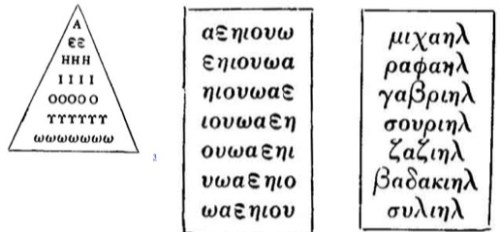
 (British Museum, Gnostic gem, No. G. 33). (Kenyon, Greek Papyri, p. 123). (Ibid., p. 123. These names read Michael, Raphael, Gabriel, Souriel, Zaziel, Badakiel, and Suliel).


(British Museum, Gnostic gem, No. G. 33).
(Kenyon, Greek Papyri, p. 123).
(Ibid., p. 123. These names read Michael, Raphael, Gabriel, Souriel, Zaziel, Badakiel, and Suliel)

In combination with a number of signs which owe their origin to the Gnostics the seven vowels were sometimes engraved upon plaques, or written upon papyri, with the view of giving the possessor power over gods or demons or his fellow creatures.

The example printed below is found on a papyrus in the British Museum and accompanies a spell written for the purpose of overcoming the malice of enemies, and for giving security against alarms and nocturnal visions. (Kenyon, op. cit., P. 121).
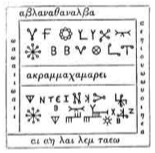
Amulet inscribed with signs and letters of magical power for overcoming the malice of enemies. (From Brit. Mus., Greek Papyrus, Nu. CXXIV.--4th or 5th century.) (Kenyon, Greek Papyri, p. 123).

Amulet inscribed with signs and letters of magical power for overcoming the malice of enemies. (From Brit. Mus., Greek Papyrus, Nu. CXXIV.–4th or 5th century.) (Kenyon, Greek Papyri, p. 123).

But of all the names found upon Gnostic gems two, i.e., Khnoubis (or Khnoumis), and Abrasax (or Abraxas), are of the most frequent occurrence. The first is usually represented as a huge serpent having the head of a lion surrounded by seven or twelve rays.

Over the seven rays, one on the point of each, are the seven vowels of the Greek alphabet, which some suppose to refer to the seven heavens; and on the back of the amulet, on which the figure of Khnoumis occurs, is usually found the sign of the triple S and bar.

Khnoumis is, of course, a form of the ancient Egyptian god Khnemu, or “Fashioner” of man and beast, the god to whom many of the attributes of the Creator of the universe were ascribed.

Khnemu is, however, often depicted with the head of a ram, and in the later times, as the “beautiful ram of Râ,” he has four heads; in the Egyptian monuments he has at times the head of a hawk, but never that of a lion.

The god Abrasax is represented in a form which has a human body, the bead of a hawk or cock, and legs terminating in serpents; in one hand he holds a knife or dagger, and in the other a shield upon which is inscribed the great name ΙΑΩ {Greek IAW}, or JÂH.

Considerable difference of opinion exists as to the meaning and derivation of the name Abrasax, but there is no doubt that the god who bore it was a form of the Sun-god, and that he was intended to represent some aspect of the Creator of the world.

The name was believed to possess magical powers of the highest class, and Basileides, (he of Alexandria, who lived about A.D. 120. He was a disciple of Menander, and declared that he had received the esoteric doctrine of Saint Peter from Glaucias, a disciple of the Apostle) who gave it currency in the second century, seems to have regarded it as an invincible name.

It is probable, however, that its exact meaning was lost at an early date, and that it soon degenerated into a mere magical symbol, for it is often found inscribed on amulets side by side with scenes and figures with which, seemingly, it cannot have any connexion whatever.

Judging from certain Gnostic gems in the British Museum, Abrasax is to be identified with the polytheistic figure that stands in the upper part of the Metternich stele depicted on p. 153 and below.

Metternich Stele.

Metternich Stele.

This figure has two bodies, one being that of a man, and the other that of a bird; from these extend four wings, and from each of his knees projects a serpent.

He has two pairs of hands and arms; one pair is extended along the wings, each hand holding the symbols of “life,” “stability,” and “power,” and two knives and two serpents; the other pair is pendent, the right hand grasping the sign of life, and the other a sceptre.

His face is grotesque, and probably represents that of Bes, or the sun as an old man; on his head is a pylon-shaped object with figures of various animals, and above it a pair of horns which support eight knives and the figure of a god with raised hands and arms, which typifies “millions of years.”

The god stands upon an oval wherein are depicted figures of various “typhonic” animals, and from each side of his crown proceed several symbols of fire.

Whether in the Gnostic system Abraxas absorbed all the names and attributes of this god of many forms cannot be said with certainty.”

E.A. Wallis Budge, Egyptian Magic, London, 1901. P. 177-80.

On Nectanebus, the Last Native King of Egypt, BC 318

“But of all the Egyptians who were skilled in working magic, Nectanebus, the last native king of Egypt, about B.C. 318, was the chief, if we may believe Greek tradition.

According to Pseudo-Callisthenes, and the versions of his works which were translated into Pehlevi, Arabic, Syriac, and a score of other languages and dialects, this king was famous as a magician and a sage, and he was deeply learned in all the wisdom of the Egyptians.

He knew what was in the depths of the Nile and of heaven, he was skilled in reading the stars, in interpreting omens, in casting nativities, in telling fortunes, and in predicting the future of the unborn child, and in working magic of every kind, as we shall see; he was said to be the lord of the earth, and to rule all kings by means of his magical powers.

Whenever he was threatened with invasion by sea or by land he succeeded in destroying the power of his enemies, and in driving them from his coasts or frontiers; and this he did by the following means.

If the enemy came against him by sea, instead of sending out his sailors to fight them, he retired into a certain chamber, and having brought forth a bowl which he kept for the purpose, he filled it with water, and then, having made wax figures of the ships and men of the enemy, and also of his own men and ships, he set them upon the water in the bowl, his men on one side, and those of the enemy on the other.

He then came out, and having put on the cloak of an Egyptian prophet and taken an ebony rod in his hand, he returned into the chamber, and uttering words of power he invoked the gods who help men to work magic, and the winds, and the subterranean demons, which straightway came to his aid.

By their means the figures of the men in wax sprang into life and began to fight, and the ships of wax began to move about likewise; but the figures which represented his own men vanquished those which represented the enemy, and as the figures of the ships and men of the hostile fleet sank through the water to the bottom of the bowl, even so did the real ships and men sink through the waters to the bottom of the sea.”

E.A. Wallis Budge, Egyptian Magic, London, 1901. Pp. 91-2.

Footnote 55 on the Use of the Name Iao

“On the use of the name Iao in the magic of the age of syncretism there is an abundance of material. Most of the older examples have been collected by W. von Baudissin, Studien zur Semitischen Religionsgeschichte, vol. 1 (Leipzig, 1876), 179-254. The passage from Yesirah is not referred to by Baudissin, nor did R. Reitzenstein make use of it in his treatment of the Book Yesirah, for which he assumes an ultimately Hellenistic origin reaching back to the second century; his arguments are based on a comparative study of letter-mysticism in late antiquity; see Reitzenstein, Poimandres (Leipzig, 1904), 291.

As an historian with a broad perspective, Reitzenstein perhaps had a clearer view than many other Jewish scholars, who often regarded the Book Yesirah as if it were suspended in a vacuum in the midst of the history of religions. It should also be noted, in this connection, that in the Coptic Pistis Sophia, chap. 136, Iao appears in a similar context: Jesus calls out his name as he turns toward the four corners of the world.

The sealing of the six directions of space by means of the permutations of Iao corresponds to the idea that this name is the master of the four directions of the world, that is, the master of the cosmos. Cf. the material assembled by Erik Peterson, Heis Theos (Göttingen, 1926), 306-307. Peterson’s interpretation of the magical name Arbathiao as “the four Iao” is, however, utterly unconvincing. The magical name is nothing other than a syncretistic transcription of the Tetragrammaton as “the tetrad [of the four letters of the name YHWH upon which is based the name] of Iao.”

This is proven by the corresponding form Tetrasya, which we find in the Hebrew writings of the Hekhaloth and which was still unknown to Peterson; cf. my Major Trends, 56, 363. The terminology employed in the Yesirah for these three directions of space is also very ancient: the phrase “above and below, in front and behind, right and left” is used in exactly the same manner in Akkadian, and is evidently also behind the wording of the Mishnah Hagigah 2:1 (first century), where “in front” and “behind” are to be understood spatially.

This usage was no longer understood by the amoraim, and was in any case transferred from the spatial to the temporal, as S. E. Löwenstamm, “On an Alleged Gnostic Element in Mishnah Hagiga II, 1″ (in Hebrew) in M. Haram (ed.), Yehezkel Kaufmann Jubilee Volume (Jerusalem, 1960), 112-121, has shown, drawing upon Akkadian material. His explanations furnished additional linguistic evidence in support of the antiquity of the Book Yesirah, although precisely the passage under consideration here escaped his attention.”

–Gershom Scholem, Origins of the Kabbalah, 1987, pp. 33-4

Footnote 48, An Amulet

“Through 231 gates everything goes forth. It is found therefore, that every creature and every speech [language] goes forth out of one name” (2:5). Does this mean that the alphabet, in its sequence, constitutes a mystical name? Of such a conception of the alphabet, Franz Dornseiff (Das Alphabet in Mystik und Magie, 2d ed. [Leipzig, 1925], 69-80) collected abundant testimonies from the Greek and Latin sources; cf. also A. Dieterich, ABC—Denkmäler, Rheinisches Museum für Philologie 56 (1900): 77-105.

In the Wiener Jahres hefte 32 (1940): 79-84, Joseph Keil published an important Hebrew-Greek amulet that contains, with an obviously magical intention, the Hebrew alphabet in Greek transcription in the so-called at-bash order. In this order the alphabet is written in two rows boustrophedon and two letters are vertically connected in pairs.

The amulet should be dated between the second and fourth centuries, but certainly no later. (I was able to identify clearly, though with some effort, the Hebrew text of Deuteronomy 28:58, which was in one of the three lines that neither Keil nor Ludwig Blau—to whom he showed the amulet in 1926—was able to decipher.

It is only natural that the view that the alphabet constitutes “One name, to wit the name of 22 letters” should have passed into the early Kabbalah, as is attested by the Commentary on the Prayer Book, composed about 1260, by the (anonymous?) commentator Sefer ha-Manhig on the Pirqe Rabbi Eliezer, Ms. British Museum, Mar-goliouth 743, fol. 96b.”

–Gershom Scholem, Origins of the Kabbalah, 1987, pp. 24-35.

Gershom Scholem on Correspondences

“All reality is constituted in the three levels of the cosmos—the world, time, and the human body, which are the fundamental realm of all being—and comes into existence through the combination of the twenty-two consonants, and especially by way of the “231 gates,” that is, the combinations of the letters into groups of two (the author apparently held the view that the roots of Hebrew words were based not on three but on two consonants).

Among the three realms there exist precise correlations, which no doubt also expresses relations of sympathy. The twenty-two consonants are divided into three groups, in accordance with the author’s peculiar phonetic system. The first contains the three “matrices,” ‘alef, mem, and shin. These in turn correspond to the three elements deduced in the first chapter in connection with the sefiroth—ether, water, fire—and from these all the rest came into being. These three letters also have their parallel in the three seasons of the year (again an ancient Greek division!) and the three parts of the body: the head, the torso, and the stomach.

The second group consists of the seven “double consonants” that in the Hebrew phonology of the author have two different sounds. They correspond, above all, to the seven planets, the seven heavens, the seven days of the week, and the seven orifices of the body. At the same time, they also represent the seven fundamental opposites in man’s life: life and death, peace and disaster, wisdom and folly, wealth and poverty, charm and ugliness, sowing and devastation, domination and servitude. To these correspond, in addition, the six directions of heaven and the Temple in the center of the world, which supports all of them (4:1-4).

The twelve remaining “simple” consonants correspond to man’s twelve principal activities, the signs of the zodiac, the twelve months, and the twelve chief limbs of the human body (the “leaders”). The combinations of all of these elements contain the root of all things, and good and evil, “pleasure and sorrow” (‘oneg and nega‘, which have the same consonants) have their origin in the same process, only according to a different arrangement of the elements (2:4).

This cosmogony and cosmology, based on language-mysticism, betray their relationship with astrological ideas. From them, direct paths lead to the magical conception of the creative and miraculous power of letters and words. It is by no means absurd to imagine that our text not only pursued theoretical aims, but was intended for thaumaturgical use as well. That is how the tradition of the early Middle Ages understood it, at least in part, and it would not have been wrong, in this case, to establish a connection between our text (or its prototype) and the story of the two masters of the Talmud, Rabbi Hanina and Rabbi Oshayah, who every Friday studied the “halakhoth concerning Creation” and by means of it created a calf that they then proceeded to eat.”

–Gershom Scholem, Origins of the Kabbalah, 1987, pp. 29-31.

Letters by Means of Which Heaven and Earth Were Created

The last six sefiroth are defined in an entirely different way; they represent the six dimensions of space, though it is not expressly stated that they emanated from the earlier elements. Nevertheless, it is said of the totality of these sefiroth that their beginning and their end were connected with each other and merged one into the other.

The primal decade thus constitutes a unity—although its nature is not sufficiently defined—but is by no means identical with the deity. The author, no doubt intentionally, employs expressions borrowed from the description of the hayyoth, the animals bearing the Throne in Ezekiel’s vision of the Merkabah. Hayyoth means literally “living beings,” and it can be said of the sefiroth that they are the “living numerical beings,” but nonetheless creatures:

“Their appearance is like that of a flash of lightning and their goal is without end. His word is in them when they come forth [from Him] and when they return. At His bidding do they speed swiftly as a whirlwind, and before His throne they prostrate themselves” (1:6).

They are the “depths” of all things:

“The depth of the beginning and the depth of the end, the depth of good and the depth of evil, the depth of above and the depth of below—and a single Master, God, the faithful king, rules over all of them from His holy abode” (1:5).

The fact that the theory of the significance of the twenty-two consonants as the fundamental elements of all creatures in the second chapter partly conflicts with the first chapter has caused some scholars (for example, Louis Ginzberg) to attribute to the author the conception of a kind of double creation: the one ideal and pure brought about by means of the sefiroth, which are conceived in a wholly ideal and abstract manner; the other one effected by the interconnection of the elements of speech. According to some views, the obscure word belimah, which always accompanies the word sefiroth, is simply a composite of beli mah—without anything, without actuality, ideal.

However, judging from the literal meaning, it would seem that it should be understood as signifying “closed,” that is, closed within itself. I am inclined to believe that here, too, an as yet unidentified Greek term underlies the expression.

The text offers no more detailed statement of the relationship between the sefiroth and the letters, and the sefiroth are not referred to again. While the numerical-mystical speculation on the sefiroth probably has its origin in neo-Pythagorean sources—Nikomachos of Gerasa, the celebrated author of a mystical arithmology who lived around 140 C.E., came from Palestine east of the Jordan—the idea of “letters by means of which heaven and earth were created” may well come from within Judaism itself.

In the first half of the third century it is encountered in a statement of the Babylonian amora, Rab, originally of Palestine. It is perfectly conceivable that two originally different theories were fused or juxtaposed in the author’s doctrine concerning the thirty-two paths. This range of ideas would fit well in the second or third century in Palestine or its immediate environs.”

–Gershom Scholem, Origins of the Kabbalah, 1987, pp. 27-9.

Scholem on the Kabbalistic Elements

“The ten primordial numbers are called sefiroth—a Hebrew noun, newly formed here, that bears no relation to the Greek word sphaira, but is derived from a Hebrew verb meaning “to count.”

Steinschneider’s contention (Mathematik bei den Juden [Hildesheim, 1965], p. 148) that the original term acquired its specific kabbalistic meaning as a result of the similarity to the Greek word is not borne out by an analysis of the oldest kabbalistic texts. By introducing a new term, sefirah, in place of the usual mispar, the author seems to indicate that it is not simply a question of ordinary numbers, but of metaphysical principles of the universe or stages in the creation of the world.

The possibility that the term refers to emanations from God himself can be excluded in view of both the wording and the context; it could only be read into the text by later reinterpretation. Each of these primordial numbers is associated with a particular category of creation, the first four sefiroth undoubtedly emanating from each other.

The first one is the pneuma of the living God, ruah ‘elohim hayyim (the book continues to use the word ruah in its triple meaning of breath, air, and spirit). From the ruah comes forth, by way of condensation, as it were, the “breath of breath,” that is, the primordial element of the air, identified in later chapters with the ether, which is divided into material and immaterial either (SIC, should probably be ether).

The idea of an “immaterial ether,” ‘awir she’eno nithpas, like the other Hebrew neologisms in the book, seems to correspond to Greek conceptions. From the primordial air come forth the water and the fire, the third and the fourth sefiroth. Out of the primordial air God created the twenty-two letters; out of the primordial fire, the Throne of Glory and the hosts of angels.

The nature of this secondary creation is not sufficiently clear, for the precise terminological meaning that the author gave to the verbs haqaq and hasab, which belong to the vocabulary of architecture, can be interpreted in different ways. He does not utilize the Hebrew word for “create,” but words that mean “engrave” (is this to designate the contours or the form?) and “hew,” as one hews a stone out of the rock. The Aristotelian element of the earth is not known to the author as a primordial element.”

–Gershom Scholem, Origins of the Kabbalah, 1987, pp. 26-7.

Gematria

“Gematria is one of the rules for interpreting the Torah, and is partially a high-level system of numerology.

It is defined by Scholem as, “explaining a word or group of words according to the numerical value of the letters, or of substituting other letters of the alphabet for them in accordance with a set system. All Hebrew letters are equally values and words, so for example the letter Aleph, signifying “A,” also means “one,” as well as being a word meaning ‘ox.'” The table given lists the major values and meanings of the twenty-two letters. This allows the letters to be taken as symbols expressing differing aspects of the Universe, either as separate entities, or when combined together in words.”

(…)

“Although some Kabbalists denied the use of Gematria as relevant, other workers such as Abulafia dealt with Gematria so deeply that their works need “decoding” rather than reading. It is said that the Torah is likewise written, and that “mistakes” in the original Greek and Hebrew texts are not mistakes, but rather spellings and variations necessary to ensure the numbers underlying them were correct.”

–Frater FP, The Magician’s Kabbalah, pg. 81.

On the Dark Mirror

“For now we see through a glass, darkly; but then face to face: now I know in part; but then shall I know even as also I am known. And now stays faith, hope, charity, these three; but the greatest of these is charity.”

Letter from the apostle Paul to a church in Corinth, which was famous for the manufacture of polished metal mirrors, hence the reference to “darkly,” which refers to the poor quality of the reflected image. Paul says that our knowledge of the divine is imperfect and incomplete. The “face to face” is considered a reference to a personal encounter with Jesus, through which “then shall I know even as also I am known.” In other words, through Christ, we will know.

Wiki notes that the term “charity” is used in translation of the Greek agape. “Love” is more accurate, and preferred in translations other than the King James.

Here is the entire chapter 13:

“13: Though I speak with the tongues of men and angels, but have not love, I have become sounding brass or a clanging cymbal. 2 And though I have the gift of prophecy, and understand all mysteries and all knowledge, and though I have all faith, so that I could remove mountains, but have not love, I am nothing. 3 And though I bestow all my goods to feed the poor, and though I give my body to be burned, but have not love, it profits me nothing.”

“4 Love suffers long and is kind; love does not envy; love does not parade itself, is not puffed up; 5 does not behave rudely, does not seek its own, is not provoked, thinks no evil; 6 does not rejoice in iniquity, but rejoices in the truth; 7 bears all things, believes all things, hopes all things, endures all things.”

“8 Love never fails. But whether there are prophecies, they will fail; whether there are tongues, they will cease; whether there is knowledge, it will vanish away. 9 For we know in part and we prophesy in part. 10 But when that which is perfect has come, then that which is in part will be done away.”

“11. When I was a child, I spoke as a child, I understood as a child, I thought as a child; but when I became a man, I put away childish things. 12 For now we see in a mirror, dimly, but then face to face. Now I know in part, but then I shall know just as I also am known.

“13 And now abide faith, hope, love, these three; but the greatest of these is love.”

The King James version:

“4 Charity suffereth long, and is kind; charity envieth not; charity vaunteth not itself, is not puffed up, 5 Doth not behave itself unseemly, seeketh not her own, is not easily provoked, thinketh no evil; 6 Rejoiceth not in iniquity, but rejoiceth in the truth; 7 Beareth all things, believeth all things, hopeth all things, endureth all things. 8 Charity never faileth: but whether there be prophecies, they shall fail; whether there be tongues, they shall cease; whether there be knowledge, it shall vanish away. 9 For we know in part, and we prophesy in part. 10 But when that which is perfect is come, then that which is in part shall be done away. 11 When I was a child, I spake as a child, I understood as a child, I thought as a child: but when I became a man, I put away childish things. 12 For now we see through a glass, darkly; but then face to face: now I know in part; but then shall I know even as also I am known. 13. And now abideth faith, hope, charity, these three; but the greatest of these is charity.”

–1 Corinthians: 13:12-13.

http://en.wikipedia.org/wiki/1_Corinthians_13

Marsilio Ficino and Christian Kabbalah

“Christian kabbalah can be traced to the “school of Marsilio Ficino in Florence, in the second half of the fifteenth century.”

“Ficino is best known for his translations of Plato’s writings from Greek to Latin, but of much importance was his translation to Latin of the corpus of esoteric, mysterious old treatises known as the Hermetica. These works, probably originating from Egypt in late antiquity, are attributed to a mysterious ancient philosopher, Hermes Trismegistus (The Thrice-Great Hermes), and they deal with magic, astrology, and esoteric theology.”

Ficino and his followers considered magic as “an ancient scientific doctrine, the source of all religious and natural truth.”

Dan mentions Count Giovani Pico dela Mirandola, a “great thinker, young scholar and theologian, who died at age thirty-three in 1496.”

He also observes that Pico’s interest in Hebrew was facilitated by the Latin translations of the Jewish Christian convert, Flavius Methredates.”

Pico’s most famous work, the Nine Hundred Theses, proclaims that Christianity’s truth is best demonstrated by the disciplines of magic and kabbalah.” In Pico’s work, magic and kabbalah are often indistinguishable. He interpreted kabbalistic texts as “ancient esoteric lore, conserved by Jews, at the heart of which was the Christian message.”

–Joseph Dan, Kabbalah: A Very Short Introduction, pg. 62-3.

The Five Rivers of Hades

The River Lethe was one of the five rivers of Hades. The River Lethe was also known as the Ameles Potamos (river of unmindfulness). All who drank from it experienced complete forgetfulness. Lethe was also the name of the Greek spirit of forgetfulness and oblivion, with whom the river was identified.

In Classical Greek, the word “Lethe” means oblivion, forgetfulness, or concealment. It is related to the Greek term for truth, “aletheia,” meaning “unforgetfulness.”

The five rivers of Hades were:

Styx: river of hate.

Akheron: river of sorrow.

Kokytos: the river of lamentation.

Plegethon: river of fire.

Lethe: river of forgetfulness and oblivion.

According to Statius, the River Lethe bordered Elysium, the final resting place of the virtuous. Ovid wrote that the River Lethe flowed through the cave of Hypnos, the god of sleep, where its murmuring would induce drowsiness.

The shades of the dead were required to drink from the River Lethe in order to forget their earthly life. In the Aenid, Virgil wrote that only after the dead had their memories erased by the Lethe could they be reincarnated.

The goddess Lethe was the personification of forgetfulness and oblivion. Hesiod’s Theogony identifies her as the daughter of Eris (strife), and the sister of Ponos (toil), Limos (starvation), Algea (pains), the Hysminai (fightings), the Makhai (battles), the Phonoi (murders), the Androktasiai (manslaughters), the Neikea (quarrels), the Pseudologoi (lies), the Amphilogiai (disputes), Dysnomia (lawless), Atë (ruin), and Horkos (oath).

The Myth of Er at the end of Plato’s Republic describes the dead arriving at the Plain of Lethe, through which the River Ameles (careless) runs. Mystery religions taught the existence of the River Mnemosyne: those who drank from this river would attain omniscience and remember everything. Initiates were taught that they would have a choice of rivers from which to drink after death, and they were taught that they should elect to drink from the River Mnemosyne instead of Lethe.

References to the two rivers derive from verse inscriptions on gold plates from Thuri in Southern Italy. There were rivers of Lethe and Msemosyne at the oracular shrine of Trophonius in Boeotia, from which worshippers would drink before seeking oracular consultations with the god.

(Wiki).

You Say Kabbalah, I Say Cabala

Christian kabbalah can be traced to the “school of Marsilio Ficino in Florence, in the second half of the fifteenth century.”

“Ficino is best known for his translations of Plato’s writings from Greek to Latin, but of much importance was his translation to Latin of the corpus of esoteric, mysterious old treatises known as the Hermetica. These works, probably originating from Egypt in late antiquity, are attributed to a mysterious ancient philosopher, Hermes Trismegistus (The Thrice-Great Hermes), and they deal with magic, astrology, and esoteric theology.”

Ficino and his followers considered magic as “an ancient scientific doctrine, the source of all religious and natural truth.”

Dan mentions Count Giovani Pico de la Mirandola, a “great thinker, young scholar and theologian, who died at age thirty-three in 1496.”

He also observes that Pico’s interest in Hebrew was facilitated by the Latin translations of the Jewish Christian convert, Flavius Methredates.”

Pico’s most famous work, the Nine Hundred Theses, proclaims that Christianity’s truth is best demonstrated by the disciplines of magic and kabbalah.” In Pico’s work, magic and kabbalah are often indistinguishable. He interpreted kabbalistic texts as “ancient esoteric lore, conserved by Jews, at the heart of which was the Christian message.”

–Joseph Dan, Kabbalah: A Very Short Introduction, pg. 62-3.