Samizdat

Publishing the Forbidden. All Rights Reserved. © Samizdat 2014-2025.

Tag: Ea

Oannes and the Apkallu, the Seven Sages of Sumeria

“Placed between two other books, Babyloniaca 2 takes on the function of a narrative pivot in Berossos’ work. It has connections with book one and book three, by way of recapitulation (e.g. Oannes and the sages) and anticipation (mention of kings who are treated in book three); and it brings into contact two fundamentally different periods in history: the mythic prehis­tory of book 1, which is cast as a revelation transmitted by the semi-divine sage Oannes; and the political history of book 3, which bears out Oannes’ revelation in a setting where gods and humans are much more clearly separate.

Book 2 of Berossos’ Babyloniaca contains, as far as we can tell, the history of Babylonian kingship organised according to a very tra­ditional pattern. Broadly speaking, it comprises the ten kings before the Flood, the deluge narrative and a concise history of rulers down to Nabonassar.
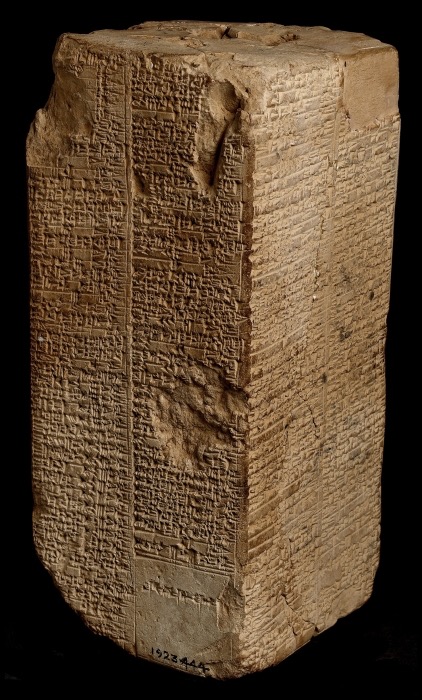
Among all the extant exemplars of the Sumerian King List, the Weld-Blundell prism in the Ashmolean Museum cuneiform collection represents the most extensive version as well as the most complete copy of the King List. It lists rulers from the antediluvian dynasties to Suen-magir, the fourteenth ruler of the Isin dynasty (ca. 1763–1753 B.C.). The prism contains four sides with two columns on each side. Perforated, the prism must originally have a wooden spindle going through its centre so that it might be rotated and read on all four sides. http://cdli.ox.ac.uk/wiki/doku.php?id=the_sumerian_king_list_sklid=the_sumerian_king_list_skl

Among all the extant exemplars of the Sumerian King List, the Weld-Blundell prism in the Ashmolean Museum cuneiform collection represents the most extensive version as well as the most complete copy of the King List. It lists rulers from the antediluvian dynasties to Suen-magir, the fourteenth ruler of the Isin dynasty (ca. 1763–1753 B.C.). The prism contains four sides with two columns on each side. Perforated, the prism must originally have a wooden spindle going through its centre so that it might be rotated and read on all four sides.
http://cdli.ox.ac.uk/wiki/doku.php?id=the_sumerian_king_list_sklid=the_sumerian_king_list_skl

The structural backbone of the book is a king list, more specifically, the so-called Sumerian King List in a version which contains sections before and after the Flood. The time before the Flood is structured by the succession of antediluvian kings, that after the Flood traces the reigns of postdiluvian kings, thus forming a narrative diptych around the central Flood narrative. Eusebius describes the overall effect as follows:

“This Berosos narrated in his first book, and in the second he wrote ordering the kings one after another… In collecting the names of the kings he collects [that] alone, but he tells nothing pre­cise of their deeds, indeed he did not consider them worthy of mention […].”

Eusebius’ complaint notwithstanding, Berossos does seem to have fleshed out the skeleton of his king list with some narrative interludes. For example, he inserts references to the antediluvian sages, a peculiarity paralleled in cuneiform sources of the Hellenistic period.

The combination of the list itself and the Flood narrative continued unchanged down to the first millennium BCE and is also attested in some fragments from the Neo-Assyrian and Late Babylonian period.

More specifically, Berossos connects the beginnings of humanity with the Oannes theme from book one. As far as we can tell, that theme appeared twice in the Babyloniaca: near the beginning of the work, Berossos introduces Oannes as the ‘paragon of Mesopotamian scholarly mysticism and wisdom’.

‘In the very first year’, a fearsome beast named Oannes appears out of the Red Sea and teaches humankind the arts of civilisation. In book 2, we learn that he is only the first in a series of other such beasts (F3a).

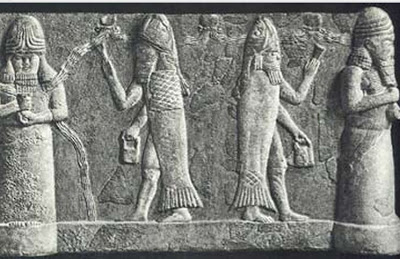
This protective spirit (Apkallu or Abkallu) guarded the entrance to the temple of Ninurta at Nimrud. A fish's head can be seen on Apkallu's head, and its skin hangs down over the back of Apkallu's body.  Neo-Assyrian era, 865-860 BCE. From the Temple of Ninurta, Nimrud (ancient Kalhu; Biblical Calah), northern Mesopotamia, Iraq. (The British Museum, London). Osama Shukir Muhammed Amin FRCP (Glasg) http://www.ancient.eu/image/2708/

This protective spirit (Apkallu or Abkallu) guarded the entrance to the temple of Ninurta at Nimrud. A fish’s head can be seen on Apkallu’s head, and its skin hangs down over the back of Apkallu’s body.
Neo-Assyrian era, 865-860 BCE. From the Temple of Ninurta, Nimrud (ancient Kalhu; Biblical Calah), northern Mesopotamia, Iraq. (The British Museum, London).
Osama Shukir Muhammed Amin FRCP (Glasg)
http://www.ancient.eu/image/2708/

Oannes, however, is clearly the most important: he is depicted as more than a mere culture hero but acts as some­thing very close to a creator god himself, shaping amorphous matter and turning mindless creatures into human beings with an identity and creative intelligence.

Oannes alone is responsible for the growth of human civilisation and its manifestations in history. Moreover, in describing his intervention, Berossos combines what in Sumero-Akkadian tradition were known as divine acts of creation with the teachings that humanity traditionally attributed to the apkallu, the mysterious seven sages who were created and inspired by Enki/Ea, the god of wisdom.

Part of the reason here, I suspect, might be that Berossos tried to make Oannes more plausible to a Greek audience by giving him some of the attributes of the Platonic δημιουργός (dēmiurgós), who acts ‘like a versatile artist or craftsman, creates his work from available materials according to a predetermined plan (PI. Resp. 507c; 530 a; 597b ff.; PI. Soph. 265c ff.; PI. Pit. 269c ff.; 272e ff.; PI. 7V.)’.

The aim is to underline the enormous age of Babylonian culture, the beginnings of which coincide with the dawn of all human culture. It is significant therefore that Berossos recapitulates the Oannes theme when he finally starts his account of human history in Babyloniaca 2.”

Martin Lang, “Book Two: Mesopotamian Early History and the Flood Story,” from Johannes Haubold, Giovanni B. Lanfranchi, Robert Rollinger, John Steele (eds.), The World of Berossos, Proceedings of the 4th International Colloquium on the Ancient Near East Between Classical and Ancient Oriental Traditions, Harrassowitz Verlag, Wiesbaden, 2013, pp. 48-9.
The Priest of Bel was Actually a Greek Philosopher

“Clearly, we need to allow for the possibility that some of these apparent similarities are fortuitous, just as we also need to allow for historically grown similarities between Ancient Greek and Mesopotamian thought: after all, these two cultures had long been part of the same Eastern Mediterranean world.

But there are at least two reasons for believing that Berossos really did cast himself as a philosopher in the vein of a Zeno. First, his reading of the Enūma Eliš was not the only possible one, nor was Berossos the first to isolate cosmic principles from the poem.

A generation or so earlier, Aristotle’s pupil Eudemos of Rhodes had already had access to a Greek text of the Enūma Eliš and had taken it to encapsulate the principles of Babylonian philosophy as follows:

Among the barbarians, the Babylonians appear to pass over the idea of a single principle in silence and instead to assume two principles of the universe, Tauthe (~ Tiamat) and Apason (~ Apsu), making Apason the husband of Tauthe, and calling her the mother of the gods.

Of these was born an only-begotten son, Moumis (~ Mummu) who, it seems, brought about the intelligible universe from the two first principles.

The same parents also gave rise to another generation, Dache and Dachos (~ Lahmu and Lahamu); and yet another, Kissare and Assoros (~ Kišar and Anšar), who in turn had three sons, Anos (~ Anu), Illinos (~ Ellil) and Aos (~ Ea).

Aos and Dauke (~ Damkina) begot a son called Bel who they say is the demiurge.

Like Berossos, Eudemos reads the Enūma Eliš as an account of physics and singles out two cosmic principles, one male one female.

However, unlike Berossos he identifies these principles with Tiamat and Apsu, rather than Tiamat and Bel, and focuses on the opening genealogy of the gods rather than on tablets 4-6 of Enūma Eliš, which describe the battle among the gods and the creation of the world and man.

Tiamat and Bel-Marduk

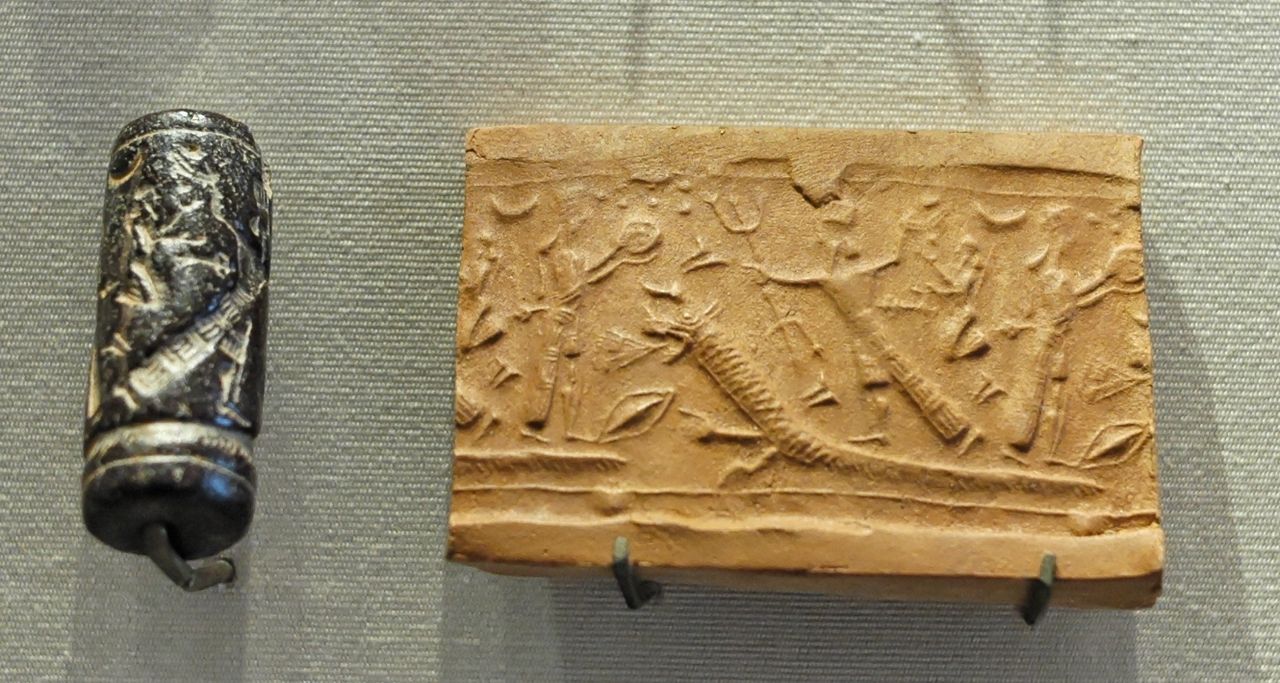
Segell cilíndric i la seva impressió, representant una escena mitològica: Asshur atacant un monstre és aclamat per una deessa. Segles IX-VIII aC
http://ca.wikipedia.org/wiki/Asshur#/media/File:Cylinder_seal_mythology_Louvre_AO30255.jpg
British Museum 89589.
A black serpentinite cylinder seal portrays a snout-nosed, horned Tiamat as a dragon.
A bearded god, Ninurta or Bel-Marduk, runs along the reptile’s body with crossed, wedge-tipped quivers on his back. In his right hand he holds a six-pronged thunderbolt below which is a rhomb, while in his left he holds two arrows.
Behind the god, a smaller bearded god in a horned head-dress holds a spear.
On the tail of the dragon stands a goddess, to the left of her head is the eight-rayed star of Istar and the inverted crescent of the Moon God Sin.
The seal may illustrate a scene from the epic of creation in which the forces of chaos, led by Tiamat, are defeated by a god representing cosmic order, Ninurta, or Bel-Marduk.
© The Trustees of the British Museum
http://www.britishmuseum.org/research/collection_online/collection_object_details/collection_image_gallery.aspx?assetId=159863&objectId=277961&partId=1

Judging by Polyhistor’s summary, Berossos seems to have skipped over those early genealogies; or at least to have shifted the main weight of his paraphrase elsewhere. It may seem hazardous to argue from absence in a text as badly mutilated as the Babyloniaca.

However, the entire thrust of Polyhistor’s narrative, including the framing account of Oannes, seems to suggest that the primordial soup of BNJ680 F lb(6), and the monsters in it, really did come first.

There is another feature of Berossos’ narrative which sets him apart from Eudemos: he translates the names of Babylonian deities into their Greek equivalents rather than merely transliterating them. Unlike his forerunner, Berossos was clearly interested in making his account accessible — and meaningful — to a wider Greek audience.

This leads me to my sec­ond reason for thinking that Berossos was quite actively modelling himself on contemporary Greek philosophers like Zeno, and that is his method of reading myth, as encapsulated in the phrase, ‘but he says that this amounts to an allegorical account of physics’.

The phrasing here has been deemed late, though Demetrius, On Style, already uses similar language, and Zeno’s pupil and successor as head of the Stoa, Cleanthes, may have done too.

Whether or not Berossos actually said άλληγορικώζ πεφυσιολογήσθαι, the sentiment is clearly his — for he must be the one who translated Omorka/Tiamat into Greek θάλασσα, hardly a fully fledged mythological character in the Greek imagination.

More generally, the entire thrust of his reading of Enūma Eliš seems to me to be self-evidently rationalising, and, in a rather loose sense of the word, allegorising too.”

Johannes Haubold, “The Wisdom of the Chaldaeans: Reading Berossos, Babyloniaca Book 1,” from Johannes Haubold, Giovanni B. Lanfranchi, Robert Rollinger, John Steele (eds.), The World of Berossos, Proceedings of the 4th International Colloquium on the Ancient Near East Between Classical and Ancient Oriental Traditions, Harrassowitz Verlag, Wiesbaden, 2013, pp. 35-7.

From Uz to Baphomet

“The gazelle or antelope was a mythological animal in Babylonia so far as it represented Ea, who is entitled ‘the princely gazelle ’ and ‘the gazelle who gives the earth.’ But this animal was also appropriated to Mul-lil, the god of Nippur, who was specially called the ‘gazelle god.’

It is likely, therefore, that this animal had been worshipped totemically at Nippur. Scores of early cylinders represent it being offered in sacrifice to a god, and bas-reliefs and other carvings show it reposing in the arms of various deities.

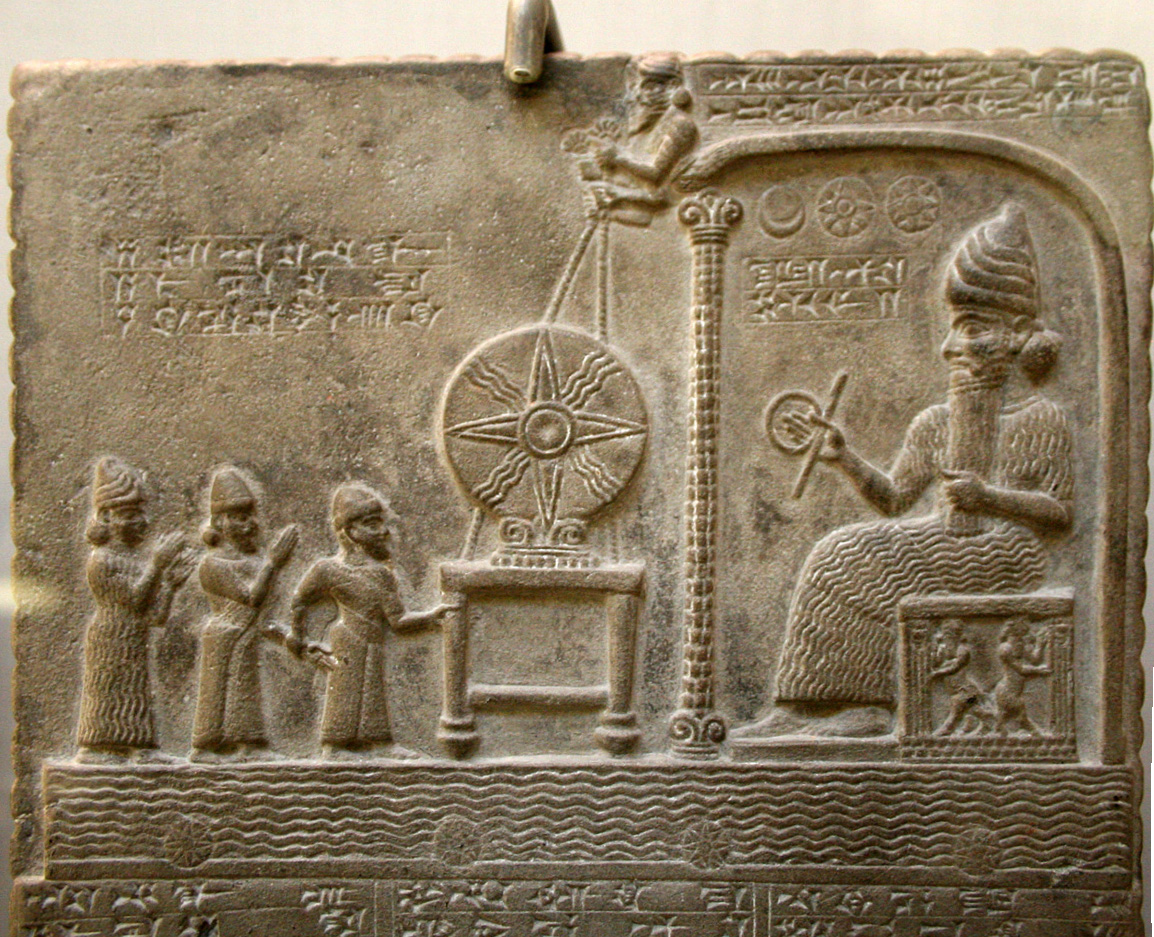
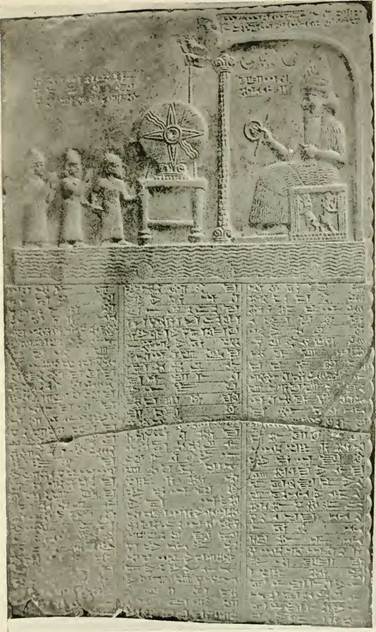
Limestone tablet depicting king Nabu-aplu-iddina being led into the presence of Šamaš, the sun god; 860 BCE-850 BCE.  Šamaš sits in the E-babbar shrine and holds the rod and ring symbols of kingship (BM 91000). © The British Museum. http://oracc.museum.upenn.edu/amgg/listofdeities/utu/ Alternative interpretation, from Lewis Spence, Myths and Legends of Babylonia and Assyria, London, 1917, p. 292.  "A god called Uz has for his name the Akkadian word for goat. Mr Hormuzd Rassam found a sculptured stone tablet in a temple of the sun-god at Sippara on which was an inscription to Sin, Shamash, and Ishtar, as being “set as companions at the approach to the deep in sight of the god Uz.”  This god Uz is depicted as sitting on a throne watching the revolution of the solar disc, which is placed upon a table and made to revolve by means of a rope or string. He is clad in a robe of goat-skin." http://www.wisdomlib.org/mesopotamian/book/myths-and-legends-of-babylonia-and-assyria/d/doc7171.html

Limestone tablet depicting king Nabu-aplu-iddina being led into the presence of Šamaš, the sun god; 860 BCE-850 BCE.
Šamaš sits in the E-babbar shrine and holds the rod and ring symbols of kingship (BM 91000). © The British Museum.
http://oracc.museum.upenn.edu/amgg/listofdeities/utu/
Alternative interpretation, from Lewis Spence, Myths and Legends of Babylonia and Assyria, London, 1917, p. 292.
“A god called Uz has for his name the Akkadian word for goat. Mr Hormuzd Rassam found a sculptured stone tablet in a temple of the sun-god at Sippara on which was an inscription to Sin, Shamash, and Ishtar, as being “set as companions at the approach to the deep in sight of the god Uz.”
This god Uz is depicted as sitting on a throne watching the revolution of the solar disc, which is placed upon a table and made to revolve by means of a rope or string. He is clad in a robe of goat-skin.”
http://www.wisdomlib.org/mesopotamian/book/myths-and-legends-of-babylonia-and-assyria/d/doc7171.html

The goat, too, seems to have been peculiarly sacred, and formed one of the signs of the zodiac. A god called Uz has for his name the Akkadian word for goat. Mr Hormuzd Rassam found a sculptured stone tablet in a temple of the sun-god at Sippara on which was an inscription to Sin, Shamash, and Ishtar, as being “set as companions at the approach to the deep in sight of the god Uz.”

This god Uz is depicted as sitting on a throne watching the revolution of the solar disc, which is placed upon a table and made to revolve by means of a rope or string. He is clad in a robe of goat-skin.

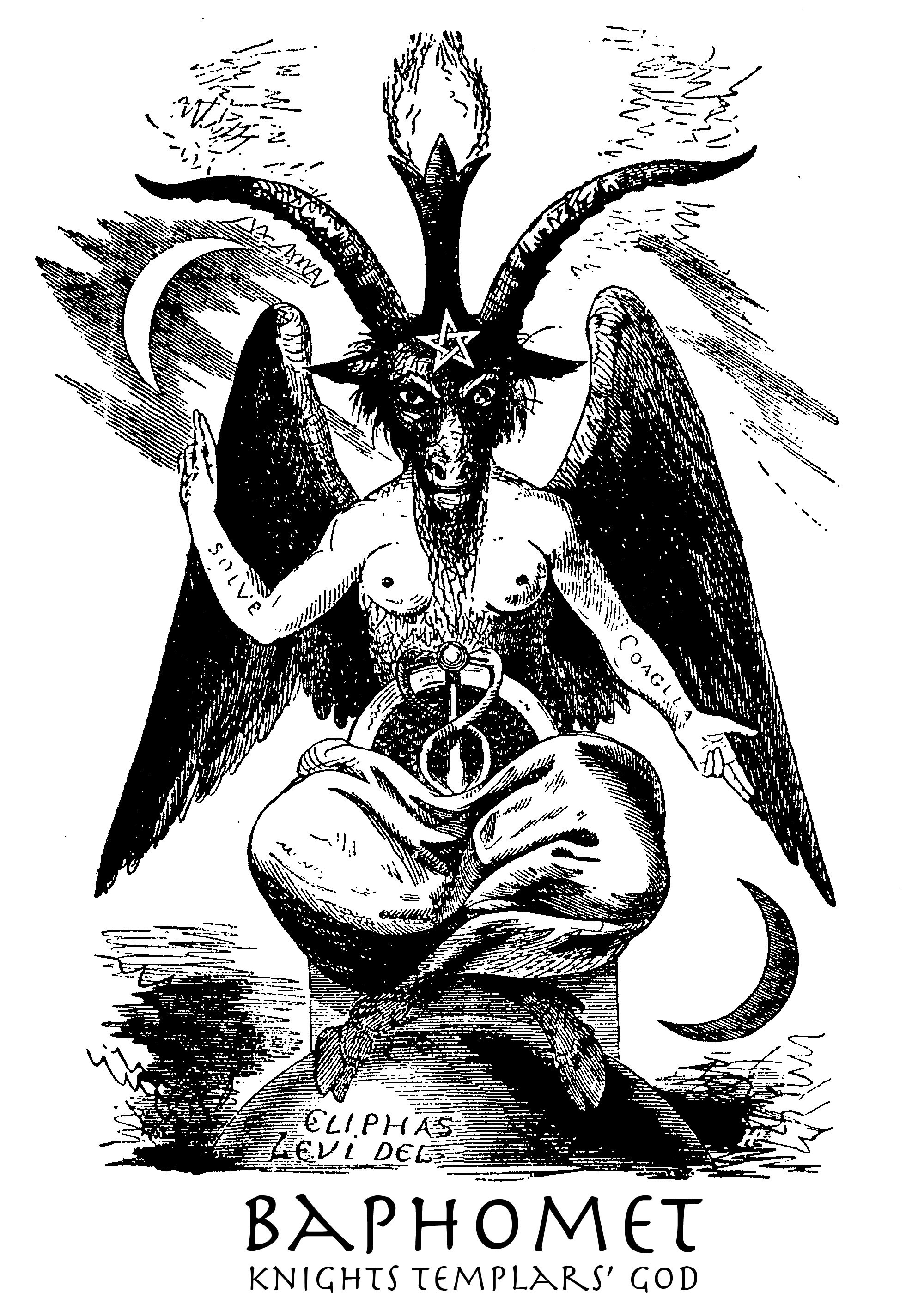
This cult of the goat appears to be of very ancient origin, and the strange thing is that it seems to have found its way into mediaeval and even into modern magic and pseudo-religion. There is very little doubt that it is the Baphomet of the knights-templar and the Sabbatic goat of the witchcraft of the Middle Ages.

It seems almost certain that when the Crusaders sojourned in Asia-Minor they came into contact with the remains of the old Babylonian cult.

When Philip the Fair of France arraigned them on a charge of heresy a great deal of curious evidence was extorted from them regarding the worship of an idol that they kept in their lodges.

The real character of this they seemed unable to explain. It was said which the image was made in the likeness of ‘Baphomet,’ which name was said to be a corruption of Mahomet, the general Christian name at that period for a pagan idol, although others give a Greek derivation for the word.

This figure was often described as possessing a goat’s head and horns. That, too, the Sabbatic goat of the Middle Ages was of Eastern and probably Babylonian origin is scarcely to be doubted. At the witch orgies in France and elsewhere those who were afterwards brought to book for their sorceries declared that Satan appeared to them in the shape of a goat and that they worshipped him in this form.

A depiction of Baphomet by Eliphas Levi, Transcendental Magic, (Figure IX), p. 296.

A depiction of Baphomet by Eliphas Levi, Transcendental Magic, (Figure IX), p. 296.

The Sabbatic meetings during the fifteenth century in the wood of Moffiaines, near Arras, had as their centre a goat-demon with a human countenance, and a like fiend was adored in Germany and in Scotland. From all this it is clear that the Sabbatic goat must have had some connexion with the East.

Eliphas Levi drew a picture of the Baphomet or Sabbatic goat to accompany one of his occult works, and strangely enough the symbols that he adorns it with are peculiarly Oriental—moreover the sun-disc figures in the drawing.

Now Levi knew nothing of Babylonian mythology, although he was moderately versed in the mythology of modern occultism, and it would seem that if he drew his information from modern or mediaeval sources that these must have been in direct line from Babylonian lore.”

Lewis Spence, Myths and Legends of Babylonia and Assyria, 1917, pp. 292-4.

Babylonian Astro-Theology

“In the Observations of Bel the stars are already invested with a divine character. The planets are gods like the sun and moon, and the stars have already been identified with certain deities of the official pantheon, or else have been dedicated to them.

The whole heaven, as well as the periods of the moon, has been divided between the three supreme divinities, Anu, Bel and Ea. In fact, there is an astro-theology, a system of Sabaism, as it would have been called half a century ago.

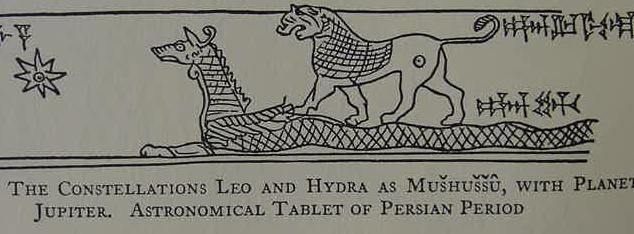
The star constellation of Hydra as a Babylonian Serpent-Dragon called Mushussu meaning "furious snake," with horns and wings from a clay cuneiform tablet of the Persian period.  According to Professor Langdon, Tammuz (Sumerian Dumuzi) was called a "Heavenly Serpent-dragon," he also noted that Ningishzida whose name means "Lord of the Good Tree" according to some scholars, was an aspect of Dumuzi/Tammuz, Dumuzi being called in hymns "Damu, the child Ningishzida."  (For the drawing cf. p. 286. Stephen Herbert Langdon. The Mythology of All Races- Semitic. Vol. 5. Boston. Marshall Jones Company. 1931). http://www.bibleorigins.net/SerpentDragonMardukAsshur.html

The star constellation of Hydra as a Babylonian Serpent-Dragon called Mushussu meaning “furious snake,” with horns and wings from a clay cuneiform tablet of the Persian period.
According to Professor Langdon, Tammuz (Sumerian Dumuzi) was called a “Heavenly Serpent-dragon,” he also noted that Ningishzida whose name means “Lord of the Good Tree” according to some scholars, was an aspect of Dumuzi/Tammuz, Dumuzi being called in hymns “Damu, the child Ningishzida.”
(For the drawing cf. p. 286. Stephen Herbert Langdon. The Mythology of All Races- Semitic. Vol. 5. Boston. Marshall Jones Company. 1931).
http://www.bibleorigins.net/SerpentDragonMardukAsshur.html

This astro-theology must go back to the very earliest times. The cuneiform characters alone are a proof of this. The common determinative of a deity is an eight-rayed star, a clear evidence that at the period when the cuneiform syllabary assumed the shape in which we know it, the stars were accounted divine.

We have seen, moreover, that the sun and moon and evening star were objects of worship from a remote epoch, and the sacredness attached to them would naturally have been reflected upon the other heavenly bodies with which they were associated.

Totemism, too, implies a worship of the stars. We find that primitive peoples confound them with animals, their automatic motions being apparently explicable by no other theory; and that primitive Chaldea was no exception to this rule has been already pointed out.

Here, too, the sun was an ox, the moon was a steer, and the planets were sheep. The adoration of the stars, like the adoration of the sun and moon, must have been a feature of the religion of primeval Shinar.

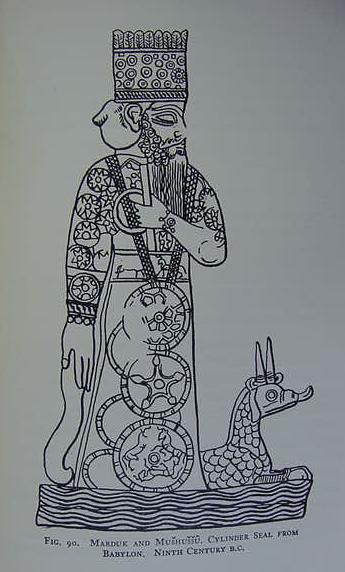
Marduk, the supreme god of Babylon. At his feet the Mushhushshu Serpent-dragon, associated with him, as he overpowered it when he defeated Tiamat the female personfication of the salty sea or ocean, mother of the gods, who sought to destroy the land-dwelling gods until killed by Marduk.  In this myth the Serpent-dragon was a creature of Tiamat's (for the image cf. p. 301. Stephen Herbert Langdon. The Mythology of All Races- Semitic. Vol. 5. Boston. Marshall Jones Company. 1931).  This drawing is after a 9th century BCE Babylonian cylinder seal. The Assyrians later declared their God Asshur as the god who defeated Tiamat, and Marduk's serpent-dragon was portrayed as accompanying Asshur. Marduk's robe is the heavenly night sky with all its stars. he was also called "the son of the Sun,"  "the Sun" and "bull-calf of the Sun" (Babylonian amar-utu). http://www.bibleorigins.net/SerpentDragonMardukAsshur.html

Marduk, the supreme god of Babylon. At his feet the Mushhushshu Serpent-dragon, associated with him, as he overpowered it when he defeated Tiamat the female personification of the salty sea or ocean, mother of the gods, who sought to destroy the land-dwelling gods until killed by Marduk.
In this myth the Serpent-dragon was a creature of Tiamat’s (for the image cf. p. 301. Stephen Herbert Langdon. The Mythology of All Races- Semitic. Vol. 5. Boston. Marshall Jones Company. 1931).
This drawing is after a 9th century BCE Babylonian cylinder seal. The Assyrians later declared their God Asshur as the god who defeated Tiamat, and Marduk’s serpent-dragon was portrayed as accompanying Asshur. Marduk’s robe is the heavenly night sky with all its stars. he was also called “the son of the Sun,” “the Sun” and “bull-calf of the Sun” (Babylonian amar-utu). I suspect that the medallions hanging from his neck are none other than the Tablets of Fate.
http://www.bibleorigins.net/SerpentDragonMardukAsshur.html

But this primeval adoration was something very different from the elaborate astro-theology of a later day. So elaborate, indeed, is it that we can hardly believe it to have been known beyond the circle of the learned classes.

The stars in it became the symbols of the official deities. Nergal, for example, under his two names of Sar-nem and ‘Sulim-ta-ea, was identified with Jupiter and Mars. It is not difficult to discover how this curious theological system arose.

Its starting-point was the prominence given to the worship of the evening and morning stars in the ancient religion, and their subsequent transformation into the Semitic Istar. The other planets were already divine; and their identification with specific deities of the official cult followed as a matter of course.

As the astronomy of Babylonia became more developed, as the heavens were mapped out into groups of constellations, each of which received a definite name, while the leading single stars were similarly distinguished and named, the stars and constellations followed the lead of the planets. As Mars became Nergal, so Orion became Tammuz.

The priest had succeeded the old Sumerian sorcerer, and was now transforming himself into an astrologer. To this cause we must trace the rise of Babylonian astro-theology and the deification of the stars of heaven.

The Sabianism of the people of Harrân in the early centuries of the Christian era was no survival of a primitive faith, but the last echo of the priestly astro-theology of Babylonia. This astro-theology had been a purely artificial system, the knowledge of which, like the knowledge of astrology itself, was confined to the learned classes.

It first grew up in the court of Sargon of Accad, but its completion cannot be earlier than the age of Khammuragas. In no other way can we explain the prominence given in it to Merodach, the god of Babylon.”

A.H. Sayce, Lectures on the Origin and Growth of Religion as Illustrated by the Religion of the Ancient Babylonians, 5th ed., London, 1898, pp. 400-2.

Nergal the Destroyer

“The library of Nineveh contained the copy of a tablet which, according to its concluding lines, was originally written for the great temple of Nergal at Cutha. The words of the text are put in the mouth of Nergal the destroyer, who is represented as sending out the hosts of the ancient brood of chaos to their destruction.

Nergal appears at the top, leering over a top register which contains the eight-pointed star of Ishtar and the inverted half-moon crescent of the Moon God Sin.  In the second register, seven demons appear to support the heavens.  The middle register depicts the burial rites for new arrivals in the underworld.  The lower register depicts the goddess Allat, or Ereshkigal, sister of Ishtar, who reigns in the underworld. She kneels upon a horse, which appears to be oppressed by her burden, in a boat which floats upon the waters of life. Note the lions suckling at her breast.  Drawn by Faucher-Gudin, from a bronze plaque of which an engraving was published by Clermont-Ganneau.  The original, which belonged to M. Péretié, is now in the collection of M. de Clercq. http://www.gutenberg.org/files/17323/17323-h/17323-h.htm#linkBimage-0039

Nergal appears at the top, leering over a top register which contains the eight-pointed star of Ishtar and the inverted half-moon crescent of the Moon God Sin.
In the second register, seven demons appear to support the heavens.
The middle register depicts the burial rites for new arrivals in the underworld.
The lower register depicts the goddess Allat, or Ereshkigal, sister of Ishtar, who reigns in the underworld. She kneels upon a horse, which appears to be oppressed by her burden, in a boat which floats upon the waters of life. Note the lions suckling at her breast.
Drawn by Faucher-Gudin, from a bronze plaque of which an engraving was published by Clermont-Ganneau.
The original, which belonged to M. Péretié, is now in the collection of M. de Clercq.
http://www.gutenberg.org/files/17323/17323-h/17323-h.htm#linkBimage-0039

Nergal is identified with Nerra, the plague-god, who smites them with pestilence, or rather with Ner, the terrible “king who gives not peace to his country, the shepherd who grants no favour to his people.”

We are first told how the armies of chaos came into existence.

“On a tablet none wrote, none disclosed, and no bodies or brushwood were produced in the land; and there was none whom I approached.

Warriors with the body of a bird of the valley, men with the faces of ravens, did the great gods create. In the ground did the gods create their city. Tiamat (the dragon of chaos) suckled them. Their progeny (sasur) the mistress of the gods created.

In the midst of the mountains they grew up and became heroes and increased in number. Seven kings, brethren, appeared and begat children. Six thousand in number were their peoples. The god Banini their father was king; their mother was the queen Melili.”

It was the subjects and the offspring of these semi-human heroes whom the god Ner was deputed to destroy.

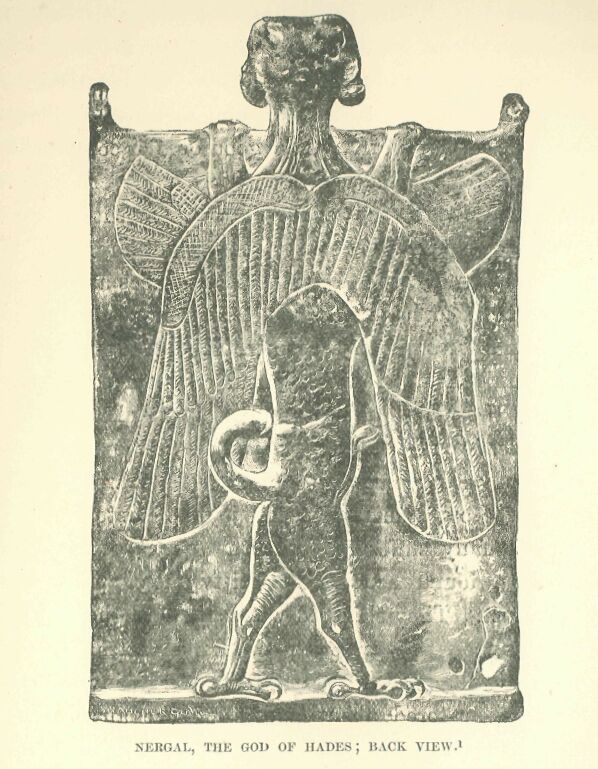
The reverse side of the god Nergal,  drawn by Faucher-Gudin. This is the back of the bronze plate above; the animal-head of the god appears in relief at the top of the illustration. http://www.gutenberg.org/files/17323/17323-h/17323-h.htm#linkBimage-0018

The reverse side of the god Nergal, drawn by Faucher-Gudin. This is the back of the bronze plate above; the animal-head of the god appears in relief at the top of the illustration.
http://www.gutenberg.org/files/17323/17323-h/17323-h.htm#linkBimage-0018

It is clear that the legend of Cutha agrees with Berossos in the main facts, however much it may differ in details. In both alike, we have a first creation of living beings, and these beings are of a composite nature, and the nurselings of Tiamat or Chaos.

"Bird men" are depicted.

“Bird men” are depicted.

In both alike, the whole brood is exterminated by the gods of light. A curious point in connection with the legend is the description of chaos as a time when writing was as yet unknown and records unkept. Perhaps we may see in this an allusion to the fact that the Babylonian histories of the pre-human period were supposed to have been composed by the gods.

The date to which the legend in its present form may be assigned is difficult to determine. The inscription is in Semitic only, like the other creation-tablets, and therefore cannot belong to the pre-Semitic age. It belongs, moreover, to an epoch when the unification of the deities of Babylonia had already taken place, and the circle of “the great gods” was complete.

Ea, Istar, Zamama, Anunit, even Nebo and “Samas the warrior,” are all referred to in it. We must therefore place its composition after the rise not only of the hymns of Sippara, but also of the celebrity of the Semitic god of Borsippa.

On the other hand, the reference to the pateśi or priest-king in the concluding lines seems to prevent us from assigning too late a date to the poem. Perhaps we shall not be far wrong in ascribing it to the era of Khammuragas.”

A.H. Sayce, Lectures on the Origin and Growth of Religion as Illustrated by the Religion of the Ancient Babylonians, 5th ed., London, 1898, pp. 372-4.

A Babylonian Incantation

“In the hymns the mamit occupies a conspicuous place. Thus we read:

“0 curse, curse, the boundary that none can pass!

The limit of the gods (themselves) against which they may not transgress!

The limit of heaven and earth which altereth not!

The unique god against whom none may sin!

Neither god nor man can undo (it). A snare not to be passed through, which is set for evil.

Whether an evil utuk, or an evil alu, or an evil ekimmu, or an evil gallu, or an evil god, or an evil incubus, or a labartu, or a labatsu, or an akhkharu, or a lilu, or a lilat, or the maid of a lilu, or the evil plague-demon, or a disease-bringing asakku, or a bad sickness, which has set its head towards the dropping water of Ea, may the snare of Ea seize it! which has stretched its head against the wisps of Nirba (the Corn-god), may the lasso of Nirba bind it!

Against the limitation (of the curse) it has transgressed. Never may (the limitation) of the gods, the limitation of heaven and earth, depart from it. (The limitation of the great) gods it reverences not. May (the lasso of) the great gods bind it! May the great gods curse it! May they send back (the demon) to (his) home! The home of (his) habitation may they cause him to enter!

As for him who has turned to another place, to another place, a place invisible, may they bring him!

As for him who has turned into the gate of the house, the gate of a place from whence there is no exit may they cause him to enter! As for him who has stationed himself in the door and bolts, in the door and bolts may they hind him with bonds from which there is no release!

As for him who has blown (?) into the threshold and socket, who into threshold and hinge has crept, like water may they pour him out, like a cup may they shatter him, like a quarry-stone may they break him to pieces! As for him who has passed across the beam, his wings may they cut!

As for him who has thrust his neck into the chamber, may they twist his neck!”

H.C. Rawlinson, The Cuneiform Inscriptions of Western Asia, 1886, iv, 16, No. 1.

This is a fair sample of the incantations by means of which the Babylonians believed that they could free themselves from the demoniac agencies that surrounded them. The power of the mamit was such that the gods themselves could not transgress it, and the mamit was accordingly invoked to protect the mortal from the demons of plague and sickness.

But the plague itself might be regarded as a mamit or “doom” inflicted by heaven upon the guilty earth.”

A.H. Sayce, Lectures on the Origin and Growth of Religion as Illustrated by the Religion of the Ancient Babylonians, 5th ed., London, 1898, pp. 307-9.

Tales of the Storm God Zu

“The scribes of Assur-bani-pal have preserved for us the mutilated copy of a bilingual poem, or part of a poem, which recounted the flight of Zu to the mountain of ‘Sabu or Kis. It begins thus:

Lugal-tudda (fled) to the mountain a place remote

In the hill of ‘Sabu he (dwelt).

No mother inhabits it and (cares for him).

No father inhabits it and (associates) with him.

No priest who knows him (assists him).

He who (changed) not the resolution, even the resolution of his heart,

in his own heart (he kept) his resolution.

Into the likeneas of a bird was he transformed,

into the likeness of Zu the divine storm-bird was he transformed,

His wife uplifts the neck.

The wife of Zu, the son of Zu, may he cause them to dwell in a cage,

even the god of the river-reeds (Enna) and the goddess the lady of the basket of river-reeds (Gu-enna).

From his mountain he brought (her),

as a woman fashioned for a mother made beautiful,

the goddess of plants, as a woman fashioned for a mother made beautiful.

Her paps were of white crystal;

her thighs were bathed in silver and gold.

[Here follow many mutiliated lines]

On (his) head he placed a circlet;

….on his head he set a coronal

(when) he came from the nest of the god Zu.

(In a place) unknown in the mountain he made his tomb.”

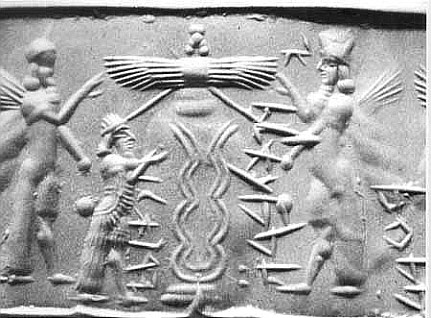
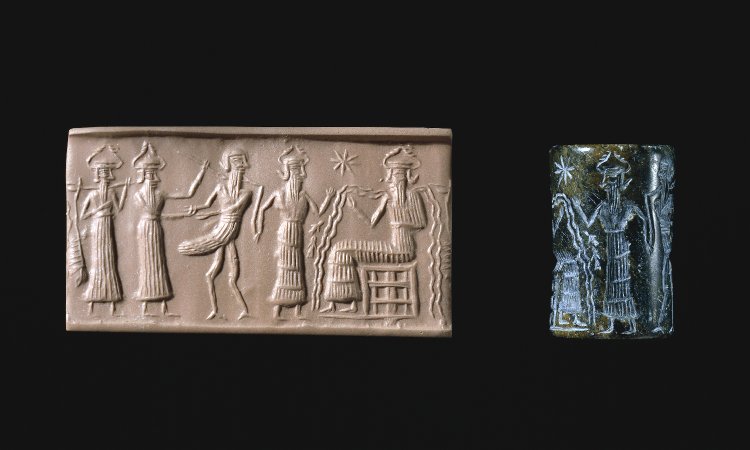
From left, Storm God Ninurta, with bows and arrows.  Ishtar, queen of heaven and earth is elevated with wings and spears and maces on her shoulders.  The tree of life sprouts to her right, our left.  The Sun God Shamash rises from the mountain Kur in the center, with rays of light on his shoulder.  The God of Water and Wisdom, Enki/Ea battles the bird-god Imdugud/Anzu, with depictions of the Tigris and Euphrates rivers and fish coursing from his shoulders.  At far right is the deified vizier Usmu, the two-faced. All gods wear conical hats with four pairs of horns.  At far left is the word Adda in Accadian cuneiform, "Scribe."  Accordingly this cylinder seal is known as the Seal of Adda, Akkadian period, 2350-2100 BCE. British Library.  [No. 89,115.] http://www.ancientworlds.net/aw/Article/787375

From left, Storm God Ninurta, with bows and arrows.
Ishtar, queen of heaven and earth is elevated with wings and spears and maces on her shoulders.
The tree of life sprouts to her right, our left.
The Sun God Shamash rises from the mountain Kur in the center, with rays of light on his shoulder.
The God of Water and Wisdom, Enki/Ea battles the bird-god Imdugud/Anzu, with depictions of the Tigris and Euphrates rivers and fish coursing from his shoulders.
At far right is the deified vizier Usmu, the two-faced. All gods wear conical hats with four pairs of horns.
At far left is the word Adda in Accadian cuneiform, “Scribe.”
Accordingly this cylinder seal is known as the Seal of Adda, Akkadian period, 2350-2100 BCE. British Library. [No. 89,115.]
http://www.ancientworlds.net/aw/Article/787375

It will be seen that the identity of the god Zu with a bird is explained in accordance with the ideas of a modern time. It has become a transformation voluntarily undergone by the deity, for the sake, as it would seem, of securing a beautiful bride.

The old faith of totemism is thus changing into a fairy-tale. But there were other stories which remembered that the transformation of the god was not the voluntary act it is here represented to have been.”

A.H. Sayce, Lectures on the Origin and Growth of Religion as Illustrated by the Religion of the Ancient Babylonians, 5th ed., London, 1898, pp. 295-7.

More Totemism

“We can learn a good deal about this totemism from the old ideographic representations of the names of the chief deities. They are like fossils, embodying the beliefs of a period which had long passed away at the date of the earliest monuments that have come down to us.

The name of Ea himself affords us an example of what we may find. It is sometimes expressed by an ideograph which signifies literally “an antelope” (dara in Accadian, turakhu in Assyrian, whence perhaps the Biblical name of Terah).

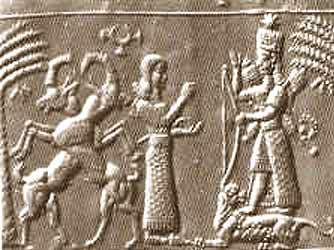
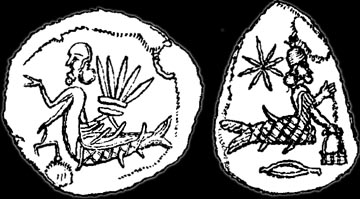
Ishtar is depicted at far left, wearing the horned headdress of divinity, with weapons on her back and a long knife in her hand.  A worshipper presents a sacrificial animal, next to an uncertain goddess depicted with water flowing from her vase.  Ea appears with a fishtail hanging behind him, and an antelope bucking beside him.  I am not certain which goddess appears at far right.

Ishtar is depicted at far left, wearing the horned headdress of divinity, with weapons on her back and a long knife in her hand.
A worshipper presents a sacrificial animal, next to an uncertain goddess depicted with water flowing from her vase.
Ea appears with a fishtail hanging behind him, and an antelope bucking beside him.
I am not certain which goddess appears at far right.

Thus we are told that Ea was called ”the antelope of the deep,” “the antelope the creator,” “the antelope the prince,” “the lusty antelope;” and the “ship” or ark of Ea in which his image was carried at festivals was entitled “the ship of the divine antelope of the deep.”

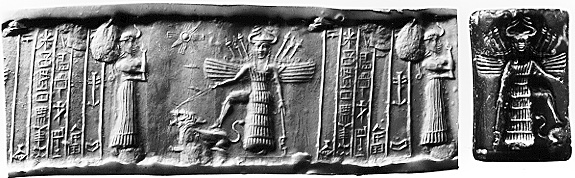
Ishtar receives the worship of an Amazon. Ishtar stands on a lion, holding a bow with arrows at her back. Her eight-pointed star is atop her head.  Lusty antelopes rear on the right side, perhaps signifying the god Ea.

Ishtar receives the worship of an Amazon. Ishtar stands on a lion, holding a bow with arrows at her back. Her eight-pointed star is atop her head.
Lusty antelopes rear on the right side, perhaps signifying the god Ea.

We should, indeed, have expected that the animal of Ea would have been the fish rather than the antelope, and the fact that it is not so points to the conclusion that the culture-god of southern Babylonia was an amalgamation of two earlier deities, one the divine antelope, and the other the divine fish.

Perhaps it was originally as the god of the river that Ea had been adored under the form of the wild beast of the Eden or desert.

There was yet another animal with which the name of Ea had been associated. This was the serpent. The Euphrates in its southern course bore names in the early inscriptions which distinctly connect the serpent with Ea on the one hand, and the goddess Innina on the other.

It was not only called “the river of the great deep”– a term which implied that it was a prolongation of the Persian Gulf and the encircling ocean; it was further named the river of the śubar lilli, “the shepherd’s hut of the lillu” or “spirit,””the river of Innína,” “the river of the snake,” and “the river of the girdle of the great god.”

In-nina is but another form of Innána or Nâna, and we may see in her at once the Istar of Eridu and the female correlative of Anúna. Among the chief deities reverenced by the rulers of Tel-loh was one whose name is expressed by the ideographs of “fish” and “enclosure,” which served in later days to denote the name of Ninâ or Nineveh.

It seems clear, therefore, that the pronunciation of Nina was attached to it; and Dr. Oppert may accordingly be right in thus reading the name of the goddess as she appears on the monuments of Tel-loh.

Nina, consequently, is both the fish-goddess and the divinity whose name is interchanged with that of the snake. Now Nina was the daughter of Ea, her eldest daughter being described in a text of Tel-loh as “the lady of the city of Mar,” the modern Tel Id, according to Hommel, where Dungi built her a temple which he called “the house of the jewelled circlet” (sutartu).

This latter epithet recalls to us the Tillili of the Tammuz legend as well as the Istar of later Babylonia. In fact, it is pretty clear that Nina, “the lady,” must have been that primitive Istar of Eridu and its neighborhood who mourned like Tillili the death of Tammuz, and whose title was but a dialectic variation of that of Nana given to her at Erech.”

A.H. Sayce, Lectures on the Origin and Growth of Religion as Illustrated by the Religion of the Ancient Babylonians, 5th ed., London, 1898, pp. 280-2.

Totemic Depictions of the Gods

“It is only the demons and inferior spirits, or mythical personages like Ea-bani, the friend of Gisdhubar, who are portrayed as animals, or as composite figures partly human and partly bestial. Ea alone, in his character of “god of life,” is given the fish’s skin, and even then the skin is but thrown over his back like a priestly cloak.

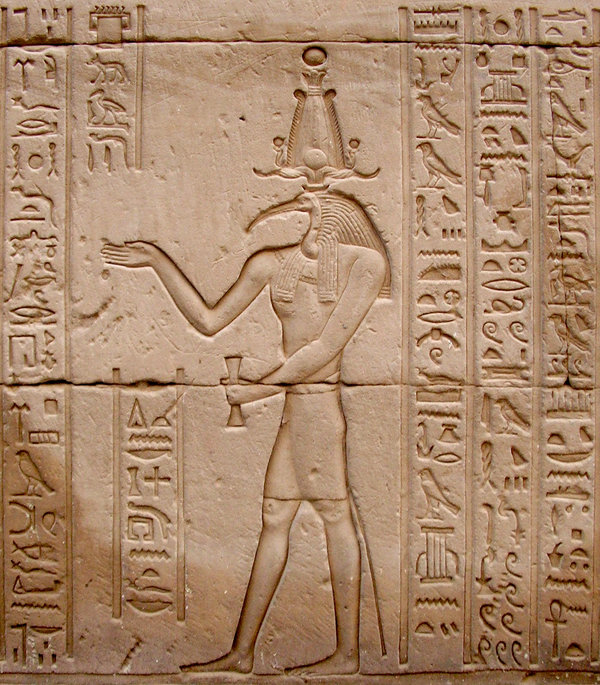
A depiction of the God Ea, or Oannes.

A depiction of the God Ea, or Oannes.

The composite monsters, whose forms Bêrôssos saw painted on the walls of the temple of Bêlos, were the brood of chaos, not of the present order of the world. The legend of the creation preserved by the priests of Cutha declares that the creatures, half men and half birds, which were depicted in sacred art, were suckled by Tiamat, the dragon-like personification of anarchy and chaos. Their disappearance marked the victory of light over darkness, of the gods of heaven over the Titanic monsters of an extinct age.

The deities of Babylonia were emphatically human; human in character and human in form. They stood in marked contrast to the animal-headed gods of Egypt, and harmonised with the Semitic belief that made the deity the father of the human race, who had created man in his own image.

Even in pre-Semitic days, Chaldean art had already followed the same line of thought, and had depicted its divinities in the likeness of men; but in pre-Semitic days this was a tendency only; it was not until the Accadian came in contact with the Semite that he felt the full force of the Semitic conception, and allowed his ancient deities of light and life to take permanently upon them the human shape.

For there are many indications that it had not always been so. The very fact that the divine beings who in the Semitic era were relegated to the realms of chaos or the inferior world of subordinate spirits, were to the last represented as partly bestial in form, proves pretty clearly that the Babylonians had once seen nothing derogatory to the divine nature in such a mode of representation.

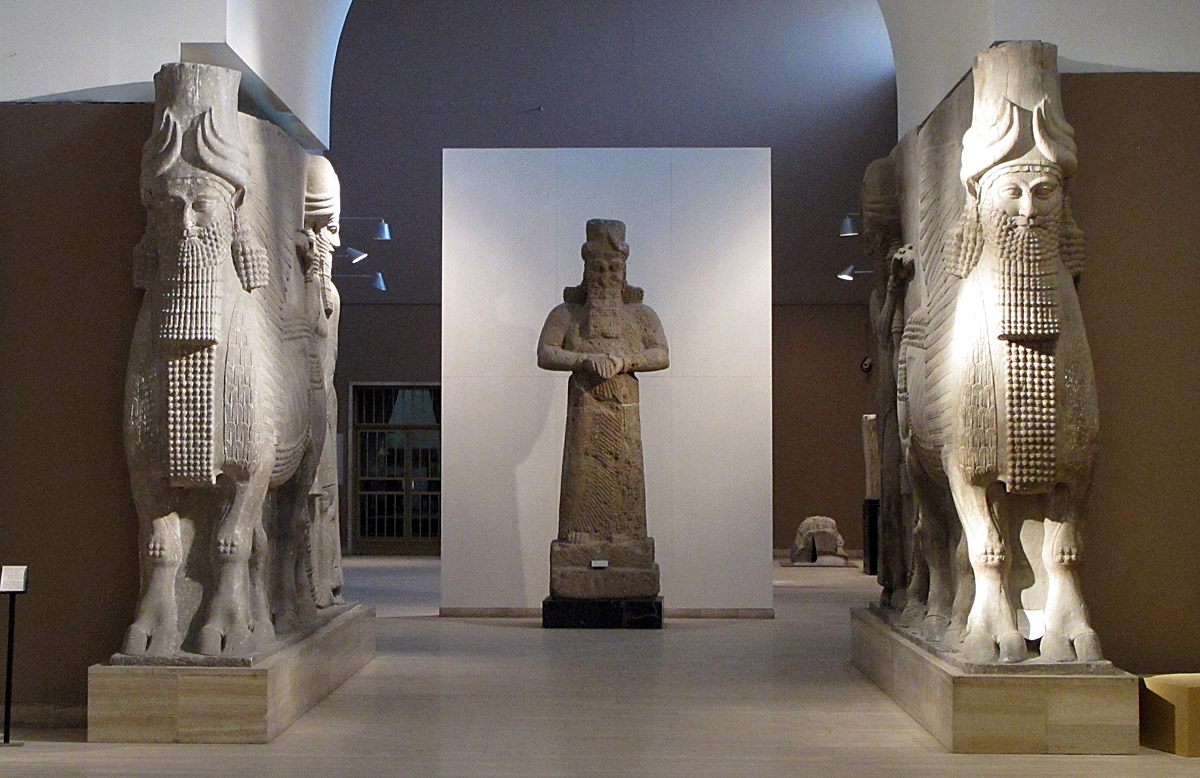
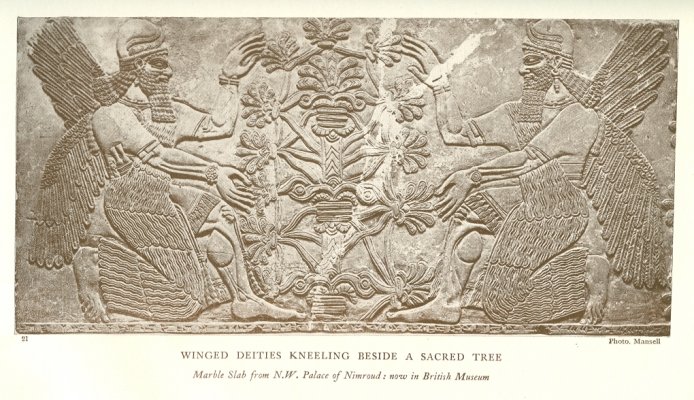
The winged bulls who guarded the approach to the temple and protected it from the invasion of evil spirits, or the eagle-headed cherubs who knelt on either side of the sacred tree, were survivals of a time when “the great gods of heaven and earth” were themselves imaged and adored in similar form.

Winged bulls with human faces guard the approach to the god Nebo.

Winged bulls with human faces guard the approach to the god Nebo.

The same evidence is borne by the animals on whose backs the anthropomorphic deities are depicted as standing in later art. When the gods had become human, there was no other place left for the animals with whom they had once been so intimately connected.

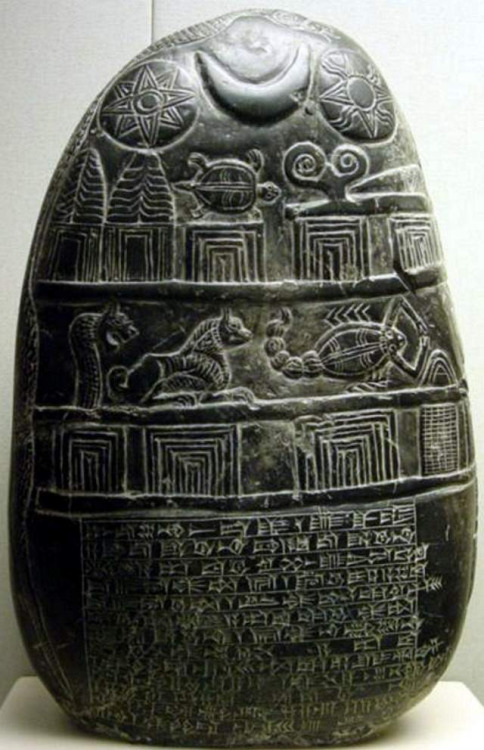
The evidence, however, is not borne by art alone. The written texts aver that the gods were symbolised by animals, like the Sun-god of Kis, whose “image” or symbol was the eagle. It is these symbols which appear on the Babylonian boundary-stones, where in the infancy of Assyrian research they were supposed to represent the Zodiacal signs.

A boundary stone. The eight-pointed star of Ishtar appears at top left, the crescent moon of the Moon God Sin is at top center, and the symbol of the Sun God Shamas appears at top right.

A boundary stone. The eight-pointed star of Ishtar appears at top left, the crescent moon of the Moon God Sin is at top center, and the symbol of the Sun God Shamas appears at top right.

That they were originally something more than mere symbols is expressly indicated in the myths about the goddess of love. Gisdhubar taunts her with her treatment, not only of Alála, the eagle, but also of the horse and the lion, whose names are not given to us.

Here, at any rate, popular tradition has preserved a recollection of the time when the gods of Babylonia were still regarded as eagles and horses and lions. We are taken back to an epoch of totemism, when the tribes and cities of Chaldea had each its totem, or sacred animal, to whom it offered divine worship, and who eventually became its creator-god.

Not less clear is the legend of the first introduction of culture into the valley of the Euphrates. Oannes, or Ea, it was ever remembered, had the body of a fish, and, like a fish, he sank each night into the waters  of the Persian Gulf when the day was closed which he had spent among his favoured disciples of Eridu.

The culture-god himself had once been a totem, from which we may infer how long it was before totemism disappeared, at all events from southern Babylonia, where the contact with Semitic thought was less strong and abiding than was the case further north.”

A.H. Sayce, Lectures on the Origin and Growth of Religion as Illustrated by the Religion of the Ancient Babylonians, 5th ed., London, 1898, pp. 277-80.

The Tree of Life = The Tree of Knowledge

“But the cedar was something more than a world-tree. It was employed, as we have seen, in incantations and magic rites which were intended to restore strength and life to the human frame. It was thus essentially “a tree of life,” and the prototype and original of those conventional trees of Iife with which the walls of the Assyrian paiaces were adorned.

Stone relief from the throne room of Ashurnasirpal II. Nimrud (ancient Kalhu), northern Iraq. Neo-Assyrian, 870–860 BC. This Assyrian relief is from the throne room of the North-West Palace of Ashurnasirpal II (reigned 883-859 BC) at Nimrud in northern Iraq. It was originally positioned behind the king’s throne. Ashurnasirpal appears twice, shown from two sides, dressed in ritual robes and holding a mace symbolising his authority. The figure of the king on the right makes a gesture of worship to a god in a winged disk in the top centre of the relief.  The source of the king’s power may be Ashur, the national god, or Shamash, the god of the sun and justice.  He holds a ring in one hand, an ancient Mesopotamian symbol of god-given kingship. The figure of the king on the left appears to gesture towards a Sacred Tree in the centre. This balanced combination of steams and foliage is a symbol of fertility and abundance given by the gods. Behind the king, on either side of the relief, is a winged protective spirit who blesses and purifies Ashurnasirpal using a cone-shaped object to sprinkle liquid from a ritual bucket. The relief thus summarises visually the main ideas of Assyrian kingship; he is the source of abundance provided by the gods. Ancient visitors approaching the enthroned king would have thus seen three royal figures, the living king facing them, and, on either side of him, two carved images showing Ashurnasirpal’s relationship with the gods.  Emerging from behind the king himself would be the Sacred-Tree. There was another almost identical relief opposite the main door of the throne room, and similar scenes occupied prominent positions in other Assyrian palaces. They were also embroidered on the royal clothes. J.E. Reade, Assyrian sculpture (London, The British Museum Press, 1983) Excavated by Austen Henry Layard, 1845-7 ME 124531, Room 7-8: Assyria: Nimrud http://www.britishmuseum.org/explore/highlights/highlight_objects/me/s/stone_throne_room_relief.aspx

Stone relief from the throne room of Ashurnasirpal II.
Nimrud (ancient Kalhu), northern Iraq. Neo-Assyrian, 870–860 BC.
This Assyrian relief is from the throne room of the North-West Palace of Ashurnasirpal II (reigned 883-859 BC) at Nimrud in northern Iraq. It was originally positioned behind the king’s throne.
Ashurnasirpal appears twice, shown from two sides, dressed in ritual robes and holding a mace symbolising his authority. The figure of the king on the right makes a gesture of worship to a god in a winged disk in the top centre of the relief.
The source of the king’s power may be Ashur, the national god, or Shamash, the god of the sun and justice.
He holds a ring in one hand, an ancient Mesopotamian symbol of god-given kingship. The figure of the king on the left appears to gesture towards a Sacred Tree in the centre. This balanced combination of steams and foliage is a symbol of fertility and abundance given by the gods.
Behind the king, on either side of the relief, is a winged protective spirit who blesses and purifies Ashurnasirpal using a cone-shaped object to sprinkle liquid from a ritual bucket. The relief thus summarises visually the main ideas of Assyrian kingship; he is the source of abundance provided by the gods.
Ancient visitors approaching the enthroned king would have thus seen three royal figures, the living king facing them, and, on either side of him, two carved images showing Ashurnasirpal’s relationship with the gods.
Emerging from behind the king himself would be the Sacred-Tree.
There was another almost identical relief opposite the main door of the throne room, and similar scenes occupied prominent positions in other Assyrian palaces. They were also embroidered on the royal clothes.
J.E. Reade, Assyrian sculpture (London, The British Museum Press, 1983)
Excavated by Austen Henry Layard, 1845-7
ME 124531, Room 7-8: Assyria: Nimrud
http://www.britishmuseum.org/explore/highlights/highlight_objects/me/s/stone_throne_room_relief.aspx

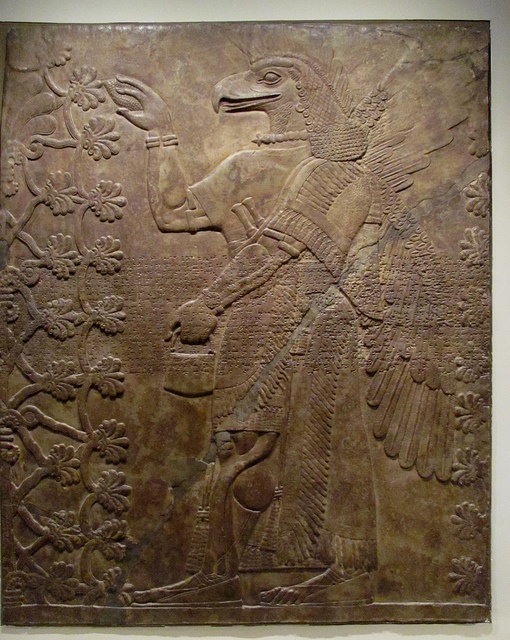
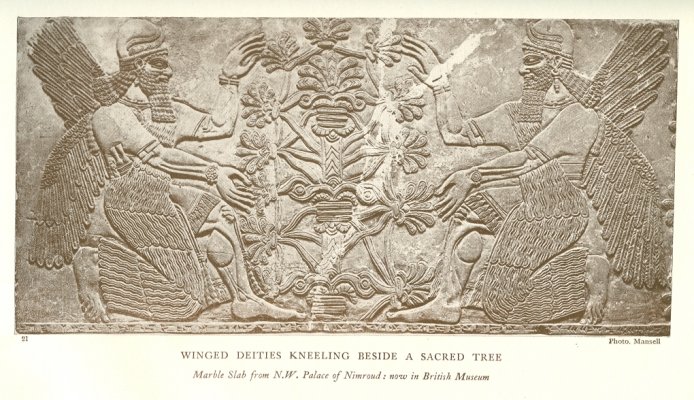
 Those who have visited the Assyrian collection of the British Museum will remember the curious form which it generally assumes, as well as the figures of the two cherubs which kneel or stand before it on either side. At times they are purely human; at other times they have the head of a hawk and hold a cone–the fruit of the cedar–over the tree by whose side they stand.

Alabaster relief from Nimroud, in the Louvre.  http://world-mysteries.com/mpl.htm

Alabaster relief from Nimroud, in the Louvre. The cone, or “fruit of the cedar,” is in the right hand of the eagle figure.
http://world-mysteries.com/mpl.htm

It is possible that, as time went on, another tree became confounded with the original tree of life. The palm was from the earliest period characteristic of Babylonia; and while its fruit seemed to be the stay and support of life, the wine made from it made “glad the heart of man.”

Date-wine was largely used, not only in Babylonian medicine, but in the religious and magical ceremonies of Babylonia as well. It is not at all improbable, therefore, that the later Babylonian tree of life, with its strange conventional form, was an amalgamation of two actual trees, the cedar and the palm.

Donald A. MacKenzie, Myths of Babylonia and Assyria, 1915, p. 340. http://www.sacred-texts.com/ane/mba/img/34000.jpg

Donald A. MacKenzie, Myths of Babylonia and Assyria, 1915, p. 340.
http://www.sacred-texts.com/ane/mba/img/34000.jpg

It is even possible that while one of them, the cedar, was primarily the sacred tree of Eridu, the other was originally the sacred tree of some other locality of Chaldea.

What gives some colour to this last suggestion is, that in later Babylonian belief the tree of life and the tree of knowledge were one and the same.

The text which describes the initiation of a soothsayer associates the cedar with “the treasures of Anu, Bel and Ea, the tablets of the gods, the delivering of the oracle of heaven and earth.” It was upon the heart or core of the cedar, too, that the name of Ea, the god of wisdom, was inscribed.

And it was wisdom rather than life, the knowledge of the secrets of heaven and the magical arts that benefit or injure, which the priesthood of Babylonia and the gods they worshipped kept jealously guarded.

Only the initiated were allowed to taste of its fruit. In this respect, consequently, there was a marked difference between the belief of the Babylonians and the account which we find in the earlier chapters of Genesis.”

A.H. Sayce, Lectures on the Origin and Growth of Religion as Illustrated by the Religion of the Ancient Babylonians, 5th ed., London, 1898, pp. 241-2.

The World Tree of Eridu

“But the primitive home of Tammuz had been in that “garden” of Edin, or Eden, which Babylonian tradition placed in the immediate vicinity of Eridu. The fragment of an old bilingual hymn has been preserved, which begins in the following way :

1. “(In) Eridu a stalk grew over-shadowing; in a holy place did it become green;

2. its root ([sur]sum) was of white crystal which stretched towards the deep;

3. (before) Ea was its course in Eridu, teeming with fertility;

4. its seat was the (central) place of the earth;

5. its foliage was the couch of Zikum (the primeval) mother.

6. Into the heart of its holy house which spread its shade like a forest hath no man entered.

7. (There is the home) of the mighty mother who passes across the sky.

8. (In) the midst of it was Tammuz.

10. (There is the shrine) of the two (gods).”

The description reminds us of the famous Ygg-drasil of Norse mythology, the world-tree whose roots descend into the world of death, while its branches rise into Asgard, the heaven of the gods.

The Babylonian poet evidently imagined his tree also to be a world-tree, whose roots stretched downwards into the abysmal deep, where Ea presided, nourishing the earth with the springs and streams that forced their way upwards from it to the surface of the ground.

Its seat was the earth itself, which stood midway between the deep below and Zikum, the primordial heavens, above, who rested as it were upon the overshadowing branches of the mighty “stem.” Within it, it would seem, was the holy house of Dav-kina, “the great mother,” and of Tammuz her son, a temple too sacred and far hidden in the recesses of the earth for mortal man to enter.

It is perhaps a reminiscence of this mystic temple that we find in the curious work on Nabathean Agriculture, composed in the fourth or fifth century by a Mandaite of Chaldea, where we are told of the temple of the sun in Babylon, in which the images of the gods from all the countries of the world gathered themselves together to weep for Tammuz.

What the tree or “stalk” was which sprang up like the bean-stalk of our old nursery tale, is indicated in the magical text to which the fragment about it has been appended. In this, Ea describes to Merodach the means whereby he is to cure a man who is possessed of the seven evil spirits.

He is first to go to “the cedar-tree, the tree that shatters the power of the incubus, upon whose core the name of Ea is recorded,” and then, with the help of “a good masal” or phylactery which is placed on the sick man’s head as he lies in bed at night, to invoke the aid of the Fire-god to expel the demons.

It is the cedar, therefore, which played the same part in Babylonian magic as the rowan ash of northern Europe, and which was believed to be under the special protection of Ea; and the parallel, therefore, between the ash Ygg-drasil of Norse mythology and the world-tree of the poet of Eridu becomes even closer than before.”

A.H. Sayce, Lectures on the Origin and Growth of Religion as Illustrated by the Religion of the Ancient Babylonians, 5th ed., London, 1898, pp. 237-40.

Tammuz, Attys, Hadad, Adonis, Gingras, & Artemis, Istar, Aphrodite, Semiramis, Gingira

“Greek mythology itself knew the name of Tammuz as well as that of Adonis. Theias or Thoas was not only the Lemnian husband of Myrina and the king of the Tauric Khersonese who immolated strangers on the altars of Artemis, he was also king of Assyria and father of Adonis and his sister Myrrha or Smyrna.

In the Kyprian myth the name of Theias is transformed into Kinyras; but, like Theias, he is the father of Adonis by his daughter Myrrha. Myrrha is the invention of a popular etymology; the true form of the name was Smyrna or Myrina, a name famous in the legendary annals of Asia Minor.

Myrina or Smyrna, it was said, was an Amazonian queen, and her name is connected with the four cities of the western coast–Smyrna, Kymê, Myrina and Ephesos–whose foundation was ascribed to Amazonian heroines.

But the Amazons were really the warrior priestesses of the great Asiatic goddess, whom the Greeks called the Artemis of Ephesos, and who was in origin the Istar of Babylonia modified a little by Hittite influence.

Drawn by Faucher-Gudin, from a heliogravure in Ménant's Recherches sur la Glyptique orientale. http://www.gutenberg.org/files/17323/17323-h/17323-h.htm#linkBimage-0018

Drawn by Faucher-Gudin, from a heliogravure in Ménant’s Recherches sur la Glyptique orientale.
http://www.gutenberg.org/files/17323/17323-h/17323-h.htm#linkBimage-0018

It was she who, in the Asianic cult of Attys or Hadad, took the place of Istar and Aphroditê; for just as Attys himself was Tammuz, so the goddess with whom he was associated was Istar. At Hierapolis, which succeeded to the religious fame and beliefs of the ancient Hittite city of Carchemish, the name under which the goddess went seems to have been Semiramis, and it is possible that Semiramis and Smyrna are but varying forms of the same word.

However this may be, in the Kyprian Kinyras who takes the place of Theias we have a play upon the Phoenician kinnór, or “either,” which is said to have been used in the worship of Adonis. But its real origin seems to be indicated by the name of Gingras which Adonis himself bore. Here it is difficult not to recognize the old Accadian equivalent of Istar, Gingira or Gingiri, “the creatress.”

The fact that Tammuz was the son of Ea points unmistakably to the source both of his name and of his worship. He must have been the primitive Sun-god of Eridu, standing in the same relation to Ea, the god of Eridu, that Adar stood to Mul-lil, the god of Nipur.

"Cylinder seal impression which may portray Dumuzi retained in the underworld, flanked by snakes." (cf. illustration and text on p. 71. Henrietta McCall. Mesopotamian Myths. London. British Museum Publications in cooperation with the University of Texas Press, Austin. 1990, 1993) http://www.bibleorigins.net/CherubimOrigins.html

“Cylinder seal impression which may portray Dumuzi retained in the underworld, flanked by snakes.” (cf. illustration and text on p. 71. Henrietta McCall. Mesopotamian Myths. London. British Museum Publications in cooperation with the University of Texas Press, Austin. 1990, 1993)
http://www.bibleorigins.net/CherubimOrigins.html

It is even possible that the boar whose tusk proved fatal to Adonis may originally have been Adar himself. Adar, as we have seen, was called the “lord of the swine” in the Accadian period, and the Semitic abhorrence of the animal may have used it to symbolise the ancient rivalry between the Sun-god of Nipur and the Sun-god of Eridu.

Those who would see in the Cain and Abel of Scripture the representatives of elemental deities, and who follow Dr. Oppert in explaining the name of Abel by the Babylonian ablu, “the son,” slightly transformed by a popular etymology, may be inclined to make them the Adar and Tammuz of Chaldean faith.”

A.H. Sayce, Lectures on the Origin and Growth of Religion as Illustrated by the Religion of the Ancient Babylonians, 5th ed., London, 1898, pp. 235-6.

Evolution of Tammuz

“We can draw but one conclusion from all this. The resurrection of Tammuz had once been commemorated as well as his death, and the festivals had been identified, not only with that of the Egyptian Osiris, as at Gebal, but also with those of other Semitic forms of the Sun-god, of Hadad and of Rimmon.

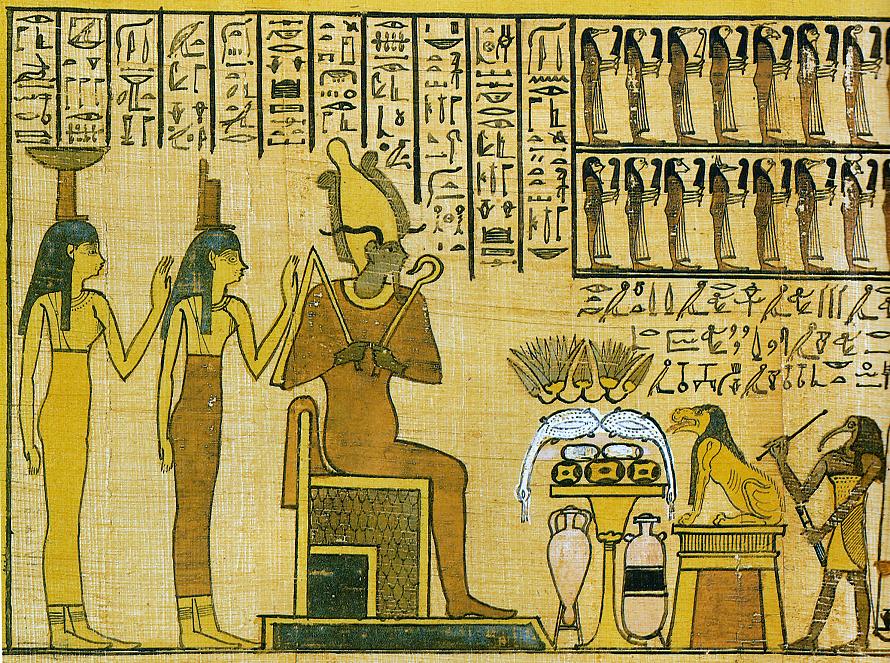
Sarcophagus of Psusennes 1 (early 10th century BCE) formed as Osiris, with crook and frail placed to form a cross. From National Museum, Cairo. http://i-cias.com/e.o/osiris.htm

Sarcophagus of Psusennes 1 (early 10th century BCE) formed as Osiris, with crook and frail placed to form a cross. From National Museum, Cairo.
http://i-cias.com/e.o/osiris.htm

When Macrobius states that Adad meant “the only one” in Syrian, he implies that Adad or Hadad--the Sun-god whose festival fell after the harvests of autumn–was identical with Tammuz.

In Babylonia, Tammuz was the Sun-god of spring; his foe was the summer heat; his death was mourned in the month of June. If there was another feast in which grief gave place to joy at his restoration to life, it was separate  from that which celebrated his death, and must have taken place at a different time of the year.

In its transplantation to the west, however, the cult of TammuzAdonis underwent a change. He was identified with other forms of the solar deity; his festivals were merged into theirs; and, except in places like Gebal, where a natural phenomenon prevented the alteration, the anniversary of his death was shifted to the fall of the year.

He ceased to be the Sun-god of spring, and became the Sun-god of summer. In the highlands of Syria the summer was not the dangerous foe it was in Babylonia; it was, on the contrary, a kindly friend, whose heats quickened and fostered the golden grain. Winter, and not summer, was the enemy who had slain the god.

The story of Tammuz was not of Semitic invention, however much it may owe, in the form in which we know it, to Semitic imagination. The month of Tammuz was called in the Accadian calendar “the month of the errand of Istar,” a clear proof that the legend of the Descent of the goddess into Hades was already known.

Nor is the name of Tammuz itself of Semitic origin. The Semites did not agree about the precise form which it should assume, and it is probable that the form (Tammuz) which prevailed in the west was due to a “popular etymology.” At all events, the Assyro-Babylonian form is not Tammuz, but Duzu, itself contracted from Duwuzu, and a fair representative of the original Accadian Dumu-zi or Duwu-zi, “the son of life.”

The word was interpreted by the Semites as meaning the “offspring,” “the only son;”  but it may be merely a shortened form of the name Dumu-zi-apzu, “the son of the spirit of the deep.” The “spirit of the deep” is of course Ea, as is expressly stated in a mythological tablet, where Dumu-zi-apzu is given as the name of one of his six sons.

Professor Langdon suggested that the below seated deity might be Tammuz as a god of grain and vegetation. Ears of grain grow from his shoulders (cf. p. 90. Stephen Herbert Langdon. The Mythology of All Races- Semitic. Vol. 5. Boston. Marshall Jones Company. 1931). Langdon noted that Tammuz/Dumuzi had many roles and manifestations. He was not only associated with dying and resurrected vegetation, he was also identified with freshwater, for water was essential in the irrigation canals of lower Mesopotamia to sustain life. A number of hymns ask Damu/Dumuzi to "arise from the river," to a degree, the annual flooding or rising of the Euphrates and Tigris rivers would assure plentiful water for crops. "O man, my Damu, my irrigator thou art." (p. 343, Langdon) http://www.bibleorigins.net/TammuzGrainGodSeal.html

Professor Langdon suggested that the below seated deity might be Tammuz as a god of grain and vegetation. Ears of grain grow from his shoulders (cf. p. 90. Stephen Herbert Langdon. The Mythology of All Races- Semitic. Vol. 5. Boston. Marshall Jones Company. 1931).
Langdon noted that Tammuz/Dumuzi had many roles and manifestations. He was not only associated with dying and resurrected vegetation, he was also identified with freshwater, for water was essential in the irrigation canals of lower Mesopotamia to sustain life. A number of hymns ask Damu/Dumuzi to “arise from the river,” to a degree, the annual flooding or rising of the Euphrates and Tigris rivers would assure plentiful water for crops.
“O man, my Damu, my irrigator thou art.” (p. 343, Langdon)
http://www.bibleorigins.net/TammuzGrainGodSeal.html

How early the designation must be, is shown by the fact that Ea appears in it as not yet a god, but as a spirit only. We are carried back to the first dawn of Chaldean religious belief. The name was translated by the Semites “Timmuz (or Dimmuz) of the flood” (H.C. Rawlinson, The Cuneiform Inscriptions of Western Asia, 1886, ii. 47, 29), and the solar character of the deity was indicated by writing his name with ideographs that signified “the maker of fire” (tim-izí).

But this very mode of writing the name, which probably grew up in the court of Sargon of Accad, proves that already the name had lost its last element. The “son of the spirit of the deep” had become “the son of life,” “the only son” of the god Ea.

It is thus that a mythological tablet gives “the River-god,” who is but Ea under another title, a single son Duzi, where the name has assumed its contracted Semitic form, and is written with ideographs that mean “the heart of life.”

A.H. Sayce, Lectures on the Origin and Growth of Religion as Illustrated by the Religion of the Ancient Babylonians, 5th ed., London, 1898, pp. 231-3.

Babylon: Imperial Polytheism

“As long, however, as these multitudinous deities were believed to exist, so long was it also believed that they could injure or assist. Hence come such expressions as those which meet us in the Penitential Psalms, “To the god that is known and that is unknown, to the goddess that is known and that is unknown, do I lift my prayer.”

Hence, too, the care with which the supreme Baal was invoked as “lord of the hosts of heaven and earth,” since homage paid to the master was paid to the subjects as well.

Hence, finally, the fact that the temples of the higher gods, like the Capitol at Rome, became gathering places for the inferior divinities, and counterparts on the earth of “the assembly of the gods” in heaven.

That curious product of Mandaite imagination, the Book of Nabathean Agriculture, which was translated into Arabic by Ibn Wahshiya in the 10th century, sets before us a curious picture of the temple of Tammuz in Babylon.

“The images (of the gods),” it tells us,

“congregated from all parts of the world to the temple of el-Askûl (Ê-Sagil) in Babylon, and betook themselves to the temple (haikal) of the Sun, to the great golden image that is suspended between heaven and earth in particular.

The image of the sun stood, they say, in the midst of the temple, surrounded by all the images of the world. Next to it stood the images of the sun in all countries; then those of the moon; next those of Mars; after them the images of Mercury; then those of Jupiter; next of Venus; and last of all, of Saturn.

Thereupon the image of the sun began to bewail Tammuz and the idols to weep; and the image of the sun uttered a lament over Tammuz and narrated his history, whilst the idols all wept from the setting of the sun till its rising at the end of that night. Then the idols flew away, returning to their own countries.”

The details are probably borrowed from the great temple of pre-Mohammedan Mecca, but they correspond very faithfully with what we now know the interior of one of the chief temples of Babylonia and Assyria to have been like.

Fragments have been preserved to us of a tablet which enumerated the names of the minor deities whose images stood in the principal temples of Assyria, attending like servants upon the supreme god.

Among them are the names of foreign divinities, to whom the catholic spirit of Babylonian religion granted a place in the national pantheon when once the conquest of the towns and countries over which they presided had proved their submission to the Babylonian and Assyrian gods; even Khaldis, the god of Ararat, figures among those who dwelt in one of the chief temples of Assyria, and whose names were invoked by the visitor to the shrine.

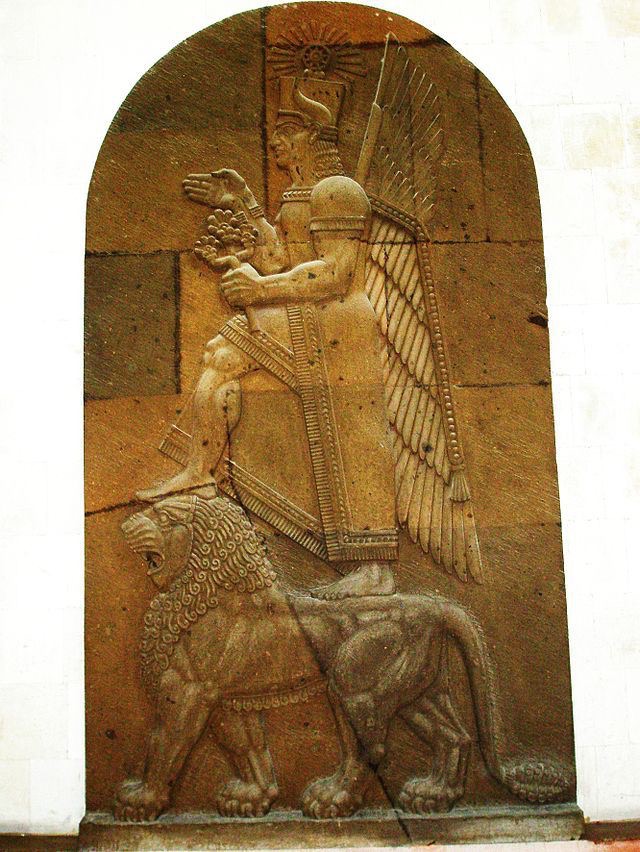
Ḫaldi was the chief deity of the Ararat (Urartu) pantheon. His shrine at Ardini (likely from Armenian Artin), was in Akkadian Muṣaṣir (Exit of the Serpent/Snake).  Of all the gods of the Ararat (Urartu) pantheon, most inscriptions are dedicated to Khaldi or Hayk (Armenian: Հայկ) or Hayg, also known as Haik Nahapet (Հայկ Նահապետ, Hayk the Tribal Chief), the legendary patriarch of the Armenian nation.  He is portrayed as a man standing on a lion. The kings of Urartu prayed to Khaldi for victory in battle. Temples dedicated to Khaldi were adorned with weapons. https://aratta.wordpress.com/2014/10/25/kaldikali-hel/

Ḫaldi was the chief deity of the Ararat (Urartu) pantheon. His shrine at Ardini (likely from Armenian Artin), was in Akkadian Muṣaṣir (Exit of the Serpent/Snake).
Of all the gods of the Ararat (Urartu) pantheon, most inscriptions are dedicated to Khaldi or Hayk (Armenian: Հայկ) or Hayg, also known as Haik Nahapet (Հայկ Նահապետ, Hayk the Tribal Chief), the legendary patriarch of the Armenian nation.
He is portrayed as a man standing on a lion.
The kings of Urartu prayed to Khaldi for victory in battle. Temples dedicated to Khaldi were adorned with weapons.
https://aratta.wordpress.com/2014/10/25/kaldikali-hel/

The spectacle of such a temple, with the statue or symbol of the supreme Baal rising majestically in the innermost cell, and delivering his oracles from within the hidden chamber of that holy of holies, while the shrines of his wife and offspring were grouped around him, and the statues of ministering deities stood slave-like in front, was a fitting image of Babylonian religion.

“The gods many and lords many” of an older creed still survived, but they had become the jealously-defined officials of an autocratic court. The democratic polytheism of an earlier day had become imperial.

Bel was the counterpart of his vicegerent the Babylonian king, with this difference, that whereas Babylonia had been fused into an united monarchy, the hierarchy of the gods still acknowledged more than one head.

How long Anu and Ea, or Samas and Sin, would have continued to share with Merodach the highest honours of the official cult, we cannot say; the process of degradation had already begun when Babylonia ceased to be an independent kingdom and Babylon the capital of an empire.

Merodach remained a supreme Baal–the cylinder inscription of Cyrus proves so much–but he never became the one supreme god.”

A.H. Sayce, Lectures on the Origin and Growth of Religion as Illustrated by the Religion of the Ancient Babylonians, 5th ed., London, 1898, pp. 217-20.

Sala of the Copper Hand = Ishtar, Evening Star

Rimmon, accordingly, among the Babylonians and Assyrians, is the god of winds and cloud, of thunder and lightning, of storm and rain; he is the inundator who is called upon to cover the fields of the impious and unjust with water, and to pour his refreshing streams into a thirsty land.

His wife went by the Accadian name of Sala, “the merciful” (?). As her husband had been identified with “the lord of the mountain,” so she too was identified with “the lady of the mountain,” to whom Gudea had built a temple at Tel-loh.

As “lady of the mountain,” however, she was more strictly the consort of the Sun-god of Eridu; and a mythological tablet speaks accordingly of a “Sala of the mountains, the wife of Merodach.”

It is to Zarpanit, the wife of Merodach, again, and not to Sala, that Nebuchadnezzar refers, when he tells us how he “built in Babylon the House Supreme, the temple of the lady of the mountain, for the exalted goddess, the mother who had borne” him. Sala and Zarpanit, therefore, must once have been one and the same divinity.

Sala was, furthermore, the “lady (or exalted lady) of the desert”–a title which brings to one’s recollection the similar title of Rimmon, as “the ever-glowing sun of the desert-land.”

It is under this title that she is addressed in a penitential psalm, where she is named, not Sala, but Gubára, “the fire-flame,” and associated with Mâtu (Matö), “the lord of the mountain.”

As the other deities invoked along with her are Ea and Dav-kina, Merodach and Zarpanit, Nebo and Tasmit, while the whole psalm is dedicated to Nana, the goddess of Erech, it is clear that the psalm is the composition of a worshipper of Nana and native of Erech, whose gods were the gods of Eridu and those who claimed kindred with them.

We may, therefore, see in the primitive Sala the female consort of the Sun-god of Eridu–the original, in fact, of the Babylonian Zarpanit, who became identified on the one side with the “lady of the mountain,” and on the other with the wife of Meri, the “bright firmament” of the starry sky.

Her name, Gubára, points to her solar connection, and makes it probable that she was not the moon–which does not seem to have been regarded as a goddess in any part of Babylonia–nor the dawn, but the evening and morning star.

This will explain why it is that she was known as the goddess of the mountains, over whose heights Venus arose and set, or as the mistress of wisdom and hidden treasure, or, again, as the goddess of the copper hand.

Other mythologies have stories of a solar hero whose hand has been cut off and replaced by one of gold and bronze, and it is in the light of such stories that the epithet must be explained.

(Note: H.C. Rawlinson, The Cuneiform Inscriptions of Western Asia, 1886, ii., 57, 35. The Sun-god Savitar is called “the golden-handed” in the Veda, a term explained in later Sanskrit literature by the statement that the hand of the god had been cut at a sacrifice and replaced by a golden one. The Teutonic Tyr is similarly one-handed, and the Keltic Nuad with the silver hand offers a close parallel to the Chaldean goddess with the copper hand.)

We are expressly told that Sala of the copper hand was the wife of Tammuz, the beautiful Sun-god of Eridu; and we know that Tammuz, the son of the River-god Ea, was the spouse of Ishtar, the evening star.

What wonder, then, that her later husband Rimmon should have become the Sun-god of the Syrians, whose untimely death was mourned in the plain of Jezreel, as the untimely death of his double, the Babylonian Tammuz, was mourned by the women of Phoenicia and Jerusalem?”

A.H. Sayce, Lectures on the Origin and Growth of Religion as Illustrated by the Religion of the Ancient Babylonians, 5th ed., London, 1898, pp. 209 -12.

More on the Babylonian Zodiac

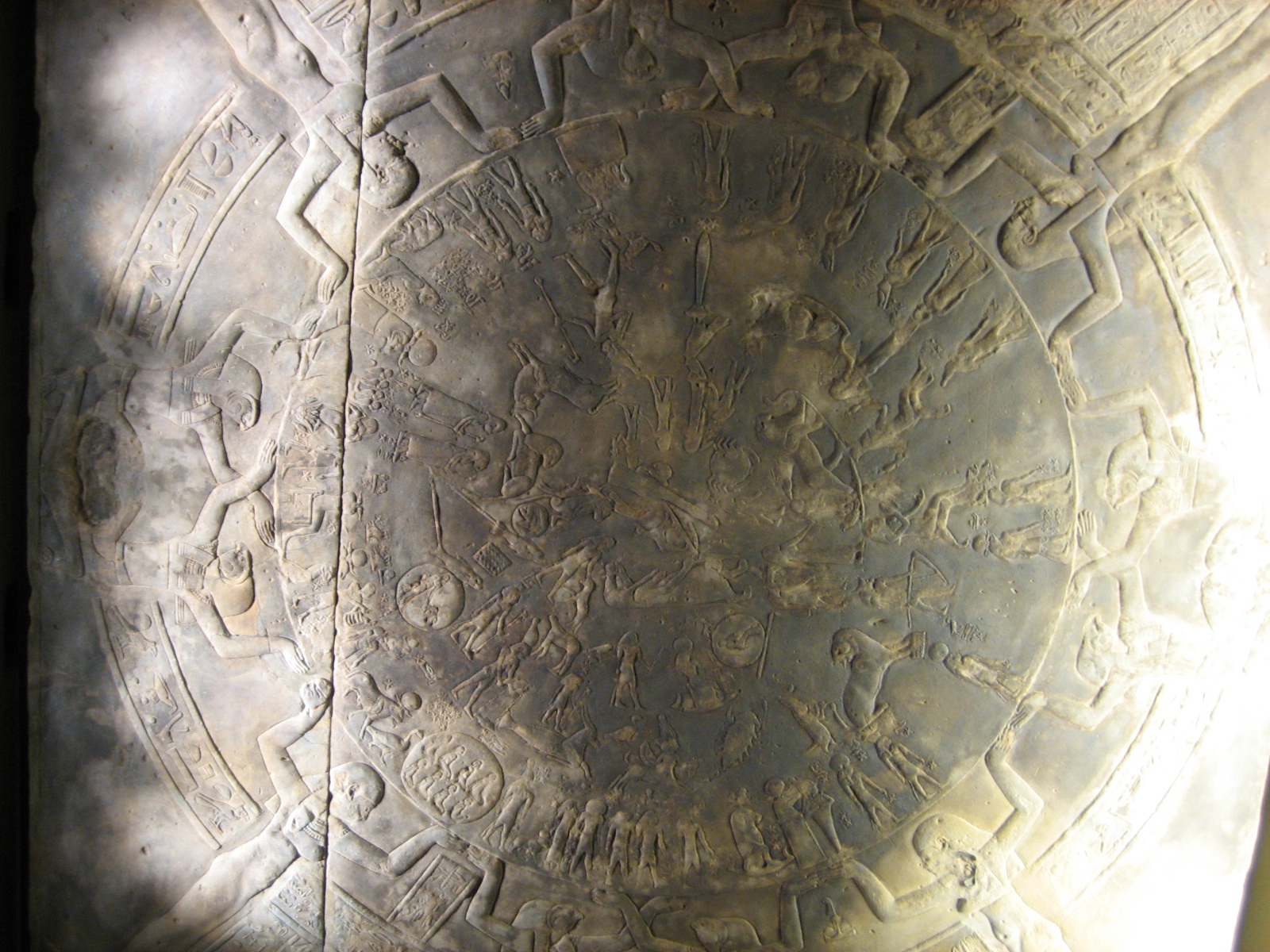
“Jupiter, the largest of the planets, was identified with Merodach, head of the Babylonian pantheon. We find him exercising control over the other stars in the creation story under the name Nibir.

Ishtar was identified with Venus, Saturn with Ninib, Mars with Nergal, Mercury with Nabu. It is more than strange that gods with certain attributes should have become attached to certain planets in more countries than one, and this illustrates the deep and lasting influence which Semitic religious thought exercised over the Hellenic and Roman theological systems.

The connexion is too obvious and too exact not to be the result of close association. There are, indeed, hundreds of proofs to support such a theory. Who can suppose, for example, that Aphrodite is any other than Ishtar?

The Romans identified their goddess Diana with the patroness of Ephesus. There are, indeed, traces of direct relations of the Greek goddess with the moon, and she was also, like Ishtar, connected with the lower world and the sea.

The Greeks had numerous and flourishing colonies in Asia Minor in remote times, and these probably assisted in the dissemination of Asiatic and especially Babylonian lore.

The sun was regarded as the shepherd of the stars, and Nergal, the god of destruction and the underworld, as the “chief sheep,” probably because the ruddy nature of his light rendered him a most conspicuous object.

Anu is the Pole Star of the ecliptic, Bel the Pole Star of the equator, while Ea, in the southern heavens, was identified with a star in the constellation Argo.

Fixed stars were probably selected for them because of their permanent and elemental nature. The sun they represented as riding in a chariot drawn by horses, and we frequently notice that the figure representing the luminary on Greek vases and other remains wears the Phrygian cap, a typically Asiatic and non-Hellenic headdress, thus assisting proof that the idea of the sun as a charioteer possibly originated in Babylonia.

Lunar worship, or at least computation of time by the phases of the moon, frequently precedes the solar cult, and we find traces in Babylonian religion of the former high rank of the moon-god. The moon, for example, is not one of the flock of sheep under guidance of the sun. The very fact that the calendar was regulated by her movements was sufficient to prevent this.

Like the Red Indians and other primitive folk, the Babylonians possessed agricultural titles for each month, but these periods were also under the direct patronage of some god or gods.

Thus the first month, Nizan, is sacred to Anu and Bel; and the second, Iyar, to Ea. Siwan is devoted to Sin, and as we approach the summer season the solar gods are apportioned to various months.

The sixth month is sacred to Ishtar, and the seventh to Shamash, great god of the sun. Merodach rules over the eighth, and Nergal over the ninth month.

The tenth, curiously enough, is sacred to a variant of Nabu, to Anu, and to Ishtar. The eleventh month, very suitably, to Ramman, the god of storms, and the last month, Adar, falling within the rainy season, is presided over by the seven evil spirits.

Assyrian star map from Nineveh (K 8538). Counterclockwise from bottom: Sirius (Arrow), Pegasus + Andromeda (Field + Plough), [Aries], the Pleiades, Gemini, Hydra + Corvus + Virgo, Libra. Drawing by L.W.King with corrections by J.Koch. Neue Untersuchungen zur Topographie des Babilonischen Fixsternhimmels (Wiesbaden 1989), p. 56ff. http://doormann.tripod.com/asssky.htm

Assyrian star map from Nineveh (K 8538). Counterclockwise from bottom: Sirius (Arrow), Pegasus + Andromeda (Field + Plough), [Aries], the Pleiades, Gemini, Hydra + Corvus + Virgo, Libra. Drawing by L.W.King with corrections by J.Koch. Neue Untersuchungen zur Topographie des Babilonischen Fixsternhimmels (Wiesbaden 1989), p. 56ff.
http://doormann.tripod.com/asssky.htm

None of the goddesses received stellar honours. The names of the months were probably quite popular in origin.

Thus we find that

  • the first month was known as the ‘month of the Sanctuary,’
  • the third as the ‘period of brick-making,’
  • the fifth as the ‘fiery month,’
  • the sixth as the ‘month of the mission of Ishtar,’ referring to her descent into the realms of Allatu.
  • The fourth month was designated ‘scattering seed,’
  • the eighth that of the opening of dams,
  • and the ninth was entitled ‘copious fertility,’
  • while the eleventh was known as ‘destructive rain.’

We find in this early star-worship of the ancient Babylonians the common origin of religion and science. Just as magic partakes in some measure of the nature of real science (for some authorities hold that it is pseudo-scientific in origin) so does religion, or perhaps more correctly speaking, early science is very closely identified with religion.

 The Zodiac of Dendera (or “Dendara”), a stone diagram from an Egyptian temple dated to the mid-1st century BCE, depicts the twelve signs of the zodiac and the 36 Egyptian decans, and numerous other constellations and astronomical phenomena. The Hellenistic-era portrayal of the zodiac is dated to between June 15th and August 15th, 50 BCE based on astronomical data in the diagram.  The positions of planets in specific signs of the zodiac and eclipses that took place on March 7th, 51 BCE and September 25, 52 BCE are depicted. The Dendera Egyptian temple complex dates back to the 4th century BCE, during the rule of the last native Egyptian pharaoh Nectanebo II. It was renovated by later Hellenistic and Roman rulers. http://horoscopicastrologyblog.com/2007/05/24/the-zodiac-of-dendera/


The Zodiac of Dendera (or “Dendara”), a stone diagram from an Egyptian temple dated to the mid-1st century BCE, depicts the twelve signs of the zodiac and the 36 Egyptian decans, and numerous other constellations and astronomical phenomena.
The Hellenistic-era portrayal of the zodiac is dated to between June 15th and August 15th, 50 BCE based on astronomical data in the diagram. The positions of planets in specific signs of the zodiac and eclipses that took place on March 7th, 51 BCE and September 25, 52 BCE are depicted.
The Dendera Egyptian temple complex dates back to the 4th century BCE, during the rule of the last native Egyptian pharaoh Nectanebo II. It was renovated by later Hellenistic and Roman rulers.
http://horoscopicastrologyblog.com/2007/05/24/the-zodiac-of-dendera/

Thus we may believe that the religious interest in their early astronomy spurred the ancient star-gazers of Babylonia to acquire more knowledge concerning the motions of those stars and planets which they believed to be deities.

We find the gods so closely connected with ancient Chaldean astronomy as to be absolutely identified with it in every way. A number was assigned to each of the chief gods, which would seem to show that they were connected in some way with mathematical science.

Thus Ishtar’s number is fifteen; that of Sin, her father, is exactly double that. Anu takes sixty, and Bel and Ea represent fifty and forty. Ramman is identified with ten.

It would be idle in this place to attempt further to outline astrological science in Babylonia, concerning which our knowledge is vague and scanty. Much remains to be done in the way of research before anything more definite can be written about it, and many years may pass before the workers in this sphere are rewarded by the discovery of texts bearing on Chaldean star-lore.”

Lewis Spence, Myths and Legends of Babylonia and Assyria, 1917, pp. 235-7.

Hymns On the Seven Matu Gods

An Accadian hymn about the Seven Harmful Spirits:

  1. “They are the destructive reptiles, even the winds that create evil!
  2. as an evil reptile, as an evil wind, do they appear!
  3. as an evil reptile, as an evil wind, who marches in front are they !
  4. Children monstrous (gitmalutu), monstrous sons are they!
  5. Messengers of the pest-demon are they!
  6. Throne-bearers of the goddess of Hades are they!
  7. The whirlwind (mátu) which is poured upon the land are they!
  8. The seven are gods of the wide-spread heaven.
  9. The seven are gods of the wide-spread earth.
  10. The seven are gods of the (four) zones.
  11. The seven are gods seven in number.
  12. Seven evil gods are they!
  13. Seven evil demons are they!
  14. Seven evil consuming spirits are they!
  15. In heaven are they seven, in earth are they seven!”
Four faced wind demon. Old Babylonian Period, 18th-17th century B.C. Purchased in Baghdad, 1930 Oriental Institute Museum A7119 University of Chicago https://oi.uchicago.edu/collections/highlights/highlights-collection-mesopotamia

Four faced wind demon. Old Babylonian Period, 18th-17th century B.C.
Purchased in Baghdad, 1930
Oriental Institute Museum A7119
University of Chicago
https://oi.uchicago.edu/collections/highlights/highlights-collection-mesopotamia

From H.C. Rawlinson, The Cuneiform Inscriptions of Western Asia, 1886, iv. 1. ii. 65–iii. 26; 2. v. 30-59:

  1. “Seven are they, seven are they!
  2. In the hollow of the deep, seven are they!
  3. (In) the glory of heaven, seven are they!
  4. In the hollow of the deep in a palace grew they up! (In the original, “from the hollow …. came they forth”).
  5. Male they are not, female they are not!
  6. They are the dust-storm, the travelled ones are they!
  7. Wife they possess not, child is unborn to them.
  8. Order and kindliness know they not.
  9. They hearken not to prayer and supplication.
  10. From the horse of the mountain came they forth.
  11. Of Ea are they the foes.
  12. The throne-bearers of the gods are they.
  13. To trouble the canal in the street are they set.
  14. Evil are they, evil are they!
  15. Seven are they, seven are they, seven doubly said are they!”
Four faced statuette, representing the god of the four winds. The god wears a low cap with a pair of horns meeting above each face. He carries a scimitar in his right hand and places his left foot upon the back of a crouching ram.  https://oi.uchicago.edu/collections/highlights/highlights-collection-mesopotamia

Four faced statuette, representing the god of the four winds. The god wears a low cap with a pair of horns meeting above each face. He carries a scimitar in his right hand and places his left foot upon the back of a crouching ram.
https://oi.uchicago.edu/collections/highlights/highlights-collection-mesopotamia

Another poet of Eridu, in a hymn to the Fire-god, speaks of the seven spirits in similar language:

  1. “O god of Fire,” he asks, “how were those seven begotten, how grew they up?
  2. Those seven in the mountain of the sunset were born;
  3. those seven in the mountain of the sunrise grew up.”

Throughout they are regarded as elemental powers, and their true character as destructive winds and tempests is but thinly veiled by a cloak of poetic imagery. But it will be noticed that they already belong to the harmful side of nature; and though the word which I have rendered “evil,” after the example of the Semitic translators, means rather “injurious” than “evil” in our sense of the word, they are already the products of night and darkness; their birth-place is the mountain behind which the sun sinks into the gloomy lower world.

 In the 22nd book of the great work on Astronomy, compiled for Sargon of Accad, they are termed “the seven great spirits” or galli, and it is therefore possible that they had already been identified with the “seven gods of destiny,” the Anúna-ge or “spirits of the lower world,” of the cult of Nipur.

In their gradual development into the Semite Rimmon, the spirits of the air underwent a change of parentage.

Mâtu, as we have seen, was, like his kindred wind-gods of Eridu, the offspring of Ea. But the home of the wind is rather the sky than the deep, and Meri, “the shining firmament,” was naturally associated with the sky.

When Ana, “the sky,” therefore, became the Semitic Anu, Rimmon, who united in himself Mâtu and Meri and other local gods of wind and weather as well, was made his son.”

A.H. Sayce, Lectures on the Origin and Growth of Religion as Illustrated by the Religion of the Ancient Babylonians, 5th ed., London, 1898, pp. 207-8.

Winds and the Babylonian Concept of Evil

Hadad, Addu or Dadda, never superseded the native name of Ramânu (Ramman) in Babylonia and Assyria, and remained foreign to the last.

Ramânu, however, was sometimes addressed as Barqu or Barak, “the lightning;” and it is possible that antiquarian zeal may have also sometimes imposed on him the Accadian title of Meru.

He grew continuously in popular favour. In Semitic Babylonia, and yet more in Semitic Assyria, his aid was constantly invoked; and, like Anu, Bel and Ea, he tended as time went on to become more and more national in character. Ramman is one of the least local of Babylonian gods.

This was due in great measure to the nature of his origin. He began as the amalgamation of two distinct deities, the wind-god and the air-god, and the extension af his cult was marked by the absorption into his person of the various deities of the winds adored by the older faith.

He continued to grow at their expense. The spirits of the winds and storms sank lower and lower; and while the beneficent side of their operation attached itself to Ramman, there remained to them only that side which was harmful and demoniac.

Iraq ca. 800-600 B.C. Bronze Purchased in New York, 1943 Oriental Institute Museum A25413 The demon Pazuzu stands but has a scorpion's body, feathered wings, avian legs, talons, and a lion face front and back.  Pazuzu, the "king of the evil wind demons," was not unfriendly. As an enemy of the Lamashtu demon, Pazuzu is portrayed on amulets for childbirth.  The ring at the top of this figurine suggests that it was such an amulet. https://oi.uchicago.edu/collections/highlights/highlights-collection-mesopotamia

Iraq
ca. 800-600 B.C.
Bronze
Purchased in New York, 1943
Oriental Institute Museum A25413
The demon Pazuzu stands but has a scorpion’s body, feathered wings, avian legs, talons, and a lion face front and back.
Pazuzu, the “king of the evil wind demons,” was an enemy of the Lamashtu demon. Pazuzu was portrayed on childbirth amulets. 
https://oi.uchicago.edu/collections/highlights/highlights-collection-mesopotamia

By degrees, the two aspects of their character came be separated. The higher gods came to be looked upon as the hearers of prayers and the bestowers of all good gifts; while the instruments of their vengeance an the inflictors of suffering and misery upon man were the inferior spirits of the lower sphere.

But the old conception, which derived both good and evil from the same source, did not wholly pass away. Evil never came to be regarded as the antagonist of good; it was rather the necessary complement and minister of good.

The supreme Baal thus preserved his omnipotence, while at the same time the ideas of pain and injustice were dissociated from him. In his combat with the dragon of chaos, Merodach summons the “evil wind” itself to his assistance; and in the legend of the assault of the seven wicked spirits upon the Moon, they are nevertheless called “the messengers of Anu their king.”

Nerra, the god of plague and destruction, smites the people of Babylonia on account of their sins by the command of the gods, like the angel with the drawn sword whom David saw standing over Jerusalem at the threshing-floor of Araunah; and in the story of the Deluge it is because of the wickedness of mankind that the flood is brought upon the earth.

The powers of darkness are degraded from their ancient position of independence, and either driven, like Tiamat, beyond the bounds of the created world, or reduced to the condition of ministers of divine wrath.

If we would realise how widely removed is this conception of them as the instruments of divine anger from that earlier view in which they are mere elemental powers, in themselves neither good nor evil, we cannot do better than compare these legendary compositions of the Semitic period with the old Accadian hymns that relate to the seven harmful spirits.”

A.H. Sayce, Lectures on the Origin and Growth of Religion as Illustrated by the Religion of the Ancient Babylonians, 5th ed., London, 1898, pp. 205-6.

On the Babylonian Winds

“The primitive inhabitant of Babylonia paid a special worship to the winds. He beheld in them spirits of good and evil. He prayed for (‘the good wind” which cooled the heats of summer and brought moisture to the parched earth, and he saw in the storm and tempest, in the freezing blasts of winter and the hot wind that blew from the burning desert, “the seven evil spirits.”

They were the demons ‘who had been created in the lower part of heaven,” and who warred against the Moon-god when he suffered eclipse. They were likened to all that was most noxious to man.

The first, we are told, was “the sword (or lightning) of rain;” the second, “a vampire;” the third, “a leopard;” the fourth, “a serpent;” the fifth, “a watch-dog” (?); the sixth, “a violent tempest which (blows) against god and king;” and the seventh, “a baleful wind.” But their power caused them to be dreaded, and they were venerated accordingly.

It was remembered that they were not essentially evil. They, too, had been the creation of Anu, for they came forth from the sky, and all seven were “the messengers of Anu their king.” In the war of the gods against the dragon of chaos, they had been the allies of Merodach. We read of them that ere the great combat began, the god “created the evil wind, the hostile wind, the tempest, the storm, the four winds, the seven winds, the whirlwind, the unceasing wind.”

Battle between Marduk (Bel) and Tiamat. Drawn from a bas-relief from the Palace of Ashur-nasir-pal, King of Assyria, 885-860 B.C., at Nimrûd. The winds that Marduk wielded in the combat are portrayed as tridents in his hands.  British Museum, Nimrûd Gallery, Nos. 28 and 29. http://bharatkalyan97.blogspot.com/2013/06/tablet-of-destinies.html

Battle between Marduk (Bel) and Tiamat. Drawn from a bas-relief from the Palace of Ashur-nasir-pal, King of Assyria, 885-860 B.C., at Nimrûd.
The winds that Marduk wielded in the combat are portrayed as tridents in his hands.
British Museum, Nimrûd Gallery, Nos. 28 and 29.
http://bharatkalyan97.blogspot.com/2013/06/tablet-of-destinies.html

When Merodach had slung forth his boomerang and hit the dragon, “the evil wind that seizes behind showed its face. And Tiamat (the dragon of the sea) opened her mouth to swallow it, but (the god) made the evil wind descend so that she could not close her lips; with the force of the winds he filled her stomach, and her heart was sickened and her mouth distorted.”

Down to the closing days of the Assyrian empire, the four winds, ”the gods of Nipur,” were still worshipped in Assyria (H.C. Rawlinson, The Cuneiform Inscriptions of Western Asia, 1886, iii. 66, Rev. 26), and Saru, the Wind-god, is mentioned as a separate divinity in the story of the Deluge.

Among the winds there was one whose name awakened feelings of dread in the mind of every Babylonian. This was the tempest, called mâtu in Accadian, and abub in Semitic. It was the tempest which had been once sent by Bel to drown guilty mankind in the waters of a deluge, and whose return as the minister of divine vengeance was therefore ever feared.

Nabu, or Nebo, sculpted bronze figure by Lee Lawrie. Door detail, east entrance, Library of Congress John Adams Building, Washington, D.C. Photographed 2007 by Carol Highsmith (1946–), who explicitly placed the photograph in the public domain. - Library of Congress, Prints & Photographs Division. http://en.wikipedia.org/wiki/Nabu#/media/File:Nabu-Lawrie-Highsmith.jpeg

Nabu, or Nebo, sculpted bronze figure by Lee Lawrie. Door detail, east entrance, Library of Congress John Adams Building, Washington, D.C.
Photographed 2007 by Carol Highsmith (1946–), who explicitly placed the photograph in the public domain. – Library of Congress, Prints & Photographs Division.
http://en.wikipedia.org/wiki/Nabu#/media/File:Nabu-Lawrie-Highsmith.jpeg

As each year brought with it the month of Sebat or January, with its “curse of rain,” the memory of that terrible event rose again in the Babyonian mind. Mâtu was a god whose favour had to be conciliated, and whose name accordingly appears on numbers of early cylinders.

But though Mâtu was thus specially identified with the great tempest which formed an era in Babylonian history, it was not forgotten that he was but one of several storm-gods, who were therefore spoken of as “the gods Mâtu.

Like the clouds, they were children of the sea, and were thus included in the family of Ea. It is possible that this genealogy was due to the systematising labours of a later day; but it is also possible that the gods Mâtu were primarily adored in Eridu, and that Eridu, and not Surippak, was the original city of the Chaldean Noah.

It is at least noticeable that the immortal home of the translated Xisuthros was beyond the mouth of the Euphrates, near which Eridu was built.

If Eridu were the birth-place of Mâtu, it would explain why the god of the tempest was also the god of the western wind. Elsewhere in Babylonia, the western wind blew from across the desert and brought heat with it rather than rain.

But in those remote days, when the northern portion of the Persian Gulf had not as yet been filled up with miles of alluvial deposit, a westerly breeze could still come to Eridu across the water.

In a penitential psalm, Mâtu, the lord of the mountain” (mulu mursamma-lil), whose wife, “the lady of the mountain,” is mentioned on the monuments of Tel-loh, is invoked along with his consort Gubarra, Ea, “the sovereign of heaven and earth and sovereign of Eridu,” Dav-kina, Merodach, Zarpanit, Nebo and Nana--in short, along with the gods of Eridu and the kindred deities of Babylon.”

A.H. Sayce, Lectures on the Origin and Growth of Religion as Illustrated by the Religion of the Ancient Babylonians, 5th ed., London, 1898, pp. 199-202.

Trinities versus Male-Female Dualism

“The early importance and supremacy of Erech in Semitic Babylonia caused its god to assume a place by the side of Ea of Eridu and Mul-lil, the older Bel. It is possible that the extension of his cult had already begun in Accadian days. The Ana, or Sky-god, to whom Gudea at Tel-loh erected a temple, may have been the Sky-god of Erech, more especially when we remember the connection that existed between Erech and Eridu on the one hand, and between Tel-loh and Eridu on the other.

However this may be, from the commencement of the Semitic period Anu appears as the first member of a triad which consisted of Anu, Bel or Mul-lil, and Ea. His position in the triad was due to the leading position held by Erech; the gods of Nipur and Eridu retained the rank which their time-honoured sanctity and the general extension of their cult had long secured to them; but the rank of Anu was derived from the city of which he was the presiding god.

The origin of the triad was thus purely accidental; there was nothing in the religious conceptions of the Babylonians which led to its formation. Once formed, however, it was inevitable that a cosmological colouring should be given to it, and that Anu, Bel and Ea, should represent respectively the heaven, the lower world and the watery element.

Later ages likened this cosmological trinity to the elemental trinity of the Sun, the Noon and the Evening Star; and below the triad of Anu, Bel and Ea, was accordingly placed the triad of of Samas, Sin and Istar. But this secondary trinity never attracted the Babylonian mind.

This finely cut seal depicts Ishtar, Mesopotamian goddess of sexuality and warfare.  Her strength as a warrior is stressed here, as she is shown with weapons rising from her shoulders. Ishtar appears to have been associated at an early period with the Sumerian goddess Inanna and both deities are depicted with symbols of fertility, such as the date palm, and of aggression, such as the lion.  This iconography survived relatively unchanged for over a thousand years. Here, Ishtar's astral quality is also emphasized: above her crown is a representation of the planet Venus.  In the first millennium BC more unusual stones were used to make seals: this one is made of green garnet, which may have come from northern Pakistan. British Museum, ME 89769, acquired 1835. D. Collon, First impressions: cylinder seals (London, The British Museum Press, 1987) H. Frankfort, Cylinder seals (London, Macmillan, 1939) http://www.britishmuseum.org/explore/highlights/highlight_objects/me/g/garnet_cylinder_seal_ishtar.aspx

This finely cut seal depicts Ishtar, Mesopotamian goddess of sexuality and warfare.
Her strength as a warrior is stressed here, as she is shown with weapons rising from her shoulders.
Ishtar appears to have been associated at an early period with the Sumerian goddess Inanna and both deities are depicted with symbols of fertility, such as the date palm, and of aggression, such as the lion.
This iconography survived relatively unchanged for over a thousand years. Here, Ishtar’s astral quality is also emphasized: above her crown is a representation of the planet Venus.
In the first millennium BC more unusual stones were used to make seals: this one is made of green garnet, which may have come from northern Pakistan. British Museum, ME 89769, acquired 1835.
D. Collon, First impressions: cylinder seals (London, The British Museum Press, 1987)
H. Frankfort, Cylinder seals (London, Macmillan, 1939)
http://www.britishmuseum.org/explore/highlights/highlight_objects/me/g/garnet_cylinder_seal_ishtar.aspx

Up to the last, as we have seen, Sin continued to be the father of Samas and Istar, and Babylonian religion remained true to its primitive tendency to dualism, its separation of the divine world into male and female deities.

The only genuine trinity that can be discovered in the religious faith of early Chaldea was that old Accadian system which conceived of a divine father and mother by the side of their son the Sun-god.

The Semitic Anu necessarily produced the feminine Anat, and as necessarily Anat was identified with the earth as Anu was with the sky. In this way the Accadian idea of a marriage union between the earth and the sky was adapted to the newer Semitic beliefs. But we must not misunderstand the nature of the adaptation.

Anat never became an independent deity, as Dav-kina, for example, had been from the outset; she had no separate existence apart from Anu. She is simply a Bilat matati, “a mistress of the world,” or a Bilat ili, “a mistress of the gods,” like the wife of Bel or of Samas: she is, in fact, a mere colourless representation of the female principle in the universe, with no attributes that distinguish her from Anunit or Istar except the single one that she was the feminine form of Anu.

Goddess Ishtar, center, with wings, standing armed with one foot on a lion, her symbol.  The goddess is portrayed wearing the horned headdress of divinity and indistinct weaponry on her back.

Goddess Ishtar, center, with wings, standing armed with one foot on a lion, her symbol.
The goddess is portrayed wearing the horned headdress of divinity and indistinct weaponry on her back.

Hence it is that the Canaanites had not only their Ashtaroth, but their Anathoth as well, for the Anathoth or “Anats” differed from the Ashtaroth or “Ashtoreths” in little else than name. So far as she was an active power, Anat was the same as Istar; in all other respects she was merely the grammatical complement of Anu, the goddess who necessarily stood at the side of a particular god.”

A.H. Sayce, Lectures on the Origin and Growth of Religion as Illustrated by the Religion of the Ancient Babylonians, 5th ed., London, 1898, pp. 192-4.

Unu-ki = Unuk = Uruk = Erech

“It was not of Semitic foundation, however. Its earliest name was the Accadian Unu-ki or Unuk, “the place of the settlement,” of which the collateral form Uruk does not seem to have come into vogue before the Semitic period.

If I am right in identifying Unuk with the Enoch of Genesis, the city built by Kain in commemoration of his first-born son, Unuk must be regarded as having received its earliest culture from Eridu, since Enoch was the son of Jared, according to Genesis iv, and Jared or Irad (Genesis iv.) is the same word as Eridu.

The local god of Erech, however, was not Ea, the god of the river and sea, but Ana, the sky. Thus whereas at Eridu the present creation was believed to have originated out of water, the sky being the primeval goddess Zikum or Zigara, mother alike of Ea and the other gods, at Erech the sky was itself the god and the creator of the visible universe.

The two cosmologies are antagonistic to one another, and produced manifold inconsistencies in the later syncretic age of Babylonian religion.

But it was not in Erech alone that the sky was considered divine. Throughout Chaldea, Ana, “the sky,” received worship, and the oldest magical texts invoke “the spirit of the sky” by the side of that of the earth. What distinguished the worship of Ana at Erech was that here alone he was the chief deity of the local cult, that here alone he had ceased to be a subordinate spirit, and had become a dingir or “creator.”

Of this pre-Semitic period in the worship of Ana we know but little. It is only when he has become the Anu of the Semites and has undergone considerable changes in his character and worship, that we make our first true acquaintance with him.

We come to know him as the Semitic Baal-samaim, or “lord of heaven,” the supreme Baal, viewed no longer as the Sun-god, but as the whole expanse of heaven which is illuminated by the sun.

How early this must have been is shown by the extension of his name as far west as Palestine. In the records of the Egyptian conqueror Thothmes III., in the 16th century before our era, mention is made of the Palestinian town of Beth-bath, “the temple of Anat,” the female double of Anu.

Another Beth-Anath was included within the borders of the tribe of Naphtali (Joshua xix.38); and Anathoth, whose name shows us that, besides the Ashtaroth or “Astartes,” the Canaanites venerated their local goddesses under the title of “Anats,” was a city of the priests.

Anah or Anat was the daughter of the Hivite Zibeon and mother-in-law of Esau (Genesis xxxvi. 1,14), and by her side we hear of Anah or Anu, the son of the Horite Zibeon, who “found the mules (or hot-springs) in the wilderness as he fed the asses of Zibeon his father.” But Anu did not make his way westward alone.”

A.H. Sayce, Lectures on the Origin and Growth of Religion as Illustrated by the Religion of the Ancient Babylonians, 5th ed., London, 1898, pp. 185-8.

Marduk, Sun God

“On the first day of the Babylonian New Year an assembly of the gods was held at Babylon, when all the principal gods were grouped round Merodach in precisely the same manner in which the King was surrounded by the nobility and his officials, for many ancient faiths imagined that the polity of earth merely mirrored that of heaven, that, as Paracelsus would have said, the earth was the microcosm of the heavenly macrocosm—“as above, so below.”

The ceremony in question consisted in the lesser deities paying homage to Merodach as their liege lord. In this council, too, they decided the political action of Babylonia for the coming year.

It is thought that the Babylonian priests at stated intervals enacted the myth of the slaughter of Tiawath. This is highly probable, as in Greece and Egypt the myths of Persephone and Osiris were represented dramatically before a select audience of initiates.

We see that these representations are nearly always made in the case of divinities who represent corn or vegetation as a whole, or the fructifying power of springtime. The name of Merodach’s consort Zar-panitum was rendered by the priesthood as ‘seed producing,’ to mark her connexion with the god who was responsible for the spring revival.

Merodach’s ideograph is the sun, and there is abundant evidence that he was first and last a solar god. The name, originally Amaruduk, probably signifies ‘the young steer of day,’ which seems to be a figure for the morning sun.

Marduk. Portrayed with a hound, and with the Tablets of Destiny upon his chest and robe.

Marduk. Portrayed with a hound, and with the Tablets of Destiny upon his chest and robe.

He was also called Asari, which may be compared with Asar, the Egyptian name of Osiris. Other names given him are Sar-agagam, ‘the glorious incantation,’ and Meragaga, ‘the glorious charm,’ both of which refer to the circumstance that he obtained from Ea, his father, certain charms and incantations which restored the sick to health and exercised a beneficial influence upon mankind.

Merodach was supposed to have a court of his own above the sky, where he was attended to by a host of ministering deities. Some superintended his food and drink supply, while others saw to it that water for his hands was always ready.

He had also doorkeepers and even attendant hounds, and it is thought that the satellites of Jupiter, the planet which represented him, may have been dimly visible to those among the Chaldean star-gazers who were gifted with good sight.

These dogs were called Ukkumu, ‘Seizer,’ Akkulu, ‘Eater,’ Iksuda, ‘Grasper,’ and Iltehu, ‘Holder.’ It is not known whether these were supposed to assist him in shepherding his flock or in the chase, and their names seem appropriate either for sheep-dogs or hunting hounds.”

Lewis Spence, Myths and Legends of Babylonia and Assyria, 1917, pp. 201-2.

Marduk Assimilates All Other Gods

“THE entire religious system of Babylonia is overshadowed, by Merodach, its great patron deity. We remember how he usurped the place of Ea, and in what manner even the legends of that god were made over to him, so that at last he came to be regarded as not only the national god of Babylonia but the creator of the world and of mankind.

He it was who, at the pleading of the other gods, confronted the grisly Tiawath, and having defeated and slain her, formed the earth out of her body and its inhabitants out of his own blood.

Battle between Marduk (Bel) and Tiamat. Drawn from a bas-relief from the Palace of Ashur-nasir-pal, King of Assyria, 885-860 B.C., at Nimrûd. British Museum, Nimrûd Gallery, Nos. 28 and 29. http://bharatkalyan97.blogspot.com/2013/06/tablet-of-destinies.html

Battle between Marduk (Bel) and Tiamat. Drawn from a bas-relief from the Palace of Ashur-nasir-pal, King of Assyria, 885-860 B.C., at Nimrûd.
British Museum, Nimrûd Gallery, Nos. 28 and 29.
http://bharatkalyan97.blogspot.com/2013/06/tablet-of-destinies.html

It is almost certain that this cosmological myth was at one time recounted of Ea, and perhaps even at an earlier date of Bel. The transfer of power from Ea to Merodach, however, was skilfully arranged by the priesthood, for they made Merodach the son of Ea, so that he would naturally inherit his father’s attributes.

In this transfer we observe the passing of the supremacy of the city of Eridu to that of Babylon. Ea, or Oannes, the fish-tailed god of Eridu, stood for the older and more southerly civilization of the Babylonian race, whilst Merodach, patron god of Babylon, a very different type of deity, represented the newer political power.

A depiction of the God Ea, or Oannes.

A depiction of the God Ea, or Oannes.

Originally Merodach appears to have been a sun-god personifying more especially the sun of the springtime. Thus he was a fitting deity to defeat the chaotic Tiawath, who personified darkness and destruction. But there is another side to him—the agricultural side.

Says Jastrow (Religion in Babylonia and Assyria, 1893, p. 38):

“At Nippur, as we shall see, there developed an elaborate lamentation ritual for the occasions when national catastrophes, defeat, failure of crops, destructive storms, and pestilence revealed the displeasure and anger of the gods.”

At such times earnest endeavours were made, through petitions accompanied by fasting and other symbols of contrition, to bring about a reconciliation with the angered power.

This ritual, owing to the religious pre-eminence of Nippur, became the norm and standard throughout the Euphrates Valley, so that when Marduk (Merodach) and Babylonia came practically to replace En-lil and Nippur, the formulas and appeals were transferred to the solar deity of Babylon, who, representing more particularly the sun-god of spring, was well adapted to be viewed as the one to bring blessings and favours after the sorrows and tribulations of the stormy season.

Strange as it will appear, although he was patron god of Babylon he did not originate in that city, but in Eridu, the city of Ea, and probably this is the reason why he was first regarded as the son of Ea. He is also directly associated with Shamash, the chief sun-god of the later pantheon, and is often addressed as the “god of canals” and “opener of subterranean fountains.”

In appearance he is usually drawn with tongues of fire proceeding from his person, thus indicating his solar character. At other times he is represented as standing above the watery deep, with a horned creature at his feet, which also occasionally serves to symbolize Ea.

It is noteworthy, too, that his temple at Babylon bore the same name—E-Sagila, ‘the lofty house,’—as did Ea’s sanctuary at Eridu.

We find among the cuneiform texts—a copy of an older Babylonian text—an interesting little poem which shows how Merodach attracted the attributes of the other gods to himself. .

Ea is the Marduk (or Merodach) of canals;
Ninib is the Marduk of strength;
Nergal is the Marduk of war;
Zamama is the Marduk of battle;
Enlil is the Marduk of sovereignty and control;
Nebo is the Marduk of possession;
Sin is the Marduk of illumination of the night;
Shamash is the Marduk of judgments;
Adad is the Marduk of rain;
Tishpak is the Marduk of the host;
Gal is the Marduk of strength;
Shukamunu is the Marduk of the harvest.

This would seem as if Merodach had absorbed the characteristics of all the other gods of any importance so successfully that he had almost established his position as the sole deity in Babylonia, and that therefore some degree of monotheism had been arrived at.”

Lewis Spence, Myths and Legends of Babylonia and Assyria, 1917, pp. 199-201.

Anu, Bel, Ea, Trinity of the Elements

“We find a good deal of confusion in later Babylonian religion as to whether the name ‘Bel’ is intended to designate the old god of that name or is merely a title for Merodach.

Khammurabi certainly uses the name occasionally when speaking of Merodach, but at other times he quite as surely employs it for the older divinity, as for example when he couples the name with Anu. One of the Kassite kings, too, speaks of “Bel, the lord of lands,” meaning the old Bel, to whom they often gave preference over Merodach.

They also preferred the old city of Nippur and its temple to Babylon, and perhaps made an attempt at one time to make Nippur the capital of their Empire.

Some authorities appear to think it strange that Bel should have existed at all as a deity after the elevation of Merodach to the highest rank in the pantheon. It was his association with Anu and Ea as one of a triad presiding over the heavens, the earth, and the deep which kept him in power.

Moreover, the very fact that he was a member of such a triad proves that he was regarded as theologically essential to the well-being of the Babylonian religion as a whole. The manufacture or slow evolution of a trinity of this description is by no means brought about through popular processes. It is, indeed, the work of a school, of a college of priests.

Strangely enough Khammurabi seems to have associated Anu and Bel together, but to have entirely omitted Ea from their companionship, and it has been thought that the conception of a trinity was subsequent to his epoch.

The god of earth and the god of heaven typify respectively that which is above and that which is below, and are reminiscent of the Father-sky and Mother-earth of many primitive mythologies, and there is much to say for the theory that Ea, god of the deep, although he had existed long prior to any such grouping, was a later inclusion.

The habit of invoking the great triad became almost a commonplace in later Babylonia. They nearly always take precedence in religious inscriptions, and we even find some monarchs stating that they hold their regal authority by favour of the trinity. Whenever a powerful curse has to be launched, one may be certain that the names of the gods of the elements will figure in it.”

Lewis Spence, Myths and Legends of Babylonia and Assyria, 1917, pp. 196-7.

The Contention Between Samas and Merodach

“With the spread and fame of the empire of Sargon, the worship of Samas spread and became famous also. The empire and the cult were alike Semitic; wherever the Semite planted himself, the Sun-god was worshipped under some form and name.

The extent, therefore, of the worship of the Sun-god of Sippara marks the extent and power of Sargon’s kingdom. The older Samas of Larsa was eclipsed by the new deity; henceforward Sippara, and not Larsa, was the chief seat of the adoration of Samas in Babylonia. It is to Sippar in all probability that the hymns addressed to the Sun-god belong.

Bas relief of the Tablet of Shamash, portraying the god Shamash on his throne, IXth century BCE. British Museum.

Bas relief of the Tablet of Shamash, portraying the god Shamash on his throne, IXth century BCE. British Museum.

 They are the product of an age of new ideas and aspirations. They represent the meeting and amalgamation of Semitic and Accadian thought. The scribes and poets of Sargon’s court were partly Semites, partly Accadians; but the Semites had received an Accadian education, and the Accadians had learnt the language and imitated the style of their Semitic masters.

Though the originals of most of the hymns are written in the old language of Accad–a language that had become sacred to the Semites, and in which alone the gods allowed themselves to be addressed–the thoughts contained in them are for the most part Semitic.

We have no longer to do with a Mul-lil, a lord of ghosts and demons, nor even with an Ea, with his charms and sorceries for the removal of human ills, but with the supreme Baal of Semitic faith, the father and creator of the world, who was for his adorer at the moment of adoration the one omnipotent god.

[ … ]

In the closing days of the Babylonian monarchy, Nabonidos, after restoring the temple of the Sun-god at Sippara, addresses him in the following words:

“O Samas, (mighty lord) of heaven and earth, light of the gods his fathers, offspring of Sin and Nin-gal, when thou enterest into E-Babbara, the temple of thy choice, when thou inhabitest thy everlasting shrine, look with joy upon me, Nabonidos, the king of Babylon, the prince who has fed thee, who has done good to thy heart, who has built thy dwelling-place supreme, and upon my prosperous labours; and daily at noon and sunset, in heaven and earth, grant me favourable omens, receive my prayers, and listen to my supplications. May I be lord of the firmly-established sceptre and sword, which thou hast given my hands to hold, for ever and ever!”

Nabonidos, the Babylonian, the peculiar protege of Merodach, could not regard Samas with the same eyes as the old poets of the city of the Sun-god. His supreme Baal was necessarily Merodach, whose original identity with Samas had long since been forgotten; and Samas of Sippara was consequently to him only the Baal of another and a subject state.

Samas is therefore but one of the younger gods, who illuminates his divine fathers in the higher heaven. He shares the power and glory of his fathers only as the son shares the authority of the father in the human family.

Nothing can illustrate more clearly the local character of Babylonian religion than this difference between the position assigned to Samas in the hymns and in the inscription of Nabonidos.

In the one, he is the supreme god who brooks no equal; in the other, the subordinate of Merodach and even of the Moon-god Sin.”

A.H. Sayce, Lectures on the Origin and Growth of Religion as Illustrated by the Religion of the Ancient Babylonians, 5th ed., London, 1898, pp. 170-5.

Moon Gods

Adar bears the same relation to Mul-lil that Merodach bears to Ea. Each alike is the son and messenger of the older god.

But whereas the errands upon which Merodach is sent are errands of mercy and benevolence, the errands of Adar are those that befit an implacable warrior. He contends not against the powers of darkness, like Merodach, for the father whose orders he obeys is himself the ruler of the powers of darkness; it is against mankind, as in the story of the Deluge, that his arms are directed. He is a solar hero who belongs to the darkness and not to the light.

It is thus that one of his brothers is “the first-born” of Mul-lil, Mul-nugi, “the lord from whom there is no return.” Mul-nugi is the lord of Hades, the god who is called Irkalla in the legend of the Descent of Istar, and out of whose hands there is no escape.

It may be that he is but another form of the Moon-god, since the Moon-god, we are told, was also the eldest son of Mul-lil. But the name by which the Moon-god went at Nipur was one that signified “the god of glowing fire.”

It is curious to find the mythologists identifying this “god of glowing fire” with Adar; but the error was natural; both alike were sons of Mul-lil, and both alike represented the great orbs of heaven.

The chief seat, however, of the worship of the Moon-god was not Nipur but Ur (the modern Mugheir). Here stood the great temple the ruins of which were partially explored by Loftus.

Already in the oldest documents that have come from thence, the god to whom the temple was consecrated is identified with the Moon-god of Nipur. Already he is termed “the first-born of Mul-lil.” The spread of the cult of Mul-lil, therefore, and of the magic which it implied, must have made its way as far south as Ur in a very remote age.

But we have no reason for believing that the Moon-god of Ur and the Moon-god of Nipur were originally one and the same. Each Babylonian town, large and small, had its own local Moon-god, whose several names are recorded on a broken tablet.

The forms under which the Moon-god was worshipped in Babylonia were as numerous as the forms of the Sun- god himself.

What seems yet more singular to the comparative mythologist is that, according to the official religion of Chaldea, the Sun-god was the offspring of the Moon-god.

Such a belief could have arisen only where the Moon-god was the supreme object of worship. It is a reversal of the usual mythological conception which makes the moon the companion or pale reflection of the sun. It runs directly counter to the Semitic Baal-worship.

To the Semite the Sun-god was the lord and father of the gods; the moon was either his female consort, or, where Semitic theology had been influenced by that of Chaldea, an inferior god.”

A.H. Sayce, Lectures on the Origin and Growth of Religion as Illustrated by the Religion of the Ancient Babylonians, 5th ed., London, 1898, pp. 153-5.

Ea, Father of Merodach

Ea developed with the centuries, and about the epoch of Khammurabi appears to have achieved a high standard of godhead, probably because of the very considerable amount of theological moulding which he had received.

In the later Babylonian period we find him described as the protagonist of mankind, the father of Merodach, and, along with Anu and Bel, a member of a great triad.

The priests of Babylon were the sole mythographers of these days. This is in sharp contradistinction to the mythographers of Greece, who were nearly always philosophers and never priests. But they were mythographers in a secondary sense only, for they merely rearranged, re-edited, or otherwise altered already existing tales relating to the gods, usually with a view to the exaltation of a certain deity or to enable his story to fit in with those of other gods.

It is only after a religion or mythological system has enjoyed a vogue more or less extended that the relationship of the gods towards one another becomes fixed.

The appointment of Merodach to the supreme position in the Babylonian pantheon naturally necessitated a rearrangement so far as the relationship of the other deities to him was concerned. This meant a re-shaping of myth and tradition generally for the purpose of ensuring consistency.

The men fitted to accomplish such a task were to hand, for the age of Khammurabi was fertile in writers, scholastic and legal, who would be well equipped to carry out a change of the description indicated.

Ea had not in the past enjoyed any very exalted sphere. But as the chief god of the important country in the neighbourhood of the Persian Gulf, the most ancient home of Babylonian culture, Ea would probably have exercised a great influence upon the antiquarian and historic sense of a man like Khammurabi.

As the god of wisdom he would strongly appeal to a monarch whose whole career was marked by a love of justice and by sagacity and insight.

A bird man appears before a god, there are horns of divinity on some of these figures, as there are on the god, who could be Ea, with water coursing from his shoulders.

A bird man appears before a god, there are horns of divinity on some of these figures, as there are on the god, who could be Ea, with water coursing from his shoulders.

From a local god of Eridu, Ea became a universal deity of wisdom and beneficence, the strong shield of man, and his benefactor by the gifts of harvest and water. Civilized and softer emotions must have begun to cluster around the cult of this kindly god who, when the angered deities resolved to destroy mankind, interceded for poor humanity and succeeded in preserving it from the divine wrath.

As a god of medicine, too, Ea is humane and protective in character, and all the arts fall under his patronage. He is the culture-god of Babylon par excellence. He might not transcend Merodach, so he became his father. Thus did pagan theology succeed in merging the cults of deities which might otherwise have been serious rivals and mutually destructive.”

Lewis Spence, Myths and Legends of Babylonia and Assyria, 1917, pp. 191-3.

Nebo, God of Wisdom, Scribe of the Gods, Patron of Writing

“The popularity of Nebo was brought about through his association with Merodach. His chief seat of worship was at Borsippa, opposite to Babylon, and when the latter city became the seat of the imperial power the proximity of Borsippa greatly assisted the cult of Nebo.

So close did the association between the deities of the two cities become that at length Nebo was regarded as the son of Merodach—a relationship that often implies that the so-called descendant of the elder god is a serious rival, or that his cult is nearly allied to the elder worship.

Nebo had acquired something of a reputation as a god of wisdom, and probably this it was which permitted him to stand separately from Merodach without becoming absorbed in the cult of the great deity of Babylon.

Nabu, or Nebo, sculpted bronze figure by Lee Lawrie. Door detail, east entrance, Library of Congress John Adams Building, Washington, D.C. Photographed 2007 by Carol Highsmith (1946–), who explicitly placed the photograph in the public domain. - Library of Congress, Prints & Photographs Division. http://en.wikipedia.org/wiki/Nabu#/media/File:Nabu-Lawrie-Highsmith.jpeg

Nabu, or Nebo, sculpted bronze figure by Lee Lawrie. Door detail, east entrance, Library of Congress John Adams Building, Washington, D.C.
Photographed 2007 by Carol Highsmith (1946–), who explicitly placed the photograph in the public domain. – Library of Congress, Prints & Photographs Division.
http://en.wikipedia.org/wiki/Nabu#/media/File:Nabu-Lawrie-Highsmith.jpeg

He was credited, like Ea, with the invention of writing, the province of all ‘wise’ gods, and he presided over that department of knowledge which interpreted the movements of the heavenly bodies. The priests of Nebo were famous as astrologers, and with the bookish king Assur-bani-pal, Nebo and his consort Tashmit were especial favourites as the patrons of writing.

By the time that the worship of Merodach had become recognised at Babylon, the cult of Nebo at Borsippa was so securely rooted that even the proximity of the greatest god in the land failed to shake it.

Even after the Persian conquest the temple-school at Borsippa continued to flourish.

But although Nebo thus ‘outlived’ many of the greater gods it is now almost impossible to trace his original significance as a deity. Whether solar or aqueous in his nature—and the latter appears more likely— he was during the period of Merodach’s ascendancy regarded as scribe of the gods, much as Thoth was the amanuensis of the Egyptian otherworld—that is to say, he wrote at the dictation of the higher deities.

A depiction of the Egyptian god of writing, Thoth.

A depiction of the Egyptian god of writing, Thoth.

When the gods were assembled in the Chamber of Fates in Merodach’s temple at Babylon, he chronicled their speeches and deliberations and put them on record. Indeed he himself had a shrine in this temple of E-Sagila, or ‘the lofty house,’ which was known as E-Zila, or ‘the firm house.’

Once during the New Year festival Nebo was carried from Borsippa to Babylon to his father’s temple, and in compliment was escorted by Merodach part of the way back to his own shrine in the lesser city. It is strange to see how closely the cults of the two gods were interwoven.

The Kings of Babylonia constantly invoke them together, their names and those of their temples are found in close proximity at every turn, and the symbols of the bow and the stylus or pen, respectively typical of the father and the son, are usually discovered in one and the same inscription.

Even Merodach’s dragon, the symbol of his victory over the dark forces of chaos, is assigned to Nebo.”

Lewis Spence, Myths and Legends of Babylonia and Assyria, 1917, pp. 184-6.

A Snake Steals the Plant of Eternal Life

“To return to the epic:

The recital of Ut-Napishtim served its primary purpose in the narrative by proving to Gilgamesh that his case was not that of his deified ancestor.

Meanwhile the hero had remained in the boat, too ill to come ashore; now Ut-Napishtim took pity on him and promised to restore him to health, first of all bidding him sleep during six days and seven nights.

Gilgamesh listened to his ancestor’s advice, and by and by “sleep, like a tempest, breathed upon him.” Ut-Napishtim’s wife, beholding the sleeping hero, was likewise moved with compassion, and asked her husband to send the traveller safely home.

He in turn bade his wife compound a magic preparation, containing seven ingredients, and administer it to Gilgamesh while he slept. This was done, and an enchantment thus put upon the hero.

When he awoke (on the seventh day) he renewed his importunate request for the secret of perpetual life.

His host sent him to a spring of water where he might bathe his sores and be healed; and having tested the efficacy of the magic waters Gilgamesh returned once more to his ancestor’s dwelling, doubtless to persist in his quest for life.

Notwithstanding that Ut-Napishtim had already declared it impossible for Gilgamesh to attain immortality, he now directed him (apparently at the instance of his wife) to the place where he would find the plant of life, and instructed Adad-Ea to conduct him thither.

The magic plant, which bestowed immortality and eternal youth on him who ate of it, appears to have been a weed, a creeping plant, with thorns which pricked the hands of the gatherer; and, curiously enough, Gilgamesh seems to have sought it at the bottom of the sea.

At length the plant was found, and the hero declared his intention of carrying it with him to Erech. And so he set out on the return journey, accompanied by the faithful ferryman not only on the first, and watery, stage of his travels, but also overland to the city of Erech itself.

When they had journeyed twenty kasbu they left an offering (presumably for the dead), and when they had journeyed thirty kasbu, they repeated a funeral chant.

The narrative goes on :

Gilgamesh saw a well of fresh water, he went down to it and offered a libation. A serpent smelled the odour of the plant, advanced . . . and carried off the plant. Gilgamesh sat down and wept, the tears ran down his cheeks.”

He lamented bitterly the loss of the precious plant, seemingly predicted to him when he made his offering at the end of twenty kasbu.

At length they reached Erech, when Gilgamesh sent Adad-Ea to enquire concerning the building of the city walls, a proceeding which has possibly some mythological significance.

The XIIth tablet opens with the lament of Gilgamesh for his friend Eabani, whose loss he has not ceased to deplore.

“Thou canst no longer stretch thy bow upon the earth; and those who were slain with the bow are round about thee. Thou canst no longer bear a sceptre in thy hand; and the spirits of the dead have taken thee captive.

Thou canst no longer wear shoes upon thy feet; thou canst no longer raise thy war-cry on the earth. No more dost thou kiss thy wife whom thou didst love; no more dost thou smite thy wife whom thou didst hate.

No more dost thou kiss thy daughter whom thou didst love; no more dost thou smite thy daughter whom thou didst hate. The sorrow of the underworld hath taken hold upon thee.”[4]

Gilgamesh went from temple to temple, making offerings and desiring the gods to restore Eabani to him; to Ninsum he went, to Bel, and to Sin, the moon-god, but they heeded him not.

At length he cried to Ea, who took compassion on him and persuaded Nergal to bring the shade of Eabani from the underworld. A hole was opened in the earth and the spirit of the dead man issued therefrom like a breath of wind.

Gilgamesh addressed Eabani thus:

“Tell me, my friend, tell me, my friend; the law of the earth which thou hast seen, tell me.”

Eabani answered him:

“I cannot tell thee, my friend, I cannot tell thee.”

But afterwards, having bidden Gilgamesh “sit down and weep,” he proceeded to tell him of the conditions which prevailed in the underworld, contrasting the lot of the warrior duly buried with that of a person whose corpse is cast uncared for into the fields.

“On a couch he lieth, and drinketh pure water, the man who was slain in battle—thou and I have oft seen such an one—his father and his mother (support) his head, and his wife (kneeleth) at his side.

But the man whose corpse is cast upon the field—thou and I have oft seen such an one—his spirit resteth not in the earth.

The man whose spirit has none to care for it—thou and I have oft seen such an one— the dregs of the vessel, the leavings of the feast, and that which is cast out upon the streets, are his food.”

Upon this solemn note the epic closes.”

Lewis Spence, Myths and Legends of Babylonia and Assyria, 1917, pp. 178-80.

Necklace of Ishtar

“At length the ship came to rest on the summit of Mount Nitsir.

There are various readings of this portion of the text, thus:

“After twelve (days) the land appeared;”
or “At the distance of twelve (kasbu) the land appeared;”
or “Twelve (cubits) above the water the land appeared.”

However this may be, the ship remained for six days on the mountain, and on the seventh Ut-Napishtim sent out a dove. But the dove found no resting-place, and so she returned.

Then he sent out a swallow, which also returned, having found no spot whereon to rest.

Finally a raven was sent forth, and as by this time the waters had begun to abate, the bird drew near to the ship “wading and croaking,” but did not enter the vessel.

Then Ut-Napishtim brought his household and all his possessions into the open air, and made an offering to the gods of reed, and cedar-wood, and incense. The fragrant odour of the incense came up to the gods, and they gathered, “like flies,” says the narrative, around the sacrifice.

Among the company was Ishtar, the Lady of the Gods, who lifted up the necklace which Anu had given her, saying:

“What gods these are! By the jewels of lapis-lazuli which are upon my neck I will not forget! These days I have set in my memory, never will I forget them!

Let the gods come to the offering, but Bel shall not come to the offering since he refused to ask counsel and sent the deluge, and handed over my people unto destruction.”

The god Bel was very wroth when he discovered that a mortal man had survived the deluge, and vowed that Ut-Napishtim should perish. But Ea defended his action in having saved his favourite from destruction, pointing out that Bel had refused to take counsel when he planned a universal disaster, and advising him in future to visit the sin on the sinner and not to punish the entire human race.

Finally Bel was mollified. He approached the ship (into which it would appear that the remnants of the human race had retired during the altercation) and led Ut-Napishtim and his wife into the open, where he bestowed on them his blessing.

“Then they took me,” says Ut-Napishtim,

“and afar off, at the mouth of the rivers, they made me to dwell.”

Such is the story of the deluge which Ut-Napishtim told to Gilgamesh.

No cause is assigned for the destruction of the human race other than the enmity which seems to have existed between man and the gods—particularly the warrior-god Bel. But it appears from the latter part of the narrative that in the assembly of the gods the majority contemplated only the destruction of the city of Shurippak, and not that of the entire human family.

It has been suggested, indeed, that the story as it is here given is compounded of two separate myths, one relating to a universal catastrophe, perhaps a mythological type of a periodic inundation, and the other dealing with a local disaster such as might have been occasioned by a phenomenal overflow of the Euphrates.

The antiquity of the legend and its original character are clearly shown by comparison with another version of the myth, inscribed on a tablet found at Abu-Habbah (the ancient site of Sippar) and dated in the twenty-first century before our era.

Notwithstanding the imperfect preservation of this text it is possible to perceive in it many points of resemblance to the Gilgamesh variant.

Berossus also quotes a version of the deluge myth in his history, substituting Chronos for Ea, King Xisuthros for Ut-Napishtim, and the city of Sippar for that of Shurippak.

In this version immortality is bestowed not only on the hero and his wife, but also on his daughter and his pilot. One writer ingeniously identifies these latter with Sabitu and Adad-Ea respectively.”

Lewis Spence, Myths and Legends of Babylonia and Assyria, 1917, pp. 176-8.

The Deluge

Ut-Napishtim employed many people in the construction of the ship. During four days he gathered the material and built the ship; on the fifth he laid it down; on the sixth he loaded it; and by the seventh day it was finished.

On a hull 120 cubits wide was constructed a great deck-house 120 cubits high, divided into six stories, each of which was divided in turn into nine rooms.

The outside of the ship was made water-tight with bitumen, and the inside with pitch. To signalise the completion of his vessel, Ut-Napishtim gave a great feast, like that which was wont to be held on New Year’s Day; oxen were slaughtered and great quantities of wine and oil provided.

According to the command of Ea, Ut-Napishtim brought into the ship all his possessions, his silver and his gold, living seed of every kind, all his family and household, the cattle and beasts of the field, the handicraftsmen, all that was his.

A heavy rain at eventide was the sign for Ut-Napishtim to enter the ship and fasten the door. All night long it rained, and with the early dawn

“there came up from the horizon a black cloud. Ramman in the midst thereof thundered, and Nabu and Marduk went before, they passed like messengers over mountain and plain. Uragal parted the anchor-cable. There went Ninib, and he made the storm to burst. The Annunaki carried flaming torches, and with the brightness thereof they lit up the earth. The whirlwind of Ramman mounted up into the heavens, and all light was turned into darkness.”

During a whole day darkness and chaos appear to have reigned on the earth. Men could no longer behold each other. The very gods in heaven were afraid and crouched “like hounds,” weeping, and lamenting their share in the destruction of mankind.

For six days and nights the tempest raged, but on the seventh day the rain ceased and the floods began to abate.

Then, says Ut-Napishtim

“I looked upon the sea and cried aloud, for all mankind was turned back into clay. In place of the fields a swamp lay before me. I opened the window and the light fell upon my cheek, I bowed myself down, I sat down, I wept; over my cheek flowed my tears. I looked upon the world, and behold all was sea.”

At length the ship came to rest on the summit of Mount Nitsir.

Lewis Spence, Myths and Legends of Babylonia and Assyria, 1917, pp. 174-6.

Nipur, City of Magic

“It is thus clear that, just as Eridu in southern Babylonia was the primitive seat of the worship of the Chaldean culture-god and of the civilisation with which his name was connected, Nipur in northern Babylonia was the original home of a very different kind of worship, which concerned itself with ghosts and demons and the various monsters of the under-world.

It was, in fact, the home of that belief in magic, and in the various spirits exorcised by the magician, which left so deep an impression upon the religion of early Babylonia, and about which I shall have to speak in a future Lecture.

The analogy of Eridu would lead us to infer, moreover, that it was not only the home of this belief, but also the source from which it made its way to other parts of the country.

In the pre-historic age, Eridu in the south and Nipur in the north would have been the two religious centres of Babylonian theology, from whence two wholly different streams of religious thought and influence spread and eventually blended.

The mixture formed what I may call the established religion of Chaldea in the pre-Semitic period. That this conclusion is not a mere inference is shown by the monuments discovered at Tel-loh.

Tel-loh was geographically nearer to Eridu than to Nipur, and its theology might therefore be expected to be more largely influenced by that of Eridu than by that of Nipur. And such, indeed, is the case.

Temples and statues are dedicated to Ea, “the king of Eridu,” and more especially to Bahu, a goddess who occupied a conspicuous place in the cosmological legends of Eridu.

But Mul-lil, the god of Nipur, appears far more frequently in the inscriptions of Tel-loh than we should have anticipated.

Nin-kharsak, “the mistress of the mountain,” and “mother of the gods,” in whom we may see a local divinity, is associated with him as wife; and Nin-girśu himself, the patron god of Tel-loh, is made his “hero” or “champion.”

So close, indeed, is the connection of the latter with Mul-lil, that the compilers of the mythological tablets, in a latter age, identified him with the “warrior” god of Nipur, Adar the son of Mul-lil.

Adar, or Ninep, or Uras--for his name has been read in these various fashions, and the true reading still remains unknown–played a conspicuous part in Babylonian, and more especially Assyrian theology.

He was regarded as emphatically the warrior and champion of the gods, and as such was naturally a favourite object of worship amongst a nation of warriors like the Assyrians. Indeed, it may be suspected that the extent to which the name of the older Bel was reverenced in Assyria was in some measure due to the favour in which his son Adar was held.

In the inscriptions of Nineveh, the title of “hero-god” (masu) is applied to him with peculiar frequency; this was the characteristic upon which the Assyrian kings more particularly loved to dwell.

In Babylonia, on the other hand, Adar was by no means so favourite a divinity. Here it was the milder and less warlike Merodach that took his place. The arts of peace, rather than those of war, found favour among the Semitic population of the southern kingdom.”

A.H. Sayce, Lectures on the Origin and Growth of Religion as Illustrated by the Religion of the Ancient Babylonians, 5th ed., London, 1898, pp. 150-2.

Mul-lil = Bel

“The “lord of the ghost-world” extended his sway over this nether earth also.

He is therefore entitled “the lord of the world,” as well as “king of all the spirits of the earth.” According to one version of the story of the Deluge, it was he who caused the waters of the flood to descend from heaven, and who designed the destruction of all mankind.

“When Mul-lil,” we are told, “approached and saw the ship (of Xisuthros), he stood still and was filled with wrath against the gods and the spirits of heaven. ‘What soul has escaped therefrom?’ (he cried). ‘Let no man remain alive in the great destruction.'”

It was then that Ea came forward with words of wisdom, and protested against this attempt of Mul-lil to confound the innocent with the guilty.

“Let the sinner alone bear his sin; let the evil-doer bear his own iniquity.”

And though the wrathful god was pacified, so that Xisuthros and his companions were allowed to escape from their threatened death, the rescued hero did not forget the evil intentions of Mul-lil; but when inviting the other gods to his sacrifice after his descent from the ark, he specially excepted the god of Nipur.

“Let the (other) gods come to my altar, but let Mul-lil not come to the altar, since he did not act considerately, but caused a deluge and doomed my people to destruction.”

In these quotations I have called the god by his old Accadian name, Mul-lil; But long before this account of the Deluge was composed, even though in its present form it probably reaches back more than 2000 years before the Christian era, the Accadian Mul-lil had become the Semitic Bel.

His primitive attributes, however, still adhered to him. He was still the god of the lower world, whose messengers were diseases and nightmares and the demons of night, and from whom came the plagues and troubles that oppressed mankind.

In a magical text (Trustees of the British Museum (H.C. Rawlinson), The Cuneiform Inscriptions of Western Asia, iv. 1. 5, 6), Namtar, the plague-demon, is called “the beloved son of Mul-lil“–standing, in fact, in the same relation to Mul-lil that Tammuz does to Ea, and in the next line Mul-lil’s wife is asserted to be Nin-ki-gal or Allat, “the queen of the mighty land” of Hades.

This magical text, however, is a good deal older than the time when the Semites adopted and transformed the deities of the Accadians, or at all events it expresses the ideas of that earlier period.”

A.H. Sayce, Lectures on the Origin and Growth of Religion as Illustrated by the Religion of the Ancient Babylonians, 5th ed., London, 1898, pp. 146-8.

Origins of Lilith

“We can now understand why it was that in the theology of Eridu the Sun-god was the offspring of Ea and Dav-kina. The name that he bore there was Dumuzi or Tammuz, “the only-begotten one,” of whom I shall have much to say in the next Lecture.

At present I need only remark that he was the primeval Merodach; the Sun-god born of Ea who was called Merodach by the Babylonians was called Tammuz (Dumuzi,) by the people of Eridu.

Perhaps Merodach is after all nothing more than “the god from Eridu.” That he came originally from Eridu we have already seen.

The author of the hymn to the demiurge identifies Ea with “father Bel.” As “the lord of heaven and earth,” Ea was indeed a Baal or Bel to the Semites, to whose age the hymn belongs.

But the particular Bel with whom the poet wishes to identify him was Mul-lil, the supreme god and demiurge of Nipur (the modern Niffer). In a list of the titles of Ea, we find it expressly stated that he is one with “Mul-lil the strong.”

But such an identification belongs to the later imperial age of Babylonian history. Mul-lil was primitively a purely local divinity, standing in the same relation to his worshippers at Nipur that Ea stood to his at Eridu.

Mul-lil signifies “the lord of the ghost-world.” Lil was an Accado-Sumerian word which properly denoted “a dust-storm” or “cloud of dust,” but was also applied to ghosts, whose food was supposed to be the dust of the earth, and whose form was like that of a dust-cloud.

The Accadian language possessed no distinction of gender, and lil therefore served to represent both male and female ghosts. It was, however, borrowed by the Semites under the form of lillum, and to this masculine they naturally added the feminine lilatu.

Originally this lilatu represented what the Accadians termed “the handmaid of the ghost” (kel-lilla), of whom it was said that the lil had neither husband nor wife; but before long lilatu was confounded with the Semitic lilátu, “the night,” and so became a word of terror, denoting the night-demon who sucked the blood of her sleeping victims.

In the legend of the Descent of Istar into Hades, the goddess is made to threaten that unless she is admitted to the realm of the dead she will let them out in the form of vampires to devour the living.

From the Semitic Babylonians the name and conception of Lilatu passed to the Jews, and in the book of Isaiah (xxxiv. 14) the picture of the ghastly desolation which should befall Idumea is heightened by its ruined mounds being made the haunt of Lilith.

According to the Rabbis, Lilith had been the first wife of Adam, and had the form of a beautiful woman; but she lived on the blood of children whom she slew at night.”

A.H. Sayce, Lectures on the Origin and Growth of Religion as Illustrated by the Religion of the Ancient Babylonians, 5th ed., London, 1898, pp. 144-6.

The Oracles of Ea

“How a water-god became the demiurge seems at first sight obscure. But it ceases to be so when we remember the local character of Babylonian religion.

Ea was as much the local god of Eridu as Merodach was of Babylon, or Assur of Assyria. His connection with the water was due to the position of Eridu at the mouth of the Euphrates and on the shore of the sea, as well as to the maritime habits of its population.

In other respects he occupied the same place as the patron-deities of the other great cities. And these patron-deities were regarded as creators, as those by whose agency the present world had come into existence, and by whose hands the ancestors of their worshippers had been made.

This conception of a creating deity is one of the distinguishing features of early Babylonian religion. Mankind are not descended from a particular divinity, as they are in other theologies; they are created by him.

The hymn to Ea tells us that the god of Eridu was the creator of the black-headed race-that is to say, the old non-Semitic population whose primary centre and starting-point was in Eridu itself. It was as creators that the Accadian gods were distinguished from the host of spirits of whom I shall have to speak in another Lecture.

The Accadian word for “god” was dimer, which appears as dingir, from an older dingira, in the southern dialect of Sumer. Now dimer or dingir is merely “the creator,” formed by the suffix r or ra, from the verb dingi or dime, “to create.”

A simpler form of dimer is dime, a general name for the divine hierarchy. By the side of dime, dim, stood gime, gim, with the same meaning; and from this verb came the Sumerian name of Istar, Gingira. Istar is said to have been the mother of mankind in the story of the Deluge, and as Gula, “the great” goddess, she is addressed in a prayer as “the mother who has borne the men with the black heads.”

It was in consequence of the fact that he was a creator that Ea was, according to Accado-Sumerian ideas, a dingir or “god.”

In the cosmology of Eridu, therefore, the origin of the universe was the watery abyss. The earth lay upon this like a wife in the arms of her husband, and Dav-kina accordingly was adored as the wife of Ea.

It was through her that the oracles of Ea, heard in the voice of the waves, were communicated to man. Dav-kina is entitled “the mistress of the oracular voice of the deep,” and also “the lady who creates the oracular voice of heaven.”‘

The oracles delivered by the thunder, the voice of heaven, thus became the reflex of the oracles delivered through the roaring of the sea.”

A.H. Sayce, Lectures on the Origin and Growth of Religion as Illustrated by the Religion of the Ancient Babylonians, 5th ed., London, 1898, pp. 142-4.

Egyptian Hieroglyphs and Babylonian Cuneiform Share No Common Ancestor

Ea was [ … ] the source of their culture. He was symbolised, it would seem, by a serpent; … the primeval seat of the worship of Ea was the city of Eridu, now represented by the mounds of Abu Shahrein on the eastern bank of the Euphrates, and not far to the south of Mugheir or Ur.

Eridu is a contracted form of the older Eri-duga, or “good city,” which appears in the non-Semitic texts of northern Babylonia as Eri-zêba,with the same meaning. The place was thus a peculiarly holy spot, whose sanctity was established far and wide throughout the country.

But it was not a holy city only. It is often termed, more especially in the sacred tests, “the lordly city,”‘ and we are told that one of its titles was “the Iand of the sovereign.”

In historical times, however, Eridu had sunk to the condition of a second-rate or even third-rate town; its power must therefore belong to that dimly remote age of which the discoveries at Tel-loh have enabled us to obtain a few glimpses. There must have been a time when Eridu held a foremost rank among the cities of Babylonia, and when it was the centre from which the ancient culture and civilisation of the country made its way.

Along with this culture went the worship of Ea, the god of Eridu, who to the closing days of the Babylonian monarchy continued to be known as Eridúga, “the god of Eridu.” At the period when the first elements of Chaldean culture were being fostered in Eridu, the city stood at the mouth of the Euphrates and on the edge of the Persian Gulf.

If the growth of the alluvium at the mouths of the Euphrates and Tigris has always been the same as is the case at present (about sixty-six feet a year), this would have been at the latest about 3000 B.C.; but as the accumulation of soil has been more rapid of late, the date would more probably be about 4000 B.C.

Already, therefore, the cult of Ea would have been established, and the sea-faring traders of Eridu would have placed themselves under his protection.

It will be noticed that the culture-myths of Babylonia, like the culture-myths of America, bring the first civiliser of the country from the sea. It is as a sea deity that Oannes is the culture-hero of the Chaldeans; it is from the depths of the Persian Gulf that he carries to his people the treasures of art and science.

Two questions are raised by this fact. Was the culture of Babylonia imported from abroad; and was Ea, its god of culture, of foreign extraction?

The last great work published by Lepsius was an attempt to answer the first of these questions in the affirmative. He revived the old theory of a mysterious Cushite population which carried the civilisation of Egypt to the shores of Babylonia.

But to all theories of this sort there is one conclusive objection. The origin of Babylonian culture is so closely bound up with the origin of the cuneiform system of writing, that the two cannot be separated from each other.

Between the hieroglyphics of Egypt, however, and the primitive pictures out af which the cuneiform characters developed, there is no traceable connection.

Apart from those general analogies which we find in all early civilisations, the script, the theology and the astronomy of Egypt and Babylonia, show no vestiges of a common source.”

A.H. Sayce, Lectures on the Origin and Growth of Religion as Illustrated by the Religion of the Ancient Babylonians, 5th ed., London, 1898, pp. 134-6.

Sayce on the God Ea, or Oannes

“Ea, as we have already seen, was the god not only of the deep, but also of wisdom. Ancient legends affirmed that the Persian Gulf–the entrance to the deep or ocean-stream–had been the mysterious spot from whence the first elements of culture and civilisation had been brought to Chaldea.

Berossos, the Chaldean historian–so at least his epitomiser Alexander Polyhistor declared–had reported them as follows:

“At Babylon there was a great resort of people of various races who inhabited Chaldea, and lived in a lawless manner like the beasts of the field.

In the first year there appeared in that part of the Erythraean sea which borders upon Babylonia, a creature endowed with reason, by name Oannes, whose whole body (according to the account of Apollodaros) was that of a fish; under the fish’s head he had another head, with feet also below similar to those of a man subjoined to the fish’s tail.

His voice, too, and language were articulate and human; and a representation of him is preserved even to this day.

“This being was accustomed to pass the day among men, but took no food at that season; and he gave them an insight into letters and sciences and arts of every kind. He taught them to construct houses, to found temples, to compile laws, and explained to them the principles of geometrical knowledge.

He made them distinguish the seeds of the earth, and showed them how to collect the fruits; in short, he instructed them in everything which could tend to soften manners and humanize their lives. From that time, nothing material has been added by way of improvement to his instructions.

Now when the sun had set, this being Oannes used to retire again into the sea, and pass the night in the deep, for he was amphibious. After this there appeared other animals like Oannes, of which Berossos proposes to give an account when he comes to the history of the kings.

Moreover, Oannes wrote concerning the generation of mankind, of their different ways of life, and of their civil polity.”

[ … ]

The exact etymology of the name which appears under the Greek dress of Oannes has not yet been ascertained. Lenormant thought that it represented Ea-khan, “Ea the fish.” But whether or not this is the case, it is certain that Oannes and Ea are one and the same.

A depiction of Oannes, or Ea.

A depiction of Oannes, or Ea.

Ea, as we have seen, not only had his home in the waters of the Persian Gulf, he was also the culture-god of primitive Babylonia, the god of wisdom, the instructor of his worshippers in arts and science.

An old Babylonian sermon on the duty of a prince to administer justice impartially and without bribes, declares that if “he speaks according to the injunction (or writing) of the god Ea, the great gods will seat him in wisdom and the knowledge of righteousness.”

Ea was, moreover, like Oannes, represented as partly man and partly fish. Sometimes the fish’s skin is thrown over the man’s back, the head of a fish appearing behind that of the man; sometimes the body of the man is made to terminate in the tail of a fish.

A depiction of the God Ea, or Oannes.

A depiction of the God Ea, or Oannes.

A gem in the British Museum, on which the deity is depicted in the latter fashion, bears an inscription stating that the figure is that of “the god of pure life.”

OannesGems

Now “the god of pure life,” as we are expressly informed by a rubrical gloss to a hymn in honour of the demiurge Ea, was one of the names of Ea.”

A.H. Sayce, Lectures on the Origin and Growth of Religion as Illustrated by the Religion of the Ancient Babylonians, 5th ed., London, 1898, pp. 131-3.

Nebo, God of Prophecy

“A knowledge of Babylonian letters and learning was accompanied by a knowledge of the Babylonian god of letters and learning.

In Assyria, Nebo was honoured as much as he was in Babylonia itself. The Assyrian kings and scribes might be silent about the name of Merodach, but the name of Nebo was continually in their mouths.

His name and worship passed even to the distant Semitic tribes of the west. The names of places in Palestine in which his name occurs, proves that the god of prophecy was adored by Canaanites and Moabites alike. Moses, the leader and prophet of Israel, died on the peak of Mount Nebo, and cities bearing the name stood within the borders of the tribes of Reuben and Judah.

When the Israelites entered upon their literary era, the old name of roch, or “seer,” was exchanged for the more literary one of Nēbi, or “prophet.”

The Semites of Babylonia provided Nebo with a wife, Tasmitu, “the hearer.” She helped to open and enlarge the ears which received the divine mysteries her husband’s inspiration enabled his devout servants to write down.

The revolution which transferred the learning of the Babylonians from the Accadians to the Semites, transferred the patronage of the literary class from the old god Ea to his younger rivals Nebo and Tasmit.

[ … ]

The Semites of Babylonia thus closely resembled their brother Semites of Canaan in their fundamental conception of religion. As the Canaanite or Phoenician had “lords many,” the multitudinous Baalim who represented the particular forms of the Sun-god worshipped in each locality, so too the gods of Semitic Babylonia were equally multitudinous and local–Merodach, for example, being merely the Bel or Baal of Babylon, just as Mel-karth (Melech-kiryath) was the Baal of Tyre.

But the parallelism extends yet further. We have seen that the rise of the prophet-god in Babylonia marks the growing importance of literature and a literary class, just as the beginning of a literary age in Israel is coeval with the change of the seer into the prophet.

Now the literary age of Israel was long preceded by a literary age among their Phoenician neighbours, and its growth is contemporaneous with the closer relations that grew up between the monarchs of Israel and Hiram of Tyre.

What Israel was in this respect to the Phoenicians, Assyria was to Babylonia. The Assyrians were a nation of warriors and traders rather than of students; their literature was for the most part an exotic, a mere imitation of Babylonian cuiture.

In Babylonia, education was widely diffused; in Assyria, it was confined to the learned class. We must remember, therefore, that in dealing with Assyrian documents we are dealing either with a foreign importation or with the thoughts and beliefs of a small and special class.”

A.H. Sayce, Lectures on the Origin and Growth of Religion as Illustrated by the Religion of the Ancient Babylonians, 5th ed., London, 1898, pp. 119-122.

Nebo, God of Wisdom, God of Writing

In Semitic days, Zarpanit, the inheritor of all these old traditions and worships, fell from her high estate. She ceased to be the goddess of wisdom, the voice of the deep revealing the secrets of heaven to the diviner and priest; she became merely the female shadow and companion of Merodach, to whom a shrine was erected at the entrance to his temple.

Her distinctive attributes all belong to the pre-Semitic epoch; with the introduction of a language which recognized gender, she was lost in the colourless throng of Ashtaroth or Baalat, the goddesses who were called into existence by the masculine Baalim.

Zarpanit, however, had something to do with the prominence given to Nebo in the Babylonian cult. Nebo, the son of Merodach and Zarpanitu, had, as we have seen, a chapel called E-Zida within the precincts of the great temple of his father.

E-Zida, “the constituted house,” derived its name from the great temple of Borsippa, the suburb of Babylon, the ruins of which are now known to travelers as the Birs-i-Nimrúd. Borsippa, it would seem, had once been an independent town, and Nebo, or the prototype of Nebo, had been its protecting deity.

In the middle of the city rose E-Zida, the temple of Nebo and Nana Tasmit, with its holy of holies, “the supreme house of life,” and its lofty tower termed “the house of the seven spheres of heaven and earth.” It had been founded, though never finished, according to Nebuchadnezzar, by an ancient king.

For long centuries it had remained a heap of ruin, until restored by Nebuchadnezzar, and legends had grown up thickly around it. It was known as the tul ellu, “the pure” or “holy mound,” and one of the titles of Nebo accordingly was “god of the holy mound.”

The word Nebo is the Semitic Babylonian Nabiu or Nabû. It means the proclaimer,” “the prophet,” and thus indicates the character of the god to whom it was applied. Nebo was essentially the proclaimer of the mind and wishes of Merodach.

He stood to Merodach in the same relation that an older mythology regarded Merodach as standing to Ea. While Merodach was rather the god of healing, in accordance with his primitively solar nature, Nebo was emphatically the god of science and literature.

The communication of the gifts of wisdom, therefore, which originally emanated from Ea, was thus shared between Merodach and his son. At Babylon, the culture-god of other countries was divided into two personalities, the one conveying to man the wisdom that ameliorates his condition, the other the knowledge which finds its expression in the art of writing.”

A.H. Sayce, Lectures on the Origin and Growth of Religion as Illustrated by the Religion of the Ancient Babylonians, 5th ed., London, 1898, pp. 112-3.

Triads and Feminine Reflections in Babylonian Religion

“Even at Babylon, however, Merodach did not stand alone. He shared his divine honours, as we have seen, with his wife Zarpanitu and his son Nebo.

The old Accadian cult seems to have had a fancy for trinities or triads, originating perhaps in the primary astronomical triad of the Sun-god, the Moon-god and the Evening Star.

The Accadian triad usually consisted of male deities. The Semites, however, as I hope to point out in the next Lecture, introduced a new idea, that of sex, into the theology of the country. Every god was provided with his female reflection, who stood to him in the relation of the wife to the husband.

Baal, accordingly, had his female reflex, his “face,” as it was termed, Bilat or Beltis. By the side of the Baal of Babylon, therefore, stood Beltis, “the lady” by the side of her “lord.”

Her local name mas Zarpanitu, which a punning etymology subsequently turned into Zir-banitu, “creatress of seed,” sometimes written Zir-panitu, with an obvious  play on the word panu, or “face.”

Zarpanitu was of purely Semitic origin. But she was identified with an older Accadian divinity, Gasmu, “the wise one,” the fitting consort of a deity whose office it was to convey the wishes of the god of wisdom to suffering humanity.

The Accadian goddess, however, must originally have stood rather in the relation of mother than of wife to the primitive Merodach. She was entitled “the lady of the deep,” “the mistress of the abode of the fish,” and “the voice of the deep.”

Hence she must have ranked by the side of Ea, the fish-god and “lord of the deep;” and in the title “voice” or “incantation of the deep,” we may see a reference to the ideas which caused Ea to become the god of wisdom, and brought the fish-god Oannes out of the Persian Gulf to carry culture and knowledge to the inhabitants of Chaldea.

In the roar of the sea-waves, the early dwellers on the shores of the Gulf must have heard the voice of heaven, and their prophets and diviners must have discovered in it a revelation of the will of the gods.

It is not surprising, therefore, if Zarpanit was specially identified with the goddess Lakhamun, who was worshipped in the sacred island of Dilmun, or with the goddess Elagu, whose name was revered in the mountains of Elam.”

A.H. Sayce, Lectures on the Origin and Growth of Religion as Illustrated by the Religion of the Ancient Babylonians, 5th ed., London, 1898, pp. 110-1.

Elder and Younger Bel

The Bel of this legend, who has settled the places of the Sun and the Moon in the sky, is not the Babylonian Bel, but the older Bel of Nipur, from whom Merodach, the Bel of Babylon, had afterwards to be distinguished.

The Accadian original of the poem belongs to a very early epoch, before the rise of Babylon, when the supreme Bel of the Semitic inhabitants of Babylonia was still the god whom the Accadians called Mul-lilla, “the lord of the lower world.”

This Bel or Mul-lilla fades into the background as the Semitic element in Babylonian religion became stronger and the influence of Babylon greater, though the part that he played in astronomical and cosmological lore, as well as his local cult at Nipur, kept his memory alive; while the dreaded visitants of night, the demoniac lilu and lilat or lilith, from the lower world, preserved a faint memory of the spirits of which he had once been the chief.

Burney Relief, Babylon (1800-1750 BCE). The figure in the relief was sometimes identified with Lilith, based on a misreading of an outdated translation of the Epic of Gilgamesh. Modern research has identified the figure as either Ishtar or Ereshkigal. https://upload.wikimedia.org/wikipedia/commons/1/19/Burney_Relief_Babylon_-1800-1750.JPG

Burney Relief, Babylon (1800-1750 BCE). The figure in the relief was sometimes identified with Lilith, based on a misreading of an outdated translation of the Epic of Gilgamesh. Modern research has identified the figure as either Ishtar or Ereshkigal.
https://upload.wikimedia.org/wikipedia/commons/1/19/Burney_Relief_Babylon_-1800-1750.JPG

 One by one, however, the attributes that had formerly attached to the older Bel were absorbed by the younger Bel of Babylon.

It was almost as it was in Greece, where the older gods were dethroned by their own offspring; in the Babylonia of Nebuchadnezzar and Nabonidos, it was the younger gods–Merodach, Sin and Samas–to whom vows were the most often made and prayer the most often ascended.

Such was the latest result of the local character of Babylonian worship: the younger gods were the gods of the younger Babylonian cities, and the god of Babylon, though he might be termed “the first-born of the gods,” was in one sense the youngest of them all.

The title, however, “first-born of the gods” was of the same nature as the other title, “prince of the world,” bestowed upon him by his grateful worshippers. It meant little else than that Babylon stood at the head of the world, and that its god must therefore be the first-born, not of one primeval deity, but of all the primeval deities acknowledged in Chaldea.

According to the earlier faith, he was the first-born of Ea only. Ea was god of the deep, both of the atmospheric deep upon which the world floats, and of that watery deep, the Okeanos of Homer, which surrounds the earth like a coiled serpent.

All streams and rivers were subject to his sway, for they flowed into that Persian Gulf which the ignorance of the primitive Chaldean imagined to be the ocean-stream itself. It was from the Persian Gulf that tradition conceived the culture and civilisation of Babylonia to have come, and Ea was therefore lord of wisdom as well as lord of the deep.

His son Merodach was the minister of his counsels, by whom the commands of wisdom were carried into practice. Merodach was thus the active side of his father Ea; to use the language of Gnosticism, he was the practical activity that emanates from wisdom.”

A.H. Sayce, Lectures on the Origin and Growth of Religion as Illustrated by the Religion of the Ancient Babylonians, 5th ed., London, 1898, p. 103-4.

Marduk as Sun God of Babylon

Here Merodach, it will be observed, though “lord of all that exists,” is nevertheless only the first-born of the gods.

There were gods older than he, just as there were cities older than Babylon. He could not therefore be absolute lord of the world; it was only within Babylon itself that this was the case; elsewhere his rule was shared with others.

Hence it was that while Nebuchadnezzar as a native of Babylon was the work of his hands, outside Babylon there were other creators and other lords. This fact is accentuated in an inscription of Nabonidos, belonging to the earlier part of his reign, in which Merodach is coupled with the Moon-god of Ur and placed on an equal footing with him.

One of the epithets applied by Nebuchadnezzar to Merodach is that of riminu, or “merciful.” It is indeed a standing epithet of the god. Merodach was the intercessor between the gods and men, and the interpreter of the will of Ea, the god of wisdom.

In an old bilingual hymn he is thus addressed: “Thou art Merodach, the merciful lord who loves to raise the dead to life.” The expression is a remarkable one, and indicates that the Babylonians were already acquainted with a doctrine of the resurrection at an early period.

Merodach’s attribute of mercy is coupled with his power to raise the dead. The same expression occurs in another of these bilingual hymns, which I intend to discuss in a future Lecture…

“(Thou art) the king of the land, the lord of the world!

0 firstborn of Ea, omnipotent over heaven and earth.

0 mighty lord of mankind, king of (all) lands,

(Thou art) the god of gods,

(The prince) of heaven and earth who hath no rival,

The companion of Anu and Bel (Mul-lil),

The merciful one among the gods,

The merciful one who loves to raise the dead to life,

Merodach, king of heaven and earth,

King of Babylon, lord of E-Sagila,

King of E-Zida, king of E-makh-tilla (the supreme house of life),

Heaven and earth are thine!

The circuit of heaven and earth is thine,

The incantation that gives life is thine,

The breath that gives life is thine,

The holy writing of the mouth of the deep is thine:

Mankind, even the black-headed race (of Accad),

All living souls that have received a name, that exist in the world,

The four quarters of the earth wheresoever they are,

All the angel-hosts of heaven and earth

(Regard) thee and (lend to thee) an ear.”

[ … ]

A.H. Sayce, Lectures on the Origin and Growth of Religion as Illustrated by the Religion of the Ancient Babylonians, 5th ed., London, 1898, pp. 98-102.

Interpretations of the Myth of Ishtar and Tammuz

“A truly allegorical elucidation of the myth of Ishtar’s descent into Hades would depict Ishtar, as the goddess of fertility, seeking in the underworld for her husband, the sun-god, slain by the icy breath of winter. During her sojourn in the nether regions all fertility ceases on the earth, to be resumed only when she returns as the joyful bride of the springtide sun.

The surrender of her clothing and jewels at the seven gates of Aralu represents the gradual decay of vegetation on the earth, and the resumption of her garments the growing beauty and verdure which mark her return.

Another hypothesis identifies Ishtar with Dawkina, goddess of the earth, wife of Ea and therefore mother as well as consort of Tammuz. According to this view Ishtar represents not the fertility of the earth, but the earth itself, deprived of its adornments of flowers and leafage by the approach of winter, or variously, by the burning heat of summer.

The waters of life, with which she sprinkles and restores her husband,[8] are the revivifying rains which give to the sun-god his youthful vigour and glory. Against this view it has been urged (e.g. by Sir James Frazer) that “there is nothing in the sun’s annual course within the temperate and tropical zones to suggest that he is dead for half or a third of the year, and alive for the other half or two-thirds.”

Alternatively it is suggested that Tammuz is a god of vegetation, and that Ishtar doubles the role. The slaying of Tammuz and the journey of Ishtar would thus represent two distinct myths, each typifying the decay and subsequent revival of vegetation. Other instances may be recalled in which two myths of the same class have become fused into one.

This view, then, presents some elements of probability; not only Tammuz but most of his variants appear to possess a vegetable significance, while the Ishtar type is open to interpretation on the same lines. Thus Adonis is associated with the myrrh-tree, from whose trunk he was born, and Osiris with the tamarisk, used in the ritual connected with his cult, while Attis after his death became a pine-tree.

Tammuz himself was conceived of as dwelling in the midst of a great world-tree, whose roots extended down to the underworld, while its branches reached to the heavens. This tree appears to have been the cedar, for which the ancient Babylonians had an especial reverence.

One feature which leads us to identify the deities of this class, both male and female, with gods of vegetation is their association with the moon. Osiris is regarded, and with much reason, as a moon-god; in one of her aspects Aphrodite is a lunar deity, while a like significance belongs to Proserpine and to the Phoenician Ashtoreth. Ishtar herself, it is true, was never identified with the moon, which in Babylonia was a male divinity; yet she was associated with him as his daughter.

Among primitive peoples the moon is believed to exercise a powerful influence on vegetation, and indeed on all manner of growth and productivity. The association of a god with the moon therefore argues for him also a connexion with vegetation and fertility.

It may be remarked, in passing, that a lunar significance has been attached by some authorities to the story of Ishtar’s descent into Hades, and to kindred myths. It is held that the sojourn of the goddess in Aralu typifies a lunar eclipse, or perhaps the period between the waning of the old moon and the appearance of the new.

But, as has been said, the ancient Babylonians saw in the luminary of night a male deity, so that any lunar characteristics pertaining to Ishtar must be regarded as of merely secondary importance.”

Lewis Spence, Myths and Legends of Babylonia and Assyria, 1917, pp. 136-8.

The Descent of Ishtar

“Coming to the gate of Aralu, Ishtar assumes a menacing aspect, and threatens to break down the door and shatter its bolts and bars if she be not admitted straightway. The keeper of the gate endeavours to soothe the irate deity, and goes to announce her presence to Eresh-ki-gal (Allatu), the mistress of Hades.

The Burney Relief (also known as the Queen of the Night relief) is a Mesopotamian terracotta plaque in high relief of the Isin-Larsa- or Old-Babylonian period, depicting a winged, nude, goddess-like figure with bird's talons, flanked by owls, and perched upon supine lions. The relief is displayed in the British Museum in London, which has dated it between 1800 and 1750 BCE.    However, whether it represents Lilitu, Inanna/Ishtar, or Ereshkigal, is under debate.  https://en.wikipedia.org/wiki/Burney_Relief

The Burney Relief (also known as the Queen of the Night relief) is a Mesopotamian terracotta plaque in high relief of the Isin-Larsa- or Old-Babylonian period, depicting a winged, nude, goddess-like figure with bird’s talons, flanked by owls, and perched upon supine lions. The relief is displayed in the British Museum in London, which has dated it between 1800 and 1750 BCE.
However, whether it represents Lilitu, Inanna/Ishtar, or Ereshkigal, is under debate.
https://en.wikipedia.org/wiki/Burney_Relief

From his words it would appear that Ishtar has journeyed thither in search of the waters of life, wherewith to restore her husband Tammuz to life. Allatu receives the news of her sister’s advent with a bitter tirade, but nevertheless instructs the keeper to admit her, which he proceeds to do.

Ishtar on entering the sombre domains is obliged to pass through seven gates, at each of which she is relieved of some article of dress or adornment (evidently in accordance with the ancient custom of Aralu), till at last she stands entirely unclad.

At the first gate the keeper takes from her “the mighty crown of her head;” at the second her earrings are taken; at the third her necklace; at the fourth the ornaments of her breast; at the fifth her jeweled girdle; at the sixth her bracelets; and at the seventh the cincture of her body.

The goddess does not part with these save under protest, but the keeper of the gate answers all her queries with the words :

“Enter, O lady, it is the command of Allatu.”

The divine wayfarer at length appears before the goddess of the underworld, who shows her scant courtesy, bidding the plague-demon, Namtar, smite her from head to foot with disease—in her eyes, side, feet, heart, and head.

During the time that Ishtar is confined within the bounds of Aralu all fertility on the earth is suspended, both in the animal and vegetable kingdoms. Knowledge of this disastrous state of affairs is conveyed to the gods by their messenger, Pap-sukal, who first tells the story to Shamash, the sun-god.

Shamash weeps as he bears the matter before Ea and Sin, gods of the earth and the moon respectively; but Ea, to remedy the sterility of the earth, creates a being called Ashushu-namir, whom he dispatches to the underworld to demand the release of Ishtar.

Allatu is greatly enraged when the demand is made “in the name of the great gods,” and curses Ashushu-namir with a terrible curse, condemning him to dwell in the darkness of a dungeon, with the garbage of the city for his food.

Nevertheless she cannot resist the power of the conjuration, wherefore she bids Namtar, the plague-demon, release the Annunaki, or earth-spirits, and place them on a golden throne, and pour the waters of life over Ishtar.

Namtar obeys; in the words of the poem he

“smote the firmly-built palace, he shattered the threshold which bore up the stones of light, he bade the spirits of earth come forth, on a throne of gold did he seat them, over Ishtar he poured the waters of life and brought her along.”

Ishtar is then led through the seven gates of Arula, receiving at each the article of attire whereof she had there been deprived.

Finally she emerges into the earth-world, which resumes its normal course.

Then follow a few lines addressed to Ishtar, perhaps by the plague-demon or by the keeper of the gates.

“If she (Allatu) hath not given thee that for which the ransom is paid her, return to her for Tammuz, the bridegroom of thy youth. Pour over him pure waters and precious oil. Put on him a purple robe, and a ring of crystal on his hand. Let Samkhat (the goddess of joy) enter the liver. …”

These lines indicate with sufficient clearness that Ishtar descended into Hades in order to obtain the waters of life and thus revive her bridegroom Tammuz. The poem does not relate whether or not her errand was successful, but we are left to conjecture that it was.

There still remain a few lines of the poem, not, however, continuing the narrative, but forming a sort of epilogue, addressed, it may be, to the hearers of the tale. Mention is made in this portion of mourners, “wailing men and wailing women,” of a funeral pyre and the burning of incense, evidently in honour of the god Tammuz.”

Lewis Spence, Myths and Legends of Babylonia and Assyria, 1917, pp. 129-31.

Myths of Tammuz and Ishtar

“The myth of Tammuz is one of high antiquity, dating possibly from 4000 b.c. or even earlier.

Both Tammuz and Ishtar were originally non-Semitic, the name of the former deity being derived from the Akkadian Dumu-zi, ‘son of life,’ or ‘the only son,’ perhaps a contraction of Dumu-zi-apsu, ‘offspring of the spirit of the deep,’ as Professor Sayce indicates. The ‘spirit of the deep’ is, of course, the water-god Ea, and Tammuz apparently typifies the sun, though he is not, as will presently be seen, a simple solar deity, but a god who unites in himself the attributes of various departmental divinities.

An ancient Akkadian hymn addresses Tammuz as “Shepherd and lord, husband of Ishtar the lady of heaven, lord of the under-world, lord of the shepherd’s seat;” as grain which lies unwatered in the meadow, which beareth no green blade; as a sapling planted in a waterless place; as a sapling torn out by the root.

Professor Sayce identifies him with that Daonus, or Daos, whom Berossus states to have been the sixth king of Babylonia during the mythical period. Tammuz is the shepherd of the sky, and his flocks and herds, like those of St. Ilya in Slavonic folk-lore, are the cloud-cattle and the fleecy vapours of the heavens.

Ishtar has from an early period been associated with Tammuz as his consort, as she has, indeed, with Merodach and Assur and other deities. Yet she is by no means a mere reflection of the male divinity, but has a distinct individuality of her own, differing in this from all other Babylonian goddesses and betraying her non-Semitic origin.

The widespread character of the worship of Ishtar is remarkable. None of the Babylonian or Assyrian deities were adopted into the pantheons of so many alien races. From the Persian Gulf to the pillars of Hercules she was adored as the great mother of all living. She has been identified with Dawkina, wife of Ea, and is therefore mother of Tammuz as well as his consort.

This dual relationship may account for that which appears in later myths among the Greeks, where Smyrna, mother of Adonis, is also his sister. Ishtar was regarded sometimes as the daughter of the sky-god Anu, and sometimes as the child of Sin, the lunar deity.

Her worship in Babylonia was universal, and in time displaced that of Tammuz himself. The love of Ishtar for Tammuz represents the wooing of the sun-god of spring-time by the goddess of fertility; the god is slain by the relentless heat of summer, and there is little doubt that Ishtar enters Aralu in search of her youthful husband.

The poem we are about to consider briefly deals with a part only of the myth— the story of Ishtar’s descent into Aralu. It opens thus :

“To the land of No-return, the region of darkness, Ishtar, the daughter of Sin, turned her ear, even Ishtar, the daughter of Sin, turned her ear, to the abode of darkness, the dwelling of Irkalla, to the house whose enterer goes not forth, to the road whence the wayfarer never returns, to the house whose inhabitants see no light, to the region where dust is their bread and their food mud; they see no light, they dwell in darkness, they are clothed, like the birds, in a garment of feathers. On the door and the bolt hath the dust fallen.”

The moral contained in this passage is a gloomy one for mortal man; he who enters the dread precincts of Aralu goes not forth, he is doomed to remain for ever in the enveloping darkness, his sustenance mud and dust. The mention of the dust which lies “on door and bolt” strikes a peculiarly bleak and dreary note; like other primitive races the ancient Babylonians painted the other world not definitely as a place of reward or punishment, but rather as a weak reflection of the earth-world, a region of darkness and passive misery which must have offered a singularly uninviting prospect to a vigorous human being.

The garment of feathers is somewhat puzzling. Why should the dead wear a garment of feathers? Unless it be that the sun-god, identified in some of his aspects with the eagle, descends into the underworld in a dress of feathers, and that therefore mortals who follow him must appear in the nether regions in similar guise.

The description above quoted of the Babylonian Hades tallies with that given in dream to Eabani by the temple-maiden Ukhut (Gilgamesh epic, tablet VII).”

Lewis Spence, Myths and Legends of Babylonia and Assyria, 1917, pp. 126-9.

Creation of Man

“According to the Babylonian Flood Story, the gods created the human race in order for it to maintain them in a comfortable and luxurious living standard. In this account, the first human was made in collaboration by the birth-goddess, Mami or Nintu, and Enki, god of wisdom. They took a piece of clay, kneaded it with divine spittle, then mixed in the spirit, flesh and blood of a slain rebellious god (Foster 1996: 168):

“They slaughtered Aw-ilu, who had the inspiration [for the revolt against the gods], in their assembly.

The [birth-goddess] Nintu mixed clay with his flesh and blood.

That same god and man were thoroughly mixed in the clay.

For the rest of time they would hear the drum,

From the flesh of the god the spirit remained.

It would make the living know its sign,

Lest he be allowed to be forgotten, the spirit remained.”

To sustain the human race, birth, maturity, marriage and procreation were instituted. Later, when the population had grown too great, celibacy, infertility, still birth and social restrictions against childbirth for certain groups of people were imposed on the human race.

This was not the only Mesopotamian story of how human beings were created. In a Sumerian account, the god of wisdom produced various experimental but defective human beings until a satisfactory human was brought forth (Kramer 1961: 68–70). In another Sumerian creation story, human beings grew from the earth after Enlil struck it with a pickaxe. Then he handed them the pickaxe and they set to work (Farber in Hallo 1997: 511–13). In the Babylonian Epic of Creation, Enki/Ea’s role in creating the human race is subordinated to Marduk, who is said to have had the original idea for it (Foster 1996: 383):

“I shall compact blood, I shall cause bones to be.

I shall make stand a human being, let ‘Man’ be its name.

I shall create human kind.

They shall bear the gods’ burden that those may rest.”

Humans in Mesopotamian thought were differentiated from animals in that they ate prepared foods, such as bread and beer, in preference to uncooked wild plants and water. Humans, unlike animals, wore clothes and treated and adorned their bodies with alien substances, such as oils and cosmetics, and cut their hair, rather than letting it grow to a natural length.

Humans were different from gods in that they had inferior mental and physical powers and had limited lifespans. What some later peoples deemed human characteristics, such as an immortal soul, language, social organization and use of implements, seemed to the Mesopotamians to be developments of human potential rather than distinguishing features of the race.”

Benjamin R. Foster, “Gods and the Human Race,” John R. Hinnells, ed., A Handbook of Ancient Religions, 2007, pp. 185-6.

Temples of the Cults

” … We have already indicated, in connection with the discussion of the chief figures in the pantheon, the tendency to group around the cult of the patron deity of an important centre the worship of other gods, and we have seen that this tendency goes hand in hand with the political expansion of such a centre, but that the centre is apt to retain a considerable portion at least of its religious prestige even after the political decline has set in.

The force of tradition, playing so effective a part in religion everywhere, would help to maintain rituals and practices once established, even if the conditions giving rise to such rituals and practices no longer prevailed. Confining ourselves to the larger centres and to those best known to us, like Nippur, Lagash, Uruk, Ur, Kish, Eridu, Sippar, Babylon and Borsippa in the south, and Ashur, Calah and Nineveh in the north, we note the gradual extension of the area within which the main temple stood to become a more or less extensive sacred quarter.

So in Nippur E-kur, the name of Enlil’s sanctuary, becomes such a designation to include the temples and shrines erected to the numerous deities grouped around Enlil and brought into a relationship of subserviency to their master, as his sons, daughters, servants, body-guard, ministers and officials. Similarly in Babylon, E-sagila, as the name of Marduk’s temple, grows to be a spacious quarter with numerous sanctuaries, large and small, to Nabu, Ninmakh (or Ishtar), Shamash, Ea, Nergal, Ninib to name only the most important.

The general arrangement of these temples, as we shall have occasion to see in more detail in the chapter on the architecture and art, [1] was in all cases the same, following an ancient prototype which provided an outer and an inner court of almost parallel dimensions, with a corridor leading from the inner court to the innermost smaller chamber, reserved for the priests and the rulers and in which, enclosed in a niche, the image of the.deity in whose honor the temple was erected stood.

Grouped around the three divisions was a series of rooms, varying in number according to the size and importance of the edifice, for the accommodation of the priests and for the administration of the temple, while in the case of the largest centres, special buildings were erected as store-houses for the temple possessions, stables for the animals, and dwellings for the numerous attendants and officials incident to the growing complications of the larger temple organizations. A feature of the main temple in every centre that was never lacking was a stage-tower, consisting of from two to seven stories, and placed either behind or at the side of the temple proper.” [2]

Morris Jastrow, The Civilization of Babylonia and Assyria, 1915, pp. 269-70.

The Nusku Fire Rite of Exorcism

” … As the Ea ritual revolves around the use of water, in all kinds of variations, so the Nusku ritual is primarily concerned with the use of fire as a means of exorcising the demons, or of destroying the sorcerer and sorceress. The most direct method was to make an image of the demon and burn it, in the hope that the imitation might bring about the reality. [6]

“I raise the torch, their images I burn,
The images of the Utukku, Shedu, Eabisu, Etimmu,
Of Labartu, Labasu, Akhkhazu,
Of Lilu, Lilit and maid of Lilu,
And all evil that seizes men.
Tremble, melt and dissolve,
Your smoke rise to heaven,
Your limbs may the sun-god destroy.
Your strength may Marduk, the chief exerciser, the son of Ea, restrain!”

Or for the sorcerer and sorceress: [7]

“On this day step forward to my judgment,
Suppress the uproar, overpower evil,
As these images flutter, melt and disappear
So may the sorcerer and sorceress flutter, melt and disappear!”

The images were made of various materials such as pitch, clay, dough and bronze. A variation of this fire ritual consisted in taking substances such as onions, dates, palm cones, bits of wool, and seeds, and throwing them into the fire to the accompaniment again of magic formulas. A single specimen of such an incantation will suffice. [8]

“As the onion is peeled and thrown into the fire,
Consumed in the flaming fire,
In a garden will never again be planted,
In furrow and ditch will never be imbedded,
Its root will never again stick in the ground,
Its stalk never grow, never see the light of the sun,
Will never come on the table of a god or king,
So may the curse, ban, pain and torture,
Sickness, aches, misdeed, sin, wrong, transgression,
The sickness in my body, in my flesh, in my muscles,
Be peeled as this onion,
This day be burned in the flaming fire.
May the ban be removed, may I see the light!”

Similar formulas are prescribed for the other substances.”

Morris Jastrow, The Civilization of Babylonia and Assyria, 1915, np.

The Ea-Rite of Exorcism by Water

“We have already had occasion in discussing the views held of Ea, the water-god, [3] and of Nusku (with various other designations), [4] the fire-god, to point out that water and fire constitute the two chief elements in the symbolical rites for exorcising the demons. The Ea-ritual involved washing or sprinkling the body of the victim with water that is to be taken from the Euphrates or Tigris as the sacred streams, or from some bubbling source coming directly out of the earth.

So we read: [5]

“With pure, clear water,
With bright, shining water,
Seven times and again seven times,
Sprinkle, purify, cleanse !
May the evil Rabisyu depart !
May he step to one side !
May the good Shedu, the good Lamassu, remain in my body!
By heaven, be ye forsworn,
By earth, be ye forsworn.”

An image is frequently made of the demon or of the sorcerer or sorceress, placed on a little boat and sent over the waters to the accompaniment of formulas, voicing the hope that as the image passes along the evil spirit may depart. The little boat is made to capsize and the image is drowned, or it is directly thrown into the water and thus again the hoped for release is dramatically reproduced.

The variations in the rites are naturally endless. It is merely a further modification of the Ea ritual if we find elsewhere directions to surround the bed on which the sick man lies with some kind of porridge made of water and barley, to symbolize the isolation of the individual, and with this isolation to secure his release from the torturing demons.”

Morris Jastrow, The Civilization of Babylonia and Assyria, 1915, np.

Exorcising Babylonian Demons

“The methods of obtaining release from the demons are as various as the demons themselves, though they all rest on two motifs: the power supposed to reside in certain formulas urging the demons to leave their victim, and the performance of certain rites based on sympathetic or symbolical magic, either mimicking the hoped-for release or applying certain remedies; but always with the idea that they will drive the demon away, rather than that they will have any direct beneficial effect on the patient.

The magic formulas invariably involve the invocation addressed to some divine agent or to a group of deities. The names of the gods have a certain power, the name being, according to a widely prevalent view, part of the essence of the being.

Besides, words as such are also imbued with power: a thought naturally suggested by the command of a superior which is obeyed by the one dependent upon a chief, and reinforced by the mystery of writing as the reflex of the spoken word.

A few specimens of the formulas will not be out of place. A brief and comprehensive one that is frequently found is:

“By the name of heaven be ye forsworn, by the name of earth be ye forsworn,”

Or the exerciser appeals to all the gods as:

“By the name of the gods, I adjure you”

Or certain gods are specifically named as at the close of a rather elaborate command to the demons to leave the body: [1]

“Away, away, far away, far away,
Be ashamed, be ashamed ! Fly, fly away !
Turn about, go away, far away,
May your evil like the smoke mount to heaven ! [2]
Out of my body away,
Out of my body far away,
Out of my body in shame,
Out of my body fly away,
Out of my body turn away,
Out of my body go away.
To my body do not return,
To my body do not approach,
To my body draw not nigh,
My body do not afflict.
By Shamash, the powerful, be ye forsworn,
By Ea, the lord of the universe, be ye forsworn,
By Marduk, the chief diviner of the great gods, be ye forsworn,
By the fire-god, who consumes you, be ye forsworn,
From my body be ye restrained!”

The magic formulas with the invocation to the gods constitute, however, only half of the exorcising ritual, the other and in many respects more important half being marked by ceremonies, accompanying the formulas, which as suggested either represent dramatically and symbolically the destruction or driving out of the demons, or fall within the category of medicinal charms that are supposed to have a direct effect on the demons.”

Morris Jastrow, The Civilization of Babylonia and Assyria, 1915, np.