Samizdat

Publishing the Forbidden. All Rights Reserved. © Samizdat 2014-2026.

Tag: Assyria

The Story of Mesopotamian Archeology

“Although official attentions were now turned elsewhere, strong popular interest in Mesopotamian antiquities continued, fueling a flourishing trade in material looted by local merchants from the ancient cities of Assyria. Scholarly plundering had already caused considerable destruction. Now the situation reached its nadir, with the retrieval of saleable pieces being the only aim, very much at the expense of the ancient remains.

Scholarly activity had not ceased, however, although it was no longer concentrated in the field. By the end of the 1850s the successful decipherment of Akkadian cuneiform meant that inscriptions and texts recovered from Nineveh and elsewhere could now yield a vast amount of information on the ancient Mesopotamian world.

One of the most surprising discoveries was the great time depth of the civilization. Biblical and Classical sources had painted a picture of the wealth and grandeur of Assyria in the first millennium B.C.E., and this had been confirmed by the excavations at Nineveh and adjacent cities.

The library uncovered in Ashurbanipal’s palace included texts written in the second millennium B.C.E., shedding light on the period of the Old Babylonian Empire and the early history of the Assyrians, the time of the biblical patriarch Abraham, native of the Mesopotamian city of Ur.

But there were also copies of even more ancient texts that revealed the existence in the third millennium B.C.E. of the southern Mesopotamian civilization of Sumer and Akkad.

The later nineteenth century was a time of great intellectual upheaval. The developing science of geology was revealing the immense age and gradual formation of the earth, while Charles Darwin was showing how life had evolved in all its diversity. This new knowledge undermined the certainties of the Bible, according to which the world was created in immutable form at a date calculated by biblical scholars as 4004 B.C.E.

In this epoch of challenge to established traditional views, many found it reassuring that archaeological research in the Near East was uncovering cities and records of individuals familiar from the Bible, thus confirming and buttressing its authenticity.

It was therefore electrifying news when George Smith, who had spent many years quietly studying cuneiform texts, announced in December 1872 that he had found part of a tablet recounting the story of the Flood. A serious-minded man, he amazed his colleagues at the moment of discovery by leaping to his feet, rushing round the room, and beginning to tear off his clothes.

In less than two months he found himself en route to Mosul to look for the missing pieces of the tablet, lavishly sponsored by the Daily Telegraph of London—a measure of the immense popular excitement that his discovery had generated.

Once Smith had accomplished the tedious and time-consuming task of extracting a permit from the Ottoman authorities, he achieved his objective in just five days of digging, finding among the debris left by previous excavators a piece of tablet that accounted for the major part of the missing section.

Smith later returned to excavate further at Nineveh, but in 1876 he contracted a fatal illness. As his replacement, the British Museum appointed Hormuzd Rassam, veteran of the 1850s excavations.”

Jane R. McIntosh, Ancient Mesopotamia, 2005, pp. 29-30.

Myths of Tammuz and Ishtar

“The myth of Tammuz is one of high antiquity, dating possibly from 4000 b.c. or even earlier.

Both Tammuz and Ishtar were originally non-Semitic, the name of the former deity being derived from the Akkadian Dumu-zi, ‘son of life,’ or ‘the only son,’ perhaps a contraction of Dumu-zi-apsu, ‘offspring of the spirit of the deep,’ as Professor Sayce indicates. The ‘spirit of the deep’ is, of course, the water-god Ea, and Tammuz apparently typifies the sun, though he is not, as will presently be seen, a simple solar deity, but a god who unites in himself the attributes of various departmental divinities.

An ancient Akkadian hymn addresses Tammuz as “Shepherd and lord, husband of Ishtar the lady of heaven, lord of the under-world, lord of the shepherd’s seat;” as grain which lies unwatered in the meadow, which beareth no green blade; as a sapling planted in a waterless place; as a sapling torn out by the root.

Professor Sayce identifies him with that Daonus, or Daos, whom Berossus states to have been the sixth king of Babylonia during the mythical period. Tammuz is the shepherd of the sky, and his flocks and herds, like those of St. Ilya in Slavonic folk-lore, are the cloud-cattle and the fleecy vapours of the heavens.

Ishtar has from an early period been associated with Tammuz as his consort, as she has, indeed, with Merodach and Assur and other deities. Yet she is by no means a mere reflection of the male divinity, but has a distinct individuality of her own, differing in this from all other Babylonian goddesses and betraying her non-Semitic origin.

The widespread character of the worship of Ishtar is remarkable. None of the Babylonian or Assyrian deities were adopted into the pantheons of so many alien races. From the Persian Gulf to the pillars of Hercules she was adored as the great mother of all living. She has been identified with Dawkina, wife of Ea, and is therefore mother of Tammuz as well as his consort.

This dual relationship may account for that which appears in later myths among the Greeks, where Smyrna, mother of Adonis, is also his sister. Ishtar was regarded sometimes as the daughter of the sky-god Anu, and sometimes as the child of Sin, the lunar deity.

Her worship in Babylonia was universal, and in time displaced that of Tammuz himself. The love of Ishtar for Tammuz represents the wooing of the sun-god of spring-time by the goddess of fertility; the god is slain by the relentless heat of summer, and there is little doubt that Ishtar enters Aralu in search of her youthful husband.

The poem we are about to consider briefly deals with a part only of the myth— the story of Ishtar’s descent into Aralu. It opens thus :

“To the land of No-return, the region of darkness, Ishtar, the daughter of Sin, turned her ear, even Ishtar, the daughter of Sin, turned her ear, to the abode of darkness, the dwelling of Irkalla, to the house whose enterer goes not forth, to the road whence the wayfarer never returns, to the house whose inhabitants see no light, to the region where dust is their bread and their food mud; they see no light, they dwell in darkness, they are clothed, like the birds, in a garment of feathers. On the door and the bolt hath the dust fallen.”

The moral contained in this passage is a gloomy one for mortal man; he who enters the dread precincts of Aralu goes not forth, he is doomed to remain for ever in the enveloping darkness, his sustenance mud and dust. The mention of the dust which lies “on door and bolt” strikes a peculiarly bleak and dreary note; like other primitive races the ancient Babylonians painted the other world not definitely as a place of reward or punishment, but rather as a weak reflection of the earth-world, a region of darkness and passive misery which must have offered a singularly uninviting prospect to a vigorous human being.

The garment of feathers is somewhat puzzling. Why should the dead wear a garment of feathers? Unless it be that the sun-god, identified in some of his aspects with the eagle, descends into the underworld in a dress of feathers, and that therefore mortals who follow him must appear in the nether regions in similar guise.

The description above quoted of the Babylonian Hades tallies with that given in dream to Eabani by the temple-maiden Ukhut (Gilgamesh epic, tablet VII).”

Lewis Spence, Myths and Legends of Babylonia and Assyria, 1917, pp. 126-9.

The View of Babylon at the Near End of History

“The influence and prestige of Mesopotamia ensured that its myths, legends, and history were widely disseminated in the Near East and beyond. Many elements of Assyrian and Babylonian legal institutions and laws, science, astronomy, mathematics and medicine, calendar and the division of time, as well as magical and ritual beliefs and practices such as divination were widely adopted, as can be seen in Classical and Hellenistic Greek literature and in the Bible.

Whereas the early Greeks knew of Mesopotamia at one remove, the Israelites had direct and often painful experience of the Mesopotamians. Mesopotamian myths and history are interwoven with biblical accounts of the early days of the world: for example, the story of the Tower of Babel in Genesis 11. From the mid-ninth century B.C.E., the biblical kingdoms of Israel and Judah suffered from Assyrian expansionism, and revolts against Assyrian, and later, Babylonian, rule led to the sack of their cities and the deportation of many of their citizens. The climax came in 588–587 B.C.E., when Jerusalem was put to the torch, the Temple destroyed, and its notables exiled to Babylon.

Although a substantial Jewish community flourished in Babylon for many centuries, becoming familiar with Babylonian traditions, it is the purple prose of the traditionalists who returned to Judah that formed the picture of Mesopotamia that passed into Western consciousness via the Bible. Centuries of conflict had produced a very hostile biblical view of Mesopotamian culture and civilization, especially of Babylon “the mother of harlots and of the abominations of the earth” (Revelation 17:5), ruled by supposedly corrupt and decadent rulers like Belshazzar, who was “weighed in the balance and found wanting” (Daniel 5:27).

Although the Greeks had no such political axe to grind, they also gave the Mesopotamians a bad press, contrasting their alien practices with the civilized behavior epitomized in the Greek mind by the Greeks. Thus, for example, Herodotus draws attention to the practice of sacred prostitution. He also gives an anecdotal and fanciful account of Mesopotamian history. In contrast, his descriptions of the cities of Babylonia, and particularly Babylon itself, are both accurate and informative.

Nevertheless, contemporaries came to doubt his accounts, which conflicted with those in the twenty-three-volume Persica of Ctesias, a Greek doctor at the Persian court in the fifth century B.C.E. In fact, Ctesias’s account is far less reliable than that of Herodotus, being filtered through the attitudes and knowledge of Mesopotamia’s Persian conquerors. Unfortunately, it was upon Ctesias’s work that later Classical scholars based their writings about Mesopotamia.

This was despite the existence of a far better account, a three-volume work by the third century B.C.E. Babylonian scholar Berossus. A native of Babylon, Berossus wrote in Greek but had access to many cuneiform texts that provided detailed and accurate information on Mesopotamian history and culture. Berossus’s Babyloniaca, which ran from the Creation to Alexander’s conquest, was copied and circulated for a few centuries but by the first century B.C.E. had been largely superseded by a digest in which a Greek scholar, Alexander Polyhistor, uncritically assembled material from a number of different and conflicting texts, including Berossus and Ctesias. Information was drawn from Berossus’s work to calculate chronology, particularly the dates of the Creation and the Flood, but his original was otherwise neglected. Little of it survived the Classical period.

The Hellenistic Greeks took an active interest in the visible relics of Mesopotamia’s past. Alexander the Great began reconstructing the ziggurat of Marduk (the Tower of Babel), although work ceased upon his death. His successors carried out restorations in the precinct of Marduk and of the temple of Nabu in Borsippa. The Hanging Gardens of Babylon, reputedly built by Nebuchadrezzar for his Median queen, Amyitis, were regarded as one of the Seven Wonders of the World, their fame long outlasting their physical existence. Some versions of the list of Seven Wonders also included the great walls of Babylon, said by Herodotus to be wide enough to turn a four-horse chariot on.”

Jane R. McIntosh, Ancient Mesopotamia, 2005, pp. 21-3.

Lady Ishtar, Goddess

Ishtar was undoubtedly a goddess of Semitic origin and symbolized the fertility of the earth. She was the great mother’ who fostered all vegetation and agriculture.

It is probable that her cult originated at Erech, and in the course of centuries and under many nominal changes dispersed itself throughout the length and breadth of western Asia and even into Greece and Egypt. It is probable that a number of lesser goddesses, such as Nana and Anunit, may have become merged in the conception of this divinity, and that lesser local deities of the same character as herself may have taken her name and assisted to swell her reputation.

She is frequently addressed as ‘mother of the gods,’ and indeed the name ‘Ishtar’ became a generic designation for ‘goddess.’ But these were later honours. When her cult centred at Erech, it appears to have speedily blossomed out in many directions, and, as has been said, lesser cults probably eagerly identified themselves with that of the great earth-mother, so that in time her worship became more than a Babylonian cult.

Indeed, wherever people of Semitic speech were to be found, there was the worship of Ishtar. As Ashteroth, or Astarte, she was known to Canaanites, Phoenicians, and Greeks, and there is some likelihood that the cult of Aphrodite had also its beginnings in that of Ishtar. We shall enquire later whether she can be the Esther of the Scriptures.

Astrologically she was identified with the planet Venus, but so numerous were the attributes surrounding her taken from other goddesses with which she had become identified that they threatened to overshadow her real character, which was that of the great and fertile mother. More especially did her identification with Nin-lil, the consort of En-lil, the storm-god, threaten to alter her real nature, as in this guise she was regarded as a goddess of war.

It is seldom that a goddess of fertility or love achieves such a distinction. Gods possessing an agricultural significance are nearly always war-gods, but that is because they bring the fertilizing thunder-clouds and therefore possess the lightning arrow or spear. But Ishtar is specifically a goddess of the class of Persephone or Isis, and her identification with battle must be regarded as purely accidental.

In later times in Assyria she was conceived as the consort of Asshur, head of the Assyrian pantheon, in days when a god or goddess who did not breathe war was of little use to a people like the Assyrians, who were constantly employed in hostilities, and this circumstance naturally heightened her reputation as a warlike divinity.

But it is at present her original character with which we are occupied, indeed in some texts we find that, so far from being able to protect herself, Ishtar and her property are made the prey of the savage En-lil, the storm-god.

“His word sent me forth,” she complains; “as often as it comes to me it casts me prostrate upon my face. The unconsecrated foe entered my courts, placed his unwashed hands upon me, and caused me to tremble. Putting forth his hand he smote me with fear. He tore away my robe and clothed his wife therein : he stripped off my jewels and placed them upon his daughter. Like a quivering dove upon a beam I sat. Like a fleeing bird from my cranny swiftly I passed. From my temple like a bird they caused me to fly.”

Such is the plaint of Ishtar, who in this case appears to be quite helpless before the enemy.”

Lewis Spence, Myths and Legends of Babylonia and Assyria, 1917, pp. 123-5.

Politics Among the Magicians and Astrologers

“No. 124.

When the Moon reaches the Sun and with it fades out of sight, its horns being dim, there will be truth in the land, and the son will speak the truth with his father. (On the fourteenth the Moon was seen with the Sun.)

When the Moon and the Sun are invisible, the king will increase wisdom; the king of the land, the foundation of his throne will be secure. (On the fourteenth day the Moon was seen with the Sun.)

When the Moon and Sun are seen with one another on the fourteenth, there will be silence, the land will be satisfied; the gods intend Akkad for happiness. Joy in the heart of the people. The cattle of Akkad will lie down securely in the pasture-places.

When a dark halo surrounds the Moon, it gathers clouds, that month will bring rain. When its horns are dim, a flood will come. (On the fourteenth the Moon was seen with the Sun.)

About the people concerning whom I sent to the king, my lord, the king does not say ‘Why ?’ but has said ‘let them bring them hither.’

Now the king knows I hold no land in Assyria: I, what is my family to them, or what my life? Who is my god, who is my lord, to whom and how are my eyes turned?

Now let my lord king, lor whose life I pray Samas, send it unto Ahisa, by royal authority, and let his messenger bring the people: let the governor of Babylon cause him to leave.

Let Nabu-itir-napsati, my son, the king’s servant, come, that with me he may visit (?) the king.”

Reginald Campbell Thompson, The Reports of the Magicians and Astrologers of Nineveh and Babylon, Vol. II, London, 1900. pp. lvi-lvii.

Tablets of Astrology and Omens in the Royal Library of Nineveh

“When Assurbanipal, king of Assyria, b.c. 668-626, added to the royal library at Nineveh, his contribution of tablets included many series of documents which related exclusively to the astrology of the ancient Babylonians, who in turn had borrowed it with modifications from the Sumerian invaders of the country.

Among these must be mentioned the Series which was commonly called The Day of Bel, and which was declared by the learned of the time to have been written in the time of the great Sargon I, king of Agade, c. 3800 B.C.

With such ancient works as these to guide them, the profession of deducing omens from daily events reached such a pitch of importance in the last Assyrian Empire, that a system of making periodical reports came into being, and by these the king was informed of all occurrences in the heavens and on the earth, and the results of astrological studies in respect to future events. The heads of the astrological profession were men of high rank and position, and their office was hereditary (see Diod., II, 29).

[ … ]

The variety of the information contained in these reports is best gathered from the fact that they were sent from cities so far removed from each other as Assur in the north and Erech in the south, and it can only be assumed that they were dispatched by runners or men mounted on swift horses.

As reports also come from Dilbat, Kutha, Nippur and Borsippa, all cities of ancient foundation, the king was probably well acquainted with the general course of events in his empire.”

Reginald Campbell Thompson, The Reports of the Magicians and Astrologers of Nineveh and Babylon, Vol. II, London, 1900. pp. xv-xvi, xvii.

Chaldean Astronomy and Magic

“For more than two thousand years the records of Babylonian and Assyrian astronomy lay buried and forgotten under the ruins of Assyrian palaces, and all that was known of the subject came from a few passages in the Bible and in the works of Greek and Roman writers.

To the Hebrews the sorceries of Babylon were an accursed thing, and the prophet Isaiah scoffs at them in these words:

“Stand now with thine enchantments, and with the multitude of thy sorceries, wherein thou hast laboured from thy youth; if so be thou shalt be able to profit, if so be thou mayest prevail.

Thou art wearied in the multitude of thy counsels. Let now the astrologers, the stargazers, the monthly prognosticators, stand up, and save thee from these things that shall come upon thee.” (Isaiah 47:12).

Among Greek writers Strabo (died a.d. 24) asserted that the Chaldeans were skilled in astronomy and the casting of horoscopes, and Aelian (3rd century a.d.) mentions the fact that both the Babylonians and Chaldeans enjoyed a reputation for possessing a knowledge of astronomy.

Achilles Tatius  (6th century) reports the existence of a tradition to the effect that the Egyptians mapped the heavens, and that they inscribed their knowledge on their pillars; the same tradition declared that the Chaldeans claimed the glory of this science, the foundation of which they attributed to the god Bel.

For this last belief there seems to be some evidence in a statement of Berosus, to the effect that the god Bel created the stars and sun and moon, and the five planets. Diodorus Siculus, a contemporary of Augustus, tells us that the Babylonian priests observed the position of certain stars in order to cast horoscopes, and that they interpreted dreams and derived omens from the movement of birds and from eclipses and earthquakes.

The general evidence of serious writers leads us to believe that astrology formed part of the religious system of the Babylonians, and it certainly exercised considerable influence over the minds of the dwellers between the Tigris and the Euphrates.

In any case, the reputation of the Chaldeans, i.e., the Babylonians and Assyrians, for possessing magical powers was so widespread, that the very name Chaldean at a comparatively early date became synonymous with magician.”

Reginald Campbell Thompson, The Reports of the Magicians and Astrologers of Nineveh and Babylon, Vol. II, London, 1900. pp. xiii-xiv.

Ashurbanipal’s Great Library of Nineveh

“But if Assur-bani-pal was effeminate and lax in government, he was the first great patron of literature. It is to his magnificent library at Nineveh that we owe practically all that we have preserved of the literature that was produced in Babylonia.

He saw that the southern part of his empire was far more intellectual and cultured than Assyria, and he despatched numerous scribes to the temple schools of the south, where they copied extensively from their archives every description of literary curiosity— hymns, legends, medical prescriptions, myths and rituals were all included in the great library at Nineveh. These through the labours of Layard and Rassam have been restored to us.

It is a most extraordinary instance of antiquarian zeal in an epoch which we regard as not far distant from the beginnings of verifiable history. Nearly twenty thousand fragments of brick, bearing the results of Assur-bani-pal’s researches, are housed in the British Museum, and this probably represents only a portion of his entire collection.

Political motives have been attributed to Assur-bani-pal in thus bringing together such a great library. It has been argued that he desired to make Assyria the centre of the religious influence of the empire. This would derogate greatly from the view that sees in him a king solely fired with the idea of preserving and retaining all that was best in ancient Babylonian literature in the north as well as in the south, and having beside him for his own personal use those records which many circumstances prove he was extremely desirous of obtaining. Thus we find him sending officials on special missions to obtain copies of certain works.

It is also significant that Assur-bani-pal placed his collection in a library and not in a temple—a fact which, discounts the theory that his collection of literature had a religious-political basis.”

Lewis Spence, Myths and Legends of Babylonia and Assyria, 1917, pp. 35-6.

Semiramis was Legendary, Mythical, and Real

“It was through the researches of Professor Lehmann-Haupt of Berlin that the true personal significance of Semiramis was recovered. Until the year 1910 the legends of Diodorus and others were held to have been completely disproved and Semiramis was regarded as a purely mythical figure. Old Bryant in his Antient Mythology, published at the beginning of last century, proves the legendary status of Semiramis to his own satisfaction.

He says :

“It must be confessed that the generality of historians have represented Semiramis as a woman, and they describe her as a great princess who reigned in Babylon; but there are writers who from their situation had opportunities of better intelligence, and by those she is mentioned as a deity. The Syrians, says Athenagoras, worshipped Semiramis, and adds that she was esteemed the daughter of Dercatus and the same as the Suria Dea. . .

Semiramis was said to have been born at Ascalon because Atargatus was there worshipped under the name of Dagon, and the same memorials were preserved there as at Hierapolis and Babylon. These memorials related to a history of which the dove was the principal type. It was upon the same account that she was said to have been changed to a dove because they found her always depicted and worshipped under that form. . . .

From the above I think it is plain that Semiramis was an emblem and that the name was a compound of Sama-ramas, or ramis, and it signified ‘the divine token,’ a type of providence, and as a military ensign, (for as such it was used) it may with some latitude be interpreted ‘the standard of the most High.’ It consisted of the figure of a dove, which was probably encircled with the iris, as those two emblems were often represented together. All who went under that standard, or who paid any deference to that emblem, were styled Semarim or Samorim. It was a title conferred upon all who had this device for their national insigne.”

There is much more of this sort of thing, typical of the mythic science of the eighteenth and early nineteenth centuries. It is easy to see how myth became busy with the name of the Assyrian Queen, whose exploits undoubtedly aroused the enthusiasm not only of the Assyrians themselves but of the peoples surrounding them. Just as any great work in ancient Britain was ascribed to the agency of Merlin or Arthur, so such monuments as could not otherwise be accounted for were attributed to Semiramis. Western Asia is monumentally eloquent of her name, and even the Behistun inscriptions of Darius have been placed to her credit. Herodotus states that one of the gates of Babylon was called after her, and that she raised the artificial banks that confined the river Euphrates. Her fame lasted until well into the Middle Ages’, and the Armenians called the district round Lake Van, Shamiramagerd.

There is very little doubt that her fame became mingled with that of the goddess Ishtar: she possesses the same Venus-like attributes, the dove is her emblem, and her story became so inextricably intertwined with that of the Babylonian goddess that she ultimately became a variant of her. The story of Semiramis is a triumphant vindication of the manner in which by certain mythical processes a human being can attain the rank of a god or goddess, for Semiramis was originally very real indeed. A column discovered in 1909 describes her as “a woman of the palace of Samsi-rammon, King of the World, King of Assyria, King of the Four Quarters of the World.”

This dedication indicates that Semiramis, or, to give her her Assyrian title, Sammuramat, evidently possessed an immense influence over her husband, Samsi-rammon, and that perhaps as queen-mother that influence lasted for more than one reign, so that the legend that after a regency of forty-two years she delivered up the kingdom to her son, Ninyas, may have some foundation in fact. She seems to have made war against the Medes and Chaldeans. The story that on relinquishing her power she turned into a dove and disappeared may mean that her name, Sammuramat, was easily connected with the Assyrian summat, the word for “dove;” and for a person of her subsequent legendary fame the mythical connexion with Ishtar is easily accounted for.”

Lewis Spence, Myths and Legends of Babylonia and Assyria, 1917, pp. 27-9.

The Tel el Amarna Letters Between Assyrian Kings and Egyptian Pharaohs

” … What the Babylonian chronologists called ‘the First Dynasty of Babylon’ fell in its turn, and it is claimed that a Sumerian line of eleven kings took its place. Their sway lasted for 368 years—a statement which is obviously open to question.

These were themselves overthrown and a Kassite dynasty from the mountains of Elam was founded by Kandis (c . 1780 B.C.) which lasted for nearly six centuries. These alien monarchs failed to retain their hold on much of the Asiatic and Syrian territory which had paid tribute to Babylon and the suzerainty of Palestine was likewise lost to them.

It was at this epoch, too, that the high-priests of Asshur in the north took the title of king, but they appear to have been subservient to Babylon in some degree. Assyria grew gradually in power. Its people were hardier and more warlike than the art-loving and religious folk of Babylon, and little by little they encroached upon the weakness of the southern kingdom until at length an affair of tragic proportions entitled them to direct interference in Babylonian politics.

[ … ]

The circumstances which necessitated this intervention are not unlike those of the assassination of King Alexander of Serbia and Draga, his Queen, that happened 3000 years later.

The Kassite king of Babylonia had married the daughter of Assur-yuballidh of Assyria. But the match did not meet with the approval of the Kassite faction at court, which murdered the bridegroom-king.

This atrocious act met with swift vengeance at the hands of Assur-yuballidh of Assyria, the bride’s father, a monarch of active and statesmanlike qualities, the author of the celebrated series of letters to Amen-hetep IV of Egypt, unearthed at Tel-el-Amarna.

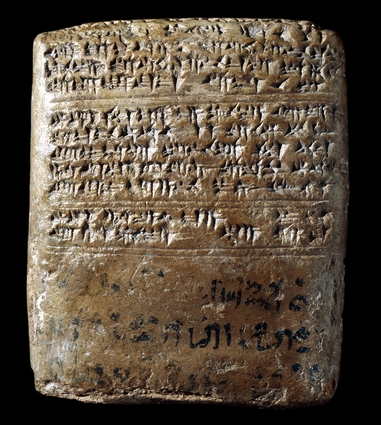
This clay tablet is part of a collection of 382 cuneiform documents discovered in 1887 in Egypt, at the site of Tell el-Amarna. ... The majority date to the reign of Amenhotep IV (Akhenaten) (1352-1336 BC), the heretic pharaoh who founded a new capital at Tell el-Amarna. This letter is written in Akkadian, the diplomatic language of Mesopotamia at the time. It is addressed to Amenhotep III from Tushratta, king of Mitanni (centred in modern Syria). Tushratta calls the pharaoh his 'brother', with the suggestion that they are of equal rank. The letter starts with greetings to various members of the royal house including Tushratta's daughter Tadu-Heba, who had become one of Amenhotep's many brides. ... Tushratta goes on to inform Amenhotep that, with the consent of the goddess Ishtar, he has sent a statue of her to Egypt. He hopes that the goddess will be held in great honour in Egypt and that the statue may be sent back safely to Mitanni. Three lines of Egyptian, written in black ink, have been added, presumably when the letter arrived in Egypt. The addition includes the date 'Year 36' of the king. W.L. Moran, The Amarna letters (John Hopkins University Press, Baltimore, 1992) http://www.britishmuseum.org/explore/highlights/highlight_objects/me/l/clay_tablet_letter,_egypt_2.aspx

This clay tablet is part of a collection of 382 cuneiform documents discovered in 1887 in Egypt, at the site of Tell el-Amarna. …
The majority date to the reign of Amenhotep IV (Akhenaten) (1352-1336 BC), the heretic pharaoh who founded a new capital at Tell el-Amarna.
This letter is written in Akkadian, the diplomatic language of Mesopotamia at the time. It is addressed to Amenhotep III from Tushratta, king of Mitanni (centred in modern Syria). Tushratta calls the pharaoh his ‘brother’, with the suggestion that they are of equal rank. The letter starts with greetings to various members of the royal house including Tushratta’s daughter Tadu-Heba, who had become one of Amenhotep’s many brides. …
Tushratta goes on to inform Amenhotep that, with the consent of the goddess Ishtar, he has sent a statue of her to Egypt. He hopes that the goddess will be held in great honour in Egypt and that the statue may be sent back safely to Mitanni.
Three lines of Egyptian, written in black ink, have been added, presumably when the letter arrived in Egypt. The addition includes the date ‘Year 36’ of the king.
W.L. Moran, The Amarna letters (John Hopkins University Press, Baltimore, 1992)
http://www.britishmuseum.org/explore/highlights/highlight_objects/me/l/clay_tablet_letter,_egypt_2.aspx

He led a punitive army into Babylonia, hurled from the throne the pretender placed there by the Kassite faction, and replaced him with a scion of the legitimate royal stock. This king, Burna-buryas, reigned for over twenty years, and upon his decease the Assyrians, still nominally the vassals of the Babylonian Crown, declared themselves independent of it.

Not content with such a revolutionary measure, under Shalmaneser I (1300 B.C.) they laid claim to the suzerainty of the Tigris-Euphrates region, and extended their conquests even to the boundaries of far Cappadocia, the Hittites and numerous other confederacies submitting to their yoke.

Shalmaneser’s son, Tukulti-in-Aristi, took the city of Babylon, slew its king, Bitilyasu, and thus completely shattered the claim of the older state to supremacy. He had reigned in Babylon for some seven years when he was faced by a popular revolt, which seems to have been headed by his own son, Assur-nazir-pal, who slew him and placed Hadad-nadin-akhi on the throne.

This king conquered and killed the Assyrian monarch of his time, Bel-kudur-uzur, the last of the old Assyrian royal line, whose death necessitated the institution of a new dynasty, the fifth monarch of which was the famous Tiglath-pileser I.”

Lewis Spence, Myths and Legends of Babylonia and Assyria, 1917, pp. 21-3.

Mesopotamian Religion is Undefinable

“Mesopotamian religion includes certain beliefs and practices of the Sumerians, Akkadians, Assyrians, Babylonians and other peoples who lived at various times in different parts of ancient Mesopotamia, the region corresponding roughly to modern Iraq, from the fourth through the first millennia BCE.

The history and cultures of these peoples were mostly forgotten during the early Christian era, save for brief historical narratives of famous kings and cities in the Hebrew Bible, in classical authors such as Herodotus, Diodorus and Josephus, and in scattered excerpts from a lost book by Berossus, a Babylonian writing in Greek in the third century BCE.

Beginning in the nineteenth century CE, with the discovery and excavation of ancient Mesopotamian sites and decipherment of Mesopotamian languages such as Sumerian and Akkadian, European and American scholars identified texts, objects and architecture as religious in nature. They used these to reconstruct ancient Mesopotamian religious beliefs and practices in the absence of any continuous or living tradition from ancient times to the present.

Inevitably the intellectual concerns of successive generations of scholars, their personal religious commitments and their individual stances, such as piety, scepticism or anticlericalism, had their effect on agendas of research and modes of presentation of Mesopotamian religion in modern studies. Many scholars of an earlier generation took for granted, for example, a higher degree of religious preoccupation and expression among ‘ancient Oriental’ or ‘Semitic peoples’ than among other ancient peoples such as the Greeks and Romans, but generalizations on this order are no longer the basis for serious research.

Some scholars imagined, for example, that the priesthood was primarily responsible for preserving culture, while others claimed that priests resisted change and development, suppressed writings unacceptable to them, and generally stood in the way of progress.

Pioneering studies of Mesopotamian religion tended to be comprehensive, such as that by M. Jastrow (1898, partially revised German edition 1912, with a volume of illustrations, 1912). Its fundamental thesis was that ancient Mesopotamian religion derived from local animistic cults that grew and merged into a larger, more complex interlocking set of religious practices and beliefs.

Similar views were set forth by R. W. Rogers (1908) in a volume that treated Mesopotamian religion as a sort of prelude to Judaism, itself a prelude to Christianity. E. Dhorme (1945, not available in English) wrote a concise and well-documented descriptive study.

The most influential writer in English on Mesopotamian religion was Thorkild Jacobsen. He developed a view that ancient Mesopotamian religion derived from a person’s sense of the ‘other’ in the natural world around him, leading to feelings of fear and awe. People perceived active will in natural events, processes and phenomena. This sense of the other was expressed, using metaphorical terms, in myth and theology and was acted upon in cult and ritual.

We have a comprehensive presentation of his views (Jacobsen 1976) and a later summary statement of his work (Jacobsen 1987). Bottéro (2001) stressed spiritual values and a phenomenological rather than a schematic, theoretical approach; for a summary of its main theses see Bottéro (1992: 201–31).

Economic and ritual aspects of Mesopotamian religion are presented by Oppenheim (1977), professing disdain for a historical approach to the subject. He contributed a brief but suggestive essay to a collection edited by Ferm (1950: 65–79). A more detailed, primarily bibliographical survey was offered by Römer (1969). There are numerous technical studies of aspects of Mesopotamian religion in the scientific literature of Assyriology, but few of them are in English.

Many presentations of Mesopotamian religion rely on retellings of ancient literary works that modern scholars classify as mythology. Authoritative presentations of Mesopotamian and other ancient Near Eastern mythologies were made in Kramer (1961 and 1969), as well as in a major treatment of Mesopotamian mythological texts jointly with Bottéro (1989, not available in English). Recent English translations of Akkadian mythology are found in Dalley (1989) and Foster (1996). Important Sumerian myths and other religious texts are translated in Jacobsen (1987).

No ancient Mesopotamian term corresponds to the modern concept of ‘religion,’ nor is there any ancient scripture, systematic treatise or general description of religious belief or activity from any period of Mesopotamian history. This means that definition of Mesopotamian religion can at best be only a modern mode of selecting and interpreting ancient writings and material culture using modern humanistic categories for which there may not have been ancient counterparts. Although the Mesopotamians recognized certain matters as ‘pertaining to the gods’, a distinction between religious and secular matters may not have been always fully comprehensible in the context of Mesopotamian culture.”

Benjamin R. Foster, “Sources,” John R. Hinnells, ed., A Handbook of Ancient Religions, 2007, pp. 161-5.

Assyro-Babylonian Studies in Modern Context

“Mesopotamian religion has been of interest to biblical scholars since the discovery in 1872 by George Smith of a flood story in an Assyrian tablet. This proved that non-biblical ancient Near Eastern documents contained material directly pertinent to the Bible. To some thinkers, the uniqueness and integrity of the Bible could therefore no longer be maintained.

Leading philologists, especially in Germany, such as Hugo Winckler, Hermann Gunkel, Heinrich Zimmern and Friedrich Delitzsch, staked out different and sometimes contradictory positions in what became known as ‘Pan-Babylonianism’ or the ‘Astral-mythological’ school. The basic tenet of this group was that the civilization of Israel was essentially Babylonian in origin, including its religious ideas, such as monotheism.

Winckler, for example, argued that Joshua, Saul and David were actually Babylonian astral deities. Zimmern went on to suggest that Marduk was a forerunner of Jesus. Peter Jensen, a distinguished Assyriologist, argued that Abraham, Jesus and John the Baptist, for example, were borrowed from Babylonian mythology and that the Gilgamesh epic, to him a kind of astral saga, was the basis for the New Testament and the Koran.

Outside of Germany more moderate positions were taken, but still implying a strong cultural and religious dependency of Israel upon Babylonia. The extravagant claims of the Pan-Babylonianists eventually collapsed and are not taken seriously today.

A broader and more moderate view held that Babylonia was part of the ancient Near Eastern context of the Hebrew Bible (Lambert 1988). Committed Christian and Jewish scholars, for example, often put the Bible first, so to them ancient Near Eastern ‘parallels’ helped to clarify or even ‘prove’ the validity of the Bible because they were independent witness to biblical passages.

Mesopotamian studies, especially in the United States, became effectively an adjunct of biblical studies. In the period 1880–1940 the majority of leading American scholars in the discipline were Protestant clergymen, very much interested in possible biblical connections.

To some scholars, such as W. F. Albright, the ‘biblical world’ came to include the whole of the ancient Near East. There was therefore no need to separate Mesopotamian studies from biblical studies; they were aspects of the same agenda. In this spirit, Albright could entitle one of his most popular books From the Stone Age to Christianity (Albright 1940).

According to this, Mesopotamian religion was a ‘preparatio’ for the more profound religion of Israel, itself a preparation for Christianity. Today, because of the accumulation of new material, a panoramic grasp of the languages and civilizations of the ancient Near East such as Albright enjoyed is impossible to attain, but Albright’s fundamental approach remains influential, especially among conservative Christian scholars.”

Benjamin R. Foster, “Mesopotamian Religion and the Bible,” John R. Hinnells, ed., A Handbook of Ancient Religions, 2007, pp. 207-8.

The Rise of the Priests

” … Corresponding to the growth of the temples, we find the organization of the cult extending its scope; and with this extension, the steadily increasing power and authority of the priests. In the small beginnings of the Euphratean cities, the priestly and secular functions no doubt rested in one and the same person.

The ruler of a city or district, as we have seen, [3] was regarded as the representative of the deity. As such he stood in a special relation to the deity, acting as a mediator between the latter and the people, while upon his good standing with the god, the general welfare of the people depended. On the very ancient monument of Ur-Nina [4] we find the ruler himself offering the libation to the god, though behind him stands an attendant who is probably a priest to assist in carrying out the rite.

As early, however, as the days of Gudea (c. 2450 B.C.) the ruler himself is led into the presence of the deity through the mediation of a priest. Gudea is so depicted on seal cylinders and other monuments, and presumably therefore the marked differentiation between priest and ruler thus illustrated was at the time an established custom of long standing.

The mediatorship may, indeed, be set down as the chief prerogative of the priest in Babylonia and Assyria. With this as a starting-point, his other functions as sacrificer, as exerciser, as inspector of the liver for the purpose of ascertaining the disposition of the deity, as astrologer and as diviner in general, interpreting birth-signs, dreams, and furnishing the answer as to the meaning of all kinds of occurrences that deviated from the normal or that in any way aroused attention, may be derived.

The people could proceed as far as the inner court of the temples, where an altar stood, but beyond that the priests alone could venture, and the rulers only if accompanied by a priest who as the privileged servitor of the deity had access to the divine presence.

Intercession is thus a distinguishing function of the priest, as a corollary to his role as mediator.”

Morris Jastrow, The Civilization of Babylonia and Assyria, 1915, pp. 271-2.

Divination and Dreams

“The three systems of divination which we have analyzed all entered directly into the religious life of the people and illustrate some of the religious practises which were maintained, like the incantation rituals, throughout all periods. The longing to pierce the unknown future, to pull aside the veil which separates us from a knowledge of coming events, is so strong in man as to have all the force of an innate quality an instinct of which he himself only gradually becomes fully conscious.

It plays an unusually prominent part in the religion of Babylonia and Assyria, indeed so prominent as to justify us in asserting that by the side of the ever present fear of the demons, the significance attached to omens was the most conspicuous outward manifestation of the religious spirit of the people taken as a whole.

This conclusion is strengthened by the knowledge that we now have of other forms of divination, such as pouring a few drops of oil into a basin of water, and according to the action of the oil in forming rings and bubbles that sink and rise and the directions in which they spread, conclusions were drawn of a more or less specific character, and suggested by a more or less artificial association of ideas with the action of the oil bearing either on public affairs or on private matters, according to the questions asked of the diviners, to which they were expected to give an answer. [1]

Within the other category of involuntary divination where the sign is obtruded on your notice, falls the importance attached to dreams, the interpretation of which formed in fact one of the most important functions of the Babylonian-Assyrian priests acting as diviners. References to dreams are frequent both in the older and later inscriptions of Babylonian and Assyrian rulers. [2]

A majestic figure reaching from earth to heaven appears to Ghidea in a dream ; it turns out to be the god Ningirsu. A female figure also rises up with a tablet and a stylus who is the goddess Nisaba.

The sun mounting up from the earth is explained to be the god of vegetation, Ningishzida. Various utensils and building material and an ass to carry burdens which the ruler sees in his dream leave no doubt as to the interpretation of the vision. It is the order to Gudea to build a temple according to the plan drawn on a tablet by a second male figure appearing to him, and who turns out to be the god Nin-dub. The interpretation is given to the ruler in this instance by the goddess Nina as whose son he designates himself.

Ordinarily, however, it is to a priest to whom rulers and people go to learn the meaning of dreams, in the belief that dreams are omens or signs sent by the gods as a means of indicating what is about to happen ; and even in Gudea’s case we may safely assume that the interpretation ascribed to the goddess directly was furnished to him through the mediation of the priests.

At the other end of Babylonian history, we find Nebuchadnezzar and a goddess appearing to Nabonnedos, the last king of Babylonia, in dreams to explain certain strange signs that had lately been reported. In the inscriptions of Ashurbanapal, the great king of Assyria, there are several references to dreams.”

Morris Jastrow, The Civilization of Babylonia and Assyria, 1915, pp. 266-7.

Chimeras in Babylonian-Assyrian Divination

” … The factor of fancy manifests itself in these handbooks of the Babylonian-Assyrian diviners in a form which is especially interesting, because of the explanation it affords for the widespread belief in antiquity in hybrid creatures such as satyrs, mermaids, fauns, harpies, sphinxes, winged serpents and the many fabulous monsters of mythology and folk-lore.

We have long lists of the young of animals having the features or parts of the body of another animal. Instead, however, of being recorded as a mere resemblance, an ewe giving birth to a lamb having a head which suggests that of a lion, or of a dog, an ass, of a fox or a gazelle, or ears or eyes which suggest those of another animal, it is stated that the ewe has given birth to a lion, dog, ass, fox gazelle, as the case may be.

In the same way, since it often happens that the face of an infant suggests a bird, a dog, a pig, a lamb, or what not, the fancied resemblance leads to the statement that a woman has given birth to the animal in question, which thus becomes an omen, the interpretation of which varies according to the ideas associated with the particular animal.

A lion suggests power and enlargement, and therefore a lamb or an infant with a lion-like face points to increase and prosperity in the land and to the growing strength of the ruler, and is also a favorable sign for the stall or house in which such a creature is born.

PLATE XXXIII

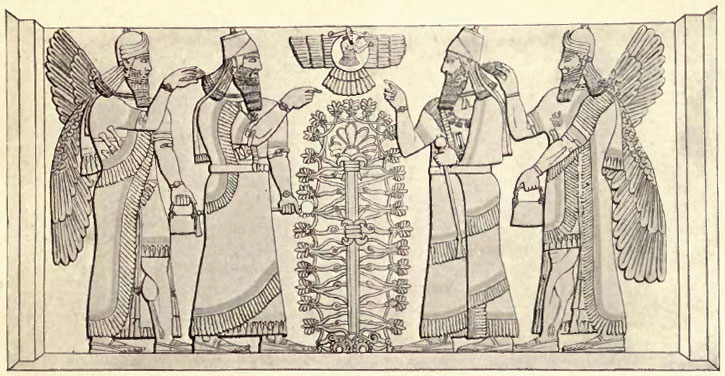
The Tree of Life with Assyrian King and with winged creature as guardian and fertilizer of the Tree — Symmetrically repeated.

The Tree of Life with Assyrian King and with winged creature as guardian and fertilizer of the Tree — Symmetrically repeated.

Favorable ideas, though of a different order, are associated with the lamb, pig, ox and ass, whereas with the dog as an unclean animal in the ancient as well as in the modern Orient, the association of ideas was unfavorable, and similarly with the serpent, wild cow and certain other animals, the interpretation refers to some misfortune, either of a public or private character, and occasionally of both.

This feature of a fancied resemblance between one animal and another and between an infant and some animal was the starting-point which led, through the further play of the imagination, to the belief in hybrid creatures and all kinds of monstrosities. The case of an infant being born with feet united so as to suggest the tail of a fish is actually recorded in our lists of birth-signs, and from such an anomaly to the belief in mermaids and tritons, half human and half fish, is only a small step, rendered still more credible by the representation in art which convents the resemblance to a fish tail into a real tail.

Since we have the direct proof [2] of the spread of the Babylonian-Assyrian system of divination from birth-omens, as of the two other systems above discussed, to Asia Minor, Greece and Rome, there is every reason to believe that we are justified in tracing back to this system the belief in fabulous beings of all kinds, though it may of course be admitted that there are also other factors involved.

We find this belief in Babylonia and Assyria, where we encounter in the ancient art hippocentaurs as well as bulls and eagles with human faces, and in the Assyrian art the winged monsters with human faces and the bodies of bulls or winged human figures with eagle faces. The process once begun would naturally lead to all kinds of ramifications and combinations.”

Morris Jastrow, The Civilization of Babylonia and Assyria, 1915, pp. 263-6.

The Demons Named

” … The existence of several elaborate incantation series in Ashurbanapal’s library, prescribing a large number of formulas to be recited in connection with symbolical rites to get rid of the demons, furnishes the proof for the practical significance attached to incantations in both Babylonia and Assyria.

These series, Babylonian in origin, revert to Sumerian prototypes and represent compilations stretching over a long period, with additions intended to adapt them to conditions prevailing in Assyria.

The scribes of Ashurbanapal were not indulging in a purely academic exercise in copying the archives of Babylonian temples ; their purpose, as was also the aim of the king, was to make Nineveh the central religious authority as well as the political mistress by having in their control the accumulated experience of the past, in dealing with the religious needs and problems of their own age.

A feature which these incantation series [1] have in common is the recognition of a large number of demons, with special functions assigned in many cases to the one class or the other.

So, for example, there is a demon Labartu, represented as a horrible monster with swine sucking at her breasts, [2] who threatens the life of the mother at childbirth; a group known as Ashakku who cause varieties of wasting diseases, another demon Ti’u, whose special function was to cause diseases, manifesting themselves by headaches accompanied by fever, and so on through a long list. It will be apparent that there is no differentiation between the demon and the disease. The one is the synonym of the other, and accordingly in medical texts the demons are introduced as the designations of the diseases themselves.

The names given to the demons in many cases convey the “strength” or “size” ascribed to them, such as Utukku, Alu, Shedu, Gallu, or they embody a descriptive epithet like AkKkhazu, “seizer” (also the name of a form of jaundice); ‘Eabisu, the one lying-in-wait; Labasu, “overthrower”; Lilu and the feminine Lilitu, “night-spirit;” Etimmu, ghost or shade, suggesting an identification of some demons with the dead who return to plague the living, Namtar, “pestilence,” and more the like.

The descriptions given of them, cruel, horrible of aspect, blood-thirsty, flying through space, generally invisible though sometimes assuming human or animal shape or a mixture of the two, further illustrate the conceptions popularly held.”

Morris Jastrow, The Civilization of Babylonia and Assyria, 1915, pp. 241-3.

Assyro-Babylonian Demonology

“From this point of view it is therefore significant to find the large place taken in the practice of the religion by incantation rituals and divination practices. It is inconceivable that the hymns and the incantations should be the product of the same order of thought, and as we proceed in our study of the religion of Babylonia and Assyria the evidence increases for the thesis that the incantation texts, growing by accumulation from age to age, represent the older products which are retained by the side of compositions expressive of more advanced thought.

The power appealed to to furnish relief must be addressed, and naturally the priests will endeavor to embody in this address the conceptions of the god or goddess that have been developed as a result of their speculations and attempts at systematization. The technical term shiptu for “incantation” is therefore attached to the hymns as a further indication that they form an ingredient part of this subdivision of the religious literature.

Taking up the incantations proper, we find the basic idea to be the theory that sickness and all forms of bodily suffering are due to the activity of demons that have either of their own accord entered the body of the victim, or that have been induced to do so through the power exercised by a special class of sorcerers or sorceresses who are able to bewitch one with the aid of the demons. This theory of ailments of the flesh is of course the one commonly held among people in a primitive stage of culture, and which is carried over to the higher phases.

That aches and fevers should be ascribed to the activity of demoniac forces within one is a natural corollary to the animistic conception controlling the religion of Babylonia and Assyria, and which ascribes life to everything that manifests power. A cramp, a throbbing of the head, a shooting pain, a burning fever naturally give the impression that something to speak indefinitely is inside of you producing the symptoms; and modern science curiously enough with its germ theory to account for so many diseases comes to the aid of the primitive notion of demoniac possession.

To secure relief, it was therefore necessary to get rid of the demon to exorcise the mischievous being. It was also natural to conclude that the demons, ordinarily invisible, lurking in the corners, gliding through doors, hiding in out of the way places to pounce upon their victims unawares, should be under the control of the gods as whose messengers they thus acted. The presence of a demon in the body was therefore a form of punishment sent by a deity, angered because of some sin committed.

But besides the gods, certain individuals were supposed to have the power over the demons to superinduce them to lay hold of their victims.

Giants and dwarfs, the crippled and deformed, persons with a strange expression in their eyes, inasmuch as they represented deviations from the normal, were regarded as imbued with such power, and curiously enough women were more commonly singled out than men, perhaps because of the mysterious function of the female in harboring the new life in her womb. As a survival from this point of view, we find the witch far down into the Middle Ages a commoner figure than the sorcerer, and in fact surviving the belief in the latter.

In whatever way the demon may have found his way into the victim, the appeal had to be made to a god or goddess to drive him out; nor was the theory that the demon represented the punishment sent by an angered deity affected by the power ascribed to certain individuals to bewitch individuals, for it was also in this case because the deity was offended that the sorcerer or sorceress could exercise his or her power. With the good will and favor of the gods assured, one was secure from demons and sorcerers alike.”

Morris Jastrow, The Civilization of Babylonia and Assyria, 1915, pp. 239-41.

Ishtar

” … Both phases of the goddess, as the gracious mother and as the grim Amazon, are dwelt upon in one of the finest specimens of the religious literature of Babylonia in which a penitent sufferer, bowed down with sickness and misfortune, implores Ishtar to grant relief. [3] The hymn is addressed to the goddess of Uruk but she has become the general mother-goddess and is instead of Nana addressed as Ishtar. Ishtar is here identified with the planet Venus and assigned to a place therefore in the heavens.

As such she is called “the daughter of Sin,” the moon-god. She is thus the daughter of Anu, of Enlil and of Sin at one and the same time, a further indication that such epithets merely symbolize a relationship to various gods, according to the traits assigned to her. The composition, too long to quote entirely, begins:

“I pray to thee, mistress of mistresses, goddess of goddesses,
Ishtar, queen of all habitations, guide of mankind,
Irnini [4] praised be thou, greatest among the Igigi [5]
Powerful art thou, ruler art thou, exalted is thy name,
Thou art the light of heaven and earth, mighty daughter of Sin,
Thou directest the weapons, arrangest the battle array,
Thou givest commands, decked with the crown of rulership,
lady, resplendent is thy greatness, supreme over all gods.

Where is thy name not! Where is thy command not!
Where are images of thee not made! Where are thy shrines not erected!
Where art thou not great? Where not supreme!
Anu, Enlil and Ea have raised thee to mighty rulership among the gods,
Have raised thee aloft and exalted thy station among all the Igigi.
At the mention of thy name, heaven and earth quake,
The gods tremble, the Anunnaki quake.
To thy awe-inspiring name mankind gives heed,
Great and exalted art thou!
All dark-headed ones, [6] living beings, mankind pay homage to thy power.

I moan like a dove night and day,
I am depressed and weep bitterly,
With woe and pain my liver is in anguish.
What have I done, my god and my goddess — I ?
As though I did not reverence my god and my goddess, am I treated.

I experience, my mistress, dark days, sad months, years of misfortune.”

As the planet Venus, the movements of Ishtar in the heavens form a basis for divining what the future has in store. [7] The prominent part taken by the observation of Venus-Ishtar in Babylonian-Assyrian astrology is reflected in many of the hymns to her. The influence of the priestly speculations in thus combining the popular animistic conceptions of the gods and goddesses with points of view derived from the projection of the gods on to the starry heavens is one of the features of the religion of Babylonia and Assyria.

Ishtar under one name or the other becomes a favorite subject for myths symbolizing the change of seasons, her period of glory when the earth is in full bloom being the summer followed by the rainy and winter months when nature decays, and which was pictured as due to the imprisonment of the goddess in the nether world. She takes her place in popular tales, half legendary and half mythical, and we have a number of compositions [8] further illustrating how the popular myths and tales were embodied into the cult.”

Morris Jastrow, The Civilization of Babylonia and Assyria, 1915, pp. 234-6.

Mother Goddess of Love, Goddess of War

” … The oldest cult of the mother goddess, so far as our material goes, appears indeed to have been in Uruk where she is known as Nana, but we may be quite sure that the cult was never limited to one place. The special place which Nana has in the old Babylonian pantheon is probably due to the peculiar development taken by the chief deity of that centre, Anu, who as we have seen became an abstraction, the god of heaven, presiding over the upper realm of the universe. Her temple at Uruk known as E-anna “the heavenly house” and revealing the association of the goddess with Anu as a solar deity became one of the most famous in the Euphrates Valley.

It is in connection with the cult of Nana that we learn of a phase of the worship of the mother-goddess which degenerates into the obscene rites that call forth the amazement of Herodotus. [1] As the mother-goddess, Nana or Ishtar is not only the source of the fertility displayed by the earth and the kind, gracious mother of mankind, but also the goddess of love, the Aphrodite of Babylonia. The mysterious process of conception and the growth of the embryo in the mother’s womb gave rise at an early period to rites in connection with the cult of the mother-goddess that symbolized the fructification through the combination with the male element.

There is, however, another side to Ishtar which comes particularly to the fore in Assyria, though it is also indigenous to Babylonia. She is not only the loving mother but, as the protector of her offspring, a warlike figure armed for the fray and whose presence is felt in the midst of the battle. She appears to her favorites in dreams and encourages them to give battle. It is she who places in the hands of the rulers the weapons with which they march to victory. To Ashurbanapal she thus appears armed with bow and arrow and reassures him: “Whithersoever thou goest, I go with thee”. [2] As far back as the days of Hammurapi, Ishtar is thus viewed as the one who encourages her followers for contest and battle.”

Morris Jastrow, The Civilization of Babylonia and Assyria, 1915, pp. 223-4.

Seize the Day

“Death in Mesopotamian religious thought did not mean the total extinction of the individual, only of the physical self and of those qualities of a person that made him productive and attractive to other human beings (Bottéro 1992: 268– 86).

A recognizable winged spirit, resembling a dove, passed to the netherworld. This was a dreary, sombre domain ruled by a pitiless hierarchy of deities and demons. There the spirit languished, often in hunger, thirst and misery, unless family or friends remembered to leave offerings of food and drink for the spirit to partake of and prayed for the spirit’s rest and contentment (Foster 1996: 403):

Dust is their sustenance and clay their food,

They see no light but dwell in darkness,

They are clothed like birds in wings for garments,

And dust has gathered on the door and bolt.

A Sumerian poem recounting a visit to the netherworld refers to the dependence of the dead upon the living (Foster 2001: 141):

Did you see the ghost of him who has no one to make funerary offerings?

I saw him. He eats table scraps and bread crusts thrown into the street.

Ghosts and spectres of the dead could trouble the living, sometimes for no apparent reason, sometimes because they had not been properly interred or were discontented because of some human action or neglect. The city Cutha, in northern Babylonia, was considered the city of the dead and the centre of the cult of death.

The netherworld was organized like an earthly or heavenly kingdom, surrounded by walls with seven gates (Lambert 1990). A popular Mesopotamian poem (Dalley 1989: 163–81; Foster 1996: 410–28) told how the netherworld had once been ruled by a queen alone, Ereshkigal, but that she eventually found a husband, Nergal or Erra.

In one version of the story, he forces himself into the netherworld by violence and threatens her into submission. In another, he breaks her loneliness and sexual frustration with a passionate relationship that finally results in their marriage.

The gods of heaven and netherworld, separated, according to the Babylonian Epic of Creation, into two groups of 600 each, could not visit each other, though they could exchange messengers. Even the great gods feared the netherworld, which barred countless human dead from swarming onto the earth to devour the living in their eternal, unsatiated hunger.

The dead entered the netherworld naked and relinquished all hope of returning to life. How their ghosts escaped to plague the living is not clear. Various Mesopotamian stories told of human beings who learned what happened after a person died.

In one, the Sumerian hero Enkidu volunteered in a fit of bravado to go down to the netherworld to retrieve a favourite athletic object of the king, Gilgamesh. This was apparently a stick and a ball or puck that had fallen down there at the pleas of the people who were oppressed by the violent game that made use of them. The losers resented Gilgamesh’s bullying tactics in the game.

Enkidu recognized his relatives and saw certain distinctions among the dead: heroes were treated better than common folk, for example, and stillborn children had a sort of play area with miniature furniture. He barely escaped alive and forgot in the stress of the moment to bring back the objects (Foster 2001: 129–43).

Much later, an Assyrian dignitary described a vision of the netherworld that included an array of monsters, composites of humans and animals in shape. He, like Enkidu, recognized a dead spirit, but fled in an ecstasy of terror and grief, narrowly escaping permanent confinement (Foster 1996: 715–22):

He darted out into the street like an arrow and scooped up dirt from alley and square in his mouth, all the while setting up a frightful clamor, ‘Woe! Alas! Why have you ordained this for me?’

Mesopotamians honoured the dead of their families with a regular ceremony of remembrance and offering. Dead and sometimes even living kings were accorded divine honours and observances in special sanctuaries. Rulers and other powerful people could be buried in lavish tombs with grave gifts, perhaps more as a splendid way of dying than out of hope that they would need such gifts in the afterlife.

Some Sumerian rulers had chariots, animals and even court attendants buried with them; Assyrian queens might be buried with their finest jewelry. Clay or metal vessels might hold food, drink and cosmetics. Burial might be in vaults in royal palaces, under the floor of homes (especially for children) or in cemeteries outside the city.

Graves were not marked on the surface, so far as is known, and funerary inscriptions, naming the deceased or invoking blessings upon them from future descendants or passers-by, were very rare. One literary text describes an excavation to open an ancient tomb and the horrible shock the investigators felt when they beheld and reflected on the fate in store for them (Foster 1996: 436).

One of the major literary achievements of ancient Mesopotamia, the Akkadian Epic of Gilgamesh (George 1999; Foster 2001), tells the story of Gilgamesh, king of Uruk, who sought immortal life. This was based on older Sumerian poems about various episodes in Gilgamesh’s life.

In the epic, Gilgamesh’s beloved friend, the wild man Enkidu, dies as the result of an expedition to achieve eternal fame for Gilgamesh by slaying a distant monster and cutting down a great tree. Terrified of dying himself, Gilgamesh abandons all in a desperate quest to find the survivor of the flood, Utanapishtim, to ask him his secret of immortality.

Gilgamesh eventually reaches Utanapishtim after unexampled heroism and hardships, not to mention the timely intervention of several kind-hearted women, but learns that his hope is vain – Utanapishtim was granted immortality for surviving the flood, but this was a one-time event that would not be repeated for Gilgamesh’s sake.

Neither he nor any other human being had any hope of achieving immortality. This poem was popular in learned circles; manuscripts have turned up throughout Mesopotamia, and from Syria and Asia Minor, dating to a time span of 1500 years.

There was no Mesopotamian paradise, no return of the soul in another body for another life, no judgement, and no sense that death might eventually end in a final consummation. Some Mesopotamians responded to this outlook by suggesting that the good for a human being was to enjoy life, love, family and vitality while they were within reach, for even a modest life was better than a grand death, as a tavern keeper advises Gilgamesh (Foster 2001: 75):

When the gods created mankind,

They established death for mankind,

And withheld eternal life for themselves.

As for you, Gilgamesh, let your stomach be full,

Always be happy, night and day.

Make every day a delight,

Night and day play and dance.

Your clothes should be clean,

Your head should be washed,

You should bathe in water,

Look proudly on the little one holding your hand,

Let your mate be always blissful in your loins,

This, then, is the work of mankind.”

Benjamin R. Foster, “Mesopotamia,” in John R. Hinnels, ed., A Handbook of Ancient Religions, Cambridge, 2007, pp. 188-90.

Cult of Sin, Moon God

“The cult of the moon-god was one of the most popular in Babylonia, the chief seat of his worship being at Uru (now Muqayyar) the Biblical Ur of the Chaldees. The origin of the name Sin is unknown, but it is thought that it may be a corruption of Zu-ena, “knowledge-lord,” as the compound ideograph expressing his name may be read and translated.

Besides this compound ideograph, the name of the god Sin was also expressed by the character for “30,” provided with the prefix of divinity, an ideograph which is due to the thirty days of the month, and is thought to be of late date.

With regard to Nannar, Jastrow explains it as being for Narnar, and renders it “light-producer.” In a long hymn to this god he is described in many lines as “the lord, prince of the gods, who in heaven alone is supreme,” and as “father Nannar.”

Among his other descriptive titles are “great Anu” (Sumerian /ana gale/, Semitic Babylonian /Anu rabû/)–another instance of the identification of two deities. He was also “lord of Ur,” “lord of the temple Gišnu-gala,” “lord of the shining crown,” etc.

He is also said to be “the mighty steer whose horns are strong, whose limbs are perfect, who is bearded with a beard of lapis-stone, [*] who is filled with beauty and fullness (of splendour).”

[*] Probably of the colour of lapis only, not made of the stone itself.

Besides Babylonia and Assyria, he was also worshipped in other parts of the Semitic east, especially at Harran, to which city Abraham migrated, scholars say, in consequence of the patron-deity being the same as at Ur of the Chaldees, where he had passed the earlier years of his life. The Mountain of Sinai and the Desert of Sin, both bear his name.

According to king Dungi (about 2700 B.C.), the spouse of Sin or Nannara was Nin-Uruwa, “the lady of Ur.” Sargon of Assyria (722-705 B.C.) calls her Nin-gala.

Theophilus G. Pinches, The Religion of Babylonia and Assyria, London, 1906, pp. 81-3.

Nineveh, Cult Center of Ishtar Worship

“From the name /Nin/, which Ištar bore, there is hardly any doubt that she acquired the identification with Nina, which is provable as early as the time of the Lagašite kings, Lugal-anda and Uru-ka-gina.

As identified with Aruru, the goddess who helped Merodach to create mankind, Ištar was also regarded as the mother of all, and in the Babylonian story of the Flood, she is made to say that she had begotten man, but like “the sons of the fishes,” he filled the sea.

Nina, then, as another form of Ištar, was a goddess of creation, typified in the teeming life of the ocean, and her name is written with a character standing for a house or receptacle, with the sign for “fish” within.

Her earliest seat was the city of Nina in southern Babylonia, from which place, in all probability, colonists went northwards, and founded another shrine at Nineveh in Assyria, which afterwards became the great centre of her worship, and on this account the city was called after her Ninaa or Ninua.

As their tutelary goddess, the fishermen in the neighbourhood of the Babylonian Nina and Lagaš were accustomed to make to her, as well as to Innanna or Ištar, large offerings of fish.

As the masculine deities had feminine forms, so it is not by any means improbable that the goddesses had masculine forms, and if that be the case, we may suppose that it was a masculine counterpart of Nina who founded Nineveh, which, as is well known, is attributed to Ninos, the same name as Nina with the Greek masculine termination.”

Theophilus G. Pinches, The Religion of Babylonia and Assyria, London, 1906, pp. 75-6.

Cult of Ishtar

” … In all probability Ištar, the spouse of Tammuz, is best known from her descent into Hades in quest of him when with Persephone (Ereš-ki-gal) in the underworld.

In this she had to pass through seven gates, and an article of clothing was taken from her at each, until she arrived in the underworld quite naked, typifying the teaching, that man can take nothing away with him when he departs this life.

During her absence, things naturally began to go wrong upon the earth, and the gods were obliged to intervene, and demand her release, which was ultimately granted, and at each gate, as she returned, the adornments which she had left were given back to her. It is uncertain whether the husband whom she sought to release was set free, but the end of the inscription seems to imply that Ištar was successful in her mission.

In this story she typifies the faithful wife, but other legends show another side of her character, as in that of Gilgameš, ruler of her city Erech, to whom she makes love.

Gilgameš, however, knowing the character of the divine queen of his city too well, reproaches her with her treatment of her husband and her other lovers–Tammuz, to whom, from year to year, she caused bitter weeping; the bright coloured Allala bird, whom she smote and broke his wings; the lion perfect in strength, in whom she cut wounds “by sevens”; the horse glorious in war, to whom she caused hardship and distress, and to his mother Silili bitter weeping; the shepherd who provided for her things which she liked, whom she smote and changed to a jackal; Išullanu, her father’s gardener, whom she tried, apparently, to poison, but failing, she smote him, and changed him to a statue (?).

On being thus reminded of her misdeeds, Ištar was naturally angry, and, ascending to heaven, complained to her father Anu and her mother Anatu, the result being, that a divine bull was sent against Gilgameš and Enki-du, his friend and helper.

The bull, however, was killed, and a portion of the animal having been cut off, Enki-du threw it at the goddess, saying at the same time that, if he could only get hold of her, he would treat her similarly. Apparently Ištar recognised that there was nothing further to be done in the matter, so, gathering the hand-maidens, pleasure-women and whores, in their presence she wept over the portion of the divine bull which had been thrown at her.

The worship of Ištar, she being the goddess of love and war, was considerably more popular than that of her spouse, Tammuz, who, as among the western Semitic nations, was adored rather by the women than the men. Her worship was in all probability of equal antiquity, and branched out, so to say, in several directions, as may be judged by her many names, each of which had a tendency to become a distinct personality.

Thus the syllabaries give the character which represents her name as having also been pronounced /Innanna/, /Ennen/, and /Nin/, whilst a not uncommon name in other inscriptions is /Ama-Innanna/, “mother Ištar.”

The principal seat of her worship in Babylonia was at Erech, and in Assyria at Nineveh–also at Arbela, and many other places. She was also honoured (at Erech and elsewhere) under the Elamite names of Tišpak and Šušinak, “the Susian goddess.”

Theophilus G. Pinches, The Religion of Babylonia and Assyria, London, 1906, pp. 72-5.

Were the Babylonian Kings … Gods?

“Though there is no proof that ancestor-worship in general prevailed at any time in Babylonia, it would seem that the worship of heroes and prominent men was common, at least in early times.

The tenth chapter of Genesis tells us of the story of Nimrod, who cannot be any other than the Merodach of the Assyro-Babylonian inscriptions; and other examples, occurring in semi-mythological times, are /En-we-dur-an-ki/, the Greek Edoreschos, and /Gilgameš/, the Greek Gilgamos, though Aelian’s story of the latter does not fit in with the account as given by the inscriptions.

In later times, the divine prefix is found before the names of many a Babylonian ruler–Sargon of Agadé,[*] Dungi of Ur (about 2500 B.C.), Rim-Sin or Eri-Aku (Arioch of Ellasar, about 2100 B.C.), and others.

It was doubtless a kind of flattery to deify and pay these rulers divine honours during their lifetime, and on account of this, it is very probable that their godhood was utterly forgotten, in the case of those who were strictly historical, after their death.

The deification of the kings of Babylonia and Assyria is probably due to the fact, that they were regarded as the representatives of God upon earth, and being his chief priests as well as his offspring (the personal names show that it was a common thing to regard children as the gifts of the gods whom their father worshipped), the divine fatherhood thus attributed to them naturally could, in the case of those of royal rank, give them a real claim to divine birth and honours.

An exception is the deification of the Babylonian Noah, Ut-napištim, who, as the legend of the Flood relates, was raised and made one of the gods by Aa or Ea, for his faithfulness after the great catastrophe, when he and his wife were translated to the “remote place at the mouth of the rivers.”

The hero Gilgameš, on the other hand, was half divine by birth, though it is not exactly known through whom his divinity came.”

[*] According to Nabonidus’s date 3800 B.C., though many Assyriologists regard this as being a millennium too early.”

Theophilus G. Pinches, The Religion of Babylonia and Assyria, London, 1906, pp. 13-4.

Was Marduk the Founder of Astronomy?

“In consequence of the determinative prefix for a god or a goddess being, in the oldest form, a picture of an eight-rayed star, it has been assumed that Assyro-Babylonian mythology is, either wholly or partly, astral in origin.

This, however, is by no means certain, the character for “star” in the inscriptions being a combination of three such pictures, and not a single sign. The probability therefore is, that the use of the single star to indicate the name of a divinity arises merely from the fact that the character in question stands for /ana/, “heaven.”

Deities were evidently thus distinguished by the Babylonians because they regarded them as inhabitants of the realms above–indeed, the heavens being the place where the stars are seen, a picture of a star was the only way of indicating heavenly things.

That the gods of the Babylonians were in many cases identified with the stars and planets is certain, but these identifications seem to have taken place at a comparatively late date. An exception has naturally to be made in the case of the sun and moon, but the god Merodach, if he be, as seems certain, a deified Babylonian king, must have been identified with the stars which bear his name after his worshippers began to pay him divine honours as the supreme deity, and naturally what is true for him may also be so for the other gods whom they worshipped.

The identification of some of the deities with stars or planets is, moreover, impossible, and if Êa, the god of the deep, and Anu, the god of the heavens, have their representatives among the heavenly bodies, this is probably the result of later development.[*]

[*] If there be any historical foundation for the statement that Merodach arranged the sun, the moon, the planets, and the stars, assigning to them their proper places and duties–a tradition which would make him the founder of the science of astronomy during his life upon earth–this, too, would tend to the probability that the origin of the gods of the Babylonians was not astral, as has been suggested, but that their identification with the heavenly bodies was introduced during the period of his reign.”

Theophilus G. Pinches, The Religion of Babylonia and Assyria, London, 1906, pp. 11-3.

Origins of the Jews?

“Babylonia, on the other hand, continued the even tenor of her way. More successful at the end of her independent political career than her northern rival had been, she retained her faith, and remained the unswerving worshipper of Merodach, the great god of Babylon, to whom her priests attributed yet greater powers, and with whom all the other gods were to all appearance identified.

This tendency to monotheism, however, never reached the culminating point–never became absolute–except, naturally, in the minds of those who, dissociating themselves, for philosophical reasons, from the superstitious teaching of the priests of Babylonia, decided for themselves that there was but one God, and worshipped Him.

That orthodox Jews at that period may have found, in consequence of this monotheistic tendency, converts, is not by any means improbable–indeed, the names met with during the later period imply that converts to Judaism were made.

Thus we see, from the various inscriptions, both Babylonian and Assyrian–the former of an extremely early period–the growth and development, with at least one branching off, of one of the most important religious systems of the ancient world.

It is not so important for modern religion as the development of the beliefs of the Hebrews, but as the creed of the people from which the Hebrew nation sprang, and from which, therefore, it had its beginnings, both corporeal and spiritual, it is such as no student of modern religious systems can afford to neglect.

Its legends, and therefore its teachings, as will be seen in these pages, ultimately permeated the Semitic West, and may in some cases even had penetrated Europe, not only through heathen Greece, but also through the early Christians, who, being so many centuries nearer the time of the Assyro-Babylonians, and also nearer the territory which they anciently occupied, than we are, were far better acquainted than the people of the present day with the legends and ideas which they possessed.”

Theophilus G. Pinches, The Religion of Babylonia and Assyria, London, 1906, pp. 7-9.

Primacy of Marduk of Babylon

“Of equal antiquity with the religion of Egypt, that of Babylonia and Assyria possesses some marked differences as to its development.

Beginning among the non-Semitic Sumero-Akkadian population, it maintained for a long time its uninterrupted development, affected mainly by influences from within, namely, the homogeneous local cults which acted and reacted upon each other.

The religious systems of other nations did not greatly affect the development of the early non-Semitic religious system of Babylonia. A time at last came, however, when the influence of the Semitic inhabitants of Babylonia and Assyria was not to be gainsaid, and from that moment, the development of their religion took another turn.

In all probably this augmentation of Semitic religious influence was due to the increased numbers of the Semitic population, and at the same period the Sumero-Akkadian language began to give way to the Semitic idiom which they spoke.

When at last the Semitic Babylonian language came to be used for official documents, we find that, although the non-Semitic divine names are in the main preserved, a certain number of them have been displaced by the Semitic equivalent names, such as Šamaš for the sun-god, with Kittu and Mêšaru (“justice and righteousness”) his attendants; Nabú (“the teacher” = Nebo) with his consort Tašmêtu (“the hearer”); Addu, Adad, or Dadu, and Rammanu, Ramimu, or Ragimu = Hadad or Rimmon (“the thunderer”); Bêl and Bêltu (Beltis = “the lord” and “the lady” /par excellence/), with some others of inferior rank.

In place of the chief divinity of each state at the head of each separate pantheon, the tendency was to make Merodach, the god of the capital city Babylon, the head of the pantheon, and he seems to have been universally accepted in Babylonia, like Aššur in Assyria, about 2000 B.C. or earlier.”

Theophilus G. Pinches, The Religion of Babylonia and Assyria, London, 1906, pp. 4-5.

Babylonian Religion

” … Outside the inscriptions of Babylonia and Assyria, there is but little bearing upon the religion of those countries, the most important fragment being the extracts from Berosus and Damascius referred to above.

Among the Babylonian and Assyrian remains, however, we have an extensive and valuable mass of material, dating from the fourth or fifth millennium before Christ until the disappearance of the Babylonian system of writing about the beginning of the Christian era.

The earlier inscriptions are mostly of the nature of records, and give information about the deities and the religion of the people in the course of descriptions of the building and rebuilding of temples, the making of offerings, the performance of ceremonies, etc.

Purely religious inscriptions are found near the end of the third millennium before Christ, and occur in considerable numbers, either in the original Sumerian text, or in translations, or both, until about the third century before Christ.

Among the more recent inscriptions–those from the library of the Assyrian king Aššur-bani-âpli and the later Babylonian temple archives–there are many lists of deities, with numerous identifications with each other and with the heavenly bodies, and explanations of their natures.

It is needless to say that all this material is of enormous value for the study of the religion of the Babylonians and Assyrians, and enables us to reconstruct at first hand their mythological system, and note the changes which took place in the course of their long national existence.”

Theophilus G. Pinches, The Religion of Babylonia and Assyria, London, 1906, pp. 2-4.

Hebrew and Babylonian Creation Myths

” … For the local Babylonian colouring of the stories, and the great age to which their existence can be traced, extending back to the time of the Sumerian inhabitants of Mesopotamia, 3 are conclusive evidence ….

On the other hand, it is equally unnecessary to cite the well-known arguments to prove the existence among the Hebrews of Creation legends similar to those of Babylonia for centuries before the Exile.

The allusions to variant Hebrew forms of the Babylonian Dragon-Myth in Amos ix, 3, Isaiah li, 9, Psalm lxxiv, 13 f., and lxxxix, 9 f., and Job xxvi, 12 f., and ix, 13, may be cited as sufficient proof of the early period at which the borrowing from Babylonian sources must have taken place; and the striking differences between the Biblical and the known Babylonian versions of the legends prove that the Exilic and post-Exilic Jews must have found ready to their hand ancient Hebrew versions of the stories, and that the changes they introduced must in the main have been confined to details of arrangement and to omissions necessitated by their own more spiritual conceptions and beliefs.

The discovery of the Tell el-Amarna tablets proved conclusively that Babylonian influence extended throughout Egypt and Western Asia in the fifteenth century B.C., and the existence of legends among the letters demonstrated the fact that Babylonian mythology exerted an influence coextensive with the range of her political ties and interests.

We may therefore conjecture that Babylonian myths had become naturalized in Palestine before the conquest of that country by the Israelites. Many such Palestinian versions of Babylonian myths the Israelites no doubt absorbed; while during the subsequent period of the Hebrew kings Assyria and Babylonia exerted a direct influence upon them.

It is clear, therefore, that at the time of their of Babylonian exile the captive Jews did not find in Babylonian mythology an entirely new and unfamiliar subject, but recognized in it a series of kindred beliefs, differing much from their own in spiritual conceptions, but presenting a startling resemblance on many material points.”

Leonard William King, The Seven Tablets of Creation, London, 1902, pp. xcv-xcvii.

Babylonian Creation Myths Echo Down the Centuries

” … The evidence furnished by these recently discovered tablets with regard to the date of Babylonian legends in general may be applied to the date of the Creation legends.

While the origin of much of the Creation legends may be traced to Sumerian sources, 1 it is clear that the Semitic inhabitants of Mesopotamia at a very early period produced their own versions of the compositions which they borrowed, modifying and augmenting them to suit their own legends and beliefs.

The connection of Marduk with the Dragon-Myth, and with the stories of the creation of the world and man, may with considerable probability be assigned to the subsequent period during which Babylon gradually attained to the position of the principal city in Mesopotamia.

On tablets inscribed during the reigns of kings of the First Dynasty we may therefore expect to find copies of the Creation legends corresponding closely with the text of the series Enuma elish. It is possible that the division of the poem into seven sections, inscribed upon separate tablets, took place at a later period; but, be this as it may, we may conclude with a considerable degree of confidence that the bulk of the poem, as we know it from late Assyrian and Neo-Babylonian copies, was composed at a period not later than B.C. 2000.

The political influence which the Babylonians exerted over neighbouring nations during long periods of their history was considerable, and it is not surprising that their beliefs concerning the origin of the universe should have been partially adopted by the races with whom they came in contact.

That Babylonian elements may be traced in the Phoenician cosmogony has long been admitted, but the imperfect, and probably distorted, form in which the latter has come down to us renders uncertain any comparison of details. 1

Some of the beliefs concerning the creation of the world which were current among the Egyptians bear a more striking resemblance to the corresponding legends of Babylonia. Whether this resemblance was due to the proto-Semitic strain which probably existed in the ancient Egyptian race, 1 or is to be explained as the result of later Babylonian influence from without, is yet uncertain.

But, whatever explanation be adopted, it is clear that the conception of chaos as a watery mass out of which came forth successive generations of primeval gods is common to both races. 2

It is in Hebrew literature, however, that the most striking examples of the influence of the Babylonian Creation legends are to be found.”

Leonard William King, The Seven Tablets of Creation, London, 1902. pp. lxxix-lxxxi.

The Enuma Elish

“THE great Assyrian poem, or series of legends, which narrates the story of the Creation of the world and man, was termed by the Assyrians and Babylonians Enuma elish, “When in the height,” from the two opening words of the text.

The poem consisted of some nine hundred and ninety-four lines, and was divided into seven sections, each of which was inscribed upon a separate Tablet. The Tablets were numbered by the Assyrian scribes, and the separate sections of the poem written upon them do not vary very much in length.

The shortest Tablet contains one hundred and thirty-eight lines, and the longest one hundred and forty-six, the average length of a Tablet being about one hundred and forty-two lines.

The poem embodies the beliefs of the Babylonians and Assyrians concerning the origin of the universe; it describes the coming forth of the gods from chaos, and tells the story of how the forces of disorder, represented by the primeval water-gods Apsû and Tiamat, were overthrown by Ea and Marduk respectively, and how Marduk, after completing the triumph of the gods over chaos, proceeded to create the world and man.

The poem is known to us from portions of several Assyrian and late-Babylonian copies of the work, and from extracts from it written out upon the so-called “practice-tablets,” or students’ exercises, by pupils of the Babylonian scribes.

The Assyrian copies of the work are from the great library which was founded at Nineveh by Ashur-bani-pal, king of Assyria from B.C. 668 to about B.C. 626; the Babylonian copies and extracts were inscribed during the period of the kings of the Neo-Babylonian and Persian periods; and one copy of the Seventh Tablet may probably be assigned to as late a date as the period of the Arsacidae.

All the tablets and fragments, which have hitherto been identified as inscribed with portions of the text of the poem, are preserved in the British Museum.”

Leonard William King, The Seven Tablets of Creation, London, 1902. pp. xxv-xxvi.

Death is a Mystery

“Lastly, the twelfth tablet of the Assyrian version of the Gilgamesh Epic is of a purely didactic character, bearing evidence of having been added as a further illustration of the current belief that there is no escape from the nether world to which all must go after life has come to an end.

Proper burial and suitable care of the dead represent all that can be done in order to secure a fairly comfortable rest for those who have passed out of this world. Enkidu is once more introduced into this episode. His shade is invoked by Gilgamesh and rises up out of the lower world to give a discouraging reply to Gilgamesh’s request,

“Tell me, my friend, tell me, my friend, The law of the earth which thou hast experienced, tell me.”

The mournful message comes back:

“I cannot tell thee, my friend, I cannot tell.”

Death is a mystery and must always remain such.

The historical Gilgamesh has clearly no connection with the figure introduced into this twelfth tablet. Indeed, as already suggested, the Gilgamesh Epic must have ended with the return to Erech, as related at the close of the eleventh tablet.

The twelfth tablet was added by some school-men of Babylonia (or perhaps of Assyria), purely for the purpose of conveying a summary of the teachings in regard to the fate of the dead.

Whether these six episodes covering the sixth to the twelfth tablets,

(1) the nature myth,

(2) the killing of the divine bull,

(3) the punishment of Gilgamesh and the death of Enkidu,

(4) Gilgamesh’s wanderings,

(5) the Deluge,

(6) the search for immortality, were all included at the time that the old Babylonian version was compiled cannot, of course, be determined until we have that version in a more complete form.

Since the two tablets thus far recovered show that as early as 2000 B.C. the Enkidu tale had already been amalgamated with the current stories about Gilgamesh, and the endeavor made to transfer the traits of the former to the latter, it is eminently likely that the story of Ishtar’s unhappy love adventure with Gilgamesh was included, as well as Gilgamesh’s punishment and the death of Enkidu.

With the evidence furnished by Meissner’s fragment of a version of the old Babylonian revision and by our two tablets, of the early disposition to make popular tales the medium of illustrating current beliefs and the teachings of the temple schools, it may furthermore be concluded that the death of Enkidu and the punishment of Gilgamesh were utilized for didactic purposes in the old Babylonian version.

On the other hand, the proof for the existence of the deluge story in the Hammurabi period and some centuries later, independent of any connection with the Gilgamesh Epic, raises the question whether in the old Babylonian version, of which our two tablets form a part, the deluge tale was already woven into the pattern of the Epic.

At all events, till proof to the contrary is forthcoming, we may assume that the twelfth tablet of the Assyrian version, though also reverting to a Babylonian original, dates as the latest addition to the Epic from a period subsequent to 2000 B.C.; and that the same is probably the case with the eleventh tablet.”

Morris Jastrow (ed.), Albert T. Clay (trans.), An Old Babylonian Version of the Gilgamesh Epic on the Basis of Recently Discovered Texts, 1920, p. 21.

On the Rejection of the Goddess Ishtar

“If, now, Enkidu is not only the older figure but the one who is the real hero of the most notable episode in the Gilgamesh Epic; if, furthermore, Enkidu is the Hercules who kills lions and dispatches the bull sent by an enraged goddess, what becomes of Gilgamesh? What is left for him?

In the first place, he is definitely the conqueror of Erech. He builds the wall of Erech, and we may assume that the designation of the city as Uruk supûri, “the walled Erech,” rests upon this tradition. He is also associated with the great temple Eanna, “the heavenly house,” in Erech.

To Gilgamesh belongs also the unenviable tradition of having exercised his rule in Erech so harshly that the people are impelled to implore Aruru to create a rival who may rid the district of the cruel tyrant, who is described as snatching sons and daughters from their families, and in other ways terrifying the population–an early example of “Schrecklichkeit.”

Tablets II to V inclusive of the Assyrian version being taken up with the Huwawa episode, modified with a view of bringing the two heroes together, we come at once to the sixth tablet, which tells the story of how the goddess Ishtar wooed Gilgamesh, and of the latter’s rejection of her advances.

This tale is distinctly a nature myth … The goddess Ishtar symbolizes the earth which woos the sun in the spring, but whose love is fatal, for after a few months the sun’s power begins to wane. Gilgamesh, who in incantation hymns is invoked in terms which show that he was conceived as a sun-god, recalls to the goddess how she changed her lovers into animals, like Circe of Greek mythology, and brought them to grief.

Enraged at Gilgamesh’s insult to her vanity, she flies to her father Anu and cries for revenge. At this point the episode of the creation of the bull is introduced, but if the analysis above given is correct it is Enkidu who is the hero in dispatching the bull, and we must assume that the sickness with which Gilgamesh is smitten is the punishment sent by Anu to avenge the insult to his daughter.

This sickness symbolizes the waning strength of the sun after midsummer is past. The sun recedes from the earth, and this was pictured in the myth as the sun-god’s rejection of Ishtar; Gilgamesh’s fear of death marks the approach of the winter season, when the sun appears to have lost its vigor completely and is near to death.

The entire episode is, therefore, a nature myth, symbolical of the passing of spring to midsummer and then to the bare season. The myth has been attached to Gilgamesh as a favorite figure, and then woven into a pattern with the episode of Enkidu and the bull. The bull episode can be detached from the nature myth without any loss to the symbolism of the tale of Ishtar and Gilgamesh.

As already suggested, with Enkidu’s death after this conquest of the bull the original Enkidu Epic came to an end. In order to connect Gilgamesh with Enkidu, the former is represented as sharing in the struggle against the bull.

Enkidu is punished with death, while Gilgamesh is smitten with disease. Since both shared equally in the guilt, the punishment should have been the same for both. The differentiation may be taken as an indication that Gilgamesh’s disease has nothing to do with the bull episode, but is merely part of the nature myth.”

Morris Jastrow (ed.), Albert T. Clay (trans.), An Old Babylonian Version of the Gilgamesh Epic on the Basis of Recently Discovered Texts, 1920, pp. 19-20.

Contrasting Views of Women in Genesis and the Epic of Gilgamesh

“Tablet I, col. 2, 34-35: Creation of Enkidu by Aruru.

36-41: Description of Enkidu’s hairy body and of his life with the animals.

42-50: The hunter sees Enkidu, who shows his anger, as also his woe, at his condition.

3, 1-12: The hunter tells his father of the strange being who pulls up the traps which the hunter digs, and who tears the nets so that the hunter is unable to catch him or the animals.

19-24: The father of the hunter advises his son on his next expedition to take a woman with him in order to lure the strange being from his life with the animals.

Line 25, beginning “On the advice of his father,” must have set forth, in the original form of the episode, how the hunter procured the woman and took her with him to meet Enkidu.

Column 4 gives in detail the meeting between the two, and naïvely describes how the woman exposes her charms to Enkidu, who is captivated by her and stays with her six days and seven nights. The animals see the change in Enkidu and run away from him. He has been transformed through the woman.  . In the Assyrian version there follows an address of the woman to Enkidu beginning (col. 4, 34):

“Beautiful art thou, Enkidu, like a god art thou.”

We find her urging him to go with her to Erech, there to meet Gilgamesh and to enjoy the pleasures of city life with plenty of beautiful maidens. Gilgamesh, she adds, will expect Enkidu, for the coming of the latter to Erech has been foretold in a dream.  

The address of the woman begins in line 51 of the Pennsylvania tablet:

“I gaze upon thee, Enkidu, like a god art thou.”

This corresponds to the line in the Assyrian version (I, 4, 34) as given above, just as lines 52-53: “Why with the cattle Dost thou roam across the field?” correspond to I, 4, 35, of the Assyrian version.

There follows in both the old Babylonian and the Assyrian version the appeal of the woman to Enkidu, to allow her to lead him to Erech where Gilgamesh dwells (Pennsylvania tablet lines 54-61 = Assyrian version I, 4, 36-39); but in the Pennsylvania tablet we now have a second speech (lines 62-63) beginning like the first one with al-ka, “come:”

“Come, arise from the accursed ground.”

Enkidu consents, and now the woman takes off her garments and clothes the naked Enkidu, while putting another garment on herself.

She takes hold of his hand and leads him to the sheepfolds (not to Erech!!), where bread and wine are placed before him. Accustomed hitherto to sucking milk with cattle, Enkidu does not know what to do with the strange food until encouraged and instructed by the woman.

The entire third column is taken up with this introduction of Enkidu to civilized life in a pastoral community, and the scene ends with Enkidu becoming a guardian of flocks. Now all this has nothing to do with Gilgamesh, and clearly sets forth an entirely different idea from the one embodied in the meeting of the two heroes.

In the original Enkidu tale, the animal-man is looked upon as the type of a primitive savage, and the point of the tale is to illustrate in the naïve manner characteristic of folklore the evolution to the higher form of pastoral life. …

We now obtain, thanks to the new section revealed by the Pennsylvania tablet, a further analogy with the story of Adam and Eve, but with this striking difference, that whereas in the Babylonian tale the woman is the medium leading man to the higher life, in the Biblical story the woman is the tempter who brings misfortune to man.

This contrast is, however, not inherent in the Biblical story, but due to the point of view of the Biblical writer, who is somewhat pessimistically inclined and looks upon primitive life, when man went naked and lived in a garden, eating of fruits that grew of themselves, as the blessed life in contrast to advanced culture which leads to agriculture and necessitates hard work as the means of securing one’s substance.

Hence the woman through whom Adam eats of the tree of knowledge and becomes conscious of being naked is looked upon as an evil tempter, entailing the loss of the primeval life of bliss in a gorgeous Paradise.

The Babylonian point of view is optimistic. The change to civilized life–involving the wearing of clothes and the eating of food that is cultivated (bread and wine) is looked upon as an advance. Hence the woman is viewed as the medium of raising man to a higher level.

The feature common to the Biblical and Babylonian tales is the attachment of a lesson to early folk-tales. The story of Adam and Eve, as the story of Enkidu and the woman, is told with a purpose. Starting with early traditions of men’s primitive life on earth, that may have arisen independently, Hebrew and Babylonian writers diverged, each group going its own way, each reflecting the particular point of view from which the evolution of human society was viewed.

Leaving the analogy between the Biblical and Babylonian tales aside, the main point of value for us in the Babylonian story of Enkidu and the woman is the proof furnished by the analysis, made possible through the Pennsylvania tablet, that the tale can be separated from its subsequent connection with Gilgamesh.

We can continue this process of separation in the fourth column, where the woman instructs Enkidu in the further duty of living his life with the woman decreed for him, to raise a family, to engage in work, to build cities and to gather resources.

All this is looked upon in the same optimistic spirit as marking progress, whereas the Biblical writer, consistent with his point of view, looks upon work as a curse, and makes Cain, the murderer, also the founder of cities.

The step to the higher forms of life is not an advance according to the J document. It is interesting to note that even the phrase the “cursed ground” occurs in both the Babylonian and Biblical tales; but whereas in the latter (Gen. 3, 17) it is because of the hard work entailed in raising the products of the earth that the ground is cursed, in the former (lines 62-63) it is the place in which Enkidu lives before he advances to the dignity of human life that is “cursed,” and which he is asked to leave. Adam is expelled from Paradise as a punishment, whereas Enkidu is implored to leave it as a necessary step towards progress to a higher form of existence.

The contrast between the Babylonian and the Biblical writer extends to the view taken of viniculture. The Biblical writer (again the J document) looks upon Noah’s drunkenness as a disgrace. Noah loses his sense of shame and uncovers himself (Genesis 9, 21), whereas in the Babylonian description Enkidu’s jolly spirit after he has drunk seven jars of wine meets with approval. The Biblical point of view is that he who drinks wine becomes drunk; the Babylonian says, if you drink wine you become happy.”

Morris Jastrow (ed.), Albert T. Clay (trans.), An Old Babylonian Version of the Gilgamesh Epic on the Basis of Recently Discovered Texts, 1920, pp. 17-8.

Boundary Stone of Ritti-Marduk (British Museum, No. 90,858)

The accompanying illustration, which is reproduced from the Boundary Stone of Ritti-Marduk (Brit. Mus., No. 90,858), supplies much information about the symbols of the gods, and of the Signs of the Zodiac in the reign of Nebuchadnezzar I, King of Babylon, about 1120 B.C.

British Museum number 90858 Description 3/4: Right Limestone stela in the form of a boundary-stone: consisting of a block of calcareous limestone, shaped and prepared on four sides to take sculptures and inscriptions. It is now mounted on a stone plinth.  Faces B and C each bear a single column of inscription, the lines running the full width of the stone.  The top of the stone and Face D have been left blank, except for the serpent, which has been carved to the left of the emblems on Face A.  Inscribed with a Charter from the reign of Nebuchadnezzar I.

British Museum number 90858
Description 3/4: Right
Limestone stela in the form of a boundary-stone: consisting of a block of calcareous limestone, shaped and prepared on four sides to take sculptures and inscriptions. It is now mounted on a stone plinth.
Faces B and C each bear a single column of inscription, the lines running the full width of the stone.
The top of the stone and Face D have been left blank, except for the serpent, which has been carved to the left of the emblems on Face A.
Inscribed with a Charter from the reign of Nebuchadnezzar I.

Thus in Register 1, we have the Star of Ishtar, the crescent of the Moon-god Sin, and the disk of Shamash the Sun-god. In Reg. 2 are three stands (?) surmounted by tiaras, which represent the gods Anu, Enlil (Bel) and Ea respectively. In Reg. 3 are three altars (?) or shrines (?) with a monster in Nos. 1 and 2. Over the first is the lance of Marduk, over the second the mason’s square of Nabû, and over the third is the symbol of the goddess Ninkharsag, the Creatress. In Reg. 4 are a standard with an animal’s head, a sign of Ea; a two-headed snake = the Twins; an unknown symbol with a horse’s head, and a bird, representative of Shukamuna and Shumalia. In Reg. 5 are a seated figure of the goddess Gula and the Scorpion-man. In Reg. 6 are forked lightning, symbol of Adad, above a bull, the Tortoise, symbol of Ea (?), the Scorpion of the goddess Ishkhara, and the Lamp of Nusku, the Fire-god.  Down the left-hand side is the serpent-god representing the constellation of the Hydra.

Thus in Register 1, we have the Star of Ishtar, the crescent of the Moon-god Sin, and the disk of Shamash the Sun-god.
In Reg. 2 are three stands (?) surmounted by tiaras, which represent the gods Anu, Enlil (Bel) and Ea respectively.
In Reg. 3 are three altars (?) or shrines (?) with a monster in Nos. 1 and 2. Over the first is the lance of Marduk, over the second the mason’s square of Nabû, and over the third is the symbol of the goddess Ninkharsag, the Creatress.
In Reg. 4 are a standard with an animal’s head, a sign of Ea; a two-headed snake = the Twins; an unknown symbol with a horse’s head, and a bird, representative of Shukamuna and Shumalia.
In Reg. 5 are a seated figure of the goddess Gula and the Scorpion-man.
In Reg. 6 are forked lightning, symbol of Adad, above a bull, the Tortoise, symbol of Ea (?), the Scorpion of the goddess Ishkhara, and the Lamp of Nusku, the Fire-god.
Down the left-hand side is the serpent-god representing the constellation of the Hydra.

The mutilated text of the Fifth Tablet makes it impossible to gain further details in connection with Marduk’s work in arranging the heavens. We are, however, justified in assuming that the gaps in it contained statements about the grouping of the gods into triads.

In royal historical inscriptions the kings often invoke the gods in threes, though they never call any one three a triad or trinity. It seems as if this arrangement of gods in threes was assumed to be of divine origin.

In the Fourth Tablet of Creation, one triad “Anu-Bel-Ea” is actually mentioned, and in the Fifth Tablet, another is indicated, “Sin-Shamash-Ishtar.”

In these triads Anu represents the sky or heaven, Bel or Enlil the region under the sky and including the earth, Ea the underworld, Sin the Moon, Shamash the Sun, and Ishtar the star Venus.

When the universe was finally constituted several other great gods existed, e.g., Nusku, the Fire-god, Enurta, a solar god, Nergal, the god of war and handicrafts, Nabu, the god of learning, Marduk of Babylon, the great national god of Babylonia, and Ashur, the great national god of Assyria.

E.A. Wallis Budge, et al, & the British Museum, The Babylonian Legends of the Creation & the Fight Between Bel & the Dragon Told by Assyrian Tablets from Nineveh (BCE 668-626), 1901, pp. 11-2.

The Library of Ashur-bani-pal

ASHUR-BANI-PAL, BOOK-COLLECTOR AND PATRON OF LEARNING.

“Ashur-bani-pal (the Asnapper of Ezra iv, 10) succeeded his father Esarhaddon B.C. 669, and at a comparatively early period of his reign he seems to have devoted himself to the study of the history of his country, and to the making of a great Private Library.

The tablets that have come down to us prove not only that he was as great a benefactor of the Library of the Temple of Nebo as any of his predecessors, but that he was himself an educated man, a lover of learning, and a patron of the literary folk of his day.

In the introduction to his Annals, as found inscribed on his great ten-sided prism in the British Museum, he tells us how he took up his abode in the Crown Prince’s dwelling from which Sermacherib and Esarhaddon had ruled the Assyrian Empire, and in describing his own education he says:

“I, Ashur-bani-pal, within it (i.e., the palace) understood the wisdom of Nebo, all the art of writing of every craftsman, of every kind, I made myself master of them all (i.e., of the various kinds of writing).”

These words suggest that Ashur-bani-pal could not only read cuneiform texts, but could write like a skilled scribe, and that he also understood all the details connected with the craft of making and baking tablets.

Having determined to form a Library in his palace he set to work in a systematic manner to collect literary works. He sent scribes to ancient seats of learning, e.g., Ashur, Babylon, Cuthah, Nippur, Akkad, Erech, to make copies of the ancient works that were preserved there, and when the copies came to Nineveh he either made transcripts of them himself, or caused his scribes to do so for the Palace Library.

In any case he collated the texts himself and revised them before placing them in his Library. The appearance of the tablets from his Library suggests that he established a factory in which the clay was cleaned and kneaded and made into homogeneous, well-shaped tablets, and a kiln in which they were baked, after they had been inscribed.

The uniformity of the script upon them is very remarkable, and texts with mistakes in them are rarely found. How the tablets were arranged in the Library is not known, but certainly groups were catalogued, and some tablets were labelled.

Groups of tablets were arranged in numbered series, with “catch lines,” the first tablet of the series giving the first line of the second tablet, the second tablet giving the first line of the third tablet, and so on.

Ashur-bani-pal was greatly interested in the literature of the Sumerians, i.e., the non-Semitic people who occupied Lower Babylonia about B.C. 3500 and later. He and his scribes made bilingual lists of signs and words and objects of all classes and kinds, all of which are of priceless value to the modem student of the Sumerian and Assyrian languages.”

E.A. Wallis Budge, The Babylonian Story of the Deluge and the Epic of Gilgamish1929, pp. 15-17.

The Library of the Temple of Nebo in Nineveh

NEBO AND HIS LIBRARY AT NINEVEH.

“Nothing is known of the early history of the Library of the Temple of Nebo at Nineveh, but there is little doubt that it was in existence in the reign of Sargon II.

Authorities differ in their estimate of the attributes that were assigned to Nebo (Nabu) in Pre-Babylonian times, and “cannot decide whether he was a water-god, or a fire-god, or a corn-god, but he was undoubtedly associated with Marduk, either as his son or as a fellow-god.

It is certain that as early as B.C. 2000 he was regarded as one of the “Great Gods” of Babylonia, and in the fourteenth century B.C. his cult was already established in Assyria. He had a temple at Nimrûd in the ninth century B.C., and King Adad-nirari (B.C. 811-783) set up six statues in it to the honour of the god; two of these statues are now in the British Museum.

The same Adad-nirari also repaired the Nebo temple at Nineveh. Under the last Assyrian Empire Nebo was believed to possess the wisdom of all the gods, and to be the “All-wise ” and “All-knowing.” He was the inventor of all the arts and sciences, and the source of inspiration in wise and learned men, and he was the divine scribe and past master of all the mysteries connected with literature and the art of writing (dup-sharrute).

Ashur-bani-pal addresses him as “Nebo, the mighty son, the director of the whole of heaven and of earth, holder of the tablet, bearer of the writing-reed of the tablet of destiny, lengthener of days, vivifier of the dead, stablisher of light for the men who are troubled.”

In the reign of Sargon II the Temple of Nebo at Kuyûnjik was repaired, and probably at that time a library was housed in it. Layard found some of the remains of Nebo’s Library in the South West Palace, but it must have been transferred thither, for the temple of Nebo lay farther north, near the south corner of Ashur-bani-pal’s palace.

Nebo’s temple at Nineveh bore the same name as his very ancient temple at Borsippa (the modem Birs-i-Nimrûd), viz., “E-ZIDA.”

Sumerian Sacred Stories, c. 3500 BCE

” … it is quite as obvious that for the history of the progress of our civilization as we see and know it today, it is the tone and temper, the word and spirit of the ancient mythologies, those of the Greeks and Hebrews, of the Hindus and Iranians, of the Babylonians and Egyptians, which are of prime significance. It is the spiritual and religious concepts revealed in these ancient literatures which permeate the modern civilized world.

Still almost entirely unknown to this very moment is Sumerian mythology, the sacred stories of the non-Semitic, non-Indo-European people which in historical times, from approximately 3500 to 2000 B.C., inhabited Sumer, the relatively small land situated between the Tigris and Euphrates Rivers and stretching from the Persian Gulf northward approximately as far as modern Bagdad; a land that may be aptly described as the culture cradle of the entire Near East.

Should the reader turn, for example, to Hastings’ Encyclopedia of Religion and Ethics29 and examine the very long article on the cosmogonic or creation myths of the world, he will find a large and relatively exhaustive list of peoples, ancient and modern, cultured and primitive, whose cosmogonic concepts are described and analyzed. But he will look in vain for Sumerian cosmogony.

Similarly, the collection entitled Mythology of All the Races 30 devotes thirteen volumes to an analysis of the more important mythologies in the world; here, too, however, there will be found few traces of Sumerian mythology. Whatever little is known of Sumerian mythology is largely surmised from the modified, redacted, and in a sense, garbled versions of the Babylonians who conquered the Sumerians toward the very end of the third millennium B.C., and who used the Sumerian stories and legends as a basis and nucleus for the development of their own myths.

But it is a known fact that in the long stretch of time between approximately 3500 and 2000 B.C. it was the Sumerians who represented the dominant cultural group of the entire Near East. It was the Sumerians who developed and probably invented the cuneiform system of writing; who developed a well integrated pantheon together with spiritual and religious concepts which influenced profoundly all the peoples of the Near East; who, finally, created and developed a literature rich in content and effective in form.

Moreover, the following significant fact must be borne in mind. By the end of the third millennium B.C. Sumer had already ceased to exist as a political entity and Sumerian had already become a dead language, for by that time Sumer had been overrun and conquered by the Semites, and it is the Semitic Accadian language which gradually became the living, spoken tongue of the land.

Nevertheless Sumerian continued to be used as the literary and religious language of the Semitic conquerors for many centuries to come, like Greek in the Roman period and like Latin in the Middle Ages. Indeed for many centuries the study of the Sumerian language and literature remained the basic pursuit of the scribal schools and intellectual and spiritual centers not only of the Babylonians and Assyrians, but also of the many surrounding peoples such as the Elamites, Hurrians, Hittites, and Canaanites.

Obviously, then, both because of their content as well as because of their age, the Sumerian mythological tales and concepts must have penetrated and permeated those of the entire Near East. A knowledge of the Sumerian myths and legends is therefore a prime and basic essential for a proper approach to a scientific study of the mythologies current in the ancient Near East, for it illuminates and clarifies to no small extent the background behind their origin and development.” i

Samuel Noah Kramer, Sumerian Mythology, 1944, pp. 27-9.

Moses, Joseph, and the Jews

OF ABRAHAM AND HIS DESCENDANTS AND OF MOSES AND THE LAND OF ISRAEL.
FROM JUSTIN, OUT OF TROGUS POMPEIUS.
Book xviii. 3, 3, 5. Book xxxvi. 2, 3, 6.

“The origin of the Jews was from Damascus, a most famous city of Syria, whence also the Assyrian kings, and queen Semiramis sprang. The name of the city was given it from king Damascus, in honour of whom the Syrians consecrated the sepulchre of his wife Arathis as a temple, and regard her as a goddess worthy of the most sacred worship.

After Damascus, Azelus, 122 and then Adores, Abraham, and Israhel were their kings. But a prosperous family of ten sons made Israhel more famous than any of his ancestors. Having divided his kingdom in consequence, into ten governments, he committed them to his sons, and called the whole people Jews, from Judas, who died soon after the division, and ordered his memory to be held in veneration by them all, as his portion was shared among them.

The youngest of the brothers was Joseph, whom the others, fearing his extraordinary abilities, secretly made prisoner, and sold to some foreign merchants. Being carried by them into Egypt, and having there, by his great powers of mind, made himself master of the arts of magic, he found, in a short time, great favour with the king; for he was eminently skilled in prodigies, and was the first to establish the science of interpreting dreams.

And nothing, indeed, of divine, or human law seems to have been unknown to him; so that he foretold a famine or dearth in the land (of Egypt), some years before it happened, and all Egypt would have perished by famine, had not the king, by his advice, ordered the corn to be laid up for several years: such being the proofs of his knowledge, that his admonitions seemed to proceed, not from a mortal, but a god.

His son was Moses, whom, besides the inheritance of his father’s knowledge, the comeliness of his person also recommended. But the Egyptians, being troubled with scabies and leprosy, and moved by some oracular prediction, expelled him, with those who had the disease, out of Egypt, that the distemper might not spread among a greater number.

Becoming leader, accordingly, of the exiles, he carried off by stealth the sacred utensils of the Egyptians, who, endeavouring to recover them by force of arms, were obliged by tempests to return home; and Moses, having reached Damascus, the birth-place of his fore-fathers, took possession of Mount Sinai; on his arrival at which, after having suffered, together with his followers, from a seven days’ fast in the deserts of Arabia, he consecrated every seventh day, (according to the present custom of the nation), for a fast-day, and to be perpetually called a Sabbath, because that day had ended at once their hunger and their wanderings.

And, as they remembered that they had been driven from Egypt for fear of spreading infection, they took care, in order that they might not become odious, from the same cause, to the inhabitants of the country, to have no communication with strangers; a rule which, from having been adopted on that particular occasion, gradually became a custom and part of their religion.

After the death of Moses, his son Aruas 123 was made priest for celebrating the rites which they brought from Egypt, and soon after created king; and ever afterwards, it was a custom among the Jews to have the same chiefs both for kings and priests; and, by uniting religion with the administration of justice, it is almost incredible how powerful they became.”

―Extracted from the Philippine History of Justin, the Abbreviator of Trogus Pompeius.

E. Edmond Hodges, Cory’s Ancient Fragments, 3d ed., 1876, pp. 78-81.

On the Confusion of Tongues

ALEXANDER POLYHISTOR.
CONCERNING THE TOWER OF BABEL.

“The Sibyl says, that when all men formerly spoke the same language, some among them undertook to erect a large and lofty tower, in order to climb into heaven. But God, (or the gods), sending forth a whirlwind, frustrated their design and gave to each tribe a particular language of its own, which (confusion of tongues) is the reason that the name of that city is called Babylon.”

“After the Flood, Titan and Prometheus lived, and Titan undertook a war against Kronus.”

―Extracted from Syncellus, 44. Josephus’ Antiquities of the Jews, i. chap. 4.; Eusebius, Preparatio Evangelica, 9.

FROM THE SIBYLLINE ORACLES.

“But when the judgments of Almighty God
Were ripe for execution ; when the tower
Rose to the skies upon Assyria’s plain,
And all mankind one language only knew:
A dread commission from on high was given
To the fell whirlwinds, which with dire alarms
Beat on the tower, and to its lowest base
Shook it convulsed. And now all intercourse,
By some occult and overruling power,
Ceased among men. By utterance they strove,
Perplexed and anxious, to disclose their mind,
But their lip failed them ; and in lieu of words
Produced a painful babbling sound : the place
Was thence called Babel; by the apostate crew
Named from the event. Then severed, far away
They sped, uncertain, into realms unknown:
Thus kingdoms rose, and the glad world was filled.”

The Sibyl having named Kronus, Titan, and Iapetus (Japheth) as the three sons of the Patriarch (Noah), who governed the world in the tenth generation, after the Flood, and mentioned the division of the world into three parts, (viz, by Shem, Ham, and Japhetti), over which each of the Patriarchs ruled in peace, then relates the death of Noah, and the war between Kronus and Titan.

N.B. The translation given above is from Vol. IV. of Bryant’s Ancient Mythology. The fragment above given is mentioned by Josephus; and some lines are quoted by the Christian Fathers, Athenagoras and Theophilus of Antioch.”

E. Edmond Hodges, Cory’s Ancient Fragments, 3d ed., 1876, pp. 75-6.

The True Pronunciation of the Ineffable Name, From an Assyrian Inscription

” … And not only names of Biblical places, but of Biblical persons are to be found there; as Hezekiah and Jehoahaz, Ahab and Jehu, and Hazael, Sennacherib, Esarhaddon, and Nebuchadnezzar.

Under this head of scriptural illustration will come the deeply interesting fact, that we now obtain evidence of the true pronunciation of the sacred and incommunicable name of God. It is, we believe, generally admitted among Hebrew scholars, that the name Jehovah, as the designation of the supreme God, is incorrect.

The Jews never pronounce this name.8

You never meet with it in the New Testament; showing that even at that time either the true pronunciation was lost, or it was considered unlawful to pronounce it, which is the statement of Philo Judaeus, confirmed by Josephus.

Some Hebraists contend for Yahveh as the correct pronunciation, but with little proof. We learn, however, from an Assyrian inscription of Sargon’s that the correct pronunciation of the most sacred name of God amongst the Semitic people was Ya-u, or Yahu.

In the Cyprus Inscription of Sargon we read of a certain Ya-hu-bidi, king of Hamath. Now as this king’s name is preceded by the sign indicating a god, it is evident that his name is a compound of some divine name, such as Yahu’s servant, in which it resembles the Hebrew name Jehoahaz, more correctly Yeho-ahaz “one who holds to Yeho,” or Jehovah. In the book of Psalms, too, we are told to praise God by his name Yah, which is an abbreviated form of Yahu.

Lastly. That this was the most sacred name of God as taught in the mysteries we learn from Macrobius and Plutarch. We may assume, therefore, from the very accurate mode of Assyrian vocalization, that we have here the correct pronunciation of a Semitic name as found in an Assyrian inscription, and that Ya-hu, or Ya-ho, and not Jehovah, is the correct pronunciation of what has been called “the ineffable name” of the Most High.”

E. Edmond Hodges, Cory’s Ancient Fragments, 3d ed., 1876, p.xxviii-p.xxx.

Ashur-bani-pal

” … The records of Ashur-bani-pal cease after 640 B.C., so that we are unable to follow the events of his reign during its last fourteen years. Apparently peace prevailed everywhere. The great monarch, who was a pronounced adherent of the goddess cults, appears to have given himself up to a life of indulgence and inactivity.

Under the name Sardanapalus he went down to tradition as a sensual Oriental monarch who lived in great pomp and luxury, and perished in his burning palace when the Medes revolted against him. It is evident, however, that the memory of more than one monarch contributed to the Sardanapalus legend, for Ashur-bani-pal had lain nearly twenty years in his grave before the siege of Nineveh took place.

In the Bible he is referred to as “the great and noble Asnapper,” and he appears to have been the emperor who settled the Babylonian, Elamite, and other colonists “in the cities of Samaria.”

He erected at Nineveh a magnificent palace, which was decorated on a lavish scale. The sculptures are the finest productions of Assyrian art, and embrace a wide variety of subjects–battle scenes, hunting scenes, and elaborate Court and temple ceremonies. Realism is combined with a delicacy of touch and a degree of originality which raises the artistic productions of the period to the front rank among the artistic triumphs of antiquity.

Ashur-bani-pal in the palace of Nineveh.

Ashur-bani-pal boasted of the thorough education which he had received from the tutors of his illustrious father, Esarhaddon. In his palace he kept a magnificent library. It contained thousands of clay tablets on which were inscribed and translated the classics of Babylonia.

To the scholarly zeal of this cultured monarch is due the preservation of the Babylonian story of creation, the Gilgamesh and Etana legends, and other literary and religious products of remote antiquity. Most of the literary tablets in the British Museum were taken from Ashur-bani-pal’s library.”

Donald A. Mackenzie, Myths of Babylonia and Assyria, 1915, pp. 486-7.

On the Neo-Platonic Forgeries

IN giving to the public a new edition of Cory’s Ancient Fragments I have endeavoured to respond to the wishes of numerous literary friends by furnishing a brief account of the several authors to whom we are indebted for these extracts, and, at the same time, some information respecting the decipherment of the hieroglyphic texts of Egypt, and the cuneiform records of Nineveh and Babylon.

The first edition of this work appeared in 1828, the second in 1832; therefore, at a time when Egyptian scholarship was still in its infancy, while cuneiform research had not yet seen the light. The discoveries of Champollion, Young, Birch, Bunsen, Brugsch, Chabas, Le Page Renouf, Godwin, and a host of other scholars in the former field of research, and of Layard, Botta, Rawlinson, Norris, Oppert, Menant, George Smith, Sayce, Fox Talbot, and Schrader in the latter, have furnished so much valuable information respecting the ancient empires of Egypt and Assyria, that we can no longer rest satisfied with the meagre accounts transmitted to us by the classic writers concerning times and people with which they were themselves but imperfectly acquainted.

At a time, therefore, when, thanks to the labours of the distinguished scholars above named, we can read with considerable facility and astonishing certainty the papyri of Egypt and the clay-tablets of Babylon, it behoves us to pause for a moment, and consider how this wonderful mine of ancient treasures was discovered, and the means by which it has been worked.

Cory’s Fragments constitute a fitting supplement to the fragments which have been exhumed from the mounds of Nineveh, and rescued from the tombs and mummy-pits of Egypt. Considered in this light they will be found to explain and complete one another; for, in the one we have Assyrians and Egyptians speaking for themselves each in his own tongue; in the other the information is supplied through a Greek channel, and reaches us, no doubt, more or less coloured by the media through which it has passed.

It is only when we place the two accounts side by side that we are in a position to estimate their respective values, and reproduce the half obliterated lines. “The contents of this volume,” says Cory, in his preface, “are fragments, which have been translated from foreign languages into Greek, or have been quoted, or transcribed, by Greeks from foreign authors; or, have been written in the Greek language by foreigners who have had access to the archives of their own countries.”

[ … ]

I have also referred the student to authorised translations of cuneiform and hieroglyphic texts, whenever I thought that any additional light was thrown by them upon the statements contained in these Fragments. Lastly, it remains only for me to say in this place that I have omitted Cory’s preface entirely, as resting chiefly upon the long-exploded learning of Jacob Bryant, Faber, and Parkhurst; and have dispensed altogether with the Neo-Platonic forgeries which Cory had placed at the end, bearing the titles respectively of, Oracles of Zoroaster, the Hermetic Creed, the Orphic, Pythagorean, and other fragments, of doubtful authenticity and of little value.

We now possess, thanks to the labours of MM. Anquetil Duperron, Spiegel, and Haug, all the remains of the so-called Zend-Avesta, of which only a small portion the Gathas are regarded by competent scholars as genuine. Comparing these so-called Oracles of Zoroaster with the genuine fragments, we have every reason to reject them as spurious.

Such as they are, however, they will be found, translated into English, in Stanley’s Lives of the Philosophers. I have preferred, therefore, in the present edition, to omit this farrago of metaphysico-philosophical nonsense, and have added several fragments of other ancient authors containing matter of greater importance.”

E. Richmond Hodges, Cory’s Ancient Fragments of the Phoenician, Carthaginian, Babylonian, Egyptian and Other Authors, London: Reeves & Turner, 1876, pp. vii-xiii.

There Were Giants

” … But if all the nations, or even the upper classes of those nations, which bear the name, be the sons of Cush, one-third of the present human race must be the descendants of that patriarch. Indeed, before the introduction of Ionism, Epiphanius and others appear to have included all mankind under the name of Scuths. The first apostacy might have been introduced by Cush, and its followers have borne his name; which the succeeding heresy of Nimrod could not obliterate.

The Scythian nations of Touran and the North were generally addicted to the Scythic superstition; and whenever they rolled back the tide of war upon their ancient rivals; the idols temples and cities were the objects upon which they satiated their revenge.

They were esteemed excommunicated, and of the Giant race, Nephelim, Rephaim and Anakim. The Scuths of Iran were also of the Giant race, with Nimrod as their chief. Of the Titanian war there appears to be a double aspect. When the Scuths of Touran are the Giants, the war between them and the Ionim is the subject of the legend; and they are the Giants cast out into Cimmerian darkness, and buried under mountains.

The other view presents both parties conjointly before the schism, as the Nephelim, Apostates or Giants, engaged in carrying on the war against Heaven itself. And in these accounts we find more frequent allusions to the Tower and its supernatural overthrow.

The catastrophe at Babel completed the dispersion. On the division of the earth and planting of the nations, there are some very curious notices extant. But whether Nimrod and his immediate adherents survived, and retained possession of Babylon, or transferred their seat of government to Nineveh and founded the great Iranian empire, or whether that empire and city were founded by Assur and the sons of Shem, is still a subject of dispute.

We find Nimrod, however, under the well-known title of Alorus, at the head of the two Chaldæan dynasties, mentioned above: but these appear rather to refer to the antediluvian patriarchs than to the proper kings of Chaldæa.

The first dynasty of Chaldæan Kings is placed by almost all chronologists as the first Iranian dynasty, that of Nimrod under the name of Evechius, and his immediate descendants. Evexius is also placed by Polyhistor as the first Chaldæan king. The dynasty of the Arabian kings of Chaldæan is placed by Eusebius, Syncellus and others, as well as by Berossus, next in the order of succession.

They have likewise been supposed to be a Scythic nation, which broke in upon the empire from the Scythian settlements of Cashgar, and obtained possession either of the entire empire, or only of the city of Babylon, during the period of its desolation, with the plains of Shinar and the country round the head of the Persian gulf, from whence they were expelled, and discharged themselves upon Palestine as the Palli or Philistines, and upon Egypt as the Hycsos or Shepherd Kings.

Next in succession, according to Eusebius and Syncellus, or perhaps contemporary with the preceding, came the long line of the great dynasty of the Assyrian Kings, who held the empire of the world for ten or twelve centuries, till their dominion was wrested from them by the Medes in the time of Thonus Concolerus, the Sardanapalus of the Greek historians.

The different catalogues of the great Assyrian succession that are extant, will be found among the Dynasties. The overthrow of the Assyrian empire was followed by several years of universal anarchy, bloodshed and revolution. And it is ascertained, that it was during this scene of confusion that Jonah was sent upon his mission to stop its progress at Nineveh.

[ … ]

The Babylonians acquired a temporary independence at the fall of the Assyrian empire, but after two or three short reigns they were subdued by Senecherib. Syria also became an independent kingdom, and prospered for a time, till again reduced under the Assyrian yoke. Persia at the same time arose, and alone maintained its independence against the growing power of the Medes and the new Assyrian dynasty, till the successes of Cyrus raised it above them all, and vested the empire of the world in the Persian race.

The Assyrian empire revived under Nabonasar, supposed to be the same with the Salmanasar of the Scriptures. Of this dynasty three several catalogues will be found, the Ecclesiastical and Astronomical canons preserved by Syncellus, and the celebrated canon of Ptolemæus, besides some other notices of the successors of Nabonasar, among the supplemental Chaldæan fragments.

The first princes of the line appear to have fixed their residence at Nineveh, and among them we may recognize the Tiglath Pileser, Senecherib, and Esar Haddon of the Scriptures. Their race appears to have terminated in Saracus, another Sardanapalus.

Nabopollasar, a successful rebel, began the last line of the Assyrian and Chaldæan monarchs. He transferred the seat of empire to Babylon, and in his reign, his celebrated son, Nebuchadnezzar, extended his conquests over the bordering kingdoms of the north and west, by the reduction of Syria, Phœnicia, Judæa, Egypt, and Arabia; an accurate account of which is transmitted by Berossus.

On the death of his father, Nebuchadnezzar succeeded to the throne. Concerning him we have several very interesting fragments from Berossus, and one from Megasthenes. In these are detailed the splendor of his works at Babylon, its celebrated walls, and brazen gates; its temples, palaces, and hanging gardens.

The prophesy of Nebuchadnezzar, probably alludes to the public notification of Daniel’s interpretation of his vision.”

I.P. Cory, Ancient Fragments, 1832, Introduction.

Prophecies of Isaiah

” … It is believed that Judah and other disaffected States were dealt with about this time. Manasseh had succeeded Hezekiah at Jerusalem when but a boy of twelve years. He appears to have come under the influence of heathen teachers.

For he built up again the high places which Hezekiah his father had destroyed; and he reared up altars for Baal, and made a grove, as did Ahab king of Israel; and worshipped all the host of heaven, and served them….

And he built altars for all the host of heaven in the two courts of the house of the Lord. And he made his son pass through the fire, and observed times, and used enchantments, and dealt with familiar spirits and wizards: he wrought much wickedness in the sight of the Lord, to provoke him to anger.

And he set a graven image of the grove that he had made in the house, of which the Lord said to David, and to Solomon his son, In this house, and in Jerusalem, which I have chosen out of all tribes of Israel, will I put my name for ever.

Isaiah ceased to prophesy after Manasseh came to the throne. According to Rabbinic traditions he was seized by his enemies and enclosed in the hollow trunk of a tree, which was sawn through.

Other orthodox teachers appear to have been slain also. “Manasseh shed innocent blood very much, till he had filled Jerusalem from one end to another.”

It is possible that there is a reference to Isaiah’s fate in an early Christian lament regarding the persecutions of the faithful:

“Others had trial of cruel mockings and scourgings, yea, moreover of bonds and imprisonment: they were stoned, they were sawn asunder, were tempted, were slain with the sword.”

There is no Assyrian evidence regarding the captivity of Manasseh.

“Wherefore the Lord brought upon them (the people of Judah) the captains of the host of the king of Assyria, which took Manasseh among the thorns, and bound him with fetters, and carried him to Babylon. And when he was in affliction, he besought the Lord his God, and humbled himself greatly before the God of his fathers, and prayed unto him: and he was intreated of him, and heard his supplication, and brought him again to Jerusalem into his kingdom.”

It was, however, in keeping with the policy of Esarhaddon to deal in this manner with an erring vassal. The Assyrian records include Manasseh of Judah (MenasÍ of the city of Yaudu) with the kings of Edom, Moab, Ammon, Tyre, Ashdod, Gaza, Byblos, &c, and “twenty-two kings of Khatti” as payers of tribute to Esarhaddon, their overlord. Hazael of Arabia was conciliated by having restored to him his gods which Sennacherib had carried away.”

Donald A. Mackenzie, Myths of Babylonia and Assyria, 1915, pp. 473-4.

Destroyer of Babylon

” … In 691 B.C. Sennacherib again struck a blow for Babylonia, but was unable to depose Mushezib-Merodach. His opportunity came, however, in 689 B.C. Elam had been crippled by raids of the men of Parsua (Persia), and was unable to co-operate with the Chaldaean king of Babylon.

Sennacherib captured the great commercial metropolis, took Mushezib-Merodach prisoner, and dispatched him to Nineveh.

Then he wreaked his vengeance on Babylon.

For several days the Assyrian soldiers looted the houses and temples, and slaughtered the inhabitants without mercy. E-sagila was robbed of its treasures, images of deities were either broken in pieces or sent to Nineveh: the statue of Bel-Merodach was dispatched to Asshur so that he might take his place among the gods who were vassals of Ashur.

“The city and its houses,” Sennacherib recorded, “from foundation to roof, I destroyed them, I demolished them, I burned them with fire; walls, gateways, sacred chapels, and the towers of earth and tiles, I laid them low and cast them into the Arakhtu.”

“So thorough was Sennacherib’s destruction of the city in 689 B.C.,” writes Mr. King, “that after several years of work, Dr. Koldewey concluded that all traces of earlier buildings had been destroyed on that occasion. More recently some remains of earlier strata have been recognized, and contract-tablets have been found which date from the period of the First Dynasty.

Moreover, a number of earlier pot-burials have been unearthed, but a careful examination of the greater part of the ruins has added little to our knowledge of this most famous city before the Neo-Babylonian period.”

[ … ]

Sennacherib’s palace was the most magnificent building of its kind ever erected by an Assyrian emperor. It was lavishly decorated, and its bas-reliefs display native art at its highest pitch of excellence.

The literary remains of the time also give indication of the growth of culture: the inscriptions are distinguished by their prose style. It is evident that men of culture and refinement were numerous in Assyria. The royal library of Kalkhi received many additions during the reign of the destroyer of Babylon.

46800

Like his father, Sennacherib died a violent death. According to the Babylonian Chronicle he was slain in a revolt by his son “on the twentieth day of Tebet” (680 B.C). The revolt continued from the “20th of Tebet” (early in January) until the 2nd day of Adar (the middle of February). On the 18th of Adar, Esarhaddon, son of Sennacherib, was proclaimed king.

Berosus states that Sennacherib was murdered by two of his sons, but Esarhaddon was not one of the conspirators. The Biblical reference is as follows:

“Sennacherib … dwelt at Nineveh. And it came to pass, as he was worshipping in the house of Nisroch (?Ashur) his god, that Adrammelech and Sharezer (Ashur-shar-etir) his sons smote him with the sword: and they escaped into the land of Armenia (Urartu). And Esarhaddon his son reigned in his stead.”

Ashur-shar-etir appears to have been the claimant to the throne.

Donald A. Mackenzie, Myths of Babylonia and Assyria, 1915, pp. 468-70.

The Assassination of Sargon

Thus “Sargon the Later” entered at length into full possession of the empire of Sargon of Akkad. In Babylonia he posed as an incarnation of his ancient namesake, and had similarly Messianic pretensions which were no doubt inspired by the Babylonian priesthood. Under him Assyria attained its highest degree of splendour.

He recorded proudly not only his great conquests but also his works of public utility: he restored ancient cities, irrigated vast tracts of country, fostered trade, and promoted the industries. Like the pious Pharaohs of Egypt he boasted that he fed the hungry and protected the weak against the strong.

” … Sargon found time during his strenuous career as a conqueror to lay out and build a new city, called Dur-Sharrukin, “the burgh of Sargon,” to the north of Nineveh. It was completed before he undertook the Babylonian campaign. The new palace was occupied in 708 B.C. Previous to that period he had resided principally at Kalkhi, in the restored palace of Ashur-natsir-pal III.

He was a worshipper of many gods. Although he claimed to have restored the supremacy of Ashur “which had come to an end,” he not only adored Ashur but also revived the ancient triad of Anu, Bel, and Ea, and fostered the growth of the immemorial “mother-cult” of Ishtar.

Before he died he appointed one of his sons, Sennacherib, viceroy of the northern portion of the empire. He was either assassinated at a military review or in some frontier war. As much is suggested by the following entry in an eponym list.

Eponymy of Upahhir-belu, prefect of the city of Amedu …

According to the oracle of the Kulummite(s)…. A soldier

(entered) the camp of the king of Assyria (and killed him?), month

Ab, day 12th, Sennacherib (sat on the throne).

The fact that Sennacherib lamented his father’s sins suggests that the old king had in some manner offended the priesthood. Perhaps, like some of the Middle Empire monarchs, he succumbed to the influence of Babylon during the closing years of his life.

It is stated that “he was not buried in his house,” which suggests that the customary religious rites were denied him, and that his lost soul was supposed to be a wanderer which had to eat offal and drink impure water like the ghost of a pauper or a criminal.”

Donald A. Mackenzie, Myths of Babylonia and Assyria, 1915, pp. 462-4.

The Ten Lost Tribes

” … Shalmaneser died before Samaria was captured, and may have been assassinated. The next Assyrian monarch, Sargon II (722-705 B.C.), was not related to either of his two predecessors. He is referred to by Isaiah, and is the Arkeanos of Ptolemy. He was the Assyrian monarch who deported the “Lost Ten Tribes.”

“In the ninth year of Hoshea” (and the first of Sargon) “the king of Assyria took Samaria, and carried Israel away into Assyria, and placed them in Halah and in Habor by the river of Gozan, and in the cities of the Medes.”

In all, according to Sargon’s record, “27,290 people dwelling in the midst of it (Samaria) I carried off.”

They (the Israelites) left all the commandments of the Lord their God, and made them molten images, even two calves, and made a grove, and worshipped all the host of heaven (the stars), and served Baal.

And they caused their sons and their daughters to pass through the fire, and used divination and enchantments, and sold themselves to do evil in the sight of the Lord, to provoke him to anger. Therefore the Lord was very angry with Israel, and removed them out of his sight: there was none left but the tribe of Judah only.

And the king of Assyria brought men from Babylon, and from Cuthah, and from Ava, and from Hamath, and from Sepharvaim, and placed them in the cities of Samaria instead of the children of Israel: and they possessed Samaria, and dwelt in the cities thereof….

And the men of Babylon made Succoth-benoth, and the men of Cuth (Cuthah) made Nergal, and the men of Hamath made Ashima, and the Avites made Nibhaz and Tartak, and the Sepharites burnt their children in fire to Adram-melech and Anam-melech, the gods of Sepharvaim.

A number of the new settlers were slain by lions, and the king of Assyria ordered that a Samaritan priest should be sent to “teach them the manner of the God of the land.” This man was evidently an orthodox Hebrew, for he taught them “how they should fear the Lord…. So they feared the Lord,” but also “served their own gods … their graven images.”

There is no evidence to suggest that the “Ten Lost Tribes,” “regarding whom so many nonsensical theories have been formed,” were not ultimately absorbed by the peoples among whom they settled between Mesopotamia and the Median Highlands.

The various sections must have soon lost touch with one another. They were not united like the Jews (the people of Judah), who were transported to Babylonia a century and a half later, by a common religious bond, for although a few remained faithful to Abraham’s God, the majority of the Israelites worshipped either the Baal or the Queen of Heaven.”

Donald A. Mackenzie, Myths of Babylonia and Assyria, 1915, pp. 455-6.

The Legends of Queen Semiramis

The legends of Semiramis indicate that Sammu-rammat was associated like Queen Tiy with the revival of mother worship.

As we have said, she went down to tradition as the daughter of the fish goddess, Derceto. Pliny identified that deity with Atargatis of Hierapolis.

In Babylonia the fish goddess was Nina, a developed form of Damkina, spouse of Ea of Eridu. In the inscription on the Nebo statue, that god is referred to as the “son of Nudimmud” (Ea). Nina was the goddess who gave her name to Nineveh, and it is possible that Nebo may have been regarded as her son during the Semiramis period.

The story of Semiramis’s birth is evidently of great antiquity. It seems to survive throughout Europe in the nursery tale of the “Babes in the Wood.” A striking Indian parallel is afforded by the legend of Shakuntala, which may be first referred to for the purpose of comparative study.

Shakuntala was the daughter of the rishi, Viswamitra, and Menaka, the Apsara (celestial fairy). Menaka gave birth to her child beside the sacred river Malini.

“And she cast the new-born infant on the bank of that river and went away. And beholding the newborn infant lying in that forest destitute of human beings but abounding with lions and tigers, a number of vultures sat around to protect it from harm.”

A sage discovered the child and adopted her. “Because,” he said, “she was surrounded by Shakuntas (birds), therefore hath she been named by me Shakuntala (bird protected).”

Semiramis was similarly deserted at birth by her Celestial mother. She was protected by doves, and her Assyrian name, Sammu-rammat, is believed to be derived from “Summat“–“dove,” and to signify “the dove goddess loveth her.”

Simmas, the chief of royal shepherds, found the child and adopted her. She was of great beauty like Shakuntala, the maiden of “perfect symmetry,” “sweet smiles,” and “faultless features,” with whom King Dushyanta fell in love and married in Gandharva fashion.

Semiramis became the wife of Onnes, governor of Nineveh, and one of the generals of its alleged founder, King Ninus. She accompanied her husband to Bactria on a military campaign, and is said to have instructed the king how that city should be taken.

Ninus fell in love with Semiramis, and Onnes, who refused to give her up, went and hanged himself. The fair courtesan then became the wife of the king.

The story proceeds that Semiramis exercised so great an influence over the impressionable King Ninus, that she persuaded him to proclaim her Queen of Assyria for five days. She then ascended the throne decked in royal robes. On the first day she gave a great banquet, and on the second thrust Ninus into prison, or had him put to death. In this manner she secured the empire for herself. She reigned for over forty years.

Professor Frazer inclines to the view that the legend is a reminiscence of the custom of appointing a mock king and queen to whom the kingdom was yielded up for five days. Semiramis played the part of the mother goddess, and the priestly king died a violent death in the character of her divine lover.

“The mounds of Semiramis which were pointed out all over Western Asia were said to have been the graves of her lovers whom she buried alive…. This tradition is one of the surest indications of the identity of the mythical Semiramis with the Babylonian goddess Ishtar or Astarte.”

As we have seen, Ishtar and other mother goddesses had many lovers whom they deserted like La Belle Dame sans Merci (pp. 174-175).

As Queen of Assyria, Semiramis was said to have cut roads through mountainous districts and erected many buildings. According to one version of the legend she founded the city of Babylon. Herodotus, however, says in this connection:

“Semiramis held the throne for five generations before the later princess (Nitocris)…. She raised certain embankments, well worthy of inspection, in the plain near Babylon, to control the river (Euphrates), which, till then, used to overflow and flood the whole country round about.”

Lucian, who associates the famous queen with “mighty works in Asia,” states that she was reputed by some to be the builder of the ancient temple of Aphrodite in the Libanus, although others credited it to Cinyras, or Deukalion.

Several Median places bear her name, and according to ancient Armenian tradition she was the founder of Van, which was formerly called “Shamiramagerd.” Strabo tells that unidentified mountains in Western Asia were named after Semiramis.

Indeed, many of the great works in the Tigro-Euphrates valley, not excepting the famous inscription of Darius, were credited to the legendary queen of Babylonia and Assyria. She was the rival in tradition of the famous Sesostris of Egypt as a ruler, builder, and conqueror.

All the military expeditions of Semiramis were attended with success, except her invasion of India. She was supposed to have been defeated in the Punjab. After suffering this disaster she died, or abdicated the throne in favour of her son Ninyas.

The most archaic form of the legend appears to be that she was turned into a dove and took flight to heaven in that form. After her death she was worshipped as a dove goddess like “Our Lady of Trees and Doves” in Cyprus, whose shrine at old Paphos was founded, Herodotus says, by Phoenician colonists from Askalon.

Fish and doves were sacred to Derceto (Attar), who had a mermaid form. “I have beheld”, says Lucian, “the image of Derceto in Phoenicia. A marvellous spectacle it is. One half is a woman, but the part which extends from thighs to feet terminates with the tail of a fish.”

Donald A. Mackenzie, Myths of Babylonia and Assyria, 1915, pp. 423-6.

The Royal Library of Kalkhi

” … The prominence given to Nebo, the god of Borsippa, during the reign of Adad-nirari IV is highly significant.

He appears in his later character as a god of culture and wisdom, the patron of scribes and artists, and the wise counsellor of the deities. He symbolized the intellectual life of the southern kingdom, which was more closely associated with religious ethics than that of war-loving Assyria.

A great temple was erected to Nebo at Kalkhi, and four statues of him were placed within it, two of which are now in the British Museum. On one of these was cut the inscription, from which we have quoted, lauding the exalted and wise deity and invoking him to protect Adad-nirari and the lady of the palace, Sammu-rammat, and closing with the exhortation, “Whoso cometh in after time, let him trust in Nebo and trust in no other god.”

The priests of Ashur in the city of Asshur must have been as deeply stirred by this religious revolt at Kalkhi as were the priests of Amon when Akhenaton turned his back on Thebes and the national god to worship Aton in his new capital at Tell-el-Amarna.

It would appear that this sudden stream of Babylonian culture had begun to flow into Assyria as early as the reign of Shalmaneser III, and it may be that it was on account of that monarch’s pro-Babylonian tendencies that his nobles and priests revolted against him.

Shalmaneser established at Kalkhi a royal library which was stocked with the literature of the southern kingdom. During the reign of Adad-nirari IV this collection was greatly increased, and subsequent additions were made to it by his successors, and especially Ashur-nirari IV, the last monarch of the Middle Empire.

The inscriptions of Shamshi-Adad, son of Shalmaneser III, have literary qualities which distinguish them from those of his predecessors, and may be accounted for by the influence exercised by Babylonian scholars who migrated northward.

To the reign of Adad-nirari belongs also that important compilation the Synchronistic History of Assyria and Babylonia, which deals with the relations of the two kingdoms and refers to contemporary events and rulers.”

Donald A. Mackenzie, Myths of Babylonia and Assyria, 1915, pp. 422-3.