Samizdat

Publishing the Forbidden. All Rights Reserved. © Samizdat 2014-2025.

Tag: 1928

Eco: Cosmic Permutability and the Kabbala of Names, 2
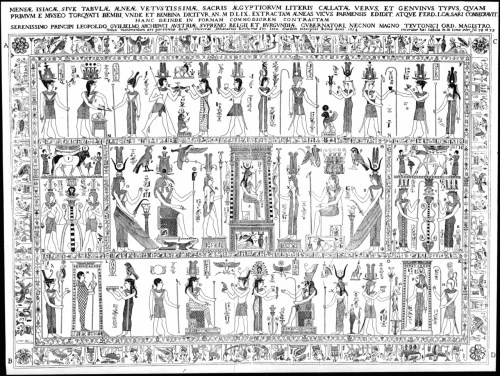
Athanasius Kircher (1602-80), The Bembine Table of Isis, Oedipus Aegypticiacus

Athanasius Kircher (1602-80), The Bembine Table of Isis, Oedipus Aegypticiacus, or Mensa Isiaca, N. Inv. C. 7155, Museo Egizio, photo by Fuzzypeg from Manly Palmer Hall, The Secret Teachings of All Ages (1928), all rights released. The Bembine Table was acquired by Cardinal Bembo after the sack of Rome in 1527, then purchased by the Savoy King Carlo Emanuele I in 1630 in Turin. A Roman interpretation of a bronze and silver altar table in an Egyptian style, early scholars surmised that the table pertained to an Isis cult. Kircher relied upon it for the third volume of his masterwork. It was ultimately determined to be an antique forgery, and not a work of ancient Egypt. This image is in the public domain. The author died over 70 years ago.   


“What justified  this process of textual dissolution was that, for Abulafia, each letter, each atomic element, already had a meaning of its own, independent of the meaning of the syntagms in which it occurred.

Each letter was already a divine name: “Since, in the letters of the Name, each letter is already a Name itself, know that Yod is a name, and YH is a name” (Perush Havdalah de-Rabbi ‘Akivà).

This practice of reading by permutation tended to produce ecstatic effects:

“And begin by combining this name, namely, YHWH, at the beginning alone, and examining all its combinations and move it, turn it about like a wheel, returning around, front and back, like a scroll, and do not let it rest, but when you see its matter strengthened because of the great motion, because of the fear of confusion of your imagination, and rolling about of your thoughts, and when you let it rest, return to it and ask [it] until there shall come to your hand a word of wisdom from it, do not abandon it.

Afterwards go on to the second one from it, Adonay, and ask of it its foundation [yesodo] and it will reveal to you its secret [sodo]. And then you will apprehend its matter in the truth of its language. Then join and combine the two of them [YHWH and Adonay] and study them and ask them, and they will reveal to you the secrets of wisdom . . .

Afterwards combine Elohim, and it will also grant you wisdom, and then combine the four of them, and find the miracles of the Perfect One [i.e. God], which are miracles of wisdom.” (Hayyê ha-Nefes, in Idel 1988c:21).

If we add that the recitation of the names was accompanied by special techniques of breathing, we begin to see how from recitation the adept might pass into ecstasy, and from ecstasy to the acquisition of magic powers; for the letters that the mystic combined were the same sounds with which God created the world.

This latter aspect came especially into prominence during the fifteenth century. For Yohanan Alemanno, friend and inspirer of Pico della Mirandola, “the symbolic cargo of language was transformed into a kind of quasi-mathematical command. Kabbalistic symbolism thus turned into–or perhaps returned to–a magical language of incantation” (Idel 1988b: 204-5).

For the ecstatic kabbala, language was a self-contained universe in which the structure of language represented the structure of reality itself. Already in the writings of Philo of Alexandria there had been an attempt to compare the intimate essence of the Torah with the Logos as the world of ideas.

Such Platonic conceptions had even penetrated into the Haggidic and Midrashic literature in which the Torah was conceived as providing the scheme according to which God created the world.

The eternal Torah was identified with wisdom and, in many passages, with the world of forms or universe of archetypes. In the thirteenth century, taking up a decidedly Averroist line, Abulafia equated the Torah with the active intellect, “the form of all the forms of separate intellects” (Sefer Mafteakh ha-Tokhahot).

In contrast, therefore, with the main philosophical tradition (from Aristotle to the Stoics and to the Middle Ages, as well as to Arab and Judaic philosophers), language, in the kabbala, did not represent the world merely by referring to it.

It did not, that is, stand to the world in the relation of signifier to signified or sign to its referent. If God created the world by uttering sounds or by combining written letters, it must follow that these semiotic elements were not representations of pre-existing things, but the very forms by which the elements of the universe are moulded.

The significance of this argument in our own story must be plain: the language of creation was perfect not because it merely happened to reflect the structure of the universe in some exemplary fashion; it created the universe.

Consequently it stands to the universe as the cast stands to the object cast from it.”

Umberto Eco, The Search for the Perfect Language, translated by James Fentress, Blackwell. Oxford, 1995, pp. 30-2.
Eco: Before and After Europe, 2

babel

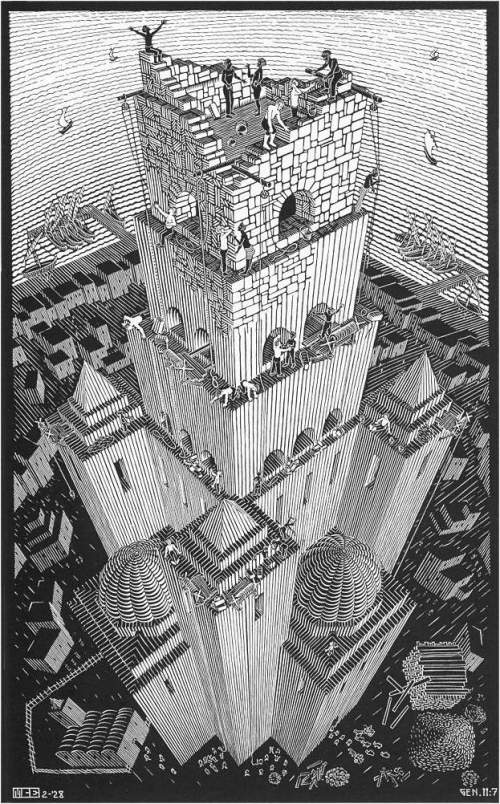
MC Escher, Tower of Babel, 1928. This image of a drawing is copyrighted by the artist, who died in 1972. Low-resolution images of works of art for purposes of critical commentary qualify for fair use under United States copyright law.

“Despite this, by the second century AD, there had begun to form the suspicion that Latin and Greek might not be the only languages which expressed harmoniously the totality of experience.

Slowly spreading across the Greco-Roman world, obscure revelations appeared; some were attributed to Persian magi, others to an Egyptian divinity called Thoth-Hermes, to Chaldean oracles, and even to the very Pythagorean and Orphic traditions which, though born on Greek soil, had long been smothered under the weight of the great rationalist philosophy.

By now, the classical rationalism, elaborated and re-elaborated over centuries, had begun to show signs of age. With this, traditional religion entered a period of crisis as well. The imperial pagan religion had become a purely formal affair, no more than a simple expression of loyalty.

Each people had been allowed to keep its own gods. These were accommodated to the Latin pantheon, no one bothering over contradictions, synonyms or homonyms. The term characterizing this leveling toleration for any type of religion (and for any type of philosophy or knowledge as well) is syncretism.

An unintended result of this syncretism, however, was that a diffused sort of religiosity began to grow in the souls of the most sensitive. It was manifested by a belief in the universal World Soul; a soul which subsisted in stars and in earthly objects alike.

Our own, individual, souls were but small particles of the great World Soul. Since the reason of philosophers proved unable to supply truths about important matters such as these, men and women sought revelations beyond reason, through visions, and through communications with the godhead itself.

It was in this climate that Pythagoreanism was reborn. From its beginnings, Pythagoreans had regarded themselves as the keepers of a mystic form of knowledge, and practiced initiatory rites.

Their understanding of the laws of music and mathematics was presented as the fruit of revelation obtained from the Egyptians. By the time of Pythagoreanism’s second appearance, however, Egyptian civilization had been eradicated by the Greek and Latin conquerors.

Egypt itself had now become an enigma, no more than an incomprehensible hieroglyph. Yet there is nothing more fascinating than secret wisdom: one is sure that it exists, but one does not know what it is. In the imagination, therefore, it shines as something unutterably profound.

That such wisdom could exist while still remaining unknown, however, could only be accounted for by the fact that the language in which this wisdom was expressed had remained unknown as well.

This was the reasoning of Diogenes Laertius, who wrote in his Lives of the Philosophers in the third century AD:

“There are those who assert that philosophy started among the Barbarians: there were, they claim, Magi among the Persians, the Chaldeans, the Babylonians, the Assyrians, the Gymnosophists of India, the Druids among the Celts and Galatians” (I).

The classical Greeks had identified barbarians as those who could not even articulate their speech. It now seemed that these very mumblings were of a sacred language, filled with the promise of tacit revelations (Festugière 1944-54:I).

I have given a summary of the cultural atmosphere at this time because, albeit in a delayed fashion, it was destined to have a deep influence on our story. Although no one at the time proposed the reconstruction of the perfect language, the need for one was, by now, vaguely felt.

We shall see that the suggestions, first planted during these years, flowered more than twelve centuries later in humanistic and Renaissance culture (and beyond); this will constitute a central thread in the story I am about to tell.

In the meantime, Christianity had become a state religion, expressed in the Greek of the patristic East and in the Latin still spoken in the West. After St. Jerome translated the Old Testament in the fourth century, the need to know Hebrew as a sacred language grew weaker. This happened to Greek as well.

A typical example of this cultural lack is given by St. Augustine, a man of vast culture, and the most important exponent of Christian thought at the end of the empire.

The Christian revelation is founded on an Old Testament written in Hebrew and a New Testament written, for the most part, in Greek. St. Augustine, however, knew no Hebrew; and his knowledge of Greek was, to say the least, patchy (cf. Marrou 1958).

This amounts to a somewhat paradoxical situation: the man who set himself the task of interpreting scripture in order to discover the true meaning of the divine word could read it only in a Latin translation.

The notion that he ought to consult the Hebrew original never really seems to have entered Augustine’s mind. He did not entirely trust the Jews, nurturing a suspicion that, in their versions, they might have erased all references to the coming of Christ.

The only critical procedure he would allow was that of comparing translations in order to find the most likely version. In this way, St. Augustine, though the father of hermeneutics, was certainly not destined to become the father of philology.”

Umberto Eco, The Search for the Perfect Language, translated by James Fentress, Blackwell. Oxford, 1995, pp. 12-4.


Selz: The Dream of Gudea

“Whereas the giants sent Mahway to Enoch for an interpretation of their dreams, in earliest parallels from Mesopotamia the deities undertake this task:

(“Thereupon] all the giants [and monsters! grew afraid 15 and called Mahway to them and the giants pleaded with him and sent him to Enoch 16 [the noted scribe]” (Q II:). Translation taken from the Book of Giants edition of The Gnostic Society Library.)

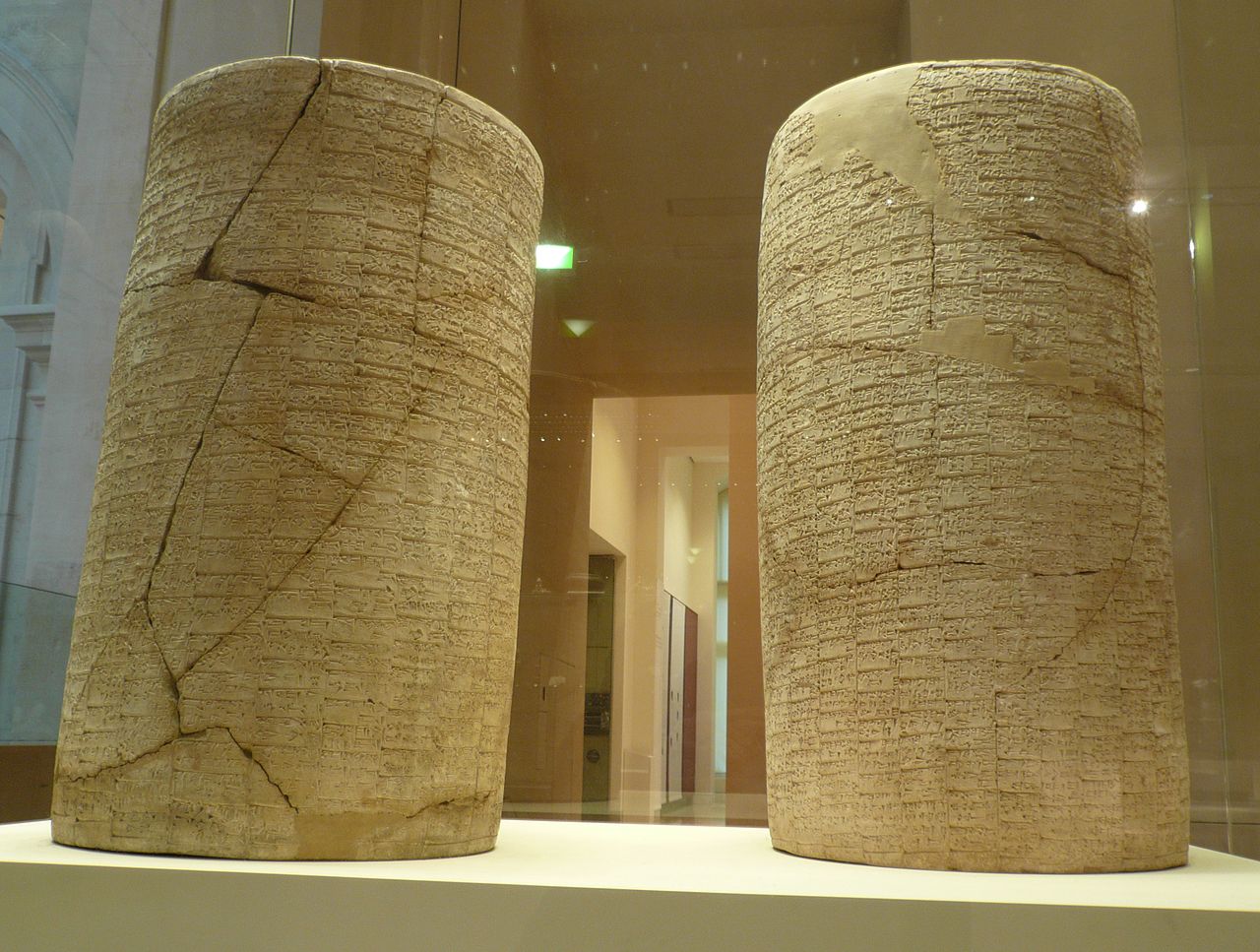
Cylinders of the Sumerian ruler Gudea with cuneiform texts, now in the Louvre.  Dated to 2125 BCE, they recount the Building of Ningursu’s temple in Sumerian. The cylinders were made by Gudea, ruler of Lagash, and excavated in 1877 during digs by Ernest de Sarzec beneath the Eninnu temple complex at Telloh (ancient Girsu).  The complete name of the temple complex was “E-Ninnu-Imdugud-babbara,” meaning “House Ninnu, the Flashing Thunderbird,” a reference to a thunderbird in the second dream that compelled Gudea to build the temple.  They are now in the permanent collection of the Louvre Museum. They are the largest cuneiform cylinders to-date, and they contain the longest known text written in the Sumerian language.  Labelled cylinders A and B, the cuneiform was intended to be read with the cylinders in a horizontal position with a perforation in the middle for mounting.  The text has been translated by Jeremy Black, G. Cunningham, E. Robson and G. Zólyomi, available from The Electronic Text Corpus of Sumerian Literature, Oxford, 1998.  http://etcsl.orinst.ox.ac.uk/section2/tr217.htm Accession numbers MNB 1511 and MNB 1512.  Photo by Ramessos.  I, the copyright holder of this work, release this work into the public domain. This applies worldwide. In some countries this may not be legally possible; if so: I grant anyone the right to use this work for any purpose, without any conditions, unless such conditions are required by law. https://en.wikipedia.org/wiki/Gudea_cylinders

Cuneiform cylinders of the Sumerian ruler Gudea. Dated to 2125 BCE, they recount the Building of Ningursu’s temple. Made by Gudea, ruler of Lagash, and excavated in 1877 during digs by Ernest de Sarzec beneath the Eninnu temple complex at Telloh (ancient Girsu), the complete name of the temple complex was “E-Ninnu-Imdugud-babbara,” meaning “House Ninnu, the Flashing Thunderbird,” a reference to a thunderbird in the second dream that compelled Gudea to build the temple.
Now in the permanent collection of the Louvre Museum, the pair are the largest cuneiform cylinders ever recovered, and they contain the longest known Sumerian text. Anomalous shards recovered on the same site indicate that a third cylinder did not survive the ravages of time. Labelled Cylinders A and B, the cuneiform was intended to be read with the cylinders in a horizontal position with a perforation in the middle for mounting.
The text has been translated by Jeremy Black, G. Cunningham, E. Robson and G. Zólyomi, available from The Electronic Text Corpus of Sumerian Literature, Oxford, 1998.
http://etcsl.orinst.ox.ac.uk/section2/tr217.htm
Accession numbers MNB 1511 and MNB 1512.
Photo by Ramessos.
I, the copyright holder of this work, release this work into the public domain. This applies worldwide.
https://en.wikipedia.org/wiki/Gudea_cylinders

The Sumerian ruler Gudea had difficulties to understand the precise meaning of his dream and addresses the goddess Nanshe, firstly describing his visions:

“(4:8) Nanshe, mighty queen, lustration priestess, protecting genius, cherished goddess of mine, . . . You are the interpreter of dreams among the gods, you are the queen of all the lands, O mother, my matter today is a dream.

There was someone in my dream, enormous as the skies, enormous as the earth was he.

That one was a god as regards his head, he was the Thunderbird as regards his wings, and a floodstorm as regards his lower body. There was a lion lying on both his left and right side . . . (but) I did not understand what (exactly) he intended. Daylight rose for me on the horizon.

(4:23) (Then) there was a woman—whoever she might have been—she (the goddess Nissaba[k]) held in her hand a stylus of shining metal, on her knees there was a tablet (with) stars of heaven, and she was consulting it.

(5:2) Furthermore, there was a warrior who bent (his) arm holding a lapis lazuli plate on which he was setting the ground-plan of a house. He set before me a brand-new basket, a brand-new brick-mould was adjusted and he let the auspicious brick be in the mould for me.”

(The translation from Cylinder A follows D.O. Edzard, ed., Gudea and his Dynasty (RIME 3:1, Toronto: University of Toronto Press,1997), pp. 71-2. Emphases are mine, G.J.S.).

Using much the same words the goddess explains the dream:

“(5:12) My shepherd, I will interpret your dream for you from beginning to end: The person who you said was as enormous as the skies, enormous as the earth, who was a god as regards his head, who, as you said, was the Thunderbird as regards his wings, and who, as you said, was a floodstorm as regards his lower parts, at whose left and right a lion was lying—he was in fact my brother Ningirsu-k; he talked to you about the building of his shrine Eninnu.

The daylight that had risen for you on the horizon—that was your (personal) god Ningishzida-k: like daylight he will be able to rise for you from there.

The young woman coming forward, who did something with sheaves, who was holding a stylus of shining metal, had on her knees a tablet (with) stars, which she was consulting was in fact my sister Nissaba-k—she announced to you the bright star (auguring) the building of the House.

Furthermore, as for the warrior who bent his arm holding a lapis lazuli plate—he was Ninduba: he was engraving thereon in all details the ground-plan of the House.”

Certainly, the setting of this dream is very different from those of the Enoch tradition. We note, however, that the dreams in the Book of Giants also show a clear connection with the scribal art, especially the “Tablets of Heavens,” to the dreams as a message of God and also to the flood.

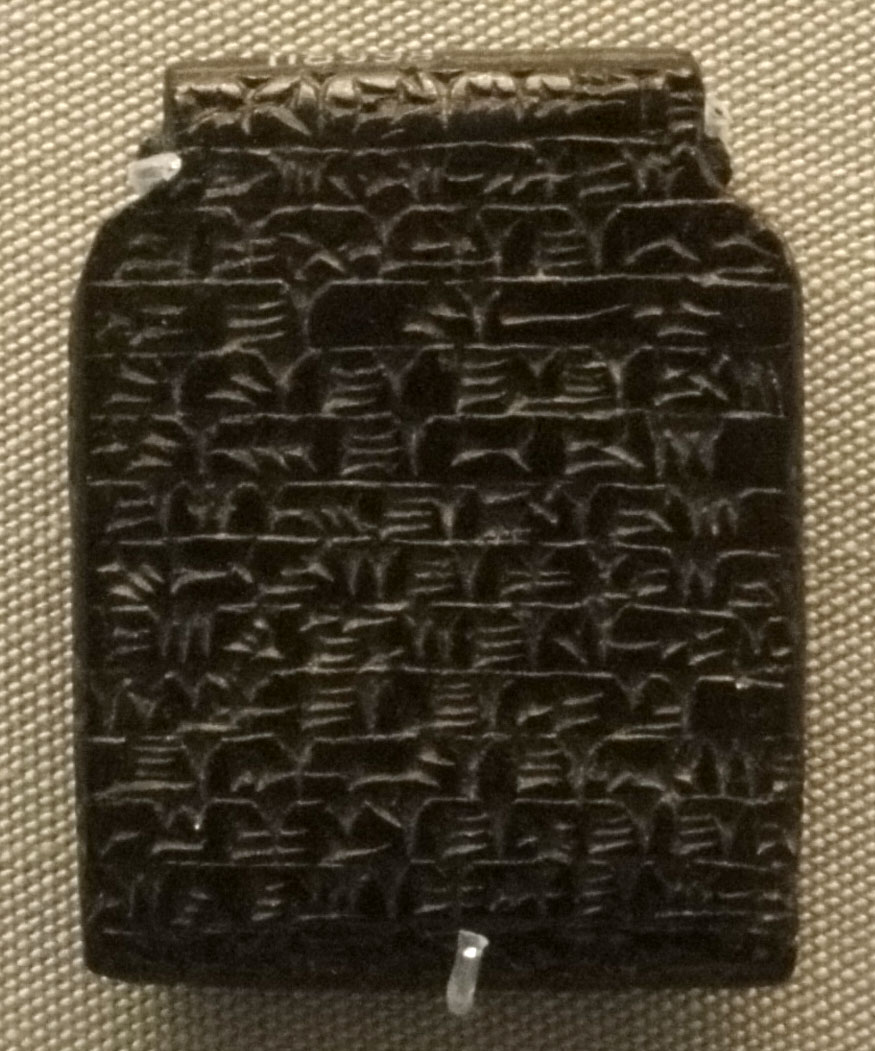
Black stone amulet against plague.  A quotation from the Akkadian Epic of Erra.  BM 118998, British Museum, Room 55.  Registration: 1928,0116.1.  Photo by Fae. This file is licensed under the Creative Commons Attribution-Share Alike 3.0 Unported license. You are free: to share – to copy, distribute and transmit the work to remix – to adapt the work Under the following conditions: attribution – You must attribute the work in the manner specified by the author or licensor (but not in any way that suggests that they endorse you or your use of the work). share alike – If you alter, transform, or build upon this work, you may distribute the resulting work only under the same or similar license to this one.

Black stone amulet against plague.
A quotation from the Akkadian Epic of Erra.
BM 118998, British Museum, Room 55.
Registration: 1928,0116.1.
Photo by Fae.
This file is licensed under the Creative Commons Attribution-Share Alike 3.0 Unported license.

The latter motif as found in the Book of Giants shows a clear connection to the story of the Erra Epic, where to Marduk’s horror, the deity of pestilence and destruction, Erra, decides to annihilate mankind and its foremost sanctuaries.

The reason for the annihilation of the world and the expression of a certain degree of hope looks very similar indeed. It is important to note that this text from the eight century BCE had a considerable audience as can be deduced from the over 35 tablets unearthed so far.

In many respects, the wording of the text and its attitude ask for elaborate comparison with the Jewish apocalyptical tradition, but this would be another article.”

(For an overview of Mesopotamian “apocalyptic motifs” see C. Wilcke, “Weltuntergang als Anfang: Theologische, anthropologische, politisch-historische und ästhetische Ebenen der Interpretation der Sintflutgeschichte im babylonischen Atram-hasīs-Epos,” in Weltende: Beiträge zur Kultur-und Religionswissenschaft (ed. A. Jones; Wiesbaden: Harrassowitz, 1999), pp. 63-112.)

Gebhard J. Selz, “Of Heroes and Sages–Considerations of the Early Mesopotamian Background of Some Enochic Traditions,” in Armin Lange, et alThe Dead Sea Scrolls in Context, v. 2, Brill, 2011, pp. 797-9.