Samizdat

Publishing the Forbidden. All Rights Reserved. © Samizdat 2014-2025.

Category: Nineveh

Nineveh, Cult Center of Ishtar Worship

“From the name /Nin/, which Ištar bore, there is hardly any doubt that she acquired the identification with Nina, which is provable as early as the time of the Lagašite kings, Lugal-anda and Uru-ka-gina.

As identified with Aruru, the goddess who helped Merodach to create mankind, Ištar was also regarded as the mother of all, and in the Babylonian story of the Flood, she is made to say that she had begotten man, but like “the sons of the fishes,” he filled the sea.

Nina, then, as another form of Ištar, was a goddess of creation, typified in the teeming life of the ocean, and her name is written with a character standing for a house or receptacle, with the sign for “fish” within.

Her earliest seat was the city of Nina in southern Babylonia, from which place, in all probability, colonists went northwards, and founded another shrine at Nineveh in Assyria, which afterwards became the great centre of her worship, and on this account the city was called after her Ninaa or Ninua.

As their tutelary goddess, the fishermen in the neighbourhood of the Babylonian Nina and Lagaš were accustomed to make to her, as well as to Innanna or Ištar, large offerings of fish.

As the masculine deities had feminine forms, so it is not by any means improbable that the goddesses had masculine forms, and if that be the case, we may suppose that it was a masculine counterpart of Nina who founded Nineveh, which, as is well known, is attributed to Ninos, the same name as Nina with the Greek masculine termination.”

Theophilus G. Pinches, The Religion of Babylonia and Assyria, London, 1906, pp. 75-6.

Cult of Ishtar

” … In all probability Ištar, the spouse of Tammuz, is best known from her descent into Hades in quest of him when with Persephone (Ereš-ki-gal) in the underworld.

In this she had to pass through seven gates, and an article of clothing was taken from her at each, until she arrived in the underworld quite naked, typifying the teaching, that man can take nothing away with him when he departs this life.

During her absence, things naturally began to go wrong upon the earth, and the gods were obliged to intervene, and demand her release, which was ultimately granted, and at each gate, as she returned, the adornments which she had left were given back to her. It is uncertain whether the husband whom she sought to release was set free, but the end of the inscription seems to imply that Ištar was successful in her mission.

In this story she typifies the faithful wife, but other legends show another side of her character, as in that of Gilgameš, ruler of her city Erech, to whom she makes love.

Gilgameš, however, knowing the character of the divine queen of his city too well, reproaches her with her treatment of her husband and her other lovers–Tammuz, to whom, from year to year, she caused bitter weeping; the bright coloured Allala bird, whom she smote and broke his wings; the lion perfect in strength, in whom she cut wounds “by sevens”; the horse glorious in war, to whom she caused hardship and distress, and to his mother Silili bitter weeping; the shepherd who provided for her things which she liked, whom she smote and changed to a jackal; Išullanu, her father’s gardener, whom she tried, apparently, to poison, but failing, she smote him, and changed him to a statue (?).

On being thus reminded of her misdeeds, Ištar was naturally angry, and, ascending to heaven, complained to her father Anu and her mother Anatu, the result being, that a divine bull was sent against Gilgameš and Enki-du, his friend and helper.

The bull, however, was killed, and a portion of the animal having been cut off, Enki-du threw it at the goddess, saying at the same time that, if he could only get hold of her, he would treat her similarly. Apparently Ištar recognised that there was nothing further to be done in the matter, so, gathering the hand-maidens, pleasure-women and whores, in their presence she wept over the portion of the divine bull which had been thrown at her.

The worship of Ištar, she being the goddess of love and war, was considerably more popular than that of her spouse, Tammuz, who, as among the western Semitic nations, was adored rather by the women than the men. Her worship was in all probability of equal antiquity, and branched out, so to say, in several directions, as may be judged by her many names, each of which had a tendency to become a distinct personality.

Thus the syllabaries give the character which represents her name as having also been pronounced /Innanna/, /Ennen/, and /Nin/, whilst a not uncommon name in other inscriptions is /Ama-Innanna/, “mother Ištar.”

The principal seat of her worship in Babylonia was at Erech, and in Assyria at Nineveh–also at Arbela, and many other places. She was also honoured (at Erech and elsewhere) under the Elamite names of Tišpak and Šušinak, “the Susian goddess.”

Theophilus G. Pinches, The Religion of Babylonia and Assyria, London, 1906, pp. 72-5.

The Enuma Elish

“THE great Assyrian poem, or series of legends, which narrates the story of the Creation of the world and man, was termed by the Assyrians and Babylonians Enuma elish, “When in the height,” from the two opening words of the text.

The poem consisted of some nine hundred and ninety-four lines, and was divided into seven sections, each of which was inscribed upon a separate Tablet. The Tablets were numbered by the Assyrian scribes, and the separate sections of the poem written upon them do not vary very much in length.

The shortest Tablet contains one hundred and thirty-eight lines, and the longest one hundred and forty-six, the average length of a Tablet being about one hundred and forty-two lines.

The poem embodies the beliefs of the Babylonians and Assyrians concerning the origin of the universe; it describes the coming forth of the gods from chaos, and tells the story of how the forces of disorder, represented by the primeval water-gods Apsû and Tiamat, were overthrown by Ea and Marduk respectively, and how Marduk, after completing the triumph of the gods over chaos, proceeded to create the world and man.

The poem is known to us from portions of several Assyrian and late-Babylonian copies of the work, and from extracts from it written out upon the so-called “practice-tablets,” or students’ exercises, by pupils of the Babylonian scribes.

The Assyrian copies of the work are from the great library which was founded at Nineveh by Ashur-bani-pal, king of Assyria from B.C. 668 to about B.C. 626; the Babylonian copies and extracts were inscribed during the period of the kings of the Neo-Babylonian and Persian periods; and one copy of the Seventh Tablet may probably be assigned to as late a date as the period of the Arsacidae.

All the tablets and fragments, which have hitherto been identified as inscribed with portions of the text of the poem, are preserved in the British Museum.”

Leonard William King, The Seven Tablets of Creation, London, 1902. pp. xxv-xxvi.

Gilgamesh, Enkidu and the Nameless Harlot

THE EPIC OF GILGAMISH.

“The narrative of the life, exploits and travels of Gilgamish, king of Erech, filled Twelve Tablets which formed the Series called from the first three words of the First Tablet, SHA NAGBU IMURUi.e., “He who hath seen all things.”

The exact period of the reign of this king is unknown, but in the list of the Sumerian kingdoms he is fifth ruler in the Dynasty of Erech, which was considered the second dynasty to reign after the Deluge. He was said to have ruled for 126 years.

The principal authorities for the Epic are the numerous fragments of the tablets that were found in the ruins of the Library of Nebo and the Royal Library of Ashur-bani-pal at Nineveh, and are now in the British Museum, but very valuable portions of other and older versions (including some fragments of a Hittite translation) have now been recovered from various sources, and these contribute greatly to the reconstruction of the story.

The contents of the Twelve Tablets may be briefly described thus–

THE FIRST TABLET.

The opening lines describe the great knowledge and wisdom of Gilgamish, who saw everything, learned everything, under stood everything, who probed to the bottom the hidden mysteries of wisdom, and who knew the history of everything that happened before the Deluge.

He travelled far over sea and land, and performed mighty deeds, and then he cut upon a tablet of stone an account of all that he had done and suffered. He built the wall of Erech, founded the holy temple of E-Anna, and carried out other great architectural works.

He was a semi-divine being, for his body was formed of the “flesh of the gods,” and “two-thirds of him were god, and one-third was man,” The description of his person is lost. As Shepherd (i.e., King) of Erech he forced the people to toil overmuch, and his demands reduced them to such a state of misery that they cried out to the gods and begged them to create some king who should control Gilgamish and give them deliverance from him.

The gods hearkened to the prayer of the men of Erech, and they commanded the goddess Aruru to create a rival to Gilgamish. The goddess agreed to do their bidding, and having planned in her mind what manner of being she intended to make, she washed her hands, took a piece of clay, cast it on the ground, and made a male creature like the god En-urta. His body was covered all over with hair. The hair of his head was long like that of a woman, and he wore clothing like that of Sumuqan, the god of cattle.

He was different in every way from the people of the country, and his name was Enkidu. He lived in the forests on the hills, ate herbs like the gazelle, drank with the wild cattle, and herded with the beasts of the field. He was mighty in stature, invincible in strength, and obtained complete mastery over all the creatures of the forests in which he lived.

One day a certain hunter went out to snare game, and he dug pit-traps and laid nets, and made his usual preparations for roping in his prey. But after doing this for three days he found that his pits were filled up and his nets smashed, and he saw Enkidu releasing the beasts that had been snared.

The hunter was terrified at the sight of Enkidu, and went home hastily and told his father what he had seen and how badly he had fared. By his father’s advice he went to Erech, and reported to Gilgamish what had happened.

When Gilgamish heard his story he advised him to act upon a suggestion which the hunter’s father had already made, namely that he should hire a harlot and take her out to the forest, so that Enkidu might be ensnared by the sight of her beauty, and take up his abode with her.

The hunter accepted this advice, and having found a harlot to help him in removing Enkidu from the forests, he set out from Erech with her and in due course arrived at the forest where Enkidu lived, and sat down by the place where the beasts came to drink.

On the second day when the beasts came to drink and Enkidu was with them, the woman carried out the instructions which the hunter had given her, and when Enkidu saw her cast aside her veil, he left his beasts and came to her, and remained with her for six days and seven nights. At the end of this period he returned to the beasts with which he had lived on friendly terms, but as soon as the gazelle winded him they took to flight, and the wild cattle disappeared into the woods.”

E.A. Wallis Budge, The Babylonian Story of the Deluge and the Epic of Gilgamish1929, pp. 41-3.

The 11th Tablet of the Epic of Gilgamesh and the Quest for Human Immortality

THE BABYLONIAN LEGEND OF THE DELUGE AS TOLD TO THE HERO GILGAMISH BY HIS ANCESTOR UTA-NAPISHTIM, WHO HAD BEEN MADE IMMORTAL BY THE GODS.

“The form of the Legend of the Deluge given below is that which is found on the Eleventh of the Series of Twelve Tablets in the Royal Library at Nineveh, which described the life and exploits of Gilgamish, an early king of the city of Erech.

As we have seen above, the Legend of the Deluge has probably no original connection with the Epic of Gilgamish, but was introduced into it by the editors of the Epic at a comparatively late period, perhaps even during the reign of Ashur-bani-pal (B.C. 669-626).

… It is … only necessary to state here that Gilgamish, who was horrified and almost beside himself when his bosom friend and companion Enkidu died, meditated deeply how he could escape death himself. He knew that his ancestor Uta-Napishtim had become immortal, therefore he determined to set out for the place where Uta-Napishtim lived so that he might obtain from him the secret of immortality.

Guided by a dream, Gilgamish set out for the Mountain of the Sunset, and, after great toil and many difficulties, came to the shore of a vast sea. Here he met Ur-Shanabi, the boatman of Uta-Napishtim, who was persuaded to carry him in his boat over the “waters of death,” and at length he landed on the shore of the country of Uta-Napishtim.

The immortal came down to the shore and asked the newcomer the object of his visit, and Gilgamish told him of the death of his great friend Enkidu, and of his desire to escape from death and to find immortality. Uta-Napishtim having made to Gilgamish some remarks which seem to indicate that in his opinion death was inevitable,

1. Gilgamish said unto him, to Uta-Napishtim the remote:

2. “I am looking at thee, Uta-Napishtim.

3. Thy person is not altered; even as am I so art thou.

4. Verily, nothing about thee is changed; even as am I so art thou.

5. A heart to do battle doth make thee complete,

6. Yet at rest (?) thou dost lie upon thy back.

7. How then hast thou stood the company of the gods and sought life?”

Thereupon Uta-Napishtim related to Gilgamish the Story of the Deluge, and the Eleventh Tablet continues thus

8. Uta-Napishtim said unto him, to Gilgamish:

9. “I will reveal unto thee, O Gilgamish, a hidden mystery,

10. And a secret matter of the gods I will declare unto thee.

11. Shurippak, a city which thou thyself knowest,

12. On [the bank] of the river Puratti (Euphrates) is situated,

13. That city is old; and the gods [dwelling] within it

14. Their hearts induced the great gods to make a windstorm (a-bu-bi),

15. There was their father Anu,

16. Their counsellor, the warrior Enlil,

17. Their messenger En-urta [and]

18. Their prince Ennugi.

19. Nin-igi-ku, Ea, was with them [in council] and

20. reported their word to a house of reeds.”

E.A. Wallis Budge, The Babylonian Story of the Deluge and the Epic of Gilgamish1929, pp. 30-2.

The Legend of the Deluge According to Berossus

” … Berosus, it is true, is not a very ancient authority, for he was not born until the reign of Alexander the Great, but he was a learned man and was well acquainted with the Babylonian language, and with the ancient literature of his country, and he wrote a history of Babylonia, some fragments of which have been preserved to us in the works of Alexander Polyhistor, Eusebius, and others.

The following is a version of the fragment which describes the flood that took place in the days of Xisuthras, the tenth King of the Chaldeans, and is of importance for comparison with the rendering of the Legend of the Deluge, as found on the Ninevite tablets, which follows immediately after.

THE LEGEND OF THE DELUGE ACCORDING TO BEROSUS.

“After the death of Ardates, his son Xisuthrus reigned eighteen sari. In his time happened a great Deluge; the history of which is thus described. The Deity, Cronus, appeared to him in a vision, and warned him that upon the 15th day of the month Daesius there would be a flood, by which mankind would be destroyed.

He therefore enjoined him to write a history of the beginning, procedure and conclusion of all things; and to bury it in the city of the Sun at Sippara; and to build a vessel, and take with him into it his friends and relations; and to convey on board everything necessary to sustain life, together with all the different animals, both birds and quadrupeds, and trust himself fearlessly to the deep.

Having asked the Deity, whither he was to sail? he was answered, ‘To the Gods ‘: upon which he offered up a prayer for the good of mankind. He then obeyed the divine admonition; and built a vessel 5 stadia in length, and 2 in breadth.

Into this he put everything which he had prepared; and last of all conveyed into it his wife, his children, and his friends.

After the flood had been upon the earth, and was in time abated, Xisuthrus sent out birds from the vessel; which, not finding any food nor any place whereupon they might rest their feet, returned to him again. After an interval of some days, he sent them forth a second time; and they now returned with their feet tinged with mud. He made a trial a third time with these birds; but they returned to him no more: from whence he judged that the surface of the earth had appeared above the waters.

He therefore made an opening in the vessel, and upon looking out found that it was stranded upon the side of some mountain; upon which he immediately quitted it with his wife, his daughter, and the pilot.

Xisuthrus then paid his adoration to the earth, and, having constructed an altar, offered sacrifices to the gods, and, with those who had come out of the vessel with him, disappeared.

They, who remained within, finding that their companions did not return, quitted the vessel with many lamentations, and called continually on the name of Xisuthrus.

Him they saw no more; but they could distinguish his voice in the air, and could hear him admonish them to pay due regard to religion; and likewise informed them that it was upon account of his piety that be was translated to live with the gods; that his wife and daughter, and the pilot, had obtained the same honour.

To this he added that they should return to Babylonia; and, it was ordained, search for the writings at Sippara, which they were to make known to mankind: moreover that the place, wherein they then were, was the land of Armenia. The rest having heard these words, offered sacrifices to the gods; and taking a circuit journeyed towards Babylonia.” (Cory, Ancient Fragments, London, 1832, p. 26 ff.)

E.A. Wallis Budge, The Babylonian Story of the Deluge and the Epic of Gilgamish1929, pp. 28-30.

The Library of Ashur-bani-pal

ASHUR-BANI-PAL, BOOK-COLLECTOR AND PATRON OF LEARNING.

“Ashur-bani-pal (the Asnapper of Ezra iv, 10) succeeded his father Esarhaddon B.C. 669, and at a comparatively early period of his reign he seems to have devoted himself to the study of the history of his country, and to the making of a great Private Library.

The tablets that have come down to us prove not only that he was as great a benefactor of the Library of the Temple of Nebo as any of his predecessors, but that he was himself an educated man, a lover of learning, and a patron of the literary folk of his day.

In the introduction to his Annals, as found inscribed on his great ten-sided prism in the British Museum, he tells us how he took up his abode in the Crown Prince’s dwelling from which Sermacherib and Esarhaddon had ruled the Assyrian Empire, and in describing his own education he says:

“I, Ashur-bani-pal, within it (i.e., the palace) understood the wisdom of Nebo, all the art of writing of every craftsman, of every kind, I made myself master of them all (i.e., of the various kinds of writing).”

These words suggest that Ashur-bani-pal could not only read cuneiform texts, but could write like a skilled scribe, and that he also understood all the details connected with the craft of making and baking tablets.

Having determined to form a Library in his palace he set to work in a systematic manner to collect literary works. He sent scribes to ancient seats of learning, e.g., Ashur, Babylon, Cuthah, Nippur, Akkad, Erech, to make copies of the ancient works that were preserved there, and when the copies came to Nineveh he either made transcripts of them himself, or caused his scribes to do so for the Palace Library.

In any case he collated the texts himself and revised them before placing them in his Library. The appearance of the tablets from his Library suggests that he established a factory in which the clay was cleaned and kneaded and made into homogeneous, well-shaped tablets, and a kiln in which they were baked, after they had been inscribed.

The uniformity of the script upon them is very remarkable, and texts with mistakes in them are rarely found. How the tablets were arranged in the Library is not known, but certainly groups were catalogued, and some tablets were labelled.

Groups of tablets were arranged in numbered series, with “catch lines,” the first tablet of the series giving the first line of the second tablet, the second tablet giving the first line of the third tablet, and so on.

Ashur-bani-pal was greatly interested in the literature of the Sumerians, i.e., the non-Semitic people who occupied Lower Babylonia about B.C. 3500 and later. He and his scribes made bilingual lists of signs and words and objects of all classes and kinds, all of which are of priceless value to the modem student of the Sumerian and Assyrian languages.”

E.A. Wallis Budge, The Babylonian Story of the Deluge and the Epic of Gilgamish1929, pp. 15-17.

The Library of the Temple of Nebo in Nineveh

NEBO AND HIS LIBRARY AT NINEVEH.

“Nothing is known of the early history of the Library of the Temple of Nebo at Nineveh, but there is little doubt that it was in existence in the reign of Sargon II.

Authorities differ in their estimate of the attributes that were assigned to Nebo (Nabu) in Pre-Babylonian times, and “cannot decide whether he was a water-god, or a fire-god, or a corn-god, but he was undoubtedly associated with Marduk, either as his son or as a fellow-god.

It is certain that as early as B.C. 2000 he was regarded as one of the “Great Gods” of Babylonia, and in the fourteenth century B.C. his cult was already established in Assyria. He had a temple at Nimrûd in the ninth century B.C., and King Adad-nirari (B.C. 811-783) set up six statues in it to the honour of the god; two of these statues are now in the British Museum.

The same Adad-nirari also repaired the Nebo temple at Nineveh. Under the last Assyrian Empire Nebo was believed to possess the wisdom of all the gods, and to be the “All-wise ” and “All-knowing.” He was the inventor of all the arts and sciences, and the source of inspiration in wise and learned men, and he was the divine scribe and past master of all the mysteries connected with literature and the art of writing (dup-sharrute).

Ashur-bani-pal addresses him as “Nebo, the mighty son, the director of the whole of heaven and of earth, holder of the tablet, bearer of the writing-reed of the tablet of destiny, lengthener of days, vivifier of the dead, stablisher of light for the men who are troubled.”

In the reign of Sargon II the Temple of Nebo at Kuyûnjik was repaired, and probably at that time a library was housed in it. Layard found some of the remains of Nebo’s Library in the South West Palace, but it must have been transferred thither, for the temple of Nebo lay farther north, near the south corner of Ashur-bani-pal’s palace.

Nebo’s temple at Nineveh bore the same name as his very ancient temple at Borsippa (the modem Birs-i-Nimrûd), viz., “E-ZIDA.”

Ashur-bani-pal

” … The records of Ashur-bani-pal cease after 640 B.C., so that we are unable to follow the events of his reign during its last fourteen years. Apparently peace prevailed everywhere. The great monarch, who was a pronounced adherent of the goddess cults, appears to have given himself up to a life of indulgence and inactivity.

Under the name Sardanapalus he went down to tradition as a sensual Oriental monarch who lived in great pomp and luxury, and perished in his burning palace when the Medes revolted against him. It is evident, however, that the memory of more than one monarch contributed to the Sardanapalus legend, for Ashur-bani-pal had lain nearly twenty years in his grave before the siege of Nineveh took place.

In the Bible he is referred to as “the great and noble Asnapper,” and he appears to have been the emperor who settled the Babylonian, Elamite, and other colonists “in the cities of Samaria.”

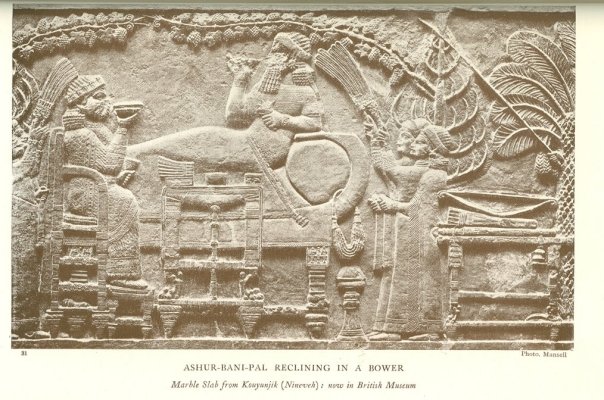
He erected at Nineveh a magnificent palace, which was decorated on a lavish scale. The sculptures are the finest productions of Assyrian art, and embrace a wide variety of subjects–battle scenes, hunting scenes, and elaborate Court and temple ceremonies. Realism is combined with a delicacy of touch and a degree of originality which raises the artistic productions of the period to the front rank among the artistic triumphs of antiquity.

Ashur-bani-pal in the palace of Nineveh.

Ashur-bani-pal boasted of the thorough education which he had received from the tutors of his illustrious father, Esarhaddon. In his palace he kept a magnificent library. It contained thousands of clay tablets on which were inscribed and translated the classics of Babylonia.

To the scholarly zeal of this cultured monarch is due the preservation of the Babylonian story of creation, the Gilgamesh and Etana legends, and other literary and religious products of remote antiquity. Most of the literary tablets in the British Museum were taken from Ashur-bani-pal’s library.”

Donald A. Mackenzie, Myths of Babylonia and Assyria, 1915, pp. 486-7.

On the Neo-Platonic Forgeries

IN giving to the public a new edition of Cory’s Ancient Fragments I have endeavoured to respond to the wishes of numerous literary friends by furnishing a brief account of the several authors to whom we are indebted for these extracts, and, at the same time, some information respecting the decipherment of the hieroglyphic texts of Egypt, and the cuneiform records of Nineveh and Babylon.

The first edition of this work appeared in 1828, the second in 1832; therefore, at a time when Egyptian scholarship was still in its infancy, while cuneiform research had not yet seen the light. The discoveries of Champollion, Young, Birch, Bunsen, Brugsch, Chabas, Le Page Renouf, Godwin, and a host of other scholars in the former field of research, and of Layard, Botta, Rawlinson, Norris, Oppert, Menant, George Smith, Sayce, Fox Talbot, and Schrader in the latter, have furnished so much valuable information respecting the ancient empires of Egypt and Assyria, that we can no longer rest satisfied with the meagre accounts transmitted to us by the classic writers concerning times and people with which they were themselves but imperfectly acquainted.

At a time, therefore, when, thanks to the labours of the distinguished scholars above named, we can read with considerable facility and astonishing certainty the papyri of Egypt and the clay-tablets of Babylon, it behoves us to pause for a moment, and consider how this wonderful mine of ancient treasures was discovered, and the means by which it has been worked.

Cory’s Fragments constitute a fitting supplement to the fragments which have been exhumed from the mounds of Nineveh, and rescued from the tombs and mummy-pits of Egypt. Considered in this light they will be found to explain and complete one another; for, in the one we have Assyrians and Egyptians speaking for themselves each in his own tongue; in the other the information is supplied through a Greek channel, and reaches us, no doubt, more or less coloured by the media through which it has passed.

It is only when we place the two accounts side by side that we are in a position to estimate their respective values, and reproduce the half obliterated lines. “The contents of this volume,” says Cory, in his preface, “are fragments, which have been translated from foreign languages into Greek, or have been quoted, or transcribed, by Greeks from foreign authors; or, have been written in the Greek language by foreigners who have had access to the archives of their own countries.”

[ … ]

I have also referred the student to authorised translations of cuneiform and hieroglyphic texts, whenever I thought that any additional light was thrown by them upon the statements contained in these Fragments. Lastly, it remains only for me to say in this place that I have omitted Cory’s preface entirely, as resting chiefly upon the long-exploded learning of Jacob Bryant, Faber, and Parkhurst; and have dispensed altogether with the Neo-Platonic forgeries which Cory had placed at the end, bearing the titles respectively of, Oracles of Zoroaster, the Hermetic Creed, the Orphic, Pythagorean, and other fragments, of doubtful authenticity and of little value.

We now possess, thanks to the labours of MM. Anquetil Duperron, Spiegel, and Haug, all the remains of the so-called Zend-Avesta, of which only a small portion the Gathas are regarded by competent scholars as genuine. Comparing these so-called Oracles of Zoroaster with the genuine fragments, we have every reason to reject them as spurious.

Such as they are, however, they will be found, translated into English, in Stanley’s Lives of the Philosophers. I have preferred, therefore, in the present edition, to omit this farrago of metaphysico-philosophical nonsense, and have added several fragments of other ancient authors containing matter of greater importance.”

E. Richmond Hodges, Cory’s Ancient Fragments of the Phoenician, Carthaginian, Babylonian, Egyptian and Other Authors, London: Reeves & Turner, 1876, pp. vii-xiii.

There Were Giants

” … But if all the nations, or even the upper classes of those nations, which bear the name, be the sons of Cush, one-third of the present human race must be the descendants of that patriarch. Indeed, before the introduction of Ionism, Epiphanius and others appear to have included all mankind under the name of Scuths. The first apostacy might have been introduced by Cush, and its followers have borne his name; which the succeeding heresy of Nimrod could not obliterate.

The Scythian nations of Touran and the North were generally addicted to the Scythic superstition; and whenever they rolled back the tide of war upon their ancient rivals; the idols temples and cities were the objects upon which they satiated their revenge.

They were esteemed excommunicated, and of the Giant race, Nephelim, Rephaim and Anakim. The Scuths of Iran were also of the Giant race, with Nimrod as their chief. Of the Titanian war there appears to be a double aspect. When the Scuths of Touran are the Giants, the war between them and the Ionim is the subject of the legend; and they are the Giants cast out into Cimmerian darkness, and buried under mountains.

The other view presents both parties conjointly before the schism, as the Nephelim, Apostates or Giants, engaged in carrying on the war against Heaven itself. And in these accounts we find more frequent allusions to the Tower and its supernatural overthrow.

The catastrophe at Babel completed the dispersion. On the division of the earth and planting of the nations, there are some very curious notices extant. But whether Nimrod and his immediate adherents survived, and retained possession of Babylon, or transferred their seat of government to Nineveh and founded the great Iranian empire, or whether that empire and city were founded by Assur and the sons of Shem, is still a subject of dispute.

We find Nimrod, however, under the well-known title of Alorus, at the head of the two Chaldæan dynasties, mentioned above: but these appear rather to refer to the antediluvian patriarchs than to the proper kings of Chaldæa.

The first dynasty of Chaldæan Kings is placed by almost all chronologists as the first Iranian dynasty, that of Nimrod under the name of Evechius, and his immediate descendants. Evexius is also placed by Polyhistor as the first Chaldæan king. The dynasty of the Arabian kings of Chaldæan is placed by Eusebius, Syncellus and others, as well as by Berossus, next in the order of succession.

They have likewise been supposed to be a Scythic nation, which broke in upon the empire from the Scythian settlements of Cashgar, and obtained possession either of the entire empire, or only of the city of Babylon, during the period of its desolation, with the plains of Shinar and the country round the head of the Persian gulf, from whence they were expelled, and discharged themselves upon Palestine as the Palli or Philistines, and upon Egypt as the Hycsos or Shepherd Kings.

Next in succession, according to Eusebius and Syncellus, or perhaps contemporary with the preceding, came the long line of the great dynasty of the Assyrian Kings, who held the empire of the world for ten or twelve centuries, till their dominion was wrested from them by the Medes in the time of Thonus Concolerus, the Sardanapalus of the Greek historians.

The different catalogues of the great Assyrian succession that are extant, will be found among the Dynasties. The overthrow of the Assyrian empire was followed by several years of universal anarchy, bloodshed and revolution. And it is ascertained, that it was during this scene of confusion that Jonah was sent upon his mission to stop its progress at Nineveh.

[ … ]

The Babylonians acquired a temporary independence at the fall of the Assyrian empire, but after two or three short reigns they were subdued by Senecherib. Syria also became an independent kingdom, and prospered for a time, till again reduced under the Assyrian yoke. Persia at the same time arose, and alone maintained its independence against the growing power of the Medes and the new Assyrian dynasty, till the successes of Cyrus raised it above them all, and vested the empire of the world in the Persian race.

The Assyrian empire revived under Nabonasar, supposed to be the same with the Salmanasar of the Scriptures. Of this dynasty three several catalogues will be found, the Ecclesiastical and Astronomical canons preserved by Syncellus, and the celebrated canon of Ptolemæus, besides some other notices of the successors of Nabonasar, among the supplemental Chaldæan fragments.

The first princes of the line appear to have fixed their residence at Nineveh, and among them we may recognize the Tiglath Pileser, Senecherib, and Esar Haddon of the Scriptures. Their race appears to have terminated in Saracus, another Sardanapalus.

Nabopollasar, a successful rebel, began the last line of the Assyrian and Chaldæan monarchs. He transferred the seat of empire to Babylon, and in his reign, his celebrated son, Nebuchadnezzar, extended his conquests over the bordering kingdoms of the north and west, by the reduction of Syria, Phœnicia, Judæa, Egypt, and Arabia; an accurate account of which is transmitted by Berossus.

On the death of his father, Nebuchadnezzar succeeded to the throne. Concerning him we have several very interesting fragments from Berossus, and one from Megasthenes. In these are detailed the splendor of his works at Babylon, its celebrated walls, and brazen gates; its temples, palaces, and hanging gardens.

The prophesy of Nebuchadnezzar, probably alludes to the public notification of Daniel’s interpretation of his vision.”

I.P. Cory, Ancient Fragments, 1832, Introduction.

Destroyer of Babylon

” … In 691 B.C. Sennacherib again struck a blow for Babylonia, but was unable to depose Mushezib-Merodach. His opportunity came, however, in 689 B.C. Elam had been crippled by raids of the men of Parsua (Persia), and was unable to co-operate with the Chaldaean king of Babylon.

Sennacherib captured the great commercial metropolis, took Mushezib-Merodach prisoner, and dispatched him to Nineveh.

Then he wreaked his vengeance on Babylon.

For several days the Assyrian soldiers looted the houses and temples, and slaughtered the inhabitants without mercy. E-sagila was robbed of its treasures, images of deities were either broken in pieces or sent to Nineveh: the statue of Bel-Merodach was dispatched to Asshur so that he might take his place among the gods who were vassals of Ashur.

“The city and its houses,” Sennacherib recorded, “from foundation to roof, I destroyed them, I demolished them, I burned them with fire; walls, gateways, sacred chapels, and the towers of earth and tiles, I laid them low and cast them into the Arakhtu.”

“So thorough was Sennacherib’s destruction of the city in 689 B.C.,” writes Mr. King, “that after several years of work, Dr. Koldewey concluded that all traces of earlier buildings had been destroyed on that occasion. More recently some remains of earlier strata have been recognized, and contract-tablets have been found which date from the period of the First Dynasty.

Moreover, a number of earlier pot-burials have been unearthed, but a careful examination of the greater part of the ruins has added little to our knowledge of this most famous city before the Neo-Babylonian period.”

[ … ]

Sennacherib’s palace was the most magnificent building of its kind ever erected by an Assyrian emperor. It was lavishly decorated, and its bas-reliefs display native art at its highest pitch of excellence.

The literary remains of the time also give indication of the growth of culture: the inscriptions are distinguished by their prose style. It is evident that men of culture and refinement were numerous in Assyria. The royal library of Kalkhi received many additions during the reign of the destroyer of Babylon.

46800

Like his father, Sennacherib died a violent death. According to the Babylonian Chronicle he was slain in a revolt by his son “on the twentieth day of Tebet” (680 B.C). The revolt continued from the “20th of Tebet” (early in January) until the 2nd day of Adar (the middle of February). On the 18th of Adar, Esarhaddon, son of Sennacherib, was proclaimed king.

Berosus states that Sennacherib was murdered by two of his sons, but Esarhaddon was not one of the conspirators. The Biblical reference is as follows:

“Sennacherib … dwelt at Nineveh. And it came to pass, as he was worshipping in the house of Nisroch (?Ashur) his god, that Adrammelech and Sharezer (Ashur-shar-etir) his sons smote him with the sword: and they escaped into the land of Armenia (Urartu). And Esarhaddon his son reigned in his stead.”

Ashur-shar-etir appears to have been the claimant to the throne.

Donald A. Mackenzie, Myths of Babylonia and Assyria, 1915, pp. 468-70.

Destruction of Sennacherib

According to Berosus, the Babylonian priestly historian, the camp of Sennacherib was visited in the night by swarms of field mice which ate up the quivers and bows and the (leather) handles of shields. Next morning the army fled.

The Biblical account of the disaster is as follows:

And it came to pass that night, that the angel of the Lord went
out, and smote the camp of the Assyrians an hundred and four score
and five thousand: and when they arose early in the morning,
behold, they were all dead corpses. So Sennacherib king of Assyria
departed, and went and returned and dwelt at Nineveh.

A pestilence may have broken out in the camp, the infection, perhaps, having been carried by field mice. Byron’s imagination was stirred by the vision of the broken army of Assyria.

The Assyrian came down like a wolf on the fold,
And his cohorts were gleaming with purple and gold;
And the sheen of their spears was like stars of the sea,
When the blue wave rolls nightly on deep Galilee.

Like the leaves of the forest when summer is green,
That host with their banners at sunset were seen;
Like the leaves of the forest when autumn hath blown,
That host on the morrow lay withered and strown.

For the Angel of Death spread his wings on the blast,
And breathed on the face of the foe as he passed;
And the eyes of the sleepers waxed deadly and chill,
And their hearts but once heaved–and forever grew still!

And there lay the steed with his nostril all wide,
But through it there rolled not the breath of his pride;
And the foam of his gasping lay white on the turf,
And cold as the spray of the rock-beating surf.

And there lay the rider distorted and pale,
With the dew on his brow, and the rust on his mail;
And the tents were all silent–the banners alone–
The lances uplifted–the trumpet unblown.

And the widows of Asshur are loud in their wail,
And the idols are broke in the temple of Baal;
And the might of the Gentile, unsmote by the sword,
Hath melted like snow in the glance of the Lord.

Before this disaster occurred Sennacherib had to invade Babylonia again, for the vassal king, Bel-ibni, had allied himself with the Chaldaeans and raised the standard of revolt.

The city of Babylon was besieged and captured, and its unfaithful king deported with a number of nobles to Assyria. Old Merodach Baladan was concerned in the plot and took refuge on the Elamite coast, where the Chaldaeans had formed a colony. He died soon afterwards.”

Donald A. Mackenzie, Myths of Babylonia and Assyria, 1915, pp. 466-7.

The Assassination of Sargon

Thus “Sargon the Later” entered at length into full possession of the empire of Sargon of Akkad. In Babylonia he posed as an incarnation of his ancient namesake, and had similarly Messianic pretensions which were no doubt inspired by the Babylonian priesthood. Under him Assyria attained its highest degree of splendour.

He recorded proudly not only his great conquests but also his works of public utility: he restored ancient cities, irrigated vast tracts of country, fostered trade, and promoted the industries. Like the pious Pharaohs of Egypt he boasted that he fed the hungry and protected the weak against the strong.

” … Sargon found time during his strenuous career as a conqueror to lay out and build a new city, called Dur-Sharrukin, “the burgh of Sargon,” to the north of Nineveh. It was completed before he undertook the Babylonian campaign. The new palace was occupied in 708 B.C. Previous to that period he had resided principally at Kalkhi, in the restored palace of Ashur-natsir-pal III.

He was a worshipper of many gods. Although he claimed to have restored the supremacy of Ashur “which had come to an end,” he not only adored Ashur but also revived the ancient triad of Anu, Bel, and Ea, and fostered the growth of the immemorial “mother-cult” of Ishtar.

Before he died he appointed one of his sons, Sennacherib, viceroy of the northern portion of the empire. He was either assassinated at a military review or in some frontier war. As much is suggested by the following entry in an eponym list.

Eponymy of Upahhir-belu, prefect of the city of Amedu …

According to the oracle of the Kulummite(s)…. A soldier

(entered) the camp of the king of Assyria (and killed him?), month

Ab, day 12th, Sennacherib (sat on the throne).

The fact that Sennacherib lamented his father’s sins suggests that the old king had in some manner offended the priesthood. Perhaps, like some of the Middle Empire monarchs, he succumbed to the influence of Babylon during the closing years of his life.

It is stated that “he was not buried in his house,” which suggests that the customary religious rites were denied him, and that his lost soul was supposed to be a wanderer which had to eat offal and drink impure water like the ghost of a pauper or a criminal.”

Donald A. Mackenzie, Myths of Babylonia and Assyria, 1915, pp. 462-4.

The Legends of Queen Semiramis

The legends of Semiramis indicate that Sammu-rammat was associated like Queen Tiy with the revival of mother worship.

As we have said, she went down to tradition as the daughter of the fish goddess, Derceto. Pliny identified that deity with Atargatis of Hierapolis.

In Babylonia the fish goddess was Nina, a developed form of Damkina, spouse of Ea of Eridu. In the inscription on the Nebo statue, that god is referred to as the “son of Nudimmud” (Ea). Nina was the goddess who gave her name to Nineveh, and it is possible that Nebo may have been regarded as her son during the Semiramis period.

The story of Semiramis’s birth is evidently of great antiquity. It seems to survive throughout Europe in the nursery tale of the “Babes in the Wood.” A striking Indian parallel is afforded by the legend of Shakuntala, which may be first referred to for the purpose of comparative study.

Shakuntala was the daughter of the rishi, Viswamitra, and Menaka, the Apsara (celestial fairy). Menaka gave birth to her child beside the sacred river Malini.

“And she cast the new-born infant on the bank of that river and went away. And beholding the newborn infant lying in that forest destitute of human beings but abounding with lions and tigers, a number of vultures sat around to protect it from harm.”

A sage discovered the child and adopted her. “Because,” he said, “she was surrounded by Shakuntas (birds), therefore hath she been named by me Shakuntala (bird protected).”

Semiramis was similarly deserted at birth by her Celestial mother. She was protected by doves, and her Assyrian name, Sammu-rammat, is believed to be derived from “Summat“–“dove,” and to signify “the dove goddess loveth her.”

Simmas, the chief of royal shepherds, found the child and adopted her. She was of great beauty like Shakuntala, the maiden of “perfect symmetry,” “sweet smiles,” and “faultless features,” with whom King Dushyanta fell in love and married in Gandharva fashion.

Semiramis became the wife of Onnes, governor of Nineveh, and one of the generals of its alleged founder, King Ninus. She accompanied her husband to Bactria on a military campaign, and is said to have instructed the king how that city should be taken.

Ninus fell in love with Semiramis, and Onnes, who refused to give her up, went and hanged himself. The fair courtesan then became the wife of the king.

The story proceeds that Semiramis exercised so great an influence over the impressionable King Ninus, that she persuaded him to proclaim her Queen of Assyria for five days. She then ascended the throne decked in royal robes. On the first day she gave a great banquet, and on the second thrust Ninus into prison, or had him put to death. In this manner she secured the empire for herself. She reigned for over forty years.

Professor Frazer inclines to the view that the legend is a reminiscence of the custom of appointing a mock king and queen to whom the kingdom was yielded up for five days. Semiramis played the part of the mother goddess, and the priestly king died a violent death in the character of her divine lover.

“The mounds of Semiramis which were pointed out all over Western Asia were said to have been the graves of her lovers whom she buried alive…. This tradition is one of the surest indications of the identity of the mythical Semiramis with the Babylonian goddess Ishtar or Astarte.”

As we have seen, Ishtar and other mother goddesses had many lovers whom they deserted like La Belle Dame sans Merci (pp. 174-175).

As Queen of Assyria, Semiramis was said to have cut roads through mountainous districts and erected many buildings. According to one version of the legend she founded the city of Babylon. Herodotus, however, says in this connection:

“Semiramis held the throne for five generations before the later princess (Nitocris)…. She raised certain embankments, well worthy of inspection, in the plain near Babylon, to control the river (Euphrates), which, till then, used to overflow and flood the whole country round about.”

Lucian, who associates the famous queen with “mighty works in Asia,” states that she was reputed by some to be the builder of the ancient temple of Aphrodite in the Libanus, although others credited it to Cinyras, or Deukalion.

Several Median places bear her name, and according to ancient Armenian tradition she was the founder of Van, which was formerly called “Shamiramagerd.” Strabo tells that unidentified mountains in Western Asia were named after Semiramis.

Indeed, many of the great works in the Tigro-Euphrates valley, not excepting the famous inscription of Darius, were credited to the legendary queen of Babylonia and Assyria. She was the rival in tradition of the famous Sesostris of Egypt as a ruler, builder, and conqueror.

All the military expeditions of Semiramis were attended with success, except her invasion of India. She was supposed to have been defeated in the Punjab. After suffering this disaster she died, or abdicated the throne in favour of her son Ninyas.

The most archaic form of the legend appears to be that she was turned into a dove and took flight to heaven in that form. After her death she was worshipped as a dove goddess like “Our Lady of Trees and Doves” in Cyprus, whose shrine at old Paphos was founded, Herodotus says, by Phoenician colonists from Askalon.

Fish and doves were sacred to Derceto (Attar), who had a mermaid form. “I have beheld”, says Lucian, “the image of Derceto in Phoenicia. A marvellous spectacle it is. One half is a woman, but the part which extends from thighs to feet terminates with the tail of a fish.”

Donald A. Mackenzie, Myths of Babylonia and Assyria, 1915, pp. 423-6.

Human Sacrifice in Ancient Babylon

” … All the younger gods, who displaced the elder gods as one year displaces another, were deities of fertility, battle, lightning, fire, and the sun; it is possible, therefore, that Ashur was like Merodach, son of Ea, god of the deep, a form of Tammuz in origin.

His spirit was in the solar wheel which revolved at times of seasonal change. In Scotland it was believed that on the morning of May Day (Beltaine) the rising sun revolved three times. The younger god was a spring sun god and fire god. Great bonfires were lit to strengthen him, or as a ceremony of riddance; the old year was burned out.

Indeed the god himself might be burned (that is, the old god), so that he might renew his youth. Melkarth was burned at Tyre. Hercules burned himself on a mountain top, and his soul ascended to heaven as an eagle.

These fiery rites were evidently not unknown in Babylonia and Assyria. When, according to Biblical narrative, Nebuchadnezzar “made an image of gold” which he set up “in the plain of Dura, in the province of Babylon,” he commanded:

“O people, nations, and languages… at the time ye hear the sound of the cornet, flute, harp, sackbut, psaltery, dulcimer, and all kinds of musick… fall down and worship the golden image.”

Certain Jews who had been “set over the affairs of the province of Babylonia,” namely, “Shadrach, Meshach, and Abed-nego,” refused to adore the idol.

They were punished by being thrown into “a burning fiery furnace”, which was heated “seven times more than it was wont to be heated.” They came forth uninjured.

In the Koran it is related that Abraham destroyed the images of Chaldean gods; he “brake them all in pieces except the biggest of them; that they might lay the blame on that.” According to the commentators the Chaldaeans were at the time “abroad in the fields, celebrating a great festival.”

To punish the offender Nimrod had a great pyre erected at Cuthah.

“Then they bound Abraham, and putting him into an engine, shot him into the midst of the fire, from which he was preserved by the angel Gabriel, who was sent to his assistance.”

Eastern Christians were wont to set apart in the Syrian calendar the 25th of January to commemorate Abraham’s escape from Nimrod’s pyre.

It is evident that the Babylonian fire ceremony was observed in the spring season, and that human beings were sacrificed to the sun god. A mock king may have been burned to perpetuate the ancient sacrifice of real kings, who were incarnations of the god.

Isaiah makes reference to the sacrificial burning of kings in Assyria:

“For through the voice of the Lord shall the Assyrian be beaten down, which smote with a rod. And in every place where the grounded staff shall pass, which the Lord shall lay upon him, it shall be with tabrets and harps: and in battles of shaking will he fight with it.

For Tophet is ordained of old; yea, for the king it is prepared: he hath made it deep and large: the pile thereof is fire and much wood: the breath of the Lord, like a stream of brimstone, doth kindle it.”

When Nineveh was about to fall, and with it the Assyrian Empire, the legendary king, Sardanapalus, who was reputed to have founded Tarsus, burned himself, with his wives, concubines, and eunuchs, on a pyre in his palace. Zimri, who reigned over Israel for seven days, “burnt the king’s house over him with fire.”

Saul, another fallen king, was burned after death, and his bones were buried “under the oak in Jabesh”.

In Europe the oak was associated with gods of fertility and lightning, including Jupiter and Thor. The ceremony of burning Saul is of special interest. Asa, the orthodox king of Judah, was, after death, “laid in the bed which was filled with sweet odours and divers kinds of spices prepared by the apothecaries’ art: and they made a very great burning for him” (2 Chronicles, xvi, 14).

Jehoram, the heretic king of Judah, who “walked in the way of the kings of Israel,” died of “an incurable disease. And his people made no burning for him like the burning of his fathers” (2 Chronicles, xxi, 18, 19).

The conclusion suggested by the comparative study of the beliefs of neighbouring peoples, and the evidence afforded by Assyrian sculptures, is that Ashur was a highly developed form of the god of fertility, who was sustained, or aided in his conflicts with demons, by the fires and sacrifices of his worshippers.”

Donald A. Mackenzie, Myths of Babylonia and Assyria, 1915, pp. 348-51.

Hammurabi Restored the Temples

” … Hammurabi’s reign was long as it was prosperous. There is no general agreement as to when he ascended the throne–some say in 2123 B.C., others hold that it was after 2000 B.C.–but it is certain that he presided over the destinies of Babylon for the long period of forty-three years.

There are interesting references to the military successes of his reign in the prologue to the legal Code. It is related that when he “avenged Larsa,” the seat of Rim-Sin, he restored there the temple of the sun god.

Other temples were built up at various ancient centres, so that these cultural organizations might contribute to the welfare of the localities over which they held sway. At Nippur he thus honoured Enlil, at Eridu the god Ea, at Ur the god Sin, at Erech the god Anu and the goddess Nana (Ishtar), at Kish the god Zamama and the goddess Ma-ma, at Cuthah the god Nergal, at Lagash the god Nin-Girsu, while at Adab and Akkad, “celebrated for its wide squares,” and other centres he carried out religious and public works.

In Assyria he restored the colossus of Ashur, which had evidently been carried away by a conqueror, and he developed the canal system of Nineveh.

[ … ]

Hammurabi referred to himself in the Prologue as “a king who commanded obedience in all the four quarters.” He was the sort of benevolent despot whom Carlyle on one occasion clamoured vainly for–not an Oriental despot in the commonly accepted sense of the term.

As a German writer puts it, his despotism was a form of Patriarchal Absolutism. “When Marduk (Merodach),” as the great king recorded, “brought me to direct all people, and commissioned me to give judgment, I laid down justice and right in the provinces, I made all flesh to prosper.”

That was the keynote of his long life; he regarded himself as the earthly representative of the Ruler of all–Merodach, “the lord god of right,” who carried out the decrees of Anu, the sky god of Destiny.”

Donald A. Mackenzie, Myths of Babylonia and Assyria, 1915.

Revolting Unmoral Rites

“There is another phase, however, to the character of the mother goddess which explains the references to the desertion and slaying of Tammuz by Ishtar. “She is,” says Jastrow, “the goddess of the human instinct, or passion which accompanies human love. Gilgamesh … reproaches her with abandoning the objects of her passion after a brief period of union.” At Ishtar’s temple “public maidens accepted temporary partners, assigned to them by Ishtar.”

The worship of all mother goddesses in ancient times was accompanied by revolting unmoral rites which are referred to in condemnatory terms in various passages in the Old Testament, especially in connection with the worship of Ashtoreth, who was identical with Ishtar and the Egyptian Hathor.

Ishtar in the process of time overshadowed all the other female deities of Babylonia, as did Isis in Egypt. Her name, indeed, which is Semitic, became in the plural, Ishtar·te, a designation for goddesses in general. But although she was referred to as the daughter of the sky, Anu, or the daughter of the moon, Sin or Nannar, she still retained traces of her ancient character.

Originally she was a great mother goddess, who was worshipped by those who believed that life and the universe had a female origin in contrast to those who believed in the theory of male origin. Ishtar is identical with Nina, the fish goddess, a creature who gave her name to the Sumerian city of Nina and the Assyrian city of Nineveh.

Other forms of the Creatrix included Mama, or Mami, or Ama, “mother,” Aruru, Bau, Gula, and Zerpanitum. These were all “Preservers” and healers. At the same time they were “Destroyers,” like Nin-sun and the Queen of Hades, Eresh-ki-gal or Allatu.

They were accompanied by shadowy male forms ere they became wives of strongly individualized gods, or by child gods, their sons, who might be regarded as “brothers” or “husbands of their mothers,” to use the paradoxical Egyptian term.

Similarly Great Father deities had vaguely defined wives. The “Semitic” Baal, “the lord,” was accompanied by a female reflection of himself–Beltu, “the lady.” Shamash, the sun god, had for wife the shadowy Aa.

As has been shown, Ishtar is referred to in a Tammuz hymn as the mother of the child god of fertility. In an Egyptian hymn the sky goddess Nut, “the mother” of Osiris, is stated to have “built up life from her own body.” Sri or Lakshmi, the Indian goddess, who became the wife of Vishnu, as the mother goddess Saraswati, a tribal deity, became the wife of Brahma, was, according to a Purana commentator, “the mother of the world … eternal and undecaying.”

The gods, on the other hand, might die annually: the goddesses alone were immortal. Indra was supposed to perish of old age, but his wife, Indrani, remained ever young. There were fourteen Indras in every “day of Brahma”, a reference apparently to the ancient conception of Indra among the Great Mother-worshipping sections of the Aryo-Indians.

In the Mahabharata the god Shiva, as Mahadeva, commands Indra on “one of the peaks of Himavat,” where they met, to lift up a stone and join the Indras who had been before him. “And Indra on removing that stone beheld a cave on the breast of that king of mountains in which were four others resembling himself.”

Indra exclaimed in his grief, “Shall I be even like these?” These five Indras, like the “Seven Sleepers,” awaited the time when they would be called forth. They were ultimately reborn as the five Pandava warriors.”

Donald A. Mackenzie, Myths of Babylonia and Assyria, 1915.