Samizdat

Publishing the Forbidden. All Rights Reserved. © Samizdat 2014-2025.

Category: London

Nebo, God of Wisdom, God of Writing

In Semitic days, Zarpanit, the inheritor of all these old traditions and worships, fell from her high estate. She ceased to be the goddess of wisdom, the voice of the deep revealing the secrets of heaven to the diviner and priest; she became merely the female shadow and companion of Merodach, to whom a shrine was erected at the entrance to his temple.

Her distinctive attributes all belong to the pre-Semitic epoch; with the introduction of a language which recognized gender, she was lost in the colourless throng of Ashtaroth or Baalat, the goddesses who were called into existence by the masculine Baalim.

Zarpanit, however, had something to do with the prominence given to Nebo in the Babylonian cult. Nebo, the son of Merodach and Zarpanitu, had, as we have seen, a chapel called E-Zida within the precincts of the great temple of his father.

E-Zida, “the constituted house,” derived its name from the great temple of Borsippa, the suburb of Babylon, the ruins of which are now known to travelers as the Birs-i-Nimrúd. Borsippa, it would seem, had once been an independent town, and Nebo, or the prototype of Nebo, had been its protecting deity.

In the middle of the city rose E-Zida, the temple of Nebo and Nana Tasmit, with its holy of holies, “the supreme house of life,” and its lofty tower termed “the house of the seven spheres of heaven and earth.” It had been founded, though never finished, according to Nebuchadnezzar, by an ancient king.

For long centuries it had remained a heap of ruin, until restored by Nebuchadnezzar, and legends had grown up thickly around it. It was known as the tul ellu, “the pure” or “holy mound,” and one of the titles of Nebo accordingly was “god of the holy mound.”

The word Nebo is the Semitic Babylonian Nabiu or Nabû. It means the proclaimer,” “the prophet,” and thus indicates the character of the god to whom it was applied. Nebo was essentially the proclaimer of the mind and wishes of Merodach.

He stood to Merodach in the same relation that an older mythology regarded Merodach as standing to Ea. While Merodach was rather the god of healing, in accordance with his primitively solar nature, Nebo was emphatically the god of science and literature.

The communication of the gifts of wisdom, therefore, which originally emanated from Ea, was thus shared between Merodach and his son. At Babylon, the culture-god of other countries was divided into two personalities, the one conveying to man the wisdom that ameliorates his condition, the other the knowledge which finds its expression in the art of writing.”

A.H. Sayce, Lectures on the Origin and Growth of Religion as Illustrated by the Religion of the Ancient Babylonians, 5th ed., London, 1898, pp. 112-3.

Triads and Feminine Reflections in Babylonian Religion

“Even at Babylon, however, Merodach did not stand alone. He shared his divine honours, as we have seen, with his wife Zarpanitu and his son Nebo.

The old Accadian cult seems to have had a fancy for trinities or triads, originating perhaps in the primary astronomical triad of the Sun-god, the Moon-god and the Evening Star.

The Accadian triad usually consisted of male deities. The Semites, however, as I hope to point out in the next Lecture, introduced a new idea, that of sex, into the theology of the country. Every god was provided with his female reflection, who stood to him in the relation of the wife to the husband.

Baal, accordingly, had his female reflex, his “face,” as it was termed, Bilat or Beltis. By the side of the Baal of Babylon, therefore, stood Beltis, “the lady” by the side of her “lord.”

Her local name mas Zarpanitu, which a punning etymology subsequently turned into Zir-banitu, “creatress of seed,” sometimes written Zir-panitu, with an obvious  play on the word panu, or “face.”

Zarpanitu was of purely Semitic origin. But she was identified with an older Accadian divinity, Gasmu, “the wise one,” the fitting consort of a deity whose office it was to convey the wishes of the god of wisdom to suffering humanity.

The Accadian goddess, however, must originally have stood rather in the relation of mother than of wife to the primitive Merodach. She was entitled “the lady of the deep,” “the mistress of the abode of the fish,” and “the voice of the deep.”

Hence she must have ranked by the side of Ea, the fish-god and “lord of the deep;” and in the title “voice” or “incantation of the deep,” we may see a reference to the ideas which caused Ea to become the god of wisdom, and brought the fish-god Oannes out of the Persian Gulf to carry culture and knowledge to the inhabitants of Chaldea.

In the roar of the sea-waves, the early dwellers on the shores of the Gulf must have heard the voice of heaven, and their prophets and diviners must have discovered in it a revelation of the will of the gods.

It is not surprising, therefore, if Zarpanit was specially identified with the goddess Lakhamun, who was worshipped in the sacred island of Dilmun, or with the goddess Elagu, whose name was revered in the mountains of Elam.”

A.H. Sayce, Lectures on the Origin and Growth of Religion as Illustrated by the Religion of the Ancient Babylonians, 5th ed., London, 1898, pp. 110-1.

The Puzzle of Marduk

“Was Merodach himself an Accadian or a Semitic deity? The names of the kings belonging to the first dynasty of Babylon are mostly Semitic; it might therefore be supposed that the deity they worshipped was Semitic also.

And so undoubtedly was the Merodach of the historical age, the great Bel or Baal of Babylon. But we must remember that the foundation of Babylon went back into the dim night of the past far beyond the era of its first dynasty of Semitic kings, and that its very name was but a translation of the older Ka-dimira, “gate of the god.”

The temple of Merodach, moreover, bore, up to the last, not a Semitic, but an Accadian designation. As we shall see, along with the older culture the Semitic settlers in Babylonia borrowed a good deal of the theology of the Accadian people, modifying it in accordance with their own beliefs, and identifying its gods and demons with their own Baalim.

Marduk.

Marduk.

It would not be surprising, then, if we found that Merodach also had once been an Accadian divinity, though his attributes, and perhaps also his name, differed very considerably from those of the Semitic Bel.

Even after the Romans had identified their Saturn with the Kronos of the Greeks, the essential characteristics of the two deities remained altogether different.”

A.H. Sayce, Lectures on the Origin and Growth of Religion as Illustrated by the Religion of the Ancient Babylonians, 5th ed., London, 1898, p. 105.

Elder and Younger Bel

The Bel of this legend, who has settled the places of the Sun and the Moon in the sky, is not the Babylonian Bel, but the older Bel of Nipur, from whom Merodach, the Bel of Babylon, had afterwards to be distinguished.

The Accadian original of the poem belongs to a very early epoch, before the rise of Babylon, when the supreme Bel of the Semitic inhabitants of Babylonia was still the god whom the Accadians called Mul-lilla, “the lord of the lower world.”

This Bel or Mul-lilla fades into the background as the Semitic element in Babylonian religion became stronger and the influence of Babylon greater, though the part that he played in astronomical and cosmological lore, as well as his local cult at Nipur, kept his memory alive; while the dreaded visitants of night, the demoniac lilu and lilat or lilith, from the lower world, preserved a faint memory of the spirits of which he had once been the chief.

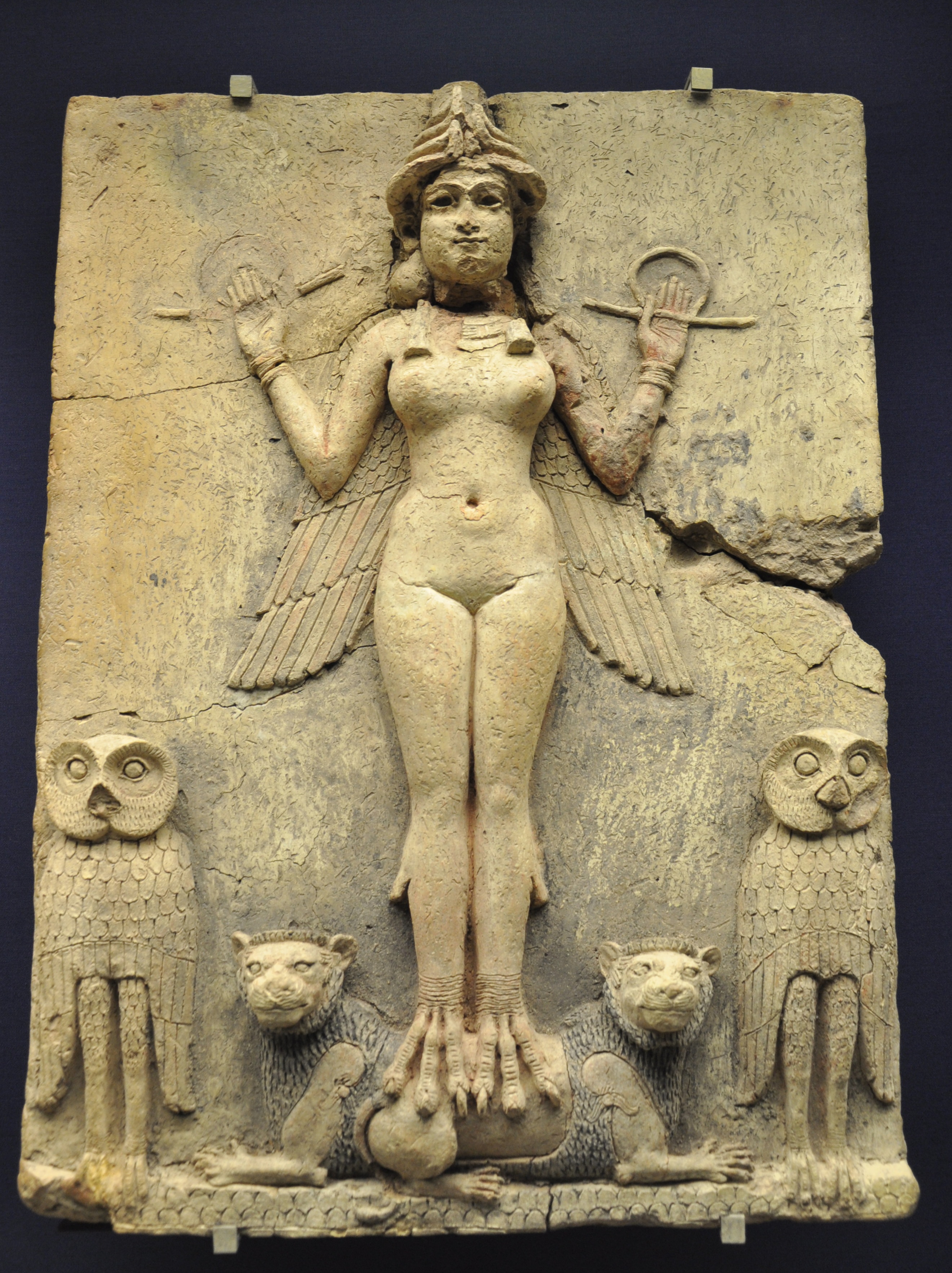
Burney Relief, Babylon (1800-1750 BCE). The figure in the relief was sometimes identified with Lilith, based on a misreading of an outdated translation of the Epic of Gilgamesh. Modern research has identified the figure as either Ishtar or Ereshkigal. https://upload.wikimedia.org/wikipedia/commons/1/19/Burney_Relief_Babylon_-1800-1750.JPG

Burney Relief, Babylon (1800-1750 BCE). The figure in the relief was sometimes identified with Lilith, based on a misreading of an outdated translation of the Epic of Gilgamesh. Modern research has identified the figure as either Ishtar or Ereshkigal.
https://upload.wikimedia.org/wikipedia/commons/1/19/Burney_Relief_Babylon_-1800-1750.JPG

 One by one, however, the attributes that had formerly attached to the older Bel were absorbed by the younger Bel of Babylon.

It was almost as it was in Greece, where the older gods were dethroned by their own offspring; in the Babylonia of Nebuchadnezzar and Nabonidos, it was the younger gods–Merodach, Sin and Samas–to whom vows were the most often made and prayer the most often ascended.

Such was the latest result of the local character of Babylonian worship: the younger gods were the gods of the younger Babylonian cities, and the god of Babylon, though he might be termed “the first-born of the gods,” was in one sense the youngest of them all.

The title, however, “first-born of the gods” was of the same nature as the other title, “prince of the world,” bestowed upon him by his grateful worshippers. It meant little else than that Babylon stood at the head of the world, and that its god must therefore be the first-born, not of one primeval deity, but of all the primeval deities acknowledged in Chaldea.

According to the earlier faith, he was the first-born of Ea only. Ea was god of the deep, both of the atmospheric deep upon which the world floats, and of that watery deep, the Okeanos of Homer, which surrounds the earth like a coiled serpent.

All streams and rivers were subject to his sway, for they flowed into that Persian Gulf which the ignorance of the primitive Chaldean imagined to be the ocean-stream itself. It was from the Persian Gulf that tradition conceived the culture and civilisation of Babylonia to have come, and Ea was therefore lord of wisdom as well as lord of the deep.

His son Merodach was the minister of his counsels, by whom the commands of wisdom were carried into practice. Merodach was thus the active side of his father Ea; to use the language of Gnosticism, he was the practical activity that emanates from wisdom.”

A.H. Sayce, Lectures on the Origin and Growth of Religion as Illustrated by the Religion of the Ancient Babylonians, 5th ed., London, 1898, p. 103-4.

E-Sagila: Temple of the Sun

“May we not conclude, then, that originally Merodach also was a solar deity, the particular Sun-god, in fact, whose worship was carried on at Babylon?

The conclusion is verified by the express testimony of the ritual belonging to Merodach’s temple E-Sagila. Here we read that

“In the month Nison, on the second day, two hours after nightfall, the priest must come and take of the waters of the river, must enter into the presence of Bel; and putting on a stole in the presence of Bel, must say this prayer:

“0 Bel, who in his strength has no equal! O Bel, blessed sovereign, lord of the world, seeking after the favour of the great gods, the lord who in his glance has destroyed the strong, lord of kings, light of mankind, establisher of faith!

0 Bel, thy sceptre is Babylon, thy crown is Borsippa, the wide heaven is the dwelling-place of thy liver. …0 lord of the world, light of the spirits of heaven, utterer of blessings, who is there whose mouth murmurs not of thy righteousness, or speaks not of thy glory, and celebrates not thy dominion?

0 lord of the world, who dwellest in the temple of the Sun, reject not the hands that are raised to thee; be merciful to thy city Babylon, to E-Sagila thy temple incline thy face; grant the prayers of thy people the sons of Babylon.”

Nothing can be more explicit than the statement that E-Sagila, the temple of Merodach, was also the temple of the Sun. We thus come to understand the attributes that are ascribed to Merodach and the language that is used of him.

He is “the light of the spirits of heaven,” even as the Son-god, … is “the illuminator of darkness” whose face is beheld by the spirits of the earth. The wide heaven is naturally his dwelling-place, and he raises the dead to life as the sun of spring revivifies the dead vegetation of winter.

The part that he plays in the old mythological poems, in the poems, that is, which embody the ancient myths and legends of Babylonia, is now fully explained. One of the most famous of these was the story of the combat between Merodach and Tiamat, the dragon of darkness and chaos.”

A.H. Sayce, Lectures on the Origin and Growth of Religion as Illustrated by the Religion of the Ancient Babylonians, 5th ed., London, 1898, pp. 100-102.

Marduk as Sun God of Babylon

Here Merodach, it will be observed, though “lord of all that exists,” is nevertheless only the first-born of the gods.

There were gods older than he, just as there were cities older than Babylon. He could not therefore be absolute lord of the world; it was only within Babylon itself that this was the case; elsewhere his rule was shared with others.

Hence it was that while Nebuchadnezzar as a native of Babylon was the work of his hands, outside Babylon there were other creators and other lords. This fact is accentuated in an inscription of Nabonidos, belonging to the earlier part of his reign, in which Merodach is coupled with the Moon-god of Ur and placed on an equal footing with him.

One of the epithets applied by Nebuchadnezzar to Merodach is that of riminu, or “merciful.” It is indeed a standing epithet of the god. Merodach was the intercessor between the gods and men, and the interpreter of the will of Ea, the god of wisdom.

In an old bilingual hymn he is thus addressed: “Thou art Merodach, the merciful lord who loves to raise the dead to life.” The expression is a remarkable one, and indicates that the Babylonians were already acquainted with a doctrine of the resurrection at an early period.

Merodach’s attribute of mercy is coupled with his power to raise the dead. The same expression occurs in another of these bilingual hymns, which I intend to discuss in a future Lecture…

“(Thou art) the king of the land, the lord of the world!

0 firstborn of Ea, omnipotent over heaven and earth.

0 mighty lord of mankind, king of (all) lands,

(Thou art) the god of gods,

(The prince) of heaven and earth who hath no rival,

The companion of Anu and Bel (Mul-lil),

The merciful one among the gods,

The merciful one who loves to raise the dead to life,

Merodach, king of heaven and earth,

King of Babylon, lord of E-Sagila,

King of E-Zida, king of E-makh-tilla (the supreme house of life),

Heaven and earth are thine!

The circuit of heaven and earth is thine,

The incantation that gives life is thine,

The breath that gives life is thine,

The holy writing of the mouth of the deep is thine:

Mankind, even the black-headed race (of Accad),

All living souls that have received a name, that exist in the world,

The four quarters of the earth wheresoever they are,

All the angel-hosts of heaven and earth

(Regard) thee and (lend to thee) an ear.”

[ … ]

A.H. Sayce, Lectures on the Origin and Growth of Religion as Illustrated by the Religion of the Ancient Babylonians, 5th ed., London, 1898, pp. 98-102.

Temple of Bel, Temple of Marduk, Temple of Babylon, E-Sagila

“He says of it:

Ka-khilibu, the gate of glory, as well as the gate of E-Zida within E-Sagila, I made as brilliant as the sun. The holy seats, the place of the gods who determine destiny, which is the place of the assembly (of the gods), the holy of holies of the gods of destiny, wherein on the great festival (Zagmuku) at the beginning of the year, on the eighth and the eleventh days (of the month), the divine king (Merodach), the god of heaven and earth, the lord of heaven, descends, while the gods in heaven and earth, listening to him with reverential awe and standing humbly before him, determine therein a destiny of long-ending days, even the destiny of my life; this holy of holies, this sanctuary of the kingdom, this sanctuary of the lordship of the first-born of the gods, the prince, Merodach, which a former king had adorned with silver, I overlaid with glittering gold and rich ornament.”

Just within the gate was the “seat” or shrine of the goddess Zarpanit, the wife of Merodach, perhaps to be identified with that Succoth-benoth whose image, we are told in the Old Testament, was made by the men of Babylon.

E-Zida, “the firmly-established temple,” was the chapel dedicated to Nebo, and derived its name from the great temple built in honour of that deity at Borsippa. As Nebo was the son of Merodach, it was only fitting that his shrine should stand within the precincts of his father’s temple, by the side of the shrine sacred to his mother Zarpanit.

It was within the shrine of Nebo, the god of prophecy, that the parakku, or holy of holies, was situated, where Merodach descended at the time of the great festival at the beginning of the year, and the divine oracles were announced to the attendant priests.

The special papakha or sanctuary of Merodach himself was separate from that of his son. It went by the name of E-Kua, “the house of the oracle,” and probably contained the golden statue of Bel mentioned by Herodotus.

Nebuchadnezzar tells us that he enriched its walls with ”glittering gold.” Beyond it rose the stately ziggurat, or tower of eight stages, called E-Temen-gurum, “the house of the foundation-stone of heaven and earth.” As was the case with the other towers of Babylonia and Assyria, its topmost chamber was used as an observatory.

This illustration depicts the dual ziggurats of E-temen-anki and the Temple of Bel, conflating them as E-Sagila, the Temple of Marduk.  http://www.dalamatiacity.com/urantia-clues23.htm

This illustration depicts the dual ziggurats of E-temen-anki and the Temple of Bel, conflating them as E-Sagila, the Temple of Marduk.
http://www.dalamatiacity.com/urantia-clues23.htm

No temple was complete without such a tower; it was to the Babylonian what the high-places were to the inhabitants of a mountainous country like Canaan. It takes us back to an age when the gods were believed to dwell in the visible sky, and when therefore man did his best to rear his altars as near to them as possible. “Let us build us a city and a tower,” said the settlers in Babel, “whose top may reach unto heaven.”

 The Babylonian Bel, accordingly, was Merodach, who watched over the fortunes of Babylon and the great temple there which had been erected in his honour. He was not the national god of Babylonia, except in so far as the city of Babylon claimed to represent the whole of Babylonia; he was simply the god of the single city of Babylon and its inhabitants.

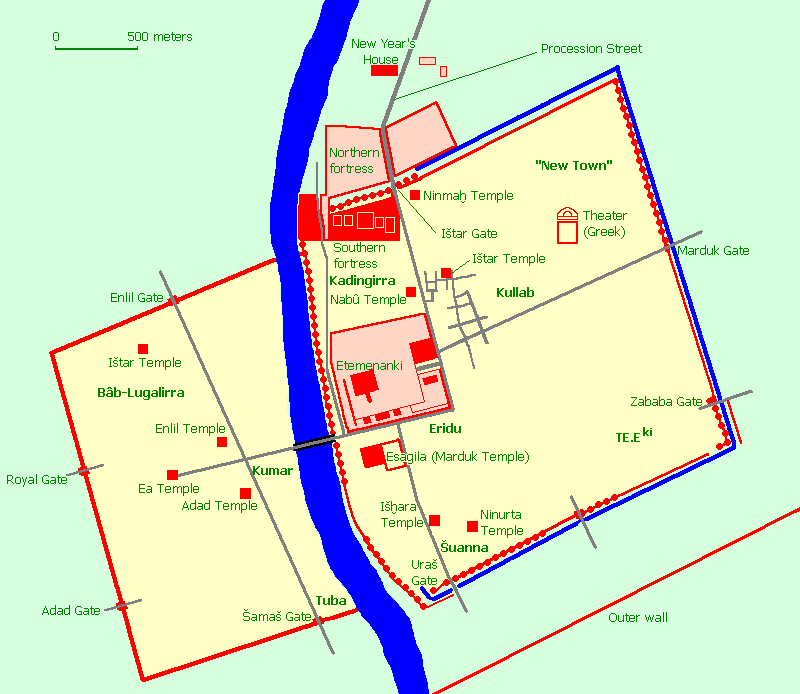
This map depicts more clearly the relative positions of Etemenanki and the Temple of Marduk.  Map of Babylon Creator Jona Lendering Licence Attribution-NonCommercial-ShareAlike 4.0 International Linked Babylon, Babylonian Empire, Capture of Babylon (Herodotus), Esagila, Etemenanki (the "Tower of Babel"), Zopyrus Categories Babylonia http://www.livius.org/pictures/a/maps/map-of-babylon/ http://www.livius.org/place/etemenanki/

This map depicts more clearly the relative positions of Etemenanki and the Temple of Marduk.
Map of Babylon
Creator
Jona Lendering
Licence
Attribution-NonCommercial-ShareAlike 4.0 International
Linked
Babylon, Babylonian Empire, Capture of Babylon (Herodotus), Esagila, Etemenanki (the “Tower of Babel”), Zopyrus
Categories
Babylonia
http://www.livius.org/pictures/a/maps/map-of-babylon/
http://www.livius.org/place/etemenanki/

He was but one Baal out of many Baalim, supreme only when his worshippers were themselves supreme. It was only when a Nebuchadnezzar or a Khammuragas was undisputed master of Babylonia that the god they adored became “the prince of the gods.”

But the other gods maintained their separate positions by his side, and in their own cities would have jealously resented any interference with their ancient supremacy. As we have seen, Nabonidos brought upon himself the anger of heaven because he carried away the gods of Marad and Kis and other towns to swell the train of Merodach in his temple at Babylon.”

 A.H. Sayce, Lectures on the Origin and Growth of Religion as Illustrated by the Religion of the Ancient Babylonians, 5th ed., London, 1898, pp. 94-7.

E-Sagila, The Great Temple of Bel in Babylon

The temple or “tomb”of Bêlos, as it was also called by the Greeks, was one of the wonders of the world.

Hêrodotos, quoting probably from an earlier author, describes it in the following terms :

“The temple of Zeus Bêlos,with bronze gates which remained up to my time, was a square building two furlongs every way. In the middle of the temple was a tower of solid masonry, a furlong in length and breadth, and upon this tower another tower had been erected, and upon that again another, and so on for eight towers.

And the ascent to them was by an incline which wound round all the towers on the outside. About the middle of the incline are a resting-place and seats, where those who ascend may sit and rest. In the topmost tower is a large shrine, within which is a large and well-appointed couch, with a golden table at its side.

But no image is set up there, nor does any one pass the night there except a single woman, a native of the country, whom the god selects for himself from among all the inhabitants, as is asserted by the Chaldeans, the priests of the god.

They further say, though I cannot believe it, that the god himself visits the shrine and takes his rest upon the couch. … There is another shrine below belonging to this Babylonian temple, and containing a great statue of Zeus [Bêlos] of gold in a sitting posture, and a great golden table is set beside it.

The pedestal and chair of the statue are of gold, and, as the Chaldeans used to say, the gold was as much as 800 talents in weight. Outside the shrine is a golden altar. There is also another great altar upon which full-grown sheep are sacrificed, for upon the golden altar only sucklings are allowed to be offered.

Upon the larger altar also the Chaldeans burn each year a thousand talents of frankincense at the time when they keep the festival of the god. In this part of the temple there was still at that time a figure of a man twelve cubits high, of solid gold.”

It is clear from this description that the great temple of Babylon resembled a large square enclosure formed by huge walls of brick, within which rose a tower in eight stages. Below the tower was a shrine or temple, and outside it two altars, the smaller one of gold for special offerings, while the larger one was intended for the sacrifice of sheep as well as for the burning of incense.

We learn a good deal about this temple from the inscriptions of Nebuchadnezzar, which show that although Hêrodotos was correct in his general description of the building, he has made mistakes in the matter of details.

The Temple itself stood on the east side of Babylon, and had existed since the age of Khammuragas (B.C. 2250), and the first dynasty which had made Babylon its capital. It bore the title of E-Sagila or E-Saggil, an Accadian name signifying “the house of the raising of the head.”

Its entrance also bore the Accadian title of Ka-khilibu, which Nebuchadnezzar renders “the gate of glory.”

 A.H. Sayce, Lectures on the Origin and Growth of Religion as Illustrated by the Religion of the Ancient Babylonians, 5th ed., London, 1898, pp. 92-4.

Marduk of Babylon: Baal

” … Nebuchadnezzar may invoke Merodach as “the lord of the gods,” “the god of heaven and earth,” “the eternal, the holy, the lord of all things,” but he almost always couples him with other deities–Nebo, Sin or Gula–of whom he speaks in equally reverential terms.

Even Nabonidos uses language of Sin, the Moon-god, which is wholly incompatible with a belief in the exclusive supremacy of Merodach. He calls him “the lord of the gods of heaven and earth, the king of the gods and the god of gods, who dwell in heaven and are mighty.” Merodach was, in fact, simply the local god of Babylon.

Events had raised Babylon first to the dignity of the capital of Babylonia, and then of that of a great empire, and its presiding deity had shared its fortunes. It was he who had sent forth its people on their career of conquest; it was to glorify his name that he had given them victory.

The introduction of other deities on an equal footing with himself into his own peculiar seat, his own special city, was of itself a profanation, and quite sufficient to draw upon Nabonidos his vindictive anger. The Moon-god might be worshipped at Ur; it was out of place to offer him at Babylon the peculiar honours which were reserved for Merodach alone.

Here, then, is one of the results of that localisation of religious worship which was characteristic of Babylonia. Nabonidos not only offended the priests and insulted the gods of other cities by bringing their images into Babylon, he also in one sense impaired the monopoly which the local deity of Babylon enjoyed. He thus stirred up angry feelings on both sides.

Had he himself been free from the common belief of the Babylonian in the local character of his gods, he might have effected a revolution similar to that of Hezekiah; he had, however, the superstition which frequently accompanies antiquarian instincts, and his endeavour to make Babylon the common gathering-place of the Babylonian divinities was dictated as much by the desire to make all of them his friends as by political design.

Now who was this Merodach, this patron-god of Babylon, whose name I have had so often to pronounce? Let us see, first of all, what we can learn about him from the latest of our documents, the inscriptions of Nebuchadnezzar and his successors.

In these, Merodach appears as the divine protector of Babylon and its inhabitants. He has the standing title of Bilu or “lord,” which the Greeks turned into βμλος, and which is the same as the Baal of the Old Testament. The title is frequently used as a name, and is, in fact, the only name under which Merodach was known to the Greeks and Romans.

In the Old Testament also it is as Bel that he comes before us. When the prophet declares that “Bel boweth down” and is “gone into captivity,” he is referring to Merodach and the overthrow of Merodach’s city.

To the Babylonian, Merodach was pre-eminently the Baal or “lord,” like the Baalim or “lords” worshipped under special names and with special rites in the several cities of Canaan.”

 A.H. Sayce, Lectures on the Origin and Growth of Religion as Illustrated by the Religion of the Ancient Babylonians, 5th ed., London, 1898, pp. 90-2.

Civil Centralization = Religious Centralization

“Up to the last, Babylonian religion remained local. It was this local character that gives us the key to its origin and history, and explains much that would otherwise seem inconsistent and obscure.

The endeavour of Nabonidos to undermine its local character and to create a universal religion for a centralised Babylonia, was deeply resented by both priests and people, and ushered in the fall of the Babylonian empire. The fundamental religious idea which had underlain the empire had been the supremacy of Merodach, the god of Babylon, over all other gods, not the absorption of the deities of the subject nations into a common cult.

The policy of Nabonidos, therefore, which aimed at making Merodach, not primus inter pares, but absolute lord of captive or vassal deities, shocked the prejudices of the Babylonian people, and eventually proved fatal to its author.

In Cyrus, accordingly, the politic restorer of the captive populations and their gods to their old homes, the priests and worshippers of the local divinities saw the pious adherent of the ancient forms of faith, and the real favourite of Merodach himself.

Merodach had not consented to the revolutionary policy of Nabonidos; he had, on the contrary, sympathised with the wrongs of his brother gods in Babylonia and throughout the world, and had thus deserted his own city and the renegade monarch who ruled over it.

In all this there is a sharp contrast to the main religious conception which subsequently held sway over the Persian empire, as well as to that which was proclaimed by the prophets of Judah, and in the reforms of Hezekiah and Josiah was carried out practically by the Jewish kings. The Ahura-mazda whom Dareios invokes on the rock of Behistun is not only the lord of the gods, he is a lord who will not brook another god by his side.

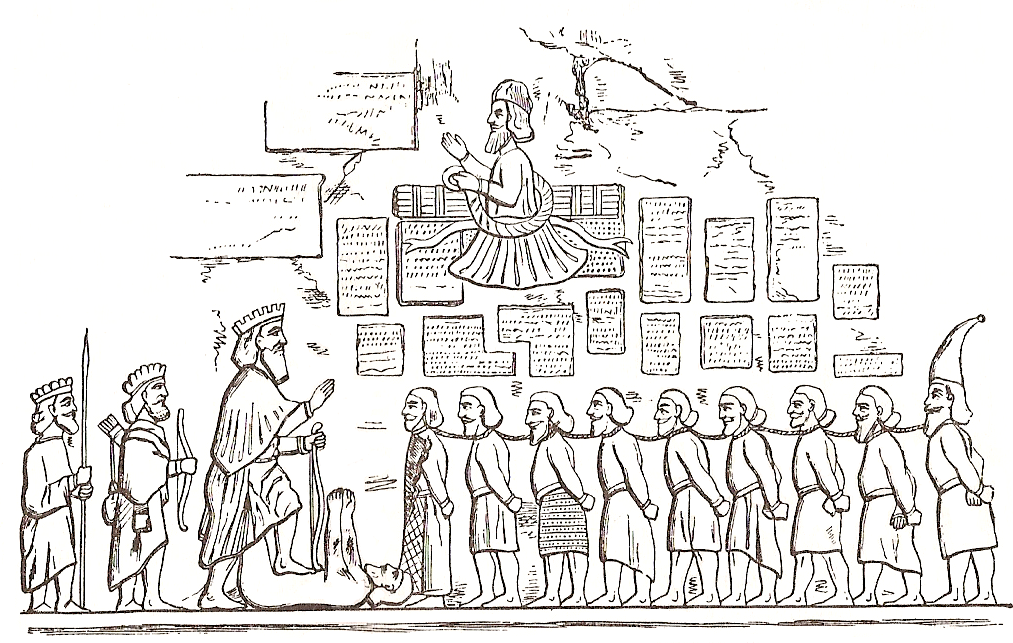
A penciled illustration of the Behistun Inscription.  https://commons.wikimedia.org/wiki/File:Behistun_Inscription_Eger.png

A penciled illustration of the Behistun Inscription.
https://commons.wikimedia.org/wiki/File:Behistun_Inscription_Eger.png

The supreme god of the Persian monarch is as absolute as the Persian monarch himself. In the Persian empire which was organised by Dareios, centralisation became for the first time a recognised and undisputed fact, and political centralisation went hand-in-hand with religious centralisation as well.

In Judah, a theocracy was established on the ruins of the old beliefs which had connected certain localities with certain forms of divinity, and which found such naive expression in the words of David to Saul (1 Samuel xxvi. 19): “They have driven me out this day from abiding in the inheritance of the Lord, saying, Go, serve other gods.”

The destruction of the high-places and the concentration of the worship of Yahveh in Jerusalem, was followed by the ever-increasing conviction that Yahveh was not only a jealous God who would allow none other gods besides Himself; He was also a God who claimed dominion over the whole world.”

A.H. Sayce, Lectures on the Origin and Growth of Religion as Illustrated by the Religion of the Ancient Babylonians, 5th ed., London, 1898, pp. 89-90.

The Fall of Nabonidos

“The destruction of the local cults, the attempt to unify and centralise religious worship, was to the Rab-shakeh, as it was to the Babylonian scribes, and doubtless also to many of the Jews in the time of Hezekiah, an act of the grossest impiety.

An annalistic tablet, drawn up not long after the conquest of Babylonia by Cyrus, hints that before making his final attack on the country, the Elamite prince had been secretly aided by a party of malcontents in Chaldea itself.

It is at all events significant that as soon as the army of Nabonidos was defeated, the whole population at once submitted, and that even the capital, with its almost impregnable fortifications, threw open its gates.

The revolts which took place afterwards in the reigns of Dareios and Xerxes, and the extremities endured by the Babylonians before they would surrender their city, prove that their surrender was not the result of cowardice or indifference to foreign rule. The great mass of the people must have been discontented with Nabonidos and anxious for his overthrow.

The anger of Merodach and the gods, in fact, was but a convenient way of describing the discontent and anger of an important section of the Babylonians themselves. Nabonidos did not belong to the royal house of Nebuchadnezzar; he seems to have raised himself to the throne by means of a revolution, and his attempt at centralisation excited strong local animosities against him.

Religion and civil government were so closely bound up together, that civil centralisation meant religious centralisation also; the surest sign that the cities of Babylonia had been absorbed in the capital was that the images of the gods whose names had been associated with them from time immemorial were carried away to Babylon. The cities lost their separate existence along with the deities who watched over their individual fortunes.

The removal of the gods, however, implied something more than the removal of a number of images and the visible loss of local self-government or autonomy. Each image was the centre of a particular cult, carried on in a particular temple in a particular way, and entrusted to the charge of a special body of priests.

It was no wonder, therefore, that the high-handed proceedings of Nabonidos aroused the enmity of these numerous local priesthoods, as well as of all those who profited in any way from the maintenance of the local cults.

Most of the cities which were thus deprived of their ancestral deities were as old as Babylon; many of them claimed to be older; while it was notorious that Babylon did not become a capital until comparatively late in Babylonian history.

The Sun-god of Sippara, the Moon-god of Ur, were alike older than Merodach of Babylon. Indeed, though in the age of Nabonidos the title of Bel or “lord”had come to be applied to Merodach specially, it was known that there was a more ancient Bel–Belitanas, “the elder Bel,” as the Greeks wrote the word–whose worship had spread from the city of Nipur, and who formed one of the supreme triad of Babylonian gods.”

A.H. Sayce, Lectures on the Origin and Growth of Religion as Illustrated by the Religion of the Ancient Babylonians, 5th ed., London, 1898, pp. 85-6.

The Rise of Marduk

“In an inscription upon a clay cylinder brought from Babylonia seven years ago, Cyrus is made to declare that the overthrow of Nabonidos, the last independent Babylonian monarch, was due to the anger of Bel and the other gods.

Nabonidos had removed their images from their ancient sanctuaries, and had collected them together in the midst of Babylon. The priests maintained that the deed had aroused the indignation of Merodach, “the lord of the gods,” who had accordingly rejected Nabonidos, even as Saul was rejected from being king of Israel, and had sought for a ruler after his own heart.

It was “in wrath” that the deities had ”left their shrines when Nabonidos brought them into Babylon,” and had prayed Merodach, the divine patron of the imperial city, to “go round unto all men wherever might be their seats.”

Merodach sympathised with their wrongs; “he visited the men of Sumer and Accad whom he had sworn should be his attendants,” and “all lands beheld his friend.” He chose Cyrus, king of Elam, and destined him by name for the sovereignty of Chaldea.

Cyrus, whom the Hebrew prophet had already hailed as the Lord’s Anointed, was thus equally the favourite of the supreme Babylonian god.

“Merodach, the great lord, the restorer of his people,” we are told, “beheld with joy the deeds of his vicegerent who was righteous in hand and heart. To his city of Babylon he summoned his march, and he bade him take the road to Babylon; like a friend and a comrade he went at his side.”

A single battle decided the conflict: the Babylonians opened their gates, and “without fighting or battle,” Cyrus was led in triumph into the city of Babylon.

His first care was to show his gratitude towards the deities who had so signally aided him. Their temples were rebuilt, and they themselves were restored to their ancient seats.

With all the allowance that must be made for the flattery exacted by a successful conqueror, we must confess that this is a very remarkable document. It is written in the Babylonian language and in the Babylonian form of the cuneiform syllabary, and we may therefore infer that it was compiled by Babylonian scribes and intended for the perusal of Babylonian readers.

Yet we find the foreign conqueror described as the favourite of the national god, while the last native king is held up to reprobation as the dishonorer of the gods. It is impossible not to compare the similar treatment experienced by Nebuchadnezzar and the native Jewish kings respectively at the hands of Jeremiah.

The Jewish prophet saw in the Chaldean invader the instrument of the God of Judah, just as the Babylonian scribes saw in Cyrus the instrument of the god of Babylon; and the fall of the house of David is attributed, just as much as the fall of Nabonidos, to divine anger.”

A.H. Sayce, Lectures on the Origin and Growth of Religion as Illustrated by the Religion of the Ancient Babylonians, 5th ed., London, 1898, pp. 85-6.

Sacred Number 7

“Seven, too, was a sacred number, whose magic virtues had descended to the Semites from their Accadian predecessors. When the Chaldaean Noah escaped from the Deluge, his first act was to build an altar and to set vessels, each containing the third of an ephah, by sevens, over a bed of reeds, pine-wood and thorns.

Seven by seven had the magic knots to be tied by the witch, seven times had the body of the sick man to be anointed with the purifying oil.

As the Sabbath of rest fell on each seventh day of the week, so the planets, like the demon messengers of Anu, were seven in number, and “the god of the number seven” received peculiar honour.”

A.H. Sayce, Lectures on the Origin and Growth of Religion as Illustrated by the Religion of the Ancient Babylonians, 5th ed., London, 1898, p. 82.

Sacrifice of Children was a Babylonian Institution

” … But although the Assyrian kings are fond of boasting of their exploits in massacring or torturing their defeated enemies in honour of Assur, we find no allusions in the inscriptions of the historical period to human sacrifice.

That human sacrifices, however, were known as far back as the Accadian era, is shown by a bilingual text (K5139) which enjoins the abgal, or “chief prophet,” to declare that the father must give the life of his child for the sin of his own soul, the child’s head for his head, the child’s neck for his neck, the child’s breast for his breast.

The text not only proves that the idea of vicarious punishment was already conceived of; it also proves that the sacrifice of children was a Babylonian institution.

In the great work on astronomy called The Observations of Bel, we are told that “on the high-places the son is burnt.” The offering was consequently by fire, as in Phoenicia.

The sacrifices were accompanied, sometimes by hymns or incantations, sometimes by prayers. The prayers were all prescribed, and a large number of them have been preserved.”

A.H. Sayce, Lectures on the Origin and Growth of Religion as Illustrated by the Religion of the Ancient Babylonians, 5th ed., London, 1898, p. 78.

The Etymology of the Name “Moses”

“Josephos has preserved an extract from the Egyptian historian Manetho, which relates the Egyptian version of the story of the Exodus as it was told in the second century before our era. In this it is stated that the earlier name of Moses was Osarsiph, and that he had been priest of Heliopolis or On.

Here it is evident that Moses and Joseph have been confounded together. The name of Joseph, who married the daughter of the priest of On, has been decomposed into two elements, the first of which is the divine name Jeho, and this has been changed into its supposed Egyptian equivalent Osar or Osiris.

It is clear that, whatever might have been his opinion about the name of Joseph, Manetho had no doubt that that of Moses was purely Israelitish. It was not until he had become the Israelitish lawgiver and had ceased to be an Egyptian priest that Osarsiph took the name of Moses.

But Moses finds no satisfactory etymology in the pages of the Hebrew lexicon. It stands alone among Hebrew proper names, like Aaron and David. We do not hear of any other persons who have borne the name. If, therefore, it is Semitic, it must belong to an older stratum of Semitic nomenclature than that preserved to us in the Old Testament. We must look to other branches of the Semitic stock for its explanation.

There is only one other branch of the Semitic family whose records are earlier than those of the Hebrews. Arabic literature begins long after the Christian era, when Jewish and Greek and even Christian names and ideas had penetrated into the heart of the Arabian peninsula.

The Arabic language, moreover, belongs to a different division of the Semitic family of speech from that to which Hebrew belongs. To compare Arabic and Hebrew together is like comparing Latin with modern German. There is, however, one Semitic language which has the closest affinities to Hebrew, and this is also the language of which we possess records older than those of the Hebrew Scriptures. I need hardly say that I am referring to Assyrian.

Now the Assyrian equivalent of the Hebrew Mosheh, “Moses,” would be mâsu, and, as it happens, mâsu is a word which occurs not unfrequently in the inscriptions. It was a word of Accadian origin, but since the days of Sargon of Accad had made itself so thoroughly at home in the language of the Semitic Babylonians as to count henceforth as a genuinely Semitic term.

Mâsu signified as nearly as possible all that we mean by the word “hero.” As such, it was an epithet applied to more than one divinity; there was one god more especially for whom it became a name.

This god was the deity sometimes called Adar by Assyrian scholars, sometimes Nin-ip, but whose ordinary name among the Assyrians is still a matter of uncertainty. He was a form of the Sun-god, originally denoting the scorching sun of mid-day. He thus became invested with the sterner attributes of the great luminary of day, and was known to his worshippers as “the warrior of the gods.”

The title of Mâsu, however, was not confined to Adar. It was given also to another solar deity, Merodach, the tutelar god of Babylon and the antagonist of the dragon of chaos, and was shared by him with Nergal, whose special function it was to guard and defend the world of the dead.

But Nergal himself was but the sun of night, the solar deity, that is to say, after he had accomplished his daily work in the bright world above and had descended to illuminate for a time the world below.”

A.H. Sayce, Lectures on the Origin and Growth of Religion as Illustrated by the Religion of the Ancient Babylonians, 5th ed., London, 1898, pp. 45-7.

Commonalities Between Sargon and Moses

” … I will conclude this Lecture with a few illustrations of the extent to which the study of Babylonian religion may be expected to throw light on the earlier portions of Scripture. We have already noticed the curious parallelism which exists between the legend of Sargon’s exposure in an ark of bulrushes and the similar exposure of the great Israelitish leader Moses on the waters of the Nile.

The parallelism exists even further than this common account of their infancy. Sargon of Accad was emphatically the founder of Semitic supremacy in Babylonia; he was the great lawgiver of Babylonian legend; and to him was assigned the compilation of those works on astrology and augury from which the wise men of the Chaldeans subsequently derived their lore.

Moses was equally the legislator of the Israelites and the successful vindicator of Semitic independence from the exactions of Egyptian tyranny, and future generations quoted the books of the Hebrew law under his name.

As we have seen, Sargon was a historical personage, and popular tradition merely treated him as it has treated other heroes of the past, by attaching to him the myths and legends that had once been told of the gods.

Now the name of the great Hebrew legislator has long been a puzzle and a subject of dispute. In the Hebrew Old Testament it is connected with the Hebrew verb mashâh, “to draw out,” not, indeed, in the sense that Moses was he who had been drawn out of the water, for this would not be grammatically permissible, though Pharaoh’s daughter puns upon the idea (Exod. ii. 10), but in the sense of a leader who had drawn his people out of the house of bondage and led them through the waves of the sea.

The translators of the Septuagint, on the other hand, living as they did in Egypt, endeavoured to give the word an Egyptian form and an Egyptian etymology. With them the name is always Μωυσης, which Josephos tells us is derived from the Egyptian words , “water,” and usês, “saved from the water.”

But this etymology, apart from other imperfections, depends upon the change the translators of the Septuagint have themselves made in the pronunciation of the name.

Modern Egyptian scholars, equally willing to find for it an Egyptian derivation, have had recourse to the Egyptian messu or mes, “a son.” This word, it is true, when occurring in proper names is usually combined with the name of a deity; Rameses, for example, the Sesostris of the Greeks, being written in the hieroglyphics Ra-messu, “Lord of the Sun-god.”

But it is conceivable that we might occasionally meet with it alone, and it is also conceivable, though not very probable, that the daughter of the Egyptian king would assign to her adopted child the simple name of “son.”

It is much less conceivable that such an Egyptian name would be that by which a national hero would be afterwards known to his Semitic countrymen. It is difficult to believe that the founder of the Israelitish people would have borne a title which the Israelites did not understand, and which could remind them only of that hated Egyptian land wherein they had been slaves.”

A.H. Sayce, Lectures on the Origin and Growth of Religion as Illustrated by the Religion of the Ancient Babylonians, 5th ed., London, 1898, pp. 43-5.

Tracing Religious Ideas from Babylon to Judaism

“But it was not only through the Babylonian exile that the religious ideas of the Babylonian and the Jew came into contact with each other. It was then, indeed, that the ideas of the conquering race–the actual masters of the captives, who had long been accustomed to regard Babylonia as the home of a venerable learning and culture–were likely to make their deepest and most enduring impression; it was then, too, that the Jew for the first time found the libraries and ancient literature of Chaldea open to his study and use.

But old tradition had already pointed to the valley of the Euphrates as the primeval cradle of his race. We all remember how Abraham, it is said, was born in Ur of the Chaldees, and how the earlier chapters of Genesis make the Euphrates and Tigris two of the rivers of Paradise, and describe the building of the Tower of Babylon as the cause of the dispersion of mankind.

Now the Hebrew language was the language not only of the Israelites, but also of those earlier inhabitants of the country whom the Jews called Canaanites and the Greeks Phoenicians. Like the Israelites, the Phoenicians held that their ancestors had come from the Persian Gulf and the alluvial plain of Babylonia.

The tradition is confirmed by the researches of comparative philology. Many of the words which the Semites have in common seem to point to the neighbourhood of Babylonia as the district from which those who used them originally came, and where they called the fauna and flora of the country by common names.

Their first home appears to have been in the low-lying desert which stretches eastward of Chaldea–on the on the very side of the Euphrates, in fact, on which stood the great city of Ur, the modern Mugheir.

Here they led a nomad life, overawed by the higher culture of the settled Accadian race, until a time came when they began to absorb it themselves, and eventually, as we have seen, to dispossess and supersede their teachers.

The tribes which travelled northward and westward must, we should think, have carried with them some of the elements of the culture they had learnt from their Accadian neighbors. And such, indeed, we find to be the case.

The names of Babylonian deities meet us again in Palestine and the adjoining Semitic lands. Nebo, the Babylonian god of prophecy and literature, has given his name to towns that stood within the territories of Reuben and Judah, as well as to the Moabite mountain on which Moses breathed his last; Anu, the Babylonian god of heaven, and his female consort Anatu, re-appear in Beth-Anath, “the temple of Anatu,” and Anathoth, the birth-place of Jeremiah; and Sinai itself is but the mountain of Sin, the Babylonian Moon-god.

We may thus assume that there were two periods in the history of the Jewish people in which they came under the influence of the religious conceptions of Babylonia. There was the later period of the Babylonish exile, when the influence was strong and direct; there was also the earlier period, when the amount of influence is more hard to determine.

Much will depend upon the view we take of the age of the Pentateuch, and of the traditions or histories embodied therein. Some will be disposed to see in Abraham the conveyer of Babylonian ideas to the west; others will consider that the Israelites made their first acquaintance with the gods and legends of Babylonia through the Canaanites and other earlier inhabitants of Palestine.

Those who incline to the latter belief may doubt whether the fathers of the Canaanitish tribes brought the elements of their Babylonian beliefs with them from Chaldea, or whether these beliefs were of later importation, due to the western conquests of Sargon and his successors.”

A.H. Sayce, Lectures on the Origin and Growth of Religion as Illustrated by the Religion of the Ancient Babylonians, 5th ed., London, 1898, pp. 41-3.

The Influence of Babylonian Religion on Judaism

“But, it will be asked, what interest can the religions of Babylonia and Assyria have for us, much more an inquiry into their nature and origin? They have long since perished, like the people who professed them, and have left no apparent traces of their influence upon the nations about whom we know and care most.

The Greeks and Romans concerned themselves so little with these Eastern barbarians as neither to read nor to preserve the only Greek history of Chaldaea (ed. note: referring to Berossus) which was written by a native and professed to be derived from native accounts; we owe the fragments we have of it to the apologetic zeal of Christian controversialists.

Still less would it appear that these old people of Babylonia and Assyria can have had any influence upon the world of to-day, or have served to mould the ideas and the society of modern Europe. Such questions may be asked, and until lately it would have been hard to answer them.

And yet a moment’s consideration might have shown that there was one nation at all events which has exercised, and still exercises, a considerable intluence upon our own thought and life, and which had been brought into close contact with the religion and culture of Babylonia at a critical epoch in its history.

The influence of Jewish religion upon Christianity, and consequently upon the races that have been moulded by Christianity, has been lasting and profound. Now Jewish religion was intimately bound up with Jewish history, more intimately perhaps than has been the case with any other great religion of the world.

It took its colouring from the events that marked the political life of the Hebrew people; it developed in unison with their struggles and successes, their trials and disappointments. Its great devotional utterance, the Book of Psalms, is national, not individual; the individual in it has merged his own aspirations and sufferings into those of the whole community.

The course of Jewish prophecy is equally stamped with the impress of the national fortunes. It grows clearer and more catholic as the intercourse of the Jewish people with those around them becomes wider; and the lesson is taught at last that the God of the Jews is the God also of the whole world.

Now the chosen instruments for enforcing this lesson, as we are expressly told, were the Assyrian and the Babylonian. The Assyrian was the rod of God’s anger, while the Babylonish exile was the bitter punishment meted out to Judah for its sins.

The captives who returned again to their own land came back with changed hearts and purified minds; from henceforward Jerusalem was to be the unrivalled dwelling-place of “the righteous nation which keepeth the truth.”

Apart, therefore, from any influence which the old religious beliefs of Babylonia may have had upon the Greeks, and which, as we shall see, was not so wholly wanting as was formerly imagined, their contact with the religious conceptions of the Jewish exiles must, to say the least, have produced an effect which it is well worth our while to study.

Hitherto, the traditional view has been that this effect exhibited itself wholly on the antagonistic side; the Jews carried nothing away from the land of their captivity except an intense hatred of idolatry, more especially Babylonian, as well as of the beliefs and practices associated therewith.

Now and then, it is true, some bold spirit, like Bishop Warburton, may have ventured to propound the paradox that the doctrine of the resurrection was first learnt by the Jews in Babylonia, but it was treated generally as a paradox, and of late years, if admitted at all, was considered a proof of the influence not of the Babylonians but of their Persian conquerors.”

A.H. Sayce, Lectures on the Origin and Growth of Religion as Illustrated by the Religion of the Ancient Babylonians, 5th ed., London, 1898, pp. 38-40.

Diorite Statues

“The land of Magána was already known to the inhabitants of Babylonia. The earliest Chaldaean monuments yet discovered are those which have been excavated at Tel-loh in southern Chaldaea by a Frenchman, M. de Sarzec, and are now deposited in the Louvre.

Some of them go back almost to the very beginnings of Chaldaean art and cuneiform writing. Indeed, the writing is hardly yet cuneiform; the primitive pictorial forms of many of the characters are but thinly disguised, and the vertical direction they originally followed, like Chinese, is still preserved.

The language and art alike are Proto-Chaldaean: there is as yet no sign that the Semite was in the land. Among the monuments are seated figures carved out of stone. The stone in several instances is diorite, a stone so hard that even the modern workman may well despair of chiselling it into the lineaments of the human form.

Seated diorite statue of Gudea, prince of Lagash, dedicated to the god Ningishzida, neo-Sumerian period. Marie-Lan Nguyen (2011) https://en.wikipedia.org/wiki/Statues_of_Gudea#/media/File:Gudea_of_Lagash_Girsu.jpg

Seated diorite statue of Gudea, prince of Lagash, dedicated to the god Ningishzida, neo-Sumerian period.
Marie-Lan Nguyen (2011)
https://en.wikipedia.org/wiki/Statues_of_Gudea#/media/File:Gudea_of_Lagash_Girsu.jpg

Now an inscription traced upon one of the figures tells us that the stone was brought from the land of Magan. Already, therefore, before the time of Sargon and the rise of Semitic supremacy and civilisation, the peninsula of Sinai was not only known to the inhabitants of Chaldaea, but blocks of stone were transported from it to the stoneless plain of Babylonia, and there made plastic under the hand of the sculptor.

I have already alluded to the fact that the quarries of Sinai had been known to the Egyptians and worked by them as early as the epoch of the Third Dynasty, some 6000 years ago. Is it more than a coincidence that one of the most marvellous statues in the world, and the chief ornament of the Museum of Bulâq, is a seated figure of king Khephrên of the Fourth Dynasty, carved out of green diorite, like the statues of Tel-loh, and representing the monarch in almost the same attitude?

 Statue of Khafre in diorite. Valley Temple of Khafra, Giza. Egyptian Museum, Cairo.  Main floor - room 42. Diorite: height 168 cm, width 57 cm, depth 96 cm. JE 10062 - CG 14. https://en.wikipedia.org/wiki/Khafra#/media/File:Khafre_statue.jpg Jon Bodsworth - http://www.egyptarchive.co.uk/html/cairo_museum_10.html


Statue of Khafre in diorite. Valley Temple of Khafra, Giza. Egyptian Museum, Cairo.
Main floor – room 42. Diorite: height 168 cm, width 57 cm, depth 96 cm. JE 10062 – CG 14.
https://en.wikipedia.org/wiki/Khafra#/media/File:Khafre_statue.jpg
Jon Bodsworth – http://www.egyptarchive.co.uk/html/cairo_museum_10.html

The Babylonian work is ruder than the Egyptian work, it is true; but if we place them side by side, it is hard to resist the conviction that both belong to the same school of sculpture, and that the one is but a less skilful imitation of the other.

The conviction grows upon us when we find that diorite is as foreign to the soil of Egypt as it is to that of Babylonia, and that the standard of measurement marked upon the plan of the city, which one of the figures of Tel-loh holds upon his lap, is the same as the standard of measurement of the Egyptian pyramid-builders–the kings of the fourth and two following dynasties.

 Egyptian research has independently arrived at the conclusion that the pyramid-builders were at least as old as the fourth millennium before the Christian era. Thc great pyramids of Gizeh were in course of erection, the hieroglyphic system of writing was already fully developed, Egypt itself was thoroughly organised and in the enjoyment of a high culture and civilisation, at a time when, according to Archbishop Usher’s chronology, the world was being created.

The discoveries at Tel-loh have revealed to us a corresponding period in the history of Babylonia, earlier considerably than the age of Sargon of Accad, in which we seem to find traces of contact between Babylonia and the Egyptians of the Old Empire.

It would even seem as if the conquests of Naram-Sin in Sinai were due to the fall of the Sixth Dynasty and the overthrow of the power of the old Egyptian empire. For some centuries after that event Egypt is lost to history, and its garrisons and miners in the Sinai peninsula must have been recalled to serve against enemies nearer home.”

A.H. Sayce, Lectures on the Origin and Growth of Religion as Illustrated by the Religion of the Ancient Babylonians, 5th ed., London, 1898, pp. 31-4.

More on Sargon

“But in spite of the atmosphere of myth which came to enshroud him, as it enshrouded the persons of Kyros, of Charlemagne, and of other heroes of popular history, Sargon was a historical monarch and the founder of a really great empire.

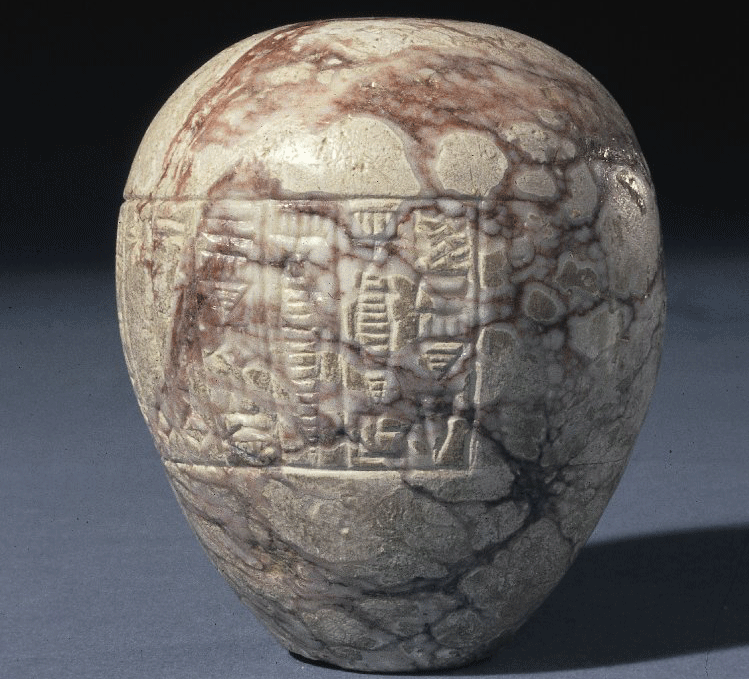
The British Museum actually possesses an inscribed egg of veined marble which he dedicated to the Sun-god of Sippara (ed note: Shamash), and the seal of his librarian Ibni-sarru is in the hands of M. Le Clercq of Paris. What may be termed the scientific literature of the library of Nineveh makes frequent reference to him, and we learn that it was for the great library which he established in his capital city of Accad that the two standard Babylonian works on astronomy and terrestrial omens were originally compiled.

Sargon's inscribed egg for the Sun God Shamash at Sippara in the British Museum.

Sargon’s inscribed egg for the Sun God Shamash at Sippara in the British Museum.

 The work on astronomy was entitled The Observations of Bel, and consisted of no less than seventy-two books, dealing with such matters as the conjunction of the sun and moon, the phases of Venus, and the appearances of comets.

It was translated in later days into Greek by the historian Berossus and though supplemented by numerous additions in its passage through the hands of generations of Babylonian astronomers, the original work contained so many records of eclipses as to demonstrate the antiquity of Babylonian astronomy even in the remote age of Sargon himself.

But besides our knowledge of Sargon’s patronage of learning, we also know something about the civil history of his reign. A copy of its annals has come down to us. We gather from these that he was not only successful in overthrowing all opposition at home, he was also equally successful abroad.

His first campaign was against the powerful kingdom of Elam in the East, where he overthrew the enemy and mutilated their slain. Next he turned to the West, laying his yoke on Syria, and subjugating “the four quarters” of the world. Then the rival kings of Babylon and other Chaldean cities felt his power; and out of the spoil of the vanquished he built the city of Accad and gave it its name.

From this time forward his attention was chiefly devoted to the West. Year after year he penetrated into Syria, until at last, we are told, “he had neither equal nor rival;” he crossed the Mediterranean to the island we now call Cyprus, and “in the third year,” at the bounds of the setting sun, his hands conquered all peoples and his mouth decreed a single empire.

Here on the shores of Cyprus the great conqueror erected images of himself, and then carried the booty of the island to the opposite coast of Asia. Such a glimpse into the history of what became afterwards a Grecian sea, when as yet no Greeks had made their ray to their later home, is startling to those whose conceptions of authentic history have been limited by the narrow horizon of the classical world. Its trustworthiness, however, has been curiously verified by a discovery made by General de Cesnola in the treasure-vaults of a Kyprian temple among the ruins of the ancient Kurion.

A god in horned cap brandishes a mace and the forked lightening of Iva-Vul, Thunder God, and sets foot on a recumbent bull.  Behind him is a leaping ibex. In front, a man, perhaps the king, in a short coat, standing full face. Behind him a man on bended knee, possibly the owner of the cylinder. Above him, a small deer is recumbent and inverted.  Then a figure in a long garment, and 3 rows of cuneiform writing:  "Arba Istar: son of Ibu Beled: servant of the god Naram-Sin."  The king Naram-Sin, to whom a divine determinative prefix is given here, reigned in Babylonia no later than 2600 BCE.  Cyprus, plate 4300.  John L. Myres, Handbook of the Cesnola Collection of Antiquities from Cyprus, 1914.

A god in horned cap brandishes a mace and the forked lightening of Iva-Vul, Thunder God, and sets foot on a recumbent bull.
Behind him is a leaping ibex. In front, a man, perhaps the king, in a short coat, standing full face. Behind him a man on bended knee, possibly the owner of the cylinder. Above him, a small deer is recumbent and inverted.
Then a figure in a long garment, and 3 rows of cuneiform writing:
“Arba Istar: son of Ibu Beled: servant of the god Naram-Sin.”
The king Naram-Sin, to whom a divine determinative prefix is given here, reigned in Babylonia no later than 2600 BCE.
Cyprus, plate 4300.
John L. Myres, Handbook of the Cesnola Collection of Antiquities from Cyprus, 1914.

Here, among other hematite cylinders of early Babylonian origin, he found one the first owner of which describes himself as a ” servant” or ”worshipper” of “the deified Naram- Sin.” Naram-Sin was the son and successor of Sargon, and it is not likely that he would have received divine honours after the fall of the dynasty to which he belonged.

The fact that the cylinder was discovered in Cyprus seems to show that even after Sargon’s death a connection continued to exist between Cyprus and the imperial power of Babylonia. Naram-Sin, however, was more bent on the conquest of Magána, or the Sinaitic Peninsula, than upon further campaigns in the West.

Sinai, with its mines of turquoise and copper, had been a prize coveted by the Egyptians ever since the age of the Third Dynasty, and one of the first efforts of the rising rival power on the banks of the Euphrates was to gain possession of the same country.

Naram-Sin, so runs the annalistic tablet, “marched to the land of Magána; the land of Magána he conquered, and overcame its king.”

A.H. Sayce, Lectures on the Origin and Growth of Religion as Illustrated by the Religion of the Ancient Babylonians, 5th ed., London, 1898, pp. 29-31.

Sargon

“Sargon himself was a monarch whom both Accadian and Semite delighted to honour. Myths surrounded his infancy as they surrounded the infancy of Kyros, and popular legend saw in him the hero-prince who had been deserted in childhood and brought up among squalid surroundings, until the time came that he should declare himself in his true character and receive his rightful inheritance.

He was born, it was said, of an unknown father; as Mars had wooed the mother of the founder of Rome, so some god whom later tradition feared to name had wooed the mother of the founder of the first Semitic empire. She brought forth her first-born “in a secret place” by the side of the Euphrates, and placed him in a basket of rushes which she daubed with bitumen and entrusted to the waters of the river.

The story reminds us of Perseus launched upon the sea with his mother Danae in a boat, of Romulus and Remus exposed to the fury of the Tiber, and still more of Moses in his ark of bulrushes upon the Nile. The Euphrates refused to drown its future lord, and bore the child in safety to Akki “the irrigator,” the representative of the Accadian peasants who tilled the laud for their Semitic masters. In this lowly condition and among a subjugated race Sargon was brought up.

Akki took compassion on the little waif, and reared him as if he had been his own son. As he grew older he was set to till the garden and cultivate the fruit-trees, and while engaged in this humble work attracted the love of the goddess Istar.

Then came the hour of his deliverance from servile employment, and, like David, he made his way to a throne. For long years he ruled the black-headed race of Accad; he rode through subjugated countries in chariots of bronze, and crossed the Persian Gulf to the sacred isle of Dilmun.

The very name the people gave him was a proof of his predestined rise to greatness. Sargon was not his real title. This was Sarganu, which a slight change of pronunciation altered into Sargina, a word that conveyed the meaning of “constituted” or “predestined” “king” to his Accadian subjects.

It was the form assumed in their mouths by the Semitic Sarru-kinu, and thus reminded them of the Sun-god Tammuz, the youthful bridegroom of Istar who was addressed as ablu kinu or “only son,” as well as of Nebo the “very son” (ablu kinu) of thc god Merodach.

Sargina, however, was not the only name by which the king was known to them. They called him also Dádil or Dádal, a title which the Semitic scribes afterwards explained to mean “Sargon, the king of constituted right (sar-kinti), devisor of constituted law, deviser of prosperity,” though its true signification was rather “the very wise.”

A.H. Sayce, Lectures on the Origin and Growth of Religion as Illustrated by the Religion of the Ancient Babylonians, 5th ed., London, 1898, pp. 26-8.

Intimations of Antediluvian Kings

“Now the annalistic tablet takes us back reign by reign, dynasty by dynasty, to about the year 2400 B.C. Among the monarchs mentioned upon it is Khammuragas, whose reign is placed 112 years later (B.C. 2290). Of Sargon and his son Naram-Sin, however, there is no trace.

But this is not all. On the shelves of the British Museum you may see huge sun-dried bricks, on which are stamped the names and titles of kings who erected or repaired the temples where they have been found. In the dynasties of the annalistic tablet their names are as much absent as is the name of Sargon.

They must have belonged to an earlier period than that with which the list of the tablet begins, and have reigned before the time when, according to the margins of our Bibles, the flood of Noah was covering the earth, and reducing such bricks as these to their primeval slime.

But the kings who have recorded their constructive operations on the bricks are seldom connected with one another. They are rather the isolated links of a broken chain, and thus presuppose a long period of time during which their reigns must have fallen.

This conclusion is verified by another document, also coming from Babylonia and also first published by Mr. Pinches. This document contains a very long catalogue of royal names, not chronologically arranged, as is expressly stated, but drawn up for a philological purpose–that of explaining in Assyrian the Accadian and Kossaean names of the non-Semitic rulers of Babylonia.

Though the document is imperfect it embodies about sixty names which do not occur on the annalistic tablet, and must therefore be referred to an earlier epoch than that with which the latter begins.

[ … ]

Moreover, whatever might have been the original character of the Semitic occupation of Babylonia, from the time of Sargon I downwards it was of a more or less peaceable nature; Accadians and Semites mingled together, and from the mixture sprang the peculiar civilisation of Babylonia, and the peculiar type of its people.”

A.H. Sayce, Lectures on the Origin and Growth of Religion as Illustrated by the Religion of the Ancient Babylonians, 5th ed., London, 1898, pp. 23-6.

The Genesis of the Kings List

“The single fact which has shaken it to its very foundations is the discovery of the date to which the reign of Sargon of Accad must be assigned. The last king of of Babylonia, Nabonidos, had antiquarian tastes, and busied himself not only with the restoration of the old temples of his country, but also with the disinterment of the memorial cylinders which their builders and restorers had buried beneath their foundations.

It was known that the great temple of the Sun-god at Sippara, where the mounds of Abu-Habba now mark its remains, had been originally erected by Naram-Sin the son of Sargon, and attempts had been already made to find the records which, it was assumed, he had entombed under its angles. With true antiquarian zeal, Nabonidos continued the search, and did not desist until, like the Dean and Chapter of some modern cathedral, he had lighted upon “the foundation-stone” of Naram-Sin himself.

The Foundation Stone of Naram-Sin.

The Foundation Stone of Naram-Sin.

 This “foundation-stone,” he tells us, had been seen by none of his predecessors for 3200 years. In the opinion, accordingly, of Nabonidos, a king who was curious about the past history of his country, and whose royal position gave him the best possible opportunities for learning all that could be known about it, Naram-Sin and his father Sargon I, lived 3200 years before his own time, or 3750 B.C.

The date is so remote and so contrary to all our preconceived ideas regarding the antiquity of the Babylonian monarchy, that I may be excused if at first I expressed doubts as to its accuracy. We are now accustomed to contemplate with equanimity the long chronology which the monuments demand for the history of Pharaonic Egypt, but we had also been accustomed to regard the history of Babylonia as beginning at the earliest in the third millennium before our era. Assyrian scholars had inherited the chronological prejudices of a former generation, and a starveling chronology seemed to be confirmed by the statements of Greek writers.

I was, however, soon forced to re-consider the reasons of my scepticism. The cylinder on which Nabonidos accounts his discovery of the foundation-stone of Naram-Sin was brought from the excavations of Mr. Hormuzd Rassam in Babylonia, and explained by Mr. Pinches six years ago.

Soon afterwards, Mr. Pinches was fortunate enough to find among some other inscriptions from Babylonia fragments of three different lists, in one of which the kings of Babylonia were arranged in dynasties, and the number of years each king reigned was stated, as well as the number of years the several dynasties lasted.

An Assyrian copy of a similar list had been already discovered by Mr. George Smith, who, with his usual quickness of perception, saw that it must have resembled the lists from which Berossos, the Greek historian of Chaldaea, drew the materials of his chronology; but the copy was so mere a fragment that the chronological position of the kings mentioned upon it was a matter of dispute.

Happily this is not the case with the principal test published by Mr. Pinches. It had been compiled by a native of Babylon, who consequently began with the first dynasty which made Babylon the capital of the kingdom, and who seems to have flourished in the time of Nabonidos. We can check the accuracy of his statements in a somewhat curious way.

One of the two other texts brought to light by Mr. Pinches is a schoolboy’s exercise copy of the first two dynasties mentioned on the annalistic tablet. There are certain variations between thc two texts, however, which show that the schoolboy or his master must have used some other list of the early kings than that which was employed by the compiler of the tablet; nevertheless, the names and the regnal years, with one exception, agree exactly in each.

In Assyria, an accurate chronology was kept by means of certain officers, the so-called Eponyms, who were changed every year and gave their names to the year over which they presided. We have at present no positive proof that the years were dated in the same way in Babylonia; but since most Assyrian institutions were of Babylonian origin, it is probable that they were.

At all events, the scribes of a later day believed that they had trustworthy chronological evidence extending back into a dim antiquity; and when we remember the imperishable character of the clay literature of the country, and the fact that the British Museum actually contains deeds and other legal documents dated in the rein of Khammuragas, more than four thousand years ago, there is no reason why we should not consider the belief to have been justified.”

A.H. Sayce, Lectures on the Origin and Growth of Religion as Illustrated by the Religion of the Ancient Babylonians, 5th ed., London, 1898, pp. 21-3.

The Story of Mesopotamian Archeology

“Although official attentions were now turned elsewhere, strong popular interest in Mesopotamian antiquities continued, fueling a flourishing trade in material looted by local merchants from the ancient cities of Assyria. Scholarly plundering had already caused considerable destruction. Now the situation reached its nadir, with the retrieval of saleable pieces being the only aim, very much at the expense of the ancient remains.

Scholarly activity had not ceased, however, although it was no longer concentrated in the field. By the end of the 1850s the successful decipherment of Akkadian cuneiform meant that inscriptions and texts recovered from Nineveh and elsewhere could now yield a vast amount of information on the ancient Mesopotamian world.

One of the most surprising discoveries was the great time depth of the civilization. Biblical and Classical sources had painted a picture of the wealth and grandeur of Assyria in the first millennium B.C.E., and this had been confirmed by the excavations at Nineveh and adjacent cities.

The library uncovered in Ashurbanipal’s palace included texts written in the second millennium B.C.E., shedding light on the period of the Old Babylonian Empire and the early history of the Assyrians, the time of the biblical patriarch Abraham, native of the Mesopotamian city of Ur.

But there were also copies of even more ancient texts that revealed the existence in the third millennium B.C.E. of the southern Mesopotamian civilization of Sumer and Akkad.

The later nineteenth century was a time of great intellectual upheaval. The developing science of geology was revealing the immense age and gradual formation of the earth, while Charles Darwin was showing how life had evolved in all its diversity. This new knowledge undermined the certainties of the Bible, according to which the world was created in immutable form at a date calculated by biblical scholars as 4004 B.C.E.

In this epoch of challenge to established traditional views, many found it reassuring that archaeological research in the Near East was uncovering cities and records of individuals familiar from the Bible, thus confirming and buttressing its authenticity.

It was therefore electrifying news when George Smith, who had spent many years quietly studying cuneiform texts, announced in December 1872 that he had found part of a tablet recounting the story of the Flood. A serious-minded man, he amazed his colleagues at the moment of discovery by leaping to his feet, rushing round the room, and beginning to tear off his clothes.

In less than two months he found himself en route to Mosul to look for the missing pieces of the tablet, lavishly sponsored by the Daily Telegraph of London—a measure of the immense popular excitement that his discovery had generated.

Once Smith had accomplished the tedious and time-consuming task of extracting a permit from the Ottoman authorities, he achieved his objective in just five days of digging, finding among the debris left by previous excavators a piece of tablet that accounted for the major part of the missing section.

Smith later returned to excavate further at Nineveh, but in 1876 he contracted a fatal illness. As his replacement, the British Museum appointed Hormuzd Rassam, veteran of the 1850s excavations.”

Jane R. McIntosh, Ancient Mesopotamia, 2005, pp. 29-30.

Portents of Thunder

“No. 257.

When it thunders in Ab, the day is dark, heaven rains, lightning lightens, waters will be poured forth in the channels.

When it thunders on a cloudless day, there will be darkness (or) famine in the land.

Concerning this sickness the king has not spoken from his heart.

The sickness lasts a year: people that are ill recover.

Do thou grant, O king my lord, that they pursue the worship of the gods and pray the gods day and night.

Does truth ever reach the king and his family?

A man should kill a calf (?) without blemish, he should cut it in pieces; he himself should say as follows, ‘A man that is in full health, his days are short (?): he is sick, his days are long.’

From Ištar-šuma-íris.”

Reginald Campbell Thompson, The Reports of the Magicians and Astrologers of Nineveh and Babylon, Vol. II, London, 1900, p. lxxx.

The Omen of a Star Lasts a Month

“No. 245.

When the Moon occults Kilba, there will be an eclipse of Subarti.

When Spica (Pafi) is darkened over the Moon and enters the Moon, the days of the prince will be long.

The Moon for one year is long.

Let the king give heed, let him not pass it by, let him guard himself, let not the king go into the street on an evil day until the time of the omen has passed. (The omen of a star lasts for a full month.)

From Irašši-ilu, the king’s servant.”

Reginald Campbell Thompson, The Reports of the Magicians and Astrologers of Nineveh and Babylon, Vol. II, London, 1900, p. lxxvii.

Portents of the Moon

“No. 234.

When Mars approaches the Moon and stands, the Moon will cause evil to inhabit the land.

When a planet stands at the left horn of the Moon, the king will act mightily.

When a star stands at the left front of the Moon, the king will act mightily.

When a star stands at the left rear of the Moon, the king of Akkad will work mightily.

When Virgo (Dilgan) stands at its left horn, in that year the vegetables of Akkad will prosper.

When Virgo (Dilgan) stands above it, in that year the crops of the land will prosper.

When a star stands at the left horn of the Moon, a hostile land will see evil.

When a star stands at its left horn, there will be an eclipse of the king of Aharrû.

The Gan-ba of that land will be diminished; it will rain.

When a star stands at its left horn, an eclipse of the king of Aharrû will take place.

When at its left horn a star (stands) Rammanu will devour in a hostile land (or) an eclipse will take place, (or) an eclipse of the king of Aharrû: his land will be diminished.

From Zakir.”

Reginald Campbell Thompson, The Reports of the Magicians and Astrologers of Nineveh and Babylon, Vol. II, London, 1900, p. lxxiv.

Portents of Venus

“No. 207.

Venus is appearing at sunset in the Tropic of Cancer: this is its interpretation.

When Venus appears in Siwan, there will be a slaughter of the enemy.

When Venus appears in the Tropic of Cancer, the king of Akkad will have no rival.

Five or six days ago it reached Allul. This is its interpretation.

When Venus (Uza) approaches Allul, there will be obedience and welfare in the land: the gods will have mercy on the land.

Empty . . (?) will be full and the crops of the land will prosper; the sick in the land will recover. Pregnant women will perfect their offspring. The great gods will show favour to the sanctuaries of the land, the houses of the great gods will be renewed. ( Uza = Venus.)

From Šumaï.”

Reginald Campbell Thompson, The Reports of the Magicians and Astrologers of Nineveh and Babylon, Vol. II, London, 1900, pp. lxix-lxx.

Martian Portents of Evil

“No. 195.

When Jupiter stands in front of Mars, there will be corn and men will be slain, (or) a great army will be slain.

When Jupiter and Mars . . . the god will devour (or) rains will be given upon the land. (Ustaddanu šutadunu resolved?)

When Mars approaches Jupiter, there will be a great devastation in the land.

When Jupiter and a planet, their stars face, evil will befall the land.

When Mars (Lubad-dir) and Jupiter (Rabú) approach, there will be a slaughter of cattle. (Lubad-dir is Mars, Rabú is Jupiter.)

Mars has approached Jupiter. When Mars (Šanamma) approaches Jupiter, in that year the king of Akkad will die and the crops of that land will be prosperous.

This omen is evil for the lands; let the king, my lord, make a Nambulbi-ceremony to avert the evil.

From Nabû-ikiša of Borsippa.”

Reginald Campbell Thompson, The Reports of the Magicians and Astrologers of Nineveh and Babylon, Vol. II, London, 1900, pp. lxvii-lxviii.

A Star as a Portent of Slaughter

“No. 187

(Obv. 1-6). When Jupiter (Sagmigar) passes to the place of sunset, there will be a dwelling securely, kindly peace will descend on the land. (It appeared in front of Allul.)

When Jupiter (Sagmigar) assumes a brilliance in the tropic of Cancer and (becomes?) Nibiru, Akkad will overflow with plenty, the king of Akkad will grow powerful.

(Rev. 5 ff.) When a great star like fire rises from sunrise and disappears at sunset, the troops of the enemy in battle (or) the troops of the enemy in slaughter will be slain.

At the beginning of thy reign Jupiter was seen in its right position; may the lord of gods make thee happy and lengthen thy days!

From Asaridu, the son of Damka.”

Reginald Campbell Thompson, The Reports of the Magicians and Astrologers of Nineveh and Babylon, Vol. II, London, 1900, p. lxvi.

A Magician and a Handmaiden

“No. 183.

When a bright star appears in the ecliptic (?), there will be a slaughter of Elam with the sword.

When the Sun reaches its zenith in a parhelion (?), the king will grow angry and raise the sword. (Explanation of ideograph.)

Jupiter has stood for a month over its reckoned time. When Jupiter passes to sunset, the land will dwell peacefully. Jupiter has stood for a month over its reckoned time.

Marcheswan is the month of the king, my lord.

(Rev. 5 ff.). The handmaiden of the king, my lord, has gone (?) to Akkad; I cannot tarry, [for] she has run away; let the king, my lord, [send and] fetch her and give her to me.

From Bil-li’, son of Igibi, the magician.”

Reginald Campbell Thompson, The Reports of the Magicians and Astrologers of Nineveh and Babylon, Vol. II, London, 1900. pp. lxiv-lxv.

Politics Among the Magicians and Astrologers

“No. 124.

When the Moon reaches the Sun and with it fades out of sight, its horns being dim, there will be truth in the land, and the son will speak the truth with his father. (On the fourteenth the Moon was seen with the Sun.)

When the Moon and the Sun are invisible, the king will increase wisdom; the king of the land, the foundation of his throne will be secure. (On the fourteenth day the Moon was seen with the Sun.)

When the Moon and Sun are seen with one another on the fourteenth, there will be silence, the land will be satisfied; the gods intend Akkad for happiness. Joy in the heart of the people. The cattle of Akkad will lie down securely in the pasture-places.

When a dark halo surrounds the Moon, it gathers clouds, that month will bring rain. When its horns are dim, a flood will come. (On the fourteenth the Moon was seen with the Sun.)

About the people concerning whom I sent to the king, my lord, the king does not say ‘Why ?’ but has said ‘let them bring them hither.’

Now the king knows I hold no land in Assyria: I, what is my family to them, or what my life? Who is my god, who is my lord, to whom and how are my eyes turned?

Now let my lord king, lor whose life I pray Samas, send it unto Ahisa, by royal authority, and let his messenger bring the people: let the governor of Babylon cause him to leave.

Let Nabu-itir-napsati, my son, the king’s servant, come, that with me he may visit (?) the king.”

Reginald Campbell Thompson, The Reports of the Magicians and Astrologers of Nineveh and Babylon, Vol. II, London, 1900. pp. lvi-lvii.

Zodiacal Portents

“No. 117.

When the greater halo surrounds the Moon, that land will be enlarged, destructions will surround men.

When it surrounds and Cancer (Alhit) stands within it, the king of Akkad will prolong life.

When Regulus stands within it, women will bear male children.

When the greater halo surrounds the Moon and is thin, there will be a giving of years to the king.

(A great halo has surrounded it and has remained for many nights and is uninterrupted.)

From Sapiku, of Borsippa.”

Reginald Campbell Thompson, The Reports of the Magicians and Astrologers of Nineveh and Babylon, Vol. II, London, 1900. p. lv.

Signs in the Heavens

“No. 94.

Last night a halo surrounded the Moon, and Jupiter (Sagmigar) and Scorpio stood within it.

When a halo surrounds the Moon and Jupiter (Sagmigar) stands within it, the king of Akkad will be besieged.

When a halo surrounds the Moon and Jupiter (Nibiru) stands within it, there will be a slaughter of cattle and beasts of the field.

(Marduk is Umunpauddu at its appearance; when it has risen for two (or four ?) hours it becomes Sagmigar; when it stands in the meridian it becomes Nibiru.)

When a halo surrounds the Moon and Scorpio stands in it, it will cause men to marry princesses (or) lions will die and the traffic of the land will be hindered.

(These are from the series ‘When a halo surrounds the Moon and Jupiter stands within it, the king of Aharru will exercise might and accomplish the defeat of the land of his foe.’ This is unpropitious.)

From Nabu-mušisi.”

Reginald Campbell Thompson, The Reports of the Magicians and Astrologers of Nineveh and Babylon, Vol. II, London, 1900. p. lii.

Omens and Gossip From the Royal Fortunetellers

“No. 90.

To the king of countries, my lord, thy servant Bil-ušizib (?)

May Bel, Nebo and Samas bless the king, my lord.

When the Sun stands within the halo of the Moon, in all lands they will speak the truth, the son will speak the truth with his father.

(Saturn has stood within the Moon’s halo.)

When a halo surrounds the Moon and Allul stands within it, the king of Akkad will prolong his life.

When a “river” surrounds the Moon, there will be great inundations and rains. (Allul has stood within the Moon’s halo.)

(Obv. 10-Rev .5 mutilated, Re 6v (iff.).

Arad-Gula . . . Bi’l-ikisa (?) in my presence I heard . . . this . . . which Mardia heard …. the chief: Yadi’, the chief, and the chieftainess of all the land of Yakimanu before the general in Van they appointed, and now they say ‘the murderer of our lord shall not grow great before us.’

Let the lord of kings ask the general (that he may hear the health of the king), how it troubles (?) me: and Mardia, who is chief of the servants of the household of the general, his lord, when I had left, entered under Nérgal-ašarid: the interpreter (?) and the chief officers he brought before Nirgal-asarid.

They entered into agreements and carried away to their homes a talent of silver with them ….”

Reginald Campbell Thompson, The Reports of the Magicians and Astrologers of Nineveh and Babylon, Vol. II, London, 1900. p. li.

Astrological Omens

“No. 88.

When the Moon out of its calculated time tarries and is not seen, there will be an invasion of a mighty city.

(It was invisible on the fifteenth; on the sixteenth it was seen with the Sun.)

When Mars stands opposite a planet, corn will be valuable.

When a comet reaches the path of the Sun, Gan-ba will be diminished; an uproar will happen twice.

These words concern Akkad.

(Mars left an interval of four degrees (?) away from Saturn, it did not approach : to … it reached.

(So) I determine. Without fail (?) let him make a nam-bul-bi ceremony for it.)

When the Moon appears on the sixteenth, the king of Subarti will grow powerful and will have no rival.”

Reginald Campbell Thompson, The Reports of the Magicians and Astrologers of Nineveh and Babylon, Vol. II, London, 1900. p. l.

The Evil of Lunar Eclipses

“No. 85.

When the Moon disappears, evil will befall the land.

When the Moon disappears out of its reckoning, an eclipse will take place. (The Moon disappeared on the twenty-fourth day.)

When a halo surrounds the Sun on the day of the Moon’s disappearance, an eclipse of the left side of the Moon will take place.

In Kislew a watch was kept for the eclipse, the halo surrounding the Sun and the disappearance of the Moon (being the causes of the watch for an eclipse in Kislew) having been observed.

May the king, my lord, know, and may he rest happy.

From Irassi-ilu, the king’s servant (the greater).”

Reginald Campbell Thompson, The Reports of the Magicians and Astrologers of Nineveh and Babylon, Vol. II, London, 1900. p. xlviii.

The Royal Astrologer Asaridu Reports

“No. 48. When the Moon appears on the first of Kislew, the king of Akkad wherever he goes will ravage the land (or) the king of Akkad wherever his face is set will rule the land.

(On the fourteenth day the Moon was seen with the Sun.)

There will be an overthrowing of fortresses and downfall of garrisons ; there will be obedience and good will in the land.

As for the rest, the king (will see?) their good luck. May the king soon hear a happy report and greeting.

From Asaridu.”

Reginald Campbell Thompson, The Reports of the Magicians and Astrologers of Nineveh and Babylon, Vol. II, London, 1900. p. xli.

Tablets of Astrology and Omens in the Royal Library of Nineveh

“When Assurbanipal, king of Assyria, b.c. 668-626, added to the royal library at Nineveh, his contribution of tablets included many series of documents which related exclusively to the astrology of the ancient Babylonians, who in turn had borrowed it with modifications from the Sumerian invaders of the country.

Among these must be mentioned the Series which was commonly called The Day of Bel, and which was declared by the learned of the time to have been written in the time of the great Sargon I, king of Agade, c. 3800 B.C.

With such ancient works as these to guide them, the profession of deducing omens from daily events reached such a pitch of importance in the last Assyrian Empire, that a system of making periodical reports came into being, and by these the king was informed of all occurrences in the heavens and on the earth, and the results of astrological studies in respect to future events. The heads of the astrological profession were men of high rank and position, and their office was hereditary (see Diod., II, 29).

[ … ]

The variety of the information contained in these reports is best gathered from the fact that they were sent from cities so far removed from each other as Assur in the north and Erech in the south, and it can only be assumed that they were dispatched by runners or men mounted on swift horses.

As reports also come from Dilbat, Kutha, Nippur and Borsippa, all cities of ancient foundation, the king was probably well acquainted with the general course of events in his empire.”

Reginald Campbell Thompson, The Reports of the Magicians and Astrologers of Nineveh and Babylon, Vol. II, London, 1900. pp. xv-xvi, xvii.

Chaldean Astronomy and Magic

“For more than two thousand years the records of Babylonian and Assyrian astronomy lay buried and forgotten under the ruins of Assyrian palaces, and all that was known of the subject came from a few passages in the Bible and in the works of Greek and Roman writers.

To the Hebrews the sorceries of Babylon were an accursed thing, and the prophet Isaiah scoffs at them in these words:

“Stand now with thine enchantments, and with the multitude of thy sorceries, wherein thou hast laboured from thy youth; if so be thou shalt be able to profit, if so be thou mayest prevail.

Thou art wearied in the multitude of thy counsels. Let now the astrologers, the stargazers, the monthly prognosticators, stand up, and save thee from these things that shall come upon thee.” (Isaiah 47:12).

Among Greek writers Strabo (died a.d. 24) asserted that the Chaldeans were skilled in astronomy and the casting of horoscopes, and Aelian (3rd century a.d.) mentions the fact that both the Babylonians and Chaldeans enjoyed a reputation for possessing a knowledge of astronomy.

Achilles Tatius  (6th century) reports the existence of a tradition to the effect that the Egyptians mapped the heavens, and that they inscribed their knowledge on their pillars; the same tradition declared that the Chaldeans claimed the glory of this science, the foundation of which they attributed to the god Bel.

For this last belief there seems to be some evidence in a statement of Berosus, to the effect that the god Bel created the stars and sun and moon, and the five planets. Diodorus Siculus, a contemporary of Augustus, tells us that the Babylonian priests observed the position of certain stars in order to cast horoscopes, and that they interpreted dreams and derived omens from the movement of birds and from eclipses and earthquakes.

The general evidence of serious writers leads us to believe that astrology formed part of the religious system of the Babylonians, and it certainly exercised considerable influence over the minds of the dwellers between the Tigris and the Euphrates.

In any case, the reputation of the Chaldeans, i.e., the Babylonians and Assyrians, for possessing magical powers was so widespread, that the very name Chaldean at a comparatively early date became synonymous with magician.”

Reginald Campbell Thompson, The Reports of the Magicians and Astrologers of Nineveh and Babylon, Vol. II, London, 1900. pp. xiii-xiv.

Cult of Sin, Moon God

“The cult of the moon-god was one of the most popular in Babylonia, the chief seat of his worship being at Uru (now Muqayyar) the Biblical Ur of the Chaldees. The origin of the name Sin is unknown, but it is thought that it may be a corruption of Zu-ena, “knowledge-lord,” as the compound ideograph expressing his name may be read and translated.

Besides this compound ideograph, the name of the god Sin was also expressed by the character for “30,” provided with the prefix of divinity, an ideograph which is due to the thirty days of the month, and is thought to be of late date.

With regard to Nannar, Jastrow explains it as being for Narnar, and renders it “light-producer.” In a long hymn to this god he is described in many lines as “the lord, prince of the gods, who in heaven alone is supreme,” and as “father Nannar.”

Among his other descriptive titles are “great Anu” (Sumerian /ana gale/, Semitic Babylonian /Anu rabû/)–another instance of the identification of two deities. He was also “lord of Ur,” “lord of the temple Gišnu-gala,” “lord of the shining crown,” etc.

He is also said to be “the mighty steer whose horns are strong, whose limbs are perfect, who is bearded with a beard of lapis-stone, [*] who is filled with beauty and fullness (of splendour).”

[*] Probably of the colour of lapis only, not made of the stone itself.

Besides Babylonia and Assyria, he was also worshipped in other parts of the Semitic east, especially at Harran, to which city Abraham migrated, scholars say, in consequence of the patron-deity being the same as at Ur of the Chaldees, where he had passed the earlier years of his life. The Mountain of Sinai and the Desert of Sin, both bear his name.

According to king Dungi (about 2700 B.C.), the spouse of Sin or Nannara was Nin-Uruwa, “the lady of Ur.” Sargon of Assyria (722-705 B.C.) calls her Nin-gala.

Theophilus G. Pinches, The Religion of Babylonia and Assyria, London, 1906, pp. 81-3.

Love, Babylonian-Style–The Tale of Ereš-ki-gal and Nerigal, Goddess and God of the Underworld

“As the prototype of Persephone, this goddess is one of much importance for comparative mythology, and there is a legend concerning her of considerable interest. The text is one of those found at Tel-el-Armana, in Egypt, and states that the gods once made a feast, and sent to Ereš-ki-gal, saying that, though they could go down to her, she could not ascend to them, and asking her to send a messenger to fetch away the food destined for her.

This she did, and all the gods stood up to receive her messenger, except one, who seems to have withheld this token of respect. The messenger, when he returned, apparently related to Ereš-ki-gal what had happened, and angered thereat, she sent him back to the presence of the gods, asking for the delinquent to be delivered to her, that she might kill him.

The gods then discussed the question of death with the messenger, and told him to take to his mistress the god who had not stood up in his presence.

When the gods were brought together, that the culprit might be recognised, one of them remained in the background, and on the messenger asking who it was who did not stand up, it was found to be Nerigal. This god was duly sent, but was not at all inclined to be submissive, for instead of killing him, as she had threatened, Ereš-ki-gal found herself seized by the hair and dragged from her throne, whilst the death-dealing god made ready to cut off her head.

“Do not kill me, my brother, let me speak to thee,” she cried, and on his loosing his hold upon her hair, she continued, “thou shalt be my husband, and I will be thy wife–I will cause you to take dominion in the wide earth. I will place the tablet of wisdom in thine hand–thou shalt be lord, I will be lady.”

Nerigal thereupon took her, kissed her, and wiped away her tears, saying, “Whatever thou hast asked me for months past now receives assent.”

Ereš-ki-gal did not treat her rival in the affections of Tammuz so gently when Ištar descended to Hades in search of the “husband of her youth.”

According to the story, not only was Ištar deprived of her garments and ornaments, but by the orders of Ereš-ki-gal, Namtar smote her with disease in all her members. It was not until the gods intervened that Ištar was set free.

The meaning of her name is “lady of the great region,” a description which is supposed to apply to Hades, and of which a variant, Ereš-ki-gal, “lady of the great house,” occurs in the Hymns to Tammuz in the Manchester Museum.”

Theophilus G. Pinches, The Religion of Babylonia and Assyria, London, 1906, pp. 78-9.

Nineveh, Cult Center of Ishtar Worship

“From the name /Nin/, which Ištar bore, there is hardly any doubt that she acquired the identification with Nina, which is provable as early as the time of the Lagašite kings, Lugal-anda and Uru-ka-gina.

As identified with Aruru, the goddess who helped Merodach to create mankind, Ištar was also regarded as the mother of all, and in the Babylonian story of the Flood, she is made to say that she had begotten man, but like “the sons of the fishes,” he filled the sea.

Nina, then, as another form of Ištar, was a goddess of creation, typified in the teeming life of the ocean, and her name is written with a character standing for a house or receptacle, with the sign for “fish” within.

Her earliest seat was the city of Nina in southern Babylonia, from which place, in all probability, colonists went northwards, and founded another shrine at Nineveh in Assyria, which afterwards became the great centre of her worship, and on this account the city was called after her Ninaa or Ninua.

As their tutelary goddess, the fishermen in the neighbourhood of the Babylonian Nina and Lagaš were accustomed to make to her, as well as to Innanna or Ištar, large offerings of fish.

As the masculine deities had feminine forms, so it is not by any means improbable that the goddesses had masculine forms, and if that be the case, we may suppose that it was a masculine counterpart of Nina who founded Nineveh, which, as is well known, is attributed to Ninos, the same name as Nina with the Greek masculine termination.”

Theophilus G. Pinches, The Religion of Babylonia and Assyria, London, 1906, pp. 75-6.

Cult of Ishtar

” … In all probability Ištar, the spouse of Tammuz, is best known from her descent into Hades in quest of him when with Persephone (Ereš-ki-gal) in the underworld.

In this she had to pass through seven gates, and an article of clothing was taken from her at each, until she arrived in the underworld quite naked, typifying the teaching, that man can take nothing away with him when he departs this life.

During her absence, things naturally began to go wrong upon the earth, and the gods were obliged to intervene, and demand her release, which was ultimately granted, and at each gate, as she returned, the adornments which she had left were given back to her. It is uncertain whether the husband whom she sought to release was set free, but the end of the inscription seems to imply that Ištar was successful in her mission.

In this story she typifies the faithful wife, but other legends show another side of her character, as in that of Gilgameš, ruler of her city Erech, to whom she makes love.

Gilgameš, however, knowing the character of the divine queen of his city too well, reproaches her with her treatment of her husband and her other lovers–Tammuz, to whom, from year to year, she caused bitter weeping; the bright coloured Allala bird, whom she smote and broke his wings; the lion perfect in strength, in whom she cut wounds “by sevens”; the horse glorious in war, to whom she caused hardship and distress, and to his mother Silili bitter weeping; the shepherd who provided for her things which she liked, whom she smote and changed to a jackal; Išullanu, her father’s gardener, whom she tried, apparently, to poison, but failing, she smote him, and changed him to a statue (?).

On being thus reminded of her misdeeds, Ištar was naturally angry, and, ascending to heaven, complained to her father Anu and her mother Anatu, the result being, that a divine bull was sent against Gilgameš and Enki-du, his friend and helper.

The bull, however, was killed, and a portion of the animal having been cut off, Enki-du threw it at the goddess, saying at the same time that, if he could only get hold of her, he would treat her similarly. Apparently Ištar recognised that there was nothing further to be done in the matter, so, gathering the hand-maidens, pleasure-women and whores, in their presence she wept over the portion of the divine bull which had been thrown at her.

The worship of Ištar, she being the goddess of love and war, was considerably more popular than that of her spouse, Tammuz, who, as among the western Semitic nations, was adored rather by the women than the men. Her worship was in all probability of equal antiquity, and branched out, so to say, in several directions, as may be judged by her many names, each of which had a tendency to become a distinct personality.

Thus the syllabaries give the character which represents her name as having also been pronounced /Innanna/, /Ennen/, and /Nin/, whilst a not uncommon name in other inscriptions is /Ama-Innanna/, “mother Ištar.”

The principal seat of her worship in Babylonia was at Erech, and in Assyria at Nineveh–also at Arbela, and many other places. She was also honoured (at Erech and elsewhere) under the Elamite names of Tišpak and Šušinak, “the Susian goddess.”

Theophilus G. Pinches, The Religion of Babylonia and Assyria, London, 1906, pp. 72-5.

Elements of the Cult of Tammuz

” … Whilst on earth, he was the one who nourished the ewe and her lamb, the goat and her kid, and also caused them to be slain–probably in sacrifice.

“He has gone, he has gone to the bosom of the earth,” the mourners cried, “he will make plenty to overflow for the land of the dead, for its lamentations for the day of his fall, in the unpropitious month of his year.”

There was also lamentation for the cessation of the growth of vegetation, and one of these hymns, after addressing him as the shepherd and husband of Ištar, “lord of the underworld,” and “lord of the shepherd’s seat,” goes on to liken him to a germ which has not absorbed water in the furrow, whose bud has not blossomed in the meadow; to the sapling which has not been planted by the watercourse, and to the sapling whose root has been removed.

In the “Lamentations” in the Manchester Museum, Ištar, or one of her devotees, seems to call for Tammuz, saying, “Return, my husband,” as she makes her way to the region of gloom in quest of him.

Ereš-ê-gala, “the lady of the great house” (Persephone), is also referred to, and the text seems to imply that Ištar entered her domain in spite of her. In this text other names are given to him, namely, /Tumu-giba/, “son of the flute,” /Ama-elaggi/, and /Ši-umunnagi/, “life of the people.”

The reference to sheep and goats in the British Museum fragment recalls the fact that in an incantation for purification the person using it is told to get the milk of a yellow goat which has been brought forth in the sheep-fold of Tammuz, recalling the flocks of the Greek sun-god Helios.

These were the clouds illuminated by the sun, which were likened to sheep–indeed, one of the early Sumerian expressions for “fleece” was “sheep of the sky.” The name of Tammuz in Sumerian is Dumu-zi, or in its rare fullest form, Dumu-zida, meaning “true” or “faithful son.” There is probably some legend attached to this which is at present unknown.

Theophilus G. Pinches, The Religion of Babylonia and Assyria, London, 1906, pp. 71-2.

The Myth of Tammuz, or Adonis

“The date of the rise of the myth of Tammuz is uncertain, but as the name of this god is found on tablets of the time of Lugal-anda and Uru-ka-gina (about 3500 B.C.), it can hardly be of later date than 4000 B.C., and may be much earlier.

As he is repeatedly called “the shepherd,” and had a domain where he pastured his flock, Professor Sayce sees in Tammuz “Daonus or Daos, the shepherd of Pantibibla,” who, according to Berosus, ruled in Babylonia for 10 /sari/, or 36,000 years, and was the sixth king of the mythical period.

According to the classic story, the mother of Tammuz had unnatural intercourse with her own father, being urged thereto by Aphrodite whom she had offended, and who had decided thus to avenge herself.

Being pursued by her father, who wished to kill her for this crime, she prayed to the gods, and was turned into a tree, from whose trunk Adonis was afterwards born.

Aphrodite was so charmed with the infant that, placing him in a chest, she gave him into the care of Persephone, who, however, when she discovered what a treasure she had in her keeping, refused to part with him again.

Zeus was appealed to, and decided that for four months in the year Adonis should be left to himself, four should be spent with Aphrodite, and four with Persephone; or, as a variant account makes it, he should spend six months with Persephone, and six with Aphrodite on earth. He was afterwards slain, whilst hunting, by a wild boar.

Nothing has come down to us as yet concerning this legend except the incident of his dwelling in Hades, whither Ištar, the Babylonian Venus, went in search of him.

It is not by any means unlikely, however, that the whole story existed in Babylonia, and thence spread to Phœnicia, and afterwards to Greece. In Phœnicia it was adapted to the physical conditions of the country, and the place of Tammuz’s encounter with the boar was said to be the mountains of Lebanon, whilst the river named after him, Adonis (now the Nahr Ibrahim), which ran red with the earth washed down by the autumn rains, was said to be so coloured in consequence of being mingled with his blood.

The descent of Tammuz to the underworld, typified by the flowing down of the earth-laden waters of the rivers to the sea, was not only celebrated by the Phœnicians, but also by the Babylonians, who had at least two series of lamentations which were used on this occasion, and were probably the originals of those chanted by the Hebrew women in the time of Ezekiel (about 597 B.C.).”

Theophilus G. Pinches, The Religion of Babylonia and Assyria, London, 1906, pp. 69-70.

Were the Babylonian Kings … Gods?

“Though there is no proof that ancestor-worship in general prevailed at any time in Babylonia, it would seem that the worship of heroes and prominent men was common, at least in early times.

The tenth chapter of Genesis tells us of the story of Nimrod, who cannot be any other than the Merodach of the Assyro-Babylonian inscriptions; and other examples, occurring in semi-mythological times, are /En-we-dur-an-ki/, the Greek Edoreschos, and /Gilgameš/, the Greek Gilgamos, though Aelian’s story of the latter does not fit in with the account as given by the inscriptions.

In later times, the divine prefix is found before the names of many a Babylonian ruler–Sargon of Agadé,[*] Dungi of Ur (about 2500 B.C.), Rim-Sin or Eri-Aku (Arioch of Ellasar, about 2100 B.C.), and others.

It was doubtless a kind of flattery to deify and pay these rulers divine honours during their lifetime, and on account of this, it is very probable that their godhood was utterly forgotten, in the case of those who were strictly historical, after their death.

The deification of the kings of Babylonia and Assyria is probably due to the fact, that they were regarded as the representatives of God upon earth, and being his chief priests as well as his offspring (the personal names show that it was a common thing to regard children as the gifts of the gods whom their father worshipped), the divine fatherhood thus attributed to them naturally could, in the case of those of royal rank, give them a real claim to divine birth and honours.

An exception is the deification of the Babylonian Noah, Ut-napištim, who, as the legend of the Flood relates, was raised and made one of the gods by Aa or Ea, for his faithfulness after the great catastrophe, when he and his wife were translated to the “remote place at the mouth of the rivers.”

The hero Gilgameš, on the other hand, was half divine by birth, though it is not exactly known through whom his divinity came.”

[*] According to Nabonidus’s date 3800 B.C., though many Assyriologists regard this as being a millennium too early.”

Theophilus G. Pinches, The Religion of Babylonia and Assyria, London, 1906, pp. 13-4.

Was Marduk the Founder of Astronomy?

“In consequence of the determinative prefix for a god or a goddess being, in the oldest form, a picture of an eight-rayed star, it has been assumed that Assyro-Babylonian mythology is, either wholly or partly, astral in origin.

This, however, is by no means certain, the character for “star” in the inscriptions being a combination of three such pictures, and not a single sign. The probability therefore is, that the use of the single star to indicate the name of a divinity arises merely from the fact that the character in question stands for /ana/, “heaven.”

Deities were evidently thus distinguished by the Babylonians because they regarded them as inhabitants of the realms above–indeed, the heavens being the place where the stars are seen, a picture of a star was the only way of indicating heavenly things.

That the gods of the Babylonians were in many cases identified with the stars and planets is certain, but these identifications seem to have taken place at a comparatively late date. An exception has naturally to be made in the case of the sun and moon, but the god Merodach, if he be, as seems certain, a deified Babylonian king, must have been identified with the stars which bear his name after his worshippers began to pay him divine honours as the supreme deity, and naturally what is true for him may also be so for the other gods whom they worshipped.

The identification of some of the deities with stars or planets is, moreover, impossible, and if Êa, the god of the deep, and Anu, the god of the heavens, have their representatives among the heavenly bodies, this is probably the result of later development.[*]

[*] If there be any historical foundation for the statement that Merodach arranged the sun, the moon, the planets, and the stars, assigning to them their proper places and duties–a tradition which would make him the founder of the science of astronomy during his life upon earth–this, too, would tend to the probability that the origin of the gods of the Babylonians was not astral, as has been suggested, but that their identification with the heavenly bodies was introduced during the period of his reign.”

Theophilus G. Pinches, The Religion of Babylonia and Assyria, London, 1906, pp. 11-3.

Origins of the Jews?

“Babylonia, on the other hand, continued the even tenor of her way. More successful at the end of her independent political career than her northern rival had been, she retained her faith, and remained the unswerving worshipper of Merodach, the great god of Babylon, to whom her priests attributed yet greater powers, and with whom all the other gods were to all appearance identified.

This tendency to monotheism, however, never reached the culminating point–never became absolute–except, naturally, in the minds of those who, dissociating themselves, for philosophical reasons, from the superstitious teaching of the priests of Babylonia, decided for themselves that there was but one God, and worshipped Him.

That orthodox Jews at that period may have found, in consequence of this monotheistic tendency, converts, is not by any means improbable–indeed, the names met with during the later period imply that converts to Judaism were made.

Thus we see, from the various inscriptions, both Babylonian and Assyrian–the former of an extremely early period–the growth and development, with at least one branching off, of one of the most important religious systems of the ancient world.

It is not so important for modern religion as the development of the beliefs of the Hebrews, but as the creed of the people from which the Hebrew nation sprang, and from which, therefore, it had its beginnings, both corporeal and spiritual, it is such as no student of modern religious systems can afford to neglect.

Its legends, and therefore its teachings, as will be seen in these pages, ultimately permeated the Semitic West, and may in some cases even had penetrated Europe, not only through heathen Greece, but also through the early Christians, who, being so many centuries nearer the time of the Assyro-Babylonians, and also nearer the territory which they anciently occupied, than we are, were far better acquainted than the people of the present day with the legends and ideas which they possessed.”

Theophilus G. Pinches, The Religion of Babylonia and Assyria, London, 1906, pp. 7-9.

Primacy of Marduk of Babylon

“Of equal antiquity with the religion of Egypt, that of Babylonia and Assyria possesses some marked differences as to its development.

Beginning among the non-Semitic Sumero-Akkadian population, it maintained for a long time its uninterrupted development, affected mainly by influences from within, namely, the homogeneous local cults which acted and reacted upon each other.

The religious systems of other nations did not greatly affect the development of the early non-Semitic religious system of Babylonia. A time at last came, however, when the influence of the Semitic inhabitants of Babylonia and Assyria was not to be gainsaid, and from that moment, the development of their religion took another turn.

In all probably this augmentation of Semitic religious influence was due to the increased numbers of the Semitic population, and at the same period the Sumero-Akkadian language began to give way to the Semitic idiom which they spoke.

When at last the Semitic Babylonian language came to be used for official documents, we find that, although the non-Semitic divine names are in the main preserved, a certain number of them have been displaced by the Semitic equivalent names, such as Šamaš for the sun-god, with Kittu and Mêšaru (“justice and righteousness”) his attendants; Nabú (“the teacher” = Nebo) with his consort Tašmêtu (“the hearer”); Addu, Adad, or Dadu, and Rammanu, Ramimu, or Ragimu = Hadad or Rimmon (“the thunderer”); Bêl and Bêltu (Beltis = “the lord” and “the lady” /par excellence/), with some others of inferior rank.

In place of the chief divinity of each state at the head of each separate pantheon, the tendency was to make Merodach, the god of the capital city Babylon, the head of the pantheon, and he seems to have been universally accepted in Babylonia, like Aššur in Assyria, about 2000 B.C. or earlier.”

Theophilus G. Pinches, The Religion of Babylonia and Assyria, London, 1906, pp. 4-5.