Samizdat

Publishing the Forbidden. All Rights Reserved. © Samizdat 2014-2026.

Category: Chronology

E-Sagila, The Great Temple of Bel in Babylon

The temple or “tomb”of Bêlos, as it was also called by the Greeks, was one of the wonders of the world.

Hêrodotos, quoting probably from an earlier author, describes it in the following terms :

“The temple of Zeus Bêlos,with bronze gates which remained up to my time, was a square building two furlongs every way. In the middle of the temple was a tower of solid masonry, a furlong in length and breadth, and upon this tower another tower had been erected, and upon that again another, and so on for eight towers.

And the ascent to them was by an incline which wound round all the towers on the outside. About the middle of the incline are a resting-place and seats, where those who ascend may sit and rest. In the topmost tower is a large shrine, within which is a large and well-appointed couch, with a golden table at its side.

But no image is set up there, nor does any one pass the night there except a single woman, a native of the country, whom the god selects for himself from among all the inhabitants, as is asserted by the Chaldeans, the priests of the god.

They further say, though I cannot believe it, that the god himself visits the shrine and takes his rest upon the couch. … There is another shrine below belonging to this Babylonian temple, and containing a great statue of Zeus [Bêlos] of gold in a sitting posture, and a great golden table is set beside it.

The pedestal and chair of the statue are of gold, and, as the Chaldeans used to say, the gold was as much as 800 talents in weight. Outside the shrine is a golden altar. There is also another great altar upon which full-grown sheep are sacrificed, for upon the golden altar only sucklings are allowed to be offered.

Upon the larger altar also the Chaldeans burn each year a thousand talents of frankincense at the time when they keep the festival of the god. In this part of the temple there was still at that time a figure of a man twelve cubits high, of solid gold.”

It is clear from this description that the great temple of Babylon resembled a large square enclosure formed by huge walls of brick, within which rose a tower in eight stages. Below the tower was a shrine or temple, and outside it two altars, the smaller one of gold for special offerings, while the larger one was intended for the sacrifice of sheep as well as for the burning of incense.

We learn a good deal about this temple from the inscriptions of Nebuchadnezzar, which show that although Hêrodotos was correct in his general description of the building, he has made mistakes in the matter of details.

The Temple itself stood on the east side of Babylon, and had existed since the age of Khammuragas (B.C. 2250), and the first dynasty which had made Babylon its capital. It bore the title of E-Sagila or E-Saggil, an Accadian name signifying “the house of the raising of the head.”

Its entrance also bore the Accadian title of Ka-khilibu, which Nebuchadnezzar renders “the gate of glory.”

 A.H. Sayce, Lectures on the Origin and Growth of Religion as Illustrated by the Religion of the Ancient Babylonians, 5th ed., London, 1898, pp. 92-4.

Implications of the Gilgamesh Epic

“Among the traditions concerning his birth is one related by Ælian (Historia Animalium, XII, 21) of Gilgamos (Gilgamesh), the grandson of Sokkaros. Sokkaros, who, according to Berossus, was the first king to reign in Babylonia after the deluge, was warned by means of divination that his daughter should bear a son who would deprive him of his throne.

Thinking to frustrate the designs of fate he shut her up in a tower, where she was closely watched. But in time she bore a son, and her attendants, knowing how wroth the King would be to learn of the event, flung the child from the tower.

But before he reached the ground an eagle seized him up and bore him off to a certain garden, where he was duly found and cared for by a peasant. And when he grew to manhood he became King of the Babylonians, having, presumably, usurped the throne of his grandfather.

Here we have a myth obviously of solar significance, conforming in every particular to a definite type of sun-legend. It cannot have been by chance that it became attached to the person of Gilgamesh.

Everything in the epic, too, is consonant with the belief that Gilgamesh is a sun-god—his connexion with Shamash (who may have been his father in the tradition given by Ælian, as well as the eagle which saved him from death), the fact that no mention is made of his father in the poem, though his mother is brought in more than once, and the assumption throughout the epic that he is more than human.

Given the key to his mythical character it is not hard to perceive in his adventures the daily (or annual) course of the sun, rising to its full strength at noonday (or mid-summer), and sinking at length to the western horizon, to return in due time to the abode of men.

Like all solar deities—like the sun itself—his birth and origin are wrapped in mystery. He is, indeed, one of the ‘fatal children,’ like Sargon, Perseus, or Arthur. When he first appears in the narrative he is already a full-grown hero, the ruler and (it would seem) oppressor of Erech.

His mother, Rimat-belit, is a priestess in the temple of Ishtar, and through her he is descended from Ut-Napishtim, a native of Shurippak, and the hero of the Babylonian flood-legend. Early in the narrative he is brought into contact with the wild man Eabani, originally designed for his destruction by the gods, but with whom he eventually concludes a firm friendship.

The pair proceed to do battle with the monster Khumbaba, whom they overcome, as they do also the sacred bull sent against them by Anu. Up to the end of the Vlth tablet their conquering and triumphant career is without interruption; Gilgamesh increases in strength as does the sun approaching the zenith.

At the Vllth tablet, however, his good fortune begins to wane. Eabani dies, slain doubtless by the wrath of Ishtar, whose love Gilgamesh has rejected with scorn; and the hero, mourning the death of his friend, and smitten with fear that he himself will perish in like manner, decides to go in search of his ancestor, Ut-Napishtim (who, as sole survivor of the deluge, has received from the gods deification and immortality), and learn of him the secret of eternal life.

His further adventures have not the triumphal character of his earlier exploits. Sunwise he journeys to the Mountain of the Sunset, encounters the scorpion-men, and crosses the Waters of Death. Ut-Napishtim teaches him the lesson that all men must die (he himself being an exception in exceptional circumstances), and though he afterwards gives Gilgamesh an opportunity of eating the plant of life, the opportunity is lost.

However, Ut-Napishtim cures Gilgamesh of a disease which he has contracted, apparently while crossing the Waters of Death, and he is finally restored to Erech.

In these happenings we see the gradual sinking of the sun into the underworld by way of the Mountain of the Sunset. It is impossible for the sun to attain immortality, to remain for ever in the land of the living; he must traverse the Waters of Death and sojourn in the underworld.

Yet the return of Gilgamesh to Erech signifies the fresh dawning of the day. It is the eternal struggle of day and night, summer and winter; darkness may conquer light, but light will emerge again victorious. The contest is unending.

Some authorities have seen in the division of the epic into twelve tablets a connexion with the months of the year or the signs of the zodiac. Such a connexion probably exists, but when we consider that the artificial division of the epic into tablets scarcely tallies with the natural divisions of the poem, it seems likely that the astrological significance of the former was given to the epic by the scribes of Nineveh, who were evidently at some pains to compress the matter into twelve tablets.

Of the astro-theological significance of the narrative itself (one of its most important aspects), we shall perhaps be better able to judge when we have considered it in detail.”

Lewis Spence, Myths and Legends of Babylonia and Assyria, 1917, pp. 156-9.

Spence on the Gilgamesh Epic

“The Gilgamesh epic ranks with the Babylonian myth of creation as one of the greatest literary productions of ancient Babylonia. The main element in its composition is a conglomeration of mythic matter, drawn from various sources, with perhaps a substratum of historic fact, the whole being woven into a continuous narrative around the central figure of Gilgamesh, prince of Erech.

It is not possible at present to fix the date when the epic was first written. Our knowledge of it is gleaned chiefly from mutilated fragments belonging to the library of Assur-bani-pal, but from internal and other evidence we gather that some at least of the traditions embodied in the epic are of much greater antiquity than his reign.

Thus a tablet dated 2100 b.c. contains a variant of the deluge story inserted in the XIth tablet of the Gilgamesh epic. Probably this and other portions of the epic existed in oral tradition before they were committed to writing—that is, in the remote Sumerian period.

Assur-bani-pal was an enthusiastic and practical patron of literature. In his great library at Nineveh (the nucleus of which had been taken from Calah by Sennacherib) he had gathered a vast collection of volumes, clay tablets, and papyri, most of which had been carried as spoil from conquered lands.

He also employed scribes to copy older texts, and this is evidently how the existing edition of the Gilgamesh epic came to be written. From the fragments now in the British Museum it would seem that at least four copies of the poem were made in the time of Assur-bani-pal.

They were not long permitted to remain undisturbed. The great Assyrian empire was already declining; ere long Nineveh was captured and its library scattered, while plundering hordes burnt the precious rolls of papyrus, and buried the clay tablets in the debris of the palace which had sheltered them.

There they were destined to lie for over 2000 years, till the excavations of Sir A. H. Layard, George Smith, and others brought them to light. It is true that the twelve tablets of the Gilgamesh epic (or rather, the fragments of them which have so far been discovered) are much defaced; frequently the entire sense of a passage is obscured by a gap in the text, and this, when nice mythological elucidations are in question, is no light matter.

Yet to such an extent has the science of comparative religion progressed in recent years that we are probably better able to read the true mythological significance of the epic than were the ancient Babylonians themselves, who saw in it merely an account of the wanderings and exploits of a national hero.

The epic, which centres round the ancient city of Erech, relates the adventures of a half-human, halfdivine hero, Gilgamesh by name, who is king over Erech.

Two other characters figure prominently in the narrative—Eabani, who evidently typifies primitive man, and Ut-Napishtim, the hero of the Babylonian deluge myth. Each of the three would seem to have been originally the hero of a separate group of traditions which in time became incorporated, more or less naturally, with the other two.

The first and most important of the trio, the hero Gilgamesh, may have been at one time a real personage, though nothing is known of him historically.[1] Possibly the exploits of some ancient king of Erech have furnished a basis for the narrative.

His name (for a time provisionally read Gisdhubar, or Izdubar, but now known to have been pronounced Gilgamesh[2]) suggests that he was not Babylonian but Elamite or Kassite in origin, and from indications furnished by the poem itself we learn that he conquered Erech (or relieved the city from a besieging force) at the outset of his adventurous career.

It has been suggested also that he was identical with the Biblical Nimrod, like him a hero of ancient Babylon; but there are no other grounds for the suggestion.

So much for the historical aspect of Gilgamesh. His mythological character is more easily established. In this regard he is the personification of the sun. He represents, in fact, the fusion of a great national hero with a mythical being.

Throughout the epic there are indications that Gilgamesh is partly divine by nature,though nothing specific is said on that head. His identity with the solar god is veiled in the popular narrative, but it is evident that he has some connexion with the god Shamash, to whom he pays his devotions and who acts as his patron and protector.”

Lewis Spence, Myths and Legends of Babylonia and Assyria, 1917, pp. 154-6.

Marduk of Babylon: Baal

” … Nebuchadnezzar may invoke Merodach as “the lord of the gods,” “the god of heaven and earth,” “the eternal, the holy, the lord of all things,” but he almost always couples him with other deities–Nebo, Sin or Gula–of whom he speaks in equally reverential terms.

Even Nabonidos uses language of Sin, the Moon-god, which is wholly incompatible with a belief in the exclusive supremacy of Merodach. He calls him “the lord of the gods of heaven and earth, the king of the gods and the god of gods, who dwell in heaven and are mighty.” Merodach was, in fact, simply the local god of Babylon.

Events had raised Babylon first to the dignity of the capital of Babylonia, and then of that of a great empire, and its presiding deity had shared its fortunes. It was he who had sent forth its people on their career of conquest; it was to glorify his name that he had given them victory.

The introduction of other deities on an equal footing with himself into his own peculiar seat, his own special city, was of itself a profanation, and quite sufficient to draw upon Nabonidos his vindictive anger. The Moon-god might be worshipped at Ur; it was out of place to offer him at Babylon the peculiar honours which were reserved for Merodach alone.

Here, then, is one of the results of that localisation of religious worship which was characteristic of Babylonia. Nabonidos not only offended the priests and insulted the gods of other cities by bringing their images into Babylon, he also in one sense impaired the monopoly which the local deity of Babylon enjoyed. He thus stirred up angry feelings on both sides.

Had he himself been free from the common belief of the Babylonian in the local character of his gods, he might have effected a revolution similar to that of Hezekiah; he had, however, the superstition which frequently accompanies antiquarian instincts, and his endeavour to make Babylon the common gathering-place of the Babylonian divinities was dictated as much by the desire to make all of them his friends as by political design.

Now who was this Merodach, this patron-god of Babylon, whose name I have had so often to pronounce? Let us see, first of all, what we can learn about him from the latest of our documents, the inscriptions of Nebuchadnezzar and his successors.

In these, Merodach appears as the divine protector of Babylon and its inhabitants. He has the standing title of Bilu or “lord,” which the Greeks turned into βμλος, and which is the same as the Baal of the Old Testament. The title is frequently used as a name, and is, in fact, the only name under which Merodach was known to the Greeks and Romans.

In the Old Testament also it is as Bel that he comes before us. When the prophet declares that “Bel boweth down” and is “gone into captivity,” he is referring to Merodach and the overthrow of Merodach’s city.

To the Babylonian, Merodach was pre-eminently the Baal or “lord,” like the Baalim or “lords” worshipped under special names and with special rites in the several cities of Canaan.”

 A.H. Sayce, Lectures on the Origin and Growth of Religion as Illustrated by the Religion of the Ancient Babylonians, 5th ed., London, 1898, pp. 90-2.

Civil Centralization = Religious Centralization

“Up to the last, Babylonian religion remained local. It was this local character that gives us the key to its origin and history, and explains much that would otherwise seem inconsistent and obscure.

The endeavour of Nabonidos to undermine its local character and to create a universal religion for a centralised Babylonia, was deeply resented by both priests and people, and ushered in the fall of the Babylonian empire. The fundamental religious idea which had underlain the empire had been the supremacy of Merodach, the god of Babylon, over all other gods, not the absorption of the deities of the subject nations into a common cult.

The policy of Nabonidos, therefore, which aimed at making Merodach, not primus inter pares, but absolute lord of captive or vassal deities, shocked the prejudices of the Babylonian people, and eventually proved fatal to its author.

In Cyrus, accordingly, the politic restorer of the captive populations and their gods to their old homes, the priests and worshippers of the local divinities saw the pious adherent of the ancient forms of faith, and the real favourite of Merodach himself.

Merodach had not consented to the revolutionary policy of Nabonidos; he had, on the contrary, sympathised with the wrongs of his brother gods in Babylonia and throughout the world, and had thus deserted his own city and the renegade monarch who ruled over it.

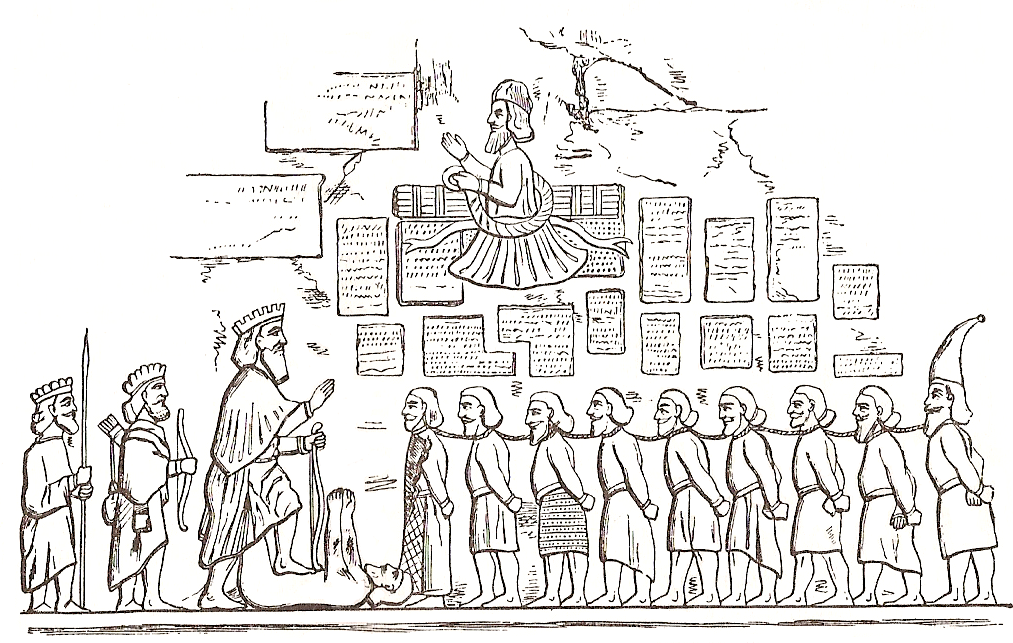
In all this there is a sharp contrast to the main religious conception which subsequently held sway over the Persian empire, as well as to that which was proclaimed by the prophets of Judah, and in the reforms of Hezekiah and Josiah was carried out practically by the Jewish kings. The Ahura-mazda whom Dareios invokes on the rock of Behistun is not only the lord of the gods, he is a lord who will not brook another god by his side.

A penciled illustration of the Behistun Inscription.  https://commons.wikimedia.org/wiki/File:Behistun_Inscription_Eger.png

A penciled illustration of the Behistun Inscription.
https://commons.wikimedia.org/wiki/File:Behistun_Inscription_Eger.png

The supreme god of the Persian monarch is as absolute as the Persian monarch himself. In the Persian empire which was organised by Dareios, centralisation became for the first time a recognised and undisputed fact, and political centralisation went hand-in-hand with religious centralisation as well.

In Judah, a theocracy was established on the ruins of the old beliefs which had connected certain localities with certain forms of divinity, and which found such naive expression in the words of David to Saul (1 Samuel xxvi. 19): “They have driven me out this day from abiding in the inheritance of the Lord, saying, Go, serve other gods.”

The destruction of the high-places and the concentration of the worship of Yahveh in Jerusalem, was followed by the ever-increasing conviction that Yahveh was not only a jealous God who would allow none other gods besides Himself; He was also a God who claimed dominion over the whole world.”

A.H. Sayce, Lectures on the Origin and Growth of Religion as Illustrated by the Religion of the Ancient Babylonians, 5th ed., London, 1898, pp. 89-90.

The Fall of Nabonidos

“The destruction of the local cults, the attempt to unify and centralise religious worship, was to the Rab-shakeh, as it was to the Babylonian scribes, and doubtless also to many of the Jews in the time of Hezekiah, an act of the grossest impiety.

An annalistic tablet, drawn up not long after the conquest of Babylonia by Cyrus, hints that before making his final attack on the country, the Elamite prince had been secretly aided by a party of malcontents in Chaldea itself.

It is at all events significant that as soon as the army of Nabonidos was defeated, the whole population at once submitted, and that even the capital, with its almost impregnable fortifications, threw open its gates.

The revolts which took place afterwards in the reigns of Dareios and Xerxes, and the extremities endured by the Babylonians before they would surrender their city, prove that their surrender was not the result of cowardice or indifference to foreign rule. The great mass of the people must have been discontented with Nabonidos and anxious for his overthrow.

The anger of Merodach and the gods, in fact, was but a convenient way of describing the discontent and anger of an important section of the Babylonians themselves. Nabonidos did not belong to the royal house of Nebuchadnezzar; he seems to have raised himself to the throne by means of a revolution, and his attempt at centralisation excited strong local animosities against him.

Religion and civil government were so closely bound up together, that civil centralisation meant religious centralisation also; the surest sign that the cities of Babylonia had been absorbed in the capital was that the images of the gods whose names had been associated with them from time immemorial were carried away to Babylon. The cities lost their separate existence along with the deities who watched over their individual fortunes.

The removal of the gods, however, implied something more than the removal of a number of images and the visible loss of local self-government or autonomy. Each image was the centre of a particular cult, carried on in a particular temple in a particular way, and entrusted to the charge of a special body of priests.

It was no wonder, therefore, that the high-handed proceedings of Nabonidos aroused the enmity of these numerous local priesthoods, as well as of all those who profited in any way from the maintenance of the local cults.

Most of the cities which were thus deprived of their ancestral deities were as old as Babylon; many of them claimed to be older; while it was notorious that Babylon did not become a capital until comparatively late in Babylonian history.

The Sun-god of Sippara, the Moon-god of Ur, were alike older than Merodach of Babylon. Indeed, though in the age of Nabonidos the title of Bel or “lord”had come to be applied to Merodach specially, it was known that there was a more ancient Bel–Belitanas, “the elder Bel,” as the Greeks wrote the word–whose worship had spread from the city of Nipur, and who formed one of the supreme triad of Babylonian gods.”

A.H. Sayce, Lectures on the Origin and Growth of Religion as Illustrated by the Religion of the Ancient Babylonians, 5th ed., London, 1898, pp. 85-6.

The Rise of Marduk

“In an inscription upon a clay cylinder brought from Babylonia seven years ago, Cyrus is made to declare that the overthrow of Nabonidos, the last independent Babylonian monarch, was due to the anger of Bel and the other gods.

Nabonidos had removed their images from their ancient sanctuaries, and had collected them together in the midst of Babylon. The priests maintained that the deed had aroused the indignation of Merodach, “the lord of the gods,” who had accordingly rejected Nabonidos, even as Saul was rejected from being king of Israel, and had sought for a ruler after his own heart.

It was “in wrath” that the deities had ”left their shrines when Nabonidos brought them into Babylon,” and had prayed Merodach, the divine patron of the imperial city, to “go round unto all men wherever might be their seats.”

Merodach sympathised with their wrongs; “he visited the men of Sumer and Accad whom he had sworn should be his attendants,” and “all lands beheld his friend.” He chose Cyrus, king of Elam, and destined him by name for the sovereignty of Chaldea.

Cyrus, whom the Hebrew prophet had already hailed as the Lord’s Anointed, was thus equally the favourite of the supreme Babylonian god.

“Merodach, the great lord, the restorer of his people,” we are told, “beheld with joy the deeds of his vicegerent who was righteous in hand and heart. To his city of Babylon he summoned his march, and he bade him take the road to Babylon; like a friend and a comrade he went at his side.”

A single battle decided the conflict: the Babylonians opened their gates, and “without fighting or battle,” Cyrus was led in triumph into the city of Babylon.

His first care was to show his gratitude towards the deities who had so signally aided him. Their temples were rebuilt, and they themselves were restored to their ancient seats.

With all the allowance that must be made for the flattery exacted by a successful conqueror, we must confess that this is a very remarkable document. It is written in the Babylonian language and in the Babylonian form of the cuneiform syllabary, and we may therefore infer that it was compiled by Babylonian scribes and intended for the perusal of Babylonian readers.

Yet we find the foreign conqueror described as the favourite of the national god, while the last native king is held up to reprobation as the dishonorer of the gods. It is impossible not to compare the similar treatment experienced by Nebuchadnezzar and the native Jewish kings respectively at the hands of Jeremiah.

The Jewish prophet saw in the Chaldean invader the instrument of the God of Judah, just as the Babylonian scribes saw in Cyrus the instrument of the god of Babylon; and the fall of the house of David is attributed, just as much as the fall of Nabonidos, to divine anger.”

A.H. Sayce, Lectures on the Origin and Growth of Religion as Illustrated by the Religion of the Ancient Babylonians, 5th ed., London, 1898, pp. 85-6.

Dagon

Dagon, alluded to in the Scriptures, was, like Oannes, a fish-god. Besides being worshipped in Erech and its neighbourhood, he was adored in Palestine and on occasion among the Hebrews themselves. But it was in the extreme south of Palestine that his worship attained its chief importance.

He had temples at Ashdod and Gaza, and perhaps his worship travelled westward along with that of Ishtar. Both were worshipped at Erech, and where the cult of the one penetrated it is likely that there would be found the rites of the other.

Dagon his name; sea-monster, upward man
And downward fish,

as Milton expresses it, affords one of the most dramatic instances in the Old Testament of the downfall of a usurping idol.

“And the Philistines took the ark of God, and brought it from Eben-ezer unto Ashdod.

“When the Philistines took the ark of God, they brought it into the house of Dagon, and set it by Dagon.

“And when they of Ashdod arose early on the morrow, behold, Dagon was fallen upon his face to the earth before the ark of the Lord. And they took Dagon, and set him in his place again.

“And when they arose early on the morrow morning, behold, Dagon was fallen upon his face to the ground before the ark of the Lord ; and the head of Dagon and both the palms of his hands were cut off upon the threshold ; only the stump of Dagon was left to him.

“Therefore neither the priests of Dagon, nor any that come into Dagon’s house, tread on the threshold of Dagon in Ashdod unto this day.

“But the hand of the Lord was heavy upon them of Ashdod, and he destroyed them, and smote them with emerods (ed. note: hemorrhoids), even Ashdod and the coasts thereof.

“And when the men of Ashdod saw that it was so, they said, The ark of the God of Israel shall not abide with us: for his hand is sore upon us and upon Dagon our god.”

Thus in the Bible story only the ‘stump’ or fish’s tail of Dagon was left to him.

In some of the Ninevite sculptures of this deity, the head of the fish forms a kind of mitre on the head of the man, while the body of the fish appears as a cloak or cape over his shoulders and back.

This is a sure sign to the mythological student that a god so adorned is in process of quitting the animal for the human form.”

Lewis Spence, Myths and Legends of Babylonia and Assyria, 1917, pp. 151-2.

Babylonian Origins of Jewish Purim

We have already questioned whether the Scripture story of Esther is in some manner connected with the goddess Ishtar. Writing of the Jewish feast of Purim, Sir James Frazer says (Golden Bough, vol. iii, p. 153):

“ From the absence of all notice of Purim in the older books of the Bible, we may fairly conclude that the festival was instituted or imported at a comparatively late date among the Jews. The same conclusion is supported by the Book of Esther itself, which was manifestly written to explain the origin of the feast and to suggest motives for its observance.

For, according to the author of the book, the festival was established to commemorate the deliverance of the Jews from a great danger which threatened them in Persia under the reign of King Xerxes. Thus the opinion of modern scholars that the feast of Purim, as celebrated by the Jews, was of late date and Oriental origin, is borne out by the tradition of the Jews themselves.

An examination of that tradition and of the mode of celebrating the feast renders it probable that Purim is nothing but a more or less disguised form of the Babylonian festival of the Sacaea or Zakmuk. . . .

But further, when we examine the narrative which professes to account for the institution of Purim, we discover in it not only the strongest traces of Babylonian origin, but also certain singular analogies to those very features of the Sacaean festival with which we are here more immediately concerned.

The Book of Esther turns upon the fortunes of two men, the vizier Haman and the despised Jew Mordecai, at the court of a Persian king. Mordecai, we are told, had given mortal offence to the vizier, who accordingly prepares a tall gallows on which he hopes to see his enemy hanged, while he himself expects to receive the highest mark of the King’s favour by being allowed to wear the royal crown and the royal robes, and thus attired to parade the streets, mounted on the King’s own horse and attended by one of the noblest princes, who should proclaim to the multitude his temporary exaltation and glory.

But the artful intrigues of the wicked vizier miscarried and resulted in precisely the opposite of what he had hoped and expected; for the royal honours which he had looked for fell to his rival Mordecai, and he himself was hanged on the gallows which he had made ready for his foe.

In this story we seem to detect a reminiscence, more or less confused, of the Zoganes of the Sacaea, in other words, of the custom of investing a private man with the insignia of royalty for a few days, and then putting him to death on the gallows or the cross. . . .

“A strong confirmation of this view is furnished by a philological analysis of the names of the four personages. It seems to be now generally recognised by Biblical scholars that the name Mordecai, which has no meaning in Hebrew, is nothing but a slightly altered form of Marduk or Merodach, the name of the chief god of Babylon, whose great festival was the Zakmuk; and further, it is generally admitted that Esther in like manner is equivalent to Ishtar, the great Babylonian goddess whom the Greeks called Astarte, and who is more familiar to English readers as Ashtaroth.

The derivation of the names of Haman and Vashti is less certain, but some high authorities are disposed to accept the view of Jensen that Haman is identical with Humman or Homman, the national god of the Elamites, and that Vashti is in like manner an Elamite deity, probably a goddess whose name appears in inscriptions.”

Lewis Spence, Myths and Legends of Babylonia and Assyria, 1917, pp. 140-2.

Sacred Number 7

“Seven, too, was a sacred number, whose magic virtues had descended to the Semites from their Accadian predecessors. When the Chaldaean Noah escaped from the Deluge, his first act was to build an altar and to set vessels, each containing the third of an ephah, by sevens, over a bed of reeds, pine-wood and thorns.

Seven by seven had the magic knots to be tied by the witch, seven times had the body of the sick man to be anointed with the purifying oil.

As the Sabbath of rest fell on each seventh day of the week, so the planets, like the demon messengers of Anu, were seven in number, and “the god of the number seven” received peculiar honour.”

A.H. Sayce, Lectures on the Origin and Growth of Religion as Illustrated by the Religion of the Ancient Babylonians, 5th ed., London, 1898, p. 82.

Sacrifice of Children was a Babylonian Institution

” … But although the Assyrian kings are fond of boasting of their exploits in massacring or torturing their defeated enemies in honour of Assur, we find no allusions in the inscriptions of the historical period to human sacrifice.

That human sacrifices, however, were known as far back as the Accadian era, is shown by a bilingual text (K5139) which enjoins the abgal, or “chief prophet,” to declare that the father must give the life of his child for the sin of his own soul, the child’s head for his head, the child’s neck for his neck, the child’s breast for his breast.

The text not only proves that the idea of vicarious punishment was already conceived of; it also proves that the sacrifice of children was a Babylonian institution.

In the great work on astronomy called The Observations of Bel, we are told that “on the high-places the son is burnt.” The offering was consequently by fire, as in Phoenicia.

The sacrifices were accompanied, sometimes by hymns or incantations, sometimes by prayers. The prayers were all prescribed, and a large number of them have been preserved.”

A.H. Sayce, Lectures on the Origin and Growth of Religion as Illustrated by the Religion of the Ancient Babylonians, 5th ed., London, 1898, p. 78.

The Etymology of the Name “Moses”

“Josephos has preserved an extract from the Egyptian historian Manetho, which relates the Egyptian version of the story of the Exodus as it was told in the second century before our era. In this it is stated that the earlier name of Moses was Osarsiph, and that he had been priest of Heliopolis or On.

Here it is evident that Moses and Joseph have been confounded together. The name of Joseph, who married the daughter of the priest of On, has been decomposed into two elements, the first of which is the divine name Jeho, and this has been changed into its supposed Egyptian equivalent Osar or Osiris.

It is clear that, whatever might have been his opinion about the name of Joseph, Manetho had no doubt that that of Moses was purely Israelitish. It was not until he had become the Israelitish lawgiver and had ceased to be an Egyptian priest that Osarsiph took the name of Moses.

But Moses finds no satisfactory etymology in the pages of the Hebrew lexicon. It stands alone among Hebrew proper names, like Aaron and David. We do not hear of any other persons who have borne the name. If, therefore, it is Semitic, it must belong to an older stratum of Semitic nomenclature than that preserved to us in the Old Testament. We must look to other branches of the Semitic stock for its explanation.

There is only one other branch of the Semitic family whose records are earlier than those of the Hebrews. Arabic literature begins long after the Christian era, when Jewish and Greek and even Christian names and ideas had penetrated into the heart of the Arabian peninsula.

The Arabic language, moreover, belongs to a different division of the Semitic family of speech from that to which Hebrew belongs. To compare Arabic and Hebrew together is like comparing Latin with modern German. There is, however, one Semitic language which has the closest affinities to Hebrew, and this is also the language of which we possess records older than those of the Hebrew Scriptures. I need hardly say that I am referring to Assyrian.

Now the Assyrian equivalent of the Hebrew Mosheh, “Moses,” would be mâsu, and, as it happens, mâsu is a word which occurs not unfrequently in the inscriptions. It was a word of Accadian origin, but since the days of Sargon of Accad had made itself so thoroughly at home in the language of the Semitic Babylonians as to count henceforth as a genuinely Semitic term.

Mâsu signified as nearly as possible all that we mean by the word “hero.” As such, it was an epithet applied to more than one divinity; there was one god more especially for whom it became a name.

This god was the deity sometimes called Adar by Assyrian scholars, sometimes Nin-ip, but whose ordinary name among the Assyrians is still a matter of uncertainty. He was a form of the Sun-god, originally denoting the scorching sun of mid-day. He thus became invested with the sterner attributes of the great luminary of day, and was known to his worshippers as “the warrior of the gods.”

The title of Mâsu, however, was not confined to Adar. It was given also to another solar deity, Merodach, the tutelar god of Babylon and the antagonist of the dragon of chaos, and was shared by him with Nergal, whose special function it was to guard and defend the world of the dead.

But Nergal himself was but the sun of night, the solar deity, that is to say, after he had accomplished his daily work in the bright world above and had descended to illuminate for a time the world below.”

A.H. Sayce, Lectures on the Origin and Growth of Religion as Illustrated by the Religion of the Ancient Babylonians, 5th ed., London, 1898, pp. 45-7.

Commonalities Between Sargon and Moses

” … I will conclude this Lecture with a few illustrations of the extent to which the study of Babylonian religion may be expected to throw light on the earlier portions of Scripture. We have already noticed the curious parallelism which exists between the legend of Sargon’s exposure in an ark of bulrushes and the similar exposure of the great Israelitish leader Moses on the waters of the Nile.

The parallelism exists even further than this common account of their infancy. Sargon of Accad was emphatically the founder of Semitic supremacy in Babylonia; he was the great lawgiver of Babylonian legend; and to him was assigned the compilation of those works on astrology and augury from which the wise men of the Chaldeans subsequently derived their lore.

Moses was equally the legislator of the Israelites and the successful vindicator of Semitic independence from the exactions of Egyptian tyranny, and future generations quoted the books of the Hebrew law under his name.

As we have seen, Sargon was a historical personage, and popular tradition merely treated him as it has treated other heroes of the past, by attaching to him the myths and legends that had once been told of the gods.

Now the name of the great Hebrew legislator has long been a puzzle and a subject of dispute. In the Hebrew Old Testament it is connected with the Hebrew verb mashâh, “to draw out,” not, indeed, in the sense that Moses was he who had been drawn out of the water, for this would not be grammatically permissible, though Pharaoh’s daughter puns upon the idea (Exod. ii. 10), but in the sense of a leader who had drawn his people out of the house of bondage and led them through the waves of the sea.

The translators of the Septuagint, on the other hand, living as they did in Egypt, endeavoured to give the word an Egyptian form and an Egyptian etymology. With them the name is always Μωυσης, which Josephos tells us is derived from the Egyptian words , “water,” and usês, “saved from the water.”

But this etymology, apart from other imperfections, depends upon the change the translators of the Septuagint have themselves made in the pronunciation of the name.

Modern Egyptian scholars, equally willing to find for it an Egyptian derivation, have had recourse to the Egyptian messu or mes, “a son.” This word, it is true, when occurring in proper names is usually combined with the name of a deity; Rameses, for example, the Sesostris of the Greeks, being written in the hieroglyphics Ra-messu, “Lord of the Sun-god.”

But it is conceivable that we might occasionally meet with it alone, and it is also conceivable, though not very probable, that the daughter of the Egyptian king would assign to her adopted child the simple name of “son.”

It is much less conceivable that such an Egyptian name would be that by which a national hero would be afterwards known to his Semitic countrymen. It is difficult to believe that the founder of the Israelitish people would have borne a title which the Israelites did not understand, and which could remind them only of that hated Egyptian land wherein they had been slaves.”

A.H. Sayce, Lectures on the Origin and Growth of Religion as Illustrated by the Religion of the Ancient Babylonians, 5th ed., London, 1898, pp. 43-5.

Tracing Religious Ideas from Babylon to Judaism

“But it was not only through the Babylonian exile that the religious ideas of the Babylonian and the Jew came into contact with each other. It was then, indeed, that the ideas of the conquering race–the actual masters of the captives, who had long been accustomed to regard Babylonia as the home of a venerable learning and culture–were likely to make their deepest and most enduring impression; it was then, too, that the Jew for the first time found the libraries and ancient literature of Chaldea open to his study and use.

But old tradition had already pointed to the valley of the Euphrates as the primeval cradle of his race. We all remember how Abraham, it is said, was born in Ur of the Chaldees, and how the earlier chapters of Genesis make the Euphrates and Tigris two of the rivers of Paradise, and describe the building of the Tower of Babylon as the cause of the dispersion of mankind.

Now the Hebrew language was the language not only of the Israelites, but also of those earlier inhabitants of the country whom the Jews called Canaanites and the Greeks Phoenicians. Like the Israelites, the Phoenicians held that their ancestors had come from the Persian Gulf and the alluvial plain of Babylonia.

The tradition is confirmed by the researches of comparative philology. Many of the words which the Semites have in common seem to point to the neighbourhood of Babylonia as the district from which those who used them originally came, and where they called the fauna and flora of the country by common names.

Their first home appears to have been in the low-lying desert which stretches eastward of Chaldea–on the on the very side of the Euphrates, in fact, on which stood the great city of Ur, the modern Mugheir.

Here they led a nomad life, overawed by the higher culture of the settled Accadian race, until a time came when they began to absorb it themselves, and eventually, as we have seen, to dispossess and supersede their teachers.

The tribes which travelled northward and westward must, we should think, have carried with them some of the elements of the culture they had learnt from their Accadian neighbors. And such, indeed, we find to be the case.

The names of Babylonian deities meet us again in Palestine and the adjoining Semitic lands. Nebo, the Babylonian god of prophecy and literature, has given his name to towns that stood within the territories of Reuben and Judah, as well as to the Moabite mountain on which Moses breathed his last; Anu, the Babylonian god of heaven, and his female consort Anatu, re-appear in Beth-Anath, “the temple of Anatu,” and Anathoth, the birth-place of Jeremiah; and Sinai itself is but the mountain of Sin, the Babylonian Moon-god.

We may thus assume that there were two periods in the history of the Jewish people in which they came under the influence of the religious conceptions of Babylonia. There was the later period of the Babylonish exile, when the influence was strong and direct; there was also the earlier period, when the amount of influence is more hard to determine.

Much will depend upon the view we take of the age of the Pentateuch, and of the traditions or histories embodied therein. Some will be disposed to see in Abraham the conveyer of Babylonian ideas to the west; others will consider that the Israelites made their first acquaintance with the gods and legends of Babylonia through the Canaanites and other earlier inhabitants of Palestine.

Those who incline to the latter belief may doubt whether the fathers of the Canaanitish tribes brought the elements of their Babylonian beliefs with them from Chaldea, or whether these beliefs were of later importation, due to the western conquests of Sargon and his successors.”

A.H. Sayce, Lectures on the Origin and Growth of Religion as Illustrated by the Religion of the Ancient Babylonians, 5th ed., London, 1898, pp. 41-3.

The Influence of Babylonian Religion on Judaism

“But, it will be asked, what interest can the religions of Babylonia and Assyria have for us, much more an inquiry into their nature and origin? They have long since perished, like the people who professed them, and have left no apparent traces of their influence upon the nations about whom we know and care most.

The Greeks and Romans concerned themselves so little with these Eastern barbarians as neither to read nor to preserve the only Greek history of Chaldaea (ed. note: referring to Berossus) which was written by a native and professed to be derived from native accounts; we owe the fragments we have of it to the apologetic zeal of Christian controversialists.

Still less would it appear that these old people of Babylonia and Assyria can have had any influence upon the world of to-day, or have served to mould the ideas and the society of modern Europe. Such questions may be asked, and until lately it would have been hard to answer them.

And yet a moment’s consideration might have shown that there was one nation at all events which has exercised, and still exercises, a considerable intluence upon our own thought and life, and which had been brought into close contact with the religion and culture of Babylonia at a critical epoch in its history.

The influence of Jewish religion upon Christianity, and consequently upon the races that have been moulded by Christianity, has been lasting and profound. Now Jewish religion was intimately bound up with Jewish history, more intimately perhaps than has been the case with any other great religion of the world.

It took its colouring from the events that marked the political life of the Hebrew people; it developed in unison with their struggles and successes, their trials and disappointments. Its great devotional utterance, the Book of Psalms, is national, not individual; the individual in it has merged his own aspirations and sufferings into those of the whole community.

The course of Jewish prophecy is equally stamped with the impress of the national fortunes. It grows clearer and more catholic as the intercourse of the Jewish people with those around them becomes wider; and the lesson is taught at last that the God of the Jews is the God also of the whole world.

Now the chosen instruments for enforcing this lesson, as we are expressly told, were the Assyrian and the Babylonian. The Assyrian was the rod of God’s anger, while the Babylonish exile was the bitter punishment meted out to Judah for its sins.

The captives who returned again to their own land came back with changed hearts and purified minds; from henceforward Jerusalem was to be the unrivalled dwelling-place of “the righteous nation which keepeth the truth.”

Apart, therefore, from any influence which the old religious beliefs of Babylonia may have had upon the Greeks, and which, as we shall see, was not so wholly wanting as was formerly imagined, their contact with the religious conceptions of the Jewish exiles must, to say the least, have produced an effect which it is well worth our while to study.

Hitherto, the traditional view has been that this effect exhibited itself wholly on the antagonistic side; the Jews carried nothing away from the land of their captivity except an intense hatred of idolatry, more especially Babylonian, as well as of the beliefs and practices associated therewith.

Now and then, it is true, some bold spirit, like Bishop Warburton, may have ventured to propound the paradox that the doctrine of the resurrection was first learnt by the Jews in Babylonia, but it was treated generally as a paradox, and of late years, if admitted at all, was considered a proof of the influence not of the Babylonians but of their Persian conquerors.”

A.H. Sayce, Lectures on the Origin and Growth of Religion as Illustrated by the Religion of the Ancient Babylonians, 5th ed., London, 1898, pp. 38-40.

Diorite Statues

“The land of Magána was already known to the inhabitants of Babylonia. The earliest Chaldaean monuments yet discovered are those which have been excavated at Tel-loh in southern Chaldaea by a Frenchman, M. de Sarzec, and are now deposited in the Louvre.

Some of them go back almost to the very beginnings of Chaldaean art and cuneiform writing. Indeed, the writing is hardly yet cuneiform; the primitive pictorial forms of many of the characters are but thinly disguised, and the vertical direction they originally followed, like Chinese, is still preserved.

The language and art alike are Proto-Chaldaean: there is as yet no sign that the Semite was in the land. Among the monuments are seated figures carved out of stone. The stone in several instances is diorite, a stone so hard that even the modern workman may well despair of chiselling it into the lineaments of the human form.

Seated diorite statue of Gudea, prince of Lagash, dedicated to the god Ningishzida, neo-Sumerian period. Marie-Lan Nguyen (2011) https://en.wikipedia.org/wiki/Statues_of_Gudea#/media/File:Gudea_of_Lagash_Girsu.jpg

Seated diorite statue of Gudea, prince of Lagash, dedicated to the god Ningishzida, neo-Sumerian period.
Marie-Lan Nguyen (2011)
https://en.wikipedia.org/wiki/Statues_of_Gudea#/media/File:Gudea_of_Lagash_Girsu.jpg

Now an inscription traced upon one of the figures tells us that the stone was brought from the land of Magan. Already, therefore, before the time of Sargon and the rise of Semitic supremacy and civilisation, the peninsula of Sinai was not only known to the inhabitants of Chaldaea, but blocks of stone were transported from it to the stoneless plain of Babylonia, and there made plastic under the hand of the sculptor.

I have already alluded to the fact that the quarries of Sinai had been known to the Egyptians and worked by them as early as the epoch of the Third Dynasty, some 6000 years ago. Is it more than a coincidence that one of the most marvellous statues in the world, and the chief ornament of the Museum of Bulâq, is a seated figure of king Khephrên of the Fourth Dynasty, carved out of green diorite, like the statues of Tel-loh, and representing the monarch in almost the same attitude?

 Statue of Khafre in diorite. Valley Temple of Khafra, Giza. Egyptian Museum, Cairo.  Main floor - room 42. Diorite: height 168 cm, width 57 cm, depth 96 cm. JE 10062 - CG 14. https://en.wikipedia.org/wiki/Khafra#/media/File:Khafre_statue.jpg Jon Bodsworth - http://www.egyptarchive.co.uk/html/cairo_museum_10.html


Statue of Khafre in diorite. Valley Temple of Khafra, Giza. Egyptian Museum, Cairo.
Main floor – room 42. Diorite: height 168 cm, width 57 cm, depth 96 cm. JE 10062 – CG 14.
https://en.wikipedia.org/wiki/Khafra#/media/File:Khafre_statue.jpg
Jon Bodsworth – http://www.egyptarchive.co.uk/html/cairo_museum_10.html

The Babylonian work is ruder than the Egyptian work, it is true; but if we place them side by side, it is hard to resist the conviction that both belong to the same school of sculpture, and that the one is but a less skilful imitation of the other.

The conviction grows upon us when we find that diorite is as foreign to the soil of Egypt as it is to that of Babylonia, and that the standard of measurement marked upon the plan of the city, which one of the figures of Tel-loh holds upon his lap, is the same as the standard of measurement of the Egyptian pyramid-builders–the kings of the fourth and two following dynasties.

 Egyptian research has independently arrived at the conclusion that the pyramid-builders were at least as old as the fourth millennium before the Christian era. Thc great pyramids of Gizeh were in course of erection, the hieroglyphic system of writing was already fully developed, Egypt itself was thoroughly organised and in the enjoyment of a high culture and civilisation, at a time when, according to Archbishop Usher’s chronology, the world was being created.

The discoveries at Tel-loh have revealed to us a corresponding period in the history of Babylonia, earlier considerably than the age of Sargon of Accad, in which we seem to find traces of contact between Babylonia and the Egyptians of the Old Empire.

It would even seem as if the conquests of Naram-Sin in Sinai were due to the fall of the Sixth Dynasty and the overthrow of the power of the old Egyptian empire. For some centuries after that event Egypt is lost to history, and its garrisons and miners in the Sinai peninsula must have been recalled to serve against enemies nearer home.”

A.H. Sayce, Lectures on the Origin and Growth of Religion as Illustrated by the Religion of the Ancient Babylonians, 5th ed., London, 1898, pp. 31-4.

More on Sargon

“But in spite of the atmosphere of myth which came to enshroud him, as it enshrouded the persons of Kyros, of Charlemagne, and of other heroes of popular history, Sargon was a historical monarch and the founder of a really great empire.

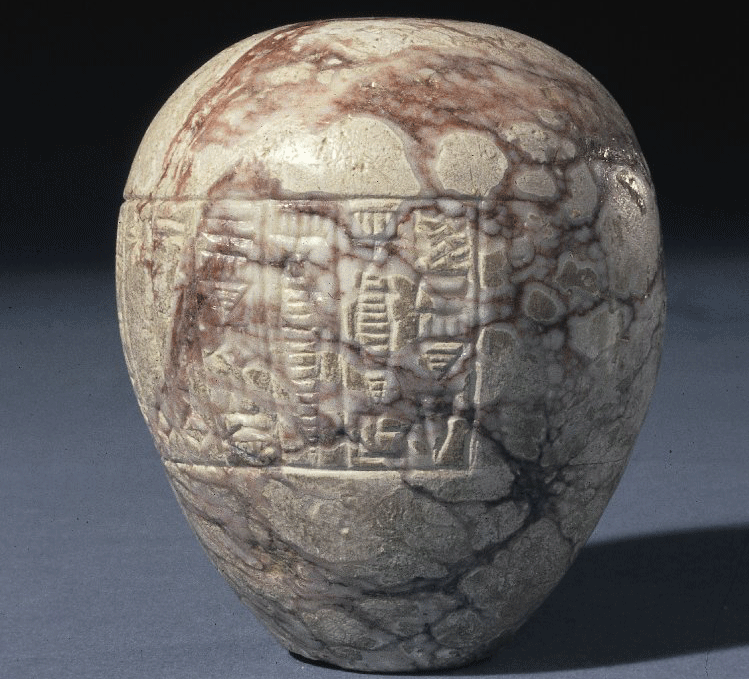
The British Museum actually possesses an inscribed egg of veined marble which he dedicated to the Sun-god of Sippara (ed note: Shamash), and the seal of his librarian Ibni-sarru is in the hands of M. Le Clercq of Paris. What may be termed the scientific literature of the library of Nineveh makes frequent reference to him, and we learn that it was for the great library which he established in his capital city of Accad that the two standard Babylonian works on astronomy and terrestrial omens were originally compiled.

Sargon's inscribed egg for the Sun God Shamash at Sippara in the British Museum.

Sargon’s inscribed egg for the Sun God Shamash at Sippara in the British Museum.

 The work on astronomy was entitled The Observations of Bel, and consisted of no less than seventy-two books, dealing with such matters as the conjunction of the sun and moon, the phases of Venus, and the appearances of comets.

It was translated in later days into Greek by the historian Berossus and though supplemented by numerous additions in its passage through the hands of generations of Babylonian astronomers, the original work contained so many records of eclipses as to demonstrate the antiquity of Babylonian astronomy even in the remote age of Sargon himself.

But besides our knowledge of Sargon’s patronage of learning, we also know something about the civil history of his reign. A copy of its annals has come down to us. We gather from these that he was not only successful in overthrowing all opposition at home, he was also equally successful abroad.

His first campaign was against the powerful kingdom of Elam in the East, where he overthrew the enemy and mutilated their slain. Next he turned to the West, laying his yoke on Syria, and subjugating “the four quarters” of the world. Then the rival kings of Babylon and other Chaldean cities felt his power; and out of the spoil of the vanquished he built the city of Accad and gave it its name.

From this time forward his attention was chiefly devoted to the West. Year after year he penetrated into Syria, until at last, we are told, “he had neither equal nor rival;” he crossed the Mediterranean to the island we now call Cyprus, and “in the third year,” at the bounds of the setting sun, his hands conquered all peoples and his mouth decreed a single empire.

Here on the shores of Cyprus the great conqueror erected images of himself, and then carried the booty of the island to the opposite coast of Asia. Such a glimpse into the history of what became afterwards a Grecian sea, when as yet no Greeks had made their ray to their later home, is startling to those whose conceptions of authentic history have been limited by the narrow horizon of the classical world. Its trustworthiness, however, has been curiously verified by a discovery made by General de Cesnola in the treasure-vaults of a Kyprian temple among the ruins of the ancient Kurion.

A god in horned cap brandishes a mace and the forked lightening of Iva-Vul, Thunder God, and sets foot on a recumbent bull.  Behind him is a leaping ibex. In front, a man, perhaps the king, in a short coat, standing full face. Behind him a man on bended knee, possibly the owner of the cylinder. Above him, a small deer is recumbent and inverted.  Then a figure in a long garment, and 3 rows of cuneiform writing:  "Arba Istar: son of Ibu Beled: servant of the god Naram-Sin."  The king Naram-Sin, to whom a divine determinative prefix is given here, reigned in Babylonia no later than 2600 BCE.  Cyprus, plate 4300.  John L. Myres, Handbook of the Cesnola Collection of Antiquities from Cyprus, 1914.

A god in horned cap brandishes a mace and the forked lightening of Iva-Vul, Thunder God, and sets foot on a recumbent bull.
Behind him is a leaping ibex. In front, a man, perhaps the king, in a short coat, standing full face. Behind him a man on bended knee, possibly the owner of the cylinder. Above him, a small deer is recumbent and inverted.
Then a figure in a long garment, and 3 rows of cuneiform writing:
“Arba Istar: son of Ibu Beled: servant of the god Naram-Sin.”
The king Naram-Sin, to whom a divine determinative prefix is given here, reigned in Babylonia no later than 2600 BCE.
Cyprus, plate 4300.
John L. Myres, Handbook of the Cesnola Collection of Antiquities from Cyprus, 1914.

Here, among other hematite cylinders of early Babylonian origin, he found one the first owner of which describes himself as a ” servant” or ”worshipper” of “the deified Naram- Sin.” Naram-Sin was the son and successor of Sargon, and it is not likely that he would have received divine honours after the fall of the dynasty to which he belonged.

The fact that the cylinder was discovered in Cyprus seems to show that even after Sargon’s death a connection continued to exist between Cyprus and the imperial power of Babylonia. Naram-Sin, however, was more bent on the conquest of Magána, or the Sinaitic Peninsula, than upon further campaigns in the West.

Sinai, with its mines of turquoise and copper, had been a prize coveted by the Egyptians ever since the age of the Third Dynasty, and one of the first efforts of the rising rival power on the banks of the Euphrates was to gain possession of the same country.

Naram-Sin, so runs the annalistic tablet, “marched to the land of Magána; the land of Magána he conquered, and overcame its king.”

A.H. Sayce, Lectures on the Origin and Growth of Religion as Illustrated by the Religion of the Ancient Babylonians, 5th ed., London, 1898, pp. 29-31.

Sargon

“Sargon himself was a monarch whom both Accadian and Semite delighted to honour. Myths surrounded his infancy as they surrounded the infancy of Kyros, and popular legend saw in him the hero-prince who had been deserted in childhood and brought up among squalid surroundings, until the time came that he should declare himself in his true character and receive his rightful inheritance.

He was born, it was said, of an unknown father; as Mars had wooed the mother of the founder of Rome, so some god whom later tradition feared to name had wooed the mother of the founder of the first Semitic empire. She brought forth her first-born “in a secret place” by the side of the Euphrates, and placed him in a basket of rushes which she daubed with bitumen and entrusted to the waters of the river.

The story reminds us of Perseus launched upon the sea with his mother Danae in a boat, of Romulus and Remus exposed to the fury of the Tiber, and still more of Moses in his ark of bulrushes upon the Nile. The Euphrates refused to drown its future lord, and bore the child in safety to Akki “the irrigator,” the representative of the Accadian peasants who tilled the laud for their Semitic masters. In this lowly condition and among a subjugated race Sargon was brought up.

Akki took compassion on the little waif, and reared him as if he had been his own son. As he grew older he was set to till the garden and cultivate the fruit-trees, and while engaged in this humble work attracted the love of the goddess Istar.

Then came the hour of his deliverance from servile employment, and, like David, he made his way to a throne. For long years he ruled the black-headed race of Accad; he rode through subjugated countries in chariots of bronze, and crossed the Persian Gulf to the sacred isle of Dilmun.

The very name the people gave him was a proof of his predestined rise to greatness. Sargon was not his real title. This was Sarganu, which a slight change of pronunciation altered into Sargina, a word that conveyed the meaning of “constituted” or “predestined” “king” to his Accadian subjects.

It was the form assumed in their mouths by the Semitic Sarru-kinu, and thus reminded them of the Sun-god Tammuz, the youthful bridegroom of Istar who was addressed as ablu kinu or “only son,” as well as of Nebo the “very son” (ablu kinu) of thc god Merodach.

Sargina, however, was not the only name by which the king was known to them. They called him also Dádil or Dádal, a title which the Semitic scribes afterwards explained to mean “Sargon, the king of constituted right (sar-kinti), devisor of constituted law, deviser of prosperity,” though its true signification was rather “the very wise.”

A.H. Sayce, Lectures on the Origin and Growth of Religion as Illustrated by the Religion of the Ancient Babylonians, 5th ed., London, 1898, pp. 26-8.

The Tel el Amarna Letters Between Assyrian Kings and Egyptian Pharaohs

” … What the Babylonian chronologists called ‘the First Dynasty of Babylon’ fell in its turn, and it is claimed that a Sumerian line of eleven kings took its place. Their sway lasted for 368 years—a statement which is obviously open to question.

These were themselves overthrown and a Kassite dynasty from the mountains of Elam was founded by Kandis (c . 1780 B.C.) which lasted for nearly six centuries. These alien monarchs failed to retain their hold on much of the Asiatic and Syrian territory which had paid tribute to Babylon and the suzerainty of Palestine was likewise lost to them.

It was at this epoch, too, that the high-priests of Asshur in the north took the title of king, but they appear to have been subservient to Babylon in some degree. Assyria grew gradually in power. Its people were hardier and more warlike than the art-loving and religious folk of Babylon, and little by little they encroached upon the weakness of the southern kingdom until at length an affair of tragic proportions entitled them to direct interference in Babylonian politics.

[ … ]

The circumstances which necessitated this intervention are not unlike those of the assassination of King Alexander of Serbia and Draga, his Queen, that happened 3000 years later.

The Kassite king of Babylonia had married the daughter of Assur-yuballidh of Assyria. But the match did not meet with the approval of the Kassite faction at court, which murdered the bridegroom-king.

This atrocious act met with swift vengeance at the hands of Assur-yuballidh of Assyria, the bride’s father, a monarch of active and statesmanlike qualities, the author of the celebrated series of letters to Amen-hetep IV of Egypt, unearthed at Tel-el-Amarna.

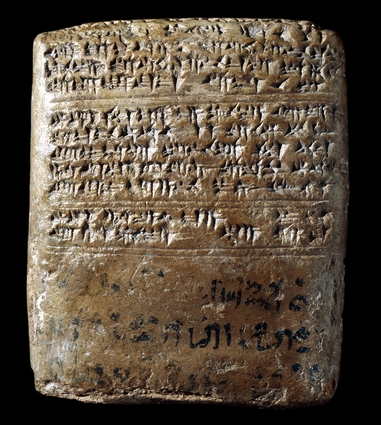
This clay tablet is part of a collection of 382 cuneiform documents discovered in 1887 in Egypt, at the site of Tell el-Amarna. ... The majority date to the reign of Amenhotep IV (Akhenaten) (1352-1336 BC), the heretic pharaoh who founded a new capital at Tell el-Amarna. This letter is written in Akkadian, the diplomatic language of Mesopotamia at the time. It is addressed to Amenhotep III from Tushratta, king of Mitanni (centred in modern Syria). Tushratta calls the pharaoh his 'brother', with the suggestion that they are of equal rank. The letter starts with greetings to various members of the royal house including Tushratta's daughter Tadu-Heba, who had become one of Amenhotep's many brides. ... Tushratta goes on to inform Amenhotep that, with the consent of the goddess Ishtar, he has sent a statue of her to Egypt. He hopes that the goddess will be held in great honour in Egypt and that the statue may be sent back safely to Mitanni. Three lines of Egyptian, written in black ink, have been added, presumably when the letter arrived in Egypt. The addition includes the date 'Year 36' of the king. W.L. Moran, The Amarna letters (John Hopkins University Press, Baltimore, 1992) http://www.britishmuseum.org/explore/highlights/highlight_objects/me/l/clay_tablet_letter,_egypt_2.aspx

This clay tablet is part of a collection of 382 cuneiform documents discovered in 1887 in Egypt, at the site of Tell el-Amarna. …
The majority date to the reign of Amenhotep IV (Akhenaten) (1352-1336 BC), the heretic pharaoh who founded a new capital at Tell el-Amarna.
This letter is written in Akkadian, the diplomatic language of Mesopotamia at the time. It is addressed to Amenhotep III from Tushratta, king of Mitanni (centred in modern Syria). Tushratta calls the pharaoh his ‘brother’, with the suggestion that they are of equal rank. The letter starts with greetings to various members of the royal house including Tushratta’s daughter Tadu-Heba, who had become one of Amenhotep’s many brides. …
Tushratta goes on to inform Amenhotep that, with the consent of the goddess Ishtar, he has sent a statue of her to Egypt. He hopes that the goddess will be held in great honour in Egypt and that the statue may be sent back safely to Mitanni.
Three lines of Egyptian, written in black ink, have been added, presumably when the letter arrived in Egypt. The addition includes the date ‘Year 36’ of the king.
W.L. Moran, The Amarna letters (John Hopkins University Press, Baltimore, 1992)
http://www.britishmuseum.org/explore/highlights/highlight_objects/me/l/clay_tablet_letter,_egypt_2.aspx

He led a punitive army into Babylonia, hurled from the throne the pretender placed there by the Kassite faction, and replaced him with a scion of the legitimate royal stock. This king, Burna-buryas, reigned for over twenty years, and upon his decease the Assyrians, still nominally the vassals of the Babylonian Crown, declared themselves independent of it.

Not content with such a revolutionary measure, under Shalmaneser I (1300 B.C.) they laid claim to the suzerainty of the Tigris-Euphrates region, and extended their conquests even to the boundaries of far Cappadocia, the Hittites and numerous other confederacies submitting to their yoke.

Shalmaneser’s son, Tukulti-in-Aristi, took the city of Babylon, slew its king, Bitilyasu, and thus completely shattered the claim of the older state to supremacy. He had reigned in Babylon for some seven years when he was faced by a popular revolt, which seems to have been headed by his own son, Assur-nazir-pal, who slew him and placed Hadad-nadin-akhi on the throne.

This king conquered and killed the Assyrian monarch of his time, Bel-kudur-uzur, the last of the old Assyrian royal line, whose death necessitated the institution of a new dynasty, the fifth monarch of which was the famous Tiglath-pileser I.”

Lewis Spence, Myths and Legends of Babylonia and Assyria, 1917, pp. 21-3.

Worship of Idols and Graven Images

“Just as a great king might exercise wide dominion in the world but needed to sleep and eat, so too the Mesopotamian gods were ascribed universal dominion but had physical, social and aesthetic needs that their human subjects were created to serve (Oppenheim 1977: 183–98).

Thus temples of the gods were at first houses then palatial structures where the god ruled as a householder and dignitary (Oppenheim 1961: 158–69). The god’s house was provided with sleeping quarters, audience chambers, storerooms and dining halls in which choice foods were served and music performed. There were gardens for the god’s enjoyment and dalliance. Their homes were appointed in luxurious style with works of art, commemorative inscriptions and treasuries of offerings, gifts and valuables.

The gods travelled to visit other gods and entertained each other with feasts accompanied by speeches and heavy drinking. Like any good householder, the gods were concerned with the stewardship of their domains. The Sumerian goddess Nanshe, for example, is described in a hymn as searching out fraud and embezzlement in her household accounts ( Jacobsen 1987a: 131; Heimpel in Hallo 1997: 526–31).

The gods were understood to be physically present at will in an image (Hallo 1983) that was dressed and adorned with special clothing, jewelry and headdresses. Destruction of the image or its removal by an enemy was a disaster for the community, demanding a theological explanation: the deity was angry with his city or her people, even if no cause for this anger could be established, and had forsaken both the image and the community.

Return of an abducted image was a moment of jubilation and renewal of patriotic feeling, as when the lost statue of Marduk was returned from its captivity in Elam by the Babylonian king Nebuchadnezzar I (twelfth century BCE).

Some Mesopotamian authors speculated on the relationship between an object produced by human craftsmanship and a universal cosmic power, asserting, as in the Epic of Erra, that the image was primeval and the craftsmen uncanny, with later human counterparts permitted by the gods to make repairs (Foster 1996: 765). However, reports of theft of divine apparel or jewelry suggest that not all Mesopotamians were awed by images of the gods.”

Benjamin R. Foster, “Gods in Their Dwellings,” John R. Hinnells, ed., A Handbook of Ancient Religions, 2007, pp. 181-2.

Semites vs. Sumerians

“Each new discovery of cuneiform tablets elicits a wave of publications asserting biblical ‘parallels,’ many of them uncertain and farfetched, even when a millennium or more may have elapsed between the tablets and the relevant portion of the Bible.

The biblical scholar M. Dahood, for example, saw parallels betwen the Bible and cuneiform tablets from Ebla in northern Syria, which date to approximately 1300 years before the kingdom of David. E. A. Speiser insisted that the ‘patriarchal age’ of the Bible was reflected in tablets from Nuzi in northern Mesopotamia (early fourteenth century BCE), although most of his analogies have been discarded in recent years.

The discovery of prophetic documents at Mari (eighteenth century BCE) attracted much discussion, as did comparison of ancient treaties with the biblical covenant.

A subtler interconnection between the worlds of the Hebrews and of the Babylonians was provided by what might be called ‘Pan-Semitism,’ the idea that the Semitic peoples had certain innate mental and emotional characteristics and limitations in common that conditioned their religious values.

A concise statement of this view, which is traceable, for example, to the works of the influential French thinker Ernest Renan, will be found in S. A. Cook’s contribution ‘The Semites, Temperament and Thought’ in the Cambridge Ancient History (1924), chapter V.

Cook held that Semitic thought was verbal rather than visual, emotional rather than systematic or speculative, and so could not have created such a grand astral system of beliefs as the Pan-Babylonianists had imagined underlay modern Christianity, Judaism and Islam.

To Pan-Semitists, Greece, with its alleged superior visual and speculative thought, albeit comparatively shallow religion, was as essential to understanding Christianity as was Judaism.

Scholars wrote of the ‘Hebrew’ and the ‘Greek’ element in Christianity and European culture. The Pan-Semitists bracketed Judaism, Islam and Babylonia as ‘Semitic’ in type, but not Christianity. This left the place of the Sumerians in the equation Babylonian = Semitic difficult to define.

The early twentieth-century historian Eduard Meyer, for example, therefore argued that the Semites were the original inhabitants of Mesopotamia and the Sumerians were later invaders, thereby maintaining the originally ‘Semitic’ character of Mesopotamian civilization.

In the period after World War I, some scholars tried to distinguish ‘Sumerian’ from ‘Semitic’ thought in Mesopotamian culture. Thus discussion of the relations between Babylonia and the Bible proceeded in an atmosphere charged with faith, scepticism and anti-Semitism.”

Benjamin R. Foster, “Mesopotamian Religion and the Bible,” John R. Hinnells, ed., A Handbook of Ancient Religions, 2007, pp. 208-9.

Hebrew and Babylonian Creation Myths

” … For the local Babylonian colouring of the stories, and the great age to which their existence can be traced, extending back to the time of the Sumerian inhabitants of Mesopotamia, 3 are conclusive evidence ….

On the other hand, it is equally unnecessary to cite the well-known arguments to prove the existence among the Hebrews of Creation legends similar to those of Babylonia for centuries before the Exile.

The allusions to variant Hebrew forms of the Babylonian Dragon-Myth in Amos ix, 3, Isaiah li, 9, Psalm lxxiv, 13 f., and lxxxix, 9 f., and Job xxvi, 12 f., and ix, 13, may be cited as sufficient proof of the early period at which the borrowing from Babylonian sources must have taken place; and the striking differences between the Biblical and the known Babylonian versions of the legends prove that the Exilic and post-Exilic Jews must have found ready to their hand ancient Hebrew versions of the stories, and that the changes they introduced must in the main have been confined to details of arrangement and to omissions necessitated by their own more spiritual conceptions and beliefs.

The discovery of the Tell el-Amarna tablets proved conclusively that Babylonian influence extended throughout Egypt and Western Asia in the fifteenth century B.C., and the existence of legends among the letters demonstrated the fact that Babylonian mythology exerted an influence coextensive with the range of her political ties and interests.

We may therefore conjecture that Babylonian myths had become naturalized in Palestine before the conquest of that country by the Israelites. Many such Palestinian versions of Babylonian myths the Israelites no doubt absorbed; while during the subsequent period of the Hebrew kings Assyria and Babylonia exerted a direct influence upon them.

It is clear, therefore, that at the time of their of Babylonian exile the captive Jews did not find in Babylonian mythology an entirely new and unfamiliar subject, but recognized in it a series of kindred beliefs, differing much from their own in spiritual conceptions, but presenting a startling resemblance on many material points.”

Leonard William King, The Seven Tablets of Creation, London, 1902, pp. xcv-xcvii.

Boundary Stone of Ritti-Marduk (British Museum, No. 90,858)

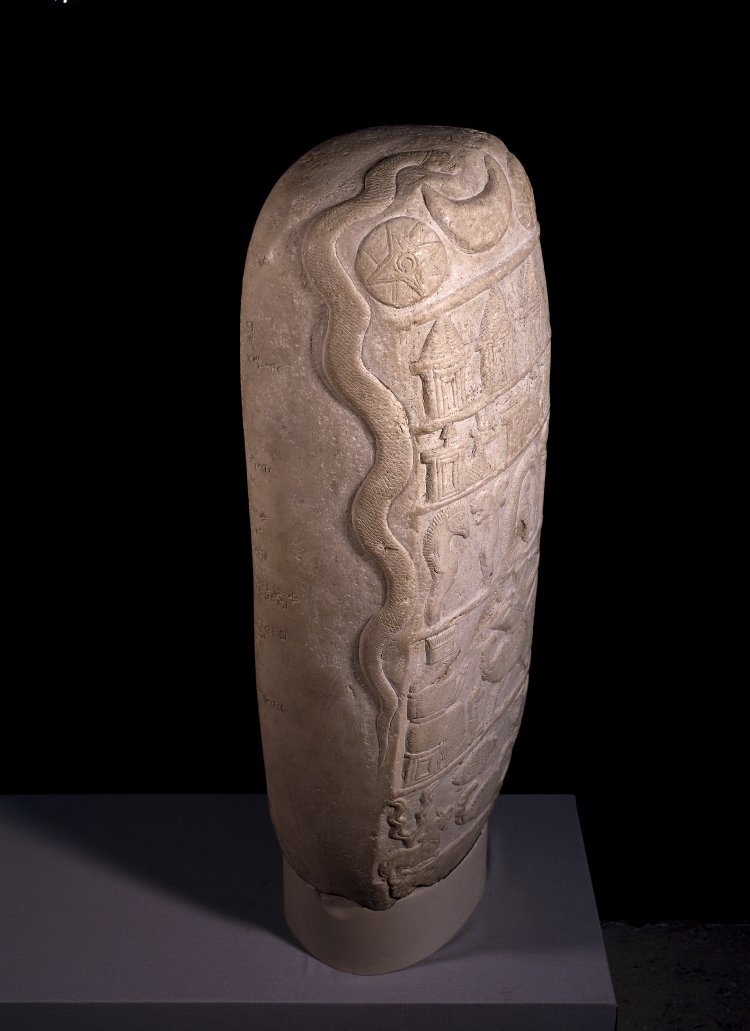
The accompanying illustration, which is reproduced from the Boundary Stone of Ritti-Marduk (Brit. Mus., No. 90,858), supplies much information about the symbols of the gods, and of the Signs of the Zodiac in the reign of Nebuchadnezzar I, King of Babylon, about 1120 B.C.

British Museum number 90858 Description 3/4: Right Limestone stela in the form of a boundary-stone: consisting of a block of calcareous limestone, shaped and prepared on four sides to take sculptures and inscriptions. It is now mounted on a stone plinth.  Faces B and C each bear a single column of inscription, the lines running the full width of the stone.  The top of the stone and Face D have been left blank, except for the serpent, which has been carved to the left of the emblems on Face A.  Inscribed with a Charter from the reign of Nebuchadnezzar I.

British Museum number 90858
Description 3/4: Right
Limestone stela in the form of a boundary-stone: consisting of a block of calcareous limestone, shaped and prepared on four sides to take sculptures and inscriptions. It is now mounted on a stone plinth.
Faces B and C each bear a single column of inscription, the lines running the full width of the stone.
The top of the stone and Face D have been left blank, except for the serpent, which has been carved to the left of the emblems on Face A.
Inscribed with a Charter from the reign of Nebuchadnezzar I.

Thus in Register 1, we have the Star of Ishtar, the crescent of the Moon-god Sin, and the disk of Shamash the Sun-god. In Reg. 2 are three stands (?) surmounted by tiaras, which represent the gods Anu, Enlil (Bel) and Ea respectively. In Reg. 3 are three altars (?) or shrines (?) with a monster in Nos. 1 and 2. Over the first is the lance of Marduk, over the second the mason’s square of Nabû, and over the third is the symbol of the goddess Ninkharsag, the Creatress. In Reg. 4 are a standard with an animal’s head, a sign of Ea; a two-headed snake = the Twins; an unknown symbol with a horse’s head, and a bird, representative of Shukamuna and Shumalia. In Reg. 5 are a seated figure of the goddess Gula and the Scorpion-man. In Reg. 6 are forked lightning, symbol of Adad, above a bull, the Tortoise, symbol of Ea (?), the Scorpion of the goddess Ishkhara, and the Lamp of Nusku, the Fire-god.  Down the left-hand side is the serpent-god representing the constellation of the Hydra.

Thus in Register 1, we have the Star of Ishtar, the crescent of the Moon-god Sin, and the disk of Shamash the Sun-god.
In Reg. 2 are three stands (?) surmounted by tiaras, which represent the gods Anu, Enlil (Bel) and Ea respectively.
In Reg. 3 are three altars (?) or shrines (?) with a monster in Nos. 1 and 2. Over the first is the lance of Marduk, over the second the mason’s square of Nabû, and over the third is the symbol of the goddess Ninkharsag, the Creatress.
In Reg. 4 are a standard with an animal’s head, a sign of Ea; a two-headed snake = the Twins; an unknown symbol with a horse’s head, and a bird, representative of Shukamuna and Shumalia.
In Reg. 5 are a seated figure of the goddess Gula and the Scorpion-man.
In Reg. 6 are forked lightning, symbol of Adad, above a bull, the Tortoise, symbol of Ea (?), the Scorpion of the goddess Ishkhara, and the Lamp of Nusku, the Fire-god.
Down the left-hand side is the serpent-god representing the constellation of the Hydra.

The mutilated text of the Fifth Tablet makes it impossible to gain further details in connection with Marduk’s work in arranging the heavens. We are, however, justified in assuming that the gaps in it contained statements about the grouping of the gods into triads.

In royal historical inscriptions the kings often invoke the gods in threes, though they never call any one three a triad or trinity. It seems as if this arrangement of gods in threes was assumed to be of divine origin.

In the Fourth Tablet of Creation, one triad “Anu-Bel-Ea” is actually mentioned, and in the Fifth Tablet, another is indicated, “Sin-Shamash-Ishtar.”

In these triads Anu represents the sky or heaven, Bel or Enlil the region under the sky and including the earth, Ea the underworld, Sin the Moon, Shamash the Sun, and Ishtar the star Venus.

When the universe was finally constituted several other great gods existed, e.g., Nusku, the Fire-god, Enurta, a solar god, Nergal, the god of war and handicrafts, Nabu, the god of learning, Marduk of Babylon, the great national god of Babylonia, and Ashur, the great national god of Assyria.

E.A. Wallis Budge, et al, & the British Museum, The Babylonian Legends of the Creation & the Fight Between Bel & the Dragon Told by Assyrian Tablets from Nineveh (BCE 668-626), 1901, pp. 11-2.

On the Literature of Ancient Sumer

” … Now let us compare this date with that of the various ancient literatures known to us at present.

In Egypt, for example, one might have expected an ancient written literature commensurate with its high cultural development. And, indeed, to judge from the pyramid inscriptions, the Egyptians in all probability did have a well developed written literature in the third millennium B. C.

Unfortunately it must have been written largely on papyrus, a readily perishable material, and there is little hope that enough of it will ever be recovered to give a reasonably adequate cross-section of the Egyptian literature of that ancient period.

Then, too, there is the hitherto unknown ancient Canaanite literature which has been found inscribed on tablets excavated in the past decade by the French at Rash-esh-Shamra in northern Syria.

These tablets, relatively few in number, indicate that the Canaanites, too, had a highly developed literature at one time. They are dated approximately 1400 B. C., that is, they were inscribed over half a millennium later than our Sumerian literary tablets. 21

As for the Semitic Babylonian literature as exemplified by such works as the Epic of Creation, the Epic of Gilgamesh, etc., it is not only considerably later than our Sumerian literature, but also includes much that is borrowed directly from it. 22

We turn now to the ancient literatures which have exercised the most profound influence on the more spiritual aspects of our civilization. These are the Bible, which contains the literary creations of the Hebrews; the Iliad and Odyssey, which are filled with the epic and mythic lore of the Greeks; the Rig-veda, which contains the literary products of ancient India; and the Avesta, which contains those of ancient Iran.

None of these literary collections were written down in their present form before the first half of the first millennium B. C.

Our Sumerian literature, inscribed on tablets dating from approximately 2000 B.C., therefore antedates these literatures by more than a millennium. Moreover, there is another vital difference.

pl04

"To judge from the script, the Nippur cylinder illustrated on this plate 
(8383 in the Nippur collection of the University Museum) may date as early 
as 2500 B. C. Although copied and published by the late George Barton as 
early as 1918, its contents, which center about the Sumerian air-god Enlil 
and the goddess Ninhursag, are still largely unintelligible. Nevertheless, 
much that was unknown or misunderstood at the time of its publication is now 
gradually becoming clarified, and there is good reason to hope that the not 
too distant future will see the better part of its contents ready for 
translation."

-Samuel Noah Kramer, Sumerian Mythology, 1944, p. 18.

The texts of the Bible, of the Iliad and Odyssey, and of the Rig-veda and Avesta, as we have them, have been modified, edited, and redacted by compilers and redactors with varied motives and diverse points of view.

Not so our Sumerian literature; it has come down to us as actually inscribed by the ancient scribes of four thousand years ago, unmodified and uncodified by later compilers and commentators.”

Samuel Noah Kramer, Sumerian Mythology, 1944, pp. 19-20.

The Pillars of Seth

OF THE SIRIADIC COLUMNS.
FROM JOSEPHUS.

“All these (the sons of Seth), being naturally of a good disposition, lived happily in the land without apostatising, and free from any evils whatsoever: and they studiously turned their attention to the knowledge of the heavenly bodies and their configurations.

And lest their science should at any time be lost among men, and what they had previously acquired should perish, (inasmuch as Adam had acquainted them that a universal aphanism, or destruction of all things, would take place alternately by the force of fire and the overwhelming powers of water), they erected two columns, the one of brick and the other of stone, and engraved upon each of them their discoveries; so that, in case the brick pillar should be dissolved by the waters, the stone one might survive to teach men the things engraved upon it, and at the same time inform them that a brick one had formerly been also erected by them.

It remains even to the present day in the land of Siriad.”158 ―Extracted from Josephus Antiquities of the Jews Book i. ch. 2.

NOTE BY THE EDITOR. “We do not here propose to renew the inquiry concerning the celebrated antediluvian columns, or stelae, on which the lore of this primaeval world, with all its wisdom, was said to be transmitted.

Plato, it is well-known, speaks of these columns in the opening of the Timaeus. We shall examine, in the 5th book, whether this be anything more than a figurative description, and how far we may be justified in assuming any connection between the Egyptian legend and the two pillars of Seth mentioned by Josephus. (Antiq. i., ch. 2).

These pillars, it is obvious, have reference to the Book of Enoch 159; perhaps also to the pillars of Akikarus, or Akicharus, the Prophet of Babylon, (or the Bosphorus), whose wisdom Democritus is said to have stolen, and on which Theophrastus composed a treatise.

In the Egyptian traditions that have come down to us, these primaeval stelae do not make their appearance until the third and fourth centuries. They are first mentioned in the so-called Fragments of Hermes, in Stobaeus; afterwards, in Zosimus of Panopolis, evidently in the colouring of Judaising-Christian writers; but, in their worst shape, in the fourth century, in the work of an impostor who assumed the name of Manetho.

That in this latter instance, at least, they were connected with the narrative of Josephus, is shown by their allusion to the ‘Syriadic Country.'”―Extracted from Bunsen’s Egypt’s Place in History, vol. 1., p. 7, 8.

E. Edmond Hodges, Cory’s Ancient Fragments, 3d ed., 1876, pp. 151-2.

Opening and Closing of the Cosmic Book

“The historical origins of this doctrine remain to be examined. It is entirely conceivable that it came from the Orient to Provence, where it became associated at a later date with the doctrine of the sefiroth. The penchant for great numbers in the cosmic cycles, which quickly led beyond the 50,000 years of a cosmic jubilee, corresponds to similar tendencies in India and the Ismailite gnosis.

As early as the thirteenth century (as Bahya ben Asher attests), the single yobhel had become 18,000 and the seven shemittoth had mushroomed to thousands. The view that the slowing down of the revolutions of the stars at the end of every period of creation took place in geometric progression led to an extension of the 7,000 years of every single shemittah, reaching prodigious numbers.

On the other hand these ideas may also have roots, however tenuous, in the Aggadah. Several old rabbinic dicta were quoted by the kabbalists in this context for example, the epigram of R. Qatina in Sanhédrin 97a: “Six millennia shall the world exist, and in the following one it shall be desolate,” deduced, paradoxically enough from Isaiah 2:11.

Apparently the idea of such cosmic weeks arose independently of any scriptural foundation. Similarly, the same talmudic text declares: “As the land lies fallow once in seven years, the world too lies fallow one thousand years in seven thousand,” and only later, in the eighth millennium, the new aeon, which is the “world to come,” will begin.

The midrashic text known as Pirqe Rabbi Eliezer speaks in chapter 51 of a periodic opening and closing of the cosmic book or, to be more exact, of an unrolling of the celestial scroll, indicating a similar notion of continual creation.

Another motif that later attained great importance among the kabbalists was provided by the dictum of R. Abbahu (third century) in Bereshith Rabba, section 9 (and the parallel paraphrase in Shemoth Rabba), who deduced from Ecclesiastes 3:11 that “God created and destroyed worlds before creating this one; He said, these please me, those do not please me.”

Here the motif of the worlds that succeed our creation is combined with that of previous worlds, a motif that also plays a role in the doctrine of the shemittah. The destruction of the world is explained by the kabbalists of Gerona as the interruption of the current of the emanation, which no longer flows toward the lower worlds, toward heaven and earth, but remains closed in on itself. Creation, then, remains in a chaotic state, and only when the current is once again renewed is new life formed.

In the Book Temunah the doctrine of the shemittoth is elaborated in great detail and closely linked, above all, with the mystical conception of the nature of the Torah. There exists a supreme Torah, which we have already encountered on page 287 as torah qedumah. This primordial Torah is none other than the divine Sophia, containing within itself in pure spirituality, the traces of all being and all becoming.

Its letters are “very subtle and hidden, without figure, form, or limit.” But when the lower sefiroth emanate, they act in every shemittah in a different manner, according to the particular law of each one. No shemittah is by itself capable of manifesting all the power of God, expressed in the Sophia and in the primordial Torah.

Rather, the timeless and self-enclosed content of this primordial Torah is distributed at the time of the cosmic and historical creation in such a way that each shemittah unveils a particular aspect of the divine revelation, and with that, the intention pursued by God in this particular unit of creation.

This means, in effect, that the specific causality of each shemittah is expressed in a corresponding revelation of the Torah. The spiritual engrams hidden in the primordial Torah certainly do not undergo any change in their essence, but they are manifested in various permutations and forms as constituted by the letters of the Torah, and as combined in different manners in accordance with the changing shemittoth.

The presupposition of the one Torah that is at the same time the highest and most all-embracing mystical essence thus serves as a justification of the existence of the most diverse manifestations in the changing shemittoth. The fundamental principle of the absolute divine character of the Torah is thus maintained, but it receives an interpretation that renders possible a completely new conception.”

Gershom Scholem, Origins of the Kabbalah, 1962, pp. 465-6.

The Cosmic Jubilee of 50,000 Years

“Seven of these shemittoth exhaust the productive power hidden in the seven “sefiroth of construction.” After 49,000 years, in the “great jubilee year,” the entire creation returns to its origin in the womb of binah, the “mother of the world,” just as according to the biblical ordinance concerning the jubilee year, after fifty years “liberty is proclaimed throughout the land,” and all things return to their original owner.

The cosmic jubilee of 50,000 years is therefore the most comprehensive cosmic unit; in it the power of the Creator takes full effect in the sequence of the seven fundamental units of shemittoth, which together constitute the yobhel, the cosmic jubilee.

In a broader framework, this doctrine displays a certain structural similarity to the ideas of Joachim of Fiore, who at the end of the twelfth century gave an historico-metaphysical twist to the Christian doctrine of the Trinity that attained considerable historical importance.

The fundamental idea was that the deity expresses itself not only in the three persons of the Trinity, but that its hidden power also acts in external creation and in the history of the world according to a sequence of three periods, each of which receives its character from one of the persons of the Trinity.

The hidden plenitude of the deity manifests itself therefore in the totality of the successive historical periods or states (status). In every status, the divine revelation assumes a different form. The period of the Father was characterized by the revelation of the Old Testament and the reign of the Mosaic law.

In the period of the Son, there began the reign of Grace, as expressed in the Catholic Church and its institutions. In the third period, on the other hand, whose advent he considered imminent, the Holy Spirit would reign alone; the mystical content of the Gospel would be completely revealed and either penetrate the external institutions of the Church or render them redundant.

This doctrine played a considerable role in the history of the Franciscan order and the sects of “spirituals.” It is not our purpose here to discuss in detail the historical implications of this doctrine, to which much scholarly attention has been devoted in recent decades, but merely to draw attention to an interesting kabbalistic analogy to Joachite doctrine with its strong Utopian elements and explosive power.”

Gershom Scholem, Origins of the Kabbalah, 1962, pp. 463-4.

A Perpetual Process of the Re-Creation of the World

“As a matter of fact, doctrines relating to cosmic cycles in the evolution of the world were also known in Jewish medieval literature outside the Kabbalah. Through the intermediary of Indian and Arabic sources, rather than under the influence of Platonic thoughts, ideas of this type slipped into astrological writings in particular. Abraham bar Hiyya in Aragon was familiar with them around 1125 as the “teachings of certain philosophers,” for he informs us that some of them say:

“ … After all the creatures have passed from potentiality to actuality, God once again returns them to potentiality as in the beginning and then brings them back to actuality a second and a third time, and thus without end. . . . Others again say that the days of the world are 49,000 years and that each of the seven planets reigns 7,000 years in the world. When at the end of 49,000 years they have completed their reign, God destroys His world, leaves it for 1,000 years in a state of tohu, and at the end of the fiftieth millennium He renews it as in the beginning.”

This is an astrological cosmic theory also known from Arabic sources, and the author adds that we are not permitted to accept such ideas, which are nothing more than mere suppositions. Ideas of this kind must have been known to other scholars also and no doubt circulated in other Jewish groups as is proved by the testimony of Mutahhar al-Maqdisi. Writing in the tenth century, he reports that a Jewish scholar—evidently in the Orient—assured him that certain of his coreligionists believed in a perpetual process of the re-creation of the world.”

Gershom Scholem, Origins of the Kabbalah, 1962, p. 462.

Fish Symbolism Spanning Cultures and Eras

“For those who hold that the Grail story is essentially, and fundamentally, Christian, finding its root in Eucharistic symbolism, the title is naturally connected with the use of the Fish symbol in early Christianity: the Icthys anagram, as applied to Christ, the title ‘Fishers of Men,’ bestowed upon the Apostles, the Papal ring of the Fisherman–though it must be noted that no manipulation of the Christian symbolism avails satisfactorily to account for the lamentable condition into which the bearer of the title has fallen.” 2

[ … ]

So far as the present state of our knowledge goes we can affirm with certainty that the Fish is a Life symbol of immemorial antiquity, and that the title of Fisher has, from the earliest ages, been associated with Deities who were held to be specially connected with the origin and preservation of Life.

In Indian cosmogony Manu finds a little fish in the water in which he would wash his hands; it asks, and receives, his protection, asserting that when grown to full size it will save Manu from the universal deluge. This is Jhasa, the greatest of all fish. 1

The first Avatar of Vishnu the Creator is a Fish. At the great feast in honour of this god, held on the twelfth day of the first month of the Indian year, Vishnu is represented under the form of a golden Fish, and addressed in the following terms:

“Wie Du, O Gott, in Gestalt eines Fisches die in der Unterwelt befindlichen Veden gerettet hast, so rette auch mich 2.”

The Fish Avatar was afterwards transferred to Buddha.

In Buddhist religion the symbols of the Fish and Fisher are freely employed. Thus in Buddhist monasteries we find drums and gongs in the shape of a fish, but the true meaning of the symbol, while still regarded as sacred, has been lost, and the explanations, like the explanations of the Grail romances, are often fantastic afterthoughts.

In the Māhāyana scriptures Buddha is referred to as the Fisherman who draws fish from the ocean of Samsara to the light of Salvation. There are figures and pictures which represent Buddha in the act of fishing, an attitude which, unless interpreted in a symbolic sense, would be utterly at variance with the tenets of the Buddhist religion. 1

This also holds good for Chinese Buddhism. The goddess Kwanyin (= Avalokiteśvara), the female Deity of Mercy and Salvation, is depicted either on, or holding, a Fish.

In the Han palace of Kun-Ming-Ch’ih there was a Fish carved in jade to which in time of drought sacrifices were offered, the prayers being always answered.

Both in India and China the Fish is employed in funeral rites. In India a crystal bowl with Fish handles was found in a reputed tomb of Buddha.

In China the symbol is found on stone slabs enclosing the coffin, on bronze urns, vases, etc. Even as the Babylonians had the Fish, or Fisher, god, Oannes who revealed to them the arts of Writing, Agriculture, etc., and was, as Eisler puts it, ‘teacher and lord of all wisdom,’ so the Chinese Fu-Hi, who is pictured with the mystic tablets containing the mysteries of Heaven and Earth, is, with his consort and retinue, represented as having a fish’s tail 2.

The writer of the article in The Open Court asserts that “the Fish was sacred to those deities who were supposed to lead men back from the shadows of death to life 3.”

If this be really the case we can understand the connection of the symbol first with Orpheus, later with Christ, as Eisler remarks:

“Orpheus is connected with nearly all the mystery, and a great many of the ordinary chthonic, cults in Greece and Italy. Christianity took its first tentative steps into the reluctant world of Graeco-Roman Paganism under the benevolent patronage of Orpheus.” 1

There is thus little reason to doubt that, if we regard the Fish as a Divine Life symbol, of immemorial antiquity, we shall not go very far astray.

We may note here that there was a fish known to the Semites by the name of Adonis, although as the title signifies ‘Lord,’ and is generic rather than specific, too much stress cannot be laid upon it.

It is more interesting to know that in Babylonian cosmology Adapa the Wise, the son of Ea, is represented as a Fisher. 2

In the ancient Sumerian laments for Tammuz, previously referred to, that god is frequently addressed as Divine Lamgar, Lord of the Net, the nearest equivalent I have so far found to our ‘Fisher King.’ 3

Whether the phrase is here used in an actual or a symbolic sense the connection of idea is sufficiently striking.

In the opinion of the most recent writers on the subject the Christian Fish symbolism derives directly from the Jewish, the Jews, on their side having borrowed freely from Syrian belief and practice. 4

What may be regarded as the central point of Jewish Fish symbolism is the tradition that, at the end of the world, Messias will catch the great Fish Leviathan, and divide its flesh as food among the faithful.

As a foreshadowing of this Messianic Feast the Jews were in the habit of eating fish upon the Sabbath. During the Captivity, under the influence of the worship of the goddess Atargatis, they transferred the ceremony to the Friday, the eve of the Sabbath, a position which it has retained to the present day.

Eisler remarks that “in Galicia one can see Israelite families in spite of their being reduced to the extremest misery, procuring on Fridays a single gudgeon, to eat, divided into fragments, at night-fall.

In the 16th century Rabbi Solomon Luria protested strongly against this practice. Fish, he declared, should be eaten on the Sabbath itself, not on the Eve.” 1

This Jewish custom appears to have been adopted by the primitive Church, and early Christians, on their side, celebrated a Sacramental Fish-meal. The Catacombs supply us with numerous illustrations, fully described by the two writers referred to.

The elements of this mystic meal were Fish, Bread, and Wine, the last being represented in the Messianic tradition: “At the end of the meal God will give to the most worthy, i.e., to King David, the Cup of Blessing–one of fabulous dimensions.” 2

Fish play an important part in Mystery Cults, as being the ‘holy’ food. Upon a tablet dedicated to the Phrygian Mater Magna we find Fish and Cup; and Dölger, speaking of a votive tablet discovered in the Balkans, says, “Hier ist der Fisch immer und immer wieder allzu deutlich als die heilige Speise eines Mysterien-Kultes hervorgehoben.” 3

Now I would submit that here, and not in Celtic Folk-lore, is to be found the source of Borron’s Fish-meal. Let us consider the circumstances. Joseph and his followers, in the course of their wanderings, find themselves in danger of famine. The position is somewhat curious, as apparently the leaders have no idea of the condition of their followers till the latter appeal to Brons. 1

Brons informs Joseph, who prays for aid and counsel from the Grail. A Voice from Heaven bids him send his brother-in-law, Brons, to catch a fish.

Meanwhile he, Joseph, is to prepare a table, set the Grail, covered with a cloth, in the centre opposite his own seat, and the fish which Brons shall catch, on the other side.

He does this, and the seats are filled–“Si s’i asieent une grant partie et plus i ot de cels qui n’i sistrent mie, que de cels qui sistrent.”

Those who are seated at the table are conscious of a great “douceur,” and “l’accomplissement de lor cuers,” the rest feel nothing.

Now compare this with the Irish story of the Salmon of Wisdom 2.

Finn Mac Cumhail enters the service of his namesake, Finn Eger, who for seven years had remained by the Boyne watching the Salmon of Lynn Feic, which it had been foretold Finn should catch.

The younger lad, who conceals his name, catches the fish. He is set to watch it while it roasts but is warned not to eat it. Touching it with his thumb he is burned, and puts his thumb in his mouth to cool it.

Immediately he becomes possessed of all knowledge, and thereafter has only to chew his thumb to obtain wisdom.

Mr Nutt remarks: “The incident in Borron’s poem has been recast in the mould of mediaeval Christian Symbolism, but I think the older myth can still be clearly discerned, and is wholly responsible for the incident as found in the Conte du Graal.”

But when these words were written we were in ignorance of the Sacramental Fish-meal, common alike to Jewish, Christian, and Mystery Cults, a meal which offers a far closer parallel to Borron’s romance than does the Finn story, in which, beyond the catching of a fish, there is absolutely no point of contact with our romance, neither Joseph nor Brons derives wisdom from the eating thereof; it is not they who detect the sinners, the severance between the good and the evil is brought about automatically.

The Finn story has no common meal, and no idea of spiritual blessings such as are connected therewith.

In the case of the Messianic Fish-meal, on the other hand, the parallel is striking; in both cases it is a communal meal, in both cases the privilege of sharing it is the reward of the faithful, in both cases it is a foretaste of the bliss of Paradise.

Furthermore, as remarked above, the practice was at one time of very widespread prevalence.

Now whence did Borron derive his knowledge, from Jewish, Christian or Mystery sources?

This is a question not very easy to decide. In view of the pronounced Christian tone of Borron’s romance I should feel inclined to exclude the first, also the Jewish Fish-meal seems to have been of a more open, general and less symbolic character than the Christian; it was frankly an anticipation of a promised future bliss, obtainable by all.

Orthodox Christianity, on the other hand, knows nothing of the Sacred Fish-meal, so far as I am aware it forms no part of any Apocalyptic expectation, and where this special symbolism does occur it is often under conditions which place its interpretation outside the recognized category of Christian belief.

A noted instance in point is the famous epitaph of Bishop Aberkios, over the correct interpretation of which scholars have spent much time and ingenuity. 1 In this curious text Aberkios, after mentioning his journeys, says:

“Paul I had as my guide,

Faith however always went ahead and set before me as food a Fish from a Fountain, a huge one, a clean one,

Which a Holy Virgin has caught.

This she gave to the friends ever to eat as food,

Having good Wine, and offering it watered together with Bread.”

Aberkios had this engraved when 72 years of age in truth.

Whoever can understand this let him pray for Aberkios.”

Eisler (I am here quoting from the Quest article) remarks, “As the last line of our quotation gives us quite plainly to understand, a number of words which we have italicized are obviously used in an unusual, metaphorical, sense, that is to say as terms of the Christian Mystery language.”

While Harnack, admitting that the Christian character of the text is indisputable, adds significantly: “aber das Christentum der Grosskirche ist es nicht.”

Thus it is possible that, to the various points of doubtful orthodoxy which scholars have noted as characteristic of the Grail romances, Borron’s Fish-meal should also be added.

Should it be objected that the dependence of a medieval romance upon a Jewish tradition of such antiquity is scarcely probable, I would draw attention to the Voyage of Saint Brandan, where the monks, during their prolonged wanderings, annually ‘kept their Resurrection,’ i.e., celebrate their Easter Mass, on the back of a great Fish. 1

On their first meeting with this monster Saint Brandan tells them it is the greatest of all fishes, and is named Jastoni, a name which bears a curious resemblance to the Jhasa of the Indian tradition cited above. 2

In this last instance the connection of the Fish with life, renewed and sustained, is undeniable.

The original source of such a symbol is most probably to be found in the belief, referred to in a previous chapter, 1 that all life comes from the water, but that a more sensual and less abstract idea was also operative appears from the close connection of the Fish with the goddess Astarte or Atargatis, a connection here shared by the Dove.

Cumont, in his Les Religions Orientales dans le Paganisme Romain, says:

“Two animals were held in general reverence, namely, Dove and Fish.

Countless flocks of Doves greeted the traveller when he stepped on shore at Askalon, and in the outer courts of all the temples of Astarte one might see the flutter of their white wings.

The Fish were preserved in ponds near to the Temple, and superstitious dread forbade their capture, for the goddess punished such sacrilege, smiting the offender with ulcers and tumours.” 2

But at certain mystic banquets priests and initiates partook of this otherwise forbidden food, in the belief that they thus partook of the flesh of the goddess. “

Jessie L. Weston, From Ritual to Romance, 1920, pp. 118-26.

Remnants of Secret Rituals of Fertility Cults

“We have found, further, that this close relation between the ruler and his land, which resulted in the ill of one becoming the calamity of all, is no mere literary invention, proceeding from the fertile imagination of a twelfth century court poet, but a deeply rooted popular belief, of practically immemorial antiquity and inexhaustible vitality; we can trace it back thousands of years before the Christian era, we find it fraught with decisions of life and death to-day.

Further, we find in that belief a tendency to express itself in certain ceremonial practices, which retain in a greater or less degree the character of the ritual observances of which they are the survival. Mr E. K. Chambers, in The Mediaeval Stage, remarks: “If the comparative study of Religion proves anything it is, that the traditional beliefs and customs of the mediaeval or modern peasant are in nine cases out of ten but the detritus of heathen mythology and heathen worship, enduring with but little external change in the shadow of a hostile faith.”

“This is notably true of the village festivals and their ludi. Their full significance only appears when they are regarded as fragments of forgotten cults, the naïve cults addressed by a primitive folk to the beneficent deities of field and wood and river, or the shadowy populace of its own dreams 1.”

We may, I think, take it that we have established at least the possibility that in the Grail romances we possess, in literary form, an example of the detritus above referred to, the fragmentary record of the secret ritual of a Fertility cult.”

Jessie L. Weston, From Ritual to Romance, 1920. Pp. 62-3.

The Lost Book of Rab Hammai

“The tendency of these writings to enumerate celestial beings and their names is sometimes reminiscent of the catalogues to be found in the Pistis Sophia and other gnostic (Mandaean) texts of a later period. Isaac Cohen, who preserved for us many such lists and enumerations, attributed them to a particular group of kabbalists who had not walked the “royal road” followed by the others.

The source of these lists (as distinct from the demonological speculations discussed previously) is said to be a source he called the Book of Rab Hammai, which he claims to have found in Provence in three copies: one in Narbonne, in the possession of the aforementioned anonymous Hasid, and two in Aries.

Here we find ourselves in a very curious situation. The Book of Hammai is lost; Moses of Burgos, Isaac’s disciple, still quoted further catalogues of archons of a gnostic character; the name appears in several other writings that in all probability also originated in Provence.

But no historical personage by this name is known. Whether the Amora Hamma ben Hanina has been transformed into a pseudepigraphic author, or the name Rahmai, rahmai, known to us from the Bahir has perhaps become a Rab Hammai, rab_hammai  or whether we are simply dealing with a new fiction, can no longer be determined.

In the most important of the extant texts, Hammai appears as a speculative author of the eleventh or twelfth century who already relied upon pseudepigraphic kabbalistic writings circulating in the name of Hai Gaon (d.1040). In addition to a “Book of the Unity,” Sefer ha-Yihud, from which only some quotations remain, we have a small tract entitled Sefer ha-‘Iyyun, “Book of the Speculation” (or “Contemplation”), preserved in numerous manuscripts.”

Gershom Scholem, Origins of the Kabbalah, pp. 310-1.

Sammael and Lilith, Adam and Eve

“In Provence, Aramaic texts appeared that could in fact have arrived there, at least in part, directly from the Orient in the twelfth century, even if they did not necessarily reach the circle of Rabad and his family. It seems, however, that in some of the earliest circles of kabbalists further variations were composed in an obviously artificial Aramaic on these same themes of the demonological hierarchies.

Remnants of these compositions still exist, for example, the pseudo-gaonic responsum on the conjuration of the prince of the demons, which incidentally also speaks of the revelation of the prophet Elijah during the night of the Day of Atonement. Already the earliest stratum of these texts distinguished between an old and a young Lilith and is familiar with strange names for the demonic rulers of the three realms of the ether and for their spouses, the Jewish names being combined with those of an obviously foreign provenance.

“The old Lilith is the wife of Sammael; both of them were born at the same hour in the image of Adam and Eve, and they embrace one another. Ashmedai, the great king of the demons, took as his wife the young Lilith, daughter of the king; his name is Qafsafuni and the name of his wife is Mehetabel, daughter of Hatred [from Gen. 36:39], and her daughter Lilitha.”

The fact that the spouse of the last king of Edom (in the list given in Genesis 36) figures as a demon suggests a reinterpretation of the list of these kings that turned them into the archons of darkness. Sammael too appears in these sources as the ruler of Edom—a Jewish code word, since the early Middle Ages, for Christianity, which was regarded as originating from the realm of darkness.”

Gershom Scholem, Origins of the Kabbalah, pp. 295-6.

Revelation of Elijah

“Already in the case of the first Spanish kabbalists, among the disciples of Isaac the Blind, the magical elements in their doctrine of the kawwanah occasionally come to the fore, as we have seen. Similar elements are discernible in the “mysteries of the prayer” of the German Hasidim, in that he who prays must think of the various names of angels as they relate—in respect to the mysticism of words and numbers—to the words of the traditional prayer. But in the earliest kabbalist circles, as far as our information extends, this magical element is missing; at least it does not manifest itself openly.

The teaching of the mystical kawwanah in prayer corresponds perfectly, it seems to me, to the objective and psychological conditions surrounding a doctrine born into an exclusive circle of men who possess the gift of meditation. With it, a new layer is added to the old gnostic elements that were contained in the tradition of the Bahir, elements that these men continued to develop in greater detail.

The creation of this doctrine bears the seal of the vita contemplativa. No element of the old Kabbalah better corresponds to the tradition of a revelation of Elijah, and we may regard this tradition as testimony that in this circle something really new had burst forth from the depths. An indication, if not an absolute proof, of this connection may be found in the fact that the remarks concerning the revelation Elijah is supposed to have vouchsafed to Isaac the Blind or his teachers are found precisely in texts in which the kawwanoth of prayer were collected by the Spanish kabbalists at the end of the thirteenth century.

No other specific doctrine among the kabbalists expressly relates to this revelation and this, perhaps, provides us with a key to our problem. A notion analogous to that of gilluy ‘Eliyahu can be found in Sufi mysticism in the accounts of revelations of Khidr (the Muslim metamorphosis of Elijah). Reports or testimonies concerning such revelations exist with regard to Muhi al-din ibn Arabi (1165-1240) of Andalusia, who shortly before 1200 —the time of Rabad and Isaac the Blind—was still wandering about in Spain (cf. G. Husaini, The Pantheism of Ibn Arabi, 28.).”

Gershom Scholem, Origins of the Kabbalah, pp. 245-6.

Two Angels at the Feast of Tabernacles

“The relatively simple content of that tradition also corresponds to Jacob’s other angelological statements, with which we have already become acquainted on page 208. Jacob is said to have received from a certain R. Nehorai in Jerusalem the tradition that the ritual of libations of water and wine on the Feast of Tabernacles was practiced in the Temple of Jerusalem because “at this ritual two angels were present, whose function it was to bring the fruits to ripeness and to lend them flavor.”

One of these angels is certainly Gabriel, whose function (according to B. Sanhedrin 95b) is to cause the fruit to ripen. The other is probably Michael. Water and wine seem to symbolize the qualities of Grace (water) and Sternness (wine), much as in the Book Bahir. Whether this symbolism came from the Orient—together with the angelological tradition —or whether it belongs exclusively to the Provençal stratum of the Bahir cannot be established with certainty.

We know nothing else about this R. Nehorai, and the doctrine of the sefiroth is implied in no other twelfth-century text that can definitely be said to have been composed in the Orient. This pilgrimage of “Rabbenu Jacob Hasid,” which I see no reason to doubt, must have taken place at the earliest not long after the conquest of Jerusalem by Saladin, after 1187; before that, under the rule of the Crusaders, access to the city was generally forbidden to Jews.

It cannot be fixed at a date prior to the time Jacob the Nazirite commenced his esoteric studies; it was on the contrary, occasioned by those studies. According to the preceding argument, we have in fact every reason to suppose that such studies were already in vogue before 1187 in the circle of Posquières and of Lunel.

Later legends of the Spanish kabbalists related the visit of the old kabbalist of Lunel to the Orient to the interest in the Kabbalah allegedly displayed by Maimonides toward the end of his life. Our R. Jacob is supposed to have gone to Egypt, where he initiated Maimonides in the esoteric science. This legend, whose origin around 1300 I have examined elsewhere, has no historical value. Even the writings of Abraham, the son of Maimonides, whose penchant for mystical religiosity is quite obvious, draw their inspiration from Sufi sources and do not evince the slightest familiarity with kabbalistic ideas, as has already been mentioned on page 12.

Our discussion of the groups of Jewish ascetics in France devoting themselves to a contemplative life gives added urgency to the question of a possible relationship between the emergence of the Kabbalah and Catharism in the middle of the twelfth century. The only scholar who, to my knowledge, has raised the problem—albeit in a rather aphoristic style—was Moses Gaster in his programmatic The Origin of the Kabbalah (Ramsgate, 1894). It is doubtful, however, whether such a relationship can be deduced with certainty from an analysis of the oldest kabbalistic traditions.

The information regarding the beliefs of Cathar groups or individuals contained in Cathar sources or in the acts of the Inquisition reveal few if any elements parallel to kabbalistic doctrine. There is, no doubt, a general similarity in the fundamental assumption common to both groups regarding the reality of a separate higher world belonging entirely to God himself and in which there occur certain dramatic events that have their counterpart in the lower world.”

Gershom Scholem, Origins of the Kabbalah, pp. 233-4.

Echoes of the Nezirim

“In this generation in France and especially in its southern part we hear with increasing frequency of scholars called by the epithet ha-parush, the ascetic, or ha-nazir, the Nazirite. The exact definition of these terms is provided by a regulation that was undoubtedly composed in this region at the beginning of the thirteenth century, or at best a short time earlier. There it is said that …

“ … one should appoint scholars whose vocation it is to occupy themselves incessantly with the Torah, so that the community might fulfill the duty of the study of the Torah, and in order that the reign of heaven sustain no loss. Perushim [literally: those who are separated, detached] is the name given to scholars who devote themselves exclusively to the study of the Torah; they are called in the language of the Mishnah perushim and in the language of the Bible nezirim—and this detachment [from worldly affairs] leads to purity.”

From this definition it is evident that this institution in France has nothing in common with the ascetic movement of the “Mourners of Zion,” ‘abele siyon, that several centuries earlier had been widespread in the Near East, and above all in Palestine. The traveler Benjamin of Tudela still found remnants of it in Jerusalem in the twelfth century.

The origin of the perushim is, rather, connected with the religious enthusiasm that gripped France in the twelfth century, finding expression in the Jewish milieu as well as in the surrounding Christian world, including the reform movements and their religious heresies.

Naturally, the very choice of words already reflects the spirit of asceticism that characterized the period. These perushim took upon themselves the “yoke of the Torah” and completely detached their thoughts from the affairs of this world. They did not engage in commerce and sought to attain purity.”

Gershom Scholem, Origins of the Kabbalah, p. 229.

Conjuring Shaddiel

“In the middle of the thirteenth century there lived in Narbonne an old kabbalist, also a disciple of Eleazar of Worms, “of whose teacher it was attested [that is, by the people of Narbonne, and not only by the former student himself] that Elijah, may his memory be blessed, revealed himself to him every Day of Atonement.”

Whether this teacher was the Eleazar just named or some other Provençal kabbalist is not clear. But the identity of the teacher is of less importance for us than the information concerning the date when the prophet Elijah regularly appeared to him. In the Talmud such an appearance of Elijah on the Day of Atonement is mentioned, to my knowledge, only once in passing ( Yoma 19b) and not as something that is repeated periodically. This revelation, whose supreme value is thrown into sharp relief by the fact of its occurrence on the most sacred day of the year, was certainly attained only after spiritual preparation and special concentration.

We possess two texts that give an exact description of the magic rituals for conjuring up the archon who is in charge of the mysteries of the Torah. These rituals take place precisely during the night of the Day of Atonement. The first of these texts is a responsum attributed to two fictitious Babylonian geonim of the eleventh century that appears to have been composed in Provence around 1200 in an artificial Aramaic.

We are given here, among other things, an utterly fantastic report concerning a very peculiar procedure that the scholars of earlier times supposedly followed on that night in order to conjure up “Shaddiel, the great king of the demons (shedim) who rule in the air,” thereby to acquire possession and knowledge of “all the mysteries of heaven.”

This mixture of angelology and demonology is very strange. It seems to me impossible that this ritual, transferred in this instance to Babylonia, was ever really practiced. But it does indicate the mood of the group from which it stems.

The second part likewise contains theurgic instructions, but these, we may assume, describe a ritual that was actually performed. These directions constitute only one link in a long chain of incantations given since very early times for conjuring up the “archons of the Torah.”

At the end of the “Greater Hekhaloth” there is a text, Sar Torah, that is also found independently and has the same aim. We possess several other conjurations of this kind that originated in the Orient and passed, in part, into the manuscripts of the German Hasidim. This text too, which similarly prescribes the eve and the night of the Day of Atonement as the time for the performance of these rituals, certainly originated in materials that came from Babylonia through Italy to France.

But the content, half conjuration and half prayer, leaves no doubt that in its extant form it was edited in France. The text contains a long list of things that one of these perushim wished to learn from the archon of the Torah. He desires that his heart be opened to the study of the Torah, with special emphasis on the various types of gematria and number-mysticism and on the comprehension of various talmudic disciplines—such as cosmogony, the Merkabah, the divine glory, the kabhod—as well as many other specific subjects of the talmudic tradition that the author considered worth knowing.

There is nothing to indicate the author’s acquaintance with the Kabbalah; his area of interest coincides, regarding theosophical matters as well, with that of the German and French Hasidim. At the same time, we learn that in those circles too one hoped for revelations concerning the exoteric and esoteric Torah during the night of the Day of Atonement. We have before us, therefore, the sort of prayer that Jacob the Nazirite might have recited had he wished to prepare himself for a revelation of this kind.”

Gershom Scholem, Origins of the Kabbalah, pp. 240-2.

The Seventh Hour, in Which “Stinking-Face” Makes His Appearance

“The Seventh Hour:

The majesty of this great god taketh up his position in the secret place of Osiris, and the majesty of this great god sendeth forth words into this to the gods who dwell therein. This god maketh to himself other forms for this hidden place in order to drive out of his path the serpent fiend APEP by means of the words of power of Isis, and the words of power of SEMSU (?).

RUTI-ASAR is the name of the gate of this City through which this god passeth.

TEPHET-SHETA is the name of this City.

This great god maketh his way over the road of Amentet in the holy boat, and he passeth in it over this road which is without water, without being towed along. He maketh his way by means of the words of power of Isis, and by means of the words of power of SEMSU (?), and the utterances of this great god himself [act as] magical protectors, and perform the slaughters of Apep in the Tuat, in this Circle, in his windings in the sky.

Whosoever shall make [a copy of] these [pictures] according to the similitudes which are in writing at the northern side of the Hidden Palace in the Tuat, they shall act as magical protectors for him that maketh them in heaven and in earth.

And whosoever knoweth them shall be a soul of souls with Ra.

And whosoever shall make (i.e., recite) the words of power of Isis and the words of power of SEMSU, shall make to be driven back the Apep of Ra in Amentet.

Whosoever shall do [this] in the Hidden Palace of the Tuat, and whosoever shall do [this] upon earth, [the result is] the same.

Whosoever knoweth this shall be in the Boat of Ra, both in heaven and upon earth; but he that hath no knowledge of this representation shall not know how to drive back NEHA-HRA (i.e., Stinking-Face).

Now the ridge of earth of NEHA-HRA in the Tuat is four hundred and fifty cubits in length, and he filleth it with the undulations of his body.

The regions which belong to him are made (i.e., kept) for him, and the great god doth not make his way over him when he maketh him to turn aside out of the way for him, from the secret place of Osiris, when this god maketh his way through this city in the form of the serpent MEHEN.

Whosoever shall know this upon earth, the serpent NEHA-HRA shall not drink his water, and the soul of him that knoweth it shall not be evilly entreated by the gods who are in this Circle; and whosoever knoweth it the crocodile AB-SHAU shall not devour his soul.

KHESEF-HAI-HESEQ-NEHA-HRA is the name of the hour of the night which guideth this great god through this Circle.”

—E.A. Wallis Budge, The Short Form of the Book of Am-Tuat, The Summary of the Book of What Is In the Underworld, from The Book of Gates, 1905, pp. 25-7.

Footnote 55 on the Use of the Name Iao

“On the use of the name Iao in the magic of the age of syncretism there is an abundance of material. Most of the older examples have been collected by W. von Baudissin, Studien zur Semitischen Religionsgeschichte, vol. 1 (Leipzig, 1876), 179-254. The passage from Yesirah is not referred to by Baudissin, nor did R. Reitzenstein make use of it in his treatment of the Book Yesirah, for which he assumes an ultimately Hellenistic origin reaching back to the second century; his arguments are based on a comparative study of letter-mysticism in late antiquity; see Reitzenstein, Poimandres (Leipzig, 1904), 291.

As an historian with a broad perspective, Reitzenstein perhaps had a clearer view than many other Jewish scholars, who often regarded the Book Yesirah as if it were suspended in a vacuum in the midst of the history of religions. It should also be noted, in this connection, that in the Coptic Pistis Sophia, chap. 136, Iao appears in a similar context: Jesus calls out his name as he turns toward the four corners of the world.

The sealing of the six directions of space by means of the permutations of Iao corresponds to the idea that this name is the master of the four directions of the world, that is, the master of the cosmos. Cf. the material assembled by Erik Peterson, Heis Theos (Göttingen, 1926), 306-307. Peterson’s interpretation of the magical name Arbathiao as “the four Iao” is, however, utterly unconvincing. The magical name is nothing other than a syncretistic transcription of the Tetragrammaton as “the tetrad [of the four letters of the name YHWH upon which is based the name] of Iao.”

This is proven by the corresponding form Tetrasya, which we find in the Hebrew writings of the Hekhaloth and which was still unknown to Peterson; cf. my Major Trends, 56, 363. The terminology employed in the Yesirah for these three directions of space is also very ancient: the phrase “above and below, in front and behind, right and left” is used in exactly the same manner in Akkadian, and is evidently also behind the wording of the Mishnah Hagigah 2:1 (first century), where “in front” and “behind” are to be understood spatially.

This usage was no longer understood by the amoraim, and was in any case transferred from the spatial to the temporal, as S. E. Löwenstamm, “On an Alleged Gnostic Element in Mishnah Hagiga II, 1″ (in Hebrew) in M. Haram (ed.), Yehezkel Kaufmann Jubilee Volume (Jerusalem, 1960), 112-121, has shown, drawing upon Akkadian material. His explanations furnished additional linguistic evidence in support of the antiquity of the Book Yesirah, although precisely the passage under consideration here escaped his attention.”

–Gershom Scholem, Origins of the Kabbalah, 1987, pp. 33-4

Footnote 48, An Amulet

“Through 231 gates everything goes forth. It is found therefore, that every creature and every speech [language] goes forth out of one name” (2:5). Does this mean that the alphabet, in its sequence, constitutes a mystical name? Of such a conception of the alphabet, Franz Dornseiff (Das Alphabet in Mystik und Magie, 2d ed. [Leipzig, 1925], 69-80) collected abundant testimonies from the Greek and Latin sources; cf. also A. Dieterich, ABC—Denkmäler, Rheinisches Museum für Philologie 56 (1900): 77-105.

In the Wiener Jahres hefte 32 (1940): 79-84, Joseph Keil published an important Hebrew-Greek amulet that contains, with an obviously magical intention, the Hebrew alphabet in Greek transcription in the so-called at-bash order. In this order the alphabet is written in two rows boustrophedon and two letters are vertically connected in pairs.

The amulet should be dated between the second and fourth centuries, but certainly no later. (I was able to identify clearly, though with some effort, the Hebrew text of Deuteronomy 28:58, which was in one of the three lines that neither Keil nor Ludwig Blau—to whom he showed the amulet in 1926—was able to decipher.

It is only natural that the view that the alphabet constitutes “One name, to wit the name of 22 letters” should have passed into the early Kabbalah, as is attested by the Commentary on the Prayer Book, composed about 1260, by the (anonymous?) commentator Sefer ha-Manhig on the Pirqe Rabbi Eliezer, Ms. British Museum, Mar-goliouth 743, fol. 96b.”

–Gershom Scholem, Origins of the Kabbalah, 1987, pp. 24-35.

Kabbalistic Foundations of Magic

I have briefly developed here some of the fundamental concepts of the Book Yesirah because they are of essential importance for the understanding of what follows and because this book was later read and interpreted by the kabbalists as a vade mecum for the Kabbalah. In contrast to later interpretations, the special charm of this text consists in the frequently felicitous and in any event ever-vivid imagery and fullness of meaning it lends to most of the concepts newly created in order to express abstractions. The author finds concrete and appropriate designations for notions that, until then, Hebrew did not know how to render in adequate terms.

That he failed on certain points and that his images sometimes remain obscure for us—which only encouraged their subsequent reinterpretation—is a clear sign of the difficulty of his efforts and of the energy with which he undertook them. The book’s solemn and enigmatic manner of speaking made it possible for the Jewish philosophers as well as the kabbalists of the Middle Ages to appeal to its authority.

Saadya, in the earliest extant (although certainly not the oldest) commentary interpreted it around 933 in accordance with his philosophic conception of the doctrine of Creation and his Jewish theology in general. Since then, a complete series of more or less detailed Hebrew and Arabic commentaries continued to be written down to the thirteenth and fourteenth centuries.

Everyone found in the book more or less what he was looking for, and the fact that Yehudah Halevi devoted extensive attention to it, almost a complete commentary, in the fourth tractate of his principal work of philosophy and theology, Sefer ha-Kuzari (around 1130), may serve as an indication of the great authority the book enjoyed.

But at the same time, this text also remained influential in entirely different circles, those who saw in its theory of language some sort of a foundation of magic, or those for whom the doctrine of the book included authentic elements of the Merkabah gnosis and of cosmogony.

The Book Yesirah was studied in the schools of the sages of Narbonne as well as among the French rabbis of the school of the tosafists and among the German Hasidim of the same period, and many commentaries have come down to us from these circles, which were generally averse to philosophic speculation.

It offers remarkable parallels, to say the least, to the turn which the Kabbalists gave to the doctrine of the sefiroth. It is no longer possible to say with certainty to what extent the study of the Book Yesirah was regarded in these circles as an esoteric discipline in the strict sense of the term. Perhaps one could view the text as situated at the limits of esotericism, partly within it, but partly already beyond it.

–Gershom Scholem, Origins of the Kabbalah, 1987, pp. 33-5.

Letters by Means of Which Heaven and Earth Were Created

The last six sefiroth are defined in an entirely different way; they represent the six dimensions of space, though it is not expressly stated that they emanated from the earlier elements. Nevertheless, it is said of the totality of these sefiroth that their beginning and their end were connected with each other and merged one into the other.

The primal decade thus constitutes a unity—although its nature is not sufficiently defined—but is by no means identical with the deity. The author, no doubt intentionally, employs expressions borrowed from the description of the hayyoth, the animals bearing the Throne in Ezekiel’s vision of the Merkabah. Hayyoth means literally “living beings,” and it can be said of the sefiroth that they are the “living numerical beings,” but nonetheless creatures:

“Their appearance is like that of a flash of lightning and their goal is without end. His word is in them when they come forth [from Him] and when they return. At His bidding do they speed swiftly as a whirlwind, and before His throne they prostrate themselves” (1:6).

They are the “depths” of all things:

“The depth of the beginning and the depth of the end, the depth of good and the depth of evil, the depth of above and the depth of below—and a single Master, God, the faithful king, rules over all of them from His holy abode” (1:5).

The fact that the theory of the significance of the twenty-two consonants as the fundamental elements of all creatures in the second chapter partly conflicts with the first chapter has caused some scholars (for example, Louis Ginzberg) to attribute to the author the conception of a kind of double creation: the one ideal and pure brought about by means of the sefiroth, which are conceived in a wholly ideal and abstract manner; the other one effected by the interconnection of the elements of speech. According to some views, the obscure word belimah, which always accompanies the word sefiroth, is simply a composite of beli mah—without anything, without actuality, ideal.

However, judging from the literal meaning, it would seem that it should be understood as signifying “closed,” that is, closed within itself. I am inclined to believe that here, too, an as yet unidentified Greek term underlies the expression.

The text offers no more detailed statement of the relationship between the sefiroth and the letters, and the sefiroth are not referred to again. While the numerical-mystical speculation on the sefiroth probably has its origin in neo-Pythagorean sources—Nikomachos of Gerasa, the celebrated author of a mystical arithmology who lived around 140 C.E., came from Palestine east of the Jordan—the idea of “letters by means of which heaven and earth were created” may well come from within Judaism itself.

In the first half of the third century it is encountered in a statement of the Babylonian amora, Rab, originally of Palestine. It is perfectly conceivable that two originally different theories were fused or juxtaposed in the author’s doctrine concerning the thirty-two paths. This range of ideas would fit well in the second or third century in Palestine or its immediate environs.”

–Gershom Scholem, Origins of the Kabbalah, 1987, pp. 27-9.

Halakhoth Concerning the Hekhaloth

” … We have no reason to believe that this gnostic theosophy still possessed any creative impulses of a decisive character after the third century. The productive development of these ideas evidently occurred on Palestinian soil, as the analysis of the Hekhaloth texts proves. At a later date in Palestine as well as in Babylonia, we still encounter literary elaborations of this old material, some of which underwent metamorphosis into edifying tracts. But we no longer find any new ideas.

The practical realization of these heavenly voyages of the soul and the “vision of the merkabah,” sefiyyath merkabah, maintained itself also in the post-talmudic period, and some scattered reports concerning practices of this kind, which are by no means to be regarded as mere legends, have come down to us from as late as the twelfth and the thirteenth centuries from France and Germany.

These old texts, augmented by all kinds of later additions, were known to the Middle Ages in the form given to them in the late talmudic and early post-talmudic periods as “Greater Hekhaloth,” “Lesser Hekhaloth,” Shi’ur Qomah, Book of the Merkabah and under other titles as well as in different versions. These texts were considered to be ancient, esoteric paragraphs of the Mishnah, and in the superscriptions of the oldest manuscripts they are here and there designated as “halakhoth concerning the Hekhaloth.”

They enjoyed great authority and were in no way suspected of heresy. Manuscripts of these texts and the related theurgical literature were known in the Orient, as is proven by many fragments in the Cairo Grenizah, but also in Italy, in Spain, in France, and in Germany. In the twelfth century, texts of this kind circulated precisely in learned circles, where they were considered authentic documents of the old esoteric doctrines. It was therefore only to be expected that the earliest kabbalists would seek to establish a relationship with the traditions that enjoyed such high esteem.”

–Gershom Scholem, Origins of the Kabbalah, 1987, pp. 23-4.

Sinatic Hebrew an Alphabetical Representation of Sumerian Cuneiform?

“…there is extensive archeological evidence of a much older Hebrew alphabet, called Gezer or Sinatic (after Mount Sinai), as the original and most ancient Hebrew.

Sinatic Hebrew is in fact the oldest known alphabet, suddenly appearing about the time of Abraham (circa 1850 BCE). The original Sinatic Hebrew became virtually extinct after the decimation of Lachish circa 701 BCE.

The Sinatic alphabet could have evolved as an alphabetic representation of the twenty-six Sumerian cuneiform ciphers, the world’s oldest known non-alphabetic language.”

–Daniel Feldman, Qabala: The Mystical Heritage of the Children of Abraham, 2001, pg. 56.

Kabbalistic Influences on Freemasonry

In the seventeenth century CE, the center of the Christian Cabala moved to England and Germany, where its status was boosted by the theosophical writings of Jacob Boehme and the landmark qabalistic compendium of Christian Knorr von Rosenroth.

Von Rosenroth and Athanasius Kircher extrapolated the qabalistic allusion of Adam Kadmon to be a reference to Jesus as the primordial man in Christian theology. In the final phase in the development of the Christian Cabala in the seventeenth and eighteenth centuries, it became permeated with alchemical symbolism and conjoined with the emerging doctrines of theosophy. This in turn greatly influenced the development of Freemasonry.

–Daniel Feldman, Qabalah: The Mystical Heritage of the Children of Abraham, 2001. Pg. 41.

The Klippoth

“Indeed, in recent publications by the Head of that Order (The Typhonian Order), Kenneth Grant, the Klippoth are associated with the “shades of the dead whose names appear in the books of Dyzan, or Thoth, of the Necronomicon…” and other such fictional works.

The organisation of these entities into hierarchies is post-Zoharic, and found popularity with the publication of Francis Barrett’s The Magus, in 1801, which was composed of many tables indicating the structure of the Universe.”

–Frater FP, The Magician’s Kabbalah, pg. 76.

Synchronicity as an Expression of a Deeper Order

“Synchronicity: the experience of two or more events as meaningfully related, whereas they are unlikely to be causally related.

Meaningfully Related versus Causally Related.

The concept is dependent upon a subject, an observer, who sees the experience as a meaningful coincidence, though the events need not be simultaneous  in time. The concept of synchronicity is attributed to Carl Gustav Jung, circa 1920’s. Jung’s first recorded mention of the idea of synchronicity occurred in 1928, during a seminar on the interpretation of dreams.

The concept does not strictly compete with or challenge or question the notion of causality. Rather, just as events may be connected by a causal line, they may also be connected by meaning. A grouping of events by meaning need not have a causal explanation. Arthur Koestler also addressed synchronicity in The Roots of Coincidence.

Synchronistic events hint at an underlying pattern, a larger framework that encompasses the synchronicity. Jung termed such incidents “temporally coincident occurrences of acausal events.” Jung again mentioned synchronicity in a 1930 speech memorializing Richard Wilhelm, a scholar of Chinese philosophy, and in 1935 he compared it to the Tao. Jung finally addressed the concept at an Eranos lecture in 1952, and published a paper (Synchronizität als ein Prinzip akausaler Zusammenhänge or Synchronicity: An Acausal Connecting Principle) in a volume with a related study by the physicist Wolfgang Pauli.

Jung claimed that the principle of synchronicity provided conclusive evidence for his concepts of archetypes and the collective unconscious, as it describes a governing dynamic that underlies the entirety of human experience and history in all realms, social, emotional, psychological, and spiritual.

Jung was convinced that life was not a series of random events, but rather an expression of a deeper order, in which each human is involved, whether consciously or not. Realizing that there is a broader, encompassing order is akin to a sort of spiritual awakening, it is an awareness of a larger pattern, that is dimly perceived and poorly understood. We can feel it, and we can realize that it exists, but we typically are unable to discern its parameters and dimensions. In religious terms, Jung sees this revelation as “an intervention of grace.” Jung also believed that synchronicity serves a role similar to that of dreams, nudging human egocentric consciousness to recognition of a greater wholeness.

A later researcher, Ray Grasse, in The Waking Dream: Unlocking the Symbolic Language of Our Lives, notes that synchronicity is ubiquitous, all-pervasive, and our occasional awareness of it is similar to seeing just a portion of the visible iceberg floating above a mystifying surface that shields far more complex and complicated interrelationships.

Indeed, all phenomena are interwoven and characterized by analogies or correspondences. While correspondences often are recognized by observers with a shock of recognition, this is more a reflection of our talent for ignoring or failing to see them, as they describe a vast mesh which vibrates with endless interactions and sometimes distant relationships. Time is often reduced to a minor factor. Events sometimes occur which suggest an eery echo of something else, continents away, separated by entire eras.

Jung cited the following exchange from Lewis Carroll, Through the Looking-Glass:

“The rule is, jam to-morrow and jam yesterday–but never jam to-day.

“It must come sometimes to “jam to-day,” Alice objected.

“No, it can’t,” said the Queen. “It’s jam every OTHER day: to-day isn’t any OTHER day, you know.”

“I don’t understand you,” said Alice. “It’s dreadfully confusing!”

“That’s the effect of living backwards,” the Queen said kindly: “It always makes one a little giddy at first–”

“Living backwards! Alice repeated in great astonishment. “I never heard of such a thing!”

“–but there’s one great advantage in it, that one’s memory works both ways.”

“I’m sure MINE only works one way,” Alice remarked. “I can’t remember things before they happen.”

“It’s a poor sort of memory that only works backwards,” the Queen remarked.”

Awesome.

The concept of synchronicity is related to the idea of serendipity. The first noted use of the term was in Horace Walpole’s letter to Horace Mann (28 January, 1754). He says that he derived it from the Persian fairy tale The Three Princes of Serendip, whose protagonists were “always making discoveries, by accidents and sagacity, of things that they were not in quest of.” The word serendip was once an Arabic term for Sri Lanka, from Sarandib.

Walpole stated that protagonists need to be sagacious enough to link together apparently innocuous and unrelated facts in order to reach unexpected conclusions.

Also see deja vu.

Harvested from Wiki.

https://en.wikipedia.org/wiki/Synchronicity

With details gleaned from Charlene P.E. Burns, “Wolfgang Pauli, Carl Jung, and the Acausal Connecting Principle: A Case Study in Transdisciplinarity,” 2011, published on MetaNexus:

http://www.metanexus.net/essay/wolfgang-pauli-carl-jung-and-acausal-connecting-principle-case-study-transdisciplinarity

And here is a gift from the universe. Enjoy:

Joseph Cambray, Synchronicity, Nature and Psyche in an Interconnected Universe, 2009

Click to access Synchronicity%20Cambray.pdf

Kabbalah as Metasystem

“The prime source for the precursors of the occult revival were without question Athanasius Kircher (1602-80), a German Jesuit whose Oedipus Aegyptiacus (1652) detailed Kabbalah amongst its study of Egyptian mysteries and hieroglyphics, and Cornelius Agrippa’s De Occulta Philosophia (1533).

Other works, such as those from alchemists including Khunrath, Fludd and Vaughan indicated that the Kabbalah had become the convenient metamap for early hermetic thinkers. Christian mystics began to utilise its structure for an explanation of their revelations, the most notable being Jacob Boeheme (1575-1624). However, the most notable event in terms of our line of examination is undoubtedly the publication of Christian Knorr von Rosenroth’s (1636-89) Kabbalah Denudata in Latin in 1677 and 1684, which provided translations from the Zohar and extracts from the works of Isaac Luria.”

“Another stream stemming from Rosenroth’s work came through Eliphas Levi (1810-75), who … ascribed to the Tarot an ancient Egyptian origin. From de Gebelin and Rosenroth, Levi synthesized a scheme of attribution of the Tarot cards to the twenty-two paths of the Tree of Life, a significant development in that it provided a synthetic model of processes to be later modified and used by the Golden Dawn as mapping the initiation system of psychological, occult, and spiritual development. Levi wrote, “Qabalah … might be called the mathematics of human thought.”

“It is said by traditional Kabbalists and Kabbalistic scholars that the occultist has an imperfect knowledge of the Tree, and hence the work of such is corrupt. It appears to me that the Kabbalah is a basic device whose keys are infinite, and that any serious approach to its basic metasystem will reveal some relevance if tested in the world about us, no matter how it may be phrased.

The first Kabbalists cannot be said to have had an imperfect knowledge because they did not understand or utilise information systems theory or understand modern cosmology. Indeed, their examination of themselves and the Universe revealed such knowledge many hundreds of years before science formalised it, in the same way that current occult thinking may be rediscovered in some new science a hundred or thousand years hence.”

–Frater FP, The Magician’s Kabbalah, pp.  5-7.

The Other

“…the first kabbalistic dualistic system was presented by … Rabbi Isaac ben Jacob ha-Cohen, entitled Treatise on the Emanations on the Left … written in Castile about 1265…(describing) “a parallel system of seven divine evil powers, the first of which is called Samael and the seventh, feminine one is called Lilith … “he was the first to bring them together and present them as a divine couple, parallel to God and the shekhinah, who rule over a diverse structure of evil demons, who struggle for dominion in the universe against the powers of goodness, the emanations on the right … Rabbi Isaac was the first to present a hierarchy of evil powers and evil phenomena, including illnesses and pestilence, connecting all of them in one system.”

“Rabbi Isaac presented a mythological description of the relationship between the satanic powers; he described the “older Lilith” and “younger Lilith,” the latter being the spouse of Asmodeus, whom Samael covets. The realm of evil includes images of dragons and snakes and other threatening monsters.”

“Unlike Rabbi Ezra of Girona, (Rabbi Isaac) …. did not find the root of evil’s existence in the Garden of Eden and human sin. Evil evolved from the third sefirah, binah, as a distorted side effect of the process of emanation. It continues throughout the history of the world, and will come to an end in the final apocalyptic struggle between Samael and the messiah.”

“De Leon even preserved a hint to the title of Rabbi Isaac’s treatise. In the Zohar the realm of evil is called sitra ahra, an Aramaic phrase meaning “the other side.” “Other” is the unmentionable left side, which is also the name of God’s archenemy, Samael.”

–Joseph Dan, Kabbalah: A Very Short Introduction, 2006, pp. 50-3.

The Legend of Ra and Isis

This version of the Legend of Ra and Isis is from the classic by E.A. Wallis Budge, Egyptian Book of the Dead, the Papyrus of Ani, 1895. pg. xc-xci.

I have edited the version with paragraph breaks to ease readability, and inserted sparing editorial notes. Care has been taken to preserve Budge’s precise translation, using capital G’s for the word “God” and lowercase g’s for the words “gods” and “goddesses.”

Source text can be found at the following URL:

http://www.sacred-texts.com/

“Now Isis was a woman who possessed words of power; her heart was wearied with the millions of men, and she chose the millions of the gods, but she esteemed more highly the millions of the khu’s. And she meditated in her heart, saying “Cannot I by means of the sacred name of God make myself mistress of the earth and become a goddess like unto “Ra in heaven and upon earth?”

The Legend continues,

“Now, behold, each day Ra entered at the head of his holy mariners and established himself upon the throne of the two horizons. The holy one had grown old, he dribbled at the mouth, his spittle fell upon the dirt, and his slobbering dropped upon the ground.”

“And Isis kneaded it with earth in her hand, and formed thereof a sacred serpent in the form of a spear; she set it not upright before her face, but let it lie upon the ground in the path whereby the great god went forth, according to his heart’s desire, into his double kingdom.

(So Isis set him up to be ambushed by her serpent, which included the spittle of Ra.)

“Now the holy god arose, and the gods who followed him as though he were Pharaoh went with him; and he came forth according to his daily wont; and the sacred serpent bit him.”

After Ra was bit:

“The flame of life departed from him, and he who dwelt among the cedars (Budge inserts a ? here) was overcome.

Budge continues:

“The holy god opened his mouth, and the cry of his majesty reached unto heaven. His company of gods said, “What hath happened?” and his gods exclaimed, “What is it?”

But Ra could not answer, for his jaws trembled and all his members quaked; the poison spread quickly through his flesh just as the Nile invadeth all his land.”

“When the great god had stablished his heart, he cried unto those who were in his train, saying, “Come unto me, O ye who have come into being from my body, ye gods who have come forth from me, make ye known unto Khepera that a dire calamity had fallen upon me.”

Ra continues,

“My heart perceiveth it, but my eyes see it not; my hand hath not caused it, nor do I know who had done this unto me. Never have I felt such pain, neither can sickness cause more woe than this.”

“I am a prince, the son of a prince, a sacred essence which hath proceeded from God. (Note: Budge has a capital G God, not god).

“I am a great one, the son of a great one, and my father planned my name; I have multitudes of names and multitudes of forms, and my existence is in every god.”

“I have been proclaimed by the heralds Tmu (Atum) and Horus, and my father and my mother uttered my name; but it hath been hidden within me by him that begat me, who would not that the words of power of any seer should have dominion over me.”

“I came forth to look upon that which I had made, I was passing through the world that I created, when lo! something stung me, but what I know not.”

“Is it fire? Is it water? My heart is on fire, my flesh quaketh, and trembling hath seized all my limbs.”

“Let there be brought unto me the children of the gods with healing words and with lips that know, and with power which reacheth unto heaven.”

“The children of every god came unto him in tears, Isis came with her healing words and with her mouth full of the breath of life, with her enchantments which destroy sickness, and with her words of power which make the dead to live.”

“And she spake, saying, “What hath come to pass, O holy father? What hath happened? A serpent hath bitten thee, and a thing which though hast created hath lifted up his head against thee.”

“Verily it shall be cast forth by my healing words of power, and I will drive it away from before the sight of thy sunbeams.”

Ra replied,

“The holy god opened his mouth and said, “I was passing along my path, and I was going through the two regions of my lands according to my heart’s desire, to see that which I had created, when lo! I was bitten by a serpent which I saw not. Is it fire? Is it water? I am colder than water, I am hotter than fire. All my flesh sweateth, I quake, my eye hath no strength, I cannot see the sky, and the sweat rusheth to my face even as in the time of summer.”

“Then said Isis unto Ra, “O tell me thy name, holy father, for whosoever shall be delivered by thy name shall live.”

[And Ra said], “I have made the heavens and the earth, I have ordered the mountains, I have created all that is above them, I have made the water, I have made to come into being the great and wide sea, I have made the “Bull of his mother,” from who spring the delights of love.”

Ra continues:

“I have made the heavens, I have stretched out the two horizons like a curtain, and I have placed the soul of the gods within them.”

“I am he who, if he openeth his eyes, doth make the light, and, if he closeth them, darkness cometh into being. At his command the Nile riseth, and the gods know not his name.”

“I have made the hours, I have created the days, I bring forward the festivals of the year, I create the Nile-flood. I make the fire of life, and I provide food in the houses. I am Khepera in the morning. I am Ra at noon, and I am Tmu (Atum) at evening.”

“Meanwhile the poison was not taken away from his body, but it pierced deeper, and the great god could no longer walk.

“Then said Isis unto Ra, “What thou has said is not thy name. O tell it unto me, and the poison shall depart; for he shall live whose name shall be revealed.”

Now the poison burned like fire, and it was fiercer than the flame and the furnace, and the majesty of god said, “I consent that Isis shall search into me, and that my name shall pass from me into her.”

“Then the god hid himself from the gods, and his place in the boat of millions of years was empty.

“And when the time arrived for the heart of Ra to come forth, Isis spake unto her son Horus, saying, “The god hath bound himself by an oath to deliver up his two eyes” (i.e., the sun and the moon).

“Thus was the name of the great god taken from him, and Isis, the lady of enchantments, said, “Depart, poison, go forth from Ra. O eye of Horus, go forth from the god, and shine outside his mouth. It is I who work, it is I who make to fall down upon the earth the vanquished poison; for the name of the great god hath been taken away from him.”

“May Ra live!”

“These are the words of Isis, the great goddess, the queen of the gods, who knew Ra by his own name.”

Budge concludes: “Thus we see that even to the great god Ra were attributed all the weakness and frailty of mortal man; and that “gods” and “goddesses” were classed with beasts and reptiles, which could die and perish.”

“As a result, it seems that the word “God” should be reserved to express the name of the Creator of the Universe, and that neteru, usually rendered “gods,” should be translated by some other word, but what that word should be is almost impossible to say.”

Legend of Ra and Isis from E.A. Wallis Budge, Egyptian Book of the Dead, the Papyrus of Ani, 1895. pg. xc-xci.

http://www.sacred-texts.com/