Samizdat

Publishing the Forbidden. All Rights Reserved. © Samizdat 2014-2025.

Category: 1898

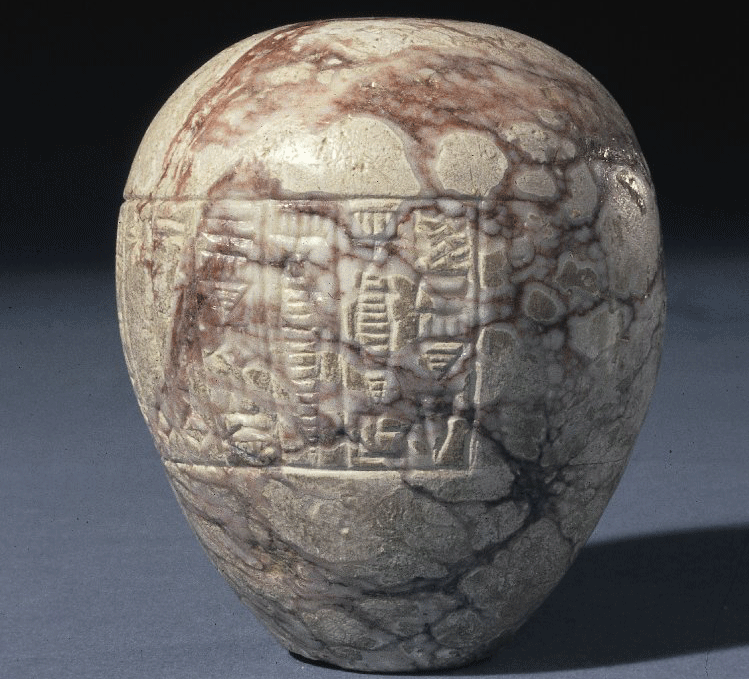
Nipur, City of Magic

“It is thus clear that, just as Eridu in southern Babylonia was the primitive seat of the worship of the Chaldean culture-god and of the civilisation with which his name was connected, Nipur in northern Babylonia was the original home of a very different kind of worship, which concerned itself with ghosts and demons and the various monsters of the under-world.

It was, in fact, the home of that belief in magic, and in the various spirits exorcised by the magician, which left so deep an impression upon the religion of early Babylonia, and about which I shall have to speak in a future Lecture.

The analogy of Eridu would lead us to infer, moreover, that it was not only the home of this belief, but also the source from which it made its way to other parts of the country.

In the pre-historic age, Eridu in the south and Nipur in the north would have been the two religious centres of Babylonian theology, from whence two wholly different streams of religious thought and influence spread and eventually blended.

The mixture formed what I may call the established religion of Chaldea in the pre-Semitic period. That this conclusion is not a mere inference is shown by the monuments discovered at Tel-loh.

Tel-loh was geographically nearer to Eridu than to Nipur, and its theology might therefore be expected to be more largely influenced by that of Eridu than by that of Nipur. And such, indeed, is the case.

Temples and statues are dedicated to Ea, “the king of Eridu,” and more especially to Bahu, a goddess who occupied a conspicuous place in the cosmological legends of Eridu.

But Mul-lil, the god of Nipur, appears far more frequently in the inscriptions of Tel-loh than we should have anticipated.

Nin-kharsak, “the mistress of the mountain,” and “mother of the gods,” in whom we may see a local divinity, is associated with him as wife; and Nin-girśu himself, the patron god of Tel-loh, is made his “hero” or “champion.”

So close, indeed, is the connection of the latter with Mul-lil, that the compilers of the mythological tablets, in a latter age, identified him with the “warrior” god of Nipur, Adar the son of Mul-lil.

Adar, or Ninep, or Uras--for his name has been read in these various fashions, and the true reading still remains unknown–played a conspicuous part in Babylonian, and more especially Assyrian theology.

He was regarded as emphatically the warrior and champion of the gods, and as such was naturally a favourite object of worship amongst a nation of warriors like the Assyrians. Indeed, it may be suspected that the extent to which the name of the older Bel was reverenced in Assyria was in some measure due to the favour in which his son Adar was held.

In the inscriptions of Nineveh, the title of “hero-god” (masu) is applied to him with peculiar frequency; this was the characteristic upon which the Assyrian kings more particularly loved to dwell.

In Babylonia, on the other hand, Adar was by no means so favourite a divinity. Here it was the milder and less warlike Merodach that took his place. The arts of peace, rather than those of war, found favour among the Semitic population of the southern kingdom.”

A.H. Sayce, Lectures on the Origin and Growth of Religion as Illustrated by the Religion of the Ancient Babylonians, 5th ed., London, 1898, pp. 150-2.
Bilat, Beltis, Nin-Ki-Gal, Allat, Infernal Queen of the Underworld

“When the god of Nipur became Semitic, his character underwent a change.

As the supreme deity of the state he was necessarily a Baal, but the Semitic Baal embodied very different conceptions from those which were associated with the Accadian Mul-lil. It is true that, as I have just pointed out, his primitive attributes still clung to him, but they were superadded to other attributes which showed him to be the supreme Sun-god of Semitic worship.

That supreme Sun-god, however, revealed himself to his worshippers under two aspects; he might be either the beneficent god who gave life and light to the world, or he might be the fierce and wrathful sun of summer who scorches all nature with his heat, and sinks at night, like a ball of glowing metal, into the darkness of the under-world.

Necessarily it was rather under the latter aspect that the Mul-lil of Nipur became the Semitic Bel.

This is the Bel whose cult was carried to Assyria, and whose name is mentioned frequently in the inscriptions of Nineveh, where among other titles he bears that of “father of the gods.”

This is a title which he received, not in virtue of his primitive character, but because he had become the Semitic Bel.

He was distinguished from the younger Bel of Babylon, Bel-Merodach, as βελιτανας or βολαθην (Βêl-êthûn), (ed. note: Greek sic) “the older Baal,” when Babylon became the imperial city, and its Bel claimed to be the father and head of the Babylonian gods.

But the distinction, as might be expected, was not always observed, and the older and younger Bel are sometimes confounded together.

The confusion was rendered the more easy by the fact that the wife of the Bel of Nipur was addressed as Bilat, and thus was undistinguished in name from Beltis of Babylon.

But she was in reality, as we have seen, the queen of Hades, Nin-ki-gal as the Accadians called her, or Allat as she is named in the Semitic texts.

Allat is interpreted “the unwearied;” like the Homeric epithet of Hades, αδαμαστος, “the inflexible” divinity who ceases not to deal on all sides his fatal blows. Her proper title, however–that, at least, under which she had originally been known at Nipur–was Nin-lil, “the lady of the ghost-world.”

It is under this name that Assur-bani-pal addresses her (Trustees of the British Museum (H.C. Rawlinson), The Cuneiform Inscriptions of Western Asia, ii. 66) as “the mistress of the world, whose habitation is the temple of the library” (i.e. the temple of Istar at Nineveh).

As Allat, the goddess of Hades, she was a much-dreaded and formidable figure, who is described in the legend of the Descent of Istar as inflicting upon her sister-goddess all the pains and diseases which emanated from her demoniac satellites.

The unfortunate Istar, stripped of her clothing and adornments, is held up to the scorn of the lower world; and Namtar, the plague-demon, is ordered by Allat to smite her with maladies in the eyes, in the sides, in the feet, in the heart, in the head, and, in short, in all the limbs.

Throughout the legend Namtar appears as the messenger of the infernal queen.”

A.H. Sayce, Lectures on the Origin and Growth of Religion as Illustrated by the Religion of the Ancient Babylonians, 5th ed., London, 1898, pp. 148-50.

Mul-lil = Bel

“The “lord of the ghost-world” extended his sway over this nether earth also.

He is therefore entitled “the lord of the world,” as well as “king of all the spirits of the earth.” According to one version of the story of the Deluge, it was he who caused the waters of the flood to descend from heaven, and who designed the destruction of all mankind.

“When Mul-lil,” we are told, “approached and saw the ship (of Xisuthros), he stood still and was filled with wrath against the gods and the spirits of heaven. ‘What soul has escaped therefrom?’ (he cried). ‘Let no man remain alive in the great destruction.'”

It was then that Ea came forward with words of wisdom, and protested against this attempt of Mul-lil to confound the innocent with the guilty.

“Let the sinner alone bear his sin; let the evil-doer bear his own iniquity.”

And though the wrathful god was pacified, so that Xisuthros and his companions were allowed to escape from their threatened death, the rescued hero did not forget the evil intentions of Mul-lil; but when inviting the other gods to his sacrifice after his descent from the ark, he specially excepted the god of Nipur.

“Let the (other) gods come to my altar, but let Mul-lil not come to the altar, since he did not act considerately, but caused a deluge and doomed my people to destruction.”

In these quotations I have called the god by his old Accadian name, Mul-lil; But long before this account of the Deluge was composed, even though in its present form it probably reaches back more than 2000 years before the Christian era, the Accadian Mul-lil had become the Semitic Bel.

His primitive attributes, however, still adhered to him. He was still the god of the lower world, whose messengers were diseases and nightmares and the demons of night, and from whom came the plagues and troubles that oppressed mankind.

In a magical text (Trustees of the British Museum (H.C. Rawlinson), The Cuneiform Inscriptions of Western Asia, iv. 1. 5, 6), Namtar, the plague-demon, is called “the beloved son of Mul-lil“–standing, in fact, in the same relation to Mul-lil that Tammuz does to Ea, and in the next line Mul-lil’s wife is asserted to be Nin-ki-gal or Allat, “the queen of the mighty land” of Hades.

This magical text, however, is a good deal older than the time when the Semites adopted and transformed the deities of the Accadians, or at all events it expresses the ideas of that earlier period.”

A.H. Sayce, Lectures on the Origin and Growth of Religion as Illustrated by the Religion of the Ancient Babylonians, 5th ed., London, 1898, pp. 146-8.

Origins of Lilith

“We can now understand why it was that in the theology of Eridu the Sun-god was the offspring of Ea and Dav-kina. The name that he bore there was Dumuzi or Tammuz, “the only-begotten one,” of whom I shall have much to say in the next Lecture.

At present I need only remark that he was the primeval Merodach; the Sun-god born of Ea who was called Merodach by the Babylonians was called Tammuz (Dumuzi,) by the people of Eridu.

Perhaps Merodach is after all nothing more than “the god from Eridu.” That he came originally from Eridu we have already seen.

The author of the hymn to the demiurge identifies Ea with “father Bel.” As “the lord of heaven and earth,” Ea was indeed a Baal or Bel to the Semites, to whose age the hymn belongs.

But the particular Bel with whom the poet wishes to identify him was Mul-lil, the supreme god and demiurge of Nipur (the modern Niffer). In a list of the titles of Ea, we find it expressly stated that he is one with “Mul-lil the strong.”

But such an identification belongs to the later imperial age of Babylonian history. Mul-lil was primitively a purely local divinity, standing in the same relation to his worshippers at Nipur that Ea stood to his at Eridu.

Mul-lil signifies “the lord of the ghost-world.” Lil was an Accado-Sumerian word which properly denoted “a dust-storm” or “cloud of dust,” but was also applied to ghosts, whose food was supposed to be the dust of the earth, and whose form was like that of a dust-cloud.

The Accadian language possessed no distinction of gender, and lil therefore served to represent both male and female ghosts. It was, however, borrowed by the Semites under the form of lillum, and to this masculine they naturally added the feminine lilatu.

Originally this lilatu represented what the Accadians termed “the handmaid of the ghost” (kel-lilla), of whom it was said that the lil had neither husband nor wife; but before long lilatu was confounded with the Semitic lilátu, “the night,” and so became a word of terror, denoting the night-demon who sucked the blood of her sleeping victims.

In the legend of the Descent of Istar into Hades, the goddess is made to threaten that unless she is admitted to the realm of the dead she will let them out in the form of vampires to devour the living.

From the Semitic Babylonians the name and conception of Lilatu passed to the Jews, and in the book of Isaiah (xxxiv. 14) the picture of the ghastly desolation which should befall Idumea is heightened by its ruined mounds being made the haunt of Lilith.

According to the Rabbis, Lilith had been the first wife of Adam, and had the form of a beautiful woman; but she lived on the blood of children whom she slew at night.”

A.H. Sayce, Lectures on the Origin and Growth of Religion as Illustrated by the Religion of the Ancient Babylonians, 5th ed., London, 1898, pp. 144-6.

The Oracles of Ea

“How a water-god became the demiurge seems at first sight obscure. But it ceases to be so when we remember the local character of Babylonian religion.

Ea was as much the local god of Eridu as Merodach was of Babylon, or Assur of Assyria. His connection with the water was due to the position of Eridu at the mouth of the Euphrates and on the shore of the sea, as well as to the maritime habits of its population.

In other respects he occupied the same place as the patron-deities of the other great cities. And these patron-deities were regarded as creators, as those by whose agency the present world had come into existence, and by whose hands the ancestors of their worshippers had been made.

This conception of a creating deity is one of the distinguishing features of early Babylonian religion. Mankind are not descended from a particular divinity, as they are in other theologies; they are created by him.

The hymn to Ea tells us that the god of Eridu was the creator of the black-headed race-that is to say, the old non-Semitic population whose primary centre and starting-point was in Eridu itself. It was as creators that the Accadian gods were distinguished from the host of spirits of whom I shall have to speak in another Lecture.

The Accadian word for “god” was dimer, which appears as dingir, from an older dingira, in the southern dialect of Sumer. Now dimer or dingir is merely “the creator,” formed by the suffix r or ra, from the verb dingi or dime, “to create.”

A simpler form of dimer is dime, a general name for the divine hierarchy. By the side of dime, dim, stood gime, gim, with the same meaning; and from this verb came the Sumerian name of Istar, Gingira. Istar is said to have been the mother of mankind in the story of the Deluge, and as Gula, “the great” goddess, she is addressed in a prayer as “the mother who has borne the men with the black heads.”

It was in consequence of the fact that he was a creator that Ea was, according to Accado-Sumerian ideas, a dingir or “god.”

In the cosmology of Eridu, therefore, the origin of the universe was the watery abyss. The earth lay upon this like a wife in the arms of her husband, and Dav-kina accordingly was adored as the wife of Ea.

It was through her that the oracles of Ea, heard in the voice of the waves, were communicated to man. Dav-kina is entitled “the mistress of the oracular voice of the deep,” and also “the lady who creates the oracular voice of heaven.”‘

The oracles delivered by the thunder, the voice of heaven, thus became the reflex of the oracles delivered through the roaring of the sea.”

A.H. Sayce, Lectures on the Origin and Growth of Religion as Illustrated by the Religion of the Ancient Babylonians, 5th ed., London, 1898, pp. 142-4.

Egyptian Hieroglyphs and Babylonian Cuneiform Share No Common Ancestor

Ea was [ … ] the source of their culture. He was symbolised, it would seem, by a serpent; … the primeval seat of the worship of Ea was the city of Eridu, now represented by the mounds of Abu Shahrein on the eastern bank of the Euphrates, and not far to the south of Mugheir or Ur.

Eridu is a contracted form of the older Eri-duga, or “good city,” which appears in the non-Semitic texts of northern Babylonia as Eri-zêba,with the same meaning. The place was thus a peculiarly holy spot, whose sanctity was established far and wide throughout the country.

But it was not a holy city only. It is often termed, more especially in the sacred tests, “the lordly city,”‘ and we are told that one of its titles was “the Iand of the sovereign.”

In historical times, however, Eridu had sunk to the condition of a second-rate or even third-rate town; its power must therefore belong to that dimly remote age of which the discoveries at Tel-loh have enabled us to obtain a few glimpses. There must have been a time when Eridu held a foremost rank among the cities of Babylonia, and when it was the centre from which the ancient culture and civilisation of the country made its way.

Along with this culture went the worship of Ea, the god of Eridu, who to the closing days of the Babylonian monarchy continued to be known as Eridúga, “the god of Eridu.” At the period when the first elements of Chaldean culture were being fostered in Eridu, the city stood at the mouth of the Euphrates and on the edge of the Persian Gulf.

If the growth of the alluvium at the mouths of the Euphrates and Tigris has always been the same as is the case at present (about sixty-six feet a year), this would have been at the latest about 3000 B.C.; but as the accumulation of soil has been more rapid of late, the date would more probably be about 4000 B.C.

Already, therefore, the cult of Ea would have been established, and the sea-faring traders of Eridu would have placed themselves under his protection.

It will be noticed that the culture-myths of Babylonia, like the culture-myths of America, bring the first civiliser of the country from the sea. It is as a sea deity that Oannes is the culture-hero of the Chaldeans; it is from the depths of the Persian Gulf that he carries to his people the treasures of art and science.

Two questions are raised by this fact. Was the culture of Babylonia imported from abroad; and was Ea, its god of culture, of foreign extraction?

The last great work published by Lepsius was an attempt to answer the first of these questions in the affirmative. He revived the old theory of a mysterious Cushite population which carried the civilisation of Egypt to the shores of Babylonia.

But to all theories of this sort there is one conclusive objection. The origin of Babylonian culture is so closely bound up with the origin of the cuneiform system of writing, that the two cannot be separated from each other.

Between the hieroglyphics of Egypt, however, and the primitive pictures out af which the cuneiform characters developed, there is no traceable connection.

Apart from those general analogies which we find in all early civilisations, the script, the theology and the astronomy of Egypt and Babylonia, show no vestiges of a common source.”

A.H. Sayce, Lectures on the Origin and Growth of Religion as Illustrated by the Religion of the Ancient Babylonians, 5th ed., London, 1898, pp. 134-6.

Sayce on the God Ea, or Oannes

“Ea, as we have already seen, was the god not only of the deep, but also of wisdom. Ancient legends affirmed that the Persian Gulf–the entrance to the deep or ocean-stream–had been the mysterious spot from whence the first elements of culture and civilisation had been brought to Chaldea.

Berossos, the Chaldean historian–so at least his epitomiser Alexander Polyhistor declared–had reported them as follows:

“At Babylon there was a great resort of people of various races who inhabited Chaldea, and lived in a lawless manner like the beasts of the field.

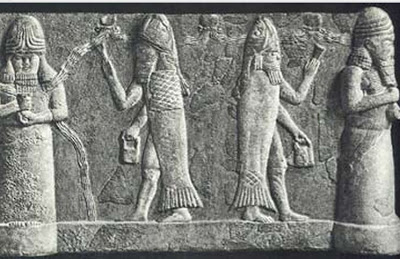
In the first year there appeared in that part of the Erythraean sea which borders upon Babylonia, a creature endowed with reason, by name Oannes, whose whole body (according to the account of Apollodaros) was that of a fish; under the fish’s head he had another head, with feet also below similar to those of a man subjoined to the fish’s tail.

His voice, too, and language were articulate and human; and a representation of him is preserved even to this day.

“This being was accustomed to pass the day among men, but took no food at that season; and he gave them an insight into letters and sciences and arts of every kind. He taught them to construct houses, to found temples, to compile laws, and explained to them the principles of geometrical knowledge.

He made them distinguish the seeds of the earth, and showed them how to collect the fruits; in short, he instructed them in everything which could tend to soften manners and humanize their lives. From that time, nothing material has been added by way of improvement to his instructions.

Now when the sun had set, this being Oannes used to retire again into the sea, and pass the night in the deep, for he was amphibious. After this there appeared other animals like Oannes, of which Berossos proposes to give an account when he comes to the history of the kings.

Moreover, Oannes wrote concerning the generation of mankind, of their different ways of life, and of their civil polity.”

[ … ]

The exact etymology of the name which appears under the Greek dress of Oannes has not yet been ascertained. Lenormant thought that it represented Ea-khan, “Ea the fish.” But whether or not this is the case, it is certain that Oannes and Ea are one and the same.

A depiction of Oannes, or Ea.

A depiction of Oannes, or Ea.

Ea, as we have seen, not only had his home in the waters of the Persian Gulf, he was also the culture-god of primitive Babylonia, the god of wisdom, the instructor of his worshippers in arts and science.

An old Babylonian sermon on the duty of a prince to administer justice impartially and without bribes, declares that if “he speaks according to the injunction (or writing) of the god Ea, the great gods will seat him in wisdom and the knowledge of righteousness.”

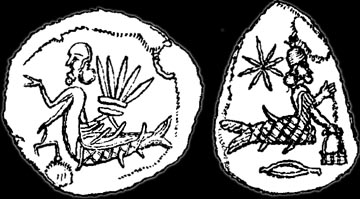
Ea was, moreover, like Oannes, represented as partly man and partly fish. Sometimes the fish’s skin is thrown over the man’s back, the head of a fish appearing behind that of the man; sometimes the body of the man is made to terminate in the tail of a fish.

A depiction of the God Ea, or Oannes.

A depiction of the God Ea, or Oannes.

A gem in the British Museum, on which the deity is depicted in the latter fashion, bears an inscription stating that the figure is that of “the god of pure life.”

OannesGems

Now “the god of pure life,” as we are expressly informed by a rubrical gloss to a hymn in honour of the demiurge Ea, was one of the names of Ea.”

A.H. Sayce, Lectures on the Origin and Growth of Religion as Illustrated by the Religion of the Ancient Babylonians, 5th ed., London, 1898, pp. 131-3.

The God Assur

“The transference of the centre of power from Assur to Nineveh made the anthropomorphic side of Assur’s nature still more prominent. He represented now the whole nation and the central power which governed the nation. He was thus the representative at once of the people and of the king in whose hands the government of the people was centred.

Assyria became “the land of the god Assur,” belonging to him in much the same way as the city of Babylon belonged to Bel-Merodach. But whereas Bel-Merodach was the Baal of a particular city only, Assur was, like the Yahveh of Israel, the national god of a race.

There was yet another respect in which Assur resembled the Yahveh of Israel. There was no goddess Assurritu by the side of Assur, as there was an Anatu by the side of Anu, a Beltis by the side of Bel. If, in imitation of Babylonian usage, Bilat or Beltis is sometimes addressed as the consort of Assur, it is simply a literary affectation; Assur was not a Bel or Baal, like Merodach.

Bilat is a Babylonian goddess; she is properly the wife of the older Bel, in later times identified with Zarpanit. There is no indication that Assur had a “face” or reflection; he stands by himself, and the inspiration received from him by the Assyrian kings is received from him alone. When a female divinity is invoked along with him, it is the equally independent goddess Istar or Ashtoreth.

We possess a list of the deities whose images stood in the temples of Assur at Assur and Nineveh.

At the head of each list the name of Assur is thrice invoked, and once his name is followed by that of Istar. There was, in fact, a special form of Istar, under which she was worshipped as “the Istar of Nineveh;” but the form was purely local, not national, arising from the existence there of a great temple dedicated to her. There was no national goddess to place by the side of the national god.

Assur consequently differs from the Babylonian gods, not only in the less narrowly local character that belongs to him, but also in his solitary nature. He is “king of all gods” in a sense in which none of the deities of Babylonia were.

He is like the king of Assyria himself, brooking no rival, allowing neither wife nor son to share in the honours which he claims for himself alone. He is essentially a jealous god, and as such sends forth his Assyrian adorers to destroy his unbelieving foes. Wife-less, childless, he is mightier than the Babylonian Baalim; less kindly, perhaps, less near to his worshippers than they were, but more awe-inspiring and more powerful.

We can, in fact, trace in him all the lineaments upon which, under other conditions, there might have been built up as pure a faith as that of the God of Israel.”

A.H. Sayce, Lectures on the Origin and Growth of Religion as Illustrated by the Religion of the Ancient Babylonians, 5th ed., London, 1898, pp. 126-9.

Assur, National Deity of Assyria

“Supreme over the old Babylonian pantheon rises the figure of a new god, the national deity of Assyria, its impersonation Assur. Assur is not merely primus inter pares, merely the president of the divine assembly, like Merodach; he is their lord and master in another and more autocratic sense.

Like the Yahveh of Israel, he claims to be “king above all gods,” that “among all gods” there is none like unto himself. In his name and through his help the Assyrian kings go forth to conquer; the towns they bum, the men they slay, the captives they take, are all his gifts.

It is to destroy “the enemies of Assur,” and to lay their yoke upon those who disbelieve in his name, that they load their armies into other lands; it is his decrees, his law, that they write upon the monuments they erect in conquered countries.

The gods of Babylonia are invoked, it is true; their old Babylonian titles are accorded to them; they are called upon to curse the sacrilegious in the stereotyped phrases of the ancient literature; but it is Assur, and Assur alone, to whom the Assyrian monarch turns in moments of distress; it is Assur, and Assur alone, in whose name he subdues the infidel. Only the goddess Istar finds a place by the side of Assur.

It is not difficult to account for all this. In passing from their native homes to Assyria, the Babylonian deities lost that local character which was the very breath of their existence. How far they owe their presence in Assyrian literature to the literary class, how far they had been brought from Babylonia in early days by the people themselves, I am not prepared to say.

One fact, however, is clear; in becoming Assyrian the Babylonian gods have lost both their definiteness and their rank. The invocations addressed to them lack their old genuine ring, their titles are borrowed from the literature of the southern kingdom, and their functions are usurped by the new god Assur.

It is almost pitiable to find Bel-Merodach invoked, in phrases that once denoted his power above other deities, by the very kings who boast of their conquests over his people, or who even razed his city to the ground.

The Assyrian, in fact, occupied much the same position as an Israelite who, while recognizing the supremacy of his national God, thought it prudent or cultivated to offer at the same time a sort of inferior homage to the Baalim of Canaan.”

A.H. Sayce, Lectures on the Origin and Growth of Religion as Illustrated by the Religion of the Ancient Babylonians, 5th ed., London, 1898, pp. 122-3.

Nebo, God of Prophecy

“A knowledge of Babylonian letters and learning was accompanied by a knowledge of the Babylonian god of letters and learning.

In Assyria, Nebo was honoured as much as he was in Babylonia itself. The Assyrian kings and scribes might be silent about the name of Merodach, but the name of Nebo was continually in their mouths.

His name and worship passed even to the distant Semitic tribes of the west. The names of places in Palestine in which his name occurs, proves that the god of prophecy was adored by Canaanites and Moabites alike. Moses, the leader and prophet of Israel, died on the peak of Mount Nebo, and cities bearing the name stood within the borders of the tribes of Reuben and Judah.

When the Israelites entered upon their literary era, the old name of roch, or “seer,” was exchanged for the more literary one of Nēbi, or “prophet.”

The Semites of Babylonia provided Nebo with a wife, Tasmitu, “the hearer.” She helped to open and enlarge the ears which received the divine mysteries her husband’s inspiration enabled his devout servants to write down.

The revolution which transferred the learning of the Babylonians from the Accadians to the Semites, transferred the patronage of the literary class from the old god Ea to his younger rivals Nebo and Tasmit.

[ … ]

The Semites of Babylonia thus closely resembled their brother Semites of Canaan in their fundamental conception of religion. As the Canaanite or Phoenician had “lords many,” the multitudinous Baalim who represented the particular forms of the Sun-god worshipped in each locality, so too the gods of Semitic Babylonia were equally multitudinous and local–Merodach, for example, being merely the Bel or Baal of Babylon, just as Mel-karth (Melech-kiryath) was the Baal of Tyre.

But the parallelism extends yet further. We have seen that the rise of the prophet-god in Babylonia marks the growing importance of literature and a literary class, just as the beginning of a literary age in Israel is coeval with the change of the seer into the prophet.

Now the literary age of Israel was long preceded by a literary age among their Phoenician neighbours, and its growth is contemporaneous with the closer relations that grew up between the monarchs of Israel and Hiram of Tyre.

What Israel was in this respect to the Phoenicians, Assyria was to Babylonia. The Assyrians were a nation of warriors and traders rather than of students; their literature was for the most part an exotic, a mere imitation of Babylonian cuiture.

In Babylonia, education was widely diffused; in Assyria, it was confined to the learned class. We must remember, therefore, that in dealing with Assyrian documents we are dealing either with a foreign importation or with the thoughts and beliefs of a small and special class.”

A.H. Sayce, Lectures on the Origin and Growth of Religion as Illustrated by the Religion of the Ancient Babylonians, 5th ed., London, 1898, pp. 119-122.

More Epithets of Nebo

“We have only to glance over the titles which were given to Nebo to see how thoroughly the conception of “the prophet” was associated with that of ‘”the writer.”

He is not only “the wise,” “the intelligent,” “the creator of peace,” “the author of the oracle;” he is also “the creator of the written tablet,” “the maker of writing,” “the opener” and “enlarger of the ear.”

Assur-bani-pal is never weary of telling us, at the end of the documents his scribes had copied from their Babylonian originals, that “Nebo and Tasmit had given him broad ears (and) endowed (him) with seeing eyes,” so that he had “written, bound together and published the store of tablets, a work which none of the kings who had gone before had undertaken, even the secrets of Nebo, the list of characters as many as exist.”

In the literary dialect of the Semitic epoch, Nebo went by the Accadian name of dim-sar, “the scribe,” and the ideograph by which he is sometimes denoted was regarded by the Semitic literati as signifying “the maker of intelligence” and “the creator of writing.”

These, however, were not the only titles that Nebo bore. He was also “the bond of the universe,” and “the overseer of the angel-hosts of heaven and earth.” The latter office might be explained as derived from his duties as scribe of the gods; but it is hard to discover what connection there could be between the first title and his association with literature.

Light is thrown upon it, however, by the fact that the ziggurrat or tower of his temple at Borsippa had the name of “the house of the seven bonds of heaven and earth.” The seven “bonds” seem to represent the seven planets, or rather their stations; the tower was in seven stages, and each stage was painted so as to symbolise the colours symbolical of the several planets.

Nebo must, therefore, have once been an elemental god, or at all events a god connected with the chief of the heavenly bodies.

We know that Babylonian astronomy made him the presiding deity of the planet Mercury, just as it made Merodach the presiding deity of Jupiter; but it cannot have been in reference to this that the tower of his temple was dedicated to the seven heavenly spheres.

Nebo cannot well have been one of the seven himself in the conception of its builders; he must rather have been the universe in which the seven spheres were set.”

A.H. Sayce, Lectures on the Origin and Growth of Religion as Illustrated by the Religion of the Ancient Babylonians, 5th ed., London, 1898, pp. 114-6.

Nebo, God of Wisdom, God of Writing

In Semitic days, Zarpanit, the inheritor of all these old traditions and worships, fell from her high estate. She ceased to be the goddess of wisdom, the voice of the deep revealing the secrets of heaven to the diviner and priest; she became merely the female shadow and companion of Merodach, to whom a shrine was erected at the entrance to his temple.

Her distinctive attributes all belong to the pre-Semitic epoch; with the introduction of a language which recognized gender, she was lost in the colourless throng of Ashtaroth or Baalat, the goddesses who were called into existence by the masculine Baalim.

Zarpanit, however, had something to do with the prominence given to Nebo in the Babylonian cult. Nebo, the son of Merodach and Zarpanitu, had, as we have seen, a chapel called E-Zida within the precincts of the great temple of his father.

E-Zida, “the constituted house,” derived its name from the great temple of Borsippa, the suburb of Babylon, the ruins of which are now known to travelers as the Birs-i-Nimrúd. Borsippa, it would seem, had once been an independent town, and Nebo, or the prototype of Nebo, had been its protecting deity.

In the middle of the city rose E-Zida, the temple of Nebo and Nana Tasmit, with its holy of holies, “the supreme house of life,” and its lofty tower termed “the house of the seven spheres of heaven and earth.” It had been founded, though never finished, according to Nebuchadnezzar, by an ancient king.

For long centuries it had remained a heap of ruin, until restored by Nebuchadnezzar, and legends had grown up thickly around it. It was known as the tul ellu, “the pure” or “holy mound,” and one of the titles of Nebo accordingly was “god of the holy mound.”

The word Nebo is the Semitic Babylonian Nabiu or Nabû. It means the proclaimer,” “the prophet,” and thus indicates the character of the god to whom it was applied. Nebo was essentially the proclaimer of the mind and wishes of Merodach.

He stood to Merodach in the same relation that an older mythology regarded Merodach as standing to Ea. While Merodach was rather the god of healing, in accordance with his primitively solar nature, Nebo was emphatically the god of science and literature.

The communication of the gifts of wisdom, therefore, which originally emanated from Ea, was thus shared between Merodach and his son. At Babylon, the culture-god of other countries was divided into two personalities, the one conveying to man the wisdom that ameliorates his condition, the other the knowledge which finds its expression in the art of writing.”

A.H. Sayce, Lectures on the Origin and Growth of Religion as Illustrated by the Religion of the Ancient Babylonians, 5th ed., London, 1898, pp. 112-3.

Triads and Feminine Reflections in Babylonian Religion

“Even at Babylon, however, Merodach did not stand alone. He shared his divine honours, as we have seen, with his wife Zarpanitu and his son Nebo.

The old Accadian cult seems to have had a fancy for trinities or triads, originating perhaps in the primary astronomical triad of the Sun-god, the Moon-god and the Evening Star.

The Accadian triad usually consisted of male deities. The Semites, however, as I hope to point out in the next Lecture, introduced a new idea, that of sex, into the theology of the country. Every god was provided with his female reflection, who stood to him in the relation of the wife to the husband.

Baal, accordingly, had his female reflex, his “face,” as it was termed, Bilat or Beltis. By the side of the Baal of Babylon, therefore, stood Beltis, “the lady” by the side of her “lord.”

Her local name mas Zarpanitu, which a punning etymology subsequently turned into Zir-banitu, “creatress of seed,” sometimes written Zir-panitu, with an obvious  play on the word panu, or “face.”

Zarpanitu was of purely Semitic origin. But she was identified with an older Accadian divinity, Gasmu, “the wise one,” the fitting consort of a deity whose office it was to convey the wishes of the god of wisdom to suffering humanity.

The Accadian goddess, however, must originally have stood rather in the relation of mother than of wife to the primitive Merodach. She was entitled “the lady of the deep,” “the mistress of the abode of the fish,” and “the voice of the deep.”

Hence she must have ranked by the side of Ea, the fish-god and “lord of the deep;” and in the title “voice” or “incantation of the deep,” we may see a reference to the ideas which caused Ea to become the god of wisdom, and brought the fish-god Oannes out of the Persian Gulf to carry culture and knowledge to the inhabitants of Chaldea.

In the roar of the sea-waves, the early dwellers on the shores of the Gulf must have heard the voice of heaven, and their prophets and diviners must have discovered in it a revelation of the will of the gods.

It is not surprising, therefore, if Zarpanit was specially identified with the goddess Lakhamun, who was worshipped in the sacred island of Dilmun, or with the goddess Elagu, whose name was revered in the mountains of Elam.”

A.H. Sayce, Lectures on the Origin and Growth of Religion as Illustrated by the Religion of the Ancient Babylonians, 5th ed., London, 1898, pp. 110-1.

The Puzzle of Marduk

“Was Merodach himself an Accadian or a Semitic deity? The names of the kings belonging to the first dynasty of Babylon are mostly Semitic; it might therefore be supposed that the deity they worshipped was Semitic also.

And so undoubtedly was the Merodach of the historical age, the great Bel or Baal of Babylon. But we must remember that the foundation of Babylon went back into the dim night of the past far beyond the era of its first dynasty of Semitic kings, and that its very name was but a translation of the older Ka-dimira, “gate of the god.”

The temple of Merodach, moreover, bore, up to the last, not a Semitic, but an Accadian designation. As we shall see, along with the older culture the Semitic settlers in Babylonia borrowed a good deal of the theology of the Accadian people, modifying it in accordance with their own beliefs, and identifying its gods and demons with their own Baalim.

Marduk.

Marduk.

It would not be surprising, then, if we found that Merodach also had once been an Accadian divinity, though his attributes, and perhaps also his name, differed very considerably from those of the Semitic Bel.

Even after the Romans had identified their Saturn with the Kronos of the Greeks, the essential characteristics of the two deities remained altogether different.”

A.H. Sayce, Lectures on the Origin and Growth of Religion as Illustrated by the Religion of the Ancient Babylonians, 5th ed., London, 1898, p. 105.

Elder and Younger Bel

The Bel of this legend, who has settled the places of the Sun and the Moon in the sky, is not the Babylonian Bel, but the older Bel of Nipur, from whom Merodach, the Bel of Babylon, had afterwards to be distinguished.

The Accadian original of the poem belongs to a very early epoch, before the rise of Babylon, when the supreme Bel of the Semitic inhabitants of Babylonia was still the god whom the Accadians called Mul-lilla, “the lord of the lower world.”

This Bel or Mul-lilla fades into the background as the Semitic element in Babylonian religion became stronger and the influence of Babylon greater, though the part that he played in astronomical and cosmological lore, as well as his local cult at Nipur, kept his memory alive; while the dreaded visitants of night, the demoniac lilu and lilat or lilith, from the lower world, preserved a faint memory of the spirits of which he had once been the chief.

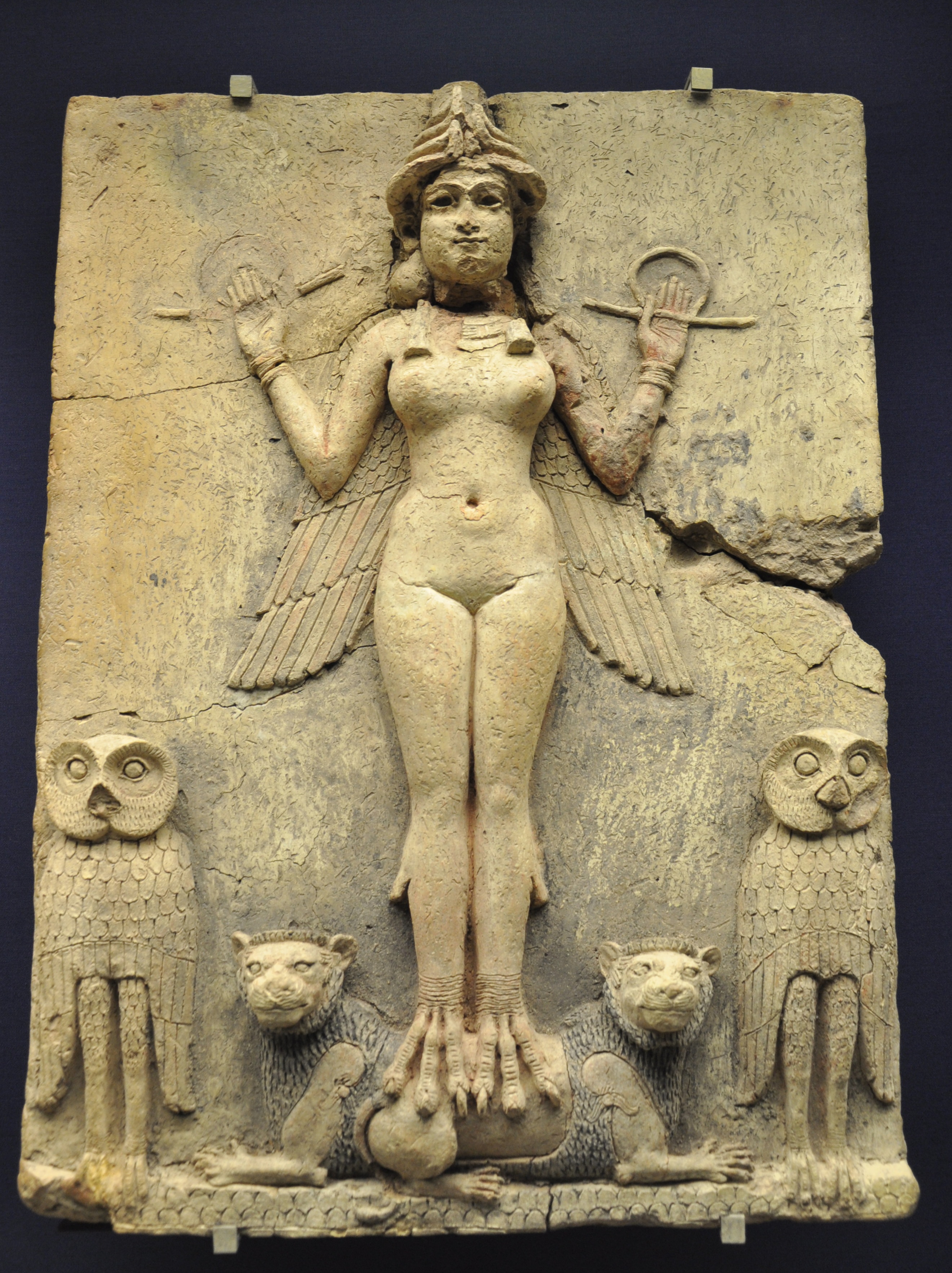
Burney Relief, Babylon (1800-1750 BCE). The figure in the relief was sometimes identified with Lilith, based on a misreading of an outdated translation of the Epic of Gilgamesh. Modern research has identified the figure as either Ishtar or Ereshkigal. https://upload.wikimedia.org/wikipedia/commons/1/19/Burney_Relief_Babylon_-1800-1750.JPG

Burney Relief, Babylon (1800-1750 BCE). The figure in the relief was sometimes identified with Lilith, based on a misreading of an outdated translation of the Epic of Gilgamesh. Modern research has identified the figure as either Ishtar or Ereshkigal.
https://upload.wikimedia.org/wikipedia/commons/1/19/Burney_Relief_Babylon_-1800-1750.JPG

 One by one, however, the attributes that had formerly attached to the older Bel were absorbed by the younger Bel of Babylon.

It was almost as it was in Greece, where the older gods were dethroned by their own offspring; in the Babylonia of Nebuchadnezzar and Nabonidos, it was the younger gods–Merodach, Sin and Samas–to whom vows were the most often made and prayer the most often ascended.

Such was the latest result of the local character of Babylonian worship: the younger gods were the gods of the younger Babylonian cities, and the god of Babylon, though he might be termed “the first-born of the gods,” was in one sense the youngest of them all.

The title, however, “first-born of the gods” was of the same nature as the other title, “prince of the world,” bestowed upon him by his grateful worshippers. It meant little else than that Babylon stood at the head of the world, and that its god must therefore be the first-born, not of one primeval deity, but of all the primeval deities acknowledged in Chaldea.

According to the earlier faith, he was the first-born of Ea only. Ea was god of the deep, both of the atmospheric deep upon which the world floats, and of that watery deep, the Okeanos of Homer, which surrounds the earth like a coiled serpent.

All streams and rivers were subject to his sway, for they flowed into that Persian Gulf which the ignorance of the primitive Chaldean imagined to be the ocean-stream itself. It was from the Persian Gulf that tradition conceived the culture and civilisation of Babylonia to have come, and Ea was therefore lord of wisdom as well as lord of the deep.

His son Merodach was the minister of his counsels, by whom the commands of wisdom were carried into practice. Merodach was thus the active side of his father Ea; to use the language of Gnosticism, he was the practical activity that emanates from wisdom.”

A.H. Sayce, Lectures on the Origin and Growth of Religion as Illustrated by the Religion of the Ancient Babylonians, 5th ed., London, 1898, p. 103-4.

E-Sagila: Temple of the Sun

“May we not conclude, then, that originally Merodach also was a solar deity, the particular Sun-god, in fact, whose worship was carried on at Babylon?

The conclusion is verified by the express testimony of the ritual belonging to Merodach’s temple E-Sagila. Here we read that

“In the month Nison, on the second day, two hours after nightfall, the priest must come and take of the waters of the river, must enter into the presence of Bel; and putting on a stole in the presence of Bel, must say this prayer:

“0 Bel, who in his strength has no equal! O Bel, blessed sovereign, lord of the world, seeking after the favour of the great gods, the lord who in his glance has destroyed the strong, lord of kings, light of mankind, establisher of faith!

0 Bel, thy sceptre is Babylon, thy crown is Borsippa, the wide heaven is the dwelling-place of thy liver. …0 lord of the world, light of the spirits of heaven, utterer of blessings, who is there whose mouth murmurs not of thy righteousness, or speaks not of thy glory, and celebrates not thy dominion?

0 lord of the world, who dwellest in the temple of the Sun, reject not the hands that are raised to thee; be merciful to thy city Babylon, to E-Sagila thy temple incline thy face; grant the prayers of thy people the sons of Babylon.”

Nothing can be more explicit than the statement that E-Sagila, the temple of Merodach, was also the temple of the Sun. We thus come to understand the attributes that are ascribed to Merodach and the language that is used of him.

He is “the light of the spirits of heaven,” even as the Son-god, … is “the illuminator of darkness” whose face is beheld by the spirits of the earth. The wide heaven is naturally his dwelling-place, and he raises the dead to life as the sun of spring revivifies the dead vegetation of winter.

The part that he plays in the old mythological poems, in the poems, that is, which embody the ancient myths and legends of Babylonia, is now fully explained. One of the most famous of these was the story of the combat between Merodach and Tiamat, the dragon of darkness and chaos.”

A.H. Sayce, Lectures on the Origin and Growth of Religion as Illustrated by the Religion of the Ancient Babylonians, 5th ed., London, 1898, pp. 100-102.

Marduk as Sun God of Babylon

Here Merodach, it will be observed, though “lord of all that exists,” is nevertheless only the first-born of the gods.

There were gods older than he, just as there were cities older than Babylon. He could not therefore be absolute lord of the world; it was only within Babylon itself that this was the case; elsewhere his rule was shared with others.

Hence it was that while Nebuchadnezzar as a native of Babylon was the work of his hands, outside Babylon there were other creators and other lords. This fact is accentuated in an inscription of Nabonidos, belonging to the earlier part of his reign, in which Merodach is coupled with the Moon-god of Ur and placed on an equal footing with him.

One of the epithets applied by Nebuchadnezzar to Merodach is that of riminu, or “merciful.” It is indeed a standing epithet of the god. Merodach was the intercessor between the gods and men, and the interpreter of the will of Ea, the god of wisdom.

In an old bilingual hymn he is thus addressed: “Thou art Merodach, the merciful lord who loves to raise the dead to life.” The expression is a remarkable one, and indicates that the Babylonians were already acquainted with a doctrine of the resurrection at an early period.

Merodach’s attribute of mercy is coupled with his power to raise the dead. The same expression occurs in another of these bilingual hymns, which I intend to discuss in a future Lecture…

“(Thou art) the king of the land, the lord of the world!

0 firstborn of Ea, omnipotent over heaven and earth.

0 mighty lord of mankind, king of (all) lands,

(Thou art) the god of gods,

(The prince) of heaven and earth who hath no rival,

The companion of Anu and Bel (Mul-lil),

The merciful one among the gods,

The merciful one who loves to raise the dead to life,

Merodach, king of heaven and earth,

King of Babylon, lord of E-Sagila,

King of E-Zida, king of E-makh-tilla (the supreme house of life),

Heaven and earth are thine!

The circuit of heaven and earth is thine,

The incantation that gives life is thine,

The breath that gives life is thine,

The holy writing of the mouth of the deep is thine:

Mankind, even the black-headed race (of Accad),

All living souls that have received a name, that exist in the world,

The four quarters of the earth wheresoever they are,

All the angel-hosts of heaven and earth

(Regard) thee and (lend to thee) an ear.”

[ … ]

A.H. Sayce, Lectures on the Origin and Growth of Religion as Illustrated by the Religion of the Ancient Babylonians, 5th ed., London, 1898, pp. 98-102.

Temple of Bel, Temple of Marduk, Temple of Babylon, E-Sagila

“He says of it:

Ka-khilibu, the gate of glory, as well as the gate of E-Zida within E-Sagila, I made as brilliant as the sun. The holy seats, the place of the gods who determine destiny, which is the place of the assembly (of the gods), the holy of holies of the gods of destiny, wherein on the great festival (Zagmuku) at the beginning of the year, on the eighth and the eleventh days (of the month), the divine king (Merodach), the god of heaven and earth, the lord of heaven, descends, while the gods in heaven and earth, listening to him with reverential awe and standing humbly before him, determine therein a destiny of long-ending days, even the destiny of my life; this holy of holies, this sanctuary of the kingdom, this sanctuary of the lordship of the first-born of the gods, the prince, Merodach, which a former king had adorned with silver, I overlaid with glittering gold and rich ornament.”

Just within the gate was the “seat” or shrine of the goddess Zarpanit, the wife of Merodach, perhaps to be identified with that Succoth-benoth whose image, we are told in the Old Testament, was made by the men of Babylon.

E-Zida, “the firmly-established temple,” was the chapel dedicated to Nebo, and derived its name from the great temple built in honour of that deity at Borsippa. As Nebo was the son of Merodach, it was only fitting that his shrine should stand within the precincts of his father’s temple, by the side of the shrine sacred to his mother Zarpanit.

It was within the shrine of Nebo, the god of prophecy, that the parakku, or holy of holies, was situated, where Merodach descended at the time of the great festival at the beginning of the year, and the divine oracles were announced to the attendant priests.

The special papakha or sanctuary of Merodach himself was separate from that of his son. It went by the name of E-Kua, “the house of the oracle,” and probably contained the golden statue of Bel mentioned by Herodotus.

Nebuchadnezzar tells us that he enriched its walls with ”glittering gold.” Beyond it rose the stately ziggurat, or tower of eight stages, called E-Temen-gurum, “the house of the foundation-stone of heaven and earth.” As was the case with the other towers of Babylonia and Assyria, its topmost chamber was used as an observatory.

This illustration depicts the dual ziggurats of E-temen-anki and the Temple of Bel, conflating them as E-Sagila, the Temple of Marduk.  http://www.dalamatiacity.com/urantia-clues23.htm

This illustration depicts the dual ziggurats of E-temen-anki and the Temple of Bel, conflating them as E-Sagila, the Temple of Marduk.
http://www.dalamatiacity.com/urantia-clues23.htm

No temple was complete without such a tower; it was to the Babylonian what the high-places were to the inhabitants of a mountainous country like Canaan. It takes us back to an age when the gods were believed to dwell in the visible sky, and when therefore man did his best to rear his altars as near to them as possible. “Let us build us a city and a tower,” said the settlers in Babel, “whose top may reach unto heaven.”

 The Babylonian Bel, accordingly, was Merodach, who watched over the fortunes of Babylon and the great temple there which had been erected in his honour. He was not the national god of Babylonia, except in so far as the city of Babylon claimed to represent the whole of Babylonia; he was simply the god of the single city of Babylon and its inhabitants.

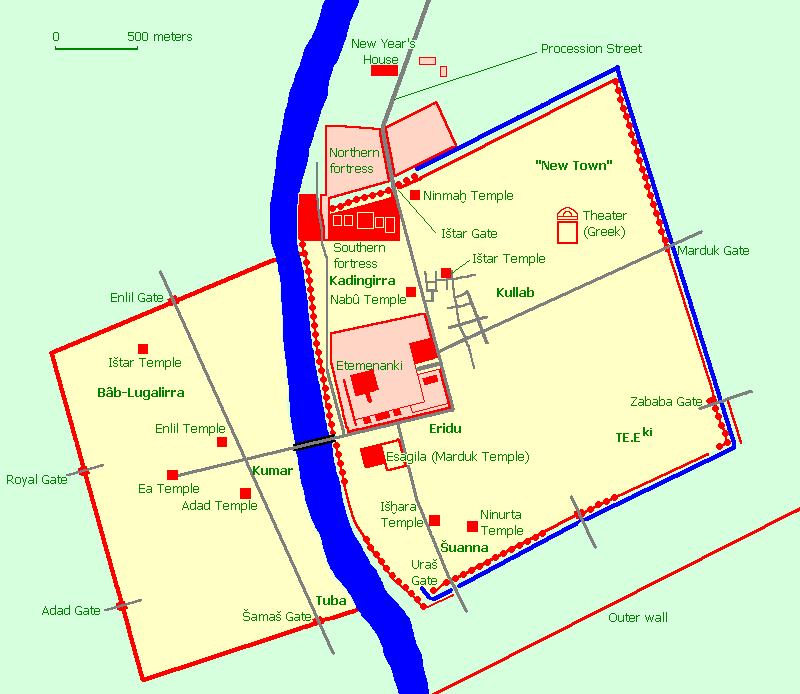
This map depicts more clearly the relative positions of Etemenanki and the Temple of Marduk.  Map of Babylon Creator Jona Lendering Licence Attribution-NonCommercial-ShareAlike 4.0 International Linked Babylon, Babylonian Empire, Capture of Babylon (Herodotus), Esagila, Etemenanki (the "Tower of Babel"), Zopyrus Categories Babylonia http://www.livius.org/pictures/a/maps/map-of-babylon/ http://www.livius.org/place/etemenanki/

This map depicts more clearly the relative positions of Etemenanki and the Temple of Marduk.
Map of Babylon
Creator
Jona Lendering
Licence
Attribution-NonCommercial-ShareAlike 4.0 International
Linked
Babylon, Babylonian Empire, Capture of Babylon (Herodotus), Esagila, Etemenanki (the “Tower of Babel”), Zopyrus
Categories
Babylonia
http://www.livius.org/pictures/a/maps/map-of-babylon/
http://www.livius.org/place/etemenanki/

He was but one Baal out of many Baalim, supreme only when his worshippers were themselves supreme. It was only when a Nebuchadnezzar or a Khammuragas was undisputed master of Babylonia that the god they adored became “the prince of the gods.”

But the other gods maintained their separate positions by his side, and in their own cities would have jealously resented any interference with their ancient supremacy. As we have seen, Nabonidos brought upon himself the anger of heaven because he carried away the gods of Marad and Kis and other towns to swell the train of Merodach in his temple at Babylon.”

 A.H. Sayce, Lectures on the Origin and Growth of Religion as Illustrated by the Religion of the Ancient Babylonians, 5th ed., London, 1898, pp. 94-7.

E-Sagila, The Great Temple of Bel in Babylon

The temple or “tomb”of Bêlos, as it was also called by the Greeks, was one of the wonders of the world.

Hêrodotos, quoting probably from an earlier author, describes it in the following terms :

“The temple of Zeus Bêlos,with bronze gates which remained up to my time, was a square building two furlongs every way. In the middle of the temple was a tower of solid masonry, a furlong in length and breadth, and upon this tower another tower had been erected, and upon that again another, and so on for eight towers.

And the ascent to them was by an incline which wound round all the towers on the outside. About the middle of the incline are a resting-place and seats, where those who ascend may sit and rest. In the topmost tower is a large shrine, within which is a large and well-appointed couch, with a golden table at its side.

But no image is set up there, nor does any one pass the night there except a single woman, a native of the country, whom the god selects for himself from among all the inhabitants, as is asserted by the Chaldeans, the priests of the god.

They further say, though I cannot believe it, that the god himself visits the shrine and takes his rest upon the couch. … There is another shrine below belonging to this Babylonian temple, and containing a great statue of Zeus [Bêlos] of gold in a sitting posture, and a great golden table is set beside it.

The pedestal and chair of the statue are of gold, and, as the Chaldeans used to say, the gold was as much as 800 talents in weight. Outside the shrine is a golden altar. There is also another great altar upon which full-grown sheep are sacrificed, for upon the golden altar only sucklings are allowed to be offered.

Upon the larger altar also the Chaldeans burn each year a thousand talents of frankincense at the time when they keep the festival of the god. In this part of the temple there was still at that time a figure of a man twelve cubits high, of solid gold.”

It is clear from this description that the great temple of Babylon resembled a large square enclosure formed by huge walls of brick, within which rose a tower in eight stages. Below the tower was a shrine or temple, and outside it two altars, the smaller one of gold for special offerings, while the larger one was intended for the sacrifice of sheep as well as for the burning of incense.

We learn a good deal about this temple from the inscriptions of Nebuchadnezzar, which show that although Hêrodotos was correct in his general description of the building, he has made mistakes in the matter of details.

The Temple itself stood on the east side of Babylon, and had existed since the age of Khammuragas (B.C. 2250), and the first dynasty which had made Babylon its capital. It bore the title of E-Sagila or E-Saggil, an Accadian name signifying “the house of the raising of the head.”

Its entrance also bore the Accadian title of Ka-khilibu, which Nebuchadnezzar renders “the gate of glory.”

 A.H. Sayce, Lectures on the Origin and Growth of Religion as Illustrated by the Religion of the Ancient Babylonians, 5th ed., London, 1898, pp. 92-4.

Marduk of Babylon: Baal

” … Nebuchadnezzar may invoke Merodach as “the lord of the gods,” “the god of heaven and earth,” “the eternal, the holy, the lord of all things,” but he almost always couples him with other deities–Nebo, Sin or Gula–of whom he speaks in equally reverential terms.

Even Nabonidos uses language of Sin, the Moon-god, which is wholly incompatible with a belief in the exclusive supremacy of Merodach. He calls him “the lord of the gods of heaven and earth, the king of the gods and the god of gods, who dwell in heaven and are mighty.” Merodach was, in fact, simply the local god of Babylon.

Events had raised Babylon first to the dignity of the capital of Babylonia, and then of that of a great empire, and its presiding deity had shared its fortunes. It was he who had sent forth its people on their career of conquest; it was to glorify his name that he had given them victory.

The introduction of other deities on an equal footing with himself into his own peculiar seat, his own special city, was of itself a profanation, and quite sufficient to draw upon Nabonidos his vindictive anger. The Moon-god might be worshipped at Ur; it was out of place to offer him at Babylon the peculiar honours which were reserved for Merodach alone.

Here, then, is one of the results of that localisation of religious worship which was characteristic of Babylonia. Nabonidos not only offended the priests and insulted the gods of other cities by bringing their images into Babylon, he also in one sense impaired the monopoly which the local deity of Babylon enjoyed. He thus stirred up angry feelings on both sides.

Had he himself been free from the common belief of the Babylonian in the local character of his gods, he might have effected a revolution similar to that of Hezekiah; he had, however, the superstition which frequently accompanies antiquarian instincts, and his endeavour to make Babylon the common gathering-place of the Babylonian divinities was dictated as much by the desire to make all of them his friends as by political design.

Now who was this Merodach, this patron-god of Babylon, whose name I have had so often to pronounce? Let us see, first of all, what we can learn about him from the latest of our documents, the inscriptions of Nebuchadnezzar and his successors.

In these, Merodach appears as the divine protector of Babylon and its inhabitants. He has the standing title of Bilu or “lord,” which the Greeks turned into βμλος, and which is the same as the Baal of the Old Testament. The title is frequently used as a name, and is, in fact, the only name under which Merodach was known to the Greeks and Romans.

In the Old Testament also it is as Bel that he comes before us. When the prophet declares that “Bel boweth down” and is “gone into captivity,” he is referring to Merodach and the overthrow of Merodach’s city.

To the Babylonian, Merodach was pre-eminently the Baal or “lord,” like the Baalim or “lords” worshipped under special names and with special rites in the several cities of Canaan.”

 A.H. Sayce, Lectures on the Origin and Growth of Religion as Illustrated by the Religion of the Ancient Babylonians, 5th ed., London, 1898, pp. 90-2.

Civil Centralization = Religious Centralization

“Up to the last, Babylonian religion remained local. It was this local character that gives us the key to its origin and history, and explains much that would otherwise seem inconsistent and obscure.

The endeavour of Nabonidos to undermine its local character and to create a universal religion for a centralised Babylonia, was deeply resented by both priests and people, and ushered in the fall of the Babylonian empire. The fundamental religious idea which had underlain the empire had been the supremacy of Merodach, the god of Babylon, over all other gods, not the absorption of the deities of the subject nations into a common cult.

The policy of Nabonidos, therefore, which aimed at making Merodach, not primus inter pares, but absolute lord of captive or vassal deities, shocked the prejudices of the Babylonian people, and eventually proved fatal to its author.

In Cyrus, accordingly, the politic restorer of the captive populations and their gods to their old homes, the priests and worshippers of the local divinities saw the pious adherent of the ancient forms of faith, and the real favourite of Merodach himself.

Merodach had not consented to the revolutionary policy of Nabonidos; he had, on the contrary, sympathised with the wrongs of his brother gods in Babylonia and throughout the world, and had thus deserted his own city and the renegade monarch who ruled over it.

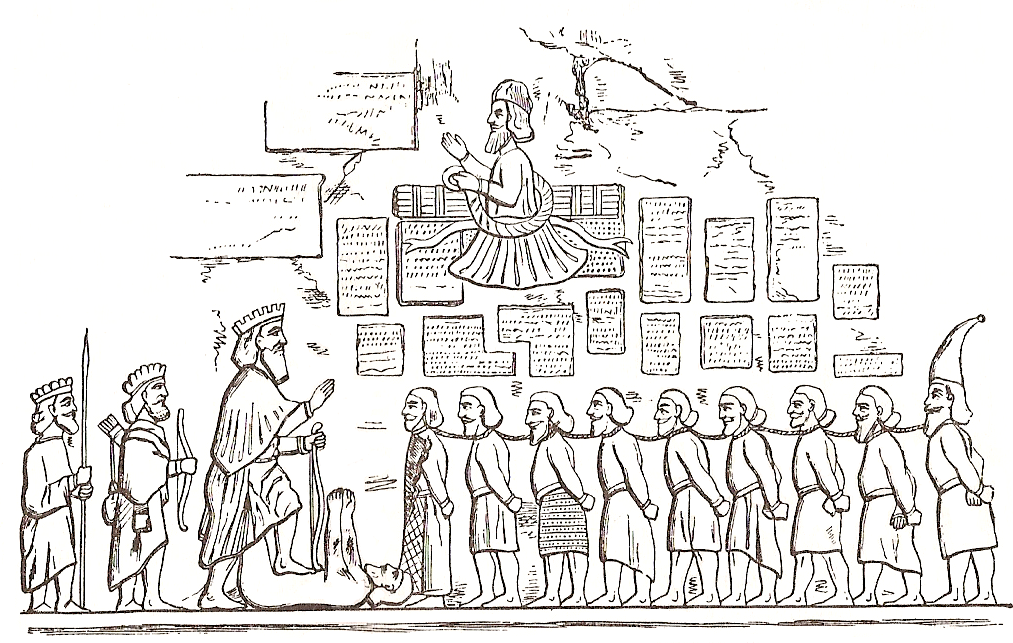
In all this there is a sharp contrast to the main religious conception which subsequently held sway over the Persian empire, as well as to that which was proclaimed by the prophets of Judah, and in the reforms of Hezekiah and Josiah was carried out practically by the Jewish kings. The Ahura-mazda whom Dareios invokes on the rock of Behistun is not only the lord of the gods, he is a lord who will not brook another god by his side.

A penciled illustration of the Behistun Inscription.  https://commons.wikimedia.org/wiki/File:Behistun_Inscription_Eger.png

A penciled illustration of the Behistun Inscription.
https://commons.wikimedia.org/wiki/File:Behistun_Inscription_Eger.png

The supreme god of the Persian monarch is as absolute as the Persian monarch himself. In the Persian empire which was organised by Dareios, centralisation became for the first time a recognised and undisputed fact, and political centralisation went hand-in-hand with religious centralisation as well.

In Judah, a theocracy was established on the ruins of the old beliefs which had connected certain localities with certain forms of divinity, and which found such naive expression in the words of David to Saul (1 Samuel xxvi. 19): “They have driven me out this day from abiding in the inheritance of the Lord, saying, Go, serve other gods.”

The destruction of the high-places and the concentration of the worship of Yahveh in Jerusalem, was followed by the ever-increasing conviction that Yahveh was not only a jealous God who would allow none other gods besides Himself; He was also a God who claimed dominion over the whole world.”

A.H. Sayce, Lectures on the Origin and Growth of Religion as Illustrated by the Religion of the Ancient Babylonians, 5th ed., London, 1898, pp. 89-90.

The Fall of Nabonidos

“The destruction of the local cults, the attempt to unify and centralise religious worship, was to the Rab-shakeh, as it was to the Babylonian scribes, and doubtless also to many of the Jews in the time of Hezekiah, an act of the grossest impiety.

An annalistic tablet, drawn up not long after the conquest of Babylonia by Cyrus, hints that before making his final attack on the country, the Elamite prince had been secretly aided by a party of malcontents in Chaldea itself.

It is at all events significant that as soon as the army of Nabonidos was defeated, the whole population at once submitted, and that even the capital, with its almost impregnable fortifications, threw open its gates.

The revolts which took place afterwards in the reigns of Dareios and Xerxes, and the extremities endured by the Babylonians before they would surrender their city, prove that their surrender was not the result of cowardice or indifference to foreign rule. The great mass of the people must have been discontented with Nabonidos and anxious for his overthrow.

The anger of Merodach and the gods, in fact, was but a convenient way of describing the discontent and anger of an important section of the Babylonians themselves. Nabonidos did not belong to the royal house of Nebuchadnezzar; he seems to have raised himself to the throne by means of a revolution, and his attempt at centralisation excited strong local animosities against him.

Religion and civil government were so closely bound up together, that civil centralisation meant religious centralisation also; the surest sign that the cities of Babylonia had been absorbed in the capital was that the images of the gods whose names had been associated with them from time immemorial were carried away to Babylon. The cities lost their separate existence along with the deities who watched over their individual fortunes.

The removal of the gods, however, implied something more than the removal of a number of images and the visible loss of local self-government or autonomy. Each image was the centre of a particular cult, carried on in a particular temple in a particular way, and entrusted to the charge of a special body of priests.

It was no wonder, therefore, that the high-handed proceedings of Nabonidos aroused the enmity of these numerous local priesthoods, as well as of all those who profited in any way from the maintenance of the local cults.

Most of the cities which were thus deprived of their ancestral deities were as old as Babylon; many of them claimed to be older; while it was notorious that Babylon did not become a capital until comparatively late in Babylonian history.

The Sun-god of Sippara, the Moon-god of Ur, were alike older than Merodach of Babylon. Indeed, though in the age of Nabonidos the title of Bel or “lord”had come to be applied to Merodach specially, it was known that there was a more ancient Bel–Belitanas, “the elder Bel,” as the Greeks wrote the word–whose worship had spread from the city of Nipur, and who formed one of the supreme triad of Babylonian gods.”

A.H. Sayce, Lectures on the Origin and Growth of Religion as Illustrated by the Religion of the Ancient Babylonians, 5th ed., London, 1898, pp. 85-6.

The Rise of Marduk

“In an inscription upon a clay cylinder brought from Babylonia seven years ago, Cyrus is made to declare that the overthrow of Nabonidos, the last independent Babylonian monarch, was due to the anger of Bel and the other gods.

Nabonidos had removed their images from their ancient sanctuaries, and had collected them together in the midst of Babylon. The priests maintained that the deed had aroused the indignation of Merodach, “the lord of the gods,” who had accordingly rejected Nabonidos, even as Saul was rejected from being king of Israel, and had sought for a ruler after his own heart.

It was “in wrath” that the deities had ”left their shrines when Nabonidos brought them into Babylon,” and had prayed Merodach, the divine patron of the imperial city, to “go round unto all men wherever might be their seats.”

Merodach sympathised with their wrongs; “he visited the men of Sumer and Accad whom he had sworn should be his attendants,” and “all lands beheld his friend.” He chose Cyrus, king of Elam, and destined him by name for the sovereignty of Chaldea.

Cyrus, whom the Hebrew prophet had already hailed as the Lord’s Anointed, was thus equally the favourite of the supreme Babylonian god.

“Merodach, the great lord, the restorer of his people,” we are told, “beheld with joy the deeds of his vicegerent who was righteous in hand and heart. To his city of Babylon he summoned his march, and he bade him take the road to Babylon; like a friend and a comrade he went at his side.”

A single battle decided the conflict: the Babylonians opened their gates, and “without fighting or battle,” Cyrus was led in triumph into the city of Babylon.

His first care was to show his gratitude towards the deities who had so signally aided him. Their temples were rebuilt, and they themselves were restored to their ancient seats.

With all the allowance that must be made for the flattery exacted by a successful conqueror, we must confess that this is a very remarkable document. It is written in the Babylonian language and in the Babylonian form of the cuneiform syllabary, and we may therefore infer that it was compiled by Babylonian scribes and intended for the perusal of Babylonian readers.

Yet we find the foreign conqueror described as the favourite of the national god, while the last native king is held up to reprobation as the dishonorer of the gods. It is impossible not to compare the similar treatment experienced by Nebuchadnezzar and the native Jewish kings respectively at the hands of Jeremiah.

The Jewish prophet saw in the Chaldean invader the instrument of the God of Judah, just as the Babylonian scribes saw in Cyrus the instrument of the god of Babylon; and the fall of the house of David is attributed, just as much as the fall of Nabonidos, to divine anger.”

A.H. Sayce, Lectures on the Origin and Growth of Religion as Illustrated by the Religion of the Ancient Babylonians, 5th ed., London, 1898, pp. 85-6.

Sacred Number 7

“Seven, too, was a sacred number, whose magic virtues had descended to the Semites from their Accadian predecessors. When the Chaldaean Noah escaped from the Deluge, his first act was to build an altar and to set vessels, each containing the third of an ephah, by sevens, over a bed of reeds, pine-wood and thorns.

Seven by seven had the magic knots to be tied by the witch, seven times had the body of the sick man to be anointed with the purifying oil.

As the Sabbath of rest fell on each seventh day of the week, so the planets, like the demon messengers of Anu, were seven in number, and “the god of the number seven” received peculiar honour.”

A.H. Sayce, Lectures on the Origin and Growth of Religion as Illustrated by the Religion of the Ancient Babylonians, 5th ed., London, 1898, p. 82.

Sacrifice of Children was a Babylonian Institution

” … But although the Assyrian kings are fond of boasting of their exploits in massacring or torturing their defeated enemies in honour of Assur, we find no allusions in the inscriptions of the historical period to human sacrifice.

That human sacrifices, however, were known as far back as the Accadian era, is shown by a bilingual text (K5139) which enjoins the abgal, or “chief prophet,” to declare that the father must give the life of his child for the sin of his own soul, the child’s head for his head, the child’s neck for his neck, the child’s breast for his breast.

The text not only proves that the idea of vicarious punishment was already conceived of; it also proves that the sacrifice of children was a Babylonian institution.

In the great work on astronomy called The Observations of Bel, we are told that “on the high-places the son is burnt.” The offering was consequently by fire, as in Phoenicia.

The sacrifices were accompanied, sometimes by hymns or incantations, sometimes by prayers. The prayers were all prescribed, and a large number of them have been preserved.”

A.H. Sayce, Lectures on the Origin and Growth of Religion as Illustrated by the Religion of the Ancient Babylonians, 5th ed., London, 1898, p. 78.

The Etymology of the Name “Moses”

“Josephos has preserved an extract from the Egyptian historian Manetho, which relates the Egyptian version of the story of the Exodus as it was told in the second century before our era. In this it is stated that the earlier name of Moses was Osarsiph, and that he had been priest of Heliopolis or On.

Here it is evident that Moses and Joseph have been confounded together. The name of Joseph, who married the daughter of the priest of On, has been decomposed into two elements, the first of which is the divine name Jeho, and this has been changed into its supposed Egyptian equivalent Osar or Osiris.

It is clear that, whatever might have been his opinion about the name of Joseph, Manetho had no doubt that that of Moses was purely Israelitish. It was not until he had become the Israelitish lawgiver and had ceased to be an Egyptian priest that Osarsiph took the name of Moses.

But Moses finds no satisfactory etymology in the pages of the Hebrew lexicon. It stands alone among Hebrew proper names, like Aaron and David. We do not hear of any other persons who have borne the name. If, therefore, it is Semitic, it must belong to an older stratum of Semitic nomenclature than that preserved to us in the Old Testament. We must look to other branches of the Semitic stock for its explanation.

There is only one other branch of the Semitic family whose records are earlier than those of the Hebrews. Arabic literature begins long after the Christian era, when Jewish and Greek and even Christian names and ideas had penetrated into the heart of the Arabian peninsula.

The Arabic language, moreover, belongs to a different division of the Semitic family of speech from that to which Hebrew belongs. To compare Arabic and Hebrew together is like comparing Latin with modern German. There is, however, one Semitic language which has the closest affinities to Hebrew, and this is also the language of which we possess records older than those of the Hebrew Scriptures. I need hardly say that I am referring to Assyrian.

Now the Assyrian equivalent of the Hebrew Mosheh, “Moses,” would be mâsu, and, as it happens, mâsu is a word which occurs not unfrequently in the inscriptions. It was a word of Accadian origin, but since the days of Sargon of Accad had made itself so thoroughly at home in the language of the Semitic Babylonians as to count henceforth as a genuinely Semitic term.

Mâsu signified as nearly as possible all that we mean by the word “hero.” As such, it was an epithet applied to more than one divinity; there was one god more especially for whom it became a name.

This god was the deity sometimes called Adar by Assyrian scholars, sometimes Nin-ip, but whose ordinary name among the Assyrians is still a matter of uncertainty. He was a form of the Sun-god, originally denoting the scorching sun of mid-day. He thus became invested with the sterner attributes of the great luminary of day, and was known to his worshippers as “the warrior of the gods.”

The title of Mâsu, however, was not confined to Adar. It was given also to another solar deity, Merodach, the tutelar god of Babylon and the antagonist of the dragon of chaos, and was shared by him with Nergal, whose special function it was to guard and defend the world of the dead.

But Nergal himself was but the sun of night, the solar deity, that is to say, after he had accomplished his daily work in the bright world above and had descended to illuminate for a time the world below.”

A.H. Sayce, Lectures on the Origin and Growth of Religion as Illustrated by the Religion of the Ancient Babylonians, 5th ed., London, 1898, pp. 45-7.

Commonalities Between Sargon and Moses

” … I will conclude this Lecture with a few illustrations of the extent to which the study of Babylonian religion may be expected to throw light on the earlier portions of Scripture. We have already noticed the curious parallelism which exists between the legend of Sargon’s exposure in an ark of bulrushes and the similar exposure of the great Israelitish leader Moses on the waters of the Nile.

The parallelism exists even further than this common account of their infancy. Sargon of Accad was emphatically the founder of Semitic supremacy in Babylonia; he was the great lawgiver of Babylonian legend; and to him was assigned the compilation of those works on astrology and augury from which the wise men of the Chaldeans subsequently derived their lore.

Moses was equally the legislator of the Israelites and the successful vindicator of Semitic independence from the exactions of Egyptian tyranny, and future generations quoted the books of the Hebrew law under his name.

As we have seen, Sargon was a historical personage, and popular tradition merely treated him as it has treated other heroes of the past, by attaching to him the myths and legends that had once been told of the gods.

Now the name of the great Hebrew legislator has long been a puzzle and a subject of dispute. In the Hebrew Old Testament it is connected with the Hebrew verb mashâh, “to draw out,” not, indeed, in the sense that Moses was he who had been drawn out of the water, for this would not be grammatically permissible, though Pharaoh’s daughter puns upon the idea (Exod. ii. 10), but in the sense of a leader who had drawn his people out of the house of bondage and led them through the waves of the sea.

The translators of the Septuagint, on the other hand, living as they did in Egypt, endeavoured to give the word an Egyptian form and an Egyptian etymology. With them the name is always Μωυσης, which Josephos tells us is derived from the Egyptian words , “water,” and usês, “saved from the water.”

But this etymology, apart from other imperfections, depends upon the change the translators of the Septuagint have themselves made in the pronunciation of the name.

Modern Egyptian scholars, equally willing to find for it an Egyptian derivation, have had recourse to the Egyptian messu or mes, “a son.” This word, it is true, when occurring in proper names is usually combined with the name of a deity; Rameses, for example, the Sesostris of the Greeks, being written in the hieroglyphics Ra-messu, “Lord of the Sun-god.”

But it is conceivable that we might occasionally meet with it alone, and it is also conceivable, though not very probable, that the daughter of the Egyptian king would assign to her adopted child the simple name of “son.”

It is much less conceivable that such an Egyptian name would be that by which a national hero would be afterwards known to his Semitic countrymen. It is difficult to believe that the founder of the Israelitish people would have borne a title which the Israelites did not understand, and which could remind them only of that hated Egyptian land wherein they had been slaves.”

A.H. Sayce, Lectures on the Origin and Growth of Religion as Illustrated by the Religion of the Ancient Babylonians, 5th ed., London, 1898, pp. 43-5.

Tracing Religious Ideas from Babylon to Judaism

“But it was not only through the Babylonian exile that the religious ideas of the Babylonian and the Jew came into contact with each other. It was then, indeed, that the ideas of the conquering race–the actual masters of the captives, who had long been accustomed to regard Babylonia as the home of a venerable learning and culture–were likely to make their deepest and most enduring impression; it was then, too, that the Jew for the first time found the libraries and ancient literature of Chaldea open to his study and use.

But old tradition had already pointed to the valley of the Euphrates as the primeval cradle of his race. We all remember how Abraham, it is said, was born in Ur of the Chaldees, and how the earlier chapters of Genesis make the Euphrates and Tigris two of the rivers of Paradise, and describe the building of the Tower of Babylon as the cause of the dispersion of mankind.

Now the Hebrew language was the language not only of the Israelites, but also of those earlier inhabitants of the country whom the Jews called Canaanites and the Greeks Phoenicians. Like the Israelites, the Phoenicians held that their ancestors had come from the Persian Gulf and the alluvial plain of Babylonia.

The tradition is confirmed by the researches of comparative philology. Many of the words which the Semites have in common seem to point to the neighbourhood of Babylonia as the district from which those who used them originally came, and where they called the fauna and flora of the country by common names.

Their first home appears to have been in the low-lying desert which stretches eastward of Chaldea–on the on the very side of the Euphrates, in fact, on which stood the great city of Ur, the modern Mugheir.

Here they led a nomad life, overawed by the higher culture of the settled Accadian race, until a time came when they began to absorb it themselves, and eventually, as we have seen, to dispossess and supersede their teachers.

The tribes which travelled northward and westward must, we should think, have carried with them some of the elements of the culture they had learnt from their Accadian neighbors. And such, indeed, we find to be the case.

The names of Babylonian deities meet us again in Palestine and the adjoining Semitic lands. Nebo, the Babylonian god of prophecy and literature, has given his name to towns that stood within the territories of Reuben and Judah, as well as to the Moabite mountain on which Moses breathed his last; Anu, the Babylonian god of heaven, and his female consort Anatu, re-appear in Beth-Anath, “the temple of Anatu,” and Anathoth, the birth-place of Jeremiah; and Sinai itself is but the mountain of Sin, the Babylonian Moon-god.

We may thus assume that there were two periods in the history of the Jewish people in which they came under the influence of the religious conceptions of Babylonia. There was the later period of the Babylonish exile, when the influence was strong and direct; there was also the earlier period, when the amount of influence is more hard to determine.

Much will depend upon the view we take of the age of the Pentateuch, and of the traditions or histories embodied therein. Some will be disposed to see in Abraham the conveyer of Babylonian ideas to the west; others will consider that the Israelites made their first acquaintance with the gods and legends of Babylonia through the Canaanites and other earlier inhabitants of Palestine.

Those who incline to the latter belief may doubt whether the fathers of the Canaanitish tribes brought the elements of their Babylonian beliefs with them from Chaldea, or whether these beliefs were of later importation, due to the western conquests of Sargon and his successors.”

A.H. Sayce, Lectures on the Origin and Growth of Religion as Illustrated by the Religion of the Ancient Babylonians, 5th ed., London, 1898, pp. 41-3.

The Influence of Babylonian Religion on Judaism

“But, it will be asked, what interest can the religions of Babylonia and Assyria have for us, much more an inquiry into their nature and origin? They have long since perished, like the people who professed them, and have left no apparent traces of their influence upon the nations about whom we know and care most.

The Greeks and Romans concerned themselves so little with these Eastern barbarians as neither to read nor to preserve the only Greek history of Chaldaea (ed. note: referring to Berossus) which was written by a native and professed to be derived from native accounts; we owe the fragments we have of it to the apologetic zeal of Christian controversialists.

Still less would it appear that these old people of Babylonia and Assyria can have had any influence upon the world of to-day, or have served to mould the ideas and the society of modern Europe. Such questions may be asked, and until lately it would have been hard to answer them.

And yet a moment’s consideration might have shown that there was one nation at all events which has exercised, and still exercises, a considerable intluence upon our own thought and life, and which had been brought into close contact with the religion and culture of Babylonia at a critical epoch in its history.

The influence of Jewish religion upon Christianity, and consequently upon the races that have been moulded by Christianity, has been lasting and profound. Now Jewish religion was intimately bound up with Jewish history, more intimately perhaps than has been the case with any other great religion of the world.

It took its colouring from the events that marked the political life of the Hebrew people; it developed in unison with their struggles and successes, their trials and disappointments. Its great devotional utterance, the Book of Psalms, is national, not individual; the individual in it has merged his own aspirations and sufferings into those of the whole community.

The course of Jewish prophecy is equally stamped with the impress of the national fortunes. It grows clearer and more catholic as the intercourse of the Jewish people with those around them becomes wider; and the lesson is taught at last that the God of the Jews is the God also of the whole world.

Now the chosen instruments for enforcing this lesson, as we are expressly told, were the Assyrian and the Babylonian. The Assyrian was the rod of God’s anger, while the Babylonish exile was the bitter punishment meted out to Judah for its sins.

The captives who returned again to their own land came back with changed hearts and purified minds; from henceforward Jerusalem was to be the unrivalled dwelling-place of “the righteous nation which keepeth the truth.”

Apart, therefore, from any influence which the old religious beliefs of Babylonia may have had upon the Greeks, and which, as we shall see, was not so wholly wanting as was formerly imagined, their contact with the religious conceptions of the Jewish exiles must, to say the least, have produced an effect which it is well worth our while to study.

Hitherto, the traditional view has been that this effect exhibited itself wholly on the antagonistic side; the Jews carried nothing away from the land of their captivity except an intense hatred of idolatry, more especially Babylonian, as well as of the beliefs and practices associated therewith.

Now and then, it is true, some bold spirit, like Bishop Warburton, may have ventured to propound the paradox that the doctrine of the resurrection was first learnt by the Jews in Babylonia, but it was treated generally as a paradox, and of late years, if admitted at all, was considered a proof of the influence not of the Babylonians but of their Persian conquerors.”

A.H. Sayce, Lectures on the Origin and Growth of Religion as Illustrated by the Religion of the Ancient Babylonians, 5th ed., London, 1898, pp. 38-40.

Diorite Statues

“The land of Magána was already known to the inhabitants of Babylonia. The earliest Chaldaean monuments yet discovered are those which have been excavated at Tel-loh in southern Chaldaea by a Frenchman, M. de Sarzec, and are now deposited in the Louvre.

Some of them go back almost to the very beginnings of Chaldaean art and cuneiform writing. Indeed, the writing is hardly yet cuneiform; the primitive pictorial forms of many of the characters are but thinly disguised, and the vertical direction they originally followed, like Chinese, is still preserved.

The language and art alike are Proto-Chaldaean: there is as yet no sign that the Semite was in the land. Among the monuments are seated figures carved out of stone. The stone in several instances is diorite, a stone so hard that even the modern workman may well despair of chiselling it into the lineaments of the human form.

Seated diorite statue of Gudea, prince of Lagash, dedicated to the god Ningishzida, neo-Sumerian period. Marie-Lan Nguyen (2011) https://en.wikipedia.org/wiki/Statues_of_Gudea#/media/File:Gudea_of_Lagash_Girsu.jpg

Seated diorite statue of Gudea, prince of Lagash, dedicated to the god Ningishzida, neo-Sumerian period.
Marie-Lan Nguyen (2011)
https://en.wikipedia.org/wiki/Statues_of_Gudea#/media/File:Gudea_of_Lagash_Girsu.jpg

Now an inscription traced upon one of the figures tells us that the stone was brought from the land of Magan. Already, therefore, before the time of Sargon and the rise of Semitic supremacy and civilisation, the peninsula of Sinai was not only known to the inhabitants of Chaldaea, but blocks of stone were transported from it to the stoneless plain of Babylonia, and there made plastic under the hand of the sculptor.

I have already alluded to the fact that the quarries of Sinai had been known to the Egyptians and worked by them as early as the epoch of the Third Dynasty, some 6000 years ago. Is it more than a coincidence that one of the most marvellous statues in the world, and the chief ornament of the Museum of Bulâq, is a seated figure of king Khephrên of the Fourth Dynasty, carved out of green diorite, like the statues of Tel-loh, and representing the monarch in almost the same attitude?

 Statue of Khafre in diorite. Valley Temple of Khafra, Giza. Egyptian Museum, Cairo.  Main floor - room 42. Diorite: height 168 cm, width 57 cm, depth 96 cm. JE 10062 - CG 14. https://en.wikipedia.org/wiki/Khafra#/media/File:Khafre_statue.jpg Jon Bodsworth - http://www.egyptarchive.co.uk/html/cairo_museum_10.html


Statue of Khafre in diorite. Valley Temple of Khafra, Giza. Egyptian Museum, Cairo.
Main floor – room 42. Diorite: height 168 cm, width 57 cm, depth 96 cm. JE 10062 – CG 14.
https://en.wikipedia.org/wiki/Khafra#/media/File:Khafre_statue.jpg
Jon Bodsworth – http://www.egyptarchive.co.uk/html/cairo_museum_10.html

The Babylonian work is ruder than the Egyptian work, it is true; but if we place them side by side, it is hard to resist the conviction that both belong to the same school of sculpture, and that the one is but a less skilful imitation of the other.

The conviction grows upon us when we find that diorite is as foreign to the soil of Egypt as it is to that of Babylonia, and that the standard of measurement marked upon the plan of the city, which one of the figures of Tel-loh holds upon his lap, is the same as the standard of measurement of the Egyptian pyramid-builders–the kings of the fourth and two following dynasties.

 Egyptian research has independently arrived at the conclusion that the pyramid-builders were at least as old as the fourth millennium before the Christian era. Thc great pyramids of Gizeh were in course of erection, the hieroglyphic system of writing was already fully developed, Egypt itself was thoroughly organised and in the enjoyment of a high culture and civilisation, at a time when, according to Archbishop Usher’s chronology, the world was being created.

The discoveries at Tel-loh have revealed to us a corresponding period in the history of Babylonia, earlier considerably than the age of Sargon of Accad, in which we seem to find traces of contact between Babylonia and the Egyptians of the Old Empire.

It would even seem as if the conquests of Naram-Sin in Sinai were due to the fall of the Sixth Dynasty and the overthrow of the power of the old Egyptian empire. For some centuries after that event Egypt is lost to history, and its garrisons and miners in the Sinai peninsula must have been recalled to serve against enemies nearer home.”

A.H. Sayce, Lectures on the Origin and Growth of Religion as Illustrated by the Religion of the Ancient Babylonians, 5th ed., London, 1898, pp. 31-4.

More on Sargon

“But in spite of the atmosphere of myth which came to enshroud him, as it enshrouded the persons of Kyros, of Charlemagne, and of other heroes of popular history, Sargon was a historical monarch and the founder of a really great empire.

The British Museum actually possesses an inscribed egg of veined marble which he dedicated to the Sun-god of Sippara (ed note: Shamash), and the seal of his librarian Ibni-sarru is in the hands of M. Le Clercq of Paris. What may be termed the scientific literature of the library of Nineveh makes frequent reference to him, and we learn that it was for the great library which he established in his capital city of Accad that the two standard Babylonian works on astronomy and terrestrial omens were originally compiled.

Sargon's inscribed egg for the Sun God Shamash at Sippara in the British Museum.

Sargon’s inscribed egg for the Sun God Shamash at Sippara in the British Museum.

 The work on astronomy was entitled The Observations of Bel, and consisted of no less than seventy-two books, dealing with such matters as the conjunction of the sun and moon, the phases of Venus, and the appearances of comets.

It was translated in later days into Greek by the historian Berossus and though supplemented by numerous additions in its passage through the hands of generations of Babylonian astronomers, the original work contained so many records of eclipses as to demonstrate the antiquity of Babylonian astronomy even in the remote age of Sargon himself.

But besides our knowledge of Sargon’s patronage of learning, we also know something about the civil history of his reign. A copy of its annals has come down to us. We gather from these that he was not only successful in overthrowing all opposition at home, he was also equally successful abroad.

His first campaign was against the powerful kingdom of Elam in the East, where he overthrew the enemy and mutilated their slain. Next he turned to the West, laying his yoke on Syria, and subjugating “the four quarters” of the world. Then the rival kings of Babylon and other Chaldean cities felt his power; and out of the spoil of the vanquished he built the city of Accad and gave it its name.

From this time forward his attention was chiefly devoted to the West. Year after year he penetrated into Syria, until at last, we are told, “he had neither equal nor rival;” he crossed the Mediterranean to the island we now call Cyprus, and “in the third year,” at the bounds of the setting sun, his hands conquered all peoples and his mouth decreed a single empire.

Here on the shores of Cyprus the great conqueror erected images of himself, and then carried the booty of the island to the opposite coast of Asia. Such a glimpse into the history of what became afterwards a Grecian sea, when as yet no Greeks had made their ray to their later home, is startling to those whose conceptions of authentic history have been limited by the narrow horizon of the classical world. Its trustworthiness, however, has been curiously verified by a discovery made by General de Cesnola in the treasure-vaults of a Kyprian temple among the ruins of the ancient Kurion.

A god in horned cap brandishes a mace and the forked lightening of Iva-Vul, Thunder God, and sets foot on a recumbent bull.  Behind him is a leaping ibex. In front, a man, perhaps the king, in a short coat, standing full face. Behind him a man on bended knee, possibly the owner of the cylinder. Above him, a small deer is recumbent and inverted.  Then a figure in a long garment, and 3 rows of cuneiform writing:  "Arba Istar: son of Ibu Beled: servant of the god Naram-Sin."  The king Naram-Sin, to whom a divine determinative prefix is given here, reigned in Babylonia no later than 2600 BCE.  Cyprus, plate 4300.  John L. Myres, Handbook of the Cesnola Collection of Antiquities from Cyprus, 1914.

A god in horned cap brandishes a mace and the forked lightening of Iva-Vul, Thunder God, and sets foot on a recumbent bull.
Behind him is a leaping ibex. In front, a man, perhaps the king, in a short coat, standing full face. Behind him a man on bended knee, possibly the owner of the cylinder. Above him, a small deer is recumbent and inverted.
Then a figure in a long garment, and 3 rows of cuneiform writing:
“Arba Istar: son of Ibu Beled: servant of the god Naram-Sin.”
The king Naram-Sin, to whom a divine determinative prefix is given here, reigned in Babylonia no later than 2600 BCE.
Cyprus, plate 4300.
John L. Myres, Handbook of the Cesnola Collection of Antiquities from Cyprus, 1914.

Here, among other hematite cylinders of early Babylonian origin, he found one the first owner of which describes himself as a ” servant” or ”worshipper” of “the deified Naram- Sin.” Naram-Sin was the son and successor of Sargon, and it is not likely that he would have received divine honours after the fall of the dynasty to which he belonged.

The fact that the cylinder was discovered in Cyprus seems to show that even after Sargon’s death a connection continued to exist between Cyprus and the imperial power of Babylonia. Naram-Sin, however, was more bent on the conquest of Magána, or the Sinaitic Peninsula, than upon further campaigns in the West.

Sinai, with its mines of turquoise and copper, had been a prize coveted by the Egyptians ever since the age of the Third Dynasty, and one of the first efforts of the rising rival power on the banks of the Euphrates was to gain possession of the same country.

Naram-Sin, so runs the annalistic tablet, “marched to the land of Magána; the land of Magána he conquered, and overcame its king.”

A.H. Sayce, Lectures on the Origin and Growth of Religion as Illustrated by the Religion of the Ancient Babylonians, 5th ed., London, 1898, pp. 29-31.

Sargon

“Sargon himself was a monarch whom both Accadian and Semite delighted to honour. Myths surrounded his infancy as they surrounded the infancy of Kyros, and popular legend saw in him the hero-prince who had been deserted in childhood and brought up among squalid surroundings, until the time came that he should declare himself in his true character and receive his rightful inheritance.

He was born, it was said, of an unknown father; as Mars had wooed the mother of the founder of Rome, so some god whom later tradition feared to name had wooed the mother of the founder of the first Semitic empire. She brought forth her first-born “in a secret place” by the side of the Euphrates, and placed him in a basket of rushes which she daubed with bitumen and entrusted to the waters of the river.

The story reminds us of Perseus launched upon the sea with his mother Danae in a boat, of Romulus and Remus exposed to the fury of the Tiber, and still more of Moses in his ark of bulrushes upon the Nile. The Euphrates refused to drown its future lord, and bore the child in safety to Akki “the irrigator,” the representative of the Accadian peasants who tilled the laud for their Semitic masters. In this lowly condition and among a subjugated race Sargon was brought up.

Akki took compassion on the little waif, and reared him as if he had been his own son. As he grew older he was set to till the garden and cultivate the fruit-trees, and while engaged in this humble work attracted the love of the goddess Istar.

Then came the hour of his deliverance from servile employment, and, like David, he made his way to a throne. For long years he ruled the black-headed race of Accad; he rode through subjugated countries in chariots of bronze, and crossed the Persian Gulf to the sacred isle of Dilmun.

The very name the people gave him was a proof of his predestined rise to greatness. Sargon was not his real title. This was Sarganu, which a slight change of pronunciation altered into Sargina, a word that conveyed the meaning of “constituted” or “predestined” “king” to his Accadian subjects.

It was the form assumed in their mouths by the Semitic Sarru-kinu, and thus reminded them of the Sun-god Tammuz, the youthful bridegroom of Istar who was addressed as ablu kinu or “only son,” as well as of Nebo the “very son” (ablu kinu) of thc god Merodach.

Sargina, however, was not the only name by which the king was known to them. They called him also Dádil or Dádal, a title which the Semitic scribes afterwards explained to mean “Sargon, the king of constituted right (sar-kinti), devisor of constituted law, deviser of prosperity,” though its true signification was rather “the very wise.”

A.H. Sayce, Lectures on the Origin and Growth of Religion as Illustrated by the Religion of the Ancient Babylonians, 5th ed., London, 1898, pp. 26-8.