Samizdat

Publishing the Forbidden. All Rights Reserved. © Samizdat 2014-2025.

Category: Anu

Unu-ki = Unuk = Uruk = Erech

“It was not of Semitic foundation, however. Its earliest name was the Accadian Unu-ki or Unuk, “the place of the settlement,” of which the collateral form Uruk does not seem to have come into vogue before the Semitic period.

If I am right in identifying Unuk with the Enoch of Genesis, the city built by Kain in commemoration of his first-born son, Unuk must be regarded as having received its earliest culture from Eridu, since Enoch was the son of Jared, according to Genesis iv, and Jared or Irad (Genesis iv.) is the same word as Eridu.

The local god of Erech, however, was not Ea, the god of the river and sea, but Ana, the sky. Thus whereas at Eridu the present creation was believed to have originated out of water, the sky being the primeval goddess Zikum or Zigara, mother alike of Ea and the other gods, at Erech the sky was itself the god and the creator of the visible universe.

The two cosmologies are antagonistic to one another, and produced manifold inconsistencies in the later syncretic age of Babylonian religion.

But it was not in Erech alone that the sky was considered divine. Throughout Chaldea, Ana, “the sky,” received worship, and the oldest magical texts invoke “the spirit of the sky” by the side of that of the earth. What distinguished the worship of Ana at Erech was that here alone he was the chief deity of the local cult, that here alone he had ceased to be a subordinate spirit, and had become a dingir or “creator.”

Of this pre-Semitic period in the worship of Ana we know but little. It is only when he has become the Anu of the Semites and has undergone considerable changes in his character and worship, that we make our first true acquaintance with him.

We come to know him as the Semitic Baal-samaim, or “lord of heaven,” the supreme Baal, viewed no longer as the Sun-god, but as the whole expanse of heaven which is illuminated by the sun.

How early this must have been is shown by the extension of his name as far west as Palestine. In the records of the Egyptian conqueror Thothmes III., in the 16th century before our era, mention is made of the Palestinian town of Beth-bath, “the temple of Anat,” the female double of Anu.

Another Beth-Anath was included within the borders of the tribe of Naphtali (Joshua xix.38); and Anathoth, whose name shows us that, besides the Ashtaroth or “Astartes,” the Canaanites venerated their local goddesses under the title of “Anats,” was a city of the priests.

Anah or Anat was the daughter of the Hivite Zibeon and mother-in-law of Esau (Genesis xxxvi. 1,14), and by her side we hear of Anah or Anu, the son of the Horite Zibeon, who “found the mules (or hot-springs) in the wilderness as he fed the asses of Zibeon his father.” But Anu did not make his way westward alone.”

A.H. Sayce, Lectures on the Origin and Growth of Religion as Illustrated by the Religion of the Ancient Babylonians, 5th ed., London, 1898, pp. 185-8.

On the Annunaki

“Hence it is that in a bilingual hymn the Anúnas of the lower world are called “the great gods;” while another text declares that while “the great gods are fifty in number, the gods of destiny are seven and the Anúna of heaven are five.”

Besides the five Anúnas of the heaven, there were the more famous Anúnas of the lower world, whose golden throne was placed in Hades by the side of the waters of life. They were called the Anú-na-ge, “the masters of the underworld,” a term which the Semites pronounced Anúnaki.

These Anúnaki were opposed to the Igigi or angels, the spirits of the upper air, and, the real origin of their name being forgotten, took the place of the older Anúnas.

In one of the texts I heve quoted, the Semitic translator not only renders the simple Anúnas by “Anúnaki,” he even speaks of the “Anúnaki of heaven,” which is a contradiction in terms.

Though Anunit was considered merely a local form of Istar (H.C. Rawlinson, The Cuneiform Inscriptions of Western Asia, 1886, 49, 12), the great temple of Ulbar–if that is the right pronunciation of the word–which had been erected by Zabu about B.C. 2340, preserved her special name and cult at Sippara, from whence it passed into Assyria.

Nabonidos tells us that he restored the temple

“for Anunit, the mistress of battle, the bearer of the bow and quiver, the accomplisher of the command of Bel her father, the sweeper away of the enemy, the destroyer of the wicked, who marches before the gods, who has made (his) omens favourable at sunrise and sunset.”

In calling her the lady of battle and daughter of Bel, Nabonidos identifies her with Istar, an identification which is made even more plain a few lines further on (col. iii. 42, 48-51), where he makes her the sister of Samas and daughter of Sin.

This identity of Anunit and Istar brings Sippara into close connection with Erech, the modern Warka, the city specially consecrated to the goddess of love.

Erech, we are told in the story of the plague-demon Nerra, was “the seat of Anu and Istar, the city of the choirs of the festival-girls and consecrated maidens of Istar,” where in E-Ana, “the house of heaven,” dwelt her priests, “the festival-makers who had devoted their manhood in order that men might adore the goddess, carrying swords, carrying razors, stout dresses and flint-knives,” “who minister to cause reverence for the glory of Istar.”

Erech, too, was the city with whose fortunes the legend of Gisdhubar (Gilgamesh) was associated; it was here that he slew the bull Anu had created to avenge the slight offered by him to Istar; and it was here in Uruk śuburi, “in Erech the shepherd’s hut,” that he exercised his sovereignty.

Erech is thus connected with the great epic of the Semitic Babylonians, and it is probable that its author, Siu-liqi- unnini, was a native of the place.

However this may be, Erech appears to have been one of the centres of Semitic influence in Babylonia from a very early period. The names of the kings stamped upon its oldest bricks bear Semitic names, and the extent to which the worship of Istar as developed at Erech spread through the Semitic world points to its antiquity as a Semitic settlement.”

A.H. Sayce, Lectures on the Origin and Growth of Religion as Illustrated by the Religion of the Ancient Babylonians, 5th ed., London, 1898, pp. 183-.5.

Anu, Bel, Ea, Trinity of the Elements

“We find a good deal of confusion in later Babylonian religion as to whether the name ‘Bel’ is intended to designate the old god of that name or is merely a title for Merodach.

Khammurabi certainly uses the name occasionally when speaking of Merodach, but at other times he quite as surely employs it for the older divinity, as for example when he couples the name with Anu. One of the Kassite kings, too, speaks of “Bel, the lord of lands,” meaning the old Bel, to whom they often gave preference over Merodach.

They also preferred the old city of Nippur and its temple to Babylon, and perhaps made an attempt at one time to make Nippur the capital of their Empire.

Some authorities appear to think it strange that Bel should have existed at all as a deity after the elevation of Merodach to the highest rank in the pantheon. It was his association with Anu and Ea as one of a triad presiding over the heavens, the earth, and the deep which kept him in power.

Moreover, the very fact that he was a member of such a triad proves that he was regarded as theologically essential to the well-being of the Babylonian religion as a whole. The manufacture or slow evolution of a trinity of this description is by no means brought about through popular processes. It is, indeed, the work of a school, of a college of priests.

Strangely enough Khammurabi seems to have associated Anu and Bel together, but to have entirely omitted Ea from their companionship, and it has been thought that the conception of a trinity was subsequent to his epoch.

The god of earth and the god of heaven typify respectively that which is above and that which is below, and are reminiscent of the Father-sky and Mother-earth of many primitive mythologies, and there is much to say for the theory that Ea, god of the deep, although he had existed long prior to any such grouping, was a later inclusion.

The habit of invoking the great triad became almost a commonplace in later Babylonia. They nearly always take precedence in religious inscriptions, and we even find some monarchs stating that they hold their regal authority by favour of the trinity. Whenever a powerful curse has to be launched, one may be certain that the names of the gods of the elements will figure in it.”

Lewis Spence, Myths and Legends of Babylonia and Assyria, 1917, pp. 196-7.

Zu, Thunder God, and the Tablets of Destiny

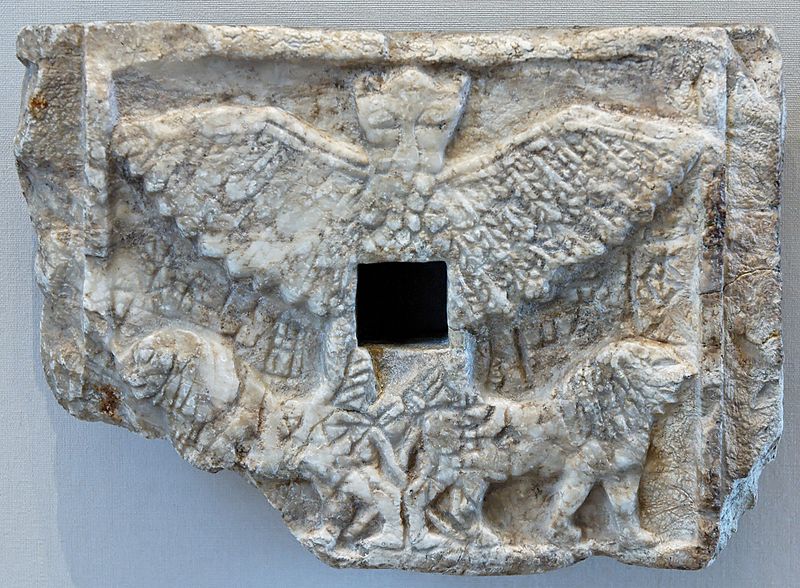
Zu was a storm-god symbolized in the form of a bird. He may typify the advancing storm-cloud, which would have seemed to those of old as if hovering like a great bird above the land which it was about to strike. The North-American Indians possess such a mythological conception in the Thunder-bird, and it is probable that the great bird called roc, so well known to readers of the Arabian Nights, was a similar monster—perhaps the descendant of the Zu-bird.

Zu or Anzu (from An 'heaven' and Zu 'to know' in Sumerian), as a lion-headed eagle, ca. 2550–2500 BCE, Louvre.  Votive relief of Ur-Nanshe, king of Lagash, representing the bird-god Anzu (or Im-dugud) as a lion-headed eagle.  Alabaster, Early Dynastic III (2550–2500 BCE). Found in Telloh, ancient city of Girsu. H. 21.6 cm (8 ½ in.), W. 15.1 cm (5 ¾ in.), D. 3.5 cm (1 ¼ in.)  http://bharatkalyan97.blogspot.com/2013/07/legend-of-anzu-which-stole-tablets-of.html

Zu or Anzu (from An ‘heaven’ and Zu ‘to know’ in Sumerian), as a lion-headed eagle, ca. 2550–2500 BCE, Louvre.
Votive relief of Ur-Nanshe, king of Lagash, representing the bird-god Anzu (or Im-dugud) as a lion-headed eagle.
Alabaster, Early Dynastic III (2550–2500 BCE). Found in Telloh, ancient city of Girsu. H. 21.6 cm (8 ½ in.), W. 15.1 cm (5 ¾ in.), D. 3.5 cm (1 ¼ in.)
http://bharatkalyan97.blogspot.com/2013/07/legend-of-anzu-which-stole-tablets-of.html

We remember how this enormous creature descended upon the ship in which Sindbad sailed and carried him off. Certain it is that we can trace the roc or rukh to the Persian simurgh, which is again referable to a more ancient Persian form, the amru or sinamru, the bird of immortality, and we may feel sure that what is found in ancient Persian lore has some foundation in Babylonian belief.

The Zu-bird was evidently under the control of the sun, and his attempt to break away from the solar authority is related in the following legend.

It is told of the god Zu that on one occasion ambition awaking in his breast caused him to cast envious eyes on the power and sovereignty of Bel, so that he determined to purloin the Tablets of Destiny, which were the tangible symbols of Bel’s greatness.

At this time, it may be recalled, the Tablets of Destiny had already an interesting history behind them. We are told in the creation legend how Apsu, the primeval, and Tiawath, chaos, the first parents of the gods, afterward conceived a hatred for their offspring, and how Tiawath, with her monster-brood of snakes and vipers, dragons and scorpion-men and raging hounds, made war on the hosts of heaven.

Her son Kingu she made captain of her hideous army—

To march before the forces, to lead the host,
To give the battle-signal, to advance to the attack,
To direct the battle, to control the fight.

To him she gave the Tablets of Destiny, laying them on his breast with the words:

“Thy command shall not be without avail, and the word of thy mouth shall be established.”

Through his possession of the divine tablets Kingu received the power of Anu, and was able to decree the fate of the gods.

After several deities had refused the honour of becoming champion of heaven, Merodach was chosen. He succeeded at length in slaying Tiawath and destroying her evil host; and having vanquished Kingu, her captain, he took from him the Tablets of Destiny, which he sealed and laid on his own breast. It was this Merodach, or Marduk, who afterward became identified with Bel.

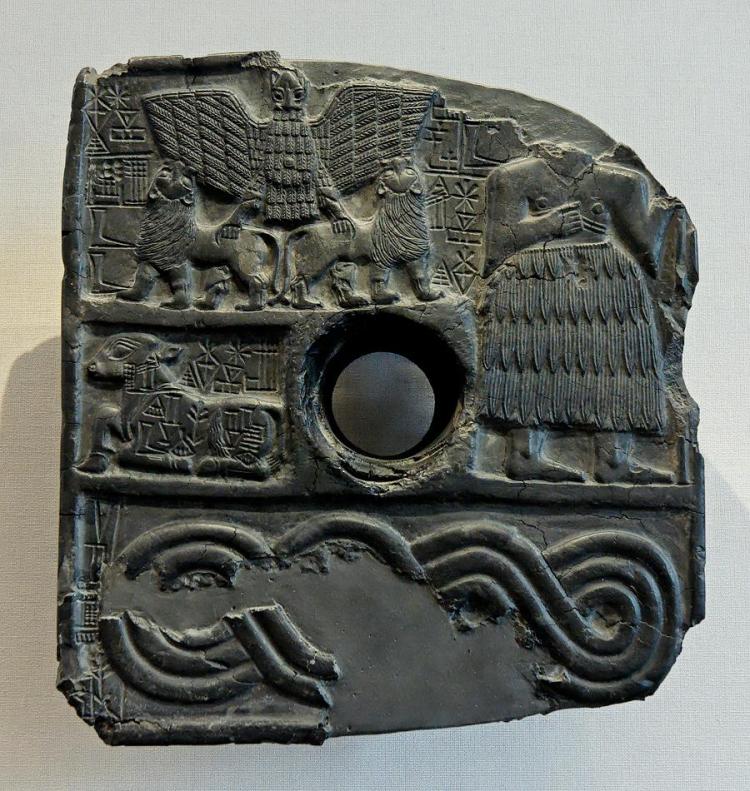
The Zu Bird appears to dominate the top of this bas relief, while the head of the figure on the right is missing, common vandalism committed by grave robbers: defacing the heads and the eyes of idols crippled their efficacy.

The Zu Bird appears to dominate the top of this bas relief, while the head of the figure on the right is missing, common vandalism committed by grave robbers: defacing the heads and the eyes of idols crippled their efficacy.

Now Zu, in his greed for power and dominion, was eager to obtain the potent symbols. He beheld the honour and majesty of Bel, and from contemplation of these he turned to look upon the Tablets of Destiny, saying within himself :

“Lo, I will possess the tablets of the gods, and all things shall be subject unto me. The spirits of heaven shall bow before me, the oracles of the gods shall lie in my hands. I shall wear the crown, symbol of sovereignty, and the robe, symbol of godhead, and then shall I rule over all the hosts of heaven.”

Thus inflamed, he sought the entrance to Bel’s hall, where he awaited the dawn of day. The text goes on :

Now when Bel was pouring out the clear water, (i.e. the light of day?)
And his diadem was taken off and lay upon the throne,
(Zu) seized the Tablets of Destiny,
He took Bel’s dominion, the power of giving commands.
Then Zu fled away and hid himself in his mountain.

Bel was greatly enraged at the theft, and all the gods with him. Anu, lord of heaven, summoned about him his divine sons, and asked for a champion to recover the tablets. But though the god Ramman was chosen, and after him several other deities, they all refused to advance against Zu.

The end of the legend is unfortunately missing, but from a passage in another tale, the legend of Etana, we gather that it was the sun-god, Shamash, who eventually stormed the mountain-stronghold of Zu, and with his net succeeded in capturing the presumptuous deity.

This legend is of the Prometheus type, but whereas Prometheus (once a bird-god) steals fire from heaven for the behoof of mankind, Zu steals the Tablets of Destiny for his own. These must, of course, be regained if the sovereignty of heaven is duly to continue, and to make the tale circumstantial the sun-god is provided with a fowler’s net with which to capture the recalcitrant Zu-bird.

Jastrow believes the myth to have been manufactured for the purpose of showing how the tablets of power were originally lost by the older Bel and gained by Merodach, but he has discounted the reference in the Etana legend relating to their recovery.”

Lewis Spence, Myths and Legends of Babylonia and Assyria, 1917, pp. 193-5.

Ea, Father of Merodach

Ea developed with the centuries, and about the epoch of Khammurabi appears to have achieved a high standard of godhead, probably because of the very considerable amount of theological moulding which he had received.

In the later Babylonian period we find him described as the protagonist of mankind, the father of Merodach, and, along with Anu and Bel, a member of a great triad.

The priests of Babylon were the sole mythographers of these days. This is in sharp contradistinction to the mythographers of Greece, who were nearly always philosophers and never priests. But they were mythographers in a secondary sense only, for they merely rearranged, re-edited, or otherwise altered already existing tales relating to the gods, usually with a view to the exaltation of a certain deity or to enable his story to fit in with those of other gods.

It is only after a religion or mythological system has enjoyed a vogue more or less extended that the relationship of the gods towards one another becomes fixed.

The appointment of Merodach to the supreme position in the Babylonian pantheon naturally necessitated a rearrangement so far as the relationship of the other deities to him was concerned. This meant a re-shaping of myth and tradition generally for the purpose of ensuring consistency.

The men fitted to accomplish such a task were to hand, for the age of Khammurabi was fertile in writers, scholastic and legal, who would be well equipped to carry out a change of the description indicated.

Ea had not in the past enjoyed any very exalted sphere. But as the chief god of the important country in the neighbourhood of the Persian Gulf, the most ancient home of Babylonian culture, Ea would probably have exercised a great influence upon the antiquarian and historic sense of a man like Khammurabi.

As the god of wisdom he would strongly appeal to a monarch whose whole career was marked by a love of justice and by sagacity and insight.

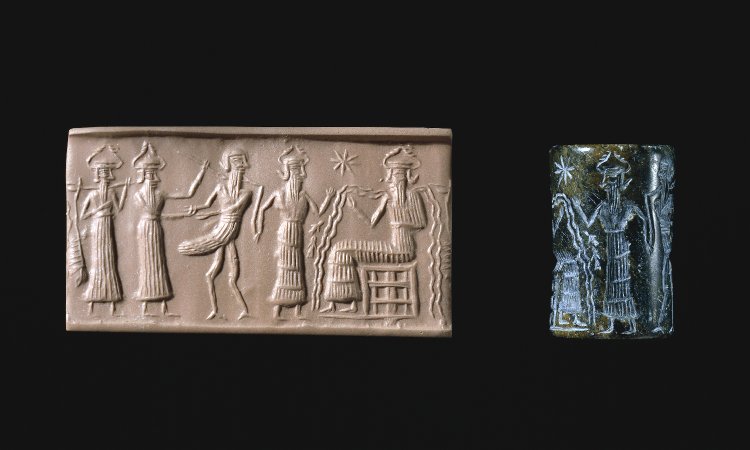
A bird man appears before a god, there are horns of divinity on some of these figures, as there are on the god, who could be Ea, with water coursing from his shoulders.

A bird man appears before a god, there are horns of divinity on some of these figures, as there are on the god, who could be Ea, with water coursing from his shoulders.

From a local god of Eridu, Ea became a universal deity of wisdom and beneficence, the strong shield of man, and his benefactor by the gifts of harvest and water. Civilized and softer emotions must have begun to cluster around the cult of this kindly god who, when the angered deities resolved to destroy mankind, interceded for poor humanity and succeeded in preserving it from the divine wrath.

As a god of medicine, too, Ea is humane and protective in character, and all the arts fall under his patronage. He is the culture-god of Babylon par excellence. He might not transcend Merodach, so he became his father. Thus did pagan theology succeed in merging the cults of deities which might otherwise have been serious rivals and mutually destructive.”

Lewis Spence, Myths and Legends of Babylonia and Assyria, 1917, pp. 191-3.

Necklace of Ishtar

“At length the ship came to rest on the summit of Mount Nitsir.

There are various readings of this portion of the text, thus:

“After twelve (days) the land appeared;”
or “At the distance of twelve (kasbu) the land appeared;”
or “Twelve (cubits) above the water the land appeared.”

However this may be, the ship remained for six days on the mountain, and on the seventh Ut-Napishtim sent out a dove. But the dove found no resting-place, and so she returned.

Then he sent out a swallow, which also returned, having found no spot whereon to rest.

Finally a raven was sent forth, and as by this time the waters had begun to abate, the bird drew near to the ship “wading and croaking,” but did not enter the vessel.

Then Ut-Napishtim brought his household and all his possessions into the open air, and made an offering to the gods of reed, and cedar-wood, and incense. The fragrant odour of the incense came up to the gods, and they gathered, “like flies,” says the narrative, around the sacrifice.

Among the company was Ishtar, the Lady of the Gods, who lifted up the necklace which Anu had given her, saying:

“What gods these are! By the jewels of lapis-lazuli which are upon my neck I will not forget! These days I have set in my memory, never will I forget them!

Let the gods come to the offering, but Bel shall not come to the offering since he refused to ask counsel and sent the deluge, and handed over my people unto destruction.”

The god Bel was very wroth when he discovered that a mortal man had survived the deluge, and vowed that Ut-Napishtim should perish. But Ea defended his action in having saved his favourite from destruction, pointing out that Bel had refused to take counsel when he planned a universal disaster, and advising him in future to visit the sin on the sinner and not to punish the entire human race.

Finally Bel was mollified. He approached the ship (into which it would appear that the remnants of the human race had retired during the altercation) and led Ut-Napishtim and his wife into the open, where he bestowed on them his blessing.

“Then they took me,” says Ut-Napishtim,

“and afar off, at the mouth of the rivers, they made me to dwell.”

Such is the story of the deluge which Ut-Napishtim told to Gilgamesh.

No cause is assigned for the destruction of the human race other than the enmity which seems to have existed between man and the gods—particularly the warrior-god Bel. But it appears from the latter part of the narrative that in the assembly of the gods the majority contemplated only the destruction of the city of Shurippak, and not that of the entire human family.

It has been suggested, indeed, that the story as it is here given is compounded of two separate myths, one relating to a universal catastrophe, perhaps a mythological type of a periodic inundation, and the other dealing with a local disaster such as might have been occasioned by a phenomenal overflow of the Euphrates.

The antiquity of the legend and its original character are clearly shown by comparison with another version of the myth, inscribed on a tablet found at Abu-Habbah (the ancient site of Sippar) and dated in the twenty-first century before our era.

Notwithstanding the imperfect preservation of this text it is possible to perceive in it many points of resemblance to the Gilgamesh variant.

Berossus also quotes a version of the deluge myth in his history, substituting Chronos for Ea, King Xisuthros for Ut-Napishtim, and the city of Sippar for that of Shurippak.

In this version immortality is bestowed not only on the hero and his wife, but also on his daughter and his pilot. One writer ingeniously identifies these latter with Sabitu and Adad-Ea respectively.”

Lewis Spence, Myths and Legends of Babylonia and Assyria, 1917, pp. 176-8.

The Harlot Civilizes the Wild Man Enkidu Using Sex

“The existence of various occupational groups connected both with cultic sexual service and with commercial prostitution tells us little about the meaning these occupations held to contemporaries.

We can try to learn something about that by looking at the earliest known poetic myth, The Epic of Gilgamesh.

The poem, which describes the exploits of a legendary god / king, who may actually have lived at the beginning of the third millennium BCE, has survived in several versions, the most complete of which is the Akkadian version, apparently based on earlier Sumerian tales written during the first millennium BCE.

In the poem, Gilgamesh’s aggressive behavior has displeased his subjects and the gods:

“Day and night [is unbridled his arrogance] . . . .

Gilgamesh leaves not the maid to [her mother],

the warrior’s daughter, the noble spouse!”

The gods create a man, “his double” Enkidu, to contend with Gilgamesh. Enkidu lives in harmony with the animals in the woods: “He knows neither people nor land.”

After Enkidu is discovered by a hunter and flees, the hunter seeks counsel as to how to tame him. He is told to get a harimtu. The hunter brings her to the woods, tells her what to do:

“and he [Enkidu] possessed her ripeness.

She was not bashful as she welcomed his ardor.

She laid aside her cloth and he rested upon her.

She treated him, the savage, to a woman’s task,

as his love was drawn unto her.”

After mating with her for six days, Enkidu finds that the wild beasts are afraid of him: “He now had [wi]sdom, [br]oader understanding.” The harlot advises him:

“Come, let me lead thee [to] ramparted Uruk,

To the holy temple, abode of Anu and Ishtar,

Where lives Gilgamesh.”

Enkidu agrees and the harlot leads him to Gilgamesh, whose best friend he becomes.

In this myth the temple harlot is an accepted part of society. Her role is honorable; in fact, it is she who is chosen to civilize the wild man. The assumption here is that sexuality is civilizing, pleasing to the gods.

The harlot does “a woman’s task;” thus she is not set off from other women because of her occupation. She possesses a kind of wisdom, which tames the wild man. He follows her lead into the city of civilization.

According to another Gilgamesh fragment, which has only recently been published, Enkidu later regrets his entry into civilization. He curses the hunter and the harimtu for having removed him from his former life of freedom in nature.

He speaks an elaborate curse against the harimtu:

“I will curse you with a great curse…

you shall not build a house for your debauch

you shall not enter the tavern of girls….

May waste places be your couch,

May the shadow of the town-wall be your stand

May thorn and bramble skin your feet

May drunkard and toper (ed note: someone who drinks alcohol to excess) alike slap your cheek.”

The nature of this curse tells us that the harimtu who mated with Enkidu lived an easier and better life than the harlot who has her stand at the town wall and is abused by her drunken customers.

This would confirm the distinction we made earlier between the women engaged in various forms of sacral sexual service and commercial prostitutes. Such a distinction was more likely to have existed in the earlier period than later.”

Gerda Lerner, “The Origin of Prostitution in Ancient Mesopotamia,” Signs, 1986, pp. 245-6.

Gilgamesh and Eabani Kill the Bull of Heaven

“To resume the tale: In her wrath and humiliation Ishtar appealed to her father and mother, Anu and Anatu, and begged the former to create a mighty bull and send it against Gilgamesh.

Anu at first demurred, declaring that if he did so it would result in seven years’ sterility on the earth; but finally he consented, and a great bull, Alu, was sent to do battle with Gilgamesh.

The portion of the text which deals with the combat is much mutilated, but it appears that the conflict was hot and sustained, the celestial animal finally succumbing to a sword-thrust from Gilgamesh. Ishtar looks on in impotent anger.

“Then Ishtar went up on to the wall of strong-walled Erech; she mounted to the top and she uttered a curse, (saying),

‘Cursed be Gilgamesh, who has provoked me to anger, and has slain the bull from heaven.’”

Then Eabani incurs the anger of the deity —“

When Eabani heard these words of Ishtar, he tore out the entrails of the bull, and he cast them before her, saying,

‘As for thee, I will conquer thee, and I will do to thee even as I have done to him.’”

Ishtar was beside herself with rage. Gilgamesh and his companion dedicated the great horns of the bull to the sun-god, and having washed their hands in the river Euphrates, returned once more to Erech. As the triumphal procession passed through the city the people came out of their houses to do honour to the heroes.

The remainder of the tablet is concerned with a great banquet given by Gilgamesh to celebrate his victory over the bull Alu, and with further visions of Eabani.

The Vllth and VlIIth tablets are extremely fragmentary, and so much of the text as is preserved is open to various readings. It is possible that to the Vllth tablet belongs a description of the underworld given to Eabani in a dream by the temple-maiden Ukhut, whom he had cursed in a previous tablet, and who had since died.

The description answers to that given in another ancient text—the myth of Ishtar’s descent into Hades—and evidently embodies the popular belief concerning the underworld.

“Come, descend with me to the house of darkness, the abode of Irkalla, to the house whence the enterer goes not forth, to the path whose way has no return, to the house whose dwellers are deprived of light, where dust is their nourishment and earth their food. They are clothed, like the birds, in a garment of feathers; they see not the light, they dwell in darkness.”

Lewis Spence, Myths and Legends of Babylonia and Assyria, 1917, pp. 168-70.

The God Assur

“The transference of the centre of power from Assur to Nineveh made the anthropomorphic side of Assur’s nature still more prominent. He represented now the whole nation and the central power which governed the nation. He was thus the representative at once of the people and of the king in whose hands the government of the people was centred.

Assyria became “the land of the god Assur,” belonging to him in much the same way as the city of Babylon belonged to Bel-Merodach. But whereas Bel-Merodach was the Baal of a particular city only, Assur was, like the Yahveh of Israel, the national god of a race.

There was yet another respect in which Assur resembled the Yahveh of Israel. There was no goddess Assurritu by the side of Assur, as there was an Anatu by the side of Anu, a Beltis by the side of Bel. If, in imitation of Babylonian usage, Bilat or Beltis is sometimes addressed as the consort of Assur, it is simply a literary affectation; Assur was not a Bel or Baal, like Merodach.

Bilat is a Babylonian goddess; she is properly the wife of the older Bel, in later times identified with Zarpanit. There is no indication that Assur had a “face” or reflection; he stands by himself, and the inspiration received from him by the Assyrian kings is received from him alone. When a female divinity is invoked along with him, it is the equally independent goddess Istar or Ashtoreth.

We possess a list of the deities whose images stood in the temples of Assur at Assur and Nineveh.

At the head of each list the name of Assur is thrice invoked, and once his name is followed by that of Istar. There was, in fact, a special form of Istar, under which she was worshipped as “the Istar of Nineveh;” but the form was purely local, not national, arising from the existence there of a great temple dedicated to her. There was no national goddess to place by the side of the national god.

Assur consequently differs from the Babylonian gods, not only in the less narrowly local character that belongs to him, but also in his solitary nature. He is “king of all gods” in a sense in which none of the deities of Babylonia were.

He is like the king of Assyria himself, brooking no rival, allowing neither wife nor son to share in the honours which he claims for himself alone. He is essentially a jealous god, and as such sends forth his Assyrian adorers to destroy his unbelieving foes. Wife-less, childless, he is mightier than the Babylonian Baalim; less kindly, perhaps, less near to his worshippers than they were, but more awe-inspiring and more powerful.

We can, in fact, trace in him all the lineaments upon which, under other conditions, there might have been built up as pure a faith as that of the God of Israel.”

A.H. Sayce, Lectures on the Origin and Growth of Religion as Illustrated by the Religion of the Ancient Babylonians, 5th ed., London, 1898, pp. 126-9.

Lewis Spence’s Version of Ishtar and Gilgamesh

“In the Vlth tablet, which relates the story of Ishtar’s love for Gilgamesh, and the slaying of the sacred bull, victory again waits on the arms of the heroes, but here nevertheless we have the key to the misfortunes which later befall them.

On his return to Erech after the destruction of Khumbaba, Gilgamesh was loudly acclaimed. Doffing the soiled and bloodstained garments he had worn during the battle, he robed himself as befitted a monarch and a conqueror.

Ishtar beheld the King in his regal splendour, the flowers of victory still fresh on his brow, and her heart went out to him in love. In moving and seductive terms she besought him to be her bridegroom, promising that if he would enter her house “in the gloom of the cedar” all manner of good gifts should be his—his flocks and herds would increase, his horses and oxen would be without rival, the river Euphrates would kiss his feet, and kings and princes would bring tribute to him.

But Gilgamesh, knowing something of the past history of this capricious goddess, rejected her advances with scorn, and began to revile her. He taunted her, too, with her treatment of former lovers—of Tammuz, the bridegroom of her youth, to whom she clung weepingly year after year; of Alalu the eagle; of a Hon perfect in might and a horse glorious in battle; of the shepherd Tabulu and of Isullanu, the gardener of her father.

All these she had mocked and ill-treated in cruel fashion, and Gilgamesh perceived that like treatment would be meted out to him should he accept the proffered love of the goddess.

The deity was greatly enraged at the repulse, and mounted up to heaven :

“Moreover Ishtar went before Anu (her father), before Anu she went and she (said) : ‘ 0 my father, Gilgamesh has kept watch on me; Gilgamesh has counted my garlands, my garlands and my girdles.’”

Underlying the story of Ishtar’s love for Gilgamesh there is evidently a nature-myth of some sort, perhaps a spring-tide myth; Gilgamesh, the sun-god, or a hero who has taken over his attributes, is wooed by Ishtar, the goddess of fertility, the great mother-goddess who presides over spring vegetation.

In the recital of her former love-affairs we find mention of the Tammuz myth, in which Ishtar slew her consort Tammuz, and other mythological fragments. It is possible also that there is an astrological significance in this part of the narrative.”

Lewis Spence, Myths and Legends of Babylonia and Assyria, 1917, pp. 167-8.

Ukhut, “Sacred Woman of the Temple of Ishtar”

“The poem goes on to introduce a new character, Tsaidu, the hunter, apparently designed by the gods to bring about the meeting of Gilgamesh and Eabani. How he first encounters Eabani is not quite clear from the mutilated text.

One reading has it that the King of Erech, learning the plan of the gods for his overthrow, sent Tsaidu into the mountains in search of Eabani, with instructions to entrap him by whatever means and bring him to Erech.

Another reading describes the encounter as purely accidental. However this may be, Tsaidu returned to Erech and related to Gilgamesh the story of his encounter, telling him of the strength and fleetness of the wild man, and his exceeding shyness at the sight of a human being.

By this time it is evident that Gilgamesh knows or conjectures the purpose for which Eabani is designed, and intends to frustrate the divine plans by anticipating the meeting between himself and the wild man.

Accordingly he bids Tsaidu return to the mountains, taking with him Ukhut, one of the sacred women of the temple of Ishtar. His plan is that Ukhut with her wiles shall persuade Eabani to return with her to Erech.

Thus the hunter and the girl set out.

“They took the straight road, and on the third day they reached the usual drinking-place of Eabani. Then Tsaidu and the woman placed themselves in hiding. For one day, for two days, they lurked by the drinking-place. With the beasts (Eabani) slaked his thirst, with the creatures of the waters his heart rejoiced. Then Eabani (approached) …”

The scene which follows is described at some length. Ukhut had no difficulty in enthralling Eabani with the snares of her beauty. For six days and seven nights he remembered nothing because of his love for her.

When at length he bethought him of his gazelles, his flocks and herds, he found that they would no longer follow him as before. So he sat at the feet of Ukhut while she told him of Erech and its king.

“Thou art handsome, O Eabani, thou art like a god. Why dost thou traverse the plain with the beasts? Come, I will take thee to strong-walled Erech, to the bright palace, the dwelling of Anu and Ishtar, to the palace of Gilgamesh, the perfect in strength, who, like a mountain-bull, wieldeth power over man.”

Eabani found the prospect delightful. He longed for the friendship of Gilgamesh, and declared himself willing to follow the woman to the city of Erech. And so Ukhut, Eabani, and Tsaidu set out on their journey.”

Lewis Spence, Myths and Legends of Babylonia and Assyria, 1917, pp. 163-4.

Ist and IInd Tablet, Creation of Eabani (Enkidu)

“Now we come to the real commencement of the poem, inscribed on a fragment which some authorities assign to the beginning of the Ilnd tablet, but which more probably forms a part of the Ist.

In this portion we find Gilgamesh filling the double role of ruler and oppressor of Erech—the latter evidently not inconsistent with the character of a hero. There is no mention here of a siege, nor is there any record of the coming of Gilgamesh, though, as has been indicated, he probably came as a conqueror. His intolerable tyranny towards the people of Erech lends colour to this view.

He presses the young men into his service in the building of a great wall, and carries off the fairest maidens to his court; he

“hath not left the son to his father, nor the maid to the hero, nor the wife to her husband.”

Finally his harshness constrained the people to appeal to the gods, and they prayed the goddess Aruru to create a mighty hero who would champion their cause, and through fear of whom Gilgamesh should be forced to temper his severity.

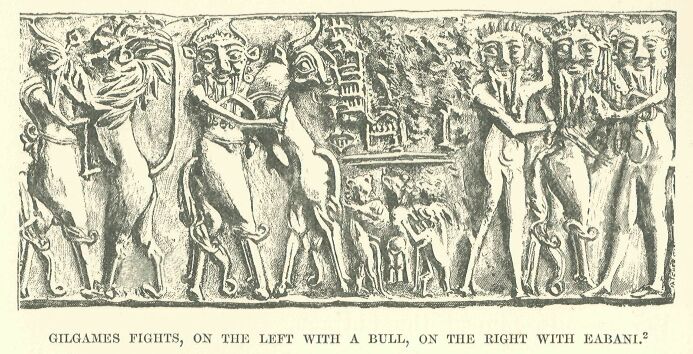
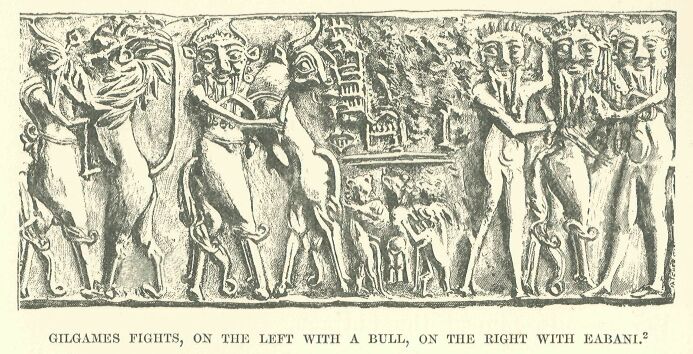
Gilgamesh, left and Eabani (Enkidu) on the right.  http://www.gutenberg.org/files/17323/17323-h/images/060.jpg

Gilgamesh, left and Eabani (Enkidu) on the right.
http://www.gutenberg.org/files/17323/17323-h/images/060.jpg

The gods themselves added their prayers to those of the oppressed people, and Aruru at length agreed to create a champion against Gilgamesh.

“Upon hearing these words (so runs the narrative), Aruru conceived a man (in the image) of Anu in her mind. Aruru washed her hands, she broke off a piece of clay, she cast it on the ground. Thus she created Eabani, the hero.”

When the creation of this champion was finished his appearance was that of a wild man of the mountains.

“The whole of his body was (covered) with hair, he was clothed with long hair like a woman. His hair was luxuriant, like that of the corn-god. He knew (not) the land and the inhabitants thereof, he was clothed with garments as the god of the field. With the gazelles he ate herbs, with the beasts he slaked his thirst, with the creatures of the water his heart rejoiced.”

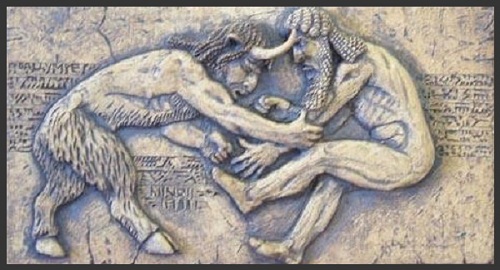
In pictorial representations on cylinder-seals and elsewhere Eabani is depicted as a sort of satyr, with the head, arms, and body of a man, and the horns, ears, and legs of a beast. As we have seen, he is a type of beast-man, a sort of Caliban, ranging with the beasts of the field, utterly ignorant of the things of civilization.”

Lewis Spence, Myths and Legends of Babylonia and Assyria, 1917, pp. 160-3.

Marduk vs. Tiamat

Merodach advances to the fight armed with a club and bow which Anu had placed in his hand and which subsequently became a constellation, as well as with his own peculiar weapon which hung behind his back. It was shaped like a sickle, and is the αρπη or khereb with which Greek mythology armed the Asiatic hero Perseus.

The struggle was long and terrible. Tiamat opened her month to swallow the god, but he thrust a storm-wind down her throat, and the monster was burst asunder, while her allies fled in terror before the victorious deity.

The combat is represented in stone in one of the Assyrian bas-reliefs now in the British Museum. There we can see the demon as she appeared to the Assyrians, with claws and wings, a short tail, and horns upon the head.

Battle between Marduk (Bel) and Tiamat. Drawn from a bas-relief from the Palace of Ashur-nasir-pal, King of Assyria, 885-860 B.C., at Nimrûd. British Museum, Nimrûd Gallery, Nos. 28 and 29. http://bharatkalyan97.blogspot.com/2013/06/tablet-of-destinies.html

Battle between Marduk (Bel) and Tiamat. Drawn from a bas-relief from the Palace of Ashurbanipal, King of Assyria, 885-860 B.C., at Nimrûd.
British Museum, Nimrûd Gallery, Nos. 28 and 29.
http://bharatkalyan97.blogspot.com/2013/06/tablet-of-destinies.html

When we remember the close parallelism that exists between this conflict of Merodach with Tiamat, and the war recorded in the Apocalypse between Michael and “the great dragon,” it is difficult not to trace in the lineaments of Tiamat the earliest portraiture of the mediaeval devil.”

A.H. Sayce, Lectures on the Origin and Growth of Religion as Illustrated by the Religion of the Ancient Babylonians, 5th ed., London, 1898, p. 102.

The Gilgamesh Epic

“The most important of the various mythological strata underlying the Gilgamesh myth is probably that concerning Eabani, who, as has been said, is a type of primitive man, living among the beasts of the field as one of themselves.

The "animal man" Enkidu (aka Eabani) defeating the King of Erech, Gilgamesh, during their first encounter.

The “animal man” Enkidu (aka Eabani) defeating the King of Erech, Gilgamesh, during their first encounter.

But he is also, according to certain authorities, a form of the sun-god, even as Gilgamesh himself. Like the hero of Erech, he rises to the zenith of his powers in a triumphal progress, then descends into the underworld.

He is not lost sight of, however, but lives in the memory of his friend Gilgamesh; and in the XIIth tablet he is temporarily brought forth from the underworld (that is, his ghost, or utukkii), which in a dim and shadowy fashion may typify the daily restoration of the sun.

Another important stratum of myth is that which concerns Ut-Napishtim, the Babylonian Noah; but whereas the myths of Eabani and Gilgamesh, though still distinguishable, have become thoroughly fused, the deluge story of which Ut-Napishtim is the hero has been inserted bodily into the XIth tablet of the epic, being related to Gilgamesh by Ut-Napishtim himself.

When he first appears in the narrative he has the attributes and powers of a god, having received these for his fidelity to the gods during the flood, from whose waters he alone of all mankind escaped.

The object of his narrative in the Gilgamesh epic seems to be to point out to the hero that only the most exceptional circumstances—unique circumstances, indeed—can save man from his doom.

Other distinct portions of the epic are the battle with the monster Khumbaba, the episode of Ishtar’s love for Gilgamesh, the fight with the sacred bull of Anu, and the search for the plant of life. These, whatever their origin, have become naturally incorporated with the story of Gilgamesh.

Gilgamesh defeating the Bull of Heaven.

Gilgamesh defeating the Bull of Heaven.

But besides the various historical and mythical elements herein presented, there is also a certain amount of Babylonian religious doctrine, evident to some extent in the XIth tablet (which points the moral that all men must die), but doubly so in the XIIth tablet, wherein the shade of Eabani appears to Gilgamesh, relates the misfortunes of the unburied dead or of those uncared for after death, and inculcates care for the deceased as the only means whereby they may evade the grievous woes which threaten them in the underworld.

Let us examine in detail the Gilgamesh epic as we have it in the broken fragments which remain to us. The Ist and Ilnd tablets are much mutilated. A number of fragments are extant which belong to one or other of these two, but it is not easy to say where the Ist ends and the Ilnd begins.

One fragment would seem to contain the very beginning of the Ist tablet—a sort of general preface to the epic, comprising a list of the advantages to be derived from reading it. After this comes a fragment whose title to inclusion in the epic is doubtful. It describes a siege of the city of Erech, but makes no mention of Gilgamesh.

The woeful condition of Erech under the siege is thus picturesquely detailed :

“She asses (tread down) their young, cows (turn upon) their calves. Men cry aloud like beasts, and maidens mourn like doves. The gods of strong-walled Erech are changed to flies, and buzz about the streets.

The spirits of strong-walled Erech are changed to serpents, and glide into holes. For three years the enemy besieged Erech, and the doors were barred, and the bolts were shot, and Ishtar did not raise her head against the foe.”

If this fragment be indeed a portion of the Gilgamesh epic, we have no means of ascertaining whether Gilgamesh was the besieger, or the raiser of the siege, or whether he was concerned in the affair at all.”

Lewis Spence, Myths and Legends of Babylonia and Assyria, 1917, pp. 159-61.

Marduk as Sun God of Babylon

Here Merodach, it will be observed, though “lord of all that exists,” is nevertheless only the first-born of the gods.

There were gods older than he, just as there were cities older than Babylon. He could not therefore be absolute lord of the world; it was only within Babylon itself that this was the case; elsewhere his rule was shared with others.

Hence it was that while Nebuchadnezzar as a native of Babylon was the work of his hands, outside Babylon there were other creators and other lords. This fact is accentuated in an inscription of Nabonidos, belonging to the earlier part of his reign, in which Merodach is coupled with the Moon-god of Ur and placed on an equal footing with him.

One of the epithets applied by Nebuchadnezzar to Merodach is that of riminu, or “merciful.” It is indeed a standing epithet of the god. Merodach was the intercessor between the gods and men, and the interpreter of the will of Ea, the god of wisdom.

In an old bilingual hymn he is thus addressed: “Thou art Merodach, the merciful lord who loves to raise the dead to life.” The expression is a remarkable one, and indicates that the Babylonians were already acquainted with a doctrine of the resurrection at an early period.

Merodach’s attribute of mercy is coupled with his power to raise the dead. The same expression occurs in another of these bilingual hymns, which I intend to discuss in a future Lecture…

“(Thou art) the king of the land, the lord of the world!

0 firstborn of Ea, omnipotent over heaven and earth.

0 mighty lord of mankind, king of (all) lands,

(Thou art) the god of gods,

(The prince) of heaven and earth who hath no rival,

The companion of Anu and Bel (Mul-lil),

The merciful one among the gods,

The merciful one who loves to raise the dead to life,

Merodach, king of heaven and earth,

King of Babylon, lord of E-Sagila,

King of E-Zida, king of E-makh-tilla (the supreme house of life),

Heaven and earth are thine!

The circuit of heaven and earth is thine,

The incantation that gives life is thine,

The breath that gives life is thine,

The holy writing of the mouth of the deep is thine:

Mankind, even the black-headed race (of Accad),

All living souls that have received a name, that exist in the world,

The four quarters of the earth wheresoever they are,

All the angel-hosts of heaven and earth

(Regard) thee and (lend to thee) an ear.”

[ … ]

A.H. Sayce, Lectures on the Origin and Growth of Religion as Illustrated by the Religion of the Ancient Babylonians, 5th ed., London, 1898, pp. 98-102.

Implications of the Gilgamesh Epic

“Among the traditions concerning his birth is one related by Ælian (Historia Animalium, XII, 21) of Gilgamos (Gilgamesh), the grandson of Sokkaros. Sokkaros, who, according to Berossus, was the first king to reign in Babylonia after the deluge, was warned by means of divination that his daughter should bear a son who would deprive him of his throne.

Thinking to frustrate the designs of fate he shut her up in a tower, where she was closely watched. But in time she bore a son, and her attendants, knowing how wroth the King would be to learn of the event, flung the child from the tower.

But before he reached the ground an eagle seized him up and bore him off to a certain garden, where he was duly found and cared for by a peasant. And when he grew to manhood he became King of the Babylonians, having, presumably, usurped the throne of his grandfather.

Here we have a myth obviously of solar significance, conforming in every particular to a definite type of sun-legend. It cannot have been by chance that it became attached to the person of Gilgamesh.

Everything in the epic, too, is consonant with the belief that Gilgamesh is a sun-god—his connexion with Shamash (who may have been his father in the tradition given by Ælian, as well as the eagle which saved him from death), the fact that no mention is made of his father in the poem, though his mother is brought in more than once, and the assumption throughout the epic that he is more than human.

Given the key to his mythical character it is not hard to perceive in his adventures the daily (or annual) course of the sun, rising to its full strength at noonday (or mid-summer), and sinking at length to the western horizon, to return in due time to the abode of men.

Like all solar deities—like the sun itself—his birth and origin are wrapped in mystery. He is, indeed, one of the ‘fatal children,’ like Sargon, Perseus, or Arthur. When he first appears in the narrative he is already a full-grown hero, the ruler and (it would seem) oppressor of Erech.

His mother, Rimat-belit, is a priestess in the temple of Ishtar, and through her he is descended from Ut-Napishtim, a native of Shurippak, and the hero of the Babylonian flood-legend. Early in the narrative he is brought into contact with the wild man Eabani, originally designed for his destruction by the gods, but with whom he eventually concludes a firm friendship.

The pair proceed to do battle with the monster Khumbaba, whom they overcome, as they do also the sacred bull sent against them by Anu. Up to the end of the Vlth tablet their conquering and triumphant career is without interruption; Gilgamesh increases in strength as does the sun approaching the zenith.

At the Vllth tablet, however, his good fortune begins to wane. Eabani dies, slain doubtless by the wrath of Ishtar, whose love Gilgamesh has rejected with scorn; and the hero, mourning the death of his friend, and smitten with fear that he himself will perish in like manner, decides to go in search of his ancestor, Ut-Napishtim (who, as sole survivor of the deluge, has received from the gods deification and immortality), and learn of him the secret of eternal life.

His further adventures have not the triumphal character of his earlier exploits. Sunwise he journeys to the Mountain of the Sunset, encounters the scorpion-men, and crosses the Waters of Death. Ut-Napishtim teaches him the lesson that all men must die (he himself being an exception in exceptional circumstances), and though he afterwards gives Gilgamesh an opportunity of eating the plant of life, the opportunity is lost.

However, Ut-Napishtim cures Gilgamesh of a disease which he has contracted, apparently while crossing the Waters of Death, and he is finally restored to Erech.

In these happenings we see the gradual sinking of the sun into the underworld by way of the Mountain of the Sunset. It is impossible for the sun to attain immortality, to remain for ever in the land of the living; he must traverse the Waters of Death and sojourn in the underworld.

Yet the return of Gilgamesh to Erech signifies the fresh dawning of the day. It is the eternal struggle of day and night, summer and winter; darkness may conquer light, but light will emerge again victorious. The contest is unending.

Some authorities have seen in the division of the epic into twelve tablets a connexion with the months of the year or the signs of the zodiac. Such a connexion probably exists, but when we consider that the artificial division of the epic into tablets scarcely tallies with the natural divisions of the poem, it seems likely that the astrological significance of the former was given to the epic by the scribes of Nineveh, who were evidently at some pains to compress the matter into twelve tablets.

Of the astro-theological significance of the narrative itself (one of its most important aspects), we shall perhaps be better able to judge when we have considered it in detail.”

Lewis Spence, Myths and Legends of Babylonia and Assyria, 1917, pp. 156-9.

Tracing Religious Ideas from Babylon to Judaism

“But it was not only through the Babylonian exile that the religious ideas of the Babylonian and the Jew came into contact with each other. It was then, indeed, that the ideas of the conquering race–the actual masters of the captives, who had long been accustomed to regard Babylonia as the home of a venerable learning and culture–were likely to make their deepest and most enduring impression; it was then, too, that the Jew for the first time found the libraries and ancient literature of Chaldea open to his study and use.

But old tradition had already pointed to the valley of the Euphrates as the primeval cradle of his race. We all remember how Abraham, it is said, was born in Ur of the Chaldees, and how the earlier chapters of Genesis make the Euphrates and Tigris two of the rivers of Paradise, and describe the building of the Tower of Babylon as the cause of the dispersion of mankind.

Now the Hebrew language was the language not only of the Israelites, but also of those earlier inhabitants of the country whom the Jews called Canaanites and the Greeks Phoenicians. Like the Israelites, the Phoenicians held that their ancestors had come from the Persian Gulf and the alluvial plain of Babylonia.

The tradition is confirmed by the researches of comparative philology. Many of the words which the Semites have in common seem to point to the neighbourhood of Babylonia as the district from which those who used them originally came, and where they called the fauna and flora of the country by common names.

Their first home appears to have been in the low-lying desert which stretches eastward of Chaldea–on the on the very side of the Euphrates, in fact, on which stood the great city of Ur, the modern Mugheir.

Here they led a nomad life, overawed by the higher culture of the settled Accadian race, until a time came when they began to absorb it themselves, and eventually, as we have seen, to dispossess and supersede their teachers.

The tribes which travelled northward and westward must, we should think, have carried with them some of the elements of the culture they had learnt from their Accadian neighbors. And such, indeed, we find to be the case.

The names of Babylonian deities meet us again in Palestine and the adjoining Semitic lands. Nebo, the Babylonian god of prophecy and literature, has given his name to towns that stood within the territories of Reuben and Judah, as well as to the Moabite mountain on which Moses breathed his last; Anu, the Babylonian god of heaven, and his female consort Anatu, re-appear in Beth-Anath, “the temple of Anatu,” and Anathoth, the birth-place of Jeremiah; and Sinai itself is but the mountain of Sin, the Babylonian Moon-god.

We may thus assume that there were two periods in the history of the Jewish people in which they came under the influence of the religious conceptions of Babylonia. There was the later period of the Babylonish exile, when the influence was strong and direct; there was also the earlier period, when the amount of influence is more hard to determine.

Much will depend upon the view we take of the age of the Pentateuch, and of the traditions or histories embodied therein. Some will be disposed to see in Abraham the conveyer of Babylonian ideas to the west; others will consider that the Israelites made their first acquaintance with the gods and legends of Babylonia through the Canaanites and other earlier inhabitants of Palestine.

Those who incline to the latter belief may doubt whether the fathers of the Canaanitish tribes brought the elements of their Babylonian beliefs with them from Chaldea, or whether these beliefs were of later importation, due to the western conquests of Sargon and his successors.”

A.H. Sayce, Lectures on the Origin and Growth of Religion as Illustrated by the Religion of the Ancient Babylonians, 5th ed., London, 1898, pp. 41-3.

Myths of Tammuz and Ishtar

“The myth of Tammuz is one of high antiquity, dating possibly from 4000 b.c. or even earlier.

Both Tammuz and Ishtar were originally non-Semitic, the name of the former deity being derived from the Akkadian Dumu-zi, ‘son of life,’ or ‘the only son,’ perhaps a contraction of Dumu-zi-apsu, ‘offspring of the spirit of the deep,’ as Professor Sayce indicates. The ‘spirit of the deep’ is, of course, the water-god Ea, and Tammuz apparently typifies the sun, though he is not, as will presently be seen, a simple solar deity, but a god who unites in himself the attributes of various departmental divinities.

An ancient Akkadian hymn addresses Tammuz as “Shepherd and lord, husband of Ishtar the lady of heaven, lord of the under-world, lord of the shepherd’s seat;” as grain which lies unwatered in the meadow, which beareth no green blade; as a sapling planted in a waterless place; as a sapling torn out by the root.

Professor Sayce identifies him with that Daonus, or Daos, whom Berossus states to have been the sixth king of Babylonia during the mythical period. Tammuz is the shepherd of the sky, and his flocks and herds, like those of St. Ilya in Slavonic folk-lore, are the cloud-cattle and the fleecy vapours of the heavens.

Ishtar has from an early period been associated with Tammuz as his consort, as she has, indeed, with Merodach and Assur and other deities. Yet she is by no means a mere reflection of the male divinity, but has a distinct individuality of her own, differing in this from all other Babylonian goddesses and betraying her non-Semitic origin.

The widespread character of the worship of Ishtar is remarkable. None of the Babylonian or Assyrian deities were adopted into the pantheons of so many alien races. From the Persian Gulf to the pillars of Hercules she was adored as the great mother of all living. She has been identified with Dawkina, wife of Ea, and is therefore mother of Tammuz as well as his consort.

This dual relationship may account for that which appears in later myths among the Greeks, where Smyrna, mother of Adonis, is also his sister. Ishtar was regarded sometimes as the daughter of the sky-god Anu, and sometimes as the child of Sin, the lunar deity.

Her worship in Babylonia was universal, and in time displaced that of Tammuz himself. The love of Ishtar for Tammuz represents the wooing of the sun-god of spring-time by the goddess of fertility; the god is slain by the relentless heat of summer, and there is little doubt that Ishtar enters Aralu in search of her youthful husband.

The poem we are about to consider briefly deals with a part only of the myth— the story of Ishtar’s descent into Aralu. It opens thus :

“To the land of No-return, the region of darkness, Ishtar, the daughter of Sin, turned her ear, even Ishtar, the daughter of Sin, turned her ear, to the abode of darkness, the dwelling of Irkalla, to the house whose enterer goes not forth, to the road whence the wayfarer never returns, to the house whose inhabitants see no light, to the region where dust is their bread and their food mud; they see no light, they dwell in darkness, they are clothed, like the birds, in a garment of feathers. On the door and the bolt hath the dust fallen.”

The moral contained in this passage is a gloomy one for mortal man; he who enters the dread precincts of Aralu goes not forth, he is doomed to remain for ever in the enveloping darkness, his sustenance mud and dust. The mention of the dust which lies “on door and bolt” strikes a peculiarly bleak and dreary note; like other primitive races the ancient Babylonians painted the other world not definitely as a place of reward or punishment, but rather as a weak reflection of the earth-world, a region of darkness and passive misery which must have offered a singularly uninviting prospect to a vigorous human being.

The garment of feathers is somewhat puzzling. Why should the dead wear a garment of feathers? Unless it be that the sun-god, identified in some of his aspects with the eagle, descends into the underworld in a dress of feathers, and that therefore mortals who follow him must appear in the nether regions in similar guise.

The description above quoted of the Babylonian Hades tallies with that given in dream to Eabani by the temple-maiden Ukhut (Gilgamesh epic, tablet VII).”

Lewis Spence, Myths and Legends of Babylonia and Assyria, 1917, pp. 126-9.

Ishtar

” … Both phases of the goddess, as the gracious mother and as the grim Amazon, are dwelt upon in one of the finest specimens of the religious literature of Babylonia in which a penitent sufferer, bowed down with sickness and misfortune, implores Ishtar to grant relief. [3] The hymn is addressed to the goddess of Uruk but she has become the general mother-goddess and is instead of Nana addressed as Ishtar. Ishtar is here identified with the planet Venus and assigned to a place therefore in the heavens.

As such she is called “the daughter of Sin,” the moon-god. She is thus the daughter of Anu, of Enlil and of Sin at one and the same time, a further indication that such epithets merely symbolize a relationship to various gods, according to the traits assigned to her. The composition, too long to quote entirely, begins:

“I pray to thee, mistress of mistresses, goddess of goddesses,
Ishtar, queen of all habitations, guide of mankind,
Irnini [4] praised be thou, greatest among the Igigi [5]
Powerful art thou, ruler art thou, exalted is thy name,
Thou art the light of heaven and earth, mighty daughter of Sin,
Thou directest the weapons, arrangest the battle array,
Thou givest commands, decked with the crown of rulership,
lady, resplendent is thy greatness, supreme over all gods.

Where is thy name not! Where is thy command not!
Where are images of thee not made! Where are thy shrines not erected!
Where art thou not great? Where not supreme!
Anu, Enlil and Ea have raised thee to mighty rulership among the gods,
Have raised thee aloft and exalted thy station among all the Igigi.
At the mention of thy name, heaven and earth quake,
The gods tremble, the Anunnaki quake.
To thy awe-inspiring name mankind gives heed,
Great and exalted art thou!
All dark-headed ones, [6] living beings, mankind pay homage to thy power.

I moan like a dove night and day,
I am depressed and weep bitterly,
With woe and pain my liver is in anguish.
What have I done, my god and my goddess — I ?
As though I did not reverence my god and my goddess, am I treated.

I experience, my mistress, dark days, sad months, years of misfortune.”

As the planet Venus, the movements of Ishtar in the heavens form a basis for divining what the future has in store. [7] The prominent part taken by the observation of Venus-Ishtar in Babylonian-Assyrian astrology is reflected in many of the hymns to her. The influence of the priestly speculations in thus combining the popular animistic conceptions of the gods and goddesses with points of view derived from the projection of the gods on to the starry heavens is one of the features of the religion of Babylonia and Assyria.

Ishtar under one name or the other becomes a favorite subject for myths symbolizing the change of seasons, her period of glory when the earth is in full bloom being the summer followed by the rainy and winter months when nature decays, and which was pictured as due to the imprisonment of the goddess in the nether world. She takes her place in popular tales, half legendary and half mythical, and we have a number of compositions [8] further illustrating how the popular myths and tales were embodied into the cult.”

Morris Jastrow, The Civilization of Babylonia and Assyria, 1915, pp. 234-6.

Mother Goddess of Love, Goddess of War

” … The oldest cult of the mother goddess, so far as our material goes, appears indeed to have been in Uruk where she is known as Nana, but we may be quite sure that the cult was never limited to one place. The special place which Nana has in the old Babylonian pantheon is probably due to the peculiar development taken by the chief deity of that centre, Anu, who as we have seen became an abstraction, the god of heaven, presiding over the upper realm of the universe. Her temple at Uruk known as E-anna “the heavenly house” and revealing the association of the goddess with Anu as a solar deity became one of the most famous in the Euphrates Valley.

It is in connection with the cult of Nana that we learn of a phase of the worship of the mother-goddess which degenerates into the obscene rites that call forth the amazement of Herodotus. [1] As the mother-goddess, Nana or Ishtar is not only the source of the fertility displayed by the earth and the kind, gracious mother of mankind, but also the goddess of love, the Aphrodite of Babylonia. The mysterious process of conception and the growth of the embryo in the mother’s womb gave rise at an early period to rites in connection with the cult of the mother-goddess that symbolized the fructification through the combination with the male element.

There is, however, another side to Ishtar which comes particularly to the fore in Assyria, though it is also indigenous to Babylonia. She is not only the loving mother but, as the protector of her offspring, a warlike figure armed for the fray and whose presence is felt in the midst of the battle. She appears to her favorites in dreams and encourages them to give battle. It is she who places in the hands of the rulers the weapons with which they march to victory. To Ashurbanapal she thus appears armed with bow and arrow and reassures him: “Whithersoever thou goest, I go with thee”. [2] As far back as the days of Hammurapi, Ishtar is thus viewed as the one who encourages her followers for contest and battle.”

Morris Jastrow, The Civilization of Babylonia and Assyria, 1915, pp. 223-4.

Origins of the Name Nina, Synonymous with Ishtar

” … In the case of each triad, a fourth figure is often added, Ninlil, originally the consort of Enlil, or Nin-makh (“the great lady”) to the first, and Belit (“the lady”) or Ishtar to the second, both, however, symbolizing the female element which, fructified by the male, is the indispensable complement to the production of life, vegetation, fertility and all blessings that go with the never ending process of vitality, growth, decay and regeneration in nature.

This leads us to a consideration, before leaving the pantheon, of one notable female figure, the great mother-goddess, frequently identified with the earth viewed as a fruitful mother but who should rather be regarded in a still wider sense as the mother of all that manifests life, embracing therefore the life in man and the animal world as well as in the fields and mountains in nature in general.

This natural association of a female element as a complement to the male one leads to assigning to every deity a consort who, however, has no independent existence. So Enlil has at his side Nin-lil, Ninib has Gula A (“the great one”), Ningirsu has Bau, Shamash has A, Sin has Nin-gul, Nergal has Laz, Anu a female counterpart Antum, to Ea a consort Shala (“the woman”) is given, to Marduk, Sarpanit or Nin-makh (“the great lady”), to Nabu, Tashmit (“obedience”), while Ashur’s consort appears as Nin-lil or Belit and at times as Ishtar.

All these figures with the single exception of Ishtar are merely shadowy reflections of their male masters, playing no part in the cult outside of receiving homage in association with their male partners. Ishtar, however, although assimilated in the Assyrian pantheon as the consort of Ashur, is an independent figure, who has her own temples and her distinct cult. She appears under a variety of names: Nana, Innina, Irnini, Ninni, Nina all of which contain an element having the force of “lady,” as is also the case with Nin-makh and Nin-lil, likewise used as epithets of the great mother-goddess. Corresponding to the Sumerian element, we have in Akkadian Belit, “lady” or “mistress,” as one of the generic designations of Ishtar.

All this confirms the view that Ishtar is merely the symbol of the female element in the production of life, and that the specific name is of secondary significance. The circumstance that Ninlil, the consort of Enlil, is also (though in texts of a later period) identified with the mother-goddess would seem to show that the female associate of the head of the pantheon was always an Ishtar, though in a certain sense, as we have seen, the consorts of all the gods were Ishtars.”

Morris Jastrow, The Civilization of Babylonia and Assyria, 1915, pp. 232-4.

Cult of Sin, Moon God

“The cult of the moon-god was one of the most popular in Babylonia, the chief seat of his worship being at Uru (now Muqayyar) the Biblical Ur of the Chaldees. The origin of the name Sin is unknown, but it is thought that it may be a corruption of Zu-ena, “knowledge-lord,” as the compound ideograph expressing his name may be read and translated.

Besides this compound ideograph, the name of the god Sin was also expressed by the character for “30,” provided with the prefix of divinity, an ideograph which is due to the thirty days of the month, and is thought to be of late date.

With regard to Nannar, Jastrow explains it as being for Narnar, and renders it “light-producer.” In a long hymn to this god he is described in many lines as “the lord, prince of the gods, who in heaven alone is supreme,” and as “father Nannar.”

Among his other descriptive titles are “great Anu” (Sumerian /ana gale/, Semitic Babylonian /Anu rabû/)–another instance of the identification of two deities. He was also “lord of Ur,” “lord of the temple Gišnu-gala,” “lord of the shining crown,” etc.

He is also said to be “the mighty steer whose horns are strong, whose limbs are perfect, who is bearded with a beard of lapis-stone, [*] who is filled with beauty and fullness (of splendour).”

[*] Probably of the colour of lapis only, not made of the stone itself.

Besides Babylonia and Assyria, he was also worshipped in other parts of the Semitic east, especially at Harran, to which city Abraham migrated, scholars say, in consequence of the patron-deity being the same as at Ur of the Chaldees, where he had passed the earlier years of his life. The Mountain of Sinai and the Desert of Sin, both bear his name.

According to king Dungi (about 2700 B.C.), the spouse of Sin or Nannara was Nin-Uruwa, “the lady of Ur.” Sargon of Assyria (722-705 B.C.) calls her Nin-gala.

Theophilus G. Pinches, The Religion of Babylonia and Assyria, London, 1906, pp. 81-3.

Cult of Ishtar

” … In all probability Ištar, the spouse of Tammuz, is best known from her descent into Hades in quest of him when with Persephone (Ereš-ki-gal) in the underworld.

In this she had to pass through seven gates, and an article of clothing was taken from her at each, until she arrived in the underworld quite naked, typifying the teaching, that man can take nothing away with him when he departs this life.

During her absence, things naturally began to go wrong upon the earth, and the gods were obliged to intervene, and demand her release, which was ultimately granted, and at each gate, as she returned, the adornments which she had left were given back to her. It is uncertain whether the husband whom she sought to release was set free, but the end of the inscription seems to imply that Ištar was successful in her mission.

In this story she typifies the faithful wife, but other legends show another side of her character, as in that of Gilgameš, ruler of her city Erech, to whom she makes love.

Gilgameš, however, knowing the character of the divine queen of his city too well, reproaches her with her treatment of her husband and her other lovers–Tammuz, to whom, from year to year, she caused bitter weeping; the bright coloured Allala bird, whom she smote and broke his wings; the lion perfect in strength, in whom she cut wounds “by sevens”; the horse glorious in war, to whom she caused hardship and distress, and to his mother Silili bitter weeping; the shepherd who provided for her things which she liked, whom she smote and changed to a jackal; Išullanu, her father’s gardener, whom she tried, apparently, to poison, but failing, she smote him, and changed him to a statue (?).

On being thus reminded of her misdeeds, Ištar was naturally angry, and, ascending to heaven, complained to her father Anu and her mother Anatu, the result being, that a divine bull was sent against Gilgameš and Enki-du, his friend and helper.

The bull, however, was killed, and a portion of the animal having been cut off, Enki-du threw it at the goddess, saying at the same time that, if he could only get hold of her, he would treat her similarly. Apparently Ištar recognised that there was nothing further to be done in the matter, so, gathering the hand-maidens, pleasure-women and whores, in their presence she wept over the portion of the divine bull which had been thrown at her.

The worship of Ištar, she being the goddess of love and war, was considerably more popular than that of her spouse, Tammuz, who, as among the western Semitic nations, was adored rather by the women than the men. Her worship was in all probability of equal antiquity, and branched out, so to say, in several directions, as may be judged by her many names, each of which had a tendency to become a distinct personality.

Thus the syllabaries give the character which represents her name as having also been pronounced /Innanna/, /Ennen/, and /Nin/, whilst a not uncommon name in other inscriptions is /Ama-Innanna/, “mother Ištar.”

The principal seat of her worship in Babylonia was at Erech, and in Assyria at Nineveh–also at Arbela, and many other places. She was also honoured (at Erech and elsewhere) under the Elamite names of Tišpak and Šušinak, “the Susian goddess.”

Theophilus G. Pinches, The Religion of Babylonia and Assyria, London, 1906, pp. 72-5.

Was Marduk the Founder of Astronomy?

“In consequence of the determinative prefix for a god or a goddess being, in the oldest form, a picture of an eight-rayed star, it has been assumed that Assyro-Babylonian mythology is, either wholly or partly, astral in origin.

This, however, is by no means certain, the character for “star” in the inscriptions being a combination of three such pictures, and not a single sign. The probability therefore is, that the use of the single star to indicate the name of a divinity arises merely from the fact that the character in question stands for /ana/, “heaven.”

Deities were evidently thus distinguished by the Babylonians because they regarded them as inhabitants of the realms above–indeed, the heavens being the place where the stars are seen, a picture of a star was the only way of indicating heavenly things.

That the gods of the Babylonians were in many cases identified with the stars and planets is certain, but these identifications seem to have taken place at a comparatively late date. An exception has naturally to be made in the case of the sun and moon, but the god Merodach, if he be, as seems certain, a deified Babylonian king, must have been identified with the stars which bear his name after his worshippers began to pay him divine honours as the supreme deity, and naturally what is true for him may also be so for the other gods whom they worshipped.

The identification of some of the deities with stars or planets is, moreover, impossible, and if Êa, the god of the deep, and Anu, the god of the heavens, have their representatives among the heavenly bodies, this is probably the result of later development.[*]

[*] If there be any historical foundation for the statement that Merodach arranged the sun, the moon, the planets, and the stars, assigning to them their proper places and duties–a tradition which would make him the founder of the science of astronomy during his life upon earth–this, too, would tend to the probability that the origin of the gods of the Babylonians was not astral, as has been suggested, but that their identification with the heavenly bodies was introduced during the period of his reign.”

Theophilus G. Pinches, The Religion of Babylonia and Assyria, London, 1906, pp. 11-3.

The Cuneiform Puzzle of the Creation

” …  George Smith recovered the opening lines of the First Tablet, which describes the condition of things before Creation when the primeval water-gods, Apsû and Tiamat, personifying chaos, mingled their waters in confusion.

The text then briefly relates how to Apsû and Tiamat were born the oldest of the gods, the first pair, Lahmu and Lahamu, being followed after a long interval by Anshar and Kishar, and after a second interval by other deities, of whose names the text … only preserves that of Anu.

George Smith perceived that this theogony had been reproduced by Damascius in his summary of the beliefs of the Babylonians concerning the creation of the world. 1

Now, since Damascius mentions Ἴλλινος and Ἀός along with Ἀνός, it was clear that the text of the poem included a description of the birth of the elder Bel (i.e. Enlil or Illil) and of Ea in the passage in which Anu’s name occurs. But as the text … breaks off … the course of the story after this point has hitherto been purely a matter for conjecture.

It appeared probable that the lines which followed contained a full account of the origin of the younger gods, and from the fact that Damascius states that Βῆλος, the Creator of the world, was the son of (i.e. Ea) and Δαύκη (i.e. Damkina), it has been concluded that at any rate special prominence was given to the birth of Bel, i.e. Marduk, who figures so prominently in the story from the close of the Second Tablet onwards.

The new fragments of the First Tablet show that the account of the birth of the gods in the Creation Series is even shorter than that given by Damascius, for the poem contains no mention of the birth and parentage of Marduk.

After mentioning the birth of Nudimmud (i.e. Ea), 2 the text proceeds to describe his marvellous wisdom and strength, and states that he had no rival among the gods; the birth of no other god is recorded after that of Ea, and, when Marduk is introduced later on, his existence, like that of Mummu and of Gaga, appears to be tacitly assumed.

It would seem, therefore, that the reference made by Damascius to Marduk’s parentage was not derived from the text of the Creation Series, but was added by him to complete his summary of the Babylonian beliefs concerning the origin of the gods.”

Leonard William King, The Seven Tablets of Creation, London, 1902. pp. xxxiii-xxxvii.

On the Rejection of the Goddess Ishtar

“If, now, Enkidu is not only the older figure but the one who is the real hero of the most notable episode in the Gilgamesh Epic; if, furthermore, Enkidu is the Hercules who kills lions and dispatches the bull sent by an enraged goddess, what becomes of Gilgamesh? What is left for him?

In the first place, he is definitely the conqueror of Erech. He builds the wall of Erech, and we may assume that the designation of the city as Uruk supûri, “the walled Erech,” rests upon this tradition. He is also associated with the great temple Eanna, “the heavenly house,” in Erech.

To Gilgamesh belongs also the unenviable tradition of having exercised his rule in Erech so harshly that the people are impelled to implore Aruru to create a rival who may rid the district of the cruel tyrant, who is described as snatching sons and daughters from their families, and in other ways terrifying the population–an early example of “Schrecklichkeit.”

Tablets II to V inclusive of the Assyrian version being taken up with the Huwawa episode, modified with a view of bringing the two heroes together, we come at once to the sixth tablet, which tells the story of how the goddess Ishtar wooed Gilgamesh, and of the latter’s rejection of her advances.

This tale is distinctly a nature myth … The goddess Ishtar symbolizes the earth which woos the sun in the spring, but whose love is fatal, for after a few months the sun’s power begins to wane. Gilgamesh, who in incantation hymns is invoked in terms which show that he was conceived as a sun-god, recalls to the goddess how she changed her lovers into animals, like Circe of Greek mythology, and brought them to grief.

Enraged at Gilgamesh’s insult to her vanity, she flies to her father Anu and cries for revenge. At this point the episode of the creation of the bull is introduced, but if the analysis above given is correct it is Enkidu who is the hero in dispatching the bull, and we must assume that the sickness with which Gilgamesh is smitten is the punishment sent by Anu to avenge the insult to his daughter.

This sickness symbolizes the waning strength of the sun after midsummer is past. The sun recedes from the earth, and this was pictured in the myth as the sun-god’s rejection of Ishtar; Gilgamesh’s fear of death marks the approach of the winter season, when the sun appears to have lost its vigor completely and is near to death.

The entire episode is, therefore, a nature myth, symbolical of the passing of spring to midsummer and then to the bare season. The myth has been attached to Gilgamesh as a favorite figure, and then woven into a pattern with the episode of Enkidu and the bull. The bull episode can be detached from the nature myth without any loss to the symbolism of the tale of Ishtar and Gilgamesh.

As already suggested, with Enkidu’s death after this conquest of the bull the original Enkidu Epic came to an end. In order to connect Gilgamesh with Enkidu, the former is represented as sharing in the struggle against the bull.

Enkidu is punished with death, while Gilgamesh is smitten with disease. Since both shared equally in the guilt, the punishment should have been the same for both. The differentiation may be taken as an indication that Gilgamesh’s disease has nothing to do with the bull episode, but is merely part of the nature myth.”

Morris Jastrow (ed.), Albert T. Clay (trans.), An Old Babylonian Version of the Gilgamesh Epic on the Basis of Recently Discovered Texts, 1920, pp. 19-20.

Boundary Stone of Ritti-Marduk (British Museum, No. 90,858)

The accompanying illustration, which is reproduced from the Boundary Stone of Ritti-Marduk (Brit. Mus., No. 90,858), supplies much information about the symbols of the gods, and of the Signs of the Zodiac in the reign of Nebuchadnezzar I, King of Babylon, about 1120 B.C.

British Museum number 90858 Description 3/4: Right Limestone stela in the form of a boundary-stone: consisting of a block of calcareous limestone, shaped and prepared on four sides to take sculptures and inscriptions. It is now mounted on a stone plinth.  Faces B and C each bear a single column of inscription, the lines running the full width of the stone.  The top of the stone and Face D have been left blank, except for the serpent, which has been carved to the left of the emblems on Face A.  Inscribed with a Charter from the reign of Nebuchadnezzar I.

British Museum number 90858
Description 3/4: Right
Limestone stela in the form of a boundary-stone: consisting of a block of calcareous limestone, shaped and prepared on four sides to take sculptures and inscriptions. It is now mounted on a stone plinth.
Faces B and C each bear a single column of inscription, the lines running the full width of the stone.
The top of the stone and Face D have been left blank, except for the serpent, which has been carved to the left of the emblems on Face A.
Inscribed with a Charter from the reign of Nebuchadnezzar I.

Thus in Register 1, we have the Star of Ishtar, the crescent of the Moon-god Sin, and the disk of Shamash the Sun-god. In Reg. 2 are three stands (?) surmounted by tiaras, which represent the gods Anu, Enlil (Bel) and Ea respectively. In Reg. 3 are three altars (?) or shrines (?) with a monster in Nos. 1 and 2. Over the first is the lance of Marduk, over the second the mason’s square of Nabû, and over the third is the symbol of the goddess Ninkharsag, the Creatress. In Reg. 4 are a standard with an animal’s head, a sign of Ea; a two-headed snake = the Twins; an unknown symbol with a horse’s head, and a bird, representative of Shukamuna and Shumalia. In Reg. 5 are a seated figure of the goddess Gula and the Scorpion-man. In Reg. 6 are forked lightning, symbol of Adad, above a bull, the Tortoise, symbol of Ea (?), the Scorpion of the goddess Ishkhara, and the Lamp of Nusku, the Fire-god.  Down the left-hand side is the serpent-god representing the constellation of the Hydra.

Thus in Register 1, we have the Star of Ishtar, the crescent of the Moon-god Sin, and the disk of Shamash the Sun-god.
In Reg. 2 are three stands (?) surmounted by tiaras, which represent the gods Anu, Enlil (Bel) and Ea respectively.
In Reg. 3 are three altars (?) or shrines (?) with a monster in Nos. 1 and 2. Over the first is the lance of Marduk, over the second the mason’s square of Nabû, and over the third is the symbol of the goddess Ninkharsag, the Creatress.
In Reg. 4 are a standard with an animal’s head, a sign of Ea; a two-headed snake = the Twins; an unknown symbol with a horse’s head, and a bird, representative of Shukamuna and Shumalia.
In Reg. 5 are a seated figure of the goddess Gula and the Scorpion-man.
In Reg. 6 are forked lightning, symbol of Adad, above a bull, the Tortoise, symbol of Ea (?), the Scorpion of the goddess Ishkhara, and the Lamp of Nusku, the Fire-god.
Down the left-hand side is the serpent-god representing the constellation of the Hydra.

The mutilated text of the Fifth Tablet makes it impossible to gain further details in connection with Marduk’s work in arranging the heavens. We are, however, justified in assuming that the gaps in it contained statements about the grouping of the gods into triads.

In royal historical inscriptions the kings often invoke the gods in threes, though they never call any one three a triad or trinity. It seems as if this arrangement of gods in threes was assumed to be of divine origin.

In the Fourth Tablet of Creation, one triad “Anu-Bel-Ea” is actually mentioned, and in the Fifth Tablet, another is indicated, “Sin-Shamash-Ishtar.”

In these triads Anu represents the sky or heaven, Bel or Enlil the region under the sky and including the earth, Ea the underworld, Sin the Moon, Shamash the Sun, and Ishtar the star Venus.

When the universe was finally constituted several other great gods existed, e.g., Nusku, the Fire-god, Enurta, a solar god, Nergal, the god of war and handicrafts, Nabu, the god of learning, Marduk of Babylon, the great national god of Babylonia, and Ashur, the great national god of Assyria.

E.A. Wallis Budge, et al, & the British Museum, The Babylonian Legends of the Creation & the Fight Between Bel & the Dragon Told by Assyrian Tablets from Nineveh (BCE 668-626), 1901, pp. 11-2.

More on the Babylonian Zodiac

” … Then returning to the dead body of Tiâmat he smashed her skull with his club and scattered her blood to the north wind, and as a reward for his destruction of their terrible foe, he received gifts and presents from the gods his fathers.

The text then goes on to say that Marduk “devised a cunning plan,” i.e., he determined to carry out a series of works of creation.

He split the body of Tiâmat into two parts; out of one half he fashioned the dome of heaven, and out of the other he constructed the abode of Nudimmud, or Ea, which he placed over against Apsu, i.e., the deep.

He also formulated regulations concerning the maintenance of the same. By this “cunning plan” Marduk deprived the powers of darkness of the opportunity of repeating their revolt with any chance of success.

Having established the framework of his new heaven and earth Marduk, acting as the celestial architect, set to work to furnish them. In the first place he founded E-Sharra, or the mansion of heaven, and next he set apart and arranged proper places for the old gods of the three realms–Anu, Bel and Ea.

Illustration: Tablet sculptured with a scene representing the worship of the Sun-god in the Temple of Sippar.  The Sun-god is seated on a throne within a pavilion holding in one hand a disk and bar which may symbolize eternity.  Above his head are the three symbols of the Moon, the Sun, and the planet Venus.  On a stand in front of the pavilion rests the disk of the Sun, which is held in position by ropes grasped in the hands of two divine beings who are supported by the roof of the pavilion.  The pavilion of the Sun-god stands on the Celestial Ocean, and the four small disks indicate either the four cardinal points or the tops of the pillars of the heavens.  The three figures in front of the disk represent the high priest of Shamash, the king (Nabu-aplu-iddina, about 870 B.C.) and an attendant goddess. [No. 91,000.]
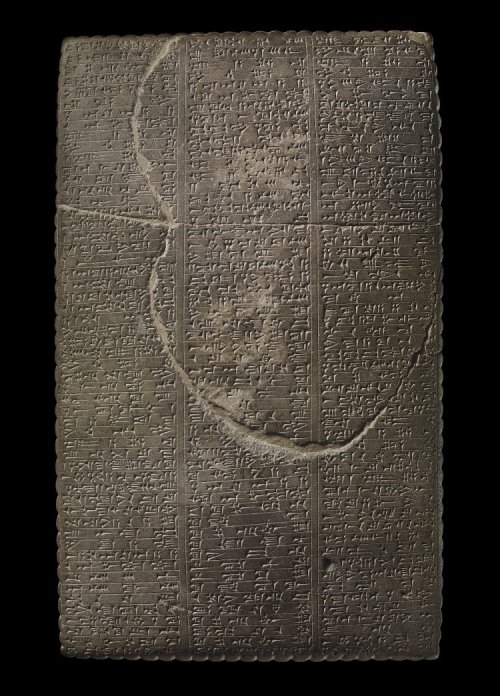
Illustration: Tablet sculptured with a scene representing the worship of the Sun-god in the Temple of Sippar.
The Sun-god is seated on a throne within a pavilion holding in one hand a disk and bar which may symbolize eternity.
Above his head are the three symbols of the Moon, the Sun, and the planet Venus.
On a stand in front of the pavilion rests the disk of the Sun, which is held in position by ropes grasped in the hands of two divine beings who are supported by the roof of the pavilion.
The pavilion of the Sun-god stands on the Celestial Ocean, and the four small disks indicate either the four cardinal points or the tops of the pillars of the heavens.
The three figures in front of the disk represent the high priest of Shamash, the king (Nabu-aplu-iddina, about 870 B.C.) and an attendant goddess. [No. 91,000.]

Museum number 91000 The engraved text contains a record of Nabu-apla-iddina's re-endowment of the Sun-Temple at Sippar. The inscription is engraved in six columns, three upon the obverse and three upon the reverse; and the upper part of the obverse is occupied by a scene sculptured in low relief; the edges of the tablet are bevelled.
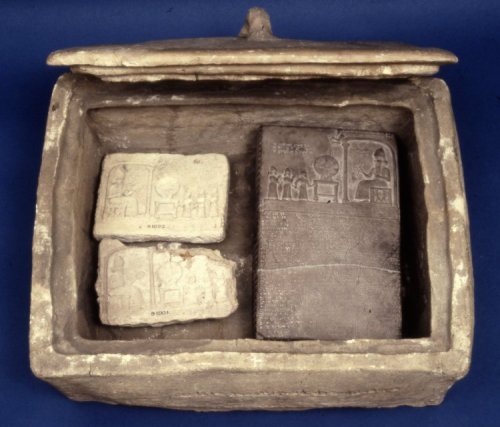
Museum number 91000
The engraved text contains a record of Nabu-apla-iddina’s re-endowment of the Sun-Temple at Sippar. The inscription is engraved in six columns, three upon the obverse and three upon the reverse; and the upper part of the obverse is occupied by a scene sculptured in low relief; the edges of the tablet are bevelled.

Museum number 91000 Group of Objects Pottery box and the limestone sun-god tablet and its covers deposited in it by Nabopolassar.

Museum number 91000
Group of Objects
Pottery box and the limestone sun-god tablet and its covers deposited in it by Nabopolassar.

The text of the Fifth Tablet, which would undoubtedly have supplied details as to Marduk’s arrangement and regulations for the sun, the moon, the stars, and the Signs of the Zodiac in the heavens is wanting.

The prominence of the celestial bodies in the history of creation is not to be wondered at, for the greater number of the religious beliefs of the Babylonians are grouped round them. Moreover, the science of astronomy had gone hand in hand with the superstition of astrology in Mesopotamia from time immemorial; and at a very early period the oldest gods of Babylonia were associated with the heavenly bodies.

Thus the Annunaki and the Igigi, who are bodies of deified spirits, were identified with the stars of the northern and southern heaven, respectively. And all the primitive goddesses coalesced and were grouped to form the goddess Ishtar, who was identified with the Evening and Morning Star, or Venus.

The Babylonians believed that the will of the gods was made known to men by the motions of the planets, and that careful observation of them would enable the skilled seer to recognize in the stars favourable and unfavourable portents. Such observations, treated from a magical point of view, formed a huge mass of literature which was being added to continually.

From the nature of the case this literature enshrined a very considerable number of facts of pure astronomy, and as early as the period of the First Dynasty (about 2000 B.C.), the Babylonians were able to calculate astronomical events with considerable accuracy, and to reconcile the solar and lunar years by the use of epagomenal months.

They had by that time formulated the existence of the Zodiac, and fixed the “stations” of the moon, and the places of the planets with it; and they had distinguished between the planets and the fixed stars. In the Fifth Tablet of the Creation Series (l. 2) the Signs of the Zodiac are called Lumashi, but unfortunately no list of their names is given in the context.

 Illustration: Tablet inscribed with a list of the Signs of the Zodiac. [No. 77,821.]


Illustration: Tablet inscribed with a list of the Signs of the Zodiac. [No. 77,821.]

Now these are supplied by the little tablet (No. 77,821) of the Persian Period of which a reproduction is here given. It has been referred to and discussed by various scholars, and its importance is very great. The transcript of the text, which is now published (see p. 68) for the first time, will be acceptable to the students of the history of the Zodiac.

Egyptian, Greek, Syriac and Arabic astrological and astronomical texts all associate with the Signs of the Zodiac twelve groups, each containing three stars, which are commonly known as the “Thirty-six Dekans.”

The text of line 4 of the Fifth Tablet of the Creation Series proves that the Babylonians were acquainted with these groups of stars, for we read that Marduk “set up for the twelve months of the year three stars apiece.” In the List of Signs of the Zodiac here given, it will be seen that each Sign is associated with a particular month.

At a later period, say about 500 B.C., the Babylonians made some of the gods regents of groups of stars, for Enlil ruled 33 stars, Anu 23 stars, and Ea 15 stars. They also possessed lists of the fixed stars, and drew up tables of the times of their heliacal risings.

Such lists were probably based upon very ancient documents, and prove that the astral element in Babylonian religion was very considerable.”

E.A. Wallis Budge, et al, & the British Museum, The Babylonian Legends of the Creation & the Fight Between Bel & the Dragon Told by Assyrian Tablets from Nineveh (BCE 668-626), 1901, pp. 10-11.

Marduk Kills Tiâmat

” … When Anu reported his inability to deal with Tiâmat, a council of the gods was called, and Ea induced his son, Marduk to be present.

We next find Anshar in converse with the god Marduk, who offers to act as the champion of the gods and to fight Tiâmat and her allies. Marduk being a form of the Sun-god, the greatest of all the powers of light, thus becomes naturally the protagonist of the gods, and the adversary of Tiâmat and her powers of darkness.

Then Anshar summoned a great council of the gods, who forthwith met in a place called “Upshukkinaku,” which may be described as the Babylonian Olympus. It was all-important for Marduk to appear at the council of the gods before he undertook his task, because it was necessary for him to be formally recognised by them as their champion, and he needed to be endowed by them with magical powers.

The primitive gods Lakhmu and Lakhamu, and the Igigi, who may be regarded as star-gods, were also summoned. A banquet was prepared, and the gods attended, and having met and kissed each other they sat down, and ate bread and drank hot and sweet sesame wine.

The fumes of the wine confused their senses, but they continued to drink, and at length “their spirits were exalted.” They appointed Marduk to be their champion officially, and then they proceeded to invest him with the power that would cause every command he spake to be followed immediately by the effect which he intended it to produce.

Next Marduk, with the view of testing the new power which had been given him, commanded a garment to disappear and it did so; and when he commanded it to reappear it did so.

Illustration: Shamash the Sun-god setting (?) on the horizon. In his right he holds a tree (?), and in his left a ... with a serrated edge. Above the horizon is a goddess who holds in her left hand an ear of corn. On the right is a god who seems to be setting free a bird from his right hand. Round him is a river with fish in it, and behind him is an attendant god; under his foot is a young bull. To the right of the goddess stand a hunting god, with a bow and lasso, and a lion. From the seal-cylinder of Adda ..., in the British Museum. About 2500 B.C. [No. 89,115.]

Illustration: Shamash the Sun-god setting (?) on the horizon. In his right he holds a tree (?), and in his left a … with a serrated edge. Above the horizon is a goddess who holds in her left hand an ear of corn. On the right is a god who seems to be setting free a bird from his right hand. Round him is a river with fish in it, and behind him is an attendant god; under his foot is a young bull. To the right of the goddess stand a hunting god, with a bow and lasso, and a lion. From the seal-cylinder of Adda …, in the British Museum. About 2500 B.C. [No. 89,115.]

Then the gods saluted him as their king, and gave him the insignia of royalty, namely, the sceptre, the throne and the pala, whatever that may be. And as they handed to him these things they commanded him to go and hack the body of Tiâmat in pieces, and to scatter her blood to the winds.

Thereupon Marduk began to arm himself for the fight. He took a bow, a spear, and a club; he filled his body full of fire and set the lightning before him. He took in his hands a net wherewith to catch Tiâmat, and he placed the four winds near it, to prevent her from escaping from it when he had snared her.

He created mighty winds and tempests to assist him, and grasped the thunderbolt in his hand; and then, mounting upon the Storm, which was drawn by four horses, he went out to meet and defeat Tiâmat. It seems pretty certain that this description of the equipment of Marduk was taken over from a very ancient account of the Fight with Tiâmat in which the hero was Enlil, i.e., the god of the air, or of the region which lies between heaven and hell.

Marduk approached and looked upon the “Middle” or “Inside” or “Womb” of Tiâmat, and divined the plan of Kingu who had taken up his place therein.

In the Seventh Tablet (l. 108) Marduk is said to have “entered into the middle of Tiâmat,” and because he did so he is called “Nibiru,” i.e., “he who entered in,” and the “seizer of the middle.” What the words “middle of Tiâmat” meant to the Babylonian we are not told, but it is clear that Marduk’s entry into it was a signal mark of the triumph of the god.

When Kingu from the “middle of Tiâmat” saw Marduk arrayed in his terrible panoply of war, he was terrified and trembled, and staggered about and lost all control of his legs; and at the mere sight of the god all the other fiends and devils were smitten with fear and reduced to helplessness.

Tiâmat saw Marduk and began to revile him, and when he challenged her to battle she flew into a rage and attempted to overthrow him by reciting an incantation, thinking that her words of power would destroy his strength. Her spell had no effect on the god, who at once cast his net over her.

At the same moment he made a gale of foul wind to blow on her face, and entering through her mouth it filled her body; whilst her body was distended he drove his spear into her, and Tiâmat split asunder, and her womb fell out from it.

Marduk leaped upon her body and looked on her followers as they attempted to escape. But the Four Winds which he had stationed round about Tiâmat made all their efforts to flee of no effect. Marduk caught all the Eleven allies of Tiâmat in his net, and he trampled upon them as they lay in it helpless.

Marduk then took the TABLET OF DESTINIES from Kingu’s breast, and sealed it with his seal and placed it on his own breast.”

E.A. Wallis Budge, et al, & the British Museum, The Babylonian Legends of the Creation & the Fight Between Bel & the Dragon Told by Assyrian Tablets from Nineveh (BCE 668-626), 1901, pp. 9-10.

The First Zodiac

” … Not content with Ummu-Khubur’s brood of devils, Tiâmat called the stars and powers of the air to her aid, for she “set up” …

(1) the Viper,

(2) the Snake,

(3) the god Lakhamu,

(4) the Whirlwind,

(5) the ravening Dog,

(6) the Scorpion-man,

(7) the mighty Storm-wind,

(8) the Fish-man, and

(9) the Horned Beast.

These bore (10) the “merciless, invincible weapon,” and were under the command of (11) Kingu, whom Tiâmat calls “her husband.”

Thus Tiâmat had Eleven mighty Helpers besides the devils spawned by Ummu-Khubur. We may note in passing that some of the above-mentioned Helpers appear among the Twelve Signs of the Zodiac which Marduk “set up” after his conquest of Tiâmat, e.g., the Scorpion-man, the Horned Beast, etc.

This fact suggests that the first Zodiac was “set up” by Tiâmat, who with her Eleven Helpers formed the Twelve Signs; the association of evil with certain stars may date from that period. That the Babylonians regarded the primitive gods as powers of evil is clear from the fact that Lakhamu, one of them, is enumerated among the allies of Tiâmat.

The helpers of Tiâmat were placed by her under the command of a god called KINGU who is TAMMUZ. He was the counterpart, or equivalent, of ANU, the Sky-god, in the kingdom of darkness, for it is said in the text “Kingu was exalted and received the power of Anu,” i.e., he possessed the same power and attributes as Anu.

When Tiâmat appointed Kingu to be her captain, she recited over him a certain spell or incantation, and then she gave him the TABLET OF DESTINIES and fastened it to his breast, saying, “Whatsoever goeth forth from thy mouth shall be established.”

Armed with all the magical powers conferred upon him by this Tablet, and heartened by all the laudatory epithets which his wife Tiâmat heaped upon him, Kingu went forth at the head of his devils.

When Ea heard that Tiâmat had collected her forces and was determined to continue the fight against the gods which Apsû and Mummu had begun, and that she had made her husband Kingu her champion, he was “afflicted” and “sat in sorrow.” He felt unable to renew the fight against the powers of darkness, and he therefore went and reported the new happenings to Anshar, representative of the “host of heaven,” and took counsel with him.

When Anshar heard the matter he was greatly disturbed in mind and bit his lips, for he saw that the real difficulty was to find a worthy antagonist for Kingu and Tiâmat. A gap in the text here prevents us from knowing exactly what Anshar said and did, but the context suggests that he summoned Anu, the Sky-god, to his assistance. Then, having given him certain instructions, he sent him on an embassy to Tiâmat with the view of conciliating her.

When Anu reached the place where she was he found her in a very wrathful state, and she was muttering angrily; Anu was so appalled at the sight of her that he turned and fled. It is impossible at present to explain this interlude, or to find any parallel to it in other ancient Oriental literature.”

Illustration: Shamash the Sun-god rising on the horizon, flames of fire ascending from his shoulder. The two portals of the dawn, each surmounted by a lion, are being drawn open by attendant gods. From a Babylonian seal cylinder in the British Museum. [No. 89,110.]

Illustration: Shamash the Sun-god rising on the horizon, flames of fire ascending from his shoulder. The two portals of the dawn, each surmounted by a lion, are being drawn open by attendant gods. From a Babylonian seal cylinder in the British Museum. [No. 89,110.]

E.A. Wallis Budge, et al, & the British Museum, The Babylonian Legends of the Creation & the Fight Between Bel & the Dragon Told by Assyrian Tablets from Nineveh (BCE 668-626), 1901, pp. 8-9.

Gilgamesh Recites the Iniquities of the Goddess Ishtar, the Sixth Tablet of the Epic of Gilgamesh

THE SIXTH TABLET.

“The scene now returns to Erech, whither the heroes returned after their glorious exploit. As Gilgamish was washing himself and dressing himself in splendid attire the goddess Ishtar saw his comeliness and desired him to be her lover, saying,

Go to, Gilgamish, do thou be (my) bridegroom,

Give me freely the fruit (of thy body).

Be thou my husband, I will be thy wife,

(So) will I make them yoke for thee a chariot of lapis-lazuli and gold,

Its wheels of gold, and its horns of electrum.

Every day shalt thou harness great mules thereto.

Enter (then) our house with the perfume of cedar.

When thou enterest our house

Threshold and dais shall kiss thy feet,

Beneath thee shall kings, lords and princes do homage,

Bringing thee as tribute the yield of the mountains and plains,

Thy she-goats shall bring forth abundantly, thy ewes bear twins,

Thine asses shall be (each) as great as a mule,

Thy horses in the chariot shall be famous for their swiftness,

Thy mules in the yoke shall not have a peer.

In answer to this invitation, Gilgamish made a long speech, in which he reviewed the calamities of those who had been unfortunate enough to attract the love of the goddess. To be her husband would be a burdensome privilege, and her love was deceptive, a ruin that gave no shelter, a door that let in the storm, a crazy building, a pitfall, defiling pitch, a leaky vessel, a crumbling stone, a worthless charm, an ill-fitting shoe.

“Who was ever thy lord that had advantage thereby? Come, I will unfold the tale of thy lovers.”

He refers to Tammuz, the lover of her youth, for whom year by year she causes wailing. Every creature that fell under her sway suffered mutilation or death; the bird’s wings were broken, the lion destroyed, the horse driven to death with whip and spur.

Her human lovers fared no better, for a shepherd, once her favourite, was turned by her into a jackal and torn by his own dogs, and Ishullanu, her father’s gardener, was turned into a spider (?) because he refused her advances.

“So, too,” said Gilgamish, “would’st thou love me, and (then) make me like unto them.”

When Ishtar heard these words she was filled with rage, and went up to heaven, and complained to Anu her father and Antu her mother that Gilgamish had blasphemed her, and revealed all her iniquitous deeds.

Anu replied, in effect, that it was her own fault, but she insisted in the request that he should create a heavenly bull to destroy Gilgamish. This he finally agreed to do, and the bull appeared before the citizens of Erech, and destroyed one, two and three hundred men who were sent out against him.

At length Enkidu and Gilgamish attacked the bull themselves, and after a hard fight: the details of which are lost, they slew him, and offered his heart together with a libation to the Sun-god. As soon as Ishtar heard of the bull’s death she rushed out on the battlements of the wall of Erech and cursed Gilgamish for destroying her bull.

When Enkidu heard what Ishtar said, he tore out the member of the bull and threw it before the goddess, saying, “Could I but get it at thee, I would serve thee like him; I would hang his it entrails about thee.”

Then Ishtar gathered together all her temple-women and harlots, and with them made lamentation over the member of the bull.

And Gilgamish called together the artisans of Erech, who came and marvelled at the size of the bull’s horns, for each of them was in bulk equal to 30 minas of lapis-lazuli, their thickness two finger-breadths, and together they contained six kur measures of oil.

These Gilgamish dedicated in the temple of his god Lugalbanda, to hold the god’s unguent, and, having made his offering, he and Enkidu washed their hands in the Euphrates, took their way back to the city, and rode through the streets of Erech, the people thronging round to admire them.

Gilgamish put forth a question to the people, saying

Who is splendid among men?

Who is glorious among heroes?

And the answer was:

[Gilgamish] is splendid among men,

[Enkidu] is glorious among heroes.

Gilgamish made a great feast in his palace, and after it all lay down to sleep. Enkidu also slept and had a vision, so he rose up and related it to Gilgamish.”

E.A. Wallis Budge, The Babylonian Story of the Deluge and the Epic of Gilgamish1929, p. 45-8.

The Friendship of Enkidu and Gilgamesh, the 2d Tablet of the Epic of Gilgamesh

” … When Enkidu saw the beasts forsake him his knees gave way, and he could not run as of old; but when he came to himself he returned to the harlot. She spoke to him flattering words, and asked him why he wandered with the wild beasts in the desert, and then told him she wished to take him back with her to Erech, where Anu and Ishtar lived, and where the mighty Gilgamish reigned.

Enkidu hearkened and the harlot then told him of the glories of Erech and of Gilgamish, who, she said, had been forewarned of Enkidu’s coming by two dreams, which he had related to his divine mother, Nin-sun. These she had interpreted as foreshowing the approach of a strong and faithful friend.

THE SECOND TABLET.

Having related these dreams of Gilgamish, the harlot again urged Enkidu to go with her to Erech, and they set out together. On the way she brought him to a shepherds’ village, where she instructed him how to eat the bread and beer which was set before him; for until then he had only sucked the milk of cattle.

By virtue of eating and drinking this human fare Enkidu became a man instead of a beast, and, taking weapons, he hunted the lions and wolves which preyed upon the shepherds’ flocks.

A messenger from Gilgamish now appeared with a summons to the city. He announced that the king offered entertainment, but that he would expect the customary present from a stranger, and would exercise his privilege over the woman who accompanied him.

The entrance of Enkidu into the city caused a general excitement, all being amazed at his surpassing strength and his conversion from savagery. The first meeting of Gilgamish and Enkidu took place when the king came in the night to claim his right to the strange woman.

Enkidu violently resisted him, and the two heroes in the doorway “grappled and snorted (?) like bulls; they shattered the threshold, the wall quivered” in their strife. Gilgamish was finally worsted, but the result of this combat was that the two became fast friends and allies.”

E.A. Wallis Budge, The Babylonian Story of the Deluge and the Epic of Gilgamish1929, p. 43.

In the End, Dwelling at the Mouth of the Rivers

[THE ABUBU (CYCLONE) AND ITS EFFECTS DESCRIBED.]

“97. As soon as something of dawn shone in the sky

98. A black cloud from the foundation of heaven came up.

99. Inside it the god Adad thundered,

100. The gods Nabû and Sharru (i.e., Marduk) went before,

101. Marching as messengers over high land and plain,

102. Irragal (Nergal) tore out the post of the ship,

103. En-urta went on, he made the storm to descend.

104. The Anunnaki brandished their torches,

105. With their glare they lighted up the land.

106. The whirlwind (or, cyclone) of Adad swept up to heaven.

107. Every gleam of light was turned into darkness.

108. . . . . . the land . . . . . as if had laid it waste.

109. A whole day long [the flood descended] . . .

110. Swiftly it mounted up . . . . . [the water] reached to the mountains

111. [The water] attacked the people like a battle.

112. Brother saw not brother.

113. Men could not be known (or, recognized) in heaven.

114. The gods were terrified at the cyclone.

115. They shrank back and went up into the heaven of Anu.

116. The gods crouched like a dog and cowered by the wall.

117. The goddess Ishtar cried out like a woman in travail.

118. The Lady of the Gods lamented with a sweet voice [saying]:

[ISHTAR’S LAMENT.]

119. May that former day be turned into mud,

120. Because I commanded evil among the company of the gods.

121. How could I command evil among the company of the gods,

122. Command battle for the destruction of my people?

123. Did I of myself bring forth my people

124. That they might fill the sea like little fishes?

[UTA-NAPISHTIM’S STORY CONTINUED.]

125. The gods, the Anunnaki wailed with her.

126. The gods bowed themselves, and sat down weeping.

127. Their lips were shut tight (in distress) . . .

128. For six days and nights

129. The wind, the storm raged, and the cyclone overwhelmed the land.

[THE ABATING OF THE STORM.]

130. When the seventh day came the cyclone ceased, the storm and battle

131. which had fought like an army.

132. The sea became quiet, the grievous wind went down, the cyclone ceased.

133. I looked on the day and voices were stilled,

134. And all mankind were turned into mud,

135. The land had been laid flat like a terrace.

136. I opened the air-hole and the light fell upon my cheek,

137. I bowed myself, I sat down, I cried,

138. My tears poured down over my cheeks.

139. I looked over the quarters of the world, (to] the limits of ocean.

140. At twelve points islands appeared.

141. The ship grounded on the mountain of Nisir.

142. The mountain of Nisir held the ship, it let it not move.

143. The first day, the second day, the mountain of Nisir held the ship and let it not move.

144. The third day, the fourth day, the mountain of Nisir held the ship and let it not move.

145. The fifth day, the sixth day, the mountain of Nisir held the ship and let it not move.

146. When the seventh day had come

147. I brought out a dove and let her go free.

148. The dove flew away and [then] came back;

149. Because she had no place to alight on she came back.

150. I brought out a swallow and let her go free.

151. The swallow flew away and [then] came back;

152. Because she had no place to alight on she came back.

153. 1 brought out a raven and let her go free.

154. The raven flew away, she saw the sinking waters.

155. She ate, she waded (?), she rose (?), she came not back.

[UTA-NAPISHTIM LEAVES THE SHIP.]

156. Then I brought out [everything] to the four winds and made a sacrifice;

157. I set out an offering on the peak of the mountain.

158. Seven by seven I set out the vessels,

159. Under them I piled reeds, cedarwood and myrtle (?).

160. The gods smelt the savour,

161. The gods smelt the sweet savour.

162. The gods gathered together like flies over him that sacrificed.

[SPEECH OF ISHTAR, LADY OF THE GODS.]

163 Now when the Lady of the Gods came nigh,

164. She lifted up the priceless jewels which Anu had made according to her desire, [saying]

165. O ye gods here present, as I shall never forget the sapphire jewels of my neck

166. So shall I ever think about these days, and shall forget them nevermore!

167. Let the gods come to the offering,

168. But let not Enlil come to the offering,

16q. Because he took not thought and made the cyclone,

170. And delivered my people over to destruction.”

[THE ANGER OF ENLIL.]

171. Now when Enlil came nigh

172. He saw the ship; then was Enlil wroth

173. And he was filled with anger against the gods, the Igigi [saying]:

174. Hath any being escaped with his life?

175. He shall not remain alive, a man among the destruction

[SPEECH OF EN-URTA.]

176. Then En-urta opened his mouth and spake

177. And said unto the warrior Enlil:

178. Who besides the god Ea can make a plan?

179. The god Ea knoweth everything that is done.

18o. The god Ea opened his mouth and spake

181. And said unto the warrior Enlil,

182. O Prince among the gods, thou warrior,

183. How, how couldst thou, not taking thought, make a cyclone?

184. He who is sinful, on him lay his sin,

185. He who transgresseth, on him lay his transgression.

186. But be merciful that [everything] be not destroyed be long-suffering that [man be not blotted out].

187. Instead of thy making a cyclone,

188. Would that the lion had come and diminished mankind.

189. Instead of thy making a cyclone

190. Would that the wolf had come and diminished mankind.

191. Instead of thy making a cyclone

192. Would that a famine had arisen and [laid waste] the land.

193. Instead of thy making a cyclone

194. Would that Irra (the Plague god) had risen up and [laid waste] the land.

195. As for me I have not revealed the secret of the great gods.

196. I made Atra-hasis to see a vision, and thus he heard the secret of the gods.

197. Now therefore take counsel concerning him.

[ENLIL DEIFIES UTA-NAPISHTIM AND HIS WIFE.]

198. Then the god Enlil went up into the ship,

199. He seized me by the hand and brought me forth.

200. He brought forth my wife and made her to kneel by my side.

201. He touched our brows, he stood between us, he blessed us [saving],

202. Formerly Uta-Napishtim was a man merely,

203. But now let Uta-Napishtim and his wife be like unto us gods.

204. Uta-Napishtim shall dwell afar off, at the mouth of the rivers.

[UTA-NAPISHTIM ENDS HIS STORY OF THE DELUGE.]

205. And they took me away to a place afar off, and made me to dwell at the mouth of the rivers.”

E.A. Wallis Budge, The Babylonian Story of the Deluge and the Epic of Gilgamish1929, pp. 35-40.

The 11th Tablet of the Epic of Gilgamesh and the Quest for Human Immortality

THE BABYLONIAN LEGEND OF THE DELUGE AS TOLD TO THE HERO GILGAMISH BY HIS ANCESTOR UTA-NAPISHTIM, WHO HAD BEEN MADE IMMORTAL BY THE GODS.

“The form of the Legend of the Deluge given below is that which is found on the Eleventh of the Series of Twelve Tablets in the Royal Library at Nineveh, which described the life and exploits of Gilgamish, an early king of the city of Erech.

As we have seen above, the Legend of the Deluge has probably no original connection with the Epic of Gilgamish, but was introduced into it by the editors of the Epic at a comparatively late period, perhaps even during the reign of Ashur-bani-pal (B.C. 669-626).

… It is … only necessary to state here that Gilgamish, who was horrified and almost beside himself when his bosom friend and companion Enkidu died, meditated deeply how he could escape death himself. He knew that his ancestor Uta-Napishtim had become immortal, therefore he determined to set out for the place where Uta-Napishtim lived so that he might obtain from him the secret of immortality.

Guided by a dream, Gilgamish set out for the Mountain of the Sunset, and, after great toil and many difficulties, came to the shore of a vast sea. Here he met Ur-Shanabi, the boatman of Uta-Napishtim, who was persuaded to carry him in his boat over the “waters of death,” and at length he landed on the shore of the country of Uta-Napishtim.

The immortal came down to the shore and asked the newcomer the object of his visit, and Gilgamish told him of the death of his great friend Enkidu, and of his desire to escape from death and to find immortality. Uta-Napishtim having made to Gilgamish some remarks which seem to indicate that in his opinion death was inevitable,

1. Gilgamish said unto him, to Uta-Napishtim the remote:

2. “I am looking at thee, Uta-Napishtim.

3. Thy person is not altered; even as am I so art thou.

4. Verily, nothing about thee is changed; even as am I so art thou.

5. A heart to do battle doth make thee complete,

6. Yet at rest (?) thou dost lie upon thy back.

7. How then hast thou stood the company of the gods and sought life?”

Thereupon Uta-Napishtim related to Gilgamish the Story of the Deluge, and the Eleventh Tablet continues thus

8. Uta-Napishtim said unto him, to Gilgamish:

9. “I will reveal unto thee, O Gilgamish, a hidden mystery,

10. And a secret matter of the gods I will declare unto thee.

11. Shurippak, a city which thou thyself knowest,

12. On [the bank] of the river Puratti (Euphrates) is situated,

13. That city is old; and the gods [dwelling] within it

14. Their hearts induced the great gods to make a windstorm (a-bu-bi),

15. There was their father Anu,

16. Their counsellor, the warrior Enlil,

17. Their messenger En-urta [and]

18. Their prince Ennugi.

19. Nin-igi-ku, Ea, was with them [in council] and

20. reported their word to a house of reeds.”

E.A. Wallis Budge, The Babylonian Story of the Deluge and the Epic of Gilgamish1929, pp. 30-2.

The Assassination of Sargon

Thus “Sargon the Later” entered at length into full possession of the empire of Sargon of Akkad. In Babylonia he posed as an incarnation of his ancient namesake, and had similarly Messianic pretensions which were no doubt inspired by the Babylonian priesthood. Under him Assyria attained its highest degree of splendour.

He recorded proudly not only his great conquests but also his works of public utility: he restored ancient cities, irrigated vast tracts of country, fostered trade, and promoted the industries. Like the pious Pharaohs of Egypt he boasted that he fed the hungry and protected the weak against the strong.

” … Sargon found time during his strenuous career as a conqueror to lay out and build a new city, called Dur-Sharrukin, “the burgh of Sargon,” to the north of Nineveh. It was completed before he undertook the Babylonian campaign. The new palace was occupied in 708 B.C. Previous to that period he had resided principally at Kalkhi, in the restored palace of Ashur-natsir-pal III.

He was a worshipper of many gods. Although he claimed to have restored the supremacy of Ashur “which had come to an end,” he not only adored Ashur but also revived the ancient triad of Anu, Bel, and Ea, and fostered the growth of the immemorial “mother-cult” of Ishtar.

Before he died he appointed one of his sons, Sennacherib, viceroy of the northern portion of the empire. He was either assassinated at a military review or in some frontier war. As much is suggested by the following entry in an eponym list.

Eponymy of Upahhir-belu, prefect of the city of Amedu …

According to the oracle of the Kulummite(s)…. A soldier

(entered) the camp of the king of Assyria (and killed him?), month

Ab, day 12th, Sennacherib (sat on the throne).

The fact that Sennacherib lamented his father’s sins suggests that the old king had in some manner offended the priesthood. Perhaps, like some of the Middle Empire monarchs, he succumbed to the influence of Babylon during the closing years of his life.

It is stated that “he was not buried in his house,” which suggests that the customary religious rites were denied him, and that his lost soul was supposed to be a wanderer which had to eat offal and drink impure water like the ghost of a pauper or a criminal.”

Donald A. Mackenzie, Myths of Babylonia and Assyria, 1915, pp. 462-4.

Hammurabi Restored the Temples

” … Hammurabi’s reign was long as it was prosperous. There is no general agreement as to when he ascended the throne–some say in 2123 B.C., others hold that it was after 2000 B.C.–but it is certain that he presided over the destinies of Babylon for the long period of forty-three years.

There are interesting references to the military successes of his reign in the prologue to the legal Code. It is related that when he “avenged Larsa,” the seat of Rim-Sin, he restored there the temple of the sun god.

Other temples were built up at various ancient centres, so that these cultural organizations might contribute to the welfare of the localities over which they held sway. At Nippur he thus honoured Enlil, at Eridu the god Ea, at Ur the god Sin, at Erech the god Anu and the goddess Nana (Ishtar), at Kish the god Zamama and the goddess Ma-ma, at Cuthah the god Nergal, at Lagash the god Nin-Girsu, while at Adab and Akkad, “celebrated for its wide squares,” and other centres he carried out religious and public works.

In Assyria he restored the colossus of Ashur, which had evidently been carried away by a conqueror, and he developed the canal system of Nineveh.

[ … ]

Hammurabi referred to himself in the Prologue as “a king who commanded obedience in all the four quarters.” He was the sort of benevolent despot whom Carlyle on one occasion clamoured vainly for–not an Oriental despot in the commonly accepted sense of the term.

As a German writer puts it, his despotism was a form of Patriarchal Absolutism. “When Marduk (Merodach),” as the great king recorded, “brought me to direct all people, and commissioned me to give judgment, I laid down justice and right in the provinces, I made all flesh to prosper.”

That was the keynote of his long life; he regarded himself as the earthly representative of the Ruler of all–Merodach, “the lord god of right,” who carried out the decrees of Anu, the sky god of Destiny.”

Donald A. Mackenzie, Myths of Babylonia and Assyria, 1915.

The Babylonian Account of the Deluge

The story of the Deluge which was related to Gilgamesh by Pir-napishtim runs as follows:–

“Hear me, O Gilgamesh, and I will make revelation regarding the hidden doings of the high gods. As thou knowest, the city of Shurippak is situated upon the bank of the Euphrates. The gods were within it: there they assembled together in council.

Anu, the father, was there, and Bel the counsellor and warrior, Ninip the messenger, and Ennugi the governor. Ea, the wise lord, sat also with them. In their hearts the gods agreed together to send a great deluge.

“Thereafter Ea made known the purpose of the divine rulers in the hut of reeds, saying: ‘O hut of reeds, hear; O wall, understand … O man of Shurippak, son of Umbara Tutu, tear down thy house and build a ship; leave all thou dost possess and save thy life, and preserve in the ship the living seed of every kind. The ship that thou wilt build must be of goodly proportions in length and height. It must be floated on the great deep.’

“I heard the command of Ea and understood, and I made answer, saying, ‘O wise lord, as thou hast said so will I do, for thy counsel is most excellent. But how shall I give reason for my doings to the young men and the elders?’

“Ea opened his mouth and said unto me, his servant: ‘What thou shalt say unto them is this…. It hath been revealed unto me that Bel doth hate me, therefore I cannot remain any longer in his domain, this city of Shurippak, so I must depart unto the domain of Ea and dwell with him…. Unto you will Bel send abundance of rain, so that you may obtain birds and fishes in plenty and have a rich harvest. But Shamash hath appointed a time for Ramman to pour down destruction from the heavens.‘”

Ea then gave instructions to Pir-napishtim how to build the ship in which he should find refuge. So far as can be gathered from the fragmentary text, it appears that this vessel was to have a deck house six stories high, with nine apartments in each story. According to another account, Ea drew a plan of the great ship upon the sand.

Pir-napishtim set to work and made a flat-bottomed vessel, which was 120 cubits wide and 120 cubits in height. He smeared it with bitumen inside and pitch outside; and on the seventh day it was ready. Then he carried out Ea’s further instructions. Continuing his narrative to Gilgamesh, he said:

“I gathered together all that I possessed, my silver and gold and seeds of every kind, and my goods also. These I placed in the ship. Then I caused to go aboard all my family and house servants, the animals of the field and the beasts of the field and the workers–every one of them I sent up.

“The god Shamash appointed the time, saying: ‘I will cause the Night Lord to send much rain and bring destruction. Then enter thou the ship and shut thy door.’

“At the appointed time the Night Lord sent at even-time much rain. I saw the beginning of the deluge and I was afraid to look up. I entered the ship and shut the door. I appointed Buzur-Kurgala, the sailor, to be captain, and put under his command the great vessel and all that it contained.

“At the dawn of day I saw rising athwart the heavens a dark cloud, and in the midst of it Ramman thundered. Nebo and Merodach went in front, speeding like emissaries over hills and plains. The cables of the ship were let loose.

“Then Ninip, the tempest god, came nigh, and the storm broke in fury before him. All the earth spirits leapt up with flaming torches and the whole land was aflare. The thunder god swept over the heavens, blotting out the sunlight and bringing thick darkness.

Rain poured down the whole day long, and the earth was covered with water; the rivers were swollen; the land was in confusion; men stumbled about in the darkness, battling with the elements.

Brothers were unable to see brothers; no man could recognize his friends…. The spirits above looked down and beheld the rising flood and were afraid: they fled away, and in the heaven of Anu they crouched like to hounds in the protecting enclosures.

“In time Ishtar, the lady of the gods, cried out distressfully, saying: ‘The elder race hath perished and turned to clay because that I have consented to evil counsel in the assembly of the gods. Alas! I have allowed my people to be destroyed. I gave being to man, but where is he? Like the offspring of fish he cumbers the deep.’

“The earth spirits were weeping with Ishtar: they sat down cowering with tightened lips and spake not; they mourned in silence.

“Six days and six nights went past, and the tempest raged over the waters which gradually covered the land. But when the seventh day came, the wind fell, the whirling waters grew peaceful, and the sea retreated. The storm was over and the rain of destruction had ceased. I looked forth. I called aloud over the waters. But all mankind had perished and turned to clay. Where fields had been I saw marshes only.

“Then I opened wide the window of the ship, and the sunlight suffused my countenance. I was dazzled and sank down weeping and the tears streamed over my face. Everywhere I looked I saw water.

“At length, land began to appear. The ship drifted towards the country of Nitsir, and then it was held fast by the mountain of Nitsir. Six days went past and the ship remained stedfast. On the seventh day I sent forth a dove, and she flew away and searched this way and that, but found no resting place, so she returned.

I then sent forth a swallow, and she returned likewise. Next I sent forth a raven, and she flew away. She saw that the waters were shrinking, and gorged and croaked and waded, but did not come back. Then I brought forth all the animals into the air of heaven.

“An offering I made on the mountain. I poured out a libation. I set up incense vessels seven by seven on heaped-up reeds and used cedar wood with incense. The gods smelt the sweet savour, and they clustered like flies about the sacrificer.

“Thereafter Ishtar (Sirtu) drew nigh. Lifting up the jewels, which the god Anu had fashioned for her according to her desire, she spake, saying: ‘Oh! these gods! I vow by the lapis lazuli gems upon my neck that I will never forget! I will remember these days for ever and ever. Let all the gods come hither to the offering, save Bel (Enlil) alone, because that he ignored my counsel, and sent a great deluge which destroyed my people.’

“But Bel Enlil came also, and when he beheld the ship he paused. His heart was filled with wrath against the gods and the spirits of heaven. Angrily he spake and said: ‘Hath one escaped? It was decreed that no human being should survive the deluge.’

“Ninip, son of Bel, spoke, saying: ‘Who hath done this save Ea alone? He knoweth all things.’

“Ea, god of the deep, opened his mouth and said unto the warrior Bel: ‘Thou art the lord of the gods, O warrior. But thou wouldst not hearken to my counsel and caused the deluge to be. Now punish the sinner for his sins and the evil doer for his evil deed, but be merciful and do not destroy all mankind. May there never again be a flood.

Let the lion come and men will decrease. May there never again be a flood. Let the leopard come and men will decrease. May there never again be a flood. Let famine come upon the land; let Ura, god of pestilence, come and snatch off mankind…. I did not reveal the secret purpose of the mighty gods, but I caused Atra-chasis (Pir-napishtim) to dream a dream in which he had knowledge of what the gods had decreed.’

“Having pondered a time over these words, Bel entered the ship alone. He grasped my hand and led me forth, even me, and he led forth my wife also, and caused her to kneel down beside me. Then he stood between us and gave his blessing.

He spoke, saying: ‘In time past Pir-napishtim was a man. Henceforth Pir-napishtim and his wife will be like unto deities, even us. Let them dwell apart beyond the river mouths.’

“Thereafter Bel carried me hither beyond the mouths of rivers.”

Donald A. Mackenzie, Myths of Babylonia and Assyria, 1915.

Revolting Unmoral Rites

“There is another phase, however, to the character of the mother goddess which explains the references to the desertion and slaying of Tammuz by Ishtar. “She is,” says Jastrow, “the goddess of the human instinct, or passion which accompanies human love. Gilgamesh … reproaches her with abandoning the objects of her passion after a brief period of union.” At Ishtar’s temple “public maidens accepted temporary partners, assigned to them by Ishtar.”

The worship of all mother goddesses in ancient times was accompanied by revolting unmoral rites which are referred to in condemnatory terms in various passages in the Old Testament, especially in connection with the worship of Ashtoreth, who was identical with Ishtar and the Egyptian Hathor.

Ishtar in the process of time overshadowed all the other female deities of Babylonia, as did Isis in Egypt. Her name, indeed, which is Semitic, became in the plural, Ishtar·te, a designation for goddesses in general. But although she was referred to as the daughter of the sky, Anu, or the daughter of the moon, Sin or Nannar, she still retained traces of her ancient character.

Originally she was a great mother goddess, who was worshipped by those who believed that life and the universe had a female origin in contrast to those who believed in the theory of male origin. Ishtar is identical with Nina, the fish goddess, a creature who gave her name to the Sumerian city of Nina and the Assyrian city of Nineveh.

Other forms of the Creatrix included Mama, or Mami, or Ama, “mother,” Aruru, Bau, Gula, and Zerpanitum. These were all “Preservers” and healers. At the same time they were “Destroyers,” like Nin-sun and the Queen of Hades, Eresh-ki-gal or Allatu.

They were accompanied by shadowy male forms ere they became wives of strongly individualized gods, or by child gods, their sons, who might be regarded as “brothers” or “husbands of their mothers,” to use the paradoxical Egyptian term.

Similarly Great Father deities had vaguely defined wives. The “Semitic” Baal, “the lord,” was accompanied by a female reflection of himself–Beltu, “the lady.” Shamash, the sun god, had for wife the shadowy Aa.

As has been shown, Ishtar is referred to in a Tammuz hymn as the mother of the child god of fertility. In an Egyptian hymn the sky goddess Nut, “the mother” of Osiris, is stated to have “built up life from her own body.” Sri or Lakshmi, the Indian goddess, who became the wife of Vishnu, as the mother goddess Saraswati, a tribal deity, became the wife of Brahma, was, according to a Purana commentator, “the mother of the world … eternal and undecaying.”

The gods, on the other hand, might die annually: the goddesses alone were immortal. Indra was supposed to perish of old age, but his wife, Indrani, remained ever young. There were fourteen Indras in every “day of Brahma”, a reference apparently to the ancient conception of Indra among the Great Mother-worshipping sections of the Aryo-Indians.

In the Mahabharata the god Shiva, as Mahadeva, commands Indra on “one of the peaks of Himavat,” where they met, to lift up a stone and join the Indras who had been before him. “And Indra on removing that stone beheld a cave on the breast of that king of mountains in which were four others resembling himself.”

Indra exclaimed in his grief, “Shall I be even like these?” These five Indras, like the “Seven Sleepers,” awaited the time when they would be called forth. They were ultimately reborn as the five Pandava warriors.”

Donald A. Mackenzie, Myths of Babylonia and Assyria, 1915.

Tammuz, Attis, Osiris, Adonis, Diarmid Derive from a More Ancient God of Fertility

“The Babylonian myth of Tammuz, the dying god, bears a close resemblance to the Greek myth of Adonis. It also links with the myth of Osiris. According to Professor Sayce, Tammuz is identical with “Daonus or Daos, the shepherd of Pantibibla,” referred to by Berosus as the ruler of one of the mythical ages of Babylonia. We have therefore to deal with Tammuz in his twofold character as a patriarch and a god of fertility.

The Adonis version of the myth may be summarized briefly. Ere the god was born, his mother, who was pursued by her angry sire, as the river goddesses of the folk tales are pursued by the well demons, transformed herself into a tree.

Adonis sprang from the trunk of this tree, and Aphrodite, having placed the child in a chest, committed him to the care of Persephone, queen of Hades, who resembles the Babylonian Eresh-ki-gal. Persephone desired to retain the young god, and Aphrodite (Ishtar) appealed to Zeus (Anu), who decreed that Adonis should spend part of the year with one goddess and part of the year with the other.

It is suggested that the myth of Adonis was derived in post-Homeric times by the Greeks indirectly from Babylonia through the Western Semites, the Semitic title “Adon,” meaning “lord,” having been mistaken for a proper name. This theory, however, cannot be accepted without qualifications.

It does not explain the existence of either the Phrygian myth of Attis, which was developed differently from the Tammuz myth, or the Celtic story of “Diarmid and the boar,” which belongs to the archaeological “Hunting Period.”

There are traces in Greek mythology of pre-Hellenic myths about dying harvest deities, like Hyakinthos and Erigone, for instance, who appear to have been mourned for. There is every possibility, therefore, that the Tammuz ritual may have been attached to a harvest god of the pre-Hellenic Greeks, who received at the same time the new name of Adonis.

Osiris of Egypt resembles Tammuz, but his Mesopotamian origin has not been proved. It would appear probable that Tammuz, Attis, Osiris, and the deities represented by Adonis and Diarmid were all developed from an archaic god of fertility and vegetation, the central figure of a myth which was not only as ancient as the knowledge and practice of agriculture, but had existence even in the “Hunting Period.”

Traces of the Tammuz-Osiris story in various forms are found all over the area occupied by the Mediterranean or Brown race from Sumeria to the British Isles. Apparently the original myth was connected with tree and water worship and the worship of animals.

Adonis sprang from a tree; the body of Osiris was concealed in a tree which grew round the sea-drifted chest in which he was concealed. Diarmid concealed himself in a tree when pursued by Finn.

The blood of Tammuz, Osiris, and Adonis reddened the swollen rivers which fertilized the soil. Various animals were associated with the harvest god, who appears to have been manifested from time to time in different forms, for his spirit pervaded all nature. In Egypt the soul of Osiris entered the Apis bull or the ram of Mendes.

Tammuz in the hymns is called “the pre-eminent steer of heaven,” and a popular sacrifice was “a white kid of the god Tammuz,” which, however, might be substituted by a sucking pig. Osiris had also associations with swine, and the Egyptians, according to Herodotus, sacrificed a pig to him annually.

When Set at full moon hunted the boar in the Delta marshes, he probably hunted the boar form of Osiris, whose human body had been recovered from the sacred tree by Isis.

As the soul of Bata, the hero of the Egyptian folk tale, migrated from the blossom to the bull, and the bull to the tree, so apparently did the soul of Osiris pass from incarnation to incarnation. Set, the demon slayer of the harvest god, had also a boar form; he was the black pig who devoured the waning moon and blinded the Eye of Ra.

In his character as a long-lived patriarch, Tammuz, the King Daonus or Daos of Berosus, reigned in Babylonia for 36,000 years. When he died, he departed to Hades or the Abyss. Osiris, after reigning over the Egyptians, became Judge of the Dead.”

Donald A. Mackenzie, Myths of Babylonia and Assyria, 1915.

Gods, Goddesses, Demons

” … In the early stages of Sumerian culture, the gods and goddesses who formed groups were indistinguishable from demons. They were vaguely defined, and had changing shapes. When attempts were made to depict them they were represented in many varying forms. Some were winged bulls or lions with human heads; others had even more remarkable composite forms. The “dragon of Babylon”, for instance, which was portrayed on walls of temples, had a serpent’s head, a body covered with scales, the fore legs of a lion, hind legs of an eagle, and a long wriggling serpentine tail. Ea had several monster forms. The following description of one of these is repulsive enough:–

The head is the head of a serpent,

From his nostrils mucus trickles,

His mouth is beslavered with water;

The ears are like those of a basilisk,

His horns are twisted into three curls,

He wears a veil in his head band,

The body is a suh-fish full of stars,

The base of his feet are claws,

The sole of his foot has no heel,

His name is Sassu-wunnu,

A sea monster, a form of Ea.

R.C. Thompson’s Translation.

Even after the gods were given beneficent attributes to reflect the growth of culture, and were humanized, they still retained many of their savage characteristics. Bel Enlil and his fierce son, Nergal, were destroyers of mankind; the storm god desolated the land; the sky god deluged it with rain; the sea raged furiously, ever hungering for human victims; the burning sun struck down its victims; and the floods played havoc with the dykes and houses of human beings.

In Egypt the sun god Ra was similarly a “producer of calamity,” the composite monster god Sokar was “the lord of fear”. Osiris in prehistoric times had been “a dangerous god,” and some of the Pharaohs sought protection against him in the charms inscribed in their tombs.

The Indian Shiva, “the Destroyer”, in the old religious poems has also primitive attributes of like character.

The Sumerian gods never lost their connection with the early spirit groups. These continued to be represented by their attendants, who executed a deity’s stern and vengeful decrees. In one of the Babylonian charms the demons are referred to as “the spleen of the gods”–the symbols of their wrathful emotions and vengeful desires.

Bel Enlil, the air and earth god, was served by the demons of disease, “the beloved sons of Bel,” which issued from the Underworld to attack mankind. Nergal, the sulky and ill-tempered lord of death and destruction, who never lost his demoniac character, swept over the land, followed by the spirits of pestilence, sunstroke, weariness, and destruction.

Anu, the sky god, had “spawned” at creation the demons of cold and rain and darkness. Even Ea and his consort, Damkina, were served by groups of devils and giants, which preyed upon mankind in bleak and desolate places when night fell. In the ocean home of Ea were bred the “seven evil spirits” of tempest–the gaping dragon, the leopard which preyed upon children, the great Beast, the terrible serpent, &c.

In Indian mythology Indra was similarly followed by the stormy Maruts, and fierce Rudra by the tempestuous Rudras.

In Teutonic mythology Odin is the “Wild Huntsman in the Raging Host.”

In Greek mythology the ocean furies attend upon fickle Poseidon.

Other examples of this kind could be multiplied.”

Donald A. Mackenzie, Myths of Babylonia and Assyria, 1915.