Samizdat

Publishing the Forbidden. All Rights Reserved. © Samizdat 2014-2025.

Tag: The Flood

A Digression on Berossus and the Babyloniaca

“The books written by Berossus, priest of Marduk at Babylon in the early third century B.C., have been lost, and all that we know about them comes from the twenty-two quotations or paraphrases of his work by other ancient writers (so-called Fragmenta), and eleven statements about Berossus (Testimonia) made by classical, Jewish and Christian writers.

We learn that he wrote for Antiochus I (280-261 B.C.) a work generally referred to as the Babyloniaca, a work divided into three rolls, or books, of papyrus.
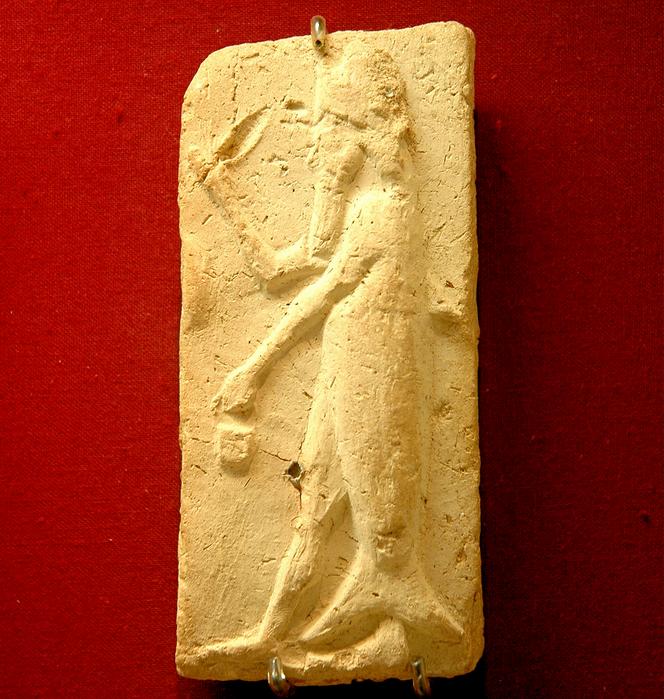
Ea, or Oannes, depicted as a fish-man.

Ea, or Oannes, depicted as a fish-man.

In the first book he told how a fish-like creature named Oannes came up from the Persian Gulf, delivered to mankind the arts of civilization, and left with them a written record of how their world had come into existence; according to this record, Berossus went on, Bel had created the world out of the body of a primeval female deity. This story of the creation of the world and mankind, otherwise familiar from Enūma eliš, filled out the first book of the Babyloniaca and ended with the statement that Bel established the stars, sun, moon and the five planets.

In book two Berossus (Frag. 3) described the 120-sar (432,000-year) rule of the ten antediluvian kings, and then the Deluge itself, with some detail on the survival of Xisuthros. The postdiluvian dynasties down to Nabonassar were baldly listed in the remainder of book two.
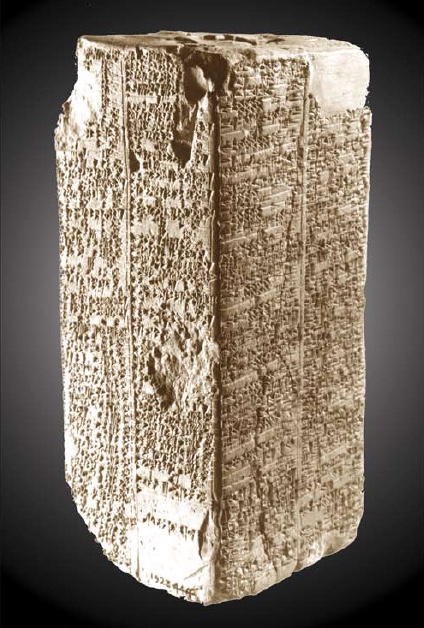
A prism containing the Sumerian King List. Borossus cites ten antediluvian rulers.

A prism containing the Sumerian King List. Borossus cites ten antediluvian rulers.

The third book, apparently beginning with Tiglath-Pileser III, presented the Late Assyrian, Neo-Babylonian and Persian kings of Babylon, and ended with Alexander the Great.

And that, according to Felix Jacoby’s edition of the Fragmenta and Testimonia is in sum what the Babyloniaca contained. There are eight quotations dealing with astronomical and astrological matters, but these he attributed not to our Berossus, but to Pseudo-Berossus of Cos.

It was to the latter, according to Jacoby, that Josephus referred as “well known to educators, since it was he who published for the Greeks the written accounts of astronomy and the philosophical doctrines of the Chaldaeans”; or who claimed, said Vitruvius, that by study of the zodiacal signs, the planets, sun and moon, the Chaldaeans could predict what the future held in store for man.

And it was Pseudo-Berossus, according to Jacoby, to whom Seneca referred in his discussion of world-floods:

Berosos, who translated Belus (qui Belum interpretatus est), says that these catastrophes occur with the movement of the planets. Indeed, he is so certain that he assigns a date for the conflagration and the deluge. For earthly things will burn, he contends, when all the planets which now maintain different orbits come together in the sign of Cancer, and are so arranged in the same path that a straight line can pass through the spheres of all of them. The deluge will occur when the same group of planets meets in the sign of Capricorn. The solstice is caused by Cancer, winter by Capricorn; they are signs of great power since they are the turning-points in the very change of the year.”

Pseudo-Berossus of Cos”, I believe, is not only an inconvenient but an utterly improbable scholarly creation. A century ago all of our fragments were assigned to one and the same Berossus, although those dealing with the stars were segregated from those of a mythological or historical characters.

Thus the notion was fostered that Berossus wrote two works, one on Babylonian history, another on astrology. By the turn of the century E. Schwartz found unlikely Vitruvius‘ statement that Berossus eventually settled on the Aegean island of Cos, where he taught the Chaldaean disciplina.”

Robert Drews, “The Babylonian Chronicles and Berossus,” Iraq, Vol. 37, No. 1 (Spring, 1975), pp. 50-2.
Sins of Man

Merodach mourned over the doom pronounced against his city, and apparently with some effect; for after a good many broken and lost lines, the tablet goes on to describe the despatch of the terrible plague-god to Erech, “the seat of Anu and Istar, the city of the choirs of the festival-makers and consecrated maidens of Istar,” who “dreaded death,” for the nomad ‘Suti of the desert had combined against their state.

The eunuch-priests were now compelled to bow the face before another deity than the peaceful Istar, who “cried and was troubled over the city of Erech.” Eventually, however, Nerra was “quieted” by “Isum his councillor, the illustrious god who goes before him,” “and the warrior Nerra spake thus:

“Sea-land against sea-land, ‘Sumasti against ‘Sumasti, the Assyrian against the Assyrian, the Elamite against the Elamite, the Kossaean against the Kossaean, the Kurd against the Kurd, the Lullubite against the Lullubite, country against country, house against house, man against man, brother against brother, let them destroy one another, and afterwards let the Accadian come and slay them all, and fall upon their breasts.”

The warrior Nerra (further) addresses a speech to Isum, who goes before him:

‘Go, Isum, incline all thy heart to the word thou hast spoken.’

(Then) Isum sets his face towards the land of the west; the seven warrior gods, unequalled, sweep (all things) away behind him.

At the land of Phoenicia, at the mountains, the warrior arrived; he lifted up the hand, he laid it on the mountain; the mountain of Phoenicia, he counted as his own soil.”

In thus marching to the west, the minister of the Babylonian god of death approaches the country in which another angel of pestilence was seen by the king of Israel.

“By the threshing-floor of Araunah the Jebusite,” David had beheld the angel of the Lord “stretching out his hand upon Jerusalem to destroy it.”

As in Babylon, so too in Israel, the plague had been a visitation for the sins of man. It was the instrument of God’s anger wielded by the hands of his angel-minister. That same angel-minister had once before stood before Balaam, and with a drawn sword in his hand had threatened the Syrian prophet with death.

He was not a demon from the lower world, like the old Chaldean plague-spirit Namtar; he was not the inexorable law of destiny, before whom even the gods had to submit their wills; but a member of the celestial hierarchy, the messenger of a beneficent God.

He came to destroy, but it was to destroy the guilty. The sins of man, and not the malevolence or passionless law of a supernatural being, brought death and suffering into the world. The Babylonian legend of Nerra, like the records of the Old Testament, tells the same tale as the Babylonian story of the Deluge.”

A.H. Sayce, Lectures on the Origin and Growth of Religion as Illustrated by the Religion of the Ancient Babylonians, 5th ed., London, 1898, pp. 312-4.

Winds and the Babylonian Concept of Evil

Hadad, Addu or Dadda, never superseded the native name of Ramânu (Ramman) in Babylonia and Assyria, and remained foreign to the last.

Ramânu, however, was sometimes addressed as Barqu or Barak, “the lightning;” and it is possible that antiquarian zeal may have also sometimes imposed on him the Accadian title of Meru.

He grew continuously in popular favour. In Semitic Babylonia, and yet more in Semitic Assyria, his aid was constantly invoked; and, like Anu, Bel and Ea, he tended as time went on to become more and more national in character. Ramman is one of the least local of Babylonian gods.

This was due in great measure to the nature of his origin. He began as the amalgamation of two distinct deities, the wind-god and the air-god, and the extension af his cult was marked by the absorption into his person of the various deities of the winds adored by the older faith.

He continued to grow at their expense. The spirits of the winds and storms sank lower and lower; and while the beneficent side of their operation attached itself to Ramman, there remained to them only that side which was harmful and demoniac.

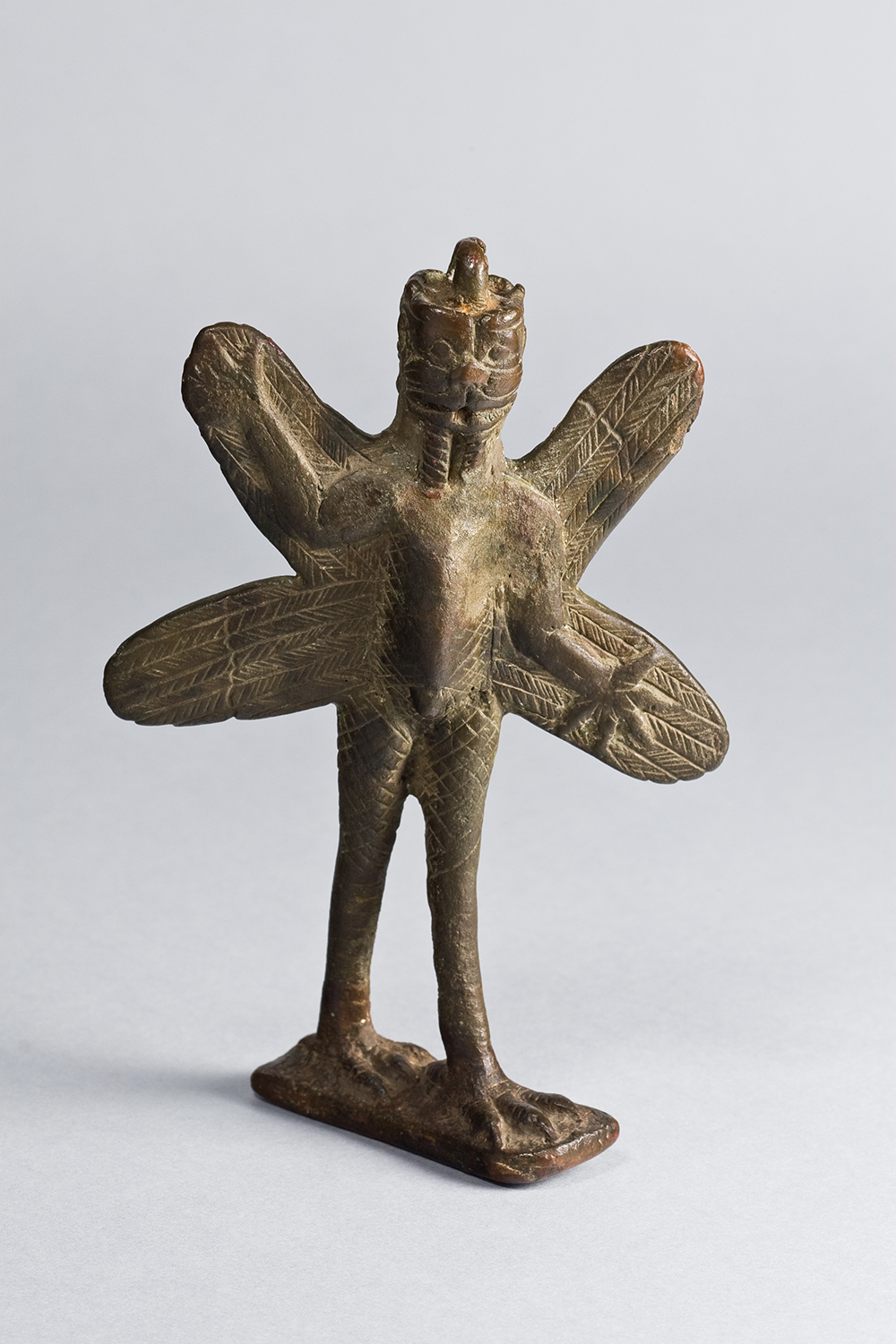
Iraq ca. 800-600 B.C. Bronze Purchased in New York, 1943 Oriental Institute Museum A25413 The demon Pazuzu stands but has a scorpion's body, feathered wings, avian legs, talons, and a lion face front and back.  Pazuzu, the "king of the evil wind demons," was not unfriendly. As an enemy of the Lamashtu demon, Pazuzu is portrayed on amulets for childbirth.  The ring at the top of this figurine suggests that it was such an amulet. https://oi.uchicago.edu/collections/highlights/highlights-collection-mesopotamia

Iraq
ca. 800-600 B.C.
Bronze
Purchased in New York, 1943
Oriental Institute Museum A25413
The demon Pazuzu stands but has a scorpion’s body, feathered wings, avian legs, talons, and a lion face front and back.
Pazuzu, the “king of the evil wind demons,” was an enemy of the Lamashtu demon. Pazuzu was portrayed on childbirth amulets. 
https://oi.uchicago.edu/collections/highlights/highlights-collection-mesopotamia

By degrees, the two aspects of their character came be separated. The higher gods came to be looked upon as the hearers of prayers and the bestowers of all good gifts; while the instruments of their vengeance an the inflictors of suffering and misery upon man were the inferior spirits of the lower sphere.

But the old conception, which derived both good and evil from the same source, did not wholly pass away. Evil never came to be regarded as the antagonist of good; it was rather the necessary complement and minister of good.

The supreme Baal thus preserved his omnipotence, while at the same time the ideas of pain and injustice were dissociated from him. In his combat with the dragon of chaos, Merodach summons the “evil wind” itself to his assistance; and in the legend of the assault of the seven wicked spirits upon the Moon, they are nevertheless called “the messengers of Anu their king.”

Nerra, the god of plague and destruction, smites the people of Babylonia on account of their sins by the command of the gods, like the angel with the drawn sword whom David saw standing over Jerusalem at the threshing-floor of Araunah; and in the story of the Deluge it is because of the wickedness of mankind that the flood is brought upon the earth.

The powers of darkness are degraded from their ancient position of independence, and either driven, like Tiamat, beyond the bounds of the created world, or reduced to the condition of ministers of divine wrath.

If we would realise how widely removed is this conception of them as the instruments of divine anger from that earlier view in which they are mere elemental powers, in themselves neither good nor evil, we cannot do better than compare these legendary compositions of the Semitic period with the old Accadian hymns that relate to the seven harmful spirits.”

A.H. Sayce, Lectures on the Origin and Growth of Religion as Illustrated by the Religion of the Ancient Babylonians, 5th ed., London, 1898, pp. 205-6.

On the Babylonian Winds

“The primitive inhabitant of Babylonia paid a special worship to the winds. He beheld in them spirits of good and evil. He prayed for (‘the good wind” which cooled the heats of summer and brought moisture to the parched earth, and he saw in the storm and tempest, in the freezing blasts of winter and the hot wind that blew from the burning desert, “the seven evil spirits.”

They were the demons ‘who had been created in the lower part of heaven,” and who warred against the Moon-god when he suffered eclipse. They were likened to all that was most noxious to man.

The first, we are told, was “the sword (or lightning) of rain;” the second, “a vampire;” the third, “a leopard;” the fourth, “a serpent;” the fifth, “a watch-dog” (?); the sixth, “a violent tempest which (blows) against god and king;” and the seventh, “a baleful wind.” But their power caused them to be dreaded, and they were venerated accordingly.

It was remembered that they were not essentially evil. They, too, had been the creation of Anu, for they came forth from the sky, and all seven were “the messengers of Anu their king.” In the war of the gods against the dragon of chaos, they had been the allies of Merodach. We read of them that ere the great combat began, the god “created the evil wind, the hostile wind, the tempest, the storm, the four winds, the seven winds, the whirlwind, the unceasing wind.”

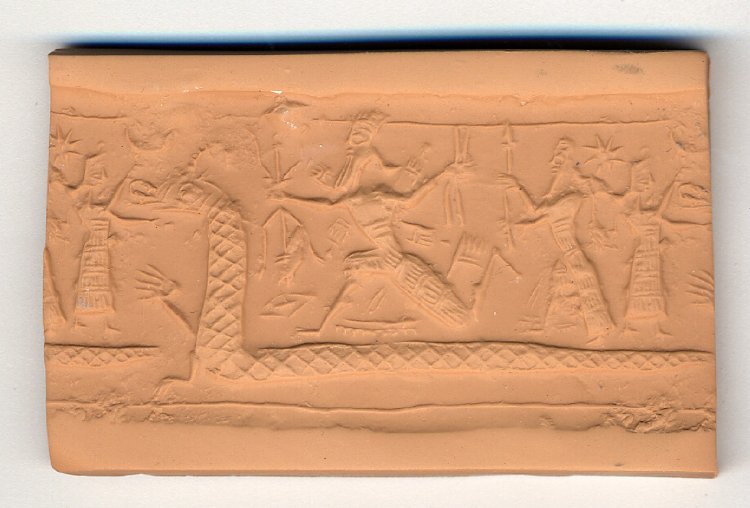
Battle between Marduk (Bel) and Tiamat. Drawn from a bas-relief from the Palace of Ashur-nasir-pal, King of Assyria, 885-860 B.C., at Nimrûd. The winds that Marduk wielded in the combat are portrayed as tridents in his hands.  British Museum, Nimrûd Gallery, Nos. 28 and 29. http://bharatkalyan97.blogspot.com/2013/06/tablet-of-destinies.html

Battle between Marduk (Bel) and Tiamat. Drawn from a bas-relief from the Palace of Ashur-nasir-pal, King of Assyria, 885-860 B.C., at Nimrûd.
The winds that Marduk wielded in the combat are portrayed as tridents in his hands.
British Museum, Nimrûd Gallery, Nos. 28 and 29.
http://bharatkalyan97.blogspot.com/2013/06/tablet-of-destinies.html

When Merodach had slung forth his boomerang and hit the dragon, “the evil wind that seizes behind showed its face. And Tiamat (the dragon of the sea) opened her mouth to swallow it, but (the god) made the evil wind descend so that she could not close her lips; with the force of the winds he filled her stomach, and her heart was sickened and her mouth distorted.”

Down to the closing days of the Assyrian empire, the four winds, ”the gods of Nipur,” were still worshipped in Assyria (H.C. Rawlinson, The Cuneiform Inscriptions of Western Asia, 1886, iii. 66, Rev. 26), and Saru, the Wind-god, is mentioned as a separate divinity in the story of the Deluge.

Among the winds there was one whose name awakened feelings of dread in the mind of every Babylonian. This was the tempest, called mâtu in Accadian, and abub in Semitic. It was the tempest which had been once sent by Bel to drown guilty mankind in the waters of a deluge, and whose return as the minister of divine vengeance was therefore ever feared.

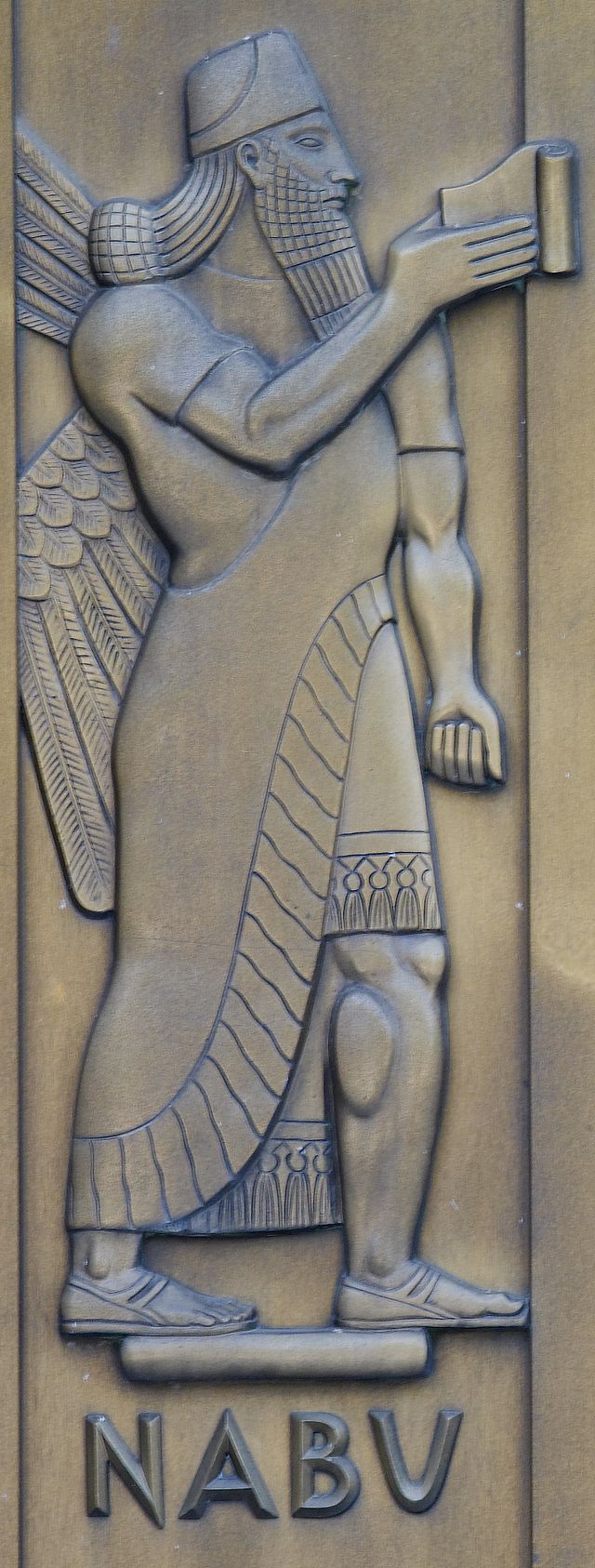
Nabu, or Nebo, sculpted bronze figure by Lee Lawrie. Door detail, east entrance, Library of Congress John Adams Building, Washington, D.C. Photographed 2007 by Carol Highsmith (1946–), who explicitly placed the photograph in the public domain. - Library of Congress, Prints & Photographs Division. http://en.wikipedia.org/wiki/Nabu#/media/File:Nabu-Lawrie-Highsmith.jpeg

Nabu, or Nebo, sculpted bronze figure by Lee Lawrie. Door detail, east entrance, Library of Congress John Adams Building, Washington, D.C.
Photographed 2007 by Carol Highsmith (1946–), who explicitly placed the photograph in the public domain. – Library of Congress, Prints & Photographs Division.
http://en.wikipedia.org/wiki/Nabu#/media/File:Nabu-Lawrie-Highsmith.jpeg

As each year brought with it the month of Sebat or January, with its “curse of rain,” the memory of that terrible event rose again in the Babyonian mind. Mâtu was a god whose favour had to be conciliated, and whose name accordingly appears on numbers of early cylinders.

But though Mâtu was thus specially identified with the great tempest which formed an era in Babylonian history, it was not forgotten that he was but one of several storm-gods, who were therefore spoken of as “the gods Mâtu.

Like the clouds, they were children of the sea, and were thus included in the family of Ea. It is possible that this genealogy was due to the systematising labours of a later day; but it is also possible that the gods Mâtu were primarily adored in Eridu, and that Eridu, and not Surippak, was the original city of the Chaldean Noah.

It is at least noticeable that the immortal home of the translated Xisuthros was beyond the mouth of the Euphrates, near which Eridu was built.

If Eridu were the birth-place of Mâtu, it would explain why the god of the tempest was also the god of the western wind. Elsewhere in Babylonia, the western wind blew from across the desert and brought heat with it rather than rain.

But in those remote days, when the northern portion of the Persian Gulf had not as yet been filled up with miles of alluvial deposit, a westerly breeze could still come to Eridu across the water.

In a penitential psalm, Mâtu, the lord of the mountain” (mulu mursamma-lil), whose wife, “the lady of the mountain,” is mentioned on the monuments of Tel-loh, is invoked along with his consort Gubarra, Ea, “the sovereign of heaven and earth and sovereign of Eridu,” Dav-kina, Merodach, Zarpanit, Nebo and Nana--in short, along with the gods of Eridu and the kindred deities of Babylon.”

A.H. Sayce, Lectures on the Origin and Growth of Religion as Illustrated by the Religion of the Ancient Babylonians, 5th ed., London, 1898, pp. 199-202.

Nergal, God of Death

“It was as the death-dealing lord of Hades that Nergal first became “the hero of the gods,” “who marches in their front.” The metaphor was taken from the champion who, like Goliath, places himself before his comrades and challenges the enemy to combat.

It is thus that we read in the story of the Deluge, when the flood of rain and destruction is described as coming upon the guilty world: “Rimmon in the midst of (heaven) thundered, and Nebo and the Wind-god went in front; the throne-bearers went over mountain and plain; Nergal the mighty removes the wicked; Adar goes in front and casteth down.”

sayce65

As lord of Hades, too, he was made the son of Mul-lil. A hymn (K 5268), the colophon of which tells us that it was composed in Cutha, begins with the words: “Let Nergal be glorified, the hero of the gods, who cometh forth as the strong one, the son of Mul-lil.”

In the same hymn, Marad is declared to be his city, from which we may infer that Marad was near Cutha. Its protecting divinity, however, was, strictly speaking, Lugal-túda,”the royal offspring,” or perhaps “valiant king,” a personification of the thunder-cloud and lightning; but it is evident from the hymn that he had been identified with the death-dealing god of Cutha.

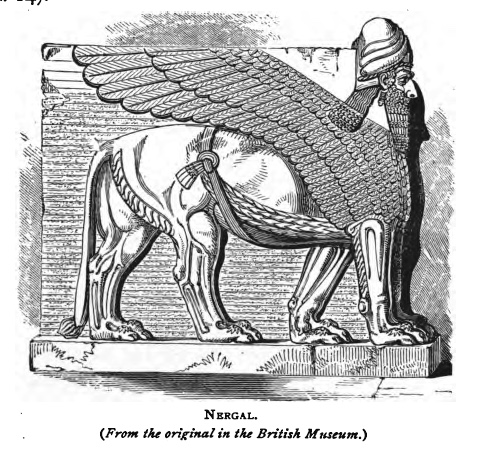
Another depiction of Nergal, patron god of Kutha.

Another depiction of Nergal, patron god of Kutha.

Of Laz, the wife of Nergal, we know little or nothing. Her name survived as the local divinity of Cutha, but her office and attributes were taken by Allat. Even Nergal himself as the lord of Hades belongs rather to the Accadian than to the Semitic period.

Among the Semites he was the hero and champion of the gods, and as such the destroyer of the wicked, rather than the king of death who slays alike the wicked and the good. The sovereignty of Hades had passed out of his hands, and he had become the companion of the solar Adar and the warrior of the gods of heaven.

Under his old name of Ner, however, a curious reminiscence of his primitive character lasted down to late times. In the hymns and other poetical effusions, we not unfrequently come across the phrase, ”mankind, the cattle of the god Ner.”

I have already drawn attention to the agricultural nature of early Chaldean civilisation, and the influence that agriculture had upon the modes of thought and expression of the population. Not only was the sky regarded as the counterpart of the Babylonian plain, and the heavenly bodies transformed into the herds and flocks that fed there, but the human inhabitants of the earth were themselves likened to the cattle they pastured and fed.

One of the earliest titles of the Babylonian kings was “shepherd,” reminding us of the Homeric ποιμην λαων, “shepherd of nations;” and in the Epic of Gisdhubar the sovereign city of Erech is termed the śubur, or “shepherd’s hut.”

Just as the subjects of the king, therefore, were looked upon as the sheep whom their ruler shepherded, so too mankind in general were regarded as the cattle slain by the god of death. They were, in fact, his herd, whom he fed and slaughtered in sacrifice to the gods.”

A.H. Sayce, Lectures on the Origin and Growth of Religion as Illustrated by the Religion of the Ancient Babylonians, 5th ed., London, 1898, pp. 196-8.

Assyrian Monotheism versus Babylonian Pantheism

“Henceforward “the heaven of Anu” denoted the serene and changeless regions to which the gods fled when the deluge had broken up the face of the lower heaven, and which an Assyrian poet calls “the land of the silver sky.”

It was to this spiritualised heaven that the spirit of Ea-bani, the friend of Gisdhubar, ascended, and from which he gazed placidly on the turmoil of the earth below; and it was from his seat therein that Anu assigned their places in the lower heaven to Samas, Sin and Istar, the Sun, the Moon and the Evening Star, according to the legend of the seven wicked spirits.

But the spiritualisation of Anu did not stop here. As a Semitic Baal he had become a supreme god, the lord and father of the universe. It was only a step further, therefore, to make him himself the universe, and to resolve into him the other deities of the Babylonian pantheon.

We read occasionally in the hymns of “the one god.”

“The ban, the ban,” a poet writes, personifying the priestly sentence of excommunication, like the Ara of Aeskhylos or the divine burden of Zechariah (ix.l),

“is a barrier which none may overpass; the barrier of the gods against which they cannot transgress, the barrier of heaven and earth which cannot be changed; the one god against whom none may rebel; god and man cannot explain (it); it is a snare not to be passed which is formed against the evil, the cord of a snare from which there is no exit which is turned against the evil.”

The conception of Anu, however, as “the one god” was pantheistic rather than monotheistic. The cosmological deities of an older phase of faith were in the first instance resolved into him. In place of the genealogical, or gnostic, system which we find in the account of the Creation in days, we have a pantheistic system, in which Lakhama and the other primeval forces of nature are not the parents of Anu, but are identified with Anu himself.

It is easy to conceive how the old deity An-sar, “the upper firmament,” with all its host of spirits, might be identified with him; but when we find Uras also, the Sun-god of Nipur, made one with Anu, “the hearer of prayer,” and the eagle-like Alala, the bridegroom of Istar and double of Tammuz, equally resolved into the god of Erech, it is plain that we have to do with an advanced stage of pantheism.

This monotheistic, or rather pantheistic, school of faith has been supposed by Sir Henry Rawlinson to have grown up at Eridu; but the fact that it centres round the name of Anu points rather to Erech as its birth-place. How long it flourished, or whether it extended beyond a narrow group of priestly thinkers, we have no means of ascertaining.

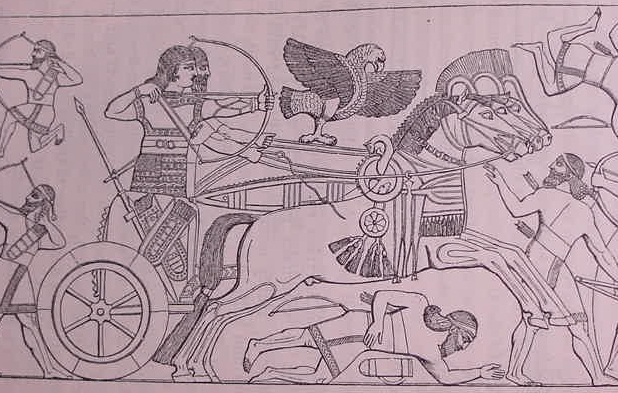
Assyrian bas-relief perhaps showing their warrior god Asshur as an Eagle, accompanying Assyrian warriors from the west palace at Nimroud, biblical Calah (p. 214. Austen Henry Layard. A Popular Account of Discoveries at Nineveh. London. John Murray. 1852).  http://www.bibleorigins.net/SundiscEagleAssyrian.html

Assyrian bas-relief perhaps showing their warrior god Asshur as an Eagle, accompanying Assyrian warriors from the west palace at Nimroud, biblical Calah (p. 214. Austen Henry Layard. A Popular Account of Discoveries at Nineveh. London. John Murray. 1852).
http://www.bibleorigins.net/SundiscEagleAssyrian.html

It is interesting, however, as showing that the same tendency which in Assyria exalted Assur to the position of an all-powerful deity who would brook neither opposition nor unbelief, among the more meditative Babylonians produced a crude system of pantheism.

Austen Henry Layard. A Popular Account of Discoveries At Nineveh. London. John Murray. 1852, p. 211. http://www.bibleorigins.net/Sundiscarcherdrawnbow.html

Austen Henry Layard. A Popular Account of Discoveries At Nineveh. London. John Murray. 1852, p. 211.
http://www.bibleorigins.net/Sundiscarcherdrawnbow.html

Whatever question there may be as to whether the pure and unmixed Semite is capable of originating a pantheistic form of faith, there can be little doubt about it where the Semite is brought into close contact with an alien race. The difference between the Assyrian and the Babylonian was the difference between the purer Semite and one in whose veins ran a copious stream of foreign blood.”

A.H. Sayce, Lectures on the Origin and Growth of Religion as Illustrated by the Religion of the Ancient Babylonians, 5th ed., London, 1898, pp. 190-2.

Sippara, Pantibibla, Book Town

“It was as Kur(?)-nigin-gára, “the god who makes the palace (of the setting sun),” that the Sun-god of Larsa seems to have been known to his worshippers in pre-Semitic days.

But when the Accadian was superseded by the Semite, his special name was merged in the general title of Samsu or Samas, “the Sun.” He became the Baal of Larsa, who differed but little, save in the name by which he was addressed, from the other Baalim of Babylonia.

The fame of the Samas of Larsa, however, was obscured at an early period by that of the Samas of Sippara. Sippara in historical times was pre-eminently the city of the Sun-god. It was there that Ê-Bábara, the house of lustre,” the great temple of the Sun-god, had been erected in days to which tradition alone went back, and it was around its shrine that Semitic sun-worship in Babylonia was chiefly centred.

Sippara and its immediate neighbourhood had been the seat of early Semitic supremacy in Chaldea. It was, it is true, of pre-Semitic foundation; its primitive name Zimbir would show this, like the name of E-Bábara itself; and we know that Samas had once been worshipped within its walls under the Accadian title of Bábara or Birra.

But in these remote days Sippara was probably an insignificant town; at all events, the memory of later ages knew of Sippara only in connection with the empire of Sargon of Accad and the Semitic version of the story of the Deluge.

In the Old Testament, Sippara appears as a dual city–Sepharvaim, “the two Sipparas.” One of these has been discovered in the mounds of Abu-Habba by Mr. Hormuzd Rassam, who has brought from it a monument on which is carved a curious image of the divine solar disk.

The other has been found by Dr. Hayes Ward in the mounds of Anbar, an hour’s distance from Sufeirah and the Euphrates.

The fragment of a geographical tablet seems indeed to mention no less than four Sipparas–Sippara proper, Sippara of the desert, Sippara “the ancient,” and Sippara of the Sun-god; but since the historical texts know of two only–Sippara of Anunit and Sippara of Samas--it is best to regard the three first names as alike denoting the same place, Sippara of Anunit, the modern Anbar.

It must have been from this Sippara that the Euphrates received its title, “river of Sippara,” since Abu-Habba is seven miles distant from the present bed of the stream.

In the close neighborhood of this double Sippara, Sargon built or restored the city to which he gave a name, and from which the whole of northern Babylonia received its title of Accad. It is called Agadhé in the non-Semitic texts, Accad (Akkadu) in the Semitic; though whether the name is of Semitic or non-Semitic origin cannot at present be decided.

Sargon’s patronage of literature, and the celebrated library he founded in Accad, caused the district to be known as “the region of books.” A popular etymology afterwards connected the name of Sippara itself with sepher, “a book,” and the city accordingly appears in the fragments of Berossos as Pantibibla, or “Book-town.”

A.H. Sayce, Lectures on the Origin and Growth of Religion as Illustrated by the Religion of the Ancient Babylonians, 5th ed., London, 1898, pp. 167-70.

Moon Gods

Adar bears the same relation to Mul-lil that Merodach bears to Ea. Each alike is the son and messenger of the older god.

But whereas the errands upon which Merodach is sent are errands of mercy and benevolence, the errands of Adar are those that befit an implacable warrior. He contends not against the powers of darkness, like Merodach, for the father whose orders he obeys is himself the ruler of the powers of darkness; it is against mankind, as in the story of the Deluge, that his arms are directed. He is a solar hero who belongs to the darkness and not to the light.

It is thus that one of his brothers is “the first-born” of Mul-lil, Mul-nugi, “the lord from whom there is no return.” Mul-nugi is the lord of Hades, the god who is called Irkalla in the legend of the Descent of Istar, and out of whose hands there is no escape.

It may be that he is but another form of the Moon-god, since the Moon-god, we are told, was also the eldest son of Mul-lil. But the name by which the Moon-god went at Nipur was one that signified “the god of glowing fire.”

It is curious to find the mythologists identifying this “god of glowing fire” with Adar; but the error was natural; both alike were sons of Mul-lil, and both alike represented the great orbs of heaven.

The chief seat, however, of the worship of the Moon-god was not Nipur but Ur (the modern Mugheir). Here stood the great temple the ruins of which were partially explored by Loftus.

Already in the oldest documents that have come from thence, the god to whom the temple was consecrated is identified with the Moon-god of Nipur. Already he is termed “the first-born of Mul-lil.” The spread of the cult of Mul-lil, therefore, and of the magic which it implied, must have made its way as far south as Ur in a very remote age.

But we have no reason for believing that the Moon-god of Ur and the Moon-god of Nipur were originally one and the same. Each Babylonian town, large and small, had its own local Moon-god, whose several names are recorded on a broken tablet.

The forms under which the Moon-god was worshipped in Babylonia were as numerous as the forms of the Sun- god himself.

What seems yet more singular to the comparative mythologist is that, according to the official religion of Chaldea, the Sun-god was the offspring of the Moon-god.

Such a belief could have arisen only where the Moon-god was the supreme object of worship. It is a reversal of the usual mythological conception which makes the moon the companion or pale reflection of the sun. It runs directly counter to the Semitic Baal-worship.

To the Semite the Sun-god was the lord and father of the gods; the moon was either his female consort, or, where Semitic theology had been influenced by that of Chaldea, an inferior god.”

A.H. Sayce, Lectures on the Origin and Growth of Religion as Illustrated by the Religion of the Ancient Babylonians, 5th ed., London, 1898, pp. 153-5.

The Zodiacal Organization of the Gilgamesh Epic

“The doctrine of the necessity for ministering to the dead is here enunciated in no uncertain fashion.

Unless their bodies are decently buried and offerings of food and drink made at their graves, their lives in the otherworld must be abjectly miserable. The manner in which they meet their end is likewise taken into account, and warriors who have fallen on the field of battle are pre-eminently fortunate.

Eabani is evidently one of the ‘happy’ spirits; his ghost is designated utukku, a name applied not only to the fortunate dead, but likewise to a class of beneficent supernatural beings.

The term edimmu, on the other hand, designates a species of malevolent being as well as the errant and even vampirish spirits of the unhappy dead. The due observance of funeral and commemorative rites is thus a matter which touches the interests not only of the deceased but also of his relatives and friends.

We have seen from the foregoing that the epic of Gilgamesh is partly historical, partly mythological. Around the figure of a great national hero myths have grown and twined with the passing of the generations, and these have in time become woven into a connected narrative, setting forth a myth which corresponds to the daily or annual course of the sun.

Within this may be discerned other myths and fragments of myths—solar, seasonal, and diluvian.

But there is in the epic another important element which has already been referred to—the astro-theological. The zodiacal significance of the division of the epic into twelve tablets may be set aside, since, as has been indicated, the significance is in all probability a superficial one merely, added to the poem by the scribes of Assur-bani-pal, and not forming an integral part of it.

At the same time it is not hard to divide the epic naturally into twelve episodes, thus:

  1. Gilgamesh’s oppression of Erech;
  2. the seduction of Eabani;
  3. the slaying of the monster Khumbaba;
  4. the wooing of Ishtar;
  5. the fight with the sacred bull;
  6. Eabani’s death;
  7. Gilgamesh’s journey to the Mountain of the Sunset;
  8. his wanderings in the region of thick darkness;
  9. the crossing of the waters of death;
  10. the deluge-story;
  11. the plant of life;
  12. the return of Eabani’s spirit.

Throughout the epic there are indications of a correspondence between the exploits of the hero and the movements of heavenly bodies.

It is possible, for instance, that Gilgamesh and his friend Eabani had some relation to the sign Gemini, also associated in ancient Chaldean mythology with two forms of the solar deity, even as were the hero and his friend.

The sign Leo recalls the slaying of Khumbaba, the allegorical victory of light over darkness, represented on monuments by the figure of a lion (symbol of fire) fighting with a bull.

Following the sign of Leo, the wooing of the hero by the goddess Ishtar falls naturally into the sign of Virgo, the virgin. The sign of Taurus is represented by the slaying of the celestial bull, Alu, by Gilgamesh.

The journey of the hero to Mashu and his encounter with the scorpion-men at the gate of the sunset are, of course, mythological representations of the sign of Scorpio, as are also his wanderings in the region of thick darkness.

It is noticeable in this respect that Babylonian astrology often doubled the eighth sign (Scorpio) to provide a seventh; it is therefore not unlikely that this sign should correspond with two distinct episodes in the poem.

The first of these episodes is associated with Scorpio by virtue of the introduction of scorpion-men; and the second, on the assumption that the scorpion is symbolical of darkness.

Perhaps the sea-goddess Sabitu is associated astrologically with the fish-tailed goat which is the conventional representation of Capricornus.

Then the placing of the deluge-story in the XIth tablet, corresponding with the eleventh sign of the zodiac, Aquarius, the water-bearer, is evidently in keeping with the astrological aspect of the epic.

Chaldean mythology connected the rainy eleventh month with the deluge, just as the first month of spring was associated mythologically with the creation.

The healing of Gilgamesh’s sickness by Ut-Napishtim may possibly symbolise the revival of the sun after leaving the winter solstice.

Lastly, the sign of Pisces, the twelfth sign of the zodiac, corresponding to the return of Eabani from the underworld, and perhaps also to the restoration of Gilgamesh to Erech, is emblematic of life after death, and of the resumption of ordinary conditions after the deluge.

It has been suggested, though without any very definite basis, that the epic was first put together before the zodiac was divided into twelve—that is, more than two thousand years before the Christian era.

Its antiquity, however, rests on other grounds than these. In later times the Babylonian astrological system became very complicated and important, and so lent its colour to the epic that, whatever the original plan of that work may have been, its astral significance became at length its most popular aspect.”

Lewis Spence, Myths and Legends of Babylonia and Assyria, 1917, pp. 181-3.

The Deluge

Ut-Napishtim employed many people in the construction of the ship. During four days he gathered the material and built the ship; on the fifth he laid it down; on the sixth he loaded it; and by the seventh day it was finished.

On a hull 120 cubits wide was constructed a great deck-house 120 cubits high, divided into six stories, each of which was divided in turn into nine rooms.

The outside of the ship was made water-tight with bitumen, and the inside with pitch. To signalise the completion of his vessel, Ut-Napishtim gave a great feast, like that which was wont to be held on New Year’s Day; oxen were slaughtered and great quantities of wine and oil provided.

According to the command of Ea, Ut-Napishtim brought into the ship all his possessions, his silver and his gold, living seed of every kind, all his family and household, the cattle and beasts of the field, the handicraftsmen, all that was his.

A heavy rain at eventide was the sign for Ut-Napishtim to enter the ship and fasten the door. All night long it rained, and with the early dawn

“there came up from the horizon a black cloud. Ramman in the midst thereof thundered, and Nabu and Marduk went before, they passed like messengers over mountain and plain. Uragal parted the anchor-cable. There went Ninib, and he made the storm to burst. The Annunaki carried flaming torches, and with the brightness thereof they lit up the earth. The whirlwind of Ramman mounted up into the heavens, and all light was turned into darkness.”

During a whole day darkness and chaos appear to have reigned on the earth. Men could no longer behold each other. The very gods in heaven were afraid and crouched “like hounds,” weeping, and lamenting their share in the destruction of mankind.

For six days and nights the tempest raged, but on the seventh day the rain ceased and the floods began to abate.

Then, says Ut-Napishtim

“I looked upon the sea and cried aloud, for all mankind was turned back into clay. In place of the fields a swamp lay before me. I opened the window and the light fell upon my cheek, I bowed myself down, I sat down, I wept; over my cheek flowed my tears. I looked upon the world, and behold all was sea.”

At length the ship came to rest on the summit of Mount Nitsir.

Lewis Spence, Myths and Legends of Babylonia and Assyria, 1917, pp. 174-6.

Mul-lil = Bel

“The “lord of the ghost-world” extended his sway over this nether earth also.

He is therefore entitled “the lord of the world,” as well as “king of all the spirits of the earth.” According to one version of the story of the Deluge, it was he who caused the waters of the flood to descend from heaven, and who designed the destruction of all mankind.

“When Mul-lil,” we are told, “approached and saw the ship (of Xisuthros), he stood still and was filled with wrath against the gods and the spirits of heaven. ‘What soul has escaped therefrom?’ (he cried). ‘Let no man remain alive in the great destruction.'”

It was then that Ea came forward with words of wisdom, and protested against this attempt of Mul-lil to confound the innocent with the guilty.

“Let the sinner alone bear his sin; let the evil-doer bear his own iniquity.”

And though the wrathful god was pacified, so that Xisuthros and his companions were allowed to escape from their threatened death, the rescued hero did not forget the evil intentions of Mul-lil; but when inviting the other gods to his sacrifice after his descent from the ark, he specially excepted the god of Nipur.

“Let the (other) gods come to my altar, but let Mul-lil not come to the altar, since he did not act considerately, but caused a deluge and doomed my people to destruction.”

In these quotations I have called the god by his old Accadian name, Mul-lil; But long before this account of the Deluge was composed, even though in its present form it probably reaches back more than 2000 years before the Christian era, the Accadian Mul-lil had become the Semitic Bel.

His primitive attributes, however, still adhered to him. He was still the god of the lower world, whose messengers were diseases and nightmares and the demons of night, and from whom came the plagues and troubles that oppressed mankind.

In a magical text (Trustees of the British Museum (H.C. Rawlinson), The Cuneiform Inscriptions of Western Asia, iv. 1. 5, 6), Namtar, the plague-demon, is called “the beloved son of Mul-lil“–standing, in fact, in the same relation to Mul-lil that Tammuz does to Ea, and in the next line Mul-lil’s wife is asserted to be Nin-ki-gal or Allat, “the queen of the mighty land” of Hades.

This magical text, however, is a good deal older than the time when the Semites adopted and transformed the deities of the Accadians, or at all events it expresses the ideas of that earlier period.”

A.H. Sayce, Lectures on the Origin and Growth of Religion as Illustrated by the Religion of the Ancient Babylonians, 5th ed., London, 1898, pp. 146-8.

The Oracles of Ea

“How a water-god became the demiurge seems at first sight obscure. But it ceases to be so when we remember the local character of Babylonian religion.

Ea was as much the local god of Eridu as Merodach was of Babylon, or Assur of Assyria. His connection with the water was due to the position of Eridu at the mouth of the Euphrates and on the shore of the sea, as well as to the maritime habits of its population.

In other respects he occupied the same place as the patron-deities of the other great cities. And these patron-deities were regarded as creators, as those by whose agency the present world had come into existence, and by whose hands the ancestors of their worshippers had been made.

This conception of a creating deity is one of the distinguishing features of early Babylonian religion. Mankind are not descended from a particular divinity, as they are in other theologies; they are created by him.

The hymn to Ea tells us that the god of Eridu was the creator of the black-headed race-that is to say, the old non-Semitic population whose primary centre and starting-point was in Eridu itself. It was as creators that the Accadian gods were distinguished from the host of spirits of whom I shall have to speak in another Lecture.

The Accadian word for “god” was dimer, which appears as dingir, from an older dingira, in the southern dialect of Sumer. Now dimer or dingir is merely “the creator,” formed by the suffix r or ra, from the verb dingi or dime, “to create.”

A simpler form of dimer is dime, a general name for the divine hierarchy. By the side of dime, dim, stood gime, gim, with the same meaning; and from this verb came the Sumerian name of Istar, Gingira. Istar is said to have been the mother of mankind in the story of the Deluge, and as Gula, “the great” goddess, she is addressed in a prayer as “the mother who has borne the men with the black heads.”

It was in consequence of the fact that he was a creator that Ea was, according to Accado-Sumerian ideas, a dingir or “god.”

In the cosmology of Eridu, therefore, the origin of the universe was the watery abyss. The earth lay upon this like a wife in the arms of her husband, and Dav-kina accordingly was adored as the wife of Ea.

It was through her that the oracles of Ea, heard in the voice of the waves, were communicated to man. Dav-kina is entitled “the mistress of the oracular voice of the deep,” and also “the lady who creates the oracular voice of heaven.”‘

The oracles delivered by the thunder, the voice of heaven, thus became the reflex of the oracles delivered through the roaring of the sea.”

A.H. Sayce, Lectures on the Origin and Growth of Religion as Illustrated by the Religion of the Ancient Babylonians, 5th ed., London, 1898, pp. 142-4.

Ut-Napishtim and the Babylonian Deluge

Ut-Napishtim was indeed surprised when he beheld Gilgamesh approaching the strand. The hero had meanwhile contracted a grievous illness, so that he was unable to leave the boat; but he addressed his queries concerning perpetual life to the deified Ut-Napishtim, who stood on the shore.

The hero of the flood was exceeding sorrowful, and explained that death is the common lot of mankind,

“nor is it given to man to know the hour when the hand of death will fall upon him—the Annunaki, the great gods, decree fate, and with them Mammetum, the maker of destiny, and they determine death and life, but the days of death are not known.”

The narrative is continued without interruption into the XIth tablet. Gilgamesh listened with pardonable scepticism to the platitudes of his ancestor.

“‘I behold thee, Ut-Napishtim, thy appearance differs not from mine, thou art like unto me, thou art not otherwise than I am; thou art like unto me, thy heart is stout for the battle . . . how hast thou entered the assembly of the gods; how hast thou found life?’”

In reply Ut-Napishtim introduces the story of the Babylonian deluge, which, told as it is without interruption, forms a separate and complete narrative, and is in itself a myth of exceptional interest. Presumably the warning of the deluge came to Ut-Napishtim in a vision.

The voice of the god said:

“Thou man of Shurippak, son of Ubara-Tutu, pull down thy house, build a ship, forsake thy possessions, take heed for thy life! Abandon thy goods, save thy life, and bring up living seed of every kind into the ship.”

The ship itself was to be carefully planned and built according to Ea’s instructions. When the god had spoken Ut-Napishtim promised obedience to the divine command. But he was still perplexed as to how he should answer the people when they asked the reason for his preparations.

Ea therefore instructed him how he should make reply,

Bel hath cast me forth, for he hateth me.’

The purpose of this reply seems clear, though the remaining few lines of it are rather broken. Ea intends that Ut-Napishtim shall disarm the suspicions of the people by declaring that the object of his shipbuilding and his subsequent departure is to escape the wrath of Bel, which he is to depict as falling on him alone.

He must prophesy the coming of the rain, but must represent it, not as a devastating flood, but rather as a mark of the prosperity which Bel will grant to the people of Shurippak, perhaps by reason of his (Ut-Napishtim’s) departure therefrom.”

Lewis Spence, Myths and Legends of Babylonia and Assyria, 1917, pp. 173-4.

The Gilgamesh Epic

“The most important of the various mythological strata underlying the Gilgamesh myth is probably that concerning Eabani, who, as has been said, is a type of primitive man, living among the beasts of the field as one of themselves.

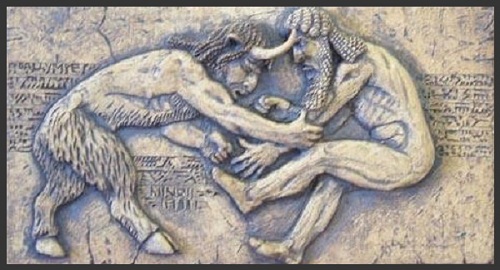
The "animal man" Enkidu (aka Eabani) defeating the King of Erech, Gilgamesh, during their first encounter.

The “animal man” Enkidu (aka Eabani) defeating the King of Erech, Gilgamesh, during their first encounter.

But he is also, according to certain authorities, a form of the sun-god, even as Gilgamesh himself. Like the hero of Erech, he rises to the zenith of his powers in a triumphal progress, then descends into the underworld.

He is not lost sight of, however, but lives in the memory of his friend Gilgamesh; and in the XIIth tablet he is temporarily brought forth from the underworld (that is, his ghost, or utukkii), which in a dim and shadowy fashion may typify the daily restoration of the sun.

Another important stratum of myth is that which concerns Ut-Napishtim, the Babylonian Noah; but whereas the myths of Eabani and Gilgamesh, though still distinguishable, have become thoroughly fused, the deluge story of which Ut-Napishtim is the hero has been inserted bodily into the XIth tablet of the epic, being related to Gilgamesh by Ut-Napishtim himself.

When he first appears in the narrative he has the attributes and powers of a god, having received these for his fidelity to the gods during the flood, from whose waters he alone of all mankind escaped.

The object of his narrative in the Gilgamesh epic seems to be to point out to the hero that only the most exceptional circumstances—unique circumstances, indeed—can save man from his doom.

Other distinct portions of the epic are the battle with the monster Khumbaba, the episode of Ishtar’s love for Gilgamesh, the fight with the sacred bull of Anu, and the search for the plant of life. These, whatever their origin, have become naturally incorporated with the story of Gilgamesh.

Gilgamesh defeating the Bull of Heaven.

Gilgamesh defeating the Bull of Heaven.

But besides the various historical and mythical elements herein presented, there is also a certain amount of Babylonian religious doctrine, evident to some extent in the XIth tablet (which points the moral that all men must die), but doubly so in the XIIth tablet, wherein the shade of Eabani appears to Gilgamesh, relates the misfortunes of the unburied dead or of those uncared for after death, and inculcates care for the deceased as the only means whereby they may evade the grievous woes which threaten them in the underworld.

Let us examine in detail the Gilgamesh epic as we have it in the broken fragments which remain to us. The Ist and Ilnd tablets are much mutilated. A number of fragments are extant which belong to one or other of these two, but it is not easy to say where the Ist ends and the Ilnd begins.

One fragment would seem to contain the very beginning of the Ist tablet—a sort of general preface to the epic, comprising a list of the advantages to be derived from reading it. After this comes a fragment whose title to inclusion in the epic is doubtful. It describes a siege of the city of Erech, but makes no mention of Gilgamesh.

The woeful condition of Erech under the siege is thus picturesquely detailed :

“She asses (tread down) their young, cows (turn upon) their calves. Men cry aloud like beasts, and maidens mourn like doves. The gods of strong-walled Erech are changed to flies, and buzz about the streets.

The spirits of strong-walled Erech are changed to serpents, and glide into holes. For three years the enemy besieged Erech, and the doors were barred, and the bolts were shot, and Ishtar did not raise her head against the foe.”

If this fragment be indeed a portion of the Gilgamesh epic, we have no means of ascertaining whether Gilgamesh was the besieger, or the raiser of the siege, or whether he was concerned in the affair at all.”

Lewis Spence, Myths and Legends of Babylonia and Assyria, 1917, pp. 159-61.

Atlantis

“Many great and wonderful deeds are recorded of your state in our histories. But one of them exceeds all the rest in greatness and valour. For these histories tell of a mighty power which unprovoked made an expedition against the whole of Europe and Asia, and to which your city put an end.

This power came forth out of the Atlantic Ocean, for in those days the Atlantic was navigable; and there was an island situated in front of the straits which are by you called the Pillars of Heracles; the island was larger than Libya and Asia put together, and was the way to other islands, and from these you might pass to the whole of the opposite continent which surrounded the true ocean; for this sea which is within the Straits of Heracles is only a harbour, having a narrow entrance, but that other is a real sea, and the surrounding land may be most truly called a boundless continent.

Now in this island of Atlantis there was a great and wonderful empire which had rule over the whole island and several others, and over parts of the continent, and, furthermore, the men of Atlantis had subjected the parts of Libya within the columns of Heracles as far as Egypt, and of Europe as far as Tyrrhenia.

This vast power, gathered into one, endeavoured to subdue at a blow our country and yours and the whole of the region within the straits; and then, Solon, your country shone forth, in the excellence of her virtue and strength, among all mankind.

She was pre-eminent in courage and military skill, and was the leader of the Hellenes. And when the rest fell off from her, being compelled to stand alone, after having undergone the very extremity of danger, she defeated and triumphed over the invaders, and preserved from slavery those who were not yet subjugated, and generously liberated all the rest of us who dwell within the pillars.

But afterwards there occurred violent earthquakes and floods; and in a single day and night of misfortune all your warlike men in a body sank into the earth, and the island of Atlantis in like manner disappeared in the depths of the sea.

For which reason the sea in those parts is impassable and impenetrable, because there is a shoal of mud in the way; and this was caused by the subsidence of the island.”

Plato, Timaeus, 360 BCE. (Translated by Benjamin Jowett).

Plato, Timaeus, 360 BCE

” … In the Egyptian Delta, at the head of which the river Nile divides, there is a certain district which is called the district of Sais, and the great city of the district is also called Sais, and is the city from which King Amasis came.

The citizens have a deity for their foundress; she is called in the Egyptian tongue Neith, and is asserted by them to be the same whom the Hellenes call Athene; they are great lovers of the Athenians, and say that they are in some way related to them.

To this city came Solon, and was received there with great honour; he asked the priests who were most skilful in such matters, about antiquity, and made the discovery that neither he nor any other Hellene knew anything worth mentioning about the times of old.

On one occasion, wishing to draw them on to speak of antiquity, he began to tell about the most ancient things in our part of the world–about Phoroneus, who is called “the first man,” and about Niobe; and after the Deluge, of the survival of Deucalion and Pyrrha; and he traced the genealogy of their descendants, and reckoning up the dates, tried to compute how many years ago the events of which he was speaking happened.

Thereupon one of the priests, who was of a very great age, said: O Solon, Solon, you Hellenes are never anything but children, and there is not an old man among you. Solon in return asked him what he meant. I mean to say, he replied, that in mind you are all young; there is no old opinion handed down among you by ancient tradition, nor any science which is hoary with age. And I will tell you why.

There have been, and will be again, many destructions of mankind arising out of many causes; the greatest have been brought about by the agencies of fire and water, and other lesser ones by innumerable other causes. There is a story, which even you have preserved, that once upon a time Paethon, the son of Helioshaving yoked the steeds in his father’s chariot, because he was not able to drive them in the path of his father, burnt up all that was upon the earth, and was himself destroyed by a thunderbolt.

Now this has the form of a myth, but really signifies a declination of the bodies moving in the heavens around the earth, and a great conflagration of things upon the earth, which recurs after long intervals; at such times those who live upon the mountains and in dry and lofty places are more liable to destruction than those who dwell by rivers or on the seashore. And from this calamity the Nile, who is our never-failing saviour, delivers and preserves us.

When, on the other hand, the gods purge the earth with a deluge of water, the survivors in your country are herdsmen and shepherds who dwell on the mountains, but those who, like you, live in cities are carried by the rivers into the sea. Whereas in this land, neither then nor at any other time, does the water come down from above on the fields, having always a tendency to come up from below; for which reason the traditions preserved here are the most ancient.

The fact is, that wherever the extremity of winter frost or of summer does not prevent, mankind exist, sometimes in greater, sometimes in lesser numbers. And whatever happened either in your country or in ours, or in any other region of which we are informed–if there were any actions noble or great or in any other way remarkable, they have all been written down by us of old, and are preserved in our temples.

Whereas just when you and other nations are beginning to be provided with letters and the other requisites of civilized life, after the usual interval, the stream from heaven, like a pestilence, comes pouring down, and leaves only those of you who are destitute of letters and education; and so you have to begin all over again like children, and know nothing of what happened in ancient times, either among us or among yourselves.

As for those genealogies of yours which you just now recounted to us, Solon, they are no better than the tales of children. In the first place you remember a single deluge only, but there were many previous ones; in the next place, you do not know that there formerly dwelt in your land the fairest and noblest race of men which ever lived, and that you and your whole city are descended from a small seed or remnant of them which survived.

And this was unknown to you, because, for many generations, the survivors of that destruction died, leaving no written word. For there was a time, Solon, before the great deluge of all, when the city which now is Athens was first in war and in every way the best governed of all cities, is said to have performed the noblest deeds and to have had the fairest constitution of any of which tradition tells, under the face of heaven.”

Plato, Timaeus, 360 BCE. (Translated by Benjamin Jowett).

Implications of the Gilgamesh Epic

“Among the traditions concerning his birth is one related by Ælian (Historia Animalium, XII, 21) of Gilgamos (Gilgamesh), the grandson of Sokkaros. Sokkaros, who, according to Berossus, was the first king to reign in Babylonia after the deluge, was warned by means of divination that his daughter should bear a son who would deprive him of his throne.

Thinking to frustrate the designs of fate he shut her up in a tower, where she was closely watched. But in time she bore a son, and her attendants, knowing how wroth the King would be to learn of the event, flung the child from the tower.

But before he reached the ground an eagle seized him up and bore him off to a certain garden, where he was duly found and cared for by a peasant. And when he grew to manhood he became King of the Babylonians, having, presumably, usurped the throne of his grandfather.

Here we have a myth obviously of solar significance, conforming in every particular to a definite type of sun-legend. It cannot have been by chance that it became attached to the person of Gilgamesh.

Everything in the epic, too, is consonant with the belief that Gilgamesh is a sun-god—his connexion with Shamash (who may have been his father in the tradition given by Ælian, as well as the eagle which saved him from death), the fact that no mention is made of his father in the poem, though his mother is brought in more than once, and the assumption throughout the epic that he is more than human.

Given the key to his mythical character it is not hard to perceive in his adventures the daily (or annual) course of the sun, rising to its full strength at noonday (or mid-summer), and sinking at length to the western horizon, to return in due time to the abode of men.

Like all solar deities—like the sun itself—his birth and origin are wrapped in mystery. He is, indeed, one of the ‘fatal children,’ like Sargon, Perseus, or Arthur. When he first appears in the narrative he is already a full-grown hero, the ruler and (it would seem) oppressor of Erech.

His mother, Rimat-belit, is a priestess in the temple of Ishtar, and through her he is descended from Ut-Napishtim, a native of Shurippak, and the hero of the Babylonian flood-legend. Early in the narrative he is brought into contact with the wild man Eabani, originally designed for his destruction by the gods, but with whom he eventually concludes a firm friendship.

The pair proceed to do battle with the monster Khumbaba, whom they overcome, as they do also the sacred bull sent against them by Anu. Up to the end of the Vlth tablet their conquering and triumphant career is without interruption; Gilgamesh increases in strength as does the sun approaching the zenith.

At the Vllth tablet, however, his good fortune begins to wane. Eabani dies, slain doubtless by the wrath of Ishtar, whose love Gilgamesh has rejected with scorn; and the hero, mourning the death of his friend, and smitten with fear that he himself will perish in like manner, decides to go in search of his ancestor, Ut-Napishtim (who, as sole survivor of the deluge, has received from the gods deification and immortality), and learn of him the secret of eternal life.

His further adventures have not the triumphal character of his earlier exploits. Sunwise he journeys to the Mountain of the Sunset, encounters the scorpion-men, and crosses the Waters of Death. Ut-Napishtim teaches him the lesson that all men must die (he himself being an exception in exceptional circumstances), and though he afterwards gives Gilgamesh an opportunity of eating the plant of life, the opportunity is lost.

However, Ut-Napishtim cures Gilgamesh of a disease which he has contracted, apparently while crossing the Waters of Death, and he is finally restored to Erech.

In these happenings we see the gradual sinking of the sun into the underworld by way of the Mountain of the Sunset. It is impossible for the sun to attain immortality, to remain for ever in the land of the living; he must traverse the Waters of Death and sojourn in the underworld.

Yet the return of Gilgamesh to Erech signifies the fresh dawning of the day. It is the eternal struggle of day and night, summer and winter; darkness may conquer light, but light will emerge again victorious. The contest is unending.

Some authorities have seen in the division of the epic into twelve tablets a connexion with the months of the year or the signs of the zodiac. Such a connexion probably exists, but when we consider that the artificial division of the epic into tablets scarcely tallies with the natural divisions of the poem, it seems likely that the astrological significance of the former was given to the epic by the scribes of Nineveh, who were evidently at some pains to compress the matter into twelve tablets.

Of the astro-theological significance of the narrative itself (one of its most important aspects), we shall perhaps be better able to judge when we have considered it in detail.”

Lewis Spence, Myths and Legends of Babylonia and Assyria, 1917, pp. 156-9.

Sacred Number 7

“Seven, too, was a sacred number, whose magic virtues had descended to the Semites from their Accadian predecessors. When the Chaldaean Noah escaped from the Deluge, his first act was to build an altar and to set vessels, each containing the third of an ephah, by sevens, over a bed of reeds, pine-wood and thorns.

Seven by seven had the magic knots to be tied by the witch, seven times had the body of the sick man to be anointed with the purifying oil.

As the Sabbath of rest fell on each seventh day of the week, so the planets, like the demon messengers of Anu, were seven in number, and “the god of the number seven” received peculiar honour.”

A.H. Sayce, Lectures on the Origin and Growth of Religion as Illustrated by the Religion of the Ancient Babylonians, 5th ed., London, 1898, p. 82.

Intimations of Antediluvian Kings

“Now the annalistic tablet takes us back reign by reign, dynasty by dynasty, to about the year 2400 B.C. Among the monarchs mentioned upon it is Khammuragas, whose reign is placed 112 years later (B.C. 2290). Of Sargon and his son Naram-Sin, however, there is no trace.

But this is not all. On the shelves of the British Museum you may see huge sun-dried bricks, on which are stamped the names and titles of kings who erected or repaired the temples where they have been found. In the dynasties of the annalistic tablet their names are as much absent as is the name of Sargon.

They must have belonged to an earlier period than that with which the list of the tablet begins, and have reigned before the time when, according to the margins of our Bibles, the flood of Noah was covering the earth, and reducing such bricks as these to their primeval slime.

But the kings who have recorded their constructive operations on the bricks are seldom connected with one another. They are rather the isolated links of a broken chain, and thus presuppose a long period of time during which their reigns must have fallen.

This conclusion is verified by another document, also coming from Babylonia and also first published by Mr. Pinches. This document contains a very long catalogue of royal names, not chronologically arranged, as is expressly stated, but drawn up for a philological purpose–that of explaining in Assyrian the Accadian and Kossaean names of the non-Semitic rulers of Babylonia.

Though the document is imperfect it embodies about sixty names which do not occur on the annalistic tablet, and must therefore be referred to an earlier epoch than that with which the latter begins.

[ … ]

Moreover, whatever might have been the original character of the Semitic occupation of Babylonia, from the time of Sargon I downwards it was of a more or less peaceable nature; Accadians and Semites mingled together, and from the mixture sprang the peculiar civilisation of Babylonia, and the peculiar type of its people.”

A.H. Sayce, Lectures on the Origin and Growth of Religion as Illustrated by the Religion of the Ancient Babylonians, 5th ed., London, 1898, pp. 23-6.

The Story of Mesopotamian Archeology

“Although official attentions were now turned elsewhere, strong popular interest in Mesopotamian antiquities continued, fueling a flourishing trade in material looted by local merchants from the ancient cities of Assyria. Scholarly plundering had already caused considerable destruction. Now the situation reached its nadir, with the retrieval of saleable pieces being the only aim, very much at the expense of the ancient remains.

Scholarly activity had not ceased, however, although it was no longer concentrated in the field. By the end of the 1850s the successful decipherment of Akkadian cuneiform meant that inscriptions and texts recovered from Nineveh and elsewhere could now yield a vast amount of information on the ancient Mesopotamian world.

One of the most surprising discoveries was the great time depth of the civilization. Biblical and Classical sources had painted a picture of the wealth and grandeur of Assyria in the first millennium B.C.E., and this had been confirmed by the excavations at Nineveh and adjacent cities.

The library uncovered in Ashurbanipal’s palace included texts written in the second millennium B.C.E., shedding light on the period of the Old Babylonian Empire and the early history of the Assyrians, the time of the biblical patriarch Abraham, native of the Mesopotamian city of Ur.

But there were also copies of even more ancient texts that revealed the existence in the third millennium B.C.E. of the southern Mesopotamian civilization of Sumer and Akkad.

The later nineteenth century was a time of great intellectual upheaval. The developing science of geology was revealing the immense age and gradual formation of the earth, while Charles Darwin was showing how life had evolved in all its diversity. This new knowledge undermined the certainties of the Bible, according to which the world was created in immutable form at a date calculated by biblical scholars as 4004 B.C.E.

In this epoch of challenge to established traditional views, many found it reassuring that archaeological research in the Near East was uncovering cities and records of individuals familiar from the Bible, thus confirming and buttressing its authenticity.

It was therefore electrifying news when George Smith, who had spent many years quietly studying cuneiform texts, announced in December 1872 that he had found part of a tablet recounting the story of the Flood. A serious-minded man, he amazed his colleagues at the moment of discovery by leaping to his feet, rushing round the room, and beginning to tear off his clothes.

In less than two months he found himself en route to Mosul to look for the missing pieces of the tablet, lavishly sponsored by the Daily Telegraph of London—a measure of the immense popular excitement that his discovery had generated.

Once Smith had accomplished the tedious and time-consuming task of extracting a permit from the Ottoman authorities, he achieved his objective in just five days of digging, finding among the debris left by previous excavators a piece of tablet that accounted for the major part of the missing section.

Smith later returned to excavate further at Nineveh, but in 1876 he contracted a fatal illness. As his replacement, the British Museum appointed Hormuzd Rassam, veteran of the 1850s excavations.”

Jane R. McIntosh, Ancient Mesopotamia, 2005, pp. 29-30.

On the Tower of Babel and the Confusion of Tongues

“Many attempts have been made to attach the legend of the confusion of tongues to certain ruined towers in Babylonia, especially to that of E-Sagila, the great temple of Merodach, and some remarks upon this most interesting tale may not be out of place at this point. The myth is not found in Babylonia itself, and in its best form may be discovered in Scripture. In the Bible story we are told that every region was of one tongue and mode of speech.

As men journeyed westward from their original home in the East, they encountered a plain in the land of Shinar where they settled. In this region they commenced building operations, constructed a city, and laid the foundations of a tower, the summit of which they hoped would reach to heaven itself.

It would appear that this edifice was constructed with the object of serving as a great landmark to the people so that they should not be scattered over the face of the earth, and the Lord came down to view the city and the tower, and he considered that as they were all of one language this gave them undue power, and that what they imagined to themselves under such conditions they would be able to achieve.

So the Lord scattered them abroad from thence over the face of every region, and the building of the tower ceased and the name of it was called ‘Babel,’ because at that place the single language of the people was confounded.

Of course it is merely the native name of Babylon, which translated means ‘gate of the god,’ and has no such etymology as the Scriptures pretend,—the Hebrews confusing their verb balal, ‘to confuse or confound,’ with the word babel.

The story was no doubt suggested by one of the temple towers of Babylon. Over and over again we find in connexion with the Jewish religion that anything which savours of presumption or unnatural aspiration is strongly condemned. The ambitious effort of the Tower of Babel would thus seem abhorrent to the Hebrews of old.

The strange thing is that these ancient towers or zikkurats, as the Babylonians called them, were intended to serve as a link between heaven and earth, just as does the minaret of the Mahommedan mosque.

The legend of the confusion of tongues is to be traced in other folk-lores than that of Babylon. It is found in Central America, where the story runs that Xelhua, one of the seven giants rescued from the deluge, built the great pyramid of Cholula in order to besiege heaven.

The structure was, however, destroyed by the gods, who cast down fire upon it and confounded the language of its builders. Livingstone found some such myth among the African tribes around Lake Ngami, and certain Australian and Mongolian peoples possess a similar tradition.”

Lewis Spence, Myths and Legends of Babylonia and Assyria, 1917, pp. 47-9.

Comparative Myths of the Deluge

“It is interesting to note that Sisuthrus, the hero of this deluge story, was also the tenth Babylonian king, just as Noah was the tenth patriarch. The birds sent out by Sisuthrus strongly recall the raven and dove despatched by Noah; but there are several American myths which introduce this conception.

Birds and beasts in many cosmologies provide the nucleus of the new world which emerges from the waters which have engulfed the old. Perhaps it is the beaver or the muskrat which dives into the abyss and brings up a piece of mud, which gradually grows into a spacious continent; but sometimes birds carry this nucleus in their beaks. In the myth under consideration they return with mud on their feet, which is obviously expressive of the same idea. Attempts have been made to show that a great difference exists between the Babylonian and Hebrew story. Undoubtedly the two stories have a common origin.

The first Babylonian version of the myth dates from about 2000 b.c. and its text is evidently derived from a still older tablet. It seems likely that this was in turn indebted to a still more archaic version, which probably recounted the earliest type of the myth.

This perhaps related how the earth and its inhabitants were not to the liking of the Creator, and how he resolved to recreate the whole. The great ocean-dragon was therefore called in to submerge the world, after which the Creator re-moulded it and set the survivor and his family upon it as the ancestors of a new human race. It is possible also that the great sea-dragon, or serpent, which was slain by the Creator, may have flooded the earth with his blood as he expired: there is an Algonquin Indian myth to this effect.

In an old cuneiform text, in fact, the year of the deluge is alluded to as “the year of the raging serpent.” The wise man who takes refuge in the ship or ark is warned by a dream of the forthcoming deluge. In some North American Indian myths he is warned by friendly animals. The mountain, too, as a place of refuge for the ark, is fairly common in myth.

We have dealt in Chapter II with the creation myth found in Berossus, and with this ends the part of his history which is of any importance.”

Lewis Spence, Myths and Legends of Babylonia and Assyria, 1917, pp. 45-6.

Berossus on the Babylonian Account of the Deluge

“More important is his account of the deluge. There is more than one Babylonian version of the deluge: that which is to be found in the Gilgamesh Epic is given in the chapter dealing with that poem. As Berossus’ account is quite as important, we shall give it in his own words before commenting upon it:

“ After the death of Ardates, his son (Sisuthrus) succeeded and reigned eighteen sari. In his time happened the great deluge; the history of which is given in this manner. The Deity, Cronus, appeared to him in a vision; and gave him notice, that upon the fifteenth day of the month Dsesius there would be a flood, by which mankind would be destroyed. He therefore enjoined him to commit to writing a history of the beginning, procedure, and final conclusion of all things, down to the present term; and to bury these accounts securely in the City of the Sun at Sippara. He then ordered Sisuthrus to build a vessel, and to take with him into it his friends and relations; and trust himself to the deep. The latter implicitly obeyed: and having conveyed on board every thing necessary to sustain life, he took in also all species of animals, that either fly, or rove upon the surface of the earth.

Having asked the Deity whither he was to go, he was answered, To the gods: upon which he offered up a prayer for the good of mankind. Thus he obeyed the divine admonition: and the vessel, which he built, was five stadia in length, and in breadth two. Into this he put every thing which he had got ready; and last of all conveyed into it his wife, children, and friends. After the flood had been upon the earth, and was in time abated, Sisuthrus sent out some birds from the vessel; which not finding any food, nor any place to rest their feet, returned to him again. After an interval of some days; he sent them forth a second time: and they now returned with their feet tinged with mud.

He made trial a third time with these birds : but they returned to him no more: from whence he formed a judgment, that the surface of the earth was now above the waters. Having therefore made an opening in the vessel, and finding upon looking out, that the vessel was driven to the side of a mountain, he immediately quitted it, being attended with his wife, children, and the pilot. Sisuthrus immediately paid his adoration to the earth: and having constructed an altar, offered sacrifices to the gods. These things being duly performed, both Sisuthrus, and those who came out of the vessel with him, disappeared. They, who remained in the vessel, finding that the others did not return, came out with many lamentations and called continually on the name of Sisuthrus.

Him they saw no more; but they could distinguish his voice in the air, and could hear him admonish them to pay due regard to the gods; and likewise inform them, that it was upon account of his piety that he was translated to live with the gods; that his wife and children, with the pilot, had obtained the same honour. To this he added, that he would have them make the best of their way to Babylonia, and search for the writings at Sippara, which were to be made known to all mankind. The place where these things happened was in Armenia. The remainder having heard these words, offered sacrifices to the gods; and, taking a circuit, journeyed towards Babylonia.”

Berossus adds, that the remains of the vessel were to be seen in his time upon one of the Corcyrean mountains in Armenia; and that people used to scrape off the bitumen, with which it had been outwardly coated, and made use of it by way of an antidote for poison or amulet. In this manner they returned to Babylon; and having found the writings at Sippara, they set about building cities and erecting temples; and Babylon was thus inhabited again.”

Lewis Spence, Myths and Legends of Babylonia and Assyria, 1917, pp. 42-5.

Immortality and Mortality of Mesopotamian Gods

“A further property of divinity was immortality. In narratives about divine deeds, gods were understood to be born of the intercourse of male and female parents. There is reference to their being nursed as infants but no further indication of a sense of their education, training or personal development.

Rather, as in the case of Marduk in the Babylonian Epic of Creation, the gods were born with full powers, knowing how to use weapons, understand magic words and so forth. As with Ninurta, a hero god, younger gods were expected to honour, obey and avenge slights to their parents. Having achieved a certain maturity, the gods stayed that way and did not age, though one and the same god could be portrayed as a youthful hero or as a sublime sage with magical, in preference to physical, prowess.

Gods could die, but only at the hands of other gods. Some died in battle or were executed for offences against higher gods. For example, the rebel god, Aw-ila, in the Story of the Flood (Foster 1996: 160–203 and below, pp. 184–5, 187) was executed to punish the uprising of the lesser gods against the great gods, but his spirit lingered on in the newly created human race, palpable as the human pulse. His flesh and blood were used to make the first human and his will may have given the human race its rebellious or wayward spirit.

The execution of Kingu, leader of the attacking army of gods and monsters in the Babylonian Epic of Creation, was modelled on this episode, but Kingu was there (falsely) accused of suborning Tiamat, mother of the gods, to kill her children (Foster 1996: 350–401).”

Benjamin R. Foster, “Birth and Death,” John R. Hinnells, ed., A Handbook of Ancient Religions, 2007, pp. 180-1.

Mesopotamian End Times

“Mesopotamia offers little evidence for a belief in a future end of the world. The only clear reference to this occurs in a third-century BCE work in Greek by Berossus, reputedly a Babylonian priest. He stated that the earth was in danger of ending in fire or flood when the planets were gathered in a straight line in the constellations Cancer or Capricorn.

No earlier Mesopotamian reference to this belief has been identified, so its authenticity as a native Mesopotamian tradition is disputed. Although there are references to good and bad times and to the impermanence of political power in any one city or dynasty, these changes were described not as cyclical but as the result of divine favour or disfavour to individual rulers or their cities.

The Mesopotamians viewed the world in which they lived as different from that of very ancient times, which were separated from the more recent past by the flood. The Mesopotamians believed that the flood would not recur; therefore, in effect the end of the world had already taken place.

They expected the world to endure in the form they knew it, despite individual triumphs and destructions of cities and states. Since the flood had shown that the human race was essential to maintain the living standards of the gods, the gods might reduce the human population through plague or famine, but would never again attempt to eliminate it entirely.”

Benjamin R. Foster, “End of the World,” John R. Hinnells, ed., A Handbook of Ancient Religions, 2007, pp. 184-5.

Creation of Man

“According to the Babylonian Flood Story, the gods created the human race in order for it to maintain them in a comfortable and luxurious living standard. In this account, the first human was made in collaboration by the birth-goddess, Mami or Nintu, and Enki, god of wisdom. They took a piece of clay, kneaded it with divine spittle, then mixed in the spirit, flesh and blood of a slain rebellious god (Foster 1996: 168):

“They slaughtered Aw-ilu, who had the inspiration [for the revolt against the gods], in their assembly.

The [birth-goddess] Nintu mixed clay with his flesh and blood.

That same god and man were thoroughly mixed in the clay.

For the rest of time they would hear the drum,

From the flesh of the god the spirit remained.

It would make the living know its sign,

Lest he be allowed to be forgotten, the spirit remained.”

To sustain the human race, birth, maturity, marriage and procreation were instituted. Later, when the population had grown too great, celibacy, infertility, still birth and social restrictions against childbirth for certain groups of people were imposed on the human race.

This was not the only Mesopotamian story of how human beings were created. In a Sumerian account, the god of wisdom produced various experimental but defective human beings until a satisfactory human was brought forth (Kramer 1961: 68–70). In another Sumerian creation story, human beings grew from the earth after Enlil struck it with a pickaxe. Then he handed them the pickaxe and they set to work (Farber in Hallo 1997: 511–13). In the Babylonian Epic of Creation, Enki/Ea’s role in creating the human race is subordinated to Marduk, who is said to have had the original idea for it (Foster 1996: 383):

“I shall compact blood, I shall cause bones to be.

I shall make stand a human being, let ‘Man’ be its name.

I shall create human kind.

They shall bear the gods’ burden that those may rest.”

Humans in Mesopotamian thought were differentiated from animals in that they ate prepared foods, such as bread and beer, in preference to uncooked wild plants and water. Humans, unlike animals, wore clothes and treated and adorned their bodies with alien substances, such as oils and cosmetics, and cut their hair, rather than letting it grow to a natural length.

Humans were different from gods in that they had inferior mental and physical powers and had limited lifespans. What some later peoples deemed human characteristics, such as an immortal soul, language, social organization and use of implements, seemed to the Mesopotamians to be developments of human potential rather than distinguishing features of the race.”

Benjamin R. Foster, “Gods and the Human Race,” John R. Hinnells, ed., A Handbook of Ancient Religions, 2007, pp. 185-6.

Assyro-Babylonian Studies in Modern Context

“Mesopotamian religion has been of interest to biblical scholars since the discovery in 1872 by George Smith of a flood story in an Assyrian tablet. This proved that non-biblical ancient Near Eastern documents contained material directly pertinent to the Bible. To some thinkers, the uniqueness and integrity of the Bible could therefore no longer be maintained.

Leading philologists, especially in Germany, such as Hugo Winckler, Hermann Gunkel, Heinrich Zimmern and Friedrich Delitzsch, staked out different and sometimes contradictory positions in what became known as ‘Pan-Babylonianism’ or the ‘Astral-mythological’ school. The basic tenet of this group was that the civilization of Israel was essentially Babylonian in origin, including its religious ideas, such as monotheism.

Winckler, for example, argued that Joshua, Saul and David were actually Babylonian astral deities. Zimmern went on to suggest that Marduk was a forerunner of Jesus. Peter Jensen, a distinguished Assyriologist, argued that Abraham, Jesus and John the Baptist, for example, were borrowed from Babylonian mythology and that the Gilgamesh epic, to him a kind of astral saga, was the basis for the New Testament and the Koran.

Outside of Germany more moderate positions were taken, but still implying a strong cultural and religious dependency of Israel upon Babylonia. The extravagant claims of the Pan-Babylonianists eventually collapsed and are not taken seriously today.

A broader and more moderate view held that Babylonia was part of the ancient Near Eastern context of the Hebrew Bible (Lambert 1988). Committed Christian and Jewish scholars, for example, often put the Bible first, so to them ancient Near Eastern ‘parallels’ helped to clarify or even ‘prove’ the validity of the Bible because they were independent witness to biblical passages.

Mesopotamian studies, especially in the United States, became effectively an adjunct of biblical studies. In the period 1880–1940 the majority of leading American scholars in the discipline were Protestant clergymen, very much interested in possible biblical connections.

To some scholars, such as W. F. Albright, the ‘biblical world’ came to include the whole of the ancient Near East. There was therefore no need to separate Mesopotamian studies from biblical studies; they were aspects of the same agenda. In this spirit, Albright could entitle one of his most popular books From the Stone Age to Christianity (Albright 1940).

According to this, Mesopotamian religion was a ‘preparatio’ for the more profound religion of Israel, itself a preparation for Christianity. Today, because of the accumulation of new material, a panoramic grasp of the languages and civilizations of the ancient Near East such as Albright enjoyed is impossible to attain, but Albright’s fundamental approach remains influential, especially among conservative Christian scholars.”

Benjamin R. Foster, “Mesopotamian Religion and the Bible,” John R. Hinnells, ed., A Handbook of Ancient Religions, 2007, pp. 207-8.

Seize the Day

“Death in Mesopotamian religious thought did not mean the total extinction of the individual, only of the physical self and of those qualities of a person that made him productive and attractive to other human beings (Bottéro 1992: 268– 86).

A recognizable winged spirit, resembling a dove, passed to the netherworld. This was a dreary, sombre domain ruled by a pitiless hierarchy of deities and demons. There the spirit languished, often in hunger, thirst and misery, unless family or friends remembered to leave offerings of food and drink for the spirit to partake of and prayed for the spirit’s rest and contentment (Foster 1996: 403):

Dust is their sustenance and clay their food,

They see no light but dwell in darkness,

They are clothed like birds in wings for garments,

And dust has gathered on the door and bolt.

A Sumerian poem recounting a visit to the netherworld refers to the dependence of the dead upon the living (Foster 2001: 141):

Did you see the ghost of him who has no one to make funerary offerings?

I saw him. He eats table scraps and bread crusts thrown into the street.

Ghosts and spectres of the dead could trouble the living, sometimes for no apparent reason, sometimes because they had not been properly interred or were discontented because of some human action or neglect. The city Cutha, in northern Babylonia, was considered the city of the dead and the centre of the cult of death.

The netherworld was organized like an earthly or heavenly kingdom, surrounded by walls with seven gates (Lambert 1990). A popular Mesopotamian poem (Dalley 1989: 163–81; Foster 1996: 410–28) told how the netherworld had once been ruled by a queen alone, Ereshkigal, but that she eventually found a husband, Nergal or Erra.

In one version of the story, he forces himself into the netherworld by violence and threatens her into submission. In another, he breaks her loneliness and sexual frustration with a passionate relationship that finally results in their marriage.

The gods of heaven and netherworld, separated, according to the Babylonian Epic of Creation, into two groups of 600 each, could not visit each other, though they could exchange messengers. Even the great gods feared the netherworld, which barred countless human dead from swarming onto the earth to devour the living in their eternal, unsatiated hunger.

The dead entered the netherworld naked and relinquished all hope of returning to life. How their ghosts escaped to plague the living is not clear. Various Mesopotamian stories told of human beings who learned what happened after a person died.

In one, the Sumerian hero Enkidu volunteered in a fit of bravado to go down to the netherworld to retrieve a favourite athletic object of the king, Gilgamesh. This was apparently a stick and a ball or puck that had fallen down there at the pleas of the people who were oppressed by the violent game that made use of them. The losers resented Gilgamesh’s bullying tactics in the game.

Enkidu recognized his relatives and saw certain distinctions among the dead: heroes were treated better than common folk, for example, and stillborn children had a sort of play area with miniature furniture. He barely escaped alive and forgot in the stress of the moment to bring back the objects (Foster 2001: 129–43).

Much later, an Assyrian dignitary described a vision of the netherworld that included an array of monsters, composites of humans and animals in shape. He, like Enkidu, recognized a dead spirit, but fled in an ecstasy of terror and grief, narrowly escaping permanent confinement (Foster 1996: 715–22):

He darted out into the street like an arrow and scooped up dirt from alley and square in his mouth, all the while setting up a frightful clamor, ‘Woe! Alas! Why have you ordained this for me?’

Mesopotamians honoured the dead of their families with a regular ceremony of remembrance and offering. Dead and sometimes even living kings were accorded divine honours and observances in special sanctuaries. Rulers and other powerful people could be buried in lavish tombs with grave gifts, perhaps more as a splendid way of dying than out of hope that they would need such gifts in the afterlife.

Some Sumerian rulers had chariots, animals and even court attendants buried with them; Assyrian queens might be buried with their finest jewelry. Clay or metal vessels might hold food, drink and cosmetics. Burial might be in vaults in royal palaces, under the floor of homes (especially for children) or in cemeteries outside the city.

Graves were not marked on the surface, so far as is known, and funerary inscriptions, naming the deceased or invoking blessings upon them from future descendants or passers-by, were very rare. One literary text describes an excavation to open an ancient tomb and the horrible shock the investigators felt when they beheld and reflected on the fate in store for them (Foster 1996: 436).

One of the major literary achievements of ancient Mesopotamia, the Akkadian Epic of Gilgamesh (George 1999; Foster 2001), tells the story of Gilgamesh, king of Uruk, who sought immortal life. This was based on older Sumerian poems about various episodes in Gilgamesh’s life.

In the epic, Gilgamesh’s beloved friend, the wild man Enkidu, dies as the result of an expedition to achieve eternal fame for Gilgamesh by slaying a distant monster and cutting down a great tree. Terrified of dying himself, Gilgamesh abandons all in a desperate quest to find the survivor of the flood, Utanapishtim, to ask him his secret of immortality.

Gilgamesh eventually reaches Utanapishtim after unexampled heroism and hardships, not to mention the timely intervention of several kind-hearted women, but learns that his hope is vain – Utanapishtim was granted immortality for surviving the flood, but this was a one-time event that would not be repeated for Gilgamesh’s sake.

Neither he nor any other human being had any hope of achieving immortality. This poem was popular in learned circles; manuscripts have turned up throughout Mesopotamia, and from Syria and Asia Minor, dating to a time span of 1500 years.

There was no Mesopotamian paradise, no return of the soul in another body for another life, no judgement, and no sense that death might eventually end in a final consummation. Some Mesopotamians responded to this outlook by suggesting that the good for a human being was to enjoy life, love, family and vitality while they were within reach, for even a modest life was better than a grand death, as a tavern keeper advises Gilgamesh (Foster 2001: 75):

When the gods created mankind,

They established death for mankind,

And withheld eternal life for themselves.

As for you, Gilgamesh, let your stomach be full,

Always be happy, night and day.

Make every day a delight,

Night and day play and dance.

Your clothes should be clean,

Your head should be washed,

You should bathe in water,

Look proudly on the little one holding your hand,

Let your mate be always blissful in your loins,

This, then, is the work of mankind.”

Benjamin R. Foster, “Mesopotamia,” in John R. Hinnels, ed., A Handbook of Ancient Religions, Cambridge, 2007, pp. 188-90.

On the Mesopotamian Gods and Mankind

“According to the Babylonian Flood Story, the gods created the human race in order for it to maintain them in a comfortable and luxurious living standard. In this account, the first human was made in collaboration by the birth-goddess, Mami or Nintu, and Enki, god of wisdom.

They took a piece of clay, kneaded it with divine spittle, then mixed in the spirit, flesh and blood of a slain rebellious god (Foster 1996: 168):

They slaughtered Aw-ilu, who had the inspiration [for the revolt against the gods], in their assembly.

The [birth-goddess] Nintu mixed clay with his flesh and blood.

That same god and man were thoroughly mixed in the clay.

For the rest of time they would hear the drum,

From the flesh of the god the spirit remained.

It would make the living know its sign,

Lest he be allowed to be forgotten, the spirit remained.

To sustain the human race, birth, maturity, marriage and procreation were instituted. Later, when the population had grown too great, celibacy, infertility, still birth and social restrictions against childbirth for certain groups of people were imposed on the human race.

This was not the only Mesopotamian story of how human beings were created. In a Sumerian account, the god of wisdom produced various experimental but defective human beings until a satisfactory human was brought forth (Kramer 1961: 68–70).

In another Sumerian creation story, human beings grew from the earth after Enlil struck it with a pickaxe. Then he handed them the pickaxe and they set to work (Farber in Hallo 1997: 511–13).

In the Babylonian Epic of Creation, Enki/Ea’s role in creating the human race is subordinated to Marduk, who is said to have had the original idea for it (Foster 1996: 383):

I shall compact blood,

I shall cause bones to be.

I shall make stand a human being, let ‘Man’ be its name.

I shall create human kind.

They shall bear the gods’ burden that those may rest.

Humans in Mesopotamian thought were differentiated from animals in that they ate prepared foods, such as bread and beer, in preference to uncooked wild plants and water. Humans, unlike animals, wore clothes and treated and adorned their bodies with alien substances, such as oils and cosmetics, and cut their hair, rather than letting it grow to a natural length.

Humans were different from gods in that they had inferior mental and physical powers and had limited lifespans. What some later peoples deemed human characteristics, such as an immortal soul, language, social organization and use of implements, seemed to the Mesopotamians to be developments of human potential rather than distinguishing features of the race.”

Benjamin R. Foster, “Mesopotamia,” in John R. Hinnels, ed., A Handbook of Ancient Religions, Cambridge, 2007, pp. 185-6.

Nineveh, Cult Center of Ishtar Worship

“From the name /Nin/, which Ištar bore, there is hardly any doubt that she acquired the identification with Nina, which is provable as early as the time of the Lagašite kings, Lugal-anda and Uru-ka-gina.

As identified with Aruru, the goddess who helped Merodach to create mankind, Ištar was also regarded as the mother of all, and in the Babylonian story of the Flood, she is made to say that she had begotten man, but like “the sons of the fishes,” he filled the sea.

Nina, then, as another form of Ištar, was a goddess of creation, typified in the teeming life of the ocean, and her name is written with a character standing for a house or receptacle, with the sign for “fish” within.

Her earliest seat was the city of Nina in southern Babylonia, from which place, in all probability, colonists went northwards, and founded another shrine at Nineveh in Assyria, which afterwards became the great centre of her worship, and on this account the city was called after her Ninaa or Ninua.

As their tutelary goddess, the fishermen in the neighbourhood of the Babylonian Nina and Lagaš were accustomed to make to her, as well as to Innanna or Ištar, large offerings of fish.

As the masculine deities had feminine forms, so it is not by any means improbable that the goddesses had masculine forms, and if that be the case, we may suppose that it was a masculine counterpart of Nina who founded Nineveh, which, as is well known, is attributed to Ninos, the same name as Nina with the Greek masculine termination.”

Theophilus G. Pinches, The Religion of Babylonia and Assyria, London, 1906, pp. 75-6.

Were the Babylonian Kings … Gods?

“Though there is no proof that ancestor-worship in general prevailed at any time in Babylonia, it would seem that the worship of heroes and prominent men was common, at least in early times.

The tenth chapter of Genesis tells us of the story of Nimrod, who cannot be any other than the Merodach of the Assyro-Babylonian inscriptions; and other examples, occurring in semi-mythological times, are /En-we-dur-an-ki/, the Greek Edoreschos, and /Gilgameš/, the Greek Gilgamos, though Aelian’s story of the latter does not fit in with the account as given by the inscriptions.

In later times, the divine prefix is found before the names of many a Babylonian ruler–Sargon of Agadé,[*] Dungi of Ur (about 2500 B.C.), Rim-Sin or Eri-Aku (Arioch of Ellasar, about 2100 B.C.), and others.

It was doubtless a kind of flattery to deify and pay these rulers divine honours during their lifetime, and on account of this, it is very probable that their godhood was utterly forgotten, in the case of those who were strictly historical, after their death.

The deification of the kings of Babylonia and Assyria is probably due to the fact, that they were regarded as the representatives of God upon earth, and being his chief priests as well as his offspring (the personal names show that it was a common thing to regard children as the gifts of the gods whom their father worshipped), the divine fatherhood thus attributed to them naturally could, in the case of those of royal rank, give them a real claim to divine birth and honours.

An exception is the deification of the Babylonian Noah, Ut-napištim, who, as the legend of the Flood relates, was raised and made one of the gods by Aa or Ea, for his faithfulness after the great catastrophe, when he and his wife were translated to the “remote place at the mouth of the rivers.”

The hero Gilgameš, on the other hand, was half divine by birth, though it is not exactly known through whom his divinity came.”

[*] According to Nabonidus’s date 3800 B.C., though many Assyriologists regard this as being a millennium too early.”

Theophilus G. Pinches, The Religion of Babylonia and Assyria, London, 1906, pp. 13-4.

Points of Correspondence Between Genesis and the Enuma Elish

” … It would be tempting to trace the framework of the Seven Days of Creation, upon which the narrative in Genesis is stretched, to the influence of the Seven Tablets of Creation, of which we now know that the great Creation Series was composed. The reasons for the employment of the Seven Days in the Hebrew account are, however, not the same which led to the arrangement of the Babylonian poem upon Seven Tablets.

In the one the writer’s intention is to give the original authority for the observance of the Sabbath; in the other there appears to have been no special reason for this arrangement of the poem beyond the mystical nature of the number “seven.”

Moreover, acts of creation are recorded on all of the first six Days in the Hebrew narrative, while in the Babylonian poem the creation only begins at the end of the Fourth Tablet. 1 The resemblance, therefore, is somewhat superficial, but it is possible that the employment of the number “seven” in the two accounts was not fortuitous.

Whether the Sabbath was of Babylonian origin (as seems probable) or not, it is clear that the writer of the narrative in Genesis was keenly interested in its propagation and its due observance. Now in Exilic and post-Exilic times the account of the Creation most prevalent in Babylonia was that in the poem Enuma elish, the text of which was at this time absolutely fixed and its arrangement upon Seven Tablets invariable.

That the late revival of mythology among the Jews was partly due to their actual study of the Babylonian legends at this period is sufficiently proved by the minute points of resemblance between the accounts of the Deluge in Genesis and in the poem of Gilgamesh. 1

It is probable, therefore, that the writer who was responsible for the final form of Gen. i-ii, 4a, was familiar with the Babylonian legend of Creation in the form in which it has come down to us. The supposition, then, is perhaps not too fanciful, that the connection of the Sabbath with the story of Creation was suggested by the mystical number of the Tablets upon which the Babylonian poem was inscribed.

Further resemblances to the Babylonian Creation legends may be traced in the second Hebrew account of the Creation which follows the first in Gen. ii, 4b-7. According to this version man was formed from the dust of the ground, which may be compared to the mixing of Bel’s blood with earth according to the account of Berossus, the use of the Creator’s blood in the one account being paralleled by the employment of His breath in the other for the purpose of giving life to the dust or earth.

Earth is not mentioned in the recovered portion of the Sixth Tablet, but its use in the creation of men is fully in accordance with Babylonian beliefs. Thus, according to the second Babylonian account of the Creation, 1 Marduk formed man by pouring out dust beside a reed which he had set upon the face of the waters. Clay is also related to have been employed in the creation of special men and heroes; thus it was used in Ea-bani’s creation by Arum, 2 and it is related to have been mixed with divine blood for a similar purpose in the fragmentary legend Bu. 91-5-9, 269. 3

To the account of the creation of woman in Gen. ii, 18 ff. we find a new parallel in l. 5 of the Sixth Tablet of the Creation Series, in the use of the word issimtu, “bone,” corresponding to the Hebrew ‘esem which occurs in the phrase “bone of my bones” in Gen. ii, 23.

In addition to the Babylonian colouring of much of the story of Paradise we may now add a new parallel from the Babylonian address to a mythical River of Creation, inscribed on S. 1704 and the Neo-Babylonian Tablet 82-9-18, 5311. 1

This short composition is addressed to a River to whom the creation of all things is ascribed, 2 and with this river we may compare the mythical river of Paradise which watered the garden, and on leaving it was divided into four branches.

That the Hebrew River of Paradise is Babylonian in character is clear; and the origin of the Babylonian River of Creation is also to be found in the Euphrates, from whose waters southern Babylonia derived its great fertility. 3 The life-giving stream of Paradise is met with elsewhere in the Old Testament, as, for instance, in Ezekiel xlvii, and it is probable that we may trace its influence in the Apocalypse.”1

Leonard William King, The Seven Tablets of Creation, London, 1902. pp. xci-xcv.

Death is a Mystery

“Lastly, the twelfth tablet of the Assyrian version of the Gilgamesh Epic is of a purely didactic character, bearing evidence of having been added as a further illustration of the current belief that there is no escape from the nether world to which all must go after life has come to an end.

Proper burial and suitable care of the dead represent all that can be done in order to secure a fairly comfortable rest for those who have passed out of this world. Enkidu is once more introduced into this episode. His shade is invoked by Gilgamesh and rises up out of the lower world to give a discouraging reply to Gilgamesh’s request,

“Tell me, my friend, tell me, my friend, The law of the earth which thou hast experienced, tell me.”

The mournful message comes back:

“I cannot tell thee, my friend, I cannot tell.”

Death is a mystery and must always remain such.

The historical Gilgamesh has clearly no connection with the figure introduced into this twelfth tablet. Indeed, as already suggested, the Gilgamesh Epic must have ended with the return to Erech, as related at the close of the eleventh tablet.

The twelfth tablet was added by some school-men of Babylonia (or perhaps of Assyria), purely for the purpose of conveying a summary of the teachings in regard to the fate of the dead.

Whether these six episodes covering the sixth to the twelfth tablets,

(1) the nature myth,

(2) the killing of the divine bull,

(3) the punishment of Gilgamesh and the death of Enkidu,

(4) Gilgamesh’s wanderings,

(5) the Deluge,

(6) the search for immortality, were all included at the time that the old Babylonian version was compiled cannot, of course, be determined until we have that version in a more complete form.

Since the two tablets thus far recovered show that as early as 2000 B.C. the Enkidu tale had already been amalgamated with the current stories about Gilgamesh, and the endeavor made to transfer the traits of the former to the latter, it is eminently likely that the story of Ishtar’s unhappy love adventure with Gilgamesh was included, as well as Gilgamesh’s punishment and the death of Enkidu.

With the evidence furnished by Meissner’s fragment of a version of the old Babylonian revision and by our two tablets, of the early disposition to make popular tales the medium of illustrating current beliefs and the teachings of the temple schools, it may furthermore be concluded that the death of Enkidu and the punishment of Gilgamesh were utilized for didactic purposes in the old Babylonian version.

On the other hand, the proof for the existence of the deluge story in the Hammurabi period and some centuries later, independent of any connection with the Gilgamesh Epic, raises the question whether in the old Babylonian version, of which our two tablets form a part, the deluge tale was already woven into the pattern of the Epic.

At all events, till proof to the contrary is forthcoming, we may assume that the twelfth tablet of the Assyrian version, though also reverting to a Babylonian original, dates as the latest addition to the Epic from a period subsequent to 2000 B.C.; and that the same is probably the case with the eleventh tablet.”

Morris Jastrow (ed.), Albert T. Clay (trans.), An Old Babylonian Version of the Gilgamesh Epic on the Basis of Recently Discovered Texts, 1920, p. 21.

The Deluge Tale of Utnapishtim and the Search for Immortality

“Gilgamesh now begins a series of wanderings in search of the restoration of his vigor, and this motif is evidently a continuation of the nature myth to symbolize the sun’s wanderings during the dark winter in the hope of renewed vigor with the coming of the spring.

Professor Haupt’s view is that the disease from which Gilgamesh is supposed to be suffering is of a venereal character, affecting the organs of reproduction. This would confirm the position here taken that the myth symbolizes the loss of the sun’s vigor. The sun’s rays are no longer strong enough to fertilize the earth.

In accord with this, Gilgamesh’s search for healing leads him to the dark regions in which the scorpion-men dwell. The terrors of the region symbolize the gloom of the winter season.

At last Gilgamesh reaches a region of light again, described as a landscape situated at the sea. The maiden in control of this region bolts the gate against Gilgamesh’s approach, but the latter forces his entrance. It is the picture of the sun-god bursting through the darkness, to emerge as the youthful reinvigorated sun-god of the spring.

Now with the tendency to attach to popular tales and nature myths lessons illustrative of current beliefs and aspirations, Gilgamesh’s search for renewal of life is viewed as man’s longing for eternal life.

The sun-god’s waning power after midsummer is past suggests man’s growing weakness after the meridian of life has been left behind. Winter is death, and man longs to escape it.

Gilgamesh’s wanderings are used as illustration of this longing, and accordingly the search for life becomes also the quest for immortality. Can the precious boon of eternal life be achieved?

Popular fancy created the figure of a favorite of the gods who had escaped a destructive deluge in which all mankind had perished. Gilgamesh hears of this favorite and determines to seek him out and learn from him the secret of eternal life. The deluge story, again a pure nature myth, symbolical of the rainy season which destroys all life in nature, is thus attached to the Epic.

Gilgamesh after many adventures finds himself in the presence of the survivor of the Deluge who, although human, enjoys immortal life among the gods. He asks the survivor how he came to escape the common fate of mankind, and in reply Utnapishtim tells the story of the catastrophe that brought about universal destruction.

The moral of the tale is obvious. Only those singled out by the special favor of the gods can hope to be removed to the distant “source of the streams” and live forever. The rest of mankind must face death as the end of life.

That the story of the Deluge is told in the eleventh tablet of the series, corresponding to the eleventh month, known as the month of “rain curse” and marking the height of the rainy season, may be intentional, just as it may not be accidental that Gilgamesh’s rejection of Ishtar is recounted in the sixth tablet, corresponding to the sixth month, which marks the end of the summer season. The two tales may have formed part of a cycle of myths, distributed among the months of the year.

The Gilgamesh Epic, however, does not form such a cycle. Both myths have been artificially attached to the adventures of the hero.

For the deluge story we now have the definite proof for its independent existence, through Dr. Poebel’s publication of a Sumerian text which embodies the tale, and without any reference to Gilgamesh. Similarly, Scheil and Hilprecht have published fragments of deluge stories written in Akkadian and likewise without any connection with the Gilgamesh Epic.

In the Epic the story leads to another episode attached to Gilgamesh, namely, the search for a magic plant growing in deep water, which has the power of restoring old age to youth. Utnapishtim, the survivor of the deluge, is moved through pity for Gilgamesh, worn out by his long wanderings.

At the request of his wife, Utnapishtim decides to tell Gilgamesh of this plant, and he succeeds in finding it. He plucks it and decides to take it back to Erech so that all may enjoy the benefit, but on his way stops to bathe in a cool cistern.

A serpent comes along and snatches the plant from him, and he is forced to return to Erech with his purpose unachieved. Man cannot hope, when old age comes on, to escape death as the end of everything.”

Morris Jastrow (ed.), Albert T. Clay (trans.), An Old Babylonian Version of the Gilgamesh Epic on the Basis of Recently Discovered Texts, 1920, pp. 20-1.

In the End, Dwelling at the Mouth of the Rivers

[THE ABUBU (CYCLONE) AND ITS EFFECTS DESCRIBED.]

“97. As soon as something of dawn shone in the sky

98. A black cloud from the foundation of heaven came up.

99. Inside it the god Adad thundered,

100. The gods Nabû and Sharru (i.e., Marduk) went before,

101. Marching as messengers over high land and plain,

102. Irragal (Nergal) tore out the post of the ship,

103. En-urta went on, he made the storm to descend.

104. The Anunnaki brandished their torches,

105. With their glare they lighted up the land.

106. The whirlwind (or, cyclone) of Adad swept up to heaven.

107. Every gleam of light was turned into darkness.

108. . . . . . the land . . . . . as if had laid it waste.

109. A whole day long [the flood descended] . . .

110. Swiftly it mounted up . . . . . [the water] reached to the mountains

111. [The water] attacked the people like a battle.

112. Brother saw not brother.

113. Men could not be known (or, recognized) in heaven.

114. The gods were terrified at the cyclone.

115. They shrank back and went up into the heaven of Anu.

116. The gods crouched like a dog and cowered by the wall.

117. The goddess Ishtar cried out like a woman in travail.

118. The Lady of the Gods lamented with a sweet voice [saying]:

[ISHTAR’S LAMENT.]

119. May that former day be turned into mud,

120. Because I commanded evil among the company of the gods.

121. How could I command evil among the company of the gods,

122. Command battle for the destruction of my people?

123. Did I of myself bring forth my people

124. That they might fill the sea like little fishes?

[UTA-NAPISHTIM’S STORY CONTINUED.]

125. The gods, the Anunnaki wailed with her.

126. The gods bowed themselves, and sat down weeping.

127. Their lips were shut tight (in distress) . . .

128. For six days and nights

129. The wind, the storm raged, and the cyclone overwhelmed the land.

[THE ABATING OF THE STORM.]

130. When the seventh day came the cyclone ceased, the storm and battle

131. which had fought like an army.

132. The sea became quiet, the grievous wind went down, the cyclone ceased.

133. I looked on the day and voices were stilled,

134. And all mankind were turned into mud,

135. The land had been laid flat like a terrace.

136. I opened the air-hole and the light fell upon my cheek,

137. I bowed myself, I sat down, I cried,

138. My tears poured down over my cheeks.

139. I looked over the quarters of the world, (to] the limits of ocean.

140. At twelve points islands appeared.

141. The ship grounded on the mountain of Nisir.

142. The mountain of Nisir held the ship, it let it not move.

143. The first day, the second day, the mountain of Nisir held the ship and let it not move.

144. The third day, the fourth day, the mountain of Nisir held the ship and let it not move.

145. The fifth day, the sixth day, the mountain of Nisir held the ship and let it not move.

146. When the seventh day had come

147. I brought out a dove and let her go free.

148. The dove flew away and [then] came back;

149. Because she had no place to alight on she came back.

150. I brought out a swallow and let her go free.

151. The swallow flew away and [then] came back;

152. Because she had no place to alight on she came back.

153. 1 brought out a raven and let her go free.

154. The raven flew away, she saw the sinking waters.

155. She ate, she waded (?), she rose (?), she came not back.

[UTA-NAPISHTIM LEAVES THE SHIP.]

156. Then I brought out [everything] to the four winds and made a sacrifice;

157. I set out an offering on the peak of the mountain.

158. Seven by seven I set out the vessels,

159. Under them I piled reeds, cedarwood and myrtle (?).

160. The gods smelt the savour,

161. The gods smelt the sweet savour.

162. The gods gathered together like flies over him that sacrificed.

[SPEECH OF ISHTAR, LADY OF THE GODS.]

163 Now when the Lady of the Gods came nigh,

164. She lifted up the priceless jewels which Anu had made according to her desire, [saying]

165. O ye gods here present, as I shall never forget the sapphire jewels of my neck

166. So shall I ever think about these days, and shall forget them nevermore!

167. Let the gods come to the offering,

168. But let not Enlil come to the offering,

16q. Because he took not thought and made the cyclone,

170. And delivered my people over to destruction.”

[THE ANGER OF ENLIL.]

171. Now when Enlil came nigh

172. He saw the ship; then was Enlil wroth

173. And he was filled with anger against the gods, the Igigi [saying]:

174. Hath any being escaped with his life?

175. He shall not remain alive, a man among the destruction

[SPEECH OF EN-URTA.]

176. Then En-urta opened his mouth and spake

177. And said unto the warrior Enlil:

178. Who besides the god Ea can make a plan?

179. The god Ea knoweth everything that is done.

18o. The god Ea opened his mouth and spake

181. And said unto the warrior Enlil,

182. O Prince among the gods, thou warrior,

183. How, how couldst thou, not taking thought, make a cyclone?

184. He who is sinful, on him lay his sin,

185. He who transgresseth, on him lay his transgression.

186. But be merciful that [everything] be not destroyed be long-suffering that [man be not blotted out].

187. Instead of thy making a cyclone,

188. Would that the lion had come and diminished mankind.

189. Instead of thy making a cyclone

190. Would that the wolf had come and diminished mankind.

191. Instead of thy making a cyclone

192. Would that a famine had arisen and [laid waste] the land.

193. Instead of thy making a cyclone

194. Would that Irra (the Plague god) had risen up and [laid waste] the land.

195. As for me I have not revealed the secret of the great gods.

196. I made Atra-hasis to see a vision, and thus he heard the secret of the gods.

197. Now therefore take counsel concerning him.

[ENLIL DEIFIES UTA-NAPISHTIM AND HIS WIFE.]

198. Then the god Enlil went up into the ship,

199. He seized me by the hand and brought me forth.

200. He brought forth my wife and made her to kneel by my side.

201. He touched our brows, he stood between us, he blessed us [saving],

202. Formerly Uta-Napishtim was a man merely,

203. But now let Uta-Napishtim and his wife be like unto us gods.

204. Uta-Napishtim shall dwell afar off, at the mouth of the rivers.

[UTA-NAPISHTIM ENDS HIS STORY OF THE DELUGE.]

205. And they took me away to a place afar off, and made me to dwell at the mouth of the rivers.”

E.A. Wallis Budge, The Babylonian Story of the Deluge and the Epic of Gilgamish1929, pp. 35-40.

The Tale of Uta-Napishtim

[FIRST SPEECH OF EA TO UTA-NAPISHTIM WHO IS SLEEPING IN A REED HUT.]

“21. O House of reeds, O House of reeds! O Wall. O Wall!

22. O House of reeds, hear! O Wall, understand!

23. O man of Shurippak, son of Ubar-Tutu,

24. Throw down the house, build a ship,

25. Forsake wealth, seek after life,

26. Hate possessions, save thy life,

27. Bring all seed of life into the ship.

28. The ship which thou shalt build,

29. The dimensions thereof shall be measured,

30. The breadth and the length thereof shall be the same.

31. Then launch it upon the ocean.

[UTA-NAPISHTIM’S ANSWER TO EA.]

32. I understood and I said unto Ea, my lord:

33. See, my lord, that which thou hast ordered,

34. I regard with reverence, and will perform it,

35. But what shall I say to the town, to the multitude, and to the elders?

[SECOND SPEECH OF EA.]

36. Ea opened his mouth and spake

37. And said unto his servant, myself,

38. Thus, man, shalt thou say unto them:

39. Ill-will hath the god Enlil formed against me,

40. Therefore I can no longer dwell. in your city,

41. And never more will I turn my countenance upon-the soil of Enlil.

42. I will descend into the ocean to dwell with my lord Ea.

43. But upon you he will rain riches

44. A catch of birds, a catch of fish

45. . . . an [abundant] harvest,

46. . . . the sender of . . .

47. . . . shall make hail [to fall upon you].

[THE BUILDING OF THE SHIP.]

48. As soon as [something of dawn] broke . . .

    [Lines 49-54 broken away.]

55. The child . . . brought bitumen,

56. The strong [man] . . . brought what was needed.

57. On the fifth day I laid down its shape.

58. According to the plan its walls were 10 gar, (i.e. 120 cubits) high,

59. And the width of its deck (?) was equally 10 gar.

60. I laid down the shape of its forepart and marked it out (?).

61. I covered (?) it six times.

62. . . . I divided into seven,

63. Its interior I divided into nine,

64. Caulking I drove into the middle of it.

65. I provided a steering pole, and cast in all that was needful.

66. Six sar of bitumen I poured over the hull (?),

67. Three sar of pitch I poured into the inside.

68. The men who bear loads brought three sar of oil,

69. Besides a sar of oil which the tackling (?) consumed,

70. And two sar of oil which the boatman hid.

71. I slaughtered oxen for the [work] people,

72. I slew sheep every day.

73. Beer, sesame wine, oil and wine

74. I made the people drink as if they were water from the river.

75. I celebrated a feast as if it had been New Year’s Day.

76. I opened [a box of ointment], I laid my hands in unguent.

77. Before the sunset (?) the ship was finished.

78. [Since] . . . was difficult.

79. The shipbuilders brought the . . . of the ship, above and below,

80. . . . two-thirds of it.

[THE LOADING OF THE SHIP.]

81. With everything that I possessed I loaded it (i.e., the ship).

82. With everything that I possessed of silver I loaded it.

83. With everything that I possessed of gold I loaded it.

84. With all that I possessed of all the seed of life I loaded it.

85. I made to go up into the ship all my family and kinsfolk,

86. The cattle of the field, the beasts of the field, all handicraftsmen I made them go up into it.

87. The god Shamash had appointed me a time (saying)

88. The sender of . . . . . will at eventide make a hail to fall;

89. Then enter into the ship and shut thy door.

90. The appointed time drew nigh;

91. The sender of . . . . . made a hail to fall at eventide.

92. I watched the aspect of the [approaching] storm,

93. Terror possessed me to look upon it,

94. I went into the ship and shut my door.

95. To the pilot of the ship, Puzur-Enlil the sailor

96. I committed the great house (i.e., ship), together with the contents thereof.”

E.A. Wallis Budge, The Babylonian Story of the Deluge and the Epic of Gilgamish1929, pp. 33-5.

The Legend of the Deluge According to Berossus

” … Berosus, it is true, is not a very ancient authority, for he was not born until the reign of Alexander the Great, but he was a learned man and was well acquainted with the Babylonian language, and with the ancient literature of his country, and he wrote a history of Babylonia, some fragments of which have been preserved to us in the works of Alexander Polyhistor, Eusebius, and others.

The following is a version of the fragment which describes the flood that took place in the days of Xisuthras, the tenth King of the Chaldeans, and is of importance for comparison with the rendering of the Legend of the Deluge, as found on the Ninevite tablets, which follows immediately after.

THE LEGEND OF THE DELUGE ACCORDING TO BEROSUS.

“After the death of Ardates, his son Xisuthrus reigned eighteen sari. In his time happened a great Deluge; the history of which is thus described. The Deity, Cronus, appeared to him in a vision, and warned him that upon the 15th day of the month Daesius there would be a flood, by which mankind would be destroyed.

He therefore enjoined him to write a history of the beginning, procedure and conclusion of all things; and to bury it in the city of the Sun at Sippara; and to build a vessel, and take with him into it his friends and relations; and to convey on board everything necessary to sustain life, together with all the different animals, both birds and quadrupeds, and trust himself fearlessly to the deep.

Having asked the Deity, whither he was to sail? he was answered, ‘To the Gods ‘: upon which he offered up a prayer for the good of mankind. He then obeyed the divine admonition; and built a vessel 5 stadia in length, and 2 in breadth.

Into this he put everything which he had prepared; and last of all conveyed into it his wife, his children, and his friends.

After the flood had been upon the earth, and was in time abated, Xisuthrus sent out birds from the vessel; which, not finding any food nor any place whereupon they might rest their feet, returned to him again. After an interval of some days, he sent them forth a second time; and they now returned with their feet tinged with mud. He made a trial a third time with these birds; but they returned to him no more: from whence he judged that the surface of the earth had appeared above the waters.

He therefore made an opening in the vessel, and upon looking out found that it was stranded upon the side of some mountain; upon which he immediately quitted it with his wife, his daughter, and the pilot.

Xisuthrus then paid his adoration to the earth, and, having constructed an altar, offered sacrifices to the gods, and, with those who had come out of the vessel with him, disappeared.

They, who remained within, finding that their companions did not return, quitted the vessel with many lamentations, and called continually on the name of Xisuthrus.

Him they saw no more; but they could distinguish his voice in the air, and could hear him admonish them to pay due regard to religion; and likewise informed them that it was upon account of his piety that be was translated to live with the gods; that his wife and daughter, and the pilot, had obtained the same honour.

To this he added that they should return to Babylonia; and, it was ordained, search for the writings at Sippara, which they were to make known to mankind: moreover that the place, wherein they then were, was the land of Armenia. The rest having heard these words, offered sacrifices to the gods; and taking a circuit journeyed towards Babylonia.” (Cory, Ancient Fragments, London, 1832, p. 26 ff.)

E.A. Wallis Budge, The Babylonian Story of the Deluge and the Epic of Gilgamish1929, pp. 28-30.

The Sumerians Considered the Deluge an Historic Event

” … It is, at all events, well known that the Sumerians regarded the Deluge as an historic event, which they were, practically, able to date, for some of their records contain lists of kings who reigned before the Deluge, though it must be confessed that the lengths assigned to their reigns are incredible. After their rule it is expressly noted that the Flood occurred, and that, when it passed away, kingship came down again from on high.

It is not too much to assume that the original event commemorated in the Legend of the Deluge was a serious and prolonged inundation or flood in Lower Babylonia, which was accompanied by great loss of life and destruction of property.

The Babylonian versions state that this inundation or flood was caused by rain, but passages in some of them suggest that the effects of the rainstorm were intensified bv other physical happenings connected with the earth, of a most destructive character.

The Hebrews also, as we may see from the Bible, had alternative views as to the cause of the Deluge. According to one, rain fell upon the earth for forty days and forty nights (Gen. vii, 12), and according to the other the Deluge came because “all the fountains of the great deep” were broken up, and “the flood-gates of heaven were opened” (Gen. vii, ii).

The latter view suggests that the rain flood was joined by the waters of the sea. Later tradition, derived partly from Babylonian and partly from Hebrew sources, asserts, e.g., in the Cave of Treasures, a Syriac treatise composed probably at Edessa about the fifth or sixth century A.D., that when Noah had entered the Ark and the door was shut …

“… the floodgates of the heavens were opened it and the foundations of the earth were rent asunder,” and that “the ocean, that great sea which surroundeth the whole world, poured forth its floods. And whilst the floodgates of heaven were open, and the foundations of the earth were rent asunder, the storehouses of the winds burst their bolts, and storms and whirlwinds swept forth, and ocean roared and hurled its floods upon the earth.”

The ark was steered over the waters by an angel who acted as pilot, and when that had come to rest on the mountains of Kardô (Ararat),

“God commanded the waters and they became separated from each other. The celestial waters were taken up and ascended to their own place above the heavens whence they came. The waters which had risen up from the earth returned to the lowermost abyss, and those which belonged to the ocean returned to the innermost part thereof.”

Many authorities seeking to find a foundation of fact for the Legend of the Deluge in Mesopotamia have assumed that the rain-flood was accompanied either by an earthquake or a tidal-wave, or by both. There is no doubt that the cities of Lower Babylonia were nearer the sea in the Sumerian Period than they are at present, and it is a generally accepted view that the head of the Persian Gulf lay farther to the north at that time. A cyclone coupled with a tidal wave is a sufficient base for any of the forms of the Legend now known.

A comparison of the contents of the various Sumerian and Babylonian versions of the Deluge that have come down to us shows us that they are incomplete. And as none of them tells so connected and full a narrative of the prehistoric shipbuilder as Berosus, a priest of Bêl, the great god of Babylon, it seems that the Mesopotamian scribes were content to copy the Legend in an abbreviated form.”

E.A. Wallis Budge, The Babylonian Story of the Deluge and the Epic of Gilgamish1929, pp. 27-8.

Legends of Creation and Dragons

” … Both the source of the original form of the Legend of the Fight between Ea and Apsu, and Marduk and Tiâmat, and the period of its composition are unknown, but there is no doubt that in one form or another it persisted in Mesopotamia for thousands of years.

The apocryphal book of “Bel and the Dragon” shows that a form of the Legend was in existence among the Babylonian Jews long after the Captivity, and the narrative relating to it associates it with religious observances.

But there is no foundation whatsoever for the assertion which has so often been made that the Two Accounts of the Creation which are given in the early chapters in Genesis are derived from the Seven Tablets of Creation described in the preceding pages. It is true that there are many points of resemblance between the narratives in cuneiform and Hebrew, and these often illustrate each other, but the fundamental conceptions of the Babylonian and Hebrew accounts are essentially different.

In the former the earliest beings that existed were foul demons and devils, and the God of Creation only appears at a later period, but in the latter the conception of God is that of a Being Who existed in and from the beginning, Almighty and Alone, and the devils of chaos and evil are His servants.

The seal may illustrate a scene from the epic of creation in which the forces of chaos, led by Tiamat, are defeated by a god representing cosmic order, probably Ninurta.

The seal may illustrate a scene from the epic of creation in which the forces of chaos, led by Tiamat, are defeated by a god representing cosmic order, probably Ninurta.

Among the primitive Semitic peoples there were probably many versions of the story of the Creation; and the narrative told by the Seven Tablets is, no doubt, one of them in a comparatively modern form.

It is quite clear that the Account of the Creation given in the Seven Tablets is derived from very ancient sources, and a considerable amount of literary evidence is now available for reconstructing the history of the Legend.

Thus in the Sumerian Account the narrative of the exploits of the hero called ZIUSUDU 19  begins with a description of the Creation and then goes on to describe a Flood, and there is little doubt that certain passages in this text are the originals of the Babylonian version as given in the Seven Tablets.

In the Story of ZIUSUDU, however, there is no mention of any Dragon. And there is reason to think that the Legend of the Dragon had originally nothing whatever to do with the Creation, for the texts of fragments of two distinct Accounts 20 of the Creation describe a fight between a Dragon and some deity other than Marduk.

In other Accounts the Dragon bears a strong resemblance to the Leviathan of Psalm civ, 26; Job xli, 1. In the one text he is said to be 50 biru 21 in length, and 1 biru in thickness; his mouth was 6 cubits (about 9 feet) wide, and the circumference of his ears 12 cubits (18 feet).

He was slain by a god whose name is unknown, and the blood continued to flow from his body for three years, three months, one day and one night.

In the second text the Dragon is 60 biru long and his thickness is 30 biru; the diameter of each eye is half a biru, and his paws are 20 biru long.

Thus there is every reason for believing that the Legend as it is given in the Seven Tablets is the work of some editor, who added the Legend of the Creation to the Legend of the Dragon in much the same way as the editor of the Gilgamish Legends included an account of the Deluge in his narrative of the exploits of his hero.

All forms of the Legend of the Creation and of the Dragon were popular in Babylonia, and one of them achieved so much notoriety that the priest employed recited it as an incantation to charm away the toothache.

The literary form of the text of the Seven Tablets fulfils the requirements of Semitic poetry in general. The lines usually fall into couplets, the second line being the antiphon of the first, e.g.:–

“When in the height heaven was not named,
And the earth beneath did not yet bear a name.”

Thus we have:–

enuma elish || lâ nabû shamamu
shaplish ammatum || shuma lâ zakrat

E.A. Wallis Budge, The Babylonian Legends of the Creation and the Fight Between Bel and the Dragon, 1921.

The Pillars of Seth

OF THE SIRIADIC COLUMNS.
FROM JOSEPHUS.

“All these (the sons of Seth), being naturally of a good disposition, lived happily in the land without apostatising, and free from any evils whatsoever: and they studiously turned their attention to the knowledge of the heavenly bodies and their configurations.

And lest their science should at any time be lost among men, and what they had previously acquired should perish, (inasmuch as Adam had acquainted them that a universal aphanism, or destruction of all things, would take place alternately by the force of fire and the overwhelming powers of water), they erected two columns, the one of brick and the other of stone, and engraved upon each of them their discoveries; so that, in case the brick pillar should be dissolved by the waters, the stone one might survive to teach men the things engraved upon it, and at the same time inform them that a brick one had formerly been also erected by them.

It remains even to the present day in the land of Siriad.”158 ―Extracted from Josephus Antiquities of the Jews Book i. ch. 2.

NOTE BY THE EDITOR. “We do not here propose to renew the inquiry concerning the celebrated antediluvian columns, or stelae, on which the lore of this primaeval world, with all its wisdom, was said to be transmitted.

Plato, it is well-known, speaks of these columns in the opening of the Timaeus. We shall examine, in the 5th book, whether this be anything more than a figurative description, and how far we may be justified in assuming any connection between the Egyptian legend and the two pillars of Seth mentioned by Josephus. (Antiq. i., ch. 2).

These pillars, it is obvious, have reference to the Book of Enoch 159; perhaps also to the pillars of Akikarus, or Akicharus, the Prophet of Babylon, (or the Bosphorus), whose wisdom Democritus is said to have stolen, and on which Theophrastus composed a treatise.

In the Egyptian traditions that have come down to us, these primaeval stelae do not make their appearance until the third and fourth centuries. They are first mentioned in the so-called Fragments of Hermes, in Stobaeus; afterwards, in Zosimus of Panopolis, evidently in the colouring of Judaising-Christian writers; but, in their worst shape, in the fourth century, in the work of an impostor who assumed the name of Manetho.

That in this latter instance, at least, they were connected with the narrative of Josephus, is shown by their allusion to the ‘Syriadic Country.'”―Extracted from Bunsen’s Egypt’s Place in History, vol. 1., p. 7, 8.

E. Edmond Hodges, Cory’s Ancient Fragments, 3d ed., 1876, pp. 151-2.

Giants Again, and Abraham

FROM EUPOLEMUS.
CONCERNING THE TOWER OF BABEL, AND ABRAHAM.

“The City of Babylon owes its foundation to those who were saved from the catastrophe of the Flood; these were the giants, (Heb. נפלים = fallen ones), and they built the tower which is noticed in history. But the tower being overthrown by the interposition of God, the giants were scattered over all the earth.

He says, moreover, that in the tenth generation, in the City of Babylonia, called Camarina (which, by some, is called the city Urie, and which signifies a city of the Chaldeans), there lived, the thirteenth in descent, (a man named), Abraham, a man of a noble race and superior to all others in wisdom.

Of him they relate that he was the inventor of astrology and the Chaldean magic, and that on account of his eminent piety he was esteemed by God. It is further said, that under the directions of God he removed and lived in Phoenicia, and there taught the Phoenicians the motions of the sun and moon, and all other things; for which reason he was held in great reverence by their king.” 121―Extracted from Eusebius, Preparatio Evangelica, 9.

E. Edmond Hodges, Cory’s Ancient Fragments, 3d ed., 1876, p. 77.

On the Confusion of Tongues

ALEXANDER POLYHISTOR.
CONCERNING THE TOWER OF BABEL.

“The Sibyl says, that when all men formerly spoke the same language, some among them undertook to erect a large and lofty tower, in order to climb into heaven. But God, (or the gods), sending forth a whirlwind, frustrated their design and gave to each tribe a particular language of its own, which (confusion of tongues) is the reason that the name of that city is called Babylon.”

“After the Flood, Titan and Prometheus lived, and Titan undertook a war against Kronus.”

―Extracted from Syncellus, 44. Josephus’ Antiquities of the Jews, i. chap. 4.; Eusebius, Preparatio Evangelica, 9.

FROM THE SIBYLLINE ORACLES.

“But when the judgments of Almighty God
Were ripe for execution ; when the tower
Rose to the skies upon Assyria’s plain,
And all mankind one language only knew:
A dread commission from on high was given
To the fell whirlwinds, which with dire alarms
Beat on the tower, and to its lowest base
Shook it convulsed. And now all intercourse,
By some occult and overruling power,
Ceased among men. By utterance they strove,
Perplexed and anxious, to disclose their mind,
But their lip failed them ; and in lieu of words
Produced a painful babbling sound : the place
Was thence called Babel; by the apostate crew
Named from the event. Then severed, far away
They sped, uncertain, into realms unknown:
Thus kingdoms rose, and the glad world was filled.”

The Sibyl having named Kronus, Titan, and Iapetus (Japheth) as the three sons of the Patriarch (Noah), who governed the world in the tenth generation, after the Flood, and mentioned the division of the world into three parts, (viz, by Shem, Ham, and Japhetti), over which each of the Patriarchs ruled in peace, then relates the death of Noah, and the war between Kronus and Titan.

N.B. The translation given above is from Vol. IV. of Bryant’s Ancient Mythology. The fragment above given is mentioned by Josephus; and some lines are quoted by the Christian Fathers, Athenagoras and Theophilus of Antioch.”

E. Edmond Hodges, Cory’s Ancient Fragments, 3d ed., 1876, pp. 75-6.

On the Deluge, from Berosus, via Alexander Polyhistor

” … Belus also formed the stars, and the sun and the moon, together with the five planets. (In the second book was the history of the ten kings of the Chaldeans, and the periods of each reign, which consisted collectively of one hundred and twenty-sari, or 432,000 years, reaching to the time of the Flood.

For Alexander, surnamed Polyhistor, as from the writings of the Chaldeans, enumerating the kings from the ninth, Ardates, to Xisuthrus, who is called by them the tenth, proceeds in this manner:)

After the death of Ardates, his son, Xisuthrus, succeeded, and reigned eighteen sari. In his time happened the great Deluge; the history of which is given in this manner. The Deity, Kronus, appeared to him in a vision, and gave him notice, that upon the fifteenth day of the month Daesia103 there would be a flood, by which mankind would be destroyed.

He therefore enjoined him to commit to writing a history of the beginning, progress, and final conclusion of all things, down to the present term; and to bury these accounts securely in the city of the Sun104 at Sippara; and to build a vessel, and to take with him into it his friends and relations; and to convey on board everything necessary to sustain life, and to take in also all species of animals that either fly, or rove upon the earth; and trust himself to the deep.

Having asked the Deity, whither he was to sail? he was answered, “To the Gods:” upon which he offered up a prayer for the good of mankind. And he obeyed the divine admonition: and built a vessel five stadia in length, and in breadth two. Into this he put everything which he had got ready; and last of all conveyed into it his wife, children, and friends.

After the Flood had been upon the earth, and was in time abated, Xisuthrus sent out some birds105 from the vessel, which, not finding any food, nor any place to rest their feet, returned to him again. After an interval of some days, he sent them forth a second time, and they now returned with their feet tinged with mud.

He made a trial a third time with these birds, but they returned to him no more; from whence he formed a judgment, that the surface of the earth was now above the waters. Having, therefore, made an opening in the vessel, and finding, upon looking out, that the vessel was driven to the side of a mountain, he immediately quitted it, being attended by his wife, his daughter, and the pilot.

Xisuthrus immediately paid his adoration to the earth, and, having constructed an altar, offered sacrifices106 to the gods.

These things being duly performed, both Xisuthrus, and those who came out of the vessel with him, disappeared. They who remained in the vessel, finding that the others did not return, came out, with many lamentations, and called continually on the name of Xisuthrus.

They saw him no more, but could distinguish his voice in the air, and could hear him admonish them to pay due regard to the gods. He likewise informed them that it was upon account of his piety that he was translated107 to live with the gods; that his wife and daughter, with the pilot, had obtained the same honour.

To this he added that he would have them make the best of their way to Babylonia, and search for the writings at Sippara, which were to be made known to all mankind: and that the place where they then were was the land of Armenia.108 The remainder having heard these words, offered sacrifices to the gods; and taking a circuit, journeyed towards Babylonia.

The vessel, being thus stranded in Armenia, some part of it yet remains in the Gordyaean 109 mountains in Armenia; and the people scrape off the bitumen,110 with which it had been outwardly coated, and make use of it by way of an alexipharmic 111 and amulet.

In this manner they returned to Babylon; and having found the writings at Sippara, they set about building cities, and erecting temples: and Babylon was thus inhabited again.” ―Syncellus. Chron. 28. Eusebius. Chron. 5, 8.

E. Edmond Hodges, Cory’s Ancient Fragments, 3d ed., 1876, pp. 60-3.

I.P Cory on the Tower of Babel

” … Mankind appear to have dwelt some time in Armenia, and the Patriarch allotted to his descendants the different regions of the earth, with commands to separate into distinct communities.

His injunctions, however, were disobeyed, and great numbers, perhaps all the human race, started from Armenia in a body, and, according to the Scriptures, journied westward, but according to Berossus, travelled by a circuitous route to the plains of Shinar.

By combining the two narratives, we may conclude that they followed the winding course of the Euphrates, till they halted upon those celebrated plains, where the enterprising spirit of Nimrod tempted him to aspire to the dominion of the world, and to found the Tower and City of Babel as the metropolis of his future universal empire.

Upon the Tower of Babel and the events connected with it, will be found some very interesting fragments from Abydenus, from Hestiæus, a very ancient Greek writer, from the Babylonian Sibyl, and from Eupolemus. I have added also a curious extract from the Sibylline oracles.

In these fragments are detailed the erection of the Tower, the dispersion of its contrivers, and the confusion of the languages; with the additional circumstances of the violent destruction of the building,3 and the Titanian war, which forms so remarkable an event in all traditions of the heathens.

Previously to the erection of the Tower, men appear very generally to have apostatized from the patriarchal worship. About this time a further deviation from the truth took place; and upon the first and more simple corruption was engrafted an elaborate system of idolatry.

Some account of these deviations will be found in the extracts from Epiphanius, Cedrenus, and the Paschal chronicle. What is mentioned under the name of Barbarism, was probably the primeval patriarchal worship. lt was succeeded by a corrupted form of superstition which is known among the ancients under the name of Scuthism, or Scythism, which was most prevalent from the flood to the building of the Tower.

The new corruption, at that time introduced by Nimrod, was denominated Ionism,4 or Hellenism: and both are still flourishing in the East under the well-known appellations of Brahmenism and Buddhism; whose priests appear to have continued in an uninterrupted succession from the Brahmanes and Germanes, the philosophical sects of India mentioned by Megasthenes and Clitarchus.

By the introduction of a more degenerate superstition, Nimrod appears to have aimed at the establishment of an universal monarchy in himself and his descendants, of which Babylon was to have been the metropolis, and the Tower, the central temple of their idolatries.

All who attended him seem to have entered into the project, so far as he might have thought proper to divulge it, and to have assisted in the erection of the tower and city. But subsequent events shew that the proposed form of government and system of theology, though asquiesced in by the majority, did not command universal approbation. And the whole project was marred by the miraculous interposition of the Almighty.

What concurring circumstances might have operated to the dispersion, we have no clue to in the narrative of Moses. He mentions the miraculous confusion of the languages, and that the Lord scattered the people abroad from thence upon the face of all the earth; and they left off to build the city.

But if we may credit the heathen accounts above referred to, with which the Hindoo, and indeed almost every remnant of traditionary lore concur; a schism, most probably both of a political and religious nature, was the result; a bitter war was carried on, or at least a bloody field was fought; from which the Scuths, defeated and excommunicated by their brethren, betook themselves, in haughty independence, to the mountains of Cashgar and the north:5 whilst some violent and supernatural catastrophe, by the overthrow of the Tower, completed the dispersion.”

I.P. Cory, Ancient Fragments, 1832, Introduction.

Magical Raiment

” … Some bodies which were laid in Sumerian graves were wrapped up in reed matting, a custom which suggests that the reeds afforded protection or imparted magical powers. Magical ceremonies were performed in Babylonian reed huts.

As we have seen, Ea revealed the “purpose” of the gods, when they resolved to send a flood, by addressing the reed hut in which Pir-napishtim lay asleep. Possibly it was believed that the dead might also have visions in their dreams which would reveal the “purpose” of demons who were preparing to attack them.

In Syria it was customary to wrap the dead in a sheep skin. As priests and gods were clad in the skins of animals from which their powers were derived, it is probable that the dead were similarly supposed to receive inspiration in their skin coverings.

The Highland seer was wrapped in a bull’s skin and left all night beside a stream so as to obtain knowledge of the future. This was a form of the Taghairm ceremony, which is referred to by Scott in his Lady of the Lake.

The belief in the magical influence of sacred clothing gave origin to the priestly robes. When David desired to ascertain what Saul intended to do he said, “Bring hither the ephod.” Then he came to know that his enemy had resolved to attack Keilah.

Elisha became a prophet when he received Elijah’s mantle.”

Donald A. Mackenzie, Myths of Babylonia and Assyria, 1915.

The Unearthly Lotuses of Life

” … The quest of the plant, flower, or fruit of life is referred to in many folk tales.

In the Mahabharata, Bhima, the Indian Gilgamesh or Hercules, journeys to north-eastern Celestial regions to find the lake of the god Kuvera (Kubera), on which grow the “most beautiful and unearthly lotuses,” which restore health and give strength to the weary.

As Gilgamesh meets with Pir-napishtim, who relates the story of the Deluge which destroyed the “elder race,” Bhima meets with Hanuman, who informs him regarding the Ages of the Universe and the races which were periodically destroyed by deluges.

When Bhima reaches the lotus lake he fights with demons. To heal his wounds and recover strength he plunges into the lake. “As he drank of the waters, like unto nectar, his energy and strength were again fully restored.”

Hercules similarly sets out to search for the golden apples which grow in

” … those Hesperian gardens famed of old,

Fortunate fields, and groves and flowery vales.”

As Bhima slew Yakshas which guarded the lotuses, Hercules slew Ladon, the guardian of the apples. Other heroes kill treasure-protecting dragons of various kinds.

There is a remarkable resemblance between the Babylonian account of Gilgamesh’s journey through the mountain tunnel to the garden and seashore, and the Indian story of the demigod Hanuman passing through the long cavern to the shoreland palace of the female ascetic, when he was engaged searching for Sita, the wife of Rama, who had been carried away by Ravana, the demon king of Ceylon.

In the version of the latter narrative which is given in the Mahabharata, Hanuman says:

“I bring thee good news, O Rama; for Janaka’s daughter hath been seen by me. Having searched the southern region with all its hills, forests, and mines for some time, we became very weary. At length we beheld a great cavern. And having beheld it, we entered that cavern which extended over many yojanas. It was dark and deep, and overgrown with trees and infested by worms.

And having gone a great way through it, we came upon sunshine and beheld a beautiful palace. It was the abode of the Daitya (sea demon) Maya. And there we beheld a female ascetic named Parbhvati engaged in ascetic austerities. And she gave us food and drink of various kinds. And having refreshed ourselves therewith and regained our strength, we proceeded along the way shown by her. At last we came out of the cavern and beheld the briny sea, and on its shores, the Sahya, the Malaya, and the great Dardura mountains.

And ascending the mountains of Malaya, we beheld before us the vast ocean (or, “the abode of Varuna”). And beholding it, we felt sorely grieved in mind…. We despaired of returning with our lives…. We then sat together, resolved to die there of starvation.”

Hanuman and his friends, having had, so far, experiences similar to those of Gilgamesh, next discovered the eagle giant which had burned its wings when endeavouring to soar to the sun. This great bird, which resembles the Etana eagle, expressed the opinion that Sita was in Lanka (Ceylon), whither she must have been carried by Ravana. But no one dared to cross the dangerous ocean.

Hanuman at length, however, obtained the assistance of Vayu, the wind god, his divine father, and leapt over the sea, slaying monsters as he went. He discovered where the fair lady was concealed by the king of demons.”

Donald A. Mackenzie, Myths of Babylonia and Assyria, 1915.

Excerpts from the Epic of Gilgamesh

” … Pir-napishtim made answer, reminding the pilgrim that all men must die. Men built houses, sealed contracts, disputed one with another, and sowed seeds in the earth, but as long as they did so and the rivers rose in flood, so long would their fate endure. Nor could any man tell when his hour would come. The god of destiny measured out the span of life: he fixed the day of death, but never revealed his secrets.

Gilgamesh then asked Pir-napishtim how it chanced that he was still alive. “Thou hast suffered no change,” he said, “thou art even as I am. Harden not thy heart against me, but reveal how thou hast obtained divine life in the company of the gods.”

Pir-napishtim thereupon related to his descendant the story of the deluge … The gods had resolved to destroy the world, and Ea in a dream revealed unto Pir-napishtim how he could escape. He built a ship which was tossed about on the waters, and when the world had been destroyed, Bel discovered him and transported him to that island in the midst of the Sea of Death.

Gilgamesh sat in the boat listening to the words of his ancestor. When the narrative was ended, Pir-napishtim spoke sympathetically and said: “Who among the gods will restore thee to health, O Gilgamesh? Thou hast knowledge of my life, and thou shalt be given the life thou dost strive after. Take heed, therefore, to what I say unto thee. For six days and seven nights thou shalt not lie down, but remain sitting like one in the midst of grief.”

Gilgamesh sat in the ship, and sleep enveloped him like to a black storm cloud.

Pir-napishtim spoke to his wife and said: “Behold the hero who desireth to have life. Sleep envelops him like to a black storm cloud.”

To that lone man his wife made answer: “Lay thine hand upon him so that he may have perfect health and be enabled to return to his own land. Give him power to pass through the mighty door by which he entered.”

Then Pir-napishtim addressed his wife, saying: “His sufferings make me sad. Prepare thou for him the magic food, and place it near his head.”

On the day when Gilgamesh lay down, the food was prepared by seven magic processes, and the woman administered it while yet he slept. Then Pir-napishtim touched him, and he awoke full of life.

Gilgamesh spake unto Pir-napishtim and said: “I was suddenly overcome by sleep…. But thou didst awaken me by touching me, even thou…. Lo! I am bewitched. What hast thou done unto thy servant?”

Then Pir-napishtim told Gilgamesh that he had been given to eat of the magic food. Afterwards he caused Arad Ea to carry Gilgamesh to a fountain of healing, where his disease-stricken body was cleansed. The blemished skin fell from him, and he was made whole.

Thereafter Gilgamesh prepared to return to his own land. Ere he bade farewell, however, Pir-napishtim revealed unto him the secret of a magic plant which had power to renew life and give youth and strength unto those who were old.

Arad Ea conducted the hero to the island where the plant grew, and when Gilgamesh found it he rejoiced, and said that he would carry it to Erech, his own city, where he would partake of it and restore his youth.

So Gilgamesh and Arad Ea went on their way together, nor paused until they came to a well of pure water. The hero stooped down to draw water. But while he was thus engaged that demon, the Earth Lion, crept forth as a serpent, and, seizing the magic plant of life, carried it away. Stricken with terror, Gilgamesh uttered a curse. Then he sat down and wept bitterly, and the tears streamed over his face. To Arad Ea he spake, saying: “Why has my health been restored to me? Why should I rejoice because that I live? The benefit which I should have derived for myself has now fallen to the Earth Lion.”

The two travellers then resumed their journey, performing religious acts from time to time; chanting dirges and holding feasts for the dead, and at length Gilgamesh returned to Erech. He found that the city walls were crumbling, and he spake regarding the ceremonies which had been performed while yet he was in a far-distant country.

During the days which followed Gilgamesh sorrowed for his lost friend Ea-bani, whose spirit was in the Underworld, the captive of the spirits of death. “Thou canst not draw thy bow now,” he cried, “nor raise the battle shout. Thou canst not kiss the woman thou hast loved; thou canst not kiss the child thou hast loved, nor canst thou smite those whom thou hast hated.”

In vain Gilgamesh appealed to his mother goddess to restore Ea-bani to him. Then he turned to the gods, and Ea heard him. Thereafter Nergal, god of death, caused the grave to yawn, and the spirit of Ea-bani arose like a wind gust.

Gilgamesh, still dreading death, spoke to the ghost of his friend, saying: “Tell me, my friend, O tell me regarding the land in which thou dost dwell.”

Ea-bani made answer sorrowfully: “Alas! I cannot tell thee, my friend. If I were to tell thee all, thou wouldst sit down and weep.”

Said Gilgamesh: “Let me sit down and weep, but tell me regarding the land of spirits.”

The text is mutilated here, but it can be gathered that Ea-bani described the land where ill-doers were punished, where the young were like the old, where the worm devoured, and dust covered all. But the state of the warrior who had been given burial was better than that of the man who had not been buried, and had no one to lament or care for him.

“He who hath been slain in battle,” the ghost said, “reposeth on a couch drinking pure water–one slain in battle as thou hast seen and I have seen. His head is supported by his parents: beside him sits his wife. His spirit doth not haunt the earth.

But the spirit of that man whose corpse has been left unburied and uncared for, rests not, but prowls through the streets eating scraps of food, the leavings of the feast, and drinking the dregs of vessels.”

So ends the story of Gilgamesh in the form which survives to us.”

Donald A. Mackenzie, Myths of Babylonia and Assyria, 1915.

The Attis Cult and the Baptism of Blood

“Tammuz died with the dying vegetation, and Diarmid expired when the hills apparently were assuming their purple tints. The month of Tammuz wailings was from 20th June till 20th July, when the heat and dryness brought forth the demons of pestilence. The mourners chanted:

He has gone, he has gone to the bosom of the earth,

And the dead are numerous in the land….

Men are filled with sorrow: they stagger by day in gloom …

In the month of thy year which brings not peace hast thou gone.

Thou hast gone on a journey that makes an end of thy people.

The following extract contains a reference to the slaying of the god:

The holy one of Ishtar, in the middle of the year the fields languish…

The shepherd, the wise one, the man of sorrows, why have they slain?…

In his temple, in his inhabited domain,

The child, lord of knowledge, abides no more…

In the meadows, verily, verily, the soul of life perishes.

There is wailing for Tammuz “at the sacred cedar, where the mother bore thee,” a reference which connects the god, like Adonis and Osiris, with tree worship:

The wailing is for the herbs: the first lament is, “they are not produced.”

The wailing is for the grain, ears are not produced.

The wailing is for the habitations, for the flocks which bring forth no more.

The wailing is for the perishing wedded ones; for the perishing children; the dark-headed people create no more.

The wailing is also for the shrunken river, the parched meadows, the fish pools, the cane brakes, the forests, the plains, the gardens, and the palace, which all suffer because the god of fertility has departed. The mourner cries:

How long shall the springing of verdure be restrained?

How long shall the putting forth of leaves be held back?

Whither went Tammuz? His destination has already been referred to as “the bosom of the earth,” and in the Assyrian version of the “Descent of Ishtar” he dwells in “the house of darkness” among the dead, “where dust is their nourishment and their food mud,” and “the light is never seen”–the gloomy Babylonian Hades.

In one of the Sumerian hymns, however, it is stated that Tammuz “upon the flood was cast out.” The reference may be to the submarine “house of Ea,” or the Blessed Island to which the Babylonian Noah was carried. In this Hades bloomed the nether “garden of Adonis.”

The following extract refers to the garden of Damu (Tammuz):–

Damu his youth therein slumbers …

Among the garden flowers he slumbers; among the garden flowers he is cast away …

Among the tamarisks he slumbers, with woe he causes us to be satiated.

Although Tammuz of the hymns was slain, he returned again from Hades. Apparently he came back as a child. He is wailed for as “child, Lord Gishzida,” as well as “my hero Damu.”

In his lunar character the Egyptian Osiris appeared each month as “the child surpassingly beautiful;” the Osiris bull was also a child of the moon; “it was begotten”, says Plutarch, “by a ray of generative light falling from the moon.”

When the bull of Attis was sacrificed his worshippers were drenched with its blood, and were afterwards ceremonially fed with milk, as they were supposed to have “renewed their youth” and become children.

The ancient Greek god Eros (Cupid) was represented as a wanton boy or handsome youth. Another god of fertility, the Irish Angus, who resembles Eros, is called “the ever young;” he slumbers like Tammuz and awakes in the Spring.

Apparently it was believed that the child god, Tammuz, returned from the earlier Sumerian Paradise of the Deep, and grew into full manhood in a comparatively brief period, like Vyasa and other super-men of Indian mythology. A couplet from a Tammuz hymn says tersely:

In his infancy in a sunken boat he lay.

In his manhood in the submerged grain he lay.

The “boat” may be the “chest” in which Adonis was concealed by Aphrodite when she confided him to the care of Persephone, queen of Hades, who desired to retain the young god, but was compelled by Zeus to send him back to the goddess of love and vegetation.

The fact that Ishtar descended to Hades in quest of Tammuz may perhaps explain the symbolic references in hymns to mother goddesses being in sunken boats also when their powers were in abeyance, as were those of the god for part of each year.

It is possible, too, that the boat had a lunar and a solar significance. Khonsu, the Egyptian moon god, for instance, was associated with the Spring sun, being a deity of fertility and therefore a corn spirit; he was a form of Osiris, the Patriarch, who sojourned on earth to teach mankind how to grow corn and cultivate fruit trees.

In the Egyptian legend Osiris received the corn seeds from Isis, which suggests that among Great-Mother-worshipping peoples, it was believed that agricultural civilization had a female origin.

The same myths may have been attached to corn gods and corn goddesses, associated with water, sun, moon, and stars.”

Donald A. Mackenzie, Myths of Babylonia and Assyria, 1915.

Echoes of the Deluge

“The Kaska people of western Canada, for instance, have the following story (condensed from Teit 1917: 442–3): 

“Once there came a great flood, which covered the earth. The people became separated. Some were driven far away. When the flood subsided, people were now widely scattered over the world. When, in their wanderings, they met people from another place, they spoke different languages and could not 
understand one another. This is why there are now many different centres of population, many tribes, and many languages. Before the flood there was but one centre, for all the people lived together in one country and spoke one language.” 

–Barry J. Blake, Secret Language: Codes, Tricks, Spies, Thieves, and Symbols, 2010, pg.132.