
Samizdat

Publishing the Forbidden. All Rights Reserved. © Samizdat 2014-2025.

Tag: šuklulu

Kvanvig: Human Knowledge is Dangerous to the Cosmic Order

“We now turn to Uan, the first apkallu. In Bīt Mēseri he is described in the following way: uanna mušaklil usurāt šamê u erseti, “Uanna, who completed the plans of heaven and earth” (line 1).

We have already examined the content of this clause. The wisdom described here is all-encompassing; the first apkallu is included in the divine knowledge about both the structure of the cosmos and the fate of humans.
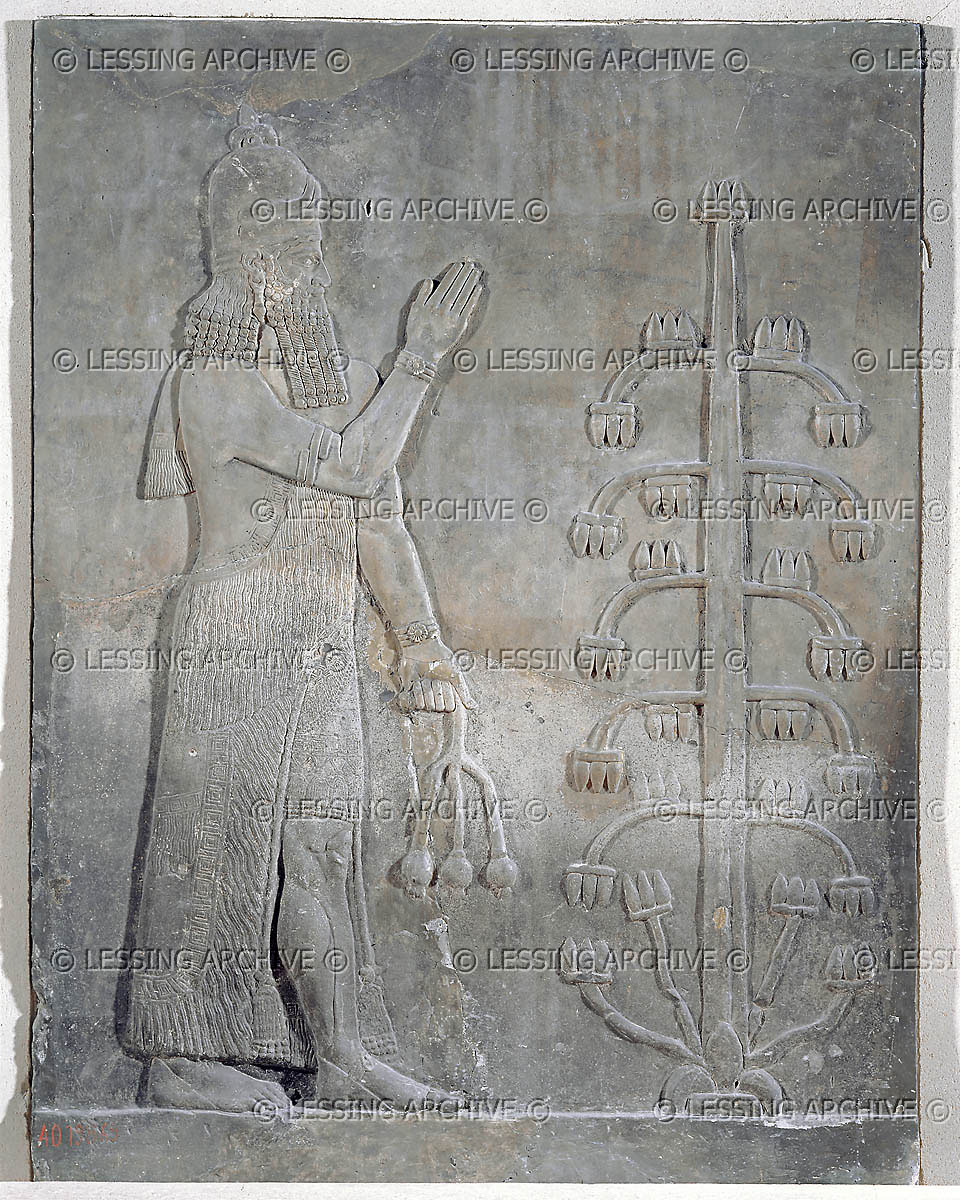
Finally compare this representation. Wings are missing. The horned headdress has two levels of horns, and is again surmounted with what appears to be a fleur-de-lis.  Like other examples, this figure holds what appear to be poppy bulbs, and raises his right hand in the greeting gesture.  Bracelets with rosettes are present, as are armlets on the upper arms.  The sacred tree before the figure varies from other depictions, as well.  It is not certain that this figure depicts an ummânū at all. It could portray a king. The lack of wings is clearly deliberate.  Bas-relief, Louvre, AO 19869

Finally compare this representation. Wings are missing. The horned headdress has two levels of horns, and is again surmounted with what appears to be a fleur-de-lis.
Like other examples, this figure holds what appear to be poppy bulbs, and raises his right hand in the greeting gesture.
Bracelets with rosettes are present, as are armlets on the upper arms.
The sacred tree before the figure varies from other depictions, as well.
It is not certain that this figure depicts an ummânū at all. It could portray a king. The lack of wings is clearly deliberate.
Bas-relief, Louvre, AO 19869

To some extent this concerns all the seven apkallus, but there is a difference; the seven apkallus together kept the plans of heaven and earth in order (lines 12-13). They were not as a group involved in creating them. We have an analogy here to the relationship between the first apkallu, Oannes, and the seventh apkallu, Odakon, in Berossos. Oannes revealed to humankind everything necessary to know; Odakon explained detail what Oannes had revealed (sic).

This all-encompassing knowledge is interesting compared to the knowledge of Adapa in the myth. According to the beginning of the myth in fragment A, Adapa’s knowledge is described in the following way: uzna rapašta ušāklilšu usurāt māti kullumu, “he made him perfect with broad understanding to reveal the plans of the land” (Nineveh fragment A obv. i. 3).

Both in Bīt Mēseri and in the myth the verb šuklulu and the noun usurtu are used. There is a difference between ersetu in Bīt Mēseri and mātu in the myth, “earth” and “land,” but this is not very significant here. What is significant is that knowledge about šamû, “heaven,” is lacking in Adapa’s initial wisdom.

He is broad in understanding, but his wisdom does not include the divine realm. This seems to be in opposition to what is said about Ea in fragment B: ea ša šamê īde, “Ea who knows heaven” (Amarna fragment B. obi. 14).
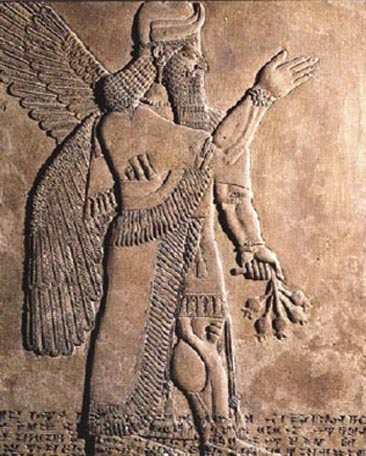
This exemplar of an Ummânū raises his right hand in the greeting gesture and holds what appear to be poppy bulbs in his left hand.  Rosette bracelets are apparent on his wrists, and he wears the horned tiara indicative of divinity.

This exemplar of an Ummânū raises his right hand in the greeting gesture and holds what appear to be poppy bulbs in his left hand.
Rosette bracelets are apparent on his wrists, and he wears the horned tiara indicative of divinity.

When Adapa arrives before Anu in heaven, Anu presupposes that Ea has revealed everything to Adapa, since Adapa had the power to paralyze the South Wind simply through his speech: ammīni d ea amīlūta lā banīta ša šamê u erseti ukillinši libra sabra iškunšu, “Why did Ea expose to a human what is bad in heaven and earth? Why did he establish a “fat heart” (in) him?”

(Fragment B rev. 57-58).

The expression, lā banīta ša šamê u erseti, “what is bad in heaven and earth,” clearly refers to Adapa’s wisdom.

Anu thinks that Ea has revealed to Adapa the same extensive wisdom about heaven and earth that Ea himself has, and Anu considers this bad, because it is dangerous for the cosmic order when humans possess it, which Adapa clearly has demonstrated.”

Helge Kvanvig, Primeval History: Babylonian, Biblical, and Enochic: An Intertextual Reading, Brill, 2011, p. 126.
Kvanvig: The Apkallus had a Cosmic Function

“There is a clear difference between the group of seven and the subsequent group of four figures in Bīt Mēseri. The difference is not expressed in the same way as in the Uruk tablet in a general pattern of apkallus and succeeding ummanus. In Bīt Mēseri all the figures are apkallus with a curious exception of the last one, who is only two-thirds apkallu.

In Bīt Mēseri, there are thus two periods of transition, from the seven apkallus of divine descent to the four apkallus of human descent, and from the extraordinary apkallus to ordinary scholarship (we assume ummanus).

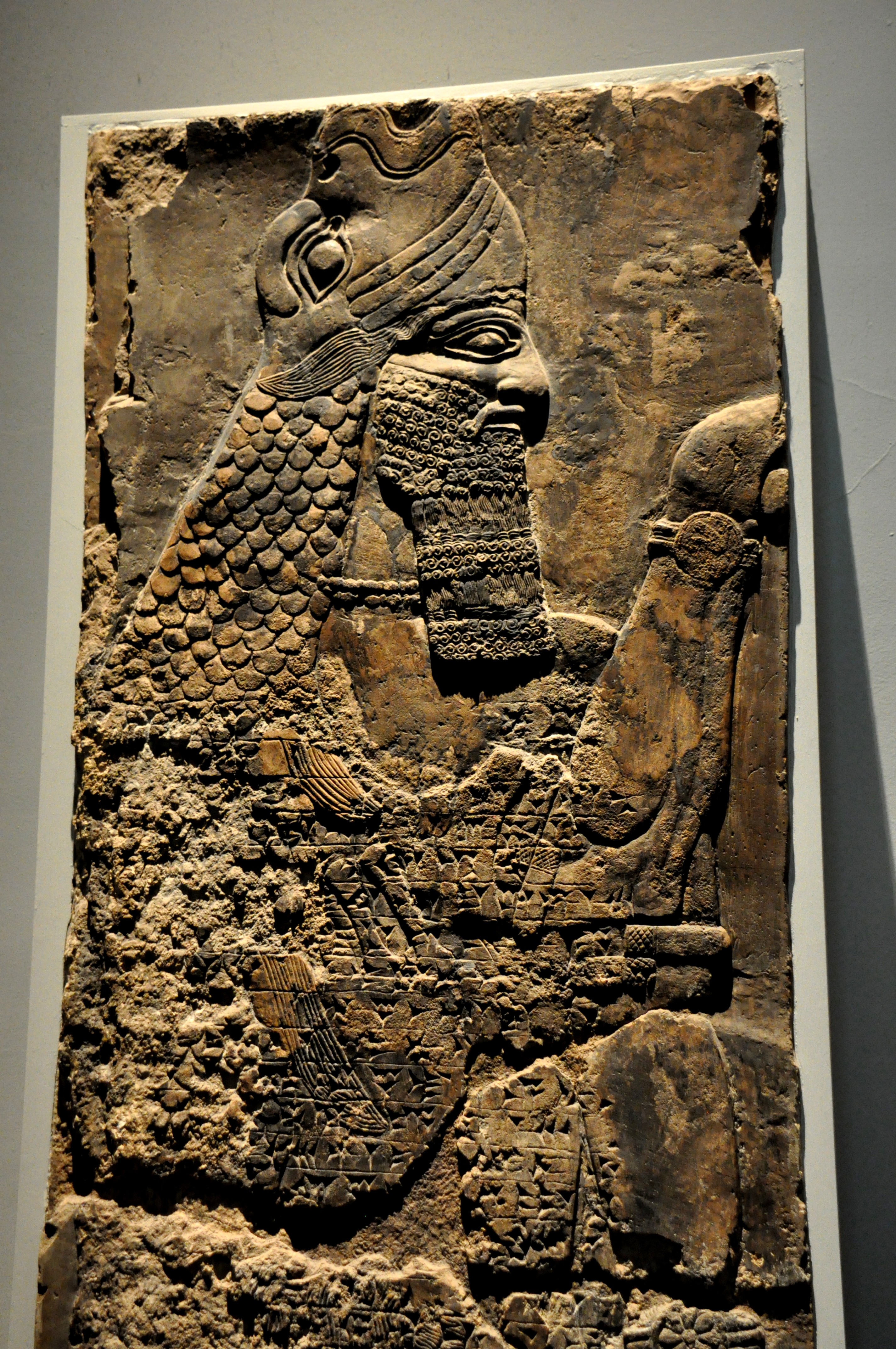
This depiction of a fish-apkallū of the parādu-fish type guarded the entrance to the temple of Ninurta at Nimrud.  A fish's head can be seen on the Apkallu's head, and its skin hangs down over the back of his body.  It is important to recall that the so-called Seven Sages of Sumeria were apkallū of this type. Neo-Assyrian era, 865-860 BCE.  From the Temple of Ninurta, Nimrud (ancient Kalhu; Biblical Calah), northern Mesopotamia, Iraq. (The British Museum, London). Osama Shukir Muhammed Amin FRCP (Glasg) http://www.ancient.eu/image/2708/

This depiction of a fish-apkallū of the parādu-fish type guarded the entrance to the temple of Ninurta at Nimrud.
A fish’s head can be seen on the Apkallu’s head, and its skin hangs down over the back of his body.
It is important to recall that the so-called Seven Sages of Sumeria were apkallū of this type.
Neo-Assyrian era, 865-860 BCE.
From the Temple of Ninurta, Nimrud (ancient Kalhu; Biblical Calah), northern Mesopotamia, Iraq. (The British Museum, London).
Osama Shukir Muhammed Amin FRCP (Glasg)
http://www.ancient.eu/image/2708/

The last transition is exemplified with Lu-Nanna; he is a mixture of both apkallu and, we must assume, ummanu. The difference between the first two groups is expressed through their origin. At the end of the list of four it is stated: [seb]et apkallu ša Ea bēlum [u]zna rapašta ušaklilušunuti,” of human descent, whom the lord Ea has endowed with a broad understanding” (lines 30-31).

“Born in the river” means engendered in the abode of Ea, which shows divine descent, in opposition to the human descent of the four succeeding ones, who, nevertheless are given great wisdom.

The apkallus are given a cosmic function. This is repeated twice, first in connection with the first apkallu, then in connection with all seven apkallus at the end of the list in Bīt Mēseri.

In both cases their responsibility concerns usurāt šamê u erseti (lines 1 and 13). Akkadian usurtu means concretely, “drawing,” abstractly, “plan, regulation, destiny;” so the apkallus are in charge of the “plans of heaven and earth.”

We have met this concept in Atrahasis where the birth-goddess Nintu: usurāti ša niši ussar, “draws the drawings for the people,” (S, 14), i.e. creates the basic conditions and fixes the destinies.

(Text in Lambert and Millard, Atra-Hasis, 62-3).

There is, however, a difference in Bīt Mēseri, which is made clear by the two different verbs used. In the case of the first apkallu (line 1) the verb mušaklil, participle, of the verb šuklulu (Š stem), is used. The verb means both “complete” and “make perfectly.”

In this bas relief from Nimrud, human apkallū, the ummánū, kneel and tend to a sacred tree.  Both ummânū wear horned tiaras and display rosette bracelets on their wrists. Bracelets are also apparent on their upper arms.  In the lower register, bird-apkallū raise mulillu cones to sprinkle water in a gesture of exorcism and liberation of sin.  As is typical, the banduddu buckets are in their left hands.  Interestingly in this case, the bracelets of the bird-apkallū are atypical. No rosettes are apparent.

In this bas relief from Nimrud, human apkallū, the ummánū, kneel and tend to a sacred tree.
Both ummânū wear horned tiaras and display rosette bracelets on their wrists. Bracelets are also apparent on their upper arms.
In the lower register, bird-apkallū raise mulillu cones to sprinkle water in a gesture of exorcism and liberation of sin.
As is typical, the banduddu buckets are in their left hands.
Interestingly in this case, the bracelets of the bird-apkallū are atypical. No rosettes are apparent.

The first apkallu thus “completed” or “made perfectly the drawings of heaven and earth.”

In the summary about all the apkallus (line 13) the verb muštešer, participle, Št stem, of the verb ešēru is used, which has the meaning “keep in order.”

Thus there is a distinction between what the first apkallu initially did, and what all apkallus did together. The first apkallu completed the design of the world-order; the seven apkallus, as a group, maintained this world order.

The corresponding Sumerian line 12 (the tablet is bilingual) has a text close to what we find in a Sumerian hymn. We quote the text in the German translation by van Dijk:

Die urformen von Himmel und Erde

in rechter Ordnung zu halten, in die Weite von Himmel und Erde

den grossen Entscheidungen den Weg zu bahnen, 

die Kultordnungen vollkommen zu machen.”

(Hymn to Nusku I, 14).

(J. van Dijk, Summarische Götterlieder, AHAW, PH, abh. I. Heidelberg 1960, 14; transliteration, 108; translation, 111.).

What is said here about the god Nusku is in Bīt Mēseri said about the apkallus. It covers the wide aspects of culture and civilization listed by Berossos about the first and seventh apkallu; it brings us, however, even one step further. The apkallus had a cosmic function; they were cosmic guardians.

They were both in charge of the me, and they were in charge of people’s destinies. In the last role, they are also described in a Babylonian myth where they are the custodians of the tablets of destinies.”

(W.G. Lambert, “The Twenty-One “poultices,”” AnSt 30 (1980): 77-83; B.R. Foster, “Wisdom and the Gods in Ancient Mesopotamia,” Orientalia (NS) 43 (1974): 344-54.).

Helge Kvanvig, Primeval History: Babylonian, Biblical, and Enochic: An Intertextual Reading, Brill, 2011, pp. 116-7.