
Samizdat

Publishing the Forbidden. All Rights Reserved. © Samizdat 2014-2025.

Tag: St. Jerome

Eco: The Etymological Furor
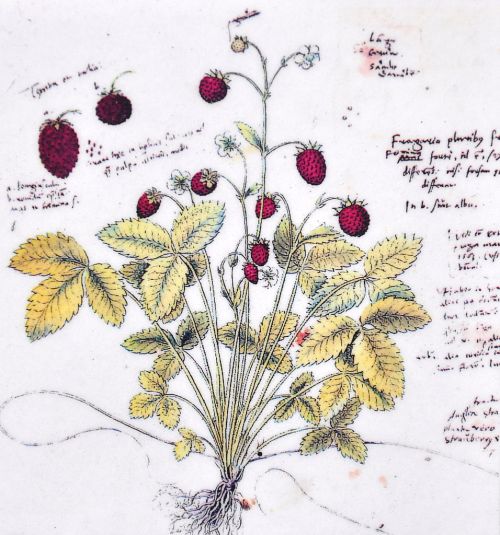
956px-Conrad_Gesner_-_Conradi_Gesneri_Historia_plantarum_Walderbeere

Conrad Gesner (1516-65), Conradi Gesneri Historia plantarum Walderbeere, Zurich: Botanical Garden zur Katz, published in 1750. Photographed by Roland zh, licensed under the Creative Commons Attribution-Share Alike 3.0 Unported license. This work is in the public domain in its country of origin and other countries and areas where the copyright term is the author’s life plus 100 years or less. 

“Postel’s was a clear and unambiguous demand for the restoration of Hebrew as the universal language. Few, however, made this demand in so radical a fashion. For others, it was usually enough to demonstrate that Hebrew was superior because it was the first language from which all others had derived.

One example is the Mithridates of Conrad Gessner. Published in 1555, the Mithridates is a book that draws parallels between fifty-five different languages.

Having dwelt briefly on the happy condition of some legendary beings with two tongues, one for human speech and the other to speak the language of the birds, Gessner immediately passed to the claim that “all existing languages had retained words of a Hebrew origin, though in a corrupt state” (1610 edn: 3).

Other authors–in order to demonstrate such a parenthood–started a mad etymological chase.

This etymological furor was not a new condition. Between the sixth and seventh centuries, by a fanciful account of the seventy-two existing languages, Isidore of Seville (Etymologiarum) elaborated a series of etymologies that has made him the laughing stock of scholars ever since: our corpus (body) comes from corruptus perit as our body goes to corruption; homo (man) derives from humus or mud from which he is born; iumenta (mare) comes from iuvat because horses help men; agnus is a lamb because it recognizes its own mother . . . These are examples of hyper-Cratylian mimological hypothesis, and we shall see that they were taken up by the supporters of Hebrew.

In 1613 Claude Duret published his monumental Thrésor de l’histoire des langues de cet univers. Using the Christian kabbala as his starting point, Duret set forth a vast panorama that swept from the origins of language, to an examination of all known tongues, including those of the New World, to a final chapter on the language of animals.

Duret started from the premise that Hebrew was the universal language of the human race; it thus appeared to him as self-evident that each animal name in Hebrew should include an encapsulated “natural history” of that animal.

Thus we are told that, in Hebrew:

the Eagle is called Nescher, a word formed by the combination of Schor and Isachar, the first meaning to look and the second to be straight because, above all others, the eagle is a bird of firm sight whose gaze is always directed towards the sun [ . . . ]

The Lion has three names, that is Aryeh, Labi, and Layisch. The first name comes from another which means tear or lacerate; the second is related to the word leb which means heart, and laab, which means to live in solitude.

The third name usually means a great and furious lion, and bears an analogy with the verb yosh, which means trample. [ . . . ] because this animal tramples and damages its prey. (p. 40).

Hebrew had managed to retain this proximity to the world of things because it never permitted itself to be polluted by other languages (ch. x). This presumption of Hebrew’s natural affinity to the world of things is also demonstrated by its magic potential.

Duret recalled that Eusebius and St. Jerome had ridiculed the Greeks because they had exalted their own language but were unable to find any mystic significance of their alphabet.

Only ask a Hebrew child the significance of the letter Alef, and he will respond “discipline,” and so on for all the other letters and for their combinations (p. 194).

Duret is an example of retrospective etymologizing, aiming at showing how the mother tongue was harmoniously related to the nature of things. Other authors engaged in prospective etymologizing, projecting Hebrew words forwards to show how they transmuted themselves into the words of all other languages.

In 1606, Estienne Guichard wrote his L’harmonie étymologique des langues, where he showed that all existing languages might be derived from Hebrew roots. He started from the premise that Hebrew was the simplest language because in it “all words are simple, and their substance consists of but three radicals.”

Manipulating these radicals through inversion, anagrams and permutations in the best kabbalistic tradition, Guichard provided his etymologies.

In Hebrew, the verb batar means to divide. How can we prove that Latin dividere comes from batar? Simple: by inversion, batar produces tarab; tarab then becomes the Latin tribus and, from there, turns into distribuo and dividere (p. 147). Zacen means old. Rearranging the radicals, we get zanec from which derives Latin senex. 

A further rearrangement and we have cazen, from which derives the Oscan word casnar, which is the root of the Latin canus, elder (p. 247). By this method we might equally prove that the English head comes from the late Latin testa, since the anagram of testa gives eatts.”

Umberto Eco, The Search for the Perfect Language, translated by James Fentress, Blackwell. Oxford, 1995, pp. 80-2.
Eco: Before and After Europe, 2

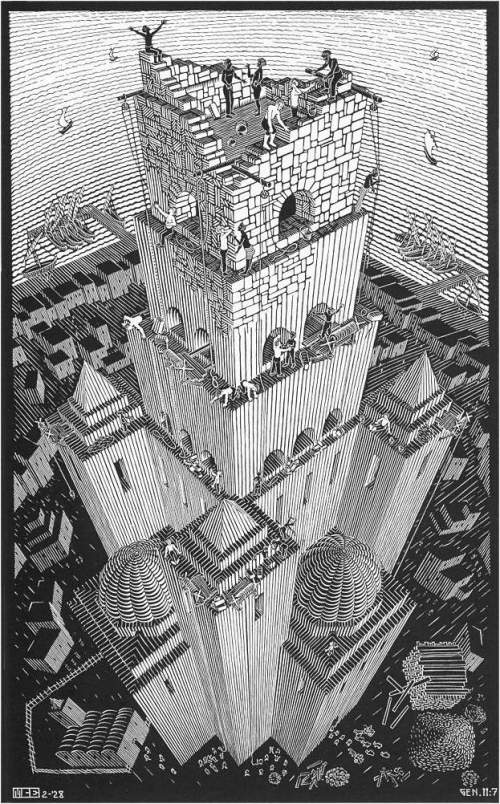
babel

MC Escher, Tower of Babel, 1928. This image of a drawing is copyrighted by the artist, who died in 1972. Low-resolution images of works of art for purposes of critical commentary qualify for fair use under United States copyright law.

“Despite this, by the second century AD, there had begun to form the suspicion that Latin and Greek might not be the only languages which expressed harmoniously the totality of experience.

Slowly spreading across the Greco-Roman world, obscure revelations appeared; some were attributed to Persian magi, others to an Egyptian divinity called Thoth-Hermes, to Chaldean oracles, and even to the very Pythagorean and Orphic traditions which, though born on Greek soil, had long been smothered under the weight of the great rationalist philosophy.

By now, the classical rationalism, elaborated and re-elaborated over centuries, had begun to show signs of age. With this, traditional religion entered a period of crisis as well. The imperial pagan religion had become a purely formal affair, no more than a simple expression of loyalty.

Each people had been allowed to keep its own gods. These were accommodated to the Latin pantheon, no one bothering over contradictions, synonyms or homonyms. The term characterizing this leveling toleration for any type of religion (and for any type of philosophy or knowledge as well) is syncretism.

An unintended result of this syncretism, however, was that a diffused sort of religiosity began to grow in the souls of the most sensitive. It was manifested by a belief in the universal World Soul; a soul which subsisted in stars and in earthly objects alike.

Our own, individual, souls were but small particles of the great World Soul. Since the reason of philosophers proved unable to supply truths about important matters such as these, men and women sought revelations beyond reason, through visions, and through communications with the godhead itself.

It was in this climate that Pythagoreanism was reborn. From its beginnings, Pythagoreans had regarded themselves as the keepers of a mystic form of knowledge, and practiced initiatory rites.

Their understanding of the laws of music and mathematics was presented as the fruit of revelation obtained from the Egyptians. By the time of Pythagoreanism’s second appearance, however, Egyptian civilization had been eradicated by the Greek and Latin conquerors.

Egypt itself had now become an enigma, no more than an incomprehensible hieroglyph. Yet there is nothing more fascinating than secret wisdom: one is sure that it exists, but one does not know what it is. In the imagination, therefore, it shines as something unutterably profound.

That such wisdom could exist while still remaining unknown, however, could only be accounted for by the fact that the language in which this wisdom was expressed had remained unknown as well.

This was the reasoning of Diogenes Laertius, who wrote in his Lives of the Philosophers in the third century AD:

“There are those who assert that philosophy started among the Barbarians: there were, they claim, Magi among the Persians, the Chaldeans, the Babylonians, the Assyrians, the Gymnosophists of India, the Druids among the Celts and Galatians” (I).

The classical Greeks had identified barbarians as those who could not even articulate their speech. It now seemed that these very mumblings were of a sacred language, filled with the promise of tacit revelations (Festugière 1944-54:I).

I have given a summary of the cultural atmosphere at this time because, albeit in a delayed fashion, it was destined to have a deep influence on our story. Although no one at the time proposed the reconstruction of the perfect language, the need for one was, by now, vaguely felt.

We shall see that the suggestions, first planted during these years, flowered more than twelve centuries later in humanistic and Renaissance culture (and beyond); this will constitute a central thread in the story I am about to tell.

In the meantime, Christianity had become a state religion, expressed in the Greek of the patristic East and in the Latin still spoken in the West. After St. Jerome translated the Old Testament in the fourth century, the need to know Hebrew as a sacred language grew weaker. This happened to Greek as well.

A typical example of this cultural lack is given by St. Augustine, a man of vast culture, and the most important exponent of Christian thought at the end of the empire.

The Christian revelation is founded on an Old Testament written in Hebrew and a New Testament written, for the most part, in Greek. St. Augustine, however, knew no Hebrew; and his knowledge of Greek was, to say the least, patchy (cf. Marrou 1958).

This amounts to a somewhat paradoxical situation: the man who set himself the task of interpreting scripture in order to discover the true meaning of the divine word could read it only in a Latin translation.

The notion that he ought to consult the Hebrew original never really seems to have entered Augustine’s mind. He did not entirely trust the Jews, nurturing a suspicion that, in their versions, they might have erased all references to the coming of Christ.

The only critical procedure he would allow was that of comparing translations in order to find the most likely version. In this way, St. Augustine, though the father of hermeneutics, was certainly not destined to become the father of philology.”

Umberto Eco, The Search for the Perfect Language, translated by James Fentress, Blackwell. Oxford, 1995, pp. 12-4.