
Samizdat

Publishing the Forbidden. All Rights Reserved. © Samizdat 2014-2025.

Tag: Pythagoreanism

Eco: Magic Names & Kabbalistic Hebrew, 3

John-Dee-painting-originally-had-circle-of-Human-Skulls-X-Rays-Show

Henry Gillard Glindoni (1852-1913), John Dee Performing an Experiment Before Elizabeth I, purchased from Mr. Henry S. Wellcome circa 1900-36 as Accession Number 47369i, courtesy of Wellcome Library. The painting portrays Dr. John Dee conjuring for Queen Elizabeth I at Dr. Dee’s home in Mortlake. On the Queen’s left are her adviser William Cecil and Sir Walter Raleigh. Dr. Dee’s notorious scryer, Edward Kelley, is seated behind Dr. Dee, wearing a skullcap that conceals his cropped ears. This work caused a stir when an x-ray scan of the painting revealed that Dr. Dee originally stood in a magical circle comprised of human skulls. The skulls were presumably removed by the artist at the request of the original buyer. An extensive collection of works by Dr. Dee is available on the Esoteric Archives site. This work is in the public domain in its country of origin and other countries and areas where the copyright term is the author’s life plus 100 years or less. 

“John Dee–not only magus and astrologer to Queen Elizabeth I, but profound érudit and sharp politician as well–summoned angels of dubious celestial provenance by invoking names like Zizop, Zchis, Esiasch, Od and Iaod, provoking the admiring comment, “He seemeth to read as Hebrew is read” (cf. A True and Faithful Relation of 1659).

There exists, however, a curious passage in the Arabic Hermetic treatise, known in the Middle Ages through a Latin translation, called the Picatrix (III, I, 2: cf. Pingree 1986), in which the Hebrew and Chaldean idioms are associated with the saturnine spirit, and, hence with melancholy.

Saturn, on the one hand, was the sign of the knowledge of deep and secret things and of eloquence. On the other, however, it carried a set of negative connotations inherited from Judaic law, and was associated with black cloths, obscure streams, deep wells and lonely spots, as well as with metals like lead, iron and all that is black and fetid, with thick-leafed plants and, among animals, with “camelos nigros, porcos, simias, ursos, canes et gatos [sic]” (“black camels, pigs, moneys, bears, dogs and cats”).

This is a very interesting passage; if the saturnine spirit, much in vogue during the Renaissance, was associated with sacred languages, it was also associated with things, places and animals whose common property was their aura of black magic.

Thus, in a period in which Europe was becoming receptive to new sciences that would eventually alter the known face of the universe, royal palaces and the elegant villas in the Tuscan hills around Florence were humming with the faint burr of Semitic-sounding incantations–often on the lips of the scientists themselves–manifesting the fervid determination to win a mastery of both the natural and the supernatural worlds.

Naturally, things could not long remain in such a simple state. Enthusiasm for kabbalist mysticism fostered the emergence of a Hebrew hermeneutics that could hardly fail to influence the subsequent development of Semitic philology.

From the De verbo mirifico and the De arte kabbalistica by Reuchelin, to the De harmonia mundi of Francesco Giorgi or the Opus de arcanis catholicae veritatis by Galatinus, all the way to the monumental Kabbala denudata by Knorr von Rosenroth (passing through the works of Jesuit authors whose fervor at the thought of new discoveries allowed them to overcome their scruples at handling such suspect material), there crystallized traditions for reading Hebrew texts.

This is a story filled with exciting exegetical adventures, numerological fabulizing, mixtures of Pythagoreanism, Neoplatonism and kabbalism. Little of it has any bearing on the search for a perfect language. Yet the perfect language was already there: it was the Hebrew of the kabbalists, a language that revealed by concealing, obscuring and allegorizing.

To return to the linguistic model outlined in our first chapter, the kabbalists were fascinated by an expression-substance–the Hebrew texts–of which they sought to retrieve the expression-form (the grammar), always remaining rather confused apropos of the corresponding content-form.

In reality, their search aimed at rediscovering, by combining new expression-substances, a content-continuum as yet unknown, formless, though seemingly dense with possibility. Although the Christian kabbalists continually discovered new methods of segmenting an infinite continuum of content, its nature continued to elude them.

In principle, expression and content ought to be conformal, but the expression-form appeared as the iconic image of something shrouded in mystery, thus leaving the process of interpretation totally adrift (cf. Eco 1990).”

Umberto Eco, The Search for the Perfect Language, translated by James Fentress, Blackwell. Oxford, 1995, pp. 124-6.
Eco: Before and After Europe, 2

babel

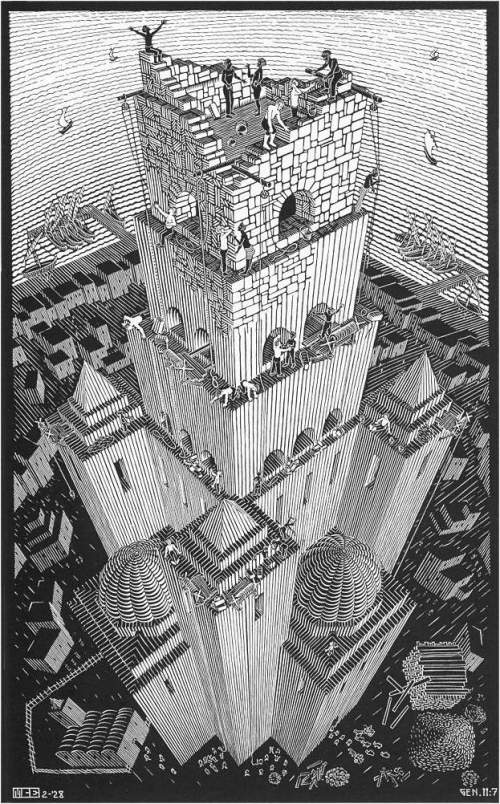
MC Escher, Tower of Babel, 1928. This image of a drawing is copyrighted by the artist, who died in 1972. Low-resolution images of works of art for purposes of critical commentary qualify for fair use under United States copyright law.

“Despite this, by the second century AD, there had begun to form the suspicion that Latin and Greek might not be the only languages which expressed harmoniously the totality of experience.

Slowly spreading across the Greco-Roman world, obscure revelations appeared; some were attributed to Persian magi, others to an Egyptian divinity called Thoth-Hermes, to Chaldean oracles, and even to the very Pythagorean and Orphic traditions which, though born on Greek soil, had long been smothered under the weight of the great rationalist philosophy.

By now, the classical rationalism, elaborated and re-elaborated over centuries, had begun to show signs of age. With this, traditional religion entered a period of crisis as well. The imperial pagan religion had become a purely formal affair, no more than a simple expression of loyalty.

Each people had been allowed to keep its own gods. These were accommodated to the Latin pantheon, no one bothering over contradictions, synonyms or homonyms. The term characterizing this leveling toleration for any type of religion (and for any type of philosophy or knowledge as well) is syncretism.

An unintended result of this syncretism, however, was that a diffused sort of religiosity began to grow in the souls of the most sensitive. It was manifested by a belief in the universal World Soul; a soul which subsisted in stars and in earthly objects alike.

Our own, individual, souls were but small particles of the great World Soul. Since the reason of philosophers proved unable to supply truths about important matters such as these, men and women sought revelations beyond reason, through visions, and through communications with the godhead itself.

It was in this climate that Pythagoreanism was reborn. From its beginnings, Pythagoreans had regarded themselves as the keepers of a mystic form of knowledge, and practiced initiatory rites.

Their understanding of the laws of music and mathematics was presented as the fruit of revelation obtained from the Egyptians. By the time of Pythagoreanism’s second appearance, however, Egyptian civilization had been eradicated by the Greek and Latin conquerors.

Egypt itself had now become an enigma, no more than an incomprehensible hieroglyph. Yet there is nothing more fascinating than secret wisdom: one is sure that it exists, but one does not know what it is. In the imagination, therefore, it shines as something unutterably profound.

That such wisdom could exist while still remaining unknown, however, could only be accounted for by the fact that the language in which this wisdom was expressed had remained unknown as well.

This was the reasoning of Diogenes Laertius, who wrote in his Lives of the Philosophers in the third century AD:

“There are those who assert that philosophy started among the Barbarians: there were, they claim, Magi among the Persians, the Chaldeans, the Babylonians, the Assyrians, the Gymnosophists of India, the Druids among the Celts and Galatians” (I).

The classical Greeks had identified barbarians as those who could not even articulate their speech. It now seemed that these very mumblings were of a sacred language, filled with the promise of tacit revelations (Festugière 1944-54:I).

I have given a summary of the cultural atmosphere at this time because, albeit in a delayed fashion, it was destined to have a deep influence on our story. Although no one at the time proposed the reconstruction of the perfect language, the need for one was, by now, vaguely felt.

We shall see that the suggestions, first planted during these years, flowered more than twelve centuries later in humanistic and Renaissance culture (and beyond); this will constitute a central thread in the story I am about to tell.

In the meantime, Christianity had become a state religion, expressed in the Greek of the patristic East and in the Latin still spoken in the West. After St. Jerome translated the Old Testament in the fourth century, the need to know Hebrew as a sacred language grew weaker. This happened to Greek as well.

A typical example of this cultural lack is given by St. Augustine, a man of vast culture, and the most important exponent of Christian thought at the end of the empire.

The Christian revelation is founded on an Old Testament written in Hebrew and a New Testament written, for the most part, in Greek. St. Augustine, however, knew no Hebrew; and his knowledge of Greek was, to say the least, patchy (cf. Marrou 1958).

This amounts to a somewhat paradoxical situation: the man who set himself the task of interpreting scripture in order to discover the true meaning of the divine word could read it only in a Latin translation.

The notion that he ought to consult the Hebrew original never really seems to have entered Augustine’s mind. He did not entirely trust the Jews, nurturing a suspicion that, in their versions, they might have erased all references to the coming of Christ.

The only critical procedure he would allow was that of comparing translations in order to find the most likely version. In this way, St. Augustine, though the father of hermeneutics, was certainly not destined to become the father of philology.”

Umberto Eco, The Search for the Perfect Language, translated by James Fentress, Blackwell. Oxford, 1995, pp. 12-4.