
Samizdat

Publishing the Forbidden. All Rights Reserved. © Samizdat 2014-2025.

Tag: Hermeneutics

Eco: Before and After Europe, 2
babel

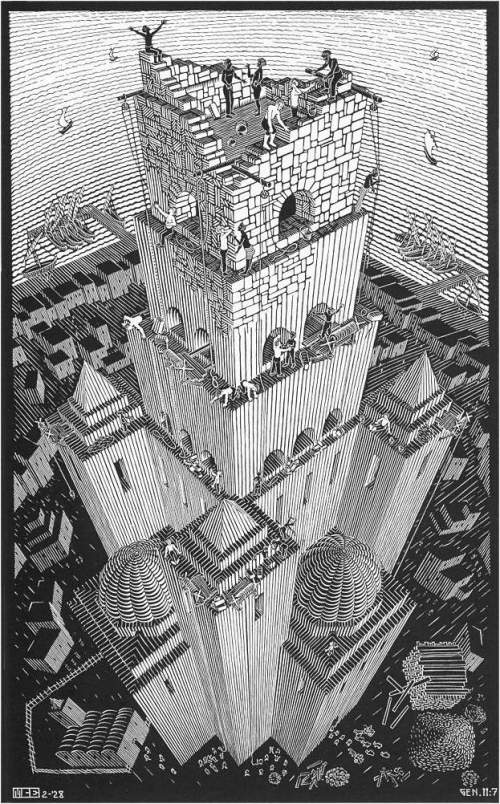
MC Escher, Tower of Babel, 1928. This image of a drawing is copyrighted by the artist, who died in 1972. Low-resolution images of works of art for purposes of critical commentary qualify for fair use under United States copyright law.

“Despite this, by the second century AD, there had begun to form the suspicion that Latin and Greek might not be the only languages which expressed harmoniously the totality of experience.

Slowly spreading across the Greco-Roman world, obscure revelations appeared; some were attributed to Persian magi, others to an Egyptian divinity called Thoth-Hermes, to Chaldean oracles, and even to the very Pythagorean and Orphic traditions which, though born on Greek soil, had long been smothered under the weight of the great rationalist philosophy.

By now, the classical rationalism, elaborated and re-elaborated over centuries, had begun to show signs of age. With this, traditional religion entered a period of crisis as well. The imperial pagan religion had become a purely formal affair, no more than a simple expression of loyalty.

Each people had been allowed to keep its own gods. These were accommodated to the Latin pantheon, no one bothering over contradictions, synonyms or homonyms. The term characterizing this leveling toleration for any type of religion (and for any type of philosophy or knowledge as well) is syncretism.

An unintended result of this syncretism, however, was that a diffused sort of religiosity began to grow in the souls of the most sensitive. It was manifested by a belief in the universal World Soul; a soul which subsisted in stars and in earthly objects alike.

Our own, individual, souls were but small particles of the great World Soul. Since the reason of philosophers proved unable to supply truths about important matters such as these, men and women sought revelations beyond reason, through visions, and through communications with the godhead itself.

It was in this climate that Pythagoreanism was reborn. From its beginnings, Pythagoreans had regarded themselves as the keepers of a mystic form of knowledge, and practiced initiatory rites.

Their understanding of the laws of music and mathematics was presented as the fruit of revelation obtained from the Egyptians. By the time of Pythagoreanism’s second appearance, however, Egyptian civilization had been eradicated by the Greek and Latin conquerors.

Egypt itself had now become an enigma, no more than an incomprehensible hieroglyph. Yet there is nothing more fascinating than secret wisdom: one is sure that it exists, but one does not know what it is. In the imagination, therefore, it shines as something unutterably profound.

That such wisdom could exist while still remaining unknown, however, could only be accounted for by the fact that the language in which this wisdom was expressed had remained unknown as well.

This was the reasoning of Diogenes Laertius, who wrote in his Lives of the Philosophers in the third century AD:

“There are those who assert that philosophy started among the Barbarians: there were, they claim, Magi among the Persians, the Chaldeans, the Babylonians, the Assyrians, the Gymnosophists of India, the Druids among the Celts and Galatians” (I).

The classical Greeks had identified barbarians as those who could not even articulate their speech. It now seemed that these very mumblings were of a sacred language, filled with the promise of tacit revelations (Festugière 1944-54:I).

I have given a summary of the cultural atmosphere at this time because, albeit in a delayed fashion, it was destined to have a deep influence on our story. Although no one at the time proposed the reconstruction of the perfect language, the need for one was, by now, vaguely felt.

We shall see that the suggestions, first planted during these years, flowered more than twelve centuries later in humanistic and Renaissance culture (and beyond); this will constitute a central thread in the story I am about to tell.

In the meantime, Christianity had become a state religion, expressed in the Greek of the patristic East and in the Latin still spoken in the West. After St. Jerome translated the Old Testament in the fourth century, the need to know Hebrew as a sacred language grew weaker. This happened to Greek as well.

A typical example of this cultural lack is given by St. Augustine, a man of vast culture, and the most important exponent of Christian thought at the end of the empire.

The Christian revelation is founded on an Old Testament written in Hebrew and a New Testament written, for the most part, in Greek. St. Augustine, however, knew no Hebrew; and his knowledge of Greek was, to say the least, patchy (cf. Marrou 1958).

This amounts to a somewhat paradoxical situation: the man who set himself the task of interpreting scripture in order to discover the true meaning of the divine word could read it only in a Latin translation.

The notion that he ought to consult the Hebrew original never really seems to have entered Augustine’s mind. He did not entirely trust the Jews, nurturing a suspicion that, in their versions, they might have erased all references to the coming of Christ.

The only critical procedure he would allow was that of comparing translations in order to find the most likely version. In this way, St. Augustine, though the father of hermeneutics, was certainly not destined to become the father of philology.”

Umberto Eco, The Search for the Perfect Language, translated by James Fentress, Blackwell. Oxford, 1995, pp. 12-4.


Asherah, Astarte, Anat, Athirat in Ancient Ugarit

“Some scholars have suggested that El’s two wives in The Birth of the Gracious Gods (Manfred Dietrich, Oswald Loretz, and Joaquín Sanmartín, Cuneiform Alphabetic Texts from Ugarit, Ras Ibn Hani and Other Places (CAT), KTU 2d enlarged edition. Münster: Ugarit-Verlag, 1995, p. 1.23) are mortal women, since they are referred to as ‘attm, “two women.” But it is just as likely that they are goddesses–perhaps Asherah and Rahmay, mentioned prominently earlier in the myth.

British Museum EA 191, upper register of limestone stele of chief craftsman Qeh.  Naked goddess identified as 'Ke(d)eshet, lady of heaven' flanked by the ithyphallic Egyptian god Min and Syro-Palestinian god Reshep.  Deir el-Medina (Dynasty 19).  Photograph © Trustees of the British Museum. Her name Qdš(-t) simply means 'holy'.  As such, it can be attached to almost any goddess, including the whole of the A-team: Anat, Astarte, Asherah and Athirat.  The question is: did there exist an independent goddess named Qedeshet at all?  She is not known from any Canaanite or Ugaritic texts or inscriptions.  Rather, she only appears as a named goddess in Egypt.  There, she is honoured with such typical titles as 'Lady of heaven' and 'Mistress of all the gods' -- which are not specific to her but could equally apply to any goddess in Egypt. What seems to have happened is this.  From the late Middle Bronze Age (ca. 1600 BCE) onwards, Canaan was under Egyptian rule.   Gods and goddesses moved with the armies back and forth in both directions.  Canaanites were envious (I would imagine) of the power of Egyptian deities and freely borrowed their attributes -- in our case, all those Hathor curls and lily-lotus flowers.  In return, Canaanite gods travelled to Egypt on the backs of soldiers, POW's and slaves. Once installed there, some became very popular with native Egyptians as well and were integrated with interesting local deities (as above, the Canaanite naked goddess with Egyptian Min on her left).  So, when we see a picture of the naked goddess in Egypt inscribed with words such as Qedeshet, lady of heaven, great of magic, mistress of the stars, we wonder if the artists were illustrating the Canaanite Q-lady, or a generic Canaanite naked goddess that had been taken over and developed in Egypt itself.  In other words, when the Egyptians borrowed the naked-female, did they mistake 'holy' for her own name?  In which case, the goddess may have been baptized in Egypt and not in her original Canaanite home. http://judithweingarten.blogspot.com/2014_01_01_archive.html

British Museum EA 191, upper register of limestone stele of chief craftsman Qeh. Naked goddess identified as ‘Ke(d)eshet, lady of heaven’ flanked by the ithyphallic Egyptian god Min and Syro-Palestinian god Reshep. Deir el-Medina (Dynasty 19). Photograph © Trustees of the British Museum.
“Her name Qdš(-t) simply means ‘holy’. As such, it can be attached to almost any goddess, including the whole of the A-team: Anat, Astarte, Asherah and Athirat. The question is: did there exist an independent goddess named Qedeshet at all? She is not known from any Canaanite or Ugaritic texts or inscriptions. Rather, she only appears as a named goddess in Egypt. There, she is honoured with such typical titles as ‘Lady of heaven’ and ‘Mistress of all the gods’ — which are not specific to her but could equally apply to any goddess in Egypt.”
http://judithweingarten.blogspot.com/2014_01_01_archive.html

In any case, these women become “El’s wives, El’s wives forever” (CAT 1.23.48-9) and give birth to two gods, Dawn and Dusk. There is much about this myth that is obscure, and nothing substantial that sheds light on Genesis 6:1-4.

In later West Semitic texts, the term “Children of El” (bn ‘ilm) is occasionally used, as at Ugarit, to refer to the main group of gods under the high gods. The Phoenician inscription of King Azitawadda (8th Century BCE) invokes a local sequence of gods: “Baal of heaven, and El the creator of earth, and the eternal Sun, and the whole council of the Children of El (bn ‘lm) (KAI 26. A.iii.19).

A Phoenician inscription from Arslan Tash (7th Century BCE) invokes the “Eternal One” and probably “Asherah,” followed by “All the Children of El (bn ‘lm) and the great of the council of all the Holy Ones” (KAI 27.11-2). An Ammonite inscription from the Amman Citadel (8th Century BCE) exhorts: “[Be]hold, you should trust(?) the Children of El (bn ‘lm).” These brief notices indicate that the term “Sons / Children of El” continued in use in the first millennium with the same general sense as in the second millennium texts.

Some Hellenistic era Phoenician traditions preserved in the writings of Philo of Byblos have been adduced as comparable to the themes and characters in Genesis 6: 1-4 (A.I. Baumgarten, The Phoenician History of Philos of Byblos (Leiden, 1981), pp. 156-7), but their relevance is dubious. In a portion of Philo’s Phoenician History (as quoted by the church father Eusebius), an interesting sequence of primeval history is related:

“From Genos, the son of Aion and Protogonos, there again were born mortal children whose names were Phos, Pur, and Phlox. These–he says–by rubbing sticks together discovered fire, and they taught its use.

And they begot sons who in size and eminence were greater [than their fathers] and whose names were given to the mountain ranges over which they ruled, so that they Kassios, the Lebanon, the Anti-Lebanon, and the Brathys were called after them.

From these–he says–were born Samemroumos who is also [called] Hypsouranios and Ousoos. And–he says–they called themselves after their mothers, since the women of that time united freely with anyone upon whom they chanced.” (Eusebius, Praeparatio evangelica 1.10.9)

These are probably authentic Phoenician traditions, but they have been filtered through Philo’s Hellenistic hermeneutics. If these traditions were about primeval humanity, as the text suggests, then the comparison with Genesis 6:1-4 would be warranted, particularly the birth of giants and perhaps the sexual adventures of women in primeval times. But it has long been clear that the characterization of these figures as human is due to Philo’s Euhemeristic technique, in which the stories of the gods have been transposed into stories about humans.

The clues that this is a sequence of divine figures include the following: Aion (“Eternity”) is identifiable as the well-known Canaanite / Phoenician god ‘Olam (“Eternal One”), as in the Arslan Tash inscription above; the children who discover fire are named “Light,” “Fire,” and “Flame,” also identifiable as Canaanite / Phoenician gods; their sons whose names are given to mountains are identifiable as local BaalsBaal of Kassios (= Mount Zaphon), called Zeus Kassios in Hellenistic times, Baal of Lebanon, and Baal of Anti-Lebanon (= Mount Hermon); Samemroumos means in Phoenician “High Heaven” (= Greek Hypsouranios), perhaps related to Baal of Heaven in the Phoenician inscription of Azitawadda above, or to the temple precinct in Sidon called “high heaven.”

Gold pendant, possibly Astarte. Ugarit. 1500-1200/1150 BCE. Drawing © Stéphane Beaulieu, after Toorn 1998:86, #31  http://www.matrifocus.com/IMB04/spotlight.htm

Gold pendant, possibly Astarte. Ugarit. 1500-1200/1150 BCE.
Drawing © Stéphane Beaulieu, after Toorn 1998:86, #31
http://www.matrifocus.com/IMB04/spotlight.htm

The “mothers,” champions of free sex in Philo’s text, are likely to be goddesses, though their identities are unclear. Astarte and Anat (called in a Ugaritic text “Lady of High Heaven”) are good candidates.

Phoenician traditions about gods of mountains and about goddesses who have sex and bear divine offspring are interesting of themselves, but do not bear directly on the story or characters of Genesis 6:1-4. The same lack of connection pertains to stories about open conflict or rebellions among the generations of the gods (related in Philo’s Phoenician History among other sources), since this theme is not perceptible in Genesis 6:1-4.

Nonetheless, the long duration of the “Sons / Children of El” in West Semitic lore indicates that the story in Genesis 6:1-4 is rooted in widespread cultural traditions. But, perhaps because our textual evidence is so sparse, we lack other West Semitic narratives that are clearly related to Genesis 6:1-4.”

Ronald Hendel, “The Nephilim Were on the Earth: Genesis 6:1-4 and its Ancient Near Eastern Context,” in Christoph Auffarth and Loren T. Stuckenbruck, eds., The Fall of the Angels, Brill, 2004, pp. 24-7.