Samizdat

Publishing the Forbidden. All Rights Reserved. © Samizdat 2014-2025.

Tag: God

Legends of Creation and Dragons

” … Both the source of the original form of the Legend of the Fight between Ea and Apsu, and Marduk and Tiâmat, and the period of its composition are unknown, but there is no doubt that in one form or another it persisted in Mesopotamia for thousands of years.

The apocryphal book of “Bel and the Dragon” shows that a form of the Legend was in existence among the Babylonian Jews long after the Captivity, and the narrative relating to it associates it with religious observances.

But there is no foundation whatsoever for the assertion which has so often been made that the Two Accounts of the Creation which are given in the early chapters in Genesis are derived from the Seven Tablets of Creation described in the preceding pages. It is true that there are many points of resemblance between the narratives in cuneiform and Hebrew, and these often illustrate each other, but the fundamental conceptions of the Babylonian and Hebrew accounts are essentially different.

In the former the earliest beings that existed were foul demons and devils, and the God of Creation only appears at a later period, but in the latter the conception of God is that of a Being Who existed in and from the beginning, Almighty and Alone, and the devils of chaos and evil are His servants.

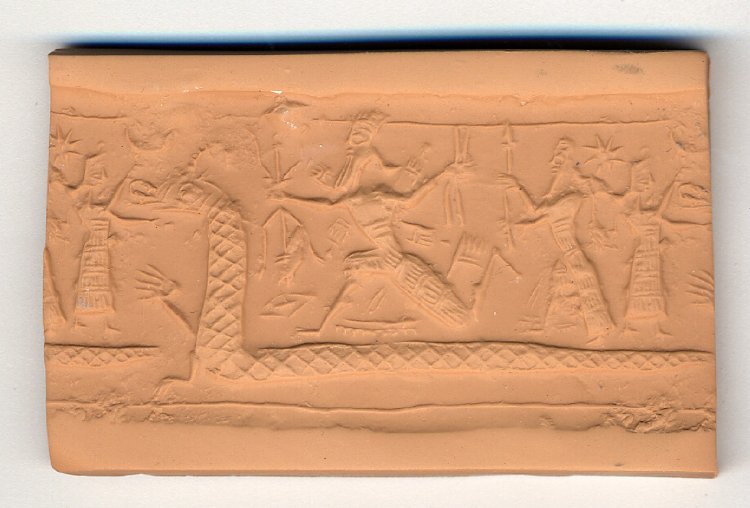
The seal may illustrate a scene from the epic of creation in which the forces of chaos, led by Tiamat, are defeated by a god representing cosmic order, probably Ninurta.

The seal may illustrate a scene from the epic of creation in which the forces of chaos, led by Tiamat, are defeated by a god representing cosmic order, probably Ninurta.

Among the primitive Semitic peoples there were probably many versions of the story of the Creation; and the narrative told by the Seven Tablets is, no doubt, one of them in a comparatively modern form.

It is quite clear that the Account of the Creation given in the Seven Tablets is derived from very ancient sources, and a considerable amount of literary evidence is now available for reconstructing the history of the Legend.

Thus in the Sumerian Account the narrative of the exploits of the hero called ZIUSUDU 19  begins with a description of the Creation and then goes on to describe a Flood, and there is little doubt that certain passages in this text are the originals of the Babylonian version as given in the Seven Tablets.

In the Story of ZIUSUDU, however, there is no mention of any Dragon. And there is reason to think that the Legend of the Dragon had originally nothing whatever to do with the Creation, for the texts of fragments of two distinct Accounts 20 of the Creation describe a fight between a Dragon and some deity other than Marduk.

In other Accounts the Dragon bears a strong resemblance to the Leviathan of Psalm civ, 26; Job xli, 1. In the one text he is said to be 50 biru 21 in length, and 1 biru in thickness; his mouth was 6 cubits (about 9 feet) wide, and the circumference of his ears 12 cubits (18 feet).

He was slain by a god whose name is unknown, and the blood continued to flow from his body for three years, three months, one day and one night.

In the second text the Dragon is 60 biru long and his thickness is 30 biru; the diameter of each eye is half a biru, and his paws are 20 biru long.

Thus there is every reason for believing that the Legend as it is given in the Seven Tablets is the work of some editor, who added the Legend of the Creation to the Legend of the Dragon in much the same way as the editor of the Gilgamish Legends included an account of the Deluge in his narrative of the exploits of his hero.

All forms of the Legend of the Creation and of the Dragon were popular in Babylonia, and one of them achieved so much notoriety that the priest employed recited it as an incantation to charm away the toothache.

The literary form of the text of the Seven Tablets fulfils the requirements of Semitic poetry in general. The lines usually fall into couplets, the second line being the antiphon of the first, e.g.:–

“When in the height heaven was not named,
And the earth beneath did not yet bear a name.”

Thus we have:–

enuma elish || lâ nabû shamamu
shaplish ammatum || shuma lâ zakrat

E.A. Wallis Budge, The Babylonian Legends of the Creation and the Fight Between Bel and the Dragon, 1921.

Giants Again, and Abraham

FROM EUPOLEMUS.
CONCERNING THE TOWER OF BABEL, AND ABRAHAM.

“The City of Babylon owes its foundation to those who were saved from the catastrophe of the Flood; these were the giants, (Heb. נפלים = fallen ones), and they built the tower which is noticed in history. But the tower being overthrown by the interposition of God, the giants were scattered over all the earth.

He says, moreover, that in the tenth generation, in the City of Babylonia, called Camarina (which, by some, is called the city Urie, and which signifies a city of the Chaldeans), there lived, the thirteenth in descent, (a man named), Abraham, a man of a noble race and superior to all others in wisdom.

Of him they relate that he was the inventor of astrology and the Chaldean magic, and that on account of his eminent piety he was esteemed by God. It is further said, that under the directions of God he removed and lived in Phoenicia, and there taught the Phoenicians the motions of the sun and moon, and all other things; for which reason he was held in great reverence by their king.” 121―Extracted from Eusebius, Preparatio Evangelica, 9.

E. Edmond Hodges, Cory’s Ancient Fragments, 3d ed., 1876, p. 77.

The Ten Lost Tribes

” … Shalmaneser died before Samaria was captured, and may have been assassinated. The next Assyrian monarch, Sargon II (722-705 B.C.), was not related to either of his two predecessors. He is referred to by Isaiah, and is the Arkeanos of Ptolemy. He was the Assyrian monarch who deported the “Lost Ten Tribes.”

“In the ninth year of Hoshea” (and the first of Sargon) “the king of Assyria took Samaria, and carried Israel away into Assyria, and placed them in Halah and in Habor by the river of Gozan, and in the cities of the Medes.”

In all, according to Sargon’s record, “27,290 people dwelling in the midst of it (Samaria) I carried off.”

They (the Israelites) left all the commandments of the Lord their God, and made them molten images, even two calves, and made a grove, and worshipped all the host of heaven (the stars), and served Baal.

And they caused their sons and their daughters to pass through the fire, and used divination and enchantments, and sold themselves to do evil in the sight of the Lord, to provoke him to anger. Therefore the Lord was very angry with Israel, and removed them out of his sight: there was none left but the tribe of Judah only.

And the king of Assyria brought men from Babylon, and from Cuthah, and from Ava, and from Hamath, and from Sepharvaim, and placed them in the cities of Samaria instead of the children of Israel: and they possessed Samaria, and dwelt in the cities thereof….

And the men of Babylon made Succoth-benoth, and the men of Cuth (Cuthah) made Nergal, and the men of Hamath made Ashima, and the Avites made Nibhaz and Tartak, and the Sepharites burnt their children in fire to Adram-melech and Anam-melech, the gods of Sepharvaim.

A number of the new settlers were slain by lions, and the king of Assyria ordered that a Samaritan priest should be sent to “teach them the manner of the God of the land.” This man was evidently an orthodox Hebrew, for he taught them “how they should fear the Lord…. So they feared the Lord,” but also “served their own gods … their graven images.”

There is no evidence to suggest that the “Ten Lost Tribes,” “regarding whom so many nonsensical theories have been formed,” were not ultimately absorbed by the peoples among whom they settled between Mesopotamia and the Median Highlands.

The various sections must have soon lost touch with one another. They were not united like the Jews (the people of Judah), who were transported to Babylonia a century and a half later, by a common religious bond, for although a few remained faithful to Abraham’s God, the majority of the Israelites worshipped either the Baal or the Queen of Heaven.”

Donald A. Mackenzie, Myths of Babylonia and Assyria, 1915, pp. 455-6.

Herodotus on the Glory of Babylon

“The rise of Babylon inaugurated a new era in the history of Western Asia.

[ … ]

Considerable wealth had accumulated at Babylon when the Dynasty of Ur reached the zenith of its power. It is recorded that King Dungi plundered its famous “Temple of the High Head,” E-sagila, which some identify with the Tower of Babel, so as to secure treasure for Ea’s temple at Eridu, which he specially favoured.

His vandalistic raid, like that of the Gutium, or men of Kutu, was remembered for long centuries afterwards, and the city god was invoked at the time to cut short his days.

No doubt, Hammurabi’s Babylon closely resembled the later city so vividly described by Greek writers, although it was probably not of such great dimensions.

According to Herodotus, it occupied an exact square on the broad plain, and had a circumference of sixty of our miles. “While such is its size,” the historian wrote, “in magnificence there is no other city that approaches to it.” Its walls were eighty-seven feet thick and three hundred and fifty feet high, and each side of the square was fifteen miles in length.

The whole city was surrounded by a deep, broad canal or moat, and the river Euphrates ran through it.

[ … ]

(Herodotus continues): In the circuit of the wall are a hundred gates, all of brass, with brazen lintels and side posts.” These were the gates referred to by Isaiah when God called Cyrus:

I will loose the loins of kings, to open before him the two leaved gates; and the gates shall not be shut: I will go before thee, and make the crooked places straight; I will break in pieces the gates of brass, and cut in sunder the bars of iron.

The outer wall was the main defence of the city, but there was also an inner wall less thick but not much inferior in strength. In addition, a fortress stood in each division of the city. The king’s palace and the temple of Bel Merodach were surrounded by walls.

All the main streets were perfectly straight, and each crossed the city from gate to gate, a distance of fifteen miles, half of them being interrupted by the river, which had to be ferried. As there were twenty-five gates on each side of the outer wall, the great thoroughfares numbered fifty in all, and there were six hundred and seventy-six squares, each over two miles in circumference.

From Herodotus we gather that the houses were three or four stories high, suggesting that the tenement system was not unknown, and according to Q. Curtius, nearly half of the area occupied by the city was taken up by gardens within the squares.”

Donald A. Mackenzie, Myths of Babylonia and Assyria, 1915.

The Immemorial Practices of Folk Religion

“Reference has been made to the introduction of Tammuz worship into Jerusalem. Ishtar, as Queen of Heaven, was also adored by the backsliding Israelites as a deity of battle and harvest. When Jeremiah censured the people for burning incense and serving gods “whom they knew not,” he said, “neither they, ye, nor your fathers,” they made answer: “Since we left off to burn incense to the queen of heaven, and to pour out drink offerings unto her, we have wanted all things, and have been consumed by the sword and the famine.”

The women took a leading part in these practices, but refused to accept all the blame, saying, “When we burned incense to the queen of heaven, and poured out drink offerings unto her, did we make our cakes and pour out drink offerings unto her without our men?” That the husbands, and the children even, assisted at the ceremony is made evident in another reference to goddess worship: “The children gather wood, and the fathers kindle the fire, and the women knead the dough, to make cakes to the queen of heaven.”

Jastrow suggests that the women of Israel wept for Tammuz, offered cakes to the mother goddess, &c., because “in all religious bodies … women represent the conservative element; among them religious customs continue in practice after they have been abandoned by men.”

The evidence of Jeremiah, however, shows that the men certainly co-operated at the archaic ceremonials. In lighting the fires with the “vital spark,” they apparently acted in imitation of the god of fertility. The women, on the other hand, represented the reproductive harvest goddess in providing the food supply. In recognition of her gift, they rewarded the goddess by offering her the cakes prepared from the newly ground wheat and barley–the “first fruits of the harvest.”

As the corn god came as a child, the children began the ceremony by gathering the wood for the sacred fire. When the women mourned for Tammuz, they did so evidently because the death of the god was lamented by the goddess Ishtar. It would appear, therefore, that the suggestion regarding the “conservative element” should really apply to the immemorial practices of folk religion.

These differed from the refined ceremonies of the official cult in Babylonia, where there were suitable temples and organized bands of priests and priestesses. But the official cult received no recognition in Palestine; the cakes intended for a goddess were not offered up in the temple of Abraham’s God, but “in the streets of Jerusalem” and those of other cities.

The obvious deduction seems to be that in ancient times women everywhere played a prominent part in the ceremonial folk worship of the Great Mother goddess, while the men took the lesser part of the god whom she had brought into being and afterwards received as “husband of his mother.”

This may account for the high social status of women among goddess worshippers, like the representatives of the Mediterranean race, whose early religion was not confined to temples, but closely associated with the acts of everyday life.”

Donald A. Mackenzie, Myths of Babylonia and Assyria, 1915.

Ancient Animism

” … The memorable sermon preached by Paul to the Athenians when he stood “in the midst of Mars’ hill,” could have been addressed with equal appropriateness to the ancient Sumerians and Akkadians.

“I perceive,” he declared, “that in all things ye are too superstitious…. God that made the world and all things therein, seeing that he is Lord of heaven and earth, dwelleth not in temples made with hands; neither is worshipped with men’s hands as though he needed any thing, seeing he giveth to all life, and breath, and all things … for in him we live, and move, and have our being; as certain also of your own poets have said, For we are also his offspring. Forasmuch then as we are the offspring of God, we ought not to think that the Godhead is like unto gold, or silver, or stone, graven by art and man’s device.”

Babylonian temples were houses of the gods in the literal sense; the gods were supposed to dwell in them, their spirits having entered into the graven images or blocks of stone.

It is probable that like the Ancient Egyptians they believed a god had as many spirits as he had attributes. The gods, as we have said, appear to have evolved from early spirit groups. All the world swarmed with spirits, which inhabited stones and trees, mountains and deserts, rivers and ocean, the air, the sky, the stars, and the sun and moon.

The spirits controlled Nature: they brought light and darkness, sunshine and storm, summer and winter; they were manifested in the thunderstorm, the sandstorm, the glare of sunset, and the wraiths of mist rising from the steaming marshes.

They controlled also the lives of men and women. The good spirits were the source of luck. The bad spirits caused misfortunes, and were ever seeking to work evil against the Babylonian. Darkness was peopled by demons and ghosts of the dead. The spirits of disease were ever lying in wait to clutch him with cruel invisible hands.”

Donald A. Mackenzie, Myths of Babylonia and Assyria, 1915.

Attis = Christ

” … The Grail story is not du fond en comble the product of imagination, literary or popular.

At its root lies the record, more or less distorted, of an ancient Ritual, having for its ultimate object the initiation into the secret of the sources of Life, physical and spiritual.

This ritual, in its lower, exoteric, form, as affecting the processes of Nature, and physical life, survives to-day, and can be traced all over the world, in Folk ceremonies, which, however widely separated the countries in which they are found, show a surprising identity of detail and intention.

In its esoteric ‘Mystery’ form it was freely utilized for the imparting of high spiritual teaching concerning the relation of Man to the Divine Source of his being, and the possibility of a sensible union between Man, and God.

The recognition of the cosmic activities of the Logos appears to have been a characteristic feature of this teaching, and when Christianity came upon the scene it did not hesitate to utilize the already existing medium of instruction, but boldly identified the Deity of Vegetation, regarded as Life Principle, with the God of the Christian Faith.

Thus, to certain of the early Christians, Attis was but an earlier manifestation of the Logos, Whom they held identical with Christ.

The evidence of the Naassene document places this beyond any shadow of doubt, and is of inestimable value as establishing a link between pre-Christian, and Christian, Mystery tradition.

This curious synthetic belief, united as it was with the highly popular cult of Mithra, travelled with the foreign legionaries, adherents of that cult, to the furthest bounds of the Roman Empire, and when the struggle between Mithraism and Christianity ended in the definite triumph of the latter, by virtue of that dual synthetic nature, the higher ritual still survived, and was celebrated in sites removed from the centres of population–in caves, and mountain fastnesses; in islands, and on desolate sea-coasts.”

Jessie L. Weston, From Ritual to Romance, 1920, pp. 191-2.

The Mystery of the Third Gate

” … But what is of special interest to us is the treatment meted out to the Christian Mystics, whom Hippolytus stigmatizes as heretics, and whose teaching he deliberately asserts to be simply that of the Pagan Mysteries.

He had come into possession of a secret document belonging to one of these sects, whom he calls the Naassenes; this document he gives in full, and it certainly throws a most extraordinary light upon the relation which this early Christian sect held to exist between the New, and the Old, Faith.

Mr G. R. S. Mead, in his translation of the Hermetic writings entitled Thrice-Greatest Hermes, has given a careful translation and detailed analysis of this most important text … [ … ]  edited by Hippolytus, in the Refutation, about 222 A. D. Thus the ground covered is roughly from 50 B. C. to 220 A. D. 1 [ … ] Mr Mead, in his introductory remarks, summarizes the evidence as follows:

“The claim of these Gnostics was practically that Christianity, or rather the Good News of The Christ, was precisely the consummation of the inner doctrine of the Mystery-institutions of all the nations: the end of them all was the revelation of the Mystery of Man.” 1

[ … ]

In other words the teaching of these Naassenes was practically a synthesis of all the Mystery-religions, and although Hippolytus regards them as nothing more than devotees of the cult of the Magna Mater, we shall see that, while their doctrine and teaching were undoubtedly based mainly upon the doctrine and practices of the Phrygian Mysteries, they practically identified the deity therein worshipped, i.e., Attis, with the presiding deity of all the other Mysteries.

Mr Mead draws attention to the fact that Hippolytus places these Naassenes in the fore-front of his Refutation; they are the first group of Heretics with whom he deals, and we may therefore conclude that he considered them, if not the most important, at least the oldest, of such sectaries. 2

[ … ]

At the outset it will be well to understand that the central doctrine of all these Mysteries is what Reitzenstein sums up as “the doctrine of the Man, the Heavenly Man, the Son of God, who descends and becomes a slave of the Fate Sphere: the Man who, though originally endowed with all power, descends into weakness and bondage, and has to win his own freedom, and regain his original state.

This doctrine is not Egyptian, but seems to have been in its origin part and parcel of the Chaldean Mystery-tradition and was widely spread in Hellenistic circles. 1

Thus, in the introductory remarks prefixed by Hippolytus to the document he is quoting he asserts that the Naassenes honour as the Logos of all universals Man, and Son of Man–“and they divide him into three, for they say he has a mental, psychic, and choïc aspect; and they think that the Gnosis of this Man is the beginning of the possibility of knowing God, saying, ‘The beginning of Perfection is the Gnosis of Man, but the Gnosis of God is perfected Perfection.’

All these, mental, psychic, and earthy, descended together into one Man, Jesus, the Son of Mary.” 2

Thus the Myth of Man, the Mystery of Generation, is the subject matter of the document in question, and this myth is set forth with reference to all the Mysteries, beginning with the Assyrian.

Paragraph 5 runs: “Now the Assyrians call this Mystery Adonis, and whenever it is called Adonis it is Aphrodite who is in love with and desires Soul so-called, and Aphrodite is Genesis according to them.” 3

But in the next section the writer jumps from the Assyrian to the Phrygian Mysteries, saying, “But if the Mother of the Gods emasculates Attis, she too regarding him as the object of her love, it is the Blessed Nature above of the super-Cosmic, and Aeonian spaces which calls back the masculine power of Soul to herself.” 4

In a note to this Mr Mead quotes from The Life of Isidorus: “I fell asleep and in a vision Attis seemed to appear to me, and on behalf of the Mother of gods to initiate me into the feast called Hilario, a mystery which discloses the way of our salvation from Hades.”

Throughout the document reference is continually made to the Phrygians and their doctrine of Man. The Eleusinian Mysteries are then treated of as subsequent to the Phrygian, “after the Phrygians, the Athenians,” but the teaching is represented as being essentially identical.

We have then a passage of great interest for our investigation, in which the Mysteries are sharply divided into two classes, and their separate content clearly defined.

There are–“the little Mysteries, those of the Fleshly Generation, and after men have been initiated into them they should cease for a while and become initiated in the Great, Heavenly, Mysteries–for this is the Gate of Heaven, and this is the House of God, where the Good God dwells alone, into which House no impure man shall come.” 1

Hippolytus remarks that “these Naassenes say that the performers in theatres, they too, neither say nor do anything without design–for example, when the people assemble in the theatre, and a man comes on the stage clad in a robe different from all others, with lute in hand on which he plays, and thus chants the Great Mysteries, not knowing what he says:

‘Whether blest Child of Kronos, or of Zeus, or of Great Rhea,

Hail Attis, thou mournful song of Rhea!

Assyrians call thee thrice-longed-for Adonis;

All Egypt calls thee Osiris;

The Wisdom of Hellas names thee Men’s Heavenly Horn;

The Samothracians call thee august Adama;

The Haemonians, Korybas;

The Phrygians name thee Papa sometimes;

At times again Dead, or God, or Unfruitful, or Aipolos;

Or Green Reaped Wheat-ear;

Or the Fruitful that Amygdalas brought forth,

Man, Piper–Attis!’

This is the Attis of many forms, of whom they sing as follows:

‘Of Attis will I sing, of Rhea’s Beloved,

Not with the booming of bells,

Nor with the deep-toned pipe of Idaean Kuretes;

But I will blend my song with Phoebus’ music of the lyre;

Evoi, Evan,

–for thou art Pan, thou Bacchus art, and Shepherd of bright stars!'” 1

On this Hippolytus comments:

“For these and suchlike reasons these Naassenes frequent what are called the Mysteries of the Great Mother, believing that they obtain the clearest view of the universal Mystery from the things done in them.”

And after all this evidence of elaborate syncretism, this practical identification of all the Mystery-gods with the Vegetation deity Adonis-Attis, we are confronted in the concluding paragraph, after stating that “the True Gate is Jesus the Blessed,” with this astounding claim, from the pen of the latest redactor, “And of all men we alone are Christians, accomplishing the Mystery at the Third Gate.” 2

Jessie L. Weston, From Ritual to Romance, 1920, pp. 144-8.

The Name of God is Woven Throughout the Torah

“This also explains the particular character of the Torah, which is designed to show the way to the worship of God under the specific conditions of this aeon. The present aeon is ruled by the evil inclination that stems from the power of Stern Judgment and that seduces man to idolatry, which had no place during the preceding period.

At present, the Torah aims to conquer the power of evil, and that is why it contains commandments and prohibitions, things permitted, things forbidden, the pure and the impure. Only a few souls, originating in the preceding aeon, return in order to preserve the world through the power of grace and to temper the destructive sternness of judgment.

Among them are Enoch, Abraham, and Moses. At present, even the perfectly righteous must enter into the bodies of animals; this is the secret reason for the special prescriptions relating to ritual slaughter.

The doctrine of the passage of the souls into the bodies of animals appears here for the first time in kabbalistic literature; it may reflect a direct contact with Cathar ideas (as suggested on p. 238) and serve to support the argument for the Provençal origin of the Temunah.

But among the Cathars as also in India this doctrine led to vegetarianism whereas here, on the contrary, it led to a more meticulous observance of the prescriptions concerning the consumption of meat; the slaughtering of an animal and the eating of its flesh are related to the elevation of the soul confined there from an animal to a human existence.

A distinct concept of hell, which would compete with the notion of the transmigration of souls, seems to be outside the purview of our author. For the rest, the book deals with this doctrine only with great reserve, in spite of its almost unlimited validity; the old commentary, printed together with the editions of the text, was to be much less discreet.

The author even knew that in the present aeon the letters of the Torah had refused to assemble themselves into the particular combinations that would compose the form in which it was to be given to Israel at Sinai.

They saw the law of Stern Judgment and how this shemittah is entangled and ensnared in evil, and they did not wish to descend into the filth upon which the palace of this aeon was erected. But “God arranged with them that the great and glorious name would be combined with them and would be contained in the Torah.”243

Apparently this signifies more than the direct mention of the name of God in the Torah. Rather, the name of God is contained everywhere in the Torah, in a mystical mode; as ibn Gikatilla put it: “It is woven into” the Torah.

All the laws and mysteries of this aeon are inscribed in secret language in this Torah, which embraces all ten sefiroth, and all this is indicated by the particular form of the letters. “No angel can understand them, but only God Himself, who explained them to Moses and communicated to him their entire mystery” (fol. 30a).

On the basis of these instructions, Moses wrote the Torah in his own language, organizing it, however, in a mystical spirit that conformed to these secret causalities. The present aeon must obey this law of Stern Judgment and the Torah that corresponds to it, and only at its end will all things return to their original state.

The author proceeds from the assumption that there also exists within the shemittah an internal cyclical system. The human race, born from the one Adam, developed into millions of individuals. After the redemption, which will take place in the sixth millenium, humanity will perish in the same rhythm in which it began. “In the manner in which everything came, everything passes away.” “The doors to the street are shut” (Eccles. 12:4), and everything returns home to its origin, even the angels of the Merkabah corresponding to this aeon, the heavenly spheres, and the stars.”

Gershom Scholem, Origins of the Kabbalah, 1962, pp. 468-9.

Shemittah Without Limit

“In this state, the Torah is not “legible” for human beings. At the Sinaitic revelation, God taught Moses how to read the Torah by a division into letters and words, in such manner that it yielded a meaning in the Hebrew language. These considerations also opened the door to the possibility of alternative mystical readings, and it is precisely this notion that the Book Temunah presents in such a radical fashion.

In fact, according to this book, the world in which we live and which we know as the creation that began so and so many thousand years ago is not the first. It was preceded by another shemittah: the aeon of Grace, in the course of which all the sefiroth acted under the determining regime of this principal sefirah.

The world “built by Grace” at that time—according to the interpretation given by the kabbalists to Psalms 89:3—bears some resemblance to the Golden Age of Greek mythology. This shemittah was entirely bathed in light. The spheres of the heavens were simple and not composed of four elements; men stood at the highest spiritual pinnacle and possessed a pure body.

Even the cattle and other animals stood as high then as the animals that bear the Merkabah in our shemittah. The cult practiced by the creatures resembled the adoration of God by the angels in the present aeon. There was neither an exile of the body, as that of Israel, nor an exile of the souls, which is the transmigration of souls.

Man looked like the celestial man whom Ezekiel saw upon the throne. The manifestation of the primordial Torah as beheld by the creatures of that shemittah came exclusively from the side of Grace. Since there existed no evil inclination and no tempting serpent, the Torah of this shemittah (that is, the manner in which the mystical letters were combined) contained nothing concerning impurities or prohibitions. Even those letters had a simple form and were not in large measure composite, as at present.”

Gershom Scholem, Origins of the Kabbalah, 1962, p. 467.

Opening and Closing of the Cosmic Book

“The historical origins of this doctrine remain to be examined. It is entirely conceivable that it came from the Orient to Provence, where it became associated at a later date with the doctrine of the sefiroth. The penchant for great numbers in the cosmic cycles, which quickly led beyond the 50,000 years of a cosmic jubilee, corresponds to similar tendencies in India and the Ismailite gnosis.

As early as the thirteenth century (as Bahya ben Asher attests), the single yobhel had become 18,000 and the seven shemittoth had mushroomed to thousands. The view that the slowing down of the revolutions of the stars at the end of every period of creation took place in geometric progression led to an extension of the 7,000 years of every single shemittah, reaching prodigious numbers.

On the other hand these ideas may also have roots, however tenuous, in the Aggadah. Several old rabbinic dicta were quoted by the kabbalists in this context for example, the epigram of R. Qatina in Sanhédrin 97a: “Six millennia shall the world exist, and in the following one it shall be desolate,” deduced, paradoxically enough from Isaiah 2:11.

Apparently the idea of such cosmic weeks arose independently of any scriptural foundation. Similarly, the same talmudic text declares: “As the land lies fallow once in seven years, the world too lies fallow one thousand years in seven thousand,” and only later, in the eighth millennium, the new aeon, which is the “world to come,” will begin.

The midrashic text known as Pirqe Rabbi Eliezer speaks in chapter 51 of a periodic opening and closing of the cosmic book or, to be more exact, of an unrolling of the celestial scroll, indicating a similar notion of continual creation.

Another motif that later attained great importance among the kabbalists was provided by the dictum of R. Abbahu (third century) in Bereshith Rabba, section 9 (and the parallel paraphrase in Shemoth Rabba), who deduced from Ecclesiastes 3:11 that “God created and destroyed worlds before creating this one; He said, these please me, those do not please me.”

Here the motif of the worlds that succeed our creation is combined with that of previous worlds, a motif that also plays a role in the doctrine of the shemittah. The destruction of the world is explained by the kabbalists of Gerona as the interruption of the current of the emanation, which no longer flows toward the lower worlds, toward heaven and earth, but remains closed in on itself. Creation, then, remains in a chaotic state, and only when the current is once again renewed is new life formed.

In the Book Temunah the doctrine of the shemittoth is elaborated in great detail and closely linked, above all, with the mystical conception of the nature of the Torah. There exists a supreme Torah, which we have already encountered on page 287 as torah qedumah. This primordial Torah is none other than the divine Sophia, containing within itself in pure spirituality, the traces of all being and all becoming.

Its letters are “very subtle and hidden, without figure, form, or limit.” But when the lower sefiroth emanate, they act in every shemittah in a different manner, according to the particular law of each one. No shemittah is by itself capable of manifesting all the power of God, expressed in the Sophia and in the primordial Torah.

Rather, the timeless and self-enclosed content of this primordial Torah is distributed at the time of the cosmic and historical creation in such a way that each shemittah unveils a particular aspect of the divine revelation, and with that, the intention pursued by God in this particular unit of creation.

This means, in effect, that the specific causality of each shemittah is expressed in a corresponding revelation of the Torah. The spiritual engrams hidden in the primordial Torah certainly do not undergo any change in their essence, but they are manifested in various permutations and forms as constituted by the letters of the Torah, and as combined in different manners in accordance with the changing shemittoth.

The presupposition of the one Torah that is at the same time the highest and most all-embracing mystical essence thus serves as a justification of the existence of the most diverse manifestations in the changing shemittoth. The fundamental principle of the absolute divine character of the Torah is thus maintained, but it receives an interpretation that renders possible a completely new conception.”

Gershom Scholem, Origins of the Kabbalah, 1962, pp. 465-6.

A Perpetual Process of the Re-Creation of the World

“As a matter of fact, doctrines relating to cosmic cycles in the evolution of the world were also known in Jewish medieval literature outside the Kabbalah. Through the intermediary of Indian and Arabic sources, rather than under the influence of Platonic thoughts, ideas of this type slipped into astrological writings in particular. Abraham bar Hiyya in Aragon was familiar with them around 1125 as the “teachings of certain philosophers,” for he informs us that some of them say:

“ … After all the creatures have passed from potentiality to actuality, God once again returns them to potentiality as in the beginning and then brings them back to actuality a second and a third time, and thus without end. . . . Others again say that the days of the world are 49,000 years and that each of the seven planets reigns 7,000 years in the world. When at the end of 49,000 years they have completed their reign, God destroys His world, leaves it for 1,000 years in a state of tohu, and at the end of the fiftieth millennium He renews it as in the beginning.”

This is an astrological cosmic theory also known from Arabic sources, and the author adds that we are not permitted to accept such ideas, which are nothing more than mere suppositions. Ideas of this kind must have been known to other scholars also and no doubt circulated in other Jewish groups as is proved by the testimony of Mutahhar al-Maqdisi. Writing in the tenth century, he reports that a Jewish scholar—evidently in the Orient—assured him that certain of his coreligionists believed in a perpetual process of the re-creation of the world.”

Gershom Scholem, Origins of the Kabbalah, 1962, p. 462.

Miracles

“We shall forgo a closer analysis of the views of this circle on the constitution of creation but shall nevertheless mention the important contribution made by Nahmanides, in marked opposition to Maimonides, with his doctrine of “hidden miracles.”

This doctrine, repeatedly expounded by him as the foundation of the whole Torah, sees the natural law in certain respects as mere appearance behind which is concealed, in reality, a continuum of secret miracles. Hidden miracles are those that give the impression of being nothing more than the effects of the natural course of events, although they are not.

In relation to man, the world is not “nature” at all but a perpetually renewed miracle. In fact, the blessedness of man depends upon his acceptance of this doctrine! Nahmanides may thus well be described as an occasionalist of the purest stripe—at least as regards Israel’s relationship to nature. The opinion of most authorities, including Maimonides, that God does not always act by means of miracles and that the world in general takes its natural course is, according to Nahmanides, a major error, the refutation of which is the purpose and meaning of the revelation of the Torah.

It is true that Maimonides himself in his Treatise on the Resurrection had already explained the coincidence of the promises in Leviticus 26 and Deuteronomy 33 on the one hand and the natural law on the other as a “permanent miracle,” and as a “miraculous sign greater than all the others.”

Bahya ibn Paquda, too, and above all Yehudah Halevi, discussed this subject at length. They too teach that events appear to occur in an order conforming to the natural law whereas in truth they follow the religious order that regulates them in consonance with the Torah’s promises of reward and punishment for Israel in accordance with its conduct.

But the notion of hidden miracles is not yet formulated by these authors; Nahmanides took it from the astrological theory of Abraham ibn Ezra and reinterpreted it in a kabbalistic spirit. God acts in nature in secret ways and introduces into its course a supernatural causal chain that is linked to the moral order of the world and to its system of rewards and punishments.

The hidden miracles are not historical, local, or individual events that are directly recognizable as miracles; they represent the action of individual providence within the natural order.

As YHWH, who suspends the natural order from outside, God brings about manifest miracles; as ‘El Shaddai, he causes the hidden miracles for the Patriarchs and for all Israel through the power of the Shekhinah, the sefirah malkhuth, his “royal dominion,” thanks to which Israel is removed from the causality of natural law and placed in a higher causal order of permanent miracles.

Divine intervention, in the form of rewards and punishments, occurs at every instant; rain and sunshine do not come from the hidden harmony of creation but are, in this sense, hidden miracles.

Since they are by no means inherent in the inner necessity of the course of nature, these hidden miracles must be announced explicitly in the Torah, whereas doctrines such as the immortality of the soul or retribution in the beyond after death necessarily follow, according to Nahmanides, from the natural course of things and therefore need not be explicitly mentioned in the Torah. This doctrine may well be expressed in the words of the eighteenth-century German poet and thinker G. E. Lessing: “The greatest miracle is that the true, the genuine miracles can and should become so ordinary to us.”

Gershom Scholem, Origins of the Kabbalah, pp. 453-4.

There are 18,000 Worlds

“The creative power of God, however, not only in the one world that we know, but all nine sefiroth—with the exception of the first, in which no contraries exist since it is the Nought—unfold in their double action toward the sides of Stern Judgment and of Mercy, and each produces a thousand worlds in each direction.

The universe would thus contain a total of 18,000 worlds, a figure that once again takes up an old talmudic aggadah but that also has its counterpart in certain Muslim speculations, in Ismailite gnosis.”

Gershom Scholem, Origins of the Kabbalah, p. 452.

The Torah is the Name

“In a more mystical sense, it is true, the ‘asiluth represents the name or the names of God, as has been shown in the preceding chapter. This theosophic conception was preserved in Gerona. Creation can subsist only to the extent that the name of God is engraved in it.

The revelation of the name is the actual revelation, and the Torah is not merely a conglomeration of the names of God, but, in its very essence, nothing but this one name itself. This doctrine, which transmuted an originally magical tradition into a strictly mystical one, was clearly expressed for the first time in Gerona, and from there reached the author of the Zohar.

Light-mysticism for the emanation and language-mysticism for the divine name remain the two principal means by which the world of the sefiroth could be described.

For Nahmanides, the ten sefiroth are the “inwardness” of the letters. The beginning and the end of the Torah together form, according to a mystical pun, the “heart,” heart of creation of creation; in terms of gematria, the traditional mysticism of numbers the numerical value of the word (thirty-two) also indicates the thirty-two paths of wisdom active in it.

This “heart” is nothing other than the “will” of God itself, which maintains the creation as long as it acts in it. For it becomes the Nothing, the Nothing (the inversion of the same two letters), as soon as the will reverses its direction and brings all things back to their original essentiality, “like someone who draws in his breath.”

But this return of all things to their proprietor is also their return to the mystical pure Nothingness. The primordial beginning of creation consisted in the emergence of hokhmah from the infinite plenitude of the “supreme crown” or the will, in an act of limitation, simsum, in which the all-embracing divine kabhod was restricted.

This restriction of the light at first produced a darkness, into which there flowed the clear light of hokhmah. We thus find in Nahmanides the oldest form of the doctrine of a self-contraction of God at creation, which, however, is not a contraction of the ‘en-sof itself, as taught by later kabbalists, but of the first sefirah.”

Gershom Scholem, Origins of the Kabbalah, pp. 448-9.

Mysticism of Prophecy

“In this manner the ancients used to spend some time in meditation, before prayer, and to divert all other thoughts and to determine the paths of their kawwanah [during the subsequent prayer] and the power that was to be applied to its direction.

And similarly [also] some time during prayer, in order to realize the kawwanah in the articulated speech. And similarly some time after prayer, in order to meditate on how they could also direct the power of the kawwanah, which came to its conclusion in the speech, in the paths of visible action.

And since they were truly pious men, Hasidim, their Torah became action and their work was blessed. And this is the path among the paths of prophecy, upon which he who makes himself familiar with it will be capable of rising to the rank of prophecy.”

“The true kawwanah described in this text is therefore identical with the path of prophecy, which passes through the realization of the perfect debhequth with God, that is, the cleaving of human thought and will to the thought and will of God.

To this corresponds Azriel’s analysis of prayer in his commentary on the aggadoth, where the dietim of the Mishnah on the subject of the old Hasidim and their habits of prayer is interpreted in a similar manner, and a parallel is established with prophecy.

The illumination, which is to be obtained through debhequth, can therefore be distinguished from prophecy only by its degree and not by its nature. The prophet is here, as so often in medieval thought, none other than the perfect mystic.

Azriel’s views on mystical prayer, remarkable for their conciseness, are then applied to the statutory prayers, the prayer of the eighteen benedictions (the ‘Amidah), and the profession of unity (the Shema‘).

According to him the ‘Amidah contains three kinds of petitions: those that concern the well-being and needs of the body, those relating to the well-being and needs of the soul, and those dealing with the needs of the life of the soul, which is nothing other than the spiritual life of the future world itself. It is, of course, in this last stratum that the mystical meaning of the prayers is disclosed.”

Gershom Scholem, Origins of the Kabbalah, p. 419.

Mysteries Not to be Discussed

He made no secret of the fact that the Kabbalah was the positive ground on which he stood in his struggle against rationalist enlightenment. He derided the Maimonideans in witty verses in which he sought to expose the weaknesses of their position. But the kabbalistic doctrines themselves, which he manifestly opposes to them, are only for initiates who weigh their words and know how to keep silent. He had studied the secret science with Ezra and Azriel:

Yes, my supports are Ezra and Azriel, who pour kabbaloth onto my hands.”

In a panegyric to the members of his circle he bemoans the death of the two “whose shields hang upon my walls.” He stands on solid ground:

The ‘ephod is in our midst; and why should we conjure the dead; in our hands the tablets are intact. The son of Nahman is a firm refuge, his discourses are measured and do not gallop away recklessly. Ezra and Azriel and my other friends, who taught me knowledge without lying—they are my priests, the luminous stars of my night. They know number and measure for their Creator, but they guard themselves from speaking publicly of God’s glory and they mind their words with a view to the heretics.

His masters in mysticism taught him to keep silent; nevertheless, he mentions the mystical kawwanah of the prayers, the meditation in the profession of unity, the mystical reasons for precisely those commandments that were emphasized by the kabbalists of Gerona, and he alludes to the doctrine of the sefiroth.

Like Jacob ben Shesheth, he reproaches the rationalists for no longer knowing how to pray, and he defends the mystical character of those aggadoth that embarrassed them the most:

Softly—you who find fault with the aggadoth! Perhaps they are mysteries, not to be discussed.

Gershom Scholem, Origins of the Kabbalah, p. 409.

Fish Symbolism Spanning Cultures and Eras

“For those who hold that the Grail story is essentially, and fundamentally, Christian, finding its root in Eucharistic symbolism, the title is naturally connected with the use of the Fish symbol in early Christianity: the Icthys anagram, as applied to Christ, the title ‘Fishers of Men,’ bestowed upon the Apostles, the Papal ring of the Fisherman–though it must be noted that no manipulation of the Christian symbolism avails satisfactorily to account for the lamentable condition into which the bearer of the title has fallen.” 2

[ … ]

So far as the present state of our knowledge goes we can affirm with certainty that the Fish is a Life symbol of immemorial antiquity, and that the title of Fisher has, from the earliest ages, been associated with Deities who were held to be specially connected with the origin and preservation of Life.

In Indian cosmogony Manu finds a little fish in the water in which he would wash his hands; it asks, and receives, his protection, asserting that when grown to full size it will save Manu from the universal deluge. This is Jhasa, the greatest of all fish. 1

The first Avatar of Vishnu the Creator is a Fish. At the great feast in honour of this god, held on the twelfth day of the first month of the Indian year, Vishnu is represented under the form of a golden Fish, and addressed in the following terms:

“Wie Du, O Gott, in Gestalt eines Fisches die in der Unterwelt befindlichen Veden gerettet hast, so rette auch mich 2.”

The Fish Avatar was afterwards transferred to Buddha.

In Buddhist religion the symbols of the Fish and Fisher are freely employed. Thus in Buddhist monasteries we find drums and gongs in the shape of a fish, but the true meaning of the symbol, while still regarded as sacred, has been lost, and the explanations, like the explanations of the Grail romances, are often fantastic afterthoughts.

In the Māhāyana scriptures Buddha is referred to as the Fisherman who draws fish from the ocean of Samsara to the light of Salvation. There are figures and pictures which represent Buddha in the act of fishing, an attitude which, unless interpreted in a symbolic sense, would be utterly at variance with the tenets of the Buddhist religion. 1

This also holds good for Chinese Buddhism. The goddess Kwanyin (= Avalokiteśvara), the female Deity of Mercy and Salvation, is depicted either on, or holding, a Fish.

In the Han palace of Kun-Ming-Ch’ih there was a Fish carved in jade to which in time of drought sacrifices were offered, the prayers being always answered.

Both in India and China the Fish is employed in funeral rites. In India a crystal bowl with Fish handles was found in a reputed tomb of Buddha.

In China the symbol is found on stone slabs enclosing the coffin, on bronze urns, vases, etc. Even as the Babylonians had the Fish, or Fisher, god, Oannes who revealed to them the arts of Writing, Agriculture, etc., and was, as Eisler puts it, ‘teacher and lord of all wisdom,’ so the Chinese Fu-Hi, who is pictured with the mystic tablets containing the mysteries of Heaven and Earth, is, with his consort and retinue, represented as having a fish’s tail 2.

The writer of the article in The Open Court asserts that “the Fish was sacred to those deities who were supposed to lead men back from the shadows of death to life 3.”

If this be really the case we can understand the connection of the symbol first with Orpheus, later with Christ, as Eisler remarks:

“Orpheus is connected with nearly all the mystery, and a great many of the ordinary chthonic, cults in Greece and Italy. Christianity took its first tentative steps into the reluctant world of Graeco-Roman Paganism under the benevolent patronage of Orpheus.” 1

There is thus little reason to doubt that, if we regard the Fish as a Divine Life symbol, of immemorial antiquity, we shall not go very far astray.

We may note here that there was a fish known to the Semites by the name of Adonis, although as the title signifies ‘Lord,’ and is generic rather than specific, too much stress cannot be laid upon it.

It is more interesting to know that in Babylonian cosmology Adapa the Wise, the son of Ea, is represented as a Fisher. 2

In the ancient Sumerian laments for Tammuz, previously referred to, that god is frequently addressed as Divine Lamgar, Lord of the Net, the nearest equivalent I have so far found to our ‘Fisher King.’ 3

Whether the phrase is here used in an actual or a symbolic sense the connection of idea is sufficiently striking.

In the opinion of the most recent writers on the subject the Christian Fish symbolism derives directly from the Jewish, the Jews, on their side having borrowed freely from Syrian belief and practice. 4

What may be regarded as the central point of Jewish Fish symbolism is the tradition that, at the end of the world, Messias will catch the great Fish Leviathan, and divide its flesh as food among the faithful.

As a foreshadowing of this Messianic Feast the Jews were in the habit of eating fish upon the Sabbath. During the Captivity, under the influence of the worship of the goddess Atargatis, they transferred the ceremony to the Friday, the eve of the Sabbath, a position which it has retained to the present day.

Eisler remarks that “in Galicia one can see Israelite families in spite of their being reduced to the extremest misery, procuring on Fridays a single gudgeon, to eat, divided into fragments, at night-fall.

In the 16th century Rabbi Solomon Luria protested strongly against this practice. Fish, he declared, should be eaten on the Sabbath itself, not on the Eve.” 1

This Jewish custom appears to have been adopted by the primitive Church, and early Christians, on their side, celebrated a Sacramental Fish-meal. The Catacombs supply us with numerous illustrations, fully described by the two writers referred to.

The elements of this mystic meal were Fish, Bread, and Wine, the last being represented in the Messianic tradition: “At the end of the meal God will give to the most worthy, i.e., to King David, the Cup of Blessing–one of fabulous dimensions.” 2

Fish play an important part in Mystery Cults, as being the ‘holy’ food. Upon a tablet dedicated to the Phrygian Mater Magna we find Fish and Cup; and Dölger, speaking of a votive tablet discovered in the Balkans, says, “Hier ist der Fisch immer und immer wieder allzu deutlich als die heilige Speise eines Mysterien-Kultes hervorgehoben.” 3

Now I would submit that here, and not in Celtic Folk-lore, is to be found the source of Borron’s Fish-meal. Let us consider the circumstances. Joseph and his followers, in the course of their wanderings, find themselves in danger of famine. The position is somewhat curious, as apparently the leaders have no idea of the condition of their followers till the latter appeal to Brons. 1

Brons informs Joseph, who prays for aid and counsel from the Grail. A Voice from Heaven bids him send his brother-in-law, Brons, to catch a fish.

Meanwhile he, Joseph, is to prepare a table, set the Grail, covered with a cloth, in the centre opposite his own seat, and the fish which Brons shall catch, on the other side.

He does this, and the seats are filled–“Si s’i asieent une grant partie et plus i ot de cels qui n’i sistrent mie, que de cels qui sistrent.”

Those who are seated at the table are conscious of a great “douceur,” and “l’accomplissement de lor cuers,” the rest feel nothing.

Now compare this with the Irish story of the Salmon of Wisdom 2.

Finn Mac Cumhail enters the service of his namesake, Finn Eger, who for seven years had remained by the Boyne watching the Salmon of Lynn Feic, which it had been foretold Finn should catch.

The younger lad, who conceals his name, catches the fish. He is set to watch it while it roasts but is warned not to eat it. Touching it with his thumb he is burned, and puts his thumb in his mouth to cool it.

Immediately he becomes possessed of all knowledge, and thereafter has only to chew his thumb to obtain wisdom.

Mr Nutt remarks: “The incident in Borron’s poem has been recast in the mould of mediaeval Christian Symbolism, but I think the older myth can still be clearly discerned, and is wholly responsible for the incident as found in the Conte du Graal.”

But when these words were written we were in ignorance of the Sacramental Fish-meal, common alike to Jewish, Christian, and Mystery Cults, a meal which offers a far closer parallel to Borron’s romance than does the Finn story, in which, beyond the catching of a fish, there is absolutely no point of contact with our romance, neither Joseph nor Brons derives wisdom from the eating thereof; it is not they who detect the sinners, the severance between the good and the evil is brought about automatically.

The Finn story has no common meal, and no idea of spiritual blessings such as are connected therewith.

In the case of the Messianic Fish-meal, on the other hand, the parallel is striking; in both cases it is a communal meal, in both cases the privilege of sharing it is the reward of the faithful, in both cases it is a foretaste of the bliss of Paradise.

Furthermore, as remarked above, the practice was at one time of very widespread prevalence.

Now whence did Borron derive his knowledge, from Jewish, Christian or Mystery sources?

This is a question not very easy to decide. In view of the pronounced Christian tone of Borron’s romance I should feel inclined to exclude the first, also the Jewish Fish-meal seems to have been of a more open, general and less symbolic character than the Christian; it was frankly an anticipation of a promised future bliss, obtainable by all.

Orthodox Christianity, on the other hand, knows nothing of the Sacred Fish-meal, so far as I am aware it forms no part of any Apocalyptic expectation, and where this special symbolism does occur it is often under conditions which place its interpretation outside the recognized category of Christian belief.

A noted instance in point is the famous epitaph of Bishop Aberkios, over the correct interpretation of which scholars have spent much time and ingenuity. 1 In this curious text Aberkios, after mentioning his journeys, says:

“Paul I had as my guide,

Faith however always went ahead and set before me as food a Fish from a Fountain, a huge one, a clean one,

Which a Holy Virgin has caught.

This she gave to the friends ever to eat as food,

Having good Wine, and offering it watered together with Bread.”

Aberkios had this engraved when 72 years of age in truth.

Whoever can understand this let him pray for Aberkios.”

Eisler (I am here quoting from the Quest article) remarks, “As the last line of our quotation gives us quite plainly to understand, a number of words which we have italicized are obviously used in an unusual, metaphorical, sense, that is to say as terms of the Christian Mystery language.”

While Harnack, admitting that the Christian character of the text is indisputable, adds significantly: “aber das Christentum der Grosskirche ist es nicht.”

Thus it is possible that, to the various points of doubtful orthodoxy which scholars have noted as characteristic of the Grail romances, Borron’s Fish-meal should also be added.

Should it be objected that the dependence of a medieval romance upon a Jewish tradition of such antiquity is scarcely probable, I would draw attention to the Voyage of Saint Brandan, where the monks, during their prolonged wanderings, annually ‘kept their Resurrection,’ i.e., celebrate their Easter Mass, on the back of a great Fish. 1

On their first meeting with this monster Saint Brandan tells them it is the greatest of all fishes, and is named Jastoni, a name which bears a curious resemblance to the Jhasa of the Indian tradition cited above. 2

In this last instance the connection of the Fish with life, renewed and sustained, is undeniable.

The original source of such a symbol is most probably to be found in the belief, referred to in a previous chapter, 1 that all life comes from the water, but that a more sensual and less abstract idea was also operative appears from the close connection of the Fish with the goddess Astarte or Atargatis, a connection here shared by the Dove.

Cumont, in his Les Religions Orientales dans le Paganisme Romain, says:

“Two animals were held in general reverence, namely, Dove and Fish.

Countless flocks of Doves greeted the traveller when he stepped on shore at Askalon, and in the outer courts of all the temples of Astarte one might see the flutter of their white wings.

The Fish were preserved in ponds near to the Temple, and superstitious dread forbade their capture, for the goddess punished such sacrilege, smiting the offender with ulcers and tumours.” 2

But at certain mystic banquets priests and initiates partook of this otherwise forbidden food, in the belief that they thus partook of the flesh of the goddess. “

Jessie L. Weston, From Ritual to Romance, 1920, pp. 118-26.

The Mystery of ben Belimah

“In the history of Jewish literature, Nahmanides is often considered to exemplify the “most Jewish” spirit; he was the one among Spanish Jews who expressed the deepest convictions regarding the Judaism of his time and embodied what was best and highest in it. From the point of view of a “refined” Judaism or the pure halakhah, it must indeed appear as an aberration that so clear a mind, one that easily penetrated the most complicated halakhic problems, should have become involved with the Kabbalah.

But it is precisely this dimension of his personality that must be grasped if we wish to understand the phenomenon. Without the Kabbalah and its contemplative mysticism Nahmanides, would be as little understood in his Jewish context as would, in the Christian context, a man like Ramón Lull (who was active in Catalonia a generation later and whose teaching exhibited structurally many analogies with the doctrine of the sefiroth) if one ignored his Ars contemplativa, in which his Christianity reached its culmination, and judged him solely on the basis of his wide-ranging activities in all other possible domains.

From this point of view, Nahmanides’ commentary on Yesirah, which develops his conception of God, is of particular importance. The gnostic doctrine of the aeons and the Neoplatonic doctrine of the emanation are combined, and we see how well they harmonize with a Jewish consciousness.

The monotheism of Nahmanides, the Jewish coloration of which is certainly beyond question, is unaware of any contradiction between the unity of God and its manifestation in the different sefiroth, each of which represents one of the aspects by which the kabhod of God reveals itself to the Shekhinah.

In his commentary on the Torah, in which he had to deal only with God’s activity in His creation, making use of the symbols of theosophy, Nahmanides could avoid touching upon this crucial point; he only discussed it in this document intended for kabbalists.

From whom Nahmanides actually received the esoteric tradition is an open question. He does mention, in his commentary on Yesirah, the Hasid Isaac the Blind, but not as his master. Nor does the letter that Isaac sent to him and to his cousin Jonah Gerondi, of whom we shall have occasion to speak later, indicate any direct discipleship.

Nahmanides refers to Yehudah ben Yaqar as his master, especially in the halakhic writings. Contrariwise, in a series of undoubtedly genuine traditions going back to Nahmanides’ most important disciple, Solomon ibn Adreth, there emerges the thoroughly enigmatic figure of a kabbalist by the name of ben Belimah—the personal first name is never mentioned—who is said to have been the connecting link between him and Isaac the Blind.

Meir ibn Sahula, in his commentaries on the traditions of Nahmanides (fol. 29a), contrasts those he had received from ben Belimah with those deriving from Isaac. In very old marginal notes emanating from the circle of Gerona and preserved in Ms. Parma, de Rossi 68, mention is made of a debate between Nahmanides and ben Belimah over the fate of Naboth’s spirit (1 Kings 22); the debate suggests that ben Belimah posited some kind of transmigration of souls or metamorphosis also for the higher spirits, even within the world of the sefiroth up to binah.

The existence of such a kabbalist therefore seems established beyond doubt, no matter how enigmatic his name. It is neither a family name nor a patronymic. Belimah is not known to me as a woman’s name, and it is extremely unlikely that Solomon ibn Adreth would have transmitted the name in a corrupted form to his disciples.

There remains the hypothesis of a pseudonym deliberately substituted for another name that was kept secret for reasons unknown to us and in a manner completely contrary to the habit of this circle. The pseudonym seems to be derived from B. Hullin 89a, where Job 26:7 is applied to Moses and Aaron who, when assailed by the Israelites, changed themselves into nothing!

The kabbalist in question thus may possibly have been a [ . . . ] ben Moses (rather than [ . . . ] ben Aaron). B. Dinur’s suggestion that the pseudonym refers to R. Jonah ben Abraham Gerondi (because of his attitude in the Maimonidean controversy) seems improbable. Perhaps new manuscript discoveries will one day clarify matters.

In any case, this name, whose literal translation would be “son of the Nought” or “son of seclusion,” provokes the historian’s curiosity. It remains uncertain whether ben Belimah should be located in Gerona, which is quite possible, or in Provence, where Nahmanides could have met with him during his youth.”

Gershom Scholem, Origins of the Kabbalah, pp. 389-91.

The Angel Anafiel

“In older parts of the genuine Hekhaloth literature the rank reserved for this angel is even higher than that of Metatron. His position is now combined with speculations concerning the first sefirah, not in the strict kabbalistic conception but in the spirit of the Book Yesirah’s definition of the first sefirah as the pneuma of the living God, which could be understood metaphorically as a “branch of God”—in fact the literal meaning of ‘Anafiel.

In the fragment under consideration, various determinations intersect. The first sefirah is unexplorable because it is without limits. But it is, at the same time, also the consonant taw, an intelligible potency that becomes an angel even higher than the hashmal, higher, therefore, than the potency of the Merkabah, to which such great importance was attributed by the ‘Iyyun circle.

The supreme angel of the Merkabah, ‘Anafiel is therefore at the same time the first sefirah, and he stands in the place usually occupied in the writings of this group by the primordial ether. But this sefirah is also a secret primordial image, temunah, in the figure of Man; in other words, it is the ‘adam qadmon whom we met in a very different context in other writings of this circle.

This conforms perfectly with the cherub-mysticism of the German Hasidim. Ezekiel 1:26 is related to ‘Anafiel. Indeed, he is at the same time the indivisible, indifferent will, rason shaweh, which produces all the creatures; as such he also is the pneuma that directs, in the spirit of Ezekiel’s vision of the Merkabah, the inner movement of the spiritual beings emerging from him in the process of differentiation. This movement is born when the will turns toward its origin in the “marvelous and nameless light” above it.

In accordance with this idea, the “Book of the True Unity” explains ‘Anafiel as the seraph and the angel posted over the unity, whose power is ramified in seven lights that “stand before the place of the unity as a burning fire” and that are identical with the seven seraphim enumerated in chapter 7 of the “Tractate of the Hekhaloth.”

Perhaps this decomposition of the supreme luminous power into seven seraphim or lights ought to be approximated to certain notions of the Cathars, for whom the Paraclete was sevenfold and who spoke of the seven animae principales.”

Gershom Scholem, Origins of the Kabbalah, pp. 345-6.

The Source of Wisdom

“The Book ‘Iyyun itself makes no mention at all of primordial ether, unless the latter is concealed in the concept of the primordial darkness.

It does, however, play an important role in the “Source of Wisdom.” This small book was always regarded by the kabbalists as one of the most enigmatic works of their literature. Baer of Mezritsch still boasted to his disciple Solomon of Luzk of having studied this book with the founder of Hasidism, Israel Baal-shem who, Baer said, explained it to him word by word.

It consists of two parts. The first is concerned largely with the divine name YHWH, the manner in which it was engendered by the processes of language-mysticism, its wondrous power, and the role of the primordial ether at the origin of all movement of language.

Here it seems that the idea of the spoken word becoming “inscribed” in the air, issuing from the mouth of the person uttering it, was applied to the primordial processes of the creative divine speech. In the second part successive attempts are made to develop a cosmogony.

The name of God—so the book begins—is the unity of the movement of language branching out from the primordial root. This movement grows out of the primordial ether, in the form of the thirteen pairs of opposites that are at the same time the thirteen middoth of divine government.”

Gershom Scholem, The Origins of the Kabbalah, pp. 331-2.

Resurrection

“It is perfectly obvious that Sir W. Ridgeway’s theory, reduced to abstract terms, would result in the conclusion that all religion is based upon the cult of the Dead, and that men originally knew no gods but their grandfathers, a theory from which as a student of religion I absolutely and entirely dissent. I can understand that such Dead Ancestors can be looked upon as Protectors, or as Benefactors, but I see no ground for supposing that they have ever been regarded as Creators, yet it is precisely as vehicle for the most lofty teaching as to the Cosmic relations existing between God and Man, that these Vegetation cults were employed.

The more closely one studies pre-Christian Theology, the more strongly one is impressed with the deeply, and daringly, spiritual character of its speculations, and the more doubtful it appears that such teaching can depend upon the unaided processes of human thought, or can have been evolved from such germs as we find among the supposedly ‘primitive’ peoples, such as e.g. the Australian tribes.

Are they really primitive? Or are we dealing, not with the primary elements of religion, but with the disjecta membra of a vanished civilization? Certain it is that so far as historical evidence goes our earliest records point to the recognition of a spiritual, not of a material, origin of the human race; the Sumerian and Babylonian Psalms were not composed by men who believed themselves the descendants of ‘witchetty grubs.’

The Folk practices and ceremonies studied in these pages, the Dances, the rough Dramas, the local and seasonal celebrations, do not represent the material out of which the Attis-Adonis cult was formed, but surviving fragments of a worship from which the higher significance has vanished.

Sir W. Ridgeway is confident that Osiris, Attis, Adonis, were all at one time human beings, whose tragic fate gripped hold of popular imagination, and led to their ultimate deification. The first-named cult stands on a somewhat different basis from the others, the beneficent activities of Osiris being more widely diffused, more universal in their operation. I should be inclined to regard the Egyptian deity primarily as a Culture Hero, rather than a Vegetation God.

With regard to Attis and Adonis, whatever their original character (and it seems to me highly improbable that there should have been two youths each beloved by a goddess, each victim of a similar untimely fate), long before we have any trace of them both have become so intimately identified with the processes of Nature that they have ceased to be men and become gods, and as such alone can we deal with them.

It is also permissible to point out that in the case of Tammuz, Esmun, and Adonis, the title is not a proper name, but a vague appellative, denoting an abstract rather than a concrete origin. Proof of this will be found later.

Sir W. Ridgeway overlooks the fact that it is not the tragic death of Attis-Adonis which is of importance for these cults, but their subsequent restoration to life, a feature which cannot be postulated of any ordinary mortal.

And how are we to regard Tammuz, the prototype of all these deities? Is there any possible ground for maintaining that he was ever a man? Prove it we cannot, as the records of his cult go back thousands of years before our era. Here, again, we have the same dominant feature; it is not merely the untimely death which is lamented, but the restoration to life which is celebrated.

Throughout the whole study the author fails to discriminate between the activities of the living, and the dead, king. The Dead king may, as I have said above, be regarded as the Benefactor, as the Protector, of his people, but it is the Living king upon whom their actual and continued prosperity depends.

The detail that the ruling sovereign is sometimes regarded as the re-incarnation of the original founder of the race strengthens this point–the king never dies–Le Roi est mort, Vive le Roi is very emphatically the motto of this Faith.

It is the insistence on Life, Life continuous, and ever-renewing, which is the abiding characteristic of these cults, a characteristic which differentiates them utterly and entirely from the ancestral worship with which Sir W. Ridgeway would fain connect them.”

Jessie L. Weston, From Ritual to Romance, 1920. Pp. 6-8.

The Naassene Fragment, on Attis

S. 4 Moreover, also, the Phrygians say that the Father of wholes 5 is Amygdalos 6

J. —no [ordinary] tree 7 (H. he says); but that He is that Amygdalos the Pre-existing, who having in Himself the Perfect Fruit, as it were, throbbing 8 and moving in [His] Depth, He tore asunder 9 His Womb, and gave birth to His own Son 10

C. —the Invisible, Unnameable, and Ineffable [One] of whom we tell. 1

S. For “amyxai” 2 is, as it were, “to break” and “cut open”; just as (H. he says) in the case of inflamed bodies and those which have some internal tumour, when physicians lance them, they speak of “amychas.” 3

Thus (H. he says) the Phrygians call him Amygdalos.

C. From whom proceeded and was born the Invisible—

“Through whom all things were made, and without whom nothing was made.” 4

(30) S. The Phrygians also say that that which is generated from Him is Syriktēs. 5

J. For that which is generated is Spirit in harmony. 6

C. For “God (H. he says) is Spirit.” 7

Wherefore He says:

“Neither in this mountain do the true worshippers worship, nor in Jerusalem, but in Spirit.” 8

For the worship of the perfect [men] (H. he says) is spiritual, not fleshly.

J. And “Spirit” (H. he says) is there where both Father and Son are named, generated there from Him 1 and the Father.

S. He 2 (H. he says) is the Many-named, Myriad-eyed, Incomprehensible, whom every nature desires, some one way, some another.

J. This (H. he says) is the Word 3 of God, which is:

“The Word of Announcement of the Great Power. Wherefore It shall be sealed, and hidden, and concealed, stored in the Habitation, where the Root of the Universals has its foundation—

“Of Æons, Powers, Intelligences, Gods, Angels, Spirits Delegate, Existing Non-existences, Generated Ingenerables, Comprehensible Incomprehensibles,—Years, Months, Days, Hours,—of [the] Boundless Point, from which the most minute begins to increase by parts. 4

“For (H. he says) the Point which is nothing and is composed of nothing, though partless, will become by means of its own Thought a Greatness 1 beyond our own comprehension.”

C. This [Point] (H. he says) is the Kingdom of the Heavens, the “grain of mustard seed,” 2 the partless point, the first existing for the body; which no one (H. he says) knows save the spiritual [men] alone.

J. This (H. he says) is what is said:

“They are neither words nor languages whereby their 3 sounds are heard.” 4

H. These things, [then,] which are said and done by all men, they thus interpret off-hand to their peculiar theory (νοῦν), pretending that they are all done with a spiritual meaning.

For which cause also they 5 say that the performers in the theatres—they, too, neither say nor do anything without Design. 6

S. For example (H. he says), when the people assemble in the theatres, and a man comes on the stage, clad in a robe different from all others, with lute 7 in hand on which he plays, and thus chants the Great Mysteries, not knowing what he says: 8

“Whether blest Child of Kronos, or of Zeus, or of Great Rhea,—

Hail, Attis, thou mournful song 9 of Rhea!

Assyrians call thee thrice-longed-for Adōnis;

all Egypt [calls thee] Osiris;

the Wisdom of Hellas [names thee] Mēn’s Heavenly Horn;

the Samothracians [call thee] august Adama;

the Hæmonians, Korybas;

the Phrygians [name thee] Papa sometimes,

at times again Dead, or God, 1 or Unfruitful,

or Aipolos, or Green Reaped 2 Wheat-ear,

or the Fruitful that Amygdalos brought forth,

Man, Piper . . . Attis!”

H. He [S.] says that this is the Attis of many forms of whom they [NN., in H.’s opinion] sing as follows:

S. “Of Attis will I sing, of Rhea’s [Belovèd];—

not with the boomings 3 of bells,

nor with the deep-toned 4 pipe of Idæan Kurētes;

but I will blend my song with Phoebus’ music of the lyre.

Evoï! Evan!—for [thou art] Pan, [thou] Bacchus [art], and Shepherd of bright stars!”

G.R.S. Mead, Thrice-Greatest HermesVol. 1, 1906, pp. 182-6.

From Hippolytus, Philosophumena; or, Refutation of all Heresies.

Naassene Fragment, Concerning the Greater and Little Mysteries of Eleusis

” … (23) S. This same [Man] is called by the Phrygians Unfruitful.

C. For He is unfruitful as long as He is fleshly and works the work of the flesh.

This (H. he says) is what is said:

“Every tree that beareth not good fruit, is cut down and cast into the fire.” 1

For these “fruits” (H. he says) are the logic, 2 living men only who pass through the third Gate. 3

J. At any rate they 4 say:

“If ye have eaten dead things and made living ones, what will ye make if ye eat living things?” 5

And by “living things” they mean logoi and minds and men—the “pearls” of that Inexpressible [Man] cast into the plasm below. 6

C. This is what He saith (H. he says):

“Cast not the holy thing to the dogs nor the pearls to the swine.” 7

H. For they say that the work of swine is the intercourse of man with woman.

(24 8) S. This same [Man] (H. he says) the Phrygians also call Ai-polos; 9 not because (H. he says) He feeds she-goats and he-goats, as the (C.—psychics 1) interpret the name, but because (H. he says) He is Aei-polos—that is, “Always-turning” (Aei-polōn), 2 revolving and driving round the whole cosmos in [its] revolution; for polein is to “turn” and change things.

Hence (H. he says) all call the two centres 3 of heaven poles. And the poet also  (H. he says) when he says: “Hither there comes and there goes (pōleitai) Old Man of the Sea, whose words are e’er true—Egypt’s undying Prōteus.” 4

[By pōleitai] he does not mean “he is put on sale,” 1 but “he turns about” [or comes and goes] there,—as though it were, [he spins] and goes round.

And the cities in which we live, in that we turn about and circulate in them, are called poleis.

Thus (H. he says) the Phrygians call Aipolos this [Man] who turns all things at all times all ways, and changes them into things kin.

(25) The Phrygians, moreover (H. he says), call Him Fruitful.

J. For (H. he says):

“Many more are the children of the desolate [woman] than of her who hath her husband.” 2

C. That is, the regenerated, deathless, and ever-continuing [children] are many, although few are they [thus] generated; but the fleshly (H. he says) all perish, though many are they [thus] generated.

C. For this cause (H. he says):

“Rachel bewailed her children, and would not (H. he says) be comforted weeping over them; for she knew (H. he says) that they are not.” 1

J. And Jeremiah also laments the Jerusalem Below—not the city in Phœnicia, 2 but the generation below—which is subject to destruction.

C. For Jeremiah also (H. he says) knew the perfect man, regenerated from water and spirit, not fleshly.

J. At any rate the same Jeremiah said:

“He is man, and who shall know him?” 3

C. Thus (H. he says) the knowledge of the perfect man is deep and hard to comprehend.

J. For “The beginning of Perfection (H. he says) is Gnosis of man, but Gnosis of God is perfect Perfection.” 4

(26) S. And the Phrygians (H. he says) call Him also “Plucked Green Wheat-ear”; and after the Phrygians the Athenians [so designate Him], when, in the secret rites at Eleusis, they show those who receive in silence the final initiation there into the Great—

C. —and marvellous and most perfect—

S. —Epoptic Mystery, a plucked wheat-ear. 5

And this Wheat-ear is also with the Athenians the Light-giver 1

C. —perfect [and] mighty—

J. —from the Inexpressible—

S. —as the hierophant himself—not emasculated like the “Attis,” 2 but made eunuch with hemlock juice—

C. —and divorced from all fleshly generation—

S. —in the night, at Eleusis, solemnising the Great Ineffable Mysteries, when the bright light streams forth, 3 shouts and cries aloud, saying:

“[Our] Lady hath brought forth a Holy Son: Brimō [hath given birth] to Brimos”—

—that is, the Strong to the Strong.

(27) J. And “[Our] Lady” (H. he says) is the Genesis—

C. —the Spiritual, Heavenly [Genesis]—

J. —Above. And the Strong is he who is thus generated.

For it is the Mystery called “Eleusis” and “Anaktoreion”;—“Eleusis,” because we—

C. —the spiritual—

J. —come 2 from Above, streaming down from Adamas, for eleus-esthai (H. he says) is “to come”; and “Anaktoreion” [from anag-esthai, “leading back,” that is 3] from “returning” 4 Above. 5

This [Return] (H. he says) is that of which those who are initiated into the great Mysteries of the Eleusinia speak.

(28) S. And the law is that after they have been initiated into the Little Mysteries, they should be further initiated into the Great.

“For greater deaths do greater lots obtain.” 6

The Little (H. he says) are the Mysteries of Persephonē Below; concerning which Mysteries and the way leading there and—

C. —being broad and wide,—

—taking [men] to Persephonē, the poet also speaks:

“Beneath this there is another path death-cold,

Hollow and clayey. But this 1 is best to lead

To grove delightsome of far-honoured Aphroditē.” 2

These 3 are (H. he says) the Little Mysteries—

C. —those of the fleshly generation—

S. —and after men have been initiated into them, they should cease for a little, and become initiated in the Great—

C. —heavenly [Mysteries].

S. For they to whom the “deaths” in them 4 are appointed, “receive greater lots.”

J. For this [Mystery] (H. he says) is the Gate of Heaven, and this is the House of God, where the Good God dwells alone; into which [House] (H. he says) no impure [man] shall come—

C. —no psychic, no fleshly [man]—

J. —but it is kept under watch for the spiritual alone; where when they come, they must cast away their garments, and all become bridegrooms, obtaining their true manhood 5 through the Virginal Spirit.

For this (H. he says) is the Virgin big with child, conceiving and bearing a Son 1

C. —not psychic, not fleshly, but a blessed Æon of Æons. 2

Concerning these [Mysteries] (H. he says) the Saviour hath explicitly said that:

“Narrow and strait is the Way that leadeth to Life, and few are they who enter it; but broad and wide [is] the Way that leadeth to Destruction, and many are they who journey thereby.” 3

G.R.S. Mead, Thrice-Greatest HermesVol. 1, 1906, pp. 175-82.

From Hippolytus, Philosophumena; or, Refutation of all Heresies.

The Naassene Fragment Continued, Jesus Made the River Jordan Flow Upwards

” … And that he (H. that is Hermes, so symbolised) is Conductor and Reconductor of souls, 1 and Cause of souls, has not escaped the notice of the poets (H. of the Gentiles), when saying:

“But Cyllenian Hermes summoned forth the souls

Of men mindful” 2

—not the “suitors” of Penelope (H. he says), hapless wights! but of those who are roused from sleep, and have their memory restored to them—

“From what honour and [how great] degree of blessedness.” 3

J. That is, from the Blessed Man Above—

H. —or Original Man, or Adamas, as they 4 think—

J. —they 5 have been thus brought down into the plasm of clay, in order that they may be enslaved to the Demiurge of this creation, Esaldaios 6

H. —a fiery God, fourth in number, for thus they call the Demiurge and Father of this special cosmos. 7

(13) S. “And he 1 holds a rod in his hands,

Beautiful, golden; and with it he spell-binds the eyes of men,

Whomsoever he would, and wakes them again too from sleep.” 2

This (H. he says) is He who alone hath the power of life and death. 3

J. Concerning Him it is written: “Thou shalt shepherd them with a rod of iron.” 4

But the poet (H. he says), wishing to embellish the incomprehensibility of the Blessed Nature of the Logos, bestowed upon Him a golden instead of an iron rod.

S. “He spell-binds the eyes” of the dead (H. he says), and “wakes them again too from sleep”—those who are waked from sleep and become “mindful.” 5

C. Concerning them the Scripture saith: “Awake thou that sleepest, and rise, and Christ will give thee light.” 6

This is the Christ, the Son of Man (H. he says), expressed in all who are born from the Logos, whom no expression can express.

S. This (H. he says) is the Great Ineffable Mystery of the Eleusinia: “Hye Kye.” 7

J. And that (H. he says) all things have been put under Him, this too has been said: “Into all the earth hath gone forth their sound.” 1

(14) S. And “Hermes leads them, moving his rod, and they follow, squeaking” 2—the souls in a cluster, as the poet hath shown in the following image:

“But as when bats into some awesome cave’s recess

Fly squeaking—should one from out the cluster fall

Down from the rock, they cling to one another.” 3

J. The “rock” (H. he says) means Adamas. This (H. he says) is the “corner-stone”—

C. —“that hath become the head of the corner.” 4 For in the

“Head” is the expressive Brain 1 of the Essence, from which [Brain] “every fatherhood” 2 has its expression—

J. —which “I insert in the foundation of Zion.” 3

[By this] (H. he says) he 4 means, allegorically, the plasm of man. For the Adamas who is “inserted” is [the inner man, and the “foundations of Zion” are 5] the “teeth”—the “fence of the teeth,” as Homer says—the Wall and Palisade 6 in which is the inner man, fallen into it from the Primal Man, the Adamas Above—[the Stone] “cut without hands” 7 cutting it, and brought down into the plasm of forgetfulness, the earthy, clayey [plasm].

(15) S. And (H. he says that) they followed Him squeaking 8—the souls, the Logos.

“Thus they went squeaking together; and he led them on,

Hermes, the guileless, down the dark ways.” 9

That is, (H. he says) [He led them] into the eternal lands free from all guile. For where (H. he says) went they?

(16) “They passed by the streams of Ocean, and by the White Rock,

By the Gates of the Sun, and the People of Dreams.” 10

For He (H. he says) is Ocean—“birth-causing of gods and birth-causing of men” 1—flowing and ebbing for ever, now up and now down.

J. When Ocean flows down (H. he says), it is the birth-causing of men; and when [it flows] up, towards the Wall and Palisade, and the “White Rock,” it is the birth-causing of gods.

This (H. he says) is what is written:

“‘I have said ye are Gods and all Sons of the Highest’ 2—if ye hasten to flee from Egypt and get you beyond the Red Sea into the Desert”; that is, from the intercourse below to the Jerusalem Above, who is the Mother of the Living. 3

“But if ye turn back again into Egypt”—that is, to the intercourse below—“‘ye shall die like men.’” 4

For (H. he says) all the generation below is subject to death, but the [birth] begotten above is superior to death.

C. For from water alone—that is, spirit—is begotten the spiritual [man], not the fleshly; the lower [man] is fleshly. That is (H. he says) what is written: “That which is born of the flesh is flesh, and that which is born of the spirit is spirit.” 5

H. This is their 6 spiritual birth.

J. This (H. he says) is the Great Jordan, which, flowing downwards and preventing the sons of Israel from going forth out of Egypt, or from the intercourse below—

H. —for Egypt is the body, according to them—

J. —was turned back by Jesus 1 and made to flow upwards.”

G.R.S. Mead, Thrice-Greatest HermesVol. 1, 1906, pp. 155-8.

From Hippolytus, Philosophumena; or, Refutation of all Heresies.

Naassene Fragment Continued

” … (4) S. Now every nature (H. he says) yearns after Soul—one in one way and another in another.

For Soul is cause of all in Genesis. All things that are sustained and grow (H. he says) need Soul. Indeed, no sustenance (H. he says) or growth is possible without the presence of Soul.

Nay, even stones (H. he says) are ensouled; 1 for they have the power of increase [or growth]; and growth could not take place without sustenance; for it is by addition that things which increase grow; and addition is the sustenance of that which is sustained. 2

(5) Now the Assyrians call this [Mystery] Adōnis (or Endymiōn). And whenever it is called Adōnis (H. he says), it is Aphroditē who is in love with and desires Soul so-called.

H. And Aphroditē is Genesis according to them. 3

But when Persephonē (that is, Korē) is in love with Adōnis, Soul becomes subject to Death, separated from Aphrodite (that is, from Genesis).

But if Selēnē is impassioned of Endymiōn, and is in love with [formal] beauty, 1 it is the Nature of the higher [spaces 2] (H. he says) which desires Soul.

(6 3) But if (H. he says) the Mother of the Gods emasculate Attis—she, too, regarding him as the object of her love—it is the Blessed Nature Above of the supercosmic and æonian [spaces] which calls back the masculine power of Soul to herself. 4

H. For Man, he says, is male-female. According, then, to this theory of theirs, the intercourse between man and woman is exhibited as most mischievous, and is forbidden according to their teaching.

J. For Attis (H. he says) is emasculated—that is, [Soul is separated] from the earthy parts of the creation [tending] downwards, and ascends in quest of the Æonian Essence Above—

C. —where (H. he says) is “neither male nor female,” 1 but a new creature, a new man, who is male-female.

H. What they call “Above” I will explain when I come to the proper place. And they say that this theory is supported not simply by [the myth] of Rhea, but also, to put it briefly, by universal creation.

Nay, they make out that this is [even] what was said by the Word (Logos): 2

C. “For the invisible 3 things of Him [God]—namely, His Eternal 4 Power and Godhead—are clearly seen from the creation of the world, being understood by His things that are made; so that they [men] are without excuse. Because that, though knowing God, they glorified Him not as God, nor did they give [Him] thanks, but their non-understanding heart was made foolish. 5

“Professing themselves to be wise, they convicted themselves of folly, and changed the Glory of the Incorruptible God into the likeness of an image of corruptible man, and of birds, and of four-footed beasts, and creeping things. 1 . . . 2

“Wherefore also God gave them up to passions of dishonour; for both their females did change their natural use to that which is against nature—

H. And what the natural use is, according to them, we will say later on.

C. —“and likewise also their males, leaving the natural use of the female, burned in their lust for one another, males with males working unseemliness 3

H. And “unseemliness,” according to them, is the First and Blessed Formless Essence, the Cause of all forms for things enformed. 4

C. —“and receiving in themselves the recompense of their Error which was meet.”

H. For in these words which Paul spake is contained, they say, the whole of their hidden and ineffable Mystery of the Blessed Bliss.

For what is promised by the [rite of the] bath 5 is nothing else, according to them, than the introduction into Unfading Bliss of him who, according to them, is washed with Living Water, and anointed with the Chrism that no tongue can declare.” 6

 G.R.S.Mead, Thrice-Greatest HermesVol. 1, 1906, pp. 151-4.

From Hippolytus, Philosophumena; or, Refutation of all Heresies.

Mystical Spelling of the Divine Name

“In the writings of the ‘Iyyun circle, the sefiroth undergo a transformation: each one, indeed even each of the thirty-two paths of the Sophia, becomes an autonomous world in which the theosophist immerses himself.

In fact, even the mystical spelling of the divine name with twenty-four points, which Pseudo-Hai transmits here and which no doubt goes back to Oriental sources of Jewish magic, is interpreted in this manner.

The spelling obviously imitates the magical alphabet and characters as they are frequently found in amulets and that, in Jewish magic, are encountered, for example, in the old “alphabets of the angels.”

They appear below:

angelic_alphabet

The twenty-four points or stars of this script correspond, according to the author, to the twenty-four books of the biblical canon, which are perhaps woven from this “hidden name.”

The author instructs the initiate that each of these points in and of itself represents an entire world. This use of the term “worlds” for different levels of being is undoubtedly Neoplatonic. It first penetrated into kabbalistic literature in the ‘Iyyun circle.

As we have seen, Isaac the Blind speaks of the “world of separation” below the sefiroth, but it seems he still did not take the step of considering the sefiroth themselves as just so many worlds. The upper world is henceforth no longer that of the separate intelligences, as it was for the philosophers and in Isaac’s fragments on cosmogony, but the world of the divine emanations itself. In the “Book of the Unity” of Pseudo-Hammai it is said that before Creation all the powers were intertwined and hidden in God,

“ … until there came the time of the will of the first Acting One, and they emerged from potentiality to spiritual reality, and the emanation of the upper world emanated to that of the tenth fundamental stone which is called, in the language of the sages of the mysteries, the “condensed light,” ‘or ‘abh. On account of its condensation they also name it “mixed darkness,” for all the powers of the flames are mixed in it, but are also differentiated in it, and it is the foundation of all the spiritual and corporeal worlds . . . and the last seal of all the [other] seals [emanated in the higher sefiroth].”

Gershom Scholem, Origins of the Kabbalah, pp. 328-30.

The Four Principle Sefiroth

“We thus encounter pell-mell the names of sefiroth, a new light-mysticism, notions of the Merkabah, and cosmological powers. Moses of Burgos had before him a later redaction of this list, which exhibited significant variants and which apparently strove to identify the first ten potencies with the ten sefiroth of the tradition that had meanwhile become canonical.

In these potencies the unknowable God gives the appearance of assuming a body, and his kabhod is, just as in the old Shi’ur Qomah, the “body of the Shekhinah.” God Himself is, in a Neoplatonic image (which likewise must have come from ibn Gabirol’s poem “The Royal Crown”) “the soul of souls.”

Below the kabhod there extend, in the form of the primordial man, the four “camps of the Shekhinah,” which are also the four primordial elements and the four realms of the archangels. Here the “body of the Shekhinah” is inexplicably separated from the primordial man.

In an equally inexplicable manner the elements are correlated with four of the aforementioned thirteen potencies, which apparently also correspond to the four principal sefiroth.

These are the hashmal (corresponding to hesed), the cloud (corresponding to Stern Judgment), the Throne of Splendor (corresponding to tif’ereth), as well as the ‘ofan of greatness (corresponding to malkhuth). This is not directly stated but implicitly understood.”

Gershom Scholem, Origins of the Kabbalah, p. 317.

The Supreme Mystery

“Whereas one of these names thus illustrates the way from magic to Neoplatonic mysticism, the other marks the way from the theory of language of the grammarians to the magic of names, that is, in the opposite direction. Both currents meet in an impressive manner in the Book ‘Iyyun and related writings.

The sequel no longer makes any direct reference to the primordial darkness. First, an “order of the master of the world” is expounded, then an “order of Metatron,” the second part obviously being conceived as some sort of explanation of the Shi’ur Qomah.

The two parts describe, in their own fashion and constantly confusing Merkabah gnosis with Neoplatonic images, the potencies by means of which God acts at Creation as well as the supreme hierarchies of essences emanating from him, the hawwayoth.

The exposition quotes other, presumably also fictitious, writings. At the end of the text it suddenly seems as if R. Ishmael had read all the foregoing aloud to Nehunya ben Haqqanah, as if everything had come from the aforementioned book of Hekhaloth.

The framework of the old Merkabah literature clearly serves here as a receptacle for contents that are alien to it. There is scarcely any relationship between these ideas (in which the doctrine of the sefiroth is mentioned only very incidentally) and the world of the Book Bahir.

The thirteen potencies manifested from the supreme mystery, setherelyon ha-ne ‘elam—no doubt the aforementioned primordial darkness—are enumerated by name. They are:

  1. The primordial hokhmah;
  2. The wondrous or hidden light, ‘or mufla;
  3. Hashmal;
  4. The cloud, ‘arafel;
  5. The throne of splendor;
  6. The ‘ofan of greatness;
  7. The cherub;
  8. The wheels of the Merkabah;
  9. The surrounding ether;
  10. The curtain;
  11. The Throne of Glory;
  12. The place of the souls, also called “chambers of greatness”;
  13. The outer Holy Temple.”

Gershom Scholem, Origins of the Kabbalah, p. 316.

The Magical Name Araritha

“But here the magical name by means of which heaven is sealed is Araritha, and the corresponding name for the earth is ‘EHWY. The latter name, which in the writings of this group frequently serves as an object of mystical speculation, is obviously not a secret name belonging to the theurgic tradition but an artificial product composed of the four consonants employed in Hebrew as matres lectionis.

Abraham ibn Ezra and Yehudah Halevi were the first to propose interpretations of these four letters as the most spiritual elements among the consonants, and hence best suited to form the symbols of the divine spirit in the body of the world and the elements of the two most important divine names in the Torah: ‘Ehyeh and YHWH.

In due course a magical primordial Tetragrammaton was formed, designating the unity of these two names and said to precede them. However, the name Araritha can be found in very old magical texts of the German Hasidim as the secret name of the hashmal in the vision of Ezekiel 1:4.

The same name also appears in a magical piece from the Gaonic period, the “Prayer of Rab Hamnunah the Elder.” In the Book ‘Iyyun, these names are interpreted in the spirit of a Neoplatonic concept of God: they indicate his static as well as his dynamic unity, which also maintains its identity in its oppositions.”

Gershom Scholem, Origins of the Kabbalah, pp. 315-6.

On the Lost Book of the Speculation

“What is surprising in this text is that it constitutes an irruption of Neoplatonic language and concepts into older cosmological and Merkabah teachings, as far removed from the language of the Bahir as it is from that of Isaac the Blind.

The few extant pages appear to have been carelessly thrown together without any sense of structure, and the exposition is in part erratic and opaque. The book is written in a pure Hebrew and in a curiously enthusiastic style. The long superscription says:

“ … The “Book of the Speculation” of the great master Rab Hammai, chief of those who speak of the subject of the inner [hidden] sefiroth, and he unveiled in it the essence of the whole reality of the hidden glory, whose reality and nature no creature can comprehend, [and of all that] in a truthful manner, such as it [the hidden kabhod?] is in the indistinct unity, in the perfection of which the higher and the lower are united, and it [this kabhod] is the foundation of all that is hidden and manifest, and from it goes forth all that is emanated from the wondrous unity. And Rab Hammai has interpreted these subjects according to the method of the doctrine of the Merkabah—’al derekh ma- ‘aseh merkabah—and commented upon the prophecy of Ezekiel.”

The language used in this superscription, as well as in the beginning of the work, is purely speculative. The notion of indistinct unity (‘ahduth shawah) is unknown in prekabbalistic Hebrew texts. The term, as becomes quite clear in the writings of Azriel of Gerona, refers to that unity in which all oppositions become “equal,” that is, identical.

This concept, and the idea of a coincidentia oppositorum in God and the highest sefiroth—which subsequently plays such an important role, particularly in Azriel—seems to appear here for the first time. According to Azriel, God is …

“ … the One who is united in all of His powers, as the fire’s flame is united in its colors, and His powers emanate from His unity as the light of the eyes proceeds from the black of the eye, and they are all emanated from one another like perfume from perfume and light from light, for one emanates from the other, and the power of the emanator is in the emanated, without the emanator suffering any loss.”

Gershom Scholem, Origins of the Kabbalah, p. 312.

Debhequth is Communio

“It is this contact, connection, or communio with God that is designated by the Hebrew term debhequth. This kabbalistic concept has its origins in the terminology of the medieval Jewish theologians, especially Bahya ibn Paquda and Abraham ibn Ezra, who employed the biblical verb dabhaq (“adhere, cleave to,”) to express the contact of the soul with God or the divine light. The biblical injunction Deuteronomy 13:5 is cited by Isaac’s pupils as their master’s cue for this doctrine:

“ … Our master the Hasid said: The essential thing in the divine service of the mystics [maskilim] and those who meditate on His name, lies in this [verse]: “and cleave to Him.” And this is a cardinal principle of Torah and of prayer, that one make one’s thought conform with one’s faith, as though it were cleaving to what is above, in order to conjoin the name [of God] in its letters and to link the ten sefiroth to Him as a flame is joined to the coal. With his mouth he must express it according to its paraphrase, but in his heart, he must conjoin it in its true structure.”

Debhequth is therefore not unio but communio. In the sense the term acquired in kabbalistic usage it always contains an element of distance despite its character of intimacy. Debhequth is not becoming one with God but entering into an infinitely close liaison with him, roughly corresponding to that called adhaeresis by medieval Christian mystics.

In Hebrew, debhequth can denote the process as well as the state attained through it. The instrument of this process is the kawwanah. Isaac and his disciples do not speak of ecstasy, of a unique act of stepping outside oneself in which human consciousness abolishes itself.

Debhequth does not consist in tempestuously rushing toward God and becoming absorbed in him; it is a constant state, nurtured and renewed through meditation. In contrast to some later schools, the old kabbalists did not go any further, and in this remained true to their Jewish-theistic character. For them, debhequth or the mystical communio is not, as for many non-Jewish mystics, a transitional stage leading to still higher regions.

Any pantheistic overstepping of the limits they fixed for themselves in their interpretation of the mystical path is far from their thoughts.”

Gershom Scholem, Origins of the Kabbalah, pp. 302-3

The Secret Signature of the Letters

“Isaac’s picture of the universe rests, therefore, on the idea that the different realms of Creation, each according to its rank in the hierarchy of things, are in communication with the roots of all being as given in the world of the sefiroth.

The limited powers proceed from the unlimited powers, and the secret signature of the letters acts in everything, but nowhere more clearly than in man. But to the current that flows downward there corresponds another, upward movement.

When Isaac says in his commentary on Yesirah (end of chapter 3) that “all things return to the root of their true being,” he means, in this context, that a thing can act only in that which is related to its principle.

But his disciples already understood expressions of this kind in the sense of a return of all things to God. “Everything issues from the first Cause, and everything returns to the first Cause.”

Such a return can have both an ontological and an eschatological aspect. Even before the end of all things all being seeks to return, in accordance with its nature, to its origin, in the spirit of the ancient philosophical thesis of the appetitus naturalis, which the Neoplatonists above all rendered popular in the Middle Ages.

But also, the eschatological nuance of a “restoration of all things to their original being,” hashabath kol ha-debharim le-haw-wayatham, is not absent among Isaac’s pupils, who probably derived it from him.”

Gershom Scholem, Origins of the Kabbalah, pp. 299-300.

Man as the “Great Seal”

“The divine power spreading from the sefiroth into Creation, from the world of the Throne and the angels outward, also descends below the human domain to living beings of a lower order, even to plants.

Trees, too, have a mystical root in those of Paradise, which represent the primordial images of all future trees. Everything below is linked to that which is above, to which it owes its existence, until it is linked by a chain of this kind to the Infinite.

”All creatures on earth depend on the higher powers, and these on still higher, up to the infinite cause.”

This cosmic chain is, at least in the realm of the sefiroth, a magnetic one. The sefiroth and logoi “rise above themselves like something rising under the influence of a magnet and thus their end [in the words of the Book Yesirah] is [enclosed] in its beginning” (on 1:7).

But in addition to the connection through emanation there is also one through vision, sefiyah. In connection with Yesirah 1:6, we learn that this vision itself is the magnetic act of communication in which everything ascends to its origins.

The Book of Creation says that the vision of the sefiroth is like lightning, and Isaac explains:

“The vision is the meditation of one thing out of the other. . . . Every cause is taken up and rises and then looks down from a cause that is higher than itself. . . . Everything is in the other and in communication with the other.”

Thus, not only does God contemplate the depths of his own wisdom when he produces the world, but a contemplative communication of the same kind also takes place among the sefiroth.

The contemplation of the mystic in a state of kawwanah is thus not unlike that which occurs among the spiritual essences themselves. In creation, it is not the divine middoth, the “fathers,” that act directly but rather the derivative middoth, toladoth, which issue from them. In isolation, without communicating with “fathers” or “mothers,” they are unable to produce anything.

Man too is inserted into this process. He is …

” … built out of combinations of the letters” (chap. 3). “And this higher edifice of spirit [ruah] that directs him [also] directs the All, and thus the All is connected to the upper and the lower ones and is composed of the world, the year and the soul. . . . And the soul is the determining factor in the All” (ibid.).

Man, our text continues, is “the quintessence of all creatures, a great seal, in which the beginning and the end” of all creatures are enclosed.”

Gershom Scholem, Origins of the Kabbalah, p. 290.

The Letters of the Great Name

“Whatever the precise nature of the supreme sefirah, hokhmah is in any case the “beginning of being” as it is also the “beginning of the dibbur.” Prom hokhmah, all the sefiroth proceed in a clear chain of emanations. In terms of Isaac’s language-mysticism, the divine things are at the same time the divine words. The ideas are names.

This motif, already prefigured in the Bahir where the sefiroth coincided with the ten logoi, now appears in a much profounder form. For the kabbalist, evidently, language-mysticism is at the same time a mysticism of script and of letters. The relation between script and language is a constitutive principle for the Kabbalah.

In the spiritual world, every act of speaking is concurrently an act of writing, and conversely every writing is potential speech, destined to become audible. The speaker engraves, as it were, the three-dimensional space of the word on the plane of the ether.

The script, which for the philologist is only a secondary and otherwise rather useless image of real speech, is for the kabbalist the true repository of its secrets. The phonographic principle of a natural transposition of speech into script and vice versa manifests itself in the Kabbalah in the idea that the sacred letters themselves are the lineaments and signs that the modern phoneticist would want upon his disc.

The creative word of God is legitimately stamped upon just these sacred lines. Beyond language lies the unarticulated reflection, the pure thought, the mute profundity, one could say, in which the nameless reposes. Prom hokhmah on there opens up, identical with the world of the sefiroth, the world of the pure name as a primordial element of language. This is the sense in which Isaac understood the saying of Yesirah 2:5, according to which all language proceeds from a name. The tree of divine powers, which formed the sefiroth in the Bahir, is here transposed to the ramifications of the letters in this great name.

But more than that of the tree, Isaac liked the simile of the coal and the flames (shalhabiyoth) that are fed by it, inspired by another passage of Yesirah (1:7) to which he often has recourse:

“ … Their root [that is, that of language and things] is in a name, for the letters are like branches, which appear in the manner of flickering flames, which are mobile, and nevertheless linked to the coal, and in the manner of the leaves of the tree, its boughs and branches, whose root is always in the tree . . . and all the debharim become form and all the forms proceed only from the one name, just as the branch comes from the root. It follows therefore that everything is in the root, which is the one name (on 2:5).

The world of language is therefore actually the “spiritual world.” Only that which lives in any particular thing as language is its essential life.

Raising the above to the level of kabbalistic discourse, the words, dibburim, constitute the world of the sefiroth, which are united in their configurations in order to form letters, just as, conversely, the words themselves are the configurations of letters.

Isaac uses both images though their kaleidoscopic relations are not entirely transparent. In any case, letters are for him the elements of the universal script. According to him, the Hebrew word for letters, ‘othiyoth, derives from the verb ‘atha, to come; the letters are “things which come from their cause,” thus, that which “proceeds” from the root.

But each of these elements comprises in ever new configurations all the sefiroth: “In every letter there are the ten sefiroth.” Thus we are told, in connection with Yesirah 4:1 that the ten sefiroth are “inner [or: hidden] essences” whose inner [hidden] being is contained in the hokhmah, and that they are at the same time the roots of principles in which good and evil are still united.

“They [the sefiroth] begin to grow forth like a tree whose beginnings are unrecognizable, until a plant issues from them.” The verbs employed by the Book Yesirah to describe the formation of the letters that God “hewed” in the pneuma suggest to Isaac the image of a mountain from which raw stones are extracted, then hewed and chiseled, and from which well-ordered edifices come into being.

This “edifice” is the world, but the world of the sefiroth as such also represents a building of this type that issues from its elements, and, in the last analysis, from the hokhmah. The sphere in which this hewing of the innermost elements takes place is not the hidden Sophia, where everything is still conceived as united without form, but the sefirah that follows it, binah or teshubah (“that to which all returns”), which is itself a mystical hyle from which the forms are chiseled.”

Gershom Scholem, Origins of the Kabbalah, pp. 277-9.

The En-Sof

“They are called in his works the Infinite (‘en-sof), Thought, and Speech. The principle of Speech, dibbur, is divided into the plurality of speeches and words, by which he often means the seven lower sefiroth, called not only dibburim but also debharim. In Hebrew dabhar means “word” as well as “thing,” and this coincidence was obviously decisive for the formation of Isaac’s thought.

The sefiroth, above all the seven lower ones, are the words or things “which shape reality.” They take the place of the ma’amaroth, the logoi of the Bahir. The “Thought,” too, already comes from this text, as we saw in the previous chapter. But what is entirely new is the emphasis laid on a domain of the divine that is above all reflective contemplation, indeed above the divine Thought itself, a domain called by Isaac “the cause of Thought” and designated by a new term: ‘en-sof.

The birth of this concept is of great interest for the history of the Kabbalah. This designation is usually explained as a borrowing from Neoplatonism. Christian Ginsburg, whose essay on the Kabbalah has been appropriated by many authors (who do not always bother to acknowledge their source), says:

“ … Any doubt upon this subject must be relinquished when the two systems are compared. The very expression En Sof which the Kabbalah uses to designate the Incomprehensible One, is foreign, and is evidently an imitation of the Greek Apeiros. The speculations about the En Sof, that he is superior to actual being, thinking and knowing, are thoroughly Neo-Platonic.”

Ginsburg, however, proceeded on the completely erroneous assumption that the oldest document of the authentic Kabbalah was the Neoplatonic catechism on the sefiroth composed by Azriel, Isaac’s disciple. There the notion is in fact explained in a manner that comes particularly close to Neoplatonic thought. But this says nothing about the origin of the concept. Indeed, the expression is strange, by virtue of its very grammatical formation.

It certainly is not a rendering of a fixed philosophical idiom, whether it be from the Greek or from the corresponding Arabic (la-nihaya)—in spite of the readiness with which some scholars have adopted this view.

The form ‘en-sof corresponds in no way to the translations of privative notions in medieval Hebrew literature: in these the conjunction Ulti always precedes the negated notion; the negation ayin is never employed for this purpose. Thus “inconceivable” is rendered by bil-ti-mussag and not by ‘en hassagah, and “infinite” is Ulti ba’al-takh-lith and not ‘en-sof.

The form ‘en-sof is altogether unusual, and Graetz had good reason to see it in a proof of the late origin of the term. However, he should have added that in the Hebrew literature of the Middle Ages, too, it represents a completely isolated phenomenon. It is only in biblical literature that we find forms such as ‘en ‘onim or ‘en ‘eyyal, for powerless. Subsequently, locutions of this kind disappear completely.

How, then, are we to understand the origin of the term ‘en-sof? It did not result from a deliberate translation, but from a mystical interpretation of texts that contain the composite term ‘en-sof in a perfectly correct adverbial sense, and not as a specific concept. The doctrine of Saadya Gaon, in particular, abounds with affirmations of the infinity of God—in fact, it is asserted at the very beginning of his well-known “Supplication” (Siddur R. Saadia [1941], 47), and in the old Hebrew paraphrase, known among the Provençal Kabbalists as well as the German Hasidim, it is reiterated incessantly.

Tobias ben Eliezer, who wrote around 1097, also stressed precisely this quality of God, in the context of a reference to the mystical Hekhaloth writings. For him God is “the first up to the unfathomable, the primordial beginning up to the infinite (‘ad ‘en-takhlith), among the last up to infinity (‘ad ‘en-sof). ” The adverbial construction is perfectly correct.

“Up to infinity” results from a combination of “up to there, where there is no end.” Expressions of this kind, in which ‘en-sof has the function of an adverbial complement, are found with particular frequency in the writings of Eleazar of Worms. We find the same usage in the Bahir (cf. p. 130 preceding). Thus, Eleazar writes, for example: “When he thinks of that which is above, he should not set any limit to this thought, but thus [should he think of God]:

” … high, higher up to the Boundless [‘ad ‘en-qes]; down deep, who can find him; and the same above in the expanse of all the heavens . . . and outside the heavens up to the infinite [le’en- sof].” Or: “in the Throne of Glory are engraved holy names, which are not transmitted to any mortal, and which sing hymns unto infinity [meshorerim shiroth le’en-sof].”

The transition here from the innumerable hymns sung by holy names and angels to a hypostasis that, as a mystical reader might perhaps conceive it, “sings hymns to ‘en-sof” seems easy enough. The term ‘en-sof came into being when one of the Provençal kabbalists read this combination of words that actually represents a phrase as a noun, possibly influenced by the aforementioned kind of adverbial composites and perhaps also by some expressions in the Bahir.”

Gershom Scholem, Origins of the Kabbalah, pp. 265-7.

Two Angels at the Feast of Tabernacles

“The relatively simple content of that tradition also corresponds to Jacob’s other angelological statements, with which we have already become acquainted on page 208. Jacob is said to have received from a certain R. Nehorai in Jerusalem the tradition that the ritual of libations of water and wine on the Feast of Tabernacles was practiced in the Temple of Jerusalem because “at this ritual two angels were present, whose function it was to bring the fruits to ripeness and to lend them flavor.”

One of these angels is certainly Gabriel, whose function (according to B. Sanhedrin 95b) is to cause the fruit to ripen. The other is probably Michael. Water and wine seem to symbolize the qualities of Grace (water) and Sternness (wine), much as in the Book Bahir. Whether this symbolism came from the Orient—together with the angelological tradition —or whether it belongs exclusively to the Provençal stratum of the Bahir cannot be established with certainty.

We know nothing else about this R. Nehorai, and the doctrine of the sefiroth is implied in no other twelfth-century text that can definitely be said to have been composed in the Orient. This pilgrimage of “Rabbenu Jacob Hasid,” which I see no reason to doubt, must have taken place at the earliest not long after the conquest of Jerusalem by Saladin, after 1187; before that, under the rule of the Crusaders, access to the city was generally forbidden to Jews.

It cannot be fixed at a date prior to the time Jacob the Nazirite commenced his esoteric studies; it was on the contrary, occasioned by those studies. According to the preceding argument, we have in fact every reason to suppose that such studies were already in vogue before 1187 in the circle of Posquières and of Lunel.

Later legends of the Spanish kabbalists related the visit of the old kabbalist of Lunel to the Orient to the interest in the Kabbalah allegedly displayed by Maimonides toward the end of his life. Our R. Jacob is supposed to have gone to Egypt, where he initiated Maimonides in the esoteric science. This legend, whose origin around 1300 I have examined elsewhere, has no historical value. Even the writings of Abraham, the son of Maimonides, whose penchant for mystical religiosity is quite obvious, draw their inspiration from Sufi sources and do not evince the slightest familiarity with kabbalistic ideas, as has already been mentioned on page 12.

Our discussion of the groups of Jewish ascetics in France devoting themselves to a contemplative life gives added urgency to the question of a possible relationship between the emergence of the Kabbalah and Catharism in the middle of the twelfth century. The only scholar who, to my knowledge, has raised the problem—albeit in a rather aphoristic style—was Moses Gaster in his programmatic The Origin of the Kabbalah (Ramsgate, 1894). It is doubtful, however, whether such a relationship can be deduced with certainty from an analysis of the oldest kabbalistic traditions.

The information regarding the beliefs of Cathar groups or individuals contained in Cathar sources or in the acts of the Inquisition reveal few if any elements parallel to kabbalistic doctrine. There is, no doubt, a general similarity in the fundamental assumption common to both groups regarding the reality of a separate higher world belonging entirely to God himself and in which there occur certain dramatic events that have their counterpart in the lower world.”

Gershom Scholem, Origins of the Kabbalah, pp. 233-4.

Heresy in the Bahir

“It is in this sense, above all, that the raising of the hands in Aaron’s blessing (Lev. 9:22) and during the battle against Amaleq (Exod. 17:11) is explained. The raising of the hands in the priestly blessing, at the end of the ‘Amidah prayer, corresponds to the raising of the hands after the sacrifice (section 87): it is a gesture marking the union of the sefiroth, which are specifically mentioned here as being contained in one another.

The victory of Israel over Amaleq when Moses raised his hands is on the same level. Moses directed the “concentration of the heart,” kawwanath ha-leb, to that middah that is named Israel and that contains the Torah of Truth.

“He indicated with the ten fingers of his hands, that [this middah] gave permanence to the ten [logoi], so that if it [this middah] would not assist Israel, the ten logoi would no longer be sanctified every day—and then Israel was victorious.”

The expression kawwanath ha-leb is taken from the Targum and the Midrash and means concentration of the spirit; from the Book Bahir on it was used by the kabbalists in the sense of “mystical meditation” on the sefiroth. It serves as the fundamental concept of their mysticism of prayer. The Midrash already states that Israel’s prayer is not heard now, for it does not know the full, explicit name of God, shem ha-meforash. If, therefore, someone knows this secret, his prayer will be heard. The same idea is very boldly developed in an interpretation of Habakkuk 3:10 in section 95:

“If there are in Israel enlightened men and such as know the secret of the venerable name and raise their hands, they will be heard immediately, for it says [Isa. 58:9]: “Then, when you call, the Lord will answer.” [This is to be understood as follows:] If you invoke [that which is indicated by the word] ‘az, God answers. And what does this ‘az [composed of ‘alef and zayin] signify? This teaches that it is not permitted to invoke the ‘alef alone or to pray to it, but only together with the two letters that are connected with it and that sit highest in the royal dominion. And together with the ‘alef, they are three. Seven of the logoi [still] remain, and that is signified by [the letter] zayin [whose numerical value is seven] and of this it is also said [Exod. 15:1]: “Then sang,” ‘az yashir, [that is, the ‘az praised] “Moses and the Israelites.”

This reinterpretation of the Hebrew word ‘az utilizes an old nonmystical midrash in which this word in Exodus 15:1 is interpreted according to the numerical value of the two consonants, as if Moses had said: “Let us praise the one who thrones above the seven heavens.”

The new idea is: if you invoke (in your kawwanah ) the ten logoi that represent the secret of the true name of God, then God answers! It is understandable that this passage, which speaks so clearly of a prayer addressed to the logoi and sefiroth, would have been considered offensive.

It evidently was one of the many heretical utterances that, according to Meir ben Simon of Narbonne, filled the Bahir. He specifically taxed the kabbalists with praying to the sefiroth as intermediaries instead of to God, thus making themselves guilty of polytheism.”

Gershom Scholem, Origins of the Kabbalah, pp. 194-6.

The Realm of Mixture

“According to the Aggadah, the Torah was given twenty-six generations after the creation of the world. But according to the rabbinic interpretation of Psalm 105, God gave His “word” (that is, the Torah) after 1,000 generations had passed. The contradiction is resolved by the talmudic Aggadah by saying that God had dispersed 974 generations of impious men among all the future generations where, in fact, they are the evildoers.

In the Bahir, these evil ones are therefore the bad grapevines, which, however, are not denied the opportunity to submit to a new test and to emerge as righteous. Section 39 says the same thing when it speaks of all the souls flying “up to 1,000 generations” from the mystical region of the Sabbath. The idea that the generation that goes is, according to the number of existing souls, the same as that which returns (section 86), points in the same direction. Here, too, the justification, as we have seen, resulted from the revision of an aggadic parable in the Talmud.

Only if Israel is worthy will it receive the new souls coming from the Sabbath or the east—from the seventh logos (section 104). The majority of the souls must wander until they are redeemed and can return from the world of mixture. The collection of the semen that is dispersed in the cosmos, the realm of mixture, is an old gnostic symbol that acquired great significance in the mystery rites of certain antinomian gnostic sects.”

Gershom Scholem, Origins of the Kabbalah, pp. 189-90.

Ioel, Yahoel, Metatron

“This no doubt explains the special connection between most of the commandments and the particular interpretation of the mystery of the Shekhinah, already discussed at the end of section 8 (p. 178, herein). In fulfilling a commandment, man brings into view some of the hidden reflection that rests upon the entire world and upon each of its particulars as well as upon every action; in this manner he thus unites himself with the historical totality of the ecclesia of Israel and with the Shekhinah, which is its innermost part and its mystical reality.

The sefiroth were thus conceived as the interior side of this Shekhinah, as powers that only manifest themselves outwardly in her and through her agency. But even if in this way we can shed some light on the relationship of the oldest kabbalists to the world of their symbols, the historical formation of these symbols themselves can only be adequately explained through their connection with the remnants of the gnostic doctrine of the aeons.

The quotation from Eleazar of Worms shows, moreover, that here the “daughter,” whether gnostic or aggadic, can also be easily identified with the figure of Metatron, the angel or envoy whom God sends before Israel according to Exodus 23:20. This identification is frequently found in Hasidic writings as well as in old kabbalistic documents.

This is clearly a promotion of Metatron, who in the Merkabah gnosis also bears the name Yahoel. The angel himself becomes a figure of the kabhod. An analogous case is presented by the Manichees; according to Theodoret, the light virgin is named loel, which is nothing other than the Hebrew Yahoel, though I would consider this as hardly more than a coincidence. The Book Bahir itself, as I have already stressed, has preserved no speculations concerning Metatron.”

Gershom Scholem, Origins of the Kabbalah, p. 187.

The Shekhinah is Bakol

“The pseudepigraphic disguise that lends it the appearance of an ancient teaching cannot deceive us concerning the true character of this dictum. “The rabbis have taught: Kol, Abraham’s daughter, is not dead. She still exists, and whoever sees her has made a great find, as it is said [Prov. 8:17]: and those who seek me will find me.”

By means of this verse from Proverbs, the daughter is clearly identified as the hokhmah or Sophia, which would be in accord with the symbolism of the Shekhinah in the Bahir, itself related to the mysticism of the Sophia (see following).

It is quite possible that the author of this dictum, preserved only in the Yemenite midrash, knew of an interpretation similar to the one that we read in the Bahir, and which must therefore already have been known in the Orient. But it is just as possible that he produced a similar interpretation quite independently stimulated by the desire to allegorize a strange phrase.

The tradition of the German Hasidim, around 1250, also shows familiarity with older materials that dealt with the interpretation of the Bakol of Genesis 24:1, though in a direction somewhat different from that taken in the Bahir. In connection with this same verse, Ephraim ben Shimshon (ca. 1240) cited a dictum of the adepts of esotericism, ba ‘ale ha-sod, according to which this blessing consisted in God’s charge to the “Prince of the Divine Presence” to grant Abraham’s every wish.

The role of the Shekhinah in the Book Bahir is here assumed by the angel Yahoel, the oldest name of Metatron, prince of the angels, whose relation to the patriarch is not only known from the Apocalypse of Abraham (early second century C.E.), but was also familiar to the German Hasidim of the twelfth century.

However, the particular exegesis relating the word Bakol to Yahoel probably originated in Germany, for it is based on the gematria method of interpretation practiced there at that time.

Whether there is a relation between the Bahir’s reference to the Shekhinah and the idea of the universal presence of the Shekhinah as current at the time particularly among the German Hasidim I would not venture to decide. Such a connection, if it exists, would rest upon a punning interpretation of the Talmud: “The Shekhinah is in every place” (Baba Bathra 25a). By abridging this phrase to shekhinah bakol, “the Shekhinah is in all things,” an association is suggested with the bakol in Genesis 24:1: the Shekhinah is Bakol.

Another example of such a reinterpretation can be found in section 126. The Talmud relates a dictum of the Babylonian amora R. Assi: “The son of David will not come until all the souls in the ‘body’ are exhausted” (Yebamoth 62a, 63b). Here “body” means the storehouse of the préexistent, unborn souls. This traditional interpretation was evidently also known to the Bahir. But there this dictum is further interpreted as a cue for the doctrine of the transmigration of souls: the “body” mentioned there would be the body of man, through which the souls must wander.”

Gershom Scholem, Origins of the Kabbalah, pp. 88-90.

Jewish Gnosticism

“The decisive step beyond the other gnostic systems consists in the fixing of the number of these powers or aeons at ten, according to the ten sefiroth of the Book of Creation and the ten words of creation through which, according to the ancient Aggadah, God called the world into existence.

Once the number of these “qualities” or middoth of God was fixed they came to be associated with a large number of symbolic names, since each of the epithets by which God could be presented or named was necessarily related to one or another of the middoth. In the Bahir we can still recognize quite clearly the efforts that were made to introduce a more or less consistent terminology in the use of these symbols in relation to specific sefiroth, though it took some time until this process of the definitive crystallization of the symbolism of the old Kabbalah came to its final conclusion.

The different attempts often contradict one another. While the commentators of the Kabbalah strove to bring the symbols into accord or to unify them, the historian naturally has no interest in a harmonistic exegesis of this kind. We shall see several examples that suggest conflicting traditions that were simply juxtaposed in the Bahir. Here, too, the choice of symbols and appellations for this or that sefirah duplicates the process by which the Gnostics designated their aeons. They liked to adopt as names of aeons abstract terms such as thought, wisdom, penitence, truth, grace, greatness, silence, or images such as father, mother, abyss, etc.

These designations, some of which are identical with those found in the ancient documents while others were newly created in accordance with the methods of gnostic exegesis, fill the pages of the Bahir. There, however, they are derived from biblical verses or even the aggadic dicta of the rabbis.

Once again the question is posed: should we admit, at least for one of the strata of the book, the existence of vestiges of an ancient Jewish gnosis, of fragments that antedate the Middle Ages and in which anonymous Jewish Gnostics sought to express their mystical conception of the divinity without impairing their Jewish monotheism?

Or are we dealing with attempts by medieval men, who felt themselves newly stimulated for one reason or another, to view traditions that were intrinsically and purely Jewish from a gnostic perspective? Is our material essentially nothing but the well-known and straightforward Jewish tradition, the adaptation and transformation of which into symbols proves just how great was the psychological and temporal distance between these later authors and the period when the aggadic sayings originally crystallized?

This is the fundamental question that imposes itself upon the reader of the Bahir. It is a question that cannot be answered on the basis of general considerations; only a careful examination of the details can help us here. I do not hesitate, for my part, to affirm that the literature of the Spanish Kabbalah, especially that imbedded in the Zohar, clearly reveals a psychological attitude that, in the Middle Ages, led men to recast ancient talmudic and midrashic material according to an entirely new spirit by means of an exegetical and homiletical method that in its structure was gnostic, but that reached its full development only under the influence of the Bahir.”

Gershom Scholem, Origins of the Kabbalah, pp. 85-6.

The Most Religious Nation of Antiquity

“Now the Egyptians believed that as the souls of the departed could assume the form of any living thing or plant, so the “gods,” who in many respects closely resembled them, could and did take upon themselves the forms of birds and beasts; this was the fundamental idea of the so-called “Egyptian animal worship,” which provoked the merriment of the cultured Greek, and drew down upon the Egyptians the ridicule and abuse of the early Christian writers.

But if the matter be examined closely its apparent stupidity disappears. The Egyptians paid honour to certain birds, and animals, and reptiles, because they considered that they possessed certain of the characteristics of the gods to whom they made them sacred.

The bull was a type of the strength and procreative power of the god of reproduction in nature, and the cow was the type of his female counterpart; every sacred animal and living thing possessed some quality or attribute which was ascribed to some god, and as each god was only a form of Râ, the quality or attribute ascribed to him was that of the Sun-god himself.

The educated Egyptian never worshipped an animal as an animal, but only as an incarnation of a god, and the reverence paid to animals in Egypt was in no way different from that paid to the king, who was regarded as “divine” and as an incarnation of Râ the Sun-god, who was the visible symbol of the Creator.

The relation of the king to Râ was identical with that of Râ to God. The Hebrews, Greeks, and Romans never understood the logical conception which underlay the reverence with which the Egyptians regarded certain animals, and as a result they grossly misrepresented their religion.

The ignorant people, no doubt, often mistook the symbol for what it symbolized, but it is wrong to say that the Egyptians worshipped animals in the ordinary sense of the word, and this fact cannot be too strongly insisted on.

Holding the views he did about transformations there was nothing absurd in the reverence which the Egyptian paid to animals. When a sacred animal died the god whom it represented sought out another animal of the same species in which to renew his incarnation, and the dead body of the animal, inasmuch as it had once been the dwelling-place of a god, was mummified and treated in much the same way as a human body after death, in order that it might enjoy immortality.

These views seem strange, no doubt, to us when judged by modern ideas, but they formed an integral part of the religious beliefs of the Egyptians, from the earliest to the latest times.

What is remarkable, however, is the fact that, in spite of invasions, and foreign wars, and internal dissensions, and external influences of all kinds, the Egyptians clung to their gods and the sometimes childish and illogical methods which they adopted in serving them with a conservatism and zeal which have earned for them the reputation of being at once the most religious and most superstitious nation of antiquity.

Whatever literary treasures may be brought to light in the future as the result of excavations in Egypt, it is most improbable that we shall ever receive from that country any ancient Egyptian work which can properly be classed among the literature of atheism or freethought; the Egyptian might be more or less religious according to his nature and temperament, but, judging, from the writings of his priests and teachers which are now in our hands, the man who was without religion and God in some form or other was most rare, if not unknown.”

E.A. Wallis Budge, Egyptian Magic, London, 1901. Pp. 232-4.

Names of the God Amen, and Sekhet-Bast-Ra

“Passing now to certain chapters of the Book of the Dead which are rich in names of magical power, (chapters CLXII., CLXIII., CLXIV., CLXV) we notice that the god Amen, whose name meant the “hidden one,” possessed numerous names, upon the knowledge of which the deceased relied for protection.

Thus he says, “O Amen, (see Chapters of Coming Forth by Day, p. 295) Amen; O Re-Iukasa; O God, Prince of the gods of the east, thy name is Na-ari-k, or (as others say) Ka-ari-ka, Kasaika is thy name. Arethikasathika is thy name. Amen-na-an-ka-entek-share, or (as others say) Thek-share-Amen-kerethi, is thy name.”

“O Amen, let me make supplication unto thee, for I, even I, know thy name. Amen is thy name. Ireqai is thy name. Marqathai is thy name. Rerei is thy name. Nasaqbubu is thy name. Thanasa-Thanasa is thy name. Shareshatha-katha is thy name. O Amen, O Amen, O God, O God, O Amen, I adore thy name.”

In another place (Ibid., p. 293) the deceased addresses Sekhet-Bast-Râ, saying, “Thou art the fire-goddess Ami-seshet, whose opportunity escapeth her not; thy name is Kaharesapusaremkakaremet, Thou art like unto the mighty flame of Saqenaqat which is in the bow of the boat of thy father Harepukakashareshabaiu, for behold, thus is [the name uttered] in the speech of the Negroes, and of the Anti, and of the people of Nubia. Sefiperemhesihrahaputchetef is thy name; Atareamtcherqemturennuparsheta is the name of one of thy divine sons, and Panemma that of the other.”

And in yet another chapter (see Chapters of Coming Forth by Day, p. 289) the deceased addressing the god Par says, “Thou art the mighty one of names among the gods, the mighty runner whose strides are might thou art the god the mighty one who comest and rescuest the needy one and the afflicted from him that oppresseth him; give heed to my cry.”

“I am the Cow, and thy divine name is in my mouth, and I will utter it; Haqabakaher is thy name; Âurauaaqersaanqrebathi is thy name; Kherserau is thy name; Kharsatha is thy name. I praise thy name . . . . O be gracious unto the deceased, and cause thou heat to exist under his head, for, indeed, he is the soul of the great divine Body which resteth in Annu (Heliopolis), whose names are Khukheperuru and Barekathatchara.”

E.A. Wallis Budge, Egyptian Magic, London, 1901. P. 172-3.

Egyptian Magic

A STUDY of the remains of the native religious literature of ancient Egypt which have come down to us has revealed the fact that the belief in magic, that is to say, in the power of magical names, and spells, and enchantments, and formulæ, and pictures, and figures, and amulets, and in the performance of ceremonies accompanied by the utterance of words of power, to produce supernatural results, formed a large and important part of the Egyptian religion.

[ … ]

The belief in magic, the word being used in its best sense, is older in Egypt than the belief in God, and it is certain that a very large number of the Egyptian religious ceremonies, which were performed in later times as an integral part of a highly spiritual worship, had their origin in superstitious customs which date from a period when God, under any name or in any form, was unconceived in the minds of the Egyptians.

[ … ]

From the religious books of ancient Egypt we learn that the power possessed by a priest or man who was skilled in the knowledge and working of magic was believed to be almost boundless. By pronouncing certain words or names of power in the proper manner and in the proper tone of voice he could heal the sick, and cast out the evil spirits which caused pain and suffering in those who were diseased, and restore the dead to life, and bestow upon the dead man the power to transform the corruptible into an incorruptible body, wherein the soul might live to all eternity.

His words enabled human beings to assume divers forms at will, and to project their souls into animals and other creatures; and in obedience to his commands, inanimate figures and pictures became living beings and things which hastened to perform his behests. The powers of nature acknowledged his might, and wind and rain, storm and tempest, river and sea, and disease and death worked evil and ruin upon his foes, and upon the enemies of those who were provided with the knowledge of the words which he had wrested from the gods of heaven, and earth, and the underworld.

Inanimate nature likewise obeyed such words of power, and even the world itself came into existence through the utterance of a word by Thoth; by their means the earth could be rent asunder, and the waters forsaking their nature could be piled up in a heap, and even the sun’s course in the heavens could be stayed by a word.

No god, or spirit, or devil, or fiend, could resist words of power, and the Egyptians invoked their aid in the smallest as well as in the greatest events of their lives. To him that was versed in the lore contained in the books of the “double house of life” the future was as well known as the past, and neither time nor distance could limit the operations of his power; the mysteries of life and death were laid bare before him, and he could draw aside the veil which hid the secrets of fate and destiny from the knowledge of ordinary mortals.

[ … ]

In the “white” and “black” magic of the Egyptians most of the magic known in the other countries of the world may be found; it is impossible yet to say exactly how much the beliefs and religious systems of other nations were influenced by them, but there is no doubt that certain views and religious ideas of many heathen and Christian sects may be traced directly to them.

[ … ]

But the fact remains that they did believe in One God Who was almighty, and eternal, and invisible, Who created the heavens, and the earth, and all beings and things therein; and in the resurrection of the body in a changed and glorified form, which would live to all eternity in the company of the spirits and souls of the righteous in a kingdom ruled by a being who was of divine origin, but who had lived upon the earth, and had suffered a cruel death at the hands of his enemies, and had risen from the dead, and had become the God and king of the world which is beyond the grave; and that, although they believed all these things and proclaimed their belief with almost passionate earnestness, they seem never to have freed themselves from a hankering after amulets and talismans, and magical names, and words of power, and seem to have trusted in these to save their souls and bodies, both living and dead, with something of the same confidence which they placed in the death and resurrection of Osiris.

E.A. Wallis Budge, Egyptian Magic, London, 1901. Pp. vii. – xiv.

The Revelations of the Prophet Elijah and the Celestial Academy

” … Their accounts emphasize the mystical inspiration, namely, the “appearance of the Holy Spirit,” in one of the most distinguished families representing the rabbinic culture of Provençal Jewry. These sources name several historical personalities to whom the prophet Elijah is said to have revealed himself (gilluy Eliyahu)-, that is, they were the recipients of celestial mysteries of which earlier tradition knew nothing until then, and which came to them as revelations from above.

These revelations may have been of a purely visionary character, or they may have been experiences of illumination sustained while in a state of contemplation. I have expressed my opinion elsewhere on the meaning of this category of gilluy Eliyahu, which is of considerable importance for an understanding of the relationship between religious authority and mysticism in Judaism.

The prophet Elijah is for rabbinic Judaism the guardian of the sacred tradition. In the end, with the arrival of the Messiah, he will bring the divergent opinions of the teachers of the Torah into harmony. To the pious, he now reveals himself on diverse occasions in the marketplace, on the road, and at home. Important religious traditions of the Talmud and even an entire midrashic work are attributed to his instruction. He is present every time a child is admitted into the Covenant of Abraham—that is, at the establishment of the sacral connection between the generations by means of circumcision. It is by no means the mystics alone who encounter him; he may just as well reveal himself to the simple Jew in distress as to one perfect in saintliness and learning.

As the zealot of God in the Bible, he is the guarantor of the tradition. He is, as I have written, “not the kind of figure of whom it could be supposed that he would communicate or reveal anything whatsoever which stood in fundamental contradiction to such a tradition.” A tradition that was acknowledged to have come from the prophet Elijah therefore became part, in the consciousness of the faithful, of the main body of Jewish tradition, even if it brought something new; and it stood above any possible suspicion of foreign influence or heretical attitude.

It is no wonder, then, that at important turning points in the history of Jewish mysticism—precisely at those times when something new appeared—constant reference was made to revelations of the prophet Elijah. Understood in this sense, “tradition” included not only that which was transmitted on earth and in history, but also that which was received from the “celestial academy” above.”

–Gershom Scholem, Origins of the Kabbalah, 1987, pp. 35-6.

Letters by Means of Which Heaven and Earth Were Created

The last six sefiroth are defined in an entirely different way; they represent the six dimensions of space, though it is not expressly stated that they emanated from the earlier elements. Nevertheless, it is said of the totality of these sefiroth that their beginning and their end were connected with each other and merged one into the other.

The primal decade thus constitutes a unity—although its nature is not sufficiently defined—but is by no means identical with the deity. The author, no doubt intentionally, employs expressions borrowed from the description of the hayyoth, the animals bearing the Throne in Ezekiel’s vision of the Merkabah. Hayyoth means literally “living beings,” and it can be said of the sefiroth that they are the “living numerical beings,” but nonetheless creatures:

“Their appearance is like that of a flash of lightning and their goal is without end. His word is in them when they come forth [from Him] and when they return. At His bidding do they speed swiftly as a whirlwind, and before His throne they prostrate themselves” (1:6).

They are the “depths” of all things:

“The depth of the beginning and the depth of the end, the depth of good and the depth of evil, the depth of above and the depth of below—and a single Master, God, the faithful king, rules over all of them from His holy abode” (1:5).

The fact that the theory of the significance of the twenty-two consonants as the fundamental elements of all creatures in the second chapter partly conflicts with the first chapter has caused some scholars (for example, Louis Ginzberg) to attribute to the author the conception of a kind of double creation: the one ideal and pure brought about by means of the sefiroth, which are conceived in a wholly ideal and abstract manner; the other one effected by the interconnection of the elements of speech. According to some views, the obscure word belimah, which always accompanies the word sefiroth, is simply a composite of beli mah—without anything, without actuality, ideal.

However, judging from the literal meaning, it would seem that it should be understood as signifying “closed,” that is, closed within itself. I am inclined to believe that here, too, an as yet unidentified Greek term underlies the expression.

The text offers no more detailed statement of the relationship between the sefiroth and the letters, and the sefiroth are not referred to again. While the numerical-mystical speculation on the sefiroth probably has its origin in neo-Pythagorean sources—Nikomachos of Gerasa, the celebrated author of a mystical arithmology who lived around 140 C.E., came from Palestine east of the Jordan—the idea of “letters by means of which heaven and earth were created” may well come from within Judaism itself.

In the first half of the third century it is encountered in a statement of the Babylonian amora, Rab, originally of Palestine. It is perfectly conceivable that two originally different theories were fused or juxtaposed in the author’s doctrine concerning the thirty-two paths. This range of ideas would fit well in the second or third century in Palestine or its immediate environs.”

–Gershom Scholem, Origins of the Kabbalah, 1987, pp. 27-9.

The 32 Paths of the Sophia

“Besides these literary monuments of the Merkabah gnosis, there was another, extremely curious text which circulated widely during the Middle Ages, excercising a great influence in many lands and in diverse circles: the “Book of Creation,” Sefer Yesirah. Concerning the origin and spiritual home of this work, which numbers only a few pages, divergent opinions have been voiced, although to date it has been impossible to come to any reliable and definitive conclusions.

This uncertainty is also reflected in the various estimates of the date of its composition, which fluctuate between the second and the sixth centuries. This slender work is also designated in the oldest manuscripts as a collection of “halakhoth on the Creation,” and it is not at all impossible that it is referred to by this name in the Talmud. In the two different versions that have come down to us, it is divided into chapters whose individual paragraphs were likewise regarded by medieval tradition as mishnaic.

[ … ]

The book’s strong link with Jewish speculations concerning divine wisdom, hokhmah or Sophia, is evident from the first sentence:

“In thirty-two wondrous paths of wisdom God . . . [there follows a series of biblical epithets for God] engraved and created His world.”

These thirty-two paths of the Sophia are the ten primordial numbers, which are discussed in the first chapter, and the twenty-two consonants of the Hebrew alphabet, which are described in a general way in chapter 2 and more particularly in the following chapters as elements and building blocks of the cosmos.

The “paths of the Sophia” are thus fundamental forces that emanate from her or in which she manifests herself. They are, as in the old conception of the Sophia herself, the instruments of creation. In her or through her—the Hebrew preposition permits both translations—God, the master of the Sophia, “engraved” Creation. The symbolism of the number thirty-two reappears also in some Christian gnostic documents, but it is in this text that it seems to be established for the first time and in the most natural manner.

Mention should, however, be made of Agrippa von Nettesheim, who informs us (De occulta philosophia 2:15) that thirty-two was considered by the Pythagoreans as the number of righteousness because of its well-nigh unlimited divisibility. More recently Nicholas Sed has discussed in a remarkable essay the relationship of the symbolism of the Book Yesirah with the Samaritan Memar of Marqah.

–Gershom Scholem, Origins of the Kabbalah, 1987, pp. 24-6.


Merkabah Gnosticism and Syncretistic Magical Papyri

” … But this representation of the demiurge proceeds from a thoroughly monotheistic conception and completely lacks the heretical and antinomian character it assumed when the Creator God had been opposed to the true God.

Here the throne of God is, in Jewish terminology, the home of the soul; it is there that the ascent of the ecstatic is completed. The world of the Merkabah into which he “descends” is closely related to the world of the pleroma of the Greek gnostic texts. However, in place of abstract concepts personified as aeons, we find the entities of the throne-world as they have entered into this tradition from the book of Ezekiel.

At the same time, there are direct contacts between these texts of Merkabah Gnosticism and the syncretistic world of the magical papyri. We possess Hebrew Merkabah texts that read as if they belonged to the literature of magical papyri. The boundaries, at least regarding Judaism, were not as well defined as those drawn by many recent authors writing on Gnosticism who were bent on differentiating between Christian Gnosticism and the syncretistic magic under discussion.”

–Gershom Scholem, Origins of the Kabbalah, 1987, pp. 22-3.