Samizdat

Publishing the Forbidden. All Rights Reserved. © Samizdat 2014-2025.

Tag: Ea

The Seven Babylonian Demons

“A group of seven frequently occurring in the texts and depicted on monuments [3]  is described as follows: [4]

“Seven, they are they seven,
In the deep they are seven,
Settling in heaven they are seven.
In a section of the deep they were nurtured;
Neither male nor female are they,
Destructive whirlwinds are they,
They have no wife, they produce no offspring.
Mercy and pity they know not,
Prayer and petition they hear not,
Horses raised in the mountains [5] are they.
Hostile to Ea [6] are they,
Throne bearers of the gods are they,
To hem the way they set themselves up in the streets.
Evil are they, evil are they,
Seven are they, they are seven, twice seven are they.”

Their universality as well as their function in seizing hold of their victims, taking up their seat in any part of the human body, is emphasized in another description.

More specific is the description of the demon Ti’u, the demon of head troubles and of fevers. [7]

“The head disease roams in the wilderness, raging like the wind,
Flaming like lightning, tearing along above and below,
Crushing him who fears not his god like a reed,
Cutting his sinews like a khinu-reed,
Maiming the limbs of him who has not a protecting goddess,
Glittering like a star of heaven, flowing like water,
Besetting a man like a whirlwind, driving him like a storm ;
Killing that man,
Piercing another as in a cramp, [8]
So that he is slashed like one whose heart has been torn out,
Burning like one thrown into the fire, [9]
Like a wild ass whose eyes are clouded, [10]
Attacking his life, in league with death,
So is Ti’u, who is like a heavy storm whose course no one can follow,
Whose final goal no one knows.”

Elsewhere the invisibility of the demons is dwelled upon. Of the Ashakku it is said [11] that, sweeping along like a storm, driving through the streets and highways

“He stands at the side of a man, without anyone seeing him,
He sits at the side of a man, without anyone seeing him,
He enters a house, without anyone seeing his form,
He leaves a house, without anyone observing him.”

Morris Jastrow, The Civilization of Babylonia and Assyria, 1915, pp. 243-4.

Ishtar

” … Both phases of the goddess, as the gracious mother and as the grim Amazon, are dwelt upon in one of the finest specimens of the religious literature of Babylonia in which a penitent sufferer, bowed down with sickness and misfortune, implores Ishtar to grant relief. [3] The hymn is addressed to the goddess of Uruk but she has become the general mother-goddess and is instead of Nana addressed as Ishtar. Ishtar is here identified with the planet Venus and assigned to a place therefore in the heavens.

As such she is called “the daughter of Sin,” the moon-god. She is thus the daughter of Anu, of Enlil and of Sin at one and the same time, a further indication that such epithets merely symbolize a relationship to various gods, according to the traits assigned to her. The composition, too long to quote entirely, begins:

“I pray to thee, mistress of mistresses, goddess of goddesses,
Ishtar, queen of all habitations, guide of mankind,
Irnini [4] praised be thou, greatest among the Igigi [5]
Powerful art thou, ruler art thou, exalted is thy name,
Thou art the light of heaven and earth, mighty daughter of Sin,
Thou directest the weapons, arrangest the battle array,
Thou givest commands, decked with the crown of rulership,
lady, resplendent is thy greatness, supreme over all gods.

Where is thy name not! Where is thy command not!
Where are images of thee not made! Where are thy shrines not erected!
Where art thou not great? Where not supreme!
Anu, Enlil and Ea have raised thee to mighty rulership among the gods,
Have raised thee aloft and exalted thy station among all the Igigi.
At the mention of thy name, heaven and earth quake,
The gods tremble, the Anunnaki quake.
To thy awe-inspiring name mankind gives heed,
Great and exalted art thou!
All dark-headed ones, [6] living beings, mankind pay homage to thy power.

I moan like a dove night and day,
I am depressed and weep bitterly,
With woe and pain my liver is in anguish.
What have I done, my god and my goddess — I ?
As though I did not reverence my god and my goddess, am I treated.

I experience, my mistress, dark days, sad months, years of misfortune.”

As the planet Venus, the movements of Ishtar in the heavens form a basis for divining what the future has in store. [7] The prominent part taken by the observation of Venus-Ishtar in Babylonian-Assyrian astrology is reflected in many of the hymns to her. The influence of the priestly speculations in thus combining the popular animistic conceptions of the gods and goddesses with points of view derived from the projection of the gods on to the starry heavens is one of the features of the religion of Babylonia and Assyria.

Ishtar under one name or the other becomes a favorite subject for myths symbolizing the change of seasons, her period of glory when the earth is in full bloom being the summer followed by the rainy and winter months when nature decays, and which was pictured as due to the imprisonment of the goddess in the nether world. She takes her place in popular tales, half legendary and half mythical, and we have a number of compositions [8] further illustrating how the popular myths and tales were embodied into the cult.”

Morris Jastrow, The Civilization of Babylonia and Assyria, 1915, pp. 234-6.

Origins of the Name Nina, Synonymous with Ishtar

” … In the case of each triad, a fourth figure is often added, Ninlil, originally the consort of Enlil, or Nin-makh (“the great lady”) to the first, and Belit (“the lady”) or Ishtar to the second, both, however, symbolizing the female element which, fructified by the male, is the indispensable complement to the production of life, vegetation, fertility and all blessings that go with the never ending process of vitality, growth, decay and regeneration in nature.

This leads us to a consideration, before leaving the pantheon, of one notable female figure, the great mother-goddess, frequently identified with the earth viewed as a fruitful mother but who should rather be regarded in a still wider sense as the mother of all that manifests life, embracing therefore the life in man and the animal world as well as in the fields and mountains in nature in general.

This natural association of a female element as a complement to the male one leads to assigning to every deity a consort who, however, has no independent existence. So Enlil has at his side Nin-lil, Ninib has Gula A (“the great one”), Ningirsu has Bau, Shamash has A, Sin has Nin-gul, Nergal has Laz, Anu a female counterpart Antum, to Ea a consort Shala (“the woman”) is given, to Marduk, Sarpanit or Nin-makh (“the great lady”), to Nabu, Tashmit (“obedience”), while Ashur’s consort appears as Nin-lil or Belit and at times as Ishtar.

All these figures with the single exception of Ishtar are merely shadowy reflections of their male masters, playing no part in the cult outside of receiving homage in association with their male partners. Ishtar, however, although assimilated in the Assyrian pantheon as the consort of Ashur, is an independent figure, who has her own temples and her distinct cult. She appears under a variety of names: Nana, Innina, Irnini, Ninni, Nina all of which contain an element having the force of “lady,” as is also the case with Nin-makh and Nin-lil, likewise used as epithets of the great mother-goddess. Corresponding to the Sumerian element, we have in Akkadian Belit, “lady” or “mistress,” as one of the generic designations of Ishtar.

All this confirms the view that Ishtar is merely the symbol of the female element in the production of life, and that the specific name is of secondary significance. The circumstance that Ninlil, the consort of Enlil, is also (though in texts of a later period) identified with the mother-goddess would seem to show that the female associate of the head of the pantheon was always an Ishtar, though in a certain sense, as we have seen, the consorts of all the gods were Ishtars.”

Morris Jastrow, The Civilization of Babylonia and Assyria, 1915, pp. 232-4.

On the Mesopotamian Gods and Mankind

“According to the Babylonian Flood Story, the gods created the human race in order for it to maintain them in a comfortable and luxurious living standard. In this account, the first human was made in collaboration by the birth-goddess, Mami or Nintu, and Enki, god of wisdom.

They took a piece of clay, kneaded it with divine spittle, then mixed in the spirit, flesh and blood of a slain rebellious god (Foster 1996: 168):

They slaughtered Aw-ilu, who had the inspiration [for the revolt against the gods], in their assembly.

The [birth-goddess] Nintu mixed clay with his flesh and blood.

That same god and man were thoroughly mixed in the clay.

For the rest of time they would hear the drum,

From the flesh of the god the spirit remained.

It would make the living know its sign,

Lest he be allowed to be forgotten, the spirit remained.

To sustain the human race, birth, maturity, marriage and procreation were instituted. Later, when the population had grown too great, celibacy, infertility, still birth and social restrictions against childbirth for certain groups of people were imposed on the human race.

This was not the only Mesopotamian story of how human beings were created. In a Sumerian account, the god of wisdom produced various experimental but defective human beings until a satisfactory human was brought forth (Kramer 1961: 68–70).

In another Sumerian creation story, human beings grew from the earth after Enlil struck it with a pickaxe. Then he handed them the pickaxe and they set to work (Farber in Hallo 1997: 511–13).

In the Babylonian Epic of Creation, Enki/Ea’s role in creating the human race is subordinated to Marduk, who is said to have had the original idea for it (Foster 1996: 383):

I shall compact blood,

I shall cause bones to be.

I shall make stand a human being, let ‘Man’ be its name.

I shall create human kind.

They shall bear the gods’ burden that those may rest.

Humans in Mesopotamian thought were differentiated from animals in that they ate prepared foods, such as bread and beer, in preference to uncooked wild plants and water. Humans, unlike animals, wore clothes and treated and adorned their bodies with alien substances, such as oils and cosmetics, and cut their hair, rather than letting it grow to a natural length.

Humans were different from gods in that they had inferior mental and physical powers and had limited lifespans. What some later peoples deemed human characteristics, such as an immortal soul, language, social organization and use of implements, seemed to the Mesopotamians to be developments of human potential rather than distinguishing features of the race.”

Benjamin R. Foster, “Mesopotamia,” in John R. Hinnels, ed., A Handbook of Ancient Religions, Cambridge, 2007, pp. 185-6.

Were the Babylonian Kings … Gods?

“Though there is no proof that ancestor-worship in general prevailed at any time in Babylonia, it would seem that the worship of heroes and prominent men was common, at least in early times.

The tenth chapter of Genesis tells us of the story of Nimrod, who cannot be any other than the Merodach of the Assyro-Babylonian inscriptions; and other examples, occurring in semi-mythological times, are /En-we-dur-an-ki/, the Greek Edoreschos, and /Gilgameš/, the Greek Gilgamos, though Aelian’s story of the latter does not fit in with the account as given by the inscriptions.

In later times, the divine prefix is found before the names of many a Babylonian ruler–Sargon of Agadé,[*] Dungi of Ur (about 2500 B.C.), Rim-Sin or Eri-Aku (Arioch of Ellasar, about 2100 B.C.), and others.

It was doubtless a kind of flattery to deify and pay these rulers divine honours during their lifetime, and on account of this, it is very probable that their godhood was utterly forgotten, in the case of those who were strictly historical, after their death.

The deification of the kings of Babylonia and Assyria is probably due to the fact, that they were regarded as the representatives of God upon earth, and being his chief priests as well as his offspring (the personal names show that it was a common thing to regard children as the gifts of the gods whom their father worshipped), the divine fatherhood thus attributed to them naturally could, in the case of those of royal rank, give them a real claim to divine birth and honours.

An exception is the deification of the Babylonian Noah, Ut-napištim, who, as the legend of the Flood relates, was raised and made one of the gods by Aa or Ea, for his faithfulness after the great catastrophe, when he and his wife were translated to the “remote place at the mouth of the rivers.”

The hero Gilgameš, on the other hand, was half divine by birth, though it is not exactly known through whom his divinity came.”

[*] According to Nabonidus’s date 3800 B.C., though many Assyriologists regard this as being a millennium too early.”

Theophilus G. Pinches, The Religion of Babylonia and Assyria, London, 1906, pp. 13-4.

Was Marduk the Founder of Astronomy?

“In consequence of the determinative prefix for a god or a goddess being, in the oldest form, a picture of an eight-rayed star, it has been assumed that Assyro-Babylonian mythology is, either wholly or partly, astral in origin.

This, however, is by no means certain, the character for “star” in the inscriptions being a combination of three such pictures, and not a single sign. The probability therefore is, that the use of the single star to indicate the name of a divinity arises merely from the fact that the character in question stands for /ana/, “heaven.”

Deities were evidently thus distinguished by the Babylonians because they regarded them as inhabitants of the realms above–indeed, the heavens being the place where the stars are seen, a picture of a star was the only way of indicating heavenly things.

That the gods of the Babylonians were in many cases identified with the stars and planets is certain, but these identifications seem to have taken place at a comparatively late date. An exception has naturally to be made in the case of the sun and moon, but the god Merodach, if he be, as seems certain, a deified Babylonian king, must have been identified with the stars which bear his name after his worshippers began to pay him divine honours as the supreme deity, and naturally what is true for him may also be so for the other gods whom they worshipped.

The identification of some of the deities with stars or planets is, moreover, impossible, and if Êa, the god of the deep, and Anu, the god of the heavens, have their representatives among the heavenly bodies, this is probably the result of later development.[*]

[*] If there be any historical foundation for the statement that Merodach arranged the sun, the moon, the planets, and the stars, assigning to them their proper places and duties–a tradition which would make him the founder of the science of astronomy during his life upon earth–this, too, would tend to the probability that the origin of the gods of the Babylonians was not astral, as has been suggested, but that their identification with the heavenly bodies was introduced during the period of his reign.”

Theophilus G. Pinches, The Religion of Babylonia and Assyria, London, 1906, pp. 11-3.

Creation of Mankind in Genesis and the Enuma Elish

” … The account of the creation of man, which is recorded as the eighth and last act of creation in the Hebrew account (Gen. i, 26-31), at length finds its parallel in the Babylonian poem upon the new fragment of the Sixth Tablet, No. 92,629. 2

It has already been pointed out that the Babylonian account closely follows the version of the story handed down to us from Berossus, 3 and it may here be added that the employment by Marduk, the Creator, of his own blood in the creation of man may perhaps be compared to the Hebrew account of the creation of man in the image and after the likeness of Elohim. 4

Moreover, the use of the plural in the phrase “Let us make man” in Gen. i, 26, may be compared with the Babylonian narrative which relates that Marduk imparted his purpose of forming man to his father Ea, whom he probably afterwards instructed to carry out the actual work of man’s creation. 1

A parallel to the charge which, according to the Hebrew account, Elohim gave to man and woman after their creation, has hitherto been believed to exist on the tablet K. 3,364, which was supposed to contain a list of the duties of man as delivered to him after his creation by Marduk.

The new Babylonian duplicate of this text, No. 33,851, proves that K. 3,364 is not part of the Creation Series, but is merely a tablet of moral precepts, so that its suggested resemblance to the Hebrew narrative must be given up. It is not improbable, however, that a missing portion of the Sixth Tablet did contain a short series of instructions by Marduk to man, since man was created with the special object of supplying the gods with worshippers and building shrines in their honour.

That to these instructions to worship the gods was added the gift of dominion over beasts, birds, and vegetation is possible, but it must be pointed out that the Babylonian version of man’s creation is related from the point of view of the gods, not from that of man.

Although his creation forms the culmination of Marduk’s work, it was conceived, not as an end and aim in itself, but merely as an expedient to satisfy the discontented gods. 2 This expedient is referred to in the Seventh Tablet, l. 29, in the phrase “For their forgiveness (i.e., the forgiveness of the gods) did he create mankind,” and other passages in the Seventh Tablet tend to show that Marduk’s mercy and goodness are extolled in his relations, not to mankind, but to the gods. 1

In one passage man’s creation is referred to, but it is in connection with the charge that he forget not the deeds of his Creator. 2

The above considerations render it unlikely that the Babylonian poem contained an exact parallel to the exalted charge of Elohim in which He placed the rest of creation under man’s dominion.

It is possible, however, that upon the new fragment of the Seventh Tablet, K. 12,830 (restored from the commentary K. 8,299) 3 we have a reference to the superiority of man over animals, in the phrase “mankind [he created], [and upon] him understanding [he bestowed (?) . . .]”; and if this be so, we may compare it to Gen. i, 286.

Moreover, if my suggested restoration of the last word in l. 7 of the Sixth Tablet be correct, so that it may read “I will create man who shall inhabit [the earth], 4” we may compare it to Gen. i, 28a in which man is commanded to be fruitful, and multiply, and replenish the earth.” 1

Leonard William King, The Seven Tablets of Creation, London, 1902. pp. lxxxvii-xc.

The Cuneiform Puzzle of the Creation

” …  George Smith recovered the opening lines of the First Tablet, which describes the condition of things before Creation when the primeval water-gods, Apsû and Tiamat, personifying chaos, mingled their waters in confusion.

The text then briefly relates how to Apsû and Tiamat were born the oldest of the gods, the first pair, Lahmu and Lahamu, being followed after a long interval by Anshar and Kishar, and after a second interval by other deities, of whose names the text … only preserves that of Anu.

George Smith perceived that this theogony had been reproduced by Damascius in his summary of the beliefs of the Babylonians concerning the creation of the world. 1

Now, since Damascius mentions Ἴλλινος and Ἀός along with Ἀνός, it was clear that the text of the poem included a description of the birth of the elder Bel (i.e. Enlil or Illil) and of Ea in the passage in which Anu’s name occurs. But as the text … breaks off … the course of the story after this point has hitherto been purely a matter for conjecture.

It appeared probable that the lines which followed contained a full account of the origin of the younger gods, and from the fact that Damascius states that Βῆλος, the Creator of the world, was the son of (i.e. Ea) and Δαύκη (i.e. Damkina), it has been concluded that at any rate special prominence was given to the birth of Bel, i.e. Marduk, who figures so prominently in the story from the close of the Second Tablet onwards.

The new fragments of the First Tablet show that the account of the birth of the gods in the Creation Series is even shorter than that given by Damascius, for the poem contains no mention of the birth and parentage of Marduk.

After mentioning the birth of Nudimmud (i.e. Ea), 2 the text proceeds to describe his marvellous wisdom and strength, and states that he had no rival among the gods; the birth of no other god is recorded after that of Ea, and, when Marduk is introduced later on, his existence, like that of Mummu and of Gaga, appears to be tacitly assumed.

It would seem, therefore, that the reference made by Damascius to Marduk’s parentage was not derived from the text of the Creation Series, but was added by him to complete his summary of the Babylonian beliefs concerning the origin of the gods.”

Leonard William King, The Seven Tablets of Creation, London, 1902. pp. xxxiii-xxxvii.

The Enuma Elish

“THE great Assyrian poem, or series of legends, which narrates the story of the Creation of the world and man, was termed by the Assyrians and Babylonians Enuma elish, “When in the height,” from the two opening words of the text.

The poem consisted of some nine hundred and ninety-four lines, and was divided into seven sections, each of which was inscribed upon a separate Tablet. The Tablets were numbered by the Assyrian scribes, and the separate sections of the poem written upon them do not vary very much in length.

The shortest Tablet contains one hundred and thirty-eight lines, and the longest one hundred and forty-six, the average length of a Tablet being about one hundred and forty-two lines.

The poem embodies the beliefs of the Babylonians and Assyrians concerning the origin of the universe; it describes the coming forth of the gods from chaos, and tells the story of how the forces of disorder, represented by the primeval water-gods Apsû and Tiamat, were overthrown by Ea and Marduk respectively, and how Marduk, after completing the triumph of the gods over chaos, proceeded to create the world and man.

The poem is known to us from portions of several Assyrian and late-Babylonian copies of the work, and from extracts from it written out upon the so-called “practice-tablets,” or students’ exercises, by pupils of the Babylonian scribes.

The Assyrian copies of the work are from the great library which was founded at Nineveh by Ashur-bani-pal, king of Assyria from B.C. 668 to about B.C. 626; the Babylonian copies and extracts were inscribed during the period of the kings of the Neo-Babylonian and Persian periods; and one copy of the Seventh Tablet may probably be assigned to as late a date as the period of the Arsacidae.

All the tablets and fragments, which have hitherto been identified as inscribed with portions of the text of the poem, are preserved in the British Museum.”

Leonard William King, The Seven Tablets of Creation, London, 1902. pp. xxv-xxvi.

We Were Created From the Blood of Kingu

” … When Marduk had arranged heaven and earth, and had established the gods in their places, the gods complained that their existence was barren, because they lacked worshippers at their shrines and offerings.

To make a way out of this difficulty Marduk devised another “cunning plan,” and announced his intention of creating man out of “blood and bone” DAMI ISSIMTUM. We have already quoted (see p. 11) the statement of Berosus that man was created out of the blood of a god mixed with earth; here, then, is the authority for his words.

Marduk made known to Ea his intention of creating man, and Ea suggested that if one of the gods were sacrificed the remainder of them should be set free from service, presumably to Marduk.

Thereupon Marduk summons a council of the gods, and asks them to name the instigator of the fight in which he himself was the victor. In reply the gods named Kingu, Tiâmat’s second husband, whom they seized forthwith, and bound with fetters and carried to Ea, and then having “inflicted punishment upon him they let his blood.” From Kingu’s blood Ea fashioned mankind for the service of the gods.

Now among the texts which have been found on the tablets at Kal’at Sharkât is an account of the creation of man which differs from the version given in the Seven Tablets of Creation, but has two features in common with it.

These two features are: (1) the council of the gods to discuss the creation of man; (2) the sacrifice which the gods had to make for the creation of man. In the variant version two (or more) gods are sacrificed, Ilu Nagar Ilu Nagar, i.e., “the workmen gods,” about whom nothing is known. The place of sacrifice is specified with some care, and it is said to be “Uzu-mu-a, or the bond of heaven and earth.” Uzu-mu-a may be the bolt with which Marduk locked the two halves of Tiâmat into place.

The Anunnaki, wishing to give an expression of their admiration for Marduk’s heroism, decided to build him a shrine or temple. To this Marduk agreed, and chose Babylon, i.e., the “Gate of God,” for its site.

The Anunnaki themselves made the bricks, and they built the great temple of E-Sagila at Babylon. When the temple was finished, Marduk re-enacted the scene of creation; for, as he had formerly assigned to each god his place in the heavens, so now he assigned to each god his place in E-Sagila.

The tablet ends with a long hymn of praise which the Anunnaki sang to Marduk, and describes the summoning of an assembly of the gods to proclaim ceremonially the great Fifty Names of this god. Thus the gods accepted the absolute supremacy of Marduk.”

E.A. Wallis Budge, et al, & the British Museum, The Babylonian Legends of the Creation & the Fight Between Bel & the Dragon Told by Assyrian Tablets from Nineveh (BCE 668-626), 1901, p. 12.

Boundary Stone of Ritti-Marduk (British Museum, No. 90,858)

The accompanying illustration, which is reproduced from the Boundary Stone of Ritti-Marduk (Brit. Mus., No. 90,858), supplies much information about the symbols of the gods, and of the Signs of the Zodiac in the reign of Nebuchadnezzar I, King of Babylon, about 1120 B.C.

British Museum number 90858 Description 3/4: Right Limestone stela in the form of a boundary-stone: consisting of a block of calcareous limestone, shaped and prepared on four sides to take sculptures and inscriptions. It is now mounted on a stone plinth.  Faces B and C each bear a single column of inscription, the lines running the full width of the stone.  The top of the stone and Face D have been left blank, except for the serpent, which has been carved to the left of the emblems on Face A.  Inscribed with a Charter from the reign of Nebuchadnezzar I.

British Museum number 90858
Description 3/4: Right
Limestone stela in the form of a boundary-stone: consisting of a block of calcareous limestone, shaped and prepared on four sides to take sculptures and inscriptions. It is now mounted on a stone plinth.
Faces B and C each bear a single column of inscription, the lines running the full width of the stone.
The top of the stone and Face D have been left blank, except for the serpent, which has been carved to the left of the emblems on Face A.
Inscribed with a Charter from the reign of Nebuchadnezzar I.

Thus in Register 1, we have the Star of Ishtar, the crescent of the Moon-god Sin, and the disk of Shamash the Sun-god. In Reg. 2 are three stands (?) surmounted by tiaras, which represent the gods Anu, Enlil (Bel) and Ea respectively. In Reg. 3 are three altars (?) or shrines (?) with a monster in Nos. 1 and 2. Over the first is the lance of Marduk, over the second the mason’s square of Nabû, and over the third is the symbol of the goddess Ninkharsag, the Creatress. In Reg. 4 are a standard with an animal’s head, a sign of Ea; a two-headed snake = the Twins; an unknown symbol with a horse’s head, and a bird, representative of Shukamuna and Shumalia. In Reg. 5 are a seated figure of the goddess Gula and the Scorpion-man. In Reg. 6 are forked lightning, symbol of Adad, above a bull, the Tortoise, symbol of Ea (?), the Scorpion of the goddess Ishkhara, and the Lamp of Nusku, the Fire-god.  Down the left-hand side is the serpent-god representing the constellation of the Hydra.

Thus in Register 1, we have the Star of Ishtar, the crescent of the Moon-god Sin, and the disk of Shamash the Sun-god.
In Reg. 2 are three stands (?) surmounted by tiaras, which represent the gods Anu, Enlil (Bel) and Ea respectively.
In Reg. 3 are three altars (?) or shrines (?) with a monster in Nos. 1 and 2. Over the first is the lance of Marduk, over the second the mason’s square of Nabû, and over the third is the symbol of the goddess Ninkharsag, the Creatress.
In Reg. 4 are a standard with an animal’s head, a sign of Ea; a two-headed snake = the Twins; an unknown symbol with a horse’s head, and a bird, representative of Shukamuna and Shumalia.
In Reg. 5 are a seated figure of the goddess Gula and the Scorpion-man.
In Reg. 6 are forked lightning, symbol of Adad, above a bull, the Tortoise, symbol of Ea (?), the Scorpion of the goddess Ishkhara, and the Lamp of Nusku, the Fire-god.
Down the left-hand side is the serpent-god representing the constellation of the Hydra.

The mutilated text of the Fifth Tablet makes it impossible to gain further details in connection with Marduk’s work in arranging the heavens. We are, however, justified in assuming that the gaps in it contained statements about the grouping of the gods into triads.

In royal historical inscriptions the kings often invoke the gods in threes, though they never call any one three a triad or trinity. It seems as if this arrangement of gods in threes was assumed to be of divine origin.

In the Fourth Tablet of Creation, one triad “Anu-Bel-Ea” is actually mentioned, and in the Fifth Tablet, another is indicated, “Sin-Shamash-Ishtar.”

In these triads Anu represents the sky or heaven, Bel or Enlil the region under the sky and including the earth, Ea the underworld, Sin the Moon, Shamash the Sun, and Ishtar the star Venus.

When the universe was finally constituted several other great gods existed, e.g., Nusku, the Fire-god, Enurta, a solar god, Nergal, the god of war and handicrafts, Nabu, the god of learning, Marduk of Babylon, the great national god of Babylonia, and Ashur, the great national god of Assyria.

E.A. Wallis Budge, et al, & the British Museum, The Babylonian Legends of the Creation & the Fight Between Bel & the Dragon Told by Assyrian Tablets from Nineveh (BCE 668-626), 1901, pp. 11-2.

More on the Babylonian Zodiac

” … Then returning to the dead body of Tiâmat he smashed her skull with his club and scattered her blood to the north wind, and as a reward for his destruction of their terrible foe, he received gifts and presents from the gods his fathers.

The text then goes on to say that Marduk “devised a cunning plan,” i.e., he determined to carry out a series of works of creation.

He split the body of Tiâmat into two parts; out of one half he fashioned the dome of heaven, and out of the other he constructed the abode of Nudimmud, or Ea, which he placed over against Apsu, i.e., the deep.

He also formulated regulations concerning the maintenance of the same. By this “cunning plan” Marduk deprived the powers of darkness of the opportunity of repeating their revolt with any chance of success.

Having established the framework of his new heaven and earth Marduk, acting as the celestial architect, set to work to furnish them. In the first place he founded E-Sharra, or the mansion of heaven, and next he set apart and arranged proper places for the old gods of the three realms–Anu, Bel and Ea.

Illustration: Tablet sculptured with a scene representing the worship of the Sun-god in the Temple of Sippar.  The Sun-god is seated on a throne within a pavilion holding in one hand a disk and bar which may symbolize eternity.  Above his head are the three symbols of the Moon, the Sun, and the planet Venus.  On a stand in front of the pavilion rests the disk of the Sun, which is held in position by ropes grasped in the hands of two divine beings who are supported by the roof of the pavilion.  The pavilion of the Sun-god stands on the Celestial Ocean, and the four small disks indicate either the four cardinal points or the tops of the pillars of the heavens.  The three figures in front of the disk represent the high priest of Shamash, the king (Nabu-aplu-iddina, about 870 B.C.) and an attendant goddess. [No. 91,000.]

Illustration: Tablet sculptured with a scene representing the worship of the Sun-god in the Temple of Sippar.
The Sun-god is seated on a throne within a pavilion holding in one hand a disk and bar which may symbolize eternity.
Above his head are the three symbols of the Moon, the Sun, and the planet Venus.
On a stand in front of the pavilion rests the disk of the Sun, which is held in position by ropes grasped in the hands of two divine beings who are supported by the roof of the pavilion.
The pavilion of the Sun-god stands on the Celestial Ocean, and the four small disks indicate either the four cardinal points or the tops of the pillars of the heavens.
The three figures in front of the disk represent the high priest of Shamash, the king (Nabu-aplu-iddina, about 870 B.C.) and an attendant goddess. [No. 91,000.]

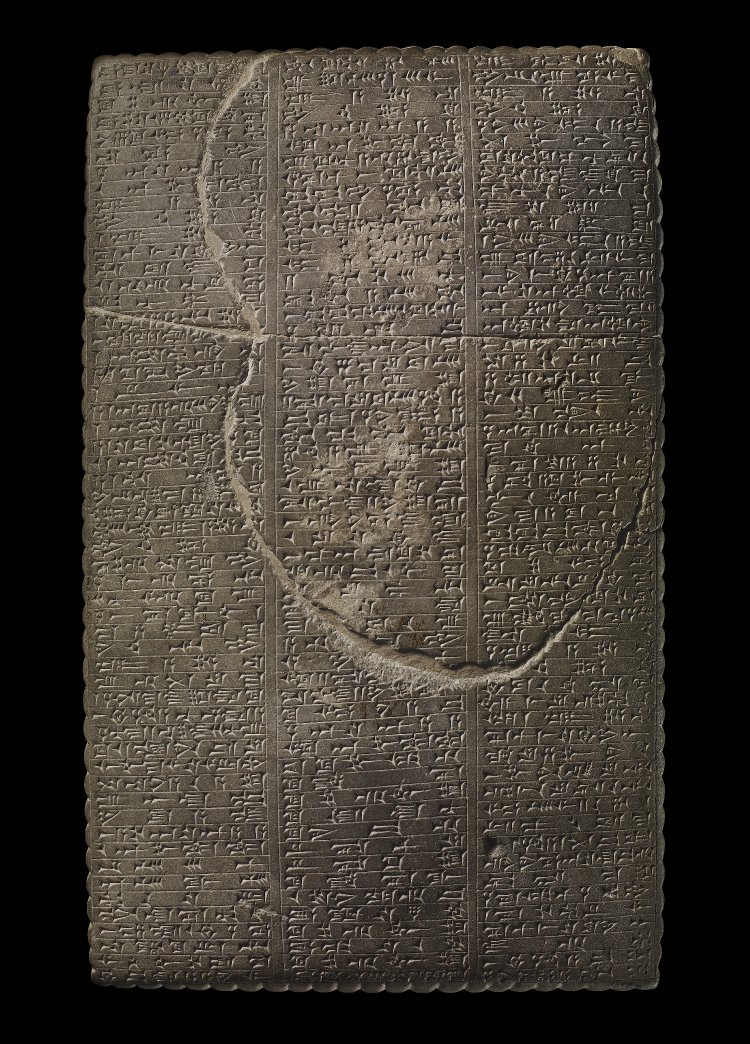
Museum number 91000 The engraved text contains a record of Nabu-apla-iddina's re-endowment of the Sun-Temple at Sippar. The inscription is engraved in six columns, three upon the obverse and three upon the reverse; and the upper part of the obverse is occupied by a scene sculptured in low relief; the edges of the tablet are bevelled.

Museum number 91000
The engraved text contains a record of Nabu-apla-iddina’s re-endowment of the Sun-Temple at Sippar. The inscription is engraved in six columns, three upon the obverse and three upon the reverse; and the upper part of the obverse is occupied by a scene sculptured in low relief; the edges of the tablet are bevelled.

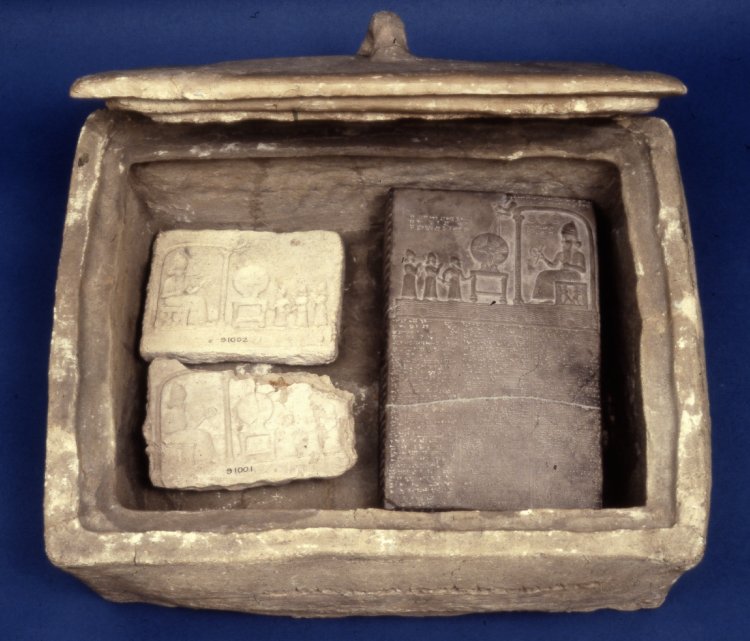
Museum number 91000 Group of Objects Pottery box and the limestone sun-god tablet and its covers deposited in it by Nabopolassar.

Museum number 91000
Group of Objects
Pottery box and the limestone sun-god tablet and its covers deposited in it by Nabopolassar.

The text of the Fifth Tablet, which would undoubtedly have supplied details as to Marduk’s arrangement and regulations for the sun, the moon, the stars, and the Signs of the Zodiac in the heavens is wanting.

The prominence of the celestial bodies in the history of creation is not to be wondered at, for the greater number of the religious beliefs of the Babylonians are grouped round them. Moreover, the science of astronomy had gone hand in hand with the superstition of astrology in Mesopotamia from time immemorial; and at a very early period the oldest gods of Babylonia were associated with the heavenly bodies.

Thus the Annunaki and the Igigi, who are bodies of deified spirits, were identified with the stars of the northern and southern heaven, respectively. And all the primitive goddesses coalesced and were grouped to form the goddess Ishtar, who was identified with the Evening and Morning Star, or Venus.

The Babylonians believed that the will of the gods was made known to men by the motions of the planets, and that careful observation of them would enable the skilled seer to recognize in the stars favourable and unfavourable portents. Such observations, treated from a magical point of view, formed a huge mass of literature which was being added to continually.

From the nature of the case this literature enshrined a very considerable number of facts of pure astronomy, and as early as the period of the First Dynasty (about 2000 B.C.), the Babylonians were able to calculate astronomical events with considerable accuracy, and to reconcile the solar and lunar years by the use of epagomenal months.

They had by that time formulated the existence of the Zodiac, and fixed the “stations” of the moon, and the places of the planets with it; and they had distinguished between the planets and the fixed stars. In the Fifth Tablet of the Creation Series (l. 2) the Signs of the Zodiac are called Lumashi, but unfortunately no list of their names is given in the context.

 Illustration: Tablet inscribed with a list of the Signs of the Zodiac. [No. 77,821.]


Illustration: Tablet inscribed with a list of the Signs of the Zodiac. [No. 77,821.]

Now these are supplied by the little tablet (No. 77,821) of the Persian Period of which a reproduction is here given. It has been referred to and discussed by various scholars, and its importance is very great. The transcript of the text, which is now published (see p. 68) for the first time, will be acceptable to the students of the history of the Zodiac.

Egyptian, Greek, Syriac and Arabic astrological and astronomical texts all associate with the Signs of the Zodiac twelve groups, each containing three stars, which are commonly known as the “Thirty-six Dekans.”

The text of line 4 of the Fifth Tablet of the Creation Series proves that the Babylonians were acquainted with these groups of stars, for we read that Marduk “set up for the twelve months of the year three stars apiece.” In the List of Signs of the Zodiac here given, it will be seen that each Sign is associated with a particular month.

At a later period, say about 500 B.C., the Babylonians made some of the gods regents of groups of stars, for Enlil ruled 33 stars, Anu 23 stars, and Ea 15 stars. They also possessed lists of the fixed stars, and drew up tables of the times of their heliacal risings.

Such lists were probably based upon very ancient documents, and prove that the astral element in Babylonian religion was very considerable.”

E.A. Wallis Budge, et al, & the British Museum, The Babylonian Legends of the Creation & the Fight Between Bel & the Dragon Told by Assyrian Tablets from Nineveh (BCE 668-626), 1901, pp. 10-11.

Marduk Kills Tiâmat

” … When Anu reported his inability to deal with Tiâmat, a council of the gods was called, and Ea induced his son, Marduk to be present.

We next find Anshar in converse with the god Marduk, who offers to act as the champion of the gods and to fight Tiâmat and her allies. Marduk being a form of the Sun-god, the greatest of all the powers of light, thus becomes naturally the protagonist of the gods, and the adversary of Tiâmat and her powers of darkness.

Then Anshar summoned a great council of the gods, who forthwith met in a place called “Upshukkinaku,” which may be described as the Babylonian Olympus. It was all-important for Marduk to appear at the council of the gods before he undertook his task, because it was necessary for him to be formally recognised by them as their champion, and he needed to be endowed by them with magical powers.

The primitive gods Lakhmu and Lakhamu, and the Igigi, who may be regarded as star-gods, were also summoned. A banquet was prepared, and the gods attended, and having met and kissed each other they sat down, and ate bread and drank hot and sweet sesame wine.

The fumes of the wine confused their senses, but they continued to drink, and at length “their spirits were exalted.” They appointed Marduk to be their champion officially, and then they proceeded to invest him with the power that would cause every command he spake to be followed immediately by the effect which he intended it to produce.

Next Marduk, with the view of testing the new power which had been given him, commanded a garment to disappear and it did so; and when he commanded it to reappear it did so.

Illustration: Shamash the Sun-god setting (?) on the horizon. In his right he holds a tree (?), and in his left a ... with a serrated edge. Above the horizon is a goddess who holds in her left hand an ear of corn. On the right is a god who seems to be setting free a bird from his right hand. Round him is a river with fish in it, and behind him is an attendant god; under his foot is a young bull. To the right of the goddess stand a hunting god, with a bow and lasso, and a lion. From the seal-cylinder of Adda ..., in the British Museum. About 2500 B.C. [No. 89,115.]

Illustration: Shamash the Sun-god setting (?) on the horizon. In his right he holds a tree (?), and in his left a … with a serrated edge. Above the horizon is a goddess who holds in her left hand an ear of corn. On the right is a god who seems to be setting free a bird from his right hand. Round him is a river with fish in it, and behind him is an attendant god; under his foot is a young bull. To the right of the goddess stand a hunting god, with a bow and lasso, and a lion. From the seal-cylinder of Adda …, in the British Museum. About 2500 B.C. [No. 89,115.]

Then the gods saluted him as their king, and gave him the insignia of royalty, namely, the sceptre, the throne and the pala, whatever that may be. And as they handed to him these things they commanded him to go and hack the body of Tiâmat in pieces, and to scatter her blood to the winds.

Thereupon Marduk began to arm himself for the fight. He took a bow, a spear, and a club; he filled his body full of fire and set the lightning before him. He took in his hands a net wherewith to catch Tiâmat, and he placed the four winds near it, to prevent her from escaping from it when he had snared her.

He created mighty winds and tempests to assist him, and grasped the thunderbolt in his hand; and then, mounting upon the Storm, which was drawn by four horses, he went out to meet and defeat Tiâmat. It seems pretty certain that this description of the equipment of Marduk was taken over from a very ancient account of the Fight with Tiâmat in which the hero was Enlil, i.e., the god of the air, or of the region which lies between heaven and hell.

Marduk approached and looked upon the “Middle” or “Inside” or “Womb” of Tiâmat, and divined the plan of Kingu who had taken up his place therein.

In the Seventh Tablet (l. 108) Marduk is said to have “entered into the middle of Tiâmat,” and because he did so he is called “Nibiru,” i.e., “he who entered in,” and the “seizer of the middle.” What the words “middle of Tiâmat” meant to the Babylonian we are not told, but it is clear that Marduk’s entry into it was a signal mark of the triumph of the god.

When Kingu from the “middle of Tiâmat” saw Marduk arrayed in his terrible panoply of war, he was terrified and trembled, and staggered about and lost all control of his legs; and at the mere sight of the god all the other fiends and devils were smitten with fear and reduced to helplessness.

Tiâmat saw Marduk and began to revile him, and when he challenged her to battle she flew into a rage and attempted to overthrow him by reciting an incantation, thinking that her words of power would destroy his strength. Her spell had no effect on the god, who at once cast his net over her.

At the same moment he made a gale of foul wind to blow on her face, and entering through her mouth it filled her body; whilst her body was distended he drove his spear into her, and Tiâmat split asunder, and her womb fell out from it.

Marduk leaped upon her body and looked on her followers as they attempted to escape. But the Four Winds which he had stationed round about Tiâmat made all their efforts to flee of no effect. Marduk caught all the Eleven allies of Tiâmat in his net, and he trampled upon them as they lay in it helpless.

Marduk then took the TABLET OF DESTINIES from Kingu’s breast, and sealed it with his seal and placed it on his own breast.”

E.A. Wallis Budge, et al, & the British Museum, The Babylonian Legends of the Creation & the Fight Between Bel & the Dragon Told by Assyrian Tablets from Nineveh (BCE 668-626), 1901, pp. 9-10.

In the End, Dwelling at the Mouth of the Rivers

[THE ABUBU (CYCLONE) AND ITS EFFECTS DESCRIBED.]

“97. As soon as something of dawn shone in the sky

98. A black cloud from the foundation of heaven came up.

99. Inside it the god Adad thundered,

100. The gods Nabû and Sharru (i.e., Marduk) went before,

101. Marching as messengers over high land and plain,

102. Irragal (Nergal) tore out the post of the ship,

103. En-urta went on, he made the storm to descend.

104. The Anunnaki brandished their torches,

105. With their glare they lighted up the land.

106. The whirlwind (or, cyclone) of Adad swept up to heaven.

107. Every gleam of light was turned into darkness.

108. . . . . . the land . . . . . as if had laid it waste.

109. A whole day long [the flood descended] . . .

110. Swiftly it mounted up . . . . . [the water] reached to the mountains

111. [The water] attacked the people like a battle.

112. Brother saw not brother.

113. Men could not be known (or, recognized) in heaven.

114. The gods were terrified at the cyclone.

115. They shrank back and went up into the heaven of Anu.

116. The gods crouched like a dog and cowered by the wall.

117. The goddess Ishtar cried out like a woman in travail.

118. The Lady of the Gods lamented with a sweet voice [saying]:

[ISHTAR’S LAMENT.]

119. May that former day be turned into mud,

120. Because I commanded evil among the company of the gods.

121. How could I command evil among the company of the gods,

122. Command battle for the destruction of my people?

123. Did I of myself bring forth my people

124. That they might fill the sea like little fishes?

[UTA-NAPISHTIM’S STORY CONTINUED.]

125. The gods, the Anunnaki wailed with her.

126. The gods bowed themselves, and sat down weeping.

127. Their lips were shut tight (in distress) . . .

128. For six days and nights

129. The wind, the storm raged, and the cyclone overwhelmed the land.

[THE ABATING OF THE STORM.]

130. When the seventh day came the cyclone ceased, the storm and battle

131. which had fought like an army.

132. The sea became quiet, the grievous wind went down, the cyclone ceased.

133. I looked on the day and voices were stilled,

134. And all mankind were turned into mud,

135. The land had been laid flat like a terrace.

136. I opened the air-hole and the light fell upon my cheek,

137. I bowed myself, I sat down, I cried,

138. My tears poured down over my cheeks.

139. I looked over the quarters of the world, (to] the limits of ocean.

140. At twelve points islands appeared.

141. The ship grounded on the mountain of Nisir.

142. The mountain of Nisir held the ship, it let it not move.

143. The first day, the second day, the mountain of Nisir held the ship and let it not move.

144. The third day, the fourth day, the mountain of Nisir held the ship and let it not move.

145. The fifth day, the sixth day, the mountain of Nisir held the ship and let it not move.

146. When the seventh day had come

147. I brought out a dove and let her go free.

148. The dove flew away and [then] came back;

149. Because she had no place to alight on she came back.

150. I brought out a swallow and let her go free.

151. The swallow flew away and [then] came back;

152. Because she had no place to alight on she came back.

153. 1 brought out a raven and let her go free.

154. The raven flew away, she saw the sinking waters.

155. She ate, she waded (?), she rose (?), she came not back.

[UTA-NAPISHTIM LEAVES THE SHIP.]

156. Then I brought out [everything] to the four winds and made a sacrifice;

157. I set out an offering on the peak of the mountain.

158. Seven by seven I set out the vessels,

159. Under them I piled reeds, cedarwood and myrtle (?).

160. The gods smelt the savour,

161. The gods smelt the sweet savour.

162. The gods gathered together like flies over him that sacrificed.

[SPEECH OF ISHTAR, LADY OF THE GODS.]

163 Now when the Lady of the Gods came nigh,

164. She lifted up the priceless jewels which Anu had made according to her desire, [saying]

165. O ye gods here present, as I shall never forget the sapphire jewels of my neck

166. So shall I ever think about these days, and shall forget them nevermore!

167. Let the gods come to the offering,

168. But let not Enlil come to the offering,

16q. Because he took not thought and made the cyclone,

170. And delivered my people over to destruction.”

[THE ANGER OF ENLIL.]

171. Now when Enlil came nigh

172. He saw the ship; then was Enlil wroth

173. And he was filled with anger against the gods, the Igigi [saying]:

174. Hath any being escaped with his life?

175. He shall not remain alive, a man among the destruction

[SPEECH OF EN-URTA.]

176. Then En-urta opened his mouth and spake

177. And said unto the warrior Enlil:

178. Who besides the god Ea can make a plan?

179. The god Ea knoweth everything that is done.

18o. The god Ea opened his mouth and spake

181. And said unto the warrior Enlil,

182. O Prince among the gods, thou warrior,

183. How, how couldst thou, not taking thought, make a cyclone?

184. He who is sinful, on him lay his sin,

185. He who transgresseth, on him lay his transgression.

186. But be merciful that [everything] be not destroyed be long-suffering that [man be not blotted out].

187. Instead of thy making a cyclone,

188. Would that the lion had come and diminished mankind.

189. Instead of thy making a cyclone

190. Would that the wolf had come and diminished mankind.

191. Instead of thy making a cyclone

192. Would that a famine had arisen and [laid waste] the land.

193. Instead of thy making a cyclone

194. Would that Irra (the Plague god) had risen up and [laid waste] the land.

195. As for me I have not revealed the secret of the great gods.

196. I made Atra-hasis to see a vision, and thus he heard the secret of the gods.

197. Now therefore take counsel concerning him.

[ENLIL DEIFIES UTA-NAPISHTIM AND HIS WIFE.]

198. Then the god Enlil went up into the ship,

199. He seized me by the hand and brought me forth.

200. He brought forth my wife and made her to kneel by my side.

201. He touched our brows, he stood between us, he blessed us [saving],

202. Formerly Uta-Napishtim was a man merely,

203. But now let Uta-Napishtim and his wife be like unto us gods.

204. Uta-Napishtim shall dwell afar off, at the mouth of the rivers.

[UTA-NAPISHTIM ENDS HIS STORY OF THE DELUGE.]

205. And they took me away to a place afar off, and made me to dwell at the mouth of the rivers.”

E.A. Wallis Budge, The Babylonian Story of the Deluge and the Epic of Gilgamish1929, pp. 35-40.

The Tale of Uta-Napishtim

[FIRST SPEECH OF EA TO UTA-NAPISHTIM WHO IS SLEEPING IN A REED HUT.]

“21. O House of reeds, O House of reeds! O Wall. O Wall!

22. O House of reeds, hear! O Wall, understand!

23. O man of Shurippak, son of Ubar-Tutu,

24. Throw down the house, build a ship,

25. Forsake wealth, seek after life,

26. Hate possessions, save thy life,

27. Bring all seed of life into the ship.

28. The ship which thou shalt build,

29. The dimensions thereof shall be measured,

30. The breadth and the length thereof shall be the same.

31. Then launch it upon the ocean.

[UTA-NAPISHTIM’S ANSWER TO EA.]

32. I understood and I said unto Ea, my lord:

33. See, my lord, that which thou hast ordered,

34. I regard with reverence, and will perform it,

35. But what shall I say to the town, to the multitude, and to the elders?

[SECOND SPEECH OF EA.]

36. Ea opened his mouth and spake

37. And said unto his servant, myself,

38. Thus, man, shalt thou say unto them:

39. Ill-will hath the god Enlil formed against me,

40. Therefore I can no longer dwell. in your city,

41. And never more will I turn my countenance upon-the soil of Enlil.

42. I will descend into the ocean to dwell with my lord Ea.

43. But upon you he will rain riches

44. A catch of birds, a catch of fish

45. . . . an [abundant] harvest,

46. . . . the sender of . . .

47. . . . shall make hail [to fall upon you].

[THE BUILDING OF THE SHIP.]

48. As soon as [something of dawn] broke . . .

    [Lines 49-54 broken away.]

55. The child . . . brought bitumen,

56. The strong [man] . . . brought what was needed.

57. On the fifth day I laid down its shape.

58. According to the plan its walls were 10 gar, (i.e. 120 cubits) high,

59. And the width of its deck (?) was equally 10 gar.

60. I laid down the shape of its forepart and marked it out (?).

61. I covered (?) it six times.

62. . . . I divided into seven,

63. Its interior I divided into nine,

64. Caulking I drove into the middle of it.

65. I provided a steering pole, and cast in all that was needful.

66. Six sar of bitumen I poured over the hull (?),

67. Three sar of pitch I poured into the inside.

68. The men who bear loads brought three sar of oil,

69. Besides a sar of oil which the tackling (?) consumed,

70. And two sar of oil which the boatman hid.

71. I slaughtered oxen for the [work] people,

72. I slew sheep every day.

73. Beer, sesame wine, oil and wine

74. I made the people drink as if they were water from the river.

75. I celebrated a feast as if it had been New Year’s Day.

76. I opened [a box of ointment], I laid my hands in unguent.

77. Before the sunset (?) the ship was finished.

78. [Since] . . . was difficult.

79. The shipbuilders brought the . . . of the ship, above and below,

80. . . . two-thirds of it.

[THE LOADING OF THE SHIP.]

81. With everything that I possessed I loaded it (i.e., the ship).

82. With everything that I possessed of silver I loaded it.

83. With everything that I possessed of gold I loaded it.

84. With all that I possessed of all the seed of life I loaded it.

85. I made to go up into the ship all my family and kinsfolk,

86. The cattle of the field, the beasts of the field, all handicraftsmen I made them go up into it.

87. The god Shamash had appointed me a time (saying)

88. The sender of . . . . . will at eventide make a hail to fall;

89. Then enter into the ship and shut thy door.

90. The appointed time drew nigh;

91. The sender of . . . . . made a hail to fall at eventide.

92. I watched the aspect of the [approaching] storm,

93. Terror possessed me to look upon it,

94. I went into the ship and shut my door.

95. To the pilot of the ship, Puzur-Enlil the sailor

96. I committed the great house (i.e., ship), together with the contents thereof.”

E.A. Wallis Budge, The Babylonian Story of the Deluge and the Epic of Gilgamish1929, pp. 33-5.

The 11th Tablet of the Epic of Gilgamesh and the Quest for Human Immortality

THE BABYLONIAN LEGEND OF THE DELUGE AS TOLD TO THE HERO GILGAMISH BY HIS ANCESTOR UTA-NAPISHTIM, WHO HAD BEEN MADE IMMORTAL BY THE GODS.

“The form of the Legend of the Deluge given below is that which is found on the Eleventh of the Series of Twelve Tablets in the Royal Library at Nineveh, which described the life and exploits of Gilgamish, an early king of the city of Erech.

As we have seen above, the Legend of the Deluge has probably no original connection with the Epic of Gilgamish, but was introduced into it by the editors of the Epic at a comparatively late period, perhaps even during the reign of Ashur-bani-pal (B.C. 669-626).

… It is … only necessary to state here that Gilgamish, who was horrified and almost beside himself when his bosom friend and companion Enkidu died, meditated deeply how he could escape death himself. He knew that his ancestor Uta-Napishtim had become immortal, therefore he determined to set out for the place where Uta-Napishtim lived so that he might obtain from him the secret of immortality.

Guided by a dream, Gilgamish set out for the Mountain of the Sunset, and, after great toil and many difficulties, came to the shore of a vast sea. Here he met Ur-Shanabi, the boatman of Uta-Napishtim, who was persuaded to carry him in his boat over the “waters of death,” and at length he landed on the shore of the country of Uta-Napishtim.

The immortal came down to the shore and asked the newcomer the object of his visit, and Gilgamish told him of the death of his great friend Enkidu, and of his desire to escape from death and to find immortality. Uta-Napishtim having made to Gilgamish some remarks which seem to indicate that in his opinion death was inevitable,

1. Gilgamish said unto him, to Uta-Napishtim the remote:

2. “I am looking at thee, Uta-Napishtim.

3. Thy person is not altered; even as am I so art thou.

4. Verily, nothing about thee is changed; even as am I so art thou.

5. A heart to do battle doth make thee complete,

6. Yet at rest (?) thou dost lie upon thy back.

7. How then hast thou stood the company of the gods and sought life?”

Thereupon Uta-Napishtim related to Gilgamish the Story of the Deluge, and the Eleventh Tablet continues thus

8. Uta-Napishtim said unto him, to Gilgamish:

9. “I will reveal unto thee, O Gilgamish, a hidden mystery,

10. And a secret matter of the gods I will declare unto thee.

11. Shurippak, a city which thou thyself knowest,

12. On [the bank] of the river Puratti (Euphrates) is situated,

13. That city is old; and the gods [dwelling] within it

14. Their hearts induced the great gods to make a windstorm (a-bu-bi),

15. There was their father Anu,

16. Their counsellor, the warrior Enlil,

17. Their messenger En-urta [and]

18. Their prince Ennugi.

19. Nin-igi-ku, Ea, was with them [in council] and

20. reported their word to a house of reeds.”

E.A. Wallis Budge, The Babylonian Story of the Deluge and the Epic of Gilgamish1929, pp. 30-2.

Mankind Was Created from the Blood of a God and Earth

” … When Marduk had arranged heaven and earth, and had established the gods in their places, the gods complained that their existence was barren, because they lacked worshippers at their shrines and offerings.

To make a way out of this difficulty Marduk devised another “cunning plan,” and announced his intention of creating man out of “blood and bone” DAMI IṢṢIMTUM .

We have already quoted (see p. 11) the statement of Berosus that man was created out of the blood of a god mixed with earth; here, then, is the authority for his words.

Marduk made known to Ea his intention of creating man, and Ea suggested that if one of the gods were sacrificed the remainder of them should be set free from service, presumably to Marduk.

Thereupon Marduk summons a council of the gods, and asks them to name the instigator of the fight in which he himself was the victor.

In reply the gods named Kingu, Tiâmat’s second husband, whom they seized forthwith, and bound with fetters and carried to Ea, and then having “inflicted punishment upon him they let his blood.”

From Kingu’s blood Ea fashioned mankind for the service of the gods.

Now among the texts which have been found on the tablets at Ḳal’at Sharḳât is an account of the creation of man which differs from the version given in the Seven Tablets of Creation, but has two features in common with it. These two features are:

(1) the council of the gods to discuss the creation of man;

(2) the sacrifice which the gods had to make for the creation of man. In the variant version two (or more) gods are sacrificed, Ilu Nagar Ilu Nagari.e., “the workmen gods,” about whom nothing is known.

The place of sacrifice is specified with some care, and it is said to be “Uzu-mu-a, or the bond of heaven and earth.” Uzu-mu-a may be the bolt with which Marduk locked the two halves of Tiâmat into place.

The Anunnaki, wishing to give an expression of their admiration for Marduk’s heroism, decided to build him a shrine or temple. To this Marduk agreed, and chose Babylon, i.e., the “Gate of God,” for its site.

The Anunnaki themselves made the bricks, and they built the great temple of E-Sagila at Babylon. When the temple was finished, Marduk re-enacted the scene of creation; for, as he had formerly assigned to each god his place in the heavens, so now he assigned to each god his place in E-Sagila.

The tablet ends with a long hymn of praise which the Anunnaki sang to Marduk, and describes the summoning of an assembly of the gods to proclaim ceremonially the great Fifty Names of this god. Thus the gods accepted the absolute supremacy of Marduk.”

E.A. Wallis Budge, The Babylonian Legends of the Creation and the Fight Between Bel and the Dragon, 1921.

The Assassination of Sargon

Thus “Sargon the Later” entered at length into full possession of the empire of Sargon of Akkad. In Babylonia he posed as an incarnation of his ancient namesake, and had similarly Messianic pretensions which were no doubt inspired by the Babylonian priesthood. Under him Assyria attained its highest degree of splendour.

He recorded proudly not only his great conquests but also his works of public utility: he restored ancient cities, irrigated vast tracts of country, fostered trade, and promoted the industries. Like the pious Pharaohs of Egypt he boasted that he fed the hungry and protected the weak against the strong.

” … Sargon found time during his strenuous career as a conqueror to lay out and build a new city, called Dur-Sharrukin, “the burgh of Sargon,” to the north of Nineveh. It was completed before he undertook the Babylonian campaign. The new palace was occupied in 708 B.C. Previous to that period he had resided principally at Kalkhi, in the restored palace of Ashur-natsir-pal III.

He was a worshipper of many gods. Although he claimed to have restored the supremacy of Ashur “which had come to an end,” he not only adored Ashur but also revived the ancient triad of Anu, Bel, and Ea, and fostered the growth of the immemorial “mother-cult” of Ishtar.

Before he died he appointed one of his sons, Sennacherib, viceroy of the northern portion of the empire. He was either assassinated at a military review or in some frontier war. As much is suggested by the following entry in an eponym list.

Eponymy of Upahhir-belu, prefect of the city of Amedu …

According to the oracle of the Kulummite(s)…. A soldier

(entered) the camp of the king of Assyria (and killed him?), month

Ab, day 12th, Sennacherib (sat on the throne).

The fact that Sennacherib lamented his father’s sins suggests that the old king had in some manner offended the priesthood. Perhaps, like some of the Middle Empire monarchs, he succumbed to the influence of Babylon during the closing years of his life.

It is stated that “he was not buried in his house,” which suggests that the customary religious rites were denied him, and that his lost soul was supposed to be a wanderer which had to eat offal and drink impure water like the ghost of a pauper or a criminal.”

Donald A. Mackenzie, Myths of Babylonia and Assyria, 1915, pp. 462-4.

The Legends of Queen Semiramis

The legends of Semiramis indicate that Sammu-rammat was associated like Queen Tiy with the revival of mother worship.

As we have said, she went down to tradition as the daughter of the fish goddess, Derceto. Pliny identified that deity with Atargatis of Hierapolis.

In Babylonia the fish goddess was Nina, a developed form of Damkina, spouse of Ea of Eridu. In the inscription on the Nebo statue, that god is referred to as the “son of Nudimmud” (Ea). Nina was the goddess who gave her name to Nineveh, and it is possible that Nebo may have been regarded as her son during the Semiramis period.

The story of Semiramis’s birth is evidently of great antiquity. It seems to survive throughout Europe in the nursery tale of the “Babes in the Wood.” A striking Indian parallel is afforded by the legend of Shakuntala, which may be first referred to for the purpose of comparative study.

Shakuntala was the daughter of the rishi, Viswamitra, and Menaka, the Apsara (celestial fairy). Menaka gave birth to her child beside the sacred river Malini.

“And she cast the new-born infant on the bank of that river and went away. And beholding the newborn infant lying in that forest destitute of human beings but abounding with lions and tigers, a number of vultures sat around to protect it from harm.”

A sage discovered the child and adopted her. “Because,” he said, “she was surrounded by Shakuntas (birds), therefore hath she been named by me Shakuntala (bird protected).”

Semiramis was similarly deserted at birth by her Celestial mother. She was protected by doves, and her Assyrian name, Sammu-rammat, is believed to be derived from “Summat“–“dove,” and to signify “the dove goddess loveth her.”

Simmas, the chief of royal shepherds, found the child and adopted her. She was of great beauty like Shakuntala, the maiden of “perfect symmetry,” “sweet smiles,” and “faultless features,” with whom King Dushyanta fell in love and married in Gandharva fashion.

Semiramis became the wife of Onnes, governor of Nineveh, and one of the generals of its alleged founder, King Ninus. She accompanied her husband to Bactria on a military campaign, and is said to have instructed the king how that city should be taken.

Ninus fell in love with Semiramis, and Onnes, who refused to give her up, went and hanged himself. The fair courtesan then became the wife of the king.

The story proceeds that Semiramis exercised so great an influence over the impressionable King Ninus, that she persuaded him to proclaim her Queen of Assyria for five days. She then ascended the throne decked in royal robes. On the first day she gave a great banquet, and on the second thrust Ninus into prison, or had him put to death. In this manner she secured the empire for herself. She reigned for over forty years.

Professor Frazer inclines to the view that the legend is a reminiscence of the custom of appointing a mock king and queen to whom the kingdom was yielded up for five days. Semiramis played the part of the mother goddess, and the priestly king died a violent death in the character of her divine lover.

“The mounds of Semiramis which were pointed out all over Western Asia were said to have been the graves of her lovers whom she buried alive…. This tradition is one of the surest indications of the identity of the mythical Semiramis with the Babylonian goddess Ishtar or Astarte.”

As we have seen, Ishtar and other mother goddesses had many lovers whom they deserted like La Belle Dame sans Merci (pp. 174-175).

As Queen of Assyria, Semiramis was said to have cut roads through mountainous districts and erected many buildings. According to one version of the legend she founded the city of Babylon. Herodotus, however, says in this connection:

“Semiramis held the throne for five generations before the later princess (Nitocris)…. She raised certain embankments, well worthy of inspection, in the plain near Babylon, to control the river (Euphrates), which, till then, used to overflow and flood the whole country round about.”

Lucian, who associates the famous queen with “mighty works in Asia,” states that she was reputed by some to be the builder of the ancient temple of Aphrodite in the Libanus, although others credited it to Cinyras, or Deukalion.

Several Median places bear her name, and according to ancient Armenian tradition she was the founder of Van, which was formerly called “Shamiramagerd.” Strabo tells that unidentified mountains in Western Asia were named after Semiramis.

Indeed, many of the great works in the Tigro-Euphrates valley, not excepting the famous inscription of Darius, were credited to the legendary queen of Babylonia and Assyria. She was the rival in tradition of the famous Sesostris of Egypt as a ruler, builder, and conqueror.

All the military expeditions of Semiramis were attended with success, except her invasion of India. She was supposed to have been defeated in the Punjab. After suffering this disaster she died, or abdicated the throne in favour of her son Ninyas.

The most archaic form of the legend appears to be that she was turned into a dove and took flight to heaven in that form. After her death she was worshipped as a dove goddess like “Our Lady of Trees and Doves” in Cyprus, whose shrine at old Paphos was founded, Herodotus says, by Phoenician colonists from Askalon.

Fish and doves were sacred to Derceto (Attar), who had a mermaid form. “I have beheld”, says Lucian, “the image of Derceto in Phoenicia. A marvellous spectacle it is. One half is a woman, but the part which extends from thighs to feet terminates with the tail of a fish.”

Donald A. Mackenzie, Myths of Babylonia and Assyria, 1915, pp. 423-6.

Human Sacrifice in Ancient Babylon

” … All the younger gods, who displaced the elder gods as one year displaces another, were deities of fertility, battle, lightning, fire, and the sun; it is possible, therefore, that Ashur was like Merodach, son of Ea, god of the deep, a form of Tammuz in origin.

His spirit was in the solar wheel which revolved at times of seasonal change. In Scotland it was believed that on the morning of May Day (Beltaine) the rising sun revolved three times. The younger god was a spring sun god and fire god. Great bonfires were lit to strengthen him, or as a ceremony of riddance; the old year was burned out.

Indeed the god himself might be burned (that is, the old god), so that he might renew his youth. Melkarth was burned at Tyre. Hercules burned himself on a mountain top, and his soul ascended to heaven as an eagle.

These fiery rites were evidently not unknown in Babylonia and Assyria. When, according to Biblical narrative, Nebuchadnezzar “made an image of gold” which he set up “in the plain of Dura, in the province of Babylon,” he commanded:

“O people, nations, and languages… at the time ye hear the sound of the cornet, flute, harp, sackbut, psaltery, dulcimer, and all kinds of musick… fall down and worship the golden image.”

Certain Jews who had been “set over the affairs of the province of Babylonia,” namely, “Shadrach, Meshach, and Abed-nego,” refused to adore the idol.

They were punished by being thrown into “a burning fiery furnace”, which was heated “seven times more than it was wont to be heated.” They came forth uninjured.

In the Koran it is related that Abraham destroyed the images of Chaldean gods; he “brake them all in pieces except the biggest of them; that they might lay the blame on that.” According to the commentators the Chaldaeans were at the time “abroad in the fields, celebrating a great festival.”

To punish the offender Nimrod had a great pyre erected at Cuthah.

“Then they bound Abraham, and putting him into an engine, shot him into the midst of the fire, from which he was preserved by the angel Gabriel, who was sent to his assistance.”

Eastern Christians were wont to set apart in the Syrian calendar the 25th of January to commemorate Abraham’s escape from Nimrod’s pyre.

It is evident that the Babylonian fire ceremony was observed in the spring season, and that human beings were sacrificed to the sun god. A mock king may have been burned to perpetuate the ancient sacrifice of real kings, who were incarnations of the god.

Isaiah makes reference to the sacrificial burning of kings in Assyria:

“For through the voice of the Lord shall the Assyrian be beaten down, which smote with a rod. And in every place where the grounded staff shall pass, which the Lord shall lay upon him, it shall be with tabrets and harps: and in battles of shaking will he fight with it.

For Tophet is ordained of old; yea, for the king it is prepared: he hath made it deep and large: the pile thereof is fire and much wood: the breath of the Lord, like a stream of brimstone, doth kindle it.”

When Nineveh was about to fall, and with it the Assyrian Empire, the legendary king, Sardanapalus, who was reputed to have founded Tarsus, burned himself, with his wives, concubines, and eunuchs, on a pyre in his palace. Zimri, who reigned over Israel for seven days, “burnt the king’s house over him with fire.”

Saul, another fallen king, was burned after death, and his bones were buried “under the oak in Jabesh”.

In Europe the oak was associated with gods of fertility and lightning, including Jupiter and Thor. The ceremony of burning Saul is of special interest. Asa, the orthodox king of Judah, was, after death, “laid in the bed which was filled with sweet odours and divers kinds of spices prepared by the apothecaries’ art: and they made a very great burning for him” (2 Chronicles, xvi, 14).

Jehoram, the heretic king of Judah, who “walked in the way of the kings of Israel,” died of “an incurable disease. And his people made no burning for him like the burning of his fathers” (2 Chronicles, xxi, 18, 19).

The conclusion suggested by the comparative study of the beliefs of neighbouring peoples, and the evidence afforded by Assyrian sculptures, is that Ashur was a highly developed form of the god of fertility, who was sustained, or aided in his conflicts with demons, by the fires and sacrifices of his worshippers.”

Donald A. Mackenzie, Myths of Babylonia and Assyria, 1915, pp. 348-51.

Hammurabi Restored the Temples

” … Hammurabi’s reign was long as it was prosperous. There is no general agreement as to when he ascended the throne–some say in 2123 B.C., others hold that it was after 2000 B.C.–but it is certain that he presided over the destinies of Babylon for the long period of forty-three years.

There are interesting references to the military successes of his reign in the prologue to the legal Code. It is related that when he “avenged Larsa,” the seat of Rim-Sin, he restored there the temple of the sun god.

Other temples were built up at various ancient centres, so that these cultural organizations might contribute to the welfare of the localities over which they held sway. At Nippur he thus honoured Enlil, at Eridu the god Ea, at Ur the god Sin, at Erech the god Anu and the goddess Nana (Ishtar), at Kish the god Zamama and the goddess Ma-ma, at Cuthah the god Nergal, at Lagash the god Nin-Girsu, while at Adab and Akkad, “celebrated for its wide squares,” and other centres he carried out religious and public works.

In Assyria he restored the colossus of Ashur, which had evidently been carried away by a conqueror, and he developed the canal system of Nineveh.

[ … ]

Hammurabi referred to himself in the Prologue as “a king who commanded obedience in all the four quarters.” He was the sort of benevolent despot whom Carlyle on one occasion clamoured vainly for–not an Oriental despot in the commonly accepted sense of the term.

As a German writer puts it, his despotism was a form of Patriarchal Absolutism. “When Marduk (Merodach),” as the great king recorded, “brought me to direct all people, and commissioned me to give judgment, I laid down justice and right in the provinces, I made all flesh to prosper.”

That was the keynote of his long life; he regarded himself as the earthly representative of the Ruler of all–Merodach, “the lord god of right,” who carried out the decrees of Anu, the sky god of Destiny.”

Donald A. Mackenzie, Myths of Babylonia and Assyria, 1915.

Herodotus on the Glory of Babylon

“The rise of Babylon inaugurated a new era in the history of Western Asia.

[ … ]

Considerable wealth had accumulated at Babylon when the Dynasty of Ur reached the zenith of its power. It is recorded that King Dungi plundered its famous “Temple of the High Head,” E-sagila, which some identify with the Tower of Babel, so as to secure treasure for Ea’s temple at Eridu, which he specially favoured.

His vandalistic raid, like that of the Gutium, or men of Kutu, was remembered for long centuries afterwards, and the city god was invoked at the time to cut short his days.

No doubt, Hammurabi’s Babylon closely resembled the later city so vividly described by Greek writers, although it was probably not of such great dimensions.

According to Herodotus, it occupied an exact square on the broad plain, and had a circumference of sixty of our miles. “While such is its size,” the historian wrote, “in magnificence there is no other city that approaches to it.” Its walls were eighty-seven feet thick and three hundred and fifty feet high, and each side of the square was fifteen miles in length.

The whole city was surrounded by a deep, broad canal or moat, and the river Euphrates ran through it.

[ … ]

(Herodotus continues): In the circuit of the wall are a hundred gates, all of brass, with brazen lintels and side posts.” These were the gates referred to by Isaiah when God called Cyrus:

I will loose the loins of kings, to open before him the two leaved gates; and the gates shall not be shut: I will go before thee, and make the crooked places straight; I will break in pieces the gates of brass, and cut in sunder the bars of iron.

The outer wall was the main defence of the city, but there was also an inner wall less thick but not much inferior in strength. In addition, a fortress stood in each division of the city. The king’s palace and the temple of Bel Merodach were surrounded by walls.

All the main streets were perfectly straight, and each crossed the city from gate to gate, a distance of fifteen miles, half of them being interrupted by the river, which had to be ferried. As there were twenty-five gates on each side of the outer wall, the great thoroughfares numbered fifty in all, and there were six hundred and seventy-six squares, each over two miles in circumference.

From Herodotus we gather that the houses were three or four stories high, suggesting that the tenement system was not unknown, and according to Q. Curtius, nearly half of the area occupied by the city was taken up by gardens within the squares.”

Donald A. Mackenzie, Myths of Babylonia and Assyria, 1915.

Magical Raiment

” … Some bodies which were laid in Sumerian graves were wrapped up in reed matting, a custom which suggests that the reeds afforded protection or imparted magical powers. Magical ceremonies were performed in Babylonian reed huts.

As we have seen, Ea revealed the “purpose” of the gods, when they resolved to send a flood, by addressing the reed hut in which Pir-napishtim lay asleep. Possibly it was believed that the dead might also have visions in their dreams which would reveal the “purpose” of demons who were preparing to attack them.

In Syria it was customary to wrap the dead in a sheep skin. As priests and gods were clad in the skins of animals from which their powers were derived, it is probable that the dead were similarly supposed to receive inspiration in their skin coverings.

The Highland seer was wrapped in a bull’s skin and left all night beside a stream so as to obtain knowledge of the future. This was a form of the Taghairm ceremony, which is referred to by Scott in his Lady of the Lake.

The belief in the magical influence of sacred clothing gave origin to the priestly robes. When David desired to ascertain what Saul intended to do he said, “Bring hither the ephod.” Then he came to know that his enemy had resolved to attack Keilah.

Elisha became a prophet when he received Elijah’s mantle.”

Donald A. Mackenzie, Myths of Babylonia and Assyria, 1915.

Different Categories of Paradise

” … In the sacred books of India a number of Paradises are referred to. No human beings, however, entered the Paradise of Varuna, who resembles the Sumerian Ea-Oannes.

The souls of the dead found rest and enjoyment in the Paradise of Yama, while “those kings that yield up their lives, without turning their backs on the field of battle, attain,” as the sage told a hero, “to the mansion of Indra,” which recalls the Valhal of Odin. It will thus be seen that belief in immortality was a tenet of the Indian cults of Indra and Yama.

It is possible that the Gilgamesh epic in one of its forms concluded when the hero reached the island of Pir-napishtim, like the Indian Yama who “searched and spied the path for many.” The Indian “Land of the Pitris” (Ancestors), over which Yama presided, may be compared to the Egyptian heaven of Osiris. It contains, we are told, “all kinds of enjoyable articles,” and also “sweet, juicy, agreeable and delicious edibles … floral wreaths of the most delicious fragrance, and trees that yield fruits that are desired of them.”

Thither go “all sinners among human beings, as also (those) that have died during the winter solstice”–a suggestion that this Paradise was not unconnected with the Tammuz-like deity who took up his abode in the spirit land during the barren season.

The view may be urged that in the Gilgamesh epic we have a development of the Tammuz legend in its heroic form. Like Ishtar, when she descended to Hades, the King of Erech could not return to earth until he had been sprinkled by the water of life. No doubt, an incident of this character occurred also in the original Tammuz legend. The life of the god had to be renewed before he could return.

Did he slumber, like one of the Seven Sleepers, in Ea’s house, and not awake again until he arrived as a child in his crescent moon boat–“the sunken boat” of the hymns–like Scef, who came over the waves to the land of the Scyldings?”

Donald A. Mackenzie, Myths of Babylonia and Assyria, 1915.

The Babylonian Account of the Deluge

The story of the Deluge which was related to Gilgamesh by Pir-napishtim runs as follows:–

“Hear me, O Gilgamesh, and I will make revelation regarding the hidden doings of the high gods. As thou knowest, the city of Shurippak is situated upon the bank of the Euphrates. The gods were within it: there they assembled together in council.

Anu, the father, was there, and Bel the counsellor and warrior, Ninip the messenger, and Ennugi the governor. Ea, the wise lord, sat also with them. In their hearts the gods agreed together to send a great deluge.

“Thereafter Ea made known the purpose of the divine rulers in the hut of reeds, saying: ‘O hut of reeds, hear; O wall, understand … O man of Shurippak, son of Umbara Tutu, tear down thy house and build a ship; leave all thou dost possess and save thy life, and preserve in the ship the living seed of every kind. The ship that thou wilt build must be of goodly proportions in length and height. It must be floated on the great deep.’

“I heard the command of Ea and understood, and I made answer, saying, ‘O wise lord, as thou hast said so will I do, for thy counsel is most excellent. But how shall I give reason for my doings to the young men and the elders?’

“Ea opened his mouth and said unto me, his servant: ‘What thou shalt say unto them is this…. It hath been revealed unto me that Bel doth hate me, therefore I cannot remain any longer in his domain, this city of Shurippak, so I must depart unto the domain of Ea and dwell with him…. Unto you will Bel send abundance of rain, so that you may obtain birds and fishes in plenty and have a rich harvest. But Shamash hath appointed a time for Ramman to pour down destruction from the heavens.‘”

Ea then gave instructions to Pir-napishtim how to build the ship in which he should find refuge. So far as can be gathered from the fragmentary text, it appears that this vessel was to have a deck house six stories high, with nine apartments in each story. According to another account, Ea drew a plan of the great ship upon the sand.

Pir-napishtim set to work and made a flat-bottomed vessel, which was 120 cubits wide and 120 cubits in height. He smeared it with bitumen inside and pitch outside; and on the seventh day it was ready. Then he carried out Ea’s further instructions. Continuing his narrative to Gilgamesh, he said:

“I gathered together all that I possessed, my silver and gold and seeds of every kind, and my goods also. These I placed in the ship. Then I caused to go aboard all my family and house servants, the animals of the field and the beasts of the field and the workers–every one of them I sent up.

“The god Shamash appointed the time, saying: ‘I will cause the Night Lord to send much rain and bring destruction. Then enter thou the ship and shut thy door.’

“At the appointed time the Night Lord sent at even-time much rain. I saw the beginning of the deluge and I was afraid to look up. I entered the ship and shut the door. I appointed Buzur-Kurgala, the sailor, to be captain, and put under his command the great vessel and all that it contained.

“At the dawn of day I saw rising athwart the heavens a dark cloud, and in the midst of it Ramman thundered. Nebo and Merodach went in front, speeding like emissaries over hills and plains. The cables of the ship were let loose.

“Then Ninip, the tempest god, came nigh, and the storm broke in fury before him. All the earth spirits leapt up with flaming torches and the whole land was aflare. The thunder god swept over the heavens, blotting out the sunlight and bringing thick darkness.

Rain poured down the whole day long, and the earth was covered with water; the rivers were swollen; the land was in confusion; men stumbled about in the darkness, battling with the elements.

Brothers were unable to see brothers; no man could recognize his friends…. The spirits above looked down and beheld the rising flood and were afraid: they fled away, and in the heaven of Anu they crouched like to hounds in the protecting enclosures.

“In time Ishtar, the lady of the gods, cried out distressfully, saying: ‘The elder race hath perished and turned to clay because that I have consented to evil counsel in the assembly of the gods. Alas! I have allowed my people to be destroyed. I gave being to man, but where is he? Like the offspring of fish he cumbers the deep.’

“The earth spirits were weeping with Ishtar: they sat down cowering with tightened lips and spake not; they mourned in silence.

“Six days and six nights went past, and the tempest raged over the waters which gradually covered the land. But when the seventh day came, the wind fell, the whirling waters grew peaceful, and the sea retreated. The storm was over and the rain of destruction had ceased. I looked forth. I called aloud over the waters. But all mankind had perished and turned to clay. Where fields had been I saw marshes only.

“Then I opened wide the window of the ship, and the sunlight suffused my countenance. I was dazzled and sank down weeping and the tears streamed over my face. Everywhere I looked I saw water.

“At length, land began to appear. The ship drifted towards the country of Nitsir, and then it was held fast by the mountain of Nitsir. Six days went past and the ship remained stedfast. On the seventh day I sent forth a dove, and she flew away and searched this way and that, but found no resting place, so she returned.

I then sent forth a swallow, and she returned likewise. Next I sent forth a raven, and she flew away. She saw that the waters were shrinking, and gorged and croaked and waded, but did not come back. Then I brought forth all the animals into the air of heaven.

“An offering I made on the mountain. I poured out a libation. I set up incense vessels seven by seven on heaped-up reeds and used cedar wood with incense. The gods smelt the sweet savour, and they clustered like flies about the sacrificer.

“Thereafter Ishtar (Sirtu) drew nigh. Lifting up the jewels, which the god Anu had fashioned for her according to her desire, she spake, saying: ‘Oh! these gods! I vow by the lapis lazuli gems upon my neck that I will never forget! I will remember these days for ever and ever. Let all the gods come hither to the offering, save Bel (Enlil) alone, because that he ignored my counsel, and sent a great deluge which destroyed my people.’

“But Bel Enlil came also, and when he beheld the ship he paused. His heart was filled with wrath against the gods and the spirits of heaven. Angrily he spake and said: ‘Hath one escaped? It was decreed that no human being should survive the deluge.’

“Ninip, son of Bel, spoke, saying: ‘Who hath done this save Ea alone? He knoweth all things.’

“Ea, god of the deep, opened his mouth and said unto the warrior Bel: ‘Thou art the lord of the gods, O warrior. But thou wouldst not hearken to my counsel and caused the deluge to be. Now punish the sinner for his sins and the evil doer for his evil deed, but be merciful and do not destroy all mankind. May there never again be a flood.

Let the lion come and men will decrease. May there never again be a flood. Let the leopard come and men will decrease. May there never again be a flood. Let famine come upon the land; let Ura, god of pestilence, come and snatch off mankind…. I did not reveal the secret purpose of the mighty gods, but I caused Atra-chasis (Pir-napishtim) to dream a dream in which he had knowledge of what the gods had decreed.’

“Having pondered a time over these words, Bel entered the ship alone. He grasped my hand and led me forth, even me, and he led forth my wife also, and caused her to kneel down beside me. Then he stood between us and gave his blessing.

He spoke, saying: ‘In time past Pir-napishtim was a man. Henceforth Pir-napishtim and his wife will be like unto deities, even us. Let them dwell apart beyond the river mouths.’

“Thereafter Bel carried me hither beyond the mouths of rivers.”

Donald A. Mackenzie, Myths of Babylonia and Assyria, 1915.

Excerpts from the Epic of Gilgamesh

” … Pir-napishtim made answer, reminding the pilgrim that all men must die. Men built houses, sealed contracts, disputed one with another, and sowed seeds in the earth, but as long as they did so and the rivers rose in flood, so long would their fate endure. Nor could any man tell when his hour would come. The god of destiny measured out the span of life: he fixed the day of death, but never revealed his secrets.

Gilgamesh then asked Pir-napishtim how it chanced that he was still alive. “Thou hast suffered no change,” he said, “thou art even as I am. Harden not thy heart against me, but reveal how thou hast obtained divine life in the company of the gods.”

Pir-napishtim thereupon related to his descendant the story of the deluge … The gods had resolved to destroy the world, and Ea in a dream revealed unto Pir-napishtim how he could escape. He built a ship which was tossed about on the waters, and when the world had been destroyed, Bel discovered him and transported him to that island in the midst of the Sea of Death.

Gilgamesh sat in the boat listening to the words of his ancestor. When the narrative was ended, Pir-napishtim spoke sympathetically and said: “Who among the gods will restore thee to health, O Gilgamesh? Thou hast knowledge of my life, and thou shalt be given the life thou dost strive after. Take heed, therefore, to what I say unto thee. For six days and seven nights thou shalt not lie down, but remain sitting like one in the midst of grief.”

Gilgamesh sat in the ship, and sleep enveloped him like to a black storm cloud.

Pir-napishtim spoke to his wife and said: “Behold the hero who desireth to have life. Sleep envelops him like to a black storm cloud.”

To that lone man his wife made answer: “Lay thine hand upon him so that he may have perfect health and be enabled to return to his own land. Give him power to pass through the mighty door by which he entered.”

Then Pir-napishtim addressed his wife, saying: “His sufferings make me sad. Prepare thou for him the magic food, and place it near his head.”

On the day when Gilgamesh lay down, the food was prepared by seven magic processes, and the woman administered it while yet he slept. Then Pir-napishtim touched him, and he awoke full of life.

Gilgamesh spake unto Pir-napishtim and said: “I was suddenly overcome by sleep…. But thou didst awaken me by touching me, even thou…. Lo! I am bewitched. What hast thou done unto thy servant?”

Then Pir-napishtim told Gilgamesh that he had been given to eat of the magic food. Afterwards he caused Arad Ea to carry Gilgamesh to a fountain of healing, where his disease-stricken body was cleansed. The blemished skin fell from him, and he was made whole.

Thereafter Gilgamesh prepared to return to his own land. Ere he bade farewell, however, Pir-napishtim revealed unto him the secret of a magic plant which had power to renew life and give youth and strength unto those who were old.

Arad Ea conducted the hero to the island where the plant grew, and when Gilgamesh found it he rejoiced, and said that he would carry it to Erech, his own city, where he would partake of it and restore his youth.

So Gilgamesh and Arad Ea went on their way together, nor paused until they came to a well of pure water. The hero stooped down to draw water. But while he was thus engaged that demon, the Earth Lion, crept forth as a serpent, and, seizing the magic plant of life, carried it away. Stricken with terror, Gilgamesh uttered a curse. Then he sat down and wept bitterly, and the tears streamed over his face. To Arad Ea he spake, saying: “Why has my health been restored to me? Why should I rejoice because that I live? The benefit which I should have derived for myself has now fallen to the Earth Lion.”

The two travellers then resumed their journey, performing religious acts from time to time; chanting dirges and holding feasts for the dead, and at length Gilgamesh returned to Erech. He found that the city walls were crumbling, and he spake regarding the ceremonies which had been performed while yet he was in a far-distant country.

During the days which followed Gilgamesh sorrowed for his lost friend Ea-bani, whose spirit was in the Underworld, the captive of the spirits of death. “Thou canst not draw thy bow now,” he cried, “nor raise the battle shout. Thou canst not kiss the woman thou hast loved; thou canst not kiss the child thou hast loved, nor canst thou smite those whom thou hast hated.”

In vain Gilgamesh appealed to his mother goddess to restore Ea-bani to him. Then he turned to the gods, and Ea heard him. Thereafter Nergal, god of death, caused the grave to yawn, and the spirit of Ea-bani arose like a wind gust.

Gilgamesh, still dreading death, spoke to the ghost of his friend, saying: “Tell me, my friend, O tell me regarding the land in which thou dost dwell.”

Ea-bani made answer sorrowfully: “Alas! I cannot tell thee, my friend. If I were to tell thee all, thou wouldst sit down and weep.”

Said Gilgamesh: “Let me sit down and weep, but tell me regarding the land of spirits.”

The text is mutilated here, but it can be gathered that Ea-bani described the land where ill-doers were punished, where the young were like the old, where the worm devoured, and dust covered all. But the state of the warrior who had been given burial was better than that of the man who had not been buried, and had no one to lament or care for him.

“He who hath been slain in battle,” the ghost said, “reposeth on a couch drinking pure water–one slain in battle as thou hast seen and I have seen. His head is supported by his parents: beside him sits his wife. His spirit doth not haunt the earth.

But the spirit of that man whose corpse has been left unburied and uncared for, rests not, but prowls through the streets eating scraps of food, the leavings of the feast, and drinking the dregs of vessels.”

So ends the story of Gilgamesh in the form which survives to us.”

Donald A. Mackenzie, Myths of Babylonia and Assyria, 1915.

The Amorous Queen of Heaven Sat as One in Darkness

“It is evident that there were various versions of the Tammuz myth in Ancient Babylonia. In one the goddess Ishtar visited Hades to search for the lover of her youth. A part of this form of the legend survives in the famous Assyrian hymn known as The Descent of Ishtar. It was first translated by the late Mr. George Smith, of the British Museum.

A box containing inscribed tablets had been sent from Assyria to London, and Mr. Smith, with characteristic patience and skill, arranged and deciphered them, giving to the world a fragment of ancient literature infused with much sublimity and imaginative power.

Ishtar is depicted descending to dismal Hades, where the souls of the dead exist in bird forms:

I spread like a bird my hands.

I descend, I descend to the house of darkness, the dwelling of the god Irkalla:

To the house out of which there is no exit,

To the road from which there is no return:

To the house from whose entrance the light is taken,

The place where dust is their nourishment and their food mud.

Its chiefs also are like birds covered with feathers;

The light is never seen, in darkness they dwell….

Over the door and bolts is scattered dust.

When the goddess reaches the gate of Hades she cries to the porter:

Keeper of the waters, open thy gate,

Open thy gate that I may enter.

If thou openest not the gate that I may enter

I will strike the door, the bolts I will shatter,

I will strike the threshold and will pass through the doors;

I will raise up the dead to devour the living,

Above the living the dead shall exceed in numbers.

The porter answers that he must first consult the Queen of Hades, here called Allatu, to whom he accordingly announces the arrival of the Queen of Heaven. Allatu’s heart is filled with anger, and makes reference to those whom Ishtar caused to perish:

Let me weep over the strong who have left their wives,

Let me weep over the handmaidens who have lost the embraces of their husbands,

Over the only son let me mourn, who ere his days are come is taken away.

Then she issues abruptly the stern decree:

Go, keeper, open the gate to her,

Bewitch her according to the ancient rules;

that is, “Deal with her as you deal with others who come here.”

As Ishtar enters through the various gates she is stripped of her ornaments and clothing. At the first gate her crown was taken off, at the second her ear-rings, at the third her necklace of precious stones, at the fourth the ornaments of her breast, at the fifth her gemmed waist-girdle, at the sixth the bracelets of her hands and feet, and at the seventh the covering robe of her body.

Ishtar asks at each gate why she is thus dealt with, and the porter answers, “Such is the command of Allatu.”

After descending for a prolonged period the Queen of Heaven at length stands naked before the Queen of Hades. Ishtar is proud and arrogant, and Allatu, desiring to punish her rival whom she cannot humble commands the plague demon, Namtar, to strike her with disease in all parts of her body. The effect of Ishtar’s fate was disastrous upon earth: growth and fertility came to an end.

Meanwhile Pap-sukal, messenger of the gods, hastened to Shamash, the sun deity, to relate what had occurred. The sun god immediately consulted his lunar father, Sin, and Ea, god of the deep. Ea then created a man lion, named Nadushu-namir, to rescue Ishtar, giving him power to pass through the seven gates of Hades. When this being delivered his message …

Allatu … struck her breast; she bit her thumb,

She turned again: a request she asked not.

In her anger she cursed the rescuer of the Queen of Heaven.

May I imprison thee in the great prison,

May the garbage of the foundations of the city be thy food,

May the drains of the city be thy drink,

May the darkness of the dungeon be thy dwelling,

May the stake be thy seat,

May hunger and thirst strike thy offspring.

She was compelled, however, to obey the high gods, and addressed Namtar, saying:

Unto Ishtar give the waters of life and bring her before me.

Thereafter the Queen of Heaven was conducted through the various gates, and at each she received her robe and the ornaments which were taken from her on entering. Namtar says:

Since thou hast not paid a ransom for thy deliverance to her (Allatu), so to her again turn back,

For Tammuz the husband of thy youth.

The glistening waters (of life) pour over him…

In splendid clothing dress him, with a ring of crystal adorn him.

Ishtar mourns for “the wound of Tammuz,” smiting her breast, and she did not ask for “the precious eye-stones, her amulets,” which were apparently to ransom Tammuz. The poem concludes with Ishtar’s wail:

O my only brother (Tammuz) thou dost not lament for me.

In the day that Tammuz adorned me, with a ring of crystal,

With a bracelet of emeralds, together with himself, he adorned me,

With himself he adorned me; may men mourners and women mourners

On a bier place him, and assemble the wake.

A Sumerian hymn to Tammuz throws light on this narrative. It sets forth that Ishtar descended to Hades to entreat him to be glad and to resume care of his flocks, but Tammuz refused or was unable to return.

His spouse unto her abode he sent back.

She then instituted the wailing ceremony:

The amorous Queen of Heaven sits as one in darkness.”

Donald A. Mackenzie, Myths of Babylonia and Assyria, 1915.
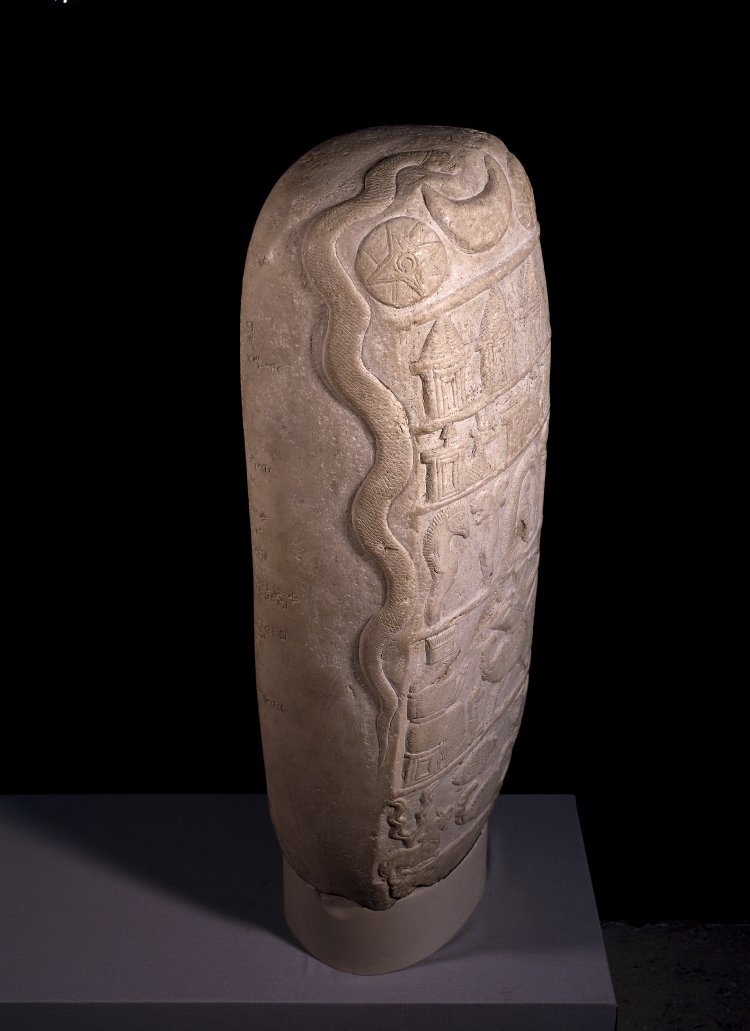
Tammuz

“Among the gods of Babylonia none achieved wider and more enduring fame than Tammuz, who was loved by Ishtar, the amorous Queen of Heaven–the beautiful youth who died and was mourned for and came to life again. He does not figure by his popular name in any of the city pantheons, but from the earliest times of which we have knowledge until the passing of Babylonian civilization, he played a prominent part in the religious life of the people.

Tammuz, like Osiris of Egypt, was an agricultural deity, and as the Babylonian harvest was the gift of the rivers, it is probable that one of his several forms was Dumu-zi-abzu, “Tammuz of the Abyss.” He was also “the child,” “the heroic lord,” “the sentinel,” “the healer,” and the patriarch who reigned over the early Babylonians for a considerable period.

“Tammuz of the Abyss” was one of the members of the family of Ea, god of the Deep, whose other sons, in addition to Merodach, were Nira, an obscure deity; Ki-gulla, “world destroyer,” Burnunta-sa, “broad ear,” and Bara and Baragulla, probably “revealers” or “oracles.” In addition there was a daughter, Khi-dimme-azaga, “child of the renowned spirit”. She may have been identical with Belit-sheri, who is referred to in the Sumerian hymns as the sister of Tammuz.

This family group was probably formed by symbolizing the attributes of Ea and his spouse Damkina. Tammuz, in his character as a patriarch, may have been regarded as a hostage from the gods: the human form of Ea, who instructed mankind, like King Osiris, how to grow corn and cultivate fruit trees. As the youth who perished annually, he was the corn spirit. He is referred to in the Bible by his Babylonian name.

When Ezekiel detailed the various idolatrous practices of the Israelites, which included the worship of the sun and “every form of creeping things and abominable beasts”–a suggestion of the composite monsters of Babylonia–he was brought “to the door of the gate of the Lord’s house, which was towards the north; and, behold, there sat women weeping for Tammuz.”

The weeping ceremony was connected with agricultural rites. Corn deities were weeping deities, they shed fertilizing tears; and the sowers simulated the sorrow of divine mourners when they cast seed in the soil “to die,” so that it might spring up as corn. This ancient custom, like many others, contributed to the poetic imagery of the Bible. “They that sow in tears,” David sang, “shall reap in joy. He that goeth forth and weepeth, bearing precious seed, shall doubtless come again with rejoicing, bringing his sheaves with him.”

In Egypt the priestesses who acted the parts of Isis and Nepthys, mourned for the slain corn god Osiris.

Gods and men before the face of the gods are weeping for

thee at the same time, when they behold me!…

All thy sister goddesses are at thy side and behind thy couch,

Calling upon thee with weeping–yet thou are prostrate upon thy bed!…

Live before us, desiring to behold thee.

It was believed to be essential that human beings should share the universal sorrow caused by the death of a god. If they remained unsympathetic, the deities would punish them as enemies. Worshippers of nature gods, therefore, based their ceremonial practices on natural phenomena.

“The dread of the worshippers that the neglect of the usual ritual would be followed by disaster, is particularly intelligible,” writes Professor Robertson Smith, “if they regarded the necessary operations of agriculture as involving the violent extinction of a particle of divine life.”

By observing their ritual, the worshippers won the sympathy and co-operation of deities, or exercised a magical control over nature.”

Donald A. Mackenzie, Myths of Babylonia and Assyria, 1915.

Gods, Goddesses, Demons

” … In the early stages of Sumerian culture, the gods and goddesses who formed groups were indistinguishable from demons. They were vaguely defined, and had changing shapes. When attempts were made to depict them they were represented in many varying forms. Some were winged bulls or lions with human heads; others had even more remarkable composite forms. The “dragon of Babylon”, for instance, which was portrayed on walls of temples, had a serpent’s head, a body covered with scales, the fore legs of a lion, hind legs of an eagle, and a long wriggling serpentine tail. Ea had several monster forms. The following description of one of these is repulsive enough:–

The head is the head of a serpent,

From his nostrils mucus trickles,

His mouth is beslavered with water;

The ears are like those of a basilisk,

His horns are twisted into three curls,

He wears a veil in his head band,

The body is a suh-fish full of stars,

The base of his feet are claws,

The sole of his foot has no heel,

His name is Sassu-wunnu,

A sea monster, a form of Ea.

R.C. Thompson’s Translation.

Even after the gods were given beneficent attributes to reflect the growth of culture, and were humanized, they still retained many of their savage characteristics. Bel Enlil and his fierce son, Nergal, were destroyers of mankind; the storm god desolated the land; the sky god deluged it with rain; the sea raged furiously, ever hungering for human victims; the burning sun struck down its victims; and the floods played havoc with the dykes and houses of human beings.

In Egypt the sun god Ra was similarly a “producer of calamity,” the composite monster god Sokar was “the lord of fear”. Osiris in prehistoric times had been “a dangerous god,” and some of the Pharaohs sought protection against him in the charms inscribed in their tombs.

The Indian Shiva, “the Destroyer”, in the old religious poems has also primitive attributes of like character.

The Sumerian gods never lost their connection with the early spirit groups. These continued to be represented by their attendants, who executed a deity’s stern and vengeful decrees. In one of the Babylonian charms the demons are referred to as “the spleen of the gods”–the symbols of their wrathful emotions and vengeful desires.

Bel Enlil, the air and earth god, was served by the demons of disease, “the beloved sons of Bel,” which issued from the Underworld to attack mankind. Nergal, the sulky and ill-tempered lord of death and destruction, who never lost his demoniac character, swept over the land, followed by the spirits of pestilence, sunstroke, weariness, and destruction.

Anu, the sky god, had “spawned” at creation the demons of cold and rain and darkness. Even Ea and his consort, Damkina, were served by groups of devils and giants, which preyed upon mankind in bleak and desolate places when night fell. In the ocean home of Ea were bred the “seven evil spirits” of tempest–the gaping dragon, the leopard which preyed upon children, the great Beast, the terrible serpent, &c.

In Indian mythology Indra was similarly followed by the stormy Maruts, and fierce Rudra by the tempestuous Rudras.

In Teutonic mythology Odin is the “Wild Huntsman in the Raging Host.”

In Greek mythology the ocean furies attend upon fickle Poseidon.

Other examples of this kind could be multiplied.”

Donald A. Mackenzie, Myths of Babylonia and Assyria, 1915.