Samizdat

Publishing the Forbidden. All Rights Reserved. © Samizdat 2014-2025.

Tag: Chaldean oracles

Eco: Kabbalism and Lullism in Modern Culture
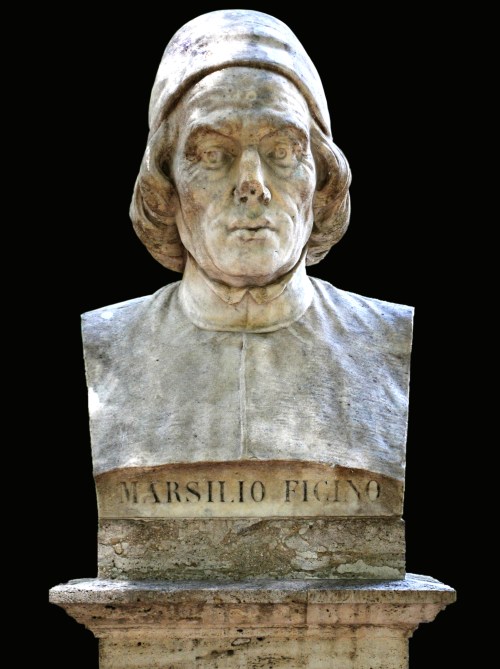
Marsilio_Ficino

Marsilio Ficino (1433-99), a bust published in “Marsilio Ficino and Renaissance Neoplatonism,” by Nicholas Goodrick-Clarke, on Rosicrucian.org. This work is in the public domain in its country of origin and other countries and areas where the copyright term is the author’s life plus 100 years or less. 

“Hebrew was not the only beneficiary of the passion for archaic wisdom that gripped scholars from the end of the Middle Ages onwards. The dawn of the modern era also saw a revival of interest in Greek thought and in the Greek’s fascination with Egypt and its mysterious hieroglyphic script (see ch. 7).

Greek texts were rediscovered and enthusiastically assigned an antiquity they did not, in fact, possess. They included the Orphic Hymns, attributed to Orpheus, but, in fact, written probably between the second and third centuries AD; the Chaldean Oracles, also written in the second century, but attributed to Zoroaster; and, above all, the Corpus Hermeticum.

This was a compilation acquired in 1460 for Cosimo de’ Medici in Florence, and immediately rushed to Marsilio Ficino so that he might translate it.

This last compilation, as was later shown, was the least archaic of all. In 1614, by using stylistic evidence and by comparing the innumerable contradictions among the documents, Isaac Casaubon, in his De rebus sacris et ecclesiasticis, showed that it was a collection of texts by different authors, all writing in late Hellenistic times under the influences of Egyptian spirituality.

None of this was apparent in 1460, however. Ficino took the texts to be archaic, directly written by the mythical Hermes or Mercurius Trismegistus.

Ficino was struck to discover that his account of the creation of the universe resembled that of Genesis, yet–he said–we should not be amazed, because Mercurius could be none other than Moses himself (Theologica platonica, 8, 1).

This enormous historical error, as Yates says, was destined to have surprising results (1964: 18-9).

The Hermetic tradition provided a magico-astrological  account of the cosmos. Celestial bodies exercise their power and influence over earthly things, and by knowing the planetary laws one can not only predict these influences, but also manipulate them.

There exists a relation of sympathy between the universal macrocosm and the human microcosm, a latticework of forces which it is possible to harness through astral magic.

Astral magic was practiced through words and other signs, because there is a language by which human beings can command the stars. Such miracles can be performed through “talismans,” that is, images which might guarantee safe recovery, health or physical prowess.

In his De vita coelitus comparanda, Ficino provided a wealth of details concerning how such talismans were to be worn; how certain plants linked by sympathy to certain stars were to be consumed; how magical ceremonies were to be celebrated with the proper perfumes, garments and songs.

Talismanic magic works because the bond which unites the occult virtues of earthly things and the celestial bodies which instilled them is expressed by signatures, that is, formal aspects of material things that recall certain features (properties or powers) of the corresponding heavenly bodies.

God himself has rendered the sympathies between macrocosm and microcosm perceptible by stamping a mark, a sort of seal, onto each object of this world (cf. Thorndike 1923-58; Foucault 1966; Couliano 1984; Bianchi 1987).

In a text that can stand as the foundation for such a doctrine of signatures, Paracelsus declared that:

“The ars signata teaches the way in which the true and genuine names must be assigned to all things, the same names that Adam, the Protoplastus, knew in the complete and perfect way [ . . . ] which show, at the same time, the virtue, the power, and the property of this or that thing. [ . . . ]

This is the signator who signs the horns of the stag with branches so that his age may be known: the stag having as many years as his horns have branches. [ . . . ] This is the signator who covers the tongue of a sick sow with excrescences, so that her impurity may be known; if the tongue is impure so the whole body is impure.

This is the signator who tints the clouds with divers colors, whereby it is possible to forecast the changes of the heavens. (De natura rerum, I, 10, “De signatura rerum“).”

Even the Middle Ages were aware that “habent corpora omnia ad invisibilia bona simulitudinem” (Richard of Saint Victor, Benjamin Major, PL, 196, 90): all bodies possess qualities which give them similarities with invisible goods.

In consequence, every creature of the universe was an image, a mirror reflecting our terrestrial and supernatural destinies. Nevertheless, it did not occur to the Middle Ages that these images might speak in a perfect language.

They required interpretation, explication and comment; they needed to be enclosed in a rational didactic framework where they could be elucidated, deciphered, in order to make clear the mystical affinities between a symbol and its content.

For Renaissance Platonism, by contrast, the relation between the images and the ideas to which they referred was considered so intuitively direct that the very distinction between a symbol and its meaning disappeared (see Gombrich 1972: “Icones Symbolicae,” v).

Umberto Eco, The Search for the Perfect Language, translated by James Fentress, Blackwell. Oxford, 1995, pp. 117-9.
Eco: Before and After Europe, 2

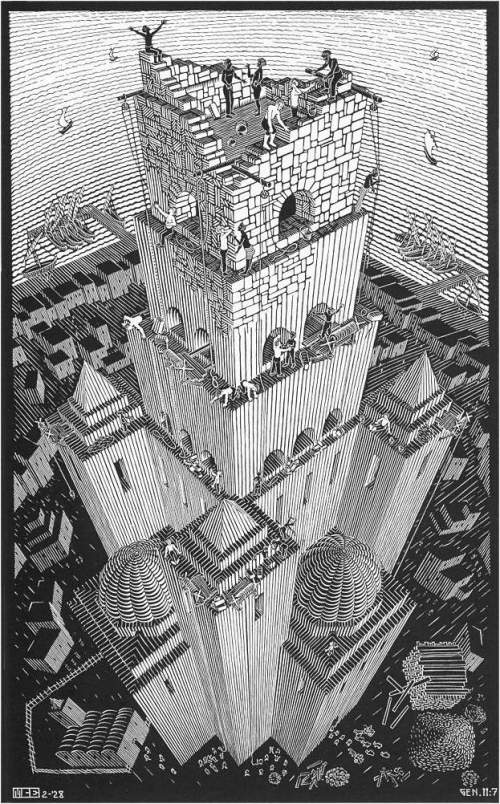
babel

MC Escher, Tower of Babel, 1928. This image of a drawing is copyrighted by the artist, who died in 1972. Low-resolution images of works of art for purposes of critical commentary qualify for fair use under United States copyright law.

“Despite this, by the second century AD, there had begun to form the suspicion that Latin and Greek might not be the only languages which expressed harmoniously the totality of experience.

Slowly spreading across the Greco-Roman world, obscure revelations appeared; some were attributed to Persian magi, others to an Egyptian divinity called Thoth-Hermes, to Chaldean oracles, and even to the very Pythagorean and Orphic traditions which, though born on Greek soil, had long been smothered under the weight of the great rationalist philosophy.

By now, the classical rationalism, elaborated and re-elaborated over centuries, had begun to show signs of age. With this, traditional religion entered a period of crisis as well. The imperial pagan religion had become a purely formal affair, no more than a simple expression of loyalty.

Each people had been allowed to keep its own gods. These were accommodated to the Latin pantheon, no one bothering over contradictions, synonyms or homonyms. The term characterizing this leveling toleration for any type of religion (and for any type of philosophy or knowledge as well) is syncretism.

An unintended result of this syncretism, however, was that a diffused sort of religiosity began to grow in the souls of the most sensitive. It was manifested by a belief in the universal World Soul; a soul which subsisted in stars and in earthly objects alike.

Our own, individual, souls were but small particles of the great World Soul. Since the reason of philosophers proved unable to supply truths about important matters such as these, men and women sought revelations beyond reason, through visions, and through communications with the godhead itself.

It was in this climate that Pythagoreanism was reborn. From its beginnings, Pythagoreans had regarded themselves as the keepers of a mystic form of knowledge, and practiced initiatory rites.

Their understanding of the laws of music and mathematics was presented as the fruit of revelation obtained from the Egyptians. By the time of Pythagoreanism’s second appearance, however, Egyptian civilization had been eradicated by the Greek and Latin conquerors.

Egypt itself had now become an enigma, no more than an incomprehensible hieroglyph. Yet there is nothing more fascinating than secret wisdom: one is sure that it exists, but one does not know what it is. In the imagination, therefore, it shines as something unutterably profound.

That such wisdom could exist while still remaining unknown, however, could only be accounted for by the fact that the language in which this wisdom was expressed had remained unknown as well.

This was the reasoning of Diogenes Laertius, who wrote in his Lives of the Philosophers in the third century AD:

“There are those who assert that philosophy started among the Barbarians: there were, they claim, Magi among the Persians, the Chaldeans, the Babylonians, the Assyrians, the Gymnosophists of India, the Druids among the Celts and Galatians” (I).

The classical Greeks had identified barbarians as those who could not even articulate their speech. It now seemed that these very mumblings were of a sacred language, filled with the promise of tacit revelations (Festugière 1944-54:I).

I have given a summary of the cultural atmosphere at this time because, albeit in a delayed fashion, it was destined to have a deep influence on our story. Although no one at the time proposed the reconstruction of the perfect language, the need for one was, by now, vaguely felt.

We shall see that the suggestions, first planted during these years, flowered more than twelve centuries later in humanistic and Renaissance culture (and beyond); this will constitute a central thread in the story I am about to tell.

In the meantime, Christianity had become a state religion, expressed in the Greek of the patristic East and in the Latin still spoken in the West. After St. Jerome translated the Old Testament in the fourth century, the need to know Hebrew as a sacred language grew weaker. This happened to Greek as well.

A typical example of this cultural lack is given by St. Augustine, a man of vast culture, and the most important exponent of Christian thought at the end of the empire.

The Christian revelation is founded on an Old Testament written in Hebrew and a New Testament written, for the most part, in Greek. St. Augustine, however, knew no Hebrew; and his knowledge of Greek was, to say the least, patchy (cf. Marrou 1958).

This amounts to a somewhat paradoxical situation: the man who set himself the task of interpreting scripture in order to discover the true meaning of the divine word could read it only in a Latin translation.

The notion that he ought to consult the Hebrew original never really seems to have entered Augustine’s mind. He did not entirely trust the Jews, nurturing a suspicion that, in their versions, they might have erased all references to the coming of Christ.

The only critical procedure he would allow was that of comparing translations in order to find the most likely version. In this way, St. Augustine, though the father of hermeneutics, was certainly not destined to become the father of philology.”

Umberto Eco, The Search for the Perfect Language, translated by James Fentress, Blackwell. Oxford, 1995, pp. 12-4.