Samizdat

Publishing the Forbidden. All Rights Reserved. © Samizdat 2014-2025.

Tag: Bible

Human Sacrifice in Ancient Babylon

” … All the younger gods, who displaced the elder gods as one year displaces another, were deities of fertility, battle, lightning, fire, and the sun; it is possible, therefore, that Ashur was like Merodach, son of Ea, god of the deep, a form of Tammuz in origin.

His spirit was in the solar wheel which revolved at times of seasonal change. In Scotland it was believed that on the morning of May Day (Beltaine) the rising sun revolved three times. The younger god was a spring sun god and fire god. Great bonfires were lit to strengthen him, or as a ceremony of riddance; the old year was burned out.

Indeed the god himself might be burned (that is, the old god), so that he might renew his youth. Melkarth was burned at Tyre. Hercules burned himself on a mountain top, and his soul ascended to heaven as an eagle.

These fiery rites were evidently not unknown in Babylonia and Assyria. When, according to Biblical narrative, Nebuchadnezzar “made an image of gold” which he set up “in the plain of Dura, in the province of Babylon,” he commanded:

“O people, nations, and languages… at the time ye hear the sound of the cornet, flute, harp, sackbut, psaltery, dulcimer, and all kinds of musick… fall down and worship the golden image.”

Certain Jews who had been “set over the affairs of the province of Babylonia,” namely, “Shadrach, Meshach, and Abed-nego,” refused to adore the idol.

They were punished by being thrown into “a burning fiery furnace”, which was heated “seven times more than it was wont to be heated.” They came forth uninjured.

In the Koran it is related that Abraham destroyed the images of Chaldean gods; he “brake them all in pieces except the biggest of them; that they might lay the blame on that.” According to the commentators the Chaldaeans were at the time “abroad in the fields, celebrating a great festival.”

To punish the offender Nimrod had a great pyre erected at Cuthah.

“Then they bound Abraham, and putting him into an engine, shot him into the midst of the fire, from which he was preserved by the angel Gabriel, who was sent to his assistance.”

Eastern Christians were wont to set apart in the Syrian calendar the 25th of January to commemorate Abraham’s escape from Nimrod’s pyre.

It is evident that the Babylonian fire ceremony was observed in the spring season, and that human beings were sacrificed to the sun god. A mock king may have been burned to perpetuate the ancient sacrifice of real kings, who were incarnations of the god.

Isaiah makes reference to the sacrificial burning of kings in Assyria:

“For through the voice of the Lord shall the Assyrian be beaten down, which smote with a rod. And in every place where the grounded staff shall pass, which the Lord shall lay upon him, it shall be with tabrets and harps: and in battles of shaking will he fight with it.

For Tophet is ordained of old; yea, for the king it is prepared: he hath made it deep and large: the pile thereof is fire and much wood: the breath of the Lord, like a stream of brimstone, doth kindle it.”

When Nineveh was about to fall, and with it the Assyrian Empire, the legendary king, Sardanapalus, who was reputed to have founded Tarsus, burned himself, with his wives, concubines, and eunuchs, on a pyre in his palace. Zimri, who reigned over Israel for seven days, “burnt the king’s house over him with fire.”

Saul, another fallen king, was burned after death, and his bones were buried “under the oak in Jabesh”.

In Europe the oak was associated with gods of fertility and lightning, including Jupiter and Thor. The ceremony of burning Saul is of special interest. Asa, the orthodox king of Judah, was, after death, “laid in the bed which was filled with sweet odours and divers kinds of spices prepared by the apothecaries’ art: and they made a very great burning for him” (2 Chronicles, xvi, 14).

Jehoram, the heretic king of Judah, who “walked in the way of the kings of Israel,” died of “an incurable disease. And his people made no burning for him like the burning of his fathers” (2 Chronicles, xxi, 18, 19).

The conclusion suggested by the comparative study of the beliefs of neighbouring peoples, and the evidence afforded by Assyrian sculptures, is that Ashur was a highly developed form of the god of fertility, who was sustained, or aided in his conflicts with demons, by the fires and sacrifices of his worshippers.”

Donald A. Mackenzie, Myths of Babylonia and Assyria, 1915, pp. 348-51.
Tammuz

“Among the gods of Babylonia none achieved wider and more enduring fame than Tammuz, who was loved by Ishtar, the amorous Queen of Heaven–the beautiful youth who died and was mourned for and came to life again. He does not figure by his popular name in any of the city pantheons, but from the earliest times of which we have knowledge until the passing of Babylonian civilization, he played a prominent part in the religious life of the people.

Tammuz, like Osiris of Egypt, was an agricultural deity, and as the Babylonian harvest was the gift of the rivers, it is probable that one of his several forms was Dumu-zi-abzu, “Tammuz of the Abyss.” He was also “the child,” “the heroic lord,” “the sentinel,” “the healer,” and the patriarch who reigned over the early Babylonians for a considerable period.

“Tammuz of the Abyss” was one of the members of the family of Ea, god of the Deep, whose other sons, in addition to Merodach, were Nira, an obscure deity; Ki-gulla, “world destroyer,” Burnunta-sa, “broad ear,” and Bara and Baragulla, probably “revealers” or “oracles.” In addition there was a daughter, Khi-dimme-azaga, “child of the renowned spirit”. She may have been identical with Belit-sheri, who is referred to in the Sumerian hymns as the sister of Tammuz.

This family group was probably formed by symbolizing the attributes of Ea and his spouse Damkina. Tammuz, in his character as a patriarch, may have been regarded as a hostage from the gods: the human form of Ea, who instructed mankind, like King Osiris, how to grow corn and cultivate fruit trees. As the youth who perished annually, he was the corn spirit. He is referred to in the Bible by his Babylonian name.

When Ezekiel detailed the various idolatrous practices of the Israelites, which included the worship of the sun and “every form of creeping things and abominable beasts”–a suggestion of the composite monsters of Babylonia–he was brought “to the door of the gate of the Lord’s house, which was towards the north; and, behold, there sat women weeping for Tammuz.”

The weeping ceremony was connected with agricultural rites. Corn deities were weeping deities, they shed fertilizing tears; and the sowers simulated the sorrow of divine mourners when they cast seed in the soil “to die,” so that it might spring up as corn. This ancient custom, like many others, contributed to the poetic imagery of the Bible. “They that sow in tears,” David sang, “shall reap in joy. He that goeth forth and weepeth, bearing precious seed, shall doubtless come again with rejoicing, bringing his sheaves with him.”

In Egypt the priestesses who acted the parts of Isis and Nepthys, mourned for the slain corn god Osiris.

Gods and men before the face of the gods are weeping for

thee at the same time, when they behold me!…

All thy sister goddesses are at thy side and behind thy couch,

Calling upon thee with weeping–yet thou are prostrate upon thy bed!…

Live before us, desiring to behold thee.

It was believed to be essential that human beings should share the universal sorrow caused by the death of a god. If they remained unsympathetic, the deities would punish them as enemies. Worshippers of nature gods, therefore, based their ceremonial practices on natural phenomena.

“The dread of the worshippers that the neglect of the usual ritual would be followed by disaster, is particularly intelligible,” writes Professor Robertson Smith, “if they regarded the necessary operations of agriculture as involving the violent extinction of a particle of divine life.”

By observing their ritual, the worshippers won the sympathy and co-operation of deities, or exercised a magical control over nature.”

Donald A. Mackenzie, Myths of Babylonia and Assyria, 1915.

The Behistun Inscription

“In 1854 Sir Henry Rawlinson superintended diggings at Birs Nimrud (Borsippa, near Babylon), and excavated relics of the Biblical Nebuchadrezzar. This notable archaeologist began his career in the East as an officer in the Bombay army. He distinguished himself as a political agent and diplomatist. While resident at Baghdad, he devoted his leisure time to cuneiform studies.

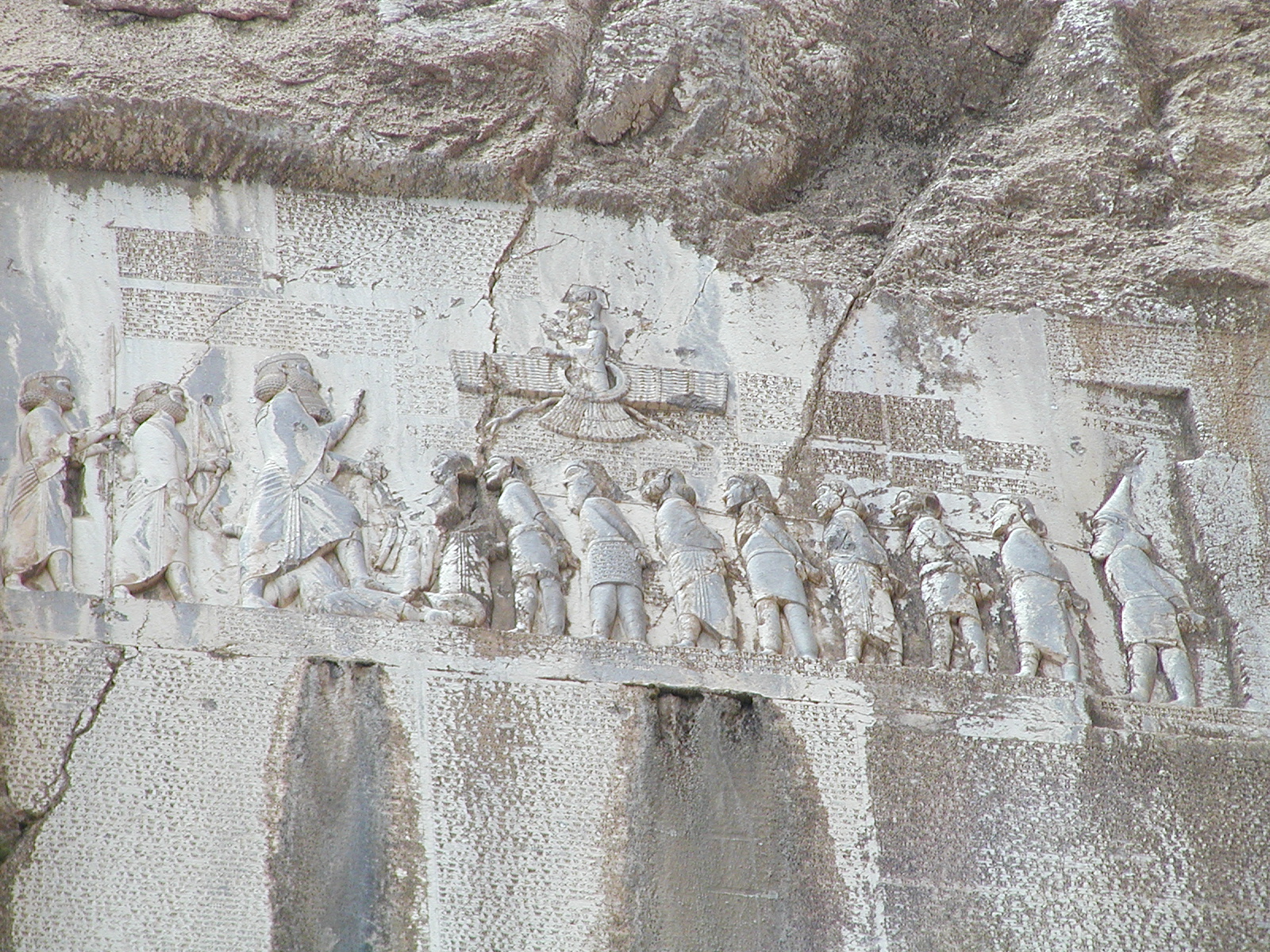
One of his remarkable feats was the copying of the famous trilingual rock inscription of Darius the Great on a mountain cliff at Behistun, in Persian Kurdistan (the Behistun Inscription). This work was carried out at great personal risk, for the cliff is 1700 feet high and the sculptures and inscriptions are situated about 300 feet from the ground.

The Behistun Inscription

Bisotun Iran Relief Achamenid Period” by Hara1603 – Own work. Licensed under Public Domain via Wikimedia Commons.

Darius was the first monarch of his line to make use of the Persian cuneiform script, which in this case he utilized in conjunction with the older and more complicated Assyro-Babylonian alphabetic and syllabic characters to record a portion of the history of his reign.

Rawlinson’s translation of the famous inscription was an important contribution towards the decipherment of the cuneiform writings of Assyria and Babylonia.”

Donald A. Mackenzie, Myths of Babylonia and Assyria, 1915.

The Names of the Great Mother

“THE dawn of history in all parts of Western Asia discloses the established worship of a nature-goddess in whom the productive powers of the earth were personified. 1 She is our Mother Earth, known otherwise as the Mother Goddess or Great Mother. Among the Babylonians 2 and northern Semites she was called Ishtar: she is the Ashtoreth of the Bible, and the Astarte of Phœnicia. In Syria her name was ‘Athar, and in Cilicia it had the form of ‘Ate (‘Atheh). At Hierapolis, with which we are primarily concerned, it appears in later Aramaic as Atargatis, a compound of the Syrian and Cilician forms.

In Asia Minor, where the influence of the Semitic language did not prevail, her various names have not survived, though it is recorded by a later Greek writer as “Ma” at one of her mountain shrines, and as Agdistis amongst one tribe of the Phrygians and probably at Pessinus. These differences, however, are partly questions of local tongue; for in one way and another there was still a prevailing similarity between the essential attributes and worship of the nature-goddess throughout Western Asia.

The “origins” of this worship and its ultimate development are not directly relevant to our present enquiry; but we must make passing allusion to a point of special interest and wide significance. As regards Asia Minor, at least, a theory that explains certain abnormal tendencies in worship and in legend would attribute to the goddess, in the primitive conception of her, the power of self-reproduction, complete in herself, a hypothesis justified by the analogy of beliefs current among certain states of primitive society.

However that may be, a male companion is none the less generally associated with her in mythology, even from the earliest historical vision of Ishtar in Babylonia, where he was known as Tammuz. While evidence is wanting to define clearly the original position of this deity in relation to the goddess, the general tendency of myth and legend in the lands of Syria and Asia Minor, with which we are specially concerned, reveals him as her offspring, the fruits of the earth.

The basis of the myth was human experience of nature, particularly the death of plant life with the approach of winter and its revival with the spring. In one version accordingly “Adonis” descends for the six winter months to the underworld, until brought back to life through the divine influence of the goddess. The idea that the youth was the favoured lover of the goddess belongs to a different strain of thought, if indeed it was current in these lands at all in early times. In Asia Minor at any rate the sanctity of the goddess’s traditional powers was safeguarded in popular legend by the emasculation of “Attis,” and in worship by the actual emasculation of her priesthood, perhaps the most striking feature of her cult.

The abnormal and impassioned tendencies of her developed worship would be derived, according to this theory, from the efforts of her worshippers to assist her to bring forth notwithstanding her singleness. However that may be, the mourning for the death of the youthful god, and rejoicing at his return, were invariable features of this worship of nature. It is reasonable to believe that long before the curtain of history was raised over Asia Minor the worship of this goddess and her son had become deep-rooted.”

Herbert A. Strong and John Garstang, Lucian’s the Syrian Goddess, A Translation of De Dea Syria  with a Life of Lucian, 1913, pp. 1-4.

Mystical Spelling of the Divine Name

“In the writings of the ‘Iyyun circle, the sefiroth undergo a transformation: each one, indeed even each of the thirty-two paths of the Sophia, becomes an autonomous world in which the theosophist immerses himself.

In fact, even the mystical spelling of the divine name with twenty-four points, which Pseudo-Hai transmits here and which no doubt goes back to Oriental sources of Jewish magic, is interpreted in this manner.

The spelling obviously imitates the magical alphabet and characters as they are frequently found in amulets and that, in Jewish magic, are encountered, for example, in the old “alphabets of the angels.”

They appear below:

angelic_alphabet

The twenty-four points or stars of this script correspond, according to the author, to the twenty-four books of the biblical canon, which are perhaps woven from this “hidden name.”

The author instructs the initiate that each of these points in and of itself represents an entire world. This use of the term “worlds” for different levels of being is undoubtedly Neoplatonic. It first penetrated into kabbalistic literature in the ‘Iyyun circle.

As we have seen, Isaac the Blind speaks of the “world of separation” below the sefiroth, but it seems he still did not take the step of considering the sefiroth themselves as just so many worlds. The upper world is henceforth no longer that of the separate intelligences, as it was for the philosophers and in Isaac’s fragments on cosmogony, but the world of the divine emanations itself. In the “Book of the Unity” of Pseudo-Hammai it is said that before Creation all the powers were intertwined and hidden in God,

“ … until there came the time of the will of the first Acting One, and they emerged from potentiality to spiritual reality, and the emanation of the upper world emanated to that of the tenth fundamental stone which is called, in the language of the sages of the mysteries, the “condensed light,” ‘or ‘abh. On account of its condensation they also name it “mixed darkness,” for all the powers of the flames are mixed in it, but are also differentiated in it, and it is the foundation of all the spiritual and corporeal worlds . . . and the last seal of all the [other] seals [emanated in the higher sefiroth].”

Gershom Scholem, Origins of the Kabbalah, pp. 328-30.

The First Sefirah is Passed Over in Silence

“After the resurrection, the righteous and the average realize a new progress in their spiritual and moral perfection, one that takes them beyond everything they attained in their lives. By this adherence to the seven divine middoth, all will share perpetually in the gift of prophecy.

From a brief allusion of ibn Sahula (f. 34a), we can infer that on several occasions Isaac expressed his views on eschatological matters, in the context of which he may also have discussed the preparation for redemption by means of the purification of souls during their transmigrations.

In the extant texts, however, there is no clear statement on this subject, though on one occasion Isaac quotes a relevant passage from the Bahir, section 105.

Isaac of Acre states that in his commentary on Yesirah Isaac the Blind made a hidden allusion to the distinction between the migration of souls (gilgul) and the impregnation of souls (ibbur) as being two different things, but I have not been able to locate this allusion.

It should be clear from the foregoing that Isaac the Blind already had at his disposal a complete system of kabbalistic symbolism, partly inherited from tradition and partly elaborated by himself which he applied to a great variety of biblical and rabbinic subjects.

His epistle to Gerona, which has survived, offers a brief explanation of the last psalm, apparently in response to a question. The psalmist’s tenfold invitation to praise God is interpreted as an allusion to the ten sefiroth, though the first sefirah is passed over in silence, and Isaac counts downward beginning with hokhmah.

His mystical allusions in this epistle scarcely differ from the instructions he gives for the mystical kawwanoth at prayer; there too, he briefly describes the process by which the mystic first traverses the world of the sefiroth from below upward during the profession of the divine unity, the Shema’ Yisrael, and then, in his meditation on the word ‘ehad, “one!” completes and closes the circle of his kawwanah, from above downward.”

Gershom Scholem, Origins of the Kabbalah, pp. 308-9.

Debhequth is Communio

“It is this contact, connection, or communio with God that is designated by the Hebrew term debhequth. This kabbalistic concept has its origins in the terminology of the medieval Jewish theologians, especially Bahya ibn Paquda and Abraham ibn Ezra, who employed the biblical verb dabhaq (“adhere, cleave to,”) to express the contact of the soul with God or the divine light. The biblical injunction Deuteronomy 13:5 is cited by Isaac’s pupils as their master’s cue for this doctrine:

“ … Our master the Hasid said: The essential thing in the divine service of the mystics [maskilim] and those who meditate on His name, lies in this [verse]: “and cleave to Him.” And this is a cardinal principle of Torah and of prayer, that one make one’s thought conform with one’s faith, as though it were cleaving to what is above, in order to conjoin the name [of God] in its letters and to link the ten sefiroth to Him as a flame is joined to the coal. With his mouth he must express it according to its paraphrase, but in his heart, he must conjoin it in its true structure.”

Debhequth is therefore not unio but communio. In the sense the term acquired in kabbalistic usage it always contains an element of distance despite its character of intimacy. Debhequth is not becoming one with God but entering into an infinitely close liaison with him, roughly corresponding to that called adhaeresis by medieval Christian mystics.

In Hebrew, debhequth can denote the process as well as the state attained through it. The instrument of this process is the kawwanah. Isaac and his disciples do not speak of ecstasy, of a unique act of stepping outside oneself in which human consciousness abolishes itself.

Debhequth does not consist in tempestuously rushing toward God and becoming absorbed in him; it is a constant state, nurtured and renewed through meditation. In contrast to some later schools, the old kabbalists did not go any further, and in this remained true to their Jewish-theistic character. For them, debhequth or the mystical communio is not, as for many non-Jewish mystics, a transitional stage leading to still higher regions.

Any pantheistic overstepping of the limits they fixed for themselves in their interpretation of the mystical path is far from their thoughts.”

Gershom Scholem, Origins of the Kabbalah, pp. 302-3

The En-Sof

“They are called in his works the Infinite (‘en-sof), Thought, and Speech. The principle of Speech, dibbur, is divided into the plurality of speeches and words, by which he often means the seven lower sefiroth, called not only dibburim but also debharim. In Hebrew dabhar means “word” as well as “thing,” and this coincidence was obviously decisive for the formation of Isaac’s thought.

The sefiroth, above all the seven lower ones, are the words or things “which shape reality.” They take the place of the ma’amaroth, the logoi of the Bahir. The “Thought,” too, already comes from this text, as we saw in the previous chapter. But what is entirely new is the emphasis laid on a domain of the divine that is above all reflective contemplation, indeed above the divine Thought itself, a domain called by Isaac “the cause of Thought” and designated by a new term: ‘en-sof.

The birth of this concept is of great interest for the history of the Kabbalah. This designation is usually explained as a borrowing from Neoplatonism. Christian Ginsburg, whose essay on the Kabbalah has been appropriated by many authors (who do not always bother to acknowledge their source), says:

“ … Any doubt upon this subject must be relinquished when the two systems are compared. The very expression En Sof which the Kabbalah uses to designate the Incomprehensible One, is foreign, and is evidently an imitation of the Greek Apeiros. The speculations about the En Sof, that he is superior to actual being, thinking and knowing, are thoroughly Neo-Platonic.”

Ginsburg, however, proceeded on the completely erroneous assumption that the oldest document of the authentic Kabbalah was the Neoplatonic catechism on the sefiroth composed by Azriel, Isaac’s disciple. There the notion is in fact explained in a manner that comes particularly close to Neoplatonic thought. But this says nothing about the origin of the concept. Indeed, the expression is strange, by virtue of its very grammatical formation.

It certainly is not a rendering of a fixed philosophical idiom, whether it be from the Greek or from the corresponding Arabic (la-nihaya)—in spite of the readiness with which some scholars have adopted this view.

The form ‘en-sof corresponds in no way to the translations of privative notions in medieval Hebrew literature: in these the conjunction Ulti always precedes the negated notion; the negation ayin is never employed for this purpose. Thus “inconceivable” is rendered by bil-ti-mussag and not by ‘en hassagah, and “infinite” is Ulti ba’al-takh-lith and not ‘en-sof.

The form ‘en-sof is altogether unusual, and Graetz had good reason to see it in a proof of the late origin of the term. However, he should have added that in the Hebrew literature of the Middle Ages, too, it represents a completely isolated phenomenon. It is only in biblical literature that we find forms such as ‘en ‘onim or ‘en ‘eyyal, for powerless. Subsequently, locutions of this kind disappear completely.

How, then, are we to understand the origin of the term ‘en-sof? It did not result from a deliberate translation, but from a mystical interpretation of texts that contain the composite term ‘en-sof in a perfectly correct adverbial sense, and not as a specific concept. The doctrine of Saadya Gaon, in particular, abounds with affirmations of the infinity of God—in fact, it is asserted at the very beginning of his well-known “Supplication” (Siddur R. Saadia [1941], 47), and in the old Hebrew paraphrase, known among the Provençal Kabbalists as well as the German Hasidim, it is reiterated incessantly.

Tobias ben Eliezer, who wrote around 1097, also stressed precisely this quality of God, in the context of a reference to the mystical Hekhaloth writings. For him God is “the first up to the unfathomable, the primordial beginning up to the infinite (‘ad ‘en-takhlith), among the last up to infinity (‘ad ‘en-sof). ” The adverbial construction is perfectly correct.

“Up to infinity” results from a combination of “up to there, where there is no end.” Expressions of this kind, in which ‘en-sof has the function of an adverbial complement, are found with particular frequency in the writings of Eleazar of Worms. We find the same usage in the Bahir (cf. p. 130 preceding). Thus, Eleazar writes, for example: “When he thinks of that which is above, he should not set any limit to this thought, but thus [should he think of God]:

” … high, higher up to the Boundless [‘ad ‘en-qes]; down deep, who can find him; and the same above in the expanse of all the heavens . . . and outside the heavens up to the infinite [le’en- sof].” Or: “in the Throne of Glory are engraved holy names, which are not transmitted to any mortal, and which sing hymns unto infinity [meshorerim shiroth le’en-sof].”

The transition here from the innumerable hymns sung by holy names and angels to a hypostasis that, as a mystical reader might perhaps conceive it, “sings hymns to ‘en-sof” seems easy enough. The term ‘en-sof came into being when one of the Provençal kabbalists read this combination of words that actually represents a phrase as a noun, possibly influenced by the aforementioned kind of adverbial composites and perhaps also by some expressions in the Bahir.”

Gershom Scholem, Origins of the Kabbalah, pp. 265-7.

Eschatological Elevation of the Soul After Death

“The Bahir’s idea of the sefiroth appears in Isaac’s writings in a fully crystallized form. In his commentary on the Yesirah 4:3, the verse 1 Chronicles 29:11 is used for the first time as a biblical reference for the names and the sequence of the seven lower sefiroth, especially the first five among them: “Yours, Lord, are the greatness (gedullah), might (geburah), splendor (tif’ereth), triumph (nesah), and majesty (hod)—yes all (kol) that is in heaven and on earth; to You, Lord, belong kingship (mamlakhah) and preeminence above all.”

From here come the designations not yet used in the Bahir, of gedullah for hesed, tif’ereth for ‘emeth, and hod. Isaac himself for the most part uses the names hesed and pahad (as in the Bahir) instead of gedullah and geburah. The name tif’ereth, however, is already familiar to him.

Whereas the word kol, occurring in the aforementioned verse, already served in the Bahir as an epithet designating the “Righteous,” Isaac uses for this sefirah the noun “Righteous” and the epithet “Foundation of the world.” For the last sefirah, on the other hand, he employs almost exclusively an epithet still not familiar to the Bahir, although it is undoubtedly alluded to there.

This epithet is ‘atarah, a synonym for kether, which designates the lowest of the ten “crowns.” Like the Bahir, he names the first three sefiroth kether or mahshabah, hokhmah and binah.

In his commentary on Yesirah, Isaac mentions many of these sefiroth in the framework of fixed schemata, but this does not always enable us to comprehend the sequence of the sefiroth within them. What is strange is that in point of fact the structure of the sefiroth beyond the supreme three only interests him in detail when it is a question of prayer mysticism, or the interpretation of certain ritual commandments. They have their importance as stages of the contemplative ascent or of the eschatological elevation of the soul, after death, to even higher spheres.

But never are any coherent thoughts presented concerning their function and structure. This is particularly the case for the potencies of tif’ereth, yesod and ‘atarah, which play an especially important role in the evolution of the doctrine of the sefiroth. In contrast to this lack of interest in detail, one discerns in Isaac a more pronounced interest in the totality of the spiritual potencies expressed in language and, in a more general manner, in spiritual entities.

Having said that, the terminological differences between concepts like sefiroth, middoth, letters (of the alphabet) and hawwayoth (literally: essences) are by no means always clear, and their interpretation is often fraught with difficulties.

However, these difficulties are closely related to what is truly new in Isaac’s Kabbalah. Indeed, from the historical point of view their interest lies in the combination of the world of ideas of the Bahir and the entirely new elements that erupt, inspired by gnostic ideas, into the oldest form of the Kabbalah as represented by the Bahir.

This combination reflects speculative interests whose origin is no longer essentially determined by Gnosticism but rather by Neoplatonism and a language mysticism generated by the latter. Isaac is visibly struggling with new thoughts for which he is as yet unable to find clear and definitive expression. The awkwardness of his new terminology militates against the supposition that this lack of clarity, which often makes it so difficult to penetrate his meaning, is intentional.

His new terminology seems to be derived from philosophy, although we cannot identify its philosophical sources in the Hebrew tradition. The special importance of Isaac’s commentary on the Yesirah lies in the attempt to read into the old texts the new, speculative thoughts of a contemplative mystic. But we are no less surprised by the boldness with which he presents far-reaching ideas in his other cosmological fragments and in his remarks concerning the mystical theory of sacrifice. The particular manner in which Isaac applies his ideas to the task of man, to the connection between the terrestrial and the celestial worlds, and to eschatological matters merits closer consideration.

The path of the mystic, described by Isaac at the beginning of his commentary on the Yesirah, is (as Isaac of Acre already recognized in his paraphrase of several of these passages in his own commentary) that of systematically uncovering the divine—by means of reflective contemplation and within the innermost depths of such contemplation. Isaac postulates three stages in the mystery of the deity and its unfolding in creation and revelation.”

Gershom Scholem, Origins of the Kabbalah, pp. 263-5.

Bakol = Shekhinah

“But what about the oldest text, the Book Bahir itself? Here, too, many passages show that we are dealing with a later exegesis, which reinterprets, on the basis of a medieval mentality, older material that had already become authoritative and confers upon it a symbolic character.

Assuredly, biblical verses could already be interpreted in the talmudic era as symbolic of events taking place on a higher plane of being. The psychological distance between the gnostic exegetes, Jewish or not, and the biblical canon is evident. The elaboration of pagan mythology in terms of gnostic exegesis, as, for example, in the “Naassene sermon” preserved by Hippolytus, indicates a similar psychological distance between ancient myth and its new interpretation.

The Bahir already presents this type of interpretation of the talmudic Aggadah. This can be seen not only in the many passages in which parables drawn from aggadic literature in the Talmud and the Midrash, where they have a perfectly exoteric significance, are transposed to a mystical plane, the new parable often becoming, in the process, much more strange and problematic than the one upon which it is based; we can observe it above all when talmudic quotations themselves are treated as old materials of this kind.

Only during a period when, for the pious consciousness of broad sections of the Jewish population, the Aggadah itself could already claim the authority of a sacred text, and at a time when for other circles its very extravagance became a problem—from the eighth century onward, after the emergence of Karaism—is a passage like section 52 of the Bahir possible. The Talmud, Baba Bathra 16b, transmits various opinions with regard to the value of the birth of daughters.

In this connection, a discussion is reported between mishnaic teachers (second century) concerning Genesis 24:1: “And the Lord had blessed Abraham in all things.” “What is meant by ‘in all things?’ R. Meir explained: it means that he had no daughter. R. Yehudah said: Abraham had a daughter whose name was Bakol [literally: with all things].”

The Bahir made this last remark the object of a mystical exegesis, which elevated the strange statement concerning the daughter Bakol to an allegorical plane. Bakol thus becomes a designation for the Shekhinah, the last of the divine powers, which is mentioned at the end of section 51 and to the symbolism of which I shall return. Abraham is there designated as the father of this Shekhinah. Section 52 then continues:

“And whence did Abraham have a daughter? [we learn that] from the verse [Gen. 24:1] the Lord had blessed Abraham with “all things” and [Scripture also] says [Isa. 43:7] “every one” will be called by my Name, etc. Was this “blessing” his daughter or not? [another version: Or was it rather his mother?] Yes, she was his daughter. It is like a king who had a perfect servant . . . Then the king said: What should I give to this servant or what should I do for him? There is nothing left for me to do but to recommend him to my brother, so that he may counsel, protect, and honor him. The servant went home with the king’s great brother and learned his ways. The brother grew very fond of him and called him his friend, as it is said [Isa. 41:8]: Abraham, my friend. He said: What shall I give him or what shall I do for him? Lo, I have made a beautiful vessel, and inside it are beautiful gems to which none can be compared, and they are the jewels of kings. I shall give them to him, and he may partake of them instead of me. That is what is written: God blessed Abraham with “all things.”

Gershom Scholem, Origins of the Kabbalah, pp. 87-8,

Abrasax, the Invincible Name of Power

“The last class of documents undoubtedly contains a very large proportion of the magical ideas, beliefs, formulæ, etc., which were current in Egypt from the time of the Ptolemies to the end of the Roman Period, but from about B.C. 150 to A.D. 200 the papyri exhibit traces of the influence of Greek, Hebrew, and Syrian philosophers and magicians, and from a passage like the following (see Goodwin, Fragment of a Græco-Egyptian Work upon Magic, p. 7) we may get a proof of this:—

“I call thee, the headless one, that didst create earth and heaven, that didst create night and day, thee the creator of light and darkness. Thou art Osoronnophris, whom no man hath seen at any time; thou art Iabas, thou art Iapôs, thou hast distinguished the just and the unjust, thou didst make female and male, thou didst produce seeds and fruits, thou didst make men to love one another and to hate one another.”

“I am Moses thy prophet, to whom thou didst commit thy mysteries, the ceremonies of Israel; thou didst produce the moist and the dry and all manner of food.”

“Listen to me: I am an angel of Phapro Osoronnophris; this is thy true name, handed down to the prophets of Israel. Listen to me. (Here follow a number of names of which Reibet, Athelebersthe, Blatha, Abeu, Ebenphi, are examples) . . .”

In this passage the name Osoronnophris is clearly a corruption of the old Egyptian names of the great god of the dead “Ausar Unnefer,” and Phapro seems to represent the Egyptian Per-âa (literally, “great house”) or “Pharaoh,” with the article pa “the” prefixed.

It is interesting to note that Moses is mentioned, a fact which seems to indicate Jewish influence.

In another magical formula we read, (Goodwin, op. cit., p. 21) “I call upon thee that didst create the earth and bones, and all flesh and all spirit, that didst establish the sea and that shakest the heavens, that didst divide the light from the darkness, the great regulative mind, that disposest everything, eye of the world, spirit of spirits, god of gods, the lord of spirits, the immoveable Aeon, IAOOUÊI, hear my voice.”

“I call upon thee, the ruler of the gods, high-thundering Zeus, Zeus, king, Adonai, lord, Iaoouêe. I am he that invokes thee in the Syrian tongue, the great god, Zaalaêr, Iphphou, do thou not disregard the Hebrew appellation Ablanathanalb, Abrasilôa.”

“For I am Silthakhôoukh, Lailam, Blasalôth, Iaô, Ieô, Nebouth, Sabiothar, Bôth, Arbathiaô, Iaoth, Sabaôth, Patoure, Zagourê, Baroukh Adonai, Elôai, Iabraam, Barbarauô, Nau, Siph,” etc.

The spell ends with the statement that it “loosens chains, blinds, brings dreams, creates favour; it may be used in common for whatever purpose you will.”

In the above we notice at once the use of the seven vowels which form “a name wherein be contained all Names, and all Lights, and all Powers” (see Kenyon, Greek Papyri in the British Museum, London, 1893, p. 63). The seven vowels have, of course, reference to the three vowels “Iaô” (for Iaoouêi we should probably read Iaô ouêi) which were intended to represent one of the Hebrew names for Almighty God, “Jâh.”

The names “Adonai, Elôai,” are also derived through the Hebrew from the Bible, and Sabaôth is another well-known Hebrew word meaning “hosts”; some of the remaining names could be explained, if space permitted, by Hebrew and Syriac words.

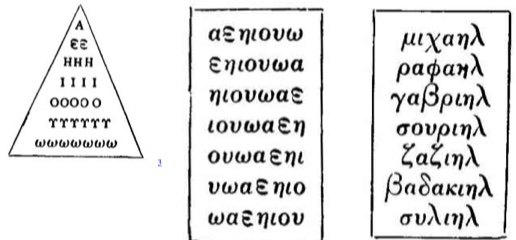
On papyri and amulets the vowels are written in magical combinations in such a manner as to form triangles and other shapes; with them are often found the names of the seven archangels of God; the following are examples:–

 (British Museum, Gnostic gem, No. G. 33). (Kenyon, Greek Papyri, p. 123). (Ibid., p. 123. These names read Michael, Raphael, Gabriel, Souriel, Zaziel, Badakiel, and Suliel).


(British Museum, Gnostic gem, No. G. 33).
(Kenyon, Greek Papyri, p. 123).
(Ibid., p. 123. These names read Michael, Raphael, Gabriel, Souriel, Zaziel, Badakiel, and Suliel)

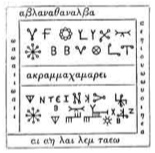
In combination with a number of signs which owe their origin to the Gnostics the seven vowels were sometimes engraved upon plaques, or written upon papyri, with the view of giving the possessor power over gods or demons or his fellow creatures.

The example printed below is found on a papyrus in the British Museum and accompanies a spell written for the purpose of overcoming the malice of enemies, and for giving security against alarms and nocturnal visions. (Kenyon, op. cit., P. 121).

Amulet inscribed with signs and letters of magical power for overcoming the malice of enemies. (From Brit. Mus., Greek Papyrus, Nu. CXXIV.--4th or 5th century.) (Kenyon, Greek Papyri, p. 123).

Amulet inscribed with signs and letters of magical power for overcoming the malice of enemies. (From Brit. Mus., Greek Papyrus, Nu. CXXIV.–4th or 5th century.) (Kenyon, Greek Papyri, p. 123).

But of all the names found upon Gnostic gems two, i.e., Khnoubis (or Khnoumis), and Abrasax (or Abraxas), are of the most frequent occurrence. The first is usually represented as a huge serpent having the head of a lion surrounded by seven or twelve rays.

Over the seven rays, one on the point of each, are the seven vowels of the Greek alphabet, which some suppose to refer to the seven heavens; and on the back of the amulet, on which the figure of Khnoumis occurs, is usually found the sign of the triple S and bar.

Khnoumis is, of course, a form of the ancient Egyptian god Khnemu, or “Fashioner” of man and beast, the god to whom many of the attributes of the Creator of the universe were ascribed.

Khnemu is, however, often depicted with the head of a ram, and in the later times, as the “beautiful ram of Râ,” he has four heads; in the Egyptian monuments he has at times the head of a hawk, but never that of a lion.

The god Abrasax is represented in a form which has a human body, the bead of a hawk or cock, and legs terminating in serpents; in one hand he holds a knife or dagger, and in the other a shield upon which is inscribed the great name ΙΑΩ {Greek IAW}, or JÂH.

Considerable difference of opinion exists as to the meaning and derivation of the name Abrasax, but there is no doubt that the god who bore it was a form of the Sun-god, and that he was intended to represent some aspect of the Creator of the world.

The name was believed to possess magical powers of the highest class, and Basileides, (he of Alexandria, who lived about A.D. 120. He was a disciple of Menander, and declared that he had received the esoteric doctrine of Saint Peter from Glaucias, a disciple of the Apostle) who gave it currency in the second century, seems to have regarded it as an invincible name.

It is probable, however, that its exact meaning was lost at an early date, and that it soon degenerated into a mere magical symbol, for it is often found inscribed on amulets side by side with scenes and figures with which, seemingly, it cannot have any connexion whatever.

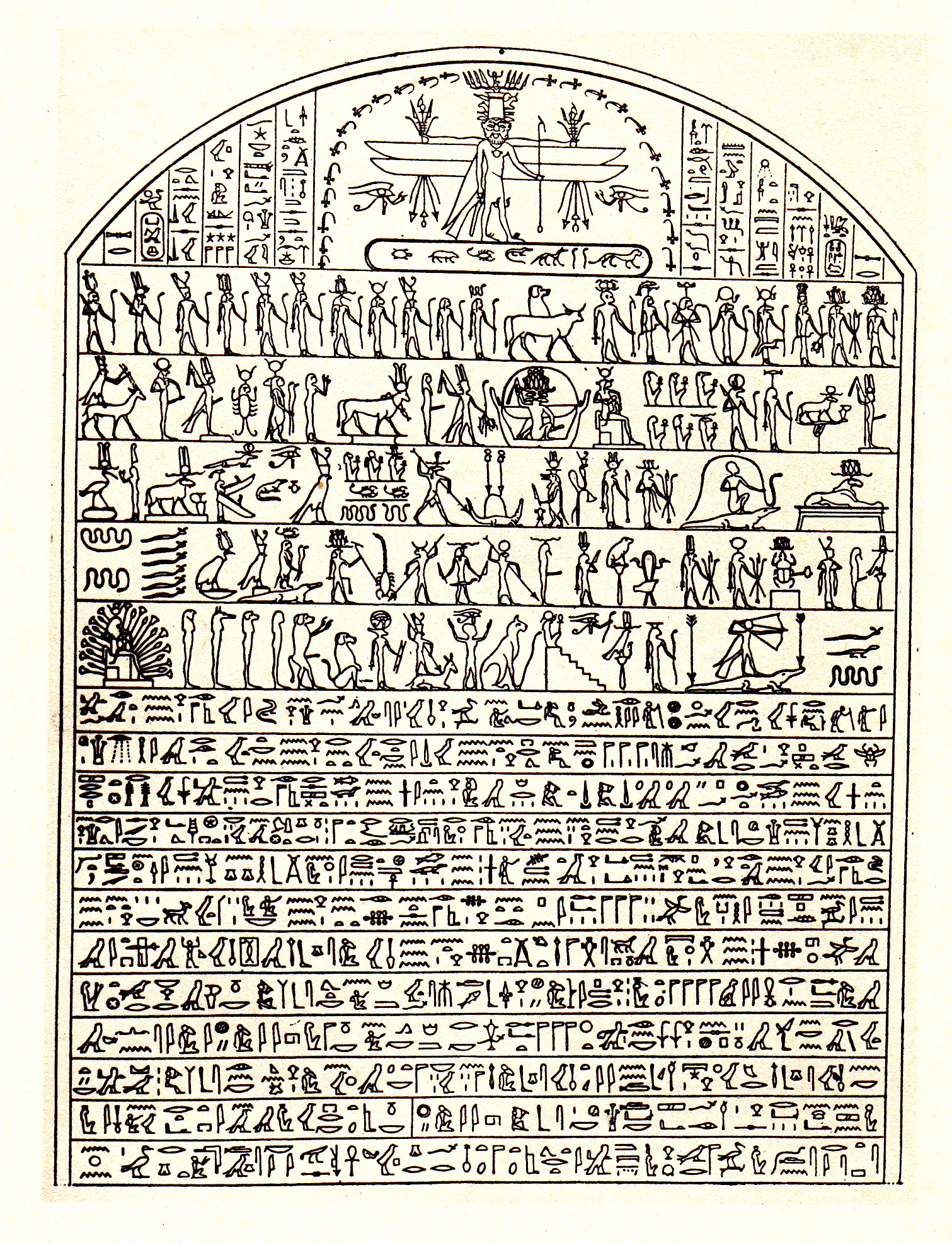
Judging from certain Gnostic gems in the British Museum, Abrasax is to be identified with the polytheistic figure that stands in the upper part of the Metternich stele depicted on p. 153 and below.

Metternich Stele.

Metternich Stele.

This figure has two bodies, one being that of a man, and the other that of a bird; from these extend four wings, and from each of his knees projects a serpent.

He has two pairs of hands and arms; one pair is extended along the wings, each hand holding the symbols of “life,” “stability,” and “power,” and two knives and two serpents; the other pair is pendent, the right hand grasping the sign of life, and the other a sceptre.

His face is grotesque, and probably represents that of Bes, or the sun as an old man; on his head is a pylon-shaped object with figures of various animals, and above it a pair of horns which support eight knives and the figure of a god with raised hands and arms, which typifies “millions of years.”

The god stands upon an oval wherein are depicted figures of various “typhonic” animals, and from each side of his crown proceed several symbols of fire.

Whether in the Gnostic system Abraxas absorbed all the names and attributes of this god of many forms cannot be said with certainty.”

E.A. Wallis Budge, Egyptian Magic, London, 1901. P. 177-80.

The Original Content of the Kabbalah

” … Traditions differ in matters of detail. According to some, it was Rabbi David, the father of Rabbi Abraham ben David (known in Hebrew literature by the acronym Rabad) and not Abraham ben Isaac, his father- in-law, who was the first to receive this Kabbalah. Albeck assumed Isaac the Blind was the son and not the grandson of Abraham ben Isaac, but the analysis of the oldest sources does not confirm this assumption. Around these scholars, but especially around Isaac the Blind, there crystallized the oldest groups of Provençal kabbalists that we are still able to identify.

The pupils of Rabad and his son, coming from Spain to study in the talmudic academies of Provence, were the principal agents of the Kabbalah’s transplantation to Spain and its propagation in that country. Nothing permits us to suppose that the Kabbalah, in the precise sense of the term, became known in Spain other than through this channel or by way of a parallel path that would point to Provence.

Here, to be sure, we must ask what the exact significance of the word Kabbalah was at this time in the circle of the kabbalists themselves. Kabbalah is a fairly common word in rabbinic Hebrew: it simply means “tradition.” In the Talmud, it served to designate the non-Pentateuchal parts of the Hebrew Bible. Later, every tradition was called by this name, without its entailing any specifically mystical nuance.

That it was already employed by the philosopher Solomon ibn Gabirol in the sense it would acquire among the kabbalists is a widespread but completely false assumption. It has just a little to do with the Aramaic word qibhla, “amulet.” The Spanish kabbalists still knew very well several generations later what original notion their predecessors had in mind when they employed the term Kabbalah. As late as the year 1330, Meir ben Solomon ibn Sahula, a pupil of Solomon ibn Adreth, expressed himself clearly and directly on the origin and meaning of this new discipline.

“It is incumbent upon us,” he writes in the preface to his commentary on the Book Yesirah, “to explore all of these things according to the measure of our understanding, and to follow, in what concerns them, the path taken by those who, in our generation and in the preceding generations, for two hundred years, are called kabbalists, mequbbalim, and they call the science of the ten sefiroth and some of the reasons for the [biblical] commandments by the name Kabbalah.”

It follows, then, that in the eyes of these kabbalists the new theosophic conception of God, based upon the doctrine of the ten sefiroth of the Book Yesirah as well as upon the mystical reasons founded on this doctrine for certain ritual precepts of the Torah, constitute the original content of the Kabbalah.

In the author’s own opinion, this teaching is by no means ancient; it does not go back many centuries. Rather, it is about two hundred years old, which brings us back, for its initial stage, to the period of the first revelations of the prophet Elijah —that is, in Provence, toward the middle of the thirteenth century. The chain of kabbalistic traditions that contains the names mentioned previously accords perfectly with this information. It should be noted, also, that the clear awareness on the part of this later kabbalist of the relative youth of the Kabbalah in no way prevents him from considering it a path to knowledge that is ”incumbent upon us” to follow.”

–Gershom Scholem, Origins of the Kabbalah, 1987, pp. 37-9.

The Revelations of the Prophet Elijah and the Celestial Academy

” … Their accounts emphasize the mystical inspiration, namely, the “appearance of the Holy Spirit,” in one of the most distinguished families representing the rabbinic culture of Provençal Jewry. These sources name several historical personalities to whom the prophet Elijah is said to have revealed himself (gilluy Eliyahu)-, that is, they were the recipients of celestial mysteries of which earlier tradition knew nothing until then, and which came to them as revelations from above.

These revelations may have been of a purely visionary character, or they may have been experiences of illumination sustained while in a state of contemplation. I have expressed my opinion elsewhere on the meaning of this category of gilluy Eliyahu, which is of considerable importance for an understanding of the relationship between religious authority and mysticism in Judaism.

The prophet Elijah is for rabbinic Judaism the guardian of the sacred tradition. In the end, with the arrival of the Messiah, he will bring the divergent opinions of the teachers of the Torah into harmony. To the pious, he now reveals himself on diverse occasions in the marketplace, on the road, and at home. Important religious traditions of the Talmud and even an entire midrashic work are attributed to his instruction. He is present every time a child is admitted into the Covenant of Abraham—that is, at the establishment of the sacral connection between the generations by means of circumcision. It is by no means the mystics alone who encounter him; he may just as well reveal himself to the simple Jew in distress as to one perfect in saintliness and learning.

As the zealot of God in the Bible, he is the guarantor of the tradition. He is, as I have written, “not the kind of figure of whom it could be supposed that he would communicate or reveal anything whatsoever which stood in fundamental contradiction to such a tradition.” A tradition that was acknowledged to have come from the prophet Elijah therefore became part, in the consciousness of the faithful, of the main body of Jewish tradition, even if it brought something new; and it stood above any possible suspicion of foreign influence or heretical attitude.

It is no wonder, then, that at important turning points in the history of Jewish mysticism—precisely at those times when something new appeared—constant reference was made to revelations of the prophet Elijah. Understood in this sense, “tradition” included not only that which was transmitted on earth and in history, but also that which was received from the “celestial academy” above.”

–Gershom Scholem, Origins of the Kabbalah, 1987, pp. 35-6.

Shabbatai Zevi and Sacred Hypocrisy

“The theological challenge facing Nathan of Gaza and other Sabbatian thinkers changed dramatically late in 1666, when Shabbatai Zevi was summoned to the palace of the Ottoman sultan. He emerged from the meeting wearing the Muslim cap. Having been threatened, Shabbatai Zevi did not hesitate for long before converting to Islam. Judaism was suddenly faced with a situation in which the messiah committed the worst possible sin that generations of Jews were educated to avoid. One has, when faced with a demand to convert, to become a martyr and “sanctify the holy name” rather than betray one’s God, people and tradition. Shabbatai Zevi, who should have been the example of religious perfection and who was regarded not only as a divine messenger but also as a divine incarnation, did the exact opposite.”

Scholem later explained that this was not only deliberate, but necessary, including the “discovery” of numerous verses and statements in the Bible, the Talmud and the Zohar that indicate the necessity of the messiah’s conversion to an “evil” religion.

“Several thousands of Sabbatians followed Shabbatai Zevi in the last decades of the seventeenth century and converted to Islam… Most Sabbatians, however, remained within Jewish communities, and created an underground of believers in all strata of Jewish society, simple people, intellectuals, and rabbis. They imitated their messiah in a kind of “sacred hypocrisy:” They pretended to be orthodox Jews, adhering to the ancient exilic tradition, while secretly they worshiped the messiah and the Torah of the age of redemption.”

–Joseph Dan, Kabbalah: A Very Short Introduction, pg. 89-90.

The Ein Sof

“The concept of an infinite, perfect supreme being that cannot change, a concept absent from Jewish thought in antiquity, is dominant in both philosophy and kabbalah. This concept, which was expressed in the most powerful terms by Aristotelian thinkers when they discussed the primal cause or the unmoved mover, was accepted wholeheartedly by Jewish medieval thinkers. Kabbalistic terminology often used the term “ein sof,” no end, infinite, to designate this supreme entity.”

“The process of emanation that brought forth the system of the sefirot was the kabbalistic answer to the question, “How can anything different emerge from the unchanging and eternal divinity?”

“Many kabbalists insisted that the ein sof is not indicated by any biblical phrase, because its perfection and unchanging character put it beyond language, even divine language … The realm of ein sof in the kabbalah is therefore beyond language, beyond any kind of description, and essentially it is not different from the rationalistic designations of the infinite supreme eternal entity.”

“This and other such systems attempt to build a bridge between the timelessness of the ein sof and the sefirot, which exist in time … The most important aspect of ein sof in kabbalistic thought is as the ultimate source of the flow of the purest divine light (shefa) that constantly provides the power to exist in both divine and earthly realms. Emanation is not a one-time event, but an ongoing vital process that maintains the existence of all beings.

“The kabbalists differed from the neo-Platonists in the intense dynamism and mythological elements that they introduced into their system, especially in the lower realms of existence, and in their belief in the capacity of human deeds and behavior to influence processes in the divine world.”

As above, so below, and vice versa.

–Joseph Dan, Kabbalah: A Very Short Introduction, 2006, pp. 39-41.

On Metatron

“Unlike the other Spheres, which have one archangel each, Malkuth has two. The first of them is named Metatron, and is also the archangel of the first Sphere, Kether. Alone of the Archangels, his name has no meaning in Hebrew (in point of fact, it is a Hebrew form of Mithras, the name of a Roman savior god of Persian origins). For reasons that will be discussed later on, Metatron is known as the Prince of Countenances; he represents a secret link connecting the highest and lowest of the Spheres.”

“Cabalistic traditions make a distinction, a useful one, between the aspect of Metatron assigned to Kether and that assigned to Malkuth, a distinction that involves a different spelling of the archangel’s name. Metatron in Malkuth is held to be the transformed Enoch, taken bodily into heaven according to the Biblical myth, and to function as a celestial scribe recording all the acts of humanity. His name was spelled MThThRVUN…Metatron in Kether, by contrast, is seen as a transcendent power, the “Lesser Tetragrammaton” created before the birth of the universe, and his name is spelled with an additional Yod, MIThThRVN….In either form, Metatron may be visualized as an angelic figure of pure light.”

The second archangel of Malkuth is named Sandalphon. As Metatron expresses the spiritual energies coming into Malkuth from above, Sandalphon expresses the spiritual energies of Malkuth itself; these two angels are usually paired in the traditional symbolism, and are associated with the two angelic figures atop the Ark of the Covenant, Metatron on the right hand, Sandalphon on the left. As Metatron is linked with Enoch, Sandalphon is often equated with Elijah, the other Old Testament figure who is said to have ascended directly into heaven.

Despite this and the meaning of the name, Sandalphon is often represented as female; she is called the Reconciler for Earth, and the Celestial Soul of Earth. She represents the driving force of evolution, the constant upward striving toward the spiritual on the part of every created thing. As the counterpart to the bright radiance of Metatron, she is sometimes envisioned as a luminous figure clad in dark garments.”

–John Michael Greer, Paths of Wisdom, the Magical Cabala in the Western Tradition, 1996, pg. 99-100.

The Third Son of Adam

“Adam and Eve, in the Genesis account, had three sons whose names are recorded; the first two, Cain and Abel, gained an unpleasant fame as the first murderer and his first victim.

The third, however, was named Seth, and had a different destiny. The Bible says little about him, but legend tells that he journeyed back to the gate of Eden and spoke to the angels who guarded the gate.

From them, according to one story, he received the secret teaching which was to become the Cabala.”

–John Michael Greer, Paths of Wisdom, the Magical Cabala in the Western Tradition, 1996, pg. 81.

The Creation of the Universe

“Even more extravagant than the Muslims were the Jews. The first chapter of the Jewish Bible contains the famous sentence: And God said, ‘Let there be light,’ and there was light;” the Kabbalists argued that the virtue of that command from the Lord came from the letters of the words.

The Sepher Yetzirah (Book of the Formation), written in Syria or Palestine around the sixth century, reveals that Yehovah of the Armies, God of Israel and God Omnipotent, created the universe by means of the cardinal numbers from one to ten and the twenty-two letters of the alphabet. That numbers may be instruments or elements of the Creation is the dogma of Pythagoras and Iamblichus; that letters also are is a clear indication of the new cult of writing.

The second paragraph of the second chapter reads: “Twenty-two fundamental letters: God drew them, engraved them, combined them, weighed them, permutated them, and with them produced everything that is and everything that will be.” Then the book reveals which letter has power over air, and which over water, and which over fire, and which over wisdom, and which over peace, and which over grace, and which over sleep, and which over anger, and how (for example) the letter kaf, which has power over life, served to form the sun in the world, the day Wednesday in the week, and the left ear on the body.”

–Jorge Luis Borges, “On the Cult of Books.”

More on Creation Through the Powers of the Alphabet.

“The Sefer Yezira (The Book of Creation) describes the process of creation mainly by the power of the letters of the alphabet. It dates to the 10th Century AD, though it was regarded as an ancient work. It was clearly developed and edited for several generations before it emerged into view. The exact date of its origin is unknown. Some assert that it was written before the destruction of Jerusalem in 70 CE, while others claim that it was written in the 9th century, with Islamic influences. The consensus seems to be that it dates to the third or fourth century, but there is no definitive evidence.

The concluding sentences state that Abraham knew the secrets of this work, so it is traditionally ascribed to Abraham the Patriarch.

The Book of Creation describes a system of cosmogony and cosmology different from Genesis, yet cites no authority and rarely refers to Bible verses.

“The universe was hewed, according to the first paragraph, by thirty-two “wondrous paths of wisdom,” and engraved in “three books.” The “paths” are described as ten sefirot and the twenty-two letters of the Hebrew alphabet. These sefirot are not divine powers….” They are “described as the directions or dimensions of the cosmos, (north, south, east, west, up, down, beginning, end, good, and evil), as well as the holy beasts of Ezekiel’s chariot, the stages of the emergence of the three elements (divine spirit, air or wind, and water and fire), and other characteristics that are unclear.”

“Early commentators interpreted the sefirot as the ten basic numbers from one to ten.”

“The central concept … is harmonia mundi, (harmony of the universe). There are three layers of existence, the cosmic, that of time, and that of man. Each letter, or group of letters, is in charge of one aspect of each layer.”

“Thus … the Hebrew letters that can be pronounced in two different ways–whose number, according to this work, is seven–in the cosmos, are in charge of the seven planets; in “time,” are in charge of the seven days of the week; and, in man, are in charge of the seven orifices in the head (eyes, ears, nostrils and mouth).

“The twelve letters that the author describes as “simple” are in charge of the twelve zodiac signs, the twelve months, and the twelve principal limbs, and so on. This model was used by subsequent thinkers to develop the concept of human beings as microcosmos, reflecting the characteristics of the cosmos as a whole (especially by Shabbatai Donolo, who used it to interpret the the verse in Genesis 1:27, indicating that man was created in the image of God).”

“The concept that the universe was created by the power of divine speech is an ancient one in Judaism, and the Sefer Yezira developed this idea systematically. The guiding principle seems to have been that if creation is accomplished by language, then the laws of creation are the laws of language. Grammar thus was conceived as the basic law of nature. The author developed a Hebrew grammar based on 231 “roots”–the number of possible combinations of 22 letters. He explained the existence of good and evil in the universe as a grammatical process: if the letter ayin is added to the “root” ng as a prefix, it gives ong, great pleasure, but if it is added as a suffix, it means infliction, malady. The author also insisted that everything in the universe, following grammatical principles, has two aspects, parallel to the gender duality of masculine and feminine.”

“The kabbalists … positioned this work in the heart of Jewish sacred tradition, a source of divine wisdom parallel to that of the Hebrew Bible.”

–Joseph Dan, Kabbalah: A Very Short Introduction, 2006, pp. 16-18.