Samizdat

Publishing the Forbidden. All Rights Reserved. © Samizdat 2014-2026.

Tag: Babylonia

Babylon: Imperial Polytheism

“As long, however, as these multitudinous deities were believed to exist, so long was it also believed that they could injure or assist. Hence come such expressions as those which meet us in the Penitential Psalms, “To the god that is known and that is unknown, to the goddess that is known and that is unknown, do I lift my prayer.”

Hence, too, the care with which the supreme Baal was invoked as “lord of the hosts of heaven and earth,” since homage paid to the master was paid to the subjects as well.

Hence, finally, the fact that the temples of the higher gods, like the Capitol at Rome, became gathering places for the inferior divinities, and counterparts on the earth of “the assembly of the gods” in heaven.

That curious product of Mandaite imagination, the Book of Nabathean Agriculture, which was translated into Arabic by Ibn Wahshiya in the 10th century, sets before us a curious picture of the temple of Tammuz in Babylon.

“The images (of the gods),” it tells us,

“congregated from all parts of the world to the temple of el-Askûl (Ê-Sagil) in Babylon, and betook themselves to the temple (haikal) of the Sun, to the great golden image that is suspended between heaven and earth in particular.

The image of the sun stood, they say, in the midst of the temple, surrounded by all the images of the world. Next to it stood the images of the sun in all countries; then those of the moon; next those of Mars; after them the images of Mercury; then those of Jupiter; next of Venus; and last of all, of Saturn.

Thereupon the image of the sun began to bewail Tammuz and the idols to weep; and the image of the sun uttered a lament over Tammuz and narrated his history, whilst the idols all wept from the setting of the sun till its rising at the end of that night. Then the idols flew away, returning to their own countries.”

The details are probably borrowed from the great temple of pre-Mohammedan Mecca, but they correspond very faithfully with what we now know the interior of one of the chief temples of Babylonia and Assyria to have been like.

Fragments have been preserved to us of a tablet which enumerated the names of the minor deities whose images stood in the principal temples of Assyria, attending like servants upon the supreme god.

Among them are the names of foreign divinities, to whom the catholic spirit of Babylonian religion granted a place in the national pantheon when once the conquest of the towns and countries over which they presided had proved their submission to the Babylonian and Assyrian gods; even Khaldis, the god of Ararat, figures among those who dwelt in one of the chief temples of Assyria, and whose names were invoked by the visitor to the shrine.
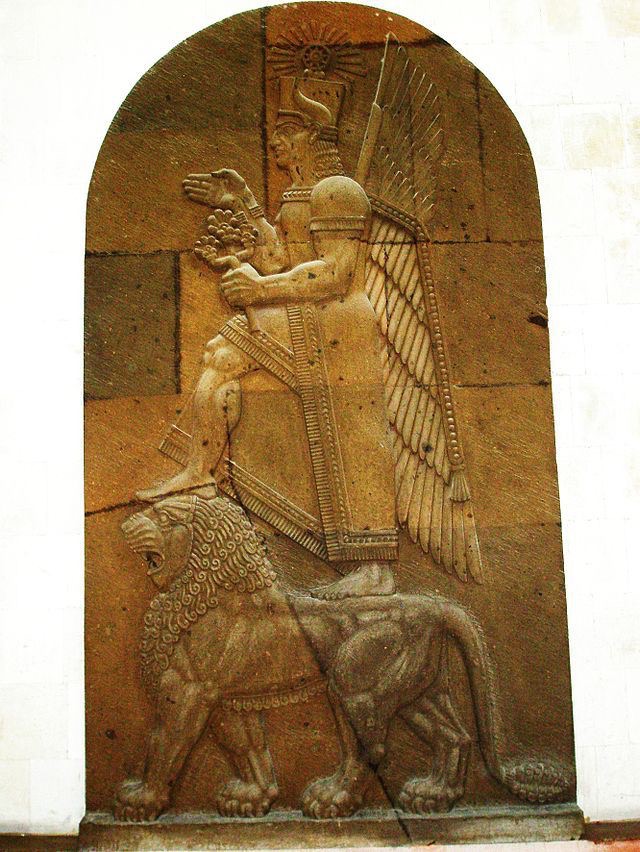
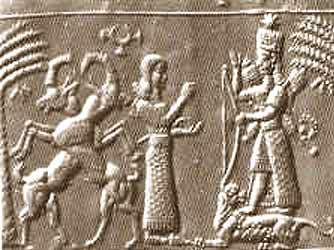
Ḫaldi was the chief deity of the Ararat (Urartu) pantheon. His shrine at Ardini (likely from Armenian Artin), was in Akkadian Muṣaṣir (Exit of the Serpent/Snake).  Of all the gods of the Ararat (Urartu) pantheon, most inscriptions are dedicated to Khaldi or Hayk (Armenian: Հայկ) or Hayg, also known as Haik Nahapet (Հայկ Նահապետ, Hayk the Tribal Chief), the legendary patriarch of the Armenian nation.  He is portrayed as a man standing on a lion. The kings of Urartu prayed to Khaldi for victory in battle. Temples dedicated to Khaldi were adorned with weapons. https://aratta.wordpress.com/2014/10/25/kaldikali-hel/

Ḫaldi was the chief deity of the Ararat (Urartu) pantheon. His shrine at Ardini (likely from Armenian Artin), was in Akkadian Muṣaṣir (Exit of the Serpent/Snake).
Of all the gods of the Ararat (Urartu) pantheon, most inscriptions are dedicated to Khaldi or Hayk (Armenian: Հայկ) or Hayg, also known as Haik Nahapet (Հայկ Նահապետ, Hayk the Tribal Chief), the legendary patriarch of the Armenian nation.
He is portrayed as a man standing on a lion.
The kings of Urartu prayed to Khaldi for victory in battle. Temples dedicated to Khaldi were adorned with weapons.
https://aratta.wordpress.com/2014/10/25/kaldikali-hel/

The spectacle of such a temple, with the statue or symbol of the supreme Baal rising majestically in the innermost cell, and delivering his oracles from within the hidden chamber of that holy of holies, while the shrines of his wife and offspring were grouped around him, and the statues of ministering deities stood slave-like in front, was a fitting image of Babylonian religion.

“The gods many and lords many” of an older creed still survived, but they had become the jealously-defined officials of an autocratic court. The democratic polytheism of an earlier day had become imperial.

Bel was the counterpart of his vicegerent the Babylonian king, with this difference, that whereas Babylonia had been fused into an united monarchy, the hierarchy of the gods still acknowledged more than one head.

How long Anu and Ea, or Samas and Sin, would have continued to share with Merodach the highest honours of the official cult, we cannot say; the process of degradation had already begun when Babylonia ceased to be an independent kingdom and Babylon the capital of an empire.

Merodach remained a supreme Baal–the cylinder inscription of Cyrus proves so much–but he never became the one supreme god.”

A.H. Sayce, Lectures on the Origin and Growth of Religion as Illustrated by the Religion of the Ancient Babylonians, 5th ed., London, 1898, pp. 217-20.

Sala of the Copper Hand = Ishtar, Evening Star

Rimmon, accordingly, among the Babylonians and Assyrians, is the god of winds and cloud, of thunder and lightning, of storm and rain; he is the inundator who is called upon to cover the fields of the impious and unjust with water, and to pour his refreshing streams into a thirsty land.

His wife went by the Accadian name of Sala, “the merciful” (?). As her husband had been identified with “the lord of the mountain,” so she too was identified with “the lady of the mountain,” to whom Gudea had built a temple at Tel-loh.

As “lady of the mountain,” however, she was more strictly the consort of the Sun-god of Eridu; and a mythological tablet speaks accordingly of a “Sala of the mountains, the wife of Merodach.”

It is to Zarpanit, the wife of Merodach, again, and not to Sala, that Nebuchadnezzar refers, when he tells us how he “built in Babylon the House Supreme, the temple of the lady of the mountain, for the exalted goddess, the mother who had borne” him. Sala and Zarpanit, therefore, must once have been one and the same divinity.

Sala was, furthermore, the “lady (or exalted lady) of the desert”–a title which brings to one’s recollection the similar title of Rimmon, as “the ever-glowing sun of the desert-land.”

It is under this title that she is addressed in a penitential psalm, where she is named, not Sala, but Gubára, “the fire-flame,” and associated with Mâtu (Matö), “the lord of the mountain.”

As the other deities invoked along with her are Ea and Dav-kina, Merodach and Zarpanit, Nebo and Tasmit, while the whole psalm is dedicated to Nana, the goddess of Erech, it is clear that the psalm is the composition of a worshipper of Nana and native of Erech, whose gods were the gods of Eridu and those who claimed kindred with them.

We may, therefore, see in the primitive Sala the female consort of the Sun-god of Eridu–the original, in fact, of the Babylonian Zarpanit, who became identified on the one side with the “lady of the mountain,” and on the other with the wife of Meri, the “bright firmament” of the starry sky.

Her name, Gubára, points to her solar connection, and makes it probable that she was not the moon–which does not seem to have been regarded as a goddess in any part of Babylonia–nor the dawn, but the evening and morning star.

This will explain why it is that she was known as the goddess of the mountains, over whose heights Venus arose and set, or as the mistress of wisdom and hidden treasure, or, again, as the goddess of the copper hand.

Other mythologies have stories of a solar hero whose hand has been cut off and replaced by one of gold and bronze, and it is in the light of such stories that the epithet must be explained.

(Note: H.C. Rawlinson, The Cuneiform Inscriptions of Western Asia, 1886, ii., 57, 35. The Sun-god Savitar is called “the golden-handed” in the Veda, a term explained in later Sanskrit literature by the statement that the hand of the god had been cut at a sacrifice and replaced by a golden one. The Teutonic Tyr is similarly one-handed, and the Keltic Nuad with the silver hand offers a close parallel to the Chaldean goddess with the copper hand.)

We are expressly told that Sala of the copper hand was the wife of Tammuz, the beautiful Sun-god of Eridu; and we know that Tammuz, the son of the River-god Ea, was the spouse of Ishtar, the evening star.

What wonder, then, that her later husband Rimmon should have become the Sun-god of the Syrians, whose untimely death was mourned in the plain of Jezreel, as the untimely death of his double, the Babylonian Tammuz, was mourned by the women of Phoenicia and Jerusalem?”

A.H. Sayce, Lectures on the Origin and Growth of Religion as Illustrated by the Religion of the Ancient Babylonians, 5th ed., London, 1898, pp. 209 -12.

More on the Babylonian Zodiac

“Jupiter, the largest of the planets, was identified with Merodach, head of the Babylonian pantheon. We find him exercising control over the other stars in the creation story under the name Nibir.

Ishtar was identified with Venus, Saturn with Ninib, Mars with Nergal, Mercury with Nabu. It is more than strange that gods with certain attributes should have become attached to certain planets in more countries than one, and this illustrates the deep and lasting influence which Semitic religious thought exercised over the Hellenic and Roman theological systems.

The connexion is too obvious and too exact not to be the result of close association. There are, indeed, hundreds of proofs to support such a theory. Who can suppose, for example, that Aphrodite is any other than Ishtar?

The Romans identified their goddess Diana with the patroness of Ephesus. There are, indeed, traces of direct relations of the Greek goddess with the moon, and she was also, like Ishtar, connected with the lower world and the sea.

The Greeks had numerous and flourishing colonies in Asia Minor in remote times, and these probably assisted in the dissemination of Asiatic and especially Babylonian lore.

The sun was regarded as the shepherd of the stars, and Nergal, the god of destruction and the underworld, as the “chief sheep,” probably because the ruddy nature of his light rendered him a most conspicuous object.

Anu is the Pole Star of the ecliptic, Bel the Pole Star of the equator, while Ea, in the southern heavens, was identified with a star in the constellation Argo.

Fixed stars were probably selected for them because of their permanent and elemental nature. The sun they represented as riding in a chariot drawn by horses, and we frequently notice that the figure representing the luminary on Greek vases and other remains wears the Phrygian cap, a typically Asiatic and non-Hellenic headdress, thus assisting proof that the idea of the sun as a charioteer possibly originated in Babylonia.

Lunar worship, or at least computation of time by the phases of the moon, frequently precedes the solar cult, and we find traces in Babylonian religion of the former high rank of the moon-god. The moon, for example, is not one of the flock of sheep under guidance of the sun. The very fact that the calendar was regulated by her movements was sufficient to prevent this.

Like the Red Indians and other primitive folk, the Babylonians possessed agricultural titles for each month, but these periods were also under the direct patronage of some god or gods.

Thus the first month, Nizan, is sacred to Anu and Bel; and the second, Iyar, to Ea. Siwan is devoted to Sin, and as we approach the summer season the solar gods are apportioned to various months.

The sixth month is sacred to Ishtar, and the seventh to Shamash, great god of the sun. Merodach rules over the eighth, and Nergal over the ninth month.

The tenth, curiously enough, is sacred to a variant of Nabu, to Anu, and to Ishtar. The eleventh month, very suitably, to Ramman, the god of storms, and the last month, Adar, falling within the rainy season, is presided over by the seven evil spirits.

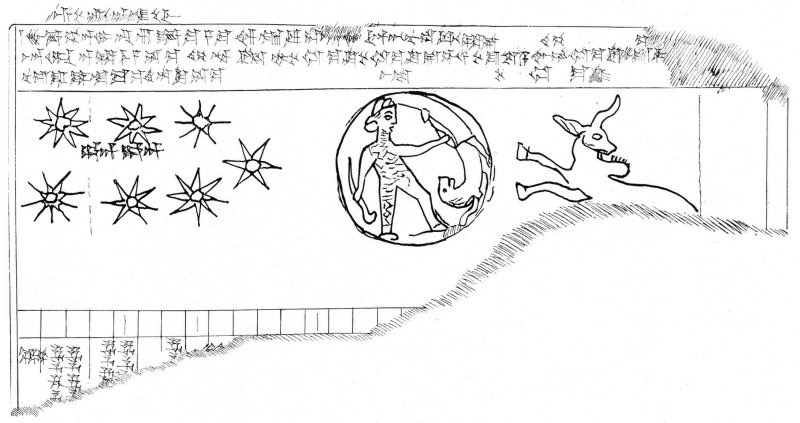
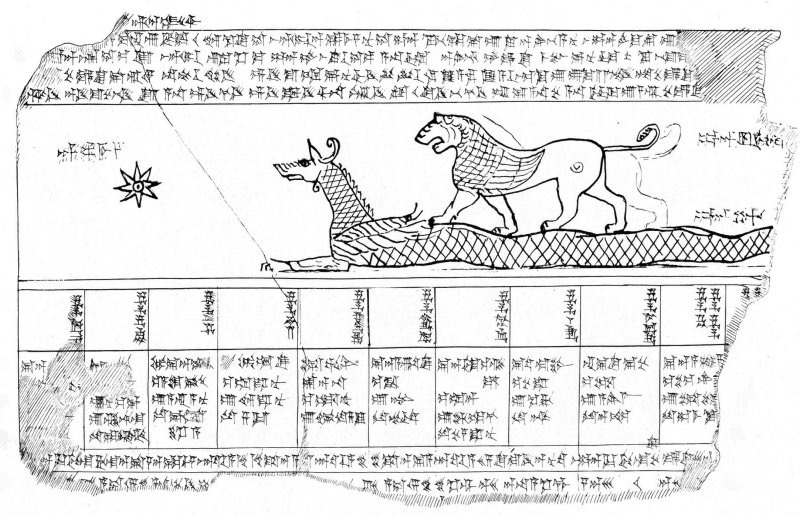
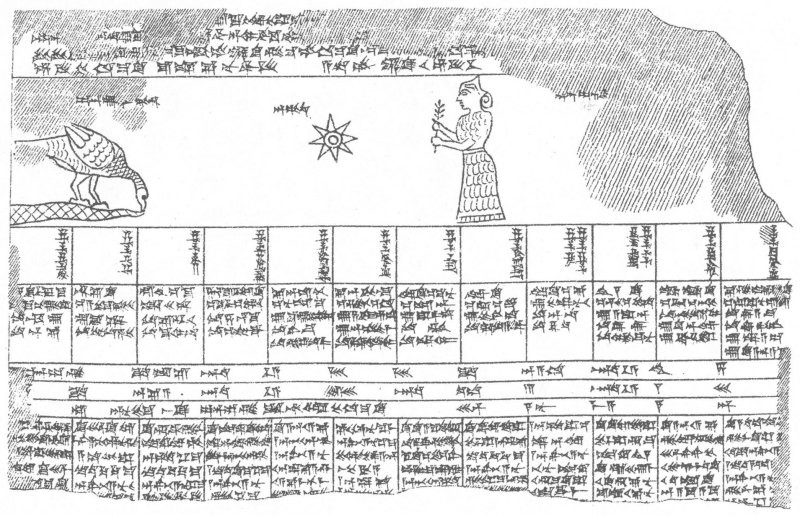
Assyrian star map from Nineveh (K 8538). Counterclockwise from bottom: Sirius (Arrow), Pegasus + Andromeda (Field + Plough), [Aries], the Pleiades, Gemini, Hydra + Corvus + Virgo, Libra. Drawing by L.W.King with corrections by J.Koch. Neue Untersuchungen zur Topographie des Babilonischen Fixsternhimmels (Wiesbaden 1989), p. 56ff. http://doormann.tripod.com/asssky.htm

Assyrian star map from Nineveh (K 8538). Counterclockwise from bottom: Sirius (Arrow), Pegasus + Andromeda (Field + Plough), [Aries], the Pleiades, Gemini, Hydra + Corvus + Virgo, Libra. Drawing by L.W.King with corrections by J.Koch. Neue Untersuchungen zur Topographie des Babilonischen Fixsternhimmels (Wiesbaden 1989), p. 56ff.
http://doormann.tripod.com/asssky.htm

None of the goddesses received stellar honours. The names of the months were probably quite popular in origin.

Thus we find that

  • the first month was known as the ‘month of the Sanctuary,’
  • the third as the ‘period of brick-making,’
  • the fifth as the ‘fiery month,’
  • the sixth as the ‘month of the mission of Ishtar,’ referring to her descent into the realms of Allatu.
  • The fourth month was designated ‘scattering seed,’
  • the eighth that of the opening of dams,
  • and the ninth was entitled ‘copious fertility,’
  • while the eleventh was known as ‘destructive rain.’

We find in this early star-worship of the ancient Babylonians the common origin of religion and science. Just as magic partakes in some measure of the nature of real science (for some authorities hold that it is pseudo-scientific in origin) so does religion, or perhaps more correctly speaking, early science is very closely identified with religion.

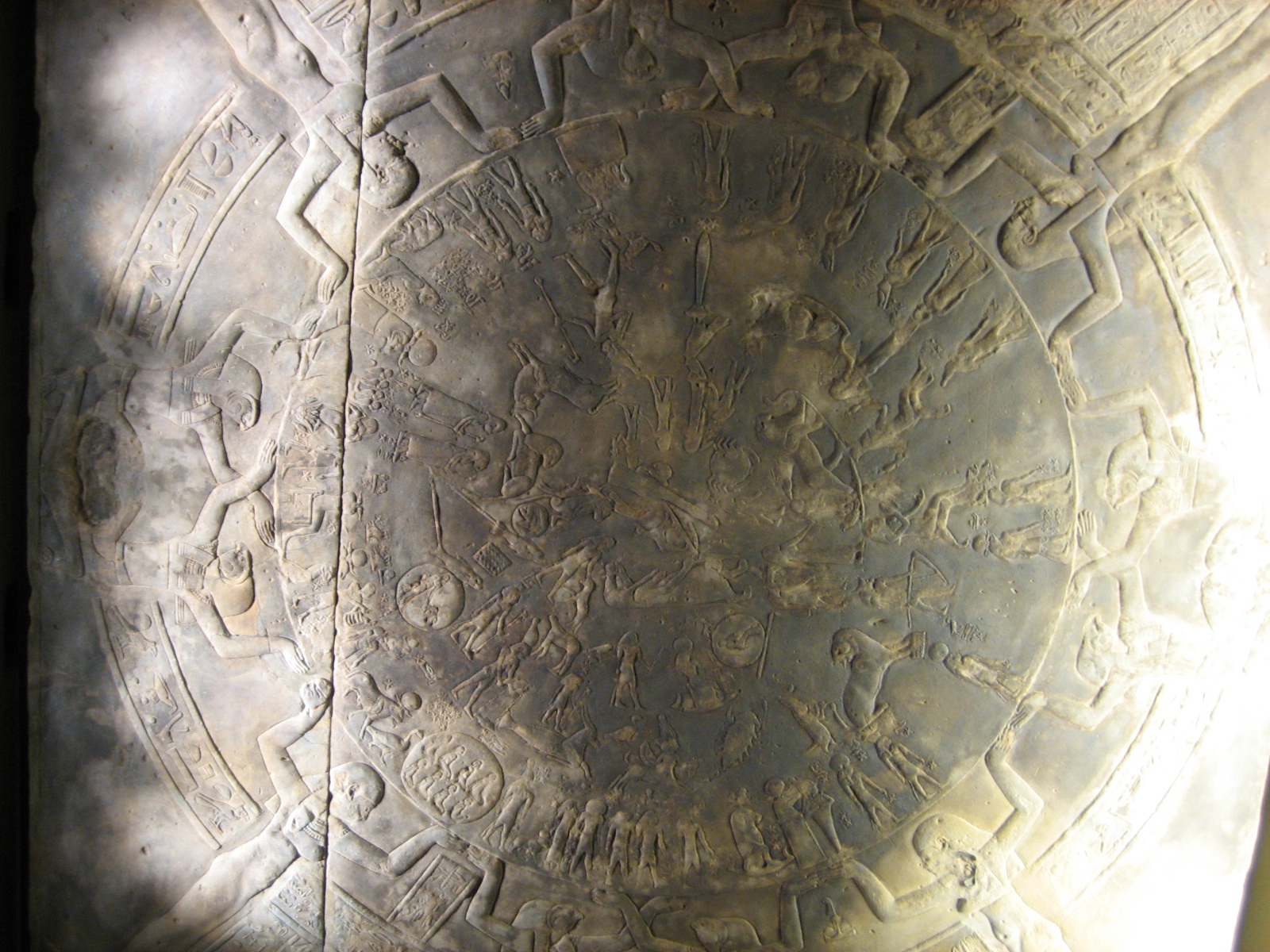
 The Zodiac of Dendera (or “Dendara”), a stone diagram from an Egyptian temple dated to the mid-1st century BCE, depicts the twelve signs of the zodiac and the 36 Egyptian decans, and numerous other constellations and astronomical phenomena. The Hellenistic-era portrayal of the zodiac is dated to between June 15th and August 15th, 50 BCE based on astronomical data in the diagram.  The positions of planets in specific signs of the zodiac and eclipses that took place on March 7th, 51 BCE and September 25, 52 BCE are depicted. The Dendera Egyptian temple complex dates back to the 4th century BCE, during the rule of the last native Egyptian pharaoh Nectanebo II. It was renovated by later Hellenistic and Roman rulers. http://horoscopicastrologyblog.com/2007/05/24/the-zodiac-of-dendera/


The Zodiac of Dendera (or “Dendara”), a stone diagram from an Egyptian temple dated to the mid-1st century BCE, depicts the twelve signs of the zodiac and the 36 Egyptian decans, and numerous other constellations and astronomical phenomena.
The Hellenistic-era portrayal of the zodiac is dated to between June 15th and August 15th, 50 BCE based on astronomical data in the diagram. The positions of planets in specific signs of the zodiac and eclipses that took place on March 7th, 51 BCE and September 25, 52 BCE are depicted.
The Dendera Egyptian temple complex dates back to the 4th century BCE, during the rule of the last native Egyptian pharaoh Nectanebo II. It was renovated by later Hellenistic and Roman rulers.
http://horoscopicastrologyblog.com/2007/05/24/the-zodiac-of-dendera/

Thus we may believe that the religious interest in their early astronomy spurred the ancient star-gazers of Babylonia to acquire more knowledge concerning the motions of those stars and planets which they believed to be deities.

We find the gods so closely connected with ancient Chaldean astronomy as to be absolutely identified with it in every way. A number was assigned to each of the chief gods, which would seem to show that they were connected in some way with mathematical science.

Thus Ishtar’s number is fifteen; that of Sin, her father, is exactly double that. Anu takes sixty, and Bel and Ea represent fifty and forty. Ramman is identified with ten.

It would be idle in this place to attempt further to outline astrological science in Babylonia, concerning which our knowledge is vague and scanty. Much remains to be done in the way of research before anything more definite can be written about it, and many years may pass before the workers in this sphere are rewarded by the discovery of texts bearing on Chaldean star-lore.”

Lewis Spence, Myths and Legends of Babylonia and Assyria, 1917, pp. 235-7.

Animist Origins of Babylonian Celestial Religion

“To arrive at a proper comprehension of Babylonian religious doctrines it is necessary to understand the nature of the astrological speculations of the ancient Chaldeans.

They recognized at an early period that eternal and unchangeable laws underlay planetary motion, and seem to have been able to forecast eclipses. Soon also did they begin to identify the several heavenly bodies with the gods. Thus the path of the sun was known as the”‘way of Anu,” and the course of the moon and planets they determined with reference to the sun’s ecliptic or pathway.

This illustration is from a page on Babylonian astronomy hosted by the science faculty of the Mathematical Institute of Utrecht University.  http://www.staff.science.uu.nl/~gent0113/babylon/babybibl_fixedstars.htm A dedicated work assessing the influences of Chaldean astrology on later Greek and Roman knowledge can be found in Franz Cumont, Astrology and Religion Among the Greeks and Romans, 1912.  Full text available for download at several locations on the net, including: http://theosnet.net/dzyan/miscpubs/Astrology_and_Religion.pdf

This illustration is from a page on Babylonian astronomy hosted by the science faculty of the Mathematical Institute of Utrecht University.
http://www.staff.science.uu.nl/~gent0113/babylon/babybibl_fixedstars.htm
A dedicated work assessing the influences of Chaldean astrology on later Greek and Roman knowledge can be found in Franz Cumont, Astrology and Religion Among the Greeks and Romans, 1912.
Full text available for download at several locations on the net, including:
http://theosnet.net/dzyan/miscpubs/Astrology_and_Religion.pdf

It is strange, too, that they should have employed the same ideograph for the word ‘star’ and the word ‘god,’ the only difference being that in the case of a god they repeated the sign three times. If the sun and moon under animistic law are regarded as gods, it stands to reason that the stars and planets must also be looked upon as lesser deities.

Indeed, poets still use such an expression regarding them as ‘the host of heaven,’ and we frequently encounter in classical authors the statement that the stars in their courses fought for such and such a person.

This illustration is from a page on Babylonian astronomy hosted by the science faculty of the Mathematical Institute of Utrecht University.  http://www.staff.science.uu.nl/~gent0113/babylon/babybibl_fixedstars.htm A dedicated work assessing the influences of Chaldean astrology on later Greek and Roman knowledge can be found in Franz Cumont, Astrology and Religion Among the Greeks and Romans, 1912.  Full text available for download at several locations on the net, including: http://theosnet.net/dzyan/miscpubs/Astrology_and_Religion.pdf

This illustration is from a page on Babylonian astronomy hosted by the science faculty of the Mathematical Institute of Utrecht University.
http://www.staff.science.uu.nl/~gent0113/babylon/babybibl_fixedstars.htm
A dedicated work assessing the influences of Chaldean astrology on later Greek and Roman knowledge can be found in Franz Cumont, Astrology and Religion Among the Greeks and Romans, 1912.
Full text available for download at several locations on the net, including:
http://theosnet.net/dzyan/miscpubs/Astrology_and_Religion.pdf

This is tantamount to saying that the stars possess volition, and even although omens were looked for out of their movements, it may have been believed that these were the outcome of volition on the part of the stars themselves as deities or deific individuals.

Again we can see how the idea that the gods reside in ‘heaven’ —that is, the sky—arose from early astrological conceptions. The gods were identified in many cases with the stars, therefore it is only natural to suppose that they resided in the sky-region. It is, indeed, one of the most difficult matters for even an intelligent and enlightened man in our enlightened age to dissociate the idea of God from a residence in the sky or ‘somewhere up there.’

This illustration is from a page on Babylonian astronomy hosted by the science faculty of the Mathematical Institute of Utrecht University.  http://www.staff.science.uu.nl/~gent0113/babylon/babybibl_fixedstars.htm A dedicated work assessing the influences of Chaldean astrology on later Greek and Roman knowledge can be found in Franz Cumont, Astrology and Religion Among the Greeks and Romans, 1912.  Full text available for download at several locations on the net, including: http://theosnet.net/dzyan/miscpubs/Astrology_and_Religion.pdf

This illustration is from a page on Babylonian astronomy hosted by the science faculty of the Mathematical Institute of Utrecht University.
http://www.staff.science.uu.nl/~gent0113/babylon/babybibl_fixedstars.htm
A dedicated work assessing the influences of Chaldean astrology on later Greek and Roman knowledge can be found in Franz Cumont, Astrology and Religion Among the Greeks and Romans, 1912.
Full text available for download at several locations on the net, including:
http://theosnet.net/dzyan/miscpubs/Astrology_and_Religion.pdf

The idea of space, too, must have assisted in such a conception as the residence of the gods in the upper regions of air. The earth would not be large enough for them, but the boundless vault above would afford them plenty of space in which to dwell.

Again, the sun and moon being gods, it would be only natural for the other deities to dwell beside them, that is, in the ‘heaven of Anu,’ as the Babylonians called the sky. It has been suggested that the conception of a pantheon dwelling in the sky originated in theological processes forwarded by a school or priesthood, but there is no reason to suppose that this was so, and the possibilities are easily covered by the circumstances of the animistic theory.”

Lewis Spence, Myths and Legends of Babylonia and Assyria, 1917, pp. 233-5.

Winds and the Babylonian Concept of Evil

Hadad, Addu or Dadda, never superseded the native name of Ramânu (Ramman) in Babylonia and Assyria, and remained foreign to the last.

Ramânu, however, was sometimes addressed as Barqu or Barak, “the lightning;” and it is possible that antiquarian zeal may have also sometimes imposed on him the Accadian title of Meru.

He grew continuously in popular favour. In Semitic Babylonia, and yet more in Semitic Assyria, his aid was constantly invoked; and, like Anu, Bel and Ea, he tended as time went on to become more and more national in character. Ramman is one of the least local of Babylonian gods.

This was due in great measure to the nature of his origin. He began as the amalgamation of two distinct deities, the wind-god and the air-god, and the extension af his cult was marked by the absorption into his person of the various deities of the winds adored by the older faith.

He continued to grow at their expense. The spirits of the winds and storms sank lower and lower; and while the beneficent side of their operation attached itself to Ramman, there remained to them only that side which was harmful and demoniac.

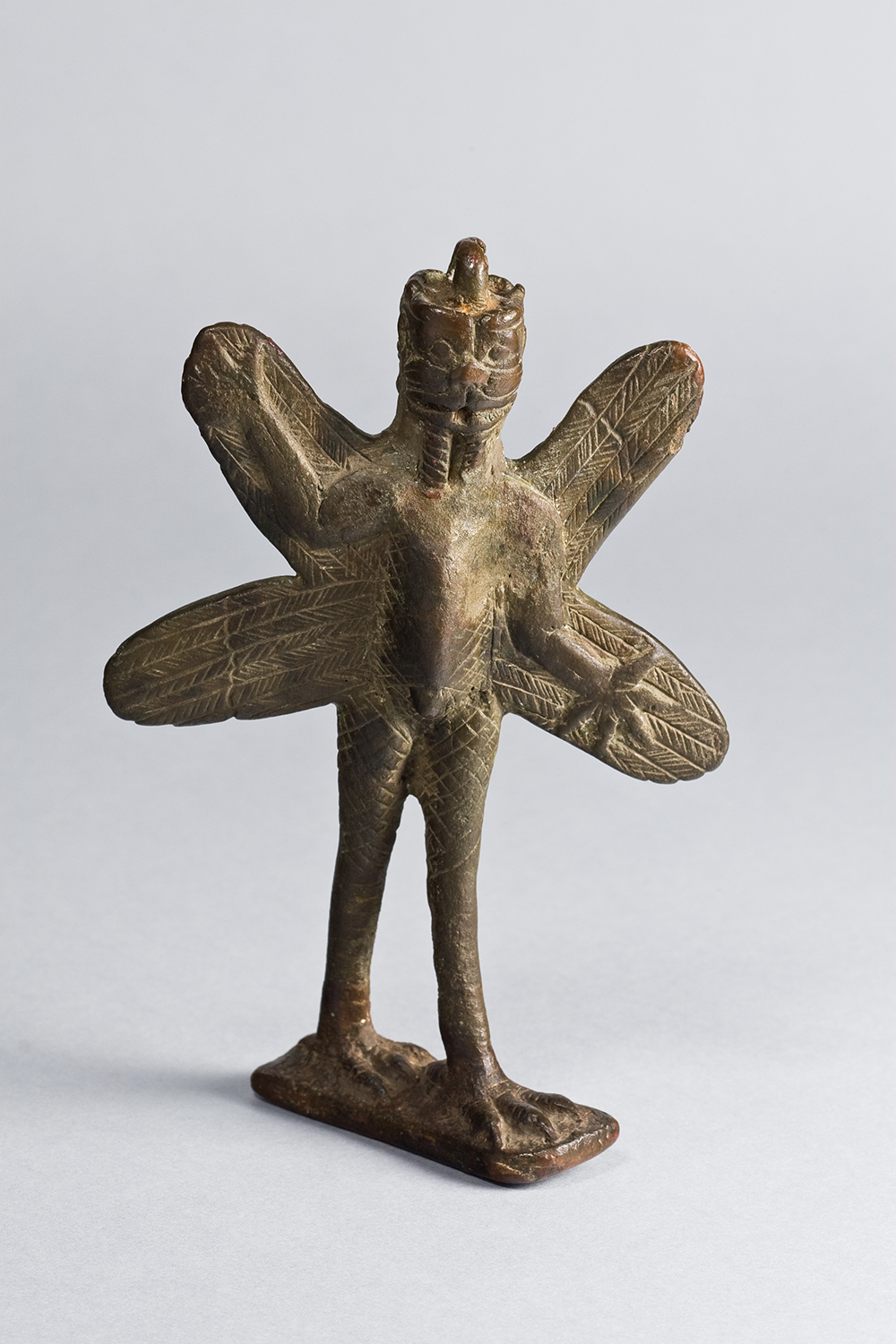
Iraq ca. 800-600 B.C. Bronze Purchased in New York, 1943 Oriental Institute Museum A25413 The demon Pazuzu stands but has a scorpion's body, feathered wings, avian legs, talons, and a lion face front and back.  Pazuzu, the "king of the evil wind demons," was not unfriendly. As an enemy of the Lamashtu demon, Pazuzu is portrayed on amulets for childbirth.  The ring at the top of this figurine suggests that it was such an amulet. https://oi.uchicago.edu/collections/highlights/highlights-collection-mesopotamia

Iraq
ca. 800-600 B.C.
Bronze
Purchased in New York, 1943
Oriental Institute Museum A25413
The demon Pazuzu stands but has a scorpion’s body, feathered wings, avian legs, talons, and a lion face front and back.
Pazuzu, the “king of the evil wind demons,” was an enemy of the Lamashtu demon. Pazuzu was portrayed on childbirth amulets. 
https://oi.uchicago.edu/collections/highlights/highlights-collection-mesopotamia

By degrees, the two aspects of their character came be separated. The higher gods came to be looked upon as the hearers of prayers and the bestowers of all good gifts; while the instruments of their vengeance an the inflictors of suffering and misery upon man were the inferior spirits of the lower sphere.

But the old conception, which derived both good and evil from the same source, did not wholly pass away. Evil never came to be regarded as the antagonist of good; it was rather the necessary complement and minister of good.

The supreme Baal thus preserved his omnipotence, while at the same time the ideas of pain and injustice were dissociated from him. In his combat with the dragon of chaos, Merodach summons the “evil wind” itself to his assistance; and in the legend of the assault of the seven wicked spirits upon the Moon, they are nevertheless called “the messengers of Anu their king.”

Nerra, the god of plague and destruction, smites the people of Babylonia on account of their sins by the command of the gods, like the angel with the drawn sword whom David saw standing over Jerusalem at the threshing-floor of Araunah; and in the story of the Deluge it is because of the wickedness of mankind that the flood is brought upon the earth.

The powers of darkness are degraded from their ancient position of independence, and either driven, like Tiamat, beyond the bounds of the created world, or reduced to the condition of ministers of divine wrath.

If we would realise how widely removed is this conception of them as the instruments of divine anger from that earlier view in which they are mere elemental powers, in themselves neither good nor evil, we cannot do better than compare these legendary compositions of the Semitic period with the old Accadian hymns that relate to the seven harmful spirits.”

A.H. Sayce, Lectures on the Origin and Growth of Religion as Illustrated by the Religion of the Ancient Babylonians, 5th ed., London, 1898, pp. 205-6.

On the Babylonian Winds

“The primitive inhabitant of Babylonia paid a special worship to the winds. He beheld in them spirits of good and evil. He prayed for (‘the good wind” which cooled the heats of summer and brought moisture to the parched earth, and he saw in the storm and tempest, in the freezing blasts of winter and the hot wind that blew from the burning desert, “the seven evil spirits.”

They were the demons ‘who had been created in the lower part of heaven,” and who warred against the Moon-god when he suffered eclipse. They were likened to all that was most noxious to man.

The first, we are told, was “the sword (or lightning) of rain;” the second, “a vampire;” the third, “a leopard;” the fourth, “a serpent;” the fifth, “a watch-dog” (?); the sixth, “a violent tempest which (blows) against god and king;” and the seventh, “a baleful wind.” But their power caused them to be dreaded, and they were venerated accordingly.

It was remembered that they were not essentially evil. They, too, had been the creation of Anu, for they came forth from the sky, and all seven were “the messengers of Anu their king.” In the war of the gods against the dragon of chaos, they had been the allies of Merodach. We read of them that ere the great combat began, the god “created the evil wind, the hostile wind, the tempest, the storm, the four winds, the seven winds, the whirlwind, the unceasing wind.”

Battle between Marduk (Bel) and Tiamat. Drawn from a bas-relief from the Palace of Ashur-nasir-pal, King of Assyria, 885-860 B.C., at Nimrûd. The winds that Marduk wielded in the combat are portrayed as tridents in his hands.  British Museum, Nimrûd Gallery, Nos. 28 and 29. http://bharatkalyan97.blogspot.com/2013/06/tablet-of-destinies.html

Battle between Marduk (Bel) and Tiamat. Drawn from a bas-relief from the Palace of Ashur-nasir-pal, King of Assyria, 885-860 B.C., at Nimrûd.
The winds that Marduk wielded in the combat are portrayed as tridents in his hands.
British Museum, Nimrûd Gallery, Nos. 28 and 29.
http://bharatkalyan97.blogspot.com/2013/06/tablet-of-destinies.html

When Merodach had slung forth his boomerang and hit the dragon, “the evil wind that seizes behind showed its face. And Tiamat (the dragon of the sea) opened her mouth to swallow it, but (the god) made the evil wind descend so that she could not close her lips; with the force of the winds he filled her stomach, and her heart was sickened and her mouth distorted.”

Down to the closing days of the Assyrian empire, the four winds, ”the gods of Nipur,” were still worshipped in Assyria (H.C. Rawlinson, The Cuneiform Inscriptions of Western Asia, 1886, iii. 66, Rev. 26), and Saru, the Wind-god, is mentioned as a separate divinity in the story of the Deluge.

Among the winds there was one whose name awakened feelings of dread in the mind of every Babylonian. This was the tempest, called mâtu in Accadian, and abub in Semitic. It was the tempest which had been once sent by Bel to drown guilty mankind in the waters of a deluge, and whose return as the minister of divine vengeance was therefore ever feared.

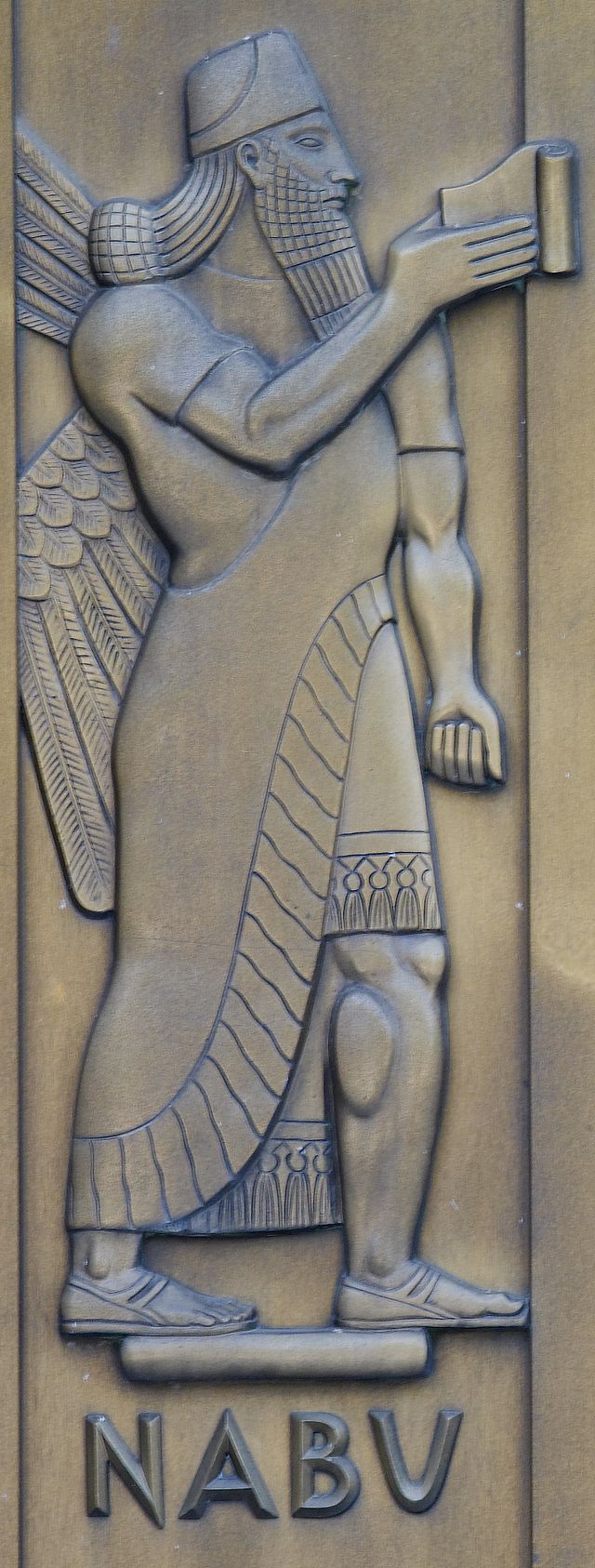
Nabu, or Nebo, sculpted bronze figure by Lee Lawrie. Door detail, east entrance, Library of Congress John Adams Building, Washington, D.C. Photographed 2007 by Carol Highsmith (1946–), who explicitly placed the photograph in the public domain. - Library of Congress, Prints & Photographs Division. http://en.wikipedia.org/wiki/Nabu#/media/File:Nabu-Lawrie-Highsmith.jpeg

Nabu, or Nebo, sculpted bronze figure by Lee Lawrie. Door detail, east entrance, Library of Congress John Adams Building, Washington, D.C.
Photographed 2007 by Carol Highsmith (1946–), who explicitly placed the photograph in the public domain. – Library of Congress, Prints & Photographs Division.
http://en.wikipedia.org/wiki/Nabu#/media/File:Nabu-Lawrie-Highsmith.jpeg

As each year brought with it the month of Sebat or January, with its “curse of rain,” the memory of that terrible event rose again in the Babyonian mind. Mâtu was a god whose favour had to be conciliated, and whose name accordingly appears on numbers of early cylinders.

But though Mâtu was thus specially identified with the great tempest which formed an era in Babylonian history, it was not forgotten that he was but one of several storm-gods, who were therefore spoken of as “the gods Mâtu.

Like the clouds, they were children of the sea, and were thus included in the family of Ea. It is possible that this genealogy was due to the systematising labours of a later day; but it is also possible that the gods Mâtu were primarily adored in Eridu, and that Eridu, and not Surippak, was the original city of the Chaldean Noah.

It is at least noticeable that the immortal home of the translated Xisuthros was beyond the mouth of the Euphrates, near which Eridu was built.

If Eridu were the birth-place of Mâtu, it would explain why the god of the tempest was also the god of the western wind. Elsewhere in Babylonia, the western wind blew from across the desert and brought heat with it rather than rain.

But in those remote days, when the northern portion of the Persian Gulf had not as yet been filled up with miles of alluvial deposit, a westerly breeze could still come to Eridu across the water.

In a penitential psalm, Mâtu, the lord of the mountain” (mulu mursamma-lil), whose wife, “the lady of the mountain,” is mentioned on the monuments of Tel-loh, is invoked along with his consort Gubarra, Ea, “the sovereign of heaven and earth and sovereign of Eridu,” Dav-kina, Merodach, Zarpanit, Nebo and Nana--in short, along with the gods of Eridu and the kindred deities of Babylon.”

A.H. Sayce, Lectures on the Origin and Growth of Religion as Illustrated by the Religion of the Ancient Babylonians, 5th ed., London, 1898, pp. 199-202.

Cult of Nabu at Calah

“As for Bel, whose place Merodach usurped in the Babylonian pantheon, he was also recognized in Assyria, and Tiglath-pileser I built him a temple in his city of Asshur. Tiglath prefixes the adjective ‘old’ to the god’s name to show that he means Bel, not Bel-Merodach.

Sargon, too, who had antiquarian tastes, also reverts to Bel, to whom he alludes as the ‘Great Mountain,’ the name of the god following immediately after that of Asshur. Bel is also invoked in connexion with Anu as a granter of victory.

His consort Belit, although occasionally she is coupled with him, more usually figures as the wife of Asshur, and almost as commonly as a variant of Ishtar. In a temple in the city of Asshur, Tiglath-pileser I made presents to Belit consisting of the images of the gods vanquished by him in his various campaigns.

Assur-bani-pal, too, regarded Belit as the wife of Asshur, and himself as their son, alluding to Belit as ‘Mother of the Great Gods,’ a circumstance which would go to show that, like most of the Assyrian kings, his egoism rather overshadowed his sense of humour.

In Assur-bani-pal’s pantheon Belit is placed close by her consort Asshur. But there seems to have been a good deal of confusion between Belit and Ishtar because of the general meaning of the word Belit.

 [ … ]

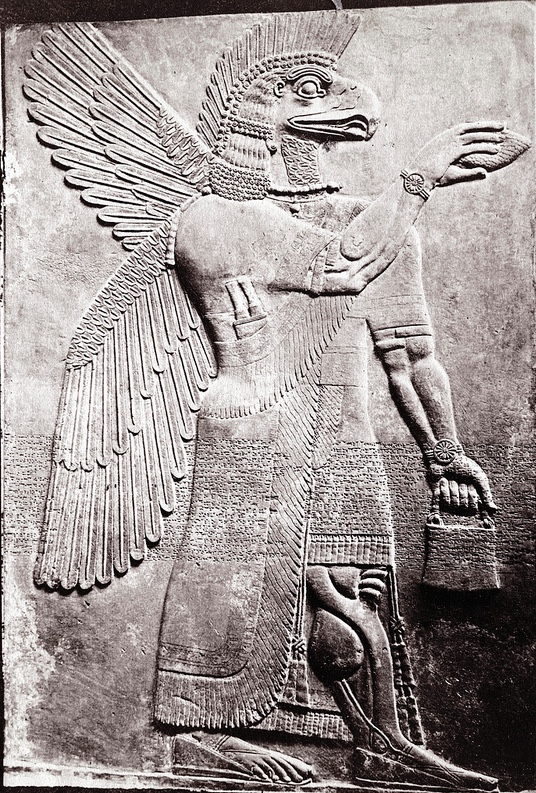
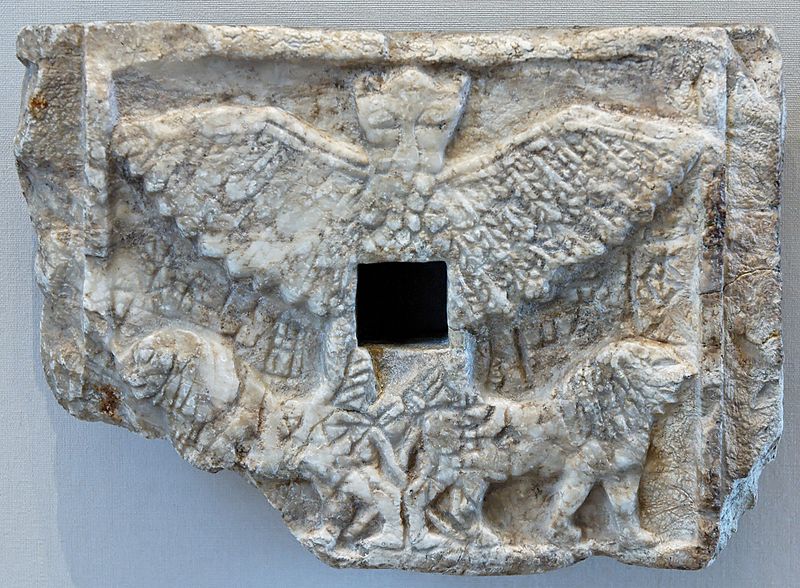
Stephen Thompson - Asshur, Assyrian God, Marble Relief, British Museum, 1872 The Catalogue of a Series of Photographs from the Collections of The British Museum (Photographed by S. Thompson), Part III, W.A. Mansell & Co, London, 1872, p. 30. In the Nimrud Gallery of the Museum, Eastern side, #355. B.C. 884.  Marble slab. Eagle-headed winged deity Asshur (the chief of all the Gods), holding cone and basket, (supposed to represent the receptacle in which the divine gifts are stored,) and standard inscriptions. https://www.flickr.com/photos/photohistorytimeline/10171487505/

Stephen Thompson – Asshur, Assyrian God, Marble Relief, British Museum, 1872
The Catalogue of a Series of Photographs from the Collections of The British Museum (Photographed by S. Thompson), Part III, W.A. Mansell & Co, London, 1872, p. 30.
In the Nimrud Gallery of the Museum, Eastern side, #355. B.C. 884.
Marble slab. Eagle-headed winged deity Asshur (the chief of all the Gods), holding cone and basket, (supposed to represent the receptacle in which the divine gifts are stored) and standard inscriptions.
https://www.flickr.com/photos/photohistorytimeline/10171487505/

As in Babylonia so in Assyria, Nabu and Merodach were paired together, often as Bel and Nabu. Especially were they invoked when the affairs of Babylonia were being dealt with. In the seventh century b.c. we find the cult of Nabu in high popularity in Assyria, and indeed Ramman-Nirari III appears to have made an attempt to advance Nabu considerably.

George Rawlinson - Source: Seven Great Monarchies Of The Ancient Eastern World, Vol 1. (1875) The Chaldean god Nebo, from a statue in the British Museum.  http://www.totallyfreeimages.com/56/Nebo.

George Rawlinson – Source: Seven Great Monarchies Of The Ancient Eastern World, Vol 1. (1875)
The Chaldean god Nebo, from a statue in the British Museum.
http://www.totallyfreeimages.com/56/Nebo.

He erected a temple to the god at Calah, and granted him many resounding titles. But even so, it does not seem that Ramman-Nirari intended to exalt Nabu at the expense of Asshur. Indeed it would have been impossible for him to have done so if he had desired to.

Asshur was as much the national god of the Assyrian people as Osiris was of the Egyptians. Nabu was the patron of wisdom, and protector of the arts; he guided the stylus of the scribe; and in these attributes he is very close to the Egyptian Thoth, and almost identical with another Babylonian god, Nusku ...

Sargon calls Nabu ‘the Seer who guides the gods,’ and it would seem from some notices of him that he was also regarded as a leader of heavenly or spiritual forces.

Those kings who were fond of erudition paid great devotion to Nabu, and many of the tablets in their literary collections close with thanksgiving to him for having opened their ears to receive wisdom.”

Lewis Spence, Myths and Legends of Babylonia and Assyria, 1917, pp. 227-9.

Conquering the Gods

“Even Bel-Merodach was absorbed into the Assyrian pantheon. To the Assyrians, Babylonia was the country of Bel, and they referred to their southern neighbours as the ‘subjects of Bel.’ This, of course, must be taken not to mean the older Bel, but Bel-Merodach. They even alluded to the governor whom they placed over conquered Babylonia as the governor of Bel, so closely did they identify the god with the country.

It is only in the time of Shalmaneser II— the ninth century b.c. —that we find the name Merodach employed for Bel, so general did the use of the latter become. Of course it was impossible that Merodach could take first place in Assyria as he had done in Babylonia, but it was a tribute to the Assyrian belief in his greatness that they ranked him immediately after Asshur in the pantheon.

Austen Henry Layard. A Popular Account of Discoveries At Nineveh. London. John Murray. 1852, p. 211. http://www.bibleorigins.net/Sundiscarcherdrawnbow.html

Austen Henry Layard. A Popular Account of Discoveries At Nineveh. London. John Murray. 1852, p. 211.
http://www.bibleorigins.net/Sundiscarcherdrawnbow.html

The Assyrian rulers were sufficiently politic to award this place to Merodach, for they could not but see that Babylonia, from which they drew their arts and sciences, as well as their religions beliefs, and from which they benefited in many directions, must be worthily represented in the national religion.

And just as the Romans in conquering Greece and Egypt adopted many of the deities of these more cultured and less powerful lands, thus seeking to bind the inhabitants of the conquered provinces more closely to themselves, so did the Assyrian rulers believe that, did they incorporate Merodach into their hierarchy, he would become so Assyrian in his outlook as to cease to be wholly Babylonian, and would doubtless work in favour of the stronger kingdom.

In no other of the religions of antiquity as in the Assyrian was the idea so powerful that the god of the conquered or subject people should become a virtual prisoner in the land of the conquerors, or should at least be absorbed into their national worship.

Some of the Assyrian monarchs went so far as to drag almost every petty idol they encountered on their conquests back to the great temple of Asshur, and it is obvious that they did not do this with any intention of uprooting the worship of these gods in the regions they conquered, but because they desired to make political prisoners of them, and to place them in a temple-prison, where they would be unable to wreak vengeance upon them, or assist their beaten worshippers to war against them in the future.

It may be fitting at this point to emphasize how greatly the Assyrian people, as apart from their rulers, cherished the older beliefs of Babylonia. Both peoples were substantially of the same stock, and any movement which had as its object the destruction of the Babylonian religion would have met with the strongest hostility from the populace of Assyria.

Just as the conquering Aztecs seem to have had immense reverence for the worship of the Toltecs, whose land they subdued, so did the less cultivated Assyrians regard everything connected, with Babylonia as peculiarly sacred.

The Kings of Assyria, in fact, were not a little proud of being the rulers of Babylonia, and were extremely mild in their treatment of their southern subjects—very much more so, in fact, than they were in their behaviour toward the people of Elam or other conquered territories. We even find the kings alluding to themselves as being nominated by the gods to rule over the land of Bel.

The Assyrian monarchs strove hard not to disturb the ancient Babylonian cult, and Shalmaneser II, when he had conquered Babylonia, actually entered Merodach’s temple and sacrificed to him.”

Lewis Spence, Myths and Legends of Babylonia and Assyria, 1917, pp.  225-7.

Nergal, God of Death

“It was as the death-dealing lord of Hades that Nergal first became “the hero of the gods,” “who marches in their front.” The metaphor was taken from the champion who, like Goliath, places himself before his comrades and challenges the enemy to combat.

It is thus that we read in the story of the Deluge, when the flood of rain and destruction is described as coming upon the guilty world: “Rimmon in the midst of (heaven) thundered, and Nebo and the Wind-god went in front; the throne-bearers went over mountain and plain; Nergal the mighty removes the wicked; Adar goes in front and casteth down.”

sayce65

As lord of Hades, too, he was made the son of Mul-lil. A hymn (K 5268), the colophon of which tells us that it was composed in Cutha, begins with the words: “Let Nergal be glorified, the hero of the gods, who cometh forth as the strong one, the son of Mul-lil.”

In the same hymn, Marad is declared to be his city, from which we may infer that Marad was near Cutha. Its protecting divinity, however, was, strictly speaking, Lugal-túda,”the royal offspring,” or perhaps “valiant king,” a personification of the thunder-cloud and lightning; but it is evident from the hymn that he had been identified with the death-dealing god of Cutha.

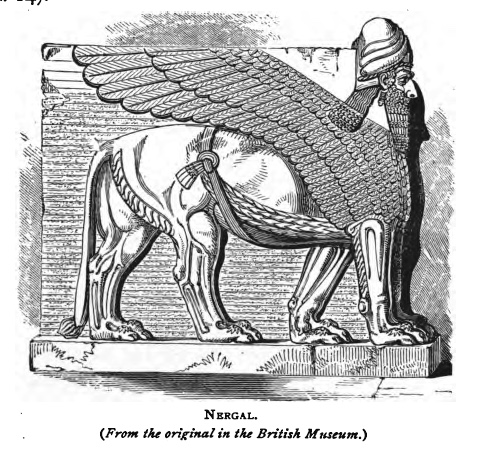
Another depiction of Nergal, patron god of Kutha.

Another depiction of Nergal, patron god of Kutha.

Of Laz, the wife of Nergal, we know little or nothing. Her name survived as the local divinity of Cutha, but her office and attributes were taken by Allat. Even Nergal himself as the lord of Hades belongs rather to the Accadian than to the Semitic period.

Among the Semites he was the hero and champion of the gods, and as such the destroyer of the wicked, rather than the king of death who slays alike the wicked and the good. The sovereignty of Hades had passed out of his hands, and he had become the companion of the solar Adar and the warrior of the gods of heaven.

Under his old name of Ner, however, a curious reminiscence of his primitive character lasted down to late times. In the hymns and other poetical effusions, we not unfrequently come across the phrase, ”mankind, the cattle of the god Ner.”

I have already drawn attention to the agricultural nature of early Chaldean civilisation, and the influence that agriculture had upon the modes of thought and expression of the population. Not only was the sky regarded as the counterpart of the Babylonian plain, and the heavenly bodies transformed into the herds and flocks that fed there, but the human inhabitants of the earth were themselves likened to the cattle they pastured and fed.

One of the earliest titles of the Babylonian kings was “shepherd,” reminding us of the Homeric ποιμην λαων, “shepherd of nations;” and in the Epic of Gisdhubar the sovereign city of Erech is termed the śubur, or “shepherd’s hut.”

Just as the subjects of the king, therefore, were looked upon as the sheep whom their ruler shepherded, so too mankind in general were regarded as the cattle slain by the god of death. They were, in fact, his herd, whom he fed and slaughtered in sacrifice to the gods.”

A.H. Sayce, Lectures on the Origin and Growth of Religion as Illustrated by the Religion of the Ancient Babylonians, 5th ed., London, 1898, pp. 196-8.

Trinities versus Male-Female Dualism

“The early importance and supremacy of Erech in Semitic Babylonia caused its god to assume a place by the side of Ea of Eridu and Mul-lil, the older Bel. It is possible that the extension of his cult had already begun in Accadian days. The Ana, or Sky-god, to whom Gudea at Tel-loh erected a temple, may have been the Sky-god of Erech, more especially when we remember the connection that existed between Erech and Eridu on the one hand, and between Tel-loh and Eridu on the other.

However this may be, from the commencement of the Semitic period Anu appears as the first member of a triad which consisted of Anu, Bel or Mul-lil, and Ea. His position in the triad was due to the leading position held by Erech; the gods of Nipur and Eridu retained the rank which their time-honoured sanctity and the general extension of their cult had long secured to them; but the rank of Anu was derived from the city of which he was the presiding god.

The origin of the triad was thus purely accidental; there was nothing in the religious conceptions of the Babylonians which led to its formation. Once formed, however, it was inevitable that a cosmological colouring should be given to it, and that Anu, Bel and Ea, should represent respectively the heaven, the lower world and the watery element.

Later ages likened this cosmological trinity to the elemental trinity of the Sun, the Noon and the Evening Star; and below the triad of Anu, Bel and Ea, was accordingly placed the triad of of Samas, Sin and Istar. But this secondary trinity never attracted the Babylonian mind.

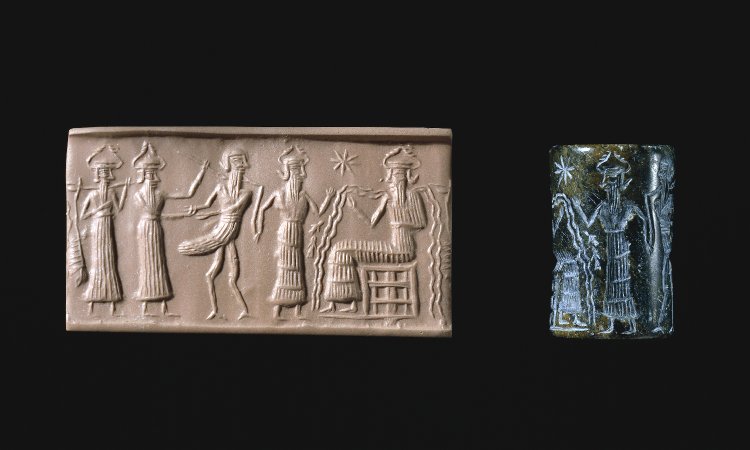
This finely cut seal depicts Ishtar, Mesopotamian goddess of sexuality and warfare.  Her strength as a warrior is stressed here, as she is shown with weapons rising from her shoulders. Ishtar appears to have been associated at an early period with the Sumerian goddess Inanna and both deities are depicted with symbols of fertility, such as the date palm, and of aggression, such as the lion.  This iconography survived relatively unchanged for over a thousand years. Here, Ishtar's astral quality is also emphasized: above her crown is a representation of the planet Venus.  In the first millennium BC more unusual stones were used to make seals: this one is made of green garnet, which may have come from northern Pakistan. British Museum, ME 89769, acquired 1835. D. Collon, First impressions: cylinder seals (London, The British Museum Press, 1987) H. Frankfort, Cylinder seals (London, Macmillan, 1939) http://www.britishmuseum.org/explore/highlights/highlight_objects/me/g/garnet_cylinder_seal_ishtar.aspx

This finely cut seal depicts Ishtar, Mesopotamian goddess of sexuality and warfare.
Her strength as a warrior is stressed here, as she is shown with weapons rising from her shoulders.
Ishtar appears to have been associated at an early period with the Sumerian goddess Inanna and both deities are depicted with symbols of fertility, such as the date palm, and of aggression, such as the lion.
This iconography survived relatively unchanged for over a thousand years. Here, Ishtar’s astral quality is also emphasized: above her crown is a representation of the planet Venus.
In the first millennium BC more unusual stones were used to make seals: this one is made of green garnet, which may have come from northern Pakistan. British Museum, ME 89769, acquired 1835.
D. Collon, First impressions: cylinder seals (London, The British Museum Press, 1987)
H. Frankfort, Cylinder seals (London, Macmillan, 1939)
http://www.britishmuseum.org/explore/highlights/highlight_objects/me/g/garnet_cylinder_seal_ishtar.aspx

Up to the last, as we have seen, Sin continued to be the father of Samas and Istar, and Babylonian religion remained true to its primitive tendency to dualism, its separation of the divine world into male and female deities.

The only genuine trinity that can be discovered in the religious faith of early Chaldea was that old Accadian system which conceived of a divine father and mother by the side of their son the Sun-god.

The Semitic Anu necessarily produced the feminine Anat, and as necessarily Anat was identified with the earth as Anu was with the sky. In this way the Accadian idea of a marriage union between the earth and the sky was adapted to the newer Semitic beliefs. But we must not misunderstand the nature of the adaptation.

Anat never became an independent deity, as Dav-kina, for example, had been from the outset; she had no separate existence apart from Anu. She is simply a Bilat matati, “a mistress of the world,” or a Bilat ili, “a mistress of the gods,” like the wife of Bel or of Samas: she is, in fact, a mere colourless representation of the female principle in the universe, with no attributes that distinguish her from Anunit or Istar except the single one that she was the feminine form of Anu.

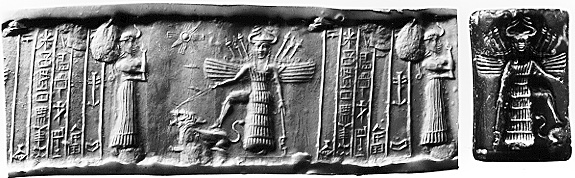
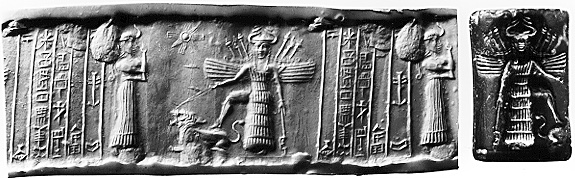
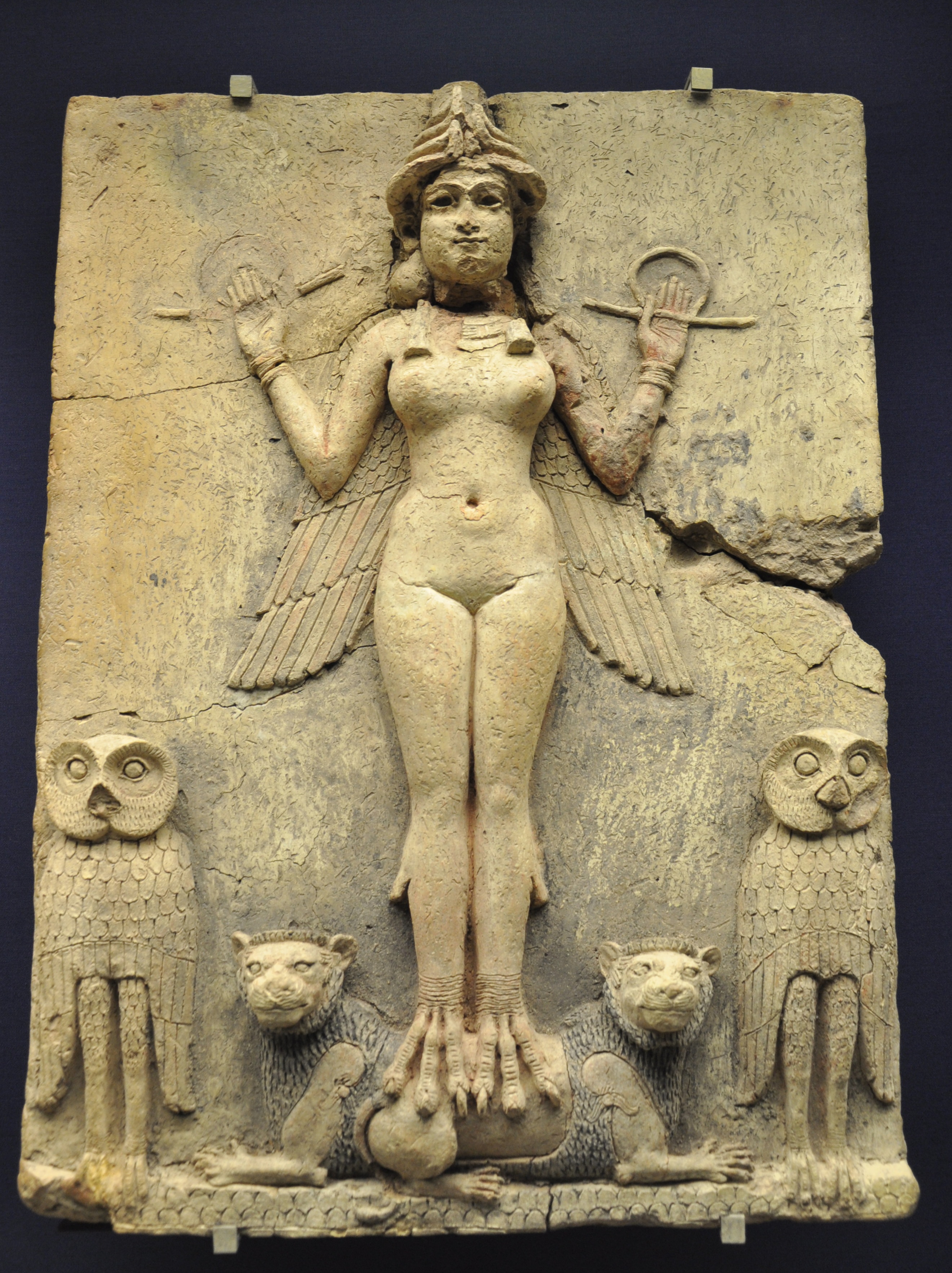
Goddess Ishtar, center, with wings, standing armed with one foot on a lion, her symbol.  The goddess is portrayed wearing the horned headdress of divinity and indistinct weaponry on her back.

Goddess Ishtar, center, with wings, standing armed with one foot on a lion, her symbol.
The goddess is portrayed wearing the horned headdress of divinity and indistinct weaponry on her back.

Hence it is that the Canaanites had not only their Ashtaroth, but their Anathoth as well, for the Anathoth or “Anats” differed from the Ashtaroth or “Ashtoreths” in little else than name. So far as she was an active power, Anat was the same as Istar; in all other respects she was merely the grammatical complement of Anu, the goddess who necessarily stood at the side of a particular god.”

A.H. Sayce, Lectures on the Origin and Growth of Religion as Illustrated by the Religion of the Ancient Babylonians, 5th ed., London, 1898, pp. 192-4.

Assyrian Monotheism versus Babylonian Pantheism

“Henceforward “the heaven of Anu” denoted the serene and changeless regions to which the gods fled when the deluge had broken up the face of the lower heaven, and which an Assyrian poet calls “the land of the silver sky.”

It was to this spiritualised heaven that the spirit of Ea-bani, the friend of Gisdhubar, ascended, and from which he gazed placidly on the turmoil of the earth below; and it was from his seat therein that Anu assigned their places in the lower heaven to Samas, Sin and Istar, the Sun, the Moon and the Evening Star, according to the legend of the seven wicked spirits.

But the spiritualisation of Anu did not stop here. As a Semitic Baal he had become a supreme god, the lord and father of the universe. It was only a step further, therefore, to make him himself the universe, and to resolve into him the other deities of the Babylonian pantheon.

We read occasionally in the hymns of “the one god.”

“The ban, the ban,” a poet writes, personifying the priestly sentence of excommunication, like the Ara of Aeskhylos or the divine burden of Zechariah (ix.l),

“is a barrier which none may overpass; the barrier of the gods against which they cannot transgress, the barrier of heaven and earth which cannot be changed; the one god against whom none may rebel; god and man cannot explain (it); it is a snare not to be passed which is formed against the evil, the cord of a snare from which there is no exit which is turned against the evil.”

The conception of Anu, however, as “the one god” was pantheistic rather than monotheistic. The cosmological deities of an older phase of faith were in the first instance resolved into him. In place of the genealogical, or gnostic, system which we find in the account of the Creation in days, we have a pantheistic system, in which Lakhama and the other primeval forces of nature are not the parents of Anu, but are identified with Anu himself.

It is easy to conceive how the old deity An-sar, “the upper firmament,” with all its host of spirits, might be identified with him; but when we find Uras also, the Sun-god of Nipur, made one with Anu, “the hearer of prayer,” and the eagle-like Alala, the bridegroom of Istar and double of Tammuz, equally resolved into the god of Erech, it is plain that we have to do with an advanced stage of pantheism.

This monotheistic, or rather pantheistic, school of faith has been supposed by Sir Henry Rawlinson to have grown up at Eridu; but the fact that it centres round the name of Anu points rather to Erech as its birth-place. How long it flourished, or whether it extended beyond a narrow group of priestly thinkers, we have no means of ascertaining.

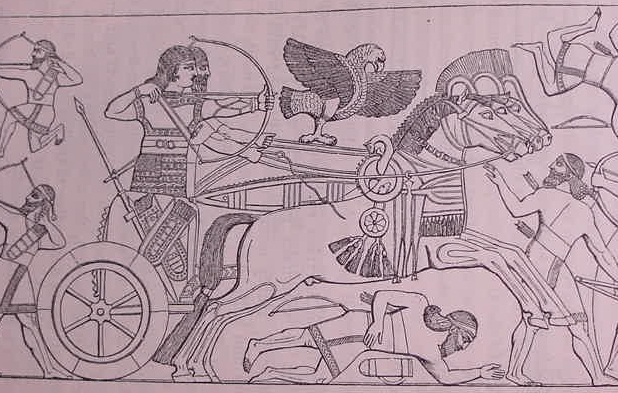
Assyrian bas-relief perhaps showing their warrior god Asshur as an Eagle, accompanying Assyrian warriors from the west palace at Nimroud, biblical Calah (p. 214. Austen Henry Layard. A Popular Account of Discoveries at Nineveh. London. John Murray. 1852).  http://www.bibleorigins.net/SundiscEagleAssyrian.html

Assyrian bas-relief perhaps showing their warrior god Asshur as an Eagle, accompanying Assyrian warriors from the west palace at Nimroud, biblical Calah (p. 214. Austen Henry Layard. A Popular Account of Discoveries at Nineveh. London. John Murray. 1852).
http://www.bibleorigins.net/SundiscEagleAssyrian.html

It is interesting, however, as showing that the same tendency which in Assyria exalted Assur to the position of an all-powerful deity who would brook neither opposition nor unbelief, among the more meditative Babylonians produced a crude system of pantheism.

Austen Henry Layard. A Popular Account of Discoveries At Nineveh. London. John Murray. 1852, p. 211. http://www.bibleorigins.net/Sundiscarcherdrawnbow.html

Austen Henry Layard. A Popular Account of Discoveries At Nineveh. London. John Murray. 1852, p. 211.
http://www.bibleorigins.net/Sundiscarcherdrawnbow.html

Whatever question there may be as to whether the pure and unmixed Semite is capable of originating a pantheistic form of faith, there can be little doubt about it where the Semite is brought into close contact with an alien race. The difference between the Assyrian and the Babylonian was the difference between the purer Semite and one in whose veins ran a copious stream of foreign blood.”

A.H. Sayce, Lectures on the Origin and Growth of Religion as Illustrated by the Religion of the Ancient Babylonians, 5th ed., London, 1898, pp. 190-2.

On Dagon, Anu, Ishtar

In the Assyrian inscriptions Anu is coupled with Dagan, “the exalted one,” whose female consort seems to have been Dalas or Salas.

Thus Assur-natsir-pal calls himself “the beloved of Anu and Dagon;” and Sargon asserts that he “had extended his protection over the city of Harran, and, according to the ordinance of Anu and Dagon, had written down their laws.”

Here Dagan or Dagon is associated with Harran, the half-way house, as it were, between the Semites of Babylonia and the Semites of the west. From Harran we can trace his name and cult to Phoenicia.

Beth-Dagon was a city of Asher, in the neighbourhood of Tyre and Zidon (Joshua xix. 27), and the fragments of Philôn Byblios, the Greek translator of the Phoenician writer Sankhuniathon, tell us expressly that Dagon was a Phoenician god.

That the statement is genuine is made clear by the false etymology assigned to the name, from the Semitic dâgân, “corn.” But it was among the Philistines in the extreme south of Palestine that the worship of Dagon attained its chief importance.

Here he appears to have been exalted into a Baal, and to have become the supreme deity of the confederate Philistine towns. We hear of his temples at Gaza (Joshua xvi. 21-30) and at Ashdod (1 Samuel v. 1 sp.), as well as of a town of Beth-Dagon, and we gather from the account given of his image that he was represented as a man with head and hands.

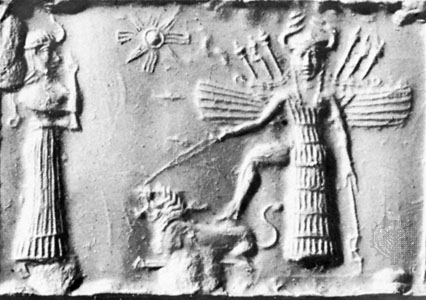
The goddess Ishtar, wearing the horned headdress of divinity, with spears and maces on her back. The goddess is winged, and stands with her foot upon a lion, her sacred animal.

The goddess Ishtar, wearing the horned headdress of divinity, with spears and maces on her back. The goddess is winged, and stands with her foot upon a lion, her sacred animal.

It is probable that the worship of Anu migrated westward along with the worship of Istar. The god and goddess of Erech could not well be dissociated from one another, and the spread of the worship of the goddess among the Semitic tribes brought with it the spread of the worship of the god also.

Detail of the goddess Ishtar. From a cylinder seal in the British Museum.

Detail of the goddess Ishtar. From a cylinder seal in the British Museum.

I am inclined to think that this must be placed at least as early as the age of Sargon of Accad. The worship of Istar found its way to all the branches of the Semitic family except the Arabic; and, as we shall see in a future Lecture, the form of the name Ashtoreth, given to the goddess in Canaan, raises a presumption that this was due, not to the campaigns of the early Babylonian kings, but to the still earlier migrations of the Semitic population towards the west.

Ishtar, goddess of sexuality and warfare. She appears frequently on seals, relief carvings, and in descriptions as a mighty warrior who protects the king.  Ishtar was associated at an early period with the Sumerian goddess Inanna and both deities are depicted with symbols of fertility, such as the date palm, and of aggression, such as the lion.  This iconography survived relatively unchanged for over a thousand years. Here, Ishtar's astral quality is also emphasized: above her crown is a representation of the planet Venus.  In the first millennium BC more unusual stones were used to make seals: this one is made of green garnet, which may have come from northern Pakistan. British Museum, ME 89769, acquired 1835. D. Collon, First impressions: cylinder seals (London, The British Museum Press, 1987) H. Frankfort, Cylinder seals (London, Macmillan, 1939) http://www.britishmuseum.org/explore/highlights/highlight_objects/me/g/garnet_cylinder_seal_ishtar.aspx

Ishtar, goddess of sexuality and warfare. She appears frequently on seals, relief carvings, and in descriptions as a mighty warrior who protects the king.
Ishtar was associated at an early period with the Sumerian goddess Inanna and both deities are depicted with symbols of fertility, such as the date palm, and of aggression, such as the lion.
This iconography survived relatively unchanged for over a thousand years. Here, Ishtar’s astral quality is also emphasized: above her crown is a representation of the planet Venus.
In the first millennium BC more unusual stones were used to make seals: this one is made of green garnet, which may have come from northern Pakistan. British Museum, ME 89769, acquired 1835.
D. Collon, First impressions: cylinder seals (London, The British Museum Press, 1987)
H. Frankfort, Cylinder seals (London, Macmillan, 1939)
http://www.britishmuseum.org/explore/highlights/highlight_objects/me/g/garnet_cylinder_seal_ishtar.aspx

The old sky-god of the Accadians must have become the Semitic Anu at a very remote period indeed.

But it was the sky-god of Erech only. It does not follow that where the divine Ana, or “sky,” is mentioned in the Accadian texts, the god who became the Semitic Anu is referred to, even though the Semitic translators of the texts imagined that such was the case.

There were numerous temples in Chaldea into whose names the name of the deified sky entered, but in most cases this deified sky was not the sky-god of Erech. It is only where the names have been given in Semitic times, or where the Accadian texts are the production of Semitic literati composing in the sacred language of the priests, like the monks of the Middle Ages, that we may see the Anu of the mythological tablets.

Without doubt the Semitic scribes have often confounded their Anu with the local sky-god of the ancient documents, but this should only make us the more cautious in dealing with their work.”

A.H. Sayce, Lectures on the Origin and Growth of Religion as Illustrated by the Religion of the Ancient Babylonians, 5th ed., London, 1898, pp. 188-90.

Unu-ki = Unuk = Uruk = Erech

“It was not of Semitic foundation, however. Its earliest name was the Accadian Unu-ki or Unuk, “the place of the settlement,” of which the collateral form Uruk does not seem to have come into vogue before the Semitic period.

If I am right in identifying Unuk with the Enoch of Genesis, the city built by Kain in commemoration of his first-born son, Unuk must be regarded as having received its earliest culture from Eridu, since Enoch was the son of Jared, according to Genesis iv, and Jared or Irad (Genesis iv.) is the same word as Eridu.

The local god of Erech, however, was not Ea, the god of the river and sea, but Ana, the sky. Thus whereas at Eridu the present creation was believed to have originated out of water, the sky being the primeval goddess Zikum or Zigara, mother alike of Ea and the other gods, at Erech the sky was itself the god and the creator of the visible universe.

The two cosmologies are antagonistic to one another, and produced manifold inconsistencies in the later syncretic age of Babylonian religion.

But it was not in Erech alone that the sky was considered divine. Throughout Chaldea, Ana, “the sky,” received worship, and the oldest magical texts invoke “the spirit of the sky” by the side of that of the earth. What distinguished the worship of Ana at Erech was that here alone he was the chief deity of the local cult, that here alone he had ceased to be a subordinate spirit, and had become a dingir or “creator.”

Of this pre-Semitic period in the worship of Ana we know but little. It is only when he has become the Anu of the Semites and has undergone considerable changes in his character and worship, that we make our first true acquaintance with him.

We come to know him as the Semitic Baal-samaim, or “lord of heaven,” the supreme Baal, viewed no longer as the Sun-god, but as the whole expanse of heaven which is illuminated by the sun.

How early this must have been is shown by the extension of his name as far west as Palestine. In the records of the Egyptian conqueror Thothmes III., in the 16th century before our era, mention is made of the Palestinian town of Beth-bath, “the temple of Anat,” the female double of Anu.

Another Beth-Anath was included within the borders of the tribe of Naphtali (Joshua xix.38); and Anathoth, whose name shows us that, besides the Ashtaroth or “Astartes,” the Canaanites venerated their local goddesses under the title of “Anats,” was a city of the priests.

Anah or Anat was the daughter of the Hivite Zibeon and mother-in-law of Esau (Genesis xxxvi. 1,14), and by her side we hear of Anah or Anu, the son of the Horite Zibeon, who “found the mules (or hot-springs) in the wilderness as he fed the asses of Zibeon his father.” But Anu did not make his way westward alone.”

A.H. Sayce, Lectures on the Origin and Growth of Religion as Illustrated by the Religion of the Ancient Babylonians, 5th ed., London, 1898, pp. 185-8.

Shamash, Sun God, God of Justice

“The cult of Shamash in Assyria dates from at least 1340 B.C., when Pudilu built a temple to this god in the city of Asshur.

He entitled Shamash ‘The Protecting Deity,’ which name is to be understood as that of the god of justice, whose fiat is unchangeable, and in this manner Shamash differed somewhat from the Babylonian idea concerning him.

In the southern kingdom he was certainly regarded as a just god, but not as the god of justice—a very different thing.

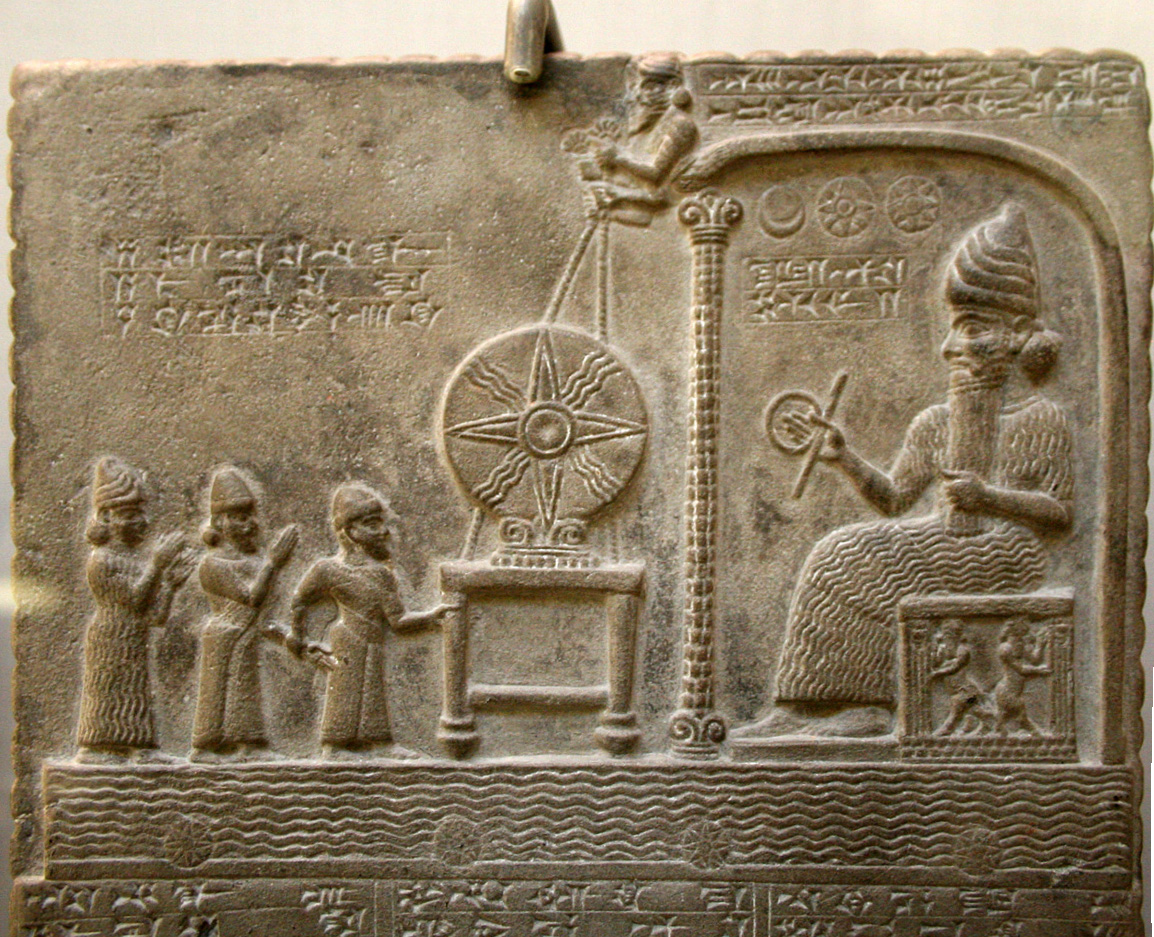
Bas relief of the Tablet of Shamash, portraying the god Shamash on his throne, IXth century BCE. British Museum.

Bas relief of the Tablet of Shamash, portraying the god Shamash on his throne, IXth century BCE. British Museum.

It is interesting as well as edifying to watch the process of evolution of a god of justice. Thus in Ancient Mexico Tezcatlipoca evolved from a tribal deity into a god who was beginning to bear all the marks and signs of a god of justice when the conquering Spaniards put an end to his career.

We observe, too, that although the Greeks had a special deity whose department was justice, other divinities, such as Pallas Athene, displayed signs that they in time might possibly become wielders of the balances between man and man.

In the Egyptian heavenly hierarchy Maat and Thoth both partook of the attributes of a god of justice, but perhaps Maat was the more directly symbolical of the two.

Now in the case of Shamash no favours can be obtained from him by prayer or sacrifice unless those who supplicate him, monarchs though they be, can lay claim to righteousness. Even Tiglath-pileser I, mighty conqueror as he was, recognized Shamash as his judge, and, naturally, as the judge of his enemies, whom he destroys, not because they are fighting against Tiglath, but because of their wickedness.

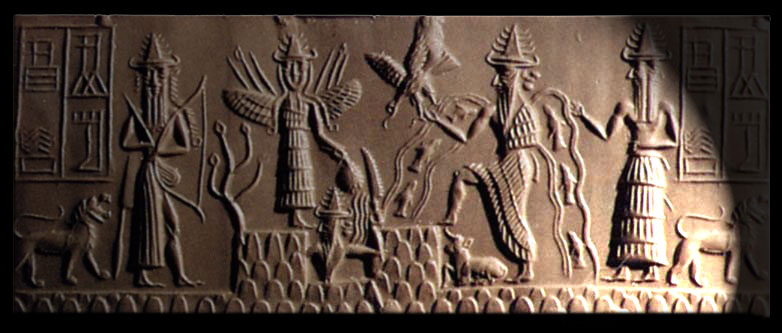
From left, Storm God Ninurta, with bows and arrows. Ishtar, queen of heaven and earth, is elevated, with wings and spears and maces on her shoulders. The tree of life sprouts to her right, our left.  The Sun God Shamash rises from the mountain Kur in the center, with rays of light on his shoulder. The God of Water and Wisdom, Enki/Ea battles the bird-god Imdugud/Anzu, with depictions of the Tigris and Euphrates rivers and fish coursing from his shoulders.  At far right is the deified vizier Usmu, the two-faced.  All gods wear conical hats with four pairs of horns. At far left is the word Adda in Accadian cuneiform, "Scribe." Accordingly this cylinder seal is known as the Seal of Adda, Akkadian period, 2350-2100 BCE. British Library.  http://www.ancientworlds.net/aw/Article/787375

From left, Storm God Ninurta, with bows and arrows. Ishtar, queen of heaven and earth, is elevated, with wings and spears and maces on her shoulders. The tree of life sprouts to her right, our left.
The Sun God Shamash rises from the mountain Kur in the center, with rays of light on his shoulder. The God of Water and Wisdom, Enki/Ea battles the bird-god Imdugud/Anzu, with depictions of the Tigris and Euphrates rivers and fish coursing from his shoulders.
At far right is the deified vizier Usmu, the two-faced.
All gods wear conical hats with four pairs of horns. At far left is the word Adda in Accadian cuneiform, “Scribe.” Accordingly this cylinder seal is known as the Seal of Adda, Akkadian period, 2350-2100 BCE. British Library.
http://www.ancientworlds.net/aw/Article/787375

When he set captives free Tiglath took care to perform the gracious act before the face of Shamash, that the god might behold that justice dwelt in the breast of his royal servant. Tiglath, in fact, is the viceroy of Shamash upon earth, and it would seem as if he referred many cases regarding whose procedure he was in doubt to the god before he finally pronounced upon them.

Both Assur-nazir-pal and Shalmaneser II exalted the sun-cult of Shamash, and it has been suggested that the popularity of the worship of Ra in Egypt had reflected upon that of Shamash in Assyria.

It must always be extremely difficult to trace such resemblances at an epoch so distant as that of the ninth century B.C. But certainly it looks as if the Ra cult had in some manner influenced that of the old Babylonian sun-god.

Sargon pushed the worship of Shamash far to the northern boundaries of Assyria, for he built a sanctuary to the deity beyond the limits of the Assyrian Empire—where, precisely, we do not know.

Amongst a nation of warriors a god such as Shamash must have been valued highly, for without his sanction they would hardly be justified in commencing hostilities against any other race.”

Lewis Spence, Myths and Legends of Babylonia and Assyria, 1917, pp. 222-3.

Lady Ishtar

Ishtar was frequently placed by the side of Asshur as a war-goddess.

Ere she left the plains of Babylonia for the uplands of Assyria she had evinced certain bellicose propensities. In the Gilgamesh epic she appears as a deity of destructive and spiteful character, if not actually of warlike nature.

The goddess Ishtar depicted center with wings and the horned headdress of divinity, weapons on her back, foot resting on a lion, her symbolic animal.

The goddess Ishtar depicted center with wings and the horned headdress of divinity, weapons on her back, foot resting on a lion, her symbolic animal.

But if the Babylonians regarded her first and foremost as the great mother-goddess, the Assyrians took but little notice of this side of her character. To them she was a veritable Valkyrie, and as the Assyrians grew more and more military so she became more the war-goddess and less the nature-mother of love and agriculture.

She appeared in dreams to the war-loving Kings of Assyria, encouraging and heartening them with words of cheer to further military exploits. Fire was her raiment, and, as became a goddess of battle, her appearance was terrific. She consumed the enemies of Assur-bani-pal with flames.

Ishtar, Mesopotamian goddess of sexuality and warfare. The star atop her crown is Venus, the planet with which she was identified.  In the first millennium BC unusual stones were used to make seals: this seal is made of green garnet, which may have come from northern Pakistan.  British Museum, ME 89769, acquired 1835. http://www.britishmuseum.org/explore/highlights/highlight_objects/me/g/garnet_cylinder_seal_ishtar.aspx

Ishtar, Mesopotamian goddess of sexuality and warfare. The star atop her crown is Venus, the planet with which she was identified.
In the first millennium BC unusual stones were used to make seals: this seal is made of green garnet, which may have come from northern Pakistan.
British Museum, ME 89769, acquired 1835.
http://www.britishmuseum.org/explore/highlights/highlight_objects/me/g/garnet_cylinder_seal_ishtar.aspx

Still, strangely enough, in the religious texts, influenced probably by Babylonian sources, she was still to a great extent the mild and bountiful mother of nature. It is in the historical texts which ring with tales of conquest and the grandiloquent boastings of conquering monarchs that she appears as the leader of armies and the martial goddess who has slain her thousands and her tens of thousands.

So has it ever been impossible for the priest and the soldier to possess the selfsame idea of godhead, and this is so in the modern no less than in the ancient world.

Yet occasionally the stern Assyrian kings unbent, and it was probably in a brief interval of peace that Assur-nazir-pal alluded to Ishtar as the lady who “loves him and his priesthood.”

Sennacherib also spoke of the goddess in similar terms. It is necessary to state that the name or title of Belit given to Ishtar does not signify that she is the wife or consort of Bel, but merely that she is a ‘great lady,’ for which the title ‘Belit’ is a generic term.

If she is at times brought into close association with Asshur she is never regarded as his wife. She is not the consort of any god, but an independent goddess in her own right, standing alone, equal with Asshur and the dependant of no other divinity. But it was later only that she ranked with Asshur, and purely because of her military reputation.”

Lewis Spence, Myths and Legends of Babylonia and Assyria, 1917, pp. 213-4.

Marduk, Sun God

“On the first day of the Babylonian New Year an assembly of the gods was held at Babylon, when all the principal gods were grouped round Merodach in precisely the same manner in which the King was surrounded by the nobility and his officials, for many ancient faiths imagined that the polity of earth merely mirrored that of heaven, that, as Paracelsus would have said, the earth was the microcosm of the heavenly macrocosm—“as above, so below.”

The ceremony in question consisted in the lesser deities paying homage to Merodach as their liege lord. In this council, too, they decided the political action of Babylonia for the coming year.

It is thought that the Babylonian priests at stated intervals enacted the myth of the slaughter of Tiawath. This is highly probable, as in Greece and Egypt the myths of Persephone and Osiris were represented dramatically before a select audience of initiates.

We see that these representations are nearly always made in the case of divinities who represent corn or vegetation as a whole, or the fructifying power of springtime. The name of Merodach’s consort Zar-panitum was rendered by the priesthood as ‘seed producing,’ to mark her connexion with the god who was responsible for the spring revival.

Merodach’s ideograph is the sun, and there is abundant evidence that he was first and last a solar god. The name, originally Amaruduk, probably signifies ‘the young steer of day,’ which seems to be a figure for the morning sun.

Marduk. Portrayed with a hound, and with the Tablets of Destiny upon his chest and robe.

Marduk. Portrayed with a hound, and with the Tablets of Destiny upon his chest and robe.

He was also called Asari, which may be compared with Asar, the Egyptian name of Osiris. Other names given him are Sar-agagam, ‘the glorious incantation,’ and Meragaga, ‘the glorious charm,’ both of which refer to the circumstance that he obtained from Ea, his father, certain charms and incantations which restored the sick to health and exercised a beneficial influence upon mankind.

Merodach was supposed to have a court of his own above the sky, where he was attended to by a host of ministering deities. Some superintended his food and drink supply, while others saw to it that water for his hands was always ready.

He had also doorkeepers and even attendant hounds, and it is thought that the satellites of Jupiter, the planet which represented him, may have been dimly visible to those among the Chaldean star-gazers who were gifted with good sight.

These dogs were called Ukkumu, ‘Seizer,’ Akkulu, ‘Eater,’ Iksuda, ‘Grasper,’ and Iltehu, ‘Holder.’ It is not known whether these were supposed to assist him in shepherding his flock or in the chase, and their names seem appropriate either for sheep-dogs or hunting hounds.”

Lewis Spence, Myths and Legends of Babylonia and Assyria, 1917, pp. 201-2.

Marduk Assimilates All Other Gods

“THE entire religious system of Babylonia is overshadowed, by Merodach, its great patron deity. We remember how he usurped the place of Ea, and in what manner even the legends of that god were made over to him, so that at last he came to be regarded as not only the national god of Babylonia but the creator of the world and of mankind.

He it was who, at the pleading of the other gods, confronted the grisly Tiawath, and having defeated and slain her, formed the earth out of her body and its inhabitants out of his own blood.

Battle between Marduk (Bel) and Tiamat. Drawn from a bas-relief from the Palace of Ashur-nasir-pal, King of Assyria, 885-860 B.C., at Nimrûd. British Museum, Nimrûd Gallery, Nos. 28 and 29. http://bharatkalyan97.blogspot.com/2013/06/tablet-of-destinies.html

Battle between Marduk (Bel) and Tiamat. Drawn from a bas-relief from the Palace of Ashur-nasir-pal, King of Assyria, 885-860 B.C., at Nimrûd.
British Museum, Nimrûd Gallery, Nos. 28 and 29.
http://bharatkalyan97.blogspot.com/2013/06/tablet-of-destinies.html

It is almost certain that this cosmological myth was at one time recounted of Ea, and perhaps even at an earlier date of Bel. The transfer of power from Ea to Merodach, however, was skilfully arranged by the priesthood, for they made Merodach the son of Ea, so that he would naturally inherit his father’s attributes.

In this transfer we observe the passing of the supremacy of the city of Eridu to that of Babylon. Ea, or Oannes, the fish-tailed god of Eridu, stood for the older and more southerly civilization of the Babylonian race, whilst Merodach, patron god of Babylon, a very different type of deity, represented the newer political power.

A depiction of the God Ea, or Oannes.

A depiction of the God Ea, or Oannes.

Originally Merodach appears to have been a sun-god personifying more especially the sun of the springtime. Thus he was a fitting deity to defeat the chaotic Tiawath, who personified darkness and destruction. But there is another side to him—the agricultural side.

Says Jastrow (Religion in Babylonia and Assyria, 1893, p. 38):

“At Nippur, as we shall see, there developed an elaborate lamentation ritual for the occasions when national catastrophes, defeat, failure of crops, destructive storms, and pestilence revealed the displeasure and anger of the gods.”

At such times earnest endeavours were made, through petitions accompanied by fasting and other symbols of contrition, to bring about a reconciliation with the angered power.

This ritual, owing to the religious pre-eminence of Nippur, became the norm and standard throughout the Euphrates Valley, so that when Marduk (Merodach) and Babylonia came practically to replace En-lil and Nippur, the formulas and appeals were transferred to the solar deity of Babylon, who, representing more particularly the sun-god of spring, was well adapted to be viewed as the one to bring blessings and favours after the sorrows and tribulations of the stormy season.

Strange as it will appear, although he was patron god of Babylon he did not originate in that city, but in Eridu, the city of Ea, and probably this is the reason why he was first regarded as the son of Ea. He is also directly associated with Shamash, the chief sun-god of the later pantheon, and is often addressed as the “god of canals” and “opener of subterranean fountains.”

In appearance he is usually drawn with tongues of fire proceeding from his person, thus indicating his solar character. At other times he is represented as standing above the watery deep, with a horned creature at his feet, which also occasionally serves to symbolize Ea.

It is noteworthy, too, that his temple at Babylon bore the same name—E-Sagila, ‘the lofty house,’—as did Ea’s sanctuary at Eridu.

We find among the cuneiform texts—a copy of an older Babylonian text—an interesting little poem which shows how Merodach attracted the attributes of the other gods to himself. .

Ea is the Marduk (or Merodach) of canals;
Ninib is the Marduk of strength;
Nergal is the Marduk of war;
Zamama is the Marduk of battle;
Enlil is the Marduk of sovereignty and control;
Nebo is the Marduk of possession;
Sin is the Marduk of illumination of the night;
Shamash is the Marduk of judgments;
Adad is the Marduk of rain;
Tishpak is the Marduk of the host;
Gal is the Marduk of strength;
Shukamunu is the Marduk of the harvest.

This would seem as if Merodach had absorbed the characteristics of all the other gods of any importance so successfully that he had almost established his position as the sole deity in Babylonia, and that therefore some degree of monotheism had been arrived at.”

Lewis Spence, Myths and Legends of Babylonia and Assyria, 1917, pp. 199-201.

Anu, Bel, Ea, Trinity of the Elements

“We find a good deal of confusion in later Babylonian religion as to whether the name ‘Bel’ is intended to designate the old god of that name or is merely a title for Merodach.

Khammurabi certainly uses the name occasionally when speaking of Merodach, but at other times he quite as surely employs it for the older divinity, as for example when he couples the name with Anu. One of the Kassite kings, too, speaks of “Bel, the lord of lands,” meaning the old Bel, to whom they often gave preference over Merodach.

They also preferred the old city of Nippur and its temple to Babylon, and perhaps made an attempt at one time to make Nippur the capital of their Empire.

Some authorities appear to think it strange that Bel should have existed at all as a deity after the elevation of Merodach to the highest rank in the pantheon. It was his association with Anu and Ea as one of a triad presiding over the heavens, the earth, and the deep which kept him in power.

Moreover, the very fact that he was a member of such a triad proves that he was regarded as theologically essential to the well-being of the Babylonian religion as a whole. The manufacture or slow evolution of a trinity of this description is by no means brought about through popular processes. It is, indeed, the work of a school, of a college of priests.

Strangely enough Khammurabi seems to have associated Anu and Bel together, but to have entirely omitted Ea from their companionship, and it has been thought that the conception of a trinity was subsequent to his epoch.

The god of earth and the god of heaven typify respectively that which is above and that which is below, and are reminiscent of the Father-sky and Mother-earth of many primitive mythologies, and there is much to say for the theory that Ea, god of the deep, although he had existed long prior to any such grouping, was a later inclusion.

The habit of invoking the great triad became almost a commonplace in later Babylonia. They nearly always take precedence in religious inscriptions, and we even find some monarchs stating that they hold their regal authority by favour of the trinity. Whenever a powerful curse has to be launched, one may be certain that the names of the gods of the elements will figure in it.”

Lewis Spence, Myths and Legends of Babylonia and Assyria, 1917, pp. 196-7.

Zu, Thunder God, and the Tablets of Destiny

Zu was a storm-god symbolized in the form of a bird. He may typify the advancing storm-cloud, which would have seemed to those of old as if hovering like a great bird above the land which it was about to strike. The North-American Indians possess such a mythological conception in the Thunder-bird, and it is probable that the great bird called roc, so well known to readers of the Arabian Nights, was a similar monster—perhaps the descendant of the Zu-bird.

Zu or Anzu (from An 'heaven' and Zu 'to know' in Sumerian), as a lion-headed eagle, ca. 2550–2500 BCE, Louvre.  Votive relief of Ur-Nanshe, king of Lagash, representing the bird-god Anzu (or Im-dugud) as a lion-headed eagle.  Alabaster, Early Dynastic III (2550–2500 BCE). Found in Telloh, ancient city of Girsu. H. 21.6 cm (8 ½ in.), W. 15.1 cm (5 ¾ in.), D. 3.5 cm (1 ¼ in.)  http://bharatkalyan97.blogspot.com/2013/07/legend-of-anzu-which-stole-tablets-of.html

Zu or Anzu (from An ‘heaven’ and Zu ‘to know’ in Sumerian), as a lion-headed eagle, ca. 2550–2500 BCE, Louvre.
Votive relief of Ur-Nanshe, king of Lagash, representing the bird-god Anzu (or Im-dugud) as a lion-headed eagle.
Alabaster, Early Dynastic III (2550–2500 BCE). Found in Telloh, ancient city of Girsu. H. 21.6 cm (8 ½ in.), W. 15.1 cm (5 ¾ in.), D. 3.5 cm (1 ¼ in.)
http://bharatkalyan97.blogspot.com/2013/07/legend-of-anzu-which-stole-tablets-of.html

We remember how this enormous creature descended upon the ship in which Sindbad sailed and carried him off. Certain it is that we can trace the roc or rukh to the Persian simurgh, which is again referable to a more ancient Persian form, the amru or sinamru, the bird of immortality, and we may feel sure that what is found in ancient Persian lore has some foundation in Babylonian belief.

The Zu-bird was evidently under the control of the sun, and his attempt to break away from the solar authority is related in the following legend.

It is told of the god Zu that on one occasion ambition awaking in his breast caused him to cast envious eyes on the power and sovereignty of Bel, so that he determined to purloin the Tablets of Destiny, which were the tangible symbols of Bel’s greatness.

At this time, it may be recalled, the Tablets of Destiny had already an interesting history behind them. We are told in the creation legend how Apsu, the primeval, and Tiawath, chaos, the first parents of the gods, afterward conceived a hatred for their offspring, and how Tiawath, with her monster-brood of snakes and vipers, dragons and scorpion-men and raging hounds, made war on the hosts of heaven.

Her son Kingu she made captain of her hideous army—

To march before the forces, to lead the host,
To give the battle-signal, to advance to the attack,
To direct the battle, to control the fight.

To him she gave the Tablets of Destiny, laying them on his breast with the words:

“Thy command shall not be without avail, and the word of thy mouth shall be established.”

Through his possession of the divine tablets Kingu received the power of Anu, and was able to decree the fate of the gods.

After several deities had refused the honour of becoming champion of heaven, Merodach was chosen. He succeeded at length in slaying Tiawath and destroying her evil host; and having vanquished Kingu, her captain, he took from him the Tablets of Destiny, which he sealed and laid on his own breast. It was this Merodach, or Marduk, who afterward became identified with Bel.

The Zu Bird appears to dominate the top of this bas relief, while the head of the figure on the right is missing, common vandalism committed by grave robbers: defacing the heads and the eyes of idols crippled their efficacy.

The Zu Bird appears to dominate the top of this bas relief, while the head of the figure on the right is missing, common vandalism committed by grave robbers: defacing the heads and the eyes of idols crippled their efficacy.

Now Zu, in his greed for power and dominion, was eager to obtain the potent symbols. He beheld the honour and majesty of Bel, and from contemplation of these he turned to look upon the Tablets of Destiny, saying within himself :

“Lo, I will possess the tablets of the gods, and all things shall be subject unto me. The spirits of heaven shall bow before me, the oracles of the gods shall lie in my hands. I shall wear the crown, symbol of sovereignty, and the robe, symbol of godhead, and then shall I rule over all the hosts of heaven.”

Thus inflamed, he sought the entrance to Bel’s hall, where he awaited the dawn of day. The text goes on :

Now when Bel was pouring out the clear water, (i.e. the light of day?)
And his diadem was taken off and lay upon the throne,
(Zu) seized the Tablets of Destiny,
He took Bel’s dominion, the power of giving commands.
Then Zu fled away and hid himself in his mountain.

Bel was greatly enraged at the theft, and all the gods with him. Anu, lord of heaven, summoned about him his divine sons, and asked for a champion to recover the tablets. But though the god Ramman was chosen, and after him several other deities, they all refused to advance against Zu.

The end of the legend is unfortunately missing, but from a passage in another tale, the legend of Etana, we gather that it was the sun-god, Shamash, who eventually stormed the mountain-stronghold of Zu, and with his net succeeded in capturing the presumptuous deity.

This legend is of the Prometheus type, but whereas Prometheus (once a bird-god) steals fire from heaven for the behoof of mankind, Zu steals the Tablets of Destiny for his own. These must, of course, be regained if the sovereignty of heaven is duly to continue, and to make the tale circumstantial the sun-god is provided with a fowler’s net with which to capture the recalcitrant Zu-bird.

Jastrow believes the myth to have been manufactured for the purpose of showing how the tablets of power were originally lost by the older Bel and gained by Merodach, but he has discounted the reference in the Etana legend relating to their recovery.”

Lewis Spence, Myths and Legends of Babylonia and Assyria, 1917, pp. 193-5.

The Contention Between Samas and Merodach

“With the spread and fame of the empire of Sargon, the worship of Samas spread and became famous also. The empire and the cult were alike Semitic; wherever the Semite planted himself, the Sun-god was worshipped under some form and name.

The extent, therefore, of the worship of the Sun-god of Sippara marks the extent and power of Sargon’s kingdom. The older Samas of Larsa was eclipsed by the new deity; henceforward Sippara, and not Larsa, was the chief seat of the adoration of Samas in Babylonia. It is to Sippar in all probability that the hymns addressed to the Sun-god belong.

Bas relief of the Tablet of Shamash, portraying the god Shamash on his throne, IXth century BCE. British Museum.

Bas relief of the Tablet of Shamash, portraying the god Shamash on his throne, IXth century BCE. British Museum.

 They are the product of an age of new ideas and aspirations. They represent the meeting and amalgamation of Semitic and Accadian thought. The scribes and poets of Sargon’s court were partly Semites, partly Accadians; but the Semites had received an Accadian education, and the Accadians had learnt the language and imitated the style of their Semitic masters.

Though the originals of most of the hymns are written in the old language of Accad–a language that had become sacred to the Semites, and in which alone the gods allowed themselves to be addressed–the thoughts contained in them are for the most part Semitic.

We have no longer to do with a Mul-lil, a lord of ghosts and demons, nor even with an Ea, with his charms and sorceries for the removal of human ills, but with the supreme Baal of Semitic faith, the father and creator of the world, who was for his adorer at the moment of adoration the one omnipotent god.

[ … ]

In the closing days of the Babylonian monarchy, Nabonidos, after restoring the temple of the Sun-god at Sippara, addresses him in the following words:

“O Samas, (mighty lord) of heaven and earth, light of the gods his fathers, offspring of Sin and Nin-gal, when thou enterest into E-Babbara, the temple of thy choice, when thou inhabitest thy everlasting shrine, look with joy upon me, Nabonidos, the king of Babylon, the prince who has fed thee, who has done good to thy heart, who has built thy dwelling-place supreme, and upon my prosperous labours; and daily at noon and sunset, in heaven and earth, grant me favourable omens, receive my prayers, and listen to my supplications. May I be lord of the firmly-established sceptre and sword, which thou hast given my hands to hold, for ever and ever!”

Nabonidos, the Babylonian, the peculiar protege of Merodach, could not regard Samas with the same eyes as the old poets of the city of the Sun-god. His supreme Baal was necessarily Merodach, whose original identity with Samas had long since been forgotten; and Samas of Sippara was consequently to him only the Baal of another and a subject state.

Samas is therefore but one of the younger gods, who illuminates his divine fathers in the higher heaven. He shares the power and glory of his fathers only as the son shares the authority of the father in the human family.

Nothing can illustrate more clearly the local character of Babylonian religion than this difference between the position assigned to Samas in the hymns and in the inscription of Nabonidos.

In the one, he is the supreme god who brooks no equal; in the other, the subordinate of Merodach and even of the Moon-god Sin.”

A.H. Sayce, Lectures on the Origin and Growth of Religion as Illustrated by the Religion of the Ancient Babylonians, 5th ed., London, 1898, pp. 170-5.

Sippara, Pantibibla, Book Town

“It was as Kur(?)-nigin-gára, “the god who makes the palace (of the setting sun),” that the Sun-god of Larsa seems to have been known to his worshippers in pre-Semitic days.

But when the Accadian was superseded by the Semite, his special name was merged in the general title of Samsu or Samas, “the Sun.” He became the Baal of Larsa, who differed but little, save in the name by which he was addressed, from the other Baalim of Babylonia.

The fame of the Samas of Larsa, however, was obscured at an early period by that of the Samas of Sippara. Sippara in historical times was pre-eminently the city of the Sun-god. It was there that Ê-Bábara, the house of lustre,” the great temple of the Sun-god, had been erected in days to which tradition alone went back, and it was around its shrine that Semitic sun-worship in Babylonia was chiefly centred.

Sippara and its immediate neighbourhood had been the seat of early Semitic supremacy in Chaldea. It was, it is true, of pre-Semitic foundation; its primitive name Zimbir would show this, like the name of E-Bábara itself; and we know that Samas had once been worshipped within its walls under the Accadian title of Bábara or Birra.

But in these remote days Sippara was probably an insignificant town; at all events, the memory of later ages knew of Sippara only in connection with the empire of Sargon of Accad and the Semitic version of the story of the Deluge.

In the Old Testament, Sippara appears as a dual city–Sepharvaim, “the two Sipparas.” One of these has been discovered in the mounds of Abu-Habba by Mr. Hormuzd Rassam, who has brought from it a monument on which is carved a curious image of the divine solar disk.

The other has been found by Dr. Hayes Ward in the mounds of Anbar, an hour’s distance from Sufeirah and the Euphrates.

The fragment of a geographical tablet seems indeed to mention no less than four Sipparas–Sippara proper, Sippara of the desert, Sippara “the ancient,” and Sippara of the Sun-god; but since the historical texts know of two only–Sippara of Anunit and Sippara of Samas--it is best to regard the three first names as alike denoting the same place, Sippara of Anunit, the modern Anbar.

It must have been from this Sippara that the Euphrates received its title, “river of Sippara,” since Abu-Habba is seven miles distant from the present bed of the stream.

In the close neighborhood of this double Sippara, Sargon built or restored the city to which he gave a name, and from which the whole of northern Babylonia received its title of Accad. It is called Agadhé in the non-Semitic texts, Accad (Akkadu) in the Semitic; though whether the name is of Semitic or non-Semitic origin cannot at present be decided.

Sargon’s patronage of literature, and the celebrated library he founded in Accad, caused the district to be known as “the region of books.” A popular etymology afterwards connected the name of Sippara itself with sepher, “a book,” and the city accordingly appears in the fragments of Berossos as Pantibibla, or “Book-town.”

A.H. Sayce, Lectures on the Origin and Growth of Religion as Illustrated by the Religion of the Ancient Babylonians, 5th ed., London, 1898, pp. 167-70.

Sin, Moon God

Nannar was now invoked as Sin–a name which at first appears to have denoted the orb of the moon only–and the name and worship of Sin spread not only in Babylonia, but in other parts of the Semitic world.

His name has been found in an inscription of southern Arabia, and Sinai itself, the sacred mountain, is nothing more than the sanctuary “dedicated to Sin.”

It may be that the worship of the Babylonian Moon-god was brought to the peninsula of Sinai as far back as the days when the sculptors of Tel-loh carved into human shape the blocks of diorite they received from the land of Magan.

However this may be, the Moon-god of Ur, like the city over which he presided, took primary rank among the Babylonians. His worshippers invoked him as the father and creator of both gods and men. It is thus that Nabonidos celebrates his restoration of the temple of Sin at Harran:

“May the gods who dwell in heaven and earth approach the house of Sin, the father who created them.

As for me, Nabonidos, king of Babylon, the completer of this temple, may Sin, the king of the gods of heaven and earth, in the lifting up of his kindly eyes, with joy look upon me month by month at noon and sunset; may he grant me favourable tokens, may he lengthen my days, may he extend my years, may he establish my reign, may he overcome my foes, may he slay my enemies, may he sweep away my opponents.

May Nin-gal, the mother of the mighty gods, in the presence of Sin, her loved one, speak like a mother.

May Samas and Istar, the bright offspring of his heart, to Sin, the father who begat them, speak of blessing.

May Nuzku, the messenger supreme, hearken to my prayer and plead for me.”

The moon existed before the sun.

This is the idea which underlay the religious belief of Accad, exact converse, as it was, of the central idea of the religion of the Semites. It was only where Accadian influence was strong that the Semite could be brought in any way to accept it.

It was only in Babylonia and Assyria and on the coasts of Arabia that the name of Sin was honoured; elsewhere the attributes of the Moon-god were transferred to the goddess Istar, who, as we shall see hereafter, was originally the evening star.

But in Babylonia, Sin became inevitably the father of the gods. His reign extended to the beginning of history; Sargon, as the representative of the Babylonian kings and the adorer of Merodach, speaks of “the remote days of the period of the Moon-god,” which another inscription makes synonymous with “the birth of the land of Assur.”

As the passage I have quoted from Nabonidos shows, Sin was more particularly the father of Samas and Istar, of the Sun-god and the goddess of the evening star.”

A.H. Sayce, Lectures on the Origin and Growth of Religion as Illustrated by the Religion of the Ancient Babylonians, 5th ed., London, 1898, pp. 164-6.

Moon Gods

Adar bears the same relation to Mul-lil that Merodach bears to Ea. Each alike is the son and messenger of the older god.

But whereas the errands upon which Merodach is sent are errands of mercy and benevolence, the errands of Adar are those that befit an implacable warrior. He contends not against the powers of darkness, like Merodach, for the father whose orders he obeys is himself the ruler of the powers of darkness; it is against mankind, as in the story of the Deluge, that his arms are directed. He is a solar hero who belongs to the darkness and not to the light.

It is thus that one of his brothers is “the first-born” of Mul-lil, Mul-nugi, “the lord from whom there is no return.” Mul-nugi is the lord of Hades, the god who is called Irkalla in the legend of the Descent of Istar, and out of whose hands there is no escape.

It may be that he is but another form of the Moon-god, since the Moon-god, we are told, was also the eldest son of Mul-lil. But the name by which the Moon-god went at Nipur was one that signified “the god of glowing fire.”

It is curious to find the mythologists identifying this “god of glowing fire” with Adar; but the error was natural; both alike were sons of Mul-lil, and both alike represented the great orbs of heaven.

The chief seat, however, of the worship of the Moon-god was not Nipur but Ur (the modern Mugheir). Here stood the great temple the ruins of which were partially explored by Loftus.

Already in the oldest documents that have come from thence, the god to whom the temple was consecrated is identified with the Moon-god of Nipur. Already he is termed “the first-born of Mul-lil.” The spread of the cult of Mul-lil, therefore, and of the magic which it implied, must have made its way as far south as Ur in a very remote age.

But we have no reason for believing that the Moon-god of Ur and the Moon-god of Nipur were originally one and the same. Each Babylonian town, large and small, had its own local Moon-god, whose several names are recorded on a broken tablet.

The forms under which the Moon-god was worshipped in Babylonia were as numerous as the forms of the Sun- god himself.

What seems yet more singular to the comparative mythologist is that, according to the official religion of Chaldea, the Sun-god was the offspring of the Moon-god.

Such a belief could have arisen only where the Moon-god was the supreme object of worship. It is a reversal of the usual mythological conception which makes the moon the companion or pale reflection of the sun. It runs directly counter to the Semitic Baal-worship.

To the Semite the Sun-god was the lord and father of the gods; the moon was either his female consort, or, where Semitic theology had been influenced by that of Chaldea, an inferior god.”

A.H. Sayce, Lectures on the Origin and Growth of Religion as Illustrated by the Religion of the Ancient Babylonians, 5th ed., London, 1898, pp. 153-5.

Ea, Father of Merodach

Ea developed with the centuries, and about the epoch of Khammurabi appears to have achieved a high standard of godhead, probably because of the very considerable amount of theological moulding which he had received.

In the later Babylonian period we find him described as the protagonist of mankind, the father of Merodach, and, along with Anu and Bel, a member of a great triad.

The priests of Babylon were the sole mythographers of these days. This is in sharp contradistinction to the mythographers of Greece, who were nearly always philosophers and never priests. But they were mythographers in a secondary sense only, for they merely rearranged, re-edited, or otherwise altered already existing tales relating to the gods, usually with a view to the exaltation of a certain deity or to enable his story to fit in with those of other gods.

It is only after a religion or mythological system has enjoyed a vogue more or less extended that the relationship of the gods towards one another becomes fixed.

The appointment of Merodach to the supreme position in the Babylonian pantheon naturally necessitated a rearrangement so far as the relationship of the other deities to him was concerned. This meant a re-shaping of myth and tradition generally for the purpose of ensuring consistency.

The men fitted to accomplish such a task were to hand, for the age of Khammurabi was fertile in writers, scholastic and legal, who would be well equipped to carry out a change of the description indicated.

Ea had not in the past enjoyed any very exalted sphere. But as the chief god of the important country in the neighbourhood of the Persian Gulf, the most ancient home of Babylonian culture, Ea would probably have exercised a great influence upon the antiquarian and historic sense of a man like Khammurabi.

As the god of wisdom he would strongly appeal to a monarch whose whole career was marked by a love of justice and by sagacity and insight.

A bird man appears before a god, there are horns of divinity on some of these figures, as there are on the god, who could be Ea, with water coursing from his shoulders.

A bird man appears before a god, there are horns of divinity on some of these figures, as there are on the god, who could be Ea, with water coursing from his shoulders.

From a local god of Eridu, Ea became a universal deity of wisdom and beneficence, the strong shield of man, and his benefactor by the gifts of harvest and water. Civilized and softer emotions must have begun to cluster around the cult of this kindly god who, when the angered deities resolved to destroy mankind, interceded for poor humanity and succeeded in preserving it from the divine wrath.

As a god of medicine, too, Ea is humane and protective in character, and all the arts fall under his patronage. He is the culture-god of Babylon par excellence. He might not transcend Merodach, so he became his father. Thus did pagan theology succeed in merging the cults of deities which might otherwise have been serious rivals and mutually destructive.”

Lewis Spence, Myths and Legends of Babylonia and Assyria, 1917, pp. 191-3.

The Zodiacal Organization of the Gilgamesh Epic

“The doctrine of the necessity for ministering to the dead is here enunciated in no uncertain fashion.

Unless their bodies are decently buried and offerings of food and drink made at their graves, their lives in the otherworld must be abjectly miserable. The manner in which they meet their end is likewise taken into account, and warriors who have fallen on the field of battle are pre-eminently fortunate.

Eabani is evidently one of the ‘happy’ spirits; his ghost is designated utukku, a name applied not only to the fortunate dead, but likewise to a class of beneficent supernatural beings.

The term edimmu, on the other hand, designates a species of malevolent being as well as the errant and even vampirish spirits of the unhappy dead. The due observance of funeral and commemorative rites is thus a matter which touches the interests not only of the deceased but also of his relatives and friends.

We have seen from the foregoing that the epic of Gilgamesh is partly historical, partly mythological. Around the figure of a great national hero myths have grown and twined with the passing of the generations, and these have in time become woven into a connected narrative, setting forth a myth which corresponds to the daily or annual course of the sun.

Within this may be discerned other myths and fragments of myths—solar, seasonal, and diluvian.

But there is in the epic another important element which has already been referred to—the astro-theological. The zodiacal significance of the division of the epic into twelve tablets may be set aside, since, as has been indicated, the significance is in all probability a superficial one merely, added to the poem by the scribes of Assur-bani-pal, and not forming an integral part of it.

At the same time it is not hard to divide the epic naturally into twelve episodes, thus:

  1. Gilgamesh’s oppression of Erech;
  2. the seduction of Eabani;
  3. the slaying of the monster Khumbaba;
  4. the wooing of Ishtar;
  5. the fight with the sacred bull;
  6. Eabani’s death;
  7. Gilgamesh’s journey to the Mountain of the Sunset;
  8. his wanderings in the region of thick darkness;
  9. the crossing of the waters of death;
  10. the deluge-story;
  11. the plant of life;
  12. the return of Eabani’s spirit.

Throughout the epic there are indications of a correspondence between the exploits of the hero and the movements of heavenly bodies.

It is possible, for instance, that Gilgamesh and his friend Eabani had some relation to the sign Gemini, also associated in ancient Chaldean mythology with two forms of the solar deity, even as were the hero and his friend.

The sign Leo recalls the slaying of Khumbaba, the allegorical victory of light over darkness, represented on monuments by the figure of a lion (symbol of fire) fighting with a bull.

Following the sign of Leo, the wooing of the hero by the goddess Ishtar falls naturally into the sign of Virgo, the virgin. The sign of Taurus is represented by the slaying of the celestial bull, Alu, by Gilgamesh.

The journey of the hero to Mashu and his encounter with the scorpion-men at the gate of the sunset are, of course, mythological representations of the sign of Scorpio, as are also his wanderings in the region of thick darkness.

It is noticeable in this respect that Babylonian astrology often doubled the eighth sign (Scorpio) to provide a seventh; it is therefore not unlikely that this sign should correspond with two distinct episodes in the poem.

The first of these episodes is associated with Scorpio by virtue of the introduction of scorpion-men; and the second, on the assumption that the scorpion is symbolical of darkness.

Perhaps the sea-goddess Sabitu is associated astrologically with the fish-tailed goat which is the conventional representation of Capricornus.

Then the placing of the deluge-story in the XIth tablet, corresponding with the eleventh sign of the zodiac, Aquarius, the water-bearer, is evidently in keeping with the astrological aspect of the epic.

Chaldean mythology connected the rainy eleventh month with the deluge, just as the first month of spring was associated mythologically with the creation.

The healing of Gilgamesh’s sickness by Ut-Napishtim may possibly symbolise the revival of the sun after leaving the winter solstice.

Lastly, the sign of Pisces, the twelfth sign of the zodiac, corresponding to the return of Eabani from the underworld, and perhaps also to the restoration of Gilgamesh to Erech, is emblematic of life after death, and of the resumption of ordinary conditions after the deluge.

It has been suggested, though without any very definite basis, that the epic was first put together before the zodiac was divided into twelve—that is, more than two thousand years before the Christian era.

Its antiquity, however, rests on other grounds than these. In later times the Babylonian astrological system became very complicated and important, and so lent its colour to the epic that, whatever the original plan of that work may have been, its astral significance became at length its most popular aspect.”

Lewis Spence, Myths and Legends of Babylonia and Assyria, 1917, pp. 181-3.

Nipur, City of Magic

“It is thus clear that, just as Eridu in southern Babylonia was the primitive seat of the worship of the Chaldean culture-god and of the civilisation with which his name was connected, Nipur in northern Babylonia was the original home of a very different kind of worship, which concerned itself with ghosts and demons and the various monsters of the under-world.

It was, in fact, the home of that belief in magic, and in the various spirits exorcised by the magician, which left so deep an impression upon the religion of early Babylonia, and about which I shall have to speak in a future Lecture.

The analogy of Eridu would lead us to infer, moreover, that it was not only the home of this belief, but also the source from which it made its way to other parts of the country.

In the pre-historic age, Eridu in the south and Nipur in the north would have been the two religious centres of Babylonian theology, from whence two wholly different streams of religious thought and influence spread and eventually blended.

The mixture formed what I may call the established religion of Chaldea in the pre-Semitic period. That this conclusion is not a mere inference is shown by the monuments discovered at Tel-loh.

Tel-loh was geographically nearer to Eridu than to Nipur, and its theology might therefore be expected to be more largely influenced by that of Eridu than by that of Nipur. And such, indeed, is the case.

Temples and statues are dedicated to Ea, “the king of Eridu,” and more especially to Bahu, a goddess who occupied a conspicuous place in the cosmological legends of Eridu.

But Mul-lil, the god of Nipur, appears far more frequently in the inscriptions of Tel-loh than we should have anticipated.

Nin-kharsak, “the mistress of the mountain,” and “mother of the gods,” in whom we may see a local divinity, is associated with him as wife; and Nin-girśu himself, the patron god of Tel-loh, is made his “hero” or “champion.”

So close, indeed, is the connection of the latter with Mul-lil, that the compilers of the mythological tablets, in a latter age, identified him with the “warrior” god of Nipur, Adar the son of Mul-lil.

Adar, or Ninep, or Uras--for his name has been read in these various fashions, and the true reading still remains unknown–played a conspicuous part in Babylonian, and more especially Assyrian theology.

He was regarded as emphatically the warrior and champion of the gods, and as such was naturally a favourite object of worship amongst a nation of warriors like the Assyrians. Indeed, it may be suspected that the extent to which the name of the older Bel was reverenced in Assyria was in some measure due to the favour in which his son Adar was held.

In the inscriptions of Nineveh, the title of “hero-god” (masu) is applied to him with peculiar frequency; this was the characteristic upon which the Assyrian kings more particularly loved to dwell.

In Babylonia, on the other hand, Adar was by no means so favourite a divinity. Here it was the milder and less warlike Merodach that took his place. The arts of peace, rather than those of war, found favour among the Semitic population of the southern kingdom.”

A.H. Sayce, Lectures on the Origin and Growth of Religion as Illustrated by the Religion of the Ancient Babylonians, 5th ed., London, 1898, pp. 150-2.

Bilat, Beltis, Nin-Ki-Gal, Allat, Infernal Queen of the Underworld

“When the god of Nipur became Semitic, his character underwent a change.

As the supreme deity of the state he was necessarily a Baal, but the Semitic Baal embodied very different conceptions from those which were associated with the Accadian Mul-lil. It is true that, as I have just pointed out, his primitive attributes still clung to him, but they were superadded to other attributes which showed him to be the supreme Sun-god of Semitic worship.

That supreme Sun-god, however, revealed himself to his worshippers under two aspects; he might be either the beneficent god who gave life and light to the world, or he might be the fierce and wrathful sun of summer who scorches all nature with his heat, and sinks at night, like a ball of glowing metal, into the darkness of the under-world.

Necessarily it was rather under the latter aspect that the Mul-lil of Nipur became the Semitic Bel.

This is the Bel whose cult was carried to Assyria, and whose name is mentioned frequently in the inscriptions of Nineveh, where among other titles he bears that of “father of the gods.”

This is a title which he received, not in virtue of his primitive character, but because he had become the Semitic Bel.

He was distinguished from the younger Bel of Babylon, Bel-Merodach, as βελιτανας or βολαθην (Βêl-êthûn), (ed. note: Greek sic) “the older Baal,” when Babylon became the imperial city, and its Bel claimed to be the father and head of the Babylonian gods.

But the distinction, as might be expected, was not always observed, and the older and younger Bel are sometimes confounded together.

The confusion was rendered the more easy by the fact that the wife of the Bel of Nipur was addressed as Bilat, and thus was undistinguished in name from Beltis of Babylon.

But she was in reality, as we have seen, the queen of Hades, Nin-ki-gal as the Accadians called her, or Allat as she is named in the Semitic texts.

Allat is interpreted “the unwearied;” like the Homeric epithet of Hades, αδαμαστος, “the inflexible” divinity who ceases not to deal on all sides his fatal blows. Her proper title, however–that, at least, under which she had originally been known at Nipur–was Nin-lil, “the lady of the ghost-world.”

It is under this name that Assur-bani-pal addresses her (Trustees of the British Museum (H.C. Rawlinson), The Cuneiform Inscriptions of Western Asia, ii. 66) as “the mistress of the world, whose habitation is the temple of the library” (i.e. the temple of Istar at Nineveh).

As Allat, the goddess of Hades, she was a much-dreaded and formidable figure, who is described in the legend of the Descent of Istar as inflicting upon her sister-goddess all the pains and diseases which emanated from her demoniac satellites.

The unfortunate Istar, stripped of her clothing and adornments, is held up to the scorn of the lower world; and Namtar, the plague-demon, is ordered by Allat to smite her with maladies in the eyes, in the sides, in the feet, in the heart, in the head, and, in short, in all the limbs.

Throughout the legend Namtar appears as the messenger of the infernal queen.”

A.H. Sayce, Lectures on the Origin and Growth of Religion as Illustrated by the Religion of the Ancient Babylonians, 5th ed., London, 1898, pp. 148-50.

The Oracles of Ea

“How a water-god became the demiurge seems at first sight obscure. But it ceases to be so when we remember the local character of Babylonian religion.

Ea was as much the local god of Eridu as Merodach was of Babylon, or Assur of Assyria. His connection with the water was due to the position of Eridu at the mouth of the Euphrates and on the shore of the sea, as well as to the maritime habits of its population.

In other respects he occupied the same place as the patron-deities of the other great cities. And these patron-deities were regarded as creators, as those by whose agency the present world had come into existence, and by whose hands the ancestors of their worshippers had been made.

This conception of a creating deity is one of the distinguishing features of early Babylonian religion. Mankind are not descended from a particular divinity, as they are in other theologies; they are created by him.

The hymn to Ea tells us that the god of Eridu was the creator of the black-headed race-that is to say, the old non-Semitic population whose primary centre and starting-point was in Eridu itself. It was as creators that the Accadian gods were distinguished from the host of spirits of whom I shall have to speak in another Lecture.

The Accadian word for “god” was dimer, which appears as dingir, from an older dingira, in the southern dialect of Sumer. Now dimer or dingir is merely “the creator,” formed by the suffix r or ra, from the verb dingi or dime, “to create.”

A simpler form of dimer is dime, a general name for the divine hierarchy. By the side of dime, dim, stood gime, gim, with the same meaning; and from this verb came the Sumerian name of Istar, Gingira. Istar is said to have been the mother of mankind in the story of the Deluge, and as Gula, “the great” goddess, she is addressed in a prayer as “the mother who has borne the men with the black heads.”

It was in consequence of the fact that he was a creator that Ea was, according to Accado-Sumerian ideas, a dingir or “god.”

In the cosmology of Eridu, therefore, the origin of the universe was the watery abyss. The earth lay upon this like a wife in the arms of her husband, and Dav-kina accordingly was adored as the wife of Ea.

It was through her that the oracles of Ea, heard in the voice of the waves, were communicated to man. Dav-kina is entitled “the mistress of the oracular voice of the deep,” and also “the lady who creates the oracular voice of heaven.”‘

The oracles delivered by the thunder, the voice of heaven, thus became the reflex of the oracles delivered through the roaring of the sea.”

A.H. Sayce, Lectures on the Origin and Growth of Religion as Illustrated by the Religion of the Ancient Babylonians, 5th ed., London, 1898, pp. 142-4.

Ut-Napishtim and the Babylonian Deluge

Ut-Napishtim was indeed surprised when he beheld Gilgamesh approaching the strand. The hero had meanwhile contracted a grievous illness, so that he was unable to leave the boat; but he addressed his queries concerning perpetual life to the deified Ut-Napishtim, who stood on the shore.

The hero of the flood was exceeding sorrowful, and explained that death is the common lot of mankind,

“nor is it given to man to know the hour when the hand of death will fall upon him—the Annunaki, the great gods, decree fate, and with them Mammetum, the maker of destiny, and they determine death and life, but the days of death are not known.”

The narrative is continued without interruption into the XIth tablet. Gilgamesh listened with pardonable scepticism to the platitudes of his ancestor.

“‘I behold thee, Ut-Napishtim, thy appearance differs not from mine, thou art like unto me, thou art not otherwise than I am; thou art like unto me, thy heart is stout for the battle . . . how hast thou entered the assembly of the gods; how hast thou found life?’”

In reply Ut-Napishtim introduces the story of the Babylonian deluge, which, told as it is without interruption, forms a separate and complete narrative, and is in itself a myth of exceptional interest. Presumably the warning of the deluge came to Ut-Napishtim in a vision.

The voice of the god said:

“Thou man of Shurippak, son of Ubara-Tutu, pull down thy house, build a ship, forsake thy possessions, take heed for thy life! Abandon thy goods, save thy life, and bring up living seed of every kind into the ship.”

The ship itself was to be carefully planned and built according to Ea’s instructions. When the god had spoken Ut-Napishtim promised obedience to the divine command. But he was still perplexed as to how he should answer the people when they asked the reason for his preparations.

Ea therefore instructed him how he should make reply,

Bel hath cast me forth, for he hateth me.’

The purpose of this reply seems clear, though the remaining few lines of it are rather broken. Ea intends that Ut-Napishtim shall disarm the suspicions of the people by declaring that the object of his shipbuilding and his subsequent departure is to escape the wrath of Bel, which he is to depict as falling on him alone.

He must prophesy the coming of the rain, but must represent it, not as a devastating flood, but rather as a mark of the prosperity which Bel will grant to the people of Shurippak, perhaps by reason of his (Ut-Napishtim’s) departure therefrom.”

Lewis Spence, Myths and Legends of Babylonia and Assyria, 1917, pp. 173-4.

Egyptian Hieroglyphs and Babylonian Cuneiform Share No Common Ancestor

Ea was [ … ] the source of their culture. He was symbolised, it would seem, by a serpent; … the primeval seat of the worship of Ea was the city of Eridu, now represented by the mounds of Abu Shahrein on the eastern bank of the Euphrates, and not far to the south of Mugheir or Ur.

Eridu is a contracted form of the older Eri-duga, or “good city,” which appears in the non-Semitic texts of northern Babylonia as Eri-zêba,with the same meaning. The place was thus a peculiarly holy spot, whose sanctity was established far and wide throughout the country.

But it was not a holy city only. It is often termed, more especially in the sacred tests, “the lordly city,”‘ and we are told that one of its titles was “the Iand of the sovereign.”

In historical times, however, Eridu had sunk to the condition of a second-rate or even third-rate town; its power must therefore belong to that dimly remote age of which the discoveries at Tel-loh have enabled us to obtain a few glimpses. There must have been a time when Eridu held a foremost rank among the cities of Babylonia, and when it was the centre from which the ancient culture and civilisation of the country made its way.

Along with this culture went the worship of Ea, the god of Eridu, who to the closing days of the Babylonian monarchy continued to be known as Eridúga, “the god of Eridu.” At the period when the first elements of Chaldean culture were being fostered in Eridu, the city stood at the mouth of the Euphrates and on the edge of the Persian Gulf.

If the growth of the alluvium at the mouths of the Euphrates and Tigris has always been the same as is the case at present (about sixty-six feet a year), this would have been at the latest about 3000 B.C.; but as the accumulation of soil has been more rapid of late, the date would more probably be about 4000 B.C.

Already, therefore, the cult of Ea would have been established, and the sea-faring traders of Eridu would have placed themselves under his protection.

It will be noticed that the culture-myths of Babylonia, like the culture-myths of America, bring the first civiliser of the country from the sea. It is as a sea deity that Oannes is the culture-hero of the Chaldeans; it is from the depths of the Persian Gulf that he carries to his people the treasures of art and science.

Two questions are raised by this fact. Was the culture of Babylonia imported from abroad; and was Ea, its god of culture, of foreign extraction?

The last great work published by Lepsius was an attempt to answer the first of these questions in the affirmative. He revived the old theory of a mysterious Cushite population which carried the civilisation of Egypt to the shores of Babylonia.

But to all theories of this sort there is one conclusive objection. The origin of Babylonian culture is so closely bound up with the origin of the cuneiform system of writing, that the two cannot be separated from each other.

Between the hieroglyphics of Egypt, however, and the primitive pictures out af which the cuneiform characters developed, there is no traceable connection.

Apart from those general analogies which we find in all early civilisations, the script, the theology and the astronomy of Egypt and Babylonia, show no vestiges of a common source.”

A.H. Sayce, Lectures on the Origin and Growth of Religion as Illustrated by the Religion of the Ancient Babylonians, 5th ed., London, 1898, pp. 134-6.

Neo-Babylonian Categories of Priestesses

“While most of the information about en priestesses comes from the Old Babylonian period, there are many references to nin-dingir priestesses in the Neo-Babylonian period in Ur and Girsu.

In the age of Hammurabi (1792-1750 B.C.) such priestesses could live outside the cloister, but their reputations were carefully guarded.

Next in rank to the en and nin-dingir came the naditum priestesses.

The word naditum means “left fallow,” which is consistent with the evidence that they were forbidden childbearing. We know a good deal about the naditum priestesses of the God Shamash and the God Marduk during the first dynasty of Babylon. They came from the upper levels of society; a few were king’s daughters, most were daughters of high bureaucrats, scribes, doctors, or priests. Naditum of the God Shamash entered a cloister at a young age and stayed unmarried.

The cloister in which they lived with their servants consisted of a large complex of individual buildings within the temple. The cloister in the temple of the town of Sippar has been shown by excavation to have also contained a library and school and a graveyard. The cloister housed up to two hundred priestesses at a time, but the number of naditum gradually declined after the age of Hammurabi.

Naditum brought rich dowries to the temple at the time of their dedication to the god. On their death, these dowries reverted to their families of birth. They could use these dowries as capital for business transactions and for loaning out money at interest, and they could leave the cloister in order to take care of their various business concerns.

Naditum sold land, slaves, and houses; made loans and gifts; and managed herds and fields. We know the names of 185 female scribes who served in the temple of Sippar. From the proceeds of their business transactions the naditum regularly made offerings to the gods on festival days.

Since they could not have children, naditum often adopted children to care for them in old age. Unlike other women of their time, they could will their property to female heirs, who, most likely, were family members also serving as priestesses.

Naditum of the God Marduk were uncloistered and could marry but were not allowed to have children. It is this group of women which is particularly the subject of regulation in the Codex Hammurabi (hereafter referred to as CH). A naditum could provide children for her husband by giving him a slave woman or a low-ranking temple servant called sugitum as a concubine or second wife.

Hammurabic law elaborately provides for the inheritance rights of such children, which may indicate the importance of the naditum in the social order.  It could also indicate that their social position had become somewhat precarious during Hammurabi’s reign or that it was undergoing some kind of change.

The latter fact may explain the inclusion of CH 110, which metes out the death penalty for an uncloistered naditum who enters an ale house or runs such an establishment. If the “ale house” implies, as the commentator seems to think, a brothel or an inn frequented by prostitutes, the obvious meaning of the law is that a naditum is forbidden all association with such a place.

She must not only live respectably but must also guard her reputation so as to be above reproach. The need for recording such a law may indicate a looseness of morals among the cultic servants. It also indicates, as we will discuss below, an increased desire on the part of the lawmakers (or of the compilers of laws) to draw clear lines of distinction between respectable and nonrespectable women.

Kulmashitum and qadishtum were lower-ranking temple servants, usually mentioned together in the texts. The distinction between them is not well understood. Their inheritance rights are specified in CH 181, according to which they are entitled to one-third of their inheritance out of the paternal estate if they were not given a dowry upon entering temple service.

But they only hold use rights in their portion of the inheritance as long as they live. Their inheritance belonged to their brothers. Driver and Miles interpret the fact that the inheritance of these temple servants reverts to their brothers as indicating that they were not expected to produce children.

This supposition seems contradicted by the evidence from a number of sources that qadishtum not infrequently served as paid wet nurses and must, therefore, themselves have had children. They may have lived outside the cloister and married after they had spent a certain period of time in temple service. Or they may have been prostitutes while in the temple service.

If so, their employment by wealthy people as wet nurses would indicate that their social role was not held in contempt. To make matters even more confusing, there are texts in which the Goddess Ishtar is herself called a qadishtu.”

Gerda Lerner, “The Origin of Prostitution in Ancient Mesopotamia,” Signs, 1986, pp. 240-3.

Nebo, God of Prophecy

“A knowledge of Babylonian letters and learning was accompanied by a knowledge of the Babylonian god of letters and learning.

In Assyria, Nebo was honoured as much as he was in Babylonia itself. The Assyrian kings and scribes might be silent about the name of Merodach, but the name of Nebo was continually in their mouths.

His name and worship passed even to the distant Semitic tribes of the west. The names of places in Palestine in which his name occurs, proves that the god of prophecy was adored by Canaanites and Moabites alike. Moses, the leader and prophet of Israel, died on the peak of Mount Nebo, and cities bearing the name stood within the borders of the tribes of Reuben and Judah.

When the Israelites entered upon their literary era, the old name of roch, or “seer,” was exchanged for the more literary one of Nēbi, or “prophet.”

The Semites of Babylonia provided Nebo with a wife, Tasmitu, “the hearer.” She helped to open and enlarge the ears which received the divine mysteries her husband’s inspiration enabled his devout servants to write down.

The revolution which transferred the learning of the Babylonians from the Accadians to the Semites, transferred the patronage of the literary class from the old god Ea to his younger rivals Nebo and Tasmit.

[ … ]

The Semites of Babylonia thus closely resembled their brother Semites of Canaan in their fundamental conception of religion. As the Canaanite or Phoenician had “lords many,” the multitudinous Baalim who represented the particular forms of the Sun-god worshipped in each locality, so too the gods of Semitic Babylonia were equally multitudinous and local–Merodach, for example, being merely the Bel or Baal of Babylon, just as Mel-karth (Melech-kiryath) was the Baal of Tyre.

But the parallelism extends yet further. We have seen that the rise of the prophet-god in Babylonia marks the growing importance of literature and a literary class, just as the beginning of a literary age in Israel is coeval with the change of the seer into the prophet.

Now the literary age of Israel was long preceded by a literary age among their Phoenician neighbours, and its growth is contemporaneous with the closer relations that grew up between the monarchs of Israel and Hiram of Tyre.

What Israel was in this respect to the Phoenicians, Assyria was to Babylonia. The Assyrians were a nation of warriors and traders rather than of students; their literature was for the most part an exotic, a mere imitation of Babylonian cuiture.

In Babylonia, education was widely diffused; in Assyria, it was confined to the learned class. We must remember, therefore, that in dealing with Assyrian documents we are dealing either with a foreign importation or with the thoughts and beliefs of a small and special class.”

A.H. Sayce, Lectures on the Origin and Growth of Religion as Illustrated by the Religion of the Ancient Babylonians, 5th ed., London, 1898, pp. 119-122.

Origins of the Sacred Marriage Rite

“In the Old Babylonian period, the daughters of kings and rulers were appointed as high priestesses of the Moon-God or of the Goddess Ishtar.

The en or entu priestesses were the counterparts of male high priests. They wore distinctive clothing, a cap with raised rim, a folded garment, jewelry, and a staff, the same insignia and garments worn by the ruler.

They lived inside the sacred shrine, had charge of temple management and affairs, performed ritual and ceremonial functions, and were usually unmarried. The nin-dingir priestess in ancient Sumer had a similar role.

Assyriologists believe that it is this class of women who annually participated in the Sacred Marriage, impersonating or representing the goddess. The basis for the ritual of the Sacred Marriage was the belief that fertility of the land and of people depended on the celebration of the sexual power of the fertility goddess.

It is likely that this rite originated in the Sumerian city of Uruk, which was dedicated to the Goddess Inanna, earlier than 3000 B.C.

The Sacred Marriage was that of the Goddess Inanna and either the high priest, representing the god, or the king, identified with the God Dumuzi. In one typical poem, the encounter is initiated by the goddess, who expresses her eagerness for union with her lover. After their union, the land blossoms forth:

“Plants rose high by his side,

Grains rose high by his side… .”

The goddess, happy and satisfied, promises to bless the house of her husband, the shepherd / king:

“My husband, the goodly store house, the holy stall,

I Inanna, will preserve you for,

I will watch over your house of life.”

The annual symbolic reenactment of this mythical union was a public celebration considered essential to the well-being of the community. It was the occasion of a joyous celebration, which may have involved sexual activity on the part of the worshipers in and around the temple grounds.

It is important for us to understand that contemporaries regarded this occasion as sacred, as mythically significant for the well-being of the community, and that they regarded the king and the priestess with reverence and honored them for performing this “sacred” service.

The Sacred Marriage was performed in the temples of various fertility goddesses for nearly two thousand years. The young God-lover or son of the goddess was known as Tammuz, Attis, Adonis, Baal, and Osiris in various languages.

In some of these rituals, the sacred union was preceded by the death of the young god, symbolizing a season of drought or infertility which ended only by his resurrection through his union with the goddess. It was she who could make him alive, who could make him king, and who could empower him to make the land fertile.

Rich sexual imagery with its joyous worship of sexuality and fertility permeated poetry and myth and found expression in statuary and sculpture. Rites similar to the Sacred Marriage also flourished in classical Greece and pre-Christian Rome.”

Gerda Lerner, “The Origin of Prostitution in Ancient Mesopotamia,” Signs, 1986, pp. 239-40.

More Epithets of Nebo

“We have only to glance over the titles which were given to Nebo to see how thoroughly the conception of “the prophet” was associated with that of ‘”the writer.”

He is not only “the wise,” “the intelligent,” “the creator of peace,” “the author of the oracle;” he is also “the creator of the written tablet,” “the maker of writing,” “the opener” and “enlarger of the ear.”

Assur-bani-pal is never weary of telling us, at the end of the documents his scribes had copied from their Babylonian originals, that “Nebo and Tasmit had given him broad ears (and) endowed (him) with seeing eyes,” so that he had “written, bound together and published the store of tablets, a work which none of the kings who had gone before had undertaken, even the secrets of Nebo, the list of characters as many as exist.”

In the literary dialect of the Semitic epoch, Nebo went by the Accadian name of dim-sar, “the scribe,” and the ideograph by which he is sometimes denoted was regarded by the Semitic literati as signifying “the maker of intelligence” and “the creator of writing.”

These, however, were not the only titles that Nebo bore. He was also “the bond of the universe,” and “the overseer of the angel-hosts of heaven and earth.” The latter office might be explained as derived from his duties as scribe of the gods; but it is hard to discover what connection there could be between the first title and his association with literature.

Light is thrown upon it, however, by the fact that the ziggurrat or tower of his temple at Borsippa had the name of “the house of the seven bonds of heaven and earth.” The seven “bonds” seem to represent the seven planets, or rather their stations; the tower was in seven stages, and each stage was painted so as to symbolise the colours symbolical of the several planets.

Nebo must, therefore, have once been an elemental god, or at all events a god connected with the chief of the heavenly bodies.

We know that Babylonian astronomy made him the presiding deity of the planet Mercury, just as it made Merodach the presiding deity of Jupiter; but it cannot have been in reference to this that the tower of his temple was dedicated to the seven heavenly spheres.

Nebo cannot well have been one of the seven himself in the conception of its builders; he must rather have been the universe in which the seven spheres were set.”

A.H. Sayce, Lectures on the Origin and Growth of Religion as Illustrated by the Religion of the Ancient Babylonians, 5th ed., London, 1898, pp. 114-6.

Nebo, God of Wisdom, God of Writing

In Semitic days, Zarpanit, the inheritor of all these old traditions and worships, fell from her high estate. She ceased to be the goddess of wisdom, the voice of the deep revealing the secrets of heaven to the diviner and priest; she became merely the female shadow and companion of Merodach, to whom a shrine was erected at the entrance to his temple.

Her distinctive attributes all belong to the pre-Semitic epoch; with the introduction of a language which recognized gender, she was lost in the colourless throng of Ashtaroth or Baalat, the goddesses who were called into existence by the masculine Baalim.

Zarpanit, however, had something to do with the prominence given to Nebo in the Babylonian cult. Nebo, the son of Merodach and Zarpanitu, had, as we have seen, a chapel called E-Zida within the precincts of the great temple of his father.

E-Zida, “the constituted house,” derived its name from the great temple of Borsippa, the suburb of Babylon, the ruins of which are now known to travelers as the Birs-i-Nimrúd. Borsippa, it would seem, had once been an independent town, and Nebo, or the prototype of Nebo, had been its protecting deity.

In the middle of the city rose E-Zida, the temple of Nebo and Nana Tasmit, with its holy of holies, “the supreme house of life,” and its lofty tower termed “the house of the seven spheres of heaven and earth.” It had been founded, though never finished, according to Nebuchadnezzar, by an ancient king.

For long centuries it had remained a heap of ruin, until restored by Nebuchadnezzar, and legends had grown up thickly around it. It was known as the tul ellu, “the pure” or “holy mound,” and one of the titles of Nebo accordingly was “god of the holy mound.”

The word Nebo is the Semitic Babylonian Nabiu or Nabû. It means the proclaimer,” “the prophet,” and thus indicates the character of the god to whom it was applied. Nebo was essentially the proclaimer of the mind and wishes of Merodach.

He stood to Merodach in the same relation that an older mythology regarded Merodach as standing to Ea. While Merodach was rather the god of healing, in accordance with his primitively solar nature, Nebo was emphatically the god of science and literature.

The communication of the gifts of wisdom, therefore, which originally emanated from Ea, was thus shared between Merodach and his son. At Babylon, the culture-god of other countries was divided into two personalities, the one conveying to man the wisdom that ameliorates his condition, the other the knowledge which finds its expression in the art of writing.”

A.H. Sayce, Lectures on the Origin and Growth of Religion as Illustrated by the Religion of the Ancient Babylonians, 5th ed., London, 1898, pp. 112-3.

Elder and Younger Bel

The Bel of this legend, who has settled the places of the Sun and the Moon in the sky, is not the Babylonian Bel, but the older Bel of Nipur, from whom Merodach, the Bel of Babylon, had afterwards to be distinguished.

The Accadian original of the poem belongs to a very early epoch, before the rise of Babylon, when the supreme Bel of the Semitic inhabitants of Babylonia was still the god whom the Accadians called Mul-lilla, “the lord of the lower world.”

This Bel or Mul-lilla fades into the background as the Semitic element in Babylonian religion became stronger and the influence of Babylon greater, though the part that he played in astronomical and cosmological lore, as well as his local cult at Nipur, kept his memory alive; while the dreaded visitants of night, the demoniac lilu and lilat or lilith, from the lower world, preserved a faint memory of the spirits of which he had once been the chief.

Burney Relief, Babylon (1800-1750 BCE). The figure in the relief was sometimes identified with Lilith, based on a misreading of an outdated translation of the Epic of Gilgamesh. Modern research has identified the figure as either Ishtar or Ereshkigal. https://upload.wikimedia.org/wikipedia/commons/1/19/Burney_Relief_Babylon_-1800-1750.JPG

Burney Relief, Babylon (1800-1750 BCE). The figure in the relief was sometimes identified with Lilith, based on a misreading of an outdated translation of the Epic of Gilgamesh. Modern research has identified the figure as either Ishtar or Ereshkigal.
https://upload.wikimedia.org/wikipedia/commons/1/19/Burney_Relief_Babylon_-1800-1750.JPG

 One by one, however, the attributes that had formerly attached to the older Bel were absorbed by the younger Bel of Babylon.

It was almost as it was in Greece, where the older gods were dethroned by their own offspring; in the Babylonia of Nebuchadnezzar and Nabonidos, it was the younger gods–Merodach, Sin and Samas–to whom vows were the most often made and prayer the most often ascended.

Such was the latest result of the local character of Babylonian worship: the younger gods were the gods of the younger Babylonian cities, and the god of Babylon, though he might be termed “the first-born of the gods,” was in one sense the youngest of them all.

The title, however, “first-born of the gods” was of the same nature as the other title, “prince of the world,” bestowed upon him by his grateful worshippers. It meant little else than that Babylon stood at the head of the world, and that its god must therefore be the first-born, not of one primeval deity, but of all the primeval deities acknowledged in Chaldea.

According to the earlier faith, he was the first-born of Ea only. Ea was god of the deep, both of the atmospheric deep upon which the world floats, and of that watery deep, the Okeanos of Homer, which surrounds the earth like a coiled serpent.

All streams and rivers were subject to his sway, for they flowed into that Persian Gulf which the ignorance of the primitive Chaldean imagined to be the ocean-stream itself. It was from the Persian Gulf that tradition conceived the culture and civilisation of Babylonia to have come, and Ea was therefore lord of wisdom as well as lord of the deep.

His son Merodach was the minister of his counsels, by whom the commands of wisdom were carried into practice. Merodach was thus the active side of his father Ea; to use the language of Gnosticism, he was the practical activity that emanates from wisdom.”

A.H. Sayce, Lectures on the Origin and Growth of Religion as Illustrated by the Religion of the Ancient Babylonians, 5th ed., London, 1898, p. 103-4.

The Gilgamesh Epic

“The most important of the various mythological strata underlying the Gilgamesh myth is probably that concerning Eabani, who, as has been said, is a type of primitive man, living among the beasts of the field as one of themselves.

The "animal man" Enkidu (aka Eabani) defeating the King of Erech, Gilgamesh, during their first encounter.

The “animal man” Enkidu (aka Eabani) defeating the King of Erech, Gilgamesh, during their first encounter.

But he is also, according to certain authorities, a form of the sun-god, even as Gilgamesh himself. Like the hero of Erech, he rises to the zenith of his powers in a triumphal progress, then descends into the underworld.

He is not lost sight of, however, but lives in the memory of his friend Gilgamesh; and in the XIIth tablet he is temporarily brought forth from the underworld (that is, his ghost, or utukkii), which in a dim and shadowy fashion may typify the daily restoration of the sun.

Another important stratum of myth is that which concerns Ut-Napishtim, the Babylonian Noah; but whereas the myths of Eabani and Gilgamesh, though still distinguishable, have become thoroughly fused, the deluge story of which Ut-Napishtim is the hero has been inserted bodily into the XIth tablet of the epic, being related to Gilgamesh by Ut-Napishtim himself.

When he first appears in the narrative he has the attributes and powers of a god, having received these for his fidelity to the gods during the flood, from whose waters he alone of all mankind escaped.

The object of his narrative in the Gilgamesh epic seems to be to point out to the hero that only the most exceptional circumstances—unique circumstances, indeed—can save man from his doom.

Other distinct portions of the epic are the battle with the monster Khumbaba, the episode of Ishtar’s love for Gilgamesh, the fight with the sacred bull of Anu, and the search for the plant of life. These, whatever their origin, have become naturally incorporated with the story of Gilgamesh.

Gilgamesh defeating the Bull of Heaven.

Gilgamesh defeating the Bull of Heaven.

But besides the various historical and mythical elements herein presented, there is also a certain amount of Babylonian religious doctrine, evident to some extent in the XIth tablet (which points the moral that all men must die), but doubly so in the XIIth tablet, wherein the shade of Eabani appears to Gilgamesh, relates the misfortunes of the unburied dead or of those uncared for after death, and inculcates care for the deceased as the only means whereby they may evade the grievous woes which threaten them in the underworld.

Let us examine in detail the Gilgamesh epic as we have it in the broken fragments which remain to us. The Ist and Ilnd tablets are much mutilated. A number of fragments are extant which belong to one or other of these two, but it is not easy to say where the Ist ends and the Ilnd begins.

One fragment would seem to contain the very beginning of the Ist tablet—a sort of general preface to the epic, comprising a list of the advantages to be derived from reading it. After this comes a fragment whose title to inclusion in the epic is doubtful. It describes a siege of the city of Erech, but makes no mention of Gilgamesh.

The woeful condition of Erech under the siege is thus picturesquely detailed :

“She asses (tread down) their young, cows (turn upon) their calves. Men cry aloud like beasts, and maidens mourn like doves. The gods of strong-walled Erech are changed to flies, and buzz about the streets.

The spirits of strong-walled Erech are changed to serpents, and glide into holes. For three years the enemy besieged Erech, and the doors were barred, and the bolts were shot, and Ishtar did not raise her head against the foe.”

If this fragment be indeed a portion of the Gilgamesh epic, we have no means of ascertaining whether Gilgamesh was the besieger, or the raiser of the siege, or whether he was concerned in the affair at all.”

Lewis Spence, Myths and Legends of Babylonia and Assyria, 1917, pp. 159-61.

Temple of Bel, Temple of Marduk, Temple of Babylon, E-Sagila

“He says of it:

Ka-khilibu, the gate of glory, as well as the gate of E-Zida within E-Sagila, I made as brilliant as the sun. The holy seats, the place of the gods who determine destiny, which is the place of the assembly (of the gods), the holy of holies of the gods of destiny, wherein on the great festival (Zagmuku) at the beginning of the year, on the eighth and the eleventh days (of the month), the divine king (Merodach), the god of heaven and earth, the lord of heaven, descends, while the gods in heaven and earth, listening to him with reverential awe and standing humbly before him, determine therein a destiny of long-ending days, even the destiny of my life; this holy of holies, this sanctuary of the kingdom, this sanctuary of the lordship of the first-born of the gods, the prince, Merodach, which a former king had adorned with silver, I overlaid with glittering gold and rich ornament.”

Just within the gate was the “seat” or shrine of the goddess Zarpanit, the wife of Merodach, perhaps to be identified with that Succoth-benoth whose image, we are told in the Old Testament, was made by the men of Babylon.

E-Zida, “the firmly-established temple,” was the chapel dedicated to Nebo, and derived its name from the great temple built in honour of that deity at Borsippa. As Nebo was the son of Merodach, it was only fitting that his shrine should stand within the precincts of his father’s temple, by the side of the shrine sacred to his mother Zarpanit.

It was within the shrine of Nebo, the god of prophecy, that the parakku, or holy of holies, was situated, where Merodach descended at the time of the great festival at the beginning of the year, and the divine oracles were announced to the attendant priests.

The special papakha or sanctuary of Merodach himself was separate from that of his son. It went by the name of E-Kua, “the house of the oracle,” and probably contained the golden statue of Bel mentioned by Herodotus.

Nebuchadnezzar tells us that he enriched its walls with ”glittering gold.” Beyond it rose the stately ziggurat, or tower of eight stages, called E-Temen-gurum, “the house of the foundation-stone of heaven and earth.” As was the case with the other towers of Babylonia and Assyria, its topmost chamber was used as an observatory.

This illustration depicts the dual ziggurats of E-temen-anki and the Temple of Bel, conflating them as E-Sagila, the Temple of Marduk.  http://www.dalamatiacity.com/urantia-clues23.htm

This illustration depicts the dual ziggurats of E-temen-anki and the Temple of Bel, conflating them as E-Sagila, the Temple of Marduk.
http://www.dalamatiacity.com/urantia-clues23.htm

No temple was complete without such a tower; it was to the Babylonian what the high-places were to the inhabitants of a mountainous country like Canaan. It takes us back to an age when the gods were believed to dwell in the visible sky, and when therefore man did his best to rear his altars as near to them as possible. “Let us build us a city and a tower,” said the settlers in Babel, “whose top may reach unto heaven.”

 The Babylonian Bel, accordingly, was Merodach, who watched over the fortunes of Babylon and the great temple there which had been erected in his honour. He was not the national god of Babylonia, except in so far as the city of Babylon claimed to represent the whole of Babylonia; he was simply the god of the single city of Babylon and its inhabitants.

This map depicts more clearly the relative positions of Etemenanki and the Temple of Marduk.  Map of Babylon Creator Jona Lendering Licence Attribution-NonCommercial-ShareAlike 4.0 International Linked Babylon, Babylonian Empire, Capture of Babylon (Herodotus), Esagila, Etemenanki (the "Tower of Babel"), Zopyrus Categories Babylonia http://www.livius.org/pictures/a/maps/map-of-babylon/ http://www.livius.org/place/etemenanki/

This map depicts more clearly the relative positions of Etemenanki and the Temple of Marduk.
Map of Babylon
Creator
Jona Lendering
Licence
Attribution-NonCommercial-ShareAlike 4.0 International
Linked
Babylon, Babylonian Empire, Capture of Babylon (Herodotus), Esagila, Etemenanki (the “Tower of Babel”), Zopyrus
Categories
Babylonia
http://www.livius.org/pictures/a/maps/map-of-babylon/
http://www.livius.org/place/etemenanki/

He was but one Baal out of many Baalim, supreme only when his worshippers were themselves supreme. It was only when a Nebuchadnezzar or a Khammuragas was undisputed master of Babylonia that the god they adored became “the prince of the gods.”

But the other gods maintained their separate positions by his side, and in their own cities would have jealously resented any interference with their ancient supremacy. As we have seen, Nabonidos brought upon himself the anger of heaven because he carried away the gods of Marad and Kis and other towns to swell the train of Merodach in his temple at Babylon.”

 A.H. Sayce, Lectures on the Origin and Growth of Religion as Illustrated by the Religion of the Ancient Babylonians, 5th ed., London, 1898, pp. 94-7.

Otto Rank, Citing Aelian on the Birth of Gilgamesh

“Aelian, who lived about 200 A.D., relates in his Animal Stories the history of a boy who was saved by an eagle:

“Animals have a characteristic fondness for man. An eagle is known to have nourished a child. I shall tell the entire story, in proof of my assertion.

When Senechoros reigned over the Babylonians, the Chaldean fortunetellers foretold that the son of the king’s daughter would take the kingdom from his grandfather; this verdict was a prophecy of the Chaldeans.

The king was afraid of this prophecy, and humorously speaking, he became a second Acrisius for his daughter, over whom he watched with the greatest severity. But his daughter, fate being wiser than the Babylonian, conceived secretly from an inconspicuous man.

For fear of the king, the guardians threw the child down from the acropolis, where the royal daughter was imprisoned. The eagle, with his keen eyes, saw the boy’s fall, and before the child struck the earth, he caught it on his back, bore it into a garden, and set it down with great care.

When the overseer of the place saw the beautiful boy, he was pleased with him and raised him. The boy received the name Gilgamesh, and became the king of Babylonia.

If anyone regards this as a fable, I have nothing to say, although I have investigated the matter to the best of my ability. Also of Achaemenes, the Persian, from whom the nobility of the Persians is derived, I learn that he was the pupil of an eagle.”

Otto Rank, Myth of the Birth of the Hero, 1914, pp. 26-7.

Implications of the Gilgamesh Epic

“Among the traditions concerning his birth is one related by Ælian (Historia Animalium, XII, 21) of Gilgamos (Gilgamesh), the grandson of Sokkaros. Sokkaros, who, according to Berossus, was the first king to reign in Babylonia after the deluge, was warned by means of divination that his daughter should bear a son who would deprive him of his throne.

Thinking to frustrate the designs of fate he shut her up in a tower, where she was closely watched. But in time she bore a son, and her attendants, knowing how wroth the King would be to learn of the event, flung the child from the tower.

But before he reached the ground an eagle seized him up and bore him off to a certain garden, where he was duly found and cared for by a peasant. And when he grew to manhood he became King of the Babylonians, having, presumably, usurped the throne of his grandfather.

Here we have a myth obviously of solar significance, conforming in every particular to a definite type of sun-legend. It cannot have been by chance that it became attached to the person of Gilgamesh.

Everything in the epic, too, is consonant with the belief that Gilgamesh is a sun-god—his connexion with Shamash (who may have been his father in the tradition given by Ælian, as well as the eagle which saved him from death), the fact that no mention is made of his father in the poem, though his mother is brought in more than once, and the assumption throughout the epic that he is more than human.

Given the key to his mythical character it is not hard to perceive in his adventures the daily (or annual) course of the sun, rising to its full strength at noonday (or mid-summer), and sinking at length to the western horizon, to return in due time to the abode of men.

Like all solar deities—like the sun itself—his birth and origin are wrapped in mystery. He is, indeed, one of the ‘fatal children,’ like Sargon, Perseus, or Arthur. When he first appears in the narrative he is already a full-grown hero, the ruler and (it would seem) oppressor of Erech.

His mother, Rimat-belit, is a priestess in the temple of Ishtar, and through her he is descended from Ut-Napishtim, a native of Shurippak, and the hero of the Babylonian flood-legend. Early in the narrative he is brought into contact with the wild man Eabani, originally designed for his destruction by the gods, but with whom he eventually concludes a firm friendship.

The pair proceed to do battle with the monster Khumbaba, whom they overcome, as they do also the sacred bull sent against them by Anu. Up to the end of the Vlth tablet their conquering and triumphant career is without interruption; Gilgamesh increases in strength as does the sun approaching the zenith.

At the Vllth tablet, however, his good fortune begins to wane. Eabani dies, slain doubtless by the wrath of Ishtar, whose love Gilgamesh has rejected with scorn; and the hero, mourning the death of his friend, and smitten with fear that he himself will perish in like manner, decides to go in search of his ancestor, Ut-Napishtim (who, as sole survivor of the deluge, has received from the gods deification and immortality), and learn of him the secret of eternal life.

His further adventures have not the triumphal character of his earlier exploits. Sunwise he journeys to the Mountain of the Sunset, encounters the scorpion-men, and crosses the Waters of Death. Ut-Napishtim teaches him the lesson that all men must die (he himself being an exception in exceptional circumstances), and though he afterwards gives Gilgamesh an opportunity of eating the plant of life, the opportunity is lost.

However, Ut-Napishtim cures Gilgamesh of a disease which he has contracted, apparently while crossing the Waters of Death, and he is finally restored to Erech.

In these happenings we see the gradual sinking of the sun into the underworld by way of the Mountain of the Sunset. It is impossible for the sun to attain immortality, to remain for ever in the land of the living; he must traverse the Waters of Death and sojourn in the underworld.

Yet the return of Gilgamesh to Erech signifies the fresh dawning of the day. It is the eternal struggle of day and night, summer and winter; darkness may conquer light, but light will emerge again victorious. The contest is unending.

Some authorities have seen in the division of the epic into twelve tablets a connexion with the months of the year or the signs of the zodiac. Such a connexion probably exists, but when we consider that the artificial division of the epic into tablets scarcely tallies with the natural divisions of the poem, it seems likely that the astrological significance of the former was given to the epic by the scribes of Nineveh, who were evidently at some pains to compress the matter into twelve tablets.

Of the astro-theological significance of the narrative itself (one of its most important aspects), we shall perhaps be better able to judge when we have considered it in detail.”

Lewis Spence, Myths and Legends of Babylonia and Assyria, 1917, pp. 156-9.

Spence on the Gilgamesh Epic

“The Gilgamesh epic ranks with the Babylonian myth of creation as one of the greatest literary productions of ancient Babylonia. The main element in its composition is a conglomeration of mythic matter, drawn from various sources, with perhaps a substratum of historic fact, the whole being woven into a continuous narrative around the central figure of Gilgamesh, prince of Erech.

It is not possible at present to fix the date when the epic was first written. Our knowledge of it is gleaned chiefly from mutilated fragments belonging to the library of Assur-bani-pal, but from internal and other evidence we gather that some at least of the traditions embodied in the epic are of much greater antiquity than his reign.

Thus a tablet dated 2100 b.c. contains a variant of the deluge story inserted in the XIth tablet of the Gilgamesh epic. Probably this and other portions of the epic existed in oral tradition before they were committed to writing—that is, in the remote Sumerian period.

Assur-bani-pal was an enthusiastic and practical patron of literature. In his great library at Nineveh (the nucleus of which had been taken from Calah by Sennacherib) he had gathered a vast collection of volumes, clay tablets, and papyri, most of which had been carried as spoil from conquered lands.

He also employed scribes to copy older texts, and this is evidently how the existing edition of the Gilgamesh epic came to be written. From the fragments now in the British Museum it would seem that at least four copies of the poem were made in the time of Assur-bani-pal.

They were not long permitted to remain undisturbed. The great Assyrian empire was already declining; ere long Nineveh was captured and its library scattered, while plundering hordes burnt the precious rolls of papyrus, and buried the clay tablets in the debris of the palace which had sheltered them.

There they were destined to lie for over 2000 years, till the excavations of Sir A. H. Layard, George Smith, and others brought them to light. It is true that the twelve tablets of the Gilgamesh epic (or rather, the fragments of them which have so far been discovered) are much defaced; frequently the entire sense of a passage is obscured by a gap in the text, and this, when nice mythological elucidations are in question, is no light matter.

Yet to such an extent has the science of comparative religion progressed in recent years that we are probably better able to read the true mythological significance of the epic than were the ancient Babylonians themselves, who saw in it merely an account of the wanderings and exploits of a national hero.

The epic, which centres round the ancient city of Erech, relates the adventures of a half-human, halfdivine hero, Gilgamesh by name, who is king over Erech.

Two other characters figure prominently in the narrative—Eabani, who evidently typifies primitive man, and Ut-Napishtim, the hero of the Babylonian deluge myth. Each of the three would seem to have been originally the hero of a separate group of traditions which in time became incorporated, more or less naturally, with the other two.

The first and most important of the trio, the hero Gilgamesh, may have been at one time a real personage, though nothing is known of him historically.[1] Possibly the exploits of some ancient king of Erech have furnished a basis for the narrative.

His name (for a time provisionally read Gisdhubar, or Izdubar, but now known to have been pronounced Gilgamesh[2]) suggests that he was not Babylonian but Elamite or Kassite in origin, and from indications furnished by the poem itself we learn that he conquered Erech (or relieved the city from a besieging force) at the outset of his adventurous career.

It has been suggested also that he was identical with the Biblical Nimrod, like him a hero of ancient Babylon; but there are no other grounds for the suggestion.

So much for the historical aspect of Gilgamesh. His mythological character is more easily established. In this regard he is the personification of the sun. He represents, in fact, the fusion of a great national hero with a mythical being.

Throughout the epic there are indications that Gilgamesh is partly divine by nature,though nothing specific is said on that head. His identity with the solar god is veiled in the popular narrative, but it is evident that he has some connexion with the god Shamash, to whom he pays his devotions and who acts as his patron and protector.”

Lewis Spence, Myths and Legends of Babylonia and Assyria, 1917, pp. 154-6.

Marduk of Babylon: Baal

” … Nebuchadnezzar may invoke Merodach as “the lord of the gods,” “the god of heaven and earth,” “the eternal, the holy, the lord of all things,” but he almost always couples him with other deities–Nebo, Sin or Gula–of whom he speaks in equally reverential terms.

Even Nabonidos uses language of Sin, the Moon-god, which is wholly incompatible with a belief in the exclusive supremacy of Merodach. He calls him “the lord of the gods of heaven and earth, the king of the gods and the god of gods, who dwell in heaven and are mighty.” Merodach was, in fact, simply the local god of Babylon.

Events had raised Babylon first to the dignity of the capital of Babylonia, and then of that of a great empire, and its presiding deity had shared its fortunes. It was he who had sent forth its people on their career of conquest; it was to glorify his name that he had given them victory.

The introduction of other deities on an equal footing with himself into his own peculiar seat, his own special city, was of itself a profanation, and quite sufficient to draw upon Nabonidos his vindictive anger. The Moon-god might be worshipped at Ur; it was out of place to offer him at Babylon the peculiar honours which were reserved for Merodach alone.

Here, then, is one of the results of that localisation of religious worship which was characteristic of Babylonia. Nabonidos not only offended the priests and insulted the gods of other cities by bringing their images into Babylon, he also in one sense impaired the monopoly which the local deity of Babylon enjoyed. He thus stirred up angry feelings on both sides.

Had he himself been free from the common belief of the Babylonian in the local character of his gods, he might have effected a revolution similar to that of Hezekiah; he had, however, the superstition which frequently accompanies antiquarian instincts, and his endeavour to make Babylon the common gathering-place of the Babylonian divinities was dictated as much by the desire to make all of them his friends as by political design.

Now who was this Merodach, this patron-god of Babylon, whose name I have had so often to pronounce? Let us see, first of all, what we can learn about him from the latest of our documents, the inscriptions of Nebuchadnezzar and his successors.

In these, Merodach appears as the divine protector of Babylon and its inhabitants. He has the standing title of Bilu or “lord,” which the Greeks turned into βμλος, and which is the same as the Baal of the Old Testament. The title is frequently used as a name, and is, in fact, the only name under which Merodach was known to the Greeks and Romans.

In the Old Testament also it is as Bel that he comes before us. When the prophet declares that “Bel boweth down” and is “gone into captivity,” he is referring to Merodach and the overthrow of Merodach’s city.

To the Babylonian, Merodach was pre-eminently the Baal or “lord,” like the Baalim or “lords” worshipped under special names and with special rites in the several cities of Canaan.”

 A.H. Sayce, Lectures on the Origin and Growth of Religion as Illustrated by the Religion of the Ancient Babylonians, 5th ed., London, 1898, pp. 90-2.

Civil Centralization = Religious Centralization

“Up to the last, Babylonian religion remained local. It was this local character that gives us the key to its origin and history, and explains much that would otherwise seem inconsistent and obscure.

The endeavour of Nabonidos to undermine its local character and to create a universal religion for a centralised Babylonia, was deeply resented by both priests and people, and ushered in the fall of the Babylonian empire. The fundamental religious idea which had underlain the empire had been the supremacy of Merodach, the god of Babylon, over all other gods, not the absorption of the deities of the subject nations into a common cult.

The policy of Nabonidos, therefore, which aimed at making Merodach, not primus inter pares, but absolute lord of captive or vassal deities, shocked the prejudices of the Babylonian people, and eventually proved fatal to its author.

In Cyrus, accordingly, the politic restorer of the captive populations and their gods to their old homes, the priests and worshippers of the local divinities saw the pious adherent of the ancient forms of faith, and the real favourite of Merodach himself.

Merodach had not consented to the revolutionary policy of Nabonidos; he had, on the contrary, sympathised with the wrongs of his brother gods in Babylonia and throughout the world, and had thus deserted his own city and the renegade monarch who ruled over it.

In all this there is a sharp contrast to the main religious conception which subsequently held sway over the Persian empire, as well as to that which was proclaimed by the prophets of Judah, and in the reforms of Hezekiah and Josiah was carried out practically by the Jewish kings. The Ahura-mazda whom Dareios invokes on the rock of Behistun is not only the lord of the gods, he is a lord who will not brook another god by his side.

A penciled illustration of the Behistun Inscription.  https://commons.wikimedia.org/wiki/File:Behistun_Inscription_Eger.png

A penciled illustration of the Behistun Inscription.
https://commons.wikimedia.org/wiki/File:Behistun_Inscription_Eger.png

The supreme god of the Persian monarch is as absolute as the Persian monarch himself. In the Persian empire which was organised by Dareios, centralisation became for the first time a recognised and undisputed fact, and political centralisation went hand-in-hand with religious centralisation as well.

In Judah, a theocracy was established on the ruins of the old beliefs which had connected certain localities with certain forms of divinity, and which found such naive expression in the words of David to Saul (1 Samuel xxvi. 19): “They have driven me out this day from abiding in the inheritance of the Lord, saying, Go, serve other gods.”

The destruction of the high-places and the concentration of the worship of Yahveh in Jerusalem, was followed by the ever-increasing conviction that Yahveh was not only a jealous God who would allow none other gods besides Himself; He was also a God who claimed dominion over the whole world.”

A.H. Sayce, Lectures on the Origin and Growth of Religion as Illustrated by the Religion of the Ancient Babylonians, 5th ed., London, 1898, pp. 89-90.

The Fall of Nabonidos

“The destruction of the local cults, the attempt to unify and centralise religious worship, was to the Rab-shakeh, as it was to the Babylonian scribes, and doubtless also to many of the Jews in the time of Hezekiah, an act of the grossest impiety.

An annalistic tablet, drawn up not long after the conquest of Babylonia by Cyrus, hints that before making his final attack on the country, the Elamite prince had been secretly aided by a party of malcontents in Chaldea itself.

It is at all events significant that as soon as the army of Nabonidos was defeated, the whole population at once submitted, and that even the capital, with its almost impregnable fortifications, threw open its gates.

The revolts which took place afterwards in the reigns of Dareios and Xerxes, and the extremities endured by the Babylonians before they would surrender their city, prove that their surrender was not the result of cowardice or indifference to foreign rule. The great mass of the people must have been discontented with Nabonidos and anxious for his overthrow.

The anger of Merodach and the gods, in fact, was but a convenient way of describing the discontent and anger of an important section of the Babylonians themselves. Nabonidos did not belong to the royal house of Nebuchadnezzar; he seems to have raised himself to the throne by means of a revolution, and his attempt at centralisation excited strong local animosities against him.

Religion and civil government were so closely bound up together, that civil centralisation meant religious centralisation also; the surest sign that the cities of Babylonia had been absorbed in the capital was that the images of the gods whose names had been associated with them from time immemorial were carried away to Babylon. The cities lost their separate existence along with the deities who watched over their individual fortunes.

The removal of the gods, however, implied something more than the removal of a number of images and the visible loss of local self-government or autonomy. Each image was the centre of a particular cult, carried on in a particular temple in a particular way, and entrusted to the charge of a special body of priests.

It was no wonder, therefore, that the high-handed proceedings of Nabonidos aroused the enmity of these numerous local priesthoods, as well as of all those who profited in any way from the maintenance of the local cults.

Most of the cities which were thus deprived of their ancestral deities were as old as Babylon; many of them claimed to be older; while it was notorious that Babylon did not become a capital until comparatively late in Babylonian history.

The Sun-god of Sippara, the Moon-god of Ur, were alike older than Merodach of Babylon. Indeed, though in the age of Nabonidos the title of Bel or “lord”had come to be applied to Merodach specially, it was known that there was a more ancient Bel–Belitanas, “the elder Bel,” as the Greeks wrote the word–whose worship had spread from the city of Nipur, and who formed one of the supreme triad of Babylonian gods.”

A.H. Sayce, Lectures on the Origin and Growth of Religion as Illustrated by the Religion of the Ancient Babylonians, 5th ed., London, 1898, pp. 85-6.

The Rise of Marduk

“In an inscription upon a clay cylinder brought from Babylonia seven years ago, Cyrus is made to declare that the overthrow of Nabonidos, the last independent Babylonian monarch, was due to the anger of Bel and the other gods.

Nabonidos had removed their images from their ancient sanctuaries, and had collected them together in the midst of Babylon. The priests maintained that the deed had aroused the indignation of Merodach, “the lord of the gods,” who had accordingly rejected Nabonidos, even as Saul was rejected from being king of Israel, and had sought for a ruler after his own heart.

It was “in wrath” that the deities had ”left their shrines when Nabonidos brought them into Babylon,” and had prayed Merodach, the divine patron of the imperial city, to “go round unto all men wherever might be their seats.”

Merodach sympathised with their wrongs; “he visited the men of Sumer and Accad whom he had sworn should be his attendants,” and “all lands beheld his friend.” He chose Cyrus, king of Elam, and destined him by name for the sovereignty of Chaldea.

Cyrus, whom the Hebrew prophet had already hailed as the Lord’s Anointed, was thus equally the favourite of the supreme Babylonian god.

“Merodach, the great lord, the restorer of his people,” we are told, “beheld with joy the deeds of his vicegerent who was righteous in hand and heart. To his city of Babylon he summoned his march, and he bade him take the road to Babylon; like a friend and a comrade he went at his side.”

A single battle decided the conflict: the Babylonians opened their gates, and “without fighting or battle,” Cyrus was led in triumph into the city of Babylon.

His first care was to show his gratitude towards the deities who had so signally aided him. Their temples were rebuilt, and they themselves were restored to their ancient seats.

With all the allowance that must be made for the flattery exacted by a successful conqueror, we must confess that this is a very remarkable document. It is written in the Babylonian language and in the Babylonian form of the cuneiform syllabary, and we may therefore infer that it was compiled by Babylonian scribes and intended for the perusal of Babylonian readers.

Yet we find the foreign conqueror described as the favourite of the national god, while the last native king is held up to reprobation as the dishonorer of the gods. It is impossible not to compare the similar treatment experienced by Nebuchadnezzar and the native Jewish kings respectively at the hands of Jeremiah.

The Jewish prophet saw in the Chaldean invader the instrument of the God of Judah, just as the Babylonian scribes saw in Cyrus the instrument of the god of Babylon; and the fall of the house of David is attributed, just as much as the fall of Nabonidos, to divine anger.”

A.H. Sayce, Lectures on the Origin and Growth of Religion as Illustrated by the Religion of the Ancient Babylonians, 5th ed., London, 1898, pp. 85-6.

Babylonian Origins of Jewish Purim

We have already questioned whether the Scripture story of Esther is in some manner connected with the goddess Ishtar. Writing of the Jewish feast of Purim, Sir James Frazer says (Golden Bough, vol. iii, p. 153):

“ From the absence of all notice of Purim in the older books of the Bible, we may fairly conclude that the festival was instituted or imported at a comparatively late date among the Jews. The same conclusion is supported by the Book of Esther itself, which was manifestly written to explain the origin of the feast and to suggest motives for its observance.

For, according to the author of the book, the festival was established to commemorate the deliverance of the Jews from a great danger which threatened them in Persia under the reign of King Xerxes. Thus the opinion of modern scholars that the feast of Purim, as celebrated by the Jews, was of late date and Oriental origin, is borne out by the tradition of the Jews themselves.

An examination of that tradition and of the mode of celebrating the feast renders it probable that Purim is nothing but a more or less disguised form of the Babylonian festival of the Sacaea or Zakmuk. . . .

But further, when we examine the narrative which professes to account for the institution of Purim, we discover in it not only the strongest traces of Babylonian origin, but also certain singular analogies to those very features of the Sacaean festival with which we are here more immediately concerned.

The Book of Esther turns upon the fortunes of two men, the vizier Haman and the despised Jew Mordecai, at the court of a Persian king. Mordecai, we are told, had given mortal offence to the vizier, who accordingly prepares a tall gallows on which he hopes to see his enemy hanged, while he himself expects to receive the highest mark of the King’s favour by being allowed to wear the royal crown and the royal robes, and thus attired to parade the streets, mounted on the King’s own horse and attended by one of the noblest princes, who should proclaim to the multitude his temporary exaltation and glory.

But the artful intrigues of the wicked vizier miscarried and resulted in precisely the opposite of what he had hoped and expected; for the royal honours which he had looked for fell to his rival Mordecai, and he himself was hanged on the gallows which he had made ready for his foe.

In this story we seem to detect a reminiscence, more or less confused, of the Zoganes of the Sacaea, in other words, of the custom of investing a private man with the insignia of royalty for a few days, and then putting him to death on the gallows or the cross. . . .

“A strong confirmation of this view is furnished by a philological analysis of the names of the four personages. It seems to be now generally recognised by Biblical scholars that the name Mordecai, which has no meaning in Hebrew, is nothing but a slightly altered form of Marduk or Merodach, the name of the chief god of Babylon, whose great festival was the Zakmuk; and further, it is generally admitted that Esther in like manner is equivalent to Ishtar, the great Babylonian goddess whom the Greeks called Astarte, and who is more familiar to English readers as Ashtaroth.

The derivation of the names of Haman and Vashti is less certain, but some high authorities are disposed to accept the view of Jensen that Haman is identical with Humman or Homman, the national god of the Elamites, and that Vashti is in like manner an Elamite deity, probably a goddess whose name appears in inscriptions.”

Lewis Spence, Myths and Legends of Babylonia and Assyria, 1917, pp. 140-2.

Sacrifice of Children was a Babylonian Institution

” … But although the Assyrian kings are fond of boasting of their exploits in massacring or torturing their defeated enemies in honour of Assur, we find no allusions in the inscriptions of the historical period to human sacrifice.

That human sacrifices, however, were known as far back as the Accadian era, is shown by a bilingual text (K5139) which enjoins the abgal, or “chief prophet,” to declare that the father must give the life of his child for the sin of his own soul, the child’s head for his head, the child’s neck for his neck, the child’s breast for his breast.

The text not only proves that the idea of vicarious punishment was already conceived of; it also proves that the sacrifice of children was a Babylonian institution.

In the great work on astronomy called The Observations of Bel, we are told that “on the high-places the son is burnt.” The offering was consequently by fire, as in Phoenicia.

The sacrifices were accompanied, sometimes by hymns or incantations, sometimes by prayers. The prayers were all prescribed, and a large number of them have been preserved.”

A.H. Sayce, Lectures on the Origin and Growth of Religion as Illustrated by the Religion of the Ancient Babylonians, 5th ed., London, 1898, p. 78.

The Etymology of the Name “Moses”

“Josephos has preserved an extract from the Egyptian historian Manetho, which relates the Egyptian version of the story of the Exodus as it was told in the second century before our era. In this it is stated that the earlier name of Moses was Osarsiph, and that he had been priest of Heliopolis or On.

Here it is evident that Moses and Joseph have been confounded together. The name of Joseph, who married the daughter of the priest of On, has been decomposed into two elements, the first of which is the divine name Jeho, and this has been changed into its supposed Egyptian equivalent Osar or Osiris.

It is clear that, whatever might have been his opinion about the name of Joseph, Manetho had no doubt that that of Moses was purely Israelitish. It was not until he had become the Israelitish lawgiver and had ceased to be an Egyptian priest that Osarsiph took the name of Moses.

But Moses finds no satisfactory etymology in the pages of the Hebrew lexicon. It stands alone among Hebrew proper names, like Aaron and David. We do not hear of any other persons who have borne the name. If, therefore, it is Semitic, it must belong to an older stratum of Semitic nomenclature than that preserved to us in the Old Testament. We must look to other branches of the Semitic stock for its explanation.

There is only one other branch of the Semitic family whose records are earlier than those of the Hebrews. Arabic literature begins long after the Christian era, when Jewish and Greek and even Christian names and ideas had penetrated into the heart of the Arabian peninsula.

The Arabic language, moreover, belongs to a different division of the Semitic family of speech from that to which Hebrew belongs. To compare Arabic and Hebrew together is like comparing Latin with modern German. There is, however, one Semitic language which has the closest affinities to Hebrew, and this is also the language of which we possess records older than those of the Hebrew Scriptures. I need hardly say that I am referring to Assyrian.

Now the Assyrian equivalent of the Hebrew Mosheh, “Moses,” would be mâsu, and, as it happens, mâsu is a word which occurs not unfrequently in the inscriptions. It was a word of Accadian origin, but since the days of Sargon of Accad had made itself so thoroughly at home in the language of the Semitic Babylonians as to count henceforth as a genuinely Semitic term.

Mâsu signified as nearly as possible all that we mean by the word “hero.” As such, it was an epithet applied to more than one divinity; there was one god more especially for whom it became a name.

This god was the deity sometimes called Adar by Assyrian scholars, sometimes Nin-ip, but whose ordinary name among the Assyrians is still a matter of uncertainty. He was a form of the Sun-god, originally denoting the scorching sun of mid-day. He thus became invested with the sterner attributes of the great luminary of day, and was known to his worshippers as “the warrior of the gods.”

The title of Mâsu, however, was not confined to Adar. It was given also to another solar deity, Merodach, the tutelar god of Babylon and the antagonist of the dragon of chaos, and was shared by him with Nergal, whose special function it was to guard and defend the world of the dead.

But Nergal himself was but the sun of night, the solar deity, that is to say, after he had accomplished his daily work in the bright world above and had descended to illuminate for a time the world below.”

A.H. Sayce, Lectures on the Origin and Growth of Religion as Illustrated by the Religion of the Ancient Babylonians, 5th ed., London, 1898, pp. 45-7.

Commonalities Between Sargon and Moses

” … I will conclude this Lecture with a few illustrations of the extent to which the study of Babylonian religion may be expected to throw light on the earlier portions of Scripture. We have already noticed the curious parallelism which exists between the legend of Sargon’s exposure in an ark of bulrushes and the similar exposure of the great Israelitish leader Moses on the waters of the Nile.

The parallelism exists even further than this common account of their infancy. Sargon of Accad was emphatically the founder of Semitic supremacy in Babylonia; he was the great lawgiver of Babylonian legend; and to him was assigned the compilation of those works on astrology and augury from which the wise men of the Chaldeans subsequently derived their lore.

Moses was equally the legislator of the Israelites and the successful vindicator of Semitic independence from the exactions of Egyptian tyranny, and future generations quoted the books of the Hebrew law under his name.

As we have seen, Sargon was a historical personage, and popular tradition merely treated him as it has treated other heroes of the past, by attaching to him the myths and legends that had once been told of the gods.

Now the name of the great Hebrew legislator has long been a puzzle and a subject of dispute. In the Hebrew Old Testament it is connected with the Hebrew verb mashâh, “to draw out,” not, indeed, in the sense that Moses was he who had been drawn out of the water, for this would not be grammatically permissible, though Pharaoh’s daughter puns upon the idea (Exod. ii. 10), but in the sense of a leader who had drawn his people out of the house of bondage and led them through the waves of the sea.

The translators of the Septuagint, on the other hand, living as they did in Egypt, endeavoured to give the word an Egyptian form and an Egyptian etymology. With them the name is always Μωυσης, which Josephos tells us is derived from the Egyptian words , “water,” and usês, “saved from the water.”

But this etymology, apart from other imperfections, depends upon the change the translators of the Septuagint have themselves made in the pronunciation of the name.

Modern Egyptian scholars, equally willing to find for it an Egyptian derivation, have had recourse to the Egyptian messu or mes, “a son.” This word, it is true, when occurring in proper names is usually combined with the name of a deity; Rameses, for example, the Sesostris of the Greeks, being written in the hieroglyphics Ra-messu, “Lord of the Sun-god.”

But it is conceivable that we might occasionally meet with it alone, and it is also conceivable, though not very probable, that the daughter of the Egyptian king would assign to her adopted child the simple name of “son.”

It is much less conceivable that such an Egyptian name would be that by which a national hero would be afterwards known to his Semitic countrymen. It is difficult to believe that the founder of the Israelitish people would have borne a title which the Israelites did not understand, and which could remind them only of that hated Egyptian land wherein they had been slaves.”

A.H. Sayce, Lectures on the Origin and Growth of Religion as Illustrated by the Religion of the Ancient Babylonians, 5th ed., London, 1898, pp. 43-5.

Tracing Religious Ideas from Babylon to Judaism

“But it was not only through the Babylonian exile that the religious ideas of the Babylonian and the Jew came into contact with each other. It was then, indeed, that the ideas of the conquering race–the actual masters of the captives, who had long been accustomed to regard Babylonia as the home of a venerable learning and culture–were likely to make their deepest and most enduring impression; it was then, too, that the Jew for the first time found the libraries and ancient literature of Chaldea open to his study and use.

But old tradition had already pointed to the valley of the Euphrates as the primeval cradle of his race. We all remember how Abraham, it is said, was born in Ur of the Chaldees, and how the earlier chapters of Genesis make the Euphrates and Tigris two of the rivers of Paradise, and describe the building of the Tower of Babylon as the cause of the dispersion of mankind.

Now the Hebrew language was the language not only of the Israelites, but also of those earlier inhabitants of the country whom the Jews called Canaanites and the Greeks Phoenicians. Like the Israelites, the Phoenicians held that their ancestors had come from the Persian Gulf and the alluvial plain of Babylonia.

The tradition is confirmed by the researches of comparative philology. Many of the words which the Semites have in common seem to point to the neighbourhood of Babylonia as the district from which those who used them originally came, and where they called the fauna and flora of the country by common names.

Their first home appears to have been in the low-lying desert which stretches eastward of Chaldea–on the on the very side of the Euphrates, in fact, on which stood the great city of Ur, the modern Mugheir.

Here they led a nomad life, overawed by the higher culture of the settled Accadian race, until a time came when they began to absorb it themselves, and eventually, as we have seen, to dispossess and supersede their teachers.

The tribes which travelled northward and westward must, we should think, have carried with them some of the elements of the culture they had learnt from their Accadian neighbors. And such, indeed, we find to be the case.

The names of Babylonian deities meet us again in Palestine and the adjoining Semitic lands. Nebo, the Babylonian god of prophecy and literature, has given his name to towns that stood within the territories of Reuben and Judah, as well as to the Moabite mountain on which Moses breathed his last; Anu, the Babylonian god of heaven, and his female consort Anatu, re-appear in Beth-Anath, “the temple of Anatu,” and Anathoth, the birth-place of Jeremiah; and Sinai itself is but the mountain of Sin, the Babylonian Moon-god.

We may thus assume that there were two periods in the history of the Jewish people in which they came under the influence of the religious conceptions of Babylonia. There was the later period of the Babylonish exile, when the influence was strong and direct; there was also the earlier period, when the amount of influence is more hard to determine.

Much will depend upon the view we take of the age of the Pentateuch, and of the traditions or histories embodied therein. Some will be disposed to see in Abraham the conveyer of Babylonian ideas to the west; others will consider that the Israelites made their first acquaintance with the gods and legends of Babylonia through the Canaanites and other earlier inhabitants of Palestine.

Those who incline to the latter belief may doubt whether the fathers of the Canaanitish tribes brought the elements of their Babylonian beliefs with them from Chaldea, or whether these beliefs were of later importation, due to the western conquests of Sargon and his successors.”

A.H. Sayce, Lectures on the Origin and Growth of Religion as Illustrated by the Religion of the Ancient Babylonians, 5th ed., London, 1898, pp. 41-3.