Samizdat

Publishing the Forbidden. All Rights Reserved. © Samizdat 2014-2025.

Tag: AO 19869

Kvanvig: The Sacred Tree

“Parpola discusses the role of these experts in relation to the king. Did the experts form a clique that was in the position to manipulate the king according to its own agenda? Parpola denies this possibility; on the one hand the “inner circle” was not permanently present at the court; on the other hand there was clearly rivalry between the scholars. In addition, the advisory role of the scholars was overwhelmingly passive and “academic.”

The cuneiform tablet (IM 65066) is in the Bagdad Museum.

 A.K. Grayson, from the Reallexikon der Assyriologie, s.v. "Königslisten und Chroniken". A.K. Grayson, 'Assyrian and Babylonian King Lists,' in: Lišan mithurti. (Festschrift Von Soden) (Kevelaer : Neukirchen-Vluyn : Butzon & Bercker; 1969) Plate III.

 http://www.livius.org/source-content/uruk-king-list/

The cuneiform tablet (IM 65066) is in the Bagdad Museum.


A.K. Grayson, from the Reallexikon der Assyriologie, s.v. “Königslisten und Chroniken”.
A.K. Grayson, ‘Assyrian and Babylonian King Lists,’ in: Lišan mithurti. (Festschrift Von Soden) (Kevelaer : Neukirchen-Vluyn : Butzon & Bercker; 1969) Plate III.


http://www.livius.org/source-content/uruk-king-list/

Nevertheless, the importance of the scholars for the king must not be underestimated. They represented a wisdom going back to the seven apkallus from before the flood, and this wisdom was indispensable for the king. The experts provided the royal family with medical care (physicians and exorcists), protection against demons and angry gods (exorcists and chanters), and they provided the king with insight into the future (haruspices and astrologers).

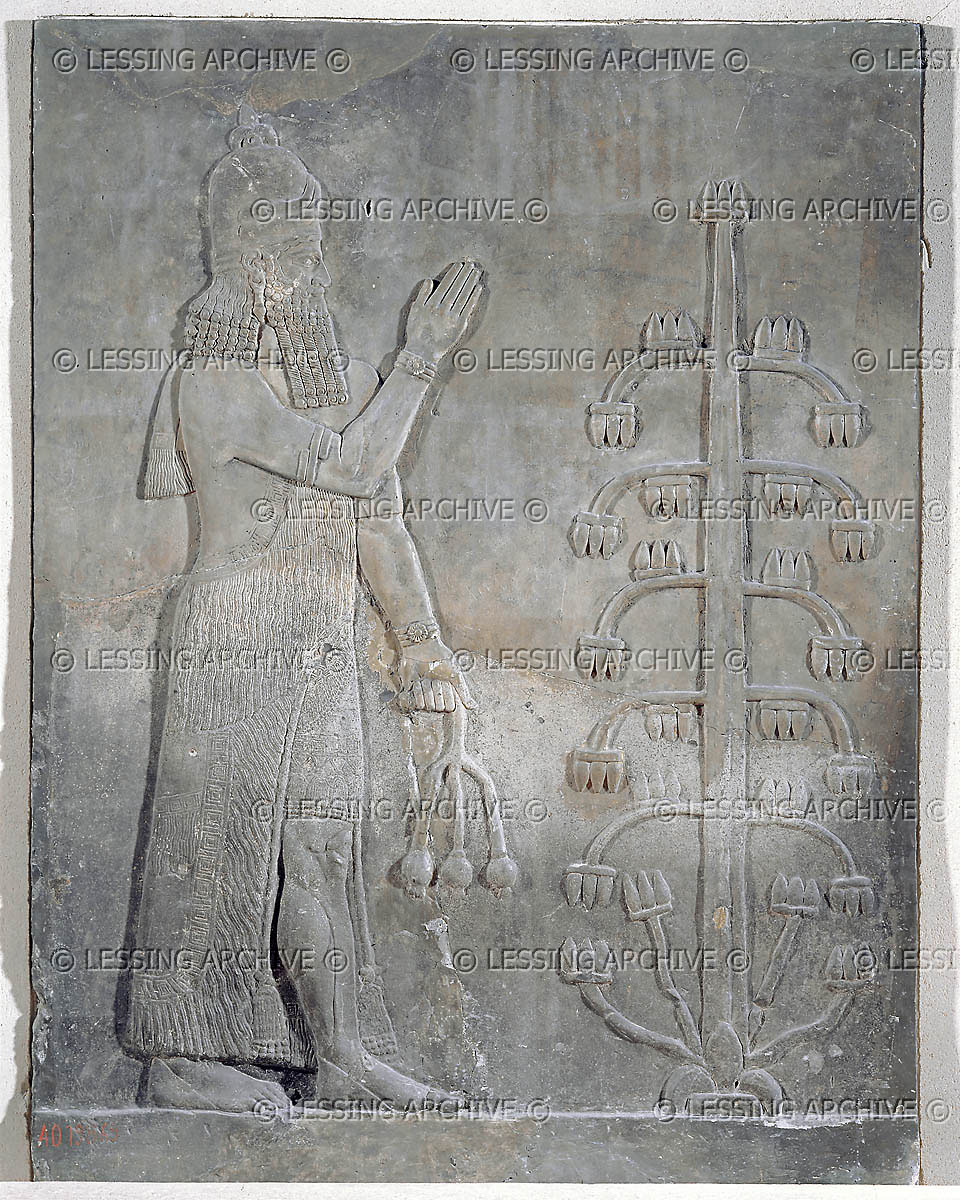
This appears to be an ummanu without wings, blessing the sacred tree with his right hand raised in the greeting gesture and his lowered left hand holding drooping poppy bulbs. This depiction of an apkallu wears a dual-horned tiara indicative of divinity or semi-divinity, but lacks all other indicators like wings. As the typical mullilu cone and banduddu bucket are absent, this could depict a king saluting the tree. Still, the figure wears a horned tiara, which is reserved for apkallu, and not worn by kings. <br />  The horned tiara is atypical with a distinctive fleur de lis at the apex. Indeed this frieze is remarkably detailed, with three separate bands visible on the rosette bracelets, and individual strands visible on the tasseled garment. <br />  The sacred tree is sparse and stark in comparison to other renditions, though it appears to be blossoming from a fleur de lis base.<br />  (Génie tenant une fleur de pavot - Genie carrying a poppy flower.)<br />  Bas-relief, 144 x 17cm.<br />  Louvre, AO 19869

This appears to be an ummanu without wings, blessing the sacred tree with his right hand raised in the greeting gesture and his lowered left hand holding drooping poppy bulbs. This depiction of an apkallu wears a dual-horned tiara indicative of divinity or semi-divinity, but lacks all other indicators like wings. As the typical mullilu cone and banduddu bucket are absent, this could depict a king saluting the tree. Still, the figure wears a horned tiara, which is reserved for apkallu, and not worn by kings.
The horned tiara is atypical with a distinctive fleur de lis at the apex. Indeed this frieze is remarkably detailed, with three separate bands visible on the rosette bracelets, and individual strands visible on the tasseled garment.
The sacred tree is sparse and stark in comparison to other renditions, though it appears to be blossoming from a fleur de lis base.
(Génie tenant une fleur de pavot – Genie carrying a poppy flower.)
Bas-relief, 144 x 17cm.
Louvre, AO 19869

Both on Assyrian reliefs and cylinder seals depictions of the apkallus together with a date palm, and in some instances the king, are common. The date palm is here a holy tree, the Tree of Life. It symbolizes the benefits the gods and kings were expected to supply for the people.

(Click to zoom in)<br />  On the imprint from this chalcedony cylinder seal dated to the 9th Century BCE, an umu-apkallu, an ummanu, winged with mullilu and banduddu bucket, blesses (or pollinates) the sacred tree with an undefined female figure.<br />  Note that this more or less symmetrical rendition of the sacred tree is mounted on a pedestal with bulbs that resemble cones.<br />  Cylinder seal and imprint: Cult of the sacred tree. Chalcedony,<br />  H: 3,2 cm<br />  Louvre: AO 22348

(Click to zoom in)
On the imprint from this chalcedony cylinder seal dated to the 9th Century BCE, an umu-apkallu, an ummanu, winged with mullilu and banduddu bucket, blesses (or pollinates) the sacred tree with an undefined female figure.
Note that this more or less symmetrical rendition of the sacred tree is mounted on a pedestal with bulbs that resemble cones.
Cylinder seal and imprint: Cult of the sacred tree. Chalcedony,
H: 3,2 cm
Louvre: AO 22348

(“This palm in art then is not the symbol of a god or the whole pantheon of gods, but is a symbol of the benefits which gods and kings were expected to supply.” W.G. Lambert, “The Background of the Neo-Assyrian Sacred Tree,” in S. Parpola and R.M. Whiting, eds., Sex and Gender in the Ancient Near East, XLVIIe Recontre Assyriologique Internationale, Helsinki, 2002, pp. 321-6.)

The role of the apkallus is to pollinate the tree. Through this guest (sic), fertility, vitality, and power were transferred to the tree; in the scenes where the king is present, he is a receiver of these benefits from apkallus.

(Cf. Kolbe, Die Reliefprogramme, 21, 29, pp. 83-8).

Parpola returns to this mythological representation of the role of the king in his new edition of the letters. The Assyrian kings had the position of the god’s representative on earth. This position was above all symbolized through the Tree of Life.

(Parpola, Letters from Assyrian and Babylonian Scholars, XIII-XXXV.)

Three superposed lotus flowers forming a "Sacred tree." Ivory (open-work, fragment)<br /> Right: Lotus flower with 5 petals.<br /> 11.3 x 3 cm, Louvre AO 11481;<br /> Left: Ivory plaque with top and bottom border from Arslan Tash, ancient Hadatu, Northern Syria.<br /> 7.6 x 2.1 cm, Louvre AO 11482.<br /> I believe that the sacred tree fragment on the left is upside down. The blossoms should be oriented upwards.

Three superposed lotus flowers forming a “Sacred tree.” Ivory (open-work, fragment)
Right: Lotus flower with 5 petals.
11.3 x 3 cm, Louvre AO 11481;
Left: Ivory plaque with top and bottom border from Arslan Tash, ancient Hadatu, Northern Syria.
7.6 x 2.1 cm, Louvre AO 11482.
I believe that the sacred tree fragment on the left is upside down. The blossoms should be oriented upwards.

The tree represented the divine world order maintained by the king. At the same time the symbolism of the tree was projected upon the king as the perfect image of the god. A king who could not conform to this role would automatically disrupt the cosmic harmony.

To execute this duty the king needed experts who could interpret the signs of the god. Therefore he needed the advisory circle of scholars: the tupšarru, “astrologer, scribe;” bārû, “haruspex / diviner;” āšipu, “exorcist / magician;” asû, “physician;” and kalû, “lamentation chanter.”

A memorandum from the reign of Ashurbanipal names 45 scholars from these professions. The scholars were mostly native, but could also include foreigners, such as Syrian, Anatolian, and Egyptian.

(Parpola, Letters from Assyrian and Babylonian Scholars, XIV.)

Click to zoom in.<br />  This reproduction of the bas reliefs in Room I of the Northwestern Palace of King Ashurnasirpal at Nimrud is remarkable for the sheer number of apkallus portrayed interacting with endless renditions of the sacred tree.<br /> All apkallu are winged, even the beardless specimens in I-16. All others are either bearded males, or griffin-headed bird apkallus.<br /> Samuel M. Paley and R.P. Sobolewski, The Reconstruction of the Relief Representations and Their Positions in the Northwest Palace at Kalhu (Nimrud) II. (The Principal Entrances and Courtyards). Mainz am Rhein: Verlag Philipp von Zabern, 1992.<br /> From Mehmet-Ali Atac, The Mythology of Kingship in Neo-Assyrian Art, Cambridge University Press, 2010, p. 100.

Click to zoom in.
This reproduction of the bas reliefs in Room I of the Northwestern Palace of King Ashurnasirpal at Nimrud is remarkable for the sheer number of apkallus portrayed interacting with endless renditions of the sacred tree.
All apkallu are winged, even the beardless specimens in I-16. All others are either bearded males, or griffin-headed bird apkallus.
Samuel M. Paley and R.P. Sobolewski, The Reconstruction of the Relief Representations and Their Positions in the Northwest Palace at Kalhu (Nimrud) II. (The Principal Entrances and Courtyards). Mainz am Rhein: Verlag Philipp von Zabern, 1992.
From Mehmet-Ali Atac, The Mythology of Kingship in Neo-Assyrian Art, Cambridge University Press, 2010, p. 100.

The Catalogue of Texts and Authors shows that the actual scholars at the royal court stood in a line of transmission; they performed a profession, the wisdom of which went back to famous ummanus of the past, and ultimately to the antediluvian apkallus.

These apkallus were, as we have seen in the rituals, imagined in three shapes. The fish-garb symbolized the connection with apsû, the ocean of wisdom; the head and wings of the eagle symbolized their connection to heaven.

The genies symbolizing the human apkallus often have crowned horns, indicating divine status. Parpola thinks that this symbolized their transformation from humans to saints after their death. (Ibid., XX). “

Helge Kvanvig, Primeval History: Babylonian, Biblical, and Enochic: An Intertextual Reading, Brill, 2011, pp. 143-4.
Kvanvig: Human Knowledge is Dangerous to the Cosmic Order

“We now turn to Uan, the first apkallu. In Bīt Mēseri he is described in the following way: uanna mušaklil usurāt šamê u erseti, “Uanna, who completed the plans of heaven and earth” (line 1).

We have already examined the content of this clause. The wisdom described here is all-encompassing; the first apkallu is included in the divine knowledge about both the structure of the cosmos and the fate of humans.

Finally compare this representation. Wings are missing. The horned headdress has two levels of horns, and is again surmounted with what appears to be a fleur-de-lis.  Like other examples, this figure holds what appear to be poppy bulbs, and raises his right hand in the greeting gesture.  Bracelets with rosettes are present, as are armlets on the upper arms.  The sacred tree before the figure varies from other depictions, as well.  It is not certain that this figure depicts an ummânū at all. It could portray a king. The lack of wings is clearly deliberate.  Bas-relief, Louvre, AO 19869

Finally compare this representation. Wings are missing. The horned headdress has two levels of horns, and is again surmounted with what appears to be a fleur-de-lis.
Like other examples, this figure holds what appear to be poppy bulbs, and raises his right hand in the greeting gesture.
Bracelets with rosettes are present, as are armlets on the upper arms.
The sacred tree before the figure varies from other depictions, as well.
It is not certain that this figure depicts an ummânū at all. It could portray a king. The lack of wings is clearly deliberate.
Bas-relief, Louvre, AO 19869

To some extent this concerns all the seven apkallus, but there is a difference; the seven apkallus together kept the plans of heaven and earth in order (lines 12-13). They were not as a group involved in creating them. We have an analogy here to the relationship between the first apkallu, Oannes, and the seventh apkallu, Odakon, in Berossos. Oannes revealed to humankind everything necessary to know; Odakon explained detail what Oannes had revealed (sic).

This all-encompassing knowledge is interesting compared to the knowledge of Adapa in the myth. According to the beginning of the myth in fragment A, Adapa’s knowledge is described in the following way: uzna rapašta ušāklilšu usurāt māti kullumu, “he made him perfect with broad understanding to reveal the plans of the land” (Nineveh fragment A obv. i. 3).

Both in Bīt Mēseri and in the myth the verb šuklulu and the noun usurtu are used. There is a difference between ersetu in Bīt Mēseri and mātu in the myth, “earth” and “land,” but this is not very significant here. What is significant is that knowledge about šamû, “heaven,” is lacking in Adapa’s initial wisdom.

He is broad in understanding, but his wisdom does not include the divine realm. This seems to be in opposition to what is said about Ea in fragment B: ea ša šamê īde, “Ea who knows heaven” (Amarna fragment B. obi. 14).

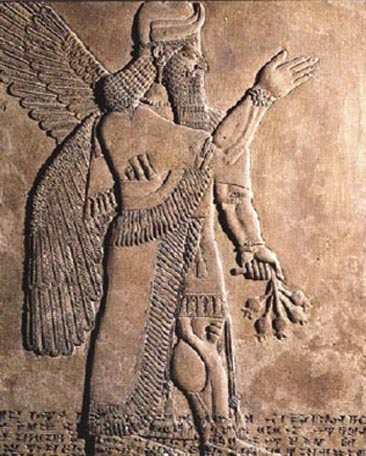
This exemplar of an Ummânū raises his right hand in the greeting gesture and holds what appear to be poppy bulbs in his left hand.  Rosette bracelets are apparent on his wrists, and he wears the horned tiara indicative of divinity.

This exemplar of an Ummânū raises his right hand in the greeting gesture and holds what appear to be poppy bulbs in his left hand.
Rosette bracelets are apparent on his wrists, and he wears the horned tiara indicative of divinity.

When Adapa arrives before Anu in heaven, Anu presupposes that Ea has revealed everything to Adapa, since Adapa had the power to paralyze the South Wind simply through his speech: ammīni d ea amīlūta lā banīta ša šamê u erseti ukillinši libra sabra iškunšu, “Why did Ea expose to a human what is bad in heaven and earth? Why did he establish a “fat heart” (in) him?”

(Fragment B rev. 57-58).

The expression, lā banīta ša šamê u erseti, “what is bad in heaven and earth,” clearly refers to Adapa’s wisdom.

Anu thinks that Ea has revealed to Adapa the same extensive wisdom about heaven and earth that Ea himself has, and Anu considers this bad, because it is dangerous for the cosmic order when humans possess it, which Adapa clearly has demonstrated.”

Helge Kvanvig, Primeval History: Babylonian, Biblical, and Enochic: An Intertextual Reading, Brill, 2011, p. 126.

Kvanvig: Bīt Mēseri and the Adapa Myth

“The exact form and meaning of the name of the first apkallu is not easy to decide. There are several reasons for this. On the one hand there seems to be a connection in the cuneiform sources between Uan as the name is given in the Uruk tablet and Bīt Mēseri, and the Adapa known from the myth.

Second, there is a connection between the name as attested in cuneiform sources and the Greek name Oannes in Berossos.

Third, there is a combined name that first seems to appear in the Catalogue of Texts and Authors I, 6, “ūma-an-na a-da-pà, which seems to play on both Uan and adapa (sic) in some mysterious way.

Fourth, there is a connection in the meaning of the name and the fate, related to the seventh apkallu, Utuabzu, and the first apkallu, Uan.

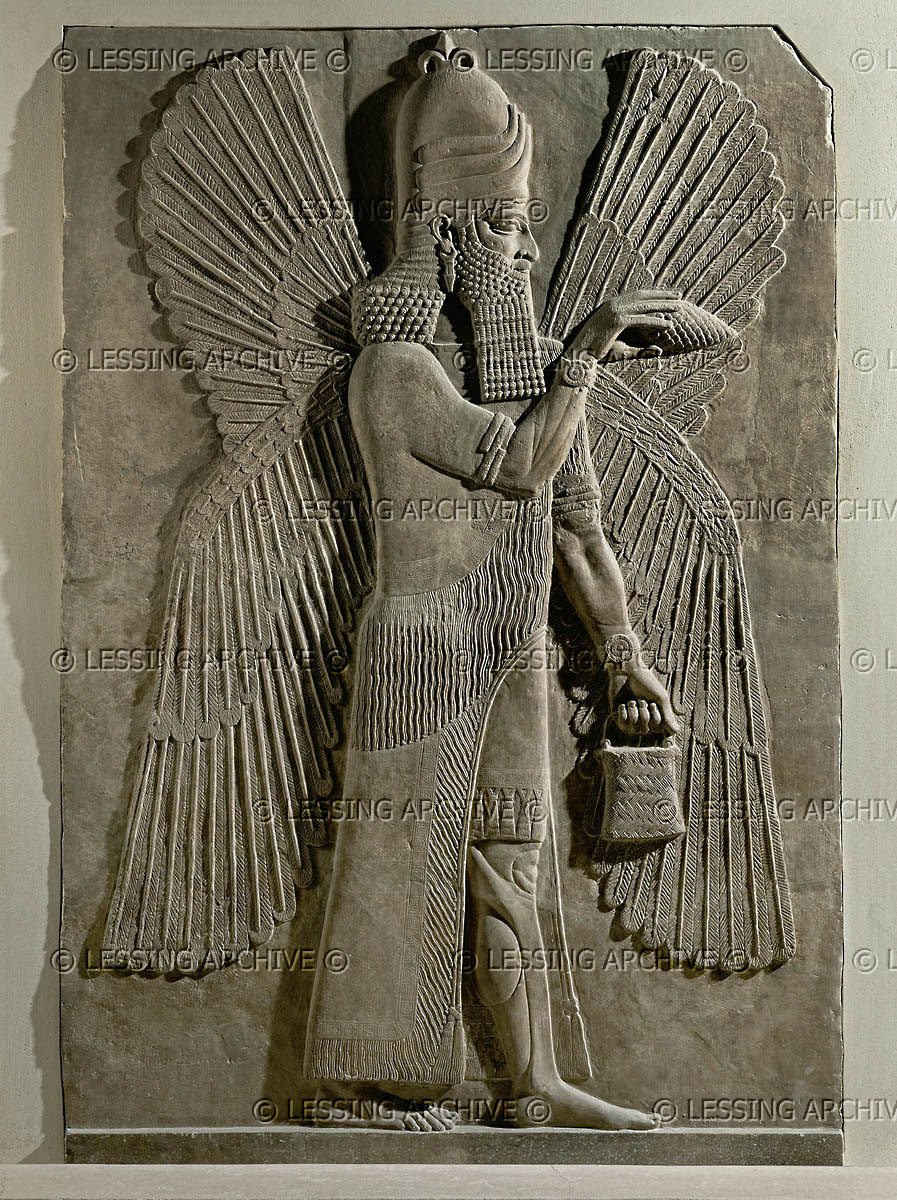
Now compare this Nimrud bas relief from the Louvre: an ummânū sprinkles water with a mullilu cone in his right hand, holding his banduddu bucket in his left. This ummânū wears bracelets with a concentric circular design, and rosettes are not apparent. This ummânū also wears the common horned headdress of Anu, but with three stacked layers of horns. As noted elsewhere, this headdress is surmounted by an object that resembles a partial fleur de lis. From Nimrud, capital of king Ashurnarzipal.  Louvre, AO 19845

Now compare this Nimrud bas relief from the Louvre: an ummânū sprinkles water with a mullilu cone in his right hand, holding his banduddu bucket in his left.
This ummânū wears bracelets with a concentric circular design, and rosettes are not apparent.
This ummânū also wears the common horned headdress of Anu, but with three stacked layers of horns.
As noted elsewhere, this headdress is surmounted by an object that resembles a partial fleur de lis.
From Nimrud, capital of king Ashurnarzipal.
Louvre, AO 19845

To the first issue, R. Borger, supported by F. Wiggermann, has claimed that Adapa from the myth and Uan from the lists were originally two separate figures. If this is the case, we first have to explain the meaning of the short form of the name, i.e. Uan, then the combination with adapu.

The short name form, Uan, in the two cuneiform lists is most easy (sic) explained as a Sumerian genitive, simply meaning “Light of An.” Since An is written with the Sumerian determinative for “god,” An is here the god of heaven.

Given the general and somewhat vague resemblances between the cuneiform and Greek names, we think Uan alone very well could form the background for Oannes in Berossos. Lambert has called attention to the fact that in a list of adjectives for “wise” the Sumerian ù.tu.a.an.ba, “born in the water,” is equated with a-da-pu.

The same Akkadian word is used in a royal prayer in which the king speaks of himself as “your wise (a-da-pà) slave.”  This could point in the direction that Uan is the proper name and adapu is an epithet designating Uan as “wise.” It is, however, difficult to equate myths with lexical texts and draw certain conclusions.

Reading the Adapa Myth from the Old Babylonian period clearly evokes the impression that Adapa was a proper name, and this proper name of the foremost wise among humans (sic) could very well have caused the use of the name as an epithet.

Finally compare this representation. Wings are missing. The horned headdress has two levels of horns, and is again surmounted with what appears to be a fleur-de-lis.  Like other examples, this figure holds what appear to be poppy bulbs, and raises his right hand in the greeting gesture.  Bracelets with rosettes are present, as are armlets on the upper arms.  The sacred tree before the figure varies from other depictions, as well.  It is not certain that this figure depicts an ummânū at all. It could portray a king. The lack of wings is clearly deliberate.  Bas-relief, Louvre, AO 19869

Finally compare this representation. Wings are missing. The horned headdress has two levels of horns, and is again surmounted with what appears to be a fleur-de-lis.
Like other examples, this figure holds what appear to be poppy bulbs, and raises his right hand in the greeting gesture.
Bracelets with rosettes are present, as are armlets on the upper arms.
The sacred tree before the figure varies from other depictions, as well.
It is not certain that this figure depicts an ummânū at all. It could portray a king. The lack of wings is clearly deliberate.
Bas-relief, Louvre, AO 19869

(Cf. the discussion in S. Izre’el, Adapa and the South Wind. Language Has the Power of Life and Death, ed. J.S. Cooper, vol. 10, Mciv. Winona Lake 2001, 1-2.)

The combined name “‘ūma-an-na a-da-pà (sic) is a riddle. Adapa at the end can be part of the name, or it can be an epithet, “the wise one;” if so the real name is ūmanna. This name does not tell us anything, except that it could be an odd spelling of ummānu, “craftsman or scholar.” But why should the foremost sage, designated apkallu, bear a name similar to an expert of lower rank?

This points in the direction that both words belong together in the name. We see that the only element in the first name that separates from the name of the first sage in the Akkadian lists is the nasalization of u in um, umanna instead of uanna.

Why this is done is hard to figure out. It could have been to create a pun between the primeval Uan, “the light of heaven,” patron of the scholars, and these succeeding scholars, designated as ummānū.

In any case the proper name of the primary sage in the Catalogue would be Uanadapa, a combination of the first apkallu Uan from the lists and Adapa from the myth.”

Helge Kvanvig, Primeval History: Babylonian, Biblical, and Enochic: An Intertextual Reading, Brill, 2011, pp. 117-9.