
Samizdat

Publishing the Forbidden. All Rights Reserved. © Samizdat 2014-2025.

Tag: Adad-apla-iddina

Kvanvig: On Šēp lemutti, Averting Evil

“The apkallus were also an essential part of the composition Šēp lemutti. The composition starts by defining the purpose of the ritual as to avert evil from the house.

Then the text prescribes the types of figures to be fashioned and buried at set locations in the house. This section contains a long passage describing wooden figures of seven apkallus, from seven Babylonian cities. Since these figures should be made of wood, no remains of them are found, of course.

Bird Apkallū and Fish Apkallū, the so-called purādu-fish, side by side. Apkallū statuettes of this design were buried in appropriate places in the home of a Babylonian exorcist. They were believed to have prophylactic qualities, guarding the home from evil.

Bird Apkallū and Fish Apkallū, the so-called purādu-fish, side by side. Apkallū statuettes of this design were buried in appropriate places in the home of a Babylonian exorcist. They were believed to have prophylactic qualities, guarding the home from evil.

The next passages describe apkallus with well-known features; seven figures with faces and wings of birds and seven figures cloaked in the skin of a fish. (Cf. Green, “Neo-Assyrian Apotropaic Figures,” 87-96, 87-90.)

In total the apkallus as groups of seven are described five times according to where they should be buried: at the head of the bed, in the foundation of the house, at the threshold to the chapel, in front of the door behind the chair and in the middle of the house in front of the chair (the chair may here be the throne of the palace).

 As noted by Professor Dalley, "The type occurs as a group of six or more clay figurines placed in brick boxes in foundations at Assur, Nimrud, and Nineveh," citing Dessa Rittig as her source (Assyrisch-babylonische Kleinplastik magischer Bedeutung vom 13.-6. Jh. v. Chr. München, 1977).


As noted by Professor Dalley, “The type occurs as a group of six or more clay figurines placed in brick boxes in foundations at Assur, Nimrud, and Nineveh,” citing Dessa Rittig as her source (Assyrisch-babylonische Kleinplastik magischer Bedeutung vom 13.-6. Jh. v. Chr. München, 1977).

The first invocation addresses the arrival of the apkallus: “the apkallus have arrived at the first location.” (Cf. P. Hibbert in Kolbe, Die Reliefprogramme, 200-1.) Then follows an invocation that is similar in all the other four instances: šiptu attunu salmānu apkallu massarī, “Incantation: “you are the statues of the apkallus, the watchers.” (Wiggermann, Mesopotamian Protective Spirits, 48.)

The designation massaru follows the intention of the whole ritual closely: the apkallus are invoked to protect the palace or the house. Accordingly, there is a close correspondence between the invocation of the apkallus as watchers and how they were represented materially.

The statues of them were initiated through proper rituals and either placed in the room of the ill person to free him from evil demons, or they were buried in a house, to guard the house against demonic attack.

As monumental reliefs at the entrances to palaces they remind people and demons that the palace, the king, and the inhabitants of the palace lived in a house which was protected against evil intruders through the proper rituals.

Since the apkallus appear in apotropaic rituals, they are closely connected to the practice of the āšipū, the exorcists. In an ancient Babylonian myth the sixth sage An-enlilda made poultices for medical means. They would be brought to the upper world of humans as protection against diseases. (Lambert, “The Twenty-One “Poultices,” obv. 11-4, 78.)
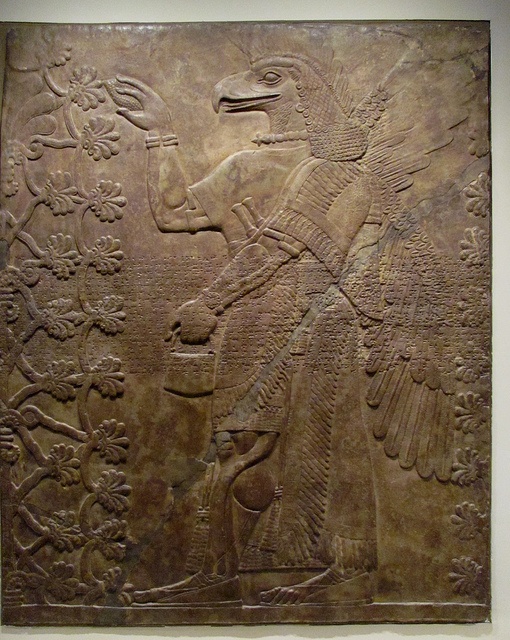
A bas relief in the Louvre.  In this case the bird-apkallū tends to a sacred tree. Considering the mullilu in his right hand and the banduddu in his left, (tree cone and water bucket), he is engaged in a water ritual intended to sanctify the sacred tree. This is a common motif in Sumerian and Neo-Assyrian idols.  This bas relief is in the Louvre.  Primary publicationNimrud NW Palace I-24 = RIMA 2.0.101.023, ex. 189 (f) Collection	Nimrud, Iraq (a); British Museum, London, UK (b); Louvre Museum, Paris, France (c); Nimrud, Iraq (d); Detroit Institute of Arts, Detroit, Michigan, USA (e); British Museum, London, UK; Louvre Museum, Paris, France  Museum no.	Nimrud fragment no. 42 (a); BM 098061 (b); AO 22198 (c); Nimrud fragment no. 43 and 45 (d); DIA 47.181 (e) (photo: DIA); AO 19849  Accession no.	1903-10-10, 0002 (b) Provenience	Kalhu (mod. Nimrud) Period	Neo-Assyrian (ca. 911-612 BC)

A bas relief in the Louvre.
In this case the bird-apkallū tends to a sacred tree. Considering the mullilu in his right hand and the banduddu in his left, (tree cone and water bucket), he is engaged in a water ritual intended to sanctify the sacred tree. This is a common motif in Sumerian and Neo-Assyrian idols.
This bas relief is in the Louvre.
Primary publication Nimrud NW Palace I-24 = RIMA 2.0.101.023, ex. 189 (f)
Collection Nimrud, Iraq (a); British Museum, London, UK (b); Louvre Museum, Paris, France (c); Nimrud, Iraq (d); Detroit Institute of Arts, Detroit, Michigan, USA (e); British Museum, London, UK; Louvre Museum, Paris, France
Museum no. Nimrud fragment no. 42 (a); BM 098061 (b); AO 22198 (c); Nimrud fragment no. 43 and 45 (d); DIA 47.181 (e) (photo: DIA); AO 19849
Accession no. 1903-10-10, 0002 (b)
Provenience Kalhu (mod. Nimrud)
Period Neo-Assyrian (ca. 911-612 BC)

We know that experts in medicine and incantations against disease demons could either designate themselves as apkallu, or place themselves as a descendant of an apkallu, in this case used as honorary title for an expert of highest rank. (Cf. A. Tuskimoto, “By the Hand of Madi-Dagan, the Scribe and Apkallu-Priest,” in Priests and Officials in the Ancient Near East, K. Watanabe, ed., Heidelberg, 1999, pp. 187-200. Also Finkel, “Adad-apla-iddina,” 144f.)

In the commentary to diagnostic omens that explains the word pirig that occurs in the names of the postdiluvian apkallus meaning “light,” it is also stated that ka.pirig means āšipu.”

Helge Kvanvig, Primeval History: Babylonian, Biblical, and Enochic: An Intertextual Reading, Brill, 2011, pp. 132-3.
Lenzi: The Mythology of Scribal Succession

“The text of the ULKS is as follows:

“During the reign of Ayalu, the king, Adapa was sage.

During the reign of Alalgar, the king, Uanduga was sage.

During the reign of Ameluana, the king, Enmeduga was sage.

During the reign of Amegalana, the king, Enmegalama was sage.

During the reign of Enmeušumgalana, the king, Enmebuluga was sage.

During the reign of Dumuzi, the shepherd, the king, Anenlilda was sage.

During the reign of Enmeduranki, the king, Utuabzu was sage.

After the flood,(?) during the reign of Enmerkar, the king, Nungalpirigal was sage, whom Ištar brought down from heaven to Eana. He made the bronze lyre, whose . . . (were) lapis lazuli, according to the technique of Ninagal (Ninagal is Ea’s smith). The lyre was placed before Anu . . ., the dwelling of (his) personal god.?

During the reign of Gilgamesh, the king,? Sin-leqi-unnini was scholar.

During the reign of Ibbi-Sin, the king, Kabti-ili-Marduk was scholar.

During the reign of Išbi-Erra, the king, Sidu, a.k.a. Enlil-ibni, was scholar.

During the reign of Abi-ešuh, the king, Gimil-Gula and Taqiš-Gula were the scholars.

During the reign of . . ., the king, Esagil-kin-apli was scholar.

During the reign of Adad-apla-iddina, the king, Esagil-kin-ubba (this name … despite chronological problems, is probably to be identified with Saggil-kina-ubbib, the author of The Babylonian Theodicy; see van Dijk, “Die Inschriftenfunde,” 51) was scholar.

During the reign of Nebuchadnezzar, the king, Esagil-kin-ubba was scholar.

During the reign of Esarhaddon, the king, Aba-Enlil-dari was scholar, whom the Arameans call Ahiqar.

. . . Nikarchos.

Tablet of Anu-belšunu, son of Nidintu-Anu, descendant of Sin-leqi-unnini, the lamentation-priest of Anu and Antu. An Urukean. (Copied) by his own hand. Uruk, 10 Ayyar, 147th year of Antiochus, the king.

The one who reveres Anu will not carry it off.”

Gaining a historical perspective on the scholarly genealogical tradition attested in the text of ULKS is the first element of contextualizing our text. Clearly, the ULKS is unique.

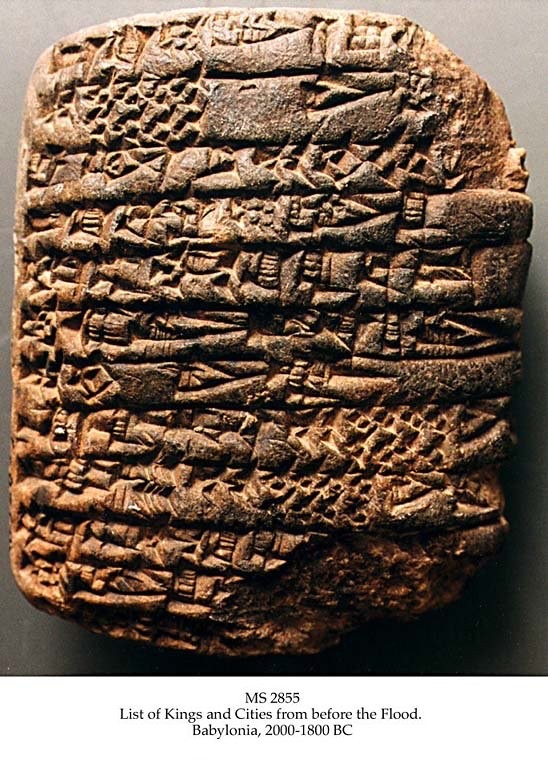
 Text:  "IN ERIDU: ALULIM RULED AS KING 28,800 YEARS. ELALGAR RULED 43,200 YEARS. ERIDU WAS ABANDONED. KINGSHIP WAS TAKEN TO BAD-TIBIRA. AMMILU'ANNA THE KING RULED 36,000 YEARS. ENMEGALANNA RULED 28,800 YEARS. DUMUZI RULED 28,800 YEARS. BAD-TIBIRA WAS ABANDONED. KINGSHIP WAS TAKEN TO LARAK. EN-SIPA-ZI-ANNA RULED 13,800 YEARS. LARAK WAS ABANDONED. KINGSHIP WAS TAKEN TO SIPPAR. MEDURANKI RULED 7,200 YEARS. SIPPAR WAS ABANDONED. KINGSHIP WAS TAKEN TO SHURUPPAK. UBUR-TUTU RULED 36,000 YEARS. TOTAL: 8 KINGS, THEIR YEARS: 222,600" MS in Sumerian on clay, probably Larsa Babylonia, 2000-1800 BC, 1 tablet, 8,1x6,5x2,7 cm, single column, 26 lines in cuneiform script. 5 other copies of the Antediluvian king list are known only: MS 3175, 2 in Oxford: Ashmolean Museum, one is similar to this list, containing 10 kings and 6 cities, the other is a big clay cylinder of the Sumerian King List, on which the kings before the flood form the first section, and has the same 8 kings in the same 5 cities as the present.  A 4th copy is in Berkeley: Museum of the University of California, and is a school tablet. A 5th tablet, a small fragment, is in Istanbul. The list provides the beginnings of Sumerian and the world’s history as the Sumerians knew it. The cities listed were all very old sites, and the names of the kings are names of old types within Sumerian name-giving. Thus it is possible that correct traditions are contained, though the sequence given need not be correct. The city dynasties may have overlapped. It is generally held that the Antediluvian king list is reflected in Genesis 5, which lists the 10 patriarchs from Adam to Noah, all living from 365 years (Enoch) to 969 years (Methuselah), altogether 8,575 years.  It is possible that the 222,600 years of the king list reflects a more realistic understanding of the huge span of time from Creation to the Flood, and the lengths of the dynasties involved.  The first of the 5 cities mentioned , Eridu, is Uruk, in the area where the myths place the Garden of Eden, while the last city, Shuruppak, is the city of Ziusudra, the Sumerian Noah. Jöran Friberg: A remarkable Collection of Babylonian Mathematical Texts. Springer 2007.  Sources and Studies in the History of Mathematics and Physical Sciences.  Manuscripts in the Schøyen Collection, vol. 6, Cuneiform Texts I. pp. 237-241. Andrew George, ed.: Cuneiform Royal Inscriptions and Related Texts in the Schøyen Collection, Cornell University Studies in Assyriology and Sumerology, vol. 17,  Manuscripts in the Schøyen Collection, Cuneiform texts VI. CDL Press, Bethesda, MD, 2011, text 96, pp. 199-200, pls. LXXVIII-LXXIX. Andrew E. Hill & John H. Walton: A survey of the Old Testament, 3rd ed., Grand Rapids, Mi., Zondervan Publ. House, 2009, p. 206.  Zondervan Illustrated Bible, Backgrounds, Commentary. John H. Walton, gen. ed. Grand Rapids, Mich., Zondervan, 2009, vol 1, p. 482, vol. 5, p. 398. Babylonia 2000 - 1800 BC

MS 2855
Text:
“IN ERIDU: ALULIM RULED AS KING 28,800 YEARS. ELALGAR RULED 43,200 YEARS. ERIDU WAS ABANDONED. KINGSHIP WAS TAKEN TO BAD-TIBIRA. AMMILU’ANNA THE KING RULED 36,000 YEARS. ENMEGALANNA RULED 28,800 YEARS. DUMUZI RULED 28,800 YEARS. BAD-TIBIRA WAS ABANDONED. KINGSHIP WAS TAKEN TO LARAK. EN-SIPA-ZI-ANNA RULED 13,800 YEARS. LARAK WAS ABANDONED. KINGSHIP WAS TAKEN TO SIPPAR. MEDURANKI RULED 7,200 YEARS. SIPPAR WAS ABANDONED. KINGSHIP WAS TAKEN TO SHURUPPAK. UBUR-TUTU RULED 36,000 YEARS. TOTAL: 8 KINGS, THEIR YEARS: 222,600”
MS in Sumerian on clay, probably Larsa Babylonia, 2000-1800 BC, 1 tablet, 8,1×6,5×2,7 cm, single column, 26 lines in cuneiform script.
5 other copies of the Antediluvian king list are known only: MS 3175, 2 in Oxford: Ashmolean Museum, one is similar to this list, containing 10 kings and 6 cities, the other is a big clay cylinder of the Sumerian King List, on which the kings before the flood form the first section, and has the same 8 kings in the same 5 cities as the present.
A 4th copy is in Berkeley: Museum of the University of California, and is a school tablet. A 5th tablet, a small fragment, is in Istanbul.
The list provides the beginnings of Sumerian and the world’s history as the Sumerians knew it. The cities listed were all very old sites, and the names of the kings are names of old types within Sumerian name-giving. Thus it is possible that correct traditions are contained, though the sequence given need not be correct. The city dynasties may have overlapped.
It is generally held that the Antediluvian king list is reflected in Genesis 5, which lists the 10 patriarchs from Adam to Noah, all living from 365 years (Enoch) to 969 years (Methuselah), altogether 8,575 years.
It is possible that the 222,600 years of the king list reflects a more realistic understanding of the huge span of time from Creation to the Flood, and the lengths of the dynasties involved.
The first of the 5 cities mentioned, Eridu, is Uruk, in the area where the myths place the Garden of Eden, while the last city, Shuruppak, is the city of Ziusudra, the Sumerian Noah.
Jöran Friberg: A Remarkable Collection of Babylonian Mathematical Texts. Springer 2007.
Sources and Studies in the History of Mathematics and Physical Sciences.
Manuscripts in the Schøyen Collection, vol. 6, Cuneiform Texts I. pp. 237-241. Andrew George, ed.: Cuneiform Royal Inscriptions and Related Texts in the Schøyen Collection, Cornell University Studies in Assyriology and Sumerology, vol. 17,
Manuscripts in the Schøyen Collection, Cuneiform texts VI. CDL Press, Bethesda, MD, 2011, text 96, pp. 199-200, pls. LXXVIII-LXXIX.
Andrew E. Hill & John H. Walton: A Survey of the Old Testament, 3rd ed., Grand Rapids, MI., Zondervan Publ. House, 2009, p. 206.
Zondervan Illustrated Bible, Backgrounds, Commentary. John H. Walton, gen. ed. Grand Rapids, MI., Zondervan, 2009, vol 1, p. 482, vol. 5, p. 398.
Babylonia
2000 – 1800 BC
http://www.schoyencollection.com/history-collection-introduction/sumerian-history-collection/king-cities-before-flood-ms-2855

It lists seven well-known antediluvian kings, each paired with his corresponding apkallū-sage, then a single post-diluvian king-apkallū pair, followed by eight post-diluvian kings, each with his corresponding ummânu-scholar (in one case, two scholars).

The list is arranged from start to finish in what one must recognize as an attempt at chronological order. Focusing on the ummânū, the implication of the text is rather clear: the human, post-diluvian scholars are the direct professional descendants of the earlier semi-divine apkallū.

In a previous study I called this traditional genealogical relationship the “mythology of scribal succession.”

Alan Lenzi, The Uruk List of Kings and Sages and Late Mesopotamian ScholarshipJANER 8.2, Brill, Leiden, 2008. pp. 140-3.