Samizdat

Publishing the Forbidden. All Rights Reserved. © Samizdat 2014-2025.

Category: Sumeria

Spence on the Gilgamesh Epic

“The Gilgamesh epic ranks with the Babylonian myth of creation as one of the greatest literary productions of ancient Babylonia. The main element in its composition is a conglomeration of mythic matter, drawn from various sources, with perhaps a substratum of historic fact, the whole being woven into a continuous narrative around the central figure of Gilgamesh, prince of Erech.

It is not possible at present to fix the date when the epic was first written. Our knowledge of it is gleaned chiefly from mutilated fragments belonging to the library of Assur-bani-pal, but from internal and other evidence we gather that some at least of the traditions embodied in the epic are of much greater antiquity than his reign.

Thus a tablet dated 2100 b.c. contains a variant of the deluge story inserted in the XIth tablet of the Gilgamesh epic. Probably this and other portions of the epic existed in oral tradition before they were committed to writing—that is, in the remote Sumerian period.

Assur-bani-pal was an enthusiastic and practical patron of literature. In his great library at Nineveh (the nucleus of which had been taken from Calah by Sennacherib) he had gathered a vast collection of volumes, clay tablets, and papyri, most of which had been carried as spoil from conquered lands.

He also employed scribes to copy older texts, and this is evidently how the existing edition of the Gilgamesh epic came to be written. From the fragments now in the British Museum it would seem that at least four copies of the poem were made in the time of Assur-bani-pal.

They were not long permitted to remain undisturbed. The great Assyrian empire was already declining; ere long Nineveh was captured and its library scattered, while plundering hordes burnt the precious rolls of papyrus, and buried the clay tablets in the debris of the palace which had sheltered them.

There they were destined to lie for over 2000 years, till the excavations of Sir A. H. Layard, George Smith, and others brought them to light. It is true that the twelve tablets of the Gilgamesh epic (or rather, the fragments of them which have so far been discovered) are much defaced; frequently the entire sense of a passage is obscured by a gap in the text, and this, when nice mythological elucidations are in question, is no light matter.

Yet to such an extent has the science of comparative religion progressed in recent years that we are probably better able to read the true mythological significance of the epic than were the ancient Babylonians themselves, who saw in it merely an account of the wanderings and exploits of a national hero.

The epic, which centres round the ancient city of Erech, relates the adventures of a half-human, halfdivine hero, Gilgamesh by name, who is king over Erech.

Two other characters figure prominently in the narrative—Eabani, who evidently typifies primitive man, and Ut-Napishtim, the hero of the Babylonian deluge myth. Each of the three would seem to have been originally the hero of a separate group of traditions which in time became incorporated, more or less naturally, with the other two.

The first and most important of the trio, the hero Gilgamesh, may have been at one time a real personage, though nothing is known of him historically.[1] Possibly the exploits of some ancient king of Erech have furnished a basis for the narrative.

His name (for a time provisionally read Gisdhubar, or Izdubar, but now known to have been pronounced Gilgamesh[2]) suggests that he was not Babylonian but Elamite or Kassite in origin, and from indications furnished by the poem itself we learn that he conquered Erech (or relieved the city from a besieging force) at the outset of his adventurous career.

It has been suggested also that he was identical with the Biblical Nimrod, like him a hero of ancient Babylon; but there are no other grounds for the suggestion.

So much for the historical aspect of Gilgamesh. His mythological character is more easily established. In this regard he is the personification of the sun. He represents, in fact, the fusion of a great national hero with a mythical being.

Throughout the epic there are indications that Gilgamesh is partly divine by nature,though nothing specific is said on that head. His identity with the solar god is veiled in the popular narrative, but it is evident that he has some connexion with the god Shamash, to whom he pays his devotions and who acts as his patron and protector.”

Lewis Spence, Myths and Legends of Babylonia and Assyria, 1917, pp. 154-6.

The Rise of Marduk

“In an inscription upon a clay cylinder brought from Babylonia seven years ago, Cyrus is made to declare that the overthrow of Nabonidos, the last independent Babylonian monarch, was due to the anger of Bel and the other gods.

Nabonidos had removed their images from their ancient sanctuaries, and had collected them together in the midst of Babylon. The priests maintained that the deed had aroused the indignation of Merodach, “the lord of the gods,” who had accordingly rejected Nabonidos, even as Saul was rejected from being king of Israel, and had sought for a ruler after his own heart.

It was “in wrath” that the deities had ”left their shrines when Nabonidos brought them into Babylon,” and had prayed Merodach, the divine patron of the imperial city, to “go round unto all men wherever might be their seats.”

Merodach sympathised with their wrongs; “he visited the men of Sumer and Accad whom he had sworn should be his attendants,” and “all lands beheld his friend.” He chose Cyrus, king of Elam, and destined him by name for the sovereignty of Chaldea.

Cyrus, whom the Hebrew prophet had already hailed as the Lord’s Anointed, was thus equally the favourite of the supreme Babylonian god.

“Merodach, the great lord, the restorer of his people,” we are told, “beheld with joy the deeds of his vicegerent who was righteous in hand and heart. To his city of Babylon he summoned his march, and he bade him take the road to Babylon; like a friend and a comrade he went at his side.”

A single battle decided the conflict: the Babylonians opened their gates, and “without fighting or battle,” Cyrus was led in triumph into the city of Babylon.

His first care was to show his gratitude towards the deities who had so signally aided him. Their temples were rebuilt, and they themselves were restored to their ancient seats.

With all the allowance that must be made for the flattery exacted by a successful conqueror, we must confess that this is a very remarkable document. It is written in the Babylonian language and in the Babylonian form of the cuneiform syllabary, and we may therefore infer that it was compiled by Babylonian scribes and intended for the perusal of Babylonian readers.

Yet we find the foreign conqueror described as the favourite of the national god, while the last native king is held up to reprobation as the dishonorer of the gods. It is impossible not to compare the similar treatment experienced by Nebuchadnezzar and the native Jewish kings respectively at the hands of Jeremiah.

The Jewish prophet saw in the Chaldean invader the instrument of the God of Judah, just as the Babylonian scribes saw in Cyrus the instrument of the god of Babylon; and the fall of the house of David is attributed, just as much as the fall of Nabonidos, to divine anger.”

A.H. Sayce, Lectures on the Origin and Growth of Religion as Illustrated by the Religion of the Ancient Babylonians, 5th ed., London, 1898, pp. 85-6.

Sumerian Archeology

“Arriving in 1878, Rassam went to work with a will. Over a period of four years he opened excavations not only at Nineveh but at sites ranging from eastern Anatolia to southern Iraq, leaving the day-to-day excavation to his assistants and rarely visiting the sites.

Bronze band from the Palace Gates of Shalmaneser III in the British Museum.  The scenes show in the upper tier the king receiving tribute from Tyre and Sidon in Lebanon and in the lower tier the conquest of the town of Hazuzu in Syria. https://en.wikipedia.org/wiki/Balawat_Gates

Bronze band from the Palace Gates of Shalmaneser III in the British Museum.
The scenes show in the upper tier the king receiving tribute from Tyre and Sidon in Lebanon and in the lower tier the conquest of the town of Hazuzu in Syria.
https://en.wikipedia.org/wiki/Balawat_Gates

His discoveries included panels of embossed bronze sheeting that had originally covered the great gates erected by Shalmaneser III at Balawat near Nimrud, and around 50,000 cuneiform cylinders and tablets in the Shamash temple at Sippar near Babylon. But times had changed since the cavalier days of the 1850s.

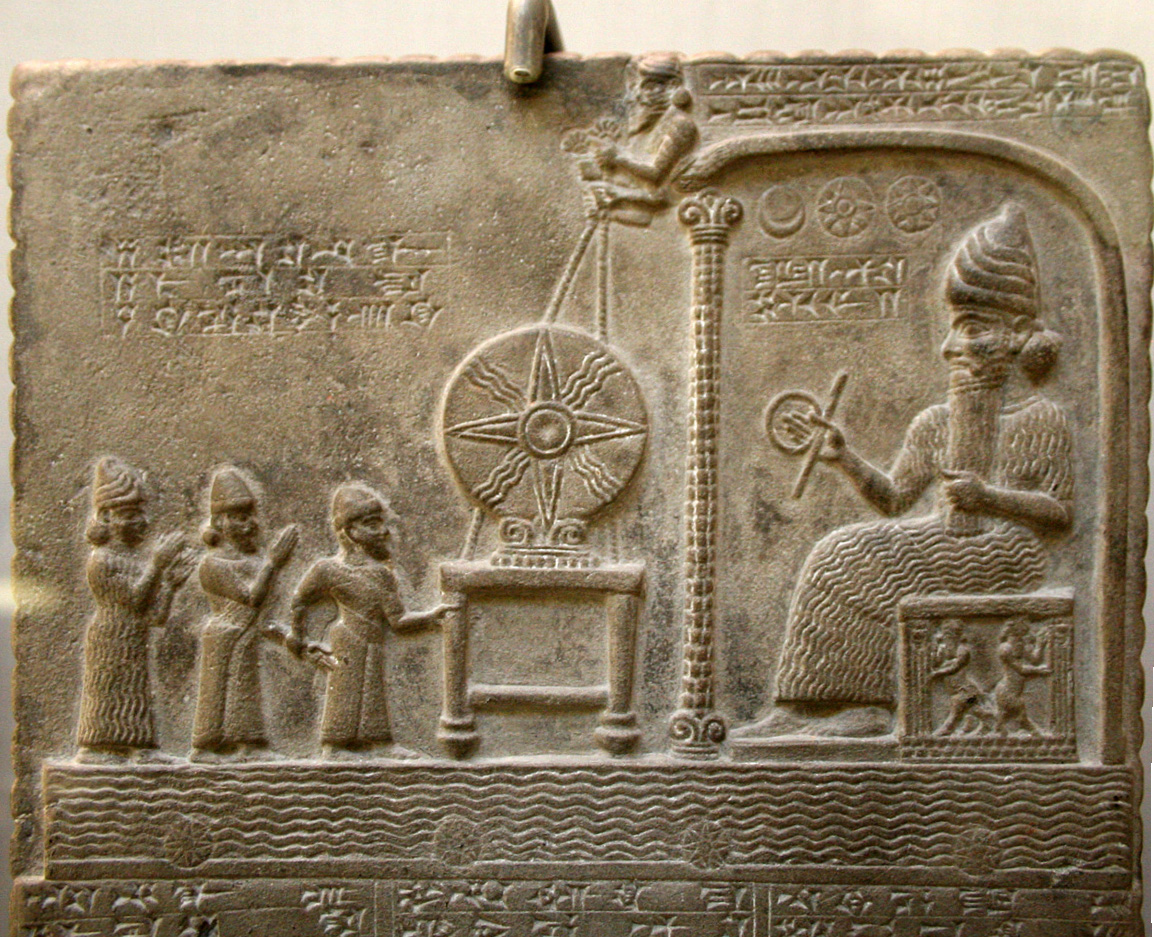
Relief image on the Tablet of Shamash, British Library room 55. Found in Sippar (Tell Abu Habbah), in Ancient Babylonia; it dates from the 9th century BC and shows the sun god Shamash on the throne, in front of the Babylonian king Nabu-apla-iddina (888-855 BC) between two interceding deities. The text tells how the king made a new cultic statue for the god and gave privileges to his temple. https://en.wikipedia.org/wiki/Tablet_of_Shamash#/media/File:Tablet_of_Shamash_relief.jpg

Relief image on the Tablet of Shamash, British Library room 55. Found in Sippar (Tell Abu Habbah), in Ancient Babylonia; it dates from the 9th century BC and shows the sun god Shamash on the throne, in front of the Babylonian king Nabu-apla-iddina (888-855 BC) between two interceding deities. The text tells how the king made a new cultic statue for the god and gave privileges to his temple.
https://en.wikipedia.org/wiki/Tablet_of_Shamash#/media/File:Tablet_of_Shamash_relief.jpg

Considerable advances had been made in excavation techniques and recording methods. It was no longer enough to plunder sites for antiquities; buildings and other contexts had to be carefully investigated and recorded, and objects had to be recovered with care, without allowing them to “crumble to dust.”

Rassam was seriously criticized by other scholars in the field, and his departure largely saw the end of crude excavation methods in Mesopotamia—until the wanton destruction by bandits with bulldozers following the 2003 invasion of Iraq, which threatens utterly to obliterate a huge number of sites.

As a native of the region, Rassam was very aware of the threat to the ancient cities from treasure hunters and brick robbers. When he left for Britain, therefore, he hired guardians to prevent future plundering in the important sites, including Kuyunjik and Sippar. Over the following decade, however, antiquities, and particularly tablets, that seemed likely to have come from these sites appeared in some numbers on the international market. The British Museum sent out Wallis Budge to investigate.

Budge arrived in Baghdad in 1888, armed with a permit to excavate Kuyunjik as a cover for his detective work. Within days, he purchased many tablets from local dealers, most of whom he found to be the very people appointed to guard the ancient sites, and skillfully foiled a plan to prevent him from exporting them.

Later in the year he reopened excavations at Kuyunjik, recovering some 200 tablets from the spoil of previous excavations. His luck turned the following year, however, when he excavated at ed-Der, part of ancient Sippar. The procedures involved in obtaining an excavation permit were long-winded and public: By the time Budge could start work, ed-Der had been thoroughly “examined” by the Vali of Baghdad, with the result that 10,000 tablets had found their way into the hands of dealers.

A similar fate befell the Frenchman Ernest de Sarzec, who excavated Telloh (ancient Girsu) in 1877–1881 and 1888–1900. This was the first serious investigation of a site belonging to Mesopotamia’s original Sumerian civilization, and the objects found here created great excitement in Europe, where they were displayed in the 1880s Paris exhibition.

     Stele of Vultures detail 01-transparent.png One fragment of the victory stele of the king Eannatum of Lagash over Umma, Sumerian archaic dynasties. https://en.wikipedia.org/wiki/Stele_of_the_Vultures#/media/File:Stele_of_Vultures_detail_01-transparent.png


Stele of Vultures detail 01-transparent.png
One fragment of the victory stele of the king Eannatum of Lagash over Umma, Sumerian archaic dynasties.
https://en.wikipedia.org/wiki/Stele_of_the_Vultures#/media/File:Stele_of_Vultures_detail_01-transparent.png

The powerful and austere art style typified by the diorite statues strongly impressed European art critics, and a sculptured slab, dubbed the “Stele of the Vultures,” sparked great interest, because it showed for the first time in history an organized army going to war.

Telloh also yielded numerous tablets, some relating to border disputes with neighboring Umma, the fascinating first contemporary account of warfare—but most of them were not recovered by de Sarzec. During de Sarzec’s frequent absences, local people, often sponsored by Baghdad dealers, abstracted around 40,000 tablets from one of the mounds. These provided the first substantial body of works in the Sumerian language, whose very existence had been doubted in earlier decades.

The first U.S. expedition to work in Mesopotamia experienced an even more dramatic mixture of success and failure. Sponsored by Pennsylvania University, a team headed by John Peters arrived in 1887 to excavate Nippur, the holy city of ancient Sumer.

Hopelessly out of their depth in the complexities of dealing with the local villagers and authorities, their first season ended in an all-out attack in which their camp was set on fire, half their horses perished, and they lost $1,000 in gold—although they saved their antiquities.

Work resumed in 1890, under more auspicious circumstances, and continued intermittently until 1900. Among the 30,000 tablets recovered from Nippur were around 2,100 whose subject matter was literature, in contrast to the ubiquitous economic texts: These opened a window onto the fascinating world of the Sumerians and to this day form the bulk of known Sumerian literature.”

Jane R. McIntosh, Ancient Mesopotamia, 2005, pp. 30-2.

The Story of Mesopotamian Archeology

“Although official attentions were now turned elsewhere, strong popular interest in Mesopotamian antiquities continued, fueling a flourishing trade in material looted by local merchants from the ancient cities of Assyria. Scholarly plundering had already caused considerable destruction. Now the situation reached its nadir, with the retrieval of saleable pieces being the only aim, very much at the expense of the ancient remains.

Scholarly activity had not ceased, however, although it was no longer concentrated in the field. By the end of the 1850s the successful decipherment of Akkadian cuneiform meant that inscriptions and texts recovered from Nineveh and elsewhere could now yield a vast amount of information on the ancient Mesopotamian world.

One of the most surprising discoveries was the great time depth of the civilization. Biblical and Classical sources had painted a picture of the wealth and grandeur of Assyria in the first millennium B.C.E., and this had been confirmed by the excavations at Nineveh and adjacent cities.

The library uncovered in Ashurbanipal’s palace included texts written in the second millennium B.C.E., shedding light on the period of the Old Babylonian Empire and the early history of the Assyrians, the time of the biblical patriarch Abraham, native of the Mesopotamian city of Ur.

But there were also copies of even more ancient texts that revealed the existence in the third millennium B.C.E. of the southern Mesopotamian civilization of Sumer and Akkad.

The later nineteenth century was a time of great intellectual upheaval. The developing science of geology was revealing the immense age and gradual formation of the earth, while Charles Darwin was showing how life had evolved in all its diversity. This new knowledge undermined the certainties of the Bible, according to which the world was created in immutable form at a date calculated by biblical scholars as 4004 B.C.E.

In this epoch of challenge to established traditional views, many found it reassuring that archaeological research in the Near East was uncovering cities and records of individuals familiar from the Bible, thus confirming and buttressing its authenticity.

It was therefore electrifying news when George Smith, who had spent many years quietly studying cuneiform texts, announced in December 1872 that he had found part of a tablet recounting the story of the Flood. A serious-minded man, he amazed his colleagues at the moment of discovery by leaping to his feet, rushing round the room, and beginning to tear off his clothes.

In less than two months he found himself en route to Mosul to look for the missing pieces of the tablet, lavishly sponsored by the Daily Telegraph of London—a measure of the immense popular excitement that his discovery had generated.

Once Smith had accomplished the tedious and time-consuming task of extracting a permit from the Ottoman authorities, he achieved his objective in just five days of digging, finding among the debris left by previous excavators a piece of tablet that accounted for the major part of the missing section.

Smith later returned to excavate further at Nineveh, but in 1876 he contracted a fatal illness. As his replacement, the British Museum appointed Hormuzd Rassam, veteran of the 1850s excavations.”

Jane R. McIntosh, Ancient Mesopotamia, 2005, pp. 29-30.

Tablets of Astrology and Omens in the Royal Library of Nineveh

“When Assurbanipal, king of Assyria, b.c. 668-626, added to the royal library at Nineveh, his contribution of tablets included many series of documents which related exclusively to the astrology of the ancient Babylonians, who in turn had borrowed it with modifications from the Sumerian invaders of the country.

Among these must be mentioned the Series which was commonly called The Day of Bel, and which was declared by the learned of the time to have been written in the time of the great Sargon I, king of Agade, c. 3800 B.C.

With such ancient works as these to guide them, the profession of deducing omens from daily events reached such a pitch of importance in the last Assyrian Empire, that a system of making periodical reports came into being, and by these the king was informed of all occurrences in the heavens and on the earth, and the results of astrological studies in respect to future events. The heads of the astrological profession were men of high rank and position, and their office was hereditary (see Diod., II, 29).

[ … ]

The variety of the information contained in these reports is best gathered from the fact that they were sent from cities so far removed from each other as Assur in the north and Erech in the south, and it can only be assumed that they were dispatched by runners or men mounted on swift horses.

As reports also come from Dilbat, Kutha, Nippur and Borsippa, all cities of ancient foundation, the king was probably well acquainted with the general course of events in his empire.”

Reginald Campbell Thompson, The Reports of the Magicians and Astrologers of Nineveh and Babylon, Vol. II, London, 1900. pp. xv-xvi, xvii.

The Tel el Amarna Letters Between Assyrian Kings and Egyptian Pharaohs

” … What the Babylonian chronologists called ‘the First Dynasty of Babylon’ fell in its turn, and it is claimed that a Sumerian line of eleven kings took its place. Their sway lasted for 368 years—a statement which is obviously open to question.

These were themselves overthrown and a Kassite dynasty from the mountains of Elam was founded by Kandis (c . 1780 B.C.) which lasted for nearly six centuries. These alien monarchs failed to retain their hold on much of the Asiatic and Syrian territory which had paid tribute to Babylon and the suzerainty of Palestine was likewise lost to them.

It was at this epoch, too, that the high-priests of Asshur in the north took the title of king, but they appear to have been subservient to Babylon in some degree. Assyria grew gradually in power. Its people were hardier and more warlike than the art-loving and religious folk of Babylon, and little by little they encroached upon the weakness of the southern kingdom until at length an affair of tragic proportions entitled them to direct interference in Babylonian politics.

[ … ]

The circumstances which necessitated this intervention are not unlike those of the assassination of King Alexander of Serbia and Draga, his Queen, that happened 3000 years later.

The Kassite king of Babylonia had married the daughter of Assur-yuballidh of Assyria. But the match did not meet with the approval of the Kassite faction at court, which murdered the bridegroom-king.

This atrocious act met with swift vengeance at the hands of Assur-yuballidh of Assyria, the bride’s father, a monarch of active and statesmanlike qualities, the author of the celebrated series of letters to Amen-hetep IV of Egypt, unearthed at Tel-el-Amarna.

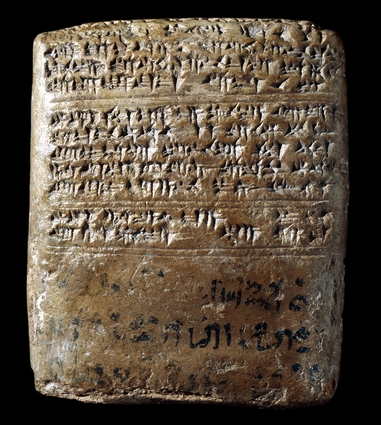
This clay tablet is part of a collection of 382 cuneiform documents discovered in 1887 in Egypt, at the site of Tell el-Amarna. ... The majority date to the reign of Amenhotep IV (Akhenaten) (1352-1336 BC), the heretic pharaoh who founded a new capital at Tell el-Amarna. This letter is written in Akkadian, the diplomatic language of Mesopotamia at the time. It is addressed to Amenhotep III from Tushratta, king of Mitanni (centred in modern Syria). Tushratta calls the pharaoh his 'brother', with the suggestion that they are of equal rank. The letter starts with greetings to various members of the royal house including Tushratta's daughter Tadu-Heba, who had become one of Amenhotep's many brides. ... Tushratta goes on to inform Amenhotep that, with the consent of the goddess Ishtar, he has sent a statue of her to Egypt. He hopes that the goddess will be held in great honour in Egypt and that the statue may be sent back safely to Mitanni. Three lines of Egyptian, written in black ink, have been added, presumably when the letter arrived in Egypt. The addition includes the date 'Year 36' of the king. W.L. Moran, The Amarna letters (John Hopkins University Press, Baltimore, 1992) http://www.britishmuseum.org/explore/highlights/highlight_objects/me/l/clay_tablet_letter,_egypt_2.aspx

This clay tablet is part of a collection of 382 cuneiform documents discovered in 1887 in Egypt, at the site of Tell el-Amarna. …
The majority date to the reign of Amenhotep IV (Akhenaten) (1352-1336 BC), the heretic pharaoh who founded a new capital at Tell el-Amarna.
This letter is written in Akkadian, the diplomatic language of Mesopotamia at the time. It is addressed to Amenhotep III from Tushratta, king of Mitanni (centred in modern Syria). Tushratta calls the pharaoh his ‘brother’, with the suggestion that they are of equal rank. The letter starts with greetings to various members of the royal house including Tushratta’s daughter Tadu-Heba, who had become one of Amenhotep’s many brides. …
Tushratta goes on to inform Amenhotep that, with the consent of the goddess Ishtar, he has sent a statue of her to Egypt. He hopes that the goddess will be held in great honour in Egypt and that the statue may be sent back safely to Mitanni.
Three lines of Egyptian, written in black ink, have been added, presumably when the letter arrived in Egypt. The addition includes the date ‘Year 36’ of the king.
W.L. Moran, The Amarna letters (John Hopkins University Press, Baltimore, 1992)
http://www.britishmuseum.org/explore/highlights/highlight_objects/me/l/clay_tablet_letter,_egypt_2.aspx

He led a punitive army into Babylonia, hurled from the throne the pretender placed there by the Kassite faction, and replaced him with a scion of the legitimate royal stock. This king, Burna-buryas, reigned for over twenty years, and upon his decease the Assyrians, still nominally the vassals of the Babylonian Crown, declared themselves independent of it.

Not content with such a revolutionary measure, under Shalmaneser I (1300 B.C.) they laid claim to the suzerainty of the Tigris-Euphrates region, and extended their conquests even to the boundaries of far Cappadocia, the Hittites and numerous other confederacies submitting to their yoke.

Shalmaneser’s son, Tukulti-in-Aristi, took the city of Babylon, slew its king, Bitilyasu, and thus completely shattered the claim of the older state to supremacy. He had reigned in Babylon for some seven years when he was faced by a popular revolt, which seems to have been headed by his own son, Assur-nazir-pal, who slew him and placed Hadad-nadin-akhi on the throne.

This king conquered and killed the Assyrian monarch of his time, Bel-kudur-uzur, the last of the old Assyrian royal line, whose death necessitated the institution of a new dynasty, the fifth monarch of which was the famous Tiglath-pileser I.”

Lewis Spence, Myths and Legends of Babylonia and Assyria, 1917, pp. 21-3.

Sargon: Conquerer, Librarian

“But the first great Semitic empire in Babylonia was that founded by the famous Sargon of Akkad. As is the case with many popular heroes and monarchs whose deeds are remembered in song and story— for example, Perseus, Oedipus, Cyrus, Romulus, and our own King Arthur—the early years of Sargon were passed in obscurity.

Sargon is, in fact, one of the ‘fatal children.’ He was, legend stated, born in concealment and sent adrift, like Moses, in an ark of bulrushes on the waters of the Euphrates, whence he was rescued and brought up by one Akki, a husbandman.

But the time of his recognition at length arrived, and he received the crown of Babylonia. His foreign conquests were extensive. On four successive occasions he invaded Syria and Palestine, which he succeeded in welding into a single empire with Babylonia. Pressing his victories to the margin of the Mediterranean, he erected upon its shores statues of himself as an earnest of his conquests. He also overcame Elam and northern Mesopotamia and quelled a rebellion of some magnitude in his own dominions.

His son, Naram-Sin, claimed for himself the title of “King of the Four Zones,” and enlarged the empire left him by his father, penetrating even into Arabia. A monument unearthed by J. de Morgan at Susa depicts him triumphing over the conquered Elamites. He is seen passing his spear through the prostrate body of a warrior whose hands are upraised as if pleading for quarter. His head-dress is ornamented with the horns emblematic of divinity, for the early Babylonian kings were the direct vicegerents of the gods on earth.

The brilliance of Naram-Sin's reign is reflected in the execution of this stele, which commemorated his victory over Satuni, king of the Lullubi.  The Akkadian army is climbing the steep slopes of the Zagros Mountains, home to the Lullubi. This upward march sweeps aside all resistance. To the right of a line of trees clinging to the mountainside, defeated enemies are depicted in a posture of submission. Those who have been killed are trampled underfoot by the Akkadian soldiers or drop over the precipice. These mountain people are clad in a tunic of hide and wear their long hair tied back. The composition is dominated by the lofty figure of the king, to whom all eyes - those of the Akkadian soldiers and of their Lullubi enemies - are turned. The triumphant sovereign, shown taller than the other men in the traditional manner, leads his army in the attack on the mountain.  He is followed by standard bearers who march before helmeted soldiers carrying bows and axes. Naram-Sin tramples the bodies of his enemies, while a kneeling Lullubi tries to tear out the arrow piercing his throat. Another raises his hands to his mouth, begging the Akkadian king for mercy.  But the conqueror's gaze is directed toward the top of the mountain. Above Naram-Sin, solar disks seem to radiate their divine protection toward him, while he rises to meet them. The Akkadian sovereign wears a conical helmet with horns - a symbol traditionally the privilege of the gods - and is armed with a large bow and an axe. This victorious ascension chiseled in stone thus celebrates a sovereign who considers himself on an equal footing with the gods. In official inscriptions, Naram-Sin's name was therefore preceded with a divine determinative.  He pushed back the frontiers of the empire farther than they had ever been, from Ebla in Syria to Susa in Elam, and led his army

The brilliance of Naram-Sin’s reign is reflected in the execution of this stele, which commemorated his victory over Satuni, king of the Lullubi.
The Akkadian army is climbing the steep slopes of the Zagros Mountains, home to the Lullubi. This upward march sweeps aside all resistance. To the right of a line of trees clinging to the mountainside, defeated enemies are depicted in a posture of submission. Those who have been killed are trampled underfoot by the Akkadian soldiers or drop over the precipice. These mountain people are clad in a tunic of hide and wear their long hair tied back.
The composition is dominated by the lofty figure of the king, to whom all eyes – those of the Akkadian soldiers and of their Lullubi enemies – are turned. The triumphant sovereign, shown taller than the other men in the traditional manner, leads his army in the attack on the mountain.
He is followed by standard bearers who march before helmeted soldiers carrying bows and axes. Naram-Sin tramples the bodies of his enemies, while a kneeling Lullubi tries to tear out the arrow piercing his throat. Another raises his hands to his mouth, begging the Akkadian king for mercy.
But the conqueror’s gaze is directed toward the top of the mountain. Above Naram-Sin, solar disks seem to radiate their divine protection toward him, while he rises to meet them. The Akkadian sovereign wears a conical helmet with horns – a symbol traditionally the privilege of the gods – and is armed with a large bow and an axe.
This victorious ascension chiseled in stone thus celebrates a sovereign who considers himself on an equal footing with the gods. In official inscriptions, Naram-Sin’s name was therefore preceded with a divine determinative.
He pushed back the frontiers of the empire farther than they had ever been, from Ebla in Syria to Susa in Elam, and led his army “where no other king had gone before him.”
He now appears as a universal monarch, as proclaimed by his official title “King of the Four Regions” – namely, of the whole world.
http://www.louvre.fr/en/oeuvre-notices/victory-stele-naram-sin

Even at this comparatively early time (c . 3800 b.c.) the resources of the country had been well exploited by its Semitic conquerors, and their absorption of the Sumerian civilization had permitted them to make very considerable progress in the enlightened arts. Some of their work in bas-relief, and even in the lesser if equally difficult craft of gem-cutting, is among the finest efforts of Babylonian art.

Nor were they deficient in more utilitarian fields. They constructed roads through the most important portions of the empire, along which a service of posts carried messages at stated intervals, the letters conveyed by these being stamped or franked by clay seals, bearing the name of Sargon.

Sargon is also famous as the first founder of a Babylonian library. This library appears to have contained works of a most surprising nature, having regard to the period at which it was instituted.

One of these was entitled The Observations of Bel, and consisted of no less than seventy-two books dealing with astronomical matters of considerable complexity; it registered and described the appearances of comets, conjunctions of the sun and moon, and the phases of the planet Venus, besides recording many eclipses. This wonderful book was long afterward translated into Greek by the Babylonian historian Berossus, and it demonstrates the great antiquity of Babylonian astronomical science even at this very early epoch.

Another famous work contained in the library of Sargon dealt with omens, the manner of casting them, and their interpretation—a very important side-issue of Babylonian magico-religious practice.

Among the conquests of this great monarch, whose splendour shines through the shadows of antiquity like the distant flash of arms on a misty day, was the fair island of Cyprus. Even imagination reels at the well-authenticated assertion that five thousand seven hundred years ago the keels of a Babylonian conqueror cut the waves of the Mediterranean and landed upon the shores of flowery Cyprus stern Semitic warriors, who, loading themselves with loot, erected statues of their royal leader and returned with their booty.

A god in horned cap brandishes a mace and the forked lightening of Iva-Vul, Thunder God, and sets foot on a recumbent bull.  Behind him is a leaping ibex. In front, a man, perhaps the king, in a short coat, standing full face. Behind him a man on bended knee, possibly the owner of the cylinder. Above him, a small deer is recumbent and inverted.  Then a figure in a long garment, and 3 rows of cuneiform writing:

A god in horned cap brandishes a mace and the forked lightening of Iva-Vul, Thunder God, and sets foot on a recumbent bull.
Behind him is a leaping ibex. In front, a man, perhaps the king, in a short coat, standing full face. Behind him a man on bended knee, possibly the owner of the cylinder. Above him, a small deer is recumbent and inverted.
Then a figure in a long garment, and 3 rows of cuneiform writing:
“Arba Istar: son of Ibu Beled: servant of the god Naram-Sin.”
The king Naram-Sin, to whom a divine determinative prefix is given here, reigned in Babylonia no later than 2600 BCE.
Cyprus, plate 4300.
John L. Myres, Handbook of the Cesnola Collection of Antiquities from Cyprus, 1914.

In a Cyprian temple De Cesnola discovered, down in the lowest vaults, a haematite cylinder which described its owner as a servant of Naram-Sin, the son of Sargon, so that a certain degree of communication must have been kept up between Babylonia and the distant island, just as early Egypt and Crete were bound to each other by ties of culture and commerce.

Lewis Spence, Myths and Legends of Babylonia and Assyria, 1917, pp. 16-9.

Mesopotamian Religion is Undefinable

“Mesopotamian religion includes certain beliefs and practices of the Sumerians, Akkadians, Assyrians, Babylonians and other peoples who lived at various times in different parts of ancient Mesopotamia, the region corresponding roughly to modern Iraq, from the fourth through the first millennia BCE.

The history and cultures of these peoples were mostly forgotten during the early Christian era, save for brief historical narratives of famous kings and cities in the Hebrew Bible, in classical authors such as Herodotus, Diodorus and Josephus, and in scattered excerpts from a lost book by Berossus, a Babylonian writing in Greek in the third century BCE.

Beginning in the nineteenth century CE, with the discovery and excavation of ancient Mesopotamian sites and decipherment of Mesopotamian languages such as Sumerian and Akkadian, European and American scholars identified texts, objects and architecture as religious in nature. They used these to reconstruct ancient Mesopotamian religious beliefs and practices in the absence of any continuous or living tradition from ancient times to the present.

Inevitably the intellectual concerns of successive generations of scholars, their personal religious commitments and their individual stances, such as piety, scepticism or anticlericalism, had their effect on agendas of research and modes of presentation of Mesopotamian religion in modern studies. Many scholars of an earlier generation took for granted, for example, a higher degree of religious preoccupation and expression among ‘ancient Oriental’ or ‘Semitic peoples’ than among other ancient peoples such as the Greeks and Romans, but generalizations on this order are no longer the basis for serious research.

Some scholars imagined, for example, that the priesthood was primarily responsible for preserving culture, while others claimed that priests resisted change and development, suppressed writings unacceptable to them, and generally stood in the way of progress.

Pioneering studies of Mesopotamian religion tended to be comprehensive, such as that by M. Jastrow (1898, partially revised German edition 1912, with a volume of illustrations, 1912). Its fundamental thesis was that ancient Mesopotamian religion derived from local animistic cults that grew and merged into a larger, more complex interlocking set of religious practices and beliefs.

Similar views were set forth by R. W. Rogers (1908) in a volume that treated Mesopotamian religion as a sort of prelude to Judaism, itself a prelude to Christianity. E. Dhorme (1945, not available in English) wrote a concise and well-documented descriptive study.

The most influential writer in English on Mesopotamian religion was Thorkild Jacobsen. He developed a view that ancient Mesopotamian religion derived from a person’s sense of the ‘other’ in the natural world around him, leading to feelings of fear and awe. People perceived active will in natural events, processes and phenomena. This sense of the other was expressed, using metaphorical terms, in myth and theology and was acted upon in cult and ritual.

We have a comprehensive presentation of his views (Jacobsen 1976) and a later summary statement of his work (Jacobsen 1987). Bottéro (2001) stressed spiritual values and a phenomenological rather than a schematic, theoretical approach; for a summary of its main theses see Bottéro (1992: 201–31).

Economic and ritual aspects of Mesopotamian religion are presented by Oppenheim (1977), professing disdain for a historical approach to the subject. He contributed a brief but suggestive essay to a collection edited by Ferm (1950: 65–79). A more detailed, primarily bibliographical survey was offered by Römer (1969). There are numerous technical studies of aspects of Mesopotamian religion in the scientific literature of Assyriology, but few of them are in English.

Many presentations of Mesopotamian religion rely on retellings of ancient literary works that modern scholars classify as mythology. Authoritative presentations of Mesopotamian and other ancient Near Eastern mythologies were made in Kramer (1961 and 1969), as well as in a major treatment of Mesopotamian mythological texts jointly with Bottéro (1989, not available in English). Recent English translations of Akkadian mythology are found in Dalley (1989) and Foster (1996). Important Sumerian myths and other religious texts are translated in Jacobsen (1987).

No ancient Mesopotamian term corresponds to the modern concept of ‘religion,’ nor is there any ancient scripture, systematic treatise or general description of religious belief or activity from any period of Mesopotamian history. This means that definition of Mesopotamian religion can at best be only a modern mode of selecting and interpreting ancient writings and material culture using modern humanistic categories for which there may not have been ancient counterparts. Although the Mesopotamians recognized certain matters as ‘pertaining to the gods’, a distinction between religious and secular matters may not have been always fully comprehensible in the context of Mesopotamian culture.”

Benjamin R. Foster, “Sources,” John R. Hinnells, ed., A Handbook of Ancient Religions, 2007, pp. 161-5.

Transcendant Radiance of the Gods

“Although the gods were visualized in anthropomorphic form, with human emotions and physical needs and desires, important distinctions set the gods apart from humanity.

First, they had transcendent divine powers in the universe, over other gods, and over human lives and institutions. Second was the gods’ sublime position in an ordered universe, in which divinity could be expressed in terms of rank and precedence. Sublime power and position inspired fear, trembling and speechlessness in the presence of a god (Jacobsen 1976: 3–5; Bottéro 1992: 210).

Divinity was furthermore revealed by a radiant brightness, not as of heat but as of a gem-like sheen, blinding, pure and holy. This was sometimes seen as separate from the divine being, worn like a brilliant garment or headgear, or set about the features as glories. In art, this property could be represented by brightly coloured inlays on the surface of figures, or rosettes or stars sewn on textiles. In poetry, this concept was expressed by words meaning awe-inspiring radiance and sublime purity.

A distinctive aspect of Sumerian religious thought was the concept called ‘me’, literally ‘is’. This was an individual, differentiated, abstract power that defined and controlled both divine attributes and attributes of human civilization (van Dijk 1971: 440–2).

Thus there was a ‘me’ of individual gods, temples and lands, and of human institutions, states and accomplishments such as kingship, wisdom, music, old age or carpentry. According to the Sumerian myth of Inanna and Enki, Enki controlled these but Inanna got them away from him by getting him drunk then taking them as gifts proffered in his intoxicated state, which he regretted when sober (Farber, in Hallo 1997: 522–6).

The concept of ‘me’ did not carry over into post-Sumerian times, though there was an Akkadian concept called ‘parsu’ which referred to the dynamic existence of gods and temples.”

Benjamin R. Foster, “Properties of Divinity,” John R. Hinnells, ed., A Handbook of Ancient Religions, 2007, pp. 179-80.

Worship of Idols and Graven Images

“Just as a great king might exercise wide dominion in the world but needed to sleep and eat, so too the Mesopotamian gods were ascribed universal dominion but had physical, social and aesthetic needs that their human subjects were created to serve (Oppenheim 1977: 183–98).

Thus temples of the gods were at first houses then palatial structures where the god ruled as a householder and dignitary (Oppenheim 1961: 158–69). The god’s house was provided with sleeping quarters, audience chambers, storerooms and dining halls in which choice foods were served and music performed. There were gardens for the god’s enjoyment and dalliance. Their homes were appointed in luxurious style with works of art, commemorative inscriptions and treasuries of offerings, gifts and valuables.

The gods travelled to visit other gods and entertained each other with feasts accompanied by speeches and heavy drinking. Like any good householder, the gods were concerned with the stewardship of their domains. The Sumerian goddess Nanshe, for example, is described in a hymn as searching out fraud and embezzlement in her household accounts ( Jacobsen 1987a: 131; Heimpel in Hallo 1997: 526–31).

The gods were understood to be physically present at will in an image (Hallo 1983) that was dressed and adorned with special clothing, jewelry and headdresses. Destruction of the image or its removal by an enemy was a disaster for the community, demanding a theological explanation: the deity was angry with his city or her people, even if no cause for this anger could be established, and had forsaken both the image and the community.

Return of an abducted image was a moment of jubilation and renewal of patriotic feeling, as when the lost statue of Marduk was returned from its captivity in Elam by the Babylonian king Nebuchadnezzar I (twelfth century BCE).

Some Mesopotamian authors speculated on the relationship between an object produced by human craftsmanship and a universal cosmic power, asserting, as in the Epic of Erra, that the image was primeval and the craftsmen uncanny, with later human counterparts permitted by the gods to make repairs (Foster 1996: 765). However, reports of theft of divine apparel or jewelry suggest that not all Mesopotamians were awed by images of the gods.”

Benjamin R. Foster, “Gods in Their Dwellings,” John R. Hinnells, ed., A Handbook of Ancient Religions, 2007, pp. 181-2.

Creation of Man

“According to the Babylonian Flood Story, the gods created the human race in order for it to maintain them in a comfortable and luxurious living standard. In this account, the first human was made in collaboration by the birth-goddess, Mami or Nintu, and Enki, god of wisdom. They took a piece of clay, kneaded it with divine spittle, then mixed in the spirit, flesh and blood of a slain rebellious god (Foster 1996: 168):

“They slaughtered Aw-ilu, who had the inspiration [for the revolt against the gods], in their assembly.

The [birth-goddess] Nintu mixed clay with his flesh and blood.

That same god and man were thoroughly mixed in the clay.

For the rest of time they would hear the drum,

From the flesh of the god the spirit remained.

It would make the living know its sign,

Lest he be allowed to be forgotten, the spirit remained.”

To sustain the human race, birth, maturity, marriage and procreation were instituted. Later, when the population had grown too great, celibacy, infertility, still birth and social restrictions against childbirth for certain groups of people were imposed on the human race.

This was not the only Mesopotamian story of how human beings were created. In a Sumerian account, the god of wisdom produced various experimental but defective human beings until a satisfactory human was brought forth (Kramer 1961: 68–70). In another Sumerian creation story, human beings grew from the earth after Enlil struck it with a pickaxe. Then he handed them the pickaxe and they set to work (Farber in Hallo 1997: 511–13). In the Babylonian Epic of Creation, Enki/Ea’s role in creating the human race is subordinated to Marduk, who is said to have had the original idea for it (Foster 1996: 383):

“I shall compact blood, I shall cause bones to be.

I shall make stand a human being, let ‘Man’ be its name.

I shall create human kind.

They shall bear the gods’ burden that those may rest.”

Humans in Mesopotamian thought were differentiated from animals in that they ate prepared foods, such as bread and beer, in preference to uncooked wild plants and water. Humans, unlike animals, wore clothes and treated and adorned their bodies with alien substances, such as oils and cosmetics, and cut their hair, rather than letting it grow to a natural length.

Humans were different from gods in that they had inferior mental and physical powers and had limited lifespans. What some later peoples deemed human characteristics, such as an immortal soul, language, social organization and use of implements, seemed to the Mesopotamians to be developments of human potential rather than distinguishing features of the race.”

Benjamin R. Foster, “Gods and the Human Race,” John R. Hinnells, ed., A Handbook of Ancient Religions, 2007, pp. 185-6.

The Demons Named

” … The existence of several elaborate incantation series in Ashurbanapal’s library, prescribing a large number of formulas to be recited in connection with symbolical rites to get rid of the demons, furnishes the proof for the practical significance attached to incantations in both Babylonia and Assyria.

These series, Babylonian in origin, revert to Sumerian prototypes and represent compilations stretching over a long period, with additions intended to adapt them to conditions prevailing in Assyria.

The scribes of Ashurbanapal were not indulging in a purely academic exercise in copying the archives of Babylonian temples ; their purpose, as was also the aim of the king, was to make Nineveh the central religious authority as well as the political mistress by having in their control the accumulated experience of the past, in dealing with the religious needs and problems of their own age.

A feature which these incantation series [1] have in common is the recognition of a large number of demons, with special functions assigned in many cases to the one class or the other.

So, for example, there is a demon Labartu, represented as a horrible monster with swine sucking at her breasts, [2] who threatens the life of the mother at childbirth; a group known as Ashakku who cause varieties of wasting diseases, another demon Ti’u, whose special function was to cause diseases, manifesting themselves by headaches accompanied by fever, and so on through a long list. It will be apparent that there is no differentiation between the demon and the disease. The one is the synonym of the other, and accordingly in medical texts the demons are introduced as the designations of the diseases themselves.

The names given to the demons in many cases convey the “strength” or “size” ascribed to them, such as Utukku, Alu, Shedu, Gallu, or they embody a descriptive epithet like AkKkhazu, “seizer” (also the name of a form of jaundice); ‘Eabisu, the one lying-in-wait; Labasu, “overthrower”; Lilu and the feminine Lilitu, “night-spirit;” Etimmu, ghost or shade, suggesting an identification of some demons with the dead who return to plague the living, Namtar, “pestilence,” and more the like.

The descriptions given of them, cruel, horrible of aspect, blood-thirsty, flying through space, generally invisible though sometimes assuming human or animal shape or a mixture of the two, further illustrate the conceptions popularly held.”

Morris Jastrow, The Civilization of Babylonia and Assyria, 1915, pp. 241-3.

Seize the Day

“Death in Mesopotamian religious thought did not mean the total extinction of the individual, only of the physical self and of those qualities of a person that made him productive and attractive to other human beings (Bottéro 1992: 268– 86).

A recognizable winged spirit, resembling a dove, passed to the netherworld. This was a dreary, sombre domain ruled by a pitiless hierarchy of deities and demons. There the spirit languished, often in hunger, thirst and misery, unless family or friends remembered to leave offerings of food and drink for the spirit to partake of and prayed for the spirit’s rest and contentment (Foster 1996: 403):

Dust is their sustenance and clay their food,

They see no light but dwell in darkness,

They are clothed like birds in wings for garments,

And dust has gathered on the door and bolt.

A Sumerian poem recounting a visit to the netherworld refers to the dependence of the dead upon the living (Foster 2001: 141):

Did you see the ghost of him who has no one to make funerary offerings?

I saw him. He eats table scraps and bread crusts thrown into the street.

Ghosts and spectres of the dead could trouble the living, sometimes for no apparent reason, sometimes because they had not been properly interred or were discontented because of some human action or neglect. The city Cutha, in northern Babylonia, was considered the city of the dead and the centre of the cult of death.

The netherworld was organized like an earthly or heavenly kingdom, surrounded by walls with seven gates (Lambert 1990). A popular Mesopotamian poem (Dalley 1989: 163–81; Foster 1996: 410–28) told how the netherworld had once been ruled by a queen alone, Ereshkigal, but that she eventually found a husband, Nergal or Erra.

In one version of the story, he forces himself into the netherworld by violence and threatens her into submission. In another, he breaks her loneliness and sexual frustration with a passionate relationship that finally results in their marriage.

The gods of heaven and netherworld, separated, according to the Babylonian Epic of Creation, into two groups of 600 each, could not visit each other, though they could exchange messengers. Even the great gods feared the netherworld, which barred countless human dead from swarming onto the earth to devour the living in their eternal, unsatiated hunger.

The dead entered the netherworld naked and relinquished all hope of returning to life. How their ghosts escaped to plague the living is not clear. Various Mesopotamian stories told of human beings who learned what happened after a person died.

In one, the Sumerian hero Enkidu volunteered in a fit of bravado to go down to the netherworld to retrieve a favourite athletic object of the king, Gilgamesh. This was apparently a stick and a ball or puck that had fallen down there at the pleas of the people who were oppressed by the violent game that made use of them. The losers resented Gilgamesh’s bullying tactics in the game.

Enkidu recognized his relatives and saw certain distinctions among the dead: heroes were treated better than common folk, for example, and stillborn children had a sort of play area with miniature furniture. He barely escaped alive and forgot in the stress of the moment to bring back the objects (Foster 2001: 129–43).

Much later, an Assyrian dignitary described a vision of the netherworld that included an array of monsters, composites of humans and animals in shape. He, like Enkidu, recognized a dead spirit, but fled in an ecstasy of terror and grief, narrowly escaping permanent confinement (Foster 1996: 715–22):

He darted out into the street like an arrow and scooped up dirt from alley and square in his mouth, all the while setting up a frightful clamor, ‘Woe! Alas! Why have you ordained this for me?’

Mesopotamians honoured the dead of their families with a regular ceremony of remembrance and offering. Dead and sometimes even living kings were accorded divine honours and observances in special sanctuaries. Rulers and other powerful people could be buried in lavish tombs with grave gifts, perhaps more as a splendid way of dying than out of hope that they would need such gifts in the afterlife.

Some Sumerian rulers had chariots, animals and even court attendants buried with them; Assyrian queens might be buried with their finest jewelry. Clay or metal vessels might hold food, drink and cosmetics. Burial might be in vaults in royal palaces, under the floor of homes (especially for children) or in cemeteries outside the city.

Graves were not marked on the surface, so far as is known, and funerary inscriptions, naming the deceased or invoking blessings upon them from future descendants or passers-by, were very rare. One literary text describes an excavation to open an ancient tomb and the horrible shock the investigators felt when they beheld and reflected on the fate in store for them (Foster 1996: 436).

One of the major literary achievements of ancient Mesopotamia, the Akkadian Epic of Gilgamesh (George 1999; Foster 2001), tells the story of Gilgamesh, king of Uruk, who sought immortal life. This was based on older Sumerian poems about various episodes in Gilgamesh’s life.

In the epic, Gilgamesh’s beloved friend, the wild man Enkidu, dies as the result of an expedition to achieve eternal fame for Gilgamesh by slaying a distant monster and cutting down a great tree. Terrified of dying himself, Gilgamesh abandons all in a desperate quest to find the survivor of the flood, Utanapishtim, to ask him his secret of immortality.

Gilgamesh eventually reaches Utanapishtim after unexampled heroism and hardships, not to mention the timely intervention of several kind-hearted women, but learns that his hope is vain – Utanapishtim was granted immortality for surviving the flood, but this was a one-time event that would not be repeated for Gilgamesh’s sake.

Neither he nor any other human being had any hope of achieving immortality. This poem was popular in learned circles; manuscripts have turned up throughout Mesopotamia, and from Syria and Asia Minor, dating to a time span of 1500 years.

There was no Mesopotamian paradise, no return of the soul in another body for another life, no judgement, and no sense that death might eventually end in a final consummation. Some Mesopotamians responded to this outlook by suggesting that the good for a human being was to enjoy life, love, family and vitality while they were within reach, for even a modest life was better than a grand death, as a tavern keeper advises Gilgamesh (Foster 2001: 75):

When the gods created mankind,

They established death for mankind,

And withheld eternal life for themselves.

As for you, Gilgamesh, let your stomach be full,

Always be happy, night and day.

Make every day a delight,

Night and day play and dance.

Your clothes should be clean,

Your head should be washed,

You should bathe in water,

Look proudly on the little one holding your hand,

Let your mate be always blissful in your loins,

This, then, is the work of mankind.”

Benjamin R. Foster, “Mesopotamia,” in John R. Hinnels, ed., A Handbook of Ancient Religions, Cambridge, 2007, pp. 188-90.

On the Mesopotamian Gods and Mankind

“According to the Babylonian Flood Story, the gods created the human race in order for it to maintain them in a comfortable and luxurious living standard. In this account, the first human was made in collaboration by the birth-goddess, Mami or Nintu, and Enki, god of wisdom.

They took a piece of clay, kneaded it with divine spittle, then mixed in the spirit, flesh and blood of a slain rebellious god (Foster 1996: 168):

They slaughtered Aw-ilu, who had the inspiration [for the revolt against the gods], in their assembly.

The [birth-goddess] Nintu mixed clay with his flesh and blood.

That same god and man were thoroughly mixed in the clay.

For the rest of time they would hear the drum,

From the flesh of the god the spirit remained.

It would make the living know its sign,

Lest he be allowed to be forgotten, the spirit remained.

To sustain the human race, birth, maturity, marriage and procreation were instituted. Later, when the population had grown too great, celibacy, infertility, still birth and social restrictions against childbirth for certain groups of people were imposed on the human race.

This was not the only Mesopotamian story of how human beings were created. In a Sumerian account, the god of wisdom produced various experimental but defective human beings until a satisfactory human was brought forth (Kramer 1961: 68–70).

In another Sumerian creation story, human beings grew from the earth after Enlil struck it with a pickaxe. Then he handed them the pickaxe and they set to work (Farber in Hallo 1997: 511–13).

In the Babylonian Epic of Creation, Enki/Ea’s role in creating the human race is subordinated to Marduk, who is said to have had the original idea for it (Foster 1996: 383):

I shall compact blood,

I shall cause bones to be.

I shall make stand a human being, let ‘Man’ be its name.

I shall create human kind.

They shall bear the gods’ burden that those may rest.

Humans in Mesopotamian thought were differentiated from animals in that they ate prepared foods, such as bread and beer, in preference to uncooked wild plants and water. Humans, unlike animals, wore clothes and treated and adorned their bodies with alien substances, such as oils and cosmetics, and cut their hair, rather than letting it grow to a natural length.

Humans were different from gods in that they had inferior mental and physical powers and had limited lifespans. What some later peoples deemed human characteristics, such as an immortal soul, language, social organization and use of implements, seemed to the Mesopotamians to be developments of human potential rather than distinguishing features of the race.”

Benjamin R. Foster, “Mesopotamia,” in John R. Hinnels, ed., A Handbook of Ancient Religions, Cambridge, 2007, pp. 185-6.

Elements of the Cult of Tammuz

” … Whilst on earth, he was the one who nourished the ewe and her lamb, the goat and her kid, and also caused them to be slain–probably in sacrifice.

“He has gone, he has gone to the bosom of the earth,” the mourners cried, “he will make plenty to overflow for the land of the dead, for its lamentations for the day of his fall, in the unpropitious month of his year.”

There was also lamentation for the cessation of the growth of vegetation, and one of these hymns, after addressing him as the shepherd and husband of Ištar, “lord of the underworld,” and “lord of the shepherd’s seat,” goes on to liken him to a germ which has not absorbed water in the furrow, whose bud has not blossomed in the meadow; to the sapling which has not been planted by the watercourse, and to the sapling whose root has been removed.

In the “Lamentations” in the Manchester Museum, Ištar, or one of her devotees, seems to call for Tammuz, saying, “Return, my husband,” as she makes her way to the region of gloom in quest of him.

Ereš-ê-gala, “the lady of the great house” (Persephone), is also referred to, and the text seems to imply that Ištar entered her domain in spite of her. In this text other names are given to him, namely, /Tumu-giba/, “son of the flute,” /Ama-elaggi/, and /Ši-umunnagi/, “life of the people.”

The reference to sheep and goats in the British Museum fragment recalls the fact that in an incantation for purification the person using it is told to get the milk of a yellow goat which has been brought forth in the sheep-fold of Tammuz, recalling the flocks of the Greek sun-god Helios.

These were the clouds illuminated by the sun, which were likened to sheep–indeed, one of the early Sumerian expressions for “fleece” was “sheep of the sky.” The name of Tammuz in Sumerian is Dumu-zi, or in its rare fullest form, Dumu-zida, meaning “true” or “faithful son.” There is probably some legend attached to this which is at present unknown.

Theophilus G. Pinches, The Religion of Babylonia and Assyria, London, 1906, pp. 71-2.

Babylonian Religion

” … Outside the inscriptions of Babylonia and Assyria, there is but little bearing upon the religion of those countries, the most important fragment being the extracts from Berosus and Damascius referred to above.

Among the Babylonian and Assyrian remains, however, we have an extensive and valuable mass of material, dating from the fourth or fifth millennium before Christ until the disappearance of the Babylonian system of writing about the beginning of the Christian era.

The earlier inscriptions are mostly of the nature of records, and give information about the deities and the religion of the people in the course of descriptions of the building and rebuilding of temples, the making of offerings, the performance of ceremonies, etc.

Purely religious inscriptions are found near the end of the third millennium before Christ, and occur in considerable numbers, either in the original Sumerian text, or in translations, or both, until about the third century before Christ.

Among the more recent inscriptions–those from the library of the Assyrian king Aššur-bani-âpli and the later Babylonian temple archives–there are many lists of deities, with numerous identifications with each other and with the heavenly bodies, and explanations of their natures.

It is needless to say that all this material is of enormous value for the study of the religion of the Babylonians and Assyrians, and enables us to reconstruct at first hand their mythological system, and note the changes which took place in the course of their long national existence.”

Theophilus G. Pinches, The Religion of Babylonia and Assyria, London, 1906, pp. 2-4.

Hebrew and Babylonian Creation Myths

” … For the local Babylonian colouring of the stories, and the great age to which their existence can be traced, extending back to the time of the Sumerian inhabitants of Mesopotamia, 3 are conclusive evidence ….

On the other hand, it is equally unnecessary to cite the well-known arguments to prove the existence among the Hebrews of Creation legends similar to those of Babylonia for centuries before the Exile.

The allusions to variant Hebrew forms of the Babylonian Dragon-Myth in Amos ix, 3, Isaiah li, 9, Psalm lxxiv, 13 f., and lxxxix, 9 f., and Job xxvi, 12 f., and ix, 13, may be cited as sufficient proof of the early period at which the borrowing from Babylonian sources must have taken place; and the striking differences between the Biblical and the known Babylonian versions of the legends prove that the Exilic and post-Exilic Jews must have found ready to their hand ancient Hebrew versions of the stories, and that the changes they introduced must in the main have been confined to details of arrangement and to omissions necessitated by their own more spiritual conceptions and beliefs.

The discovery of the Tell el-Amarna tablets proved conclusively that Babylonian influence extended throughout Egypt and Western Asia in the fifteenth century B.C., and the existence of legends among the letters demonstrated the fact that Babylonian mythology exerted an influence coextensive with the range of her political ties and interests.

We may therefore conjecture that Babylonian myths had become naturalized in Palestine before the conquest of that country by the Israelites. Many such Palestinian versions of Babylonian myths the Israelites no doubt absorbed; while during the subsequent period of the Hebrew kings Assyria and Babylonia exerted a direct influence upon them.

It is clear, therefore, that at the time of their of Babylonian exile the captive Jews did not find in Babylonian mythology an entirely new and unfamiliar subject, but recognized in it a series of kindred beliefs, differing much from their own in spiritual conceptions, but presenting a startling resemblance on many material points.”

Leonard William King, The Seven Tablets of Creation, London, 1902, pp. xcv-xcvii.

Babylonian Creation Myths Echo Down the Centuries

” … The evidence furnished by these recently discovered tablets with regard to the date of Babylonian legends in general may be applied to the date of the Creation legends.

While the origin of much of the Creation legends may be traced to Sumerian sources, 1 it is clear that the Semitic inhabitants of Mesopotamia at a very early period produced their own versions of the compositions which they borrowed, modifying and augmenting them to suit their own legends and beliefs.

The connection of Marduk with the Dragon-Myth, and with the stories of the creation of the world and man, may with considerable probability be assigned to the subsequent period during which Babylon gradually attained to the position of the principal city in Mesopotamia.

On tablets inscribed during the reigns of kings of the First Dynasty we may therefore expect to find copies of the Creation legends corresponding closely with the text of the series Enuma elish. It is possible that the division of the poem into seven sections, inscribed upon separate tablets, took place at a later period; but, be this as it may, we may conclude with a considerable degree of confidence that the bulk of the poem, as we know it from late Assyrian and Neo-Babylonian copies, was composed at a period not later than B.C. 2000.

The political influence which the Babylonians exerted over neighbouring nations during long periods of their history was considerable, and it is not surprising that their beliefs concerning the origin of the universe should have been partially adopted by the races with whom they came in contact.

That Babylonian elements may be traced in the Phoenician cosmogony has long been admitted, but the imperfect, and probably distorted, form in which the latter has come down to us renders uncertain any comparison of details. 1

Some of the beliefs concerning the creation of the world which were current among the Egyptians bear a more striking resemblance to the corresponding legends of Babylonia. Whether this resemblance was due to the proto-Semitic strain which probably existed in the ancient Egyptian race, 1 or is to be explained as the result of later Babylonian influence from without, is yet uncertain.

But, whatever explanation be adopted, it is clear that the conception of chaos as a watery mass out of which came forth successive generations of primeval gods is common to both races. 2

It is in Hebrew literature, however, that the most striking examples of the influence of the Babylonian Creation legends are to be found.”

Leonard William King, The Seven Tablets of Creation, London, 1902. pp. lxxix-lxxxi.

The Deluge Tale of Utnapishtim and the Search for Immortality

“Gilgamesh now begins a series of wanderings in search of the restoration of his vigor, and this motif is evidently a continuation of the nature myth to symbolize the sun’s wanderings during the dark winter in the hope of renewed vigor with the coming of the spring.

Professor Haupt’s view is that the disease from which Gilgamesh is supposed to be suffering is of a venereal character, affecting the organs of reproduction. This would confirm the position here taken that the myth symbolizes the loss of the sun’s vigor. The sun’s rays are no longer strong enough to fertilize the earth.

In accord with this, Gilgamesh’s search for healing leads him to the dark regions in which the scorpion-men dwell. The terrors of the region symbolize the gloom of the winter season.

At last Gilgamesh reaches a region of light again, described as a landscape situated at the sea. The maiden in control of this region bolts the gate against Gilgamesh’s approach, but the latter forces his entrance. It is the picture of the sun-god bursting through the darkness, to emerge as the youthful reinvigorated sun-god of the spring.

Now with the tendency to attach to popular tales and nature myths lessons illustrative of current beliefs and aspirations, Gilgamesh’s search for renewal of life is viewed as man’s longing for eternal life.

The sun-god’s waning power after midsummer is past suggests man’s growing weakness after the meridian of life has been left behind. Winter is death, and man longs to escape it.

Gilgamesh’s wanderings are used as illustration of this longing, and accordingly the search for life becomes also the quest for immortality. Can the precious boon of eternal life be achieved?

Popular fancy created the figure of a favorite of the gods who had escaped a destructive deluge in which all mankind had perished. Gilgamesh hears of this favorite and determines to seek him out and learn from him the secret of eternal life. The deluge story, again a pure nature myth, symbolical of the rainy season which destroys all life in nature, is thus attached to the Epic.

Gilgamesh after many adventures finds himself in the presence of the survivor of the Deluge who, although human, enjoys immortal life among the gods. He asks the survivor how he came to escape the common fate of mankind, and in reply Utnapishtim tells the story of the catastrophe that brought about universal destruction.

The moral of the tale is obvious. Only those singled out by the special favor of the gods can hope to be removed to the distant “source of the streams” and live forever. The rest of mankind must face death as the end of life.

That the story of the Deluge is told in the eleventh tablet of the series, corresponding to the eleventh month, known as the month of “rain curse” and marking the height of the rainy season, may be intentional, just as it may not be accidental that Gilgamesh’s rejection of Ishtar is recounted in the sixth tablet, corresponding to the sixth month, which marks the end of the summer season. The two tales may have formed part of a cycle of myths, distributed among the months of the year.

The Gilgamesh Epic, however, does not form such a cycle. Both myths have been artificially attached to the adventures of the hero.

For the deluge story we now have the definite proof for its independent existence, through Dr. Poebel’s publication of a Sumerian text which embodies the tale, and without any reference to Gilgamesh. Similarly, Scheil and Hilprecht have published fragments of deluge stories written in Akkadian and likewise without any connection with the Gilgamesh Epic.

In the Epic the story leads to another episode attached to Gilgamesh, namely, the search for a magic plant growing in deep water, which has the power of restoring old age to youth. Utnapishtim, the survivor of the deluge, is moved through pity for Gilgamesh, worn out by his long wanderings.

At the request of his wife, Utnapishtim decides to tell Gilgamesh of this plant, and he succeeds in finding it. He plucks it and decides to take it back to Erech so that all may enjoy the benefit, but on his way stops to bathe in a cool cistern.

A serpent comes along and snatches the plant from him, and he is forced to return to Erech with his purpose unachieved. Man cannot hope, when old age comes on, to escape death as the end of everything.”

Morris Jastrow (ed.), Albert T. Clay (trans.), An Old Babylonian Version of the Gilgamesh Epic on the Basis of Recently Discovered Texts, 1920, pp. 20-1.

Gilgamesh, Enkidu and the Nameless Harlot

THE EPIC OF GILGAMISH.

“The narrative of the life, exploits and travels of Gilgamish, king of Erech, filled Twelve Tablets which formed the Series called from the first three words of the First Tablet, SHA NAGBU IMURUi.e., “He who hath seen all things.”

The exact period of the reign of this king is unknown, but in the list of the Sumerian kingdoms he is fifth ruler in the Dynasty of Erech, which was considered the second dynasty to reign after the Deluge. He was said to have ruled for 126 years.

The principal authorities for the Epic are the numerous fragments of the tablets that were found in the ruins of the Library of Nebo and the Royal Library of Ashur-bani-pal at Nineveh, and are now in the British Museum, but very valuable portions of other and older versions (including some fragments of a Hittite translation) have now been recovered from various sources, and these contribute greatly to the reconstruction of the story.

The contents of the Twelve Tablets may be briefly described thus–

THE FIRST TABLET.

The opening lines describe the great knowledge and wisdom of Gilgamish, who saw everything, learned everything, under stood everything, who probed to the bottom the hidden mysteries of wisdom, and who knew the history of everything that happened before the Deluge.

He travelled far over sea and land, and performed mighty deeds, and then he cut upon a tablet of stone an account of all that he had done and suffered. He built the wall of Erech, founded the holy temple of E-Anna, and carried out other great architectural works.

He was a semi-divine being, for his body was formed of the “flesh of the gods,” and “two-thirds of him were god, and one-third was man,” The description of his person is lost. As Shepherd (i.e., King) of Erech he forced the people to toil overmuch, and his demands reduced them to such a state of misery that they cried out to the gods and begged them to create some king who should control Gilgamish and give them deliverance from him.

The gods hearkened to the prayer of the men of Erech, and they commanded the goddess Aruru to create a rival to Gilgamish. The goddess agreed to do their bidding, and having planned in her mind what manner of being she intended to make, she washed her hands, took a piece of clay, cast it on the ground, and made a male creature like the god En-urta. His body was covered all over with hair. The hair of his head was long like that of a woman, and he wore clothing like that of Sumuqan, the god of cattle.

He was different in every way from the people of the country, and his name was Enkidu. He lived in the forests on the hills, ate herbs like the gazelle, drank with the wild cattle, and herded with the beasts of the field. He was mighty in stature, invincible in strength, and obtained complete mastery over all the creatures of the forests in which he lived.

One day a certain hunter went out to snare game, and he dug pit-traps and laid nets, and made his usual preparations for roping in his prey. But after doing this for three days he found that his pits were filled up and his nets smashed, and he saw Enkidu releasing the beasts that had been snared.

The hunter was terrified at the sight of Enkidu, and went home hastily and told his father what he had seen and how badly he had fared. By his father’s advice he went to Erech, and reported to Gilgamish what had happened.

When Gilgamish heard his story he advised him to act upon a suggestion which the hunter’s father had already made, namely that he should hire a harlot and take her out to the forest, so that Enkidu might be ensnared by the sight of her beauty, and take up his abode with her.

The hunter accepted this advice, and having found a harlot to help him in removing Enkidu from the forests, he set out from Erech with her and in due course arrived at the forest where Enkidu lived, and sat down by the place where the beasts came to drink.

On the second day when the beasts came to drink and Enkidu was with them, the woman carried out the instructions which the hunter had given her, and when Enkidu saw her cast aside her veil, he left his beasts and came to her, and remained with her for six days and seven nights. At the end of this period he returned to the beasts with which he had lived on friendly terms, but as soon as the gazelle winded him they took to flight, and the wild cattle disappeared into the woods.”

E.A. Wallis Budge, The Babylonian Story of the Deluge and the Epic of Gilgamish1929, pp. 41-3.

The Sumerians Considered the Deluge an Historic Event

” … It is, at all events, well known that the Sumerians regarded the Deluge as an historic event, which they were, practically, able to date, for some of their records contain lists of kings who reigned before the Deluge, though it must be confessed that the lengths assigned to their reigns are incredible. After their rule it is expressly noted that the Flood occurred, and that, when it passed away, kingship came down again from on high.

It is not too much to assume that the original event commemorated in the Legend of the Deluge was a serious and prolonged inundation or flood in Lower Babylonia, which was accompanied by great loss of life and destruction of property.

The Babylonian versions state that this inundation or flood was caused by rain, but passages in some of them suggest that the effects of the rainstorm were intensified bv other physical happenings connected with the earth, of a most destructive character.

The Hebrews also, as we may see from the Bible, had alternative views as to the cause of the Deluge. According to one, rain fell upon the earth for forty days and forty nights (Gen. vii, 12), and according to the other the Deluge came because “all the fountains of the great deep” were broken up, and “the flood-gates of heaven were opened” (Gen. vii, ii).

The latter view suggests that the rain flood was joined by the waters of the sea. Later tradition, derived partly from Babylonian and partly from Hebrew sources, asserts, e.g., in the Cave of Treasures, a Syriac treatise composed probably at Edessa about the fifth or sixth century A.D., that when Noah had entered the Ark and the door was shut …

“… the floodgates of the heavens were opened it and the foundations of the earth were rent asunder,” and that “the ocean, that great sea which surroundeth the whole world, poured forth its floods. And whilst the floodgates of heaven were open, and the foundations of the earth were rent asunder, the storehouses of the winds burst their bolts, and storms and whirlwinds swept forth, and ocean roared and hurled its floods upon the earth.”

The ark was steered over the waters by an angel who acted as pilot, and when that had come to rest on the mountains of Kardô (Ararat),

“God commanded the waters and they became separated from each other. The celestial waters were taken up and ascended to their own place above the heavens whence they came. The waters which had risen up from the earth returned to the lowermost abyss, and those which belonged to the ocean returned to the innermost part thereof.”

Many authorities seeking to find a foundation of fact for the Legend of the Deluge in Mesopotamia have assumed that the rain-flood was accompanied either by an earthquake or a tidal-wave, or by both. There is no doubt that the cities of Lower Babylonia were nearer the sea in the Sumerian Period than they are at present, and it is a generally accepted view that the head of the Persian Gulf lay farther to the north at that time. A cyclone coupled with a tidal wave is a sufficient base for any of the forms of the Legend now known.

A comparison of the contents of the various Sumerian and Babylonian versions of the Deluge that have come down to us shows us that they are incomplete. And as none of them tells so connected and full a narrative of the prehistoric shipbuilder as Berosus, a priest of Bêl, the great god of Babylon, it seems that the Mesopotamian scribes were content to copy the Legend in an abbreviated form.”

E.A. Wallis Budge, The Babylonian Story of the Deluge and the Epic of Gilgamish1929, pp. 27-8.

The Library of Ashur-bani-pal

ASHUR-BANI-PAL, BOOK-COLLECTOR AND PATRON OF LEARNING.

“Ashur-bani-pal (the Asnapper of Ezra iv, 10) succeeded his father Esarhaddon B.C. 669, and at a comparatively early period of his reign he seems to have devoted himself to the study of the history of his country, and to the making of a great Private Library.

The tablets that have come down to us prove not only that he was as great a benefactor of the Library of the Temple of Nebo as any of his predecessors, but that he was himself an educated man, a lover of learning, and a patron of the literary folk of his day.

In the introduction to his Annals, as found inscribed on his great ten-sided prism in the British Museum, he tells us how he took up his abode in the Crown Prince’s dwelling from which Sermacherib and Esarhaddon had ruled the Assyrian Empire, and in describing his own education he says:

“I, Ashur-bani-pal, within it (i.e., the palace) understood the wisdom of Nebo, all the art of writing of every craftsman, of every kind, I made myself master of them all (i.e., of the various kinds of writing).”

These words suggest that Ashur-bani-pal could not only read cuneiform texts, but could write like a skilled scribe, and that he also understood all the details connected with the craft of making and baking tablets.

Having determined to form a Library in his palace he set to work in a systematic manner to collect literary works. He sent scribes to ancient seats of learning, e.g., Ashur, Babylon, Cuthah, Nippur, Akkad, Erech, to make copies of the ancient works that were preserved there, and when the copies came to Nineveh he either made transcripts of them himself, or caused his scribes to do so for the Palace Library.

In any case he collated the texts himself and revised them before placing them in his Library. The appearance of the tablets from his Library suggests that he established a factory in which the clay was cleaned and kneaded and made into homogeneous, well-shaped tablets, and a kiln in which they were baked, after they had been inscribed.

The uniformity of the script upon them is very remarkable, and texts with mistakes in them are rarely found. How the tablets were arranged in the Library is not known, but certainly groups were catalogued, and some tablets were labelled.

Groups of tablets were arranged in numbered series, with “catch lines,” the first tablet of the series giving the first line of the second tablet, the second tablet giving the first line of the third tablet, and so on.

Ashur-bani-pal was greatly interested in the literature of the Sumerians, i.e., the non-Semitic people who occupied Lower Babylonia about B.C. 3500 and later. He and his scribes made bilingual lists of signs and words and objects of all classes and kinds, all of which are of priceless value to the modem student of the Sumerian and Assyrian languages.”

E.A. Wallis Budge, The Babylonian Story of the Deluge and the Epic of Gilgamish1929, pp. 15-17.

The Enduring, Syncretic Cult of the Great Mother

” … Tashmit, whose name signifies “Obedience,” according to Jastrow, or “Hearing,” according to Sayce, carried the prayers of worshippers to Nebo, her spouse.

As Isis interceded with Osiris, she interceded with Nebo, on behalf of mankind. But this did not signify that she was the least influential of the divine pair. A goddess played many parts: she was at once mother, daughter, and wife of the god; the servant of one god or the “mighty queen of all the gods.”

The Great Mother was, as has been indicated, regarded as the eternal and un-decaying one; the gods passed away, son succeeding father; she alone remained. Thus, too, did Semiramis survive in the popular memory, as the queen-goddess of widespread legends, after kings and gods had been forgotten.

To her was ascribed all the mighty works of other days in the lands where the indigenous peoples first worshipped the Great Mother as Damkina, Nina, Bau, Ishtar, or Tashmit, because the goddess was anciently believed to be the First Cause, the creatrix, the mighty one who invested the ruling god with the powers he possessed–the god who held sway because he was her husband, as did Nergal as the husband of Eresh-ki-gal, queen of Hades.

The multiplication of well-defined goddesses was partly due to the tendency to symbolize the attributes of the Great Mother, and partly due to the development of the great “Lady” in a particular district where she reflected local phenomena and where the political influence achieved by her worshippers emphasized her greatness.

Legends regarding a famous goddess were in time attached to other goddesses, and in Aphrodite and Derceto we appear to have mother deities who absorbed the traditions of more than one local “lady” of river and plain, forest and mountain.

Semiramis, on the other hand, survived as a link between the old world and the new, between the country from which emanated the stream of ancient culture and the regions which received it. As the high priestess of the cult, she became identified with the goddess whose bird name she bore, as Gilgamesh and Etana became identified with the primitive culture-hero or patriarch of the ancient Sumerians, and Sargon became identified with Tammuz.

No doubt the fame of Semiramis was specially emphasized because of her close association, as Queen Sammu-rammat, with the religious innovations which disturbed the land of the god Ashur during the Middle Empire period.”

Donald A. Mackenzie, Myths of Babylonia and Assyria, 1915, pp. 436-8.

Origins of the Sacred Marriage

” … The Great Mother goddess was worshipped from the earliest times, and she bore various local names. At Comana in Pontus she was known to the Greeks as Ma, a name which may have been as old as that of the Sumerian Mama (the creatrix), or Mamitum (goddess of destiny); in Armenia she was Anaitis; in Cilicia she was Ate (‘Atheh of Tarsus); while in Phrygia she was best known as Cybele, mother of Attis, who links with Ishtar as mother and wife of Tammuz, Aphrodite as mother and wife of Adonis, and Isis as mother and wife of Osiris.

The Great Mother was in Phoenicia called Astarte; she was a form of Ishtar, and identical with the Biblical Ashtoreth. In the Syrian city of Hierapolis she bore the name of Atargatis, which Meyer, with whom Frazer agrees, considers to be the Greek rendering of the Aramaic ‘Athar-‘Atheh–the god ‘Athar and the goddess ‘Atheh. Like the “bearded Aphrodite,” Atargatis may have been regarded as a bisexual deity.

Some of the specialized mother goddesses, whose outstanding attributes reflected the history and politics of the states they represented, were imported into Egypt–the land of ancient mother deities–during the Empire period, by the half-foreign Rameses kings; these included the voluptuous Kadesh and the warlike Anthat.

In every district colonized by the early representatives of the Mediterranean race, the goddess cult came into prominence, and the gods and the people were reputed to be descendants of the great Creatrix. This rule obtained as far distant as Ireland, where the Danann folk and the Danann gods were the children of the goddess Danu.

Among the Hatti proper–that is, the broad-headed military aristocracy–the chief deity of the pantheon was the Great Father, the creator, “the lord of Heaven,” the Baal. As Sutekh, Tarku, Adad, or Ramman, he was the god of thunder, rain, fertility, and war, and he ultimately acquired solar attributes.

A famous rock sculpture at Boghaz-Köi depicts a mythological scene which is believed to represent the Spring marriage of the Great Father and the Great Mother, suggesting a local fusion of beliefs which resulted from the union of tribes of the god cult with tribes of the goddess cult.

So long as the Hatti tribe remained the predominant partner in the Hittite confederacy, the supremacy was assured of the Great Father who symbolized their sway. But when, in the process of time, the power of the Hatti declined, their chief god “fell… from his predominant place in the religion of the interior,” writes Dr. Garstang. “But the Great Mother lived on, being the goddess of the land.”

Donald A. Mackenzie, Myths of Babylonia and Assyria, 1915, pp. 267-8.

Desecration of the Dead, Depredations of the Dead

” … Sometimes the bodies of the Sumerians were placed in sarcophagi of clay. The earlier type was of “bath-tub” shape, round and flat-bottomed, with a rounded lid, while the later was the “slipper-shaped coffin,” which was ornamented with charms. There is a close resemblance between the “bath-tub” coffins of Sumeria and the Egyptian pottery coffins of oval shape found in Third and Fourth Dynasty tombs in rock chambers near Nuerat. Certain designs on wooden coffins, and tombs as early as the First Dynasty, have direct analogies in Babylonia.

No great tombs were erected in Sumeria. The coffins were usually laid in brick vaults below dwellings, or below temples, or in trenches outside the city walls. On the “stele of victory,” which belongs to the period of Eannatum, patesi of Lagash, the dead bodies on the battlefield are piled up in pairs quite naked, and earth is being heaped over them; this is a specimen of mound burial.

According to Herodotus the Babylonians “buried their dead in honey, and had funeral lamentations like the Egyptians.” The custom of preserving the body in this manner does not appear to have been an ancient one, and may have resulted from cultural contact with the Nile valley during the late Assyrian period. So long as the bones were undisturbed, the spirit was supposed to be assured of rest in the Underworld. This archaic belief was widespread …

… In Babylonia the return of the spirits of the dead was greatly dreaded. Ishtar once uttered the terrible threat: “I will cause the dead to rise; they will then eat and live. The dead will be more numerous than the living.”

When a foreign country was invaded, it was a common custom to break open the tombs and scatter the bones they contained. Probably it was believed, when such acts of vandalism were committed, that the offended spirits would plague their kinsfolk.

Ghosts always haunted the homes they once lived in, and were as malignant as demons. It is significant to find in this connection that the bodies of enemies who were slain in battle were not given decent burial, but mutilated and left for birds and beasts of prey to devour.

The demons that plagued the dead might also attack the living. A fragmentary narrative, which used to be referred to as the Cuthean Legend of Creation, and has been shown by Mr. L.W. King to have no connection with the struggle between Merodach and the dragon, deals with a war waged by an ancient king against a horde of evil spirits, led by “the lord of heights, lord of the Anunaki (earth spirits).” Some of the supernatural warriors had bodies like birds; others had “raven faces,” and all had been “suckled by Tiamat.”

For three years the king sent out great armies to attack the demons, but “none returned alive.” Then he decided to go forth himself to save his country from destruction. So he prepared for the conflict, and took the precaution of performing elaborate and therefore costly religious rites so as to secure the cooperation of the gods.

His expedition was successful, for he routed the supernatural army. On his return home, he recorded his great victory on tablets which were placed in the shrine of Nergal at Cuthah.

This myth may be an echo of Nergal’s raid against Eresh-ki-gal. Or, being associated with Cuthah, it may have been composed to encourage burial in that city’s sacred cemetery, which had been cleared by the famous old king of the evil demons which tormented the dead and made seasonal attacks against the living.”

Donald A. Mackenzie, Myths of Babylonia and Assyria, 1915.

Magical Raiment

” … Some bodies which were laid in Sumerian graves were wrapped up in reed matting, a custom which suggests that the reeds afforded protection or imparted magical powers. Magical ceremonies were performed in Babylonian reed huts.

As we have seen, Ea revealed the “purpose” of the gods, when they resolved to send a flood, by addressing the reed hut in which Pir-napishtim lay asleep. Possibly it was believed that the dead might also have visions in their dreams which would reveal the “purpose” of demons who were preparing to attack them.

In Syria it was customary to wrap the dead in a sheep skin. As priests and gods were clad in the skins of animals from which their powers were derived, it is probable that the dead were similarly supposed to receive inspiration in their skin coverings.

The Highland seer was wrapped in a bull’s skin and left all night beside a stream so as to obtain knowledge of the future. This was a form of the Taghairm ceremony, which is referred to by Scott in his Lady of the Lake.

The belief in the magical influence of sacred clothing gave origin to the priestly robes. When David desired to ascertain what Saul intended to do he said, “Bring hither the ephod.” Then he came to know that his enemy had resolved to attack Keilah.

Elisha became a prophet when he received Elijah’s mantle.”

Donald A. Mackenzie, Myths of Babylonia and Assyria, 1915.

Prehistoric Sumerian Burial Customs, Magical Talismans and Amulets

” … The conservative element in Babylonian religion is reflected by the burial customs. These did not change greatly after the Neolithic period. Prehistoric Sumerian graves resemble closely those of pre-Dynastic Egypt.

The bodies of the dead were laid on their sides in crouching posture, with a “beaker,” or “drinking cup” urn, beside the right hand. Other vessels were placed near the head. In this connection it may be noted that the magic food prepared for Gilgamesh by Pir-napishtim’s wife, when he lay asleep, was also placed near his head.

The corpse was always decked with various ornaments, including rings, necklaces, and armlets. As has been indicated, these were worn by the living as charms, and, no doubt, they served the same purpose for the dead.

This charm-wearing custom was condemned by the Hebrew teachers. On one occasion Jacob commanded his household to “put away the strange gods which were in their hand, and all the ear-rings which were in their ears; and Jacob buried them under the oak which was by Shechem.”

To Jacob, personal ornaments had quite evidently an idolatrous significance.”

Donald A. Mackenzie, Myths of Babylonia and Assyria, 1915.

The Attis Cult and the Baptism of Blood

“Tammuz died with the dying vegetation, and Diarmid expired when the hills apparently were assuming their purple tints. The month of Tammuz wailings was from 20th June till 20th July, when the heat and dryness brought forth the demons of pestilence. The mourners chanted:

He has gone, he has gone to the bosom of the earth,

And the dead are numerous in the land….

Men are filled with sorrow: they stagger by day in gloom …

In the month of thy year which brings not peace hast thou gone.

Thou hast gone on a journey that makes an end of thy people.

The following extract contains a reference to the slaying of the god:

The holy one of Ishtar, in the middle of the year the fields languish…

The shepherd, the wise one, the man of sorrows, why have they slain?…

In his temple, in his inhabited domain,

The child, lord of knowledge, abides no more…

In the meadows, verily, verily, the soul of life perishes.

There is wailing for Tammuz “at the sacred cedar, where the mother bore thee,” a reference which connects the god, like Adonis and Osiris, with tree worship:

The wailing is for the herbs: the first lament is, “they are not produced.”

The wailing is for the grain, ears are not produced.

The wailing is for the habitations, for the flocks which bring forth no more.

The wailing is for the perishing wedded ones; for the perishing children; the dark-headed people create no more.

The wailing is also for the shrunken river, the parched meadows, the fish pools, the cane brakes, the forests, the plains, the gardens, and the palace, which all suffer because the god of fertility has departed. The mourner cries:

How long shall the springing of verdure be restrained?

How long shall the putting forth of leaves be held back?

Whither went Tammuz? His destination has already been referred to as “the bosom of the earth,” and in the Assyrian version of the “Descent of Ishtar” he dwells in “the house of darkness” among the dead, “where dust is their nourishment and their food mud,” and “the light is never seen”–the gloomy Babylonian Hades.

In one of the Sumerian hymns, however, it is stated that Tammuz “upon the flood was cast out.” The reference may be to the submarine “house of Ea,” or the Blessed Island to which the Babylonian Noah was carried. In this Hades bloomed the nether “garden of Adonis.”

The following extract refers to the garden of Damu (Tammuz):–

Damu his youth therein slumbers …

Among the garden flowers he slumbers; among the garden flowers he is cast away …

Among the tamarisks he slumbers, with woe he causes us to be satiated.

Although Tammuz of the hymns was slain, he returned again from Hades. Apparently he came back as a child. He is wailed for as “child, Lord Gishzida,” as well as “my hero Damu.”

In his lunar character the Egyptian Osiris appeared each month as “the child surpassingly beautiful;” the Osiris bull was also a child of the moon; “it was begotten”, says Plutarch, “by a ray of generative light falling from the moon.”

When the bull of Attis was sacrificed his worshippers were drenched with its blood, and were afterwards ceremonially fed with milk, as they were supposed to have “renewed their youth” and become children.

The ancient Greek god Eros (Cupid) was represented as a wanton boy or handsome youth. Another god of fertility, the Irish Angus, who resembles Eros, is called “the ever young;” he slumbers like Tammuz and awakes in the Spring.

Apparently it was believed that the child god, Tammuz, returned from the earlier Sumerian Paradise of the Deep, and grew into full manhood in a comparatively brief period, like Vyasa and other super-men of Indian mythology. A couplet from a Tammuz hymn says tersely:

In his infancy in a sunken boat he lay.

In his manhood in the submerged grain he lay.

The “boat” may be the “chest” in which Adonis was concealed by Aphrodite when she confided him to the care of Persephone, queen of Hades, who desired to retain the young god, but was compelled by Zeus to send him back to the goddess of love and vegetation.

The fact that Ishtar descended to Hades in quest of Tammuz may perhaps explain the symbolic references in hymns to mother goddesses being in sunken boats also when their powers were in abeyance, as were those of the god for part of each year.

It is possible, too, that the boat had a lunar and a solar significance. Khonsu, the Egyptian moon god, for instance, was associated with the Spring sun, being a deity of fertility and therefore a corn spirit; he was a form of Osiris, the Patriarch, who sojourned on earth to teach mankind how to grow corn and cultivate fruit trees.

In the Egyptian legend Osiris received the corn seeds from Isis, which suggests that among Great-Mother-worshipping peoples, it was believed that agricultural civilization had a female origin.

The same myths may have been attached to corn gods and corn goddesses, associated with water, sun, moon, and stars.”

Donald A. Mackenzie, Myths of Babylonia and Assyria, 1915.

Tammuz, Attis, Osiris, Adonis, Diarmid Derive from a More Ancient God of Fertility

“The Babylonian myth of Tammuz, the dying god, bears a close resemblance to the Greek myth of Adonis. It also links with the myth of Osiris. According to Professor Sayce, Tammuz is identical with “Daonus or Daos, the shepherd of Pantibibla,” referred to by Berosus as the ruler of one of the mythical ages of Babylonia. We have therefore to deal with Tammuz in his twofold character as a patriarch and a god of fertility.

The Adonis version of the myth may be summarized briefly. Ere the god was born, his mother, who was pursued by her angry sire, as the river goddesses of the folk tales are pursued by the well demons, transformed herself into a tree.

Adonis sprang from the trunk of this tree, and Aphrodite, having placed the child in a chest, committed him to the care of Persephone, queen of Hades, who resembles the Babylonian Eresh-ki-gal. Persephone desired to retain the young god, and Aphrodite (Ishtar) appealed to Zeus (Anu), who decreed that Adonis should spend part of the year with one goddess and part of the year with the other.

It is suggested that the myth of Adonis was derived in post-Homeric times by the Greeks indirectly from Babylonia through the Western Semites, the Semitic title “Adon,” meaning “lord,” having been mistaken for a proper name. This theory, however, cannot be accepted without qualifications.

It does not explain the existence of either the Phrygian myth of Attis, which was developed differently from the Tammuz myth, or the Celtic story of “Diarmid and the boar,” which belongs to the archaeological “Hunting Period.”

There are traces in Greek mythology of pre-Hellenic myths about dying harvest deities, like Hyakinthos and Erigone, for instance, who appear to have been mourned for. There is every possibility, therefore, that the Tammuz ritual may have been attached to a harvest god of the pre-Hellenic Greeks, who received at the same time the new name of Adonis.

Osiris of Egypt resembles Tammuz, but his Mesopotamian origin has not been proved. It would appear probable that Tammuz, Attis, Osiris, and the deities represented by Adonis and Diarmid were all developed from an archaic god of fertility and vegetation, the central figure of a myth which was not only as ancient as the knowledge and practice of agriculture, but had existence even in the “Hunting Period.”

Traces of the Tammuz-Osiris story in various forms are found all over the area occupied by the Mediterranean or Brown race from Sumeria to the British Isles. Apparently the original myth was connected with tree and water worship and the worship of animals.

Adonis sprang from a tree; the body of Osiris was concealed in a tree which grew round the sea-drifted chest in which he was concealed. Diarmid concealed himself in a tree when pursued by Finn.

The blood of Tammuz, Osiris, and Adonis reddened the swollen rivers which fertilized the soil. Various animals were associated with the harvest god, who appears to have been manifested from time to time in different forms, for his spirit pervaded all nature. In Egypt the soul of Osiris entered the Apis bull or the ram of Mendes.

Tammuz in the hymns is called “the pre-eminent steer of heaven,” and a popular sacrifice was “a white kid of the god Tammuz,” which, however, might be substituted by a sucking pig. Osiris had also associations with swine, and the Egyptians, according to Herodotus, sacrificed a pig to him annually.

When Set at full moon hunted the boar in the Delta marshes, he probably hunted the boar form of Osiris, whose human body had been recovered from the sacred tree by Isis.

As the soul of Bata, the hero of the Egyptian folk tale, migrated from the blossom to the bull, and the bull to the tree, so apparently did the soul of Osiris pass from incarnation to incarnation. Set, the demon slayer of the harvest god, had also a boar form; he was the black pig who devoured the waning moon and blinded the Eye of Ra.

In his character as a long-lived patriarch, Tammuz, the King Daonus or Daos of Berosus, reigned in Babylonia for 36,000 years. When he died, he departed to Hades or the Abyss. Osiris, after reigning over the Egyptians, became Judge of the Dead.”

Donald A. Mackenzie, Myths of Babylonia and Assyria, 1915.

Tammuz

“Among the gods of Babylonia none achieved wider and more enduring fame than Tammuz, who was loved by Ishtar, the amorous Queen of Heaven–the beautiful youth who died and was mourned for and came to life again. He does not figure by his popular name in any of the city pantheons, but from the earliest times of which we have knowledge until the passing of Babylonian civilization, he played a prominent part in the religious life of the people.

Tammuz, like Osiris of Egypt, was an agricultural deity, and as the Babylonian harvest was the gift of the rivers, it is probable that one of his several forms was Dumu-zi-abzu, “Tammuz of the Abyss.” He was also “the child,” “the heroic lord,” “the sentinel,” “the healer,” and the patriarch who reigned over the early Babylonians for a considerable period.

“Tammuz of the Abyss” was one of the members of the family of Ea, god of the Deep, whose other sons, in addition to Merodach, were Nira, an obscure deity; Ki-gulla, “world destroyer,” Burnunta-sa, “broad ear,” and Bara and Baragulla, probably “revealers” or “oracles.” In addition there was a daughter, Khi-dimme-azaga, “child of the renowned spirit”. She may have been identical with Belit-sheri, who is referred to in the Sumerian hymns as the sister of Tammuz.

This family group was probably formed by symbolizing the attributes of Ea and his spouse Damkina. Tammuz, in his character as a patriarch, may have been regarded as a hostage from the gods: the human form of Ea, who instructed mankind, like King Osiris, how to grow corn and cultivate fruit trees. As the youth who perished annually, he was the corn spirit. He is referred to in the Bible by his Babylonian name.

When Ezekiel detailed the various idolatrous practices of the Israelites, which included the worship of the sun and “every form of creeping things and abominable beasts”–a suggestion of the composite monsters of Babylonia–he was brought “to the door of the gate of the Lord’s house, which was towards the north; and, behold, there sat women weeping for Tammuz.”

The weeping ceremony was connected with agricultural rites. Corn deities were weeping deities, they shed fertilizing tears; and the sowers simulated the sorrow of divine mourners when they cast seed in the soil “to die,” so that it might spring up as corn. This ancient custom, like many others, contributed to the poetic imagery of the Bible. “They that sow in tears,” David sang, “shall reap in joy. He that goeth forth and weepeth, bearing precious seed, shall doubtless come again with rejoicing, bringing his sheaves with him.”

In Egypt the priestesses who acted the parts of Isis and Nepthys, mourned for the slain corn god Osiris.

Gods and men before the face of the gods are weeping for

thee at the same time, when they behold me!…

All thy sister goddesses are at thy side and behind thy couch,

Calling upon thee with weeping–yet thou are prostrate upon thy bed!…

Live before us, desiring to behold thee.

It was believed to be essential that human beings should share the universal sorrow caused by the death of a god. If they remained unsympathetic, the deities would punish them as enemies. Worshippers of nature gods, therefore, based their ceremonial practices on natural phenomena.

“The dread of the worshippers that the neglect of the usual ritual would be followed by disaster, is particularly intelligible,” writes Professor Robertson Smith, “if they regarded the necessary operations of agriculture as involving the violent extinction of a particle of divine life.”

By observing their ritual, the worshippers won the sympathy and co-operation of deities, or exercised a magical control over nature.”

Donald A. Mackenzie, Myths of Babylonia and Assyria, 1915.

Numbers 7, 9 and 40, and the Omphalos.

“Later he became fascinated with more abstract topics: numbers in Greek medicine, the numbers seven, nine and forty, and the concept of an imaginary middle point, the omphalos or world-navel, a recurrent theme in Greek, Roman and Semitic mythology.”

–W.H. Roscher, Pan and the Nightmare: Ephialtes–A Pathological-Mythological Treatise on the Nightmare in Classical Antiquity, & An Essay on Pan by James Hillman, 1972. Pp., pg. v.

Marduk’s Tower of Babel.

Modern archeology estimates the height of the Tower of Babel, a ziggurat dedicated to Marduk, at 270 feet high. 

–Fred S. Kleiner, Gardner’s Art Through the Ages: A Global History, enhanced 13th Edition. 2005, 2009, 2011. “Sumer,” Pg. 33.

Herodotus, 5th Century BCE, described it: “In the middle of the sanctuary [of Marduk] has been built a solid tower……which supports another tower, which in turn supports another, and so on; there are eight towers in all. A stairway has been constructed to wind its way up the outside of all the towers; halfway up the stairway there is a shelter with benches to rest on, where people making the ascent can sit and catch their breath. In the last tower there is a huge temple. The temple contains a large couch, which is adorned with fine coverings and has a golden table standing beside it, but there are no statutes at all standing there…..[The Babylonians] say that the god comes in person to the temple [compare the Sumerian notion of the temple as a “waiting room”] and rests on the couch; I do not believe this story myself.” 

–Herodotus: The Histories, Robin Waterfield, trans., New York: Oxford University Press, 1998, pp. 79-80. 

 Quoted in Gardner’s Art Through the Ages, pg. 48.