
Samizdat

Publishing the Forbidden. All Rights Reserved. © Samizdat 2014-2025.

Category: Speiser

Melvin: Divine Knowledge was Sexual Knowledge

The Eden Story and the Demythologization of the Rise of Civilization

“I would now like to propose that the conspicuous absence of divine mediation of civilization from Genesis 1–11, in light of its prominence in Mesopotamian literature, may be explained with reference to the tradition of the origin of evil found in Genesis 3.

Here the reception of forbidden knowledge by the first human couple leads not only to their becoming “god-like” but also to their fall into a corrupt, sinful state and expulsion from paradise. Genesis 4–11 then portrays the long-term consequences of the at least partially-successful attempt by Adam and Eve to obtain divinity by procuring this knowledge.

Albrecht Dürer (1471-1528), Adam and Eve, dated 1504, currently held in the British Museum (1868,0822.167).<br /> At top left on the plate, it states: "ALBERT DVRER NORICVS FACIEBAT AD 1504."<br /> Which means: "Albrecht Dürer of Nuremberg made this 1504."<br /> https://commons.wikimedia.org/wiki/File:Adam_and_Eve_standing_on_either_side_of_the_tree_of_knowledge_with_the_serpent_by_Albrecht_Dürer.jpg

Albrecht Dürer (1471-1528), Adam and Eve, dated 1504, currently held in the British Museum (1868,0822.167).
At top left on the plate, it states: “ALBERT DVRER NORICVS FACIEBAT AD 1504.”
Which means: “Albrecht Dürer of Nuremberg made this 1504.”
https://commons.wikimedia.org/wiki/File:Adam_and_Eve_standing_on_either_side_of_the_tree_of_knowledge_with_the_serpent_by_Albrecht_Dürer.jpg

Included among these consequences are not only obvious examples of sin (murder, violence, etc.) but also the rise of civilization. The implication is that civilization too is an outgrowth of the forbidden knowledge obtained by Adam and Eve in Genesis 3.

The dialogue between the woman and the serpent, her eating of the fruit, and her giving of the fruit to her husband turn upon two primary points. First, the fruit of the tree is associated with knowledge of some sort.

Second, the serpent responds to the woman’s statement that Yahweh has forbidden them to eat from the tree in the center of the garden by saying that if she eats of the fruit of this tree, she will become like a god, which the woman presumably desires since she decides to eat the fruit. Thus, there is an implicit connection between knowledge and divinity in Genesis 3.
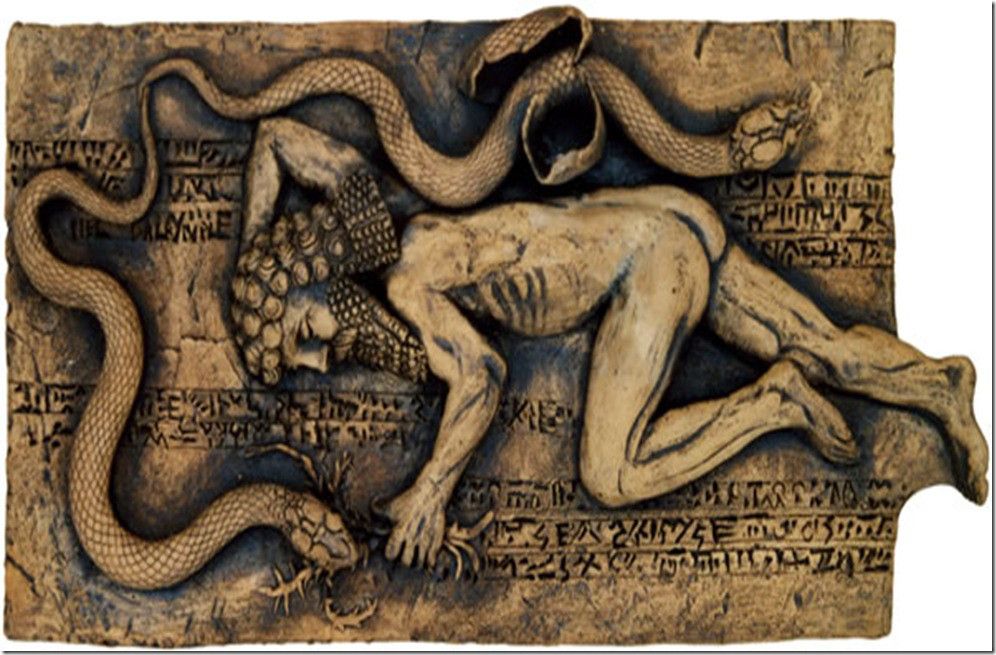
Gilgamesh and the Plant of Eternal Youth

In the Epic of Gilgamesh, Gilgamesh finds a plant that renews youth at the bottom of the ocean.
Taking it back to Erech, he falls asleep, and a serpent, again, a serpent, eats the plant and promptly sheds its skin.
While the serpent is the agent of evil in the Eve myth, the serpent thwarts human immortality in Gilgamesh.
https://konekrusoskronos.wordpress.com/2013/07/22/dreams-and-myths-crossing-the-waters-of-knowledge-archetypes-of-wisdom-an-inner-journey/
https://therealsamizdat.com/category/serpent/

A number of possible understandings of the “knowledge” השכיל which results from eating the fruit present themselves. Gunkel understands the “knowledge” to be primarily, though not exclusively, sexual awareness.

Thus, before eating the fruit, the primeval couple is not aware of their nakedness, suggesting that they likewise did not engage in sexual intercourse prior to this moment, and may possibly have been unaware of the difference between their sexes.

(Gunkel, Genesis, pp. 14–15. So also Speiser, Genesis, pp. 26–27; Jarich Oosten, “The Origins of Society in the Creation Myths of Genesis: An Anthropological Perspective,” Nederlands theologisch tijdschrift 52 (1998), pp. 116–17.)

The significance of such a motif in the Paradise episode would suggest that humanity’s attainment of this “knowledge” forms a necessary step in their becoming fully human (cf. the “humanizing” of Enkidu in the Epic of Gilgamesh).

(The Epic of Gilgamesh, SBV I.197–202 (George, The Epic of Gilgamesh, p. 8).

While the awareness of nudity, making of clothing, and sexual activity which follow the eating of the fruit do support this interpretation, a number of other elements weigh against it.

The objects טוב􏰢􏰣􏰟 and רע􏰠􏰜 in Genesis 3:5 make little sense in relation to sexual awareness, even if one understands them (correctly) not as moral terms but as referring to that which is helpful or harmful for humanity.

There is nothing else which suggests that human reproduction is inherently negative in Genesis 1–11, and indeed, it is explicitly commanded in Genesis 1:28 and 9:1, 7.

(While Genesis 1 and 9:1–17 are both P texts, Genesis 2–3 belongs to JE according to the classical Documentary hypothesis, and thus it is possible that they had different views on sexuality and reproduction, the positive view of human fruitfulness in the final form of Genesis 1–11 rules out Gunkel’s interpretation for the present form of the Paradise episode in its literary context.)”

David P. Melvin, “Divine Mediation and the Rise of Civilization in Mesopotamian Literature and in Genesis 1-11,” Journal of Hebrew Scriptures, 2010, pp. 12-3.

Each King had his Apkallu

“The fish-figurines would seem to confirm the theory attractively put forward by Zimmern (KAT 535 ff. and subsequently ZA 35 151 ff.), that the apkallu’s, often occurring in groups of seven and sometimes identified with purādu-fish (Sumerian s u h u r . k u), represent Oannes and the other fish-like monsters who, according to Berosso’s account, taught mankind all crafts and civilization.

This depiction of a fish-apkallū (Apkallu, Abkallu) guarded the entrance to the temple of Ninurta at Nimrud. A fish's head can be seen on Apkallu's head, and its skin hangs down over the back of Apkallu's body.  Neo-Assyrian era, 865-860 BCE. From the Temple of Ninurta, Nimrud (ancient Kalhu; Biblical Calah), northern Mesopotamia, Iraq. (The British Museum, London). Osama Shukir Muhammed Amin FRCP (Glasg) http://www.ancient.eu/image/2708/

This depiction of a fish-apkallū (Apkallu, Abkallu) guarded the entrance to the temple of Ninurta at Nimrud. A fish’s head can be seen on Apkallu’s head, and its skin hangs down over the back of Apkallu’s body.
Neo-Assyrian era, 865-860 BCE. From the Temple of Ninurta, Nimrud (ancient Kalhu; Biblical Calah), northern Mesopotamia, Iraq. (The British Museum, London).
Osama Shukir Muhammed Amin FRCP (Glasg)
http://www.ancient.eu/image/2708/

Furthermore, the apkallu-figurines of the ritual KAR 298 discussed by Zimmern loc. cit. (see also Gurney, AAA 22 38 ff.) are each associated with a city in Mesopotamia and addressed as ūmu; Güterbock’s suggestion that the element p i r i g in the names of three apkallu’s in our text corresponds to this ūmu and refers to their character as mythological creatures (ZA 42 10 n. 3) would thus strengthen the argument in favor of the identification of the apkallu’s with the monsters described by Berossos.

What in the Greek account clearly reflects an etiological myth finds no correspondence in any of the texts dealing with apkallu’s in Mesopotamia. The exploits of the apkallu’s, as we shall see, are on a different mythological plane.

Nergal appears at the top, leering over a top register which contains the eight-pointed star of Ishtar and the inverted half-moon crescent of the Moon God Sin.  In the second register, seven demons appear to support the heavens.  The middle register depicts the burial rites for new arrivals in the underworld, presided over by two fish-apkallū.  The lower register depicts the goddess Allat, or Ereshkigal, sister of Ishtar, who reigns in the underworld. She kneels upon a horse, which appears to be oppressed by her burden, in a boat which floats upon the waters of life. Note the lion pups suckling at her breast.  Drawn by Faucher-Gudin, from a bronze plaque of which an engraving was published by Clermont-Ganneau.  The original, which belonged to M. Péretié, is now in the collection of M. de Clercq. http://www.gutenberg.org/files/17323/17323-h/17323-h.htm#linkBimage-0039

Nergal appears at the top, leering over a top register which contains the eight-pointed star of Ishtar and the inverted half-moon crescent of the Moon God Sin.
In the second register, seven demons appear to support the heavens.
The middle register depicts the burial rites for new arrivals in the underworld, presided over by two fish-apkallū.
The lower register depicts the goddess Allat, or Ereshkigal, sister of Ishtar, who reigns in the underworld. She kneels upon a horse, which appears to be oppressed by her burden, in a boat which floats upon the waters of life. Note the lion pups suckling at her breast.
Drawn by Faucher-Gudin, from a bronze plaque of which an engraving was published by Clermont-Ganneau.
The original, which belonged to M. Péretié, is now in the collection of M. de Clercq.
http://www.gutenberg.org/files/17323/17323-h/17323-h.htm#linkBimage-0039

The connection between them and wisdom and the crafts lies in the term ummânu, which is one of their epithets, and to which I shall presently return.

First, however, we shall have to dispel the misconception originating with Zimmern’s article in KAT, and repeated in the discussions connected with the apkallu’s by others, namely, the assumed identity of the “wise men” — or some of them — with the early kings.

Besides a certain juggling of names inevitable when dealing with Berossos, the allusion to the “man who ascended to heaven” in the text published by Gurney, JRAS 1935 459 ff., was taken to refer to Etana, the more easily so since the phrase used in the Sumerian version, l ú a n . š è  b a . a n . e x (DU+DU) echoes the very words of the Sumerian King List: E t a n a   s i p a  l ú  a n . š è  b a . e x . d è (see Jacobsen, AS 11 p. 80: 16 f. and n. 67).

Antediluvian apkallu portrayed as fish-men, such mixed-species creatures were the teachers of men.

Antediluvian apkallu portrayed as fish-men, such mixed-species creatures were the teachers of men. Small figurines of this type were buried beneath doorways and beneath walls for prophylactic purposes, warding off evil. In some cases, they were buried in a set of seven statuettes, indicative of the so-called “Seven Sages” of Sumeria.

The view of Güterbock, ZA 42 9f., that the tradition of the apkallu’s is separate from that of the historical kings, and his assumption that the phrase “who ascended to heaven” refers to Adapa — of whom the same words are used in one of the versions of the Adapa legend (PSBA 16 [1894] 275:14, latest translation by Speiser, ANET 101 ff.) — is vindicated against his critics by the structure of the present text.

Since each personage is described by a group of at least four lines, the third and fourth lines, “[ . . . ] who ascended to heaven”, must be part of the description of the same person mentioned in the first and second lines as the purification priest of Eridu (išippu Eridu).

Because this is a well-known title of Adapa, the section must refer to him rather than to Etana. Indeed, none of the apkallu’s mentioned is himself a king, but is only associated with a famed king of old: the text states clearly that Nunpiriggaldim was the apkallu of Enmerkar, that Lu-Nanna was apkallu under Šulgi, allowing us only to conjecture that each was a noted person during a particular reign, excelling in superior wisdom — a topos later taken up by the Assyrian kings when they boast of being endowed with a wisdom equal to that of the apkallu’s.”

Erica Reiner, “The Etiological Myth of the “Seven Sages,” Orientalia, v. 30, No. 1, 1961, pp. 6-7.