Samizdat

Publishing the Forbidden. All Rights Reserved. © Samizdat 2014-2025.

Category: Greece

The Influence of Babylonian Religion on Judaism

“But, it will be asked, what interest can the religions of Babylonia and Assyria have for us, much more an inquiry into their nature and origin? They have long since perished, like the people who professed them, and have left no apparent traces of their influence upon the nations about whom we know and care most.

The Greeks and Romans concerned themselves so little with these Eastern barbarians as neither to read nor to preserve the only Greek history of Chaldaea (ed. note: referring to Berossus) which was written by a native and professed to be derived from native accounts; we owe the fragments we have of it to the apologetic zeal of Christian controversialists.

Still less would it appear that these old people of Babylonia and Assyria can have had any influence upon the world of to-day, or have served to mould the ideas and the society of modern Europe. Such questions may be asked, and until lately it would have been hard to answer them.

And yet a moment’s consideration might have shown that there was one nation at all events which has exercised, and still exercises, a considerable intluence upon our own thought and life, and which had been brought into close contact with the religion and culture of Babylonia at a critical epoch in its history.

The influence of Jewish religion upon Christianity, and consequently upon the races that have been moulded by Christianity, has been lasting and profound. Now Jewish religion was intimately bound up with Jewish history, more intimately perhaps than has been the case with any other great religion of the world.

It took its colouring from the events that marked the political life of the Hebrew people; it developed in unison with their struggles and successes, their trials and disappointments. Its great devotional utterance, the Book of Psalms, is national, not individual; the individual in it has merged his own aspirations and sufferings into those of the whole community.

The course of Jewish prophecy is equally stamped with the impress of the national fortunes. It grows clearer and more catholic as the intercourse of the Jewish people with those around them becomes wider; and the lesson is taught at last that the God of the Jews is the God also of the whole world.

Now the chosen instruments for enforcing this lesson, as we are expressly told, were the Assyrian and the Babylonian. The Assyrian was the rod of God’s anger, while the Babylonish exile was the bitter punishment meted out to Judah for its sins.

The captives who returned again to their own land came back with changed hearts and purified minds; from henceforward Jerusalem was to be the unrivalled dwelling-place of “the righteous nation which keepeth the truth.”

Apart, therefore, from any influence which the old religious beliefs of Babylonia may have had upon the Greeks, and which, as we shall see, was not so wholly wanting as was formerly imagined, their contact with the religious conceptions of the Jewish exiles must, to say the least, have produced an effect which it is well worth our while to study.

Hitherto, the traditional view has been that this effect exhibited itself wholly on the antagonistic side; the Jews carried nothing away from the land of their captivity except an intense hatred of idolatry, more especially Babylonian, as well as of the beliefs and practices associated therewith.

Now and then, it is true, some bold spirit, like Bishop Warburton, may have ventured to propound the paradox that the doctrine of the resurrection was first learnt by the Jews in Babylonia, but it was treated generally as a paradox, and of late years, if admitted at all, was considered a proof of the influence not of the Babylonians but of their Persian conquerors.”

A.H. Sayce, Lectures on the Origin and Growth of Religion as Illustrated by the Religion of the Ancient Babylonians, 5th ed., London, 1898, pp. 38-40.

More on Sargon

“But in spite of the atmosphere of myth which came to enshroud him, as it enshrouded the persons of Kyros, of Charlemagne, and of other heroes of popular history, Sargon was a historical monarch and the founder of a really great empire.

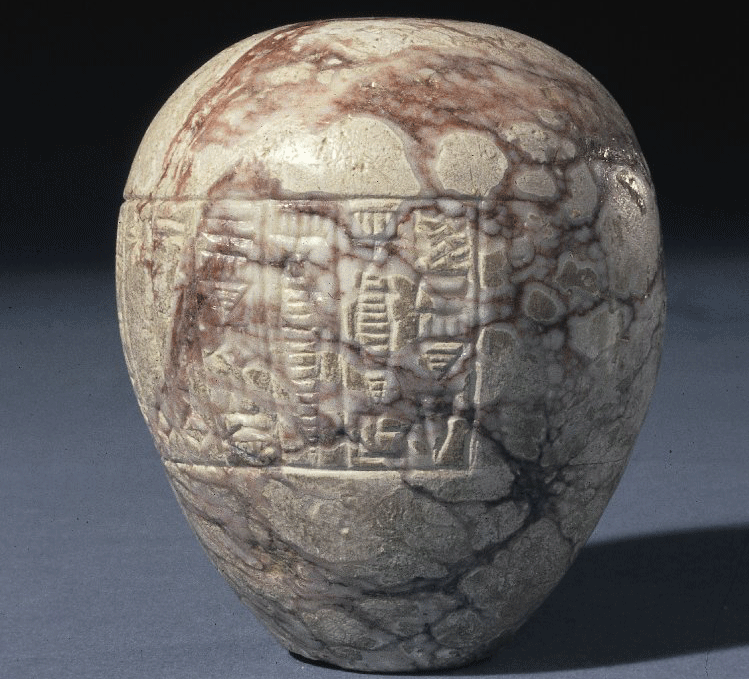
The British Museum actually possesses an inscribed egg of veined marble which he dedicated to the Sun-god of Sippara (ed note: Shamash), and the seal of his librarian Ibni-sarru is in the hands of M. Le Clercq of Paris. What may be termed the scientific literature of the library of Nineveh makes frequent reference to him, and we learn that it was for the great library which he established in his capital city of Accad that the two standard Babylonian works on astronomy and terrestrial omens were originally compiled.

Sargon's inscribed egg for the Sun God Shamash at Sippara in the British Museum.

Sargon’s inscribed egg for the Sun God Shamash at Sippara in the British Museum.

 The work on astronomy was entitled The Observations of Bel, and consisted of no less than seventy-two books, dealing with such matters as the conjunction of the sun and moon, the phases of Venus, and the appearances of comets.

It was translated in later days into Greek by the historian Berossus and though supplemented by numerous additions in its passage through the hands of generations of Babylonian astronomers, the original work contained so many records of eclipses as to demonstrate the antiquity of Babylonian astronomy even in the remote age of Sargon himself.

But besides our knowledge of Sargon’s patronage of learning, we also know something about the civil history of his reign. A copy of its annals has come down to us. We gather from these that he was not only successful in overthrowing all opposition at home, he was also equally successful abroad.

His first campaign was against the powerful kingdom of Elam in the East, where he overthrew the enemy and mutilated their slain. Next he turned to the West, laying his yoke on Syria, and subjugating “the four quarters” of the world. Then the rival kings of Babylon and other Chaldean cities felt his power; and out of the spoil of the vanquished he built the city of Accad and gave it its name.

From this time forward his attention was chiefly devoted to the West. Year after year he penetrated into Syria, until at last, we are told, “he had neither equal nor rival;” he crossed the Mediterranean to the island we now call Cyprus, and “in the third year,” at the bounds of the setting sun, his hands conquered all peoples and his mouth decreed a single empire.

Here on the shores of Cyprus the great conqueror erected images of himself, and then carried the booty of the island to the opposite coast of Asia. Such a glimpse into the history of what became afterwards a Grecian sea, when as yet no Greeks had made their ray to their later home, is startling to those whose conceptions of authentic history have been limited by the narrow horizon of the classical world. Its trustworthiness, however, has been curiously verified by a discovery made by General de Cesnola in the treasure-vaults of a Kyprian temple among the ruins of the ancient Kurion.

A god in horned cap brandishes a mace and the forked lightening of Iva-Vul, Thunder God, and sets foot on a recumbent bull.  Behind him is a leaping ibex. In front, a man, perhaps the king, in a short coat, standing full face. Behind him a man on bended knee, possibly the owner of the cylinder. Above him, a small deer is recumbent and inverted.  Then a figure in a long garment, and 3 rows of cuneiform writing:  "Arba Istar: son of Ibu Beled: servant of the god Naram-Sin."  The king Naram-Sin, to whom a divine determinative prefix is given here, reigned in Babylonia no later than 2600 BCE.  Cyprus, plate 4300.  John L. Myres, Handbook of the Cesnola Collection of Antiquities from Cyprus, 1914.

A god in horned cap brandishes a mace and the forked lightening of Iva-Vul, Thunder God, and sets foot on a recumbent bull.
Behind him is a leaping ibex. In front, a man, perhaps the king, in a short coat, standing full face. Behind him a man on bended knee, possibly the owner of the cylinder. Above him, a small deer is recumbent and inverted.
Then a figure in a long garment, and 3 rows of cuneiform writing:
“Arba Istar: son of Ibu Beled: servant of the god Naram-Sin.”
The king Naram-Sin, to whom a divine determinative prefix is given here, reigned in Babylonia no later than 2600 BCE.
Cyprus, plate 4300.
John L. Myres, Handbook of the Cesnola Collection of Antiquities from Cyprus, 1914.

Here, among other hematite cylinders of early Babylonian origin, he found one the first owner of which describes himself as a ” servant” or ”worshipper” of “the deified Naram- Sin.” Naram-Sin was the son and successor of Sargon, and it is not likely that he would have received divine honours after the fall of the dynasty to which he belonged.

The fact that the cylinder was discovered in Cyprus seems to show that even after Sargon’s death a connection continued to exist between Cyprus and the imperial power of Babylonia. Naram-Sin, however, was more bent on the conquest of Magána, or the Sinaitic Peninsula, than upon further campaigns in the West.

Sinai, with its mines of turquoise and copper, had been a prize coveted by the Egyptians ever since the age of the Third Dynasty, and one of the first efforts of the rising rival power on the banks of the Euphrates was to gain possession of the same country.

Naram-Sin, so runs the annalistic tablet, “marched to the land of Magána; the land of Magána he conquered, and overcame its king.”

A.H. Sayce, Lectures on the Origin and Growth of Religion as Illustrated by the Religion of the Ancient Babylonians, 5th ed., London, 1898, pp. 29-31.

Tammuz and Ishtar, Adonis and Aphrodite, Attis and Cybele, Isis and Osiris

As has been indicated already, the myth of Tammuz and Ishtar furnished the groundwork for certain myths of classic Greece and Rome.

The Phoenician Astarte (Ashtoreth), a development of Ishtar, became in time the Aphrodite of the Greeks, a deity who plays a part in the Adonis legend analogous to that of Ishtar in the Tammuz story. The name Adonis itself is derived from Adoni (‘my lord’), the word with which the Phoenician worshippers of Tammuz hailed the setting sun.

The myth of Adonis is perhaps the most nearly related of any to that of Tammuz, since its chief characters are acknowledged counterparts of those in the Babylonian legend, while the tale of Ishtar’s descent into Hades may be regarded as a sequel to the Greek story, or rather to an early Babylonian variant thereof.

Briefly outlined, the story runs as follows: Adonis was the fruit of an unnatural union between the Syrian king Theias and his daughter Smyrna (Myrrha). Theias pursued the princess, intending to take her life for the crime, but the pity of the gods turned her into a tree from which, at the end of ten months, Adonis was born. It is said that a boar rent open the tree-trunk with its tusk, and thus enabled the divine infant to see the light.

Aphrodite, charmed with the beauty of the child, gave him into the care of Persephone, who was so enamoured of her charge that she afterwards refused to give him up. The goddesses appealed to Zeus, who decreed that Adonis should spend six months of each year with Aphrodite and six with Persephone in the underworld; or, according to another version, four months were to be passed with Aphrodite and four with Persephone, while the remaining four were to be at his own disposal.

He was afterwards slain by a boar sent against him by Artemis (herself, by the way, a development of Ishtar). It may be remarked that Aphrodite, who figures, like Ishtar, as the goddess of love and beauty, is also closely associated with the nether regions, perhaps because she was identified with the Babylonian goddess in her journey to Hades in search of her spouse.

Akin to Adonis is the god Attis, who likewise, according to one version of his myth, is slain by a boar. After his death he becomes a pine-tree, and from his blood violets spring. He is beloved of Cybele, the mother-goddess, who laments his untimely end.

In the Adonis legend there is evidence of some overlapping. Persephone, or Proserpine, who here corresponds to the Allatu of the Babylonian variant, figures in another well-known myth as the prototype of Tammuz. When she is carried off to the nether-world by Pluto, her mother, Ceres, will not suffer the corn to grow while her daughter remains a prisoner. Like Ishtar in search of her spouse, the mother-goddess seeks her child with weeping and lamentation. Through the eating of a pomegranate seed, Proserpine is finally obliged to pass four (or six) months of every year with her dark captor, as his consort.

Another myth which has affinities with the tale of Tammuz and Ishtar is the Egyptian one which deals with the quest of Isis. The god Osiris is slain through the machinations of his brother Set (who, being identified elsewhere with a black hog, recalls the boar which slew Adonis and Attis), and his body, enclosed in a chest, is cast into the Nile.

Afterwards the chest is thrown up by the waves, and round it springs miraculously a tamarisk tree. Meanwhile Isis, wife and sister to Osiris, travels hither and thither in search of his remains, which in due time she finds. However, the chest is stolen from her by Set, who, taking therefrom the body of Osiris, tears the corpse into fourteen pieces, which he scatters through the land. Isis still pursues her quest, till she has found all the portions and buried them.

These tales were the mythical correlates of certain ritualistic practices designed to bring about the change of seasons, and other natural phenomena, by means of sympathetic magic. The burden of a great duty falls upon the shoulders of primitive man; with his rites and spells and magic arts he must assist the universe in its course.

His esoteric plays, typifying the mysterious fact of growth, are necessary to ensure the sprouting of the corn; his charms and incantations are essential even for the rising of the sun; lacking the guarantee of science that one season shall follow another in its proper order, he goes through an elaborate performance symbolizing the decay and revival of vegetation, believing that only thus can the natural order be maintained. Through the force of sympathetic magic he sees his puny efforts related to the mighty results which follow them.

This, then, is the origin of the ritual of the Tammuz festival, which may conceivably have had an existence prior to that of the myth itself. The representation of the death and resurrection of the god, whether in myth or ritual, had undoubtedly a seasonal significance, wherefore the date of his festival varied in the different localities.

In Babylonia it was celebrated in June, thus showing that the deity was slain by the fierce heat of the sun, burning up all the springtide vegetation. Ishtar’s sojourn in Hades would thus occupy the arid months of summer.

In other and more temperate climes winter would be regarded as the enemy of Tammuz. An interesting account of the Tammuz festival is that given by an Arabic author writing in the tenth century, and quoted by Sir James Frazer in his Golden Bough.

Tammuz (July). In the middle of this month is the festival of el-Būgāt, that is, of the weeping women, and this is the Ta-uz festival, which is celebrated in honour of the god Ta-uz. The women bewail him, because his lord slew him so cruelly, ground his bones in a mill, and then scattered them to the wind. The women (during this festival) eat nothing which has been ground in a mill, but limit their diet to steeped wheat, sweet vetches, dates, raisins, and the like.”

The material for this description was furnished by the Syrians of Harran. Of the curious legend attaching to the mourning rites more will be said later.”

Lewis Spence, Myths and Legends of Babylonia and Assyria, 1917, pp. 131-5.

Lady Ishtar, Goddess

Ishtar was undoubtedly a goddess of Semitic origin and symbolized the fertility of the earth. She was the great mother’ who fostered all vegetation and agriculture.

It is probable that her cult originated at Erech, and in the course of centuries and under many nominal changes dispersed itself throughout the length and breadth of western Asia and even into Greece and Egypt. It is probable that a number of lesser goddesses, such as Nana and Anunit, may have become merged in the conception of this divinity, and that lesser local deities of the same character as herself may have taken her name and assisted to swell her reputation.

She is frequently addressed as ‘mother of the gods,’ and indeed the name ‘Ishtar’ became a generic designation for ‘goddess.’ But these were later honours. When her cult centred at Erech, it appears to have speedily blossomed out in many directions, and, as has been said, lesser cults probably eagerly identified themselves with that of the great earth-mother, so that in time her worship became more than a Babylonian cult.

Indeed, wherever people of Semitic speech were to be found, there was the worship of Ishtar. As Ashteroth, or Astarte, she was known to Canaanites, Phoenicians, and Greeks, and there is some likelihood that the cult of Aphrodite had also its beginnings in that of Ishtar. We shall enquire later whether she can be the Esther of the Scriptures.

Astrologically she was identified with the planet Venus, but so numerous were the attributes surrounding her taken from other goddesses with which she had become identified that they threatened to overshadow her real character, which was that of the great and fertile mother. More especially did her identification with Nin-lil, the consort of En-lil, the storm-god, threaten to alter her real nature, as in this guise she was regarded as a goddess of war.

It is seldom that a goddess of fertility or love achieves such a distinction. Gods possessing an agricultural significance are nearly always war-gods, but that is because they bring the fertilizing thunder-clouds and therefore possess the lightning arrow or spear. But Ishtar is specifically a goddess of the class of Persephone or Isis, and her identification with battle must be regarded as purely accidental.

In later times in Assyria she was conceived as the consort of Asshur, head of the Assyrian pantheon, in days when a god or goddess who did not breathe war was of little use to a people like the Assyrians, who were constantly employed in hostilities, and this circumstance naturally heightened her reputation as a warlike divinity.

But it is at present her original character with which we are occupied, indeed in some texts we find that, so far from being able to protect herself, Ishtar and her property are made the prey of the savage En-lil, the storm-god.

“His word sent me forth,” she complains; “as often as it comes to me it casts me prostrate upon my face. The unconsecrated foe entered my courts, placed his unwashed hands upon me, and caused me to tremble. Putting forth his hand he smote me with fear. He tore away my robe and clothed his wife therein : he stripped off my jewels and placed them upon his daughter. Like a quivering dove upon a beam I sat. Like a fleeing bird from my cranny swiftly I passed. From my temple like a bird they caused me to fly.”

Such is the plaint of Ishtar, who in this case appears to be quite helpless before the enemy.”

Lewis Spence, Myths and Legends of Babylonia and Assyria, 1917, pp. 123-5.

Mesopotamian Religion is Undefinable

“Mesopotamian religion includes certain beliefs and practices of the Sumerians, Akkadians, Assyrians, Babylonians and other peoples who lived at various times in different parts of ancient Mesopotamia, the region corresponding roughly to modern Iraq, from the fourth through the first millennia BCE.

The history and cultures of these peoples were mostly forgotten during the early Christian era, save for brief historical narratives of famous kings and cities in the Hebrew Bible, in classical authors such as Herodotus, Diodorus and Josephus, and in scattered excerpts from a lost book by Berossus, a Babylonian writing in Greek in the third century BCE.

Beginning in the nineteenth century CE, with the discovery and excavation of ancient Mesopotamian sites and decipherment of Mesopotamian languages such as Sumerian and Akkadian, European and American scholars identified texts, objects and architecture as religious in nature. They used these to reconstruct ancient Mesopotamian religious beliefs and practices in the absence of any continuous or living tradition from ancient times to the present.

Inevitably the intellectual concerns of successive generations of scholars, their personal religious commitments and their individual stances, such as piety, scepticism or anticlericalism, had their effect on agendas of research and modes of presentation of Mesopotamian religion in modern studies. Many scholars of an earlier generation took for granted, for example, a higher degree of religious preoccupation and expression among ‘ancient Oriental’ or ‘Semitic peoples’ than among other ancient peoples such as the Greeks and Romans, but generalizations on this order are no longer the basis for serious research.

Some scholars imagined, for example, that the priesthood was primarily responsible for preserving culture, while others claimed that priests resisted change and development, suppressed writings unacceptable to them, and generally stood in the way of progress.

Pioneering studies of Mesopotamian religion tended to be comprehensive, such as that by M. Jastrow (1898, partially revised German edition 1912, with a volume of illustrations, 1912). Its fundamental thesis was that ancient Mesopotamian religion derived from local animistic cults that grew and merged into a larger, more complex interlocking set of religious practices and beliefs.

Similar views were set forth by R. W. Rogers (1908) in a volume that treated Mesopotamian religion as a sort of prelude to Judaism, itself a prelude to Christianity. E. Dhorme (1945, not available in English) wrote a concise and well-documented descriptive study.

The most influential writer in English on Mesopotamian religion was Thorkild Jacobsen. He developed a view that ancient Mesopotamian religion derived from a person’s sense of the ‘other’ in the natural world around him, leading to feelings of fear and awe. People perceived active will in natural events, processes and phenomena. This sense of the other was expressed, using metaphorical terms, in myth and theology and was acted upon in cult and ritual.

We have a comprehensive presentation of his views (Jacobsen 1976) and a later summary statement of his work (Jacobsen 1987). Bottéro (2001) stressed spiritual values and a phenomenological rather than a schematic, theoretical approach; for a summary of its main theses see Bottéro (1992: 201–31).

Economic and ritual aspects of Mesopotamian religion are presented by Oppenheim (1977), professing disdain for a historical approach to the subject. He contributed a brief but suggestive essay to a collection edited by Ferm (1950: 65–79). A more detailed, primarily bibliographical survey was offered by Römer (1969). There are numerous technical studies of aspects of Mesopotamian religion in the scientific literature of Assyriology, but few of them are in English.

Many presentations of Mesopotamian religion rely on retellings of ancient literary works that modern scholars classify as mythology. Authoritative presentations of Mesopotamian and other ancient Near Eastern mythologies were made in Kramer (1961 and 1969), as well as in a major treatment of Mesopotamian mythological texts jointly with Bottéro (1989, not available in English). Recent English translations of Akkadian mythology are found in Dalley (1989) and Foster (1996). Important Sumerian myths and other religious texts are translated in Jacobsen (1987).

No ancient Mesopotamian term corresponds to the modern concept of ‘religion,’ nor is there any ancient scripture, systematic treatise or general description of religious belief or activity from any period of Mesopotamian history. This means that definition of Mesopotamian religion can at best be only a modern mode of selecting and interpreting ancient writings and material culture using modern humanistic categories for which there may not have been ancient counterparts. Although the Mesopotamians recognized certain matters as ‘pertaining to the gods’, a distinction between religious and secular matters may not have been always fully comprehensible in the context of Mesopotamian culture.”

Benjamin R. Foster, “Sources,” John R. Hinnells, ed., A Handbook of Ancient Religions, 2007, pp. 161-5.

The Schism Between Biblical and Mesopotamian Studies

“Some scholars of Mesopotamia sought to declare independence from biblical studies in the 1930s, insisting that Mesopotamia be studied on its own terms, even in isolation, but for most people the main interest of Mesopotamian religions lies in their historical interest and comparison with ancient Greece and the Bible.

Studies regularly appear on the Near Eastern background of Greek mythology and culture. Some, such as the work of Cyrus Gordon, are strongly critical of a perceived tendency of Classicists to assume that Greece stood alone in the eastern Mediterranean and was not significantly influenced by Near Eastern (or ‘Semitic’) peoples (Gordon 1965).

With respect to the Bible, the ‘contextual approach,’ advocated by scholars such as William W. Hallo, makes both comparisons and contrasts, recognizing the autonomy and interdependence of ancient Israel and Mesopotamia (Hallo 1997).

This steers a middle course between the extremism of the Pan-Babylonianists and of those who would build a fence around the Bible and claim that Israel was somehow exempt from the dynamic influences of Mesopotamia, the greatest cultural centre in Western Asia during the first millennium BCE.

No serious student of the Bible can ignore Mesopotamian civilization, but the religious experiences of both Mesopotamia and the Hebrews have to be understood in their own terms before they can be profitably compared or contrasted.”

Benjamin R. Foster, “Mesopotamian Religion and the Bible,” John R. Hinnells, ed., A Handbook of Ancient Religions, 2007, pp. 209.

Semites vs. Sumerians

“Each new discovery of cuneiform tablets elicits a wave of publications asserting biblical ‘parallels,’ many of them uncertain and farfetched, even when a millennium or more may have elapsed between the tablets and the relevant portion of the Bible.

The biblical scholar M. Dahood, for example, saw parallels betwen the Bible and cuneiform tablets from Ebla in northern Syria, which date to approximately 1300 years before the kingdom of David. E. A. Speiser insisted that the ‘patriarchal age’ of the Bible was reflected in tablets from Nuzi in northern Mesopotamia (early fourteenth century BCE), although most of his analogies have been discarded in recent years.

The discovery of prophetic documents at Mari (eighteenth century BCE) attracted much discussion, as did comparison of ancient treaties with the biblical covenant.

A subtler interconnection between the worlds of the Hebrews and of the Babylonians was provided by what might be called ‘Pan-Semitism,’ the idea that the Semitic peoples had certain innate mental and emotional characteristics and limitations in common that conditioned their religious values.

A concise statement of this view, which is traceable, for example, to the works of the influential French thinker Ernest Renan, will be found in S. A. Cook’s contribution ‘The Semites, Temperament and Thought’ in the Cambridge Ancient History (1924), chapter V.

Cook held that Semitic thought was verbal rather than visual, emotional rather than systematic or speculative, and so could not have created such a grand astral system of beliefs as the Pan-Babylonianists had imagined underlay modern Christianity, Judaism and Islam.

To Pan-Semitists, Greece, with its alleged superior visual and speculative thought, albeit comparatively shallow religion, was as essential to understanding Christianity as was Judaism.

Scholars wrote of the ‘Hebrew’ and the ‘Greek’ element in Christianity and European culture. The Pan-Semitists bracketed Judaism, Islam and Babylonia as ‘Semitic’ in type, but not Christianity. This left the place of the Sumerians in the equation Babylonian = Semitic difficult to define.

The early twentieth-century historian Eduard Meyer, for example, therefore argued that the Semites were the original inhabitants of Mesopotamia and the Sumerians were later invaders, thereby maintaining the originally ‘Semitic’ character of Mesopotamian civilization.

In the period after World War I, some scholars tried to distinguish ‘Sumerian’ from ‘Semitic’ thought in Mesopotamian culture. Thus discussion of the relations between Babylonia and the Bible proceeded in an atmosphere charged with faith, scepticism and anti-Semitism.”

Benjamin R. Foster, “Mesopotamian Religion and the Bible,” John R. Hinnells, ed., A Handbook of Ancient Religions, 2007, pp. 208-9.

Elements of the Cult of Tammuz

” … Whilst on earth, he was the one who nourished the ewe and her lamb, the goat and her kid, and also caused them to be slain–probably in sacrifice.

“He has gone, he has gone to the bosom of the earth,” the mourners cried, “he will make plenty to overflow for the land of the dead, for its lamentations for the day of his fall, in the unpropitious month of his year.”

There was also lamentation for the cessation of the growth of vegetation, and one of these hymns, after addressing him as the shepherd and husband of Ištar, “lord of the underworld,” and “lord of the shepherd’s seat,” goes on to liken him to a germ which has not absorbed water in the furrow, whose bud has not blossomed in the meadow; to the sapling which has not been planted by the watercourse, and to the sapling whose root has been removed.

In the “Lamentations” in the Manchester Museum, Ištar, or one of her devotees, seems to call for Tammuz, saying, “Return, my husband,” as she makes her way to the region of gloom in quest of him.

Ereš-ê-gala, “the lady of the great house” (Persephone), is also referred to, and the text seems to imply that Ištar entered her domain in spite of her. In this text other names are given to him, namely, /Tumu-giba/, “son of the flute,” /Ama-elaggi/, and /Ši-umunnagi/, “life of the people.”

The reference to sheep and goats in the British Museum fragment recalls the fact that in an incantation for purification the person using it is told to get the milk of a yellow goat which has been brought forth in the sheep-fold of Tammuz, recalling the flocks of the Greek sun-god Helios.

These were the clouds illuminated by the sun, which were likened to sheep–indeed, one of the early Sumerian expressions for “fleece” was “sheep of the sky.” The name of Tammuz in Sumerian is Dumu-zi, or in its rare fullest form, Dumu-zida, meaning “true” or “faithful son.” There is probably some legend attached to this which is at present unknown.

Theophilus G. Pinches, The Religion of Babylonia and Assyria, London, 1906, pp. 71-2.

The Myth of Tammuz, or Adonis

“The date of the rise of the myth of Tammuz is uncertain, but as the name of this god is found on tablets of the time of Lugal-anda and Uru-ka-gina (about 3500 B.C.), it can hardly be of later date than 4000 B.C., and may be much earlier.

As he is repeatedly called “the shepherd,” and had a domain where he pastured his flock, Professor Sayce sees in Tammuz “Daonus or Daos, the shepherd of Pantibibla,” who, according to Berosus, ruled in Babylonia for 10 /sari/, or 36,000 years, and was the sixth king of the mythical period.

According to the classic story, the mother of Tammuz had unnatural intercourse with her own father, being urged thereto by Aphrodite whom she had offended, and who had decided thus to avenge herself.

Being pursued by her father, who wished to kill her for this crime, she prayed to the gods, and was turned into a tree, from whose trunk Adonis was afterwards born.

Aphrodite was so charmed with the infant that, placing him in a chest, she gave him into the care of Persephone, who, however, when she discovered what a treasure she had in her keeping, refused to part with him again.

Zeus was appealed to, and decided that for four months in the year Adonis should be left to himself, four should be spent with Aphrodite, and four with Persephone; or, as a variant account makes it, he should spend six months with Persephone, and six with Aphrodite on earth. He was afterwards slain, whilst hunting, by a wild boar.

Nothing has come down to us as yet concerning this legend except the incident of his dwelling in Hades, whither Ištar, the Babylonian Venus, went in search of him.

It is not by any means unlikely, however, that the whole story existed in Babylonia, and thence spread to Phœnicia, and afterwards to Greece. In Phœnicia it was adapted to the physical conditions of the country, and the place of Tammuz’s encounter with the boar was said to be the mountains of Lebanon, whilst the river named after him, Adonis (now the Nahr Ibrahim), which ran red with the earth washed down by the autumn rains, was said to be so coloured in consequence of being mingled with his blood.

The descent of Tammuz to the underworld, typified by the flowing down of the earth-laden waters of the rivers to the sea, was not only celebrated by the Phœnicians, but also by the Babylonians, who had at least two series of lamentations which were used on this occasion, and were probably the originals of those chanted by the Hebrew women in the time of Ezekiel (about 597 B.C.).”

Theophilus G. Pinches, The Religion of Babylonia and Assyria, London, 1906, pp. 69-70.

Origins of the Jews?

“Babylonia, on the other hand, continued the even tenor of her way. More successful at the end of her independent political career than her northern rival had been, she retained her faith, and remained the unswerving worshipper of Merodach, the great god of Babylon, to whom her priests attributed yet greater powers, and with whom all the other gods were to all appearance identified.

This tendency to monotheism, however, never reached the culminating point–never became absolute–except, naturally, in the minds of those who, dissociating themselves, for philosophical reasons, from the superstitious teaching of the priests of Babylonia, decided for themselves that there was but one God, and worshipped Him.

That orthodox Jews at that period may have found, in consequence of this monotheistic tendency, converts, is not by any means improbable–indeed, the names met with during the later period imply that converts to Judaism were made.

Thus we see, from the various inscriptions, both Babylonian and Assyrian–the former of an extremely early period–the growth and development, with at least one branching off, of one of the most important religious systems of the ancient world.

It is not so important for modern religion as the development of the beliefs of the Hebrews, but as the creed of the people from which the Hebrew nation sprang, and from which, therefore, it had its beginnings, both corporeal and spiritual, it is such as no student of modern religious systems can afford to neglect.

Its legends, and therefore its teachings, as will be seen in these pages, ultimately permeated the Semitic West, and may in some cases even had penetrated Europe, not only through heathen Greece, but also through the early Christians, who, being so many centuries nearer the time of the Assyro-Babylonians, and also nearer the territory which they anciently occupied, than we are, were far better acquainted than the people of the present day with the legends and ideas which they possessed.”

Theophilus G. Pinches, The Religion of Babylonia and Assyria, London, 1906, pp. 7-9.

Twins

“The close association of Enkidu and Gilgamesh which becomes one of the striking features in the combination of the tales of these two heroes naturally recalls the “Heavenly Twins” motif, which has been so fully and so suggestively treated by Professor J. Rendell Harris in his Cult of the Heavenly Twins, (London, 1906).

Professor Harris has conclusively shown how widespread the tendency is to associate two divine or semi-divine beings in myths and legends as inseparable companions or twins, like Castor and Pollux, Romulus and Remus, the Acvins in the Rig-Veda, Cain and Abel, Jacob and Esau in the Old Testament, the Kabiri of the Phoenicians, Herakles and Iphikles in Greek mythology, Ambrica and Fidelio in Teutonic mythology, Patollo and Potrimpo in old Prussian mythology, Cautes and Cautopates in Mithraism, Jesus and Thomas (according to the Syriac Acts of Thomas), and the various illustrations of “Dioscuri in Christian Legends,” set forth by Dr. Harris in his work under this title, which carries the motif far down into the period of legends about Christian Saints who appear in pairs, including the reference to such a pair in Shakespeare’s Henry V:

“And Crispin Crispian shall ne’er go by

From that day to the ending of the world.”

–(Act, IV, 3, 57-58.)

There are indeed certain parallels which suggest that Enkidu-Gilgamesh may represent a Babylonian counterpart to the “Heavenly Twins.” In the Indo-Iranian, Greek and Roman mythology, the twins almost invariably act together. In unison they proceed on expeditions to punish enemies.

But after all, the parallels are of too general a character to be of much moment; and moreover the parallels stop short at the critical point, for Gilgamesh though worsted is not killed by Enkidu, whereas one of the “Heavenly Twins” is always killed by the brother, as Abel is by Cain, and Iphikles by his twin brother Herakles.

Even the trait which is frequent in the earliest forms of the “Heavenly Twins,” according to which one is immortal and the other is mortal, though applying in a measure to Enkidu who is killed by Ishtar, while Gilgamesh the offspring of a divine pair is only smitten with disease, is too unsubstantial to warrant more than a general comparison between the Enkidu-Gilgamesh pair and the various forms of the “twin” motif found throughout the ancient world.

For all that, the point is of some interest that in the Gilgamesh Epic we should encounter two figures who are portrayed as possessing the same traits and accomplishing feats in common, which suggest a partial parallel to the various forms in which the twin-motif appears in the mythologies, folk-lore and legends of many nations; and it may be that in some of these instances the duplication is due, as in the case of Enkidu and Gilgamesh, to an actual transfer of the traits of one figure to another who usurped his place.”

Morris Jastrow (ed.), Albert T. Clay (trans.), An Old Babylonian Version of the Gilgamesh Epic on the Basis of Recently Discovered Texts, 1920, pp. 22-3.

On the Rejection of the Goddess Ishtar

“If, now, Enkidu is not only the older figure but the one who is the real hero of the most notable episode in the Gilgamesh Epic; if, furthermore, Enkidu is the Hercules who kills lions and dispatches the bull sent by an enraged goddess, what becomes of Gilgamesh? What is left for him?

In the first place, he is definitely the conqueror of Erech. He builds the wall of Erech, and we may assume that the designation of the city as Uruk supûri, “the walled Erech,” rests upon this tradition. He is also associated with the great temple Eanna, “the heavenly house,” in Erech.

To Gilgamesh belongs also the unenviable tradition of having exercised his rule in Erech so harshly that the people are impelled to implore Aruru to create a rival who may rid the district of the cruel tyrant, who is described as snatching sons and daughters from their families, and in other ways terrifying the population–an early example of “Schrecklichkeit.”

Tablets II to V inclusive of the Assyrian version being taken up with the Huwawa episode, modified with a view of bringing the two heroes together, we come at once to the sixth tablet, which tells the story of how the goddess Ishtar wooed Gilgamesh, and of the latter’s rejection of her advances.

This tale is distinctly a nature myth … The goddess Ishtar symbolizes the earth which woos the sun in the spring, but whose love is fatal, for after a few months the sun’s power begins to wane. Gilgamesh, who in incantation hymns is invoked in terms which show that he was conceived as a sun-god, recalls to the goddess how she changed her lovers into animals, like Circe of Greek mythology, and brought them to grief.

Enraged at Gilgamesh’s insult to her vanity, she flies to her father Anu and cries for revenge. At this point the episode of the creation of the bull is introduced, but if the analysis above given is correct it is Enkidu who is the hero in dispatching the bull, and we must assume that the sickness with which Gilgamesh is smitten is the punishment sent by Anu to avenge the insult to his daughter.

This sickness symbolizes the waning strength of the sun after midsummer is past. The sun recedes from the earth, and this was pictured in the myth as the sun-god’s rejection of Ishtar; Gilgamesh’s fear of death marks the approach of the winter season, when the sun appears to have lost its vigor completely and is near to death.

The entire episode is, therefore, a nature myth, symbolical of the passing of spring to midsummer and then to the bare season. The myth has been attached to Gilgamesh as a favorite figure, and then woven into a pattern with the episode of Enkidu and the bull. The bull episode can be detached from the nature myth without any loss to the symbolism of the tale of Ishtar and Gilgamesh.

As already suggested, with Enkidu’s death after this conquest of the bull the original Enkidu Epic came to an end. In order to connect Gilgamesh with Enkidu, the former is represented as sharing in the struggle against the bull.

Enkidu is punished with death, while Gilgamesh is smitten with disease. Since both shared equally in the guilt, the punishment should have been the same for both. The differentiation may be taken as an indication that Gilgamesh’s disease has nothing to do with the bull episode, but is merely part of the nature myth.”

Morris Jastrow (ed.), Albert T. Clay (trans.), An Old Babylonian Version of the Gilgamesh Epic on the Basis of Recently Discovered Texts, 1920, pp. 19-20.

More on the Babylonian Zodiac

” … Then returning to the dead body of Tiâmat he smashed her skull with his club and scattered her blood to the north wind, and as a reward for his destruction of their terrible foe, he received gifts and presents from the gods his fathers.

The text then goes on to say that Marduk “devised a cunning plan,” i.e., he determined to carry out a series of works of creation.

He split the body of Tiâmat into two parts; out of one half he fashioned the dome of heaven, and out of the other he constructed the abode of Nudimmud, or Ea, which he placed over against Apsu, i.e., the deep.

He also formulated regulations concerning the maintenance of the same. By this “cunning plan” Marduk deprived the powers of darkness of the opportunity of repeating their revolt with any chance of success.

Having established the framework of his new heaven and earth Marduk, acting as the celestial architect, set to work to furnish them. In the first place he founded E-Sharra, or the mansion of heaven, and next he set apart and arranged proper places for the old gods of the three realms–Anu, Bel and Ea.

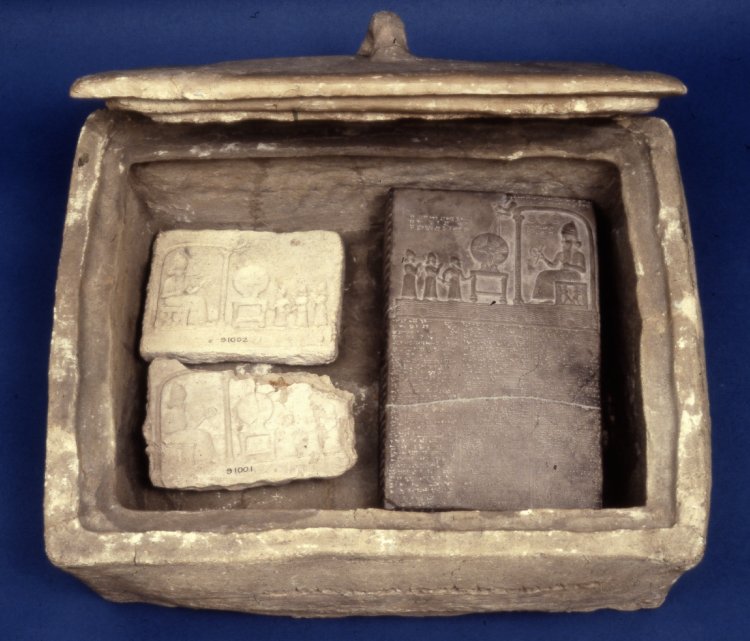
Illustration: Tablet sculptured with a scene representing the worship of the Sun-god in the Temple of Sippar.  The Sun-god is seated on a throne within a pavilion holding in one hand a disk and bar which may symbolize eternity.  Above his head are the three symbols of the Moon, the Sun, and the planet Venus.  On a stand in front of the pavilion rests the disk of the Sun, which is held in position by ropes grasped in the hands of two divine beings who are supported by the roof of the pavilion.  The pavilion of the Sun-god stands on the Celestial Ocean, and the four small disks indicate either the four cardinal points or the tops of the pillars of the heavens.  The three figures in front of the disk represent the high priest of Shamash, the king (Nabu-aplu-iddina, about 870 B.C.) and an attendant goddess. [No. 91,000.]

Illustration: Tablet sculptured with a scene representing the worship of the Sun-god in the Temple of Sippar.
The Sun-god is seated on a throne within a pavilion holding in one hand a disk and bar which may symbolize eternity.
Above his head are the three symbols of the Moon, the Sun, and the planet Venus.
On a stand in front of the pavilion rests the disk of the Sun, which is held in position by ropes grasped in the hands of two divine beings who are supported by the roof of the pavilion.
The pavilion of the Sun-god stands on the Celestial Ocean, and the four small disks indicate either the four cardinal points or the tops of the pillars of the heavens.
The three figures in front of the disk represent the high priest of Shamash, the king (Nabu-aplu-iddina, about 870 B.C.) and an attendant goddess. [No. 91,000.]

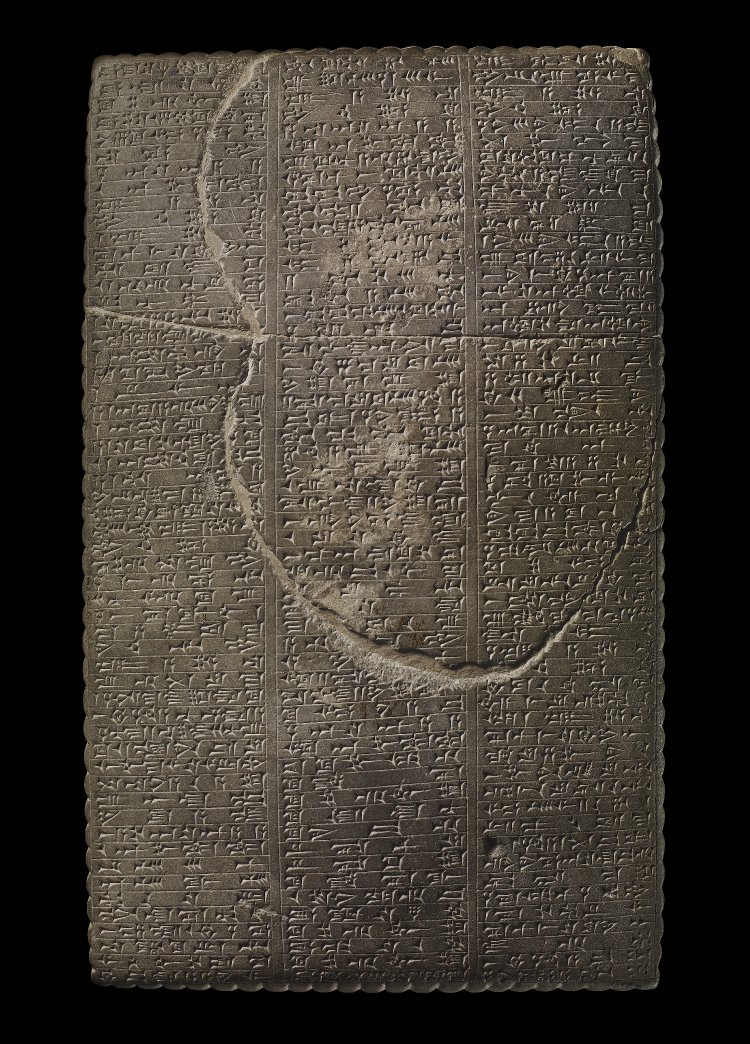
Museum number 91000 The engraved text contains a record of Nabu-apla-iddina's re-endowment of the Sun-Temple at Sippar. The inscription is engraved in six columns, three upon the obverse and three upon the reverse; and the upper part of the obverse is occupied by a scene sculptured in low relief; the edges of the tablet are bevelled.

Museum number 91000
The engraved text contains a record of Nabu-apla-iddina’s re-endowment of the Sun-Temple at Sippar. The inscription is engraved in six columns, three upon the obverse and three upon the reverse; and the upper part of the obverse is occupied by a scene sculptured in low relief; the edges of the tablet are bevelled.

Museum number 91000 Group of Objects Pottery box and the limestone sun-god tablet and its covers deposited in it by Nabopolassar.

Museum number 91000
Group of Objects
Pottery box and the limestone sun-god tablet and its covers deposited in it by Nabopolassar.

The text of the Fifth Tablet, which would undoubtedly have supplied details as to Marduk’s arrangement and regulations for the sun, the moon, the stars, and the Signs of the Zodiac in the heavens is wanting.

The prominence of the celestial bodies in the history of creation is not to be wondered at, for the greater number of the religious beliefs of the Babylonians are grouped round them. Moreover, the science of astronomy had gone hand in hand with the superstition of astrology in Mesopotamia from time immemorial; and at a very early period the oldest gods of Babylonia were associated with the heavenly bodies.

Thus the Annunaki and the Igigi, who are bodies of deified spirits, were identified with the stars of the northern and southern heaven, respectively. And all the primitive goddesses coalesced and were grouped to form the goddess Ishtar, who was identified with the Evening and Morning Star, or Venus.

The Babylonians believed that the will of the gods was made known to men by the motions of the planets, and that careful observation of them would enable the skilled seer to recognize in the stars favourable and unfavourable portents. Such observations, treated from a magical point of view, formed a huge mass of literature which was being added to continually.

From the nature of the case this literature enshrined a very considerable number of facts of pure astronomy, and as early as the period of the First Dynasty (about 2000 B.C.), the Babylonians were able to calculate astronomical events with considerable accuracy, and to reconcile the solar and lunar years by the use of epagomenal months.

They had by that time formulated the existence of the Zodiac, and fixed the “stations” of the moon, and the places of the planets with it; and they had distinguished between the planets and the fixed stars. In the Fifth Tablet of the Creation Series (l. 2) the Signs of the Zodiac are called Lumashi, but unfortunately no list of their names is given in the context.

 Illustration: Tablet inscribed with a list of the Signs of the Zodiac. [No. 77,821.]


Illustration: Tablet inscribed with a list of the Signs of the Zodiac. [No. 77,821.]

Now these are supplied by the little tablet (No. 77,821) of the Persian Period of which a reproduction is here given. It has been referred to and discussed by various scholars, and its importance is very great. The transcript of the text, which is now published (see p. 68) for the first time, will be acceptable to the students of the history of the Zodiac.

Egyptian, Greek, Syriac and Arabic astrological and astronomical texts all associate with the Signs of the Zodiac twelve groups, each containing three stars, which are commonly known as the “Thirty-six Dekans.”

The text of line 4 of the Fifth Tablet of the Creation Series proves that the Babylonians were acquainted with these groups of stars, for we read that Marduk “set up for the twelve months of the year three stars apiece.” In the List of Signs of the Zodiac here given, it will be seen that each Sign is associated with a particular month.

At a later period, say about 500 B.C., the Babylonians made some of the gods regents of groups of stars, for Enlil ruled 33 stars, Anu 23 stars, and Ea 15 stars. They also possessed lists of the fixed stars, and drew up tables of the times of their heliacal risings.

Such lists were probably based upon very ancient documents, and prove that the astral element in Babylonian religion was very considerable.”

E.A. Wallis Budge, et al, & the British Museum, The Babylonian Legends of the Creation & the Fight Between Bel & the Dragon Told by Assyrian Tablets from Nineveh (BCE 668-626), 1901, pp. 10-11.

Again, Berossus

“Versions in Greek of the Legends found by George Smith had long been known to classical scholars, owing to the preservation of fragments of them in the works of later Greek writers, e.g., Eusebius, Syncellus, and others.

The most important of these is derived from the History of Babylonia, which was written in Greek by BEROSUS, a priest of Bel-Marduk, i.e., the “Lord Marduk,” at Babylon, about 250 B.C. In this work Berosus reproduced all the known historical facts and traditions derived from native sources which were current in his day.

It is therefore not surprising to find that his account of the Babylonian beliefs about the origin of things corresponds very closely with that given in the cuneiform texts, and that it is of the greatest use in explaining and partly in expanding these texts. His account of the primeval abyss, out of which everything came, and of its inhabitants reads:–

“There was a time in which there existed nothing but darkness and an abyss of waters, wherein resided most hideous beings, which were produced on a two-fold principle. There appeared men, some of whom were furnished with two wings, others with four, and with two faces. They had one body but two heads; the one that of a man, the other of a woman; and likewise in their several organs both male and female. Other human figures were to be seen with the legs and horns of goats; some had horses’ feet; while others united the hind-quarters of a horse with the body of a man, resembling in shape the hippo-centaurs. Bulls likewise were bred there with the heads of men, and dogs with four told bodies, terminated in their extremities with the tails of fishes; horses also with the heads of dogs; men too and other animals, with the heads and bodies of horses and the tails of fishes. In short, there were creatures in which were combined the limbs of every species of animals. In addition to these, fishes, reptiles, serpents, with other monstrous animals, which assumed each other’s shape and countenance. Of all which were preserved delineations in the temple of Belus at Babylon.” (Cory, Ancient Fragments, London, 1832, pp. 24-26.)

E.A. Wallis Budge, The Babylonian Legends of the Creation and the Fight Between Bel and the Dragon, 1921.

Sumerian Sacred Stories, c. 3500 BCE

” … it is quite as obvious that for the history of the progress of our civilization as we see and know it today, it is the tone and temper, the word and spirit of the ancient mythologies, those of the Greeks and Hebrews, of the Hindus and Iranians, of the Babylonians and Egyptians, which are of prime significance. It is the spiritual and religious concepts revealed in these ancient literatures which permeate the modern civilized world.

Still almost entirely unknown to this very moment is Sumerian mythology, the sacred stories of the non-Semitic, non-Indo-European people which in historical times, from approximately 3500 to 2000 B.C., inhabited Sumer, the relatively small land situated between the Tigris and Euphrates Rivers and stretching from the Persian Gulf northward approximately as far as modern Bagdad; a land that may be aptly described as the culture cradle of the entire Near East.

Should the reader turn, for example, to Hastings’ Encyclopedia of Religion and Ethics29 and examine the very long article on the cosmogonic or creation myths of the world, he will find a large and relatively exhaustive list of peoples, ancient and modern, cultured and primitive, whose cosmogonic concepts are described and analyzed. But he will look in vain for Sumerian cosmogony.

Similarly, the collection entitled Mythology of All the Races 30 devotes thirteen volumes to an analysis of the more important mythologies in the world; here, too, however, there will be found few traces of Sumerian mythology. Whatever little is known of Sumerian mythology is largely surmised from the modified, redacted, and in a sense, garbled versions of the Babylonians who conquered the Sumerians toward the very end of the third millennium B.C., and who used the Sumerian stories and legends as a basis and nucleus for the development of their own myths.

But it is a known fact that in the long stretch of time between approximately 3500 and 2000 B.C. it was the Sumerians who represented the dominant cultural group of the entire Near East. It was the Sumerians who developed and probably invented the cuneiform system of writing; who developed a well integrated pantheon together with spiritual and religious concepts which influenced profoundly all the peoples of the Near East; who, finally, created and developed a literature rich in content and effective in form.

Moreover, the following significant fact must be borne in mind. By the end of the third millennium B.C. Sumer had already ceased to exist as a political entity and Sumerian had already become a dead language, for by that time Sumer had been overrun and conquered by the Semites, and it is the Semitic Accadian language which gradually became the living, spoken tongue of the land.

Nevertheless Sumerian continued to be used as the literary and religious language of the Semitic conquerors for many centuries to come, like Greek in the Roman period and like Latin in the Middle Ages. Indeed for many centuries the study of the Sumerian language and literature remained the basic pursuit of the scribal schools and intellectual and spiritual centers not only of the Babylonians and Assyrians, but also of the many surrounding peoples such as the Elamites, Hurrians, Hittites, and Canaanites.

Obviously, then, both because of their content as well as because of their age, the Sumerian mythological tales and concepts must have penetrated and permeated those of the entire Near East. A knowledge of the Sumerian myths and legends is therefore a prime and basic essential for a proper approach to a scientific study of the mythologies current in the ancient Near East, for it illuminates and clarifies to no small extent the background behind their origin and development.” i

Samuel Noah Kramer, Sumerian Mythology, 1944, pp. 27-9.

On the Literature of Ancient Sumer

” … Now let us compare this date with that of the various ancient literatures known to us at present.

In Egypt, for example, one might have expected an ancient written literature commensurate with its high cultural development. And, indeed, to judge from the pyramid inscriptions, the Egyptians in all probability did have a well developed written literature in the third millennium B. C.

Unfortunately it must have been written largely on papyrus, a readily perishable material, and there is little hope that enough of it will ever be recovered to give a reasonably adequate cross-section of the Egyptian literature of that ancient period.

Then, too, there is the hitherto unknown ancient Canaanite literature which has been found inscribed on tablets excavated in the past decade by the French at Rash-esh-Shamra in northern Syria.

These tablets, relatively few in number, indicate that the Canaanites, too, had a highly developed literature at one time. They are dated approximately 1400 B. C., that is, they were inscribed over half a millennium later than our Sumerian literary tablets. 21

As for the Semitic Babylonian literature as exemplified by such works as the Epic of Creation, the Epic of Gilgamesh, etc., it is not only considerably later than our Sumerian literature, but also includes much that is borrowed directly from it. 22

We turn now to the ancient literatures which have exercised the most profound influence on the more spiritual aspects of our civilization. These are the Bible, which contains the literary creations of the Hebrews; the Iliad and Odyssey, which are filled with the epic and mythic lore of the Greeks; the Rig-veda, which contains the literary products of ancient India; and the Avesta, which contains those of ancient Iran.

None of these literary collections were written down in their present form before the first half of the first millennium B. C.

Our Sumerian literature, inscribed on tablets dating from approximately 2000 B.C., therefore antedates these literatures by more than a millennium. Moreover, there is another vital difference.

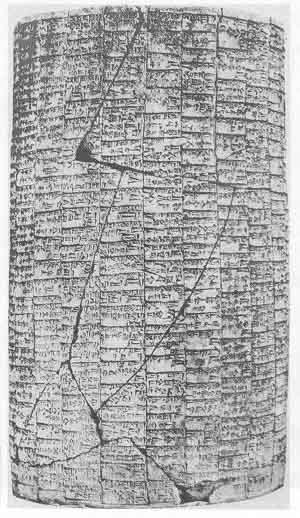
pl04

"To judge from the script, the Nippur cylinder illustrated on this plate 
(8383 in the Nippur collection of the University Museum) may date as early 
as 2500 B. C. Although copied and published by the late George Barton as 
early as 1918, its contents, which center about the Sumerian air-god Enlil 
and the goddess Ninhursag, are still largely unintelligible. Nevertheless, 
much that was unknown or misunderstood at the time of its publication is now 
gradually becoming clarified, and there is good reason to hope that the not 
too distant future will see the better part of its contents ready for 
translation."

-Samuel Noah Kramer, Sumerian Mythology, 1944, p. 18.

The texts of the Bible, of the Iliad and Odyssey, and of the Rig-veda and Avesta, as we have them, have been modified, edited, and redacted by compilers and redactors with varied motives and diverse points of view.

Not so our Sumerian literature; it has come down to us as actually inscribed by the ancient scribes of four thousand years ago, unmodified and uncodified by later compilers and commentators.”

Samuel Noah Kramer, Sumerian Mythology, 1944, pp. 19-20.

On the Neo-Platonic Forgeries

IN giving to the public a new edition of Cory’s Ancient Fragments I have endeavoured to respond to the wishes of numerous literary friends by furnishing a brief account of the several authors to whom we are indebted for these extracts, and, at the same time, some information respecting the decipherment of the hieroglyphic texts of Egypt, and the cuneiform records of Nineveh and Babylon.

The first edition of this work appeared in 1828, the second in 1832; therefore, at a time when Egyptian scholarship was still in its infancy, while cuneiform research had not yet seen the light. The discoveries of Champollion, Young, Birch, Bunsen, Brugsch, Chabas, Le Page Renouf, Godwin, and a host of other scholars in the former field of research, and of Layard, Botta, Rawlinson, Norris, Oppert, Menant, George Smith, Sayce, Fox Talbot, and Schrader in the latter, have furnished so much valuable information respecting the ancient empires of Egypt and Assyria, that we can no longer rest satisfied with the meagre accounts transmitted to us by the classic writers concerning times and people with which they were themselves but imperfectly acquainted.

At a time, therefore, when, thanks to the labours of the distinguished scholars above named, we can read with considerable facility and astonishing certainty the papyri of Egypt and the clay-tablets of Babylon, it behoves us to pause for a moment, and consider how this wonderful mine of ancient treasures was discovered, and the means by which it has been worked.

Cory’s Fragments constitute a fitting supplement to the fragments which have been exhumed from the mounds of Nineveh, and rescued from the tombs and mummy-pits of Egypt. Considered in this light they will be found to explain and complete one another; for, in the one we have Assyrians and Egyptians speaking for themselves each in his own tongue; in the other the information is supplied through a Greek channel, and reaches us, no doubt, more or less coloured by the media through which it has passed.

It is only when we place the two accounts side by side that we are in a position to estimate their respective values, and reproduce the half obliterated lines. “The contents of this volume,” says Cory, in his preface, “are fragments, which have been translated from foreign languages into Greek, or have been quoted, or transcribed, by Greeks from foreign authors; or, have been written in the Greek language by foreigners who have had access to the archives of their own countries.”

[ … ]

I have also referred the student to authorised translations of cuneiform and hieroglyphic texts, whenever I thought that any additional light was thrown by them upon the statements contained in these Fragments. Lastly, it remains only for me to say in this place that I have omitted Cory’s preface entirely, as resting chiefly upon the long-exploded learning of Jacob Bryant, Faber, and Parkhurst; and have dispensed altogether with the Neo-Platonic forgeries which Cory had placed at the end, bearing the titles respectively of, Oracles of Zoroaster, the Hermetic Creed, the Orphic, Pythagorean, and other fragments, of doubtful authenticity and of little value.

We now possess, thanks to the labours of MM. Anquetil Duperron, Spiegel, and Haug, all the remains of the so-called Zend-Avesta, of which only a small portion the Gathas are regarded by competent scholars as genuine. Comparing these so-called Oracles of Zoroaster with the genuine fragments, we have every reason to reject them as spurious.

Such as they are, however, they will be found, translated into English, in Stanley’s Lives of the Philosophers. I have preferred, therefore, in the present edition, to omit this farrago of metaphysico-philosophical nonsense, and have added several fragments of other ancient authors containing matter of greater importance.”

E. Richmond Hodges, Cory’s Ancient Fragments of the Phoenician, Carthaginian, Babylonian, Egyptian and Other Authors, London: Reeves & Turner, 1876, pp. vii-xiii.

I.P. Cory on Egypt, the Basest of Kingdoms

” … The Laterculus or Canon of the Kings of Thebes, was compiled from the archives of that city, by Eratosthenes, the librarian of Ptolemæus Philadelphus. It is followed by the Old Egyptian Chronicle, with a Latin version of the same, from the Excerpta Barbara, and another from the Armenian Chronicle of Eusebius: they contain a summary of the dynasties of Egypt.

To these succeed the Egyptian dynasties of Manetho, whose introductory letter to king Ptolemæus, given in a subsequent page, explains the nature of his work, and the materials from whence it was compiled. I have placed the six different versions of the Dynasties of Manetho that are extant confronting each other.

The Canon of the kings of Egypt from Josephus, I have compiled from the historical fragments of Manetho: and I have thrown it into the form of a Canon to facilitate comparison. I have next given a very important Canon, the first part of which, from Mestraim to the end of the seventeenth dynasty, is preserved by Syncellus only: from the beginning of the eighteenth it is continued also in the fragments of Eusebius: and from hence to the conclusion, four different versions of it will be found.

To these are added the Canons of all the kings of Egypt, mentioned by Diodorus Siculus and Herodotus. They were originally compiled by Scaliger, but I have corrected them and given them with several very important additions in the original words of the authors, instead of in the words of Scaliger himself.

They are followed by the Canon of Theophilus Antiochenus. And after several very important chronological extracts upon the antiquities of Egypt, I have completed the Dynasties, with a Canon of the early Egyptian, Chaldæan, and Assyrian Kings, from the Syriac Chronicle of Bar-hebræus: which I have placed beside each other as they are synchonized by that author, and given them in the English letters corresponding to the Syriac, instead of adopting the Latinized names of the translators.

I have, therefore, comprised in this part of the work, no less than nineteen catalogues of the Egyptian kings, with all the various readings that occur in the different versions of the same. They have been compiled with the greatest care, and I have purposely abstained from all reference to the Hieroglyphics, that I might not be misled by any preconceived opinion.

At a time, when indefatigable research is every day bringing to light new and interesting circumstances, it would be absurd to attempt to give anything but the roughest outline of Egyptian history. I shall merely observe, then, that after the dispersion from Babel, the children of Mizraim went off to Egypt, of which they appear to have continued some time in undisturbed possession.

Menes Misor or Mestraim, the Mizraim of the Scriptures, and planter of the nation, is naturally placed as the first sovereign of the united realm, at the head of all the catalogues. And perhaps the dominion of Athothis was equally extensive; for his name occurs in the Laterculus of Eratosthenes, and as the Thoth or Taautus of Sanchoniatho.

After him the country seems to have been divided into several independent monarchies, some of whose princes may perhaps be found among the fourteen first dynasties. That the country was so divided, and that the first dynasties were not considered successive by the ancients, we have the authority of Artapanus and Eusebius.

The first historical fragment of Manetho, from Josephus, gives an account of the invasion and expulsion of a race of foreigners, who were styled Hycsos or Shepherd kings; whose princes are identified with the seventeenth dynasty of all the Canons except that given by Syncellus as the canon of Africanus, in which they are placed as the fifteenth.

Of what family they were, whence they came, and to what country they retired, have heen the subjects of almost as many hypotheses as writers; I shall not venture a remark upon a problem, of which there is every reason shortly to expect a satisfactory solution.

Josephus and the Fathers confound them with the Israelites, who appear rather to be referred to by the second fragment as the lepers, who were so cruelly ill-treated by the Egyptians, and afterwards laid waste the country, assisted by a second invasion of the Shepherds.

To these fragments I have subjoined six other very curious notices of the exodus of the Israelites and the final expulsion of the Shepherds; which events appear to have been connected with one another, as well as with the emigration of the Danaan colonies to Greece, not only in time, but by circumstances of a political nature, and to have occurred during the sovereignty of the eighteenth dynasty.

Tacitus has also noticed the exodus, but in terms evidently copied from some of those which I have given: we have but few and scanty notices of the kings of Egypt, even in Diodorus and Herodotus.

Its conquest by Nebucchadnezzar is related by Berossus, and after two or three temporary gleams of independence, it sunk at length into a province of the Persian empire, and from that day to the present, according to the denunciation of the prophet, Egypt has been the basest of kingdoms, and under the yoke of strangers.”

I.P. Cory, Ancient Fragments, 1832, Introduction.

There Were Giants

” … But if all the nations, or even the upper classes of those nations, which bear the name, be the sons of Cush, one-third of the present human race must be the descendants of that patriarch. Indeed, before the introduction of Ionism, Epiphanius and others appear to have included all mankind under the name of Scuths. The first apostacy might have been introduced by Cush, and its followers have borne his name; which the succeeding heresy of Nimrod could not obliterate.

The Scythian nations of Touran and the North were generally addicted to the Scythic superstition; and whenever they rolled back the tide of war upon their ancient rivals; the idols temples and cities were the objects upon which they satiated their revenge.

They were esteemed excommunicated, and of the Giant race, Nephelim, Rephaim and Anakim. The Scuths of Iran were also of the Giant race, with Nimrod as their chief. Of the Titanian war there appears to be a double aspect. When the Scuths of Touran are the Giants, the war between them and the Ionim is the subject of the legend; and they are the Giants cast out into Cimmerian darkness, and buried under mountains.

The other view presents both parties conjointly before the schism, as the Nephelim, Apostates or Giants, engaged in carrying on the war against Heaven itself. And in these accounts we find more frequent allusions to the Tower and its supernatural overthrow.

The catastrophe at Babel completed the dispersion. On the division of the earth and planting of the nations, there are some very curious notices extant. But whether Nimrod and his immediate adherents survived, and retained possession of Babylon, or transferred their seat of government to Nineveh and founded the great Iranian empire, or whether that empire and city were founded by Assur and the sons of Shem, is still a subject of dispute.

We find Nimrod, however, under the well-known title of Alorus, at the head of the two Chaldæan dynasties, mentioned above: but these appear rather to refer to the antediluvian patriarchs than to the proper kings of Chaldæa.

The first dynasty of Chaldæan Kings is placed by almost all chronologists as the first Iranian dynasty, that of Nimrod under the name of Evechius, and his immediate descendants. Evexius is also placed by Polyhistor as the first Chaldæan king. The dynasty of the Arabian kings of Chaldæan is placed by Eusebius, Syncellus and others, as well as by Berossus, next in the order of succession.

They have likewise been supposed to be a Scythic nation, which broke in upon the empire from the Scythian settlements of Cashgar, and obtained possession either of the entire empire, or only of the city of Babylon, during the period of its desolation, with the plains of Shinar and the country round the head of the Persian gulf, from whence they were expelled, and discharged themselves upon Palestine as the Palli or Philistines, and upon Egypt as the Hycsos or Shepherd Kings.

Next in succession, according to Eusebius and Syncellus, or perhaps contemporary with the preceding, came the long line of the great dynasty of the Assyrian Kings, who held the empire of the world for ten or twelve centuries, till their dominion was wrested from them by the Medes in the time of Thonus Concolerus, the Sardanapalus of the Greek historians.

The different catalogues of the great Assyrian succession that are extant, will be found among the Dynasties. The overthrow of the Assyrian empire was followed by several years of universal anarchy, bloodshed and revolution. And it is ascertained, that it was during this scene of confusion that Jonah was sent upon his mission to stop its progress at Nineveh.

[ … ]

The Babylonians acquired a temporary independence at the fall of the Assyrian empire, but after two or three short reigns they were subdued by Senecherib. Syria also became an independent kingdom, and prospered for a time, till again reduced under the Assyrian yoke. Persia at the same time arose, and alone maintained its independence against the growing power of the Medes and the new Assyrian dynasty, till the successes of Cyrus raised it above them all, and vested the empire of the world in the Persian race.

The Assyrian empire revived under Nabonasar, supposed to be the same with the Salmanasar of the Scriptures. Of this dynasty three several catalogues will be found, the Ecclesiastical and Astronomical canons preserved by Syncellus, and the celebrated canon of Ptolemæus, besides some other notices of the successors of Nabonasar, among the supplemental Chaldæan fragments.

The first princes of the line appear to have fixed their residence at Nineveh, and among them we may recognize the Tiglath Pileser, Senecherib, and Esar Haddon of the Scriptures. Their race appears to have terminated in Saracus, another Sardanapalus.

Nabopollasar, a successful rebel, began the last line of the Assyrian and Chaldæan monarchs. He transferred the seat of empire to Babylon, and in his reign, his celebrated son, Nebuchadnezzar, extended his conquests over the bordering kingdoms of the north and west, by the reduction of Syria, Phœnicia, Judæa, Egypt, and Arabia; an accurate account of which is transmitted by Berossus.

On the death of his father, Nebuchadnezzar succeeded to the throne. Concerning him we have several very interesting fragments from Berossus, and one from Megasthenes. In these are detailed the splendor of his works at Babylon, its celebrated walls, and brazen gates; its temples, palaces, and hanging gardens.

The prophesy of Nebuchadnezzar, probably alludes to the public notification of Daniel’s interpretation of his vision.”

I.P. Cory, Ancient Fragments, 1832, Introduction.

I.P Cory on the Tower of Babel

” … Mankind appear to have dwelt some time in Armenia, and the Patriarch allotted to his descendants the different regions of the earth, with commands to separate into distinct communities.

His injunctions, however, were disobeyed, and great numbers, perhaps all the human race, started from Armenia in a body, and, according to the Scriptures, journied westward, but according to Berossus, travelled by a circuitous route to the plains of Shinar.

By combining the two narratives, we may conclude that they followed the winding course of the Euphrates, till they halted upon those celebrated plains, where the enterprising spirit of Nimrod tempted him to aspire to the dominion of the world, and to found the Tower and City of Babel as the metropolis of his future universal empire.

Upon the Tower of Babel and the events connected with it, will be found some very interesting fragments from Abydenus, from Hestiæus, a very ancient Greek writer, from the Babylonian Sibyl, and from Eupolemus. I have added also a curious extract from the Sibylline oracles.

In these fragments are detailed the erection of the Tower, the dispersion of its contrivers, and the confusion of the languages; with the additional circumstances of the violent destruction of the building,3 and the Titanian war, which forms so remarkable an event in all traditions of the heathens.

Previously to the erection of the Tower, men appear very generally to have apostatized from the patriarchal worship. About this time a further deviation from the truth took place; and upon the first and more simple corruption was engrafted an elaborate system of idolatry.

Some account of these deviations will be found in the extracts from Epiphanius, Cedrenus, and the Paschal chronicle. What is mentioned under the name of Barbarism, was probably the primeval patriarchal worship. lt was succeeded by a corrupted form of superstition which is known among the ancients under the name of Scuthism, or Scythism, which was most prevalent from the flood to the building of the Tower.

The new corruption, at that time introduced by Nimrod, was denominated Ionism,4 or Hellenism: and both are still flourishing in the East under the well-known appellations of Brahmenism and Buddhism; whose priests appear to have continued in an uninterrupted succession from the Brahmanes and Germanes, the philosophical sects of India mentioned by Megasthenes and Clitarchus.

By the introduction of a more degenerate superstition, Nimrod appears to have aimed at the establishment of an universal monarchy in himself and his descendants, of which Babylon was to have been the metropolis, and the Tower, the central temple of their idolatries.

All who attended him seem to have entered into the project, so far as he might have thought proper to divulge it, and to have assisted in the erection of the tower and city. But subsequent events shew that the proposed form of government and system of theology, though asquiesced in by the majority, did not command universal approbation. And the whole project was marred by the miraculous interposition of the Almighty.

What concurring circumstances might have operated to the dispersion, we have no clue to in the narrative of Moses. He mentions the miraculous confusion of the languages, and that the Lord scattered the people abroad from thence upon the face of all the earth; and they left off to build the city.

But if we may credit the heathen accounts above referred to, with which the Hindoo, and indeed almost every remnant of traditionary lore concur; a schism, most probably both of a political and religious nature, was the result; a bitter war was carried on, or at least a bloody field was fought; from which the Scuths, defeated and excommunicated by their brethren, betook themselves, in haughty independence, to the mountains of Cashgar and the north:5 whilst some violent and supernatural catastrophe, by the overthrow of the Tower, completed the dispersion.”

I.P. Cory, Ancient Fragments, 1832, Introduction.

I.P Cory on Sanchoniatho

 ” … Or all nations were once assembled together in a single place and in a single community; where they adopted a corrupt form of religion, which they afterwards respectively carried with them into the lands that they colonized.

[ … ]

 In the same manner we may ascertain the region from which mankind originally dispersed. Both in ancient and modern times the Greeks have been accused of a kind of plagiarism, which was the prevailing custom of every nation upon earth. Egypt and India, and Prœnicia, no less than Greece, have appropriated to themselves, and assigned within their own territorial limits, the localities of the grand events of primeval history, with the birth and achievements of the Gods and Heroes, the Deluge, the origin of the arts and the civilization of mankind.

And their claims have found more able supporters, only because they have not been so obviously liable to refutation. Yet by rejecting each country, whose claims rest upon no better foundation than its own local histories, and retaining those only, whose pretensions are substantiated by the concurrent testimony of the rest; it may be shown, independently of Scripture, that the primitive settlements of mankind were in such places, and attended with such circumstances, as the Scripture instructs us was the case.

Of the transactions previous to the Deluge there are but few and faint memorials among the heathens. One of the most authentic may be found in the remains of the Prœnician History of Sanchoniatho, who is considered to be the most ancient writer of the heathen world. In what age he wrote is uncertain: but his history was composed in the Prœnician language, and its materials collected from the archives of the Prœnician cities. It was translated into Greek by Philo Byblius, and for the preservation of these fragments we are indebted to the care of Eusebius.

The Cosmogony I shall have occasion to refer to hereafter: as one of the most ancient, it is extremely valuable, and as it speaks more plainly than the rest, it affords a key to their interpretation.

The Generations contain many very curious passages. In the first is an allusion to the fall: in the second Genus may be Cain: after which we lose the traces of similarity: at the fifth there is an interruption. But taking up the thread of inquiry, at the end, in Taautus or Thoyth, we may recognize Athothis, the second king of Egypt, the Hermes Trismegistus, who againt appears as the adviser of Cronus. His predecessor Misor then corresponds with Mizraïm, the first king of Egypt, the Menes and Mines of the dynasties.

In the preceding generation is Amynus, Amon, or Ham, the same with the Cronus, of what by the historian is supposed to be a different but contemporary line. An ascent higher we find, Agrus, the husbandman, who was worshipped in Phœnicia as the greatest of the gods: he corresponds with Noah, the Ouranus of the other line, whose original name was Epigeus or Autochthon.

Sanchoniatho seems to have been a very diligent inquirer, and intimates at the conclusion that the generations contain the real history of those early times, stripped of the fictions and allegories with which it had been obscured by the son of Thabion, the first hierophant of Prœnicia. That such is the case, we are assured by Philo Byblius, in the remarks on Sanchoniatho with which he prefaces his translation of the work. The passage also informs us that the history thus disguised was handed down to Isiris, the brother of Chna the first Prœnician, apparently alluding to Mizraïm the brother of Canaan.

It is very remarkable that he has placed these characters in the true order of succession, though in all the traditions of the heathens they are generally confounded with one another. It is also remarkable that Sanchoniatho is almost the only heathen writer upon antiquities who makes no direct mention of the deluge, though several obscure allusions to it may be found in the course of the fragment.

Were we assured of his silence upon the point in the parts of his work that have been lost, the omission might still be accounted for from his avowed determination to suppress what he considered merely allegorical, for he would find the traditions of the deluge so intimately blended with those relating to the creation, that in endeavouring to disengage the truth from the fable he might easily be induced to suppose that they related to the same event.

For explanation of his fragment upon the mystical sacrifice of the Prœnicians, I must refer to the very curious dissertations by Bryant and Mr. Faber.

Sanchoniatho wrote also a history of the serpent, a single fragment of which is preserved by Eusebius.”

I.P. Cory, Ancient Fragments, 1832, Introduction.

The Zodiac is Babylonian

” … Each month was also controlled by a zodiacal constellation.

In the Creation myth of Babylon it is stated that when Merodach engaged in the work of setting the Universe in order he “set all the great gods in their several stations,” and “also created their images, the stars of the Zodiac, and fixed them all.”

Our signs of the Zodiac are of Babylonian origin. They were passed on to the Greeks by the Phoenicians and Hittites. “There was a time,” says Professor Sayce, “when the Hittites were profoundly affected by Babylonian civilization, religion, and art….”

They “carried the time-worn civilizations of Babylonia and Egypt to the furthest boundary of Egypt, and there handed them over to the West in the grey dawn of European history…. Greek traditions affirmed that the rulers of Mykenae had come from Lydia, bringing with them the civilization and treasures of Asia Minor.

The tradition has been confirmed by modern research. While certain elements belonging to the prehistoric culture of Greece, as revealed at Mykenae and elsewhere, were derived from Egypt and Phoenicia, there are others which point to Asia Minor as their source. And the culture of Asia Minor was Hittite.”

The early Babylonian astronomers did not know, of course, that the earth revolved round the sun. They believed that the sun travelled across the heavens flying like a bird or sailing like a boat. In studying its movements they observed that it always travelled from west to east along a broad path, swinging from side to side of it in the course of the year.

This path is the Zodiac–the celestial “circle of necessity.” The middle line of the sun’s path is the Ecliptic. The Babylonian scientists divided the Ecliptic into twelve equal parts, and grouped in each part the stars which formed their constellations; these are also called “Signs of the Zodiac.” Each month had thus its sign or constellation.”

Donald A. Mackenzie, Myths of Babylonia and Assyria, 1915, pp. 305-7.

Origins of the Sacred Marriage

” … The Great Mother goddess was worshipped from the earliest times, and she bore various local names. At Comana in Pontus she was known to the Greeks as Ma, a name which may have been as old as that of the Sumerian Mama (the creatrix), or Mamitum (goddess of destiny); in Armenia she was Anaitis; in Cilicia she was Ate (‘Atheh of Tarsus); while in Phrygia she was best known as Cybele, mother of Attis, who links with Ishtar as mother and wife of Tammuz, Aphrodite as mother and wife of Adonis, and Isis as mother and wife of Osiris.

The Great Mother was in Phoenicia called Astarte; she was a form of Ishtar, and identical with the Biblical Ashtoreth. In the Syrian city of Hierapolis she bore the name of Atargatis, which Meyer, with whom Frazer agrees, considers to be the Greek rendering of the Aramaic ‘Athar-‘Atheh–the god ‘Athar and the goddess ‘Atheh. Like the “bearded Aphrodite,” Atargatis may have been regarded as a bisexual deity.

Some of the specialized mother goddesses, whose outstanding attributes reflected the history and politics of the states they represented, were imported into Egypt–the land of ancient mother deities–during the Empire period, by the half-foreign Rameses kings; these included the voluptuous Kadesh and the warlike Anthat.

In every district colonized by the early representatives of the Mediterranean race, the goddess cult came into prominence, and the gods and the people were reputed to be descendants of the great Creatrix. This rule obtained as far distant as Ireland, where the Danann folk and the Danann gods were the children of the goddess Danu.

Among the Hatti proper–that is, the broad-headed military aristocracy–the chief deity of the pantheon was the Great Father, the creator, “the lord of Heaven,” the Baal. As Sutekh, Tarku, Adad, or Ramman, he was the god of thunder, rain, fertility, and war, and he ultimately acquired solar attributes.

A famous rock sculpture at Boghaz-Köi depicts a mythological scene which is believed to represent the Spring marriage of the Great Father and the Great Mother, suggesting a local fusion of beliefs which resulted from the union of tribes of the god cult with tribes of the goddess cult.

So long as the Hatti tribe remained the predominant partner in the Hittite confederacy, the supremacy was assured of the Great Father who symbolized their sway. But when, in the process of time, the power of the Hatti declined, their chief god “fell… from his predominant place in the religion of the interior,” writes Dr. Garstang. “But the Great Mother lived on, being the goddess of the land.”

Donald A. Mackenzie, Myths of Babylonia and Assyria, 1915, pp. 267-8.

Hanging Gardens of Babylon, Temple of E-sagila, Bel Merodach, Tower of Babel

” … In Greek times Babylon was famous for the hanging or terraced gardens of the “new palace,” which had been erected by Nebuchadnezzar II.

These occupied a square which was more than a quarter of a mile in circumference. Great stone terraces, resting on arches, rose up like a giant stairway to a height of about three hundred and fifty feet, and the whole structure was strengthened by a surrounding wall over twenty feet in thickness.

So deep were the layers of mould on each terrace that fruit trees were grown amidst the plants of luxuriant foliage and the brilliant Asian flowers. Water for irrigating the gardens was raised from the river by a mechanical contrivance to a great cistern situated on the highest terrace, and it was prevented from leaking out of the soil by layers of reeds and bitumen and sheets of lead.

Spacious apartments, luxuriously furnished and decorated, were constructed in the spaces between the arches and were festooned by flowering creepers. A broad stairway ascended from terrace to terrace.

The old palace stood in a square nearly four miles in circumference, and was strongly protected by three walls, which were decorated by sculptures in low relief, representing battle scenes and scenes of the chase and royal ceremonies. Winged bulls with human heads guarded the main entrance.

Another architectural feature of the city was E-sagila, the temple of Bel Merodach, known to the Greeks as “Jupiter-Belus.” The high wall which enclosed it had gates of solid brass. “In the middle of the precinct,” wrote Herodotus,

“there was a tower of solid masonry, a furlong in length and breadth, upon which was raised a second tower, and on that a third, and so on up to eight.

The ascent to the top is on the outside, by a path which winds round all the towers. When one is about halfway up, one finds a resting-place and seats, where persons are wont to sit some time on their way to the summit.

On the topmost tower there is a spacious temple, and inside the temple stands a couch of unusual size, richly adorned, with a golden table by its side.

There is no statue of any kind set up in the place, nor is the chamber occupied of nights by anyone but a single native woman, who, as the Chaldaeans, the priests of this god, affirm, is chosen for himself by the deity out of all the women of the land.”

A woman who was the “wife of Amon” also slept in that god’s temple at Thebes in Egypt. A similar custom was observed in Lycia.

“Below, in the same precinct,” continued Herodotus, “there is a second temple, in which is a sitting figure of Jupiter, all of gold. Before the figure stands a large golden table, and the throne whereon it sits, and the base on which the throne is placed, are likewise of pure gold….

Outside the temple are two altars, one of solid gold, on which it is only lawful to offer sucklings; the other, a common altar, but of great size, on which the full-grown animals are sacrificed.

It is also on the great altar that the Chaldaeans burn the frankincense, which is offered to the amount of a thousand talents’ weight, every year, at the festival of the god.

In the time of Cyrus there was likewise in this temple a figure of a man, twelve cubits high, entirely of solid gold…. Besides the ornaments which I have mentioned, there are a large number of private offerings in this holy precinct.”

Donald A. Mackenzie, Myths of Babylonia and Assyria, 1915.

Herodotus on the Glory of Babylon

“The rise of Babylon inaugurated a new era in the history of Western Asia.

[ … ]

Considerable wealth had accumulated at Babylon when the Dynasty of Ur reached the zenith of its power. It is recorded that King Dungi plundered its famous “Temple of the High Head,” E-sagila, which some identify with the Tower of Babel, so as to secure treasure for Ea’s temple at Eridu, which he specially favoured.

His vandalistic raid, like that of the Gutium, or men of Kutu, was remembered for long centuries afterwards, and the city god was invoked at the time to cut short his days.

No doubt, Hammurabi’s Babylon closely resembled the later city so vividly described by Greek writers, although it was probably not of such great dimensions.

According to Herodotus, it occupied an exact square on the broad plain, and had a circumference of sixty of our miles. “While such is its size,” the historian wrote, “in magnificence there is no other city that approaches to it.” Its walls were eighty-seven feet thick and three hundred and fifty feet high, and each side of the square was fifteen miles in length.

The whole city was surrounded by a deep, broad canal or moat, and the river Euphrates ran through it.

[ … ]

(Herodotus continues): In the circuit of the wall are a hundred gates, all of brass, with brazen lintels and side posts.” These were the gates referred to by Isaiah when God called Cyrus:

I will loose the loins of kings, to open before him the two leaved gates; and the gates shall not be shut: I will go before thee, and make the crooked places straight; I will break in pieces the gates of brass, and cut in sunder the bars of iron.

The outer wall was the main defence of the city, but there was also an inner wall less thick but not much inferior in strength. In addition, a fortress stood in each division of the city. The king’s palace and the temple of Bel Merodach were surrounded by walls.

All the main streets were perfectly straight, and each crossed the city from gate to gate, a distance of fifteen miles, half of them being interrupted by the river, which had to be ferried. As there were twenty-five gates on each side of the outer wall, the great thoroughfares numbered fifty in all, and there were six hundred and seventy-six squares, each over two miles in circumference.

From Herodotus we gather that the houses were three or four stories high, suggesting that the tenement system was not unknown, and according to Q. Curtius, nearly half of the area occupied by the city was taken up by gardens within the squares.”

Donald A. Mackenzie, Myths of Babylonia and Assyria, 1915.

Hades, Nifelhel, Put, Underworld.

“There was no Heaven for the Babylonian dead.

All mankind were doomed to enter the gloomy Hades of the Underworld, “the land of darkness and the shadow of death; a land of darkness, as darkness itself; and of the shadow of death, without any order, and where the light is darkness,” as Job exclaimed in the hour of despair, lamenting his fate.

This gloomy habitation of the dead resembles the Greek Hades, the Teutonic Nifelhel, and the Indian Put. No detailed description of it has been found.

The references, however, in the Descent of Ishtar and the Gilgamesh epic suggest that it resembled the hidden regions of the Egyptians, in which souls were tortured by demons who stabbed them, plunged them in pools of fire, and thrust them into cold outer darkness where they gnashed their teeth, or into places of horror swarming with poisonous reptiles.

Ishtar was similarly tortured by the plague demon, Namtar, when she boldly entered the Babylonian Underworld to search for Tammuz. Other sufferings were, no doubt, in store for her, resembling those, perhaps, with which the giant maid in the Eddic poem Skirnismal was threatened when she refused to marry Frey, the god of fertility and harvest:

Trolls shall torment thee from morn till eve

In the realms of the Jotun race,

Each day to the dwellings of Frost giants must thou

Creep helpless, creep hopeless of love;

Thou shalt weeping have in the stead of joy,

And sore burden bear with tears….

May madness and shrieking, bondage and yearning

Burden thee with bondage and tears.

In like manner, too, the inhabitants of the Indian Hell suffered endless and complicated tortures.”

Donald A. Mackenzie, Myths of Babylonia and Assyria, 1915.

Comparative Deluge Myths

Flood myths are found in many mythologies both in the Old World and the New.

The violent and deceitful men of the mythical Bronze Age of Greece were destroyed by a flood. It is related that Zeus said on one occasion to Hermes:

“I will send a great rain, such as hath not been since the making of the world, and the whole race of men shall perish.

I am weary of their iniquity.”

For receiving with hospitable warmth these two gods in human guise, Deucalion, an old man, and his wife Pyrrha were spared, however. Zeus instructed his host to build an ark of oak, and store it well with food. When this was done, the couple entered the vessel and shut the door. Then Zeus “broke up all the fountains of the deep, and opened the well springs of heaven, and it rained for forty days and forty nights continually.”

The Bronze folk perished: not even those who fled to the hilltops could escape. The ark rested on Parnassus, and when the waters ebbed the old couple descended the mountain and took up their abode in a cave.

In Indian mythology the world is destroyed by a flood at the end of each Age of the Universe. There are four ages: the Krita or Perfect Age, the Treta Age, the Dwapara Age, and the Kali or Wicked Age. These correspond closely to the Greek and Celtic ages.

There are also references in Sanskrit literature to the destruction of the world because too many human beings lived upon it.

“When the increase of population had been so frightful,” a sage related, “the Earth, oppressed with the excessive burden, sank down for a hundred Yojanas. Suffering pain in all her limbs, and being deprived of her senses by excessive pressure, the Earth in distress sought the protection of Narayana, the foremost of the gods.”

Manu’s account of the flood has been already referred to (Chapter II). The god in fish shape informed him:

“The time is ripe for purging the world…. Build a strong and massive ark, and furnish it with a long rope….”

When the waters rose the horned fish towed the ark over the roaring sea, until it grounded on the highest peak of the Himavat, which is still called Naubandha (the harbour). Manu was accompanied by seven rishis.

In the Celtic (Irish) account of the flood, Cessair, granddaughter of Noah, was refused a chamber for herself in the ark, and fled to the western borders of the world as advised by her idol. Her fleet consisted of three ships, but two foundered before Ireland was reached. The survivors in addition to Cessair were, her father Bith, two other men, Fintan and Ladru, and fifty women.

All of these perished on the hills except Fintan, who slept on the crest of a great billow, and lived to see Partholon, the giant, arriving from Greece.

There is a deluge also in Egyptian mythology. When Ra, the sun god, grew old as an earthly king, men began to mutter words against him. He called the gods together and said: “I will not slay them (his subjects) until I have heard what ye say concerning them.”

Nu, his father, who was the god of primeval waters, advised the wholesale destruction of mankind.

Said Ra: “Behold men flee unto the hills; their heart is full of fear because of that which they said.”

The goddess Hathor-Sekhet, the Eye of Ra, then went forth and slew mankind on the hills. Thereafter Ra, desiring to protect the remnant of humanity, caused a great offering to be made to the goddess, consisting of corn beer mixed with herbs and human blood. This drink was poured out during the night.

“And the goddess came in the morning; she found the fields inundated, she rejoiced thereat, she drank thereof, her heart was rejoiced, she went about drunken and took no more cognizance of men.”

Donald A. Mackenzie, Myths of Babylonia and Assyria, 1915.

Comparative Mythology

” … Of special interest in this connection are the resemblances between some of the Indian and Babylonian myths. The writer has drawn upon that “great storehouse” of ancient legends, the voluminous Indian epic, the Mahabharata, and it is shown that there are undoubted links between the Garuda eagle myths and those of the Sumerian Zu bird and the Etana eagle, while similar stories remain attached to the memories of “Sargon of Akkad” and the Indian hero Karna, and of Semiramis (who was Queen Sammu-ramat of Assyria) and Shakuntala.

The Indian god Varuna and the Sumerian Ea are also found to have much in common, and it seems undoubted that the Manu fish and flood myth is a direct Babylonian inheritance, like the Yuga (Ages of the Universe) doctrine and the system of calculation associated with it. It is of interest to note, too, that a portion of the Gilgamesh epic survives in the Ramayana story of the monkey god Hanuman’s search for the lost princess Sita; other relics of similar character suggest that both the Gilgamesh and Hanuman narratives are derived in part from a very ancient myth.

Gilgamesh also figures in Indian mythology as Yama, the first man, who explored the way to the Paradise called “The Land of Ancestors”, and over which he subsequently presided as a god. Other Babylonian myths link with those found in Egypt, Greece, Scandinavia, Iceland, and the British Isles and Ireland. The Sargon myth, for instance, resembles closely the myth of Scyld (Sceaf), the patriarch, in the Beowulf epic, and both appear to be variations of the Tammuz-Adonis story. Tammuz also resembles in one of his phases the Celtic hero Diarmid, who was slain by the “green boar” of the Earth Mother, as was Adonis by the boar form of Ares, the Greek war god.”

Donald A. Mackenzie, Myths of Babylonia and Assyria, 1915.

Osiris, Tammuz, Adonis, Attis

“Under the names of Osiris, Tammuz, Adonis, and Attis, the peoples of Egypt and Western Asia represented the yearly decay and revival of life, especially of vegetable life, which they personified as a god who annually died and rose again from the dead. In name and detail the rites varied from place to place: in substance they were the same. The supposed death and resurrection of this oriental deity, a god of many names but of essentially one nature, is now to be examined. We begin with Tammuz or Adonis.

The worship of Adonis was practised by the Semitic peoples of Babylonia and Syria, and the Greeks borrowed it from them as early as the seventh century before Christ. The true name of the deity was Tammuz: the appellation of Adonis is merely the Semitic Adon, “lord,” a title of honour by which his worshippers addressed him. But the Greeks through a misunderstanding converted the title of honour into a proper name.

In the religious literature of Babylonia Tammuz appears as the youthful spouse or lover of Ishtar, the great mother goddess, the embodiment of the reproductive energies of nature. The references to their connexion with each other in myth and ritual are both fragmentary and obscure, but we gather from them that every year Tammuz was believed to die, passing away from the cheerful earth to the gloomy subterranean world, and that every year his divine mistress journeyed in quest of him “to the land from which there is no returning, to the house of darkness, where dust lies on door and bolt.”

During her absence the passion of love ceased to operate: men and beasts alike forgot to reproduce their kinds: all life was threatened with extinction. So intimately bound up with the goddess were the sexual functions of the whole animal kingdom that without her presence they could not be discharged.

A messenger of the great god Ea was accordingly despatched to rescue the goddess on whom so much depended. The stern queen of the infernal regions, Allatu or Eresh-Kigal by name, reluctantly allowed Ishtar to be sprinkled with the Water of Life and to depart, in company probably with her lover Tammuz, that the two might return together to the upper world, and that with their return all nature might revive.

[ … ]

The tragical story and the melancholy rites of Adonis are better known to us from the descriptions of Greek writers than from the fragments of Babylonian literature or the brief reference of the prophet Ezekiel, who saw the women of Jerusalem weeping for Tammuz at the north gate of the temple.

Mirrored in the glass of Greek mythology, the oriental deity appears as a comely youth beloved by Aphrodite. In his infancy the goddess hid him in a chest, which she gave in charge to Persephone, queen of the nether world. But when Persephone opened the chest and beheld the beauty of the babe, she refused to give him back to Aphrodite, though the goddess of love went down herself to hell to ransom her dear one from the power of the grave.

The dispute between the two goddesses of love and death was settled by Zeus, who decreed that Adonis should abide with Persephone in the under world for one part of the year, and with Aphrodite in the upper world for another part.

At last the fair youth was killed in hunting by a wild boar, or by the jealous Ares, who turned himself into the likeness of a boar in order to compass the death of his rival. Bitterly did Aphrodite lament her loved and lost Adonis.

In this form of the myth, the contest between Aphrodite and Persephone for the possession of Adonis clearly reflects the struggle between Ishtar and Allatu in the land of the dead, while the decision of Zeus that Adonis is to spend one part of the year under ground and another part above ground is merely a Greek version of the annual disappearance and reappearance of Tammuz.”

James George Frazer, The Golden Bough: A Study in Magic and Religion, 1922, The Myth of Adonis, np.

Mortality of the Gods

“The grave of Zeus, the great god of Greece, was shown to visitors in Crete as late as about the beginning of our era. The body of Dionysus was buried at Delphi beside the golden statue of Apollo, and his tomb bore the inscription, “Here lies Dionysus dead, the son of Semele.”

According to one account, Apollo himself was buried at Delphi; for Pythagoras is said to have carved an inscription on his tomb, setting forth how the god had been killed by the python and buried under the tripod.

The great gods of Egypt themselves were not exempt from the common lot. They too grew old and died. But when at a later time the discovery of the art of embalming gave a new lease of life to the souls of the dead by preserving their bodies for an indefinite time from corruption, the deities were permitted to share the benefit of an invention which held out to gods as well as to men a reasonable hope of immortality.

Every province then had the tomb and mummy of its dead god. The mummy of Osiris was to be seen at Mendes; Thinis boasted of the mummy of Anhouri; and Heliopolis rejoiced in the possession of that of Toumou.

The high gods of Babylon also, though they appeared to their worshippers only in dreams and visions, were conceived to be human in their bodily shape, human in their passions, and human in their fate; for like men they were born into the world, and like men they loved and fought and died.”

James George Frazer, The Golden Bough: A Study in Magic and Religion, 1922, The Mortality of the Gods, np.

Deukalion and the Deluge

” … The people, then, allege that it was Deukalion or Sisythus who founded the temple; I mean the Deukalion in whose time the great flood occurred.

I have heard the story about Deukalion as the Greeks narrate it from the Greeks themselves. The story runs as follows: The present race of men was not the first to be created. The first generation perished to a man; the present is a second creation.

This generation became a vast multitude, owing to Deukalion. Of the men of the original creation they tell this tale: they were rebellious, and wilful, and performed unholy deeds, disregarding the sanctity of oaths and hospitality, and behaving cruelly to suppliants; and it was for these misdeeds that the great destruction fell upon them.

Straightway the earth discharged a vast volume of water, and the rivers of heaven came down in streams and the sea mounted high. Thus everything became water, and all men perished; Deukalion alone was saved for another generation, on the score of his wisdom and piety.

The manner of his salvation was as follows: He placed his children and his wives in an ark of vast size, and he himself also entered in. Now, when he had embarked, there came to him wild boars and horses, and generations of lions and serpents, and all the other beasts which roam the earth, all in couples. He welcomed them all. Nor did they harm him; and friendship remained amongst them as Zeus himself ordained. These, one and all, floated in this ark as long as the flood remained. This is the legend of Deukalion as told by the Greeks.” 22

Herbert A. Strong and John Garstang, trans., The Syrian Goddess, by Lucian, 1913, pp. 50-1.

The Mystery of the Third Gate

” … But what is of special interest to us is the treatment meted out to the Christian Mystics, whom Hippolytus stigmatizes as heretics, and whose teaching he deliberately asserts to be simply that of the Pagan Mysteries.

He had come into possession of a secret document belonging to one of these sects, whom he calls the Naassenes; this document he gives in full, and it certainly throws a most extraordinary light upon the relation which this early Christian sect held to exist between the New, and the Old, Faith.

Mr G. R. S. Mead, in his translation of the Hermetic writings entitled Thrice-Greatest Hermes, has given a careful translation and detailed analysis of this most important text … [ … ]  edited by Hippolytus, in the Refutation, about 222 A. D. Thus the ground covered is roughly from 50 B. C. to 220 A. D. 1 [ … ] Mr Mead, in his introductory remarks, summarizes the evidence as follows:

“The claim of these Gnostics was practically that Christianity, or rather the Good News of The Christ, was precisely the consummation of the inner doctrine of the Mystery-institutions of all the nations: the end of them all was the revelation of the Mystery of Man.” 1

[ … ]

In other words the teaching of these Naassenes was practically a synthesis of all the Mystery-religions, and although Hippolytus regards them as nothing more than devotees of the cult of the Magna Mater, we shall see that, while their doctrine and teaching were undoubtedly based mainly upon the doctrine and practices of the Phrygian Mysteries, they practically identified the deity therein worshipped, i.e., Attis, with the presiding deity of all the other Mysteries.

Mr Mead draws attention to the fact that Hippolytus places these Naassenes in the fore-front of his Refutation; they are the first group of Heretics with whom he deals, and we may therefore conclude that he considered them, if not the most important, at least the oldest, of such sectaries. 2

[ … ]

At the outset it will be well to understand that the central doctrine of all these Mysteries is what Reitzenstein sums up as “the doctrine of the Man, the Heavenly Man, the Son of God, who descends and becomes a slave of the Fate Sphere: the Man who, though originally endowed with all power, descends into weakness and bondage, and has to win his own freedom, and regain his original state.

This doctrine is not Egyptian, but seems to have been in its origin part and parcel of the Chaldean Mystery-tradition and was widely spread in Hellenistic circles. 1

Thus, in the introductory remarks prefixed by Hippolytus to the document he is quoting he asserts that the Naassenes honour as the Logos of all universals Man, and Son of Man–“and they divide him into three, for they say he has a mental, psychic, and choïc aspect; and they think that the Gnosis of this Man is the beginning of the possibility of knowing God, saying, ‘The beginning of Perfection is the Gnosis of Man, but the Gnosis of God is perfected Perfection.’

All these, mental, psychic, and earthy, descended together into one Man, Jesus, the Son of Mary.” 2

Thus the Myth of Man, the Mystery of Generation, is the subject matter of the document in question, and this myth is set forth with reference to all the Mysteries, beginning with the Assyrian.

Paragraph 5 runs: “Now the Assyrians call this Mystery Adonis, and whenever it is called Adonis it is Aphrodite who is in love with and desires Soul so-called, and Aphrodite is Genesis according to them.” 3

But in the next section the writer jumps from the Assyrian to the Phrygian Mysteries, saying, “But if the Mother of the Gods emasculates Attis, she too regarding him as the object of her love, it is the Blessed Nature above of the super-Cosmic, and Aeonian spaces which calls back the masculine power of Soul to herself.” 4

In a note to this Mr Mead quotes from The Life of Isidorus: “I fell asleep and in a vision Attis seemed to appear to me, and on behalf of the Mother of gods to initiate me into the feast called Hilario, a mystery which discloses the way of our salvation from Hades.”

Throughout the document reference is continually made to the Phrygians and their doctrine of Man. The Eleusinian Mysteries are then treated of as subsequent to the Phrygian, “after the Phrygians, the Athenians,” but the teaching is represented as being essentially identical.

We have then a passage of great interest for our investigation, in which the Mysteries are sharply divided into two classes, and their separate content clearly defined.

There are–“the little Mysteries, those of the Fleshly Generation, and after men have been initiated into them they should cease for a while and become initiated in the Great, Heavenly, Mysteries–for this is the Gate of Heaven, and this is the House of God, where the Good God dwells alone, into which House no impure man shall come.” 1

Hippolytus remarks that “these Naassenes say that the performers in theatres, they too, neither say nor do anything without design–for example, when the people assemble in the theatre, and a man comes on the stage clad in a robe different from all others, with lute in hand on which he plays, and thus chants the Great Mysteries, not knowing what he says:

‘Whether blest Child of Kronos, or of Zeus, or of Great Rhea,

Hail Attis, thou mournful song of Rhea!

Assyrians call thee thrice-longed-for Adonis;

All Egypt calls thee Osiris;

The Wisdom of Hellas names thee Men’s Heavenly Horn;

The Samothracians call thee august Adama;

The Haemonians, Korybas;

The Phrygians name thee Papa sometimes;

At times again Dead, or God, or Unfruitful, or Aipolos;

Or Green Reaped Wheat-ear;

Or the Fruitful that Amygdalas brought forth,

Man, Piper–Attis!’

This is the Attis of many forms, of whom they sing as follows:

‘Of Attis will I sing, of Rhea’s Beloved,

Not with the booming of bells,

Nor with the deep-toned pipe of Idaean Kuretes;

But I will blend my song with Phoebus’ music of the lyre;

Evoi, Evan,

–for thou art Pan, thou Bacchus art, and Shepherd of bright stars!'” 1

On this Hippolytus comments:

“For these and suchlike reasons these Naassenes frequent what are called the Mysteries of the Great Mother, believing that they obtain the clearest view of the universal Mystery from the things done in them.”

And after all this evidence of elaborate syncretism, this practical identification of all the Mystery-gods with the Vegetation deity Adonis-Attis, we are confronted in the concluding paragraph, after stating that “the True Gate is Jesus the Blessed,” with this astounding claim, from the pen of the latest redactor, “And of all men we alone are Christians, accomplishing the Mystery at the Third Gate.” 2

Jessie L. Weston, From Ritual to Romance, 1920, pp. 144-8.

Mirrors Reflect the Soul

” … We can now understand why it was a maxim both in ancient India and ancient Greece not to look at one’s reflection in water, and why the Greeks regarded it as an omen of death if a man dreamed of seeing himself so reflected. They feared that the water-spirits would drag the person’s reflection or soul under water, leaving him soulless to perish. This was probably the origin of the classical story of the beautiful Narcissus, who languished and died through seeing his reflection in the water.

Further, we can now explain the widespread custom of covering up mirrors or turning them to the wall after a death has taken place in the house. It is feared that the soul, projected out of the person in the shape of his reflection in the mirror, may be carried off by the ghost of the departed, which is commonly supposed to linger about the house till the burial. The custom is thus exactly parallel to the Aru custom of not sleeping in a house after a death for fear that the soul, projected out of the body in a dream, may meet the ghost and be carried off by it.

The reason why sick people should not see themselves in a mirror, and why the mirror in a sick-room is therefore covered up, is also plain; in time of sickness, when the soul might take flight so easily, it is particularly dangerous to project it out of the body by means of the reflection in a mirror. The rule is therefore precisely parallel to the rule observed by some peoples of not allowing sick people to sleep; for in sleep the soul is projected out of the body, and there is always a risk that it may not return.”

James George Frazer, The Golden Bough: A Study in Magic and Religion, 1922, The Soul as a Shadow and Reflection, np.

The Missing Books of Hippolytus’s The Refutation of All Heresies

” … In the previous chapter we have seen that there is evidence, and abundant evidence, not merely of the existence of Mysteries connected with the worship of Adonis-Attis, but of the high importance assigned to such Mysteries; at the time of the birth of Christianity they were undoubtedly the most popular and the most influential of the foreign cults adopted by Imperial Rome.

In support of this statement I quoted certain passages from Cumont’s Religions Orientales, in which he touches on the subject: here are two other quotations which may well serve as introduction to the evidence we are about to examine.

“Researches on the doctrines and practices common to Christianity and the Oriental Mysteries almost invariably go back, beyond the limits of the Roman Empire, to the Hellenized East. It is there we must seek the key of enigmas still unsolved–The essential fact to remember is that the Eastern religions had diffused, first anterior to, then parallel with, Christianity, doctrines which acquired with this latter a universal authority in the decline of the ancient world. The preaching of Asiatic priests prepared in their own despite the triumph of the Church 1.”

But the triumph of the new Faith once assured the organizing, dominating, influence of Imperial Rome speedily came into play. Christianity, originally an Eastern, became a Western, religion, the ‘Mystery’ elements were frowned upon, kinship with pre-Christian faiths ignored, or denied; where the resemblances between the cults proved too striking for either of these methods such resemblances were boldly attributed to the invention of the Father of Lies himself, a cunning snare whereby to deceive unwary souls.

Christianity was carefully trimmed, shaped, and forced into an Orthodox mould, and anything that refused to adapt itself to this drastic process became by that very refusal anathema to the righteous.

Small wonder that, under such conditions, the early ages of the Church were marked by a fruitful crop of Heresies, and heresy-hunting became an intellectual pastime in high favour among the strictly orthodox.

Among the writers of this period whose works have been preserved Hippolytus, Bishop of Portus in the early years of the third century, was one of the most industrious. He compiled a voluminous treatise, entitled Philosophumena, or The Refutation of all Heresies, of which only one MS. and that of the fourteenth century, has descended to us.

The work was already partially known by quotations, the first Book had been attributed to Origen, and published in the editio princeps of his works. The text originally consisted of ten Books, but of these the first three, and part of the fourth, are missing from the MS. The Origen text supplies part of the lacuna, but two entire Books, and part of a third are missing.

Now these special Books, we learn from the Introduction, dealt with the doctrines and Mysteries of the Egyptians and Chaldaeans, whose most sacred secrets Hippolytus boasts that he has divulged.

Curiously enough, not only are these Books lacking but in the Epitome at the beginning of Book X the summary of their contents is also missing, a significant detail, which, as has been suggested by critics, looks like a deliberate attempt on the part of some copyist to suppress the information contained in the Books in question.”

Incidentally this would seem to suggest that the worthy bishop was not making an empty boast when he claimed to be a revealer of secrets.”

Jessie L. Weston, From Ritual to Romance, 1920, pp. 142-4.

The New Mystery

” … Lucian has heard of Christianity, but seems to have regarded it as an ordinary Oriental cult. He refers to it twice; the first passage is in the memoirs of Alexander, in which the false prophet is alleged to have proclaimed: “If any atheist, Christian, or Epicurean has come to spy out the sacred rites, let him flee”; and in the same tract (§ 25) he couples Christians and atheists.

The second passage is in the treatise on the death of Peregrinus the impostor, who, according to Lucian, was a renegade from Christianity and indeed had occupied an important post among that community. The translation is Sir Richard Jebb’s.

“He had thoroughly learnt,” says Lucian, “the wondrous philosophy of the Christians, having consorted in Palestine with their priests and scribes. What would you expect? He speedily showed that they were mere children in his hands: he was their prophet, the chief of their religious fraternity (θιασιάρχης), the convener of their meetings (συναγωγεύς) —in short, everything to them. Some of their books he interpreted and elucidated; many of them he wrote himself. They regarded him as a god, made him their law-giver, and adopted him as their champion (προστάτην ἐπεγράφοντο).”

Concerning their tenets he says, “They still reverence that great one (τὸν μέγαν ἐκεῖνον), the man who was crucified in Palestine because he brought this new mystery into the world. The poor creatures have persuaded themselves that they will be altogether immortal and live for ever; wherefore they despise death and in many cases give themselves to it voluntarily.

Then their first Law-giver (i.e., Christ) persuaded them that they were all brethren, when they should have taken the step of renouncing all the Hellenic gods, and worshipping that crucified one, their sophist, and living after his laws.

So they despise all things alike (i.e., all dangers and sufferings) and hold their goods in common: though they have received such traditions without any certain warrant. If then an artful impostor comes among them, an adroit man of the world, he very soon enriches himself by making these simple folk his dupes.”

Herbert A. Strong and John Garstang, trans., The Syrian Goddess, by Lucian, 1913, pp. 35-7.

Persistence of the Cult of the Great Mother

“But the Great Mother lived on, being the goddess of the land. Her cult, modified, in some cases profoundly, by time and changed political circumstances, was found surviving at the dawn of Greek history in several places in the interior. Prominent among these sites is Pessinus in Phrygia, a sacred city, with which the legend of Kybele and Attis is chiefly associated.

Other districts developed remarkable and even abnormal tendencies in myth and worship. At Comana, in the Taurus, where the Assyrian armies were resisted to the last, and the ancient martial spirit still survives, she became, like Isthar, a goddess of war, identified by the Romans with Bellona: 50 In Syria, again, a different temper and climate emphasized the sensuous tendency of human passions.

In all these cases, however, there survived some uniformity of ceremonial and custom. At each shrine numerous priests, called Galli, numbering at Comana as many as 5,000, took part in the worship. Women dedicated their persons as an honourable custom, which in some cases was not even optional, to the service of the goddess. The great festivals were celebrated at regular seasons with revelry, music, and dancing, as they had been of old, coupled with customs which tended to become, in the course of time, more and more orgiastic.

These are, however, matters of common knowledge and may be studied in the classical writings. Lucian himself adds considerably to our understanding of these institutions; indeed his tract has been long one of the standard sources of information, supplying details which have been applied, perhaps too freely, to the character of the general cult.

Religion in the East is a real part of life, not tending so much as in the West to become stereotyped or conventionalized, but changing with changes of conditions, adapted to the circumstances and needs of the community. 51 So, wherever the goddess was worshipped there would be variety of detail. It is, however, remarkable in this case, that throughout the Hittite period, though wedded and in a sense subordinate to a dominant male deity, and subsequently down to the age at which Lucian wrote, she maintained, none the less, her individuality and comprehensive character.

Thus, while Lucian is concerned in his treatise with the cult of an apparently local goddess of northern Syria, we recognize her as a localised aspect of the Mother-goddess, whose worship in remoter times had already been spread wide, and so explain at once the points of clear resemblance in character and in worship to other nature-goddesses of Syria and Asia Minor.”

Herbert A. Strong and John Garstang, trans., The Syrian Goddess, by Lucian, 1913, pp. 17-20.

Mithra and Attis Syncretism: Death and Resurrection Classic Rituals of the Adonis Cult

” … Fortunately, however, so far as our present research is concerned, we have more than probability to rely upon; not only did these Nature Cults with which we are dealing express themselves in Mystery terms, but as regards these special Mysteries we possess clear and definite information, and we know, moreover, that in the Western world they were, of all the Mystery faiths, the most widely spread, and the most influential.

As Sir J. G. Frazer has before now pointed out, there are parallel and over-lapping forms of this cult, the name of the god, and certain details of the ritual, may differ in different countries, but whether he hails from Babylon, Phrygia, or Phoenicia, whether he be called Tammuz, Attis, or Adonis, the main lines of the story are fixed, and invariable.

Always he is young and beautiful, always the beloved of a great goddess; always he is the victim of a tragic and untimely death, a death which entails bitter loss and misfortune upon a mourning world, and which, for the salvation of that world, is followed by a resurrection.

Death and Resurrection, mourning and rejoicing, present themselves in sharp antithesis in each and all of the forms.

We know the god best as Adonis, for it was under that name that, though not originally Greek, he became known to the Greek world, was adopted by them with ardour, carried by them to Alexandria, where his feast assumed the character of a State solemnity; under that name his story has been enshrined in Art, and as Adonis he is loved and lamented to this day. The Adonis ritual may be held to be the classic form of the cult.

But in Rome, the centre of Western civilization, it was otherwise: there it was the Phrygian god who was in possession; the dominating position held by the cult of Attis and the Magna Mater, and the profound influence exercised by that cult over better known, but subsequently introduced, forms of worship, have not, so far, been sufficiently realized.

The first of the Oriental cults to gain a footing in the Imperial city, the worship of the Magna Mater of Pessinonte was, for a time, rigidly confined within the limits of her sanctuary.

The orgiastic ritual of the priests of Kybele made at first little appeal to the more disciplined temperament of the Roman population. By degrees, however, it won its way, and by the reign of Claudius had become so popular that the emperor instituted public feasts in honour of Kybele and Attis, feasts which were celebrated at the Spring solstice, March 15th-27th. 1

As the public feast increased in popularity, so did the Mystery feast, of which the initiated alone were privileged to partake, acquire a symbolic significance: the foods partaken of became “un aliment de vie spirituelle, et doivent soutenir dans les épreuves de la vie l’initié.”

Philosophers boldly utilized the framework of the Attis cult as the vehicle for imparting their own doctrines, “Lorsque le Nèoplatonisme triomphera la fable Phrygienne deviendra le moule traditionnel dans lequel des exégètes subtils verseront hardiment leurs spéculations philosophiques sur les forces créatrices fécondantes, principes de toutes les formes matérielles, et sur la délivrance de l’âme divine plongée dans la corruption de ce monde terrestre.” 2

Certain of the Gnostic sects, both pre- and post-Christian, appear to have been enthusiastic participants in the Attis mysteries; 3 Hepding, in his Attis study, goes so far as to refer to Bishop Aberkios, to whose enigmatic epitaph our attention was directed in the last chapter, as “der Attis-Preister.” 4

Another element aided in the diffusion of the ritual. Of all the Oriental cults which journeyed Westward under the aegis of Rome none was so deeply rooted or so widely spread as the originally Persian cult of Mithra–the popular religion of the Roman legionary.

But between the cults of Mithra and of Attis there was a close and intimate alliance. In parts of Asia Minor the Persian god had early taken over features of the Phrygian deity. “Aussitôt que nous pouvons constater la présence du culte Persique en Italie nous le trouvons étroitement uni à celui de la Grande Mére de Pessinonte.” 1

The union between Mithra and the goddess Anâhita was held to be the equivalent of that subsisting between the two great Phrygian deities Attis-Kybele.”

Jessie L. Weston, From Ritual to Romance, 1920, pp. 136-8.

The Names of the Great Mother

“THE dawn of history in all parts of Western Asia discloses the established worship of a nature-goddess in whom the productive powers of the earth were personified. 1 She is our Mother Earth, known otherwise as the Mother Goddess or Great Mother. Among the Babylonians 2 and northern Semites she was called Ishtar: she is the Ashtoreth of the Bible, and the Astarte of Phœnicia. In Syria her name was ‘Athar, and in Cilicia it had the form of ‘Ate (‘Atheh). At Hierapolis, with which we are primarily concerned, it appears in later Aramaic as Atargatis, a compound of the Syrian and Cilician forms.

In Asia Minor, where the influence of the Semitic language did not prevail, her various names have not survived, though it is recorded by a later Greek writer as “Ma” at one of her mountain shrines, and as Agdistis amongst one tribe of the Phrygians and probably at Pessinus. These differences, however, are partly questions of local tongue; for in one way and another there was still a prevailing similarity between the essential attributes and worship of the nature-goddess throughout Western Asia.

The “origins” of this worship and its ultimate development are not directly relevant to our present enquiry; but we must make passing allusion to a point of special interest and wide significance. As regards Asia Minor, at least, a theory that explains certain abnormal tendencies in worship and in legend would attribute to the goddess, in the primitive conception of her, the power of self-reproduction, complete in herself, a hypothesis justified by the analogy of beliefs current among certain states of primitive society.

However that may be, a male companion is none the less generally associated with her in mythology, even from the earliest historical vision of Ishtar in Babylonia, where he was known as Tammuz. While evidence is wanting to define clearly the original position of this deity in relation to the goddess, the general tendency of myth and legend in the lands of Syria and Asia Minor, with which we are specially concerned, reveals him as her offspring, the fruits of the earth.

The basis of the myth was human experience of nature, particularly the death of plant life with the approach of winter and its revival with the spring. In one version accordingly “Adonis” descends for the six winter months to the underworld, until brought back to life through the divine influence of the goddess. The idea that the youth was the favoured lover of the goddess belongs to a different strain of thought, if indeed it was current in these lands at all in early times. In Asia Minor at any rate the sanctity of the goddess’s traditional powers was safeguarded in popular legend by the emasculation of “Attis,” and in worship by the actual emasculation of her priesthood, perhaps the most striking feature of her cult.

The abnormal and impassioned tendencies of her developed worship would be derived, according to this theory, from the efforts of her worshippers to assist her to bring forth notwithstanding her singleness. However that may be, the mourning for the death of the youthful god, and rejoicing at his return, were invariable features of this worship of nature. It is reasonable to believe that long before the curtain of history was raised over Asia Minor the worship of this goddess and her son had become deep-rooted.”

Herbert A. Strong and John Garstang, Lucian’s the Syrian Goddess, A Translation of De Dea Syria  with a Life of Lucian, 1913, pp. 1-4.

The Weeping of the Infant Christ and the Lament for Adonis

” … When we reflect how often the Church has skilfully contrived to plant the seeds of the new faith on the old stock of paganism, we may surmise that the Easter celebration of the dead and risen Christ was grafted upon a similar celebration of the dead and risen Adonis, which, as we have seen reason to believe, was celebrated in Syria at the same season.

The type, created by Greek artists, of the sorrowful goddess with her dying lover in her arms, resembles and may have been the model of the Pietà of Christian art, the Virgin with the dead body of her divine Son in her lap, of which the most celebrated example is the one by Michael Angelo in St. Peters. That noble group, in which the living sorrow of the mother contrasts so wonderfully with the languor of death in the son, is one of the finest compositions in marble. Ancient Greek art has bequeathed to us few works so beautiful, and none so pathetic.

In this connexion a well-known statement of Jerome may not be without significance. He tells us that Bethlehem, the traditionary birthplace of the Lord, was shaded by a grove of that still older Syrian Lord, Adonis, and that where the infant Jesus had wept, the lover of Venus was bewailed.

Though he does not expressly say so, Jerome seems to have thought that the grove of Adonis had been planted by the heathen after the birth of Christ for the purpose of defiling the sacred spot. In this he may have been mistaken. If Adonis was indeed, as I have argued, the spirit of the corn, a more suitable name for his dwelling-place could hardly be found than Bethlehem, “the House of Bread,” and he may well have been worshipped there at his House of Bread long ages before the birth of Him who said, “I am the bread of life.”

Even on the hypothesis that Adonis followed rather than preceded Christ at Bethlehem, the choice of his sad figure to divert the allegiance of Christians from their Lord cannot but strike us as eminently appropriate when we remember the similarity of the rites which commemorated the death and resurrection of the two.

One of the earliest seats of the worship of the new god was Antioch, and at Antioch, as we have seen, the death of the old god was annually celebrated with great solemnity. A circumstance which attended the entrance of Julian into the city at the time of the Adonis festival may perhaps throw some light on the date of its celebration. When the emperor drew near to the city he was received with public prayers as if he had been a god, and he marvelled at the voices of a great multitude who cried that the Star of Salvation had dawned upon them in the East.

This may doubtless have been no more than a fulsome compliment paid by an obsequious Oriental crowd to the Roman emperor. But it is also possible that the rising of a bright star regularly gave the signal for the festival, and that as chance would have it the star emerged above the rim of the eastern horizon at the very moment of the emperor’s approach. The coincidence, if it happened, could hardly fail to strike the imagination of a superstitious and excited multitude, who might thereupon hail the great man as the deity whose coming was announced by the sign in the heavens.

Or the emperor may have mistaken for a greeting to himself the shouts which were addressed to the star. Now Astarte, the divine mistress of Adonis, was identified with the planet Venus, and her changes from a morning to an evening star were carefully noted by the Babylonian astronomers, who drew omens from her alternate appearance and disappearance.

Hence we may conjecture that the festival of Adonis was regularly timed to coincide with the appearance of Venus as the Morning or Evening Star. But the star which the people of Antioch saluted at the festival was seen in the East; therefore, if it was indeed Venus, it can only have been the Morning Star.

At Aphaca in Syria, where there was a famous temple of Astarte, the signal for the celebration of the rites was apparently given by the flashing of a meteor, which on a certain day fell like a star from the top of Mount Lebanon into the river Adonis. The meteor was thought to be Astarte herself, and its flight through the air might naturally be interpreted as the descent of the amorous goddess to the arms of her lover.

At Antioch and elsewhere the appearance of the Morning Star on the day of the festival may in like manner have been hailed as the coming of the goddess of love to wake her dead leman from his earthy bed. If that were so, we may surmise that it was the Morning Star which guided the wise men of the East to Bethlehem, the hallowed spot which heard, in the language of Jerome, the weeping of the infant Christ and the lament for Adonis.”

James George Frazer, The Golden Bough: A Study in Magic and Religion  (1922)
Chapter 33:: The Gardens of Adonis, np. 

Fish Symbolism Spanning Cultures and Eras

“For those who hold that the Grail story is essentially, and fundamentally, Christian, finding its root in Eucharistic symbolism, the title is naturally connected with the use of the Fish symbol in early Christianity: the Icthys anagram, as applied to Christ, the title ‘Fishers of Men,’ bestowed upon the Apostles, the Papal ring of the Fisherman–though it must be noted that no manipulation of the Christian symbolism avails satisfactorily to account for the lamentable condition into which the bearer of the title has fallen.” 2

[ … ]

So far as the present state of our knowledge goes we can affirm with certainty that the Fish is a Life symbol of immemorial antiquity, and that the title of Fisher has, from the earliest ages, been associated with Deities who were held to be specially connected with the origin and preservation of Life.

In Indian cosmogony Manu finds a little fish in the water in which he would wash his hands; it asks, and receives, his protection, asserting that when grown to full size it will save Manu from the universal deluge. This is Jhasa, the greatest of all fish. 1

The first Avatar of Vishnu the Creator is a Fish. At the great feast in honour of this god, held on the twelfth day of the first month of the Indian year, Vishnu is represented under the form of a golden Fish, and addressed in the following terms:

“Wie Du, O Gott, in Gestalt eines Fisches die in der Unterwelt befindlichen Veden gerettet hast, so rette auch mich 2.”

The Fish Avatar was afterwards transferred to Buddha.

In Buddhist religion the symbols of the Fish and Fisher are freely employed. Thus in Buddhist monasteries we find drums and gongs in the shape of a fish, but the true meaning of the symbol, while still regarded as sacred, has been lost, and the explanations, like the explanations of the Grail romances, are often fantastic afterthoughts.

In the Māhāyana scriptures Buddha is referred to as the Fisherman who draws fish from the ocean of Samsara to the light of Salvation. There are figures and pictures which represent Buddha in the act of fishing, an attitude which, unless interpreted in a symbolic sense, would be utterly at variance with the tenets of the Buddhist religion. 1

This also holds good for Chinese Buddhism. The goddess Kwanyin (= Avalokiteśvara), the female Deity of Mercy and Salvation, is depicted either on, or holding, a Fish.

In the Han palace of Kun-Ming-Ch’ih there was a Fish carved in jade to which in time of drought sacrifices were offered, the prayers being always answered.

Both in India and China the Fish is employed in funeral rites. In India a crystal bowl with Fish handles was found in a reputed tomb of Buddha.

In China the symbol is found on stone slabs enclosing the coffin, on bronze urns, vases, etc. Even as the Babylonians had the Fish, or Fisher, god, Oannes who revealed to them the arts of Writing, Agriculture, etc., and was, as Eisler puts it, ‘teacher and lord of all wisdom,’ so the Chinese Fu-Hi, who is pictured with the mystic tablets containing the mysteries of Heaven and Earth, is, with his consort and retinue, represented as having a fish’s tail 2.

The writer of the article in The Open Court asserts that “the Fish was sacred to those deities who were supposed to lead men back from the shadows of death to life 3.”

If this be really the case we can understand the connection of the symbol first with Orpheus, later with Christ, as Eisler remarks:

“Orpheus is connected with nearly all the mystery, and a great many of the ordinary chthonic, cults in Greece and Italy. Christianity took its first tentative steps into the reluctant world of Graeco-Roman Paganism under the benevolent patronage of Orpheus.” 1

There is thus little reason to doubt that, if we regard the Fish as a Divine Life symbol, of immemorial antiquity, we shall not go very far astray.

We may note here that there was a fish known to the Semites by the name of Adonis, although as the title signifies ‘Lord,’ and is generic rather than specific, too much stress cannot be laid upon it.

It is more interesting to know that in Babylonian cosmology Adapa the Wise, the son of Ea, is represented as a Fisher. 2

In the ancient Sumerian laments for Tammuz, previously referred to, that god is frequently addressed as Divine Lamgar, Lord of the Net, the nearest equivalent I have so far found to our ‘Fisher King.’ 3

Whether the phrase is here used in an actual or a symbolic sense the connection of idea is sufficiently striking.

In the opinion of the most recent writers on the subject the Christian Fish symbolism derives directly from the Jewish, the Jews, on their side having borrowed freely from Syrian belief and practice. 4

What may be regarded as the central point of Jewish Fish symbolism is the tradition that, at the end of the world, Messias will catch the great Fish Leviathan, and divide its flesh as food among the faithful.

As a foreshadowing of this Messianic Feast the Jews were in the habit of eating fish upon the Sabbath. During the Captivity, under the influence of the worship of the goddess Atargatis, they transferred the ceremony to the Friday, the eve of the Sabbath, a position which it has retained to the present day.

Eisler remarks that “in Galicia one can see Israelite families in spite of their being reduced to the extremest misery, procuring on Fridays a single gudgeon, to eat, divided into fragments, at night-fall.

In the 16th century Rabbi Solomon Luria protested strongly against this practice. Fish, he declared, should be eaten on the Sabbath itself, not on the Eve.” 1

This Jewish custom appears to have been adopted by the primitive Church, and early Christians, on their side, celebrated a Sacramental Fish-meal. The Catacombs supply us with numerous illustrations, fully described by the two writers referred to.

The elements of this mystic meal were Fish, Bread, and Wine, the last being represented in the Messianic tradition: “At the end of the meal God will give to the most worthy, i.e., to King David, the Cup of Blessing–one of fabulous dimensions.” 2

Fish play an important part in Mystery Cults, as being the ‘holy’ food. Upon a tablet dedicated to the Phrygian Mater Magna we find Fish and Cup; and Dölger, speaking of a votive tablet discovered in the Balkans, says, “Hier ist der Fisch immer und immer wieder allzu deutlich als die heilige Speise eines Mysterien-Kultes hervorgehoben.” 3

Now I would submit that here, and not in Celtic Folk-lore, is to be found the source of Borron’s Fish-meal. Let us consider the circumstances. Joseph and his followers, in the course of their wanderings, find themselves in danger of famine. The position is somewhat curious, as apparently the leaders have no idea of the condition of their followers till the latter appeal to Brons. 1

Brons informs Joseph, who prays for aid and counsel from the Grail. A Voice from Heaven bids him send his brother-in-law, Brons, to catch a fish.

Meanwhile he, Joseph, is to prepare a table, set the Grail, covered with a cloth, in the centre opposite his own seat, and the fish which Brons shall catch, on the other side.

He does this, and the seats are filled–“Si s’i asieent une grant partie et plus i ot de cels qui n’i sistrent mie, que de cels qui sistrent.”

Those who are seated at the table are conscious of a great “douceur,” and “l’accomplissement de lor cuers,” the rest feel nothing.

Now compare this with the Irish story of the Salmon of Wisdom 2.

Finn Mac Cumhail enters the service of his namesake, Finn Eger, who for seven years had remained by the Boyne watching the Salmon of Lynn Feic, which it had been foretold Finn should catch.

The younger lad, who conceals his name, catches the fish. He is set to watch it while it roasts but is warned not to eat it. Touching it with his thumb he is burned, and puts his thumb in his mouth to cool it.

Immediately he becomes possessed of all knowledge, and thereafter has only to chew his thumb to obtain wisdom.

Mr Nutt remarks: “The incident in Borron’s poem has been recast in the mould of mediaeval Christian Symbolism, but I think the older myth can still be clearly discerned, and is wholly responsible for the incident as found in the Conte du Graal.”

But when these words were written we were in ignorance of the Sacramental Fish-meal, common alike to Jewish, Christian, and Mystery Cults, a meal which offers a far closer parallel to Borron’s romance than does the Finn story, in which, beyond the catching of a fish, there is absolutely no point of contact with our romance, neither Joseph nor Brons derives wisdom from the eating thereof; it is not they who detect the sinners, the severance between the good and the evil is brought about automatically.

The Finn story has no common meal, and no idea of spiritual blessings such as are connected therewith.

In the case of the Messianic Fish-meal, on the other hand, the parallel is striking; in both cases it is a communal meal, in both cases the privilege of sharing it is the reward of the faithful, in both cases it is a foretaste of the bliss of Paradise.

Furthermore, as remarked above, the practice was at one time of very widespread prevalence.

Now whence did Borron derive his knowledge, from Jewish, Christian or Mystery sources?

This is a question not very easy to decide. In view of the pronounced Christian tone of Borron’s romance I should feel inclined to exclude the first, also the Jewish Fish-meal seems to have been of a more open, general and less symbolic character than the Christian; it was frankly an anticipation of a promised future bliss, obtainable by all.

Orthodox Christianity, on the other hand, knows nothing of the Sacred Fish-meal, so far as I am aware it forms no part of any Apocalyptic expectation, and where this special symbolism does occur it is often under conditions which place its interpretation outside the recognized category of Christian belief.

A noted instance in point is the famous epitaph of Bishop Aberkios, over the correct interpretation of which scholars have spent much time and ingenuity. 1 In this curious text Aberkios, after mentioning his journeys, says:

“Paul I had as my guide,

Faith however always went ahead and set before me as food a Fish from a Fountain, a huge one, a clean one,

Which a Holy Virgin has caught.

This she gave to the friends ever to eat as food,

Having good Wine, and offering it watered together with Bread.”

Aberkios had this engraved when 72 years of age in truth.

Whoever can understand this let him pray for Aberkios.”

Eisler (I am here quoting from the Quest article) remarks, “As the last line of our quotation gives us quite plainly to understand, a number of words which we have italicized are obviously used in an unusual, metaphorical, sense, that is to say as terms of the Christian Mystery language.”

While Harnack, admitting that the Christian character of the text is indisputable, adds significantly: “aber das Christentum der Grosskirche ist es nicht.”

Thus it is possible that, to the various points of doubtful orthodoxy which scholars have noted as characteristic of the Grail romances, Borron’s Fish-meal should also be added.

Should it be objected that the dependence of a medieval romance upon a Jewish tradition of such antiquity is scarcely probable, I would draw attention to the Voyage of Saint Brandan, where the monks, during their prolonged wanderings, annually ‘kept their Resurrection,’ i.e., celebrate their Easter Mass, on the back of a great Fish. 1

On their first meeting with this monster Saint Brandan tells them it is the greatest of all fishes, and is named Jastoni, a name which bears a curious resemblance to the Jhasa of the Indian tradition cited above. 2

In this last instance the connection of the Fish with life, renewed and sustained, is undeniable.

The original source of such a symbol is most probably to be found in the belief, referred to in a previous chapter, 1 that all life comes from the water, but that a more sensual and less abstract idea was also operative appears from the close connection of the Fish with the goddess Astarte or Atargatis, a connection here shared by the Dove.

Cumont, in his Les Religions Orientales dans le Paganisme Romain, says:

“Two animals were held in general reverence, namely, Dove and Fish.

Countless flocks of Doves greeted the traveller when he stepped on shore at Askalon, and in the outer courts of all the temples of Astarte one might see the flutter of their white wings.

The Fish were preserved in ponds near to the Temple, and superstitious dread forbade their capture, for the goddess punished such sacrilege, smiting the offender with ulcers and tumours.” 2

But at certain mystic banquets priests and initiates partook of this otherwise forbidden food, in the belief that they thus partook of the flesh of the goddess. “

Jessie L. Weston, From Ritual to Romance, 1920, pp. 118-26.

November is the Month of the Dead

“Professor von Schroeder points out that their father was the god Rudra, later known as Çiva, the god of departed souls, and of fruitfulness, i.e., a Chthonian deity, and suggests that the Maruts represent the “in Wind und Sturm dahinjagende Seelenschar.” 1

He points out that the belief in a troop of departed souls is an integral part of Aryan tradition, and classifies such belief under four main headings.

1. Under the form of a spectral Hunt, the Wild Huntsman well known in European Folk-lore. He equates this with Dionysus Zagreus, and the Hunt of Artemis-Hekate.

2. That of a spectral Army, the souls of warriors slain in fight. The Northern Einherier belong to this class, and the many traditions of spectral combats, and ghostly battles, heard, but not seen.

3. The conception of a host of women in a condition of ecstatic exaltation bordering on madness, who appear girdled with snakes, or hissing like snakes, tear living animals to pieces, and devour the flesh. The classic examples here are the Greek Maenads, and the Indian Senâs, who accompany Rudra.

4. The conception of a train of theriomorphic, phallic, demons of fertility, with their companion group of fair women. Such are the Satyrs and Nymphs of Greek, the Gandharvas and Apsaras of Indian, Mythology.

To these four main groups may be added the belief among Germanic peoples, also among the Letts, in a troop of Child Souls.

These four groups, in more or less modified forms, appear closely connected with the dominant Spirit of Vegetation, by whatever name that spirit may be known.

According to von Schroeder there was, among the Aryan peoples generally, a tendency to regard the dead as assuming the character of daimons of fertility. This view the learned Professor considers to be at the root of the annual celebrations in honour of the Departed, the ‘Feast of Souls,’ which characterized the commencement of the winter season, and is retained in the Catholic conception of November as the month of the Dead. 1

In any case we may safely conclude that the Maruts, represented as armed youths, were worshipped as deities of fruitfulness; that their dances were of a ceremonial character; and that they were, by nature and origin, closely connected with spirits of fertility of a lower order, such as the Gandharvas.

It also appears probable that, if the Dramas of which traces have been preserved in the Rig-Veda, were, as scholars are now of opinion, once actually represented, the mythological conception of the Maruts must have found its embodiment in youths, most probably of the priestly caste, who played their rôle, and actually danced the ceremonial Sword Dance.”

Jessie L. Weston, From Ritual to Romance, 1920, pp. 80-1.

On the Black Arts

“From Egypt, by way of Greece and Rome, the use of wax figures passed into Western Europe and England, and in the Middle Ages it found great favour with those who interested themselves in the working of the “black art,” or who wished to do their neighbour or enemy an injury.

Many stories are current of how in Italy and England ignorant or wicked minded people made models of their enemies in wax and hung them up in the chimney, not too close to the fire, so that they might melt away slowly, and of how the people that were represented by such figures gradually lost the power over their limbs, and could not sleep, and slowly sickened and died.

If pins and needles were stuck into the wax figures at stated times the sufferings of the living were made more agonizing, and their death much more painful.

Sharpe relates (see C. K. Sharpe, Witchcraft in Scotland, London, 1884, p. 21) that about the end of the VIIth century king Duffus was so unpopular that “a company of hags roasted his image made of wax upon a wooden spit, reciting certain words of enchantment, and basting the figure with a poisonous liquor.

These women when apprehended declared that as the wax melted, the body of the king should decay, and the words of enchantment prevented him from the refreshment of sleep.”

The two following extracts from Thomas Middleton’s The Witch (London, 1778) illustrate the views held about wax figures in England in the time of this writer. (Born about 1570, died about 1626).

I.
Heccat. Is the heart of wax
Stuck full of magique needles?”
Stadlin. ‘Tis done Heccat.

Heccat. And is the Farmer’s picture, and his wives, Lay’d downe to th’ fire yet?
Stadlin. They are a roasting both too.
Heccat. Good:
Then their marrowes are a melting subtelly
And three monethes sicknes sucks up life in ’em.”
(Act i., scene 2.)

II.
Heccat. What death is’t you desire for Almachildes?
Duchesse. A sodaine and a subtle.
Heccat. Then I have fitted you.
Here lye the guifts of both; sodaine and subtle:
His picture made in wax, and gently molten
By a blew fire kindled with dead mens’ eyes
Will waste him by degrees.”
(Act v., scene 2)

Mr. Elworthy in his very interesting book The Evil Eye (London, 1895, pp. 53, 56) relates some striking examples of the burning of hearts stuck full of pins for magical purposes in recent years.

Thus an old woman at Mendip had a pig that fell ill, and she at once made up her mind that the animal had been “overlooked”; in her trouble she consulted a “white witch,” i.e. a “wise” man, and by his orders she acted thus.

She obtained a sheep’s heart, and having stuck it full of pins (in the Worth Riding of Yorkshire evil influences were averted by means of a living black cock which “was pierced with pins and roasted alive at dead of night, with every door, window, and cranny and crevice stuffed up” (see Blakeborough, Wit, Character, Folk-lore and Customs of the North Riding of Yorkshire, London, 1898, p. 205)) set it to roast before a fire, whilst her friends and neighbours sang:–

“It is not this heart I mean to burn.
But the person’s heart I wish to turn,
Wishing them neither rest nor peace
Till they are dead and gone.”

At intervals her son George sprinkled salt on the fire which added greatly to the weirdness of the scene, and at length, when the roasting had been continued until far into the night, a black cat jumped out from somewhere and was, of course, instantly declared to be the demon which had been exorcised.

Again, in October, 1882, a heart stuck full of pins was found in a recess of a chimney in an old house in the village of Ashbrittle; and in 1890 another was found nailed up inside the “clavel” in the chimney of an old house at Staplegrove.”

E.A. Wallis Budge, Egyptian Magic, London, 1901. Pp. 97-100.

Merkabah Gnosticism and Syncretistic Magical Papyri

” … But this representation of the demiurge proceeds from a thoroughly monotheistic conception and completely lacks the heretical and antinomian character it assumed when the Creator God had been opposed to the true God.

Here the throne of God is, in Jewish terminology, the home of the soul; it is there that the ascent of the ecstatic is completed. The world of the Merkabah into which he “descends” is closely related to the world of the pleroma of the Greek gnostic texts. However, in place of abstract concepts personified as aeons, we find the entities of the throne-world as they have entered into this tradition from the book of Ezekiel.

At the same time, there are direct contacts between these texts of Merkabah Gnosticism and the syncretistic world of the magical papyri. We possess Hebrew Merkabah texts that read as if they belonged to the literature of magical papyri. The boundaries, at least regarding Judaism, were not as well defined as those drawn by many recent authors writing on Gnosticism who were bent on differentiating between Christian Gnosticism and the syncretistic magic under discussion.”

–Gershom Scholem, Origins of the Kabbalah, 1987, pp. 22-3.

Arabic Antecedents of Alchemy

Another “oriental” influence is that found in the Western alchemical traditions, deeply influenced by Islamic spiritual practices and philosophies. The entire history of alchemy passes through Islamic alchemical traditions, inherited from the Greeks, but is infused with Islamic spiritual ideas regarding the alchemical processes. Jabir ibn Hayyan (fl. c. 760 CE), later known as Gerber (in Latin), a Persian Sufi living in southern Arabia, was believed to be the author of many alchemical texts, showing a clear attribution to “oriental wisdom” in the transmission of alchemy to the Medieval west. The mystical style of the Jabir corpus reflects many Sufi ideas and may have been authored by the Iranian brethren of Purity (c. 1100). However, one text, the Kitab Sirr al-Khaliqa wa San`at al-Tabi`a (Book of the Secret of Creation and the Art of Nature), attributed to Jabir, c. 800, who in fact attributes this text to Apollonius of Tyana, is the basis for the single most popular text in Western Hermeticism, translated into Latin (1140) as the Tabula Smaragdina (Emerald Tablet) (43).

This text, transiting from Greek to Syriac, to Arabic, to Latin and finally to modern European languages, is a symbolic testimony to the interweaving of classical, “oriental” and later European alchemical and hermetic thought. The very term alchemy (al-kimia) is, of course, Arabic transmitted from the Greek (chemeia) and carries with it a fusion of Greek and Arabic ideas, as expressed in the famous, influential alchemical text, the Turba Philosophorum (“Conference of Philosophers,” c. 900 CE, translated into Latin by the 13th century) which combines pre-Socratic philosophy with Islamic-Sufi ideas (44). Maslama ibn Ahmad’s The Aim of the Wise was translated into Spanish and Latin, where it became known as Picatrix (1256). Many other Arabic influences (Razi, Avicenna, and so on) can be traced in the history of western alchemy, stemming particularly from the 7th through the 11th centuries (45).

–Lee Irwin, “Western Esotericism, Eastern Spirituality, and the Global Future.”

http://www.esoteric.msu.edu/VolumeIII/HTML/Irwin.html

On Metempsychosis, or Reincarnation

“Indian contact with the Greeks can be traced back to Alexander the Great, establishing trade and exchange between the eastern Mediterranean, the Middle East (Persian), and India. The classic narrative of this relationship is found in the Life of Apollonius of Tyana (recorded by Philostratus, c. 220 CE). Apollonius journeyed to India to study at the sacred hill of the Indian “wise men marked with a crescent on their foreheads”. When Apollonius (d. 98 CE) was asked about why he came on such a long journey, he replied “Your ways are wiser and much more godly”, clearly indicating a classic Greek respect for Indian thought at the time of Roman Philostratus (36).

Another example, far more significant, is that of the teachings of the Persian religious leader, Mani (c. 245 CE). According to Mani’s teachings, the Apostles of Light sent by Jesus to redeem humanity included the Buddha and Manichaeism is distinctively influenced by Buddhist ideas, such as Mani representing himself as the Buddha to come, Maitreya (37). In esoteric circles, Iranian syncretic religions (such as those of Kushan) came to be regarded as influenced by both Greco-Roman and Indo-Iranian ideas, ideas that have carried over into the history of various forms of Western Esotericism but are little studied (38).

One of the significant esoteric teachings contained in the Life of Apollonius, recorded as a teaching of the Indian sages, is that on reincarnation. When Apollonius asks about the nature of the soul, he is told that, like Pythagoras and Plato, human beings live many lives in diverse bodies based on past actions. Further, the Indian sages claim that this teaching which was taught to the Greek philosophers in Egypt was transmitted to the Egyptians by ancient Rishis’ of India who migrated to north Africa (Ethiopia) from the Ganges River basin (39).

The belief in reincarnation or metempsychosis has very ancient roots in India and is the probable source of that belief in the classical period of formative Gnosticism (40). Gnostic teachers such as Basilides propagated the idea along with other groups such as the Carpocratians and Ophites, and it was popular among various Neoplatonists such as Alcinous, as well as taught by the archetypal magician, Simon Magus. It was also taught by Mani as the fate of the “Hearers” who did not attain perfection (41). Gnostic texts such as the ZostrianosThe Treatise on Resurrection, and the later Pistis Sophia further propagated ideas of reincarnation for the “inpenitent soul” that it might try again to attain the goal of liberation from worldly life (42). Thus a very early Indian influence in Western Esotericism may have roots in the spread and popularity of ideas of reincarnation, also found in early elements of Christianity but later repressed.”

–Lee Irwin, “Western Esotericism, Eastern Spirituality, and the Global Future.”

http://www.esoteric.msu.edu/VolumeIII/HTML/Irwin.html