
Samizdat

Publishing the Forbidden. All Rights Reserved. © Samizdat 2014-2025.

Category: Eve

Melvin: Divine Knowledge was Sexual Knowledge

The Eden Story and the Demythologization of the Rise of Civilization

“I would now like to propose that the conspicuous absence of divine mediation of civilization from Genesis 1–11, in light of its prominence in Mesopotamian literature, may be explained with reference to the tradition of the origin of evil found in Genesis 3.

Here the reception of forbidden knowledge by the first human couple leads not only to their becoming “god-like” but also to their fall into a corrupt, sinful state and expulsion from paradise. Genesis 4–11 then portrays the long-term consequences of the at least partially-successful attempt by Adam and Eve to obtain divinity by procuring this knowledge.

Albrecht Dürer (1471-1528), Adam and Eve, dated 1504, currently held in the British Museum (1868,0822.167).<br /> At top left on the plate, it states: "ALBERT DVRER NORICVS FACIEBAT AD 1504."<br /> Which means: "Albrecht Dürer of Nuremberg made this 1504."<br /> https://commons.wikimedia.org/wiki/File:Adam_and_Eve_standing_on_either_side_of_the_tree_of_knowledge_with_the_serpent_by_Albrecht_Dürer.jpg

Albrecht Dürer (1471-1528), Adam and Eve, dated 1504, currently held in the British Museum (1868,0822.167).
At top left on the plate, it states: “ALBERT DVRER NORICVS FACIEBAT AD 1504.”
Which means: “Albrecht Dürer of Nuremberg made this 1504.”
https://commons.wikimedia.org/wiki/File:Adam_and_Eve_standing_on_either_side_of_the_tree_of_knowledge_with_the_serpent_by_Albrecht_Dürer.jpg

Included among these consequences are not only obvious examples of sin (murder, violence, etc.) but also the rise of civilization. The implication is that civilization too is an outgrowth of the forbidden knowledge obtained by Adam and Eve in Genesis 3.

The dialogue between the woman and the serpent, her eating of the fruit, and her giving of the fruit to her husband turn upon two primary points. First, the fruit of the tree is associated with knowledge of some sort.

Second, the serpent responds to the woman’s statement that Yahweh has forbidden them to eat from the tree in the center of the garden by saying that if she eats of the fruit of this tree, she will become like a god, which the woman presumably desires since she decides to eat the fruit. Thus, there is an implicit connection between knowledge and divinity in Genesis 3.
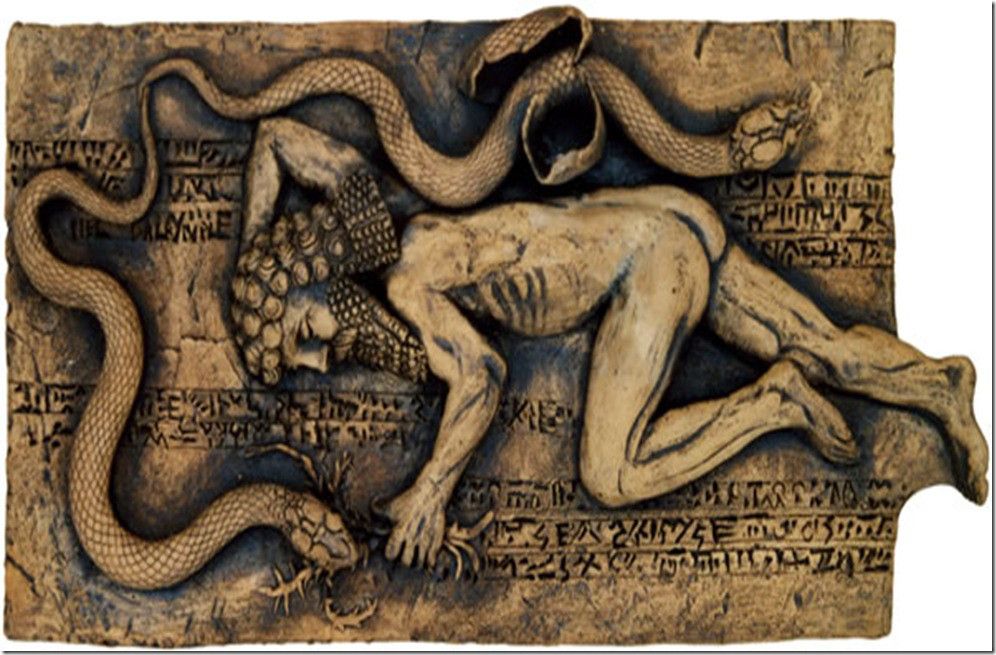
Gilgamesh and the Plant of Eternal Youth

In the Epic of Gilgamesh, Gilgamesh finds a plant that renews youth at the bottom of the ocean.
Taking it back to Erech, he falls asleep, and a serpent, again, a serpent, eats the plant and promptly sheds its skin.
While the serpent is the agent of evil in the Eve myth, the serpent thwarts human immortality in Gilgamesh.
https://konekrusoskronos.wordpress.com/2013/07/22/dreams-and-myths-crossing-the-waters-of-knowledge-archetypes-of-wisdom-an-inner-journey/
https://therealsamizdat.com/category/serpent/

A number of possible understandings of the “knowledge” השכיל which results from eating the fruit present themselves. Gunkel understands the “knowledge” to be primarily, though not exclusively, sexual awareness.

Thus, before eating the fruit, the primeval couple is not aware of their nakedness, suggesting that they likewise did not engage in sexual intercourse prior to this moment, and may possibly have been unaware of the difference between their sexes.

(Gunkel, Genesis, pp. 14–15. So also Speiser, Genesis, pp. 26–27; Jarich Oosten, “The Origins of Society in the Creation Myths of Genesis: An Anthropological Perspective,” Nederlands theologisch tijdschrift 52 (1998), pp. 116–17.)

The significance of such a motif in the Paradise episode would suggest that humanity’s attainment of this “knowledge” forms a necessary step in their becoming fully human (cf. the “humanizing” of Enkidu in the Epic of Gilgamesh).

(The Epic of Gilgamesh, SBV I.197–202 (George, The Epic of Gilgamesh, p. 8).

While the awareness of nudity, making of clothing, and sexual activity which follow the eating of the fruit do support this interpretation, a number of other elements weigh against it.

The objects טוב􏰢􏰣􏰟 and רע􏰠􏰜 in Genesis 3:5 make little sense in relation to sexual awareness, even if one understands them (correctly) not as moral terms but as referring to that which is helpful or harmful for humanity.

There is nothing else which suggests that human reproduction is inherently negative in Genesis 1–11, and indeed, it is explicitly commanded in Genesis 1:28 and 9:1, 7.

(While Genesis 1 and 9:1–17 are both P texts, Genesis 2–3 belongs to JE according to the classical Documentary hypothesis, and thus it is possible that they had different views on sexuality and reproduction, the positive view of human fruitfulness in the final form of Genesis 1–11 rules out Gunkel’s interpretation for the present form of the Paradise episode in its literary context.)”

David P. Melvin, “Divine Mediation and the Rise of Civilization in Mesopotamian Literature and in Genesis 1-11,” Journal of Hebrew Scriptures, 2010, pp. 12-3.

Sammael and Lilith, Adam and Eve

“In Provence, Aramaic texts appeared that could in fact have arrived there, at least in part, directly from the Orient in the twelfth century, even if they did not necessarily reach the circle of Rabad and his family. It seems, however, that in some of the earliest circles of kabbalists further variations were composed in an obviously artificial Aramaic on these same themes of the demonological hierarchies.

Remnants of these compositions still exist, for example, the pseudo-gaonic responsum on the conjuration of the prince of the demons, which incidentally also speaks of the revelation of the prophet Elijah during the night of the Day of Atonement. Already the earliest stratum of these texts distinguished between an old and a young Lilith and is familiar with strange names for the demonic rulers of the three realms of the ether and for their spouses, the Jewish names being combined with those of an obviously foreign provenance.

“The old Lilith is the wife of Sammael; both of them were born at the same hour in the image of Adam and Eve, and they embrace one another. Ashmedai, the great king of the demons, took as his wife the young Lilith, daughter of the king; his name is Qafsafuni and the name of his wife is Mehetabel, daughter of Hatred [from Gen. 36:39], and her daughter Lilitha.”

The fact that the spouse of the last king of Edom (in the list given in Genesis 36) figures as a demon suggests a reinterpretation of the list of these kings that turned them into the archons of darkness. Sammael too appears in these sources as the ruler of Edom—a Jewish code word, since the early Middle Ages, for Christianity, which was regarded as originating from the realm of darkness.”

Gershom Scholem, Origins of the Kabbalah, pp. 295-6.

Gabriel, the Angel, on the Pearl

“And again, there shall be unto thee a sign that the Saviour shall come from thy seed, and that He shall deliver thee with thy fathers and thy seed after thee by His coming. Your salvation was created in the belly of Adam in the form of a Pearl before Eve. And when He created Eve out of the rib He brought her to Adam, and said unto them, ‘Multiply you from the belly of Adam.’ The Pearl did not go out into Cain or Abel, but into the third that went forth from the belly of Adam, and it entered into the belly of Seth.”

“And then passing from him that Pearl went into those who were the firstborn, and came to Abraham. And it did not go from Abraham into his firstborn Ishmael, but it tarried and came into Isaac the pure. And it did not go into his firstborn, the arrogant Esau, but it went into Jacob the lowly one. And it did not enter from him into his firstborn, the erring Reuben, but into Judah, the innocent one. And it did not go forth from Judah until four sinners had been born, but it came to Fares (Perez), the patient one.”

“And from him this Pearl went to the firstborn until it came into the belly of Jesse, the father of thy father. And then it waited until six men of wrath had been born, and after that it came to the seventh, David, [David was the eighth of Jesse’s sons] thy innocent and humble father; for God hateth the arrogant and proud, and loveth the innocent and humble. And then it waited in the loins of thy father until five erring fools had been born, when it came into thy loins because of thy wisdom and understanding.”

“And then the Pearl waited, and it did not go forth into thy firstborn. For those good men of his country neither denied Him nor crucified Him, like Israel thy people; when they saw Him Who wrought miracles, Who was to be born from the Pearl, they believed on Him when they heard the report of Him. And the Pearl did not go forth into thy youngest son ‘Adrami. For those good men neither crucified Him nor denied Him when they saw the working of miracles and wonders by Him that was to be born from the Pearl, and afterwards they believed in Him through His disciples.”

“Now the Pearl, which is to be your salvation, went forth from thy belly and entered into the belly of ‘Iyorbe’am (Rehoboam) thy son, because of the wickedness of Israel thy people, who in their denial and in their wickedness crucified Him. But if He had not been crucified He could not have been your salvation. For He was crucified without sin, and He rose [again] without corruption. And for the sake of this He went down to you into Sheol, and tore down its walls, that He might deliver you and bring you out, and show mercy upon all of you.”

“Ye in whose bellies the Pearl shall be carried shall be saved with your wives, and none of you shall be destroyed, from your father Adam unto him that shall come, thy kinsman ‘Eyakem (Joachim), and from Eve thy mother, the wife of Adam, to Noah and his wife Tarmiza, to Tara (Terah) and his wife ‘Aminya, and to Abraham and his wife Sara (Sarah), and to Isaac and his wife Rebka (Rebecca), and to Jacob and his wife Leya (Leah), and to Yahuda and his bride Te’emar (Tamar), and to thy father and his wife Bersabeh (Bathsheba), and to thyself and Tarbana thy wife, and to Rehoboam thy son and his wife ‘Amisa, and to Iyo’akem (Joachim) thy kinsman, who is to come, and his wife Hanna.”

“None of you who shall have carried the Pearl shall be destroyed, and whether it be your men or your women, those who shall have carried the Pearl shall not be destroyed. For the Pearl shall be carried by the men who shall be righteous, and the women who have carried the Pearl shall not be destroyed, for they shall become pure through that Pearl, for it is holy and pure, and by it they shall be made holy and pure; and for its sake and for the sake of Zion He hath created the whole world.”

“Zion hath taken up her abode with thy firstborn and she shall be the salvation of the people of Ethiopia for ever; and the Pearl shall be carried in the belly of ‘Ayorbe’am (Rehoboam) thy son, and shall be the saviour of all the world. And when the appointed time hath come this Pearl shall be born of thy seed, for it is exceedingly pure, seven times purer than the sun. And the Redeemer shall come from the seat of His Godhead, and shall dwell upon her, and shall put on her flesh, and straightway thou thyself shalt announce to her what my Lord and thy Lord speaketh to me.”

“I am Gabriel the Angel, the protector of those who shall carry the Pearl from the body of Adam even to the belly of Hanna, so that I may keep from servitude and pollution you wherein the Pearl shall dwell. And Michael hath been commanded to direct and keep Zion wheresoever she goeth, and Uriel shall direct and keep the wood of the thicket [Compare Gen. xxii, 13] which shall be the Cross of the Saviour. And when thy people in their envy have crucified Him, they shall rush upon His Cross because of the multitude of miracles that shall take place through it, and they shall be put to shame when they see its wonders.”

“And in the last times a descendant of thy son ‘Adramis shall take the wood of the Cross, the third [means of] salvation that shall be sent upon the earth. The Angel Michael is with Zion, with David thy firstborn, who hath taken the throne of David thy father. And I am with the pure Pearl for him that shall reign for ever, with Rehoboam thy second son; and the Angel Uriel is with thy youngest son ‘Adrami[s]. This have I told thee, and thou shalt not make thy heart to be sad because of thine own salvation and that of thy son.”

And when Solomon had heard these words, his strength came [back] to him on his bed, and he prostrated himself before the Angel of God, and said, “I give thanks unto the Lord, my Lord and thy Lord, O thou radiant being of the spirit, because thou hast made me to hear a word which filleth me with gladness, and because He doth not cut off my soul from the inheritance of my father because of my sin, and because my repentance hath been accepted after mine affliction, and because He hath regarded my tears, and hath heard my cry of grief, and hath looked upon my affliction, and hath not let me die in my grief, but hath made me to rejoice before my soul shall go forth from my body.”

“Henceforward [the thought of] dying shall not make me sorrowful, and I will love death as I love life. Henceforward I will drink of the bitter cup of death as if it were honey, and henceforward I will love the grave as if it were an abode of costly gems. And when I have descended and have been thrust down deep into Sheol because of my sins, I shall not suffer grief, because I have heard the word which hath made me glad. And when I have gone down into the lowest depth of the deepest deep of Sheol, because of my sins, what will it matter to me?”

“And if He crush me to powder in His hand and scatter me to the ends of the earth and to the winds because of my sins, it will not make me sorrowful, because I have heard the word that hath made me to rejoice, and God hath not cut my soul off from the inheritance of my fathers. And my soul shall be with the soul of David my father, and with the soul of Abraham, and Isaac, and Jacob my fathers. And the Saviour shall come and shall bring us out from Sheol with all my fathers, and my kinsmen, old and young.”

“And as for my children, they shall have upon earth three mighty angels to protect them. I have found the kingdom of the heavens, and the kingdom of the earth. Who is like unto God, the Merciful, Who showeth mercy to His handiwork and glorifieth it, Who forgiveth the sins of the sinners and Who doth not blot out the memorial of the penitent? For His whole Person is forgiveness, and His whole Person is mercy, and to Him belongeth praise.” Amen.”

E.A. Wallis Budge, The Kebra Nagast, p. 111-4. [1922], at sacred-texts.com

Edenic Origins of the Kabbalah

“The Qabalah is traditionally traced back to Adam and Eve.”

[ … ]

“The disciplines of the Mystical Qabalah are distinct from those practiced by magicians, wizards, and sorcerers who seek to acquire creative and/or destructive power, depending on what paths they traverse on the Tree of Life.

The occult disciplines of wizards and magicians are often called the Practical, Hermetic, or Magical Qabalah. Practical Qabalah has its roots in the “Thirteen Enochian Keys” of Enoch son of Qain, along with a highly admixture of material taken from Egyptian, Mesopotamian and other non-Hebrew sources.

It is important not to confuse Enoch son of Qain with Enoch son of Yared. The former Enoch was the grandson of Adam and the son after whom Qain was said to name a city.

Enoch son of Yared was the great, great, great, great grandson of Adam, and the one who “walked with Elohim” and was transformed into Metatron.”

–Daniel Feldman, Qabalah: The Mystical Heritage of the Children of Abraham, 2001. Pg. 33-4.

The Children of Eve

“And she tied a scarlet thread on the middle of the door of [the house of] her gods, and she brought three locusts and set them in the house of her gods. And she said unto Solomon, “Come to me without breaking the scarlet thread, bend thyself and kill these locusts before me and pull out their necks”; and he did so. And she said unto him, “I will henceforward do thy will, for thou hast sacrificed to my gods and hast worshipped them.” Now he had done thus because of his oath, so that he might not break his oath which she had made him to swear, even though he knew that it was an offence (or, sin) to enter into the house of her gods.

Now God had commanded the children of Israel, saying, “Ye shall not marry strange women that ye may not be corrupted by them through their gods, and through the wickedness of their works and the sweetness of their voices; for they make soft the hearts of simple young men by the sweetness of their gentle voices, and by the beauty of their forms they destroy the wisdom of the foolish man.”

Who was wiser than Solomon? yet he was seduced by a woman. Who was more righteous than David? yet he was seduced by a woman. Who was stronger than Samson? yet he was seduced by a woman. Who was handsomer than ‘Amnon? yet he was seduced by Tamar the daughter of David his father. And Adam was the first creation of God, yet he was seduced by Eve his wife. And through that seduction death was created for every created thing. And this seduction of men by women was caused by Eve, for we are all the children of Eve.”

The Kebra Nagast, by E.A.W. Budge, [1922], pg. 104, at sacred-texts.com