
Samizdat

Publishing the Forbidden. All Rights Reserved. © Samizdat 2014-2025.

Category: Civilization

Melvin: Divine Knowledge was Sexual Knowledge

The Eden Story and the Demythologization of the Rise of Civilization

“I would now like to propose that the conspicuous absence of divine mediation of civilization from Genesis 1–11, in light of its prominence in Mesopotamian literature, may be explained with reference to the tradition of the origin of evil found in Genesis 3.

Here the reception of forbidden knowledge by the first human couple leads not only to their becoming “god-like” but also to their fall into a corrupt, sinful state and expulsion from paradise. Genesis 4–11 then portrays the long-term consequences of the at least partially-successful attempt by Adam and Eve to obtain divinity by procuring this knowledge.

Albrecht Dürer (1471-1528), Adam and Eve, dated 1504, currently held in the British Museum (1868,0822.167).<br /> At top left on the plate, it states: "ALBERT DVRER NORICVS FACIEBAT AD 1504."<br /> Which means: "Albrecht Dürer of Nuremberg made this 1504."<br /> https://commons.wikimedia.org/wiki/File:Adam_and_Eve_standing_on_either_side_of_the_tree_of_knowledge_with_the_serpent_by_Albrecht_Dürer.jpg

Albrecht Dürer (1471-1528), Adam and Eve, dated 1504, currently held in the British Museum (1868,0822.167).
At top left on the plate, it states: “ALBERT DVRER NORICVS FACIEBAT AD 1504.”
Which means: “Albrecht Dürer of Nuremberg made this 1504.”
https://commons.wikimedia.org/wiki/File:Adam_and_Eve_standing_on_either_side_of_the_tree_of_knowledge_with_the_serpent_by_Albrecht_Dürer.jpg

Included among these consequences are not only obvious examples of sin (murder, violence, etc.) but also the rise of civilization. The implication is that civilization too is an outgrowth of the forbidden knowledge obtained by Adam and Eve in Genesis 3.

The dialogue between the woman and the serpent, her eating of the fruit, and her giving of the fruit to her husband turn upon two primary points. First, the fruit of the tree is associated with knowledge of some sort.

Second, the serpent responds to the woman’s statement that Yahweh has forbidden them to eat from the tree in the center of the garden by saying that if she eats of the fruit of this tree, she will become like a god, which the woman presumably desires since she decides to eat the fruit. Thus, there is an implicit connection between knowledge and divinity in Genesis 3.
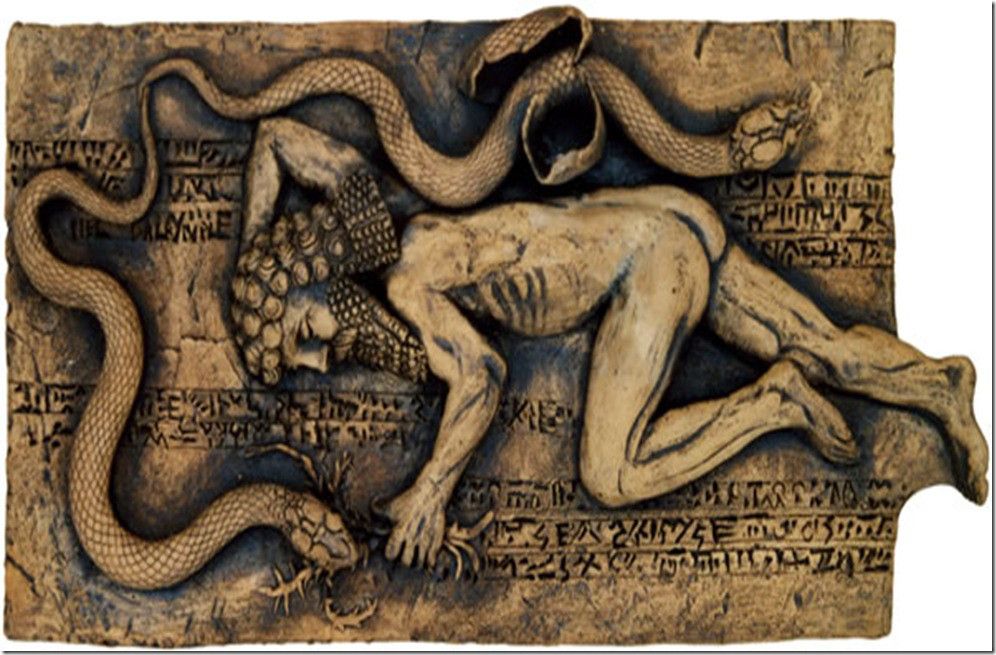
Gilgamesh and the Plant of Eternal Youth

In the Epic of Gilgamesh, Gilgamesh finds a plant that renews youth at the bottom of the ocean.
Taking it back to Erech, he falls asleep, and a serpent, again, a serpent, eats the plant and promptly sheds its skin.
While the serpent is the agent of evil in the Eve myth, the serpent thwarts human immortality in Gilgamesh.
https://konekrusoskronos.wordpress.com/2013/07/22/dreams-and-myths-crossing-the-waters-of-knowledge-archetypes-of-wisdom-an-inner-journey/
https://therealsamizdat.com/category/serpent/

A number of possible understandings of the “knowledge” השכיל which results from eating the fruit present themselves. Gunkel understands the “knowledge” to be primarily, though not exclusively, sexual awareness.

Thus, before eating the fruit, the primeval couple is not aware of their nakedness, suggesting that they likewise did not engage in sexual intercourse prior to this moment, and may possibly have been unaware of the difference between their sexes.

(Gunkel, Genesis, pp. 14–15. So also Speiser, Genesis, pp. 26–27; Jarich Oosten, “The Origins of Society in the Creation Myths of Genesis: An Anthropological Perspective,” Nederlands theologisch tijdschrift 52 (1998), pp. 116–17.)

The significance of such a motif in the Paradise episode would suggest that humanity’s attainment of this “knowledge” forms a necessary step in their becoming fully human (cf. the “humanizing” of Enkidu in the Epic of Gilgamesh).

(The Epic of Gilgamesh, SBV I.197–202 (George, The Epic of Gilgamesh, p. 8).

While the awareness of nudity, making of clothing, and sexual activity which follow the eating of the fruit do support this interpretation, a number of other elements weigh against it.

The objects טוב􏰢􏰣􏰟 and רע􏰠􏰜 in Genesis 3:5 make little sense in relation to sexual awareness, even if one understands them (correctly) not as moral terms but as referring to that which is helpful or harmful for humanity.

There is nothing else which suggests that human reproduction is inherently negative in Genesis 1–11, and indeed, it is explicitly commanded in Genesis 1:28 and 9:1, 7.

(While Genesis 1 and 9:1–17 are both P texts, Genesis 2–3 belongs to JE according to the classical Documentary hypothesis, and thus it is possible that they had different views on sexuality and reproduction, the positive view of human fruitfulness in the final form of Genesis 1–11 rules out Gunkel’s interpretation for the present form of the Paradise episode in its literary context.)”

David P. Melvin, “Divine Mediation and the Rise of Civilization in Mesopotamian Literature and in Genesis 1-11,” Journal of Hebrew Scriptures, 2010, pp. 12-3.
Melvin: Human Civilization is a Gift of the gods

“At other times, the gods create civilization directly, either through the birth of the patron deities of aspects of civilization (e.g., agriculture) or by means of themes.

(This phenomenon is especially prevalent in Sumerian creation accounts, which often emphasize the importance of agricultural technology by placing the creation of tools prior to and even necessary for the creation of humans (see, for example, The Song of the Hoe [COS 1.157]) and by presenting the development of agriculture as a theogony in which the patron deities of various agricultural technologies are born. See Cattle and Grain in Samuel N. Kramer, Sumerian Mythology: A Study of Spiritual and Literary Achievement in the Third Millennium B.C. (rev. ed.; New York: Harper & Brothers, 1961), 72–73.)

(See Enki and Inanna (COS 1.161). See also Kramer, Sumerian Mythology, 64–68; Bottéro, 238–39.)

In The Song of the Hoe, Enlil invents the hoe, first, in order to prepare the ground for sprouting humans, and second, for humans to use in their work of temple-building.

(In Mesopotamian Creation myths, the origin of humans is usually described in one of two ways. The first is that they are fashioned from clay, usually mixed with the blood of a slain god (cf. Enuma Elish; Atrahasis). The second is that they sprout up from the ground like plants, as is the case here.)

Similarly, in Cattle and Grain the arts of animal husbandry and agriculture are tied to their patron deities, Lahar and Ashnan. In another text, Enki decrees the fates of the cities of Sumer, blessing them and causing civilization to develop.

Batto notes that a number of texts present the earliest humans (i.e., humans prior to the divine bestowal of the gift of civilization) as animal-like. Thus, in Cattle and Grain, early humans walk about naked, eat grass like sheep, and drink water from ditches.

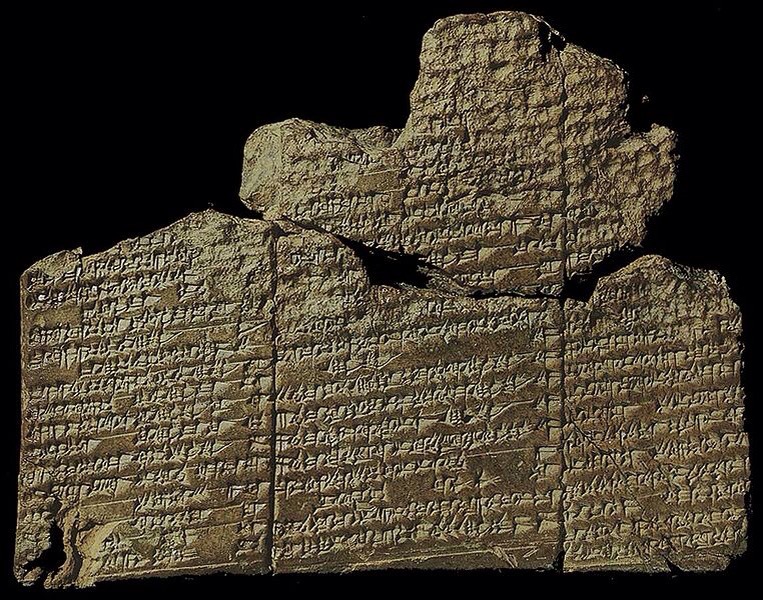
A fragment of The Eridu Genesis. <br />  The earliest recorded Sumerian creation myth is The Eridu Genesis, known from a cuneiform tablet excavated from Nippur, a fragment from Ur, and a bilingual fragment in Sumerian with Akkadian, from the Library of Ashurbanipal dated 600 BCE. The main fragment from Nippur (depicted above) is dated to 1600 BCE. <br />  http://etcsl.orinst.ox.ac.uk/cgi-bin/etcsl.cgi?text=t.1.7.4# <br />  https://en.wikipedia.org/wiki/Sumerian_creation_myth <br />  It was Thorkild Jacobsen who named this fragment. As he says, “…it deals with the creation of man, the institution of kingship, the founding of the first cities and the great flood. Thus it is a story of beginnings, a Genesis, and, as I will try to show in detail later, it prefigures so to speak, the biblical Genesis in its structure. <br />  The god Enki and his city Eridu figure importantly in the story, Enki as savior of mankind, Eridu as the first city. Thus “The Eridu Genesis” seems appropriate." <br />  In a footnote, Jacobsen observes, “The tablet was found at Nippur during the third season’s work of the Expedition of the University of Pennsylvania (1893-6) but was not immediately recognized for what it was. The box in which it was kept was labeled “incantation.” Thus it was not until 1912, when Arno Poebel went through the tablet collection, that its true nature was discovered.” <br />  He continues, “Poebel published it in hardcopy ... and furnished a transliteration, translation and penetrating analysis .... He convincingly dated the tablet (pp. 66-9) on epigraphical and other grounds to the latter half of the First Dynasty of Babylon.” <br />  “Little further work of consequence was done on the text for thirty-six years—a detailed bibliography may be found in Rykle Borger, Handbuch der Keilschriftliteratur I (Berlin: de Gruyter, p. 411 ... but in 1950 Samuel N. Kramer’s translation was published in ANET (pp. 43-4) and again, almost twenty years later, Miguel Civil restudied the text in his chapter on Atra-hasīs (pp. 138-47). <br />  The interpretation here offered owes much to our predecessors, far more than would appear from our often very different understanding of the text." <br />  https://books.google.co.uk/books?id=g5MGVP6gAPkC&amp;pg=PA129&amp;dq=Eridu+Genesis.+Nippur&amp;hl=en&amp;sa=X&amp;ved=0CCEQ6AEwAGoVChMI4ImL2PiCxwIVhNWACh01nwD6#v=onepage&amp;q=Eridu%20Genesis.%20Nippur&amp;f=false

A fragment of The Eridu Genesis.
The earliest recorded Sumerian creation myth is The Eridu Genesis, known from a cuneiform tablet excavated from Nippur, a fragment from Ur, and a bilingual fragment in Sumerian with Akkadian, from the Library of Ashurbanipal dated 600 BCE. The main fragment from Nippur (depicted above) is dated to 1600 BCE.
http://etcsl.orinst.ox.ac.uk/cgi-bin/etcsl.cgi?text=t.1.7.4#
https://en.wikipedia.org/wiki/Sumerian_creation_myth
It was Thorkild Jacobsen who named this fragment. As he says, “…it deals with the creation of man, the institution of kingship, the founding of the first cities and the great flood. Thus it is a story of beginnings, a Genesis, and, as I will try to show in detail later, it prefigures so to speak, the biblical Genesis in its structure.
The god Enki and his city Eridu figure importantly in the story, Enki as savior of mankind, Eridu as the first city. Thus “The Eridu Genesis” seems appropriate.”
In a footnote, Jacobsen observes, “The tablet was found at Nippur during the third season’s work of the Expedition of the University of Pennsylvania (1893-6) but was not immediately recognized for what it was. The box in which it was kept was labeled “incantation.” Thus it was not until 1912, when Arno Poebel went through the tablet collection, that its true nature was discovered.”
He continues, “Poebel published it in hardcopy … and furnished a transliteration, translation and penetrating analysis …. He convincingly dated the tablet (pp. 66-9) on epigraphical and other grounds to the latter half of the First Dynasty of Babylon.”
“Little further work of consequence was done on the text for thirty-six years—a detailed bibliography may be found in Rykle Borger, Handbuch der Keilschriftliteratur I (Berlin: de Gruyter, p. 411 … but in 1950 Samuel N. Kramer’s translation was published in ANET (pp. 43-4) and again, almost twenty years later, Miguel Civil restudied the text in his chapter on Atra-hasīs (pp. 138-47).
The interpretation here offered owes much to our predecessors, far more than would appear from our often very different understanding of the text.”
https://books.google.co.uk/books?id=g5MGVP6gAPkC&pg=PA129&dq=Eridu+Genesis.+Nippur&hl=en&sa=X&ved=0CCEQ6AEwAGoVChMI4ImL2PiCxwIVhNWACh01nwD6#v=onepage&q=Eridu%20Genesis.%20Nippur&f=false

Both The Rulers of Lagash and The Eridu Genesis present early humanity as similar to animals in that they slept on straw beds in pens because they did not know how to build houses and also lived at the mercy of the rains because they did not know how to dig canals for irrigation.

Batto concludes that Mesopotamian literature depicts the advancement of early humans as their evolution from a low, animal-like state to a higher, “civilized” state by means of gifts from the gods.

A further illustration of the role of the gods in the rise of civilization in Sumer is the myth Innana and Enki􏰓􏰋􏰎􏰋􏰋􏰎􏰃􏰎􏰋􏰐􏰃􏰔􏰋􏰝􏰉. In this text, Inanna steals the mes (in this case, corresponding to the arts of civilization) from Enki in Eridu and brings them to Uruk, thus transferring civilization to Uruk. The text mentions 94 individual elements of civilization, including:

“… the craft of the carpenter, the craft of the copper-smith, the art of the scribe, the craft of the smith, the craft of the leather-worker, the craft of the fuller, the craft of the builder, the craft of the mat-weaver, understanding, knowledge, purifying washing rites, the house of the shepherd,…kindling of fire, extinguishing of fire….”

Key in this myth is the fact that it is the divine mes, originally bestowed by Enki upon Eridu alone but subsequently transferred to Uruk by Inanna, which give rise to civilization.

What is nearly universal in the Mesopotamian literature, as far as the available texts indicate, is that the source of human civilization is divine, with humans acting primarily as recipients of divine knowledge.

Because of its divine origin and the clear benefits which it provides for humans—at least for those favored humans on whom the gods bestow it—civilization is portrayed in an overwhelmingly positive manner in these texts.”

David P. Melvin, “Divine Mediation and the Rise of Civilization in Mesopotamian Literature and in Genesis 1-11,” Journal of Hebrew Scriptures, 2010, pp. 6-7.