Samizdat

Publishing the Forbidden. All Rights Reserved. © Samizdat 2014-2026.

Category: Chronology

The Babylonian Zodiac is 1000 Years Older than Sargon of Accad

“The contents of the fifth tablet introduce us to a side of Babylonian religion which occupied an important and prominent position, at all events in the official cult. At the beginning of the present century, writers upon the ancient East were fond of enlarging upon a Sabaistic system of faith which they supposed had once been the dominant form of religion in Western Asia.

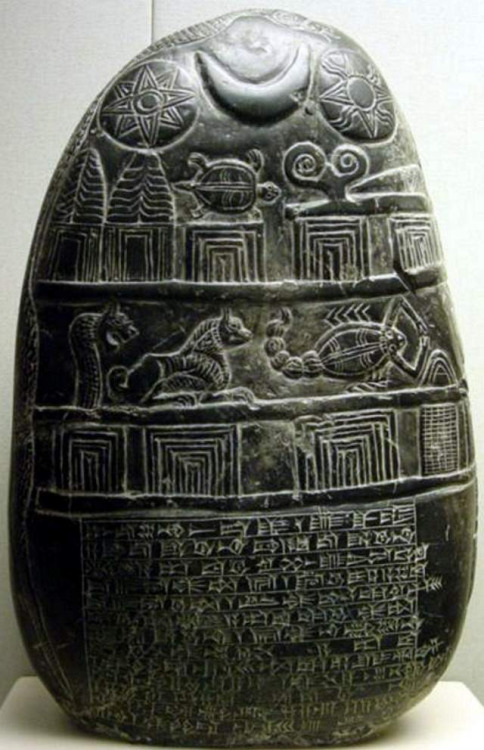
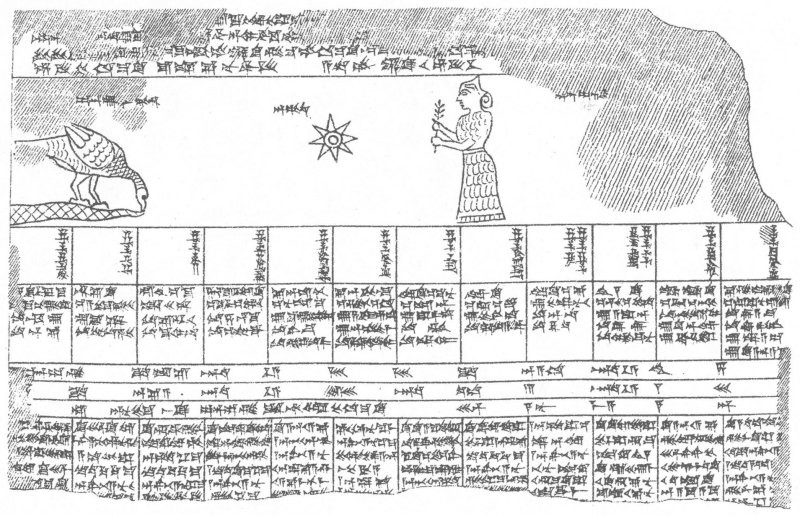
The accompanying illustration, which is reproduced from the Boundary Stone of Ritti-Marduk (Brit. Mus., No. 90,858), supplies much information about the symbols of the gods, and of the Signs of the Zodiac in the reign of Nebuchadnezzar I, King of Babylon, about 1120 B.C..  Thus in Register 1, we have the Star of Ishtar, the crescent of the Moon-god Sin, and the disk of Shamash the Sun-god.  In Reg. 2 are three stands (?) surmounted by tiaras, which represent the gods Anu, Enlil (Bel) and Ea respectively.  In Reg. 3 are three altars (?) or shrines (?) with a monster in Nos. 1 and 2. Over the first is the lance of Marduk, over the second the mason's square of Nabû, and over the third is the symbol of the goddess Ninkharsag, the Creatress.  In Reg. 4 are a standard with an animal's head, a sign of Ea; a two-headed snake = the Twins; an unknown symbol with a horse's head, and a bird, representative of Shuḳamuna and Shumalia.  In Reg. 5 are a seated figure of the goddess Gula and the Scorpion-man; and in Reg. 6 are forked lightning, symbol of Adad, above a bull, the Tortoise, symbol of Ea (?), the Scorpion of the goddess Ishkhara, and the Lamp of Nusku, the Fire-god.  Down the left-hand side is the serpent-god representing the constellation of the Hydra. http://sacred-texts.com/ane/blc/img/016.png http://sacred-texts.com/ane/blc/blc07.htm

The accompanying illustration, which is reproduced from the Boundary Stone of Ritti-Marduk (Brit. Mus., No. 90,858), supplies much information about the symbols of the gods, and of the Signs of the Zodiac in the reign of Nebuchadnezzar I, King of Babylon, about 1120 B.C..
Thus in Register 1, we have the Star of Ishtar, the crescent of the Moon-god Sin, and the disk of Shamash the Sun-god.
In Reg. 2 are three stands (?) surmounted by tiaras, which represent the gods Anu, Enlil (Bel) and Ea respectively.
In Reg. 3 are three altars (?) or shrines (?) with a monster in Nos. 1 and 2. Over the first is the lance of Marduk, over the second the mason’s square of Nabû, and over the third is the symbol of the goddess Ninkharsag, the Creatress.
In Reg. 4 are a standard with an animal’s head, a sign of Ea; a two-headed snake = the Twins; an unknown symbol with a horse’s head, and a bird, representative of Shuḳamuna and Shumalia.
In Reg. 5 are a seated figure of the goddess Gula and the Scorpion-man; and in Reg. 6 are forked lightning, symbol of Adad, above a bull, the Tortoise, symbol of Ea (?), the Scorpion of the goddess Ishkhara, and the Lamp of Nusku, the Fire-god.
Down the left-hand side is the serpent-god representing the constellation of the Hydra.
http://sacred-texts.com/ane/blc/img/016.png
http://sacred-texts.com/ane/blc/blc07.htm

 Star-worship was imagined to be the most primitive phase of Oriental religion, and the reference to it in the book of Job was eagerly seized upon as an evidence of the antiquity of the book. Dupuis resolved all human forms of faith into Zodiacal symbols, and Sir William Drummond went far in the same direction. That the first gods of the heathen were the planets and stars of heaven, was regarded by high authorities as an incontrovertible fact.

The plains of Shinar were held to be the earliest home of this Sabaism or star-worship. The astronomy and astrology of Babylonia had been celebrated even by Greek and Latin authors, and scholars were inclined to see in the “Chaldaean shepherds” the first observers of the heavens.

The “astrologers, the star-gazers, the monthly prognosticators” of Babylon, are enumerated in the Old Testament (Isaiah xlvii. 13); and the small cylinders brought by travelers from Bagdad, with their frequent representations of a star or sun, seemed to leave no doubt that the deities of Babylonia were in truth the heavenly bodies. The decipherment of the cuneiform inscriptions has shown that the belief in Babylonian “Sabaism” was, after all, not altogether a chimera.

Babylonia was really the cradle of astronomical observations. Long before the lofty zigurrâti or “towers” of the temples were reared, where the royal astronomers had their stations and from whence they sent their reports to the king, the leading groups of stars had been named, a calendar had been formed, and the eclipses of the sun and moon had been noted and recorded.

The annual path of the sun through the sky had been divided into twelve sections, like the twelve kasbu or double hours of the day, and each section had been distinguished by its chief constellation or star. It was thus that the Zodiac first came into existence.

The names given to its constellations are not only Accadian, but they also go back to the totemistic age of Accadian faith. The first sign, the first constellation, was that of “the directing bull,” so named from the solar bull who at the vernal equinox began to plough his straight furrow through the sky, directing thereby the course of the year.

The last sign but one was “the fish of Ea;” while midway between the two, presiding over the month whose name was derived from its “facing the foundation” or “beginning” of the year, was the great star of the Scorpion.

The fact that the year thus began with Taurus proves the antiquity of the Chaldean Zodiac, and of the months of thirty days which corresponded to its several signs. From about B.C. 2500 and onwards, the precession of the equinoxes caused Aries, and not Taurus, to be the asterism into which the sun entered at spring-time; the period when Taurus ushered in the year reached back from that date to about B.C. 4700.

The Zodiacal circle may therefore have been invented nearly a thousand years before Sargon of Accad was born; and that it was invented at an early epoch is demonstrated by its close connection with the Accadian calendar.”

A.H. Sayce, Lectures on the Origin and Growth of Religion as Illustrated by the Religion of the Ancient Babylonians, 5th ed., London, 1898, pp. 396-8.

Nergal the Destroyer

“The library of Nineveh contained the copy of a tablet which, according to its concluding lines, was originally written for the great temple of Nergal at Cutha. The words of the text are put in the mouth of Nergal the destroyer, who is represented as sending out the hosts of the ancient brood of chaos to their destruction.

Nergal appears at the top, leering over a top register which contains the eight-pointed star of Ishtar and the inverted half-moon crescent of the Moon God Sin.  In the second register, seven demons appear to support the heavens.  The middle register depicts the burial rites for new arrivals in the underworld.  The lower register depicts the goddess Allat, or Ereshkigal, sister of Ishtar, who reigns in the underworld. She kneels upon a horse, which appears to be oppressed by her burden, in a boat which floats upon the waters of life. Note the lions suckling at her breast.  Drawn by Faucher-Gudin, from a bronze plaque of which an engraving was published by Clermont-Ganneau.  The original, which belonged to M. Péretié, is now in the collection of M. de Clercq. http://www.gutenberg.org/files/17323/17323-h/17323-h.htm#linkBimage-0039

Nergal appears at the top, leering over a top register which contains the eight-pointed star of Ishtar and the inverted half-moon crescent of the Moon God Sin.
In the second register, seven demons appear to support the heavens.
The middle register depicts the burial rites for new arrivals in the underworld.
The lower register depicts the goddess Allat, or Ereshkigal, sister of Ishtar, who reigns in the underworld. She kneels upon a horse, which appears to be oppressed by her burden, in a boat which floats upon the waters of life. Note the lions suckling at her breast.
Drawn by Faucher-Gudin, from a bronze plaque of which an engraving was published by Clermont-Ganneau.
The original, which belonged to M. Péretié, is now in the collection of M. de Clercq.
http://www.gutenberg.org/files/17323/17323-h/17323-h.htm#linkBimage-0039

Nergal is identified with Nerra, the plague-god, who smites them with pestilence, or rather with Ner, the terrible “king who gives not peace to his country, the shepherd who grants no favour to his people.”

We are first told how the armies of chaos came into existence.

“On a tablet none wrote, none disclosed, and no bodies or brushwood were produced in the land; and there was none whom I approached.

Warriors with the body of a bird of the valley, men with the faces of ravens, did the great gods create. In the ground did the gods create their city. Tiamat (the dragon of chaos) suckled them. Their progeny (sasur) the mistress of the gods created.

In the midst of the mountains they grew up and became heroes and increased in number. Seven kings, brethren, appeared and begat children. Six thousand in number were their peoples. The god Banini their father was king; their mother was the queen Melili.”

It was the subjects and the offspring of these semi-human heroes whom the god Ner was deputed to destroy.

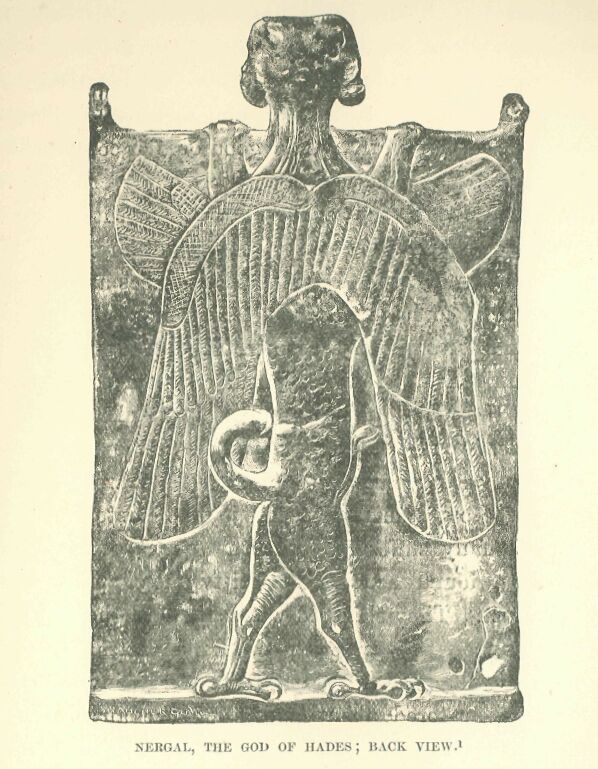
The reverse side of the god Nergal,  drawn by Faucher-Gudin. This is the back of the bronze plate above; the animal-head of the god appears in relief at the top of the illustration. http://www.gutenberg.org/files/17323/17323-h/17323-h.htm#linkBimage-0018

The reverse side of the god Nergal, drawn by Faucher-Gudin. This is the back of the bronze plate above; the animal-head of the god appears in relief at the top of the illustration.
http://www.gutenberg.org/files/17323/17323-h/17323-h.htm#linkBimage-0018

It is clear that the legend of Cutha agrees with Berossos in the main facts, however much it may differ in details. In both alike, we have a first creation of living beings, and these beings are of a composite nature, and the nurselings of Tiamat or Chaos.

"Bird men" are depicted.

“Bird men” are depicted.

In both alike, the whole brood is exterminated by the gods of light. A curious point in connection with the legend is the description of chaos as a time when writing was as yet unknown and records unkept. Perhaps we may see in this an allusion to the fact that the Babylonian histories of the pre-human period were supposed to have been composed by the gods.

The date to which the legend in its present form may be assigned is difficult to determine. The inscription is in Semitic only, like the other creation-tablets, and therefore cannot belong to the pre-Semitic age. It belongs, moreover, to an epoch when the unification of the deities of Babylonia had already taken place, and the circle of “the great gods” was complete.

Ea, Istar, Zamama, Anunit, even Nebo and “Samas the warrior,” are all referred to in it. We must therefore place its composition after the rise not only of the hymns of Sippara, but also of the celebrity of the Semitic god of Borsippa.

On the other hand, the reference to the pateśi or priest-king in the concluding lines seems to prevent us from assigning too late a date to the poem. Perhaps we shall not be far wrong in ascribing it to the era of Khammuragas.”

A.H. Sayce, Lectures on the Origin and Growth of Religion as Illustrated by the Religion of the Ancient Babylonians, 5th ed., London, 1898, pp. 372-4.

Conflation of Languages

“The beliefs which produced the magical texts must still have been active, although the hymn belongs to a late period of Babylonian history; the old doctrine of an inexorable fate, even if degraded into a belief in the witch’s art, still existed along with the worship of a god who restored the dead to life and was supreme in mercy to those that were in trouble.

We have only to turn to our modern newspapers to discover how slowly such primeval beliefs die out, and how long they may linger among the uneducated and superstitious by the side of the most exalted faiths and the mightiest triumphs of inductive science.

The fact that one text is magical, while another contains a hymn to the deity, does not of itself prove the relative ages of the two documents. Then, thirdly, it has become increasingly manifest that a good many of the so-called Accadian texts are not Accadian in their origin.

As I pointed out several years ago, the old Accado-Sumerian language was learned by the Semitic Babylonians as Latin was learned by the mediaeval monks, and for much the same reasons. It was the language of the oldest sacred texts; it was also the early language of law; and both priests and lawyers were accordingly interested in its preservation and use.

What happened to Latin in the Middle Ages had already happened to Accadian in Babylonia. The monks spoke and wrote in a language which was Latin indeed, but which had lost its classical purity; monkish Latin was full of modern words and idioms, and its grammar was not always scrupulously accurate.

On the other hand, it contributed multitudes of words, and even forms of expression, to the languages of every-day life that were spoken around it, and the words were frequently modified to suit the pronunciation and genius of the languages that borrowed them, just as the modern words which monkish Latin had itself adopted were furnished with classical terminations and construed in a classical fashion.

The case was precisely the same in ancient Chaldea. Here, too, there was a monkish Accadian, both spoken and written, some of which would have shocked the Accadian speakers of an earlier age. The literati of the court of Sargon of Accad had been partly Accadian, partly Semitic; the Accadian scribes wrote and spoke Semitic, the Semitic scribes wrote and spoke Accadian.

The result was necessarily a large amount of lending and borrowing upon both sides, and the growth of an artificial literary language which maintained its ground for centuries. The way for the rise of this artificial dialect had already been prepared by the long contact there had been between the two chief languages of primitive Chaldea.

When two languages thus exist side by side–like Welsh, for example, by the side of English–they will borrow one from another, the language of superior culture and organisation being that which exerts the greatest influence.

The pupils will imitate the speech of their masters in art and science even if, as in the case of Greece and Rome, the masters in art and science are the subjects in political power.”

A.H. Sayce, Lectures on the Origin and Growth of Religion as Illustrated by the Religion of the Ancient Babylonians, 5th ed., London, 1898, pp. 322-3.

Lenormant on the Great Babylonian Work on Magic

“The great work on magic, many copies of which had been executed by the scribes of Ashurbanipal, according to the pattern placed centuries since in the library of the famous school for priests at Erech in Chaldea, was composed of three different books.

We know the title of one of the three, “The Wicked Spirits,” for we find at the end of each of the tablets, which come from it and which have been preserved entire, “Tablet No. __ of the Wicked Spirits.”

As the title shows, it was filled exclusively with formulae of conjurations and imprecations, which were designed to repulse demons and other wicked spirits, to avert their fatal action, and to shelter the invoker from their attacks.

Portions of a second book exist, and, judging from what remains of it, it would seem to be formed of a collection of these incantations, to which was attributed the power of curing various maladies.

Lastly, the third book contained Hymns to certain gods. A supernatural and mysterious power was attributed to the chanting of these hymns, which are, however, of a very different character from the regular liturgical prayers of the official religion, a few of which have been preserved to us.

It is curious to notice that the three parts composing thus the great work on magic, of which Sir Henry Rawlinson has found the remains, correspond exactly to the three classes of Chaldean doctors, which Daniel (ii, 2; v. II) enumerates, together with the astrologers and divines (Kasdim and Gazrim), that is, the Khartumim or conjurors, the Chakamim or physicians, and the Asaphim or theosophists.”

François Lenormant, Chaldean Magic, “The Magic and Sorcery of the Chaldeans,” Chapter I, 1878, pp. 13-4. Originally published as La Magie Chez Les Chaldeens, 1847.

An Excerpt from Lenormant’s Chaldean Magic, Contrasted with Egyptian Magic

“After having put the reader in the way of comparing for himself the Egyptian and Chaldean magical formula, there is no need for me to pursue further the marked difference between the two systems, for this is evident to all students. The fundamental beliefs and ideas of magic superstition in Egypt and Chaldea were as different in their character as were the forms of their incantations.

In the Egyptian documents we perceive no trace of those elementary spirits, some good and some bad, endowed with a distinct personality, which Chaldeans believed to have been spread all over the world, the objects either of propitiatory incantations or the most terrible exorcisms.

On the other hand, the Chaldeans in no way entertained the idea of being able to elevate a man into a kind of demigod by means of their formulae, and of identifying him with the greatest personages of the celestial hierarchy.

Neither did they pretend that those formulae had any power to command the gods or to compel them to obey. Their magic belonged to the intermediate spiritual state, and there its powers were displayed.

If they required the help of the supreme gods, that was to be obtained by means of prayers and supplications; and not by compulsion; indeed, and we shall refer to this idea again, even their prayers were not all powerful to accomplish the desires of the suppliant unless they were presented to the gods by a mediator.

True indeed there was a supreme name which possessed the power of commanding the gods, and exacting from them a perfect obedience, but that name remained the inviolable secret of Hea.

The initiated need never hope to attain to such an awful height of knowledge as he might in the Egyptian system. In exceptionally grave cases he besought Hea, through the mediator Silik-mulu-khi, to pronounce the solemn word in order to reestablish order in the world and restrain the powers of the abyss.

But the enchanter did not know that name, and could not in consequence introduce it into his formulae, even although they were tested to remain for ever concealed in mystery.

He could not obtain or make use of it, he only requested the god who knew it to employ it, without endeavoring to penetrate the terrible secret himself.

The primitive simplicity of the incantations of Chaldean magic strikes us forcibly when we compare them with those of the Egyptian magic, and this fact gives to them a stamp of greater antiquity.

Every thing is expressed very clearly and simply without any attempt at obscurity, or premeditated complications. The belief in spirits is seen there in its most ancient and perfect form, without any philosophical refinement as to the divine substance, without a single trace of mysticism, and above all without any allusions to the vast number of mythological legends which fill the Egyptian formulae, and render them perfectly unintelligible without a voluminous commentary.

It is easy on the contrary to understand the magical formulae in the Accadian language, which were preserved in Chaldea until the breaking up of the sacerdotal schools on the borders of the Euphrates, and which Ashurbanipal had copied for the royal library in Nineveh about the VIIth century, BCE.

They contain no mysteries, and the sacerdotal secret, if there were one, consisted in the precise knowledge of the exact terms of the incantations, sacred from their antiquity, and no doubt also from the idea that they were of divine origin.

The formulae were the work of a people who possessed as yet no esoteric doctrines and no mystical initiations; amongst whom the science of magic consisted simply in a practical acquaintance by the priests with certain rites and words, by means of which they fancied themselves able to establish a communication with the world of spirits, whilst at the same time their conception of those spirits difference from the popular superstitions only by a little more systematic regularity in their position, hierarchy and privileges.

It is for this reason that the Accadian magic preserved, even during the centuries of the greatest splendor of Babylon and Assyria, the appearance of extreme antiquity and the spirit of the earliest ages, by the side of the learned religion which sprang up later in the same places, and which accepted the existence of this magic by placing in the canon of its sacred books the old Accadian incantations, and giving a place, though indeed an insubordinate one, in its theological system to the genii who were invoked in these incantations.

At the bottom, as we shall see, magic was not separated in Chaldea from the religion of the historical centuries; it was a new twig from an entirely different plant which was grafted for good or for evil upon the trunk from the time that its existence was recognized, and tolerated instead of being annihilated.

But facts oblige us to see in it also the remains of an earlier religious system, of a still rudimentary and coarse naturalism, which arose from the ideas of a primitive population belonging to a race entirely different from that among which the Chaldaic-Assyrian religion existed.

In the civilization which gradually spread over the borders of the Tigris and Euphrates from the fusion of the Sumerians, and the Accadians, the Semit-Kushites and the Turanians, religion and magic were peaceably united, although they originated in the two opposing elements of the people.

This I think will be made evident by placing the doctrines of the magic books which were originally written in the Accadian language, and the discovery of which we owe to Sir Henry Rawlinson, in comparison with those of the later official religion and of the public worship, as they appear in many documents.”

François Lenormant, Chaldean Magic, “Contrasts between the Accadian and Egyptian magic,” Chapter VIII, 1878, pp. 107-110. Originally published as La Magie Chez Les Chaldeens, 1847.

Babylonian Magical Incantations

“The relation between the magical texts and the hymns of ancient Babylonia is now, therefore, clear. In many cases, at least, the hymns formed part of the magical texts; they were the mystical incantations around the recitation of which the rites prescribed in the texts were intended to revolve.

The magical text was not complete without the repetition of a form of words as well as a direct appeal to the names of certain supernatural beings; and the form of words was in many instances furnished by hymns to the gods or analogous kinds of composition.

It is not only the magical texts, however, in which we find the hymns embedded and prefaced by the significant word siptu, “incantation.” They are still more numerous in the ritual texts–in the texts, that is to say, which describe the religious ceremonies the Babylonian was called upon to perform.

These ceremonies had for the most part the same end and object as the magical texts; they were not so much a communion with the deities of heaven, as an attempt to compel them by particular rites and words to relieve the worshipper from trouble, or to bestow upon him some benefit.

Divine worship, in short, was a performance rather than an act of devotion, and upon the correctness of the performance depended entirely its efficacy. The mispronunciation of a single word, the omission to tie a knot at the right moment, would invalidate the whole ceremony and render its repetition necessary.

The ritual, therefore, was a sort of acted magic, and it is consequently not surprising that the hymns should play the same part in it as they did in the incantations of the magical texts.

It follows from all this that many of the magical texts are, like the ritual texts, later than many of the hymns. The fact must necessarily introduce some modification into Lenormant’s theory of the origin of the sacred books of Chaldaea.

In the second place, not only the hymns, but even the magical texts are at times composed in Semitic Babylonian only. There is no trace of an Accadian original of any kind whatever. And not only is this the case, but these purely Semitic hymns occasionally glide into what is neither more nor less than unadulterated magic.”

A.H. Sayce, Lectures on the Origin and Growth of Religion as Illustrated by the Religion of the Ancient Babylonians, 5th ed., London, 1898, pp. 319-20.

The Sacred Books of Chaldea and the Long Shadow Cast by Francois Lenormant

“To François Lenormant, whose untimely death was an irreparable loss to the progress of Assyrian research, belongs the merit of first describing and defining the sacred books of ancient Babylonia.

With the keenness of perception that characterised him, he pointed out two main collections of Babylonian sacred texts; one containing magic incantations and exorcisms; the other, hymns to the gods.

The magical texts obviously belong to an earlier and less advanced stage of religious belief than the hymns; they presuppose, in fact, a sort of Shamanism, according to which each object and power of nature has its zi or “spirit,” which can be propitiated only by a sorcerer-priest and certain magical rites; while the hymns, on the other hand, introduce us to a world of gods, and their language from time to time approaches a high level of spiritual expression.

The collection of hymns Lenormant very happily named the Chaldean Rig-Veda, and to them he subsequently added a third collection, consisting of penitential psalms which in many respects resemble the psalms of the Old Testament.

All three collections are generally composed in both Accadian and Semitic Babylonian, the Semitic Babylonian being a translation of the presumably older Accadian text which is written line by line above it.

It was natural to suppose that what has happened in the case of other sacred books happened also in Babylonia; that the magical texts were first collected together, the collection subsequently acquiring a sacred character; and that a similar process took place in the case of the hymns.

The whole work would have been complete before the culture and literature of the Accadians were handed on to the Semites: in this way the preservation of the Accadian originals would be accounted for, the very words of the primitive documents and their correct pronunciation having come to be looked upon as sacred and inspired; while the Semitic interlinear translation served, like the Aramaic Targums of the Old Testament, to assist the priests in understanding the object of their recitations.

As time went on, the religious beliefs which underlay the magical texts became so far removed from those of a later age that the texts themselves gradually passed into the background, the collection of hymns taking more and more their place as pre-eminently the Babylonian Bible.

The theory as thus stated is at once simple and probable. But although in its main outlines it is no doubt correct, further research has shown that its simplicity is due to the imperfection of the materials upon which Lenormant had to work, and that it will have to be very considerably modified before all the facts now known to us are accounted for.

In the first place, there are numerous magical texts which are later, and not older, than many of the hymns. Nothing is more common than to find a magical text breaking off into a hymn or a fragment of a hymn the recitation of which forms part of the spell or ceremony.

A large number of the hymns that have come down to us are thus embedded in the magical documents of which they form an integral part. The hymn to the seven evil spirits, for instance, quoted in a former Lecture, is really a portion of one of the most famous of the magicaI texts.

In such instances there can be no question that the hymn is older than the text in which it is found. Moreover, it is difficult to distinguish the hymns when used in this way from similar poetical addresses to divine beings, which, so far from being especially sacred, were employed as spells in medical practice.”

A.H. Sayce, Lectures on the Origin and Growth of Religion as Illustrated by the Religion of the Ancient Babylonians, 5th ed., London, 1898, pp. 315-7.

Sins of Man

Merodach mourned over the doom pronounced against his city, and apparently with some effect; for after a good many broken and lost lines, the tablet goes on to describe the despatch of the terrible plague-god to Erech, “the seat of Anu and Istar, the city of the choirs of the festival-makers and consecrated maidens of Istar,” who “dreaded death,” for the nomad ‘Suti of the desert had combined against their state.

The eunuch-priests were now compelled to bow the face before another deity than the peaceful Istar, who “cried and was troubled over the city of Erech.” Eventually, however, Nerra was “quieted” by “Isum his councillor, the illustrious god who goes before him,” “and the warrior Nerra spake thus:

“Sea-land against sea-land, ‘Sumasti against ‘Sumasti, the Assyrian against the Assyrian, the Elamite against the Elamite, the Kossaean against the Kossaean, the Kurd against the Kurd, the Lullubite against the Lullubite, country against country, house against house, man against man, brother against brother, let them destroy one another, and afterwards let the Accadian come and slay them all, and fall upon their breasts.”

The warrior Nerra (further) addresses a speech to Isum, who goes before him:

‘Go, Isum, incline all thy heart to the word thou hast spoken.’

(Then) Isum sets his face towards the land of the west; the seven warrior gods, unequalled, sweep (all things) away behind him.

At the land of Phoenicia, at the mountains, the warrior arrived; he lifted up the hand, he laid it on the mountain; the mountain of Phoenicia, he counted as his own soil.”

In thus marching to the west, the minister of the Babylonian god of death approaches the country in which another angel of pestilence was seen by the king of Israel.

“By the threshing-floor of Araunah the Jebusite,” David had beheld the angel of the Lord “stretching out his hand upon Jerusalem to destroy it.”

As in Babylon, so too in Israel, the plague had been a visitation for the sins of man. It was the instrument of God’s anger wielded by the hands of his angel-minister. That same angel-minister had once before stood before Balaam, and with a drawn sword in his hand had threatened the Syrian prophet with death.

He was not a demon from the lower world, like the old Chaldean plague-spirit Namtar; he was not the inexorable law of destiny, before whom even the gods had to submit their wills; but a member of the celestial hierarchy, the messenger of a beneficent God.

He came to destroy, but it was to destroy the guilty. The sins of man, and not the malevolence or passionless law of a supernatural being, brought death and suffering into the world. The Babylonian legend of Nerra, like the records of the Old Testament, tells the same tale as the Babylonian story of the Deluge.”

A.H. Sayce, Lectures on the Origin and Growth of Religion as Illustrated by the Religion of the Ancient Babylonians, 5th ed., London, 1898, pp. 312-4.

A Babylonian Incantation

“In the hymns the mamit occupies a conspicuous place. Thus we read:

“0 curse, curse, the boundary that none can pass!

The limit of the gods (themselves) against which they may not transgress!

The limit of heaven and earth which altereth not!

The unique god against whom none may sin!

Neither god nor man can undo (it). A snare not to be passed through, which is set for evil.

Whether an evil utuk, or an evil alu, or an evil ekimmu, or an evil gallu, or an evil god, or an evil incubus, or a labartu, or a labatsu, or an akhkharu, or a lilu, or a lilat, or the maid of a lilu, or the evil plague-demon, or a disease-bringing asakku, or a bad sickness, which has set its head towards the dropping water of Ea, may the snare of Ea seize it! which has stretched its head against the wisps of Nirba (the Corn-god), may the lasso of Nirba bind it!

Against the limitation (of the curse) it has transgressed. Never may (the limitation) of the gods, the limitation of heaven and earth, depart from it. (The limitation of the great) gods it reverences not. May (the lasso of) the great gods bind it! May the great gods curse it! May they send back (the demon) to (his) home! The home of (his) habitation may they cause him to enter!

As for him who has turned to another place, to another place, a place invisible, may they bring him!

As for him who has turned into the gate of the house, the gate of a place from whence there is no exit may they cause him to enter! As for him who has stationed himself in the door and bolts, in the door and bolts may they hind him with bonds from which there is no release!

As for him who has blown (?) into the threshold and socket, who into threshold and hinge has crept, like water may they pour him out, like a cup may they shatter him, like a quarry-stone may they break him to pieces! As for him who has passed across the beam, his wings may they cut!

As for him who has thrust his neck into the chamber, may they twist his neck!”

H.C. Rawlinson, The Cuneiform Inscriptions of Western Asia, 1886, iv, 16, No. 1.

This is a fair sample of the incantations by means of which the Babylonians believed that they could free themselves from the demoniac agencies that surrounded them. The power of the mamit was such that the gods themselves could not transgress it, and the mamit was accordingly invoked to protect the mortal from the demons of plague and sickness.

But the plague itself might be regarded as a mamit or “doom” inflicted by heaven upon the guilty earth.”

A.H. Sayce, Lectures on the Origin and Growth of Religion as Illustrated by the Religion of the Ancient Babylonians, 5th ed., London, 1898, pp. 307-9.

On Assyrian Curses

“Closely connected with the mystical importance thus assigned to names was the awe and dread with which the curse or excommunication was regarded. Once uttered with the appropriate ceremonies, the binding of knots and the invocation of divine names, it was a spell which even the gods were powerless to resist.

In Assyrian it was called the mamit, in Accadian the śabba, and was naturally considered to be divine. In Accadian, Mami had been a goddess; the borrowed Assyrian deity, therefore, assumed the Semitic feminine termination.

In the tenth book of the Epic of Gisdhubar (Epic of Gilgamesh), the goddess Mam-metu, as her name is there spelt, is called “the maker of fate” who “has fixed the destinies” of mankind, “along with” the spirits of the earth; “she has established death and life, but the days of death are unknown.”

Mamit thus bore a striking resemblance to the Fate of the Romans and the Atê of the Greeks. Like Atê, her operations were usually conceived of as evil. Just as Namtar, the plague-demon, was also the personification of doom and destiny, so too Mamit was emphatically the concrete curse.

If she established life as well as death, it was only because the term of life is fixed by death; death, and not life, was the real sphere of her work. Hence the mamit was known among the Accadians as the (nam)-eríma or “hostile doom;” and though Anu, as we have seen, might as the pole-star be called “the mamit of heaven,” it is in no friendly guise that the mamit is presented to us in the magical texts.

It was, in fact, like the power of excommunication in the Middle Ages, the most terrible weapon that could be used by the priestly exorcist. For the power of invoking the aid of the goddess Mamit by pronouncing the curse was completely in his hands.

All that was needed was the performance of certain rites and the repetition of certain words. Armed with the magic wand, he could lay the terrible excommunication on the head of his enemy, and cause it to issue forth from the body of his friend.

“Let the mamit come forth that I may see the light,” is one of the petitions we meet with in the tablets; and Tiglath-Pileser I states that after his conquest of the kings of Nahri he “freed them, prisoners and bound as they were, in the presence of the Sun-god (his) lord, and made them swear to be his servants from henceforth and for ever, under pain of the curse (mamit) of (his) great gods.”

A.H. Sayce, Lectures on the Origin and Growth of Religion as Illustrated by the Religion of the Ancient Babylonians, 5th ed., London, 1898, pp. 305-7.

The Power and Magic of Names

“The voices heard by the Babylonian in nature, however, were not a whit more sacred to him than the inarticulate voice which found expression in the name. Like all primitive peoples, the Chaldeans confounded the person and the name by which he was known.

The name, in fact, was the personality, and whatever happened to the name would happen equally to the personality. Injury could be done to a person by using his name in a spell; and, similarly, to pronounce the name of a deity compelled him to attend to the wishes of the priest or exorcist.

As among the ancient Egyptians, the secret names of the gods–many of them heirlooms from a primeval age, whose actual meaning was forgotten–were not only especially holy, but also especially efficacious.

Names, consequently, like the persons or things they represented, were in themselves of good and evil omen; and the Babylonian would have sympathised with the feeling which made the Roman change Maleventum into Beneventum, or has caused the Cape of Storms to become the Cape of Good Hope.

Whether this superstition about names was of purely Semitic origin, or whether it was shared in by the Accadians, we have no means of determining at present; the analogy of other races, however, in a corresponding stage of social development would lead us to infer that the superstition was the independent possession of Accadians and Semites alike.

At all events, it was deeply imprinted upon the Semitic mind. The sacredness attached to the name of the God of Israel among the later Jews, and the frequent employment of the name for the person of the Lord, bear witness to the fact.

When Moses was ordained to his mission of leading his people out of Egypt and forming them into a nation, it was prefaced by what was henceforth to be the sacred and national name of their God.

There were names of good fortune and names of evil fortune, and special significance was attached to a change of name.

Three successive usurpers of the throne of Assyria–Pul, Ululâ or Ilulaios, and the father of Sennacherib–all discarded their old names on the successful accomplishment of their usurpation.

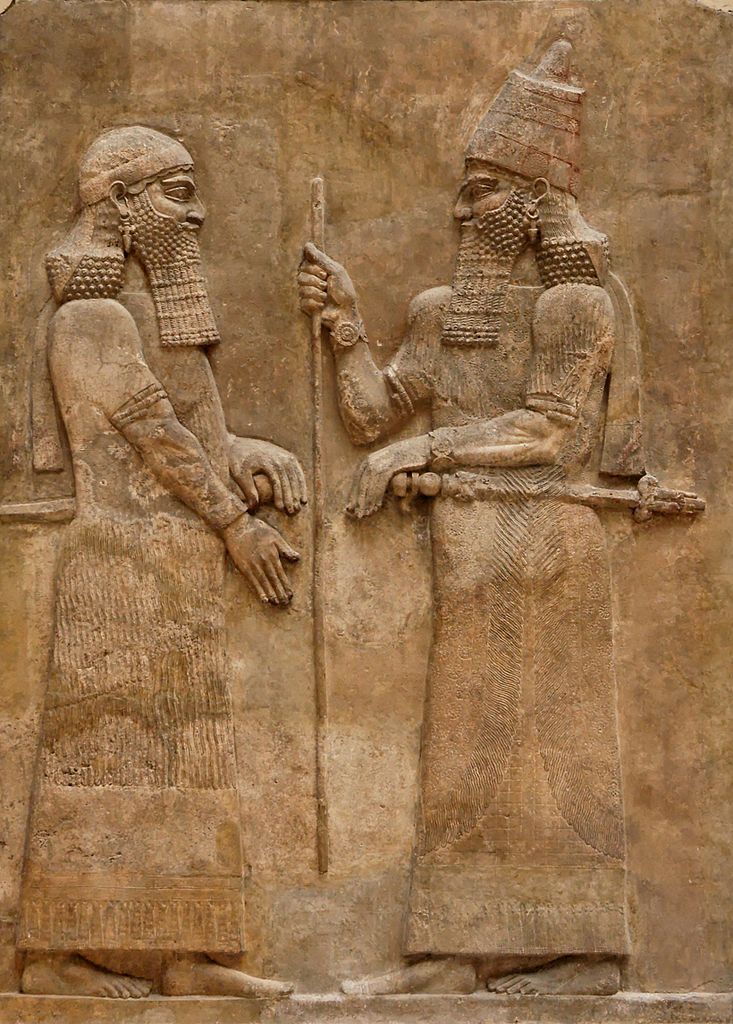
Sargon II and dignitary, said to be his marshal Tartan. Low-relief from the L wall of the palace of Sargon II at Dur Sharrukin in Assyria (now Khorsabad in Iraq), c. 716–713 BC. Fouilles de Paul-Émile Botta en 1843–1844. DimensionsH. 3.30 m (10 ft. 9 ¾ in.), W. 2.30 m (7 ft. 6 ½ in.), D. 33 cm (12 ¾ in.) Current location	 (Inventory) Louvre Museum  Department of Oriental Antiquities, Richelieu wing, ground floor, room 4 Accession number	AO 19873 & AO 19874 Credit line	Excavations of Paul-Émile Botta, 1843–1844 Source/Photographer	Jastrow (2006) http://commons.wikimedia.org/wiki/File:Sargon_II_and_dignitary.jpg

Sargon II and dignitary, said to be his marshal Tartan. Low-relief from the L wall of the palace of Sargon II at Dur Sharrukin in Assyria (now Khorsabad in Iraq), c. 716–713 BC.
Fouilles de Paul-Émile Botta en 1843–1844.
Dimensions H. 3.30 m (10 ft. 9 ¾ in.), W. 2.30 m (7 ft. 6 ½ in.), D. 33 cm (12 ¾ in.)
Current location
(Inventory) Louvre Museum
Department of Oriental Antiquities, Richelieu wing, ground floor, room 4
Accession number AO 19873 & AO 19874
Credit line Excavations of Paul-Émile Botta, 1843–1844
Source/Photographer Jastrow (2006)
http://commons.wikimedia.org/wiki/File:Sargon_II_and_dignitary.jpg

Pul and Ululâ adopted those of the two famous monarchs of the older Assyrian dynasty, Tiglath-Pileser and Shalmaneser, retaining their original designations only in Babylonia, where the names they had adopted were associated with ideas of hostility and invasion; while Sargon, who claimed to be lord of Babylonia as well as of Assyria, identified himself with the past glories of the ancient kingdom by taking the name of Sargon of Accad.

In 1847 archaeologists discovered a prism of Sargon dated to the early 8th century BC reading: "At the beginning of my royal rule, I…the town of the Samarians I besieged, conquered (2 Lines destroyed) [for the god…] who let me achieve this my triumph… I led away as prisoners [27,290 inhabitants of it (and) equipped from among them (soldiers to man)] 50 chariots for my royal corps…. The town I rebuilt better than it was before and settled therein people from countries which I had conquered. I placed an officer of mine as governor over them and imposed upon them tribute as is customary for Assyrian citizens." (Nimrud Prism IV 25-41) https://theosophical.files.wordpress.com/2011/08/sargon-nimrud-cylinder1.jpg

In 1847 archaeologists discovered a prism of Sargon dated to the early 8th century BC reading:
“At the beginning of my royal rule, I…the town of the Samarians I besieged, conquered (2 Lines destroyed) [for the god…] who let me achieve this my triumph… I led away as prisoners [27,290 inhabitants of it (and) equipped from among them (soldiers to man)] 50 chariots for my royal corps…. The town I rebuilt better than it was before and settled therein people from countries which I had conquered. I placed an officer of mine as governor over them and imposed upon them tribute as is customary for Assyrian citizens.” (Nimrud Prism IV 25-41)
https://theosophical.files.wordpress.com/2011/08/sargon-nimrud-cylinder1.jpg

The adoption of these time-honoured names of itself conferred legitimacy upon the new claimants of the throne; along with the name they inherited the title and the claim to veneration of those who had borne them.

It must have been for a similar reason that Esar-haddon’s name, according to Sennacherib, was changed to that of Assur-etil-yukin-abla, “Assur the hero has established the son,” “for affection’s sake,” though the prince preferred to retain his earlier appellation of Esar-haddon or Assur-akh-iddina, “Assur has given the brother,” after his accession to the throne.

We are reminded of the records of the Jews, from which we learn that Jedidiah became the Solomon of later history, and the Pharaoh of Egypt “turned the name” of Eliakim into Jehoiakim.”

A.H. Sayce, Lectures on the Origin and Growth of Religion as Illustrated by the Religion of the Ancient Babylonians, 5th ed., London, 1898, pp. 302-4.

Augury Through the Flights of Birds and the Voice of the Thunder

“The divine storm-bird,” however, who invested himself by stealth with the attributes of Mul-lil, and carried the knowledge of futurity to mankind, served to unite the two species of augury which read the future in the flight of birds and the flash of the lightning.

The first species was but a branch of the general pseudo-science which discovered coming events from the observation of animals and their actions, while the second species was closely allied to the belief that in the thunder men heard the voice of the gods. The old belief marked its impress upon Hebrew as well as upon Assyro-Babylonian thought.

“The voice of thy thunder was in the whirlwind,” says the Psalmist; and nothing can show more clearly what must once have been the Canaanitish faith than the poetic imagery of another Psalm (xxix.):

“The voice of the Lord is upon the waters;

the God of glory thundereth;

the Lord is upon many waters.

The voice of the Lord is powerful;

the voice of the Lord is full of majesty.

The voice of the Lord breaketh the cedars;

yea, the Lord breaketh the cedars of Lebanon. …

The voice of the Lord shaketh the wilderness;

the Lord shaketh the wilderness of Kadesh.

The voice of the Lord maketh the hinds to calve, and discovereth the forests.”

In the Talmud, “the voice of the Lord” has become the bath qôl, or “daughter of the voice,” a supernatural message from heaven which sometimes proceeded from the Holy of Holies, sometimes, like the δαιμονιον of Socrates, assumed the form of an intuition directing the recipient as to his course in life.

This prophetic voice of heaven was heard in the thunder by the Accadians as well as by the Semites. I have already noticed that the Accadians believed the sounds of nature to be divine voices, from which the initiated could derive a knowledge of the future.

At Eridu it was more especially the roar of the sea in which the Sumerian priest listened to the revelations of his deities, and this perhaps was the oracle through which Oannes had spoken to men. In the rival city of northern Babylonia, where the supreme god presided over the realm of the dead, and not over the waters of the sea, the divine voice came to men in the thunder.

By the side of Mul-lil, the lord of the ghost-world, stood Mul-me-sarra (Wül-mö-sára), “the lord of the voice of the firmament.” Mul-me-sarra, in fact, was but Mul-lil himself in another form, and hence, as lord of Hades, was the author, not only of the thunder, but of subterranean noises as well.”

A.H. Sayce, Lectures on the Origin and Growth of Religion as Illustrated by the Religion of the Ancient Babylonians, 5th ed., London, 1898, 299-300.

The Gods Fear Zu

“A long but broken text explains why it was that he had to take refuge in the mountain of ‘Sabu under the guise of a bird of prey.

We learn that Zu gazed upon the work and duties of Mul-lil;

“he sees the crown of his majesty, the clothing of his divinity, the tablets of destiny, and Zu himself, and he sees also the father of the gods, the bond of heaven and earth.

The desire to be Bel (Mul-lil) is taken in his heart; yea, he sees the father of the gods, the bond of heaven and earth; the desire to be Bel is taken in his heart:

‘Let me seize the tablets of destiny of the gods, and the laws of all the gods let me establish (lukhmum); let my throne be set up, let me seize the oracles; let me urge on the whole of all of them, even the spirits of heaven.’

So his heart devised opposition; at the entrance to the forest where he was gazing he waited with his head (intent) during the day.

When Bel pours out the pure waters, his crown was placed on the throne, stripped from (his head). The tablets of destiny (Zu) seized with his hand; the attributes of Bel he took; he delivered the oracles.

(Then) Zu fled away and sought his mountains. He raised a tempest, making (a storm).”

Then Mul-lil, “the father and councillor” of the gods, consulted his brother divinities, going round to each in turn. Anu was the first to speak. He

“opened his mouth, he speaks, he says to the gods his sons: ‘(Whoever will,) let him subjugate Zu, and (among all) men let the destroyer pursue him (?).

(To Rimmon) the first-born, the strong, Anu declares (his) command, even to him: …’0 Rimmon, protector (?), may thy power of fighting never fail! (Slay) Zu with thy weapon. (May thy name) be magnified in the assembly of the great gods. (Among) the gods thy brethren (may it destroy) the rival. May incense (?) (etarsi) be offered, and may shrines be built!

(In) the four (zones) may they establish thy strongholds. May they magnify thy fortress that it become a fane of power in the presence of the gods, and may thy name be mighty?’

(Rimmon) answered the command, (to Anu) his father he utters the word:

‘(0 my father, to a mountain) none has seen mayest thou assign (him); (never may) Zu play the thief (again) among the gods thy sons; (the tablets of destiny) his hand has taken; (the attributes of Bel) he seized, he delivered the oracles; (Zu) has fled away and has sought his mountains.'”

Rimmon goes on to decline the task, which is accordingly laid upon another god, but with like result.

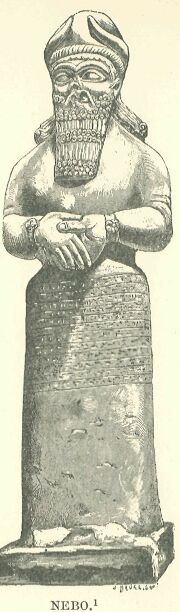
George Rawlinson - Source: Seven Great Monarchies Of The Ancient Eastern World, Vol 1. (1875) The Chaldean god Nebo, from a statue in the British Museum.  http://www.totallyfreeimages.com/56/Nebo.

George Rawlinson: Seven Great Monarchies Of The Ancient Eastern World, Vol 1. (1875)
The Chaldean god Nebo, from a statue in the British Museum.
http://www.totallyfreeimages.com/56/Nebo.

Then Anu turns to Nebo:

“(To Nebo), the strong one, the eldest son of Istar, (Anu declares his will) and addresses him:  … ‘0 Nebo, protector (?), never may thy power of fighting fail! (Slay) Zu with thy weapon. May (thy name) be magnified in the assembly of the great gods! Among the gods thy brethren (may it destroy) the rival!

May incense (?) be offered and may shrines be built! In the four zones may thy strongholds be established! May they magnify thy stronghold that it become a fane of power in the presence of the gods, and may thy name be mighty!’

Nebo answered the command: ‘0 my father, to a mountain none hast seen mayest thou assign (him); never may Zu play the thief (again) among the gods thy sons! The tablets of destiny his hand has taken; the attributes of Bel he has seized; he has delivered the oracles; Zu is fled away and (has sought) his mountains.'”

Like Rimmon, Nebo also refused to hunt down and slay his brother god, the consequence being, as we have seen, that Zu escaped with his life, but was changed into a bird, and had to live an exile from heaven for the rest of time.”

A.H. Sayce, Lectures on the Origin and Growth of Religion as Illustrated by the Religion of the Ancient Babylonians, 5th ed., London, 1898, pp. 297-9.

Tales of the Storm God Zu

“The scribes of Assur-bani-pal have preserved for us the mutilated copy of a bilingual poem, or part of a poem, which recounted the flight of Zu to the mountain of ‘Sabu or Kis. It begins thus:

Lugal-tudda (fled) to the mountain a place remote

In the hill of ‘Sabu he (dwelt).

No mother inhabits it and (cares for him).

No father inhabits it and (associates) with him.

No priest who knows him (assists him).

He who (changed) not the resolution, even the resolution of his heart,

in his own heart (he kept) his resolution.

Into the likeneas of a bird was he transformed,

into the likeness of Zu the divine storm-bird was he transformed,

His wife uplifts the neck.

The wife of Zu, the son of Zu, may he cause them to dwell in a cage,

even the god of the river-reeds (Enna) and the goddess the lady of the basket of river-reeds (Gu-enna).

From his mountain he brought (her),

as a woman fashioned for a mother made beautiful,

the goddess of plants, as a woman fashioned for a mother made beautiful.

Her paps were of white crystal;

her thighs were bathed in silver and gold.

[Here follow many mutiliated lines]

On (his) head he placed a circlet;

….on his head he set a coronal

(when) he came from the nest of the god Zu.

(In a place) unknown in the mountain he made his tomb.”

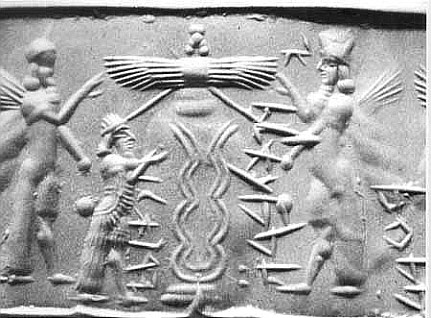
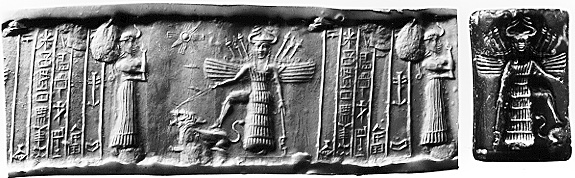
From left, Storm God Ninurta, with bows and arrows.  Ishtar, queen of heaven and earth is elevated with wings and spears and maces on her shoulders.  The tree of life sprouts to her right, our left.  The Sun God Shamash rises from the mountain Kur in the center, with rays of light on his shoulder.  The God of Water and Wisdom, Enki/Ea battles the bird-god Imdugud/Anzu, with depictions of the Tigris and Euphrates rivers and fish coursing from his shoulders.  At far right is the deified vizier Usmu, the two-faced. All gods wear conical hats with four pairs of horns.  At far left is the word Adda in Accadian cuneiform, "Scribe."  Accordingly this cylinder seal is known as the Seal of Adda, Akkadian period, 2350-2100 BCE. British Library.  [No. 89,115.] http://www.ancientworlds.net/aw/Article/787375

From left, Storm God Ninurta, with bows and arrows.
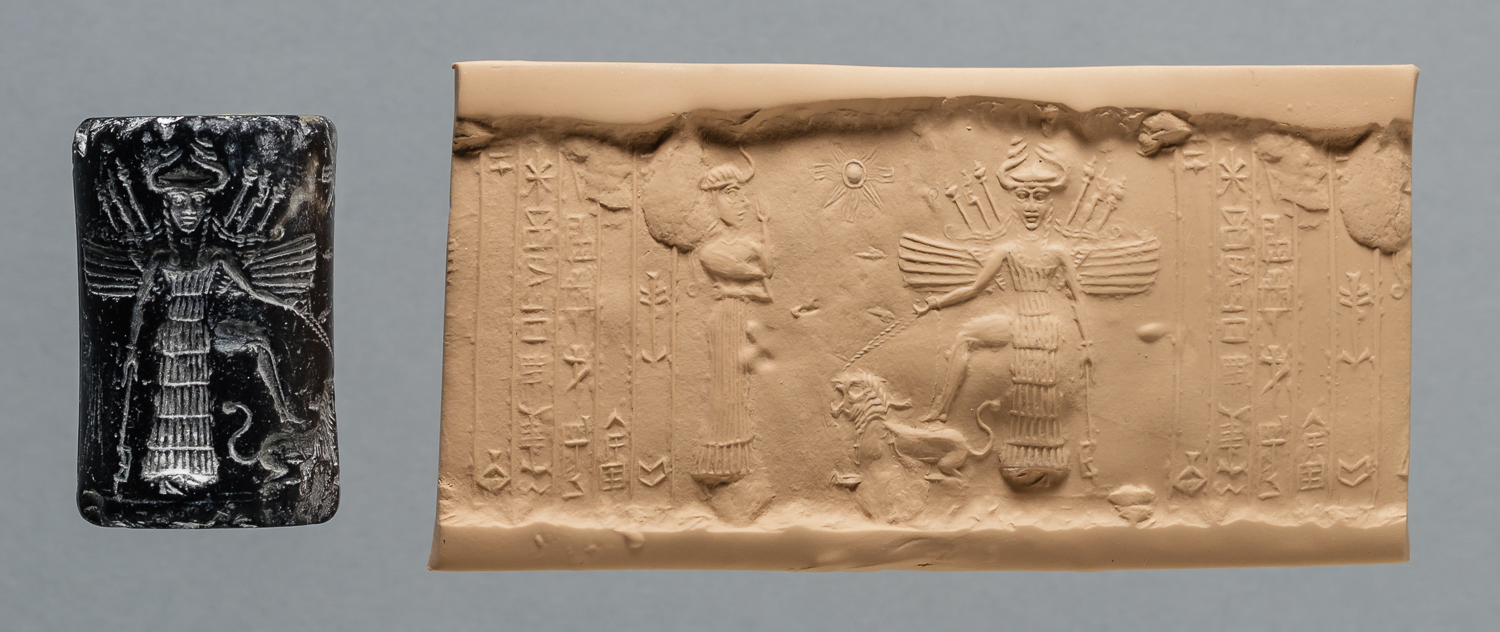
Ishtar, queen of heaven and earth is elevated with wings and spears and maces on her shoulders.
The tree of life sprouts to her right, our left.
The Sun God Shamash rises from the mountain Kur in the center, with rays of light on his shoulder.
The God of Water and Wisdom, Enki/Ea battles the bird-god Imdugud/Anzu, with depictions of the Tigris and Euphrates rivers and fish coursing from his shoulders.
At far right is the deified vizier Usmu, the two-faced. All gods wear conical hats with four pairs of horns.
At far left is the word Adda in Accadian cuneiform, “Scribe.”
Accordingly this cylinder seal is known as the Seal of Adda, Akkadian period, 2350-2100 BCE. British Library. [No. 89,115.]
http://www.ancientworlds.net/aw/Article/787375

It will be seen that the identity of the god Zu with a bird is explained in accordance with the ideas of a modern time. It has become a transformation voluntarily undergone by the deity, for the sake, as it would seem, of securing a beautiful bride.

The old faith of totemism is thus changing into a fairy-tale. But there were other stories which remembered that the transformation of the god was not the voluntary act it is here represented to have been.”

A.H. Sayce, Lectures on the Origin and Growth of Religion as Illustrated by the Religion of the Ancient Babylonians, 5th ed., London, 1898, pp. 295-7.

The Knowledge of Fire and Prognostication Were Stolen From the Gods

“It was thus that “the divine storm-bird” of the ancient Accadian faith passed into the god Zu of the Semitic epoch.

“The divine storm-bird” was a ravenous bird of prey, of large size and sharp beak, who darted on its spoil and devoured the flesh. The Semitic Babylonians identified it with their Zu, partly because zu signified a “stormy wind,” partly because a species of vulture was called by the same name.

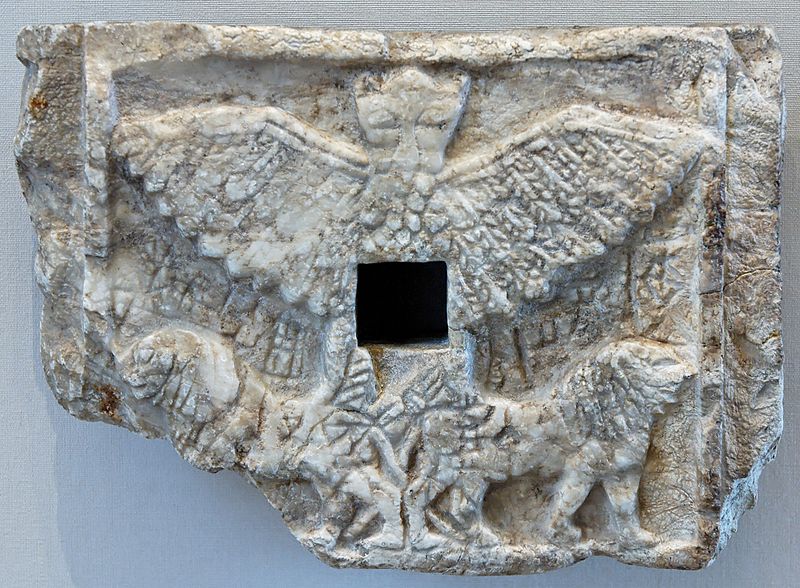
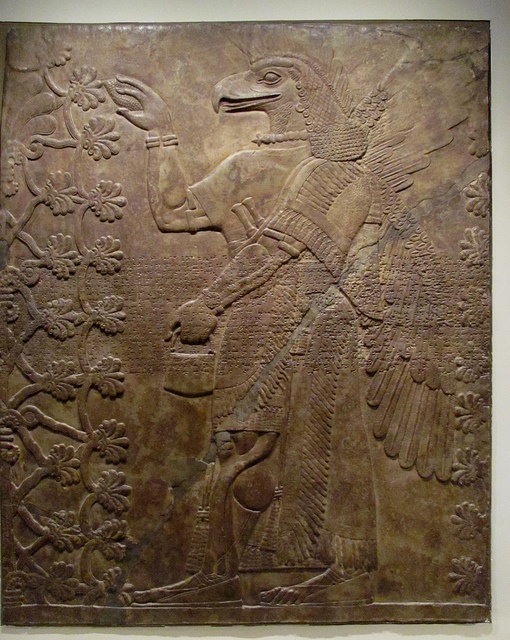
The Zu Bird dominates the top of this bas relief, while the head of the figure on the right is missing, common vandalism committed by grave robbers: defacing the heads and the eyes of idols crippled their efficacy.

The Zu Bird dominates the top of this bas relief, while the head of the figure on the right is missing, common vandalism committed by grave robbers: defacing the heads and the eyes of idols crippled their efficacy.

But the conception of the tempest as a bird which rushes on its prey is common to many mythologies. In Aryan mythology the storm-cloud appears under the varying forms of the eagle, the woodpecker, and the robin redbreast, the sacred bird of Thor; while in Chinese folk-lore the storm-bird is “a bird which in flying obscures the sun and of whose quills are made water-tuns.”

The roc of the Arabian Nights, with its wings ten thousand fathoms in width, and its egg which it was a sin in Aladdin to wish to take from the place where it hung, is but an echo of the Chinese storm-bird. It is in the nest of the storm-bird that the tempest is brewed; it swoops upon the earth with the rush of his wings, and the lightning itself is but the gleam of his flight.

Even a poet of to-day instinctively speaks of the curlews as “dreary gleams about the moorland flying over Locksley Hall.”

“The divine storm-bird” was known as Lugal-banda, “the lusty king,” and was the patron deity of the city of Marad, near Sippara. He brought the lightning, the fire of heaven, from the gods to men, giving them at once the knowledge of fire and the power of reading the future in the flashes of the storm.

Zu or Anzu (from An 'heaven' and Zu 'to know' in Sumerian language), as a lion-headed eagle, ca. 2550–2500 BCE, Louvre.  Votive relief of Ur-Nanshe, king of Lagash, representing the bird-god Anzu (or Im-dugud) as a lion-headed eagle.  Alabaster, Early Dynastic III (2550–2500 BCE). Found in Telloh, ancient city of Girsu.  H. 21.6 cm (8 ½ in.), W. 15.1 cm (5 ¾ in.), D. 3.5 cm (1 ¼ in.)  http://bharatkalyan97.blogspot.com/2013/07/legend-of-anzu-which-stole-tablets-of.html

Zu or Anzu (from An ‘heaven’ and Zu ‘to know’ in Sumerian language), as a lion-headed eagle, ca. 2550–2500 BCE, Louvre.
Votive relief of Ur-Nanshe, king of Lagash, representing the bird-god Anzu (or Im-dugud) as a lion-headed eagle.
Alabaster, Early Dynastic III (2550–2500 BCE). Found in Telloh, ancient city of Girsu.
H. 21.6 cm (8 ½ in.), W. 15.1 cm (5 ¾ in.), D. 3.5 cm (1 ¼ in.)
http://bharatkalyan97.blogspot.com/2013/07/legend-of-anzu-which-stole-tablets-of.html

Like Prometheus, therefore, he was an outcast from the gods. He had stolen their treasures and secret wisdom, and had communicated them to mankind. In Babylonia, as in Greece, the divine benefactor of primitive humanity was doomed to suffer.

The knowledge and the artificial warmth man has gained are not the free gifts of the gods; they have been wrenched from them by guile; and though man has been allowed to retain them, his divine friend and benefactor is condemned to punishment.

The culture-god of totemistic Marad is thus a very different being from the culture-god of Eridu; both, indeed, are clad in animal form; but whereas the fish-god of Eridu is the willing and unhindered communicator of civilisation, whose successor, Merodach, becomes a god of light and healing, the bird-god of Marad is a pariah among his divine brethren, hunted out of heaven by the great gods, and wresting from them by craft man’s future knowledge of good and evil.

It was only in the later syncretic age, when these uglier facts of the earlier mythology were glossed over or forgotten, that the divine “bull” was described as “the offspring of the god Zu” (H.C. Rawlinson, The Cuneiform Inscriptions of Western Asia, 1886, iv. 123, 19).”

A.H. Sayce, Lectures on the Origin and Growth of Religion as Illustrated by the Religion of the Ancient Babylonians, 5th ed., London, 1898, pp. 293-5.

Sargon and the Observations of Bel

“We know that Sargon’s patronage of science produced the great standard Babylonian work on astronomy and astrology, in seventy-two books, which went under the name of the Observations of Bel. It was translated into Greek by the Chaldean historian Bêrôssos, and large portions of it, including a table of contents, are among the tablets found on the site of the library of Kouyunjik.

This illustration is from a page on Babylonian astronomy hosted by the science faculty of the Mathematical Institute of Utrecht University.  http://www.staff.science.uu.nl/~gent0113/babylon/babybibl_fixedstars.htm A dedicated work assessing the influences of Chaldean astrology on later Greek and Roman knowledge can be found in Franz Cumont, Astrology and Religion Among the Greeks and Romans, 1912.  Full text available for download at several locations on the net, including: http://theosnet.net/dzyan/miscpubs/Astrology_and_Religion.pdf

This illustration is from a page on Babylonian astronomy hosted by the science faculty of the Mathematical Institute of Utrecht University.
http://www.staff.science.uu.nl/~gent0113/babylon/babybibl_fixedstars.htm
A dedicated work assessing the influences of Chaldean astrology on later Greek and Roman knowledge can be found in Franz Cumont, Astrology and Religion Among the Greeks and Romans, 1912.
Full text available for download at several locations on the net, including:
http://theosnet.net/dzyan/miscpubs/Astrology_and_Religion.pdf

In the course of centuries it had undergone a large amount of interpolation and addition; marginal glosses had crept into the text, and new paragraphs had been inserted recording the observations that had been made by the astronomers and astrologers of Babylonia during the whole length of the historical period.

In the form, therefore, in which it was edited for the library of Nineveh, it was very different from the original work that had been composed by the orders of Sargon. Old and new matter had been mixed up in it, and the enlargements introduced into it had probably nearly doubled its original size.

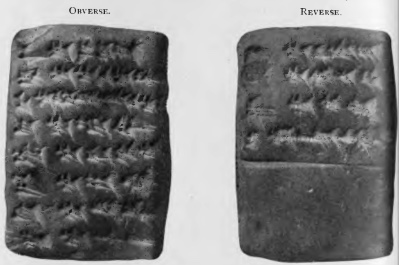
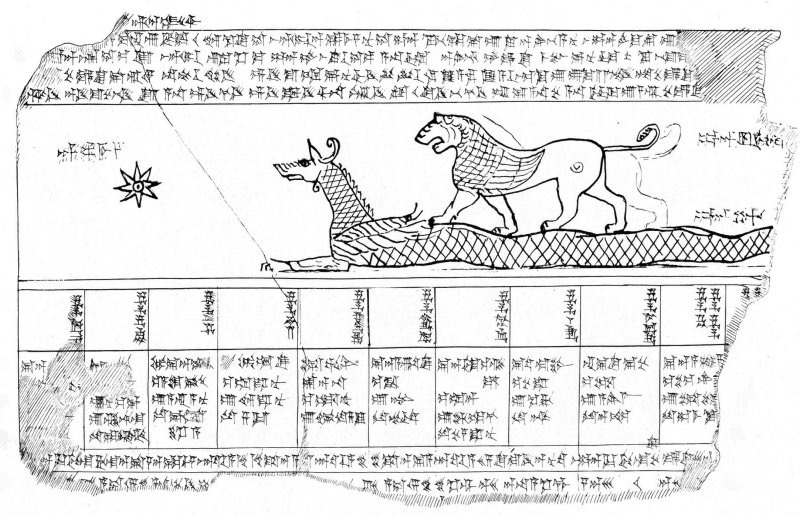
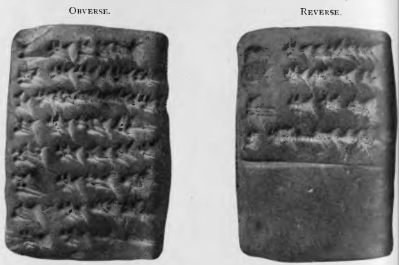
In the Fifth Tablet of the Creation Series (l. 2) the Signs of the Zodiac are called Lumashi 12  , but unfortunately no list of their names is given in the context. Now these are supplied by the little tablet (No. 77,821) of the Persian Period of which a reproduction is here given. It has been referred to and discussed by various scholars, and its importance is very great.  The transcript of the text, which is now published (see p. 68) for the first time, will be acceptable to the students of the history of the Zodiac. Egyptian, Greek, Syriac and Arabic astrological and astronomical texts all associate with the Signs of the Zodiac twelve groups, each containing three stars, which are commonly known as the "Thirty-six Dekans."   The text of line 4 of the Fifth Tablet of the Creation Series proves that the Babylonians were acquainted with these groups of stars, for we read that Marduk "set up for the twelve "months of the year three stars apiece." In the List of Signs of the Zodiac here given, it will be seen that each Sign is associated with a particular month. http://www.sacred-texts.com/ane/blc/blc07.htm http://www.sacred-texts.com/ane/blc/img/015.png

In the Fifth Tablet of the Creation Series (l. 2) the Signs of the Zodiac are called Lumashi 12 , but unfortunately no list of their names is given in the context. Now these are supplied by the little tablet (No. 77,821) of the Persian Period of which a reproduction is here given. It has been referred to and discussed by various scholars, and its importance is very great.
The transcript of the text, which is now published (see p. 68) for the first time, will be acceptable to the students of the history of the Zodiac. Egyptian, Greek, Syriac and Arabic astrological and astronomical texts all associate with the Signs of the Zodiac twelve groups, each containing three stars, which are commonly known as the “Thirty-six Dekans.”
The text of line 4 of the Fifth Tablet of the Creation Series proves that the Babylonians were acquainted with these groups of stars, for we read that Marduk “set up for the twelve “months of the year three stars apiece.” In the List of Signs of the Zodiac here given, it will be seen that each Sign is associated with a particular month.
http://www.sacred-texts.com/ane/blc/blc07.htm
http://www.sacred-texts.com/ane/blc/img/015.png

But the original work was itself a compilation of records and observations that had been made during an untold number of previous years. These records and observations had for the most part been written in Accadian; the result being that, although the astronomy of the Chaldeans, as we know it, is purely Semitic in form and character, many of its technical terms are non-Semitic, as well as the names of the celestial bodies.

Hence it is that we find a remarkable inconsistency between certain facts reported by the astronomical tablets and the astronomical system which they set before us. This astronomical system is based upon the assumption that the sun enters the first point of the constellation Aries at the time of the vernal equinox.

http://doormann.tripod.com/asssky.htm Assyrian star map from Nineveh (K 8538). Counterclockwise from bottom: Sirius (Arrow), Pegasus + Andromeda (Field + Plough), [Aries], the Pleiades, Gemini, Hydra + Corvus + Virgo, Libra. Drawing by L.W.King with corrections by J.Koch. Neue Untersuchungen zur Topographie des Babilonischen Fixsternhimmels (Wiesbaden 1989), p. 56ff.

http://doormann.tripod.com/asssky.htm
Assyrian star map from Nineveh (K 8538). Counterclockwise from bottom: Sirius (Arrow), Pegasus + Andromeda (Field + Plough), [Aries], the Pleiades, Gemini, Hydra + Corvus + Virgo, Libra. Drawing by L.W.King with corrections by J.Koch. Neue Untersuchungen zur Topographie des Babilonischen Fixsternhimmels (Wiesbaden 1989), p. 56ff.

The system must therefore have come into existence later than the 26th century before the Christian era, when Aries first became the starting-point of the Zodiacal signs. But the signs themselves were named, and the path of the sun through them was mapped out, when the vernal equinox still coincided with the sun’s entrance, not into Aries, but into Taurus.

The whole pre-Semitic nomenclature of the Zodiacal signs, and the months of the year that correspond to them, rests on the supposition that the Zodiacal bull ushers in the vernal year. Its Accadian name was “the directing Bull,” the bull that directs the course of the year; and the sign which faced it, the Scorpion of a later age, was correspondingly termed the star “that is opposite to the foundation” of the year.

We can now understand why the Sun-god Merodach, whom even the astronomers of the historical period continued to identify with the typical constellations of the twelve months of the year, should have been entitled “the Bull of Light” in the primitive astronomical records.

He was, in fact, the celestial bull who ploughed the great furrow of the sky, and from whom the first sign of the Zodiac borrowed its name. We may see in him the prototype of that famous bull of later legend whom Anu created in order to avenge upon Gisdhubar the slight offered by the latter to Istar.

The Sun-god eventually became the monster slain by a solar hero. Such are the results of time working upon the half-forgotten beliefs and tales of an earlier age.

Whiie in some instances the old totemistic conceptions were evaded by the degeneration of a god into a mere animal, in others the reverse process took place, the bestial element being eliminated from the nature of the god.”

A.H. Sayce, Lectures on the Origin and Growth of Religion as Illustrated by the Religion of the Ancient Babylonians, 5th ed., London, 1898, pp. 291-3.

More Totemism

“We can learn a good deal about this totemism from the old ideographic representations of the names of the chief deities. They are like fossils, embodying the beliefs of a period which had long passed away at the date of the earliest monuments that have come down to us.

The name of Ea himself affords us an example of what we may find. It is sometimes expressed by an ideograph which signifies literally “an antelope” (dara in Accadian, turakhu in Assyrian, whence perhaps the Biblical name of Terah).

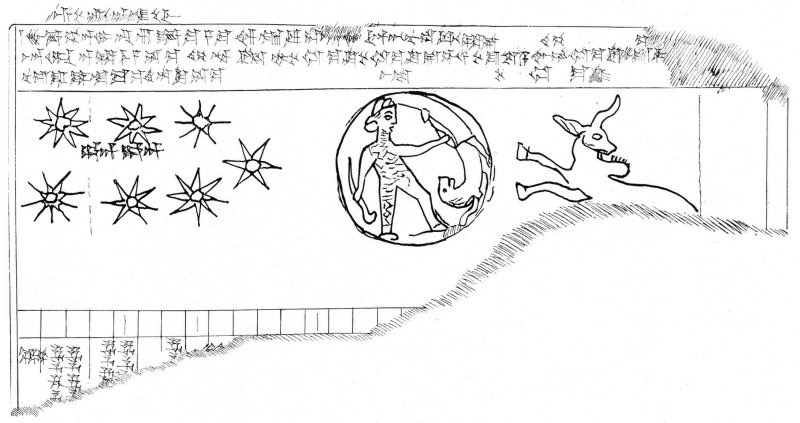
Ishtar is depicted at far left, wearing the horned headdress of divinity, with weapons on her back and a long knife in her hand.  A worshipper presents a sacrificial animal, next to an uncertain goddess depicted with water flowing from her vase.  Ea appears with a fishtail hanging behind him, and an antelope bucking beside him.  I am not certain which goddess appears at far right.

Ishtar is depicted at far left, wearing the horned headdress of divinity, with weapons on her back and a long knife in her hand.
A worshipper presents a sacrificial animal, next to an uncertain goddess depicted with water flowing from her vase.
Ea appears with a fishtail hanging behind him, and an antelope bucking beside him.
I am not certain which goddess appears at far right.

Thus we are told that Ea was called ”the antelope of the deep,” “the antelope the creator,” “the antelope the prince,” “the lusty antelope;” and the “ship” or ark of Ea in which his image was carried at festivals was entitled “the ship of the divine antelope of the deep.”

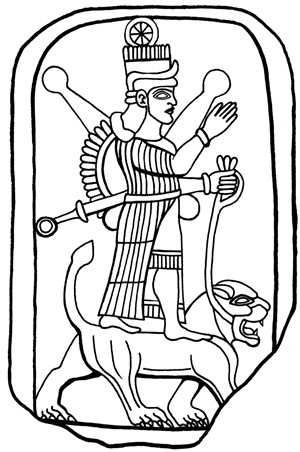
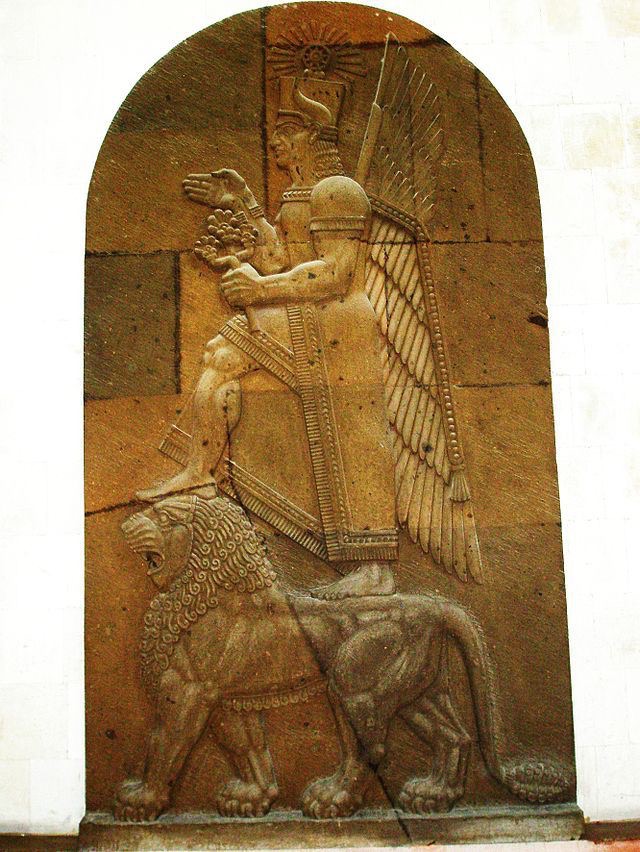
Ishtar receives the worship of an Amazon. Ishtar stands on a lion, holding a bow with arrows at her back. Her eight-pointed star is atop her head.  Lusty antelopes rear on the right side, perhaps signifying the god Ea.

Ishtar receives the worship of an Amazon. Ishtar stands on a lion, holding a bow with arrows at her back. Her eight-pointed star is atop her head.
Lusty antelopes rear on the right side, perhaps signifying the god Ea.

We should, indeed, have expected that the animal of Ea would have been the fish rather than the antelope, and the fact that it is not so points to the conclusion that the culture-god of southern Babylonia was an amalgamation of two earlier deities, one the divine antelope, and the other the divine fish.

Perhaps it was originally as the god of the river that Ea had been adored under the form of the wild beast of the Eden or desert.

There was yet another animal with which the name of Ea had been associated. This was the serpent. The Euphrates in its southern course bore names in the early inscriptions which distinctly connect the serpent with Ea on the one hand, and the goddess Innina on the other.

It was not only called “the river of the great deep”– a term which implied that it was a prolongation of the Persian Gulf and the encircling ocean; it was further named the river of the śubar lilli, “the shepherd’s hut of the lillu” or “spirit,””the river of Innína,” “the river of the snake,” and “the river of the girdle of the great god.”

In-nina is but another form of Innána or Nâna, and we may see in her at once the Istar of Eridu and the female correlative of Anúna. Among the chief deities reverenced by the rulers of Tel-loh was one whose name is expressed by the ideographs of “fish” and “enclosure,” which served in later days to denote the name of Ninâ or Nineveh.

It seems clear, therefore, that the pronunciation of Nina was attached to it; and Dr. Oppert may accordingly be right in thus reading the name of the goddess as she appears on the monuments of Tel-loh.

Nina, consequently, is both the fish-goddess and the divinity whose name is interchanged with that of the snake. Now Nina was the daughter of Ea, her eldest daughter being described in a text of Tel-loh as “the lady of the city of Mar,” the modern Tel Id, according to Hommel, where Dungi built her a temple which he called “the house of the jewelled circlet” (sutartu).

This latter epithet recalls to us the Tillili of the Tammuz legend as well as the Istar of later Babylonia. In fact, it is pretty clear that Nina, “the lady,” must have been that primitive Istar of Eridu and its neighborhood who mourned like Tillili the death of Tammuz, and whose title was but a dialectic variation of that of Nana given to her at Erech.”

A.H. Sayce, Lectures on the Origin and Growth of Religion as Illustrated by the Religion of the Ancient Babylonians, 5th ed., London, 1898, pp. 280-2.

Totemic Depictions of the Gods

“It is only the demons and inferior spirits, or mythical personages like Ea-bani, the friend of Gisdhubar, who are portrayed as animals, or as composite figures partly human and partly bestial. Ea alone, in his character of “god of life,” is given the fish’s skin, and even then the skin is but thrown over his back like a priestly cloak.

A depiction of the God Ea, or Oannes.

A depiction of the God Ea, or Oannes.

The composite monsters, whose forms Bêrôssos saw painted on the walls of the temple of Bêlos, were the brood of chaos, not of the present order of the world. The legend of the creation preserved by the priests of Cutha declares that the creatures, half men and half birds, which were depicted in sacred art, were suckled by Tiamat, the dragon-like personification of anarchy and chaos. Their disappearance marked the victory of light over darkness, of the gods of heaven over the Titanic monsters of an extinct age.

The deities of Babylonia were emphatically human; human in character and human in form. They stood in marked contrast to the animal-headed gods of Egypt, and harmonised with the Semitic belief that made the deity the father of the human race, who had created man in his own image.

Even in pre-Semitic days, Chaldean art had already followed the same line of thought, and had depicted its divinities in the likeness of men; but in pre-Semitic days this was a tendency only; it was not until the Accadian came in contact with the Semite that he felt the full force of the Semitic conception, and allowed his ancient deities of light and life to take permanently upon them the human shape.

For there are many indications that it had not always been so. The very fact that the divine beings who in the Semitic era were relegated to the realms of chaos or the inferior world of subordinate spirits, were to the last represented as partly bestial in form, proves pretty clearly that the Babylonians had once seen nothing derogatory to the divine nature in such a mode of representation.

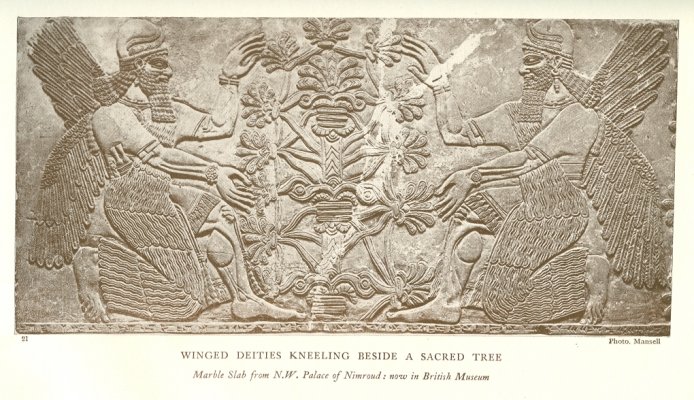
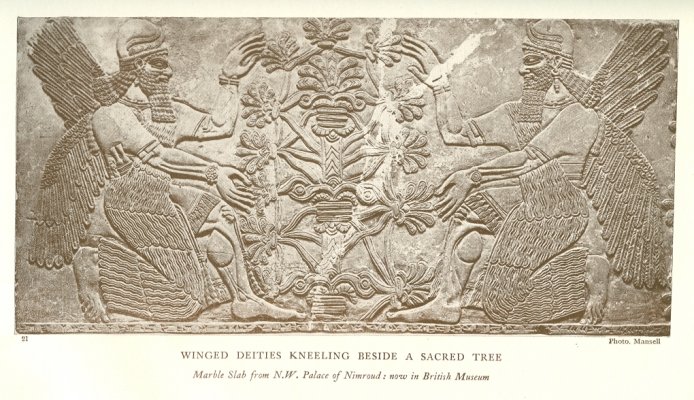
The winged bulls who guarded the approach to the temple and protected it from the invasion of evil spirits, or the eagle-headed cherubs who knelt on either side of the sacred tree, were survivals of a time when “the great gods of heaven and earth” were themselves imaged and adored in similar form.

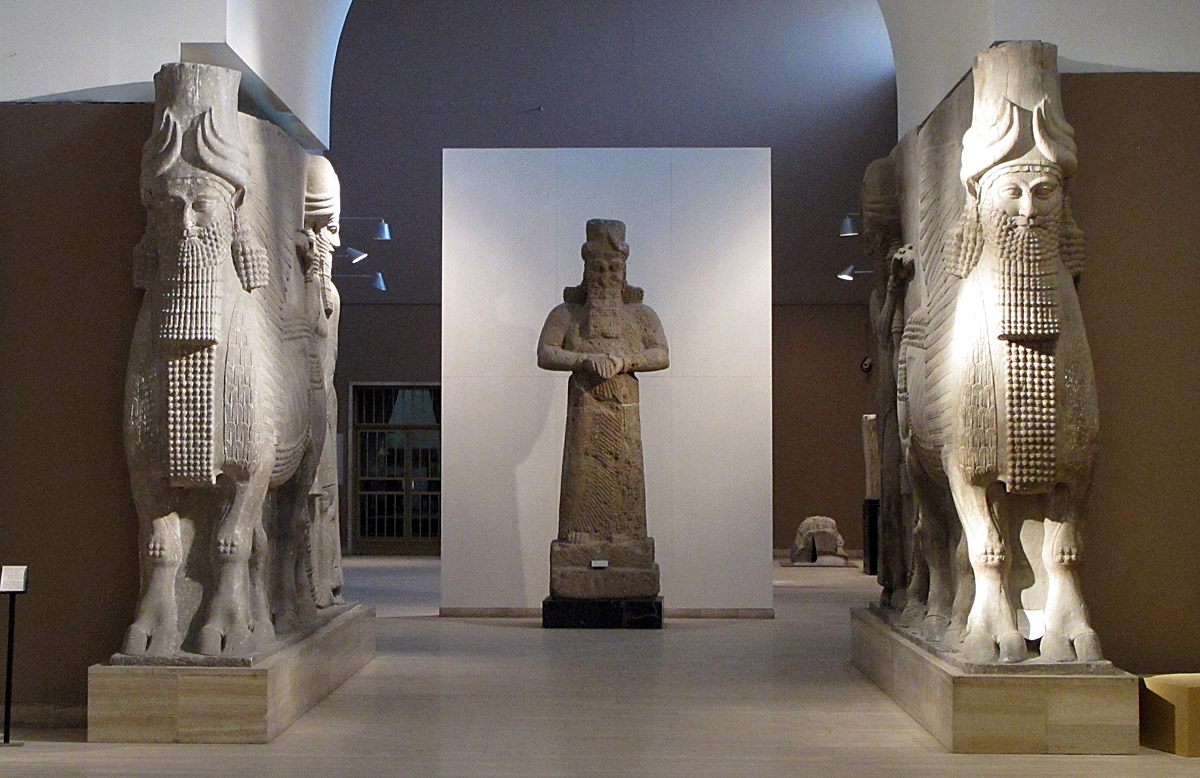
Winged bulls with human faces guard the approach to the god Nebo.

Winged bulls with human faces guard the approach to the god Nebo.

The same evidence is borne by the animals on whose backs the anthropomorphic deities are depicted as standing in later art. When the gods had become human, there was no other place left for the animals with whom they had once been so intimately connected.

The evidence, however, is not borne by art alone. The written texts aver that the gods were symbolised by animals, like the Sun-god of Kis, whose “image” or symbol was the eagle. It is these symbols which appear on the Babylonian boundary-stones, where in the infancy of Assyrian research they were supposed to represent the Zodiacal signs.

A boundary stone. The eight-pointed star of Ishtar appears at top left, the crescent moon of the Moon God Sin is at top center, and the symbol of the Sun God Shamas appears at top right.

A boundary stone. The eight-pointed star of Ishtar appears at top left, the crescent moon of the Moon God Sin is at top center, and the symbol of the Sun God Shamas appears at top right.

That they were originally something more than mere symbols is expressly indicated in the myths about the goddess of love. Gisdhubar taunts her with her treatment, not only of Alála, the eagle, but also of the horse and the lion, whose names are not given to us.

Here, at any rate, popular tradition has preserved a recollection of the time when the gods of Babylonia were still regarded as eagles and horses and lions. We are taken back to an epoch of totemism, when the tribes and cities of Chaldea had each its totem, or sacred animal, to whom it offered divine worship, and who eventually became its creator-god.

Not less clear is the legend of the first introduction of culture into the valley of the Euphrates. Oannes, or Ea, it was ever remembered, had the body of a fish, and, like a fish, he sank each night into the waters  of the Persian Gulf when the day was closed which he had spent among his favoured disciples of Eridu.

The culture-god himself had once been a totem, from which we may infer how long it was before totemism disappeared, at all events from southern Babylonia, where the contact with Semitic thought was less strong and abiding than was the case further north.”

A.H. Sayce, Lectures on the Origin and Growth of Religion as Illustrated by the Religion of the Ancient Babylonians, 5th ed., London, 1898, pp. 277-80.

Semiramis, Queen of Assyria

“But Istar was not merely the goddess of love. By the side of the amorous goddess there was also a warlike one. The Syrian goddess who migrated westward was a warrior as well as a bride. Among the Hittites and their disciples in Asia Minor, she was served not only by Galli, but by Amazons–warrior priestesses–as well.

Ishtar receives the worship of an Amazon. Ishtar stands on a lion, holding a bow with arrows at her back. Her eight-pointed star is atop her head.

Ishtar receives the worship of an Amazon. Ishtar stands on a lion, holding a bow with arrows at her back. Her eight-pointed star is atop her head.

The Artemis of Ephesos, her lineal descendant, was separated by a wide gulf from the Aphroditê of Cyprus. Both Artemis and Aphroditê were alike the offspring of the same Babylonian deity, but in making their way to Greece they had become separated and diverse. The goddess of the Hittites and of Asia Minor preserved mainly her fiercer side; the goddess of Phoenician Cyprus her gentler side. Both sides, however, had once been united in the Istar of Chaldea.

The Greek myths which recounted the story of Semiramis recorded the fact. For Semiramis is but Istar in another guise. As Istar was called “queen” by the Assyrians, so is Semiramis the queen of Assyria; as Semiramis deserts Menôn for Ninos or Nineveh, so did Istar desert her old haunts for her later temple at Nineveh.

The dove into which Semiramis was changed was the bird sacred to Istar. Her passion for her son Ninyas, “the Ninevite,” whom another version of the myth names Zames or Samas, is an echo of the passion of Istar, the Dav-kina of Eridu, for Tammuz the Sun-god. The warrior-queen of Assyria, in fact, was the great Babylonian goddess in her martial character.

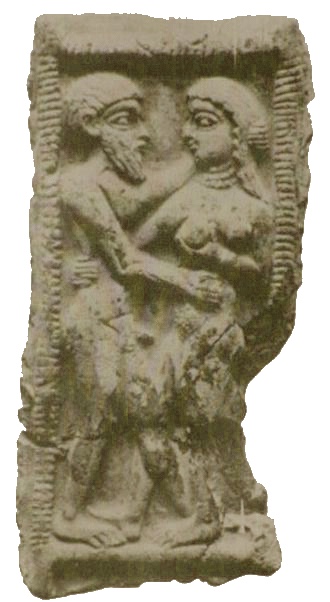
Tammuz and Ishtar.

Tammuz and Ishtar.

While the gentler-mannered Babylonians preferred to dwell upon the softer side of Istar, the Assyrians, as was natural in the case of a military nation, saw in her mainly the goddess of war and battle. Like Babylonia, with its two centres of her worship at Erech and Accad, Assyria also had its two great sanctuaries of Istar at Nineveh and Arbela.

That she should have had no famous temple in Assur, the old capital of the kingdom, shows clearly the comparatively late development of her cult. Doubtless the earliest inhabitants of the Assyrian cities had brought with them the name and worship of Istar, but it could only have been long afterwards that it attained its final celebrity. Indeed, we can trace its progress through the historical inscriptions until it culminates in the reign of Assur-bani-pal.

There was a particular cause for this gradual development which was connected with the warlike attributes of the Assyrian Istar. The Assyrians were an essentially Semitic people. Their supreme goddess accordingly was that vague and colourless Bilit ili, “the mistress of the gods,” who sat as a queenly shadow by the side of Bel.

They had none of those associations with the older Accadian goddesses, with their specific names and functions, which the natives of the Babylonian cities possessed; apart from Istar, the evening star, there was no goddess among them who could claim a more independent position than that of a Bilit ili. Assur himself had no special consort, like Zarpanit at Babylon or even  at Accad.

Except Istar, therefore, the Assyrian pantheon was destitute of a goddess who could assert her equality with the gods.”

A.H. Sayce, Lectures on the Origin and Growth of Religion as Illustrated by the Religion of the Ancient Babylonians, 5th ed., London, 1898, pp. 270-2.

An Accadian Hymn to Ishtar

“The light of heaven, who blazeth like the fire, art thou,

0 goddess (istaritum), when thou fixest thy dwelling-place in the earth;

thou who art strong as the earth!

Ishtar, in a characteristic posture atop a lion, her animal. The goddess has weaponry on her back, and handles her lion with a leash. Her eight-pointed star is on her head.

Ishtar, in a characteristic posture atop a lion, her animal. The goddess has weaponry on her back, and handles her lion with a leash. Her eight-pointed star is on her head.

Thee, the path of justice approaches thee

when thou enterest into the house of man.

A hyena, who springs to seize the lamb, art thou!

A lion, who stalks in the midst, art thou!

By day, 0 virgin, adorn the heaven!

0 virgin Istar, adorn the heaven!

Thou who art set as the jewelled circlet of moonstone adorn the heaven!

Companion of the Sun-god, adorn the heaven!

‘To cause enlightenment to prevail am I appointed, alone am I appointed.

By the side of my father the Moon-god to cause enlightenment to prevail am I appointed, alone am I appointed.

By the side of my brother the Sun-god to cause enlightenment to prevail am I appointed, alone am I appointed.

The original relief of the drawing above.

The original relief of the drawing above.

My father Nannaru has appointed me; to cause enlightenment to prevail am I appointed.

In the resplendent heaven to cause enlightenment to prevail am I appointed, alone am I appointed.

In the beginning was my glory, in the beginning was my glory.

In the beginning was I a goddess (istaritum) who marched on high.

Istar the divinity of the evening sky am I.

Istar the divinity of the dawn am I.

Istar the opener of the bolts of the bright heaven is my (name of) glory.

My glory extinguishes the heaven, it spoils the earth.

The extinguisher of the heaven, the spoiler of the earth is my glory.

That which glows in the clouds of heaven, whose name is renowned in the world, is my glory.

As queen of heaven above and below may my glory be addressed.

My glory sweeps away the mountains altogether.

Thou art the mighty fortress of the mountains, thou art their mighty bolt, O my glory.'”

A.H. Sayce, Lectures on the Origin and Growth of Religion as Illustrated by the Religion of the Ancient Babylonians, 5th ed., London, 1898, pp. 268-70.

The Rites of Ishtar

“Her worship was a reflexion of that worship of nature which underlay the Semitic conception of Baalism. The fierce passions excited by an Eastern sun found their expression in it.

Prostitution became a religious duty, whose wages were consecrated to the goddess of love. She was served by eunuchs and by trains of men and boys who dressed like women and gave themselves up to women’s pursuits.

Ishtar in terracotta relief, early 2nd millennium BC., Eshnunna. Currently in the Louvre. Department of Near Eastern antiquities, Richelieu, ground floor, room 3, case 6 Accession numberAO 12456 Purchased 1930 http://commons.wikimedia.org/wiki/File:Ishtar_Eshnunna_Louvre_AO12456.jpg

Ishtar in terracotta relief, early 2nd millennium BC., Eshnunna.
Currently in the Louvre.
Department of Near Eastern antiquities, Richelieu, ground floor, room 3, case 6
Accession number AO 12456
Purchased 1930
http://commons.wikimedia.org/wiki/File:Ishtar_Eshnunna_Louvre_AO12456.jpg

Istar, in fact, had ceased to be the “pure” goddess of the evening star. The other elements in her hybrid character had come to the front, aided by the Semitic conception of the female side of the divinity. She was now the fruitful goddess of the earth, teeming with fertility, the feminine development of the life-giving Sun-god, the patroness of love.

The worshipper who would serve her truly had to share with her her pains and pleasures. Only thus could he live the divine life, and be, as it were, united with the deity. It was on this account that the women wept with Istar each year over the fatal wound of Tammuz; it was on this account that her temples were filled with the victims of sexual passion and religious frenzy, and that her festivals were scenes of consecrated orgies.

The Burney Relief, Babylon (1800-1750 BCE). The figure in the relief was sometimes identified with Lilith, based on a misreading of an outdated translation of the Epic of Gilgamesh. Modern research has identified the figure as either Ishtar or Ereshkigal. https://upload.wikimedia.org/wikipedia/commons/1/19/Burney_Relief_Babylon_-1800-1750.JPG

The Burney Relief, Babylon (1800-1750 BCE). The figure in the relief was sometimes identified with Lilith, based on a misreading of an outdated translation of the Epic of Gilgamesh. Modern research has identified the figure as either Ishtar or Ereshkigal.
https://upload.wikimedia.org/wikipedia/commons/1/19/Burney_Relief_Babylon_-1800-1750.JPG

As the worship of the goddess spread westward, the revolting features connected with it spread at the same time. The prophets of Israel denounce the abominations committed in honour of Ashtoreth and Baal within the sacred walls of Jerusalem itself; the Greek writers stand aghast at the violations of social decency enjoined as religious duties on the adorers of the oriental Aphroditê; and Lucian himself–if Lucian indeed be the author of the treatise–is shocked at the self-mutilation practised before the altar of the Syrian goddess of Hieropolis.

From Syria, the cult, with all its rites, made its way, like that of Attys-Adonis, to the populations beyond the Taurus. At Komana in Kappadokia, the goddess Ma was ministered to by 6000 eunuch-priests, and the Galli of Phrygia rivalled the priests of Baal and Ashtoreth in cutting their arms with knives, in scourging their backs, and in piercing their flesh with darts.

The worship of the fierce powers of nature, at once life-giving and death-dealing, which required from the believer a sympathetic participation in the sufferings and pleasures of his deities, produced alternate outbursts of frenzied self-torture and frenzied lust.

There was, however, a gentler side to the worship of Istar. The cult of a goddess who watched over the family bond and whose help was ever assured to the faithful in his trouble, could not but exercise a humanising influence, however much that influence may have been sullied by the excesses of the popular religion.

But there were many whose higher and finer natures were affected only by the humanising influence and not by the popular faith. Babylonia does not seem to have produced any class of men like the Israelitish prophets; but it produced cultivated scribes and thinkers, who sought and found beneath the superstitions of their countrymen a purer religion and a more abiding form of faith.

Istar was to them a divine “mother,” the goddess who had begotten mankind, and who cared for their welfare with a mother’s love.”

A.H. Sayce, Lectures on the Origin and Growth of Religion as Illustrated by the Religion of the Ancient Babylonians, 5th ed., London, 1898, pp. 266-7.

Morning Star, Evening Star, Ishtar

“Already, before the days of Sargon of Accad and the compilation of the great Babylonian work on astronomy, it had been discovered that the evening and morning stars were one and the same.

Not only, therefore, was Istar the evening star, the companion of the moon; she became also the morning star, the companion and herald of the sun.

It was thus that she assumed the attributes and titles of a male deity, since Dun-khud-e, “the hero who issues forth at daybreak,” was both a god and the morning star. As the morning star, therefore, Istar was a god and the successor of a god, so that it is not wonderful if the bewildered Semite, who found no visible sign of gender in the name of the divinity he had adopted, should sometimes have regarded Istar as the masculine form of Ashtoreth.

Nebo in the British Museum.

Nebo in the British Museum.

Some of the early Accadian titles of Istar belong to her as the star of the morning, though the title of “Lady of Rising,” given her as “the wife of Anu” (H.C. Rawlinson, The Cuneiform Inscriptions of Western Asia, 1886, ii. 54,15), would apply equally to the evening star.

In making her the wife of the Sky-god, the mythologists were only expressing in another way what the poet of the legend of the seven evil spirits had denoted by saying that Istar set up her throne by the side of Anu.

Messenger of the gods, Nebo. From a statute in the British Museum.  George Rawlinson - Source: Seven Great Monarchies Of The Ancient Eastern World, Vol 1. (1875) http://www.gutenberg.org/files/17323/17323-h/17323-h.htm#linkBimage-0018

Messenger of the gods, Nebo. From a statute in the British Museum.
George Rawlinson – Source: Seven Great Monarchies Of The Ancient Eastern World, Vol 1. (1875)
http://www.gutenberg.org/files/17323/17323-h/17323-h.htm#linkBimage-0018

More usually, however, the relation between Istar and Anu was regarded as a genetic one; she was the daughter, rather than the wife, of the Sky. At times, again, she is called the daughter of the Moon-god, the Moon-god being here the larger body which begets the smaller star.

It is possible that these different views about her descent are derived from different centres of worship; that which made her the daughter of Sin having its origin in Ur, while that which made her the daughter of Anu emanated from Erech.

At any rate, her connection with the Moon-god seems to have been the more popular view in Semitic times.

As a planet, Istar’s ordinary name was the Accadian Dilbat, or “Announcer.” One of the smaller cities of Babylonia had the same name, and was probably the chief seat of the worship of the goddess under this particular form. It is obvious that the name must have been originally applied not to the evening but to the morning star.

It was only as the announcer of day and the herald of the sun that Venus could be the Accadian representative of the Semitic Nebo. The other messengers of the gods were male: and in Semitic times the fact that there had once been a female messenger was forgotten.

The name of Dilbat, it is true, remained, but only as the name of a star; the place of lstar as the herald of the Sun-god was taken, at Babylon at all events, by Nebo.

It is possible that the records of the city of Dilbat, if ever they are recovered, will show us that this was the primal home of the name of Istar itself, and the centre from which it first spread. If so, however, it was little more than the primal home of the goddess’s name.

The real source and centre of the worship of Istar at the dawn of the historical period, the starting-point from which it was handed on to the Semites and became overlaid with Semitic beliefs and practices, was not Dilbat, but Erech.

In the days when Erech had been a leading state, when the cult of the Sky-god had been carried by its people to other parts of the Eastern world, the cult of Istar also had been carried with it. Wherever the worship of Anu had gone, the worship of Istar, the daughter of Anu, went too.”

A.H. Sayce, Lectures on the Origin and Growth of Religion as Illustrated by the Religion of the Ancient Babylonians, 5th ed., London, 1898, pp. 258-60.

The Avarice of Ishtar

“Away from Accadian influences, in the Phoenician lands of the west, the character, like the name, of the goddess was more closely accommodated to Semitic ideas. Istar had become Ashtoreth, and Ashtoreth had put on the colourless character of the Semitic goddess.

Hence it was that, just as Baal became the common designation of the male deity, Ashtoreth was the common designation of the female. By the side of the Baalim stood the Ashtaroth–those goddesses whose sole right to exist was the necessity of providing the male divinity with a consort.

Ashêrah, the southern Canaanitish goddess of fertility, alone retained some of the independence of the Babylonian Istar.

In the second place, there is a very important difference between the Istar of Babylonia and the Ashtoreth of Phoenicia. Ashtoreth was the goddess of the moon; Istar was not. It was in the west alone that Astartê was

“Queen of heaven with crescent horns;

To whose bright image nightly by the moon

Sidonian virgins paid their vows and songs.”

It was in the west alone that the shrine was erected to Ashtoreth Karnaim, “Ashtoreth of the double horn;” and Greek legend described the wandering Astartê, the name of Eurôpa, crossing the celestial sea on the bull that Anu had created for her so long before to punish the disdainful Gisdhubar.

In Babylonia and Assyria, however, Istar and the moon were separate one from another. The moon was conceived of as a god, not as a goddess, in conformity with pre-Semitic ideas; and the Moon-god Sin was never confounded with the goddess Istar.

I am unsure of the provenance of this drawing of a seal impression.  The goddess Istar appears at far left, the vault of the heavens at her back, identified by her idiosyncratic eight-pointed star atop her head.  The Moon God Sin is depicted at center, denoted by his inverted crescent moon.

I am unsure of the provenance of this drawing of a seal impression.
The goddess Istar appears at far left, the vault of the heavens at her back, identified by her idiosyncratic eight-pointed star atop her head.
The Moon God Sin is depicted at center, denoted by his inverted crescent moon.

It must have been the same wherever the worship of Sin extended, whether in Harran in the north or in Yemen and the Sinaitic desert in the south. But the worship never made its way to Canaan. Sin failed to establish himself there, and the moon accordingly remained the pale mirror and double of the mightier Baal.

The Semites of Phoenicia were too distant from the cultured kingdoms of the Euphrates to allow their religious instincts to be overridden and transformed. The name and cult of were indeed introduced among them, but a new interpretation was given to both. Istar sank to the level and took the place of the older goddesses of the Canaanitish faith.

Perhaps you will ask me what is the meaning of the name of Istar? This, however, is a question which I cannot answer. The Babylonians of the historical age do not seem to have known what was its origin, and it is therefore quite useless for us to speculate on the subject.

Iraq Akkadian Period Reign of Naramsin or Sharkalishari, ca. 2254-2193 B.C. Black stone Purchased in New York, 1947 Oriental Institute Museum A27903 This cylinder seal was dedicated to a little-known goddess, Ninishkun, who is shown interceding on the owner's behalf with the great goddess Ishtar.  Ishtar places her right foot upon a roaring lion, which she restrains with a leash. The scimitar in her left hand and the weapons sprouting from her winged shoulders signify her war-like character. https://oi.uchicago.edu/collections/highlights/highlights-collection-mesopotamia

Iraq
Akkadian Period
Reign of Naramsin or Sharkalishari, ca. 2254-2193 B.C.
Black stone
Purchased in New York, 1947
Oriental Institute Museum A27903
This cylinder seal was dedicated to a little-known goddess, Ninishkun, who is shown interceding on the owner’s behalf with the great goddess Ishtar.
Ishtar places her right foot upon a roaring lion, which she restrains with a leash. The scimitar in her left hand and the weapons sprouting from her winged shoulders signify her war-like character.
https://oi.uchicago.edu/collections/highlights/highlights-collection-mesopotamia

Its true etymology was buried in the night of antiquity. But its earliest application appears to have been to the evening star. This is the oldest signification that we can assign to the word, which by the way, it may be noticed, does not occur in any of the Accadian texts that we possess.

The legend of the assault of the seven wicked spirits upon the moon tells us pretty clearly who the goddess Istar was primarily supposed to be. Mul-lil, it is said, “had appointed Sin, Samas and Istar, to rule the vault of heaven,” and,

“…along with Anu, had given them to share the lordship of the hosts of heaven.

To the three of them, those gods his children, he had entrusted the night and the day; that they cease not their work he urged them.

Then those seven, the wicked gods, darted upon the vault of heaven; before Sin, the god of light, they came in fierce attack; Samas the hero and Rimmon the warrior turned and fled; Istar set up a glittering throne by the side of Anu the king, and plotted for the sovereignty of heaven.”

Thus once more the mythologist gives the goddess an unfavorable character, though it is easy to see what the story means. When the moon is eclipsed, the evening star has no longer any rival in the sky; it shines with increased brilliancy, and seems to meditate ruling the night alone, in company only with the heaven itself.”

A.H. Sayce, Lectures on the Origin and Growth of Religion as Illustrated by the Religion of the Ancient Babylonians, 5th ed., London, 1898, pp. 255-8.

Syncretic Istar

“But who, all this while, was the goddess, whom one legend made the faithful wife enduring even death for her husband’s sake, while another regarded her as the most faithless and cruel of coquettes?

I have already spoken of her as the goddess of love, and such, indeed, she was to the Babylonian or Assyrian of later days. In the story of her descent into Hades, her residence in the lower world is marked by all cessation of intercourse between male and female in the animal creation, as well as among the gods of heaven.

It was this feature of the story which caused it to find its way into the literature of another people, and to survive the days when the clay tablets of Assyria and Babylon could still be read. We find it serving to point a moral in the pages of the Talmud.

We are there told how a pious rabbi once prayed that the demon of lust should be bound, and how his petition was granted. But society quickly fell into a state of anarchy. No children were born; no eggs even could be procured for food; and the rabbi was at length fain to confess that his prayer had been a mistaken one, and to ask that the demon should again be free.

But though a moral signification thus came to be read into the old Babylonian myth, it was a signification that was originally entirely foreign to it. Prof. Tiele has clearly shown that the legend of Istar’s descent into Hades is but a thinly-veiled description of the earth-goddess seeking below for the hidden waters of life, which shall cause the Sun-god and all nature with him to rise again from their sleep of death.

Drawn by Faucher-Gudin, from an intaglio at Rome. http://www.gutenberg.org/files/17323/17323-h/17323-h.htm#linkBimage-0018

Drawn by Faucher-Gudin, from an intaglio at Rome.
http://www.gutenberg.org/files/17323/17323-h/17323-h.htm#linkBimage-0018

The spirits of earth, the gnomes that guard its treasures below, watch over the waters, and not until they are led forth and placed on their golden throne can their precious treasure be secured. It is the earth who loses her adornments, one by one, as she passes slowly downward into the palace-prison of the infernal goddess, and it is the earth who is once more gladdened at spring-time with the returning love of the youthful Sun-god.

Istar, then, must primitively have been the goddess of the earth, and the bride of Tammuz at Eridu must accordingly have been his mother Dav-kina. This alone will explain the persistent element in the myth as it made its way to the Greeks, according to which the mother of Tammuz was also his sister.

Istar, Tillili, Dav-kina, were all but different names and forms of the same divinity. We have just seen that Tillili, at all events, was the primordial earth.

Drawn by Faucher-Gudin, from a heliogravure in Ménant's Recherches sur la Glyptique orientale. http://www.gutenberg.org/files/17323/17323-h/17323-h.htm#linkBimage-0018

Drawn by Faucher-Gudin, from a heliogravure in Ménant’s Recherches sur la Glyptique orientale.
http://www.gutenberg.org/files/17323/17323-h/17323-h.htm#linkBimage-0018

What Istar was primitively, however, will not explain what she became in those later ages of Babylonian history to which our monuments belong. Her origin faded more and more into the background; new elements entered into her character; and she absorbed the attributes and functions of numberless local divinities. The Istar of Assur-bani-pal or Nabonidos was the inheritress of cults and beliefs which had grown up in different localities and had gathered round the persons of other deities.”

A.H. Sayce, Lectures on the Origin and Growth of Religion as Illustrated by the Religion of the Ancient Babylonians, 5th ed., London, 1898, pp. 250-2.

The Tree of Life = The Tree of Knowledge

“But the cedar was something more than a world-tree. It was employed, as we have seen, in incantations and magic rites which were intended to restore strength and life to the human frame. It was thus essentially “a tree of life,” and the prototype and original of those conventional trees of Iife with which the walls of the Assyrian paiaces were adorned.

Stone relief from the throne room of Ashurnasirpal II. Nimrud (ancient Kalhu), northern Iraq. Neo-Assyrian, 870–860 BC. This Assyrian relief is from the throne room of the North-West Palace of Ashurnasirpal II (reigned 883-859 BC) at Nimrud in northern Iraq. It was originally positioned behind the king’s throne. Ashurnasirpal appears twice, shown from two sides, dressed in ritual robes and holding a mace symbolising his authority. The figure of the king on the right makes a gesture of worship to a god in a winged disk in the top centre of the relief.  The source of the king’s power may be Ashur, the national god, or Shamash, the god of the sun and justice.  He holds a ring in one hand, an ancient Mesopotamian symbol of god-given kingship. The figure of the king on the left appears to gesture towards a Sacred Tree in the centre. This balanced combination of steams and foliage is a symbol of fertility and abundance given by the gods. Behind the king, on either side of the relief, is a winged protective spirit who blesses and purifies Ashurnasirpal using a cone-shaped object to sprinkle liquid from a ritual bucket. The relief thus summarises visually the main ideas of Assyrian kingship; he is the source of abundance provided by the gods. Ancient visitors approaching the enthroned king would have thus seen three royal figures, the living king facing them, and, on either side of him, two carved images showing Ashurnasirpal’s relationship with the gods.  Emerging from behind the king himself would be the Sacred-Tree. There was another almost identical relief opposite the main door of the throne room, and similar scenes occupied prominent positions in other Assyrian palaces. They were also embroidered on the royal clothes. J.E. Reade, Assyrian sculpture (London, The British Museum Press, 1983) Excavated by Austen Henry Layard, 1845-7 ME 124531, Room 7-8: Assyria: Nimrud http://www.britishmuseum.org/explore/highlights/highlight_objects/me/s/stone_throne_room_relief.aspx

Stone relief from the throne room of Ashurnasirpal II.
Nimrud (ancient Kalhu), northern Iraq. Neo-Assyrian, 870–860 BC.
This Assyrian relief is from the throne room of the North-West Palace of Ashurnasirpal II (reigned 883-859 BC) at Nimrud in northern Iraq. It was originally positioned behind the king’s throne.
Ashurnasirpal appears twice, shown from two sides, dressed in ritual robes and holding a mace symbolising his authority. The figure of the king on the right makes a gesture of worship to a god in a winged disk in the top centre of the relief.
The source of the king’s power may be Ashur, the national god, or Shamash, the god of the sun and justice.
He holds a ring in one hand, an ancient Mesopotamian symbol of god-given kingship. The figure of the king on the left appears to gesture towards a Sacred Tree in the centre. This balanced combination of steams and foliage is a symbol of fertility and abundance given by the gods.
Behind the king, on either side of the relief, is a winged protective spirit who blesses and purifies Ashurnasirpal using a cone-shaped object to sprinkle liquid from a ritual bucket. The relief thus summarises visually the main ideas of Assyrian kingship; he is the source of abundance provided by the gods.
Ancient visitors approaching the enthroned king would have thus seen three royal figures, the living king facing them, and, on either side of him, two carved images showing Ashurnasirpal’s relationship with the gods.
Emerging from behind the king himself would be the Sacred-Tree.
There was another almost identical relief opposite the main door of the throne room, and similar scenes occupied prominent positions in other Assyrian palaces. They were also embroidered on the royal clothes.
J.E. Reade, Assyrian sculpture (London, The British Museum Press, 1983)
Excavated by Austen Henry Layard, 1845-7
ME 124531, Room 7-8: Assyria: Nimrud
http://www.britishmuseum.org/explore/highlights/highlight_objects/me/s/stone_throne_room_relief.aspx

 Those who have visited the Assyrian collection of the British Museum will remember the curious form which it generally assumes, as well as the figures of the two cherubs which kneel or stand before it on either side. At times they are purely human; at other times they have the head of a hawk and hold a cone–the fruit of the cedar–over the tree by whose side they stand.

Alabaster relief from Nimroud, in the Louvre.  http://world-mysteries.com/mpl.htm

Alabaster relief from Nimroud, in the Louvre. The cone, or “fruit of the cedar,” is in the right hand of the eagle figure.
http://world-mysteries.com/mpl.htm

It is possible that, as time went on, another tree became confounded with the original tree of life. The palm was from the earliest period characteristic of Babylonia; and while its fruit seemed to be the stay and support of life, the wine made from it made “glad the heart of man.”

Date-wine was largely used, not only in Babylonian medicine, but in the religious and magical ceremonies of Babylonia as well. It is not at all improbable, therefore, that the later Babylonian tree of life, with its strange conventional form, was an amalgamation of two actual trees, the cedar and the palm.

Donald A. MacKenzie, Myths of Babylonia and Assyria, 1915, p. 340. http://www.sacred-texts.com/ane/mba/img/34000.jpg

Donald A. MacKenzie, Myths of Babylonia and Assyria, 1915, p. 340.
http://www.sacred-texts.com/ane/mba/img/34000.jpg

It is even possible that while one of them, the cedar, was primarily the sacred tree of Eridu, the other was originally the sacred tree of some other locality of Chaldea.

What gives some colour to this last suggestion is, that in later Babylonian belief the tree of life and the tree of knowledge were one and the same.

The text which describes the initiation of a soothsayer associates the cedar with “the treasures of Anu, Bel and Ea, the tablets of the gods, the delivering of the oracle of heaven and earth.” It was upon the heart or core of the cedar, too, that the name of Ea, the god of wisdom, was inscribed.

And it was wisdom rather than life, the knowledge of the secrets of heaven and the magical arts that benefit or injure, which the priesthood of Babylonia and the gods they worshipped kept jealously guarded.

Only the initiated were allowed to taste of its fruit. In this respect, consequently, there was a marked difference between the belief of the Babylonians and the account which we find in the earlier chapters of Genesis.”

A.H. Sayce, Lectures on the Origin and Growth of Religion as Illustrated by the Religion of the Ancient Babylonians, 5th ed., London, 1898, pp. 241-2.

The World Tree of Eridu

“But the primitive home of Tammuz had been in that “garden” of Edin, or Eden, which Babylonian tradition placed in the immediate vicinity of Eridu. The fragment of an old bilingual hymn has been preserved, which begins in the following way :

1. “(In) Eridu a stalk grew over-shadowing; in a holy place did it become green;

2. its root ([sur]sum) was of white crystal which stretched towards the deep;

3. (before) Ea was its course in Eridu, teeming with fertility;

4. its seat was the (central) place of the earth;

5. its foliage was the couch of Zikum (the primeval) mother.

6. Into the heart of its holy house which spread its shade like a forest hath no man entered.

7. (There is the home) of the mighty mother who passes across the sky.

8. (In) the midst of it was Tammuz.

10. (There is the shrine) of the two (gods).”

The description reminds us of the famous Ygg-drasil of Norse mythology, the world-tree whose roots descend into the world of death, while its branches rise into Asgard, the heaven of the gods.

The Babylonian poet evidently imagined his tree also to be a world-tree, whose roots stretched downwards into the abysmal deep, where Ea presided, nourishing the earth with the springs and streams that forced their way upwards from it to the surface of the ground.

Its seat was the earth itself, which stood midway between the deep below and Zikum, the primordial heavens, above, who rested as it were upon the overshadowing branches of the mighty “stem.” Within it, it would seem, was the holy house of Dav-kina, “the great mother,” and of Tammuz her son, a temple too sacred and far hidden in the recesses of the earth for mortal man to enter.

It is perhaps a reminiscence of this mystic temple that we find in the curious work on Nabathean Agriculture, composed in the fourth or fifth century by a Mandaite of Chaldea, where we are told of the temple of the sun in Babylon, in which the images of the gods from all the countries of the world gathered themselves together to weep for Tammuz.

What the tree or “stalk” was which sprang up like the bean-stalk of our old nursery tale, is indicated in the magical text to which the fragment about it has been appended. In this, Ea describes to Merodach the means whereby he is to cure a man who is possessed of the seven evil spirits.

He is first to go to “the cedar-tree, the tree that shatters the power of the incubus, upon whose core the name of Ea is recorded,” and then, with the help of “a good masal” or phylactery which is placed on the sick man’s head as he lies in bed at night, to invoke the aid of the Fire-god to expel the demons.

It is the cedar, therefore, which played the same part in Babylonian magic as the rowan ash of northern Europe, and which was believed to be under the special protection of Ea; and the parallel, therefore, between the ash Ygg-drasil of Norse mythology and the world-tree of the poet of Eridu becomes even closer than before.”

A.H. Sayce, Lectures on the Origin and Growth of Religion as Illustrated by the Religion of the Ancient Babylonians, 5th ed., London, 1898, pp. 237-40.

Tammuz, Attys, Hadad, Adonis, Gingras, & Artemis, Istar, Aphrodite, Semiramis, Gingira

“Greek mythology itself knew the name of Tammuz as well as that of Adonis. Theias or Thoas was not only the Lemnian husband of Myrina and the king of the Tauric Khersonese who immolated strangers on the altars of Artemis, he was also king of Assyria and father of Adonis and his sister Myrrha or Smyrna.

In the Kyprian myth the name of Theias is transformed into Kinyras; but, like Theias, he is the father of Adonis by his daughter Myrrha. Myrrha is the invention of a popular etymology; the true form of the name was Smyrna or Myrina, a name famous in the legendary annals of Asia Minor.

Myrina or Smyrna, it was said, was an Amazonian queen, and her name is connected with the four cities of the western coast–Smyrna, Kymê, Myrina and Ephesos–whose foundation was ascribed to Amazonian heroines.

But the Amazons were really the warrior priestesses of the great Asiatic goddess, whom the Greeks called the Artemis of Ephesos, and who was in origin the Istar of Babylonia modified a little by Hittite influence.

Drawn by Faucher-Gudin, from a heliogravure in Ménant's Recherches sur la Glyptique orientale. http://www.gutenberg.org/files/17323/17323-h/17323-h.htm#linkBimage-0018

Drawn by Faucher-Gudin, from a heliogravure in Ménant’s Recherches sur la Glyptique orientale.
http://www.gutenberg.org/files/17323/17323-h/17323-h.htm#linkBimage-0018

It was she who, in the Asianic cult of Attys or Hadad, took the place of Istar and Aphroditê; for just as Attys himself was Tammuz, so the goddess with whom he was associated was Istar. At Hierapolis, which succeeded to the religious fame and beliefs of the ancient Hittite city of Carchemish, the name under which the goddess went seems to have been Semiramis, and it is possible that Semiramis and Smyrna are but varying forms of the same word.

However this may be, in the Kyprian Kinyras who takes the place of Theias we have a play upon the Phoenician kinnór, or “either,” which is said to have been used in the worship of Adonis. But its real origin seems to be indicated by the name of Gingras which Adonis himself bore. Here it is difficult not to recognize the old Accadian equivalent of Istar, Gingira or Gingiri, “the creatress.”

The fact that Tammuz was the son of Ea points unmistakably to the source both of his name and of his worship. He must have been the primitive Sun-god of Eridu, standing in the same relation to Ea, the god of Eridu, that Adar stood to Mul-lil, the god of Nipur.

"Cylinder seal impression which may portray Dumuzi retained in the underworld, flanked by snakes." (cf. illustration and text on p. 71. Henrietta McCall. Mesopotamian Myths. London. British Museum Publications in cooperation with the University of Texas Press, Austin. 1990, 1993) http://www.bibleorigins.net/CherubimOrigins.html

“Cylinder seal impression which may portray Dumuzi retained in the underworld, flanked by snakes.” (cf. illustration and text on p. 71. Henrietta McCall. Mesopotamian Myths. London. British Museum Publications in cooperation with the University of Texas Press, Austin. 1990, 1993)
http://www.bibleorigins.net/CherubimOrigins.html

It is even possible that the boar whose tusk proved fatal to Adonis may originally have been Adar himself. Adar, as we have seen, was called the “lord of the swine” in the Accadian period, and the Semitic abhorrence of the animal may have used it to symbolise the ancient rivalry between the Sun-god of Nipur and the Sun-god of Eridu.

Those who would see in the Cain and Abel of Scripture the representatives of elemental deities, and who follow Dr. Oppert in explaining the name of Abel by the Babylonian ablu, “the son,” slightly transformed by a popular etymology, may be inclined to make them the Adar and Tammuz of Chaldean faith.”

A.H. Sayce, Lectures on the Origin and Growth of Religion as Illustrated by the Religion of the Ancient Babylonians, 5th ed., London, 1898, pp. 235-6.

Evolution of Tammuz

“We can draw but one conclusion from all this. The resurrection of Tammuz had once been commemorated as well as his death, and the festivals had been identified, not only with that of the Egyptian Osiris, as at Gebal, but also with those of other Semitic forms of the Sun-god, of Hadad and of Rimmon.

Sarcophagus of Psusennes 1 (early 10th century BCE) formed as Osiris, with crook and frail placed to form a cross. From National Museum, Cairo. http://i-cias.com/e.o/osiris.htm

Sarcophagus of Psusennes 1 (early 10th century BCE) formed as Osiris, with crook and frail placed to form a cross. From National Museum, Cairo.
http://i-cias.com/e.o/osiris.htm

When Macrobius states that Adad meant “the only one” in Syrian, he implies that Adad or Hadad--the Sun-god whose festival fell after the harvests of autumn–was identical with Tammuz.

In Babylonia, Tammuz was the Sun-god of spring; his foe was the summer heat; his death was mourned in the month of June. If there was another feast in which grief gave place to joy at his restoration to life, it was separate  from that which celebrated his death, and must have taken place at a different time of the year.

In its transplantation to the west, however, the cult of TammuzAdonis underwent a change. He was identified with other forms of the solar deity; his festivals were merged into theirs; and, except in places like Gebal, where a natural phenomenon prevented the alteration, the anniversary of his death was shifted to the fall of the year.

He ceased to be the Sun-god of spring, and became the Sun-god of summer. In the highlands of Syria the summer was not the dangerous foe it was in Babylonia; it was, on the contrary, a kindly friend, whose heats quickened and fostered the golden grain. Winter, and not summer, was the enemy who had slain the god.

The story of Tammuz was not of Semitic invention, however much it may owe, in the form in which we know it, to Semitic imagination. The month of Tammuz was called in the Accadian calendar “the month of the errand of Istar,” a clear proof that the legend of the Descent of the goddess into Hades was already known.

Nor is the name of Tammuz itself of Semitic origin. The Semites did not agree about the precise form which it should assume, and it is probable that the form (Tammuz) which prevailed in the west was due to a “popular etymology.” At all events, the Assyro-Babylonian form is not Tammuz, but Duzu, itself contracted from Duwuzu, and a fair representative of the original Accadian Dumu-zi or Duwu-zi, “the son of life.”

The word was interpreted by the Semites as meaning the “offspring,” “the only son;”  but it may be merely a shortened form of the name Dumu-zi-apzu, “the son of the spirit of the deep.” The “spirit of the deep” is of course Ea, as is expressly stated in a mythological tablet, where Dumu-zi-apzu is given as the name of one of his six sons.

Professor Langdon suggested that the below seated deity might be Tammuz as a god of grain and vegetation. Ears of grain grow from his shoulders (cf. p. 90. Stephen Herbert Langdon. The Mythology of All Races- Semitic. Vol. 5. Boston. Marshall Jones Company. 1931). Langdon noted that Tammuz/Dumuzi had many roles and manifestations. He was not only associated with dying and resurrected vegetation, he was also identified with freshwater, for water was essential in the irrigation canals of lower Mesopotamia to sustain life. A number of hymns ask Damu/Dumuzi to "arise from the river," to a degree, the annual flooding or rising of the Euphrates and Tigris rivers would assure plentiful water for crops. "O man, my Damu, my irrigator thou art." (p. 343, Langdon) http://www.bibleorigins.net/TammuzGrainGodSeal.html

Professor Langdon suggested that the below seated deity might be Tammuz as a god of grain and vegetation. Ears of grain grow from his shoulders (cf. p. 90. Stephen Herbert Langdon. The Mythology of All Races- Semitic. Vol. 5. Boston. Marshall Jones Company. 1931).
Langdon noted that Tammuz/Dumuzi had many roles and manifestations. He was not only associated with dying and resurrected vegetation, he was also identified with freshwater, for water was essential in the irrigation canals of lower Mesopotamia to sustain life. A number of hymns ask Damu/Dumuzi to “arise from the river,” to a degree, the annual flooding or rising of the Euphrates and Tigris rivers would assure plentiful water for crops.
“O man, my Damu, my irrigator thou art.” (p. 343, Langdon)
http://www.bibleorigins.net/TammuzGrainGodSeal.html

How early the designation must be, is shown by the fact that Ea appears in it as not yet a god, but as a spirit only. We are carried back to the first dawn of Chaldean religious belief. The name was translated by the Semites “Timmuz (or Dimmuz) of the flood” (H.C. Rawlinson, The Cuneiform Inscriptions of Western Asia, 1886, ii. 47, 29), and the solar character of the deity was indicated by writing his name with ideographs that signified “the maker of fire” (tim-izí).

But this very mode of writing the name, which probably grew up in the court of Sargon of Accad, proves that already the name had lost its last element. The “son of the spirit of the deep” had become “the son of life,” “the only son” of the god Ea.

It is thus that a mythological tablet gives “the River-god,” who is but Ea under another title, a single son Duzi, where the name has assumed its contracted Semitic form, and is written with ideographs that mean “the heart of life.”

A.H. Sayce, Lectures on the Origin and Growth of Religion as Illustrated by the Religion of the Ancient Babylonians, 5th ed., London, 1898, pp. 231-3.

Conflation of Resurrection Gods Tammuz, Adonis, and Osiris

“In later times, after the revolt of Egypt from the Assyrian king and the rise of the 26th Dynasty, the cult of Adonis at Gebal entered upon a new phase.

Egyptian beliefs and customs made their way into Phoenicia along with Egyptian political influence, and the story of Adonis was identified with that of the Egyptian Osiris. As the Sun-god Osiris had been slain and had risen again from the dead, so, too, had the Phoenician Adonis descended into Hades and been rescued again from its grasp.

Osiris on a lapis lazuli pillar in the middle, flanked by Horus on the left and Isis on the right (22nd dynasty, Louvre, Paris). Public Domain Uploaded by Borislav Created: between 874 and 850 BC (Twenty-second dynasty) Guillaume Blanchard, Own work, July 2004,  Osiris, Isis and Horus: pendant bearing the name of King Osorkon II http://en.wikipedia.org/wiki/Osiris#/media/File:Egypte_louvre_066.jpg

Osiris on a lapis lazuli pillar in the middle, flanked by Horus on the left and Isis on the right (22nd dynasty, Louvre, Paris).
Public Domain
Uploaded by Borislav
Created: between 874 and 850 BC (Twenty-second dynasty)
Guillaume Blanchard, Own work, July 2004,
Osiris, Isis and Horus: pendant bearing the name of King Osorkon II
http://en.wikipedia.org/wiki/Osiris#/media/File:Egypte_louvre_066.jpg

 How long, indeed, he had remained in the world below was a matter of doubt. There were some who said that he shared half the year with the goddess of death, and the other half only with the goddess of love; there were others who declared that his year was divided into three–four months was he condemned to dwell in Hades, four months he was free to live where he might choose, while the other four were passed in the companionship of Ashtoreth, and that it was to Ashtoreth that he devoted his months of freedom.

But all agreed that the Sun-god of spring was not compelled to live for ever in the gloomy under-world; a time came when he and nature would alike revive. It was inevitable, therefore, that in the days of Egyptianising fashion, Adonis and Osiris should be looked upon as the same god, and that the festival of Adonis at Gebal should be assimilated to that of Osiris in Egypt.

And so it came about that a new feature was added to the festival of Adonis; the days of mourning were succeeded by days of rejoicing; the death of Adonis was followed by the announcement of his resurrection.

A head of papyrus came from Egypt over the waves; while, on the other hand, an Alexandrian legend told how the mourning Isis had found again at Gebal the chest in which the dismembered limbs of Osiris were laid.

It is clear that the Babylonian poet who sang of the descent of Istar into Hades had no conception of a festival of joy that followed immediately upon a festival of mourning. Nevertheless, the whole burden of his poem is the successful journey of the goddess into the under-world for the sake of the precious waters which should restore her beloved one to life.

Even in Babylonia, therefore, there must have been a season when the name of Tammuz was commemorated, not with words of woe, but with joy and rejoicing. But it could have been only when the fierce heats of the summer were past; when the northern wind, which the Accadians called “the prospering one,” began again to blow; and when the Sun-god regained once more the vigour of his spring-tide youth.

That there had once been a festival of this kind is indicated by the fact that the lamentations for his death did not take place in all parts of Syria at the same time. We learn from Ammianus that when Julian arrived at Antioch in the late autumn, he found the festival of Adonis being celebrated “according to ancient usage,” after the in-gathering of the harvest and before the beginning of the new year, in Tisri or October.

It must have been in the autumn, too, that the feast of Hadad-Rimmon was observed, to which Zechariah alludes; and Ezekiel saw the women weeping for Tammuz in “the sixth month.” Nay, Macrobius even tells us that the Syrian worshippers of Adonis in his time explained the boar’s tusk which had slain the god as the cold and darkness of winter, his return to the upper world being his “victory over the first six zodiacal signs, along with the lengthening day-light.”

A.H. Sayce, Lectures on the Origin and Growth of Religion as Illustrated by the Religion of the Ancient Babylonians, 5th ed., London, 1898, pp. 229-31.

The Lamentations for Tammuz

“On the one hand, we now know who was that Tammuz in whose honour Ezekiel saw the women of Jerusalem weeping at the gate of “the Lord’s house.”

On the other hand, it is clear that the Tammuz and Istar of the Babylonian legend are the Adonis and Aphrodite of Greek mythology. Like Tammuz, Adonis, the beloved one of Aphrodite, is slain by the boar’s tusk of winter, but eventually ransomed from Hades by the prayers of the goddess.

It has long been recognised that Aphrodite, the Kyprian goddess of love and war, came to Hellas from Phoenicia, whether or not we agree with Dr. Hommel in seeing in her name a mere etymological perversion of the Phoenician Ashtoreth.

Adonis is the Phoenician Adoni, “my lord,” the cry with which the worshippers of the stricken Sun-god mourned his untimely descent into the lower world.

The cry was familiar throughout the land of Palestine. In the valley of Megiddo, by the plain of Jezreel, each year witnessed “the mourning for Hadad-Rimmon” (Zechariah xii. ll),while hard by Amos heard the men of Israel mourning for “the only son” (Amos viii. lo), and the prophet of Judah gives the very words of the refrain: “Ah me, my brother, and ah me, my sister! Ah me, Adonis, and ah me, his lady!” (Jeremiah xxii. 18).

Monument funéraire, Adonis mourant: Museu Gregoriano Etrusco, Vatican. Uploaded by Jean-Pol GRANDMONT http://en.wikipedia.org/wiki/Adonis#/media/File:0_Monument_funéraire_-_Adonis_mourant_-_Museu_Gregoriano_Etrusco.JPG

Monument funéraire, Adonis mourant: Museu Gregoriano Etrusco, Vatican.
Uploaded by Jean-Pol GRANDMONT
http://en.wikipedia.org/wiki/Adonis#/media/File:0_Monument_funéraire_-_Adonis_mourant_-_Museu_Gregoriano_Etrusco.JPG

 The words were carried across the western sea to men of an alien race and language. “Cry ailinon, ailinon! woe!” says the Greek poet of Athens, and already in Homeric days the dirge was attributed to a mythic Linos whose magic fate was commemorated in its opening words: “0 Linos, Linos!”

Linos, however, had no existence except in a popular etymology; the Greek ailinos is in reality the Phoenician ai-lénu, “alas for us!” with which the lamentations for the death of the divine Adonis were wont to begin.

Like the refrain quoted by Jeremiah, the words eventually go back to Babylonia, and find their counterpart in the closing lines of the old Babylonian poem I have translated above. When Tillili commences her wail over the dead Tammuz, she cries, like the women of Judah and Phoenicia, “0 my brother, the only one!”

It was, above all, in the Phoenician town of Gebal or Byblos that the death of Adonis was commemorated. Here, eight miles to the north of Beyrût, the ancient military road led from eastern Asia to the shores of the Mediterranean, and brought from early days the invading armies of Babylonia and Assyria to the coasts and cities of Canaan.

Hard by was the river of Adonis, the Nahr Ibrahim of to-day, which rolled through a rocky gorge into the sea. Each year, when the rains and melting snow of spring stained its waters with the red marl of the mountains, the people of Gebal beheld in it the blood of the slaughtered Sun-god.

It was then, in the month of Tammuz or June, that the funeral-festival of the god was held. For seven days it lasted. “Gardens of Adonis,” as they were called, were planted, pots filled with earth and cut herbs, which soon withered away in the fierce heat of the summer sun–fitting emblems of the lost Adonis himself.

Meanwhile, the streets and gates of the temples were filled with throngs of wailing women. They tore their hair, they disfigured the face, they cut the breast with sharp knives, in token of the agony of their grief.

Their cry of lamentation went up to Heaven mingled with that of the Galli, the emasculated priests of Ashtoreth, who shared with them their festival of woe over her murdered bridegroom.

Adonis, the young, the beautiful, the beloved of Ashtoreth, was dead; the bright sun of the springtide, like the verdure of nature which he had called into life, was slain and withered by the hot blasts of the summer.”

A.H. Sayce, Lectures on the Origin and Growth of Religion as Illustrated by the Religion of the Ancient Babylonians, 5th ed., London, 1898, pp. 227-9.

Babylonian Blood Sacrifice

“Like the other Semitic peoples the Babylonians attached great importance to the question of sacrifices. Professor Robertson Smith has put it on record in his Religion of the Semites, that sacrifice among that race was regarded as a meal shared between the worshipper and the deity. This view of sacrifice is almost world-wide among peoples in the higher stages of barbarism if not in those of savagery.

Drawn by Faucher-Gudin, from an Assyrian intaglio illustrated in A. Rich, Narrative of a Journey to the Site of Babylon in 1811. The sacrifice of the goat, or rather its presentation to the god, is not infrequently represented on the Assyrian bas-reliefs. HISTORY OF EGYPT, CHALDEA, SYRIA, BABYLONIA, AND ASSYRIA By G. MASPERO http://www.gutenberg.org/files/17323/17323-h/17323-h.htm#linkBimage-0018

Drawn by Faucher-Gudin, from an Assyrian intaglio illustrated in A. Rich, Narrative of a Journey to the Site of Babylon in 1811. The sacrifice of the goat, or rather its presentation to the god, is not infrequently represented on the Assyrian bas-reliefs.
HISTORY OF EGYPT, CHALDEA, SYRIA, BABYLONIA, AND ASSYRIA
By G. MASPERO
http://www.gutenberg.org/files/17323/17323-h/17323-h.htm#linkBimage-0018

There is no source from which we can definitely discover the exact manner of Babylonian and Assyrian sacrifices. As civilization advanced what was intended for the god almost invariably went for the use of the temple. Certain parts of the animal which were not fit to eat were burned to the glory of the deity.

The blood of the animal may, however, have been regarded as more directly pleasing to the gods, and was probably poured out upon the altar. This practice is distinctly of magical origin.

The wizard believes that the dead, demons, and supernatural beings in general have a special desire for blood, and we remember Homer’s vivid description of how, when the trench was cut and the blood of the victims poured therein, the shadowy presentments of the dead flocked about it and devoured the steam arising from the sacrifice.

In some cults blood alone is offered to the gods, and perhaps the most striking instance of this is afforded by the religion of ancient Mexico, in which blood was regarded as the pabulum or food of the gods, and the body of the victim as the ceremonial corpse of the deity to be eaten by his worshippers.”

Lewis Spence, Myths and Legends of Babylonia and Assyria, 1917, pp. 241-2.

Priests and Priestesses in Babylonia

“AT an early period in Babylonian history the priesthood and kingship were blended in one office, and it is not until after several centuries from the beginnings of Babylonian history as we know it that the two offices were separated.

Indeed, long afterward the monarchs of Babylonia and Assyria appear to have taken especial pleasure in styling themselves the priests of such and such a deity, and in all likelihood they personally officiated at the altars of the gods on occasions of high religious sanctity.

The priesthood in general was called shangu, which may mean ‘ sacrificer,’ and there is little doubt that at first, as among other peoples, the Babylonian priest was practically a medicine-man. It was his business to secure people from the attacks of the evil demons who caused disease and the wiles of witches, and to forecast the future and discover the will and intentions of the gods.

From left, Storm God Ninurta, with bows and arrows.  Ishtar, queen of heaven and earth is elevated with wings and spears and maces on her shoulders.  The tree of life sprouts to her right, our left.  The Sun God Shamash rises from the mountain Kur in the center, with rays of light on his shoulder.  The God of Water and Wisdom, Enki/Ea battles the bird-god Imdugud/Anzu, with depictions of the Tigris and Euphrates rivers and fish coursing from his shoulders.  At far right is the deified vizier Usmu, the two-faced. All gods wear conical hats with four pairs of horns.  At far left is the word Adda in Accadian cuneiform, "Scribe."  Accordingly this cylinder seal is known as the Seal of Adda, Akkadian period, 2350-2100 BCE. British Library.  http://www.ancientworlds.net/aw/Article/787375

From left, Storm God Ninurta, with bows and arrows.
Ishtar, queen of heaven and earth is elevated with wings and spears and maces on her shoulders.
The tree of life sprouts to her right, our left.
The Sun God Shamash rises from the mountain Kur in the center, with rays of light on his shoulder.
The God of Water and Wisdom, Enki/Ea battles the bird-god Imdugud/Anzu, with depictions of the Tigris and Euphrates rivers and fish coursing from his shoulders.
At far right is the deified vizier Usmu, the two-faced. All gods wear conical hats with four pairs of horns.
At far left is the word Adda in Accadian cuneiform, “Scribe.”
Accordingly this cylinder seal is known as the Seal of Adda, Akkadian period, 2350-2100 BCE. British Library.
http://www.ancientworlds.net/aw/Article/787375

It is quite clear how such an official as this came to be known as the ‘sacrificer,’ for it would seem that the best way to find favour with the gods was to make offerings to them through an accredited intermediary. Indeed the early priesthood of Babylonia appears to have been as much magical as religious, and we read of the makhkhu, or soothsayer, the mushelu, or necromancer, the asipu, or sorcerer, and the mashmashu, or charmer, whose especial functions are probably outlined in their several titles.

But as civilization proceeded and theological opinion took shape, religious ceremonial began to take the place of what was little better than sorcery. It has been said that magic is an attempt to force the hands of the gods, to overawe them, whereas religion is an appeal to their protective instincts.

Now when the feeling began to obtain that there was such a quality as justice in the universe, and when the idea of just gods had an acceptance among the people through the instruction of thinking theologians, the more vulgar practices of the sorcerer-priests fell out of favour with the upper classes, if not with the populace, and a more imposing ceremonial took the place of mere incantation.

Besides, being founded on the idea of mercy as opposed to mere power, religion has invariably recommended itself, politically speaking, to the class of mind which makes for immediate and practical progress as apart from that which seeks to encourage mere speculation.

As the ritual grew the necessity for new branches of the priesthood was discovered. At the head of the priestly organization was the shangan-makhu, and each class of priests had its chief as well. The priests were a caste, — that is, it is probable that the right to enter the priesthood was vested in certain families, but many young men were educated by the priests who did not in after life exercise their functions, but who became scribes or lawyers.

As in the case of most primitive religions, the day of the priest was carefully subdivided. It was made up of three watches, and the night was divided into a similar number of watches. Three relays of priests thus officiated through the day and three through the night.

Iraq, Akkadian Period Reign of Naramsin or Sharkalishari, ca. 2254-2193 B.C. Black stone 4.2 cm H, 2.5 cm W Purchased in New York, 1947 Oriental Institute Museum A27903 This cylinder seal was dedicated to the goddess, Ninishkun, who is interceding on the owner's behalf with the great goddess Ishtar. Ishtar places her right foot upon a roaring lion, which she restrains with a leash. The scimitar in her left hand and the weapons sprouting from her winged shoulders are a reference to her martial qualities. https://oi.uchicago.edu/collections/highlights/highlights-collection-mesopotamia

Iraq, Akkadian Period
Reign of Naramsin or Sharkalishari, ca. 2254-2193 B.C.
Black stone
4.2 cm H, 2.5 cm W
Purchased in New York, 1947
Oriental Institute Museum A27903
This cylinder seal was dedicated to the goddess, Ninishkun, who is interceding on the owner’s behalf with the great goddess Ishtar. Ishtar places her right foot upon a roaring lion, which she restrains with a leash. The scimitar in her left hand and the weapons sprouting from her winged shoulders are a reference to her martial qualities.
https://oi.uchicago.edu/collections/highlights/highlights-collection-mesopotamia

Priestesses were also known in Babylonia, and many references are made in the texts to the ‘sacred women.’ Some of these were exorcisers, and others, like the Greek pythonesses, presided at oracular shrines. The cult of Ishtar in especial had many attendant priestesses, and these were of several classes.”

Lewis Spence, Myths and Legends of Babylonia and Assyria, 1917, pp. 239-41.

Ibn Wahshiyya in Historical Context

“The magic as displayed in Filāha coincides with the common Near Eastern patterns and is in this sense genuine: whether the exact procedures were used by the pagan population —either in the tenth century or earlier, if we agree with Fahd—is another question.

The Aramaic prayers would perhaps seem genuine, but when strongly Neoplatonic formulae occur in the invocations, one may doubt whether the peasants indeed used these prayers. It may be that the material is partly descriptive, describing the religious practices of the rural population, partly prescriptive, i.e. composed by the author, following pre-existing patterns, to invent new formulae.

It may strike many as surprising that there could have been rites like burnt offerings to Zuhal in the countryside, sqwād, of Iraq until the tenth century —if we accept a late date for the Nabatean corpus— but the evidence from Harrān makes this not unprecedented, and the magical procedures throughout history have always retained archaic religious material.

Likewise, the mere existence of Mandaeans shows the tolerance of Islam towards ultimately pagan religions. Had someone translated the Mandaean books into Arabic in the tenth century and circulated them outside the community, the texts would have been just as incongruent with the surrounding Islamic society as the books of the Nabatean corpus.

As the main texts of the Nabatean corpus purport to be translations of old manuscripts, the dating of the religious material in them, if it mirrors real procedures, is of course problematic. But in some cases, like when speaking about the lamentations over Tammūz, Ibn Wahshiyya speaks as himself, adding a translator’s note to the main text.

Thus, at least the pagan rites described in these passages were being performed in the early tenth century.

Although ignored by compilers of biographical dictionaries, Ibn Wahshiyya was much respected by those interested in magic, esoterica and the Nabatean or Sabian inheritance.

Not only was his main work, Filāha, excerpted by persons such as the author of the Arabic Picatrix (Ghāyat al-hakīm) ([pseudo]-al-Majrītī) and later writers of agricultural works —the latter, though, usually showed little interest for the religious and magical material in the work— but he was also profusely used by Maimonides in his Dalāla, from which source, together with Picatrix, the magic of the Nabateans and the Chaldaeans was transmitted into European languages.

Thus, through Ibn Wahshiyya, the magic of the Nabateans diffused throughout the civilized world, and Ibn Wahshiyya became an important link in the world history of magic and esoterica.”

Jaakko Hāmeem-Anttila, “Ibn Wahshiyya and Magic,” Anaquel de Estudios Árabes X, 1999, pp. 47-8.

More on Ibn Wahshiyyah and Magic

“The magic of Ibn Washiyya consists of invocations to astral deities, magical recipes and forms of action. Most of the invocations are given only in Arabic, but a minority is also provided with the supposed Aramaic original.

The text of these is heavily corrupted, as far as the manuscripts are concerned, but in the original the Aramaic may well have been flawless; in any case, several Aramaic words and expressions may still be recognized.

The Arabic script and the inability of the later copyists to understand the foreign words make a mess of the text, as we know also happened to the romance kharjas, which were definitely originally composed by poets who knew, at least to some extent, the language they used.

The Nabatean corpus contains very many invocations to astral deities, often in connection with magical preparations. The Filāha provides a very forceful invocation to Zuhal, Saturn, in the beginning of the text (pp. 10-11).

One may draw attention to the association between Zuhal and black objects, animals, stones and plants (Filāha, p. 12), which is typical of chthonic deities, the planet Zuhal retaining his older chthonic connotations; throughout the book he is considered the god of agriculture.

The burning of fourteen black bats and an equal amount of rats —black ones I suppose— before praying to Zuhal over their ashes is to be seen as a magical preparation for an invocation for apotropaic reasons, to avoid the destructive and nefarious power of the deity.

As a Muslim, Ibn Wahshiyya naturally has to keep his distance from this prayer, but as he claims to be translating an old text, the discrepancy between his Islamic religion and the text’s paganism does not surface. On the other hand, he, as himself, the translator, vouches for the efficacy of similar prayers in many cases.

In Sumūm, fol. 22a, he comments on the language of a prayer, Aramaic in the original, and says that the prayer may also be read in his Arabic translation. In this case, one can hardly avoid the conclusion that Ibn Wahshiyya himself believes in the power of the prayer, thus actually compromising himself.

Yet in the tenth-century Būyid Iraq this was not an issue. This leads us to the question of the religious worldview of the author. In some earlier studies, the supposed piety of Ibn Wahshiyya, called a Sufi in, e.g., his Kitāb Asrār al-falak, fol. 87b, has been contrasted with the paganism of Filāha.

In a sense, the question has been wrongly posed: Ibn Wahshiyya is definitely not an orthodox Sunni scholar, but a narrow definition of Islam as Sunni orthodoxy certainly distorts the picture.

The tenth century was full of esoteric speculation, syncretism and doctrines far from the hadīth-oriented religion of the ‘ulamā’, and much of this took an Islamic garb and often especially a Sufi cloak; we are speaking of the time when al-Hallāj was executed (309/922), either for his wild utterances or, perhaps more probably, for some court intrigues.

Being a Sufi did not automatically certify orthodox beliefs. — In fact, the topic should be properly studied; in some passages of Filāha (esp. pp. 256-262), both the  supposed author and Ibn Wahshiyya, the translator, are very outspoken in their verdict against ascetism and Sufism.”

Jaakko Hāmeem-Anttila, “Ibn Wahshiyya and Magic,” Anaquel de Estudios Árabes X, 1999, pp. 44-6.

Ibn Wahshiyya and Black Magic

“Magic has a prominent role in the Nabatean corpus, especially in Filāha and Sumūm. Following the theme of the present conference, I would like to make some comments on the relation of Ibn Wahshiyya to magic.

First of all, it should be clear that there was no ban against such material in the early tenth century. Magic, and especially its practice, was not perhaps looked on benevolently by Ihe ‘ulamā’, but in the Shiite Iraq governed by the Būyids there was not much possibility for the Sunni ‘ulamā’ to react against those interested in magic, occult sciences and esoterica.

On the other hand, the open paganism and polytheism of much of Ihe material in Filāha and the other Nabatean books would make it necessary for the author to keep his distance from the material. In Ibn Wahshiyyas’ case this presented no great problem, since he purported only to translate, not to compose the material, and the open paganism of the text could always be labelled as merely vestiges of ancient paganism.

In fact, the translator often adds clearly and strongly monotheistic notes to the text (see esp. Filāha, pp. 405-406), thus safeguarding himself from any accusations of an over close identification with the polytheistic, Nabatean system.

Ibn Wahshiyya is also very careful, especially in Filāha, to keep his distance from black magic. In his toxicological work Sumūm, a more controversial book by its very nature, he is not so prudent. He also often refuses to speak of harmful uses of a plant (e.g. Filāha, p. 184, II. 6-7) and apologizes for speaking about poisons in Sumūm, fol. 5a. This recurrent motif shows that Ibn Wahshiyya was aware of the negative response his works might attract.

For Ibn Wahshiyya, magic is a real operative force in the universe. His world view is, generally speaking, Neoplatonic, and the cult he is describing is astral, which brings with it the idea of a correspondence between macrocosm and microcosm as well as other correspondences between different phenomena.

The thoroughly magical worldview of Ibn Wahshiyya is seen in the strong magical element in Filāha, a work dealing with agriculture. In this, Filāha resembles, and has perhaps been influenced by, similar Greek works, especially the book of Bōlos Dēmokritos, where magic, agriculture and folklore are found side by side—On the other hand, one should not forget the sober and often experimental attitude of Ibn Wahshiyya towards agriculture in general: he is not an obscurantist trading with talismans and amulets, but a learned and perspicacious observer.

The Nabatean books make a clear difference between black and white magic; the former harmed people, the latter protected them. In Filāha, lbn Wahshiyya constantly avoids black magic (see e.g. pp. 383-384), although he does refer, in the words of the purported authors of the Aramaic original, to passages in the original sources which belonged to black magic (e.g. p. 477, by Sughrīth). The same prudence may also be seen in his other texts, although he does give some examples of black magic, especially in Sumūm.

In Filāha, the supposed Aramaic author claims ignorance of magic (p. 147: wa- ‘ilmu s-sihri ‘ilmun lam a ‘rid lahu wa-lā uhibbu an atakallama bimā lā ‘ilma lī bihi). In Sumūm, black magic is somewhat more prominent. Some of the poisons described in the work belong to the sphere of black magic more than to toxicology. One of these magical operations is the grotesque recipe for creating an animal, whose sight kills. Much abbreviated the recipe goes as follows:

One takes a young, monocoloured cow, sprinkles it with human blood, has sexual intercourse with it and inserts a special dough into its vagina. Finally one anoints its vagina with ox blood. The cow is kept in a dark stall and fed with a spec¡al diet. When it gives birth, the born monster, which is described in detail, is sprinkled with another powder. Seven days after its birth, it is ready to kill by sight when it smells a wad of cotton soaked with wine and becomes upset.

The creation of a calf, although in not so colourful a fashion, is well known from early Jewish mysticism. In Filāha, p. 1318, there is also a mention of ‘Ankabūthā, the chief magician, creating an anthropoid which reminds one of the Golem tradition in Kabbalistic literature.”

Jaakko Hāmeem-Anttila, “Ibn Wahshiyya and Magic,” Anaquel de Estudios Árabes X, 1999, pp. 43-4.

On Ibn Wahshiyya

“However, it is not my intention to focus on the authenticity of the material in the present context, but to draw attention to the character of Ibn Wahshiyya himself. Even the authorship and existence of Ibn Wahshiyya have been doubted, but with little evidence other than the fact that he is not mentioned in the standard biographical dictionaries.

Yet he is mentioned as the translator of the works of the Nabatean corpus in an-Nadim’s Fihrist—albeit as a little known person—and there are no cogent arguments for claiming him to be a pseudonym for Ibn az-Zayyāt, his student, as has been done by, among others, Theodor Nöldeke (see below). —

The biographical dictionaries are very much Islamic and urban in character, and thus it is no wonder that a parochial author of works of pagan lore is absent from all major compilations.

More fruitful than joining the discussion concerning the authenticity of the íexts and the identity of lbn Wahshiyya would be to start by studying the stand of this person, «Ibn Wahshiyya» (in the following without quotation marks), and his attitude towards the material he is transmitting.

As the date of lbn Wahshiyya can be rather firmly fixed to the early tenth century, we may start with a comment on the general atmosphere of the period. When it comes to the interest of Ibn Wahshiyya in the occult sciences and ancient lore, one might draw attention to the many pseudepigraphical texts which we know from the same period and which also purport to be either translations or transcripts of long-forgotten texts, such as the highly interesting Daniel Apocalypse or the Prophecies of Bābā.

We might also mention the Ismaili movement which was born at about the same time (discounting the traditional narrative of its origin, I find more probable to date it to the time after the minor occultation). The early Ismailis were very much interested in esoteric lore, as can be seen in the collection of the Letters (Rasā’il) of the Brethren of Purity who, if not Ismailis themselves, had close relations with them.

The interest in Sabian, the last remnants of pagans in Harrān and elsewhere, was also growing in the times of Ibn Wahshiyya; in fact, the community he describes might well be labelled as «Babylonian Sabians», in contrast to both Harrānian Sabians and Mandaeans (the Sabians of al-Batā’ih), although the term Sabian is not often used in the works of Ibn Wahshiyya.

The doctrines of the Sabians of Harrān have received some attention both recently and in Mediaeval times: an-Nadim wrote profusely on them in his Fihrist and was able to quote from several, later lost works.

Their later offshoot in Baghdad, it might be mentioned in passing, is a problematic source for any real, living religious practices, as the Baghdadian Sabians were heavily influenced by Neoplatonic philosophy and seem to have freely developed the Harranian religion in the light of philosophical speculation.

This is the background against which we must consider the activities of Ibn Wahshiyya. Early tenth-century Iraq lived through an intensive period of wide interest in different religious phenomena, and especially in Neoplatonic speculations, and Muslim scholars with an indigenous background were eager to dig up the past legacy of their ancestors.

Ibn Wahshiyya himself often disavows ‘asabiyya «national pride» (see e.g. Filāha, p. 358; Sumūm, fols. 6b-7a) but his very refusal to see himself as a Nabatean nationalist shows the tenor of his work, which is remarkably pro-Nabatean.

Ibn Wahshiyya’s works remain unpublished with the exception of the recently edited al-Filāha an-Nabatiyya. Among his works which do not purport to be translations and which thus fall outside the Nabatean corpus, there are tractates on astrology and alchemy, but the Kitāb at-Tilismāt attributed to him is hardly genuine.”

Jaakko Hāmeem-Anttila, “Ibn Wahshiyya and Magic,” Anaquel de Estudios Árabes X, 1999, pp. 41-3.

Ibn Wayshiyya and Magic

“Magic has always had a role to play in Islamic society. Its use has often been condemned by religious scholars, yet the efficacy of magic has never been contested; the early tenth-century religious scholar al-Ash’arī (d. 324/936), to take but one example, wrote in his dogmatical work Ibána (p. 19): «(…) and we belíeve that there are magicians and magic in this world, and that magic is an existing entity in this world».

During the Middle Ages magic always kept this role not only among common people but also among the learned. In the tenth century the Brethren of Purity wrote extensively on magic in their Rasā’il (esp. IV:283- 335) and magical elements can easily be detected from a variety of sources, including the biography of the prophet Muhammad.

One of the learned authors who was very much interested in magic and esoterica was the early tenth-century Abū Bakr Ibn Wahshiyya (alive in 318/930), the author or translator of many «Nabatean» books, among them the famous al-Filāha an-Nabatiyya, «the Nabatean Agriculture>.

The Nabatean books (also called the Nabatean corpus in the following) of Ibn Wahshiyya claim to be translations from «ancient Syriac». Both the author and his book, mainly Filāha, have been controversial since the nineteenth century, when the corpus was first enthusiatically received in Europe as deriving from the ancient Babylonians, though subsequently exposed as a forgery.

There is no need to cover once again the history of the controversy, and it is enough to draw attention to the present situation. The majority of scholars have more or less ignored both Ibn Wahshiyya and his works, whereas a few, especially Toufic Fahd, have courageously but not always coherently defended the authenticity of Filāha, not as a remnant of ancient Babylonian literature but as an authentic Arabic translation of a fourth/fifth century AD pseudepigraphic Aramic text.

The other works of Ibn Wahshiyya have received extremely scant attention, despite their obvious importance as a source for the almost unknown rural and parochial life in Iraq.

Hiéroglyphe reproduits par Ibn Wahshiyyah, Paris, Bibliothèque Nationale, MS Arabe 6805 folios 92b. ff http://www.esoblogs.net/6946/ibn-wahshiyya-et-la-magie-2/

Hiéroglyphe reproduits par Ibn Wahshiyyah, Paris, Bibliothèque Nationale, MS Arabe 6805 folios 92b. ff
http://www.esoblogs.net/6946/ibn-wahshiyya-et-la-magie-2/

In the final analysis the question of the texts’ exact provenence must still be left open, though the lack of any signs of translation in the texts as well as the absence of similar genuine texts in Aramaic argues against their authenticity.

Nevertheless, we must make a difference between the works and their material. Whether the works of the Nabatean corpus are authentic or not, that is whether they indeed derive from complete books written in Syriac or some other form of Aramaic or not, there are features that speak in favour of the authenticity of (some of) the material in these books.

First, there are several prayers in Aramaic, in Arabic script, in, eg., Sumūm, which clearly sound Aramaic; their present corruption is most probably due to later copyists. Ibn Wahshiyya himself could hardly have composed these prayers, so they must have come to him in either written or oral form.

Second, the local setting is given accurately, which proves that Ibn Wahshiyya did know the area he was speaking about and thus there is nothing ínherently improbable in presuming that he had access to local traditions.

Third, and most importantly, much of the material has to be genuine as parallels can be found in Babylonian and Assyrian sources—I am referring to the Tammūz/Dumuzi description in particular—which proves that it cannot be a product of Muslim fiction but a report of practices in semipagan rural areas.

Some of these descriptions are more detailed and accurate in the works of Ibn Wahshiyya than in any of the other extant Muslim sources, which makes it improbable that Ibn Wahshiyya could have found them in the Arabic literature at his disposal.

Thus they must stem from a living tradition—although obviously an already dying one.”

Jaakko Hāmeem-Anttila, “Ibn Wahshiyya and Magic,” Anaquel de Estudios Árabes X, 1999, pp. 39-41.

Babylon: Imperial Polytheism

“As long, however, as these multitudinous deities were believed to exist, so long was it also believed that they could injure or assist. Hence come such expressions as those which meet us in the Penitential Psalms, “To the god that is known and that is unknown, to the goddess that is known and that is unknown, do I lift my prayer.”

Hence, too, the care with which the supreme Baal was invoked as “lord of the hosts of heaven and earth,” since homage paid to the master was paid to the subjects as well.

Hence, finally, the fact that the temples of the higher gods, like the Capitol at Rome, became gathering places for the inferior divinities, and counterparts on the earth of “the assembly of the gods” in heaven.

That curious product of Mandaite imagination, the Book of Nabathean Agriculture, which was translated into Arabic by Ibn Wahshiya in the 10th century, sets before us a curious picture of the temple of Tammuz in Babylon.

“The images (of the gods),” it tells us,

“congregated from all parts of the world to the temple of el-Askûl (Ê-Sagil) in Babylon, and betook themselves to the temple (haikal) of the Sun, to the great golden image that is suspended between heaven and earth in particular.

The image of the sun stood, they say, in the midst of the temple, surrounded by all the images of the world. Next to it stood the images of the sun in all countries; then those of the moon; next those of Mars; after them the images of Mercury; then those of Jupiter; next of Venus; and last of all, of Saturn.

Thereupon the image of the sun began to bewail Tammuz and the idols to weep; and the image of the sun uttered a lament over Tammuz and narrated his history, whilst the idols all wept from the setting of the sun till its rising at the end of that night. Then the idols flew away, returning to their own countries.”

The details are probably borrowed from the great temple of pre-Mohammedan Mecca, but they correspond very faithfully with what we now know the interior of one of the chief temples of Babylonia and Assyria to have been like.

Fragments have been preserved to us of a tablet which enumerated the names of the minor deities whose images stood in the principal temples of Assyria, attending like servants upon the supreme god.

Among them are the names of foreign divinities, to whom the catholic spirit of Babylonian religion granted a place in the national pantheon when once the conquest of the towns and countries over which they presided had proved their submission to the Babylonian and Assyrian gods; even Khaldis, the god of Ararat, figures among those who dwelt in one of the chief temples of Assyria, and whose names were invoked by the visitor to the shrine.

Ḫaldi was the chief deity of the Ararat (Urartu) pantheon. His shrine at Ardini (likely from Armenian Artin), was in Akkadian Muṣaṣir (Exit of the Serpent/Snake).  Of all the gods of the Ararat (Urartu) pantheon, most inscriptions are dedicated to Khaldi or Hayk (Armenian: Հայկ) or Hayg, also known as Haik Nahapet (Հայկ Նահապետ, Hayk the Tribal Chief), the legendary patriarch of the Armenian nation.  He is portrayed as a man standing on a lion. The kings of Urartu prayed to Khaldi for victory in battle. Temples dedicated to Khaldi were adorned with weapons. https://aratta.wordpress.com/2014/10/25/kaldikali-hel/

Ḫaldi was the chief deity of the Ararat (Urartu) pantheon. His shrine at Ardini (likely from Armenian Artin), was in Akkadian Muṣaṣir (Exit of the Serpent/Snake).
Of all the gods of the Ararat (Urartu) pantheon, most inscriptions are dedicated to Khaldi or Hayk (Armenian: Հայկ) or Hayg, also known as Haik Nahapet (Հայկ Նահապետ, Hayk the Tribal Chief), the legendary patriarch of the Armenian nation.
He is portrayed as a man standing on a lion.
The kings of Urartu prayed to Khaldi for victory in battle. Temples dedicated to Khaldi were adorned with weapons.
https://aratta.wordpress.com/2014/10/25/kaldikali-hel/

The spectacle of such a temple, with the statue or symbol of the supreme Baal rising majestically in the innermost cell, and delivering his oracles from within the hidden chamber of that holy of holies, while the shrines of his wife and offspring were grouped around him, and the statues of ministering deities stood slave-like in front, was a fitting image of Babylonian religion.

“The gods many and lords many” of an older creed still survived, but they had become the jealously-defined officials of an autocratic court. The democratic polytheism of an earlier day had become imperial.

Bel was the counterpart of his vicegerent the Babylonian king, with this difference, that whereas Babylonia had been fused into an united monarchy, the hierarchy of the gods still acknowledged more than one head.

How long Anu and Ea, or Samas and Sin, would have continued to share with Merodach the highest honours of the official cult, we cannot say; the process of degradation had already begun when Babylonia ceased to be an independent kingdom and Babylon the capital of an empire.

Merodach remained a supreme Baal–the cylinder inscription of Cyrus proves so much–but he never became the one supreme god.”

A.H. Sayce, Lectures on the Origin and Growth of Religion as Illustrated by the Religion of the Ancient Babylonians, 5th ed., London, 1898, pp. 217-20.

Sala of the Copper Hand = Ishtar, Evening Star

Rimmon, accordingly, among the Babylonians and Assyrians, is the god of winds and cloud, of thunder and lightning, of storm and rain; he is the inundator who is called upon to cover the fields of the impious and unjust with water, and to pour his refreshing streams into a thirsty land.

His wife went by the Accadian name of Sala, “the merciful” (?). As her husband had been identified with “the lord of the mountain,” so she too was identified with “the lady of the mountain,” to whom Gudea had built a temple at Tel-loh.

As “lady of the mountain,” however, she was more strictly the consort of the Sun-god of Eridu; and a mythological tablet speaks accordingly of a “Sala of the mountains, the wife of Merodach.”

It is to Zarpanit, the wife of Merodach, again, and not to Sala, that Nebuchadnezzar refers, when he tells us how he “built in Babylon the House Supreme, the temple of the lady of the mountain, for the exalted goddess, the mother who had borne” him. Sala and Zarpanit, therefore, must once have been one and the same divinity.

Sala was, furthermore, the “lady (or exalted lady) of the desert”–a title which brings to one’s recollection the similar title of Rimmon, as “the ever-glowing sun of the desert-land.”

It is under this title that she is addressed in a penitential psalm, where she is named, not Sala, but Gubára, “the fire-flame,” and associated with Mâtu (Matö), “the lord of the mountain.”

As the other deities invoked along with her are Ea and Dav-kina, Merodach and Zarpanit, Nebo and Tasmit, while the whole psalm is dedicated to Nana, the goddess of Erech, it is clear that the psalm is the composition of a worshipper of Nana and native of Erech, whose gods were the gods of Eridu and those who claimed kindred with them.

We may, therefore, see in the primitive Sala the female consort of the Sun-god of Eridu–the original, in fact, of the Babylonian Zarpanit, who became identified on the one side with the “lady of the mountain,” and on the other with the wife of Meri, the “bright firmament” of the starry sky.

Her name, Gubára, points to her solar connection, and makes it probable that she was not the moon–which does not seem to have been regarded as a goddess in any part of Babylonia–nor the dawn, but the evening and morning star.

This will explain why it is that she was known as the goddess of the mountains, over whose heights Venus arose and set, or as the mistress of wisdom and hidden treasure, or, again, as the goddess of the copper hand.

Other mythologies have stories of a solar hero whose hand has been cut off and replaced by one of gold and bronze, and it is in the light of such stories that the epithet must be explained.

(Note: H.C. Rawlinson, The Cuneiform Inscriptions of Western Asia, 1886, ii., 57, 35. The Sun-god Savitar is called “the golden-handed” in the Veda, a term explained in later Sanskrit literature by the statement that the hand of the god had been cut at a sacrifice and replaced by a golden one. The Teutonic Tyr is similarly one-handed, and the Keltic Nuad with the silver hand offers a close parallel to the Chaldean goddess with the copper hand.)

We are expressly told that Sala of the copper hand was the wife of Tammuz, the beautiful Sun-god of Eridu; and we know that Tammuz, the son of the River-god Ea, was the spouse of Ishtar, the evening star.

What wonder, then, that her later husband Rimmon should have become the Sun-god of the Syrians, whose untimely death was mourned in the plain of Jezreel, as the untimely death of his double, the Babylonian Tammuz, was mourned by the women of Phoenicia and Jerusalem?”

A.H. Sayce, Lectures on the Origin and Growth of Religion as Illustrated by the Religion of the Ancient Babylonians, 5th ed., London, 1898, pp. 209 -12.

More on the Babylonian Zodiac

“Jupiter, the largest of the planets, was identified with Merodach, head of the Babylonian pantheon. We find him exercising control over the other stars in the creation story under the name Nibir.

Ishtar was identified with Venus, Saturn with Ninib, Mars with Nergal, Mercury with Nabu. It is more than strange that gods with certain attributes should have become attached to certain planets in more countries than one, and this illustrates the deep and lasting influence which Semitic religious thought exercised over the Hellenic and Roman theological systems.

The connexion is too obvious and too exact not to be the result of close association. There are, indeed, hundreds of proofs to support such a theory. Who can suppose, for example, that Aphrodite is any other than Ishtar?

The Romans identified their goddess Diana with the patroness of Ephesus. There are, indeed, traces of direct relations of the Greek goddess with the moon, and she was also, like Ishtar, connected with the lower world and the sea.

The Greeks had numerous and flourishing colonies in Asia Minor in remote times, and these probably assisted in the dissemination of Asiatic and especially Babylonian lore.

The sun was regarded as the shepherd of the stars, and Nergal, the god of destruction and the underworld, as the “chief sheep,” probably because the ruddy nature of his light rendered him a most conspicuous object.

Anu is the Pole Star of the ecliptic, Bel the Pole Star of the equator, while Ea, in the southern heavens, was identified with a star in the constellation Argo.

Fixed stars were probably selected for them because of their permanent and elemental nature. The sun they represented as riding in a chariot drawn by horses, and we frequently notice that the figure representing the luminary on Greek vases and other remains wears the Phrygian cap, a typically Asiatic and non-Hellenic headdress, thus assisting proof that the idea of the sun as a charioteer possibly originated in Babylonia.

Lunar worship, or at least computation of time by the phases of the moon, frequently precedes the solar cult, and we find traces in Babylonian religion of the former high rank of the moon-god. The moon, for example, is not one of the flock of sheep under guidance of the sun. The very fact that the calendar was regulated by her movements was sufficient to prevent this.

Like the Red Indians and other primitive folk, the Babylonians possessed agricultural titles for each month, but these periods were also under the direct patronage of some god or gods.

Thus the first month, Nizan, is sacred to Anu and Bel; and the second, Iyar, to Ea. Siwan is devoted to Sin, and as we approach the summer season the solar gods are apportioned to various months.

The sixth month is sacred to Ishtar, and the seventh to Shamash, great god of the sun. Merodach rules over the eighth, and Nergal over the ninth month.

The tenth, curiously enough, is sacred to a variant of Nabu, to Anu, and to Ishtar. The eleventh month, very suitably, to Ramman, the god of storms, and the last month, Adar, falling within the rainy season, is presided over by the seven evil spirits.

Assyrian star map from Nineveh (K 8538). Counterclockwise from bottom: Sirius (Arrow), Pegasus + Andromeda (Field + Plough), [Aries], the Pleiades, Gemini, Hydra + Corvus + Virgo, Libra. Drawing by L.W.King with corrections by J.Koch. Neue Untersuchungen zur Topographie des Babilonischen Fixsternhimmels (Wiesbaden 1989), p. 56ff. http://doormann.tripod.com/asssky.htm

Assyrian star map from Nineveh (K 8538). Counterclockwise from bottom: Sirius (Arrow), Pegasus + Andromeda (Field + Plough), [Aries], the Pleiades, Gemini, Hydra + Corvus + Virgo, Libra. Drawing by L.W.King with corrections by J.Koch. Neue Untersuchungen zur Topographie des Babilonischen Fixsternhimmels (Wiesbaden 1989), p. 56ff.
http://doormann.tripod.com/asssky.htm

None of the goddesses received stellar honours. The names of the months were probably quite popular in origin.

Thus we find that

  • the first month was known as the ‘month of the Sanctuary,’
  • the third as the ‘period of brick-making,’
  • the fifth as the ‘fiery month,’
  • the sixth as the ‘month of the mission of Ishtar,’ referring to her descent into the realms of Allatu.
  • The fourth month was designated ‘scattering seed,’
  • the eighth that of the opening of dams,
  • and the ninth was entitled ‘copious fertility,’
  • while the eleventh was known as ‘destructive rain.’

We find in this early star-worship of the ancient Babylonians the common origin of religion and science. Just as magic partakes in some measure of the nature of real science (for some authorities hold that it is pseudo-scientific in origin) so does religion, or perhaps more correctly speaking, early science is very closely identified with religion.

 The Zodiac of Dendera (or “Dendara”), a stone diagram from an Egyptian temple dated to the mid-1st century BCE, depicts the twelve signs of the zodiac and the 36 Egyptian decans, and numerous other constellations and astronomical phenomena. The Hellenistic-era portrayal of the zodiac is dated to between June 15th and August 15th, 50 BCE based on astronomical data in the diagram.  The positions of planets in specific signs of the zodiac and eclipses that took place on March 7th, 51 BCE and September 25, 52 BCE are depicted. The Dendera Egyptian temple complex dates back to the 4th century BCE, during the rule of the last native Egyptian pharaoh Nectanebo II. It was renovated by later Hellenistic and Roman rulers. http://horoscopicastrologyblog.com/2007/05/24/the-zodiac-of-dendera/


The Zodiac of Dendera (or “Dendara”), a stone diagram from an Egyptian temple dated to the mid-1st century BCE, depicts the twelve signs of the zodiac and the 36 Egyptian decans, and numerous other constellations and astronomical phenomena.
The Hellenistic-era portrayal of the zodiac is dated to between June 15th and August 15th, 50 BCE based on astronomical data in the diagram. The positions of planets in specific signs of the zodiac and eclipses that took place on March 7th, 51 BCE and September 25, 52 BCE are depicted.
The Dendera Egyptian temple complex dates back to the 4th century BCE, during the rule of the last native Egyptian pharaoh Nectanebo II. It was renovated by later Hellenistic and Roman rulers.
http://horoscopicastrologyblog.com/2007/05/24/the-zodiac-of-dendera/

Thus we may believe that the religious interest in their early astronomy spurred the ancient star-gazers of Babylonia to acquire more knowledge concerning the motions of those stars and planets which they believed to be deities.

We find the gods so closely connected with ancient Chaldean astronomy as to be absolutely identified with it in every way. A number was assigned to each of the chief gods, which would seem to show that they were connected in some way with mathematical science.

Thus Ishtar’s number is fifteen; that of Sin, her father, is exactly double that. Anu takes sixty, and Bel and Ea represent fifty and forty. Ramman is identified with ten.

It would be idle in this place to attempt further to outline astrological science in Babylonia, concerning which our knowledge is vague and scanty. Much remains to be done in the way of research before anything more definite can be written about it, and many years may pass before the workers in this sphere are rewarded by the discovery of texts bearing on Chaldean star-lore.”

Lewis Spence, Myths and Legends of Babylonia and Assyria, 1917, pp. 235-7.

Animist Origins of Babylonian Celestial Religion

“To arrive at a proper comprehension of Babylonian religious doctrines it is necessary to understand the nature of the astrological speculations of the ancient Chaldeans.

They recognized at an early period that eternal and unchangeable laws underlay planetary motion, and seem to have been able to forecast eclipses. Soon also did they begin to identify the several heavenly bodies with the gods. Thus the path of the sun was known as the”‘way of Anu,” and the course of the moon and planets they determined with reference to the sun’s ecliptic or pathway.

This illustration is from a page on Babylonian astronomy hosted by the science faculty of the Mathematical Institute of Utrecht University.  http://www.staff.science.uu.nl/~gent0113/babylon/babybibl_fixedstars.htm A dedicated work assessing the influences of Chaldean astrology on later Greek and Roman knowledge can be found in Franz Cumont, Astrology and Religion Among the Greeks and Romans, 1912.  Full text available for download at several locations on the net, including: http://theosnet.net/dzyan/miscpubs/Astrology_and_Religion.pdf

This illustration is from a page on Babylonian astronomy hosted by the science faculty of the Mathematical Institute of Utrecht University.
http://www.staff.science.uu.nl/~gent0113/babylon/babybibl_fixedstars.htm
A dedicated work assessing the influences of Chaldean astrology on later Greek and Roman knowledge can be found in Franz Cumont, Astrology and Religion Among the Greeks and Romans, 1912.
Full text available for download at several locations on the net, including:
http://theosnet.net/dzyan/miscpubs/Astrology_and_Religion.pdf

It is strange, too, that they should have employed the same ideograph for the word ‘star’ and the word ‘god,’ the only difference being that in the case of a god they repeated the sign three times. If the sun and moon under animistic law are regarded as gods, it stands to reason that the stars and planets must also be looked upon as lesser deities.

Indeed, poets still use such an expression regarding them as ‘the host of heaven,’ and we frequently encounter in classical authors the statement that the stars in their courses fought for such and such a person.

This illustration is from a page on Babylonian astronomy hosted by the science faculty of the Mathematical Institute of Utrecht University.  http://www.staff.science.uu.nl/~gent0113/babylon/babybibl_fixedstars.htm A dedicated work assessing the influences of Chaldean astrology on later Greek and Roman knowledge can be found in Franz Cumont, Astrology and Religion Among the Greeks and Romans, 1912.  Full text available for download at several locations on the net, including: http://theosnet.net/dzyan/miscpubs/Astrology_and_Religion.pdf

This illustration is from a page on Babylonian astronomy hosted by the science faculty of the Mathematical Institute of Utrecht University.
http://www.staff.science.uu.nl/~gent0113/babylon/babybibl_fixedstars.htm
A dedicated work assessing the influences of Chaldean astrology on later Greek and Roman knowledge can be found in Franz Cumont, Astrology and Religion Among the Greeks and Romans, 1912.
Full text available for download at several locations on the net, including:
http://theosnet.net/dzyan/miscpubs/Astrology_and_Religion.pdf

This is tantamount to saying that the stars possess volition, and even although omens were looked for out of their movements, it may have been believed that these were the outcome of volition on the part of the stars themselves as deities or deific individuals.

Again we can see how the idea that the gods reside in ‘heaven’ —that is, the sky—arose from early astrological conceptions. The gods were identified in many cases with the stars, therefore it is only natural to suppose that they resided in the sky-region. It is, indeed, one of the most difficult matters for even an intelligent and enlightened man in our enlightened age to dissociate the idea of God from a residence in the sky or ‘somewhere up there.’

This illustration is from a page on Babylonian astronomy hosted by the science faculty of the Mathematical Institute of Utrecht University.  http://www.staff.science.uu.nl/~gent0113/babylon/babybibl_fixedstars.htm A dedicated work assessing the influences of Chaldean astrology on later Greek and Roman knowledge can be found in Franz Cumont, Astrology and Religion Among the Greeks and Romans, 1912.  Full text available for download at several locations on the net, including: http://theosnet.net/dzyan/miscpubs/Astrology_and_Religion.pdf

This illustration is from a page on Babylonian astronomy hosted by the science faculty of the Mathematical Institute of Utrecht University.
http://www.staff.science.uu.nl/~gent0113/babylon/babybibl_fixedstars.htm
A dedicated work assessing the influences of Chaldean astrology on later Greek and Roman knowledge can be found in Franz Cumont, Astrology and Religion Among the Greeks and Romans, 1912.
Full text available for download at several locations on the net, including:
http://theosnet.net/dzyan/miscpubs/Astrology_and_Religion.pdf

The idea of space, too, must have assisted in such a conception as the residence of the gods in the upper regions of air. The earth would not be large enough for them, but the boundless vault above would afford them plenty of space in which to dwell.

Again, the sun and moon being gods, it would be only natural for the other deities to dwell beside them, that is, in the ‘heaven of Anu,’ as the Babylonians called the sky. It has been suggested that the conception of a pantheon dwelling in the sky originated in theological processes forwarded by a school or priesthood, but there is no reason to suppose that this was so, and the possibilities are easily covered by the circumstances of the animistic theory.”

Lewis Spence, Myths and Legends of Babylonia and Assyria, 1917, pp. 233-5.

Nascence of the Babylonian Zodiac

“ANCIENT Chaldea was undoubtedly the birth place of that mysterious science of astrology which was destined to exert such influence upon the European mind during the Middle Ages, and which indeed has not yet ceased to amuse the curious and flatter the hopes of the credulous.

Whether any people more primitive than the Akkadians had studied the movements of the stars it would indeed be extremely difficult to say. This the Akkadians or Babylonians were probably the first to attempt. The plain of Mesopotamia is peculiarly suited to the study of the movements of the stars. It is level for the most part, and there are few mountains around which moisture can collect to obscure the sky. Moreover the climate greatly assists such observations.

Like most primitive people the Babylonians originally believed the stars to be pictures drawn on the heavens. At a later epoch they were described as the “writing of heaven;” the sky was supposed to be a great vault, and the movements observed by these ancient astronomers were thought to be on the part of the stars alone.

Of course it would be noticed at an early stage that some of the stars seemed fixed while others moved about. Lines were drawn between the various stars and planets, and the figures which resulted from these were regarded as omens.

Assyrian star planisphere found in the library of the Assyrian king Ashurbanipal (Aššur-bāni-apli – reigned 668-627 BCE) at Nineveh.  The function of this unique 13-cm diameter clay tablet, in which the principal constellations are positioned in eight sectors, is disputed. The texts and drawings appear to be astro-magical in nature.  Kuyunjik Collection, British Museum, K 8538 [= CT 33, 10]. London. http://www.staff.science.uu.nl/~gent0113/babylon/babybibl.htm

Assyrian star planisphere found in the library of the Assyrian king Ashurbanipal (Aššur-bāni-apli – reigned 668-627 BCE) at Nineveh.
The function of this unique 13-cm diameter clay tablet, in which the principal constellations are positioned in eight sectors, is disputed. The texts and drawings appear to be astro-magical in nature.
Kuyunjik Collection, British Museum, K 8538 [= CT 33, 10]. London.
http://www.staff.science.uu.nl/~gent0113/babylon/babybibl.htm

Again, certain groups or constellations were connected with such lines which led them to be identified with various animals, and in this we may observe the influence of animism. The Babylonian zodiac was, with the exception of the sign of Merodach, identified with the eleven monsters forming the host of Tiawath.

The first complete reconstruction of the Babylonian heavens in the modern era. For more information the reader is referred to ‘Babylonian Star-lore, An Illustrated Guide to the Star-lore and Constellations of Ancient Babylonia’ by Gavin White.  © 2007, Gavin White. http://solariapublications.com/2011/10/25/map-2-full-reconstruction-of-the-babylonian-star-map/

The first complete reconstruction of the Babylonian heavens in the modern era.
For more information the reader is referred to Babylonian Star-lore, An Illustrated Guide to the Star-lore and Constellations of Ancient Babylonia, by Gavin White.
© 2007, Gavin White.
http://solariapublications.com/2011/10/25/map-2-full-reconstruction-of-the-babylonian-star-map/

Thus it would seem that the zodiacal system as a whole originated in Babylonia. The knowledge of the Chaldean astronomers appears to have been considerable, and it is likely that they were familiar with most of the constellations known to the later Greeks.

The following legend is told regarding the origin of astrology by Maimonides, the famous Jewish rabbi and friend of Averroes, in his commentary on the Mischnah :

“ In the days of Enos, the son of Seth, the sons of Adam erred with great error: and the council of the wise men of that age became brutish; and Enos himself was of them that erred. And their error was this: they said,—

Forasmuch as God hath created these stars and spheres to govern the world, and hath set them on high, and hath imparted honour unto them, and they are ministers that minister before Him, it is meet that men should laud and glorify and give them honour.

For this is the will of God that we laud and magnify whomsoever He magnifieth and honoureth, even as a king would honour them that stand before him. And this is the honour of the king himself.

When this thing was come up into their hearts they began to build temples unto the stars, and to offer sacrifice unto them, and to laud and magnify them with words, and to worship before them, that they might, in their evil opinion, obtain favour of their Creator.

And this was the root of idolatry; for in process of time there stood up false prophets among the sons of Adam, which said, that God had commanded them and said unto them,—

Worship such a star, or all the stars, and do sacrifice unto them thus and thus; and build a temple for it, and make an image of it, that all the people, women and children, may worship it.

And the false prophet showed them the image which he had feigned out of his own heart, and said that it was the image of that star which was made known to him by prophecy.

And they began after this manner to make images in temples, and under trees, and on the tops of mountains and hills, and assembled together and worshipped them; and this thing was spread through all the world to serve images, with services different one from another, and to sacrifice unto and worship them.

So, in process of time, the glorious and fearful Name was forgotten out of the mouth of all living, and out of their knowledge, and they acknowledged Him not.

And there was found on earth no people that knew aught, save images of wood and stone, and temples of stone which they had been trained up from their childhood to worship and serve, and to swear by their names; and the wise men that were among them, the priests and such like, thought that there was no God save the stars and spheres, for whose sake, and in whose likeness, they had made these images; but as for the Rock Everlasting, there was no man that did acknowledge Him or know Him save a few persons in the world, as Enoch, Methusaleh, Noah, Shem, and Heber.

And in this way did the world work and converse, till that pillar of the world, Abram our father, was born.”

Lewis Spence, Myths and Legends of Babylonia and Assyria, 1917, pp. 231-3.

Hymns On the Seven Matu Gods

An Accadian hymn about the Seven Harmful Spirits:

  1. “They are the destructive reptiles, even the winds that create evil!
  2. as an evil reptile, as an evil wind, do they appear!
  3. as an evil reptile, as an evil wind, who marches in front are they !
  4. Children monstrous (gitmalutu), monstrous sons are they!
  5. Messengers of the pest-demon are they!
  6. Throne-bearers of the goddess of Hades are they!
  7. The whirlwind (mátu) which is poured upon the land are they!
  8. The seven are gods of the wide-spread heaven.
  9. The seven are gods of the wide-spread earth.
  10. The seven are gods of the (four) zones.
  11. The seven are gods seven in number.
  12. Seven evil gods are they!
  13. Seven evil demons are they!
  14. Seven evil consuming spirits are they!
  15. In heaven are they seven, in earth are they seven!”
Four faced wind demon. Old Babylonian Period, 18th-17th century B.C. Purchased in Baghdad, 1930 Oriental Institute Museum A7119 University of Chicago https://oi.uchicago.edu/collections/highlights/highlights-collection-mesopotamia

Four faced wind demon. Old Babylonian Period, 18th-17th century B.C.
Purchased in Baghdad, 1930
Oriental Institute Museum A7119
University of Chicago
https://oi.uchicago.edu/collections/highlights/highlights-collection-mesopotamia

From H.C. Rawlinson, The Cuneiform Inscriptions of Western Asia, 1886, iv. 1. ii. 65–iii. 26; 2. v. 30-59:

  1. “Seven are they, seven are they!
  2. In the hollow of the deep, seven are they!
  3. (In) the glory of heaven, seven are they!
  4. In the hollow of the deep in a palace grew they up! (In the original, “from the hollow …. came they forth”).
  5. Male they are not, female they are not!
  6. They are the dust-storm, the travelled ones are they!
  7. Wife they possess not, child is unborn to them.
  8. Order and kindliness know they not.
  9. They hearken not to prayer and supplication.
  10. From the horse of the mountain came they forth.
  11. Of Ea are they the foes.
  12. The throne-bearers of the gods are they.
  13. To trouble the canal in the street are they set.
  14. Evil are they, evil are they!
  15. Seven are they, seven are they, seven doubly said are they!”
Four faced statuette, representing the god of the four winds. The god wears a low cap with a pair of horns meeting above each face. He carries a scimitar in his right hand and places his left foot upon the back of a crouching ram.  https://oi.uchicago.edu/collections/highlights/highlights-collection-mesopotamia

Four faced statuette, representing the god of the four winds. The god wears a low cap with a pair of horns meeting above each face. He carries a scimitar in his right hand and places his left foot upon the back of a crouching ram.
https://oi.uchicago.edu/collections/highlights/highlights-collection-mesopotamia

Another poet of Eridu, in a hymn to the Fire-god, speaks of the seven spirits in similar language:

  1. “O god of Fire,” he asks, “how were those seven begotten, how grew they up?
  2. Those seven in the mountain of the sunset were born;
  3. those seven in the mountain of the sunrise grew up.”

Throughout they are regarded as elemental powers, and their true character as destructive winds and tempests is but thinly veiled by a cloak of poetic imagery. But it will be noticed that they already belong to the harmful side of nature; and though the word which I have rendered “evil,” after the example of the Semitic translators, means rather “injurious” than “evil” in our sense of the word, they are already the products of night and darkness; their birth-place is the mountain behind which the sun sinks into the gloomy lower world.

 In the 22nd book of the great work on Astronomy, compiled for Sargon of Accad, they are termed “the seven great spirits” or galli, and it is therefore possible that they had already been identified with the “seven gods of destiny,” the Anúna-ge or “spirits of the lower world,” of the cult of Nipur.

In their gradual development into the Semite Rimmon, the spirits of the air underwent a change of parentage.

Mâtu, as we have seen, was, like his kindred wind-gods of Eridu, the offspring of Ea. But the home of the wind is rather the sky than the deep, and Meri, “the shining firmament,” was naturally associated with the sky.

When Ana, “the sky,” therefore, became the Semitic Anu, Rimmon, who united in himself Mâtu and Meri and other local gods of wind and weather as well, was made his son.”

A.H. Sayce, Lectures on the Origin and Growth of Religion as Illustrated by the Religion of the Ancient Babylonians, 5th ed., London, 1898, pp. 207-8.

Winds and the Babylonian Concept of Evil

Hadad, Addu or Dadda, never superseded the native name of Ramânu (Ramman) in Babylonia and Assyria, and remained foreign to the last.

Ramânu, however, was sometimes addressed as Barqu or Barak, “the lightning;” and it is possible that antiquarian zeal may have also sometimes imposed on him the Accadian title of Meru.

He grew continuously in popular favour. In Semitic Babylonia, and yet more in Semitic Assyria, his aid was constantly invoked; and, like Anu, Bel and Ea, he tended as time went on to become more and more national in character. Ramman is one of the least local of Babylonian gods.

This was due in great measure to the nature of his origin. He began as the amalgamation of two distinct deities, the wind-god and the air-god, and the extension af his cult was marked by the absorption into his person of the various deities of the winds adored by the older faith.

He continued to grow at their expense. The spirits of the winds and storms sank lower and lower; and while the beneficent side of their operation attached itself to Ramman, there remained to them only that side which was harmful and demoniac.

Iraq ca. 800-600 B.C. Bronze Purchased in New York, 1943 Oriental Institute Museum A25413 The demon Pazuzu stands but has a scorpion's body, feathered wings, avian legs, talons, and a lion face front and back.  Pazuzu, the "king of the evil wind demons," was not unfriendly. As an enemy of the Lamashtu demon, Pazuzu is portrayed on amulets for childbirth.  The ring at the top of this figurine suggests that it was such an amulet. https://oi.uchicago.edu/collections/highlights/highlights-collection-mesopotamia

Iraq
ca. 800-600 B.C.
Bronze
Purchased in New York, 1943
Oriental Institute Museum A25413
The demon Pazuzu stands but has a scorpion’s body, feathered wings, avian legs, talons, and a lion face front and back.
Pazuzu, the “king of the evil wind demons,” was an enemy of the Lamashtu demon. Pazuzu was portrayed on childbirth amulets. 
https://oi.uchicago.edu/collections/highlights/highlights-collection-mesopotamia

By degrees, the two aspects of their character came be separated. The higher gods came to be looked upon as the hearers of prayers and the bestowers of all good gifts; while the instruments of their vengeance an the inflictors of suffering and misery upon man were the inferior spirits of the lower sphere.

But the old conception, which derived both good and evil from the same source, did not wholly pass away. Evil never came to be regarded as the antagonist of good; it was rather the necessary complement and minister of good.

The supreme Baal thus preserved his omnipotence, while at the same time the ideas of pain and injustice were dissociated from him. In his combat with the dragon of chaos, Merodach summons the “evil wind” itself to his assistance; and in the legend of the assault of the seven wicked spirits upon the Moon, they are nevertheless called “the messengers of Anu their king.”

Nerra, the god of plague and destruction, smites the people of Babylonia on account of their sins by the command of the gods, like the angel with the drawn sword whom David saw standing over Jerusalem at the threshing-floor of Araunah; and in the story of the Deluge it is because of the wickedness of mankind that the flood is brought upon the earth.

The powers of darkness are degraded from their ancient position of independence, and either driven, like Tiamat, beyond the bounds of the created world, or reduced to the condition of ministers of divine wrath.

If we would realise how widely removed is this conception of them as the instruments of divine anger from that earlier view in which they are mere elemental powers, in themselves neither good nor evil, we cannot do better than compare these legendary compositions of the Semitic period with the old Accadian hymns that relate to the seven harmful spirits.”

A.H. Sayce, Lectures on the Origin and Growth of Religion as Illustrated by the Religion of the Ancient Babylonians, 5th ed., London, 1898, pp. 205-6.

On the Babylonian Winds

“The primitive inhabitant of Babylonia paid a special worship to the winds. He beheld in them spirits of good and evil. He prayed for (‘the good wind” which cooled the heats of summer and brought moisture to the parched earth, and he saw in the storm and tempest, in the freezing blasts of winter and the hot wind that blew from the burning desert, “the seven evil spirits.”

They were the demons ‘who had been created in the lower part of heaven,” and who warred against the Moon-god when he suffered eclipse. They were likened to all that was most noxious to man.

The first, we are told, was “the sword (or lightning) of rain;” the second, “a vampire;” the third, “a leopard;” the fourth, “a serpent;” the fifth, “a watch-dog” (?); the sixth, “a violent tempest which (blows) against god and king;” and the seventh, “a baleful wind.” But their power caused them to be dreaded, and they were venerated accordingly.

It was remembered that they were not essentially evil. They, too, had been the creation of Anu, for they came forth from the sky, and all seven were “the messengers of Anu their king.” In the war of the gods against the dragon of chaos, they had been the allies of Merodach. We read of them that ere the great combat began, the god “created the evil wind, the hostile wind, the tempest, the storm, the four winds, the seven winds, the whirlwind, the unceasing wind.”

Battle between Marduk (Bel) and Tiamat. Drawn from a bas-relief from the Palace of Ashur-nasir-pal, King of Assyria, 885-860 B.C., at Nimrûd. The winds that Marduk wielded in the combat are portrayed as tridents in his hands.  British Museum, Nimrûd Gallery, Nos. 28 and 29. http://bharatkalyan97.blogspot.com/2013/06/tablet-of-destinies.html

Battle between Marduk (Bel) and Tiamat. Drawn from a bas-relief from the Palace of Ashur-nasir-pal, King of Assyria, 885-860 B.C., at Nimrûd.
The winds that Marduk wielded in the combat are portrayed as tridents in his hands.
British Museum, Nimrûd Gallery, Nos. 28 and 29.
http://bharatkalyan97.blogspot.com/2013/06/tablet-of-destinies.html

When Merodach had slung forth his boomerang and hit the dragon, “the evil wind that seizes behind showed its face. And Tiamat (the dragon of the sea) opened her mouth to swallow it, but (the god) made the evil wind descend so that she could not close her lips; with the force of the winds he filled her stomach, and her heart was sickened and her mouth distorted.”

Down to the closing days of the Assyrian empire, the four winds, ”the gods of Nipur,” were still worshipped in Assyria (H.C. Rawlinson, The Cuneiform Inscriptions of Western Asia, 1886, iii. 66, Rev. 26), and Saru, the Wind-god, is mentioned as a separate divinity in the story of the Deluge.

Among the winds there was one whose name awakened feelings of dread in the mind of every Babylonian. This was the tempest, called mâtu in Accadian, and abub in Semitic. It was the tempest which had been once sent by Bel to drown guilty mankind in the waters of a deluge, and whose return as the minister of divine vengeance was therefore ever feared.

Nabu, or Nebo, sculpted bronze figure by Lee Lawrie. Door detail, east entrance, Library of Congress John Adams Building, Washington, D.C. Photographed 2007 by Carol Highsmith (1946–), who explicitly placed the photograph in the public domain. - Library of Congress, Prints & Photographs Division. http://en.wikipedia.org/wiki/Nabu#/media/File:Nabu-Lawrie-Highsmith.jpeg

Nabu, or Nebo, sculpted bronze figure by Lee Lawrie. Door detail, east entrance, Library of Congress John Adams Building, Washington, D.C.
Photographed 2007 by Carol Highsmith (1946–), who explicitly placed the photograph in the public domain. – Library of Congress, Prints & Photographs Division.
http://en.wikipedia.org/wiki/Nabu#/media/File:Nabu-Lawrie-Highsmith.jpeg

As each year brought with it the month of Sebat or January, with its “curse of rain,” the memory of that terrible event rose again in the Babyonian mind. Mâtu was a god whose favour had to be conciliated, and whose name accordingly appears on numbers of early cylinders.

But though Mâtu was thus specially identified with the great tempest which formed an era in Babylonian history, it was not forgotten that he was but one of several storm-gods, who were therefore spoken of as “the gods Mâtu.

Like the clouds, they were children of the sea, and were thus included in the family of Ea. It is possible that this genealogy was due to the systematising labours of a later day; but it is also possible that the gods Mâtu were primarily adored in Eridu, and that Eridu, and not Surippak, was the original city of the Chaldean Noah.

It is at least noticeable that the immortal home of the translated Xisuthros was beyond the mouth of the Euphrates, near which Eridu was built.

If Eridu were the birth-place of Mâtu, it would explain why the god of the tempest was also the god of the western wind. Elsewhere in Babylonia, the western wind blew from across the desert and brought heat with it rather than rain.

But in those remote days, when the northern portion of the Persian Gulf had not as yet been filled up with miles of alluvial deposit, a westerly breeze could still come to Eridu across the water.

In a penitential psalm, Mâtu, the lord of the mountain” (mulu mursamma-lil), whose wife, “the lady of the mountain,” is mentioned on the monuments of Tel-loh, is invoked along with his consort Gubarra, Ea, “the sovereign of heaven and earth and sovereign of Eridu,” Dav-kina, Merodach, Zarpanit, Nebo and Nana--in short, along with the gods of Eridu and the kindred deities of Babylon.”

A.H. Sayce, Lectures on the Origin and Growth of Religion as Illustrated by the Religion of the Ancient Babylonians, 5th ed., London, 1898, pp. 199-202.

Cult of Nabu at Calah

“As for Bel, whose place Merodach usurped in the Babylonian pantheon, he was also recognized in Assyria, and Tiglath-pileser I built him a temple in his city of Asshur. Tiglath prefixes the adjective ‘old’ to the god’s name to show that he means Bel, not Bel-Merodach.

Sargon, too, who had antiquarian tastes, also reverts to Bel, to whom he alludes as the ‘Great Mountain,’ the name of the god following immediately after that of Asshur. Bel is also invoked in connexion with Anu as a granter of victory.

His consort Belit, although occasionally she is coupled with him, more usually figures as the wife of Asshur, and almost as commonly as a variant of Ishtar. In a temple in the city of Asshur, Tiglath-pileser I made presents to Belit consisting of the images of the gods vanquished by him in his various campaigns.

Assur-bani-pal, too, regarded Belit as the wife of Asshur, and himself as their son, alluding to Belit as ‘Mother of the Great Gods,’ a circumstance which would go to show that, like most of the Assyrian kings, his egoism rather overshadowed his sense of humour.

In Assur-bani-pal’s pantheon Belit is placed close by her consort Asshur. But there seems to have been a good deal of confusion between Belit and Ishtar because of the general meaning of the word Belit.

 [ … ]

Stephen Thompson - Asshur, Assyrian God, Marble Relief, British Museum, 1872 The Catalogue of a Series of Photographs from the Collections of The British Museum (Photographed by S. Thompson), Part III, W.A. Mansell & Co, London, 1872, p. 30. In the Nimrud Gallery of the Museum, Eastern side, #355. B.C. 884.  Marble slab. Eagle-headed winged deity Asshur (the chief of all the Gods), holding cone and basket, (supposed to represent the receptacle in which the divine gifts are stored,) and standard inscriptions. https://www.flickr.com/photos/photohistorytimeline/10171487505/

Stephen Thompson – Asshur, Assyrian God, Marble Relief, British Museum, 1872
The Catalogue of a Series of Photographs from the Collections of The British Museum (Photographed by S. Thompson), Part III, W.A. Mansell & Co, London, 1872, p. 30.
In the Nimrud Gallery of the Museum, Eastern side, #355. B.C. 884.
Marble slab. Eagle-headed winged deity Asshur (the chief of all the Gods), holding cone and basket, (supposed to represent the receptacle in which the divine gifts are stored) and standard inscriptions.
https://www.flickr.com/photos/photohistorytimeline/10171487505/

As in Babylonia so in Assyria, Nabu and Merodach were paired together, often as Bel and Nabu. Especially were they invoked when the affairs of Babylonia were being dealt with. In the seventh century b.c. we find the cult of Nabu in high popularity in Assyria, and indeed Ramman-Nirari III appears to have made an attempt to advance Nabu considerably.

George Rawlinson - Source: Seven Great Monarchies Of The Ancient Eastern World, Vol 1. (1875) The Chaldean god Nebo, from a statue in the British Museum.  http://www.totallyfreeimages.com/56/Nebo.

George Rawlinson – Source: Seven Great Monarchies Of The Ancient Eastern World, Vol 1. (1875)
The Chaldean god Nebo, from a statue in the British Museum.
http://www.totallyfreeimages.com/56/Nebo.

He erected a temple to the god at Calah, and granted him many resounding titles. But even so, it does not seem that Ramman-Nirari intended to exalt Nabu at the expense of Asshur. Indeed it would have been impossible for him to have done so if he had desired to.

Asshur was as much the national god of the Assyrian people as Osiris was of the Egyptians. Nabu was the patron of wisdom, and protector of the arts; he guided the stylus of the scribe; and in these attributes he is very close to the Egyptian Thoth, and almost identical with another Babylonian god, Nusku ...

Sargon calls Nabu ‘the Seer who guides the gods,’ and it would seem from some notices of him that he was also regarded as a leader of heavenly or spiritual forces.

Those kings who were fond of erudition paid great devotion to Nabu, and many of the tablets in their literary collections close with thanksgiving to him for having opened their ears to receive wisdom.”

Lewis Spence, Myths and Legends of Babylonia and Assyria, 1917, pp. 227-9.

Conquering the Gods

“Even Bel-Merodach was absorbed into the Assyrian pantheon. To the Assyrians, Babylonia was the country of Bel, and they referred to their southern neighbours as the ‘subjects of Bel.’ This, of course, must be taken not to mean the older Bel, but Bel-Merodach. They even alluded to the governor whom they placed over conquered Babylonia as the governor of Bel, so closely did they identify the god with the country.

It is only in the time of Shalmaneser II— the ninth century b.c. —that we find the name Merodach employed for Bel, so general did the use of the latter become. Of course it was impossible that Merodach could take first place in Assyria as he had done in Babylonia, but it was a tribute to the Assyrian belief in his greatness that they ranked him immediately after Asshur in the pantheon.

Austen Henry Layard. A Popular Account of Discoveries At Nineveh. London. John Murray. 1852, p. 211. http://www.bibleorigins.net/Sundiscarcherdrawnbow.html

Austen Henry Layard. A Popular Account of Discoveries At Nineveh. London. John Murray. 1852, p. 211.
http://www.bibleorigins.net/Sundiscarcherdrawnbow.html

The Assyrian rulers were sufficiently politic to award this place to Merodach, for they could not but see that Babylonia, from which they drew their arts and sciences, as well as their religions beliefs, and from which they benefited in many directions, must be worthily represented in the national religion.

And just as the Romans in conquering Greece and Egypt adopted many of the deities of these more cultured and less powerful lands, thus seeking to bind the inhabitants of the conquered provinces more closely to themselves, so did the Assyrian rulers believe that, did they incorporate Merodach into their hierarchy, he would become so Assyrian in his outlook as to cease to be wholly Babylonian, and would doubtless work in favour of the stronger kingdom.

In no other of the religions of antiquity as in the Assyrian was the idea so powerful that the god of the conquered or subject people should become a virtual prisoner in the land of the conquerors, or should at least be absorbed into their national worship.

Some of the Assyrian monarchs went so far as to drag almost every petty idol they encountered on their conquests back to the great temple of Asshur, and it is obvious that they did not do this with any intention of uprooting the worship of these gods in the regions they conquered, but because they desired to make political prisoners of them, and to place them in a temple-prison, where they would be unable to wreak vengeance upon them, or assist their beaten worshippers to war against them in the future.

It may be fitting at this point to emphasize how greatly the Assyrian people, as apart from their rulers, cherished the older beliefs of Babylonia. Both peoples were substantially of the same stock, and any movement which had as its object the destruction of the Babylonian religion would have met with the strongest hostility from the populace of Assyria.

Just as the conquering Aztecs seem to have had immense reverence for the worship of the Toltecs, whose land they subdued, so did the less cultivated Assyrians regard everything connected, with Babylonia as peculiarly sacred.

The Kings of Assyria, in fact, were not a little proud of being the rulers of Babylonia, and were extremely mild in their treatment of their southern subjects—very much more so, in fact, than they were in their behaviour toward the people of Elam or other conquered territories. We even find the kings alluding to themselves as being nominated by the gods to rule over the land of Bel.

The Assyrian monarchs strove hard not to disturb the ancient Babylonian cult, and Shalmaneser II, when he had conquered Babylonia, actually entered Merodach’s temple and sacrificed to him.”

Lewis Spence, Myths and Legends of Babylonia and Assyria, 1917, pp.  225-7.

Nergal, God of Death

“It was as the death-dealing lord of Hades that Nergal first became “the hero of the gods,” “who marches in their front.” The metaphor was taken from the champion who, like Goliath, places himself before his comrades and challenges the enemy to combat.

It is thus that we read in the story of the Deluge, when the flood of rain and destruction is described as coming upon the guilty world: “Rimmon in the midst of (heaven) thundered, and Nebo and the Wind-god went in front; the throne-bearers went over mountain and plain; Nergal the mighty removes the wicked; Adar goes in front and casteth down.”

sayce65

As lord of Hades, too, he was made the son of Mul-lil. A hymn (K 5268), the colophon of which tells us that it was composed in Cutha, begins with the words: “Let Nergal be glorified, the hero of the gods, who cometh forth as the strong one, the son of Mul-lil.”

In the same hymn, Marad is declared to be his city, from which we may infer that Marad was near Cutha. Its protecting divinity, however, was, strictly speaking, Lugal-túda,”the royal offspring,” or perhaps “valiant king,” a personification of the thunder-cloud and lightning; but it is evident from the hymn that he had been identified with the death-dealing god of Cutha.

Another depiction of Nergal, patron god of Kutha.

Another depiction of Nergal, patron god of Kutha.

Of Laz, the wife of Nergal, we know little or nothing. Her name survived as the local divinity of Cutha, but her office and attributes were taken by Allat. Even Nergal himself as the lord of Hades belongs rather to the Accadian than to the Semitic period.

Among the Semites he was the hero and champion of the gods, and as such the destroyer of the wicked, rather than the king of death who slays alike the wicked and the good. The sovereignty of Hades had passed out of his hands, and he had become the companion of the solar Adar and the warrior of the gods of heaven.

Under his old name of Ner, however, a curious reminiscence of his primitive character lasted down to late times. In the hymns and other poetical effusions, we not unfrequently come across the phrase, ”mankind, the cattle of the god Ner.”

I have already drawn attention to the agricultural nature of early Chaldean civilisation, and the influence that agriculture had upon the modes of thought and expression of the population. Not only was the sky regarded as the counterpart of the Babylonian plain, and the heavenly bodies transformed into the herds and flocks that fed there, but the human inhabitants of the earth were themselves likened to the cattle they pastured and fed.

One of the earliest titles of the Babylonian kings was “shepherd,” reminding us of the Homeric ποιμην λαων, “shepherd of nations;” and in the Epic of Gisdhubar the sovereign city of Erech is termed the śubur, or “shepherd’s hut.”

Just as the subjects of the king, therefore, were looked upon as the sheep whom their ruler shepherded, so too mankind in general were regarded as the cattle slain by the god of death. They were, in fact, his herd, whom he fed and slaughtered in sacrifice to the gods.”

A.H. Sayce, Lectures on the Origin and Growth of Religion as Illustrated by the Religion of the Ancient Babylonians, 5th ed., London, 1898, pp. 196-8.

Trinities versus Male-Female Dualism

“The early importance and supremacy of Erech in Semitic Babylonia caused its god to assume a place by the side of Ea of Eridu and Mul-lil, the older Bel. It is possible that the extension of his cult had already begun in Accadian days. The Ana, or Sky-god, to whom Gudea at Tel-loh erected a temple, may have been the Sky-god of Erech, more especially when we remember the connection that existed between Erech and Eridu on the one hand, and between Tel-loh and Eridu on the other.

However this may be, from the commencement of the Semitic period Anu appears as the first member of a triad which consisted of Anu, Bel or Mul-lil, and Ea. His position in the triad was due to the leading position held by Erech; the gods of Nipur and Eridu retained the rank which their time-honoured sanctity and the general extension of their cult had long secured to them; but the rank of Anu was derived from the city of which he was the presiding god.

The origin of the triad was thus purely accidental; there was nothing in the religious conceptions of the Babylonians which led to its formation. Once formed, however, it was inevitable that a cosmological colouring should be given to it, and that Anu, Bel and Ea, should represent respectively the heaven, the lower world and the watery element.

Later ages likened this cosmological trinity to the elemental trinity of the Sun, the Noon and the Evening Star; and below the triad of Anu, Bel and Ea, was accordingly placed the triad of of Samas, Sin and Istar. But this secondary trinity never attracted the Babylonian mind.

This finely cut seal depicts Ishtar, Mesopotamian goddess of sexuality and warfare.  Her strength as a warrior is stressed here, as she is shown with weapons rising from her shoulders. Ishtar appears to have been associated at an early period with the Sumerian goddess Inanna and both deities are depicted with symbols of fertility, such as the date palm, and of aggression, such as the lion.  This iconography survived relatively unchanged for over a thousand years. Here, Ishtar's astral quality is also emphasized: above her crown is a representation of the planet Venus.  In the first millennium BC more unusual stones were used to make seals: this one is made of green garnet, which may have come from northern Pakistan. British Museum, ME 89769, acquired 1835. D. Collon, First impressions: cylinder seals (London, The British Museum Press, 1987) H. Frankfort, Cylinder seals (London, Macmillan, 1939) http://www.britishmuseum.org/explore/highlights/highlight_objects/me/g/garnet_cylinder_seal_ishtar.aspx

This finely cut seal depicts Ishtar, Mesopotamian goddess of sexuality and warfare.
Her strength as a warrior is stressed here, as she is shown with weapons rising from her shoulders.
Ishtar appears to have been associated at an early period with the Sumerian goddess Inanna and both deities are depicted with symbols of fertility, such as the date palm, and of aggression, such as the lion.
This iconography survived relatively unchanged for over a thousand years. Here, Ishtar’s astral quality is also emphasized: above her crown is a representation of the planet Venus.
In the first millennium BC more unusual stones were used to make seals: this one is made of green garnet, which may have come from northern Pakistan. British Museum, ME 89769, acquired 1835.
D. Collon, First impressions: cylinder seals (London, The British Museum Press, 1987)
H. Frankfort, Cylinder seals (London, Macmillan, 1939)
http://www.britishmuseum.org/explore/highlights/highlight_objects/me/g/garnet_cylinder_seal_ishtar.aspx

Up to the last, as we have seen, Sin continued to be the father of Samas and Istar, and Babylonian religion remained true to its primitive tendency to dualism, its separation of the divine world into male and female deities.

The only genuine trinity that can be discovered in the religious faith of early Chaldea was that old Accadian system which conceived of a divine father and mother by the side of their son the Sun-god.

The Semitic Anu necessarily produced the feminine Anat, and as necessarily Anat was identified with the earth as Anu was with the sky. In this way the Accadian idea of a marriage union between the earth and the sky was adapted to the newer Semitic beliefs. But we must not misunderstand the nature of the adaptation.

Anat never became an independent deity, as Dav-kina, for example, had been from the outset; she had no separate existence apart from Anu. She is simply a Bilat matati, “a mistress of the world,” or a Bilat ili, “a mistress of the gods,” like the wife of Bel or of Samas: she is, in fact, a mere colourless representation of the female principle in the universe, with no attributes that distinguish her from Anunit or Istar except the single one that she was the feminine form of Anu.

Goddess Ishtar, center, with wings, standing armed with one foot on a lion, her symbol.  The goddess is portrayed wearing the horned headdress of divinity and indistinct weaponry on her back.

Goddess Ishtar, center, with wings, standing armed with one foot on a lion, her symbol.
The goddess is portrayed wearing the horned headdress of divinity and indistinct weaponry on her back.

Hence it is that the Canaanites had not only their Ashtaroth, but their Anathoth as well, for the Anathoth or “Anats” differed from the Ashtaroth or “Ashtoreths” in little else than name. So far as she was an active power, Anat was the same as Istar; in all other respects she was merely the grammatical complement of Anu, the goddess who necessarily stood at the side of a particular god.”

A.H. Sayce, Lectures on the Origin and Growth of Religion as Illustrated by the Religion of the Ancient Babylonians, 5th ed., London, 1898, pp. 192-4.

Assyrian Monotheism versus Babylonian Pantheism

“Henceforward “the heaven of Anu” denoted the serene and changeless regions to which the gods fled when the deluge had broken up the face of the lower heaven, and which an Assyrian poet calls “the land of the silver sky.”

It was to this spiritualised heaven that the spirit of Ea-bani, the friend of Gisdhubar, ascended, and from which he gazed placidly on the turmoil of the earth below; and it was from his seat therein that Anu assigned their places in the lower heaven to Samas, Sin and Istar, the Sun, the Moon and the Evening Star, according to the legend of the seven wicked spirits.

But the spiritualisation of Anu did not stop here. As a Semitic Baal he had become a supreme god, the lord and father of the universe. It was only a step further, therefore, to make him himself the universe, and to resolve into him the other deities of the Babylonian pantheon.

We read occasionally in the hymns of “the one god.”

“The ban, the ban,” a poet writes, personifying the priestly sentence of excommunication, like the Ara of Aeskhylos or the divine burden of Zechariah (ix.l),

“is a barrier which none may overpass; the barrier of the gods against which they cannot transgress, the barrier of heaven and earth which cannot be changed; the one god against whom none may rebel; god and man cannot explain (it); it is a snare not to be passed which is formed against the evil, the cord of a snare from which there is no exit which is turned against the evil.”

The conception of Anu, however, as “the one god” was pantheistic rather than monotheistic. The cosmological deities of an older phase of faith were in the first instance resolved into him. In place of the genealogical, or gnostic, system which we find in the account of the Creation in days, we have a pantheistic system, in which Lakhama and the other primeval forces of nature are not the parents of Anu, but are identified with Anu himself.

It is easy to conceive how the old deity An-sar, “the upper firmament,” with all its host of spirits, might be identified with him; but when we find Uras also, the Sun-god of Nipur, made one with Anu, “the hearer of prayer,” and the eagle-like Alala, the bridegroom of Istar and double of Tammuz, equally resolved into the god of Erech, it is plain that we have to do with an advanced stage of pantheism.

This monotheistic, or rather pantheistic, school of faith has been supposed by Sir Henry Rawlinson to have grown up at Eridu; but the fact that it centres round the name of Anu points rather to Erech as its birth-place. How long it flourished, or whether it extended beyond a narrow group of priestly thinkers, we have no means of ascertaining.

Assyrian bas-relief perhaps showing their warrior god Asshur as an Eagle, accompanying Assyrian warriors from the west palace at Nimroud, biblical Calah (p. 214. Austen Henry Layard. A Popular Account of Discoveries at Nineveh. London. John Murray. 1852).  http://www.bibleorigins.net/SundiscEagleAssyrian.html

Assyrian bas-relief perhaps showing their warrior god Asshur as an Eagle, accompanying Assyrian warriors from the west palace at Nimroud, biblical Calah (p. 214. Austen Henry Layard. A Popular Account of Discoveries at Nineveh. London. John Murray. 1852).
http://www.bibleorigins.net/SundiscEagleAssyrian.html

It is interesting, however, as showing that the same tendency which in Assyria exalted Assur to the position of an all-powerful deity who would brook neither opposition nor unbelief, among the more meditative Babylonians produced a crude system of pantheism.

Austen Henry Layard. A Popular Account of Discoveries At Nineveh. London. John Murray. 1852, p. 211. http://www.bibleorigins.net/Sundiscarcherdrawnbow.html

Austen Henry Layard. A Popular Account of Discoveries At Nineveh. London. John Murray. 1852, p. 211.
http://www.bibleorigins.net/Sundiscarcherdrawnbow.html

Whatever question there may be as to whether the pure and unmixed Semite is capable of originating a pantheistic form of faith, there can be little doubt about it where the Semite is brought into close contact with an alien race. The difference between the Assyrian and the Babylonian was the difference between the purer Semite and one in whose veins ran a copious stream of foreign blood.”

A.H. Sayce, Lectures on the Origin and Growth of Religion as Illustrated by the Religion of the Ancient Babylonians, 5th ed., London, 1898, pp. 190-2.