
Was the Birs-i-Nimrud the Historical Tower of Babel?
“At any rate, in Babylonia itself the primitive cult of the mountains could be carried on only artificially. The sacred mountains of the plain were the mounds which marked the sites of ancient temples, or the towers which rose within them in order that the priest might continue on their summits that close communion with heaven which he had once enjoyed on the high places of the mountain-tops.
In the story of the Deluge, the mountain peak of Nizir, where the rescued hero of the legend built his altar and poured out his offerings, is called a ziggurrat, or temple-tower. Conversely, “the mountain of the world” was the name given to a temple at Calah; and the mountain of ‘Sabu, to which the god Zu took his flight, was Kharsak-kalama, “the mountain of mankind,” an artificial mound near Kis.
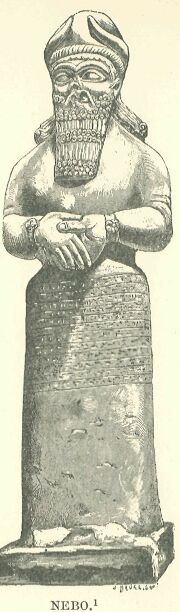
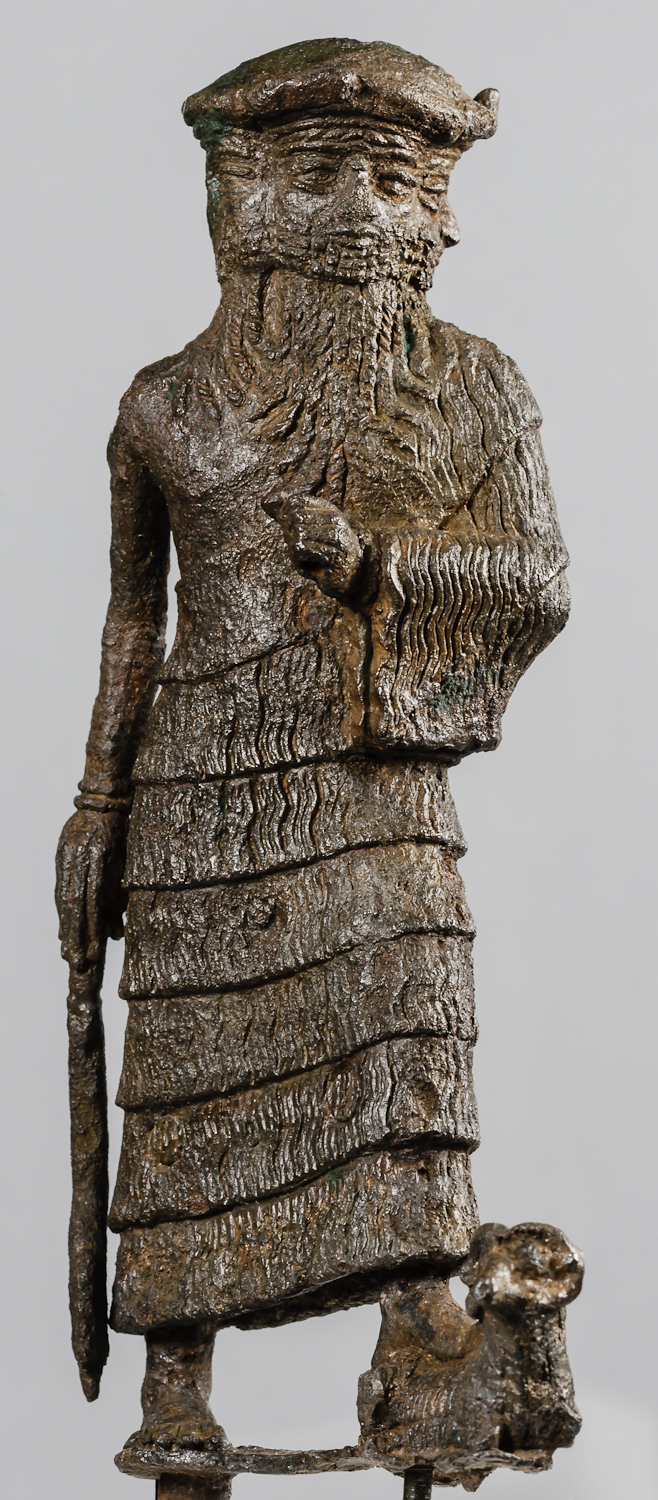
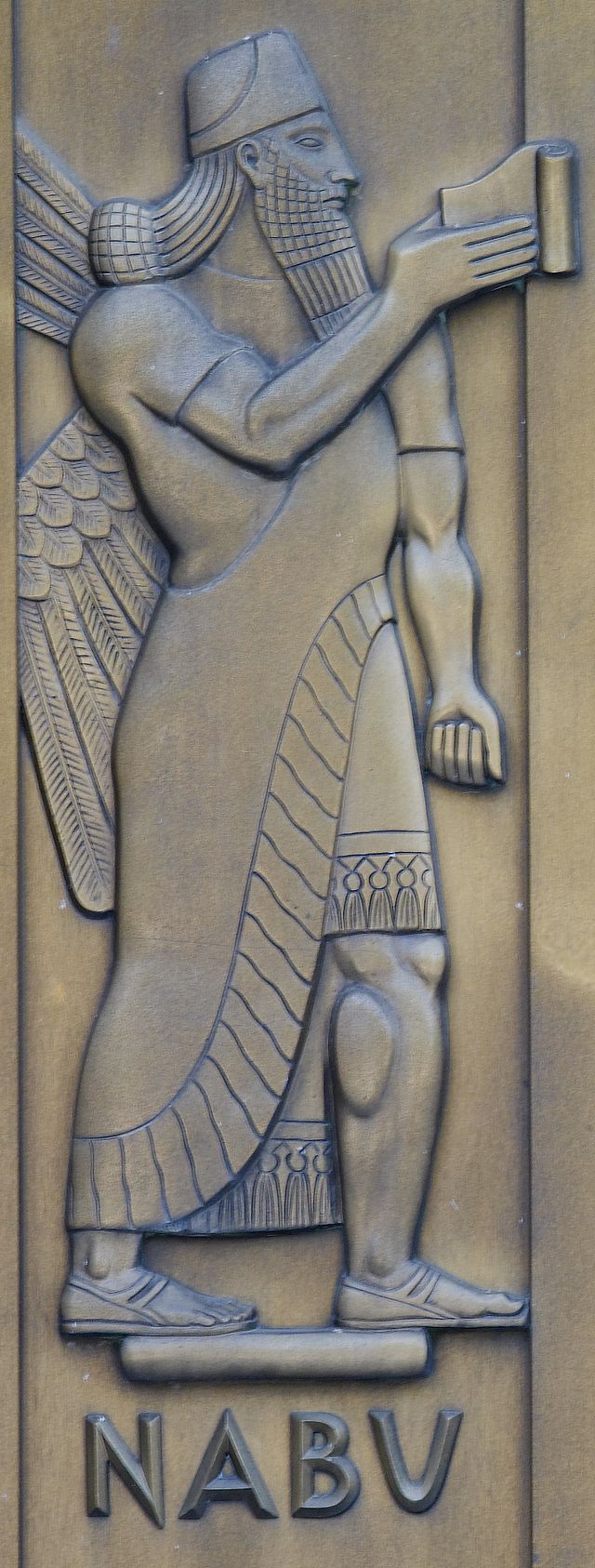
The most famous of these sacred tels or mounds, however, was the famous tilu ellu, “the illustrious mound,” at Borsippa, now represented by the Birs-i-Nimrud. Nebo, to whom the great temple of Borsippa was dedicated, is called its god (H.C. Rawlinson, The Cuneiform Inscriptions of Western Asia, 1886, ii. 54, 71).
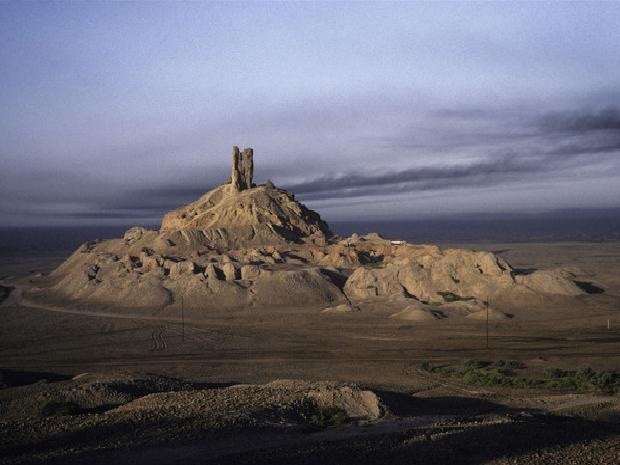
The Birs-i-Numrud, alleged to be the ruined remains of the historical Tower of Babel.
Current dimensions are 150 feet high with a circumference of 2300 ft.
https://www.pinterest.com/pin/206180489165185035/
One of “the three great” or secret “names of Anu” was that of “the lord who issues forth from the illustrious mound” (H.C. Rawlinson, The Cuneiform Inscriptions of Western Asia, 1886, iii. 68, ID), in reference to the fact that the Accadian prototype of Nebo was once the universe itself, in which the seven spheres of light were set, and around which the ocean-stream wound like a rope or serpent.
When the old god of Borsippa had passed into the Semitic Nebo, the attributes which had formerly connected him with the firmament of heaven were transferred to Anu, the sky-god of the official cult.
A fragmentary tablet, which gives us, as I believe, the Babylonian version of the building of the tower of Babel, expressly identifies it with “the illustrious mound.” Here we are told of the leader of the rebellion that when “the thought of his heart was hostile” and he “had wronged the father of all the gods,” when “he was hurrying to seize Babylon,” and “small and great were mingling the mound,” “the divine king of the illustrious mound” intervened, “Anu iifted up (his hand) in front” and prayed “to his father the lord of the firmament.”
“All day long he troubled” them; “as they lamented on their couch he ended not” their “distress.” “In his wrath he overthrows (their) secret counsel; in his (fury) he set his face to mingle (their) designs; he gave the command (?), he made strange their plan” (William Saint Chad Boscawen, Transactions of the Society of Biblical Archeology, v. 1.)
The very word that the Hebrew writer uses in order to explain the origin of the name of Babylon, and which the Authorised Version translates “confound,” is here employed of those who “mingled together” the mound, and whose designs were afterwards themselves “mingled'” by the god of heaven.
“The illustrious mound” was known as far back as the time when the months of the Accadian year were named. The month which corresponded to the Semitic Tasrit or Tisri, and our September, was “the month of the illustrious mound.”
It would seem, therefore, that legend had referred the attempt to build the tower whose head should reach to heaven to the autumnal equinox; at any rate, it is clear that the mound of Borsippa was not only in existence, but was already in a state of ruin when the Accadian calendar was first drawn up.”
A.H. Sayce, Lectures on the Origin and Growth of Religion as Illustrated by the Religion of the Ancient Babylonians, 5th ed., London, 1898, pp. 405-7.




 Samizdat

May 30, 2015
The Great Year Doctrine of World Catastrophe
“In the Greek world the first distinct mention of the Great Year was made by Plato, who argued in his Timaeus that time is produced by the celestial bodies: the moon determines the month, the sun the year; but the times of the planets and of the sphere of the fixed stars are so great that it can hardly be known whether they are times at all.
In any case it is clear that the perfect number of time fulfills the perfect year at the moment at which the sun, the moon, the planets, and the fixed stars have all completed their courses and have again reached their starting point. (Plato, Timaeus, 39c, 39d).
By this is meant that the Great Year is completed when the celestial bodies have reached the same positions in relation to each other as they had at the beginning of that period. The identical conception is found in Cicero, qualified by the statement that the actual duration of such a period is a matter of controversy (Cicero, De natura deorum, II, 51-2).
But in his Hortensius, the book which was later to make such a strong impression on the young Augustine, Cicero equated the Great Year with 12,954 ordinary years, as we know from Tacitus and Servius (Tacitus, Dialogus de oratoribus, 16, 7. Maurus Servius Honoratus, Commentary on the Aenid of Virgil, I, 296. The same number is given by Solinus in connection with the phoenix, Solini Polyhistor, cap. xxxvi).
In addition to these opinions about the Great Year there is another according to which the sun, the moon, and the five planets all return at the end of the Great Year to one and the same sign of the Zodiac, the one under which they were when it began. According to Censorinus, Aristotle himself had put forward this same view, and preferentially indicated this period as “the Greatest Year.” This year, like the ordinary solar year, was thought to have a summer and winter too, the summer culminating in a world conflagration and the world in a world flood. (Censorinus, De die natali, 18, II. ).
How much of this really goes back to Aristotle cannot be said with certainty. (V. Rose, Aristotelis fragmenta, Lipsiae, 1886, 39, frg. 25). According to Seneca, Berossus, the Babylonian priest of Bel who wrote in the third century BC, propagated the same doctrine in a more detailed form: when the sun, the moon, and the planets came to lie in a straight line under the sign of Cancer, the world would burst into flames; and if they reached that position under Capricorn, the world would be inundated. (Seneca, Naturales Quaestiones, III, 29, I).
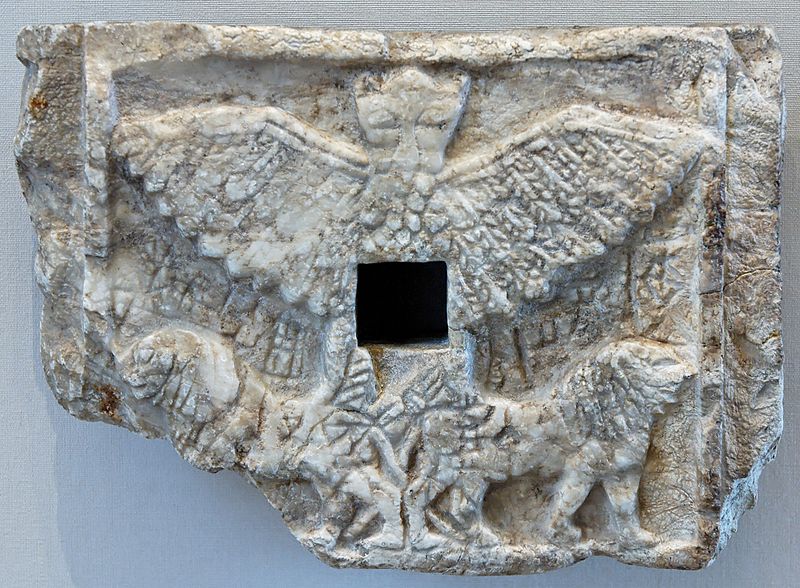
BM102485 – Boundary stone (kudurru)
Kassite dynasty, about 1125-1100 BC
Probably from southern Iraq
A legal statement about the ownership of a piece of land
The cuneiform inscription on this kudurru records the granting by Eanna-shum-iddina, the governor of the Sealand, of five gur of corn land in the district of Edina in south Babylonia to a man called Gula-eresh. The boundaries of the land are laid out; the surveyor is named as Amurru-bel-zeri and the transfer completed by two high officials who are also named.
Nine gods are invoked to protect the monument, along with seventeen divine symbols. The symbols of the important Mesopotamian gods are most prominent: the solar disc of the sun-god Shamash, the crescent of the moon-god Sin and the eight-pointed star of Ishtar, goddess of fertility and war. The square boxes beneath these signs represent altars supporting the symbols of gods, including horned headdresses, the triangular spade of Marduk, and the wedge-shaped stylus of Nabu, the god of writing.
A prominent snake is shown on many kudurru and may, like many of the symbols, be related to the constellations. The text ends with curses on anyone who removes, ignores or destroys the kudurru.
L.W. King, Babylonian Boundary Stones (London, Trustees of the British Museum, 1912)
© The Trustees of the British Museum
http://www.britishmuseum.org/explore/highlights/highlight_objects/me/b/boundary_stone_kudurru-6.aspx
These rather improbable theories were especially favored among astrologers, since Greek astronomy had already reached a point of development at which the doctrines of Berossus could not be accepted. (J. Bidez, Bérose et la grande année, in Melanges Paul Fredericq, Brussels, 1904, 9-19.)
These texts treating the views of Aristotle and Berossus say that world catastrophes corresponding to the summer and winter of the solar year can occur in the course of the Great Year. The period between two world catastrophes could also be seen as a Great Year, but only in the derivative sense. The true Great Year, which might with Aristotle be called the Greatest Year, coincided with a complete cosmic revolution, whether interpreted in the sense of Plato and Cicero or in that of Aristotle and Berossus.
The Great Year of the Classical world arose from the purely mythical conception of a cosmic periodicity ultimately traceable to Babylonia.” (B.L. van der Waerden, Das gross Jahr und die ewige Wiederkehr, in Hermes, 80, 1952, 135-43.)”
R. van den Broek, The Myth of the Phoenix: According to Classical and Early Christian Traditions, Brill Archive, 1972, pp. 72-6.
Share this: