Samizdat

Publishing the Forbidden. All Rights Reserved. © Samizdat 2014-2025.

Category: Berossos

Sippara, Pantibibla, Book Town

“It was as Kur(?)-nigin-gára, “the god who makes the palace (of the setting sun),” that the Sun-god of Larsa seems to have been known to his worshippers in pre-Semitic days.

But when the Accadian was superseded by the Semite, his special name was merged in the general title of Samsu or Samas, “the Sun.” He became the Baal of Larsa, who differed but little, save in the name by which he was addressed, from the other Baalim of Babylonia.

The fame of the Samas of Larsa, however, was obscured at an early period by that of the Samas of Sippara. Sippara in historical times was pre-eminently the city of the Sun-god. It was there that Ê-Bábara, the house of lustre,” the great temple of the Sun-god, had been erected in days to which tradition alone went back, and it was around its shrine that Semitic sun-worship in Babylonia was chiefly centred.

Sippara and its immediate neighbourhood had been the seat of early Semitic supremacy in Chaldea. It was, it is true, of pre-Semitic foundation; its primitive name Zimbir would show this, like the name of E-Bábara itself; and we know that Samas had once been worshipped within its walls under the Accadian title of Bábara or Birra.

But in these remote days Sippara was probably an insignificant town; at all events, the memory of later ages knew of Sippara only in connection with the empire of Sargon of Accad and the Semitic version of the story of the Deluge.

In the Old Testament, Sippara appears as a dual city–Sepharvaim, “the two Sipparas.” One of these has been discovered in the mounds of Abu-Habba by Mr. Hormuzd Rassam, who has brought from it a monument on which is carved a curious image of the divine solar disk.

The other has been found by Dr. Hayes Ward in the mounds of Anbar, an hour’s distance from Sufeirah and the Euphrates.

The fragment of a geographical tablet seems indeed to mention no less than four Sipparas–Sippara proper, Sippara of the desert, Sippara “the ancient,” and Sippara of the Sun-god; but since the historical texts know of two only–Sippara of Anunit and Sippara of Samas--it is best to regard the three first names as alike denoting the same place, Sippara of Anunit, the modern Anbar.

It must have been from this Sippara that the Euphrates received its title, “river of Sippara,” since Abu-Habba is seven miles distant from the present bed of the stream.

In the close neighborhood of this double Sippara, Sargon built or restored the city to which he gave a name, and from which the whole of northern Babylonia received its title of Accad. It is called Agadhé in the non-Semitic texts, Accad (Akkadu) in the Semitic; though whether the name is of Semitic or non-Semitic origin cannot at present be decided.

Sargon’s patronage of literature, and the celebrated library he founded in Accad, caused the district to be known as “the region of books.” A popular etymology afterwards connected the name of Sippara itself with sepher, “a book,” and the city accordingly appears in the fragments of Berossos as Pantibibla, or “Book-town.”

A.H. Sayce, Lectures on the Origin and Growth of Religion as Illustrated by the Religion of the Ancient Babylonians, 5th ed., London, 1898, pp. 167-70.
Sayce on the God Ea, or Oannes

“Ea, as we have already seen, was the god not only of the deep, but also of wisdom. Ancient legends affirmed that the Persian Gulf–the entrance to the deep or ocean-stream–had been the mysterious spot from whence the first elements of culture and civilisation had been brought to Chaldea.

Berossos, the Chaldean historian–so at least his epitomiser Alexander Polyhistor declared–had reported them as follows:

“At Babylon there was a great resort of people of various races who inhabited Chaldea, and lived in a lawless manner like the beasts of the field.

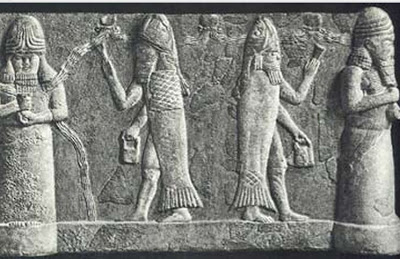
In the first year there appeared in that part of the Erythraean sea which borders upon Babylonia, a creature endowed with reason, by name Oannes, whose whole body (according to the account of Apollodaros) was that of a fish; under the fish’s head he had another head, with feet also below similar to those of a man subjoined to the fish’s tail.

His voice, too, and language were articulate and human; and a representation of him is preserved even to this day.

“This being was accustomed to pass the day among men, but took no food at that season; and he gave them an insight into letters and sciences and arts of every kind. He taught them to construct houses, to found temples, to compile laws, and explained to them the principles of geometrical knowledge.

He made them distinguish the seeds of the earth, and showed them how to collect the fruits; in short, he instructed them in everything which could tend to soften manners and humanize their lives. From that time, nothing material has been added by way of improvement to his instructions.

Now when the sun had set, this being Oannes used to retire again into the sea, and pass the night in the deep, for he was amphibious. After this there appeared other animals like Oannes, of which Berossos proposes to give an account when he comes to the history of the kings.

Moreover, Oannes wrote concerning the generation of mankind, of their different ways of life, and of their civil polity.”

[ … ]

The exact etymology of the name which appears under the Greek dress of Oannes has not yet been ascertained. Lenormant thought that it represented Ea-khan, “Ea the fish.” But whether or not this is the case, it is certain that Oannes and Ea are one and the same.

A depiction of Oannes, or Ea.

A depiction of Oannes, or Ea.

Ea, as we have seen, not only had his home in the waters of the Persian Gulf, he was also the culture-god of primitive Babylonia, the god of wisdom, the instructor of his worshippers in arts and science.

An old Babylonian sermon on the duty of a prince to administer justice impartially and without bribes, declares that if “he speaks according to the injunction (or writing) of the god Ea, the great gods will seat him in wisdom and the knowledge of righteousness.”

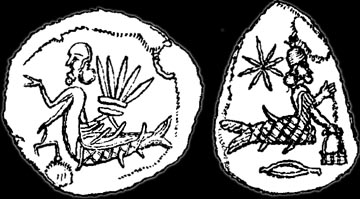
Ea was, moreover, like Oannes, represented as partly man and partly fish. Sometimes the fish’s skin is thrown over the man’s back, the head of a fish appearing behind that of the man; sometimes the body of the man is made to terminate in the tail of a fish.

A depiction of the God Ea, or Oannes.

A depiction of the God Ea, or Oannes.

A gem in the British Museum, on which the deity is depicted in the latter fashion, bears an inscription stating that the figure is that of “the god of pure life.”

OannesGems

Now “the god of pure life,” as we are expressly informed by a rubrical gloss to a hymn in honour of the demiurge Ea, was one of the names of Ea.”

A.H. Sayce, Lectures on the Origin and Growth of Religion as Illustrated by the Religion of the Ancient Babylonians, 5th ed., London, 1898, pp. 131-3.

The Genesis of the Kings List

“The single fact which has shaken it to its very foundations is the discovery of the date to which the reign of Sargon of Accad must be assigned. The last king of of Babylonia, Nabonidos, had antiquarian tastes, and busied himself not only with the restoration of the old temples of his country, but also with the disinterment of the memorial cylinders which their builders and restorers had buried beneath their foundations.

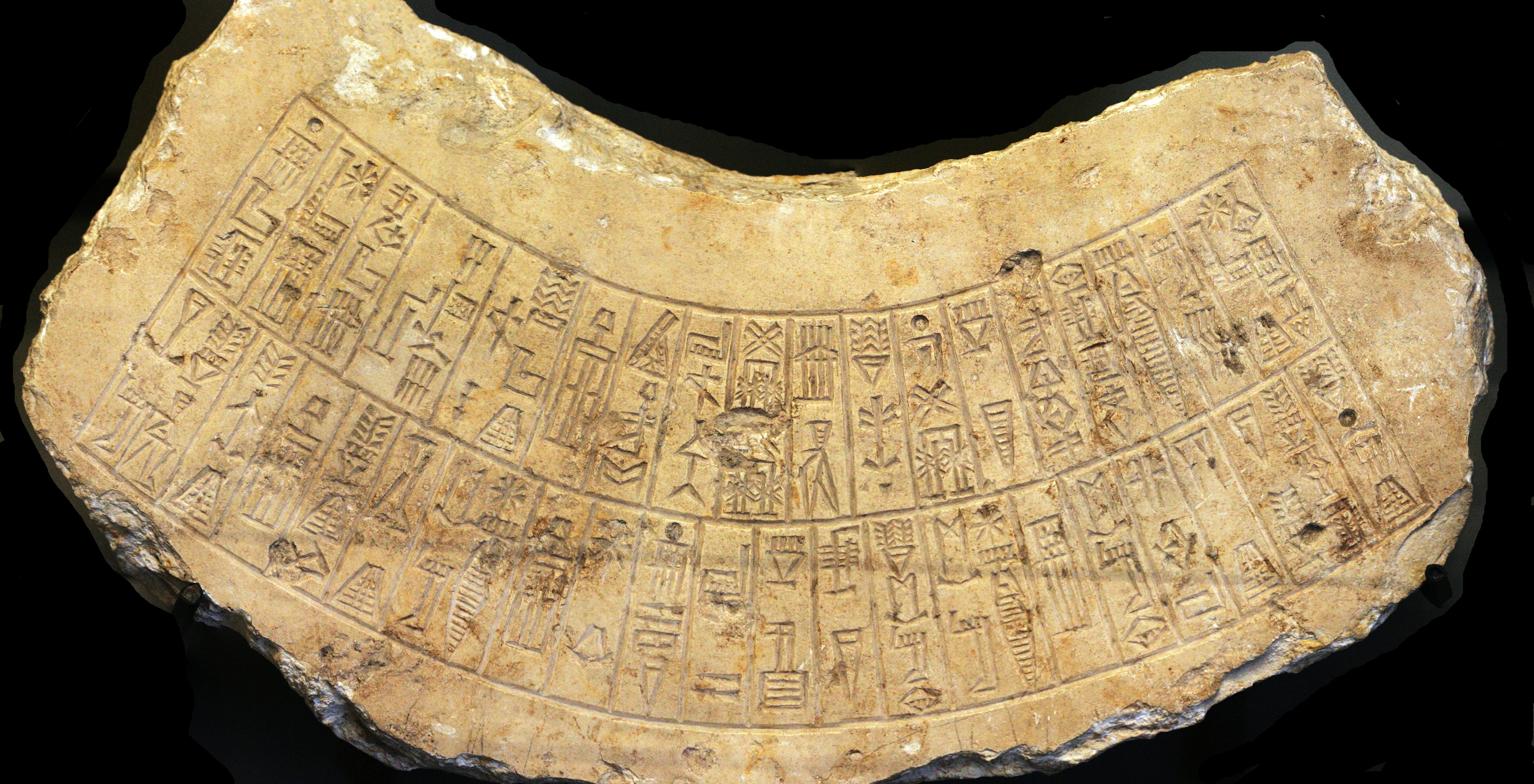
It was known that the great temple of the Sun-god at Sippara, where the mounds of Abu-Habba now mark its remains, had been originally erected by Naram-Sin the son of Sargon, and attempts had been already made to find the records which, it was assumed, he had entombed under its angles. With true antiquarian zeal, Nabonidos continued the search, and did not desist until, like the Dean and Chapter of some modern cathedral, he had lighted upon “the foundation-stone” of Naram-Sin himself.

The Foundation Stone of Naram-Sin.

The Foundation Stone of Naram-Sin.

 This “foundation-stone,” he tells us, had been seen by none of his predecessors for 3200 years. In the opinion, accordingly, of Nabonidos, a king who was curious about the past history of his country, and whose royal position gave him the best possible opportunities for learning all that could be known about it, Naram-Sin and his father Sargon I, lived 3200 years before his own time, or 3750 B.C.

The date is so remote and so contrary to all our preconceived ideas regarding the antiquity of the Babylonian monarchy, that I may be excused if at first I expressed doubts as to its accuracy. We are now accustomed to contemplate with equanimity the long chronology which the monuments demand for the history of Pharaonic Egypt, but we had also been accustomed to regard the history of Babylonia as beginning at the earliest in the third millennium before our era. Assyrian scholars had inherited the chronological prejudices of a former generation, and a starveling chronology seemed to be confirmed by the statements of Greek writers.

I was, however, soon forced to re-consider the reasons of my scepticism. The cylinder on which Nabonidos accounts his discovery of the foundation-stone of Naram-Sin was brought from the excavations of Mr. Hormuzd Rassam in Babylonia, and explained by Mr. Pinches six years ago.

Soon afterwards, Mr. Pinches was fortunate enough to find among some other inscriptions from Babylonia fragments of three different lists, in one of which the kings of Babylonia were arranged in dynasties, and the number of years each king reigned was stated, as well as the number of years the several dynasties lasted.

An Assyrian copy of a similar list had been already discovered by Mr. George Smith, who, with his usual quickness of perception, saw that it must have resembled the lists from which Berossos, the Greek historian of Chaldaea, drew the materials of his chronology; but the copy was so mere a fragment that the chronological position of the kings mentioned upon it was a matter of dispute.

Happily this is not the case with the principal test published by Mr. Pinches. It had been compiled by a native of Babylon, who consequently began with the first dynasty which made Babylon the capital of the kingdom, and who seems to have flourished in the time of Nabonidos. We can check the accuracy of his statements in a somewhat curious way.

One of the two other texts brought to light by Mr. Pinches is a schoolboy’s exercise copy of the first two dynasties mentioned on the annalistic tablet. There are certain variations between thc two texts, however, which show that the schoolboy or his master must have used some other list of the early kings than that which was employed by the compiler of the tablet; nevertheless, the names and the regnal years, with one exception, agree exactly in each.

In Assyria, an accurate chronology was kept by means of certain officers, the so-called Eponyms, who were changed every year and gave their names to the year over which they presided. We have at present no positive proof that the years were dated in the same way in Babylonia; but since most Assyrian institutions were of Babylonian origin, it is probable that they were.

At all events, the scribes of a later day believed that they had trustworthy chronological evidence extending back into a dim antiquity; and when we remember the imperishable character of the clay literature of the country, and the fact that the British Museum actually contains deeds and other legal documents dated in the rein of Khammuragas, more than four thousand years ago, there is no reason why we should not consider the belief to have been justified.”

A.H. Sayce, Lectures on the Origin and Growth of Religion as Illustrated by the Religion of the Ancient Babylonians, 5th ed., London, 1898, pp. 21-3.