Samizdat

Publishing the Forbidden. All Rights Reserved. © Samizdat 2014-2025.

Category: Babylonians

Ibn Wayshiyya and Magic

“Magic has always had a role to play in Islamic society. Its use has often been condemned by religious scholars, yet the efficacy of magic has never been contested; the early tenth-century religious scholar al-Ash’arī (d. 324/936), to take but one example, wrote in his dogmatical work Ibána (p. 19): «(…) and we belíeve that there are magicians and magic in this world, and that magic is an existing entity in this world».

During the Middle Ages magic always kept this role not only among common people but also among the learned. In the tenth century the Brethren of Purity wrote extensively on magic in their Rasā’il (esp. IV:283- 335) and magical elements can easily be detected from a variety of sources, including the biography of the prophet Muhammad.

One of the learned authors who was very much interested in magic and esoterica was the early tenth-century Abū Bakr Ibn Wahshiyya (alive in 318/930), the author or translator of many «Nabatean» books, among them the famous al-Filāha an-Nabatiyya, «the Nabatean Agriculture>.

The Nabatean books (also called the Nabatean corpus in the following) of Ibn Wahshiyya claim to be translations from «ancient Syriac». Both the author and his book, mainly Filāha, have been controversial since the nineteenth century, when the corpus was first enthusiatically received in Europe as deriving from the ancient Babylonians, though subsequently exposed as a forgery.

There is no need to cover once again the history of the controversy, and it is enough to draw attention to the present situation. The majority of scholars have more or less ignored both Ibn Wahshiyya and his works, whereas a few, especially Toufic Fahd, have courageously but not always coherently defended the authenticity of Filāha, not as a remnant of ancient Babylonian literature but as an authentic Arabic translation of a fourth/fifth century AD pseudepigraphic Aramic text.

The other works of Ibn Wahshiyya have received extremely scant attention, despite their obvious importance as a source for the almost unknown rural and parochial life in Iraq.

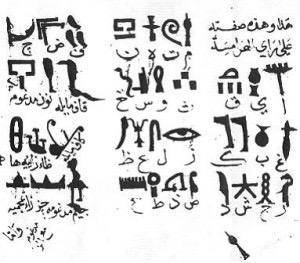
Hiéroglyphe reproduits par Ibn Wahshiyyah, Paris, Bibliothèque Nationale, MS Arabe 6805 folios 92b. ff http://www.esoblogs.net/6946/ibn-wahshiyya-et-la-magie-2/

Hiéroglyphe reproduits par Ibn Wahshiyyah, Paris, Bibliothèque Nationale, MS Arabe 6805 folios 92b. ff
http://www.esoblogs.net/6946/ibn-wahshiyya-et-la-magie-2/

In the final analysis the question of the texts’ exact provenence must still be left open, though the lack of any signs of translation in the texts as well as the absence of similar genuine texts in Aramaic argues against their authenticity.

Nevertheless, we must make a difference between the works and their material. Whether the works of the Nabatean corpus are authentic or not, that is whether they indeed derive from complete books written in Syriac or some other form of Aramaic or not, there are features that speak in favour of the authenticity of (some of) the material in these books.

First, there are several prayers in Aramaic, in Arabic script, in, eg., Sumūm, which clearly sound Aramaic; their present corruption is most probably due to later copyists. Ibn Wahshiyya himself could hardly have composed these prayers, so they must have come to him in either written or oral form.

Second, the local setting is given accurately, which proves that Ibn Wahshiyya did know the area he was speaking about and thus there is nothing ínherently improbable in presuming that he had access to local traditions.

Third, and most importantly, much of the material has to be genuine as parallels can be found in Babylonian and Assyrian sources—I am referring to the Tammūz/Dumuzi description in particular—which proves that it cannot be a product of Muslim fiction but a report of practices in semipagan rural areas.

Some of these descriptions are more detailed and accurate in the works of Ibn Wahshiyya than in any of the other extant Muslim sources, which makes it improbable that Ibn Wahshiyya could have found them in the Arabic literature at his disposal.

Thus they must stem from a living tradition—although obviously an already dying one.”

Jaakko Hāmeem-Anttila, “Ibn Wahshiyya and Magic,” Anaquel de Estudios Árabes X, 1999, pp. 39-41.

Origins of Lilith

“We can now understand why it was that in the theology of Eridu the Sun-god was the offspring of Ea and Dav-kina. The name that he bore there was Dumuzi or Tammuz, “the only-begotten one,” of whom I shall have much to say in the next Lecture.

At present I need only remark that he was the primeval Merodach; the Sun-god born of Ea who was called Merodach by the Babylonians was called Tammuz (Dumuzi,) by the people of Eridu.

Perhaps Merodach is after all nothing more than “the god from Eridu.” That he came originally from Eridu we have already seen.

The author of the hymn to the demiurge identifies Ea with “father Bel.” As “the lord of heaven and earth,” Ea was indeed a Baal or Bel to the Semites, to whose age the hymn belongs.

But the particular Bel with whom the poet wishes to identify him was Mul-lil, the supreme god and demiurge of Nipur (the modern Niffer). In a list of the titles of Ea, we find it expressly stated that he is one with “Mul-lil the strong.”

But such an identification belongs to the later imperial age of Babylonian history. Mul-lil was primitively a purely local divinity, standing in the same relation to his worshippers at Nipur that Ea stood to his at Eridu.

Mul-lil signifies “the lord of the ghost-world.” Lil was an Accado-Sumerian word which properly denoted “a dust-storm” or “cloud of dust,” but was also applied to ghosts, whose food was supposed to be the dust of the earth, and whose form was like that of a dust-cloud.

The Accadian language possessed no distinction of gender, and lil therefore served to represent both male and female ghosts. It was, however, borrowed by the Semites under the form of lillum, and to this masculine they naturally added the feminine lilatu.

Originally this lilatu represented what the Accadians termed “the handmaid of the ghost” (kel-lilla), of whom it was said that the lil had neither husband nor wife; but before long lilatu was confounded with the Semitic lilátu, “the night,” and so became a word of terror, denoting the night-demon who sucked the blood of her sleeping victims.

In the legend of the Descent of Istar into Hades, the goddess is made to threaten that unless she is admitted to the realm of the dead she will let them out in the form of vampires to devour the living.

From the Semitic Babylonians the name and conception of Lilatu passed to the Jews, and in the book of Isaiah (xxxiv. 14) the picture of the ghastly desolation which should befall Idumea is heightened by its ruined mounds being made the haunt of Lilith.

According to the Rabbis, Lilith had been the first wife of Adam, and had the form of a beautiful woman; but she lived on the blood of children whom she slew at night.”

A.H. Sayce, Lectures on the Origin and Growth of Religion as Illustrated by the Religion of the Ancient Babylonians, 5th ed., London, 1898, pp. 144-6.

Semites vs. Sumerians

“Each new discovery of cuneiform tablets elicits a wave of publications asserting biblical ‘parallels,’ many of them uncertain and farfetched, even when a millennium or more may have elapsed between the tablets and the relevant portion of the Bible.

The biblical scholar M. Dahood, for example, saw parallels betwen the Bible and cuneiform tablets from Ebla in northern Syria, which date to approximately 1300 years before the kingdom of David. E. A. Speiser insisted that the ‘patriarchal age’ of the Bible was reflected in tablets from Nuzi in northern Mesopotamia (early fourteenth century BCE), although most of his analogies have been discarded in recent years.

The discovery of prophetic documents at Mari (eighteenth century BCE) attracted much discussion, as did comparison of ancient treaties with the biblical covenant.

A subtler interconnection between the worlds of the Hebrews and of the Babylonians was provided by what might be called ‘Pan-Semitism,’ the idea that the Semitic peoples had certain innate mental and emotional characteristics and limitations in common that conditioned their religious values.

A concise statement of this view, which is traceable, for example, to the works of the influential French thinker Ernest Renan, will be found in S. A. Cook’s contribution ‘The Semites, Temperament and Thought’ in the Cambridge Ancient History (1924), chapter V.

Cook held that Semitic thought was verbal rather than visual, emotional rather than systematic or speculative, and so could not have created such a grand astral system of beliefs as the Pan-Babylonianists had imagined underlay modern Christianity, Judaism and Islam.

To Pan-Semitists, Greece, with its alleged superior visual and speculative thought, albeit comparatively shallow religion, was as essential to understanding Christianity as was Judaism.

Scholars wrote of the ‘Hebrew’ and the ‘Greek’ element in Christianity and European culture. The Pan-Semitists bracketed Judaism, Islam and Babylonia as ‘Semitic’ in type, but not Christianity. This left the place of the Sumerians in the equation Babylonian = Semitic difficult to define.

The early twentieth-century historian Eduard Meyer, for example, therefore argued that the Semites were the original inhabitants of Mesopotamia and the Sumerians were later invaders, thereby maintaining the originally ‘Semitic’ character of Mesopotamian civilization.

In the period after World War I, some scholars tried to distinguish ‘Sumerian’ from ‘Semitic’ thought in Mesopotamian culture. Thus discussion of the relations between Babylonia and the Bible proceeded in an atmosphere charged with faith, scepticism and anti-Semitism.”

Benjamin R. Foster, “Mesopotamian Religion and the Bible,” John R. Hinnells, ed., A Handbook of Ancient Religions, 2007, pp. 208-9.

The First Zodiac

” … Not content with Ummu-Khubur’s brood of devils, Tiâmat called the stars and powers of the air to her aid, for she “set up” …

(1) the Viper,

(2) the Snake,

(3) the god Lakhamu,

(4) the Whirlwind,

(5) the ravening Dog,

(6) the Scorpion-man,

(7) the mighty Storm-wind,

(8) the Fish-man, and

(9) the Horned Beast.

These bore (10) the “merciless, invincible weapon,” and were under the command of (11) Kingu, whom Tiâmat calls “her husband.”

Thus Tiâmat had Eleven mighty Helpers besides the devils spawned by Ummu-Khubur. We may note in passing that some of the above-mentioned Helpers appear among the Twelve Signs of the Zodiac which Marduk “set up” after his conquest of Tiâmat, e.g., the Scorpion-man, the Horned Beast, etc.

This fact suggests that the first Zodiac was “set up” by Tiâmat, who with her Eleven Helpers formed the Twelve Signs; the association of evil with certain stars may date from that period. That the Babylonians regarded the primitive gods as powers of evil is clear from the fact that Lakhamu, one of them, is enumerated among the allies of Tiâmat.

The helpers of Tiâmat were placed by her under the command of a god called KINGU who is TAMMUZ. He was the counterpart, or equivalent, of ANU, the Sky-god, in the kingdom of darkness, for it is said in the text “Kingu was exalted and received the power of Anu,” i.e., he possessed the same power and attributes as Anu.

When Tiâmat appointed Kingu to be her captain, she recited over him a certain spell or incantation, and then she gave him the TABLET OF DESTINIES and fastened it to his breast, saying, “Whatsoever goeth forth from thy mouth shall be established.”

Armed with all the magical powers conferred upon him by this Tablet, and heartened by all the laudatory epithets which his wife Tiâmat heaped upon him, Kingu went forth at the head of his devils.

When Ea heard that Tiâmat had collected her forces and was determined to continue the fight against the gods which Apsû and Mummu had begun, and that she had made her husband Kingu her champion, he was “afflicted” and “sat in sorrow.” He felt unable to renew the fight against the powers of darkness, and he therefore went and reported the new happenings to Anshar, representative of the “host of heaven,” and took counsel with him.

When Anshar heard the matter he was greatly disturbed in mind and bit his lips, for he saw that the real difficulty was to find a worthy antagonist for Kingu and Tiâmat. A gap in the text here prevents us from knowing exactly what Anshar said and did, but the context suggests that he summoned Anu, the Sky-god, to his assistance. Then, having given him certain instructions, he sent him on an embassy to Tiâmat with the view of conciliating her.

When Anu reached the place where she was he found her in a very wrathful state, and she was muttering angrily; Anu was so appalled at the sight of her that he turned and fled. It is impossible at present to explain this interlude, or to find any parallel to it in other ancient Oriental literature.”

Illustration: Shamash the Sun-god rising on the horizon, flames of fire ascending from his shoulder. The two portals of the dawn, each surmounted by a lion, are being drawn open by attendant gods. From a Babylonian seal cylinder in the British Museum. [No. 89,110.]

Illustration: Shamash the Sun-god rising on the horizon, flames of fire ascending from his shoulder. The two portals of the dawn, each surmounted by a lion, are being drawn open by attendant gods. From a Babylonian seal cylinder in the British Museum. [No. 89,110.]

E.A. Wallis Budge, et al, & the British Museum, The Babylonian Legends of the Creation & the Fight Between Bel & the Dragon Told by Assyrian Tablets from Nineveh (BCE 668-626), 1901, pp. 8-9.

What was the Third Image?

” … In this shrine are placed the statues, one of which is Hera, the other Zeus, though they call him by another name. Both of these are golden, both are sitting; Hera is supported by lions, Zeus is sitting on bulls. The effigy of Zeus recalls Zeus in all its details—his head, his robes, his throne; nor even if you wished it could you take him for another deity. 43

Hera, however, as you look at her will recall to you a variety of forms. Speaking generally she is undoubtedly Hera, but she has something of the attributes of Athene, and of Aphrodite, and of Selene, and of Rhea, and of Artemis, and of Nemesis, and of The Fates.

In one of her hands she holds a sceptre, in the other a distaff; on her head she bears rays and a tower and she has a girdle wherewith they adorn none but Aphrodite of the sky. 44 And without she is gilt with gold, and gems of great price adorn her, some white, some sea-green, others wine-dark, others flashing like fire. Besides these there are many onyxes from Sardinia and the jacinth and emeralds, the offerings of the Egyptians and of the Indians, Ethiopians, Medes, Armenians, and Babylonians.

But the greatest wonder of all I will proceed to tell: she bears a gem on her head called a Lychnis; it takes its name from its attribute. From this stone flashes a great light in the night-time, so that the whole temple gleams brightly as by the light of myriads of candles, but in the day-time the brightness grows faint; the gem has the likeness of a bright fire. There is also another marvel in this image: if you stand over against it, it looks you in the face, and as you pass it the gaze still follows you, and if another approaching from a different quarter looks at it, he is similarly affected.

Between the two there stands another image of gold, no part of it resembling the others. This possesses no special form of its own, but recalls the characteristics of other gods. The Assyrians themselves speak of it as a symbol, but they have assigned to it no definite name. They have nothing to tell us about its origin, nor its form: some refer it to Dionysus; others to Deukalion; others to Semiramis; for its summit is crowned by a golden pigeon, 45 and this is why they allege that it is the effigy of Semiramis. It is taken down to the sea twice in every year to bring up the water of which I have spoken. 46

In the body of the temple, as you enter, there stands on the left hand side, a throne for the Sun god; but there is no image upon it, for the effigies of the Sun and Moon are not exhibited. I have learnt, however, the reasons of this practice. They say that religion does not forbid making effigies of the other deities, for the outward form of these deities is known to all; but the Sun and Moon are plain for all to see, and all men behold them. What boots it, therefore, to make effigies of those deities who offer themselves for all to gaze on?”

Herbert A. Strong and John Garstang, trans., The Syrian Goddess, by Lucian, 1913, pp. 70-4.

Fish Symbolism Spanning Cultures and Eras

“For those who hold that the Grail story is essentially, and fundamentally, Christian, finding its root in Eucharistic symbolism, the title is naturally connected with the use of the Fish symbol in early Christianity: the Icthys anagram, as applied to Christ, the title ‘Fishers of Men,’ bestowed upon the Apostles, the Papal ring of the Fisherman–though it must be noted that no manipulation of the Christian symbolism avails satisfactorily to account for the lamentable condition into which the bearer of the title has fallen.” 2

[ … ]

So far as the present state of our knowledge goes we can affirm with certainty that the Fish is a Life symbol of immemorial antiquity, and that the title of Fisher has, from the earliest ages, been associated with Deities who were held to be specially connected with the origin and preservation of Life.

In Indian cosmogony Manu finds a little fish in the water in which he would wash his hands; it asks, and receives, his protection, asserting that when grown to full size it will save Manu from the universal deluge. This is Jhasa, the greatest of all fish. 1

The first Avatar of Vishnu the Creator is a Fish. At the great feast in honour of this god, held on the twelfth day of the first month of the Indian year, Vishnu is represented under the form of a golden Fish, and addressed in the following terms:

“Wie Du, O Gott, in Gestalt eines Fisches die in der Unterwelt befindlichen Veden gerettet hast, so rette auch mich 2.”

The Fish Avatar was afterwards transferred to Buddha.

In Buddhist religion the symbols of the Fish and Fisher are freely employed. Thus in Buddhist monasteries we find drums and gongs in the shape of a fish, but the true meaning of the symbol, while still regarded as sacred, has been lost, and the explanations, like the explanations of the Grail romances, are often fantastic afterthoughts.

In the Māhāyana scriptures Buddha is referred to as the Fisherman who draws fish from the ocean of Samsara to the light of Salvation. There are figures and pictures which represent Buddha in the act of fishing, an attitude which, unless interpreted in a symbolic sense, would be utterly at variance with the tenets of the Buddhist religion. 1

This also holds good for Chinese Buddhism. The goddess Kwanyin (= Avalokiteśvara), the female Deity of Mercy and Salvation, is depicted either on, or holding, a Fish.

In the Han palace of Kun-Ming-Ch’ih there was a Fish carved in jade to which in time of drought sacrifices were offered, the prayers being always answered.

Both in India and China the Fish is employed in funeral rites. In India a crystal bowl with Fish handles was found in a reputed tomb of Buddha.

In China the symbol is found on stone slabs enclosing the coffin, on bronze urns, vases, etc. Even as the Babylonians had the Fish, or Fisher, god, Oannes who revealed to them the arts of Writing, Agriculture, etc., and was, as Eisler puts it, ‘teacher and lord of all wisdom,’ so the Chinese Fu-Hi, who is pictured with the mystic tablets containing the mysteries of Heaven and Earth, is, with his consort and retinue, represented as having a fish’s tail 2.

The writer of the article in The Open Court asserts that “the Fish was sacred to those deities who were supposed to lead men back from the shadows of death to life 3.”

If this be really the case we can understand the connection of the symbol first with Orpheus, later with Christ, as Eisler remarks:

“Orpheus is connected with nearly all the mystery, and a great many of the ordinary chthonic, cults in Greece and Italy. Christianity took its first tentative steps into the reluctant world of Graeco-Roman Paganism under the benevolent patronage of Orpheus.” 1

There is thus little reason to doubt that, if we regard the Fish as a Divine Life symbol, of immemorial antiquity, we shall not go very far astray.

We may note here that there was a fish known to the Semites by the name of Adonis, although as the title signifies ‘Lord,’ and is generic rather than specific, too much stress cannot be laid upon it.

It is more interesting to know that in Babylonian cosmology Adapa the Wise, the son of Ea, is represented as a Fisher. 2

In the ancient Sumerian laments for Tammuz, previously referred to, that god is frequently addressed as Divine Lamgar, Lord of the Net, the nearest equivalent I have so far found to our ‘Fisher King.’ 3

Whether the phrase is here used in an actual or a symbolic sense the connection of idea is sufficiently striking.

In the opinion of the most recent writers on the subject the Christian Fish symbolism derives directly from the Jewish, the Jews, on their side having borrowed freely from Syrian belief and practice. 4

What may be regarded as the central point of Jewish Fish symbolism is the tradition that, at the end of the world, Messias will catch the great Fish Leviathan, and divide its flesh as food among the faithful.

As a foreshadowing of this Messianic Feast the Jews were in the habit of eating fish upon the Sabbath. During the Captivity, under the influence of the worship of the goddess Atargatis, they transferred the ceremony to the Friday, the eve of the Sabbath, a position which it has retained to the present day.

Eisler remarks that “in Galicia one can see Israelite families in spite of their being reduced to the extremest misery, procuring on Fridays a single gudgeon, to eat, divided into fragments, at night-fall.

In the 16th century Rabbi Solomon Luria protested strongly against this practice. Fish, he declared, should be eaten on the Sabbath itself, not on the Eve.” 1

This Jewish custom appears to have been adopted by the primitive Church, and early Christians, on their side, celebrated a Sacramental Fish-meal. The Catacombs supply us with numerous illustrations, fully described by the two writers referred to.

The elements of this mystic meal were Fish, Bread, and Wine, the last being represented in the Messianic tradition: “At the end of the meal God will give to the most worthy, i.e., to King David, the Cup of Blessing–one of fabulous dimensions.” 2

Fish play an important part in Mystery Cults, as being the ‘holy’ food. Upon a tablet dedicated to the Phrygian Mater Magna we find Fish and Cup; and Dölger, speaking of a votive tablet discovered in the Balkans, says, “Hier ist der Fisch immer und immer wieder allzu deutlich als die heilige Speise eines Mysterien-Kultes hervorgehoben.” 3

Now I would submit that here, and not in Celtic Folk-lore, is to be found the source of Borron’s Fish-meal. Let us consider the circumstances. Joseph and his followers, in the course of their wanderings, find themselves in danger of famine. The position is somewhat curious, as apparently the leaders have no idea of the condition of their followers till the latter appeal to Brons. 1

Brons informs Joseph, who prays for aid and counsel from the Grail. A Voice from Heaven bids him send his brother-in-law, Brons, to catch a fish.

Meanwhile he, Joseph, is to prepare a table, set the Grail, covered with a cloth, in the centre opposite his own seat, and the fish which Brons shall catch, on the other side.

He does this, and the seats are filled–“Si s’i asieent une grant partie et plus i ot de cels qui n’i sistrent mie, que de cels qui sistrent.”

Those who are seated at the table are conscious of a great “douceur,” and “l’accomplissement de lor cuers,” the rest feel nothing.

Now compare this with the Irish story of the Salmon of Wisdom 2.

Finn Mac Cumhail enters the service of his namesake, Finn Eger, who for seven years had remained by the Boyne watching the Salmon of Lynn Feic, which it had been foretold Finn should catch.

The younger lad, who conceals his name, catches the fish. He is set to watch it while it roasts but is warned not to eat it. Touching it with his thumb he is burned, and puts his thumb in his mouth to cool it.

Immediately he becomes possessed of all knowledge, and thereafter has only to chew his thumb to obtain wisdom.

Mr Nutt remarks: “The incident in Borron’s poem has been recast in the mould of mediaeval Christian Symbolism, but I think the older myth can still be clearly discerned, and is wholly responsible for the incident as found in the Conte du Graal.”

But when these words were written we were in ignorance of the Sacramental Fish-meal, common alike to Jewish, Christian, and Mystery Cults, a meal which offers a far closer parallel to Borron’s romance than does the Finn story, in which, beyond the catching of a fish, there is absolutely no point of contact with our romance, neither Joseph nor Brons derives wisdom from the eating thereof; it is not they who detect the sinners, the severance between the good and the evil is brought about automatically.

The Finn story has no common meal, and no idea of spiritual blessings such as are connected therewith.

In the case of the Messianic Fish-meal, on the other hand, the parallel is striking; in both cases it is a communal meal, in both cases the privilege of sharing it is the reward of the faithful, in both cases it is a foretaste of the bliss of Paradise.

Furthermore, as remarked above, the practice was at one time of very widespread prevalence.

Now whence did Borron derive his knowledge, from Jewish, Christian or Mystery sources?

This is a question not very easy to decide. In view of the pronounced Christian tone of Borron’s romance I should feel inclined to exclude the first, also the Jewish Fish-meal seems to have been of a more open, general and less symbolic character than the Christian; it was frankly an anticipation of a promised future bliss, obtainable by all.

Orthodox Christianity, on the other hand, knows nothing of the Sacred Fish-meal, so far as I am aware it forms no part of any Apocalyptic expectation, and where this special symbolism does occur it is often under conditions which place its interpretation outside the recognized category of Christian belief.

A noted instance in point is the famous epitaph of Bishop Aberkios, over the correct interpretation of which scholars have spent much time and ingenuity. 1 In this curious text Aberkios, after mentioning his journeys, says:

“Paul I had as my guide,

Faith however always went ahead and set before me as food a Fish from a Fountain, a huge one, a clean one,

Which a Holy Virgin has caught.

This she gave to the friends ever to eat as food,

Having good Wine, and offering it watered together with Bread.”

Aberkios had this engraved when 72 years of age in truth.

Whoever can understand this let him pray for Aberkios.”

Eisler (I am here quoting from the Quest article) remarks, “As the last line of our quotation gives us quite plainly to understand, a number of words which we have italicized are obviously used in an unusual, metaphorical, sense, that is to say as terms of the Christian Mystery language.”

While Harnack, admitting that the Christian character of the text is indisputable, adds significantly: “aber das Christentum der Grosskirche ist es nicht.”

Thus it is possible that, to the various points of doubtful orthodoxy which scholars have noted as characteristic of the Grail romances, Borron’s Fish-meal should also be added.

Should it be objected that the dependence of a medieval romance upon a Jewish tradition of such antiquity is scarcely probable, I would draw attention to the Voyage of Saint Brandan, where the monks, during their prolonged wanderings, annually ‘kept their Resurrection,’ i.e., celebrate their Easter Mass, on the back of a great Fish. 1

On their first meeting with this monster Saint Brandan tells them it is the greatest of all fishes, and is named Jastoni, a name which bears a curious resemblance to the Jhasa of the Indian tradition cited above. 2

In this last instance the connection of the Fish with life, renewed and sustained, is undeniable.

The original source of such a symbol is most probably to be found in the belief, referred to in a previous chapter, 1 that all life comes from the water, but that a more sensual and less abstract idea was also operative appears from the close connection of the Fish with the goddess Astarte or Atargatis, a connection here shared by the Dove.

Cumont, in his Les Religions Orientales dans le Paganisme Romain, says:

“Two animals were held in general reverence, namely, Dove and Fish.

Countless flocks of Doves greeted the traveller when he stepped on shore at Askalon, and in the outer courts of all the temples of Astarte one might see the flutter of their white wings.

The Fish were preserved in ponds near to the Temple, and superstitious dread forbade their capture, for the goddess punished such sacrilege, smiting the offender with ulcers and tumours.” 2

But at certain mystic banquets priests and initiates partook of this otherwise forbidden food, in the belief that they thus partook of the flesh of the goddess. “

Jessie L. Weston, From Ritual to Romance, 1920, pp. 118-26.