
Samizdat

Publishing the Forbidden. All Rights Reserved. © Samizdat 2014-2026.

Tag: Thomas

Cicada Files: The Repugnant brotherBox

Prologue
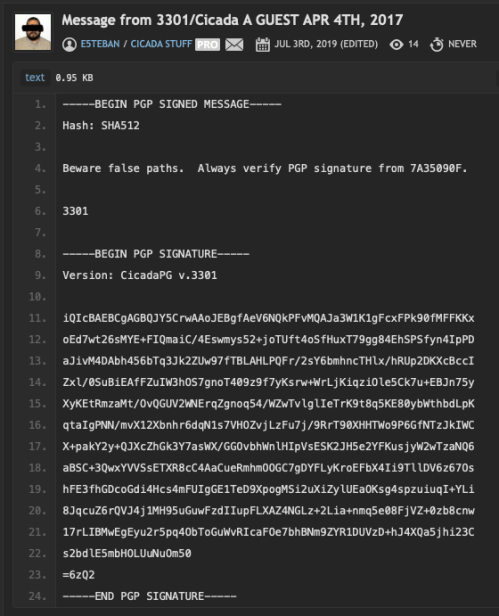
Cicada PGP April 4 2017

“The problem with screen names or handles deserves some amplification. Concealing your identity behind a handle is a juvenile and silly behavior characteristic of crackers, warez d00dz, and other lower life forms. Hackers don’t do this; they’re proud of what they do and want it associated with their real names. So if you have a handle, drop it. In the hacker culture it will only mark you as a loser.”

and

“Sociologists, who study networks like those of the hacker culture under the general rubric of “invisible colleges,” have noted that one characteristic of such networks is that they have gatekeepers–core members with the social authority to endorse new members into the network. Because the “invisible college” that is hacker culture is a loose and informal one, the role of gatekeeper is informal too. But one thing that all hackers understand in their bones is that not every hacker is a gatekeeper. Gatekeepers have to have a certain degree of seniority and accomplishment before they can bestow the title. How much is hard to quantify, but every hacker knows it when they see it.”

-Eric Steven Raymond, How to Become a Hacker, Thyrsus Enterprises, 2001.

I publish these communications from Mr. Martin Wehrmeyer (aka brotherBox, @aBoxMaybe, @luceatnobis), who demanded that I embargo his surname and refer to him by the alias brotherBox and in no other way, using bold for the usual reasons. I break up his long paragraphs to make them easier to read. My editorial comments are few, included in parentheses, while Mr. Wehrmeyer’s statements are bracketed in quotation marks.

This article includes a response that Mr. Wehrmeyer wrote to me when I invited him to review an early draft of my article about Z 3301. I felt that his response, which immediately follows, was sane and meaningful.

Bizarrely, Wehrmeyer quickly turned execrable, extracting an excerpt from that draft, twisting it to his purposes, placing me in an impossible position: Ms. Bogaerts demanded confidentiality from me, yet she inserted herself into an argument that I was keeping her out of. When she ordered me to “leave Marcus alone,” meaning Mr. Wanners, I declined. Read the rest of this entry »

Cicada Files: Z 3301 et al

Cicada TS Obese Suitcase Undated Sept 2019 Defango Gabe Hoffman Interview

Thomas Andrew Schoenberger (b. June 1, 1960) is mired in legal disputes with Manuel Chavez III, Jesse Davis and Gabe Hoffman, and reportedly shuffles between motels to evade service of court orders. Schoenberger was tracked to the Monterey Park Motel 6 in Northridge (Los Angeles) on September 12, 2019 by Chronic0ps. Life on the run is taking its toll on Mr. Schoenberger, 59 years old, with an extensive criminal record. This photo was reportedly taken by Mr. Schoenberger’s former landlady, Ms. Linda Barrett, in September, 2019, but an accidental self-portrait by Mr. Schoenberger that I post at the end of this article confirms that this is an accurate representation. Both photos depict a clinically obese male with slovenly hair, wearing the same black shirt in pictures taken on different days. Mr. Schoenberger is notoriously shy, he claims because Mr. Chavez put out a Bitcoin bounty on him: in truth, Mr. Schoenberger is vain, and ashamed of his appearance. He claims that this photo was Photoshopped.

Prologue

Researching QAnon led me to Cicada 3301, a phenomenon that Rolling Stone called “the Web’s Deepest Mystery.” (David Kushner, “Cicada: Solving the Web’s Deepest Mystery,” Rolling Stone, January 15, 2015). I consequently interact with felons, sociopaths, hackers and cypherpunks, anons, denizens of the ‘chans, the Twitter-verse, YouTube and the dark web.

Wielding anonymity and encryption, clandestinity and plausible deniability, my subjects manipulate sock accounts, ‘bots, and Search Engine Optimization (SEO), waging information campaigns across cyberspace. As Cicada preceded Q, some of its members were involved in both. As melodramatic as all this seems, I am not exaggerating, as you shall see. Read the rest of this entry »

The Naassene Fragment, on the Ithyphallus

” … (7) And they say that not only the Mysteries of the Assyrians and Phrygians substantiate this teaching (logos) concerning the Blessed Nature, which is at once hidden and manifest [but also those of the Egyptians 1].

C. 2 [The Nature] which (H. he says) is the Kingdom of the Heavens sought for within man—

H. —concerning which [Nature] they hand on a distinct tradition in the Gospel entitled According to Thomas, saying as follows:

C. “He who seeketh shall find me in children from the age of seven years 3; for in them at the fourteenth year 4 [lit. æon] I hidden am made manifest.”

H. But this is not Christ’s Saying but that of Hippocrates:

“A boy of seven years [is] half a father.” 5

Hence as they place the Original Nature of the universals in the Original Seed, having learned the Hippocratian dictum that a child of seven is half a father, they say at fourteen years, according to Thomas, it is manifested. This 6 is their ineffable and mysterious Logos. 7

(8 8) S. (H.—At any rate they say that) the Egyptians—who are the most ancient of men after the Phrygians, who at the same time were confessedly the first to communicate to mankind the Mystery-rites and Orgies of all the Gods, and to declare their Forms and Energies—have the mysteries of Isis, holy, venerable, and not to be disclosed to the uninitiated.

H. And these are nothing else than the robbing of the member of Osiris, and its being sought for by the seven-robed and black-mantled 1 [Goddess].

And (they [the Egyptians] say) Osiris is Water. 2 And Seven-robed Nature—

H. —having round her, nay, robing herself in seven ætheric vestures—for thus they 3 allegorically designate the planet-stars, calling [their spheres] ætheric vestures—

S. —being metamorphosed, as ever-changing Genesis, by the Ineffable and Uncopiable and Incomprehensible and Formless, is shown forth as creation.

J. And this is what (H. he says) is said in the Scripture:

“Seven times the Just shall fall and rise again.” 4

For these “fallings” (H. he says) are the changes of the stars, 5 set in motion by the Mover of all things.

(9) S. Accordingly they 6 declare concerning the Essence of the Seed which is the cause of all things in Genesis, that it is none of these things, but that it begets and makes all generated things, saying:

“I become what I will, and am what I am.” 1

Therefore (H. he says) That which moves all is unmoved; for It remains what It is, making all things, and becomes no one of the things produced.

(H. He says that) This is the Only Good—

C. And concerning this was spoken what was said by the Saviour:

“Why callest thou me Good? One is Good 2—my Father in the Heavens, who maketh His sun to rise on righteous and unrighteous, and sendeth rain on saints and sinners.” 3

H. And who are the saints on whom He sendeth rain and the sinners on whom He also sendeth rain—this also he tells subsequently with the rest.

S. —and (H. that) This is the Great, Hidden, and Unknown Mystery of the Egyptians, Hidden and [yet] Revealed.  For there is no temple (H. he says) before the entrance of which the Hidden [Mystery] does not stand naked, pointing from below above, and crowned with all its fruits of generation.

(10) And (H. they say) it stands so symbolised not only in the most sacred temples before the statues, but also set up for general knowledge—

C. —as it were “a light not under the bushel, but set “on the candlestick” 1—a preaching “heralded forth on the house-tops.”2

S. —on all the roads and in all the streets, and alongside the very houses as a boundary and limit of the dwelling; (H. that) This is the God spoken of by all, for they call Him Bringer-of-good, not knowing what they say.

H. And this mystery [-symbol] the Greeks got from the Egyptians, and have it [even] to this day.

At any rate, he says, we see the “Hermes” 3 honoured by them in this form.

(11) S. And the Cyllenians, treating [this symbol] with special honour, [regard it as the] Logos. 4

For (H. he says) Hermes is [the] Logos, who, as being the Interpreter and Fabricator of all things that have been and are and shall be, was honoured by them under the symbolism of this figure, namely an ithyphallus.”

 G.R.S. Mead, Thrice-Greatest HermesVol. 1, 1906, pp. 155-8.

From Hippolytus, Philosophumena; or, Refutation of all Heresies.