
Eco: Magic Language
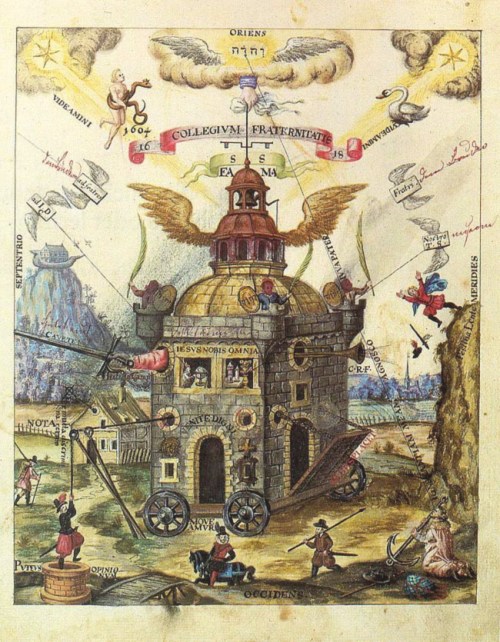
Teophilus Schweighardt Constantiens, aka Daniel Mögling (1596-1635), Speculum Sophicum Rhodostauroticum (The Mirror of the Wisdom of the Rosy Cross), 1618. This work is in the public domain in its country of origin and other countries and areas where the copyright term is the author’s life plus 100 years or less.
“In a climate of extraordinary spiritual tension, the seventeenth century awaited change–a general reform of knowledge and morals, a reawakening of religions sensibility.
The period was dominated by a belief that a new, golden century was dawning; Postel had already used the term “golden century” in the title of one of his works. This was, moreover, an expectation shared by Catholics and Protestants alike, though each in different forms.
Authors from Campanella to Andreae had drawn up projects for an ideal republic. Not only Postel but other thinkers in different countries had designed schemes for a universal monarchy.
The Thirty Years War acted as a catalyst: conflict had flared in one region after another, creating, on the one hand, confessional hatreds and nationalist rivalries, engendering the modern notion of the raison d’état, on the other producing a pleiad of mystic spirits dreaming of universal peace (cf. De Mas 1982).
It was in this climate, then, that in 1614, there appeared an anonymous tract written in German: Allgemeine und general Reformation der gantzen weiten Welt. Though this was only discovered later, the first part was largely a re-elaboration of a satire written by Traiano Boccalini and published in 1612-3, called Ragguagli di Parnaso.
The second part, however, took the form of a manifesto, entitled Fama fraternitatis R.C. In this, the mysterious confraternity of the Rosicrucians openly declared its existence, supplying details concerning its own history as well as that of its mythical founder, Christian Rosencreutz.
In the following year, 1615, the German manifesto was republished together with a second manifesto, written this time in Latin, with the title Confessio fraternitatis Roseae crucis. Ad eruditos Europae (we shall use the first English translation, The Fame and the Confession of the Fraternity of R.C., London, 1652).
The first manifesto proclaimed its wish that there should be “a Society in Europe [ . . . ] with which such as be Governors might be brought up, for to learn all that which God hath suffered Man to know” (p. 9).
Both the manifestos emphasized the secret character of the confraternity and the fact that their members were not permitted to reveal its true aims and nature. It was a call, addressed to the learned of Europe, beseeching them to make contact with the writers of the manifesto; this made the final appeal of the Fama even more ambiguous:
“And although at this time we make no mention either of our names, or meetings, yet nevertheless every ones opinion shal assuredly come to our hands, in what language so ever it be, nor any body shal fail. who so gives but his name to speak with some of us, either by word of mouth, or else if there be some lett in writing [ . . . ] Also our building (although one hundred thousand people had very near seen and beheld the same) shal for ever remain untouched, undestroyed, and hidden to the wicked world.” (pp. 31-2).
Immediately, from almost every corner of Europe, responses to the Rosicrucian appeal were written. No one claimed to be a Rosicrucian. Almost no one claimed even to know who the Rosicrucians were. Yet almost everyone tried to claim that his own programme was synonymous with that of the Rosicrucian brotherhood.
Some authors professed an extreme humility. In his Themis aurea (1618), for example, Michael Maier insisted that though the brotherhood really existed, he was too humble an individual to be admitted as a member.
Yet, as Yates observed, this was typical of the behavior of Rosicrucian authors: not only did they deny being Rosicrucians, they claimed never to have encountered a single member of the confraternity.
Thus when, in 1623, a set of –naturally anonymous–manifestos appeared in Paris, announcing the arrival of the Rosicrucians, a furious polemic ensued in which the common opinion emerged that the Rosicrucians were worshippers of Satan.
It was said of Descartes that, in the course of a trip to Germany, he had tried (unsuccessfully of course) to make contact with the brotherhood. On his return to Paris, he even fell under suspicion of being a member.
He readily found a logical argument to exculpate himself, however; since it was well known that the Rosicrucians were invisible, Descartes showed up (making himself visible) in public places and on public occasions (see A. Baillet, Vie de Monsieur Descartes, 1693).
In 1623, a certain Neuhaus published, first in German and then in French, an Advertissiment pieux et utile des frères de la Rosee-Croix, in which he asked whether or not they existed, and if so, who they were and what was the origin of their name.
Neuhaus proved their existence by means of a rather startling argument: “By the very fact that they change and alter their name and that they mask their age, and that, by their own confession, they come and go without making themselves known, there is no Logician that could deny the necessity that they exist” (p. 5).
It would be tedious to recount here the entire story of books and tracts contradicting each other in an endeavor to reveal the truth about the Rosicrucians (it has sometimes been claimed, for instance, that the same author, using two different pseudonyms, was responsible for two or more tracts pro- and anti-Rosicrucians: see Arnold 1955; Edighoffer 1982).
It means that, when conditions are ripe, it takes but one spark–be it an obscure and ambiguous appeal for the spiritual reform of all humanity–to set off unexpected reactions. It almost seemed that everyone had been waiting for the Rosicrucian manifesto to appear as the missing piece in a polemic in which all sides–Catholic and Protestant–were waiting to join.
Thus, although the Jesuits were soon in the forefront of the battle against the Rosicrucians, there were not lacking those who insinuated that behind the Rosicrucians was the Society of Jesus itself, seeking to smuggle Catholic dogma into the Protestant world (see Rosa jesuitica, 1620).
The most intriguing aspect of the whole story was that the people immediately suspected of being the authors of the manifestos–Johann Valentin Andreae and his circle of friends in Tubingen–spent the rest of their lives either denying their involvement, or minimizing it as nothing more than a literary exercise.
As one might expect, given the spirit of the time, it was impossible to offer to the people of all lands a new philosophy without also offering them a perfect language in which to express it.
The manifestos, of course, spoke of this language; yet its perfection was mirrored by its secrecy (Fama, 287). According to the Confessio, the four founders of the brotherhood had “created the magic language and writing:”
“…and thenceforth our Trumpet shall publiquely sound with a loud sound, and great noise, when namely the fame (which at this present is shewed by few, and is secretly, as thing to come, declared in Figures and Pictures) shall be free, and publiquely proclaimed, and the whole World be filled withall [ . . . ]
So, the secret hid Writings and Characters are most necessary for all such things which are found out by Men: Although that great Book of Nature stand open to all Men, yet there are but few that can read and understand the same [ . . . ]
The Characters and Letters, as God hath here and there incorporated them in the Holy Scripture the Bible, so hath he imprinted them most apparently into the wonderful Creation of Heaven and Earth, yea in all Beasts [ . . . ]
From the which Characters and Letters we have borrowed our Magick writing, and have found out, and made a new Language for our selves, in the which withall is expressed and declared the Nature of all Things; so that it is no wonder that we are not so eloquent in other Languages, the which we know that they are altogether disagreeing to the Language of our forefathers, Adam and Enoch, and were through the Babylonical Confusion wholly hidden.” (pp. 43, 47, 48).
Umberto Eco, The Search for the Perfect Language, translated by James Fentress, Blackwell. Oxford, 1995, pp. 178-82.
 Samizdat