Samizdat

Publishing the Forbidden. All Rights Reserved. © Samizdat 2014-2025.

Tag: Protoplastus

Eco: The Egyptian vs. The Chinese Way
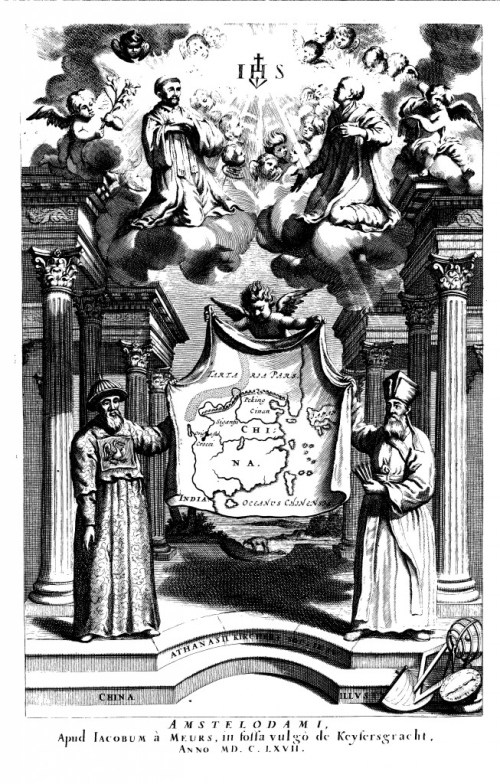
kircher_093-653x1024

Athanasius Kircher (1602-80), frontispiece depicting Adam Schall and Matteo Ricci holding a map of China, China Illustrata, 1667, courtesy of Stanford University. This work is in the public domain in its country of origin and other countries and areas where the copyright term is the author’s life plus 100 years or less.

“Although today many are still of the opinion that images provide a means of communication that can overcome language barriers, the explanation of the way in which images can accomplish this by now takes one of two forms: the Egyptian and the Chinese way.

The Egyptian way today belongs only to art history. We believe that visual media such as paintings, sequences in films, etc. are “texts” which convey emotions and feelings that could not be expressed verbally: we cannot represent by mere words Mona Lisa to a blind person.

The meanings that such texts can express are multiple, because there is no universal code: the rules of representation (and of recognizability) for an Egyptian mural, an Arab miniature, a painting by Turner or a comic strip are simply not the same in each case.

It is true that some ideograms have been used as characters of a universal code, for instances many road signals; in the same vein we are using more or less universal pictograms (think of the schematic crossed knives and forks which signal a restaurant in an airport, or of the stylized “ladies” and “gentlemen” on public lavatory doors).

Sometimes visual signs are merely substituting alphabetical letters, as happens with semaphores or flag signals; sometimes a yellow flag meaning “contagious disease on board” simply stands for a verbal sentence (cf. Prieto 1966).

Likewise, the gestural languages of Trappist monks, Indian merchants, gypsies or thieves, as well as the drummed and whistled languages of certain tribes (cf. Le Barre 1964), are equally dependent on the model of natural languages.

As useful, convenient and ingenious as some of these systems of communication may be, they make no claims to being “perfect” languages in which philosophers might one day wish to compose a treatise.

Any language of images is based on the alleged fact that images exhibit some properties of the represented things. Yet in any representable thing there will always be a multitude of properties, and there are infinite points of view under which an image can be judged similar to something else. Moreover, “that a picture looks like nature often means only that it looks the way nature is usually painted” (Goodman 1968: 39).

We can see this by looking at the various versions of a semiotic apparatus (if not a true language) which remained alive for centuries and which flowered in the same period when the western culture was looking for perfect visual languages: the arts of memory (cf. Rossi 1960; Yates 1966).

An art of memory establishes at its expression-plane a system of loci (that is, of places in the literal sense of the word) which may be imagined as the rooms of a building or palace, or as an urban street or square.

This system of loci is destined to house a set of images, drawn from the same iconographical field, which will play the role of lexical units. The content-plane is given by a system of res memoranda, in other words, of things to be remembered, usually belonging to the same conceptual framework. In this way, an art of memory is a semiotic system.

For instance, in mnemonic systems like those presented by the Congestorius artificiosae memoriae by Romberch (1520), the Dialogo del modo di accrescerce e conservare la memoria by Dolce (1575), or the Artificiosae memoriae fundamenta by Paepp (1619), the system of grammatical cases is expressed (and thus recalled) by the different parts of the human body.

Not only is this a case of one system expressing another system; it is also a case where the two planes are (in Hjelmslev‘s sense) conformal. It is not arbitrary that the head stands for nominative, the chest, which can receive blows, stands for accusative, and the hands, which possess and offer, stand for genitive and dative, and so on.

This shows that a mnemonic image, in order to express its content easily, should evoke it by similarity. But no mnemonic system was ever able to find a univocal criterion of resemblance.

The criteria are the same as those that linked the signature to its signatum. If we look back and see (ch. 6) what Paracelsus had to say about the language of Adam, the Protoplastus, we see that he represented him as naming one animal on the basis of a morphological similarity (from which a virtue derived), while, in another case, the name derived directly from a virtue not manifested by the form of the object.

In other cases, the name that Adam gave reflected neither morphology nor causal relations, but was inferred symptomatically: for instance, the horn of the stag permitted us to infer the age of the animal from the complexity of its branching.”

Umberto Eco, The Search for the Perfect Language, translated by James Fentress, Blackwell. Oxford, 1995, pp. 168-71.
Eco: Kabbalism and Lullism in Modern Culture

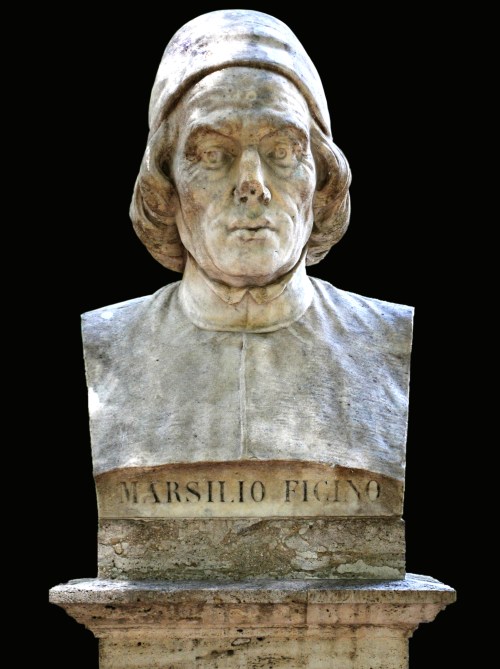
Marsilio_Ficino

Marsilio Ficino (1433-99), a bust published in “Marsilio Ficino and Renaissance Neoplatonism,” by Nicholas Goodrick-Clarke, on Rosicrucian.org. This work is in the public domain in its country of origin and other countries and areas where the copyright term is the author’s life plus 100 years or less. 

“Hebrew was not the only beneficiary of the passion for archaic wisdom that gripped scholars from the end of the Middle Ages onwards. The dawn of the modern era also saw a revival of interest in Greek thought and in the Greek’s fascination with Egypt and its mysterious hieroglyphic script (see ch. 7).

Greek texts were rediscovered and enthusiastically assigned an antiquity they did not, in fact, possess. They included the Orphic Hymns, attributed to Orpheus, but, in fact, written probably between the second and third centuries AD; the Chaldean Oracles, also written in the second century, but attributed to Zoroaster; and, above all, the Corpus Hermeticum.

This was a compilation acquired in 1460 for Cosimo de’ Medici in Florence, and immediately rushed to Marsilio Ficino so that he might translate it.

This last compilation, as was later shown, was the least archaic of all. In 1614, by using stylistic evidence and by comparing the innumerable contradictions among the documents, Isaac Casaubon, in his De rebus sacris et ecclesiasticis, showed that it was a collection of texts by different authors, all writing in late Hellenistic times under the influences of Egyptian spirituality.

None of this was apparent in 1460, however. Ficino took the texts to be archaic, directly written by the mythical Hermes or Mercurius Trismegistus.

Ficino was struck to discover that his account of the creation of the universe resembled that of Genesis, yet–he said–we should not be amazed, because Mercurius could be none other than Moses himself (Theologica platonica, 8, 1).

This enormous historical error, as Yates says, was destined to have surprising results (1964: 18-9).

The Hermetic tradition provided a magico-astrological  account of the cosmos. Celestial bodies exercise their power and influence over earthly things, and by knowing the planetary laws one can not only predict these influences, but also manipulate them.

There exists a relation of sympathy between the universal macrocosm and the human microcosm, a latticework of forces which it is possible to harness through astral magic.

Astral magic was practiced through words and other signs, because there is a language by which human beings can command the stars. Such miracles can be performed through “talismans,” that is, images which might guarantee safe recovery, health or physical prowess.

In his De vita coelitus comparanda, Ficino provided a wealth of details concerning how such talismans were to be worn; how certain plants linked by sympathy to certain stars were to be consumed; how magical ceremonies were to be celebrated with the proper perfumes, garments and songs.

Talismanic magic works because the bond which unites the occult virtues of earthly things and the celestial bodies which instilled them is expressed by signatures, that is, formal aspects of material things that recall certain features (properties or powers) of the corresponding heavenly bodies.

God himself has rendered the sympathies between macrocosm and microcosm perceptible by stamping a mark, a sort of seal, onto each object of this world (cf. Thorndike 1923-58; Foucault 1966; Couliano 1984; Bianchi 1987).

In a text that can stand as the foundation for such a doctrine of signatures, Paracelsus declared that:

“The ars signata teaches the way in which the true and genuine names must be assigned to all things, the same names that Adam, the Protoplastus, knew in the complete and perfect way [ . . . ] which show, at the same time, the virtue, the power, and the property of this or that thing. [ . . . ]

This is the signator who signs the horns of the stag with branches so that his age may be known: the stag having as many years as his horns have branches. [ . . . ] This is the signator who covers the tongue of a sick sow with excrescences, so that her impurity may be known; if the tongue is impure so the whole body is impure.

This is the signator who tints the clouds with divers colors, whereby it is possible to forecast the changes of the heavens. (De natura rerum, I, 10, “De signatura rerum“).”

Even the Middle Ages were aware that “habent corpora omnia ad invisibilia bona simulitudinem” (Richard of Saint Victor, Benjamin Major, PL, 196, 90): all bodies possess qualities which give them similarities with invisible goods.

In consequence, every creature of the universe was an image, a mirror reflecting our terrestrial and supernatural destinies. Nevertheless, it did not occur to the Middle Ages that these images might speak in a perfect language.

They required interpretation, explication and comment; they needed to be enclosed in a rational didactic framework where they could be elucidated, deciphered, in order to make clear the mystical affinities between a symbol and its content.

For Renaissance Platonism, by contrast, the relation between the images and the ideas to which they referred was considered so intuitively direct that the very distinction between a symbol and its meaning disappeared (see Gombrich 1972: “Icones Symbolicae,” v).

Umberto Eco, The Search for the Perfect Language, translated by James Fentress, Blackwell. Oxford, 1995, pp. 117-9.